


Abstract
Domestication has profoundly shaped the phenotypic differentiation and genetic architecture of Perilla. However, analyses of the morphological difference between its cultivated and weedy forms across its varieties remains incomplete. This study analyzed morphological variation, genetic diversity, population structure, and marker–trait associations of 45 accessions representing the cultivated and weedy forms of two Perilla varieties (P. frutescens var. frutescens and var. crispa) collected from South Korea and Japan. Analyses of ten qualitative and quantitative agronomic traits revealed clear domestication-related differentiation. Cultivated var. frutescens showed larger and heavier seeds, whereas cultivated var. crispa and the weedy accessions were characterized by longer inflorescences and higher floret numbers but smaller seeds. Strong positive correlations were observed among seed-related traits, particularly between seed size and seed weight (r = 0.932), indicating coordinated selection of seed traits. Genetic diversity analysis using 70 SSR markers identified 330 alleles consistent with domestication bottlenecks in cultivated forms while higher diversity was generally retained in the weedy accessions. Population structure, UPGMA clustering, and principal coordinate analyses broadly differentiated the cultivated and weedy accessions, although partial admixture indicated shared ancestry and historical gene flow. Association mapping using Q-based GLM and Q + K MLM models identified 23 significant marker–trait associations involving 16 SSR markers consistently detected across both models. Several markers were associated with multiple traits, implying pleiotropy or tight genetic linkage. Notably, five SSR markers (KNUPF192, KNUPF202, KNUPF207, KNUPF230, and KNUPF238) may represent potential candidate loci for marker-assisted selection to improve seed-related traits in var. frutescens and leaf-related traits in var. crispa.
1. Introduction
Perilla frutescens (L.) Britt. is a tetraploid species (2n = 40 = 4x) belonging to the family Lamiaceae and is predominantly self-pollinating. Native to East Asia, Perilla has been cultivated for centuries as both an oilseed and leafy vegetable crop [1,2,3]. Based on its morphological differentiation and patterns of utilization, P. frutescens is broadly classified into two major varieties: P. frutescens var. frutescens (PFF) and P. frutescens var. crispa (PFC). PFF is primarily cultivated for seed oil production, but it is also widely consumed as a leafy vegetable, particularly in South Korea. Its seeds contain approximately 46–48% oil, of which α-linolenic acid accounts for 65–75% of the total fatty acid content, making PFF one of the richest known plant sources of omega-3 fatty acids [4]. Beyond its nutritional value, recent studies have reported anticancer and immunoregulatory activities in PFF-derived compounds, highlighting its potential as a functional food crop [5]. In contrast, PFC is mainly used as a leafy vegetable and medicinal herb, especially in Japan, and is characterized by high concentrations of bioactive compounds such as rosmarinic acid, perillaldehyde, luteolin, and anthocyanins, which confer antioxidant, anti-inflammatory, and immunomodulatory properties [6]. Increasing global demand for health-promoting foods has expanded the cultivation and utilization of Perilla beyond East Asia, thereby enhancing its economic value and breeding importance worldwide [7,8].
Despite sharing the same chromosome number and having full inter-fertility, PFF and PFC exhibit pronounced phenotypic divergence driven by domestication and artificial selection. Key domestication-related traits, including seed size, seed coat hardness, dormancy, leaf pigmentation, and aromatic compound composition, differ between the two varieties and between their cultivated and weedy forms [9,10,11,12]. These phenotypic differences reflect underlying shifts in their genetic architecture associated with resource allocation, reproductive strategy, and secondary metabolite biosynthesis. Cultivated PFF has experienced strong selection for seed-related traits, resulting in large, soft seeds with uniform germination that facilitate mechanical harvesting and enhance oil yield and quality. In South Korea, PFF cultivars such as ‘sodam’ and ‘deulchan’ were developed for high α-linolenic acid content and are widely used for oil production, whereas ‘saebom’ was bred to maximize leaf yield for culinary purposes [13,14,15]. In contrast, cultivated PFC, although domesticated, retains many morphological features of its weedy counterpart (weedy P. frutescens var. crispa; WPFC), including small seeds with hard seed coats and a similar plant architecture [16]. As a result, cultivated PFC and WPFC are often difficult to distinguish based solely on morphological traits [16,17]. Nevertheless, PFC cultivars have been selectively bred for leaf quality and anthocyanin accumulation, leading to the development of Japanese cultivars such as ‘akarimen shiso’ and ‘chirimen red shiso’. In South Korea, intervarietal crosses between PFF and PFC have also produced anthocyanin-rich cultivars, including ‘neulbora’ and ‘saebora’ [18,19]. Weedy forms of Perilla, which are endemic to South Korea, represent important reservoirs of ancestral genetic variation. While weedy P. frutescens var. frutescens (WPFF) can be readily distinguished from cultivated PFF based on seed traits, cultivated PFC, particularly Japanese commercial cultivars, shows strong morphological similarity to South Korean WPFC populations. This close resemblance raises unresolved questions regarding genetic differentiation, introgression, and shared ancestry between the cultivated and weedy forms that cannot be resolved through phenotypic evaluation alone.
In minor crops such as Perilla, where high-quality reference genomes remain limited, simple sequence repeat (SSR) markers provide an effective framework for investigating genetic diversity, population structure, and domestication-related variation. Owing to their high polymorphism, co-dominant inheritance, and reproducibility, SSR markers remain particularly valuable for association mapping in genetically structured populations [20,21,22]. Although previous studies have developed SSR markers and examined genetic diversity in Perilla [23,24,25,26], most have focused on either the cultivated or weedy accessions, or on a single variety, limiting insights into shared and variety-specific genetic architectures. Moreover, association mapping linking SSR loci to domestication-related traits across both varieties and their cultivated and weedy forms remains limited [10,17,27].
This study presents the first integrative genetic analysis encompassing all four Perilla groups, the cultivated and weedy forms of both PFF and PFC, including commercial PFF and PFC cultivars, using a combined framework of morphological trait analysis, SSR-based genetic diversity assessment, population structure inference, and association mapping. A total of 45 Perilla accessions collected from South Korea and Japan were analyzed to capture the genetic variation across domesticated and weedy forms. Specifically, this study aimed to (i) identify the genetic differentiation underlying domestication-related morphological traits, (ii) resolve the population genetic structure and diversity across the cultivated and weedy forms, and (iii) detect the SSR markers associated with key agronomic traits reflecting divergent domestication strategies. By uncovering novel marker–trait associations and shared or variety-specific genetic patterns, this study advances our understanding of Perilla domestication and provides foundational resources for marker-assisted breeding and evolutionary research.
2. Results
2.1. Morphological Variation and Correlations Among Agronomic Traits in Cultivated and Weedy Perilla Accessions
Summary statistics for five qualitative and five quantitative traits measured in 45 cultivated and weedy Perilla accessions representing two Perilla varieties from South Korea and Japan are presented in Table 1. Comparative analysis among the four groups (PFF, PFC, WPFF, and WPFC) revealed clear morphological differentiation between the cultivated and weedy accessions.
Table 1.
Summary of morphological characteristics for five qualitative and five quantitative traits in 45 Perilla accessions representing four Perilla types (PFF, PFC, WPFF, and WPFC).
Qualitative traits exhibited distinct patterns of variation between the cultivated and weedy forms. Adaxial (QL1) and abaxial (QL2) leaf colors varied widely among the cultivated accessions, whereas the weedy accessions showed markedly reduced variation with largely conserved pigmentation patterns. This contrast was most pronounced in WPFC, in which all of the accessions consistently displayed a purple abaxial leaf color. Flower color (QL3) was predominantly white or light pink in the PFF and WPFF accessions, while pink flowers were more frequent in the PFC and WPFC accessions. Seed color (QL4) also differed substantially between the cultivated and weedy accessions, with predominantly darker seed colors in the weedy types. Seed hardness (QL5) further distinguished the cultivated and weedy forms. The PFF cultivars exhibited both soft and hard seeds, whereas all of the WPFF, PFC, and WPFC accessions consistently displayed hard seeds. Quantitative traits also differed among four groups. Mean plant height (QN1) was 140.0 cm in PFF, 129.5 cm in PFC, 141.3 cm in WPFF, and 117.1 cm in WPFC. Inflorescence length (QN2) and number of florets (QN3) were generally higher in the weedy accessions, particularly in WPFC. In contrast, seed-related traits showed pronounced differentiation between the cultivated and weedy forms, with mean seed size (QN4) and 100-seed weight (QN5) highest in the PFF cultivars and lowest in the WPFC accessions.
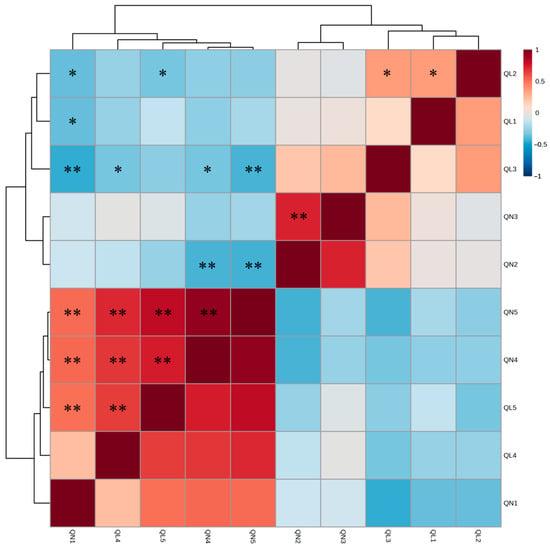
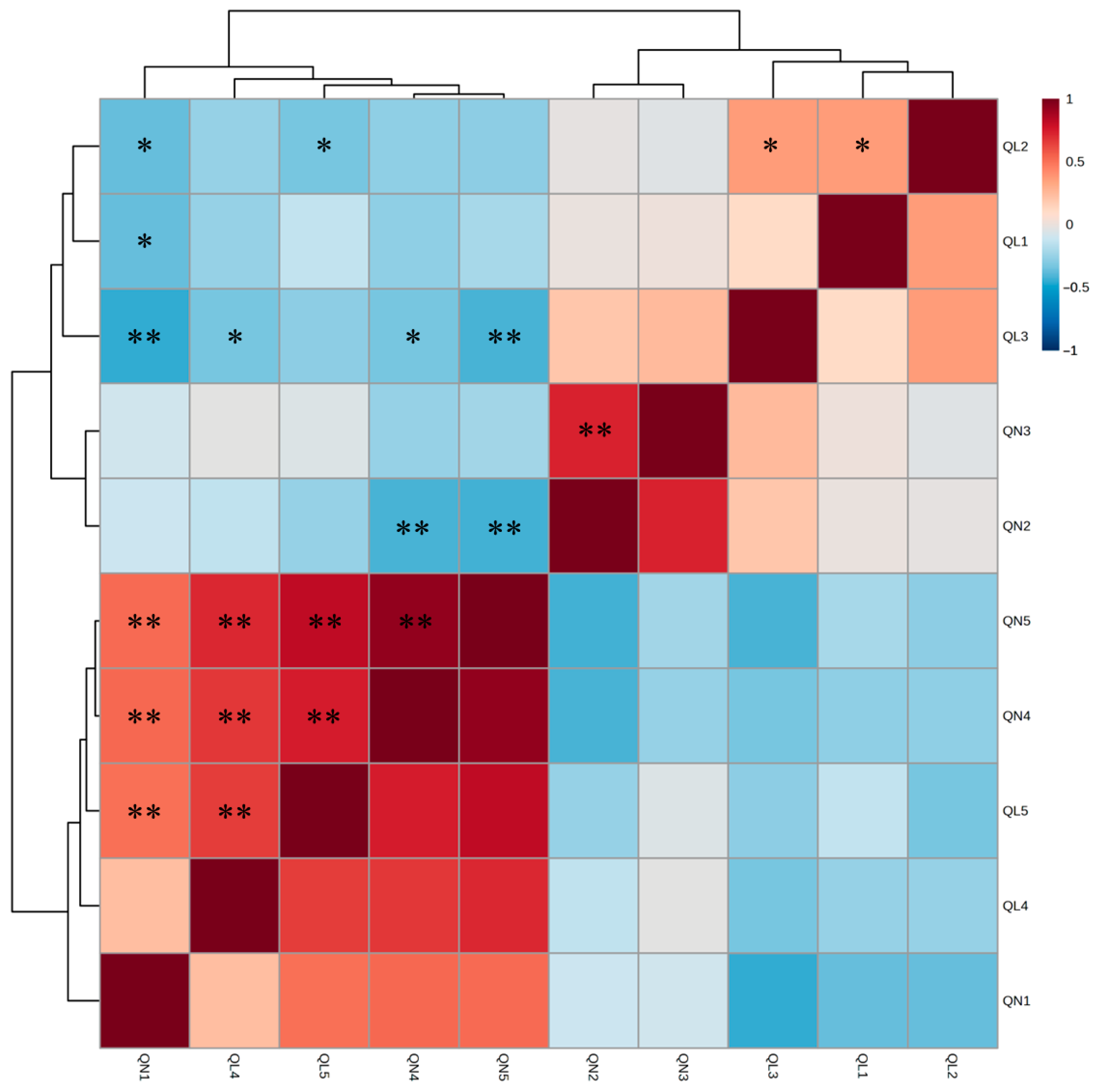
Correlation analysis among the five qualitative and five quantitative traits revealed numerous significant relationships (Figure 1; Supplementary Table S1). The strongest positive correlations were observed between seed color (QL4) and seed hardness (QL5), as well as between seed size (QN4) and 100-seed weight (QN5). Several negative correlations were also detected, indicating complex interrelationships among agronomic traits.
Figure 1.
Heatmap of correlation analysis results for 10 agricultural traits in 45 Perilla accessions. ** Significance at p < 0.01. * Significance at p < 0.05.
2.2. Genetic Diversity and Polymorphism of SSR Loci Among 45 Perilla Accessions
A set of 70 polymorphic Perilla SSR loci was utilized to assess genetic diversity (GD) among the 45 accessions representing the cultivated and weedy forms of the two Perilla varieties. Across all of the accessions, a total of 330 alleles were detected using the 70 Perilla SSR markers (Table 2). The number of alleles per locus ranged from 2 to 12, with an average of 4.7 alleles per locus. The GD across the loci ranged from 0.085 to 0.845, with a mean of 0.566. Similarly, the polymorphism information content (PIC) values ranged from 0.081 to 0.829, with an average of 0.506. The major allele frequency (MAF) values varied from 0.244 to 0.956, with a mean of 0.543. Allelic frequency distribution analysis revealed that, among the 330 alleles detected, private alleles accounted for 25%, rare alleles for 34%, intermediate-frequency alleles for 27%, and abundant alleles for 13% of the total alleles (Supplementary Figure S1), indicating substantial allelic heterogeneity across the cultivated and weedy accessions.
Table 2.
Estimates of allele number, MAF, GD, and PIC for 70 SSR primer sets in 45 Perilla accessions (11 PFF, 14 PFC, 10 WPFF, and 10 WPFC) collected from South Korea and Japan.
Genetic diversity was further examined separately for the four Perilla groups: cultivated P. frutescens var. frutescens (PFF, n = 11), weedy var. frutescens (WPFF, n = 10), cultivated P. frutescens var. crispa (PFC, n = 14), and weedy var. crispa (WPFC, n = 10) (Supplementary Table S2). The mean number of alleles per locus was highest in WPFF (3.1), followed by WPFC (2.7), and was lower in the cultivated groups (2.4 in both PFF and PFC). Correspondingly, the mean MAF values were highest in PFF (0.726) and PFC (0.704) and lower in WPFF (0.623) and WPFC (0.681). The mean GD values were 0.375 (PFF), 0.489 (WPFF), 0.383 (PFC), and 0.406 (WPFC), while the mean PIC values were 0.322, 0.437, 0.323, and 0.356 for PFF, WPFF, PFC, and WPFC, respectively (Supplementary Table S2). Overall, the weedy accessions consistently exhibited higher genetic diversity than the cultivated accessions, consistent with domestication-associated genetic bottlenecks.
2.3. Population Structure Analysis and Phylogenetic Relationships Between Cultivated and Weedy Perilla Accessions from South Korea and Japan
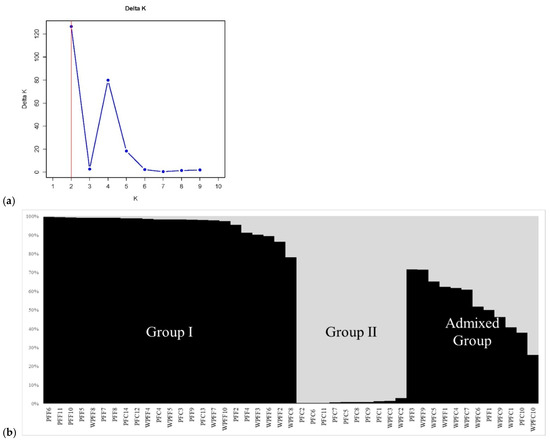
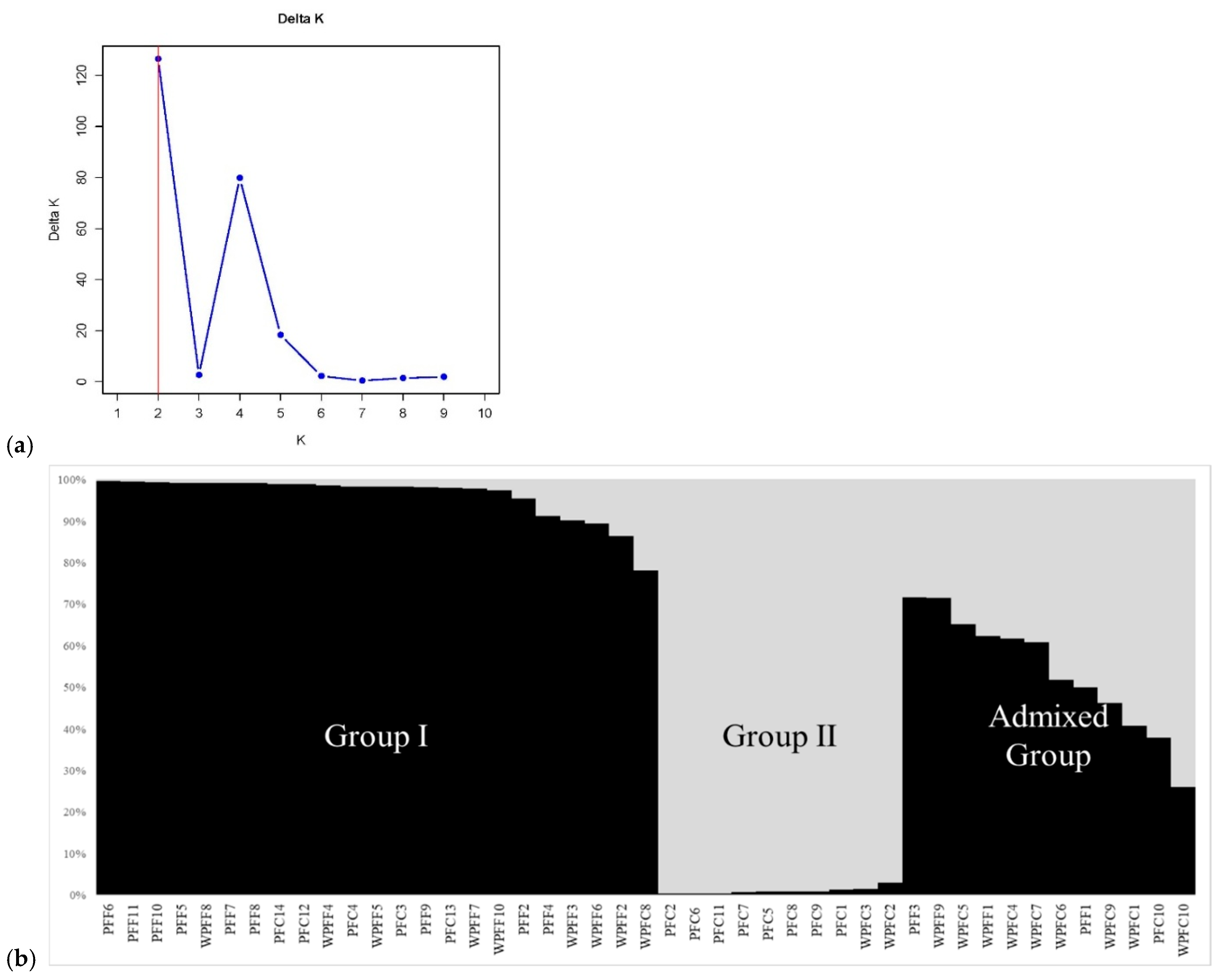
Population structure analysis (PSA) revealed a pronounced peak at K = 2 (Figure 2a). By applying a membership probability threshold of 0.75, the accessions were assigned into two major genetic groups (Groups I and II) and an admixed group (Figure 2b). Group I comprised 23 accessions, including 9 PFF cultivars, 5 PFC cultivars, 8 WPFF accessions, and 1 WPFC accession. Group II consisted of 10 accessions, including 8 PFC cultivars and 2 WPFC accessions. The remaining 12 accessions formed the admixed group, containing 2 PFF cultivars, 1 PFC cultivar, 2 WPFF accessions, and 7 WPFC accessions. This pattern indicates partial genetic differentiation between cultivated and weedy forms, accompanied by substantial admixture, particularly among the WPFC accessions.
Figure 2.
Magnitude of ∆K as a function of K; the peak value of ∆K was at K = 2 (a). Population structure of four Perilla types inferred from 45 accessions using 70 SSR markers at K = 2 (b).
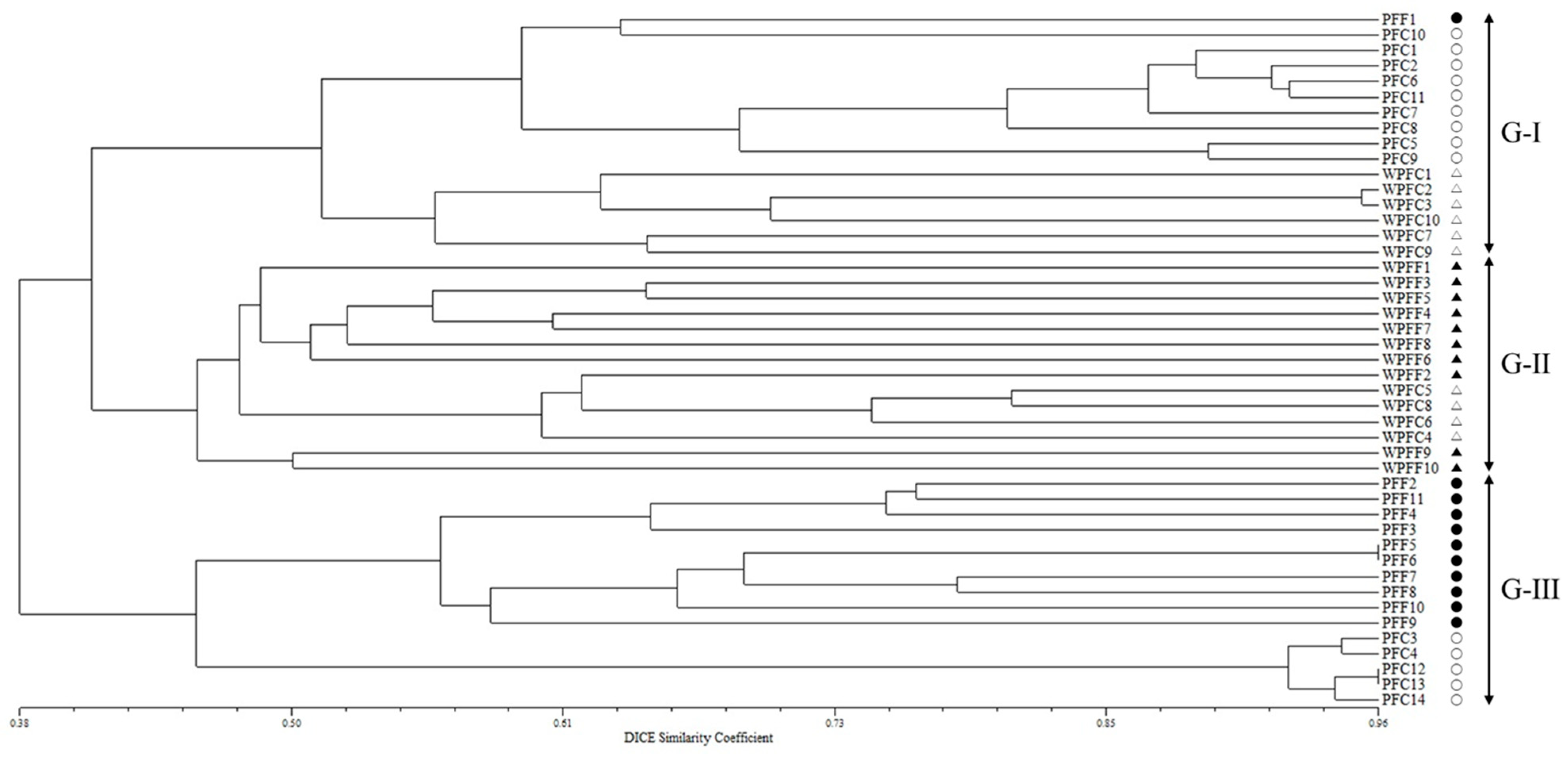
Based on the phylogenetic analysis, the 45 accessions were classified into three major clusters at a genetic similarity (GS) threshold of 45% (Figure 3). Group I included 1 PFF cultivar, 9 PFC cultivars, and 6 WPFC accessions; Group II consisted exclusively of weedy accessions (10 WPFF and 4 WPFC); and Group III contained 10 PFF and 5 PFC cultivars. Overall, most of the cultivated PFF and PFC cultivars were clearly separated from the weedy WPFF and WPFC accessions, although the two weedy groups were not distinctly differentiated from each other. In addition, the cultivated PFF and PFC cultivars were generally well separated, with only a few exceptions.
Figure 3.
UPGMA dendrogram of 45 Perilla accessions (11 PFF, 14 PFC, 10 WPFF, and 10 WPFC) collected from South Korea and Japan, constructed using 70 newly developed Perilla SSR markers (●, PFF; ○, PFC; ▲, WPFF; △, WPFC).
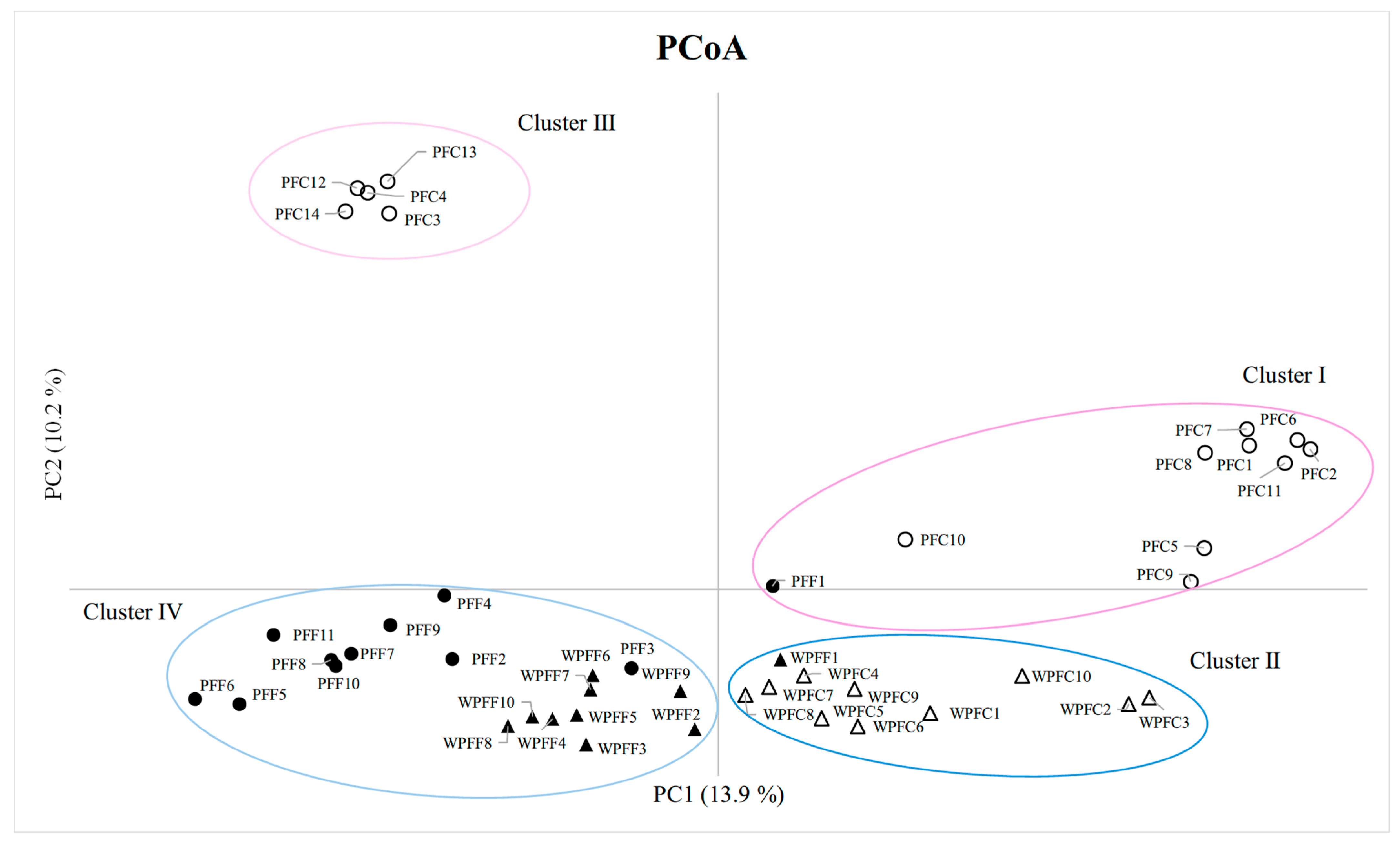
To further resolve the genetic differentiation among the four Perilla types (PFF, PFC, WPFF, and WPFC), principal coordinate analysis (PCoA) was conducted based on genetic distance. The first two principal coordinates explained 24.1% of the total genetic variation, with PC1 and PC2 accounting for 13.9% and 10.2%, respectively (Figure 4). The PCoA scatter plot revealed four major clusters. Cluster I included 9 PFC cultivars (PFC1, PFC2, PFC5–PFC11) together with 1 PFF cultivar (PFF1), while Cluster II consisted of 1 WPFF accession (WPFF1) and all 10 WPFC accessions (WPFC1–WPFC10). Cluster III comprised 5 PFC cultivars (PFC3, PFC4, PFC12, PFC13, and PFC14), whereas Cluster IV contained 10 PFF cultivars (PFF2–PFF11) and 9 WPFF accessions (WPFF2–WPFF10). In general, the PFC and WPFC accessions were distributed on the positive side of PC1, whereas the PFF and WPFF accessions were located on the negative side. However, several accessions (PFF1, WPFF1, PFC3, PFC4, PFC12, PFC13, and PFC14) showed intermediate positions and were not clearly separated. Overall, the clustering patterns observed in the PCoA were largely congruent with those revealed by the UPGMA dendrogram (Figure 3).
Figure 4.
Principal coordinates analysis (PCoA) of 45 Perilla accessions (11 PFF, 14 PFC, 10 WPFF, and 10 WPFC) collected from South Korea and Japan based on 70 newly developed Perilla SSR markers (●, PFF; ○, PFC; ▲, WPFF; △, WPFC).
The analysis of molecular variance (AMOVA) assessing genetic differentiation among and within the 45 Perilla accessions representing the four Perilla types (PFF, PFC, WPFF, and WPFC) is presented in Supplementary Figure S2. The results indicated that 28% of the total genetic variation was attributable to differences among the four Perilla types, whereas the remaining 72% was explained by variation within the types.
2.4. Marker–Trait Associations for Ten Morphological Traits in 45 Perilla Accessions Using Q GLM and Q + K MLM
Marker–trait associations detected as significant in both the Q GLM and Q + K MLM models were regarded as robust associations. Association mapping analyses (AMA) were performed between 70 SSR markers and ten morphological traits (five qualitative and five quantitative traits) across the 45 Perilla accessions using both the Q-based general linear model (Q GLM) and the Q + K mixed linear model (Q + K MLM). Using the Q GLM, a total of 226 significant marker–trait associations involving 59 SSR markers were detected across the ten traits (Supplementary Table S3). At significance thresholds of p < 0.05 or p < 0.01, the number of associated markers per trait was 7 for QL1, 10 for QL2, 18 for QL3, 25 for QL4, 28 for QL5, 30 for QN1, 18 for QN2, 10 for QN3, 39 for QN4, and 41 for QN5.
To reduce false-positive associations arising from population structure and kinship, AMA was further conducted using the more stringent Q + K MLM. Compared to the Q GLM, the Q + K MLM identified substantially fewer significant associations. Using this model, 26 significant marker–trait associations involving 18 SSR markers were detected for the ten morphological traits at p < 0.05 or p < 0.01 (Supplementary Table S3). The number of associated markers per trait under the Q + K MLM was two for QL1, one for QL2, three for QL3, four for QL4, one for QL5, one for QN1, two for QN2, three for QN3, three for QN4, and six for QN5. The reduced number of significant associations detected by the MLM model likely reflects its ability to more effectively control false positives by accounting for both population structure and kinship relationships among accessions.
Comparison of the results obtained from the two models identified 23 overlapping significant marker–trait associations (SMTAs) involving 16 SSR markers (Table 3). Since these SMTAs were consistently detected by both approaches, they are considered robust associations. Among these SMTAs, two markers were associated with QL1; one with QL2; three with QL3; two with QL4; one with QL5; one with QN1; two with QN2; three with QN3; two with QN4; and six with QN5. Notably, several SSR markers were associated with multiple qualitative or quantitative traits: KNUPF192 with QL1 and QN2; KNUPF230 with QL3, QN4, and QN5; KNUPF207 with QN4 and QN5; KNUPF238 with QL4, QN4, and QN5; and KNUPF202 with QN2 and QN3. This suggests potential pleiotropic effects or tight genetic linkage among loci for related phenotypes.
Table 3.
Significant marker–trait associations (SMTAs) for 10 traits identified using the GLM and MLM models in 45 Perilla accessions representing four Perilla types (PFF, PFC, WPFF, and WPFC).
3. Discussion
3.1. Genetic Variation and Morphological Differentiation Between Cultivated and Weedy Types of the Two Perilla Varieties
Morphological variation between the cultivated and weedy types of the two Perilla varieties provides important taxonomic evidence for understanding their evolutionary history and domestication processes [2,16]. In East Asia, Perilla has traditionally been classified into two cultivated varieties, PFF and PFC, based on their primary uses as seed oil crops or as leafy vegetables and medicinal plants, respectively [2,16,29]. Although true wild relatives of cultivated Perilla have not been identified in this region, corresponding weedy forms (WPFF and WPFC) were reported for both varieties by Nitta and Ohnishi (1999) [30] and Lee and Ohnishi (2001) [16]. In South Korea, weedy Perilla accessions are commonly observed in disturbed habitats such as field margins, farmhouse surroundings, and roadside environments, where they are often regarded as descendants of escaped or hybridized cultivated forms. In contrast, clearly identifiable weedy populations have been reported less frequently in Japan. Previous studies have suggested that the domestication status of the two Perilla varieties differs substantially. For example, Lee and Ohnishi (2001, 2003) [16,31] reported little morphological or AFLP differentiation between Japanese PFC cultivars and weedy WPFC accessions from South Korea, suggesting that PFC may represent a relatively weakly differentiated or semi-domesticated form.
In the present study, a comprehensive morphological trait analysis was therefore conducted as a preliminary step toward developing molecular markers associated with phenotypic traits distinguishing the cultivated and weedy forms of the two Perilla varieties. Among the 20 qualitative and quantitative traits examined, five qualitative (QL1–QL5) and five quantitative (QN1–QN5) traits were identified as the most effective in discriminating between the cultivated and weedy forms [28]. The cultivated Perilla accessions (PFF and PFC) exhibited greater phenotypic diversity in qualitative traits, such as leaf pigmentation and seed hardness, reflecting directional selection under human cultivation, whereas the weedy accessions (WPFF and WPFC) showed more uniform traits consistent with stabilizing selection in unmanaged environments. Seed-related traits were particularly informative indicators of domestication. Cultivated PFF was characterized by soft seeds, larger seed size, and higher 100-seed weight, whereas cultivated PFC and the weedy accessions (WPFF and WPFC) consistently exhibited hard seeds and markedly lower seed mass (Table 1). These patterns likely reflect divergent selection pressures, with artificial selection enhancing seed-related traits in cultivated PFF, whereas the reduced seed mass observed in cultivated PFC and the weedy accessions (WPFF and WPFC) suggests weak or absent directional selection in non-domesticated populations. Overall, these morphological differences are consistent with domestication signatures reported for seed-bearing crops [10,32].
Genetic diversity analysis using 70 SSR loci detected a total of 330 alleles among the 45 Perilla accessions, with 2–12 alleles per locus (mean = 4.7). Approximately 25% of the alleles were private alleles unique to specific groups, while rare and intermediate-frequency alleles accounted for 34% and 27%, respectively, indicating substantial allelic variation across the Perilla accessions (Supplementary Figure S1). Mean GD values for the PFF, WPFF, PFC, and WPFC accessions were 0.375, 0.489, 0.383, and 0.406, respectively, with corresponding PIC values of 0.322, 0.437, 0.323, and 0.356 (Supplementary Table S2). The KNUPF194 marker exhibited fewer allelic fragments in cultivated PFF accessions than in cultivated PFC and weedy WPFF and WPFC accessions (Supplementary Figure S3). This allelic pattern clearly distinguished most cultivated PFF accessions from cultivated PFC and weedy accessions, although several exceptions were observed. Despite the relatively limited number of accessions analyzed, the diversity patterns distinguishing the cultivated and weedy types of the two Perilla varieties were consistent with those reported in previous studies using AFLP [1,31] and SSR markers [24,26,33].
As previously reported by Lee and Ohnishi (2003) [31], the higher genetic variation observed in weedy accessions likely reflects weak artificial selection and the retention of ancestral variation, whereas the reduced diversity in cultivated accessions may result from domestication-related bottlenecks and directional selection. Similar patterns have been reported in many domesticated crops, in which cultivated populations typically exhibit lower genetic diversity than their wild or weedy counterparts [31,34,35,36,37]. However, an important limitation of the present study is the geographical imbalance of the sampled accessions. Most cultivated PFC cultivars analyzed in this study were obtained from Japan, whereas the weedy accessions were collected from South Korea. Consequently, varietal identity, domestication status, and geographic origin are partially confounded in the current sampling design, which may influence the interpretation of the population structure and clustering analyses. For example, the clustering pattern observed at K = 2 in the STRUCTURE analysis may indicate differentiation between cultivated and weedy types, but it may also partly reflect geographic genetic differentiation between Korean and Japanese populations. Similar patterns were observed in the PCoA and UPGMA analyses, where the separation between cultivated and weedy accessions may likewise be influenced by geographic origin. Furthermore, some of the marker–trait associations detected in the association mapping analysis may partly reflect underlying population structure rather than direct causal relationships with domestication-related traits.
Therefore, the genetic differentiation and marker–trait associations identified in this study should be interpreted with caution. Future studies incorporating more geographically balanced sampling, including additional cultivated and weedy accessions from both South Korea and Japan, will be necessary to more clearly disentangle the relative contributions of domestication, varietal differentiation, and geographic population structure.
3.2. Trait Correlations, Population Structure, and Phylogenetic Relationships of Cultivated and Weedy Types of Two Perilla Varieties from South Korea and Japan
Correlation analysis revealed strong relationships among several phenotypic traits, particularly among seed-related characteristics such as seed color, seed hardness, seed size, and seed weight. Notably, seed size (QN4) and 100-seed weight (QN5) showed an exceptionally high correlation (r = 0.932), indicating close functional and developmental integration. Such correlations likely reflect coordinated selection on seed traits during the domestication process, particularly in PFF, which has been domesticated primarily as an oil crop. In contrast, cultivated PFC and the weedy accessions tend to produce relatively smaller seeds while maintaining higher reproductive output, suggesting different resource allocation strategies between seed-type and leaf-type cultivars. Trade-offs between reproductive output and individual seed investment have been widely reported in plant life-history studies [38,39,40]. Consistent with this pattern, cultivated PFF exhibits increased seed size as a result of artificial selection, whereas cultivated PFC and the weedy accessions maintain higher reproductive output with relatively smaller seeds [16,31]. Because cultivated PFC is primarily grown for leaf production in Japan, selection pressure on seed-related traits may have been relatively weak. Notably, the PFC cultivars displayed pronounced genetic heterogeneity, with several accessions (e.g., PFC3, PFC4, and PFC12–14) forming distinct clusters in both PCoA and UPGMA analyses, whereas others clustered with additional PFC and PFF cultivars. Collectively, these patterns suggest that Perilla domestication involved shifts in resource allocation strategies, favoring increased investment in individual seeds over reproductive fecundity in seed-type cultivars. Furthermore, the observed associations between qualitative morphological traits (e.g., leaf and flower color) and quantitative seed characteristics suggest that easily observable phenotypes may serve as proxies for underlying life-history strategies, thereby enhancing the efficiency of phenotypic selection and germplasm evaluation in breeding programs.
On the other hand, PSA consistently resolved two major genetic groups corresponding to the two Perilla varieties, reflecting their deep evolutionary divergence (Figure 2). Despite this clear varietal separation, extensive admixture was observed between the cultivated and weedy accessions within each variety. The absence of distinct genetic boundaries between the cultivated and weedy forms suggests ongoing or historical gene flow, incomplete reproductive isolation, and repeated feralization events [32]. This interpretation is further supported by the AMOVA results (Supplementary Figure S2), which showed that genetic variation among the 45 Perilla accessions was predominantly structured within rather than among the four Perilla types (PFF, PFC, WPFF, and WPFC). Only 28% of the total genetic variation was attributable to differences among the Perilla types, whereas the majority (72%) resided within the types, indicating substantial intra-type genetic diversity. Consistent with these findings, UPGMA clustering and PCoA analyses (Figure 3 and Figure 4) revealed broadly overlapping yet partially differentiated genetic clusters associated with varietal identity and domestication status. In both analyses, the cultivated PFF and PFC cultivars generally formed distinct groups relative to the weedy WPFF and WPFC accessions and to each other. However, several exceptions were observed, and genetic differentiation between the two weedy groups remained weak. Notably, the close clustering of several weedy accessions with their cultivated counterparts suggests that some weedy forms may have arisen repeatedly through natural hybridization between the cultivated and weedy populations or through derivation from wild progenitors, as previously reported by Lee and Ohnishi (2003) [31], Sa et al. (2013) [41], and Fu et al. (2023) [42]. Such genetic patterns are characteristic of crop–weed complexes, in which taxonomic and genetic boundaries are often diffuse due to bidirectional gene flow and recurrent escape from cultivation, as documented in brassicas, rice, and other domesticated crops [43,44]. Taken together, the genetic patterns observed in this study suggest that differentiation in Perilla likely occurred along a crop–weed continuum characterized by recurrent gene flow and incomplete divergence between cultivated and weedy populations.
3.3. Marker–Trait Associations and Genetic Architecture of Agronomic Traits
In this study, AMA was conducted using genotypic data from 70 newly developed Perilla SSR markers and phenotypic data for ten agronomic traits across 45 accessions representing cultivated and weedy types of two Perilla varieties. AMA performed using both the Q GLM and the Q + K MLM models identified a subset of marker–trait associations that were consistently detected across both models (Supplementary Table S3). As observed in previous association-mapping studies, the number of significant associations was substantially reduced under the more stringent Q + K MLM model, demonstrating the importance of accounting for population structure and kinship to minimize false-positive associations [45]. Across both models, a total of 23 overlapping SMTAs involving 16 SSR markers were identified (Table 3). Associations consistently detected across statistical models are generally considered to represent loci with robust effects across diverse genetic backgrounds. The moderate coefficients of determination (R2) observed for most SMTAs suggest that the evaluated traits are governed by a polygenic architecture comprising multiple loci with small to moderate effects, rather than by single major-effect genes [46]. Notably, several SSR markers were significantly associated with multiple qualitative or quantitative traits, indicating potential pleiotropic effects or tight genetic linkage among the loci for related phenotypes. Specifically, KNUPF192 was associated with QL1 and QN2; KNUPF202 with QN2 and QN3; KNUPF207 with QN4 and QN5; KNUPF230 with QL3, QN4, and QN5; and KNUPF238 with QL4, QN4, and QN5. Several pairs of marker-associated traits, namely QN2 and QN3, QN4 and QN5, and QL4 and QN5, exhibited strong phenotypic correlations (Figure 1; Supplementary Table S1), suggesting coordinated genetic regulation. However, it should be noted that the association analysis in this study was conducted using a relatively limited number of accessions. Small population sizes may reduce statistical power and increase the likelihood of detecting spurious marker–trait associations [47]. Because of this limitation, strict multiple testing correction methods, such as the false discovery rate (FDR), were not applied, and the identified associations should therefore be interpreted with caution. Accordingly, the SMTAs identified in this study should be regarded as preliminary signals rather than definitive causal relationships. Further validation using larger populations, independent germplasm panels, or integrative approaches combining high-density genomic markers, genome-wide association analyses, and functional genomic studies will be necessary to elucidate the genetic basis of these traits.
Previous studies have reported Perilla SSR primer sets associated with leaf- and seed-related traits in cultivated and weedy accessions of two Perilla varieties [10,17,25]. Building on this foundation, the present study expands the available genomic resources by applying 70 newly developed SSR primer sets [48] to the integrated analyses of genetic diversity, population structure, and association mapping. Despite these advances, informative SSR markers for Perilla remain relatively limited, constraining detailed evaluations of GD, PIC, PSA, and AMA across the cultivated and weedy accessions. Accordingly, the genetic information generated in this study represents a valuable resource for future genetic and breeding research for Perilla. In particular, five SSR markers (KNUPF192, KNUPF202, KNUPF207, KNUPF230, and KNUPF238) associated with multiple qualitative and quantitative traits were identified as candidate markers requiring further validation for potential phenotypic improvement in both cultivated and weedy Perilla types. Markers linked to seed-related traits (QN4 and QN5) may be particularly relevant for improving PFF cultivars with enhanced oil yield, whereas markers associated with qualitative leaf traits (QL1 and QL2) may contribute to the development of improved PFC cultivars with desirable leaf characteristics and potentially enhanced bioactive compound content.
Collectively, these findings provide an integrated view of phenotypic variation, genetic diversity, and trait architecture across cultivated and weedy types of the two Perilla varieties. The combined morphological, population genetic, and association analyses highlight the dynamic evolutionary interplay between domesticated and weedy Perilla types. Nevertheless, several limitations should be acknowledged. First, the total number of accessions analyzed (n = 45) is relatively small for association mapping analyses. Such a limited sample size may reduce the statistical power to detect true marker–trait associations and increase the likelihood of false-positive signals. In addition, correlations among morphological traits may be overestimated when the number of observations is limited. Therefore, the marker–trait associations identified in this study should be regarded as preliminary and interpreted with caution. Second, the geographical origins of the sampled germplasm were not fully balanced. Most cultivated PFC accessions were obtained from Japan, whereas the weedy accessions were collected from South Korea. As a result, geographical origin, varietal identity, and domestication status are partially confounded in the present dataset. Consequently, some of the genetic differentiation patterns and marker–trait associations observed in this study may reflect geographic population structure rather than domestication-related divergence alone. Future studies incorporating larger germplasm collections with more balanced geographical representation will be necessary to disentangle the relative contributions of domestication, varietal differentiation, and geographic structure. In addition, the candidate marker–trait associations identified in this study should be validated using larger populations and independent germplasm panels.
4. Materials and Methods
4.1. Plant Materials and Morphological Characteristics of Cultivated and Weedy Perilla Accessions
A total of 45 Perilla accessions representing cultivated and weedy Perilla forms were analyzed. These accessions comprised 11 P. frutescens var. frutescens (PFF), 14 P. frutescens var. crispa (PFC), 10 weedy PFF (WPFF), and 10 weedy PFC (WPFC) accessions collected from South Korea and Japan (Supplementary Table S4). Among the cultivated accessions, 10 PFF cultivars were developed by the National Institute of Crop and Food Science, Rural Development Administration (RDA), South Korea, whereas 1 PFF cultivar and all of the PFC cultivars were developed by a private seed company in Japan. The weedy accessions (WPFF and WPFC) were collected in South Korea by the research team, as previously described by Lee et al. (2026) [28].
Morphological data for the 45 Perilla accessions were obtained from Lee et al. (2026) [28]. The dataset included five qualitative traits (adaxial leaf color (QL1), abaxial leaf color (QL2), flower color (QL3), seed color (QL4), and seed hardness (QL5)), and five quantitative traits (plant height (QN1), length of inflorescence (QN2), number of florets (QN3), seed size (QN4), and 100-seed weight (QN5) (Table 1). These traits were previously demonstrated to effectively discriminate between cultivated and weedy accessions based on principal component analysis and were therefore selected for subsequent trait association analyses in the present study.
4.2. DNA Extraction and SSR Analysis
Genomic DNA extracted from young leaf tissue was used as a template for PCR amplification using Perilla-specific SSR primer sets. A total of 70 SSR primer sets, developed previously by Lee et al. (2025) [48], were employed in this study (Supplementary Table S5). PCR amplifications were performed using an Ex Taq PCR kit (Takara, Ohtsu, Japan) in a final reaction volume of 20 µL containing 20 ng of genomic DNA, 1× PCR buffer, 0.5 µM of each forward and reverse primer, 0.2 mM dNTPs, and 1 U of Taq DNA polymerase (Biotools, Madrid, Spain). Thermal cycling conditions consisted of an initial denaturation at 94 °C for 5 min, followed by 35 cycles of denaturation at 94 °C for 30 s, annealing at 55 °C for 30 s, extension at 72 °C for 1 min 30 s, and a final extension at 72 °C for 5 min. The amplified PCR products were initially separated using a mini vertical electrophoresis system (MGV-202–33, CBS Scientific Company, San Diego, CA, USA). For fragment analysis, 3 µL of each PCR product was mixed with 3 µL of loading buffer containing 98% formamide, 0.02% xylene cyanol, 0.02% bromophenol blue, and 5 mM NaOH. Following denaturation and rapid cooling, 2 µL of the mixture was loaded onto a 6% denaturing polyacrylamide gel (7.5 M urea; 19:1 acrylamide:bisacrylamide) and electrophoresed in 0.5× TBE buffer at 250 V for 30 min. The DNA fragments were visualized by ethidium bromide staining, as shown in Supplementary Figure S3.
4.3. Data Analysis
The morphological trait data were analyzed using MetaboAnalyst 6.0 to generate correlation matrices among the traits. The SSR alleles amplified by the 70 Perilla SSR primer sets across the 45 cultivated and weedy accessions were scored as present (1) or absent (0). Genetic variation was evaluated based on the number of alleles, major allele frequency (MAF), genetic diversity (GD), and polymorphism information content (PIC). Genetic diversity (GD) within each group of Perilla accessions was estimated using Nei’s genetic diversity index [49], calculated as GD = 1 − ∑ Pi2, where Pi represents the frequency of the ith SSR allele within a group of Perilla accessions. For all 45 Perilla accessions and 70 Perilla SSR loci, the number of alleles, major allele frequency (MAF), and polymorphism information content (PIC) were calculated using PowerMarker version 3.25 [49,50]. Genetic similarity (GS) between pairs of cultivated and weedy accessions was estimated using the Dice similarity coefficient [51]. The resulting similarity matrix was used to construct a dendrogram using the unweighted pair group method with arithmetic mean (UPGMA) and to perform principal coordinate analysis (PCoA) based on the SAHN clustering algorithm implemented in NTSYS-pc version 2.1 [52].
To further examine the genetic relationships among the four Perilla types (PFF, PFC, WPFF, and WPFC), a phylogenetic tree was constructed using POPGENE version 1.32 [53] based on Nei’s genetic distance [54] and visualized using MEGA-X version 11.0.11 [55]. Population structure and phylogenetic relationships among the cultivated and weedy accessions of the two Perilla varieties from South Korea and Japan were investigated using 45 accessions representing the four Perilla types (PFF, PFC, WPFF, and WPFC). The population structure of the 45 Perilla accessions was inferred using a Bayesian clustering approach implemented in STRUCTURE version 2.3 [56]. The optimal number of genetic clusters (K) was determined using the ΔK method of Evanno et al. (2005) [57] implemented in the web-based program STRUCTURE HARVESTER. Analysis of molecular variance (AMOVA) was conducted using GenAlEx version 6.5 [58]. Finally, association mapping analysis (AMA) was performed using TASSEL version 3.0 [59] to identify marker–trait associations for the five qualitative and five quantitative morphological traits. Both a general linear model incorporating population structure (Q GLM) and a mixed linear model incorporating population structure and kinship (Q + K MLM) were applied following Mathiang et al. (2023) [45]. Because the number of accessions analyzed in this study was relatively limited, a strict multiple testing correction, such as the false discovery rate (FDR), was not applied. Therefore, the detected marker–trait associations should be interpreted cautiously and regarded as preliminary results requiring further validation. Basic statistical analyses were conducted using Microsoft Excel 2016, and correlation analyses of agronomic traits were performed using MetaboAnalyst 6.0 (Montreal, QC, Canada, https://www.metaboanalyst.ca (accessed on 26 January 2026)). The analysis showed that numerous trait pairs were significantly correlated, displaying either positive or negative relationships at the 0.05 and 0.01 significance levels.
5. Conclusions
Perilla frutescens comprises two varieties that are distinguished by their morphological characteristics and patterns of utilization in East Asia. In this study, 70 polymorphic SSR markers generated 330 alleles across 45 Perilla accessions representing cultivated (PFF and PFC) and weedy (WPFF and WPFC) forms from South Korea and Japan. The weedy accessions consistently exhibited higher genetic diversity than the cultivated forms, indicating that weedy populations retain greater levels of ancestral genetic variation. Phylogenetic analysis separated the 45 accessions into three major clusters, largely distinguishing cultivated and weedy types. However, several weedy accessions clustered together with cultivated groups, suggesting that some weedy forms may have arisen repeatedly through natural hybridization between cultivated and weedy populations. Association mapping using Q GLM and Q + K MLM models identified 23 significant marker–trait associations across 16 SSR markers. Five markers (KNUPF192, KNUPF202, KNUPF207, KNUPF230, and KNUPF238) were associated with multiple qualitative and quantitative traits, particularly seed size/weight and leaf pigmentation. These loci represent promising candidate markers for future marker-assisted selection aimed at improving seed yield traits in PFF cultivars and desirable leaf characteristics in PFC cultivars. Nevertheless, the relatively small number of accessions analyzed in this study may limit the statistical power of the association analysis. Therefore, the detected marker–trait associations should be considered preliminary and require validation using larger germplasm collections, independent populations, or genome-wide marker systems. Future studies incorporating Perilla accessions with more balanced geographical origins will be necessary to better disentangle the effects of domestication, varietal differentiation, and geographic population structure. Overall, this study provides an integrated understanding of the genetic diversity, population structure, and trait-associated loci across the cultivated and weedy forms of the two Perilla varieties.
Supplementary Materials
The following supporting information can be downloaded at https://www.mdpi.com/article/10.3390/plants15081273/s1. Supplementary Figure S1. Histogram of allele frequency for a total of 330 alleles in the 45 Perilla accessions collected from South Korea and Japan. Supplementary Figure S2. Percentages of molecular variance based on SSR markers among the 45 Perilla accessions representing cultivated and weedy types collected from South Korea and Japan. Supplementary Figure S3. Representative SSR profiles of the four Perilla types (PFF, PFC, WPFF, and WPFC) collected from South Korea and Japan. The profiles were resolved on a 6% native polyacrylamide gel using the SSR primer KNUPF194. Supplementary Table S1. Pearson correlation coefficients among the 10 morphological traits measured in the 45 Perilla accessions. Supplementary Table S2. Genetic variation detected by each SSR primer among four groups (PFF, PFC, WPFF, and WPFC) within 45 Perilla accessions collected from South Korea and Japan. Supplementary Table S3. Information on marker–trait associations (MTAs) identified using the GLM and MLM approaches in the 45 Perilla accessions representing four Perilla types (PFF, PFC, WPFF, and WPFC). Supplementary Table S4. Summary of the 45 accessions (11 PFF, 14 PFC, 10 WPFF, and 10 WPFC) representing cultivated and weedy types of the two Perilla varieties collected from South Korea and Japan. Supplementary Table S5. The 70 SSR primer sets used for genetic diversity analysis in the 45 Perilla accessions from South Korea and Japan.
Author Contributions
D.H.L.: Formal analysis, writing—original draft. J.C., H.P. and T.H.H.: Investigation. J.K.L.: Writing—review and editing, conceptualization. All authors have read and agreed to the published version of the manuscript.
Funding
This study was supported by a National Research Foundation of Korea (NRF) grant funded by the Korean government (MSIT) (No. 2022R1F1A1063300), Republic of Korea.
Data Availability Statement
The original contributions presented in this study are included in the article/Supplementary Materials. Further inquiries can be directed to the corresponding author.
Acknowledgments
The authors want to thank the National Agrobiodiversity Center, National Institute of Agricultural Sciences, Rural Development Administration (RDA) of South Korea, and the people who collaborated on this study.
Conflicts of Interest
The authors declare that this manuscript is original, has not been published, and is not under consideration for publication elsewhere. There are no conflicts of interest to disclose.
References
- Lee, J.K.; Nitta, M.; Kim, N.S.; Park, C.H.; Yoon, K.M.; Shin, Y.B.; Ohnishi, O. Genetic diversity of Perilla and related weedy types in Korea determined by AFLP analyses. Crop Sci. 2002, 42, 2161–2166. [Google Scholar] [CrossRef] [Scilit]
- Nitta, M. Origin of Perilla Crops and Their Weedy Type. Ph.D. Thesis, Kyoto University, Kyoto, Japan, 2001. [Google Scholar]
- Nitta, M.; Lee, J.K.; Ohnishi, O. Asian Perilla crops and their weedy forms: Their cultivation, utilization and genetic relationships. Econ. Bot. 2003, 57, 245–253. [Google Scholar] [CrossRef] [Scilit]
- Ciftci, O.; Roman, P.; Magdalena, R. Lipid components of flax, perilla, and chia seeds. Eur. J. Lipid Sci. Technol. 2012, 114, 794–800. [Google Scholar] [CrossRef] [Scilit]
- Yan, H.; Zhang, S.; Yang, L.; Jiang, M.; Xin, Y.; Liao, X.; Li, Y.; Lu, J. The antitumor effects of α-linolenic acid. J. Pers. Med. 2024, 14, 260. [Google Scholar] [CrossRef] [Scilit]
- Hou, T.; Netala, V.R.; Zhang, H.; Xing, Y.; Li, H.; Zhang, Z. Perilla frutescens: A rich source of pharmacological active compounds. Molecules 2022, 27, 3578. [Google Scholar] [CrossRef] [Scilit]
- Aochen, C.; Kumar, A.; Jaiswal, S.; Puro, K.-U.; Shimray, P.W.; Hajong, S.; Sangma, R.H.C.; Aochen, S.; Iangrai, B.; Bhattacharjee, B.; et al. Perilla frutescens L.: A dynamic food crop worthy of future challenges. Front. Nutr. 2023, 10, 1130927. [Google Scholar] [CrossRef] [Scilit]
- Li, M.; Jiang, N.; Guo, G.; Lu, S.; Li, Z.; Mu, Y.; Xiang, X. Perilla seed oil: A review of health effects, encapsulation strategies and applications in food. Foods 2024, 13, 3615. [Google Scholar] [CrossRef] [Scilit]
- Honda, G.; Koezuka, Y.; Tabata, M. Genetic studies of fruit color and hardness in Perilla frutescens. Jap. J. Breed. 1990, 40, 469–474. [Google Scholar] [CrossRef] [Scilit]
- Ha, Y.J.; Sa, K.J.; Lee, J.K. Identifying SSR markers associated with seed characteristics in Perilla (L.). Physiol. Mol. Biol. Plants 2021, 27, 93–105. [Google Scholar] [CrossRef] [Scilit]
- Kim, J.A.; Sa, K.J.; Choi, S.H.; Lee, J.K. Morphological variation of cultivated types of Perilla crop and their weedy types in East and Southeast Asia. Korean J. Crop Sci. 2013, 58, 408–415. [Google Scholar] [CrossRef] [Scilit]
- Sa, K.J.; Jang, S.J.; Lee, S.; Park, H.; Cho, J.; Sung, J.; Lee, J.K. Characterization of volatile compounds of Perilla crop (Perilla frutescens L.) in South Korea. Appl. Biol. Chem. 2023, 66, 41. [Google Scholar] [CrossRef] [Scilit]
- Lee, M.H.; Kim, J.I.; Kim, S.U.; Oh, E.; Pae, S.B.; Hwang, C.D.; Kwak, D.Y. Development of perilla cultivar ‘Sodam’ with high alpha-linolenic acid content and upright growth with narrow branch angle for edible seeds. Korean J. Breed. Sci. 2020, 52, 140–144. [Google Scholar] [CrossRef] [Scilit]
- Kim, J.I.; Lee, M.H.; Kim, S.U.; Oh, E.; Pae, S.; Ha, T.J. Perilla cultivar ‘Deulchan’ with high oil content and favorable oil quality. Korean J. Breed. Sci. 2019, 201. [Google Scholar]
- Kim, J.I.; Lee, M.H.; Kim, S.W.; Kim, S.; Lee, J.; Lee, E.; Kim, K.Y. ‘Saebom.’ A New Variety of Perilla with Round Heart-shaped Leaves that are Small and Thick and Have Good Inner Leaf Growth. Korean J. Breed. Sci. 2025, 57, 291–299. [Google Scholar] [CrossRef] [Scilit]
- Lee, J.K.; Ohnishi, O. Geographic Differentiation of Morphological Characters among Perilla crops and Their Weedy Types in East Asia. Breed. Sci. 2001, 51, 247–255. [Google Scholar] [CrossRef] [Scilit]
- Jang, S.J.; Sa, K.J.; Fu, Z.Y.; Lee, J.K. Association mapping analysis for cultivated and weedy types of Perilla crop collected from South Korea using morphological characteristics and SSR markers. Heliyon 2024, 10, e26720. [Google Scholar] [CrossRef] [Scilit]
- Jung, C.S.; Oh, K.W.; Lee, M.H.; Park, C.B.; Pae, S.B.; Sim, K.B.; Kim, H.Y. A New Wrinkled Leaf Shape and Purple Leaf Color Vegetable Perilla Cultivar, “Neulbora”. Korean J. Breed. Sci. 2007, 39, 102–103. [Google Scholar]
- Jung, C.S.; Oh, K.W.; Lee, M.H.; Seong, J.D.; Park, C.B.; Han, S.H.; Kim, H.Y. A New High Quality Purple Backside Leaf Color Vegetable Perilla Cultivar, Saebora. Korean J. Breed. Sci. 2007, 39, 100–101. [Google Scholar]
- Akagi, H.; Yokozeki, Y.; Inagaki, A.; Fujimura, T. Highly polymorphic microsatellites of rice consist of AT repeats, and a classification of closely related cultivars with these microsatellite loci. Theor. Appl. Genet. 1997, 94, 61–67. [Google Scholar] [CrossRef] [Scilit]
- Powell, W.; Morgante, M.; Andre, C.; Hanafey, M.; Vogel, J.; Tingey, S.; Rafalski, A. The comparison of RFLP, RAPD, AFLP and SSR (microsatellite) markers for germplasm analysis. Mol. Breed. 1996, 2, 225–238. [Google Scholar] [CrossRef] [Scilit]
- Park, Y.J.; Lee, J.K.; Kim, N.S. Simple Sequence Repeat Polymorphisms (SSRPs) for Evaluation of Molecular Diversity and Germplasm Classification of Minor Crops. Molecules 2009, 14, 4546–4569. [Google Scholar] [CrossRef] [Scilit]
- Park, Y.J.; Dixit, A.; Ma, K.H.; Lee, J.K.; Lee, M.H.; Chung, C.S.; Nitta, M.; Okuno, K.; Kim, T.S.; Cho, E.G.; et al. Evaluation of genetic diversity and relationships within an on-farm collection of Perilla frutescens (L.) Britt. using microsatellite markers. Genet. Res. Crop Evol. 2008, 55, 523–535. [Google Scholar] [CrossRef] [Scilit]
- Sa, K.J.; Choi, I.Y.; Park, K.C.; Lee, J.K. Genetic diversity and population structure among accessions of Perilla frutescens (L.) Britton in East Asia using new developed microsatellite markers. Genes Genom. 2018, 40, 1319–1329. [Google Scholar] [CrossRef] [Scilit] [PubMed]
- Kim, J.Y.; Sa, K.J.; Ha, Y.J.; Lee, J.K. Genetic variation and association mapping in F2 population of Perilla crop (Perilla frutescens L.) using new developed Perilla SSR markers. Euphytica 2021, 217, 135. [Google Scholar] [CrossRef] [Scilit]
- Fu, Z.Y.; Sa, K.J.; Park, H.; Jang, S.J.; Kim, Y.J.; Lee, J.K. Utilization of novel Perilla SSR markers to assess the genetic diversity of native Perilla germplasm accessions collected from South Korea. Plants 2022, 11, 2974. [Google Scholar] [CrossRef] [Scilit] [PubMed]
- Heo, T.H.; Park, H.; Cho, J.; Lee, D.H.; Lee, J.K. Association Mapping Analysis of Morphological Characteristics in F2 Population of Perilla (Perilla frutescens L.) Using SSR Markers. Plants 2025, 14, 2799. [Google Scholar] [CrossRef] [Scilit]
- Lee, D.H.; Cho, J.; Park, H.; Heo, T.H.; Lee, J.K. Morphological Variation among Commercial Cultivars and Weed-Like Accessions of Perilla frutescens Collected in South Korea and Japan. Int. J. Plant Biol. 2026, 17, 26. [Google Scholar] [CrossRef] [Scilit]
- Makino, T. Makino’s New Illustrated Flora of Japan; Hokuryu-kan: Tokyo, Japan, 1966. [Google Scholar]
- Nitta, M.; Ohnishi, O. Genetic relationships among two Perilla crops, shiso and egoma, and the weedy type revealed by RAPD markers. Jpn. J. Genet. 1999, 74, 43–48. [Google Scholar] [CrossRef] [Scilit]
- Lee, J.K.; Ohnishi, O. Genetic relationships among cultivated types of Perilla frutescens and their weedy types in East Asia revealed by AFLP markers. Genet. Resour. Crop Evol. 2003, 50, 65–74. [Google Scholar] [CrossRef] [Scilit]
- Fuller, D.Q.; Denham, T.; Allaby, R. Plant domestication and agricultural ecologies. Curr. Biol. 2023, 33, R636–R649. [Google Scholar] [CrossRef] [Scilit]
- Sa, K.J.; Choi, S.H.; Ueno, M.; Lee, J.K. Genetic diversity and population structure in cultivated and weedy types of Perilla in East Asia and other countries as revealed by SSR markers. Hortic. Environ. Biotechnol. 2015, 56, 524–534. [Google Scholar] [CrossRef] [Scilit]
- Zhou, H.f.; Xie, Z.W.; Ge, S. Microsatellite analysis of genetic diversity and population genetic structure of a wild rice (Oryza rufipogon Griff.) in China. Theor. Appl. Genet. 2023, 107, 332–339. [Google Scholar] [CrossRef] [Scilit] [PubMed]
- Gross, B.L.; Olsen, K.M. Genetic perspectives on crop domestication. Trends Plant Sci. 2010, 15, 529–537. [Google Scholar] [CrossRef] [Scilit] [PubMed]
- Doebley, J.F.; Gaut, B.S.; Smith, B.D. The molecular genetics of crop domestication. Cell 2006, 127, 1309–1321. [Google Scholar] [CrossRef] [Scilit]
- Meyer, R.S.; Purugganan, M.D. Evolution of crop species: Genetics of domestication and diversification. Nat. Rev. Genet. 2013, 4, 840–852. [Google Scholar] [CrossRef] [Scilit]
- Smith, C.C.; Fretwell, S.D. The optimal balance between size and number of offspring. Am. Nat. 1974, 108, 499–506. [Google Scholar] [CrossRef] [Scilit]
- Stearns, S.C. The Evolution of Life Histories; Oxford University Press: Oxford, UK, 1992. [Google Scholar]
- Roach, D.A. Life-history trade-offs and senescence in plants. Funct. Ecol. 2020, 34, 1398–1410. [Google Scholar] [CrossRef] [Scilit]
- Sa, K.J.; Choi, S.H.; Ueno, M.; Park, K.C.; Park, Y.J.; Ma, K.H.; Lee, J.K. Identification of genetic variations of cultivated and weedy types of Perilla species in Korea and Japan using morphological and SSR markers. Genes Genom. 2013, 35, 649–659. [Google Scholar] [CrossRef] [Scilit]
- Fu, Z.Y.; Sa, K.J.; Lee, S.K.; Lee, J.K. Morphological variation of cultivated and Weedy types in Perilla Crop Collected from South Korea. Korean J. Med. Crop Sci. 2023, 31, 1–11. [Google Scholar] [CrossRef] [Scilit]
- Chen, L.Y.; Snow, A.A.; Wang, F.; Lu, B.R. Effects of insect-resistance transgenes on fecundity in rice (Oryza sativa, Poaceae): A test for underlying costs. Am. J. Bot. 2006, 93, 94–101. [Google Scholar] [CrossRef] [Scilit]
- Saban, J.M.; Romero, A.J.; Ezard, T.H.G.; Chapman, M.A. Extensive crop–wild hybridization during Brassica evolution and selection during the domestication and diversification of Brassica crops. Genetics 2023, 223, iyad027. [Google Scholar] [CrossRef] [Scilit]
- Mathiang, E.A.; Park, H.; Jang, S.J.; Cho, J.; Heo, T.H.; Lee, J.K. Uncovering microsatellite markers associated with agronomic traits of South Sudan landrace maize. Genes Genom. 2023, 45, 1587–1598. [Google Scholar] [CrossRef] [Scilit] [PubMed]
- Riehl, J.F.; Cole, C.T.; Morrow, C.J.; Barker, H.L.; Bernhardsson, C.; Rubert-Nason, K.; Lindroth, R.L. Genomic and transcriptomic analyses reveal polygenic architecture for ecologically important traits in aspen. Ecol. Evol. 2023, 13, e10541. [Google Scholar] [CrossRef] [Scilit] [PubMed]
- Tong, D.M.H.; Hernandez, R.D. Population genetic simulation study of power in association testing across genetic architectures and study designs. Genet. Epidemiol. 2020, 44, 90–103. [Google Scholar] [CrossRef] [Scilit] [PubMed]
- Lee, D.H.; Park, H.; Heo, T.H.; Cho, J.; Lee, J.K. Genetic Variation among Cultivars of Perilla Frutescens (L.) Britton Using new Developed Perilla SSR Markers. Plant Mol. Biol. Rep. 2025, 43, 2041–2052. [Google Scholar] [CrossRef] [Scilit]
- Nei, M. Analysis of gene diversity in subdivided populations. Proc. Natl. Acad. Sci. USA 1973, 70, 3321–3323. [Google Scholar] [CrossRef] [Scilit]
- Liu, K.; Muse, S.V. PowerMarker: An integrated analysis environment for genetic marker analysis. Bioinformatics 2005, 21, 2128–2129. [Google Scholar] [CrossRef] [Scilit]
- Dice, L.R. Measures of the amount of ecologic association between species. Ecology 1945, 26, 297–302. [Google Scholar] [CrossRef] [Scilit]
- Rohlf, F.J. NTSYS-PC Numerical Taxonomy and Multivariate Analysis System, version 2.1. Exeter Software. Setauket: New York, NY, USA, 2000.
- Yeh, F.C.; Yang, R.C.; Boyle, T. POPGENE 1.32: A Free Program for the Analysis of Genetic Variation Among and Within Populations Using Co-Dominant and Dominant Markers; Uni Alberta: Edmonton, AB, Canada, 2000. [Google Scholar]
- Nei, M. Estimation of average heterozygosity and genetic distance from a small number of individuals. Genetics 1978, 89, 583–590. [Google Scholar] [CrossRef] [Scilit]
- Tamura, K.; Stecher, G.; Kumar, S. MEGA11: Molecular evolutionary genetics analysis version 11. Mol. Biol. Evol. 2021, 38, 3022–3027. [Google Scholar] [CrossRef] [Scilit]
- Pritchard, J.K.; Stephens, M.; Donnelly, P. Inference of population structure using multilocus genotype data. Genetics 2000, 155, 945–959. [Google Scholar] [CrossRef] [Scilit]
- Evanno, G.; Regnaut, S.; Goudet, J. Detecting the number of clusters of individuals using the software STRUCTURE: A simulation study. Mol. Ecol. 2005, 14, 2611–2620. [Google Scholar] [CrossRef] [Scilit]
- Peakall, R.; Smouse, P.E. GenALEx 6.5: Genetic Analysis in Excel. Population Genetic Software for Teaching and Research-an Update. Bioinformatics 2012, 28, 2537–2539. [Google Scholar] [CrossRef] [Scilit]
- Bradbury, P.J.; Zhang, Z.; Kroon, D.E.; Casstevens, T.M.; Ramdoss, Y.; Buckler, E.S. TASSEL: Software for association mapping of complex traits in diverse samples. Bioinformatics 2007, 23, 2633–2635. [Google Scholar] [CrossRef] [Scilit]

Disclaimer/Publisher’s Note: The statements, opinions and data contained in all publications are solely those of the individual author(s) and contributor(s) and not of MDPI and/or the editor(s). MDPI and/or the editor(s) disclaim responsibility for any injury to people or property resulting from any ideas, methods, instructions or products referred to in the content. |
© 2026 by the authors. Licensee MDPI, Basel, Switzerland. This article is an open access article distributed under the terms and conditions of the Creative Commons Attribution (CC BY) license.