


Abstract
Seed size and shape affect numerous ecological adaptations and the agricultural value of crops. Leguminosae, a diverse and agronomically important family, is an interesting model to study the connection between seed size and shape and their significance. Seeds from eight genera of two leguminous tribes, the Fabeae and the Trifolieae, served as the study material. Individual seeds were weighed and photographed in three perpendicular projections. Several size and shape metrics were estimated from the resulting digital images and statistically analyzed. Some seed features do not differ significantly between growing environments. Relationships between seed size and shape varied across taxonomic levels. Negative correlations were observed at the level of individual seeds in most genera, but these associations were not generally retained within species. Interspecific associations also varied among genera. Within the same genotype, seeds may assume different shapes depending on the number of seeds per pod, partly reproducing the natural range of interspecific variation. This observation suggests a possible influence of pod morphology on seed shape. Congeneric species can be discriminated using principal component analysis of seed traits, but these data are insufficient for taxonomic conclusions. Further progress in this field requires synchronous analysis of seed and pod morphology, preferably assisted by automated seed phenotyping.
Keywords:
cotyledons; evolution; heterospermy; hilum; morphometrics; physical pressure; pod dehiscence; seed dispersal 1. Introduction
Seeds are the primary reproductive units of both gymnosperms and angiosperms and serve functions such as dispersal, dormancy, protection, and germination, among others [1]. This diversity of capacities is conditioned by the unique histogenesis of seeds, where the diploid embryo has a hybrid genotype, the endosperm is also hybrid but triploid in angiosperms (haploid with a maternal genotype in gymnosperms), and the seed coat develops from integuments, i.e., from maternal tissues [2].
Even within a single family, there is a broad range of seed sizes and shapes. Leguminosae, with its exceptional morphological diversity, is mentioned by Harper et al. [1] as an example of great variation in seed size. The family includes Mora oleifera (Triana ex Hemsl.) Ducke, with the largest dicot seeds known to date. Leguminosae have also shown exceptional importance for agriculture since prehistoric times and the majority of their value is connected with their seeds or seed-derived products. Hence, selection for certain seed sizes as well as specific chemical features is an important aspect of breeding legume crops. Seed mass and yield are related in a nonlinear manner, so it may be beneficial to breed small-seeded varieties in some circumstances [3]. Differences in seed shape may also be associated with variation in chemical composition and milling properties, probably due to the pleiotropic action of shape-related gene(s) [4]. In temperate latitudes, the most agriculturally important leguminous tribes are the Fabeae and the Trifolieae. The former includes numerous pulse crops that have been cultivated since ancient times, such as pea (Pisum sativum L.), several species of vetches (Vicia L.) including faba bean (V. faba L.) and lentil (V. lens [L.] Coss. & Germ.), and vetchlings (Lathyrus L.). The members of the Trifolieae, such as Trifolium Tourn. ex L. and Medicago L., are planted as fodder crops and green manure, as well as being valuable melliferous plants. For these reasons, all data on factors affecting seed size and shape in these groups may be important for breeding and seed production.
Besides its practical value [3,4,5], a detailed study of the correlations and possible trade-offs among seed-related quantitative features is essential for a deeper understanding of plant diversity and evolution. For example, Cervantes et al. [6] concluded that an elongated shape was predominant among small seeds versus the more rounded shape of larger seeds. No significant connection among size and departure from sphericity was found in a large dataset on seed features by Dias and Dias [7].
Several ecological aspects are obviously connected with the pronounced diversity of seed sizes and shapes [1,8]. At the intraspecific level, larger seeds are more prone to breaking physical dormancy than smaller ones [9,10,11] (see also papers reviewed therein), although the connection between seed size and dormancy may vary among different life forms [12]. The shape of seeds affects their vertical distribution and persistence in the soil [13,14], and thus their ability to produce a stable seed bank. Seed characteristics may vary even at the within-individual level, i.e., among seeds produced by a single plant or even within a single fruit, and contribute to the phenomenon known as heterospermy.
Legumes represent a convenient model to study seed morphology and factors affecting it. With some notable exceptions (e.g., Astragalus L.), their seeds are arranged in an uniseriate way within a pod [15], so each seed can be easily localized with respect to pod sides and along a proximo-distal axis.
There are various approaches to quantifying seed size and shape. In agricultural plant science, seeds are usually characterized by mass of a fixed lot (e.g., 1000 seed mass). In works on taxonomy, seed sizes are mainly described as min–max range of seed metrics, such as length, width, and sometimes thickness. The former two values are seemingly obtained via the projection that makes it easiest to capture an image, i.e., when a seed is placed on its flat side, if one exists. However, even in various species of the same family (such as Leguminosae), these metrics can be incomparable. For example, in Phaseolus vulgaris L., seed length (i.e., maximum measure) coincides with the pod axis. In Senna surattensis (Burm.f.) H.S.Irwin & Barneby, this length is perpendicular to the pod axis, and seed plane is aligned with the pod plane. In S. alata (L.) Roxb., seed planes are oriented perpendicular to the pod axis, as are seed lengths [16]. Although Senna is not closely related to Phaseolus, their seeds possess a distinguishable length, width, and thickness (long, middle, and short metrics, respectively). However, these are oriented variously with respect to pod dimensions, i.e., the ‘thickness’ of S. surattensis seed corresponds to the ‘width’ of S. alata seed, a pattern that is rare in this family [17]. Distinguishing between seed metrics may be critical to explore how shape is acquired in development or how seeds are dispersed.
Descriptive epithets of seed shapes are often used in the taxonomic literature, e.g., pyriform or obovate, and even figurative descriptions such as ‘owl’s head’ [18], ‘harp-shaped’ [19], or ‘turtle-shaped’ [20]. To quantify shape characteristics and avoid the effect of sizes, various parameters are used. These usually represent ratios, such as between length and width (seed index: [21]) or between the diameters of the greatest inscribed circle and the smallest circumscribed circle [22]. The variance in three seed measurements after transformation of length to 1 was used in [13]. A comparison between seed silhouettes and geometric figures has been suggested as an alternative [6]. However, this approach has its limitations. The continuous morphospace of seeds is thus split into several discrete categories or archetypes; this process is partly observer-dependent. Moreover, the suggested categories are chiefly based on visual typology rather than strict mathematical classification. For example, a circle is a special case of an ellipse which can in turn be included into the group of ovals. Ellipses and ovals represent infinite families of figures, so a lot of forms can be classified as ovals with varying shape coefficients. A cardioid is generalized by the limaçon of Pascal, which, under some transformations, may generate convex shapes barely that are visually barely discernible from ellipses. More promising are approaches allowing researchers to cover the continuous diversity of seed shapes (e.g., [23]). However, the introduction of a universal method of quantification of all possible seed shapes is still pending.
Regardless of approach, the majority of works devoted to seed shapes operate with two-dimensional (2D) images, usually obtained from easy-to-shoot projections. In fact, seeds possess three-dimensional (3D) geometric characteristics which differ among projections. For example, the seed of Phaseolus has a reniform shape when viewed from the lateral side, but its outline is elliptic or lenticular when viewed from the hilum and the apex. The 3D shape of seeds is important to decipher developmental mechanisms defining their morphology and, most importantly, the adaptive significance of seed traits for dormancy, dispersal, and other functions.
There are several approaches to analyzing 3D seed morphology. Spatial data can be acquired using a 3D scanner [24], X-ray microscopy, which also allows one to examine the inner structure nondestructively [25], or through a combination of multi-view photos (Structure-from-Motion) [26]. The resulting images are then processed to obtain a quantifiable dataset. Despite their reliability, these methods usually require complex and expensive equipment. The original study analyzed 2D images of individual seeds obtained in three perpendicular projections to provide an approximation of three-dimensional geometry and capture its features to the maximum possible extent (2D-to-3D).
This study aimed to characterize the variation in seed size and shape in the Fabeae and Trifolieae and to examine how their relationships depend on the level of analysis, from individual seeds to species. Particular attention was paid to the consistency of seed traits across growing conditions, the possible contribution of pod-related physical constraints to seed shape variation, and the extent to which seed morphometric traits can distinguish congeneric species.
2. Results
The primary results of seed measurements and image analysis, together with data obtained from previously published sources, are available in Table S1 as mean values. The analyses below address complementary aspects of seed morphological variation: its consistency across growing conditions, the relationships between size and shape at different levels of analysis, the contribution of within-individual variation, and the potential of morphometric traits for species discrimination.
2.1. Variation in Seed Features Among Trials
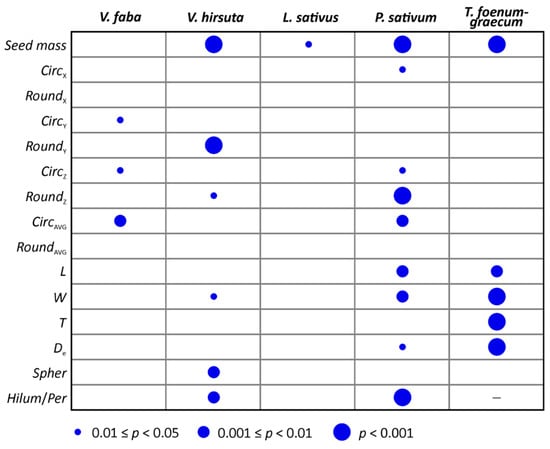
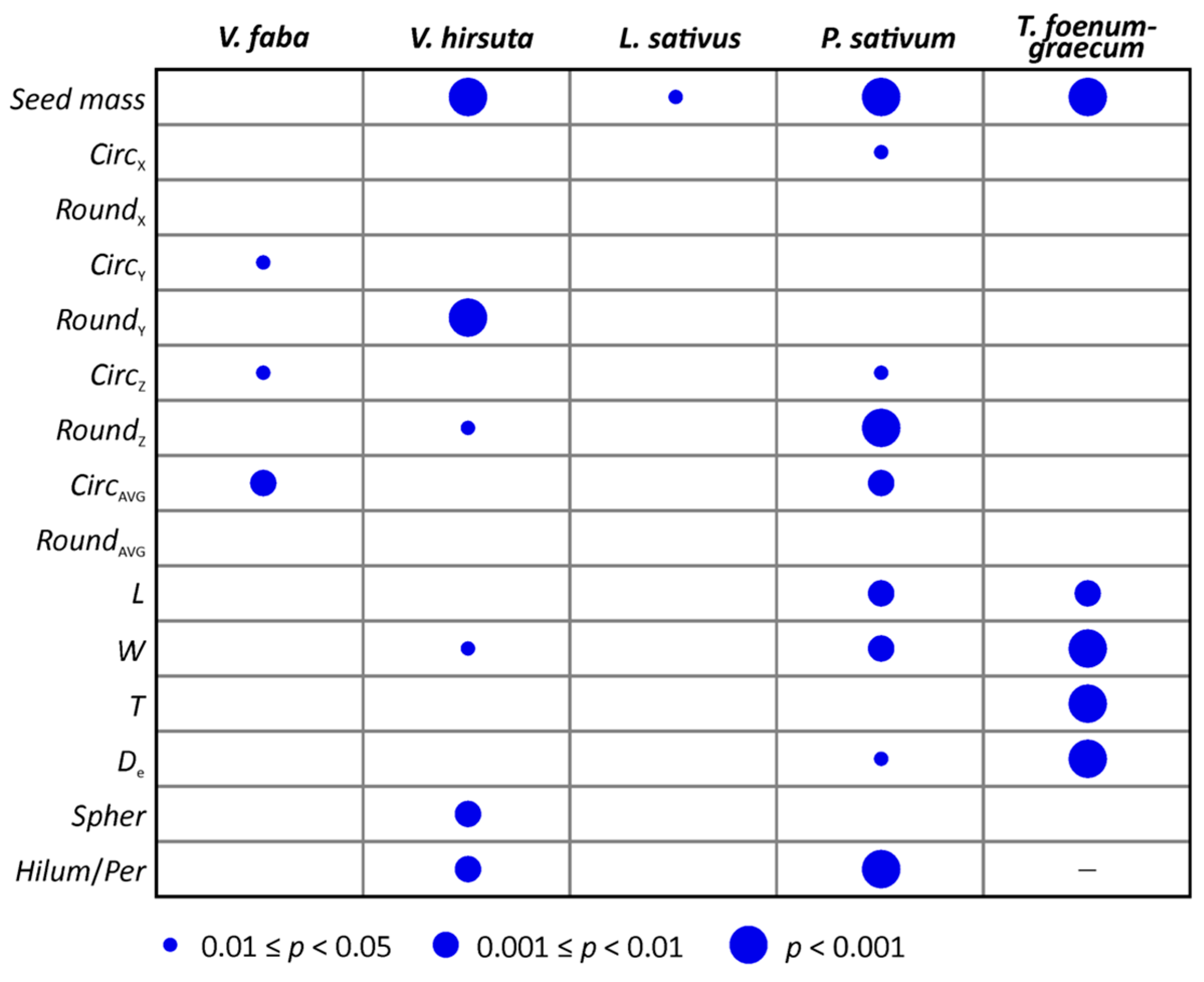
Five accessions were tested for the reproducibility of seed traits depending on the environment. Except for faba bean, all displayed statistically significant differences in mass and at least some of the size metrics (L, W, T, De) (Figure 1; the exact values of all parameters are available in Table S2). However, no significant differences were detected between trials for many shape metrics, i.e., they showed a similar degree of deviation from a sphere.
Figure 1.
The comparison (Mann–Whitney test) of seed parameters between two replications of five species grown in different environments: two years of field trials for Vicia faba and a field trial vs. a growing chamber for the other species. Sample sizes n = 8–20 (see Table S2 for details). Only statistically significant (p < 0.05) differences are depicted. AVG = average value for X, Y, and Z projections; Circ = circularity; De = equivalent diameter; L = seed length; Per = perimeter; Round =roundness; Spher = sphericity; T = seed thickness; W = seed width; lowercase X, Y, and Z specify in which projection a parameter was obtained; dash = not applicable.
The magnitude of between-trial differences varied considerably among species (Table S3). The strongest effects were observed in Trigonella foenum-graecum, particularly for seed size-related traits, whereas Vicia faba showed predominantly small to moderate effects, with confidence intervals frequently including zero. Pisum sativum and Vicia hirsuta showed several large effects involving both size and shape descriptors. In Lathyrus sativus, the largest effect was observed for seed mass, although the interpretation is limited by the small number of seeds in the second trial.
2.2. Correlations Among Traits Are Different at the Levels of Individual Seeds and Species-Means
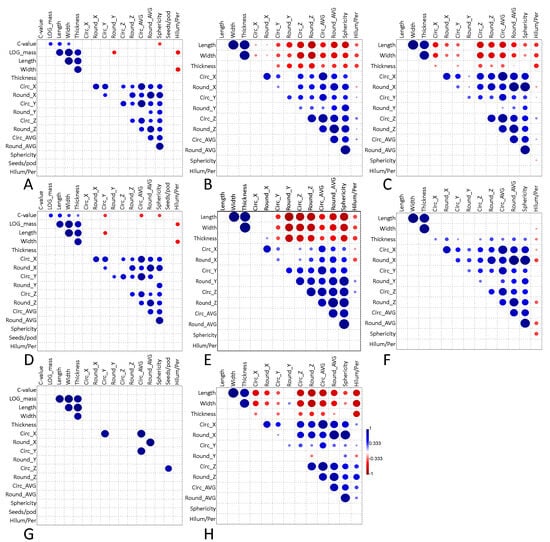
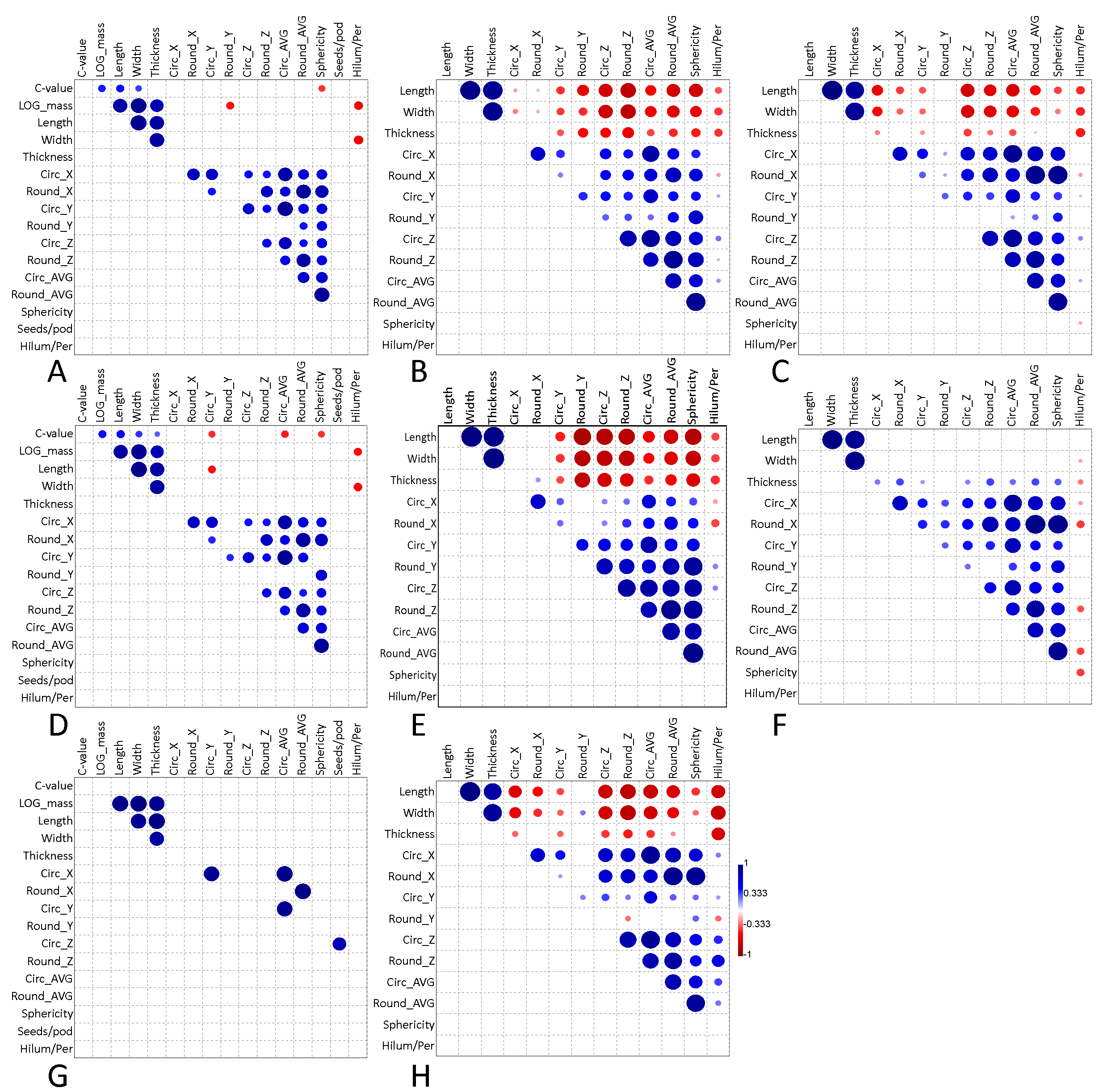
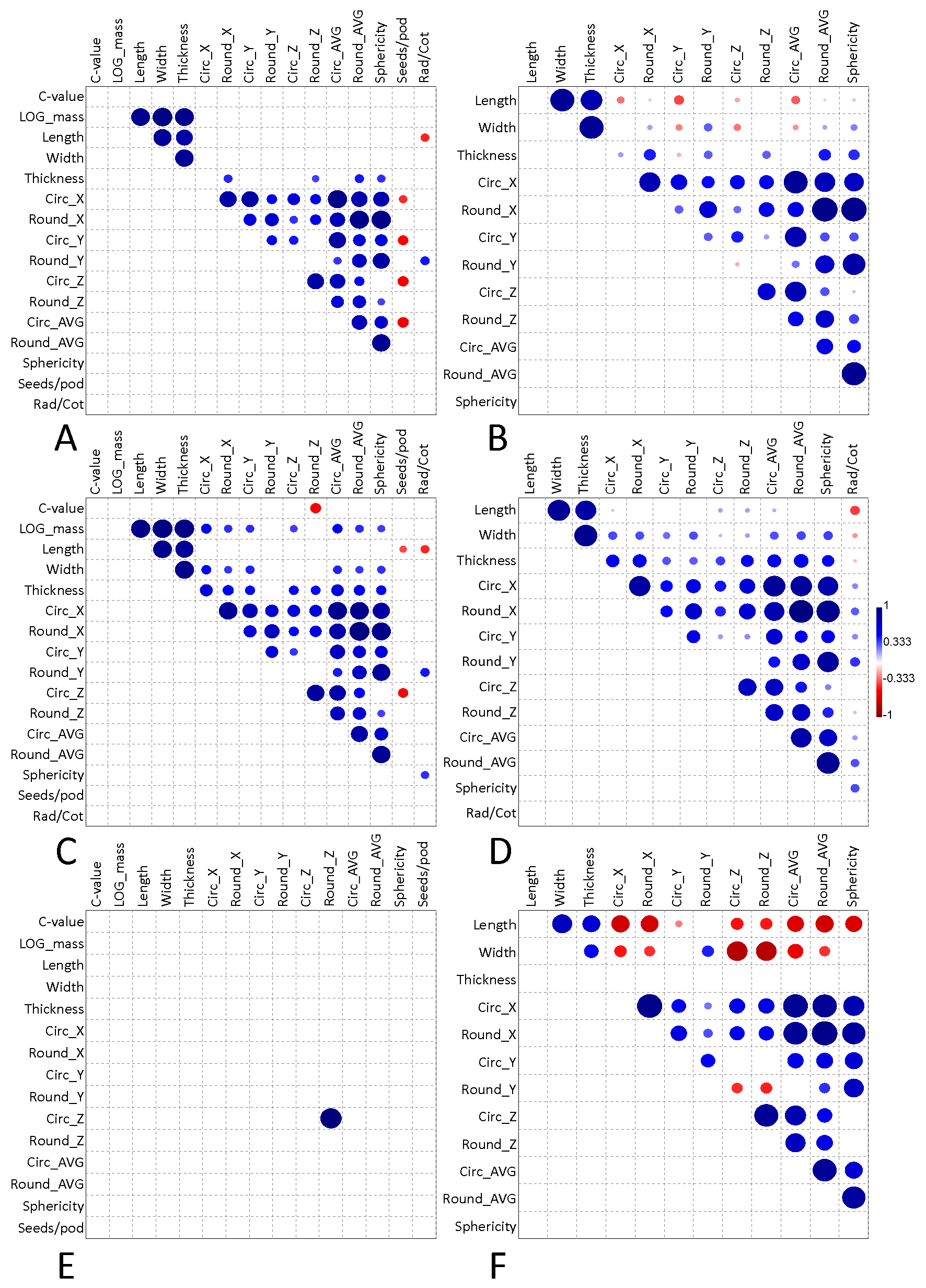
Two major clusters of positive correlations were found among species-means for both tribes (Figure 2A and Figure 3A) and the most represented genera (Figure 2D,G and Figure 3C,E). Generally, there are strong positive correlations among mass and size parameters, usually except seed thickness. Shape descriptors also chiefly correlate with each other, mostly positively. There are almost no significant interactions between two groups of values, i.e., size and shape, in terms of statistical associations. The exceptions are few, such as a negative correlation between L and CircY in Vicia. C-value shows relatively weak statistical association with seed mass and size in Vicia, but not in Lathyrus. Only in Vicia did C-value positively correlate with seed dimensions (Figure 2A). In both Lathyrus and Vicia, C-value was negatively associated with circularity and/or sphericity in some projections (Figure 2D,G). The number of seeds per pod correlates positively with RoundY in Lathyrus and negatively with shape features in the Trifolieae.
Figure 2.
Correlations among studied seed parameters in the Fabeae (Spearman’s ρ in (A,D,G); Pearson’s r in (B,C,E,F,H)). (A) The whole sample of species-means of the Fabeae (n = 66, with a full set of shape metrics available for 23 species); (B) the same as (A) for individual seed measurements (n = 321); (C) individual seed values for the Fabeae excluding Vicia faba (n = 281); (D) species-means for all Vicia (n = 51, with a full set of shape metrics available for 17 species); (E) individual seed values of all Vicia (n = 180); (F) the same as (E) excluding V. faba (n = 140); (G) species-means of all Lathyrus + Pisum (n = 15); (H) individual seed values for all Lathyrus + Pisum (n = 141). Only significant (p < 0.05) correlations that successfully passed the multiple testing correction via the Benjamini–Hochberg False Discovery Rate (FDR) procedure are displayed. Circle diameters correspond to the strength of the correlations; color encodes their directions, either positive (blue) or negative (red). The exact values of correlation coefficients and p-values are available in Tables S4–S11. AVG = average value for X, Y, and Z projections; Circ = circularity; Per = perimeter; Round = roundness; X, Y, Z specify in which projection a parameter was obtained.
Figure 3.
Correlations among studied seed parameters in the Trifolieae (Spearman’s ρ in (A,C,E); Pearson’s r in (B,D,F)). (A) The whole sample of species-means of the Trifolieae (n = 41); (B) the Trifolieae at the level of individual seed values (n = 370); (C) means of all species of Trifolium (n = 30); (D) individual seed values of Trifolium (n = 300); (E) species-means of Medicago (n = 7); (F) traits of individual seeds of Medicago (n = 70). Circle diameters correspond to the strength of correlations, color encodes their directions, either positive (blue) or negative (red). The exact values of correlation coefficients and p-values are available in Tables S12–S17. AVG = average value for X, Y, and Z projections; Circ = circularity; Per = perimeter; Round = roundness; X, Y, Z specify in which projection a parameter was obtained.
However, more robust statistical interactions between seed size and shape emerge in larger samples of individual seed data (Figure 2B,E,H and Figure 3B,D,F). Typically, size and shape metrics interact negatively, i.e., larger seeds tend to be more compressed in all projections. This tendency is remarkably lacking in Trifolium and Vicia, especially if data on V. faba are excluded from the analysis (Figure 2F and Figure 3D). Vicia including V. faba displays similar set of correlations as in Lathyrus (Figure 2E,H).
Vicia seeds were generally rounder than Lathyrus, as indicated by the higher values of CircAVG (individual seed-mean for Lathyrus 0.80, for Vicia without V. faba 0.84) and RoundAVG (0.82 versus 0.86). In addition, shape descriptors were largely independent of seed size in Vicia (Figure 2F). If faba bean was excluded from the comparison, the shapes of the largest (V. serratifolia) and the smallest (V. tetrasperma) seeds differed insignificantly (Mann–Whitney test) if RoundAVG or Spher was compared. CircAVG differed reliably, with a relatively high p-value (0.035). At the same time De differed more than threefold between these two species.
Finally, to distinguish within-species associations from differences among species, the relationship between De and the shape descriptors (Circ and Round) was examined at both the individual-seed and species-mean levels, with a separate within-species analysis (Table 1). In Vicia, negative associations observed when all species were pooled were not detected among species means or within species. Moreover, these associations disappeared when V. faba was excluded, indicating that the pattern in the complete dataset was strongly influenced by interspecific differences. Lathyrus and Medicago showed a similar pattern, with negative associations in pooled individual-seed data but no corresponding within-species relationships. In Trifolium, the pooled association was positive and was also evident among species-means, whereas no significant within-species association was detected. Thus, the direction of the size–shape association differed among genera, and no consistent within-species relationship was detected in any of the four genera (Table 1).
Table 1.
Correlations of seed size (expressed as De) with two shape metrics (Circ and Round).
2.3. Seed Shape Is Associated with the Number of Seeds per Pod
There was a certain level of variation in seed sizes and shapes in all species. For example, the coefficient of variation (CV) of RoundAVG ranged from 1.4% to 12.6% (average 5.1%) in the Fabeae and from 2.3% to 9.3% (average 5.7%) in the Trifolieae.
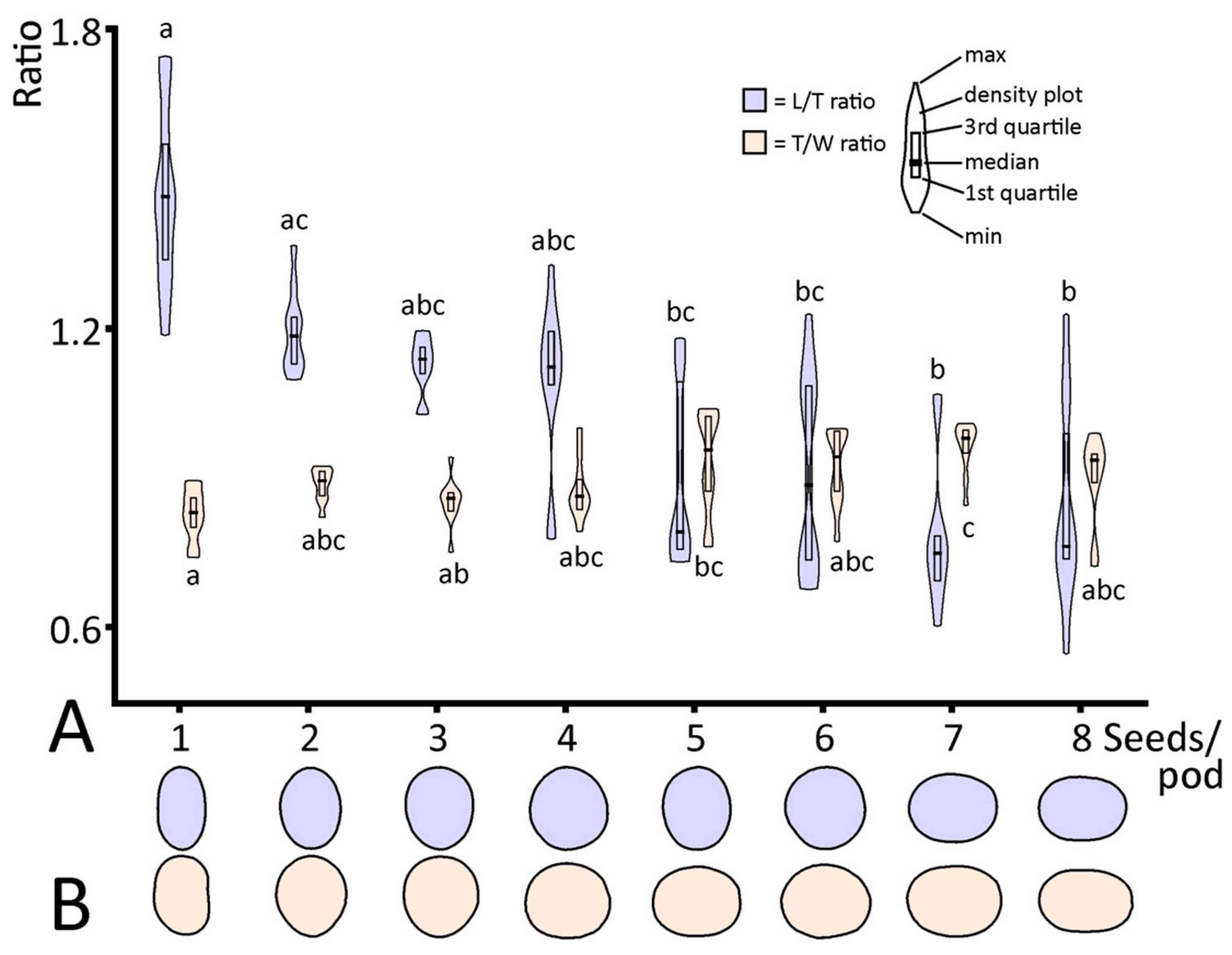
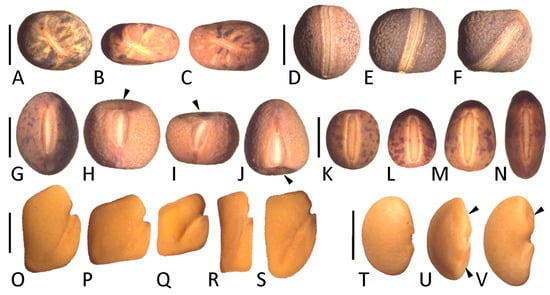
In Vicia pannonica ‘Panonka’, the shape of seeds changed markedly depending on the number of seeds per pod. Solitary seeds were mostly flattened from lateral (pod valves) sides. As the number of seeds per pod increased, their L/T ratio decreased, so their shape gradually changed from being sidewise flattened to lengthwise flattened (Figure 4A,B). These differences are statistically significant (Figure 4A). Similarly, T/W ratio also increased together with the seed number (Figure 4A). Under lengthwise compression, the position of hilum often became skewed, not fully parallel to pod axis (Figure 5A–C,E,F,I).
Figure 4.
Variation in seed shape in Vicia pannonica ‘Panonka’ according to the number of seeds per pod. (A) Distribution of shape indices, length/thickness (L/T) and thickness/width (T/W); (B) the contours of representative seeds in X (lavender) and Y (pink) projections. In (A), plots not sharing any letter are significantly different (Dunn’s test, p < 0.05). Seed contours are oriented along the pod axis vertically; in the Y projection hilum is to the right.
Figure 5.
The within-individual variations in seed shapes in Vicia pannonica ‘Panonka’ (A–C), Lathyrus sylvestris (D–F), L. tuberosus (G–J), L. niger (K–N), Trigonella foenum-graecum (O–S), and Medicago arabica (T–V). Arrowheads = facets resulting from seed contact. Scale bars: 2 mm.
Although the number of seeds per pod was not scored during sampling in other species, their shape may bear signs of pressure from adjacent seeds and/or pod walls (Figure 5). The seeds developing from the most distal and proximal ovules are often of characteristic conical shape (Figure 5J,L,M). Flat facets are produced on seed sides contacting their neighbors (Figure 5H,I,J,U,V). The seeds of some species of Medicago (e.g., M. arabica) follow the curvature of spirally twisted pods, so the resulting shape may lack any symmetry even in X projection.
2.4. Differentiation Among Species Using the Principal Component Analysis of Seed Traits
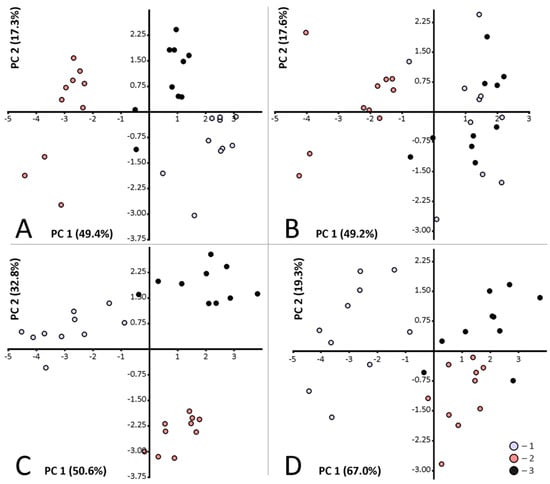
One of the objectives was to test whether the studied set of size and shape traits is suitable for discriminating among the seeds of congeneric species. For this purpose, three species of Vicia and three species of Trifolium were studied using principal component analysis (PCA), here applied in an exploratory way.
In Vicia, when 11 traits were taken (L, W, T, CircX, RoundX, CircY, RoundY, CircZ, RoundZ, Spher, and Hilum/Per), two first principal components (PC) together explained 66.7% of variance. PC1 was mainly negatively associated with size dimensions and hilum/perimeter ratio, a trait of taxonomic importance for the tribe (Table 2; for other PCs, see Tables S18–S21). The second PC was positively associated with size and shape descriptors (Table 2). The resulting scatterplot in PC1–PC2 space demonstrated quite fine separation between the three species (Figure 6A). When linear dimensions (L, W, T) were omitted, the discrimination of the same species in the space of PC1 and PC2 (together explaining 66.8% of variance) was not clear, with an overlap between resulting point clouds (Figure 6B).
Table 2.
Loadings of the first two principal components (PC). Dash = not applicable.
Figure 6.
Principal component analysis (PCA) of seed morphometric traits in three Vicia and three Trifolium species. (A) Vicia, 11 traits; (B) Vicia, eight shape-related traits; (C) Trifolium, 11 traits; (D) Trifolium, eight shape-related traits. PCA was performed using the correlation matrix. Each point represents an individual seed; n = 10 per species; colors indicate species: 1 = V. tetrasperma (A,B)/T. montanum (C,D); 2 = V. sepium (A,B)/T. retusum (C,D); 3 = V. sativa (A,B)/T. subterraneum (C,D). Percentages in parentheses on the axes indicate the proportion of variance explained by the corresponding principal component.
The same general pattern was observed in the PCA of the seeds of three Trifolium species. Although PC1 and PC2 together explained a larger proportion of the variance (83.4% for 11 traits, 86.3% for eight shape-related traits), 11 shape- and size-related descriptors were sufficient to separate the three point clouds in PC1–PC2 space (Figure 6C, D). PC1 was primarily associated with seed shape, as indicated by the high loadings of the circularity and roundness descriptors, whereas PC2 was mainly associated with seed size, with high loadings of length, width and thickness (Table 2).
3. Discussion
Seed size has previously been characterized as highly stable compared with other plant parts (see [1] for review) and often independent of them [27]. At the same time, the reproducibility of seed size (typically expressed as mass) is much lower in different seasons, under stress or in different positions within an inflorescence [1]. This is consistent with the results of this study, which also examined the reproducibility of shape features across environments. However, even taxonomically important traits, such as hilum/perimeter ratio, can differ significantly among trials or depending on the number of seeds per pod [28]. The majority of shape descriptors did not differ significantly between trials. This suggests that these descriptors may be useful for comparing seeds obtained from different sources. Nevertheless, this apparent stability should be interpreted with caution. Similar values of the descriptors chosen for this work do not indicate shape similarity, only a similar degree of deviation from isodiametry, which can be achieved via different changes. To quantify the actual similarity between shapes, approaches such as geometric morphometrics would be required (e.g., [29]). With this precaution in mind, the results of the work will be discussed below.
3.1. Physical Constraints as Potential Determinants of Seed Shape
The effect of physical pressures on seed shapes has been recognized in earlier works [15,28]. The range of shapes exhibited by Vicia pannonica seeds depending on the number of seeds per pod encompasses much of the range found in the genus and/or tribe. Solitary seeds are oblong and compressed sidewise, reminiscent of those of V. michauxii Spreng. With the increase in seed number, their shape changes through spherical to compressed lengthwise, as in Lathyrus sylvestris. At the quantitative level, this connection was only studied in Vicia pannonica ‘Panonka’ in this study. This phenomenon can be explained by the varying distribution of forces experienced by a developing seed. When there are no neighboring seeds or the distance between them is big enough to minimize contact, pressures from the pod valves prevail, resulting in a sidewise-compressed shape. A larger number of developing seeds resists such pressure more efficiently, so their contour in Z projection is close to circular. However, the contact between enlarging seeds causes longitudinal compression. The most distal and the most proximal seeds develop in a sort of funnel produced by the pod walls, so their shapes tend to be conical. In narrow many-seeded pods, sidewise compression seems strong but does not cause seed-flattening (Caragana, ‘oroboid’ Lathyrus, e.g., L. vernus). In such a space, seeds tend to become cylindrical rather than sidewise-flattened [30]. To test this mechanistic hypothesis on the role of physical constraints in defining seed shape, further research is needed to directly measure the hypothetical forces and map their distribution.
The results suggest that pod morphology and the associated physical constraints may be important factors defining seed shape. Not only are seed/pod dimensions important to determine seed shape but probably also the comparative rates of pericarp lignification and seed hardening. Genotype-specific differences in seed filling may also contribute to shape variations. The diversity of seed shapes in pea (Pisum sativum) is mostly attributed to heritable changes in pod geometry, and primarily to the distance between ovules [31]. This effect is most prominent in large seeds, i.e., at least partly dependent on embryo genotypes.
The very shape of papilionoid embryos, which are curved versus the straight shape characteristic for other subfamilies, is hypothesized to result from space limitations due to the unequal growth rates of the raphal and antiraphal sides of developing seeds [32]. An embryo genotype is also important to determine seed shape, but its contribution may be variable in different species. For example, in Phaseolus vulgaris, seeds from reciprocal crosses are of a size and shape characteristic of their maternal genotype [5]. In legumes with ‘inflated’ pods (e.g., of Astragalus L., Colutea L. or Cicer L.), seeds develop with minimum or no contact with pericarp but retain taxon-specific shapes. The existence of several seed types in cultivated Cicer arietinum L., such as angular, rounded or ‘owl’s head’ [33], provides evidence for the significant contribution of the embryo’s own genotype to seed shape. Overall, seed phenotype is an example of strong maternal effect [34].
3.2. Correlations Among Seed Features Exhibit Taxon-Specific Patterns
The majority of correlations among quantitative seed traits can be classified as predictable and even not fully biological. For example, the strong positive nonlinear association between seed mass and linear dimensions, when dimensions scale approximately as mass1/3, is deducible from the general relationship between mass and volume [35]. As found at the species-mean level, mass = 11.642De0.3388 (R2 = 0.9866, n = 94). A negative correlation between hilum/perimeter ratio and seed size is also expected for geometric reasons, as is an inverse relation between seed length and radicle/cotyledon ratio. The strong correlations usually found among shape descriptors suggest that they are interchangeable to some extent.
However, the statistical interactions between size and shape metrics have non-uniform features in various genera. Size and shape descriptors demonstrate a negative association at the level of individual seeds in Lathyrus and Medicago. By contrast, in Vicia and Trifolium, variation in seed size was not accompanied by a correspondingly pronounced variation in seed shape. In the case of Vicia, this stability suggests some adaptive significance in relation to ballistic seed dispersal, which may favor round seeds. In clovers, where single-seeded pods prevail, the influence of physical constraints is lower than in taxa producing several seeds per pod. In both genera, seed shape is likely mediated by pod morphology.
The growth of each seed is dictated by fruit shape, so larger seeds grow allometrically to fit within the available space in the pod. As a result, there is a trade-off between the size and shape of individual seeds, i.e., larger seeds depart from a spherical shape more prominently. The original observations indicated positive correlations among seed dimensions, but the geometry of seeds in other leguminous tribes, and especially within a species, may obey other rules. For example, Ruiz-Vidal et al. [36] reported a weakly negative association between seed length and other dimensions in Ormosia macrocalyx Ducke, suggesting some morphological compensation.
This is consistent with the observation that the size–shape associations in pooled individual-seed data were not generally retained within species, indicating that these correlations largely reflected differences among species rather than a consistent relationship between seed size and shape within species. The contrasting directions of the interspecific associations among genera further argue against a universal size–shape trade-off. In Vicia, the negative association was particularly sensitive to the inclusion of V. faba, disappearing when this species was excluded. These results therefore suggest taxon-specific differentiation in seed size–shape combinations rather than a general within-species scaling rule.
However, the morphospace of seed shapes is much more capacious than the limited space within the pod. For this reason, shape–size interactions are apparently rarer among species-means. Various lineages seem to overcome structural limitations in various ways, such as destabilization of seed shape after loss of pod dehiscence, acquisition of disciform rather than spherical seeds, etc. Further structural, ecological or developmental studies on seed shapes cannot be isolated from synchronous analysis of pod morphology and associated adaptations.
3.3. Seed Size and Shape May Be Connected with Dispersal Mode
Seed dispersal modes, namely, ballistic in the Fabeae and non-ballistic in the Trifolieae, differentiate the two tribes. Unlike cultivated forms, wild-growing members of the Fabeae possess pods that rupture along both sutures and their valves twist spirally, thereby dispersing the seeds. This is due to numerous adaptations. These include diagonally oriented lignified cells of a parchment layer derived from endo- and sometimes mesocarp [37], the presence of a parenchyma layer between the bundles along sutures [38], the upright orientation of mature pods [39], and even lignin chemical properties [40]. In the Fabeae, seeds are tightly embraced by pod walls, which can be connected with the prevalence of ballistic dispersal, i.e., the seed diameter is close to the pod diameter. As a result, seeds are dispersed up to several meters apart from the maternal plant [39,41]. A round shape without a prominent radicle lobe also seems to play a role in dispersal efficiency.
The exceptions are scarce, such as Lathyrus belinensis (Rodger Parsons, pers. comm.) or L. tuberosus (own observations), in which pods are either weakly dehiscent or do not shatter at all. Interestingly, the seeds of L. belinensis are less spherical (RoundAVG = 0.78) than most other Lathyrus analyzed in this study. This value is only lower in L. sativus, L. cicera, with their specific seed shape, L. clymenum, and L. tingitanus (Table S1). The two latter species are undoubtedly adapted to ballistochory, but their seeds are markedly flattened sidewise, whereas the seeds of L. belinensis are of irregular shape and more compressed between pod sutures. The seeds of Vicia faba, a species with a wild progenitor that is (yet) unknown [42], are highly atypical for the genus and, if included in the Vicia sample, strikingly change its statistical features.
Seeds of Vicia (excluding V. faba) are rounder than in Lathyrus. This is consistent with the statistically low dependence between size and shape in vetches, i.e., seed sphericity is maintained stable within a broad range of sizes/masses. Seed shapes in the tribe are mostly less rounded in species with indehiscent pods, such as V. faba, L. belinensis or L. tuberosus. This is not necessarily always the case, as some species obviously adapted to ballistic seed dispersal possess flattened seeds (V. grandiflora, L. clymenum, L. tingitanus). A further study may identify the limits of seed shapes and sizes compatible with ballistic dispersal, which are clearly not conditioned solely by seed macromorphology (e.g., [41,43]). Both spherical and flattened seed shapes are compatible with ballistochory. Compact, rounded seeds are expected to be relatively insensitive to changes in orientation during ballistic flight because their projected area varies less with rotation. After landing, such seeds may also continue to roll, contributing to secondary displacement, as documented for Vicia sativa [44]. By contrast, more flattened seeds may show stronger orientation-dependent aerodynamic behavior, although the outcome depends on their specific shape and rotational dynamics [45].
Members of the Trifolieae display a broad range of seed dispersal strategies not including ballistochory. Even when dehiscent, pod walls do not coil (Medicago L., Ononis L.). The pods of Medicago may be dispersed via epizoochory, when armed with hook-like emergences (M. minima), or with rainwater (M. orbicularis). The recurrent diminishing of pod sizes to single-seeded units parallels the modification of dehiscence mechanisms (Melilotus p.p., Trifolium p.p., Medicago lupulina). In Trifolium, several-seeded pods usually possess thick leathery walls and a weakly developed calyx. The pericarp of few- or single-seeded pods is usually thick and membranaceous; such pods either rupture irregularly (T. filiforme L.), along the ventral suture (T. medium), or with the operculum (T. pratense) [46]. The pods of clovers are often shed in persistent calyces that make their opening ineffective.
Seeds of Trifolium in the studied sample, where single-seeded pods prevail, exhibit no negative correlations between roundness and size, as do seeds of Vicia. In single-seeded clover pods, seed shape is not defined by pressure from adjacent seeds, nor is it under selection for dehiscence. In vetches, even a small number of seeds per pod (such as 1–2 in V. hirsuta and up to five in V. tetrasperma) is compatible with their round shape.
Another feature differentiating between the tribes is the underground (hypogeal) germination in the Fabeae versus above-ground (epigeal) germination in the Trifolieae, i.e., only in the latter tribe do the cotyledons emerge from the soil and photosynthesize [47]. In the Fabeae, the cotyledons are fleshy and serve to store starch [47], although chloroplasts were reported to persist in pea cotyledons [48]. The exact evolutionary sequence of events may be interesting to trace, i.e., whether a dispersal mechanism allowed for the use of cotyledons for storage or vice versa. In some legume tribes, genera with various germination modes coexist, such as epi-, hypo-, and cryptohypogeal in the Desmodieae (now nested within the Phaseoleae) [49].
3.4. Does Shape Heterospermy Matter?
Since ancient times, the seeds of the carob tree (Ceratonia siliqua L., subfam. Caesalpinioideae) were believed to possess such a constant mass that they were utilized as a unit of mass in jewelry (carat). This conviction appeared erroneous: carob seeds display mass variation at the same level as other species [50]. Such within-individual diversity of seeds is usually referred to as heterospermy [10,30]. This polymorphism may have ecological significance. The connection between germination capacity and seed size has been repeatedly reported, with smaller seeds usually retaining a deeper dormancy [10,11]. Testa color variation is known to be associated with dormancy even within the same clutch, i.e., the seed set produced in a pod [51]. Yet, the polymorphism of seed shapes seems underexplored for its ecological significance, although the effects of size and shape need to be thoroughly discriminated between. It cannot be excluded that the impact of shape heterospermy is negligible, i.e., all possible shape morphs have equal adaptive value and their polymorphism is in fact neutral [52] at both intraspecific and within-individual levels.
Descriptions of the seed shapes and sizes characteristic for a species [21,53,54] mostly refer to a prevailing seed type, not taking into account rarer morphs. In a large sample, the identification of a species is not problematic, as ‘typical’ seeds are readily available. In studies when only a few seed specimens, or even single seeds, are available, such as in the case of archaeobotany identifying plant remains, the phenomenon of size and shape heterogeneity may appear decisive. Tarongi et al. [29] acknowledged the possible limitations of their tool based on geometric morphometrics and machine learning and even concluded that this approach will never replace traditional identification of seeds. The analysis in this area is complicated not only by intraspecific variation in seed size and shape but also by numerous artifacts resulting from imperfect preservation. For example, it is sometimes challenging to distinguish between charred seeds of Lathyrus cicera, L. sativus and even Vicia ervilia [29]. This emphasizes the need for further development of seed identification criteria that necessarily take 3D shape and size metrics into account.
3.5. The Potential and Limitations of Seed Morphometry for Species Discrimination
In the examined examples, the clearest separation of congeneric species was obtained when both size and shape traits were included. This regularity was especially prominent in Vicia, whereas in Trifolium the separation based on shape-related traits was still satisfactory. The proximity of species observed in the PCA reflects their position in morphospace but does not coincide with their phylogenetic affinity. For example, Vicia tetrasperma and V. sativa appeared closer to each other in PCA as compared with V. sepium, whereas molecular phylogeny places V. sativa and V. sepium in a common clade [55]. Similarly, the two closest (as indicated by the PCA) species of Trifolium, T. retusum and T. subterraneum, belong to different sections (Trifoliastrum and Trichocephalum, respectively [56]), but another member of sect. Trifoliastrum, T. montanum, is more dissimilar to them. One may agree with the conclusion of numerous preceding studies that seed morphology alone is not enough for taxonomic resolution in Leguminosae [19,21,57] or is only of limited value [54]. More references are available in [53]. A set of quantitative and qualitative traits, especially when coupled with testa micromorphology, can be used to identify seeds [57].
The possibility that some seed shapes characterize certain sections cannot be fully neglected, especially when a specific pod morphology is involved. For instance, the unusual ‘axe head’ seed shape is found in some species of Lathyrus sect. Cicercula, although Güneş [53] characterized it as spheroidal. This shape is even reflected in the vernacular names for L. sativus, an important crop, such as sekirica in Serbian (i.e., ‘small axe’, ‘hatchet’; from sekira ‘axe’) [58]. It is not impossible that a larger set of size and shape descriptors may appear powerful enough to discriminate among related species. To date, this goal remains challenging.
The results demonstrate that seed size and shape variation in the Fabeae and Trifolieae is structured at several interconnected levels. Some morphological descriptors remain relatively consistent across growing conditions, whereas relationships between seed size and shape depend strongly on the taxonomic level and genus considered. Within-individual variation further indicates that seed morphology may be affected by developmental constraints imposed by the pod, while the PCA results illustrate both the potential and the limitations of morphometric traits for distinguishing related species. Together, these findings suggest that seed size and shape should be considered not as independent taxonomic or ecological characters, but as components of a variable morphological system shaped by developmental and evolutionary factors.
4. Materials and Methods
4.1. Seed Material
Seeds were collected in natural populations or obtained from germplasm collections (Table 3). Samples were stored in paper envelopes at room temperature. The best-represented genera were Lathyrus (14 species), Vicia (18 species), Trifolium (30 species), and Medicago (7 species), whereas other genera (Pisum, Melilotus, Trigonella, Ononis) were exemplified by one or two species. The majority of seeds were sampled in 2021–2025 except for the collection of Trifolium, generously provided by Prof. Lana Zorić; these seeds were from 2002–2003.
Table 3.
Plant species used in this study.
4.2. Data Acquisition
Seed weight was determined using CHYO MJ-500 laboratory electronic scales (YMC Co., Kyoto, Japan). Twenty randomly sampled seeds were usually characterized for each specimen. In the case of small-seeded species, samples of 5–30 seeds were weighed and the result was recalculated.
For image acquisition, ten mature seeds lacking visual signs of diseases or damage by pests were randomly chosen for each species. Seeds were mounted on a microscopic slide using double-sided transparent adhesive tape in three projections, hereafter designated as X, Y, and Z (Figure 7).
Figure 7.
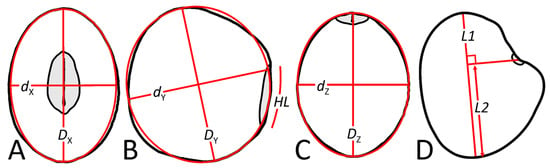
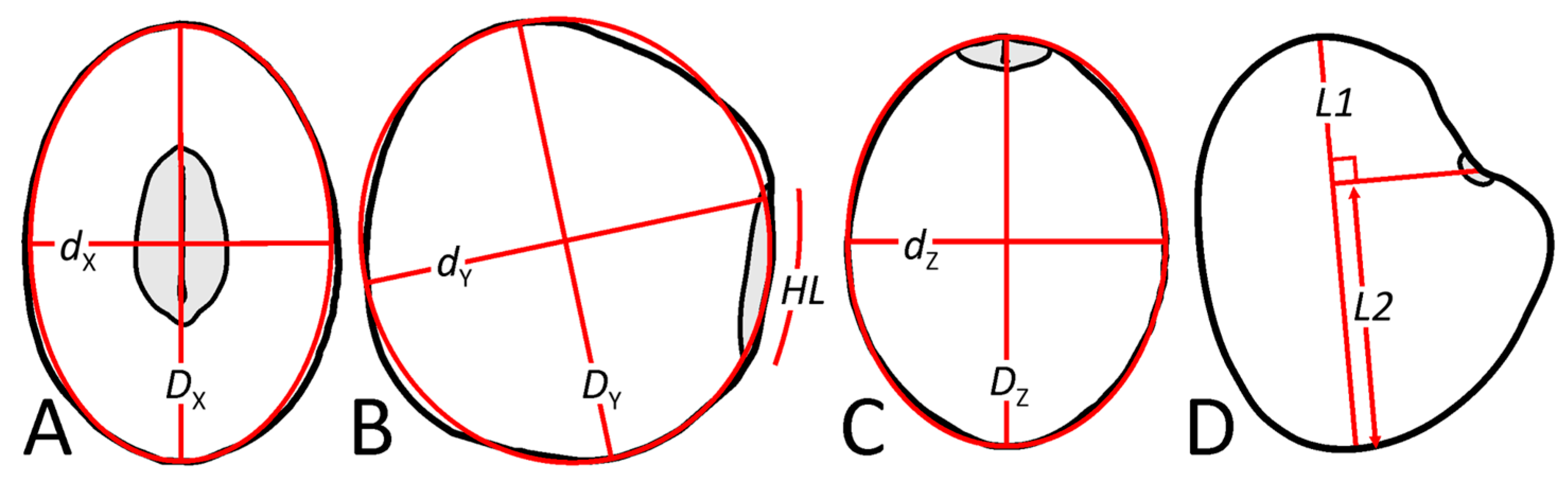
Quantitative parameters of seeds in three projections, i.e., when photographed from the hilum (X: (A)), pod valve (Y: (B,D)) and pod apex (Z: (C)). Gray = hilum; D = major axis of fitted ellipse; d = minor axis of fitted ellipse; HL = hilum length; L1 = cotyledon length; L2 = radicle projection length.
Photographs were taken backlit using a stereomicroscope StereoBlue SB.1402 (Euromex, Duiven, The Netherlands) and a smartphone camera Galaxy S25 (SM-S931B/DS) (Samsung Electronics, Yongin-si, Republic of Korea), or a Zeiss STEMI 2000 stereomicroscope equipped with an AxioCam 105 color camera and ZEN 3.12 (ZEN lite) software (all produced by Carl Zeiss AG, Oberkochen, Germany). The obtained images were binarized in Corel PHOTO-PAINT2019 (Corel Corporation, Ottawa, ON, Canada). The resulting contours were analyzed in ImageJ 1.53e (National Institutes of Health, Bethesda, MD, USA) [59]. Several parameters were measured, namely the major (D) and minor (d) axes of automatically fitted ellipse (Figure 7), circularity (Circ) and roundness (Round) of all three projections:
To minimize measurement errors, corresponding values from different projections were averaged to obtain the length (L), width (W), and thickness (T) of a seed:
Here and elsewhere, lowercase indices X, Y and Z specify the projection where the parameters were obtained.
To quantify overall seed shape, mean values of Circ and Round were calculated:
Additionally, sphericity (Spher) [60] was computed:
where De denotes equivalent diameter:
Sphericity was previously demonstrated to correlate strongly with seed volume, a parameter which is difficult to measure directly [61].
Circ, Round, and Spher range from 0 (increasingly elongated shape) to 1 (perfectly isodiametric shape) [59]. Sphere and circle, unlike ovals or ellipses, are unique geometric objects and their dimensions do not require additional explanation, so the comparison with these objects is quite clear. It should be emphasized that these parameters (Formulas (1) and (2)) only specify how an object’s shape differs from a reference rather than defining what exactly the shape of an object is. For example, Round (as defined in ImageJ) cannot distinguish between a circle and a square, i.e., this parameter only reports how isodiametric a shape is. Close Circ values of two objects do not necessarily mean that they are similar in geometric sense, but only show how far their shapes depart from a perfect circle. Moreover, circularity is dependent on the perimeter and hence quite sensitive to image artifacts, such as contour fluctuations. However, in the samples, these descriptors provide quite reliable estimates.
Two seed features are recognized as important for the systematics of the two tribes. The ratio between hilum length (HL) and seed circumference is typically described for the Fabeae [28,62]. In the Trifolieae, the comparison of radicle lobe size with that of cotyledons is significant [21]. To take these parameters into account, two ratios were calculated: hilum/perimeter in the seeds of the Fabeae and radicle/cotyledons in the Trifolieae.
For designations, see Figure 7. The perpendicular projection of hilum on the major seed axis was used as a measure of radicle lobe length (L2, see Figure 7).
Data for some species are incomplete. Only a limited set of shape parameters was acquired from an earlier piece of independent, unpublished research, so for some species of the Fabeae, no data on L, W, and T are available. Seed sizes for some Vicia species were extracted from the paper of Han et al. [54], which did not report shape descriptors. Haploid genome size (C-value) is available in the Angiosperm DNA C-values database of the Royal Botanical Gardens, Kew [63]. The monographs [62,64,65] and some papers [66,67,68] (among others) were used as a source for the number of seeds per pod. When seed mass was missing, it was completed with the data obtained by the author in the germplasm collection of the Federal Research Center of N.I. Vavilov All-Russian Institute of Plant Genetic Resources (VIR, Saint-Petersburg, Russia).
To test reproducibility and the range of intraspecific variation in features, these were compared among seeds of several accessions sown in various conditions (field trial versus plant growing chamber) and/or different seasons. Field observations were conducted in a plot in Rimski Šančevi (Serbia, 45.331233, 19.831339). Growing chambers (Shinekin Globaltide Trading Co., Ltd., Zhejiang, China) were illuminated with ATS300W LED module (Lumatek, Rochester, UK) under a long-day light regime and equipped with ventilation. The dependence of the morphology of seeds on their number per pod was analyzed in Vicia pannonica ‘Panonka’ grown in field conditions.
4.3. Statistical Analysis
All statistical procedures were performed in Statistica 12 (Statsoft, Tulsa, OK, USA), PAST 4.03 [69], and Microsoft Excel 2016 (version 10.0.4266.1001; Microsoft, Redmond, WA, USA). Nonparametric methods were used for comparisons involving small samples and for associations where the relationship between traits was not adequately described by a linear model (e.g., seed mass and size dimensions). Mann–Whitney and Kruskal–Wallis (followed by Dunn’s post hoc test) tests were used for pairwise and multiple comparisons, respectively. Nonparametric Spearman’s ρ was used for rank correlations. Pearson’s r was used for linear correlation analyses in larger datasets, where appropriate.
To account for multiple testing in the main correlation analyses, p-values were adjusted using the Benjamini–Hochberg procedure to control the false discovery rate (FDR) at 5%. For Mann–Whitney comparisons between trials, effect sizes were expressed as rank-biserial correlations, with 95% confidence intervals calculated using the percentile bootstrap method with 10,000 independent resamples within each trial. Accordingly, non-significant differences between trials were not interpreted as evidence of equivalence or complete stability.
To distinguish associations occurring within species from those attributable to differences among species, the relationships between equivalent seed diameter and the shape descriptors circularity and roundness were additionally examined using a hierarchical approach. Analyses were performed separately for the most represented genera, namely Vicia, Lathyrus, Medicago, and Trifolium. Associations among species were assessed using species means, whereas within-species associations were estimated using regression models that accounted for species-level clustering. Equivalent seed diameter (De), a measure of size, was partitioned into within-species and between-species components, allowing the regression coefficient (β) to represent the association between seed size and shape (Circ and Round) within species. The significance of β was assessed against the null hypothesis of no within-species association (β = 0), and 95% confidence intervals were reported.
PCA was based on the correlation matrix, thereby standardizing variables measured on different scales. Some plots were constructed with the use of PAST 4.0369 and ChatGPT (OpenAI, GPT-5.5).
5. Conclusions and Further Prospects
Several conclusions can be drawn as a result of the work:
- Seed size and, particularly, shape showed relatively high consistency between the examined environments. This suggests that quantitative seed descriptors can be used to characterize certain taxa or accessions across different growing conditions.
- Negative associations between seed size and shape observed in pooled data were generally not retained within species, suggesting that they largely reflect differences among species rather than a consistent within-species relationship. The direction of these associations also differed among genera: it was negative in Vicia, Lathyrus, and Medicago, but positive in Trifolium. In Vicia, the negative association disappeared when V. faba was excluded. These patterns suggest genus-specific differences in seed size–shape combinations rather than a universal size–shape trade-off.
- The observed within-individual variation in seed shape, partly overlapping with the diversity found at the interspecific level, suggests that seed shapes may be influenced by changes in pod dimensions, the spacing of ovules, and probably the relative timing of pod and seed coat lignification, as well as seed filling (somatic heterochrony: [9]).
- For distinguishing among congeneric species, both quantitative seed shape and size parameters are important to achieve better resolution than shape descriptors alone. The relative contribution of seed size and shape to species separation somewhat differed between the examined genera.
Several directions of further progress in this area can be outlined. It is important to assess whether shape heterospermy has an impact on seed germination, dormancy, dispersal, vigor and other features, i.e., if unavoidable shape variation has adaptive significance. Seed traits should be studied alongside pod features, preferably at various developmental stages [2].
This work emphasizes the importance of studying the 3D shape of seeds rather than a single projection. However, the approach used here is laborious and time-consuming, so further progress in this field equipped with high-throughput automatic systems of 3D shape acquisition appear promising (e.g., [24]), and analysis with the use of machine learning.
Supplementary Materials
The following supporting information can be downloaded at https://www.mdpi.com/article/10.3390/plants15223620/s1, Table S1: Mean values, standard deviations, medians, and the 1st and the 3rd quartiles of studied traits in examined species; Table S2: The comparison of seed size and shape features between trials in selected species; Table S3: Sample sizes, Mann–Whitney Us, effect sizes, and confidence interval limits for comparisons between trials in five model species; Tables S4–S17: Correlations among the studied seed parameters; Tables S18–S21: Eigenvalues, percent of explained variance, and loadings of principal components in the analysis of size- and/or shape-related traits.
Funding
The work was partly supported by the Ministry of Science, Technological Development and Innovation of the Republic of Serbia, grant number: 451-03-33/2026-03/200032.
Data Availability Statement
The contour images used for measurements along with the values of individual seeds dimensions and shape descriptors are available upon request.
Acknowledgments
The author is grateful to the colleagues who provided material for the survey, viz. Janna Akopian, Gennagii Levko, Bojan Zlatković, Lana Zorić. The author is indebted to Margarita Vishnyakova, Marina Burlyaeva, and Tatiana Aleksandrova for the invaluable opportunity to weigh seeds of representatives of the Fabeae in the germplasm collection of the Vavilov All-Russian Institute of Plant Genetic Resources (VIR, Saint Petersburg, Russia), and to Sonja Tančić Živanov and Jelena Jocković for their great help with the acquisition of photo images. The assistance of Wojciech Święcicki, Magdalena Gawłowska, Sanja Vasiljević, the International Seed Testing Association Secretariat and, personally, Agnes Hegedüs in obtaining some of the old literature sources is greatly acknowledged. During the work on this manuscript, the author used ChatGPT (OpenAI, GPT-5.5) to assist with the preparation of the plots presented in Figure 1 and Figure 4. The author has thoroughly reviewed and edited the output and takes full responsibility for the content of this publication.
Conflicts of Interest
The author declares no conflicts of interest.
Abbreviations
The following abbreviations are used in the paper:
| CI | Confidence interval |
| Circ | Circularity |
| De | Equivalent diameter |
| FDR | False Discovery Rate |
| HL | Hilum length |
| L | Seed length |
| PCA | Principal Component Analysis |
| Round | Roundness |
| Spher | Sphericity |
| T | Seed thickness |
| W | Seed width |
References
- Harper, J.L.; Lovell, P.H.; Moore, K.G. The shapes and sizes of seeds. Ann. Rev. Ecol. Syst. 1970, 1, 327–356. [Google Scholar] [CrossRef] [Scilit]
- Carta, A.; Vandelook, F.; Ramírez-Barahona, S.; Chen, S.C.; Dickie, J.; Steinbrecher, T.; Thanos, C.A.; Moles, A.T.; Leubner-Metzger, G.; Mattana, E. The seed morphospace, a new contribution towards the multidimensional study of angiosperm sexual reproductive biology. Ann. Bot. 2024, 134, 701–710. [Google Scholar] [CrossRef] [Scilit] [PubMed]
- Smitchger, J.; Weeden, N.F. The ideotype for seed size: A model examining the relationship between seed size and actual yield in pea. Int. J. Agron. 2018, 2018, 9658707. [Google Scholar] [CrossRef] [Scilit]
- Wood, J.A.; Knights, E.J.; Campbell, G.M.; Choct, M. Near-isogenic lines of desi chickpea (Cicer arietinum L.) that differ in milling ease: Differences in chemical composition. J. Food Sci. Technol. 2017, 54, 1002–1013. [Google Scholar] [CrossRef] [Scilit] [PubMed]
- Singh, J.; Clavijo Michelangeli, J.A.; Gezan, S.A.; Lee, H.; Vallejos, C.E. Maternal effects on seed and seedling phenotypes in reciprocal F1 hybrids of the common bean (Phaseolus vulgaris L.). Front. Plant Sci. 2017, 8, 42. [Google Scholar] [CrossRef] [Scilit] [PubMed]
- Cervantes, E.; Martín Gómez, J.J.; Gutiérrez del Pozo, D.; Silva Dias, L. An angiosperm species dataset reveals relationships between seed size and two-dimensional shape. Horticulturae 2019, 5, 71. [Google Scholar] [CrossRef] [Scilit]
- Dias, L.S.; Dias, A.S. The relationship between shape and size of diaspores depends on being seeds or fruits. Horticulturae 2019, 5, 65. [Google Scholar] [CrossRef] [Scilit]
- Westoby, M.; Leishman, M.; Lord, J.; Poorter, H.; Schoen, D.J. Comparative ecology of seed size and dispersal. Phil. Trans. R. Soc. Lond. B 1996, 351, 1309–1318. [Google Scholar] [CrossRef] [Scilit]
- Silvertown, J. Phenotypic variety in seed germination behavior: The ontogeny and evolution of somatic polymorphism in seeds. Am. Nat. 1984, 124, 1–16. [Google Scholar] [CrossRef] [Scilit] [PubMed]
- Telebokova, R.N. Heterospermy: Phenomenon, Concept, Place among Other Types of Intrapopulation Seed Variation in Four Leguminous Species of the Tribe Fabeae; Prometei: Moscow, Russia, 2013; pp. 1–70. [Google Scholar]
- Rodrigues-Junior, A.G.; Mello, A.C.M.P.; Baskin, C.C.; Baskin, J.M.; Oliveira, D.M.T.; Garcia, Q.S. Why large seeds with physical dormancy become nondormant earlier than small ones. PLoS ONE 2018, 13, e0202038. [Google Scholar] [CrossRef] [Scilit] [PubMed]
- Maleki, K.; Vandelook, F.; Saatkamp, A.; Maleki, K.; Heshmati, S.; Soltani, E. Global patterns in the evolutionary relations between seed mass and germination traits. Ecol. Evol. 2025, 15, e71543. [Google Scholar] [CrossRef] [Scilit] [PubMed]
- Thompson, K.; Band, S.R.; Hodgson, J.G. Seed size and shape predict persistence in soil. Funct. Ecol. 1993, 7, 236–241. [Google Scholar] [CrossRef] [Scilit]
- Bekker, R.M.; Bakker, J.P.; Grandin, U.; Kalamees, R.; Milberg, P.; Poschlod, P.; Thompson, K.; Willems, J.H. Seed size, shape and vertical distribution in the soil: Indicators of seed longevity. Funct. Ecol. 1998, 12, 834–842. [Google Scholar] [CrossRef] [Scilit]
- Kirkbride, J.H.; Gunn, C.R.; Weitzman, A.L. Fruits and Seeds of Genera in the Subfamily Faboideae (Fabaceae); US Department of Agriculture, Agricultural Research Service: Beltsville, MD, USA, 2003; Volume 2, pp. 636–1208.
- Rodrigues-Junior, A.G.; Baskin, C.C.; Baskin, J.M.; De-Paula, O.C. The pleurogram, an under-investigated functional trait in seeds. Ann. Bot. 2021, 127, 167–174. [Google Scholar] [CrossRef] [Scilit] [PubMed]
- Endo, Y.; Ohashi, H. Diversification of seed arrangement induced by ovule rotation and septum formation in Leguminosae. J. Plant Res. 2009, 122, 541–550. [Google Scholar] [CrossRef] [Scilit] [PubMed]
- Sivakumar, K.B.; Gautam, A.; Singh, S.; Panwar, R.K.; Arora, A.; Verma, S.K. A pragmatic study on seed shape classification and its association among seed quality attributes in chickpea (Cicer arietinum L.). Legume Res. 2024, 47, 597–602. [Google Scholar] [CrossRef] [Scilit]
- Ninkaew, S.; Pornpongrungrueng, P.; Balslev, H.; Chantaranotahi, P. Seed morphology of nineteen Crotalaria L. (Fabaceae) species in Thailand. Thai For. Bull. Bot. 2017, 45, 47–57. [Google Scholar] [CrossRef] [Scilit]
- Schaefer, H.; Renner, S.S. Cucurbitaceae. In Families and Genera of Vascular Plants X. Flowering Plants. Eudicots. Sapindales, Cucurbitales, Myrtaceae; Kubitzki, K., Ed.; Springer: Heidelberg, Germany; Dordrecht, The Netherlands, 2011; pp. 112–174. [Google Scholar]
- Zorić, L.; Merkulov, L.; Luković, J.; Boža, P. Comparative seed morphology of Trifolium L. species (Fabaceae). Period. Biol. 2010, 112, 263–272. [Google Scholar]
- Wood, J.A.; Keir, C.F. A simple method to compare seed shape in chickpea (Cicer arietinum). Ind. J. Agr. Sci. 2008, 78, 1048–1052. [Google Scholar]
- Cervantes, E.; Rodríguez-Lorenzo, J.L.; Gutiérrez del Pozo, D.; Martín-Gómez, J.J.; Janousek, B.; Tocino, Á.; Juan, A. Seed silhouettes as geometric objects: New applications of Elliptic Fourier Transform to seed morphology. Horticulturae 2022, 8, 974. [Google Scholar] [CrossRef] [Scilit]
- Huang, X.; Zheng, S.; Zhu, N. High-throughput legume seed phenotyping using a handheld 3D laser scanner. Remote Sens. 2022, 14, 431. [Google Scholar] [CrossRef] [Scilit]
- Griffiths, M.; Gautam, B.; Lebow, C.; Duncan, K.; Ding, X.; Handakumbura, P.; Sedbrook, J.C.; Topp, C.N. Evaluation of 3D seed structure and cellular traits in-situ using X-ray microscopy. Sci. Rep. 2025, 15, 4532. [Google Scholar] [CrossRef] [Scilit] [PubMed]
- Gao, J.; Zhu, C.; Hu, J.; Deng, F.; Xu, Z.; Wang, X. Seed 3D phenotyping across multiple crops using 3D Gaussian splatting. Agriculture 2025, 15, 2329. [Google Scholar] [CrossRef] [Scilit]
- Berg, R.L. Correlation pleiades and stabilizing selection. In Genetics and Evolution. Selected Works; VO Nauka: Novosibirsk, Russia, 1993; pp. 137–178. [Google Scholar]
- Gunn, C.R. A key and diagrams for the seeds of one hundred species of Vicia (Leguminosae). Proc. Int. Seed Test. Ass. 1970, 35, 773–790. [Google Scholar]
- Tarongi, M.; Bouby, L.; Bonhomme, V.; Alonso, N. Which pulse is it? Identifying archaeological legumes seeds by means of biometric measurements and geometric morphometrics. Veg. Hist. Archaeobot. 2024, 33, 5–14. [Google Scholar] [CrossRef] [Scilit]
- Borisova, I.V. On heterocarpy and heterospermy of Caragana microphylla (Fabaceae). Bot. Zhurn. 2000, 85, 83–89. [Google Scholar]
- Lamprecht, H. Monographie der Gattung Pisum; Steiermärkische Landesdruckerei: Graz, Austria, 1974; pp. 68–69. [Google Scholar]
- Endo, Y. Relationships between seed coat development and curved embryo in Papilionoideae (Leguminosae). J. Jap. Bot. 2025, 100, 416–429. [Google Scholar]
- IBPGR; ICRISAT; ICARDA. Descriptors for Chickpea (Cicer arietinum L.); ICRISAT: Patancheru, India, 1993; pp. 15–17. [Google Scholar]
- Roach, D.A.; Wulff, R.D. Maternal effects in plants. Ann. Rev. Ecol. Syst. 1987, 18, 209–235. [Google Scholar] [CrossRef] [Scilit]
- Niklas, K.J. The scaling of plant and animal body mass, length, and diameter. Evolution 1994, 48, 44–54. [Google Scholar] [CrossRef] [Scilit]
- Ruiz-Vidal, J.; Vargas-Simón, G.; Angeles, G.; Gaspar-Génico, J.Á.; Campillo, L.M.G.; Jiménez-Pérez, N.d.C.; Martínez-Zurimendi, P.; Ascencio-Rivera, J. Fruit morphology and seed anatomy of Ormosia macrocalyx Ducke. Seeds 2026, 5, 26. [Google Scholar] [CrossRef] [Scilit]
- Loseva, S.I.; Lotova, L.I. The pericarp and sporoderm peculiarities of leguminous plants with different ways of dissemination. Biulleten Mosk. Obs. Ispyt. Prir. Biol. 1996, 101, 86–94. [Google Scholar]
- Hradilová, I.; Trněný, O.; Válková, M.; Cechová, M.; Janská, A.; Prokešová, L.; Aamir, K.; Krezdorn, N.; Rotter, B.; Winter, P.; et al. A combined comparative transcriptomic, metabolomic, and anatomical analyses of two key domestication traits: Pod dehiscence and seed dormancy in pea (Pisum sp.). Front. Plant Sci. 2017, 8, 542. [Google Scholar] [CrossRef] [Scilit] [PubMed]
- Ambrose, M.J.; Ellis, T.H.N. Ballistic seed dispersal and associated seed shadow in wild Pisum germplasm. Pisum Genet. 2008, 40, 5–10. [Google Scholar]
- Tilhou, N.; Smýkal, P.; Rencoret, J.; del Río, J.C.; Bartow, A.; Bhamidimarri, S.; Riday, H.; Kucek, L.K. Lignin composition correlates with pod dehiscence in hairy vetch (Vicia villosa Roth). Agrosyst. Geosci. Environ. 2026, 9, e70353. [Google Scholar] [CrossRef] [Scilit]
- Sharpe, C.R.; Ruxton, G.D. Can predation pressure help explain the curious evolution of ballistic seed dispersal? Ecol. Evol. 2025, 15, e71081. [Google Scholar] [CrossRef] [Scilit] [PubMed]
- Kosterin, O.E. The lost ancestor of the broad bean (Vicia faba L.) and the origin of plant cultivation in the Near East. Vavilov J. Genet. Breed. 2014, 18, 831–840. [Google Scholar] [CrossRef] [Scilit]
- Norghauer, J.M.; Newbery, D.M. Tree size and fecundity influence ballistic seed dispersal of two dominant mast-fruiting species in a tropical rain forest. For. Ecol. Manag. 2015, 338, 100–113. [Google Scholar] [CrossRef] [Scilit]
- Garrison, W.J.; Miller, G.L.; Raspet, R. Ballistic seed projection in two herbaceous species. Am. J. Bot. 2000, 87, 1257–1264. [Google Scholar] [CrossRef] [Scilit]
- Cooper, E.S.; Mosher, M.A.; Cross, C.M.; Whitaker, D.L. Gyroscopic stabilization minimizes drag on Ruellia ciliatiflora seeds. J. R. Soc. Interface 2018, 15, 20170901. [Google Scholar] [CrossRef] [Scilit] [PubMed]
- Jakowlew, M. Über das Aufspringen der Hülsen der Gattung Trifolium L. Bot. Zhurn. 1932, 17, 100–119. [Google Scholar]
- Smith, D.L. Cotyledon anatomy in the Leguminosae. Bot. J. Linn. Soc. 1983, 86, 325–355. [Google Scholar] [CrossRef] [Scilit]
- Bain, J.M.; Mercer, F.V. Subcellular organization of the developing cotyledons of Pisum sativum L. Aust. J. Biol. Sci. 1966, 19, 49–67. [Google Scholar] [CrossRef] [Scilit]
- Nemoto, T.; Ohashi, H. Germination mode and morphology of seedlings in Hanslia ormocarpoides (Leguminosae). J. Jpn. Bot. 2012, 87, 22–30. [Google Scholar]
- Turnbull, L.A.; Santamaria, L.; Martorell, T.; Rallo, J.; Hector, A. Seed size variability: From carob to carats. Biol. Lett. 2006, 2, 397–400. [Google Scholar] [CrossRef] [Scilit] [PubMed]
- Bhatt, A.; Gairola, S.; El-Keblawy, A.A. Seed colour affects light and temperature requirements during germination in two Lotus species (Fabaceae) of the Arabian subtropical deserts. Rev. Biol. Trop. 2016, 64, 483–492. [Google Scholar] [CrossRef] [Scilit] [PubMed]
- Gould, S.J.; Lewontin, R.C. The spandrels of San Marco and the Panglossian paradigm: A critique of the adaptationist programme. Proc. R. Soc. Lond. B 1979, 205, 581–598. [Google Scholar] [CrossRef] [Scilit] [PubMed]
- Güneş, F. Seed characteristics and testa textures of Pratensis, Orobon, Lathyrus, Orobastrum and Cicercula sections from Lathyrus (Fabaceae) in Turkey. Plant Syst. Evol. 2013, 299, 1935–1953. [Google Scholar] [CrossRef] [Scilit]
- Han, S.; Sebastin, R.; Lee, K.J.; Wang, X.; Shin, M.J.; Kim, S.H.; Lee, S.; Lee, J.R.; Cho, G.T.; Hyun, D.Y.; et al. Interspecific variation of seed morphological and micro-morphological traits in the genus Vicia (Fabaceae). Microsc. Res. Tech. 2021, 84, 337–357. [Google Scholar] [CrossRef] [Scilit] [PubMed]
- Schaefer, H.; Hechenleitner, P.; Santos-Guerra, A.; de Sequeira, M.M.; Pennington, R.T.; Kenicer, G.; Carine, M.A. Systematics, biogeography, and character evolution of the legume tribe Fabeae with special focus on the middle-Atlantic island lineages. BMC Evol. Biol. 2012, 12, 250. [Google Scholar] [CrossRef] [Scilit] [PubMed]
- Ellison, N.W.; Liston, A.; Steiner, J.J.; Williams, W.M.; Taylor, N.L. Molecular phylogenetics of the clover genus (Trifolium—Leguminosae). Mol. Phylogenet. Evol. 2006, 39, 688–705. [Google Scholar] [CrossRef] [Scilit] [PubMed]
- Chernoff, M.; Plitmann, U.; Kislev, M.E. Seed characters and testa texture in species of the Vicieae: Their taxonomic significance. Isr. J. Bot. 1992, 41, 167–186. [Google Scholar]
- Mikić, A. Lexicon of Pulse Crops; CRC Press: Boca Raton, FL, USA, 2018; pp. 126–135. [Google Scholar]
- Ferreira, T.; Rasband, W.S. ImageJ User Guide (v. 1.46). Available online: https://imagej.net/ij/docs/guide/index.html (accessed on 15 November 2026).
- Mohsenin, N.N. Physical Properties of Plant and Animal Materials. Structure, Physical Characteristics and Mechanical Properties, 2nd ed.; Gordon and Breach Science Publishers: New York, NY, USA, 1986; pp. 1–910. [Google Scholar]
- Kaliniewicz, Z.; Choszcz, D.; Lipiński, A. Determination of seed volume based on selected seed dimensions. Appl. Sci. 2022, 12, 9198. [Google Scholar] [CrossRef] [Scilit]
- Stankevich, A.K.; Repjev, S.I. Flora of Cultivated Plants: Vetch; All-Russian Institute of Plant Industry (VIR): St. Petersburg, Russia, 1999; pp. 1–491. [Google Scholar]
- Leitch, I.J.; Johnston, E.; Pellicer, J.; Hidalgo, O.; Bennett, M.D. Angiosperm DNA C-Values Database (Release 9.0, April 2019). Available online: https://cvalues.science.kew.org/ (accessed on 24 April 2026).
- Zohary, M.; Heller, D. The Genus Trifolium; The Israel Academy of Sciences and Humanities: Jerusalem, Israel, 1984; pp. 1–606. [Google Scholar]
- Small, E. Alfalfa and Relatives: Evolution and Classification of Medicago; NRC Research Press: Ottawa, ON, Canada, 2011; pp. 1–727. [Google Scholar]
- Yamamoto, K.; Fujiwara, T.; Blumenreich, I.D. Karyotypes and morphological characteristics of some species in the genus Lathyrus L. Japan. J. Breed. 1984, 34, 273–284. [Google Scholar] [CrossRef] [Scilit]
- Maxted, N.; Goyder, D.J. A new species of Lathyrus sect. Lathyrus (Leguminosae: Papilionoideae) from Turkey. Kew Bull. 1988, 43, 711–714. [Google Scholar] [CrossRef] [Scilit]
- Sinjushin, A.; Ploshinskaya, M.; Sytin, A. Reproductive morphology and success in annual versus perennial legumes: Evidence from Astragalus and the Fabeae (Papilionoideae). Plants 2024, 13, 2380. [Google Scholar] [CrossRef] [Scilit] [PubMed]
- Hammer, Ø.; Harper, D.A.T.; Ryan, P.D. PAST: Paleontological statistics software package for education and data analysis. Palaeontol. Electron. 2001, 4, 1–9. [Google Scholar]

Disclaimer/Publisher’s Note: The statements, opinions and data contained in all publications are solely those of the individual author(s) and contributor(s) and not of MDPI and/or the editor(s). MDPI and/or the editor(s) disclaim responsibility for any injury to people or property resulting from any ideas, methods, instructions or products referred to in the content. |
© 2026 by the author. Licensee MDPI, Basel, Switzerland. This article is an open access article distributed under the terms and conditions of the Creative Commons Attribution (CC BY) license.