


Abstract
For Fragaria (strawberry) species, individual chromosome identification is challenging due to the small size of chromosomes; consequently, the chromosome numbers of most cultivars remain unreported. In this study, we investigated the ploidy of 26 strawberry cultivars by counting root-tip chromosomes. Surprisingly, 25 cultivars were octoploid (2n = 8x = 56), whereas only ‘Tokun’ was aneuploid (2n = 10x − 3 = 67). To explore the breeding potential of this aneuploid, we performed reciprocal crosses between ‘Tokun’ and ‘Benihoppe’, a widely cultivated octoploid cultivar. Only the combination with ‘Benihoppe’ as female and ‘Tokun’ as male produced fertile progenies. The progenies had variable chromosome numbers of 61, 62 or 63, meaning that ‘Tokun’ produced aneuploid gametes with varying chromosome numbers ranging from 33 to 35. Some hybrids exhibited superior aroma, firmness, or soluble solids compared with their parents. Specifically, J2138 (2n = 9x − 2 = 61) was selected for its larger single-fruit weight, J2139 (2n = 9x − 2 = 61) and J2153 (2n = 9x − 2 = 61) for their white flesh, and J2151 (2n = 9x − 1 = 62) and J2156 (2n = 9x = 63) for their soluble solids content exceeding that of the higher parent, showing potential value for commercial production and breeding. Strawberry is usually propagated via stolons or through tissue culture; therefore, aneuploids obtained from 8x × aneuploid ‘Tokun’ crosses would be good sources for cultivar breeding.
1. Introduction
The cultivated strawberry (Fragaria × ananassa Duch.), an herbaceous perennial plant that belongs to genus Fragaria in the Rosaceae family, is one of the world’s most important berry crops, originating from occasional hybridization between F. chiloensis and F. virginiana in the 18th century [1,2,3]. The genus Fragaria exhibits a base chromosome number of seven (x = 7), with a naturally occurring polyploid series spanning from 2x, 4x, 5x, 6x, 8x, and 9x to 10x [4,5,6]. Additionally, 16x and 32x have been artificially induced using colchicine [1,7]. The extensive ploidy diversity within the genus Fragaria provides a solid genetic foundation for germplasm innovation.
To broaden genetic diversity and incorporate key agronomic traits, such as large fruit size, day neutrality, aroma and resistance to biotic and abiotic stresses, breeders have conducted extensive interspecific and interploidy hybridization in strawberry breeding, yielding pentaploids, hexaploids, heptaploids, nonaploids, and others [8,9,10,11,12,13,14], resulting in improved cold hardiness, disease resistance, and other agronomic traits in strawberry. Interspecific or interploidy hybridization is a key approach in strawberry breeding to break genetic barriers and achieve germplasm innovation; However, when the ploidy levels of the parental lines differ considerably, successful hybridization is difficult, and even when F1 progeny from distant crosses are obtained, they are generally highly sterile due to abnormal meiosis [15]. In some cases, although F1 offspring can be produced, they often produce small fruits with low commercial value [16,17,18,19,20]. Consequently, current strawberry breeding is largely confined to crosses among octoploid cultivars. However, this prolonged reliance on inter-cultivar hybridization has led to a progressively narrowing genetic base, with cultivated strawberry showing declining genetic diversity and reduced disease resistance, stress tolerance, and other agronomic traits.
Most strawberry genotypes are euploid, as their somatic cells possess complete chromosome sets that are exact integer multiples of the base number (x = 7). In contrast, aneuploids are characterized by somatic cells in which at least one genome exhibits an incomplete chromosome complement, resulting from the loss or gain of one or more chromosomes [21]. Henry et al. [22] confirmed that specific traits are closely associated with particular chromosome numbers. Due to the unbalanced changes in chromosome number, aneuploids exhibit a broad range of trait diversity [23,24,25,26], providing abundant selection materials for breeding [27]. However, there have been very few reports on aneuploidy in cultivated strawberry.
‘Tokun’, a newly released strawberry cultivar characterized by a peach-like fragrance, was developed through a multi-step breeding process. Initially, an interspecific hybrid was obtained from a cross between F. nilgerrensis (2x) and F. × ananassa (8x), followed by chromosome doubling with colchicine to generate decaploid (10x) lines. This cultivar was then bred by crossing two of these decaploid lines and selecting the superior progeny that retained the aromatic traits from F. nilgerrensis [15]. In the present study, we first conducted a chromosome survey of 26 strawberry cultivars to determine their ploidy levels and unexpectedly identified ‘Tokun’ as an aneuploid. To evaluate its breeding potential, we then crossed it with the octoploid cultivar ‘Benihoppe’ and assessed the ploidy levels and fruit quality traits of the progeny. This study aims to (1) determine the chromosome numbers of 26 strawberry cultivars, with a focus on the aneuploid ‘Tokun’ and its hybrid progeny, and (2) evaluate the feasibility of utilizing this aneuploid germplasm for trait introgression in strawberry.
2. Results
2.1. The Ploidy Levels of the 26 Strawberry Cultivars
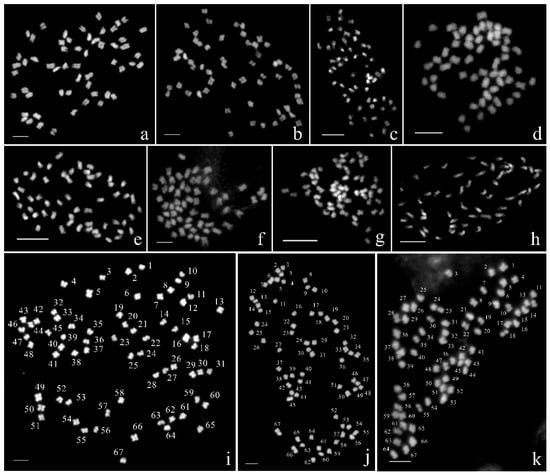
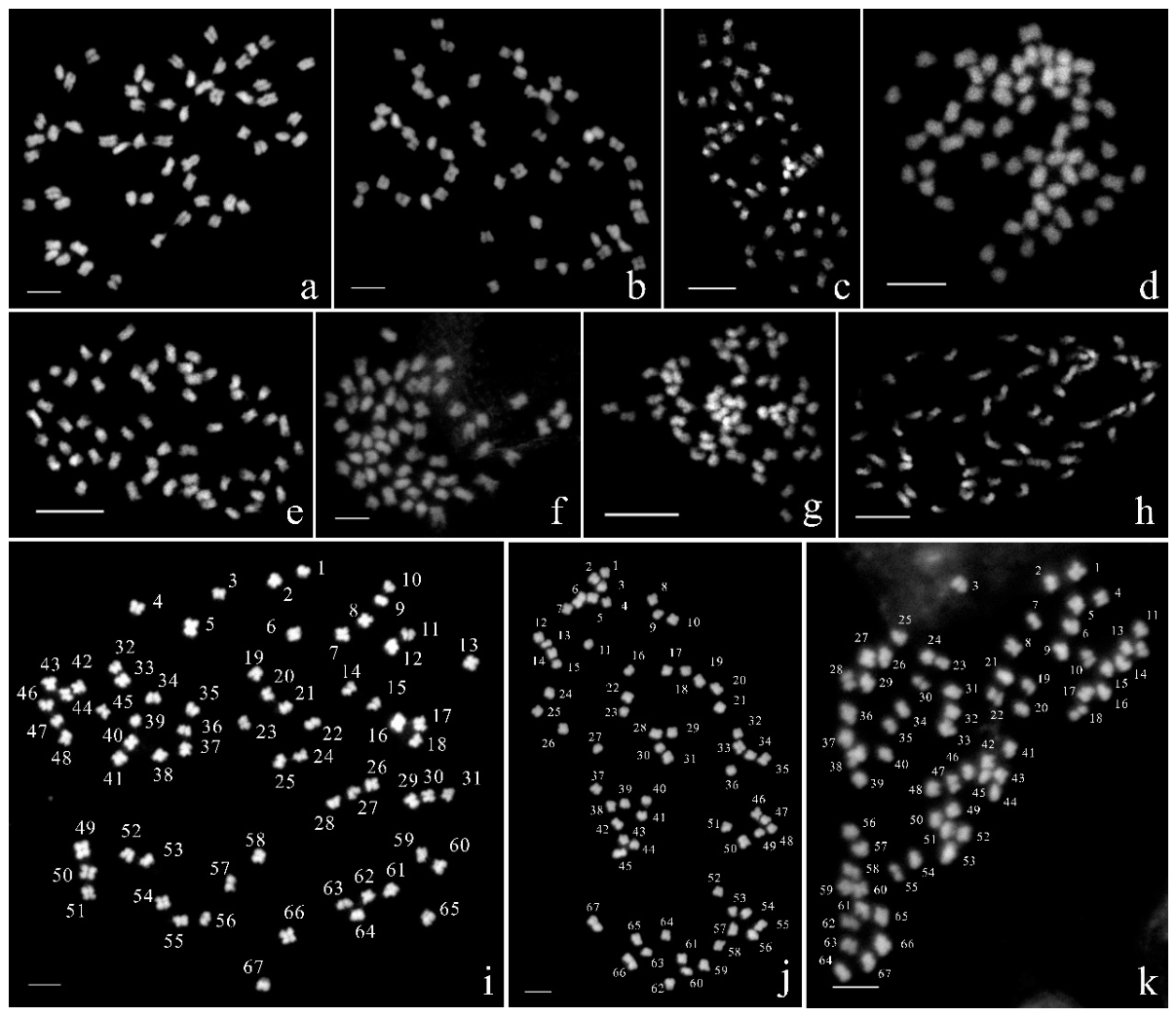
Chromosome counts were obtained for 26 strawberry cultivars. Among these, 25 were octoploid (2n = 8x = 56) (Figure 1a–h). Notably, in ‘Tokun’, all 20 well-spread metaphase cells examined from five plants showed 67 chromosomes (Figure 1i–k), which was reported for the first time (Table 1).
Figure 1.
Chromosome numbers of nine cultivars. (a) ‘Benihoppe’; (b) ‘Yuehouji’; (c) ‘Ganlu’; (d) ‘Huangxiang’; (e) ‘Chandler’; (f) ‘Yutu’; (g) ‘Kaorino’; (h) ‘Guangdian’; (i–k) ‘Tokun’. Bars = 5 μm. The numbers in (i–k) indicate individual chromosomes counted in representative cells.
Table 1.
The ploidy levels of the 26 strawberry cultivars.
2.2. Fruit-Setting Rate and Seed Germination
Reciprocal crosses between ‘Benihoppe’ and ‘Tokun’ revealed substantial differences in fruit-setting rate and achene number per receptacle (Table 2). The fruit-setting rate (56.67%) and achene numbers per receptacle (25.71) of ‘Benihoppe’ × ‘Tokun’ were higher than those of ‘Tokun’ × ‘Benihoppe’ (26.67% and 19.63, respectively). A total of 116 seedlings were obtained from the cross of ‘Benihoppe’ × ‘Tokun’, while 15 weak seedlings were obtained when ‘Tokun’ was female parent, but they did not grow normally and eventually died before maturity.
Table 2.
The fruit-setting rate and germination rate of ‘Benihoppe’ and ‘Tokun’.
2.3. Relative DNA Content and Chromosome Number of Parents and the Hybrids
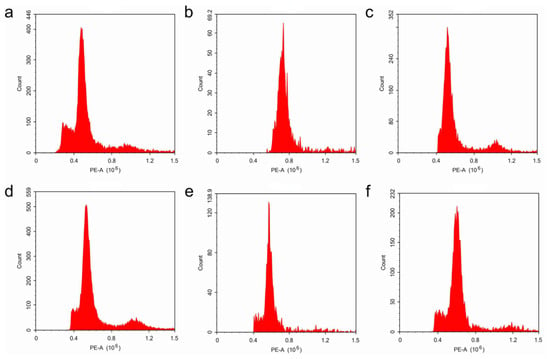
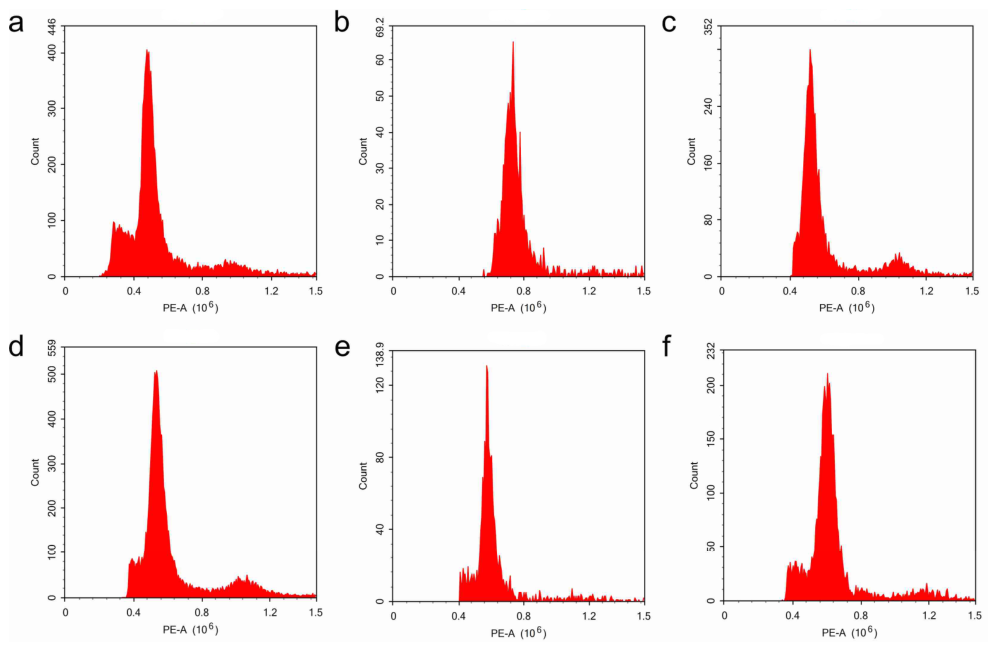
To accurately determine the genetic material of the parents and the hybrid progenies, both traditional chromosome counting and flow cytometry (FCM) were employed. ‘Benihoppe’ had a relative DNA content of 0.49 × 10⁶, while ‘Tokun’ showed a DNA content of 0.72 × 10⁶. The FCM histograms of these two parents were distinctly separated. The relative DNA contents of all hybrids ranged from 0.52 × 10⁶ to 0.63 × 10⁶, falling strictly between those of the two parents. This confirmed their true hybrid identity, demonstrating an intermediate inheritance pattern. Furthermore, the relative DNA contents of hybrids with 61, 62, and 63 chromosomes could not be distinguished (Figure 2).
Figure 2.
Relative fluorescence intensity of parents and selected hybrids analyzed by flow cytometry. (a) ‘Benihoppe’. (b) ‘Tokun’. (c) J2107. (d) J2101. (e) J2150. (f) J2156.
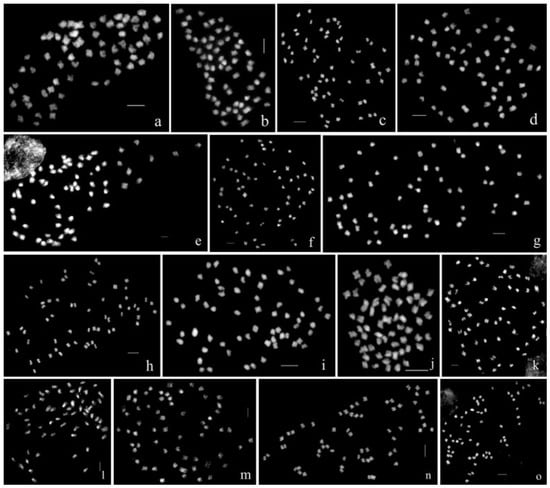
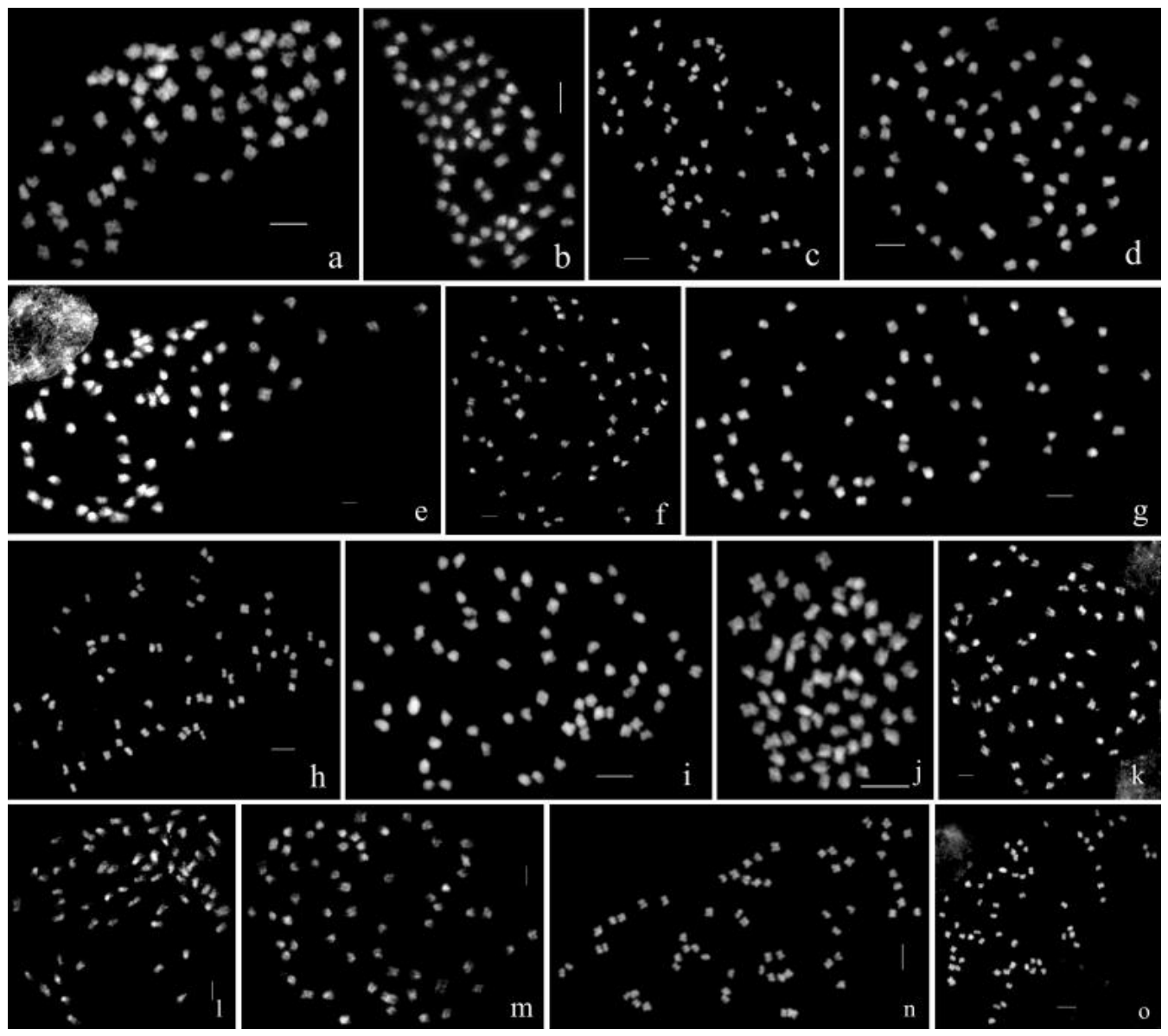
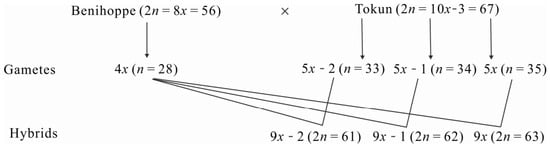
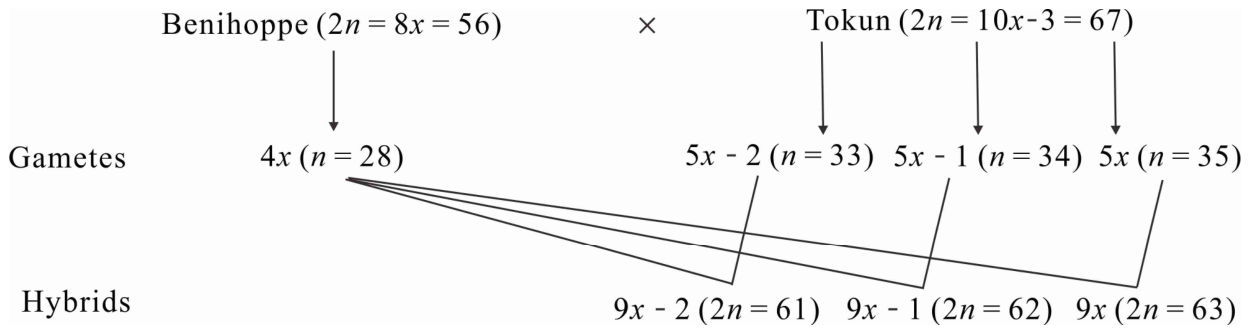
The chromosome numbers of the observed seedlings are presented in Table 3. Among the 27 hybrids, the chromosome numbers of the seedlings were predominantly nonaploid minus one (40.74%) or two (48.15%), and only 11.11% were nonaploid, with an average of 61.63. No seedlings with nonaploid minus three, minus four, or minus five were observed (Figure 3, Table 3). Since octoploid parents undergoing regular meiosis rarely produce aneuploid gametes, the observed aneuploidy is attributable to irregular meiotic segregation in ‘Tokun’. The nonaploid (9x) and aneuploid hybrids were probably derived from the union of the 4x gamete of the female ‘Benihoppe’ and 5x, 5x − 1 and 5x − 2 gametes of the male ‘Tokun’ (Figure 4).
Table 3.
Chromosome numbers and parental contributions in hybrids from ‘Benihoppe’ × ‘Tokun’.
Figure 3.
Chromosome numbers of root-tips in some hybrids from ‘Benihoppe’ × ‘Tokun’ and their parents. (a) J2101, 2n = 9x − 1 = 62. (b) J2105, 2n = 9x = 63. (c) J2107, 2n = 9x − 2 = 61. (d) J2125, 2n = 9x − 2 = 61. (e) J2127, 2n = 9x − 1 = 62. (f) J2132, 2n = 9x − 2 = 61. (g) J2138, 2n = 9x − 2 = 61. (h) J2139, 2n = 9x − 2 = 61. (i) J2140, 2n = 9x − 1 = 62. (j) J2150, 2n = 9x = 63. (k) J2151, 2n = 9x − 1 = 62. (l) J2153, 2n = 9x − 2 = 61. (m) J2154, 2n = 9x − 2 = 61. (n) J2155, 2n = 9x − 2 = 61. (o) J2156, 2n = 9x = 63. Bars = 5 μm.
Figure 4.
The putative origins of various ploidy hybrids from ‘Benihoppe’ × ‘Tokun’. The basic chromosome number of strawberry is x = 7. ‘Benihoppe’ (2n = 8x = 56) produces 4x (n = 28) gametes. ‘Tokun’ (2n = 10x − 3 = 67) produces variable gametes: 5x − 2 (n = 33), 5x − 1 (n = 34), and 5x (n = 35). Consequently, the resulting hybrids have chromosome numbers of 9x − 2 (2n = 61), 9x − 1 (2n = 62), and 9x (2n = 63).
2.4. Pollen Germination, Flower and Stolon Traits, and Fruit Quality of the Hybrids
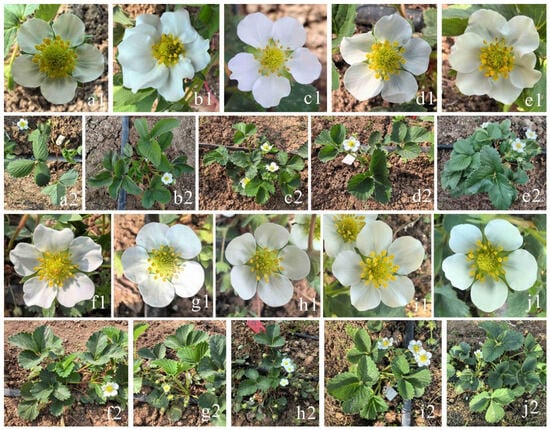
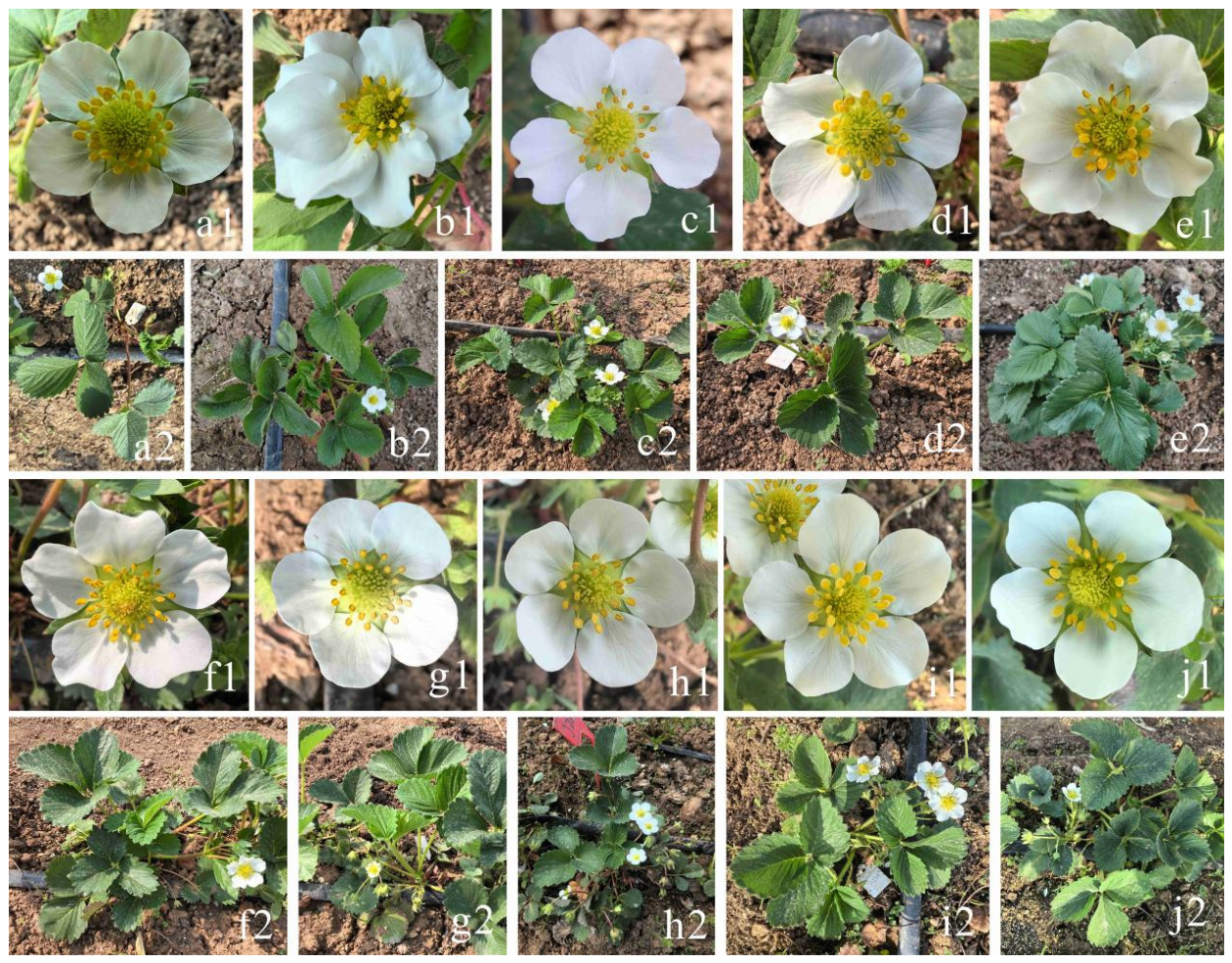
The 27 selected hybrids showed substantial pollen viability, with in vitro pollen germination rates ranging from 21.79% (J2106) to 59.87% (J2136) (Table 4). The flower diameter of J2139 and J2153 was comparable to that of ‘Tokun’ (Figure 5(f1,i1)). All hybrids exhibited higher flower diameter than the lower-value parent ‘Benihoppe’. However, none of the hybrids produced more inflorescences per plant than the female parent ‘Benihoppe’ (Table 5). J2105 displays a double-flowered phenotype. Most hybrids exhibited good stolon propagation ability, whereas three hybrids (J2122, J2127, and J2140) showed relatively poor capacity for stolon production.
Table 4.
The pollen viability of the 27 hybrids.
Figure 5.
The flowers and plants of some hybrids from ‘Benihoppe’ × ‘Tokun’. (a1,a2) J2101. (b1,b2) J2105. (c1,c2) J2107. (d1,d2) J2125. (e1,e2) J2138. (f1,f2) J2139. (g1,g2) J2150. (h1,h2) J2151. (i1,i2) J2153. (j1,j2) J2156.
Table 5.
Fruit characteristics of the eight excellent strawberry hybrids and their parents.
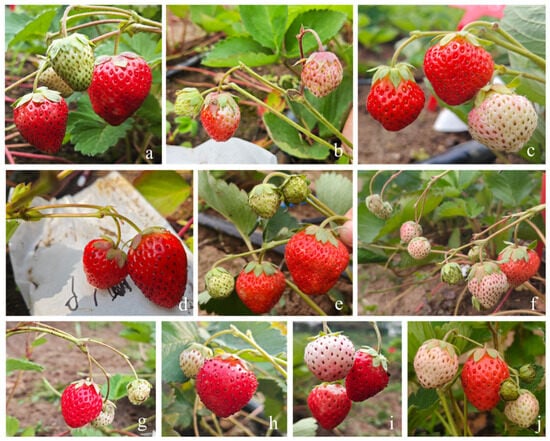
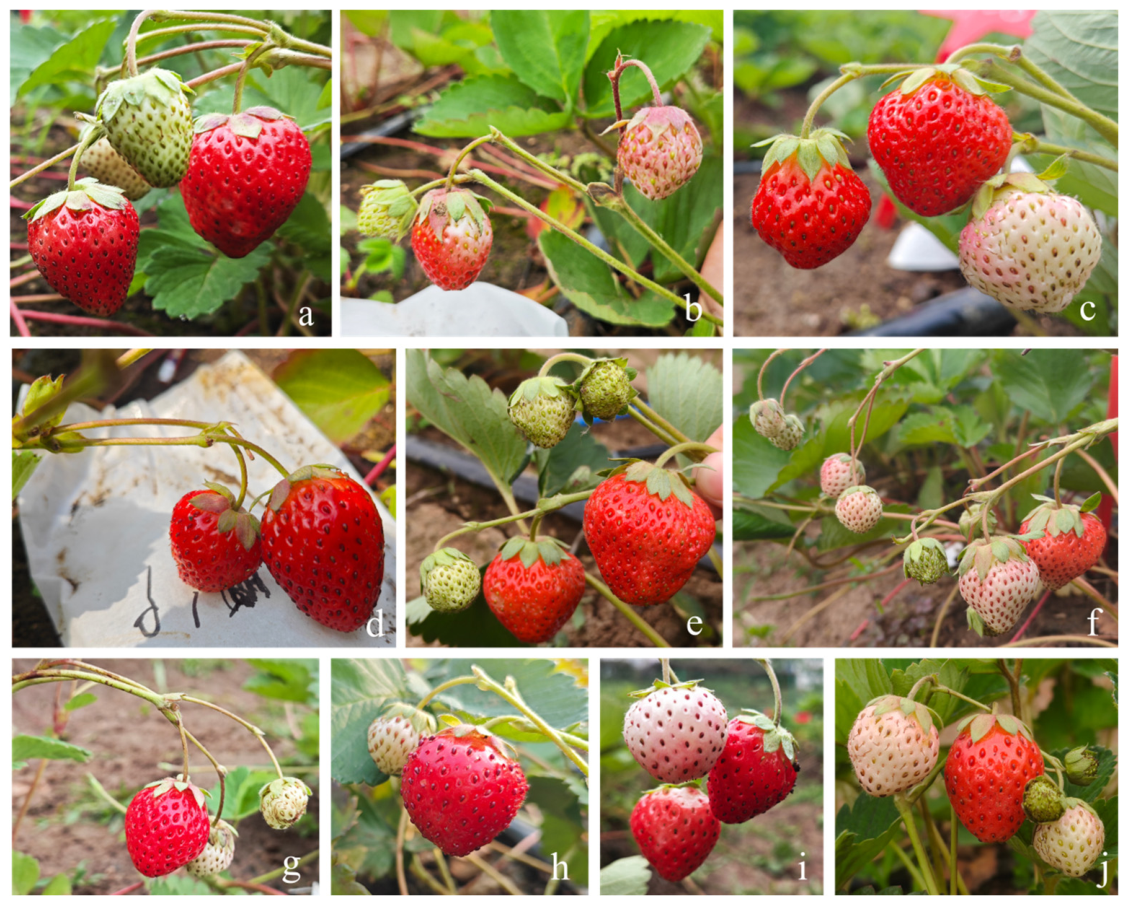
‘Benihoppe’ and ‘Tokun’ exhibited conical and ovoid fruit shapes, respectively. However, their hybrids displayed a variety of fruit shapes, including globular, ovoid, cuneate, short conical, conical, and malformed types. The fruit color of the ‘Benihoppe’ was red, while that of ‘Tokun’ was pink. Most hybrids produced red fruits, though some yielded orange-red (e.g., J2139) or pink fruits (e.g., J2153) (Figure 6). The flesh color of ‘Benihoppe’ was red, whereas ‘Tokun’ had white flesh. Hybrids J2105, J2139 and J2153 also showed white flesh. Most hybrids bore small or abnormally shaped fruits. Nearly all hybrids inherited a distinct peachy aroma from the parent ‘Tokun’. For example, J2138 (2n = 9x − 2 = 61), J2139 (2n = 9x − 2 = 61), J2151 (2n = 9x − 1 = 62), and J2156 (2n = 9x = 63) exhibited an intense peachy aroma similar to ‘Tokun’. These results indicate that ‘Tokun’ can serve as a valuable parent for developing novel germplasm with this distinctive aromatic trait.
Figure 6.
Fruits of some hybrids from ‘Benihoppe’ × ‘Tokun’. (a) J2101. (b) J2105. (c) J2107. (d) J2125. (e) J2138. (f) J2139. (g) J2150. (h) J2151. (i) J2153. (j) J2156.
Most hybrids exhibited low values for both average single-fruit weight and plant yield, though a few produced medium-to-large fruits. For instance, J2138 (11.45 g) showed a greater fruit weight than the higher-weight parent ‘Tokun’ (9.60 g), indicating that large-fruited individuals can be effectively selected from this cross. Conversely, some selections such as J2105 yielded exhibited smaller fruits than the parent cultivars. J2101, J2138 and J2153 exhibited plant yields comparable to the parents, whereas the other hybrids showed lower yields than the parents. The flesh firmness of the male parent ‘Tokun’ was only 0.79 kg · (cm)−2, significantly lower (p < 0.05) than that of the female parent ‘Benihoppe’. All hybrids displayed intermediate flesh firmness between the two parents. Quantitative analysis showed that soluble solids content in most hybrids was close to the mid-parent value, while J2151 and J2156 showed higher than their high-parent values. The majority of hybrids also had higher titratable acidity than both parents. Unfortunately, none of the hybrids surpassed the high-parent lines in vitamin C content.
In summary, five promising lines with aneuploid or nonaploid chromosome constitutions (J2138, J2139, J2151, J2153, and J2156) were obtained through interploidy hybridization, all of which exhibited improved fruit traits. Some of these selected lines displayed more intense aroma, higher flesh firmness, or elevated soluble solids content compared to their parents (Table 5). These results indicate their potential for commercial application and for use in breeding modern aneuploid or nonaploid strawberry cultivars.
3. Discussion
The present results showed that ‘Tokun’ is an aneuploid strawberry (2n = 10x − 3 = 67), which is reported for the first time, differing from previous studies that considered it as a decaploid [15]. Among the 27 hybrids with minimal fruit malformation, the majority were aneuploids and exhibited a peachy aroma. This is likely attributable to abnormal meiosis in the aneuploid ‘Tokun’. It provides a novel insight for aneuploid strawberry breeding.
In the present study, crosses using the octoploid as the maternal parent produced a greater number of fertile offspring. In contrast, the reciprocal cross yielded seeds, but the resulting seedlings died. The discrepancy in crossability between the reciprocal crosses reflects unilateral incompatibility at the gametophytic stage [28,29]. Furthermore, the seedling lethality observed in the latter cross suggests the potential presence of postzygotic isolation. This phenomenon may be preliminarily explained by the Endosperm Balance Number (EBN) hypothesis [30,31]. In distant or interploidy crosses, an imbalance in parental genomic dosage can lead to abnormal endosperm development, consequently compromising seedling survival. However, the underlying cause requires further investigation.
Aneuploid strawberries, characterized by the gain or loss of one to a few chromosomes, exhibit extensive morphological and physiological variation. Although most such changes are harmful [32,33], certain aneuploids may achieve a new genetic balance and display desirable horticultural traits, making them candidates for new cultivars via vegetative propagation [34,35,36,37,38,39,40,41,42,43]. Aneuploidy is thought to enhance evolvability through global physiological and genomic changes [44,45,46], and plants are remarkably tolerant to its effects [35]. This has facilitated the development of ornamental traits such as larger flowers and reduced fertility [47], as well as novel traits like peachy aroma in strawberry hybrids [48]. Thus, aneuploidy induces considerable variation in morphological and agronomic traits, thereby enriching the diversity available for cultivar development. Strawberry is easily propagated by stolons, making it possible to multiply promising aneuploid lines.
Aneuploids can typically be obtained through interspecific hybridization followed by backcrossing [49,50]. For example, Bringhurst and Gill [51] obtained some aneuploids from F. chiloensis × F. vesca hybrids backcrossed to F. chiloensis, with aneuploid gametes derived from the pentaploid, hexaploid, and enneaploid hybrids, and euploid gametes from the octoploid male parent. In the progeny of diploid F. vesca × octoploid F. × ananassa, one individual was aneuploid (2n = 8x + 2 = 58), which arose from an unreduced 8x pollen grain and an incomplete egg [52]. Abnormal gametes were frequently observed in strawberry [52], which may lead to the formation of aneuploids. ‘Tokun’ itself was derived from interspecific hybridization between F. nilgerrensis and cultivated strawberry, followed by chromosome doubling and subsequent hybridization events. Given that ‘Benihoppe’ is a regular octoploid that undergoes normal meiosis and rarely produces aneuploid gametes, the aneuploid gametes observed in the progeny are most likely derived from ‘Tokun’.
The successful introgression of the peachy aroma from ‘Tokun’ into the progeny is noteworthy, particularly given the well-documented difficulty of utilizing F. nilgerrensis in conventional breeding due to its diploid nature [51,52]. Unlike typical diploid × octoploid crosses that often result in hybrid failure or small, sterile offspring, ‘Tokun’, as an aneuploid genotype, appears to circumvent this ploidy barrier, likely through the production of viable aneuploid gametes, as supported by the observed chromosome constitutions of the progeny. This observation aligns with the notion that aneuploids can achieve a novel genetic balance that supports fertility and trait transmission [35,38]. Moreover, the recovery of multiple progeny lines with both the peachy aroma and improved fruit traits suggests that the aneuploid condition of ‘Tokun’ does not preclude, and may even facilitate, the recombination of desirable traits from wild and cultivated genomes. These results thus provide direct experimental evidence that interploidy hybridization using an aneuploid bridge parent can effectively overcome the long-standing ploidy barrier associated with diploid wild species, offering a practical way for broadening the genetic and aromatic diversity of cultivated strawberry.
4. Materials and Methods
4.1. Plant Materials
A total of 26 strawberry cultivars were collected from various growers and research stations. Chromosome counting revealed that one cultivar, ‘Tokun’, was an aneuploid (2n = 67). To evaluate its breeding potential, reciprocal crosses were conducted between ‘Tokun’ and the octoploid cultivar ‘Benihoppe’ in January 2023. A total of 30 flowers were pollinated for each reciprocal cross direction. The resulting seeds were collected in April, stored at 4 °C for one month, and sown in May 2023. Seedlings were transplanted into planters in a greenhouse in September 2023. A total of 27 progenies with intense fruit aroma and low incidence of fruit malformation were selected and propagated via stolons during 2024. The remaining 89 seedlings were discarded after screening and were not subjected to further ploidy or chromosome analyses. The 27 selected progeny lines were evaluated for ploidy level and agronomic traits in 2025.
4.2. Flow Cytometric Determination of Ploidy Levels
Young strawberry leaves were placed in a Petri dish, and 1000 µL nuclei extraction buffer was added. The leaves were rapidly chopped with a sharp razor blade in a single stroke to form a tissue homogenate, ensuring the leaf tissue remained completely submerged in the extraction buffer throughout the process. The prepared homogenate was filtered through a micro-pore filter, and the filtrate was collected into a 1.5 mL centrifuge tube. The centrifuge tube was wrapped in aluminum foil to protect it from light and kept at 4 °C for 5 min. Subsequently, 500 μL solution was transferred into a sample tube, and 30 µL PI staining solution was added. The sample was stained in the dark on ice for 30 min. After staining, the samples were analyzed using a NovoCyte 2040R flow cytometer (ACEA Biosciences, San Diego, CA, USA).
4.3. Chromosome Count
Chromosome preparation was according to Zhou et al. [53] with minor modifications. Young root tips were collected and pretreated with 0.71 mM cycloheximide at room temperature for 2 h. The root tips were then excised and fixed in ethanol/acidic acid (3:1) at 4 °C for at least 12 h. For chromosome preparation, the fixed root tips were washed with distilled water and softened in an enzyme mixture containing 1% (w/v) cellulase RS (Yakult, Tokyo, Japan) and 1% (w/v) pectolyase Y-23 (Yakult, Tokyo, Japan) at 37 °C for about 20 min, followed by treatment with 20 μL ultrapure water for 30 min. The meristematic tissue was then transferred to a glass slide, mixed with 20 μL 45% acetic acid, and spread using an anatomical needle on a heating plate at 65 °C until nearly all acetic acid had evaporated.
The slides were washed three times in 2 × SSC (0.3 M NaCl and 0.03 M sodium citrate) for 5 min. They were then incubated in 0.01 M HCl for 2 min, after which 200 μL pepsin stock solution was applied. The slides were covered with coverslips and placed in a humid chamber at 37 °C for 10 min, followed by one wash in 2 × SSC for 5 min. A dehydration series was carried out using 70%, 90%, and 100% ethanol (3 min each), after which the slides were air-dried. After counterstaining with DAPI, chromosomes in somatic cells at metaphase were observed and photographed under a 40 × objective using a fluorescence microscope (ZEISS Scope. A1, Carl Zeiss Microscopy GmbH, Oberkochen, Germany). For each strain, at least three clear metaphase cells were analyzed.
Sampling intensity differed among materials: For ‘Tokun’, one root tip was sampled from each of five plants (five roots in total), and a total of 20 well-spread metaphase cells (across the five root tips) were examined; for each hybrid and for each of the 25 additional strawberry cultivars, three root tips from different runner plants were examined, with at least 5–7 clear metaphase spreads scored per root tip.
4.4. Investigation of Pollen Germination and Fruit Characteristics
Fresh pollen grains were placed on a medium consisting of 100 g/L sucrose, 4 g/L agar, 0.1 g/L H3BO3, and pH 5.8. After incubation at 28 °C for 2–3 h, pollen germination was observed under microscope (ZEISS Scope. A1). The fruit shape, color, and weight of all hybrids and their parents were measured following the method of Zhao [54]. The vitamin C (VC) content was determined according to Luo et al. [17]. Titratable acid (TA) was measured by acid-base titration. Soluble solids (SS) were determined directly in the field using a portable refractometer. Fruit firmness (FF) was measured using a GY-2 pointer-type fruit hardness tester (portable maturity tester) with a 3.5-mm-diameter probe inserted to a depth of 10 mm. Five fruits were measured per biological replicate, with three technical replicate measurements per fruit. The values of these traits are presented as mean ± SE.
The peachy aroma was assessed by sensory evaluation. Ten horticultural researchers scored the aroma intensity of ‘Tokun’, ‘Benihoppe’, and their hybrids on a 0–5 scale: 0 = no aroma, 1 = faint aroma, 2 = moderately weak aroma, 3 = aromatic, 4 = strongly aromatic, and 5 = very strongly aromatic. For example, ‘Tokun’ received a mean score of 5 (very strongly aromatic). The scores were statistically analyzed, and mean values were used to assign aroma grades recorded as –, +, ++, +++, ++++, and +++++.
5. Conclusions
In conclusion, this study reports, for the first time, that ‘Tokun’ is an aneuploid (2n = 10x − 3 = 67) rather than a decaploid and demonstrates its value as a bridge parent in strawberry breeding. ‘Tokun’ produces viable gametes with variable chromosome numbers, enabling fertile interploidy crosses with octoploid cultivars and generating progeny with diverse chromosome constitutions and improved fruit traits, particularly the characteristic peachy aroma. This work offers a practical framework for using aneuploid germplasm to overcome ploidy barriers and broaden flavor-related genetic variation in strawberry breeding.
Author Contributions
Data curation, Methodology, Investigation, Validation, Visualization, Writing—original draft, and Writing—review and editing, J.C.; Software, T.X.; Data curation, L.L.; Investigation and Conceptualization, X.D.; Investigation and Conceptualization, S.G.; Investigation, Q.Z.; Conceptualization, Z.Z.; Conceptualization, M.Z.; Supervision and Conceptualization, B.M.; Writing—review and editing, Supervision, and Validation, G.L. All authors have read and agreed to the published version of the manuscript.
Funding
This research was funded by the Key Research Project of Higher Education Institutions of Henan Province, grant number 24B210011, the Science and Technology Research Program of the Chongqing Municipal Education Commission, grant number KJQN202301443, the Science and Technology Planning Project of the Technology Innovation Center for Seed Industry Research of Plateau Characteristic Economic Crops in Lhasa, grant number LSQSCNYQ2026006, and the Henan Provincial Science and Technology Research Project, grant numbers 252102110329 and 262102110298.
Data Availability Statement
Data will be made available on request.
Conflicts of Interest
The authors declare no conflicts of interest.
References
- Darrow, G. The Strawberry; Holt, Rinehart and Winston: New York, NY, USA, 1966. [Google Scholar]
- Staudt, G. The species of Fragaria, their taxonomy and geographical distribution. Acta Hortic. 1989, 265, 23–33. [Google Scholar] [CrossRef] [Scilit]
- Hancock, J.F.; Callow, P.W.; Serce, S.; Son, P.Q. Variation in the horticultural characteristics of native Fragaria virginiana and F. chiloensis from North and South America. J. Am. Soc. Hortic. Sci. 2003, 128, 201–208. [Google Scholar] [CrossRef] [Scilit]
- Hummer, K.E.; Nathewet, P.; Yanagi, T. Decaploidy in Fragaria iturupensis (Rosaceae). Am. J. Bot. 2009, 96, 713–716. [Google Scholar] [CrossRef] [Scilit] [PubMed]
- Hummer, K.E. A new species of Fragaria (Rosaceae) from Oregon. J. Bot. Res. Inst. Tex. 2012, 6, 9–15. [Google Scholar]
- Lei, J.J.; Xue, L.; Guo, R.X.; Dai, H.P. The Fragaria species native to China and their geographical distribution. Acta Hortic. 2017, 1156, 37–46. [Google Scholar] [CrossRef] [Scilit]
- Dermen, H.; Darrow, G.M. Colchicine induced terraploid and 16-ploid strawberries. Proc. Amer Soc. Hort. Sci. 1938, 36, 300–301. [Google Scholar]
- Ahmadi, H.; Bringhurst, R.S. Breeding strawberries at the decaploid level. J. Am. Soc. Hortic. Sci. 1992, 117, 856–862. [Google Scholar] [CrossRef] [Scilit]
- Lei, J.J.; Dai, H.P.; Deng, M.Q.; Wu, L.P.; Hu, W.Y. Studies on the interspecific hybridization in the genus Fragaria. Acta Hortic. Sin. 2002, 29, 519–523. [Google Scholar]
- Bors, R.H.; Sullivan, J.A. Interspecific hybridization of Fragaria moschata with two diploid species, F. nubicola and F. viridis. Euphytica 2005, 143, 201–207. [Google Scholar] [CrossRef] [Scilit]
- Dalid, C.; Osorio, L.F.; Peres, N.A.; Lee, S.; Whitaker, V.M.; Plotto, A.; Bai, J. Florida MedallionTM ‘FL 16.30-128’ strawberry. HortScience 2025, 60, 1032–1036. [Google Scholar] [CrossRef] [Scilit]
- Sun, Q.R.; Sun, H.; Li, L.G.; Bell, R.L. In vitro colchicine induced polyploid plantlet production and regeneration from leaf explants of the diploid pear (Pyrus communis L.) cultivar, ‘Fertility’. J. Hortic. Sci. Biotech. 2009, 84, 548–552. [Google Scholar] [CrossRef] [Scilit]
- Chen, M.L. Chromosome doubling of pentaploid strawberrys from Fragaria × ananassa and F. viridis and investigation of biological characteristics of decaploid lines. Master’s Thesis, Nanjing Agricultural University, Nanjing, China, 2014. [Google Scholar]
- Luo, G.J.; Xue, L.; Guo, R.X.; Xu, W.J.; Lei, J.J. Creating cold resistant strawberry via interploidy hybridization between octoploid and dodecaploid. Euphytica 2017, 213, 194. [Google Scholar] [CrossRef] [Scilit]
- Noguchi, Y.; Mochizuki, T.; Sone, K. Breeding of a new aromatic strawberry by interspecific hybridization Fragaria × ananassa × F. nilgerrensis. J. Jpn. Soc. Hortic. Sci. 2002, 71, 208–213. [Google Scholar] [CrossRef] [Scilit]
- Korzin, V. Evaluation study of the interspecific hybrids between Prunus armeniaca and P. brigantina in Nikita Botanical Garden. Acta Hortic. 2021, 1308, 10. [Google Scholar] [CrossRef] [Scilit]
- Luo, G.J.; Xue, L.; Guo, R.X.; Ding, Y.; Xu, W.J.; Lei, J.J. Creating interspecific hybrids with improved cold resistance in Fragaria. Sci. Hortic. 2018, 234, 1–9. [Google Scholar] [CrossRef] [Scilit]
- Wang, J.; Liu, L.; Dong, J.; Zhu, L.; Wang, Y.; Hu, G.; Shi, S. Inheritance of fruit weight, size and organic acid content in a distant hybrid population of longan ‘Huanongzao’ and lychee ‘Ziniangxi’. Horticulturae 2022, 8, 999. [Google Scholar] [CrossRef] [Scilit]
- Deterre, S.C.; McCollum, G.; Leclair, C.; Manthey, J.A.; Bai, J.; Baldwin, E.A.; Raithore, S.; Stover, E.; Plotto, A. Effect of Poncirus trifoliata on the chemical composition of fruits in pedigrees of Citrus scion hybrids. Sci. Hortic. 2021, 277, 109816. [Google Scholar] [CrossRef] [Scilit]
- Tian, Z.; Wu, B.; Liu, J.; Zhang, L.; Wu, T.; Wang, Y.; Han, Z.; Zhang, X. Genetic variations in MdSAUR36 participate in the negative regulation of mesocarp cell division and fruit size in Malus species. Mol. Breed. 2024, 44, 1. [Google Scholar] [CrossRef] [Scilit] [PubMed]
- Griffiths, A.J.; Miller, J.H.; Suzuki, D.T. An Introduction to Genetic Analysis, 7th ed.; W.H. Freeman: New York, NY, USA, 2000; Chapter 18. [Google Scholar]
- Henry, I.M.; Dilkes, B.P.; Miller, E.S.; Burkart-Waco, D.; Comai, L. Phenotypic consequences of aneuploidy in Arabidopsis thaliana. Genetics 2010, 186, 1231–1245. [Google Scholar] [CrossRef] [Scilit] [PubMed]
- Huettel, B.; Kreil, D.P.; Matzke, M.; Matzke, A.J.M. Effects of aneuploidy on genome structure, expression, and interphase organization in Arabidopsis thaliana. PLoS Genet 2008, 4, e1000226. [Google Scholar] [CrossRef] [Scilit] [PubMed]
- Makarevitch, I.; Harris, C. Aneuploidy causes tissue-specific qualitative changes in global gene expression patterns in maize. Plant Physiol. 2010, 152, 927–938. [Google Scholar] [CrossRef] [Scilit] [PubMed][Green Version]
- Oleszczuk, K.; Augustinsson, L.; Bayat, N.; Giwercman, A.; Bungum, M. Prevalence of high DNA fragmentation index in male partners of unexplained infertile couples. Andrology 2013, 1, 357–360. [Google Scholar] [CrossRef] [Scilit] [PubMed]
- Birchler, J.A.; Veitia, R.A. The gene balance hypothesis: Dosage effects in plants. Methods Mol. Biol. 2014, 1112, 25. [Google Scholar] [CrossRef] [Scilit] [PubMed]
- Sang, Y.; Zhao, Y.; Kong, B.; Cheng, D.; Li, L.; Ma, L.; Zhang, P. Genetic variations in morphology, chromosome number, and physiology of backcross progeny of the triploid hybrid clone ‘Beilinxiongzhu 1#’. BMC Plant Biol. 2024, 24, 1123. [Google Scholar] [CrossRef] [Scilit] [PubMed]
- Marta, A.E.; Camadro, E.L.; Castagnaro, A.P. Breeding barriers between the cultivated strawberry, Fragaria × ananassa, and related wild germplasm. Euphytica 2004, 136, 139–150. [Google Scholar] [CrossRef] [Scilit]
- Gore, P.L.; Volker, P.W.; Megalos, J. Unilateral cross-incompatibility in Eucalyptus: The case of hybridisation between E. globulus and E. nitens. Aust. J. Bot. 1990, 38, 383–394. [Google Scholar] [CrossRef] [Scilit]
- Johnston, S.A.; den Nijs, T.P.M.; Peloquin, S.J.; Hanneman, R.E., Jr. The significance of genic balance to endosperm development in interspecific crosses. Theor. Appl. Genet. 1980, 57, 5–9. [Google Scholar] [CrossRef] [Scilit] [PubMed]
- Carputo, D.; Barone, A. Ploidy level manipulations in potato through sexual hybridization. Ann. Appl. Biol. 2005, 146, 71–79. [Google Scholar] [CrossRef] [Scilit]
- Cao, Y.; Zhao, K.L.; Xu, J.X.; Wu, L.; Hao, F.Y.; Sun, M.P.; Dong, J.; Chao, G.T.; Zhang, H.; Gong, X.F.; et al. Genome balance and dosage effect drive allopolyploid formation in Brassica. Proc. Natl. Acad. Sci. USA 2023, 120, e2217672120. [Google Scholar] [CrossRef] [Scilit] [PubMed]
- Yue, W.; Yu, C.; Yang, H.; Lin, S.; Liu, S.; Birchler, J.A.; Shi, X. Genome imbalance modulates the expression of long non-coding RNAs in maize. Plant J. 2025, 123, e70464. [Google Scholar] [CrossRef] [Scilit] [PubMed]
- Henry, I.M.; Dilkes, B.P.; Comai, L. Genetic basis for dosage sensitivity in Arabidopsis thaliana. PLoS Genet 2007, 3, e70. [Google Scholar] [CrossRef] [Scilit] [PubMed]
- Siegel, J.J.; Amon, A. New insights into the troubles of aneuploidy. Annu. Rev. Cell Dev. BI 2012, 28, 189–214. [Google Scholar] [CrossRef] [Scilit] [PubMed]
- Zhou, S.; Li, K.; Zhou, G. Euploid endosperm of triploid × diploid/tetraploid crosses results in aneuploid embryo survival in Lilium. HortScience 2011, 46, 558–562. [Google Scholar] [CrossRef] [Scilit]
- Zhou, S.; Li, K.; Zhou, G. Analysis of endosperm development of allotriploid × diploid/tetraploid crosses in Lilium. Euphytica 2012, 184, 401–412. [Google Scholar] [CrossRef] [Scilit]
- Zhou, S.; Yuan, G.; Xu, P.; Gong, H. Study on lily introgression breeding using allotriploids as maternal parents in interploid hybridizations. Breed. Sci. 2014, 64, 97–102. [Google Scholar] [CrossRef] [Scilit] [PubMed]
- Zhong, J.; Cai, J.; Liu, S.; Wang, Z.; Yin, D.; Zhou, S. GISH analysis of introgressive hybridization using aneuploids as male parents in Lilium. Euphytica 2022, 218, 167. [Google Scholar] [CrossRef] [Scilit]
- Xiao, K.; Sun, Y.; Zhou, S. Revealing the abnormal meiosis and the variation of the functional female gametes of aneuploid lily (Lilium) using genomic in situ hybridization (GISH). Euphytica 2023, 219, 108. [Google Scholar] [CrossRef] [Scilit]
- Liu, S.; Chen, J.; Sun, Y.; Zhou, S. Fluorescence in situ hybridization confirms a theory–Triploid Lilium produce variable aneuploidy eggs and invariable hexaploidy secondary nuclei. Euphytica 2025, 221, 45. [Google Scholar] [CrossRef] [Scilit]
- Chen, J.; Chen, L.; Zeng, Y.; Li, L.; Sun, Y.; Zhou, S. The characteristics of gametogenesis may contribute to the partial female-fertility in aneuploid Lilium. BMC Plant Biol. 2026, 26, 1803. [Google Scholar] [CrossRef] [Scilit] [PubMed]
- Wang, P.; Yang, S.J.; Chen, M.Y.; Liu, Y.J.; He, Q.; Sun, H.Y.; Wu, D.; Xiang, S.Q.; Jing, D.L.; Wang, S.M.; et al. Karyotype variation patterns and phenotypic responses of hybrid progenies of triploid loquat (Eriobotrya japonica) provide new insight into aneuploid germplasm innovation. Hortic. Res. 2025, 12, uhaf023. [Google Scholar] [CrossRef] [Scilit] [PubMed]
- Wang, H.; Wang, R.; Chen, B.; Aslam, T.; Lian, T.T.; Xu, C.M.; Liu, B.; Lv, R. Aneuploidy confers environmentally robust higher evolvability than euploidy in a synthetic allotetraploid wheat. Sci. Adv. 2026, 12, eaec8789. [Google Scholar] [CrossRef] [Scilit] [PubMed]
- Yang, F.; Gritsenko, V.; Lu, H.; Jiang, Y.Y. Adaptation to fluconazole via aneuploidy enables cross-adaptation to amphotericin b and flucytosine in cryptococcus neoformans. Microbiol. Spectr. 2021, 9, e0072321. [Google Scholar] [CrossRef] [Scilit] [PubMed]
- Muenzner, J.; Trebulle, P.; Agostini, F.; Zauber, H.; Messner, C.B.; Steger, M.; Kilian, C.; Lau, K.; Barthel, N.; Lehmann, A.; et al. Natural proteomediversity links aneuploidy tolerance to protein turnover. Nature 2024, 630, 149–157. [Google Scholar] [CrossRef] [Scilit] [PubMed]
- Chen, H.; Contreras, R.N. Near-hexaploid and near-tetraploid aneuploid progenies derived from backcrossing tetraploid parents Hibiscus syriacus × (H. syriacus × H. paramutabilis). Genes 2022, 13, 1022. [Google Scholar] [CrossRef] [Scilit] [PubMed]
- Zhang, Y.; Chen, J.; Luo, G. Creating peach-like-aroma strawberries via interploidy hybridization. HortScience 2026, 61, 1267–1272. [Google Scholar] [CrossRef] [Scilit]
- Jena, K.K.; Khush, G.S. Monosomic alien addition lines of rice: Production, morphology, cytology, and breeding behavior. Genome 1989, 32, 449–455. [Google Scholar] [CrossRef] [Scilit]
- Wu, L.; Wan, L.; Cui, L.; Xiao, K.; Zhong, J.; Liu, Y.; Zeng, J.; Sun, Y.; Zhou, S. Analysis of the cross-compatibility of Lilium brownii var. viridulum and L. davidii var. unicolor. Sci. Hortic. 2021, 284, 110130. [Google Scholar] [CrossRef] [Scilit]
- Bringhurst, R.S.; Gill, T. Origin of Fragaria polyploids. II. Unreduced and doubled-unreduced gametes. Am. J. Bot. 1970, 57, 969–976. [Google Scholar] [CrossRef] [Scilit]
- Yanagi, T.; Hummer, K.E.; Iwata, T.; Sone, K.; Nathewet, P.; Takamura, T. Aneuploid strawberry (2n = 8x + 2 = 58) was developed from homozygous unreduced gamete (8x) produced by second division restitution in pollen. Sci. Hortic. 2010, 125, 123–128. [Google Scholar] [CrossRef] [Scilit]
- Zhou, S.; De Jeu, M.J.; Visser, R.G.F.; Kuipers, A.G.J. Characterisation of distant Alstrogmeria hybrids: Application of highly repetitive DNA sequences from A. ligtu ssp. ligtu. Ann. Appl. Biol. 2003, 142, 277–283. [Google Scholar] [CrossRef] [Scilit]
- Zhao, M.Z. Descriptors and Data Standard for Strawberry (Fragaria spp.); Chinese Agriculture Press: Beijing, Chinese, 2006. [Google Scholar]

Disclaimer/Publisher’s Note: The statements, opinions and data contained in all publications are solely those of the individual author(s) and contributor(s) and not of MDPI and/or the editor(s). MDPI and/or the editor(s) disclaim responsibility for any injury to people or property resulting from any ideas, methods, instructions or products referred to in the content. |
© 2026 by the authors. Licensee MDPI, Basel, Switzerland. This article is an open access article distributed under the terms and conditions of the Creative Commons Attribution (CC BY) license.