


Abstract
Amid increasingly complex climate scenarios, abiotic stresses such as drought, extreme temperatures, and soil salinization have emerged as primary bottlenecks limiting the sustainable development of modern agriculture. Because of their unique nanoscale effects and physicochemical properties, nanoparticles (NPs) can penetrate plant tissue barriers, offering a novel approach to enhance crop resilience to environmental stresses. This review systematically summarizes the core mechanisms by which NPs enhance plant stress tolerance. NPs primarily mitigate the overaccumulation of reactive oxygen species (ROS) and cellular oxidative stress by modulating antioxidant systems, thereby maintaining the physical integrity of photosynthetic apparatuses and cell membranes. Additionally, NPs regulate phytohormone signaling networks and the transcription of stress-responsive genes, while supporting ion compartmentalization and osmotic homeostasis in complex habitats such as coastal saline environments. Integrating multi-omics analyses, this review discusses plant metabolic responses to NPs and their dose-dependent toxicological effects. Addressing bottlenecks in practical application, we evaluate barriers to field-scale translation, the environmental release and migration of nanomaterials across water, air, and the food supply, and associated detection methods and safety risks, including the specific case of widely used silver nanoparticles. Future research must rely on multidisciplinary integration to optimize targeted delivery networks, premised on well-defined risk-assessment standards and viable cost–benefit balances, ultimately providing a scientific basis for enhancing agricultural climate resilience.
1. Introduction
Amidst intensifying global climate change, abiotic stresses have emerged as a primary environmental constraint on crop production. The global mean surface temperature has increased by approximately 1.1 °C above pre-industrial levels, and each 1 °C of warming is estimated to reduce the global yields of wheat by 6.0%, rice by 3.2%, maize by 7.4%, and soybean by 3.1% [1]. Drought frequency and severity have risen across many cropping regions, while altered precipitation patterns and prolonged meteorological droughts are projected to affect an even larger fraction of the global land surface. Concurrently, soil and water salinization is accelerating: the first global assessment of salt-affected soils in five decades estimates that approximately 1381 million hectares (10.7% of the global land area) are salt-affected, with roughly 10% of both irrigated and rainfed cropland impacted by salinization [2]. These stresses disrupt plant water homeostasis, inhibit photosynthesis, and induce cellular oxidative damage, severely constraining crop growth and yield [3]. Currently, conventional strategies to mitigate abiotic stress rely mainly on breeding stress-tolerant cultivars and applying traditional agrochemicals. However, conventional breeding is often hampered by long selection cycles and a limited pool of elite stress-tolerant germplasm [4]. Meanwhile, traditional agrochemicals generally have low field-use efficiency. A substantial proportion of active ingredients is readily lost via leaching, volatilization, or soil fixation [5], thus failing to match the dynamic physiological demands of crops under stress. Furthermore, prolonged and high-dose applications exacerbate agricultural pollution and drive soil degradation [6]. Therefore, there is a pressing need to develop highly efficient and eco-friendly technologies to optimize crop stress management.
In recent years, nanotechnology has emerged as a promising frontier for overcoming bottlenecks in enhancing plant stress tolerance [7]. Characterized by high specific surface areas, tunable surface chemistry, and nanoscale effects, nanoparticles (NPs) exhibit physicochemical properties fundamentally distinct from their bulk counterparts [8]. Their ultra-small size (typically 1–100 nm) enables them to effectively permeate cell wall pores and plasma membranes, bypassing the physical barriers that limit the uptake of conventional bulky agrochemicals—such as conventional synthetic fertilizers (e.g., granular urea), bulk metal-salt micro-nutrient fertilizers (e.g., ferrous sulfate and zinc sulfate), and traditional fungicide and herbicide formulations [9,10]. This unique size advantage facilitates trans-barrier transport and targeted release within plant tissues. Moreover, NPs with specific compositions possess intrinsic surface catalytic activities, enabling them to directly modulate ion homeostasis, reactive oxygen species (ROS) metabolism, and phytohormone networks, thereby triggering endogenous defense mechanisms [11,12]. In light of these advances, this review aims to systematically elucidate the core mechanisms by which nanotechnology enhances plant abiotic stress tolerance and to explore feasible pathways for field-scale applications. To this end, we first outline the physicochemical properties and translocation dynamics of NPs, then analyze their roles in reprogramming plant stress-response networks and their targeted applications across diverse abiotic stress scenarios. Concurrently, considering the barriers to translational research, we objectively assess the biosafety and environmental fate of nanomaterials, aiming to provide theoretical references for the targeted development of next-generation green agricultural inputs.
2. Literature Search Methodology
This review followed a structured and reproducible literature search. Peer-reviewed studies were retrieved from the Web of Science Core Collection, Scopus, PubMed, and Google Scholar, and were supplemented by authoritative institutional reports such as those of the Food and Agriculture Organization (FAO). Search strings combined the terms “nanoparticle”, “nanofertilizer”, or “nanotechnology” with “abiotic stress”, “drought”, “salinity”, “salt stress”, “heavy metal”, “cadmium”, “heat”, “chilling”, “temperature stress”, “antioxidant”, “nanozyme”, “phytohormone”, “omics”, “environmental fate”, and “risk assessment”. Priority was given to primary research published over the last decade, together with seminal and high-impact review articles. A study was included when it reported physiological, biochemical, molecular, or agronomic responses of higher plants to nanomaterials under a defined abiotic stress, and was excluded if it was confined to animal or microbial systems, lacked an identifiable plant response, was not peer reviewed, or was not in English. Titles and abstracts were screened against these criteria and the reference lists of key articles were hand-searched; the retained evidence was subsequently organized by stress type and mechanistic axis.
3. Nanoparticle Types and Plant Interactions
Nanotechnology is the design, characterization, production, and application of structures, devices, and systems by controlling shape and size at the nanoscale, conventionally defined as having at least one dimension between approximately 1 and 100 nm. At this scale, materials exhibit size-dependent optical, catalytic, magnetic, and mechanical properties that differ markedly from those of the corresponding bulk substances and dissolved ions [13]. In agriculture, nanotechnology is being developed for nanofertilizers and nanopesticides, controlled-release formulations, seed nanopriming, nanosensors for soil and crop monitoring, and remediation agents for contaminated soils and water [14].
3.1. Common Categories
Based on their core matrices, agricultural NPs are generally classified as metal(loid)-based, carbon-based, and biopolymer-based carriers [15]. Metal(loid)-based nanomaterials, predominantly represented by zinc oxide (ZnO), iron oxide (Fe3O4), and cerium oxide (CeO2) with mixed valence states, are the most extensively applied [16]. The dynamic redox transition between Ce3+ and Ce4+ endows these nanoparticles with exceptional, regenerative ROS-scavenging capabilities. These materials can serve as slow-release sources of trace elements in tissues or soils; released metal ions or intrinsic surface enzymatic activity can activate antioxidant systems and mitigate oxidative damage [17,18]. Silver nanoparticles (AgNPs), including widely used colloidal liquid formulations, are the predominant antimicrobial nanomaterials and are increasingly incorporated into agricultural biocides, coatings, and seed dressings through the sustained release of Ag+ ions, whose environmental mobility is a growing safety concern [19,20]. Carbon-based materials, such as carbon nanotubes (CNTs) and biomass-derived carbon dots, feature large specific surface areas and excellent electrical conductivity [21]. They can adsorb free nutrients in the soil, and once internalized by cells, facilitate electron transport within photosynthetic and respiratory chains [22,23]. To minimize active-ingredient loss, researchers often use biodegradable polymers (e.g., chitosan and polylactic acid) and porous inorganic carriers (e.g., mesoporous silica nanoparticles) as encapsulation matrices [24]. These materials enable the controlled release of active compounds through pore diffusion or stimuli-responsive degradation, offering superior biocompatibility and minimizing environmental accumulation. Table 1 summarizes the principal categories, representative materials, properties, and agricultural uses.
Table 1.
Common categories of nanomaterials used in plant science and agriculture.
3.2. Uptake and Translocation Networks
The uptake and efficacy of NPs in plants are primarily dictated by their chemical composition, application modes, and physicochemical properties [14]. NPs predominantly enter plant systems through three primary delivery routes: foliar spraying, soil application, and seed nanopriming [25].
During foliar application, NPs smaller than 50 nm can directly enter stomata via air currents or permeate cuticular nanopores to reach epidermal cells [26], effectively overcoming the hydrophobic barrier of the leaf cuticle and potential interception by epidermal trichomes. Some NPs traverse membrane porins to enter organelles such as chloroplasts and participate in local metabolism [20]. This mode ensures rapid efficacy, directly delivering nutrients to photosynthetic organs while bypassing soil fixation [27].
Soil application provides a sustained nutrient supply, initiating with root internalization via sequential apoplastic and symplastic pathways [28]. Intercellular diffusion is ultimately restricted by the Casparian strip at the endodermis [16]. To breach this barrier, NPs must be internalized into the symplast via endocytosis or channel-mediated transport, enabling subsequent xylem-driven acropetal translocation to aerial tissues [29,30].
As a prophylactic strategy, seed nanopriming facilitates NP influx through seed coat micro-fissures and parenchymal interstitial spaces [31,32]. Following imbibition, internalized active components are rapidly reallocated to the developing radicle and plumule, minimizing nutrient competition with rhizosphere microflora [33]. Accordingly, seed-coat thickness, permeability, and the timing of imbibition set species-specific limits on nanopriming outcomes [14].
At the plasma membrane, internalization proceeds through aquaporins and ion channels, carrier-mediated transport, membrane porins, or energy-dependent endocytosis, with the dominant route depending on particle composition, size, and surface chemistry [10,29].
3.3. Influence of Physicochemical Properties on Translocation and Efficacy
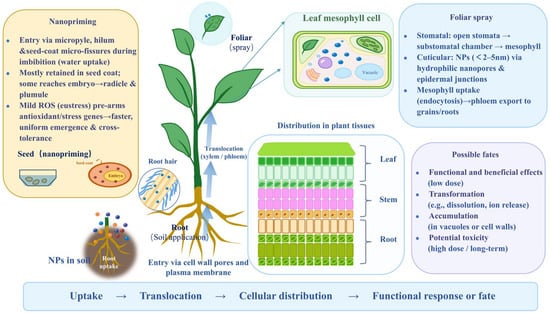
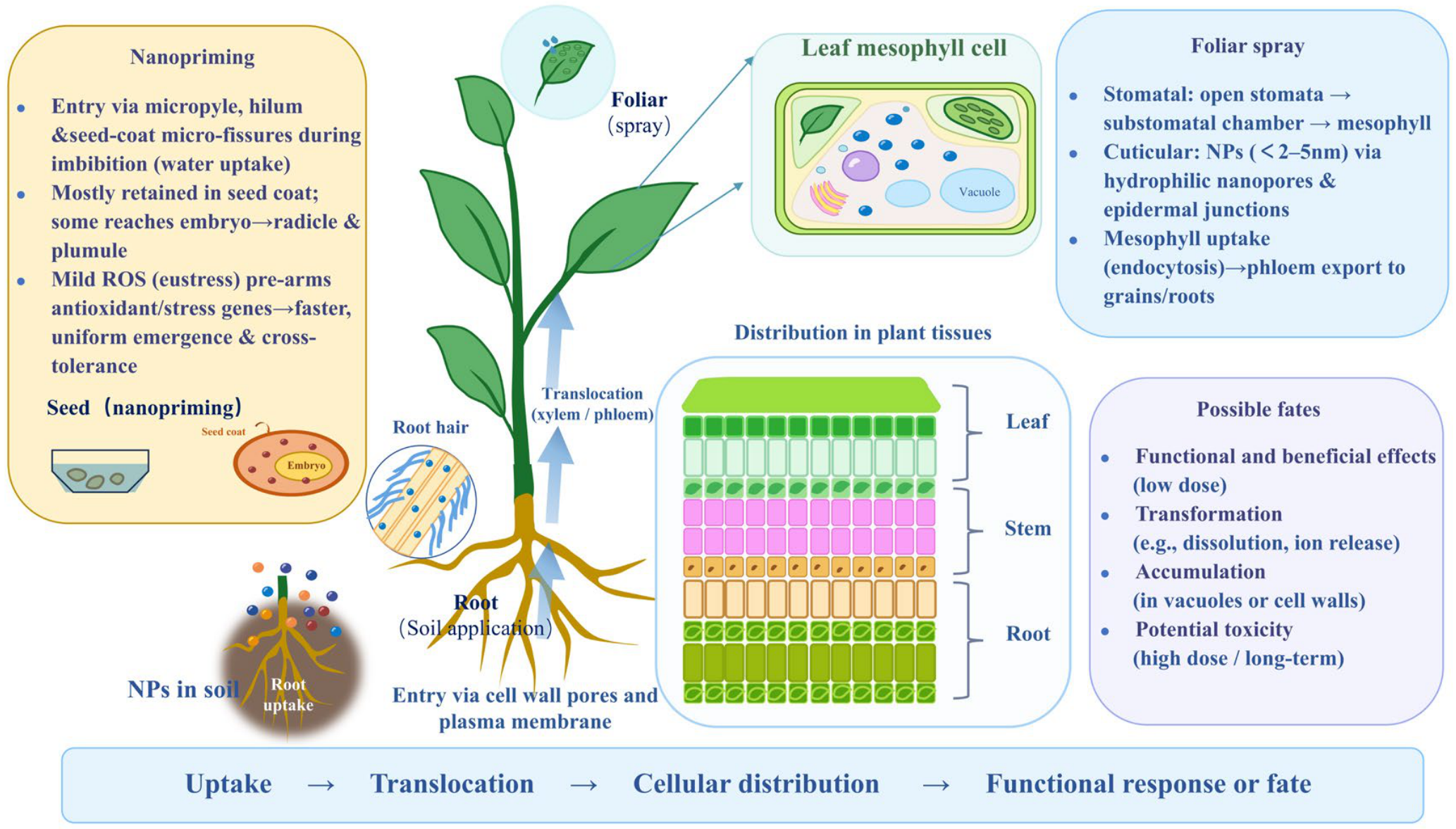
Particle size, surface charge, and surface modifications collectively govern the uptake, translocation efficiency, and bioavailability of NPs [16]. Particle size first sets access across tissue barriers: cell-wall pores generally admit particles below roughly 5–20 nm depending on species and tissue, whereas stomatal openings allow larger particles, commonly below 50 nm, to bypass the foliar cuticle [26,29]. Even after entry, ultra-small particles are readily lost through the transpiration stream, whereas overly large particles agglomerate on the root surface and remain in the cortex [16,34]. Surface charge then controls retention and mobility: the negatively charged pectic acids in cell walls electrostatically attract positively charged NPs and enhance uptake, whereas negatively charged NPs aggregate less with soil colloids and thus remain more mobile [35]. Surface functionalization governs dispersibility and ingress—hydrophilic, neutrally, or moderately charged coatings such as PEG, citrate, chitosan, and small biomolecules reduce agglomeration and facilitate passage through hydrated wall pores, whereas hydrophobic or strongly aggregating surfaces are retained at tissue surfaces; grafting such polymers or introducing ligands (e.g., EDTA) also protects active compounds and widens the safe dose window [16,26]. This fine-tuning aligns NP release with the physiological demands of plants under stress. Taken together, Figure 1 illustrates the complete journey of NPs, from root and foliar entry through xylem/phloem translocation and tissue distribution to subcellular localization and eventual fate.
Figure 1.
Uptake, translocation, and cellular fate of nanoparticles (NPs) in plants across the three delivery routes.
4. Core Mechanisms of Stress Tolerance
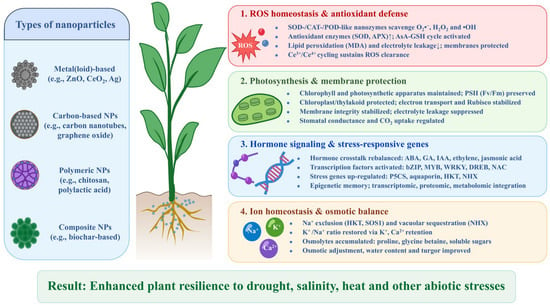
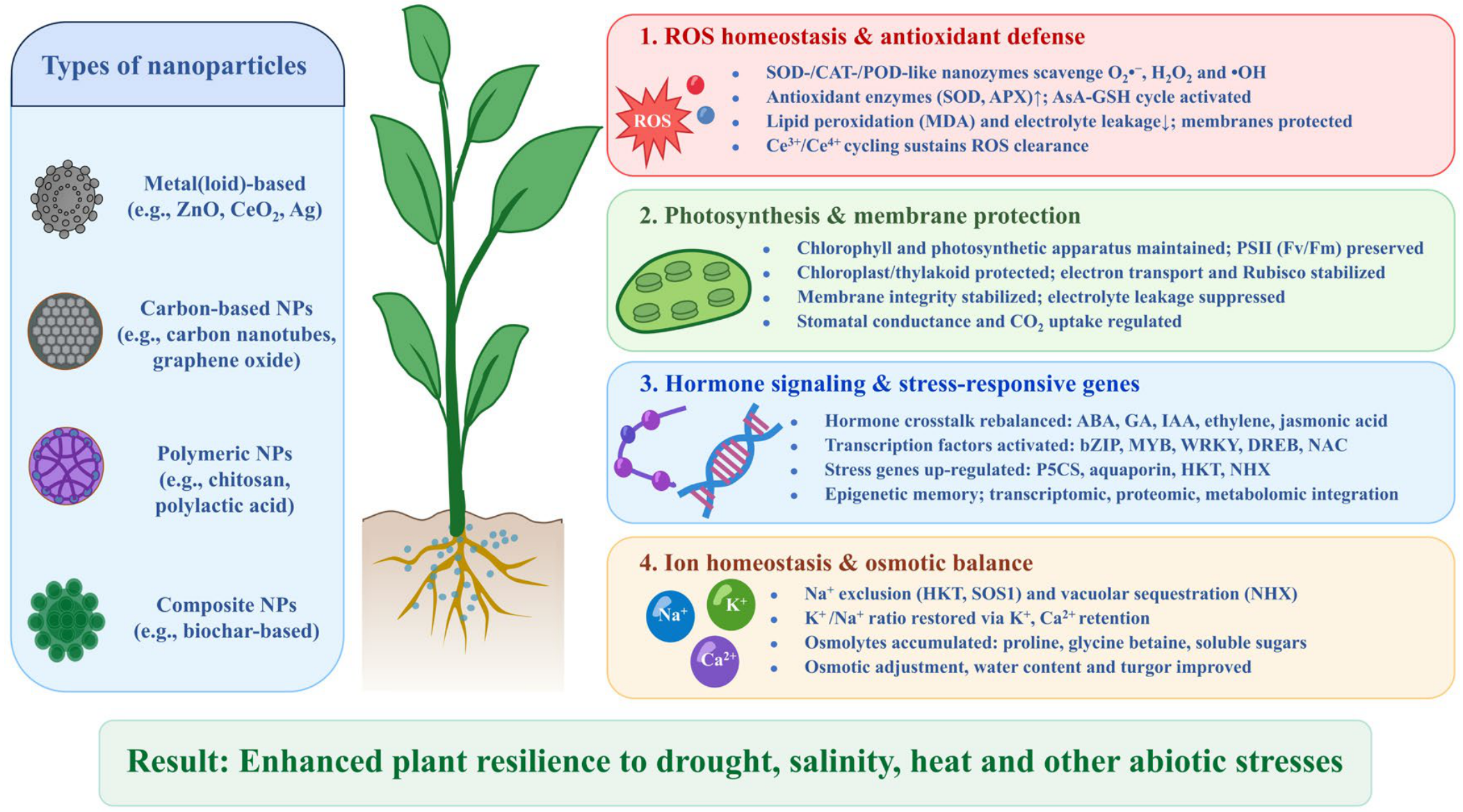
The efficacy of NPs in conferring abiotic stress tolerance stems from fundamental nano–bio interactions at the cellular and molecular levels. Diverging from conventional agrochemicals that merely act as exogenous elicitors, NPs operate through intrinsic catalytic activities, targeted subcellular localization, and profound molecular reprogramming to establish systemic plant resilience [36,37]. Figure 2 provides an integrated overview of the major NP classes, delivery routes, and four principal mechanistic axes: redox control, photosynthetic and membrane protection, hormonal and transcriptional reprogramming, and ion/osmotic homeostasis.
Figure 2.
Integrated mechanisms by which nanoparticles enhance plant abiotic stress tolerance. Upward arrows (↑) indicate increase/upregulation, whereas downward arrows (↓) indicate de-crease/downregulation.
4.1. Intrinsic Nanozyme Activity and Redox Modulation
At the forefront of NP-mediated defense is the direct regulation of cellular redox homeostasis [38]. While conventional treatments indirectly upregulate plant antioxidant enzymes, certain nanomaterials (nanozymes) have intrinsic enzyme-mimicking properties that directly catalyze ROS degradation [39]. Beyond intrinsic surface catalysis, specific nano-formulations quantitatively amplify endogenous defense cascades. For instance, foliar application of calcium phosphate-urea nanocomposites (CaP-U NPs) to drought-stressed finger millet upregulated the activity and expression of key ROS-scavenging enzymes, elevating ascorbate peroxidase (APX) and superoxide dismutase (SOD) by 70% and 47.7%, respectively, relative to stressed controls [40]. Furthermore, nanomaterials like nanoceria, with their dynamic Ce3+/Ce4+ valence transitions, exhibit robust catalase- and superoxide dismutase-like activities. This enables them to neutralize free radicals directly at the site of generation [12,41]. Similarly, biomass-derived carbon dots utilize their high electron mobility and intrinsic catalase-like activity to scavenge ROS independently of the plant’s endogenous enzymatic capacity. This efficient redox modulation directly drives robust structural adaptations; for example, seed dressing with yellow-emissive carbon dots in cold-stressed oilseed rape increased the total root length and root tip number by 124.95% and 36.15%, respectively [42]. The mild, localized ROS generation induced by certain carbon nanomaterials can pre-activate the cellular antioxidant machinery without crossing the threshold of oxidative damage, effectively preparing the plant for subsequent severe environmental shocks [43,44].
4.2. Subcellular Targeting and Membrane Stability
The ultra-small dimensions of NPs enable them to bypass apoplastic barriers and achieve targeted sequestration within specific organelles [45]. High-resolution electron microscopy shows that nanoparticles can preferentially accumulate in critical sites such as chloroplasts and vacuoles [46]. Chloroplast localization allows NPs to directly stabilize the photosynthetic electron transport chain and modulate localized ion fluxes independent of plasma membrane transporters [47]. Moreover, as NPs permeate the cell wall, their interaction with apoplastic proteins and root exudates alters their surface properties, dictating their subsequent intracellular fate and interaction with cellular barriers [48]. Rather than functioning purely as abstract thermodynamic modulators, these materials practically influence membrane lipid composition and fluidity [49]. They help prevent cold-induced membrane rigidification or heat-induced hyper-fluidization, thereby maintaining crucial membrane integrity and preventing electrolyte leakage under environmental extremes [50,51]. Functionally, this structural preservation effectively mitigates stress-induced cellular damage. For instance, foliar application of cysteine-doped graphene quantum dots to drought-stressed plants suppressed lipid peroxidation (measured via MDA) and subsequent electrolyte leakage by 24.17% and 50.74%, respectively, securing intracellular homeostasis [52].
4.3. Transcriptional and Hormonal Reprogramming
The physiological acclimation induced by NPs is ultimately governed by extensive molecular reprogramming [53]. Transcriptomic analyses reveal that NP exposure acts as a rapid primary stimulus, activating broad-spectrum transcription factor networks (e.g., basic leucine zipper (bZIP), myeloblastosis (MYB)-family, and WRKY transcription fac-tors (WRKY proteins, named after the conserved WRKYGQK heptapeptide, Trp–Arg–Lys–Tyr–Gly–Gln–Lys, in their DNA-binding domain)) to prime defense-related genes [54]. Consistent with this transcriptional priming, the CaP-U NPs described in Section 5.1 were shown to induce changes in the expression of antioxidant- and defense-related genes in drought-stressed finger millet, rather than acting solely through surface catalysis [38]. This transcriptional reprogramming is measurable; for example, under severe salinity, applying silicon nanoparticles (SiNPs) to rice upregulates the critical sodium transporter gene OsHKT1;1 by 4-fold, directly supporting ionic and osmotic homeostasis [55]. These molecular events are systematically integrated via phytohormone signaling crosstalk [53]. The NP-induced spatial modulation of hormones, such as balancing growth-promoting indole-3-acetic acid (IAA) with stress-responsive abscisic acid (ABA), facilitates a critical metabolic shift [56]. This reallocates carbon and nitrogen resources from active proliferation toward survival-oriented structural fortification [57]. Beyond transient gene expression, emerging evidence suggests that NPs can induce specific DNA methylation patterns, conferring robust transgenerational stress memory in subsequent offspring [58].
4.4. Multi-Omics Insights
NP-mediated stress regulation involves intricate crosstalk among multiple metabolic pathways. Traditional single-tier molecular techniques fall short in fully elucidating this complexity, whereas multi-omics integrated analysis, encompassing transcriptomics, proteomics, metabolomics, and ionomics, offers a holistic systems biology perspective [59]. By coupling transcriptomics with metabolomics, researchers can trace NP-mediated alterations in metabolic networks with unprecedented resolution. Concurrently, proteomics and ionomics further decipher protein-level execution and elemental reallocation, respectively [60,61]. Transcriptomic data help identify differentially expressed genes, delineating their transcriptional responses in signal transduction and antioxidant defense [60]. Integrated with metabolomics, researchers can precisely quantify the differential abundance of key metabolites. Such combinatorial analyses unravel how NPs modulate carbon and nitrogen metabolic fluxes, providing empirical support for understanding energy reallocation and the biosynthesis of stress-responsive secondary metabolites under adversity [62].
5. Application to Specific Stresses
The efficacy of nanoparticles in abiotic stress management depends on the targeted modulation of physiological damage mechanisms induced by environmental adversity, as NPs reconfigure plant adaptive strategies across diverse stress-specific scenarios (Table 2, Table 3, Table 4 and Table 5).
5.1. Drought
Under drought conditions, prolonged water deficit induces severe cellular dehydration and curtails carbon assimilation. NP interventions mitigate these constraints by driving morphological adaptations, particularly root system optimization for deep-water foraging [63,64]. In staple crops like rice, applying manganese ferrite to the soil reshapes the root architecture by modulating localized IAA signaling, facilitating deeper soil penetration [57]. Beyond in planta structural modifications, engineered nanomaterials such as pectin-modified mesoporous silica nanoparticles directly remodel the rhizosphere [65]. These materials physically enhance soil moisture retention and alter local microbial communities, establishing a resilient hydraulic microenvironment that sustains root vigor during bulk soil desiccation [65,66].
Aboveground NP applications focus on minimizing transpirational water loss and maximizing water use efficiency (WUE) by physically fortifying cellular boundaries and regulating stomatal kinetics [66]. Cellulose nanocrystals specifically target cell wall metabolism in species like tall fescue, reinforcing the structural barrier against severe tissue dehydration [67]. Metallic NPs can upregulate drought-sensing peptides to stimulate systemic ABA biosynthesis [57,63]. This targeted signaling tightly couples’ stomatal closure with increased cuticular wax deposition, sealing the leaf surface to prevent visual senescence [57,68,69]. The field-scale agronomic utility of these nano-elicitors is governed by dose-dependent hormesis. While low concentrations of ZnO NPs optimize root volume and photosynthetic capacity, doses exceeding the physiological thresholds induce severe phytotoxicity and growth arrest [70]. To expand the therapeutic window and bypass the toxicity limits of single-element treatments, modern formulations increasingly use synergistic combinations. The co-application of SeNPs and CuNPs, for instance, safely maximizes plant water status by elevating leaf water content by up to 368.32% under severe drought relative to untreated controls, thereby broadening the threshold for field applications [47].
Key representative drought studies are summarized in Table 2. Proline- and betaine-doped ZnO NPs (15–21 nm), supplied to drought-stressed coriander, redirected secondary metabolism toward essential-oil production and promoted the accumulation of proline and betaine as seed osmoprotectants [71]. In arid-grown onion, ZnO supported on multi-walled carbon nanotubes acted as a smart micronutrient distributor, stimulating cell division (increasing the telophase index) and improving the spatial distribution of zinc during seed and seedling exposure [72]. For fenugreek, biosynthesized magnetite NPs (19–21 nm) applied as a foliar spray enhanced electron transport and broad-spectrum drought acclimation, improving photosynthetic performance and yield [73]. Green-synthesized AgNPs likewise enhanced the drought tolerance of cotton cultured in vitro, preserving relative water content and photosynthetic pigments while inducing antioxidant and drought-responsive genes [74]. Across these examples, smaller particles and foliar or seed-stage delivery tended to produce rapid benefits, whereas dose, coating, and crop-specific anatomy determined the magnitude of the response.
Table 2.
Effects of nanoparticles on plant drought-tolerance mechanisms (↑, increase; ↓, decrease).
5.2. Salinity
Coastal saline environments impose a dual challenge on crops like rice: immediate osmotic shock followed by severe intracellular ion toxicity [75]. Nanoparticle interventions address this toxicity by modifying ion partitioning and compartmentalization [76]. At the systemic level, foliar applications of SiNPs in rice upregulate HKT transporter genes to drive active Na+ exclusion while preserving K+ and Ca2+ retention [55]. This efficacy is often linked to precise subcellular localization. Polyacrylic acid-coated nanoceria accumulate directly within chloroplasts to orchestrate HKT1-dependent ion partitioning, thereby securing a nearly 5-fold higher K+/Na+ ratio than in untreated stressed plants. This process operates independently of the traditional SOS1 or vacuolar sequestration mechanisms [77]. Organelle-level targeting simultaneously facilitates the remodeling of cell wall hemicellulose and pectin, preserving mesophyll conductance and carbon assimilation under extreme salinity [78]. The penetration of metal oxide NPs, such as Mn2O3, through the seed coat triggers the formation of a nanoparticle-protein corona [48]. This interaction directly modifies macromolecular profiles, such as lignin biosynthesis, to strengthen early physical barriers against salt ingress. Rather than merely scavenging existing free radicals, seed priming with carbonaceous materials like multi-walled carbon nanotubes induces a beneficial mild stress, or eustress [79]. This slight, transient H2O2 accumulation acts as a primary signal to pre-activate downstream enzymatic defenses long before severe oxidative damage begins [43].
The broader salinity literature, summarized in Table 3, reinforces these patterns across materials and delivery routes. Selenocystamine-modified chitosan nanomaterials applied as a root drench to rice and pakchoi activated SOD, CAT, and POD, enhanced MAPK-linked transcriptional reprogramming, enriched the rhizosphere microbial community, and reduced lipid peroxidation [80]. Tannic acid-iron nanomaterials delivered through seed priming or drenching acted as broad-spectrum ROS scavengers, lowering H2O2 and hydroxyl radicals while preserving membrane integrity and promoting biomass accumulation and root elongation in rice [81]. In wheat, licorice- and wolfberry-derived nanomaterials stimulated the AsA–GSH cycle and nitrogen-metabolism enzymes during seed priming, restoring the K+/Na+ ratio and preserving photosynthetic pigments [38]. Biologically synthesized magnesium oxide NPs primed radish seeds to increase carbohydrate and protein biosynthesis, suppress anti-nutritional tannins, and activate polyphenolic and flavonoid defenses [82]. Silicon nanoparticle priming of chia optimized the fatty acid profile, lowered the Na+/K+ ratio, and induced proline, CAT, and SOD responses [83], while foliar selenium NPs preserved photosynthetic pigments, activated CAT, APX, and polyphenol oxidase, and reduced lipid peroxidation in faba bean [84]. Foliar AgNPs similarly mitigated seawater-induced salt toxicity in chickpea, restoring shoot and root growth and fresh biomass, raising chlorophyll and Fv/Fm, and enhancing SOD and CAT activity [85]. Collectively, seed-priming and foliar routes dominate salinity management, and surface functionalization (e.g., chitosan, selenium, tannic acid) appears central to efficacy.
Table 3.
Effects of nanoparticles on plant salinity-tolerance mechanisms (↑, increase; ↓, decrease).
5.3. Heavy Metals
Heavy metal toxicity disrupts plant physiology primarily by substituting essential divalent cations in enzymes, inducing severe ROS bursts and impairing nutrient uptake. NPs alleviate this stress through two primary, sometimes opposing, strategies: immobilizing metals in the rhizosphere to enforce exclusion, or enhancing plant uptake to support phytoremediation [89,90]. For food crops, soil amendments with nanoscale zero-valent iron (nZVI) coupled with biochar represent a spatially targeted exclusion strategy. Biochar immobilizes cadmium via surface adsorption, while nZVI modifies root iron transporters; this synergy restricted cadmium partitioning into sensitive tissues [91]. In remediation-oriented species, such as water hyacinth, chitosan-grafted magnetic nanoparticles are paired with synthetic rhizobacteria. This biotic–abiotic association dramatically increases aqueous cadmium and lead capture while reprogramming the root microbiome to favor metal-tolerant Enterobacteriaceae [92].
While root interception limits initial exposure, suppressing the acropetal translocation of any internalized heavy metals is critical for protecting aerial tissues and the food supply. Foliar applications of zinc oxide nanoparticles in cotton, spatially decoupled from soil plant-growth-promoting rhizobacteria, repress the expression of cadmium transporters and modify cell wall polysaccharide metabolism. This blocks the re-distribution of cadmium into photosynthetic tissues [93]. Conversely, in dedicated hyperaccumulators, certain nanomaterials are deliberately deployed to enhance, rather than restrict, metal capture and translocation. Molybdenum trioxide nanoparticles stimulate cadmium phytoextraction in Solanum nigrum, with nontargeted metabolomics linking the response to carbohydrate and antioxidant remodeling and phytohormone signaling [94].
Table 4 summarizes representative heavy-metal studies spanning immobilization, exclusion, and enhanced phytoextraction. In soil-cultivated cucumber, a suite of met-al(loid) oxide and metal sulfide nanomaterials (e.g., MoS2; 5–120 nm) suppressed the bioaccumulation of As, Cd, Pb, Cr, Cu, and Ni, although antagonistic effects on the uptake of Mg, Fe, K, and Mn were also observed [95]. Green-synthesized Cu-Zn nanocomposites applied to Pb-stressed pea improved growth, isozyme activity, phenols, and photosynthetic traits, with remodeling of protein profiles [96]. A multi-omics follow-up in Solanum nigrum distinguished nanoparticle-specific regulation from that of Mo6+ ions and linked the response to heavy-metal-tolerant proteins and cadmium spatial reallocation [94]. Sugarcane pressmud-derived nano-biochar alleviated chromium stress in black cumin, lowering MDA and H2O2 while activating CAT, SOD, POD, and APX and preserving primary metabolism [97]. Graphene oxide enhanced root and shoot cadmium accumulation and improved carbon-sequestration and oxygen-release traits in the hyperaccumulator Lonicera japonica [98], whereas multi-walled carbon nanotubes restricted grain cadmium and lead below food-safety thresholds in scented rice while modulating the rhizosphere microbiome [99]. These studies highlight a crop-dependent duality: nanomaterials can either increase metal capture for remediation or enforce exclusion to protect the food supply.
Table 4.
Effects of nanoparticles on plant responses to heavy-metal stress (↑, increase; ↓, decrease).
5.4. Temperature
Extreme temperatures compromise cellular integrity primarily by altering mem-brane fluidity and destabilizing the photosynthetic apparatus. NPs mitigate chilling and heat injury by preserving organelle ultrastructure and pre-activating temperature-responsive transcriptional networks [24,104]. Under heat stress, zinc oxide nanoparticles localize within vacuoles and chloroplasts, preserving mitochondrial and chloroplast integrity; in alfalfa, this organelle-level protection rescued up to 90% of the biomass otherwise lost to high-temperature injury [24]. At the reproductive stage, where heat sensitivity is greatest, foliar zinc oxide applied at flowering in mungbean maintained gas exchange and rescued pod and seed set [46]. For chilling, nanocomposites such as chitosan-putrescine directly modulate membrane lipid thermodynamics, increasing elasticity to prevent cold-induced rigidification while expanding non-enzymatic redox pools such as glutathione and ascorbate [50]. Foliar nano-priming with zinc oxide in japonica rice activated cold-responsive transcription factors (e.g., bZIP, MYB, and WRKY) and promoted post-stress biomass recovery [105].
Additional temperature studies, compiled in Table 5, extend these findings. Gold nanoparticles used in wheat seed priming stimulated adaptogenic cold hardening, pre-served the photosynthetic apparatus, and activated systemic antioxidant defenses during low-temperature hardening [106]. Titanium dioxide nanoparticles applied to chickpea under cold stress induced temporal transcriptomic reprogramming of early defense and chromatin-architecture genes and maintained membrane integrity, with subcellular sequestration in vacuoles and chloroplasts mitigating electrolyte leakage and MDA accumulation [54,107]. In indica rice, comparative prophylactic foliar sprays of transition- and rare-earth metal oxide nanoparticles (ZnO, Fe2O3, TiO2, CeO2) produced genotype-specific recovery trajectories, alleviated stress-induced proline accumulation, and restored biomass [108]. Across chilling and heat studies, organelle-targeted localization and early transcriptional priming emerged as recurring determinants of protection.
Table 5.
Effects of nanoparticles on plant temperature-stress tolerance (↑, increase; ↓, decrease).
5.5. Dose-Dependent Effects and Hormesis
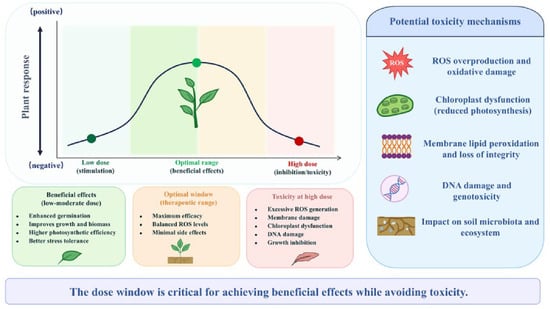
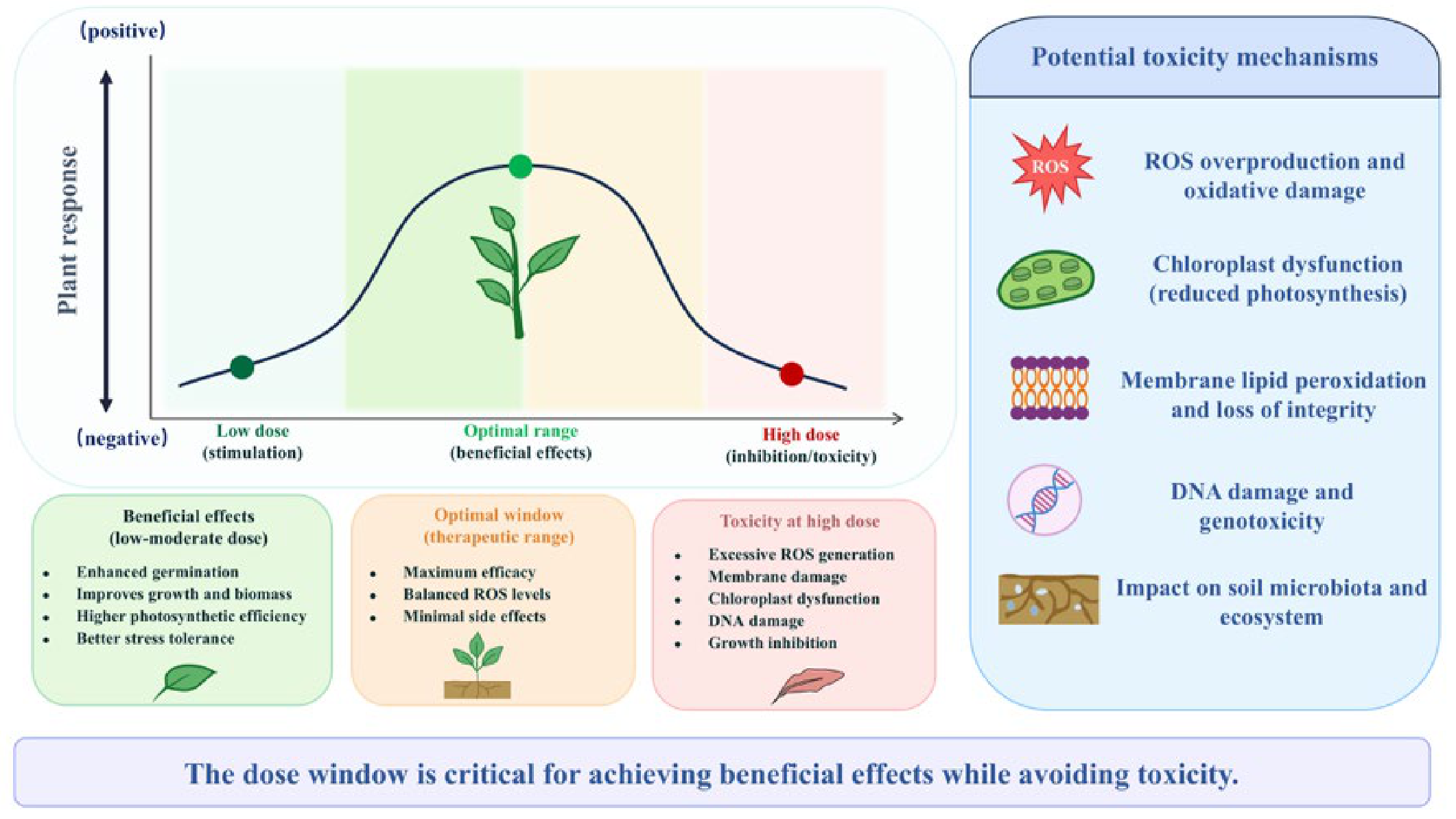
The biological effects of nanomaterials are intrinsically dose-dependent and typically exhibit a hormetic response characterized by low-dose stimulation and high-dose inhibition [110]. For instance, while foliar application of low-dose zinc oxide nanoparticles (≤200 mg/L) enhances photosynthetic efficiency by up to 49.1%, exceeding the critical threshold of 400 mg/L precipitates severe phytotoxicity, thereby suppressing this essential physiological trait by 66.3% and actively reducing overall plant biomass [70]. Beyond phenotypic manifestations such as reduced seed germination rates and inhibited root elongation, high-concentration NPs tend to agglomerate within tissues, hindering vascular transport and inducing cellular apoptosis [111]. Consequently, defining the safe dosage window and evaluating genotype-specific sensitivities are critical prerequisites for agricultural application. The high-dose inhibition shown in Figure 3 arises through several converging mechanisms: ROS overproduction and oxidative damage, chloroplast dysfunction and reduced photosynthesis, membrane lipid peroxidation and loss of integrity, DNA damage and genotoxicity, together with adverse effects on soil microbiota and the wider ecosystem.
Figure 3.
Dose-dependent hormetic effects and potential toxicity of nanoparticles in plants.
6. Safety, Environmental Fate and Risk Assessment
Field-scale use of nanomaterials entails release into, and transfer across, multiple environmental compartments, calling for ecosystem-level rather than plant-centric risk assessment. In soil, pH, redox potential, and organic matter govern NP dissolution, transformation, and agglomeration, and accumulated particles can perturb rhizosphere microbial communities and the biogeochemical cycles they drive [112]; runoff, drainage, and wastewater carry NPs into surface water and groundwater, while spray drift, dust, and the aerosolization of dry formulations release them to the atmosphere, from which they are re-deposited onto land and water. Across these compartments, particles undergo aggregation, sulfidation, and dissolution and can affect algae, invertebrates, and fish, while residues that persist in edible tissues may be transferred through the food chain to higher trophic levels, with biomagnification still incompletely quantified [113]. Silver exemplifies this concern: the widely used colloidal AgNPs described in Section 3.1 slowly release Ag+ through oxidative dissolution, and the dissolved ion is generally more bioavailable and toxic than the particulate form to microbes, algae, plants, and invertebrates [19]. Such assessment depends on robust detection. Single-particle inductively coupled plasma mass spectrometry (spICP-MS) quantifies particle size distributions and number concentrations at environmentally relevant levels, even in complex waters, and is increasingly coupled with field-flow fractionation and ICP-time-of-flight for multi-element particles; electron microscopy (TEM/SEM), energy-dispersive X-ray spectroscopy, dynamic light scattering, nanoparticle tracking analysis, X-ray absorption spectroscopy, and emerging nanosensors provide the orthogonal characterization needed to distinguish engineered NPs from natural nanoparticles and background ions [114]. Table 6 maps the principal environmental compartments, their associated risks, and representative detection approaches [115,116].
Table 6.
Environmental compartments, principal risks of released nanomaterials, and representative detection and assessment approaches.
7. Challenges and Future Directions
While the theoretical foundation for leveraging nanotechnology to enhance plant stress tolerance is robust, substantial barriers to practical translation persist. Current nano-agricultural research predominantly relies on controlled hydroponic or short-term pot systems. However, real-world agroecosystems feature fluctuating light and temperature, soil heterogeneity, and multiple interacting stresses. Therefore, transitioning to longitudinal field trials across diverse pedoclimatic zones is urgently required to systematically evaluate the long-term efficacy and physicochemical stability of nanomaterials in complex soil matrices [13].
The economic viability of nano-enabled cultivation must also be demonstrated. Although nanofertilizers and nanopriming can reduce application rates, nutrient losses, and management costs while raising yields and resource-use efficiency, these benefits must be weighed against high R&D and manufacturing expenses, quality-control and regulatory-compliance costs, specialized storage and infrastructure needs, and potential liabilities associated with environmental release [116]. Field-based cost–benefit and life-cycle analyses, across crop species and pedoclimatic zones, are needed to establish whether the agronomic gains of nanomaterial-treated cultivation reliably justify the increased input costs [114,116].
Developing next-generation nano-agrochemicals hinges on multidisciplinary integration to achieve smart, on-demand delivery. Formulating stimuli-responsive release systems is pivotal. Carriers engineered to respond to rhizospheric pH fluctuations, redox gradients, or specific enzyme exudations can seamlessly align release kinetics with dynamic physiological demands under stress [117,118]. Regarding application and targeting, integrating nanotechnology with precision agriculture and artificial intelligence algorithms enables the dynamic optimization of application parameters based on real-time monitoring data. Beyond technological innovation, establishing standardized ecotoxicological evaluation and regulatory frameworks for nano-agrochemicals is a fundamental prerequisite for their large-scale commercialization [119]. Because nanomaterials vary widely in physicochemical properties, traditional assessment frameworks struggle to gauge environmental exposure risks accurately. Developing quantitative evaluation standards to assess their environment fate systematically, impacts on non-target biological communities, and trophic transfer characteristics will provide a scientific, rigorous basis for the registration and standardized application of these novel agricultural inputs [120].
8. Conclusions
Nanoparticles have shown considerable potential to modulate plant responses to abiotic stresses. By facilitating ROS scavenging, preserving the structural integrity of cell membranes and photosynthetic apparatuses, and interacting with endogenous phytohormone and stress-responsive gene networks, nanomaterials offer intervention pathways distinct from traditional agrochemicals. Together, these mechanisms drive enhanced plant acclimation under a broad spectrum of adversities, including drought, salinity, heavy metal toxicity, and extreme temperatures.
Overcoming the translational bottleneck from promising laboratory-scale findings to practical field applications remains the primary challenge for nano-enabled agriculture. Future developments must strictly adhere to inherently safe design principles and undergo comprehensive evaluations across the entire product life cycle. Such assessments must encompass environmentally benign material synthesis, formulation stability, and long-term environmental degradation. Future research must integrate agronomy, materials science, and ecotoxicology to systematically optimize targeted delivery networks that mitigate ecological and food-web risks. Ultimately, this collaborative approach is essential for translating nanoscale interventions into reliable agronomic traits, thereby securing climate resilience and sustaining global agricultural productivity.
Author Contributions
Conceptualization, Y.L. and M.N.K.; investigation, Y.L., S.H., L.W., S.C., W.W., X.J. and Y.W.; resources, J.L. and Z.U.; writing—original draft preparation, Y.L.; writing—review and editing, Y.L., J.L., Z.U. and M.N.K.; visualization, Y.L.; supervision, M.N.K.; project administration, M.N.K.; funding acquisition, M.N.K. All authors have read and agreed to the published version of the manuscript.
Funding
This work was supported by Linyi University’s Talent Research Fund (Grant# Z6126012).
Data Availability Statement
No new data were created or analyzed in this study.
Acknowledgments
The authors also would like to express their appreciation to all the students and staff for their contributions to the execution of this research.
Conflicts of Interest
The authors declare no conflicts of interest.
References
- Zhao, C.; Liu, B.; Piao, S.; Wang, X.; Lobell, D.B.; Huang, Y.; Huang, M.; Yao, Y.; Bassu, S.; Ciais, P.; et al. Temperature increase reduces global yields of major crops in four independent estimates. Proc. Natl. Acad. Sci. USA 2017, 114, 9326–9331. [Google Scholar] [CrossRef] [Scilit] [PubMed]
- FAO. Global Status of Salt-Affected Soils: Main Report; FAO: Rome, Italy, 2024; 240p. [Google Scholar]
- Kopecká, R.; Kameniarová, M.; Černý, M.; Brzobohatý, B.; Novák, J. Abiotic stress in crop production. Int. J. Mol. Sci. 2023, 24, 6603. [Google Scholar] [CrossRef] [Scilit]
- Wang, Y.; Zafar, N.; Ali, Q.; Manghwar, H.; Wang, G.; Yu, L.; Ding, X.; Ding, F.; Hong, N.; Wang, G.; et al. CRISPR/Cas genome editing technologies for plant improvement against biotic and abiotic stresses: Advances, limitations, and future perspectives. Cells 2022, 11, 3928. [Google Scholar] [CrossRef] [Scilit]
- Elumalai, P.; Gao, X.; Parthipan, P.; Luo, J.; Cui, J. Agrochemical pollution: A serious threat to environmental health. Curr. Opin. Environ. Sci. Health 2025, 43, 100597. [Google Scholar] [CrossRef] [Scilit]
- Yadav, S.L.; Birla, D.; Inwati, D.K.; Yadav, M.; Yadav, I.R.; Makwana, S.N.; Lakshman; Papnai, N. Impact of agrochemicals on soil biota and ways to mitigate it: A review. Int. J. Environ. Clim. Change 2023, 13, 366–375. [Google Scholar] [CrossRef] [Scilit]
- Sarraf, M.; Vishwakarma, K.; Kumar, V.; Arif, N.; Das, S.; Johnson, R.; Janeeshma, E.; Puthur, J.T.; Aliniaeifard, S.; Chauhan, D.K.; et al. Metal/metalloid-based nanomaterials for plant abiotic stress tolerance: An overview of the mechanisms. Plants 2022, 11, 316. [Google Scholar] [CrossRef] [Scilit] [PubMed]
- Wahab, A.; Munir, A.; Saleem, M.H.; AbdulRaheem, M.I.; Aziz, H.; Mfarrej, M.F.B.; Abdi, G. Interactions of metal-based engineered nanoparticles with plants: An overview of the state of current knowledge, research progress, and prospects. J. Plant Growth Regul. 2023, 42, 5396–5416. [Google Scholar] [CrossRef] [Scilit]
- Hyder, S.; Ul-Nisa, M.; Shahzadi; Shahid, H.; Gohar, F.; Gondal, A.S.; Riaz, N.; Younas, A.; Santos-Villalobos, S.d.l.; Montoya-Martínez, A.C.; et al. Recent trends and perspectives in the application of metal and metal oxide nanomaterials for sustainable agriculture. Plant Physiol. Biochem. 2023, 202, 107960. [Google Scholar] [CrossRef] [Scilit] [PubMed]
- Wu, H.; Li, Z. Nano-enabled agriculture: How do nanoparticles cross barriers in plants? Plant Commun. 2022, 3, 100346. [Google Scholar] [CrossRef] [Scilit] [PubMed]
- Narang, J.; Kapoor, B.; Sharma, S.; Gill, N.S. Mechanistic insights: How nanoparticles modulate plant hormones and defense response signaling under stress. Plant Nano Biol. 2025, 13, 100174. [Google Scholar] [CrossRef] [Scilit]
- Niyazi, S.; Keerthana, K.; Arif, Y.; Ahmad, Z.; Shahid, M.; Vijayakanth, V. CeO2 nanozymes as redox regulators: Reprogramming of reactive oxygen species (ROS) signaling for plant climate resilience. Plant Mol. Biol. 2026, 116, 63. [Google Scholar] [CrossRef] [Scilit] [PubMed]
- Pagano, M.; Lunetta, E.; Belli, F.; Mocarli, G.; Cocozza, C.; Cacciotti, I. Advancements in agricultural nanotechnology: An updated review. Plants 2025, 14, 2939. [Google Scholar] [CrossRef] [Scilit] [PubMed]
- Khan, M.N.; Li, Y.; Mu, Y.; Sultan, H.; Baloch, A.; Din, I.; Fu, C.; Li, J.; Khan, Z.; Kumar, S.; et al. Recent advances in nano-enabled plant salt tolerance: Methods of application, risk assessment, opportunities and future prospects. J. Integr. Agric. 2025, 24, 1611–1630. [Google Scholar] [CrossRef] [Scilit]
- Joudeh, N.; Linke, D. Nanoparticle classification, physicochemical properties, characterization, and applications: A comprehensive review for biologists. J. Nanobiotechnol. 2022, 20, 262. [Google Scholar] [CrossRef] [Scilit] [PubMed]
- Duan, H.; Zhao, Y.; Sun, W.; Li, W.; Siddique, K.H.M.; Mao, H.; Zhou, L. Physicochemical determinants of metal-based nanoparticle uptake and translocation in plants: A review. Curr. Opin. Environ. Sci. Health 2026, 50, 100718. [Google Scholar] [CrossRef] [Scilit]
- Liu, Y.; Xiao, Z.; Chen, F.; Yue, L.; Zou, H.; Lyu, J.; Wang, Z. Metallic oxide nanomaterials act as antioxidant nanozymes in higher plants: Trends, meta-analysis, and prospect. Sci. Total Environ. 2021, 780, 146578. [Google Scholar] [CrossRef] [Scilit] [PubMed]
- Saifi, M.A.; Negi, A.; Kaur, A.; Lakshya; Merugu, R.; Negi, S.; Yassin, M.T. Phytochemicals-derived functional metal/metal oxide nanocomposites: Mechanistic insights and biological interactions. Inorg. Chem. Commun. 2026, 186, 116214. [Google Scholar] [CrossRef] [Scilit]
- Ihtisham, M.; Noori, A.; Yadav, S.; Sarraf, M.; Kumari, P.; Brestic, M.; Imran, M.; Jiang, F.; Yan, X.; Rastogi, A. Silver nanoparticle’s toxicological effects and phytoremediation. Nanomaterials 2021, 11, 2164. [Google Scholar] [CrossRef] [Scilit] [PubMed]
- Fares, A.; Mahdy, A.; Ahmed, G. Unraveling the mysteries of silver nanoparticles: Synthesis, characterization, antimicrobial effects and uptake translocation in plant—A review. Planta 2024, 260, 7. [Google Scholar] [CrossRef] [Scilit] [PubMed]
- Sigala-Aguilar, N.A.; López, M.G.; Fernández-Luqueño, F. Carbon-based nanomaterials as inducers of biocompounds in plants: Potential risks and perspectives. Plant Physiol. Biochem. 2024, 212, 108753. [Google Scholar] [CrossRef] [Scilit] [PubMed]
- Zaytseva, O.; Neumann, G. Carbon nanomaterials: Production, impact on plant development, agricultural and environmental applications. Chem. Biol. Technol. Agric. 2016, 3, 17. [Google Scholar] [CrossRef] [Scilit]
- Zhu, L.; Chen, L.; Gu, J.; Ma, H.; Wu, H. Carbon-based nanomaterials for sustainable agriculture: Their application as light converters, nanosensors, and delivery tools. Plants 2022, 11, 511. [Google Scholar] [CrossRef] [Scilit] [PubMed]
- Kareem, H.A.; Hassan, M.U.; Zain, M.; Irshad, A.; Shakoor, N.; Saleem, S.; Niu, J.; Skalicky, M.; Chen, Z.; Guo, Z.; et al. Nanosized zinc oxide (n-ZnO) particles pretreatment to alfalfa seedlings alleviate heat-induced morpho-physiological and ultrastructural damages. Environ. Pollut. 2022, 303, 119069. [Google Scholar] [CrossRef] [Scilit] [PubMed]
- Du, J.; Liu, B.; Zhao, T.; Xu, X.; Lin, H.; Ji, Y.; Li, Y.; Li, Z.; Lu, C.; Li, P.; et al. Silica nanoparticles protect rice against biotic and abiotic stresses. J. Nanobiotechnol. 2022, 20, 197. [Google Scholar] [CrossRef] [Scilit] [PubMed]
- Avellan, A.; Yun, J.; Zhang, Y.; Spielman-Sun, E.; Unrine, J.M.; Thieme, J.; Li, J.; Lombi, E.; Bland, G.; Lowry, G.V. Nanoparticle size and coating chemistry control foliar uptake pathways, translocation, and leaf-to-rhizosphere transport in wheat. ACS Nano 2019, 13, 5291–5305. [Google Scholar] [CrossRef] [Scilit] [PubMed]
- He, E.; Li, X.; Xu, X.; Fu, Z.; Romero-Freire, A.; Qiu, H. Distinct accumulation patterns, translocation efficiencies, and impacts of nano-fertilizer and nano-pesticide in wheat through foliar versus soil application. J. Hazard. Mater. 2024, 480, 136357. [Google Scholar] [CrossRef] [Scilit] [PubMed]
- Sultan, H.; Mazhar Abbas, H.M.; Faizan, M.; Emamverdian, A.; Shah, A.; Bahadur, S.; Li, Y.; Khan, M.N.; Nie, L. Residual effects of biochar and nano-modified biochar on growth and physiology under saline environment in two different genotype of Oryza sativa L. J. Environ. Manag. 2025, 373, 123847. [Google Scholar] [CrossRef] [Scilit] [PubMed]
- Zhang, H.-Y.; Su, W.-H. Classification, uptake, translocation, and detection methods of nanoparticles in crop plants: A review. Environ. Sci. Nano 2024, 11, 1847–1870. [Google Scholar] [CrossRef] [Scilit]
- Yan, G.; Jin, H.; Yin, C.; Hua, Y.; Huang, Q.; Zhou, G.; Xu, Y.; He, Y.; Liang, Y.; Zhu, Z. Comparative effects of silicon and silicon nanoparticles on the antioxidant system and cadmium uptake in tomato under cadmium stress. Sci. Total Environ. 2023, 904, 166819. [Google Scholar] [CrossRef] [Scilit] [PubMed]
- Fonseca, J.D.d.S.; Wojciechowska, E.; Kulesza, J.; Barros, B.u.S. Carbon nanomaterials in seed priming: Current possibilities. ACS Omega 2024, 9, 44891–44906. [Google Scholar] [CrossRef] [Scilit] [PubMed]
- Khan, M.N.; Fu, C.; Li, J.; Tao, Y.; Li, Y.; Hu, J.; Chen, L.; Khan, Z.; Wu, H.; Li, Z. Seed nanopriming: How do nanomaterials improve seed tolerance to salinity and drought? Chemosphere 2023, 310, 136911. [Google Scholar] [CrossRef] [Scilit] [PubMed]
- Del Buono, D.; Luzi, F.; Puglia, D. Lignin nanoparticles: A promising tool to improve maize physiological, biochemical, and chemical traits. Nanomaterials 2021, 11, 846. [Google Scholar] [CrossRef] [Scilit] [PubMed]
- Al-Amri, N.; Tombuloglu, H.; Slimani, Y.; Akhtar, S.; Barghouthi, M.; Almessiere, M.; Alshammari, T.; Baykal, A.; Sabit, H.; Ercan, I.; et al. Size effect of iron (III) oxide nanomaterials on the growth, and their uptake and translocation in common wheat (Triticum aestivum L.). Ecotoxicol. Environ. Saf. 2020, 194, 110377. [Google Scholar] [CrossRef] [Scilit] [PubMed]
- Zhang, Y.; Martinez, M.R.; Sun, H.; Sun, M.; Yin, R.; Yan, J.; Marelli, B.; Giraldo, J.P.; Matyjaszewski, K.; Tilton, R.D.; et al. Charge, aspect ratio, and plant species affect uptake efficiency and translocation of polymeric agrochemical nanocarriers. Environ. Sci. Technol. 2023, 57, 8269–8279. [Google Scholar] [CrossRef] [Scilit] [PubMed]
- Ijaz, M.; Khan, F.; Ahmed, T.; Noman, M.; Zulfiqar, F.; Rizwan, M.; Chen, J.; Siddique, K.H.M.; Li, B. Nanobiotechnology to advance stress resilience in plants: Current opportunities and challenges. Mater. Today Bio 2023, 22, 100759. [Google Scholar] [CrossRef] [Scilit] [PubMed]
- Fu, C.; Khan, M.N.; Yan, J.; Hong, X.; Zhao, F.; Chen, L.; Ma, H.; Li, Y.; Li, J.; Wu, H. Mechanisms of nanomaterials for improving plant salt tolerance. Crop Environ. 2023, 2, 92–99. [Google Scholar] [CrossRef] [Scilit]
- Wang, W.; Liu, Z.; Wang, S.; Dang, P.; Wang, X.; Sun, G.; Yan, X.; Gao, L.; Fan, K.; Jiang, J. Mineral-derived nanozymes modulate plant redox homeostasis and nitrogen metabolism to improve crop productivity. ACS Nano 2026, 20, 14785–14798. [Google Scholar] [CrossRef] [Scilit] [PubMed]
- Akhter, F.; Rashid, S.; Ridwan, Q.; Anjum, N.; Zehra, D.; Asgher, M.; Khan, M.R.R.; Peer, L.A.; Mir, B.A.A.; Hanief, M.; et al. Recent advances in the role of selenium and nanoselenium in modulating plant defense under biotic and abiotic stresses. Front. Plant Sci. 2026, 17, 1815681. [Google Scholar] [CrossRef] [Scilit] [PubMed]
- Mishra, D.; Chitara, M.K.; Upadhayay, V.K.; Singh, J.P.; Chaturvedi, P. Plant growth promoting potential of urea doped calcium phosphate nanoparticles in finger millet (Eleusine coracana (L.) Gaertn.) under drought stress. Front. Plant Sci. 2023, 14, 1137002. [Google Scholar] [CrossRef] [Scilit] [PubMed]
- Khan, M.N.; Li, Y.; Fu, C.; Hu, J.; Chen, L.; Yan, J.; Khan, Z.; Wu, H.; Li, Z. CeO2 nanoparticles seed priming increases salicylic acid level and ROS scavenging ability to improve rapeseed salt tolerance. Glob. Chall. 2022, 6, 2200025. [Google Scholar] [CrossRef] [Scilit] [PubMed]
- Ding, Z.; Xu, W.; Feng, Y.; Li, Y.; Ma, X.; Zhou, Z.; Chen, K.; Shah, A.A.; Wang, Q.; Ren, X.; et al. Selective photosynthetically active nanozymes alleviate crops cold stress via exclusively enhancing root proliferation. Chem. Eng. J. 2025, 508, 160428, Correction in Chem. Eng. J. 2025, 526, 171145. [Google Scholar] [CrossRef] [Scilit]
- González-García, Y.; López-Vargas, E.R.; Pérez-Álvarez, M.; Cadenas-Pliego, G.; Benavides-Mendoza, A.; Valdés-Reyna, J.; Pérez-Labrada, F.; Juárez-Maldonado, A. Seed priming with carbon nanomaterials improves the bioactive compounds of tomato plants under saline stress. Plants 2022, 11, 1984. [Google Scholar] [CrossRef] [Scilit] [PubMed]
- Han, T.; Sun, X.; He, S.; Li, J.; Tian, X.; Sun, Q.; Wang, H.; Pang, Q.; Niu, N.; Chen, L. Cu-doped ZnO nanozyme with citric acid modification alleviate saline-alkaline stress in wheat by scavenging reactive oxygen species. Plant Physiol. Biochem. 2025, 229, 110365. [Google Scholar] [CrossRef] [Scilit] [PubMed]
- Saurabh, K.; Prakash, V.; Dubey, A.K.; Ghosh, S.; Kumari, A.; Sundaram, P.K.; Jeet, P.; Sarkar, B.; Upadhyaya, A.; Das, A.; et al. Enhancing sustainability in agriculture with nanofertilizers. Discov. Appl. Sci. 2024, 6, 559. [Google Scholar] [CrossRef] [Scilit]
- Kareem, H.A.; Saleem, M.F.; Saleem, S.; Rather, S.A.; Wani, S.H.; Siddiqui, M.H.; Alamri, S.; Kumar, R.; Gaikwad, N.B.; Guo, Z.; et al. Zinc oxide nanoparticles interplay with physiological and biochemical attributes in terminal heat stress alleviation in mungbean (Vigna radiata L.). Front. Plant Sci. 2022, 13, 842349. [Google Scholar] [CrossRef] [Scilit] [PubMed]
- Liu, A.; Xiao, W.; Lai, W.; Wang, J.; Li, X.; Yu, H.; Zha, Y. Potential application of selenium and copper nanoparticles in improving growth, quality, and physiological characteristics of strawberry under drought stress. Agriculture 2024, 14, 1172. [Google Scholar] [CrossRef] [Scilit]
- Ye, Y.; Cota-Ruiz, K.; Hernández-Viezcas, J.A.; Valdés, C.; Medina-Velo, I.A.; Turley, R.S.; Peralta-Videa, J.R.; Gardea-Torresdey, J.L. Manganese nanoparticles control salinity-modulated molecular responses in Capsicum annuum L. through priming: A sustainable approach for agriculture. ACS Sustain. Chem. Eng. 2020, 8, 1427–1436. [Google Scholar] [CrossRef] [Scilit]
- Salam, A.; Rehman, M.; Deng, Z.; Zhu, S.; Wang, X.; Chang, J.; Zeeshan, M.; Zhang, Z.X.; Zhao, C. Cerium-coated Fe3O4 nanocomposite enhances salt stress tolerance in maize by modulating photosynthetic efficiency, antioxidant defense, and cellular ultrastructure. Front. Plant Sci. 2026, 17, 1768765. [Google Scholar] [CrossRef] [Scilit] [PubMed]
- Kalisz, A.; Kornaś, A.; Gil, J.; Sękara, A.; Húska, D.; Rudolphi-Szydło, E.; Sieprawska, A.; Gawrońska, K.; Kulak, M.; Fotopoulos, V.; et al. Exogenously applied putrescine and chitosan–putrescine nanocomposite alleviate the negative effects of chilling stress on iceberg lettuce seedlings. Sci. Rep. 2025, 15, 26963. [Google Scholar] [CrossRef] [Scilit] [PubMed]
- Sathasivam, M.; Allen, D.K.; Shankar, V.; Saha, R.; Narayanan, S. Conserved mechanisms of plant lipidome remodeling under heat and cold stresses revealed through a systematic review and meta-analysis. J. Exp. Bot. 2026, 77, 3445–3464. [Google Scholar] [CrossRef] [Scilit] [PubMed]
- Aazami, M.A.; Bahrevar, F.; Rasouli, F.; Hassanpouraghdam, M.B.; Khoshmaram, L. Foliar application of a newly engineered cysteine-graphene quantum dots (GQDs-Cys) nanocomposite mitigates drought stress in apricot (Prunus armeniaca L.) seedlings. Sci. Hortic. 2024, 338, 113808. [Google Scholar] [CrossRef] [Scilit]
- Tripathi, G.; Dutta, S.; Mishra, A.; Basu, S.; Gupta, V.; Kamaraj, C. Nanomaterials impact in phytohormone signaling networks of plants—A critical review. Plant Sci. 2025, 352, 112373. [Google Scholar] [CrossRef] [Scilit] [PubMed]
- Amini, S.; Maali-Amiri, R.; Mohammadi, R.; Kazemi-Shahandashti, S.-S. cDNA-AFLP analysis of transcripts induced in chickpea plants by TiO2 nanoparticles during cold stress. Plant Physiol. Biochem. 2017, 111, 39–49. [Google Scholar] [CrossRef] [Scilit] [PubMed]
- Ijaz, U.; Ahmed, T.; Rizwan, M.; Noman, M.; Shah, A.A.; Azeem, F.; Alharby, H.F.; Bamagoos, A.A.; Alharbi, B.M.; Ali, S. Rice straw based silicon nanoparticles improve morphological and nutrient profile of rice plants under salinity stress by triggering physiological and genetic repair mechanisms. Plant Physiol. Biochem. 2023, 201, 107788. [Google Scholar] [CrossRef] [Scilit] [PubMed]
- Pal, P.; Prakash, O.; Parveen, A.; Singh, A.K.; Gupta, R.; Sarangi, P.K.; Sahoo, U.K.; Rathore, S.S.; Singh, R.K. Nanoparticle-driven plant signaling for advancing stress resilience and agricultural productivity-A review. J. Nanopart. Res. 2025, 27, 258. [Google Scholar] [CrossRef] [Scilit]
- Yue, L.; Xie, B.; Cao, X.; Chen, F.; Wang, C.; Xiao, Z.; Jiao, L.; Wang, Z. The mechanism of manganese ferrite nanomaterials promoting drought resistance in rice. Nanomaterials 2023, 13, 1484. [Google Scholar] [CrossRef] [Scilit] [PubMed]
- Li, Y.; Qi, J.; Gao, Q.; He, C.; Gu, J.; Xie, Z.; Li, Z.; Wu, H. Plants primed with CeO2 nanoparticles increased DNA methylation level to convey transgenerational salinity tolerance. Plant Nano Biol. 2025, 14, 100214. [Google Scholar] [CrossRef] [Scilit]
- Raza, A.; Gangurde, S.S.; Singh Sandhu, K.; Lv, Y. Omics-assisted crop improvement under abiotic stress conditions. Plant Stress 2024, 14, 100626. [Google Scholar] [CrossRef] [Scilit]
- Cherati, S.R.; Khodakovskaya, M.V. Integration of transcriptomics and proteomics data for understanding the mechanisms of positive effects of carbon-based nanomaterials on plant tolerance to salt stress. Environ. Sci. Nano 2025, 12, 3772–3790. [Google Scholar] [CrossRef] [Scilit]
- Wang, C.; Hua, Y.; Liang, T.; Guo, Y.; Wang, L.; Zheng, X.; Liu, P.; Zheng, Q.; Kang, Z.; Xu, Y.; et al. Integrated analyses of ionomics, phytohormone profiles, transcriptomics, and metabolomics reveal a pivotal role of carbon-nano sol in promoting the growth of tobacco plants. BMC Plant Biol. 2024, 24, 473. [Google Scholar] [CrossRef] [Scilit] [PubMed]
- Chen, L.; Zhu, L.; Liu, X.; Chen, L.; Zhou, H.; Ma, H.; Sun, G.; Nyande, A.; Li, Z.; Wu, H. Recent omics progress in nanobiotechnology for plant abiotic stress tolerance improvement. Crop J. 2024, 12, 1274–1279. [Google Scholar] [CrossRef] [Scilit]
- Zhao, L.; Wang, W.; Fu, X.; Liu, A.; Cao, J.; Liu, J. Graphene oxide, a novel nanomaterial as soil water retention agent, dramatically enhances drought stress tolerance in soybean plants. Front. Plant Sci. 2022, 13, 810905. [Google Scholar] [CrossRef] [Scilit] [PubMed]
- Cheng, P.; Zhang, J.; Du, W.; Yang, X.; Zhang, Y.; Zheng, Z.; Khalil, A.; Han, X.; Niu, C.; Ma, F.; et al. Graphene oxide enhances drought tolerance in apple by promoting ROS scavenging and regulating amino acid contents. Physiol. Plant. 2026, 178, e70817. [Google Scholar] [CrossRef] [Scilit] [PubMed]
- Liu, Y.; Wu, T.; Wang, K.; He, J.; Li, J.; Wang, Y.; Xu, C.; Dong, K. Bifunctional pectin-silica nanocomposites for mitigating drought stress and promoting ginseng growth. Int. J. Biol. Macromol. 2026, 335, 149329. [Google Scholar] [CrossRef] [Scilit] [PubMed]
- Chen, Q.; Cao, X.; Nie, X.; Li, Y.; Liang, T.; Ci, L. Alleviation role of functional carbon nanodots for tomato growth and soil environment under drought stress. J. Hazard. Mater. 2022, 423, 127260. [Google Scholar] [CrossRef] [Scilit] [PubMed]
- Li, M.; Hu, S.; Bai, X.; Ren, J.; Tian, K.; Zhang, H.; Zhang, Z.; Nguyen, V. Comparative study on the effects of silicon nanoparticles and cellulose nanocrystals on drought tolerance in tall fescue (Festuca arundinacea Schreb.). Plants 2025, 14, 1461. [Google Scholar] [CrossRef] [Scilit] [PubMed]
- Giglou, M.T.; Giglou, R.H.; Esmaeilpour, B.; Azarmi, R.; Padash, A.; Falakian, M.; Śliwka, J.; Gohari, G.; Lajayer, H.M. A new method in mitigation of drought stress by chitosan-coated iron oxide nanoparticles and growth stimulant in peppermint. Ind. Crops Prod. 2022, 187, 115286. [Google Scholar] [CrossRef] [Scilit]
- Kim, T.Y.; Lee, S.-H.; Ku, H.; Lee, S.-Y. Enhancement of drought tolerance in cucumber plants by natural carbon materials. Plants 2019, 8, 446. [Google Scholar] [CrossRef] [Scilit] [PubMed]
- Wang, X.; Yi, Z.; Jiang, W.; Li, X.; Liu, L.; Dong, S. Mitigative effects and toxic risks of nano-zinc oxide on soybean under drought stress. Ind. Crops Prod. 2026, 240, 122591. [Google Scholar] [CrossRef] [Scilit]
- Hanif, S.; Nawaz, M.; Azeem, M.; Mozuratis, R.; Khan, J.; Zia, M. Proline and betaine enriched nano zinc fertilizer for growth and seed quality enhancement in drought exposed coriander. Ind. Crops Prod. 2025, 230, 121136. [Google Scholar] [CrossRef] [Scilit]
- Kumar, V.; Sachdev, D.; Pasricha, R.; Maheshwari, P.H.; Taneja, N.K. Zinc-supported multiwalled carbon nanotube nanocomposite: A synergism to micronutrient release and a smart distributor to promote the growth of onion seeds in arid conditions. ACS Appl. Mater. Interfaces 2018, 10, 36733–36745. [Google Scholar] [CrossRef] [Scilit] [PubMed]
- Bisht, S.; Sharma, V.; Kumari, N. Biosynthesized magnetite nanoparticles from Polyalthia longifolia leaves improve photosynthetic performance and yield of Trigonella foenum-graecum under drought stress. Plant Stress 2022, 5, 100090. [Google Scholar] [CrossRef] [Scilit]
- Baransel, G.Ş.; Yücel, O.; Yıldırım, E.; Kalyon, G.; Emik, S.; Erol, A.; Kara, N.T. Green synthesized silver nanoparticles enhance drought tolerance in cotton plants cultured in vitro. Physiol. Mol. Biol. Plants 2025, 31, 959–978. [Google Scholar] [CrossRef] [Scilit] [PubMed]
- Li, Y.; Ai, Z.; Mu, Y.; Zhao, T.; Zhang, Y.; Li, L.; Huang, Z.; Nie, L.; Khan, M.N. Rice yield penalty and quality deterioration is associated with failure of nitrogen uptake from regreening to panicle initiation stage under salinity. Front. Plant Sci. 2023, 14, 1120755. [Google Scholar] [CrossRef] [Scilit] [PubMed]
- Li, Y.; Sultan, H.; He, A.; Guo, X.; Zhao, T.; Khan, M.N.; Ai, Z.; Nie, L. Salt stress in rice: Morpho-physiological effects, nitrogen dynamics and integrated management strategies for yield improvement in saline soils. Pedosphere 2026, 36, 402–415. [Google Scholar] [CrossRef] [Scilit]
- Liu, J.; Li, G.; Chen, L.; Gu, J.; Wu, H.; Li, Z. Cerium oxide nanoparticles improve cotton salt tolerance by enabling better ability to maintain cytosolic K+/Na+ ratio. J. Nanobiotechnol. 2021, 19, 153. [Google Scholar] [CrossRef] [Scilit] [PubMed]
- Yang, Y.; Yang, X.; Dai, K.; He, S.; Zhao, W.; Wang, S.; Zhou, Z.; Hu, W. Nanoceria-induced variations in leaf anatomy and cell wall composition drive the increase in mesophyll conductance of salt-stressed cotton leaves. Plant Physiol. Biochem. 2024, 216, 109111. [Google Scholar] [CrossRef] [Scilit] [PubMed]
- Garg, T.; Joshi, A.; Kumar, A.; Kumar, V.; Jindal, N.; Awasthi, A.; Kaur, S. Foliar application of selenium nanoparticles, multiwalled carbon nanotubes and their hybrids stimulates plant growth and yield characters in rice (Oryza sativa L.) under salt stress. Plant Nano Biol. 2025, 11, 100146. [Google Scholar] [CrossRef] [Scilit]
- Fang, J.; Peng, Y.; Zheng, L.; He, C.; Peng, S.; Huang, Y.; Wang, L.; Liu, H.; Feng, G. Chitosan–Se engineered nanomaterial mitigates salt stress in plants by scavenging reactive oxygen species. J. Agric. Food Chem. 2023, 72, 176–188. [Google Scholar] [CrossRef] [Scilit] [PubMed]
- Cheng, X. Tannic acid-iron nanomaterial enhances rice growth and antioxidant defense under salt stress. Front. Plant Sci. 2025, 16, 1565234. [Google Scholar] [CrossRef] [Scilit] [PubMed]
- Gautam, A.; Kumar, V.; Guleria, P. Magnesium oxide nanoparticles improved biochemical and antioxidant parameters of radish to induce salt stress tolerance. Plant Nano Biol. 2025, 13, 100176. [Google Scholar] [CrossRef] [Scilit]
- Haghaninia, M.; Memarzadeh Mashhouri, S.; Najafifar, A.; Soleimani, F.; Mirzaei, A. Impact of silicon nanoparticle priming on metabolic responses and seed quality of chia (Salvia hispanica L.) under salt stress. Food Biosci. 2025, 65, 106119. [Google Scholar] [CrossRef] [Scilit]
- Elsheery, N.I.; Nosier, A.M.; Maswada, H.F.; Teiba, I.I.; Elhamahmy, M.; Abdelrazik, E.M.; Ismaeil, R.A.; El-Araby, H.G.; Yi, G.; Li, L.; et al. Alleviating the harmful effect of salinity on faba bean plants using selenium nanoparticles. Plant Nano Biol. 2025, 12, 100158. [Google Scholar] [CrossRef] [Scilit]
- Alabdallah, N.M.; Latif, S. Silver nanoparticles as a sustainable approach to enhance crop health and mitigate seawater-induced salt toxicity in chickpea. Front. Plant Sci. 2026, 16, 1697885. [Google Scholar] [CrossRef] [Scilit] [PubMed]
- Wang, W.; Lian, X.; Li, Z.; Bao, L.; Liu, J.; Mao, T.; Wang, D.; Yang, L.; Ma, L.; Han, L. Licorice–wolfberry-derived nanomaterial improves the germination rate of wheat under salt stress by maintaining reactive oxygen species homeostasis. Front. Plant Sci. 2025, 16, 1657516. [Google Scholar] [CrossRef] [Scilit] [PubMed]
- Granata, G.; Vitiello, L.; Boninelli, S.; Curcuruto, G.; Spadaro, M.C.; Arbiol, J.; Geraci, C.; Las Casas, G.; Torrisi, B.; Ferlito, F.; et al. Hybrid nanocomposites of cerium oxide nanoparticles in chitosan/alginate to enhance the salinity stress tolerance of Carrizo citrange rootstock. J. Environ. Chem. Eng. 2025, 13, 117404. [Google Scholar] [CrossRef] [Scilit]
- Mahmoud, N.E.; Abdel-Gawad, H.; Abdelhameed, R.M. Post-synthetic modification of nano-chitosan using gibberellic acid: Foliar application on sorghum under salt stress conditions and estimation of biochemical parameters. Plant Physiol. Biochem. 2024, 211, 108655. [Google Scholar] [CrossRef] [Scilit] [PubMed]
- Huihui, Z.; Xin, L.; Zisong, X.; Yue, W.; Zhiyuan, T.; Meijun, A.; Yuehui, Z.; Wenxu, Z.; Nan, X.; Guangyu, S. Toxic effects of heavy metals Pb and Cd on mulberry (Morus alba L.) seedling leaves: Photosynthetic function and reactive oxygen species (ROS) metabolism responses. Ecotoxicol. Environ. Saf. 2020, 195, 110469. [Google Scholar] [CrossRef] [Scilit] [PubMed]
- Yang, X.; Wen, E.; Ge, C.; El-Naggar, A.; Yu, H.; Wang, S.; Kwon, E.E.; Song, H.; Shaheen, S.M.; Wang, H.; et al. Iron-modified phosphorus- and silicon-based biochars exhibited various influences on arsenic, cadmium, and lead accumulation in rice and enzyme activities in a paddy soil. J. Hazard. Mater. 2023, 443, 130203. [Google Scholar] [CrossRef] [Scilit] [PubMed]
- Zand, A.D.; Tabrizi, A.M.; Heir, A.V. Incorporation of biochar and nanomaterials to assist remediation of heavy metals in soil using plant species. Environ. Technol. Innov. 2020, 20, 101134. [Google Scholar] [CrossRef] [Scilit]
- Shi, C.; Zhao, Z.; Zhu, N.; Yu, Q. Magnetic nanoparticle-assisted colonization of synthetic bacteria on plant roots for improved phytoremediation of heavy metals. Chemosphere 2023, 329, 138631. [Google Scholar] [CrossRef] [Scilit] [PubMed]
- Hu, W.; Yang, Y.; Ali, S.; Zhao, W.; Wang, S.; Zhou, Z. Optimizing cotton growth and phytoremediation under cadmium stress through the integration of nanomaterials and plant growth-promoting bacteria. J. Hazard. Mater. 2025, 495, 139090. [Google Scholar] [CrossRef] [Scilit] [PubMed]
- Qin, M.; Gong, J.; Zeng, G.; Song, B.; Cao, W.; Li, H.; Xu, F. Mechanistic insights into Cd resilience enhancement by molybdenum trioxide nanoparticles in Solanum nigrum L.: Distinct molecular regulation from Mo6+ through multi-omics perspective. J. Environ. Sci. 2026, 164, 620–631. [Google Scholar] [CrossRef] [Scilit] [PubMed]
- Song, C.; Ye, F.; Zhang, H.; Hong, J.; Hua, C.; Wang, B.; Chen, Y.; Ji, R.; Zhao, L. Metal(loid) oxides and metal sulfides nanomaterials reduced heavy metals uptake in soil cultivated cucumber plants. Environ. Pollut. 2019, 255, 113354. [Google Scholar] [CrossRef] [Scilit] [PubMed]
- Osman, M.S.; Salem, S.S.; Fouda, H.M.; Hashem, A.H.; Elshennawy, S.I.; Mustafa, E.N.; El-Hosary, E.G. Foliar application of green-synthesized Cu–Zn nanocomposites: Improve physiological responses, isozymes activity, and photosynthetic traits in lead-stressed pea (Pisum sativum L.) plants. Sci. Rep. 2026, 16, 10487, Correction in Sci. Rep. 2026, 16, 13262. [Google Scholar] [CrossRef] [Scilit] [PubMed]
- Ramzan, M.; Zia, A.; Naz, G.; Shahid, M.; Shah, A.A.; Farid, G. Effect of nanobiochar (nBC) on morpho-physio-biochemical responses of black cumin (Nigella sativa L.) in Cr-spiked soil. Plant Physiol. Biochem. 2023, 196, 859–867. [Google Scholar] [CrossRef] [Scilit] [PubMed]
- Liu, Z.; Lu, Q.; Zhao, Y.; Wei, J.; Liu, M.; Duan, X.; Lin, M. Ameliorating effects of graphene oxide on cadmium accumulation and eco-physiological characteristics in a greening hyperaccumulator (Lonicera japonica Thunb.). Plants 2024, 13, 19. [Google Scholar] [CrossRef] [Scilit] [PubMed]
- Chen, Z.; Ma, Y.; Ren, Y.; Ma, L.; Tang, X.; Pan, S.; Duan, M.; Tian, H.; Mo, Z. Multi-walled carbon nanotubes affect yield, antioxidant response, and rhizosphere microbial community of scented rice under combined cadmium-lead (Cd–Pb) stress. Plant Physiol. Biochem. 2024, 213, 108826. [Google Scholar] [CrossRef] [Scilit] [PubMed]
- Qin, M.; Gong, J.; Zeng, G.; Cao, W.; Song, B.; Zhang, Y.; Fang, S.; Xu, F.; Wu, Y. Molybdenum trioxide nanoparticles as promising stimulators for facilitating phytoremediation by Cd hyperaccumulator Solanum nigrum L. ACS Sustain. Chem. Eng. 2024, 12, 4767–4778. [Google Scholar] [CrossRef] [Scilit]
- Yang, X.; Zhao, W.; Li, H.; Sun, L.; Wang, L.; Wang, Z.; Yang, J.; Zhang, B.; Zhao, L.; Zhang, X.; et al. Silica nanoparticles alleviate cadmium toxicity to Pisum sativum L. seedling growth by remodeling carbon-nitrogen metabolism. Front. Plant Sci. 2025, 16, 1641785. [Google Scholar] [CrossRef] [Scilit] [PubMed]
- Ahmed, T.; Noman, M.; Manzoor, N.; Shahid, M.; Abdullah, M.; Ali, L.; Wang, G.; Hashem, A.; Al-Arjani, A.-B.F.; Alqarawi, A.A.; et al. Nanoparticle-based amelioration of drought stress and cadmium toxicity in rice via triggering the stress responsive genetic mechanisms and nutrient acquisition. Ecotoxicol. Environ. Saf. 2021, 209, 111829. [Google Scholar] [CrossRef] [Scilit] [PubMed]
- Qin, H.; Zeng, J.; He, X.; Li, J.; Lu, D.; Lei, B.; Zhong, M.; Kang, Y.; Chai, X.; Yang, X. Salvia miltiorrhiza-derived carbon dots alleviate cadmium stress in flowering Chinese cabbage by suppressing BrTCP9-mediated cadmium transport and reactive oxygen species metabolism. Plant Physiol. Biochem. 2025, 228, 110240. [Google Scholar] [CrossRef] [Scilit] [PubMed]
- Venzhik, Y.; Deryabin, A.; Dykman, L. Nanomaterials in plant physiology: Main effects in normal and under temperature stress. Plant Sci. 2024, 346, 112148. [Google Scholar] [CrossRef] [Scilit] [PubMed]
- Song, Y.; Jiang, M.; Zhang, H.; Li, R. Zinc oxide nanoparticles alleviate chilling stress in rice (Oryza sativa L.) by regulating antioxidative system and chilling response transcription factors. Molecules 2021, 26, 2196. [Google Scholar] [CrossRef] [Scilit] [PubMed]
- Venzhik, Y.; Deryabin, A.; Naraikina, N.; Zhukova, K.; Dykman, L. The influence of Au-based nanoparticles on some physiological, biochemical and molecular characteristics of wheat plants during low temperature hardening. Plant Physiol. Biochem. 2024, 213, 108837. [Google Scholar] [CrossRef] [Scilit] [PubMed]
- Mohammadi, R.; Maali-Amiri, R.; Abbasi, A. Effect of TiO2 nanoparticles on chickpea response to cold stress. Biol. Trace Elem. Res. 2013, 152, 403–410. [Google Scholar] [CrossRef] [Scilit] [PubMed]
- Ullah, S.; Ikram, M.; Xiao, J.; Khan, A.; Din, I.; Huang, J. Influence of foliar application of nanoparticles on low temperature resistance of rice seedlings. Plants 2024, 13, 2949. [Google Scholar] [CrossRef] [Scilit] [PubMed]
- Azmat, A.; Tanveer, Y.; Yasmin, H.; Hassan, M.N.; Shahzad, A.; Reddy, M.; Ahmad, A. Coactive role of zinc oxide nanoparticles and plant growth promoting rhizobacteria for mitigation of synchronized effects of heat and drought stress in wheat plants. Chemosphere 2022, 297, 133982. [Google Scholar] [CrossRef] [Scilit] [PubMed]
- Ping, Y.; Cao, D.; Hu, J.; Lin, Y.; Dang, C.; Xue, D. The application, safety, and challenge of nanomaterials on plant growth and stress tolerance. Ind. Crops Prod. 2024, 222, 119691. [Google Scholar] [CrossRef] [Scilit]
- Sarkar, M.M.; Saha, P.; Karmakar, B.; Toppo, P.; Paul, P.; Dua, T.K.; Mathur, P.; Roy, S. Sugar-coating on the surface of silica nanoparticles attenuates the dose- and size-dependent toxicity of the nanoparticles for plant-based applications. Plant Physiol. Biochem. 2025, 223, 109778. [Google Scholar] [CrossRef] [Scilit] [PubMed]
- Chen, X.; Wang, S.; Lai, H.; Deng, L.; Zhong, Q.; Okoye, C.O.; Niu, Q.; Jing, Y.; Wang, J.; Jiang, J. Nano-biotechnology in soil remediation: Use of nanomaterials to promote plant growth and stress tolerance. Nanomaterials 2025, 15, 1743. [Google Scholar] [CrossRef] [Scilit] [PubMed]
- Dang, F.; Yuan, Y.; Huang, Y.; Wang, Y.; Xing, B. Trophic transfer of nanomaterials and their effects on high-trophic-level predators. NanoImpact 2023, 32, 100489. [Google Scholar] [CrossRef] [Scilit] [PubMed]
- Goodman, A.J.; Benner, B.F.; Montaño, M.D. Out of the lab and into the environment: The evolution of single particle ICP-MS over the past decade. Environ. Sci. Nano 2025, 12, 1789–1800. [Google Scholar] [CrossRef] [Scilit]
- Balusamy, S.R.; Joshi, A.S.; Perumalsamy, H.; Mijakovic, I.; Singh, P. Advancing sustainable agriculture: A critical review of smart and eco-friendly nanomaterial applications. J. Nanobiotechnol. 2023, 21, 372. [Google Scholar] [CrossRef] [Scilit] [PubMed]
- Bouhadi, M.; Javed, Q.; Jakubus, M.; Elkouali, M.h.; Fougrach, H.; Ansar, A.; Ban, S.G.; Ban, D.; Heath, D.; Černe, M. Nanoparticles for sustainable agriculture: Assessment of benefits and risks. Agronomy 2025, 15, 1131. [Google Scholar] [CrossRef] [Scilit]
- Di Rago, S.; Morandi, F.; Pizzetti, F.; Rossi, F. Advances in controlled release systems for sustainable crop production: A review of nano-, micro-, and macro-formulations. Adv. Agrochem. 2025, 4, 188–206. [Google Scholar] [CrossRef] [Scilit]
- Li, Y.; Xue, Y.; Guan, Z.; Wang, Z.; Hou, D.; Zhao, T.; Lu, X.; Qi, Y.; Hao, Y.; Liu, J.; et al. Salt Stress Responses of Different Rice Varieties at Panicle Initiation: Agronomic Traits, Photosynthesis, and Antioxidants. Plants 2025, 14, 2278. [Google Scholar] [CrossRef] [Scilit] [PubMed]
- Xiao, Z.; White, J.C.; Kah, M.; Cao, X.; Yue, L.; Dai, Y.; Wang, C.; Zhang, L.; Ma, L.; Bai, Z.; et al. Nano-agrochemical use in sustainable agriculture and environmental protection. Nat. Rev. Earth Environ. 2026, 7, 447–468. [Google Scholar] [CrossRef] [Scilit]
- Singh, A.V.; Shelar, A.; Rai, M.; Laux, P.; Thakur, M.; Dosnkyi, I.; Santomauro, G.; Singh, A.K.; Luch, A.; Patil, R.; et al. Harmonization risks and rewards: Nano-QSAR for agricultural nanomaterials. J. Agric. Food Chem. 2024, 72, 2835–2852, Correction in J. Agric. Food Chem. 2024, 72, 8284. [Google Scholar] [CrossRef] [Scilit] [PubMed]

Disclaimer/Publisher’s Note: The statements, opinions and data contained in all publications are solely those of the individual author(s) and contributor(s) and not of MDPI and/or the editor(s). MDPI and/or the editor(s) disclaim responsibility for any injury to people or property resulting from any ideas, methods, instructions or products referred to in the content. |
© 2026 by the authors. Licensee MDPI, Basel, Switzerland. This article is an open access article distributed under the terms and conditions of the Creative Commons Attribution (CC BY) license.