


Abstract
Background: Recurrence after atrial fibrillation (AF) ablation remains difficult to predict. Circulating microRNAs may reflect molecular substrates not captured by established predictors. We mapped recurrence-specific evidence and identified priorities for prospective validation. Methods: Six databases were searched from inception through 29 August 2026 for adult AF ablation cohorts measuring circulating microRNAs before or around ablation and reporting atrial tachyarrhythmia recurrence. Recurrence-specific reports were assessed with the Quality in Prognosis Studies (QUIPS) tool. A post hoc candidate-centered framework required direct recurrence evidence in at least two analytically distinct samples and support in at least one additional clinical, mechanistic, or analytical domain. Candidate-specific certainty was evaluated with the Grading of Recommendations, Assessment, Development and Evaluation (GRADE) framework. Results: Thirty-five publications represented 29 linked programs; 26 recurrence-specific reports represented 25 independent cohorts (3309 enrolled; 3205 analyzed), and nine publications provided longitudinal context. Six microRNAs were identified as priorities for prospective validation: miR-21-5p, miR-150-5p, miR-29b-3p, miR-451a, miR-10b-5p, and miR-320a. Their evidence differed in mature-arm identity, matrix, sampling compartment, assay scale, biological source, and mechanistic support. Candidate-specific certainty was very low. Conclusions: The evidence supports candidate-specific prospective validation rather than a uniform circulating-microRNA class effect. Standardized preanalytics, mature-arm and carrier attribution, locked assays, and multicenter incremental-prediction studies are required before clinical utility can be established.
1. Introduction
Atrial fibrillation (AF) is the most common sustained cardiac arrhythmia and is associated with stroke, heart failure, impaired quality of life, and premature mortality [1,2,3]. Catheter ablation is an established rhythm control strategy, but atrial tachyarrhythmia recurs after a single procedure in many patients [3,4]. Better preprocedural prediction could improve counseling, follow-up intensity, and the design of substrate-directed strategies.
Clinical, imaging, and procedural predictors—including AF type, left atrial size and fibrosis, ventricular function, obesity, and comorbidity burden—capture only part of the biological variability underlying recurrence [5,6]. Circulating microRNAs are short non-coding ribonucleic acids (RNAs) that regulate post-transcriptional gene expression and intersect with atrial fibrosis, inflammatory signaling, calcium handling, electrical remodeling, cellular senescence, and extracellular matrix turnover [7,8,9,10,11]. Extracellular vesicles and protein-associated carriers can protect circulating microRNAs from degradation, whereas cellular leakage, hemolysis, and platelet contamination can confound the measured signal [12,13,14]. Their compatibility with quantitative polymerase chain reaction supports biomarker development, but molecular identity depends on specimen matrix, carrier fraction, cellular source, mature arm, and assay scale.
Published studies of microRNAs after AF ablation vary in specimen compartment, sampling time, extraction and normalization protocols, exposure coding, recurrence definitions, monitoring intensity, and statistical adjustment [5,12,13,14]. Several reports assess multiple microRNAs or biological compartments within small cohorts, increasing the risk of selective reporting and dependent estimates. What remains unresolved is which individual candidates have sufficiently coherent clinical, analytical, and mechanistic support to justify prospective validation. Therefore, cross-biomarker class-level synthesis is exploratory and requires clear handling of candidate identity, effect direction, and statistical independence. Recent reviews have summarized microRNA biomarkers and other predictors of recurrence after AF ablation [15,16,17].
The primary objective of this systematic review was to map recurrence-specific evidence and identify candidate microRNAs for prospective validation using a transparent, candidate-specific framework. Secondary objectives were to (1) map peri-ablation longitudinal evidence; (2) distinguish experimentally supported mechanisms from pathway hypotheses and source or carrier inference; (3) explore odds ratio (OR) and hazard ratio (HR) evidence without combining effect measures; and (4) define the analytical and clinical validation pathway for translation.
2. Materials and Methods
2.1. Study Design and Registration
This systematic review followed the Preferred Reporting Items for Systematic Reviews and Meta-Analyses (PRISMA) 2020 statement and guidance for prognostic factor reviews [18,19]. The protocol and working materials were prospectively made available through the Open Science Framework (https://doi.org/10.17605/OSF.IO/GD4P2; accessed on 29 August 2026). A dated amendment added Wanfang and Chinese-language terms after a coverage gap was identified; eligibility and cohort-linkage rules remained unchanged. The later reviewer-prompted restrictive sensitivity hierarchy is described in Section 2.9 and did not alter eligibility. The final evidence base was frozen on 29 August 2026.
2.2. Eligibility and Evidence Layers
The recurrence-specific layer included adults undergoing catheter ablation for AF, circulating microRNAs measured in blood-derived specimens before or around the index procedure, and recurrence of AF or another atrial tachyarrhythmia during follow-up. A separate contextual longitudinal layer retained eligible pre- and post-ablation circulating microRNA studies that did not report recurrence-specific estimates. Eligibility was based only on population, intervention, biomarker, sampling window, outcome/evidence layer, and original-report criteria; statistical significance, risk of bias, and quantitative usability were not included as eligibility criteria. Surgical ablation, non-separable mixed interventions, tissue-only markers, non-AF populations, ineligible outcomes, and non-original reports were excluded. Legacy arm-unspecified labels were retained as reported and were not assigned to a mature microRNA arm unless assay documentation confirmed identity.
2.3. Information Sources and Search
PubMed/MEDLINE, Embase, Web of Science Core Collection, Scopus, the Cochrane Library, and Wanfang were searched from inception through 29 August 2026 without language restrictions. The search combined controlled vocabulary and free-text terms for AF, catheter ablation, and microRNA. The recorded Wanfang yield was the 50-record screening set after within-source deduplication; no additional duplicates were recorded against the master library. The original databases were re-evaluated, and citation lists were checked. Exact strategies and dated source accounting are provided in Supplementary Tables S1 and S2.
2.4. Study Selection and Data Extraction
After deduplication, two reviewers independently screened titles and abstracts and assessed full texts; disagreements were resolved by consensus. Inclusion and exclusion were determined before considering effect direction or statistical significance. The same two reviewers independently extracted the prespecified data items using an audited form that included cohort identity, participants, AF phenotype, ablation method, matrix and compartment, sampling time, assay and normalization, recurrence definition, follow-up, effect measure, exposure coding, adjustment set, and report overlap. Reports were linked when author group and institution, recruitment site and period, sample size and AF phenotype, ablation method, biomarker platform, and follow-up characteristics indicated a shared or probably shared cohort. Overlapping publications remained eligible but were assigned a common program or recurrence-cohort identifier so that an independent cohort could contribute at most one estimate to a quantitative sensitivity model. Uncertain linkage was retained as probable rather than treated as confirmed.
2.5. Outcome
The primary outcome was recurrence of AF or another atrial tachyarrhythmia after catheter ablation, as defined by each study. When multiple eligible time points were reported, outcomes beyond the study-specific blanking period were selected consistently using the documented time-point rule. The reviewer-prompted biomarker hierarchy described in Section 2.9 did not alter outcome eligibility. Variations in recurrence definition, rhythm-monitoring method, monitoring intensity, and blanking period were recorded as sources of clinical heterogeneity.
2.6. Risk of Bias and Certainty
Two reviewers assessed recurrence-specific reports using the six-domain Quality in Prognosis Studies (QUIPS) tool [20]. Candidate-specific certainty was evaluated with the GRADE framework for prognostic-factor research [21]. Observational prognostic evidence began at high certainty, as recommended by this framework, and was downgraded for risk of bias, inconsistency, indirectness, imprecision, and suspected publication bias where applicable. Mechanistic plausibility was not used to upgrade certainty for clinical prognosis. Source-based rationales and the complete candidate-specific profiles are provided in Supplementary Table S11.
2.7. Candidate-Centered Molecular Evidence Mapping
Candidate prioritization was post hoc and did not alter eligibility, extraction, or QUIPS judgments. The framework was formalized during evidence mapping and then applied uniformly to all microRNAs. A candidate entered the prospective-validation set only when direct recurrence evidence was present in at least two analytically distinct samples—independent cohorts or separately recruited derivation and validation phases—and at least one additional domain supported further study: adjusted prognosis, mechanistic concordance, analytical feasibility, or external evidence. Selection did not depend on effect magnitude, direction, statistical significance, or inclusion in a pooled model. Molecular annotation distinguished experimentally supported targets or pathways, computational enrichment, phenotype-level association, and unresolved cellular or carrier source. The operational criteria and candidate-level evidence are reported in Supplementary Tables S5–S7.
2.8. Effect Selection and Coding
ORs and HRs were not combined. Reported directions were retained exactly as published in the reviewer-prompted restrictive sensitivity analysis; no outcome-informed direction folding was performed. Exposure units remained study-specific and non-commensurate. Reports without a uniquely eligible estimate under the restrictive hierarchy remained in the systematic review and candidate-specific evidence map but did not contribute to the cross-biomarker sensitivity model.
2.9. Statistical Analysis
Candidate-specific mapping was the primary synthesis. In response to peer review, cross-biomarker models were retained only as post hoc sensitivity analyses in the Supplementary Material. One estimate per independent cohort was selected hierarchically: (1) an author-designated primary prognostic biomarker or analysis; (2) the most fully adjusted compatible estimate; and (3) a pre-ablation measure with a prespecified recurrence outcome when otherwise equivalent. If multiple eligible biomarkers remained without a unique author-designated primary estimate, that cohort was excluded from the cross-biomarker model rather than selected by title, abstract order, effect magnitude, direction, or significance. Separate log-OR and log-HR models used restricted maximum likelihood with modified Hartung–Knapp confidence intervals; Q, I2, τ2, and prediction intervals were descriptive. The hierarchy is explicitly post hoc and reviewer-prompted. Complete decisions and results are reported in Supplementary Tables S8 and S10.
2.10. Code and Data Availability
The analysis-ready inputs, original and integrity-updated Python (Python Software Foundation; https://www.python.org/; accessed on 26 October 2026) scripts, versioned requirements, and machine-readable outputs are provided in the accompanying Supplementary Data. The protocol is available at https://osf.io/gd4p2/ (accessed on 29 August 2026; https://doi.org/10.17605/OSF.IO/GD4P2).
3. Results
3.1. Study Selection
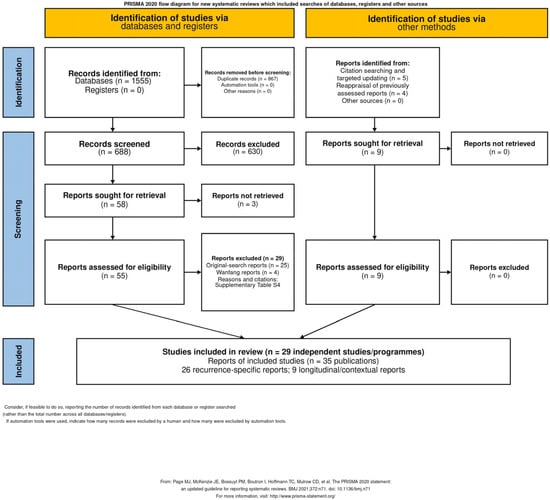
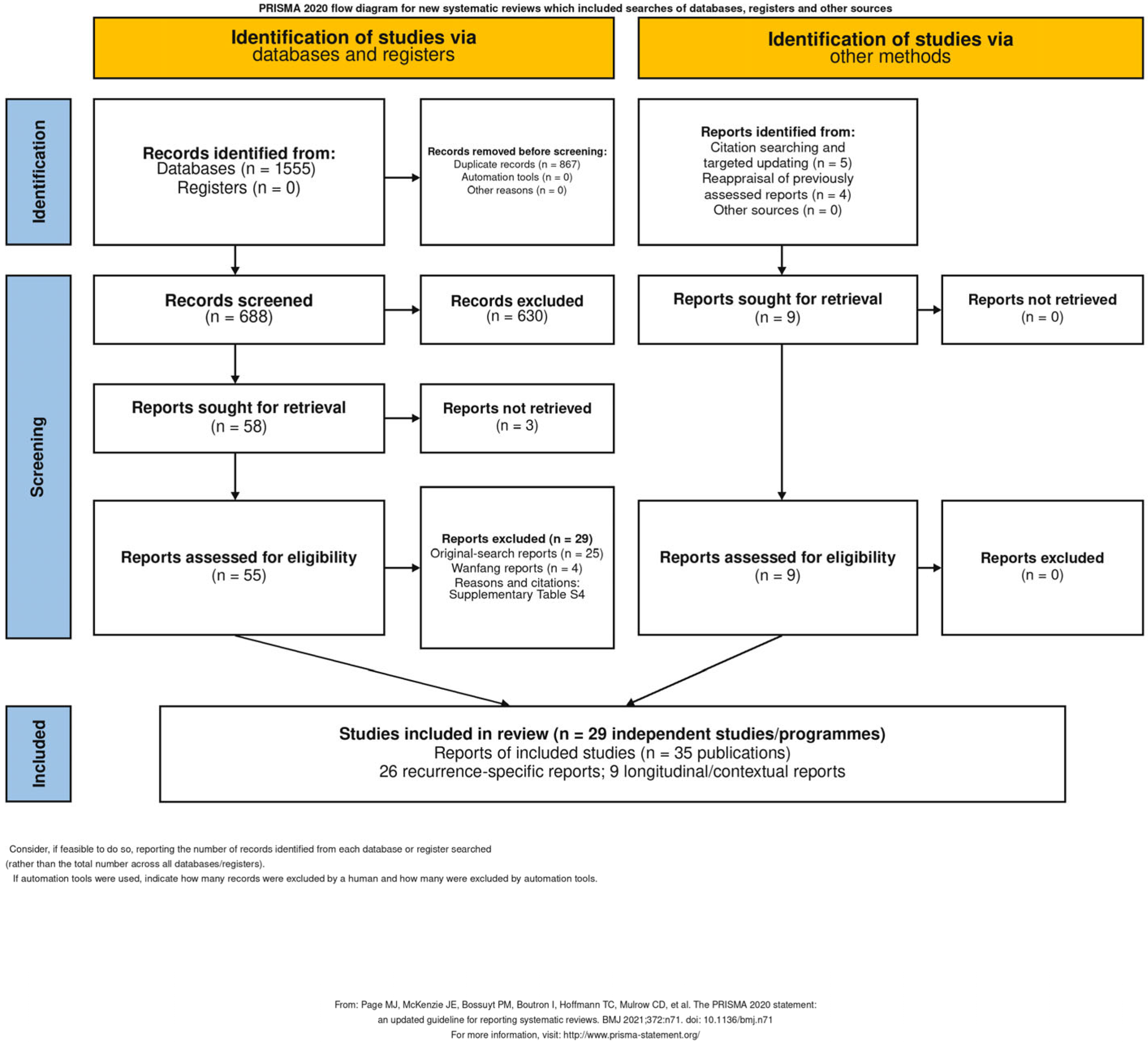
The original database stream identified 1505 records. After removing 867 duplicates, 638 records were screened; 37 reports were sought, three were not retrieved, 34 were assessed in full, and 25 were excluded, yielding nine eligible publications. Targeted updating, citation searching, and historical evidence reappraisal added a further nine publications. The dated Wanfang amendment screened 50 records, excluded 29 at the title/abstract review stage, assessed 21 full texts, and excluded four, adding 17 more publications. The final review retained 35 publications (Figure 1; Supplementary Tables S2 and S9).
Figure 1.
PRISMA 2020 flow diagram. The database stream contributed 26 publications after the dated Wanfang amendment; targeted updating, citation searching, and historical evidence reappraisal contributed nine. The final evidence base contained 35 publications representing 29 linked study/cohort programs. Of these, 26 addressed recurrence-specific prognosis, and nine contributed contextual longitudinal evidence. Adapted from the PRISMA 2020 flow diagram [18].
3.2. Study Characteristics
The 35 publications represented 29 linked studies or cohort programs under the overlap rules. Twenty-six publications reported recurrence-specific data from 25 independent recurrence cohorts: 3309 participants were enrolled and 3205 were analyzed. Nine publications contributed contextual longitudinal evidence. Follow-up ranged from 3 to 24 months, and sampling included baseline peripheral serum or plasma, intracardiac blood, and early post-ablation specimens. Recurrence definitions ranged from AF alone to AF or another atrial tachyarrhythmia after study-specific blanking periods. Rhythm surveillance ranged from scheduled electrocardiography or ambulatory monitoring to more intensive or symptom-triggered assessment, depending on the study. Intermittent surveillance may miss asymptomatic episodes and can therefore alter event detection and prognostic estimates. Study characteristics are summarized in Table 1; Table 2 lists only the estimates retained in the reviewer-prompted restrictive sensitivity set. Full assay details remain in Supplementary Tables S4–S6 [22,23,24,25,26,27,28,29,30,31,32,33,34,35,36,37,38,39,40,41,42,43,44,45,46,47,48,49,50,51,52,53,54,55,56].
Table 1.
Characteristics of included studies and study populations.
Table 2.
Effect estimates retained in the reviewer-prompted restrictive cross-biomarker sensitivity set.
3.3. Risk of Bias
The risk of bias ranged from low or moderate to high across the 26 recurrence-specific reports. Representative concerns included incomplete reporting of preanalytical handling or normalization, limited adjustment for established clinical predictors, recurrence ascertainment based on intermittent rather than continuous monitoring, and selective or internally inconsistent model reporting. For example, some cohorts lacked a fully specified adjustment set, whereas others reported several biomarkers without a uniquely designated primary prognostic analysis. Eligibility was not based on these judgments (Supplementary Figure S3).
3.4. Candidate-Specific Molecular and Translational Map
Applying the post hoc framework uniformly identified six priorities for prospective validation: miR-21-5p, miR-150-5p, miR-29b-3p, miR-451a, miR-10b-5p, and miR-320a. These are research priorities rather than established biomarkers. Mature-arm-specific names are used in the synthesis; arm-unspecified labels from legacy studies are retained only where assay documentation did not permit mature-arm assignment. The candidate evidence, molecular interpretation, source/carrier uncertainty, and candidate-specific certainty are summarized in Table 3, Tables S7 and S11.
Table 3.
Candidate-centered molecular and translational evidence map.
3.5. Secondary Exploratory Quantitative Synthesis
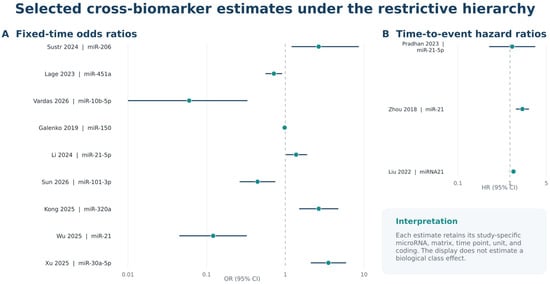
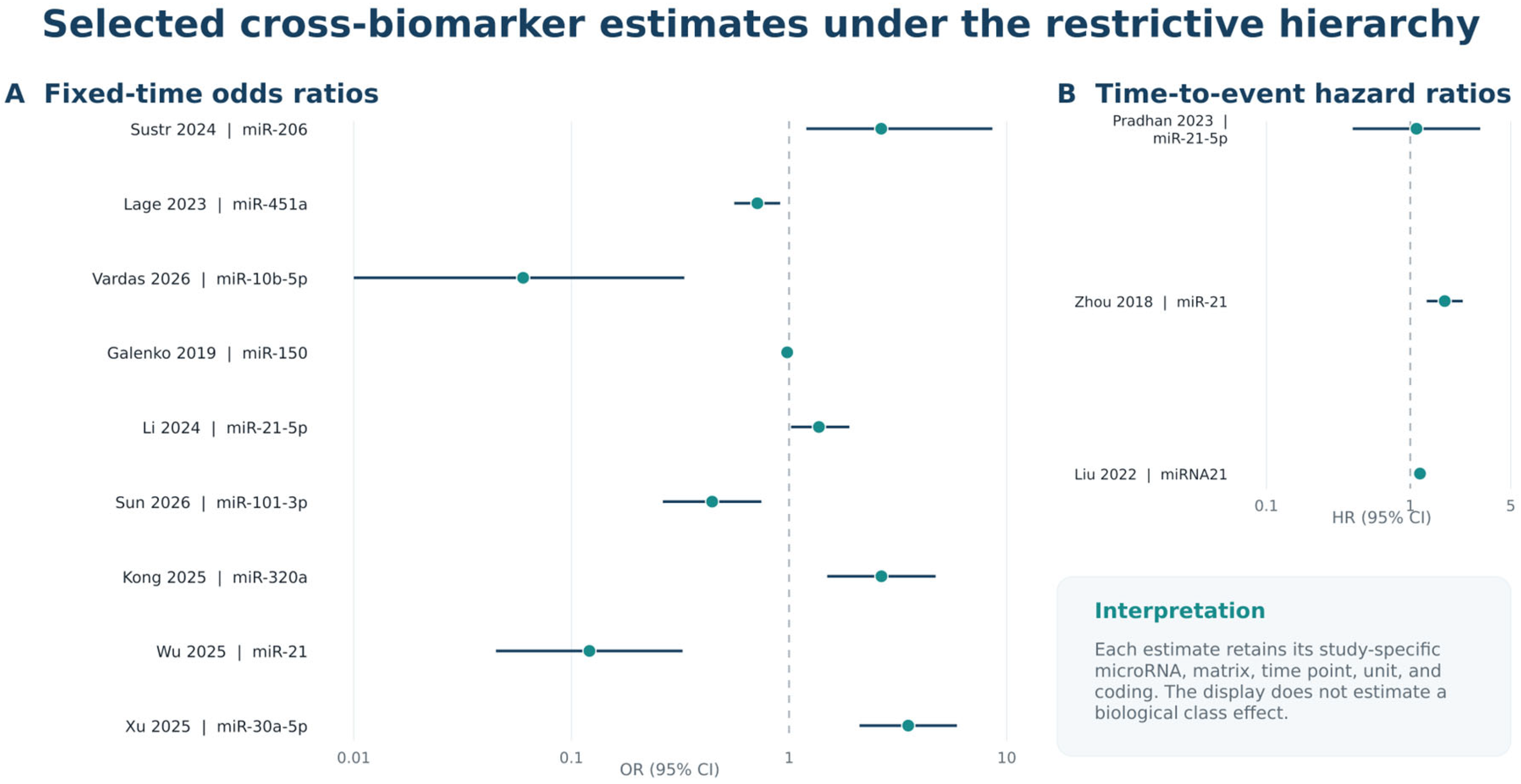
Nine independent cohorts (n = 1162) contributed fixed-time ORs and three cohorts (n = 364) contributed HRs under the reviewer-prompted restrictive hierarchy. Six OR cohorts that had been selected only through the earlier title/abstract-order rule were not retained in this sensitivity model; their qualitative and candidate-specific evidence remains in the review. Figure 2 presents the selected study-level estimates without a pooled diamond.
Figure 2.
Study-level estimates retained under the reviewer-prompted restrictive hierarchy. Panel (A) displays nine fixed-time ORs and panel (B) displays three reported HRs. No pooled diamond is shown because the molecules and their assay scales are non-commensurate; the figure does not estimate a biological class effect. Teal circles indicate point estimates, horizontal dark blue lines indicate 95% confidence intervals, and vertical dashed lines indicate the null value of 1. Axes use logarithmic scales. Sources: Šustr et al. [34], Lage et al. [31], Vardas et al. [39], Galenko et al. [27], Li et al. [44], Sun et al. [46], Kong et al. [47], Wu et al. [48], Xu et al. [49], Pradhan et al. [30], Zhou et al. [26], and Liu et al. [29].
The estimates varied in direction and magnitude across different microRNAs, matrices, compartments, sampling times, and assay scales. Because these exposures are not biologically or analytically commensurate, the main text does not interpret an average class effect. Secondary random-effects model estimates and leave-one-out checks are reported only as sensitivity analyses in Supplementary Table S8 and Supplementary Figures S1 and S2.
3.6. Candidate-Specific Certainty of Evidence
Candidate-specific certainty was very low for each of the six prioritized microRNAs. The reasons differed by candidate but included risk of bias, limited independent replication, inconsistent matrices or compartments, mature-arm and assay uncertainty, small samples, imprecise estimates, and suspected selective reporting. Mechanistic plausibility did not upgrade certainty for clinical prognosis, and no candidate had enough independent studies for a meaningful funnel-plot or asymmetry test (Supplementary Table S11).
4. Discussion
The main finding is a candidate-specific molecular map rather than a pooled microRNA class effect. miR-21-5p and miR-150-5p have the strongest recurrence-specific support; miR-29b-3p, miR-451a, and miR-10b-5p link clinical signals to extracellular matrix-, scar-, or senescence-related biology; and miR-320a has model-based evidence of recurrence but limited mechanistic specificity. These markers form a prospective validation set rather than established clinical tests, and the molecular map is an evidence-organization framework rather than a clinical ranking.
Pooling different microRNAs cannot establish the prognostic value of any individual candidate. Opposite associations across biologically distinct molecules can average toward the null, and a random-effects model does not correct non-commensurate exposure units, compartments, or sampling times. Accordingly, the revision removes the outcome-informed adverse-profile fold, omits pooled class-effect estimates from the Abstract and primary Results, and relegates the restrictive OR and HR summaries to the Supplementary Material as sensitivity analyses. Their prediction intervals were 0.04–16.69 for the OR model and 0.04–46.36 for the HR model. Both intervals cross 1 widely, indicating substantial uncertainty about the direction and magnitude of association in a new population. The Chinese-language amendment expanded the eligible evidence base, while explicit cohort linkage prevented overlapping publications from receiving duplicate quantitative weight.
4.1. Molecular Interpretation: Signal, Source, and Mechanism
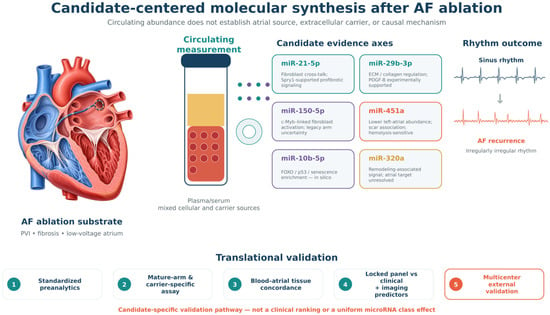
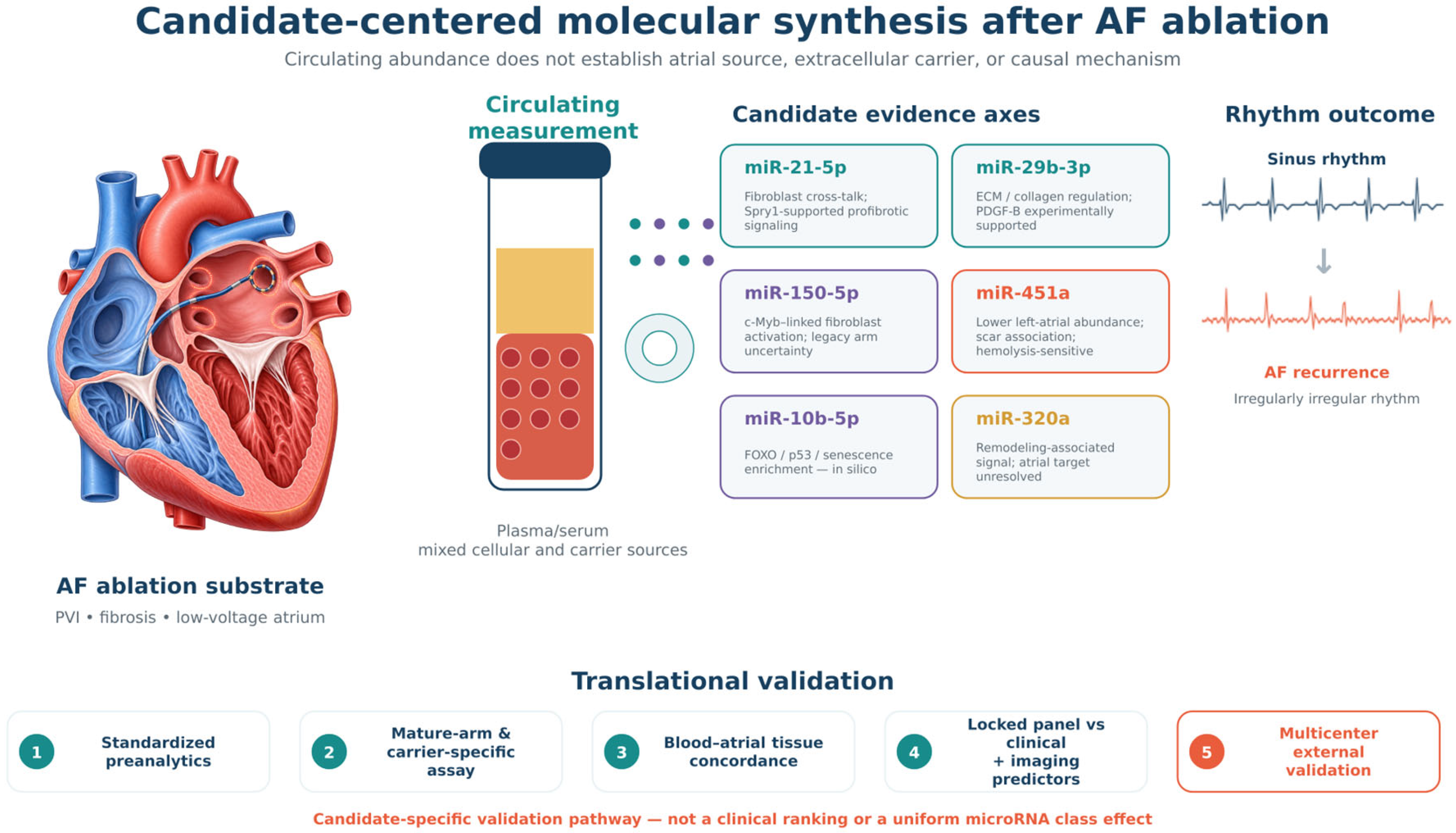
Three interpretive layers must remain separate. First, measured abundance depends on matrix, processing, normalization, and exposure coding. Second, the circulating carrier and cellular source may include extracellular vesicles, protein-bound RNA, platelets, erythrocytes, leukocytes, injured cardiomyocytes, fibroblasts, or altered clearance. Exosomes can transfer functional microRNAs between cells [64], but most recurrence cohorts quantify total circulating RNA and do not isolate a carrier fraction. Third, a validated target pathway in experimental tissue does not prove that the corresponding blood measurement is a causal mediator. This separation is central to the molecular synthesis in Figure 3.
Figure 3.
Candidate-centered molecular synthesis and translational validation pathway. The six priorities are organized by their best-supported experimental, computational, or phenotype-level axis while preserving uncertainty about cellular source and extracellular carrier. The electrocardiographic sequence distinguishes regular sinus rhythm from irregularly irregular AF recurrence. The lower sequence shows the analytical and clinical gates required before implementation. Candidate-box colors group the displayed evidence axes: teal, experimental profibrotic or extracellular-matrix signaling; purple, c-Myb-linked biology or computational pathway enrichment; coral, scar association and hemolysis sensitivity; and gold, a remodeling-associated signal with an unresolved atrial target. These colors do not denote certainty or clinical rank. The colored dots and carrier symbol are schematic and do not establish a cell or carrier of origin. Blue and coral electrocardiographic traces illustrate sinus rhythm and AF recurrence, respectively; the five numbered circles indicate sequential validation steps. PVI, pulmonary vein isolation; ECM, extracellular matrix.
The strongest mechanistic convergence concerns fibrosis. miR-21 participates in cardiomyocyte–fibroblast cross-talk and experimental atrial profibrotic signaling involving Spry1, yet arterial, venous, peripheral, and left-atrial findings are discordant [26,29,30,36,44,48,57]. miR-29b is an antifibrotic regulator of extracellular-matrix programs; experimental overexpression of miR-29b-3p in a rat model reduced atrial fibrosis, collagen I, and alpha-smooth muscle actin (α-SMA), increased connexin 43 (Cx43), and directly suppressed PDGF-B [59,60]. miR-150 inhibits cardiac-fibroblast activation through c-Myb [58], but clinical evidence includes arm-unspecified labels and non-commensurate concentration scales. These mechanisms support plausibility, not transportable prediction.
The other candidates illustrate distinct translational hazards. Lower left-atrial miR-451a abundance was associated with recurrence, whereas greater scar burden was positively associated with recurrence; a second cohort reported an adjusted inverse association [31,40]. Erythrocyte enrichment makes objective control of hemolysis indispensable [61,62], and no atrial target pathway has been confirmed in recurrence cohorts. For miR-10b-5p, FOXO, p53, cellular senescence, and circadian pathways were identified through in silico enrichment of validated targets; the study did not demonstrate a causal mechanism [39]. Circulating extracellular miR-320a-3p has been associated with paroxysmal AF [63], and two recurrence cohorts reported adjusted estimates of miR-320a [40,47], but matrices, mature-arm labels, sampling details, and model reporting differed. None of these signals establishes extracellular-vesicle transport or concordance with atrial tissue.
4.2. Analytical Validity and Sampling Time
Analytical validity is the first translational gate. Serum versus plasma, anticoagulant, processing delay, platelet activation, hemolysis, extraction efficiency, normalization, and freeze–thaw history can materially alter abundance [61,62,65,66]. A lower concentration can denote risk for one marker, while a higher ΔCq denotes lower expression for another; neither is equivalent to outcome-informed folding toward an adverse profile. Future studies should prespecify collection and processing, document hemolysis and platelet depletion; use validated reference or spike-in strategies; report assay linearity, limits, and precision; and state whether total, protein-bound, or extracellular vesicle-enriched RNA is measured.
Sampling time is a biological design variable rather than a convenience. Baseline concentrations may reflect pre-existing atrial substrate, immediate peri-procedural measurements may capture injury or inflammation, and later changes may accompany reverse remodeling. The nine contextual longitudinal publications describe dynamic peri-ablation expression but cannot support recurrence prognosis without adjusted, recurrence-specific effects. Baseline prognostic and pharmacodynamic sampling should therefore be analyzed as separate questions.
4.3. Clinical Validation Pathway
Clinical utility remains unestablished. Association and prediction are distinct, and few studies reported calibration, optimism correction, decision curves [67], or incremental performance beyond clinical and imaging variables. Future incremental-value analyses should compare prespecified microRNA models against established clinical and imaging predictors, use separate model-development and external-validation cohorts, and avoid data-driven re-selection of biomarkers or cut points. A multicenter program should assay the six candidates individually and as a locked panel; blind laboratories to outcomes; standardize rhythm surveillance; and evaluate calibration, discrimination, reclassification, and decision curves across AF phenotypes and ablation technologies. Nested tissue, left-atrial/peripheral, and carrier-fraction substudies would determine whether prediction and molecular source are concordant.
4.4. Strengths and Limitations
Strengths include eligibility criteria independent of study results or quality, separation of publications from linked programs, prevention of duplicate weighting, source-based risk-of-bias judgments, and reproducible code. Limitations include incomplete bibliographic identities for part of the historical full-text exclusion log, probable rather than confirmed overlap within the five-report Beijing program, candidate prioritization developed post hoc, substantial clinical heterogeneity, non-commensurate assay units, internal inconsistencies in several reports, and limited candidate-specific replication. The reviewer-prompted quantitative hierarchy is also post hoc and cannot remove conceptual non-commensurability. These limitations support candidate mapping as the primary approach and quantitative pooling only as a supplementary sensitivity analysis.
5. Conclusions
Candidate-specific mapping identified miR-21-5p, miR-150-5p, miR-29b-3p, miR-451a, miR-10b-5p, and miR-320a as priorities for hypothesis-driven prospective validation after AF ablation. Their certainty is very low, and their molecular contexts, biological sources, matrices, and assay scales differ. The available evidence does not establish a common direction, a uniform circulating-microRNA class effect, or clinical utility. Translation requires standardized preanalytics, mature-arm and carrier-specific assays, prespecified models, independent multicenter validation, and demonstration of incremental value beyond established clinical and imaging predictors.
Supplementary Materials
The following supporting information can be downloaded at: https://www.mdpi.com/article/10.3390/biom16111590/s1. Supplementary Methods S1–S5 describe the search update, evidence layers and cohort linkage, effect selection, statistical sensitivity analyses, and candidate-specific certainty assessment. Table S1 presents the search strategies; Tables S2A and S2B provide the PRISMA 2020 and abstract checklists; Table S3 presents the translational evidence-mapping framework; Table S4 documents contextual reports and full-text exclusions; Tables S5 and S6 describe candidate prioritization and phenotype-oriented interpretation; Table S7 presents the candidate-specific evidence map; Table S8 reports the restrictive sensitivity models; Table S9 documents the Wanfang update; Table S10 provides the effect-selection audit; and Table S11 provides candidate-specific GRADE profiles. Figures S1–S3 show the exploratory models, leave-one-out analyses, and QUIPS judgments. Sources cited in Table S4 are included in the main reference list [15,23,24,51,52,53,54,55,56,68,69,70,71,72,73,74,75,76,77,78,79,80,81,82,83,84,85,86,87,88,89,90,91,92,93].
Author Contributions
A.d.S.M.J.: Conceptualization, methodology, formal analysis, project administration, supervision, writing—original draft, and writing—review and editing. A.d.S.S.: Investigation, data curation, validation, and writing—review and editing. A.J.d.P.N.M.: Investigation, data curation, validation, and writing—review and editing. A.V.S.B.: Investigation, data curation, validation, and writing—review and editing. A.D.d.C.: Methodology, supervision, and writing—review and editing. All authors have read and agreed to the published version of the manuscript.
Funding
This research received no external funding.
Institutional Review Board Statement
Not applicable.
Informed Consent Statement
Not applicable.
Data Availability Statement
The data analyzed in this systematic review were extracted from the published reports cited in the article. The analysis-ready study-level dataset, extraction form, cohort-linkage fields, effect-selection audit trail, search strategies, source data for figures, and integrity-updated code are provided in the accompanying Supplementary Data archive. The protocol is available at https://osf.io/gd4p2/ (accessed on 29 August 2026; https://doi.org/10.17605/OSF.IO/GD4P2). No individual participant data were used.
Acknowledgments
During manuscript preparation, ChatGPT/Codex (OpenAI; https://chatgpt.com/; accessed on 26 October 2026) was used as an artificial intelligence (AI)-assisted tool for language editing, document formatting, assistance with developing and checking Python code, the organization of methodological checks, and final language proofreading. All source data, study selection, risk-of-bias judgments, code, numerical outputs, and interpretations were independently verified by the authors, who made all final scientific decisions and take responsibility for the accuracy and integrity of the work.
Conflicts of Interest
The authors declare no conflicts of interest.
References
- Linz, D.; Gawalko, M.; Betz, K.; Hendriks, J.M.; Lip, G.Y.H.; Vinter, N.; Guo, Y.; Johnsen, S. Atrial fibrillation: Epidemiology, screening and digital health. Lancet Reg. Health Eur. 2024, 37, 100786. [Google Scholar] [CrossRef] [Scilit]
- Joglar, J.A.; Chung, M.K.; Armbruster, A.L.; Benjamin, E.J.; Chyou, J.Y.; Cronin, E.M.; Deswal, A.; Eckhardt, L.L.; Goldberger, Z.D.; Gopinathannair, R.; et al. 2023 ACC/AHA/ACCP/HRS guideline for the diagnosis and management of atrial fibrillation. J. Am. Coll. Cardiol. 2024, 83, 109–279. [Google Scholar] [CrossRef] [Scilit]
- Tzeis, S.; Gerstenfeld, E.P.; Kalman, J.; Saad, E.B.; Shamloo, A.S.; Andrade, J.G.; Barbhaiya, C.R.; Baykaner, T.; Boveda, S.; Calkins, H.; et al. 2024 EHRA/HRS/APHRS/LAHRS expert consensus statement on catheter and surgical ablation of atrial fibrillation. Heart Rhythm 2024, 21, e31–e149. [Google Scholar] [CrossRef] [Scilit]
- Ganesan, A.N.; Shipp, N.J.; Brooks, A.G.; Kuklik, P.; Lau, D.H.; Lim, H.S.; Sullivan, T.; Roberts-Thomson, K.C.; Sanders, P. Long-term outcomes of catheter ablation of atrial fibrillation: A systematic review and meta-analysis. J. Am. Heart Assoc. 2013, 2, e004549. [Google Scholar] [CrossRef] [Scilit]
- Boyalla, V.; Harling, L.; Snell, A.; Kralj-Hans, I.; Barradas-Pires, A.; Haldar, S.; Khan, H.R.; Cleland, J.G.F.; Athanasiou, T.; Harding, S.E.; et al. Biomarkers as predictors of recurrence of atrial fibrillation post ablation: An updated and expanded systematic review and meta-analysis. Clin. Res. Cardiol. 2022, 111, 680–691. [Google Scholar] [CrossRef] [Scilit]
- Zhang, W.; Wang, Y.; Wang, H.; Shao, Y.; Dong, Q.; Li, S.; Gu, Y. Left atrial low-voltage areas predict recurrence of atrial fibrillation after catheter ablation: A meta-analysis. Heart Surg. Forum 2024, 27, E058–E067. [Google Scholar] [CrossRef] [Scilit]
- Bartel, D.P. MicroRNAs: Genomics, biogenesis, mechanism, and function. Cell 2004, 116, 281–297. [Google Scholar] [CrossRef] [Scilit]
- Thum, T.; Galuppo, P.; Wolf, C.; Fiedler, J.; Kneitz, S.; van Laake, L.W.; Doevendans, P.A.; Mummery, C.L.; Borlak, J.; Haverich, A.; et al. MicroRNAs in the human heart: A clue to fetal gene reprogramming in heart failure. Circulation 2007, 116, 258–267. [Google Scholar] [CrossRef] [Scilit]
- Santulli, G.; Iaccarino, G.; De Luca, N.; Trimarco, B.; Condorelli, G. Atrial fibrillation and microRNAs. Front. Physiol. 2014, 5, 15. [Google Scholar] [CrossRef] [Scilit]
- Harada, M.; Luo, X.; Murohara, T.; Yang, B.; Dobrev, D.; Nattel, S. MicroRNA regulation and cardiac calcium signaling: Role in cardiac disease and therapeutic potential. Circ. Res. 2014, 114, 689–705. [Google Scholar] [CrossRef] [Scilit]
- Zeng, Y.; Wu, N.; Zhang, Z.; Zhong, L.; Li, G.; Li, Y. Non-coding RNA and arrhythmias: Expression, function, and molecular mechanism. Europace 2023, 25, 1296–1308. [Google Scholar] [CrossRef] [Scilit]
- Gilad, S.; Meiri, E.; Yogev, Y.; Benjamin, S.; Lebanony, D.; Yerushalmi, N.; Benjamin, H.; Kushnir, M.; Cholakh, H.; Melamed, N.; et al. Serum microRNAs are promising novel biomarkers. PLoS ONE 2008, 3, e3148. [Google Scholar] [CrossRef] [Scilit]
- Navickas, R.; Gal, D.; Laucevičius, A.; Taparauskaitė, A.; Zdanytė, M.; Holvoet, P. Identifying circulating microRNAs as biomarkers of cardiovascular disease: A systematic review. Cardiovasc. Res. 2016, 111, 322–337. [Google Scholar] [CrossRef] [Scilit]
- Menezes Junior, A.S.; Ferreira, L.C.; Barbosa, L.J.V.; Silva, A.M.T.C.; e Silva, D.D.M. Circulating microRNAs as specific biomarkers in atrial fibrillation: A meta-analysis. Noncoding RNA 2023, 9, 13. [Google Scholar] [CrossRef] [Scilit]
- Vardas, E.P.; Oikonomou, E.; Vardas, P.E.; Tousoulis, D. MicroRNAs as prognostic biomarkers for atrial fibrillation recurrence after catheter ablation: Current evidence and future directions. Biomedicines 2025, 13, 32. [Google Scholar] [CrossRef] [Scilit]
- Mo, D.; Wang, M.; Zhang, P.; Dai, H.; Guan, J. Factors predicting recurrence of atrial fibrillation after catheter ablation: A review. Heliyon 2024, 10, e34205. [Google Scholar] [CrossRef] [Scilit]
- Vempati, R.; Garg, A.; Shah, M.; Jena, N.; Raj, K.; Reddy, Y.M.; Noheria, A.; Ha, Q.D.; Umashankar, D.; Gahona, C.T. Predictors of atrial fibrillation recurrence after catheter ablation: A state-of-the-art review. Hearts 2025, 6, 12. [Google Scholar] [CrossRef] [Scilit]
- Page, M.J.; McKenzie, J.E.; Bossuyt, P.M.; Boutron, I.; Hoffmann, T.C.; Mulrow, C.D.; Shamseer, L.; Tetzlaff, J.M.; Akl, E.A.; Brennan, S.E.; et al. The PRISMA 2020 statement: An updated guideline for reporting systematic reviews. BMJ 2021, 372, n71. [Google Scholar] [CrossRef] [Scilit]
- Riley, R.D.; Moons, K.G.M.; Snell, K.I.E.; Ensor, J.; Hooft, L.; Altman, D.G.; Hayden, J.; Collins, G.S.; Debray, T.P.A. A guide to systematic review and meta-analysis of prognostic factor studies. BMJ 2019, 364, k4597. [Google Scholar] [CrossRef] [Scilit]
- Hayden, J.A.; van der Windt, D.A.; Cartwright, J.L.; Côté, P.; Bombardier, C. Assessing bias in studies of prognostic factors. Ann. Intern. Med. 2013, 158, 280–286. [Google Scholar] [CrossRef] [Scilit]
- Foroutan, F.; Guyatt, G.; Zuk, V.; Vandvik, P.O.; Alba, A.C.; Mustafa, R.; Vernooij, R.; Arevalo-Rodriguez, I.; Munn, Z.; Roshanov, P.; et al. GRADE guidelines 28: Use of GRADE for assessing the certainty of evidence in prognostic factor research. J. Clin. Epidemiol. 2020, 121, 62–70. [Google Scholar] [CrossRef] [Scilit]
- McManus, D.D.; Tanriverdi, K.; Lin, H.; Esa, N.; Kinno, M.; Mandapati, D.; Tam, S.; Okike, O.N.; Ellinor, P.T.; Keaney, J.F., Jr.; et al. Plasma microRNAs are associated with atrial fibrillation and change after catheter ablation (the miRhythm study). Heart Rhythm 2015, 12, 3–10. [Google Scholar] [CrossRef] [Scilit]
- Liu, T.; Zhong, S.; Rao, F.; Xue, Y.; Qi, Z.; Wu, S. Catheter ablation restores decreased plasma miR-409-3p and miR-432 in atrial fibrillation patients. Europace 2016, 18, 92–99. [Google Scholar] [CrossRef] [Scilit]
- Yue, Y.N.; Li, B.; Xu, G.Y.; Yang, S.X. Treating atrial fibrillation with radiofrequency ablation to reverse changes in microRNAs regulating ion-channel proteins. Bratisl. Lek. Listy 2021, 122, 396–404. [Google Scholar] [CrossRef] [Scilit]
- Vaze, A.; Donahue, K.; Spring, M.; Sardana, M.; Tanriverdi, K.; Freedman, J.E.; Keaney, J.F.; Benjamin, E.J.; Lubitz, S.A.; Rosenthal, L.; et al. Plasma microRNAs relate to atrial fibrillation recurrence after catheter ablation: Longitudinal findings from the MiRhythm Study. J. Clin. Exp. Cardiol. 2017, 8, 502. [Google Scholar] [CrossRef]
- Zhou, Q.; Maleck, C.; von Ungern-Sternberg, S.N.; Neupane, B.; Heinzmann, D.; Marquardt, J.; Duckheim, M.; Scheckenbach, C.; Stimpfle, F.; Gawaz, M.; et al. Circulating microRNA-21 correlates with left atrial low-voltage areas and is associated with procedure outcome in patients undergoing atrial fibrillation ablation. Circ. Arrhythmia Electrophysiol. 2018, 11, e006242. [Google Scholar] [CrossRef] [Scilit]
- Galenko, O.; Jacobs, V.; Knight, S.; Taylor, M.; Cutler, M.J.; Muhlestein, J.B.; Carlquist, J.L.; Knowlton, K.U.; Bunch, T.J. The role of microRNAs in the development, regulation, and treatment of atrial fibrillation. J. Interv. Card. Electrophysiol. 2019, 55, 297–305. [Google Scholar] [CrossRef] [Scilit]
- Kiliszek, M.; Maciak, K.; Maciejak, A.; Krzyżanowski, K.; Wierzbowski, R.; Gora, M.; Burzynska, B.; Segiet, A.; Skrobowski, A. Serum microRNA in patients undergoing atrial fibrillation ablation. Sci. Rep. 2020, 10, 4424. [Google Scholar] [CrossRef] [Scilit]
- Liu, Y.; Luo, D.; Liu, E.; Liu, T.; Xu, G.; Liang, X.; Yuan, M.; Zhang, Y.; Chen, X.; Chen, X.; et al. MiRNA21 and IL-18 levels in left atrial blood in patients with atrial fibrillation undergoing cryoablation and their predictive value for recurrence. J. Interv. Card. Electrophysiol. 2022, 64, 111–120. [Google Scholar] [CrossRef] [Scilit]
- Pradhan, K.; Niehues, P.; Neupane, B.; Maleck, C.; Sharif-Yakan, A.; Emrani, M.; Zink, M.D.; Napp, A.; Marx, N.; Gramlich, M. MicroRNA-21 mediated cross-talk between cardiomyocytes and fibroblasts in patients with atrial fibrillation. Front. Cardiovasc. Med. 2023, 10, 1056134. [Google Scholar] [CrossRef] [Scilit]
- Lage, R.; Cebro-Márquez, M.; Vilar-Sánchez, M.E.; González-Melchor, L.; García-Seara, J.; Martínez-Sande, J.L.; Fernández-López, X.A.; Aragón-Herrera, A.; Martínez-Monzonís, M.A.; González-Juanatey, J.R.; et al. Circulating miR-451a expression may predict recurrence in atrial fibrillation patients after catheter pulmonary vein ablation. Cells 2023, 12, 638. [Google Scholar] [CrossRef] [Scilit]
- Harada, M.; Okuzaki, D.; Yamauchi, A.; Ishikawa, S.; Nomura, Y.; Nishimura, A.; Motoike, Y.; Koshikawa, M.; Hitachi, K.; Tsuchida, K.; et al. Circulating miR-20b-5p and miR-330-3p are novel biomarkers for progression of atrial fibrillation: Intracardiac/extracardiac plasma sample analysis by small RNA sequencing. PLoS ONE 2023, 18, e0283942. [Google Scholar] [CrossRef] [Scilit]
- He, W.; Tang, R.; Han, J.; Zhang, Z.; Li, J.; Xue, W.; Xie, Q. The impact of microRNA-155 on the effect of cryoablation in paroxysmal atrial fibrillation. Cell. Mol. Biol. 2023, 69, 144–149. [Google Scholar] [CrossRef] [Scilit]
- Šustr, F.; Macháčková, T.; Pešl, M.; Svačinova, J.; Trachtová, K.; Stárek, Z.; Kianička, B.; Slabý, O.; Novák, J. Identification of plasmatic microRNA-206 as new predictor of early recurrence of atrial fibrillation after catheter ablation using next-generation sequencing. Mol. Diagn. Ther. 2024, 28, 301–310. [Google Scholar] [CrossRef] [Scilit]
- Zhan, J.; Peng, C.; Liu, Y.; Bi, Z.; Lu, G.; Hao, S.; Tong, Y.; Zhang, G. Predictive value of serum microRNA-29b-3p for recurrence after radiofrequency catheter ablation in patients with atrial fibrillation. Clin. Interv. Aging 2024, 19, 715–725. [Google Scholar] [CrossRef] [Scilit]
- Ren, B.; Cai, S.; Wang, M. Risk factors for recurrence of persistent atrial fibrillation after radiofrequency ablation and correlation with plasma miRNA expression. Minerva Cardiol. Angiol. 2025, 73, 489–502. [Google Scholar] [CrossRef] [Scilit]
- Ruan, Z.-B.; Peng, Q.; Sun, X.-J.; Wang, F.; Zhu, L. Serum miR-15a-5p may predict recurrence after catheter ablation in atrial fibrillation. PeerJ 2025, 13, e19618. [Google Scholar] [CrossRef] [Scilit]
- Lai, W.; Chen, H.; Huang, M.; Cheng, Z.; Lin, N.; Lu, H. A risk model based on miR-483-5p and miR-150 for atrial fibrillation recurrence. 3 Biotech 2026, 16, 217. [Google Scholar] [CrossRef] [Scilit]
- Vardas, Ε.P.; Oikonomou, E.; Tzeis, S.; Theofilis, P.; Gazouli, M.; Papadogeorgaki, E.; Belogiannis, K.; Asvestas, D.; Vavouris, E.; Charitos, D.; et al. Circulating miR-10b-5p as a candidate biomarker of atrial fibrillation recurrence after catheter ablation: A two-phase translational study. Europace 2026, 28, euag097. [Google Scholar] [CrossRef] [Scilit]
- Liu, M. MicroRNA, hs-CRP and Left Atrial Diameter as Combined Predictors of Recurrence After Radiofrequency Ablation in Atrial Fibrillation. Master’s Thesis, Hebei North University, Zhangjiakou, China, 2025. [Google Scholar]
- Li, J.J.; Liu, X.C.; Liu, E.X.; Wang, Y.S. Serum miR-29b and miR-135b expression in relation to atrial fibrosis and recurrence after radiofrequency ablation in atrial fibrillation. J. Mod. Lab. Med. 2023, 38, 75–80. [Google Scholar] [CrossRef]
- Zhou, W.Q.; Dai, M.; Sun, J.J.; Li, L. Changes in plasma microRNA-21 and microRNA-150 after radiofrequency ablation and their detection value in atrial fibrillation. Shaanxi Med. J. 2024, 53, 970. [Google Scholar]
- Wang, Y.S.; Liu, X.C.; Liu, E.X.; Li, J.J. Serum miR-133a-3p and miR-324-3p expression and recurrence after radiofrequency ablation in persistent atrial fibrillation. J. Mod. Lab. Med. 2024, 39, 108–112. [Google Scholar] [CrossRef]
- Li, Z.L.; Shi, S.N.; Yang, L.; Ren, Z.F.; Zhu, L.L. Serum microRNA-21-5p and related biomarkers for predicting recurrence after radiofrequency ablation of paroxysmal atrial fibrillation. Chin. J. Cardiovasc. Res. 2024, 22, 623–628. [Google Scholar] [CrossRef]
- Wang, D.B.; Ren, F.X.; Zhao, Y.; Zheng, S.C. Serum microRNA-31 and microRNA-27b for predicting recurrence after radiofrequency ablation in persistent atrial fibrillation. Chin. J. Cardiovasc. Med. 2021, 26, 356. [Google Scholar] [CrossRef]
- Sun, N.; Chen, X.; Han, Y.; Bu, Y. Serum RNA biomarkers, left atrial remodelling and recurrence after catheter radiofrequency ablation in older patients with paroxysmal atrial fibrillation. Chin. J. Cardiovasc. Res. 2026, 24, 254–259. [Google Scholar] [CrossRef]
- Kong, B.; Huang, Y.; Zhao, L. Application of miRNA-320a testing to predict atrial fibrillation recurrence after cryoablation. Chin. J. Cardiovasc. Rehabil. Med. 2025, 34, 350–355. [Google Scholar] [CrossRef]
- Wu, L.; Jiang, H.; Xu, M.; Gao, J. Value of cardiac magnetic resonance parameters and blood miR-21 in early recurrence after radiofrequency ablation of atrial fibrillation. Chin. J. Cardiovasc. Res. 2025, 23, 437–441. [Google Scholar]
- Xu, Z.T.; Peng, C.; Zhi, J. Serum miR-30a-5p and PGC-1α for predicting recurrence after radiofrequency ablation in paroxysmal atrial fibrillation. Chin. J. Evid. Based Cardiovasc. Med. 2025, 17, 688–694. [Google Scholar]
- Lai, W.W.; Zhao, W.A.; Zhang, Z.L.; Lu, H.Y.; Cai, K.F.; Xu, Z.X.; Huang, M.W. Construction and evaluation of a nomogram based on serum miRNA levels for recurrence after ablation in non-valvular atrial fibrillation. Med. J. Chin. PLA 2023, 48, 715–722. [Google Scholar] [CrossRef]
- Cui, Y.; Su, Y.; Li, L.; Zhao, S.; Nan, J.; Yue, Y.N.; Yang, S.X. Radiofrequency ablation can reverse abnormal regulation of circulating microRNAs in atrial fibrillation. Chin. J. Cardiol. 2015, 43, 1051–1056. [Google Scholar] [CrossRef]
- Zhao, S.; Yang, N.; Yue, Y.N.; Lei, L.C.; Ren, L.H.; Ye, H.M.; Yang, S.X. Radiofrequency ablation changes the peripheral-blood microRNA expression profile in atrial fibrillation. Chin. J. Geriatr. Heart Brain Vessel Dis. 2015, 17, 725–731. [Google Scholar] [CrossRef]
- Nan, J.; Yang, S.X. Effects of radiofrequency ablation on TBX5, NKX2.5 and their regulatory microRNAs in atrial fibrillation. Chin. J. Geriatr. Heart Brain Vessel Dis. 2015, 17, 1236–1239. [Google Scholar] [CrossRef]
- Xu, G.Y.; Zhao, N.N.; Yang, S.X. Radiofrequency ablation reverses abnormal coronary-sinus blood microRNA expression in atrial fibrillation. Chin. J. Cardiovasc. Res. 2016, 14, 720. [Google Scholar]
- Wang, Y.R.; Cui, Q.X.; Li, L.; Su, Y.; Yue, Y.N.; Yang, S.X. Effect of radiofrequency ablation on ion-channel protein and current remodelling in atrial fibrillation. Chin. J. Cardiovasc. Res. 2015, 13, 1090. [Google Scholar]
- Li, B.; Lu, H. Changes in plasma miR-150 before and after radiofrequency ablation in atrial fibrillation. Shandong Med. J. 2017, 57, 62–64. [Google Scholar] [CrossRef]
- Cardin, S.; Guasch, E.; Luo, X.; Naud, P.; Le Quang, K.; Shi, Y.; Tardif, J.-C.; Comtois, P.; Nattel, S. Role for microRNA-21 in atrial profibrillatory fibrotic remodeling associated with experimental postinfarction heart failure. Circ. Arrhythmia Electrophysiol. 2012, 5, 1027–1035. [Google Scholar] [CrossRef] [Scilit]
- Deng, P.; Chen, L.; Liu, Z.; Ye, P.; Wang, S.; Wu, J.; Yao, Y.; Sun, Y.; Huang, X.; Ren, L.; et al. MicroRNA-150 inhibits the activation of cardiac fibroblasts by regulating c-Myb. Cell. Physiol. Biochem. 2016, 38, 2103–2122. [Google Scholar] [CrossRef] [Scilit]
- Dawson, K.; Wakili, R.; Ördög, B.; Clauss, S.; Chen, Y.; Iwasaki, Y.; Voigt, N.; Qi, X.Y.; Sinner, M.F.; Dobrev, D.; et al. MicroRNA29: A mechanistic contributor and potential biomarker in atrial fibrillation. Circulation 2013, 127, 1466–1475. [Google Scholar] [CrossRef] [Scilit]
- Lv, X.; Lu, P.; Hu, Y.; Xu, T. Overexpression of miR-29b-3p inhibits atrial remodeling in rats by targeting the PDGF-B signaling pathway. Oxid. Med. Cell. Longev. 2021, 2021, 3763529. [Google Scholar] [CrossRef] [Scilit]
- Kirschner, M.B.; Kao, S.C.; Edelman, J.J.; Armstrong, N.J.; Vallely, M.P.; van Zandwijk, N.; Reid, G. Haemolysis during sample preparation alters microRNA content of plasma. PLoS ONE 2011, 6, e24145. [Google Scholar] [CrossRef] [Scilit]
- Mussbacher, M.; Krammer, T.L.; Heber, S.; Schrottmaier, W.C.; Zeibig, S.; Holthoff, H.-P.; Pereyra, D.; Starlinger, P.; Hackl, M.; Assinger, A. Impact of anticoagulation and sample processing on the quantification of human blood-derived microRNA signatures. Cells 2020, 9, 1915. [Google Scholar] [CrossRef] [Scilit]
- Zhelankin, A.V.; Vasiliev, S.V.; Stonogina, D.A.; Babalyan, K.A.; Sharova, E.I.; Doludin, Y.V.; Shchekochikhin, D.Y.; Generozov, E.V.; Akselrod, A.S. Elevated plasma levels of circulating extracellular miR-320a-3p in patients with paroxysmal atrial fibrillation. Int. J. Mol. Sci. 2020, 21, 3485. [Google Scholar] [CrossRef] [Scilit]
- Valadi, H.; Ekstrom, K.; Bossios, A.; Sjostrand, M.; Lee, J.J.; Lotvall, J.O. Exosome-mediated transfer of mRNAs and microRNAs is a novel mechanism of genetic exchange between cells. Nat. Cell Biol. 2007, 9, 654–659. [Google Scholar] [CrossRef] [Scilit]
- Kim, S.H.; MacIntyre, D.A.; Sykes, L.; Arianoglou, M.; Bennett, P.R.; Terzidou, V. Whole blood holding time prior to plasma processing alters microRNA expression profile. Front. Genet. 2022, 12, 818334. [Google Scholar] [CrossRef] [Scilit]
- Mestdagh, P.; Van Vlierberghe, P.; De Weer, A.; Muth, D.; Westermann, F.; Speleman, F.; Vandesompele, J. A novel and universal method for microRNA RT-qPCR data normalization. Genome Biol. 2009, 10, R64. [Google Scholar] [CrossRef] [Scilit]
- Vickers, A.J.; Elkin, E.B. Decision curve analysis: A novel method for evaluating prediction models. Med. Decis. Mak. 2006, 26, 565–574. [Google Scholar] [CrossRef] [Scilit]
- Liu, Z.; Zhou, C.; Liu, Y.; Wang, S.; Ye, P.; Miao, X.; Xia, J. The Expression Levels of Plasma micoRNAs in Atrial Fibrillation Patients. PLoS ONE 2012, 7, e44906. [Google Scholar] [CrossRef] [Scilit]
- Chen, H.; Zhang, F.; Zhang, Y.-L.; Yang, X.-C. Relationship between circulating miRNA-21, atrial fibrosis, and atrial fibrillation in patients with atrial enlargement. Ann. Palliat. Med. 2021, 10, 12742–12749. [Google Scholar] [CrossRef] [Scilit]
- Xiao, J.; Zhang, Y.; Tang, Y.; Dai, H.; OuYang, Y.; Li, C.; Yu, M. Hsa-miR-4443 inhibits myocardial fibroblast proliferation by targeting THBS1 to regulate TGF-beta1/alpha-SMA/collagen signaling in atrial fibrillation. Braz. J. Med. Biol. Res. 2021, 54, e10692. [Google Scholar] [CrossRef] [Scilit]
- Geurts, S.; Mens, M.M.J.; Bos, M.M.; Ikram, M.A.; Ghanbari, M.; Kavousi, M. Circulatory microRNAs in plasma and atrial fibrillation in the general population: The Rotterdam Study. Genes 2022, 13, 11. [Google Scholar] [CrossRef] [Scilit]
- Bai, C.; Liu, Y.; Zhao, Y.; Ye, Q.; Zhao, C.; Liu, Y.; Wang, J. Circulating exosome-derived miR-122-5p is a novel biomarker for prediction of postoperative atrial fibrillation. J. Cardiovasc. Transl. Res. 2022, 15, 1393–1405. [Google Scholar] [CrossRef] [Scilit]
- Siwaponanan, P.; Kaewkumdee, P.; Phromawan, W.; Udompunturak, S.; Chomanee, N.; Udol, K.; Pattanapanyasat, K.; Krittayaphong, R. Increased expression of six-large extracellular vesicle-derived miRNAs signature for nonvalvular atrial fibrillation. J. Transl. Med. 2022, 20, 1–16. [Google Scholar] [CrossRef] [Scilit]
- Shen, X.-B.; Zhang, S.-H.; Li, H.-Y.; Chi, X.-D.; Jiang, L.; Huang, Q.-L.; Xu, S.-H. Rs12976445 polymorphism is associated with post-ablation recurrence of atrial fibrillation by modulating the expression of microRNA-125a and interleukin-6R. Med. Sci. Monit. 2018, 24, 6349–6358. [Google Scholar] [CrossRef] [Scilit]
- Xie, Y.; Zhou, L.; Yan, M.; Zhao, W.; Hu, Z. Differentiation of Atrial Fibrillation and Atrial Fibrillation-Associated Ischemic Stroke Based on Serum Exosome miRNA-Seq. Cardiology 2023, 148, 150–160. [Google Scholar] [CrossRef] [Scilit]
- Zhang, X.B.; Deng, K.B.; Ren, X.-A.B.; Su, X.-M.B. Effect of miR-145 on intracardiac thrombosis in patients with rheumatic heart disease complicated with atrial fibrillation: A retrospective analysis. Medicine 2023, 102, e33385. [Google Scholar] [CrossRef] [Scilit]
- Nopp, S.; van der Bent, M.L.; Kraemmer, D.; Königsbrügge, O.; Wojta, J.; Pabinger, I.; Ay, C.; Nossent, A.Y. Circulatory miR-411-5p as a Novel Prognostic Biomarker for Major Adverse Cardiovascular Events in Patients with Atrial Fibrillation. Int. J. Mol. Sci. 2023, 24, 3861. [Google Scholar] [CrossRef] [Scilit]
- Siwaponanan, P.; Kaewkumdee, P.; Sudcharee, P.; Udompunturak, S.; Chomanee, N.; Udol, K.; Pattanapanyasat, K.; Krittayaphong, R. Increased small extracellular vesicle levels and decreased miR-126 levels associated with atrial fibrillation and coexisting diabetes mellitus. Clin. Cardiol. 2023, 46, 1326–1336. [Google Scholar] [CrossRef] [Scilit]
- Tsai, P.-C.; Ko, A.M.-S.; Chen, Y.-L.; Chiu, C.-H.; Yeh, Y.-H.; Tsai, F.-C. Exosomal miRNA Changes Associated with Restoration to Sinus Rhythm in Atrial Fibrillation Patients. Int. J. Mol. Sci. 2024, 25, 3861. [Google Scholar] [CrossRef] [Scilit]
- Xu, Z.; Zhang, L.; Pan, Q.; Gao, Y.; Huang, S. Expression and potential significance of miR-499 and IL-1beta in serum of dilated cardiomyopathy patients with atrial fibrillation. Altern. Ther. Health Med. 2024, 30, 330–334. [Google Scholar] [PubMed]
- Sathipati, S.Y.; Carter, T.; Soodi, D.; Somto, N.; Shukla, S.K.; Petronovich, J.; Ingrid, G.; Braxton, J.; Sharma, P. MicroRNA signature predicts post operative atrial fibrillation after coronary artery bypass grafting. Sci. Rep. 2025, 15, 1–17. [Google Scholar] [CrossRef] [Scilit]
- Li, G.-Y.; Chang, S.-L.; Lin, Y.-J.; Lo, L.-W.; Hu, Y.-F.; Chung, F.-P.; Lin, C.-Y.; Chang, T.-Y.; Kuo, L.; Liu, C.-M.; et al. PO-05-005 MicroRNA-122′s protective effects on left atrial substrate: Clinical and mitochondrial perspectives. Heart Rhythm 2024, 21, S551–S552. [Google Scholar] [CrossRef] [Scilit]
- Tak, K.; Lessard, D.; Kiefe, C.I.; Freedman, J.E.; Parker, M.; Aurigemma, G.P.; Donahue, K.; McManus, D.D.; Tran, K.-V. Circulating extra-cellular RNAs and atrial fibrillation: Data from the TRACE-CORE cohort. Front. Cardiovasc. Med. 2025, 12, 1623112. [Google Scholar] [CrossRef] [Scilit]
- Xue, Y.; Jia, Z.; Liang, S.; Dai, M.; Liu, F.; Wu, J.; Zhao, R. Exosomal miR-320c: A Novel Biomarker for Atrial Cardiomyopathy. J. Cardiovasc. Transl. Res. 2025, 18, 1681–1693. [Google Scholar] [CrossRef] [Scilit]
- Lian, J.; Du, Y.; Zhao, B.; Liu, J. LncRNA NEAT1 serves as a risk biomarker for acute myocardial infarction complicated by arrhythmia and regulates cardiomyocyte function via miR-624-5p/SAT1. Arch. Biochem. Biophys. 2026, 784, 110905. [Google Scholar] [CrossRef] [Scilit]
- Góra, M.; Kiliszek, M.; Maciak, K.; Salamaga, H.; Łazowski, K.; Burzyńska, B. A novel microRNA differentially expressed in patients with persistent and paroxysmal atrial fibrillation. Pol. Arch. Intern Med. 2024, 134, 16650. [Google Scholar] [CrossRef] [Scilit]
- Nakano, Y. Genome and atrial fibrillation. J. Arrhythmia 2023, 39, 303–309. [Google Scholar] [CrossRef] [Scilit]
- Cebro-Marquez, M.; E Vilar-Sanchez, M.; Gonzalez-Melchor, L.; Garcia-Seara, J.; Martinez-Sande, J.L.; A Fernandez-Lopez, X.; A Martinez-Monzonis, M.; Gonzalez-Juanatey, J.R.; Rodriguez-Manero, M.; Lage-Fernandez, R.; et al. Plasma miR-451a predicts atrial fibrillation recurrence after pulmonary vein ablation. Eur. Heart J. 2022, 43. [Google Scholar] [CrossRef] [Scilit]
- Sustr, F.; Machackova, T.; Pesl, M.; Trachtova, K.; Svacinova, J.; Starek, Z.; Spinarova, L.; Kianicka, B.; Slaby, O.; Novak, J. MicroRNAs as the predictors for atrial fibrillation recurrence after catheter ablation: Next-generation sequencing study. EP Eur. 2022, 24. [Google Scholar] [CrossRef] [Scilit]
- Xiao, J.; Fu, J.; Li, X.; Chen, J. The correlation between miRNA-328, miRNA-223 expression and prognosis in patients with atrial fibrillation before and after radiofrequency ablation. Chin. J. Integr. Med. Cardio-Cerebrovasc. Dis. 2020, 18, 3636–3639. [Google Scholar] [CrossRef]
- Huang, L.; Xuan, X.; Yang, F.; Jia, J. Predictive value of echocardiography combined with serum microRNA-26 for recurrence in patients with atrial fibrillation after radiofrequency ablation. Chin. J. Evid. Based Cardiovasc. Med. 2026, 18, 714–719. [Google Scholar] [CrossRef]
- Wang, C.; Zhong, G. Effect of microRNA on atrial fibrillation. Chin. J. Card. Pacing Electrophysiol. 2021, 35, 116–119. [Google Scholar] [CrossRef]
- Xu, G.-Y.; Zhao, N.-N.; Wang, Z.-Y.; Guan, F.; Wang, P.; Wang, R.-P.; Su, Y.; Yue, Y.-N.; Yang, S.-X. Value of circulating miRNA expression in atrial fibrillation patients. Chin. J. Geriatr. Heart Brain Vessel Dis. 2014, 16, 726–732. [Google Scholar]

Disclaimer/Publisher’s Note: The statements, opinions and data contained in all publications are solely those of the individual author(s) and contributor(s) and not of MDPI and/or the editor(s). MDPI and/or the editor(s) disclaim responsibility for any injury to people or property resulting from any ideas, methods, instructions or products referred to in the content. |
© 2026 by the authors. Licensee MDPI, Basel, Switzerland. This article is an open access article distributed under the terms and conditions of the Creative Commons Attribution (CC BY) license.