


Highlights
What are the main findings?
- RDW was higher in patients with Behçet’s disease than in age- and sex-comparable healthy controls and had the highest observed AUC (0.770) among the CBC-derived indices.
- Patients with a history of genital ulcers had lower RDW. No index differed by BDCAF-defined disease activity.
What are the implications of the main findings?
- RDW and related CBC indices are derived from routine blood counts and may serve as complementary markers in Behçet’s disease.
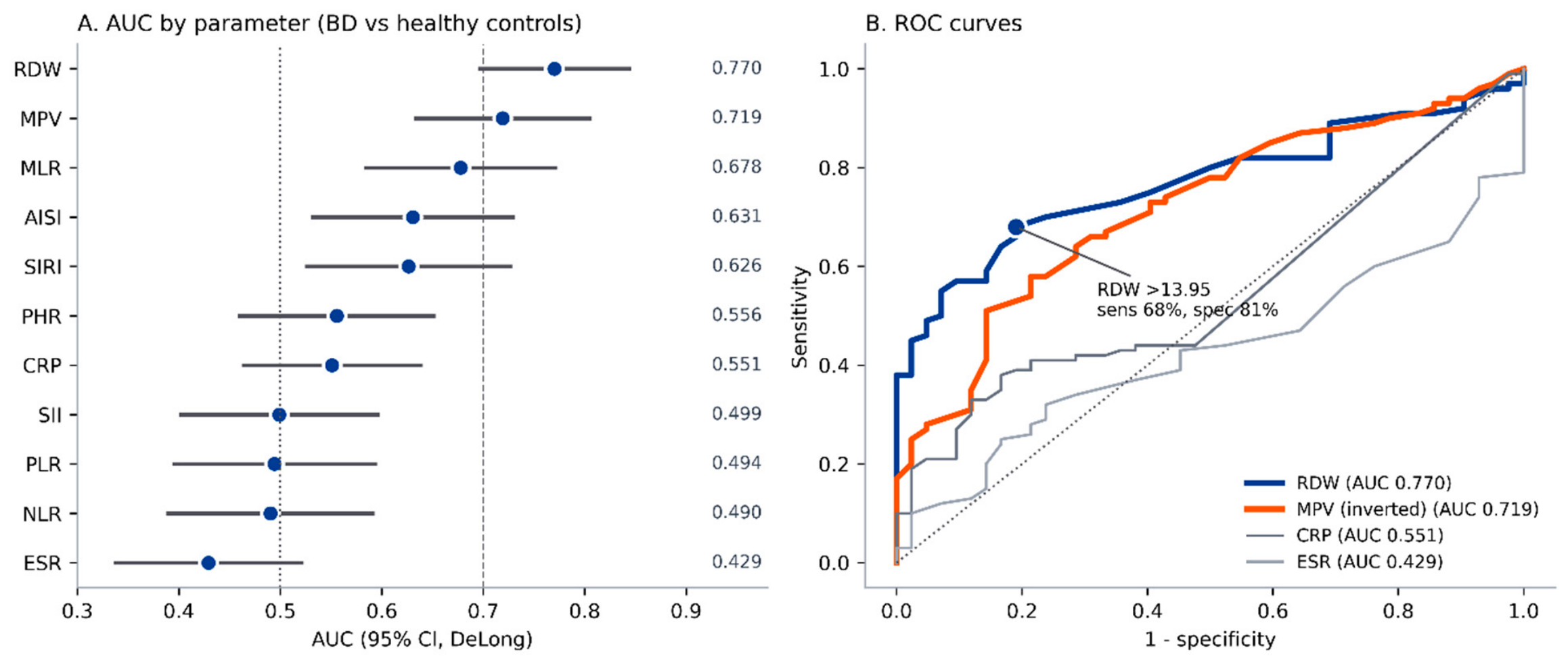
- The indices separated patients from healthy controls. Diagnostic accuracy was not assessed, so disease-controlled prospective studies are needed. RDW (AUC 0.77) and MPV (AUC 0.72) separated Behçet’s disease (BD) patients from healthy controls, whereas CRP (AUC 0.551) and ESR did not. RDW had the highest observed AUC for separating BD from healthy controls, but was not significantly superior to MPV or MLR.
Abstract
Objective: Behçet’s disease (BD) is a systemic vasculitis characterized by thrombo-inflammation. This cross-sectional study compared inflammatory indices obtained from complete blood counts (CBC), focusing particularly on red blood cell distribution width (RDW), with conventional acute-phase reactants (CRP, ESR). It examined phenotype-specific hematological patterns across clinical manifestations and the cross-sectional relationships of hematological parameters and vascular involvement with treatments. Subjects and Methods: A total of 100 BD patients (ISG criteria) and 42 age- and sex-comparable healthy controls were studied. RDW, MPV, PHR, and CBC-derived indices (NLR, PLR, MLR, SII, SIRI, AISI) were calculated. Disease activity (BDCAF), clinical manifestations (DVT, composite vascular complications, genital ulcer history, arthralgia, pathergy), and treatment regimens were recorded. Between-group comparisons used the Mann–Whitney U test; separation from controls was assessed by ROC analysis with Youden-derived cut-offs. The Benjamini–Hochberg procedure controlled the false discovery rate (FDR) across subgroup comparisons. Results: CRP (p = 0.299) and ESR (p = 0.184) did not differ between groups, whereas RDW (median 15.05% [IQR 13.57–16.32] vs. 13.45% [12.90–13.70], p < 0.001) and MPV (8.85 fL [8.38–10.00] vs. 10.05 fL [9.30–10.60], p < 0.001) did. RDW showed the highest observed AUC for separation from controls (AUC 0.77; cut-off > 13.95), followed by MPV (AUC 0.72); CRP (AUC 0.551) and NLR (AUC 0.49) were uninformative. PHR was nominally lower in DVT (median 17.08 [IQR 15.66–18.97] vs. 20.08 [16.54–25.64], p = 0.043) and composite vascular complications (17.16 [15.23–19.28] vs. 20.22 [16.66–26.26], p = 0.024), accompanied by higher hemoglobin (p = 0.013) and hematocrit (p = 0.006). RDW was lower in patients with a history of genital ulcers (13.65% [IQR 13.07–14.35] vs. 15.70% [14.17–16.45], p < 0.001). After Benjamini–Hochberg correction, the BD–control differences and the genital ulcer–RDW association remained significant, whereas marginal subgroup associations (DVT–PHR, pathergy–SIRI/AISI; p = 0.02–0.05) did not. Colchicine use was nominally associated with a lower DVT frequency (8.1% vs. 28.6%; OR 0.23, 95% CI 0.05–1.24), an unstable, exploratory finding based on only 14 non-users and substantially confounded by indication. Conclusions: In BD, CBC-derived indices, particularly RDW and MPV, separated BD patients from healthy controls even when conventional acute-phase reactants (CRP and ESR) remained normal, although this reflects separation from health rather than diagnostic accuracy for BD. RDW was lower in patients with a history of genital ulcers, while an exploratory PHR signal in deep vein thrombosis was inconclusive. These readily accessible indices may serve as complementary markers in BD, pending validation in disease-controlled prospective studies.
1. Introduction
Behçet’s disease (BD) is a chronic, relapsing, systemic variable-vessel vasculitis first described by Hulusi Behçet in 1937, characterized by recurrent oral and genital ulcers, uveitis, cutaneous lesions, and major vascular involvement [1]. Vascular engagement is the leading cause of mortality in BD, accounting for as much as 43.9% of deaths [2]. BD is now recognized as a natural model of inflammation-mediated thrombosis in humans, with vascular involvement affecting up to 50% of patients [3].
The pathogenesis of vascular thrombosis in BD differs fundamentally from traditional cardiovascular risk factors, relying instead on dysregulated immune–inflammatory responses. Neutrophil hyperactivation and neutrophil-mediated injury directly facilitate endothelial dysfunction, platelet activation, and thrombogenesis [3,4]. Consequently, the therapeutic approach to thrombosis in BD relies on immunosuppressants rather than anticoagulants [5].
In clinical practice, C-reactive protein (CRP) and erythrocyte sedimentation rate (ESR) are widely used to monitor disease activity. However, these acute-phase reactants are liver-derived with short half-lives and may remain within normal limits, especially in patients with predominantly mucocutaneous involvement or in the fibrotic stage of vascular lesions [6]. Aksoy et al. found that, although hsCRP, ESR, and RDW were elevated in BD patients relative to controls, none differed between patients with or without ocular or vascular involvement [7]. Tezcan et al. similarly reported that CRP and ESR had no significant relationship with specific clinical manifestations, whereas CBC-derived parameters such as RDW, PLR, MPV, and NLR showed organ-specific associations [8]. This limitation of conventional biomarkers has been documented across multiple studies [9,10].
CBC-derived inflammatory indices, including NLR, PLR, SII, and SIRI, have emerged as prognostic markers in various inflammatory and autoimmune diseases [11,12]. RDW and MPV, in particular, have demonstrated independent prognostic value far beyond that of BD: in coronary artery disease, both indices are associated with angiographic lesion burden [13]; in hospitalized COVID-19 patients, RDW and the MPV-to-platelet ratio predict disease severity and mortality in a time-dependent manner [14]; in children following cardiopulmonary bypass, postoperative RDW independently predicts early-stage lung injury [15]; and in critically ill children, RDW and MPV values at the time of hospital admission independently predict 28-day mortality [16]. This consistency across diseases supports the notion that RDW and MPV are generalizable markers of hematopoietic stress rather than BD-specific secondary phenomena. These indices primarily reflect leukocyte dynamics and capture only part of the systemic inflammatory picture. Inflammation also disrupts the erythroid and megakaryocytic compartments of the bone marrow, increasing RDW through impaired erythrocyte maturation and altering MPV through platelet consumption [17,18]. RDW, in particular, may reflect cumulative bone marrow stress rather than acute inflammation, making it a candidate marker for the chronic, low-grade inflammatory state of BD.
Building on this rationale, the present cross-sectional study had three aims: (1) to compare CBC-derived inflammatory indices—with a particular focus on RDW—and conventional acute-phase reactants (CRP, ESR) between BD patients and healthy controls; (2) to explore whether specific CBC-derived parameters show phenotype-specific patterns across clinical manifestations, including vascular involvement; and (3) to examine cross-sectional associations between treatment regimens (colchicine, corticosteroids, anti-TNF agents) and hematological parameters and vascular involvement. We did not hypothesize that any composite score would outperform RDW; rather, we evaluated RDW and individual CBC-derived indices as candidate markers and report their relative performance descriptively.
2. Materials and Methods
2.1. Study Population and Ethical Approval
This retrospective cross-sectional study utilized data collected at the Rheumatology Outpatient Clinic of Sakarya Training and Research Hospital between 2022 and 2024. As the data were extracted retrospectively from existing clinical records, retrospective approval was obtained from the Sakarya University Ethics Committee (approval no. E-43012747-050.04-450826-73, dated 21 January 2025), and the study protocol was conducted in accordance with the Declaration of Helsinki.BD was diagnosed according to the International Study Group (ISG) criteria [19]. Patients with malignancy, active infection, chronic renal failure, or pregnancy were excluded. Healthy controls were enrolled as an age- and sex-comparable convenience sample of volunteers without inflammatory, hematological, or chronic systemic disease. No formal individual or frequency matching was performed.
2.2. Disease Activity and Clinical Phenotyping
Disease activity was assessed at the time of blood sampling using the Behçet’s Disease Current Activity Form (BDCAF), with a score ≥2 taken to indicate active disease, consistent with prior use of this threshold in the BD literature [20,21]. All patients were systematically evaluated for deep vein thrombosis (DVT), arterial involvement, pulmonary thromboembolism, cerebral vasculitis, uveitis, arthralgia, arthritis, oral aphthous ulcers, genital ulcer history, erythema nodosum, and neurological symptoms. A composite vascular complication variable was constructed from DVT, arterial involvement, pulmonary thromboembolism, and cerebral vasculitis. Pathergy test results were recorded. Treatment data (colchicine, azathioprine, anti-TNF agents, corticosteroids, aspirin, and anticoagulants) were recorded together with clinical findings and inflammatory markers.
2.3. Calculation of Inflammatory Indices
Peripheral blood samples were collected in standard EDTA tubes and analyzed within 30 min of venous blood collection at the central laboratory of Sakarya Training and Research Hospital using an automated hematology analyzer (Mindray BC-6800 Mindray, Shenzhen, China). As the MPV value increases gradually with the incubation time in the EDTA-containing tube, patient and control group samples were processed in accordance with the same routine processing time protocol in order to minimize deviations arising from differences in the pre-analysis period. CRP values below the lower limit of detection (3.0 mg/L) were recorded as 3.0 mg/L. The laboratory is equipped with internationally certified instruments and operates under strict quality control protocols.
NLR, PLR, MLR, SII, SIRI, AISI, and PHR were calculated from CBC data as follows:
Neutrophil-to-Lymphocyte Ratio (NLR) = absolute neutrophil count/absolute lymphocyte count
Platelet-to-Lymphocyte Ratio (PLR) = platelet count/absolute lymphocyte count
Monocyte-to-Lymphocyte Ratio (MLR) = absolute monocyte count/absolute lymphocyte count
Systemic Immune-Inflammation Index (SII) = (platelet × neutrophil)/lymphocyte
Systemic Inflammatory Response Index (SIRI) = (neutrophil × monocyte)/lymphocyte
Aggregate Index of Systemic Inflammation (AISI) = (neutrophil × platelet × monocyte)/lymphocyte
Platelet-to-Hemoglobin Ratio (PHR) = platelet count/hemoglobin
RDW (normal 11–15%), MPV (normal 7.5–11.5 fL).
2.4. Statistical Analysis
Continuous variables are presented as median (interquartile range) throughout, except age, which is presented as mean ± SD. Between-group comparisons used the Mann–Whitney U test. Correlations used the Spearman coefficient, and treatment–complication associations used the Fisher exact test. The ability of each parameter to separate BD patients from healthy controls was assessed by receiver operating characteristic (ROC) curve analysis, with optimal cut-off values determined by the Youden index. To account for the large number of subgroup comparisons, the Benjamini–Hochberg procedure was applied to control the false discovery rate (FDR) within each family of comparisons; associations are reported either as remaining significant after FDR correction or as nominal (uncorrected) and therefore exploratory. RDW was pre-specified as the primary parameter of interest; the remaining ten indices in Family 1 were secondary. Families were defined a priori by comparison type (BD versus control, activity, clinical phenotype, treatment) rather than by outcome, so that every test within a clinically coherent question shares one correction. A two-sided p < 0.05 was considered statistically significant. The primary BD-versus-control comparison (n = 100 vs. n = 42) is reported with its effect size and 95% CI (e.g., adjusted RDW ratio 1.083, 95% CI 1.041–1.128); given the well-documented limitations of post hoc power calculations, we rely on these estimates rather than a retrospective power statement to convey precision. The control group was an age- and sex-comparable convenience sample; the resulting group imbalance and the modest size of clinical subgroups (e.g., DVT, n = 11) limited power for secondary comparisons, which should be interpreted as exploratory.
3. Results
3.1. Demographics
Mean age was comparable between BD patients and controls (44.49 ± 8.51 vs. 46.36 ± 9.01 years; p = 0.173), as was sex distribution (p = 0.509). Among patients, 77% had active disease. The frequencies of clinical manifestations were: DVT 11%, composite vascular complications 14%, uveitis 24%, genital ulcer history 28%, and arthralgia 68% (Table 1).
Table 1.
Demographic, clinical and treatment characteristics.
3.2. Laboratory Parameters: BD vs. Controls
CRP (p = 0.299) and ESR (p = 0.184) did not differ between groups. By contrast, RDW (median 15.05% [IQR 13.57–16.32] vs. 13.45% [12.90–13.70], p < 0.001), MPV (8.85 [8.38–10.00] vs. 10.05 [9.30–10.60] fL, p < 0.001), MLR, SIRI, and AISI differed significantly between BD patients and controls (Table 2). NLR, PLR, SII, and PHR did not differ at the group level.
Table 2.
Laboratory parameters: BD vs. controls.
3.3. Disease Activity
No parameters showed a statistically significant difference between active and inactive disease (all p > 0.05; see footnote in Table 2). No association between the indices and current BDCAF-defined disease activity was detected (active n = 77 vs. inactive n = 23; all q > 0.70). This may reflect limited statistical power, the small inactive subgroup, or misclassification of activity.
3.4. Separation of BD from Healthy Controls (ROC)
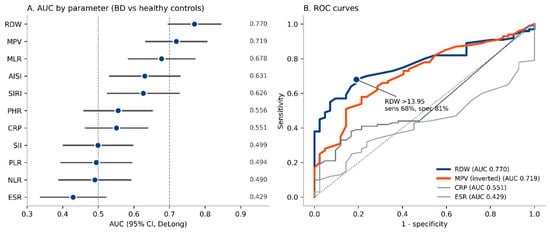
RDW showed the highest observed AUC for separating BD from healthy controls (AUC 0.770; sensitivity 68%, specificity 81%; Youden cut-off > 13.95), followed by MPV (AUC 0.719) and MLR (AUC 0.678); however, DeLong testing showed that RDW was not significantly superior to MPV (p = 0.327) or MLR (p = 0.117), so the higher AUC of RDW should be regarded as a numerical rather than a statistical advantage. CRP (AUC 0.551), NLR (AUC 0.49), and PLR (AUC 0.49) were uninformative (Table 3, Figure 1). Because controls were healthy volunteers rather than patients with other inflammatory conditions, these AUC values describe separation from health, not diagnostic accuracy for BD (see Limitations).
Table 3.
ROC analysis: separation of BD patients from healthy controls.
Figure 1.
Separation of BD patients from healthy controls. (A) AUC with 95% CI (DeLong); dotted line 0.5, dashed 0.7. (B) ROC curves; MPV inverted (lower values indicate BD). Marked point: RDW cut-off > 13.95 (sensitivity 68%, specificity 81%).
3.5. Clinical Phenotype Associations
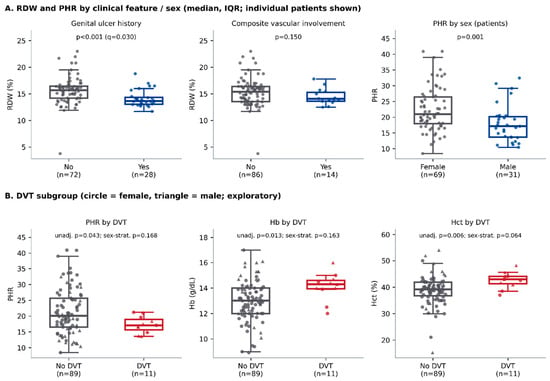
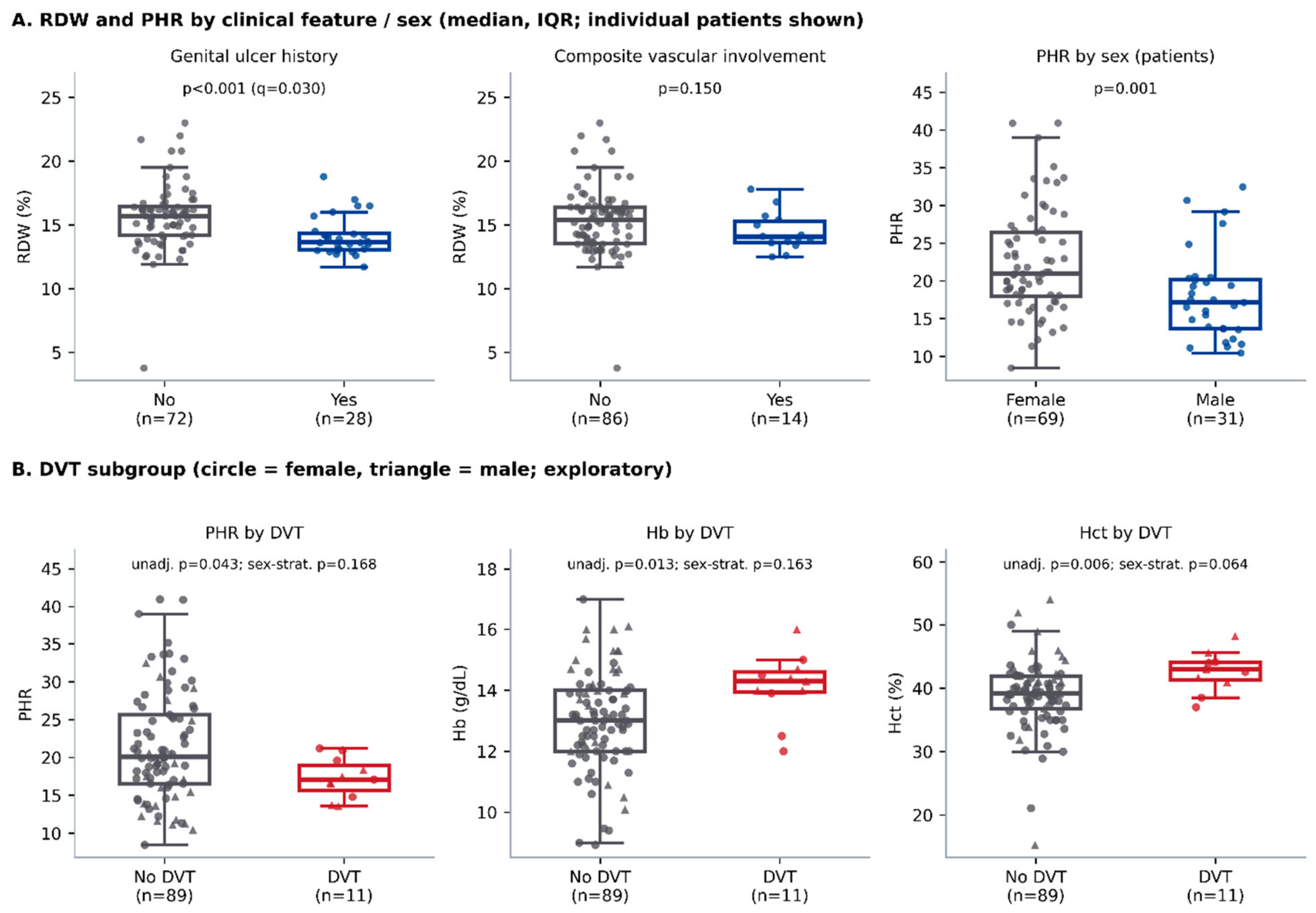
PHR was lower in patients with DVT (17.08 vs. 20.08 [IQR 15.66–18.97 vs. 16.54–25.64], nominal p = 0.043) and composite vascular complications (nominal p = 0.024), accompanied by higher hemoglobin (14.30 [13.95–14.60] vs. 13.00 [12.00–14.00] g/dL, p = 0.013) and hematocrit (43.0 [41.4–44.0] vs. 39.2 [36.8–41.9] %, p = 0.006). As PHR is calculated directly from the hemoglobin value, the higher Hb/Hct values in this subgroup are not an independent confirmatory finding, but rather a restatement of the same relationship. RDW was lower in patients with a history of genital ulcers (13.65% [IQR 13.07–14.35] vs. 15.70% [14.17–16.45], p < 0.001). SIRI (p = 0.046) and AISI (p = 0.030) were higher in pathergy-positive patients. CRP and ESR were not associated with any clinical manifestation (Table 4, Figure 2).
Table 4.
Clinical feature associations with indices (q < 0.10).
Figure 2.
(A) RDW by genital ulcer history and composite vascular involvement; PHR by sex. (B) PHR, Hb and Hct by DVT (circle female, triangle male). Boxes: median and IQR; points: individual patients.
Following the application of the Benjamini–Hochberg correction across the subgroup comparison family, the lower RDW in patients with a history of genital ulcers and the PHR difference in males (lower PHR in men compared to women; Table 4) remained significant; in contrast, the borderline-significant associations between DVT and PHR (p = 0.043), pathergy and SIRI (p = 0.046), and SIRI and AISI (p = 0.030), as well as the borderline-significant associations between arthralgia and ESR (p = 0.039) and between genital ulcers and PLR (p = 0.030), lost their statistical significance and were reported as exploratory findings intended to inform hypothesis generation. The DVT finding derives from only 11 patients and requires confirmation (Table 5).
Table 5.
Sensitivity and adjusted analyses (RDW, genital ulcer, DVT/PHR, correlations).
3.6. Treatment Associations
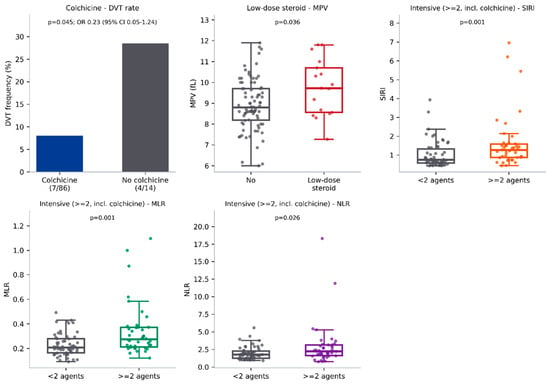
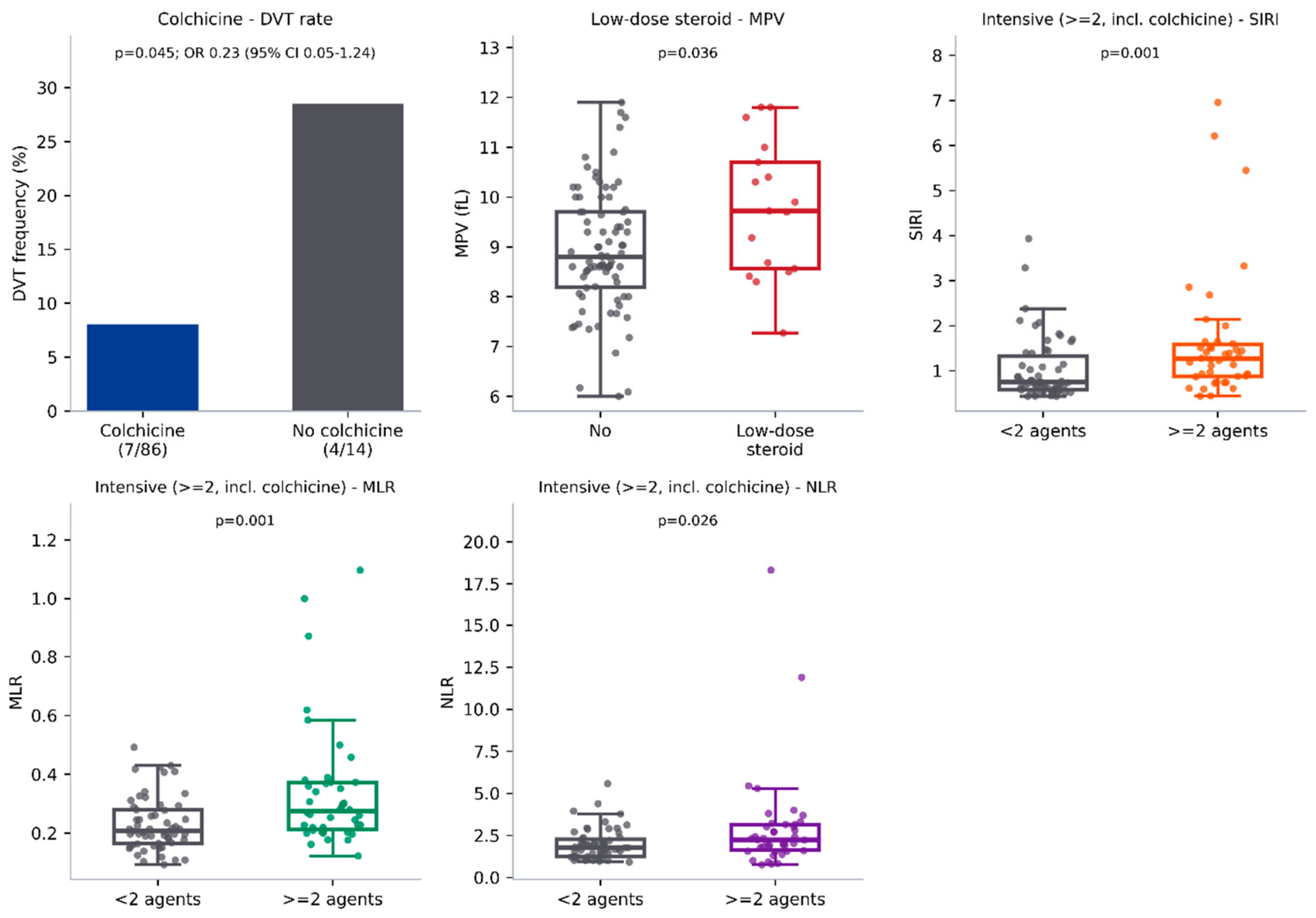
In cross-sectional comparison, colchicine users had a lower DVT frequency than non-users (8.1% vs. 28.6%; OR 0.23, nominal p = 0.045) without significant differences in any inflammatory index. Low-dose corticosteroid use was associated with higher MPV (median 9.72 [IQR 8.56–10.70] vs. 8.80 [8.19–9.70] fL, p = 0.036); anticoagulant use with lower PLR (p = 0.039) and CRP (p = 0.040); and aspirin use with lower MLR (p = 0.036). Patients receiving ≥ 2 immunosuppressive agents had higher SIRI (p = 0.001), MLR (p < 0.001), and NLR (p = 0.026). Because treatment was not randomized, all of these associations are subject to confounding by indication—with more severe disease receiving more intensive therapy—and none survived correction for multiple comparisons; they thus cannot be interpreted as treatment effects (Table 6, Figure 3).
Table 6.
Treatment associations with indices and vascular involvement.
Figure 3.
Cross-sectional treatment associations: lower DVT frequency among colchicine users; higher MPV with low-dose corticosteroids; higher SIRI, MLR, and NLR with intensive immunosuppression. All associations are confounded by indication and are not causal.
4. Discussion
This cross-sectional study highlights the limited value of classical acute-phase reactants (CRP, ESR) in BD and shows that bone marrow-responsive markers, particularly RDW, differ between BD patients and healthy controls. It further describes phenotype-specific hematological patterns and explores cross-sectional treatment associations. We interpret all findings as descriptive and hypothesis-generating, and we explicitly avoid claims of diagnostic, predictive, or therapeutic value.
4.1. RDW and Conventional Acute-Phase Reactants
In our cohort, RDW was the parameter that best separated BD patients from healthy controls (AUC 0.77), consistent with prior reports of elevated RDW in BD [8,9,17]. The chronic cytokine milieu in BD stimulates hepatic hepcidin synthesis via IL-6, disrupting iron metabolism and inducing erythropoietin resistance [22]. Tezcan et al. observed that SII and NLR normalized after three months of colchicine treatment while RDW remained elevated, reflecting cumulative bone marrow stress rather than acute inflammation [23]. Our finding of normal CRP levels in the presence of elevated RDW is consistent with the concept of a slower-resolving hematological signal. However, this contradicts the findings of Gheita et al., who reported higher RDW levels, particularly in BD with vascular symptoms [24]; in our cohort, RDW was not higher but numerically lower in patients with composite vascular involvement (15.40 vs. 14.05, p = 0.150; Table 5). Our data do not support a vascular-specific increase in RDW.
Aksoy et al. reported that RDW, ESR, and hsCRP levels were significantly higher in patients with active Behçet’s disease than in inactive patients and healthy controls, suggesting that these markers reflect disease activity [7]. In our cohort, RDW was higher than in healthy controls, whereas CRP and ESR did not differ between the two groups. Although most of our patients (77%) had active disease, RDW, CRP, and ESR did not differ between the active and inactive subgroups, and no other index was associated with current BDCAF-defined activity. These data cannot show whether RDW reflects cumulative rather than current inflammatory burden, and longitudinal studies are needed to address this.
The lower MPV in our BD cohort (p < 0.001) is compatible with the consumption hypothesis, in which large, active platelets are consumed at sites of vascular injury [25,26]. This aligns with reports of low MPV in vascular BD but contrasts with studies reporting high MPV in active disease [17]. The discrepancy may reflect stage dependence: consumption predominates in active vascular disease, whereas increased thrombopoiesis can elevate MPV in chronic inflammation, a pattern also reported in atherosclerotic vascular disease where RDW, MPV and platelet-distribution indices scale with the burden of vascular lesions [13].
4.2. PHR and Vascular Involvement
Patients with DVT (n = 11) had a lower PHR, and the same direction was seen for composite vascular involvement. This association did not survive FDR correction (q = 0.342) and was not significant after sex stratification (van Elteren p = 0.168). DVT and combined vascular involvement were more common among men (Table 5), and the PHR itself differed by sex (Table 4), so sex may confound the association. Because hemoglobin is a component of the PHR, the higher hemoglobin and hematocrit in these patients cannot be counted as independent supporting evidence. Earlier reports describe lower erythrocyte indices in vascular BD and a correlation between venous wall thickness and hematological parameters [2,3,27]. Our cross-sectional design, however, allows no inference about thrombotic risk. We therefore regard the PHR finding as inconclusive and hypothesis-generating.
4.3. Phenotype-Specific Patterns
RDW was lower in patients with a history of genital ulcers (p < 0.001). The association remained significant after FDR correction (q = 0.030), sex stratification (van Elteren p = 0.0008), and adjustment for sex, age, smoking, hemoglobin, and MCV (adjusted ratio 0.941, 95% CI 0.888–0.997; Table 5). Genital ulcer history is a lifetime variable that does not capture current mucosal activity, and the biological explanation remains unclear. Patients with a predominantly mucocutaneous course may experience less systemic bone marrow stress, but this is speculative and cannot be tested with cross-sectional data. RDW was not significantly associated with composite vascular involvement (Table 5), so our data do not support a vascular-specific RDW signal. The higher PLR in patients with genital ulcers was nominal only. Machine-learning analyses have identified distinct BD phenotypes that single biomarkers such as CRP cannot capture [28]. Higher SIRI and AISI in pathergy-positive patients are plausible given the monocyte contribution to both indices, but these values were nominal, were based on only 10 patients, and did not remain significant after correction. They need validation in larger BD cohorts.
4.4. Treatment Associations
The lower DVT frequency among colchicine users is consistent with the established role of colchicine in BD but, in a cross-sectional design, cannot be interpreted as a protective effect: colchicine use is associated with disease phenotype, duration, and concomitant therapy, all of which confound the association. Tezcan et al. showed that colchicine normalized SII, CRP, and NLR after three months while RDW and MPV remained elevated, indicating distinct kinetic profiles, and current recommendations emphasize immunosuppression rather than anticoagulation for BD thrombosis [5,23,29]. The association of intensive immunosuppression with higher SIRI, MLR, and NLR most plausibly reflects confounding by indication—more severe disease receiving more aggressive treatment [10]. Anti-cytokine therapies may not fully suppress monocyte-derived inflammation; however, in the absence of mechanistic data specific to BD, this remains speculative, and our cross-sectional study is not well-suited to test this directly.
4.5. Limited Value of CRP and ESR in Phenotyping
CRP and ESR were not associated with any clinical manifestation, consistent with prior reports [7,8]. This likely reflects their non-specific, liver-derived, rapidly fluctuating nature, which poorly captures chronic vascular inflammation [10]. CBC-derived indices, which provide broader information on cellular immune dynamics, may complement conventional markers, but our data show this only in comparison with healthy controls and cannot establish added clinical value [12].
4.6. Limitations
This study has several important limitations. First, the cross-sectional design precludes any causal inference regarding inflammation, vascular risk, or treatment effects. Second, controls were healthy volunteers rather than patients with other inflammatory or thrombotic conditions; consequently, the ROC analyses describe separation from health and do not establish diagnostic accuracy for BD, whose diagnosis remains clinical. Third, the group sizes were imbalanced (100 vs. 42) and several clinical subgroups, most notably DVT (n = 11) and pathergy-positive patients (n = 10), were small, limiting power; the corresponding findings are exploratory. Fourth, because numerous comparisons were performed, most marginal associations did not survive FDR correction and require confirmation. Fifth, treatment associations are subject to confounding by indication. Sixth, the study was single-center, and standardized cut-off values for CBC-derived indices in BD are lacking [9,11]. Seventh, the Youden-derived cut-offs for RDW and MPV were derived and tested in the same cohort; without external validation in an independent sample, they should not be regarded as clinically applicable diagnostic thresholds. Eighth, RDW values may also be influenced by iron and folate levels, recent bleeding or transfusion, hemoglobinopathy carrier status and liver disease; as data on ferritin, folate, history of transfusion and hemoglobinopathy screening were not available in this cohort, the possibility that these factors act as additional confounding variables cannot be ruled out, beyond the sensitivity analyses for anemia/MCV/B12 already presented in Table 5. Disease-controlled, multicenter, prospective, and longitudinal studies with adequately powered subgroups are needed.
5. Conclusions
In this cross-sectional, single-center study, RDW and MPV differed between BD patients and healthy controls even when CRP and ESR were normal, and RDW was lower in patients with a history of genital ulcers. The lower PHR observed in patients with DVT did not remain statistically significant after adjustment for multiple comparisons or stratification by sex. Pathergy-positive patients showed nominally higher SIRI and AISI. These findings are exploratory and rest on comparison with healthy controls; they do not establish diagnostic accuracy, predictive value for vascular events, or treatment efficacy. The cross-sectional association between colchicine use and lower DVT frequency is hypothesis-generating and confounded by indication. Disease-controlled, prospective, longitudinal studies with adequately powered subgroups and standardized cut-offs are required before CBC-derived indices can be recommended for risk stratification in BD.
Author Contributions
G.D. and M.K.U. and K.N. contributed to the conception and design of the study. M.K.U. contributed to data acquisition, analysis, and/or interpretation. G.D. and E.U. drafted the manuscript. G.D., E.U., A.K. and K.N. critically revised the manuscript for important intellectual content. All authors have read and agreed to the published version of the manuscript.
Funding
This research received no external funding.
Institutional Review Board Statement
The study was conducted in accordance with the principles of the Declaration of Helsinki (October 2024 version). Ethical approval was granted by the Sakarya University Ethics Committee (approval number and date: E-43012747-050.04-450826-73/21.01.2025).
Informed Consent Statement
The Sakarya University Ethics Committee does not require an informed consent form for retrospective studies; therefore, informed consent was waived and not obtained for this study.
Data Availability Statement
The data presented in this study are available upon reasonable request to the corresponding author.
Conflicts of Interest
The authors declare no conflicts of interest.
References
- Behcet, H. Ueber rezidivierende, aphthose, durch ein Virus verursachte Geschwüre am Mund, am Auge, und an den Genitalien Dermat. Wchnschr 1937, 105, 1152–1157. [Google Scholar]
- Cheng, L.; Li, L.; Liu, C.; Yan, S.; Chen, H.; Li, H.; Zhang, F.; Chen, H.; Li, Y. Variation of Red Blood Cell Parameters in Behcet’s Disease: Association with Disease Severity and Vascular Involvement. Clin. Rheumatol. 2020, 40, 1457–1464. [Google Scholar] [CrossRef] [Scilit] [PubMed]
- Bettiol, A.; Alibaz-Öner, F.; Direskeneli, H.; Hatemi, G.; Saadoun, D.; Seyahi, E.; Prisco, D.; Emmi, G. Vascular Behçet Syndrome: From Pathogenesis to Treatment. Nat. Rev. Rheumatol. 2022, 19, 111–126. [Google Scholar] [CrossRef] [Scilit] [PubMed]
- Tómasson, G.; Monach, P.A.; Merkel, P.A. Thromboembolic Disease in Vasculitis. Curr. Opin. Rheumatol. 2009, 21, 41–46. [Google Scholar] [CrossRef] [Scilit] [PubMed]
- Koné-Paut, I.; Barète, S.; Bodaghi, B.; Deiva, K.; Desbois, A.C.; Galeotti, C.; Gaudric, J.; Kaplanski, G.; Mahr, A.; Noël, N.; et al. French Recommendations for the Management of Behçet’s Disease. Orphanet J. Rare Dis. 2021, 16, 352. [Google Scholar] [CrossRef] [Scilit] [PubMed]
- Cocco, G.; Gasparyan, A.Y. Behcet’s Disease: An Insight From a Cardiologist’s Point of View. Open Cardiovasc. Med. J. 2010, 4, 63–70. [Google Scholar] [CrossRef] [Scilit] [PubMed]
- Aksoy, Ş.; Savaş, E.; Sucu, M.; Kısacık, B.; Kul, S.; Zengin, O. Association Between Red Blood Cell Distribution Width and Disease Activity in Patients with Behçet’s Disease. J. Int. Med. Res. 2015, 43, 765–773. [Google Scholar] [CrossRef] [Scilit] [PubMed]
- Tezcan, D.; Körez, M.K.; Gülcemal, S.; Hakbilen, S.; Akdağ, T.; Yılmaz, S. Evaluation of Diagnostic Performance of Haematological Parameters in Behçet’s Disease. Int. J. Clin. Pract. 2021, 75, e14638. [Google Scholar] [CrossRef] [Scilit] [PubMed]
- Tanaçan, E.; Dinçer, D.; Erdoğan, F.G.; Gürler, A. A Cutoff Value for the Systemic Immune-Inflammation Index in Determining Activity of Behçet Disease. Clin. Exp. Dermatol. 2020, 46, 286–291. [Google Scholar] [CrossRef] [Scilit] [PubMed]
- Gasparyan, A.Y.; Ayvazyan, L.; Mukanova, U.; Yessirkepov, M.; Kitas, G.D. The Platelet-to-Lymphocyte Ratio as an Inflammatory Marker in Rheumatic Diseases. Ann. Lab. Med. 2019, 39, 345–357. [Google Scholar] [CrossRef] [Scilit] [PubMed]
- Daood, R.; Sabbah, F.; Fawaz, A.; Hassan, F.; Naffaa, M.E. The Role of Neutrophil to Lymphocytes Ratio (NLR) as a Predictor of Disease Activity in Behcet’s Syndrome—A Comprehensive Review. J. Clin. Med. 2025, 14, 5847. [Google Scholar] [CrossRef] [Scilit] [PubMed]
- Wu, Y.C.; Huang, Y.; Wu, Y.; Sun, J.; Xie, Q.; Yin, G. Systemic Immune-Inflammation Index as a Versatile Biomarker in Autoimmune Disorders: Insights From Rheumatoid Arthritis, Lupus, and Spondyloarthritis. Front. Immunol. 2025, 16, 1621209. [Google Scholar] [CrossRef] [Scilit] [PubMed]
- Zavragiu, A.C.; Sutoi, D.; Radbea, O.R.; Chiu, B.; Mailat, D.E.; Ardelean, S.; Barzache, P.A.; Dudau, I.; Mederle, O.A.; Andor, M. Insights into the Use of Erythrocyte and Platelet Distribution Indices for Assessing the Extent of Coronary Lesions. Medicina 2025, 61, 1939. [Google Scholar] [CrossRef] [Scilit] [PubMed]
- Georgiadou, D.; Xanthos, T.; Komninaka, V.; Xatzikiriakou, R.; Baka, S.; Pouliakis, A.; Spyridaki, A.; Theodoridis, D.; Papapanagiotou, A.; Karida, A.; et al. Red Cell Distribution Width (RDW), Platelets and Platelet Index MPV/PLT Ratio as Specific Time Point Predictive Variables of Survival Outcomes in COVID-19 Hospitalized Patients. J. Clin. Med. 2025, 14, 5381. [Google Scholar] [CrossRef] [Scilit] [PubMed]
- Liu, H.; Cheng, J.; Peng, K.; Chen, L.; Kong, Z.; Zhao, Y.; Luo, Z. Red Cell Distribution Width as a Predictive Biomarker for Early Lung Injury in Pediatric Patients Following Cardiopulmonary Bypass. Children 2025, 12, 785. [Google Scholar] [CrossRef] [Scilit] [PubMed]
- Sunkonkit, K.; Chai-Adisaksopha, C.; Natesirinilkul, R.; Phinyo, P.; Trongtrakul, K. Admission Red Blood Cell Distribution Width and Mean Platelet Volume as Predictors of Mortality in the Pediatric Intensive Care Unit: A Five-Year Single-Center Retrospective Study. J. Clin. Med. 2025, 14, 3839. [Google Scholar] [CrossRef] [Scilit] [PubMed]
- Masoumi, M.; Shadmanfar, S.; Davatchi, F.; Shahram, F.; Akhlagi, M.; Faezi, T.; Kavosi, H.; Moradi, S.; Balasi, J. Correlation of Clinical Signs and Symptoms of Behçet’s Disease with Mean Platelet Volume (MPV) and Red Cell Distribution Width (RDW). Orphanet J. Rare Dis. 2020, 15, 297. [Google Scholar] [CrossRef] [Scilit] [PubMed]
- Montagnana, M.; Cervellin, G.; Meschi, T.; Lippi, G. The Role of Red Blood Cell Distribution Width in Cardiovascular and Thrombotic Disorders. Clin. Chem. Lab. Med. (CCLM) 2012, 50, 635–641. [Google Scholar] [CrossRef] [Scilit] [PubMed]
- Disease, I.S.G.f.B.s. Criteria for diagnosis of Behcet’s disease. International Study Group for Behcet’s Disease. Lancet 1990, 335, 1078–1080. [Google Scholar]
- Karatas, A.; Akkoc, R.F.; Oz, B. A Bidirectional C1q/TNF-Related Protein Signature Is Associated with Disease Activity in Behcet’s Disease: A Cross-Sectional Study. Diagnostics 2026, 16, 3035. [Google Scholar] [CrossRef] [Scilit] [PubMed]
- Bhakta, B.; James, T.; Chamberlain, M.A.; Noble, B.; Silman, A.J. Behçet’s Disease: Evaluation of a New Instrument to Measure Clinical Activity. Rheumatology 1999, 38, 728–733. [Google Scholar] [CrossRef] [Scilit] [PubMed]
- Nemeth, E.; Rivera, S.; Gabayan, V.; Keller, C.; Taudorf, S.; Pedersen, B.K.; Ganz, T. IL-6 Mediates Hypoferremia of Inflammation by Inducing the Synthesis of the Iron Regulatory Hormone Hepcidin. J. Clin. Investig. 2004, 113, 1271–1276. [Google Scholar] [CrossRef] [Scilit] [PubMed]
- Tezcan, D.; Turan, Ç.; Yılmaz, S. The Effect of Colchicine Treatment on Complete Blood Cell Count-Based Parameters in Patients with Behçet’s Disease. J. Health Sci. Med. 2022, 5, 517–522. [Google Scholar] [CrossRef] [Scilit]
- Gheita, T.A.; Sakr, B.R.; Rabea, R.E.; Elhamid, S.A. Value of Hematological Indices Versus VEGF as Biomarkers of Activity in Behçet’s Disease. Clin. Rheumatol. 2019, 38, 2201–2210. [Google Scholar] [CrossRef] [Scilit] [PubMed]
- Gasparyan, A.Y.; Ayvazyan, L.; Mikhailidis, D.P.; Kitas, G.D. Mean Platelet Volume: A Link Between Thrombosis and Inflammation? Curr. Pharm. Des. 2011, 17, 47–58. [Google Scholar] [CrossRef] [Scilit] [PubMed]
- Ryu, H.J.; Seo, M.R.; Choi, H.J.; Ko, K.P.; Park, P.-W.; Baek, H.J. Mean Platelet Volume as a Marker for Differentiating Disease Flare From Infection in Behçet’s Disease. Int. J. Rheum. Dis. 2016, 21, 1640–1645. [Google Scholar] [CrossRef] [Scilit] [PubMed]
- Tezcan, D.; Özer, H.; Gülcemal, S.; Hakbilen, S.; Durmaz, M.S.; Batur, A.; Yılmaz, S. Diagnostic Performance of Lower Extremity Venous Wall Thickness and Laboratory Findings in the Diagnosis of the Behçet Disease. JCR J. Clin. Rheumatol. 2021, 28, e521–e527. [Google Scholar] [CrossRef] [Scilit] [PubMed]
- Tsubota, K.; Usui, Y.; Shimizu, H.; Gotô, H. Identification of Markers Predicting Clinical Course in Patients with Behcet Disease by Combination of Machine Learning and Unbiased Clustering Analysis. Graefe’s Arch. Clin. Exp. Ophthalmol. 2025, 263, 2641–2650. [Google Scholar] [CrossRef] [Scilit] [PubMed]
- Hatemi, G.; Silman, A.J.; Bang, D.; Bodaghi, B.; Chamberlain, A.; Gül, A.; Houman, M.H.; Kötter, I.; Olivieri, I.; Salvarani, C.; et al. EULAR Recommendations for the Management of Behçet Disease. Ann. Rheum. Dis. 2008, 67, 1656–1662. [Google Scholar] [CrossRef] [Scilit] [PubMed]

Disclaimer/Publisher’s Note: The statements, opinions and data contained in all publications are solely those of the individual author(s) and contributor(s) and not of MDPI and/or the editor(s). MDPI and/or the editor(s) disclaim responsibility for any injury to people or property resulting from any ideas, methods, instructions or products referred to in the content. |
© 2026 by the authors. Licensee MDPI, Basel, Switzerland. This article is an open access article distributed under the terms and conditions of the Creative Commons Attribution (CC BY) license.