


Abstract
Introduction: Antimicrobial resistance (AMR) and healthcare-associated infections (HAIs) are major global health threats. This study investigated the genomic landscape and clonal diversity in a targeted hospital-based dataset using whole-genome sequencing (WGS). Methods: Carbapenemase-producing K. pneumoniae isolates exhibiting resistance or reduced susceptibility to carbapenems, comprising infection isolates and selected rectal surveillance swabs were collected between March 2023 and March 2025. Isolates were subjected to WGS using the Illumina NovaSeq X Plus platform, followed by bioinformatic analyses with Galaxy. Phylogenetic relationships were inferred through core-genome alignment and high-resolution SNP analysis. Results: Within the targeted sequenced dataset, the most frequently detected lineages were ST512 (43.3%) and ST147 (30.0%). Phylogenetic analysis revealed high genomic relatedness and temporal persistence of ST512, whereas ST147 and ST2442 showed greater genetic diversity. Phenotypic resistance exceeded 80% for carbapenems and fluoroquinolones. The resistome was characterized by a high prevalence of blaSHV, blaKPC-3 (73.3%), and blaOXA-9 (66.7%), frequently co-occurring. The blaNDM-1 gene was detected in 20% of sequenced isolates; because NDM-positive surveillance isolates were deliberately enriched, this proportion should not be interpreted as hospital-wide prevalence, mainly within ST2442 and ST5859, indicating increasing enzymatic diversity and a shift from a predominantly KPC-driven epidemiology to a more heterogeneous carbapenemase landscape. Conclusion: Genomically related MDR K. pneumoniae isolates were recovered from several hospital wards; however, genomic relatedness alone does not establish direct transmission routes. The identification of blaNDM-1 alongside blaKPC-3 highlights an evolving, increasingly complex carbapenemase landscape. This study offers a targeted genomic snapshot of selected high-risk clones and emerging resistance determinants, providing actionable data to support institutional infection prevention and control (IPC) protocols and antimicrobial stewardship.
1. Introduction
Antimicrobial resistance is one of the most serious global public health threats, reducing treatment effectiveness for common infections and increasing morbidity, mortality, and healthcare costs. At the same time, healthcare-associated infections (HAIs) remain a major challenge in healthcare settings, often caused by multidrug-resistant organisms [1]. The close link between AMR and HAIs underscores the urgent need for effective infection prevention, antimicrobial stewardship, and continuous surveillance to protect patient safety and improve health outcomes. The current AMR landscape in Europe is marked by pronounced geographical disparities, with a clear north-to-south and west-to-east gradient. Northern and western regions generally report lower resistance levels than the south and east. This gradient results in a significant human and economic toll, with more than 35,000 people dying annually in the EU/EEA [1,2].
According to recent ECDC surveillance data, Gram-negative pathogens are the most critical threat to public health in the WHO European Region, with four species of particular concern. Among these, Klebsiella pneumoniae stands out for the rapid rise in resistance to carbapenems and third-generation cephalosporins. Of additional concern is the emergence of hypervirulent lineages that acquire resistance determinants, creating a convergence of virulence and antimicrobial resistance that poses major challenges for surveillance and clinical management [1].
Klebsiella pneumoniae is a significant Gram-negative opportunistic pathogen responsible for various infections, including pneumonia, urinary tract infections, bacteremia, and liver abscesses. Recent clinical trends show a worrying rise in multidrug-resistant (MDR) and hypervirulent Klebsiella pneumoniae (hvKP) strains, which are increasingly difficult to treat and control [3].
The epidemiological landscape of carbapenem-resistant Klebsiella pneumoniae has reached a critical juncture in the European Union. In 2024, the estimated incidence of bloodstream infections caused by these resistant strains was 3.51 per 100,000 inhabitants, a stark 61.0% increase from the 2019 baseline, directly opposing the established EU 2030 target of a 5% reduction (to 2.07 per 100,000) [1]. Furthermore, an additional concern is the convergence of hypervirulence and carbapenem resistance: the emergence of hypervirulent K. pneumoniae lineages that have acquired carbapenemase genes. These strains pose a severe risk to patient safety because most clinical laboratories do not routinely screen for hypervirulence markers, allowing these highly dangerous and hard-to-treat infections to circulate undetected. Several external factors have further aggravated this situation, including the enduring pressures of the COVID-19 pandemic and, more recently, the impact of war-related casualties and patient transfers from Ukraine beginning in 2022 [1,4].
Surveillance data indicates that the dissemination of carbapenem-resistant K. pneumoniae (CRKp) is driven by specific sequence types (STs) with distinct geographic niches. For instance, the ST258/512 remains a major globally disseminated lineage, particularly in the United States and Southern Europe, where it is closely linked to carbapenemases [5]. Meanwhile, ST11 has become the primary driver of both CRKp and hypervirulent (CR-hvKp) infections in China and is increasingly identified in Europe carrying blaKPC or blaNDM genes [6]. Other lineages, such as ST101 in Eastern Europe and the emerging ST307 in the Mediterranean, further illustrate the regional shifts where newer clones are displacing established ones. Notably, the traditionally hypervirulent ST23 and other prominent types like ST14, ST15, and ST147 continue to facilitate the international spread of diverse resistance determinants [5].
Earlier studies, conducted by our team, established that the local epidemiological scenario was primarily dominated by the ST512 lineage, a high-risk clone within Clonal Group 258. This lineage has shown persistent detection within the hospital setting, particularly within the ICU. More recent investigations documented changes in the local resistance landscape, documenting the emergence of strains co-producing multiple carbapenemases. Specifically, the presence of KPC in combination with OXA-48-like (e.g., OXA-181) and OXA-162 enzymes was characterized, indicating a shift from a predominantly single-carbapenemase pattern toward more complex carbapenemase profiles [7,8].
To counter this trend, there is an urgent need to intensify infection prevention and control (IPC) measures and antimicrobial stewardship, alongside improved and timely laboratory detection; in this context, next-generation sequencing (NGS) analysis can provide deeper, higher-resolution epidemiological insights to track and mitigate the spread of these pathogens.
To support these efforts, the present study was conducted within a broader regional surveillance framework promoted under the Regional Prevention Plan 2020–2025 of the Autonomous Region of Sardinia, which aims to implement Antimicrobial Stewardship Programs across all hospitals in Sardinia. This initiative seeks to strengthen microbiological and genomic surveillance, improve the early detection of multidrug-resistant organisms, support infection prevention and control (IPC) strategies, and generate evidence to guide public health interventions against antimicrobial resistance. In line with these objectives, the study was also carried out within the Interdisciplinary Research Project—DM 737/2021 of the University of Sassari, entitled “Early Diagnosis, Treatment, Surveillance, and Training for the Control of Hospital Infections Caused by Multidrug-Resistant Microorganisms.” The project promotes the integration of clinical, microbiological, genomic, and epidemiological approaches to improve the prevention, surveillance, and management of multidrug-resistant healthcare-associated infections.
Building on our previous genomic surveillance studies, this work aimed to characterize the current genomic landscape and clonal diversity of carbapenemase-producing K. pneumoniae isolates collected in our hospital between 2023 and 2025. Specifically, we used whole-genome sequencing to characterize changes in clonal distribution, resistome composition, virulence determinants, and the emergence of novel carbapenemase combinations over time, providing an updated snapshot of the shifting local epidemiological landscape compared with historical trends.
2. Materials and Methods
2.1. Clinical Isolates
The study included non-duplicate carbapenemase-producing K. pneumoniae isolates referred to the Molecular Epidemiology Laboratory between March 2023 and March 2025. Eligible isolates showed phenotypic resistance or reduced susceptibility to one or more carbapenems and were subsequently confirmed to carry carbapenemase genes by molecular and/or genomic testing. To characterize high-risk circulating strains while actively monitoring emerging resistance mechanisms, isolate selection incorporated two complementary components. The primary core of the study population comprised non-duplicate clinical isolates recovered from documented invasive infections in patients previously identified as colonized through the hospital CPE surveillance program. Only the first isolate per patient was included to avoid duplication, ensuring a focused characterization of strains with high clinical relevance. Here, infection was defined as the microbial invasion of host tissues triggering clinical symptoms and an inflammatory response, as opposed to asymptomatic colonization [9]. In parallel, as part of our institutional AMR surveillance mandate to detect emerging resistance mechanisms early, six additional rectal swab isolates from active surveillance in critical care settings (ICU and NICU) were included. These specific surveillance isolates were selected because they harbored blaNDM genes, an emerging feature in our local epidemiological setting, thereby enabling high-resolution genomic profiling of emerging resistance markers and novel strain introductions in our hospital setting. Isolates from other healthcare institutions were excluded. The sampling strategy was therefore designed for targeted genomic surveillance of clinically relevant and emerging high-risk isolates and was not intended to estimate hospital-wide prevalence of sequence types or resistance determinants.
All bacterial isolates included in this study were identified at the species level using either the VITEK 2 automated system or Matrix-Assisted Laser Desorption Ionization–Time of Flight Mass Spectrometry (MALDI-TOF MS). Antimicrobial susceptibility testing was performed simultaneously using the automated VITEK 2 system (BioMérieux, Marcy-l’Étoile, France) with dedicated antibiotic panels, as part of the routine diagnostic workflow, and the results were interpreted according to the criteria established by the European Committee on Antimicrobial Susceptibility Testing [10]. Due to routine commercial updates and adjustments in the AST panels used by the clinical laboratory over the study period, the set of tested antimicrobial agents varied across isolates. These panel variations are reflected in the shifting denominators reported for specific antibiotics in the Results section.
As part of the standard institutional diagnostic protocol, total genomic DNA was extracted from cultured bacterial colonies using the QIAamp DNA Mini Kit (QIAGEN, Hilden, Germany) following the manufacturer’s protocol, and stored at −20 °C for subsequent molecular and genomic analyses. Isolates displaying resistance or reduced susceptibility to carbapenems were routinely screened for the five major carbapenemase gene families blaKPC, blaNDM, blaVIM, blaIMP, and blaOXA-48-like using the commercial Allplex™ Entero-DR Assay (Seegene, Seoul, Republic of Korea) on a real-time PCR platform. All confirmed carbapenemase-producing isolates were subsequently subjected to whole-genome sequencing (WGS) for high-resolution genomic characterization, enabling detailed profiling of their resistome, virulome, and phylogenetic relationships. Contextually, clinical and demographic data were collected for each inpatient involved.
2.2. Genome Sequencing, Data Processing, and Analysis
DNA libraries were prepared using the Illumina DNA Prep Kit (Illumina, San Diego, CA, USA) following the manufacturer’s protocol. Briefly, a total input of 60 ng of purified genomic DNA was subjected to On-Bead Tagmentation, where DNA was simultaneously fragmented and tagged with adapter sequences via bead-linked transposomes (BLTs). Following tagmentation and post-tagmentation wash steps, the adapter-ligated fragments were amplified using 8 cycles of PCR to introduce unique dual indexes (UDIs) and complete the sequencing adapter sequences. The amplification protocol and purification conditions were optimized to target an average insert size of approximately 350 bp. Final library concentration was quantified using the Qubit sDNA BR Assay Kit on a Qubit Fluorometer (Thermo Fisher Scientific, Waltham, MA, USA), and the fragment size distribution was assessed using a Fragment Analyzer 5300 (Agilent Technologies, Santa Clara, CA, USA). Libraries were subsequently pooled in equimolar ratios and sequenced on an Illumina NovaSeq X Plus platform to generate 2 × 150 bp paired-end reads, yielding an average of 5 million clusters per sample, corresponding to 1.5 Gbp of sequence data and an average coverage of 250X.
All analyses were performed using the online open-source bioinformatics platform Galaxy (https://usegalaxy.org, accessed on 13 October 2026) [11]. Raw paired-end sequencing reads were initially assessed for quality using Falco (Version. 1.2.4) [12], and quality metrics across samples were summarized using MultiQC (Version 1.33) [13]. Adapter trimming and quality filtering were performed using fastp (Version 1.1.0) [14], with a minimum Phred score of 20 and a minimum read length of 30 bp, and with sliding-window trimming (window size 4, mean quality threshold 20) applied to both read ends. Post-filtering quality metrics were summarized using MultiQC.
To assess potential contamination, taxonomic classification of sequencing reads was performed using Kraken2 (v. 2.17.1) [15] with the standard reference database, and species-level abundance estimates were refined using Bracken (v. 3.1) [16]. Kraken reports were converted using KrakenTools (Version 1.2.1) [17] and visualized with Krona (Version 2.7.1) [18,19] to facilitate identification of potential contaminant taxa. Samples showing unequivocal evidence of significant contamination, with non-target taxa accounting for approximately 50–70% of sequencing reads, were excluded from downstream analyses. These samples represented clear outliers, consistent with an isolated pre-analytical contamination event during sample handling. As no borderline cases were observed, no fixed contamination threshold was applied for sample exclusion.
High-quality reads were assembled de novo using Shovill (Version 1.4.2) [20], which internally uses SPAdes for bacterial genome assembly. Assemblies were generated using paired-end reads with an estimated genome size of approximately 5.2 Mb and the isolate parameter to optimize assembly for bacterial isolate genomes. Assembly quality metrics were evaluated using QUAST (Version 5.3.0) [21,22,23] and summarized across samples using MultiQC. All assemblies included in downstream analyses satisfied the predefined quality criteria, with an N50 > 100 kb, fewer than 150 contigs ≥ 1 kb, and total assembly lengths consistent with the expected genome size. Among the retained assemblies, N50 values ranged from 158 to 544 kb, the number of contigs ≥ 1 kb ranged from 22 to 105, and total assembly lengths ranged from 5.16 to 5.95 Mb.
Genome annotation was performed using Bakta (Version 1.9.4) [24] with the latest available Bakta and AMRFinderPlus databases (available online at: https://www.ncbi.nlm.nih.gov/pathogens/antimicrobial-resistance/AMRFinder/, accessed on 1 October 2025). Antimicrobial resistance genes were identified using StarAMR (Version 0.11.1) [25] with the ResFinder database (available online at: https://genepi.food.dtu.dk/resfinder, accessed 1 October 2025), using the default thresholds of ≥98% sequence identity and ≥60% gene-length overlap. Additional antimicrobial resistance gene screening was performed using ABRicate (Version 1.0.1) [26] with the NCBI Bacterial Antimicrobial Resistance Reference Gene Database (available online at: https://www.ncbi.nlm.nih.gov/pathogens/antimicrobial-resistance/ accessed on 1 October 2025), applying minimum thresholds of ≥80% nucleotide identity and ≥80% gene coverage. Gene presence across isolates was summarized using ABRicate Summary, and presence–absence matrices were visualized using heatmap2 (Version 3.30) [27]. Virulence-associated genes were identified using ABRicate with the Virulence Factor Database (VFDB) core dataset (Set A; available online at: https://www.mgc.ac.cn/VFs/main.htm, accessed on 1 October 2025), using the same minimum thresholds of ≥80% nucleotide identity and ≥80% gene coverage.
Multilocus sequence typing was performed using the MLST tool (Version 2.22.0) [28], the Klebsiella pneumoniae PubMLST typing scheme (kpneumoniae) available at the time of analysis (available online at: https://pubmlst.org/, accessed on 1 October 2025). The typing scheme was automatically selected by MLST based on the input genome assemblies.
Comparative genomic analyses were conducted using Roary (Version 3.13.0) [29], which clusters orthologous genes across genomes to identify core and accessory gene sets. Core genome alignments generated by Roary were used for phylogenetic inference using RAxML (Version 8.2.12) [30] and IQ-TREE (Version 2.4.0) [31], while rapid exploratory trees were inferred using FastTree (Version 2.1.10). RAxML analyses were performed under the GTRGAMMA nucleotide substitution model. No additional bootstrap analysis was specified, and all remaining parameters were left at their default settings. Accessory genome similarity based on gene presence–absence patterns was visualized with Newick Display (Version 1.6) [32].
A high-resolution SNP-based phylogeny was constructed using Snippy (Version 4.6.0) [33] for read mapping, variant calling, and variant filtering. The complete genome of Klebsiella pneumoniae subsp. pneumoniae strain HS11286 (NCBI RefSeq assembly accession GCF_000240185.1) was used as a single common reference genome, for all isolates, providing a consistent genomic coordinate framework for comparative SNP analysis and generation of the core-SNP alignment. Default Snippy filtering parameters were applied, requiring a minimum mapping quality of 60, a minimum read depth of 10×, a minimum variant allele proportion of 0.90, and a minimum variant quality score of 100. Core SNP alignments were generated with snippy-core, and pairwise core-SNP distances between isolates were calculated from the snippy-core alignment using snp-dists (Version 1.2.0). No fixed SNP-distance threshold was applied to infer direct transmission. No additional recombination filtering was performed prior to phylogenetic reconstruction; accordingly, the resulting phylogeny was interpreted as representing overall genomic relatedness rather than a recombination-corrected clonal genealogy. The final maximum-likelihood phylogenetic tree presented in the manuscript was reconstructed from the core-SNP alignment using IQ-TREE (Version 2.4.0). ModelFinder selected TVM + F + ASC + R3 as the best-fitting nucleotide substitution model according to the Akaike Information Criterion (AIC). No bootstrap resampling was performed, as the phylogenetic tree was used primarily to visualize genomic relatedness among isolates, which was quantitatively assessed using pairwise core-SNP distances. The tree topology was therefore not used alone to infer direct transmission events or to define epidemiological clusters.
Finally, genomic similarity between assemblies and the reference genome was evaluated using FastANI (Version 1.3) [34], which computes average nucleotide identity (ANI) between genomes. ANI values ≥ 95–96% were considered indicative of genomes belonging to the same species.
3. Results
3.1. Selection Criteria and Clinical Data of Cases
During the study period, a total of 68 invasive K. pneumoniae isolates were referred to our laboratory. All isolates were confirmed to exhibit reduced susceptibility or overt resistance to at least one carbapenem according to EUCAST criteria, carried at least one confirmed carbapenemase gene, and were screened for documented prior CPE rectal colonization. To avoid duplication, serial isolates or multiple samples recovered from different anatomical sites in the same patient were excluded, retaining only the first isolate per patient episode. This selection workflow yielded 27 non-duplicate clinical infection isolates from patients with confirmed prior CPE colonization. These 27 isolates represented 39.7% of the 68 invasive isolates referred to the laboratory before DNA-quality exclusions. To complement this clinical dataset, 6 additional non-duplicate rectal swab isolates exhibiting unusual resistance profiles (specifically harboring blaNDM in critical care units) were selectively included through our targeted AMR surveillance program, bringing the candidate total to 33 isolates. While this targeted selection approach does not represent an unselected population survey, it deliberately captures high-consequence lineages and emerging resistance determinants within critical hospital wards.
Following DNA quality control, 3 samples were excluded due to insufficient DNA quality, yielding a final dataset of 30 high-quality sequenced isolates. The median (IQR) patient age was 66.5 (53–76), with equal sex distribution (14/30 males, 46.7%). Most cases were associated with bloodstream infection (16/30), bronchoalveolar lavage (4/30), and other body fluids (4/30).
Most samples were collected in the ICU ward (16/30), followed by the Medicine ward (6/30), Surgery (3/30), NICU (2/30), and Other (3/30).
3.2. Microbiological Information
All isolates belonged to the K. pneumoniae species and carried at least one gene that conferred resistance to β-lactam antimicrobials.
High rates of antimicrobial resistance were observed across multiple antimicrobial classes: full resistance (‘R’) to carbapenems was documented in >80% of isolates, with the remaining showing reduced susceptibility (category ‘I’ under EUCAST guidelines). Complete resistance (100%) was observed for several second- and third-generation cephalosporins and for some older beta-lactam/beta-lactamase inhibitor combinations; activity varied for newer combinations, as detailed below.
Among conventional non-β-lactam agents, amikacin retained comparatively higher in vitro activity than other evaluated aminoglycosides, demonstrating a resistance rate of 36.3% (8/22), compared to 60.0% (15/25) for gentamicin and 72.7% (16/22) for tobramycin. High resistance to fluoroquinolones was observed (85.7% for ciprofloxacin and 100% for moxifloxacin/levofloxacin), indicating limited in vitro activity in this setting. Among the tested agents, meropenem/vaborbactam and imipenem/relebactam exhibited the highest susceptibility rates, with resistance limited to 31.8% and 37.5%, respectively. Ceftazidime/avibactam also showed moderate activity (44.8% resistance) (Table 1).
Table 1.
Results of the antibiotic susceptibility test.
Isolate-level cross-tabulation of resistance genotypes and phenotypic susceptibility profiles revealed clear enzymatic-phenotypic concordance, particularly for the newer β-lactam/β-lactamase inhibitor combinations (Table S3). All isolates harboring blaNDM displayed high-level phenotypic resistance to ceftazidime/avibactam (MICs ≥ 16 mg/L) and elevated MICs/resistance to meropenem/vaborbactam, in agreement with the inability of non-β-lactam-based inhibitors to neutralize Class B metallo-β-lactamases. In contrast, isolates carrying solely blaKPC-3 or co-harboring blaOXA-48-like variants demonstrated high susceptibility rates to meropenem/vaborbactam and imipenem/relebactam. Intermediate or resistant profiles to temocillin were frequently associated with the co-presence of ESBL determinants blaCTX-M or blaOXA-48-like enzymes.
Genomic profiling revealed a complex beta-lactamase background (Table S4). While blaSHV variants were universally or highly detected across the dataset, more than three-quarters of strains encoded blaKPC-3 (22/30; 73.3%) and blaOXA-like (23/30; 76.7%), followed by blaNDM-1 in 6 isolates (20.0%). In detail, the most common variant of blaOXA-like genes was blaOXA-9 (20/30; 66.7%), followed by blaOXA-10 (6/30; 20.0%). Additional non-carbapenemase beta-lactamase genes included blaTEM (20/30; 66.7%) and blaCTX-M (11/30; 36.7%). Moreover, numerous strains showed resistant determinants to aminoglycosides encoding aph(3′)-Ia (18/30; 60%), aadA1 genes (13/30; 43.3%) and aadA2 (10/30; 33.3%).
Virulence profiling revealed the presence of enterobactin-, yersiniabactin-, and aerobactin-encoding genes in the majority of strains (Table 2).
Table 2.
Prevalence of detected iron acquisition and virulence factors in the isolate collection.
3.3. Phylogenetic Analysis and Genomic Epidemiology of Klebsiella pneumoniae
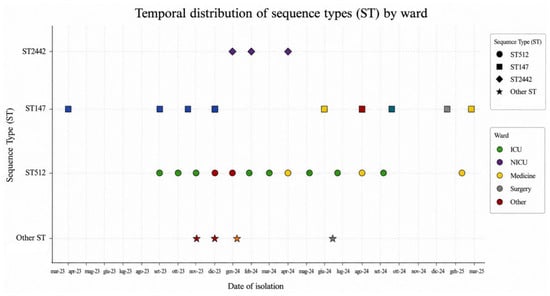
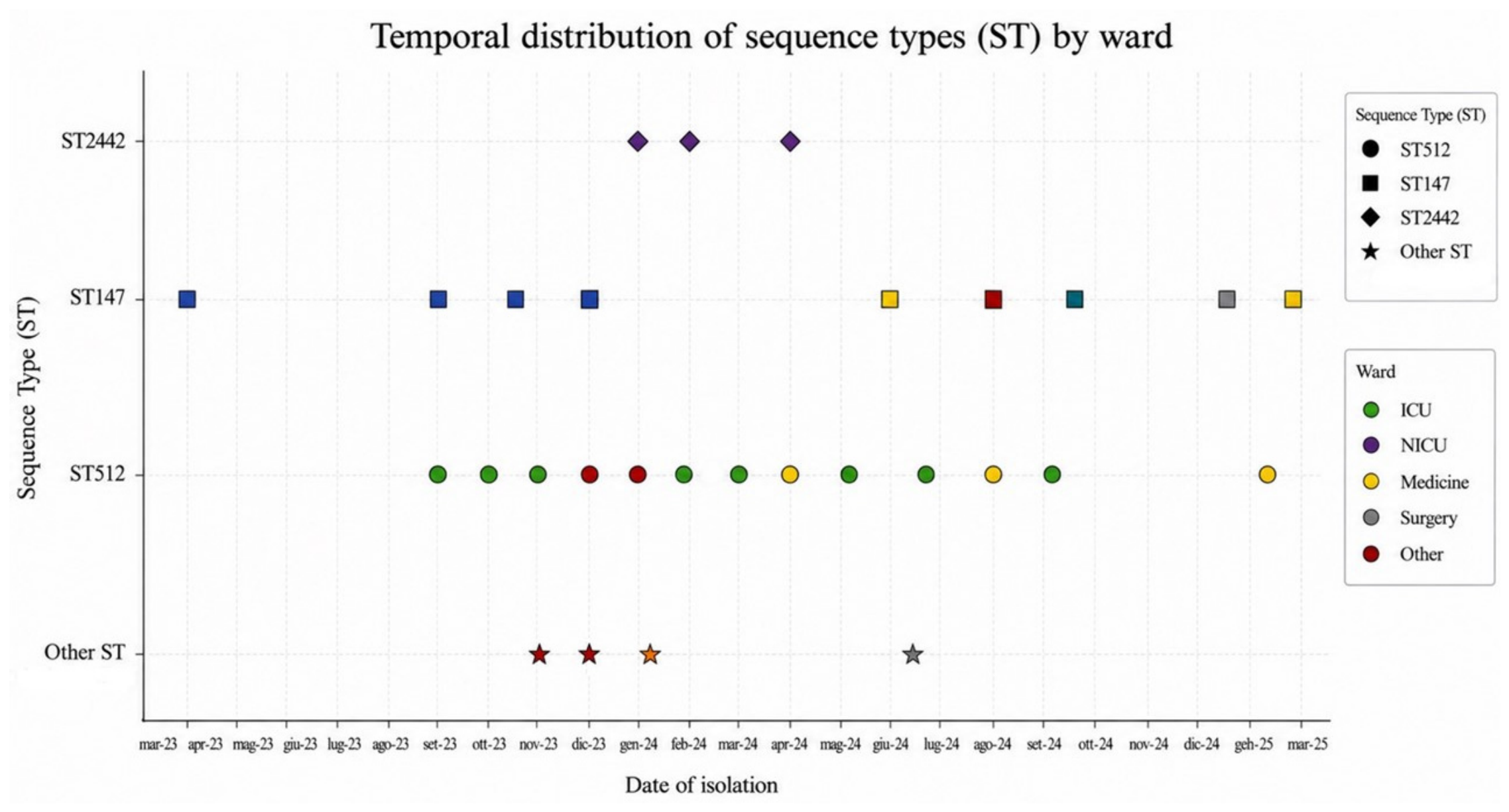
The MLST analysis of the 30 Klebsiella pneumoniae isolates revealed a population dominated by a few high-risk lineages, alongside several sporadic types. The most prevalent STs were ST512 (13/30) and ST147 (9/30), followed by ST2442 (3/30). The following STs were identified once: ST-20, ST-35, ST-45, ST-307, and ST-5859. Within the March 2023–March 2025 study period, ST512 was detected throughout the observation window, whereas ST147 was identified from March 2024 onward and ST2442 was detected exclusively in March–April 2024. The remaining STs occurred sporadically. The temporal distribution of the identified sequence types is shown in Figure 1.
Figure 1.
Temporal distribution of Klebsiella pneumoniae sequence types according to hospital ward between March 2023 and March 2025. Each dot represents one isolate. Different symbols indicate the sequence type (ST); sporadic sequence types, including ST-20, ST-35, ST-45, ST-307, and ST-5859, are grouped as “Other ST”. Different colors indicate the hospital ward of isolation. ST, sequence type; ICU, intensive care unit; NICU, neonatal intensive care unit (Created in Biorender. Muresu N. (2026) https://BioRender.com).
To account for potential selection bias from the active surveillance program, we conducted a sensitivity analysis of clinical infection isolates that excluded the six targeted NDM-1-positive rectal swabs (n = 24) (Table S5). In this subset, the proportion of blaNDM-1-positive isolates dropped from 20.0% to 0%, confirming that its detection was restricted to surveillance screening. Conversely, ST512 remained predominant, accounting for 54.2% of invasive isolates (compared with 43.3% in the total dataset), whereas ST2442 and ST5859 dropped to 0%. These findings confirm that while ST512 remains the main driver of invasive CPE infections in our hospital, NDM-producing strains currently represent an emerging mechanism, imported or circulating predominantly at the surveillance level.
To better contextualize the current findings, the clonal distribution observed in this study was compared with that reported in previous surveillance periods at the same institution (Table 3). The temporal distribution of the major sequence types revealed a progressive shift in the composition of the CR-Kp population over the study period. Although ST512 consistently represented the predominant lineage, its relative contribution varied markedly across periods, accounting for 90% of isolates in 2015–2017 and 100% in 2020–2021, before decreasing to 43.3% (13/30) in 2023–2025. The most recent period was characterized by increased clonal diversity, with the emergence of ST147 and ST2442, accounting for 30% and 10% of isolates, respectively, while other STs represented the remaining 16.7% (5/30). A similar temporal evolution was observed for carbapenemase determinants. blaKPC-3 was detected in 61% of isolates in 2015–2017, decreased to 12% in 2020–2021, and increased to 73.3% (22/30) in 2023–2025. In contrast, blaNDM was not detected in the two earlier periods but was identified in 20.0% (6/30) of the targeted sequenced isolates in 2023–2025. Overall, these findings indicate that, despite the persistent predominance of ST512, the local CR-Kp population has progressively diversified, accompanied by a more heterogeneous carbapenemase profile in the most recent surveillance period. These cross-period comparisons should be interpreted descriptively because the sampling frames differed: the 2015–2017 cohort focused on invasive KPC-producing K. pneumoniae infections, the 2020–2021 cohort focused on KPC/OXA-48-like co-producing clinical isolates, and the present study used a targeted design that also enriched NDM-positive surveillance isolates [7,35].
Table 3.
Temporal distribution of major ST and carbapenemase determinants across different study periods [7,35].
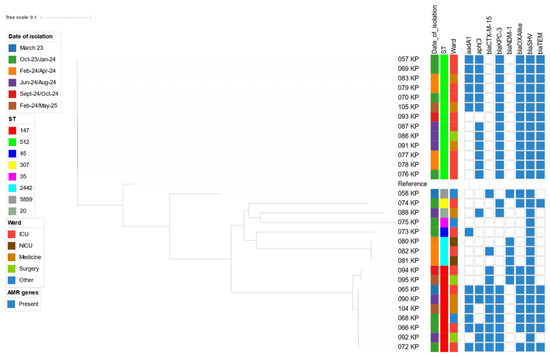
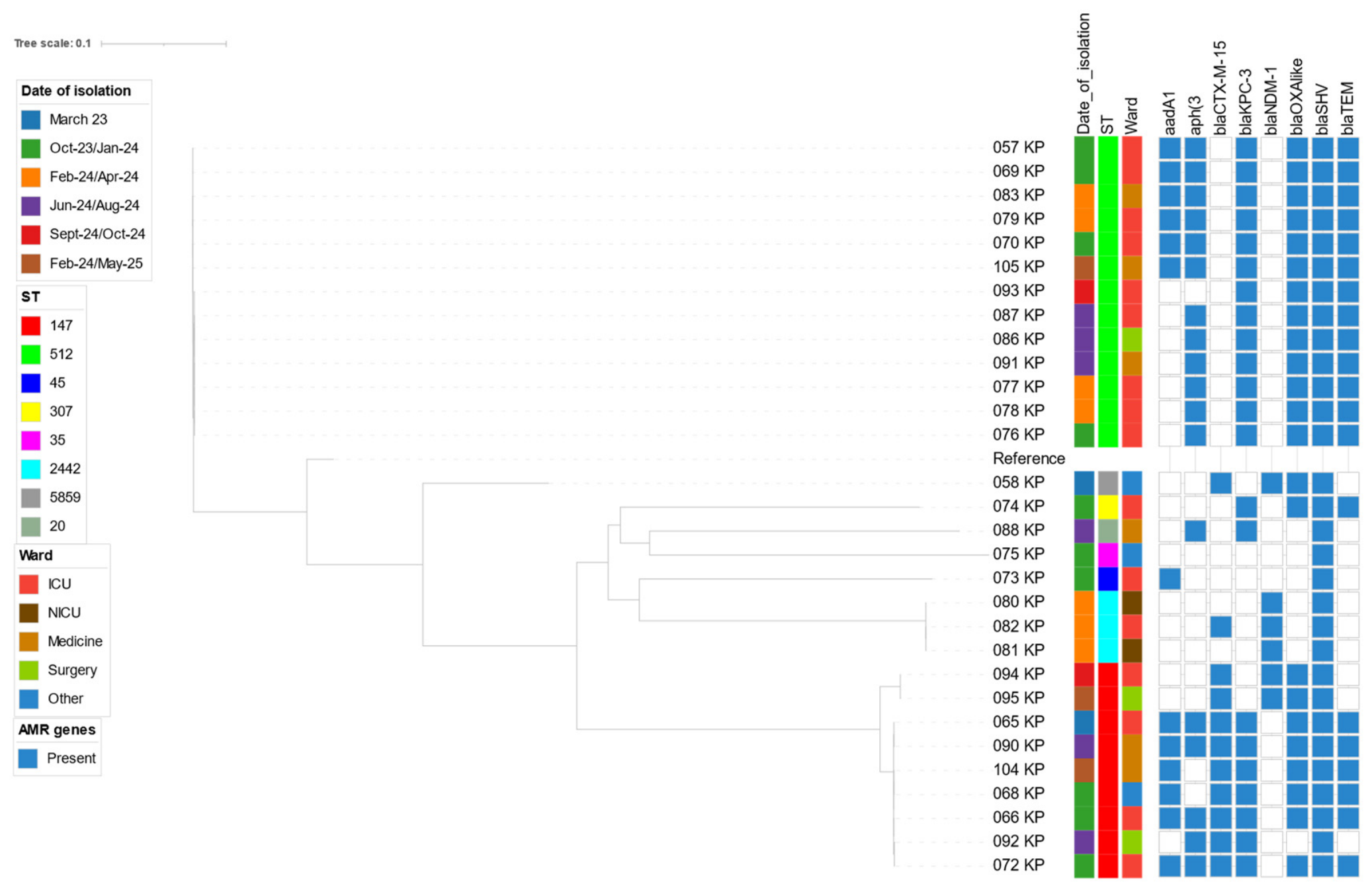
The phylogenetic analysis integrates genomic, clinical, and temporal data to provide a comprehensive overview of the Klebsiella pneumoniae population structure within the hospital setting. The results are summarized in Figure 2.
Figure 2.
Estimated maximum likelihood phylogenetic analysis of Klebsiella pneumoniae isolates, using IqTree. Leaf numbers represent the sample IDs. Metadata associated with each isolate are displayed as colored annotation strips, including the date of isolation, sequence type (ST), and hospital ward. The presence of antimicrobial resistance (AMR) genes is indicated by blue squares, with each column corresponding to a specific resistance gene. Colors and symbols are defined in the legend.
The phylogenetic reconstruction revealed a population divided into two major evolutionary paths. The upper clade was dominated by closely related ST512 isolates. Pairwise SNP distances within ST512 ranged from 0 to 105 SNPs (Table S2), revealing internal substructure, including two highly related subclusters (pairwise distances of 1–5 SNPs and 0–2 SNPs, respectively), rather than complete genomic identity across the entire lineage. The short branch lengths within the cluster are consistent with a shared clonal background and temporal persistence in the hospital setting. Spatiotemporally, the ICU represented a key ward associated with this lineage, where highly related ST512 isolates were consistently recovered over one year (October 2023 to October 2024), suggesting sustained persistence of this lineage within critical care settings. In contrast, the lower clade is characterized by greater genetic diversity and longer branch lengths, reflecting a more varied evolutionary history. Within this group, multiple sequence types were identified, including ST147, the ST2442 cluster, and the genetically distant ST5859. The three ST2442 isolates (080, 081, and 082), recovered between February and April 2024 from the NICU and ICU, differed by 4–14 core SNPs, indicating close genomic relatedness within this cluster. Moreover, ST147 showed substantially greater diversity, with pairwise distances ranging from 8 to 2014 SNPs, recovered from multiple cliniacal wards without a single dominant clinical site.
ST512 was recovered predominantly from the ICU, whereas ST147 showed a more dispersed distribution across the ICU and other wards, a pattern compatible with distribution across different hospital departments. The resistance patterns are tightly linked to the phylogenetic clusters, showing that specific lineages carry distinct resistance genes. Consistent with the structure of the phylogenetic tree, the homogeneous upper clade, corresponding to the ST512 lineage, is defined by a highly consistent blaKPC-3 profile. Most of these isolates (such as 057, 069, 070, 083, and 105) carry a robust set of genes, including aadA1, aph(3′)-Ia, blaOXAlike, blaSHV, and blaTEM, resulting in MDR phenotypes. The NDM-1 gene is found in the highly divergent ST5859 and specifically within the ST2442 cluster isolated in the NICU. Interestingly, this ST2442 cluster shows a reduction in other common genes like blaTEM and blaOXAlike. Meanwhile, blaCTX-M-15 is scattered across the upper clade, often co-occurring with blaKPC-3 in isolates like 065, 066, and 072, indicating co-existence of multiple resistance determinants within single genomic backgrounds.
4. Discussion
The global escalation of AMR represents one of the most formidable challenges to modern medicine, with CPE positioned at the lead of this crisis, necessitating a constant re-evaluation of local and international trends.
Specifically, we sought to characterize emerging resistance patterns and assess the genomic diversity of circulating high-risk clones to inform targeted institutional infection control strategies. By integrating genomic data, the study aims to support local antimicrobial stewardship, provide actionable insight into the presence of high-risk lineages within critical hospital wards, and predict potential future shifts in the local AMR landscape.
K. pneumoniae isolates were recovered from multiple hospital wards, with the largest proportion obtained from patients admitted to the ICU. The age distribution of the study population should be interpreted descriptively, as the study was not designed to assess age-related susceptibility or associated comorbidities. It is important to emphasize that all infections occurred after a positive result on rectal swabs performed as part of active CPE surveillance, confirming that colonization status is a significant risk factor for the development of invasive disease. This finding is consistent with several studies in the literature, which support targeted management strategies for colonized patients to reduce the risk of progression to clinically overt infection [36].
The antimicrobial susceptibility profile underscores a deeply concerning trend of multidrug resistance (MDR) among clinical isolates. The data demonstrate near-total resistance to conventional β-lactam antibiotics and highlight a significant erosion of the clinical utility of carbapenems, which have historically been reserved as “last-line” treatments. In contrast, next-generation β-lactam-β-lactamase inhibitor (BLI) combinations showed superior activity, providing a narrow but essential window for clinical intervention. These results mandate rigorous antimicrobial stewardship and the prioritization of rapid molecular diagnostics to identify specific resistance genes.
The high levels of phenotypic resistance reported in this study are corroborated by the complex range of AMR genes identified and highlight the necessity to consider a shift in therapeutic paradigms. While blaKPC remains the dominant drivers of carbapenem resistance in our cohort, the emergence of New Delhi metallo-β-lactamase (NDM) represents a significant clinical escalation and challenge, as they confer resistance to virtually all β-lactams, including the newer BLI combinations. The ubiquitous presence of blaSHV and blaTEM, alongside the presence of carbapenemases genes, creates a robust enzymatic barrier. Moreover, the presence of ESBLs further determines total resistance to third- and fourth-generation cephalosporins, as reflected in the 100% resistance rates observed for cefotaxime and ceftriaxone. The molecular basis for the observed aminoglycoside resistance is linked to a variety of Aminoglycoside-Modifying Enzymes (AMEs), as aph(3′)-Ia and aadA1 genes.
Phenotypic resistance patterns demonstrated strong alignment with the identified enzymatic resistome. All isolates harboring blaNDM (whether alone or co-occurring with blaCTX-M) exhibited complete cross-resistance to ceftazidime/avibactam and meropenem/vaborbactam. This observation is biologically expected, as Class B metallo-β-lactamases (MBLs) lack the active-site serine required for inhibition by non-β-lactam inhibitors like avibactam, vaborbactam, and relebactam. Conversely, isolates harboring solely blaKPC3 or co-producing blaOXA-48-like enzymes largely preserved susceptibility to meropenem/vaborbactam (68.2% susceptible) and imipenem/relebactam (62.5% susceptible), reaffirming their role as key frontline options against KPC-driven endemic clones in our institution. Ceftazidime/avibactam demonstrated moderate activity (55.2% susceptible overall), with resistance primarily driven by blaNDM. Overall, these isolate-level genotype–phenotype correlations underscore that WGS and targeted PCR assays provide essential guidance for antibiotic stewardship, ensuring that novel BL/BLI combinations are strictly preserved for susceptible non-MBL phenotypes.
The characterization of virulence determinants underscores a comprehensive genetic armamentarium that potentially enhances the biological fitness, host colonization, and overall pathogenic potential of the isolates. Siderophores are critical determinants of hypervirulence in Klebsiella pneumoniae, facilitating survival through both nutrient acquisition and immune evasion. While Enterobactin offers high-affinity iron uptake, it is easily neutralized by the host’s lipocalin-2. Additionally, Yersiniabactin bolsters bacterial persistence by providing resistance to oxidative stress and aiding survival within host cells. Ultimately, the synergistic effect of producing multiple siderophore systems significantly enhances the pathogen’s in vivo fitness, invasiveness, and capacity for systemic spread. Our set of isolates shows a high prevalence of factors involved in adhesion and iron acquisition. While enterobactin genes (entA, entB, fepC) were identified in 83.3% of isolates and yersiniabactin determinants (fyuA, irp1, irp2, ybt loci) in 80.0%, classic markers defining hypervirulent K. pneumoniae (hvKP) phenotypes, such as plasmid-borne rmpA/rmpA2 regulators or the salmochelin (iro) locus, were absent. Thus, these isolates do not represent true hypervirulent clones but rather MDR lineages equipped with standard fitness and adhesion determinants, including the ubiquitous ecp operon (100%) and outer membrane protein ompA (100%), which support surface attachment and colonization in healthcare environments [37,38].
The molecular epidemiological analysis reveals a population structure dominated by specific high-risk clones, mainly belonging to two major lineages: ST512 and ST147. ST512, a well-known member of the Clonal Complex 258 (CC258), was the most frequent sequence type identified. Its persistent circulation over the years, as previously reported by our research group, together with its continued detection during the period of observation across multiple hospital wards, particularly the ICU and Medicine, supports its continued detection within the targeted dataset [7,35]. ST147 also showed a significant and sustained presence. The detection of ST147 in various anatomical sites, including blood and bronchoalveolar lavage (BAL), confirms its role as a relevant opportunistic pathogen capable of causing severe systemic infections. The frequent recovery of these high-risk lineages from ICU settings reflects the high selective pressure of antimicrobial use and the clinical complexity of critically ill patients in these units.
The genomic landscape of K. pneumoniae in this setting is dominated by the persistent presence of an ST512-KPC-3 clonal lineage, highlighting a high degree of genomic relatedness among ST512 isolates recovered from ICU patients. In parallel, the identification of NDM-1 carrying lineages (i.e., ST2442) in neonatal settings indicates emerging diversification of the carbapenemase profile. The close genetic proximity observed within these subclusters is consistent with potential local circulation or endemic persistence, underscoring the importance of targeted infection control interventions to monitor the spread of MDR clones.
The local molecular epidemiology of Klebsiella pneumoniae is characterized by a dichotomy between a dominant high-risk clonal expansion and a genetically diverse background of sporadic lineages. In particular, the ST512 lineage showed high genomic relatedness and temporal persistence. Indeed, the limited branch lengths and low pairwise SNP distances observed in the upper clade of the phylogenetic tree reflect a shared clonal lineage, aligning with previous reports that characterize ST512 as a primary driver of endemic carbapenem resistance in Italian hospitals [8,35,39].
As observed in the phylogenetic reconstruction, the ST512 clade was defined by consistent blaKPC-3 carriage, typically co-occurring with a robust toolkit of resistance genes including aadA1, aph(3′)-Ia, blaOXAlike, blaSHV, and blaTEM. This resistance gene configuration mirrors the established KPC-producing KP (KPC-Kp) profile previously identified in our healthcare facilities [7]. However, while previous studies in our setting predominantly reported ST512 harboring KPC-3, our results identify a emergence of blaNDM-1 in divergent lineages such as ST5859 and the ST2442 cluster. Furthermore, the detection of blaCTX-M-15 scattered across the ST147 lineage, often in combination with blaKPC-3, underscores the ongoing accumulation of diverse beta-lactamases within high-risk clones. This pattern of gene accumulation warrants continued monitoring, as it increases the genomic complexity and resistance potential of circulating strains. While this study provides valuable insights into the genomic epidemiology of Klebsiella pneumoniae in our hospital, several limitations must be acknowledged. First, the sequenced isolates do not capture every CR-Kp case identified during the observation period, as sequencing was limited to isolates successfully transferred to the reference laboratory for advanced molecular characterization. Consequently, potential selection bias cannot be completely ruled out. Second, the study dataset combined invasive clinical infection isolates with six epidemiologically selected rectal surveillance swabs carrying unusual resistance traits; while this targeted approach enhances active genomic surveillance of emerging mechanisms, it may influence observed gene prevalence rates within the overall dataset. Third, variations in commercial AST panels over the multi-year study period resulted in differing testing denominators across certain antimicrobial agents. Fourth, detailed clinical outcome data (such as treatment success or patient mortality) were not evaluated, as the study primary objective was to maintain continuous genomic surveillance of circulating lineages. Finally, phylogenetic clustering and core-SNP analyses provide evidence of genomic relatedness but cannot definitively prove direct patient-to-patient transmission routes without comprehensive contact-tracing and overlapping stay data. In addition, SNP calling used a single reference genome and no additional recombination filtering; these analytical choices may affect pairwise SNP distances, particularly across divergent lineages, and therefore the phylogeny was interpreted as evidence of relatedness rather than as proof of transmission. Nonetheless, this dataset offers a highly informative genomic snapshot of the major circulating MDR lineages and resistance mechanisms across critical and non-critical wards in our institution. Future studies integrating high-resolution genomic data with detailed patient-level epidemiological and clinical follow-up will be essential to fully refine local infection control strategies and understand the impact of these emerging strains on patient prognosis.
Although the dataset does not capture all CR-Kp cases identified during the study period, it provides an informative genomic snapshot of the major circulating MDR lineages across critical and non-critical hospital wards. Accordingly, these data support description of genomic relatedness and resistance patterns within the sampled isolates, but not reconstruction of hospital-wide transmission dynamics or prevalence trends.
5. Conclusions
This study provides an updated genomic snapshot of K. pneumoniae in our setting. While ST512 remained the most frequently detected lineage and showed strong genomic relatedness over time, the detection of NDM-1-producing lineages and the co-occurrence of multiple resistance determinants, including within ST147, indicate an increasingly complex resistance repertoire among the sampled isolates. Genomically related MDR isolates were recovered from different hospital wards, although the available data do not establish specific transmission routes. Overall, these results reinforce the importance of integrating genomic surveillance into routine clinical practice, as identifying the specific enzymatic “toolkits” of circulating strains is crucial to support hospital infection control strategies and guide targeted antimicrobial stewardship efforts to halt the dissemination of these high-risk pathogens.
Supplementary Materials
The following supporting information can be downloaded at: https://www.mdpi.com/article/10.3390/diseases14110432/s1, Table S1: Participating members of the Early Diagnosis and AMR Surveillance (EDAS) Working Group; Table S2: Pairwise core-SNP distance matrix among the 30 K. pneumoniae isolates; Table S3: Isolate-level profile linking carbapenemase genotype to phenotypic MICs and EUCAST categories for novel BL/BLI combinations and key agents. Table S4: Main epidemiological findings of the isolate collection; Table S5: Comparison of Sequence Type frequencies between full dataset (N = 30) and infection-only dataset (N = 24).
Author Contributions
Conceptualization, N.M., A.A., P.C. and A.P. (Andrea Piana); methodology, N.M., A.C., I.E. and A.P. (Andrea Piana); software, N.M., A.C. and I.E.; validation, N.M., A.A., M.D., A.P. (Alessandra Palmieri), P.C. and A.P. (Andrea Piana); formal analysis, N.M., A.C. and A.C.; investigation, N.M., A.C., I.E. and A.P. (Andrea Piana); resources, N.M., A.A. and P.C.; data curation, N.M., P.C. and A.P. (Andrea Piana); writing—original draft preparation, N.M., M.D., P.C. and A.P. (Andrea Piana); writing—review and editing, N.M., A.A., M.D., A.P. (Alessandra Palmieri) and EDAS group; visualization, N.M., A.A., M.D., A.P. (Alessandra Palmieri), A.C., I.E., P.C., A.P. (Andrea Piana) and EDAS group; supervision, P.C. and A.P. (Andrea Piana); project administration, P.C. and EDAS group; funding acquisition, P.C. and A.P. (Andrea Piana). All authors have read and agreed to the published version of the manuscript.
Funding
This research was funded by “Progetto di Ricerca Interdisciplinare DM 737/2021” University of Sassari, and the APC was funded by “Piano Regionale di Prevenzione 2020–2025, Bilancio Regionale 2025—Regione Autonoma della Sardegna, Programma Predefinito (PP) 10 Misure per il contrasto dell’antimicrobico resistenza, Implementazione di Programmi di Antimicrobial Stewardship in tutti gli ospedali della Sardegna”.
Institutional Review Board Statement
Ethical review and approval were waived due to the retrospective design of the study and the exclusive use of anonymized data, in accordance with Italian legislation: Italian Personal Data Protection Code (Legislative Decree No. 196/2003, Legislative Decree No. 101/2018).
Informed Consent Statement
Patient consent was waived due to the study’s design.
Data Availability Statement
The raw whole-genome sequencing data generated and analyzed during the current study have been deposited in the Zenodo open-access repository and are publicly available under DOI: https://doi.org/10.5281/zenodo.24004484. Additional data supporting the findings of this study are available from the corresponding author upon reasonable request.
Acknowledgments
The authors would like to thank all the administrative and technical staff, as well as the colleagues involved in the EDAS working group, belonging to the Department of Medicine, Surgery, and Pharmacy at the University of Sassari for their valuable support and collaboration. Generative AI (Gemini 3.1, Google) was utilized during the preparation of this study and manuscript. Specifically, the tool provided guidance on preparing figures using BioRender and setting up phylogenetic analyses using IQ-TREE (Version 2.4.0). Additionally, the tool was employed for English language editing, proofreading, and improving text readability. The authors reviewed and edited all output and take full responsibility for the final text. Membership of the Early Diagnosis and AMR Surveillance Working Group: Antonio Azara; Maria Dolores Masia; Giovanni Sotgiu; Sergio Babudieri; Giordano Madeddu; Ivana Maida; Pierpaolo Terragni; Daniela Pasero; Piero Pirina; Alessandro Fois; Claudio Fozza(University of Sassari, Sardinia, Italy); Giovanna Deiana; Maria Grazia Deriu; Serena Soddu; Cristina D’Avino; Ilaria Mulas(University Hospital of Sassari, Sardinia, Italy); Rossano Atzeni; Roberto Cusano; Jessica Milia(Interdisciplinary Centre for Advanced Studies, Research and Development in Sardinia (CRS4), Sardinia Research, Pula).
Conflicts of Interest
The authors declare no conflicts of interest.
References
- WHO Regional Office for Europe and European Centre for Disease Prevention and Control. Surveillance of Antimicrobial Resistance in Europe, 2024 Data: Executive Summary; WHO Regional Office for Europe: Copenhagen, Denmark, 2025. [Google Scholar]
- Cooke, E.; Rendi-Wagner, P. Rising antimicrobial resistance in Europe: EMA and ECDC outline urgent actions to achieve EU targets. Lancet Reg. Health Eur. 2025, 59, 101539. [Google Scholar] [CrossRef] [Scilit]
- Roy, S.; Choudhury, K.; Pinto, U.M.; Singh, V.K. The dual threat of hypervirulent and multidrug-resistant Klebsiella pneumoniae: Pathogenesis and prospects for intervention. Front. Microbiol. 2026, 17, 1837929. [Google Scholar] [CrossRef] [Scilit]
- Dong, X.; Xiang, Y.; Li, Y.; Zhang, Y. Lineage-specific evolution and resistance-virulence divergence in Klebsiella pneumoniae ST268: A global population genomic analysis. Antimicrob. Agents Chemother. 2025, 69, e0070325. [Google Scholar] [CrossRef] [Scilit] [PubMed] [PubMed Central]
- Budia-Silva, M.; Kostyanev, T.; Ayala-Montaño, S.; Acosta, J.B.-F.; Garcia-Castillo, M.; Cantón, R.; Goossens, H.; Rodriguez-Baño, J.; Grundmann, H. International and regional spread of carbapenem-resistant Klebsiella pneumoniae in Europe. Nat. Commun. 2024, 15, 5092. [Google Scholar] [CrossRef] [Scilit]
- Lei, T.Y.; Liao, B.B.; Yang, L.R.; Wang, Y.; Chen, X.B. Hypervirulent and carbapenem-resistant Klebsiella pneumoniae: A global public health threat. Microbiol. Res. 2024, 288, 127839. [Google Scholar] [CrossRef] [Scilit]
- Sotgiu, G.; Are, B.M.; Pesapane, L.; Palmieri, A.; Muresu, N.; Cossu, A.; Dettori, M.; Azara, A.; Mura, I.I.; Cocuzza, C.; et al. Nosocomial transmission of carbapenem-resistant Klebsiella pneumoniae in an Italian university hospital: A molecular epidemiological study. J. Hosp. Infect. 2018, 99, 413–418. [Google Scholar] [CrossRef] [Scilit]
- Del Rio, A.; Muresu, N.; Sotgiu, G.; Saderi, L.; Sechi, I.; Cossu, A.; Usai, M.; Palmieri, A.; Are, B.M.; Deiana, G.; et al. High-Risk Clone of Klebsiella pneumoniae Co-Harbouring Class A and D Carbapenemases in Italy. Int. J. Environ. Res. Public Health 2022, 19, 2623. [Google Scholar] [CrossRef] [Scilit]
- Centers for Disease Control and Prevention (CDC). Guidance for control of infections with carbapenem-resistant or carbapenemase-producing Enterobacteriaceae in acute care facilities. MMWR Morb. Mortal. Wkly. Rep. 2009, 58, 256–260. [Google Scholar] [PubMed]
- The European Committee on Antimicrobial Susceptibility Testing. Breakpoint Tables for Interpretation of MICs and Zone Diameters. Version 16.0, 2026. Available online: https://www.eucast.org (accessed on 13 October 2026).
- Galaxy Community. The Galaxy platform for accessible, reproducible and collaborative biomedical analyses: 2022 update. Nucleic Acids Res. 2022, 50, W345–W351. [Google Scholar] [CrossRef] [Scilit]
- de Sena Brandine, G.; Smith, A.D. Falco: High-speed FastQC emulation for quality control of sequencing data. F1000Research 2021, 8, 1874. [Google Scholar] [CrossRef] [Scilit]
- Ewels, P.; Magnusson, M.; Lundin, S.; Käller, M. MultiQC: Summarize analysis results for multiple tools and samples in a single report. Bioinformatics 2016, 32, 3047–3048. [Google Scholar] [CrossRef] [Scilit]
- Chen, S.; Zhou, Y.; Chen, Y.; Gu, J. fastp: An ultra-fast all-in-one FASTQ preprocessor. Bioinformatics 2018, 34, i884–i890. [Google Scholar] [CrossRef] [Scilit]
- Wood, D.E.; Salzberg, S.L. Kraken: Ultrafast metagenomic sequence classification using exact alignments. Genome Biol. 2014, 15, R46. [Google Scholar] [CrossRef] [Scilit]
- Lu, J.; Breitwieser, F.P.; Thielen, P.; Salzberg, S.L. Bracken: Estimating species abundance in metagenomics data. PeerJ Comput. Sci. 2017, 3, e104. [Google Scholar] [CrossRef] [Scilit]
- Lu, J.; Rincon, N.; Wood, D.E.; Breitwieser, F.P.; Pockrandt, C.; Langmead, B.; Salzberg, S.L.; Steinegger, M. Author Correction: Metagenome analysis using the Kraken software suite. Nat. Protoc. 2026, 21, 872. [Google Scholar] [CrossRef] [Scilit]
- Ondov, B.D.; Bergman, N.H.; Phillippy, A.M. Interactive metagenomic visualization in a Web browser. BMC Bioinform. 2011, 12, 385. [Google Scholar] [CrossRef] [Scilit]
- Cuccuru, G.; Orsini, M.; Pinna, A.; Sbardellati, A.; Soranzo, N.; Travaglione, A.; Uva, P.; Zanetti, G.; Fotia, G. Orione, a web-based framework for NGS analysis in microbiology. Bioinformatics 2014, 30, 1928–1929. [Google Scholar] [CrossRef] [Scilit]
- Seemann, T. Shovill: Faster SPAdes Assembly of Illumina Reads. 2017. Available online: https://github.com/tseemann/shovill (accessed on 13 October 2026).
- Mikheenko, A.; Prjibelski, A.; Saveliev, V.; Antipov, D.; Gurevich, A. Versatile genome assembly evaluation with QUAST-LG. Bioinformatics 2018, 34, i142–i150. [Google Scholar] [CrossRef] [Scilit]
- Mikheenko, A.; Valin, G.; Prjibelski, A.; Saveliev, V.; Gurevich, A. Icarus: Visualizer for de novo assembly evaluation. Bioinformatics 2016, 32, 3321–3323. [Google Scholar] [CrossRef] [Scilit]
- Gurevich, A.; Saveliev, V.; Vyahhi, N.; Tesler, G. QUAST: Quality assessment tool for genome assemblies. Bioinformatics 2013, 29, 1072–1075. [Google Scholar] [CrossRef] [Scilit]
- Schwengers, O.; Jelonek, L.; Dieckmann, M.A.; Beyvers, S.; Blom, J.; Goesmann, A. Bakta: Rapid and standardized annotation of bacterial genomes via alignment-free sequence identification. Microb. Genom. 2021, 7, 000685. [Google Scholar] [CrossRef] [Scilit]
- Bharat, A.; Petkau, A.; Avery, B.P.; Chen, J.C.; Folster, J.P.; Carson, C.A.; Kearney, A.; Nadon, C.; Mabon, P.; Thiessen, J.; et al. Correlation between Phenotypic and In Silico Detection of Antimicrobial Resistance in Salmonella enterica in Canada Using Staramr. Microorganisms 2022, 10, 292. [Google Scholar] [CrossRef] [Scilit]
- Seemann, T. ABRicate: Mass screening of contigs for antiobiotic resistance genes. 2016. Available online: https://github.com/tseemann/abricate (accessed on 13 October 2026).
- Heatmap.2: Enhanced Heat Map. Available online: https://rdocumentation.org/packages/gplots/versions/3.1.3/topics/heatmap.2 (accessed on 13 October 2026).
- Seemann, T. MLST: Scan Contig Files Against PubMLST Typing Schemes. 2016. Available online: https://github.com/tseemann/mlst (accessed on 13 October 2026).
- Page, A.J.; Cummins, C.A.; Hunt, M.; Wong, V.K.; Reuter, S.; Holden, M.T.G.; Fookes, M.; Falush, D.; Keane, J.A.; Parkhill, J. Roary: Rapid large-scale prokaryote pan genome analysis. Bioinformatics 2015, 31, 3691–3693. [Google Scholar] [CrossRef] [Scilit]
- Stamatakis, A. RAxML version 8: A tool for phylogenetic analysis and post-analysis of large phylogenies. Bioinformatics 2014, 30, 1312–1313. [Google Scholar] [CrossRef] [Scilit]
- Nguyen, L.-T.; Schmidt, H.A.; von Haeseler, A.; Minh, B.Q. IQ-TREE: A Fast and Effective Stochastic Algorithm for Estimating Maximum-Likelihood Phylogenies. Mol. Biol. Evol. 2014, 32, 268–274. [Google Scholar] [CrossRef] [Scilit]
- Dress, A.W.; Flamm, C.; Fritzsch, G.; Grünewald, S.; Kruspe, M.; Prohaska, S.J.; Stadler, P.F. Noisy: Identification of problematic columns in multiple sequence alignments. Algorithms Mol. Biol. 2008, 3, 7. [Google Scholar] [CrossRef] [Scilit]
- Seemann, T. Snippy: Fast bacterial variant calling from NGS reads. 2015. Available online: https://github.com/tseemann/snippy (accessed on 13 October 2026).
- Jain, C.; Rodriguez-R, L.M.; Phillippy, A.M.; Konstantinidis, K.T.; Aluru, S. High throughput ANI analysis of 90K prokaryotic genomes reveals clear species boundaries. Nat. Commun. 2018, 9, 5114. [Google Scholar] [CrossRef] [Scilit]
- Del Rio, A.; Fox, V.; Muresu, N.; Sechi, I.; Cossu, A.; Palmieri, A.; Scutari, R.; Alteri, C.; Sotgiu, G.; Castiglia, P.; et al. A Whole-Genome Sequencing-Based Approach for the Characterization of Klebsiella pneumoniae Co-Producing KPC and OXA-48-like Carbapenemases Circulating in Sardinia, Italy. Microorganisms 2023, 11, 2354. [Google Scholar] [CrossRef] [Scilit] [PubMed] [PubMed Central]
- Cai, S.; Wang, Z.; Han, X.; Hu, H.; Quan, J.; Jiang, Y.; Du, X.; Zhou, Z.; Yu, Y. The correlation between intestinal colonization and infection of carbapenem-resistant Klebsiella pneumoniae: A systematic review. J. Glob. Antimicrob. Resist. 2024, 38, 187–193. [Google Scholar] [CrossRef] [Scilit] [PubMed]
- Lan, P.; Lu, Y.; Fu, Y.; Yu, Y.; Zhou, J. Siderophores and beyond: A comprehensive review of iron acquisition in Klebsiella pneumoniae. Virulence 2025, 16, 2550621. [Google Scholar] [CrossRef] [Scilit] [PubMed] [PubMed Central]
- Guerra, M.E.S.; Destro, G.; Vieira, B.; Lima, A.S.; Ferraz, L.F.C.; Hakansson, A.P.; Darrieux, M.; Converso, T.R. Corrigendum: Klebsiella pneumoniae biofilms and their role in disease pathogenesis. Front. Cell. Infect. Microbiol. 2025, 15, 1564010. [Google Scholar] [CrossRef] [Scilit]
- Fox, V.; Mangioni, D.; Renica, S.; Comelli, A.; Teri, A.; Zatelli, M.; Orena, B.S.; Scuderi, C.; Cavallero, A.; Rossi, M.; et al. Genomic characterization of Klebsiella pneumoniae carbapenemase-producing Klebsiella pneumoniae (KPC-Kp) strains circulating in three university hospitals in Northern Italy over three years. Antimicrob. Resist. Infect. Control 2024, 13, 70. [Google Scholar] [CrossRef] [Scilit]

Disclaimer/Publisher’s Note: The statements, opinions and data contained in all publications are solely those of the individual author(s) and contributor(s) and not of MDPI and/or the editor(s). MDPI and/or the editor(s) disclaim responsibility for any injury to people or property resulting from any ideas, methods, instructions or products referred to in the content. |
© 2026 by the authors. Licensee MDPI, Basel, Switzerland. This article is an open access article distributed under the terms and conditions of the Creative Commons Attribution (CC BY) license.