


Abstract
Background/Objectives: Social support and spiritual well-being may matter for the quality of life (QoL) of women with cervical cancer in sub-Saharan Africa, but their interrelations are rarely studied. This study examined their associations with QoL in Tanzanian women. Methods: In this cross-sectional study, 499 women recruited consecutively at two Tanzanian cancer centers completed the EORTC QLQ-C30, the EORTC QLQ-SWB32 and a Kiswahili ENRICHD Social Support Instrument (ESSI). Associations were examined using multivariable regression and mediation analysis. Results: In adjusted regression (n = 460), higher social support (B = 0.80 per ESSI point, 95% CI 0.49–1.11) and higher global spiritual well-being (B = 0.11, 95% CI 0.04–0.17) were associated with higher global QoL. The statistical indirect association via spiritual well-being was small (ab = 0.19, 95% CI 0.05–0.34; 19.2% of the total association) and robust to multiple imputation and additional covariates, but it was present at only one center (difference −0.42, 95% CI −0.78 to −0.06) and could not be distinguished from reverse orderings. Neither variable was positively associated with the QLQ-C30 summary score. Conclusions: Both social support and spiritual well-being were associated with women’s global appraisal of QoL rather than with functioning or symptoms; longitudinal studies are needed to establish direction and clinical relevance.
1. Introduction
Cervical cancer (CC) is the fourth most commonly diagnosed cancer and the fourth leading cause of cancer death among women worldwide; of the approximately 660,000 new cases and 350,000 deaths in 2022, 94% occurred in low- and middle-income countries [1,2]. Tanzania carries one of the highest burdens: in 2022, an estimated 10,868 women were diagnosed with CC and 6832 died of it, corresponding to age-standardized incidence and mortality rates of 64.8 and 42.2 per 100,000 women [1,3,4]. Virtually all cases are caused by persistent high-risk human papillomavirus infection, and HIV infection increases the risk approximately sixfold; Tanzania is one of six countries that together account for about half of all HIV-associated CC cases worldwide [2,5]. Without changes in prevention and treatment, incidence and mortality in medium-Human Development Index countries such as Tanzania are projected to increase by 84% and 98%, respectively, by 2050 [6,7].
Because many women in sub-Saharan Africa (SSA) present with advanced disease and treatment is prolonged, toxic and often far from home, quality of life (QoL) is a central outcome of care [8,9]. QoL is a multidimensional, subjective appraisal of one’s position in life in relation to one’s goals, expectations and concerns [10]. Women with CC experience pain, fatigue, vaginal discharge, sexual and urological dysfunction and psychological distress, all of which impair QoL [11,12,13,14], and pre-treatment QoL predicts survival in advanced CC [15]. Studies from Tanzania and Ethiopia have described QoL after chemoradiotherapy and its associations with education, symptoms, physical functioning and financial difficulties [16,17,18], but psychosocial resources that could be addressed in care have received little quantitative attention. In Tanzania, CC is surrounded by stigma and misconceptions, for example, that it is contagious or caused by promiscuity, which can lead to shame, isolation and withdrawal of family and community support [8,19,20].
Perceived social support, the perceived availability of emotional, informational and practical help from others, is one such resource. It is thought to protect health both directly and by buffering the impact of stressful events, such as a cancer diagnosis, on well-being [21,22]. Among patients with cancer, higher perceived social support has been associated with less depression and better QoL [23,24], and psychosocial interventions have improved QoL in women with CC [25]. In Tanzania, where women describe losing support from partners, relatives and friends after diagnosis [9,19], the support that remains may be particularly relevant to how women appraise their lives.
Spiritual well-being refers to a sense of meaning, peace and connectedness with oneself, with others, with nature and with God or something greater, and it does not presuppose religious belief [26,27]. In patients with cancer, spiritual well-being, particularly its meaning and peace dimensions, has been consistently associated with better QoL [28,29], including in women with gynecological cancer [30]. In SSA, religious coping through prayer, scripture and faith communities is common and counselling services are scarce [8,31]; in Ghana, most patients receiving radiotherapy reported that spirituality contributed to their QoL [32]. Social support and spiritual well-being are also closely linked: relationships and faith communities can provide the context in which patients make sense of illness and maintain hope [33], and perceived social support has been associated with spiritual well-being in women with gynecological cancer [34]. Spiritual well-being may therefore be one route through which social relationships are related to QoL, although the reverse, that women with better QoL are more able to engage socially and spiritually, is equally plausible.
Evidence on how social support, spiritual well-being and QoL interrelate among women with CC in SSA is nevertheless scarce. To our knowledge, no study in the region has used the EORTC QLQ-SWB32, a cross-culturally developed measure of spiritual well-being [35], among women with CC, examined spiritual well-being as a statistical mediator of the association between social support and QoL, or used a Kiswahili version of the ENRICHD Social Support Instrument (ESSI). Clarifying these associations could indicate which psychosocial resources should be assessed in routine oncology care and evaluated in intervention studies.
The aims of this study were to (i) describe QoL, perceived social support and spiritual well-being among Tanzanian women with CC; (ii) examine whether perceived social support and global spiritual well-being were associated with global QoL independently of sociodemographic and clinical covariates; and (iii) estimate the statistical indirect association of social support with global QoL via global spiritual well-being and assess its robustness across study sites, patient groups and analytic decisions. We hypothesized that higher perceived social support would be associated with higher global QoL and that part of this association would be statistically accounted for by global spiritual well-being. Because the data are cross-sectional, the mediation model was used to describe a pattern of associations consistent with this hypothesis, not to establish a causal mechanism. In a secondary, exploratory analysis, conditional associations among social support, the spiritual well-being domains and QoL indicators were described with network analysis (Supplementary Materials).
2. Materials and Methods
2.1. Study Design, Setting and Participants
This cross-sectional study was conducted at the two main referral centers for CC treatment in Tanzania: Ocean Road Cancer Institute (ORCI), the national cancer hospital in Dar es Salaam (Coastal Zone), and Bugando Medical Centre (BMC) in Mwanza (Lake Zone) [36,37,38]. Until March 2026, these were the only centers offering radiotherapy for CC in the country [9], so participants came from all parts of Tanzania. Data were collected between September 2023 and January 2025. The study is reported in accordance with the STROBE statement for cross-sectional studies [39] (Supplementary File S1).
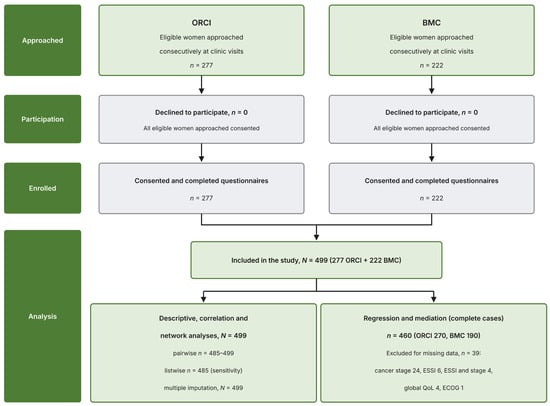
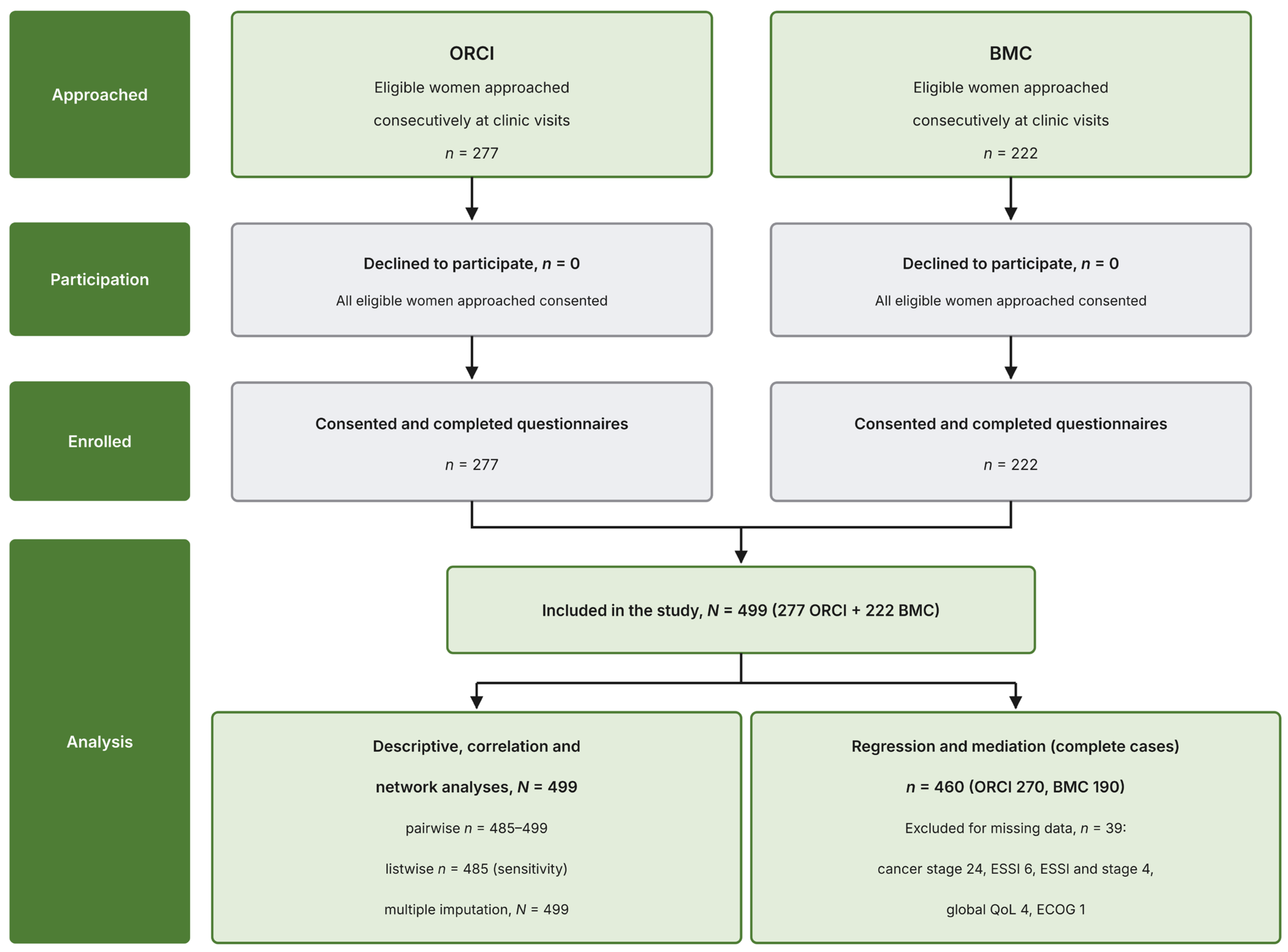
Women aged 18 years or older with a diagnosis of CC who spoke Kiswahili and attended ORCI or BMC for treatment or follow-up were eligible. Women were not eligible for recruitment if they had a comorbidity that impaired cognitive function (as judged by a physician) or if they were too severely ill to complete the assessment, i.e., hospitalized for end-of-life care. ECOG performance status was not an exclusion criterion: women with ECOG 3 (n = 24) or 4 (n < 5) were included when they were able to complete the assessment. Women were recruited consecutively during clinic visits on the CC wards and in the outpatient clinics; on each data-collection day, the research assistants, oncology nurses known to the patients, screened the daily ward and clinic lists and approached only women who met the eligibility criteria. The recruitment of participants at each study site Participant recruitment, inclusion and analytic samples by study site are presented in Figure 1. All eligible women who were approached consented to participate and completed the questionnaires, and the reasons for exclusion from the regression and mediation analyses (missing data) are also shown in Figure 1.
Figure 1.
Flow diagram of participant recruitment, inclusion and analytic samples by study site. All eligible women who were approached consented to participate and completed the questionnaires; reasons for exclusion from the regression and mediation analyses (missing data) are shown.
2.2. Sample Size
The minimum sample size was calculated a priori using the formula for estimating a single proportion [40], n = Z2P(1 − P)/e2, where Z = 1.96 (95% confidence level), P = 0.50 (assumed proportion, giving the most conservative estimate) and e = 0.05 (margin of error). This gave 384 participants; after adding 10% to allow for non-response, the minimum required sample size was 422. In total, 499 adult women were enrolled. Because this calculation addresses precision rather than statistical power for the regression-based analyses, we also verified the adequacy of the analytic samples: with n = 460 and seven independent variables, the linear regression model had more than 60 observations per variable, well above the commonly recommended 10–20, and n = 460 exceeds the sample size (approximately 400) reported by Fritz and MacKinnon to provide 0.80 power for detecting an indirect effect with percentile bootstrap confidence intervals when one path is small and the other medium [41].
2.3. Data Collection
Trained research assistants, nurses working in the oncology department, explained the study and obtained written informed consent. The questionnaires were completed in Kiswahili in a private room, either by the participant or, for women who could not read or who preferred assistance, read aloud by the research assistant, who noted the answers without interpretation. Sociodemographic characteristics were collected with a structured study-specific questionnaire. Clinical data were extracted from the medical records: cancer stage according to the International Federation of Gynecology and Obstetrics (FIGO) FIGO 2018 staging system (https://www.figo.org), which refers to stage at diagnosis or, where applicable, at recurrence, and ECOG performance status at the time of assessment [42]; patient status, recorded as new (first attendance for treatment of the current diagnosis), follow-up or recurrence, mode of treatment (chemotherapy or radiotherapy); and time since diagnosis. Because women were recruited consecutively during clinic visits, the questionnaires were not completed at a fixed point in the treatment trajectory; the phase of the trajectory is reflected by patient status and time since diagnosis. Data were entered into IBM SPSS Statistics (version 31) (IBM Corp., Armonk, NY, USA) and double-checked by two researchers.
2.4. Instruments
2.4.1. EORTC QLQ-C30
The EORTC QLQ-C30 (version 3.0) is a 30-item cancer-specific QoL questionnaire comprising five functional scales, a two-item global health status/QoL scale, and symptom scales and single items [43]; the validated Kiswahili version was used [44]. All 30 items were administered. The primary outcome was the global health status/QoL scale (items 29–30, each rated from 1 = very poor to 7 = excellent), which captures patients’ overall appraisal of their health and QoL. Social functioning (items 26–27) and financial difficulties (item 28) were described because of their relevance to stigma and financial strain in this setting. To examine whether the findings extended to functioning and symptom burden, the QLQ-C30 summary score was calculated as the mean of the five functional scales and the eight symptom scales and items, with symptom scores reversed (100 − score) [45]. All scores were linearly transformed to 0–100 according to the EORTC scoring manual [46]; higher scores indicate better global QoL and functioning but greater financial difficulties.
2.4.2. ESSI
The ESSI comprises seven items [47,48]. Six items assess perceived emotional, informational and instrumental support on a 5-point scale (1 = none of the time to 5 = all of the time), and one item records whether the respondent is currently married or living with a partner (yes = 4, no = 2); the total score ranges from 8 to 34, with higher scores indicating greater perceived support. The ESSI has shown good internal consistency and validity in cardiac and general-population samples [48,49], and a single-factor structure of the six perceived-support items has been supported [50]. Because no Kiswahili version existed, the ESSI was translated following the EORTC translation procedure [51]: two independent forward translations by native Kiswahili speakers fluent in English, reconciliation, two back-translations, proofreading, and pilot testing with 10 Kiswahili-speaking women with CC, which resulted in minor linguistic changes. The total score was used in the primary analyses, as recommended for the original instrument; because the partner item reflects structural rather than perceived support, the six perceived-support items (ESSI-6, range 6–30) were analyzed in a sensitivity analysis.
2.4.3. EORTC QLQ-SWB32
The EORTC QLQ-SWB32 was developed and validated cross-culturally by the EORTC Quality of Life Group in 14 countries [35]. Twenty-two items form four scales, Relationships with Others (six items), Relationship with Self (five items, reverse-scored), Relationship with Someone or Something Greater (five items) and Existential (six items), rated from 1 (not at all) to 4 (very much), and a global spiritual well-being item is rated from 1 (very poor) to 7 (excellent); the remaining items screen for belief in God or something greater or are not scored. Scores were transformed to 0–100 according to the EORTC manual, with higher scores indicating better spiritual well-being [35]. Translations have shown acceptable reliability and the original four-scale structure, including among women with gynecological cancer [52,53]. The Kiswahili version, produced according to the EORTC translation procedure [51], was used with permission from the EORTC.
2.5. Variables and Covariate Selection
The outcome was global QoL, the exposure was perceived social support (ESSI total score) and the hypothesized mediator was global spiritual well-being. The global item was chosen as the primary mediator because it summarizes respondents’ overall appraisal of their spiritual well-being at the same level of generality as the global QoL outcome, because the hypothesis concerned spiritual well-being as a whole rather than a specific domain, and because the QLQ-SWB32 scales overlap conceptually, which would have required several correlated mediators. As a single item is susceptible to measurement error and ceiling effects, the four scales were examined as parallel mediators in a sensitivity analysis.
Covariates were selected a priori on the basis of previous literature and clinical relevance; their assumed roles are summarized in a causal diagram (Supplementary Figure S1) [54]. Age, education and study site were considered common causes of social support, spiritual well-being and QoL, and cancer stage and ECOG performance status were included as markers of disease severity, although ECOG performance status may also lie on the pathway from stage to QoL. Education (1 = none to 5 = university) and ECOG performance status (0–4) were entered as linear terms, and cancer stage was dichotomized as I–II vs. III–IV. Variables that could act both as confounders and as consequences of the illness or its treatment, or that had substantial missing data, namely HIV status, mode of treatment, time since diagnosis, occupation, residence, religion and patient status, were not included in the primary models but were added one at a time and jointly in targeted sensitivity analyses.
2.6. Statistical Analysis
Descriptive statistics are presented as means (SD), medians (IQR) or frequencies (%), overall and by study site. Internal consistency was estimated with Cronbach’s α for the ESSI and the QLQ-SWB32 scales and with the Spearman–Brown coefficient for the two-item QLQ-C30 scales [55], with values ≥ 0.70 considered acceptable. The structure of the Kiswahili ESSI was examined with confirmatory factor analysis (CFA) using the weighted least squares mean- and variance-adjusted (WLSMV) estimator for ordinal items, together with item-level statistics, local residuals, a model of the six perceived-support items and measurement invariance across sites; because conventional RMSEA cut-offs are inflated in models with few degrees of freedom and do not transfer directly to WLSMV estimation, fit was judged jointly from CFI, TLI, SRMR, RMSEA and residuals [56,57]. The four-factor structure and discriminant validity of the QLQ-SWB32 scales were examined with CFA and the heterotrait–monotrait ratio (HTMT) [58].
Bivariate associations were described with Pearson correlations. A multivariable linear regression model was fitted with global QoL as the outcome and social support, global spiritual well-being and the covariates as independent variables. Linearity (RESET test, p = 0.94), influential observations (maximum Cook’s distance 0.07) and multicollinearity (all variance inflation factors < 1.5) were acceptable; because the Breusch–Pagan test indicated heteroscedasticity (p < 0.001), HC3 robust standard errors were also computed. The mediation model, specified as ordinary least squares path models equivalent to PROCESS Model 4 [59], estimated the (a) path (social support → spiritual well-being), the (b) path (spiritual well-being → QoL, adjusted for social support), the direct association (c′) and the total association (c), all adjusted for the same covariates. The indirect association (ab) was tested with 5000 percentile bootstrap samples [60], and the proportion mediated (ab/c) and the completely standardized indirect association are reported. In this paper, “effect” in mediation terminology denotes a statistical association. To express practical magnitude, differences in global QoL were estimated for interquartile-range contrasts in social support and spiritual well-being and interpreted against published guidelines for the QLQ-C30, in which differences of approximately 5–10 points are perceived by patients as small [61,62].
Missing data were examined by site and pattern; the primary analyses used complete cases (n = 460). The following sensitivity analyses were conducted: (i) multiple imputation by chained equations (50 imputations, predictive mean matching) for all 499 participants, overall and by site, pooled with Rubin’s rules [63,64]; (ii) additional adjustment for HIV status, mode of treatment, time since diagnosis, occupation, residence, religion and patient status, one at a time and jointly; (iii) the ESSI-6 in place of the ESSI total; (iv) moderated mediation, in which study site, patient status (new vs. follow-up or recurrence) and mode of treatment were allowed to modify the a, b and direct paths, with conditional indirect associations and their differences tested by bootstrapping, complemented by site-specific models and an ordinal logistic model of the a path that accounted for the ceiling of the global item; (v) the four QLQ-SWB32 scales as parallel mediators, and quadratic and categorical terms to assess non-linearity of the b path; (vi) models with the three variables in alternative orderings, compared on completely standardized estimates [65]; and (vii) the QLQ-C30 summary score and its functional and symptom components as outcomes.
The study protocol specified the instruments and the aim of examining associations between QoL, social support and spiritual well-being, but no statistical analysis plan was registered. The outcome, exposure, mediator, covariates and single-mediator model were defined before the models were fitted; the sensitivity analyses, several of which were added during peer review, and the network analysis are exploratory. Tests were two-sided with α = 0.05, without adjustment for multiple testing.
In a secondary, exploratory analysis, a regularized partial correlation network (EBICglasso, γ = 0.5) [66] of eight variables (ESSI total, the four QLQ-SWB32 scales, global QoL, social functioning and financial difficulties) was estimated to describe conditional associations among the constructs. Edge accuracy and centrality stability were assessed by bootstrapping [67], and robustness was examined by omitting the Relationship with Self scale, adjusting for site and covariates, estimating site-specific networks compared with a network comparison test [68], and recoding financial difficulties in the positive direction. The network methods and results are reported in full in the Supplementary Materials.
All analyses were performed in R version 4.5.2 (R Foundation for Statistical Computing, Vienna, Austria) using lavaan 0.6-21 for CFA [69], mice 3.19.0 for multiple imputation [64], MASS for ordinal regression, and bootnet, qgraph and NetworkComparisonTest for the network analysis [67,68]; data were entered in IBM SPSS Statistics version 31 (IBM Corp., Armonk, NY, USA).
3. Results
3.1. Participants and Baseline Characteristics
During the data-collection period, 499 eligible women were approached (ORCI 277, BMC 222). All of them consented to participate and completed the questionnaires; none declined (Figure 1). This complete participation can be explained by the fact that only eligible women were approached and that recruitment took place during routine clinic visits by oncology nurses known to the patients. All 499 were included in the descriptive and correlation analyses, and the 460 (92.2%) with complete data on all model variables in the regression and mediation analyses. Missing data were more frequent at BMC than at ORCI (32/222 vs. 7/277 participants excluded), mainly for cancer stage (Supplementary Table S1). The 39 excluded participants had lower education and higher ESSI scores than those included, but these differences were not statistically significant within sites.
The study population comprised 499 women with a mean age of 50.4 years (see Table 1). A majority (60%) were cohabiting or married at the time of data collection. Most participants (76.5%) had no formal education or primary education only. Nearly all participants (98%) were not HPV vaccinated. The median parity was four children, and the median age at first sexual debut was 16 years (10.4% missing). A majority (68%) reported no comorbidity; HIV was the most common comorbidity (19%). Health care workers were the main source of information about CC (69%), and 25% had never used any CC prevention service. Almost half (43%) reported that they were unemployed and 46% were self-employed.
Table 1.
Patient characteristics.
The sample was almost equally split between rural and urban residents (49% and 51%, respectively), and the largest proportions lived in the Lake (39%) and Coastal (27%) zones, which together accounted for 66% of the sample. All patient characteristics can be found in Table 1.
The two sites differed markedly (Supplementary Table S2). Compared with participants at ORCI, those at BMC were more often new patients (62.6% vs. 28.9%), had been diagnosed more recently (median 2 vs. 7 months), and more often had stage III–IV disease (41.4% vs. 33.2%), ECOG performance status ≥ 2 (32.4% vs. 6.9%), no formal education, rural residence and HIV; they were also more often Christian (76.6% vs. 49.5%). BMC participants reported higher social support and spiritual well-being, with 40.1% vs. 21.3% scoring the maximum on the global spiritual well-being item, and similar global QoL (64.6 vs. 63.0), but a much lower QLQ-C30 summary score (61.3 vs. 88.9) and greater financial difficulties (84.5 vs. 44.4).
3.2. Descriptive Statistics and Psychometric Properties
Mean scores were 24.96 (SD 5.56) for the ESSI, 63.72 (SD 18.46) for global QoL and 71.08 (SD 26.56) for global spiritual well-being. Ceiling effects (>15% at the maximum score) were observed for global spiritual well-being (29.7%), social functioning (32.9%) and Relationship with Someone or Something Greater (15.4%), and 41.2% reported the maximum level of financial difficulties. The ESSI showed good internal consistency (α = 0.86; ESSI-6, α = 0.90). In the one-factor CFA (n = 498), the CFI (0.987), TLI (0.981) and SRMR (0.030) indicated good fit, whereas the RMSEA was elevated (0.110). Items 1–6 loaded strongly (0.77–0.84) and the partner item weakly (0.17), consistent with its structural rather than perceived nature. All residual correlations were ≤|0.05| except two small negative residuals between perceived-support items (items 1 and 6, −0.09; items 2 and 4, −0.08), and freeing the residual covariance between items 1 and 6 reduced the RMSEA to 0.073, indicating localized misfit in a model with few degrees of freedom rather than multidimensionality [56,57]. Approximate measurement invariance across sites was supported by changes in CFI, although χ2 difference tests were significant, reflecting different response distributions (Supplementary Table S3). The global QoL scale showed acceptable reliability (Spearman–Brown coefficient 0.71) and social functioning modest reliability (0.66). Internal consistency was acceptable for Relationships with Others (α = 0.83), Relationship with Someone or Something Greater (α = 0.79) and Existential (α = 0.75) but poor for Relationship with Self (α = 0.43), whose items were keyed in the expected direction but heterogeneous (mean inter-item r = 0.14). Relationships with Others and Existential were not empirically distinct (latent correlation 0.97; HTMT 0.98), and the four-factor model fitted poorly (CFI 0.875; RMSEA 0.114). Reliability was lower at BMC than at ORCI for three scales but similar among Christian and Muslim participants, and scale scores did not differ by religion after adjustment for site (Supplementary Table S4).
3.3. Bivariate Correlations
Zero-order Pearson correlations between the nine study variables (ESSI total, five QLQ-SWB32 scores and three QLQ-C30 scores) are shown in Table 2. Perceived social support was positively associated with both global QoL (r = 0.279, p < 0.01) and global spiritual well-being (r = 0.412, p < 0.01). Global spiritual well-being, in turn, was positively associated with global QoL (r = 0.267, p < 0.01). In contrast, financial difficulties were negatively associated with social function (r = −0.481, p < 0.01), indicating that greater financial burden was related to poorer social functioning. The strongest correlations among the EORTC QLQ-SWB32 subscales were observed between Relationship with Others and Existential (r = 0.771, p < 0.01), and between Relationship with Others and Relationship with Something Greater (r = 0.593, p < 0.01). Findings involving Relationship with Self should be interpreted cautiously due to its low internal consistency. The positive correlations of financial difficulties with social support and spiritual well-being largely reflected differences between sites and were weak within sites (r ≤ 0.15; Supplementary Table S2).
Table 2.
Pearson correlations between the main study variables.
3.4. Regression Model
A multivariable linear regression (n = 460) was conducted with global QoL as the dependent variable, social support as the exposure, global spiritual well-being entered simultaneously, and the covariates described in Section 2.5 (Table 3). The model was statistically significant, F(7, 452) = 13.63, p < 0.001, and explained 17.4% of the variance in global QoL. Higher perceived social support was significantly associated with better global QoL (B = 0.799, p < 0.001). Higher global spiritual well-being was also independently associated with better global QoL (B = 0.108, p = 0.001). Poorer ECOG performance status was significantly associated with lower global QoL (B = −4.698, p < 0.001). Age, education, cancer stage, and clinical site were not statistically significant correlates of global QoL in the adjusted model. Collinearity was not a concern, as all VIF values were below 1.5. Because the Breusch–Pagan test indicated heteroscedasticity, the model was re-estimated with HC3 robust standard errors; all conclusions were unchanged (social support, p < 0.001; global spiritual well-being, p = 0.008; ECOG performance status, p < 0.001).
Table 3.
Multivariable linear regression of factors associated with global QoL (n = 460).
In practical terms, women at the 75th percentile of social support (ESSI 29) had 6.4 points (95% CI 3.9–8.9) higher adjusted global QoL than women at the 25th percentile (ESSI 21); the corresponding total association, without adjustment for spiritual well-being, was 7.9 points (95% CI 5.6–10.2). An interquartile-range difference in global spiritual well-being (100 vs. 50) corresponded to 5.4 points (95% CI 2.1–8.7), and each one-category poorer ECOG performance status to −4.7 points (95% CI −6.7 to −2.7) (Supplementary Table S5). These differences are in the range that patients perceive as small [61]. In a model without ECOG performance status, advanced cancer stage was associated with lower global QoL (B = −3.90, p = 0.020).
3.5. Mediation Analysis
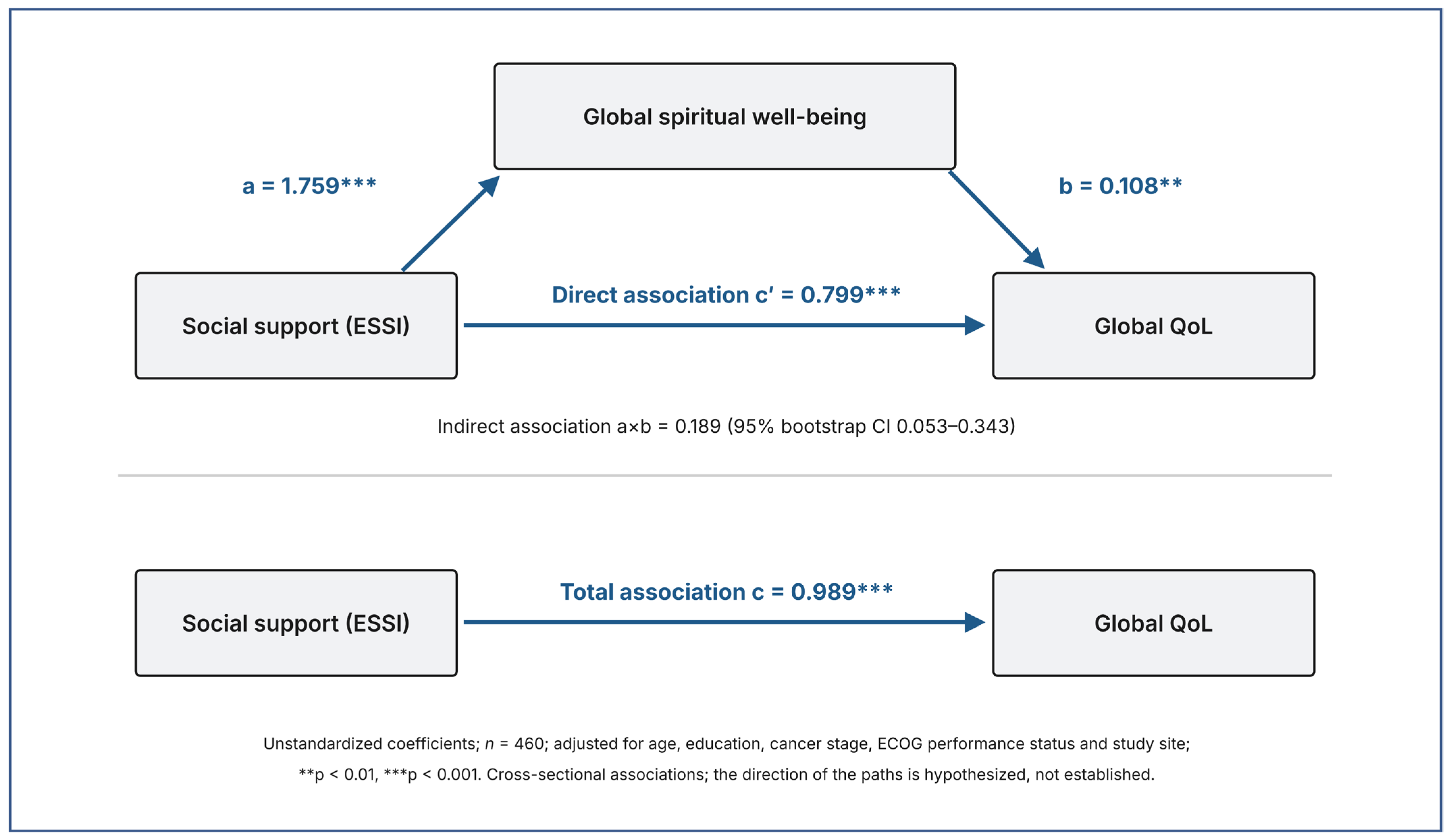
The mediation analysis was based on 460 participants with complete data on all variables (Table 4). Higher perceived social support was associated with higher global spiritual well-being (a path: b = 1.759, SE = 0.207, t = 8.51, p < 0.001, 95% CI [1.353, 2.165]). In the outcome model, both perceived social support (c′: b = 0.799, SE = 0.158, t = 5.06, p < 0.001, 95% CI [0.489, 1.110]) and global spiritual well-being (b path: b = 0.108, SE = 0.033, t = 3.23, p = 0.001, 95% CI [0.042, 0.173]) were associated with global QoL, adjusting for age, education, cancer stage, ECOG performance status, and study site. Because the covariates were the same as in the linear regression, the outcome model is identical to the model in Table 3.
Table 4.
Mediation analysis of the association between social support and global QoL through global spiritual well-being.
Among the covariates, poorer ECOG performance status was associated with lower global spiritual well-being (b = −3.95, p = 0.006) and with lower global QoL in both the outcome model (b = −4.70, p < 0.001) and the total-association model (b = −5.12, p < 0.001). Women treated at BMC reported higher global spiritual well-being than those treated at ORCI (b = 13.67, p < 0.001), but study site was not associated with global QoL. Age, education, and cancer stage were not significantly associated with either the mediator or the outcome.
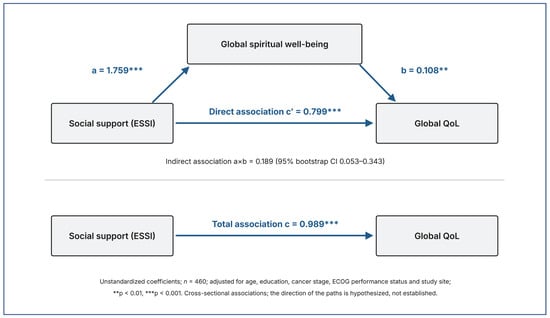
The total association of perceived social support with global QoL was significant (c: b = 0.989, SE = 0.148, t = 6.67, p < 0.001, 95% CI [0.697, 1.280]; Figure 2). After inclusion of the mediator, the direct association remained statistically significant (c′ = 0.799, p < 0.001), indicating that most of the association between social support and QoL was not statistically accounted for by global spiritual well-being.
Figure 2.
Simple mediation model of the association between perceived social support (ESSI) and global QoL through global spiritual well-being, with unstandardized path coefficients (a, b, c’) and the total association (c); n = 460, adjusted for age, education, cancer stage, ECOG performance status, and study site. ESSI = ENRICHD Social Support Instrument; QoL = quality of life.
The statistical indirect association of social support with global QoL via global spiritual well-being was small (ab = 0.189, BootSE = 0.073, 95% bootstrap CI [0.053, 0.343]; completely standardized ab = 0.057), corresponding to 1.5 points (95% CI 0.4–2.7) of global QoL for an interquartile-range difference in social support and to 19.2% of the total association. This proportion is a statistical decomposition of a cross-sectional association; it does not indicate the improvement in QoL that could be achieved by an intervention on spiritual well-being.
The mediator model explained 23.2% of the variance in global spiritual well-being (R2 = 0.232), and the outcome model explained 17.4% of the variance in global QoL (R2 = 0.174).
3.6. Sensitivity Analyses
The indirect association was similar with multiple imputation (n = 499; ab = 0.181, 95% CI 0.070–0.305; 20.1% mediated), after additional adjustment for each further covariate (ab = 0.165–0.204) or for all of them jointly (n = 388; ab = 0.163, 95% CI 0.026–0.327), and when the partner item was removed from the ESSI (ESSI-6: ab = 0.202, 95% CI 0.048–0.359) (Supplementary Table S6). With HC3 standard errors, social support (p < 0.001) and global spiritual well-being (p = 0.008) remained associated with global QoL.
The indirect association was, however, heterogeneous (Supplementary Table S7). It was present at ORCI (n = 270; ab = 0.437, 95% CI 0.113–0.794) but not at BMC (n = 190; ab = 0.013, 95% CI −0.061 to 0.073; difference −0.416, 95% CI −0.784 to −0.060), and this pattern was unchanged after multiple imputation (ORCI 0.423, 95% CI 0.175–0.687; BMC 0.020, 95% CI −0.043 to 0.102). The difference arose in the a path: social support was strongly associated with global spiritual well-being at ORCI (B = 2.92 per ESSI point, p < 0.001) but not at BMC (B = 0.41, p = 0.19; interaction p < 0.001), also in an ordinal model that accounted for the ceiling of the global item. The direct association between social support and global QoL did not differ by site (interaction p = 0.42) and was statistically significant at both sites. By patient status, the indirect association was present in new patients (ab = 0.400, 95% CI 0.196–0.652) but not in follow-up or recurrent patients (ab = 0.042, 95% CI −0.122 to 0.213; difference 0.358, 95% CI 0.087–0.642), and it was largest among new patients at ORCI (n = 76; ab = 0.737, 95% CI 0.135–1.518). It did not differ by mode of treatment (difference −0.003, 95% CI −0.293 to 0.303). The ceiling effect of the global spiritual well-being item was most pronounced among new patients at BMC (45.3% at the maximum) and least pronounced among new patients at ORCI (3.8%).
When the four QLQ-SWB32 scales were entered as parallel mediators, none of the specific indirect associations was statistically significant and the total indirect association was close to zero (three reliable scales: 0.029, 95% CI −0.083 to 0.146; Supplementary Table S8); only Relationship with Self was associated with global QoL (B = 0.18, p < 0.001), but it was not associated with social support. There was no evidence of non-linearity in the association between global spiritual well-being and global QoL (quadratic term, p = 0.87; categorical vs. linear term, p = 0.18). Models with the three variables in alternative orderings yielded indirect associations of similar standardized magnitude (completely standardized ab 0.042–0.092 vs. 0.057 for the hypothesized ordering; Supplementary Table S9); the data therefore do not favor the hypothesized direction over reverse or reciprocal pathways.
Social support was not associated with the QLQ-C30 summary score (n = 455; B = 0.04, 95% CI −0.20 to 0.28) or with its functional and symptom components, and global spiritual well-being was weakly negatively associated with it (B = −0.07, 95% CI −0.12 to −0.02); consequently, the indirect association with the summary score was negative (ab = −0.125, 95% CI −0.224 to −0.026) (Supplementary Table S10). Within sites, social support was not associated with the summary score. Global QoL correlated only moderately with the summary score (r = 0.26 overall; 0.31 at ORCI and 0.47 at BMC), and BMC participants had much lower adjusted summary scores than ORCI participants (B = −24.2) despite similar global QoL.
3.7. Exploratory Network Analysis
The exploratory network retained 16 of 28 possible edges (Supplementary Figure S2). The strongest edges were Relationships with Others–Existential (0.62), social functioning–financial difficulties (−0.37) and Relationships with Others–Relationship with Someone or Something Greater (0.29); among the edges of global QoL, the strongest was with social support (0.21). The social support–global QoL edge was robust to bootstrapping, to omitting Relationship with Self (0.21) and to adjustment for site and covariates (0.18), but it was present at ORCI (0.30) and absent at BMC (0.00; network comparison test, p = 0.005). Because Relationships with Others and Existential were not empirically distinct and expected influence depended on the scoring direction of financial difficulties, centrality indices were not interpreted substantively (Supplementary Table S11 and Figures S3 and S4).
4. Discussion
In this cross-sectional study of 499 Tanzanian women with CC, higher perceived social support and higher global spiritual well-being were each associated with better global QoL after adjustment for sociodemographic and clinical covariates, and poorer performance status was associated with poorer QoL. The statistical indirect association of social support with global QoL via global spiritual well-being was small and robust to missing data, additional covariates and the scoring of the ESSI, but it was confined to one center and to new patients, was not carried by any specific spiritual well-being domain, could not be distinguished from reverse orderings and did not extend to the QLQ-C30 summary score. The findings therefore describe associations with women’s global appraisal of their QoL; they do not show that social support or spiritual well-being improve QoL.
4.1. Social Support and Quality of Life
The association between perceived social support and global QoL is consistent with studies of patients with cancer [23,24] and with stress-buffering models of social support [21]. Its magnitude, about 6 points for an interquartile-range difference, is small by conventional QLQ-C30 benchmarks [61,62] but similar to the difference associated with one category of ECOG performance status in this sample. It was present at both centers and robust to all sensitivity analyses. In a setting where many women describe withdrawal of partners, relatives and friends after diagnosis [9,19], perceived support may be an important resource, although women who feel better may also be more able to seek and maintain support. The association between poorer ECOG performance status and lower QoL is consistent with previous studies [70,71]. Because performance status may lie on the pathway from stage to QoL, the absence of an independent association between stage and QoL after adjustment for performance status should not be taken to mean that stage is unimportant.
4.2. Spiritual Well-Being and the Indirect Association
Global spiritual well-being was independently associated with global QoL, in line with systematic reviews and with studies of women with gynecological cancer [28,29,30]. The indirect association, however, should be interpreted as a statistical decomposition rather than as a mechanism, for three reasons. First, it was present only at ORCI and among new patients. At BMC, social support was barely associated with spiritual well-being and many women, especially new patients, reported the maximum score; the centers also differed in religious composition, case mix and response distributions. Whether this heterogeneity reflects the phase of the illness trajectory, the cultural and religious context, ceiling effects or differences in questionnaire administration cannot be determined from these data. Second, models with the variables in reverse order yielded indirect associations of similar standardized size; cross-sectional data cannot identify the direction of such associations [65], and women with better QoL may engage more in social and religious life. Third, the indirect association relied on a single global item. The QLQ-SWB32 scales did not carry it, and the reliable scales were not associated with QoL once social support was taken into account, suggesting that it is women’s overall appraisal of their spiritual well-being, rather than a particular domain, that co-varies with their appraisal of QoL; shared method variance between two global self-ratings may contribute to this. Measurement error in a single-item mediator usually attenuates indirect associations, but in combination with unmeasured confounding of the mediator–outcome association, for example, by depression, coping or religious practice, the bias can go in either direction [72,73]; the estimate should therefore not be regarded as conservative.
4.3. Global Appraisal Versus Functioning and Symptoms
Social support and spiritual well-being were associated with global QoL but not with the QLQ-C30 summary score, which reflects functioning and symptom burden, and global spiritual well-being was even slightly higher among women with poorer functioning. The global QoL scale and the summary score capture different aspects of QoL and correlated only moderately in this sample. At BMC, women had much poorer functioning and more symptoms than at ORCI but rated their global QoL similarly and reported higher spiritual well-being. This pattern is consistent with meaning-making models of adjustment to serious illness, in which spiritual and social resources shape how patients evaluate their lives rather than their physical status [33]. Our conclusions therefore apply to women’s global appraisal of their QoL, the prespecified primary outcome, and not to functioning or symptom burden, which limits comparison with studies reporting the full QLQ-C30 [16,17].
4.4. Clinical Implications and Future Research
The findings support assessing perceived social support and spiritual well-being as part of holistic CC care in Tanzania, where counselling services are limited and religious coping is common [31], but they do not show that improving either will improve QoL. Brief instruments such as the Kiswahili ESSI and the global spiritual well-being item could help identify women with low support or spiritual distress for referral to peer support, counselling or chaplaincy, once their measurement properties and cut-offs have been established. Prospective studies with repeated measurements from diagnosis through treatment are needed to establish temporal ordering, and the concentration of the indirect association among new patients suggests that the period around the start of treatment deserves particular attention. Whether interventions such as nurse-led psychosocial support or peer support pairing newly diagnosed women with survivors improve QoL should be tested in randomized trials [25]. The opening of a radiotherapy facility at KCMC in Moshi in 2026 also offers an opportunity to examine how reduced geographical and financial barriers affect treatment adherence and QoL.
4.5. Strengths and Limitations
Strengths include the large sample recruited consecutively at the two national referral centers with full participation of all eligible women approached, Kiswahili instruments produced with standardized translation procedures, adjustment for clinical covariates and sensitivity analyses addressing missing data, confounding, measurement and heterogeneity. Several limitations must be considered. First, the cross-sectional design precludes conclusions about temporal order or causality [65,74]. Second, consecutive recruitment at referral centers excludes women who never reach specialist care, who are likely to be poorer, more rural and more severely affected [75]; in addition, missing data, mainly on cancer stage at BMC, were not missing completely at random, although multiple imputation gave similar results. Third, measurement limitations include the RMSEA misfit of the ESSI and its weakly loading partner item, the poor reliability of Relationship with Self, the lack of discriminant validity between Relationships with Others and Existential, the ceiling effect and unknown reliability of the global spiritual well-being item, and between-site differences in response distributions; moreover, the QLQ-SWB32 was developed mainly in Western palliative care settings and may not fully capture the communal forms of spirituality common in Tanzania [35]. Fourth, residual confounding by unmeasured factors such as income, depression, coping, treatment intensity and side effects is likely. Fifth, stigma surrounding CC and sexuality, and assistance with questionnaire completion for women who could not read, may have led to under-reporting of distress or socially desirable responses. Finally, apart from the primary model, the analyses were not prespecified, and the number of sensitivity and subgroup analyses increases the risk of chance findings; they were intended to test the robustness of the primary findings rather than to generate new conclusions.
5. Conclusions
Among Tanzanian women with cervical cancer, higher perceived social support and higher global spiritual well-being were associated with better global QoL, although the associations were small by conventional benchmarks. The statistical indirect association of social support with QoL via global spiritual well-being was small, varied between centers and patient groups and could not be distinguished from reverse orderings; it should not be interpreted as evidence of a causal mechanism. Neither social support nor spiritual well-being was associated with better functioning or fewer symptoms. Given the observational design and the measurement limitations identified, social support and spiritual well-being should be regarded as candidate targets for assessment in supportive cancer care, whose effects on QoL need to be established in longitudinal and intervention studies.
Supplementary Materials
The following supporting information can be downloaded at: https://www.mdpi.com/article/10.3390/diseases14110431/s1, File S1: STROBE checklist; Table S1: Missing data on the model variables by study site; Table S2: Participant characteristics and study variables by study site; Table S3: Item-level results and confirmatory factor analyses of the Kiswahili ESSI; Table S4: Reliability, mean scores and structural validity of the EORTC QLQ-SWB32 scales by study site and religion; Table S5: Practical magnitude of the associations with global quality of life; Table S6: Sensitivity of the indirect association to missing data, covariate adjustment and the ESSI score; Table S7: Heterogeneity of the indirect association by study site, patient status and treatment modality; Table S8: Domain-specific (parallel) mediation and non-linearity; Table S9: Alternative orderings of social support, spiritual well-being and quality of life; Table S10: Associations with the EORTC QLQ-C30 summary score and its components; Table S11: Sensitivity of the exploratory network (edge weights, network comparison test and centrality); Figure S1: Causal diagram used for covariate selection; Figure S2: Exploratory regularized partial correlation network; Figure S3: Edge weights with 95% bootstrap intervals; Figure S4: Stability of the centrality indices.
Author Contributions
Conceptualization, C.C.M., A.H.P., J.C., J.M., H.A.M., F.S., R.M., P.K., D.L.M. and G.B.; Methodology, C.C.M., A.H.P., J.C., J.M., H.A.M., F.S., R.M., P.K., D.L.M. and G.B.; Formal analysis, C.C.M., I.G., A.H.P. and P.K.; Investigation, C.C.M., R.M., P.K. and D.L.M.; Data curation, C.C.M., I.G., A.H.P. and P.K.; Writing—original draft preparation, I.G. and C.C.M.; Writing—review and editing, C.C.M., I.G., A.H.P., J.C., J.M., H.A.M., F.S., R.M., P.K., D.L.M. and G.B.; Supervision, A.H.P., J.C., J.M., H.A.M., D.L.M. and G.B.; Project administration, C.C.M. C.C.M. and I.G. contributed equally to this work as joint first authors. All authors have read and agreed to the published version of the manuscript.
Funding
This research received no external funding.
Institutional Review Board Statement
The study was conducted in accordance with the Declaration of Helsinki [76] and was approved by the College Research Ethics Committee at Kilimanjaro Christian Medical University College (KCMUCo) (approval number 2626) and by the National Institute for Medical Research in Tanzania (approval number NIMR/HQ/R.8a/Vol.IX/4589).
Informed Consent Statement
Written informed consent was obtained from all subjects involved in the study.
Data Availability Statement
The data presented in this study are available on request from the corresponding author due to privacy and ethical restrictions relating to the sensitive health information of participants.
Acknowledgments
The authors are grateful to KCMC, BMC, ORCI, and their staff for their invaluable assistance with data collection and logistical support, and especially to Jane Rogathi for her guidance and support throughout this process. During the preparation of this manuscript, the authors used Grammarly (v.1.154.0.0–1.162.0.0) for grammar and sentence-structure suggestions, ChatGPT-4o to assist with SPSS syntax for data calculations. The authors also used Elicit (web version, Elicit Research PBC, https://elicit.com; accessed January–March 2026) to help search for relevant published literature and Anara 2.0 to summarize published research and, during the revision https://anara.com, and, Claude (Opus 5.5; Anthropic 2026) to assist with language editing of the text. The authors have reviewed and edited the output of these tools and take full responsibility for the content of this publication.
Conflicts of Interest
The authors declare no conflicts of interest.
Abbreviations
The following abbreviations are used in this manuscript:
| BMC | Bugando Medical Centre |
| CC | Cervical Cancer |
| CFA | Confirmatory Factor Analysis |
| CFI | Comparative Fit Index |
| CI | Confidence Interval |
| ECOG | Eastern Cooperative Oncology Group |
| EORTC | European Organisation for Research and Treatment of Cancer |
| EORTC QLQ-C30 | EORTC Quality of Life Questionnaire–Core 30 |
| EORTC QLQ-SWB32 | EORTC Quality of Life Questionnaire–Spiritual Well-Being 32 |
| ESSI | ENRICHD Social Support Instrument |
| FIGO | International Federation of Gynecology and Obstetrics |
| HIV | Human Immunodeficiency Virus |
| HTMT | Heterotrait–Monotrait Ratio |
| IQR | Interquartile Range |
| KCMC | Kilimanjaro Christian Medical Centre |
| ORCI | Ocean Road Cancer Institute |
| QoL | Quality of life |
| RMSEA | Root Mean Square Error of Approximation |
| SD | Standard Deviation |
| SE | Standard Error |
| SPSS | Statistical Package for the Social Sciences |
| SRMR | Standardized Root Mean Square Residual |
| SSA | Sub Saharan Africa |
| STROBE | Strengthening the Reporting of Observational Studies in Epidemiology |
| TLI | Tucker–Lewis Index |
| UNDP | United Nations Development Programme |
| WLSMV | Weighted Least Squares Mean- and Variance-Adjusted |
| WMA | World Medical Association |
References
- Bray, F.; Laversanne, M.; Sung, H.; Ferlay, J.; Siegel, R.L.; Soerjomataram, I.; Jemal, A. Global cancer statistics 2022: GLOBOCAN estimates of incidence and mortality worldwide for 36 cancers in 185 countries. CA Cancer J. Clin. 2024, 74, 229–263. [Google Scholar] [CrossRef] [Scilit] [PubMed]
- World Health Organization. Cervical Cancer; World Health Organization (WHO): Geneva, Switzerland, 2025; Available online: https://www.who.int/news-room/fact-sheets/detail/cervical-cancer (accessed on 2 February 2026).
- World Cancer Research Fund International. Cervical Cancer Statistics (GLOBOCAN 2022). Available online: https://www.wcrf.org/preventing-cancer/cancer-statistics/cervical-cancer-statistics/ (accessed on 19 October 2026).
- International Agency for Research on Cancer (IARC). Cancer Today—Global Cancer Observatory (Prevalence). Available online: https://gco.iarc.who.int/today/en/dataviz/bars-prevalence?mode=cancer&key=total&group_populations=1&sort_by=value1&populations=834&age_end=17 (accessed on 3 February 2026).
- Stelzle, D.; Tanaka, L.F.; Lee, K.K.; Ibrahim Khalil, A.; Baussano, I.; Shah, A.S.V.; McAllister, D.A.; Gottlieb, S.L.; Klug, S.J.; Winkler, A.S.; et al. Estimates of the global burden of cervical cancer associated with HIV. Lancet Glob. Health 2021, 9, e161–e169. [Google Scholar] [CrossRef] [Scilit] [PubMed]
- United Nations Development Programme (UNDP). Human Development Report 2025. A Matter of Choice: People and Possibilities in the Age of AI; UNDP: New York, NY, USA, 2025; Available online: https://hdr.undp.org/content/human-development-report-2025 (accessed on 19 October 2026).
- Wu, J.; Jin, Q.; Zhang, Y.; Ji, Y.; Li, J.; Liu, X.; Duan, H.; Feng, Z.; Liu, Y.; Zhang, Y.; et al. Global burden of cervical cancer: Current estimates, temporal trend and future projections based on the GLOBOCAN 2022. J. Natl. Cancer Cent. 2025, 5, 322–329. [Google Scholar] [CrossRef] [Scilit] [PubMed]
- Chona, E.Z.; Gosse, R.A.; Msengi, E.A.; Aruldhas, T.P.; Mkonongo, L.; Matle, T.M.; Iseselo, M.K.; Ambikile, J.S. Life Experiences of Women Diagnosed With Cervical Cancer in Sub-Saharan Africa: A Systematic Review of Qualitative Studies. Psychooncology 2025, 34, e70280. [Google Scholar] [CrossRef] [Scilit] [PubMed]
- Mtuya, C.C.; Cadstedt, J.; Mattsson, J.; Manhica, H.A.; Serventi, F.; Machange, R.; Kidayi, P.; Mushi, D.; Björling, G. “Cervical Cancer—A Silent Disease in the Community”—A Qualitative Study on Awareness of Cervical Cancer in Tanzania. Sage Open Nurs. 2025, 11, 23779608251393079. [Google Scholar] [CrossRef] [Scilit] [PubMed]
- WHOQOL—Measuring Quality of Life|The World Health Organization. Available online: https://www.who.int/tools/whoqol (accessed on 4 February 2026).
- Ye, S.; Yang, J.; Cao, D.; Lang, J.; Shen, K. A Systematic Review of Quality of Life and Sexual Function of Patients with Cervical Cancer After Treatment. Int. J. Gynecol. Cancer 2014, 24, 1146–1157. [Google Scholar] [CrossRef] [Scilit] [PubMed]
- Tramacere, F.; Lancellotta, V.; Casà, C.; Fionda, B.; Cornacchione, P.; Mazzarella, C.; De Vincenzo, R.P.; Macchia, G.; Ferioli, M.; Rovirosa, A.; et al. Assessment of Sexual Dysfunction in Cervical Cancer Patients after Different Treatment Modality: A Systematic Review. Medicina 2022, 58, 1223. [Google Scholar] [CrossRef] [Scilit] [PubMed]
- Wit, E.M.K.; Horenblas, S. Urological complications after treatment of cervical cancer. Nat. Rev. Urol. 2014, 11, 110–117. [Google Scholar] [CrossRef] [Scilit] [PubMed]
- Zeng, Y.; Cheng, A.S.; Liu, X.; Chan, C.C. Cervical cancer survivors’ perceived cognitive complaints and supportive care needs in mainland China: A qualitative study. BMJ Open 2017, 7, e014078. [Google Scholar] [CrossRef] [Scilit] [PubMed]
- Chase, D.M.; Huang, H.Q.; Wenzel, L.; Cella, D.; McQuellon, R.; Long, H.J.; Moore, D.H.; Monk, B.J. Quality of life and survival in advanced cervical cancer: A Gynecologic Oncology Group study. Gynecol. Oncol. 2012, 125, 315–319. [Google Scholar] [CrossRef] [Scilit] [PubMed]
- Mvunta, D.H.; August, F.; Dharsee, N.; Mvunta, M.H.; Wangwe, P.; Ngarina, M.; Simba, B.M.; Kidanto, H. Quality of life among cervical cancer patients following completion of chemoradiotherapy at Ocean Road Cancer Institute (ORCI) in Tanzania. BMC Womens Health 2022, 22, 426. [Google Scholar] [CrossRef] [Scilit] [PubMed]
- Araya, L.T.; Fenta, T.G.; Sander, B.; Gebremariam, G.T.; Gebretekle, G.B. Health-related quality of life and associated factors among cervical cancer patients at Tikur Anbessa specialized hospital, Addis Ababa, Ethiopia. Health Qual. Life Outcomes 2020, 18, 72. [Google Scholar] [CrossRef] [Scilit] [PubMed]
- Seyfu, D.T.; Abebe, S.N.; Haile, S.; Ayana, B.A. Health related quality of life and its predictive factors on cervical cancer patients in two teaching hospitals, Addis Ababa, Ethiopia. BMC Womens Health 2024, 24, 209. [Google Scholar] [CrossRef] [Scilit] [PubMed]
- Chona, E.Z.; Msengi, E.A.; Gosse, R.A.; Ambikile, J.S. The lived experiences and caring needs of women diagnosed with cervical cancer: A qualitative study in Dar es Salaam, Tanzania. PLoS ONE 2023, 18, e0289925. [Google Scholar] [CrossRef] [Scilit] [PubMed]
- Mwobobia, J.M.; Knettel, B.A.; Headley, J.; Msoka, E.F.; Tarimo, C.S.; Katiti, V.; Juhlin, E.; Osazuwa-Peters, N. “Let him die. He caused it”: A qualitative study on cancer stigma in Tanzania. PLoS Glob. Public Health 2024, 4, e0003283. [Google Scholar] [CrossRef] [Scilit] [PubMed]
- Cohen, S.; Wills, T.A. Stress, social support, and the buffering hypothesis. Psychol. Bull. 1985, 98, 310–357. [Google Scholar] [CrossRef]
- Holt-Lunstad, J.; Smith, T.B.; Layton, J.B. Social Relationships and Mortality Risk: A Meta-analytic Review. PLoS Med. 2010, 7, e1000316. [Google Scholar] [CrossRef] [Scilit] [PubMed]
- Yoo, H.; Shin, D.W.; Jeong, A.; Kim, S.Y.; Yang, H.K.; Kim, J.S.; Lee, J.E.; Oh, J.H.; Park, E.-C.; Park, K.; et al. Perceived social support and its impact on depression and health-related quality of life: A comparison between cancer patients and general population. Jpn. J. Clin. Oncol. 2017, 47, 728–734. [Google Scholar] [CrossRef] [Scilit] [PubMed]
- Ruiz-Rodríguez, I.; Hombrados-Mendieta, I.; Melguizo-Garín, A.; Martos-Méndez, M.J. The Importance of Social Support, Optimism and Resilience on the Quality of Life of Cancer Patients. Front. Psychol. 2022, 13, 833176. [Google Scholar] [CrossRef] [Scilit] [PubMed]
- Dhakal, K.; Chen, C.; Wang, P.; Mboineki, J.F.; Adhikari, B. Existing psychological supportive care interventions for cervical cancer patients: A systematic review and meta-analysis. BMC Public Health 2024, 24, 1419. [Google Scholar] [CrossRef] [Scilit] [PubMed]
- Gomez, R.; Fisher, J.W. Domains of spiritual well-being and development and validation of the Spiritual Well-Being Questionnaire. Pers. Individ. Dif. 2003, 35, 1975–1991. [Google Scholar] [CrossRef] [Scilit]
- Bożek, A.; Nowak, P.F.; Blukacz, M. The Relationship Between Spirituality, Health-Related Behavior, and Psychological Well-Being. Front. Psychol. 2020, 11, 1997. [Google Scholar] [CrossRef] [Scilit] [PubMed]
- Bai, M.; Lazenby, M. A systematic review of associations between spiritual well-being and quality of life at the scale and factor levels in studies among patients with cancer. J. Palliat. Med. 2015, 18, 286–298. [Google Scholar] [CrossRef] [Scilit] [PubMed]
- Jim, H.S.L.; Pustejovsky, J.E.; Park, C.L.; Danhauer, S.C.; Sherman, A.C.; Fitchett, G.; Merluzzi, T.V.; Munoz, A.R.; George, L.; Snyder, M.A.; et al. Religion, spirituality, and physical health in cancer patients: A meta-analysis. Cancer 2015, 121, 3760–3768. [Google Scholar] [CrossRef] [Scilit] [PubMed]
- Chen, J.; You, H.; Liu, Y.; Kong, Q.; Lei, A.; Guo, X. Association between spiritual well-being, quality of life, anxiety and depression in patients with gynaecological cancer in China. Medicine 2021, 100, e24264. [Google Scholar] [CrossRef] [Scilit] [PubMed]
- Onyeka, T.C.; Onu, J.U.; Agom, D.A. Psychosocial aspects of adult cancer patients: A scoping review of sub-Saharan Africa. Psychooncology 2023, 32, 86–106. [Google Scholar] [CrossRef] [Scilit] [PubMed]
- Daniels, J.; Glover, E.T.; Kyei, K.A. The contribution of spirituality and religiousness to the quality of life of cancer patients treated with radiotherapy in Ghana: A cross-sectional study. Ecancermedicalscience 2025, 19, 1858. [Google Scholar] [CrossRef] [Scilit] [PubMed]
- Park, C.L. Making sense of the meaning literature: An integrative review of meaning making and its effects on adjustment to stressful life events. Psychol. Bull. 2010, 136, 257–301. [Google Scholar] [CrossRef] [Scilit] [PubMed]
- Feng, Y.; Liu, X.; Zhang, S.; Lin, T.; Guo, X.; Chen, J. Relationship among post-traumatic growth, spiritual well-being, and perceived social support in Chinese women with gynecological cancer. Sci. Rep. 2024, 14, 4847. [Google Scholar] [CrossRef] [Scilit] [PubMed]
- Vivat, B.; Young, T.E.; Winstanley, J.; Arraras, J.I.; Black, K.; Boyle, F.; Bredart, A.; Costantini, A.; Guo, J.; Irarrazaval, M.; et al. The international phase 4 validation study of the EORTC QLQ-SWB32: A stand-alone measure of spiritual well-being for people receiving palliative care for cancer. Eur. J. Cancer Care 2017, 26, e12697. [Google Scholar] [CrossRef] [Scilit] [PubMed]
- Ministry of Health, Community Development, Gender, Elderly and Children (MoHCDGEC). National Strategic Plan for Prevention and Control of Non-Communicable Diseases 2021–2026; United Republic of Tanzania MoHCDGEC: Dar es Salaam, Tanzania, 2021; Available online: https://tzdpg.or.tz/wp-content/uploads/2022/04/NCD-ACTION-PLAN-2021-2026.pdf (accessed on 21 October 2026).
- Ministry of Health and Social Welfare (MoHSW). National Cancer Control Strategy (NCCS) 2013–2022; United Republic of Tanzania MoHSW: Dar es Salaam, Tanzania, 2013. Available online: https://www.iccp-portal.org/system/files/plans/NCSS%20Book.pdf (accessed on 21 October 2026).
- Tupa, F.; Ruwaichi, T.; Luoga, P.; Mwaiselage, J.; Lidenge, S.J.; Tungu, M. Institutional management factors influencing compliance with National Cancer Treatment Guidelines for cervical cancer: A case study from Ocean Road Cancer Institute, Tanzania. BMC Cancer 2025, 25, 1259. [Google Scholar] [CrossRef] [Scilit] [PubMed]
- von Elm, E.; Altman, D.G.; Egger, M.; Pocock, S.J.; Gøtzsche, P.C.; Vandenbroucke, J.P. The Strengthening the Reporting of Observational Studies in Epidemiology (STROBE) statement: Guidelines for reporting observational studies. Lancet 2007, 370, 1453–1457. [Google Scholar] [CrossRef] [Scilit] [PubMed]
- Cochran, W.G. Sampling Techniques, 3rd ed.; John Wiley & Sons: New York, NY, USA, 1977. [Google Scholar]
- Fritz, M.S.; MacKinnon, D.P. Required Sample Size to Detect the Mediated Effect. Psychol. Sci. 2007, 18, 233–239. [Google Scholar] [CrossRef] [Scilit] [PubMed]
- Oken, M.M.; Creech, R.H.; Tormey, D.C.; Horton, J.; Davis, T.E.; McFadden, E.T.; Carbone, P.P. Toxicity and response criteria of the Eastern Cooperative Oncology Group. Am. J. Clin. Oncol. 1982, 5, 649–655. [Google Scholar] [CrossRef] [Scilit]
- Aaronson, N.K.; Ahmedzai, S.; Bergman, B.; Bullinger, M.; Cull, A.; Duez, N.J.; Filiberti, A.; Flechtner, H.; Fleishman, S.B.; De Haes, J.C.J.M.; et al. The European Organization for Research and Treatment of Cancer QLQ-C30: A Quality-of-Life Instrument for Use in International Clinical Trials in Oncology. JNCI J. Natl. Cancer Inst. 1993, 85, 365–376. [Google Scholar] [CrossRef] [Scilit] [PubMed]
- EORTC Quality of Life Group. EORTC QLQ-C30. Available online: https://qol.eortc.org/questionnaire/eortc-qlq-c30/ (accessed on 19 October 2026).
- Giesinger, J.M.; Kieffer, J.M.; Fayers, P.M.; Groenvold, M.; Petersen, M.A.; Scott, N.W.; Sprangers, M.A.; Velikova, G.; Aaronson, N.K. Replication and validation of higher order models demonstrated that a summary score for the EORTC QLQ-C30 is robust. J. Clin. Epidemiol. 2016, 69, 79–88. [Google Scholar] [CrossRef] [Scilit] [PubMed]
- Fayers, P.M.; Aaronson, N.K.; Bjordal, K.; Groenvold, M.; Curran, D.; Bottomley, A.; on behalf of the EORTC Quality of Life Group. The EORTC QLQ-C30 Scoring Manual, 3rd ed.; European Organisation for Research and Treatment of Cancer: Brussels, Belgium, 2001. [Google Scholar]
- Mitchell, P.H.; Powell, L.; Blumenthal, J.; Norten, J.; Ironson, G.; Pitula, C.R.; Froelicher, E.S.; Czajkowski, S.; Youngblood, M.; Huber, M.; et al. A short social support measure for patients recovering from myocardial infarction: The ENRICHD Social Support Inventory. J. Cardiopulm. Rehabil. 2003, 23, 398–403. [Google Scholar] [CrossRef] [Scilit] [PubMed]
- Vaglio, J.; Conard, M.; Poston, W.S.; O’Keefe, J.; Haddock, C.K.; House, J.; Spertus, J.A. Testing the performance of the ENRICHD Social Support Instrument in cardiac patients. Health Qual. Life Outcomes 2004, 2, 24. [Google Scholar] [CrossRef] [Scilit] [PubMed]
- Hinz, A.; Esser, P.; Richter, D.; Schönfelder, A.; Glaesmer, H.; Lehmann-Laue, A.; Heyne, S.; Leuteritz, K.; Sender, A.; Springer, F.; et al. Social support in a large general population sample over the course of six years. Sci. Rep. 2025, 15, 6405. [Google Scholar] [CrossRef] [Scilit] [PubMed]
- Salinas-Rehbein, B.; Terán-Mendoza, O.; Cancino, M. Social support and aging: Psychometric analysis of the ENRICHD Social Support Instrument in a Chilean population over 50. Psicol. Reflex. Crit. 2025, 38, 1–9. [Google Scholar] [CrossRef] [Scilit] [PubMed]
- Kuliś, D.; Bottomley, A.; Velikova, G.; Greimel, E.; Koller, M.; on behalf of the EORTC Quality of Life Group. EORTC Quality of Life Group Translation Procedure, 4th ed.; EORTC: Brussels, Belgium, 2017; Available online: https://qol.eortc.org/app/uploads/sites/2/2018/02/translation_manual_2017.pdf (accessed on 19 October 2026).
- Feng, Y.; Luo, J.; Lin, T.; Liu, X.; Guo, X.; Chen, J.; Vivat, B. Translation and validation of the Chinese version of EORTC QLQ-SWB32 assessing the spiritual wellbeing of women with gynecological cancer. PLoS ONE 2025, 20, e0321790. [Google Scholar] [CrossRef] [Scilit] [PubMed]
- Goyarrola, R.; Lipsanen, J.; Saarelainen, S.M.; Suviranta, R.; Rahko, E.; Lamminmäki, A.; Klaavuniemi, T.; Ahtiluoto, S.; Ohvanainen, A.; Metso, P.; et al. Spiritual well-being correlates with quality of life of both cancer and non-cancer patients in palliative care—Further validation of EORTC QLQ-SWB32 in Finnish. BMC Palliat. Care 2023, 22, 33. [Google Scholar] [CrossRef] [Scilit] [PubMed]
- Greenland, S.; Pearl, J.; Robins, J.M. Causal diagrams for epidemiologic research. Epidemiology 1999, 10, 37–48. [Google Scholar] [CrossRef] [Scilit]
- Eisinga, R.; te Grotenhuis, M.; Pelzer, B. The reliability of a two-item scale: Pearson, Cronbach, or Spearman–Brown? Int. J. Public Health 2013, 58, 637–642. [Google Scholar] [CrossRef] [Scilit] [PubMed]
- Kenny, D.A.; Kaniskan, B.; McCoach, D.B. The performance of RMSEA in models with small degrees of freedom. Sociol. Methods Res. 2015, 44, 486–507. [Google Scholar] [CrossRef] [Scilit]
- Xia, Y.; Yang, Y. RMSEA, CFI, and TLI in structural equation modeling with ordered categorical data: The story they tell depends on the estimation methods. Behav. Res. Methods 2019, 51, 409–428. [Google Scholar] [CrossRef] [Scilit] [PubMed]
- Henseler, J.; Ringle, C.M.; Sarstedt, M. A new criterion for assessing discriminant validity in variance-based structural equation modeling. J. Acad. Mark. Sci. 2015, 43, 115–135. [Google Scholar] [CrossRef] [Scilit]
- Hayes, A.F. Introduction to Mediation, Moderation, and Conditional Process Analysis: A Regression-Based Approach, 3rd ed.; Guilford Press: New York, NY, USA, 2022. [Google Scholar]
- Preacher, K.J.; Hayes, A.F. Asymptotic and resampling strategies for assessing and comparing indirect effects in multiple mediator models. Behav. Res. Methods 2008, 40, 879–891. [Google Scholar] [CrossRef] [Scilit] [PubMed]
- Osoba, D.; Rodrigues, G.; Myles, J.; Zee, B.; Pater, J. Interpreting the significance of changes in health-related quality-of-life scores. J. Clin. Oncol. 1998, 16, 139–144. [Google Scholar] [CrossRef] [Scilit] [PubMed]
- Cocks, K.; King, M.T.; Velikova, G.; Martyn St-James, M.; Fayers, P.M.; Brown, J.M. Evidence-based guidelines for determination of sample size and interpretation of the European Organisation for the Research and Treatment of Cancer Quality of Life Questionnaire Core 30. J. Clin. Oncol. 2011, 29, 89–96. [Google Scholar] [CrossRef] [Scilit] [PubMed]
- White, I.R.; Royston, P.; Wood, A.M. Multiple imputation using chained equations: Issues and guidance for practice. Stat. Med. 2011, 30, 377–399. [Google Scholar] [CrossRef] [Scilit] [PubMed]
- van Buuren, S.; Groothuis-Oudshoorn, K. mice: Multivariate imputation by chained equations in R. J. Stat. Softw. 2011, 45, 1–67. [Google Scholar] [CrossRef] [Scilit]
- Maxwell, S.E.; Cole, D.A. Bias in cross-sectional analyses of longitudinal mediation. Psychol. Methods 2007, 12, 23–44. [Google Scholar] [CrossRef] [Scilit] [PubMed]
- Epskamp, S.; Fried, E.I. A tutorial on regularized partial correlation networks. Psychol. Methods 2018, 23, 617–634. [Google Scholar] [CrossRef] [Scilit] [PubMed]
- Epskamp, S.; Borsboom, D.; Fried, E.I. Estimating psychological networks and their accuracy: A tutorial paper. Behav. Res. Methods 2018, 50, 195–212. [Google Scholar] [CrossRef] [Scilit] [PubMed]
- van Borkulo, C.D.; van Bork, R.; Boschloo, L.; Kossakowski, J.J.; Tio, P.; Schoevers, R.A.; Borsboom, D.; Waldorp, L.J. Comparing network structures on three aspects: A permutation test. Psychol. Methods 2023, 28, 1273–1285. [Google Scholar] [CrossRef] [Scilit] [PubMed]
- Rosseel, Y. lavaan: An R package for structural equation modeling. J. Stat. Softw. 2012, 48, 1–36. [Google Scholar] [CrossRef] [Scilit]
- de Mol, M.; Visser, S.; Aerts, J.; Lodder, P.; van Walree, N.; Belderbos, H.; Oudsten, B.D. The association of depressive symptoms, personality traits, and sociodemographic factors with health-related quality of life and quality of life in patients with advanced-stage lung cancer: An observational multi-center cohort study. BMC Cancer 2020, 20, 431. [Google Scholar] [CrossRef] [Scilit] [PubMed]
- Laird, B.J.A.; Fallon, M.; Hjermstad, M.J.; Tuck, S.; Kaasa, S.; Klepstad, P.; McMillan, D.C. Quality of Life in Patients With Advanced Cancer: Differential Association With Performance Status and Systemic Inflammatory Response. J. Clin. Oncol. 2016, 34, 2769–2775. [Google Scholar] [CrossRef] [Scilit] [PubMed]
- Fritz, M.S.; Kenny, D.A.; MacKinnon, D.P. The combined effects of measurement error and omitting confounders in the single-mediator model. Multivar. Behav. Res. 2016, 51, 681–697. [Google Scholar] [CrossRef] [Scilit] [PubMed]
- VanderWeele, T.J. Mediation analysis: A practitioner’s guide. Annu. Rev. Public Health 2016, 37, 17–32. [Google Scholar] [CrossRef] [Scilit] [PubMed]
- Setia, M.S. Methodology Series Module 3: Cross-sectional Studies. Indian. J. Dermatol. 2016, 61, 261. [Google Scholar] [CrossRef] [Scilit] [PubMed]
- Willems, R.; Bolman, C.; Mesters, I.; Kanera, I.; Beaulen, A.; Lechner, L. One way or another: Opportunities and pitfalls of self-referral and consecutive sampling as recruitment strategies for psycho-oncology intervention trials. Psychooncology 2018, 27, 2161–2167. [Google Scholar] [CrossRef] [Scilit] [PubMed]
- The World Medical Association (WMA). WMA Declaration of Helsinki—Ethical Principles for Medical Research Involving Human Participants. Available online: https://www.wma.net/policies-post/wma-declaration-of-helsinki/ (accessed on 16 February 2026).

Disclaimer/Publisher’s Note: The statements, opinions and data contained in all publications are solely those of the individual author(s) and contributor(s) and not of MDPI and/or the editor(s). MDPI and/or the editor(s) disclaim responsibility for any injury to people or property resulting from any ideas, methods, instructions or products referred to in the content. |
© 2026 by the authors. Licensee MDPI, Basel, Switzerland. This article is an open access article distributed under the terms and conditions of the Creative Commons Attribution (CC BY) license.