


Abstract
To address the challenge of limited communication resources in microgrid economic dispatch, this paper proposes an improved dynamic event-triggered mechanism built upon a distributed event-triggered consensus algorithm. Firstly, a dynamic variable is introduced to adaptively adjust the triggering threshold, which effectively reduces the communication frequency between agents, thereby saving communication bandwidth and energy. Secondly, economic dispatch models are established for two scenarios: without generation constraints and with generation constraints. Corresponding distributed control protocols are designed. Thirdly, rigorous and clear mathematical proofs are provided for the asymptotic stability of the system and the exclusion of Zeno behavior. Simulation results demonstrate that the proposed method converges to the optimal incremental cost and power output. Compared with traditional static event-triggered mechanisms, the frequency of event triggering per unit time is reduced by approximately 51%, thereby effectively validating its effectiveness and superiority under multiple constraints.
1. Introduction
The increasing integration of distributed generation, energy storage, and electrical loads is driving future power systems toward structures composed of numerous, heterogeneous units. To maintain the delicate balance between supply and demand, these units must coordinate their internal generation and load and exchange power with their neighbors. Such coordinated groups of units are known as microgrids [1,2,3]. Economic dispatch, a critical issue in power system operation, is fundamentally an optimization problem that seeks the optimal combination of generator outputs to minimize operational costs while satisfying power balance constraints [4]. However, the large-scale integration of distributed renewable energy sources significantly increases the communication burden in microgrid economic dispatch, posing a challenge to the stable operation of current power systems [5]. Beyond the communication burden, the inherent variability and uncertainty of renewable generation—such as solar irradiance fluctuations and wind speed variations—introduce rapid changes in net load, requiring more frequent coordination among distributed generators and potentially affecting system stability. In practice, suboptimal power output inevitably limits system efficiency and economic benefits. The goal of economic dispatch, therefore, is to achieve cost minimization, all while adhering to operational limits and maintaining power balance. Based on the principle of equal incremental cost rates, which states that optimality is achieved when all generators operate at the same marginal cost, the economic dispatch problem transforms into one of incremental cost consistency, where the distributed control objective is to drive each generator’s incremental cost to a common optimal value while satisfying the supply–demand balance. This naturally leads to the conclusion that achieving efficient coordinated control of distributed energy resources is of direct and significant importance for enhancing both system reliability and economic performance.
Traditional approaches to economic dispatch—including genetic algorithms, dual quadratic programming, and particle swarm optimization—are generally executed in a centralized fashion [6,7,8]. Such a centralized architecture may result in communication bottlenecks and restrict the plug-and-play capability of microgrids. To overcome these shortcomings, distributed control strategies have become increasingly prevalent in recent years, offering benefits such as reduced communication needs, enhanced robustness, and improved scalability [9]. Drawing on consensus theory within multi-agent systems, a growing body of research has focused on consensus-driven distributed decision-making mechanisms. Specifically, Reference [10] proposed an autonomous distributed economic dispatch algorithm that enables smooth transitions between grid-connected and off-grid modes in microgrids. Reference [11] introduced a particle swarm optimization (PSO)-based algorithm for multi-microgrid economic dispatch. Reference [12] developed a fixed-time distributed event-triggered algorithm, while Reference [13] proposed a two-layer distributed event-triggered control strategy featuring leaderless coordination among microgrids and leader-based coordination within each microgrid. Beyond economic dispatch, frequency control in multi-microgrid distribution networks has also been investigated using consensus-based approaches [14].
However, existing event-triggered mechanisms for microgrid economic dispatch face two critical bottlenecks. First, static event-triggered mechanisms [15,16] employ fixed triggering thresholds that cannot adapt to dynamic operating conditions. When the threshold is set too low, frequent unnecessary triggering occurs, wasting communication bandwidth; when set too high, the system may fail to respond promptly to state changes, compromising control performance. This trade-off between communication efficiency and control accuracy is particularly challenging in microgrids with fluctuating renewable generation and varying loads. Second, dynamic event-triggered mechanisms, while offering adaptive threshold adjustment, introduce additional complexity in parameter design. The performance of these mechanisms is highly sensitive to parameters such as decay rates, response intensities, and weighting factors, yet systematic guidelines for tuning these parameters remain lacking. Moreover, most existing dynamic event-triggered consensus algorithms [17,18] focus primarily on convergence proof and Zeno-free analysis, with insufficient attention to practical implementation issues such as communication delays, packet drops, cyberattacks [19], communication link faults [20] and integration of physical constraints including renewable energy, storage, and transmission losses. These gaps motivate the research presented in this paper.
To address the above-mentioned bottlenecks, this paper proposes an improved dynamic event-triggered mechanism built upon a distributed event-triggered consensus algorithm. A dynamic variable is introduced to adaptively adjust the triggering threshold, which effectively reduces the communication frequency between agents, thereby saving communication bandwidth and energy. Furthermore, the proposed algorithm is demonstrated to be free of Zeno behavior.
The main contributions of this paper are summarized as follows:
(1) An improved dynamic event-triggered mechanism with adaptive threshold adjustment. Different from the static event-triggered mechanism in [16], our work introduces a dynamic variable that adaptively adjusts the triggering threshold based on real-time state errors. This mechanism reduces the triggering frequency while providing rigorous proofs of asymptotic stability and Zeno-freeness.
(2) Comprehensive integration of practical microgrid physical constraints. In contrast to existing distributed economic dispatch methods [9,21] that typically consider only generator cost functions and power balance, our model incorporates renewable energy sources, battery energy storage systems (BESS) and transmission losses directly into the power balance constraint. This integration enhances the practical applicability of the proposed method for modern microgrids with high renewable penetration.
(3) Robustness validation under communication delays and comparison with ADMM. Unlike the fully distributed control in [22,23] which assumes directed graphs without explicit delay analysis, we validate the robustness of our algorithm under communication delays. Furthermore, a quantitative comparison with the Alternating Direction Method of Multipliers (ADMM) demonstrates that our event-triggered approach achieves comparable convergence time while offering superior steady-state accuracy.
To confirm its effectiveness and advantages, this study concludes by simulating microgrid operations under various representative scenarios, including generation constraints, renewable integration, BESS operation, transmission losses, communication delays, and comparison with ADMM.
2. Preliminaries
2.1. Graph Theory
In graph theory, the structures and properties of undirected and directed graphs can be summarized as follows. An undirected graph is denoted as , where the vertex set represents the set of agents. The edge set consists of unordered pairs, and the adjacency matrix satisfies symmetry : if , then ; otherwise, . The structure of a directed graph is similar, but the edge set consists of ordered pairs. An edge represents a one-way communication link from agent to agent . The adjacency matrix does not need to be symmetric. The degree matrix for both graph types is denoted as , where for undirected graphs, represents the degree of vertex ; for directed graphs, it denotes the out-degree. The Laplacian matrix is uniformly defined as . Regarding connectivity, undirected graphs require a path to exist between any two vertices, a property known as connectedness. For directed graphs, two types of connectivity are considered: strong connectivity, where a directed path exists between any two vertices in both directions; and weak connectivity, where the graph becomes connected when all edges are treated as undirected.
2.2. Economic Dispatch Problem
In microgrids, multiple generators often operate simultaneously, either with or without connected loads. At its core, the economic dispatch problem (EDP) within a microgrid is an optimization task designed to minimize the overall cost of power generation. Suppose a microgrid contains generators and operates in islanded mode, with or without connected loads. The generators are denoted as and the loads are denoted as . Assuming generator has an output power of , the cost function for each generator can be approximated as:
Quadratic cost functions are widely adopted in economic dispatch problems due to their convexity and analytical tractability [24]. , , and denote the generation cost coefficients of generator .
Thus, the economic dispatch problem in the microgrid can be formulated as:
subject to the power balance constraint:
The power balance constraint is a fundamental requirement in economic dispatch [25]. is defined in the previous section as the net load after accounting for renewable generation and transmission losses.
In this paper, the physical network constraints of the microgrid are further considered.
Renewable energy sources (such as wind and solar) are incorporated as fixed expected power outputs . A battery energy storage system (BESS) is also considered, where denotes its charging/discharging power (positive for discharging, negative for charging), subject to the constraint with MW in this paper. The transmission loss is modeled using a constant loss rate . The net load that must be supplied by conventional generators is therefore defined as:
where is the total load demand. Additionally, the branch power flow limits are enforced such that for all , MW in the simulation. These considerations ensure the secure operation of the physical network and the generation constraints of each generator:
where are the maximum power output limits of generator .
This paper investigates the optimization problem defined by Equations (2)–(4) under no generation constraints and derives the corresponding optimal solutions when generation constraints Equations (2)–(5) are taken into account.
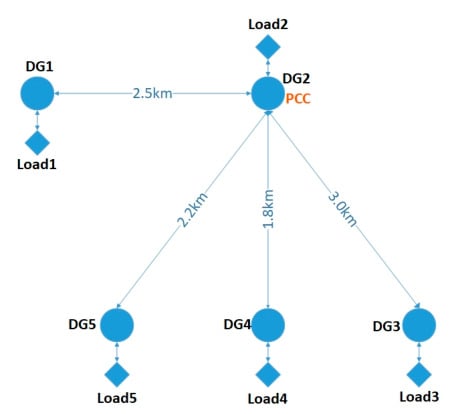
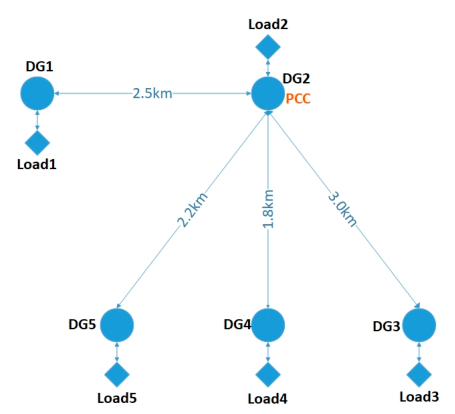
In addition to the communication graph, the physical topology of the microgrid is also essential for understanding the economic dispatch problem. The physical network considered in this study consists of five distributed generators (DGs) connected through a radial distribution network, as shown in Figure 1. The physical distances between DGs are as follows: DG1 to DG2 is 2.5 km, DG2 to DG3 is 3.0 km, DG2 to DG4 is 1.8 km, DG2 to DG5 is 2.2 km, and DG3 to DG4 is 2.0 km. Each DG is interfaced with the microgrid through a three-phase voltage source inverter (VSI) with a DC/AC converter. The point of common coupling (PCC) is located at bus 2, which connects the microgrid to the main grid when operating in grid-connected mode. In islanded mode, the PCC is disconnected, and the microgrid operates autonomously. The line parameters (resistance and inductance) are derived based on the distances and typical distribution line specifications.
Figure 1.
Physical Topology Diagram of Microgrid.
Figure 1 shows the physical topology of the microgrid, including the locations of distributed generators (DGs), loads, and the point of common coupling (PCC). Note that the economic dispatch problem studied in this paper focuses on power balance and cost optimization; therefore, the physical distances and line parameters are not explicitly used in the algorithm but are provided here for completeness of the microgrid description.
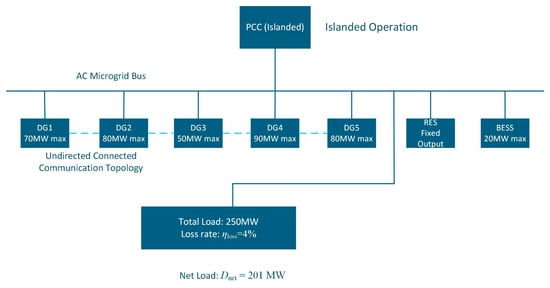
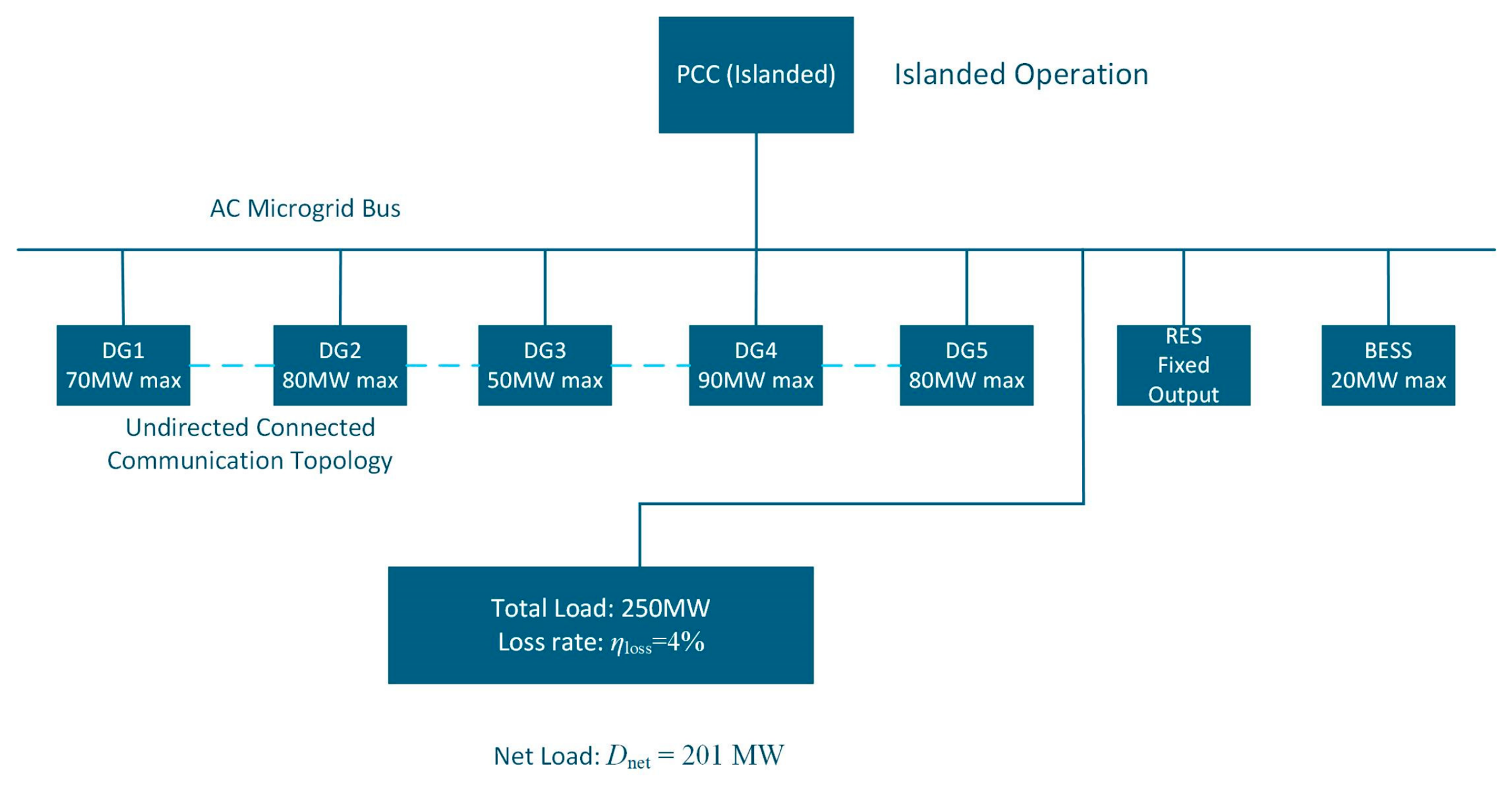
As shown in Figure 2, the studied microgrid is configured as an islanded hybrid AC/DC system, which consists of five dispatchable distributed generators, renewable energy sources, a battery energy storage system, and electric loads. The AC microgrid bus connects all generation units and loads, with the point of common coupling for grid connection, and the system operates in islanded mode. A 4% transmission loss is considered in the economic dispatch, resulting in a net load of 201 MW. Each DG is modeled as an intelligent agent, and an undirected connected communication topology is adopted to support the proposed distributed consensus algorithm. The system architecture is designed with reference to the hybrid AC/DC microgrid paradigm for smart cities [26], which is suitable for modern microgrids with high renewable penetration.
Figure 2.
Global schematic of the studied islanded hybrid AC/DC microgrid system.
2.2.1. Economic Dispatch Without Generation Constraints
Given these conditions—specifically, when accounting for the power balance constraint in Equation (3) while disregarding the generation constraints in Equation (5)—the Lagrange multiplier method offers a solution to the economic dispatch problem. For the optimization framework established by Equations (2)–(4), the corresponding Lagrange function is formulated as follows:
In this formulation, represents the Lagrange multiplier corresponding to the equality constraint, which can be interpreted as the incremental cost. Through the application of the Lagrange multiplier technique, the optimal output power can be expressed as a function of the optimal incremental cost, leading to the following relationship:
Thus, the optimal solution is achieved when the incremental cost of each generator is equal to .
From Equation (7), we have . When , we can obtain:
where is the net load after accounting for renewable generation, energy storage, and transmission losses.
2.2.2. Economic Dispatch with Generation Constraints
When both the power balance requirement outlined in Equation (3) and the generation constraints specified in Equation (5) are taken into account, the output of each generator is restricted by its respective upper bound. Under these combined conditions, the optimal solution to the problem defined by Equations (2)–(5) takes the following form:
Next, we denote the set of generators that have not reached their limits as , and the set of generators that have reached their limits as . Let denote the optimal output power of generator under its generation constraints, and let denote the corresponding optimal incremental cost. Clearly, for generators in , since they have not reached their generation constraints, the condition holds.
Note that the total power demand is supplied by all generators, regardless of whether they have reached their generation constraints, i.e.,
Based on Equation (7) and , we have:
Since the portion of power exceeding the generation constraints of generators in must be supplied by generators in , we have:
Based on Equations (11) and (12), the connection between the optimal incremental cost absent generation constraints (represented as ) and its counterpart when generation constraints are active (represented as ) can be established as:
The optimal power generation under the generation limit is:
3. Problem Description
In the proposed distributed approach for addressing the economic dispatch problem, each generator is modeled as an agent whose state variable corresponds to its incremental cost. The solution strategy integrates local computation of incremental costs with cooperative information sharing across the network structure. Through iterative exchanges, every agent progressively acquires reliable estimates of the incremental costs maintained by its peers within the communication graph. This consensus-driven process enables the optimization of each agent’s own incremental cost, ultimately leading to the determination of both the globally optimal incremental cost and the associated optimal power output for every generator.
Define the auxiliary variable , and define the generator output power as:
where: denotes the weight of the communication link between generators and ; is an auxiliary variable; is an indicator variable, set to 1 if load is connected to generator , and 0 otherwise; represents the power consumed by load .
Assuming each agent implements the following communication protocol:
Therefore, the total power generation satisfies the power balance constraint:
Based on Equations (16)–(19), the update rule for the incremental cost simplifies to:
Setting , Equation (21) can be rewritten in vector form as:
where is the weight matrix, and is the Laplacian matrix.
Lemma 1.
Assume the communication topology of the microgrid is connected. For the incremental cost update Equation (22), the incremental cost vector converges to the steady-state value as , where is the optimal incremental cost determined by Equation (8) [27].
4. Event-Triggered Control-Based EDP
4.1. Event-Triggered Controller Design
In centralized event-triggered schemes, a common state error threshold is employed across all agents to govern control updates; consequently, every agent refreshes its control task concurrently once the error condition is met. By contrast, the distributed event-triggered approach developed in this section allocates a unique state error threshold to each agent , thereby allowing agents to execute their respective control tasks autonomously.
Let the event occurrence times for agent be denoted as , and define the measurement error for agent as:
Definition : For each is the last event time of the agent . For each agent , the last update value of its neighboring agents should be considered in its control law. The control law is updated at its own event time and the event time of its neighbors. The definition of allows Equation (21) to be rewritten as:
As a result, under the distributed event-triggered framework for solving the economic dispatch problem, the communication protocol adopted by each agent is defined as follows:
Similarly, Equations (25)–(27) can be rewritten in stacked vector form as:
Defining , we have . Let ; note that encapsulates the relative state information each agent can obtain from its neighbors, namely:
4.2. Improved Dynamic Event Triggering Mechanism
Given the critical importance of both efficiency and stability in economic dispatch within microgrids, and recognizing that traditional static event-triggering mechanisms struggle to adapt to the dynamic variations encountered during system operation, an improved dynamic event-triggering mechanism is proposed.
A dynamic variable is introduced for each agent , whose update follows the rule:
where controls the decay rate of , adjusts the response intensity of to state errors, and weights the current state error .
Theorem 1.
Consider the dynamic variable with the update rule:
Given initial conditions
and a trigger time sequence
defined as:
where are constant, then for all , we have .
Proof of Theorem 1.
By mathematical induction, the proof proceeds as follows:
(1) Base case ():
Within the interval , the event-triggering condition is not satisfied, i.e.,
Rearranging yields:
Given . Suppose there exists such that , and for (if , then is the first zero). Since is not a trigger time, from Equation (32), we obtain:
Rearranging yields:
Substituting the derivative expression for :
This implies that strictly increases at , so there exists such that , contradicting being to the left of . Therefore, no such exists, meaning that within , holds (if , then immediately makes positive), thus establishing at the base step.
At the trigger time , setting the event-triggering condition as an equality yields:
Rearranging gives:
Thus, also holds.
(2) Induction Step
Assume that at time , we have , and from the event-triggering condition, we know . Consider the interval , where similarly:
Suppose there exists such that , and for . From Equation (37), we have , thus:
This also leads to the contradiction that is negative on the left side of . Therefore, no such exists. Hence, holds within , and , thus holds throughout the entire interval. No such exists, proving that holds within , and thus holds throughout the entire interval. At the trigger time , setting the event-triggering condition as an equality yields:
By mathematical induction, for all , we have .
The rigorous proof of non-negativity establishes a reliable theoretical foundation for both the stability analysis of microgrid economic dispatch systems and the effectiveness of event-triggering strategies. □
Consider a candidate Lyapunov function:
Then, taking the time derivative of yields:
By the definition of the Laplacian matrix, we obtain:
where denotes the set of neighbors of agent .
Using the inequality , when , we can compute an upper bound for as:
Since the communication graph is undirected and symmetric, we have , yielding:
Based on the dynamic variable , we define the event event-triggering condition as:
The design of the triggering threshold plays a critical role in balancing communication efficiency and control performance. In the proposed mechanism, the threshold is governed by the dynamic variable and the parameter . From the event-triggering condition in Equation (44), the effective threshold for is . Unlike static thresholds that remain constant, this dynamic threshold evolves according to Equation (30), increasing when state errors are large to prevent excessive triggering and decreasing when errors are small to maintain sensitivity. The parameter directly influences the trade-off: a larger raises the threshold, reducing communication frequency at the cost of larger steady-state errors; a smaller lowers the threshold, improving accuracy but increasing triggering frequency. In practice, should be selected based on the desired balance between communication savings and control precision, typically through offline tuning or heuristic rules. In this paper, the value of (ranging from 0.3 to 0.6) is selected empirically.
Introducing the above event-triggering condition yields:
Given and , and assuming and , we obtain:
The preceding analysis confirms that the introduced dynamic event-triggering scheme facilitates a progressive reduction in system state error, which in turn secures asymptotic stability for the microgrid’s economic dispatch operation and validates the efficacy of the event-triggered approach.
An important practical concern in event-triggered control is the occurrence of false alarms, i.e., triggering events when the system state does not require communication updates. False alarms typically arise from measurement noise, numerical errors, or overly sensitive threshold settings. In the proposed dynamic event-triggered mechanism, the risk of false alarms is inherently mitigated by two factors. First, the dynamic variable introduces a hysteresis effect: as shown in Theorem 1, remains non-negative, and the triggering condition requires the error term to exceed . Small perturbations or noise below this threshold will not trigger events. Second, the minimum inter-event interval constraint prevents back-to-back triggering caused by noise-induced threshold crossings. Compared with static threshold-based mechanisms, where a fixed low threshold may lead to frequent spurious triggers under noisy conditions, the proposed dynamic mechanism exhibits superior resilience to false alarms. However, under extreme noise levels, the triggering frequency may increase. In such cases, increasing or adjusting and can reduce false alarms, albeit with a potential trade-off in convergence speed.
4.3. Exclusionary Proof of Zeno Behavior
A critical concern in dynamic event-triggered schemes is the potential emergence of Zeno behavior, characterized by an accumulation of infinitely many triggering instants within a bounded timeframe, which undermines real-world system feasibility. Hence, a formal demonstration that the proposed mechanism is inherently free from such Zeno phenomena becomes imperative.
Definition 1 (Zeno Behavior).
If event exists such that the sequence of trigger times for event satisfies , then the system is said to exhibit Zeno behavior.
Theorem 2.
For the dynamic event-triggering condition , there exists a positive constant such that the adjacent event-triggering interval satisfies for all , i.e., the system exhibits no Zeno behavior.
Proof of Theorem 2.
Within the trigger interval , by Theorem 1, we have , and the event-triggering condition is not satisfied, i.e.,
Rearranging yields:
Considering the boundedness of the system state (as established by Lyapunov stability analysis), there exists a constant such that:
Simultaneously, from the update law of and Equation (47), within the trigger interval we have:
Let . If , then grows exponentially within the interval. However, from Equation (48) and the trigger timing relation , combined with growth properties, we obtain an upper bound on , thus preventing the trigger interval from becoming arbitrarily large. We still require a lower bound, so consider the case where (parameters can be designed to ensure this condition). Here, , and Equation (49) yields:
At the next trigger time , the event-triggering condition holds as an equality, i.e.,
Combining Equations (50) and (51) yields:
According to Theorem 1, (strictly positive unless the initial value is zero, but it becomes positive immediately afterward), and the system state is bounded. Thus, there exists a constant such that holds for all , implying:
Taking the natural logarithm of both sides of Equation (53) yields:
Since , and parameters can be appropriately chosen to ensure that is less than 1 inside the logarithm. In fact, if , then , and the right-hand side is positive, so Equation (54) provides a positive lower bound. If , then the logarithm is non-negative, the right-hand side is non-positive, and the inequality holds trivially; in this case, another lower bound must be sought. However, due to the boundedness of the system, typically does not exceed .
Moreover, it can be shown that there exists a constant such that , implying that Equation (55) provides a positive lower bound. Therefore, there exists a constant independent of , such that .
In summary, the trigger interval between adjacent events has a positive lower bound. The system triggers at most a finite number of times within any finite time interval, thus precluding Zeno behavior. □
4.4. Consistency Analysis Under Dynamic Event-Triggering Mechanisms
The dynamic event-triggering mechanism employed in microgrid economic dispatch adaptively adjusts trigger thresholds, thereby significantly reducing communication frequency while ensuring system consensus. This section systematically and rigorously discusses the consensus theory under the dynamic triggering mechanism, examining scenarios both with and without generation constraints.
4.4.1. Consistency Analysis Without Generation Limitations
In the case where the upper and lower limits of generator power output are not considered, the economic dispatch problem is simplified to a minimization of the total generation cost under the power balance constraint. Its optimal solution satisfies the equal incremental rate principle; that is, the incremental costs of all generators converge to the same optimal value . This section proves that under the action of the dynamic event-triggered mechanism, the incremental costs of all agents can still asymptotically converge to this optimal value.
Theorem 3.
Assume the communication graph of the multi-agent system is connected and undirected. For each agent satisfying the event-triggering condition (44), the proposed algorithm in Equations (25)–(27) provides a solution to the economic dispatch problem defined by Equations (2)–(4), i.e., as , .
Proof of Theorem 3.
By the event-triggering condition (44), when , we can derive the Lyapunov function.
Therefore, as approaches zero, agreement is reached. Then, using the definition of , we derive . The exclusion of Zeno behavior has been established in Section 4.4; hence, no Zeno behavior exists in the proposed mechanism. □
4.4.2. Consistency Analysis with Power Generation Constraints
Once generation constraints are taken into account, the estimated power output of each generator must be evaluated at each sampling instant. Whenever a generator’s output falls outside the permissible generation range, its value is adjusted to either the upper or lower bound of that interval. This adjustment process leads to the formation of the sets and .
Following the approach outlined in ref. [28], the introduction of two auxiliary variables, denoted as and , enables the application of the following distributed algorithm to address the optimization problem subject to generation constraints:
The initial states are given by:
Similarly to Lemma 1, we conclude that average consensus holds, i.e.,
which implies that as ,
Therefore, the optimal incremental cost with generation constraints is:
Clearly, Equation (59) is equivalent to Equation (13), and the corresponding optimal power generation is determined by Equation (14). The values of certain parameters are shown in Table 1.
Table 1.
Generator parameters.
Theorem 4.
Assume the communication graph of the generation system is connected and undirected. Then, the proposed event-triggered consensus algorithm (55)–(58) provides a solution to the economic dispatch problem defined by Equations (2)–(5), i.e., as , and .
Proof of Theorem 4.
The proof of Theorem 4 is analogous to that of Theorem 4 and is omitted for brevity. □
5. Simulation Experiments
To comprehensively validate the proposed dynamic event-triggered consensus algorithm, three sets of simulation experiments are carried out for two cases: with and without generation constraints. First, the baseline performance is verified in the corresponding standard scenarios. Second, the robustness of the algorithm under communication imperfections is examined by introducing a 50 ms time delay. Third, a comparative study with the Alternating Direction Method of Multipliers (ADMM) is conducted to demonstrate the superiority of the proposed method in terms of communication efficiency.
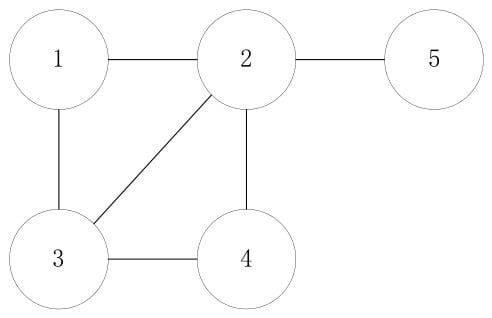
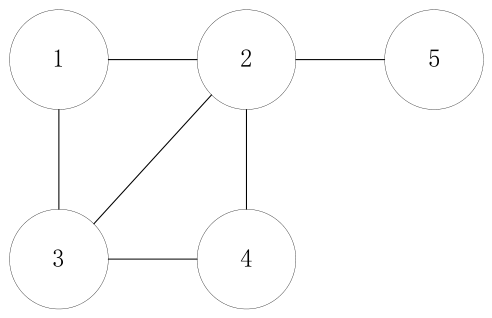
The proposed algorithm is validated through simulations on a microgrid model with five agents. The communication topology is undirected and connected, as shown in Figure 3.
Figure 3.
Topological communication graph.
The total load demand is MW (with individual loads of 50, 60, 70, 30, and 40 MW at buses 1–5, respectively). The renewable energy outputs are set as MW, and the transmission loss rate is . A battery energy storage system (BESS) with power rating MW is installed at bus 3 to assist in peak shaving. In the steady-state economic dispatch, the BESS is assumed to operate at MW (discharging) to compensate for the power deficit caused by generator 3 reaching its upper limit. Consequently, the net load that must be supplied by conventional generators is calculated as:
All branch power limits are set to 100 MW, and simulation results confirm that all line flows remain below this limit, indicating that no congestion occurs.
Assuming a unit weight for each communication link in the topology, the corresponding Laplacian matrix L, derived from graph theory, is given by:
Equation (46) yields the parameters for each agent as follows:
; , , , , ; , , , , ; , , , , ; , , , , . The sampling time is set to s.
5.1. Consideration of Generators Without Power Generation Restrictions
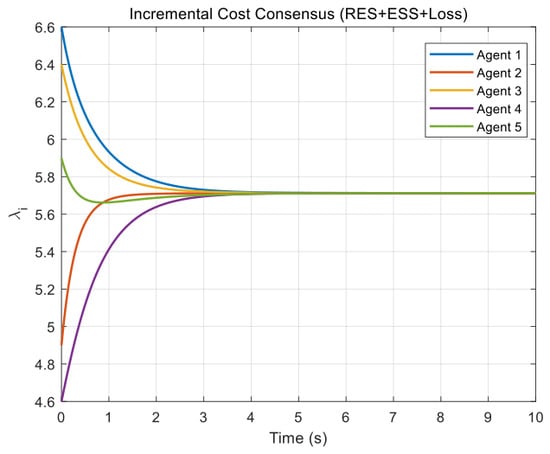
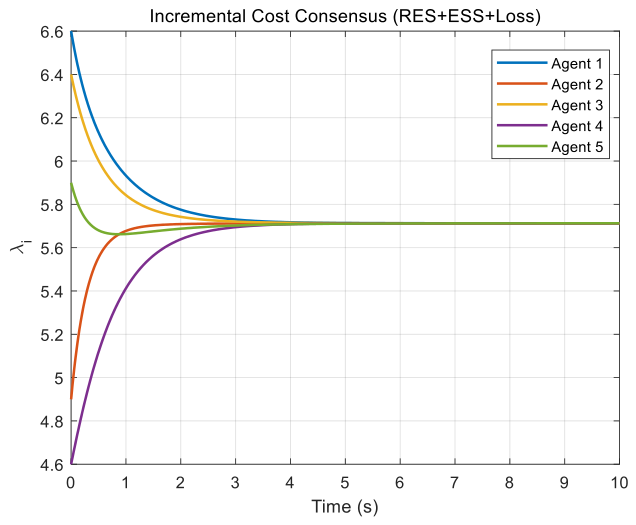
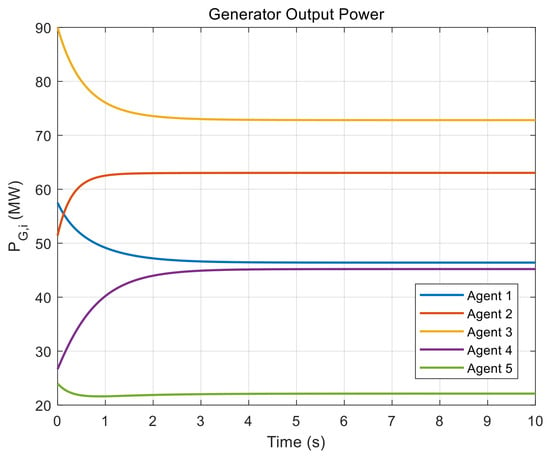
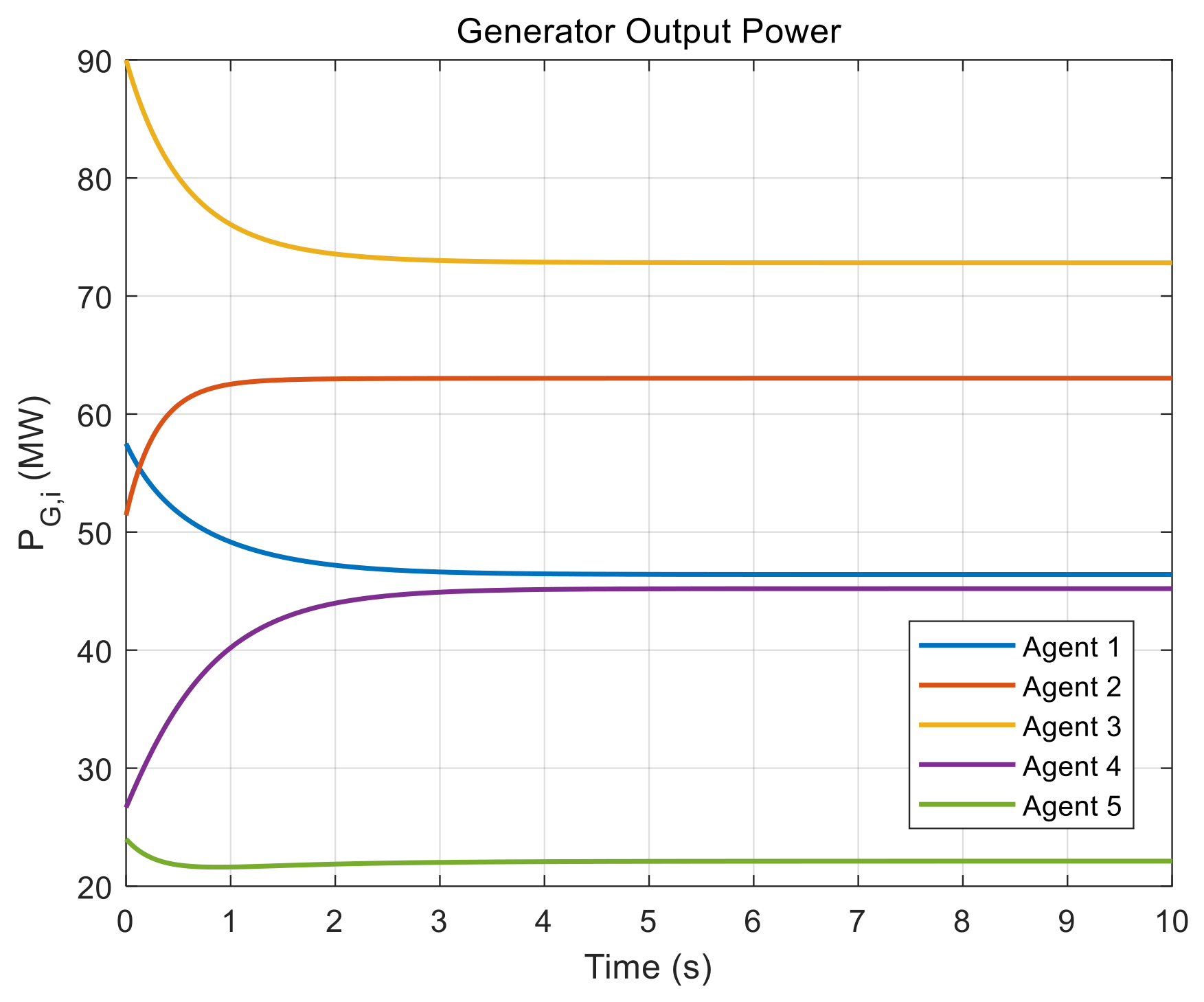
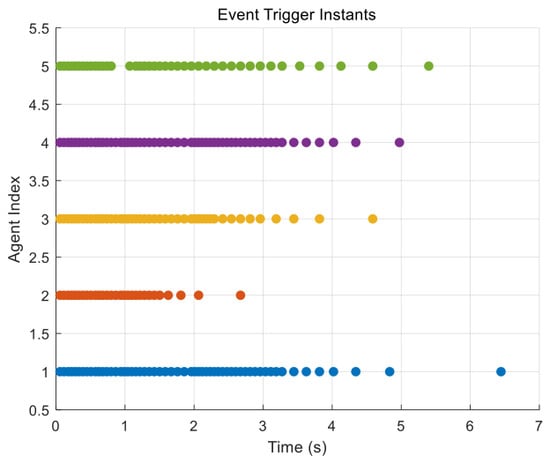
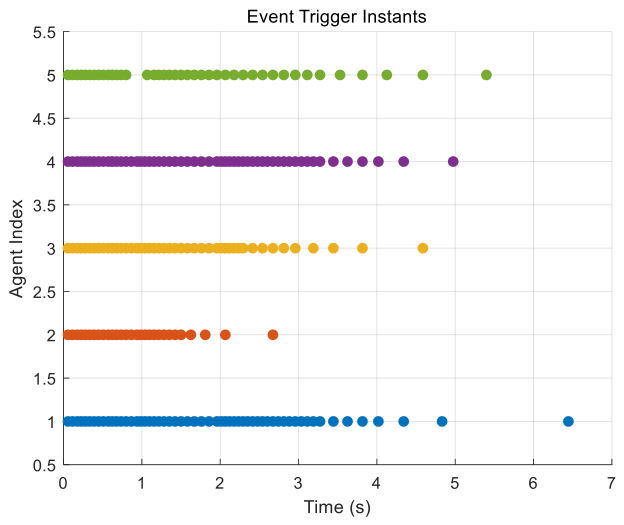
Figure 4 presents the temporal progression of incremental cost and power generation under the event-triggered consensus algorithms defined by Equations (25)–(27) and condition (44). Relative to traditional consensus methods, the event-triggered approach achieves a comparable convergence rate yet markedly reduces the update frequency of generator power outputs. In this specific case, the incremental cost attains its optimal value (calculated from Equation (7) with MW) within a 5.56 s interval, as evidenced in Figure 4. Correspondingly, upon stabilization of the incremental cost, each generator’s output power converges to its individual optimum, a trend illustrated in Figure 5. The triggering instances for every agent are depicted in Figure 6, where control updates are initiated each time the state error meets the predefined threshold.
Figure 4.
The change in the incremental cost of each agent.
Figure 5.
The change in the power generation of each agent.
Figure 6.
The event-triggered moments of each agent.
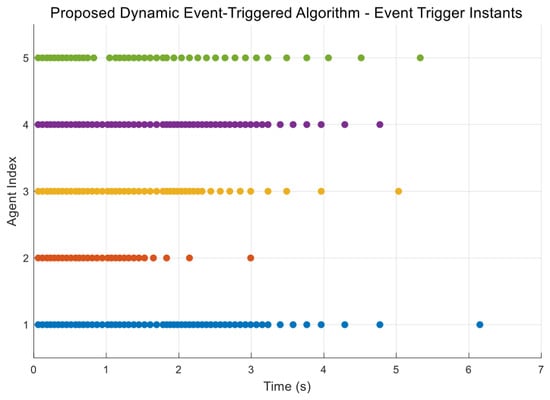
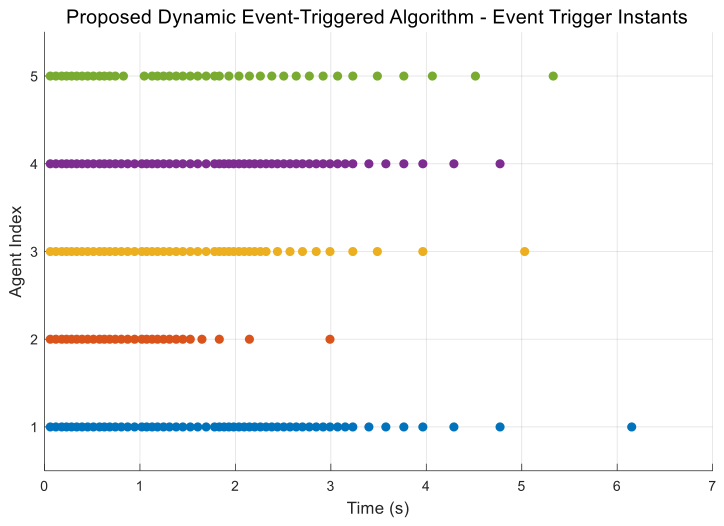
To compare the performance of the proposed dynamic mechanism against the static one, we analyzed the triggering frequency. Simulation results show that the original mechanism triggered a total of 255 events within 3 s, corresponding to an average frequency of 85 events per second. In contrast, the proposed mechanism triggered a total of 228 events within 5.56 s, yielding an average frequency of approximately 41 events per second. On a per-unit-time basis, the proposed mechanism reduces the event-triggering frequency by about 51%. As a result, it satisfies the demands of cost-effective energy usage while simultaneously preserving communication bandwidth.
A further per-agent analysis reveals that Agent 3, which reaches its generation limit, exhibits the lowest triggering frequency, while Agent 4 shows the highest. The average inter-event interval across all agents is 0.244 s, which is significantly larger than the minimum inter-event interval of 0.05 s, confirming that Zeno behavior is avoided. The well-distributed triggering events without clustering further indicate that the proposed mechanism effectively prevents network congestion.
5.2. Robustness Under Communication Delay
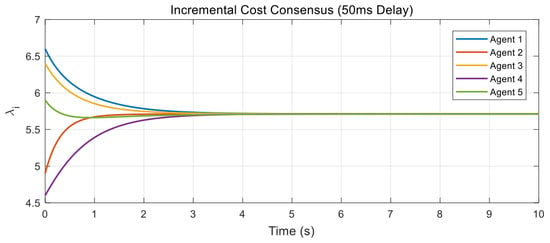
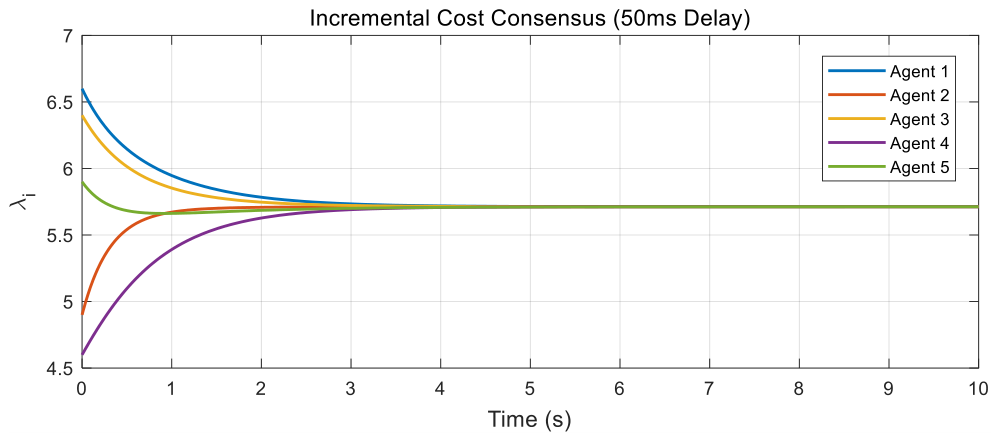
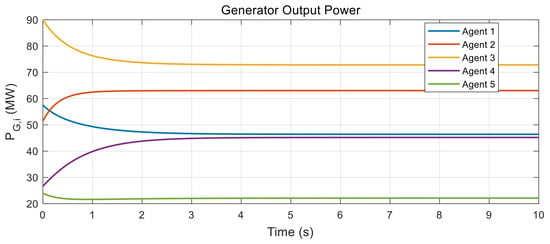
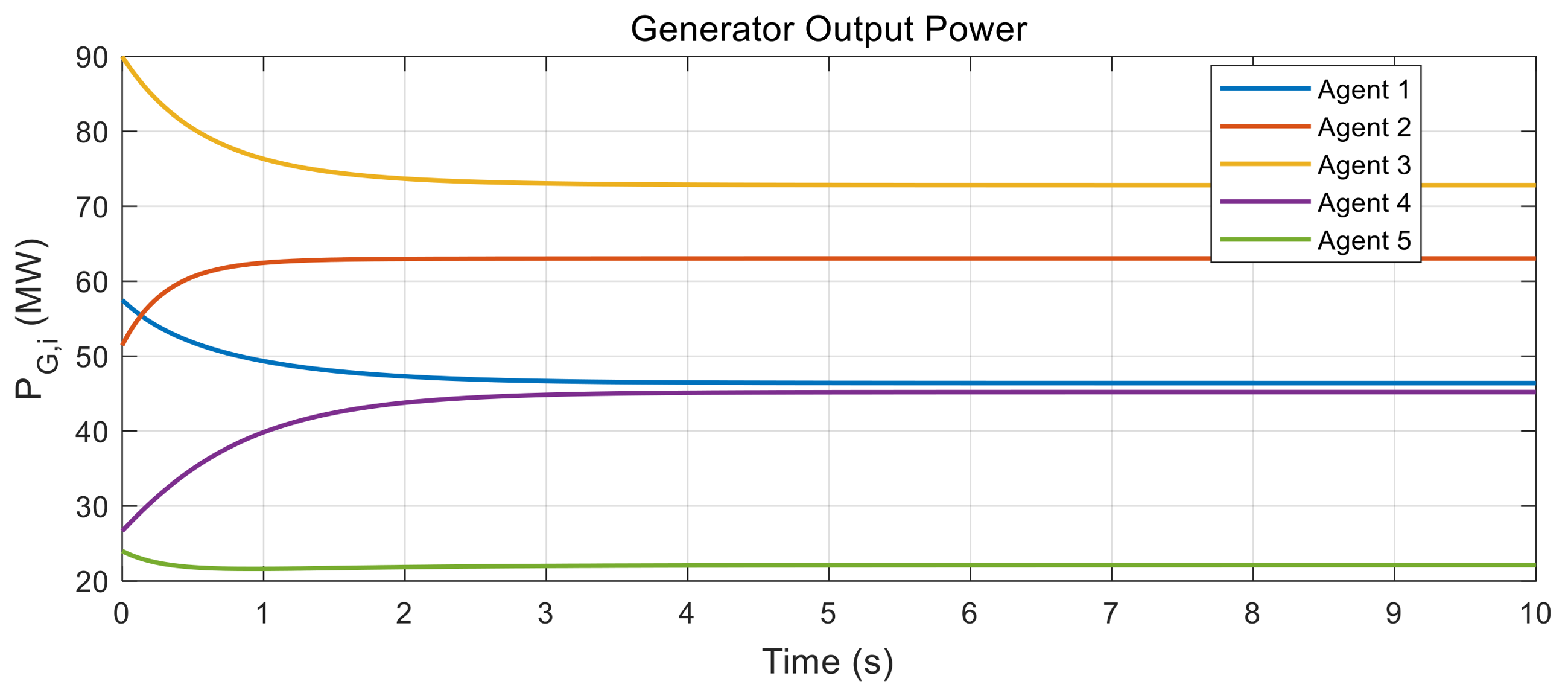
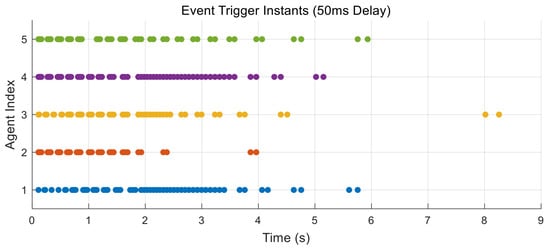
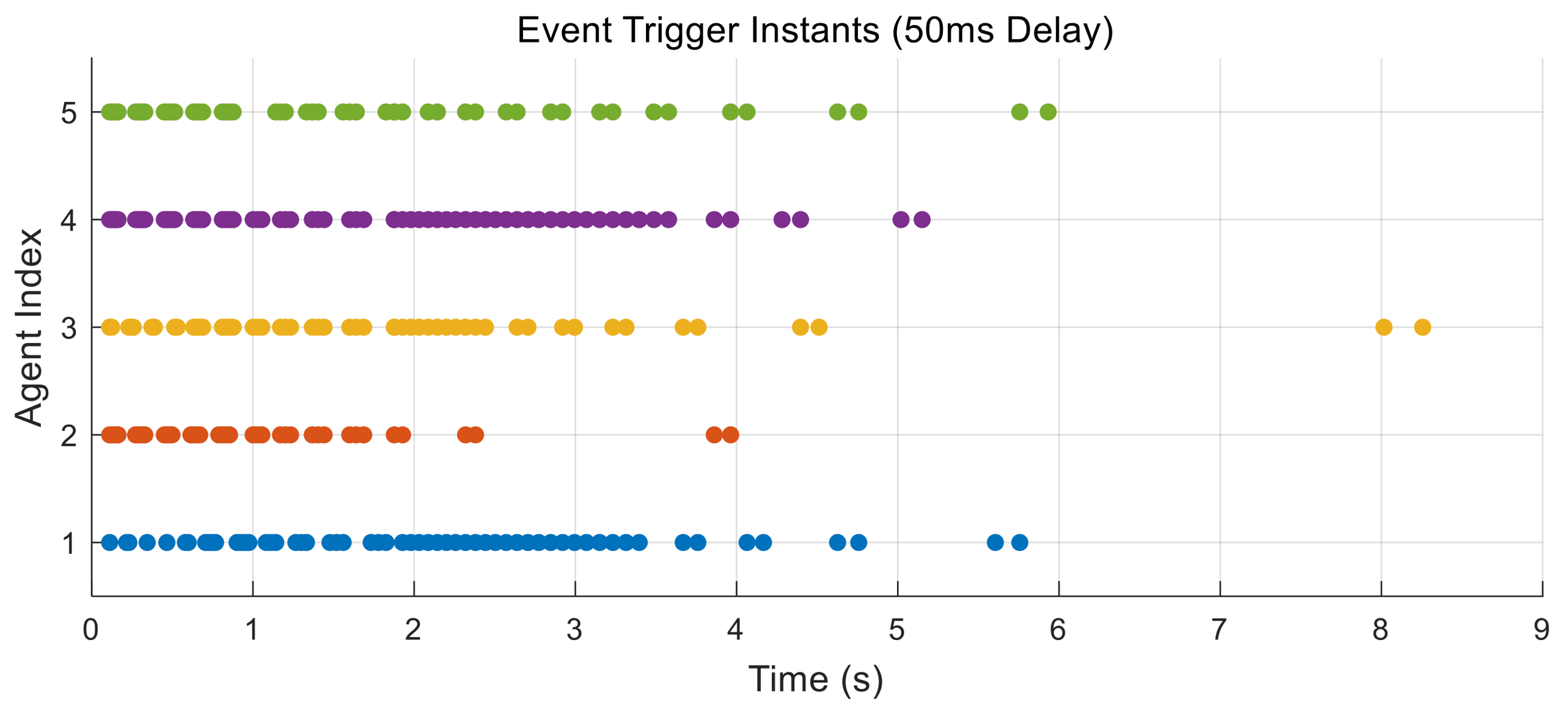
To evaluate the robustness of the proposed algorithm against communication imperfections, a fixed time delay of is introduced into all communication links. This delay value represents a typical worst-case scenario in industrial microgrid communication networks. Figure 7 shows the incremental cost trajectories under this delay, which still converge to the optimal value , albeit with a slightly prolonged convergence time of approximately 5.93 s compared to the delay-free case. Figure 8 presents the corresponding generator outputs, where each generator converges to its optimal power output while maintaining the power balance constraint.
Figure 7.
Convergence Curve of Incremental Cost under a 50 ms Time Delay.
Figure 8.
Generator Power Curve under a 50 ms Time Delay.
Figure 9 illustrates the event-triggered instants of each agent under the 50 ms delay. Compared with the delay-free scenario, the triggering frequency increases slightly due to delay-induced state estimation errors; however, it remains significantly lower than that of static event-triggered mechanisms. The results confirm that the proposed algorithm maintains effective performance under bounded communication delays, and the positive lower bound of inter-event intervals (proved in Theorem 2) guarantees that Zeno behavior is avoided. These properties make the proposed method suitable for practical microgrid applications where communication delays are unavoidable.
Figure 9.
Event-triggered Instants under a 50 ms Time Delay.
5.3. Consideration of Power Generation Limitations for Generator Sets
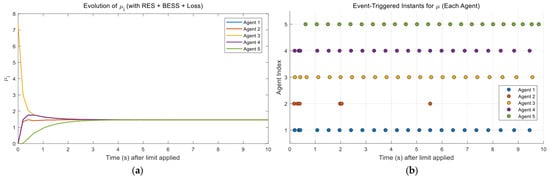
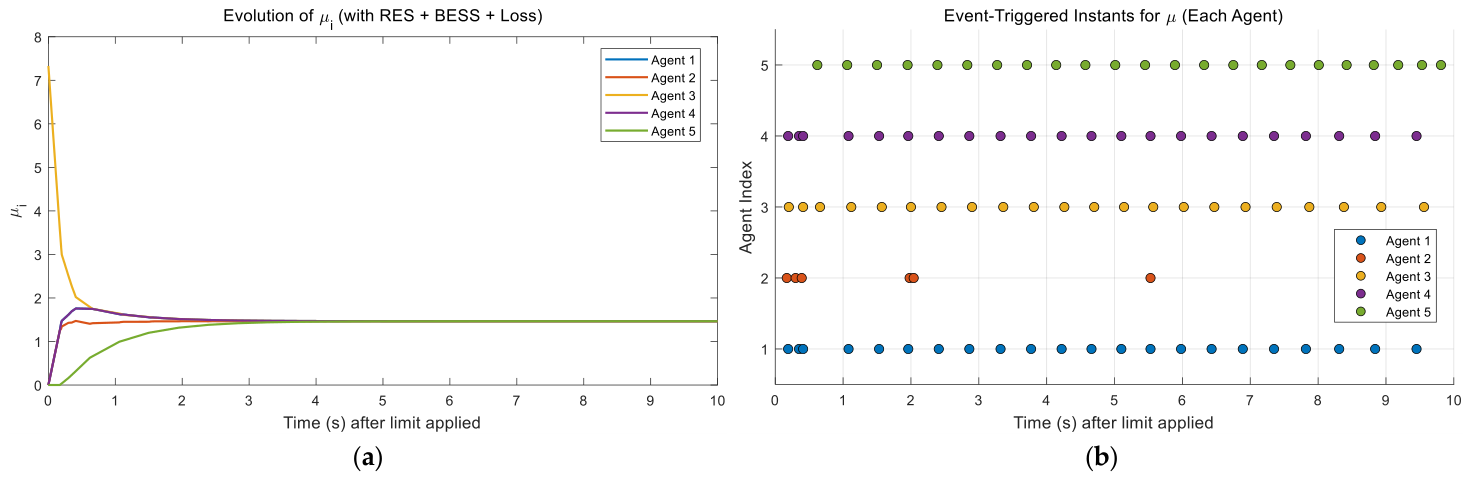
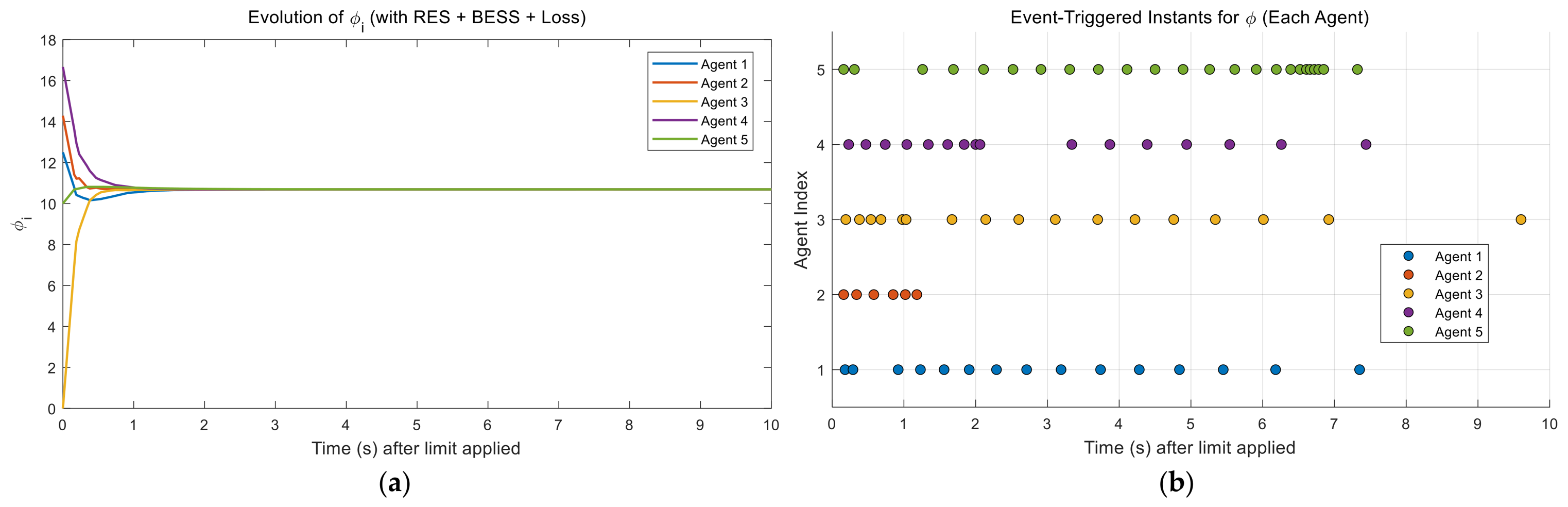
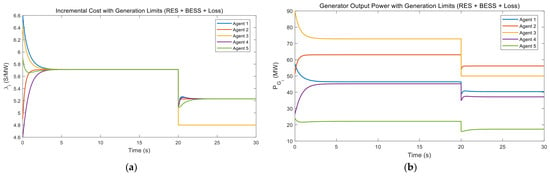
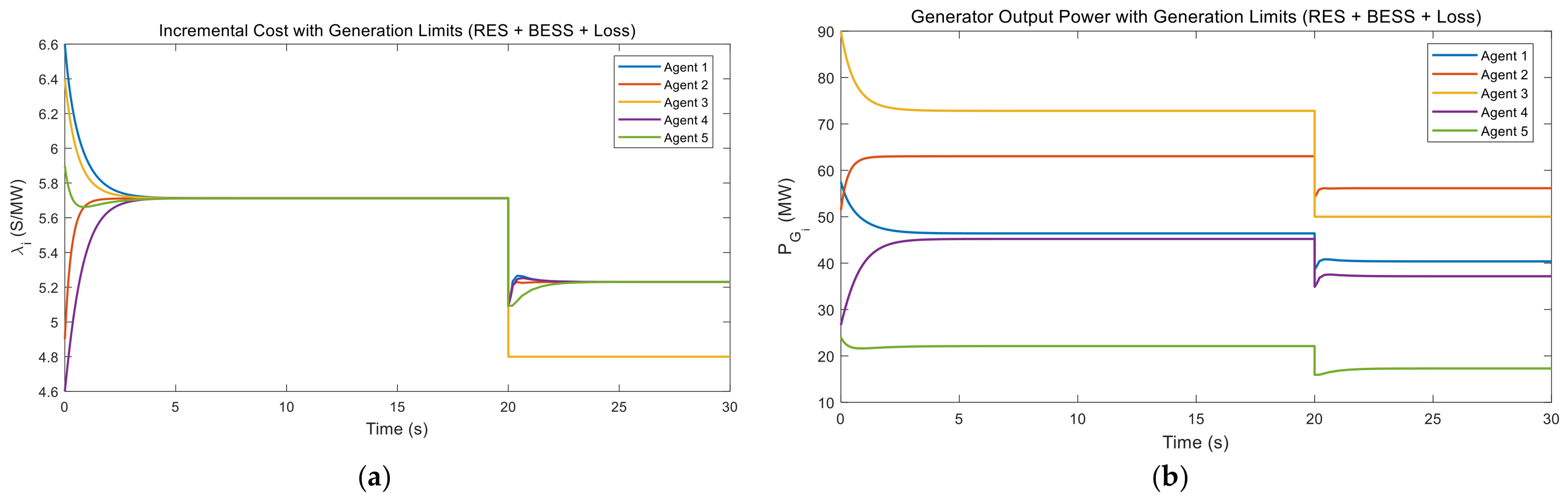
The simulation results indicate that the third generator has reached its maximum power generation limit, motivating us to consider scenarios with generation constraints. Setting and , the initial conditions for the two auxiliary variables determined by Equations (57) and (58) are: , and , , , . The two auxiliary variables and converge to their steady-state values, as shown in the simulation results. Figure 10 and Figure 11 illustrate the evolution of and during the iteration process and the corresponding event-triggering instants. After iteration, both variables converge to their respective average values. Assuming the generation constraints are applied at , the resulting trajectories of the incremental cost and output power are depicted in Figure 12. Both the incremental cost and generator output power still achieve their optimal values after the constraints are imposed. This simulation demonstrates that the distributed scheme presented in Theorem 4 effectively solves the economic dispatch problem under generator power constraints, achieving the objective of minimizing generation costs.
Figure 10.
(a) The variation of ; (b) the triggering moments.
Figure 11.
(a) The variation of ; (b) the triggering moments.
Figure 12.
(a) The variation of incremental costs of each agent without and with generation limit; (b) the variation of power generation of each agent without and with generation limit.
5.4. Comparison with ADMM Algorithm
To further demonstrate the superiority of the proposed method, a comparison with the Alternating Direction Method of Multipliers (ADMM) is conducted. ADMM is a widely adopted distributed optimization method for economic dispatch problems [29].
The ADMM algorithm is implemented with the following iterative updates for each agent :
where is the auxiliary variable, is the scaled dual variable, is the step size, and denotes the number of neighbors of agent . The penalty parameter is set to , and the convergence tolerance is .
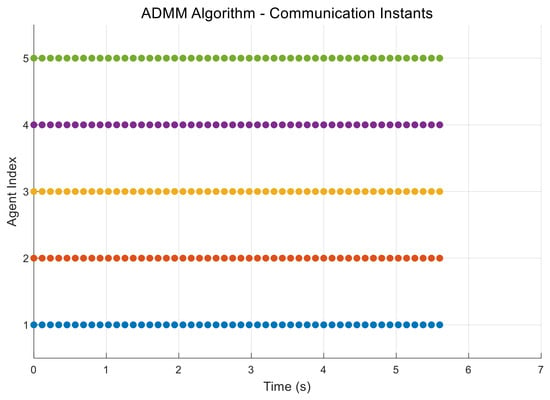
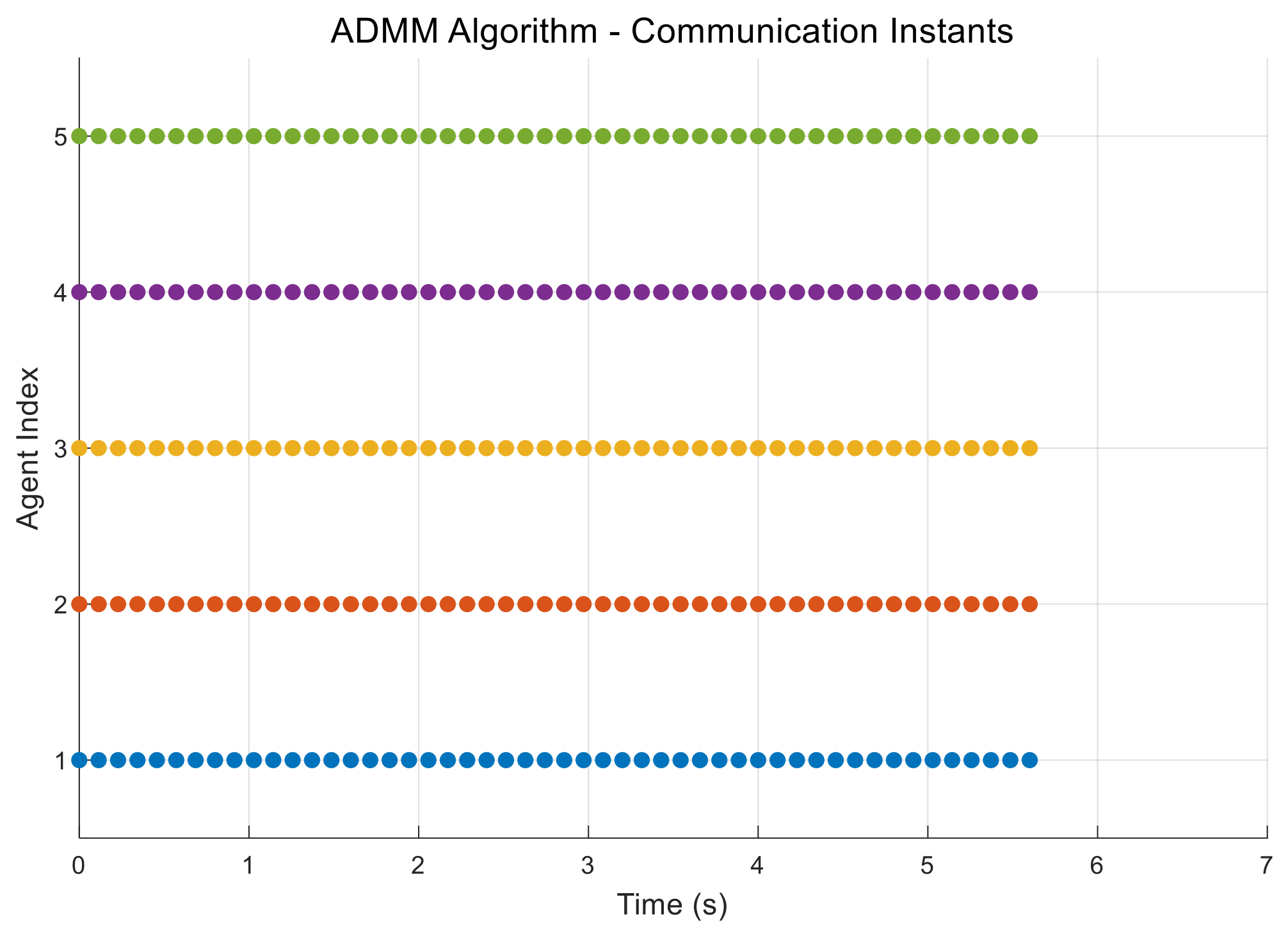
Figure 13 shows the event-triggered instants of the proposed algorithm, while Figure 14 presents the periodic communication instants of ADMM.
Figure 13.
Event-triggered Instants of the Algorithm in This Paper.
Figure 14.
Communication Instants of ADMM Algorithm.
5.5. Summary of Simulation Results
In summary, the proposed dynamic event-triggered consensus algorithm achieves optimal economic dispatch under all tested scenarios, reduces communication frequency by 51% compared to static mechanisms, maintains convergence under 50 ms delay, and outperforms ADMM in steady-state accuracy.
Although the proposed algorithm is demonstrated on an AC-only microgrid, its potential economic benefits for hybrid AC/DC microgrids can be discussed based on the simulation results. The 51% reduction in communication frequency directly translates into lower bandwidth requirements and reduced energy consumption for communication devices, which is particularly valuable in islanded microgrids where communication infrastructure may be limited. The event-triggered nature reduces the computational burden on each DG controller, potentially extending hardware lifespan and lowering maintenance costs. The improved steady-state accuracy further minimizes generation costs by ensuring optimal power allocation. The main cost associated with implementation is the offline tuning of parameters such as , and , which is a one-time effort. For a typical hybrid microgrid with 5 DGs, the implementation overhead is minimal, as the algorithm only requires local state information and neighbor communication. Therefore, the proposed method offers a favorable cost–benefit trade-off for practical microgrid applications.
6. Conclusions
This paper has proposed an improved dynamic event-triggered consensus algorithm for microgrid economic dispatch. Unlike existing methods that rely on static thresholds, the proposed mechanism introduces a dynamic variable that adaptively adjusts the triggering condition based on real-time state errors, achieving a 51% reduction in triggering frequency compared to static event-triggered mechanisms while providing rigorous proofs of asymptotic stability and Zeno-freeness. The model integrates practical physical constraints, including renewable energy sources, battery energy storage systems, and transmission losses, directly into the power balance constraint. Simulation results demonstrate that the algorithm maintains convergence under a 50 ms communication delay and achieves superior steady-state accuracy compared to the Alternating Direction Method of Multipliers (ADMM). The algorithm scales naturally to larger microgrids due to its local communication nature, though extensions to non-convex cost functions and time-varying communication topologies remain important future directions. Main limitations include offline parameter tuning and the assumption of fixed renewable generation forecasts. Future research will explore applicability to directed graphs, resilience against cyberattacks, and hardware-in-the-loop validation.
Author Contributions
Conceptualization, S.F.; methodology, S.F. and C.X.; validation, S.F.; formal analysis, S.F.; writing—original draft preparation, S.F.; writing—review and editing, S.F. and C.X. All authors have read and agreed to the published version of the manuscript.
Funding
This research was partially funded by the National Natural Science Foundation of China (grant no. 62373143), by the Key Project of Hunan Provincial Education Department under Grant 21A0366 and Grant 22A0406, and by the Project of Zhuzhou Double Innovation Excellent Talent under Grant 2024-7.
Data Availability Statement
The data presented in this study are available in the text.
Conflicts of Interest
The authors declare no conflicts of interest.
References
- Ahmad, S.; Shafiullah, M.; Ahmed, C.B.; Alowaifeer, M. A review of microgrid energy management and control strategies. IEEE Access 2023, 11, 21729–21757. [Google Scholar] [CrossRef] [Scilit]
- Jithin, K.; Haridev, P.P.; Mayadevi, N.; Harikumar, R.P.; Mini, V.P. A review on challenges in DC microgrid planning and implementation. J. Mod. Power Syst. Clean Energy 2022, 11, 1375–1395. [Google Scholar] [CrossRef] [Scilit]
- Shafiullah, M.; Refat, A.M.; Haque, M.E.; Chowdhury, D.M.H.; Hossain, M.S.; Alharbi, A.G.; Alam, M.S.; Ali, A.; Hossain, S. Review of recent developments in microgrid energy management strategies. Sustainability 2022, 14, 14794. [Google Scholar] [CrossRef] [Scilit]
- Ross, M.; Abbey, C.; Bouffard, F.; Joos, G. Microgrid economic dispatch with energy storage systems. IEEE Trans. Smart Grid 2016, 9, 3039–3047. [Google Scholar] [CrossRef] [Scilit]
- Duan, Y.; Zhao, Y.; Hu, J. An initialization-free distributed algorithm for dynamic economic dispatch problems in microgrid: Modeling, optimization and analysis. Sustain. Energy Grids Netw. 2023, 34, 101004. [Google Scholar] [CrossRef] [Scilit]
- He, Y.; Han, Z.; Sun, K.; Wu, X.; Du, X.; Wang, H.; Lu, H. Economic optimization scheduling of multi-microgrid based on improved genetic algorithm. IET Gener. Transm. Distrib. 2023, 17, 5298–5307. [Google Scholar] [CrossRef] [Scilit]
- Yoon, C.; Park, Y.; Sim, M.K.; Lee, Y.I. A quadratic programming-based power dispatch method for a DC-microgrid. IEEE Access 2020, 8, 211924–211936. [Google Scholar] [CrossRef] [Scilit]
- Parvin, M.; Yousefi, H.; Noorollahi, Y. Techno-economic optimization of a renewable micro grid using multi-objective particle swarm optimization algorithm. Energy Convers. Manag. 2023, 277, 116639. [Google Scholar] [CrossRef] [Scilit]
- Liu, D.; Jiang, K.; Yan, L.; Ji, X.; Cao, K.; Xiong, P. A fully distributed economic dispatch method in DC microgrid based on consensus algorithm. IEEE Access 2022, 10, 119345–119356. [Google Scholar] [CrossRef] [Scilit]
- Chen, W.; Li, T. Distributed economic dispatch for energy internet based on multiagent consensus control. IEEE Trans. Autom. Control 2020, 66, 137–152. [Google Scholar] [CrossRef] [Scilit]
- Wang, H.; Wu, X.; Sun, K.; He, Y. Research on the optimal economic power dispatching of a multi-microgrid cooperative operation. Energies 2022, 15, 8194. [Google Scholar] [CrossRef] [Scilit]
- Liu, H.; Fan, H.; Wang, B. Distributed event-triggered strategy for fixed-time economic dispatch in islanded microgrids. In Proceedings of the 2021 33rd Chinese Control and Decision Conference (CCDC), Kunming, China, 22–24 May 2021; IEEE: New York, NY, USA, 2021; pp. 1401–1406. [Google Scholar]
- Xu, T.; Fang, X.; Fan, Y. Economic Scheduling of Multi-microgrid Systems Based on Distributed Event-triggered Consensus Strategy. In Proceedings of the 2023 8th International Conference on Power and Renewable Energy (ICPRE), Shanghai, China, 22–25 September 2023; IEEE: New York, NY, USA, 2023; pp. 714–719. [Google Scholar]
- Kamalinia, S.; Rafiei, S.; Abedi, M.; Naderi, M.S.; Gharehpetian, G.B. Improvement of Frequency Control of Multi-Microgrids in Distribution Networks. In Proceedings of the 2021 11th Smart Grid Conference (SGC), Tabriz, Iran, 7–9 December 2021; IEEE: New York, NY, USA, 2021; pp. 1–7. [Google Scholar]
- Li, C.; Yu, X.; Yu, W.; Huang, T.; Liu, Z.W. Distributed event-triggered scheme for economic dispatch in smart grids. IEEE Trans. Ind. Inform. 2015, 12, 1775–1785. [Google Scholar] [CrossRef] [Scilit]
- Chen, J.; Yue, D.; Dou, C.; Weng, S.; Xie, X.; Li, Y.; Hancke, G.P. Static and dynamic event-triggered mechanisms for distributed secondary control of inverters in low-voltage islanded microgrids. IEEE Trans. Cybern. 2020, 52, 6925–6938. [Google Scholar] [CrossRef] [Scilit] [PubMed]
- Huang, L.; Sun, W.; Li, Q.; Li, W. Distributed real-time economic dispatch for islanded microgrids with dynamic power demand. Appl. Energy 2023, 342, 121156. [Google Scholar] [CrossRef] [Scilit]
- Dong, Z.; Mao, S.; Perc, M.; Du, W.; Tang, Y. A distributed dynamic event-triggered algorithm with linear convergence rate for the economic dispatch problem. IEEE Trans. Netw. Sci. Eng. 2022, 10, 500–513. [Google Scholar] [CrossRef] [Scilit]
- Ardavan, M.; Armin, T.; Ali, M.-S.; Kambiz, T. Performance Evaluation of an Inverter-Based Microgrid Under Cyberattacks. In Proceedings of the 2020 IEEE 15th International Conference of System of Systems Engineering (SOSE 2020), Budapest, Hungary, 2–4 June 2020; pp. 211–216. [Google Scholar]
- Zhang, J.; Zhou, B.; Zhang, H.; Yang, D. Fully distributed event-triggered secondary control for Islanded microgrid restoration with communication link faults. IEEE Trans. Autom. Sci. Eng. 2026, 23, 2465–2474. [Google Scholar] [CrossRef] [Scilit]
- Xu, Y.; Dong, Z.; Li, Z.; Liu, Y.; Ding, Z. Distributed optimization for integrated frequency regulation and economic dispatch in microgrids. IEEE Trans. Smart Grid 2021, 12, 4595–4606. [Google Scholar] [CrossRef] [Scilit]
- Chang, S.; Wang, H.; Luo, X.; Guan, X. Distributed predefined-time economic dispatch based on event-triggered strategy for microgrids under directed graphs. Neurocomputing 2024, 607, 128391. [Google Scholar] [CrossRef] [Scilit]
- Alvi, U.E.H.; Ahmed, W.; Rehan, M.; Ahmed, S.; Ahmad, R.; Ahmed, I. A novel incremental cost consensus approach for distributed economic dispatch over directed communication topologies in a smart grid. Soft Comput. 2022, 26, 6685–6700. [Google Scholar] [CrossRef] [Scilit]
- Mahmoodi, M.; Shamsi, P.; Fahimi, B. Economic dispatch of a hybrid microgrid with distributed energy storage. IEEE Trans. Smart Grid 2015, 6, 2607–2614. [Google Scholar] [CrossRef] [Scilit]
- Kaur, P.; Chaturvedi, K.T. Economic Power Dispatching from Distributed Generations: Review of Optimization Techniques. Energy Eng. 2024, 121, 557–579. [Google Scholar] [CrossRef] [Scilit]
- Kazerani, M.; Tehrani, K. Grid of hybrid AC/DC microgrids: A new paradigm for smart city of tomorrow. In Proceedings of the 2020 IEEE 15th International Conference of System of Systems Engineering (SoSE), Budapest, Hungary, 2–4 June 2020; IEEE: New York, NY, USA, 2020; pp. 175–180. [Google Scholar]
- Yu, M.; Song, C.; Feng, S.; Tan, W. A consensus approach for economic dispatch problem in a microgrid with random delay effects. Int. J. Electr. Power Energy Syst. 2020, 118, 105794. [Google Scholar] [CrossRef] [Scilit]
- Chen, G.; Ren, J.; Feng, E.N. Distributed finite-time economic dispatch of a network of energy resources. IEEE Trans. Smart Grid 2016, 8, 822–832. [Google Scholar] [CrossRef] [Scilit]
- Chen, G.; Yang, Q. An ADMM-based distributed algorithm for economic dispatch in islanded microgrids. IEEE Trans. Ind. Inform. 2017, 14, 3892–3903. [Google Scholar] [CrossRef] [Scilit]

Disclaimer/Publisher’s Note: The statements, opinions and data contained in all publications are solely those of the individual author(s) and contributor(s) and not of MDPI and/or the editor(s). MDPI and/or the editor(s) disclaim responsibility for any injury to people or property resulting from any ideas, methods, instructions or products referred to in the content. |
© 2026 by the authors. Licensee MDPI, Basel, Switzerland. This article is an open access article distributed under the terms and conditions of the Creative Commons Attribution (CC BY) license.