


Abstract
Cybersecurity operations in IoT and edge environments require fast, evidence-grounded decisions under strict resource and trust constraints. While large language models can support triage and incident analysis, their parametric knowledge may be outdated and prone to hallucination. Retrieval-augmented generation (RAG) improves grounding by conditioning responses on retrieved evidence, but also introduces new risks such as knowledge-base poisoning, indirect prompt injection, and embedding leakage. Federated learning enables collaborative adaptation without centralizing sensitive data, motivating federated RAG (FedRAG) architectures for distributed cybersecurity deployments. This study presents a deployment-oriented scoping review of FedRAG for cybersecurity. The review follows PRISMA-ScR reporting guidance and synthesizes 82 studies published between 2020 and 2026, identified through keyword search and citation snowballing over OpenAlex, arXiv, and Crossref. We develop a taxonomy that clarifies the components of federated systems, deployment locations, trust boundaries, and protected assets. We further map the combined RAG+FL attack surface, summarize practical defenses and system patterns, and distill actionable guidance for secure, privacy-preserving, and efficient FedRAG deployment in real-world IoT and edge scenarios. Our synthesis highlights recurring trade-offs among robustness, privacy, latency, communication overhead, and maintainability, and identifies open research priorities in benchmark design, governance mechanisms, and cross-silo evaluation protocols for practical deployment.
1. Introduction
Cybersecurity is a knowledge-intensive domain: analysts must interpret logs, correlate heterogeneous signals, map observations to tactics and techniques, and make time-critical decisions with incomplete evidence. Large language models (LLMs) can assist in summarization, triage, and question answering, but their parametric knowledge can be outdated, and their outputs can hallucinate, a failure mode that is unacceptable for security operations. Retrieval-Augmented Generation (RAG) mitigates these limitations by retrieving supporting documents at inference time and conditioning generation on retrieved context [1]. As summarized in recent RAG surveys [2], this “retrieve-then-generate” paradigm has rapidly become a widely adopted architectural pattern for building LLM applications that require grounding, attribution, and fast knowledge refresh.
However, RAG also introduces new security and privacy risks that matter for security-critical deployments. Attackers can poison the knowledge base (KB) to corrupt answers [3], craft indirect prompt injections (IPIs) that exploit retrieved text [4,5], or implant backdoors into retrievers and generators [6,7]. Even when raw documents are never shared, embeddings and retrieval metadata can leak sensitive information through embedding inversion [8,9] and through routing/search patterns in distributed settings.
1.1. Motivating Deployment Scenario and Design Tensions
To ground the discussion, we use a running scenario that is representative of modern cybersecurity deployments in resource-constrained Internet of Things (IoT) and edge environments.
1.1.1. Scenario: Multi-Site IoT Fleet with a Central SOC
As illustrated in Figure 1, consider an enterprise (or a managed security service provider) that monitors IoT devices deployed across multiple sites (factories, offices, retail stores, or critical-infrastructure substations). Each site has an edge gateway that aggregates device telemetry (logs, alerts, flows) and stores local knowledge artifacts (tickets, incident notes, playbooks). A central security operations center (SOC) coordinates incident response and maintains curated global knowledge (approved policies, enterprise-wide threat intelligence, and vetted vulnerability references). The organization aims to deploy a RAG-based assistant to support analysts and operators in pivotal tasks, such as diagnosing device anomalies, mapping indicators to attack techniques, and recommending containment actions tailored to local constraints. In this workflow, the most valuable evidence is distributed and sensitive: raw telemetry and internal incident knowledge cannot be freely centralized, and cross-site or cross-organization sharing is governed by strict trust boundaries.
Figure 1.
Motivating deployment scenario for cybersecurity IoT/edge FedRAG.
1.1.2. Key Design Tensions
This scenario highlights four recurring trade-offs that frame FedRAG as an architectural necessity rather than an optional enhancement:
- Freshness vs. governance: cybersecurity knowledge updates rapidly, but ingesting new content without provenance controls increases poisoning risk.
- Locality vs. completeness: edge-local evidence reduces leakage and latency, but purely local KBs can miss cross-site patterns.
- Confidentiality vs. collaboration: collaboration improves coverage and personalization, yet sharing documents, embeddings, or updates can leak sensitive incident information.
- Efficiency vs. security overhead: privacy-preserving retrieval (Trusted Execution Environments (TEEs), Homomorphic Encryption (HE), and Private Information Retrieval (PIR)) and privacy controls add latency and compute cost that matter on gateways and devices.
1.2. Why FedRAG for IoT/Edge Cybersecurity?
A central barrier to adopting RAG in cybersecurity is that key evidence is distributed and sensitive. Operational telemetry (e.g., IoT device logs and alerts), internal incident reports, proprietary playbooks, and organization-specific threat intelligence are usually spread across sites or organizations. Regulatory constraints, contractual obligations, and Intellectual Property (IP) considerations often preclude centralizing raw data and, in some cases, sharing full document collections. At the same time, edge/IoT environments introduce severe resource constraints and enlarge the attack surface, making cloud-only RAG architectures difficult to deploy safely [10,11]. Before FedRAG, federated learning (FL) had already been explored for intrusion detection systems (IDS) and distributed security analytics in edge settings [12].
FL enables collaborative model adaptation without exchanging raw data by aggregating model updates [13,14]. Recent work integrates FL and RAG into FedRAG systems, which federate one or more components of the RAG pipeline, such as retriever tuning [15], distributed retrieval (federated search and routing) [16,17,18], secure/federated vector similarity search [19,20,21], or cross-silo confidential orchestration [22]. Beyond “classic” cross-silo settings, emerging systems highlight privacy-preserving RAG workflows [23] and federated parametric/in-context co-adaptation [24]. For cybersecurity IoT/edge deployments, these designs must simultaneously address (i) adversarial threat models, (ii) strict confidentiality boundaries, and (iii) resource and connectivity constraints.
1.3. Scope and Contributions
This survey complements broad systematic mappings of FedRAG [25] by focusing on the intersection of FedRAG, IoT/Edge and cybersecurity. Emphasizing practical challenges and deployment realism, we contribute:
- A deployment-oriented taxonomy organizing FedRAG by federated component(s), architecture (centralized/federated/decentralized), deployment locus (device/edge/on-prem/cloud), trust boundary, and protected assets (Section 4).
- A layered taxonomy presentation: an analytical comparison table and grouped comparison views by deployment and application context, with an appendix tagged inventory of reviewed works.
- A security and privacy synthesis unifying RAG-specific threats (poisoning, indirect prompt injection, retriever backdoors, data extraction, embedding inversion) with federated adversaries (malicious clients, poisoning, update leakage, routing leakage), culminating in an edge-feasible mitigation checklist (Section 6).
- An evaluation map and checklist covering benchmarks and metrics for retrieval quality, generation groundedness, security robustness, privacy leakage, and edge efficiency (Section 5).
- Three deployment blueprints (Section 8) that translate the literature into practically deployable system designs for SOC and IoT/edge scenarios.
1.4. Paper Organization
Section 2 describes the survey methodology and scope. Section 3 reviews RAG, FL, federated search, secure retrieval, and edge constraints. Section 4 surveys FedRAG architectures, representative systems, and cybersecurity applications. Section 5 discusses evaluation protocols. Section 6 details challenges and mitigations. Section 7, Section 8 and Section 9 cover related work, deployment discussion, future directions, and conclusions.
2. Survey Methodology and Scope
We conduct this work as a deployment-oriented scoping review. We adopt a transparent protocol for (i) identifying relevant literature, (ii) screening and categorizing studies, and (iii) synthesizing deployment patterns, threat models, and open gaps for cybersecurity IoT/edge FedRAG. We report the study identification and selection process in accordance with the PRISMA Extension for Scoping Reviews (PRISMA-ScR) [26] and provide a completed PRISMA 2020 flow diagram [27] (Figure 2). The completed PRISMA-ScR checklist is provided in the Supplementary Materials. A predefined review protocol (Appendix A) was used and documented. This review was not prospectively registered.
Figure 2.
PRISMA 2020 flow diagram for identification, screening, eligibility assessment, and inclusion of studies in this scoping review.
2.1. Research Questions
We organize the survey around four research questions (RQs):
- RQ1 (What is federated?): Which parts of the RAG pipeline (retriever, generator, index/KB, routing, orchestration) are federated, and what trust boundaries are assumed?
- RQ2 (Edge realism): Which IoT/edge constraints dominate design choices, and how are they addressed in systems and evaluations?
- RQ3 (Threats and defenses): What risks emerge from the combined RAG+FL attack surface, and which defenses are practical under edge constraints?
- RQ4 (Evaluation): What benchmarks, metrics, and protocols are used to evaluate FedRAG, and how should they be adapted for cybersecurity IoT/edge deployments?
2.2. Information Sources and Search Strategy
We used a hybrid identification strategy combining keyword search with forward and backward citation snowballing. Primary sources were OpenAlex, arXiv, and Crossref. Searches were conducted in February 2026 and were restricted to English-language journal articles, conference proceedings, preprints, and technical reports published between 2020 and 2026.
Keyword queries were organized into thematic clusters covering FedRAG, privacy-preserving/confidential RAG, secure/private vector search and private ANNS, RAG security threats (prompt injection, poisoning, backdoors, extraction), edge/on-device/IoT RAG, federated LLM adaptation (e.g., federated fine-tuning/LoRA), embedding inversion and Vec2Text, and cybersecurity RAG applications. Representative queries and protocol settings are provided in Appendix A.
After keyword retrieval, we performed three rounds of forward and backward citation snowballing starting from a predefined seed set of conceptually central works in RAG, federated learning, edge computing, and RAG security. We also used predefined alternative methods (e.g., DOI/arXiv ID/title resolution) to ensure coverage of seminal works and benchmarks that keyword queries may not capture.
Because this is a deployment-oriented scoping review, coverage was defined conceptually rather than by disciplinary labels alone. In practice, adjacent areas relevant to reviewer concerns can be understood through FedRAG-relevant functional clusters: distributed information retrieval through federated search, routing, and source-selection studies; secure computation for vector search through private ANNS, secure/encrypted vector search, and TEE/HE/PIR-assisted retrieval studies; and edge information retrieval through edge/on-device RAG, serving, caching, and indexing work. We further reduced omission risk through seed-based forward/backward snowballing and predefined other-method identification of conceptually central works in these adjacent areas. We therefore do not claim exhaustive coverage of DIR, secure computation, or edge IR as standalone areas of literature; rather, we aimed to cover those parts of these areas that materially affect FedRAG deployment, privacy, threat modeling, or evaluation conclusions.
2.3. Eligibility Criteria
We included English-language journal articles, conference proceedings, preprints, and technical reports published between 2020 and 2026 that provide substantive technical evidence relevant to the cybersecurity deployment of FedRAG in IoT/edge settings. Specifically, we included works that satisfy at least one of the following:
- FedRAG architectures and federation primitives: federated retriever/generator tuning, federated indexing, and federated search/routing [15,16,17,18,24,28].
- Privacy-preserving retrieval for RAG: TEEs, cryptographic similarity search, federated/private vector search, and private ANNS building blocks [19,20,21,22,29,30,31,32,33,34].
- Privacy-preserving RAG workflows: local privacy shields, differential privacy (DP) KB release, and end-to-end privacy-preserving RAG pipelines [23,35,36,37,38].
- Edge/on-device and serving optimizations: system designs and optimizations relevant to IoT deployments (indexing, caching, incremental updates, scheduling) [39,40,41,42,43,44,45,46,47].
- Cybersecurity RAG applications and RAG security analyses/benchmarks: security assistants and adversarial evaluations relevant to SOC and IoT/edge [3,48,49,50,51,52,53,54,55,56,57,58].
Operationally, we treated a work as in-scope FedRAG evidence if it satisfied at least one of three conditions: (i) it federated a RAG-relevant component or coordination function (retriever, generator, index/KB, routing, or orchestration); (ii) it instantiated the secure retrieval/search mechanism that becomes a first-class bottleneck in cross-silo RAG; or (iii) it provided deployment evidence (benchmark, application, or security evaluation) that materially constrains FedRAG design choices. By contrast, generic background works on IR, LLMs, or FL were cited for exposition but were not counted in the PRISMA-ScR corpus unless they changed the deployment, privacy, or threat-model conclusions of the survey.
For clarity, we distinguish three roles in the review. We refer to a study as a FedRAG architecture/pattern when federation changes at least one operational RAG component or coordination function in the deployed workflow. We refer to supporting building blocks when a paper does not itself instantiate end-to-end FedRAG, but contributes a retrieval, privacy, or coordination primitive that becomes a binding constraint in FedRAG deployment (e.g., private vector search, secure aggregation, or routed source selection). We refer to contextual evidence when applications, benchmarks, or security analyses do not federate the full workflow, yet materially determine the threat model, evaluation protocol, or operational requirements used in this survey. This distinction is used consistently below: the patterns in Section 4 describe FedRAG design choices, whereas supporting building blocks and contextual evidence are included to explain feasibility, risk, or evaluation constraints rather than to relabel every adjacent system as FedRAG.
We excluded purely centralized RAG studies without a security/privacy/edge/federation angle, and purely FL security works that do not interact with retrieval or KB governance. During full-text assessment, we excluded reports with no substantial RAG/retrieval focus, insufficient deployment-oriented technical detail, or non-primary study types for this scoping review. Foundational background references retained for exposition were not counted as included studies in the PRISMA-ScR corpus. A summary of inclusion and exclusion criteria is detailed in Appendix A.
2.4. Screening Procedure and Selection Flow
Study selection followed PRISMA-ScR and is documented in the PRISMA 2020 flow diagram (Figure 2). Records from keyword search and citation snowballing were de-duplicated using DOI, arXiv ID, OpenAlex ID, and normalized titles, then screened by title/abstract and full text. Overall, 10,330 records were identified, 2519 duplicates were removed, 7811 records were screened, 139 full-text reports were assessed (including predefined other-method records), and 82 studies were included. Full-text exclusions (n = 57) were due to no substantial RAG/retrieval focus (n = 53), insufficient deployment-oriented technical detail (n = 3), or non-primary technical study type (n = 1). The PRISMA-ScR flow diagram reports the core study-selection corpus used for evidence synthesis. Additional background references were cited where needed to contextualize foundational concepts.
2.5. Quality Assessment and Evidence Interpretation
Because the field is rapidly evolving and includes many preprints, we did not compute a single “quality score”. Instead, we used a structured quality assessment checklist (detailed in Appendix A) to interpret the strength and transferability of evidence when synthesizing design patterns and open gaps.
2.6. Data Extraction, Coding, and Synthesis
For each included work, we extracted: (i) deployment setting (cross-silo vs. cross-device; device/edge/cloud split), (ii) federated components (retriever, generator, index, routing or orchestration), (iii) threat model(s) and protected assets (updates, queries, embeddings, context, KB), (iv) defense mechanisms (secure aggregation, DP, HE/PIR, TEEs, access control, sanitization, provenance), and (v) evaluation tasks/metrics (retrieval, groundedness, Attack Success Rate (ASR), privacy leakage, latency, bandwidth). The coding procedure was hybrid. We initialized a deductive coding frame from the research questions and from recurring deployment axes (federated component, deployment locus, trust boundary, protected asset, defense family, and evaluation dimension). We then refined subcategories inductively while reading full texts, especially for architectural patterns, privacy mechanisms, and operational constraints. This iterative process produced the taxonomy of Section 4: the top-level axes were fixed early, while pattern definitions, tag combinations, and deployment groupings were stabilized only after repeated comparison across included works. We mapped studies into the taxonomy of Section 4, and distilled threats/mitigations in Section 6. The Appendix tag dictionary (Appendix B) serves as the operative coding legend used to apply these tags consistently. In other words, the top-level axes were author-defined for analytical consistency, whereas lower-level pattern labels and tag combinations were evidence-refined during full-text comparison. Because this is a scoping review rather than an inter-rater reliability study, we report the coding logic and tag legend explicitly rather than a formal agreement coefficient; reproducibility therefore rests on the transparency of the coding rules and examples provided in the taxonomy tables and appendix.
2.7. Scope Limitations and Threats to Validity
Our scope is intentionally deployment-oriented and cybersecurity-centric, which introduces two limitations. First, some general-purpose RAG systems work (e.g., advanced retrievers/rerankers) is only included when it changes the security, privacy, or edge feasibility story. Second, FedRAG is a fast-moving area with many preprints; results and naming conventions can change quickly. We mitigate this by (i) emphasizing design patterns and threat surfaces that are stable across implementations, and (ii) making our taxonomy explicit so future work can be integrated consistently. A further interpretive boundary concerns the combined RAG+FL attack surface synthesized later in the paper. Some risks are supported by direct end-to-end FedRAG systems or benchmarks, whereas others are synthesis-based inferences drawn by combining empirical RAG attack studies with empirical FL poisoning/leakage studies under shared trust-boundary assumptions. We therefore treat the combined threat map as a deployment-oriented synthesis rather than as a claim that every combined threat has already been validated on a single unified production-grade FedRAG stack.
3. Background
3.1. Retrieval-Augmented Generation
RAG systems augment an LLM with a retriever and an external knowledge base (KB). Given a query q, a retriever returns top-k evidence passages , and the generator produces an answer conditioned on retrieved context [1]. Dense retrieval commonly uses a bi-encoder: , , with similarity (e.g., dot product), enabling approximate nearest neighbor (ANN) search over a vector database [59].
3.1.1. Pipeline Components That Matter for Security and Deployment
Operational RAG pipelines typically include (i) ingestion and KB governance (source vetting, provenance, access control), (ii) chunking and embedding, (iii) indexing and ANN search, (iv) optional reranking, (v) context assembly (quotas, filtering, sanitization), and (vi) generation and post-processing (citations, refusal, policy checks). These stages define the main assets (documents, embeddings, queries, retrieved context, and model parameters) and the main attack surface (poisoning at ingestion, retrieval manipulation, and injection/exfiltration at generation).
3.1.2. Security and Privacy Implications of Embeddings
In modern RAG deployments, embeddings are often treated as “safe” derived data. However, embeddings can leak substantial information about the underlying text via generative embedding inversion attacks [9] and via practical reconstruction methods such as Vec2Text [8]. Recoverability depends on embedding models and system choices; mitigations can preserve ranking while reducing leakage [60]. These results imply that, in cybersecurity RAG, embeddings and retrieved context must be treated as sensitive assets, especially when shared across silos or processed in third-party infrastructure.
3.2. FL Basics
FL trains models across multiple clients without centralizing raw data. The canonical FedAvg algorithm alternates between local optimization on clients and server-side aggregation of updates [13]. Because model updates can leak information, practical FL deployments often use secure aggregation (SA) [61] and sometimes differential privacy (DP) [62]. Cross-silo FL is common for organizations; cross-device FL is common for IoT and mobile, where partial participation and communication efficiency are central [14].
Threats Inherited from FL
Federation introduces classic threats such as malicious clients and backdoor/poisoning attacks [63], as well as update-based leakage attacks that reconstruct training information from gradients/updates [64]. Secure aggregation mitigates per-client update leakage [61], but can introduce scalability costs; recent protocols such as Turbo-Aggregate aim to reduce secure aggregation overheads [65]. These threats and mitigations become more complex in FedRAG because retrievers and routers directly influence which external text is injected into the generator context.
3.3. Federated Search and Secure Retrieval
Federated search retrieves results from multiple autonomous collections without centralizing content [66]. In RAG, this becomes “retrieve-then-generate” across multiple silos: source selection (routing), ranking fusion, access control, and query privacy become first-order issues. Recent FedRAG designs explore routing [16], evaluation benchmarks for federated search in RAG [17,18], TEEs for confidential RAG [22], homomorphic-encryption-based vector search [19], and TEE-assisted federated vector similarity search [20,21].
Private and Encrypted Vector Search
When the retriever must operate across trust boundaries, secure retrieval primitives become relevant. Private/secure approximate nearest neighbor search (ANNS) protocols and encrypted semantic search systems protect queries and/or databases, e.g., SANNS [29], two-server private ANN with sublinear communication [30], PACMANN [31], single-server private ANNS designs [32], and encrypted semantic search engines such as Compass [33]. RAG-specific systems (e.g., PIR-RAG) further tailor these primitives for end-to-end RAG query privacy [34].
3.4. IoT/Edge Constraints and Security Requirements
Edge computing pushes computation closer to data sources to reduce latency and bandwidth, but it also imposes limits on compute, memory, energy, and network availability [10]. IoT/edge cybersecurity deployments require:
- Confidentiality: protect sensitive telemetry, incident data, and private KB contents;
- Integrity: prevent KB poisoning, index manipulation, and malicious update injection;
- Availability: tolerate intermittency and resist DoS at retrieval/generation;
- Auditability/provenance: trace evidence used in outputs for compliance and incident review.
These operational constraints, together with the above security requirements, jointly shape the design space of FedRAG. In particular, they influence index structure, routing strategy, update mechanisms, and trust management. Table 1 summarizes these constraints and their corresponding design implications.
Table 1.
IoT/edge constraints and their implications for FedRAG design.
Because “IoT and edge” spans hardware with very different capabilities, we use the operational hardware taxonomy in Table 2 throughout the remainder of the survey. The purpose is not to impose a universal standard, but to make deployment claims explicit about which edge tier they realistically target.
Table 2.
Operational hardware tiers used to interpret FedRAG deployment feasibility.
4. FedRAG for Cybersecurity in IoT/Edge Environments
4.1. System Model, Trust Boundaries, and Threat Actors
We consider FedRAG deployments in which evidence and/or learning signals are distributed across multiple silos (organizations, sites, or tenants) and often originate from resource-constrained IoT and edge environments. A FedRAG system typically includes: (i) one or more knowledge bases (local KBs per silo and optional global KB tiers), (ii) a retriever (and possibly a reranker) that selects evidence, (iii) a generator that produces responses conditioned on retrieved context, and (iv) a coordination layer that handles federation, routing, policy enforcement, and auditing.
4.1.1. Cross-Silo vs. Cross-Device Federation
Most cybersecurity deployments are naturally cross-silo: sites or organizations collaborate while keeping raw documents local. Some IoT scenarios also involve cross-device participation, in which multiple devices contribute updates or telemetry summaries under intermittent connectivity. These settings differ in participation, heterogeneity, and communication constraints [14], and they motivate different FedRAG designs (e.g., gateway-level aggregation vs. device-level personalization).
4.1.2. Trust Boundaries and Protected Assets
We treat the following as primary protected assets: raw documents, embeddings and index structures, queries, retrieved context, and model updates. Importantly, embeddings and retrieved passages can leak sensitive incident information (Section 3.1) [8,9], and federated updates can leak information about local corpora [64]. Therefore, “keeping documents local” is insufficient for strong confidentiality in multi-silo deployments.
4.1.3. Threat Actors
We consider three broad attacker classes that frequently co-exist in cybersecurity settings: (i) content adversaries who can inject or tamper with KB content (poisoning, retrieval hijack) [3,67]; (ii) interaction adversaries who exploit the RAG interface (indirect prompt injection, KB extraction) [4,68,69]; and (iii) federated adversaries who participate in federation to poison or backdoor models and/or infer private information from updates [63,64]. This survey emphasizes deployments in which these threats overlap and must be mitigated jointly.
4.1.4. The Coordination Layer as Both Control Point and Bottleneck
Routers, aggregators, and orchestration services are often introduced to select silos, aggregate updates, enforce policy, and record audit trails. These components improve scalability and governance, but they also create additional attack surface and operational bottlenecks. A compromised router can leak which silo is likely to contain relevant evidence; a fragile aggregator can delay update propagation or become a single point of failure; and an orchestration layer with weak policy separation can expose context across trust tiers. For this reason, we treat the coordination layer not as “glue code” but as a first-class FedRAG component whose confidentiality, integrity, availability, and auditability must be specified explicitly [16,20,22].
These attacker classes represent distinct but overlapping dimensions of cybersecurity threats within federated retrieval-augmented generation (FedRAG) systems. A comprehensive deployment-oriented taxonomy is presented in Table 3, highlighting critical aspects of architecture, trust boundaries, protected assets, and applicable defense mechanisms. This survey emphasizes deployments in which these threats overlap and must be mitigated jointly, guided by the structured categorization provided in the taxonomy.
Table 3.
Deployment-oriented taxonomy for FedRAG in IoT/edge cybersecurity.
4.1.5. Analytical Classification and Grouped Views of Reviewed Works (2020–2026)
We organize the evidence base at two levels. Table 4 classifies studies by study class, deployment condition, and dominant guarantee, while Table 5 and Table 6 present grouped views by deployment context and by cybersecurity application context. These tables emphasize deployment fit, guarantee type, dominant limitation, and best-fit use. Detailed latency/bandwidth cost signals are discussed later in Section 5, where representative numerical reference points are summarized. We additionally summarize a conservative evidence maturity dimension at the study-class level, because maturity is reported inconsistently in the literature and would otherwise be overstated if assigned as a hard operational label to every entry. Table A5 in the appendix lists the individual works using the same compact tag set. A complete dictionary of the compact tags (covering deployment architecture, federated components, study/source types, threats, and defenses) is provided in Appendix B.
Table 4.
Analytical classification of the reviewed FedRAG evidence base.
Table 5.
Grouped comparison of the reviewed literature by deployment context. Each row summarizes a study cluster rather than individual articles.
Table 6.
Grouped comparison of the reviewed literature by cybersecurity application context.
We interpret maturity conservatively. We reserve “operational evidence” for works that report real workflow constraints, practitioner-facing deployment context, or sustained operational reporting; research systems, even when implemented, remain prototypes without such evidence, and datasets/toolkits/evaluation artifacts are treated as benchmark evidence rather than deployment proof. Under this interpretation, systems such as CHATIoT, EdgeRAG, MobileRAG, C-FedRAG, and FRAG remain prototype evidence because they are evaluated as research implementations under controlled settings. By contrast, deployment-facing systems such as the Wazuh Security Event Response Copilot and the PNNL CyRAG/GraphCyRAG report provide workflow-oriented evidence for analyst use, but they still fall short of broad, sustained production validation across large operational SOC or IoT environments. On this basis, the current corpus is dominated by prototypes and benchmarks, while documented operational cybersecurity deployments remain scarce.
Several regularities emerge from Table 4, Table 5 and Table 6. First, the strongest distinction is not merely “federated” versus “non-federated”, but what is being federated: updates (Pattern P2), routing decisions (Pattern P3), confidential execution across organizational boundaries (Pattern P4), the vector-search protocol itself (Pattern P5), or privacy controls around the full workflow (Pattern P6). Second, the grouped deployment view shows that the dominant design question changes with the trust boundary. Single-organization edge deployments are primarily constrained by locality, cache safety, and hardware fit, whereas multi-organization deployments are dominated by coordination, confidentiality, and policy enforcement. Third, the grouped application view shows that cybersecurity use is concentrated in SOC, DFIR, vulnerability-analysis, CTI, and IoT-assistance workflows, while documented long-lived operational evidence remains sparse. Overall, the literature suggests a practical ordering of choices: start with local-first or routed designs when exposure can be minimized operationally; move to federated adaptation when heterogeneity hurts retrieval quality; and reserve confidential retrieval or private vector search mechanisms for settings where the trust boundary itself makes simpler designs unacceptable.
4.2. Architectural Patterns
We summarize common architectural patterns in Table 7 and illustrate them in Figure 3, highlighting their alignment with IoT/edge cybersecurity requirements. These patterns are not all mutually exclusive. In particular, Patterns P4–P6 operate at different analytical layers: P4 is an architecture-level answer to low inter-organizational trust, P5 isolates the retrieval protocol as the bottleneck to secure cross-silo search, and P6 adds workflow-level privacy controls that can be composed with either of the former two patterns.
Table 7.
Summary of architectural patterns (P1–P7) and their deployment implications for cybersecurity IoT/edge FedRAG.
Figure 3.
Visual summary of recurrent analytical patterns (P1–P7) in FedRAG for IoT/edge cybersecurity. The patterns are shown side-by-side for readability, but they are not all at the same abstraction level: P1–P3 and P7 summarize architecture or adaptation choices, whereas P4–P6 capture composable trust-, retrieval-protocol-, and workflow-level privacy/security patterns.
These tier labels are grounded in the representative implementations reviewed here rather than in an abstract capability ranking. MobileRAG evaluates a fully on-device pipeline on a Galaxy S24-class smartphone, supporting T1 feasibility for lightweight local retrieval and prompt reduction [40]. EdgeRAG is evaluated on a Jetson Orin Nano with 8 GiB DRAM and a 15 W power limit, supporting T2 feasibility for memory-aware edge retrieval [39]. RAGRoute reports sub-millisecond router inference and explicitly notes that the router is lightweight enough for low-resource devices, but its provider-side retrieval experiments are still run on server-class infrastructure, so we treat routed search itself as lighter-weight than the retrieval backends it coordinates [16]. By contrast, C-FedRAG, FRAG, FedVS, FedVSE, and PIR-RAG rely on TEEs, HE, PIR, or multi-server cloud deployments, so we conservatively interpret them as T3-oriented or offloaded T2 deployments rather than native T1 techniques [19,20,21,22,34].
4.2.1. Pattern P1: Local-First Retrieval, Central Generation
An edge gateway maintains a local KB/index; IoT devices query locally. Only if local evidence is insufficient, the gateway escalates to cross-silo retrieval or a central KB. Generation runs on a secure on-prem server or a controlled cloud. This pattern reduces data exfiltration, supports offline operation, and fits edge indexing optimizations [39,40]. For security, local-first retrieval also limits the blast radius of prompt injections and poisoned external feeds, at the cost of potentially reduced global context.
4.2.2. Pattern P2: Federated Retriever Adaptation
Sites collaboratively fine-tune a dense retriever (or PEFT adapters) over local corpora using FL. FedE4RAG illustrates privacy-preserving federated embedding learning via distillation and encrypted parameter exchange [15]. For cybersecurity, this pattern supports adaptation to site-specific log formats, device vocabularies, and local threat narratives. A key design choice is whether the retriever is shared globally (with higher transfer) or personalized per site (with higher privacy and local accuracy).
4.2.3. Pattern P3: Federated Search with Routing and Source Selection
Rather than broadcasting queries to all silos, routing selects a small set of relevant sources. RAGRoute proposes lightweight query-time routing to reduce redundant traffic while maintaining retrieval quality [16]. FeB4RAG and MKP-QA provide complementary benchmarks to compare federated search strategies, source selection, and fusion policies in multi-provider settings [17,18]. Routing is especially valuable for bandwidth-limited IoT/edge deployments and can reduce query exposure, but it introduces a new trust point (the router) and a new leakage channel (routing decisions as metadata). From a coordination perspective, Pattern P3 is only as reliable as its router and source-selection policy: mis-routing, stale provider metadata, or fail-open fallback logic can simultaneously harm recall, increase unnecessary cross-silo exposure, and create analyst-visible delays.
4.2.4. Pattern P4: Confidential Cross-Org RAG
When silos do not trust each other, confidentiality becomes dominant. Pattern P4 should be read as an end-to-end architectural stance: the question is how retrieval and, in some systems, generation are executed across a low-trust boundary without exposing sensitive context. C-FedRAG uses TEEs to execute retrieval and generation in enclaves, protecting context confidentiality [22]. FRAG explores HE-based encrypted vector similarity search for secure collaborative retrieval [19]. Such approaches are relevant to cross-organizational threat intelligence sharing, but must be engineered to support latency, remote attestation, and side-channel robustness. In coordination terms, Pattern P4 concentrates trust into a secure orchestration path: enclave lifecycle management, attestation, key handling, and failover behavior become part of the security boundary rather than mere implementation details.
4.2.5. Pattern P5: Federated/Private Vector Similarity Search as a First-Class Component
Many FedRAG designs implicitly assume that cross-silo retrieval can be implemented safely once documents remain local. In practice, the retrieval protocol itself often becomes the security bottleneck. Pattern P5 is therefore narrower than P4: it isolates top-k search, access filters, and similarity computation as the object being secured, whether or not the rest of the RAG pipeline is confidential. Recent work studies federated vector similarity search in which each provider keeps its vectors locally while jointly computing top-k results under access filters, using TEEs as a coordination point (FedVS) [20]. Related systems target privacy-preserving and efficient vector search with secure coordination (FedVSE) [21]. These approaches connect FedRAG to a growing body of private ANNS and encrypted semantic search work [29,30,31,32,33], which provides building blocks when the query, the database, or both must remain confidential. For cybersecurity consortia, federated/private vector search supports “need-to-know” sharing: only the minimum necessary context is revealed for the current query, subject to policy. Its coordination bottleneck is narrower than in P4 but no less important: the secure top-k selection, access-filter enforcement, and result fusion logic must remain correct under partial trust, since mistakes at this layer can either leak forbidden candidates or suppress relevant evidence.
4.2.6. Pattern P6: Privacy-Preserving RAG Workflows (Local Shields, DP KB Release, and End-to-End Designs)
Beyond protecting model updates, FedRAG must protect queries, retrieved context, and embeddings. Pattern P6 is best understood as a workflow-level overlay: it governs what may leave a device or silo and in what transformed form, and can therefore compose with P4 or P5 rather than compete with them. Locally private RAG variants (e.g., LPRAG [35]) aim to reduce sensitive leakage from queries or contexts via perturbation/redaction, and plug-and-play shields (e.g., VAGUE-Gate [36]) seek to enforce local privacy without modifying the base retriever/LLM. A complementary line of work focuses on releasing a usable RAG KB under DP, e.g., by synthesizing a private surrogate corpus (DP-SynRAG) [37]. Finally, end-to-end privacy-preserving RAG frameworks (ppRAG) [23] propose integrated designs that combine access control, privacy controls, and secure retrieval. Adjacent multimodal IoT evidence shows that similar workflow-level protections can also combine segmentation-based sanitization, LoRA/Ghost Clipping adaptation, and curated retrieval in privacy-aware vision-language assistants [73]. For IoT/edge cybersecurity, these workflows are relevant when privacy constraints prevent raw incident data from leaving devices or sites, yet operational value requires cross-silo knowledge sharing.
4.2.7. Pattern P7: Personalization and Hybrid Edge–Cloud Execution
Beyond federating retrieval or routing, cybersecurity deployments often require personalization because silos differ in logging formats, device fleets, policies, and threat exposure. Personalization can be implemented at multiple layers: (i) retriever/embedding personalization (e.g., depth-adaptive embedding tuning in pFedRAG [28]) and (ii) generator and in-context co-adaptation (e.g., FedMosaic [24]). In parallel, hybrid FedRAG (HyFedRAG) highlights split execution and heterogeneity [70], which is analogous to IoT settings where some evidence is local (device logs) and some is remote (threat feeds).
This pattern highlights a few critical open questions for secure deployment: when should we federate retrievers, when should we federate generators or prompts, and how do we prevent federated personalization from amplifying privacy leakage or backdoors?
4.3. Edge-Optimized RAG as a Building Block
IoT/edge deployments fundamentally change the performance envelope of RAG: indexing, retrieval latency, and context assembly must operate under strict memory/compute limits and intermittent connectivity. EdgeRAG proposes online indexing and memory-aware embedding caching to keep edge RAG feasible under tight memory constraints [39]. MobileRAG proposes an on-device pipeline with efficient vector search and content reduction to reduce memory and energy costs [40]. Related constrained multimodal QA work on robots shows that budget-aware routing can selectively trigger retrieval augmentation and question decomposition only when the expected utility justifies the extra compute, which is directly relevant to edge FedRAG policies for selective inference under tight memory and energy budgets [74]. These methods can be integrated into FedRAG to reduce per-client resource usage and enable local-first retrieval.
4.3.1. Serving and Caching for Low-Latency RAG
Caching is a practical knob for edge feasibility: it reduces the cost of repeated retrieval, amortizes embedding/ANN overheads, and can lower network usage when remote retrieval is expensive. RAGCache studies knowledge caching for RAG inference [41], while CacheBlend explores cached-knowledge fusion to accelerate RAG serving [42]. In FedRAG, caching interacts with privacy and governance: cached artifacts (retrieved chunks, embeddings, KV-cache content) may contain sensitive incident data and thus require the same access control and retention policies as the underlying KB.
4.3.2. Edge-Friendly Retrieval Pipelines and Hardware Acceleration
Beyond caching, edge deployments often require simplified retrieval pipelines and/or hardware-aware designs. Chain-of-Rank explores edge-friendly design choices for domain-specific RAG [43], and DIRC-RAG investigates hardware acceleration for edge RAG pipelines using in-memory computation [44]. From a FedRAG perspective, these works emphasize that “what to federate” is constrained by hardware: it may be feasible to federate retriever adapters or routing policies while keeping heavyweight generation centralized.
4.3.3. Freshness and Incremental KB Updates
Cybersecurity knowledge evolves rapidly (new Common Vulnerabilities and Exposures [CVEs], new indicators, new playbooks), so KB update costs and staleness become first-class concerns. EraRAG studies incremental RAG for growing corpora [45], and dynamic-knowledge benchmarks such as MIRAGE/MIRAGE-Bench highlight that grounding quality can degrade under KB drift and retrieval noise [75,76]. For FedRAG, a key open systems question is how to coordinate federated indexing and update propagation without leaking sensitive deltas or enabling poisoning.
4.3.4. Collaborative Edge Scheduling and Distributed RAG Execution
In multi-gateway deployments, collaborative scheduling and distributed execution can reduce latency and smooth resource utilization. CoEdge-RAG studies hierarchical scheduling for retrieval-augmented LLMs in collaborative edge computing [46], and DGRAG explores distributed graph-based RAG in edge–cloud systems [47]. These systems provide building blocks for FedRAG deployments where some routing, retrieval, or aggregation must happen across multiple edge nodes.
In summary, achieving feasibility in edge environments requires a multi-layered approach rather than a single optimization. Key components include: (i) local-first retrieval strategies to minimize latency and exposure; (ii) caching and incremental update mechanisms; (iii) the use of lightweight retrievers with split execution models; and (iv) strict governance of cached artifacts to prevent performance optimizations from introducing new leakage channels.
4.4. Cybersecurity RAG Applications Motivating FedRAG
Cybersecurity RAG applications motivate FedRAG because the underlying evidence is (i) highly distributed (across sites, tenants, and organizations), (ii) confidential (logs, incident tickets, internal playbooks), and (iii) fast-changing (threat intelligence and vulnerabilities). While many application papers are not “federated” per se, they expose recurring deployment requirements: provenance, least-privilege retrieval, and robustness to adversarial content.
Representative Application Families
Current cybersecurity RAG systems span several task families: (1) IoT/edge security assistants that ground responses in heterogeneous threat intelligence and device telemetry [48]; (2) cybersecurity QA and analyst support with specialized retrieval/routing [49,55]; (3) vulnerability analysis and detection grounded in verifiable sources (e.g., CVE/National Vulnerability Database [NVD]/Common Weakness Enumeration [CWE]) with explicit provenance [50,51]; (4) Digital Forensics and Incident Response (DFIR) and incident summarization that reconstruct timelines from multi-source evidence [52]; (5) Cyber Threat Intelligence (CTI) and ATT&CK-aligned reasoning for technique annotation and threat attribution [53,72]; and (6) malware analysis where explainability and evidence traceability are central [54]. Government and lab reports (e.g., CyRAG/GraphCyRAG) highlight operational constraints and evaluation considerations for cyber defense pipelines [56]. We summarize these representative applications and their implications for FedRAG in Table 8. More generally, graph-based multi-hop RAG systems such as StepChain GraphRAG show how explicit evidence-chain construction over retrieved knowledge graphs can support traceable reasoning for complex analyst-style questions, even when the target workflow is not cybersecurity-specific [77].
Table 8.
Representative cybersecurity RAG applications that motivate FedRAG design requirements.
These applications underscore that FedRAG design is not only about federating model updates; it is equally about KB governance (what enters the KB and with what provenance), trust boundaries (which silos can see which queries/evidence), and robustness (how the system behaves under poisoned or instruction-bearing content).
4.5. Representative Systems, Toolkits, and Benchmarks
While the architectural patterns and application contexts above identify the main design clusters, the specific systems implementing these concepts span several domains. From federated retriever adaptation (e.g., FedE4RAG [15], pFedRAG [28]) and confidential cross-silo retrieval (e.g., C-FedRAG [22], FRAG [19]) to edge-optimized caching and serving algorithms (e.g., RAGCache [41], EdgeRAG [39]), the landscape is diverse. Table 4 and Table 5 and Table 6 summarize these systems from study-class, deployment, and application perspectives, and Table A5 provides the appendix tagged inventory. Concrete cybersecurity applications motivating these system designs are summarized earlier in Table 8.
5. Evaluation Protocols and Benchmarks
Evaluating FedRAG for cybersecurity requires more than accuracy in answers. A deployment-ready evaluation should jointly measure: (i) retrieval quality and evidence coverage, (ii) grounded generation and citation faithfulness, (iii) security robustness under adversarial content and malicious participants, (iv) privacy leakage across trust boundaries, and (v) efficiency under edge constraints.
5.1. Component-Level Evaluation: Retrieval, Routing, and Generation
5.1.1. Retrieval Quality
Standard information-retrieval metrics (Recall@k, nDCG, MRR) remain relevant. BEIR provides a broad retrieval benchmark suite [78] and is commonly used to sanity-check retrievers before domain specialization. In cybersecurity deployments, retrieval evaluation should be repeated under access control and federated routing constraints, because the reachable evidence set may change per silo.
5.1.2. Routing and Federated Search
When evidence is distributed, evaluation must include source selection, result fusion, and policy filters. FeB4RAG and MKP-QA provide benchmarks for multi-provider/FedRAG settings [17,18], and can be adapted to SOC scenarios by treating sites/tenants as providers and enforcing per-provider access rules.
5.1.3. Generation Groundedness
Automated metrics for faithfulness and groundedness are increasingly used in RAG. RAGAS provides a practical evaluation toolkit for RAG pipelines [79]. However, automated scoring should be complemented with targeted failure analysis, because cybersecurity outputs often require precise caveats and operationally safe recommendations.
5.2. End-to-End and Task-Based Evaluation for Cybersecurity
For SOC/IoT security assistants, end-to-end evaluation should align with operational tasks: incident summarization, triage, alert explanation, vulnerability analysis, threat-hunting queries, and playbook retrieval. Application-oriented systems (e.g., ChatIoT, ProveRAG, GenDFIR) highlight that task success depends on multi-source evidence and provenance [48,50,52]. Where possible, evaluation should report both effectiveness (task accuracy, analyst acceptance) and efficiency (time-to-answer, latency, and resource cost).
5.3. Security Robustness Evaluation
5.3.1. Knowledge Poisoning and Manipulation
RAG-specific poisoning attacks show that a small amount of malicious content can redirect retrieval and corrupt outputs [3,67,80,81]. More recent work studies practical and black-box poisoning regimes [82,83,84]. BadRAG analyzes vulnerability patterns in RAG pipelines and can be used as a diagnostic lens for robustness gaps [85].
5.3.2. Indirect Prompt Injection (IPI)
IPI is a realistic threat when retrieved documents include instruction-like content [4,5]. Benchmarks such as SafeRAG and OpenRAG-Soc provide evaluation setups for RAG security regression testing [57,58], while Retrieval-barrier IPI expands realism by considering attacks in the wild [86].
5.3.3. Backdoors and Extraction
Retriever or generator backdoors can steer retrieval and/or leak private KB content [6,7,87]. For FedRAG, robustness evaluation should also consider malicious clients and model-update attacks (Section 6), because poisoned updates can silently degrade retriever behavior and amplify downstream RAG risks.
5.4. Privacy and Confidentiality Evaluation
5.4.1. Embedding and Context Leakage
Embedding inversion and reconstruction results imply that embeddings and retrieved context are sensitive [8,9,60]. Privacy evaluation should include adversarial reconstruction tests (when feasible) and should report what artifacts are exposed across trust boundaries (queries, embeddings, retrieved chunks, citations).
5.4.2. Privacy-Preserving RAG and Secure Retrieval
End-to-end privacy-preserving RAG workflows (ppRAG, LPRAG, VAGUE-Gate) propose privacy controls for queries and context [23,35,36], while secure retrieval systems (C-FedRAG, FRAG, FedVS, PIR-RAG) protect context and/or queries during cross-silo retrieval [19,20,21,22,34]. Evaluation should report the privacy–utility–latency trade-off induced by each mechanism.
5.5. Dynamic Knowledge, Freshness, and Continual Updates
Cybersecurity KBs change continuously. Evaluations that assume a static KB can overestimate real-world performance. Incremental RAG systems such as EraRAG study update-efficient retrieval under growing corpora [45], while MIRAGE and MIRAGE-Bench highlight performance degradation under dynamic knowledge and retrieval drift [75,76]. For FedRAG, the freshness evaluation should also assess how quickly updates propagate across silos, and whether update mechanisms introduce new poisoning or leakage channels. We use propagation delay to denote the elapsed time between admitting an update at one authorized silo and making that update query-visible to other authorized silos. A complementary metric is the staleness window: the maximum age of evidence that can still be surfaced at answer time under the current synchronization policy.
5.6. Edge Efficiency and Cost
Edge deployments require reporting compute, memory, bandwidth, and latency. EdgeRAG and MobileRAG provide baselines for local indexing and on-device constraints [39,40]. Serving/caching work (RAGCache, CacheBlend) shows that latency can be reduced via cached artifacts [41,42], while collaborative edge systems (CoEdge-RAG, DGRAG) emphasize scheduling and distributed execution costs [46,47]. In addition to averages, edge evaluations should report tail latency and worst-case memory usage, because SOC workflows often operate under strict SLAs.
5.7. Checklist for Deployment-Oriented Evaluation
Table 9 provides a checklist that researchers and practitioners can use to assess whether a FedRAG evaluation is close to deployment realism. The checklist combines two kinds of guidance. Some rows (e.g., retrieval quality, groundedness, latency, and baseline robustness) recur directly in the surveyed systems and benchmarks. Others (e.g., routing leakage, propagation delay across silos, or policy-aware evidence reachability) are synthesis-driven deployment recommendations that became necessary when comparing studies across trust boundaries and hardware tiers. We therefore distinguish whether an item is already a common reporting practice or whether it remains underreported but necessary for practical deployment.
Table 9.
Evaluation checklist for cybersecurity IoT/edge FedRAG.
5.7.1. Quantitative Reference Points
The checklist above specifies what should be measured; however, deployment decisions often hinge on how large the trade-offs are (e.g., “is privacy worth the latency/bandwidth hit?” or “do we need caching to meet SOC latency SLOs?”). To make these trade-offs more concrete, Table 10 summarizes representative numerical metrics reported in recent FedRAG-related systems. We define these metrics as follows to ensure clarity: Retrieval Quality (e.g., Recall, nDCG) and Task Quality (e.g., F1, Accuracy) measure the relevance of evidence and the correctness of the final output, respectively. Latency represents the end-to-end wall-clock time per query, while Time-To-First-Token (TTFT) isolates the initial delay before generation starts. Throughput reflects the system’s processing capacity (e.g., queries per second). Communication Cost quantifies the bandwidth usage for cross-silo retrieval or updates. Memory denotes the runtime footprint of indices and models on edge devices. Finally, Robustness measures resilience to attacks, typically reported as Attack Success Rate (ASR). Because these results come from different datasets, workloads, hardware tiers, and threat models, they are best interpreted as order-of-magnitude reference points rather than direct apples-to-apples comparisons. We therefore group them first by dominant workflow task/setting (local/edge serving, federated routing/adaptation, confidential retrieval, and attack evaluation), and then expose the usual hardware tier and dominant mechanism explicitly in separate columns. In this sense, the table is organized jointly along task/setting, hardware tier, and dominant privacy/security or systems mechanism, rather than by chronology alone. Table 10 should not be read as a single ranking table. The grouping is intended to reduce category error, not to normalize away all experimental differences: even within a group, the entries may rely on different hardware, corpora, access policies, and security assumptions. Accordingly, the table should be read as a set of benchmarking envelopes for design discussion, not as evidence that one system universally outperforms another.
Table 10.
Representative numerical reference points grouped by dominant workflow task/setting (N/A = not explicitly reported). Typical hardware tier(s) and dominant mechanism are included to make hardware and privacy/security assumptions explicit. Values remain non-comparable across different datasets, hardware, and workloads.
5.7.2. Implications for Evaluation Design
The literature numbers above suggest several practical takeaways for cybersecurity IoT/edge FedRAG:
- TTFT and throughput matter as much as retrieval time. Multiple caching/KV-reuse lines of work report 2.2–6.68× TTFT improvements [41,42,88], so evaluation should report TTFT and throughput (ideally with tail metrics such as P95), not only Recall@k or average retrieval latency.
- Edge feasibility is multi-objective. On-device systems show meaningful speedups, with MobileRAG reporting double-digit memory/power reductions and EdgeRAG showing latency gains while keeping extra memory overhead low (about +7%) [39,40]; evaluations should therefore include memory footprint, power/energy (or at least a fixed power cap), and accuracy/recall side-by-side.
- The energy cost of security should be separated from base serving cost. In cybersecurity IoT/edge deployments, on-device retrieval already consumes memory and power, and additional security/privacy controls can add further overhead through secure retrieval, repeated local filtering, and federated updates. The current literature provides only limited direct reporting of this incremental cost, so future evaluations should distinguish base retrieval/generation energy from the extra energy induced by security mechanisms, especially on T1–T2 hardware.
- Bandwidth dominates under strong privacy. PIR-style designs can require tens of seconds and tens-to-hundreds of MB downlink per query [34], turning query reduction into a first-class objective. Techniques such as federated routing (e.g., ≈77.5% fewer cross-silo queries [16]) and retrieval caching (e.g., 77.2% fewer database calls [89]) become essential to meet edge bandwidth budgets.
- Workflow fit should be evaluated explicitly. For reactive workflows such as alert triage, analyst-in-the-loop troubleshooting, and time-critical containment support, the current evidence favors local-first or routed retrieval paths: MobileRAG and EdgeRAG show that T1–T3 local retrieval can reduce latency, memory, and power pressure [39,40], while RAGRoute adds only sub-millisecond routing overhead and substantially lowers cross-silo query and communication volume [16]. By contrast, PIR-RAG reports retrieval-phase times around 16.84 s at the 5k-document setting and 47.6–474 MB downlink per query [34], which is difficult to reconcile with reactive SOC loops and is better matched to delayed, high-confidentiality workflows such as cross-organization intelligence enrichment, retrospective investigation, or selective escalation. TEE-oriented systems such as C-FedRAG, FedVS, and FedVSE are more promising than PIR/HE for selective high-value escalation on T3 infrastructure because they concentrate secure coordination in enclaves rather than repeatedly fetching large plaintext clusters, but the current literature still reports limited analyst-facing, per-query SLA evidence beyond prototype evaluations [20,21,22]. HE-oriented FRAG and PIR-style retrieval remain the hardest to justify for default reactive loops because their reported evaluations rely on server-class assumptions and emphasize confidentiality/throughput trade-offs more than analyst-facing response deadlines [19,34].
- Freshness should be reported as a timed systems property. In cybersecurity settings, it is not enough to say that a KB is “dynamic”; evaluations should measure propagation delay, staleness window, and any rollback or cache-invalidation lag after policy or threat-intelligence updates.
- Robustness should be quantified with attacker cost and defense overhead. Recent attacks can exceed 90% ASR [67,85]; beyond ASR, evaluations should also report behavioral-shift indicators (e.g., reject ratio and sentiment shift), poison budget (e.g., number of poisoned passages), and any defense-induced latency/accuracy regressions.
6. Challenges and Mitigations
FedRAG inherits threats from both RAG and federated/distributed learning, and the combination creates new failure modes. This section synthesizes the main threat surfaces and maps them to edge-feasible mitigations. Where end-to-end FedRAG evidence is sparse, we explicitly treat the combined threat surface as a synthesis across adjacent RAG and FL results under compatible deployment assumptions.
6.1. RAG-Layer Threats
6.1.1. Knowledge Poisoning and Retrieval Manipulation
RAG pipelines can be attacked by injecting malicious or misleading documents into the KB, causing retrieval to surface attacker-chosen evidence and steering generation. Targeted poisoning attacks and retrieval hijacking have been demonstrated in multiple settings [3,67,80,81]. Practical and black-box poisoning regimes further reduce the attacker’s requirements [82,83,84]. For cybersecurity deployments, poisoning is particularly dangerous because (i) threat intelligence feeds can be adversarial or noisy, and (ii) incorrect guidance can lead to operational harm. In practice, the first line of defense should be operational rather than purely statistical: signed ingestion, provenance tracking, source allowlists, staged publication into trusted KB tiers, and rollbackable caches. Anomaly detection on incoming documents can be useful as a secondary screen, but it should not be treated as the primary control because legitimate threat intelligence is often novel and outlying by design.
6.1.2. Indirect Prompt Injection (IPI) via Retrieved Content
IPI occurs when retrieved documents contain instructions that the model follows, overriding developer intent [4,5]. Realistic benchmarks show that IPI can occur in web-derived corpora and social content [58,86]. Operational guidance (e.g., OWASP) treats prompt injection as a top risk for LLM applications [90]. For SOC assistants, IPI is plausible whenever retrieved tickets, wiki pages, or external advisories contain instruction-like sequences or adversarially crafted payloads.
6.1.3. Backdoors and Supply-Chain Compromise
Backdoored retrievers can redirect retrieval toward malicious evidence [6], and backdoors can be used to exfiltrate private KB information [7]. TrojanRAG highlights that retrieval augmentation itself can become a “driver” that triggers backdoor behaviors [87]. In FedRAG, the supply-chain risk extends to federated updates: compromised clients can inject backdoor signals into retriever or generator adaptation.
6.1.4. KB Extraction and Confidentiality Attacks
Even when access controls exist, attackers may attempt to extract KB contents through repeated queries and feedback. Pirates of the RAG demonstrates adaptive attacks to leak KB information from RAG applications [68], and RAG-Thief studies feedback-guided extraction of KB content [69]. These attacks are particularly relevant in multi-tenant SOC tools where query interfaces are exposed to many users. They also interact with edge caching: cached context or retrieved chunks can serve as unintended extraction channels if not properly governed.
6.1.5. Embedding Leakage and Privacy Pitfalls
Embedding inversion attacks show that embeddings can leak underlying text [8,9], with mitigations that reduce recoverability [60]. The Good and The Bad provides a broader privacy analysis of RAG systems and highlights leakage vectors beyond direct document exposure [38]. In cybersecurity, embeddings derived from incident reports, logs, and alerts can contain sensitive identifiers, so “embedding sharing” must be treated as data sharing.
6.2. Federated and Distributed Threats
6.2.1. Malicious Clients and Federated Poisoning/Backdoors
FL is vulnerable to malicious participants that attempt to poison global models or implant backdoors [63]. In FedRAG, retriever poisoning is particularly harmful because it indirectly alters which external text reaches the generator. Robust aggregation, update auditing, and controlled participation can help, but they must be evaluated under non-IID and partial participation, which are common in IoT deployments [14].
6.2.2. Update Leakage and Gradient Inversion
Even without raw data sharing, updates can leak information about local corpora. Gradient leakage attacks and their variants (e.g., iDLG) demonstrate that private information can be reconstructed from gradients [64]. Secure aggregation reduces per-client visibility [61], while DP limits memorization but requires careful privacy accounting [62]. Because retrievers are trained on sensitive text (e.g., tickets and incident narratives), leakage evaluation is important even when the generator remains frozen.
6.2.3. Routing, Access-Pattern, and Cross-Silo Metadata Leakage
Federated search introduces leakage channels through routing decisions, access patterns, and returned metadata (e.g., which provider responded, number of hits, latency profiles). Routing systems such as RAGRoute reduce cross-silo queries [16], but evaluation should consider whether routing decisions themselves leak sensitive information about local corpora or incident states.
6.3. Mitigation Strategies and Deployment Guidance
Mitigations must be practical under edge constraints and across organizational trust boundaries. We organize mitigations into governance controls, model-level defenses, and secure retrieval primitives. Table 11 summarizes the major threat categories and representative deployment-oriented mitigation strategies.
Table 11.
Threats and representative mitigations for cybersecurity IoT/edge FedRAG.
A Practical Ordering of Defenses
For many deployments, the most cost-effective path is: (1) strong KB governance (source vetting + provenance), (2) access control and routing to minimize exposure, (3) systematic security regression testing (SafeRAG/OpenRAG-Soc) [57,58], and (4) confidential retrieval primitives (TEE/HE/PIR) when trust boundaries require them. Privacy-preserving workflows (ppRAG, LPRAG, VAGUE-Gate) become critical when sensitive incident evidence must cross organizational boundaries [23,35,36].
6.4. Open Gaps Specific to Cybersecurity IoT/Edge FedRAG
To make the problem-solution mapping explicit, Table 12 summarizes the main unresolved issues, what can already be done with today’s design patterns, and the residual gaps that remain important for cybersecurity deployments.
Table 12.
Problem-solution-gap map for cybersecurity IoT/edge FedRAG.
7. Related Work
This survey intersects multiple sections of the literature: (i) retrieval-augmented generation (RAG), (ii) FL and federated systems, (iii) privacy-preserving and confidential retrieval, (iv) RAG security (poisoning, injection, backdoors, extraction), and (v) cybersecurity-specific LLM/RAG applications. Because our goal is deployment guidance under real trust boundaries, we position related work after the main taxonomy and threat synthesis so that comparisons can be made along concrete deployment axes (e.g., whether a service is federated, which boundaries are crossed, and which assets are protected).
7.1. Comparison with Existing Surveys and Frameworks
Table 13 highlights representative surveys/frameworks most adjacent to our scope and clarifies what is unique about this work.
Table 13.
Representative related surveys/frameworks and how this survey differs.
7.2. General RAG Surveys and Evaluation Toolkits
General RAG surveys summarize retriever/generator designs and the broader RAG evaluation landscape [2]. Complementary toolkits and benchmarks (e.g., RAGAS, MIRAGE) help enable groundedness evaluation in practice and highlight sensitivity to retrieval noise and drift [75,76,79]. Our survey differs in that we treat trust boundaries, confidentiality, and adversarial risk as first-class constraints and focus on what changes when retrieval crosses organizational boundaries and when evidence is attacker-influenced.
7.3. FedRAG and Federated Adaptation of Components
The FedRAG mapping study provides a broad view of the emerging FedRAG space [25]. In addition, a growing body of work studies federated adaptation of LLMs and PEFT modules, which is relevant when the generator (or prompt policies) is federated rather than kept fixed [92]. We extend these perspectives by making federation component-specific: retriever federation (Pattern P2), routing/search federation (Pattern P3), confidential cross-boundary execution and secure retrieval protocols (Patterns P4–P5), and privacy-preserving workflow federation (Pattern P6). This enables a more actionable comparison for practitioners: two “FedRAG” systems may share a name but have fundamentally different threat surfaces depending on whether they federate updates, retrieval, or confidential execution.
7.4. FL for Cybersecurity and Edge Deployments
FL has been widely explored for security analytics such as intrusion detection, often motivated by privacy and data-locality requirements [12,91]. These works provide important background on non-IID behavior, communication constraints, and classic FL threats [14]. However, they typically assume that the learned model consumes local features and do not account for retrieval-based evidence injection or KB governance. Once RAG is introduced, integrity and interface threats (poisoning, injection, extraction) become first-order, and the interaction between FL threats (malicious clients, update leakage) and RAG threats must be evaluated jointly (Section 6).
7.5. Privacy-Preserving Retrieval and Confidential RAG
A substantial portion of the literature studies private similarity search and private ANNS as primitives for protecting queries and/or vector databases [29,30,31,32]. Encrypted semantic search engines such as Compass further push accuracy and practicality of encrypted retrieval [33]. RAG-specific systems integrate these primitives into end-to-end pipelines, including confidential cross-silo RAG (C-FedRAG, FRAG) and query-private retrieval for RAG (PIR-RAG) [19,22,34]. We unify this work under a deployment view: in many cross-silo cyber settings, secure retrieval is the main bottleneck because embeddings, access patterns, and retrieved context are themselves sensitive assets.
7.6. RAG Security: Attacks, Defenses, and Benchmarking
RAG introduces new adversarial levers—poisoning and retrieval manipulation [3,67,84], indirect prompt injection [4,5], backdoors and supply-chain compromise [6,87], and KB extraction [68,69]. Recent benchmarks and frameworks aim to systematize these risks and enable regression testing [57,58,93]. We contribute by connecting these threats and defenses to federated deployment constraints (routing leakage, malicious silos, update leakage) and to edge engineering realities (caching, intermittency, limited compute), which are often under-specified in security-only RAG work.
7.7. Cybersecurity RAG Applications and Operational Constraints
Finally, domain-specific RAG systems for cybersecurity highlight operational constraints that motivate FedRAG in practice: on-prem deployment, strict auditability, least-privilege retrieval, and continual KB updates [48,50,52,55]. Even when these systems are not federated, they motivate the system requirements that FedRAG must satisfy in real SOC workflows. Accordingly, we treat application papers as evidence for deployment needs and integrate them into our taxonomy and evaluation checklist rather than presenting them as a separate “application-only” thread.
8. Discussion: Practical Deployment Blueprints
This section translates the taxonomy and threat analysis into three deployment blueprints. Each blueprint is a composable design that practitioners can adapt to their trust boundary and edge constraints.
8.1. Blueprint A: Local-First Retrieval with Controlled Escalation
When to use: a single organization with multiple sites/edge gateways; strict data locality; intermittent connectivity.
Design: deploy a local KB/index at each gateway (Pattern P1) and answer most queries locally. Escalate to a central/on-prem generator only when local evidence is insufficient.
Security controls: signed ingestion and provenance (to mitigate poisoning), local access control, and IPI sanitization at the context assembly stage.
8.2. Blueprint B: Federated Retriever Personalization with Routed Retrieval
When to use: multiple silos with similar tasks but different vocabularies/log formats; need personalization without sharing raw data.
Design: federate retriever adapters/embeddings (Pattern P2) and optionally add federated routing policies (Pattern P3) so queries are sent only to relevant silos. Personalization systems such as pFedRAG illustrate tiered embedding tuning [28].
Security controls: secure aggregation for update confidentiality [61]; DP on retriever adapters when leakage risk is high [62]; robust aggregation and update auditing to resist poisoning/backdoors [63].
Engineering note: PEFT-based FL methods (e.g., Low-Rank Adaptation (LoRA)-based personalization) can reduce communication, but must be evaluated for leakage and backdoor amplification [94,95,96,97].
8.3. Blueprint C: Confidential Cross-Silo Retrieval with Policy Enforcement
When to use: multi-organization collaboration; mutually distrusted knowledge providers; high-value KBs (threat intel, incident reports).
Design: use secure retrieval primitives (TEEs, HE, PIR/PrivANNS) for cross-silo search (Patterns P4–P5), while keeping sensitive context confidential. Systems such as C-FedRAG, FRAG, FedVS/FedVSE, and PIR-RAG exemplify different trust/overhead points [19,20,21,22,34].
Operational fit: in current evidence, confidential retrieval is best treated as a selective escalation path rather than the default path for every analyst query. It is most defensible for delayed, high-value workflows such as cross-organization threat-intelligence enrichment, retrospective investigation, or policy/compliance lookups, where confidentiality dominates and multi-second overhead may be acceptable. TEE-based coordination appears more plausible than HE/PIR for these selective escalations because it can keep secure computation concentrated within an enclave-backed orchestrator, whereas PIR-style cluster fetching and HE-based encrypted similarity search still carry heavier latency/communication assumptions in the reported evaluations [19,22,34]. Even so, it is harder to justify any of these mechanisms for reactive triage or containment loops unless the deployment measures local end-to-end overhead and shows that the chosen mechanism satisfies the required analyst-facing SLA, especially below T3 or without offload [16,20,21,39,40].
Security controls: strict access control and audit logs; query budget/rate limits to mitigate extraction; selective disclosure and sanitization to mitigate IPI [71].
8.4. Blueprint Comparison and Selection Criteria
Table 14 summarizes the main trade-offs. Based on this, the following design guidance is provided. If most queries can be answered from local telemetry and playbooks, start with Blueprint A and add routed escalation. If performance depends on learning better retrievers across heterogeneous sites, evolve toward Blueprint B. If the deployment crosses organizational trust boundaries or the KB is a high-value asset, Blueprint C becomes necessary, but it should usually be reserved for selective escalation or slower intelligence-oriented workflows unless local measurements show that its overhead fits the required analyst-facing SLA (Table 9).
Table 14.
Deployment checklist and blueprint comparison for cybersecurity IoT/edge FedRAG.
8.5. Deployment Checklist and Common Pitfalls
To translate the literature into an actionable implementation plan, Table 14 summarizes a deployment checklist aligned with the blueprints and the evaluation/threat tables (Table 9 and Table 11).
Common Pitfalls
Across the surveyed literature, we repeatedly observe pitfalls that can derail real deployments: (i) treating embeddings or cached context as “non-sensitive” artifacts; (ii) assuming RAG automatically improves safety or robustness [98]; (iii) evaluating only answer accuracy while ignoring routing leakage, injection, extraction, or update leakage; and (iv) ignoring dynamic-knowledge drift and cache safety in edge settings. The blueprints and checklists in this survey are designed to make these pitfalls explicit.
9. Future Directions
FedRAG for cybersecurity IoT/edge is still emerging. We highlight directions that are both research-relevant and deployment-relevant.
9.1. Benchmarking Under Realistic Trust Boundaries
Current benchmarks cover federated search and IPI to some extent [17,18,58], but cybersecurity needs: multi-silo datasets with access control, red-teamed KBs, and realistic update streams (new CVEs, new alerts). Dynamic-knowledge evaluation (e.g., MIRAGE) should be combined with multi-silo routing and policy constraints [75]. In particular, future benchmarks should report propagation delay and staleness window, rather than treating cross-silo freshness as a qualitative property.
9.2. Governance-First FedRAG: Provenance, Policy, and Audit
Security deployments require traceability and policy enforcement. Future systems should integrate provenance and signed ingestion (as in ProveRAG-style workflows [50]) with confidential retrieval and federated update pipelines. Audit trails should cover not only cited documents but also routing decisions and retrieval filters.
9.3. Cache Safety, Freshness, and Secure Update Propagation
Edge feasibility depends on caching and incremental updates [41,42,45], yet cache safety is under-explored. Open questions include: safe cache invalidation under access control, privacy-preserving propagation of KB deltas across silos, poisoning detection for update streams, and how to minimize the time-to-visibility of authorized updates without increasing leakage.
9.4. Robust and Private Personalization
Personalization is essential in heterogeneous IoT/edge security environments. A key direction is to combine PEFT-based federated personalization (LoRA adapters) with strong privacy and robustness guarantees [94,95,96,97]. This includes understanding how personalization interacts with backdoors and with embedding leakage.
9.5. Energy Cost of Security
For resource-constrained IoT and edge deployments, energy should be treated as a primary systems constraint rather than as a secondary optimization metric. Future work should therefore report not only the base energy cost of retrieval and generation, but also the incremental energy cost induced by security/privacy controls such as secure retrieval, local privacy filtering, and federated update participation. This distinction is especially important on T1–T2 hardware, where a mechanism may satisfy privacy requirements yet still be impractical if its security overhead materially reduces battery life, duty cycle, or thermal headroom.
9.6. Human-in-the-Loop Evaluation and SOC Integration
Ultimately, cybersecurity assistants must help analysts make correct decisions faster. Future work should evaluate FedRAG in realistic SOC workflows (case triage, alert clustering, ticket writing) with human feedback, while maintaining strict confidentiality and auditability.
10. Conclusions
FedRAG is a promising path to bring retrieval-grounded LLM assistance into cybersecurity settings where evidence is distributed, sensitive, and fast-changing. However, FedRAG is not “RAG + FL”: federation changes the threat model (malicious silos, routing leakage, update leakage), and RAG changes the failure modes of learned components (poisoning, injection, extraction).
This survey organized the space with a deployment-oriented taxonomy, an analytical comparison table (Table 4), grouped main-text views by deployment and application context (Table 5 and Table 6), and an appendix tagged work inventory (Table A5), distilled architectural patterns and blueprints for IoT/edge cybersecurity, and unified RAG and federated threats into a mitigation checklist (Table 11). We also highlighted evaluation practices and gaps, including the need for dynamic-knowledge benchmarks, realistic access control, and end-to-end SOC task evaluations (Table 9).
Because end-to-end FedRAG deployments are still limited, some conclusions about the combined attack surface should be read as synthesis across adjacent RAG and FL evidence rather than as universal empirical proof on a single stack. Even with that boundary in view, we expect the most impactful near-term progress to come from governance-first FedRAG: provenance and policy enforcement at ingestion and retrieval, coupled with security regression testing and privacy-preserving retrieval primitives when trust boundaries require them.
Supplementary Materials
The following supporting information can be downloaded at: https://www.mdpi.com/article/10.3390/electronics15071409/s1, Supplementary Table S1: Completed PRISMA-ScR checklist.
Author Contributions
Conceptualization, H.H., K.W. and W.N.; literature search, H.H. and X.Y.; writing—original draft preparation, H.H.; writing—review and editing, X.Y., K.W. and W.N.; supervision, K.W. and W.N. All authors have read and agreed to the published version of the manuscript.
Funding
This research received no external funding.
Institutional Review Board Statement
Not applicable.
Informed Consent Statement
Not applicable.
Data Availability Statement
No new data were created or analyzed in this study.
Acknowledgments
During the preparation of this manuscript, the authors used ChatGPT (GPT-5.2, OpenAI, 2025 release) once to support preliminary background literature discovery, and Google Gemini (Gemini 3 Pro, 2025 release) for language refinement (grammar, readability, and text clarity). The authors reviewed and edited all AI-assisted outputs and take full responsibility for the content of this publication.
Conflicts of Interest
The authors declare no conflicts of interest.
Abbreviations
| RAG | Retrieval-Augmented Generation |
| FedRAG | Federated Retrieval-Augmented Generation |
| FL | Federated Learning |
| IoT | Internet of Things |
| LLM | Large Language Model |
| KB | Knowledge Base |
| SOC | Security Operations Center |
| ANN/ANNS | Approximate Nearest Neighbor (Search) |
| DP | Differential Privacy |
| HE | Homomorphic Encryption |
| TEE | Trusted Execution Environment |
| PEFT | Parameter-Efficient Fine-Tuning |
| LoRA | Low-Rank Adaptation |
| CTI | Cyber Threat Intelligence |
| IDS | Intrusion Detection System |
| ASR | Attack Success Rate |
| IPI | Indirect Prompt Injection |
| PIR | Private Information Retrieval |
Appendix A. Supplementary Methods
Because the field is rapidly evolving and includes many preprints, we used a structured quality assessment checklist (Table A1) to interpret the strength and transferability of evidence. The inclusion and exclusion criteria are summarized in Table A2, and representative search queries used in the literature retrieval are detailed in Table A3.
Table A1.
Quality assessment dimensions used for interpreting the evidence base.
Table A2.
Inclusion/exclusion criteria used in screening.
Table A3.
Representative search queries used in the literature retrieval.
Appendix B. Taxonomy Tags Dictionary and Appendix Inventory
Table A4 serves as a comprehensive legend, defining concise tags for critical dimensions such as deployment architecture, federated components, threats, and defenses. These tags are applied in the appendix inventory in Table A5.
Table A4.
Legend for the taxonomy tags used in Table A5.
Full Tagged Inventory of Reviewed Works
Table A5 provides an appendix study-level tagged inventory of the reviewed literature, complementing the grouped comparisons in the main text and showing the full set of included studies with their compact tags.
Table A5.
Appendix tagged inventory of reviewed works. Tags meaning can be found in Table A4.
References
- Lewis, P.; Perez, E.; Piktus, A.; Petroni, F.; Karpukhin, V.; Goyal, N.; Küttler, H.; Lewis, M.; Yih, W.T.; Rocktäschel, T.; et al. Retrieval-Augmented Generation for Knowledge-Intensive NLP Tasks. In Advances in Neural Information Processing Systems (NeurIPS); Curran Associates, Inc.: Vancouver, BC, Canada, 2020. [Google Scholar]
- Gao, Y.; Xiong, Y.; Gao, X.; Jia, K.; Pan, J.; Bi, Y.; Dai, Y.; Sun, J.; Wang, M.; Wang, H. Retrieval-Augmented Generation for Large Language Models: A Survey. arXiv 2023, arXiv:2312.10997. [Google Scholar]
- Zou, W.; Geng, R.; Wang, B.; Jia, J. PoisonedRAG: Knowledge Corruption Attacks to Retrieval-Augmented Generation of Large Language Models. In Proceedings of USENIX Security Symposium; USENIX Association: Berkeley, CA, USA, 2025. [Google Scholar]
- Greshake, K.; Abdelnabi, S.; Mishra, S.; Endres, C.; Holz, T.; Fritz, M. Not What You’ve Signed Up For: Compromising Real-World LLM-Integrated Applications with Indirect Prompt Injection. In Proceedings of the 16th ACM Workshop on Artificial Intelligence and Security (AISec); ACM: New York, NY, USA, 2023; pp. 79–90. [Google Scholar] [CrossRef] [Scilit]
- De Stefano, G.; Schönherr, L.; Pellegrino, G. Rag and Roll: An End-to-End Evaluation of Indirect Prompt Manipulations in LLM-based Application Frameworks. arXiv 2024, arXiv:2408.05025. [Google Scholar]
- Clop, C.; Teglia, Y. Backdoored Retrievers for Prompt Injection Attacks on Retrieval-Augmented Generation of Large Language Models. arXiv 2024, arXiv:2410.14479. [Google Scholar]
- Peng, Y.; Wang, J.; Yu, H.; Houmansadr, A. Data Extraction Attacks in Retrieval-Augmented Generation via Backdoors. arXiv 2024, arXiv:2411.01705. [Google Scholar] [CrossRef] [Scilit]
- Morris, J.; Kuleshov, V.; Shmatikov, V.; Rush, A.M. Text Embeddings Reveal (Almost) As Much As Text. In Proceedings of the 2023 Conference on Empirical Methods in Natural Language Processing (EMNLP); Association for Computational Linguistics: Singapore, 2023; pp. 12448–12460. [Google Scholar] [CrossRef] [Scilit]
- Li, H.; Xu, M.; Song, Y. Sentence Embedding Leaks More Information than You Expect: Generative Embedding Inversion Attack to Recover the Whole Sentence. In Findings of ACL; Association for Computational Linguistics: Stroudsburg, PA, USA, 2023. [Google Scholar] [CrossRef] [Scilit]
- Cao, K.; Liu, Y.; Meng, G.; Sun, Q. An Overview on Edge Computing Research. IEEE Access 2020, 8, 85714–85728. [Google Scholar] [CrossRef] [Scilit]
- Alwarafy, A.; Al-Thelaya, K.A.; Abdallah, M.; Schneider, J.; Hamdi, M. A Survey on Security and Privacy Issues in Edge-Computing-Assisted Internet of Things. IEEE Internet Things J. 2021, 8, 4004–4022. [Google Scholar] [CrossRef] [Scilit]
- Agrawal, S.; Sarkar, S.; Aouedi, O.; Yenduri, G.; Piamrat, K.; Alazab, M.; Bhattacharya, S.; Maddikunta, P.K.R.; Gadekallu, T.R. Federated Learning for Intrusion Detection System: Concepts, Challenges and Future Directions. Comput. Commun. 2022, 195, 346–361. [Google Scholar] [CrossRef] [Scilit]
- McMahan, H.B.; Moore, E.; Ramage, D.; Hampson, S.; Agüera y Arcas, B. Communication-Efficient Learning of Deep Networks from Decentralized Data. In Proceedings of the AISTATS, Fort Lauderdale, FL, USA, 20–220 April 2017. [Google Scholar]
- Kairouz, P.; McMahan, H.B.; Avent, B.; Bellet, A.; Bennis, M.; Bhagoji, A.N.; Bonawitz, K.; Charles, Z.; Cormode, G.; Cummings, R.; et al. Advances and Open Problems in Federated Learning. Found. Trends Mach. Learn. 2021, 14, 1–210. [Google Scholar] [CrossRef] [Scilit]
- Mao, Q.; Zhang, Q.; Hao, H.; Han, Z.; Xu, R.; Jiang, W.; Hu, Q.; Chen, Z.; Zhou, T.; Li, B.; et al. Privacy-Preserving Federated Embedding Learning for Localized Retrieval-Augmented Generation. arXiv 2025, arXiv:2504.19101. [Google Scholar]
- Guerraoui, R.; Kermarrec, A.-M.; Petrescu, D.; Pires, R.; Randl, M.; de Vos, M. Efficient Federated Search for Retrieval-Augmented Generation. arXiv 2025, arXiv:2502.19280. [Google Scholar] [CrossRef] [Scilit]
- Wang, S.; Khramtsova, E.; Zhuang, S.; Zuccon, G. FeB4RAG: Evaluating Federated Search in the Context of Retrieval-Augmented Generation. In Proceedings of the 47th International ACM SIGIR Conference on Research and Development in Information Retrieval (SIGIR); ACM: New York, NY, USA, 2024. [Google Scholar] [CrossRef] [Scilit]
- Shojaee, P.; Harsha, S.S.; Luo, D.; Maharaj, A.; Yu, T.; Li, Y. Federated Retrieval Augmented Generation for Multi-Product Question Answering. arXiv 2025, arXiv:2501.14998. [Google Scholar] [CrossRef] [Scilit]
- Zhao, D. FRAG: Toward Federated Vector Database Management for Collaborative and Secure Retrieval-Augmented Generation. arXiv 2024, arXiv:2410.13272. [Google Scholar] [CrossRef] [Scilit]
- Fan, Z.; Zeng, Y.; Zheng, Z.; Yang, B.; Tong, Y. FedVS: Towards Federated Vector Similarity Search with Filters. In Proceedings of the 31st ACM SIGKDD Conference on Knowledge Discovery and Data Mining (KDD); ACM: New York, NY, USA, 2025. [Google Scholar] [CrossRef] [Scilit]
- Fan, Z.; Zeng, Y.; Zheng, Z.; Tong, Y. FedVSE: A Privacy-Preserving and Efficient Vector Search Engine for Federated Databases. Proc. Vldb Endow. (PVLDB) 2025, 18, 5371–5374. [Google Scholar] [CrossRef] [Scilit]
- Addison, P.; Nguyen, M.-T.H.; Medan, T.; Shah, J.; Manzari, M.T.; McElrone, B.; Lalwani, L.; More, A.; Sharma, S.; Roth, H.R.; et al. C-FedRAG: A Confidential Federated Retrieval-Augmented Generation System. arXiv 2024, arXiv:2412.13163. [Google Scholar]
- Ye, H.; Guo, J.; Liu, Z.; Lam, K.-Y. Efficient Privacy-Preserving Retrieval Augmented Generation with Distance-Preserving Encryption. arXiv 2026, arXiv:2601.12331. [Google Scholar]
- Liang, Z.; Wang, Y.; Zhou, Z.; Zhang, H.; Liu, B.; Tong, Y. FedMosaic: Federated Retrieval-Augmented Generation via Parametric Adapters. arXiv 2026, arXiv:2602.05235. [Google Scholar]
- Chakraborty, A.; Dahal, C.; Gupta, V. Federated Retrieval-Augmented Generation: A Systematic Mapping Study. In Findings of the Association for Computational Linguistics: EMNLP; Association for Computational Linguistics: Stroudsburg, PA, USA, 2025. [Google Scholar] [CrossRef] [Scilit]
- Tricco, A.C.; Lillie, E.; Zarin, W.; O’Brien, K.K.; Colquhoun, H.; Levac, D.; Moher, D.; Peters, M.D.J.; Horsley, T.; Weeks, L.; et al. PRISMA Extension for Scoping Reviews (PRISMA-ScR): Checklist and Explanation. Ann. Intern. Med. 2018, 169, 467–473. [Google Scholar] [CrossRef] [Scilit] [PubMed]
- Page, M.J.; McKenzie, J.E.; Bossuyt, P.M.; Boutron, I.; Hoffmann, T.C.; Mulrow, C.D.; Shamseer, L.; Tetzlaff, J.M.; Akl, E.A.; Brennan, S.E.; et al. The PRISMA 2020 Statement: An Updated Guideline for Reporting Systematic Reviews. BMJ 2021, 372, n71. [Google Scholar] [CrossRef] [Scilit]
- He, H.; Yuan, X.; Wu, K.; Liu, R.P.; Ni, W. pFedRAG: A Personalized Federated Retrieval-Augmented Generation System with Depth-Adaptive Tiered Embedding Tuning. In Findings of the Association for Computational Linguistics: EMNLP; Association for Computational Linguistics: Stroudsburg, PA, USA, 2025. [Google Scholar] [CrossRef] [Scilit]
- Chen, H.; Chillotti, I.; Dong, Y.; Poburinnaya, O.; Razenshteyn, I.; Riazi, M.S. SANNS: Scaling Up Secure Approximate k-Nearest Neighbors Search. In Proceedings of USENIX Security Symposium; USENIX Association: Berkeley, CA, USA, 2020. [Google Scholar]
- Servan-Schreiber, S.; Langowski, S.; Devadas, S. Private Approximate Nearest Neighbor Search with Sublinear Communication. In Proceedings of IEEE Symposium on Security and Privacy (S&P); IEEE: Piscataway, NJ, USA, 2022. [Google Scholar] [CrossRef] [Scilit]
- Zhou, M.; Shi, E.; Fanti, G. PACMANN: Efficient Private Approximate Nearest Neighbor Search. IACR Cryptology ePrint Archive. 2024. Available online: https://eprint.iacr.org/2024/1600 (accessed on 24 March 2026).
- Li, J.; Huang, Z.; Zhang, M.; Hong, C.; Liu, J.; Wei, T.; Chen, W. PANTHER: Private Approximate Nearest Neighbor Search in the Single Server Setting. In Proceedings of the 2025 ACM SIGSAC Conference on Computer and Communications Security (CCS); ACM: New York, NY, USA, 2025; pp. 365–379. [Google Scholar] [CrossRef] [Scilit]
- Zhu, J.; Patel, L.; Zaharia, M.; Popa, R.A. Compass: Encrypted Semantic Search with High Accuracy. In Proceedings of the 19th USENIX Symposium on Operating Systems Design and Implementation (OSDI 2025); USENIX Association: Berkeley, CA, USA, 2025; pp. 915–938. [Google Scholar]
- Wang, B.; Lou, Q.; Zheng, M.; Zhao, D. PIR-RAG: A System for Private Information Retrieval in Retrieval-Augmented Generation. arXiv 2025, arXiv:2509.21325. [Google Scholar]
- He, L.; Tang, P.; Zhang, Y.; Zhou, P.; Su, S. Mitigating Privacy Risks in Retrieval-Augmented Generation via Locally Private Entity Perturbation. Inf. Process. Manag. 2025, 62, 104150. [Google Scholar] [CrossRef] [Scilit]
- Hemmat, A.; Moqadas, M.; Mamanpoosh, A.; Rismanchian, A.; Fatemi, A. VAGUE-Gate: Plug-and-Play Local-Privacy Shield for Retrieval-Augmented Generation. In Proceedings of the 14th International Joint Conference on Natural Language Processing and the 4th Conference of the Asia-Pacific Chapter of the Association for Computational Linguistics; The Asian Federation of Natural Language Processing and The Association for Computational Linguistics: Stroudsburg, PA, USA, 2025; pp. 3715–3730. [Google Scholar]
- Mori, J.; Kakizaki, K.; Miyagawa, T.; Sakuma, J. Differentially Private Synthetic Text Generation for Retrieval-Augmented Generation (RAG). arXiv 2025, arXiv:2510.06719. [Google Scholar] [CrossRef] [Scilit]
- Zeng, S.; Zhang, J.; He, P.; Liu, Y.; Xing, Y.; Xu, H.; Ren, J.; Chang, Y.; Wang, S.; Yin, D.; et al. The Good and The Bad: Exploring Privacy Issues in Retrieval-Augmented Generation (RAG). arXiv 2024, arXiv:2402.16893. [Google Scholar] [CrossRef] [Scilit]
- Seemakhupt, K.; Liu, S.; Khan, S. EdgeRAG: Online-Indexed RAG for Edge Devices. arXiv 2024, arXiv:2412.21023. [Google Scholar]
- Park, T.; Lee, G.; Kim, M.-S. MobileRAG: A Fast, Memory-Efficient, and Energy-Efficient Method for On-Device RAG. arXiv 2025, arXiv:2507.01079. [Google Scholar]
- Jin, C.; Zhang, Z.; Jiang, X.; Liu, F.; Liu, X.; Liu, X.; Jin, X. RAGCache: Efficient Knowledge Caching for Retrieval-Augmented Generation. arXiv 2024, arXiv:2404.12457. [Google Scholar] [CrossRef] [Scilit]
- Yao, J.; Li, H.; Liu, Y.; Ray, S.; Cheng, Y.; Zhang, Q.; Du, K.; Lu, S.; Jiang, J. CacheBlend: Fast Large Language Model Serving for RAG with Cached Knowledge Fusion. arXiv 2024, arXiv:2405.16444. [Google Scholar]
- Lee, J.; Bang, J.; Yang, S.; Shim, K.; Chang, S. Chain-of-Rank: Enhancing Large Language Models for Domain-Specific RAG in Edge Device. arXiv 2025, arXiv:2502.15134. [Google Scholar]
- Shao, K.; Liao, Z.; Yu, J.; Zhao, L.; Li, Q.; Huang, X.; He, J.; Tian, F.; Zou, Y.; Wang, X.; et al. DIRC-RAG: Accelerating Edge RAG with Robust High-Density and High-Loading-Bandwidth Digital In-ReRAM Computation. arXiv 2025, arXiv:2510.25278. [Google Scholar]
- Zhang, F.; Huang, Z.; Zhou, Y.; Guo, Q.; Li, Z.; Luo, W.; Jiang, D.; Fang, Y.; Zhou, X. EraRAG: Efficient and Incremental Retrieval Augmented Generation for Growing Corpora. arXiv 2025, arXiv:2506.20963. [Google Scholar] [CrossRef] [Scilit]
- Hong, G.; Ouyang, T.; Zhao, K.; Zhou, Z.; Chen, X. CoEdge-RAG: Optimizing Hierarchical Scheduling for Retrieval-Augmented LLMs in Collaborative Edge Computing. arXiv 2025, arXiv:2511.05915. [Google Scholar]
- Zhou, W.; Yan, Y.; Yang, Q. DGRAG: Distributed Graph-based Retrieval-Augmented Generation in Edge-Cloud Systems. arXiv 2025, arXiv:2505.19847. [Google Scholar]
- Dong, Y.; Aung, Y.L.; Chattopadhyay, S.; Zhou, J. ChatIoT: Large Language Model-based Security Assistant for Internet of Things with Retrieval-Augmented Generation. arXiv 2025, arXiv:2502.09896. [Google Scholar]
- Simoni, M.; Saracino, A.; Vinod, P.; Conti, M. MoRSE: Bridging the Gap in Cybersecurity Expertise with Retrieval Augmented Generation. arXiv 2024, arXiv:2407.15748. [Google Scholar] [CrossRef] [Scilit]
- Fayyazi, R.; Hoyos Trueba, S.; Zuzak, M.; Yang, S.J. ProveRAG: Provenance-Driven Vulnerability Analysis with Automated Retrieval-Augmented LLMs. arXiv 2024, arXiv:2410.17406. [Google Scholar]
- Du, X.; Zheng, G.; Wang, K.; Zou, Y.; Wang, Y.; Deng, W.; Feng, J.; Liu, M.; Chen, B.; Peng, X.; et al. Vul-RAG: Enhancing LLM-based Vulnerability Detection via Knowledge-level RAG. arXiv 2024, arXiv:2406.11147. [Google Scholar]
- Loumachi, F.Y.; Ghanem, M.C.; Ferrag, M.A. GenDFIR: Advancing Cyber Incident Timeline Analysis Through Retrieval Augmented Generation and Large Language Models. arXiv 2024, arXiv:2409.02572. [Google Scholar]
- Rani, N.; Shukla, S.K. AURA: A Multi-Agent Intelligence Framework for Knowledge-Enhanced Cyber Threat Attribution. arXiv 2025, arXiv:2506.10175. [Google Scholar]
- Zhang, G.; Wang, X.; Sun, S.; Xiao, P.; Sun, K.; Xiong, Y. TraceRAG: A LLM-Based Framework for Explainable Android Malware Detection and Behavior Analysis. arXiv 2025, arXiv:2509.08865. [Google Scholar]
- Ismail; Kurnia, R.; Widyatama, F.; Wibawa, I.M.; Brata, Z.A.; Ukasyah; Nelistiani, G.A.; Kim, H. Enhancing Security Operations Center: Wazuh Security Event Response with Retrieval-Augmented-Generation-Driven Copilot. Sensors 2025, 25, 870. [Google Scholar] [CrossRef] [Scilit]
- Rahman, M.; Piryani, K.O.; Sanchez, A.M.; Munikoti, S.; De La Torre, L.; Levin, M.S.; Akbar, M.; Hossain, M.; Hasan, M.; Halappanavar, M. Retrieval Augmented Generation for Robust Cyber Defense; Technical Report PNNL–36792; Pacific Northwest National Laboratory: Richland, WA, USA, 2024. [Google Scholar] [CrossRef] [Scilit]
- Liang, X.; Niu, S.; Li, Z.; Zhang, S.; Wang, H.; Xiong, F.; Fan, Z.; Tang, B.; Zhao, J.; Yang, J.; et al. SafeRAG: Benchmarking Security in Retrieval-Augmented Generation of Large Language Model. In Proceedings of the 63rd Annual Meeting of the Association for Computational Linguistics (Volume 1: Long Papers); Association for Computational Linguistics: Stroudsburg, PA, USA, 2025; pp. 4609–4631. [Google Scholar] [CrossRef] [Scilit]
- Guo, H.; Wei, Z. Hidden-in-Plain-Text: A Benchmark for Social-Web Indirect Prompt Injection in RAG. arXiv 2026, arXiv:2601.10923. [Google Scholar]
- Karpukhin, V.; Oguz, B.; Min, S.; Lewis, P.; Wu, L.; Edunov, S.; Chen, D.; Yih, W.-T. Dense Passage Retrieval for Open-Domain Question Answering. In Proceedings of the 2020 Conference on Empirical Methods in Natural Language Processing (EMNLP); Association for Computational Linguistics: Stroudsburg, PA, USA, 2020; pp. 6769–6781. [Google Scholar] [CrossRef] [Scilit]
- Zhuang, S.; Koopman, B.; Chu, X.; Zuccon, G. Understanding and Mitigating the Threat of Vec2Text to Dense Retrieval Systems. arXiv 2024, arXiv:2402.12784. [Google Scholar] [CrossRef] [Scilit]
- Bonawitz, K.; Ivanov, V.; Kreuter, B.; Marcedone, A.; McMahan, H.B.; Patel, S.; Ramage, D.; Segal, A.; Seth, K. Practical Secure Aggregation for Privacy-Preserving Machine Learning. In Proceedings of CCS; ACM: New York, NY, USA, 2017. [Google Scholar] [CrossRef] [Scilit]
- Abadi, M.; Chu, A.; Goodfellow, I.; McMahan, H.B.; Mironov, I.; Talwar, K.; Zhang, L. Deep Learning with Differential Privacy. In Proceedings of CCS; ACM: New York, NY, USA, 2016. [Google Scholar] [CrossRef] [Scilit]
- Bagdasaryan, E.; Veit, A.; Hua, Y.; Estrin, D.; Shmatikov, V. How To Backdoor Federated Learning. In Proceedings of the AISTATS, Online, 26–28 August 2020. [Google Scholar]
- Zhao, B.; Mopuri, K.R.; Bilen, H. iDLG: Improved Deep Leakage from Gradients. arXiv 2020, arXiv:2001.02610. [Google Scholar] [CrossRef] [Scilit]
- So, J.; Guler, B.; Avestimehr, A.S. Turbo-Aggregate: Breaking the Quadratic Aggregation Barrier in Secure Federated Learning. IEEE J. Sel. Areas Inf. Theory 2021, 2, 479–489. [Google Scholar] [CrossRef] [Scilit]
- Shokouhi, M.; Si, L. Federated Search. Found. Trends Inf. Retr. 2011, 5, 1–102. [Google Scholar] [CrossRef] [Scilit]
- Zhang, Y.; Li, Q.; Du, T.; Zhang, X.; Zhao, X.; Feng, Z.; Yin, J. HijackRAG: Hijacking Attacks against Retrieval-Augmented Large Language Models. arXiv 2024, arXiv:2410.22832. [Google Scholar]
- Di Maio, C.; Cosci, C.; Maggini, M.; Poggioni, V.; Melacci, S. Pirates of the RAG: Adaptively Attacking LLMs to Leak Knowledge Bases. arXiv 2024, arXiv:2412.18295. [Google Scholar] [CrossRef] [Scilit]
- Jiang, C.; Pan, X.; Hong, G.; Bao, C.; Chen, Y.; Yang, M. Feedback-Guided Extraction of Knowledge Base from Retrieval-Augmented LLM Applications. arXiv 2024, arXiv:2411.14110. [Google Scholar]
- Qian, C.; Zhang, H.; Tong, Y.; Zheng, H.-W.; Zheng, Z. HyFedRAG: A Federated Retrieval-Augmented Generation Framework for Heterogeneous and Privacy-Sensitive Data. arXiv 2025, arXiv:2509.06444. [Google Scholar]
- Masoud, A.A.; Arazzi, M.; Nocera, A. SD-RAG: A Prompt-Injection-Resilient Framework for Selective Disclosure in Retrieval-Augmented Generation. arXiv 2026, arXiv:2601.11199. [Google Scholar]
- Lekssays, A.; Shukla, U.; Sencar, H.T.; Parvez, M.R. TechniqueRAG: Retrieval Augmented Generation for Adversarial Technique Annotation in Cyber Threat Intelligence Text. In Findings of the Association for Computational Linguistics: ACL; Association for Computational Linguistics: Stroudsburg, PA, USA, 2025. [Google Scholar] [CrossRef] [Scilit]
- Ni, T.; Yuan, X.; Li, S.; Ni, W. Privacy-Preserving Multimodal Reasoning for Internet of Things: A Retrieval-Augmented Large Language and Vision Assistant Framework. IEEE Internet Things Mag. 2026. [Google Scholar] [CrossRef] [Scilit]
- Ni, T.; Yuan, X.; Li, S.; Wu, K.; Liu, R.P.; Ni, W.; Zhang, W. BOLT: Decision-Aligned Distillation and Budget-Aware Routing for Constrained Multimodal QA on Robots. In Proceedings of the Fourteenth International Conference on Learning Representations (ICLR), Rio de Janeiro, Brazil, 23–27 April 2026. [Google Scholar]
- Park, C.; Moon, H.; Park, C.; Lim, H. MIRAGE: A Metric-Intensive Benchmark for Retrieval-Augmented Generation Evaluation. arXiv 2025, arXiv:2504.17137. [Google Scholar]
- Thakur, N.; Kazi, S.; Luo, G.; Lin, J.; Ahmad, A. MIRAGE-Bench: Automatic Multilingual Benchmark Arena for Retrieval-Augmented Generation Systems. In Proceedings of NAACL; Association for Computational Linguistics: Stroudsburg, PA, USA, 2025. [Google Scholar] [CrossRef] [Scilit]
- Ni, T.; Yuan, X.; Li, S.; Wu, K.; Liu, R.P.; Ni, W.; Zhang, W. StepChain GraphRAG: Reasoning Over Knowledge Graphs for Multi-Hop Question Answering. arXiv 2025, arXiv:2510.02827. [Google Scholar]
- Thakur, N.; Reimers, N.; Rücklé, A.; Srivastava, A.; Gurevych, I. BEIR: A Heterogenous Benchmark for Zero-shot Evaluation of Information Retrieval Models. arXiv 2021, arXiv:2104.08663. [Google Scholar] [CrossRef] [Scilit]
- Es, S.; James, J.; Espinosa Anke, L.; Schockaert, S. RAGAs: Automated Evaluation of Retrieval Augmented Generation. In Proceedings of the 18th Conference of the European Chapter of the Association for Computational Linguistics: System Demonstrations; Association for Computational Linguistics: Stroudsburg, PA, USA, 2024; pp. 150–158. [Google Scholar] [CrossRef] [Scilit]
- Zhu, H.; Fiondella, L.; Yuan, J.; Zeng, K.; Jiao, L. NeuroGenPoisoning: Neuron-Guided Attacks on Retrieval-Augmented Generation of LLM via Genetic Optimization of External Knowledge. arXiv 2025, arXiv:2510.21144. [Google Scholar]
- Chang, Z.; Li, M.; Jia, X.; Wang, J.; Huang, Y.; Jiang, Z.; Liu, Y.; Wang, Q. One Shot Dominance: Knowledge Poisoning Attack on Retrieval-Augmented Generation Systems. In Findings of the Association for Computational Linguistics: EMNLP; Association for Computational Linguistics: Stroudsburg, PA, USA, 2025. [Google Scholar] [CrossRef] [Scilit]
- Li, C.; Zhang, J.; Cheng, A.; Ma, Z.; Li, X.; Ma, J. CPA-RAG: Covert Poisoning Attacks on Retrieval-Augmented Generation in Large Language Models. arXiv 2025, arXiv:2505.19864. [Google Scholar]
- Sui, R. CtrlRAG: Black-box Document Poisoning Attacks for Retrieval-Augmented Generation of Large Language Models. arXiv 2025, arXiv:2503.06950. [Google Scholar]
- Zhang, B.; Chen, Y.; Liu, Z.; Nie, L.; Li, T.; Liu, Z.; Fang, M. Practical Poisoning Attacks against Retrieval-Augmented Generation. arXiv 2025, arXiv:2504.03957. [Google Scholar] [CrossRef] [Scilit]
- Xue, J.; Zheng, M.; Hu, Y.; Liu, F.; Chen, X.; Lou, Q. BadRAG: Identifying Vulnerabilities in Retrieval Augmented Generation of Large Language Models. arXiv 2024, arXiv:2406.00083. [Google Scholar] [CrossRef] [Scilit]
- Chang, H.; Bao, E.; Luo, X.; Yu, T. Overcoming the Retrieval Barrier: Indirect Prompt Injection in the Wild for LLM Systems. arXiv 2026, arXiv:2601.07072. [Google Scholar] [CrossRef] [Scilit]
- Cheng, P.; Ding, Y.; Ju, T.; Wu, Z.; Du, W.; Yi, P.; Zhang, Z.; Liu, G. TrojanRAG: Retrieval-Augmented Generation Can Be Backdoor Driver in Large Language Models. arXiv 2024, arXiv:2405.13401. [Google Scholar]
- Zhu, Q.; Zhang, L.; Xu, Q.; Long, C.; Zhang, J. SubGCache: Accelerating Graph-based RAG with Subgraph-level KV Cache. arXiv 2025, arXiv:2505.10951. [Google Scholar] [CrossRef] [Scilit]
- Bergman, S.; Kermarrec, A.-M.; Petrescu, D.; Pires, R.; Randl, M.; de Vos, M.; Zhang, J. Leveraging Approximate Caching for Faster Retrieval-Augmented Generation. In Proceedings of the 26th International Middleware Conference (Middleware); ACM: New York, NY, USA, 2025; pp. 340–353. [Google Scholar] [CrossRef] [Scilit]
- OWASP GenAI Security Project. LLM01:2025 Prompt Injection. OWASP. 2025. Available online: https://genai.owasp.org/llmrisk/llm01-prompt-injection/ (accessed on 26 February 2026).
- Albshaier, L.; Almarri, S.; Albuali, A. Federated Learning for Cloud and Edge Security: A Systematic Review of Challenges and AI Opportunities. Electronics 2025, 14, 1019. [Google Scholar] [CrossRef] [Scilit]
- Wu, Y.; Tian, C.; Li, J.; Sun, H.; Tam, K.; Zhou, Z.; Liao, H.; Guo, Z.; Li, L.; Xu, C. A Survey on Federated Fine-Tuning of Large Language Models. arXiv 2025, arXiv:2503.12016. [Google Scholar] [CrossRef] [Scilit]
- Ammann, L.; Ott, S.; Landolt, C.R.; Lehmann, M.P. Securing RAG: A Risk Assessment and Mitigation Framework. arXiv 2025, arXiv:2505.08728. [Google Scholar] [CrossRef] [Scilit]
- Hu, E.J.; Shen, Y.; Wallis, P.; Allen-Zhu, Z.; Li, Y.; Wang, S.; Wang, L.; Chen, W. LoRA: Low-Rank Adaptation of Large Language Models. In Proceedings of the ICLR, Virtual Event, 25–29 April 2022. [Google Scholar]
- Yi, L.; Yu, H.; Wang, G.; Liu, X.; Li, X. pFedLoRA: Model-Heterogeneous Personalized Federated Learning with LoRA Tuning. arXiv 2023, arXiv:2310.13283. [Google Scholar]
- Liu, H.; Wen, R.; Nair, S.; Liu, J.; Lou, W.; Zhang, C.; Yeoh, W.; Vorobeychik, Y.; Zhang, N. EcoLoRA: Communication-Efficient Federated Fine-Tuning of Large Language Models. In Proceedings of the 2025 Conference on Empirical Methods in Natural Language Processing; Association for Computational Linguistics: Stroudsburg, PA, USA, 2025. [Google Scholar] [CrossRef] [Scilit]
- Singhal, R.; Ponkshe, K.; Vepakomma, P. FedEx-LoRA: Exact Aggregation for Federated and Efficient Fine-Tuning of Large Language Models. In Proceedings of the 63rd Annual Meeting of the Association for Computational Linguistics (Volume 1: Long Papers); Association for Computational Linguistics: Stroudsburg, PA, USA, 2025. [Google Scholar] [CrossRef] [Scilit]
- An, B.; Zhang, S.; Dredze, M. RAG LLMs are Not Safer: A Safety Analysis of Retrieval-Augmented Generation for Large Language Models. In Proceedings of the 2025 Conference of the Nations of the Americas Chapter of the Association for Computational Linguistics: Human Language Technologies (Volume 1: Long Papers); Association for Computational Linguistics: Stroudsburg, PA, USA, 2025; pp. 5444–5474. [Google Scholar] [CrossRef] [Scilit]
- Zyskind, G.; South, T.; Pentland, A. Don’t forget private retrieval: Distributed private similarity search for large language models. arXiv 2023, arXiv:2311.12955. [Google Scholar]
- Fajardo, V.A.; Emerson, D.B.; Singh, A.; Chatrath, V.; Lotif, M.; Theja, R.; Cheung, A.; Matsuba, I. FedRAG: A Framework for Fine-Tuning Retrieval-Augmented Generation Systems. arXiv 2025, arXiv:2506.09200. [Google Scholar]
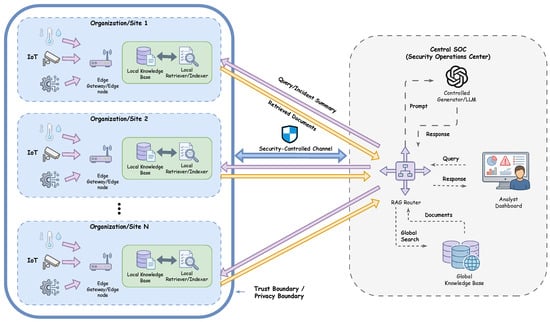
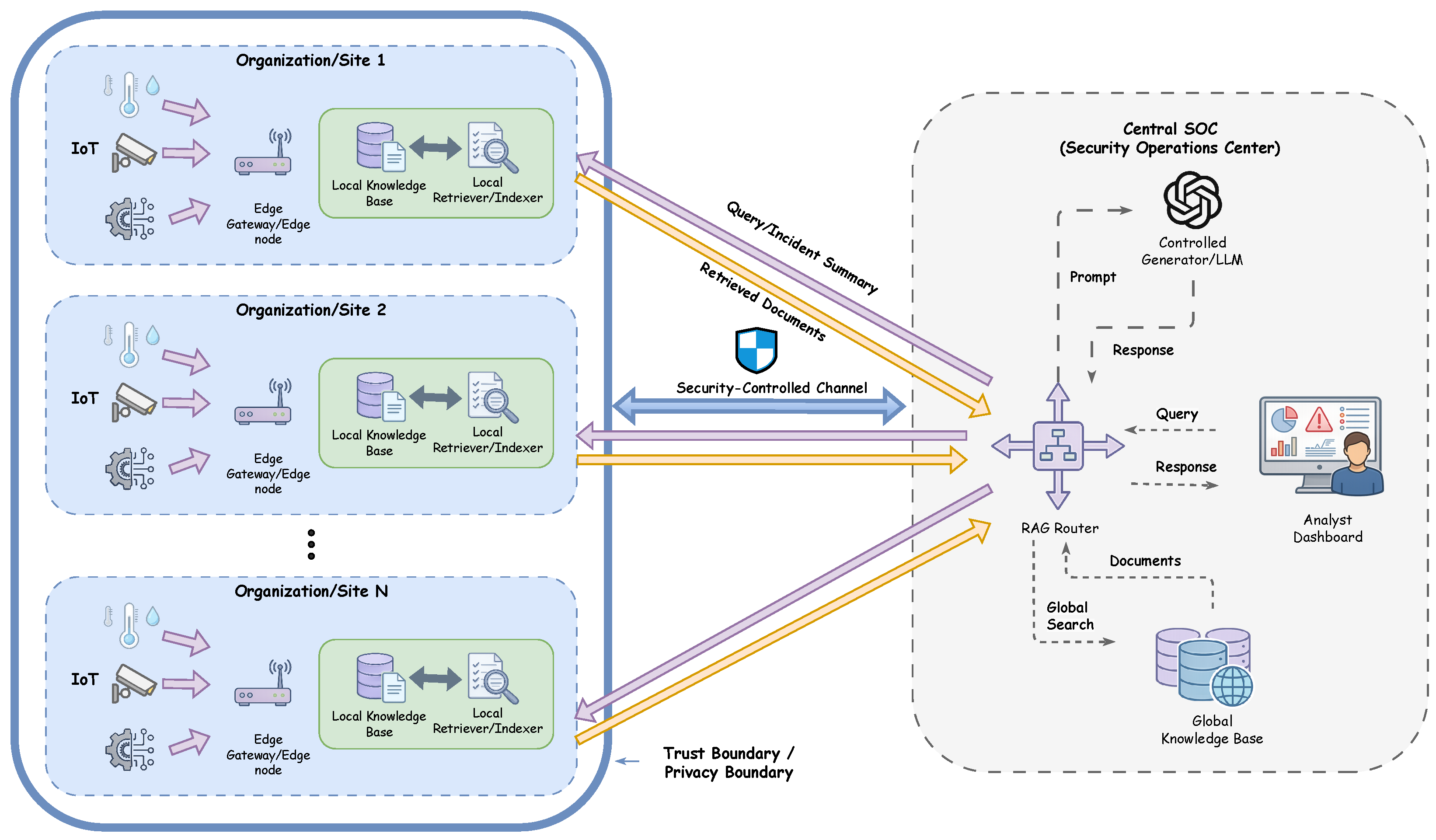
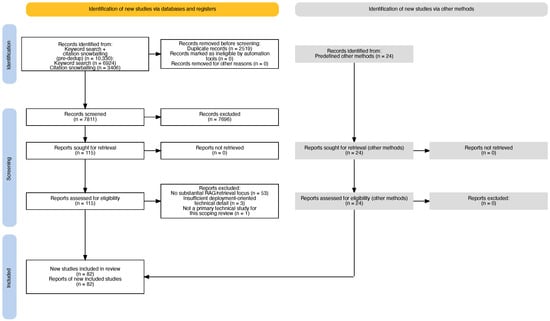
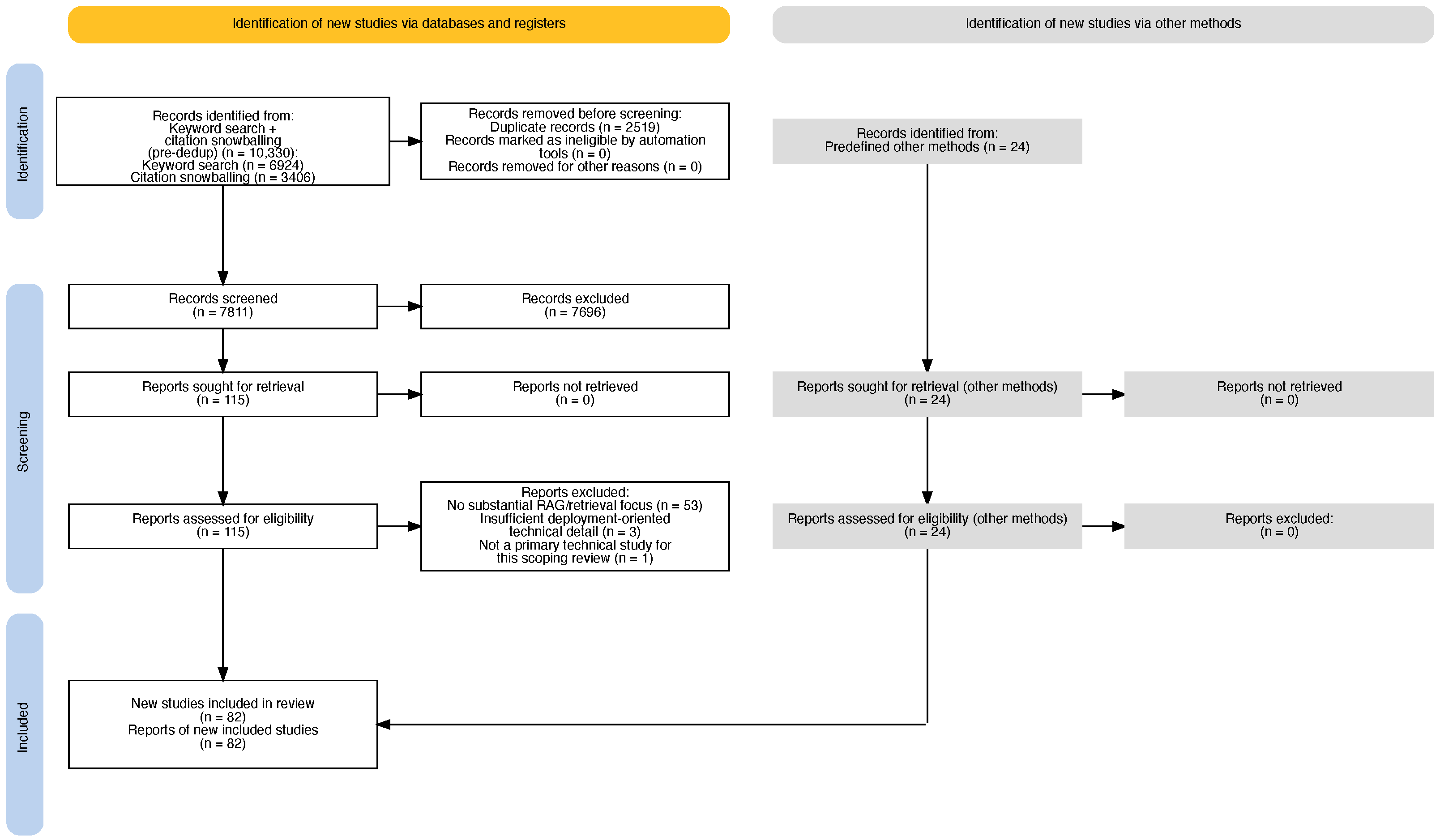
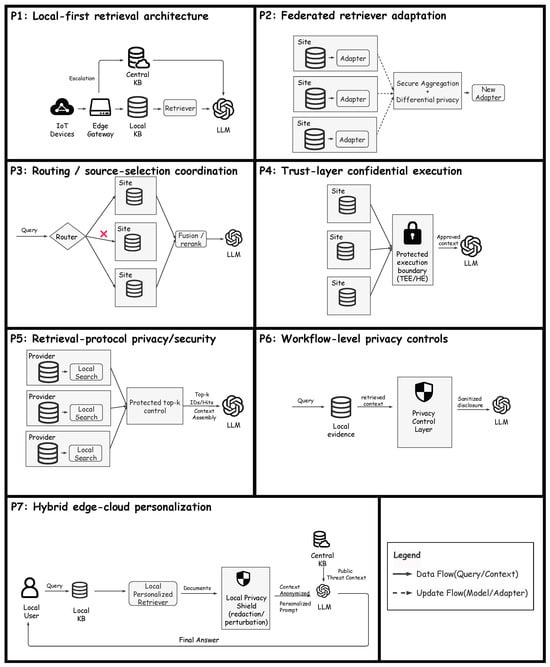
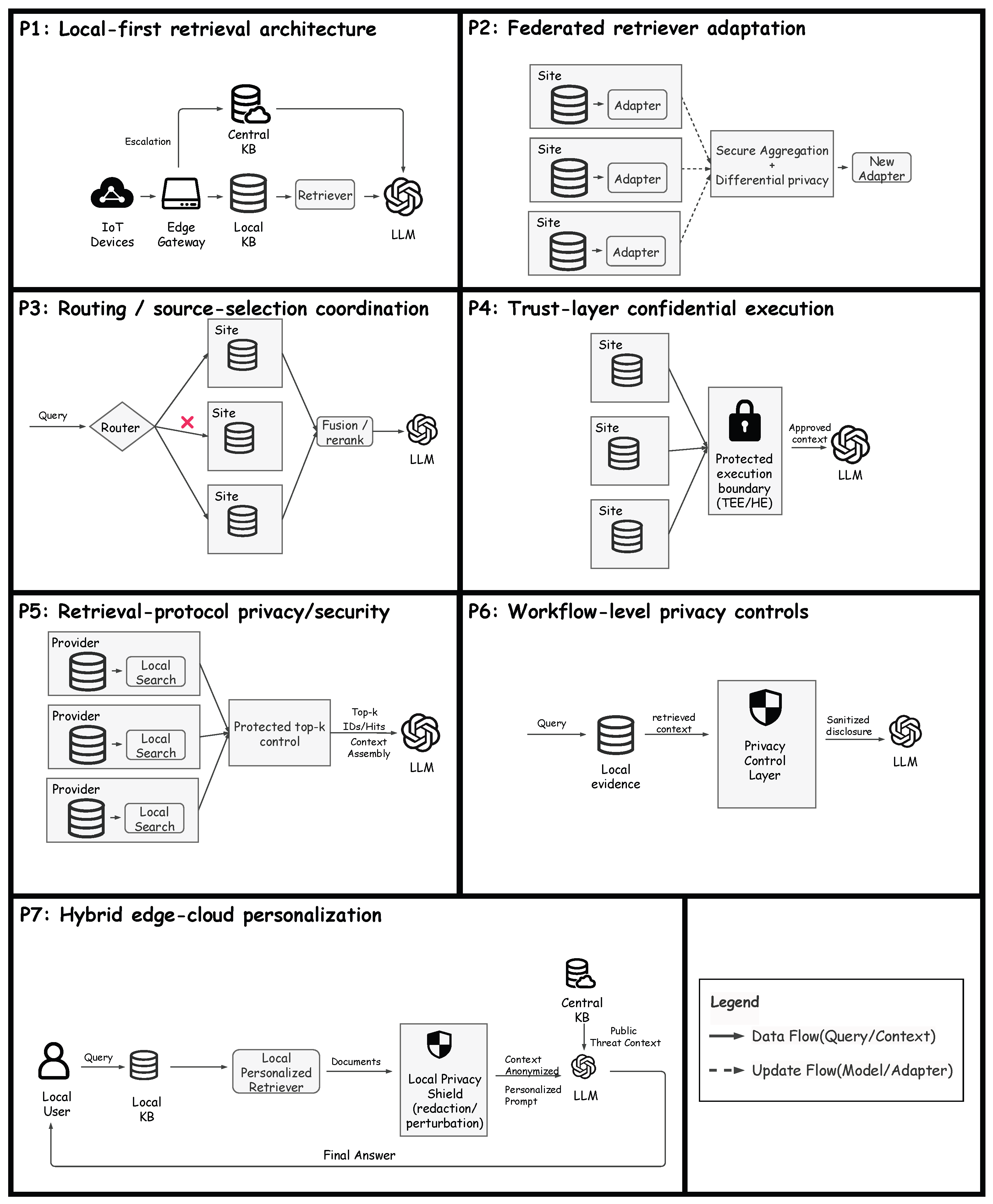

Disclaimer/Publisher’s Note: The statements, opinions and data contained in all publications are solely those of the individual author(s) and contributor(s) and not of MDPI and/or the editor(s). MDPI and/or the editor(s) disclaim responsibility for any injury to people or property resulting from any ideas, methods, instructions or products referred to in the content. |
© 2026 by the authors. Licensee MDPI, Basel, Switzerland. This article is an open access article distributed under the terms and conditions of the Creative Commons Attribution (CC BY) license.