Article

Multi-Target Sensing for UAV System-Enabled ISAC Network

College of Nuclear Engineering, Rocket Force University, Xi’an 710025, China
*
Author to whom correspondence should be addressed.
These authors contributed equally to this work.
Electronics 2026, 15(7), 1410; https://doi.org/10.3390/electronics15071410
Submission received: 4 March 2026 / Revised: 25 March 2026 / Accepted: 27 March 2026 / Published: 28 March 2026

Abstract

6G has introduced integrated sensing and communication (ISAC) technology, which is one of the core technologies for the next-generation communication networks. In this paper, we propose an efficient sensing method for multiple moving targets in a 6G ISAC unmanned aerial vehicle (UAV) system. Firstly, we establish an integrated channel model for multi-user communication and multi-moving-target sensing. Secondly, we design the ISAC signal and analyze the target echo signal. We propose a multiple moving-target sensing method to achieve the joint accurate estimation of the target angle of departure (AOD), radial velocity, and distance. Specifically, to solve the problems of limited-angle scanning resolution and grid error in parameter estimation, we adopt the weighted fusion interpolation algorithm and the iteratively reweighted compressed sensing (CS) algorithm to optimize the parameter estimation performance of multiple moving targets. Finally, extensive simulation results verify the effectiveness of the proposed method.

1. Introduction

With the rapid deployment of 5G mobile communication networks, the design of the next generation of mobile communication technology (6G) has been gradually refined and materialized [1,2]. As the latest generation of intelligent digital information infrastructure, 6G will be closely integrated with cutting-edge information technologies such as big data and artificial intelligence (AI), enabling the in-depth fusion of communication, sensing, and control capabilities. Integrated sensing and communications (ISAC) is one of the key technologies for 6G networks [3,4]. By leveraging radio signals to detect, locate, and identify targets, 6G ISAC technology can capture and reconstruct environmental data, ushering 6G networks into a new era of convergence between the physical and digital worlds [5,6,7].
Unmanned aerial vehicle (UAV) systems have emerged as crucial equipment in military reconnaissance, emergency rescue, environmental monitoring, and other fields, thanks to their advantages such as high mobility, no risk of casualties, and flexible deployment [8,9,10,11]. Traditional UAV systems mostly adopt an architecture with separate communication and sensing modules, which suffer from problems including spectrum-resource waste, heavy equipment payload, and poor coordination between communication and sensing functions [12,13,14]. In dense multi-target scenarios, such systems are susceptible to multipath interference and crosstalk between users and targets, leading to degraded target sensing accuracy and false target detection. Integrating 6G ISAC technology into UAV systems enables the collaborative implementation of communication and sensing via integrated signals, which can effectively reduce the payload of UAVs, improve their endurance, and significantly enhance the performance and reliability of multi-target sensing [15,16,17,18,19].
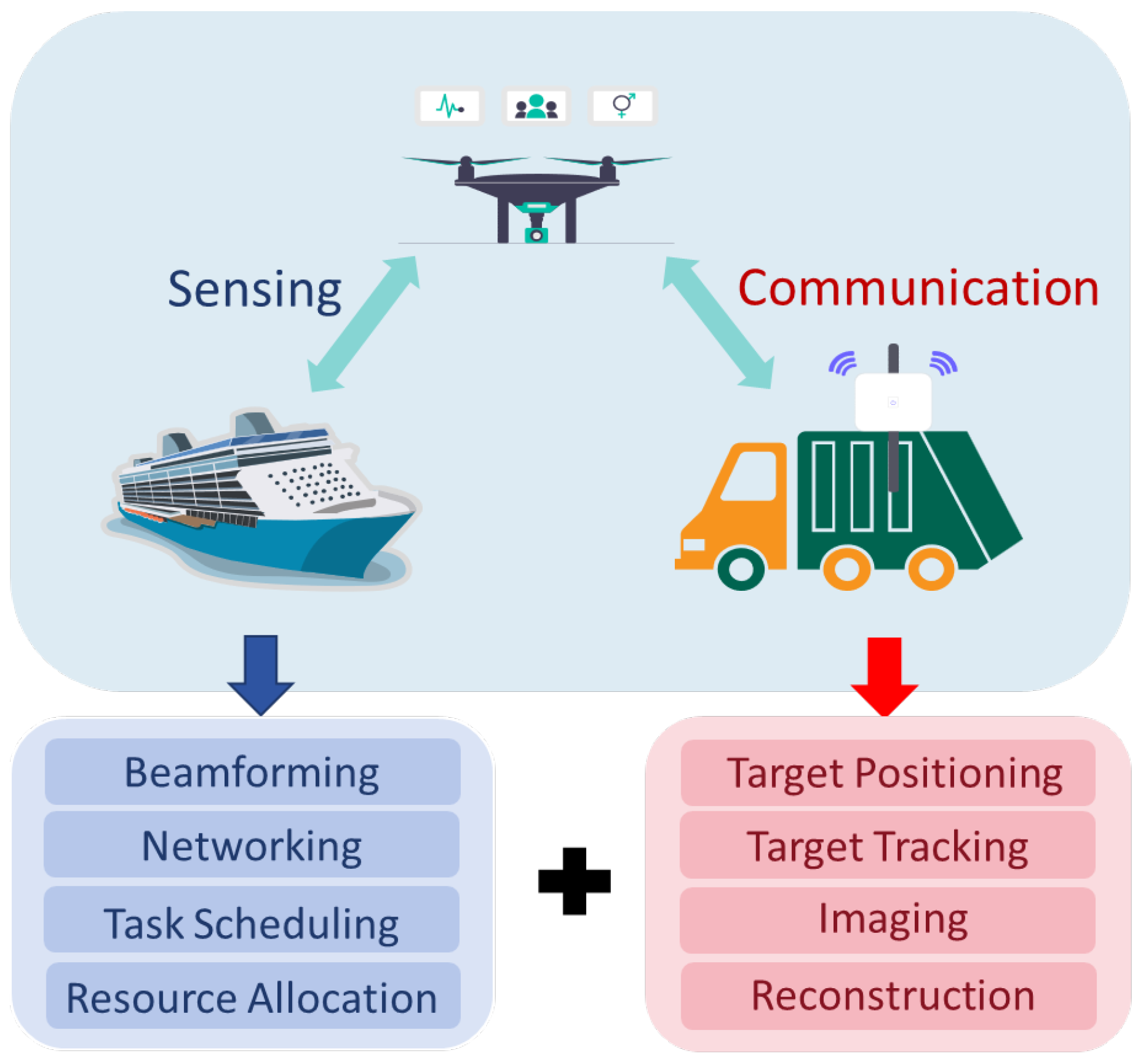
Figure 1 shows the UAV system-enabled ISAC network. The system features two typical interactive modes, i.e., sensing-aided communication and communication-aided sensing. On one hand, the sensing information obtained by the UAV from targets can be utilized to facilitate communication functions, including beamforming, networking, task scheduling, and resource allocation for ground terminals [20,21,22]. On the other hand, the communication signals transmitted by the UAV to ground users can be exploited to achieve target positioning, tracking, imaging, and environment reconstruction for surrounding targets [23,24,25].
Authors of [26] proposed an unsupervised learning algorithm for designing communication and sensing beamformers in cell-free ISAC systems. Authors of [27] investigated the network-level performance of low-altitude ISAC systems via stochastic geometry, where BSs, users, and aerial targets are modeled as homogeneous Poisson point processes, and cooperative beamforming is adopted to suppress inter-BS interference. Authors of [28] proposed an optical ISAC scheme for hovering UAVs that optimizes the ergodic achievable rate via power-domain multiplexing and adaptive beam allocation. Authors of [29] investigated a UAV-enabled ISAC system with wireless power transfer, jointly optimizing the radar waveform, receive filter, time scheduling, uplink power, and UAV trajectory to enhance both sensing and communication performance. Authors of [30] proposed a multi-antenna UAV-enabled ISAC system and maximized the radar average beam pattern gain via joint optimization of sensing scheduling, beamforming, and UAV trajectory, using the alternating direction optimization (ADO) algorithm. Authors of [31] proposed an integrated sensing-communication-control scheduling method for mmWave/THz UAV networks, ensuring communication rate and UAV motion control via state-to-noise-ratio and closed-form activation design. It can be seen that most existing studies implement ISAC functions using traditional communication or radar sensing techniques, which are difficult to adapt to the ISAC network scenario enabled by UAV systems, where multiple users and multiple targets coexist.
In this paper, we focus on the accurate sensing of multiple moving targets in a 6G ISAC UAV system. Firstly, we construct an integrated channel model suitable for multi-user communication and multi-moving-target sensing, which can be accurately characterized by physical parameters such as the spatial positions and motion states among the UAV, users, and targets. Secondly, we propose a collaborative ISAC scheme for the UAV ISAC platform, in which we design an ISAC signal for multi-user and multi-target scenarios, and analyze the target echo signal. We propose a high-precision sensing method for moving targets to realize the joint and accurate estimation of the target angle of departure (AOD), radial velocity, and distance. To address the problems of limited-angle scanning resolution and grid error in parameter estimation, we adopt the weighted fusion interpolation algorithm and the iteratively reweighted compressive sensing (CS) algorithm to optimize the parameter estimation performance of multiple moving targets. Finally, we conduct extensive simulations, and the results demonstrate the effectiveness of the proposed scheme in achieving accurate sensing of multiple moving targets in 6G ISAC UAV systems. The main contributions of this paper are summarized as follows:
  • We propose a 6G ISAC UAV system, construct an integrated channel model suitable for multi-user communication and multi-moving-target sensing, and design the ISAC signal.
  • We present a multi-target AOD estimation method for the UAV platform, which utilizes the multiple subcarriers joint detection (MSJD) algorithm to suppress false peaks and noise interference, and adopts the weighted fusion interpolation algorithm to break through the limitation of angle resolution.
  • We propose a velocity and distance estimation method for multiple moving targets, which employs the super-resolution iterative reweighted CS algorithm to reduce grid mismatch error and improve recovery performance and parameter estimation accuracy.
The rest of this paper is organized as follows. Section 2 presents the system model, including the channel model for multi-user communication and multi-target sensing. Section 3 provides the ISAC signal design scheme and introduces the multi-target sensing method based on the UAV reconnaissance platform. Section 4 shows the simulation results. Finally, Section 5 concludes the whole paper.
Notations: Vectors and matrices are denoted by boldface small and capital letters; the transpose, complex conjugate, Hermitian, and inverse of the matrix A are denoted by A T , A * , A H , and A 1 , respectively; ⊙ represents the operation of dot product.

2. System Model

We consider a UAV as an aerial ISAC platform that communicates with U users and simultaneously detects K targets. Through the organic integration of communication and sensing, high-rate communication with users and high-precision target perception are achieved. The UAV is equipped with two parallel and closely placed uniform linear arrays (ULA), each consisting of N t and N r antennas for signal transmission and reception, respectively. To ensure the integrity of the sensing information and improve the accuracy of target parameter estimation, it is generally required that the number of receiving antennas be no fewer than the number of transmitting antennas, that is, N r N t .
The UAV platform operates using orthogonal frequency-division multiplexing (OFDM) modulation. Within the basic framework of MIMO-OFDM signal processing, multiple antenna arrays transmit OFDM signals in parallel [32]. It enables two-way communication and receives target echo signals to realize efficient and stable signal transmission as well as multi-dimensional data interaction. The ISAC network is adapted to high-frequency deployment scenarios, with typical operating frequency bands covering millimeter-wave (mmWave) and terahertz spectra [33], and the antenna spacing is set to d = λ 2 , where λ is the wavelength.
Assume that the system employs a narrowband OFDM signal with M subcarriers, where the lowest frequency of the subcarrier and the frequency spacing are denoted as f 0 and Δ f , respectively. Then, the channel bandwidth is B = ( M 1 ) Δ f , and the frequency of the m-th subcarrier is given by f m = f 0 + ( m 1 ) Δ f . If the UAV uses N consecutive OFDM symbols to achieve target sensing and user communication in a single direction, the OFDM symbol duration is T s = 1 Δ f . The sensing and communication phases are divided into Q time slots, each lasting for a duration of N T s . In the q-th time slot, the UAV platform generates communication beams directed toward U users and sensing beams for detecting K targets via its transmit antenna array, simultaneously enabling stable communication with users and precise target sensing.

2.1. The Channel Model for the UAV-Enabled Communications

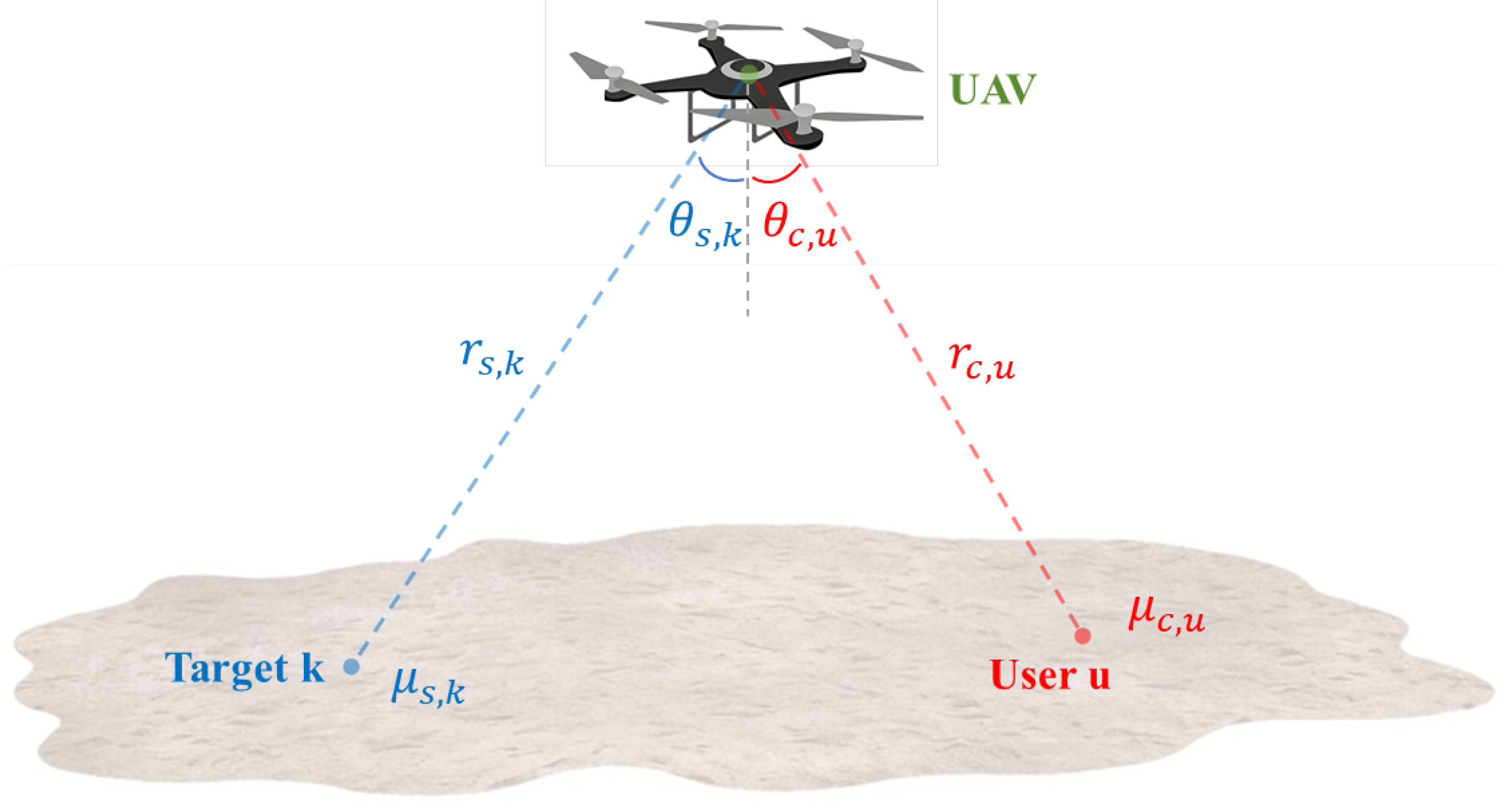
According to Figure 2, we suppose that the state parameters of the u-th user served by the UAV are denoted as ( r c , u , θ c , u , μ c , u ) , where r c , u is the distance between the user and the UAV, θ c , u is the AOD from the UAV to the user, and μ c , u is the radial velocity of the UAV relative to the user. Then, the propagation time delay is given by τ c , u = r c , u c , with c representing the speed of light.
The dynamic variations of the UAV platform, including attitude changes, jittering effects, and translational or vertical motion disturbances, will distort the beam pointing and induce time-varying channels as well as additional Doppler spread. In this paper, we focus on the core design of the multi-target sensing algorithm, and thus, the UAV platform motion and attitude jitter are ignored by assuming that the UAV operates in an approximately stable hovering state. Since the UAV is relatively stationary, the relative motion is primarily determined by the movement speed of the user, and the Doppler shift of the communication signal is expressed as f d , c , u = μ c , u λ .
Let x i ( t ) denote the signal transmitted by the i-th transmit antenna on the m-th subcarrier of the n-th OFDM symbol in the q-th time slot. The signal received by user u is given by
y q , n , m c , u , i ( t ) = α q , n , m c , u x i ( t τ q , n , m c , u ) e j 2 π f d , q , n , m c , u ( n 1 ) T s e j 2 π ( i 1 ) d sin θ λ + n q , n , m c , u ( t ) ,
where t denotes time, α q , n , m c , u is the communication channel fading factor, n q , n , m c , u ( t ) represents additive white Gaussian noise with zero mean and variance σ c , u 2 . Therefore, the signal received by the user from the entire transmit array can be expressed as
y q , n , m c , u ( t ) = α q , n , m c , u x ( t τ q , n , m c , u ) e j 2 π f d , q , n , m c , u ( n 1 ) T s a t ( θ q , n , m c , u ) + n q , n , m c , u ( t ) ,
where a t ( θ q , n , m c , u ) 1 , e j 2 π λ d sin θ q , n , m c , u , e j 2 π λ d sin θ q , n , m c , u , , e j ( N t 1 ) d sin θ q , n , m c , u λ is the transmit array steering vector. The channel frequency response between the UAV and the u-th user can be derived as
H q , n , m c , u = α q , n , m c , u e j 2 π f d , q , n , m c , u ( n 1 ) T s e j 2 π f m τ q , n , m c , u a t ( θ q , n , m c , u ) .
Substituting τ q , n , m c , u = r q , n , m c , u c and f d , q , n , m c , u = μ q , n , m c , u λ , the final communication channel model can be derived as
H q , n , m c , u = α q , n , m c , u e j 2 π μ q , n , m c , u λ ( n 1 ) T s j 2 π f m r q , n , m c , u λ a t ( θ q , n , m c , u ) C 1 × N r .

2.2. The Channel Model for the UAV Enabled Sensing

Let the state parameters of the k-th moving target detected by the UAV be ( r s , k , θ s , k , μ s , k ) , where r s , k is the distance between the target and the UAV, θ s , k is the angle of arrival (AOA) of the UAV relative to the target, and μ s , k is the radial velocity of the UAV relative to the target. Since the transmit and receive antenna arrays are placed in parallel, the AOD of the UAV relative to the target is also θ s , k . During target sensing, the UAV transmits downlink ISAC signals and receives echo signals reflected from the target. Thus, the round-trip time delay is τ s , k = 2 r s , k c , and the Doppler shift of the signal due to the relative motion between the UAV and the target is f d , s , k = 2 μ s , k λ .
The i-th transmit antenna element of the UAV transmits a signal x i ( t ) at the n-th OFDM symbol time of the q-th time slot and on the m-th subcarrier, the echo signal received by the γ -th receive antenna element from the target t is
y q , n , m s , k , i ( t ) = α q , n , m s , k x i ( t τ q , n , m s , k ) e j 2 π f d , q , n , m s , k ( n 1 ) T s e j 2 π ( γ 1 ) d sin θ λ e j 2 π ( i 1 ) d sin θ λ + n q , n , m s , k ( t ) ,
where α q , n , m s , k is the sensing channel fading factor. Similarly, the echo signal received by the entire antenna array can be derived as
y q , n , m s , k ( t ) = α q , n , m s , k x ( t τ q , n , m s , k ) e j 2 π f d , q , n , m s , k ( n 1 ) T s a r ( θ q , n , m s , k ) T a t ( θ q , n , m s , k ) + n q , n , m s , k ( t ) ,
where a r ( θ q , n , m s , k ) [ 1 , e j 2 π d sin θ s , k λ , e j 2 π 2 d sin θ s , k λ , , e j 2 π ( N r 1 ) d sin θ s , k λ ] is the steering vector of the receive array. Thus, the sensing echo channel model between the UAV and the k-th target at the n-th OFDM symbol time of the q-th time slot and on the m-th subcarrier can be obtained as
H q , n , m s , k = α q , n , m s , k e j 2 π f d , q , n , m s , k ( n 1 ) T s e j 2 π f m τ q , n , m s , k a r ( θ q , n , m s , k ) T a t ( θ q , n , m s , k ) .
Similarly, the final sensing channel model can be obtained as
H q , n , m s , k = α q , n , m s , k e j 4 π μ q , n , m s , k λ ( n 1 ) T s e j 4 π f m r q , n , m s , k c a r ( θ q , n , m s , k ) T a t ( θ q , n , m s , k ) C N r × N t .

3. Multi-Target Sensing Parameter Estimation

3.1. Downlink Transmission of the ISAC Signal and Echo Signal Analysis

The transmit signal of the UAV at the n-th OFDM symbol and m-th subcarrier of the q-th time slot can be derived as
x q , n , m = u = 1 U w q , n , m c , u s q , n , m c , u + k = 1 K w q , n , m s , k s q , n , m s , k ,
where w q , n , m c , u = a t ( θ q , n , m c , u ) T C N t × 1 and w q , n , m s , k = a t ( θ q , n , m s , k ) T C N t × 1 are the communication beamforming vector for the u-th user and the sensing beamforming vector for the k-th target respectively. s q , n , m c , u and s q , n , m s , k are the communication symbol for the u-th user and the sensing symbol for the k-th target, which are zero-mean and wide-sense stationary random processes. They are uncorrelated with each other, i.e., E { s q , n , m c , u s q , n , m s , k } = 0 .
According to (4), the downlink communication signal received by the u-th user at the n-th OFDM symbol and m-th subcarrier of the q-th time slot from the UAV is given by
y q , n , m c , u = H q , n , m c , u x q , n , m + n q , n , m c , u = u = 1 U H q , n , m c , u w q c , u s q , n , m c , u + k = 1 K H q , n , m c , u w q s , k s q , n , m s , k + n q , n , m c , u = H q , n , m c , u w q c , u s q , n , m c , u + u = 1 ( u u ) U H q , n , m c , u w q c , u s q , n , m c , u + k = 1 K H q , n , m c , u w q s , k s q , n , m s , k + n q , n , m c , u .
From the above equation, it can be seen that when multiple users and multiple targets coexist, the communication signal received by the u-th user consists of four components, namely the effective received (ER) communication signal, the non-target users interference (NUI), the cross-function sensing interference (SI), and noise. Therefore, the communication performance can be characterized by the signal-to-interference-plus-noise ratio (SINR).
SIN R c , u = E | ER | 2 E | NUI | 2 + E | SI | 2 + σ c , u 2 = E H q , n , m c , u w q c , u s q , n , m c , u 2 E u = 1 , u u U H q , n , m c , u w q c , u s q , n , m c , u 2 + E k = 1 K H q , n , m c , k w q c , k s q , n , m c , k 2 + σ c , u 2
To suppress interference from echo signals in non-target directions and improve the directivity and purity of the received signals, the UAV also needs to set the sensing receive beam to point toward the target at the receive array end, focusing the target echo using beamforming. The shaping vector of this receive beam is w r , q = 1 N r a r ( θ q , n , m s , k ) T C N r × 1 , where a r ( θ q , n , m s , k ) is the sensing array steering vector at the angle θ q , n , m s , k .
According to (8), the sensing echo signal received by the UAV from the k-th target at the n-th OFDM symbol and m-th subcarrier of the q-th time slot is
y s , k , n , m = w r , q H H q , n , m s , k x q , n , m + n q , n , m s , k = k = 1 K w r , q H H q , n , m s , k w q s , k s q , n , m s , k + u = 1 U w r , q H H q , n , m s , k w q c , u s q , n , m c , u + n q , n , m s , k = w r , q H H q , n , m s , k w q s , k s q , n , m s , k + k = 1 ( k k ) K w r , q H H q , n , m s , k w q s , k s q , n , m s , k + u = 1 U w r , q H H q , n , m s , k w q c , u s q , n , m c , u + n q , n , m s , k .
Similarly, a higher sensing SINR indicates a better target parameter estimation capability, thus SINR can also serve as a performance evaluation metric for sensing.
SIN R s , k = E w r , q H H q , n , m s , k s q , n , m c , k 2 E k = 1 , k k K w r , q H H q , n , m s , k s q , n , m c , k 2 + E u = 1 U w r , q H H q , n , m s , u s q , n , m c , u 2 + σ q , n , m s , k 2
When the spatial distribution of users and targets is relatively uniform without significant close-range clustering, and the number of antennas N t or N r , the interference caused by multiple users and multiple targets can be neglected. At this point, the sensing echo signal received by the UAV from the k-th target is
y s , k , n , m = w r , q H H q , n , m s , k w q s , k s q , n , m s , k + n q , n , m s , k = α q , n , m s , k 1 N r e j 4 π μ q , n , m s , k λ ( n 1 ) T s e j 4 π f m r q , n , m s , k c a r ( θ q , n , m s , k ) * a r ( θ q , n , m s , k ) T s q , n , m s , k + n q , n , m s , k .
From the analysis of the above equation, the sensing echo signal is jointly determined by θ q , n , m s , k , μ q , n , m s , k , and r q , n , m s , k . Based on this characteristic, the precise estimation of target parameters can be achieved through the processing of the echo signal.

3.2. Target Angle Estimation

Angle-doppler spectrum estimation (ADSE) is the core technology for separating the angle information of multiple moving targets [34]. It converts the time-domain signals in the OFDM symbol dimension into frequency-domain signals in the Doppler shift dimension via Fast Fourier Transform (FFT), and constructs a two-dimensional angle-Doppler shift matrix. By exploiting differences in angles, independent peaks are formed at the target positions. With the aid of the dual-threshold multiple subcarriers joint detection (MSJD) algorithm, false peaks and noise interference are suppressed, enabling the detection of targets from the mixed signals and the accurate estimation of their angle information.
Due to the directivity of the massive MIMO array, the echo signals mainly originate from the sensing beam in the current scanning direction. Therefore, the influence of the transmitted symbols on the target parameter estimation can be eliminated from the received sensing echo signals, yielding the equivalent sensing echo channel as h ˜ q , n , m s , k = y q , n , m s , k s q , n , m s , k . These equivalent channel values h ˜ q , n , m s , k can be stacked into a three-dimensional equivalent echo channel tensor H ˜ s , k C Q × N × M , where the ( q , n , m ) -th element of the tensor corresponds to h ˜ q , n , m s , k . To detect moving targets and estimate their angle information from H ˜ s , k , we extract the equivalent echo channel corresponding to the m-th subcarrier, resulting in a two-dimensional matrix H ˜ s , k m = H ˜ s , k [ : , : , m ] C Q × N , i.e.,
H ˜ s , k m = w r , 1 H H 1 , 0 , m s , k w 1 , 0 , m s , k w r , 1 H H 1 , N 1 , m s , k w 1 , N 1 , m s , k w r , Q H H Q , 0 , m s , k w Q , 0 , m s , k w r , Q H H Q , N 1 , m s , k w Q , N 1 , m s , k + N s , k m ,
where the ( q , n ) -th element of the noise matrix N s , k m is N s , k m [ q , n ] = n q , n , m s , k s q , n , m s , k .
The sensing beam scanning dimension in H ˜ s , k m contains the angle information of moving targets, while the OFDM symbol dimension contains the velocity information of moving targets. By fixing the scanning angle and performing an N-point FFT on each row of H ˜ s , k m , the phase changes in the time domain are converted into Doppler shifts in the frequency domain
H ˜ s , k m , F [ q , f d ] = FFT { H ˜ s , k m [ q , : ] , N } , f d = 0 , 1 , , N 1 ,
where H ˜ s , k m , F [ q , f d ] represents the amplitude of the frequency-domain signal at the q-th angle and the f d -th Doppler shift. By performing N-point spectrum centering on each row of H ˜ s , k m , F , the angle-Doppler spectrum of the equivalent echo channel at the m-th subcarrier is obtained
H ˜ s , k m , AD [ q , f d ] = FFTshift { H ˜ s , k m , F [ q , : ] , N } , f d = 0 , 1 , , N 1 .
Since the elements of the two-dimensional spectrum matrix contain both amplitude and phase, an amplitude matrix F s , k m is introduced to facilitate the precise localization of moving targets, i.e., F s , k m [ q , f d ] = H ˜ s , k m , AD [ q , f d ] . When the resolution of angle and velocity is sufficient, K distinct independent peaks will form in F s , k m , corresponding one-to-one with the K moving targets.
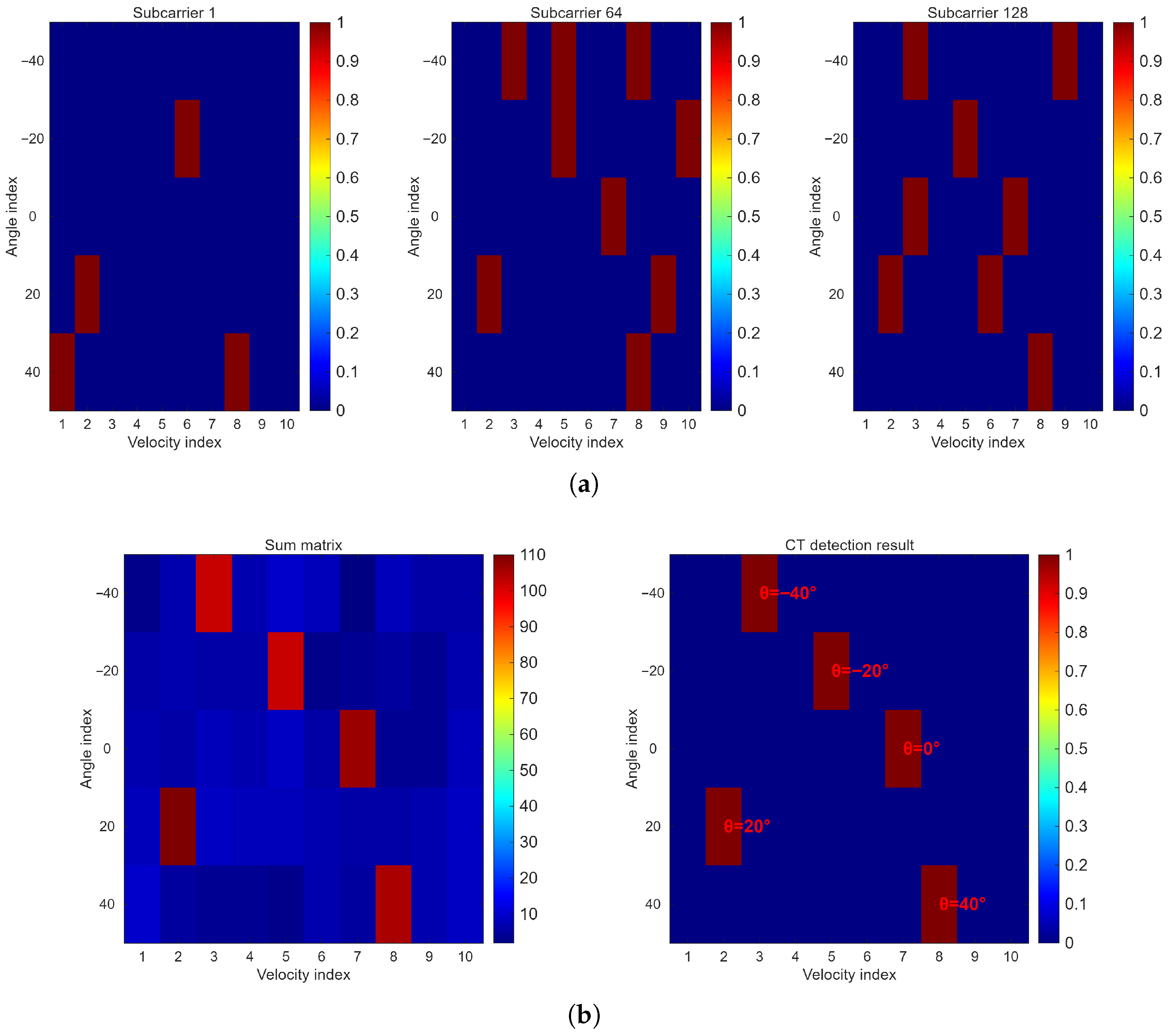
To accurately distinguish target peaks from low-amplitude noise, appropriate thresholds need to be set to reduce the impact of interference and noise on target detection. This paper proposes a multi-subcarrier joint detection algorithm based on constant false alarm rate (CFAR) and constant threshold (CT), which suppresses noise peaks as much as possible while ensuring a low false alarm rate. In the first step, two-dimensional cell-averaging CFAR detection is performed on the F s , k m matrix of a single subcarrier. The detection threshold is adaptively adjusted to maintain a low false-alarm rate and retain the peaks of suspected targets.In the second step, constant threshold detection is performed on multiple subcarriers. The decision matrices F s , k m , P of a total of M subcarriers are accumulated to obtain the sum matrix F s , k A L L , i.e.,
F s , k A L L [ q , f d ] = m = 1 M F s , k m , P [ q , f d ] .
A global CT detection threshold T C T = δ C T M is set, where δ C T is a redundancy factor that can be dynamically adjusted according to the noise intensity. The values of each element in the sum matrix are compared with the global constant threshold. If the value is greater than the threshold, the output is 1, and the corresponding ( q k , f d , k ) is the angle-Doppler shift coordinate of the target, thereby detecting multiple targets. The flow diagram of the MSJD algorithm is shown in Figure 3.
Local peaks are sought in the accumulated angle-Doppler spectrum, each corresponding to a potential target position. However, due to the discrete nature of angle scanning, there is an inherent resolution limit. To address grid errors, interpolation methods are required to refine the initial angles in the continuous domain. The algorithm proposes a weighted fusion of Gaussian fitting interpolation and iterative spline interpolation during the angle information extraction stage to achieve ultra-high-precision angle estimation.
After beamforming, Doppler processing, and multi-subcarrier coherent integration, the power spectrum P ( θ q ) on the discrete angle grid θ q is obtained, where θ q is uniformly distributed over [ 90 , 90 ] for q = 1 , 2 , , Q . Suppose the peak index obtained by the MSJD detection method is q * , corresponding to the target angle θ q * . Centered at the peak, the original angle spectrum power values of the five adjacent discrete angle grids are extracted to form a local window, followed by a logarithmic transformation
y i = ln ( P ( θ i ) + ε ) , i = q * 2 , , q * + 2 ,
where ε > 0 is a very small constant to avoid taking the logarithm of zero. In the local neighborhood around the peak, the angle spectrum typically exhibits an approximately Gaussian shape, and the Gaussian function becomes a quadratic function after taking the logarithm. Thus, quadratic polynomial fitting can be used to achieve sub-grid peak localization. Assume that within the peak neighborhood, ln P ( θ ) can be expressed as a quadratic function of θ
y ( θ ) = a θ 2 + b θ + c .
The equation Ψ T Ψ β ^ = Ψ T y ln is solved via the least squares method to obtain the fitted quadratic polynomial coefficients β ^ = [ a ^ , b ^ , c ^ ] T , where Ψ = θ q * 2 2 θ q * 2 1 θ q * + 2 2 θ q * + 2 1 C 5 × 3 denotes the basis matrix. Subsequently, the Gaussian fitting angle estimate is derived by applying the vertex coordinate formula of the quadratic function, yielding
θ ^ 1 = b ^ 2 a ^ .
Gaussian fitting interpolation fully leverages the prior information of the spectrum shape near the peak, enabling estimation accuracy far superior to the angle sampling interval when the signal-to-noise ratio is sufficient. However, Gaussian fitting relies to some extent on the symmetry of the spectrum shape. To enhance the algorithm’s robustness, an iterative refinement method is introduced. Let the current angle estimate be θ ^ ( i ) , initialized with θ ^ 1 . Within the search interval [ θ ^ ( i ) δ , θ ^ ( i ) + δ ] , I interpolation points are uniformly sampled, with values given by
θ ˜ i = θ ^ ( i ) δ + ( i 1 ) 2 δ I 1 , i = 1 , 2 , , I .
Using the discrete point set { ( θ q , P ( θ q ) ) } q = 1 Q , a cubic spline interpolation function S ( θ ) is constructed. The interpolated power S ( θ ˜ i ) at each interpolation point is calculated, and the angle corresponding to the maximum value is found
θ ˜ max = arg max θ ˜ k S ( θ ˜ i ) .
A damped update strategy is adopted, where θ ˜ max is taken as the update quantity for the current iteration and averaged with the current estimate to form a new angle estimate θ ^ ( i + 1 ) = θ ^ ( i ) + θ ˜ max 2 . After 3 iterations, the estimate rapidly converges near the extremum, yielding the refined angle θ ^ 2 = θ ^ ( 3 ) . Gaussian fitting interpolation achieves extremely high accuracy when the spectrum shape is ideal, whereas iterative spline interpolation exhibits stronger adaptability to local distortions. To combine the advantages of both interpolation methods, a linear weighted fusion strategy is employed to generate the final angle estimate
θ ^ = ω 1 θ ^ 1 + ω 2 θ ^ 2 ,
where the two weights satisfy ω 1 + ω 2 = 1 , and the specific values of the two weights are obtained through simulation experiments, ensuring the best interpolation effect.

3.3. Target Velocity and Range Estimation

The ISAC signal features an extremely narrow main lobe and very low side lobes, generating a strong response only at moving targets. Therefore, the target sensing model based on the UAV platform has excellent distance velocity resolution and strong sparsity. CS provides an efficient way to solve the target parameter estimation problem.
Due to the unrestricted distribution of targets and users, there may be cases where the same angle or the angle resolution is insufficient to distinguish them. In such cases, further estimation of velocity and distance information is required to identify the number and distribution of targets. Specifically, we assume that these indistinguishable targets are located at the same angle θ q . Then, the state parameters of the k-th moving target detected by the UAV are ( r s , k q , θ q , μ s , k q ) , where k = 1 , 2 , , K . Extracting the equivalent echo channels corresponding to all OFDM symbols and subcarriers under the q-th beam scanning, the two-dimensional matrix of the sensing echo channel between the UAV and the k-th target is obtained as H ˜ s , k q = H ˜ s , k [ : , : , q ] C N × M , i.e.,
H ˜ s , k q = w r , q H H q , 0 , 0 s , k w q , 0 , 0 s , k w r , q H H q , 0 , M 1 s , k w q , 0 , M 1 s , k w r , q H H q , N 1 , 0 s , k w q , N 1 , 0 s , k w r , q H H q , N 1 , M 1 s , k w q , N 1 , M 1 s , k + N s , k q
= A s , k q Φ N ( μ s , k q ) T Φ M ( r s , k q ) + N s , k q ,
where the amplitude term is A s , k q = α s , k q e j 4 π f 0 r s , k q c , and the ( n , m ) -th element of the noise matrix N s , k q is N s , k q [ n , m ] = n s , k , n , m q s q , n , m s , k . Moreover, Φ N ( μ s , k q ) and Φ M ( r s , k q ) are the velocity array steering vector and range array steering vector, which can be derived as
Φ N ( μ s , k q ) = [ 1 , e j 4 π μ s , k q T s λ , , e j 4 π μ s , k q ( N 1 ) T s λ ] C 1 × N ,
Φ M ( r s , k q ) = [ 1 , e j 4 π r s , k q Δ f c , , e j 4 π r s , k q ( M 1 ) Δ f c ] C 1 × M .
At this point, the sensing echo signal Y s , k q C N × M received by the UAV from the k-th target is
Y s , k q = A s , k q Φ N ( μ s , k q ) T Φ M ( r s , k q ) S s , k q + Ω s , k q ,
where S s , k q C N × M is the sensing symbol matrix of the k-th target, and Ω s , k q C N × M is the noise matrix formed by stacking n q , n , m s , k .
The traditional CS theory reconstructs sparse signals based on a known sparse dictionary [35]. However, in the target sensing model of this paper, the sparse dictionary Φ ( μ s , r s ) is characterized by two sets of unknown parameters in the continuous domain. If the traditional CS algorithm is still used, the continuous parameter space needs to be discretized into a finite set of grid points. However, since the real parameters may not be located on the discretized grid points, grid mismatch errors will be introduced, affecting the recovery performance and parameter estimation accuracy. Based on this, this paper proposes a super-resolution iteratively reweighted CS algorithm, which jointly estimates the sparse signal and the unknown parameters in the dictionary through an interleaved iterative process.
For traditional CS techniques, it is necessary to construct a 2D parameter dictionary Φ ( μ s , r s ) of velocity-range, where each atom is expressed as Φ ( μ i s , r j s ) = Φ N ( μ i s ) Φ M ( r j s ) , with i = 1 , 2 , , L and j = 1 , 2 , , P . Here, L is the number of grids in the velocity dimension, P is the number of grids in the range dimension, and the dictionary dimension is N M × L P . At this point, the sensing echo model is transformed into a sparse signal
Y s = Φ ( μ s , r s ) Z + Ω C N M × 1 ,
where Y s is the vectorized sensing echo signal, Z is the sparse coefficient column vector, and Ω is the noise vector. The amplitude of elements in Z is related to the target intensity, the positions of non-zero elements correspond to the velocity and range information of K moving targets, and the number of non-zero elements K should be much smaller than L P .
However, the parameters ( μ i s , r j s ) in the dictionary are unknown. Therefore, the target parameter estimation problem can be transformed into a sparse signal recovery problem with an unknown parameter dictionary. It is not only necessary to estimate the sparse signal, but also to optimize the velocity parameters { μ i s } i = 1 L and range parameters { r j s } j = 1 P so that the dictionary approaches the true sparse dictionary. To find two sets of unknown parameters to represent the sensing echo signal with as few atoms as possible within a specified error tolerance, the problem can be formulated as
min Z , μ s , r s Z 0 s . t . Y s Φ ( μ s , r s ) Z 2 ξ ,
where Z 0 denotes the number of non-zero components in Z , and ξ is a fault-tolerant parameter related to noise statistics.
However, since this optimization problem is NP-hard, the 0 -norm can be replaced by a log-sum penalty function
min Z , μ s , r s L ( Z ) = n = 1 L P log ( | Z n | 2 + ε ) s . t . Y s Φ ( μ s , r s ) Z 2 ξ ,
where Z n represents the n-th component of the vector Z , and ε is a positive parameter ensuring the function is well-defined. To maintain the stability of the iterative algorithm, ε is initialized to 1 in the first iteration and gradually decreased during the iteration process. When the sparse coefficients converge, i.e., Z ( t + 1 ) Z ( t ) 2 < ε ( t ) , its value is reduced to ε ( t + 1 ) = max ε ( t ) 10 , ε min , where ε min is the minimum threshold.
By incorporating the constraints into the objective function, the constrained optimization problem can be transformed into an unconstrained optimization problem
min Z , μ s , r s G ( Z , μ s , r s ) = n = 1 L P log ( | z n | 2 + ε ) + λ Y s Φ ( μ s , r s ) Z 2 2 = L ( Z ) + λ Y s Φ ( μ s , r s ) Z 2 2 ,
where λ > 0 is a regularization parameter that can be adaptively updated to balance signal sparsity and fitting error. The smaller λ will converge to more sparse results, while the larger λ will yield solutions with poorer sparsity but better fitting performance. When the noise variance is unknown, λ is set to be inversely proportional to the observation residual Y s Φ ( μ s , r s ) Z 2 2 to dynamically balance fitting and sparsity, i.e.,
λ ( t ) = max λ 0 1 Y s Φ ( μ s ( t ) , r s ( t ) ) Z ( t ) 2 2 , λ min ,
where λ 0 and λ min are preset constants, representing the initial value and the minimum threshold.
Then we construct a convex surrogate function for the original objective. By iteratively minimizing this surrogate function, the original objective function is monotonically non-increasing and finally converges to a stationary point, from which the unknown parameters to be estimated can be obtained. Let S ( Z ) denote the surrogate function of L ( Z ) , with its expression given by
S ( Z | Z ( t ) ) = n = 1 L P log ( | Z n ( t ) | 2 + ε ) + | Z n | 2 | Z n ( t ) | 2 | Z n ( t ) | 2 + ε = n = 1 L P log ( | Z n ( t ) | 2 + ε ) + | Z n | 2 + ε | Z n ( t ) | 2 + ε 1 .
From the convex function property of the first-order Taylor expansion, it is easy to derive that S ( Z | Z ( t ) ) L ( Z ) , with equality if and only if Z = Z ( t ) . For the ( t + 1 ) -th iteration, we have
S ( Z ( t + 1 ) | Z ( t ) ) L ( Z ( t + 1 ) ) S ( Z ( t ) | Z ( t ) ) L ( Z ( t ) ) ,
and the surrogate function form of G ( Z , μ s , r s ) is
Q ( Z , μ s , r s | Z ( t ) ) = S ( Z | Z ( t ) ) + λ Y s Φ ( μ s , r s ) Z 2 2 .
Therefore, solving (33) can be transformed into iteratively minimizing the surrogate function Q ( Z , μ s , r s | Z ( t ) ) . Ignoring terms irrelevant to { Z , μ s , r s } , the optimization problem can be simplified as
min Z , μ s , r s Q ( Z , μ s , r s | Z ( t ) ) = n = 1 L P | Z n | 2 + ε | Z n ( t ) | 2 + ε + λ Y s Φ ( μ s , r s ) Z 2 2 + C = Z H D ( t ) Z + λ Y s Φ ( μ s , r s ) Z 2 2 + C ,
where C is a constant irrelevant to { Z , μ s , r s } , and D ( t ) is a diagonal matrix expressed as
D ( t ) = diag 1 | Z 1 ( t ) | 2 + ε , 1 | Z 2 ( t ) | 2 + ε , , 1 | Z L P ( t ) | 2 + ε .
To ensure the effectiveness of the optimization, it is necessary to prove that reducing the surrogate function will cause a reduction in G ( Z , μ s , r s ) . Iteratively reducing Q ( Z , μ s , r s | Z ( t ) ) , combined with (36), we can obtain
G ( Z ( t + 1 ) , μ ( t + 1 ) , r ( t + 1 ) ) = L ( Z ( t + 1 ) ) + λ Y s Φ ( μ ( t + 1 ) , r ( t + 1 ) ) Z ( t + 1 ) 2 2 S ( Z ( t + 1 ) | Z ( t ) ) S ( Z ( t ) | Z ( t ) ) + L ( Z ( t ) ) + λ Y s Φ ( μ ( t + 1 ) , r ( t + 1 ) ) Z ( t + 1 ) 2 2 S ( Z ( t ) | Z ( t ) ) S ( Z ( t ) | Z ( t ) ) + L ( Z ( t ) ) + λ Y s Φ ( μ ( t + 1 ) , r ( t + 1 ) ) Z ( t + 1 ) 2 2 = G ( Z ( t ) , μ ( t ) , r ( t ) ) .
Therefore, by minimizing Q ( Z , μ s , r s | Z ( t ) ) , the optimal solution of Z can be obtained for given ( μ s , r s )
Z * ( μ s , r s ) = Φ H ( μ s , r s ) Φ ( μ s , r s ) + λ 1 D ( t ) 1 Φ H ( μ s , r s ) Y s .
Substituting the above equation into (38), the final optimization problem is obtained as
min μ s , r s F ( μ s , r s ) = Y s H Φ ( μ s , r s ) Φ H ( μ s , r s ) Φ ( μ s , r s ) + λ 1 D ( t ) 1 Φ H ( μ s , r s ) Y s + C .
Although it is difficult to obtain an analytical solution of the above equation, the algorithm only needs to iteratively make F ( μ s , r s ) non-increasing, i.e., find a new estimate ( μ ( t + 1 ) , r ( t + 1 ) ) such that F ( μ ( t + 1 ) , r ( t + 1 ) ) F ( μ s , r s ) . Since F ( μ s , r s ) is differentiable, the gradient descent method can be used in each iteration to ensure that a stationary point of ( μ s , r s ) is finally reached.

4. Simulations and Results

The concrete steps of the iteratively reweighted CS algorithm for multi-target sensing are shown in Algorithm 1. In this section, we provide various simulation results to verify the effectiveness of the proposed method. Based on the practical specifications, we consider a UAV system enabled 6G ISAC network, where the UAV serves as an aerial ISAC platform to detect K = 5 targets. The number of transmit and receive antennas is set as N t = 32 and N r = 64 , respectively, which is consistent with the large-scale antenna array configuration. The carrier frequency f c = 60 GHz and the bandwidth W = 600 MHz conform to the mainstream frequency band and transmission bandwidth of ISAC systems. The number of OFDM symbols is N = 32 , and the number of subcarriers is M = 64 according to the standardized frame structure of 6G broadband systems.
Algorithm 1 Iteratively Reweighted CS Algorithm for Multi-Target Sensing
  • Step 1: Initialization: set t = 0 , L k = L P , and initialize ε ( 0 ) , Z ( 0 ) , μ s ( 0 ) and r s ( 0 ) .
  • Step 2: Regularization parameter update: for the t-th iteration, calculate the regularization parameter λ ( t ) and construct the optimization objective function G ( Z , μ s , r s ) .
  • Step 3: Parameter estimation: obtain new estimates of velocity and range parameters μ s ( t + 1 ) , r s ( t + 1 ) by minimizing the objective function using gradient descent method.
  • Step 4: Sparse coefficient update: compute the optimal sparse coefficient vector Z ( t + 1 ) as Z * ( μ s , r s ) = Φ H ( μ s , r s ) Φ ( μ s , r s ) + λ 1 D ( t ) 1 Φ H ( μ s , r s ) Y s , and update the regularization parameter λ ( t + 1 ) .
  • Step 5: Convergence judgment and ε update: calculate the sparse coefficient difference δ = Z ( t + 1 ) Z ( t ) 2 . If δ < ε ( t ) , update the penalty parameter as ε ( t + 1 ) = max ε ( t ) 10 , ε min .
  • Step 6: Sparse coefficient pruning: if the n-th element of Z ( t + 1 ) satisfies Z n ( t + 1 ) < Z min , remove Z n ( t + 1 ) , corresponding μ n ( t + 1 ) and r n ( t + 1 ) from the vectors, and update the parameter dimension L k .
  • Step 7: Iteration termination judgment: update iteration count t = t + 1 . If δ < δ T , stop iteration and output the final estimates μ ^ s , r ^ s ; otherwise, return to Step 2 for the next iteration.
The target parameters for the UAV platform sensing simulation are randomly generated within reasonable ranges. The radial velocity is set from −50 m/s to 50 m/s, the detection range is set from 10 m to 30,000 m, and the target angle is set from −40° to 40°. These parameter ranges are selected to match realistic UAV motion characteristics, 6G ISAC system sensing capabilities, and a typical antenna array field of view, ensuring the simulation is practical and effective for verifying the proposed algorithm.
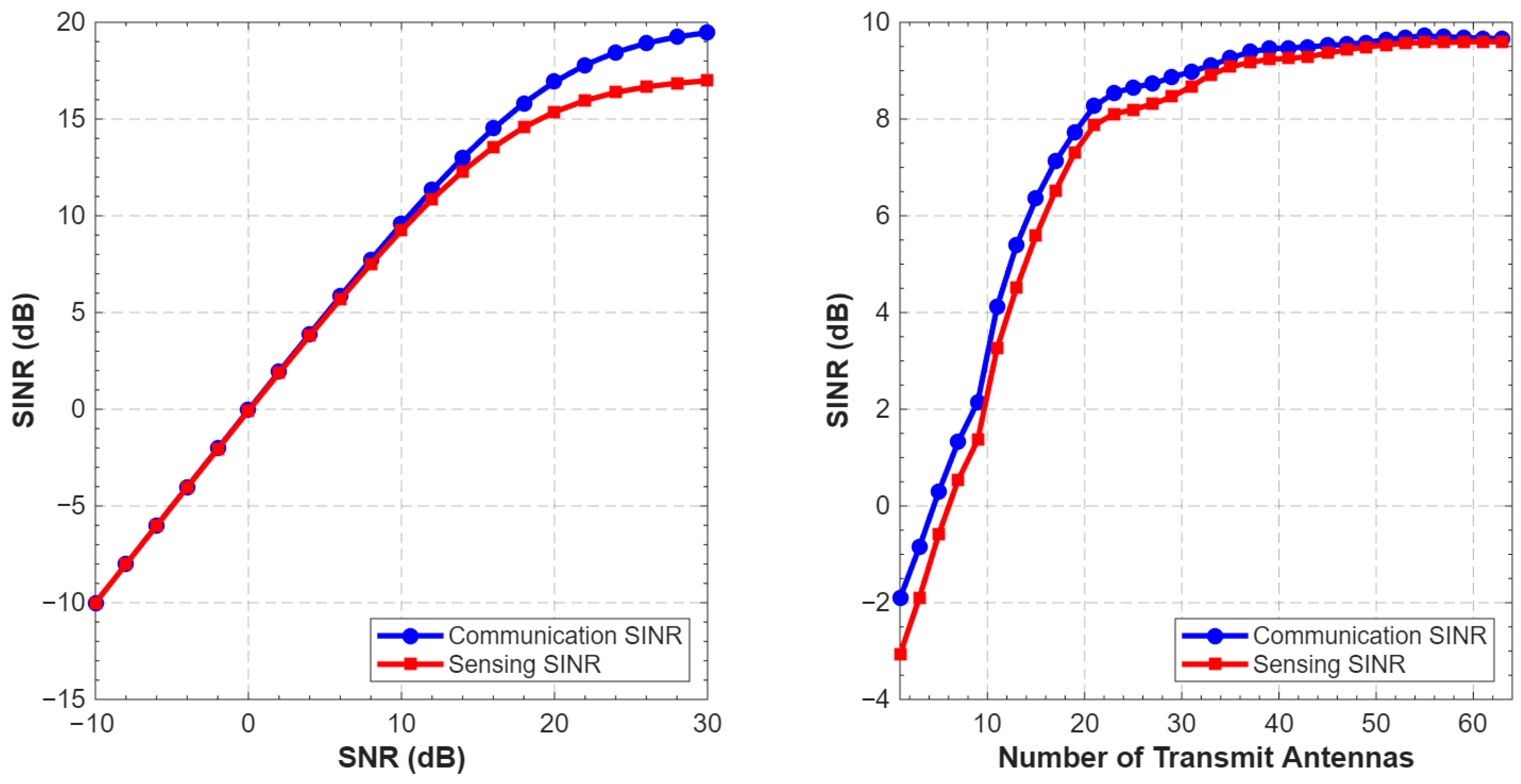
Figure 4 shows the effects of SNR and the number of transmit antennas on the SINR performance of the 6G ISAC system. In the left subplot, both the communication SINR and sensing SINR increase monotonically with the elevation of SNR, and the communication SINR consistently maintains a slight lead over the sensing SINR across the entire SNR range. Moreover, the growth rate of both SINRs gradually slows down at high SNR, which suggests that the system performance tends to saturate under strong signal conditions. In the right subplot, as the number of transmit antennas increases, both SINRs rise rapidly and eventually stabilize at around 10 dB. Additionally, the communication SINR and sensing SINR remain very close throughout the variation of N t , which verifies that the proposed ISAC scheme can achieve a favorable balance between communication and sensing performance under different antenna configurations.
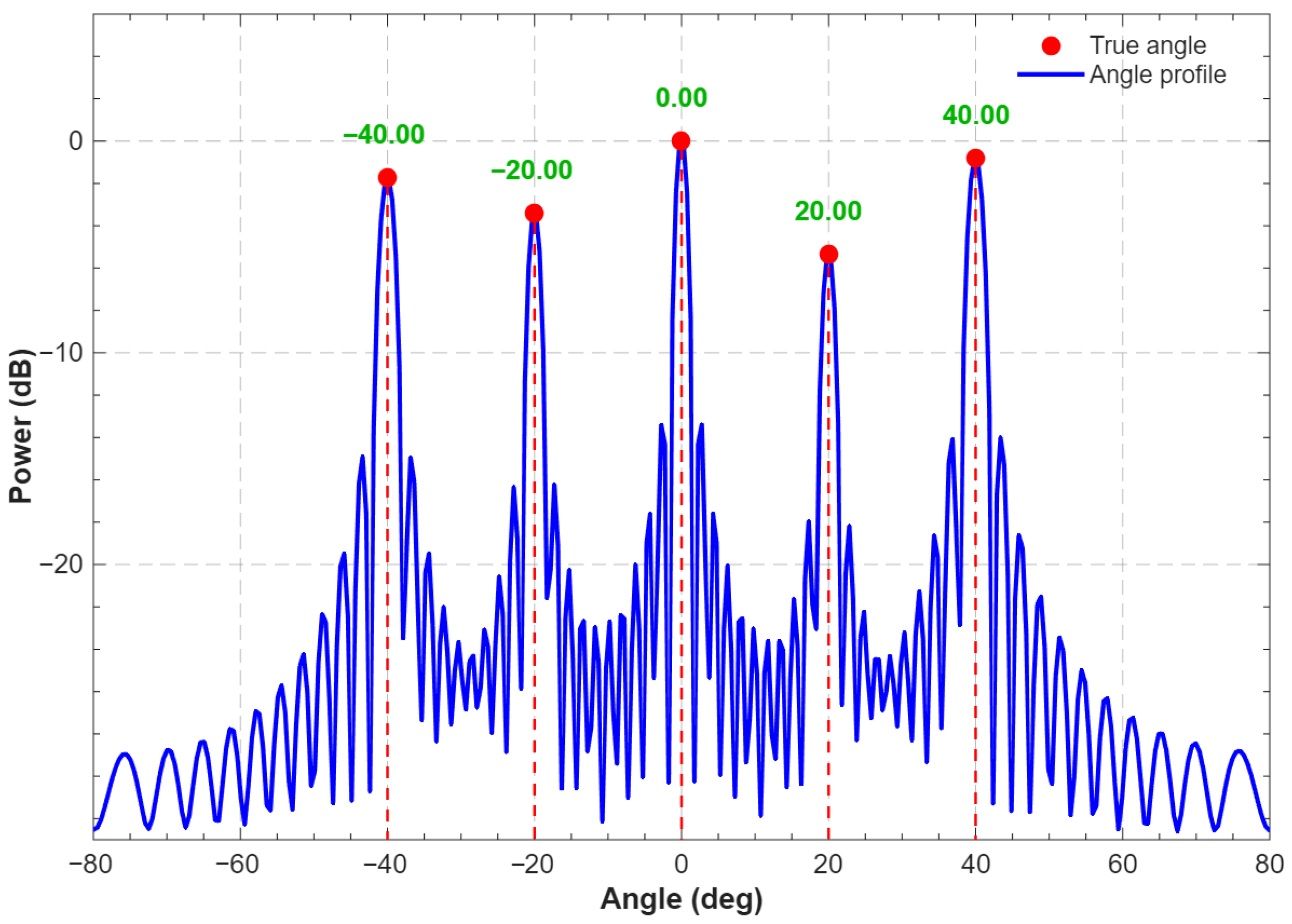
Figure 5 shows the angle-domain power spectrum in a multi-target scenario. We can see that distinct peaks appear in the angle-domain power spectrum at each true target angle position, and the peak positions are highly consistent with the true target angles. Meanwhile, in the non-target angle regions, the power spectrum remains at a low noise floor, and the sidelobe interference between targets is effectively suppressed. This result indicates that the proposed multi-target sensing method can accurately resolve and estimate the AOD of each target in a multi-target coexistence scenario, with excellent angular resolution and anti-interference capability, thereby providing reliable angle prior information for the precise estimation of velocity and distance.
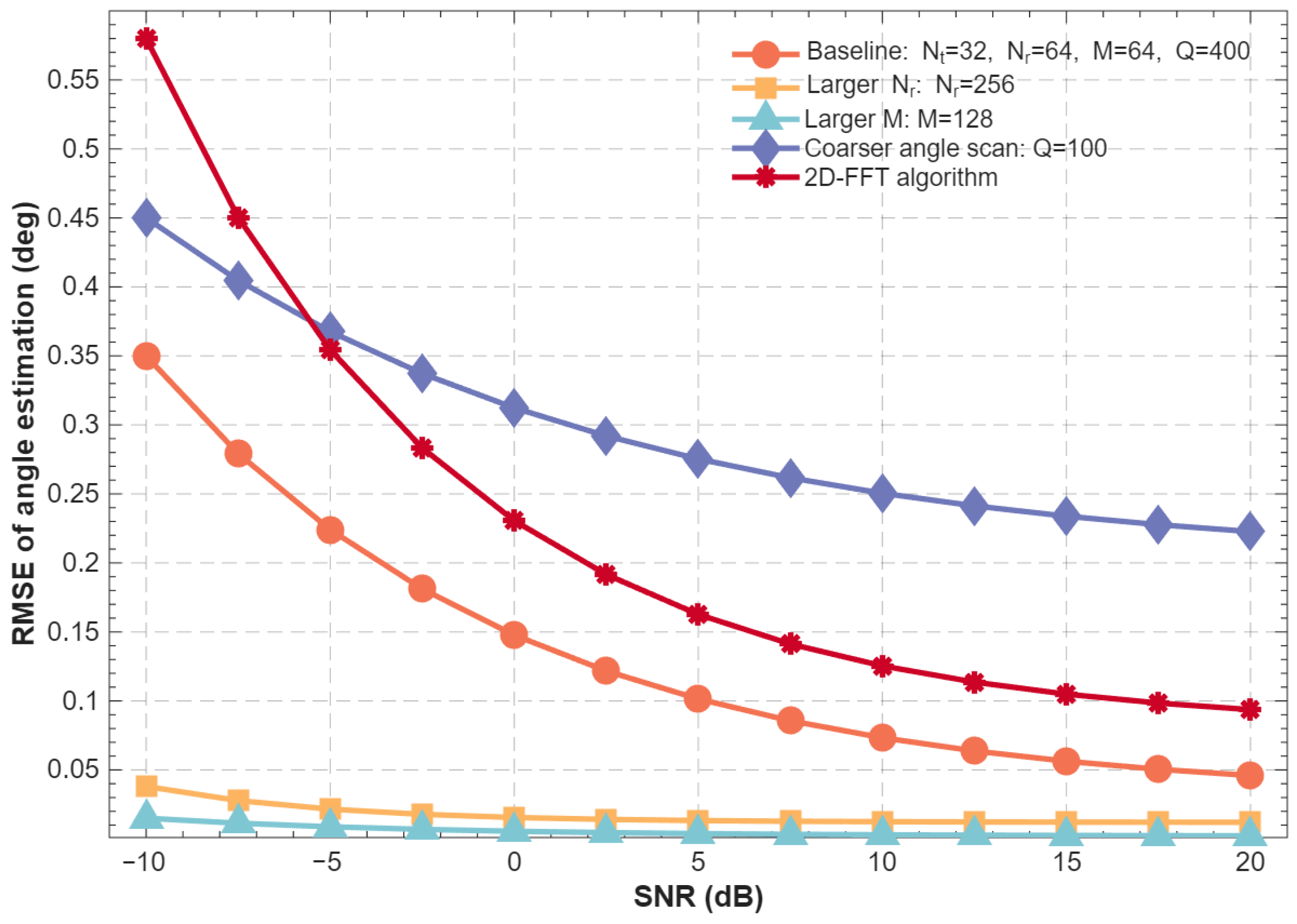
Figure 6 shows the root mean square error (RMSE) of multi-target angle estimation under different system parameter configurations, i.e., the number of receive antennas, subcarriers and angle scanning points, and the performance of the proposed ADSE-MSJD algorithm is compared with the traditional algorithm. From the overall trend, the RMSE of angle estimation exhibits a continuous decreasing trend with the increase of signal-to-noise ratio (SNR) and gradually stabilizes in the high SNR region. Comparing the impact of different parameters, it can be seen that reasonably increasing the number of receive antennas, subcarriers, and angle scanning points can effectively break through the limitations of system hardware and further improve the sensing accuracy in multi-target scenarios. In terms of algorithm performance comparison, the RMSE of angle estimation for the 2D-FFT algorithm is significantly higher than that of the proposed method across the entire SNR range. This result indicates that the proposed multi-target sensing method has superior angle estimation accuracy and anti-noise performance compared with traditional algorithms.
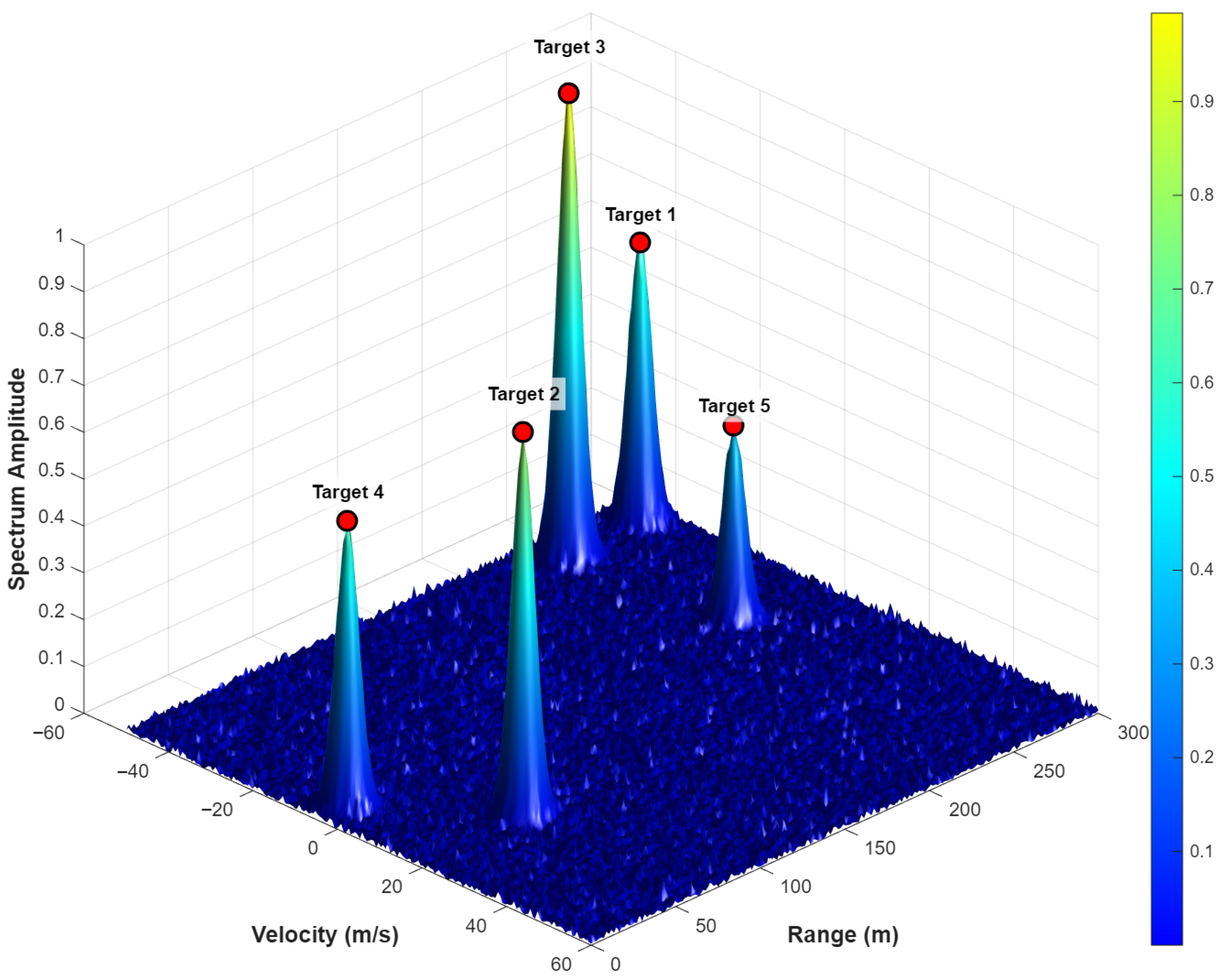
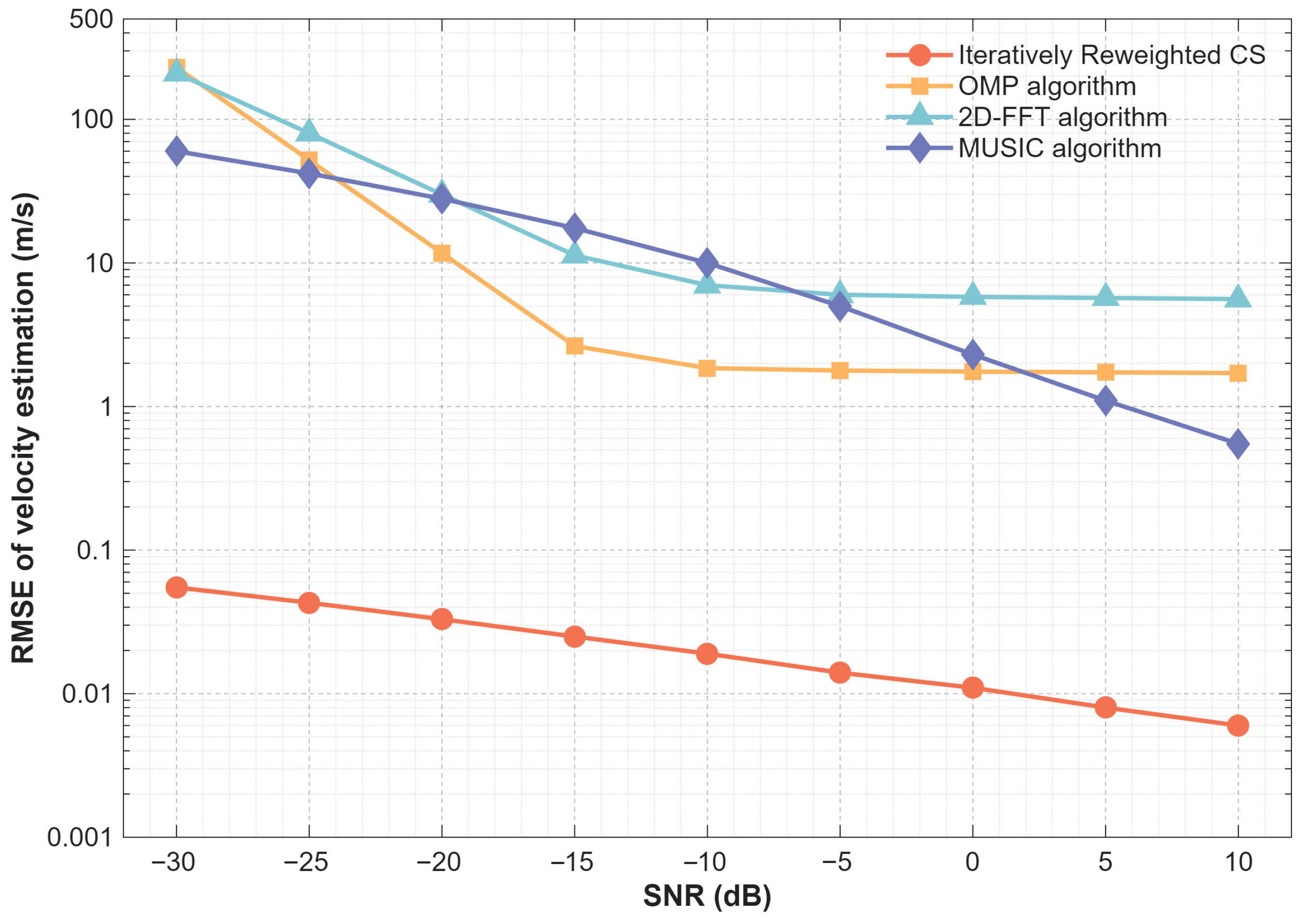
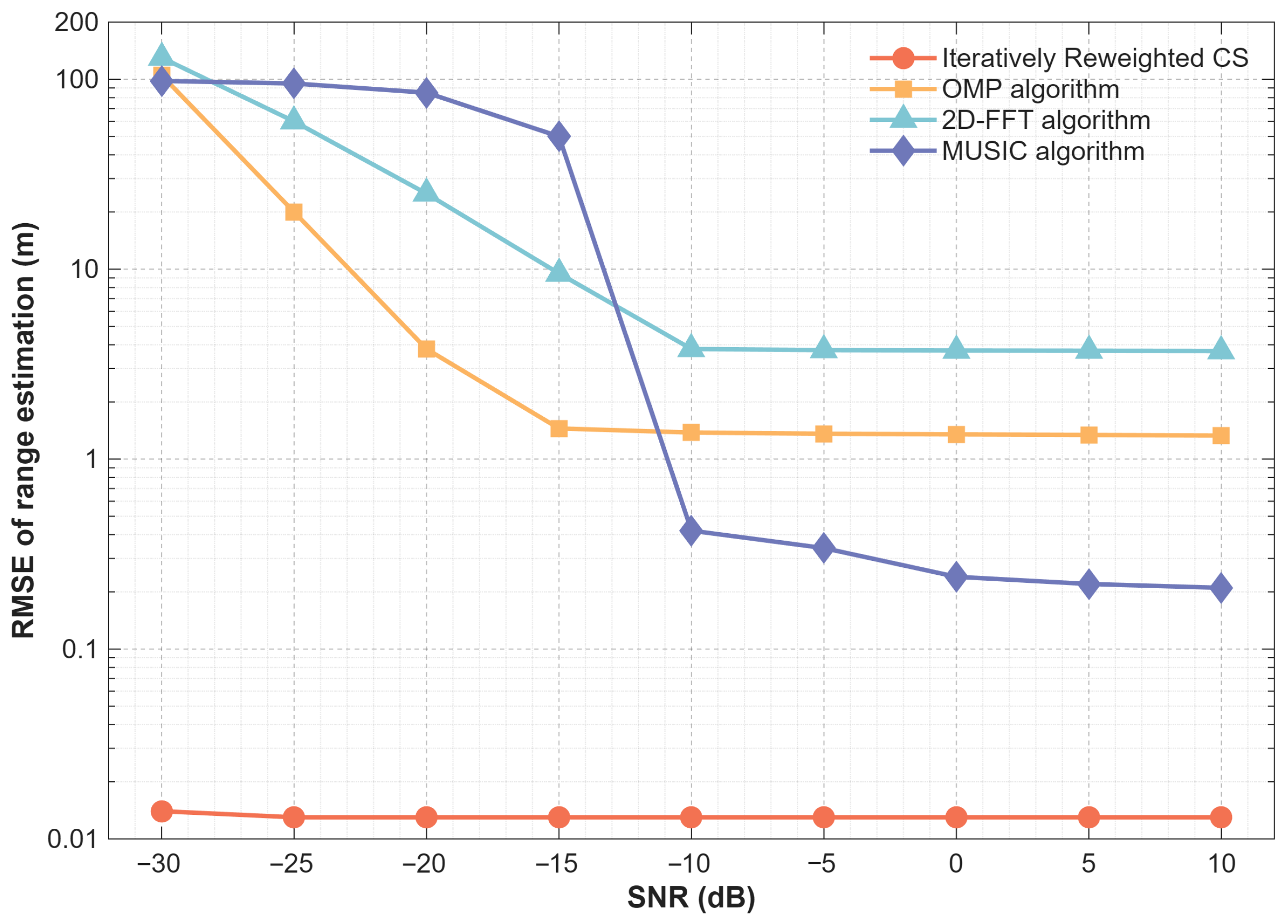
Figure 7 shows the multi-target velocity and range estimation results after iteratively reweighted CS, while Figure 8 and Figure 9 show the RMSE performance comparison versus SNR between the proposed iteratively reweighted CS algorithm and three benchmark algorithms, i.e., OMP, 2D-FFT, and MUSIC. From the 3D Doppler-range spectrum, it can be clearly observed that all five targets form distinct energy peaks, whose positions are highly consistent with the true velocity and range of the targets, verifying the effectiveness of the proposed method in multi-target scenarios. From the RMSE curves, it can be seen that the estimation error of all algorithms decreases with the increase of SNR. Additionally, the RMSE of the iteratively reweighted CS algorithm is significantly lower than that of other algorithms across the entire SNR range, which further verifies the superiority of the proposed method in multi-target parameter estimation.
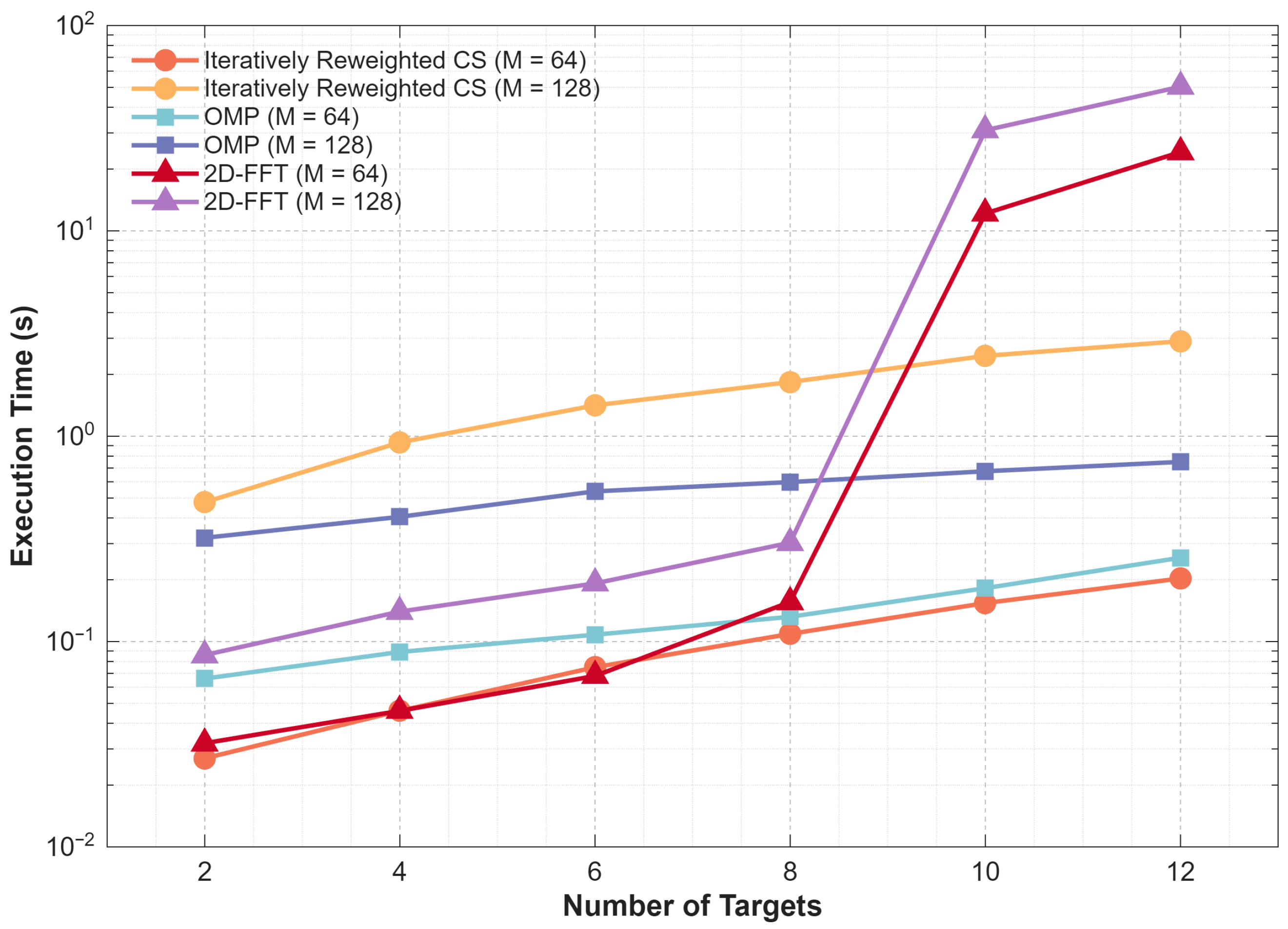
Figure 10 shows the execution time of multi-target sensing algorithms under varying numbers of targets and subcarriers. Note that the MUSIC algorithm is excluded from the complexity analysis due to its consistently high computational overhead across all parameter configurations. From the overall trend, the execution time of all algorithms increases monotonically with the number of targets and the number of subcarriers. When the number of subcarriers is fixed at M = 64 , the iteratively reweighted CS algorithm exhibits lower computational complexity than the OMP algorithm across the considered target count range. In particular, when the number of targets is small, the execution time of the iteratively reweighted CS algorithm is nearly identical to that of the 2D-FFT algorithm, which confirms its high efficiency for low-complexity multi-target sensing tasks. However, as the number of subcarriers increases, the growth rate of computational complexity for the iteratively reweighted CS algorithm is higher than that of the OMP algorithm. This phenomenon can be attributed to the iterative reweighting mechanism, which introduces additional matrix operations and weight updates that scale more sensitively with the dimension of the measurement matrix. Despite this, the iteratively reweighted CS algorithm still maintains a favorable balance between estimation accuracy and computational efficiency.

5. Conclusions and Future Prospects

In this paper, we propose a high-precision sensing scheme for multiple moving targets in a 6G ISAC UAV system. Firstly, we established an integrated channel model that supports simultaneous multi-user communication and multi-target sensing. Secondly, we designed the ISAC waveform and analyzed the target echo signal. Furthermore, we presented a refined sensing approach to realize the joint estimation of target AOD, radial velocity, and distance with high accuracy. To address the issues of insufficient angular resolution and grid mismatch in parameter estimation, we used weighted fusion interpolation and the iteratively reweighted CS algorithm to improve estimation performance. Finally, we conducted comprehensive simulation experiments, and the results verified the effectiveness of the proposed strategy for sensing multiple moving targets.
It should be acknowledged that this study has several limitations that warrant further investigation in future work. Firstly, the performance verification of the proposed multi-target sensing method is solely based on numerical simulation experiments. Although the simulation parameters are set in line with practical 6G ISAC system specifications, the ideal simulation environment cannot fully replicate complex real-world conditions. Secondly, the proposed method may face certain challenges in dealing with densely distributed targets. When confronted with densely clustered targets, severe coupling of target echo signals and mutual interference between adjacent targets lead to a noticeable decline in estimation accuracy and an increase in computational complexity. Thirdly, the UAV is assumed to be in a static hovering state, and the established channel model and sensing algorithm do not account for the UAV’s dynamic characteristics. Hence, further improvements are required to adapt to dynamic UAV platforms.
Accordingly, future efforts will be devoted to real-world measurement and hardware testbed verification to validate the practicality of the proposed scheme. Meanwhile, more robust algorithms against signal coupling and mutual interference will be investigated to enhance performance in dense target scenarios, along with complexity-reduction strategies for practical deployment. Furthermore, we will extend the proposed method to high-mobility UAV platforms by considering time-varying channels and additional Doppler effects in future research.

Author Contributions

Conceptualization, N.C.; methodology, J.Z.; validation, F.Z.; formal analysis, N.C.; writing—original draft preparation, F.H.; writing—review and editing, H.H.; supervision, W.J. (Weimin Jia); funding acquisition, W.J. (Wei Jin). All authors have read and agreed to the published version of the manuscript.

Funding

This research was sponsored by the National Natural Science Foundation of China (Grant Nos. 62001500, 42301458, 42401499, and 12403080), in part supported by the China Postdoctoral Science Foundation under Grant Nos. 2025T181182, 2023M734288, and 2023M744301, in part supported by the National Social Science Fund under Grant No. 2023-SKJJ-C-028, in part supported by the Shaanxi Province Support Fund under Grant No. 20230712.

Data Availability Statement

The original contributions presented in this study are included in the article. Further inquiries can be directed to the corresponding author.

Acknowledgments

The authors would like to thank the handling editor and the anonymous reviewers for their valuable comments and suggestions.

Conflicts of Interest

The authors declare no conflicts of interest.

References

  1. Rong, B. 6G: The next horizon: From connected people and things to connected intelligences. IEEE Wirel. Commun. 2021, 28, 8. [Google Scholar] [CrossRef]
  2. Sheng, M.; Zhou, D.; Bai, W.; Liu, J.; Li, J. 6G service coverage with mega satellite constellations. China Commun. 2022, 19, 64–76. [Google Scholar] [CrossRef]
  3. Liu, Y.; Yuan, X.; Xiong, Z.; Kang, J.; Wang, X.; Niyato, D. Federated learning for 6G communications: Challenges, methods, and future directions. China Commun. 2020, 17, 105–118. [Google Scholar] [CrossRef]
  4. Abouaomar, A.; Taik, A.; Filali, A.; Cherkaoui, S. Federated deep reinforcement learning for open RAN slicing in 6G network. IEEE Commun. Mag. 2023, 61, 126–132. [Google Scholar] [CrossRef]
  5. Zhao, Z.; Liu, Z.; Jiang, R.; Li, Z.; Zhang, X.P.; Tang, X.; Dong, Y. Joint Beamforming for Multi-Target Detection and Multi-User Communication in ISAC Systems. IEEE Trans. Veh. Technol. 2025, 74, 14938–14942. [Google Scholar] [CrossRef]
  6. Wu, G.; Liu, H.; You, J.; Zhao, X.; Chen, H. Resource Allocation for Intelligent Reflecting Surface Enabled Target Tracking in Integrated Sensing and Communication Systems. IEEE Open J. Veh. Technol. 2025, 6, 1–12. [Google Scholar] [CrossRef]
  7. Li, J.; Zhang, Q.; Ma, D.; Huang, S. UAV Target Reconstruction and Imaging Algorithm Design and Performance Evaluation Using CSI of ISAC Signal. IEEE Trans. Wirel. Commun. 2025, 24, 9422–9434. [Google Scholar] [CrossRef]
  8. Cheng, N.; Wu, S.; Wang, X.; Yin, Z.; Li, C.; Chen, W.; Chen, F. AI for UAV-Assisted IoT Applications: A Comprehensive Review. IEEE Internet Things J. 2023, 10, 14438–14461. [Google Scholar] [CrossRef]
  9. Zhang, L.; Zhao, H.; Hou, S.; Zhao, Z.; Xu, H.; Wu, X.; Wu, Q.; Zhang, R. A Survey on 5G Millimeter Wave Communications for UAV-Assisted Wireless Networks. IEEE Access 2019, 7, 117460–117504. [Google Scholar] [CrossRef]
  10. Kuo, Y.C.; Chiu, J.H.; Sheu, J.P.; Hong, Y.W.P. UAV Deployment and IoT Device Association for Energy-Efficient Data-Gathering in Fixed-Wing Multi-UAV Networks. IEEE Trans. Green Commun. Netw. 2021, 5, 1934–1946. [Google Scholar] [CrossRef]
  11. Abushakra, F.; Jeong, N.; Elluru, D.N.; Awasthi, A.K.; Kolpuke, S.; Luong, T.; Reyhanigalangashi, O.; Taylor, D.; Gogineni, S.P. A Miniaturized Ultra-Wideband Radar for UAV Remote Sensing Applications. IEEE Microw. Wirel. Components Lett. 2022, 32, 198–201. [Google Scholar] [CrossRef]
  12. Shao, X.; Wang, W.; Zhou, B.; Pan, G.; Jiang, W. Joint Bandwidth and Spectrum Usage Zones Flexible Allocation for Coexisting Multiple UAV Networks: An Interference Graph Approach. IEEE Internet Things J. 2025, 12, 31141–31153. [Google Scholar] [CrossRef]
  13. Qi, W.; Song, Q.; Guo, L.; Jamalipour, A. Energy-Efficient Resource Allocation for UAV-Assisted Vehicular Networks with Spectrum Sharing. IEEE Trans. Veh. Technol. 2022, 71, 7691–7702. [Google Scholar] [CrossRef]
  14. Sun, J.; Shi, W.; Yao, J.; Xu, W.; Wang, D.; Cao, Y. UAV-Based Intelligent Sensing Over CF-mMIMO Communications: System Design and Experimental Results. IEEE Open J. Commun. Soc. 2025, 6, 3211–3221. [Google Scholar] [CrossRef]
  15. Wei, Z.; Meng, Z.; Lai, M.; Wu, H.; Han, J.; Feng, Z. Anti-collision technologies for unmanned aerial vehicles: Recent advances and future trends. IEEE Internet Things J. 2022, 9, 7619–7638. [Google Scholar] [CrossRef]
  16. Zou, J.; Wang, C.; Liu, Y.; Zou, Z.; Sun, S. Vision-assisted 3-D predictive beamforming for green UAV-to-vehicle communications. IEEE Trans. Green Commun. Netw. 2023, 7, 434–443. [Google Scholar] [CrossRef]
  17. Gao, N.; Liang, L.; Cai, D.; Li, X.; Jin, S. Coverage control for UAV swarm communication networks: A distributed learning approach. IEEE Internet Things J. 2022, 9, 19854–19867. [Google Scholar] [CrossRef]
  18. Bai, L.; Huang, Z.; Zhang, X.; Cheng, X. A non-stationary 3D model for 6G massive MIMO mmWave UAV channels. IEEE Trans. Wirel. Commun. 2022, 21, 4325–4339. [Google Scholar] [CrossRef]
  19. Mu, J.; Zhang, R.; Cui, Y.; Gao, N.; Jing, X. UAV meets integrated sensing and communication: Challenges and future directionss. IEEE Commun. Mag. 2023, 61, 62–67. [Google Scholar] [CrossRef]
  20. Zhao, M.; Li, W.; Bao, L.; Luo, J.; He, Z.; Liu, D. Fairness-Aware Task Scheduling and Resource Allocation in UAV-Enabled Mobile Edge Computing Networks. IEEE Trans. Green Commun. Netw. 2021, 5, 2174–2187. [Google Scholar] [CrossRef]
  21. Duan, T.; Wang, W.; Wang, T.; Chen, X.; Li, X. Dynamic Tasks Scheduling Model of UAV Cluster Based on Flexible Network Architecture. IEEE Access 2020, 8, 115448–115460. [Google Scholar] [CrossRef]
  22. Kim, J.H.; Lee, M.C.; Lee, T.S. Generalized UAV Deployment for UAV-Assisted Cellular Networks. IEEE Trans. Wirel. Commun. 2024, 23, 7894–7910. [Google Scholar] [CrossRef]
  23. Chang, R.; Pan, A.; Yu, K.; Zhou, C.; Yang, Y. A Dual UAV Cooperative Positioning System with Advanced Target Detection and Localization. IEEE Access 2024, 12, 43235–43244. [Google Scholar] [CrossRef]
  24. Qian, M.; Chen, W.; Sun, R. A Maneuvering Target Tracking Algorithm Based on Cooperative Localization of Multi-UAVs with Bearing-Only Measurements. IEEE Trans. Instrum. Meas. 2024, 73, 9516911. [Google Scholar] [CrossRef]
  25. Abdollahzadeh, S.; Allili, M.S.; Boulmerka, A.; Lapointe, J.F. A Vision-Based Framework for Safe Landing Zone Mapping of UAVs in Dynamic Environments. IEEE Open J. Comput. Soc. 2026, 7, 492–503. [Google Scholar] [CrossRef]
  26. Masood, M. Efficient Beamforming Design for Cell-Free Integrated Sensing and Communication Systems. In 2024 7th International Conference on Information Communication and Signal Processing (ICICSP); IEEE: New York, NY, USA, 2024; pp. 1153–1157. [Google Scholar]
  27. Jiang, Y.; Meng, F.; Li, X.; Li, X.; Zhu, G.; Han, K.; Shi, Q. Coverage Analysis for Air-Ground Integrated-Sensing-and-Communication Networks. In 2024 International Conference on Ubiquitous Communication (Ucom); IEEE: New York, NY, USA, 2024; pp. 455–459. [Google Scholar]
  28. Li, Z.; Wu, L.; Zhang, Z. An Integrated Optical Mobile Communication and Sensing System for Hovering UAVs. In 2025 IEEE Wireless Communications and Networking Conference (WCNC); IEEE: New York, NY, USA, 2025; pp. 1–6. [Google Scholar]
  29. Rezaei, O.; Naghsh, M.M.; Karbasi, S.M.; Nayebi, M.M. Resource Allocation for UAV-Enabled Integrated Sensing and Communication (ISAC) via Multi-Objective Optimization. In IEEE International Conference on Acoustics, Speech and Signal Processing (ICASSP); IEEE: New York, NY, USA, 2023; pp. 1–5. [Google Scholar]
  30. Wang, W.; Liu, X.; Liu, Z. Joint Beamforming and Trajectory Design for Multi-Antenna UAV-Enabled ISAC. IEEE Trans. Veh. Technol. 2026, 75, 3283–3287. [Google Scholar] [CrossRef]
  31. Chang, B.; Tang, W.; Yan, X.; Tong, X.; Chen, Z. Integrated Scheduling of Sensing, Communication, and Control for mmWave/THz Communications in Cellular Connected UAV Networks. IEEE J. Sel. Areas Commun. 2022, 40, 2103–2113. [Google Scholar] [CrossRef]
  32. Wang, H.; Fang, J.; Duan, H.; Li, H. Efficient Beamforming Training and Channel Estimation for mmWave MIMO-OFDM Systems. In 2020 IEEE 11th Sensor Array and Multichannel Signal Processing Workshop (SAM), Hangzhou, China; IEEE: New York, NY, USA, 2020; pp. 1–5. [Google Scholar]
  33. Zhang, Z.; Dang, J.; Wong, K.-K.; Zhang, Z.; Masouros, C. Integrated Sensing and Communications for Unsourced Random Access: A Spectrum Sharing Compressive Sensing Approach. In 2025 IEEE 101st Vehicular Technology Conference (VTC2025-Spring), Oslo, Norway; IEEE: New York, NY, USA, 2025; pp. 1–6. [Google Scholar]
  34. Xu, H.; Yang, Z.; Tian, M.; Xin, Z.; He, Y. An angle-Doppler spectrum separation approach of near-range ambiguous clutter for airborne non-side-looking array radar. In 2016 CIE International Conference on Radar (RADAR), Guangzhou, China; IEEE: New York, NY, USA, 2016; pp. 1–5. [Google Scholar]
  35. Wang, Z.; Li, Y.; Wang, C.; Ouyang, D.; Huang, Y. A-OMP: An Adaptive OMP Algorithm for Underwater Acoustic OFDM Channel Estimation. IEEE Wirel. Commun. Lett. 2021, 10, 1761–1765. [Google Scholar] [CrossRef]
Figure 1. The UAV system enabled ISAC network.
Electronics 15 01410 g001
Figure 2. UAV-based ISAC coordinate system.
Electronics 15 01410 g002
Figure 3. (a) Multi-subcarrier CFAR detection result matrices; (b) MSJD final result.
Electronics 15 01410 g003
Figure 4. Effects of SNR and the number of transmit antenna on ISAC system performance.
Electronics 15 01410 g004
Figure 5. Multi-target angle estimation profile after ADSE-MSJD.
Electronics 15 01410 g005
Figure 6. The RMSE of multi-target angle estimation under different system parameter configurations and benchmark algorithm.
Electronics 15 01410 g006
Figure 7. The multi-target velocity and range estimation result after iteratively reweighted CS.
Electronics 15 01410 g007
Figure 8. The RMSE of multi-target velocity estimation versus SNR for different algorithms.
Electronics 15 01410 g008
Figure 9. The RMSE of multi-target range estimation versus SNR for different algorithms.
Electronics 15 01410 g009
Figure 10. The execution time of multi-target sensing algorithms under varying numbers of targets and subcarriers.
Electronics 15 01410 g010
Disclaimer/Publisher’s Note: The statements, opinions and data contained in all publications are solely those of the individual author(s) and contributor(s) and not of MDPI and/or the editor(s). MDPI and/or the editor(s) disclaim responsibility for any injury to people or property resulting from any ideas, methods, instructions or products referred to in the content.