Article

A Comprehensive Comparative Analysis of Grid Code Requirements for Renewable Power Plants and Energy Storage Systems Integration: Technical Requirements, Compliance Assessments, and Future Directions for Türkiye


1
Department of Electrical and Electronics Engineering, Ankara Yildirim Beyazit University, Ankara 06010, Türkiye
2
Inavitas Energy, Ankara 06370, Türkiye
3
Epra Energy, Ankara 06800, Türkiye
4
Turkish Energy, Nuclear and Mineral Research Agency, Ankara 06510, Türkiye
*
Author to whom correspondence should be addressed.
Electronics 2026, 15(5), 968; https://doi.org/10.3390/electronics15050968
Submission received: 4 February 2026 / Revised: 16 February 2026 / Accepted: 24 February 2026 / Published: 26 February 2026

Abstract

The rapid integration of inverter-based renewable energy sources (RES), particularly solar photovoltaic (PV) and wind power plants (WPPs), together with the large-scale deployment of battery energy storage systems (BESSs) is fundamentally reshaping modern power systems. While these technologies are essential for decarbonization, their converter-dominated and variable characteristics introduce new challenges for grid stability, operational security, and regulatory compliance. As a result, grid codes are being continuously revised to define advanced technical requirements, including fault ride-through (FRT) capability, reactive power support, frequency response, voltage control, and active power management for RESs and energy storage systems (ESS). This study presents a systematic comparative assessment of international grid codes, examining the technical and operational requirements imposed on inverter-based resources (IBR) and ESSs across multiple jurisdictions. In parallel, the current Turkish Grid Code is evaluated from a future-oriented perspective, and recommendations that can improve the existing regulatory framework are proposed, particularly regarding high-voltage ride-through capability, synthetic inertia provision, fast frequency response (FFR), hybrid power plant (HPP) coordination, and ESS-specific performance criteria. Based on the comparative analysis, the study proposes targeted amendments to the Turkish Grid Code aimed at enhancing system resilience under high renewable penetration levels. Furthermore, field-testing methodologies, model-based validation practices, and emerging digitalized compliance monitoring architectures are investigated to assess their applicability to next-generation power systems. By integrating international best practices with country-specific recommendations, this work contributes to the development of transparent, adaptive, and technically robust grid code compliance frameworks, supporting both academic research and practical grid modernization efforts.

1. Introduction

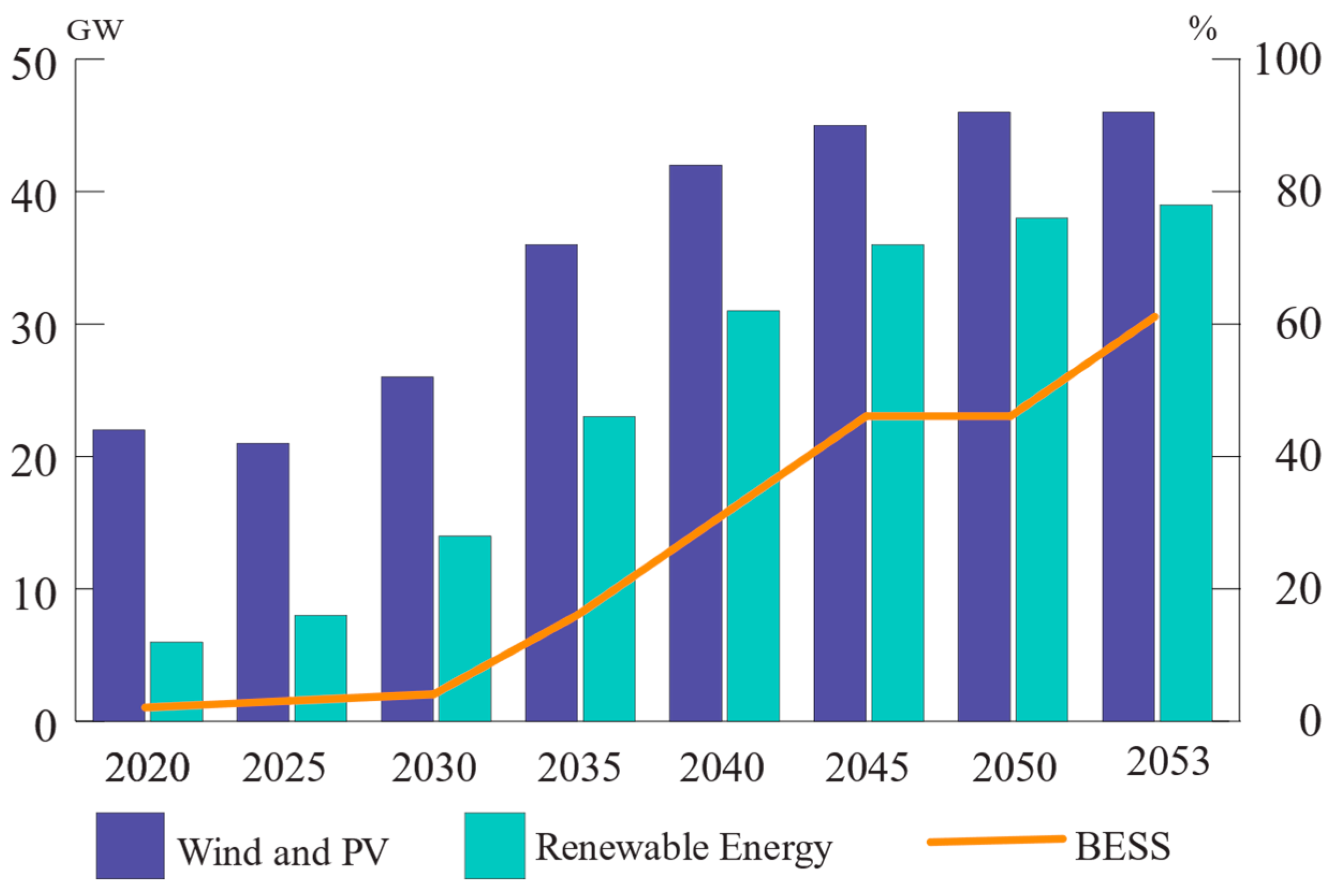
The rapid proliferation of renewable energy power plants over the past decade has significantly transformed the global electricity generation structure [1]. At the same time, advancements in photovoltaic (PV) and wind energy technologies have facilitated the integration of battery energy storage systems (BESS), leading to increasingly inverter-dominated power systems [2]. By 2024, the share of low-carbon energy sources (renewable and nuclear) in global electricity generation is expected to exceed 40%, with renewable generation reaching a record level of 858 TWh, clearly demonstrating the pace of transformation [3]. This trend indicates that dependence on fossil fuels will gradually decrease and renewable sources will become more dominant in global energy systems [4]. As illustrated in Figure 1, projections for the period 2020–2053 indicate that renewable energy generation and energy storage capacity will grow in parallel, highlighting the increasing role of storage systems in supporting variable renewable energy integration [5].
Renewable sources such as wind and solar are inherently intermittent and unpredictable [6]. Mismatches between generation and demand result in inefficiencies in existing grids, reducing energy quality and supply reliability [7,8]. Consequently, frequency deviations, voltage fluctuations, and sudden power changes occur more frequently, particularly in regions with high penetration of intermittent generation [9]. The literature emphasizes that these problems significantly complicate grid operation and that traditional control mechanisms cannot always respond adequately to such rapid changes [10,11]. These challenges have positioned ESSs as key enablers in terms of maintaining operational flexibility and stability in renewable-dominated power systems [12]. ESS technologies are among the fundamental solutions for balancing fluctuations in renewable energy generation and improving grid flexibility [13]. These systems play a critical role in ensuring supply-demand balance, supporting frequency and voltage stability, and strengthening overall energy supply security [14]. In particular, ESSs are widely used to manage demand peaks, mitigate sudden generation changes, and enhance grid stability due to their fast response capabilities [14,15]. In this way, ESS enables the safe, stable, and efficient integration of RES into the grid at higher rates [16].
As renewable power plants (RPPs) and ESSs are increasingly deployed to mitigate the operational challenges caused by intermittent generation, both systems have become integral components of modern power systems [17]. Since RPPs and BESSs are predominantly connected to the grid through power electronic interfaces, their dynamic behavior directly affects grid stability, power quality (PQ), and overall system security [18]. Consequently, ensuring compliance with grid codes, standards, and regulations has become a mandatory requirement for both RPPs and ESSs, regardless of their installed capacity or specific application [19]. Grid code compliance ensures that these systems operate within defined technical limits under normal operating conditions and respond appropriately to grid disturbances such as frequency deviations, voltage fluctuations, and sudden power changes [20,21]. Therefore, systematic verification and documentation of grid code compliance are essential for the safe, stable, and large-scale integration of renewable generation and ESSs into electrical grids [22].
Grid codes are regulatory frameworks that primarily define the technical and operational requirements for generation units connected to electricity grids [23]. In most developed countries, these codes are published by transmission system operators and are continuously updated to ensure system reliability [24]. The literature emphasizes that the integration of variable RESs into weak and isolated grids creates new technical and economic challenges, which directly influence the evolution of grid codes [25]. Comparative analyses of grid codes in countries such as Denmark, the UK, Germany, Spain, the USA, and Canada reveal that the system support capabilities expected from renewable generation facilities are increasingly approaching those of conventional power plants [26].
In particular, requirements such as FRT, reactive power support, and frequency response have become fundamental components of modern grid codes [27,28]. However, ensuring these requirements for IBR has introduced additional engineering challenges, especially due to their interaction with protection systems, where behaviors such as phase selection errors during reactive current injection have been reported [29]. Therefore, grid code compliance must be addressed not only during the design phase, but also through field tests, validated model simulations, and certification processes [30,31]. Country-based case studies conducted under different grid structures, including Indonesia [32,33], Ethiopia [34], Egypt [35], and Türkiye, show that the operational characteristics and integration requirements of variable renewable energy (VRE) systems strongly depend on local grid conditions. In parallel, comprehensive reviews on large-scale PV integration emphasize that the increasing penetration of inverter-based generation introduces new stability and dynamic performance challenges, which require continuous refinement and extension of existing grid code provisions [36]. Moreover, connection requirements for PV and wind power plants (WPP) have expanded to include PQ, island operation, active-reactive power control, and SCADA-based monitoring, while differences between international standards have increased the importance of selecting appropriate standards, particularly in developing countries [37,38,39].
With the increasing penetration of RPPs, the FRT and dynamic voltage support requirements defined in grid codes have led to more complex control and protection challenges for inverter-based generation facilities [40]. The literature shows that during the implementation of these requirements, inverter-induced fault currents can cause phase selection errors in protection relays, primarily due to their behavior differing from that of traditional synchronous generators [41]. To address this issue, advanced control structures that simultaneously regulate positive and negative-sequence currents have been proposed, demonstrating that reactive current injection requirements and proper protection operation can be achieved simultaneously [41,42]. However, the risk that such current injections may exceed converter current limits has made current-limiting strategies an integral part of grid code compliance [42]. These findings highlight the necessity for grid codes to explicitly define not only static operating limits but also dynamic behavior under fault conditions.
The applicability of grid code requirements is evaluated not only through theoretical definitions but also through case studies, simulations, and validation processes conducted on actual systems. Ensuring grid code compliance of renewable generation and ESSs requires systematic monitoring, testing, and simulation-based verification approaches [43]. Model validation plays a critical role in confirming the correct performance of control systems and the accuracy of simulation models used for stability and compliance assessments, while practical testing of reactive power capability, excitation systems, and governors is also widely addressed in the literature [44]. In parallel, grid codes increasingly emphasize the consistency between simulation models and the physical behavior of grid-connected assets, highlighting the need for validated and representative models [45]. Compliance verification can be supported through both off-line and on-line methodologies, including disturbance monitoring techniques that compare simulated responses with measurements recorded during real grid events [46]. In addition to simulation-based approaches, on-site testing remains essential, with commercial and standardized test solutions enabling functions such as Low-Voltage Ride-Through (LVRT), High-Voltage Ride-Through (HVRT), and phase angle jump testing under controlled conditions [47,48]. Nevertheless, existing verification and certification practices still face challenges due to the limited specification of simulation procedures and hardware-dependent effects, particularly for reactive power capability assessments, reinforcing the importance of integrated monitoring, testing, and simulation frameworks for reliable grid code compliance verification [30,49,50].
In line with the increasing complexity of grid code requirements and the diversification of grid-connected generation technologies, a broad range of studies have investigated grid code compliance from different system, control, and verification perspectives. As summarized in Table 1, the literature covers a wide spectrum of inverter-based generation assets, including WPPs, PV power plants, ESSs, and hybrid sites, examined at both unit and plant levels. These studies address key grid code requirements such as active and reactive power control, frequency response, fault ride-through (FRT) capability, PQ limits, ramp-rate constraints, and dynamic performance under normal and disturbed operating conditions. In addition to control-oriented solutions, significant attention has been given to compliance verification methodologies, including model validation, real-time simulation, monitoring-based assessment, and certification-oriented testing frameworks. Overall, Table 1 provides a structured overview of representative studies, highlighting the diversity of technical approaches and validation strategies proposed to support grid code-compliant operation of RPPs and ESSs across different grid conditions and regulatory environments.
In this regard, the general structure and scope of the study are presented in Figure 2, which illustrates the logical flow of the research. The study begins with an overview of global trends in renewable energy and ESSs, followed by a comprehensive comparative analysis of grid code regulations applied in different countries. Subsequently, the technical requirements imposed on inverter-based RPP and ESS are systematically examined, and critical regulatory gaps are identified. Based on this analysis, future-oriented and technically justified recommendations are developed for the Turkish Electricity Grid Regulation. This structured approach enables the study to address regulatory, technical, and operational aspects within a coherent and integrated framework.
The main contributions of this study can be summarized as follows:
  • A comparative analysis of the Turkish Electricity Grid Code with selected international grid codes is conducted, focusing on requirements applicable to RPPs and ESSs.
  • Unlike most previous studies that predominantly address RPP-oriented grid code compliance, this work explicitly incorporates ESSs as standalone and hybrid power plant (HPP) components, providing a more comprehensive perspective on inverter-based generation and storage integration.
  • Beyond regulatory definitions, the study systematically examines grid code compliance assessment practices, including monitoring, testing, and simulation-based verification methodologies, based on existing literature and technical reports.
  • Specific to the Turkish Electricity Grid Code, technical limitations and missing provisions related to inverter-based generation and ESS integration are identified, and practically implementable revision and improvement recommendations are proposed.
  • The study presents a future-oriented perspective for Türkiye, evaluating international best practices and emerging requirements, such as synthetic inertia, fast frequency response (FFR), power oscillation damping (POD), and HVRT, to support secure and reliable grid operation under high renewable and energy storage penetration.
While the contributions outlined above clarify the scope and novelty of this study, it is equally important to explicitly articulate the analytical questions that guide the comparative assessment. In order to avoid a purely descriptive review of grid code provisions and to establish a structured problem-oriented framework, the following research questions are formulated:
  • What structural and technical gaps exist in the current Turkish Electricity Grid Regulation when benchmarked against leading international grid code frameworks and advanced regulatory practices, particularly in emerging areas such as HVRT, FFR, synthetic inertia, and ESS-specific performance criteria?
  • How do different national grid codes parameterize and enforce dynamic performance requirements-such as LVRT/HVRT envelopes, reactive current injection (K-factor), post-fault active power recovery, and frequency-sensitive operating modes (LFSM-U, LFSM-O, FSM)-under increasing inverter-based resource penetration?
  • What best practices can be identified in international compliance verification frameworks, including modeling requirements, simulation-based validation, monitoring architectures, and on-site testing methodologies?
  • How can these international best practices be systematically adapted to strengthen the resilience, transparency, and future-readiness of the Turkish grid code in a high-renewable and storage-integrated power system?
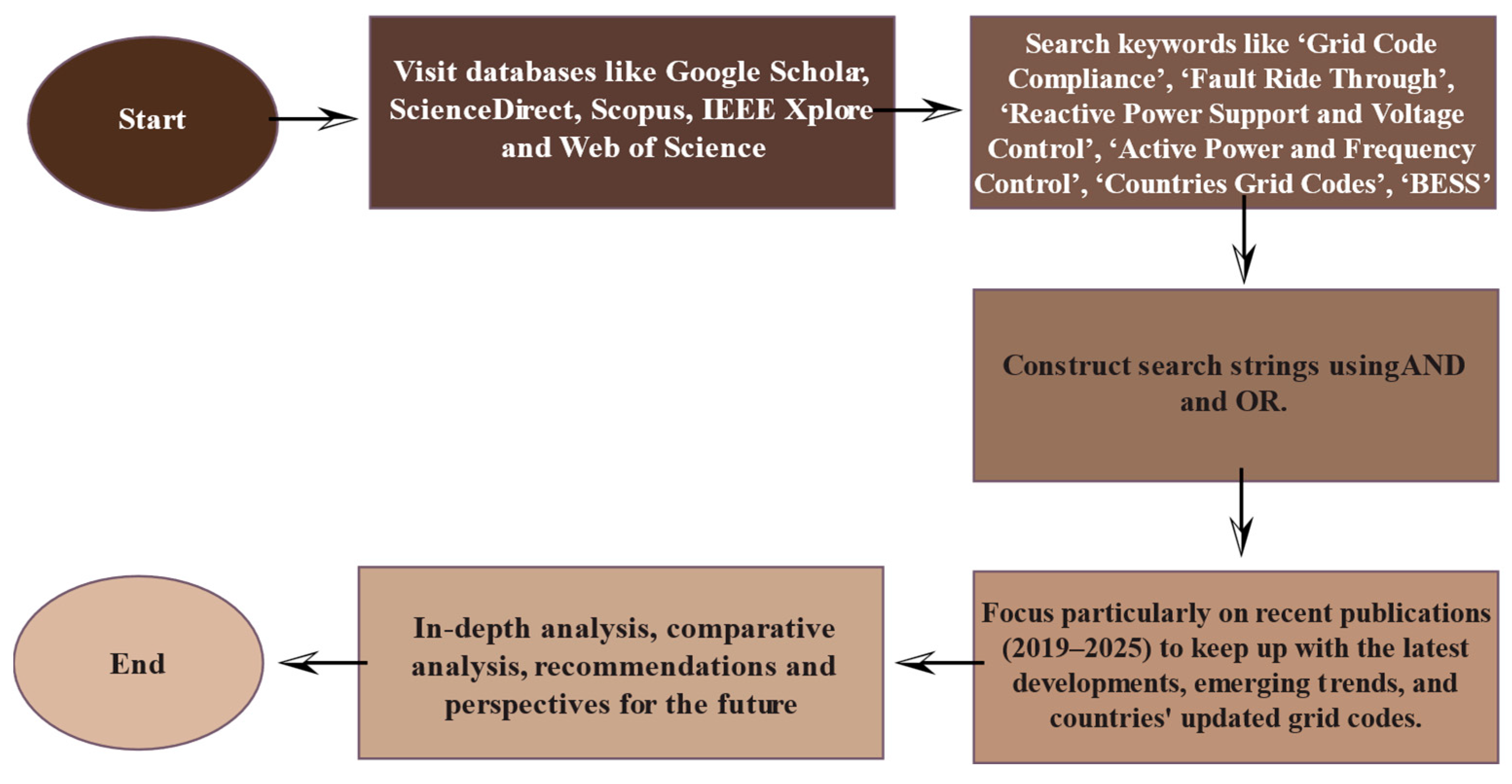
Additionally, Figure 3 summarizes the systematic review approach followed in the study. The figure shows the databases used, search keywords and query strings, inclusion/exclusion criteria, and the thematic categorization of the literature into topics such as FRT capability, frequency control, reactive power support, compatibility tests, and ESS-specific requirements. This systematic approach demonstrates that the study is based on a comprehensive review methodology, strengthening the scientific validity of the analyses presented.

2. Share of RPP and ESS in Türkiye and Global Power Systems

Low carbon emission targets and clean energy policies are becoming increasingly decisive in reshaping modern power systems. Within this transformation, both the installed capacity and the share of RESs in total electricity generation are continuously increasing, making renewables a fundamental component of national energy portfolios worldwide [93,94,95]. The rapid development of renewable energy technologies and declining investment costs support sustainable energy.
While the rapid development of renewable energy technologies and declining investment costs support sustainable energy supply and reduce dependence on fossil fuels, the variable and intermittent nature of solar and wind generation introduces new operational challenges. In particular, increasing variability in generation profiles intensifies the need for flexibility, balancing capability, and system stability, highlighting the strategic role of ESS in modern power systems [96]. Among available storage technologies, BESSs have emerged as the dominant solution due to their modular structure, decreasing costs, and millisecond-level response capabilities [97]. In parallel, hybrid energy systems combining multiple renewable sources are increasingly adopted to further enhance system flexibility and operational robustness [98].
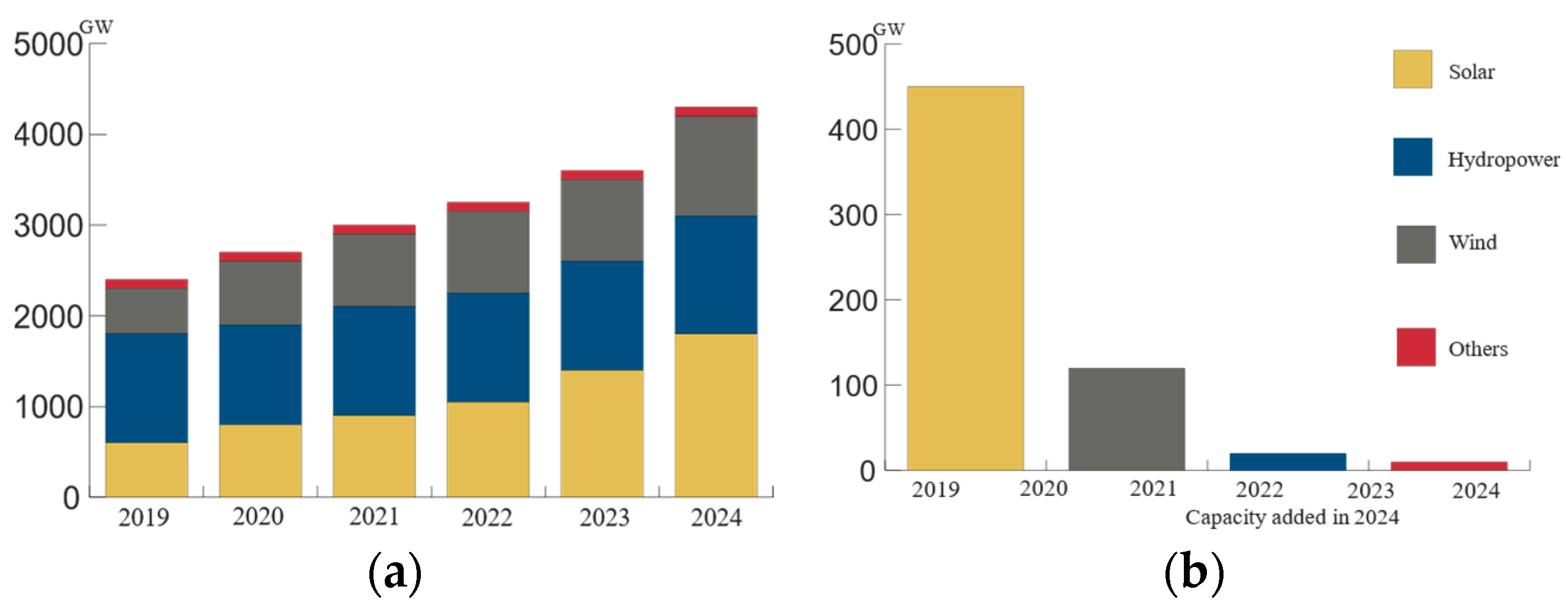
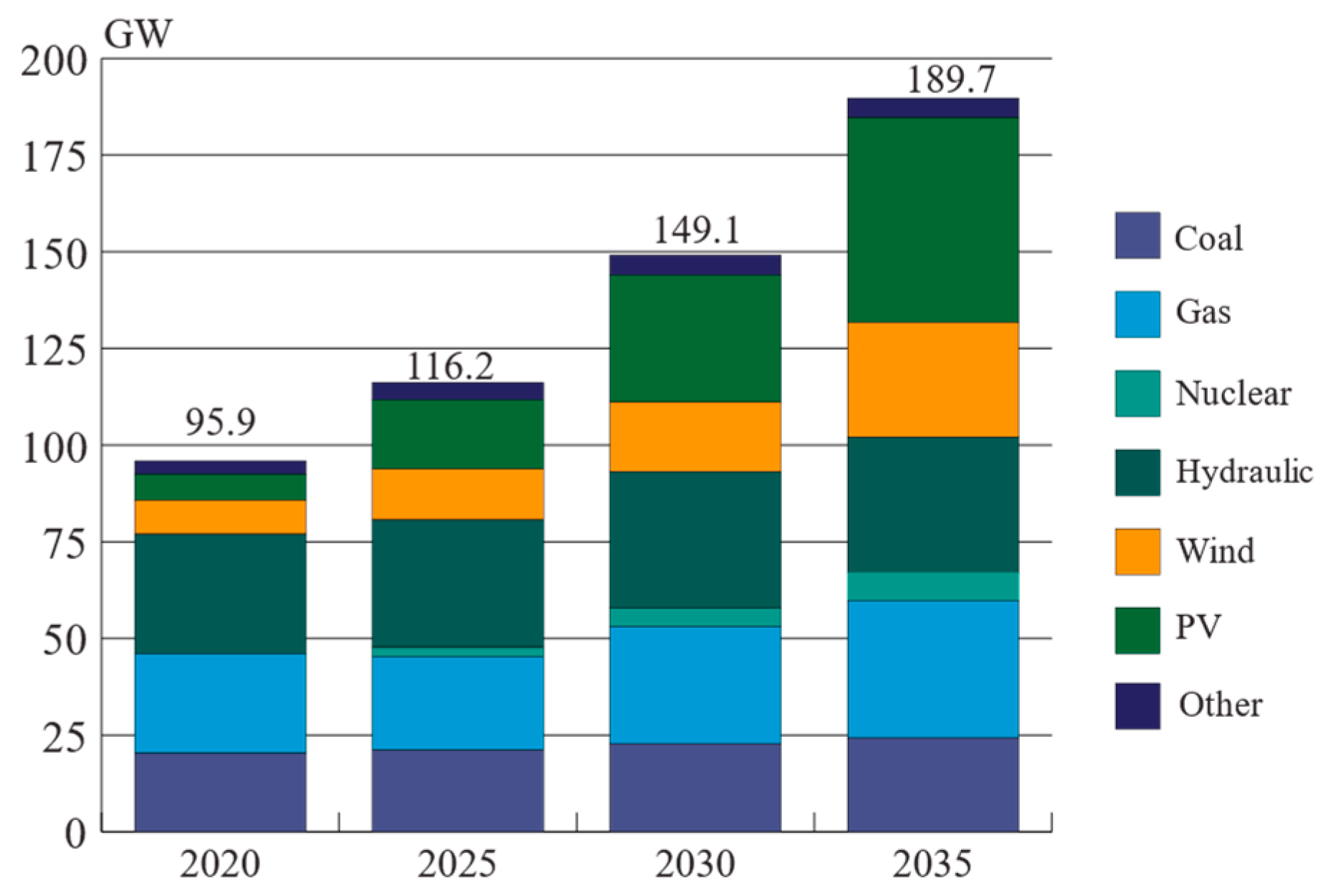
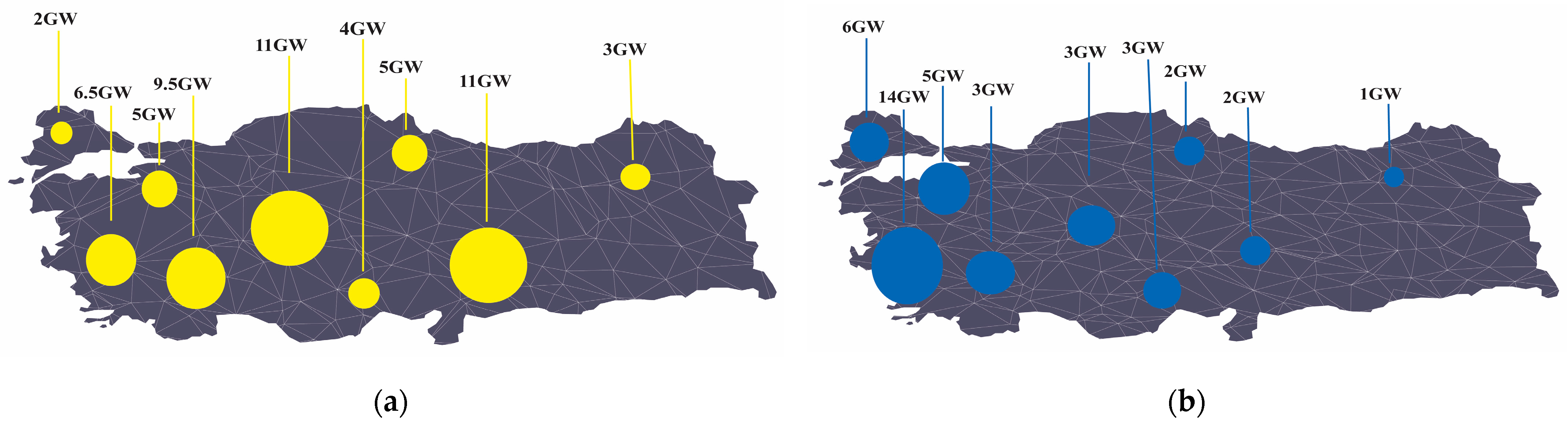
At the global scale, by the end of 2024, global renewable power capacity reached 4448 GW, with solar energy leading at 1865 GW, followed by hydropower (1283 GW) and wind energy (1133 GW). As illustrated in Figure 4, solar and wind power dominate the global renewable generation mix and together accounted for 96.6% of net renewable capacity additions in 2024, reflecting the rapid expansion of IBRs. In 2024 alone, total renewable capacity increased by 585 GW (15.1%), marking the highest annual growth on record, primarily driven by solar (452 GW) and wind (113 GW) installations [99]. These global deployment trends have directly influenced national energy policies, prompting countries to align long-term capacity planning with the increasing dominance of inverter-based renewable generation. Within this global transition context, Türkiye has defined ambitious renewable energy and capacity expansion targets in its long-term policy documents. According to the 12th Development Plan (2024–2028), the total installed power capacity of Türkiye is targeted to reach 136 GW by 2028, with wind and solar capacities planned to reach 18 GW and 30 GW, respectively. Within the same framework, the share of RESs in total electricity generation is expected to reach 50% by 2028 [100]. Furthermore, the National Energy Plan published by the Ministry of Energy and Natural Resources projects that the total installed power capacity of Türkiye will increase to 149.1 GW by 2030 and 189.7 GW by 2035, with wind and solar installed capacities reaching 29.6 GW and 52.9 GW, respectively [101]. Figure 5 illustrates the current installed solar and wind capacities of Türkiye [5,102,103], while Figure 6 presents capacity projections for the 2025–2035 period [100]. These projections indicate a substantial increase in inverter-based generation penetration within the Turkish power system, highlighting the growing importance of flexibility-oriented solutions such as ESSs.
Operational data further demonstrates that this transformation is already reflected in system behavior. Total annual electricity consumption increased from 328.8 TWh in 2021 to 354.6 TWh in 2025, while the share of wind and solar generation rose from approximately 13.3% to over 21% during the same period [104]. As the share of non-synchronous generation grows, system operating conditions increasingly depend on coordinated frequency support, voltage regulation, and balancing mechanisms. A representative example occurred during the Eid holiday period on 6 June 2025, when system demand declined markedly and approximately 22.5 GWh of wind generation was curtailed within a short time window due to low load conditions. Such operational events reflect the sensitivity of high-renewable systems under reduced demand scenarios and emphasize the need for clearly defined voltage withstand requirements, structured frequency support functions, reactive power coordination, and appropriately integrated ESS solutions within the Turkish regulatory framework.
Consistent with these policy targets, the acceleration of renewable energy investments, particularly in solar and wind generation, has made the need for grid flexibility more pronounced and elevated the strategic importance of ESS within national energy planning. The planned expansion of battery storage infrastructure is expected to facilitate renewable integration, enhance operational reliability, and strengthen supply security.
In this context, the allocation of connection points for behind-the-meter, generation-integrated, and standalone storage facilities by the transmission system operator (TEİAŞ, Ankara, Türkiye) plays a critical role in ensuring secure and efficient system operation [105,106]. Planning processes must also jointly consider investment costs, system-level contributions, and end-of-life management of storage technologies [107].
The strengthened carbon reduction target of Türkiye of 41% by 2030, together with national energy planning documents, further reinforces the role of energy storage in supporting high renewable penetration. The National Energy Plan forecasts a storage capacity of 2.1 GW/4.2 GWh by 2030 and 7.5 GW/15 GWh by 2035, alongside substantial increases in wind and solar installed capacity [100]. These targets underline the growing need for flexibility-oriented technologies such as ESS, grid-forming inverters, demand-side participation, and advanced distributed generation management, supported by digitalization and cybersecurity enhancements in energy systems [108,109].
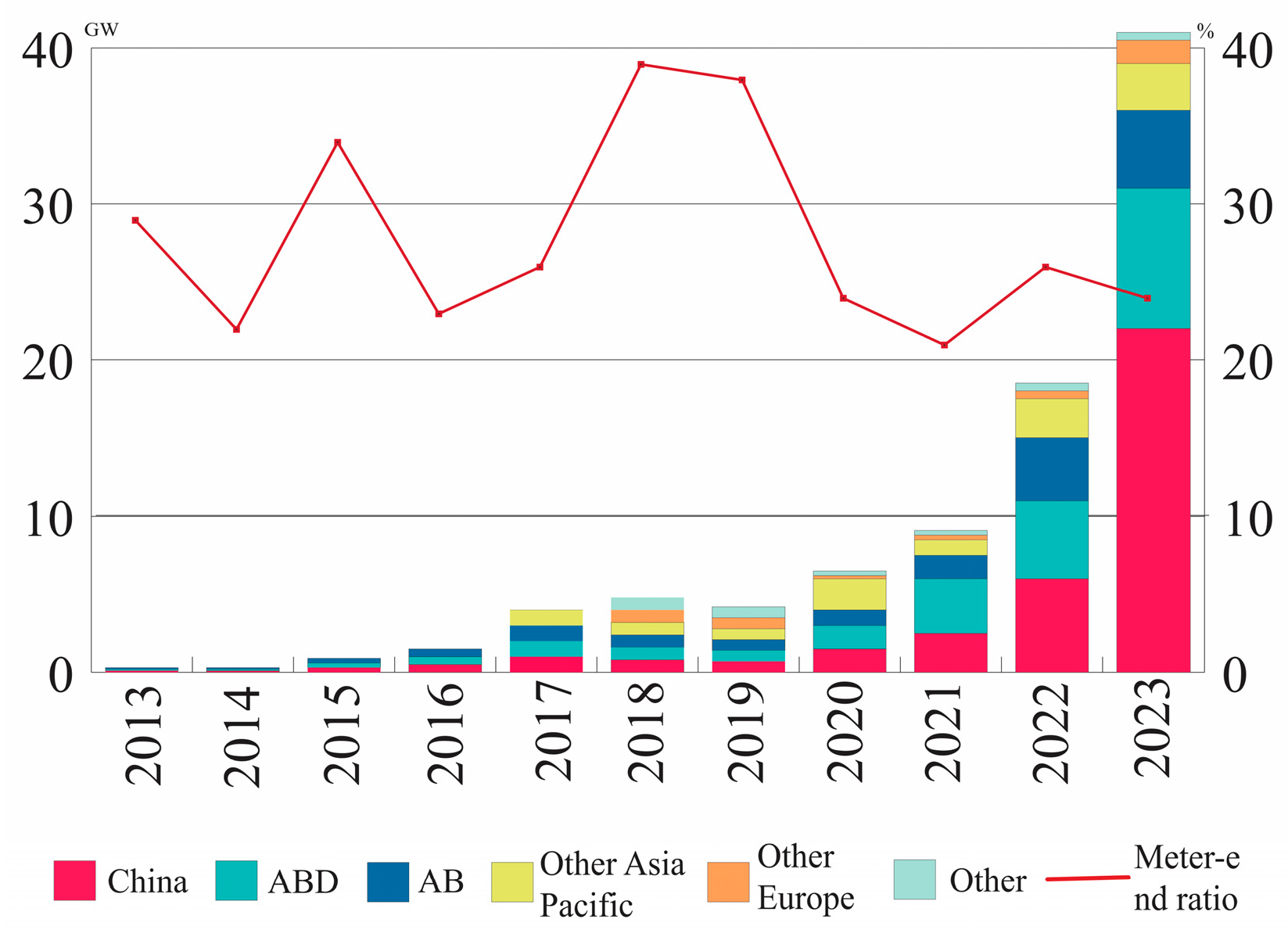
Similar dynamics are also observed at the global scale. Worldwide, the growing share of renewable energy has driven a rapid expansion of battery energy storage deployments as a key flexibility and balancing resource in power systems with high renewable penetration [110,111,112]. Declining battery costs, evolving market structures, and time-of-use pricing mechanisms have accelerated global BESS investments, with approximately 40 GW of new battery capacity commissioned in 2023 alone [113]. As illustrated in Figure 7, the majority of this capacity consists of grid-scale projects, reinforcing the strategic role of ESS in long-term power system planning.
At the international level, the multi-service capability of ESS has reshaped operational and market participation strategies across different regions. In the USA, BESS applications are primarily deployed to support frequency control and system stability, contributing effectively to both primary frequency control and fast frequency reserve services [114,115]. Similarly, transmission system operators in Sweden, Ireland, and the UK increasingly rely on batteries to provide FFR and other ancillary services under high renewable penetration conditions [116]. Growth trends in the European energy storage market further confirm this development, with annual installed capacity increasing from 0.6 GWh in 2015 to 9.4 GWh in 2022, predominantly within European Union member states [117].
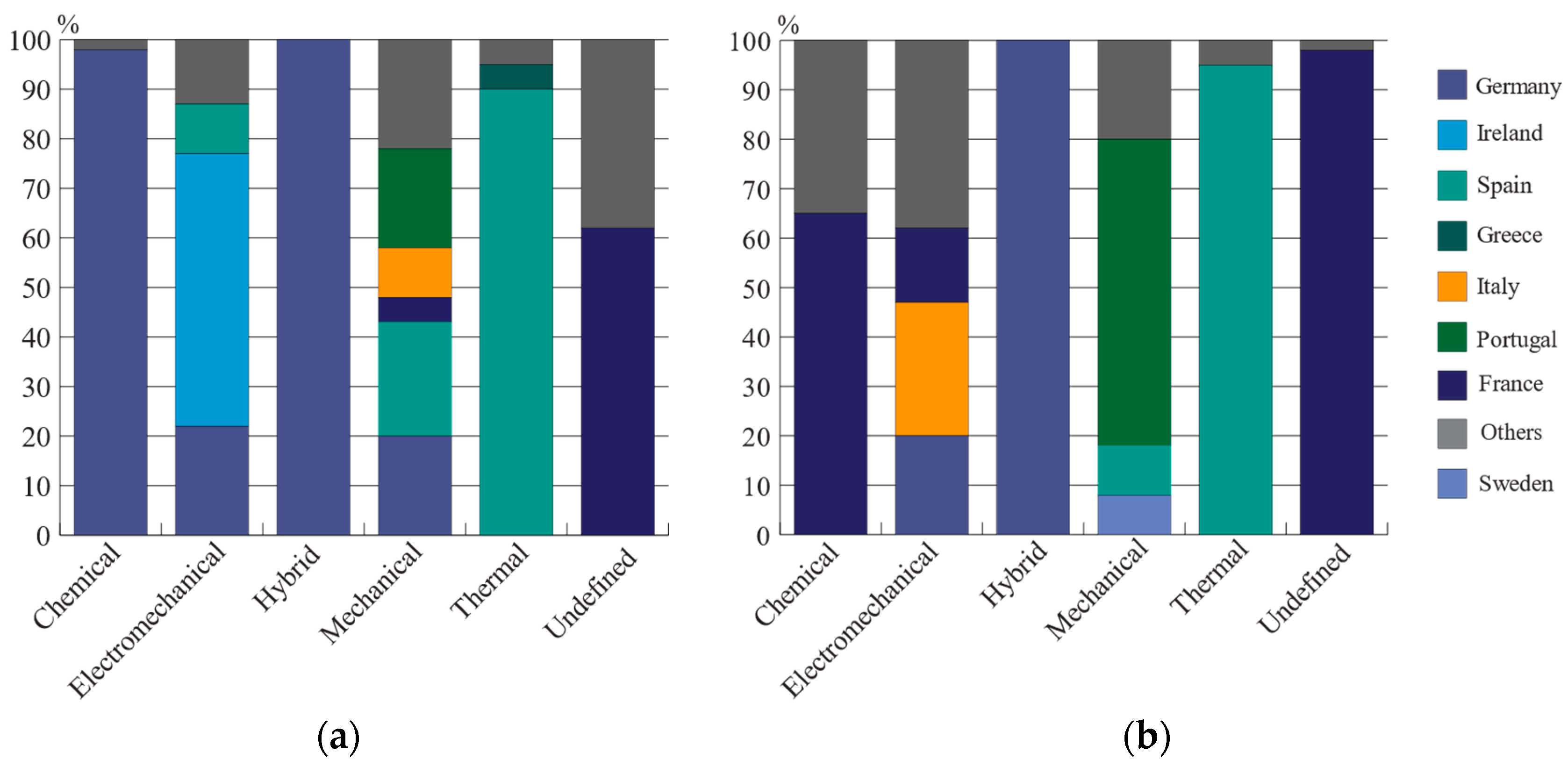
The rapid expansion of ESS deployment has also been reflected in strategic industrial and policy frameworks. The European Union’s objective of transitioning to zero-emission new light-duty vehicle sales by 2035 necessitates a substantial increase in battery manufacturing capacity, which is projected to reach 458 GWh by 2025 and 1083 GWh by 2030 [118,119]. Figure 8 highlights the geographical distribution of storage technologies, indicating that while mechanical storage solutions are widely dispersed, chemical storage technologies are primarily concentrated in countries such as France and Germany [116,120]. These patterns demonstrate that storage technologies fulfill different roles depending on regional energy policies, market structures, and supply security considerations.

3. Grid Code Requirements for Integration of RPP and ESS

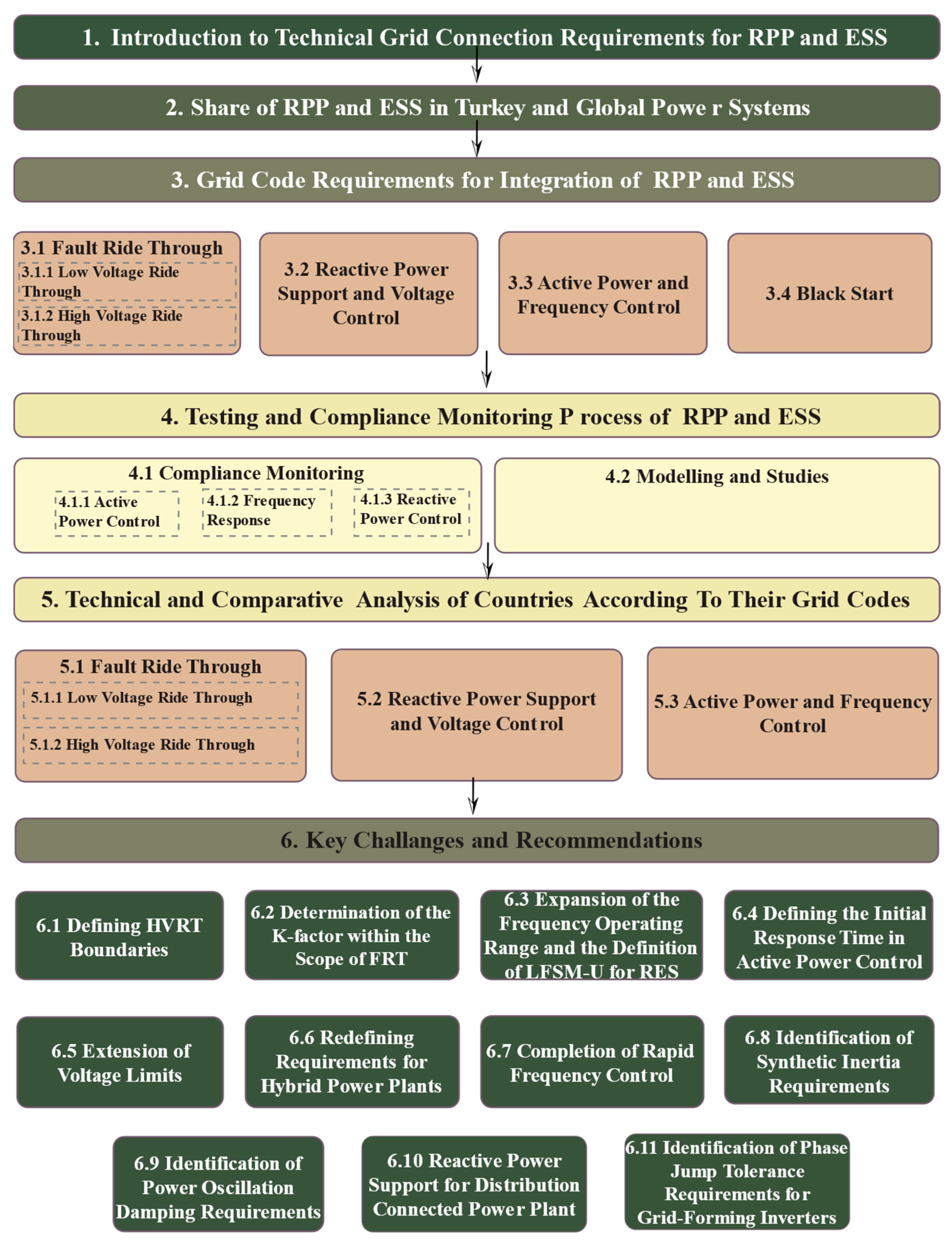
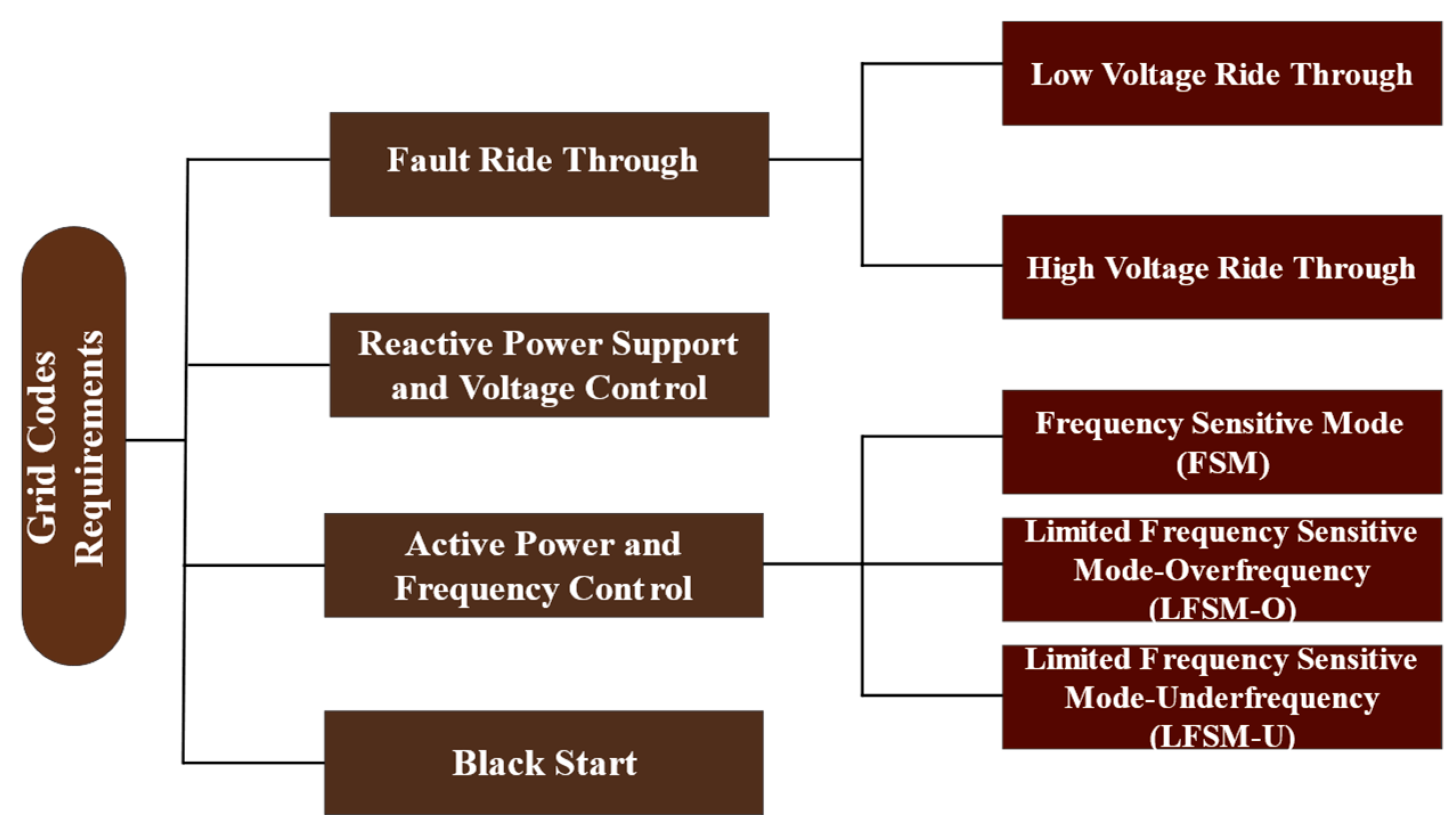
RPPs and ESSs must comply with a wide range of grid code requirements to ensure stable and reliable operation in modern power systems with high renewable energy penetration. These requirements typically encompass dynamic fault performance, voltage regulation capability, active and reactive power control, and system restoration functionalities. As illustrated in Figure 9, grid code obligations applicable to RPP and ESSs can be classified into four main categories: Fault Ride-Through (LVRT/HVRT), Reactive Power Support and Voltage Control, Active Power and Frequency Control (LFSM, LFSM-O, LFSM-U), and Black Start capability. This structured classification provides a systematic basis for evaluating the technical expectations imposed on renewable generation and storage facilities and highlights the growing need for consistent and well-defined performance standards under diverse grid operating conditions.

3.1. Fault Ride Through

FRT refers to the ability of power generation facilities connected to the power system to continue operating without disconnecting from the grid during short-term voltage dips, swells, or fault conditions caused by short circuits [121]. This requirement, which is critical for grid stability, is particularly important for IBRs and ESSs, since IBRs and ESS units without FRT capability can pose serious risks to stability and safety in systems with high renewable energy generation [122]. Therefore, grid codes define FRT requirements in accordance with national and international standards, including IEEE 1547 [123], IEEE 2800 [124], and ENTSO-E regulations [125].
FRT requirements are defined based on three fundamental performance criteria to ensure that RPPs and ESSs remain connected to the grid during fault conditions and actively support overall system stability. First, the grid connection criterion requires generation units to remain connected to the grid and operate for a predefined period depending on the type and duration of the fault [126]. Second, the active and reactive power contribution criterion requires IBRs and ESSs to provide active and/or reactive current within specified limits to support the grid during the fault duration [127]. The third criterion, return to normal operation, requires facilities to return to pre-fault conditions in accordance with specified dynamic response characteristics after the fault has been cleared [128]. These three fundamental elements form the basic framework for the contribution of FRT performance to both grid security and the stable integration of RESs.
FRT performance is generally evaluated under two categories [129]. LVRT refers to a facility’s ability to remain connected to the grid during voltage dips and provides the required reactive power support, while HVRT similarly mandates continued operation during voltage surges, including appropriate voltage and reactive power support, without disconnection from the grid. These capabilities enable inverter-based generation technologies to respond quickly and safely to fault conditions, directly contributing to both grid voltage stabilization and overall system security.

3.1.1. Low-Voltage Ride-Through

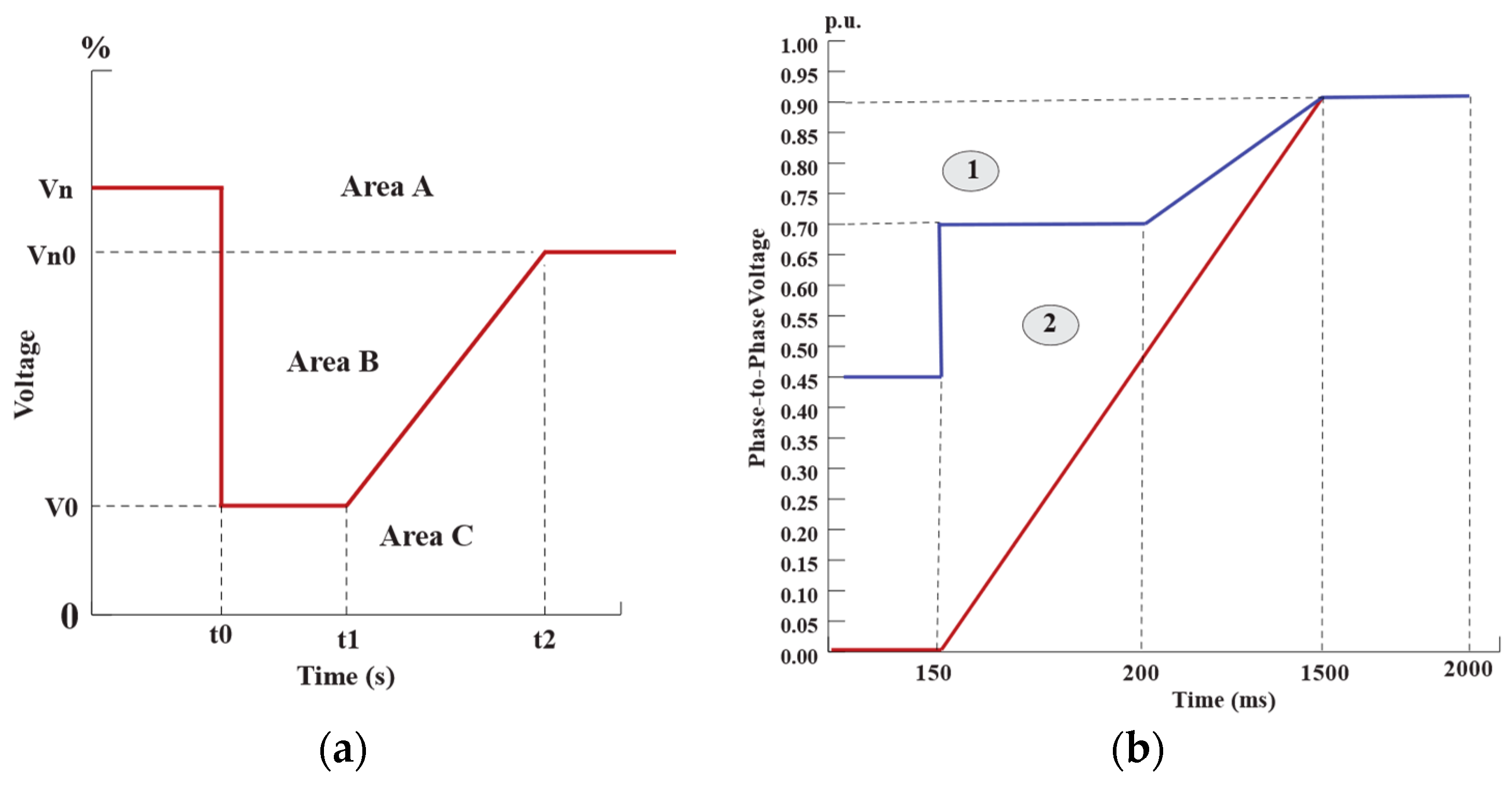
LVRT is a core grid code requirement related to the ability of ESSs to comply with grid support obligations during voltage dips caused by faults or short-circuit events [130,131]. A generic LVRT capability curve commonly adopted in international grid code practices is illustrated in Figure 10a. Although detailed voltage–time thresholds differ among countries, the overall structure and intent of LVRT requirements are largely consistent, reflecting a common international framework for FRT behavior [132]. Under LVRT conditions, grid-connected facilities are required to remain connected down to predefined voltage levels without protection tripping and to support the grid, which is particularly critical for maintaining transmission-level stability [133,134].
In the Turkish Electricity Grid Regulation [135], LVRT requirements are explicitly defined in Annex-18, and the corresponding national LVRT characteristic is shown in Figure 10b. According to this regulation, when the phase-to-phase voltage at the connection point remains within Area 1 and 2 of the LVRT curve, generation facilities must remain connected during voltage dips affecting one or all phases. For Area 1 voltage dips, the active power output must be restored after fault clearance at a ramp rate of at least 20% of the nominal active power per second, whereas for Region 2, a lower recovery rate of at least 5% per second is permitted.
Figure 10. (a) FRT/LVRT curve [136]; (b) Turkish grid code LVRT requirement curve [135].
Electronics 15 00968 g010
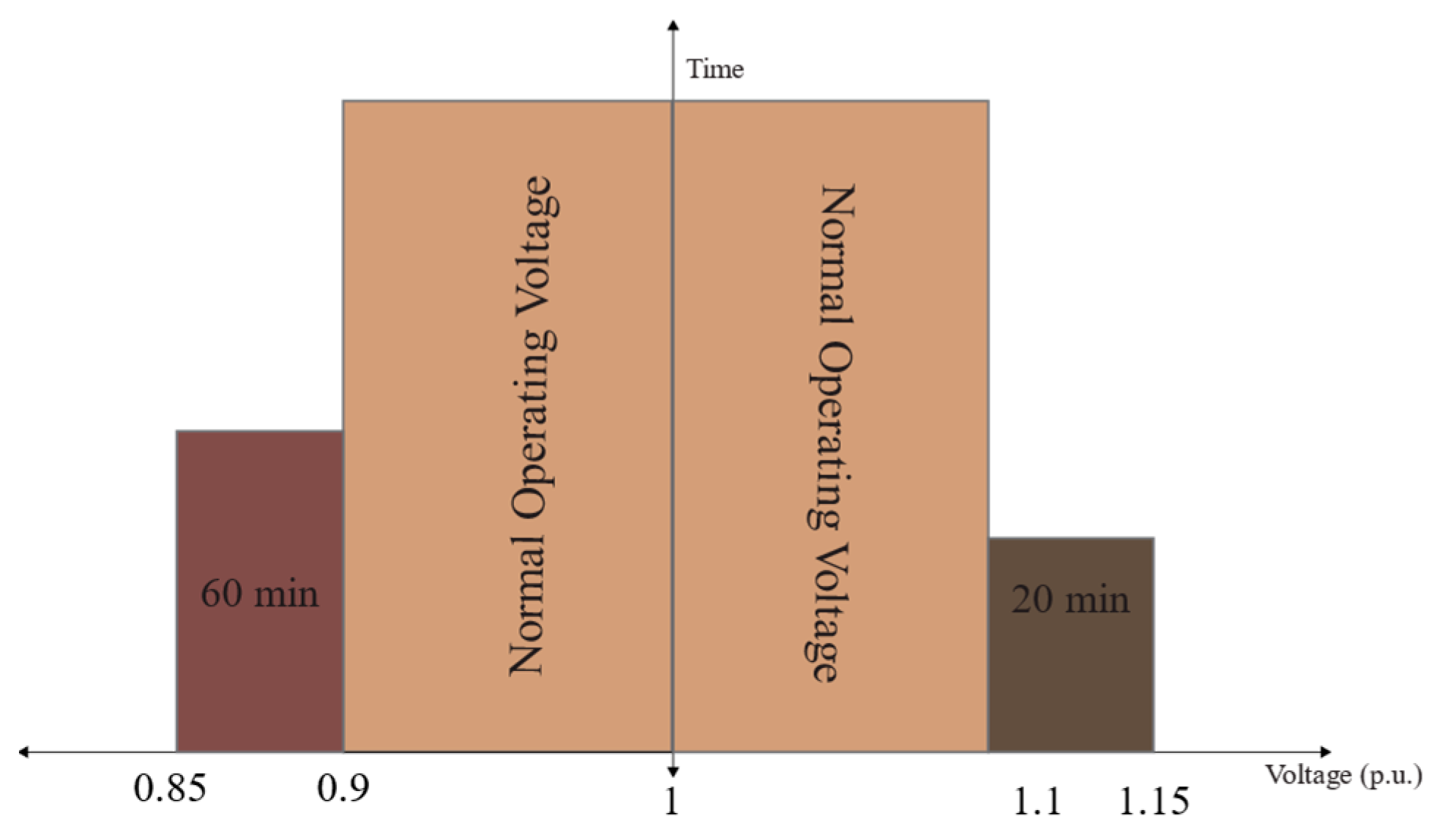
Under normal operating conditions, PCC voltage variations within ±10% (0.9 p.u.–1.1 p.u.) are acceptable. During fault conditions exceeding this range, wind turbine generators and PV inverters are required to provide inductive or capacitive reactive current support up to 100% of the nominal current capacity without exceeding transient ratings. As specified in Annex-18, this reactive current must be reached within 60 ms (±10% tolerance) and sustained for at least 1.5 s to support voltage recovery. Recent grid code developments further indicate that similar reactive current support principles are increasingly extended beyond LVRT to include HVRT scenarios, ensuring voltage stability under a wide range of disturbances [137,138].

3.1.2. High-Voltage Ride-Through

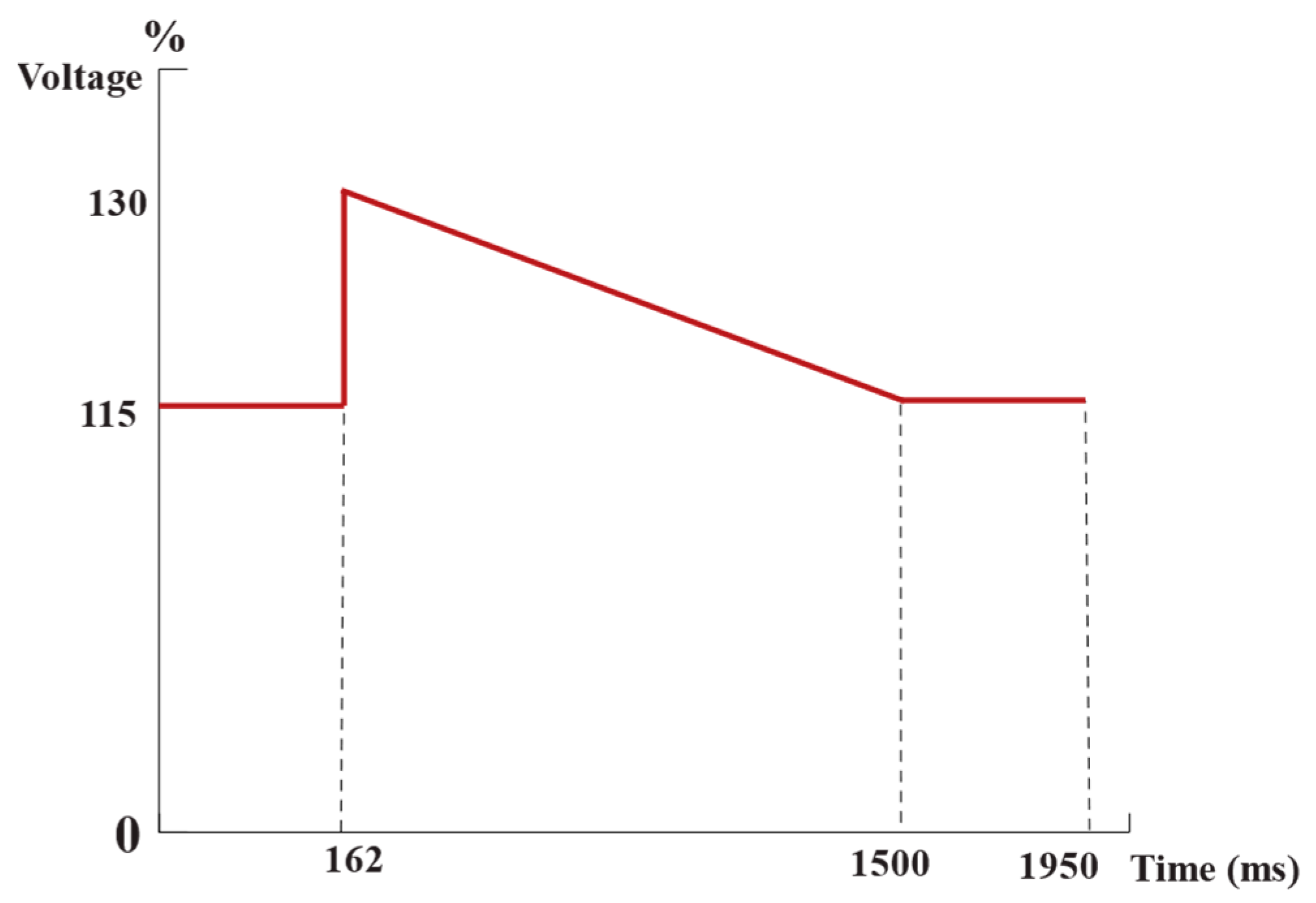
HVRT is a critical grid operation requirement that refers to the ability of energy facilities, particularly power electronics-based sources such as inverter-based generation units and ESS, to remain connected to the grid during sudden voltage surges and contribute to system stability [139]. Under HVRT requirements, facilities are expected to prevent the unnecessary triggering of protection systems under overvoltage conditions, continue to operate within specified upper voltage limits, and contribute to voltage regulation by providing reactive current support when necessary. Figure 11 presents a typical HVRT voltage–time characteristic curve [140,141]. This capability is of great importance in limiting the propagation effects caused by overvoltage at both transmission and distribution levels and in maintaining system reliability.
Unlike LVRT requirements, the Turkish Electricity Grid Regulation does not explicitly define detailed technical performance criteria for HVRT. However, international experience clearly demonstrates that HVRT capability is a critical function for modern power systems with high penetration of inverter-based renewable generation and storage resources. The Iberian Peninsula blackout report published by Red Eléctrica highlights that, under overvoltage conditions, insufficient reactive current contribution from IBRs can significantly weaken voltage control and adversely affect system restoration processes [142]. This finding underscores the importance of explicitly addressing HVRT performance within grid codes to avoid large-scale stability issues during overvoltage events.

3.2. Reactive Power Support and Voltage Control

Maintaining voltage within operating limits is a fundamental requirement for reliable power system operation and equipment protection [143]. Since voltage regulation is inherently dependent on reactive power management, the capability of RPPs and ESSs to supply or absorb reactive power constitutes a critical component of grid stability [144]. Accordingly, grid codes impose reactive power obligations on IBRs, with specific requirements varying according to connection level, operating mode, and system conditions.
In generation-integrated storage configurations, reactive power responsibilities are defined by both the operational status of the primary generation unit and the limits specified in the Turkish Electricity Grid Regulation. When the primary generation source is in service, reactive power provision must comply with the technical characteristics of the relevant generation technology and the boundaries defined in Annex 18. However, when the main generation unit is unavailable or when the active power output falls below 10% of the installed capacity, reactive power support must be provided exclusively by the storage unit [145]. This operational arrangement ensures continuity of voltage support under varying generation conditions and enhances system robustness.
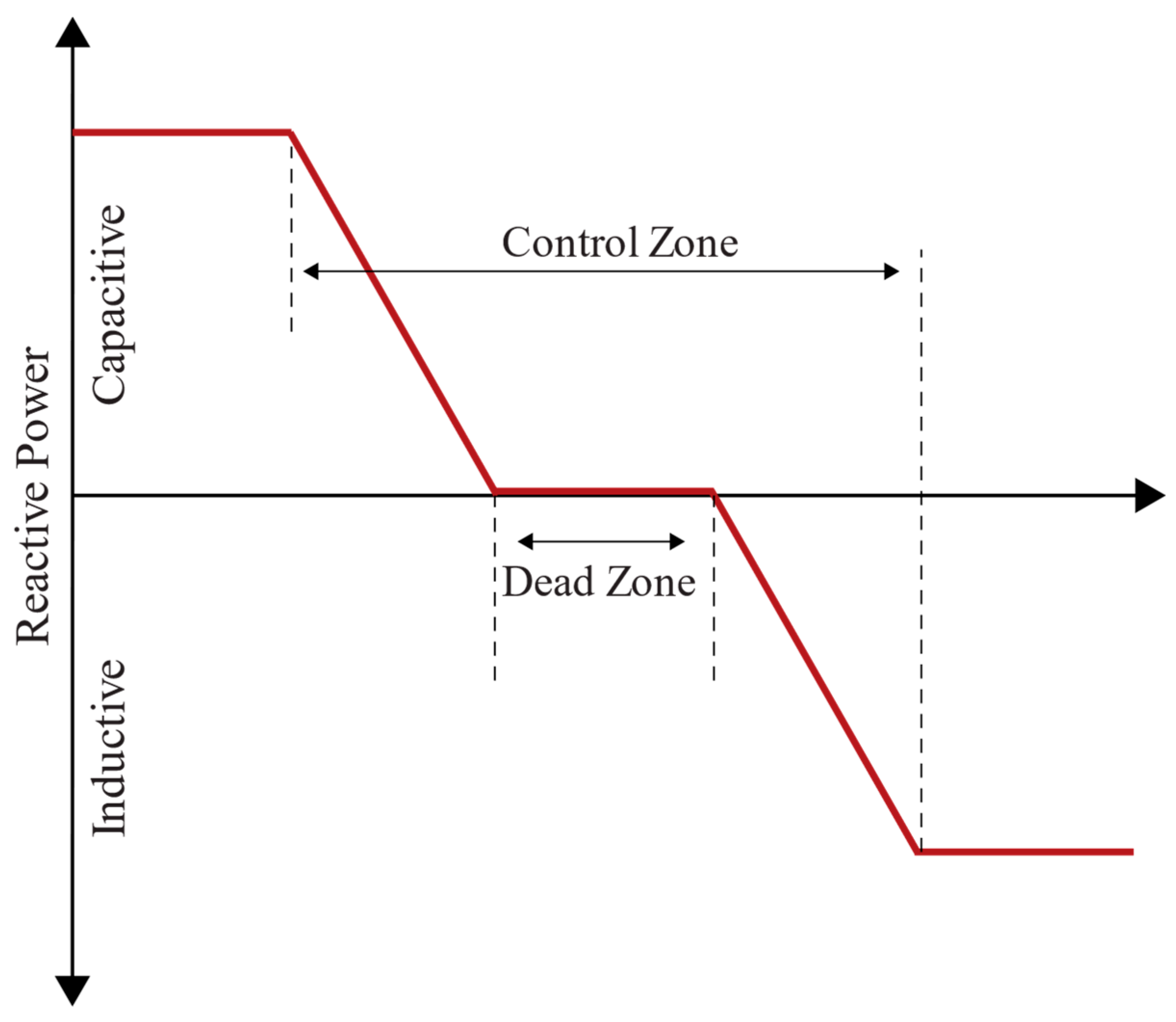
To meet these obligations, inverter-based systems employ different reactive power control strategies. Among these, power factor control and Volt-VAR control are the most adopted approaches [146]. Power factor control regulates reactive power output based on a predefined relationship with active power flow, whereas Volt-VAR control enables a voltage-dependent response by continuously adjusting reactive power according to measured grid voltage levels [147]. A representative Volt-VAR characteristic, illustrating voltage deadband regions, maximum reactive power limits, and slope definitions associated with inverter capacity, is shown in Figure 12 [148]. By dynamically adapting reactive power output to local voltage conditions, this control strategy effectively mitigates voltage deviations and improves voltage profiles across both transmission and distribution networks. Recent studies on advanced inverter-based control architectures, including fuel-cell-integrated active filtering systems, further demonstrate that robust harmonic suppression and fast dynamic response significantly enhance voltage regulation performance under distorted and sag/swell grid conditions [149].
Maintaining the voltage at the point of common coupling within predefined limits requires IBRs to reserve sufficient reactive power capability to support voltage regulation and system stability [150]. Under nominal operating conditions, grid voltage is typically maintained within a narrow band (e.g., 0.95 p.u.–1.05 p.u.). When deviations occur, IBRs are expected to inject or absorb reactive power to counteract voltage changes; for example, reactive power absorption is required when the PCC voltage rises above its nominal value. This response is governed by a predefined voltage-reactive power characteristic with a specified droop, ensuring coordinated and predictable voltage control.
According to the ENTSO-E Network Code on Requirements for Generators [151], which underpins grid code practices in many European countries, the Volt-VAR droop is typically defined within the range of 2–7%. In the Turkish Electricity Grid Regulation, these principles are implemented through defined droop characteristics and associated dynamic performance criteria, including response time, settling time, and steady-state error limits. Together, these requirements ensure that inverter-based generation and storage systems contribute effectively to voltage regulation while maintaining overall system coordination and stability. In the Turkish Electricity Grid Regulation, reactive power and voltage control performance are evaluated at the PCC, where compliance is coordinated through the plant controller and verified within defined tolerance bands during commissioning and monitoring procedures.

3.3. Active Power and Frequency Control

RPPs are required to comply with active power control requirements defined in grid codes to support frequency stability, limit power ramps, and ensure coordinated system operation under normal and disturbed conditions [152]. These requirements typically include active power curtailment, ramp-rate limitation, frequency-dependent power response, and setpoint-based active power regulation, enabling the secure integration of variable renewable generation into the power system [153].
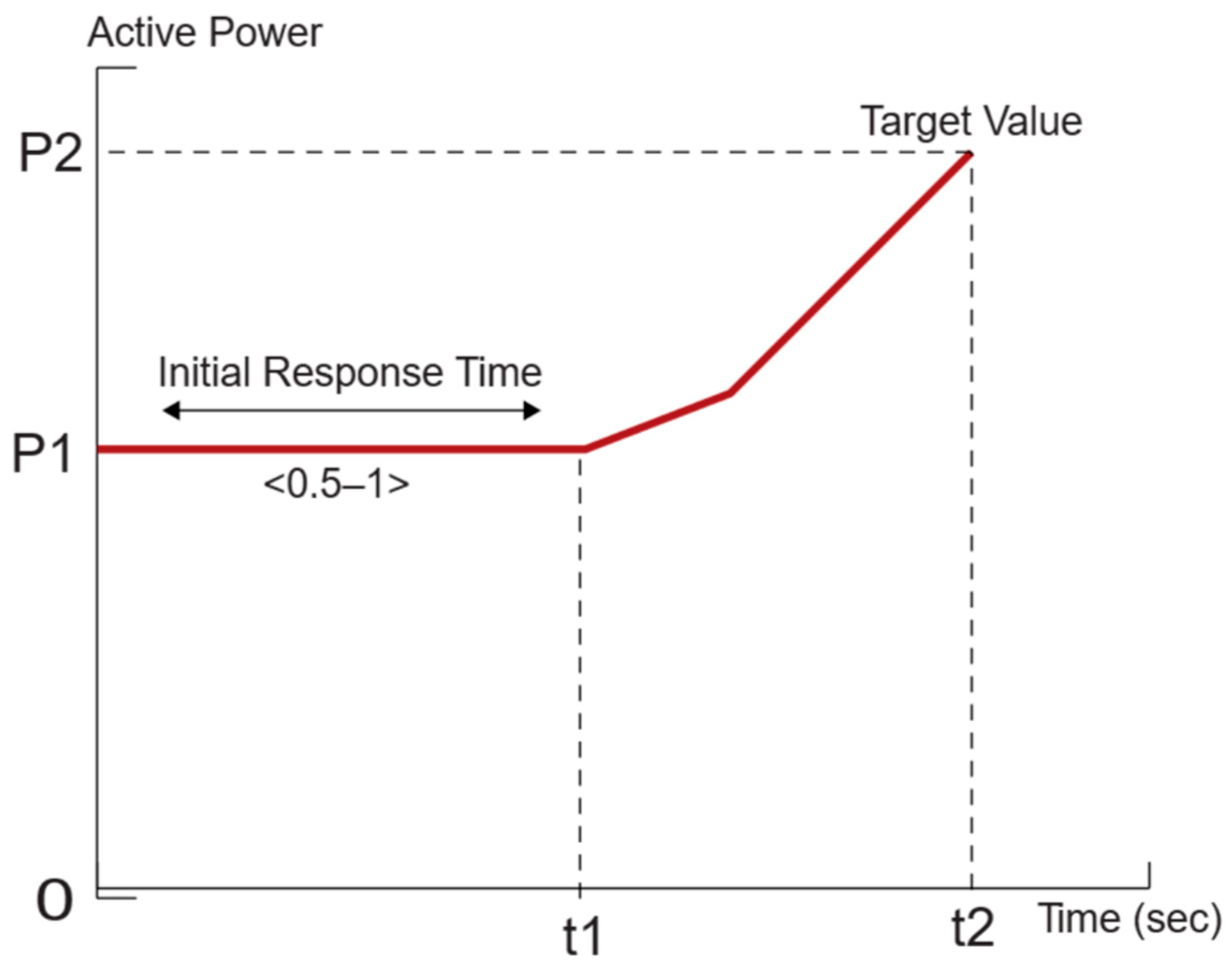
ESSs, in contrast to renewable generation units, inherently enable bidirectional active power flow, allowing them to both inject power into the grid and absorb power from it [154]. This characteristic requires ESSs to support system stability under both generation and consumption conditions [13,155]. Consequently, active power control requirements for ESSs must address not only power injection scenarios but also power withdrawal operation [156], enabling ESSs to contribute to system stability in both directions of power flow. In accordance with the Turkish Electricity Grid Regulation, ESSs are required to continuously and automatically regulate their active power levels in line with target values transmitted by the system operator [145]. Safe transitions between charging and discharging modes are essential to prevent adverse grid impacts caused by sudden power variations. For this reason, active power control must be initiated from the zero-power level during all transition processes, while control accuracy must be maintained throughout operation. Power level deviations are required to remain within ±1 MW or ±1% of the installed capacity. In addition, limiting ramp rates and enforcing maximum power change constraints are recognized as effective measures for mitigating sudden load variations and enhancing system stability during dynamic operating conditions. The literature further indicates that controlled active power–time behavior, coordinated with system operator commands, plays a key role in reducing the impact of rapid power fluctuations on grid performance.
In terms of frequency control, the active power frequency response of RPP and ESS is defined by their ability to automatically respond to deviations in system frequency [157]. In this context, frequency response is addressed under three basic operating modes [158,159]:
  • Frequency Sensitivity Mode—Underfrequency (LFSM-U): When the system frequency falls below the treshold value, the ESS should limit the frequency drop by increasing the active power output to the extent of its available capacity.
  • Frequency Sensitivity Mode—Overfrequency (LFSM-O): When the system frequency rises above the treshold value, the ESS should respond to the frequency rise by reducing its active power output.
  • Frequency Sensitivity Mode (FSM): The ESS should continuously monitor frequency deviations to support grid frequency stabilization and contribute to maintaining dynamic stability.
While WPPs and SPPs typically apply generation curtailment only during overfrequency events, ESSs can contribute more effectively to system balancing by switching from charging to discharging during frequency drops and from discharging to charging during frequency increases, owing to their bidirectional power flow capability. Within the current Turkish Electricity Grid Regulation, frequency response requirements are explicitly limited to the definition of the LFSM-O mode, whereas LFSM-U and continuous FSM response modes are not formally specified.

3.4. Black Start

Black Start refers to the process of re-energizing the power grid in the event of a widespread or complete collapse [160]. In this process, power plants that can operate independently without requiring an external energy source are brought online first to supply energy to the grid. Other power plants are then gradually connected to the system; frequency and voltage synchronization are critical during this phase. To maintain system stability, energy flow is managed in a controlled and phased manner during Black Start operations, preventing sudden power fluctuations [161].
ESSs, particularly GFM-controlled types, play a critical role in black start scenarios due to their fast dynamic response and ability to generate an independent voltage/frequency reference. Unlike grid-following (GFL) inverters, GFM-ESSs can stabilize both voltage and frequency after a system collapse, accelerate system recovery, and enable the safe commissioning of other generation facilities [162].

4. Testing and Compliance Monitoring Process of RPP and ESS

4.1. Compliance Monitoring

In this context, grid code compliance tests are applied to verify whether both RES and ESS facilities meet certain technical requirements [30]. Grid codes standardize the voltage, frequency, active, and reactive power behavior of generation and storage units, enabling system operators to manage energy from different sources safely and reliably [163]. These requirements cover compliance with national legislation as well as international grid regulations such as ENTSO-E [164].

4.1.1. Active Power Control

The compliance monitoring process for RPPs and ESSs constitutes a systematic verification phase aimed at ensuring that grid-connected facilities operate within the technical and operational limits defined by applicable grid codes and regulations [165]. During this process, monitoring activities focus on assessing whether the plant correctly follows active and reactive power control commands, respects predefined operating limits, and maintains stable operation across different operating modes [166,167].
In accordance with grid code monitoring provisions, the first stage involves verifying active power control behavior [168]. This includes monitoring compliance with maximum export and import limits, accurate tracking of transmitted setpoints, adherence to ramp-rate constraints, and proper activation or deactivation of control modes as required by the system operator. Within this framework, ESSs are required to automatically regulate the difference between the current active power level and the dispatched power reference based on control signals issued by the system operator. Accordingly, ESSs are expected to adjust their active power output accurately, rapidly, and bidirectionally in both charging and discharging modes, ensuring compliant active power control under varying operating condition [75]. For hybrid configurations, it is also verified that active power contributions from RPPs and ESSs are coordinated and that control commands are executed without undesired interactions between generation and storage units [169].
From a regulatory perspective, national grid codes explicitly define active power control monitoring requirements for both generation and storage assets. In the European Union, the ENTSO-E Requirements for Generators [170] mandate continuous monitoring of active power output, verification of ramp-rate compliance, and accurate execution of dispatched setpoints. Similar provisions are adopted in Germany under VDE-AR-N 4110 [171] and VDE-AR-N 4120 [172], where compliance monitoring includes supervision of active power gradients and coordinated control at the point of common coupling for hybrid plants. In the UK, the ENA Engineering Recommendation G99 requires Type C and Type D generating units, explicitly including electricity storage systems, to demonstrate controlled active power behavior during normal operation and system events, with particular emphasis on ramp-rate compliance and interaction with frequency response functions [173]. Nordic regulations similarly emphasize monitoring of active power gradients and stable post-disturbance power recovery, ensuring predictable system balancing without oscillatory behavior, while Australia adopts comparable monitoring requirements for bidirectional ESS operation [174]. Within the Turkish Electricity Grid Regulation [135], compliance monitoring of active power control is technically focused on verifying accurate setpoint tracking, ramp-rate conformity, and stable execution of frequency-sensitive active power functions at the point of connection, including coordinated power sharing between RPPs and ESSs in hybrid plant configurations.
A subsequent monitoring stage focuses on the continuous supervision of system operating states and availability [175]. For RPPs, this includes tracking real-time power output, availability status, and operational limits, while for ESSs it involves monitoring charge and discharge states, available energy, and usable capacity [13]. Monitoring systems are required to confirm that both generation units and storage modules operate above their minimum technical thresholds and remain within permissible operating ranges defined by the regulation [176,177]. During monitored operation and test sequences, system responses to different setpoints, ramp rates, and output transitions are evaluated to ensure stable behavior, controlled power recovery, and compatibility with grid operation [177]. Overall, these monitoring stages provide evidence that RPPs and ESSs can reliably support grid operation and comply with regulatory performance requirements under normal operating conditions.

4.1.2. Frequency Response

Grid codes require frequency response capabilities of both RPPs and ESSs to be explicitly verified through structured compliance monitoring and testing procedures [178]. In the European Union, the ENTSO-E RfG mandate that Power Park Modules demonstrate Limited Frequency Sensitive Mode (LFSM-U and LFSM-O) and FSM performance through predefined test sequences, including frequency step and ramp injections, verification of droop settings, response delays, and stability during activation [170]. Similarly, the UK’s ENA Engineering Recommendation G99 requires Type C and Type D power generating modules, explicitly including electricity storage, to undergo frequency response tests that assess response magnitude, activation time, repeatability, and coordination with plant-level controllers, with results documented as part of the commissioning and final operational notification process [179]. In Nordic countries, such as Finland, frequency response compliance for grid ESSs is evaluated through staged verification procedures combining simulations and commissioning measurements, ensuring correct activation of LFSM functions, droop accuracy, and stable operation under frequency disturbances [180]. In Türkiye, frequency-related requirements are defined in Annex-18 of the Turkish Electricity Grid Regulation. LFSM-O is mandatory for RPPs, while ESSs are required to comply with both LFSM-O and LFSM-U provisions. Transmission-connected ESSs with an installed capacity exceeding 30 MW may additionally participate in ancillary services through FSM. For ESSs participating in FSM-based ancillary services, compliance monitoring focuses on verifying correct FSM activation, adherence to defined slope characteristics, and coordinated operation at the grid connection point. However, explicit response time requirements and dynamic stability margins are not formally specified [135].
Within these regulatory frameworks, compliance monitoring focuses on verifying that both RPPs and ESSs follow frequency-triggered active power trajectories without violating converter current limits, export/import constraints, or plant-level coordination rules [181]. Test procedures assess whether frequency response functions are activated within specified time limits, whether droop characteristics remain within adjustable ranges defined by the system operator, and whether stable operation is maintained throughout the response period [167]. For ESSs, additional monitoring verifies correct bidirectional behavior, ensuring seamless transitions between charging and discharging modes during over and under-frequency events [182], while for RPPs the focus remains on controlled power reduction or increase within available capacity limits [183]. Accordingly, frequency response compliance is verified through on-site measurements and model-based validation, ensuring predictable and reliable frequency support from IBRs under grid code requirements [184].

4.1.3. Reactive Power Control

Grid codes require the reactive power control capabilities of RPPs and ESSs to be continuously monitored and verified to ensure voltage regulation and system stability at the grid connection point [185]. Under the ENTSO-E RfG, Power Park Modules are required to demonstrate compliant reactive power behavior through predefined operating modes, including fixed power factor control, reactive power setpoint control, and voltage-dependent Volt-VAR control [151]. Compliance monitoring focuses on verifying that the delivered reactive power remains within the specified capability envelope, respects defined deadband limits and follows the commanded setpoints or characteristic curves without violating converter current constraints or plant-level coordination rules [186].
Similar monitoring requirements are implemented in national grid codes derived from the RfG [187]. In the UK, the ENA Engineering Recommendation G99 requires Type C and Type D generating units, explicitly including electricity storage systems, to provide continuous reactive power control capability and to demonstrate compliance through monitored operation at the point of common coupling [179]. Monitoring activities verify correct execution of Volt-VAR characteristics, adherence to reactive power response slopes, and stable operation during voltage variations. In Nordic countries, such as Finland, reactive power compliance monitoring for both generation and storage assets combines operational measurements and commissioning verification to confirm accurate tracking of voltage-dependent reactive power functions, droop accuracy, and absence of sustained oscillations during normal and disturbed voltage conditions [188].
Within the Turkish Electricity Grid Regulation, reactive power control obligations are defined for both RPPs and ESSs with respect to voltage regulation at the grid connection point [135]. Compliance monitoring under the Turkish Electricity Grid Regulation focuses on verifying that IBRs provide requested inductive or capacitive reactive power support within defined operating limits and response time, follow voltage-dependent reactive power control characteristics, and maintain coordination between generation and storage units in hybrid configurations. Monitoring activities confirm that reactive current contributions remain within permissible converter ratings and that voltage regulation support is sustained during steady-state operations and during LVRT events involving short-duration voltage deviations beyond the normal operating band.
Across all these regulatory frameworks, compliance monitoring of reactive power control relies on continuous operational data, disturbance records, and model-consistent measurements to demonstrate that RPPs and ESSs can deliver predictable, stable, and regulation-compliant voltage support [189]. This approach ensures that IBRs contribute effectively to voltage control objectives while maintaining coordinated operation at plant and system levels in accordance with national grid code requirements.

4.2. Modeling and Studies

Modern grid codes increasingly rely on mandatory modeling and simulation-based studies as a primary mechanism for verifying the compliance of RPPs and ESSs [190]. With the growing penetration of IBRs, regulatory authorities no longer consider static capability declarations sufficient; instead, they require validated dynamic models to demonstrate compliant behavior under a wide range of operating and disturbance conditions [191]. These modeling requirements aim to ensure predictable system response, coordination among multiple inverter-based units, and secure power system operation under both normal and stressed grid conditions [192].
Across many power systems, grid codes explicitly mandate the submission of plant-level dynamic models, typically including representations of inverter controls, plant controllers, protection functions, and grid interface characteristics [193,194]. These models are required to capture active power control behavior (e.g., ramp-rate, frequency response, and power setpoint tracking), reactive power capability, and ride-through performance under voltage and frequency disturbances [177]. Compliance is generally demonstrated through predefined simulation studies, which assess plant behavior during events such as voltage dips, frequency deviations, fault clearance, and post-disturbance recovery. In Europe, this model-based compliance philosophy is harmonized through the ENTSO-E Network Code on Requirements for Generators [151,187]. The regulation requires Power Park Modules to provide validated dynamic models and to demonstrate compliance through standardized simulation test cases [188]. These requirements have been transposed into national grid codes across many countries, including Germany [171,172], Spain [56], the UK [173], France [195], Denmark [196], Sweden [197], Finland [180], and the Netherlands [173], where simulation studies form a mandatory part of grid connection approval. In these systems, both RMS and EMT-type models are commonly required depending on connection voltage level and system impact, and model validation against commissioning test results is emphasized to ensure consistency between simulated and measured behavior [198].
Similar modeling obligations are observed in non-European regulatory frameworks. In the USA, interconnection standards such as IEEE 1547-2018 [123], together with reliability requirements issued by NERC, require IBRs to provide validated dynamic models for system planning and operational studies, particularly under abnormal voltage and frequency conditions [199]. In Canada [200], grid codes and interconnection requirements defined by system operators such as IESO [201] and AESO [202] rely on plant-level models and simulation studies to assess voltage stability, frequency response, and FRT performance of renewable generation and ESS facilities. In Australia, the National Electricity Rules and Generator Performance Standards mandate detailed modeling and extensive dynamic simulation studies as part of the grid connection process, with compliance verified prior to final approval [203,204].
The Turkish Electricity Grid Regulation aligns with international practices by requiring modeling- and study-based verification of grid code compliance for renewable generation and ESS installations. The updated ESS regulation mandates multiple model representations, including static, RMS, and EMT models at both detailed and aggregated levels, with particular emphasis on aggregated RMS models based on standardized WECC/IEC control structures to accurately capture plant-level dynamic behavior in transmission system studies. In addition, analyses conducted using detailed RMS models are required to be reproducible, allowing independent validation of simulation results by the transmission system operator [135]. Dynamic simulation studies constitute a fundamental component of the grid connection and approval process, enabling the evaluation of active and reactive power control performance, frequency response behavior, and FRT capability under predefined disturbance scenarios [205]. Through these studies, regulatory authorities and system operators are able to assess plant-level compliance with grid code requirements in a manner consistent with internationally adopted verification and validation practices.
To provide a structured synthesis of the regulatory approaches discussed, Table 2 presents a comparative overview of key compliance monitoring and modeling framework elements across selected regions. The comparison focuses on dynamic model submission requirements, RMS and EMT modeling obligations, validation practices, on-site testing procedures, and the use of aggregated plant-level models. This overview clarifies common patterns and structural differences among national frameworks while avoiding evaluative ranking.

5. Technical and Comparative Analysis of Countries According to Their Grid Codes

5.1. Fault Ride Through

FRT capability constitutes one of the most critical technicals requirements imposed on inverter-based renewable generation and ESS in modern grid codes [206]. Across different countries, LVRT and HVRT requirements define the voltage–time operating envelopes, current injection obligations, and post-fault recovery behavior expected from WPP, SPP, and ESS under grid fault conditions [207]. In this subsection, LVRT and HVRT requirements specified in selected international grid codes are comparatively analyzed with respect to voltage thresholds, fault duration tolerances, reactive current support obligations, and recovery criteria [208]. The analysis highlights converging technical practices as well as regulatory differences among countries, providing a structured basis for evaluating the adequacy of existing requirements and identifying gaps relevant to inverter-dominated power systems.

5.1.1. Low-Voltage Ride-Through

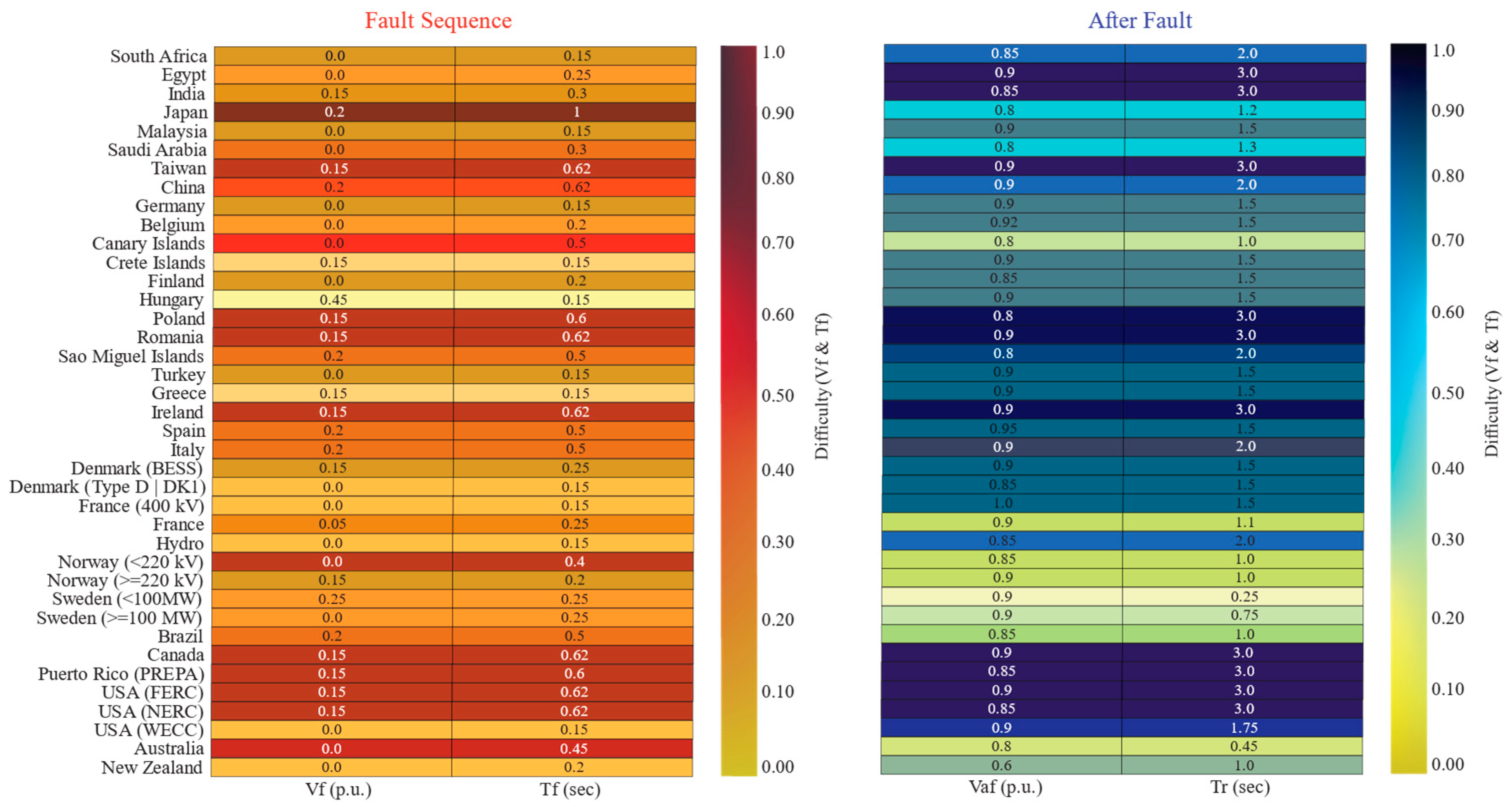
LVRT requirements constitute a fundamental compliance condition in the grid regulations of many countries, reflecting the critical role of inverter-based generation and ESSs in maintaining grid stability during fault conditions. LVRT directly affects system dynamic stability and post-fault recovery performance by defining the capability of facilities to remain connected to the grid and sustain operation during voltage depressions [209]. To enable an objective comparison among national regulations, this study focuses on four key LVRT parameters: minimum fault voltage ( V f ), fault duration ( T f ), recovery voltage ( V af ), and recovery time ( T r ). These parameters collectively characterize fault severity and recovery expectations, allowing country-specific requirements to be evaluated within a consistent analytical framework.
As inverter-based resources increasingly dominate generation portfolios, LVRT requirements have evolved from basic connection criteria to performance-based stability obligations that directly influence post-fault system recovery. In this context, understanding the relative stringency of LVRT parameters across jurisdictions is essential for evaluating how grid codes adapt to rising IBR penetration and reduced system inertia. Figure 13 presents a synthesized two-dimensional heat map illustrating relative LVRT stringency, where low V f and long T f values indicate more demanding requirements. By transforming country-specific voltage–time envelopes into a harmonized difficulty representation, the figure enables a structured assessment of regulatory evolution rather than a mere side-by-side presentation of national limits. To complement this visual comparison and enhance transparency, Table 3 provides a numerical summary of the LVRT parameters extracted from the corresponding national grid codes, forming the quantitative basis of the comparative assessment.
The comparative analysis reveals both convergence and differentiation in LVRT criteria across national grid codes. Specifically, the Turkish Grid Code permits operation down to V f = 0.0 p.u. for a fault duration of T f = 0.15 s, while the German and Danish grid codes impose identical fault-sequence requirements with V f = 0.0 p.u. and T f = 0.15 s. In contrast, the Spanish and Italian regulations define a higher minimum fault voltage of V f = 0.2 p.u. combined with a longer fault duration of T f = 0.5 s. In addition, recovery to nominal voltage levels within approximately three seconds after fault clearance is a commonly defined criterion. These trends indicate that LVRT requirements for inverter-based generation and storage technologies are becoming increasingly stringent, despite differences in network structure and operational conditions. As a result, advanced control algorithms, robust protection schemes, and resilient power electronic hardware are increasingly necessary for compliance. Post-fault active power recovery represents a further critical dimension of LVRT performance.
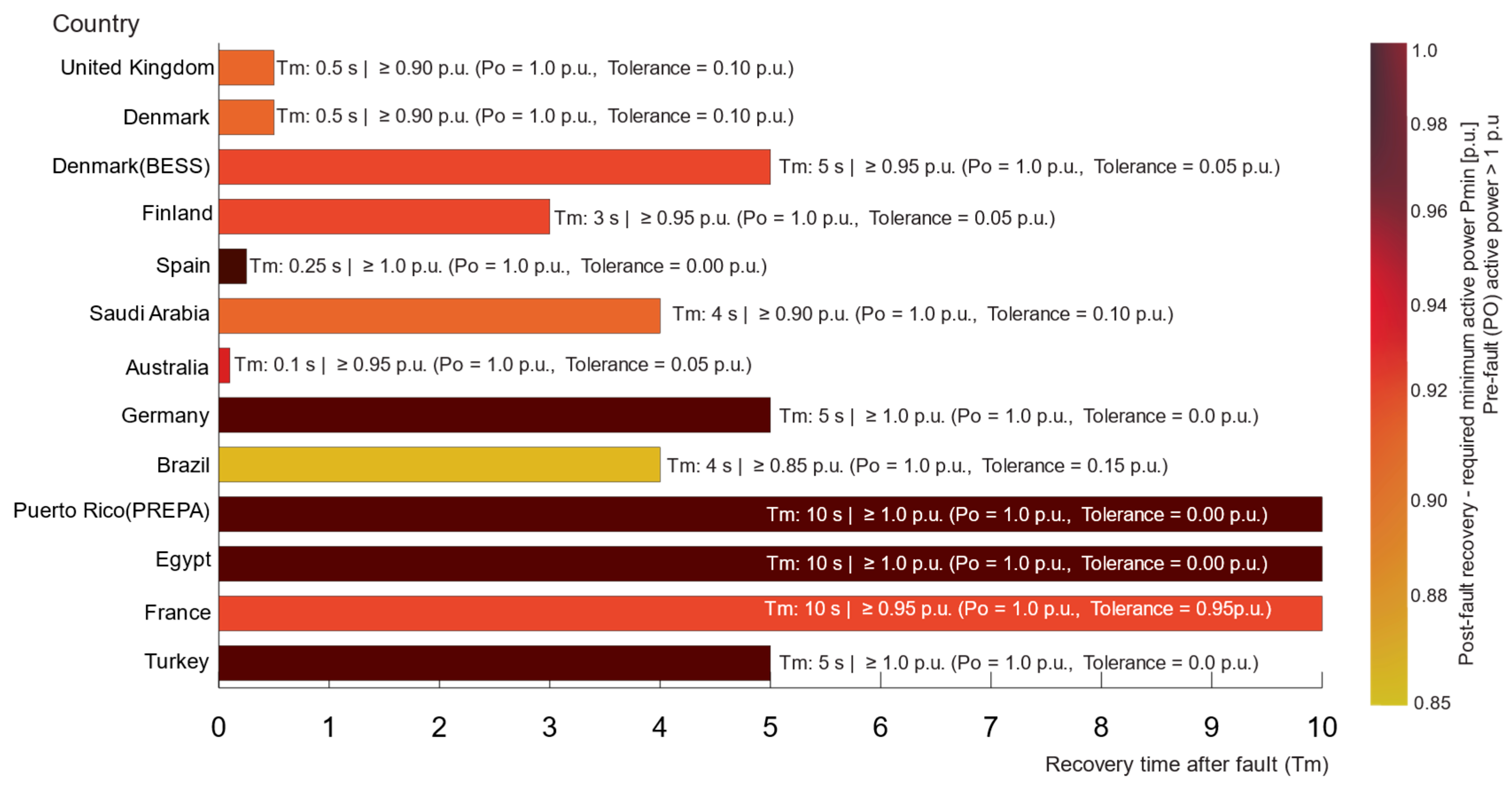
Following fault clearance, facilities are expected to restore active power output in a controlled manner to support voltage and frequency stabilization [225,226]. Grid codes typically define recovery behavior using two parameters: recovery time ( T m ) and tolerance (tol). T m specifies the maximum allowable time for restoring active power close to the pre-fault level, while tol defines the permissible deviation from the pre-fault power P o . For instance, a tolerance of 0.05 p.u. requires the facility to reach at least 0.95 p.u. of P o within the defined T m . For instance, a tolerance of 0.05 p.u. requires the facility to reach at least 0.95 p.u. of P o within the defined T m . Accordingly, lower T m values and narrower tolerance margins correspond to stricter and more technically challenging recovery requirements.
Figure 14 provides a comparative overview of T m and tolerance values specified in different national grid regulations. The graphical envelopes reflect the officially defined post-fault recovery limits published in the respective grid codes and are presented to ensure accurate representation of regulatory requirements. A pronounced diversity in recovery characteristics is observed across jurisdictions, indicating substantial differences in allowable recovery durations and voltage tolerance thresholds. Australia and the UK impose comparatively stricter recovery conditions, with recovery times as short as 0.1–0.5 s and tolerance values typically ranging between 0.05 and 0.10 p.u., whereas Türkiye and Germany define intermediate recovery requirements, allowing recovery times of up to approximately 5 s. These variations reflect distinct regulatory strategies in balancing fast dynamic stabilization against equipment stress and operational flexibility. By harmonizing these parameters within a unified comparative structure, the study highlights structural differences in post-fault performance expectations across regulatory frameworks. The comparative representation therefore contributes to understanding how grid codes are progressively redefining active power recovery as a measurable and verifiable dynamic stability requirement.
Reactive current support during faults constitutes another differentiating aspect of LVRT requirements. The K-factor, which defines the slope of reactive current injection as a function of voltage deviation, is not explicitly specified in many grid codes, including the Turkish Grid Regulation. Nevertheless, equivalent requirements are defined by using alternative terminology in several countries. In the Danish Technical Regulation, this requirement is referred to as Fast Fault Current, specifying that a facility must provide 1 p.u. reactive current when voltage decreases from 0.9 to 0.5 p.u., corresponding to a K-factor of 5 [223]. Reported values in the literature include K = 2.5 for Finland [227], 5 for the UK [179], 2 for Saudi Arabia [215], and 2 for Germany [228], highlighting substantial variation in national expectations for reactive current support.
In addition to magnitude, the response time of reactive current injection is a decisive parameter for the dynamic performance of inverter-based generation and storage systems. The Turkish Grid Regulation requires reactive current support to be provided within 60 ms with a tolerance of ±10%. Comparable requirements differ among countries: Denmark specifies a response time of 100 ms with ±20% tolerance, Finland defines 60–80 ms with +20%/−10% tolerance, the UK requires 65% of reactive current within 60 ms and full response within 120 ms, and Saudi Arabia specifies a response time of 60 ms. These differences reflect national grid characteristics, including short-circuit strength, IBR penetration, and system stability requirements.

5.1.2. High-Voltage Ride-Through

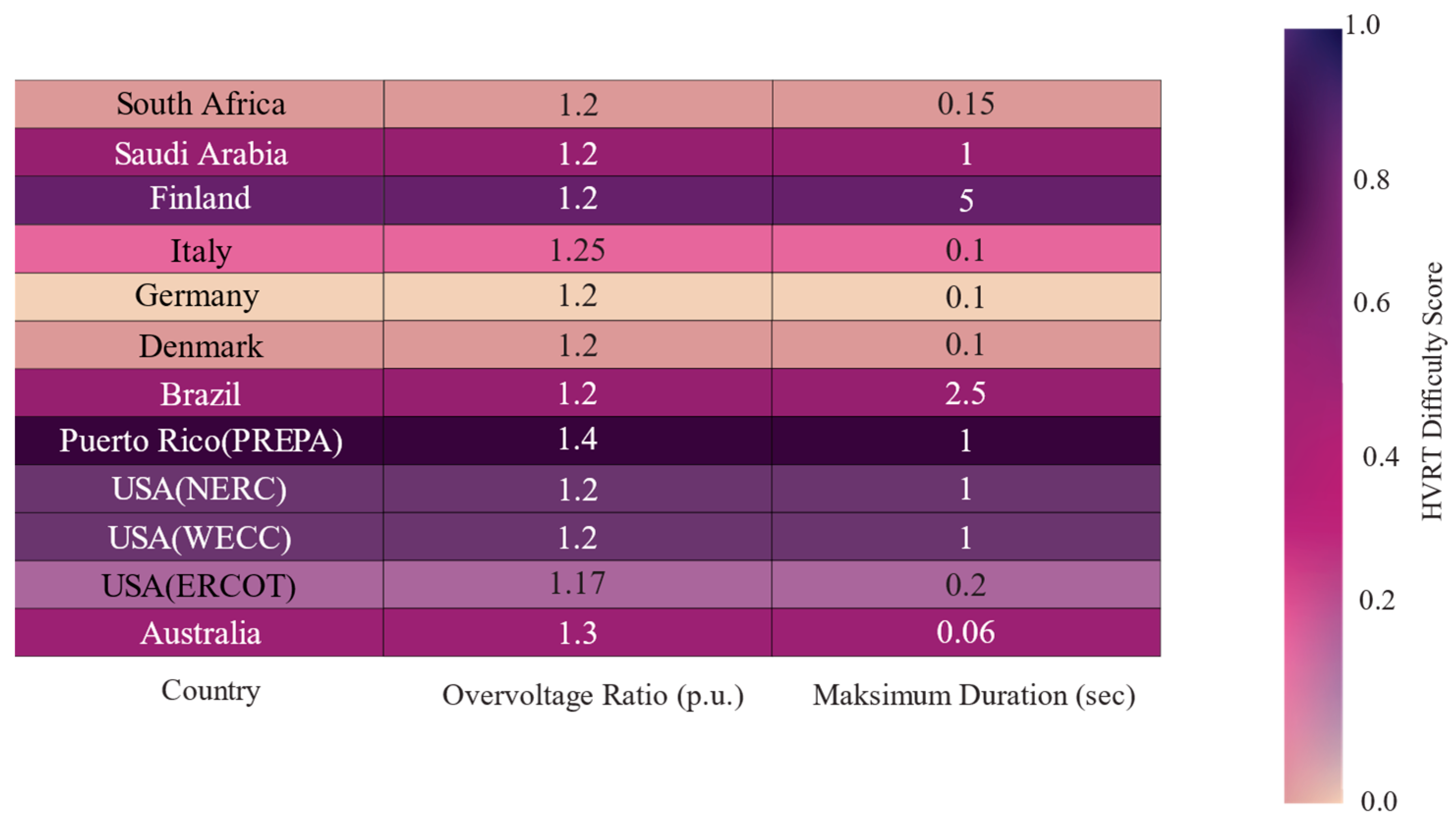
HVRT requirements constitute a critical technical criterion that defines the ability of inverter-based generation and energy storage facilities to remain connected to the grid and contribute to system stability during sudden voltage surges. In grid codes, HVRT performance is typically characterized by two parameters: the overvoltage level ( V p , p.u.) and the maximum allowable duration ( T m , s) for which this voltage can be sustained without disconnecting. Accordingly, HVRT capability represents a standardized performance expectation whereby facilities must tolerate voltage rises up to a specified V p level for the duration of Tm while maintaining grid connection.
A comparative assessment of HVRT requirements across countries reveals pronounced regional differences in both voltage thresholds and permissible durations. In several European grid codes, including those of Germany, Italy, and Denmark, overvoltage limits are commonly defined in the range of 1.2–1.3 p.u., with allowable durations typically restricted to short intervals between 0.1 and 0.5 s. These requirements emphasize rapid transient tolerance while limiting prolonged exposure to elevated voltage levels. In contrast, Finland adopts a notably more stringent approach, permitting facilities to remain connected for durations of up to 5 s at voltage levels exceeding 1.2 p.u., reflecting a higher tolerance for sustained overvoltage conditions. Figure 15 provides a comparative overview of HVRT difficulty levels among countries by jointly considering the specified overvoltage magnitude and the maximum allowable duration. Higher difficulty scores correspond to combinations of elevated V p values and extended T m durations, indicating more demanding technical requirements for inverter-based generation and storage systems. By integrating magnitude and duration parameters into a unified comparative structure, the study enables systematic cross-country evaluation of overvoltage tolerance characteristics rather than merely presenting isolated regulatory limits. The observed diversity in HVRT criteria highlights how national grid codes balance equipment protection, system stability, and operational robustness in response to differences in network characteristics and IBR penetration.

5.2. Reactive Power Support and Voltage Control

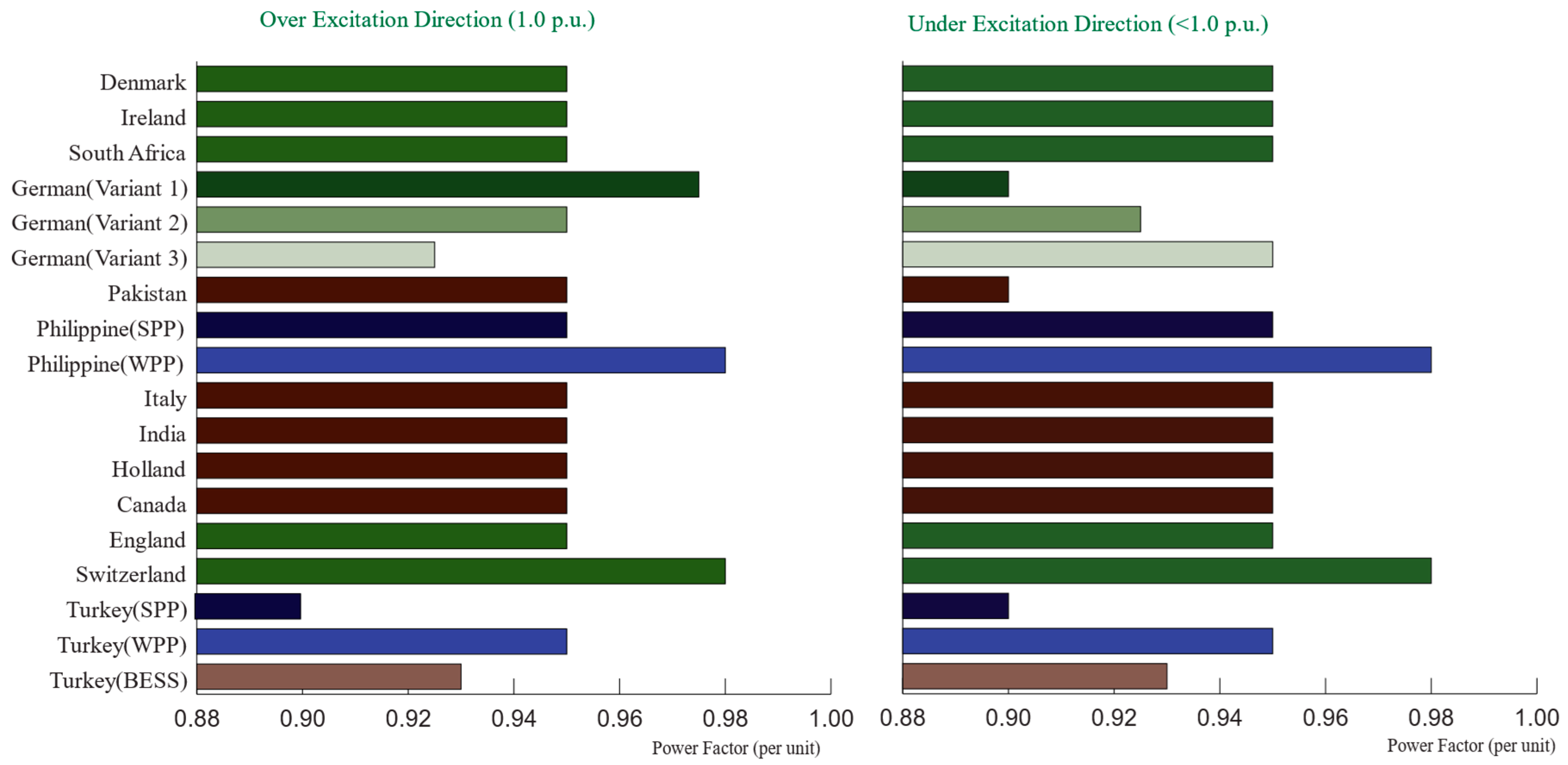
Across different countries, reactive power capability and voltage control requirements for WPP, SPP, and ESS are defined within a broadly similar technical framework; however, notable differences arise in detailed parameterization and performance expectations. A comparative assessment of national grid codes reveals that while general principles, such as mandatory reactive power provision and voltage regulation at the point of connection, are widely shared, significant variations exist in key technical parameters. These include reactive power capacity limits, reserve margins, voltage-reactive power slope definitions, deadband settings, and dynamic response times. Such differences are closely linked to country-specific grid characteristics, including short-circuit strength, network topology, renewable energy penetration levels, and operational security criteria.
In this context, Figure 16 provides a comparative overview of the reactive power capacity requirements defined for RES and ESS in different countries; Table 4 summarizes the reactive power performance criteria specified for ESS. These analyses demonstrate that reactive power support in modern power systems is not only a grid code requirement but also a strategic necessity for high-penetration renewable integration. The comparative synthesis therefore highlights how national frameworks are progressively formalizing reactive power obligations to maintain voltage stability, network robustness, and operational flexibility under increasing RES and ESS penetration.
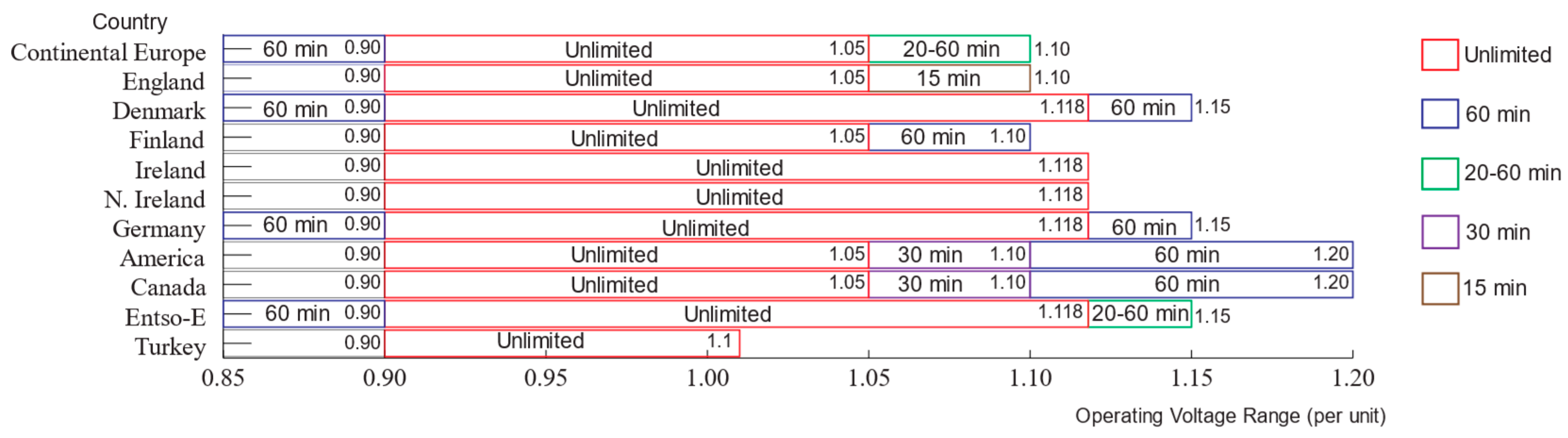
Voltage operating range requirements further differentiate national grid codes. These requirements define the minimum and maximum voltage limits within which generation and storage facilities must remain connected and operational [243]. Grid operators specify these limits to ensure system stability and to protect network components against both transient and sustained voltage deviations. Figure 17 compares the voltage operating ranges and mandatory withstand durations defined in different countries, indicating the minimum time periods during which facilities must continue operation following deviations from the nominal 1 p.u. voltage level at the connection point. The observed variations underline the diversity of national approaches to voltage robustness and provide a structured basis for assessing the voltage withstand performance of inverter-based generation and storage systems on an international scale.

5.3. Active Power Support and Frequency Control

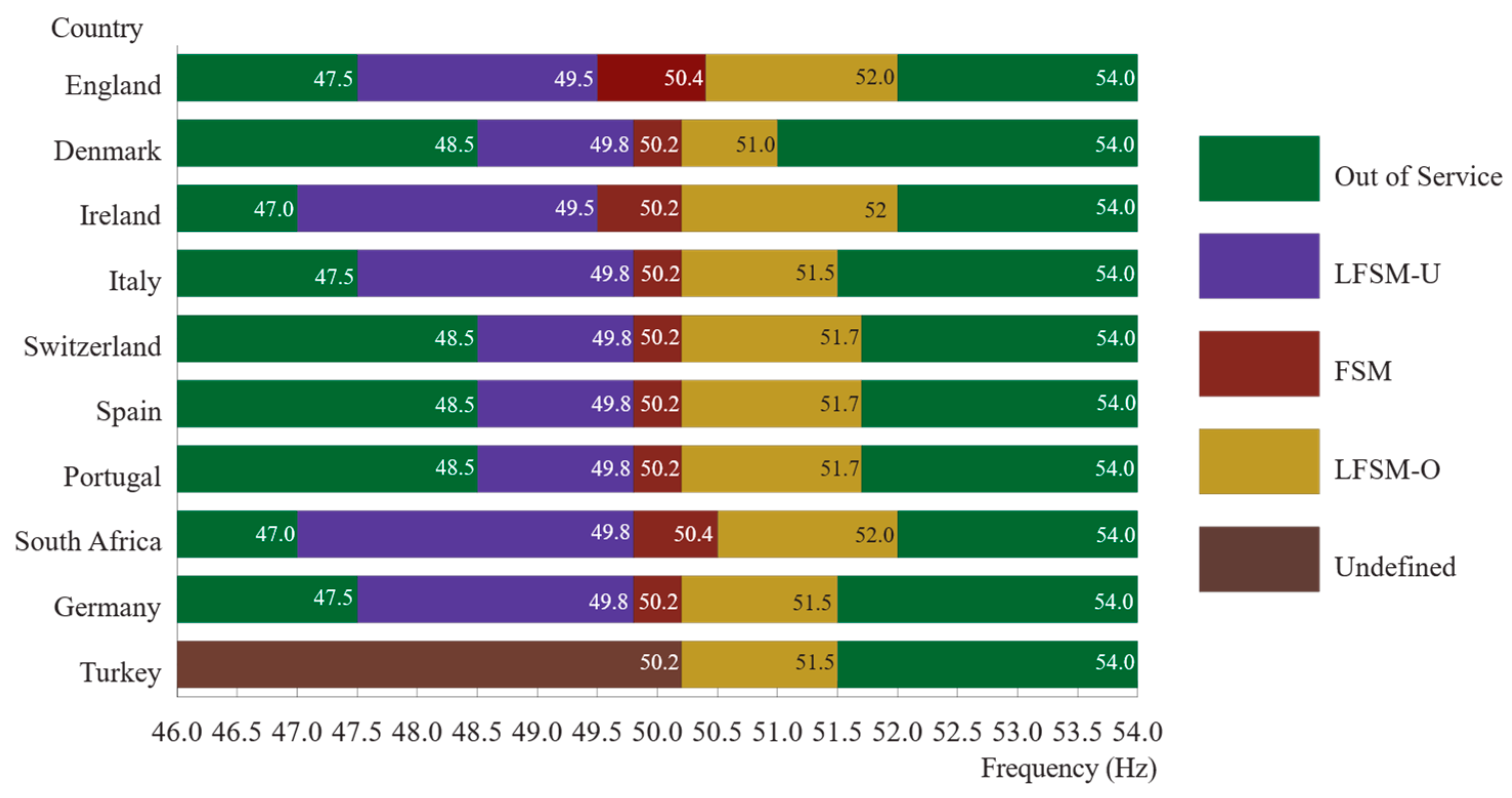
Active power-frequency control constitutes a fundamental functional requirement for inverter-based generation units and ESSs, as it directly affects system frequency stability. Accordingly, grid codes in many countries define detailed technical requirements for frequency-responsive active power control. Figure 18 presents a comparative overview of the threshold values associated with the LFSM-U, LFSM-O, and FSM operating modes applied in different countries for RESs. While the general operating principles of these modes are largely aligned across regions, notable differences are observed in technical parameters such as tripping frequency limits, droop slopes, response sensitivity, and tolerance ranges. These variations reflect regulatory approaches shaped by national system inertia levels, short-circuit strength, renewable energy penetration, and operational reliability objectives.
Within this broader context, similar structural trends can be observed in the Turkish transmission system. The increasing penetration of inverter-based renewable generation has progressively reduced the relative contribution of synchronous generation during certain operating periods, particularly under low-load and high-RES conditions. Publicly available TEİAŞ system reports indicate that such operating scenarios may lead to lower effective inertia margins and reduced short-circuit strength at specific transmission nodes [135]. Under these conditions, system frequency containment and voltage stability become more sensitive to inverter tripping behavior and insufficient dynamic support functions, thereby reinforcing the importance of clearly defined HVRT and frequency response requirements in the Turkish grid code.
Limited LFSM-U provisions in Türkiye for RES may create operational vulnerabilities during underfrequency events. Without clearly defined activation thresholds and response parameters, inverter-based generation may not provide sufficient active power increase during frequency drops. LFSM-U requirements have recently been introduced for ESSs in Türkiye; however, strengthening the LFSM-U framework would enhance the utilization of RES as frequency support resources and improve overall system resilience.
Table 5 provides a comparative overview of frequency regulation requirements specified in national and regional grid codes based on key technical parameters, including frequency deadband settings, droop characteristics, response times, minimum active power contributions, and required operating durations under frequency deviations. The deadband and droop parameters primarily correspond to FSM operation, which is mandatory for ESSs in the Turkish grid code, while not required for RPPs. Response time requirements are not explicitly defined for renewable generation units in Türkiye and are traditionally associated with synchronous generators.
The operating duration values indicate the minimum time during which units are required to remain connected and actively support the system when frequency deviates beyond normal operating limits, revealing notable differences in regulatory implementation despite a common objective of maintaining frequency stability.
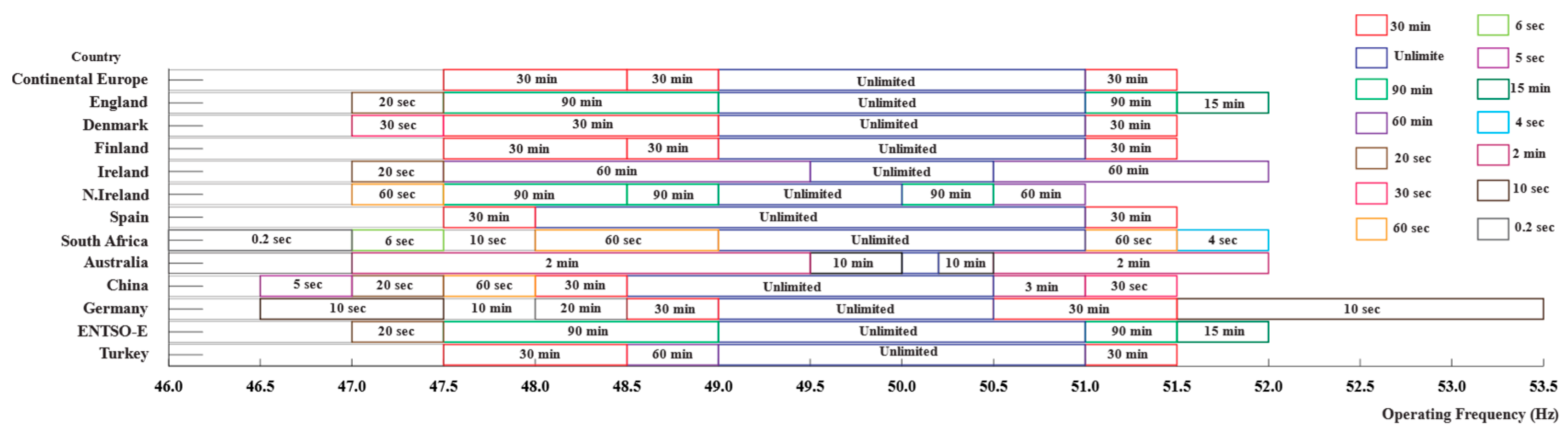
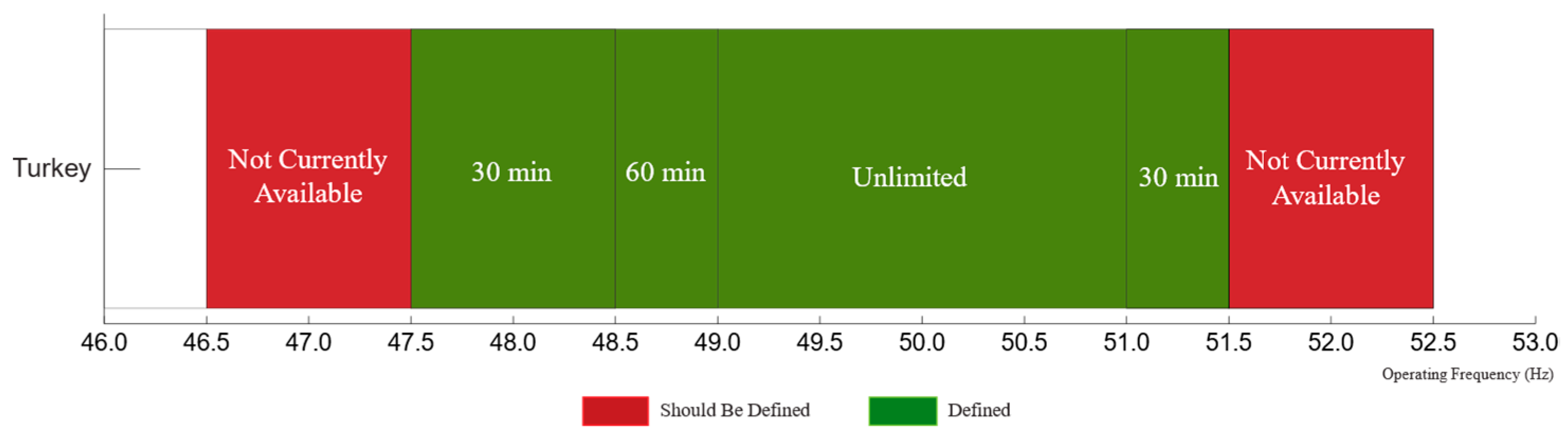
In addition to dynamic frequency response characteristics, frequency operating range requirements define the limits within which generation and storage facilities must remain connected and operational. These limits are established by grid operators to ensure both operational safety and system integrity under frequency deviations. For instance, ENTSO-E requires generation facilities to remain in continuous operation within the 49.0–51.0 Hz frequency range [236,252].
Similarly, the Turkish Electricity Grid Regulation requires WPPs to maintain continuous operation within defined frequency operating limits, thereby supporting system frequency stability during normal and disturbed operating conditions [253]. Figure 19 compares the frequency operating ranges specified in different countries, highlighting both common practices and region-specific deviations in frequency withstand requirements.

6. Key Challenges and Recommendations for the Turkish Grid Code

6.1. Defining HVRT Boundaries

When examining various regional grid regulations, it is observed that HVRT limits are mostly defined in the range of 1.2–1.3 p.u. and withstand durations vary between 0.1 and 0.5 s in different regions such as ENTSO-E countries, America, Australia, Saudi Arabia, and South Africa. The gradual definition of HVRT requirements in these regions based on voltage level reflects a common approach aimed at enabling inverter-based generation and storage facilities to contribute to the grid under overvoltage conditions.
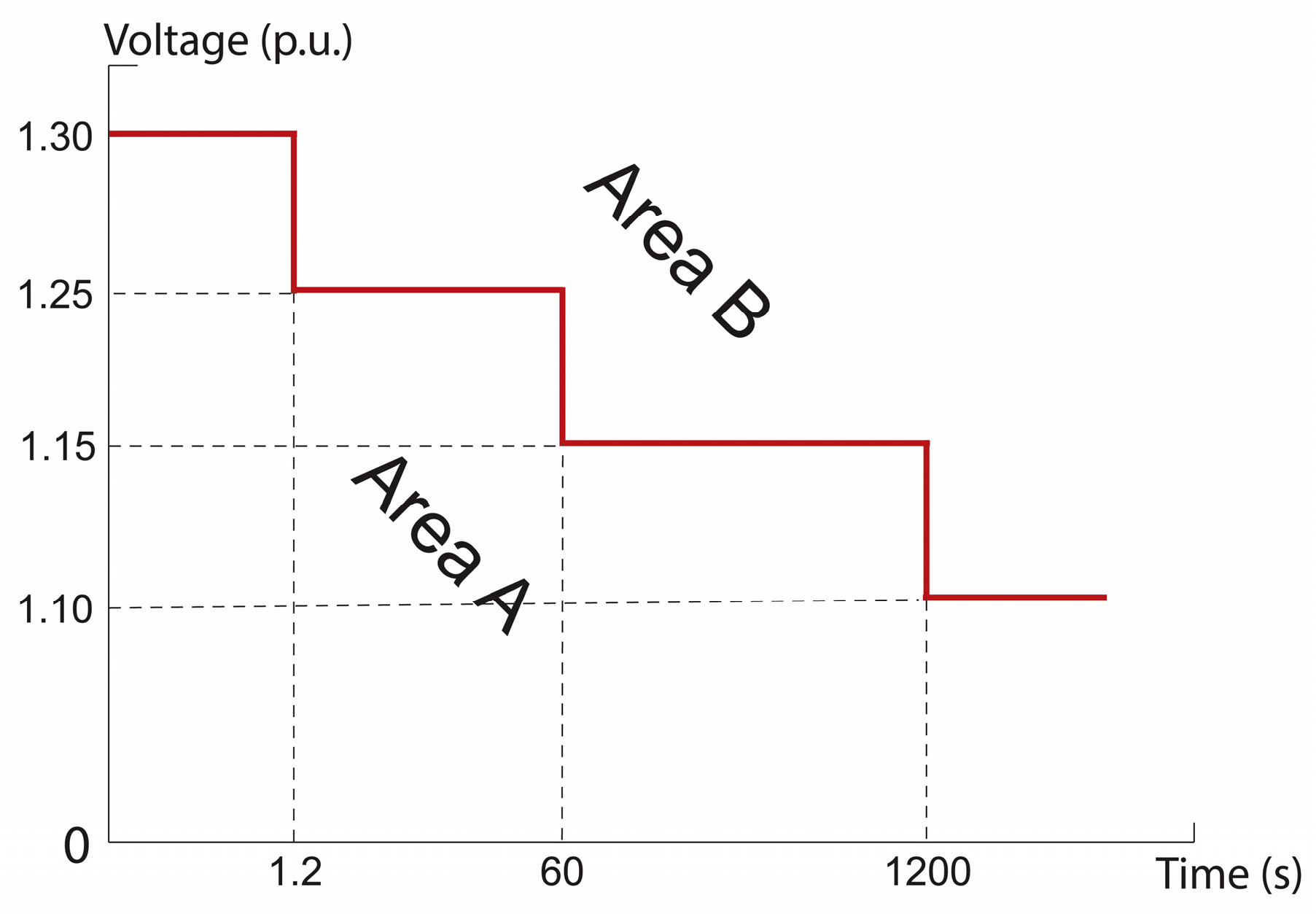
The current Turkish Grid Regulation does not define any technical limits for HVRT; the regulation only requires that the nominal operating voltage be within the range of 0.9–1.1 p.u. Therefore, there is no regulation regarding how long facilities must remain connected to the grid at voltages above 1.1 p.u. Addressing this technical gap is important, particularly in terms of increasing the resilience of inverter-based generation and energy storage facilities against overvoltage conditions. To this end, it is recommended that HVRT requirements for Türkiye be defined using a phased approach. The proposal presented in this study is structured based on the Voltage–Time curve shown in Figure 20. In this context:
  • As long as the PCC voltage remains within the boundaries of Zone A, IBRs are expected to remain connected to the grid and continue to provide voltage support.
  • It is recommended that facilities remain operational for at least 1200 s (20 min) at the 1.15 p.u. level.
  • When the voltage reaches 1.25 p.u., the facilities must maintain their connection for at least 60 s.
  • If the voltage exceeds 1.30 p.u., facilities are required to remain connected to the grid for at least 0.1 s.
The absence of explicitly defined HVRT voltage–time withstand characteristics in the current Turkish Electricity Grid Regulation may introduce stability risks under high inverter-based resource penetration. In scenarios with large-scale PV, WPP, and ESS integration, temporary overvoltage events exceeding 1.1 p.u. may trigger coordinated inverter disconnections if no mandatory HVRT envelope is defined. Such simultaneous tripping behavior can reduce available reactive power support, weaken voltage regulation capability at the point of common coupling, and amplify voltage oscillations in grid.

6.2. Determination of the K-Factor Within the Scope of FRT

The slope of the reactive current support that must be provided by inverter-based generation and storage facilities under fault conditions is expressed by a coefficient defined as the K-factor in the grid regulations of many countries [262]. The K-factor determines the relationship between voltage drop and reactive current increase, directly affecting the dynamic characteristics of voltage support during faults [263]. An examination of international practices reveals that the K-factor is defined as 2 in Saudi Arabia [215], 2.5 (in the range of 2–6) in Finland [227], and 2 (in the range of 2–10) in Germany [228]. The Danish Technical Regulation states that if the voltage drops from 0.9 p.u. to 0.5 p.u., the facility must be able to supply 1 p.u. of reactive current with a 20% tolerance, indicating that the K-factor for Denmark is 5. It has been reported that a similar value of 5 is adopted in the UK [179]. This distribution reveals that expectations regarding reactive current support during faults vary significantly between countries.
The Turkish Electricity Grid Regulation does not contain any definition of the K-factor. This situation creates a gap in terms of standardizing the reactive current support to be provided during outages and indicates the need to define a K-factor range that is consistent with international regulations.
Not only the slope but also the rate at which reactive current support is provided is critical for the dynamic performance of inverter-based generation and storage systems. The Turkish Grid Code requires reactive current support to be provided within 60 ms. In other countries, the specified response times and associated implementation criteria differ. In other countries, the time and tolerance values differ: in Denmark, it must be provided within 100 ms with a tolerance of 20%; in Finland, within 60–80 ms with a tolerance of +20%/−10%; in the UK, 60 ms for 65% of the reactive current and 120 ms for the entire reactive current; and in Saudi Arabia, it must be provided within 60 ms. These differences stem from variations in countries’ priorities regarding grid stability, short-circuit levels, grid topologies, and the maturity levels of inverter-based technologies.
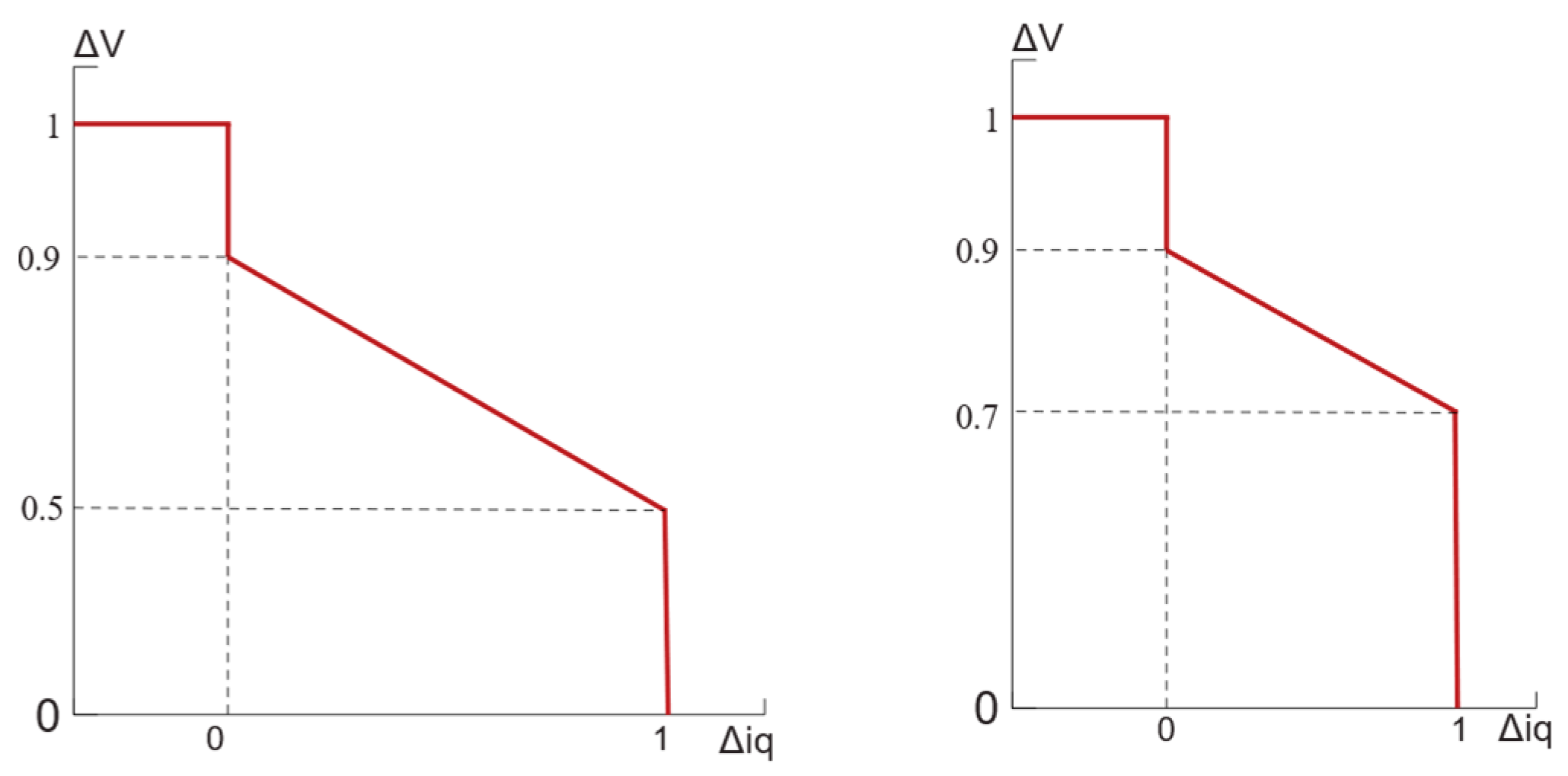
The slope of the reactive current support is commonly calculated in the literature using the ratio in (1) [264]. When examining (2) and (3), the K factor is calculated as 2.5 and 5.
K = Δ I q Δ V
K = 1 0 0.9 0.5 = 2.5
K = 1 0 0.9 0.7 = 5
In this context, the reduction in the voltage change range requires the definition of a higher K-factor value for the same reactive current increase. In other words, as the K-factor increases, the reactive current support provided by the inverter during a fault exhibits a faster and more aggressive character [265]. This situation offers a critical advantage, particularly for maintaining grid stability at low voltage levels. When international practices and technical calculations are evaluated together, it is anticipated that defining a K-factor in the range of 2.5 to 5 would be appropriate for the Turkish Electricity Grid Regulation. This range corresponds to the values used in advanced grid systems such as Finland [227] and Germany [228], and provides optimal control performance in terms of ensuring effective voltage support in different fault scenarios [265].
Figure 21 illustrates voltage-reactive current characteristics corresponding to different K-factor values. Based on these characteristics, it is recommended that the transmission system operator defines appropriate K-factor settings in a similar manner to ensure consistent reactive current response under voltage disturbances.

6.3. Expansion of the Frequency Operating Range and the Definition of LFSM-U for RES

The Turkish Electricity Grid Regulation defines the frequency operating range as 47.5–51.5 Hz, which corresponds to a total operating band of 4 Hz [145]. This wide range contributes to system stability by allowing generation units, especially in low-inertia power systems, to remain connected to the grid for longer periods during faults, fluctuations, or transient oscillations [266]. Given the increasing penetration of RESs in Türkiye, frequency stability requirements may need to be reassessed through a more clearly parameterized and, where justified, expanded operating framework [267].
In this regard, the new frequency operating range proposal presented in Figure 22 has been developed based on both international practices. The proposed approach aims to enhance the stability performance of inverter-based generation and storage facilities during faults and improve post-fault recovery behavior. This will enable the frequency flexibility requirements arising from increased renewable energy penetration to be met more effectively.
The current LFSM-U framework for RES in Türkiye is relatively limited and may lead to operational risks during underfrequency conditions. In the absence of well-defined activation criteria and response characteristics, inverter-based resources may fail to deliver adequate active power support when frequency declines. Although LFSM-U requirements have recently been introduced for ESS in Türkiye, further strengthening and clarifying these provisions would enable better use of RES for frequency support and contribute to greater system stability and resilience.

6.4. Defining the Initial Response Time in Active Power Control

The initial response time is a fundamental performance criterion that defines the moment when the facility begins to actively change power following a frequency deviation or operator command [268]. An examination of national and international grid regulations reveals that different practices are adopted regarding this time. For example, while the initial response time is set at 1 s in Australia [269], the UK defines this value as 0.5 s [229]. In contrast, the Turkish Electricity Grid Regulation [145] regulates redispatch-up and redispatch-down rates, while no explicit criterion is provided regarding the initiation of active power response. This situation creates a gap in terms of the consistency and predictability of the responses of IBRs and ESSs to frequency events. Therefore, as shown in the example in Figure 23, it is important to clearly define the time interval during which the facility should begin active power changes from the moment the frequency deviation occurs or an active power setpoint sent. Adding a clear value for the initial response time in the range of 0.5–1 s to the ESS will increase the effectiveness of inverter-based generation units and ESSs in frequency control; it will also provide a more precise framework for the system operator’s expectations regarding frequency stability.

6.5. Extension of Voltage Limits

In ENTSO-E member countries, the voltage range within which generation facilities can remain in continuous operation is generally defined as 0.85–1.118 p.u., and this approach allows power plants to operate with a wider tolerance against temporary voltage deviations [151]. In contrast, the Turkish Electricity Grid Regulation defines a narrower voltage band, setting 0.9–1.1 p.u. as the operating condition. Controlled expansion of this band under specific conditions and for short periods can prevent inverter-based generation and ESSs from tripping unnecessarily during temporary voltage deviations. The extension of voltage limits is shown in Figure 24.

6.6. Redefining Requirements for Hybrid Power Plant

Although the Turkish Electricity Network Regulation defines the basic technical requirements for HPPs, the comparative analysis presented in Table 6 shows that the current regulations need to be expanded in terms of alignment with international practices. In this context, defining the reactive current support required from HPPs during FRT based on total installed capacity rather than just licensed capacity will strengthen the voltage support provided to the grid during faults and contribute to reducing fault depth. Similarly, addressing reactive power reserve obligations based on installed capacity will enable HPPs to contribute more effectively to voltage stability under normal operating conditions.

6.7. Completion of Rapid Frequency Control

The fact that the FFR function has not yet been defined in the Turkish Electricity Grid Regulation creates a significant gap in terms of ensuring frequency stability in low-inertia power systems. Particularly in sudden deviation conditions where the frequency can drop below 49.5 Hz in a very short time, the ability of inverter-based generation and storage facilities to provide rapid and additional frequency support is critical in limiting frequency deviation and maintaining stability across the system. The fact that comprehensive technical requirements for FFR are clearly defined in ENTSO-E countries and Australia demonstrates the need for similar regulations in Türkiye [206].
In this context, limiting the FFR time to a maximum of 1 s and defining the active power contribution to be provided within the range of 5–10% of the plant’s nominal power is considered an appropriate practice. Furthermore, clearly defining the tolerances (e.g., ±1%) regarding the accuracy of the FFR support provided and standardizing the test procedures for verifying this performance by adding them to the Electricity Grid Regulation will both increase transparency in the audit processes and significantly strengthen system reliability.

6.8. Identification of Synthetic Inertia Requirements

In regions such as ENTSO-E countries and Canada inverter-based generation units are expected to provide resynthesis inertia, and this function is generally mandated through the dP/df parameter, which defines the relationship between the rate of power change and the rate of frequency change [270]. However, the Turkish Electricity Grid Regulation does not impose any requirement for a synthetic inertia function. However, as the share of RES in the system increases, grid inertia decreases, leading to higher RoCoF values [24].
Synthetic inertia support emerges as a critical mechanism that directly contributes to maintaining frequency stability by limiting RoCoF values.
Upon reviewing current international network regulations, it is recommended that the following points be added to the Turkish Electricity Grid Regulation:
  • Determination of the synthetic inertia function for inverter-based facilities connected to the transmission system with a capacity of 30 MW and above;
  • Indicative response time targets in the order of several milliseconds (5–10 ms), recognizing that actual achievable performance depends on measurement delays, control dynamics, plant-level communication latency, and aggregation models;
  • An adjustable inertia constant within a reference range (3–5 s), to be optimized based on system inertia requirements and stability studies.
The implementation of these regulations will significantly contribute to maintaining system inertia, limiting RoCoF values, and thus sustainably strengthening frequency stability in the Turkish electricity system, even if the proportion of inverter-based generation increases.

6.9. Identification of Power Oscillation Damping Requirements

In large interconnected systems (e.g., Scandinavia, Spain, and Germany), inverter-based generation facilities are expected to provide a POD function capable of suppressing power oscillations within a specific frequency range [271]. This application increases system stability and prevents the propagation of oscillations in interconnected regions. In this context, a similar approach is adopted in the Turkish Electricity Grid Regulation, and the following regulations are recommended:
  • The presence of a POD function in inverter-based generation facilities connected to the transmission system with a capacity of 30 MW or more;
  • Defining the effective range of POD controllers as 0.1–2 Hz;
  • Designing the function to operate continuously under normal operating conditions;
  • Documentation of POD performance through model validation and field testing.
For the analysis and verification of the POD function, a test approach like the Swedish Svenska kraftnät [197] application can be adopted. The tests that can be applied in this context are as follows:
  • Simulation test: The improvement in the damping ratio of the POD should be evaluated by creating oscillations in the 0.1–2 Hz range on a standard system model defined by TEİAŞ.
  • Open-loop frequency response test: Reactive power-voltage response should be measured by applying small-amplitude sinusoidal signals to the central voltage reference; phase shift is expected to be between ±30° in the 0.1–2 Hz range. Additionally, the active power response should be measured, and a phase shift of 150–210° is required in the 0.1–2 Hz range.
The implementation of these tests will demonstrate that POD controllers increase stability without creating adverse interactions under real system conditions and will enable verification of the contribution of inverter-based generation facilities to system dynamics. Consequently, the proposed regulations will make significant contributions to maintaining system stability in the Turkish electricity system alongside increasing inverter-based generation rates.

6.10. Reactive Power Support for Distribution Connected Power Plant

If renewable energy generation facilities connected to the distribution system do not contribute to reactive power support, it is estimated that unavoidable voltage problems will occur in the distribution system. To prevent this situation and ensure that the system voltage is kept within operating limits, considering the requirements of different countries [151,180,223,241], the following technical principles are recommended for Türkiye:
  • Unlicensed power plants with an installed capacity of less than 10 MW must provide reactive power support with a fixed power factor determined by the Electricity Distribution Company.
  • Unlicensed power plants with an installed capacity of 10 MW and greater than 10 MW must have a reactive reserve at a power factor level of ±0.95 and be able to respond dynamically to voltage control. The reactive power response to voltage changes at the connection point must start within 0.2 s at the latest, reach 90% within 1 s, and reach a stable state within 2 s with a tolerance of 5%.

6.11. Identification of Phase Jump Tolerance Requirements for Grid-Forming Inverters

With the increasing penetration of IBRs, power systems are exposed to rapid voltage phase angle variations during grid disturbances such as faults, switching events, generator tripping, and fault clearing [272]. Recent disturbance analyses show that sudden phase angle jumps, particularly in weak grids, may lead to inverter misoperation, loss of synchronism, or unintended tripping due to control and protection interactions rather than fundamental voltage or frequency limit violations [273]. Unlike synchronous generators, IBRs rely on fast control loops and synchronization mechanisms, making them particularly sensitive to abrupt phase angle changes [274]. EMT studies further demonstrate that voltage phase angle jumps in the upstream grid can be amplified at inverter terminals depending on grid strength and operating point, potentially triggering PLL instability, overcurrent, or overvoltage protection even during non-severe disturbances [272].
Recognizing this issue, NERC explicitly addressed phase jump ride-through capability in the PRC-029-1 (Frequency and Voltage Ride-through Requirements for Inverter-based Resources, NERC, Atlanta, GA, USA, 2025) Reliability Standard, emphasizing that voltage phase angle jumps are common occurrences on the bulk power system and should not result in unnecessary inverter tripping [275]. Accordingly, PRC-029-1 defines a minimum phase jump ride-through capability of 25 electrical degrees, which is widely regarded as a practical and representative threshold for IBRs connected to the transmission system.
In the Turkish context, recent draft regulations for grid-forming inverter technologies acknowledge the importance of phase angle disturbances and require grid-forming inverter-based facilities to remain connected during sudden voltage phase angle changes of up to 60 electrical degrees, while providing active power support within equipment limits. While advanced grid-forming inverter designs may tolerate such large phase angle deviations, defining a clear minimum requirement remains essential to ensure consistent and predictable ride-through behavior across inverter-based facilities [145]. Accordingly, based on international practice and system reliability considerations, it is recommended that the Turkish Electricity Grid Regulation specify a minimum phase jump ride-through requirement in the range of 20–30 electrical degrees for transmission-connected grid-forming inverter-based facilities, while allowing higher tolerance levels to be demonstrated through validated EMT studies.
Section 6 has examined the Turkish Electricity Grid Regulation from multiple technical dimensions, including FRT performance, reactive and active power control mechanisms, frequency stability provisions, modeling and compliance assessment frameworks, and future-oriented enhancement strategies. To provide a consolidated and structured overview of these analyses, Table 7 presents a comparative synthesis of the current Turkish provisions, the enhancement proposals developed in this study, and representative international practices discussed throughout the chapter.

7. Conclusions

This study has provided a comprehensive comparative analysis of grid code requirements applicable to inverter-based RPPs and ESSs, with particular focus on the Turkish Electricity Grid Regulation. Using a harmonized and parameter-based framework, this study enabled systematic comparison of FRT capability, reactive current support, active and reactive power control, frequency response functions, advanced grid support functionalities, and compliance verification practices across multiple jurisdictions. The comparative assessment indicates several areas where the current Turkish framework could be further developed in line with evolving international practices. These include the progressive definition of HVRT voltage–time withstand characteristics, FFR parameters, the structured incorporation of synthetic inertia and POD capabilities within the regulatory architecture. Furthermore, for ESS-integrated HPPs, the study highlights the opportunity to reassess reactive power capability limits from a system-level perspective, particularly under increasing inverter-based penetration. In parallel, under high renewable integration scenarios where short-circuit strength may decrease, the process f reviewing and potentially expanding voltage operating boundaries emerges as a constructive step toward reinforcing voltage stability and overall system robustness.
From a broader international perspective, the findings reflect a global transition toward performance-based and continuously monitored grid code architectures designed to address low-inertia system dynamics. As inverter-based generation and ESSs progressively replace synchronous resources, regulatory frameworks increasingly evolve toward structured frequency support definitions, enhanced voltage withstand characteristics, oscillation damping provisions, and continuous grid code compliance monitoring mechanisms beyond one-time commissioning tests. In this context, the analytical framework developed in this study not only supports forward-looking and adaptive grid code evolution in Türkiye but also provides a transferable reference for other power systems integrating high shares of inverter-based generation and storage, where adaptive voltage margins, frequency containment capability, and sustained compliance monitoring contribute to long-term system stability.

Author Contributions

Conceptualization, F.Y., E.D., Y.Y., E.T., M.D., E.K., M.T. and K.Ç.B.; methodology, F.Y., E.D., Y.Y., M.D., E.K. and K.Ç.B.; investigation, F.Y., E.D., Y.Y., E.T., M.D., E.K., M.T. and K.Ç.B.; writing—original draft preparation, F.Y., E.D., Y.Y., M.D. and E.K.; writing—review and editing, F.Y., E.D., Y.Y., E.T., M.D., E.K., M.T. and K.Ç.B.; supervision, E.D., Y.Y., E.T. and K.Ç.B. All authors have read and agreed to the published version of the manuscript.

Funding

This work was supported by the Turkish Energy, Nuclear and Mineral Research Agency under Project No. 2831.

Data Availability Statement

The original contributions presented in this study are included in the article. Further inquiries can be directed to the corresponding author.

Acknowledgments

The authors would like to acknowledge the support provided by the Turkish Energy, Nuclear and Mineral Research Agency under Project No. 2831 entitled “Digitalization of Grid Regulation Compliance Processes and Monitoring System Development for Renewable Power Plants and Energy Storage Systems”.

Conflicts of Interest

Authors Fatma Yıldırım and Erman Terciyanlı were employed by the company Inavitas Energy. Authors Erdi Doğan, Muzaffer Dindar and Elif Kayar were employed by the company Epra Energy. Author Murat Tuncer was employed by the company Turkish Energy, Nuclear and Mineral Research Agency. The remaining authors declare that the research was conducted in the absence of any commercial or financial relationships that could be construed as a potential conflict of interest.

Abbreviations

The following abbreviations are used in this manuscript:
PVPhotovoltaic
BESSBattery Energy Storage System
ESSEnergy Storage System
CSRCodes, Standards and Regulations
IECInternational Electrotechnical Commission
RESRenewable Energy Source
PFCPrimary Frequency Control
DGDistributed Generation
LVLow Voltage
HESSHybrid Energy Storage System
ASAncillary Services
ENTSO-EEuropean Network of Transmission System Operators
FERCFederal Energy Regulatory Commission
FCRFrequency Containment Reserve
FRRFrequency Restoration Reserve
aFRRAutomatic Frequency Restoration Reserve
mFRRManuel Frequency Restoration Reserve
MVMedium Voltage
VSGVirtual Synchronous Generator
UKNational Grid
FFRFast Frequency Response
ANMActive Network Management
TEİAŞTürkiye Electricity Transmission Inc.
SOCState of Charge
MGMicrogrid
ADNActive Distribution Network
PSOParticle Swarm Optimization
SWOTStrengths, Weaknesses, Opportunities, Threats
DRDemand Response
LFCLoad Frequency Control
MPCModel Predictive Control
FRTFault Ride Through
GFMGrid Forming
GFLGrid Following
RoCoFRate of Change in Frequency
PFRPrimary Frequency Response
MILPMixed Integer Linear Programming
A-R-OPFActive-Reactive Optimal Power Flow
PCSPower Conversion System
EPDKEnergy Market Regulatory Authority
IBRInverter-Based Resources
LVRTLow-Voltage Ride-Through
HVRTHigh-Voltage Ride-Through
PCCPoint of Common Coupling
AVRAutomatic Voltage Regulator
SVCStatic Var Compensator
LFSM-ULimited Frequency Sensitive Mode-Underlimited
LFSM-OLimited Frequency Sensitive Mode-Overlimited
SPPSolar Power Plant
WPPWind Power Plant
FFCFast Fault Current
PODPower Oscillation Damping
PLLPhase Locking Loop
POD-PActive Power Modulation
POD-QReactive Power Modulation
PPMPower Park Module
AVCAutomatic Voltage Control
VREVariable Renewable Energy
RPPRenewable Power Plant
WTGWind Turbine Generator
WECSWind Energy Conversion System
WECCWestern Electricity Coordinating Council
MPPCMaster Power Plant Controller

References

  1. Kumar, R.K.R.; Soni, S.; Anichkov, D.; Milam, N. Hardware-in-the-Loop Validation of Utility-Scale Power Plant Controllers for Inverter-Based Resources. In Proceedings of the 2025 IEEE PES Grid Edge Technologies Conference and Exposition, Grid Edge 2025, San Diego, CA, USA, 21–23 January 2025; IEEE: New York, NY, USA, 2025. [Google Scholar] [CrossRef]
  2. Datta, U.; Kalam, A.; Shi, J. A Review of Key Functionalities of Battery Energy Storage System in Renewable Energy Integrated Power Systems. Energy Storage 2021, 3, e224. [Google Scholar] [CrossRef]
  3. Available online: https://www.iea.org/reports/global-energy-review-2025/electricity (accessed on 14 November 2025).
  4. Skea, J.I.M.; Nishioka, S. Policies and Practices for a Low-Carbon Society; Routledge: London, UK, 2015; pp. 5–16. [Google Scholar] [CrossRef]
  5. Türkiye İçin Batarya Enerji Depolama Seçenekleri. Available online: https://shura.org.tr/turkiye-icin-batarya-enerji-depolama-secenekleri/ (accessed on 14 November 2025).
  6. Wu, F.-B.; Yang, B.; Ye, J.-L. Grid-Scale Energy Storage Systems and Applications; Academic Press: Cambridge, MA, USA, 2020. [Google Scholar]
  7. Eicke, A.; Ruhnau, O.; Hirth, L. Electricity Balancing as a Market Equilibrium: An Instrument-Based Estimation of Supply and Demand for Imbalance Energy. Energy Econ. 2021, 102, 105455. [Google Scholar] [CrossRef]
  8. Liu, J.; Hu, H.; Yu, S.S.; Trinh, H. Virtual Power Plant with Renewable Energy Sources and Energy Storage Systems for Sustainable Power Grid-Formation, Control Techniques and Demand Response. Energies 2023, 16, 3705. [Google Scholar] [CrossRef]
  9. Kim, Y.S.; Kim, E.S.; Moon, S. Il Frequency and Voltage Control Strategy of Standalone Microgrids with High Penetration of Intermittent Renewable Generation Systems. IEEE Trans. Power Syst. 2016, 31, 718–728. [Google Scholar] [CrossRef]
  10. Amin, S.M. Smart Grid: Overview, Issues and Opportunities. Advances and Challenges in Sensing, Modeling, Simulation, Optimization and Control. Eur. J. Control 2011, 17, 547–567. [Google Scholar] [CrossRef]
  11. Sun, H.; Guo, Q.; Qi, J.; Ajjarapu, V.; Bravo, R.; Chow, J.; Li, Z.; Moghe, R.; Nasr-Azadani, E.; Tamrakar, U.; et al. Review of Challenges and Research Opportunities for Voltage Control in Smart Grids. IEEE Trans. Power Syst. 2019, 34, 2790–2801. [Google Scholar] [CrossRef]
  12. Faisal, M.; Hannan, M.A.; Ker, P.J.; Hussain, A.; Mansor, M.B.; Blaabjerg, F. Review of Energy Storage System Technologies in Microgrid Applications: Issues and Challenges. IEEE Access 2018, 6, 35143–35164. [Google Scholar] [CrossRef]
  13. Muzammal Islam, M.; Yu, T.; Giannoccaro, G.; Mi, Y.; La Scala, M.; Rajabi Nasab, M.; Wang, J. Improving Reliability and Stability of the Power Systems: A Comprehensive Review on the Role of Energy Storage Systems to Enhance Flexibility. IEEE Access 2024, 12, 152738–152765. [Google Scholar] [CrossRef]
  14. Ferreira, J.; Nazir, I.; Mushtaq, N.; Amin, W. Smart Grid Systems: Addressing Privacy Threats, Security Vulnerabilities, and Demand–Supply Balance (A Review). Energies 2025, 18, 5076. [Google Scholar] [CrossRef]
  15. Rahman, M.A. Optimizing Smart Grid Flexibility and Resilience with Demand Response, Renewable Integration and Energy Storage. Master’s Thesis, University of Vaasa, Vaasa, Finland, 2025. [Google Scholar]
  16. Branco, H.; Castro, R.; Setas Lopes, A. Battery Energy Storage Systems as a Way to Integrate Renewable Energy in Small Isolated Power Systems. Energy Sustain. Dev. 2018, 43, 90–99. [Google Scholar] [CrossRef]
  17. Colak, A.M. Fast-Responding and Flexible Energy Storage Systems for Renewable Integration: Challenges and Opportunities. In Proceedings of the 13th International Conference on Renewable Energy Research and Applications, ICRERA 2024, Nagasaki, Japan, 9–13 November 2024; IEEE: New York, NY, USA, 2024; pp. 1117–1124. [Google Scholar] [CrossRef]
  18. Akinsooto, O.; Ogundipe, O.B.; Ikemba, S. Regulatory Policies for Enhancing Grid Stability through the Integration of Renewable Energy and Battery Energy Storage Systems (BESS). Int. J. Frontline Res. Rev. 2024, 2, 022–044. [Google Scholar] [CrossRef]
  19. Kendeck, C.N. Fault Ride-Through Capability of Multi-Pole Permanent Magnet Synchronous Generator for Wind Energy Conversion System. Doctoral Dissertation, Cape Peninsula University of Technology, Cape Town, South Africa, 2019. [Google Scholar]
  20. Rebollal, D.; Carpintero-Rentería, M.; Santos-Martín, D.; Chinchilla, M.; Rebollal, D.; Carpintero-Rentería, M.; Santos-Martín, D.; Chinchilla, M. Microgrid and Distributed Energy Resources Standards and Guidelines Review: Grid Connection and Operation Technical Requirements. Energies 2021, 14, 523. [Google Scholar] [CrossRef]
  21. Bajaj, M.; Singh, A.K. Grid Integrated Renewable DG Systems: A Review of Power Quality Challenges and State-of-the-Art Mitigation Techniques. Int. J. Energy Res. 2020, 44, 26–69. [Google Scholar] [CrossRef]
  22. Cavus, M.; Cavus, M. Advancing Power Systems with Renewable Energy and Intelligent Technologies: A Comprehensive Review on Grid Transformation and Integration. Electronics 2025, 14, 1159. [Google Scholar] [CrossRef]
  23. Purvins, A.; Klebow, B. Technical Grid Connection Guides for Distributed Electricity Generation Systems: A New DERlab Database Has Come Alive. IET Renew. Power Gener. 2015, 9, 1087–1092. [Google Scholar] [CrossRef]
  24. Vrana, T.K.; Flynn, D.; Gomez-Lazaro, E.; Kiviluoma, J.; Marcel, D.; Cutululis, N.; Smith, J.C. Wind Power within European Grid Codes: Evolution, Status and Outlook. Wiley Interdiscip. Rev. Energy Environ. 2018, 7, e285. [Google Scholar] [CrossRef]
  25. Etxegarai, A.; Eguia, P.; Torres, E.; Iturregi, A.; Valverde, V. Review of Grid Connection Requirements for Generation Assets in Weak Power Grids. Renew. Sustain. Energy Rev. 2015, 41, 1501–1514. [Google Scholar] [CrossRef]
  26. Wu, Y.K.; Chang, S.M.; Mandal, P. Grid-Connected Wind Power Plants: A Survey on the Integration Requirements in Modern Grid Codes. IEEE Trans. Ind. Appl. 2019, 55, 5584–5593. [Google Scholar] [CrossRef]
  27. Johnson, A.; Tleis, N. The Development of Grid Code Requirements for New and Renewable Forms of Generation in Great Britain. Wind. Eng. 2005, 29, 201–215. [Google Scholar] [CrossRef]
  28. Nhlapo, B.; Awodele, K. Review and Comparison of the South African Grid Code Requirements for Wind Generation with the European Countries’ Grid Codes. In Proceedings of the 2020 International SAUPEC/RobMech/PRASA Conference, SAUPEC/RobMech/PRASA 2020, Cape Town, South Africa, 29–31 January 2020; IEEE: New York, NY, USA, 2020. [Google Scholar] [CrossRef]
  29. Aboelnaga, A.A.; Azzouz, M.A.; Sindi, H.F.; Awad, A.S.A. Fault Ride Through of Inverter-Interfaced Renewable Energy Sources for Enhanced Resiliency and Grid Code Compliance. IEEE Trans. Sustain. Energy 2022, 13, 2275–2290. [Google Scholar] [CrossRef]
  30. Etxegarai, A.; Eguia, P.; Torres, E.; Buigues, G.; Iturregi, A. Current Procedures and Practices on Grid Code Compliance Verification of Renewable Power Generation. Renew. Sustain. Energy Rev. 2017, 71, 191–202. [Google Scholar] [CrossRef]
  31. Villena-Ruiz, R.; Honrubia-Escribano, A.; Jiménez-Buendía, F.; Molina-García, Á.; Gómez-Lázaro, E.; Villena-Ruiz, R.; Honrubia-Escribano, A.; Jiménez-Buendía, F.; Molina-García, Á.; Gómez-Lázaro, E. Requirements for Validation of Dynamic Wind Turbine Models: An International Grid Code Review. Electronics 2020, 9, 1707. [Google Scholar] [CrossRef]
  32. Ali, M.; Guan, Y.; Vasquez, J.C.; Guerrero, J.M.; Wijaya, F.D.; Perdana, A.P. Grid Code Requirements for the Integration of Renewable Energy Sources in Indonesia—A Review. Renew. Energy Focus 2026, 56, 100782. [Google Scholar] [CrossRef]
  33. Barus, D.H.; Dalimi, R. The Requirement of Indonesian Grid Code Adaptation toward Variable Renewable Energy Penetration (Case Study: Solar Power Plant in Kupang Sub System). In Proceedings of the 2nd International Conference on High Voltage Engineering and Power Systems: Towards Sustainable and Reliable Power Delivery, ICHVEPS 2019, Denpasar, Indonesia, 1–4 October 2019; IEEE: New York, NY, USA, 2019. [Google Scholar] [CrossRef]
  34. Khan, B.; Guerrero, J.M.; Chaudhary, S.; Vasquez, J.C.; Frederiksen, K.H.B.; Wu, Y.; Khan, B.; Guerrero, J.M.; Chaudhary, S.; Vasquez, J.C.; et al. A Review of Grid Code Requirements for the Integration of Renewable Energy Sources in Ethiopia. Energies 2022, 15, 5197. [Google Scholar] [CrossRef]
  35. Abubakr, H.; Vasquez, J.C.; Mahmoud, K.; Darwish, M.M.F.; Guerrero, J.M. Comprehensive Review on Renewable Energy Sources in Egypt-Current Status, Grid Codes and Future Vision. IEEE Access 2022, 10, 4081–4101. [Google Scholar] [CrossRef]
  36. Shah, R.; Mithulananthan, N.; Bansal, R.C.; Ramachandaramurthy, V.K. A Review of Key Power System Stability Challenges for Large-Scale PV Integration. Renew. Sustain. Energy Rev. 2015, 41, 1423–1436. [Google Scholar] [CrossRef]
  37. Wu, Y.K.; Lin, J.H.; Lin, H.J. Standards and Guidelines for Grid-Connected Photovoltaic Generation Systems: A Review and Comparison. IEEE Trans. Ind. Appl. 2017, 53, 3205–3216. [Google Scholar] [CrossRef]
  38. Khairy, H.; El-Shimy, M.; Hashem, G. Overview of Grid Code and Operational Requirements of Grid-Connected Solar PV Power Plants. Focus 2015, 1, 2. [Google Scholar]
  39. Tan, N.M.L.; Ramasamy, A.K.; Ramachandaramurthy, V.K.; Marsadek, M.; Othman, M.R.; Ariffin, I. Utility-Scale Photovoltaic Generators: A Review on Trends, Grid Code Requirements and Challenges. Indones. J. Electr. Eng. Comput. Sci. 2020, 18, 573–585. [Google Scholar] [CrossRef]
  40. Xu, S.; Xue, Y.; Chang, L. Review of Power System Support Functions for Inverter-Based Distributed Energy Resources-Standards, Control Algorithms, and Trends. IEEE Open J. Power Electron. 2021, 2, 88–105. [Google Scholar] [CrossRef]
  41. Aboelnaga, A.A.; Azzouz, M.A. Dual Current Control of Renewable Energy Sources for Recent Grid Code Compliance and Reliability Enhancement. IEEE Trans. Sustain. Energy 2024, 15, 1380–1395. [Google Scholar] [CrossRef]
  42. Marchgraber, J.; Gawlik, W.; Marchgraber, J.; Gawlik, W. Dynamic Voltage Support of Converters during Grid Faults in Accordance with National Grid Code Requirements. Energies 2020, 13, 2484. [Google Scholar] [CrossRef]
  43. Benigni, A.; Strasser, T.; De Carne, G.; Liserre, M.; Cupelli, M.; Monti, A. Real-Time Simulation-Based Testing of Modern Energy Systems: A Review and Discussion. IEEE Ind. Electron. Mag. 2020, 14, 28–39. [Google Scholar] [CrossRef]
  44. Hajagos, L.; Barton, J.; Berube, R.; Coultes, M.; Feltes, J.; Lanier, G.; Patterson, S.; Pereira, L.; Pourbeik, P.; Schneider, A.; et al. Guidelines for Generator Stability Model Validation Testing. In Proceedings of the 2007 IEEE Power Engineering Society General Meeting, Tampa, FL, USA, 24–28 June 2007; IEEE: New York, NY, USA, 2007. [Google Scholar]
  45. Fortmann, J.; Engelhardt, S.; Kretschmann, J.; Feltes, C.; Erlich, I. Validation of an RMS DFIG Simulation Model According to New German Model Validation Standard FGW TR4 at Balanced and Unbalanced Grid Faults. In Proceedings of the 8th International Workshop on Large-Scale Integration of Wind Power, Bremen, Germany, 14–15 October 2009; IEEE: New York, NY, USA, 2009. [Google Scholar]
  46. Pourbeik, P. Automated Parameter Derivation for Power Plant Models from System Disturbance Data. In Proceedings of the 2009 IEEE Power & Energy Society General Meeting, Calgary, Alberta, Canada, 26–30 July 2009; IEEE: New York, NY, USA, 2009. [Google Scholar]
  47. 4fores—For Optimal Renewable Energy Systems S.L.—All2gan. Available online: https://www.all2gan.eu/4fores-for-optimal-renewable-energy-systems-s-l (accessed on 23 December 2025).
  48. IEC 61400-21:2008; Wind turbines—Part 21: Measurement and assessment of power quality characteristics of grid connected wind turbines. IEC: Geneva, Switzerland, 2008. Available online: https://iteh-standards.uc.r.appspot.com/catalog/standards/iec/1bbcaa1d-6119-47ef-8084-c7c9456d7fe3/iec-61400-21-2008 (accessed on 14 November 2025).
  49. Ledro, M.; Pinter, Z.M.; Gabderakhmanova, T.; Marinelli, M. Testing Procedures of Active Power Functions for Grid Code Compliance of Battery Systems. In Proceedings of the 2022 International Conference on Renewable Energies and Smart Technologies, REST 2022, Tirana, Albania, 28–29 July 2022; IEEE: New York, NY, USA, 2022. [Google Scholar] [CrossRef]
  50. Nikolaev, N.; Rangelov, Y.; Panosyan, A. Practical Aspects for Reactive Power Capability Grid Code Compliance Simulation Tests. In Proceedings of the 2022 14th Electrical Engineering Faculty Conference (BulEF), Varna, Bulgaria, 14–17 September 2022; IEEE: New York, NY, USA, 2022. [Google Scholar]
  51. Rona, B.; Güler, Ö. Power System Integration of Wind Farms and Analysis of Grid Code Requirements. Renew. Sustain. Energy Rev. 2015, 49, 100–107. [Google Scholar] [CrossRef]
  52. Kalverkamp, F.; Schowe-von der Brelie, B.; Nguyen, T.D.; Mertens, T.; Meuser, M. Comparative Analysis of European Grid Codes and Compliance Standards for Distributed Power Generation Plants with Respect to Future Requirements of. In Proceedings of the International ETG Congress 2015, Berlin, Germany, 17–18 November 2015; IEEE: New York, NY, USA, 2015. [Google Scholar]
  53. Al Riyami, H.; Al Busaidi, A.; Al Nadabi, A.; Abdalla, O.H.; Al Manthari, K.; Hagenkort, B.; Fahmi, R. Grid Code Compliance for Integrating 50 MW Wind Farm into Dhofar Power Grid. In Proceedings of the 12th GCC Cigre International Conference and 21st Exhibition for Electrical Equipment, GCC-Power, Doha, Qatar, 8–10 November 2016. [Google Scholar]
  54. Nomandela, S.; Mnguni, M.; Raji, A.K. A Case Study on the Validation of Renewable Energy Grid Code Compliance for a Large-Scale Wind Power Plant Grid-Connected Mode of Operation in Real. Appl. Sci. 2025, 10, 5521. [Google Scholar] [CrossRef]
  55. Díaz-González, F.; Hau, M.; Sumper, A.; Gomis-Bellmunt, O. Participation of Wind Power Plants in System Frequency Control: Review of Grid Code Requirements and Control Methods. Renew. Sustain. Energy Rev. 2014, 34, 551–564. [Google Scholar] [CrossRef]
  56. Jiménez, R.; Platero, C.; Sánchez, M.E.; Barneto, E.R. Synchronous Condenser for European Grid Code Compliance: A Case Study of a PV Power Plant in Spain. IEEE Access 2023, 11, 54713–54723. [Google Scholar] [CrossRef]
  57. Bui, V.; Hussain, A.; Kim, H.M. Optimal Operation of Wind Farm for Reducing Power Deviation Considering Grid-Code Constraints and Events. IEEE Access 2019, 7, 139058–139068. [Google Scholar] [CrossRef]
  58. Ruiz, C.; Abad, G.; Zubiaga, M.; Madariaga, D.; Arza, J. Wind Turbine Oriented Solutions to Improve Power Quality and Harmonic Compliance of AC Offshore Wind Power Plants. IEEE Access 2021, 9, 167096–167116. [Google Scholar] [CrossRef]
  59. Martínez-Lavín, M.; Villena-Ruiz, R.; Honrubia-Escribano, A.; Hernández, J.C.; Gómez-Lázaro, E. Evaluation of the Latest Spanish Grid Code Requirements from a PV Power Plant Perspective. Energy Rep. 2022, 8, 8589–8604. [Google Scholar] [CrossRef]
  60. Ullah, M.; Guan, Y.; Yu, Y.; Chaudhary, S.K.; Vasquez, J.C.; Guerrero, J.M. Dynamic Performance and Power Quality of Large-Scale Wind Power Plants: A Review on Challenges, Evolving Grid Code, and Proposed Solutions. IEEE Open J. Power Electron. 2025, 6, 1148–1173. [Google Scholar] [CrossRef]
  61. Tur, M.R. Grid Code Requirements of Wind Power, Integration Problems and Solutions. In Proceedings of the VI. Umteb Internatıonal Congress on Vocational & Technical Sciences, Batumi, GA, USA, 5–7 August 2019. [Google Scholar]
  62. Islam, M.M.; Hossain, E.; Padmanaban, S.; Brice, C.W. A New Perspective of Wind Power Grid Codes under Unbalanced and Distorted Grid Conditions. IEEE Access 2020, 8, 15931–15944. [Google Scholar] [CrossRef]
  63. González-Cajigas, A.; Bueno, E.J.; Roldán-Pérez, J. Compliance of Grid-Forming Requirements of Grid Codes with a Type III Wind Turbine Controlled as a Virtual Synchronous Machine. IEEE Trans. Energy Convers. 2024, 9, 2244–2257. [Google Scholar] [CrossRef]
  64. Navarro, G.; Blanco, M.; Torres, J.; Nájera, J.; Santiago, Á.; Santos-Herran, M.; Ramírez, D.; Lafoz, M. Dimensioning Methodology of an Energy Storage System Based on Supercapacitors for Grid Code Compliance of a Wave Power Plant. Energies 2021, 14, 985. [Google Scholar] [CrossRef]
  65. Kamel, O.; Diab, A.; Do, T.; Mossa, M.A. A Novel Hybrid Ant Colony-Particle Swarm Optimization Techniques Based Tuning STATCOM for Grid Code Compliance. IEEE Access 2020, 8, 41566–41587. [Google Scholar] [CrossRef]
  66. Wu, D.; Seo, G.; Xu, L.; Su, C.; Kocewiak, L.; Sun, Y.; Qin, Z. Grid Integration of Offshore Wind Power: Standards, Control, Power Quality and Transmission. IEEE Open J. Power Electron. 2024, 5, 583–604. [Google Scholar] [CrossRef]
  67. Abouyehia, M.; Nambiar, A.; Yousuf, I.; Smailes, M. Grid Compliance and Performance Analysis of a Hybrid Load–Generation Site Integrating Wind Farm, Battery Storage, and Hydrogen Generation. In Proceedings of the 2025 10th IEEE Workshop on the Electronic Grid (eGRID), Glasgow, UK, 30 September–2 October 2025; IEEE: New York, NY, USA, 2025. [Google Scholar] [CrossRef]
  68. Mkhaitari, R.; Zazoui, M.; MIR, Y.M. Wind Project HV Grid Connection and Grid Code Compliance. Rev. L’entrepreneuriat L’innovation 2023, 5, 18. [Google Scholar]
  69. Bonfiglio, A.; Delfino, F.; Invernizzi, M.; Procopio, R.; Serra, P. An Approximate Methodology to Verify the Compliance of Large Photovoltaic Power Plants to System Operator Steady-State Requirements. Electr. Power Syst. Res. 2015, 127, 80–92. [Google Scholar] [CrossRef]
  70. Duvenhage, T.; Abo-Al-Ez, K.M. Mitigation Techniques for Non-Compliance Challenges of a Grid-Connected Photovoltaic Plant. In Proceedings of the 2021 4th International Symposium on Advanced Electrical and communication Technologies (ISAECT), Alkhobar, Saudi Arabia, 6–8 December 2021; IEEE: New York, NY, USA, 2021. [Google Scholar]
  71. Joubert, G.D.; Kamoru Raji, A. Design and Evaluation of a Grid Code Guided Approach to Renewable Energy Integration Studies. In Proceedings of the 13th International Symposium on Advanced Topics in Electrical Engineering, ATEE 2023, Bucharest, Romania, 23–25 March 2023; IEEE: New York, NY, USA, 2023. [Google Scholar] [CrossRef]
  72. Zainuddin, M.; Surusa, F.; Asri, M.; Mokoagow, A. Reactive Power Control of Solar Photovoltaic Inverters for Grid Code Compliance Support. Int. J. Appl. 2023, 12, 300–311. [Google Scholar] [CrossRef]
  73. Yang, D.; Li, W.; Yagli, G.; Srinivasan, D. Operational Solar Forecasting for Grid Integration: Standards, Challenges, and Outlook. Sol. Energy 2021, 224, 930–937. [Google Scholar] [CrossRef]
  74. Abdalla, O.H.; Gamal, A.-S.; Mostafa, A.A.A. Recommendations for Updating the Electricity Distribution Code and Solar Plants Grid Connection Codes in Egypt. J. Egypt. Soc. Eng. 2021, 60, 13–16. [Google Scholar]
  75. Sommerville, S.; Taylor, G.A.; Abbod, M. Development and Deployment of Generic Models for Grid Code Compliance Studies. In Proceedings of the 2024 IEEE PES Innovative Smart Grid Technologies Europe (ISGT EUROPE), Dubrovnik, Croatia, 14–17 October 2024; IEEE: New York, NY, USA, 2024. [Google Scholar]
  76. Chabane, S.B.; Alamir, M.; Fiacchini, M.; Riah, R.; Kovaltchouk, T.; Bacha, S. Electricity Grid Connection of a Tidal Farm: An Active Power Control Framework Constrained to Grid Code Requirements. IEEE Trans. Sustain. Energy 2018, 9, 1948–1956. [Google Scholar] [CrossRef]
  77. Ayan, O.; Turkay, B.E. Techno-Economic Comparative Analysis of Grid-Connected and Islanded Hybrid Renewable Energy Systems in 7 Climate Regions, Turkey. IEEE Access 2023, 11, 48797–48825. [Google Scholar] [CrossRef]
  78. Jing, Y.; Li, R.; Xu, L.; Wang, Y. Enhanced AC Voltage and Frequency Control of Offshore MMC Station for Wind Farm Connection. IET Renew. Power Gener. 2018, 12, 1771–1777. [Google Scholar] [CrossRef]
  79. Nomandela, S.; Mnguni, M.E.S.; Raji, A.K.; Nomandela, S.; Mnguni, M.E.S.; Raji, A.K. Modeling and Simulation of a Large-Scale Wind Power Plant Considering Grid Code Requirements. Energies 2023, 16, 2897. [Google Scholar] [CrossRef]
  80. Chakraborty, T.; Maleki, S.; Mohan, S.; Samarasekara, K.; Yancey, B.; Qu, Z.; Alian, G.; Trahan, H. Design, Implementation, and Application Guidelines of Master Power Plant Controllers in Dynamic Analysis for Grid Code Requirements. In Proceedings of the 2023 IEEE Kansas Power and Energy Conference (KPEC), Manhattan, KZ, USA, 27–28 April 2023; IEEE: New York, NY, USA, 2023. [Google Scholar]
  81. Sarkar, S.; Bhaskar, M.; Rao, K.; Almakhles, D.; Subramaniam, U. Solar PV Network Installation Standards and Cost Estimation Guidelines for Smart Cities. Alex. Eng. J. 2022, 61, 1277–1287. [Google Scholar] [CrossRef]
  82. Adak, S. Control Strategy Evaluation for Reactive Power Management in Grid-Connected Photovoltaic Systems under Varying Solar Conditions. Sci. Rep. 2025, 15, 24697. [Google Scholar] [CrossRef]
  83. Joubert, G.; Raji, A.K. Development and Validation of a Real-Time Testbed for Renewable Energy Integration Studies: South African Grid Code Case Study. J. Eng. Des. Technol. 2025, 23, 1–20. [Google Scholar] [CrossRef]
  84. Nithya, C.; Roselyn, J.P. Multimode Inverter Control Strategy for LVRT and HVRT Capability Enhancement in Grid Connected Solar PV System. IEEE Access 2022, 10, 54899–54911. [Google Scholar] [CrossRef]
  85. Vojtek, M.; Mastny, P.; Moravek, J.; Drapela, J.; Vrana, M.; Dvoracek, J. Recent Challenges Regarding the Verification of Photovoltaic Inverters Properties and Their Compliance with Technical Requirements. Acta Polytech. Hung. 2023, 20, 2023–2063. [Google Scholar] [CrossRef]
  86. Jeong, S.; Lee, J.; Yoon, M.; Jang, G. Energy Storage System Event-Driven Frequency Control Using Neural Networks to Comply with Frequency Grid Code. Energies 2020, 13, 1657. [Google Scholar] [CrossRef]
  87. Kordkandi, R.; Hagh, M.; Roozbehani, S.; Feyzi, M.; Bayati, N.; Ebel, T. Reactive Power Control of Micro-Grids Using FOSMC for Grid Code Compliance during Asymmetrical Voltage Sags. Electr. Power Syst. Res. 2024, 229, 110056. [Google Scholar] [CrossRef]
  88. Parwal, A.; Hjalmarsson, J.; Potapenko, T.; Anttila, S.; Leijon, J.; Kelly, J.; Temiz, I.; de Oliveira, J.G.; Boström, C.; Leijon, M. Grid Impact and Power Quality Assessment of Wave Energy Parks: Different Layouts and Power Penetrations Using Energy Storage. J. Eng. 2021, 2021, 415–428. [Google Scholar] [CrossRef]
  89. Vega, V.; Alpizar, V.; Calderon, F.; Nuñez, O.; Arguello, A. Sizing Methodology for Battery Energy Storage Systems Coupled with Pv Plants to Ensure Compliance to Grid Codes. SSRN 2024, preprint. Available online: https://ssrn.com/abstract=4753856 (accessed on 23 February 2026).
  90. Vartanian, C.; Paiss, M.; Viswanathan, V.; Kolln, J.; Reed, D. Review of Codes and Standards for Energy Storage Systems. Curr. Sustain./Renew. Energy Rep. 2021, 8, 138–148. [Google Scholar] [CrossRef]
  91. Berger, M.; Kocar, I.; Farantatos, E.; Haddadi, A. Dual Control Strategy for Grid-Tied Battery Energy Storage Systems to Comply with Emerging Grid Codes and Fault Ride Through Requirements. J. Mod. Power Syst. Clean Energy 2022, 10, 977–988. [Google Scholar] [CrossRef]
  92. Yongning, C.; Yan, L.; Zhen, L.; Ziyu, C.; Hongzhi, L. Study on Grid-Connected Renewable Energy Grid Code Compliance. In Proceedings of the iSPEC 2019–2019 IEEE Sustainable Power and Energy Conference: Grid Modernization for Energy Revolution, Beijing, China, 21–23 November 2019; IEEE: New York, NY, USA, 2019; pp. 72–75. [Google Scholar] [CrossRef]
  93. Teixeira, T.P.; Borges, C.L.T. Operation Strategies for Coordinating Battery Energy Storage with Wind Power Generation and Their Effects on System Reliability. J. Mod. Power Syst. Clean Energy 2021, 9, 190–198. [Google Scholar] [CrossRef]
  94. Ye, Y.; Qiao, Y.; Lu, Z. Revolution of Frequency Regulation in the Converter-Dominated Power System. Renew. Sustain. Energy Rev. 2019, 111, 145–156. [Google Scholar] [CrossRef]
  95. Islam, F.R.; Lallu, A.; Mamun, K.A.; Prakash, K.; Roy, N.K. Power Quality Improvement of Distribution Network Using BESS and Capacitor Bank. J. Mod. Power Syst. Clean Energy 2021, 9, 625–632. [Google Scholar] [CrossRef]
  96. Shafiei, K.; Zadeh, S.G.; Hagh, M.T. Planning for a Network System with Renewable Resources and Battery Energy Storage, Focused on Enhancing Resilience. J. Energy Storage 2024, 87, 111339. [Google Scholar] [CrossRef]
  97. Liu, X.; Li, W.; Guo, X.; Su, B.; Guo, S.; Jing, Y.; Zhang, X.; Liu, X.; Li, W.; Guo, X.; et al. Advancements in Energy-Storage Technologies: A Review of Current Developments and Applications. Sustainability 2025, 17, 8316. [Google Scholar] [CrossRef]
  98. Khan, A.; Bressel, M.; Davigny, A.; Abbes, D.; Bouamama, B.O.; Khan, A.; Bressel, M.; Davigny, A.; Abbes, D.; Bouamama, B.O. Comprehensive Review of Hybrid Energy Systems: Challenges, Applications, and Optimization Strategies. Energies 2025, 18, 2612. [Google Scholar] [CrossRef]
  99. Renewable Capacity Highlights. Available online: https://www.irena.org/-/media/Files/IRENA/Agency/Publication/2025/Mar/IRENA_DAT_RE_Capacity_Highlights_2025.pdf (accessed on 14 November 2025).
  100. TÜRKİYE ULUSAL ENERJİ PLANI 2022. Available online: https://enerji.gov.tr/Media/Dizin/EIGM/tr/Raporlar/TUEP/T%C3%BCrkiye_Ulusal_Enerji_Plan%C4%B1.pdf (accessed on 14 November 2025).
  101. Kat, B.; Şahin, Ü.; Teimourzadeh, S.; Tör, O.B.; Voyvoda, E.; Yeldan, A.E. A New Energy-Economy-Environment Modeling Framework: Insights from Decarbonization of the Turkish Power Sector towards Net-Zero Emission Targets. Energy 2024, 302, 131760. [Google Scholar] [CrossRef]
  102. Celik, A.N.; Özgür, E. Review of Turkey’s Photovoltaic Energy Status: Legal Structure, Existing Installed Power and Comparative Analysis. Renew. Sustain. Energy Rev. 2020, 134, 110344. [Google Scholar] [CrossRef]
  103. Republic of Türkiye Ministry of Energy and Natural Resources—Electricity. Available online: https://enerji.gov.tr/infobank-energy-electricity (accessed on 28 November 2025).
  104. Anasayfa|EPİAŞ ŞEFFAFLIK PLATFORMU. Available online: https://seffaflik.epias.com.tr/home (accessed on 15 February 2026).
  105. Behind-The-Meter: What You Need to Know|EnergySage. Available online: https://www.energysage.com/electricity/behind-the-meter-overview/ (accessed on 14 December 2025).
  106. Colak, I.; Bayindir, R.; Fulli, G.; Tekin, I.; Demirtas, K.; Covrig, C.F. Smart Grid Opportunities and Applications in Turkey. Renew. Sustain. Energy Rev. 2014, 33, 344–352. [Google Scholar] [CrossRef]
  107. Hossain, E.; Murtaugh, D.; Mody, J.; Faruque, H.M.R.; Sunny, M.S.H.; Mohammad, N. A Comprehensive Review on Second-Life Batteries: Current State, Manufacturing Considerations, Applications, Impacts, Barriers Potential Solutions, Business Strategies, and Policies. IEEE Access 2019, 7, 73215–73252. [Google Scholar] [CrossRef]
  108. Farivar, G.G.; Manalastas, W.; Tafti, H.D.; Ceballos, S.; Sanchez-Ruiz, A.; Lovell, E.C.; Konstantinou, G.; Townsend, C.D.; Srinivasan, M.; Pou, J. Grid-Connected Energy Storage Systems: State-of-the-Art and Emerging Technologies. Proc. IEEE 2023, 111, 397–420. [Google Scholar] [CrossRef]
  109. Ajayi, O.; Alozie, C.; Abieba, O. Enhancing Cybersecurity in Energy Infrastructure: Strategies for Safeguarding Critical Systems in the Digital Age. Trends Renew. Energy 2025, 11, 201–212. [Google Scholar] [CrossRef]
  110. New Energy Paradigm and Renewable Energy: Turkey’s Vision. Available online: https://www.academia.edu/69992509/New_Energy_Paradigm_and_Renewable_Energy_Turkeys_Vision (accessed on 14 November 2025).
  111. Nkwanyana, T.B.; Siti, M.W.; Wang, Z.; Toudjeu, I.; Mbungu, N.T.; Mulumba, W. An Assessment of Hybrid-Energy Storage Systems in the Renewable Environments. J. Energy Storage 2023, 72, 108307. [Google Scholar] [CrossRef]
  112. Sekeroglu, A.; Erol, D. Site Selection Modeling of Hybrid Renewable Energy Facilities Using Suitability Index in Spatial Planning. Renew. Energy 2023, 219, 119458. [Google Scholar] [CrossRef]
  113. World Energy Investment 2024. Available online: https://iea.blob.core.windows.net/assets/60fcd1dd-d112-469b-87de-20d39227df3d/WorldEnergyInvestment2024.pdf (accessed on 14 November 2025).
  114. Energy Storage for Electricity Generation—U.S. Energy Information Administration (EIA). Available online: https://www.eia.gov/energyexplained/electricity/energy-storage-for-electricity-generation.php (accessed on 28 November 2025).
  115. EIA—U.S. Battery Storage Market Trends. Available online: https://www.eia.gov/analysis/studies/electricity/batterystorage/ (accessed on 28 November 2025).
  116. Study on Energy Storage—Publications Office of the EU. Available online: https://op.europa.eu/en/publication-detail/-/publication/dfcaa78b-c217-11ed-8912-01aa75ed71a1 (accessed on 28 November 2025).
  117. EMMES 5.0—March 2021|Energy Storage Europe|The Unified Voice of Energy Storage. Available online: https://energystorageeurope.eu/publication/emmes-5-0-march-2021/ (accessed on 28 November 2025).
  118. EU Countries Approve Ban on Sale of Petrol, Diesel Cars from 2035|Euractiv. Available online: https://www.euractiv.com/news/eu-countries-approve-ban-on-sale-of-petrol-diesel-cars-from-2035/ (accessed on 28 November 2025).
  119. Ragonnaud, G. Powering the EU’s Future: Strengthening the EU Battery Industry; European Parliamentary Research Service: Luxembourg, 2025. [Google Scholar]
  120. Figgener, J.; Hecht, C.; Haberschusz, D.; Bors, J.; Spreuer, K.G.; Kairies, K.-P.; Stenzel, P.; Sauer, D.U. The Development of Battery Storage Systems in Germany: A Market Review (Status 2023). arXiv 2022, arXiv:2203.06762. [Google Scholar]
  121. Moheb, A.M.; El-Hay, E.A.; El-Fergany, A.A. Comprehensive Review on Fault Ride-Through Requirements of Renewable Hybrid Microgrids. Energies 2022, 15, 6785. [Google Scholar] [CrossRef]
  122. Aliyu, K.T.; Kamara, A.Y.; Huising, E.J.; Jibrin Aliyu, A.; Kannan, R. Comprehensive Review of Fault Ride-through Techniques for Grid-Forming Inverters: Current Approaches, Challenges, and Future Directions. Eng. Res. Express 2025, 7, 022302. [Google Scholar] [CrossRef]
  123. IEEE 1547-2018; IEEE Standard for Interconnection and Interoperability of Distributed Energy Resources with Associated Electric Power Systems Interfaces. IEEE: Piscataway, NJ, USA, 2018.
  124. IEEE 2800-2022; IEEE Standard for Interconnection and Interoperability of Inverter-Based Resources (IBRs) Interconnecting with Associated Transmission Electric Power Systems. IEEE: Piscataway, NJ, USA, 2022.
  125. Official Mandates. Available online: https://www.entsoe.eu/about/inside-entsoe/official-mandates/ (accessed on 28 November 2025).
  126. Kim, S.T.; Kang, B.K.; Bae, S.H.; Park, J.W. Application of SMES and Grid Code Compliance to Wind/Photovoltaic Generation System. IEEE Trans. Appl. Supercond. 2013, 23, 2962. [Google Scholar] [CrossRef]
  127. Sewchurran, S.; Davidson, I.E. Introduction to the South African Renewable Energy Grid Code Version 2.9 Requirements (Part II—Grid Code Technical Requirements). In 2017 IEEE AFRICON: Science, Technology and Innovation for Africa, AFRICON 2017; IEEE: New York, NY, USA, 2017; pp. 1225–1230. [Google Scholar] [CrossRef]
  128. Zhang, Y.; Duan, Z.; Liu, X. Comparison of Grid Code Requirements with Wind Turbine in China and Europe. In Proceedings of the Asia-Pacific Power and Energy Engineering Conference, APPEEC, Chendu, China, 28–31 March 2010; IEEE: New York, NY, USA, 2010. [Google Scholar] [CrossRef]
  129. Nori, A.M.; Abdulabbs, A.K.; Al-Shammaa, A.A.; Farh, H.M.H. Enhancing Fault Ride-Through and Power Quality in Wind Energy Systems Using Dynamic Voltage Restorer and Battery Energy Storage System. Electronics 2025, 14, 2760. [Google Scholar] [CrossRef]
  130. Al-Shetwi, A.Q.; Sujod, M.Z.; Blaabjerg, F. Low Voltage Ride-through Capability Control for Single-Stage Inverter-Based Grid-Connected Photovoltaic Power Plant. Sol. Energy 2018, 159, 665–681. [Google Scholar] [CrossRef]
  131. Bak, Y.; Lee, J.S.; Lee, K.B. Low-Voltage Ride-Through Control Strategy for a Grid-Connected Energy Storage System. Appl. Sci. 2018, 8, 57. [Google Scholar] [CrossRef]
  132. Jervekani, M.K.; Niroomand, M.; Madani, S.M. LVRT Capability Based on P-V Curve Fitting under Partial Shading Conditions. IET Renew. Power Gener. 2021, 15, 1469–1482. [Google Scholar] [CrossRef]
  133. Camacho, A.; Castilla, M.; Miret, J.; Guzman, R.; Borrell, A. Reactive Power Control for Distributed Generation Power Plants to Comply with Voltage Limits during Grid Faults. IEEE Trans. Power Electron. 2014, 29, 6224–6234. [Google Scholar] [CrossRef]
  134. Razavi, S.E.; Rahimi, E.; Javadi, M.S.; Nezhad, A.E.; Lotfi, M.; Shafie-khah, M.; Catalão, J.P.S. Impact of Distributed Generation on Protection and Voltage Regulation of Distribution Systems: A Review. Renew. Sustain. Energy Rev. 2019, 105, 157–167. [Google Scholar] [CrossRef]
  135. EPDK|Enerji Piyasası Düzenleme Kurumu. Available online: https://www.epdk.gov.tr/Detay/Icerik/4-14475/duyuru (accessed on 28 November 2025).
  136. Buraimoh, E.; Davidson, I.E. Overview of Fault Ride-Through Requirements for Photovoltaic Grid Integration, Design and Grid Code Compliance. In Proceedings of the 9th International Conference on Renewable Energy Research and Applications, ICRERA 2020, online, 27–30 September 2020; IEEE: New York, NY, USA, 2020; pp. 332–336. [Google Scholar] [CrossRef]
  137. Alrumayh, O.; Sayed, K.; Almutairi, A. LVRT and Reactive Power/Voltage Support of Utility-Scale PV Power Plants during Disturbance Conditions. Energies 2023, 16, 3245. [Google Scholar] [CrossRef]
  138. Visiers, M.; Mendoza, J.; Búnez, J.; González, F.; Contreras, A.; Molina, S.; Agudo, A. WINDFACT®, a Solution for the Grid Code Compliance of the Windfarms in Operation. In Proceedings of the 2007 European Conference on Power Electronics and Applications, EPE, Aalborg, Denmark, 2–5 September 2007; IEEE: New York, NY, USA, 2007. [Google Scholar] [CrossRef]
  139. Fan, S.; Chao, P.; Zhang, F. Modelling and Simulation of the Photovoltaic Power Station Considering the LVRT and HVRT. J. Eng. 2017, 2017, 1206–1209. [Google Scholar] [CrossRef]
  140. Kim, B.; Nam, Y.-H.; Ryu, K.-S.; Kim, D.-J.; Kim, B.; Nam, Y.-H.; Ryu, K.-S.; Kim, D.-J. Implementation Strategy of Test Facility Based on Auto-Transformer for LVRT/HVRT Evaluation of Large-Scale Wind Turbine. Energies 2023, 16, 4194. [Google Scholar] [CrossRef]
  141. IEC 61400-21-1:2019; Wind energy generation systems—Part 21-1: Measurement and assessment of electrical characteristics—Wind turbines. International Electrotechnical Commission (IEC): Geneva, Switzerland, 2019.
  142. Available online: https://www.tzb-info.cz/docu/clanky/0287/028735_ree-report.pdf (accessed on 14 November 2025).
  143. Alvarez-Alvarado, M.S.; Donaldson, D.L.; Recalde, A.A.; Noriega, H.H.; Khan, Z.A.; Velasquez, W.; Rodriguez-Gallegos, C.D. Power System Reliability and Maintenance Evolution: A Critical Review and Future Perspectives. IEEE Access 2022, 10, 51922–51950. [Google Scholar] [CrossRef]
  144. Collins, L.; Ward, J.K. Real and Reactive Power Control of Distributed PV Inverters for Overvoltage Prevention and Increased Renewable Generation Hosting Capacity. Renew. Energy 2015, 81, 464–471. [Google Scholar] [CrossRef]
  145. Elektrik Depolama Tesislerine Ait Usul Esas ve Teknik Kriterler Hakkında Duyuru. Available online: https://www.teias.gov.tr/duyurular/elektrik-depolama-tesislerine-ait-usul-esas-ve-teknik-kriterler-hakkinda-duyuru (accessed on 28 November 2025).
  146. Pathak, A.K.; Sharma, M.P.; Bundele, M. A Critical Review of Voltage and Reactive Power Management of Wind Farms. Renew. Sustain. Energy Rev. 2015, 51, 460–471. [Google Scholar] [CrossRef]
  147. Yani, A.; Irwanto, M.; Haziah, A.H. Optimum Reactive Power to Improve Power Factor in Industry Using Genetic Algortihm. Indones. J. Electr. Eng. Comput. Sci. 2019, 14, 751–757. [Google Scholar] [CrossRef]
  148. de Souza, J.P.A.; Leite, L.H.d.M.; Teixeira, L.d.G.; Boaventura, W.d.C.; Alves, D.D.S.; de Souza, M.H.; Mariz, J.C. Analysis of Reactive Power Control Using Battery Energy Storage Systems for a Real Distribution Feeder. J. Control Autom. Electr. Syst. 2022, 33, 1198–1216. [Google Scholar] [CrossRef]
  149. Erel, M.Z. Fuel-Cell Electric Vehicle Integrated Shunt Active Power Filter with Advanced Control Algorithm for Energy Management and Harmonic Suppression. Eng. Sci. Technol. Int. J. 2025, 72, 102241. [Google Scholar] [CrossRef]
  150. Honrubia-Escribano, A.; García-Sánchez, T.; Gómez-Lázaro, E.; Muljadi, E.; Molina-García, A. Power Quality Surveys of Photovoltaic Power Plants: Characterisation and Analysis of Grid-Code Requirements. IET Renew. Power Gener. 2015, 9, 466–473. [Google Scholar] [CrossRef]
  151. Regulation—2016/631—EN—EUR-Lex. Available online: https://eur-lex.europa.eu/eli/reg/2016/631/oj/eng (accessed on 28 November 2025).
  152. G. Landera, Y.; C. Zevallos, O.; Neto, R.C.; Castro, J.F.d.C.; Neves, F.A.S. A Review of Grid Connection Requirements for Photovoltaic Power Plants. Energies 2023, 16, 2093. [Google Scholar] [CrossRef]
  153. Strunz, K.; Almunem, K.; Wulkow, C.; Kuschke, M.; Valescudero, M.; Guillaud, X. Enabling 100% Renewable Power Systems Through Power Electronic Grid-Forming Converter and Control: System Integration for Security, Stability, and Application to Europe. Proc. IEEE 2023, 111, 891–915. [Google Scholar] [CrossRef]
  154. Tang, C.Y.; Chen, P.T.; Jheng, J.H. Bidirectional Power Flow Control and Hybrid Charging Strategies for Three-Phase PV Power and Energy Storage Systems. IEEE Trans. Power Electron. 2021, 36, 12710–12720. [Google Scholar] [CrossRef]
  155. Reihani, E.; Sepasi, S.; Roose, L.R.; Matsuura, M. Energy Management at the Distribution Grid Using a Battery Energy Storage System (BESS). Int. J. Electr. Power Energy Syst. 2016, 77, 337–344. [Google Scholar] [CrossRef]
  156. Chowdhury, S. IET RENEWABLE ENERGY SERIES 6 Microgrids and Active Distribution Networks; The Institution of Engineering and Technology: London, UK, 2009. [Google Scholar]
  157. Obaid, Z.A.; Cipcigan, L.M.; Abrahim, L.; Muhssin, M.T. Frequency Control of Future Power Systems: Reviewing and Evaluating Challenges and New Control Methods. J. Mod. Power Syst. Clean Energy 2019, 7, 9–25. [Google Scholar] [CrossRef]
  158. Kulkarni, S.S.; Arnold, G.; Schäfer, N. Optimization of Compliance Testing for Grid-Supporting Inverter Functionalities. In Proceedings of the International Renewable Energy Storage and Systems Conference (IRES 2023), Aachen, Germany, 28–30 November 2023; Atlantis Press: Dordrecht, The Netherlands, 2024; pp. 37–54. [Google Scholar] [CrossRef]
  159. Chatterjee, D.; Louka, T. Active Power Regulation in Hybrid Power Plants (PV, Wind and Batteries). Master’s Thesis, Aalborg University, Aalborg, Denmark, 2024. [Google Scholar]
  160. Chen, B.O.; Hou, I.-H.; Butenko, S. Black Start Restoration for Electric Distribution Systems and Microgrids. Doctoral Dissertation, Texas A&M University, College Station, TX, USA, 2017. [Google Scholar]
  161. Khalid, A.; Stevenson, A.; Sarwat, A.I. Overview of Technical Specifications for Grid-Connected Microgrid Battery Energy Storage Systems. IEEE Access 2021, 9, 163554–163593. [Google Scholar] [CrossRef]
  162. Pagnani, D.; Kocewiak, L.; Hjerrild, J.; Blaabjerg, F.; Bak, C.L.; Blasco-Gimenez, R.; Martínez-Turégano, J. Power System Restoration Services by Grid-Forming Offshore Wind Farms with Integrated Energy Storage. In Proceedings of the IEEE Power and Energy Society General Meeting, Orlando, FL, USA, 6–20 July 2023; IEEE: New York, NY, USA, 2023. [Google Scholar] [CrossRef]
  163. Rajendran, G.; Raute, R.; Caruana, C. A Comprehensive Review of Solar PV Integration with Smart-Grids: Challenges, Standards, and Grid Codes. Energies 2025, 18, 2221. [Google Scholar] [CrossRef]
  164. Hancher, L.; Kehoe, A.-M.; Rumpf, J. The EU Electricity Network Codes and Guidelines: A Legal Perspective, 2nd ed.; European University Institute: Fiesole, Italy, 2021. [Google Scholar] [CrossRef]
  165. Gwabavu, M.; Raji, A.; Gwabavu, M.; Raji, A. Dynamic Control of Integrated Wind Farm Battery Energy Storage Systems for Grid Connection. Sustainability 2021, 13, 3112. [Google Scholar] [CrossRef]
  166. Molęda, M.; Małysiak-Mrozek, B.; Ding, W.; Sunderam, V.; Mrozek, D.; Molęda, M.; Małysiak-Mrozek, B.; Ding, W.; Sunderam, V.; Mrozek, D. From Corrective to Predictive Maintenance—A Review of Maintenance Approaches for the Power Industry. Sensors 2023, 23, 5970. [Google Scholar] [CrossRef]
  167. ESPS-Frequency-Response-Test-Procedure-Template.Docx. Available online: https://view.officeapps.live.com/op/view.aspx?src=https%3A%2F%2Fcms.eirgrid.ie%2Fsites%2Fdefault%2Ffiles%2Fpublications%2FESPS-Frequency-Response-Test-Procedure-Template.docx&wdOrigin=BROWSELINK (accessed on 28 November 2025).
  168. Bullich-Massagué, E.; Aragüés-Peñalba, M.; Sumper, A.; Boix-Aragones, O. Active Power Control in a Hybrid PV-Storage Power Plant for Frequency Support. Sol. Energy 2017, 144, 49–62. [Google Scholar] [CrossRef]
  169. Kumar, M.; Shanmugam, K.; Pradeep, K.; Filippone, M. Grid Integration and Application of Battery Energy Storage Systems. In Proceedings of the 2022 IEEE International Conference on Electronics, Computing and Communication Technologies, CONECCT 2022, Bangalore, India, 8–10 July 2022; IEEE: New York, NY, USA, 2022. [Google Scholar] [CrossRef]
  170. Regulation—2016/1447—EN—EUR-Lex. Available online: https://eur-lex.europa.eu/eli/reg/2016/1447/oj/eng (accessed on 28 November 2025).
  171. VDE-AR-N 4110:2023-09; Technical Connection Rules for Medium-Voltage. VDE VERLAG GmbH: Berlin, Germany, 2023.
  172. VDE-AR-N 4120:2018-10; Technical Connection Rules for High-Voltage. VDE VERLAG GmbH: Berlin, Germany, 2018.
  173. The Grid Code|NESO. Available online: https://dcm.nationalenergyso.com/ (accessed on 29 November 2025).
  174. Gonzalez-Longatt, F.; Roldan-Fernandez, J.M.; Chamorro, H.R.; Arnaltes, S.; Rodriguez-Amenedo, J.L. Investigation of Inertia Response and Rate of Change of Frequency in Low Rotational Inertial Scenario of Synchronous Dominated System. Electronics 2021, 10, 2288. [Google Scholar] [CrossRef]
  175. Mahoney, W.; Gandhi, R.A. An Integrated Framework for Control System Simulation and Regulatory Compliance Monitoring. Int. J. Crit. Infrastruct. Prot. 2011, 4, 41–53. [Google Scholar] [CrossRef]
  176. Rahman, M.M.; Selvaraj, J.; Rahim, N.A.; Hasanuzzaman, M. Global Modern Monitoring Systems for PV Based Power Generation: A Review. Renew. Sustain. Energy Rev. 2018, 82, 4142–4158. [Google Scholar] [CrossRef]
  177. Gui, Y.; Jiang, S.; Bai, L.; Xue, Y.; Wang, H.; Reidt, J.; Ojetola, S.T.; Schoenwald, D.A. Review of Challenges and Research Opportunities for Control of Transmission Grids. IEEE Access 2024, 12, 94543–94569. [Google Scholar] [CrossRef]
  178. Al kez, D.; Foley, A.M.; McIlwaine, N.; Morrow, D.J.; Hayes, B.P.; Zehir, M.A.; Mehigan, L.; Papari, B.; Edrington, C.S.; Baran, M. A Critical Evaluation of Grid Stability and Codes, Energy Storage and Smart Loads in Power Systems with Wind Generation. Energy 2020, 205, 117671. [Google Scholar] [CrossRef]
  179. Engineering Recommendation G99—Designing Buildings. Available online: https://www.designingbuildings.co.uk/wiki/Engineering_Recommendation_G99 (accessed on 28 November 2025).
  180. Available online: https://www.fingrid.fi/en/grid/grid-connection-agreement-phases/grid-code-specifications/grid-energy-storage-systems/ (accessed on 14 November 2025).
  181. Knap, V.; Chaudhary, S.K.; Stroe, D.I.; Swierczynski, M.; Craciun, B.I.; Teodorescu, R. Sizing of an Energy Storage System for Grid Inertial Response and Primary Frequency Reserve. IEEE Trans. Power Syst. 2016, 31, 3447–3456. [Google Scholar] [CrossRef]
  182. Banguero, E.; Correcher, A.; Pérez-Navarro, Á.; Morant, F.; Aristizabal, A. A Review on Battery Charging and Discharging Control Strategies: Application to Renewable Energy Systems. Energies 2018, 11, 1021. [Google Scholar] [CrossRef]
  183. Minnaar, U.J.; Peterson, B.; Mostert, H.; Rens, J.; Botha, G. Power Quality Grid Code Compliance for Renewable Power Plants in South Africa. IET Gener. Transm. Distrib. 2019, 13, 137–144. [Google Scholar] [CrossRef]
  184. El Rifai, A.; Alrayah, M.; Muhammad, H.I.; Shahzad, K.; Kauhaniemi, K. Grid Codes Certification by Simulation. In Proceedings of the 28th International Conference and Exhibition on Electricity Distribution (CIRED 2025), Geneva, Switzerland, 16–19 June 2025; IET: Kings Way, UK, 2025. [Google Scholar]
  185. Shan, Y.; Hu, J.; Guerrero, J.M. A Model Predictive Power Control Method for PV and Energy Storage Systems with Voltage Support Capability. IEEE Trans. Smart Grid 2020, 11, 1018–1029. [Google Scholar] [CrossRef]
  186. Chaudhary, P.; Rizwan, M. Voltage Regulation Mitigation Techniques in Distribution System with High PV Penetration: A Review. Renew. Sustain. Energy Rev. 2018, 82, 3279–3287. [Google Scholar] [CrossRef]
  187. 4.-RfG_Reactive-Power-Capability_Excitation-Limiters-Test-Procedure-Template.Docx. Available online: https://view.officeapps.live.com/op/view.aspx?src=https%3A%2F%2Fcms.soni.ltd.uk%2Fsites%2Fdefault%2Ffiles%2Fmedia%2Fdocuments%2F4.-RfG_Reactive-Power-Capability_Excitation-Limiters-Test-Procedure-Template.docx&wdOrigin=BROWSELINK (accessed on 28 November 2025).
  188. Li, H.; Li, F.; Xu, Y.; Rizy, D.T.; Kueck, J.D. Adaptive Voltage Control with Distributed Energy Resources: Algorithm, Theoretical Analysis, Simulation, and Field Test Verification. IEEE Trans. Power Syst. 2010, 25, 1638–1647. [Google Scholar] [CrossRef]
  189. Ibe, O.; Onyema, A.I. Concepts of Reactive Power Control and Voltage Stability Methods in Power System Network. J. Comput. Eng. 2013, 11, 15–25. [Google Scholar]
  190. Raslan, R.M.S. Performance Based Regulations: The Viability of the Modelling Approach as a Methodology for Building Energy Compliance Demonstration. Doctoral Dissertation, University College London, London, UK, 2010. [Google Scholar]
  191. Ghazavi Dozein, M.; Pal, B.C.; Mancarella, P. Dynamics of Inverter-Based Resources in Weak Distribution Grids. IEEE Trans. Power Syst. 2022, 37, 3682–3692. [Google Scholar] [CrossRef]
  192. Rathnayake, D.B.; Akrami, M.; Phurailatpam, C.; Me, S.P.; Hadavi, S.; Jayasinghe, G.; Zabihi, S.; Bahrani, B. Grid Forming Inverter Modeling, Control, and Applications. IEEE Access 2021, 9, 114781–114807. [Google Scholar] [CrossRef]
  193. Draganescu, M. Study of Supercritical Coal-Fired Power Plant Dynamic Responses and Control for Grid Code Compliance. Doctoral Dissertation, University of Warwick, Coventry, UK, 2015. [Google Scholar]
  194. Soni, S.; Karady, G.G.; Undrill, J.; Vittal, V. Solar PV Plant Model Validation for Grid Integration Studies; Arizona State University: Tempe, Arizona, 2014. [Google Scholar]
  195. Policies|Clean Energy for EU Islands. Available online: https://clean-energy-islands.ec.europa.eu/countries/france/legal (accessed on 23 December 2025).
  196. Hansen, A.D.; Das, K.; Sørensen, P.; Singh, P.; Gavrilovic, A.; Hansen, A.D.; Das, K.; Sørensen, P.; Singh, P.; Gavrilovic, A. European and Indian Grid Codes for Utility Scale Hybrid Power Plants. Energies 2021, 14, 4335. [Google Scholar] [CrossRef]
  197. Home|Svenska Kraftnät. Available online: https://www.svk.se/en/ (accessed on 28 November 2025).
  198. Milani, M.T.; Khodabakhchian, B.; Mahseredjian, J. Detailed EMT-Type Load Modeling for Power System Dynamic and Harmonic Studies. IEEE Trans. Power Deliv. 2023, 38, 703–711. [Google Scholar] [CrossRef]
  199. NERC Reliability Guideline on BPS-Connected Inverter-Based Resource Performance. Available online: https://www.researchgate.net/publication/327656539_NERC_Reliability_Guideline_on_BPS-Connected_Inverter-Based_Resource_Performance (accessed on 17 December 2025).
  200. Available online: https://natural-resources.canada.ca/sites/nrcan/files/canmetenergy/files/pubs/2006-075_%2528TR%2529_411-INTERC_Leblanc_Evans_Gardner_Soctt_Wittaker_e.pdf (accessed on 14 November 2025).
  201. Independent Electricity System Operator (IESO). Available online: https://www.ieso.ca/ (accessed on 23 December 2025).
  202. Available online: https://www.aeso.ca/assets/Uploads/AUC-Proceeding-1449-Decision-2012-059.pdf (accessed on 10 November 2025).
  203. Yu, L.; Meng, K.; Zhang, W.; Zhang, Y.; Yu, L.; Meng, K.; Zhang, W.; Zhang, Y. An Overview of System Strength Challenges in Australia’s National Electricity Market Grid. Electronics 2022, 11, 224. [Google Scholar] [CrossRef]
  204. Badrzadeh, B.; Halley, A. Challenges Associated with Assessment and Testing of Fault Ride-Through Compliance of Variable Power Generation in Australian National Electricity Market. IEEE Trans. Sustain. Energy 2015, 6, 1160–1168. [Google Scholar] [CrossRef]
  205. Kumar, N.S. Dynamic Simulation of Power Systems with Grid Connected Windfarms. In Wind Farm: Impact in Power System and Alternatives to Improve the Integration; InTech: Rijeka Croatia, 2011. [Google Scholar]
  206. Das, T.K.; Zhang, J.; Pota, H.R. Enhancing Grid Compliance of DFIG Wind Generators to Voltage Sags and Swells. In Proceedings of the 2016 Australasian Universities Power Engineering Conference (AUPEC), Brisbane, Australia, 25–28 September 2016; IEEE: New York, NY, USA, 2016; pp. 1–6. [Google Scholar] [CrossRef]
  207. Pramanik, A.S.; Sepasi, S. Transient Behavior Analysis of Microgrids in Grid-Connected and Islanded Modes: A Comparative Study of LVRT and HVRT Capabilities. Clean Technol. 2023, 5, 1287–1303. [Google Scholar] [CrossRef]
  208. Zahloul, H.; Khaliq, A.; Hamzehbahmani, H.; Veremieiev, S.; Salous, S. Evaluation of LVRT Capability and Stability Analysis of VSC Based Advanced Control Approach for Grid Connected PV System under Grid Fault Conditions. Heliyon 2024, 10, e26935. [Google Scholar] [CrossRef]
  209. Mahela, O.P.; Gupta, N.; Khosravy, M.; Patel, N. Comprehensive Overview of Low Voltage Ride through Methods of Grid Integrated Wind Generator. IEEE Access 2019, 7, 99299–99326. [Google Scholar] [CrossRef]
  210. Yadav, M.; Pal, N.; Saini, D.K. Low Voltage Ride through Capability for Resilient Electrical Distribution System Integrated with Renewable Energy Resources. Energy Rep. 2023, 9, 833–858. [Google Scholar] [CrossRef]
  211. Al-Shetwi, A.Q.; Hannan, M.A.; Jern, K.P.; Mansur, M.; Mahlia, T.M.I. Grid-Connected Renewable Energy Sources: Review of the Recent Integration Requirements and Control Methods. J. Clean. Prod. 2020, 253, 119831. [Google Scholar] [CrossRef]
  212. Al-Shetwi, A.Q.; Sujod, M.Z. Grid-Connected Photovoltaic Power Plants: A Review of the Recent Integration Requirements in Modern Grid Codes. Int. J. Energy Res. 2018, 42, 1849–1865. [Google Scholar] [CrossRef]
  213. Available online: https://egyptera.org/ar/Download/Code/Egypt_gridcode_for_solar_plant_connectionOnMVandHV.pdf (accessed on 10 November 2025).
  214. Naidu, B.R.; Bajpai, P.; Chakraborty, C. Voltage Fault Ride-Through Operation of Solar PV Units: A Review and Way Forward. In Proceedings of the 2019 8th International Conference on Power Systems: Transition towards Sustainable, Smart and Flexible Grids, ICPS 2019, Jailpur, India, 20–22 December 2019; IEEE: New York, NY, USA, 2019. [Google Scholar] [CrossRef]
  215. Saudi Electricity Company—Saudipedia. Available online: https://saudipedia.com/en/article/956/economy-and-business/companies/saudi-electricity-company (accessed on 28 November 2025).
  216. Balijepalli, V.S.K.M.; Ukil, A.; Karthikeyan, N.; Gupta, A.K.; Shicong, Y. Virtual Synchronous Generators as Potential Solution for Electricity Grid Compliance Studies. In Proceedings of the IEEE Region 10 Annual International Conference, Proceedings/TENCON, Singapore, 22–25 November 2016; IEEE: New York, NY, USA, 2017; pp. 718–722. [Google Scholar] [CrossRef]
  217. Rodrigues, E.M.G.; Bizuayehu, A.W.; Catalão, J.P.S. Analysis of Requirements in Insular Grid Codes for Large-Scale Integration of Renewable Generation. In Proceedings of the IEEE Power Engineering Society Transmission and Distribution Conference, Chicago, IL, USA, 14–17 April 2014; IEEE: New York, NY, USA, 2014. [Google Scholar] [CrossRef]
  218. Rodrigues, E.M.G.; Osório, G.J.; Godina, R.; Bizuayehu, A.W.; Lujano-Rojas, J.M.; Catalão, J.P.S. Grid Code Reinforcements for Deeper Renewable Generation in Insular Energy Systems. Renew. Sustain. Energy Rev. 2016, 53, 163–177. [Google Scholar] [CrossRef]
  219. 9 Şubat 2025 PAZAR. Available online: https://www.resmigazete.gov.tr/eskiler/2025/02/20250209-1.htm (accessed on 29 November 2025).
  220. Kanellos, F.D.; Kabouris, J. Wind Farms Modeling for Short-Circuit Level Calculations in Large Power Systems. IEEE Trans. Power Deliv. 2009, 24, 1687–1695. [Google Scholar] [CrossRef]
  221. Etxegarai, A.; Torres, E.; Zamora, I.; San Martin, J.I.; Eguia, P. Review of Procedures for Verification of Grid Code Compliance of Renewable Generation. In Proceedings of the International Conference on Renewable Energies and Power Quality, Córdoba, Spain, 8–10 April 2014. [Google Scholar] [CrossRef]
  222. Thornton-Jones, R.; Golightly, I.; Gutteridge, N.; Huizer, C.; Navratil, D. Review of Generator and Excitation System Specification and Test Requirements to Satisfy Multiple International Grid Code Standards. In Proceedings of the IEEE Power and Energy Society General Meeting, San Diego, CA, USA, 22–26 July 2012; IEEE: New York, NY, USA, 2012. [Google Scholar] [CrossRef]
  223. Available online: https://en.energinet.dk/media/qmspag3i/technical-regulation-331-requirements-for-energy-storage-facilities-rev-5_expired.pdf (accessed on 12 November 2025).
  224. Zhao, C.; Pinter, Z.M.; Klintstrom, M.; Jakobsen, P.M.; Andersen, P.B.; Hashemi, S.; Mijatovic, N.; Traeholt, C. Battery Energy Storage Systems in the Nordic Grid: Characteristics and Ancillary Service Provision. In Proceedings of the IEEE Power and Energy Society General Meeting, Seattle, WA, USA, 21–25 July 2024; IEEE: New York, NY, USA, 2024. [Google Scholar] [CrossRef]
  225. Al-Shetwi, A.Q.; Sujod, M.Z.; Blaabjerg, F.; Yang, Y. Fault Ride-through Control of Grid-Connected Photovoltaic Power Plants: A Review. Sol. Energy 2019, 180, 340–350. [Google Scholar] [CrossRef]
  226. Lammert, G.; Premm, D.; Ospina, L.D.P.; Boemer, J.C.; Braun, M.; Van Cutsem, T. Control of Photovoltaic Systems for Enhanced Short-Term Voltage Stability and Recovery. IEEE Trans. Energy Convers. 2019, 34, 243–254. [Google Scholar] [CrossRef]
  227. Available online: https://www.fingrid.fi/globalassets/dokumentit/fi/palvelut/kulutuksen-ja-tuotannon-liittaminen-kantaverkkoon/specific-study-requirements-for-grid-energy-storage-systems-en.pdf (accessed on 14 November 2025).
  228. Sourkounis, C.; Tourou, P.; Al-Assaf, Y.; Demokritou, P.; Poullikkas, A. Grid Code Requirements for Wind Power Integration in Europe. Conf. Pap. Sci. 2013, 2013, 437674. [Google Scholar] [CrossRef]
  229. Murdan, A.; Jahmeerbacus, I.; Sayed Hassen, S.Z. Challenges of Existing Grid Codes and the Call for Enhanced Standards. Clean Technol. Recycl. 2023, 3, 241–256. [Google Scholar] [CrossRef]
  230. The Grid Code|The Grid|EirGrid. Available online: https://www.eirgrid.ie/grid/grid-codes-and-compliance/grid-code (accessed on 28 November 2025).
  231. Erlich, I.; Shewarega, F. Grid Codes in Power Systems with Significant Renewable-Based Generation. In Smart Grid Handbook, 3 Volume Set; John Wiley & Sons Ltd.: Chichester, UK, 2016; pp. 1–12. [Google Scholar] [CrossRef]
  232. Available online: https://www.eskom.co.za/distribution/wp-content/uploads/2022/03/RSA-Distribution-Governance-Code-Ver-6.2.pdf (accessed on 14 November 2025).
  233. Pechan, A.; Buchmann, M. Market Design for the Procurement of Reactive Power: The Current State in Germany; University Bremen, Bremen Energy Research (BER): Breme, Germany, 2023. [Google Scholar]
  234. Electricity Network Code (ENC) Guide Pakistan—Grid Compliance & Power Stability. Available online: https://iesco-online-bill.pk/enc-guide/ (accessed on 29 November 2025).
  235. Available online: https://solana4u.ph/downloads/Philippine%20Grid%20Code%202001.pdf (accessed on 10 November 2025).
  236. Italian Grid Code—Terna Spa. Available online: https://www.terna.it/en/electric-system/grid-codes/italian-grid-code (accessed on 28 November 2025).
  237. Roberts, C. Review of International Grid Codes; Lawrence Berkeley National Laboratory: Berkeley, CA, USA, 2018. [Google Scholar]
  238. Sarkar, M.N.I.; Meegahapola, L.G.; Datta, M. Reactive Power Management in Renewable Rich Power Grids: A Review of Grid-Codes, Renewable Generators, Support Devices, Control Strategies and Optimization Algorithms. IEEE Access 2018, 6, 41458–41489. [Google Scholar] [CrossRef]
  239. Conformity with Transmission Code 2019 (TC2019):: Hydro Exploitation SA:; Sion:: Valais:: Switzerland. Available online: https://www.hydro.ch/en/conformity-with-transmission-code-2019-tc2019-542.html (accessed on 29 November 2025).
  240. Makholm, J.D. The New “Three Ds” in Regulation—Decarbonization, Decentralization, and Digitization. Nat. Gas Electr. 2018, 35, 18–22. [Google Scholar] [CrossRef]
  241. Carolina, W.; Vicente, B.; Briceno, A.W.; Macdonald, V.-M. Grid Code Requirements in the UK for the Connection of BESS in Wind Systems. Cigre Sci. Eng. 2022, 25, 1–25. [Google Scholar]
  242. Rather, Z.H.; Chen, Z.; Thogersen, P. Impact of Wind Energy Integration on Reactive Power Reserve and Its Smart Solution: A Danish Power System Case Study. In 2012 IEEE International Conference on Power System Technology, POWERCON 2012, Auckland, New Zealand, 30 October–2 November 2012; IEEE: New York, NY, USA, 2012. [Google Scholar] [CrossRef]
  243. Balducci, P.J.; Alam, M.J.E.; Hardy, T.D.; Wu, D. Assigning Value to Energy Storage Systems at Multiple Points in an Electrical Grid. Energy Environ. Sci. 2018, 11, 1926–1944. [Google Scholar] [CrossRef]
  244. An Overview of Grid-Connection Requirements for Converters and Their Impact on Grid-Forming Control|IEEE Conference Publication|IEEE Xplore. Available online: https://ieeexplore.ieee.org/abstract/document/9907064 (accessed on 30 November 2025).
  245. Power-Generating Modules Compliance Verification Power-Generating Modules Type B, C and D According to NC RfG and Netcode Elektriciteit. Available online: https://www.netbeheernederland.nl/sites/default/files/2024-03/rfg_compliance_verification_document_v2.0.pdf (accessed on 10 November 2025).
  246. Available online: https://www.entsoe.eu/network_codes/rfg/ (accessed on 10 November 2025).
  247. Sutherland, P.E. Canadian Grid Codes and Wind Farm Interconnections. In Proceedings of the 2015 IEEE/IAS 51st Industrial and Commercial Power Systems Technical Conference, I and CPS 2015, Calgary, AB, Canada, 5–8 May 2015; IEEE: New York, NY, USA, 2015. [Google Scholar] [CrossRef]
  248. Villena-Ruiz, R.; Silva, B.; Honrubia-Escribano, A.; Gómez-Lázaro, E. Requirements for New Grid Codes: A Review in Spain & Portugal. Renew. Energy Power Qual. J. 2022, 20, 336–441. [Google Scholar] [CrossRef]
  249. Atkinson, J.; Albayati, I.M. Impact of the Generation System Parameters on the Frequency Response of the Power System: A UK Grid Case Study. Electricity 2021, 2, 143–157. [Google Scholar] [CrossRef]
  250. Available online: https://cms.soni.ltd.uk/sites/default/files/media/documents/SONI-Housekeeping-and-RfG-Modification-Proposals-Consultation-Paper_July-2019.pdf (accessed on 10 November 2025).
  251. Available online: https://www.europarl.europa.eu/RegData/etudes/ATAG/2023/747922/EPRS_ATA%282023%29747922_EN.pdf (accessed on 10 November 2025).
  252. Hassan, Q.; Algburi, S.; Sameen, A.Z.; Salman, H.M.; Jaszczur, M. A Review of Hybrid Renewable Energy Systems: Solar and Wind-Powered Solutions: Challenges, Opportunities, and Policy Implications. Results Eng. 2023, 20, 101621. [Google Scholar] [CrossRef]
  253. Al-Shetwi, A.Q.; Hannan, M.A.; Jern, K.P.; Alkahtani, A.A.; Abas, A.E.P.G. Power Quality Assessment of Grid-Connected PV System in Compliance with the Recent Integration Requirements. Electronics 2020, 9, 366. [Google Scholar] [CrossRef]
  254. Emanuel, H.; Brombach, J.; Rosso, R.; Pierros, K. Requirements for Control Strategies of Gridconnected Converters in the Future Power System. IET Renew. Power Gener. 2020, 14, 1288–1295. [Google Scholar] [CrossRef]
  255. Ippolito, M.G.; Musca, R.; Zizzo, G. Analysis and Simulations of the Primary Frequency Control during a System Split in Continental Europe Power System. Energies 2021, 14, 1456. [Google Scholar] [CrossRef]
  256. Available online: https://eepublicdownloads.entsoe.eu/clean-documents/Network%20codes%20documents/NC%20RfG/210412_IGD_Frequency_ranges.pdf (accessed on 10 November 2025).
  257. Rouco, L.; Chan, K.; Oesterheld, J.; Keller, S. Recent Evolution of European Grid Code Requirements and Its Impact on Turbogenerator Design. In 2012 IEEE Power and Energy Society General Meeting, Power and Energy Society General Meeting, San Diego, CA, USA, 22–26 July 2012; IEEE: New York, NY, USA, 2012; pp. 1–9. [Google Scholar] [CrossRef]
  258. Luo, X.; Wang, J.; Wojcik, J.D.; Wang, J.; Li, D.; Draganescu, M.; Li, Y.; Miao, S. Review of Voltage and Frequency Grid Code Specifications for Electrical Energy Storage Applications. Energies 2018, 11, 1070. [Google Scholar] [CrossRef]
  259. Boyle, J.; Littler, T. A Review of Frequency-Control Techniques for Wind Power Stations to Enable Higher Penetration of Renewables onto the Irish Power System. Energy Rep. 2024, 12, 5567–5581. [Google Scholar] [CrossRef]
  260. Singh, B.; Singh, S.N. Wind Power Interconnection into the Power System: A Review of Grid Code Requirements. Electr. J. 2009, 22, 54–63. [Google Scholar] [CrossRef]
  261. Kabashi, G.; Kabashi, S. Review of under Frequency Load Shedding Program of Kosovo Power System Based on ENTSO-E Requirements. Int. J. Electr. Comput. Eng. 2018, 8, 741–748. [Google Scholar] [CrossRef]
  262. Poulose, A.; Kim, S. Transient Stability Analysis and Enhancement Techniques of Renewable-Rich Power Grids. Energies 2023, 16, 2495. [Google Scholar] [CrossRef]
  263. Xiao, X.; Choudhury, S.; Coumont, M.; Hanson, J. Impact of HVDC Fault Ride-Through and Continuous Reactive Current Support on Transient Stability in Meshed AC/DC Transmission Grids. In Proceedings of the IEEE PES Innovative Smart Grid Technologies Conference Europe 2022, Novi Sad, Serbia, 10–12 October 2022; IEEE: New York, NY, USA, 2022. [Google Scholar] [CrossRef]
  264. Lammert, G.; Boemer, J.C.; Premm, D.; Glitza, O.; Ospina, L.D.P.; Fetzer, D.; Braun, M. Impact of Fault Ride-through and Dynamic Reactive Power Support of Photovoltaic Systems on Short-Term Voltage Stability. In Proceedings of the 2017 IEEE Manchester PowerTech, Powertech 2017, Manchester, UK, 18–22 June 2017; IEEE: New York, NY, USA, 2017. [Google Scholar] [CrossRef]
  265. Weise, B. Impact of K-Factor and Active Current Reduction during Fault-Ride-through of Generating Units Connected via Voltage-Sourced Converters on Power System Stability. IET Renew. Power Gener. 2015, 9, 25–36. [Google Scholar] [CrossRef]
  266. Song, J.; Zhou, X.; Zhou, Z.; Wang, Y.; Wang, X.; Song, J.; Zhou, X.; Zhou, Z.; Wang, Y.; Wang, Y.; et al. Review of Low Inertia in Power Systems Caused by High Proportion of Renewable Energy Grid Integration. Energies 2023, 16, 6042. [Google Scholar] [CrossRef]
  267. Saygin, D.; Tör, O.B.; Cebeci, M.E.; Teimourzadeh, S.; Godron, P. Increasing Turkey’s Power System Flexibility for Grid Integration of 50% Renewable Energy Share. Energy Strategy Rev. 2021, 34, 100625. [Google Scholar] [CrossRef]
  268. Moeini, A.; Kamwa, I. Analytical Concepts for Reactive Power Based Primary Frequency Control in Power Systems. IEEE Trans. Power Syst. 2016, 31, 4217–4230. [Google Scholar] [CrossRef]
  269. Mokui, H.T.; Masoum, M.A.S.; Mohseni, M. Review on Australian Grid Codes for Wind Power Integration in Comparison with International Standards. In Proceedings of the 2014 Australasian Universities Power Engineering Conference, AUPEC 2014—Proceedings, Perth, WA, Australia, 28 September–1 October 2014; IEEE: New York, NY, USA, 2014. [Google Scholar] [CrossRef]
  270. Ullmark, J. Optimization Modeling of Frequency Reserves and Inertia in the Transition to a Climate-Neutral Electricity System; Chalmers Tekniska Hogskola: Gothenburg, Sweden, 2022. [Google Scholar]
  271. Bernal-Sancho, M.; Muñoz-Lázaro, M.; Comech, M.P.; Ferrer-Fernández, P.; Bernal-Sancho, M.; Muñoz-Lázaro, M.; Comech, M.P.; Ferrer-Fernández, P. Dynamic Damping of Power Oscillations in High-Renewable-Penetration Grids with FFT-Enabled POD-P Controllers. Appl. Sci. 2025, 15, 1585. [Google Scholar] [CrossRef]
  272. Pattabiraman, D.; Inzunza, R. Mitigating IBR Trips During Grid Disturbances Using Low Risk Control Approaches. In Proceedings of the IEEE Power Engineering Society Transmission and Distribution Conferencei, Anaheim, CA, USA, 6–9 May 2024; IEEE: New York, NY, USA, 2024. [Google Scholar] [CrossRef]
  273. Karimipour, N.; Arani, M.F.M.; Abiri Jahromi, A. Investigating Disturbance-Induced Misoperation of Grid-Following Inverter-Based Resources. IET Gener. Transm. Distrib. 2025, 19, e70046. [Google Scholar] [CrossRef]
  274. Liu, Y.; Zhu, L.; Xu, X.; Li, D.; Liang, Z.; Ye, N.; Liu, Y.; Zhu, L.; Xu, X.; Li, D.; et al. Transient Synchronization Stability in Grid-Following Converters: Mechanistic Insights and Technological Prospects—A Review. Energies 2025, 18, 1975. [Google Scholar] [CrossRef]
  275. Honarmand, P. Regulatory Compliance Standards and Power System Reliability: A Study on Inverter-Based Resources. Master’s Thesis, University of Arkansas, Fayetteville, Arkansas, 2025. [Google Scholar]
Figure 1. Renewable energy sources (RESs) share and ESS capacity development [5].
Electronics 15 00968 g001
Figure 2. Structure of this paper.
Electronics 15 00968 g002
Figure 3. Flow chart of review methodology.
Electronics 15 00968 g003
Figure 4. (a) Evolution of global renewable power capacity by technology between 2019 and 2024; (b) technology-wise renewable capacity addition in 2024 [99].
Electronics 15 00968 g004
Figure 5. Current installed (a) solar and (b) wind power capacities of Türkiye [5,103].
Electronics 15 00968 g005
Figure 6. Capacity forecast of Türkiye for the period 2025–2035 [100].
Electronics 15 00968 g006
Figure 7. Global distribution of annual ESS capacity increases in the electricity sector [5].
Electronics 15 00968 g007
Figure 8. Specific relative distribution of individual technologies [116]: (a) installed power and (b) installed capacity.
Electronics 15 00968 g008
Figure 9. Classification of grid code requirements.
Electronics 15 00968 g009
Figure 11. HVRT standard curve of IEC 61400-21-1 [140,141].
Electronics 15 00968 g011
Figure 12. Volt-VAR curve [148].
Electronics 15 00968 g012
Figure 13. Comparative LVRT stringency across countries and its implications for evolving FRT performance standards. The data presented were compiled from references [136,145,152,180,209,210,211,212,213,214,215,216,217,218,219,220,221,222,223,224].
Electronics 15 00968 g013
Figure 14. Cross-country comparison of post-fault active power recovery criteria and their impact on dynamic stability requirements. The data presented were compiled from references [152,180,215,219,223].
Electronics 15 00968 g014
Figure 15. Comparative HVRT performance expectations and their role in shaping overvoltage tolerance strategies. The data presented were compiled from references [136,151,152,180,209,210,211,212,215,224,229].
Electronics 15 00968 g015
Figure 16. Reactive power capability requirements across countries and their contribution to voltage regulation evolution. The data presented were compiled from references [145,210,212,219,221,223,224,230,231,232,233,234,235,236,237,238,239].
Electronics 15 00968 g016
Figure 17. The minimum continuous operation periods and their implications for system resilience under disturbance conditions. The data presented were compiled from references [145,152,170,180,212,219,244,245,246,247].
Electronics 15 00968 g017
Figure 18. Frequency control activation thresholds (LFSM-U, LFSM-O, FSM) and their influence on frequency response standardization. The data presented were compiled from references [127,136,145,152,173,219,223,230,239,243,248].
Electronics 15 00968 g018
Figure 19. National frequency operating ranges and their relevance to low-inertia system adaptation. The data presented were compiled from references [145,180,210,216,219,221,230,232,244,246,248,254,255,256,257,258,259,260,261].
Electronics 15 00968 g019
Figure 20. Proposed HVRT voltage–time characteristic to enhance overvoltage resilience in the Turkish grid code.
Electronics 15 00968 g020
Figure 21. Proposed K-factor parameterization to strengthen reactive current support performance in Türkiye.
Electronics 15 00968 g021
Figure 22. Proposed expansion of frequency operating ranges to improve flexibility and stability margins in Türkiye.
Electronics 15 00968 g022
Figure 23. Standardization of initial response time definitions for improved dynamic compliance assessment.
Electronics 15 00968 g023
Figure 24. Proposed extension of voltage limits to support enhanced operational robustness under high IBR penetration.
Electronics 15 00968 g024
Table 1. Overview of grid code compliance studies for RPP and ESS.
Ref No.System/Technology Under
Review
Key TechnologiesCountry Mentioned in the Study
[51]WPP (50–300 MW), PMSG, DFIG, Fixed-Speed WTPQ, Grid Impact, Grid Code ComplianceTürkiye
[52]DG, HV & MV connected generation facilitiesActive Power Control, Reactive Power, PQ, Fault Behavior, ProtectionGermany, France, UK, Poland, Türkiye
[53]Wind Farm (WF) (50 MW), DFIG, Full Converter Asynchronous GeneratorLoad Flow, Short-Circuit, Contingency, StabilityOman
[54]Large-Scale Wind Power Plant (LSWPP), Interconnected Power SystemRES Grid CodesNA
[26]WPP (especially Offshore WPP)Reactive Power, Frequency Regulation, FRT, PQ, Communication, Ramp RateDenmark, Ireland, UK, Germany, Spain, China, USA, Canada
[55]WPP (WT control methods)Active Power Reserves, Primary Frequency Control, Synthetic InertiaENTSO-E, Spain, Germany, UK, Ireland
[31]Wind Turbine & WPP Dynamic ModelsModel Validation, Certification, Commissioning RequirementsSpain, Germany, South Africa
[56]PV Power Plant (500 MW), IBRs, Synchronous Condenser (160 Mvar)Reactive Power Capability, FRT, Short-Circuit Current ContributionSpain
[57]WF, Wind Turbine Generators (WTGs), Set-point Control StrategyPower Fluctuation Limitation, Grid-Code Operational ConstraintsNA
[58]Offshore WPP, Wind Turbines, PWM Modulation, Selective Harmonic EliminationPQ, Harmonic Emission LimitsGermany
[59]Real PV Power Plant, Simulation ModelPower-Frequency Requirements, Reactive Power Control and CapabilitySpain
[60]WPP (especially Grid-Forming WPPs), Wind Energy Conversion Systems (WECSs) Topologies & Control StrategiesPQ Standards, Dynamic Performance RequirementsDenmark, UK, Australia, Germany, USA
[61]WPP (Grid-Connected WP), Wind TurbinesPQ, Grid Integration Requirements, ASTürkiye
[62]WPP, Measurement & Monitoring Methods, Time-Frequency AnalysisLVRT, Power Factor Requirements, SCADA ComplianceUSA
[63]Type III Wind Turbine (2 MW), Virtual Synchronous Machine ControlGFM Capability Requirements, Virtual Inertia SpecificationsUK
[64]Wave Energy Generation Plant, ESS (Supercapacitor-based ESS)Active Power Ramp-Rate Limit ComplianceSpain
[65]WF (9 MW), STATCOM, PI Controllers, Ant Colony and PSOLVRTNA
[66]Offshore WPP, Wind Turbines, GFM Control, HVDC TransmissionGrid Requirements (ENTSO-E framework), AS, Harmonics, Stability AnalysisNA
[67]Offshore WF (1.2 GW), BESS (400 MW), Electrolyser Plant (400 MW), Hybrid Site (400 kV PCC)Reactive Power Requirements, FRT, Dynamic Performance ConstraintsNA
[68]Wind Power Projects, HV Grid Connection, Direct Connection, LILO (Loop-In Loop-Out), SubstationsHV Grid Connection Requirements, Reliability, System Stability, Grid Code ComplianceNA
[69]Large-Scale PV Power Plants, Equivalent POI Modeling, Load Flow ValidationAS Requirements, Transmission System Operator Compliance VerificationNA
[70,71]SPP (Category B SPP), Inverter Model, DIgSILENT PowerFactory Network ModelReactive Power and Voltage Capability Requirements, PQSouth Africa
[72]SPP, Smart Inverters, Medium Voltage Distribution NetworkVoltage Regulation, Reactive Power Control, Power Factor LimitsNA
[73]SPP, Operational Forecasting MethodsForecast Submission Requirements, Penalty Schemes, Grid Integration StandardsNA
[74]SPP, Distribution Grid CodesVoltage & Frequency Deviations, Active & Reactive Power Control, Power Factor Control, FRTEgypt
[75]ESS Plant (50 MW), Aggregated WECC Model, DIgSILENT PowerFactoryGrid Code Compliance Studies, Requirements for Generators (RfG) Performance Requirements, Aggregated ModelingUK
[76]Commercial-Scale Power Plants, PCC Voltage ConstraintsGrid Code Applicability Assessment, Active Power Control ComplianceFrance
[34]RESs, Small & MicrogridsGrid Integration Requirements, Grid Code Normalization, Compliance TestingEthiopia
[77]Residential Grid-tied and Off-grid (PV, WPP, ESS)Techno-Economic Analysis & OptimizationTürkiye
[78]Offshore WF High-Voltage Direct Current (MMC-HVDC connected)AC Voltage & Frequency Control, Fault Current InjectionNA
[79]Large-Scale WPP (Grid-Connected & Islanded)WPP Modeling, SCIG-based WTGU, Grid Code Compliance (RTDS/RSCAD)South Africa
[80]HPPs, Wind Farms, MPPC) (PSS/E, PSCAD)Interconnection Requirements, Advanced Grid Functions, Dynamic Performance ComplianceUSA, Australia
[81]PV Systems, IEC PV StandardsQuality Certification, Safety Standards, PV Technical StandardsIndia
[82]Grid-Connected PV Systems, Inverter Control, Data-Driven Curve Fitting ModelReactive Power Management, Voltage Stability, Grid CompatibilityNA
[39]Utility-Scale PV Power Plants, IBRsGrid-Connection Requirements (Normal & Abnormal Conditions),
IEEE 1547 Compliance
Germany, UK, Australia, Denmark, Egypt, Malaysia
[83]RPP, Wind Farm Model, Real-Time Simulation TestbedVoltage Requirements, Frequency Requirements, Short-Circuit Response, Reactive Power SupportSouth Africa
[84]Grid-Connected PV System, Two-Stage Inverter, Multimode Control, MATLAB/Simulink, Hardware PrototypeFRT, Real & Reactive Power Control, Grid Stability SupportNA
[85]PV Inverters, Non-Synchronous Power Generating ModulesCompliance Verification, Operational Requirements, PQ & ReliabilityCzech Republic
[86]ESS, Neural Network-Based Control, IEEE 39-Bus Test SystemFrequency Regulation, Frequency Grid Code ComplianceNA
[87]Four-Wire Multi-Source MGs, Grid-Forming (GFM) Inverters, Fractional-Order Sliding Mode ControlLVRT, Reactive Power Injection, PQ RequirementsGermany, Denmark
[88]Wave Energy Converters, Wave Energy Park, ESS, Real-Time PHIL (Simulink, HIL)Flicker, Harmonic Distortion, Voltage Variations (IEC 61000-4-15)Sweden
[89]PV Power Plant (20 MWp), ESS (Li-ion: LFP & NMC), Degradation-Aware ModelingPower Output Variability Limits, Grid Code Compliance via Energy StorageNA
[90]Grid ESSs (especially Li-ion ESS)Energy Storage Codes & Standards, Safety Requirements, Standardization GapsNA
[91]ESSs, DC-Link Control, Dual Control with Positive DroopFRT, Unbalanced Fault Compliance, Active & Reactive Current ControlGermany
[92]RPPs, Unit-Level Testing + Plant-Level SimulationPQ Test, Control Performance Test, LVRT, Voltage/Frequency Response, Anti-Islanding ProtectionNA
NA: not available.
Table 2. Comparative summary of modeling and compliance requirements.
Region/CountryMandatory
Dynamic Model Submission
RMS Models
Required
EMT Models
Required
Model Validation Against
Measurements
On-Site Compliance TestingAggregated/
Standardized
Plant-Level Models
ENTSO-E [151,187]Validated dynamic models required through standardized simulation test casesRMS models requiredEMT required depending on voltage level and system impactValidation against commissioning tests emphasizedOn-site testing considered essentialHarmonized framework with standardized modeling structures
Germany [171,172]Transposed ENTSO-E modeling requirementsRMS models requiredEMT required depending on connection levelValidation emphasizedCommissioning and testing procedures appliedStructured plant-level modeling aligned with ENTSO-E
UK [173]Simulation studies mandatory for grid connection approvalRMS models requiredEMT required for higher impact connectionsValidation required prior to final approvalFormal commissioning and compliance tests requiredStructured plant-level modeling framework
Nordic Countries [180,188]Compliance evaluated through staged simulation and commissioning proceduresRMS-based verification appliedEMT applied depending on system impactValidation through simulation and measurement comparisonCommissioning measurements requiredNo specific aggregated model structure stated
USA [123,199]Validated dynamic models required for planning and operational studiesRMS modeling used for system studiesEMT applied under abnormal or high-impact conditionsValidation requiredTesting applied during commissioningAggregated modeling framework varies by operator
Australia [203,204]Generator Performance Standards mandate detailed modeling and dynamic studiesRMS models requiredEMT required under performance assessmentCompliance verified prior to final approvalExtensive testing prior to approvalStructured modeling framework under performance standards
Türkiye [135]Static, RMS, and EMT models required under updated regulationRMS models requiredEMT requiredReproducibility and validation requiredCompliance monitoring and testing requiredAggregated RMS models required based on WECC/IEC structures
Table 3. Numerical summary of LVRT requirements across selected grid codes.
Region/Country V f (p.u.) T f (s) V af (p.u.) T r (s)Relative Severity Index
Türkiye [145,219]0.00.150.91.5Medium-High
Germany [136,210,211,212,214,216]0.00.150.91.5Medium-High
Denmark [223]0.00.150.851.5Medium-High
Finland [180]0.00.20.851.5Medium-High
Spain [210,221]0.20.50.951.5High
Italy [210]0.20.50.92.0High
Australia [136,152,211,212]0.00.450.80.45Medium
Saudi Arabia [215]0.00.30.93.0High
Sweden [136]0.20.250.81.3Medium-High
Table 4. Reactive power and voltage control requirements for ESS in different countries.
CountryReactive Power
Capacity
Power FactorDroop SettingsReactive Power ResponseTolerance/Deviation
UK [229,240,241]20–50% of nominal capacity0.95NA0.2 s from voltage change; 1 s to 90% levelIn steady state, reactive power exchange is close to zero; tolerance ± 5% of nominal active power
Denmark [242]±0.33 p.u0.952–7%, margin of error ± 3%; deadband ± 5%, step size 0.5%90% of the set value in 1 s, 100% in 5 sDeadband ± 5%
Finland [180]±0.33 p.u0.952–7%, step ≤ 0.5%0–90% change in 0.2–1 s; reaches target within 5 sIn steady state ± 5% (maximum ± 1 Mvar); overshoot ≤ 15%
Türkiye [135]≥40% reactive power reserve (active power > 10%)NA2–7%Starts response within 200 ms; 90% target 1 s; equilibrium 2 s ± 2%NA
NA: not available.
Table 5. Comparative analysis of frequency regulation requirements in grid codes across different regions.
Region/CountryDeadband
Adjustment (Hz)
Permitted Setting Range (Hz)DroopResponse Time Requirements (s)Minimum Active Power Output (%)Operating
Duration (s)
Global—IEEE 1547-2018 [123]0.0360.017–1.0%5 (3–5%)5 s (0.2–10 s)20NA
UK [179,249,250]0.015NA3–5%101030
Denmark [246]≤0.010NA2–12%15 and 30 (depending on the model)10NA
Finland [180,251]0.0100–0.1%4 (2–12%)50% response 5 s, 100% response 30 s10120
Ireland [230]≤0.015±0.0153–15%2–10530
Italy [236]0.010–0.020±0.010–±0.0202–5%15–30NA900
ENTSO-E [151]0.010–0.5 (±0.05)2–12%2–3010NA
Türkiye [145]0.010–0.22–7%15–30101800
NA: not available.
Table 6. Summary of requirements specified in grid regulations by source type.
RequirementHybrid (WPP + SPP + ESS)WPPSPPESS
Operating Limits (Voltage,
Frequency, RoCoF)
SimilarSimilarSimilarSimilar
FRTReactive current support during a fault
can be requested based on installed capacity,
not licensed capacity.
SimilarSimilarSimilar
Frequency ControlIn addition to reducing generation during frequency increases, the ESS may be required to engage in tractionSimilarSimilarSimilar
Active Power ControlSimilarSimilarSimilarSimilar
Reactive Power ReserveReactive power reserve may be requested based on installed capacity instead of licensed capacity. Additionally, asynchronous reactive power service may be provided in ASSimilarSimilarAsynchronous reactive power service can be provided in AS
PODSimilarSimilarSimilarSimilar
Synthetic InertiaSimilar. However, it can provide higher support depending on the license powerSimilarSimilarSimilar
Fast Frequency ResponseSimilar. However, it can hold a larger reserveSimilarSimilarSimilar
Black StartGrid forming technology for ESSs is requiredNothingNothingGrid forming technology for ESSs
is required
NA: not available.
Table 7. Comparison of current Turkish grid code provisions proposed technical enhancements, and international practices.
Technical DomainCurrent Turkish Grid CodeProposed EnhancementInternational Practice
HVRT—Overvoltage Magnitude & DurationNA HVRT technical limits defined; only nominal 0.9–1.1 p.u. range specified1.15 p.u. ≥ 1200 s; 1.25 p.u. ≥ 60 s; 1.30 p.u. ≥ 0.1 s0.1–0.5 s (ENTSO-E [151], Australia [269], Saudi Arabia [215], South Africa [232])
Reactive Current Support—Response TimeReactive current must be provided within 60 ms
can be requested based on installed capacity,
not licensed capacity
Maintain 60 ms with standardized tolerance definitionFinland: 60–80 ms (+20%/−10%) [227]; UK: 60 ms (65%), 120 ms (100%) [179]; Saudi Arabia: 60 ms [215]
Frequency Operating Range47.5–48.5 Hz (30 min); 48.5–49.0 Hz (60 min); 49.0–51.0 Hz (Unlimited); 51.0–51.5 Hz (30 min)46.5–47.5 Hz/>51.5–52.5 Hz: To be definedFrequency operating ranges defined with structured performance expectations (Figure 19)
Active Power Response—Initial Response TimeNo explicit definition: redispatch-up/down rates defined onlyDefine initial response time in the range of 0.5–1 sAustralia: 1 s [269]; UK: 0.5 s [229]
Voltage Operating Band (Continuous Operation Limits)0.9–1.1 p.u.0.85–1.15 p.u.0.85–1.118 p.u. continuous operating range in ENTSO-E member countries [151], as discussed and illustrated in Figure 17
NA: not available.
Disclaimer/Publisher’s Note: The statements, opinions and data contained in all publications are solely those of the individual author(s) and contributor(s) and not of MDPI and/or the editor(s). MDPI and/or the editor(s) disclaim responsibility for any injury to people or property resulting from any ideas, methods, instructions or products referred to in the content.