


Abstract
Accurate time and frequency acquisition is essential for deploying Orthogonal Time–Frequency Space (OTFS) modulation in non-terrestrial networks (NTNs), where severe Doppler shifts and low-SNR conditions are common. We propose a practical synchronization method that inserts an m-sequence-based pilot (illustrated using the 5G NR PSS) periodically in the delay–Doppler grid. Leveraging OTFS mapping properties, the method enables robust matched-filter detection for joint coarse time and frequency acquisition and continuous phase-drift tracking without increasing transmission redundancy. Numerical simulations show that the proposed method achieves a slightly lower PAPR and approximately a 3 dB improvement in detection threshold compared to a recent practical baseline. The algorithm is suitable for 5G/6G NTN links such as LEO constellations and operates reliably at low and negative SNR values.
Keywords:
5G; 6G; non-terrestrial networks; NTN; LEO; SATCOM; telecommunications; Doppler; synchronization 1. Introduction
Current and future 3GPP 5G and 6G mobile communication standards aim at seamless integration of both terrestrial and non-terrestrial networks. Non-terrestrial networks include unmanned aerial vehicles (UAVs), spacecraft, and high-altitude platforms such as aircraft and stratospheric balloons. Among these, LEO satellite constellations represent a particularly important class. Such constellations provide global coverage while offering low latency and high data rates, enabling a quality of service comparable to terrestrial networks. Key characteristics of LEO satellite constellations include high satellite velocities (on the order of several kilometers per second) and long communication distances (approximately 300–1200 km). These features make synchronization and signal acquisition between onboard payloads and ground user equipment especially challenging, particularly under low- or even negative-SNR conditions and in the presence of significant Doppler frequency shifts [1].
OTFS modulation has been identified as one of the candidate modulation schemes for 6G systems. This is a promising modulation scheme that offers improved robustness to Doppler-induced impairments compared to orthogonal frequency division multiplexing (OFDM) [2]. As noted above, this advantage is particularly relevant for non-terrestrial networks, especially LEO constellations.
Unlike OFDM, where resource elements are allocated in the time–frequency domain, OTFS maps symbols in the delay–Doppler domain and spreads them over the entire time–delay domain after transmitter-side transformations. This property results in a lower PAPR compared to OFDM. Reduced PAPR relaxes the requirements on the analog front-end and power amplifiers in both onboard and ground-based equipment [3].
In this work, an OTFS time synchronization method based on an m-sequence pilot signal is proposed. The use of such signals simplifies compatibility or even preserves existing procedures for user equipment (UE) initial access. As an example, the primary synchronization signal (PSS) from the 5G NR standard is used as the pilot sequence.
By inserting this sequence into the OTFS resource grid according to specific rules, primary signal detection, time synchronization, and coarse frequency offset estimation can be achieved. Moreover, the periodic placement of the sequence within the OTFS resource grid enables additional estimation of channel dynamics and phase drift. These tasks are accomplished by inserting pilot symbols in the delay–Doppler domain. Furthermore, the proposed time synchronization method maintains a lower PAPR in comparison with existing works.
This paper covers initial synchronization in the time domain with coarse frequency offset estimation and the main contributions are:
- The authors propose an initial timing offset (TO) and carrier-frequency offset (CFO) estimation algorithm for OTFS systems based on m-sequence pilot signals.
- The algorithm supports existing 5G NR initial access procedures.
- Compared with the reviewed studies, the proposed algorithm provides improved SNR performance, lower PAPR, and reduced overhead.
The remainder of this paper is organized as follows. Section 2 reviews related work and papers with a focus on initial synchronization algorithms for OTFS systems. Section 3 describes the system model and simulation assumptions. Section 4 presents the proposed synchronization algorithm. Simulation results are discussed in Section 5, followed by analysis in Section 6. Finally, Section 7 concludes this paper and outlines potential application scenarios.
2. Related Work
The time and frequency synchronization methods proposed in [4,5] rely on impulse-like, short-duration, high-power pilot signals, which significantly increase the PAPR. These pilot signals are transmitted alongside data symbols and enable efficient synchronization at the receiver, but at the cost of reduced power amplifier efficiency.
To address the high-PAPR issue, the authors of [6] proposed a special pilot symbol based on Zadoff–Chu (ZC) sequences with a cyclic prefix (PCP). This approach reduces the PAPR by increasing the pilot duration and appending a cyclic prefix. Then, the authors demonstrated the use of the PCP signal for time synchronization [7]. Synchronization is performed by sliding-window processing and detecting a correlation peak between the received pilot symbol and its cyclic prefix. The estimation is carried out in two stages: correlation in the delay domain followed by correlation in the time domain after initial correction. While this approach mitigates the high-PAPR issue, it exhibits poor performance at a low or negative SNR. In addition, the PCP signal imposes constraints on both the sequence length and the ZC root parameter [8].
OTFS synchronization for the LEO-specific scenario is addressed in the work [9]. The authors proposed dynamical adaptation of guard bands around an impulse pilot. These guard bands might be adopted for specific channel conditions and provide a trade-off between transmission stability and spectral efficiency. This work exploits the idea of an impulse pilot for OTFS, which was discussed above.
Non-terrestrial networks usually occupy Ka and Ku frequency bands because of general efficiency [10,11] and work with long-distance radio links. For example, the state-of-art 5G NTN-based Amazon LEO operates at 590–630 km altitude and the Ka frequency band (up to 20.2 GHz). Starlink also occupies similar orbits (530–560 km) and the same frequency bands: Ka and Ku. These frequencies bands and ranges leads to a very low or even negative SNR during initial synchronization and beam search. As mentioned above, a common limitation of existing approaches is that they are not designed to operate in channels with a low or negative SNR.
Except for [5,7], most existing solutions are difficult to implement in practice without further refinement. For example, in [4], a large number of resources are allocated for synchronization, significantly reducing spectral efficiency. In [12], three dedicated symbols are used for non-coherent synchronization, channel estimation, and transmitter ID detection, which also leads to reduced spectral efficiency. Taking these considerations into account, this paper focuses on the algorithms proposed in [5,7] as the most practical and efficient solutions.
3. System Model
As in most related works, the OTFS resource grid in this paper is defined as a two-dimensional array with M rows (delay axis) and N columns (Doppler axis). In this representation, the Doppler-axis resolution is given by , while the delay-axis resolution is , where denotes the sampling period [13].
Accordingly, the resource grid is represented as for and . The OTFS transmitter performs an inverse Fourier transform along the Doppler axis, thereby spreading symbols from the delay–Doppler domain into the stream, hereinafter referred to as the time–delay domain [14]:
where denotes the time-domain index and is the delay-domain index.
The resulting samples are converted from a set of parallel OTFS symbols into a serial data stream. A single cyclic prefix (CP) of length is then appended to the beginning of this stream.
The transmitted signal propagates through a multipath channel that applies various distortions. Characteristics of the channel are summarized in Table 1.
Table 1.
Channel parameters.
The adopted channel model is deliberately simplified to evaluate synchronization performance under conditions of Doppler shifts and a low SNR. The motivation for simplification of the channels is that stability of the proposed algorithm and performance of the proposed synchronization scheme is weakly dependent on the number of multipath components. The key point here is that for an OTFS system the channel might be presented as a two-dimensional convolution in the Doppler–delay domain. After the OTFS modulation procedure, the signal is spread over the full frequency–time span. Multipath propagation results in delayed replicas of the pilot sequence while preserving its correlation properties. So, the signal after the multipath channel is a coherent sum of the all paths in the channel in the slot interval. This feature of OTFS modulation also provides an option for reducing the number of cyclic prefixes [15].
A three-path propagation model with a dominant line-of-sight (LoS) component is assumed, which is representative of NTN and LEO satellite communication links where multipath scattering is typically limited. The model is primarily intended to capture frequency offsets induced by Doppler effects and timing uncertainties, rather than to characterize frequency-selective fading. More sophisticated channel models will be investigated in future work.
4. Proposed Time Synchronization Algorithm
This section describes the insertion of the pilot signal into the OTFS resource grid and the procedure for coarse timing and frequency synchronization at the receiver side. As stated above, the PSS signal from the 5G NR standard is used here as the pilot sequence:
where , , = 0,…,1007, and the m-sequence is generated by the recursion
with the initial register state . The sequence length according to the standard is samples and is BPSK-modulated.
The generated pilot sequence is inserted into the OTFS resource grid as follows:
where
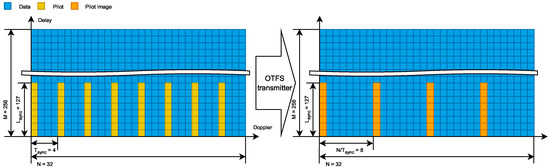
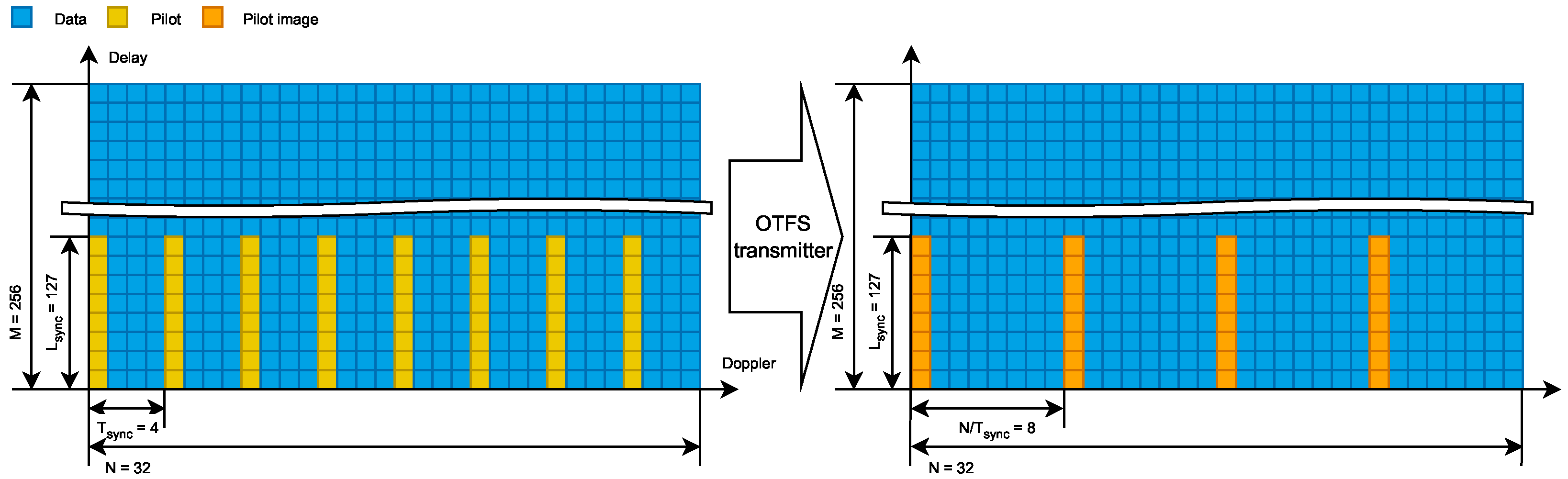
and denotes the period (in OTFS symbols) of pilot insertion along the Doppler axis. Periodic placement of the m-sequence along the Doppler axis produces multiple time-domain copies of the pilot in the transmitted signal; this enables both initial synchronization and continuous phase-drift tracking.
The first element of the pilot sequence in the delay axis is placed at the zero-delay resource element and the last element index equals the sequence length ( samples). This placement is performed for every -th OTFS symbol starting from symbol zero. According to (1), such Doppler-domain repetition produces time-domain images with a period equal to . For example (see Figure 1), with and , two time-domain images appear with a spacing of eight symbols.
Figure 1.
Reference signal map.
For an example of the synchronization signal mapping in the time domain see Figure 2. It is a schematic that corresponds to the time-domain signal after transformations in the OTFS transmitter.
Figure 2.
Pilot sequences in time domain for and .
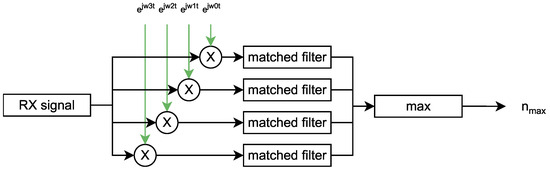
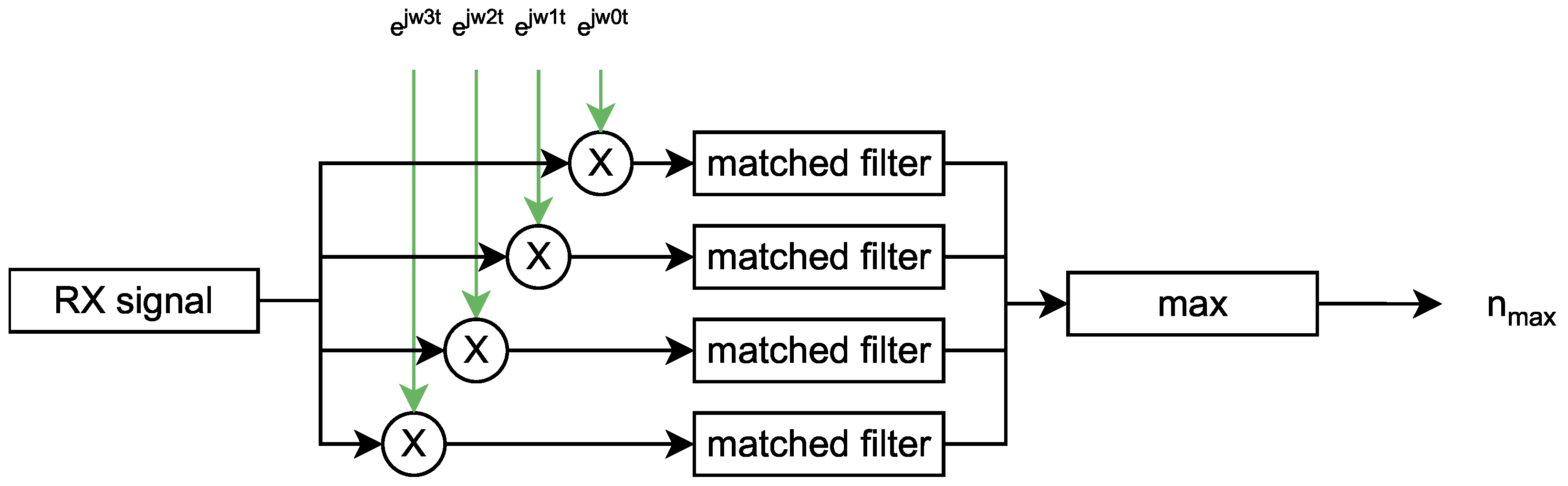
The received complex baseband signal in the time domain is multiplied by a bank of complex exponentials and fed to a bank of matched filters:
where denotes the n-th frequency-shifted version of the received signal and is the corresponding frequency offset for branch n. The number of branches (and matched filters) is chosen according to the required coarse frequency-offset resolution.
Each branch output is correlated with the known reference sequence using the matched filter bank. The discrete correlation (or convolution with a time-reversed conjugate) produces a set of correlation functions whose peaks indicate the pilot positions in the resource grid. The receiver selects the matched-filter branch with the maximum correlation response. The detection index can be written as
where “⋆” denotes correlation and t is the time.
A schematic of the proposed algorithm for the case of four filters is shown in Figure 3.
Figure 3.
Proposed algorithm implementation for 4-branch bank.
From Figure 3 it follows that the CFO resolution linearly depends on the number of branches with frequency shifts of the reference signal. For the given example four branches with a 60 kHz offset each are used. These values maintain a ±120 kHz CFO range and 60 kHz CFO resolution, which correspond to the subcarrier spacing value. The trade-off in this scheme is computational complexity versus CFO estimation. The more branches included in the filter bank, the better the resolution and/or range available for the system designer. At the same time, complexity raises linearly and depends on the number of branches and length of the sequence.
Using the index , the receiver gets both time alignment (the time moment, corresponding to the correlation peak, gives the synchronization position in the time domain) and coarse frequency alignment (the branch index indicates the best-matching frequency offset). Thus, initial time and frequency synchronization can be achieved in a single stage without buffering the entire resource grid and OTFS processing.
5. Simulation
This section presents numerical simulation results for the proposed synchronization system. The OTFS transmitter described in Section 2 was used for the analysis with the system parameters listed in Table 2.
Table 2.
System parameters.
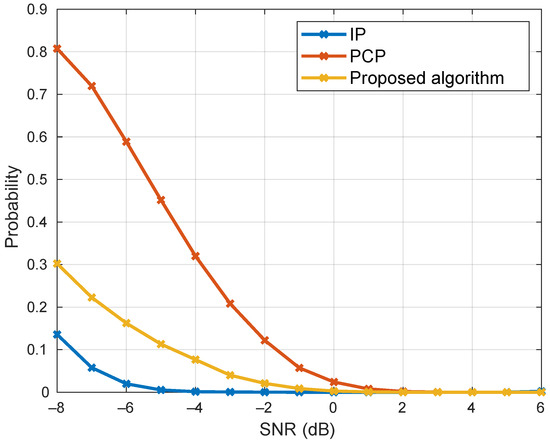
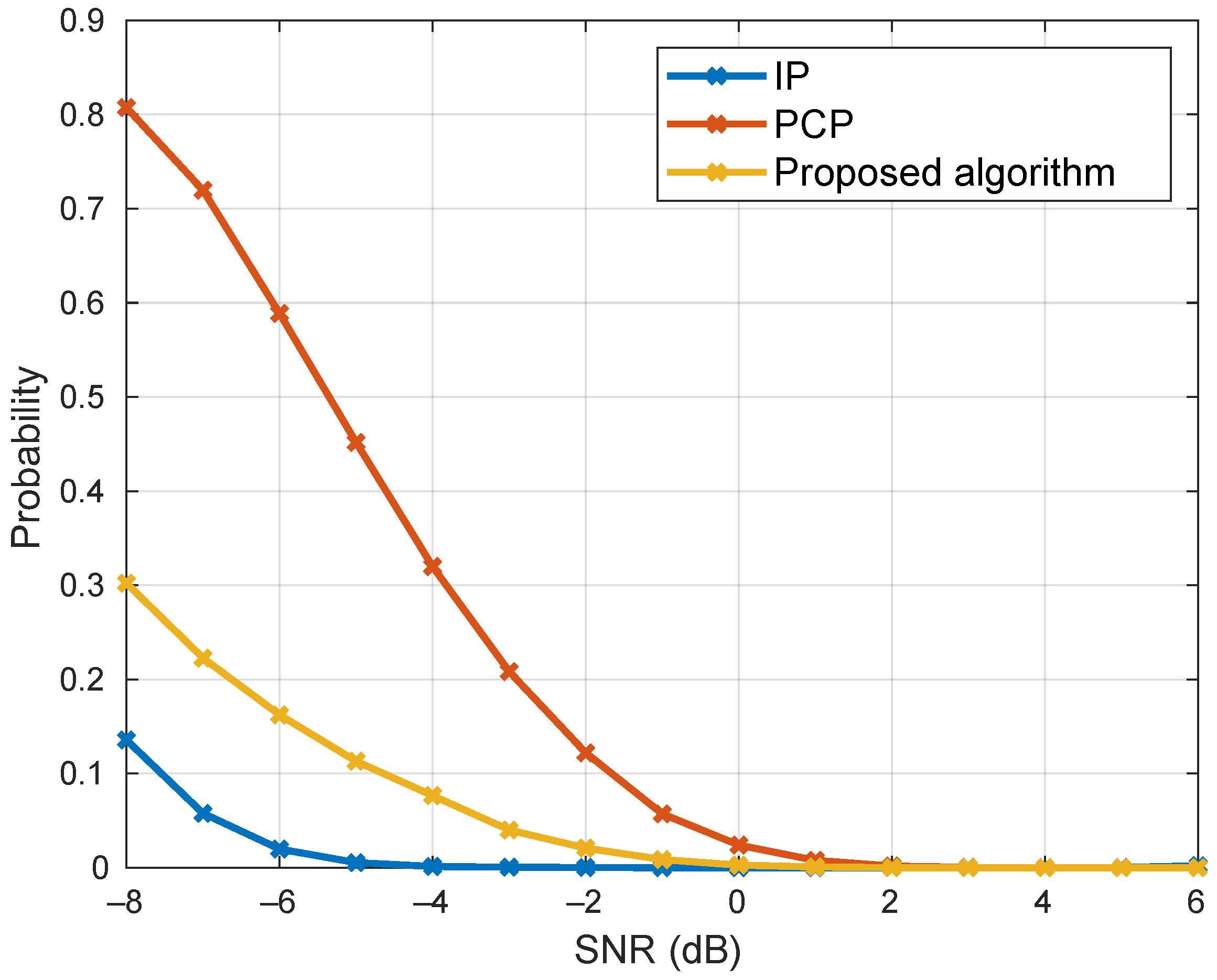
Using similar system parameters allows a fair comparison between the proposed algorithm and the algorithms from [5,7]. The idea behind selection of the parameter is to maintain lower overhead and better performance of the proposed algorithm. Also, no incremental processing of the sequential pilot image is applied, so there is no reason to increase this parameter. Figure 4 shows a comparison of the algorithms in terms of the probability of the timing synchronization error as a function of SNR.
Figure 4.
Probability of timing synchronization error as function of SNR.
According to the curves in Figure 4 the proposed algorithm demonstrates about 3 dB better performance in terms of timing synchronization detection. This improvement can be interpreted as follows: with identical system parameters (channel attenuation, receiver and transmitter characteristics, etc.), the proposed algorithm approximately doubles the probability of zero-timing error. Or, from the other point of view, the proposed algorithm maintains the same level of timing error with a 3 dB lower SNR.
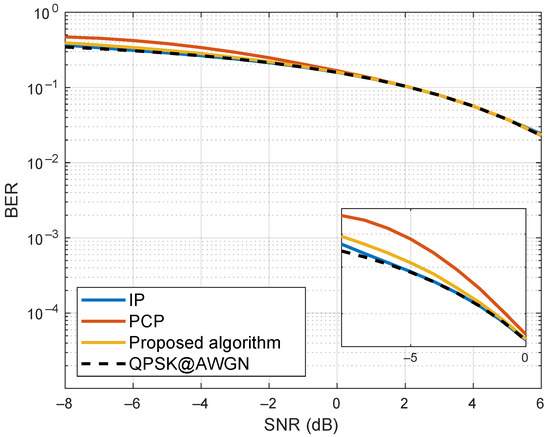
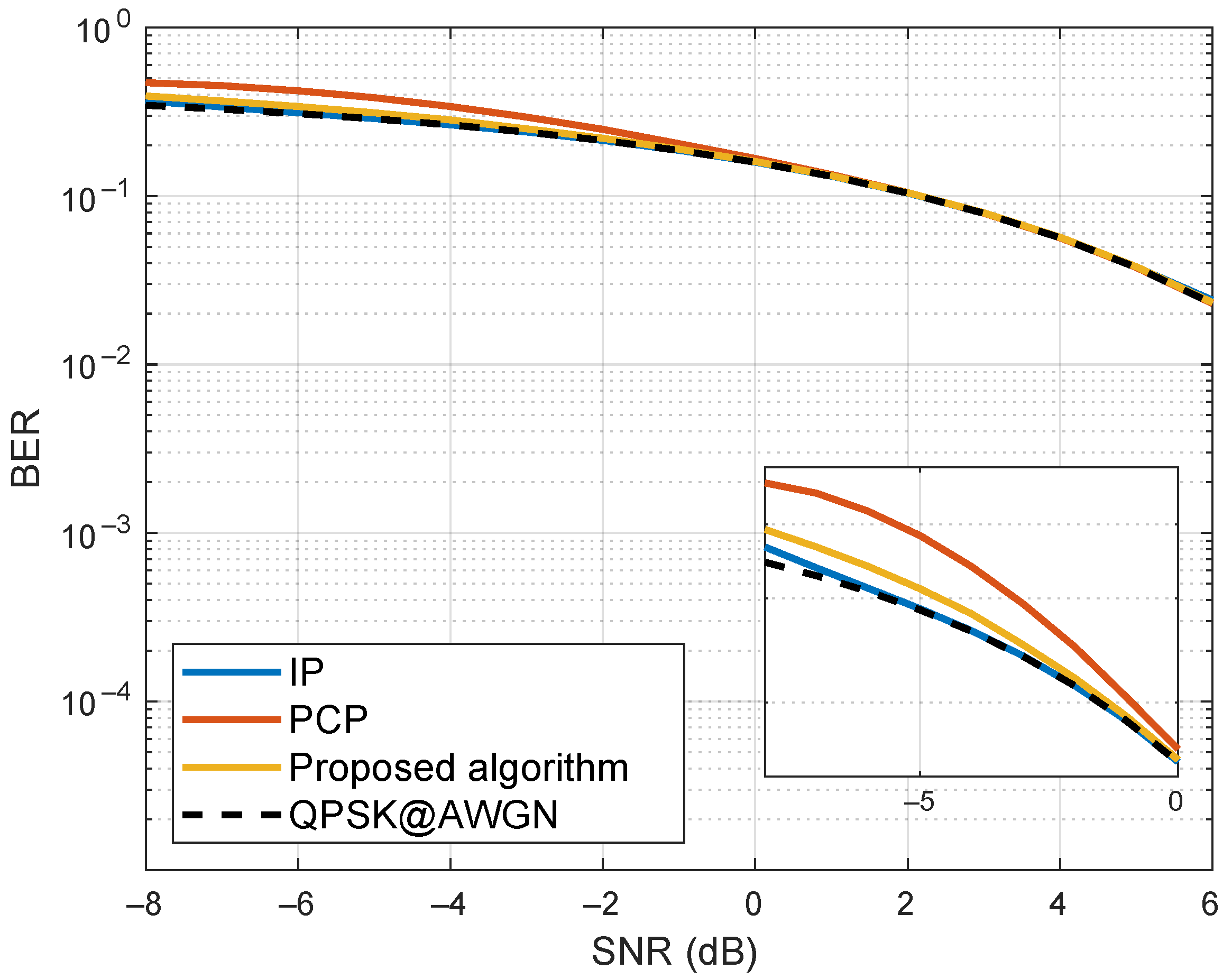
Despite the fact that timing error probability is different for the discussed algorithms, BER is still similar, as per Figure 5. There is a small difference between BER curves in a certain SNR range (see the zoom frame in Figure 5). In this range the signal is affected by AWGN and timing error simultaneously, so this leads to worse BER performance, which is the expected behavior.
Figure 5.
Bit error rate as function of SNR.
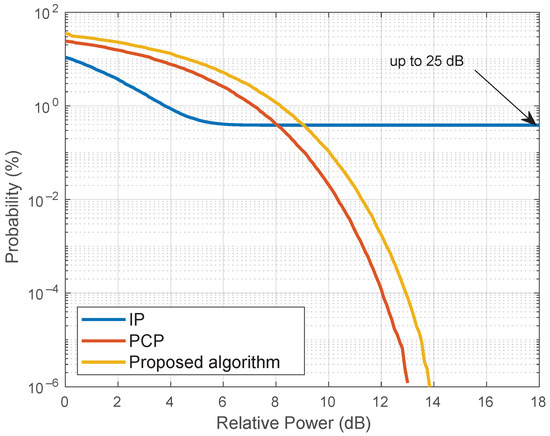
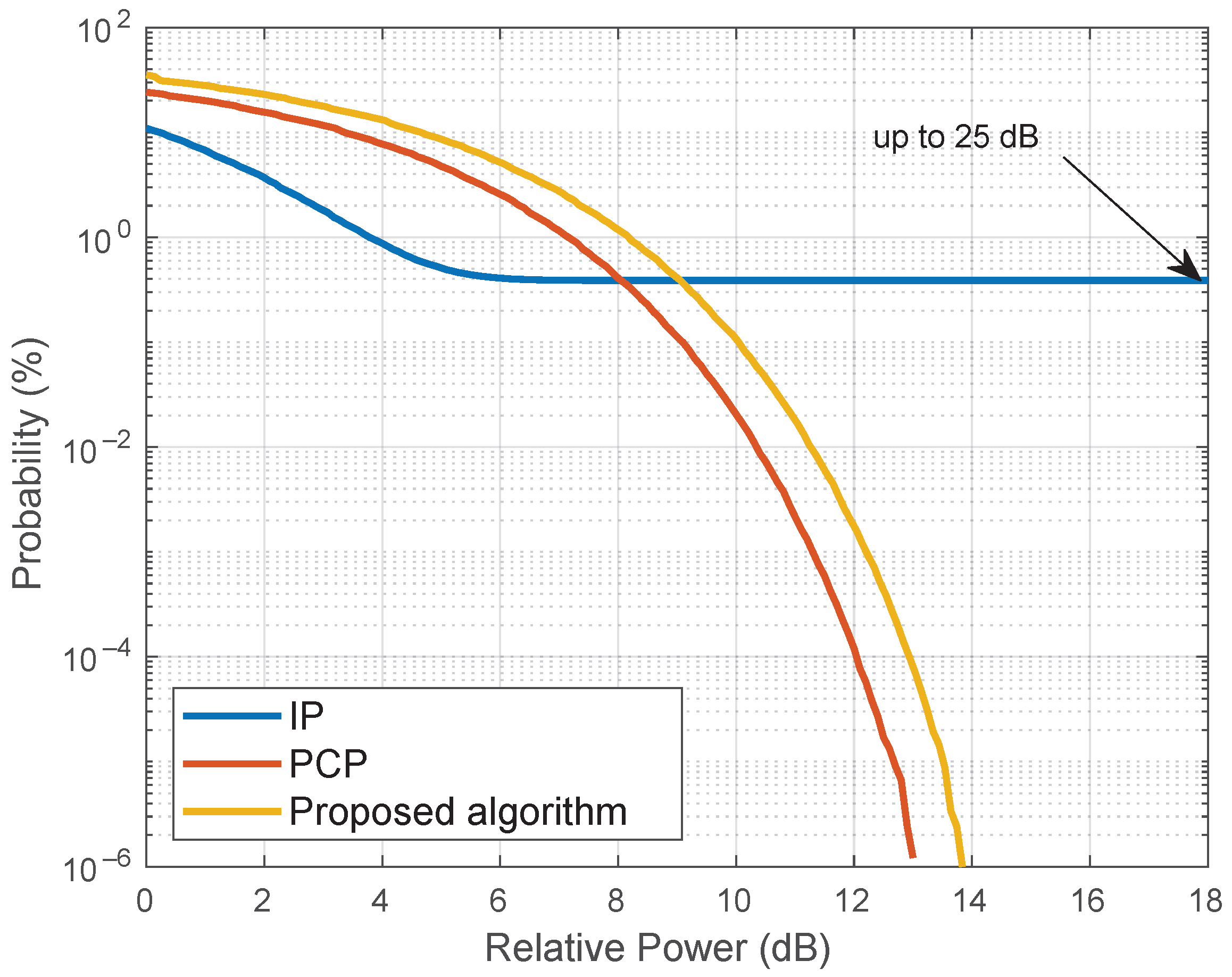
The above-discussed improvement is achieved with an even lower overall PAPR. Figure 6 presents the CCDF curves for the PAPR of the compared algorithms.
Figure 6.
CCDF curves.
To achieve this PAPR performance, the pilot amplitude should be chosen depending on the occupancy of the resource grid by data symbols. The observed PAPR values for the algorithms from [5,7] and for the proposed algorithm are 25 dB, 14 dB, and 13 dB, respectively. For the proposed algorithm, the PAPR value is about 1 dB lower (better).
6. Results and Discussion
A summary of the studied algorithms is presented in Table 3.
Table 3.
Algorithm summary.
6.1. PAPR
Although the algorithm in [5] achieves the lowest probability of synchronization error in the performed simulations, it is severely limited due to the high PAPR. This value of PAPR requires very high-level power amplifiers, which significantly reduces the practical applicability of the mentioned algorithm. This is especially important for NTN scenarios where link distance is a reason for low SNR. Therefore, this algorithm is not comparable for the given NTN scenarios and used as a reference.
The PAPR of the proposed algorithm is 13 dB, approximately 1 dB lower than the PAPR reported for the method in [7]. The reason for this improvement lies in the difference in filling of the Doppler–delay grid. The algorithm from [7] requires zero-level guard intervals near the pilot signal. But the proposed algorithm does not need this.
6.2. Overhead
Overhead values in Table 3 show the number of REs with pilot signals and empty guard REs. The overhead of the proposed algorithm is 1.1 and 4 times less in comparison with [5] and [7] respectively. This improvement is explained by a reduced number of unused resource elements in the delay–Doppler grid as well.
6.3. Synchronization Performance
In the channel described, the probability-of-correct-detection curve for the proposed algorithm indicates an approximately 3 dB improvement in detection threshold compared with the algorithm from [7]. The improvement in detection threshold is achieved by leveraging matched-filtering principles and using large time-domain reference signals. The proposed algorithm calculates the correlation of the full synchronization sequence (in this case 127 samples). With similar overhead and parameters the algorithms in [5,7] process only half of its synchronization signal width: the correlation between the signal and the cyclic prefix. As mentioned before, the reviewed algorithms calculate the correlation between two windows in the received signal. But the window-to-window correlation method is difficult to apply in channels with a low or negative SNR. In that regime the signal power is comparable to the noise power and the computed correlation essentially becomes the correlation of noise samples, which cannot provide acceptable detection performance. Instead of this, the proposed algorithm exploits the well-known nature of matching filtering and m-sequences.
In additional, there are several practical advantages of the proposed method. First, it has the ability to place pilot symbols periodically with a known schedule. These periodic pilots can be used to refine frequency-offset estimates and to perform channel or phase tracking. Second, by varying the sequence duration (i.e., increasing the signal base), a trade-off of redundancy versus detection reliability might be achieved. Increasing the base improves detection reliability due to greater redundancy, whereas decreasing it reduces redundancy and detection performance. The same logic is applicable for the parameter.
6.4. Complexity
For the studied system model and according to Table 3, the number of complex multiplications per OTFS slot is 10,208 for [7], 42,464 for [5], and 416,1536 for the proposed algorithm. These values represent the number of complex multiplications required to process a single OTFS slot of size 32 × 256 resource elements (REs) and to compute the initial TO and CFO. The proposed algorithm requires significantly more operations in real time, even if it provides CFO information at the same time. This is one of the disadvantages of the proposed algorithm.
Although the proposed algorithm requires a larger number of complex multiplications compared to the reference schemes, its implementation remains feasible for practical hardware platforms. The matched-filter bank operations consist primarily of multiply–accumulate procedures, which are well suited for FPGA and DSP architectures commonly used in satellite payloads and user terminals. For example, for the considered 32 × 256 OTFS frame, the required operations correspond to several MFLOPS, which is significantly below the processing capability of modern embedded SDR platforms and FPGAs. Furthermore, the algorithm supports sequential processing using a single-branch filter bank, reducing parallel hardware requirements at the cost of a small buffering delay. Therefore, the computational load is compatible with real-time implementation in NTN communication systems.
6.5. 5G and Beyond Integration
Another distinguishing feature of the proposed algorithm is the use of a priori-known reference sequences. This requires either prior knowledge of the reference signal parameters (initial state of the shift register and the PRBS generator polynomial) or a search over these parameters at the receiver. This contrasts with the approach in [7], which computes correlations between two sliding windows of the received signal.
But this feature is useful for compatibility with existing procedures in the 5G NR standard: initial access procedure and detection. In this paper the 5G NR PSS signal is used as an illustrative m-sequence. In case of need, this sequence might be replaced by another member of the m-sequence or gold sequence family to maintain orthogonality between existing and future systems. These and the various other details of standardization of OTFS and its coexistence with 5G and beyond systems is under study now [16].
7. Conclusions
In this paper, a practical implementation of initial time and frequency synchronization for OTFS modulation using an m-sequence-based pilot signal was presented. With similar BER performance (Figure 5) the proposed algorithm improves the detection threshold by 3 dB while reducing the PAPR by 1 dB and synchronization overhead by 10% (Table 3) under parameters defined in Table 2.
Signal detection is performed using matched filtering. Compared to the algorithms discussed in the Introduction, the proposed method simplifies the coarse time synchronization process. Also, the same pilot signal can be used to estimate the coarse frequency offset, which reduces transmission redundancy. Moreover, the pilot periodicity can be adapted dynamically to trade off redundancy against channel estimation accuracy.
The proposed synchronization algorithm is suitable for operation in channels with high Doppler frequency shifts and a low SNR, which makes it particularly relevant for non-terrestrial LEO communication systems where both these conditions coexist.
The proposed signal makes possible integration of the algorithm with beyond 5G systems and coexistence with previous generations.
Future work includes important steps for practical deployment of the proposed algorithm. There are several important directions of work:
- Complex channel and various environment modeling with the Quadriga framework;
- Adaptive pilot design (periodicity of ) with incremental processing and performance–overhead trade-off investigation for the LEO NTN scenario;
- Verification of multi-user and multi-antenna scenarios;
- Computational complexity optimization;
- Hardware validation with a future proposed frame structure.
Author Contributions
Conceptualization, V.B.; methodology, V.B., A.K. and E.R.; software, V.B.; validation, V.B.; writing—original draft preparation, V.B. and A.K.; visualization V.B. and A.K.; writing—review and editing, E.R.; supervision, E.R.; funding acquisition, E.R. All authors have read and agreed to the published version of the manuscript.
Funding
This research was funded with the support of the Ministry of Education and Science of Russia under project FEWM-2026-0007.
Data Availability Statement
The data that support the findings of this study are available from the corresponding author upon reasonable request.
Conflicts of Interest
The authors declare no conflicts of interest.
Abbreviations
The following abbreviations are used in this manuscript:
| OTFS | Orthogonal Time–Frequency Space |
| NTNs | Non-Terrestrial Networks |
| LEO | Low Earth Orbit |
| FEC | Forward Error Correction |
| PAPR | Peak-to-Average-Power Ratio |
| SNR | Signal-to-Noise Ratio |
| CP | Cyclic Prefix |
| PSS | Primary Synchronization Signal |
| PCP | Pilot with Cyclic Prefix |
| UE | User Equipment |
| LoS | Line of Sight |
| AWGN | Additive White Gaussian Noise |
| CCDF | Complementary Cumulative Distribution Function |
| BPSK | Binary Phase-Shift Keying |
References
- Leyva-Mayorga, I.; Soret, B.; Röper, M.; Wübben, D.; Matthiesen, B.; Dekorsy, A.; Popovski, P. LEO Small-Satellite Constellations for 5G and Beyond-5G Communications. IEEE Access 2020, 8, 184955–184964. [Google Scholar] [CrossRef] [Scilit]
- Okoyeigbo, O.; Deng, X.; Imoize, A.L.; Shobayo, O. OTFS: A Potential Waveform for Space–Air–Ground Integrated Networks in 6G and Beyond. Telecom 2025, 6, 19. [Google Scholar] [CrossRef] [Scilit]
- Gaudio, L.; Colavolpe, G.; Caire, G. OTFS vs. OFDM in the Presence of Sparsity: A Fair Comparison. IEEE Trans. Wirel. Commun. 2022, 21, 4410–4423. [Google Scholar] [CrossRef] [Scilit]
- Thaj, T.; Viterbo, E. OTFS Modem SDR Implementation and Experimental Study of Receiver Impairment Effects. In 2019 IEEE International Conference on Communications Workshops (ICC Workshops); IEEE: New York, NY, USA, 2019; pp. 1–6. [Google Scholar] [CrossRef] [Scilit]
- Bayat, M.; Farhang, A. Time and Frequency Synchronization for OTFS. IEEE Wirel. Commun. Lett. 2022, 11, 2670–2674. [Google Scholar] [CrossRef] [Scilit]
- P. S., S.; Farhang, A. A Practical Pilot for Channel Estimation of OTFS. In ICC 2023—IEEE International Conference on Communications; IEEE: New York, NY, USA, 2023; pp. 1319–1325. [Google Scholar] [CrossRef] [Scilit]
- Bayat, M.; P. S., S.; Farhang, A. Practical Synchronization for OTFS. In ICC 2023—IEEE International Conference on Communications; IEEE: New York, NY, USA, 2023; pp. 735–740. [Google Scholar] [CrossRef] [Scilit]
- Andrews, J. A Primer on Zadoff Chu Sequences. arXiv 2022, arXiv:2211.05702. [Google Scholar] [CrossRef] [Scilit]
- Deng, S.; Deng, Z.; He, Y.; Lin, W.; Wan, D.; Wang, W.; Feng, Z.; Fan, Z. Adaptive OTFS Frame Design and Resource Allocation for High-Mobility LEO Satellite Communications Based on Multi-Domain Channel Prediction. Electronics 2025, 14, 3939. [Google Scholar] [CrossRef] [Scilit]
- Sedin, J.; Feltrin, L.; Lin, X. Throughput and Capacity Evaluation of 5G New Radio Non-Terrestrial Networks with LEO Satellites. In GLOBECOM 2020—2020 IEEE Global Communications Conference; IEEE: New York, NY, USA, 2020; pp. 1–6. [Google Scholar] [CrossRef] [Scilit]
- Panagopoulos, A.D.; Arapoglou, P.D.M.; Cottis, P.G. Satellite communications at KU, KA, and V bands: Propagation impairments and mitigation techniques. IEEE Commun. Surv. Tutor. 2004, 6, 2–14. [Google Scholar] [CrossRef] [Scilit]
- Khan, M.S.; Kim, Y.J.; Sultan, Q.; Joung, J.; Cho, Y.S. Downlink Synchronization for OTFS-Based Cellular Systems in High Doppler Environments. IEEE Access 2021, 9, 73575–73589. [Google Scholar] [CrossRef] [Scilit]
- Hadani, R.; Rakib, S.; Tsatsanis, M.; Monk, A.; Goldsmith, A.J.; Molisch, A.F.; Calderbank, R. Orthogonal Time Frequency Space Modulation. In 2017 IEEE Wireless Communications and Networking Conference (WCNC); IEEE: New York, NY, USA, 2017; pp. 1–6. [Google Scholar] [CrossRef] [Scilit]
- Farhang, A.; RezazadehReyhani, A.; Doyle, L.E.; Farhang-Boroujeny, B. Low Complexity Modem Structure for OFDM-Based Orthogonal Time Frequency Space Modulation. IEEE Wirel. Commun. Lett. 2018, 7, 344–347. [Google Scholar] [CrossRef] [Scilit]
- Zegrar, S.E.; Arslan, H. Effect of Prefix/Suffix Configurations on OTFS Systems with Rectangular Waveforms. arXiv 2022, arXiv:2205.14872. [Google Scholar] [CrossRef] [Scilit]
- Nie, M.; Chong, R.; Li, S.; Farhang, A.; Göttsch, F.; Ng, D.W.K.; Matthaiou, M.; Li, Y. Towards Standardizing OTFS: A Candidate Waveform for Next-Generation Wireless Networks. arXiv 2026, arXiv:2601.15048. [Google Scholar] [CrossRef] [Scilit]



Disclaimer/Publisher’s Note: The statements, opinions and data contained in all publications are solely those of the individual author(s) and contributor(s) and not of MDPI and/or the editor(s). MDPI and/or the editor(s) disclaim responsibility for any injury to people or property resulting from any ideas, methods, instructions or products referred to in the content. |
© 2026 by the authors. Licensee MDPI, Basel, Switzerland. This article is an open access article distributed under the terms and conditions of the Creative Commons Attribution (CC BY) license.