


Abstract
This paper studies the problem of cold-start recommendation with graph contrastive learning. Graph contrastive learning has achieved state-of-the-art performance for the recommendation. However, it lacks robustness in cold-start scenarios due to noisy user–item interactions. Recent works have been proposed to improve the performance of noisy user-item interactions; however, they can achieve effective performance only on existing user–item interactions, which are not cold-start interactions. The question of how to find an optimal graph contrastive learning method that is suitable for cold-start cases still remains to be explored. We propose a novel method, graph contrastive learning via noisy training (GCLNT), to alleviate the cold-start recommendation problem. Specifically, GCLNT identifies user–item interactions with different preferences, and assigns them to different preference environments. With such different preference environments, noisy training is used to enhance the model’s robustness. We evaluate GCLNT on three datasets, and the results demonstrate the effectiveness of GCLNT in handling the cold-start in recommender systems.
1. Introduction
The rapid proliferation of internet data has intensified the issue of information overload, thereby elevating the significance of recommendation systems in efficiently bridging users with pertinent information [1,2]. Deep learning models have emerged as the predominant methodology for constructing recommender systems, owing to their capacity to discern intricate user–item relationships [3].
Among these, graph neural networks (GNNs) have shown remarkable success by modeling recommender systems as bipartite graphs [4]. However, most GNN approaches [1,5] struggle with cold-start scenarios where insufficient user–item interaction data exists.
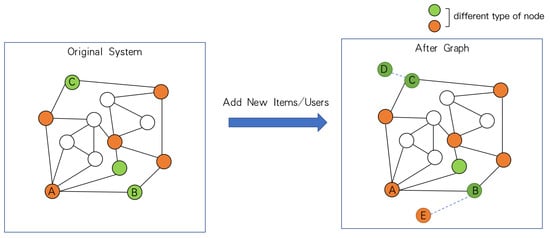
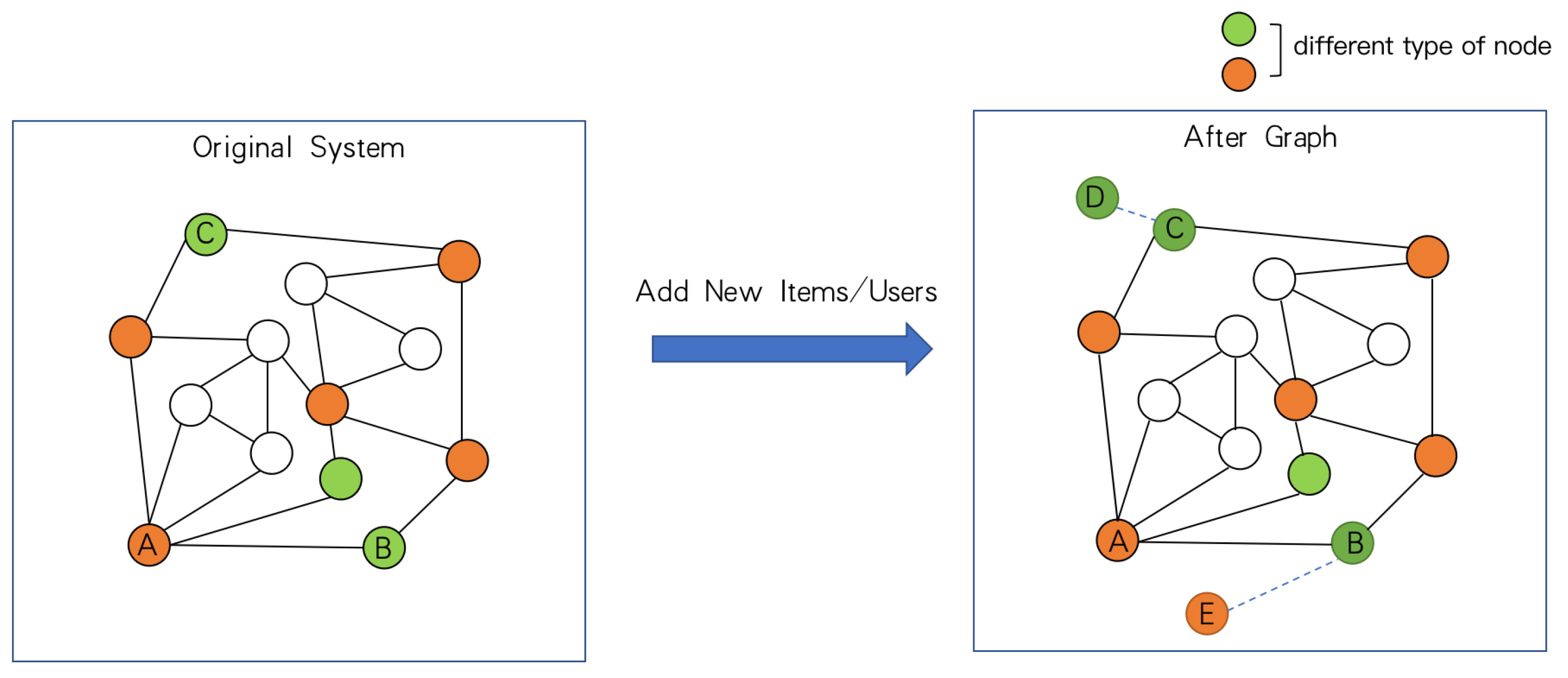
The cold-start problem presents significant challenges for GNNs, which rely on graph-structured data [1]. As illustrated in Figure 1, introducing new nodes (D and E) alters the graph structure, requiring the model to adapt to unfamiliar patterns. This adaptation is particularly difficult when personal information for new users/items differs substantially from existing data.
Figure 1.
User–item graph illustration for cold-start recommendation. After training on the original graph, the GNN learns that nodes with mixed green/orange neighbors (e.g., A) are orange, while nodes with all-orange neighbors (e.g., B, C) are green. However, introducing cold-start nodes D and E creates unseen patterns: D has only one green neighbor, and C connects to another green node. These structural changes, absent during training, degrade model performance.
To address these challenges, we propose a graph contrastive learning framework inspired by the idea of learning invariant representations across heterogeneous user behaviors. Rather than assuming uniform interaction patterns, our approach recognizes that user actions emerge from diverse behavioral contexts—such as work, leisure, or exploration—which we formalize as preference environments. By identifying these environments through clustering-based disentanglement, we enable more targeted and semantically coherent contrastive learning.
Our key insight is that noise and data sparsity in cold-start settings are not random but environment-specific. Thus, applying uniform augmentation strategies (e.g., random corruption or edge dropout) may distort meaningful patterns rather than enhance robustness. Instead, we introduce environment-specific noise training, a novel contrastive augmentation strategy that adapts embedding-level perturbations to each preference environment. This yields cleaner and more consistent graph views, especially for underrepresented items.
The main contributions of this work are as follows:
- We propose a novel graph contrastive learning framework for cold-start recommendation that explicitly models the heterogeneity of user behavior through preference environment division, allowing the model to disentangle diverse interaction contexts.
- We introduce environment-specific noise training, a new contrastive augmentation strategy that adapts noise perturbations to each preference environment. This creates cleaner and more semantically consistent graph views, particularly beneficial in cold-start settings.
- We highlight the synergistic advantage between these components: environment division enables targeted denoising, while environment-aware contrastive learning improves representation robustness. This design distinguishes our approach from standard GCL methods that apply uniform noise augmentation regardless of the behavioral context.
- We validate the effectiveness of our approach on three real-world datasets, showing consistent improvements over state-of-the-art methods. The results demonstrate our model’s superior ability to handle noisy and sparse interactions in cold-start scenarios.
2. Related Work
2.1. Cold-Start Problem
The cold-start problem in recommendation systems is the challenge of providing recommendations for new users and items with limited interaction history [6]. Many classical recommendation algorithms rely on a wealth of interaction data, making it difficult to provide accurate recommendations for new users or items. Traditional approaches, such as leveraging user item attributes instead of historical records, have been proposed to address the cold-start problem. More recently, novel techniques such as bandit algorithms, meta-learning, and contrastive learning have emerged to solve this problem.
MetaEmb [7] is a model that utilizes an item’s feature attributes to learn a generator, which generates an initialized ID embedding of the item. The generated embedding is then used for subsequent training and prediction to improve performance on cold-start recommendations. The MWUF model [8] also leverages meta-learning and employs a meta-stretching network to predict a stretching function from the item’s features, which is used to perform feature transformation on the cold-start ID embedding. This transformation helps to map the embedding to a better feature space. GAR [9] introduces an adversarial generative network to solve the cold-start problem by using attribute information of items to generate more suitable embeddings for the recommendation.
However, these models heavily rely on attribute information and do not offer in-depth consideration of graph-based recommendation systems. To address this gap, our work explores the concept of invariant learning from the embedding level and proposes methods to mitigate the cold-start problem in recommender systems. Our approach addresses the biased problem of uneven distribution of popular and less popular items. By incorporating the concept of invariance, our proposed model can generate more robust and effective embeddings, improving the accuracy of recommendations for cold-start users and items.
2.2. Graph Neural Networks for Recommendation
Recommendation systems aim to provide personalized suggestions by leveraging user and item features—such as attributes and historical interactions—which can be naturally modeled as a graph. In this formulation, users, items, and their interactions form nodes and edges, enabling graph neural networks (GNNs) to learn expressive representations that capture both structural dependencies and semantic information. As a result, GNN-based methods have achieved state-of-the-art performance in various recommendation tasks [4].
Early works laid the foundation for GNN-based recommender systems. PinSage [10] introduced a scalable approach by constructing a bipartite user–item graph and applying random walks combined with graph convolutions to generate embeddings that incorporate both feature and structural information. This framework significantly improved recommendation accuracy at scale. Building on this, NGCF [11] explicitly models high-order connectivity between users and items through message passing, enhancing embedding quality by propagating interactions across multiple hops. Later, LightGCN [12] simplified the architecture by removing nonlinear transformations and feature manipulations, focusing solely on neighborhood aggregation. This minimal yet effective design achieved superior performance and greater computational efficiency, setting a new benchmark for GNN-based recommenders.
With the success of GNNs, researchers began exploring self-supervised learning to further enhance representation robustness. SGL [13] pioneered graph contrastive learning (GCL) in recommendation by generating augmented views of the user–item graph via stochastic data augmentation (e.g., node or edge dropout), then maximizing agreement between different views of the same node. This contrastive objective serves as a regularizer, improving generalization by learning invariant patterns across perturbed graph structures.
However, recent studies reveal a critical tension between GCL and cold-start scenarios: while GCL aims to improve robustness through data augmentation, its effectiveness deteriorates under extreme data sparsity [14,15]. This degradation stems not merely from insufficient supervision, but from the interplay between sparsity and noisy interactions—a phenomenon increasingly acknowledged in the literature. In sparse graphs, each observed interaction carries disproportionate influence during training [16], making embeddings highly sensitive to even minor corruptions such as accidental clicks or session timeouts [17,18].
This vulnerability is exacerbated in GCL frameworks that apply stochastic augmentations uniformly across nodes. For well-connected users, operations like edge dropout act as effective regularizers. But for cold-start users with only a few genuine interactions, such augmentations risk eliminating the sole reliable signals, causing the model to align embeddings based on spurious patterns or noise [19,20]. This creates a negative feedback loop: sparsity increases susceptibility to overfitting, while fixed augmentation policies further weaken already scarce supervision signals [14].
Indeed, Zhang et al. [21] show that standard GCL methods can amplify biases in cold-start settings—especially when noisy interactions are systematically correlated with user demographics or device types. Similarly, Li et al. [22] identify a phenomenon termed supervision starvation, where uniform augmentation leads to representation collapse on low-degree nodes, undermining their ability to learn meaningful representations.
Despite these insights, most existing GCL methods treat all nodes uniformly and lack mechanisms to distinguish reliable from unreliable interactions. Some efforts attempt to incorporate side information—such as node attributes—to guide learning [23,24]; however, these often rely on non-adaptive augmentation strategies and remain vulnerable to attribute noise or incompleteness.
To address these limitations, recent work has explored more sophisticated view generation strategies. For instance, Li et al. [25] propose HD-KCL, a hierarchy-aware diffusion model in hyperbolic space combined with knowledge-enhanced contrastive learning. By leveraging a masked prediction-guided diffusion process and topology-aware aggregation, HD-KCL generates semantically coherent contrastive views while filtering out irrelevant knowledge, particularly beneficial in knowledge graph-enhanced recommendations. This reflects a broader trend toward structured view synthesis to improve contrastive learning under sparsity.
Our work aligns with this direction but takes a different path. Rather than designing complex view generation mechanisms or relying on auxiliary knowledge graphs and diffusion steps, we focus on improving the alignment between embedding-level perturbations and the reliability of supervision signals. Specifically, by disentangling user interactions into distinct preference environments, our approach implicitly accounts for behavioral heterogeneity—a strategy supported by prior causal studies suggesting that such disentanglement helps isolate true user preferences from spurious correlations [17,26].
Thus, our method offers a practical and effective route toward more robust contrastive learning in cold-start scenarios. We address this challenge by introducing an invariant learning framework that adaptively adjusts augmentation strength and alignment scope based on node reliability, thereby mitigating the adverse interaction between noise and sparsity in cold-start recommendation.
3. Method
In this section, we introduced the framework of GCLNT, which contains a curriculum preference identification module and a noisy training module. GCLNT learns robust representations, which could alleviate the cold-start recommendation problem. The curriculum preference identification module identifies different preferences in noisy interactions and classifies these interactions into environments with different preferences. Thus, the noisy training module could learn robust representation based on these environments.
3.1. Curriculum Preference Identification Module
3.1.1. Preference Environment Construction
We define a preference environment as a semantically coherent subset of user–item interactions that exhibit similar behavioral patterns. To construct such environments, we proceed as follows:
- 1.
- Preference Feature Extraction: For each user , we derive a preference feature vector by aggregating their interacted item embeddings through a light-weight GNN layer:where denotes the set of items interacted by user u, is the embedding of item i, is a learnable projection matrix, and is a non-linear activation function.
- 2.
- Environment Clustering: We collect all user preference vectors and apply K-means clustering to partition users into K distinct environments . The environment assignment for user u is given bywhere is the centroid of environment .
- 3.
- Environment-Aware Interaction Grouping: Once users are assigned to environments, each user–item interaction inherits the environment label of user u. Thus, the interaction graph is implicitly partitioned into K subgraphs, each corresponding to one preference environment.
The number of environments K is determined in a data-driven manner using clustering diagnostics applied to environment-specific feature representations or gradient statistics. This provides an initial estimate of K that reflects the intrinsic diversity of environmental patterns present in the training data, reducing reliance on exhaustive manual tuning. We further refine K based on validation performance to balance model capacity and environmental resolution, ensuring robust generalization. The resulting clustering-based environment construction ensures that each environment captures a distinct preference pattern, thereby facilitating robust representation learning under environmental heterogeneity.
3.1.2. Curriculum Learning Strategy
To prevent the model from overfitting to dominant environments, we employ a curriculum learning strategy that gradually exposes the model to environments of increasing complexity—defined here by decreasing interaction density (i.e., moving from head to long-tail items).
The curriculum is governed by a scheduling function , which determines the maximum environment index (or minimum interaction threshold) included at training step t. Specifically, we define as a linear ramp:
where is a pre-specified warm-up horizon (e.g., 20% of total training steps). At step t, only environments satisfying are activated for training, where is the size of the largest environment. This ensures that training starts with the densest environments and progressively incorporates sparse ones until all environments are included after steps.
Separately, to further mitigate the dominance of popular environments, we apply an adaptive weighting penalty to the loss of each environment:
with a normalization constant such that . This reweighting amplifies the contribution of long-tail environments but operates independently of the curriculum schedule.
In summary, the curriculum controls which environments are used at each stage (temporal exposure), while the weighting adjusts how much each active environment contributes to the loss. The performance gain thus arises from both structured exposure and rebalanced optimization emphasis.
3.2. Noisy Training Module
This section details the Noisy Training Module (NTM) within the Graph Contrastive Learning via Noisy Training (GCLNT) framework. The primary objective of this module is to learn robust node representations that effectively address the cold-start recommendation problem by leveraging noisy training signals derived from heterogeneous user preference environments.
The NTM operates on environment assignments produced by the Curriculum Preference Identification Module. By incorporating environment-aware perturbations, the module learns representations that are less sensitive to data noise and better capture the underlying preference patterns specific to each environment.
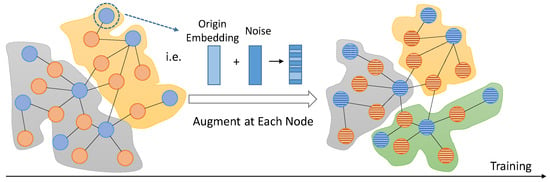
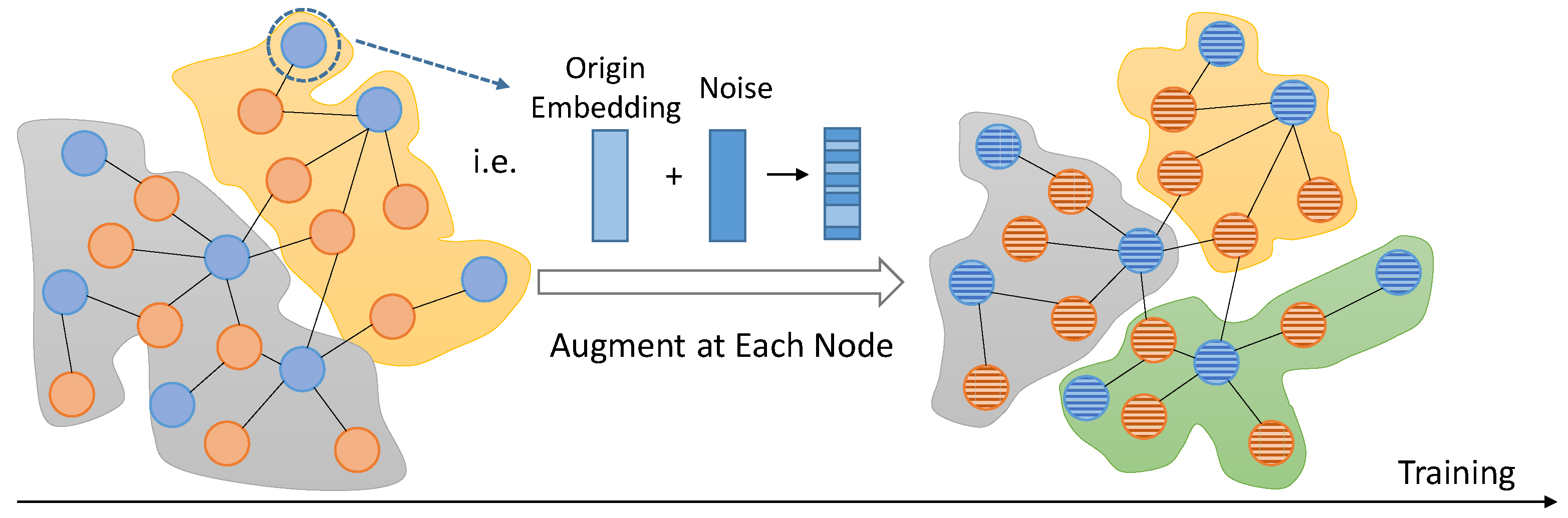
To this end, we introduce an environment-specific noise vector for each environment e. During training, this noise vector is added to node embeddings to simulate behavioral variations among users under different preferential conditions. The injection of controlled randomness enriches the diversity of training views and enables the model to generalize across multiple preference regimes simultaneously.
Building upon graph contrastive learning principles, we formulate a contrastive objective to encourage consistency between semantically related representations derived from augmented graph views. For each node i (representing either a user or an item), two augmented views are constructed as follows:
- The anchor view is obtained by performing one layer of LightGCN-style aggregation over the original neighborhood, followed by the addition of environment-specific noise .
- The positive view is generated by first applying random edge dropout to the interaction graph, then aggregating neighbors within the same environment e, and finally perturbing the resulting embedding with the same noise vector .
These two views constitute a positive pair, as they correspond to the same node under consistent environmental context but with stochastic structural and embedding-level augmentations.
All other nodes in the current mini-batch serve as negative samples. The negative set includes nodes from both the same environment (to discriminate fine-grained preference differences) and different environments (to promote learning of environment-invariant features). This mixed negative sampling strategy is designed to enhance generalization, particularly for cold-start users who may belong to previously unobserved preference environments.
The contrastive loss is formulated as a standard InfoNCE objective:
where is a temperature hyperparameter that modulates the sharpness of the similarity distribution.
This contrastive design is particularly beneficial for cold-start scenarios. New users or items typically exhibit extremely sparse interaction histories, leading to unstable and overfitted representations. By enforcing agreement between two perturbed views of the same node within a stable environmental context, the contrastive loss acts as a self-supervised regularizer that mitigates sensitivity to accidental interactions. Furthermore, contrasting against negatives drawn from diverse environments discourages the model from memorizing environment-specific biases and instead encourages the extraction of transferable preference signals. Together, these mechanisms improve representation stability and cross-environment generalization, which are critical for effective cold-start recommendation.
The noise injection process is formalized as follows. For a node i assigned to environment e, its embedding is perturbed according to
where is a d-dimensional random vector with independent standard normal components. The scalar controls the magnitude of the perturbation, such that each dimension of the noise follows . This parameter allows for adaptive noise scaling across environments, balancing robustness and representation fidelity.
Functionally, the module serves as a structured data augmentation mechanism. By injecting Gaussian noise into node embeddings during message passing, it reduces over-reliance on specific interaction patterns and enhances model generalization—particularly important in graph-based recommendation systems where data sparsity and noise are prevalent. Overall, the Noisy Training Module contributes to improved recommendation performance, with notable gains in cold-start settings.
3.3. Framework
This section delves into the comprehensive framework of Graph Contrastive Learning via Noisy Training (GCLNT), which comprises a curriculum preference identification module and a noisy training module. Initially, we enhance the embedding data by partitioning the environmental environment and constructing the graph structure to mitigate the impact of data distribution. Subsequently, through curriculum learning, we iteratively train the model multiple times, enabling the recommendation model to be trained more efficiently, effectively, and tailored to cold-start items with long-tail distributions. Figure 2 illustrates the framework of the overall model. GCLNT learns resilient representations, which could alleviate the cold-start recommendation problem. The curriculum preference identification module recognizes distinct preferences in noisy interactions and categorizes these interactions into environments with different preferences. Consequently, the noisy training module could learn robust representation based on these environments. We summarize the GCLNT in Algorithm 1.
Figure 2.
The framework of GCLNT employs a simple initial environment partition, which is gradually refined through data augmentation noise during training to improve the performance of the graph neural network.
To address the cold-start issue in recommender systems, we propose a solution that leverages data and model modifications. Firstly, we partition item data into distinct environments based on their inherent characteristics, such as attributes and popularity. This enables precise control over the model’s representation learning for items in diverse environments, reducing the impact of interaction data size and facilitating the acquisition of robust representations for accurate predictions across environments. Secondly, we enhance the model’s robustness by introducing embedding noise during representation training. By applying varying noise levels to items in different environments, we simulate real-world variations in interaction data. Empirical results demonstrate that this approach improves the model’s ability to learn accurate representations and make robust predictions. Lastly, we adopt a curriculum learning approach to dynamically adjust the number of item environment categories during training, ensuring a smooth and effective training strategy for the model. In conclusion, our proposed solution effectively addresses the cold-start in recommender systems, enhancing the model’s robustness and accuracy, particularly through the introduction of environment-specific noise during representation training.
| Algorithm 1. GCLNT Algorithm |
Input: GRAPH , number of layers n, noise weight , environment weight , training dataset D, learning rate Output: User and item representations
|
4. Experiments
To identify the effectiveness of proposed our model, we conduct extensive experiments and answer the following research questions:
- RQ1: How effective is the proposed model for recommendation compared with previous state-of-the-art methods?
- RQ2: What are the benefits of the proposed modules?
- RQ3: How do different settings impact the effectiveness of our model?
4.1. Experimental Settings
4.1.1. Experimental Datasets
Three public datasets collected from real-world online services are used to evaluate the performance of our model. The statistics of these datasets are summarized in Table 1. We follow the same strategy described in ref. [13] to split the interactions into training, validation, and testing sets with a ratio of 7:1:2. Details of the experimental datasets are as follows:
Table 1.
Statistics of the datasets.
- Yelp: This dataset contains reviews of local businesses collected from the Yelp website. It contains information on the businesses themselves.
- Amazon: This dataset contains product reviews collected from the Amazon website. It includes information on the products themselves.
- Gowalla: This dataset is collected from Gowalla, a location-based social networking site that allows users to check in at various locations. The dataset includes user check-in records at geographical locations.
To evaluate model performance under cold-start scenarios, we define new users and new items as those with limited interactions in the training set. Based on the overall interaction distribution in each dataset, we set a threshold of at most five interactions: users who have interacted with ≤5 items in training are treated as new users, and items interacted with by ≤5 users are considered new items. This interaction-count-based protocol ensures that the model faces sparsely observed entities during testing.
The data split is fixed across all experiments using a predefined random seed, and all models are evaluated exclusively on test interactions involving these cold-start entities. This setup guarantees a fair and reproducible comparison.
4.1.2. Evaluation Protocols
In line with previous studies on collaborative filtering recommenders [13], we perform an all-rank evaluation approach, which involves ranking positive items from the test set alongside all unexplored items for each user. To evaluate the performance of our model, we utilize two commonly used metrics, namely Recall@N and NDCG@N, with a default value of . These metrics enable us to assess the accuracy and relevance of the recommended items, and provide a comprehensive evaluation of our model’s effectiveness.
4.1.3. Baseline Models
We compare our model with the following baselines:
- LightGCN [12]: LightGCN is a simple graph convolutional network that only considers a node’s first-order neighbors. Despite its simplicity, it achieves comparable performance to more complex graph convolutional networks on standard datasets, while also being significantly faster.
- SGL [13]: SGL is a self-supervised learning method that learns a graph embedding by predicting the existence of edges in a graph. It achieves state-of-the-art performance on graph-based tasks.
4.2. Overall Performance(RQ1)
To evaluate the performance of non-cold-start scenario and cold-start scenarios, we prepared four partitions for each dataset: (1) existing items for existing users, (2) existing items for new users, (3) new items for existing users, and (4) new items for new users. The overall performance of our model and the baselines are shown in Table 2. From the results, we have the following observations:
Table 2.
Experimental results on the three datasets in terms of and .
- Our model consistently achieves better performance than the baseline methods, with modest gains in Recall@20 and NDCG@20. These improvements may stem from our intervention in the training process that adjusts for item popularity bias, allowing the model to focus more on informative features. The incorporation of noise perturbation in the graph structure contributes to improved robustness, while the weighted penalty on items of different popularity levels helps reduce the undue influence of highly popular items during training.
- When comparing LightGCN with SGL and our approach, we observe a clear performance gain from integrating self-supervised learning into GNN-based recommenders. This suggests that contrastive learning provides useful auxiliary signals that enhance representation learning—particularly under conditions of sparse user–item interactions—leading to more discriminative embeddings.
- Compared to SGL, our model shows consistent improvements by applying weighted processing tailored to different connectivity patterns in the graph. This strategy appears to mitigate the dominance of highly connected (popular) nodes during training, which may otherwise skew representations. As a result, our model demonstrates stronger capability in capturing preferences related to long-tail items. While the absolute gains are modest, they indicate a promising direction for improving recommendation quality in imbalanced scenarios. These findings suggest that carefully adjusting learning objectives based on node characteristics can contribute to more balanced and potentially fairer recommendations.
4.3. Ablation Study (RQ2)
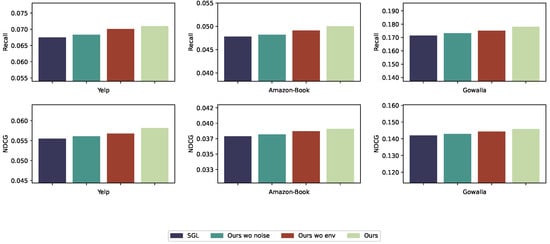
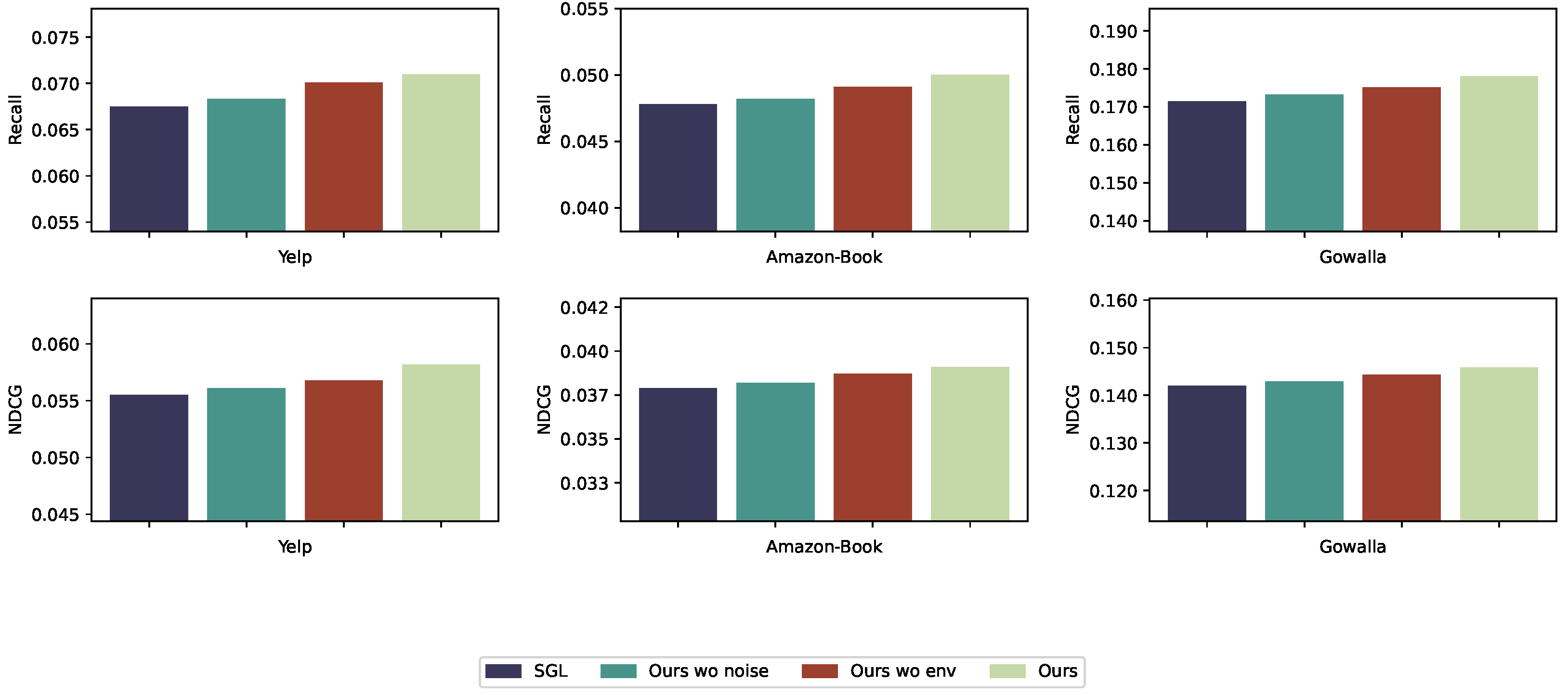
In our ablation study on three datasets, we compare our approach with SGL and three variants of our model: (1) SGL: the baseline; (2) ours (wo env): our model without environment segmentation; (3) ours (wo noise): our model without augmentation noise; (4) ours: the full framework. As shown in Figure 3, our models outperform the SGL baseline, with both environment segmentation and noise augmentation contributing to improved recommendation performance, especially for items with limited interactions.
Figure 3.
The results of the ablation study.
Notably, the performance drop is more significant when removing noise augmentation than when removing environment segmentation, indicating that graph perturbation plays a more fundamental role in enhancing model robustness. We attribute this to the fact that noise-based contrastive learning prevents the encoder from overfitting to high-degree (popular) items during message passing, thereby preserving discriminative signals for long-tail items. In sparse interaction scenarios, this mechanism ensures that embeddings of new or less-popular items are not overwhelmed by dominant neighbors.
On the other hand, environment segmentation helps mitigate the influence of popularity bias by adaptively adjusting the contribution of data based on its popularity level. Although its impact is slightly smaller than that of noise, it provides complementary benefits by enabling the model to learn environment-aware representations that better reflect user intent beyond mere frequency patterns.
To illustrate this behavior, consider a new item such as a niche academic book with only a few interactions. In SGL or the “wo noise” variant, its embedding is easily dominated by connections to generalist users who also interact with popular bestsellers. In contrast, our full model applies structured noise and environment-aware weighting, which reduces the influence of these high-degree nodes and amplifies subtle but meaningful signals—e.g., from users with specific research interests. As a result, the learned representation better captures the item’s semantic identity, leading to improved recall in cold-start settings.
The overall framework achieves the best performance, demonstrating the synergy between robustness enhancement (via noise) and bias mitigation (via environment modeling), both of which are crucial for capturing long-tail characteristics under sparse supervision.
4.4. Hyperparameter Study (RQ3)
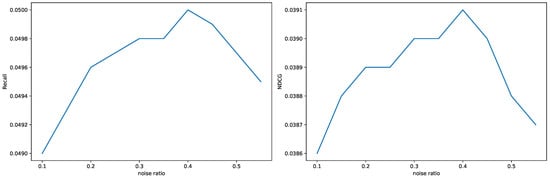
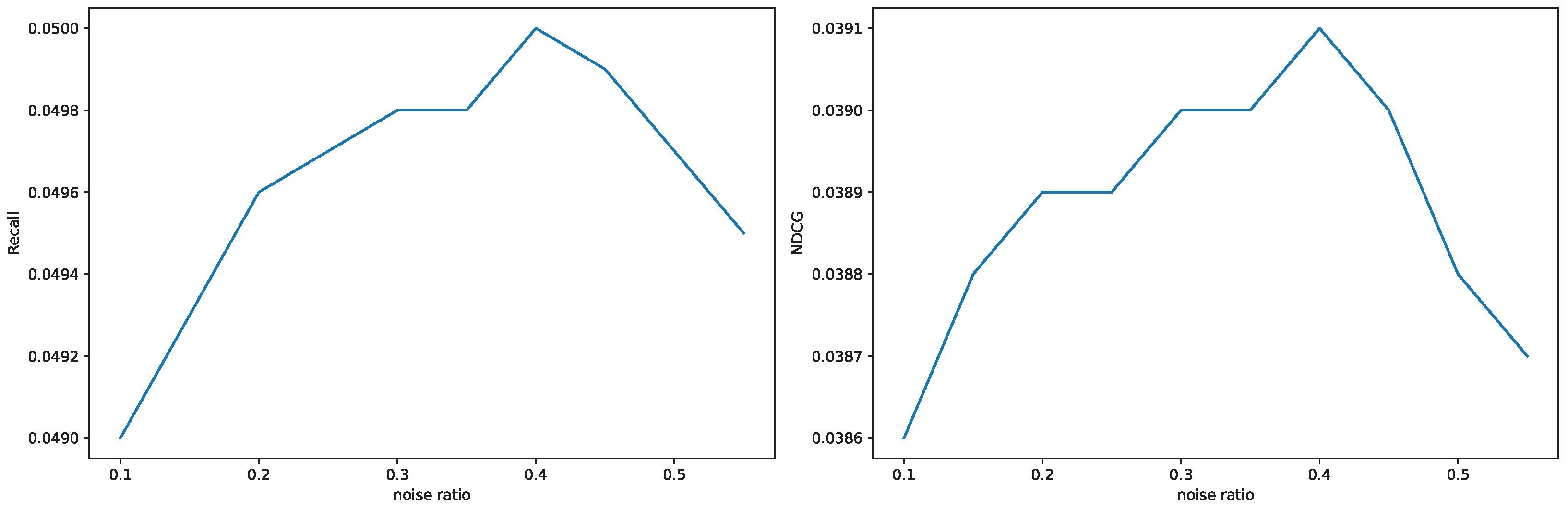
In this section, we examine the impact of introducing varying noise to our framework on the outcomes. Figure 4 depicts the performance of our framework. As illustrated in the figure, our approach exhibits diverse performance with different noise, and decreases beyond a certain optimal value. Specifically, performance improves slightly with small noise (e.g., noise ratio = 0.1–0.2), suggesting that a moderate level of perturbation regularizes the training process and enhances model generalization. However, as the noise magnitude increases further (e.g.,noise ratio = 0.4–0.5 ), both Recall and NDCG degrade significantly, indicating that excessive noise distorts the embedding space and hampers effective learning. Consequently, appropriate parameters need to be tailored for different datasets to attain optimal results.
Figure 4.
Recall and NDCG on Amazon-Book dataset with different noise settings.
5. Discussion
This work presents a novel framework for improving the robustness of recommendation models by adaptively reweighting data based on popularity, thereby mitigating the dominance of popular items during training. By introducing intervention mechanisms on both popularity and feature representations within the model architecture, our method enables more balanced learning dynamics, which helps address common challenges such as cold-start and long-tail item exposure.
Our design choices—such as using a single GNN aggregation step to derive user preference vectors and applying K-means clustering for environment construction—are motivated by efficiency and simplicity. However, we acknowledge that these components may be sensitive to hyperparameters and random initialization, especially in sparse interaction graphs. As highlighted by the reviewer, a more rigorous analysis of the stability and consistency of the constructed environments across different runs would enhance the reliability and interpretability of this module. While we leave a comprehensive ablation study on clustering strategies, sensitivity to K, and environment reproducibility for future work, we recognize the importance of such modular analysis in building trustworthy recommendation systems.
In addition, while our current experiments focus on standard cold-start settings, future work will explore fine-grained analyses under varying degrees of sparsity and novelty. We also plan to investigate dynamic methods for identifying popularity patterns during training, rather than relying on static pre-defined thresholds. Extending our approach to large-scale industrial datasets will further validate its scalability and practical utility.
6. Conclusions
In this paper, we have proposed a method to enhance the robustness of recommendation models by resisting the influence of popular data on model training. Our approach adaptively adjusts the contribution of data with varying degrees of popularity to model training, thus facilitating the model to focus on the most essential features of the data. We have designed intervention methods for data popularity and feature information in the recommendation model structure, which alleviate the common cold-start and long-tail problems in recommendation systems. Our comprehensive experiments have demonstrated the effectiveness of our approach in improving recommendation accuracy.
Author Contributions
Conceptualization, T.F., G.S. and Q.S.; data curation, T.F. and Q.S.; formal analysis, T.F. and Q.S.; funding acquisition, G.S. and Q.S. writing—original draft, T.F.; writing—review and editing, G.S. and Q.S. All authors have read and agreed to the published version of the manuscript.
Funding
The work was supported by the Application of Trusted Education Digital Identity in the Construction of Smart Campus in Vocational Colleges (Grant No. 2242000393).
Data Availability Statement
The original contributions presented in this study are included in the article. Further inquiries can be directed to the corresponding author.
Conflicts of Interest
The authors declare no conflicts of interest.
References
- Zhang, M.; Wu, S.; Yu, X.; Liu, Q.; Wang, L. Dynamic graph neural networks for sequential recommendation. IEEE Trans. Knowl. Data Eng. 2022, 35, 4741–4753. [Google Scholar] [CrossRef] [Scilit]
- Lee, H.; Im, J.; Jang, S.; Cho, H.; Chung, S. Melu: Meta-learned user preference estimator for cold-start recommendation. In Proceedings of the 25th ACM SIGKDD International Conference on Knowledge Discovery & Data Mining, Anchorage, AK, USA, 4–8 August 2019; Association for Computing Machinery: New York, NY, USA, 2019; pp. 1073–1082. [Google Scholar]
- Chen, Z.; Xu, Z.; Wang, D. Deep transfer tensor decomposition with orthogonal constraint for recommender systems. In Proceedings of the The Thirty-Fifth AAAI Conference on Artificial Intelligence, Virtual, 2–9 February 2021; AAAI Press: Washington, DC, USA, 2021; Volume 2021, p. 3. [Google Scholar]
- Wu, S.; Sun, F.; Zhang, W.; Xie, X.; Cui, B. Graph neural networks in recommender systems: A survey. ACM Comput. Surv. 2022, 55, 1–37. [Google Scholar] [CrossRef] [Scilit]
- Pang, Y.; Wu, L.; Shen, Q.; Zhang, Y.; Wei, Z.; Xu, F.; Chang, E.; Long, B.; Pei, J. Heterogeneous global graph neural networks for personalized session-based recommendation. In Proceedings of the Fifteenth ACM International Conference on Web Search and Data Mining, Virtual, 21–25 February; Association for Computing Machinery: New York, NY, USA, 2022; pp. 775–783. [Google Scholar]
- Li, J.; Jing, M.; Lu, K.; Zhu, L.; Yang, Y.; Huang, Z. From zero-shot learning to cold-start recommendation. In Proceedings of the AAAI Conference on Artificial Intelligence; AAAI Press: Washington, DC, USA, 2019; Volume 33, pp. 4189–4196. [Google Scholar]
- Pan, F.; Li, S.; Ao, X.; Tang, P.; He, Q. Warm up cold-start advertisements: Improving ctr predictions via learning to learn id embeddings. In Proceedings of the 42nd International ACM SIGIR Conference on Research and Development in Information Retrieval; Association for Computing Machinery: New York, NY, USA, 2019; pp. 695–704. [Google Scholar]
- Zhu, Y.; Xie, R.; Zhuang, F.; Ge, K.; Sun, Y.; Zhang, X.; Lin, L.; Cao, J. Learning to warm up cold item embeddings for cold-start recommendation with meta scaling and shifting networks. In Proceedings of the 44th International ACM SIGIR Conference on Research and Development in Information Retrieval; Association for Computing Machinery: New York, NY, USA, 2021; pp. 1167–1176. [Google Scholar]
- Chen, H.; Wang, Z.; Huang, F.; Huang, X.; Xu, Y.; Lin, Y.; He, P.; Li, Z. Generative adversarial framework for cold-start item recommendation. In Proceedings of the 45th International ACM SIGIR Conference on Research and Development in Information Retrieval; Association for Computing Machinery: New York, NY, USA, 2022; pp. 2565–2571. [Google Scholar]
- Ying, R.; He, R.; Chen, K.; Eksombatchai, P.; Hamilton, W.L.; Leskovec, J. Graph convolutional neural networks for web-scale recommender systems. In Proceedings of the 24th ACM SIGKDD International Conference on Knowledge Discovery & Data Mining; Association for Computing Machinery: New York, NY, USA, 2018; pp. 974–983. [Google Scholar]
- Wang, X.; He, X.; Wang, M.; Feng, F.; Chua, T.S. Neural graph collaborative filtering. In Proceedings of the 42nd International ACM SIGIR Conference on Research and Development in Information Retrieval; Association for Computing Machinery: New York, NY, USA, 2019; pp. 165–174. [Google Scholar]
- He, X.; Deng, K.; Wang, X.; Li, Y.; Zhang, Y.; Wang, M. Lightgcn: Simplifying and powering graph convolution network for recommendation. In Proceedings of the 43rd International ACM SIGIR Conference on Research and Development in Information Retrieval; Association for Computing Machinery: New York, NY, USA, 2020; pp. 639–648. [Google Scholar]
- Wu, J.; Wang, X.; Feng, F.; He, X.; Chen, L.; Lian, J.; Xie, X. Self-supervised graph learning for recommendation. In Proceedings of the 44th International ACM SIGIR Conference on Research and Development in Information Retrieval; Association for Computing Machinery: New York, NY, USA, 2021; pp. 726–735. [Google Scholar]
- Wang, Y.; Zhang, D.; Wulamu, A. Self-supervised cognitive learning for multifaced interest in large-scale industrial recommender systems. Inf. Sci. 2025, 686, 121338. [Google Scholar] [CrossRef] [Scilit]
- Ren, X.; Wei, W.; Xia, L.; Huang, C. A comprehensive survey on self-supervised learning for recommendation. ACM Comput. Surv. 2025, 58, 1–38. [Google Scholar] [CrossRef] [Scilit]
- Zhang, L.; Liu, G.; Liu, X.; Wu, J. Denoising item graph with disentangled learning for recommendation. IEEE Trans. Knowl. Data Eng. 2024, 36, 2942–2955. [Google Scholar] [CrossRef] [Scilit]
- Wang, W.; Lin, X.; Wang, L.; Feng, F.; Ma, Y.; Chua, T.S. Causal disentangled recommendation against user preference shifts. ACM Trans. Inf. Syst. 2023, 42, 1–27. [Google Scholar] [CrossRef] [Scilit]
- Li, J.; Yang, C.; Ye, G.; Nguyen, Q.V.H. Graph neural networks with deep mutual learning for designing multi-modal recommendation systems. Inf. Sci. 2024, 654, 119815. [Google Scholar] [CrossRef] [Scilit]
- Ponzi, V.; Napoli, C. Graph Neural Networks: Architectures, Applications, and Future Directions. IEEE Access 2025, 13, 62870–62891. [Google Scholar] [CrossRef] [Scilit]
- Anand, V.; Maurya, A.K. A survey on recommender systems using graph neural network. ACM Trans. Inf. Syst. 2025, 43, 1–49. [Google Scholar] [CrossRef] [Scilit]
- Zhang, G.; Yuan, G.; Cheng, D.; Liu, L.; Li, J.; Xu, Z.; Zhang, S. Deconfounding representation learning for mitigating latent confounding effects in recommendation. Knowl. Inf. Syst. 2025, 67, 5999–6020. [Google Scholar] [CrossRef] [Scilit]
- Li, Y.; Yang, Q.; Yu, L.; Tian, S.; Fan, X. Robust graph contrastive learning for recommender systems: Addressing data sparsity and noise. Inf. Syst. 2025, 136, 102625. [Google Scholar] [CrossRef] [Scilit]
- Zhao, X.; Ren, Y.; Du, Y.; Zhang, S.; Wang, N. Improving item cold-start recommendation via model-agnostic conditional variational autoencoder. In Proceedings of the 45th International ACM SIGIR Conference on Research and Development in Information Retrieval; Association for Computing Machinery: New York, NY, USA, 2022; pp. 2595–2600. [Google Scholar]
- Wang, Q.; Wei, Y.; Yin, J.; Wu, J.; Song, X.; Nie, L. Dualgnn: Dual graph neural network for multimedia recommendation. IEEE Trans. Multimed. 2021, 25, 1074–1084. [Google Scholar] [CrossRef] [Scilit]
- Li, K.; Zhang, Y.; He, Q.; Li, X. Leveraging hierarchy-aware diffusion model and knowledge-enhanced contrastive learning for recommendation. Knowl. Inf. Syst. 2026, 68, 34. [Google Scholar] [CrossRef] [Scilit]
- Sheth, P.; Guo, R.; Ding, K.; Cheng, L.; Candan, K.S.; Liu, H. Causal disentanglement with network information for debiased recommendations. In Proceedings of the International Conference on Similarity Search and Applications; Springer: Berlin/Heidelberg, Germany, 2022; pp. 265–273. [Google Scholar]

Disclaimer/Publisher’s Note: The statements, opinions and data contained in all publications are solely those of the individual author(s) and contributor(s) and not of MDPI and/or the editor(s). MDPI and/or the editor(s) disclaim responsibility for any injury to people or property resulting from any ideas, methods, instructions or products referred to in the content. |
© 2026 by the authors. Licensee MDPI, Basel, Switzerland. This article is an open access article distributed under the terms and conditions of the Creative Commons Attribution (CC BY) license.