


Abstract
Urban traffic accidents remain an important road-safety problem, especially in densely populated cities where traffic conditions can change quickly and increase the possibility of accidents. This study proposes a machine-learning framework to predict urban traffic accidents over a short time using traffic, weather, congestion, and route-condition information collected in Marrakech, Morocco. The dataset was collected at five-minute intervals over a period of approximately six months and contains about 890,000 traffic observations and 3980 recorded accident events. The proposed approach includes several steps, including data preprocessing, feature analysis, Principal Component Analysis (PCA), chronological data splitting, treatment of class imbalance, machine-learning classification, and performance evaluation. The dataset was divided chronologically into 65% for training, 10% for validation, and 25% for testing. The different sampling methods were applied only to the training data to avoid affecting the validation and testing sets. Four sampling strategies were looked at: Random Over-Sampling (ROS), Synthetic Minority Over-sampling Technique (SMOTE), Random Under-Sampling (RUS), and Cluster Centroids (CC). After that several traditional machine-learning classifiers were tested. Among the evaluated classifiers, XGBoost achieved the strongest predictive performance. The results show that ROS and SMOTE improve the detection of accident cases, whereas RUS and CC lead to comparatively higher classification errors. These results indicate that an XGBoost-based approach can be useful for predicting whether an accident will occur during the following five-minute interval. The proposed framework provides a basis for developing real-time intelligent traffic-safety systems. Future work will consider additional spatial, temporal, environmental, and behavioral features and will evaluate the framework using datasets from other urban areas.
1. Introduction
Road traffic accidents remain a major public safety concern worldwide, and their impacts are especially intense in low- and middle- income countries. Rapid urban expansion and the growing number of vehicles can exacerbate traffic congestion and increase the risk of road accidents, plus limited road infrastructure, and even differences in how people behave on the road, and all that can raise the odds of road crashes in those places. In a lot of developing cities, the push for stronger urban mobility adds even more strain on the already strained transport systems. As a result, preventing accidents and providing a rapid response to dangerous traffic situations have become important challenges for improving road safety. Therefore, identifying traffic conditions that may be related to the occurrence of accidents is an important research topic, particularly in urban environments [1].
In recent years, machine- learning (ML) techniques have provided new possibilities for traffic accident prediction. These methods can learn relationships between traffic conditions and accident occurrence from historical data. Compared to methods that rely on set statistical connections machine- learning models can handle various kinds of data and find patterns that are hard to see with regular techniques. Things like traffic jams, car speeds, weather, road conditions and how traffic moves can all be considered during the prediction. Because of this using machine learning for predicting accidents has become more popular. This is especially true because it can help transportation systems and offer important details for managing road safety in a proactive way [2].
The objective of this study is to develop a short-term traffic accident prediction framework that can determine whether an accident is likely to occur on a given road segment during the following five-minute interval. The proposed approach considers several traffic and environmental factors, including congestion level, jam length, vehicle speed, weather conditions, route status, and other available traffic information. Different conventional machine-learning classifiers are investigated, together with several strategies for dealing with the strong class imbalance generally present in accident datasets. The proposed methodology includes data preprocessing, feature analysis, dimensionality reduction using Principal Component Analysis (PCA), chronological dataset splitting, sampling of the training data, model selection, and performance evaluation. The main objective is to identify an effective machine-learning configuration for distinguishing between Accident and No Accident conditions while preserving a realistic temporal prediction setting.
The remainder of this paper is organized as follows. Related Work presents existing studies on traffic accident prediction and machine-learning methods used in road-safety applications. Methodology describes the dataset, data preprocessing, feature preparation, dataset splitting, sampling strategies, and machine-learning models used in the study. Results and Discussion presents and analyzes the experimental results, including the effect of the different sampling methods, classifier performance, and confusion-matrix results. Finally, Conclusion summarizes the main findings, discusses the limitations of the proposed approach, and presents possible directions for future research.
2. Related Work
Road traffic accident prediction has received increasing attention with the development of machine learning (ML) and deep learning (DL) techniques. Earlier studies mainly relied on statistical methods, such as Ordered Probit models, to analyze accident occurrence and severity. More recent research has introduced neural networks, ensemble learning, and deep learning methods to deal with the complex relationships between traffic conditions, environmental factors, drivers, and vehicles [3]. Several systematic reviews have also shown the growing use of ML and DL for both accident occurrence and severity prediction. At the same time, these studies have pointed out the importance of having comprehensive datasets and better integration with intelligent transportation systems (ITS) [4,5]. A systematic review and meta-analysis covering 74 studies and more than 2.1 million crash cases reported a pooled macro F1-score of 78.6%. The study also found that deep learning methods generally performed better than conventional ML approaches, while transformer-based and transfer-learning methods obtained the strongest results [6]. These findings show that advanced learning methods have an important potential for road safety applications.
Several researchers studies have focused on conventional supervised ML methods for accident severity prediction. One study used a large U.S. accident dataset covering the period from 2016 to 2023 and compared optimized Random Forest and AdaBoost models after data preprocessing and SMOTE-based class balancing. The Random Forest model obtained an accuracy of 97.82% and a precision of 99%. The results also showed that location, time, and weather were among the important factors related to accident outcomes [7]. One study analyzed 112,837 at-fault crashes in Thailand using eight supervised learning algorithms. Random Forest was the best giving an accuracy of 0.777 and an AUC of 0.768. Still the recall for crashes was only 0.198 showing that predicting rare and severe accident outcomes is still difficult [8]. Other studies have also used driver and environmental characteristics, such as vehicle type, age, gender, time of day, and weather conditions, to predict accident risk. Decision trees, Random Forest, and logistic regression were found to be useful for this purpose [9]. These studies show that tree-based and ensemble methods can provide good prediction performance, but the detection of severe and fatal accidents remains a difficult problem.
Another important direction in recent research is the integration of different sources of information. Accident risk is influenced by several factors related to people, vehicles, roads, and the surrounding environment. Therefore, combining these sources can provide a more complete representation of accident risk [10]. Historical accident records, traffic patterns, weather conditions, and road infrastructure have been used to identify accident-prone locations and determine the factors associated with crash probability [11]. In Advanced Driver Assistance Systems (ADAS), machine- learning models have also been applied for accident detection and prevention. One study found that Random Forest performed better than AdaBoost, KNN, and SVM, with weather conditions, temporal variables, distance, crossings, and traffic signals among the important predictors [12]. In addition, IoT and Internet of Vehicles (IoV) technologies have made it possible to use real-time vehicle information and communication between vehicles for accident prediction. The ABO-RF framework, which combines Adaptive Bayesian Optimization with Random Forest, achieved 90% accuracy, 100% recall, and a 94.74% F1-score for collision detection in VANET environments [13].
Deep learning and hybrid approaches have also been investigated for accident prediction, especially in dynamic and real-time environments. The A-LAPPM model is based on an attention-enhanced LSTM autoencoder and uses vehicle sensor information, V2V communication, and environmental variables to model temporal accident-risk patterns. The reported results showed improvements in prediction accuracy and response time, as well as a reduction in accident rates [14]. In addition, a systematic review of hybrid deep learning approaches identified CNN-LSTM models, explainable AI (XAI), and reinforcement learning as promising methods for improving prediction accuracy, model interpretation, and adaptation to changing traffic conditions [15]. These studies indicate that models able to learn temporal patterns and use real-time information can provide advantages compared with conventional static prediction approaches.
One of the main difficulties in accident prediction is the imbalance between the different severity classes. Fatal and severe accidents usually represent only a small part of the available data. As a result, conventional ML models can be biased toward the majority class and fail to correctly identify serious accidents. For this reason, several studies have investigated over-sampling and other class-balancing methods. The meta-analysis presented in [6] reported that the combination of SMOTE or ADASYN with class weighting can improve the detection of minority classes. In pedestrian crash prediction, XGBoost combined with threshold moving obtained a 72% F1-score for fatality classification and 84% macro-accuracy [16]. Another study on construction accidents showed that ADASYN improved the prediction of fatal outcomes, with an F1-score of 0.905 and an AUC of 0.879 [17]. In Northwest Ethiopia, the use of SMOTE increased the Random Forest accuracy from 78.6% to 82%, with an AUC-ROC of 0.87 [18]. These results indicate that class balancing is an important part of the accident prediction process and can have a direct effect on the detection of high-risk outcomes.
Feature selection and model interpretation have also become important topics in accident prediction research. Although ML and DL models can achieve good predictive performance, their black-box nature can make it difficult to understand the reasons behind their predictions. For this reason, several XAI techniques, including SHAP, LIME, GeoShapely, and permutation importance, have been used to identify the most influential accident factors and improve model transparency [12,19]. An explainable ML framework evaluated on U.S., Ethiopian, and U.K. accident datasets showed that the selection of top-ranked features obtained from XAI techniques improved prediction accuracy by 17.04%, 3.66%, and 5.06%, respectively [19]. At the collision level, an XGBoost model applied to PV-PV crashes obtained an accuracy of 84.9% and an F1-score of 84.87%. SHAP was then used to provide global, local, and interaction-level explanations of the factors related to crashes [20]. Similarly, an interpretable multi-task deep neural network was developed to predict fatalities, severe injuries, and property damage at the same time. This approach addresses the limitation of studies that focus only on one accident outcome [21].
Machine learning has also been applied to accident prediction in several specialized domains. For example, aviation studies have used supervised, unsupervised, and semi-supervised learning for post-accident analysis, incident prediction, and real-time detection. These studies have also emphasized the importance of interpretability, fairness, bias reduction, and data security [22]. In the construction domain, reviews of accident reports have highlighted the difficulty of processing semi-structured and unstructured textual information and have identified advanced NLP techniques and large language models as possible solutions [23]. Similar applications have been reported in maritime and nuclear safety, where ML has been used for accident prediction, early detection, and decision support [24,25]. Although these applications are different from road transportation, they demonstrate that machine learning can support safety management in complex and dynamic environments.
Recent studies have proposed advanced methods for traffic forecasting [26]. BLSTF combines spatial and temporal features to improve traffic-flow prediction, while DADiffNet models delayed traffic interactions to capture the propagation of traffic disturbances. Unlike these approaches, which focus on traffic-flow forecasting, the proposed framework uses machine-learning classifiers to predict short-term traffic accidents [27]. In this paper [28] proposed an attention-based spatiotemporal graph convolutional network (ASTGCN) that integrates multi-source traffic risks and focal loss to evaluate crash risk on urban road networks while addressing class imbalance.
Recent research has addressed the challenge of learning from datasets containing incorrectly labeled samples. Zhang and Chen [29] proposed UCRT, a two-stage framework combining uniform consistency selection to identify reliable samples with robust training based on semi-supervised learning. Experiments on synthetic and real-world noisy datasets demonstrated its robustness to different types of label noise. Unlike UCRT, which focuses on improving learning under noisy annotations, the proposed framework addresses short-term traffic accident prediction using traffic-related features and machine-learning classifiers, with SMOTE applied to handle class imbalance.
Overall, the reviewed studies show a clear development from traditional statistical methods toward machine learning, ensemble methods, deep learning, hybrid models, real-time sensing, and explainable AI. Random Forest and XGBoost have frequently shown good prediction performance, while recent studies increasingly focus on temporal information, the integration of multiple data sources, class imbalance, and model interpretability [6,7,8,13,20,30]. However, several challenges are still present. These include differences between datasets, limited data sharing, variations between locations, imbalanced accident classes, limited external validation, and the difficulty of predicting rare severe or fatal accidents [5,31]. These limitations indicate the need for accident prediction frameworks that are robust, interpretable, and adapted to the local context, while considering different factors such as traffic conditions, weather, road characteristics, and other relevant environmental information.
Despite the progress achieved in machine-learning-based traffic accident prediction, several limitations remain. Existing studies have investigated traffic conditions, weather, road characteristics, and other contextual factors, but these factors are often considered separately or through relatively limited datasets. In addition, a considerable part of the recent literature focuses on accident severity rather than directly predicting accident occurrence. Class imbalance also remains a major challenge, particularly when the objective is to reliably distinguish accident cases from non-accident cases. Furthermore, although recent studies increasingly apply explainable AI, there is still a need for prediction frameworks that combine large-scale data, dynamic traffic conditions, environmental information, and road or route status while maintaining reliable predictive performance and interpretable results. These limitations motivate the development of a machine-learning framework for short-term traffic accident prediction. This system brings together traffic jams, weather, road conditions and other important details. This way we can understand the situations that lead to accidents better. It also helps us take action to keep roads safer.
3. Methodology
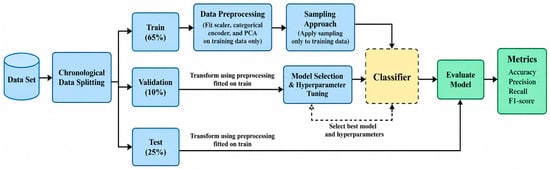
This study presents a conventional machine-learning approach for short-term traffic accident prediction. As illustrated in Figure 1, the proposed workflow begins with the chronological division of the collected traffic data into training, validation, and testing sets, followed by preprocessing, sampling, classification, and evaluation. The preprocessing step aims to prepare the original data and address data-quality issues. To prevent data leakage, data-dependent preprocessing operations, including feature scaling, categorical encoding, and Principal Component Analysis (PCA), are fitted exclusively on the training set. The fitted transformations are then applied to the validation and test sets without refitting. PCA is used to reduce the dimensionality of the input features while retaining the main information relevant to prediction. The dataset is divided chronologically into training, validation, and testing sets, representing 65%, 10%, and 25% of the observations, respectively. Because accident and non-accident observations are unevenly distributed, sampling methods are applied exclusively to the training set. Several machine-learning classifiers are subsequently evaluated under the same experimental setup. The validation set is used for model selection and hyperparameter tuning, while the test set remains untouched during model development and is reserved for final performance evaluation. Model performance is assessed using Accuracy, Precision, Recall, and F1-score.
Figure 1.
Proposed machine-learning framework for traffic accident prediction.
3.1. Data Collection
The dataset used in this study was collected in Marrakech, Morocco, using the DataCollect application [32] developed by the research team. The application was used to collect information related to urban traffic, weather conditions, road conditions, and traffic accidents during the observation period. Traffic and road-conditioning information was recorded every five minutes. The collected variables include congestion level, jam length, vehicle speed, weather conditions, route status, geographic coordinates, road or location identifiers, and date and time information.
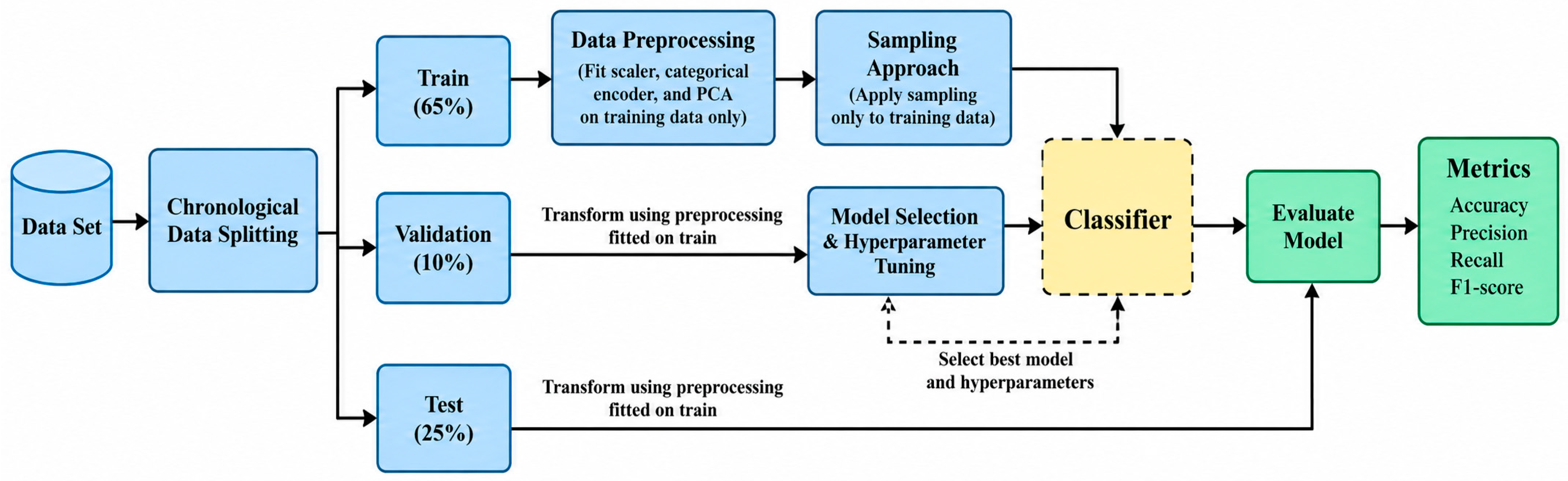
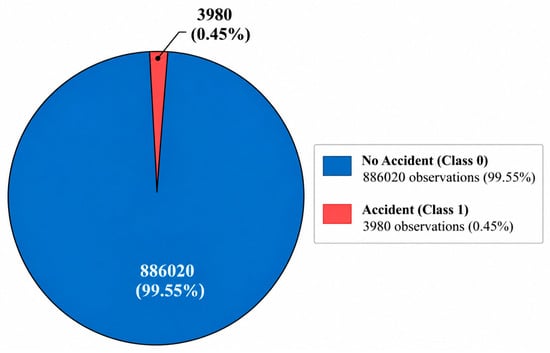
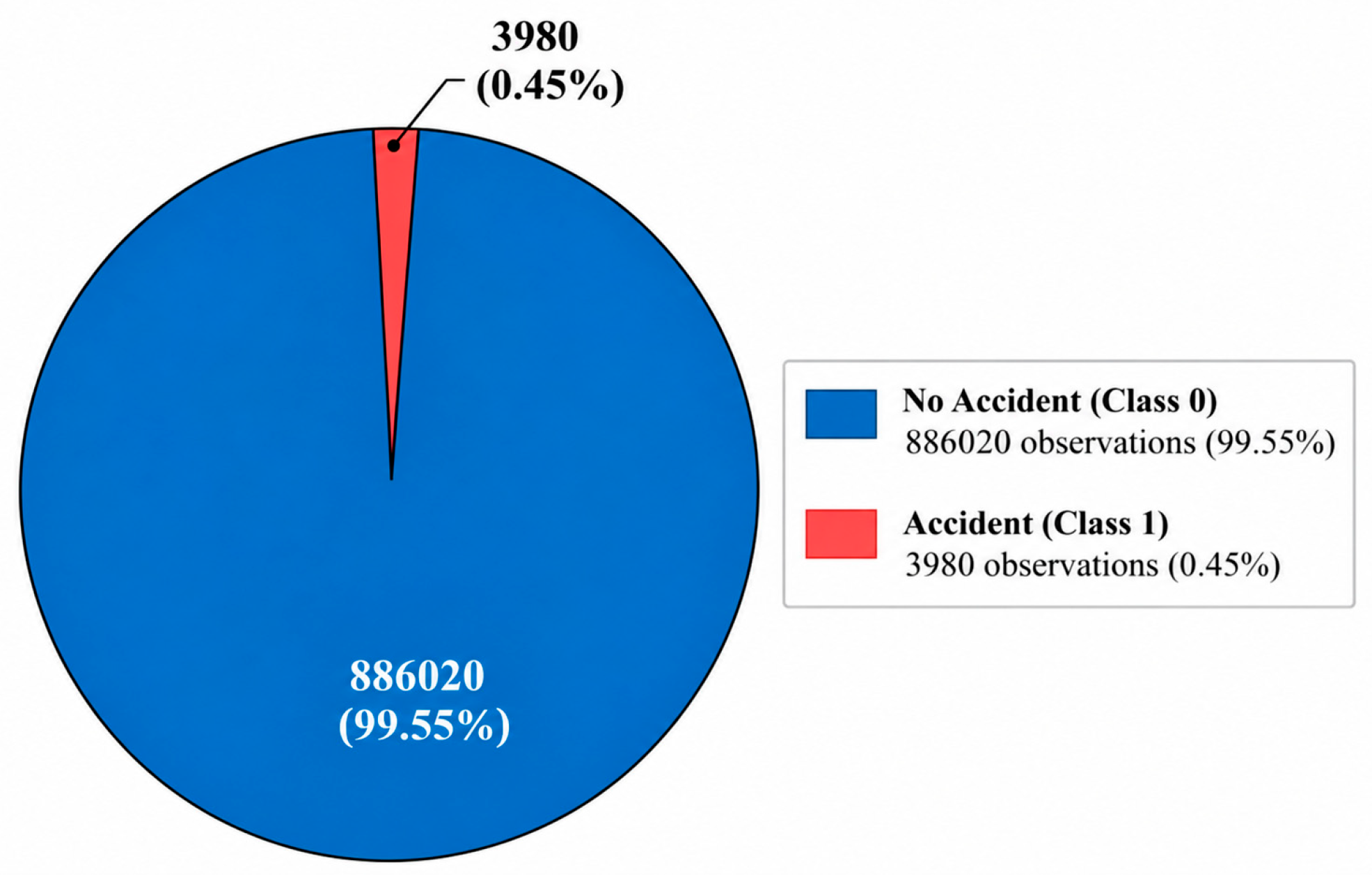
The data collection was conducted over approximately six months, during which about 890,000 traffic and road-condition observations were recorded, including information on traffic congestion, jam length, and vehicle speed. During the same period, 3980 accident records were collected, containing information on accident time, location, geographic coordinates, clearance duration, and date. By associating accident records with the corresponding traffic observations, the dataset was labeled into two classes: Accident (Class 1) and No Accident (Class 0). Assuming each accident record corresponds to one accident-related observation, accident cases account for approximately 0.45% of the dataset, while non-accident cases represent approximately 99.55%. The resulting class distribution is illustrated in Figure 2.
Figure 2.
Class distribution: Accident vs No Accident.
After the data collection process, the traffic and accident records were combined using their spatial and temporal information. Road or location identifiers and geographic coordinates were used to determine the corresponding road segments of the accident events. The date and time information were then used to match the accident records with the traffic observations recorded at five-minute intervals. The resulting dataset provides the information required to study the relationship between traffic and environmental conditions and the occurrence of accidents.
Table 1 and Table 2 present the main attributes of the datasets used in this study. Table 1 contains the traffic, weather, route, spatial, and temporal information collected from the urban road network. The main variables include congestion level, jam length, vehicle speed, weather conditions, route status, geographic coordinates, and timestamp information. Table 2 presents the information related to traffic accidents, including accident location, geographic coordinates, accident time, clearance duration, and date and time. The spatial and temporal information in these tables was used to associate traffic observations with the recorded accident events and to prepare the data for short-term accident prediction. The traffic and accident datasets were then combined using their spatial and temporal information. The traffic dataset records the evolution of traffic and road conditions every five minutes, while the accident dataset provides the location and time of each recorded accident. A spatial and temporal join was therefore performed to associate an accident with the traffic observation available before the event. In the final dataset, the observations related to the recorded accident events were retained, and the traffic condition five minutes before each accident was extracted as the main preceding traffic condition. For example, when an accident occurred at time t, the congestion condition recorded at t − 5 min was used to represent the traffic situation before the accident. This procedure makes it possible to use information that was available before the accident rather than information collected after the event. The temporal alignment follows the same principle used to link traffic and accident records through their location and timestamp information.
Table 1.
Description of traffic, weather, and route dataset attributes.
Table 2.
Description of traffic accident dataset attributes.
3.2. Data Preprocessing
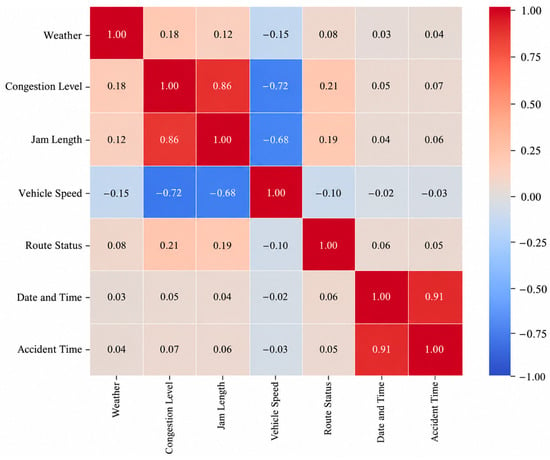
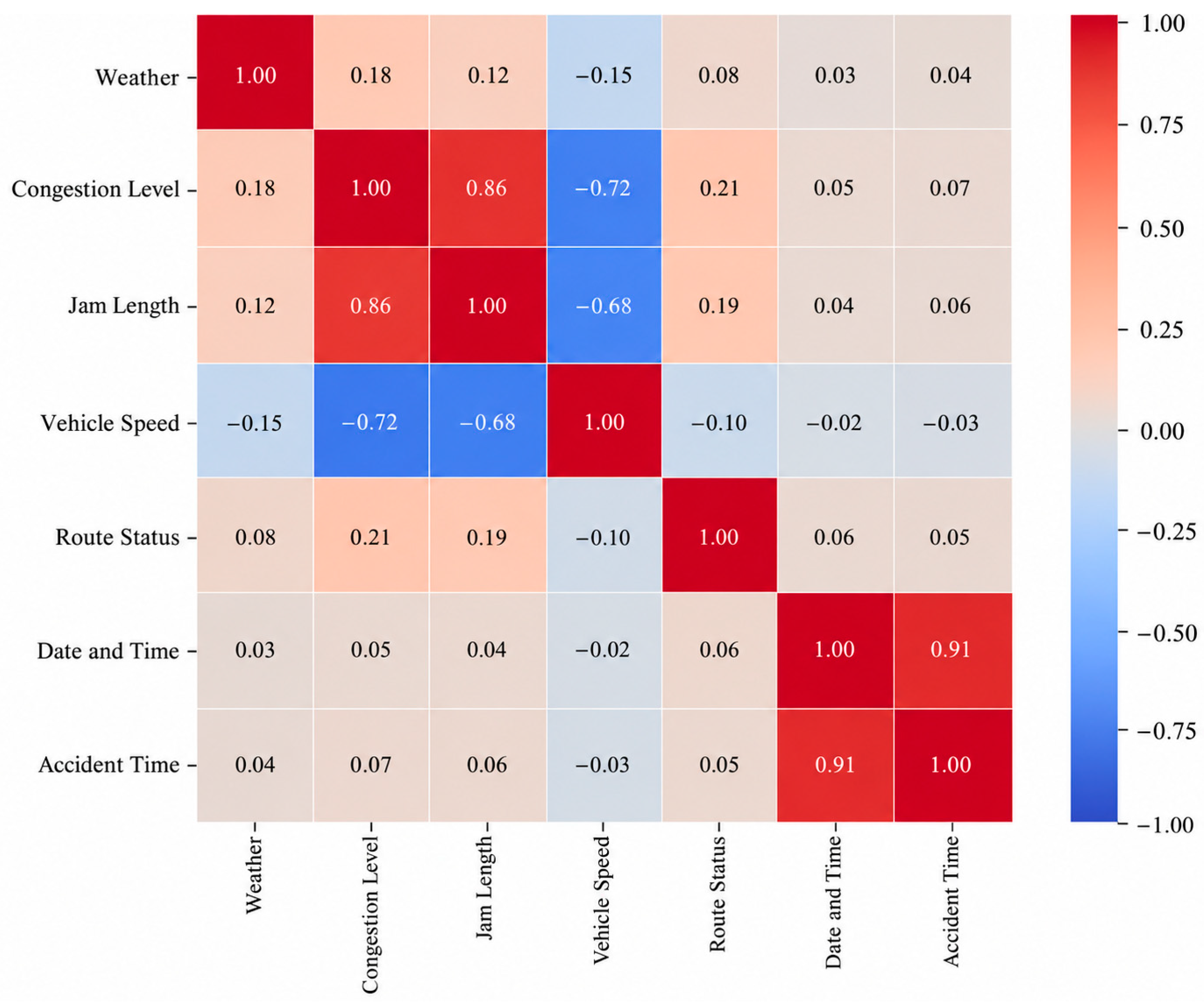
The correlation analysis was conducted to examine the relationships among the collected variables and identify potential redundancy. As shown in Figure 3, Congestion Level exhibits a strong positive correlation with Jam Length (r = 0.86), indicating that higher congestion levels are generally associated with longer traffic queues. Conversely, Congestion Level exhibits a strong negative correlation with Vehicle Speed (r = −0.72). A similar negative relationship is observed between Jam Length and Vehicle Speed (r = −0.68). These findings are consistent with the expected relationships among traffic congestion, queue length, and vehicle speed. A very strong positive correlation is also observed between Date and Time and Accident Time (r = 0.91), suggesting that these variables contain highly similar temporal information.
Figure 3.
Correlation matrix of traffic, weather, route, and temporal features.
Based on the correlation analysis, Date and Time and Accident Time were considered potentially redundant temporal variables and excluded from the predictive feature set. The remaining variables, including Weather, Congestion Level, Jam Length, Vehicle Speed, and Route Status, were retained for further analysis. Weather and Route Status are categorical variables and were encoded into numerical representations before model training. Numerical features were scaled when required by the corresponding machine-learning algorithms. To prevent data leakage, the chronological train–validation–test split was performed before fitting data-dependent preprocessing transformations. The scaler, categorical encoder, and PCA were fitted exclusively on the training set, and the resulting transformations were applied to the validation and test sets without refitting.
PCA was applied to the processed numerical feature representation to reduce dimensionality and capture the main sources of variation among the correlated traffic variables. The resulting principal components were used as input features for the models when PCA-based dimensionality reduction was applied. The contribution of PCA was further examined by comparing model performance with and without PCA.
Correlation analysis and Principal Component Analysis (PCA) were used to investigate relationships and potential redundancy among the input features. The correlation matrix was first examined to identify strongly correlated variables. PCA was then used as an exploratory tool to further investigate the relationships among the features and support the identification of redundant information. Based on these analyses, highly correlated feature pairs, such as Date and Time and Accident Time, and Congestion Level and Jam Length, were examined, and one feature from each pair was retained to reduce dimensionality. The resulting feature set was subsequently used to train the machine-learning models.
The prediction problem is formulated as a binary classification task to determine whether an accident will occur on a given road segment during the next five-minute interval, based on traffic and environmental conditions observed before that interval. Two classes are considered. Class 0 (No Accident) indicates that no accident was recorded on the road segment during the prediction interval, whereas Class 1 (Accident) indicates that at least one accident was recorded during the same interval. The predictive features consist of Weather, Congestion Level, Jam Length, Vehicle Speed, and Route Status, or their corresponding principal components when PCA is applied.
3.3. Dataset Splitting and Sampling Approach
Following the correlation analysis and feature screening, Weather, Congestion Level, Jam Length, Vehicle Speed, and Route Status were retained as the main predictive features, while Date and Time and Accident Time were excluded because of their strong temporal redundancy. The resulting dataset was divided chronologically into three subsets to preserve the temporal nature of traffic accident prediction: 65% for training, 10% for validation, and 25% for testing. A chronological split was preferred over random splitting because the objective is to predict future accident events from traffic conditions observed at the current time, thereby avoiding the use of future information during model development. The 65% training subset was used to train the machine-learning models and to address the class imbalance problem, while the 10% validation subset was used for model selection and hyperparameter optimization. The final 25% testing subset was kept completely independent and was used only for the final evaluation of the trained models.
The accident prediction task presents a significant class-imbalance problem, since accident events represent only a small proportion of the available traffic observations. To improve the ability of the classifiers to learn the minority Accident class, several sampling strategies were investigated, including Random Over-Sampling (ROS), Synthetic Minority Over-sampling Technique (SMOTE), Random Under-Sampling (RUS), and Cluster Centroids (CC). These techniques were applied exclusively to the 65% training subset, while the validation and testing subsets were maintained in their original distributions to provide an unbiased evaluation of model performance. ROS increases the representation of minority-class observations by replicating existing samples, whereas SMOTE generates synthetic minority samples from neighboring observations. Conversely, RUS reduces the number of majority-class samples, and CC replaces groups of majority samples with representative cluster centroids. Each sampling strategy was evaluated separately to determine its effect on accident detection performance. The prediction happens at a time t. The model reads traffic and environmental data such as Weather, Congestion Level, Jam Length, Vehicle Speed and Route Status. Then the model predicts whether the same road segment will have an accident in five minutes (t + 5). We can write the prediction as X_t → Y_(t + 5). X_t means the traffic conditions we see now. Y_(t + 5) is simple. No answer: No Accident (Class 0) or Accident (Class 1) in the following five minutes. This design makes sure the model only uses data that is available at time (t) to forecast an accident that might happen five minutes, from now.
3.4. Model Selection
Among the machine-learning methods evaluated in this study, Extreme Gradient Boosting (XGBoost) was selected as the main classification model due to its ability to capture nonlinear relationships between traffic conditions and accident occurrence and to handle different types of input variables. XGBoost is an ensemble learning algorithm based on decision trees that are constructed sequentially, with each successive tree aiming to reduce the errors of the preceding trees. This characteristic makes it suitable for accident prediction, where relationships among congestion level, jam length, vehicle speed, weather conditions, and route status may be nonlinear. The model was configured as a binary classifier to estimate the probability of an accident occurring during the following five-minute interval. The hyperparameter configurations of all evaluated classifiers, including XGBoost, Logistic Regression, Random Forest, Support Vector Machine, Decision Tree, and K-Nearest Neighbors, are presented in Table 3.
Table 3.
Hyperparameter configurations of all evaluated classifiers.
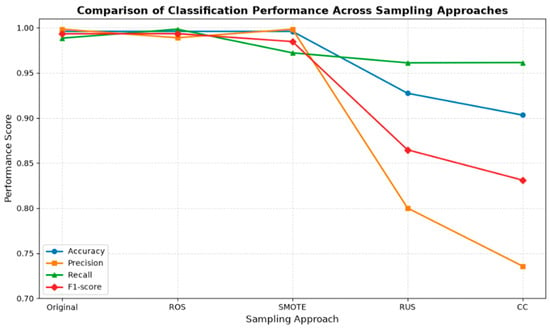
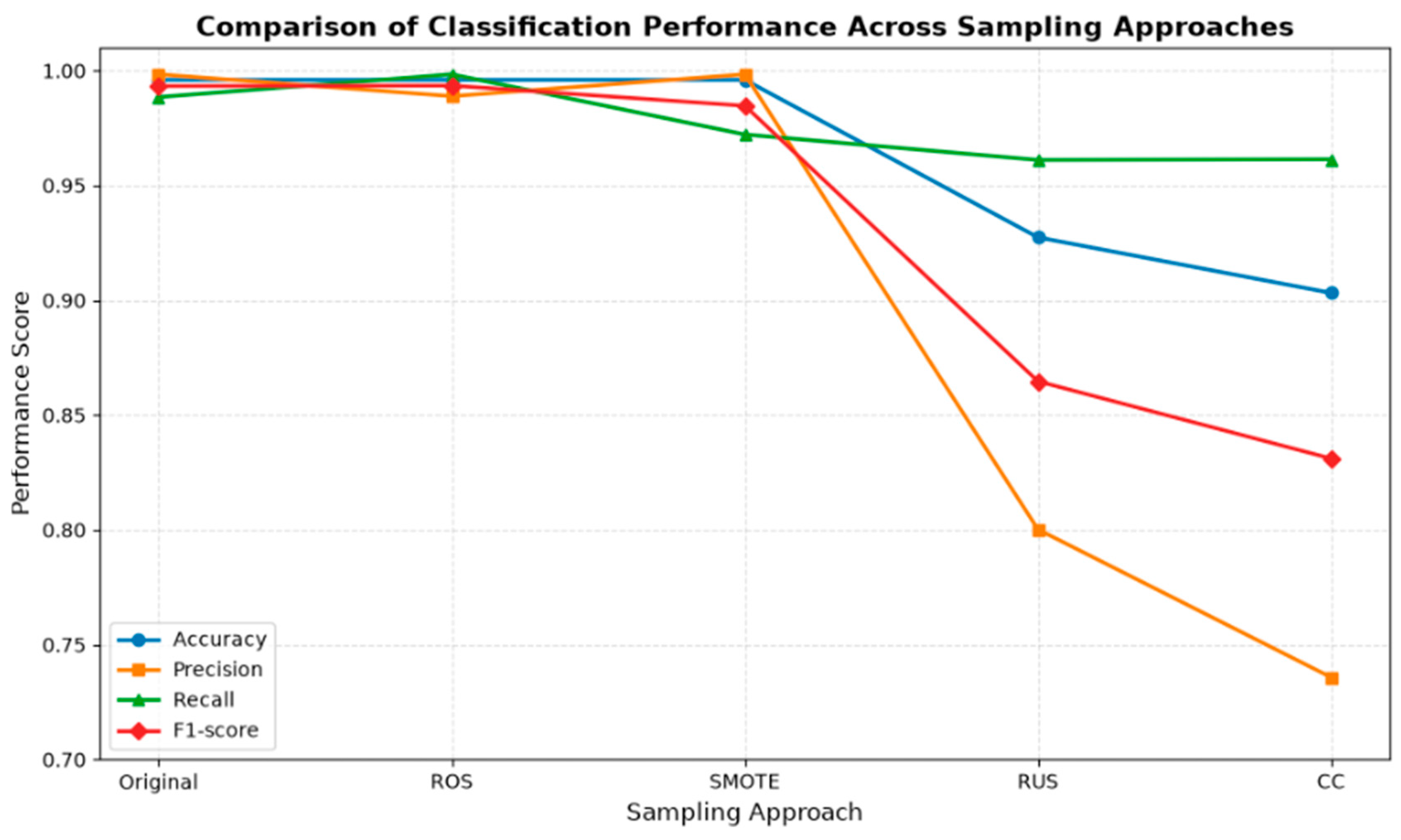
Figure 4 presents the performance of XGBoost using different sampling strategies applied to the training set. The results show that the original and ROS strategies achieve F1-scores of 0.9933 and 0.9935, respectively. ROS slightly increases Recall from 0.9885 to 0.9984, although this improvement is accompanied by a slight decrease in Precision. SMOTE achieves an Accuracy of 0.9960 and an F1-score of 0.9847, with a Recall of 0.9722. In contrast, RUS and CC result in lower F1-scores of 0.8647 and approximately 0.8311, respectively. Regarding computational efficiency, CC requires the longest execution time (809.40 ms), whereas RUS is the fastest (44.25 ms). Despite the high performance of ROS, SMOTE was selected for the subsequent classifier comparison based on its validation performance, using the F1-score as the primary selection criterion. This criterion was applied consistently throughout the experimental workflow.
Figure 4.
Performance of XGBoost with different training-set sampling strategies.
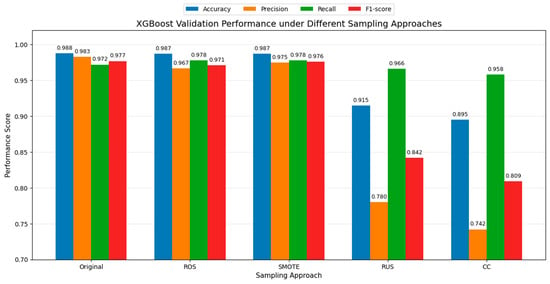
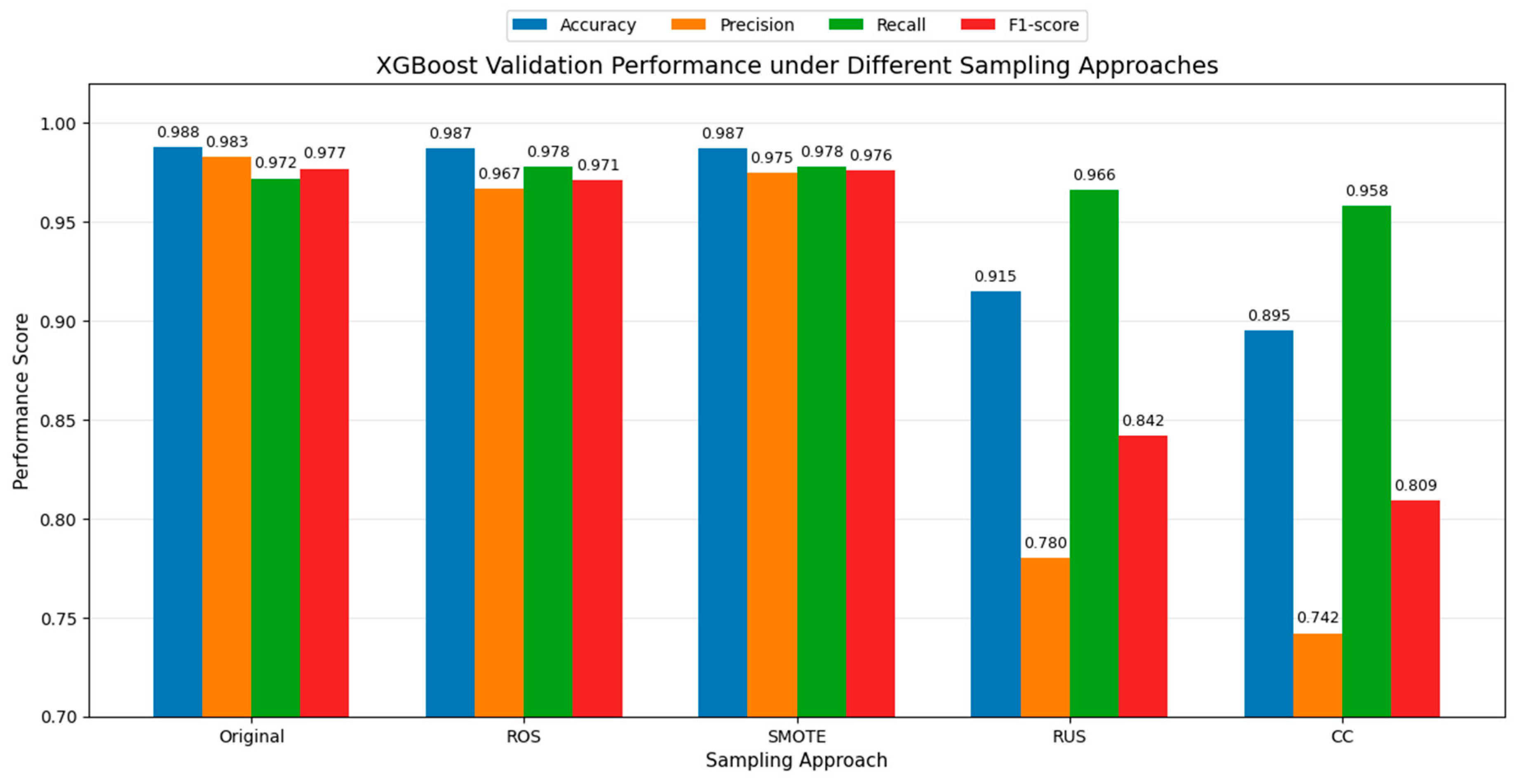
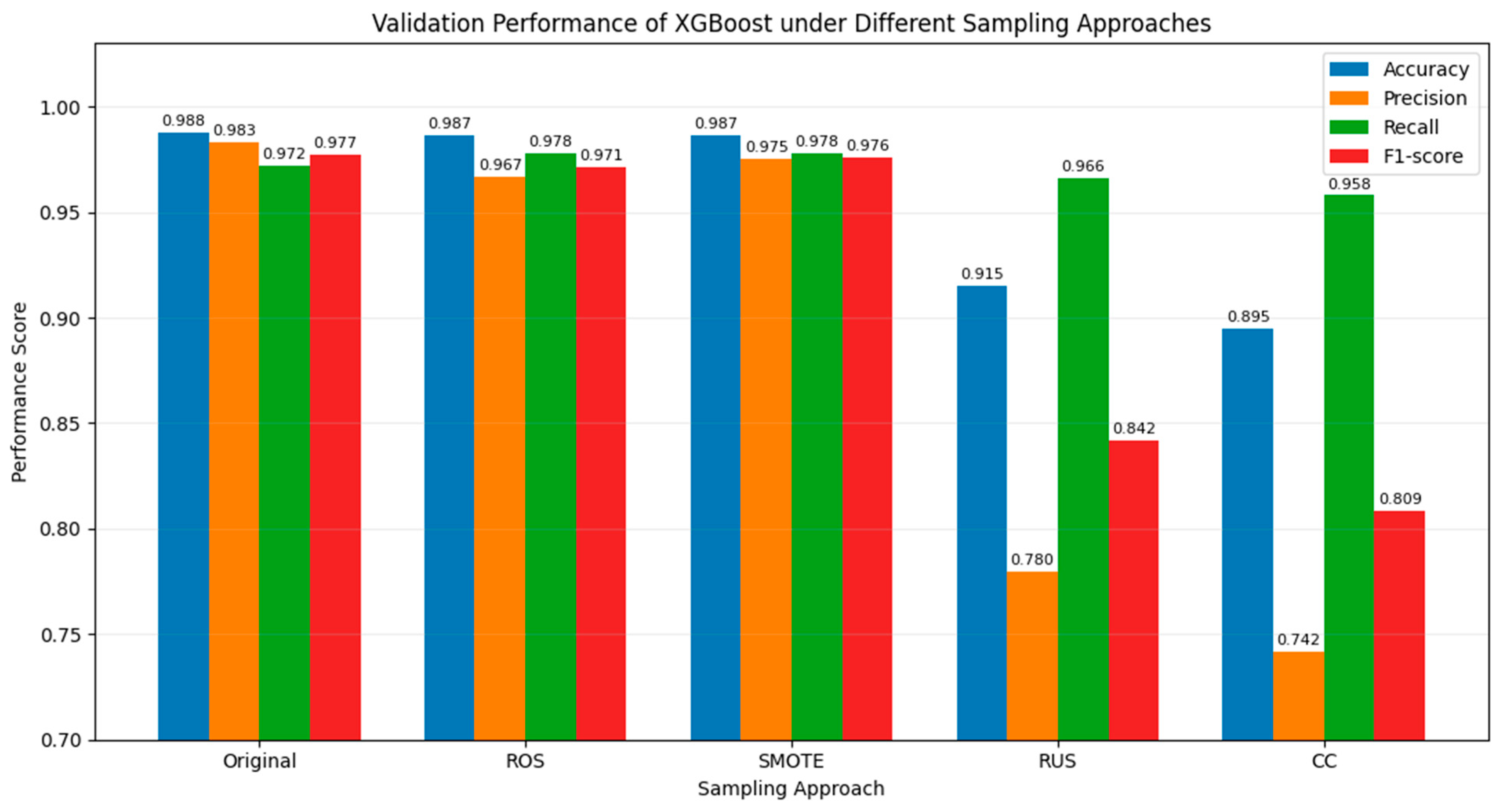
Figure 5 shows the validation results obtained using XGBoost with the original training data and the four sampling methods: ROS, SMOTE, RUS and CC. The researcher observed that the results from the Original ROS and SMOTE methods are close to each other with Accuracy values near 0.99. The Recall values are 0.9778 for ROS and SMOTE and 0.9722, for the data. This shows that the use of sampling can improve the detection of accident cases. On the other hand, RUS and CC give lower Accuracy, Precision and F1-score values, although the Recall remains relatively high. Based on these results, SMOTE gives the highest F1-score with 0.9760, while ROS gives the highest Recall with 0.9778.
Figure 5.
Validation performance of XGBoost under different sampling approaches.
Table 4 presents the results obtained from the different machine-learning classifiers using the original data, ROS, SMOTE, RUS and CC. The classifiers considered in this experiment are Logistic Regression, Random Forest, Support Vector Machine, Decision Tree, K-Nearest Neighbors and XGBoost. Accuracy, Precision, Recall and F1-score are used for the comparison. The results show that Decision Tree and XGBoost provide the best performance. XGBoost with ROS obtains an F1-score of 99.35, while Decision Tree with the Original data also obtains 99.35. Random Forest with SMOTE gives an F1-score of 98.12. The other classifiers, namely Logistic Regression, SVM and KNN, give lower results in comparison. These results are used for the initial comparison between the models and sampling methods. The validation results are then considered for the final model selection.
Table 4.
Train performance comparison of machine-learning classifiers under different sampling approaches.
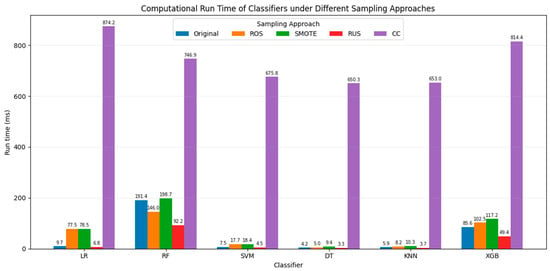
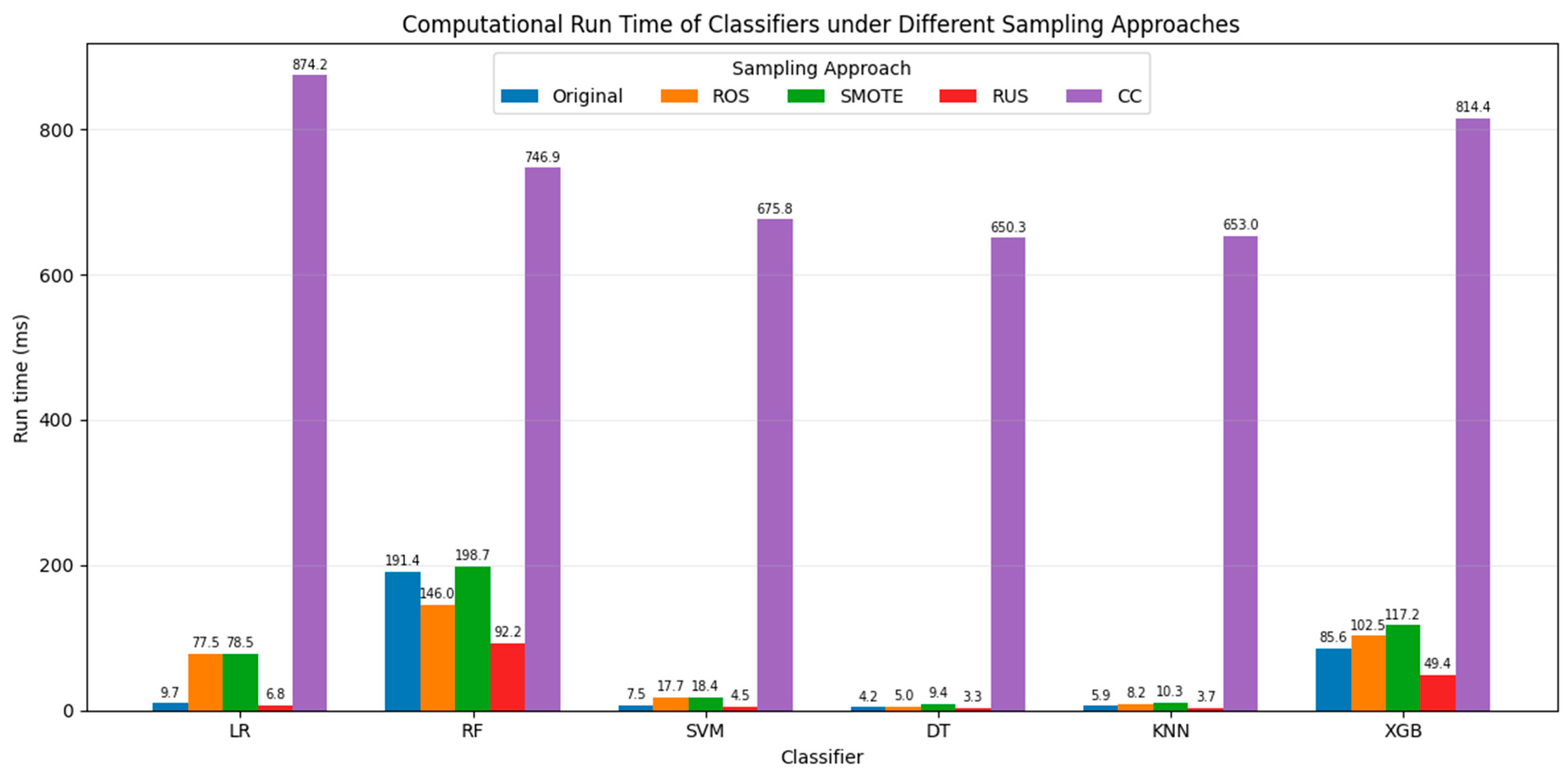
Figure 6 compares the computational run time of the evaluated machine-learning classifiers under the original training data and the four sampling approaches, namely ROS, SMOTE, RUS, and CC. The results show clear differences in computational cost among the evaluated approaches. CC requires substantially higher execution time for all classifiers, with runtimes exceeding 650 ms, indicating a considerably higher computational cost than the other sampling strategies. In contrast, RUS generally provides the lowest runtime, followed by the original configuration, although the exact computational cost varies according to the classifier. Among the evaluated models, Decision Tree, KNN, SVM, and Logistic Regression generally require relatively low execution times, whereas Random Forest and XGBoost require more computational resources. These results highlight the trade-off between predictive performance and computational efficiency when selecting the sampling strategy and classifier for the proposed accident prediction framework.
Figure 6.
Computational run time of machine-learning classifiers under different sampling approaches.
4. Result and Discussion
This section presents the experimental results obtained from the proposed machine-learning framework for traffic accident prediction. The analysis first examines the effect of the different sampling approaches on XGBoost and then compares the performance of the evaluated classifiers using the selected sampling strategy. Accuracy, Precision, Recall, and F1-score are considered to assess the ability of the models to correctly identify accident and non-accident cases.
Figure 7 presents the validation performance of XGBoost under the original training data and the four sampling strategies: ROS, SMOTE, RUS, and CC. The sampling strategies were compared using the F1-score on the validation set as the primary selection criterion. SMOTE achieved the highest validation F1-score of 0.9760 and was therefore selected for the subsequent classifier comparison. The same selection criterion was applied consistently across the experimental workflow. The validation set was not resampled.
Figure 7.
Validation performance of XGBoost under different sampling approaches.
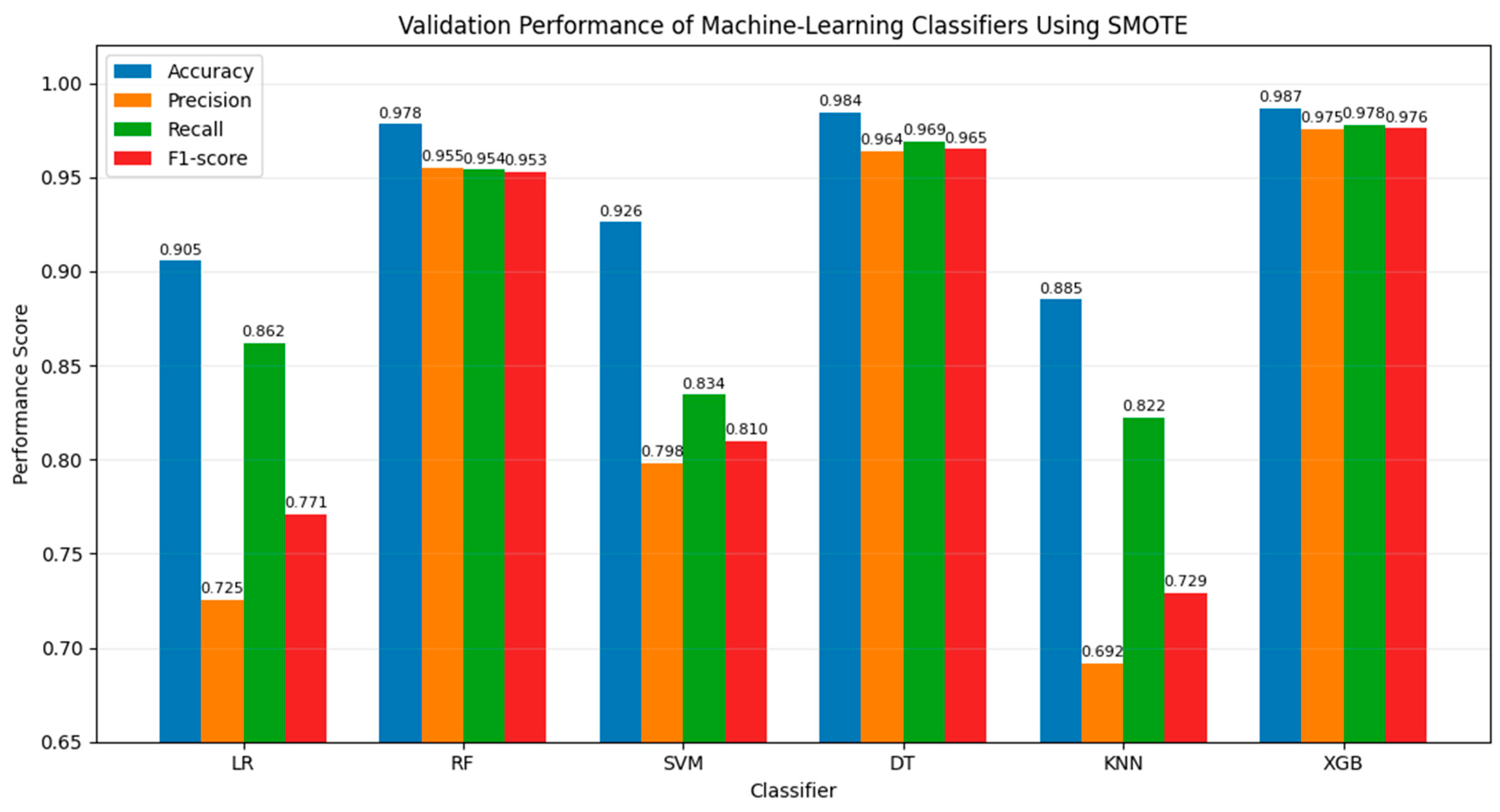
Figure 8 compares the validation performance of LR, RF, SVM, DT, KNN, and XGBoost after applying SMOTE to the training data. XGBoost achieves the highest overall performance, with an Accuracy of 0.9867, Precision of 0.9753, Recall of 0.9778, and F1-score of 0.9760. Decision Tree provides the second-best results, followed by Random Forest, while Logistic Regression, SVM, and KNN show lower performance. These results support the selection of XGBoost with SMOTE as the final model configuration for the subsequent evaluation on the independent test set.
Figure 8.
Validation performance of machine-learning classifiers using SMOTE.
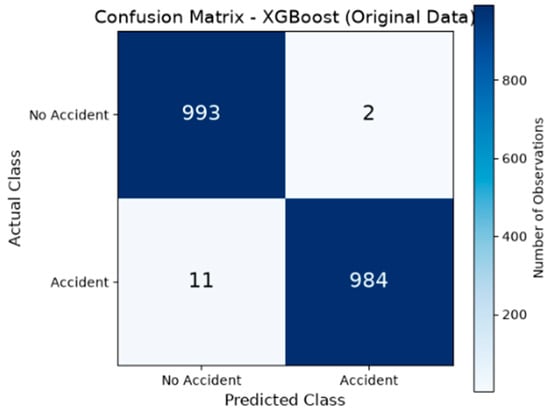
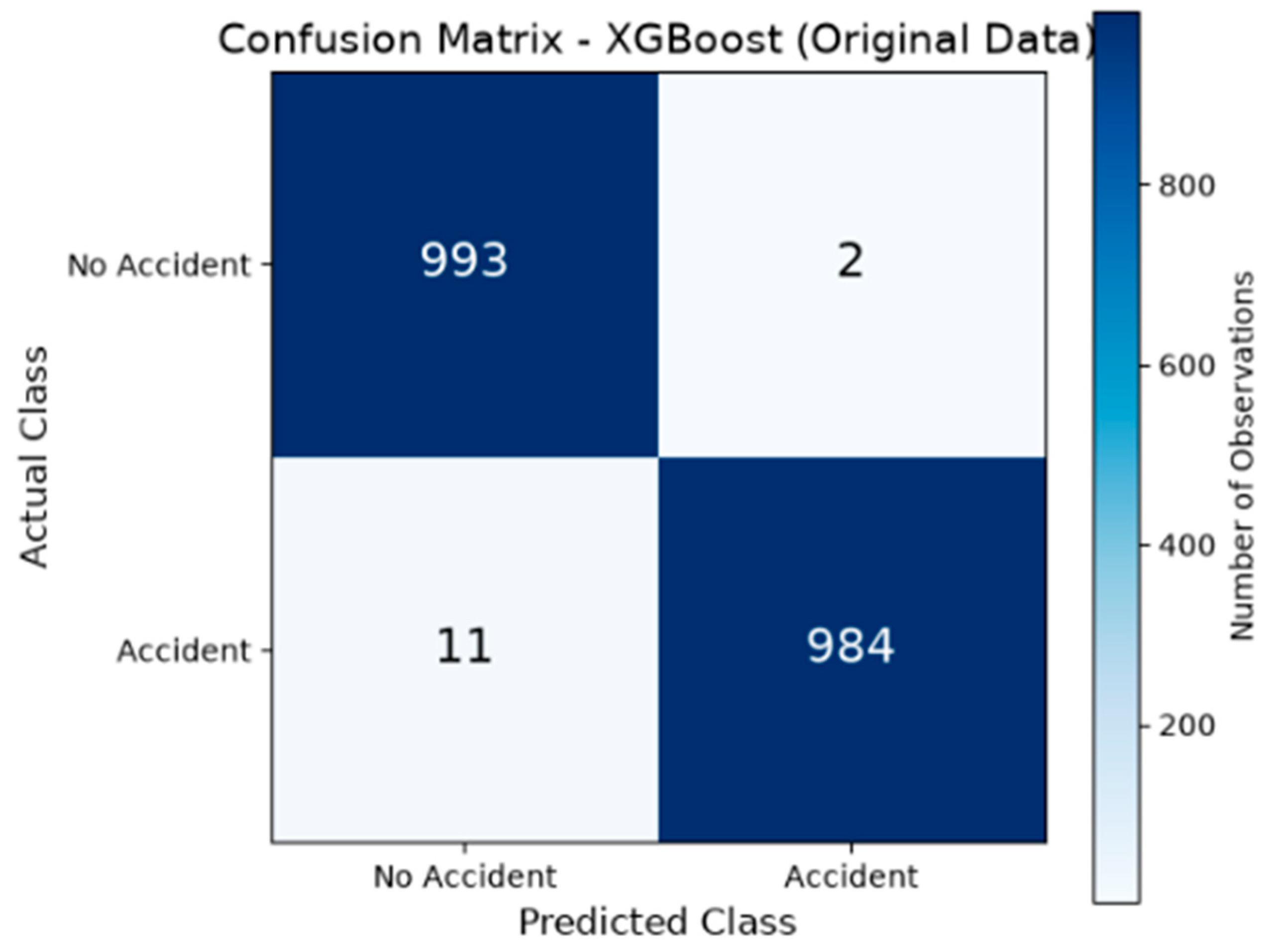
Figure 9 shows the confusion matrix that was created using the XGBoost classifier on the dataset that was not balanced. The evaluation set has 1990 observations. These include 995 Accident cases which are Class 1 and 995 No Accident cases which are Class 0. The matrix shows 993 negatives which are TN, two false positives which are FP, 11 false negatives which are FN and 984 true positives which are TP.
Figure 9.
Confusion matrix of XGBoost using the original dataset.
The results show that XGBoost gives a level of classification performance on the original dataset. Out of 995 No Accident cases 993 are correctly classified. Only two are classified incorrectly as Accident. Also, out of the 995 Accident cases 984 are correct. Eleven are classified incorrectly as No Accident. Therefore, the model shows an ability to tell the difference between Accident and No Accident observations. There are few false positives and false negatives. The accuracy is 99.35 percent. This means that 1977, out of 1990 observations, are correctly classified.
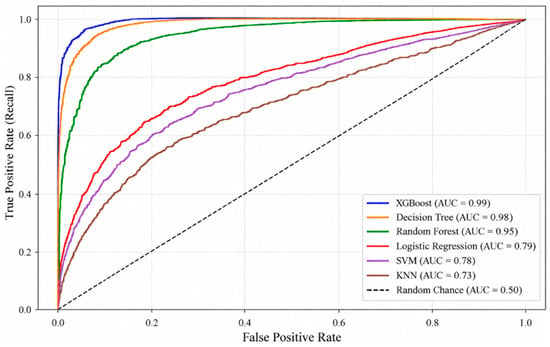
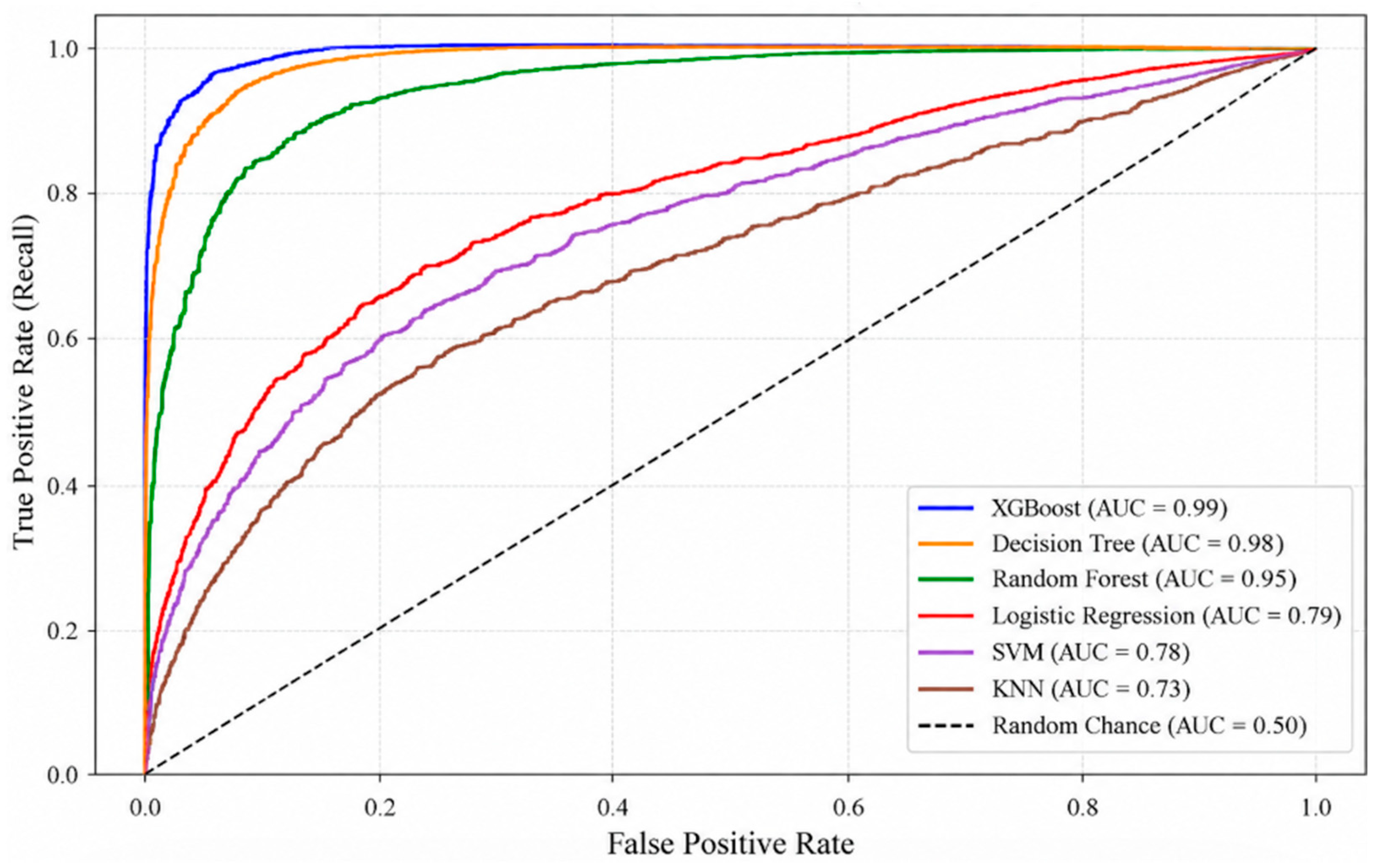
Figure 10 illustrates the Receiver Operating Characteristic (ROC) curves of six machine-learning classifiers, namely XGBoost, Decision Tree (DT), Random Forest (RF), Logistic Regression (LR), Support Vector Machine (SVM), and K-Nearest Neighbors (KNN), evaluated using the original dataset without applying any sampling strategy. The ROC curves represent the relationship between the True Positive Rate (TPR) and the False Positive Rate (FPR) across different classification thresholds. The Area Under the Curve (AUC) is used to assess the discriminative capability of each classifier in distinguishing between accident and non-accident observations.
Figure 10.
AUROC and AUPRC of the evaluated classifiers.
As shown in the figure, XGBoost achieves the highest AUC value of 0.99, followed by Decision Tree (0.98) and Random Forest (0.95), indicating strong discrimination between the two classes. Logistic Regression and SVM obtain AUC values of 0.79 and 0.78, respectively, while KNN records the lowest value of 0.73. The dashed diagonal line represents the performance of a random classifier, corresponding to an AUC of 0.50.
The results demonstrate that conventional machine-learning methods can provide effective performance for short-term urban traffic accident prediction. Among the evaluated classifiers, XGBoost achieved the strongest overall performance, particularly in terms of Accuracy, Precision, Recall, and F1-score. The analysis also showed that handling class imbalance has an important influence on accident detection. ROS and SMOTE improved the ability of the model to identify accident cases, while RUS and Cluster Centroids (CCs) resulted in a larger number of classification errors. These findings indicate that combining XGBoost with an appropriate sampling strategy can provide a promising solution for predicting accident occurrence within the subsequent five-minute interval.
Despite these results there are several limitations that need to be considered. First the study relies on traffic and accident data gathered in Marrakech, Morocco. This means the findings might not apply well to cities that have different traffic setups, road systems or environmental conditions. Second the prediction time frame is limited to five minutes. The features used cover traffic, weather, congestion and route details. Other important factors like road shape, how drivers behave, events, visibility and past accident trends were not included. Also, there is an imbalance between accident and non-accident cases. This makes predicting accidents hard and could influence how we understand the usual performance measures.
Future work will focus on extending the proposed framework by adding contextual and time-related features and testing longer and multiple prediction horizons. Advanced methods, such as ensemble learning, deep-learning models and spatiotemporal architectures could be explored to capture complex links between traffic conditions and accident occurrence. Also testing the proposed framework on data from cities and regions would give a stronger check, on its generalization ability. Finally, the developed prediction model could be built into a real-time traffic-management system to give early warnings and help with proactive road-safety actions.
5. Conclusions
This study presented a conventional machine-learning framework for short-term urban traffic accident prediction using traffic, weather, congestion, and route-condition information collected in Marrakech, Morocco. The proposed framework integrates data preprocessing, feature analysis, Principal Component Analysis (PCA), chronological dataset splitting, class-imbalance handling, machine-learning classification, and performance evaluation. The problem of making predictions was set up as a classification task. In this task the traffic conditions that are seen at a time are used to guess if an accident will happen on the same road segment in the next five minutes. The results from the experiments showed that XGBoost had an overall performance compared to the other classifiers that were tested. The analysis further showed that the choice of sampling strategy substantially affects accident detection performance. ROS and SMOTE provided better detection of the minority Accident class, whereas RUS and Cluster Centroids resulted in comparatively higher classification errors. The confusion-matrix analysis confirmed that XGBoost was able to correctly identify a large proportion of both Accident and No Accident cases. These findings highlight the potential of conventional ensemble learning, particularly XGBoost combined with appropriate class-imbalance treatment, for developing short-term traffic accident prediction systems.
Despite these promising results, the proposed approach remains limited by the geographical scope of the dataset, the five-minute prediction horizon, the strong imbalance between accident and non-accident observations, and the limited set of contextual variables considered. Future research should therefore investigate additional spatial, temporal, environmental, and behavioral features, as well as alternative prediction horizons and more advanced spatiotemporal and ensemble-learning approaches. Evaluating the framework using datasets from cities would also give a better sense of how well it works in different places. In the end the approach we propose could become a base for time-intelligent traffic-safety systems. These systems could give warnings and help support actions that prevent accidents before they happen.
Author Contributions
Conceptualization, A.B. and A.N.; methodology, A.B.; software, A.B.; validation, A.B. and A.N.; formal analysis, A.B.; investigation, A.B.; resources, A.B.; data curation, A.B.; writing—original draft preparation, A.B.; writing—review and editing, A.B.; visualization, A.B.; supervision, A.B.; project administration, A.B.; funding acquisition, A.N. All authors have read and agreed to the published version of the manuscript.
Funding
This research received no external funding.
Data Availability Statement
The dataset used in this study is available from the corresponding author upon reasonable request. The data can be provided to interested researchers for research and verification purposes, subject to the applicable conditions.
Conflicts of Interest
The authors declare no conflicts of interest.
References
- Mostafa, A.M.; Aldughayfiq, B.; Tarek, M.; Alaerjan, A.S.; Allahem, H.; Elbashir, M.K.; Ezz, M.; Hamouda, E. AI-based prediction of traffic crash severity for improving road safety and transportation efficiency. Sci. Rep. 2025, 15, 27468. [Google Scholar] [CrossRef] [Scilit] [PubMed]
- Charef, A.; Jarir, Z. Impact of delivery and private Riders’ roles on safety behavior in Marrakech Morocco. Results Eng. 2025, 26, 105371. [Google Scholar] [CrossRef] [Scilit]
- Butt, M.S.; Shafique, M.A. A literature review: AI models for road safety for prediction of crash frequency and severity. Discov. Civ. Eng. 2025, 2, 99. [Google Scholar] [CrossRef] [Scilit]
- Verma, R.; Agarwal, M.M. A Systematic Review on Road Accident Prediction: A Special Attention Toward Machine Learning and Deep Learning Approaches. J. Circuits Syst. Comput. 2025, 35, 2530009. [Google Scholar] [CrossRef] [Scilit]
- Niture, N.; Abdellatif, I. A systematic review of factors, data sources, and prediction techniques for earlier prediction of traffic collision using AI and machine Learning. Multimed. Tools Appl. 2025, 84, 19009–19037. [Google Scholar] [CrossRef] [Scilit]
- Kotsyubynska, Y.; Kozan, N.; Chadiuk, V.; Kostyshyn, A.; Kotsyubynsky, A.; Fentsyk, V. Machine Learning and Deep Learning for Predicting Traffic Crash Injury Severity: A Systematic Review and Meta-Analysis (2014–2025). J. Road Saf. 2026, 37, 46–60. [Google Scholar] [CrossRef] [Scilit]
- Yadav, H.K. Design and Implement Machine Learning Based Predictive Analytics for Road Safety and Accident Prevention. In Proceedings of the 4th IEEE International Conference on Interdisciplinary Approaches in Technology and Management for Social Innovation, IATMSI 2026, Gwalior, India, 12–14 March 2026. [Google Scholar] [CrossRef] [Scilit]
- Mohamad, I.; JomnonKwao, S.; Ratanavaraha, V. Machine learning predictive performance in road accident severity: A case study from Thailand. Results Eng. 2025, 26, 104833. [Google Scholar] [CrossRef] [Scilit]
- Santhoshkumar, S.P.; Gangadhar, S.G.; Reddy, S.N.; Reddy, R.K.; Uvaneshwari, M.; Parthasarathy, R. AI-Driven Accident Prediction in Traffic. IET Conf. Proc. 2025, 2025, 1631–1636. [Google Scholar] [CrossRef] [Scilit]
- He, M.; Meng, G.; Wu, X.; Han, X.; Fan, J. Road Traffic Accident Prediction Based on Multi-Source Data—A Systematic Review. Promet-Traffic Transp. 2025, 37, 499–522. [Google Scholar] [CrossRef] [Scilit]
- Ananthakrishnan, A.V.; Maya, D.K.; Krishnan, M.S. Predictive Analytics: Unveiling Road Accident Risks with Machine Learning Algorithms. AIP Conf. Proc. 2025, 3237, 060043. [Google Scholar] [CrossRef] [Scilit]
- Alotaibi, J. Enhancing Traffic Accident Severity Prediction: Feature Identification Using Explainable AI. Vehicles 2025, 7, 38. [Google Scholar] [CrossRef] [Scilit]
- Mahalakshmi, V.; Karthikeyan, B. Context reasoning-based vehicle traffic accident severity prediction using a machine learning algorithm in edge computing. Eng. Res. Express 2025, 7, 045310. [Google Scholar] [CrossRef] [Scilit]
- Almutairi, A.; Al Asmari, A.F.; Alanazi, F.; Alqubaysi, T.; Armghan, A. Deep learning based predictive models for real time accident prevention in autonomous vehicle networks. Sci. Rep. 2025, 15, 20844. [Google Scholar] [CrossRef] [Scilit] [PubMed]
- Saragih, R.; Wahyono, T.; Sembiring, I.; Wellem, T.; Yanto, B. Hybrid Deep Learning Models with Explainable AI and Reinforcement Learning for Traffic Accident Prediction. In Proceedings of the Proceeding-2025 4th International Conference on Creative Communication and Innovative Technology: Empowering Transformative MATURE LEADERSHIP: Harnessing Technological Advancement for Global Sustainability ICCIT, Kota Cirebon, Indonesia, 15–16 August 2025. [Google Scholar] [CrossRef] [Scilit]
- Amiri, M.A.; Afshari, S.; Soltani, A. Machine learning approaches to traffic accident severity prediction: Addressing class imbalance. Mach. Learn. Appl. 2025, 22, 100792. [Google Scholar] [CrossRef] [Scilit]
- Kim, K.-N.; Cho, D.-G.; Lee, M.-J. A Machine Learning Approach for Factor Analysis and Scenario-Based Prediction of Construction Accidents. Buildings 2025, 15, 4343. [Google Scholar] [CrossRef] [Scilit]
- Mengistu, A.K.; Gedefaw, A.E.; Baykemagn, N.D.; Walle, A.D.; Yehuala, T.Z.; Alemayehu, M.A.; Messelu, M.A.; Assaye, B.T. Predicting car accident severity in Northwest Ethiopia: A machine learning approach leveraging driver, environmental, and road conditions. Sci. Rep. 2025, 15, 21913. [Google Scholar] [CrossRef] [Scilit] [PubMed]
- Srivastava, N.; Gohil, B.N.; Ray, S. Unraveling Road Accident Risk Prediction Models with eXplainable AI. IEEE Trans. Comput. Soc. Syst. 2025, 1–13. [Google Scholar] [CrossRef] [Scilit]
- Liu, P.; Zhang, W.; Wu, X.; Guo, W.; Yu, W. Driver Injury Prediction and Factor Analysis in Passenger Vehicle-to-Passenger Vehicle Collision Accidents Using Explainable Machine Learning. Vehicles 2025, 7, 42. [Google Scholar] [CrossRef] [Scilit]
- Xiao, Y.; Duan, Z. An explainable multi-task deep learning framework for crash severity prediction using multi-source data. Sci. Rep. 2025, 15, 21978. [Google Scholar] [CrossRef] [Scilit] [PubMed]
- Nanyonga, A.; Turhan, U.; Wild, G. A Systematic Review of Machine Learning Analytic Methods for Aviation Accident Research. Sci 2025, 7, 124. [Google Scholar] [CrossRef] [Scilit]
- Shayboun, M.; Kifokeris, D.; Koch, C. A review of machine learning for analysing accident reports in the construction industry. J. Inf. Technol. Constr. 2025, 30, 439–460. [Google Scholar] [CrossRef] [Scilit]
- Shin, G.-H.; Yang, H. Maritime accident prediction in busan port using machine learning: An integrated approach with maritime accident reports and VTS data. Ocean Eng. 2025, 316, 119968. [Google Scholar] [CrossRef] [Scilit]
- Almomani, B.; Khuwaileh, B.A.; Alam, S.B. Machine Learning-Based Classification and Regression Approach for Early Detection of Large Break Loss-of-Coolant Accident Conditions. Arab. J. Sci. Eng. 2025, 50, 18971–18991. [Google Scholar] [CrossRef] [Scilit]
- Chen, J.; Pan, S.; Peng, W.; Xu, W. Bilinear spatiotemporal fusion network: An efficient approach for traffic flow prediction. Neural Netw. 2025, 187, 107382. [Google Scholar] [CrossRef] [Scilit] [PubMed]
- Fan, Y.; Chen, J.; Xu, W.; Peng, W. DADiffNet: Delay-aware diffusion networks with adaptive subgraphs for large scale traffic forecasting. Neural Netw. 2026, 200, 108756. [Google Scholar] [CrossRef] [Scilit] [PubMed]
- Liu, X.; Lu, J.; Chen, X.; Fong, Y.H.C.; Ma, X.; Zhang, F. Attention-based spatio-temporal graph convolutional network with focal loss for crash risk evaluation on urban road traffic network based on multi-source risks. Accid. Anal. Prev. 2023, 192, 107262. [Google Scholar] [CrossRef] [Scilit] [PubMed]
- Zhang, Q.; Chen, Q. UCRT: A Two-Stage Noisy Label Learning Framework with Uniform Consistency Selection and Robust Training. Appl. Intell. 2026, 56, 21. [Google Scholar] [CrossRef] [Scilit]
- Hamdan, N.; Sipos, T. Advancements in Machine Learning for Traffic Accident Severity Prediction: A Comprehensive Review. Period. Polytech. Transp. Eng. 2025, 53, 347–355. [Google Scholar] [CrossRef] [Scilit]
- Ajah, S.A.; Akanji, L.; Gomes, J. Recent Trends in Nuclear Accident Events Prediction: A Review. Nucl. Technol. 2025, 211, 2668–2698. [Google Scholar] [CrossRef] [Scilit]
- Charef00/Urban-Traffic-Data-Collector. Available online: https://github.com/charef00/Urban-Traffic-Data-Collector (accessed on 22 August 2026).

Disclaimer/Publisher’s Note: The statements, opinions and data contained in all publications are solely those of the individual author(s) and contributor(s) and not of MDPI and/or the editor(s). MDPI and/or the editor(s) disclaim responsibility for any injury to people or property resulting from any ideas, methods, instructions or products referred to in the content. |
© 2026 by the authors. Licensee MDPI, Basel, Switzerland. This article is an open access article distributed under the terms and conditions of the Creative Commons Attribution (CC BY) license.