


Abstract
Herein, the distributed variational Bayesian-assisted unscented Kalman filter (VB-UKF) is used to enhance the accuracy of pedestrian positioning. For this method, a distributed filter is employed. First, the UKF under colored measurement noise (CMN) is derived. The VB-assisted method is then derived. Subsequently, the Mahalanobis distance is used to determine whether the current noise estimate conformed to the navigation environment; if the Mahalanobis distance is higher than the preset threshold, the VB-assisted method is employed to update the noise, which can improve the UKF accuracy under CMN. The effectiveness of the proposed method was subsequently validated through two practical tests. Experimental results demonstrate that this method plays a notable role in reducing localization errors in the experiments. This observation emphasizes the efficacy of the proposed method.
1. Introduction
Nowadays, with technological advancements, considerable progress has been made in smart healthcare and wellness [1,2,3]. Correspondingly, obtaining high-precision pose information has gradually become a research hotspot in this field [4,5,6].
Various navigation and positioning methods are available under current conditions for pedestrian navigation [7,8,9,10]. For example, the scheme proposed by Karimi and Asavasuthirakul [11], which leverages integrated global navigation satellite system (iGNSS) quality-of-service prediction technology, provides optimized route planning for navigation systems and services. Although GNSSs have been widely used in many fields, this localization method still presents challenges, and many approaches have been proposed in this regard. For example, Meng et al. [12] aimed to address the challenge of achieving accurate positioning with inexpensive GNSS chips in smartphones under complex environments. This paper proposed an iGNSS/pedestrian dead reckoning navigation solution that adaptively adjusted measurement values. Many short-distance communication technology-based methods are available to address the issue where the GNSS signal cannot provide stable and accurate localization information. For instance, Wu et al. [13] used radio-frequency identification (RFID) technology in the positioning system. The scheme proposed in the literature [14], which processes distribution signals from high-density passive RFID tags using a particle filtering framework, achieves high positioning accuracy while maintaining excellent stability. Wang et al. [15] proposed a privacy-preserving indoor positioning scheme for WiFi localization using inner-product encryption (IPE) in a cloud environment. Sun et al. [16] presented an improved signal measurement method for accurate indoor WiFi localization. The methods mentioned above can provide position information in a GNSS-denied area, with localization accuracy approximately at the meter-level, which is not suitable for accurate indoor localization. The ultra-wideband (UWB)-based method has been proposed to enhance the localization accuracy [17]. For example, a UWB-ranging-based fusion localization method was proposed by Sun et al. In [18], one modified long short-term memory (LSTM) model receives the distance values from a time-of-arrival (TOA)-distance model of the UWB system and predicts the current user position [19] to enhance the positioning accuracy of the experiment, which introduces a Rauch–Tung–Striebel smoother-assisted extended Kalman filter (EKF) framework. One improved UWB-based method was proposed in [20]. Notably, although UWB-based technology can enhance localization in indoor environments, this method still faces challenges in complex environments.
Based on the localization method, the data fusion filter can further improve localization accuracy [21,22,23,24]. The Kalman filter is one of the most widely used methods [25,26,27,28,29]. Vana and Bisnath [30] addressed the urban navigation requirements of low-cost sensors by proposing an improved adaptive factor Kalman filtering algorithm. Meanwhile, Chen et al. [31] developed a novel robust adaptive Kalman filtering method, which has been successfully applied to integrated vehicle navigation systems in urban environments. Notably, the Kalman filter is suitable for linear systems, whereas the EKF has been proposed to address nonlinear systems. For instance, a novel nonlinear state error Lie-group EKF method was proposed by Wang et al. [32] for the implementation of a tightly coupled strapdown inertial navigation system (SINS)/iGNSS navigation scheme. Both the system error and measurement models of SINS/Odometer (OD) tightly coupled navigation are derived based on the state transformation EKF, which was investigated in [33]. While these enhanced EKF frameworks incorporate strategies to alleviate truncation errors, they inevitably encounter performance bottlenecks in highly nonlinear scenarios. To bypass the inherent linearization flaws of the EKF, the unscented Kalman Filter (UKF) was introduced, leveraging the unscented transform (UT) to precisely propagate the statistical properties (mean and covariance) of random variables [34]. Extending this paradigm, an adaptive UKF architecture driven by variational Bayesian (VB) inference was developed in [35] to dynamically track fluctuating measurement noise covariances. Nevertheless, such conventional UKF implementations generally operate under the assumption of white noise, failing to account for the presence of colored measurement noise (CMN).
This work proposed a distributed variational Bayesian-assisted UKF (VB-UKF) to enhance the accuracy of pedestrian positioning. To account for the temporal correlation inherent in CMN, we augment the system’s state vector, establishing a tailored data fusion framework. Within this structured model, the UKF is utilized to resolve nonlinear state estimation, while the VB methodology is integrated to dynamically refine the precision of the noise covariance estimation. Furthermore, to mitigate computational overhead, a predefined statistical boundary is introduced, thereby granting the proposed algorithm enhanced adaptive efficiency. The distributed filter was employed in this method. The UKF under CMN was derived first. Then, the VB-assisted method was also derived. Third, the Mahalanobis distance was used to determine whether the current noise estimate conformed to the navigation environment; if the Mahalanobis distance exceeds the preset threshold, the VB-assisted method is employed to update the noise, possibly improving the accuracy of the UKF under CMN. Subsequently, two experimental tests were conducted to evaluate the performance of the algorithm. The results demonstrated that the proposed method could significantly reduce pedestrian positioning errors. This observation emphasizes the efficacy of the proposed method.
2. Distributed Localization
In this section, we propose a UWB-based distributed localization system. First, this study provides a systematic exposition of the UWB technical solution design tailored for personnel positioning requirements. Furthermore, we elaborate on the specific forms and establishment process of both the state and observation equations employed in this filter. Finally, to reduce the impact of CMN, the modified state and measurement equations are derived.
2.1. Indoor Distributed Localization Scheme
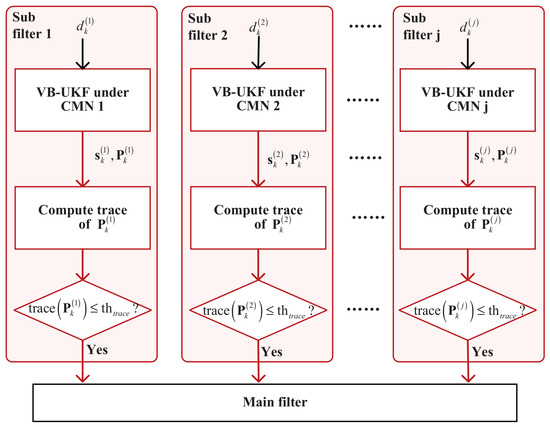
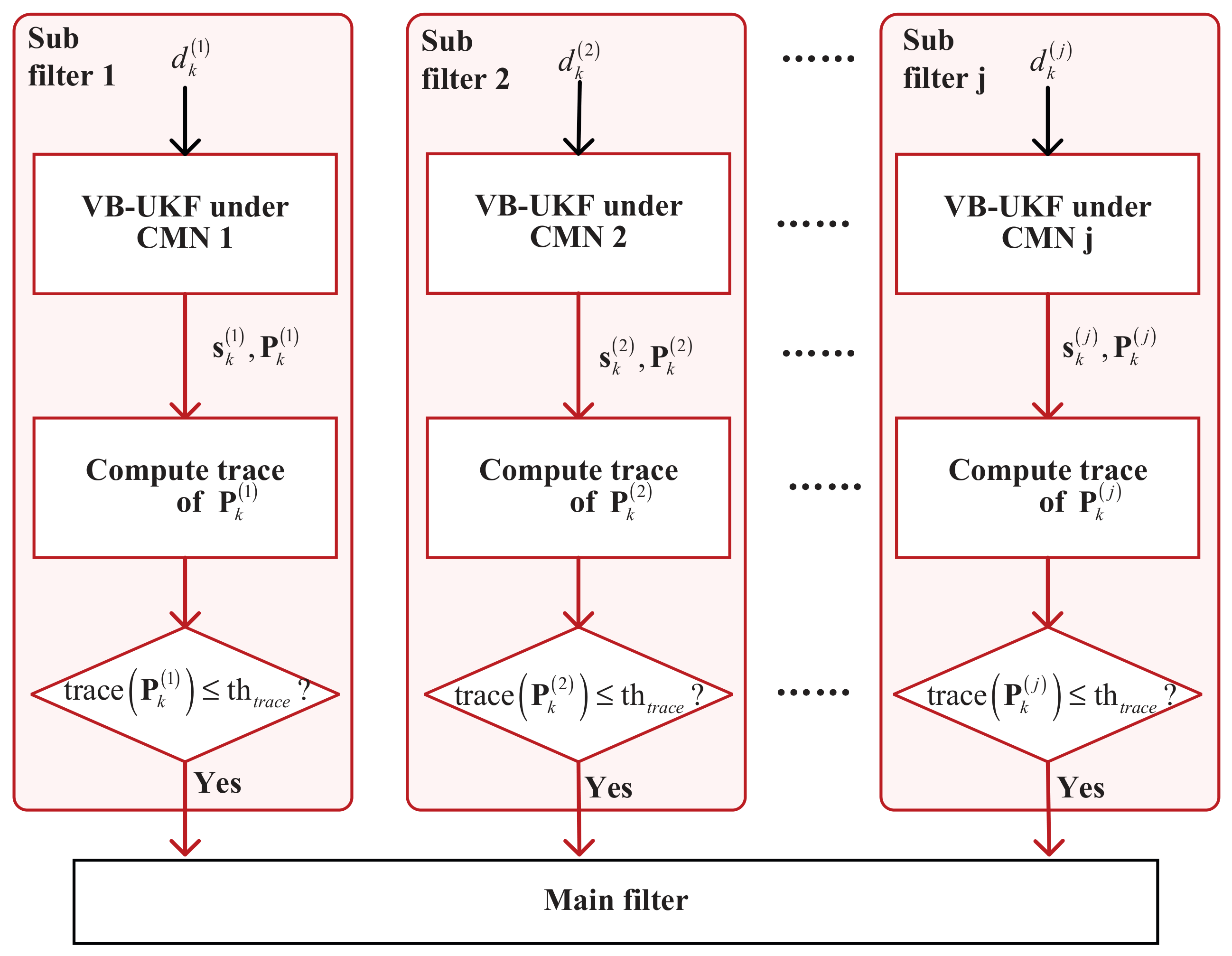
In this subsection, a UWB-based distributed localization scheme is designed, as shown in Figure 1. In the proposed distributed localization scheme, we employed the variational Bayesian-UKF under colored measurement noise as the subfilter, which is capable of estimating the target object’s pose information and its error matrix by fusing the distance () between the UWB blind node and UWB reference nodes (RNs). Then, we compute the sum of the main diagonal elements of , which is used to determine whether it can be used by the main filter. If the sum of the main diagonal elements of is less than its preset threshold (denoted as ), it means that the accuracy of the corresponding is fine and can be used by the main filter. Otherwise, it can not be used by the main filter. Finally, the main filter employs all the available to output the final output .
Figure 1.
Distributed localization scheme using variational Bayesian-UKF under colored measurement noise.
2.2. State and Measurement Equations for the Distributed Filter
Employing the localization scheme described in Section 2.1, the state and measurement equations of the distributed VB-UKF under CMN are derived in this subsection. The state equation used herein for the subfilter is presented as Equation (1).
where n is the identifier of the subfilter, j is the number of the subfilter, represents the target object’s east and north position at the time index k, represents the target object’s east and north velocity at the time index k, represents the sampling time, and represents a zero-mean Gaussian system with system noise covariance .
The distributed structure proposed in this work employs the distance () between the UWB blind node and the UWB RN as the subfilter’s measurement. The measurement equation utilized herein can be expressed as follows:
where represents the UWB RN’s position, colored Gaussian-Markov noise is denoted as , the colored factor is denoted as , and represents the Gaussian measurement noise. From Equation (2), we can get
To mathematically encapsulate this phenomenon, the state vector dimensionality is expanded, yielding the augmented state representation expressed in Equation (6). Here, we rewrite Equation (5) to obtain the following equation:
Consequently, the a priori state propagation defined in Equation (1) is reformulated as Equation (7).
Additionally, the corresponding measurement model tailored for the CMN environment is constructed as Equation (8).
To mitigate the effects of CMN, we build the following measurement equation.
3. Distributed VB-UKF
This section presents the distributed VB-UKF. First, the UKF under CMN is proposed. Second, the VB-UKF is derived. Finally, the improved distributed VB-assisted filter approach is presented.
3.1. Sub-UKF Under CMN
In this subsection, a sub-UKF under CMN is constructed using models (1) and (8). During the initial phase of the CMN-resilient UKF, the associated Sigma points are generated from the state estimate and its error covariance as follows:
where is the Sigma point of , is the scaling factor, and is the size of the . The weights corresponding to the Sigma points can be calculated using the following:
Then, we can compute the prediction using the following equation:
Subsequently, the a priori state estimate and its corresponding error covariance are formulated as
Building upon this, the predicted augmented state vector and its covariance matrix are mathematically expressed by
Utilizing the augmented predictions and , a new set of Sigma points is sequentially extracted:
yielding the following nonlinear projections:
Consequently, the propagated values are synthesized via
To facilitate the cross-covariance computation, the intermediate variable is defined as
which leads to the variance and cross-covariance matrices:
Ultimately, the predicted measurement and its associated theoretical covariance are deduced as
where .
Finally, the Kalman gain and the a posteriori state updates are executed via standard optimal estimation operations:
3.2. VB
This subsection introduces the VB based on models (1) and (8). The variational Bayesian (VB) inference method is an approximate interference method that approximates the joint posterior using the product of the processable edge posterior. Its core function in this paper is to approximate the joint posterior distribution of the state vector and the measurement noise covariance. If we assume that the state vector is independent of the covariance of the measurement noise, then the joint posterior distribution of the state vector and the covariance of the measurement noise can be calculated using the following equation:
where and are unknown approximate densities. Here, the Kullback Leibler (KL) divergence of can be computed using the following equations:
3.3. VB-UKF Under CMN
This subsection introduces the VB method into the sub-UKF under CMN, which can estimate the prediction error covariance and measurement noise covariance . After we get the one-step prediction and , we set the initial of the iteration.
where is the forgetting factor, is the size of , is the size of , and s is the steps of the iteration. Here, the VB-based method employs a single iteration, which involves the following equations. The measurement noise covariance can be computed using the following equations:
The covariance matrix of measurement noise can be computed using the following equation:
Thus, we can compute the VB-based using the following equation:
Then, we compute via Equation (32). And can be computed by using the following equation:
3.4. Improved VB-UKF Under CMN
As mentioned in the above section, the VB-based method is capable of improving the accuracy of noise covariance estimation. Thus, in this work, we employ the VB-based method to provide an accurate estimation of the noise covariance.
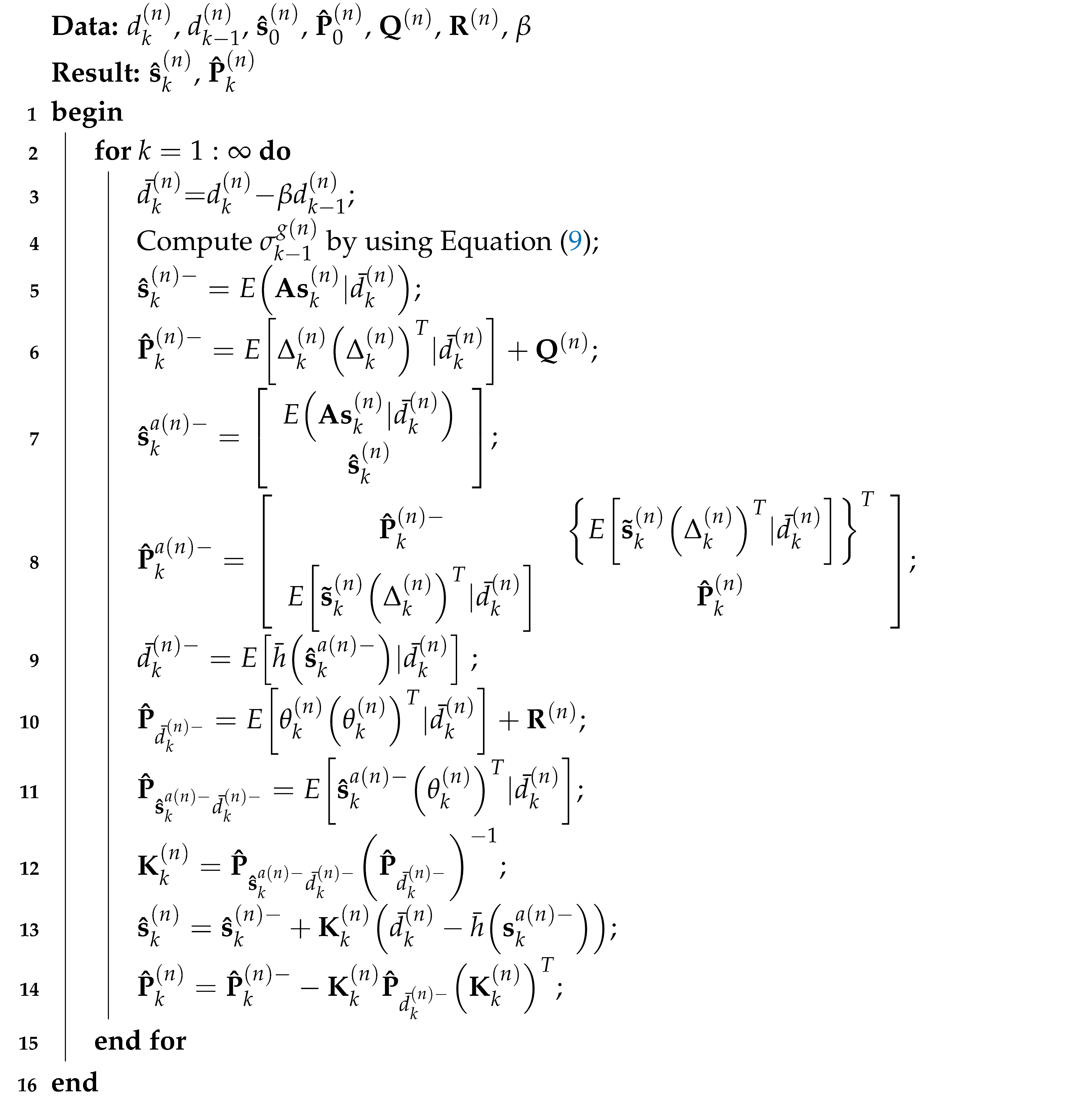
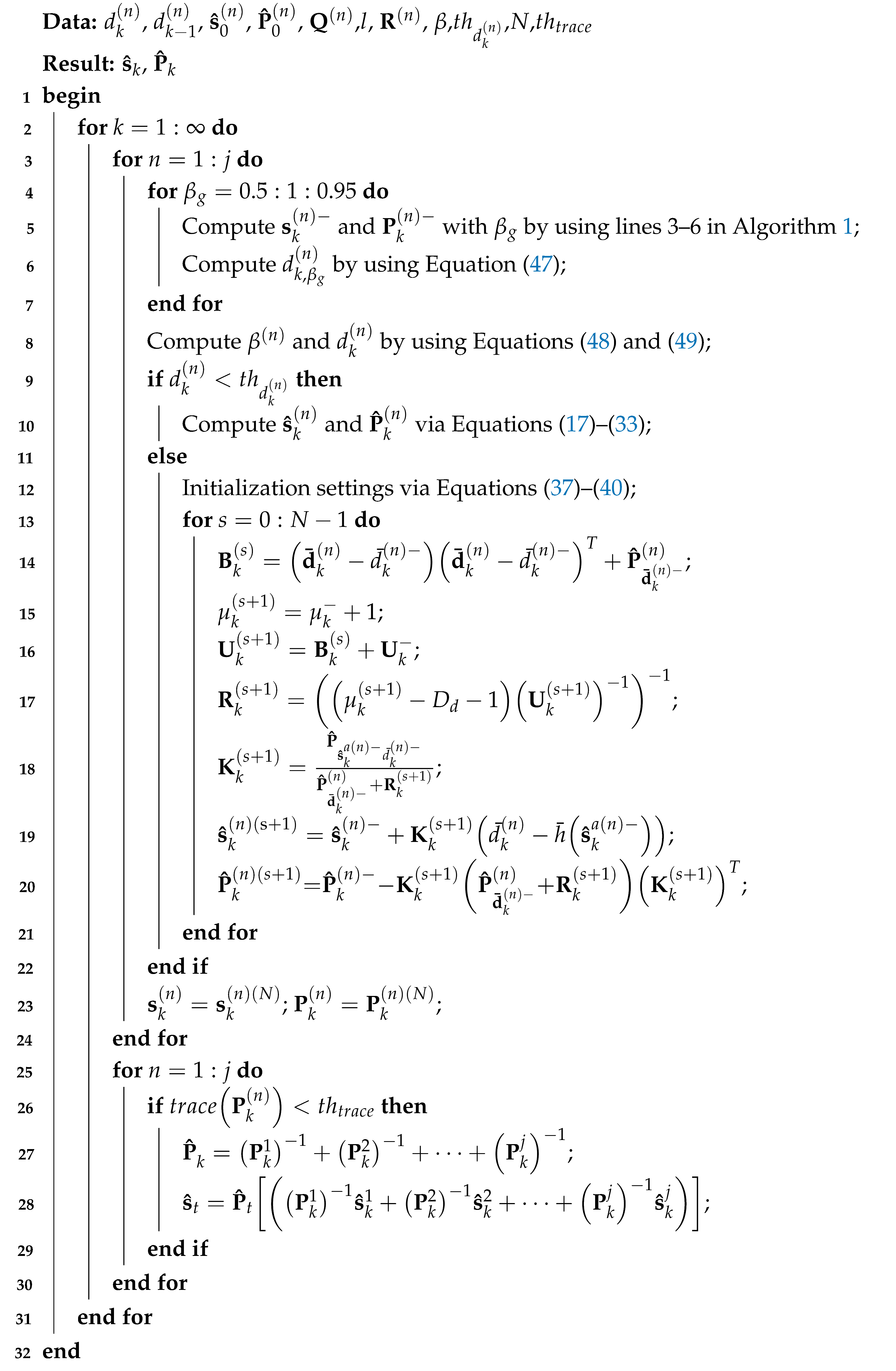
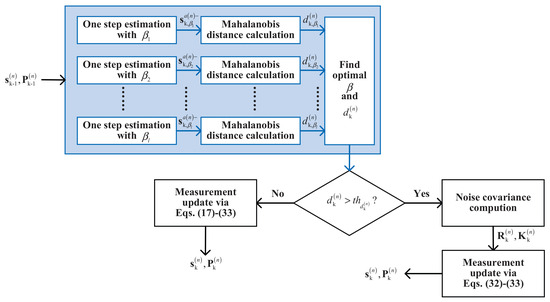
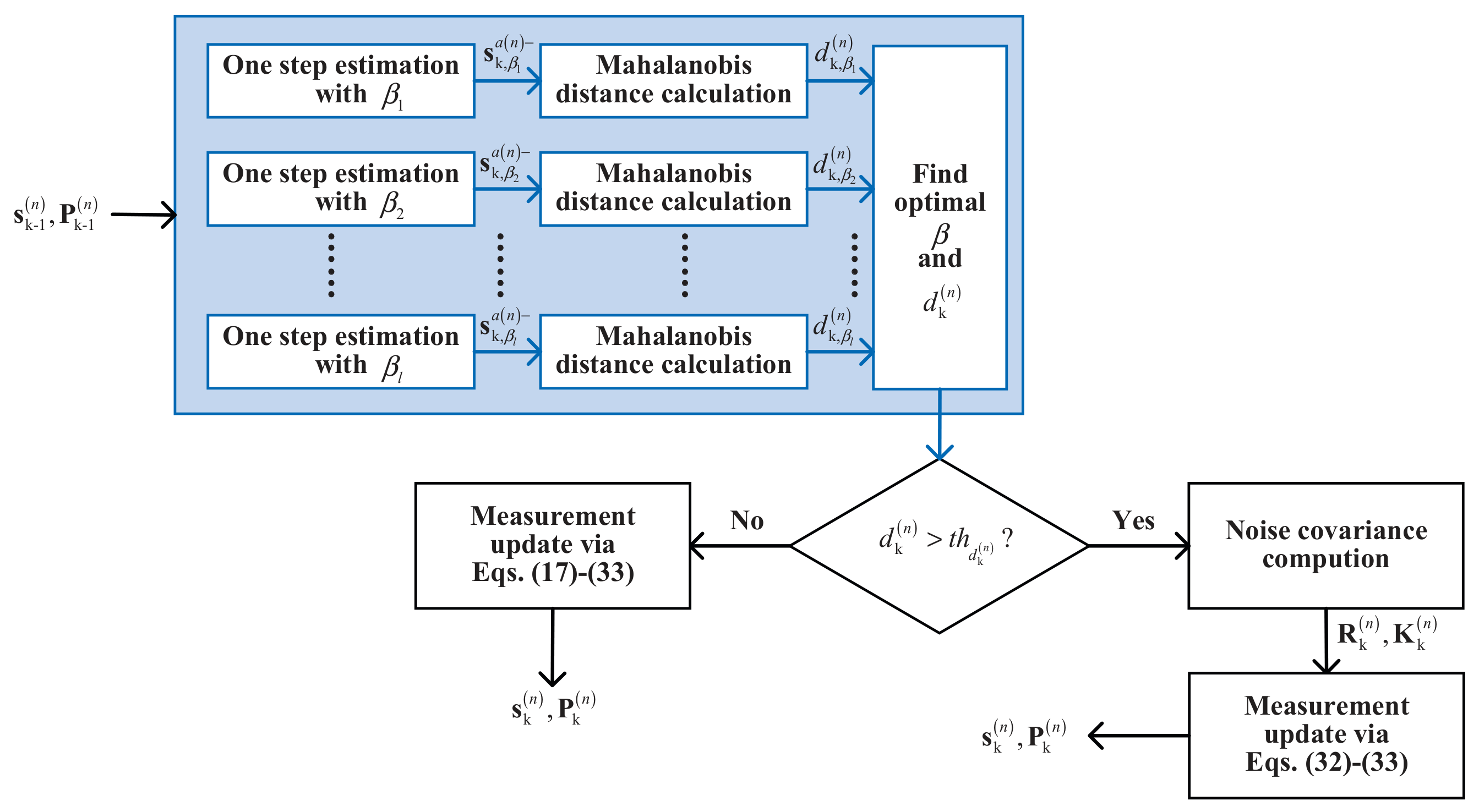
In this work, we employed the VB-based method to estimate the noise covariance; however, as mentioned in the above section, we found that the VB-based method exhibits higher computational complexity compared to the traditional UKF method. Notably, the high computational complexity is not conducive to the practical application of these algorithms. To deal with this problem, we present the lightweight improvement of VB-UKF under CMN (shown in Figure 2). The main steps of the proposed method in the subfilter are as follows:
Figure 2.
Lightweight improvement of VB-UKF under CMN.
- In order to deal with the dynamic CMN, we employ one color factor array, which is denoted as . Here, l is the number of .
- A one-step estimation of the UKF under CMN with different is performed. Using the one-step estimation and , the Mahalanobis distance is then computed via Equation (47). Then, and used in the subfilter are determined by using Equations (48) and (49). Meanwhile, the corresponding , , and with are employed by the subfilter as the one-step estimation.
- If (where represents the preset threshold of the Mahalanobis distance), we consider the accuracy of the UKF under CMN to be fine. We then perform the measurement update using Equations (32) and (33). Otherwise, we consider that the noise setting of the method is not suitable for the current real environment. Moreover, we first use iterative steps to estimate the noise covariance matrix of the current navigation environment via Equations (41)–(44). Then, we carry out the measurement update via Equations (44), (32) and (46).
With the subfilters’ outputs, we first evaluate the performance of subfilters by using the sum of main diagonal elements of ; if its value is less than the , the outputs of the subfilter are available and can be used by the main filter; otherwise, the output of the subfilter is unavailable. The main filter can estimate the final output using Equations (50) and (51).
Thus, the proposed distributed VB-UKF under CMN can be listed as Algorithm 2.
| Algorithm 2: Distributed adaptive VB-UKF under CMN |
 |
4. Performance of the Proposed Method
This section investigates the performance of the proposed method. First, we introduce the setting of the test, and then we investigate the performances of the proposed method.
4.1. The Setting of the Test
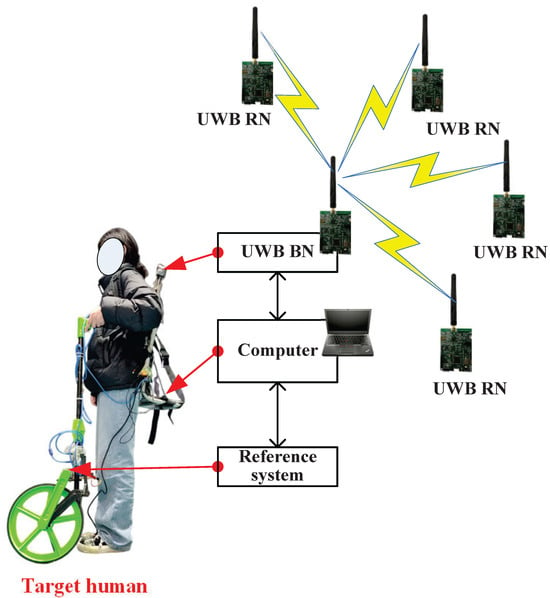
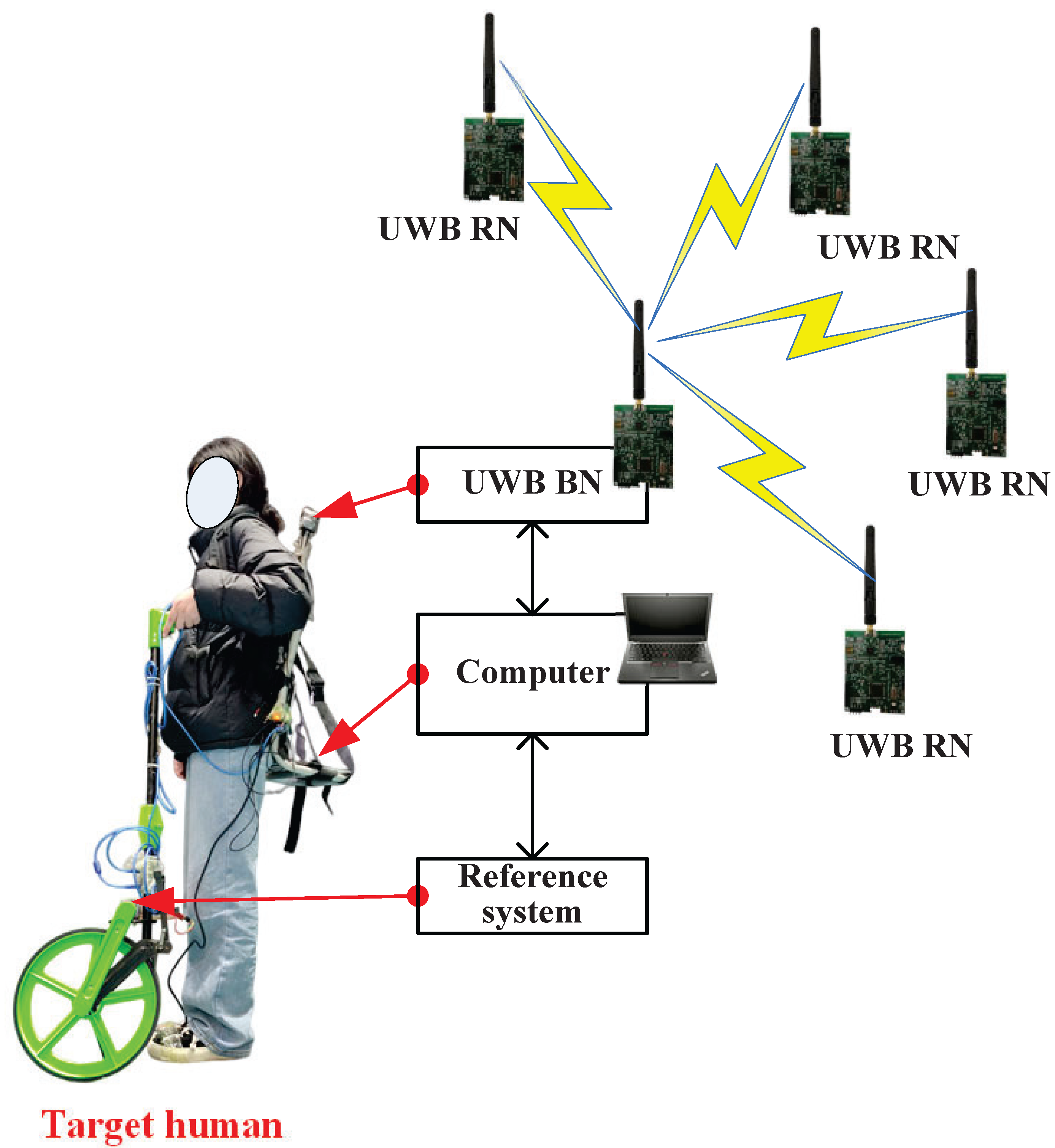
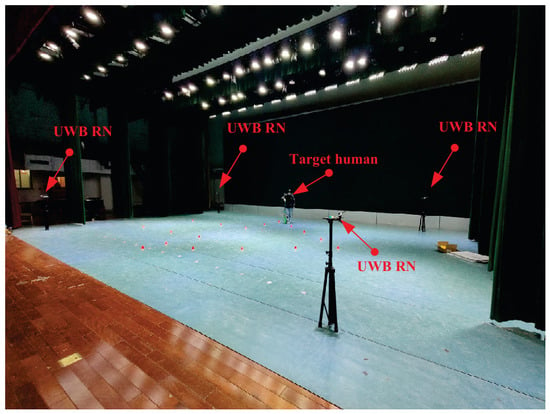
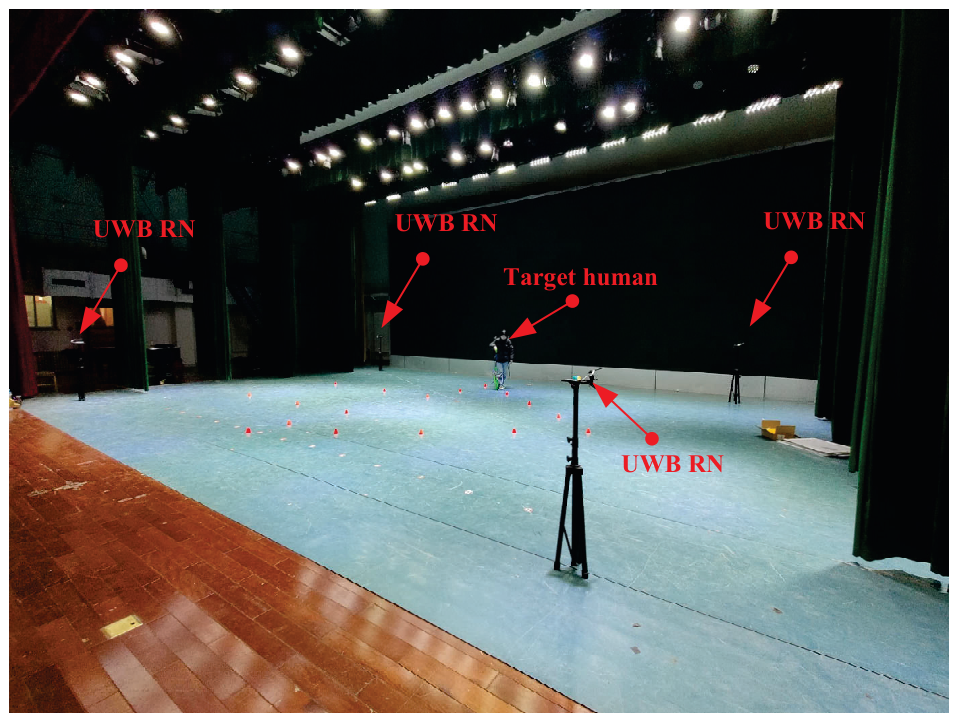
In this work, we perform the test in the auditorium of the university of Jinan. The architecture of the testing platform used in this work is shown in Figure 3. In this work, we employ four UWB reference nodes (RNs) and one UWB blind node (BN) to build the UWB localization system, which is used to measure the distance between the UWB RNs and UWB BN. In this system, all the nodes are based on the DW-1000. We also propose one reference system, which is used to provide the reference value. The reference system includes one encoder, which is used to measure the distance from the start point. In order to get the reference value, we first build the mapping between the reference coordinates and distance from the start point. In the test, the encoder is employed to measure the distance from the start point, and we can obtain the corresponding reference coordinates via the mapping. When we perform the test, the UWB RNs are placed in a known position in advance. The target human walks following the reference path with the UWB BN, computer, and reference system. All the sensors’ data are collected by the computer. The real test environment used in the work is shown in Figure 4. From the figure, one can infer that the test site is open and flat; however, it should be pointed out that the metal equipment above and around the stage has an impact on the positioning accuracy.
Figure 3.
The architecture of the testing platform used in this work.
Figure 4.
The real test environment used in the work.
For the filter, the filter parameters used in the test are listed in Table 1. What we need to emphasize is that the selection of these parameters is based on the prior knowledge of experiments in this site. For our proposed algorithm, the selection of parameters will affect the performance of the algorithm. To rigorously evaluate the proposed methodology, baseline comparisons are conducted against the standard distributed EKF (DEKF), distributed unscented KF (UKF), distributed particle filter (PF), distributed variational Bayesian–assisted UKF with no trigger under CMN (D-VB-cUKF (no trigger), where no trigger means that the iteration steps of VB are fixed), centralized UKF (CUKF), distributed variational Bayesian-assisted UKF (D-VB-UKF), and a distributed UKF under CMN (DcUKF).
Table 1.
Parameters of the filter used in the test.
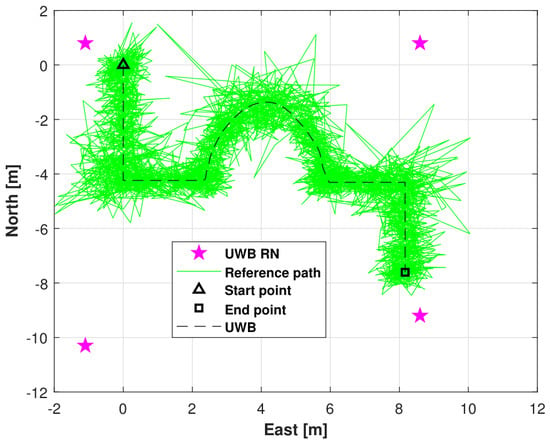
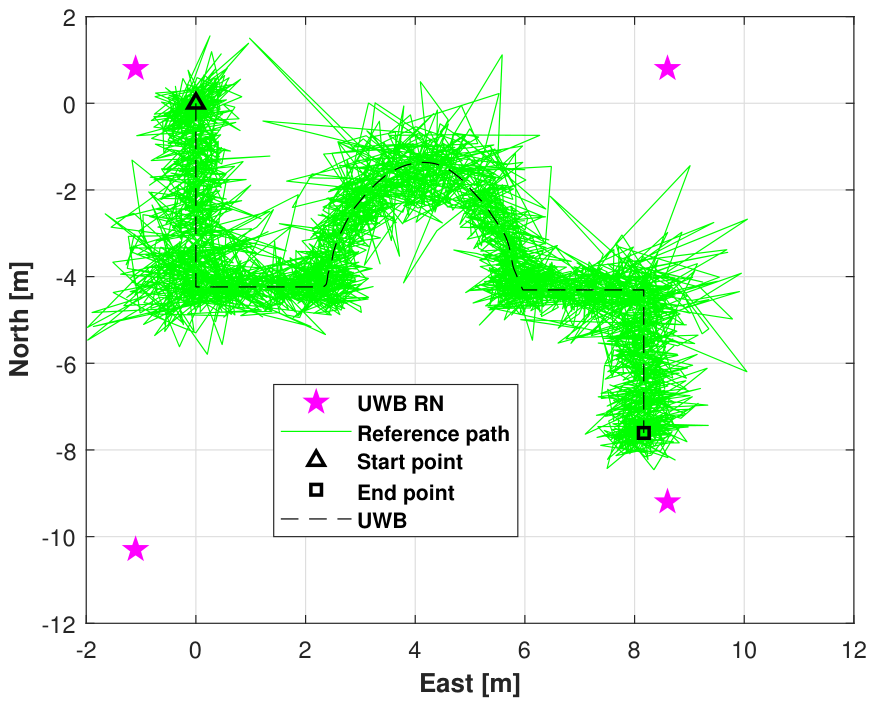
The reference path and the UWB solution path based on the least-squares (LS) algorithm are shown in Figure 5. The UWB RNs’ positions used in the test are listed in Table 2. Note that we just consider the positioning error of the horizontal plane; therefore, all distances will be projected onto the horizontal plane. In this test, the target human walks following the reference path with the UWB BN, computer, and reference system. Meanwhile, the person manually swings left and right (or back and forth) at certain positions to generate a relatively large CMN. All the sensors’ data are collected by the computer.
Figure 5.
The reference path and the UWB solution path based on the least-squares algorithm.
Table 2.
UWB RNs’ positions used in the test.
4.2. The Localization Accuracy
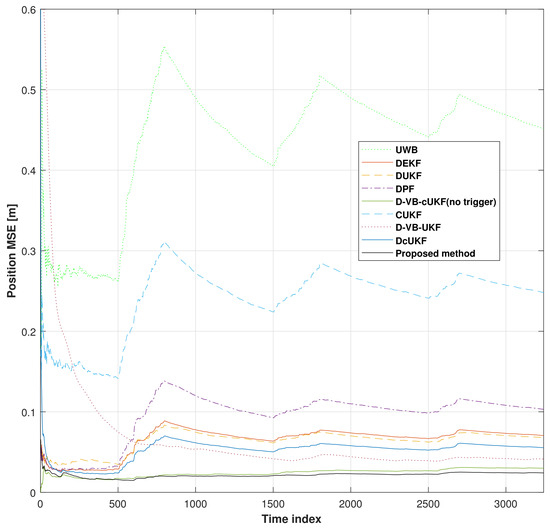
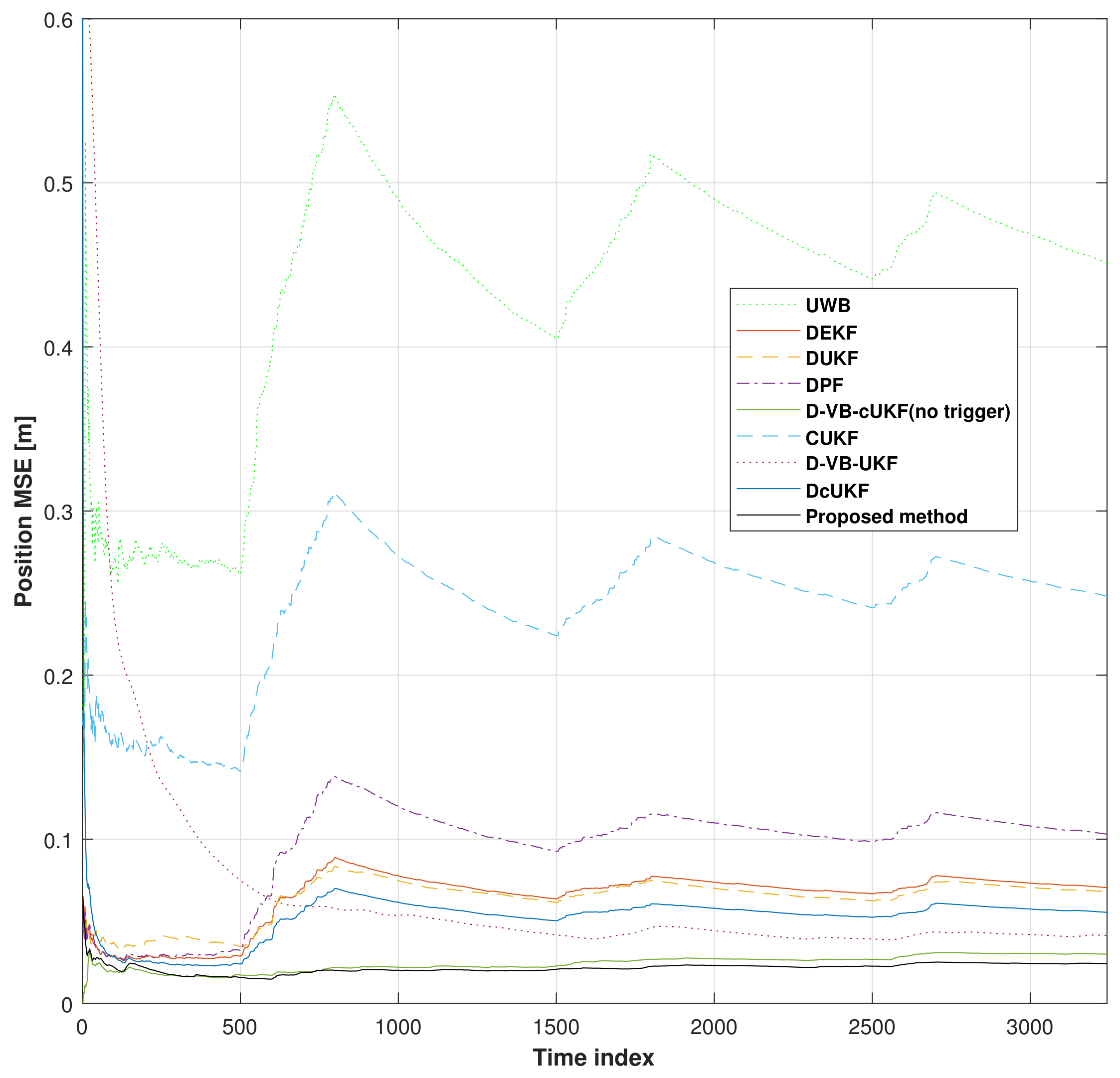
In this subsection, we investigate the localization accuracy of the proposed method. Figure 6 delineates the resulting mean square errors (MSEs) across the different filtering paradigms. From the figure, we can first find that all the filters’ position MSEs are lower than the UWB, which indicates that all the filtering methods can improve the localization accuracy. In these filtering methods, we can clearly see that the CUKF method’s MSE is the second largest in this test, especially when compared with the distributed method, which indicates that the distributed method is capable of reducing the impact of the error of sub-measurement on the accuracy of the data fusion algorithm. Then, one can infer that the DPF’s MSE is less than the CUKF, but its value is higher than the D-VB-cUKF (no trigger), D-VB-UKF, DcUKF, and the proposed method. Thus, we can say that the DPF is not suitable for the test used in this work. Moreover, the performances of the DEKF and DUKF are similar, and the DUKF has the smaller value. These results show that the DUKF method is more effective than DEKF, but their performances are affected by the CMN. The DcUKF can improve the localization accuracy when compared with the DUKF, which shows that the CMN-aware framework significantly suppresses positioning drift. Moreover, the D-VB-UKF method can reduce the localization error when compared with the DUKF, which indicates that the VB method can improve the accuracy of the noise estimation accuracy, which can further improve the filtering accuracy. Finally, both the D-VB-cUKF (no trigger) and the proposed methods have similar performances. This shows that the integration of the distributed model, VB method, and cUKF is capable of reducing the localization error. And the proposed method has the smallest position MSE, which shows that the trigger scheme can further improve the performance.
Figure 6.
Position MSEs measured by the UWB, DEKF, DUKF, DPF, D-VB-cUKF (no trigger), CUKF, D-VB-UKF, DcUKF, and the proposed method.
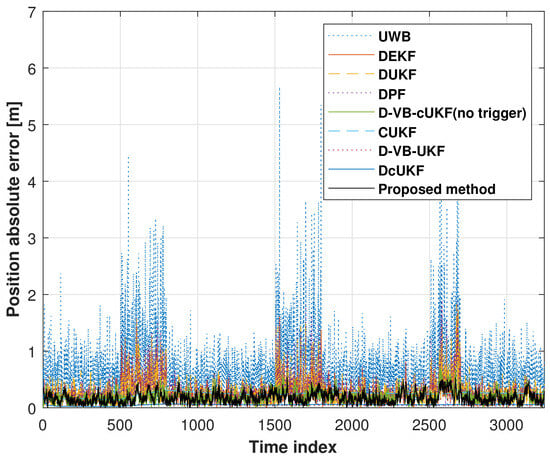
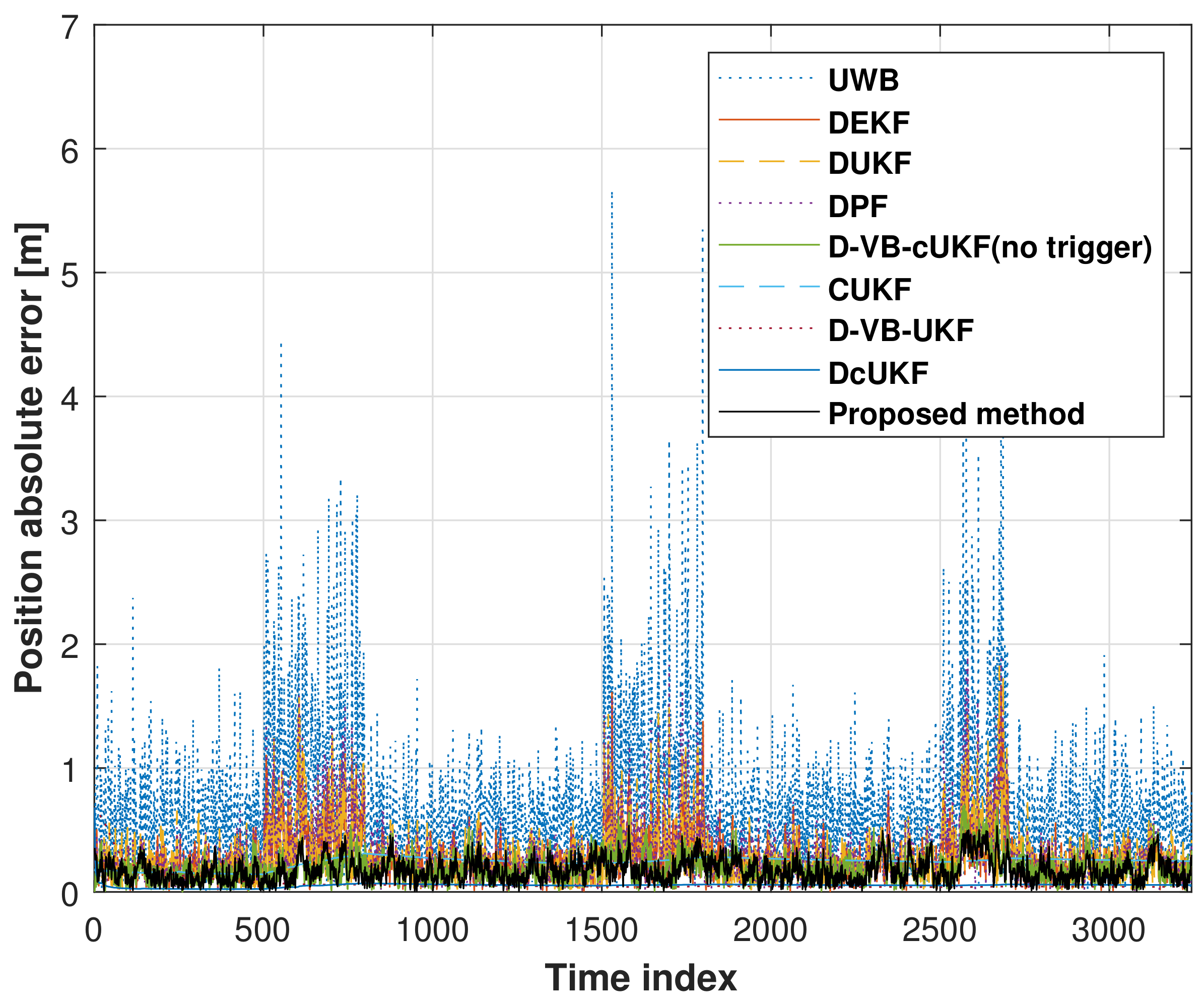
Figure 7 displays the position absolute errors (PAEs) measured by the UWB, DEKF, DUKF, DPF, D-VB-cUKF (no trigger), CUKF, D-VB-cUKF, DcUKF, and the proposed method for the path used in the work. One can see easily that there are three areas where the error suddenly increases, and these three parts are the areas where we intentionally increase the swing amplitude of the target pedestrian during the experiment. From the figure, we can see that the errors of all the filters are smaller than the UWB solutions. However, it should be pointed out that only the D-VB-cUKF (no trigger) and the proposed methods have stable performance when compared with the other filtering methods. The other filtering methods’ PAEs increase when the UWB’s accuracy worsens, and the proposed method has the smallest error, which indicates that the proposed method has the best performance in the test.
Figure 7.
Position absolute errors measured by DEKF, DUKF, DPF, D-VB-cUKF (no trigger), CUKF, D-VB-UKF, DcUKF, and the proposed method.
Table 3 and Table 4 present a quantitative breakdown of the root-mean-square errors (RMSEs) and corresponding confidence intervals for the evaluated schemes along the path used in this work. The baseline UWB system produced average deviations of 0.497 m (east) and 0.451 m (north). The CUKF is able to improve the RMSE by about 26.16% compared with the UWB. Then, the DPF can mitigate these coordinate errors to approximately 0.229 m and 0.225 m, respectively. With the distributed mode, the DEKF and DUKF are capable of reducing the RMSEs by about 60.34% and 60.97% respectively when compared with the UWB, and this value is 26.16% for CUKF; thus, we can say that the distributed mode is effective. For the CMN-aware framework, we can see that the DcUKF can reduce the RMSEs from 0.185 m (mean) to 0.167 m (mean) when compared with the DUKF, which shows that this mode is effective. Moreover, it can be seen that the VB-method can reduce the RMSEs from 0.185 m (mean) to 0.143 m (Mean) when compared with the DUKF. Finally, the D-VB-cUKF (no trigger) method can improved by about 74.05% when compared with the UWB, which is higher than the DcUKF. And the proposed trigger scheme can further improve the localization accuracy to 76.79%, which is the biggest improvement in this test.
Table 3.
Position RMSEs of the UWB, DEKF, DUKF, DPF, D-VB-cUKF (no trigger), CUKF, D-VB-UKF, DcUKF, and the proposed method.
Table 4.
Position confidence intervals of PAEs of the UWB, DEKF, DUKF, DPF, D-VB-cUKF (no trigger), CUKF, D-VB-UKF, DcUKF, and the proposed method.
Furthermore, as corroborated by Table 4, the proposed methodology exhibits the narrowest 95% confidence intervals for position absolute errors (PAEs), underscoring its exceptional statistical stability and convergence throughout the test. In this work, we use the midpoint of the confidence interval to evaluate the performance of the algorithm. From the table, we can see that the improvements in DEKF and DUKF are similar, and their improvement compared with UWB is about 60%, which is higher than the CUKF’s 26.85%. Meanwhile, we can see that the DcUKF can narrow the confidence interval from [0.139 m 0.147 m] (east) and [0.127 m 0.135 m] (north) to [0.117 m 0.125 m] (east) and [0.119 m 0.126 m] (north) when compared with DUKF. And the proposed method has the smallest confidence interval, with a value of [0.082 m 0.086 m] (east) and [0.087 m 0.092 m] (north) respectively. We can conclude that the performance of our proposed algorithm is the best in confidence intervals.
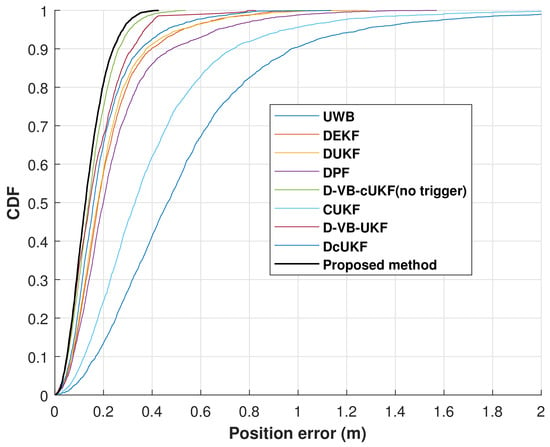
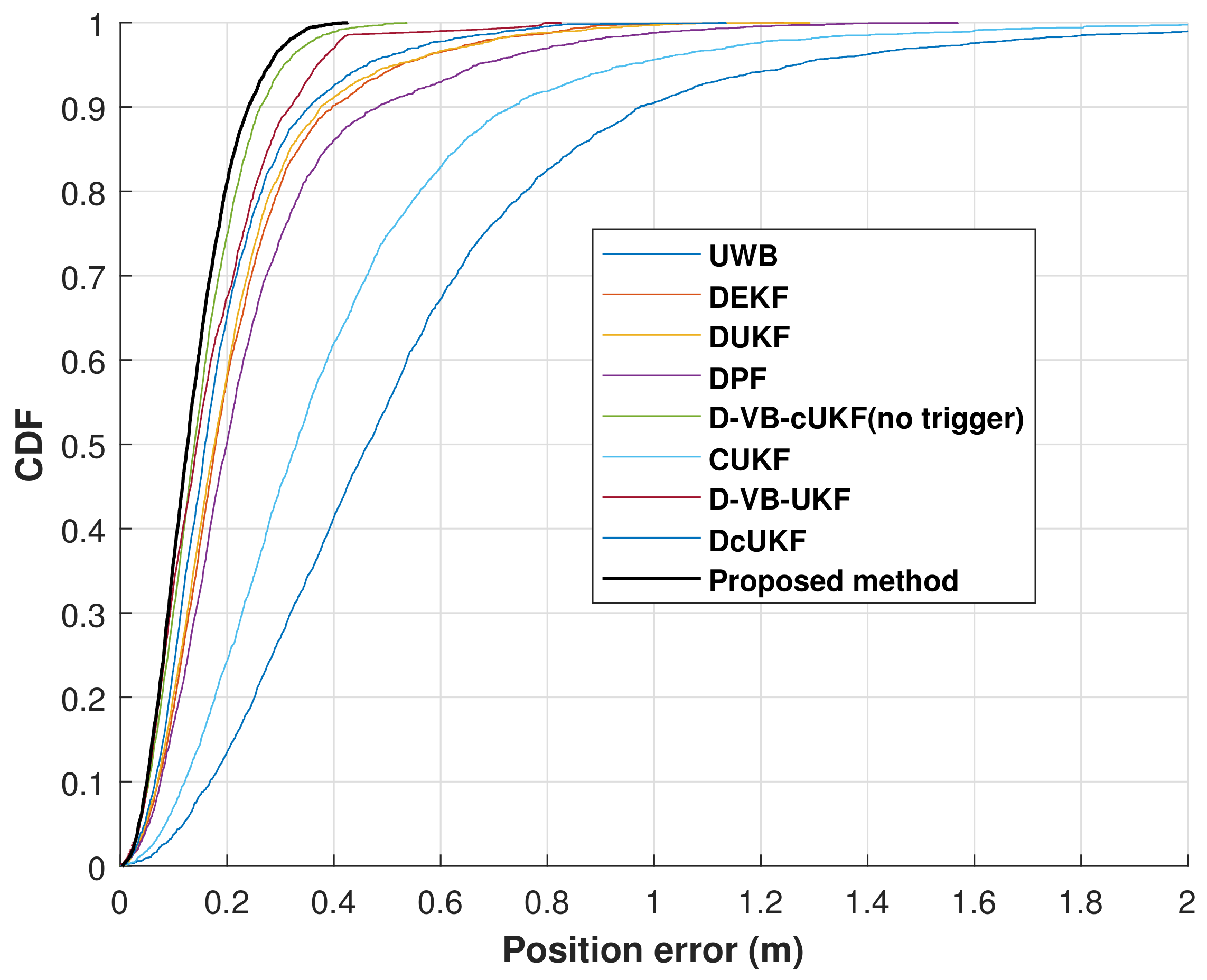
Figure 8 compares the position error cumulative distribution functions (CDFs) for the four localization schemes under the path conditions. In this figure, the position error CDFs represent the sum of the absolute value errors in two directions. The figure shows that under CMN, the proposed adaptive distributed VB-UKF exhibits a smaller localization error (0.9) compared to the other two methods. From the figure, we can see easily that the the UWB solution has the biggest position error, and then the CUKF method can reduce the position error to smaller than that of UWB at 0.9. Meanwhile, the DcUKF also has a smaller position error when compared with the DUKF method. Similar to the results mentioned above, it can be seen that the VB-method and the trigger scheme also affect the position error; thus, the proposed method has the smallest position error.
Figure 8.
Position error CDF of the UWB, DEKF, DUKF, DPF, D-VB-cUKF (no trigger), CUKF, D-VB-UKF, DcUKF, and the proposed method for the path.
4.3. Running Time
To ensure practical feasibility, the computational overhead of the proposed algorithm is investigated. In this subsection, we employ the Lenovo Legion Y9000K2020H computer, utilizing an Intel(R) Core(TM) i7-10875H CPU @2.30 GHz and 16.0 GB of RAM. The methods were executed in MATLAB R2021b using the sensors’ data collected by the real environment. Here, we run the program five times and the execution times for the distributed EKF, UKF, PF, and the proposed method can be found in Table 5. It should be pointed out that because the data collected from the actual test is used, running the program many times will only make a small difference to the running time, and will not have any impact on the accuracy of the algorithm. From the table, we can find that the DPF has the longest running time when compared with the other methods. Then, D-VB-cUKF (no trigger) and the proposed method have the second longest running times, and our proposed method reduces the running time when compared with the D-VB-cUKF (no trigger) method. The metrics confirm that despite the incorporation of the CMN and VB iterative mechanisms, the average execution duration remains well within the predefined system sampling interval, guaranteeing real-time applicability.
Table 5.
Running time of UWB, DEKF, DUKF, DPF, D-VB-cUKF (no trigger), CUKF, D-VB-UKF, DcUKF, and the proposed method.
4.4. The Investigation of the Colored Factor
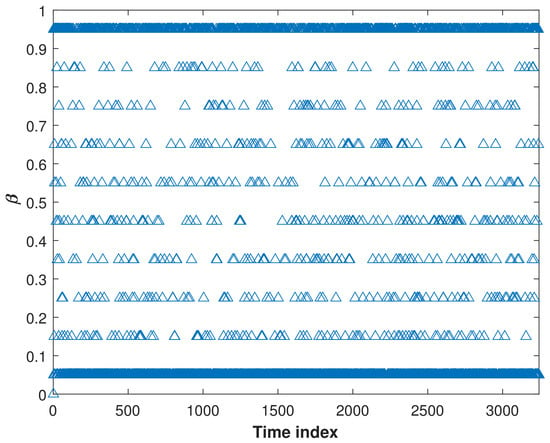
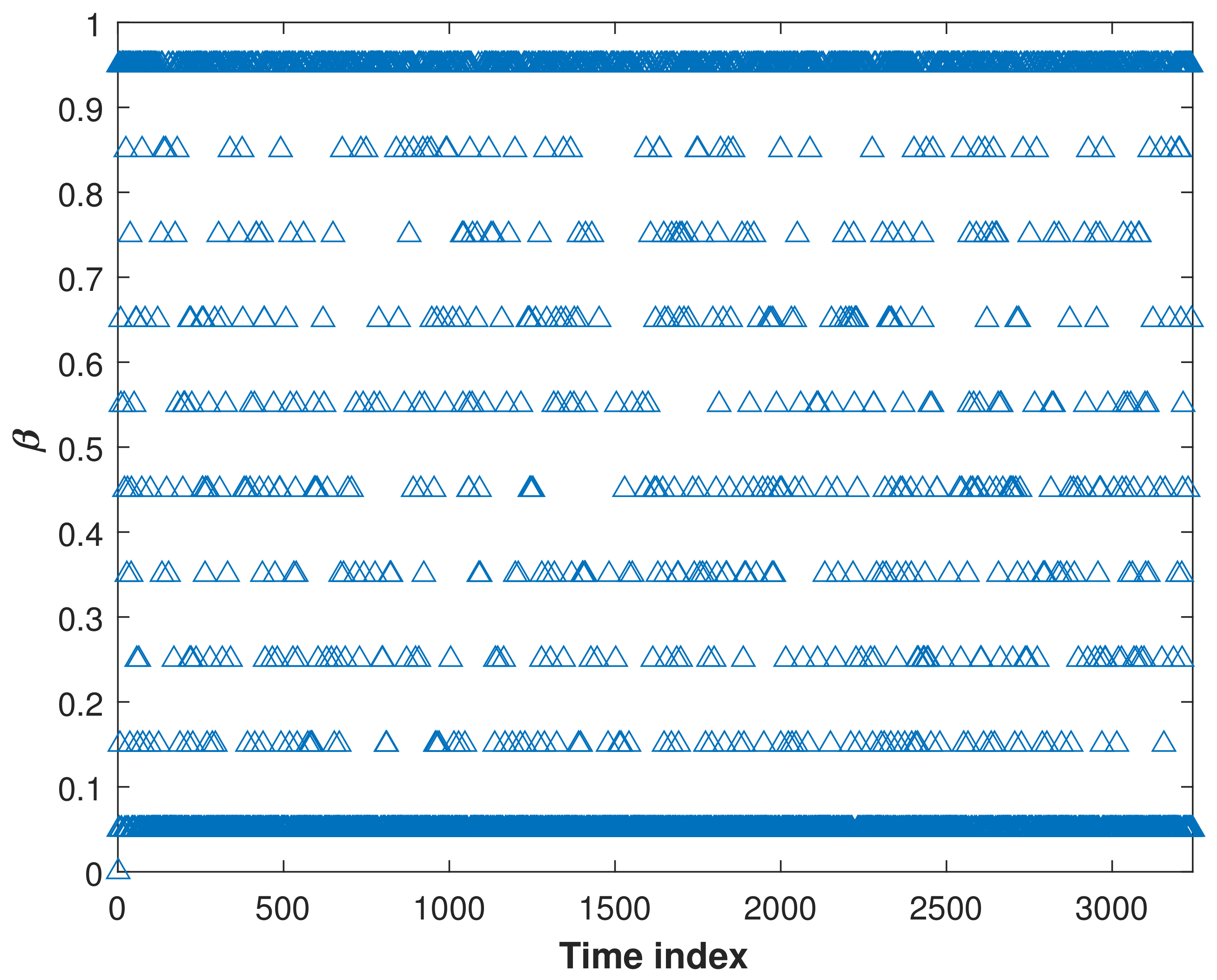
In this subsection, we investigate the colored factor of the proposed method, which is shown in Figure 9. From the figure, one can infer that the colored factor of the proposed method in each index is not a fixed value; its value varies with the environment.
Figure 9.
The colored factor of the proposed method.
4.5. Relationship Between Algorithm Performance and Number of UWB RN Nodes
In this subsection, we investigate the relationship between algorithm performance and number of UWB RN nodes. Here, we reduce the UWB RN from Node ID 4 to 1, which is listed in Table 2. The position RMSEs of the proposed method with different UWB node numbers are listed in Table 6. It should be emphasized that our proposed method can maintain working with only one UWB RN, but in that condition, the performance of the proposed method is investigated in following section. From the table, it can be seen easily that the mean position RMSEs of the proposed method will increase from 0.110 m to 5.523 m when the available UWB RN nodes’ number reduces from 4 to 1. Thus, we can conclude that the performance of the proposed algorithm will gradually decrease as the number of RNs decreases.
Table 6.
Position RMSEs of the proposed method with different UWB node numbers.
5. Conclusions
This research proposes a distributed VB-UKF to enhance the localization accuracy. In this method, a distributed filter is employed. The UKF under CMN is first derived. Then, the VB-assisted method is derived. Subsequently, the Mahalanobis distance is used to determine whether the current noise estimate conformed to the navigation environment; if the Mahalanobis distance is higher than the preset threshold, the VB-assisted method is employed to update the noise, which can improve the accuracy of the UKF under CMN. Subsequent experiments demonstrate the practical performance of the proposed algorithm. The results indicate that the method significantly reduces pedestrian positioning errors, effectively validating its effectiveness in real-world applications. It should be emphasized that the number of test paths proposed in this paper is limited, and more extensive verification is needed in more diverse indoor environments.
Author Contributions
Conceptualization, M.Z. and M.S.; methodology, M.Z., H.L. and Y.X.; software, M.Z., H.Y., H.L. and Y.X.; validation, H.Y., H.L. and Y.X.; formal analysis, H.Y. and M.S.; investigation, H.Y. and M.S.; resources, M.Z. and M.S.; data curation, M.Z., H.Y. and M.S.; writing—original draft preparation, M.Z. and M.S.; writing—review and editing, M.Z., Y.X. and M.S.; visualization, M.Z. and H.L.; supervision, M.Z. and M.S.; project administration, M.Z. and M.S.; funding acquisition, M.S. All authors have read and agreed to the published version of the manuscript.
Funding
This research received no external funding.
Data Availability Statement
The original contributions presented in the study are included in the article, and further inquiries can be directed to the corresponding author.
Conflicts of Interest
Author Maoxiang Zhou was employed by the company Shandong Luqiao Group Co., Ltd. Author Yuan Xu was employed by the company Jinan Chenhe Information Technology Co., Ltd. The remaining authors declare that the research was conducted in the absence of any commercial or financial relationships that could be construed as a potential conflict of interest.
Abbreviations
The manuscript employs the following abbreviations:
| CDF | Cumulative distribution function |
| CMN | Colored measurement noise |
| EKF | Extended Kalman filter |
| KF | Kalman filter |
| KL | Kullback–Leibler |
| GNSS | Global satellite navigation system |
| LS | Least squares |
| LSTM | Long short-term memory |
| iGNSS | Integrated GNSS |
| IPE | Inner-product encryption |
| IW | Inverse Wishart |
| RFID | Radio-frequency identification |
| RMSE | Root-mean-square error |
| RN | Reference node |
| PAE | Position absolute error |
| UKF | Unscented Kalman filter |
| UT | Unscented transformation |
| UWB | Ultra-wideband |
| VB | Variational Bayesian |
References
- Rahman, A.; Debnath, T.; Kundu, D.; Khan, M.S.I.; Aishi, A.A.; Sazzad, S.; Sayduzzaman, M.; Band, S.S. Machine learning and deep learning-based approach in smart healthcare: Recent advances, applications, challenges and opportunities. AIMS Public Health 2024, 11, 58–109. [Google Scholar] [CrossRef] [Scilit] [PubMed]
- Xu, Y.; Gao, R.; Yang, A.; Liang, K.; Shi, Z.; Sun, M.; Shen, T. Extreme Learning Machine/Finite Impulse Response Filter and Vision Data-Assisted Inertial Navigation System-Based Human Motion Capture. Micromachines 2023, 14, 2088. [Google Scholar] [CrossRef] [Scilit] [PubMed]
- Xu, Y.; Shmaliy, Y.S.; Vazquez-Olguín, M.A.; Chen, X.; Zhuang, Y. Minimum distance constraint FIR filter for dual-foot-mounted pedestrian localization. IEEE Trans. Instrum. Meas. 2026, 75, 9522514. [Google Scholar] [CrossRef] [Scilit]
- Li, J.; Xiu, C.; Yang, D.; Wang, F. A novel two-stage IMU/MAG-aided UWB fusion algorithm for pedestrian localization in underground Space. IEEE Trans. Instrum. Meas. 2025, 74, 1–16. [Google Scholar] [CrossRef] [Scilit]
- Asiedu Asante, B.K.; Imamura, H. Seamless indoor and outdoor navigation using IMU-GNSS sensor data fusion. Sensors 2026, 26, 2215. [Google Scholar] [CrossRef] [Scilit] [PubMed]
- Cao, L.; Zhang, W.; Wei, D.; Yuan, H. IPM-INS: A Pedestrian Inertial Navigation System Using a Trunk-Mounted IMU Based on Inverted Pendulum Model. IEEE Trans. Instrum. Meas. 2025, 74, 9513411. [Google Scholar] [CrossRef] [Scilit]
- Liao, Z.; Zhang, X.; Zhang, T.; Li, Y. Pedestrian gait-enhanced LINS: A robust, IMU-centric LiDAR-inertial navigation system for pedestrian. IEEE Sens. J. 2025, 25, 11348–11356. [Google Scholar] [CrossRef] [Scilit]
- Niu, X.; Liu, Z.; Ding, L.; Kuang, J. A robust GNSS/INS integrated system for pedestrian navigation in urban environments based on spatial consistency check. IEEE Internet Things J. 2010, 12, 44810–44821. [Google Scholar]
- Huang, J.; Zou, M.; Wang, S.; Chen, Y.; Liu, X.; Peng, H.; Liu, Y. Pedestrian navigation using waist-mounted IMU and RTK. Sens. J. IEEE 2025, 25, 5510–5519. [Google Scholar] [CrossRef] [Scilit]
- Xu, Y.; Cao, J.; Shmaliy, Y.; Zhuang, Y. Distributed Kalman filter for UWB/INS integrated pedestrian localization under colored measurement noise. Satell. Navig. 2021, 2, 22. [Google Scholar] [CrossRef] [Scilit]
- Karimi, H.A.; Asavasuthirakul, D. A Novel Optimal Routing for Navigation Systems/Services Based on Global Navigation Satellite System Quality of Service. J. Intell. Transp. Syst. 2014, 18, 286–298. [Google Scholar] [CrossRef] [Scilit]
- Meng, Q.; Li, S.; Jiang, Y.; Wang, L.; Meng, X. Smartphone-based GNSS/PDR integration navigation enhanced by measurements resilient adjustment under challenging scenarios. GPS Solut. 2025, 29, 23. [Google Scholar] [CrossRef] [Scilit]
- Wu, Y.; Lin, J.; Chen, H.; Lan, H.; Yang, L. A transformer-based double-order RFID indoor positioning system. Expert Syst. Appl. 2025, 271, 126530. [Google Scholar] [CrossRef] [Scilit]
- Yang, P.; Wu, W. Efficient Particle Filter Localization Algorithm in Dense Passive RFID Tag Environment. IEEE Trans. Ind. Electron. 2014, 61, 5641–5651. [Google Scholar] [CrossRef] [Scilit]
- Wang, Z.; Xu, Y.; Yan, Y.; Ouyang, X.; Zhang, B. Privacy-Preserving WiFi Localization Based on Inner Product Encryption in a Cloud Environment. IEEE Internet Things J. 2024, 11, 19. [Google Scholar] [CrossRef] [Scilit]
- Sun, Y.; He, Y.; Zhang, J.; Na, X. Exploiting dispersion effect of signals for accurate indoor WiFi localization. ACM Trans. Sens. Netw. 2024, 21, 1–21. [Google Scholar] [CrossRef] [Scilit]
- Xu, Y.; Zang, X.; Shmaliy, Y.S.; Yu, J.; Zhuang, Y.; Sun, M. UWB-based robot localization using distributed adaptive EFIR filtering. IEEE Internet Things J. 2024, 11, 30704–30713. [Google Scholar] [CrossRef] [Scilit]
- Poulose, A.; Han, D.S. UWB indoor localization using deep learning LSTM networks. Appl. Sci. 2020, 10, 6290. [Google Scholar] [CrossRef] [Scilit]
- Sun, M.; Gao, Y.; Jiao, Z.; Xu, Y.; Zhuang, Y.; Qian, P. R-T-S assisted Kalman filtering for robot localization using UWB measurement. Mob. Netw. Appl. 2024, 29, 1089–1098. [Google Scholar] [CrossRef] [Scilit]
- Deng, B.; Xu, T.; Yan, M. UWB NLOS identification and mitigation based on gramian angular field and parallel deep learning model. IEEE Sens. J. 2023, 23, 28513–28525. [Google Scholar] [CrossRef] [Scilit]
- Shen, T.; Yuan, Z.; Wang, X. Stability analysis for digital filters with multiple saturation nonlinearities. Automatica 2012, 48, 2717–2720. [Google Scholar] [CrossRef] [Scilit]
- Shen, T.; Yuan, Z.; Wang, X. An improved stability criterion for fixed-point state-space digital filters using two’s complement arithmetic. Automatica 2012, 48, 243–245. [Google Scholar] [CrossRef] [Scilit]
- Cheng, L.; Song, J.; Zhao, W. A hybrid EKF/WUFIR filter for indoor localization integrating INS and UWB data. IEEE Trans. Netw. Sci. Eng. 2025, 12, 2266–2276. [Google Scholar] [CrossRef] [Scilit]
- Yan, Y.; Yang, J. An improved variational Bayesian-based adaptive federated Kalman filter for multi-sensor integrated navigation systems. Sensors 2025, 25, 7173. [Google Scholar] [CrossRef] [Scilit] [PubMed]
- Zhao, S.; Huang, B. Trial-and-error or avoiding a guess? Initialization of the Kalman filter. Automatica 2020, 121, 109184. [Google Scholar] [CrossRef] [Scilit]
- Yan, X.; Yang, X.; Zhang, J.; Ding, S.; Xiang, Z. Adaptive Barometer/INS fusion for UAV altitude estimation under strong wind disturbances. IEEE Trans. Aerosp. Electron. Syst. 2026, 26, 8905–8916. [Google Scholar] [CrossRef] [Scilit]
- Jung, E.; Choi, W.; Jeon, W. Adaptive Kalman filter-based fusion of multiple low-cost IMUs for mobile robot navigation. Int. J. Control. Autom. Syst. 2025, 23, 3621–3636. [Google Scholar] [CrossRef] [Scilit]
- Guan, X.; Wu, J.; Li, Y.; Zhou, Z.; Xing, Y.; Wu, H.; Zhao, A. Research on the adaptive fusion timing algorithm for BeiDou and LORAN based on the EKF. Remote Sens. 2025, 17, 246. [Google Scholar] [CrossRef] [Scilit]
- Chen, H.; Sun, Z.; Chen, H.; Chu, J.; Song, J. A barometer-enhanced state adaptive indirect Kalman filter for 3-D indoor navigation. IEEE Sens. J. 2025, 25, 19816–19824. [Google Scholar] [CrossRef] [Scilit]
- Vana, S.; Bisnath, S. A modified adaptive factor-based Kalman filter for continuous urban navigation with low-cost sensors. GPS Solut. 2024, 28, 84. [Google Scholar] [CrossRef] [Scilit]
- Chen, Y.; Li, W.; Du, Y.X. A novel robust adaptive Kalman filter with application to urban vehicle integrated navigation systems. Measurement 2024, 236, 18. [Google Scholar] [CrossRef] [Scilit]
- Wang, M.; Cui, J.; Wu, W. Left/Right invariant Lie group error for SINS/GNSS tightly coupled vehicular integrated navigation. IEEE Trans. Veh. Technol. 2025, 74, 1–14. [Google Scholar] [CrossRef] [Scilit]
- Wang, M.; Wu, W.; He, X.; Li, Y.; Pan, X. Consistent ST-EKF for long distance land vehicle navigation based on SINS/OD integration. IEEE Trans. Veh. Technol. 2019, 68, 10525–10534. [Google Scholar] [CrossRef] [Scilit]
- Gustafsson, F.; Hendeby, G. Some Relations Between Extended and Unscented Kalman Filters. IEEE Trans. Signal Process. 2012, 60, 545–555. [Google Scholar] [CrossRef] [Scilit]
- Li, K.; Chang, L.; Hu, B. A variational Bayesian-based unscented Kalman filter With both adaptivity and robustness. IEEE Sens. J. 2016, 16, 6966–6976. [Google Scholar] [CrossRef] [Scilit]

Disclaimer/Publisher’s Note: The statements, opinions and data contained in all publications are solely those of the individual author(s) and contributor(s) and not of MDPI and/or the editor(s). MDPI and/or the editor(s) disclaim responsibility for any injury to people or property resulting from any ideas, methods, instructions or products referred to in the content. |
© 2026 by the authors. Licensee MDPI, Basel, Switzerland. This article is an open access article distributed under the terms and conditions of the Creative Commons Attribution (CC BY) license.