


Abstract
This paper introduces a bias point transformation to deal with the nonholonomic constraints of multiple second-order underactuated mobile vehicles, and transforms such systems into equivalent holonomic systems. In complex environments, follower vehicles cannot directly acquire the leader’s position and velocity due to limited sensing ranges or communication constraints. To this end, a distributed fixed-time observer is developed, which can accurately estimate the leader’s state for all followers within a fixed settling time using only local neighboring information. Based on the estimated states, a distributed fixed-time controller is further proposed and it enables the system to achieve fixed-time rotating consensus without requiring velocity measurements. The fixed-time stability of the closed-loop system is rigorously analyzed via bilateral homogeneity theory and Lyapunov stability theory. Theoretical results confirm that the developed observer and controller ensure that all underactuated mobile vehicles achieve rotating consensus within a fixed time. Finally, numerical simulation results demonstrate the effectiveness of the presented control protocol.
1. Introduction
With the rapid advancement of intelligent manufacturing, unmanned systems, intelligent transportation and other fields, cooperative control of multiple mobile vehicles has become a research hotspot in robotics and control engineering [1]. Second-order underactuated mobile vehicles feature lightweight structure, low energy consumption and strong adaptability to practical unmanned platforms, showing broad application prospects in cooperative operation scenarios such as warehouse logistics, industrial inspection and disaster relief [2,3,4]. In such cooperative application scenarios, achieving consensus of underactuated mobile vehicles is the core to accomplishing various cooperative tasks.
As the core technology of multi-vehicle cooperation, consensus control aims to design a distributed controller by using only local information interaction, so that the position, velocity and other states of all vehicles converge to the same value [5]. To further adapt to complex cooperative tasks such as dynamic surrounding surveillance of leaders and cooperative inspection, it is particularly critical to extend consensus control to the more challenging rotating consensus control [6,7]. Obviously, compared with traditional state consensus, rotating consensus imposes more stringent constraints. It is not only the foundation of rotating formation, but also applicable to dynamic circular motion tasks, and can better match the practical cooperative operation scenarios of multiple mobile vehicles. Specifically, in the cooperative vigilance scenario of multiple underactuated ground unmanned vehicles, the vehicle group needs to conduct circular cruising around key areas or moving targets to realize omnidirectional real-time monitoring and situation awareness; in the cluster operation of underactuated unmanned surface vehicles, multiple vehicles can perform cooperative rotating navigation around waterways, wrecked targets or monitored sea areas to complete global inspection, target containment and environmental sampling tasks. In the early research on rotating consensus control, Lin et al. [8] first realized rotating consensus control for second-order multi-agent systems; subsequently, Scardovi et al. [9] first adopted a distributed control strategy to achieve rotating consensus of agents in three-dimensional space and proved the exponential convergence property of the system. On this basis, Wang et al. [10] further extended this problem to second-order systems under directed communication topologies, and since then, a series of progress has been made in related research, including solving key practical application problems such as topology switching and communication constraints [11,12].
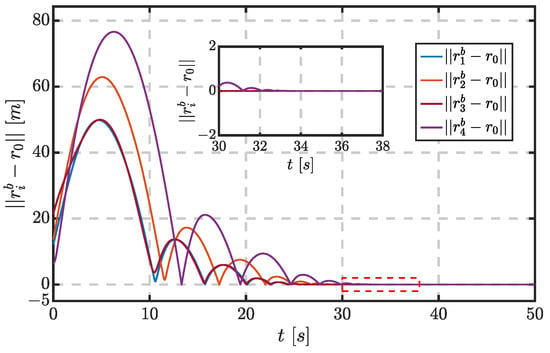
It should be pointed out that most of the above observers can only achieve exponential convergence or finite-time convergence. Although exponential convergence can ensure system stability, its convergence rate is significantly constrained by system parameters and initial conditions, and the theoretical convergence time tends to infinity, which makes it difficult to meet the practical requirement of fast convergence for rotating consensus. To address this issue, Wang et al. [13] first proposed the finite-time stability theory for second-order multi-agent systems, making the state errors of the system converge to zero in finite time; subsequently, Guan et al. [14] solved the finite-time tracking consensus problem for second-order integrator multi-agent systems, realizing finite-time synchronous tracking of system position and velocity states; after that, Cao et al. [15] extended it to nonlinear systems and achieved finite-time consensus of multi-agent systems with inherent nonlinearities, and subsequent related research has achieved a series of fruitful results based on this. Although finite-time convergence has a significant improvement in speed compared with exponential convergence, its convergence time is still closely related to the initial state of the system and increases with the enlargement of the initial state deviation. In some practical engineering scenarios, it is more desirable for the system to achieve fast and accurate convergence in fixed time, independent of the initial state. To solve this problem, Polyakov [16] first proposed the concept of fixed-time stability theory, the greatest advantage of which is that the convergence time is independent of the initial state; subsequently, Zuo et al. [17] applied this theory to multi-agent systems; Polyakov et al. [18] extended the fixed-time stability theory to nonlinear systems based on the implicit Lyapunov function method, enabling it to adapt to the analysis scenarios of non-smooth systems and sliding mode control. With its outstanding convergence performance advantages, fixed-time stability theory has been widely verified in robotics formation control, microgrid cooperative regulation and other fields [19,20]. On this basis, related research has been further extended to rotating consensus problems with higher requirements for convergence performance. Kou et al. [21] first proposed a fixed-time rotating consensus control scheme for second-order multi-agent systems, which can achieve fixed-time convergence independent of initial conditions. However, this method still relies on the direct observation of the leader’s state by agents and makes it difficult to apply to nonholonomic systems, with certain application limitations.
In addition, the underactuated characteristics and nonholonomic constraints of the system make it difficult to realize full-state cooperation of the entire system. Especially in leader-following rotating consensus tasks, it is necessary not only to achieve convergence of position, velocity and other states, but also to ensure that underactuated mobile vehicles complete cooperative rotating motion around the leader. Ou et al. [22] first proposed the distributed finite-time formation theory for nonholonomic robots, solving the distributed observation problem where only part of the robots can obtain the leader’s information. Lu et al. [23] studied finite-time formation control under input saturation based on classical finite-time formation. However, none of the above studies have been extended to rotating consensus of nonholonomic systems, and most existing fixed-time cooperative control studies focus on second-order or higher-order integral systems with holonomic constraints, while research on nonholonomic constrained mobile robot systems is still limited. In practice, underactuated mobile vehicles such as differential-drive wheeled carts are widely used, but affected by nonholonomic motion constraints and underactuated characteristics, the system has significant nonlinearity, the states cannot be completely linearized, and the control inputs are insufficient. As a result, mature fixed-time cooperative control strategies are difficult to apply directly, especially for complex tasks such as rotating consensus. To solve this problem, B. d’Andrea-Novel et al. [24] proposed selecting a bias point with a fixed deviation from the geometric center as the target for underactuated mobile vehicles rather than directly controlling the vehicle center in the traditional manner. They derived the transformation relationship that maps the bias point to the vehicle control inputs including linear velocity and angular velocity, thereby achieving precise control of the bias point. However, it cannot achieve global asymptotic stability through continuously differentiable time-invariant control laws. Ou et al. [25] designed a continuous fixed-time trajectory tracking controller for nonholonomic mobile robots, derived the error system through global invertible transformation, and ensured that the tracking error converges in fixed time. Nevertheless, this study only focuses on single-robot tracking and has not been extended to multi-robot rotating consensus, failing to accomplish tasks in large-scale, distributed and highly complex environments. To further illustrate the advantages of the proposed method, we compare it with the fixed-time control strategy recently reported in [26]. In that work, fixed-time convergence is achieved for multi-agent systems under ideal integrator-type dynamics. However, the considered model does not involve nonholonomic constraints or underactuated vehicle dynamics, and the controller design relies on full-state availability. In contrast, the system studied in this paper is a class of second-order underactuated mobile vehicles with nonholonomic kinematic constraints. To address these challenges, a bias-point transformation is introduced to equivalently convert the system into a holonomic form, and a distributed fixed-time observer is designed to estimate the leader state under limited communication. Moreover, an output-feedback fixed-time controller is constructed without requiring velocity measurements.
As summarized in the foregoing literature review, most existing fixed-time cooperative control schemes target holonomic integrator systems, whereas research concerning nonholonomically constrained underactuated mobile vehicles remains underdeveloped. To facilitate subsequent theoretical analysis, we first formalize the generalized definitions of holonomic systems and nonholonomic constraints below. Specifically, holonomic systems feature integrable algebraic constraints on generalized coordinates that depend purely on position states. By contrast, nonholonomic constraints are nonintegrable differential restrictions coupling system velocities, which cannot be transformed into position-only algebraic equalities. These limitations narrow the feasible motion directions of the system and widely exist in wheeled vehicles and other underactuated mobile vehicles. Fixed-time controller design for underactuated mobile vehicles is far more challenging than that for fully actuated holonomic counterparts. For fully actuated systems, every degree of freedom can be individually manipulated via dedicated control inputs, and the system dynamics are readily transformed into standard integrator normal forms. Accordingly, a wealth of established fixed-time consensus protocols can be deployed directly on such systems. In stark contrast, underactuated mobile vehicles suffer from nonholonomic motion constraints, where the count of control inputs is smaller than the system’s degrees of freedom. This structural property generates severe nonlinear coupling between translational and rotational dynamics and prevents direct regulation of lateral motion. Consequently, traditional fixed-time consensus strategies designed for fully actuated systems fail to extend straightforwardly to underactuated mobile vehicles, especially for rotation consensus objectives. Based on the above discussion, the contributions of this paper are as follows:
- Aiming at the influence of nonholonomic motion constraints and underactuated characteristics of underactuated mobile vehicles, the system achieves fixed-time rotating consensus by controlling the bias point.
- For the fixed-time rotating consensus control problem of the system under communication constraints and unmeasurable velocity information, a distributed observation and output feedback control scheme is proposed, and dynamic auxiliary variables are introduced to compensate for the lack of velocity information.
Remark 1.
The main symbols used in this paper are listed as follows for clarity. Let denote the n-dimensional real vector space. For a vector , denotes its Euclidean norm. The operator represents the transpose of a vector or matrix. The set of vehicles is denoted as , where is the number of followers. The leader is indexed by 0. The position of vehicle i is denoted by , and the leader position is . The heading angle of vehicle i is , and its control inputs are defined as , where is the linear force input and is the angular torque. The linear and angular velocities are denoted by and , respectively. The skew-symmetric matrix is defined as The bias point of vehicle i is denoted as . The communication topology is described by a graph , with adjacency matrix and Laplacian matrix . The matrix , where B represents the leader adjacency matrix. The consensus error of vehicle i is denoted as , and the observer state is denoted as , which estimates the leader state . The symbols denote positive controller and observer gain parameters. The symbol denotes the fixed settling time of the closed-loop system.
2. Preliminary Knowledge and Problem Statement
In this paper, the following basic notations and definitions are first presented to lay a foundation for the subsequent analysis. The set denotes the set of all agents considered in this paper, where is the total number of agents. For any vector , stands for the r-dimensional real column vector space, and the Euclidean norm of vector x is defined as where denotes the i-th component of vector x. For any scalar , the vector power operation is defined as In particular, for a skew-symmetric matrix S with appropriate dimensions, the identity holds identically. The derivation is presented as follows: For any antisymmetric matrix satisfying , the quadratic form always holds. Hence, the above expression is identically equal to zero. The normalized direction function is defined as which is used to characterize the directional property of the vector. Furthermore, given a weight vector and a positive scalar , denotes the weighted dilation operation of vector x with respect to the weight vector r.
2.1. Homogeneity Theory
This section first presents the definition of double-limit homogeneity, followed by the introduction of several key lemmas required for the subsequent analysis, which lays a theoretical foundation for the proof of the fixed-time stability of the system.
Consider the following nonlinear dynamical system:
where the initial time satisfies , the initial state is , and denotes the system state vector. is a nonlinear vector field defined in a neighborhood of the origin, which satisfies the continuity conditions required for subsequent analysis. To facilitate the subsequent exposition, the weighted dilation operation is first defined: for a weight vector and a scalar , we define .
Definition 1.
Let a function be given. If there exists a triple , where is a weight vector, is the degree, and is an approximating function whose definition is contained in the triple, such that is continuous, is continuous and nonzero, and for any compact set C satisfying , then is called an ℓ-limit homogeneous function associated with the above triple [27].
Definition 2.
Let a vector field be given. If there exists a triple , where is a weight vector, is the degree, and is an approximating vector field, such that for each (denoted as ), the component function is an ℓ-limit homogeneous function with the triple , and holds for all , then is called an ℓ-limit homogeneous vector field associated with the above triple [27].
Based on the double-limit homogeneity, a criterion for the fixed-time stability of the system can be established, as presented in the following lemma:
Lemma 1.
Assume that the vector field satisfies the double-limit homogeneity, with its associated triples corresponding to the 0-limit and ∞-limit being and , respectively. If the original system (1), the 0-limit approximate system , and the ∞-limit approximate system are all globally asymptotically stable, and the degrees satisfy , then the system (1) is fixed-time stable, i.e., all solutions of the system converge to the origin within a fixed time independent of the initial state [16,27].
Lemma 2.
Lemma 3.
Let n be a positive integer. For any real numbers with , the power inequalities for sums hold as follows: if , then if , then [16,28].
2.2. Problem Formulation
Consider the double-integrator underactuated mobile vehicle system consisting of N followers and a leader, where and . The system model is given as follows:
(ref. [29]) where and are the linear velocity and angular velocity of the i-th vehicle, denotes its position, represents its heading angle, and is the control input with being the forward force and being the torque. It should be noted that are damping coefficients. The dynamic model of the leader is given as follows:
where denotes the position of the leader, and S is a skew-symmetric matrix defined as , where is a constant. For simplicity, this paper assumes . From model (3), the velocity and acceleration of the leader can be readily obtained as and , respectively.
Since each mobile vehicle is nonholonomic, it cannot move independently in the lateral direction, and its direction of motion is always aligned with the heading angle . To mitigate tracking difficulties induced by nonholonomic constraints, we adopt the forward offset coordinate transformation widely utilized in wheeled robot control [30,31]. A bias point is defined as the point obtained by shifting the centroid of the mobile vehicle by a fixed distance along its heading direction. Its coordinate expression is:
This variable substitution eliminates complex kinematic couplings and greatly simplifies the subsequent trajectory tracking controller design. Taking the time derivative of (4) and substituting (2) yields:
where , and denotes the input transformation matrix, whose determinant is . Consequently, is invertible. From the above equation, the acceleration of the bias point is given by:
Remark 2.
The proposed control framework avoids singularities induced by coordinate transformation. Specifically, the determinant of the bias-point transformation matrix satisfies , which ensures that matrix is globally invertible for any heading angle . As a result, the controller is well-defined and solvable throughout the whole motion of the underactuated nonholonomic mobile vehicles.
Combined with the system model (2), we obtain:
where . In this paper, an undirected graph is employed to describe the communication topology among mobile vehicles, where is the node set with 0 denoting the leader and representing the followers, and is the edge set of . The neighbor set of vehicle i is denoted as , meaning that vehicle i can obtain information from vehicle j. The adjacency matrix satisfies if and otherwise. The Laplacian matrix is defined with diagonal elements and off-diagonal elements for . In addition, implies that vehicle i can acquire the leader’s position information .
Before deriving the main results, the relevant concepts are rigorously defined.
Definition 3.
Consider the leader dynamics (3) and the nonholonomic mobile vehicle dynamics (4). The closed-loop system is said to achieve fixed-time rotating consensus if there exists a settling time , independent of the initial conditions, such that
for all , where and denote the position and velocity tracking errors of each mobile vehicle with respect to the leader, respectively. Here, , where represents the angular velocity, and is considered in this paper.
Remark 3.
Equations (8) enable underactuated mobile vehicles to achieve position and velocity convergence. Consequently, the multi-vehicle system achieves fixed-time rotating consensus as the leader moves with a circular motion.
Assumption 1.
The undirected communication graph is connected, and at least one agent has direct access to the leader position . Accordingly, the diagonal matrix satisfies .
Remark 4.
Under Assumption 1, the matrix is positive definite, which is used to prove the convergence of the distributed estimation.
3. Main Results
In practical applications, owing to limited sensing ranges, unstable communication links and other constraints, not all underactuated mobile vehicles can acquire the leader’s position information directly. To solve this problem, this section first constructs a distributed fixed-time observer to estimate the leader’s position, and then proposes a fixed-time local output feedback controller for mobile-vehicle systems to address the fixed-time rotating consensus problem.
3.1. Design of Distributed Fixed-Time Observer
In this section, a distributed fixed-time observer is designed to solve the problem that some underactuated mobile vehicles cannot directly obtain the leader’s position. The specific form of the observer is given as follows:
where is the observed estimate of the leader’s state for the i-th underactuated mobile vehicle, and are the observer gains, is a fixed-time control parameter, and S denotes a skew-symmetric matrix.
Theorem 1.
Proof of Theorem 1.
First, define the leader state estimation error of the i-th agent as where denotes the leader state satisfying the leader dynamics , and S is a constant skew-symmetric matrix. Taking the time derivative of the error variable and substituting the observer dynamics one can derive that
Subsequently, define the global estimation error vector and the global consensus error vector Combined with the definition of local consensus error together with the definitions of the undirected graph Laplacian matrix and matrix , the global consensus error can be rearranged into the following compact matrix form: where denotes the two-dimensional identity matrix, and ⊗ represents the Kronecker product operation. Furthermore, construct the Lyapunov function candidate as From Assumption 1 and Remark 4, the matrix is symmetric positive definite. Hence, is also symmetric positive definite. Its inverse matrix satisfies the operation rule and such an inverse matrix still maintains symmetric positive definiteness, which ensures that V is a globally positive definite function. Combined with the global error constraint relation , one can obtain Since is a symmetric matrix and S is a skew-symmetric matrix, it follows from the properties of the Kronecker product that is also skew-symmetric. Based on the property that the quadratic form of a skew-symmetric matrix is always zero, we can derive Taking the time derivative of V, we have:
Based on the vector operation definitions presented in the preliminary knowledge, the inner product terms can be simplified to the corresponding norm forms. Accordingly, the above formula can be rewritten as
From Lemma 3, for any with if the following inequality holds: When one can obtain Since it yields Accordingly, we have
Similarly, the following relation can be derived:
Since the matrix is symmetric positive definite under Assumption 1, let denote the minimum eigenvalue of . According to the definition of the Lyapunov function it follows from the eigenvalue property of positive definite matrices that Therefore, Substituting the inequalities derived in (12) and (13) into (11), one obtains
Define Then the Lyapunov derivative satisfies Next, the fixed-time stability condition is verified. Since , it follows that Hence, the Lyapunov differential inequality contains one power term greater than one and another power term less than one, which exactly satisfies the standard sufficient condition for fixed-time stability given in Lemma 2. Therefore, according to Lemma 2, the equilibrium point of the estimation error system is globally fixed-time stable. Moreover, the settling time is independent of the initial conditions, and the upper bound of the convergence time satisfies
Consequently, there exists a fixed time such that That is, This completes the proof. □
3.2. Design of Local Controller
Based on the distributed fixed-time observer (9), a local controller is designed to guarantee that underactuated vehicles achieve rotating consensus within a fixed time independent of initial conditions. The controller is designed as follows:
Among them, is used to realize the position consensus of underactuated mobile vehicles; represents the offset position estimation of the carrier acquired by the distributed fixed-time observer (9); is an auxiliary variable adopted to compensate the velocity error; denotes the coupling coefficient of the velocity compensation term with . , , and are positive control gain parameters. To ensure fixed-time stability, the constraints and are satisfied to guarantee the bi-limit homogeneity. The parameter is defined as .
Theorem 2.
Consider the underactuated mobile vehicle system (2) and the leader dynamics (3). Suppose that the communication topology is connected, the observer (9) converges in fixed time, and the local controller (16) is applied with all control gains being positive. Then there exists a fixed time independent of initial conditions such that the bias points of all underactuated mobile vehicles track the leader trajectory within fixed time, and the global fixed-time rotating consensus is achieved.
Proof of Theorem 2.
From the fixed-time convergence result given in Theorem 1, there exists a fixed time such that the observed state is identically equal to the leader position for all . For the time interval , all closed-loop signals , , and control input remain uniformly bounded. This boundedness is guaranteed by the fixed-time stability of the observer in Theorem 1 and the input-to-state stable property of the agent rotational dynamics, which ensures the global boundedness of all signals over the entire time horizon. Substituting the steady-state condition into the controller (16), the simplified controller after convergence can be derived as follows:
By combining the controller (17) with Equation (7), one can eliminate the control input and obtain the closed-loop second-order dynamics of :
Define the error vectors and , where and . It holds that , so we rewrite . By taking the time derivative and substituting (17) and (18), the following error dynamic system can be obtained, as presented in (19):
Choose the following Lyapunov function candidate, which is positive definite and radially unbounded with respect to :
Taking the time derivative of (20) yields the following. Take the time derivative of (20) term by term via the chain rule. For the integral terms, we use the differentiation identity . The full expansion reads:
Substitute into the first inner product:
Next substitute the full expression of to split the second term:
Insert both simplified expressions back into :
The cross terms and exactly cancel each other. We then substitute into the remaining term:
This expression fully offsets the two derivative terms from the Lyapunov integral parts, leaving only the negative-definite terms associated with :
Since all control gains are positive scalars, holds for all , which implies is non-increasing and all error states stay uniformly bounded.
According to the invariant set theory, the system states asymptotically converge to the set which means holds if and only if , i.e., on . From the uniform continuity of and Barbalat’s lemma, we have Substitute into the third line of (19):
As and valid nonlinear exponent parameters, this directly implies the following. Combining with (19), it yields Based on the uniform continuity of and Barbalat’s lemma, one can obtain Therefore, , and hold, which implies that the global asymptotic stability of the system (19) is proven.
To facilitate proving the fixed-time stability of system (19) by Lemma 1, it is first required to verify whether system (19) possesses homogeneity under dual limits. The approximate systems of system (19) at the 0-limit and ∞-limit are given, respectively, as follows:
Define The dimension arises from stacking three 2-dimensional rotational vectors: position error , velocity error , auxiliary dynamic . Let the nonlinear functions , and represent the systems (19), (23) and (24), respectively. Subsequently, it is proven that the system is homogeneous with respect to the triple at the 0-limit, and homogeneous with respect to the triple at the ∞-limit, where Define the dilation operation for weight vector r and scalar component-wise: , where each element is scaled by the corresponding power of . The weight values are selected to match the homogeneous degree of each differential term in the error dynamics. For convenience of expression, each scalar component of the systems and is defined as and with For instance, and . Since , the inequality ensures that the exponent of inside the limit is positive, which guarantees the vanishing of the residual cross terms as . And and are continuous functions over compact set C; it follows that:
From the above derivation, system (19) possesses homogeneity under the 0-limit condition, where is the corresponding homogeneous associated triple. For the homogeneity of system (19) in the ∞-limit case with the associated triple , the identical scaling and limit analytical approach can be applied for verification, which is omitted for brevity. Accordingly, the dual-limit homogeneity property of system (19) is proven.
From Lemma 1, it can be concluded that system (19) is globally fixed-time stable, and all error variables satisfy the limit convergence conditions: , , . It follows directly from the definition that the system satisfies (8), which implies that fixed-time rotating consensus is achieved for the system. This completes the proof. □
Remark 5.
To highlight the superiority of the fixed-time controller proposed in this paper, we compare it with the conventional finite-time controller herein. The design form of the finite-time controller is given as follows:
The aforementioned controller can drive the system to converge within a finite time. Nevertheless, its convergence time depends on the system’s initial states, which causes substantial fluctuations in practical performance induced by initial conditions. In contrast, the fixed-time controller (16) proposed in this paper guarantees system convergence within a predetermined fixed time independent of initial conditions.
4. Simulation Results and Analysis
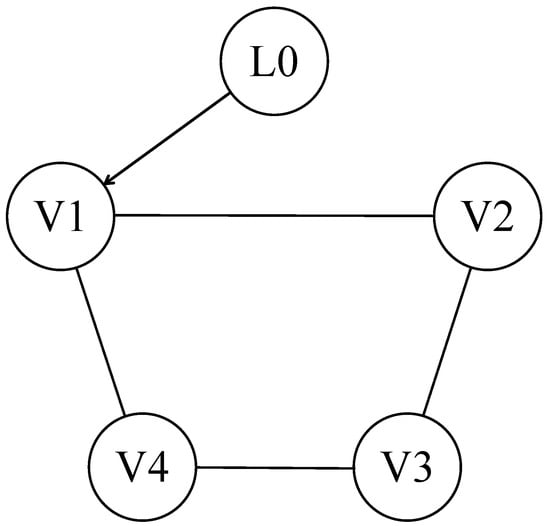
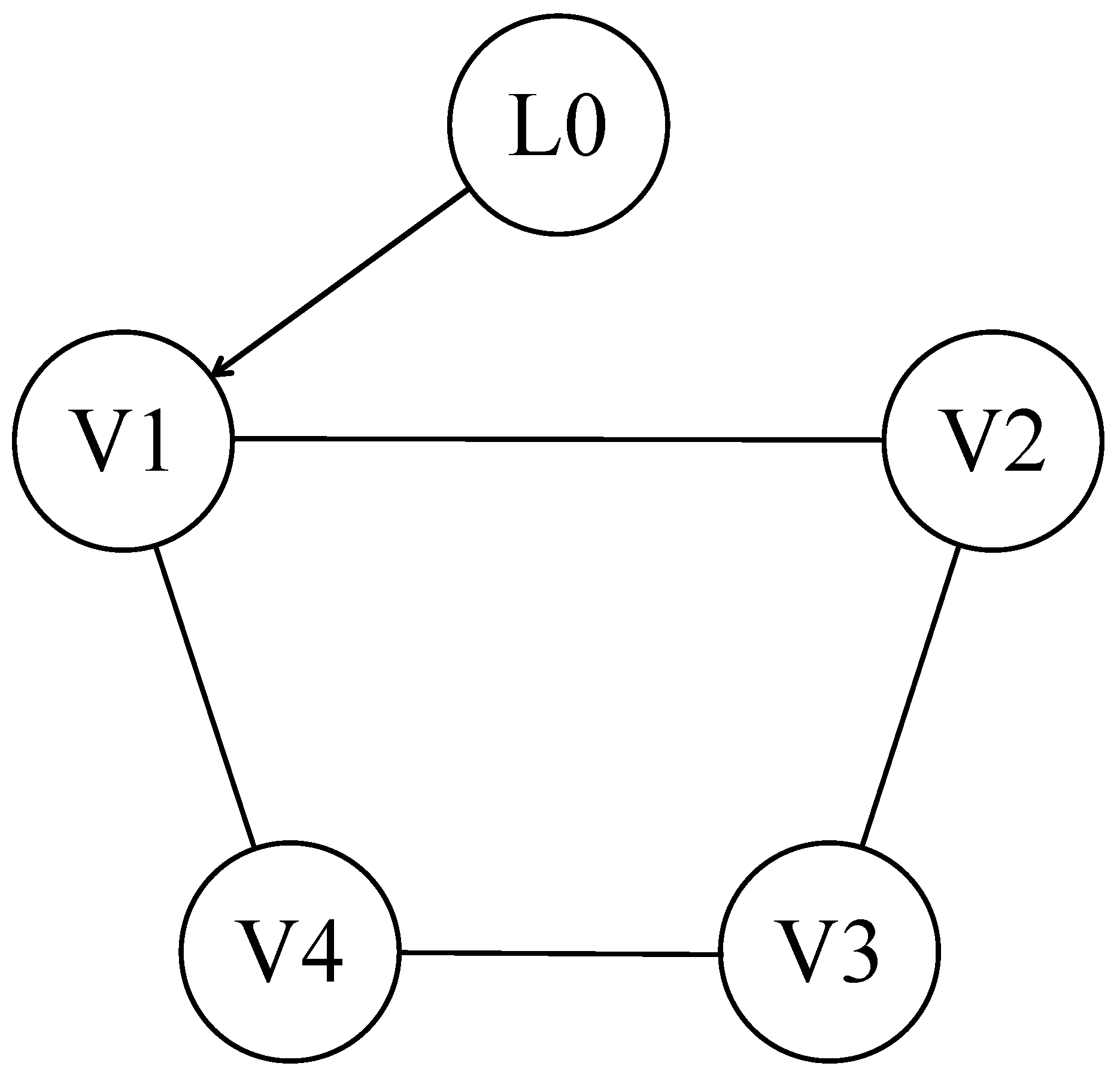
To verify the effectiveness of the proposed controller, numerical simulations are carried out for an underactuated mobile robot system composed of four underactuated mobile robots and one leader. The total simulation time is set to 20 s. To guarantee the reproducibility of all simulation results, the fifth-order Dormand–Prince solver (ode5) is adopted for numerical calculation, and a fixed integration step size of 0.001 is used during the whole simulation process. The parameters of the observer (9) and the controller (16) are listed in Table 1. The communication topology between the leader and the underactuated mobile robots is depicted in Figure 1, where denotes the leader and represent the underactuated mobile robots. The initial state of the leader is set as , and the initial states of the underactuated mobile robot system are given as follows:
Table 1.
Simulation parameters.
Figure 1.
Communication topology graph between leader and underactuated mobile vehicles.
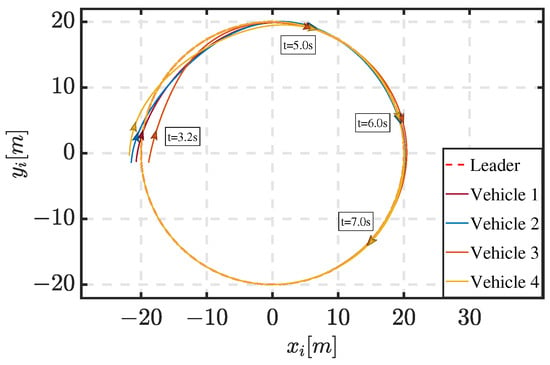
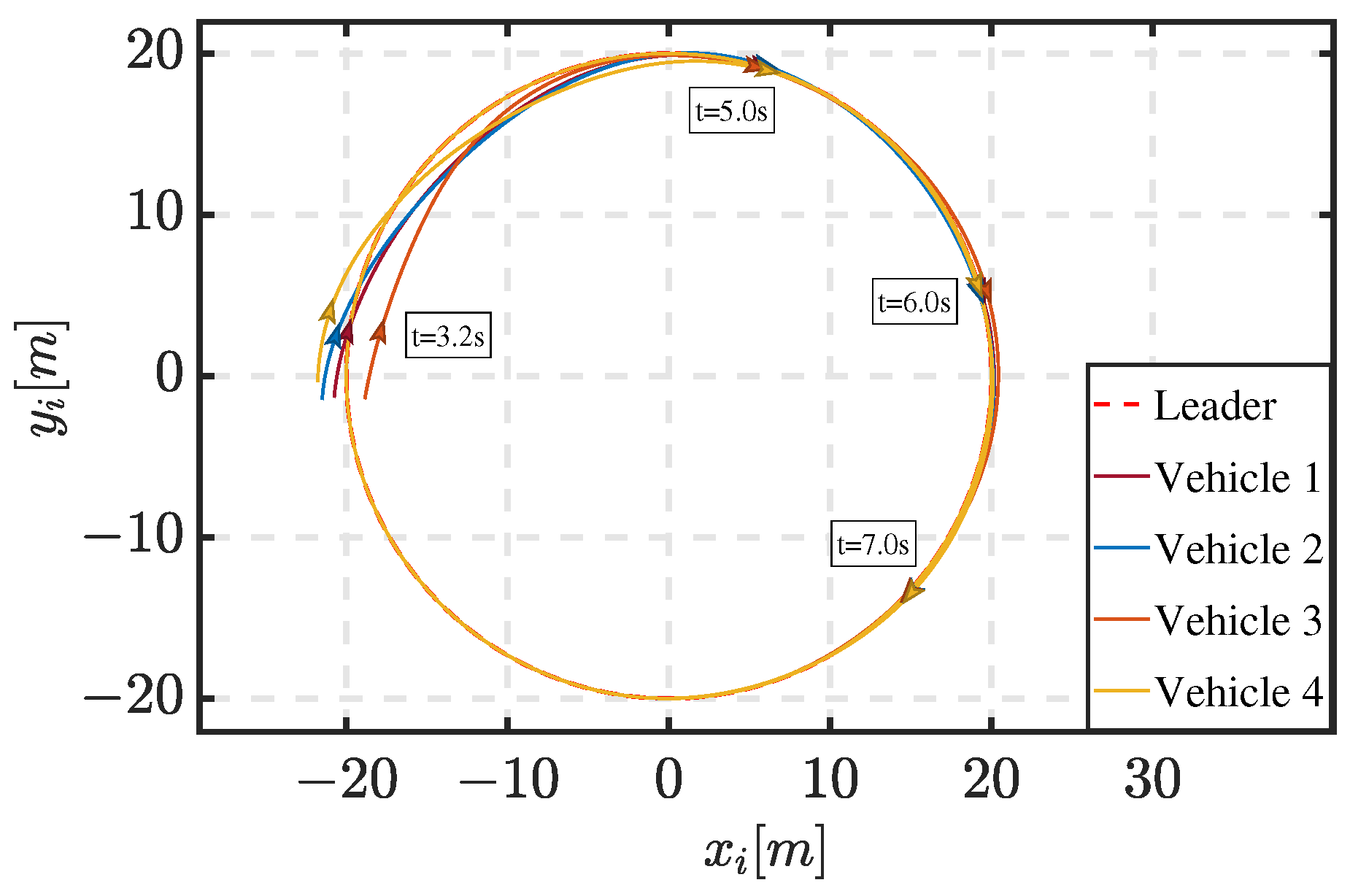
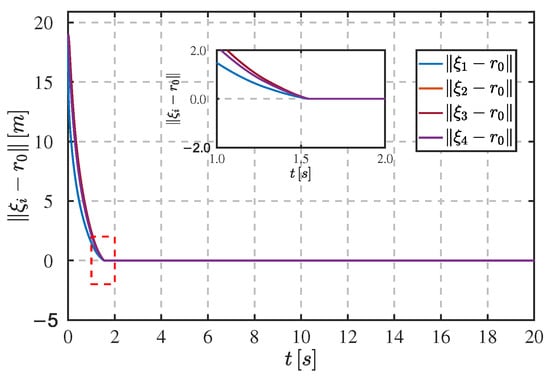
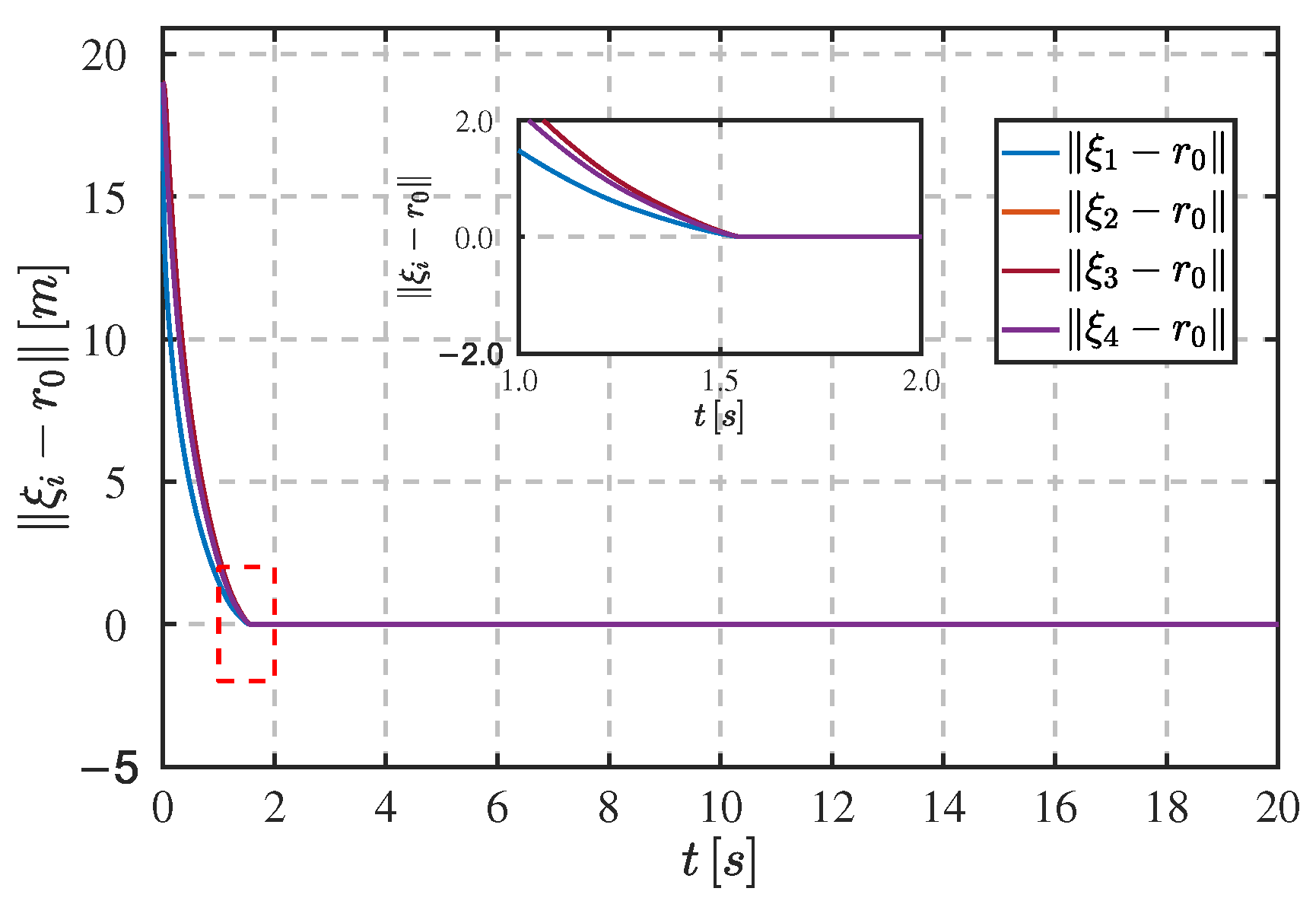
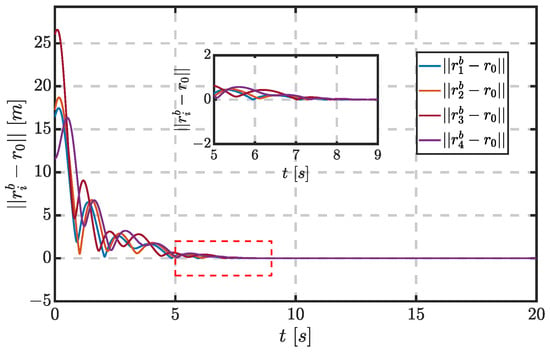
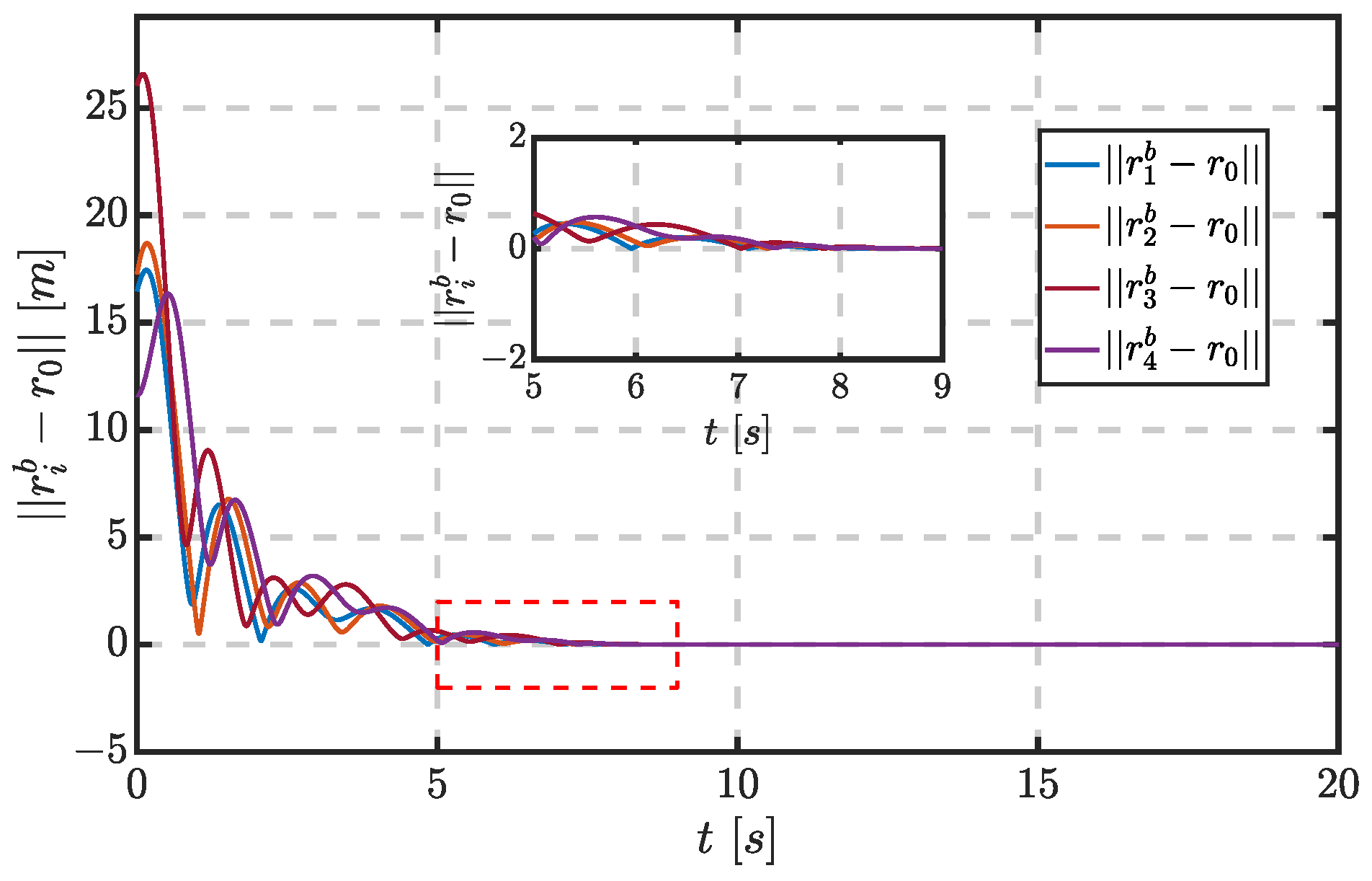
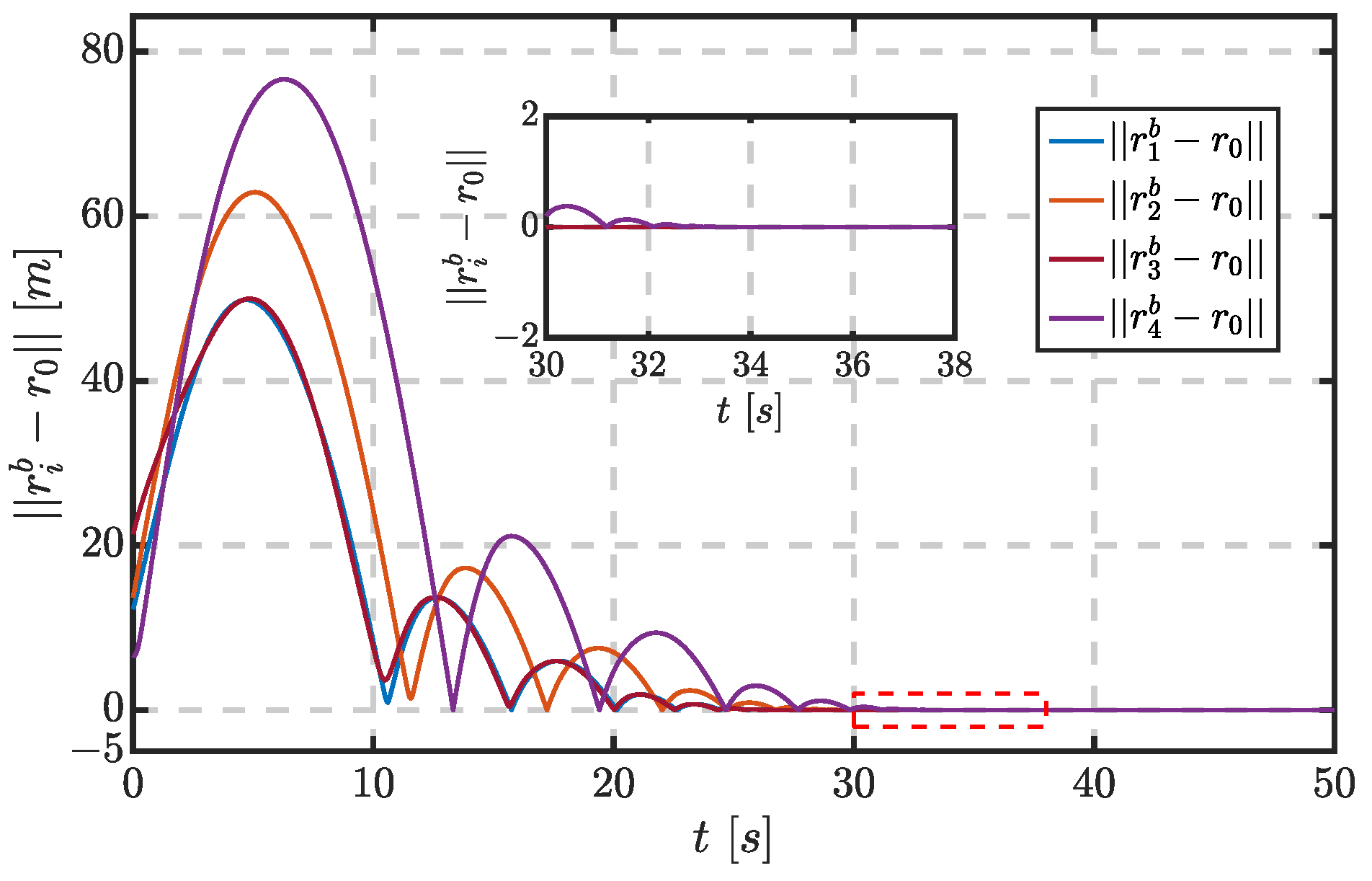
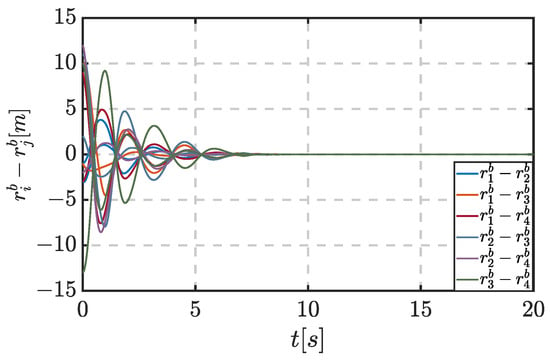
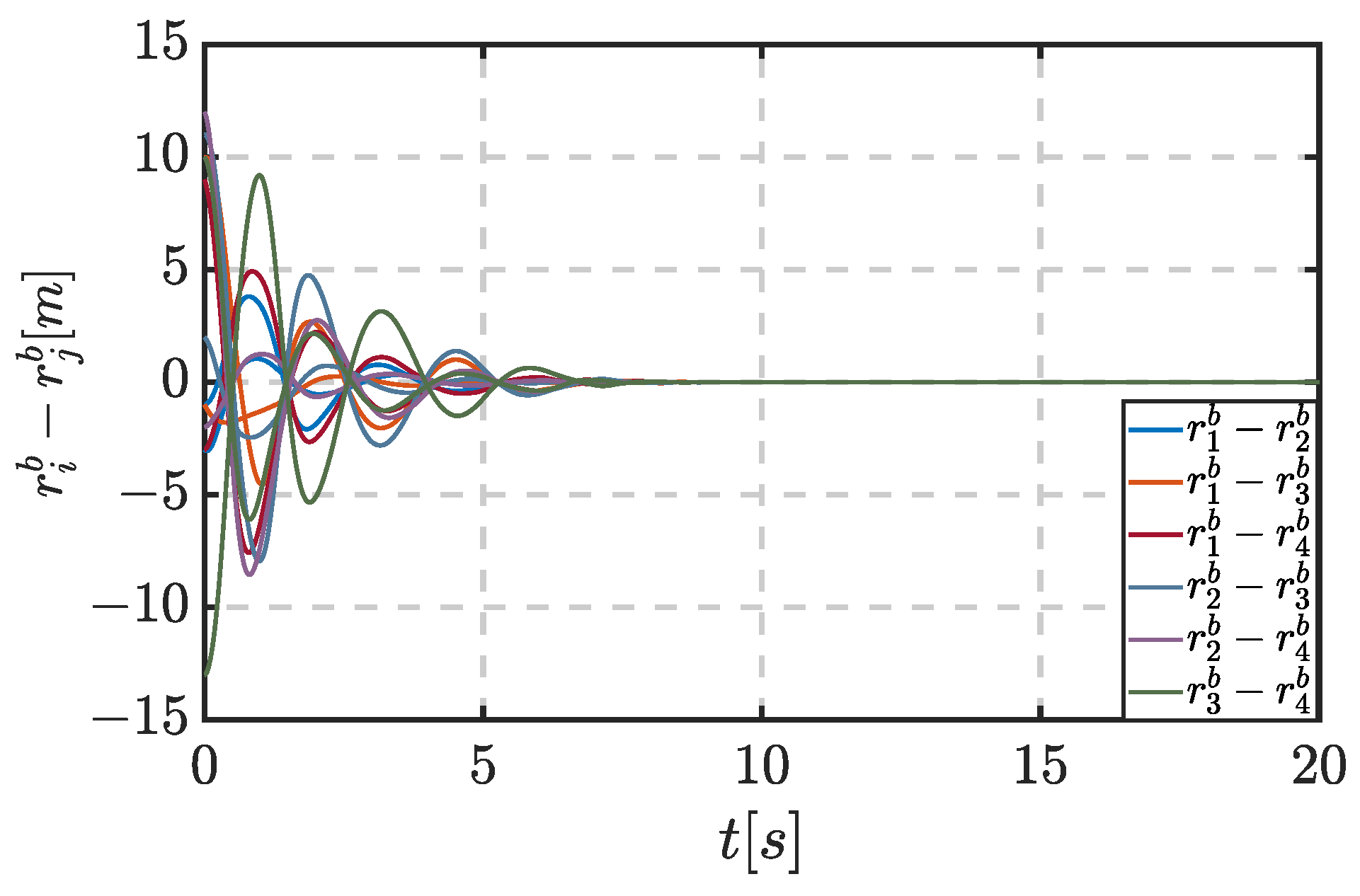
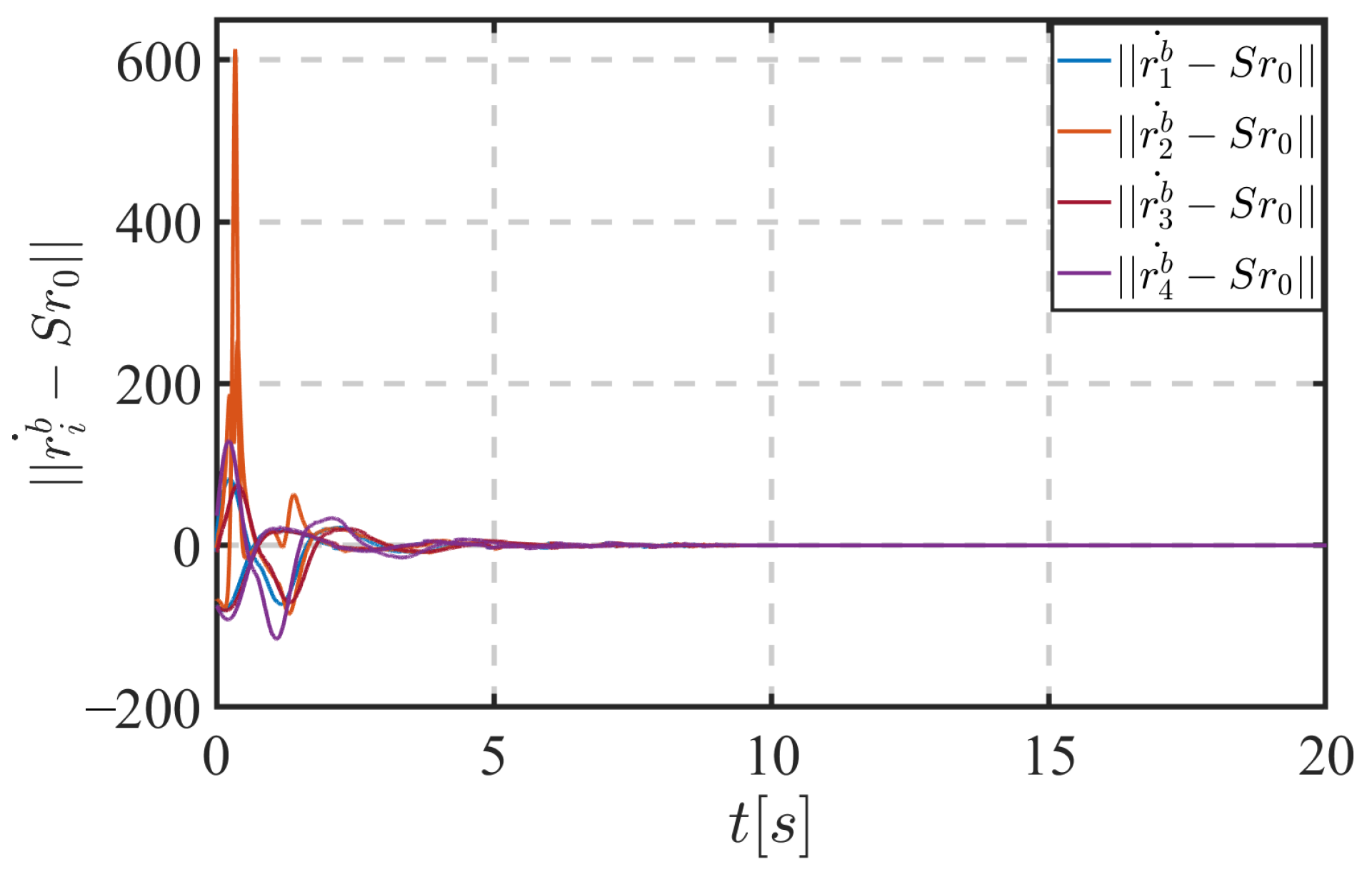
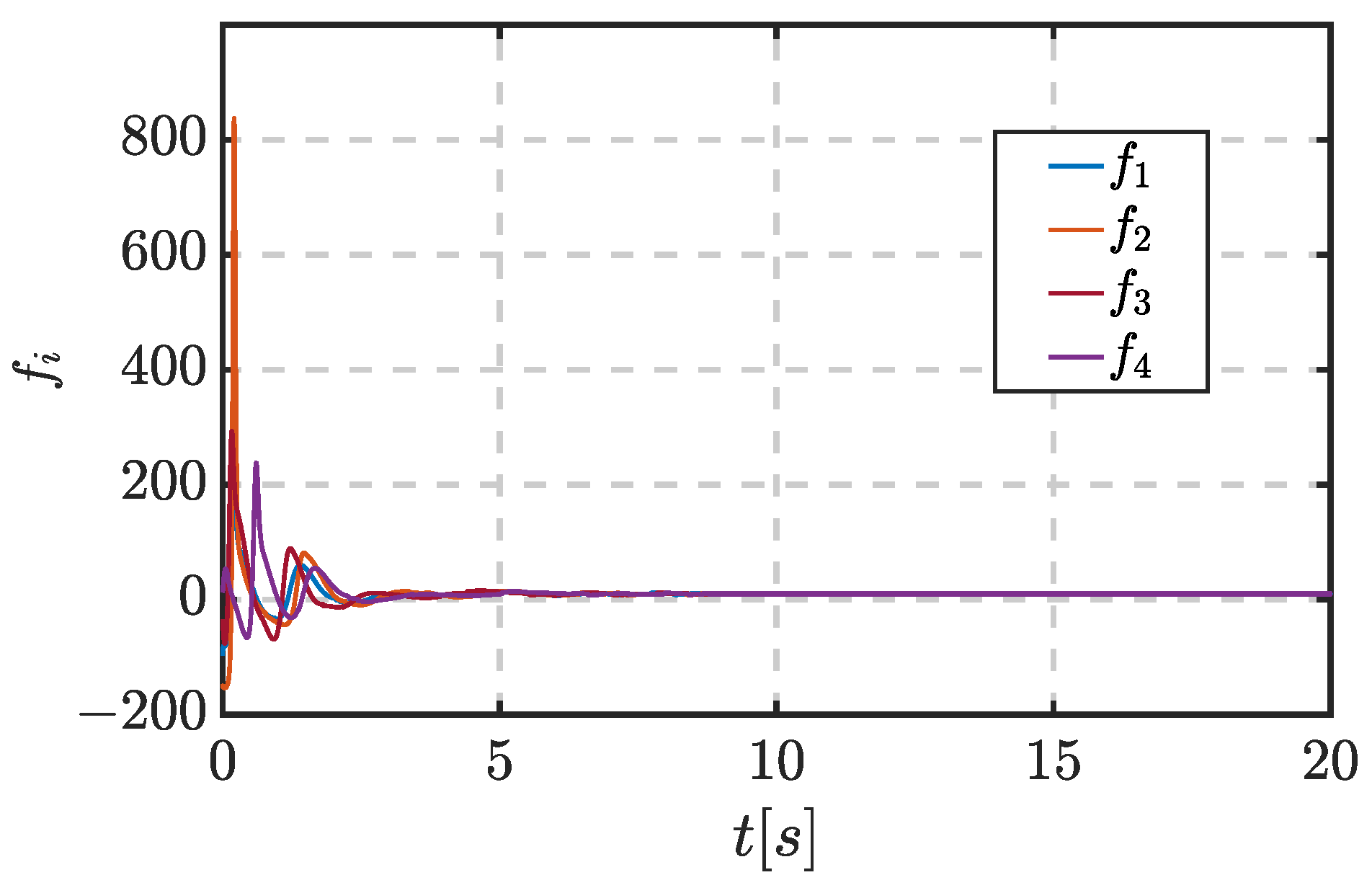
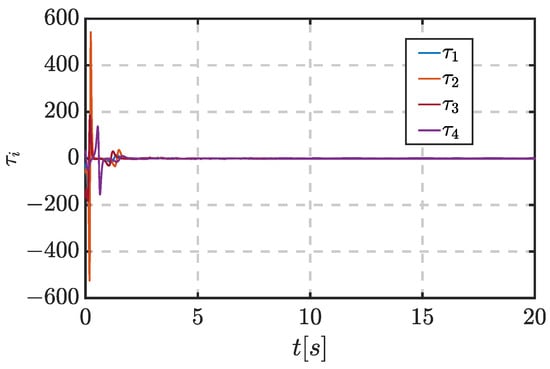
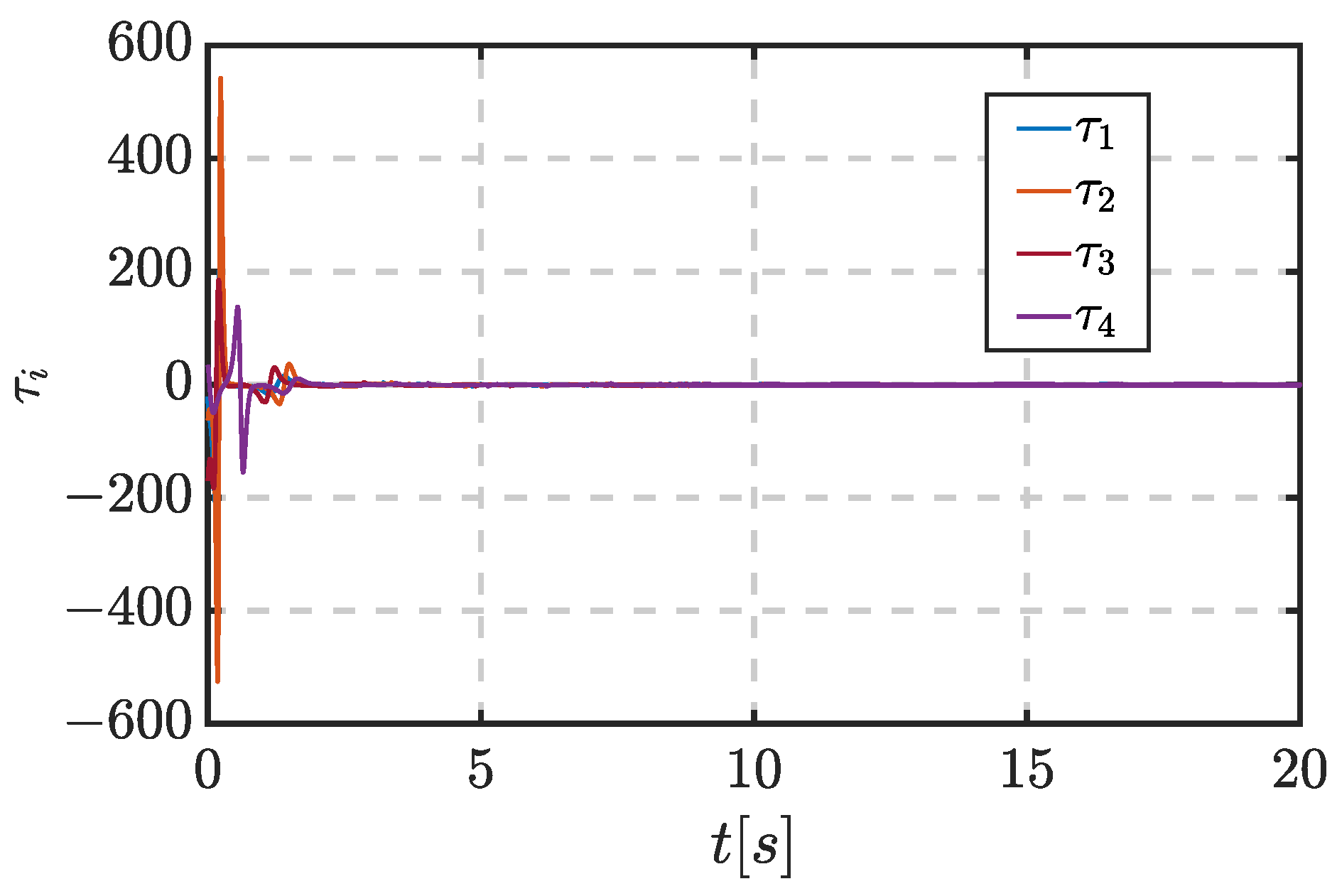
Simulation results are shown in Figure 2, Figure 3, Figure 4, Figure 5 and Figure 6. Figure 2 depicts the motion trajectories of the leader and underactuated mobile vehicles. The arrows in the figure indicate the direction of the heading angle of each vehicle. It can be observed that the underactuated mobile vehicles are capable of tracking the moving leader and achieving rotating consensus motion around the leader, and their motion trajectories eventually tend to coincide with each other, which indicates that the system realizes fixed-time rotating consensus. Figure 3 shows the time response curve of . It can be seen that the designed distributed fixed-time observer can estimate the position of the leader within 1.5 s. According to Equation (27), the theoretical fixed-time convergence bound satisfies . Therefore, the simulation results are in good agreement with the theoretical calculation. Figure 4 presents the relative distances between the underactuated mobile vehicles and the leader under the fixed-time controller, which finally converge to zero. Figure 5 illustrates the relative distance between the agent and the moving target under the finite-time controller (25). It can be readily observed that the convergence process of the relative distance relies on the system’s initial conditions: a larger initial relative distance leads to a longer convergence time, while a smaller one yields faster convergence. In comparison, the convergence time of the system under the fixed-time controller is independent of the initial states. Figure 6 illustrates the relative distances among the underactuated mobile vehicles under the fixed-time controller, which also converge to zero eventually. Figure 7 shows that the velocity errors of each underactuated mobile vehicle converge to zero in fixed time. Figure 8 and Figure 9, respectively, present the time-varying curves of the system control inputs and . Simulation results reveal that the control input converges to a nonzero constant, whereas converges to zero. This physical phenomenon admits a reasonable interpretation: under steady-state conditions, underactuated mobile vehicles are required to maintain continuous rotation around the leader. Consequently, a nonzero longitudinal force is adopted to counteract damping effects and preserve the target rotational angular velocity. By contrast, once steady-state coordination of the heading direction is achieved, substantial steering corrections are no longer needed, so the torque input gradually converges to zero. In summary, the controllers (9) and (16) guarantee that the vehicles achieve uniform circular motion around the leader and achieve fixed-time rotating consensus.
Figure 2.
Trajectory plot of leader and underactuated mobile vehicles.
Figure 3.
Time evolution of under fixed-time control.
Figure 4.
Fixed-time relative error curves between underactuated mobile vehicles and the leader.
Figure 5.
Finite-time relative distance curves among underactuated mobile vehicles.
Figure 6.
Fixed-time relative distance curves among underactuated mobile vehicles.
Figure 7.
Time evolution of under fixed-time control.
Figure 8.
Time evolution of under fixed-time control.
Figure 9.
Time evolution of under fixed-time control.
5. Conclusions
This study investigated the fixed-time rotating consensus control problem of multiple second-order underactuated mobile vehicles considering inherent underactuated characteristics and nonholonomic kinematic constraints. These two types of constraints brought huge difficulties to the consensus control of multi-vehicle systems in practical engineering applications. To eliminate the negative impacts of nonholonomic limitations and underactuated properties, researchers proposed a bias point transformation method in this work. This method equivalently converted the original complex underactuated nonholonomic system into a holonomic integrable system, which built a solid theoretical basis for the subsequent design of fixed-time rotating consensus controllers. In view of the actual communication limitation that some follower vehicles failed to obtain the position state information of the virtual leader directly, this paper designed a distributed fixed-time observer. The designed observer realized precise state estimation of the virtual leader for all mobile vehicles in the tracking control loop. Meanwhile, auxiliary signal variables were adopted to solve the engineering difficulty that real-time velocity measurement data between adjacent vehicles could not be acquired easily in physical experiments. In terms of theoretical verification, this paper adopted Lyapunov stability theory together with the bi-limit homogeneous technique to carry out strict stability analysis. The analytical results demonstrated that the proposed distributed control strategy enabled the overall multi-vehicle system to reach rotating consensus within a fixed convergence time, and this settling time was independent of all initial system states. Finally, comparative numerical simulation experiments were conducted, and the simulation results verified the feasibility, reliability and superior control performance of the developed distributed fixed-time control framework for multi-underactuated mobile vehicles.
Finally, this work only validates the theoretical performance via numerical simulations without physical platform experiments. In future research, we will further carry out hardware-in-the-loop or prototype experiments to verify the practical engineering applicability of the proposed method. However, the current controller design mainly focuses on theoretical fixed-time stability analysis, while insufficient discussions are provided on key engineering issues arising from parameter selection, including actuator saturation, high-frequency chattering and excessive energy consumption. The power nonlinear terms adopted to guarantee fixed-time convergence will drastically amplify control signals under large state deviations, which may drive physical actuators such as motors and servos into saturation, degrade closed-loop control performance, and even endanger system operational safety. Accordingly, in our follow-up research, we will quantitatively analyze the trade-off between the upper bound of fixed-time settling time and the adverse effects of actuator saturation, chattering and energy consumption. Furthermore, input saturation constraints will be explicitly incorporated into the controller construction and stability proof to enhance the engineering practicability of the developed algorithm for real-world multi-vehicle coordination scenarios.
Author Contributions
Conceptualization, X.S. and C.C.; methodology, L.K.; software, X.S.; validation, Y.D.; formal analysis, L.K.; investigation, Y.H.; resources, Y.H.; data curation, C.C.; writing—original draft preparation, X.S. and L.K.; writing—review and editing, C.C. and L.K.; visualization, X.S.; supervision, Y.D.; project administration, Y.D.; funding acquisition, Y.H. All authors have read and agreed to the published version of the manuscript.
Funding
This work was supported in part by the National Key Research and Development Program of China (Grant No. 2022YFC2807603), in part by the National Natural Science Foundation of China (Grant Nos. 62503353, 62403193, and 62403346), in part by the Science and Technology Innovation Program of Hunan Province (Grant No. 2024RC9015), and in part by Research and Development of Key Technologies for New Power System Sources and Storage under Extreme Conditions and Simulation Test Platform (Grant No. SXEIRI-ZDZD-2024002), in part by the Science and Technology Innovation Program of Hunan Province under Grant 2025RC3197, and in part by the Hainan Province National Natural Science Foundation of China under Grant 626MS0242.
Data Availability Statement
The data presented in this study are available on request from the corresponding author.
Conflicts of Interest
The authors declare no conflicts of interest.
References
- Yang, R.; Liu, L.; Feng, G. An Overview of Recent Advances in Distributed Coordination of Multi-Agent Systems. Unmanned Syst. 2021, 10, 307–325. [Google Scholar] [CrossRef] [Scilit]
- Hu, J.; Bhowmick, P.; Lanzon, A. Group Coordinated Control of Networked Mobile Robots With Applications to Object Transportation. IEEE Trans. Veh. Technol. 2021, 70, 8269–8274. [Google Scholar] [CrossRef] [Scilit]
- Zhao, W.; Liu, H.; Lewis, F.L. Robust Formation Control for Cooperative Underactuated Quadrotors via Reinforcement Learning. IEEE Trans. Neural Netw. Learn. Syst. 2021, 32, 4577–4587. [Google Scholar] [PubMed]
- Wu, S.; Zhang, H.; Qian, Y. Reinforcement Learning Strategy-Based Adaptive Tracking Control for Underactuated Dual Ship-Mounted Cranes: Theoretical Design and Hardware Experiments. IEEE Trans. Ind. Electron. 2025, 72, 5408–5417. [Google Scholar]
- Wei, Q.; Wang, X.; Zhong, X.; Wu, N. Consensus Control of Leader-Following Multi-Agent Systems in Directed Topology With Heterogeneous Disturbances. IEEE/CAA J. Autom. Sin. 2021, 8, 423–431. [Google Scholar] [CrossRef] [Scilit]
- Ding, R.; Hu, W.; Yang, Y. Rotating consensus control of double-integrator multi-agent systems with event-based communication. Sci. China Inf. Sci. 2020, 63, 150203. [Google Scholar] [CrossRef] [Scilit]
- Hasanzadeh, M.; Tang, S.-X. Encirclement Control for PDE-Based Leader-Follower Multi-Agent Systems with Targets in a Sphere: Part 2—Rotation Encirclement. In Proceedings of the 63rd IEEE Conference on Decision and Control, Milan, Italy, 16–19 December 2024; IEEE: New York, NY, USA, 2024; pp. 7160–7165. [Google Scholar]
- Lin, P.; Jia, Y. Distributed rotating formation control of multi-agent systems. Syst. Control Lett. 2010, 59, 587–595. [Google Scholar] [CrossRef] [Scilit]
- Scardovi, L.; Leonard, N.E.; Sepulchre, R. Stabilization of collective motion in three dimensions: A consensus approach. In Proceedings of the 46th IEEE Conference on Decision and Control, New Orleans, LA, USA, 12–14 December 2007; IEEE: New York, NY, USA, 2007; pp. 2931–2936. [Google Scholar]
- Wang, Y.; Sun, Q. Sampled-data collective rotating consensus for second-order networks under directed interaction. Int. J. Control Autom. Syst. 2015, 13, 1057–1066. [Google Scholar] [CrossRef] [Scilit]
- Mo, L.; Yuan, X.; Jia, Y. Mean-square Quasi-composite Rotating Formation Control of Second-order Multi-agent Systems under Stochastic Communication Noises. J. Robot. Netw. Artif. Life 2019, 6, 89–96. [Google Scholar] [CrossRef] [Scilit]
- Chen, X.; Chen, H. Event-Triggered Time-Varying Formation Tracking Control for Multi-Agent Systems with a Switching-Directed Topology. Mathematics 2023, 11, 4245. [Google Scholar]
- Wang, L.; Xiao, F. Finite-Time Consensus Problems for Networks of Dynamic Agents. IEEE Trans. Autom. Control 2010, 55, 950–955. [Google Scholar] [CrossRef] [Scilit]
- Guan, Z.H.; Sun, F.L.; Wang, Y.W.; Li, T. Finite-Time Consensus for Leader-Following Second-Order Multi-Agent Networks. IEEE Trans. Circuits Syst. I Regul. Pap. 2012, 59, 2646–2654. [Google Scholar] [CrossRef] [Scilit]
- Cao, Y.; Ren, W. Finite-time consensus for multi-agent networks with unknown inherent nonlinear dynamics. Automatica 2014, 50, 2648–2656. [Google Scholar]
- Polyakov, A. Nonlinear Feedback Design for Fixed-Time Stabilization of Linear Control Systems. IEEE Trans. Autom. Control 2012, 57, 2106–2110. [Google Scholar]
- Zuo, Z.; Yang, W.; Tie, L.; Meng, D. Fixed-time consensus for multi-agent systems under directed and switching interaction topology. In Proceedings of the 2014 American Control Conference, Portland, OR, USA, 4–6 June 2014; IEEE: New York, NY, USA, 2014; pp. 5133–5138. [Google Scholar]
- Polyakov, A.; Efimov, D.; Perruquetti, W. Finite-time and fixed-time stabilization: Implicit Lyapunov function approach. Automatica 2015, 51, 332–340. [Google Scholar]
- Smith, E.; Robinson, D.; Agalgaonkar, A. Cooperative Control of Microgrids: A Review of Theoretical Frameworks, Applications and Recent Developments. Energies 2021, 14, 8026. [Google Scholar] [CrossRef] [Scilit]
- Zhou, N.; Cheng, X.; Xia, Y.; Liu, Y. Distributed Formation Control of Multi-Robot Systems: A Fixed-Time Behavioral Approach. In Proceedings of the 59th IEEE Conference on Decision and Control, Jeju, Republic of Korea, 14–18 December 2020; IEEE: New York, NY, USA, 2020; pp. 4017–4022. [Google Scholar]
- Kou, L.; Huang, Y.; Zuo, G.; Jian, L.; Dou, Y. Fixed-time rotating consensus control of second-order multi-agent systems. Int. J. Robust. Nonlinear Control 2024, 34, 12031–12049. [Google Scholar]
- Ou, M.; Du, H.; Li, S. Finite-time formation control of multiple nonholonomic mobile robots. Int. J. Robust. Nonlinear Control 2014, 24, 140–165. [Google Scholar] [CrossRef] [Scilit]
- Lu, W.; Wang, Y.; Jiao, D.; Zou, A.M. Finite-Time Formation Tracking Control of Multiple Nonholonomic Mobile Robots Under Control Input Constraints. In Proceedings of the 2023 China Automation Congress, Chongqing, China, 17–19 November 2023; IEEE: New York, NY, USA, 2023; pp. 3731–3736. [Google Scholar]
- d’Andrea-Novel, B.; Bastin, G.; Campion, G. Dynamic feedback linearization of nonholonomic wheeled mobile robots. In Proceedings of the 1992 IEEE International Conference on Robotics and Automation, Nice, France, 12–14 May 1992; IEEE: New York, NY, USA, 1992; pp. 2527–2532. [Google Scholar]
- Ou, M.; Sun, H.; Zhang, Z.; Li, L.; Wang, X. Fixed-time tracking control for nonholonomic mobile robot. Kybernetika 2021, 57, 220–235. [Google Scholar] [CrossRef] [Scilit]
- Liang, C.-D.; Huang, K.-L.; Zhan, X.-S.; Han, T.; Chen, Q.; Ge, M.-F. Fault-Tolerant Formation of Interlinked Marine Surface Vehicles Based on Fixed-Time Distributed Optimization. IEEE Internet Things J. 2026, 13, 3200–3210. [Google Scholar] [CrossRef] [Scilit]
- Andrieu, V.; Praly, L.; Astolfi, A. Homogeneous approximation, recursive observer design, and output feedback. SIAM J. Control Optim. 2008, 47, 1814–1850. [Google Scholar] [CrossRef] [Scilit]
- Zuo, Z. Nonsingular fixed-time consensus tracking for second-order multi-agent networks. Automatica 2015, 54, 305–309. [Google Scholar]
- Kim, B.M.; Tsiotras, P. Controllers for unicycle-type wheeled robots: Theoretical results and experimental validation. IEEE Trans. Robot. Autom. 2002, 18, 294–307. [Google Scholar] [CrossRef]
- Kim, D.-H.; Oh, J.-H. Tracking control of a two-wheeled mobile robot using input–output linearization. Control Eng. Pract. 1999, 7, 369–373. [Google Scholar] [CrossRef] [Scilit]
- Moreno-Valenzuela, J. Constrained trajectory tracking control of a mobile robot by limited integrator anti-windup. IEEE Trans. Circuits Syst. II Express Briefs 2022, 69, 1422–1426. [Google Scholar]

Disclaimer/Publisher’s Note: The statements, opinions and data contained in all publications are solely those of the individual author(s) and contributor(s) and not of MDPI and/or the editor(s). MDPI and/or the editor(s) disclaim responsibility for any injury to people or property resulting from any ideas, methods, instructions or products referred to in the content. |
© 2026 by the authors. Licensee MDPI, Basel, Switzerland. This article is an open access article distributed under the terms and conditions of the Creative Commons Attribution (CC BY) license.