


Abstract
Accurate and unobtrusive measurement of upper-limb kinematics is critical for advancing wearable sensing technologies used in industrial ergonomics, human–machine interaction, and real-time biomechanics monitoring. This study evaluates the performance of two soft, flexible wearable sensors—BendLabs biaxial angular displacement sensors and StretchSense capacitive stretch sensors—for quantifying wrist and elbow motions during simulated dynamic industrial tasks. Wrist flexion–extension and radial–ulnar deviation were measured using BendLabs sensors mounted on the dorsal hand, while elbow flexion–extension was captured using StretchSense sensors positioned along the elbow joint. A multi-camera optical motion capture system served as the reference standard. Sensor data were preprocessed using baseline correction, smoothing, denoising, and normalized cross-correlation techniques to support temporal alignment with motion-capture recordings. Across all activities, the BendLabs sensors demonstrated moderate agreement with motion capture for wrist kinematics, with generally better performance for radial–ulnar deviation than for flexion–extension. StretchSense sensors demonstrated stronger agreement with motion capture for elbow flexion–extension, with performance that was generally consistent across task types. These findings support the feasibility of soft wearable sensors for capturing upper-limb kinematics during simulated occupational tasks and highlight their potential for integration into ergonomic assessment, occupational monitoring systems, and future industrial wearable platforms.
1. Introduction
Grip strength is one of several components to consider when examining hand function, and many upper-extremity assessments are based on observation and subjective impressions. However, grip-strength measurement can provide objective and quantifiable information regarding hand function when adequately obtained. Alongside task repetition and forceful exertion, awkward wrist and elbow postures are recognized occupational risk factors for upper-extremity musculoskeletal disorders and cumulative trauma disorders [1,2,3]. Various studies have demonstrated that body positioning can affect grip-strength performance [4,5,6]. Furthermore, quantification of body-segment position and displacement is an integral component of biomechanical analysis, particularly in occupational settings in which repetitive motion, forceful exertion, and non-neutral joint postures contribute to upper-extremity musculoskeletal loading [1,3]. Because wrist and elbow posture influence both hand performance and tissue loading, objective quantification of upper-limb kinematics is important for occupational biomechanics and ergonomic risk assessment.
Several factors play a role in grip-force production, including variation in muscle length, muscle and tendon compliance, joint condition, and body or joint configuration. The hand is an end-effector of the multilink kinematic chain of the human body. Therefore, a positional change in any proximal segment may influence hand performance. It has been reported that handgrip strength is dependent on body posture and on the angular position of the shoulder, elbow, forearm, wrist joint, metacarpophalangeal joint, and interphalangeal joint. Among these factors, wrist position has been shown to be one of the most critical determinants of grip and pinch strength capabilities [5]. Awkward hand and wrist posture has also often been reported as a risk factor associated with hand and wrist problems [1]. Wrist deviations from the neutral position can lead to substantial losses in grip strength, increasing the amount of force required to perform a given task. The posture of the hand and forearm directly affects the force muscles must generate during task execution. Working in awkward postures imposes biomechanical stress on joints and soft tissues, contributing to strain and injury in the hand and wrist because muscular strength is limited in certain positions. Exertions in these weaker postures, therefore, require muscles to operate nearer their maximum capacity. Sustained exertions in mechanically disadvantaged postures may accelerate fatigue and increase loading of the muscles, tendons, and nerves of the hand and wrist [3,7]. In addition, occupational ergonomic studies have consistently identified awkward wrist deviation, repetitive hand activity, and forceful exertion as key exposure variables associated with upper-extremity musculoskeletal risk [2,3].
Besides the hand and wrist, the elbow is also affected by physical exposure during occupational activities. A systematic review by van Rijn et al. reported quantitative exposure–response relationships between work-related factors and specific elbow disorders [8]. The authors found an association between four work-related disorders at the elbow (lateral epicondylitis, medial epicondylitis, cubital tunnel syndrome, and radial tunnel syndrome) and certain occupational risk factors. In addition to psychosocial factors, physical exposure specifications such as handling tools > 1 kg, handling loads > 5 kg (2 times/min for more than 2 h/day), high handgrip forces > 1 h/day, repetitive hand/arm movement > 2 h/day, lifting the arms and bending the hands for more than 75% of working time, and working with power tools > 2 h/day were associated with increased risk [8]. The review also reported that cubital tunnel syndrome was associated with the risk factor of holding a tool in position. Handling loads > 1 kg with a frequency of exertion of 10 times/h, static hand work during the majority of the cycle time, and full elbow extension were associated with radial tunnel syndrome [8]. Various studies have also demonstrated the impact of elbow position on grip strength. Mathiowetz et al. found that grip-strength scores were higher with the elbow positioned at 90° of flexion than the elbow in full extension [4]. Kuzala and Vargo found greater grip strength at 0° of flexion and the weakest grip strength at 135° of flexion [6]. More recent evidence has continued to support the role of quantified physical exposures, including force, posture, repetition, and forearm rotation, in work-related elbow disorders, reinforcing the need for objective tools that can characterize upper-limb kinematics during realistic tasks [9,10].
Active and passive cinematographic systems, video motion-analysis systems, and electromagnetic field-based systems have often been used in the laboratory to track body-segment position and displacement. Although accurate, these systems have several drawbacks, including costs, technical limitations, operator skill requirements, and limited portability for measurement outside the laboratory. Thus, a non-invasive system for human motion monitoring that can provide objective feedback remains an important need. Recent reviews of wearable monitoring for workplace biomechanical risk assessment, upper-limb motion tracking, and soft mechanical sensors have highlighted the potential for field-deployable biomechanical monitoring while also emphasizing persistent challenges related to calibration, sensor placement, hysteresis, drift, and validation against reference standards [11,12,13,14].
The aim of the present study was to evaluate the usability of the BendLabs sensor for tracking wrist joint kinematics and to validate StretchSense stretch sensors embedded in an elbow brace against a motion-capture system for elbow joint kinematics. The biaxial BendLabs sensor attached to the dorsal region of the hand allows direct determination of wrist angular displacement in the flexion–extension and radial–ulnar planes. The StretchSense sensor attached to the elbow joint may likewise support quantification of elbow motion during functional industrial tasks. Together, these sensing approaches may help extend joint-kinematic analysis beyond traditional laboratory environments and support future ergonomic monitoring in applied occupational settings [11,14]. Outcomes of this study include a novel comparison of wearable sensors when used in comparison to the gold standard motion-capture during dynamic industrial tasks, as well as a customized data collection, processing, and analysis pipeline that can be used for wearable research. Additionally, this study focuses especially on the hand and elbow, which have been explored less in comparison to lower limb kinematics with wearable systems.
While previous studies have validated wearable sensors for upper-limb kinematics in laboratory settings using isolated or repetitive movements (e.g., [11,12,15]), the present study offers several novel contributions. First, to the best of our knowledge, this is one of the first studies to validate BendLabs biaxial angular displacement sensors and StretchSense capacitive stretch sensors specifically for simulated industrial tasks (hammering, drilling, and wire crimping) rather than basic range-of-motion exercises. Second, unlike prior work that focused primarily on lower-limb kinematics or single-joint tracking, this study simultaneously evaluates wrist (flexion–extension and radial–ulnar deviation) and elbow (flexion–extension) kinematics using two distinct soft sensor technologies. Third, we provide a complete, customizable preprocessing pipeline (including wavelet denoising, noise peak cancellation, and normalized cross-correlation) that can be adopted by other researchers in wearable sensor validation [16]. Fourth, we explicitly quantify agreement using three complementary metrics (R2, RMSE, and MAE) with predefined interpretation thresholds adapted from [17], facilitating cross-study comparison. These contributions collectively advance the field of occupational ergonomics by demonstrating the feasibility of soft wearable sensors for monitoring upper-limb kinematics outside traditional laboratory environments.
2. Materials and Methods
2.1. Participants and Ethical Approval
This study was approved by the Mississippi State University Institutional Review Board (IRB Protocol #21-184). All participants were informed of the testing procedures before participation and provided written informed consent prior to data collection.
A statistical power analysis was conducted to determine the required sample size, and 36 participants were enrolled based on an alpha level of 0.05 (two-tailed), 80% power, and an expected correlation coefficient of r = 0.45. The value of r = 0.45 was selected to represent a moderate effect size, which is consistent with standard practices in correlation-based sample size estimation [18,19]. Such moderate correlations are commonly observed in wearable sensor validation and biomechanical studies due to factors such as sensor noise, soft tissue artifacts, and inter-subject variability. Thus, a total of 36 healthy adults participated in the study, including 18 males and 18 females. Participants were screened to ensure no prior history of neuromuscular or orthopedic dysfunction that would significantly affect hand strength. Before testing, participants completed a Physical Activity Readiness Questionnaire (PAR-Q) and musculoskeletal discomfort screening questionnaires for the dominant hand and whole body to identify potential safety concerns and establish eligibility for participation. Participant characteristics, including age, sex, hand dominance, hand size, height, weight, and general health status, were recorded prior to testing. The participants had a mean age of 23.86 ± 4.42 years, a mean height of 1.704 ± 0.105 m, and a mean body mass of 70.42 ± 12.18 kg.
2.2. Study Design and Experimental Procedure
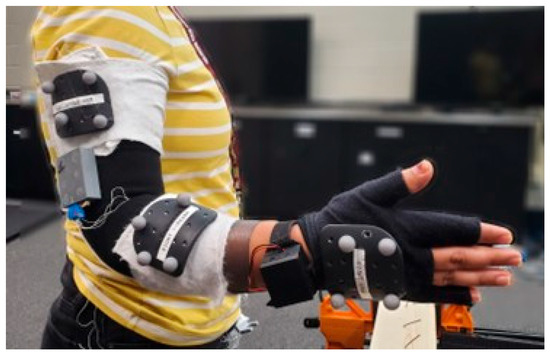
A realistic model workplace was established in the Human Performance Laboratory at the Center for Advanced Vehicular Systems (Mississippi State University, Starkville, MS, USA). Experimental testing was designed to measure wrist and elbow kinematics during simulated industrial tasks using optical motion capture as the reference method. Upper-extremity kinematic data were collected using a 12-camera Vicon Bonita motion-capture system, with marker trajectories and joint-angle outputs processed in the MotionMonitor xGen (Innovative Sports Training, Inc., Chicago, IL, USA). Reflective marker clusters were placed on the dominant upper extremity at the upper arm, forearm, and hand according to the layout shown in Figure 1, and each participant was calibrated in the MotionMonitor environment to generate a generic skeletal model for kinematic recording.
Figure 1.
Placement of reflective marker clusters on participant’s dominant hand, forearm, and upper arm.
The study design included an initial familiarization session conducted prior to experimental testing. During the session, each participant was briefed on the study procedures and given the opportunity to perform practice trials to become accustomed to the work environment and task requirements.
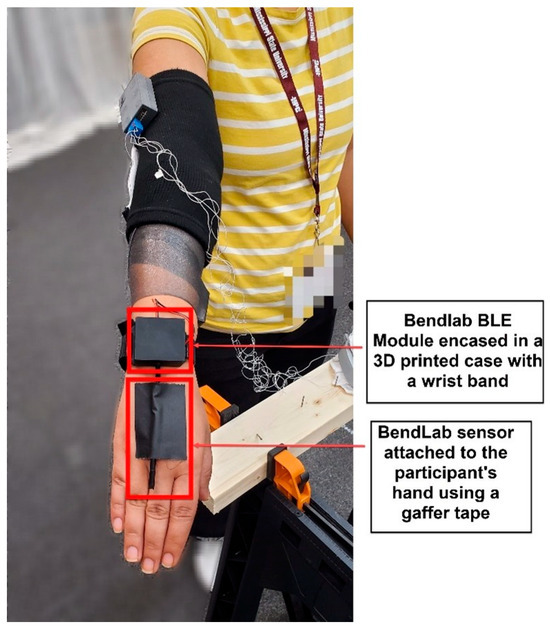
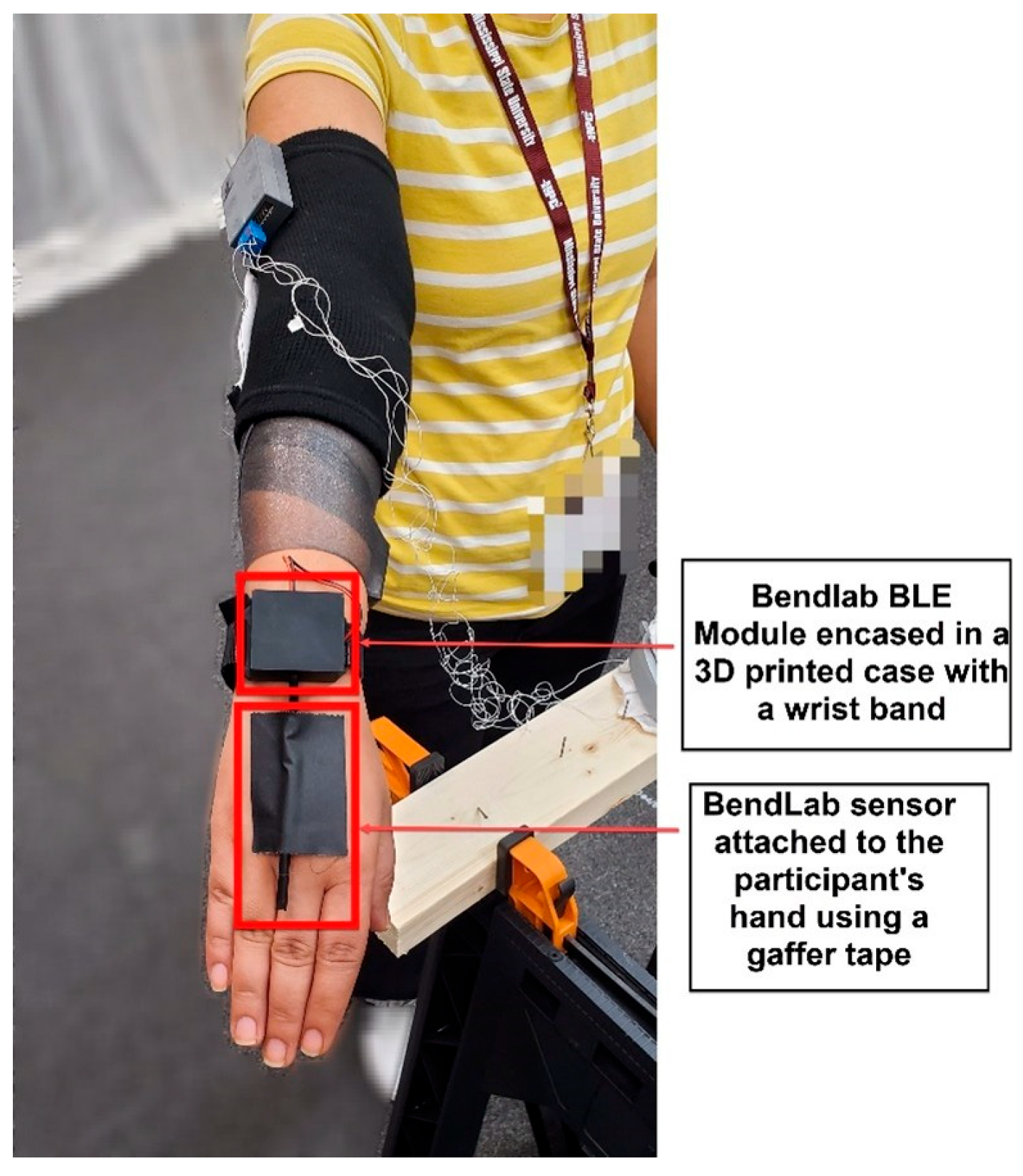
For wrist-angle measurements, a BendLabs biaxial angular displacement sensor (Bend Labs, now Nitto Bend Technologies, Farmington, UT, USA) was attached to the dominant hand over the region of greatest skin deformation during wrist motion, at the middle of the junction between the wrist and palm. The sensor was secured to the skin using gaffer tape to reduce sensor sliding during movement, as seen in Figure 2. The BendLabs sensor measured wrist angular displacement in two orthogonal planes, flexion–extension and radial–ulnar deviation. This two-way curvature of the sensor allowed for direct comparison of the wearable sensor data to two planes of motion collected from the motion-capture system. BendLabs data were collected using a custom application developed by the research team, and the sensor was calibrated before each trial.
Figure 2.
BendLabs sensor positioning on the subject’s dominant hand.
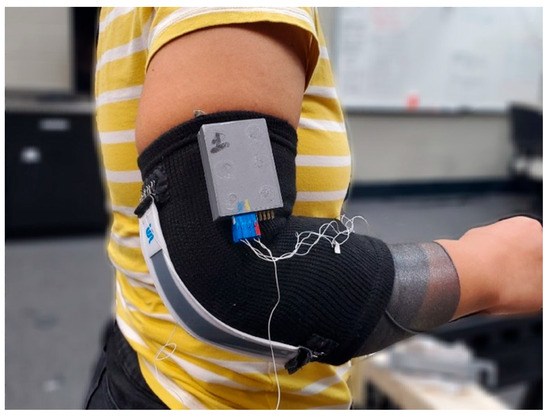
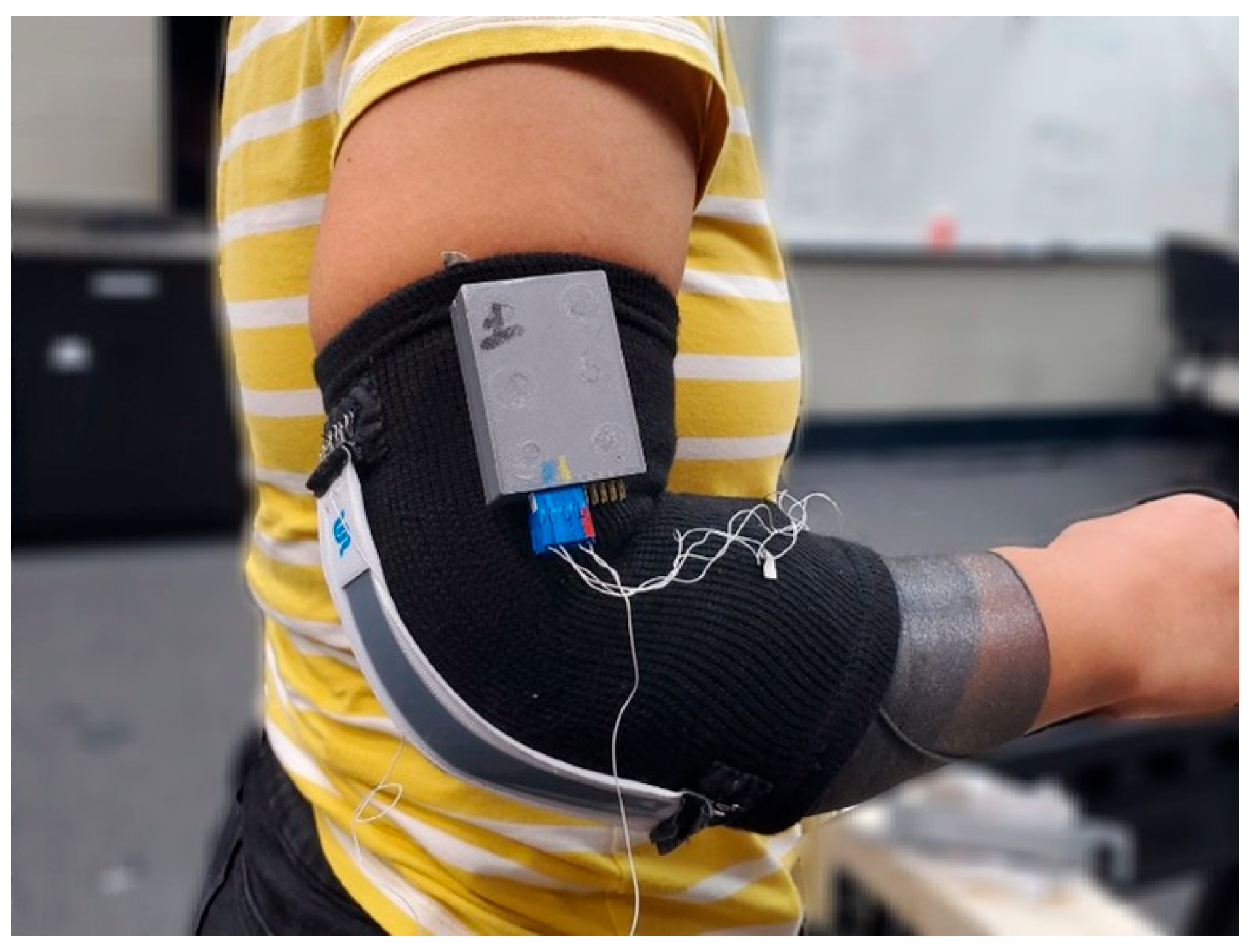
For elbow-angle measurements, a StretchSense stretch sensor (StretchSense, Auckland, New Zealand) was attached to the posterior side of a customized elbow sleeve using a hook-and-eye fastening method. The sleeve was fitted skin-tight to reduce garment shift during movement, and the sensor was positioned on the posterior aspect of the elbow sleeve to undergo substantial elongation as the elbow moved from full extension to full flexion. However, it is important to note that wearable sensors mounted on the skin are inherently susceptible to soft tissue artifacts. During dynamic movements, deformation and displacement of underlying soft tissues may result in partial decoupling between the sensor output and actual skeletal joint motion. This effect is amplified during rapid and high-intensity tasks, where increased skin movement relative to the underlying bone introduces additional variability and potential measurement error. To mitigate these effects, the BendLabs sensor was positioned over the region of greatest skin deformation and secured using gaffer tape to minimize relative movement between the sensor and skin. For elbow measurements, a skin-tight sleeve was used to reduce garment displacement during movement. In addition, all sensors were calibrated prior to each trial to improve measurement consistency. All wearable sensor outputs were also compared against an optical motion-capture system to evaluate agreement and identify potential deviations associated with soft tissue artifacts.
An example of this sensor placement is shown in Figure 3. The stretch sensor was connected to a Bluetooth Low-Energy (BLE) module for wireless data transmission. The StretchSense sensor data is recorded as a capacitance that increases with the strain of the sensor. This data would be compared to motion-capture data through linear regression to determine how much of the variance in elbow flexion data could be explained by the StretchSense sensor. Participants performed three simulated industrial tasks: hammering, drilling, and wire crimping. These tasks were completed in randomized order to reduce systematic bias related to fatigue or learning effects.
Figure 3.
StretchSense stretch sensor and BLE module placements on custom-developed elbow sleeve.
The hammering task involved a 0.454 kg ball-peen hammer (TEKTON, Grand Rapids, MI, USA) and a 0.907 kg sledgehammer (Estwing, Rockford, IL, USA). Six nails were secured in a 2 in × 4 in × 36 in lumber board mounted horizontally on sawhorses. Participants struck three nails with the ball-peen hammer and three nails with the sledgehammer, with each nail struck three times.
The drilling task was performed using a BLACK + DECKER 20V MAX cordless drill (BLACK+DECKER Inc., Towson, MD, USA). Participants drilled into 2 in × 4 in × 36 in lumber during three 5 s drilling bouts, with 10 s of rest between bouts. Participants performed the task in an upright standing position and were allowed to adjust foot placement between bouts, but not during each drilling interval.
The wire-crimping task was performed using a ratcheting terminal crimper (Qibaok Insulated Ratcheting Terminal Crimper). Participants were provided with five 16 American Wire Gauge stranded wires, approximately 6 in in length, each with stripped insulation and an inserted connector. For each trial, participants inserted the wire and connector into the crimper and completed a full ratcheting cycle until the handle released automatically. This process was repeated until all five wires had been crimped.
During all task conditions, motion-capture, BendLabs, and StretchSense data were recorded simultaneously. All three systems were sampled at 250 Hz.
2.3. Data Preprocessing and Statistical Analysis for BendLabs Versus Motion Capture
All sensor and motion-capture data were processed using MATLAB R2022a (The MathWorks, Inc., Natick, MA, USA) with the Signal Processing Toolbox. These measurements were collected during the simulated tasks of hammering, drilling, and wire crimping. Preprocessing steps were designed to reduce measurement noise, remove non-physiological artifacts, and preserve the temporal and amplitude characteristics of upper-limb kinematic signals for valid comparison across systems.
The preprocessing pipeline was designed to address common challenges in wearable sensor validation, including signal noise, transient artifacts, temporal misalignment, and baseline drift. A moving-average filter with a window size of three samples was selected as a compromise between noise reduction and signal fidelity; larger windows caused excessive smoothing and attenuation of peak kinematic features, while smaller windows left high-frequency noise unacceptably high, as confirmed during preliminary testing. Noise peak cancellation (NPC) was implemented following established despiking techniques for biomechanical signals [16], with thresholds and neighborhood window sizes selected empirically based on the amplitude range and artifact characteristics specific to each sensor type. Wavelet-based denoising was preferred over conventional linear filtering because it enables multi-resolution decomposition, making it particularly suitable for non-stationary biomechanical signals where transient features must be preserved [16]. Normalized cross-correlation was chosen for temporal alignment because it is independent of signal amplitude and robust to differences in signal scaling across recording systems. These preprocessing choices collectively ensure that subsequent comparisons between wearable sensors and motion capture reflect genuine kinematic agreement rather than artifacts introduced by processing parameters.
BendLabs sensor data were collected using the custom acquisition application and included wrist flexion–extension and radial–ulnar deviation measurements. Corresponding wrist kinematic data for the same movement planes were obtained from the motion-capture system. StretchSense sensor data and corresponding elbow kinematic motion capture data were obtained during the same trials.
2.3.1. Signal Smoothing
Initial noise reduction was performed using a moving-average filter with a window size of three samples applied to both motion-capture and wearable sensor signals. The use of a small window size was selected to balance noise suppression with preservation of signal fidelity. In preliminary testing of the processing pipeline, larger window sizes were observed to introduce excessive smoothing and attenuation of peak features relevant to joint kinematics, whereas smaller windows did not sufficiently reduce high-frequency noise.
2.3.2. Noise Peak Cancellation (NPC)
Following smoothing, transient spikes and abrupt signal excursions were addressed using a noise peak cancellation (NPC) routine. This method identifies values exceeding a predefined threshold and replaces them with the mean of neighboring data points to produce a continuous and physiologically plausible signal. This approach is consistent with established signal-processing methods in which transient spikes are removed and replaced using local statistics (e.g., mean or median of neighboring samples) or interpolation to mitigate non-physiological artifacts while preserving the underlying signal structure [16]. The threshold used for spike detection (set to 500 in the present study) was selected empirically based on the observed signal range and scaling of the motion-capture and wearable sensor outputs. This value corresponds to signal excursions substantially beyond typical kinematic variations and was chosen to isolate spikes in data without affecting valid motion patterns. These spikes were more systematically detected for the StretchSense sensor, due to the nature of the capacitive signal that was transmitted, in addition to noise. NPC was applied to BendLabs and motion-capture data primarily to mitigate any potential spikes that could have occurred due to sensor connection or motion tracking issues. For each detected spike, the affected value was replaced using the mean of neighboring samples (10 samples for motion-capture signals and StretchSense signals, and 20 samples for the BendLabs signals), ensuring continuity while minimizing distortion of the underlying waveform.
2.3.3. Baseline Correction, Frequency Filtering, and Wavelet-Based Denoising
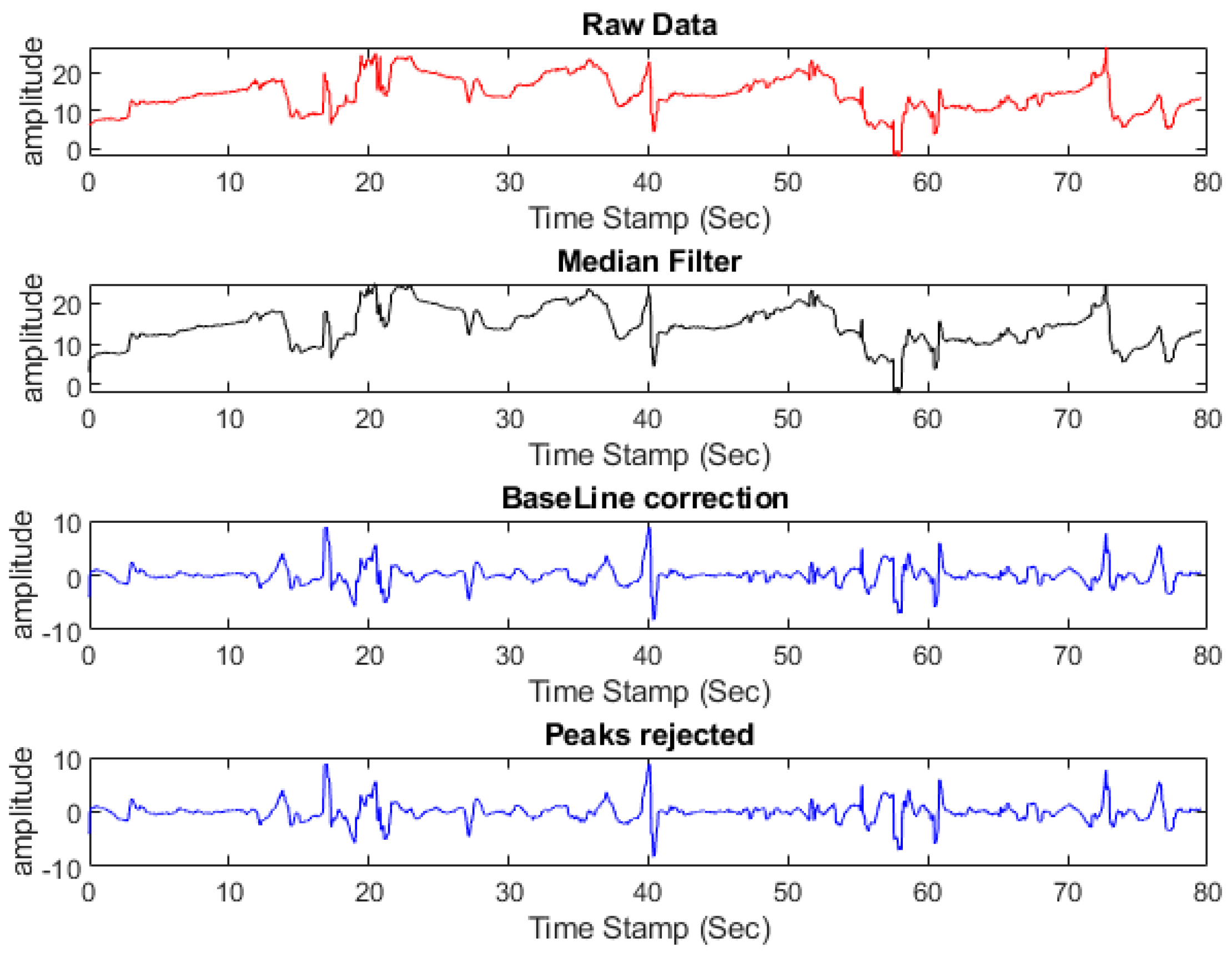
The BendLabs sensor exhibited baseline drift over time, likely due to sensor deformation, temperature effects, and material hysteresis. To address this, baseline correction was applied to remove low-frequency drift components. A notch filter was subsequently applied to attenuate known sources of periodic interference, further improving signal quality. This additional processing was not needed for the StretchSense and motion-capture signals based on the observed signal outputs following the NPC routine.
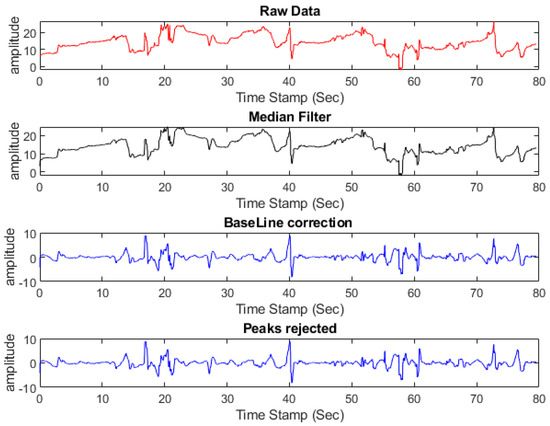
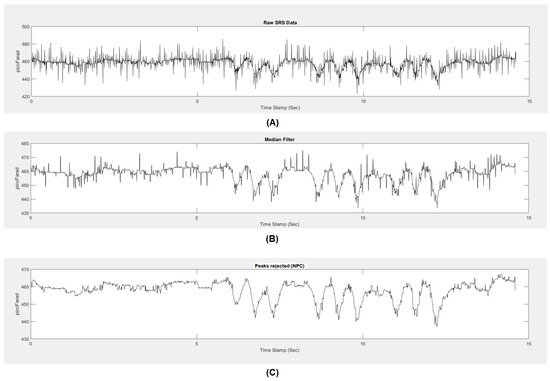
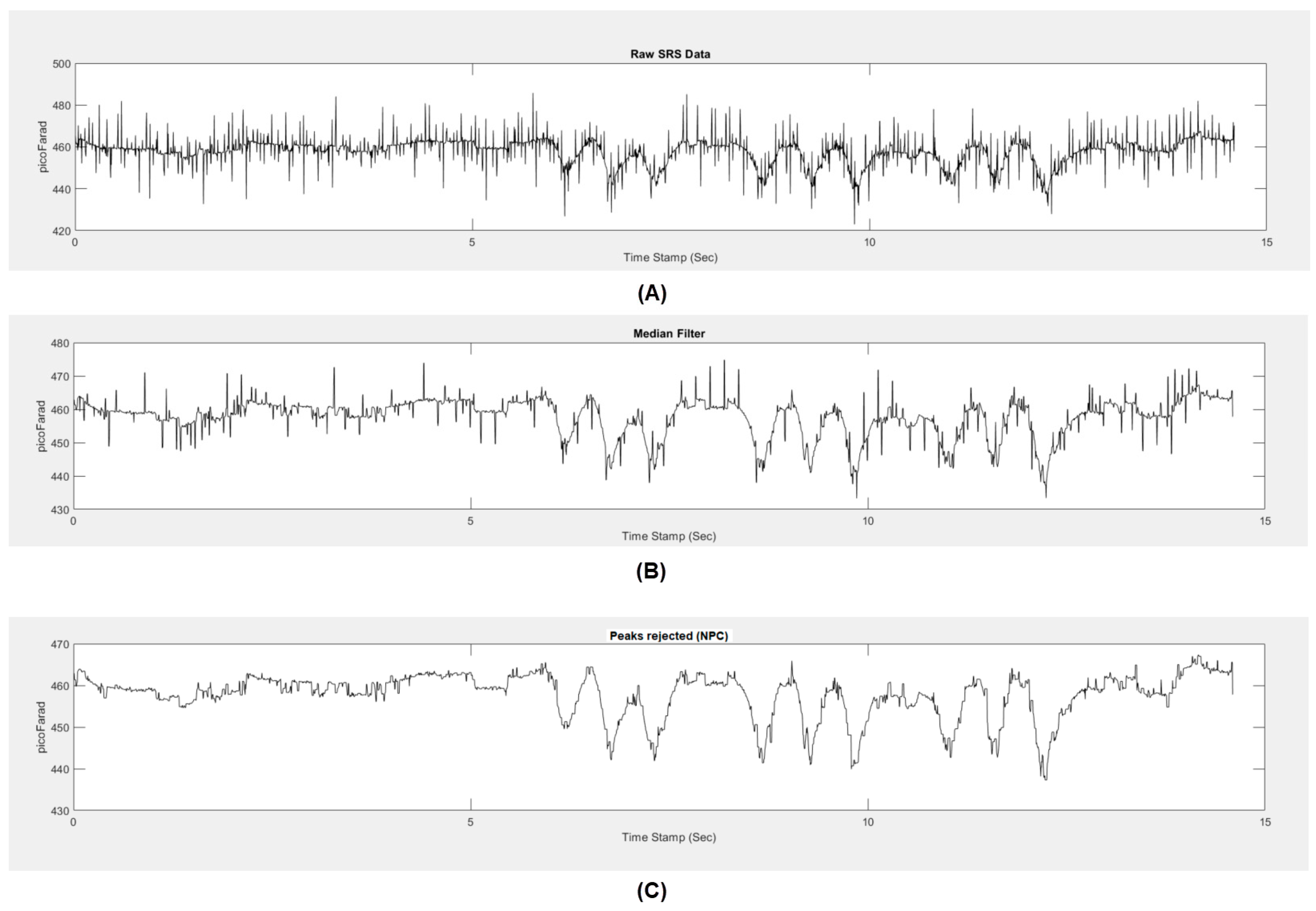
Following this, wavelet-based denoising was applied to suppress residual high-frequency noise while preserving important signal features. A discrete wavelet transform with a compactly supported orthogonal basis was implemented due to its suitability for non-stationary biomechanical signals containing transient features. Wavelet denoising was selected over conventional linear filtering methods because it enables multi-resolution decomposition of the signal, allowing noise reduction without significant loss of temporal or amplitude information critical for kinematic analysis. Figure 4 and Figure 5 provide a visual summary of the preprocessing methods applied to the Bendlabs and StretchSense wearable sensors, respectively.
Figure 4.
Baseline correction for BendLabs sensor data.
Figure 5.
Data preprocessing steps for StretchSense stretch sensor: (A) raw stretch-sensor data; (B) smoothing of the raw stretch-sensor signal using a moving average filter; (C) denoising and detrending of the stretch-sensor signal using the NPC routine.
2.3.4. Temporal Alignment
Because motion-capture and wearable sensor data were recorded using independent systems, temporal alignment was required prior to comparisons for both the wrist and elbow. A normalized cross-correlation approach was used to determine the optimal lag between signals. Specifically, the MATLAB xcorr function was used to compute correlation coefficients across a range of time shifts, and the wearable sensor signal was shifted relative to the motion-capture signal to maximize similarity. This method ensures alignment that is independent of signal amplitude and robust to differences in signal scaling. No resampling was needed since all the wearable and motion-capture systems were recorded at 250 Hz.
2.3.5. Regression Analysis
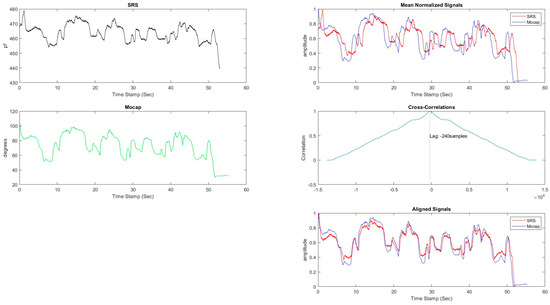
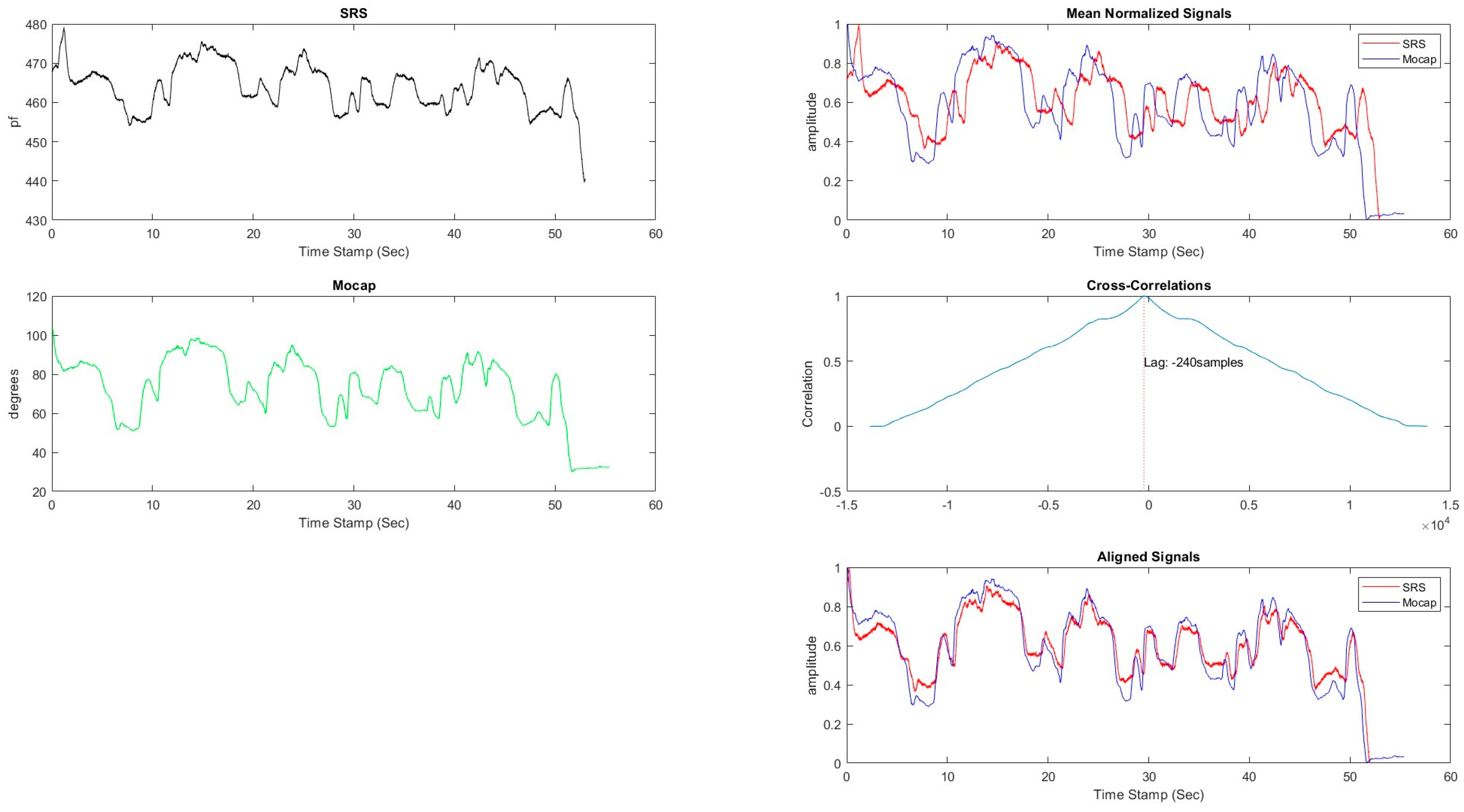
After temporal alignment, the MATLAB polyfit and polyval functions were used to obtain regression-based predictions and error estimates on the normalized signal. A custom MATLAB script was used to generate linear models and calculate the coefficient of determination (R2) values to quantify the proportion of variance in the stretch-sensor signal explained by the elbow tracking motion-capture signal, and the BendLabs signal explained by the wrist tracking motion-capture signal. The same script also computed root mean square error (RMSE) and mean absolute error (MAE) to quantify deviation and overall goodness of fit between the wearable and motion-capture measurements. Due to normalization on a unit scale of 0–1 prior to analysis, all metrics were computed as unitless to be directly comparable across conditions. Figure 6 provides an example case of this approach using the StretchSense and motion-capture signals.
Figure 6.
Normalized cross-correlation between stretch-sensor data and motion-capture data.
To enable objective interpretation and facilitate cross-study comparisons, predefined evaluation thresholds were adopted for each metric. For R2, we adapted the correlation strength scale proposed by [17], where |r| = 0.50–0.69 indicates moderate, 0.70–0.89 high, and ≥0.90 very high association. Because R2 represents the squared Pearson correlation coefficient, the corresponding R2 interpretation thresholds were defined as follows: ≥0.81 = excellent (very high agreement), 0.50–0.80 = good (high agreement), 0.25–0.49 = moderate, 0.09–0.24 = low, and <0.09 = negligible agreement. For RMSE and MAE, which are scale-dependent metrics without universally accepted interpretation thresholds, relative evaluation criteria were defined based on the normalized signal range (0–1); this approach follows prior work emphasizing the scale dependence of absolute error metrics and the use of range-normalized error measures to improve interpretability in wearable-sensor-based biomechanical prediction studies [20,21]. Accordingly, values < 0.10 were interpreted as excellent, 0.10–0.20 as good, 0.21–0.30 as moderate, 0.31–0.40 as low, and >0.40 as poor agreement. These thresholds were introduced to improve interpretability and reproducibility rather than to establish universal biomechanical standards.
3. Results
3.1. Comparing BendLabs Sensor Performance to Motion Capture
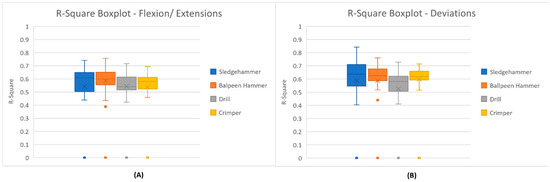
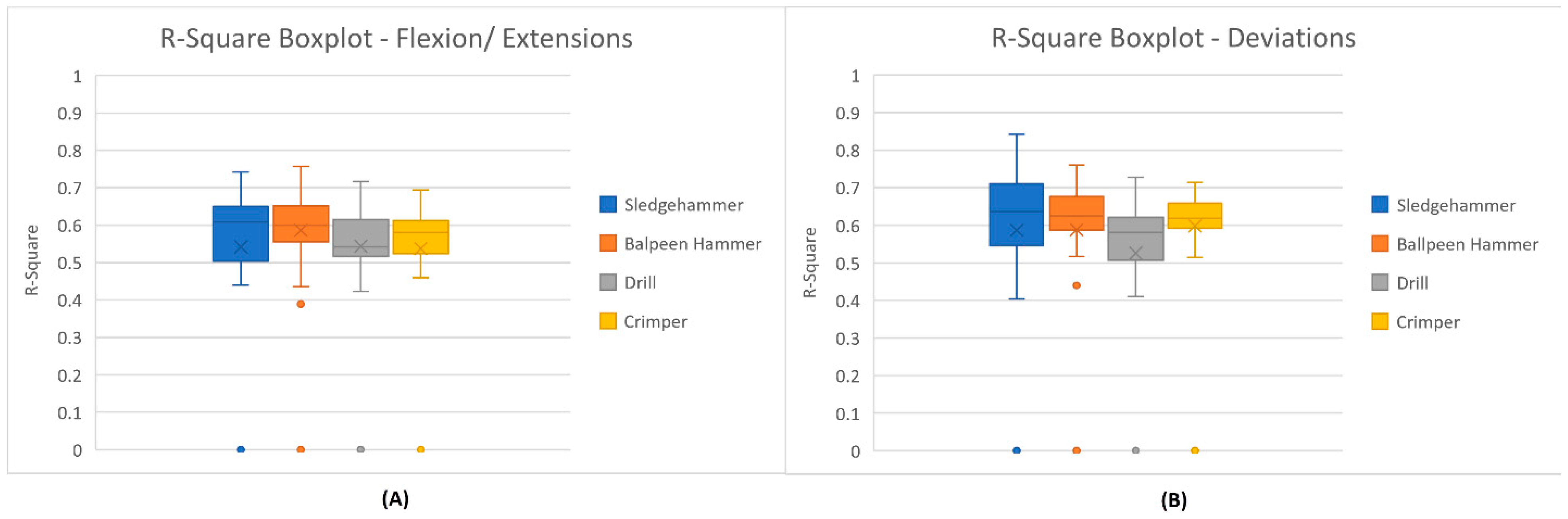
Regression analysis was conducted to examine the relationship between the BendLabs sensor and the motion-capture data for wrist kinematics during the simulated dynamic tasks. Linear regression models were used to quantify the relationship between the two measurement systems for each trial, and the resulting R2, RMSE, and MAE values were averaged across trials for each activity. The combination of R2, RMSE, and MAE provides complementary insight into model performance. While R2 reflects overall agreement in signal trends, RMSE emphasizes larger deviations and transient mismatches, and MAE provides a robust measure of typical error magnitude. The mean values for all dynamic activities are summarized in Table 1, and the distribution of R2 values is illustrated in Figure 7.
Table 1.
Average R2, RMSE, and MAE values for BendLabs sensor measurements relative to motion capture for wrist radial–ulnar deviation and flexion–extension during dynamic tasks. Results reported without units due to normalization.
Figure 7.
Box-and-whisker plot of R2 results for the BendLabs sensor: (A) wrist flexion–extension; (B) wrist radial–ulnar deviation.
R2 quantifies the proportion of variance in the wearable sensor signal explained by the motion-capture reference signal, with values closer to 1 indicating stronger agreement. RMSE represents the average magnitude of error with greater sensitivity to larger deviations, while MAE represents the average absolute difference between signals and is less influenced by extreme values. Given the normalized signal range, RMSE and MAE values can be interpreted as proportional error relative to the full signal amplitude (e.g., an RMSE of 0.20 corresponds to an average deviation of approximately 20% of the signal range).
Overall, the BendLabs sensor demonstrated moderate agreement with motion capture across the dynamic tasks. For radial–ulnar deviation, the mean R2 values ranged from 0.5868 during drilling to 0.6472 during sledgehammer use. The corresponding mean RMSE values ranged from 0.2968 to 0.3662, and the mean MAE values ranged from 0.2505 to 0.3185. For flexion–extension, the mean R2 values ranged from 0.5628 during drilling to 0.6056 during ball-peen hammer use. The corresponding mean RMSE values ranged from 0.3280 to 0.3586, and the mean MAE values ranged from 0.2700 to 0.2991.
Across tasks, the BendLabs sensor generally showed higher mean R2 values for radial–ulnar deviation than for flexion–extension. Among the dynamic activities, sledgehammer use produced the highest mean R2 for radial–ulnar deviation (0.6472), whereas ball-peen hammer use produced the highest mean R2 for flexion–extension (0.6056). Drilling yielded the lowest mean R2 values for both radial–ulnar deviation (0.5868) and flexion–extension (0.5628). The box-and-whisker plots in Figure 7 further illustrate the distribution and variability of the R2 values across tasks.
3.2. Comparing Stretch Sensor Performance to Motion Capture
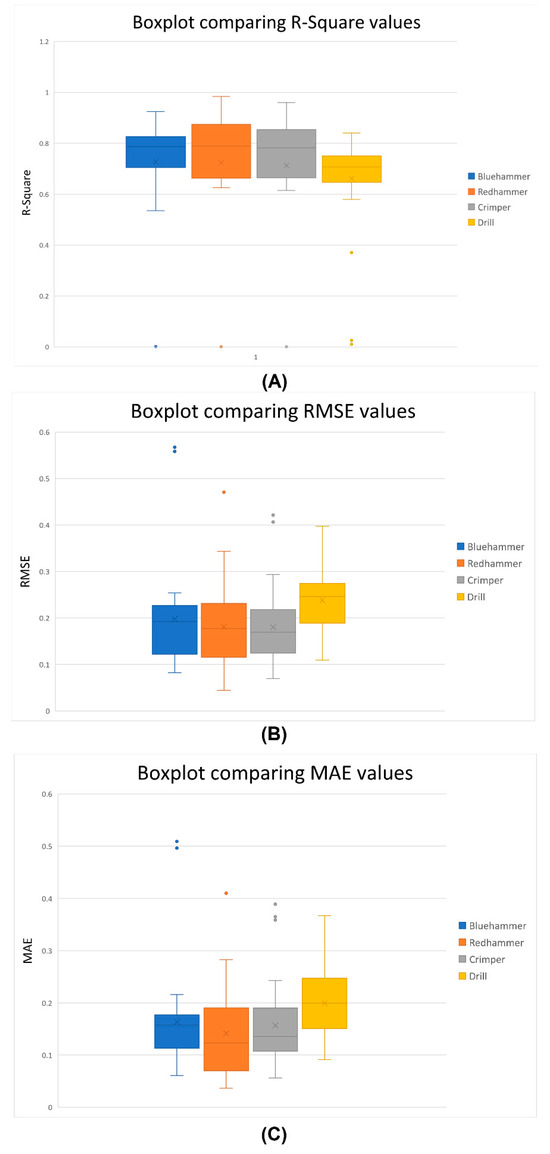
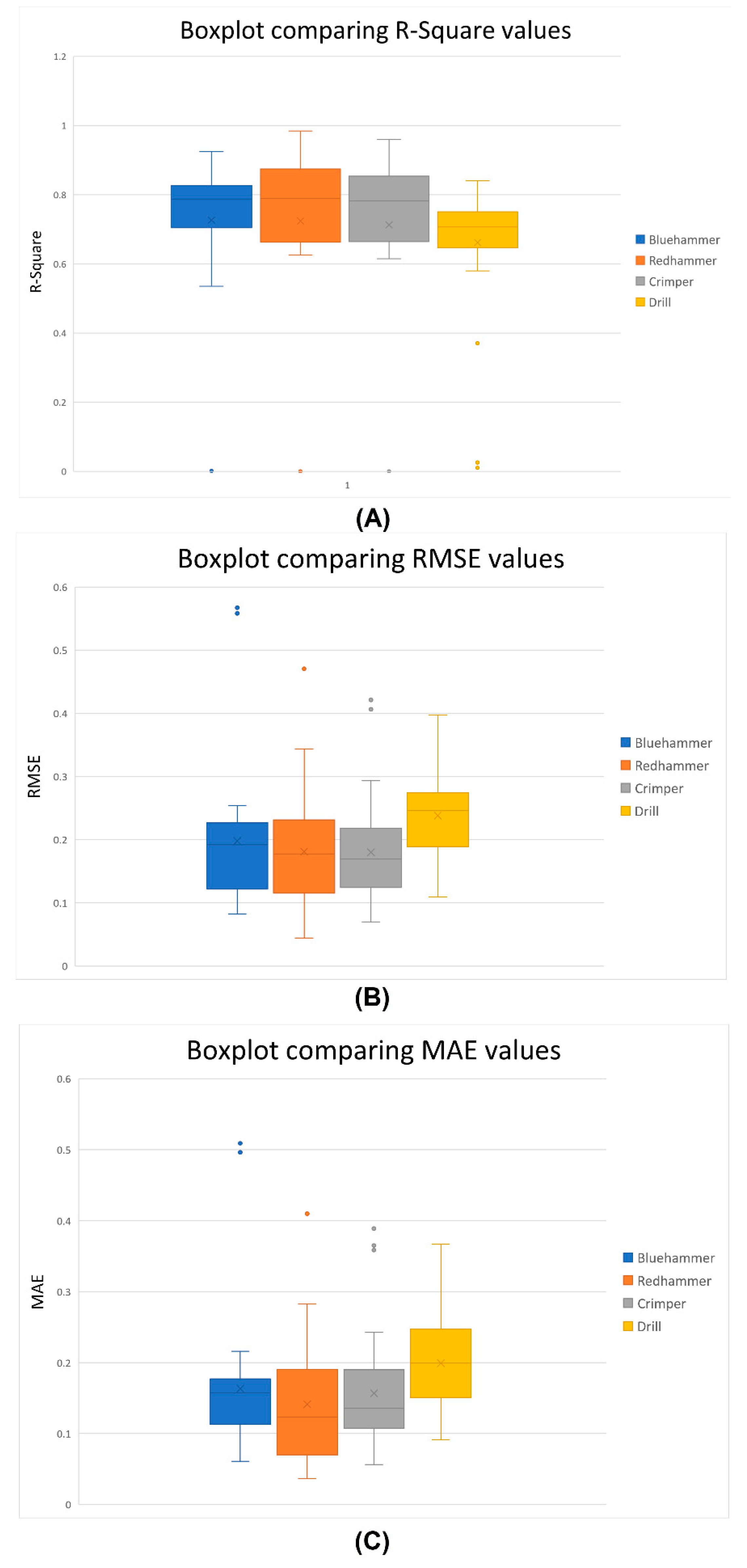
The average R2, RMSE, and MAE values for the stretch sensor relative to motion capture during elbow flexion–extension are summarized in Table 2, and the distribution of results is shown in Figure 8. Isolated extreme low-value observations were identified in the R2 distributions. Examination of the underlying signals indicated that these cases were associated with data-quality issues, including motion-capture marker occlusion and intermittent sensor signal loss, leading to erroneous spikes and misalignment during temporal synchronization. Because these observations reflect measurement artifacts rather than true biomechanical behavior, analyses were performed both including and excluding these trials. Both conditions are reported to provide transparency and demonstrate that the primary findings are robust to the presence of such artifact-related deviations.
Table 2.
Average R2, RMSE, and MAE values for stretch-sensor measurements relative to motion capture for elbow flexion–extension during dynamic tasks, reported with and without trials where motion artifacts were observed. Results reported without units due to normalization.
Figure 8.
Box-and-whisker plot results for the StretchSense sensor during dynamic activities: (A) R2 values, (B) RMSE values, and (C) MAE values.
Overall, the stretch sensor demonstrated stronger agreement with motion capture than the BendLabs sensor. When trials impacted by motion artifacts were excluded, the mean R2 values ranged from 0.7030 during drilling to 0.7939 during ball-peen hammer use. The corresponding mean RMSE values ranged from 0.1632 to 0.2393, and the mean MAE values ranged from 0.1268 to 0.1964. When all trials were included, the mean R2 values ranged from 0.6615 during drilling to 0.7262 during sledgehammer use. The corresponding mean RMSE values ranged from 0.1800 to 0.2383, and the mean MAE values ranged from 0.1413 to 0.1992.
Among the dynamic tasks, ball-peen hammer use produced the highest mean R2 when trials with motion artifacts were excluded (0.7939), whereas sledgehammer use produced the highest mean R2 when all trials were included (0.7262). Drilling showed the lowest mean R2 values in trials without motion artifacts (0.7030) and trials including motion artifacts (0.6615). Wire crimping also demonstrated relatively high agreement, with mean R2 values of 0.7814 when removing motion artifact trials and 0.7129 with them included. The box-and-whisker plots in Figure 8 illustrate the spread and variability of the R2, RMSE, and MAE results across tasks.
4. Discussion
4.1. Comparing BendLabs Sensor with Motion Capture
The BendLabs sensing system converted wrist movements into real-time joint-angle data through a custom-developed application that measured wrist radial–ulnar deviation and flexion–extension. The BendLabs biaxial sensor was positioned on the dorsal aspect of the dominant hand, aligned with the third metacarpal, and calibrated before each trial.
Regarding the results for measuring radial–ulnar deviation, the box-and-whisker summary showed a maximum R2 of 0.8425 during sledgehammer use, whereas the lowest lower-quartile value was 0.5073 during drilling. However, median and mean R2 values for radial–ulnar deviation were below 0.70, indicating only moderate overall agreement. The average RMSE values were as high as 0.3662, and the average MAE values ranged from 0.2505 to 0.3185 across all dynamic activities. Overall, radial–ulnar deviation showed its highest mean R2 during sledgehammer use, while wire crimping yielded the lowest mean RMSE.
For flexion–extension, the R2 values ranged from a maximum of 0.7575 during ball-peen hammer use to a lower quartile of 0.5035 during sledgehammer use. Similar to the radial–ulnar deviation results, although the maximum value indicated good trial-level agreement between the BendLabs sensor and the motion capture, the mean and median values for flexion–extension remained below 0.65. The average RMSE value for flexion–extension was as high as 0.3586, and the average MAE reached 0.2991.
The hammering tasks involved the wrist moving along an oblique path, from radial extension toward ulnar flexion. The BendLabs sensor showed higher agreement for radial–ulnar deviation than for flexion–extension. These findings may be explained by the relatively small flexion–extension angles observed during hammering. Hammering is often performed using a “dart thrower’s motion,” which involves more radial–ulnar deviation than flexion–extension of the wrist, thereby helping explain the higher agreement observed for radial–ulnar deviation.
The wire-crimping task involved awkward wrist positions repeated over short periods. The wrist was highly ulnar deviated and extended when the ratchet was open and radially deviated with slight flexion when the ratchet was closed. Much of the wrist motion occurred in the frontal plane (radial–ulnar deviation). The box-and-whisker results showed maximum R2 values greater than 0.70 for the crimping task, indicating that BendLabs tracked some of these movement patterns reasonably well.
The drilling task involved drilling into a lumber piece clamped to a sawhorse on a horizontal plane. The wrist position during drilling was more complex and involved simultaneous wrist ulnar deviation and flexion. The data indicated the lowest R2 values for wrist motion during drilling, and the average RMSE and MAE values were also among the highest compared with the other activities. Taken together, these findings suggest that the BendLabs sensor captured radial–ulnar deviation, which occurs primarily in the frontal plane, more consistently than flexion–extension, which occurs in the sagittal plane, under the selected task conditions. One reason for the lower agreement in flexion–extension may be that the dynamic tasks used for evaluation involved relatively limited wrist flexion–extension but substantial radial–ulnar deviation.
The moderate agreement levels observed for wrist flexion–extension (mean R2 = 0.56–0.61) are consistent with previous findings that wrist position alone explains only part of the variance in cumulative trauma disorder (CTD) risk. Marras and Schoenmarklin demonstrated that velocity and acceleration variables are stronger differentiators of CTD risk than static wrist position [22]. Thus, the moderate R2 values in our study may reflect that the BendLabs sensor captures angular displacement accurately, but that dynamic tasks involve additional kinematic components (e.g., velocity, acceleration) not fully represented by position-only metrics. Compared to [23], who reported good linearity for flexible sensors on power tools, our BendLabs results (R2 = 0.59–0.65 for radial–ulnar deviation) are within a comparable range, though slightly lower due to the higher complexity of our multi-task protocol and the use of a strict motion-capture reference standard. Additionally, the task-dependent variability we observed—with drilling showing the lowest agreement—aligns with Aldien et al., who found that handle size and grip force significantly affect pressure distribution and, consequently, sensor performance [24].
4.2. Comparing StretchSense Stretch Sensors with Motion Capture
The validation study aimed to compare StretchSense stretch-sensor performance against the motion capture system, which served as the laboratory reference standard. While prior validation studies have used stretch sensors at the knee and ankle joints, validation of stretch sensors at the elbow joint to study elbow kinematics remains comparatively limited. A custom elbow-brace mount was developed by the research team to allow secure placement of the stretch sensor across the elbow joint while participants performed simulated industrial tasks. The brace was intended to provide consistent positioning of the sensor over the region of maximum deformation during elbow flexion and extension, allowing measurement of elbow kinematics during dynamic movements without substantially restricting natural motion.
Statistical analysis metrics were used to evaluate sensor behavior and characterize stretch-sensor performance for individual dynamic activities. Because the Section 3 presents summary metrics both with and without trials impacted by motion artifacts, the activity-specific discussion below focuses primarily on the values with all trials included, while the values without motion artifact trials are used to contextualize sensitivity to edge-case observations.
4.2.1. Hammering Task (Sledgehammer)
The average R2 value observed across 36 trials was 0.7262, with average RMSE = 0.1980 and MAE = 0.1635. Fifty percent of the R2 values were observed between 0.7046 and 0.8264, with a positively skewed median value of 0.7869. A maximum R2 value of 0.9245 was observed for one trial, indicating very strong agreement in that instance. However, multiple trials had R2 values below 0.70, contributing to the variability in the response data.
4.2.2. Hammering Task (Ball-Peen Hammer)
The ball-peen hammer results were similar to the sledgehammer results because both tasks involved comparable elbow flexion–extension patterns. The average R2 value across 36 trials, including motion artifact trials, was 0.7239, with average RMSE = 0.1811 and MAE = 0.1413. The interquartile range of the boxplot showed that 50% of the trials had R2 values between 0.6628 and 0.8745, with a median value of 0.7888 and an overall positively skewed distribution.
The hammering task involved a limited range of elbow motion, with participants extending the elbow to the height of the lumber piece. Because elbow motion was partially constrained by the sawhorse height, the resulting deformation in the stretch sensor may have been reduced, which could have affected agreement with motion capture.
4.2.3. Drilling Task
The drilling task produced the lowest average agreement among the stretch-sensor tasks. The mean R2 value was 0.6615 with all trials included and 0.7030 when motion artifact trials were excluded, with RMSE = 0.2383 and MAE = 0.1992 with all trials included, and RMSE = 0.2393 and MAE = 0.1964 without trials impacted by motion artifacts. The drilling activity involved complex wrist and elbow motion, with the elbow extended and forearm pronated. Some trials demonstrated stronger agreement, with R2 values as high as 0.8402, whereas lower-performing trials reduced the overall average. One possible explanation is that some participants maintained the drill in an extended-arm position rather than returning toward a more neutral elbow position between repetitions, which may have reduced sensor deformation and tensile strain during the task.
4.2.4. Wire-Crimping Task
The wire crimping activity showed relatively strong agreement for elbow measurements compared with motion capture. The mean R2 was 0.7129 with all trials and 0.7814 without motion artifact trials, and a maximum trial-level R2 of 0.9594 was observed. The median R2 value was 0.7819. The corresponding RMSE and MAE values were 0.1800 and 0.1568 with all trials included, and 0.1632 and 0.1423 without motion artifact trials. The crimping task involved one of the largest elbow ranges of motion, causing greater deformation in the stretch sensor, and thereby increasing sensor capacitance with strain. Wire crimping has been associated with physically strenuous work and may expose workers to ergonomic risk factors associated with musculoskeletal disorders, including lateral epicondylitis at the elbow. Similarly, repetitive or frequent work activities involving twisting or repeated arm extension, such as drilling and hammering, have also been associated with tendon-related injuries [25]. The findings from the present experiment indicate that the stretch sensor demonstrated favorable agreement, together with relatively low RMSE and MAE values, for activities involving elbow flexion and extension. Due to their portability and ease of use, stretch sensors may represent a promising option for measuring elbow range of motion outside a laboratory setting.
The stronger agreement observed for the StretchSense stretch sensor (R2 = 0.66–0.79) aligns with Yao et al., who found low hysteresis and good linearity for capacitive stretch sensors under static and dynamic conditions [26]. However, our results also reveal task-dependent variability: wire crimping (R2 = 0.78 after artifact filtering) showed the highest agreement, whereas drilling (R2 = 0.70) showed the lowest. This finding contrasts with Kalra et al., who reported more consistent performance across tool types [23]. The discrepancy may be attributed to differences in elbow range of motion across tasks; drilling involved limited elbow flexion coupled with forearm pronation, which reduced sensor deformation and, consequently, signal sensitivity. Furthermore, the use of a skin-tight sleeve, as recommended by Gioberto, likely minimized garment shift and contributed to the generally favorable agreement compared to wrist-motion tracking, where gaffer tape alone could not fully eliminate soft tissue artifact [27].
4.3. Limitations and Future Work
The wrist has complex motion and plays a critical role in hand function. Designing a comfortable, portable, and accurate wrist motion-capture system is therefore challenging. The BendLabs sensor had several limitations: (1) the sensor required frequent calibration and readjustment to maintain its absolute position, and (2) the BendLabs stackable Bluetooth Low-Energy module disconnected several times during data collection, requiring some trials to be repeated.
These limitations can significantly affect both user experience and data integrity, particularly in real-world industrial applications. Frequent calibration increases the operational burden on users and reduces the practicality of continuous monitoring, as repeated manual intervention may be required to maintain measurement accuracy. In addition, intermittent Bluetooth Low-Energy (BLE) connectivity can result in data transmission interruptions, leading to missing data segments, temporal discontinuities, and potential loss of critical motion information. These issues are especially problematic in long-term monitoring scenarios where consistent and reliable data acquisition is essential. Furthermore, the reliance on a custom-developed preprocessing pipeline adds complexity to the system and may limit ease of deployment outside controlled laboratory settings. In industrial environments, monitoring systems are expected to operate in real time with minimal user intervention and high robustness. These limitations are primarily associated with the prototype software framework and wireless implementation used in this study rather than the sensing hardware itself. Future work should focus on improving wireless communication stability, enabling automated calibration procedures, and developing real-time processing capabilities to enhance system usability and support reliable long-term occupational monitoring.
Beyond the software-related limitations discussed above, the BendLabs sensor exhibited lower accuracy for wrist flexion–extension (mean R2 = 0.56–0.61) compared to radial–ulnar deviation (mean R2 = 0.59–0.65). This may be due to the sensor’s mechanical design, which is optimized for bending in one primary plane, and the fact that our selected tasks involved more radial–ulnar deviation than flexion–extension (e.g., hammering’s “dart thrower’s motion”). For the StretchSense elbow sensor, the primary limitation was its sensitivity to sensor placement; lateral shifting during dynamic activities reduced signal fidelity, particularly in drilling tasks where forearm pronation accompanied elbow flexion. Additionally, both sensors required frequent recalibration to maintain accuracy, which would be impractical in real-world industrial settings where workers cannot interrupt tasks for repeated calibration. These limitations are primarily associated with the prototype software framework and sensor attachment methods rather than the sensing hardware itself. Future work should explore sensor fusion approaches (e.g., combining inertial measurement units with soft sensors) to overcome individual sensor limitations and improve overall accuracy, as well as develop automated calibration routines and more robust attachment mechanisms (e.g., sensor-embedded garments) for field deployment.
During analysis of wrist motions using the BendLabs biaxial sensor, it was observed that the sensor captured radial–ulnar deviation more accurately than flexion–extension. One reason for the reduced accuracy in flexion–extension may be the type of dynamic activities chosen for evaluation, as the selected tasks involved more radial–ulnar deviation than flexion–extension. Future work should include activities with greater wrist flexion–extension demands and isolated wrist-motion tasks to provide a clearer assessment of BendLabs sensor performance across movement directions.
For the second part of the study, the stretch sensor yielded higher average R2 values and lower error metrics for elbow flexion–extension than were observed for the BendLabs sensor during wrist-motion tracking. One limitation of the study was sensor positioning over the elbow landmarks, specifically the need to position the sensor midway so that part of the sensor spanned the dorsal forearm and the remainder spanned the upper arm. During some dynamic activities, the stretch sensor shifted laterally. A refined elbow-brace design for positioning and anchoring the sensor could help mitigate this limitation. Another limitation related to the elbow motion required during drilling, where forearm pronation occurred in addition to elbow flexion–extension. Future work should consider integrating additional sensors around the elbow to better capture coupled elbow and forearm motions.
It has also been observed that capacitive stretch sensors, although promising for real-world applications, require greater deformation to produce stronger capacitive output. Porte et al. demonstrated that repeated stretching of the sensors helps decrease sensor resistance [28]. Lower sensor resistance can increase the frequency at which capacitance changes are detected and strain is measured, thereby improving conductivity. In the present work, the research team strain-cycled the sensor at least 500 times to a maximum deformation of 80 mm at a rate of 60 rpm using a custom cyclic tester. In future work, pre-stretching the sensor may help reduce sensor resistance and improve accuracy during tasks involving smaller elbow ranges of motion.
5. Conclusions
The present study evaluated the validity and utility of stretchable and bendable soft sensors for measuring joint-angle motion during simulated industrial tasks. Overall, the findings were encouraging when compared with the motion-capture reference standard, although some variability and data impacted by motion artifacts were observed. The stretch sensor demonstrated stronger agreement with motion capture for elbow flexion–extension, whereas the BendLabs sensor showed moderate agreement for wrist kinematics, with better performance for radial–ulnar deviation than for flexion–extension.
These findings support the potential use of soft wearable sensors for ergonomic assessment during physically demanding occupational tasks. Such sensors may offer practical advantages over video-based ergonomic assessment approaches, particularly in settings where clothing, field conditions, or long-duration monitoring can limit the accuracy or feasibility of camera-based systems. For potential future work, integration of wearable sensing technologies into personal protective equipment or other workwear may provide health and safety practitioners with a means to monitor movement patterns over extended periods and better identify when breakdowns in safe ergonomic techniques occur.
Author Contributions
Conceptualization, P.T., J.E.B., H.C., B.K.S. and R.F.B.V.; methodology, P.T., E.T., J.E.B., H.C., B.K.S. and R.F.B.V.; software, P.T. and D.S.; validation, P.T., D.S. and L.B.K.; formal analysis, P.T.; investigation, P.T.; resources, D.S., J.E.B., H.C., B.K.S. and R.F.B.V.; data curation, P.T., D.S., E.T., A.J.T. and R.L.; writing—original draft preparation, P.T.; writing—review and editing, P.T., D.S., L.B.K., J.W., J.E.B., H.C., B.K.S. and R.F.B.V.; visualization, P.T.; supervision, J.W., J.E.B., H.C., B.K.S. and R.F.B.V.; project administration, D.S., J.W., J.E.B., H.C., B.K.S. and R.F.B.V.; funding acquisition, J.E.B., H.C., B.K.S. and R.F.B.V. All authors have read and agreed to the published version of the manuscript.
Funding
The research presented in this paper was funded by the National Science Foundation under NSF 18-511—Partnerships for Innovation award number 1827652.
Institutional Review Board Statement
The study was conducted in accordance with the Declaration of Helsinki, and the protocol was approved by the Ethics Committee of Mississippi State University’s Instutional Review Board (Protocol #21-184) on 27 May 2021.
Informed Consent Statement
Informed consent for participation was obtained from all subjects involved in the study.
Data Availability Statement
The raw data supporting the conclusions of this article will be made available by the authors on request.
Conflicts of Interest
Author Purva Talegaonkar was employed by Environmental Health and Safety, Ideagen, Ruddington, Nottingham, UK. The remaining authors declare that the research was conducted in the absence of any commercial or financial relationships that could be construed as a potential conflict of interest.
Abbreviations
The following abbreviations are used in this manuscript:
| BLE | Bluetooth Low Energy |
| CTD | Cumulative Trauma Disorder |
| MAE | Mean Absolute Error |
| NPC | Noise Peak Cancellation |
| PAR-Q | Physical Activity Readiness Questionnaire |
| RMSE | Root Mean Square Error |
| R2 | Coefficient of Determination |
| Hz | Hertz |
References
- Mani, L.; Gerr, F. Work-related upper extremity musculoskeletal disorders. Prim. Care Clin. Off. Pract. 2000, 27, 845–864. [Google Scholar] [CrossRef] [Scilit]
- National Research Council (US) and Institute of Medicine (US) Panel on Musculoskeletal Disorders and the Workplace. Musculoskeletal Disorders and the Workplace: Low Back and Upper Extremities; National Academies Press (US): Washington, DC, USA, 2001. Available online: http://www.ncbi.nlm.nih.gov/books/NBK222440/ (accessed on 27 February 2026).
- Keyserling, W.M.; Brouwer, M.; Silverstein, B.A. A checklist for evaluating ergonomic risk factors resulting from awkward postures of the legs, trunk and neck. Int. J. Ind. Ergon. 1992, 9, 283–301. [Google Scholar] [CrossRef] [Scilit]
- Mathiowetz, V.; Rennells, C.; Donahoe, L. Effect of elbow position on grip and key pinch strength. J. Hand Surg. 1985, 10, 694–697. [Google Scholar] [CrossRef] [Scilit]
- Li, Z.-M. The influence of wrist position on individual finger forces during forceful grip. J. Hand Surg. 2002, 27, 886–896. [Google Scholar] [CrossRef] [Scilit] [PubMed]
- Kuzala, E.A.; Vargo, M.C. The relationship between elbow position and grip strength. Am. J. Occup. Ther. 1992, 46, 509–512. [Google Scholar] [CrossRef] [Scilit]
- Carson, R.G. Human Motor Control; Human Kinetics: Champaign, IL, USA, 1994. [Google Scholar]
- van Rijn, R.M.; Huisstede, B.M.A.; Koes, B.W.; Burdorf, A. Associations between work-related factors and specific disorders of the elbow: A systematic literature review. Rheumatology 2009, 48, 528–536. [Google Scholar] [CrossRef] [Scilit] [PubMed]
- Seidel, D.H.; Ditchen, D.M.; Hoehne-Hückstädt, U.M.; Rieger, M.A.; Steinhilber, B. Quantitative Measures of Physical Risk Factors Associated with Work-Related Musculoskeletal Disorders of the Elbow: A Systematic Review. Int. J. Environ. Res. Public Health 2019, 16, 130. [Google Scholar] [CrossRef] [Scilit]
- Bretschneider, S.F.; Los, F.S.; Eygendaal, D.; Kuijer, P.P.F.M.; van der Molen, H.F. Work-relatedness of lateral epicondylitis: Systematic review including meta-analysis and GRADE work-relatedness of lateral epicondylitis. Am. J. Ind. Med. 2022, 65, 41–50. [Google Scholar] [CrossRef] [Scilit]
- Chander, H. Wearable stretch sensors for human movement monitoring and fall detection in ergonomics. Int. J. Environ. Res. Public Health 2020, 17, 3554. [Google Scholar] [CrossRef] [Scilit]
- Karoulla, E.; Matsangidou, M.; Frangoudes, F.; Paspalides, P.; Neokleous, K.; Pattichis, C.S. Tracking Upper Limb Motion via Wearable Solutions: Systematic Review of Research From 2011 to 2023. J. Med. Internet Res. 2024, 26, e51994. [Google Scholar] [CrossRef] [Scilit]
- Papani, R.; Li, Y.; Wang, S. Soft mechanical sensors for wearable and implantable applications. Wiley Interdiscip. Rev. Nanomed. Nanobiotechnol. 2024, 16, e1961. [Google Scholar] [CrossRef] [Scilit]
- Alberto, R.; Draicchio, F.; Varrecchia, T.; Silvetti, A.; Iavicoli, S. Wearable Monitoring Devices for Biomechanical Risk Assessment at Work: Current Status and Future Challenges—A Systematic Review. Int. J. Environ. Res. Public Health 2018, 15, 2001. [Google Scholar] [CrossRef] [Scilit]
- Walmsley, C.P.; Williams, S.A.; Grisbrook, T.; Elliott, C.; Imms, C.; Campbell, A. Measurement of Upper Limb Range of Motion Using Wearable Sensors: A Systematic Review. Sports Med. Open 2018, 4, 53. [Google Scholar] [CrossRef] [Scilit]
- Xia, Y.-X.; Ni, Y.-Q. A wavelet-based despiking algorithm for large data of structural health monitoring. Int. J. Distrib. Sens. Netw. 2018, 14, 1550147718819095. [Google Scholar] [CrossRef] [Scilit]
- Mukaka, M. A guide to appropriate use of Correlation coefficient in medical research. Malawi Med. J. 2012, 24, 69–71. [Google Scholar] [PubMed]
- Hulley, S.B.; Cummings, S.R.; Browner, W.S.; Grady, D.G.; Newman, T.B. Designing Clinical Research; Lippincott Williams & Wilkins: Philadelphia, PA, USA, 2011. [Google Scholar]
- Bujang, M.A.; Baharum, N. Sample Size Guideline for Correlation Analysis. World J. Soc. Sci. Res. 2016, 3, 37. [Google Scholar] [CrossRef] [Scilit]
- Hyndman, R.J.; Koehler, A.B. Another look at measures of forecast accuracy. Int. J. Forecast. 2006, 22, 679–688. [Google Scholar] [CrossRef] [Scilit]
- Moghadam, S.M.; Yeung, T.; Choisne, J. A comparison of machine learning models’ accuracy in predicting lower-limb joints’ kinematics, kinetics, and muscle forces from wearable sensors. Sci. Rep. 2023, 13, 5046. [Google Scholar] [CrossRef] [Scilit] [PubMed]
- Marras, W.S.; Schoenmarklin, R.W. Wrist motions in industry. Ergonomics 1993, 36, 341–351. [Google Scholar] [CrossRef] [Scilit] [PubMed]
- Kalra, M.; Rakheja, S.; Marcotte, P.; Dewangan, K.N.; Adewusi, S. Measurement of coupling forces at the power tool handle-hand interface. Int. J. Ind. Ergon. 2015, 50, 105–120. [Google Scholar] [CrossRef] [Scilit]
- Aldien, Y.; Welcome, D.; Rakheja, S.; Dong, R.; Boileau, P.-E. Contact pressure distribution at hand–handle interface: Role of hand forces and handle size. Int. J. Ind. Ergon. 2005, 35, 267–286. [Google Scholar] [CrossRef] [Scilit]
- Grandjean, E.; Kroemer, K.H.E. Fitting the Task to the Human, 5th ed.; Taylor & Francis: Abingdon, UK, 1997. [Google Scholar]
- Yao, Y.; Rakheja, S.; Marcotte, P. Relationship among hand forces imparted on a viscoelastic hand-handle interface. Measurement 2019, 145, 525–534. [Google Scholar] [CrossRef] [Scilit]
- Gioberto, G. Measuring joint movement through garment-integrated wearable sensing. In Proceedings of the 2013 ACM Conference on Pervasive and Ubiquitous Computing Adjunct Publication, in UbiComp ’13 Adjunct, Zurich, Switzerland, 8–12 September 2013; Association for Computing Machinery: New York, NY, USA, 2013; pp. 331–336. [Google Scholar] [CrossRef] [Scilit]
- Porte, E.; Sipple, T.; Botero, L.S.; Shah, D.; Kramer-Bottiglio, R. Capacitive sensor measurement rate improves by pre-stretching. In 2021 IEEE 4th International Conference on Soft Robotics (RoboSoft), New Haven, CT, USA, 12–16 April 2021; IEEE: Piscataway, NJ, USA, 2021; pp. 412–418. [Google Scholar] [CrossRef] [Scilit]

Disclaimer/Publisher’s Note: The statements, opinions and data contained in all publications are solely those of the individual author(s) and contributor(s) and not of MDPI and/or the editor(s). MDPI and/or the editor(s) disclaim responsibility for any injury to people or property resulting from any ideas, methods, instructions or products referred to in the content. |
© 2026 by the authors. Licensee MDPI, Basel, Switzerland. This article is an open access article distributed under the terms and conditions of the Creative Commons Attribution (CC BY) license.