A Feature Distillation Network to Enable Object Detection on an FPGA Platform in Poor Visibility Conditions
 ,
,  ,
,  , and
, and
Abstract
1. Introduction
Given the performance of current benchmark object detection techniques for poor-visibility images, which is the most appropriate choice of a teacher architecture for adaptation on FPGA?
When inference speed is of preference, how much importance should be given to the gain obtained by using an image enhancement step prior to object detection?
Knowledge distillation techniques are capable of transferring the learning from a larger model to a smaller one [9]. Can the same principle be applied for learning object detection features of an enhanced image from a degraded one without involving an explicit enhancement step?
- We show that, compared to SOA object detectors that rely on hierarchical fusion with a feature pyramid network or attention-based fusion with scale dependency, a scale-permuted architecture is best suited for degraded images. Such an architecture not only provides more robustness in domain shifts without fine-tuning but is also suited for knowledge distillation.
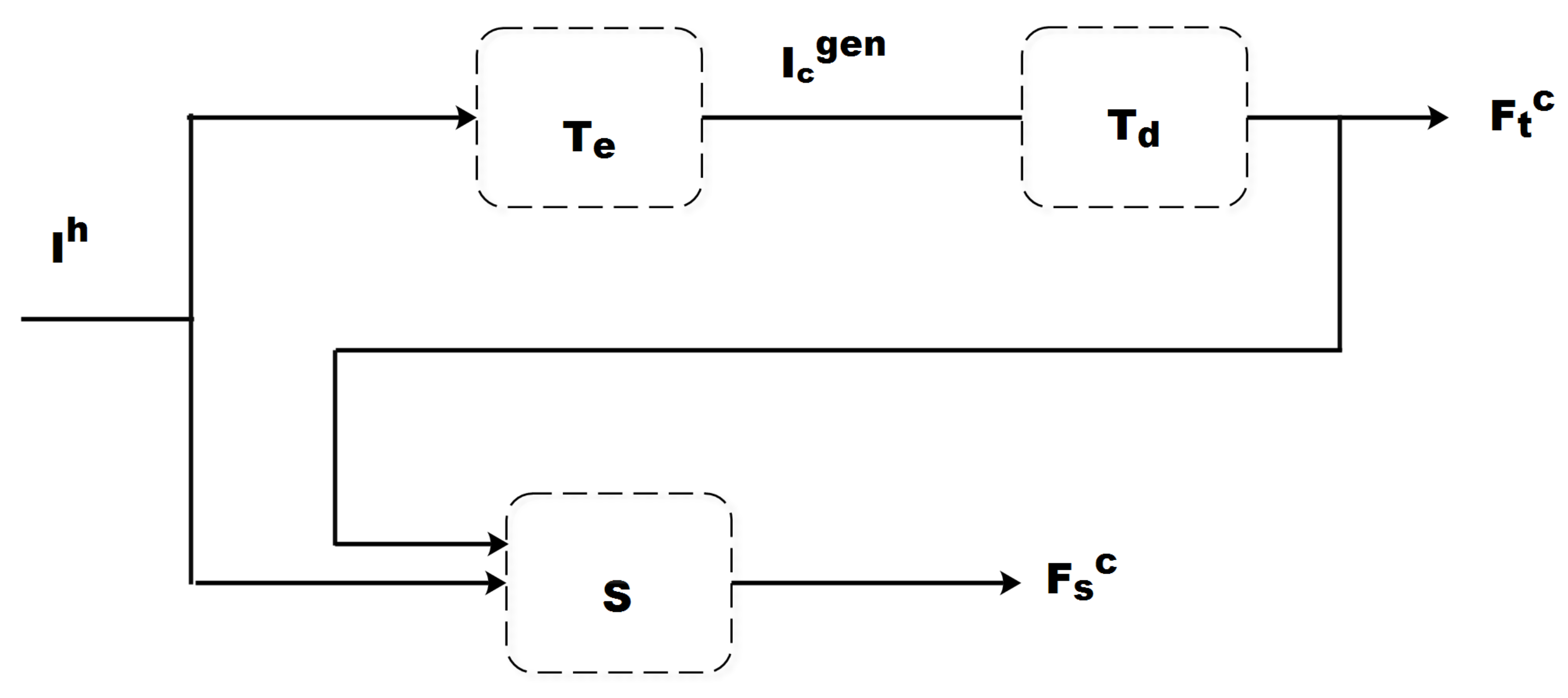
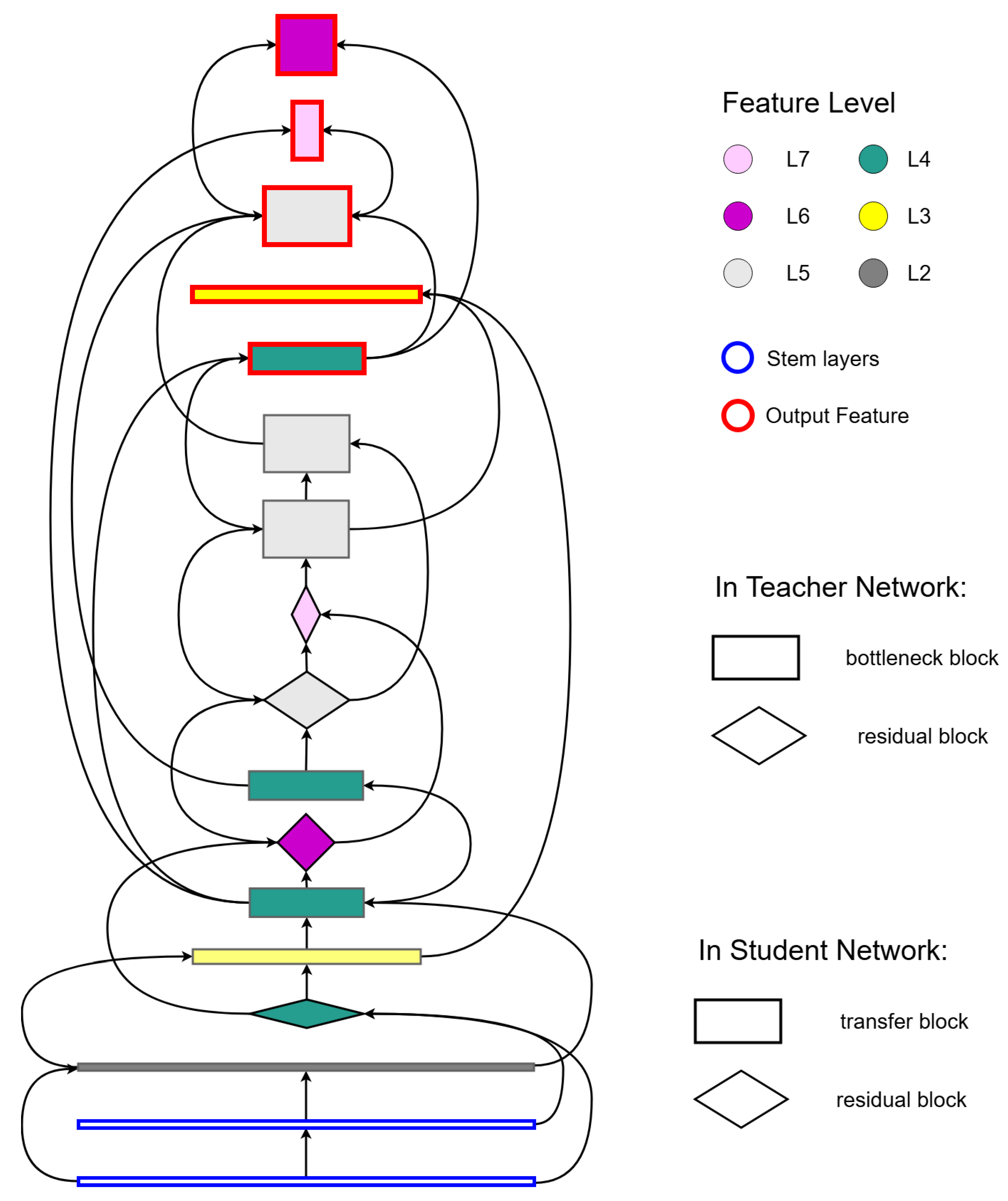
- We propose a joint distillation technique based on dual-teacher training, in which the compressed model not only distills knowledge from a larger object detection backbone via output mapping but also learns the teacher’s decision-making process through attention transfer, while simultaneously distilling feature maps from enhanced images without requiring an explicit denoising step.
- We deploy the compressed network on an FPGA unit. To the best of our knowledge, FPGA implementation of a scale-permuted network for object detection in poor visibility conditions is the first of its kind.
2. Real-Time Object Detection on FPGAs
3. Image Restoration and Detection for Degraded Images
- High detection accuracy on the COCO benchmark does not necessarily translate to strong cross-dataset generalization or reliable performance in real-world, real-time scenarios.
- It is therefore essential to determine whether the observed performance degradation across datasets is primarily caused by poor image quality or by limitations in the generalization capability of the detection architectures.
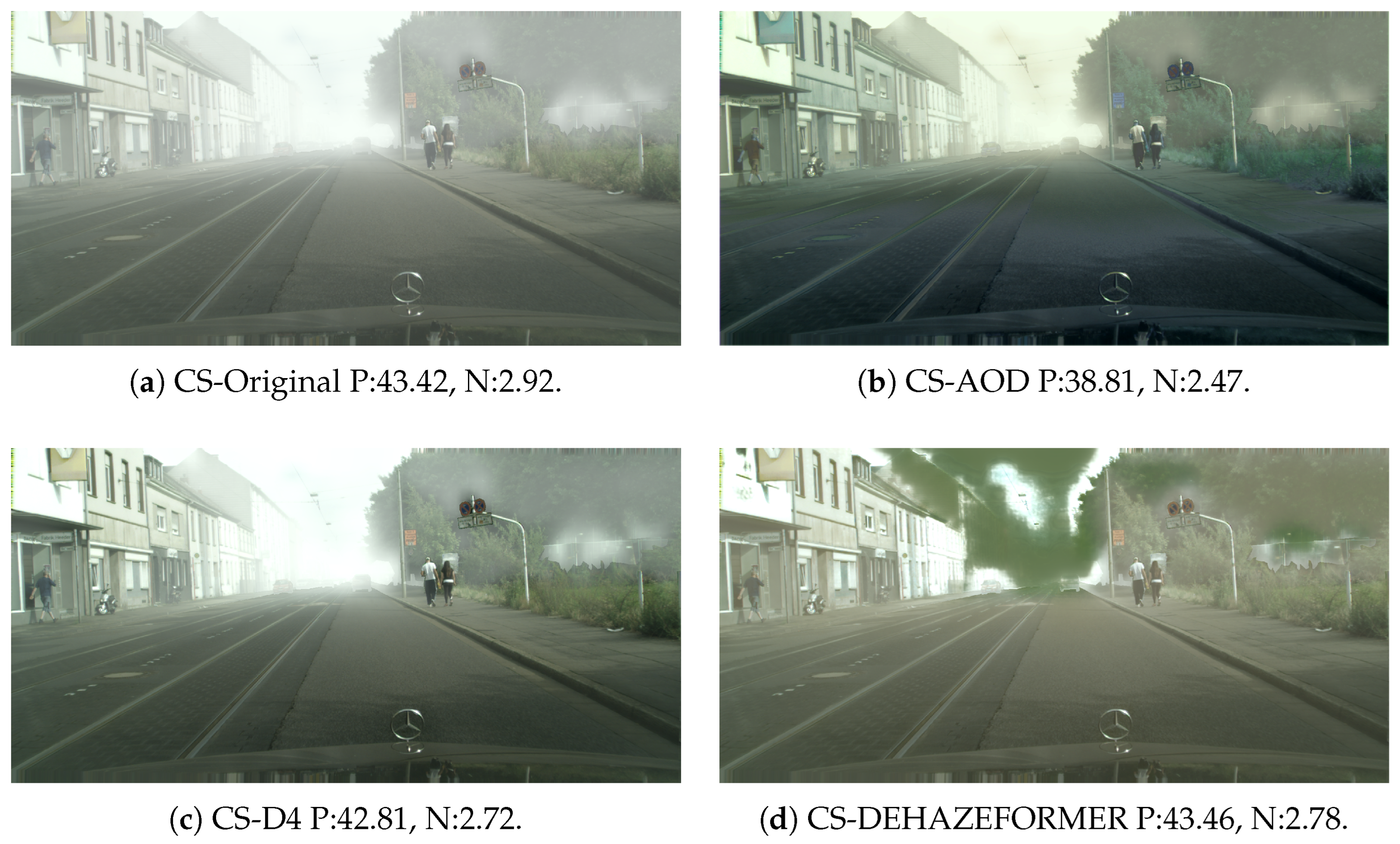
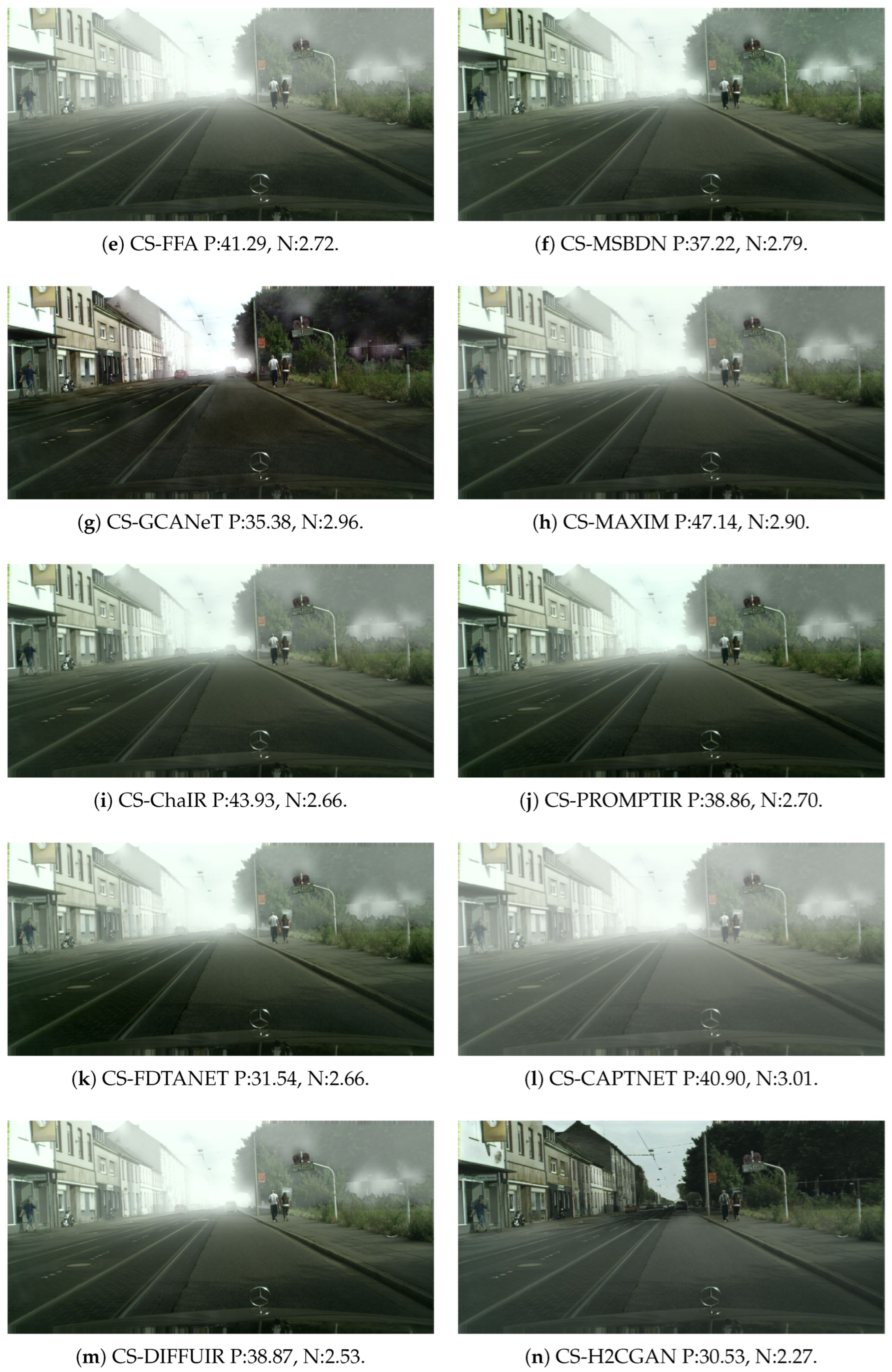
- A natural question that follows is whether the application of appropriate enhancement or dehazing techniques can improve downstream detection performance.
- When performance gains are observed, they remain marginal across all detectors.
- The best detection performance obtained using enhanced images, regardless of the detector, remains significantly lower than the precision achieved by SpineNet operating directly on degraded images.
4. Dual-Teacher Framework
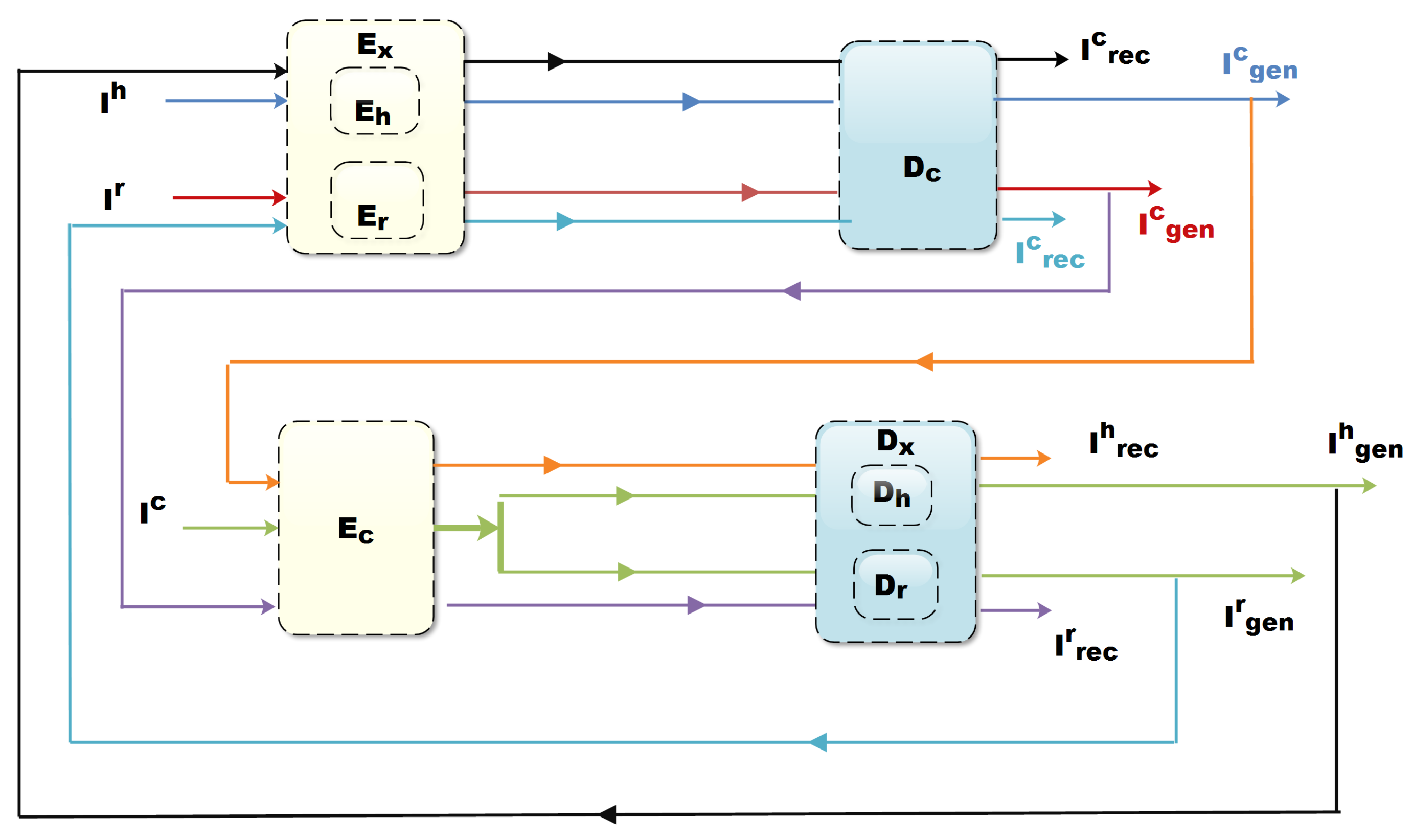
4.1. Enhancement Teacher
4.2. Scale-Permuted Distillation Network
| Algorithm 1 Dehazing + Distillation Training |
|
1: Input: Hazy domain , Clear domain , Hyperparameters 2: Networks: Encoders , Decoders , Teacher , Student , Pretrained VGG Layer 5 V 3: Output: Generated clean i.e., , Generated Hazy , Features from :- 4: for each do 5: 6: 7: , r(.) is forward rotation function 8: 9: 10: 11: 12: 13: , G(.) is inverse rotation function 14: 15: 16: 17: 18: 19: 20: end for 21: 22: 23: 24: Update using 25: for each do 26: 27: 28: , i denotes the feature levels 29: , , 30: 31: Update using 32: end for 33: Detection for input : |
4.3. The FPGA Implementation
5. Results and Discussion
5.1. Detection on Hazy Scenes
- For both haze levels, the distilled student consistently achieves slightly better performance than the teacher network.
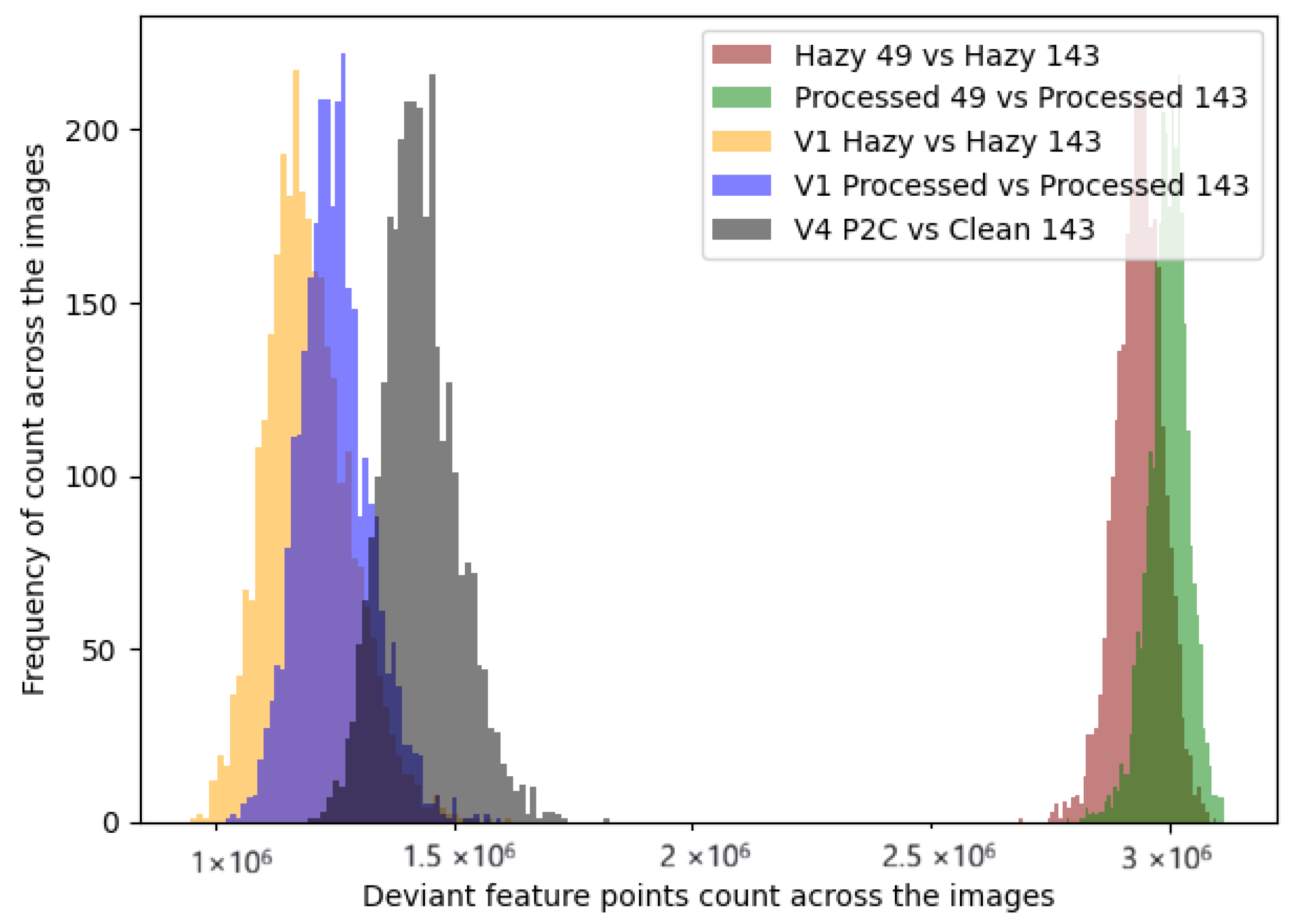
- Our hypothesis that using clean target feature maps during detection (i.e., ) yields improved performance compared to using hazy feature maps (i.e., ) is validated. This demonstrates that the explicit image enhancement step can be omitted, while still achieving improved detection performance through joint learning of clean-domain features from hazy inputs.
- For the lower haze level (), mixed-precision () training combined with pruning results in notably improved detection precision. At higher haze levels, however, configurations employing pruning and FP16 weights may require additional training epochs to achieve stable convergence.
5.2. Detection on Rainy Scenes
5.3. Detection on Low-Light Scenes
5.4. Ablation
- Does training on hazy images limit inference on clean inputs? Comparisons between S-V1-H-H and S-V1-H-P indicate that the student network is not biased toward hazy inputs and, in fact, achieves improved performance when evaluated on cleaner images.
- Can dual distillation from a large teacher outperform training from scratch? We observed that both S-V4 and S-V5 achieve nearly a improvement in mAP compared to a similarly sized model, T49-H (28.31 M parameters), trained from scratch. This demonstrates the effectiveness of dual-teacher distillation using a very large teacher (66.9 M parameters).
6. Conclusions and Future Work
Author Contributions
Funding
Data Availability Statement
Acknowledgments
Conflicts of Interest
References
- Vaithianathan, M. Real-Time Object Detection and Recognition in FPGA-Based Autonomous Driving Systems. Int. J. Comput. Trends Technol. 2024, 72, 145–152. [Google Scholar] [CrossRef]
- Sha, X.; Yanagisawa, M.; Shi, Y. An FPGA-Based YOLOv6 Accelerator for High-Throughput and Energy-Efficient Object Detection. IEICE Trans. Fundam. Electron. Commun. Comput. Sci. 2025, 108, 473–481. [Google Scholar] [CrossRef]
- Yvinec, E. Efficient Neural Networks: Post Training Pruning and Quantization. Ph.D. Thesis, Sorbonne Université, Paris, France, 2023. [Google Scholar]
- Gou, J.; Yu, B.; Maybank, S.J.; Tao, D. Knowledge Distillation: A Survey. Int. J. Comput. Vis. 2021, 129, 1789–1819. [Google Scholar] [CrossRef]
- Jocher, G.; Qiu, J. Ultralytics YOLO26, version 26; Ultralytics: Frederick, MD, USA, 2026.
- Kumar, A.; Chadha, A. From Fog to Failure: The Unintended Consequences of Dehazing on Object Detection in Clear Images. In Proceedings of the ICLR 2025 Workshops: I Can’t Believe It’s Not Better (ICBINB), Singapore, 28 April 2025. [Google Scholar]
- Tan, M.; Pang, R.; Le, Q.V. EfficientDet: Scalable and Efficient Object Detection. arXiv 2020, arXiv:1911.09070. [Google Scholar] [CrossRef]
- Li, C.; Zhou, H.; Liu, Y.; Yang, C.; Xie, Y.; Li, Z.; Zhu, L. Detection-Friendly Dehazing: Object Detection in Real-World Hazy Scenes. IEEE Trans. Pattern Anal. Mach. Intell. 2023, 45, 8284–8295. [Google Scholar] [CrossRef]
- Qin, H.; Lu, X.; Wang, L.; Wang, Y. Foggy-Aware Teacher: An Unsupervised Domain Adaptive Learning Framework for Object Detection in Foggy Scenes. IEEE Robot. Autom. Lett. 2025, 10, 7508–7515. [Google Scholar] [CrossRef]
- Zhang, D.; Wang, A.; Mo, R.; Wang, D. End-to-end acceleration of the YOLO object detection framework on FPGA-only devices. Neural Comput. Appl. 2024, 36, 1067–1089. [Google Scholar] [CrossRef]
- Ding, C.; Wang, S.; Liu, N.; Xu, K.; Wang, Y.; Liang, Y. REQ-YOLO: A resource-aware, efficient quantization framework for object detection on FPGAs. In Proceedings of the 2019 ACM/SIGDA international symposium on field-programmable gate arrays, Seaside, CA, USA, 24–26 February 2019; pp. 33–42. [Google Scholar]
- Nguyen, D.T.; Nguyen, T.N.; Kim, H.; Lee, H.J. A high-throughput and power-efficient FPGA implementation of YOLO CNN for object detection. IEEE Trans. Very Large Scale Integr. (VLSI) Systems 2019, 27, 1861–1873. [Google Scholar] [CrossRef]
- Cai, L.; Dong, F.; Chen, K.; Yu, K.; Qu, W.; Jiang, J. An FPGA based heterogeneous accelerator for single shot multibox detector (SSD). In Proceedings of the 2020 IEEE 15th International Conference on Solid-State & Integrated Circuit Technology (ICSICT), Kunming, China, 3–6 November 2020; pp. 1–3. [Google Scholar]
- Amin, R.A.; Hasan, M.; Wiese, V.; Obermaisser, R. FPGA-Based Real-Time Object Detection and Classification System Using YOLO for Edge Computing. IEEE Access 2024, 12, 73268–73278. [Google Scholar] [CrossRef]
- Zhai, J.; Li, B.; Lv, S.; Zhou, Q. FPGA-based vehicle detection and tracking accelerator. Sensors 2023, 23, 2208. [Google Scholar] [CrossRef]
- Kang, H.J. Real-time object detection on 640x480 image with vgg16+ ssd. In Proceedings of the 2019 International conference on field-programmable technology (ICFPT), Tianjin, China, 9–13 December 2019; pp. 419–422. [Google Scholar]
- Yu, Z.; Bouganis, C.S. A parameterisable FPGA-tailored architecture for YOLOv3-tiny. In Proceedings of the Applied Reconfigurable Computing. Architectures, Tools, and Applications: 16th International Symposium, ARC 2020, Toledo, Spain, 1–3 April 2020; Springer: Berlin/Heidelberg, Gemany, 2020; pp. 330–344. [Google Scholar]
- Kim, S.; Na, S.; Kong, B.Y.; Choi, J.; Park, I.C. Real-time SSDLite object detection on FPGA. IEEE Trans. Very Large Scale Integr. (VLSI) Syst. 2021, 29, 1192–1205. [Google Scholar] [CrossRef]
- Ngo, D.; Son, J.; Kang, B. VBI-Accelerated FPGA Implementation of Autonomous Image Dehazing: Leveraging the Vertical Blanking Interval for Haze-Aware Local Image Blending. Remote Sens. 2025, 17, 919. [Google Scholar] [CrossRef]
- Li, X.; Li, W.; Yan, X.; Wang, W.; Bu, F. Object Detection Method Based on Polarimetric Features and PFOD-Net Under Adverse Weather Conditions. Appl. Sci. 2026, 16, 1698. [Google Scholar] [CrossRef]
- Xie, F.; Jing, H.; Lu, Z.; Ju, S.; Peng, B.; Xie, T.; Yang, L.; Han, W.; Wang, Z.; Sai, G. FPGA-Based Front-End Low-Light Enhancement for Deterministic Vision-Only Driving Perception. Electronics 2026, 15, 1224. [Google Scholar] [CrossRef]
- Fata, J.S.; Elmannai, W.M. Low-Cost FPGA-Enhanced CNN Accelerator for Real-Time YOLO Object Detection and Classification. IEEE Access 2026, 14, 34614–34642. [Google Scholar] [CrossRef]
- Lin, T.Y.; Goyal, P.; Girshick, R.; He, K.; Dollár, P. Focal Loss for Dense Object Detection. arXiv 2018, arXiv:1708.02002. [Google Scholar] [CrossRef]
- Zhou, X.; Wang, D.; Krähenbühl, P. Objects as Points. arXiv 2019, arXiv:1904.07850. [Google Scholar]
- Du, X.; Lin, T.Y.; Jin, P.; Ghiasi, G.; Tan, M.; Cui, Y.; Le, Q.V.; Song, X. SpineNet: Learning scale-permuted backbone for recognition and localization. In Proceedings of the IEEE/CVF conference on computer vision and pattern recognition, Seattle, WA, USA, 13–19 June 2020; pp. 11592–11601. [Google Scholar]
- Wang, A.; Chen, H.; Liu, L.; Chen, K.; Lin, Z.; Han, J.; Ding, G. YOLOv10: Real-Time End-to-End Object Detection. arXiv 2024, arXiv:2405.14458. [Google Scholar]
- Lv, W.; Zhao, Y.; Chang, Q.; Huang, K.; Wang, G.; Liu, Y. RT-DETRv2: Improved Baseline with Bag-of-Freebies for Real-Time Detection Transformer. arXiv 2024, arXiv:2407.17140. [Google Scholar]
- Li, B.; Ren, W.; Fu, D.; Tao, D.; Feng, D.; Zeng, W.; Wang, Z. Reside: A benchmark for single image dehazing. arXiv 2017, arXiv:1712.04143. [Google Scholar]
- Kenk, M.A.; Hassaballah, M. DAWN: Vehicle detection in adverse weather nature dataset. arXiv 2020, arXiv:2008.05402. [Google Scholar] [CrossRef]
- Cordts, M.; Omran, M.; Ramos, S.; Rehfeld, T.; Enzweiler, M.; Benenson, R.; Franke, U.; Roth, S.; Schiele, B. The cityscapes dataset for semantic urban scene understanding. In Proceedings of the IEEE Conference on Computer Vision and Pattern Recognition, Las Vegas, NV, USA, 27–30 June 2016; pp. 3213–3223. [Google Scholar]
- Sakaridis, C.; Dai, D.; Hecker, S.; Van Gool, L. Model Adaptation with Synthetic and Real Data for Semantic Dense Foggy Scene Understanding. In Proceedings of the European Conference on Computer Vision (ECCV), Munich, Germany, 8–14 September 2018; pp. 707–724. [Google Scholar]
- Li, B.; Peng, X.; Wang, Z.; Xu, J.; Feng, D. Aod-net: All-in-one dehazing network. In Proceedings of the IEEE international conference on computer vision, Venice, Italy, 22–29 October 2017; pp. 4770–4778. [Google Scholar]
- Chen, D.; He, M.; Fan, Q.; Liao, J.; Zhang, L.; Hou, D.; Yuan, L.; Hua, G. Gated context aggregation network for image dehazing and deraining. In Proceedings of the 2019 IEEE Winter Conference on Applications of Computer Vision (WACV), Waikoloa, HI, USA, 7–11 January 2019; pp. 1375–1383. [Google Scholar]
- Dong, H.; Pan, J.; Xiang, L.; Hu, Z.; Zhang, X.; Wang, F.; Yang, M.H. Multi-scale boosted dehazing network with dense feature fusion. In Proceedings of the IEEE/CVF Conference on Computer Vision and Pattern Recognition, Seattle, WA, USA, 13–19 June 2020; pp. 2157–2167. [Google Scholar]
- Qin, X.; Wang, Z.; Bai, Y.; Xie, X.; Jia, H. FFA-Net: Feature fusion attention network for single image dehazing. In Proceedings of the AAAI Conference on Artificial Intelligence, New York, NY, USA, 7–12 February 2020; Volume 34, pp. 11908–11915. [Google Scholar]
- Cui, Y.; Knoll, A. Exploring the potential of channel interactions for image restoration. Knowl. Based Syst. 2023, 282, 111156. [Google Scholar] [CrossRef]
- Song, Y.; He, Z.; Qian, H.; Du, X. Vision transformers for single image dehazing. IEEE Trans. Image Process. 2023, 32, 1927–1941. [Google Scholar] [CrossRef]
- Tu, Z.; Talebi, H.; Zhang, H.; Yang, F.; Milanfar, P.; Bovik, A.; Li, Y. Maxim: Multi-axis mlp for image processing. In Proceedings of the IEEE/CVF Conference on Computer Vision and Pattern Recognition, New Orleans, LA, 18–24 June 2022; pp. 5769–5780. [Google Scholar]
- Potlapalli, V.; Zamir, S.; Khan, S.; Khan, F. Promptir: Prompting for all-in-one blind image restoration. arXiv 2023, arXiv:2306.13090. [Google Scholar] [CrossRef]
- Gao, H.; Yang, J.; Zhang, Y.; Wang, N.; Yang, J.; Dang, D. Prompt-based Ingredient-Oriented All-in-One Image Restoration. IEEE Trans. Circuits Syst. Video Technol. 2024, 34, 9458–9471. [Google Scholar] [CrossRef]
- Gao, H.; Ma, B.; Zhang, Y.; Yang, J.; Yang, J.; Dang, D. Frequency domain task-adaptive network for restoring images with combined degradations. Pattern Recognit. 2025, 158, 111057. [Google Scholar] [CrossRef]
- Zheng, D.; Wu, X.M.; Yang, S.; Zhang, J.; Hu, J.F.; Zheng, W.S. Selective Hourglass Mapping for Universal Image Restoration Based on Diffusion Model. In Proceedings of the IEEE/CVF Conference on Computer Vision and Pattern Recognition, Seattle, WA, USA, 16–22 June 2024; pp. 25445–25455. [Google Scholar]
- Yang, Y.; Wang, C.; Liu, R.; Zhang, L.; Guo, X.; Tao, D. Self-Augmented Unpaired Image Dehazing via Density and Depth Decomposition. In Proceedings of the IEEE/CVF Conference on Computer Vision and Pattern Recognition (CVPR), New Orleands, LA, USA, 18–24 June 2022; pp. 2037–2046. [Google Scholar]
- Mishra, P.; Bhattacharya, J.; Sharma, R.K.; Ramponi, G. H2CGAN: Manageable AI for Scene Understanding Tasks in Hazy/Rainy Environment. IEEE Access 2024, 12, 89163–89182. [Google Scholar] [CrossRef]
- Bhattacharya, J.; Carini, A.; Marsi, S.; Ramponi, G. A Polynomial and Fourier Basis Network for Vision-Based Translation Tasks. Electronics 2026, 15, 52. [Google Scholar] [CrossRef]
- Bhattacharya, J.; Ramponi, G. Speeded-up Convolution Neural Network for classification tasks using multiscale 2-dimensional decomposition. Neurocomputing 2020, 410, 61–70. [Google Scholar] [CrossRef]
- Li, S.; Araujo, I.B.; Ren, W.; Wang, Z.; Tokuda, E.K.; Junior, R.H.; Cesar-Junior, R.; Zhang, J.; Guo, X.; Cao, X. Single Image Deraining: A Comprehensive Benchmark Analysis. In Proceedings of the IEEE/CVF Conference on Computer Vision and Pattern Recognition, Long Beach, CA, USA, 16–20 June 2019; pp. 3833–3842. [Google Scholar]
- Kumar, R.; Reddy, D.S.; Rajalakshmi, P. Driveindia: An Object Detection Dataset for Diverse Indian Traffic Scenes. In Proceedings of the 2025 IEEE 28th International Conference on Intelligent Transportation Systems (ITSC), Gold Coast, Australia, 18–21 November 2025; pp. 4249–4254. [Google Scholar]




| Model Name | No. of Parameters | COCO | RESIDE | Dawn Haze |
|---|---|---|---|---|
| Retina-Net | 53.1 M | 43.9 | 35.7 | 51.0 |
| Centre-Net | 53 M | 44.5 | 17.5 | 23.7 |
| Efficient-Det6 | 52 M | 50.5 | 44.3 | 59.4 |
| YOLOv10 | 29.5 M | 54.4 | 47.4 | 57.6 |
| RT-DETR | 76 M | 54.3 | 49.5 | 57.4 |
| SpineNet | 42.7/ | 47.1/ | 60.6/ | 70.6/ |
| 96/143 | 66.73 | 48.1 | 62.7 | 75.5 |
| Cityscapes | RESIDE | DawnHaze | Total Gain | |
|---|---|---|---|---|
| Hazy Image | 36.52 | 62.67 | 75.47 | |
| ChaIR | 36.07 | 62.72 | 76.21 | 0.34 |
| D4 | 38.10 | 62.06 | 76.32 | 1.83 |
| GCANeT | 38.94 | 61.80 | 73.13 | −0.79 |
| MAXIM | 36.01 | 62.71 | 74.95 | −0.98 |
| AOD | 36.50 | 57.87 | 63.22 | −17.07 |
| CAPTNET | 33.62 | 47.28 | 70.83 | −22.93 |
| DEHAZEFORMER | 37.43 | 60.25 | 63.18 | −13.80 |
| DIFFUIR | 36.31 | 62.73 | 72.87 | −2.74 |
| FDTANET | 34.98 | 46.73 | 71.35 | −21.59 |
| FFA | 37.46 | 62.54 | 75.26 | 0.61 |
| MSBDN | 38.71 | 60.66 | 73.55 | −1.74 |
| PROMPTIR | 36.40 | 60.84 | 74.41 | −3.01 |
| H2CGAN | 39.56 | 62.16 | 75.79 | 2.86 |
| Effdetv6 | YOLOv10 | RTDETR | Spinenet | |
|---|---|---|---|---|
| DawnHaze (DH) | 59.39 | 57.59 | 57.36 | 75.46 |
| DH_ChaIR | 57.18 | 56.61 | 59.45 | 76.20 |
| DH_MAXIM | 56.10 | 58.21 | 58.46 | 74.95 |
| DH_D4 | 57.09 | 55.83 | 58.35 | 76.32 |
| RESIDE (R) | 44.34 | 47.37 | 49.45 | 62.66 |
| R_ChaIR | 46.24 | 47.15 | 47.56 | 62.71 |
| R_MAXIM | 44.79 | 47.22 | 47.34 | 62.71 |
| R_D4 | 46.33 | 47.12 | 47.81 | 62.06 |
| Bicycle | Bus | Car | Motorcycle | Person | Truck | Train | Traffic Light | Avg | |
|---|---|---|---|---|---|---|---|---|---|
| EfficientDet | |||||||||
| Clean | 39.83 | 53.18 | 48.13 | 28.33 | 28.05 | 35.72 | 4.76 | 18.67 | 32.08 |
| 0.005 | 38.76 | 51.38 | 47.11 | 27.71 | 28.4 | 30.68 | 4.35 | 18.81 | 30.9 |
| 0.01 | 36.14 | 47.6 | 46.03 | 27.29 | 27.87 | 29.8 | 4.35 | 18.26 | 29.66 |
| 0.02 | 32.45 | 37.8 | 42.63 | 25.04 | 26.18 | 26.19 | 0 | 16.15 | 25.80 |
| YOLOv10 | |||||||||
| Clean | 34.94 | 52.24 | 49.85 | 27.62 | 31.67 | 25.74 | 7.97 | 18.67 | 31.08 |
| 0.005 | 33.43 | 52.25 | 47.78 | 28.72 | 31.11 | 25.97 | 9.58 | 20.7 | 31.19 |
| 0.01 | 32.73 | 52.24 | 45.76 | 25.48 | 30.61 | 25.75 | 8.7 | 20.76 | 30.25 |
| 0.02 | 30.84 | 47.27 | 41.69 | 23.57 | 28.7 | 25.49 | 9.94 | 19.74 | 28.40 |
| RT-Detr | |||||||||
| Clean | 34.96 | 53.07 | 49.28 | 29.27 | 30.46 | 28.47 | 17.39 | 23.66 | 33.32 |
| 0.005 | 34.39 | 48.29 | 46.3 | 27.43 | 30.43 | 29.38 | 4.35 | 25.92 | 30.81 |
| 0.01 | 32.64 | 46.81 | 44.17 | 24.52 | 29.54 | 28.65 | 8.7 | 25.02 | 30.00 |
| 0.02 | 26.85 | 45.86 | 38.08 | 24.83 | 31.84 | 32.54 | 10 | 24.81 | 29.35 |
| SpineNet143 | |||||||||
| Clean | 48.43 | 63.26 | 67.04 | 44.46 | 44.11 | 30.56 | 40.58 | 32.6 | 46.38 |
| 0.005 | 48.05 | 59.39 | 65.28 | 40.68 | 42.97 | 29.78 | 40.72 | 33.85 | 45.09 |
| 0.01 | 46.52 | 55.72 | 63.48 | 36.92 | 42.44 | 30.62 | 35.06 | 33.25 | 43.00 |
| 0.02 | 43.65 | 47.93 | 60.33 | 30.52 | 39.63 | 30.39 | 29.81 | 30.15 | 39.05 |
| Teacher | |
| Filter Sizes | 64, 83, 164, 166, 332, 664 |
| No. of Blocks | stem (2), (1), (2), (4), (4), (2), (2) |
| Basic Blocks | residual (Conv 3 × 3, Conv 3 × 3), |
| bottleneck (Conv 1 × 1, Conv 3 × 3, Conv 1 × 1) | |
| Student 1 | |
| Filter Sizes | 64, 83, 164, 166, 332, 664 |
| No. of Blocks | stem (2), (1), (2), (4), (4), (2), (2) |
| Basic Blocks | residual (Conv 3 × 3, Conv 3 × 3), |
| transfer (Conv 1 × 1, Conv 1 × 1) | |
| Student 2 | |
| Filter Sizes | 20, 83, 41, 64, 128, 192 |
| No. of Blocks | stem (2), (1), (2), (4), (4), (2), (2) |
| Basic Blocks | residual (Conv 3 × 3, Conv 3 × 3), |
| transfer (Conv 1 × 1, Conv 1 × 1) |
| Metrics | 8-Bits Fixed-Point | 16-Bits Fixed-Point |
|---|---|---|
| BRAM | 34% | 63% |
| DSP | 0% | 65% |
| LUT | 4% | 4% |
| FF | 40% | 60% |
| Frequency [MHz] | 100 | 100 |
| FP32 | FP16 | P | Haze 0.01 | Haze 0.02 | |||
|---|---|---|---|---|---|---|---|
| Student | ✓ | ✓ | ✓ | 33.85 | 30.23 | ||
| Student | ✓ | ✓ | 33.28 | 29.97 | |||
| Student | ✓ | ✓ | ✓ | 32.77 | 28.90 | ||
| Student | ✓ | ✓ | 33.50 | 28.97 | |||
| Student | ✓ | ✓ | ✓ | 33.81 | 30.32 | ||
| Student | ✓ | ✓ | 33.82 | 30.51 | |||
| Student | ✓ | ✓ | ✓ | 32.70 | 29.01 | ||
| Student | ✓ | ✓ | 33.40 | 28.81 | |||
| Teacher | 32.86 | 29.01 |
| YOLO | YOLO | YOLO | SPINE | Student | YOLO | Student | |
|---|---|---|---|---|---|---|---|
| v10-M | v10-S | 26-S | 49s | 1Bd (Ours) | v10-N | 2Ad (Ours) | |
| Haze level 0.01 | 32.90 | 22.98 | 28.04 | 32.86 | 33.85 | 15.9 | 23.54 |
| Haze level 0.02 | 28.75 | 21.13 | 25.54 | 29.01 | 30.50 | 14.4 | 20.82 |
| Pars (M) | 15.4 | 7.20 | 9.50 | 11.15 | 8.58 | 2.30 | 3.67 |
| YOLO | SPINE | Student | Student | |
|---|---|---|---|---|
| 26-S | 49s | 1Bd (Ours) | 2Ad (Ours) | |
| mAP | 15.01 | 18.47 | 21.40 | 21.2 |
| Pars (M) | 9.5 | 11.15 | 8.58 | 3.67 |
| YOLO | SPINE | Student | Student | |
|---|---|---|---|---|
| 26-S | 49s | 1Bd (Ours) | 2Ad (Ours) | |
| mAP | 20.41 | 29.8 | 24.38 | 15.07 |
| Pars (M) | 9.5 | 11.15 | 8.58 | 3.67 |
| Bicycle | Bus | Car | Motorcycle | Person | Traffic Light | Train | Truck | Avg. | Pars | |
|---|---|---|---|---|---|---|---|---|---|---|
| S-V1-H-H | 40.71 | 48.09 | 62.25 | 29.76 | 40.57 | 29.36 | 35.29 | 26.60 | 39.07 | 28.7 |
| S-V1-H-P | 41.55 | 54.40 | 62.77 | 33.09 | 42.11 | 28.44 | 32.01 | 29.72 | 40.51 | 28.7 |
| S-V2-H-P | 40.42 | 52.25 | 60.91 | 34.59 | 41.07 | 27.88 | 33.33 | 25.38 | 39.47 | 28.7 |
| S-V3-H-P | 40.33 | 53.43 | 63.97 | 32.62 | 42.37 | 29.30 | 36.25 | 26.83 | 40.63 | 28.7 |
| S-V4-H2P-H | 41.01 | 50.50 | 62.22 | 31.23 | 41.96 | 29.74 | 34.96 | 26.04 | 39.70 | 28.7 |
| S-V4-H2C-H | 44.24 | 49.58 | 62.18 | 34.40 | 42.90 | 28.04 | 29.32 | 26.90 | 39.69 | 28.7 |
| S-V4-P2C-P | 42.97 | 53.96 | 65.32 | 36.71 | 42.29 | 28.92 | 32.54 | 25.44 | 41.01 | 28.7 |
| S-V5-H2C-H | 42.82 | 53.44 | 64.52 | 36.99 | 42.92 | 28.43 | 33.24 | 26.85 | 41.15 | 28.7 |
| T49-H | 34.32 | 46.17 | 55.31 | 23.33 | 34.63 | 21.20 | 16.44 | 25.41 | 32.10 | 28.3 |
| T143-H | 45.99 | 54.10 | 62.97 | 35.75 | 41.59 | 32.21 | 34.16 | 30.00 | 42.09 | 66.9 |
| T143-C | 48.43 | 63.26 | 67.04 | 44.46 | 44.11 | 32.60 | 40.58 | 30.56 | 46.38 | 66.9 |
| T143-P | 45.86 | 56.87 | 62.02 | 37.98 | 42.39 | 31.38 | 44.57 | 29.92 | 43.87 | 66.9 |
| Bicycle | Bus | Car | Motorcycle | Person | Truck | Avg. | Pars (M) | |
|---|---|---|---|---|---|---|---|---|
| S-V4-H2C-H | 11.44 | 44.56 | 89.76 | 80.60 | 33.10 | 37.15 | 49.43 | 28.7 |
| T143 | 17.56 | 39.89 | 82.80 | 78.29 | 75.52 | 43.81 | 56.31 | 66.9 |
| T49 | 18.76 | 37.29 | 86.31 | 81.58 | 29.16 | 37.01 | 48.35 | 28.3 |
| YOLO26-L | 18.83 | 37.86 | 85.92 | 81.80 | 22.93 | 40.84 | 48.03 | 24.8 |
| BDD Night | Cityscapes (0.02) | |
|---|---|---|
| YOLOv10-S (7 M) | 20.41 | 21.12 |
| YOLOv10-X (28 M) | 32.90 | 30.62 |
| Distilled s2x (19.6 M) | 17.49 | 24.72 |
Disclaimer/Publisher’s Note: The statements, opinions and data contained in all publications are solely those of the individual author(s) and contributor(s) and not of MDPI and/or the editor(s). MDPI and/or the editor(s) disclaim responsibility for any injury to people or property resulting from any ideas, methods, instructions or products referred to in the content. |
© 2026 by the authors. Licensee MDPI, Basel, Switzerland. This article is an open access article distributed under the terms and conditions of the Creative Commons Attribution (CC BY) license.
Share and Cite
Bhattacharya, J.; Molina, R.; Crespo, M.L.; Carini, A.; Marsi, S.; Ramponi, G. A Feature Distillation Network to Enable Object Detection on an FPGA Platform in Poor Visibility Conditions. Electronics 2026, 15, 2454. https://doi.org/10.3390/electronics15112454
Bhattacharya J, Molina R, Crespo ML, Carini A, Marsi S, Ramponi G. A Feature Distillation Network to Enable Object Detection on an FPGA Platform in Poor Visibility Conditions. Electronics. 2026; 15(11):2454. https://doi.org/10.3390/electronics15112454
Chicago/Turabian StyleBhattacharya, Jhilik, Romina Molina, Maria Liz Crespo, Alberto Carini, Stefano Marsi, and Giovanni Ramponi. 2026. "A Feature Distillation Network to Enable Object Detection on an FPGA Platform in Poor Visibility Conditions" Electronics 15, no. 11: 2454. https://doi.org/10.3390/electronics15112454
APA StyleBhattacharya, J., Molina, R., Crespo, M. L., Carini, A., Marsi, S., & Ramponi, G. (2026). A Feature Distillation Network to Enable Object Detection on an FPGA Platform in Poor Visibility Conditions. Electronics, 15(11), 2454. https://doi.org/10.3390/electronics15112454