XORSFRO: A Resource-Efficient XOR Self-Feedback Ring Oscillator-Based TRNG Architecture for Securing Distributed Photovoltaic Systems


Abstract
1. Introduction
- (1)
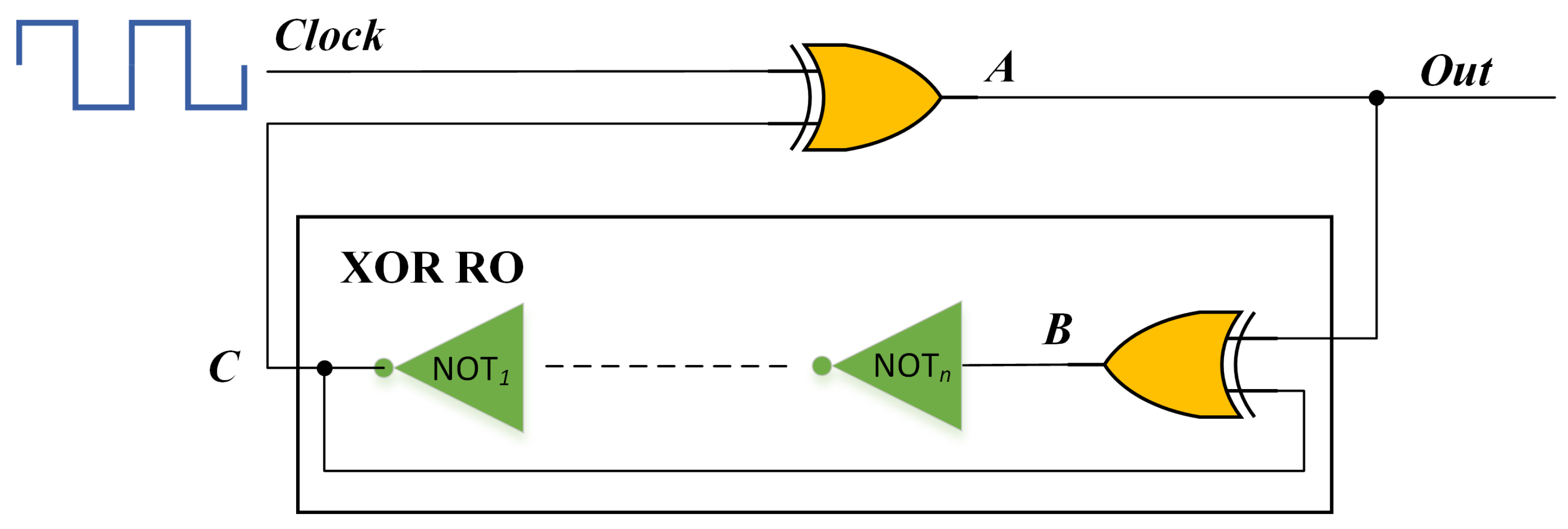
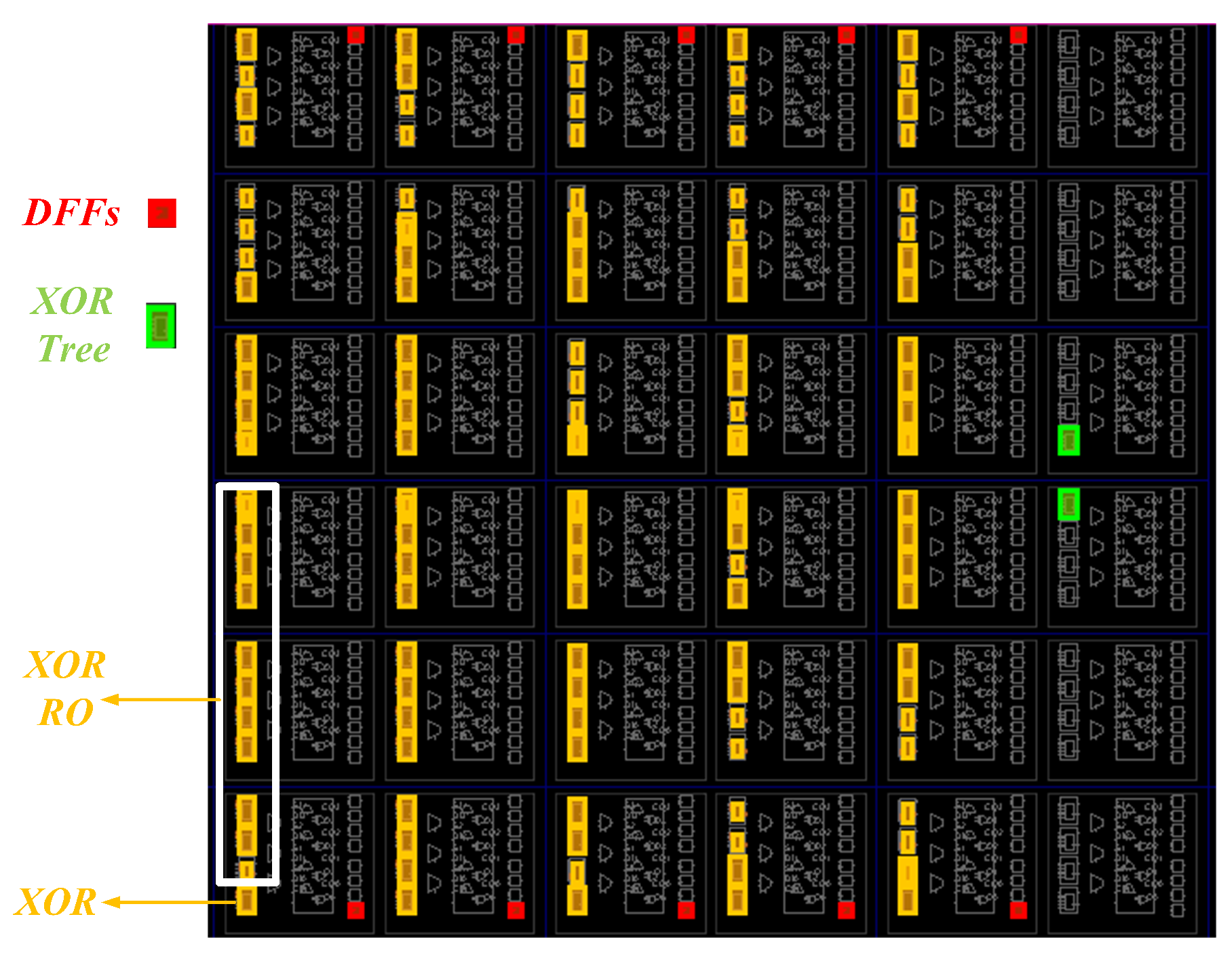
- We refine the standard RO and propsoe a compact, resource-efficient, and stable self-feedback structure, named XORSFRO, as ES for TRNG.
- (2)
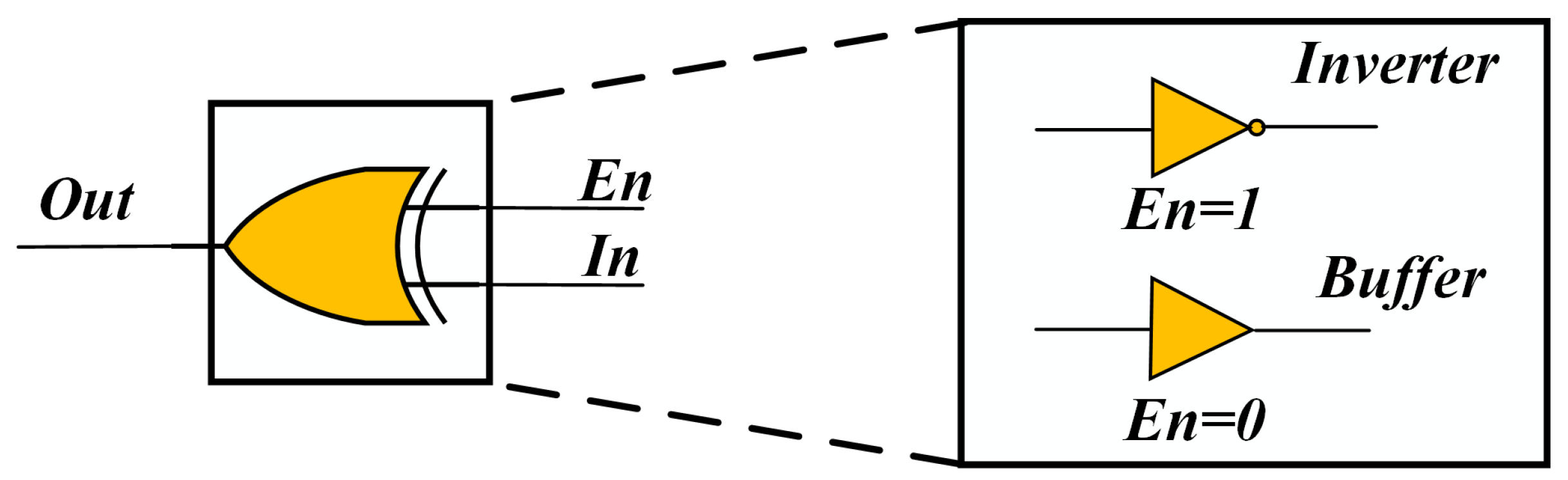
- By feeding back the XOR of a high-speed clock and the RO output, the ES is continuously refreshed, thereby improving minimum entropy and reducing bias.
- (3)
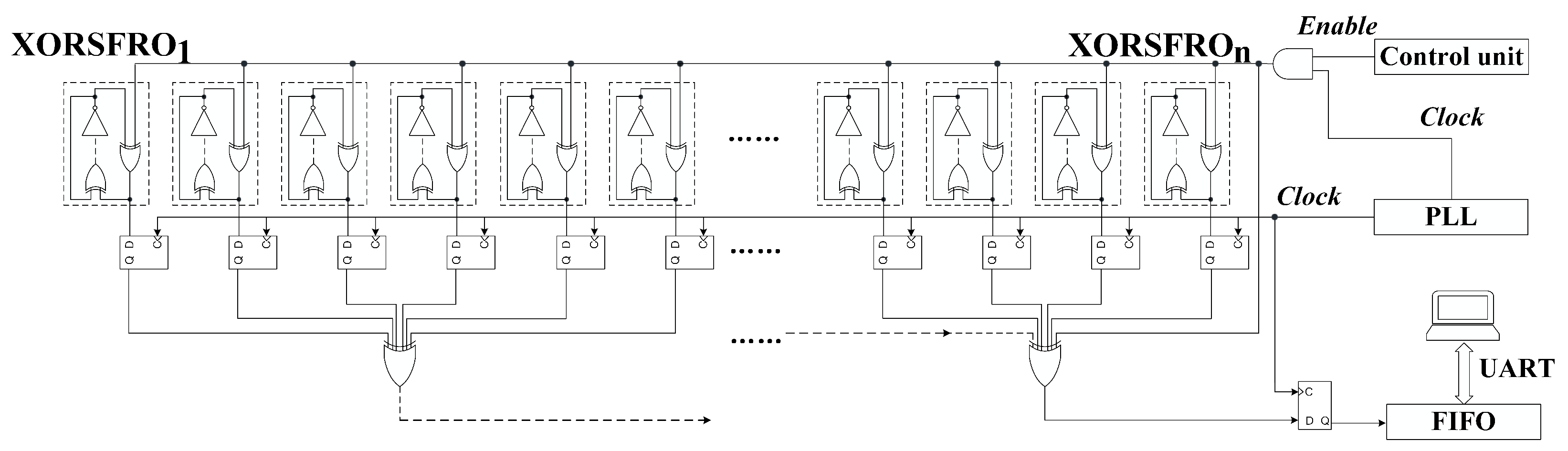
- A two-round cross-serial XOR tree is utilized to prevent the detrimental effects of clock coupling of ES architecture, further improving the randomness.
- (4)
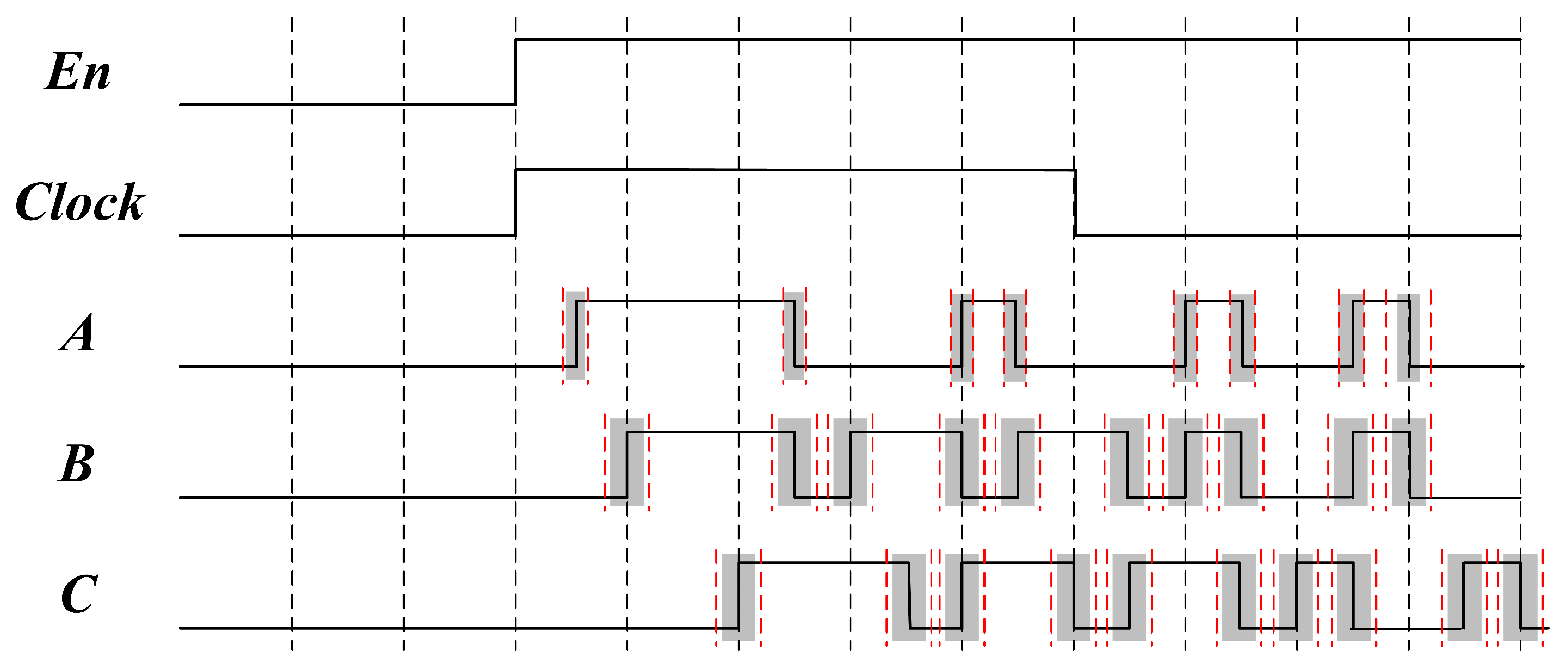
- We establish a mathematical model that explains how input-arrival skew and gate inertial delay generate narrow pulses and inversions, effectively amplifying randomness.
- (5)
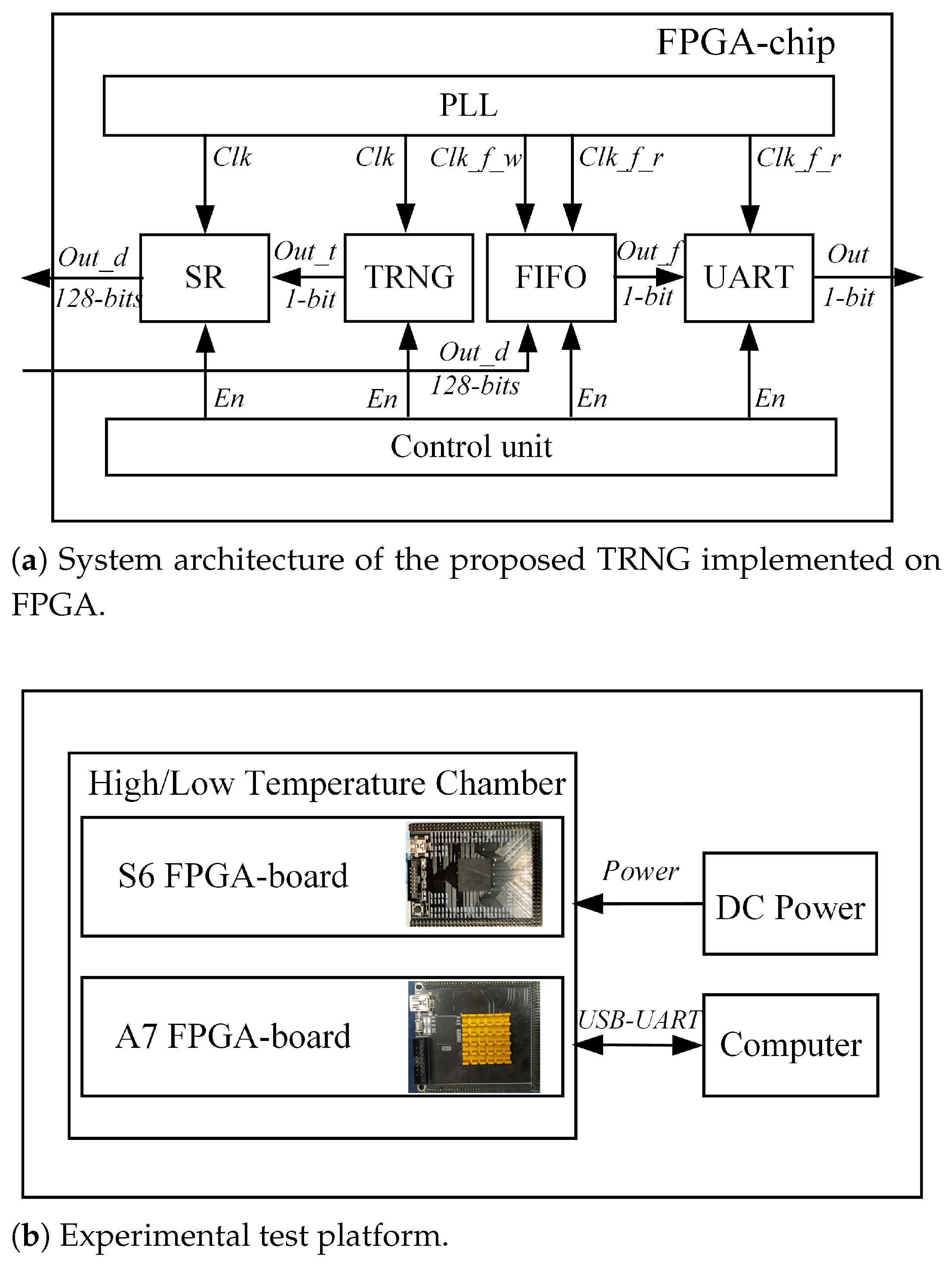
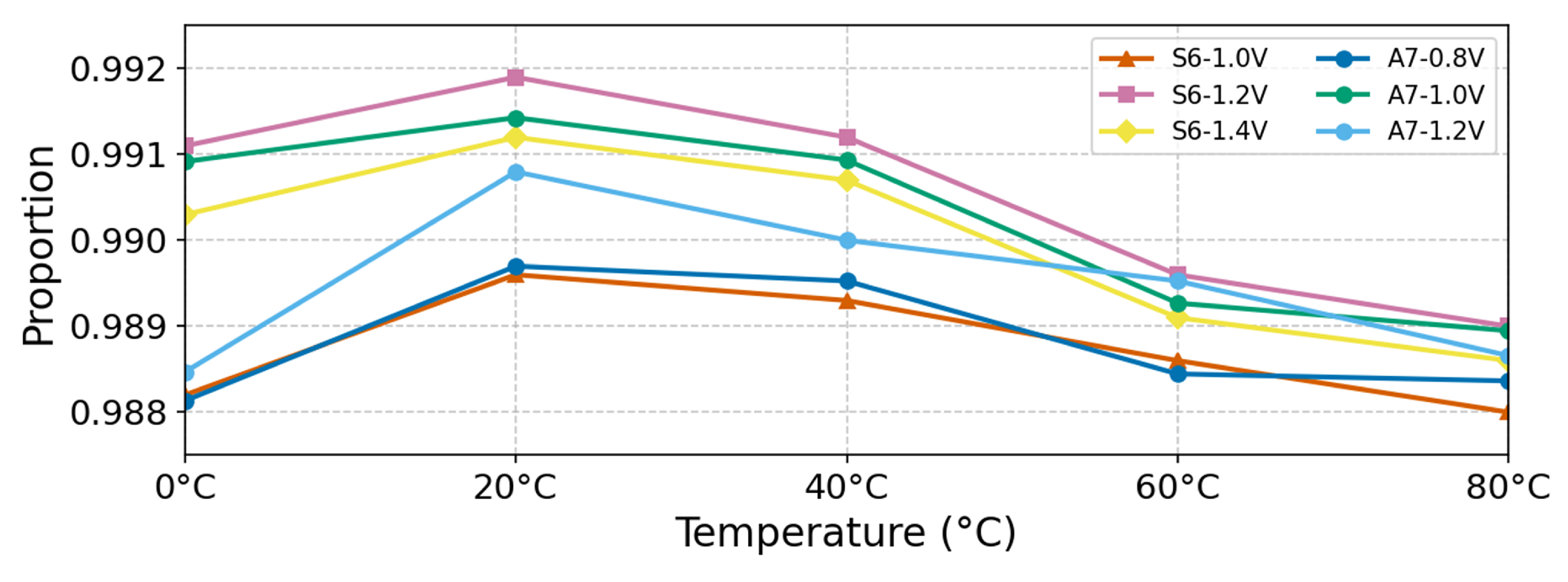
- Experimental results on FPGA platforms demonstrate that XORSFRO achieves high throughput and low hardware/power cost, while maintaining robustness across process–voltage–temperature (PVT) variations, making it a strong candidate for secure distributed PV applications.
2. Background
3. The Proposed XORSFRO TRNG Architecture
3.1. XORSFRO Structure
3.2. XORSFRO TRNG Design
3.3. Theoretical Proof
- When , the two signals are perfectly in phase, and ;
- When , a narrow pulse is generated, with a width on the same order as the misalignment;
- When , an effective inversion occurs, and the output is .
4. Experiment Results
4.1. NIST Test
4.2. Deviation Test
4.3. Autocorrelation Test
4.4. Restart Test
4.5. PVT Test
4.6. Comparison with Other TRNGs Based on FPGAs
5. Conclusions
Author Contributions
Funding
Data Availability Statement
Acknowledgments
Conflicts of Interest
Abbreviations
| TRNG | True Random Number Generator |
| ES | Entropy Source |
| PV | Photovoltaic |
| IoT | Internet of Things |
| RO | Ring Oscillator |
| STR | Self-Timed Ring |
| DCM | Digital Clock Manager |
| PLL | Phase-Locked Loop |
| PVT | Process–Voltage–Temperature |
| FPGA | Field-Programmable Gate Array |
| XOR | Exclusive OR |
| XNOR | Exclusive NOR |
| XORSFRO | XOR Self-Feedback Ring Oscillator |
| DFF | D-type Flip-Flop |
| SR | Shift Register |
| FIFO | First-In First-Out |
| UART | Universal Asynchronous Receiver-Transmitter |
| Clk | System Clock |
| ACF | Autocorrelation factor |
| LUT | Look-Up Table |
| MCV | Most Common Value |
| h-min | Minimum Entropy |
| p-max | Maximum Probability |
| NAND | NOT AND Gate |
| NOR | NOT OR Gate |
References
- Harrou, F.; Taghezouit, B.; Bouyeddou, B.; Sun, Y. Cybersecurity of Photovoltaic Systems: Challenges, Threats, and Mitigation Strategies: A Short Survey. Electronics 2023, 12, 1274451. [Google Scholar] [CrossRef] [Scilit]
- Orúe López, A.B.; Encinas, L.H.; Muñoz, A.M.; Vitini, F.M. A lightweight pseudorandom number generator for securing the Internet of Things. IEEE Access 2017, 5, 27800–27806. [Google Scholar] [CrossRef] [Scilit]
- Serrano, R.; Duran, C.; Sarmiento, M.; Hoang, T.-T.; Tsukamoto, A.; Suzaki, K.; Pham, C.-K. A robust and healthy against PVT variations TRNG based on frequency collapse. IEEE Access 2022, 10, 41852–41862. [Google Scholar] [CrossRef] [Scilit]
- Koyuncu, İ.; Tuna, M.; Pehlivan, İ.; Fidan, C.B.; Alçin, M. Design, FPGA implementation and statistical analysis of chaos-ring based dual entropy core true random number generator. Analog Integr. Circuits Signal Process. 2020, 102, 445–456. [Google Scholar] [CrossRef] [Scilit]
- IEA-PVPS. Trends in Photovoltaic Applications 2024. International Energy Agency Photovoltaic Power Systems Programme. 2024. Available online: https://iea-pvps.org/wp-content/uploads/2024/10/IEA-PVPS-Task-1-Trends-Report-2024.pdf (accessed on 15 September 2025).
- Choe, J.-Y.; Shin, K.-W. A self-timed ring based TRNG with feedback structure. In Proceedings of the 2020 International Conference on Electronics, Information, and Communication (ICEIC), Barcelona, Spain, 19–22 January 2020; pp. 1–3. [Google Scholar]
- Gu, H.; Deng, F.; Wang, Q.; Jing, N. A four-phase self-timed ring based true random number generator on FPGA. In Proceedings of the 2022 IEEE 16th International Conference on Solid-State & Integrated Circuit Technology (ICSICT), Nanjing, China, 25–28 October 2022; pp. 1–3. [Google Scholar]
- Fujieda, N.; Takeda, M.; Ichikawa, S. An analysis of DCM-based true random number generator. IEEE Trans. Circuits Syst. II Express Briefs 2020, 67, 1109–1113. [Google Scholar] [CrossRef] [Scilit]
- Riurean, S.; Fodorean, D.; Rusu, M.C.; Drosu, A.L. Securing photovoltaic systems as critical infrastructure. Sustainability 2025, 17, 4397. [Google Scholar] [CrossRef] [Scilit]
- Johnson, A.P.; Chakraborty, R.S.; Mukhopadyay, D. An improved DCM-based tunable true random number generator for Xilinx FPGA. IEEE Trans. Circuits Syst. II Express Briefs 2017, 64, 452–456. [Google Scholar] [CrossRef] [Scilit]
- Frustaci, F.; Spagnolo, F.; Perri, S.; Corsonello, P. A high-speed FPGA-based true random number generator using metastability with clock managers. IEEE Trans. Circuits Syst. II Express Briefs 2023, 70, 756–760. [Google Scholar] [CrossRef] [Scilit]
- Maiti, A.; Schaumont, P. Improved Ring Oscillator PUF: An FPGA-friendly Secure Primitive. J. Cryptol. 2011, 24, 375–397. [Google Scholar] [CrossRef] [Scilit]
- Mei, F.; Zhang, L.; Gu, C.; Cao, Y.; Wang, C.; Liu, W. A highly flexible lightweight and high speed true random number generator on FPGA. In Proceedings of the 2018 IEEE Computer Society Annual Symposium on VLSI (ISVLSI), Hong Kong, China, 8–11 July 2018; pp. 399–404. [Google Scholar]
- Sivaraman, R.; Arumugham, S.; Rajagopalan, S. Design and analysis of ring oscillator influenced beat frequency detection for true random number generation on FPGA. In Proceedings of the 2019 11th International Conference on Computing, Communication and Networking Technologies (ICCCNT), Coimbatore, India, 7–11 January 2019; pp. 1–6. [Google Scholar]
- Xu, X.; Liang, H.; Zhou, K.; Ma, G.; Huang, Z.; Yi, M.; Ni, T.; Lu, Y. An all-digital and jitter-quantizing true random number generator in SRAM-based FPGAs. In Proceedings of the 2018 IEEE Asian Test Symposium (ATS), Hefei, China, 15–18 October 2018; pp. 59–62. [Google Scholar]
- Lu, Z.; Qidiao, H.; Chen, Q.; Liu, Z.; Zhang, J. An FPGA-compatible TRNG with ultra-high throughput and energy efficiency. In Proceedings of the 2023 60th ACM/IEEE Design Automation Conference (DAC), San Francisco, CA, USA, 9–13 July 2023; pp. 1–6. [Google Scholar] [CrossRef] [Scilit]
- Tao, S.; Yu, Y.; Dubrova, E. FPGA-based true random number generators using non-linear feedback ring oscillators. In Proceedings of the 2018 16th IEEE International New Circuits and Systems Conference (NEWCAS), Montreal, QC, Canada, 24–27 June 2018; pp. 213–216. [Google Scholar]
- Cui, J.; Yi, M.; Cao, D.; Yao, L.; Wang, X.; Liang, H.; Huang, Z.; Qi, H.; Ni, T.; Lu, Y. Design of true random number generator based on multi-stage feedback ring oscillator. IEEE Trans. Circuits Syst. II Express Briefs 2022, 69, 1752–1756. [Google Scholar] [CrossRef] [Scilit]
- Peng, Q.; Bian, J.; Huang, Z.; Wang, S.; Yan, A. A compact TRNG design for FPGA based on the metastability of RO-driven shift registers. ACM Trans. Des. Autom. Electron. Syst. 2023, 29, 1–17. [Google Scholar] [CrossRef] [Scilit]
- Wang, X.; Liang, H.; Wang, Y.; Yao, L.; Guo, Y.; Yi, M.; Huang, Z.; Qi, H.; Lu, Y. High-throughput portable true random number generator based on jitter-latch structure. IEEE Trans. Circuits Syst. I Reg. Papers 2021, 68, 741–753. [Google Scholar] [CrossRef] [Scilit]
- Grujić, M.; Verbauwhede, I. TROT: A three-edge ring oscillator based true random number generator with time-to-digital conversion. IEEE Trans. Circuits Syst. I Reg. Papers 2022, 69, 2435–2448. [Google Scholar] [CrossRef] [Scilit]
- Yang, Y.; Jia, S.; Wang, Y.; Zhang, S.; Liu, C. A reliable true random number generator based on novel chaotic ring oscillator. In Proceedings of the 2017 IEEE International Symposium on Circuits and Systems (ISCAS), Baltimore, MD, USA, 28–31 May 2017; pp. 1–4. [Google Scholar]
- Della Sala, R.; Bellizia, D.; Scotti, G. A novel ultra-compact FPGA-compatible TRNG architecture exploiting latched ring oscillators. IEEE Trans. Circuits Syst. II Express Briefs 2022, 69, 1672–1676. [Google Scholar] [CrossRef] [Scilit]
- Lin, J.; Wang, Y.; Zhao, Z.; Hui, C.; Song, Z. A new method of true random number generation based on Galois ring oscillator with event sampling architecture in FPGA. In Proceedings of the IEEE International Instrumentation and Measurement Technology Conference (I2MTC), Dubrovnik, Croatia, 25–28 May 2020; pp. 1–5. [Google Scholar]
- Della Sala, R.; Scotti, G. On enhancing the throughput of the latched ring oscillator TRNG on FPGA. In Proceedings of the International Conference on Applications in Electronics Pervading Industry, Environment and Society, Genova, Italy, 26–27 September 2023; pp. 277–287. [Google Scholar] [CrossRef] [Scilit]
- Zhang, Y.; Zhang, J. A high throughput STR-based TRNG by jitter precise quantization superposing. ACM Trans. Des. Autom. Electron. Syst. 2023, 29, 1–19. [Google Scholar] [CrossRef] [Scilit]
- Tupparwar, S.; Mohankumar, N. A hybrid true random number generator using ring oscillator and digital clock manager. In Proceedings of the 6th International Conference on Inventive Computation Technologies (ICICT), Coimbatore, India, 20–22 January 2021; pp. 290–294. [Google Scholar]
- Sivaraman, R.; Rajagopalan, S.; Sridevi, A.; Rayappan, J.B.B.; Annamalai, M.P.V.; Rengarajan, A. Metastability-induced TRNG architecture on FPGA. Iran. J. Sci. Technol. Trans. Electr. Eng. 2019, 44, 47–57. [Google Scholar] [CrossRef] [Scilit]
- Wu, X.; Li, S. A new digital true random number generator based on delay chain feedback loop. In Proceedings of the IEEE International Symposium on Circuits and Systems (ISCAS), Baltimore, MD, USA, 28–31 May 2017; pp. 1–4. [Google Scholar]









| Two-Input Logic Gate | P1:P0 Ratio | |
|---|---|---|
| AND | Gate | 1:3 |
| OR | Gate | 3:1 |
| NAND | Gate | 3:1 |
| NOR | Gate | 1:3 |
| XNOR | Gate | 1:1 |
| XOR | Gate | 1:1 |
| Chip Model | Spartan-6 | Artix-7 | ||
|---|---|---|---|---|
| Test Item | p-Value | Proportion | p-Value | Proportion |
| Frequency | 0.213309 | 9/10 | 0.739918 | 10/10 |
| BlockFrequency | 0.911413 | 10/10 | 0.534146 | 10/10 |
| CumulativeSums | 0.213309 | 10/10 | 0.213309 | 9/10 |
| Runs | 0.911413 | 10/10 | 0.213309 | 10/10 |
| LongestRun | 0.350485 | 10/10 | 0.911413 | 10/10 |
| Rank | 0.739918 | 9/10 | 0.534146 | 10/10 |
| FFT | 0.350485 | 10/10 | 0.213309 | 9/10 |
| NonOverlappingTemplate | 0.505002 | 10/10 | 0.499754 | 10/10 |
| OverlappingTemplate | 0.534146 | 10/10 | 0.739918 | 10/10 |
| Universal | 0.122325 | 10/10 | 0.066882 | 10/10 |
| ApproximateEntropy | 0.534146 | 10/10 | 0.739918 | 10/10 |
| Serial | 0.534146 | 10/10 | 0.630949 | 9/10 |
| LinearComplexity | 0.739918 | 10/10 | 0.534146 | 10/10 |
| Chip Model | Spartan-6 | Artix-7 | ||
|---|---|---|---|---|
| Test Item | h-Min | p-Max | p-Min | p-Max |
| MCV | 0.996095 | 0.501355 | 0.992995 | 0.501149 |
| Collision | 0.899598 | 0.500000 | 0.936991 | 0.499999 |
| Markov | 0.999654 | 3.03 × | 0.998248 | 3.43 × |
| Compression | 1 | 0.5 | 1 | 0.5 |
| t-Tuple | 0.922420 | 0.526342 | 0.919607 | 0.527370 |
| LRS | 0.995989 | 0.500109 | 0.994079 | 0.500772 |
| Multi-MCW | 0.996208 | 0.501316 | 0.995351 | 0.501613 |
| Lag | 0.998706 | 0.500448 | 0.995156 | 0.501681 |
| Multi-MMC | 0.998056 | 0.500674 | 0.997164 | 0.500983 |
| LZ78Y | 0.998620 | 0.500478 | 0.994656 | 0.501855 |
| Deviation | Spartan-6 | Artix-7 | ||
|---|---|---|---|---|
| Chip1 | Chip2 | Chip1 | Chip2 | |
| results | −0.0376% | −0.0281% | −0.0206% | −0.0188% |
| Paper | Platform | Tech. (nm) | ES Circuit | Hardware Cost | Throughput (Mbps) | Mbps/ Slice | Power (mW) |
|---|---|---|---|---|---|---|---|
| [18] 2022 | Virtex-6 Spartan-6 | 40 45 | RO | 24 LUTs 2 DFFs – | 290 150 | – | – |
| [20] 2021 | Spartan-6 Virtex-6 | 45 40 | STRs | 56 LUTs 19 DFFs | 100 | 1.15 | – |
| [11] 2023 | Zynq XC7Z020 | 28 | Metastability | 38 LUTs 121 DFFs | 300 | 7.89 | 119 |
| [21] 2022 | Zynq XC7Z020 Artix-6 | 28 28 | RO | 21 LUTs 36 DFFs 17 CARRT4 32 LUTs 55 DFFs 17 CARRT4 | 25 12.5 | 0.86 0.38 | 8.84 9.51 |
| [22] 2017 | Spartan-6 | 45 | Oscillatory Chaos | – | 125 | – | – |
| [23] 2022 | Spartan-6 | 45 | RO | 4 LUTs 3 DFFs | 0.76 | 0.76 | – |
| [24] 2020 | Artix-7 | 28 | RO | 50 LUTs 79 DFFs | 280 | – | – |
| [29] 2017 | Cyclone IV Cyclone II | 60 90 | Delay chains | 298 LUTs – | 150 133 | – | – |
| This work 2025 | Spartan-6 Artix-7 | 45 28 | RO | 32 LUTs11 DFFs | 400 500 | 66.67 82.33 | 56 114 |
Disclaimer/Publisher’s Note: The statements, opinions and data contained in all publications are solely those of the individual author(s) and contributor(s) and not of MDPI and/or the editor(s). MDPI and/or the editor(s) disclaim responsibility for any injury to people or property resulting from any ideas, methods, instructions or products referred to in the content. |
© 2025 by the authors. Licensee MDPI, Basel, Switzerland. This article is an open access article distributed under the terms and conditions of the Creative Commons Attribution (CC BY) license.
Share and Cite
Guo, W.; Xia, R.; Wang, J.; Ding, B.; Xiong, C.; Zhao, Y.; Li, J. XORSFRO: A Resource-Efficient XOR Self-Feedback Ring Oscillator-Based TRNG Architecture for Securing Distributed Photovoltaic Systems. Electronics 2026, 15, 71. https://doi.org/10.3390/electronics15010071
Guo W, Xia R, Wang J, Ding B, Xiong C, Zhao Y, Li J. XORSFRO: A Resource-Efficient XOR Self-Feedback Ring Oscillator-Based TRNG Architecture for Securing Distributed Photovoltaic Systems. Electronics. 2026; 15(1):71. https://doi.org/10.3390/electronics15010071
Chicago/Turabian StyleGuo, Wei, Rui Xia, Jingcheng Wang, Bosong Ding, Chao Xiong, Yuning Zhao, and Jinping Li. 2026. "XORSFRO: A Resource-Efficient XOR Self-Feedback Ring Oscillator-Based TRNG Architecture for Securing Distributed Photovoltaic Systems" Electronics 15, no. 1: 71. https://doi.org/10.3390/electronics15010071
APA StyleGuo, W., Xia, R., Wang, J., Ding, B., Xiong, C., Zhao, Y., & Li, J. (2026). XORSFRO: A Resource-Efficient XOR Self-Feedback Ring Oscillator-Based TRNG Architecture for Securing Distributed Photovoltaic Systems. Electronics, 15(1), 71. https://doi.org/10.3390/electronics15010071