


Abstract
Unmanned aerial vehicles (UAVs) equipped with antenna arrays can deliver high-capacity, high-throughput, and low-latency communication services. Considering a UAV-assisted mmWave multi-input and multi-output (MIMO) system, a two-stage beamforming scheme based on a budgeted combinatorial multi-armed bandit (BC-MAB) is proposed to improve the system’s spectral efficiency (SE). The pre-beamformer design problem is initially formulated as a BC-MAB problem. In this framework, the reward is the received energy, while the cost corresponds to the energy consumed by each RF chain and the budget is represented by the residual energy of the UAV. To achieve a favorable trade-off between the number of communication slots and the energy acquired per slot, a pre-beamforming scheme based on the bang-per-buck ratio is introduced to optimize the number of activated RF chains, therefore maximizing the cumulative reward. The second stage utilizes the reduced-dimensional instantaneous channel state information to design and optimize the beamformer to achieve maximum system SE. The proposed scheme achieves more than 7.1% improvement in SE compared to the benchmark schemes. Simulations validate the superiority of the proposed scheme.
1. Introduction
Unmanned aerial vehicle (UAV)-assisted wireless communication has recently attracted significant attention and is regarded as a key enabler for the sixth generation (6G) of mobile networks [1,2,3,4]. Owing to their deployment flexibility and cost-efficiency, UAVs are deployed as aerial base stations (UAV-BSs) to provide extended coverage for terrestrial networks and improved service quality for ground users. As a result, UAV-assisted communication has become a prominent research topic in academia [5,6]. Millimeter-wave (mmWave) communication also represents a cornerstone technology for prospective 6G wireless networks. Compared to microwave frequencies, the mmWave band offers vast and contiguous available bandwidth that can effectively alleviate the spectrum scarcity issues faced by sub-6 GHz systems. Integrating mmWave communication into UAV-assisted systems can substantially support high-throughput and low-latency requirements [4]. The ability of UAVs to facilitate line-of-sight (LoS) links is a significant benefit for mmWave transmission, which is notoriously vulnerable to pronounced attenuation over non-line-of-sight (NLoS) paths. Furthermore, due to their compact size and limited payload capacity, UAVs impose strict constraints on the volume and weight of onboard equipment. The compact form factor of a large-scale antenna array on a UAV platform is made possible by the short wavelength of mmWave signals. This facilitates agile beamforming, which capitalizes on spatial multiplexing and substantial directional array gains. The inherent sparsity of mmWave channels, combined with the directional nature of beamforming, enables a substantial reduction in interference for UAV communication systems [7].
To date, a number of studies have investigated mmWave UAV-BS multi-input and multi-output (MIMO) communications, covering areas such as channel modeling and beamforming. A three-dimensional (3D) elliptical cylindrical channel model considering the mobility and flight altitude characteristics of UAV-BSs was proposed in [8]. This work further provides a detailed analysis of the model’s statistical properties, taking into account the effects of other environment reflections. Cheng and Li [9] introduced a stochastic model based on a 3D geometric structure to characterize wideband non-stationary air-to-ground MIMO channels. Similarly, a 3D geometry-based UAV-correlated MIMO model was proposed in [10]. By employing polarized geometric theory, the depolarization effects caused by terrestrial scattering environments were described based on a multi-cylinder geometric model. Furthermore, the authors of [11] developed a software-defined radio platform and conducted real-world channel measurements to characterize air-to-ground channels in various practical scenarios, including hovering, encircling, and linear topologies.
Numerous studies have also been conducted on beamforming techniques for mmWave UAV-BS MIMO systems. The application of hybrid beamforming in UAV-assisted massive MIMO communication systems was investigated in [12]. Xiao et al. [13] aimed to maximize the achievable sum rates under constraints including minimum per-user rate requirements, UAV-BS positioning limits, and constant-modulus constraints on beamforming vectors. A two-stage methodology was employed involving the introduction of an approximate beam pattern to solve the initial subproblems of deployment and gain allocation followed by the application of an artificial bee colony algorithm for beamforming optimization. Furthermore, the authors of [14] introduced a manifold matrix representation tailored for UAV platforms to support both MIMO communication and direction-of-arrival estimation. Zhu et al. [15] explored mmWave UAV-BS communication and proposed a 3D beamforming scheme based on phased uniform planar arrays to achieve flexible coverage. A mmWave massive MIMO network supported by multiple UAV-BSs was studied in [16]. By leveraging hybrid analog–digital beamforming, the system effectively compensates for the high channel path loss and mitigates cell interference. The work optimized UAV positioning, user assignment, and hybrid beamforming jointly to maximize the achievable sum rate while satisfying per-user minimum rate constraints. To address this high-dimensional non-convex problem, a sub-optimal solution was developed using alternating optimization. Reference [7] tackled the non-convex problem of co-optimizing UAV deployment, user clustering, and hybrid beamforming. Their proposed solution synergistically combined alternating optimization with successive convex and combinatorial methods. The existing approaches predominantly rely on channel state information (CSI). However, acquiring CSI introduces additional overhead, which can consequently degrade system performance. Furthermore, the ensuing growth in CSI dimensionality in massive antenna systems directly translates into prohibitive pilot overhead for channel estimation. Obtaining accurate CSI becomes increasingly challenging as the number of antennas increases, thereby impeding the advancement and practical implementation of the existing approaches.
A number of works have proposed two-stage beamforming (TSB) schemes to reduce the pilot overhead. In this work, slow-varying statistical CSI (SCSI) is utilized in the first stage to design a pre-beamformer, which reduced the dimensionality of the instantaneous CSI (ICSI) required in the second stage. The reduced-dimensional ICSI could then be acquired with considerably lower pilot overhead. In the second stage, the reduced-dimensional ICSI is used to design the beamformer. Considerable research attention has been devoted to the TSB approach within the domain of terrestrial MIMO communications. The two-stage design of the frequency-invariant beamformer was proposed in [17]. In [18], a cluster-group-based TSB scheme was developed for massive MIMO systems operating in multi-scattering-cluster channels. A large-system analysis was also conducted in [19] for a TSB system operating with limited channel feedback at the transmitter and incorporating a regularized zero-forcing precoder in its second stage. However, as summarized in Table 1, the aforementioned TSB schemes still require the acquisition of both SCSI and ICSI, which incurs additional overhead. While the required ICSI dimensionality has been substantially reduced and its acquisition overhead significantly lowered, obtaining SCSI still introduces pilot overhead.
Table 1.
Summary of the existing literature in comparison to the present study.
To further reduce this overhead, a TSB design based on a multi-armed bandit (MAB) is considered. The MAB problem constitutes a specific category within the reinforcement learning models. In the MAB framework, a set of arms is defined, each yielding a reward when selected. The algorithm aims to maximize the cumulative reward over time by online learning from historical pull outcomes. Several studies have introduced MAB-based TSB methods. Reference [20] applied a combinatorial MAB (CMAB) approach to TSB in massive MIMO with frequency-division duplexing mode. The pre-beamforming design is modeled as a contextual MAB problem and subsequently recast into a 0–1 integer programming formulation, which is solved using a branch-and-bound algorithm. However, a critical limitation of these primarily ground-oriented studies is their general neglect of the stringent energy constraints that are crucial in UAV communications. Specifically, achieving higher SE in a single time slot typically comes at the cost of increased energy consumption. Yet, high per-slot SE does not necessarily guarantee high cumulative SE over an extended time interval. Under energy constraints, it becomes a challenging problem to simultaneously achieve high cumulative SE over a time interval while maintaining desirable per-slot SE. Consequently, the aforementioned studies designed for terrestrial communications are ill-suited for energy-constrained UAV scenarios.
Therefore, we investigated an MAB-based TSB scheme for a UAV-BS single-user downlink communication system. In the first stage, the pre-beamformer is designed to enlarge the energy of the received signal while minimizing the number of activated RF chains. The reduced-dimensional ICSI is then estimated after pre-beamforming. In the second stage, the low-dimensional ICSI is utilized to design the beamformer with the aim of maximizing the system spectral efficiency (SE). The specific contributions are summarized as follows:
(1) The pre-beamformer design problem is formulated as a budgeted combinatorial MAB (BC-MAB) problem. In this model, the UAV-BS acts as the agent, with its battery level serving as the budget. Each codeword in the beamforming codebook is treated as an arm, the energy consumption per RF chain is defined as the cost, and the received energy per slot (RES) constitutes the reward. In each slot, the UAV-BS leverages historical information to select multiple arms under the budget constraint, with the goal of maximizing the cumulative reward. By framing the pre-beamformer design as a BC-MAB problem, the proposed scheme eliminates the need for SCSI, thereby further reducing pilot overhead and improving overall SE. There exists a trade-off between the number of communication slots (NCS) and the RES. By formulating the pre-beamforming problem within the BC-MAB problem, the limited energy budget can be comprehensively accounted for, thereby achieving a favorable trade-off.
(2) The bang-per-buck ratio is introduced to efficiently solve the BC-MAB problem and achieve an effective trade-off between the NCS and the RES. It is challenging to achieve a favorable trade-off. Activating fewer RF chains reduces energy consumption and allows a larger NCS but may decrease the energy obtained per slot, ultimately reducing the cumulative SE during slots. Conversely, activating more RF chains increases the RES but leads to higher energy consumption and a smaller NCS, which also degrades the cumulative SE. The bang-per-buck ratio was adopted to achieve a good trade-off between these competing objectives. Reducing the number of activated RF chains not only increases the NCS, thereby improving cumulative SE, but also lowers the dimensionality of the ICSI. This reduction occurs because the number of columns in the ICSI matrix equals the number of activated RF chains. The decreased ICSI dimensionality subsequently reduces the pilot overhead, leading to enhanced system SE.
2. System Description and Problem Formulation
2.1. System Model
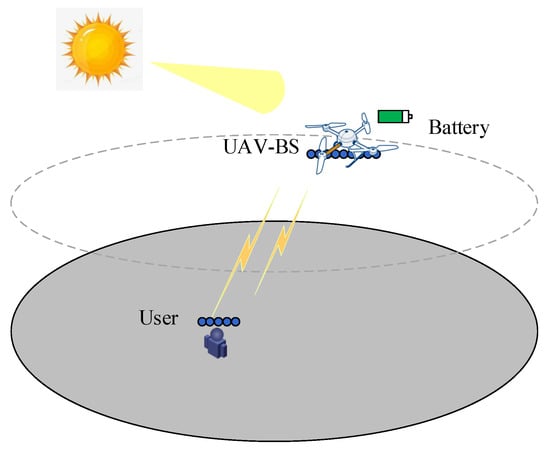
We consider a UAV-assisted mmWave MIMO link in which an N-antenna UAV-BS serves a multi-antenna ground user equipped with M elements, as shown in Figure 1. The transmission operates in downlink mode. A solar panel is incorporated into the UAV-BS to replenish its battery and provide energy sustainability. The respective positions of both the UAV-BS and user in 3D Cartesian coordinates are defined by and , where h represents the vertical height of the UAV-BS.
Figure 1.
Illustration of a UAV mmWave MIMO system.
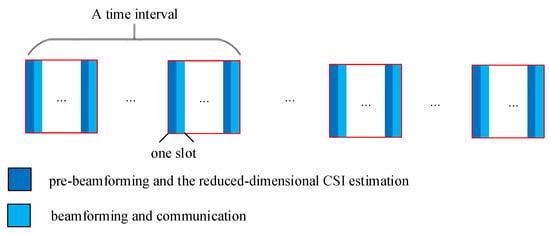
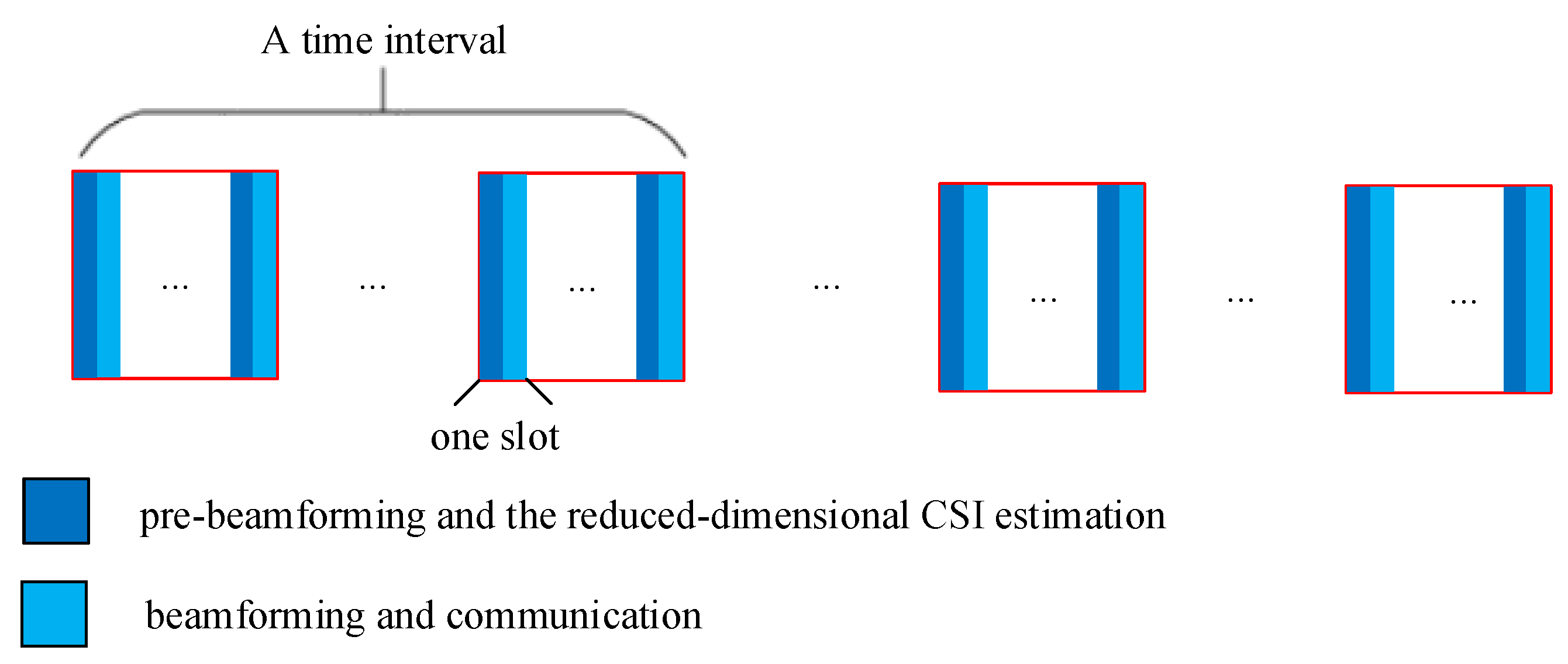
The communication process is illustrated in Figure 2. Given the relatively small variation in both the UAV and user positions within a time interval, the SCSI is assumed to remain approximately constant over this interval. Each time interval comprises multiple slots, during which the ICSI varies. A TSB scheme is employed for transmission in each slot to reduce the pilot overhead associated with ICSI acquisition. In the first stage, a pre-beamformer is designed to reduce the pilot overhead. In the second stage, the beamformer is designed to enhance system performance. The beamformer at the UAV-BS is connected to the pre-beamformer via RF chains, while the number of RF chains is . During the first stage, a pre-beamformer is designed, where denotes the number of activated RF chains. The UAV-BS transmits pilot signals to the user once the pre-beamformer design has been finalized. After receiving the signals, the user feeds back the reduced-dimensional ICSI, represented as , where denotes the channel matrix between the UAV-BS and the user on the ground, is the combiner, and is the number of data streams. In the second stage, the obtained reduced-dimensional ICSI is utilized to design the beamformer , after which data transmission occurs. The signal received at the UAV-BS is
where denotes the transmitted signal in each slot t with , and represents the additive white Gaussian noise. In each slot t, the achievable SE can be expressed as
where , and is the pilot length. The maximum pilot overhead required for estimating the reduced-dimensional ICSI is . is the number of symbols each slot.
Figure 2.
The communication process.
2.2. Channel Model
The Rician channel model [21] was adopted. In this model, the channel is
where is the distance-based large-scale path loss, is defined as the channel gain at the distance m, K denotes the Rician factor, is the distance between the ground user and the UAV, and represents the path loss exponent. is the deterministic LoS channel components, where is the steering vector, and and are the angles of arrival and departure. is the NLoS channel components, which follow , where denotes the covariance matrix of . We characterize as a one-ring channel, where the scattering clusters surround the user and have a center angle and an angular spread . Therefore, .
2.3. Energy Model
The total average power consumption of signal transmission at slot t is calculated as [22], where , represents the power amplifier (PA) efficiency, and denotes the circuit power consumption of each RF chain. The residual energy at slot t is given by
where denotes the recharge energy by solar panel, is the power consumed by the battery to maintain flight, and is the time span in a slot. Denoted by , the indicator function is as follows:
where denotes the minimum energy threshold required to ensure operational safety of the UAV-BS. When , the UAV-BS engages in communication with the ground user. Otherwise, the UAV-BS suspends communication activities and initiates solar energy replenishment.
2.4. Problem Formulation
The discrete Fourier transform (DFT) codebook can effectively characterize the channel [23]. The n-th codeword of the codebook is given by
The pre-beamformer is designed by selecting codewords from the DFT codebook . Since the SE is positively correlated with the received energy, the pre-beamformer is designed to maximize the cumulative received energy. Note that this cumulative energy relies on both the RES and the NCS. The dimension of the pre-beamforming matrix, which sets the count of activated RF chains, presents a critical trade-off: an overly large dimension inversely affects the NCS component, leading to a reduction in the total harvested energy. Conversely, if too few RF chains are activated, the RES diminishes, which also adversely affects the cumulative energy. Therefore, it is crucial to optimize the column number in the pre-beamforming matrix to maximize the cumulative received energy. Our solution formulates the pre-beamformer design within a BC-MAB framework to address this trade-off between the RES and NCS, enabling an efficient balance between these competing components. Let denote the received energy at slot t and the column number. Then, the problem of the pre-beamformer design maximizing the cumulative received energy during T slots is formulated as
In , to maximize the objective function, we need to make be 1 as often as possible, which means the BS and the UAV should communicate in as many slots as possible.
After the pre-beamformer, the UAV-BS transmits the orthogonal pilot to the user, where denotes the pilot length at slot t. The user then estimates the reduced-dimensional ICSI and feeds it back to the UAV-BS. The number of columns in this reduced-dimensional ICSI matrix matches that of the pre-beamforming matrix, namely, the number of activated RF chains; i.e., .
In the second stage, the beamformer is designed to maximize the SE with the reduced-dimensional ICSI. The beamformer is only designed when , and the problem of this beamformer design at slot t is
where P denotes the maximum allowable transmit power.
With perfect CSI at the receiver, the user computes the combiner directly from the channel matrix . We firstly express the SVD of the channel as , where and comprise the left and right singular vectors. The matrix is diagonal, with its non-zero entries consisting of the singular values arranged in descending order. Then, the combiner is given by
where
3. BC-MAB-Based TSB Scheme
3.1. Pre-Beamforming Design
We firstly formulate problem as a BC–MAB problem. Subsequently, we present a pre-beamforming design based on the greedy policy.
3.1.1. BC-MAB Problem
The BC–MAB is a variant of the MAB in which, under a budget constraint, a subset of arms is selected to form a super-arm; each arm inside the super-arm is termed a base arm. In our formulation, the budget represents the total available resources, and the cost of each arm corresponds to its per-slot resource consumption. The BC–MAB problem is characterized by four key elements: arms, reward, budget, and cost.
Arm: The pre-beamforming matrix is constructed by codewords from the codebook; i.e., , where denotes the -th codeword of codebook , . The codebook is defined as an arm space and each codeword , , as an arm. The aggregation is a super arm. The arm is the base arm of when .
Reward: The reward of super-arm is defined as the total energy harvested within one slot. Note that the RETS equals the sum of the energies received over all the selected arms. Hence, the reward of base arm is defined as .
Budget: In this paper, the budget is the available energy of the battery carried by the UAV. Hence, the budget at slot t is set to .
Cost: The beamformer is connected to the pre-beamformer via RF chains. Hence, corresponds to the pre-beamforming vector for the l-th RF chain. At slot t, the energy consumption of the l-th RF chain is defined as the cost of arm ; i.e.,
where . denotes the l-th row of the beamforming matrix . Since the energy consumption of the l-th RF chain cannot be measured at the beginning of time slot t, the value from the previous slot is utilized as an estimate for cost calculation.
3.1.2. The Proposed BC-MAB-Based Pre-Beamforming Algorithm
In the MAB problem, the upper confidence bound (UCB) value associated with each arm is used to estimate its potential for obtaining rewards. Unlike the traditional MAB formulation, the BC-MAB problem aims to maximize the cumulative reward sum with a limited budget. To this end, the bang-per-buck ratio is introduced. Arm in slot t is defined as , where denotes the UCB value of arm at slot t, and represents the estimated cost of selecting arm at slot t. The UCB value is positively correlated with the reward and hence positively related to the RES. A higher cost leads to a lower NCS. Therefore, the introduction of the bang-per-buck ratio helps achieve a trade-off between the RES and NCS. The UCB value of arm at slot t is given by
where denotes the reward expectation of the arm at slot t, and is the total selection count of arm over the preceding t time slots. The calculations for and are given as
The estimated cost of selecting arm at slot t is given by
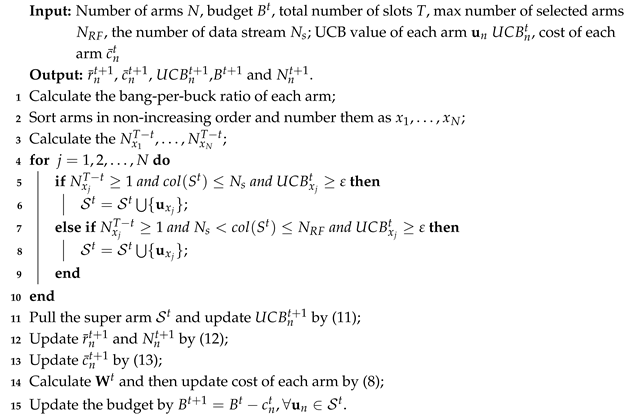
The details of the greedy policy-based pre-beamforming algorithm in each t, , are presented in Algorithm 1. Specifically, in step 1, we calculate the bang-per-buck ratio of each arm by . In step 2, we sort the arms in non-increasing order of their bang-per-buck ratios at first, and then the new indices for all the arms are obtained; i.e., ∀ pairs . In step 3, we calculate the number of slots in which each arm can be selected within the budget . For instance, the budget for arm is , and the number of the slots in which arm can be selected is calculated as . Then, the remaining budget is updated by . The is obtained similarly to . After repeating the aforementioned operations, are obtained. In steps 4–10, we select the base arms. The arm is selected as a base arm, satisfying the constraints that , , and , where . This is because when , the reward gained is negligible compared to the energy consumption of the RF chain. In step 11, we pull the super arm and then update each UCB value. In step 12, we update and . In steps 13–14, we calculate the beamformer and update the cost of each arm. In step 15, the remaining budget is updated by .
Now we analyze the complexity of Algorithm 1. The complexity of step 1 is . The complexity of step 2 is . The complexity of step 3 is . Steps 4–10 choose the super arm, whose complexity is . The complexity of step 11 is less than . In step 12, the complexity is less than . In step 13, the complexity is less than . In step 14, we calculate the beamforming matrix and obtain their cost, and the complexity is upper-bounded by . Step 15 updates the budgets, and the complexity of is . As a result, the computational complexity of Algorithm 1 is upper-bounded by . Thus, the proposed algorithm has cubic complexity.
| Algorithm 1: BC-MAB-based beamforming algorithm |
 |
3.2. Beamforming Design
Let with a dummy variable, and then bring into . Due to the , can be transformed into
where . The corresponding closed-form solution for is given by
where is constructed by taking the first columns from the right singular vector matrix of . Once the optimal is obtained, the optimal beamformer can be derived as follows:
4. Simulation Results
This section presents a comprehensive simulation-based evaluation of the proposed TSB scheme’s efficacy in a UAV-BS mmWave MIMO communication scenario. In this scenario, a UAV equipped with multiple antennas serves as a UAV-BS to provide downlink communication services for a single ground user with multiple antennas. The UAV follows a circular trajectory with a radius of 10 m at a constant speed of v. Aforementioned traditional methods, the joint hybrid precoding/combining (JHPC) scheme [24] and the simultaneous orthogonal matching pursuit (SOMP) scheme [25], are directly extended to the UAV mmWave communication system for comparison. The simulation parameters are shown in Table 2. We set the values of in accordance with [26], the values of and in accordance with [20], and the values of in accordance with [24]. In addition, we set the values of , , , and according to [22]. The maximum pilot overhead required for estimating the reduced-dimensional ICSI is . The and are given by
where m/s is the horizontal velocity of the UAV. Reference [27] can be consulted for the values of other parameters.
Table 2.
Simulation parameters.
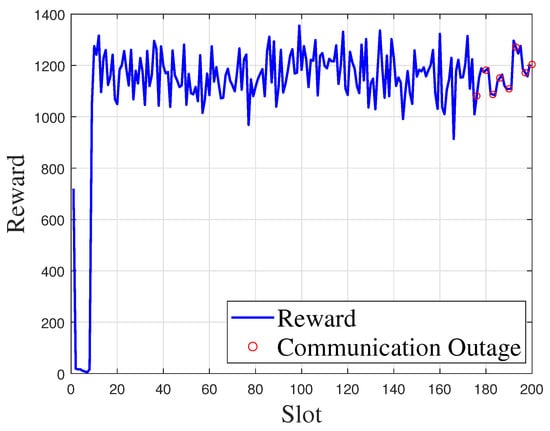
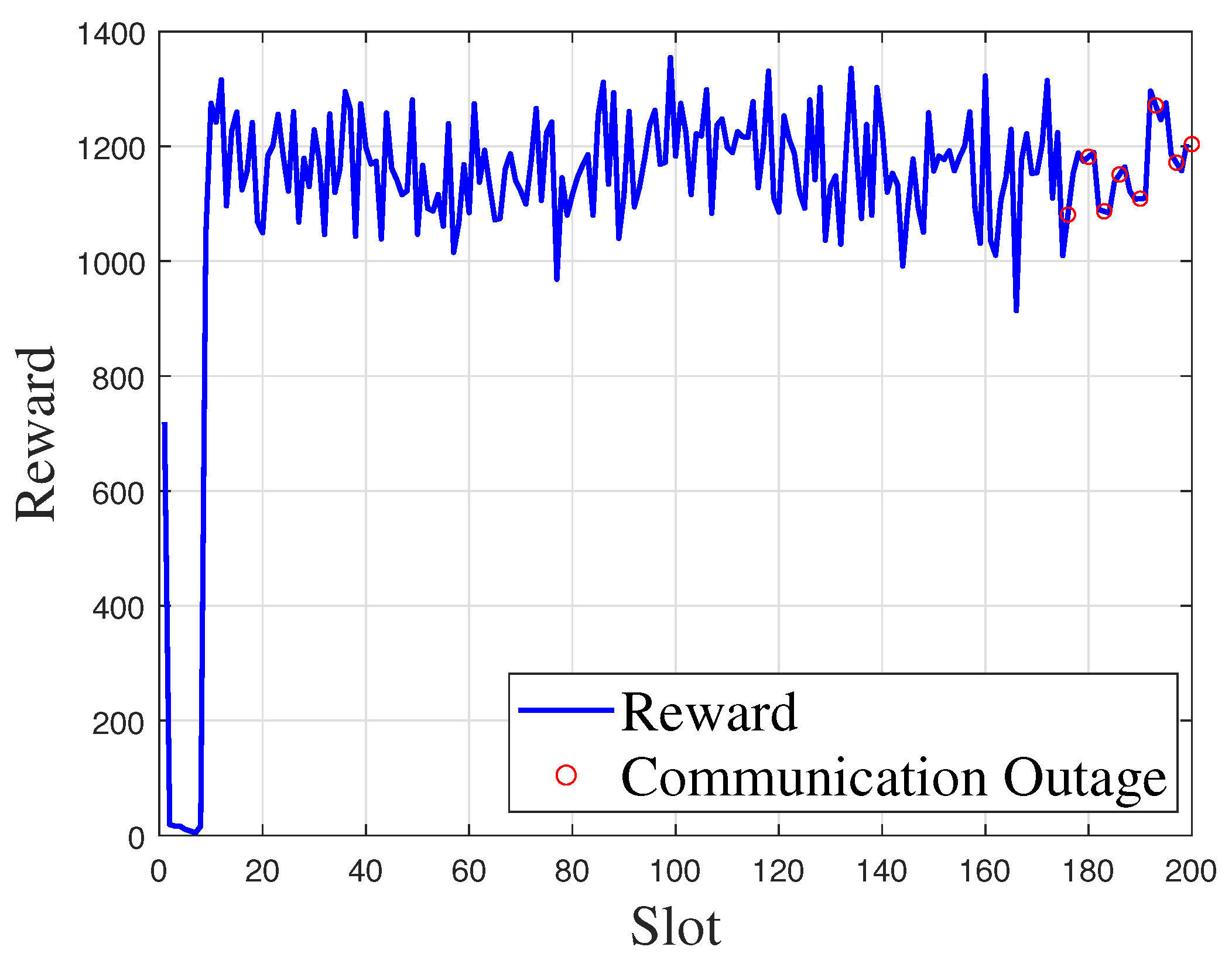
Figure 3 demonstrates the convergence of the rewards achieved by the proposed scheme over slots. It can be observed that during the initial slots, the rewards are relatively small due to the necessity of exploring and initializing each arm. As the number of slots increases, the average reward gradually stabilizes, indicating the convergence behavior of the proposed scheme.
Figure 3.
Reward achieved during slots while and SNR dB.
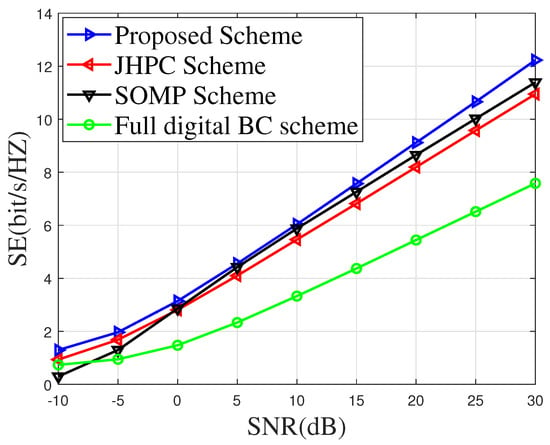
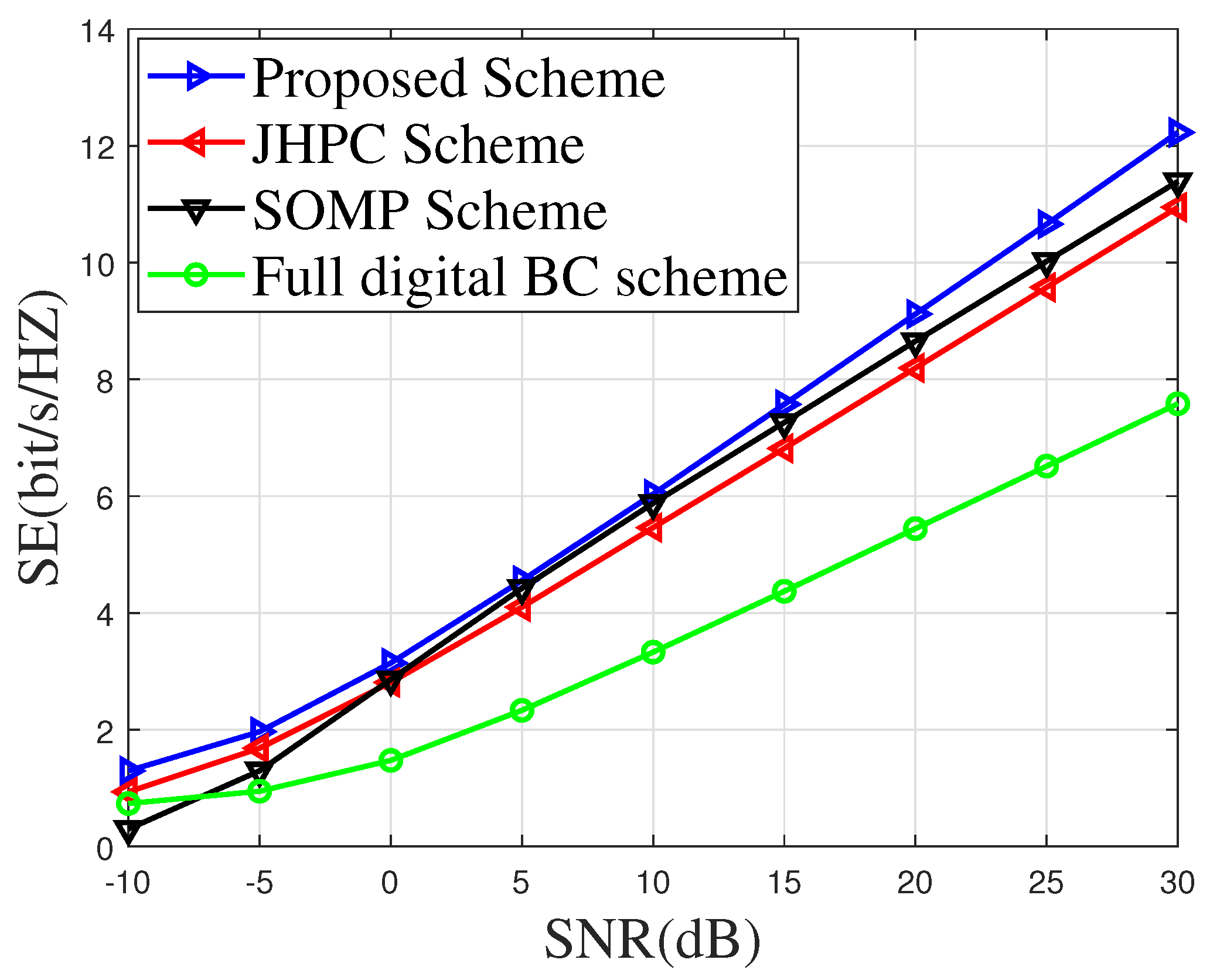
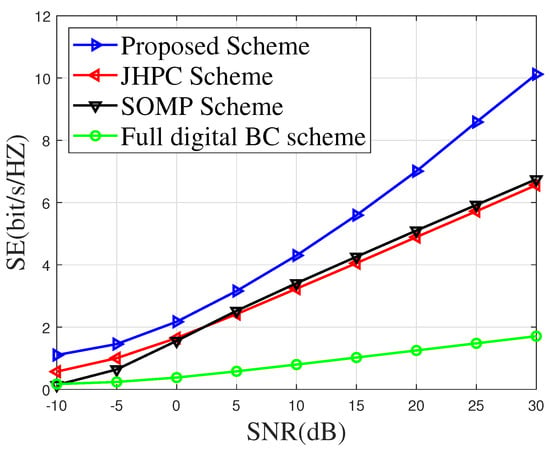
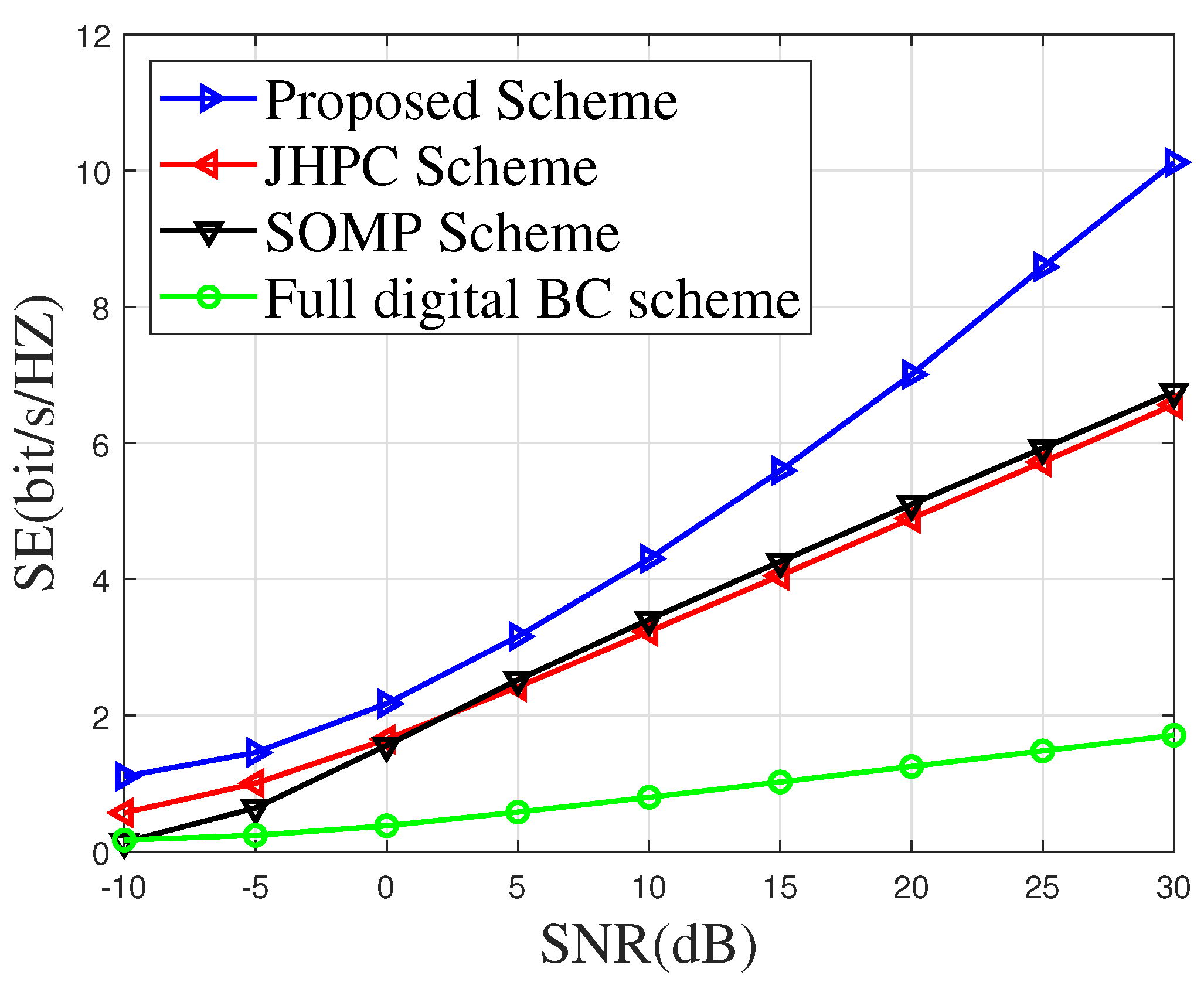
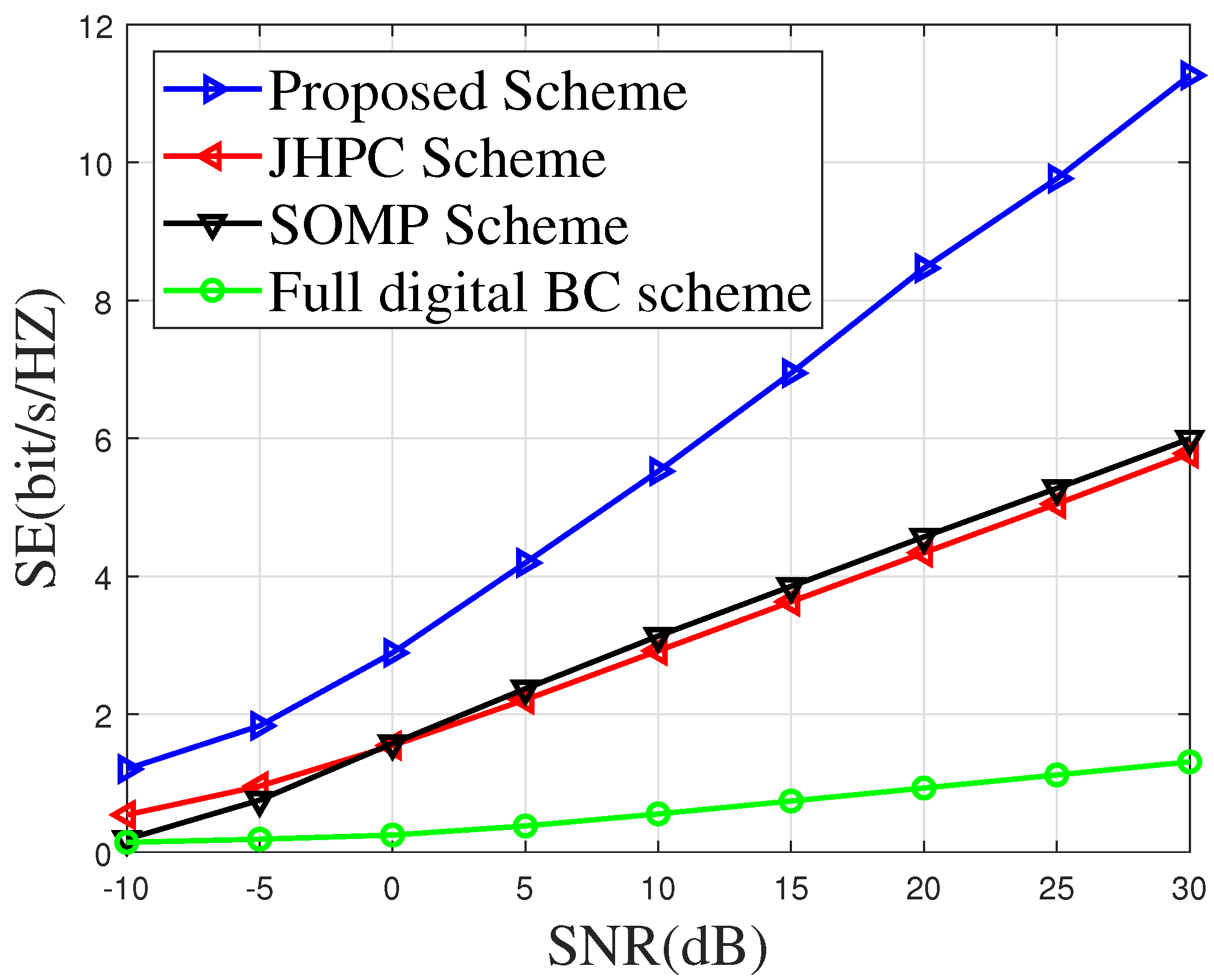
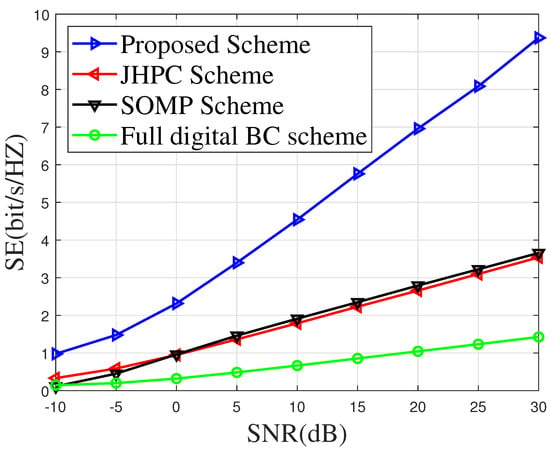
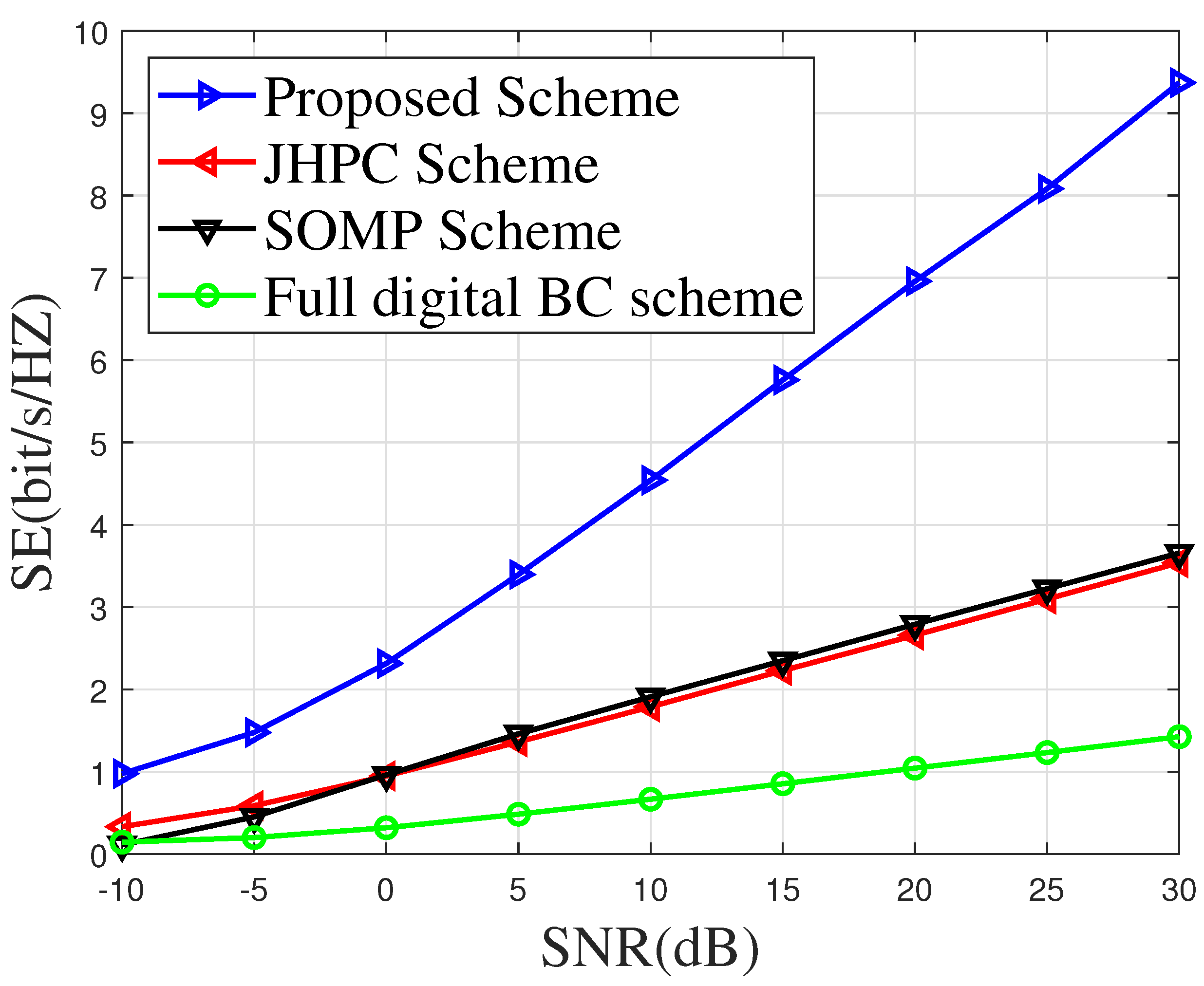
Figure 4 and Figure 5 compare the SE at different signal-to-noise ratios (SNRs) when and . The proposed scheme, the SOMP scheme, the JHPC scheme, and the fully digital precoding scheme all achieve lower SE. This is primarily due to the energy constraints of the UAV: the fully digital, SOMP, and JHPC schemes activate a larger number of RF chains, leading to higher energy consumption and consequently a smaller NCS, which results in inferior SE performance. Moreover, the proposed scheme does not require CSI for designing the pre-beamformer, which further reduces the pilot overhead for estimating the equivalent channel. As a result, the proposed scheme achieves higher SE with lower overhead. As shown in Figure 4 and Figure 5, the SE of the benchmark schemes decreases as the number of transmit antennas increases. This degradation occurs because the growing antenna count elevates the pilot overhead required for ICSI estimation, which in turn reduces the SE. In contrast, the proposed scheme effectively mitigates this overhead, thereby demonstrating its superior performance. The proposed scheme achieves a 7.1% improvement in SE compared to the benchmark schemes when and and a 48.5% improvement when and .
Figure 4.
The comparison of SE versus the SNR while and .
Figure 5.
The comparison of SE versus the SNR while and .
The EE is given by
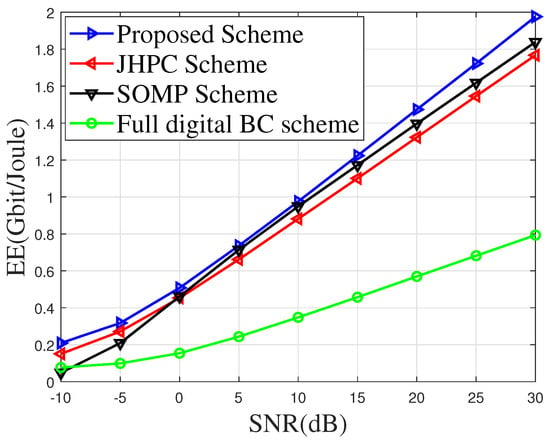
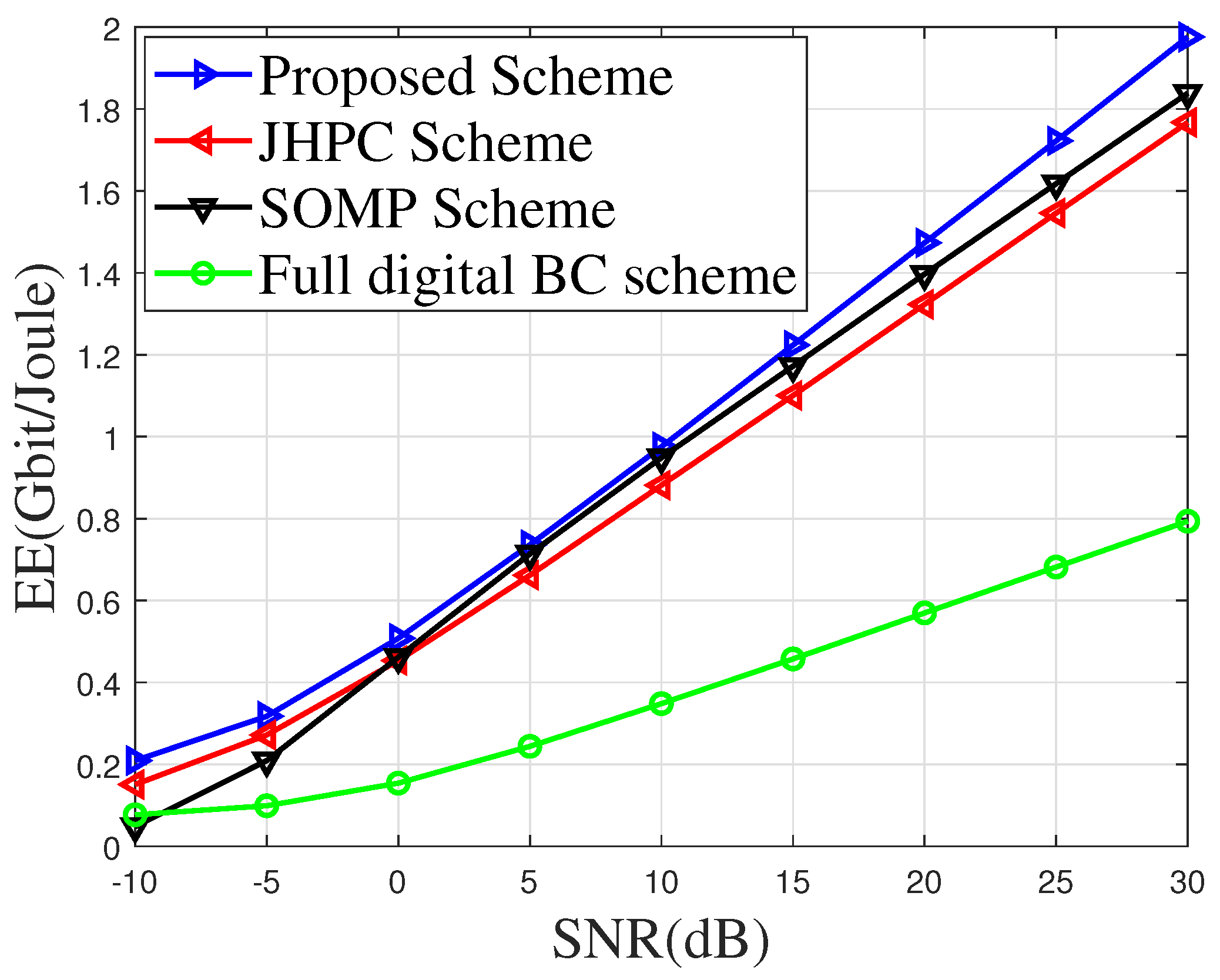
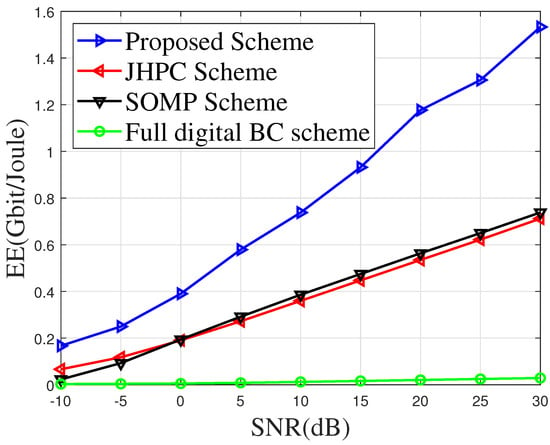
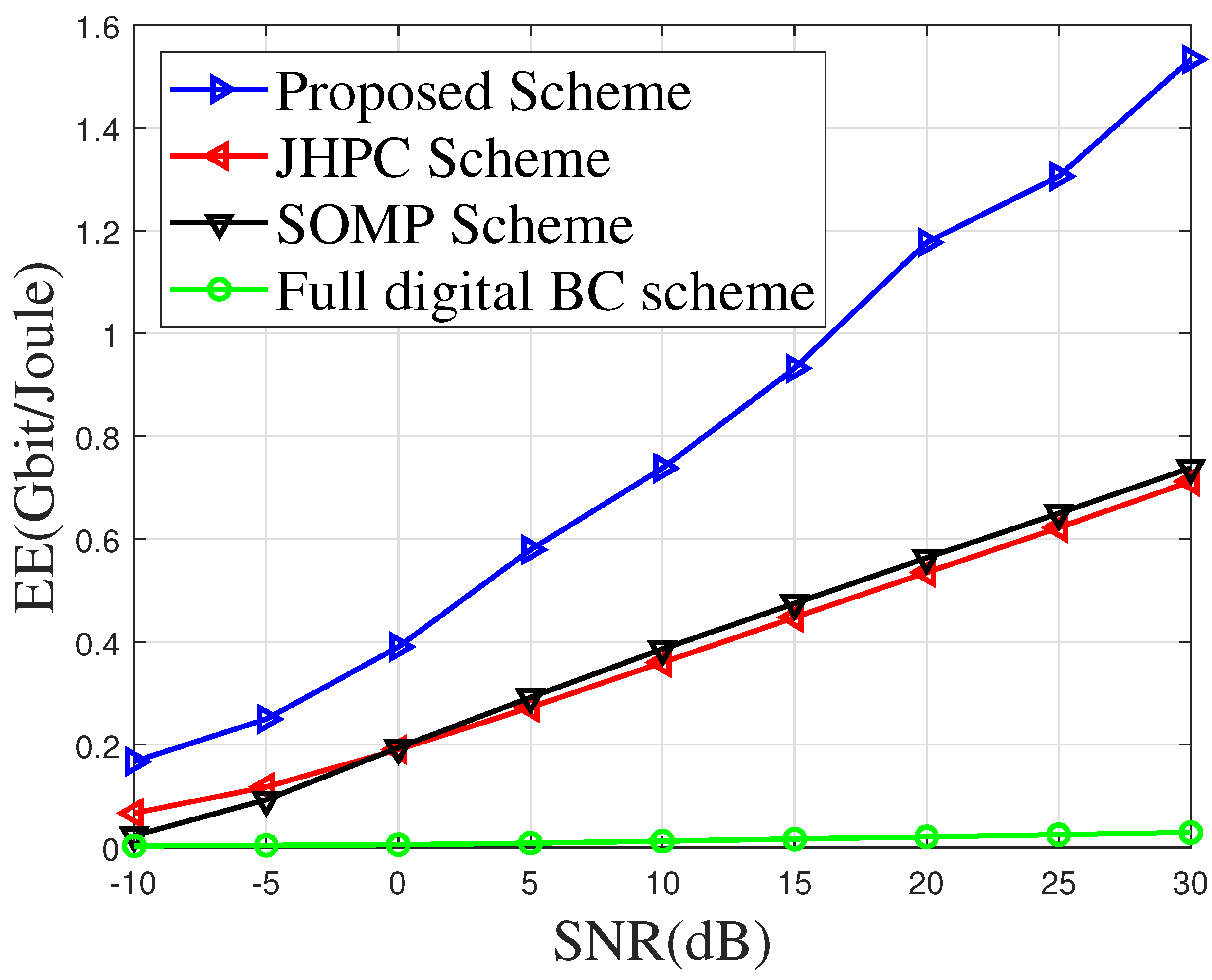
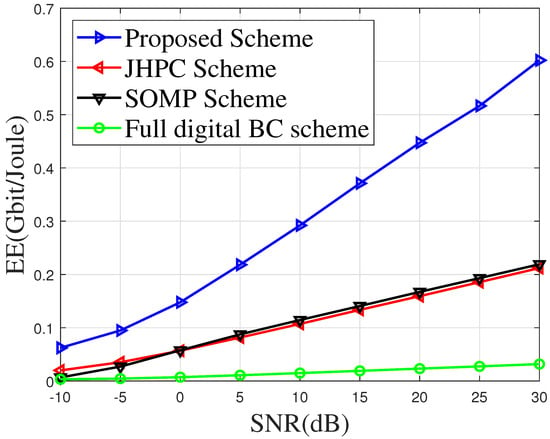
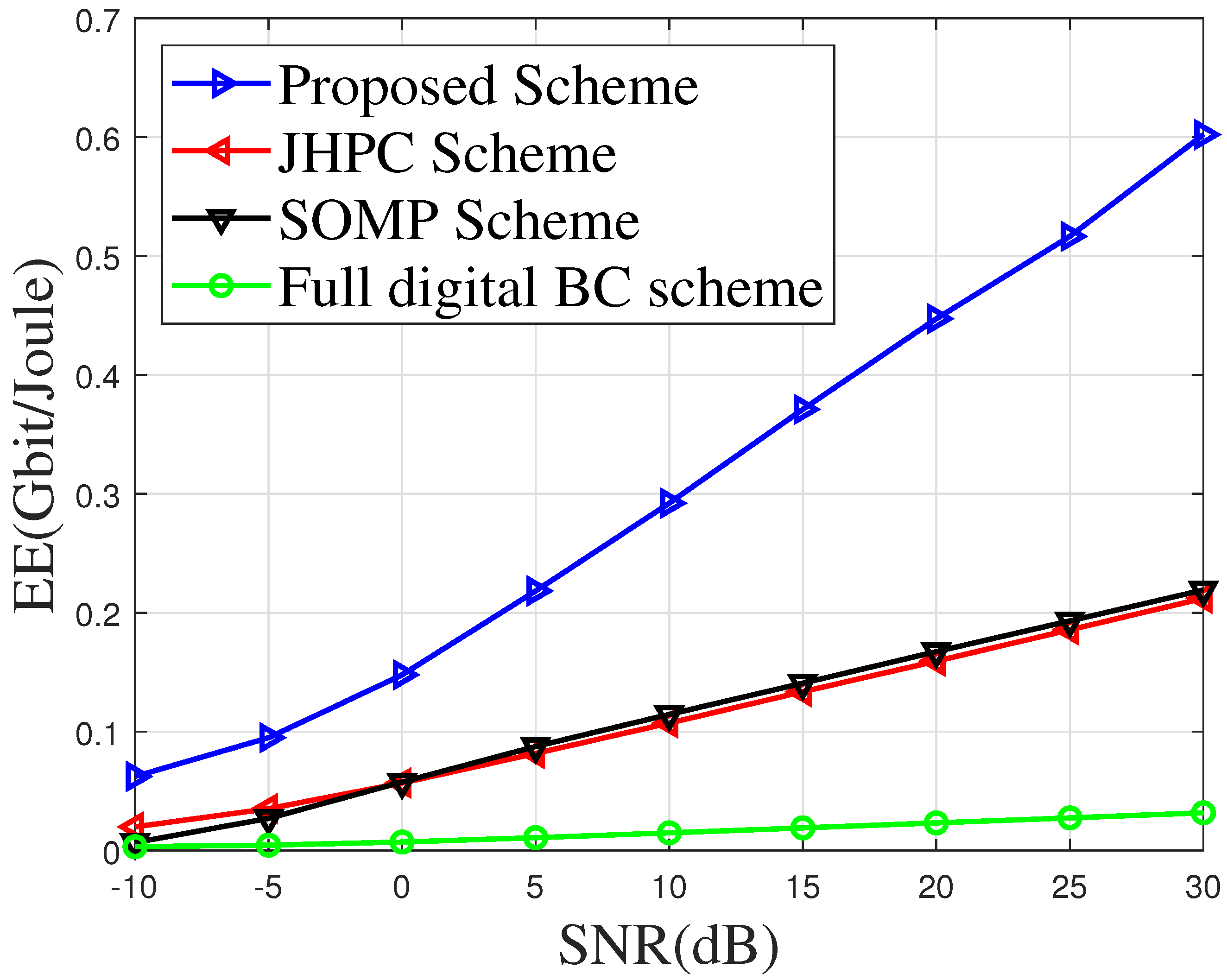
Figure 6 and Figure 7 compare the energy efficiency (EE) at different SNR levels when . A comparative analysis reveals that the proposed scheme achieves superior EE, benchmarking against the fully digital, SOMP, and JHPC schemes. This performance gap stems from the energy constraints of the UAV platform: the aforementioned schemes activate a larger number of RF chains, resulting in higher energy consumption and consequently a reduced NCS. Particularly in the fully digital scheme, the absence of an analog module results in the number of RF chains being equal to the number of antennas. Consequently, this architecture exhibits the highest energy consumption among all the considered schemes. The proposed scheme achieves more than 9.8% improvement in EE compared to the benchmark schemes when and . As a result, they achieve lower EE than the proposed method.
Figure 6.
The comparison of EE versus the SNR while and .
Figure 7.
The comparison of EE versus the SNR while and .
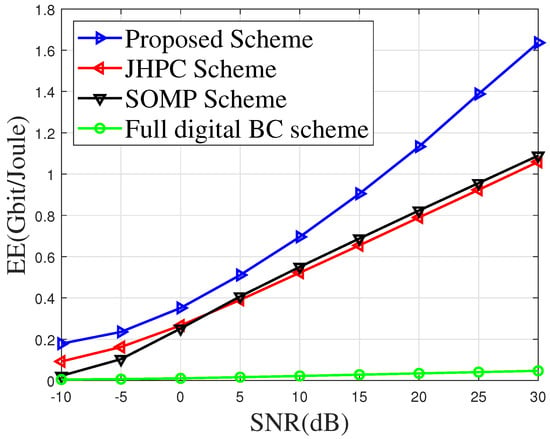
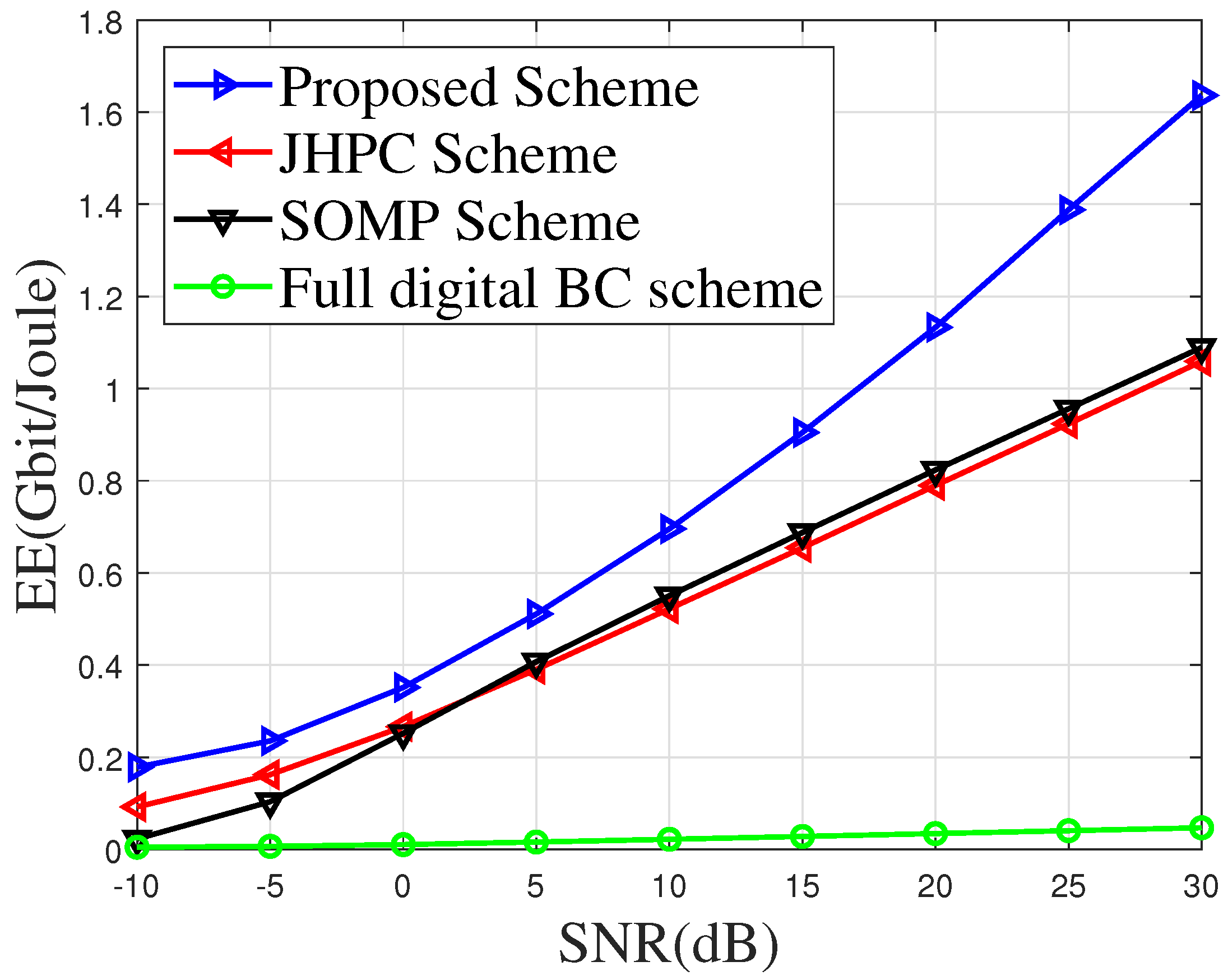
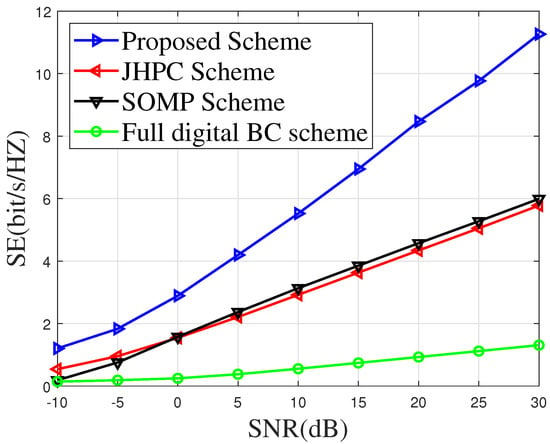
Figure 8 and Figure 9 compare the SE and EE for different SNR values when and . The proposed scheme achieves more than 40% improvement in SE compared to the other schemes, while the EE of the proposed scheme is more than double those of the other algorithms. As corroborated by Figure 5 and Figure 7, the proposed and fully digital schemes exhibit stable SE and EE performance. This is because the activated RF chain count in our scheme is determined by the algorithm’s reward characteristics and remains independent of the parameter . Similarly, the SE and EE of the fully digital precoding scheme depend only on the number of antennas and are, therefore, also unaffected by the increase in . In contrast, as increases, both the SOMP and JHPC schemes consume more energy, resulting in a lower NCS, and thus, lower SE and EE compared to Figure 5 and Figure 7. It can therefore be observed that as increases, the performance of the SOMP and JHPC schemes correspondingly degrades. In contrast, both the proposed and the fully digital schemes remain largely unaffected by this parameter variation. Overall, these comparisons demonstrate the superiority of the proposed scheme.
Figure 8.
The comparison of SE versus the SNR while and .
Figure 9.
The comparison of EE versus the SNR while and .
Figure 10 and Figure 11 compare the SE and EE for different SNR values when and W. The EE (SE) of the proposed scheme is more than double those of other algorithms. An increase in transmit power P elevates energy consumption. Consequently, as evidenced by Figure 8 and Figure 9, both the proposed and the compared schemes exhibit reduced SE and EE performance. Nevertheless, the proposed approach still outperforms all the compared methods.
Figure 10.
The comparison of SE versus the SNR while , W, and .
Figure 11.
The comparison of EE versus the SNR while , W, and .
5. Conclusions
In this paper, we proposed a BC-MAB-based TSB scheme for UAV-BS mmWave MIMO communications. The proposed method optimizes the number of activated RF chains in the first stage, achieving high EE while maintaining high SE. Furthermore, the scheme reduces pilot overhead and enhances the overall system SE. The proposed scheme achieves more than 7.1% improvement in SE compared to the benchmark schemes. The proposed scheme is designed for UAVs in uniform motion. When the UAV undergoes accelerated movement, the problem becomes considerably more complex. In our future work, we will consider more challenging scenarios, such as UAVs with variable velocities or multi-UAV communication systems.
Author Contributions
Conceptualization, J.G., Y.X., G.W. and J.Z.; methodology, J.G., Y.X., T.G. and Y.S.; software, Y.S., J.W., T.G. and X.Y.; validation, J.G., Y.S., J.W. and X.Y.; formal analysis, J.Z. and Y.S.; investigation, J.W. and Y.S.; resources, J.W. and Y.S.; writing—original draft preparation, J.G., Y.X., G.W. and Y.S.; writing—review and editing, Y.S., J.Z., J.W. and X.Y.; supervision, Y.S.; project administration, Y.S.; funding acquisition, Y.S. All authors have read and agreed to the published version of the manuscript.
Funding
This work was supported in part by the Natural Science Foundation of China under Grant 62101282.
Informed Consent Statement
Not applicable.
Data Availability Statement
The original contributions presented in this study are included in the article. Further inquiries can be directed to the corresponding author.
Conflicts of Interest
Authors Jing Gao, Yunxing Xiang, Jing Zhu, Jun Wang, Xiaohui You were employed by the company State Grid Jiangxi Electric Power Co., Ltd. The remaining authors declare that the research was conducted in the absence of any commercial or financial relationships that could be construed as a potential conflict of interest.
Abbreviations
The following abbreviations are used in this manuscript:
| 6G | Sixth-generation |
| MIMO | Multi-input and multi-output |
| BS | Base station |
| UAV | Unmanned aerial vehicle |
| UAV-BS | Unmanned aerial vehicle base station |
| LoS | Line-of-sight |
| NLoS | Non-line-of-sight |
| mmWave | Millimeter-wave |
| 3D | Three-dimensional |
| CSI | Channel state information |
| SCSI | Statistical CSI |
| ICSI | Instantaneous CSI |
| TSB | Two-stage beamforming |
| MAB | Multi-armed bandit |
| CMAB | Combinatorial MAB |
| BC-MAB | Budgeted combinatorial MAB |
| NCS | Number of communication slots |
| RES | Received energy per slot |
| SE | Spectral efficiency |
| EE | Energy efficiency |
| DFT | Discrete Fourier transform |
| UCB | Upper confidence bound |
| JHPC | Joint hybrid precoding/combining |
| SOMP | Simultaneous orthogonal-matching-pursuit |
| SNR | Signal-to-noise ratio |
References
- Meng, K.; Wu, Q.; Xu, J.; Chen, W.; Feng, Z.; Schober, R.; Swindlehurst, A.L. UAV-enabled integrated sensing and communication: Opportunities and challenges. IEEE Wirel. Commun. 2023, 31, 97–104. [Google Scholar] [CrossRef] [Scilit]
- Alnakhli, M. Joint Optimization of Spectrum and Power Control in 6G Multi-UAV Networks: Managing Data Redundancy. IEEE Access 2025, 13, 132913–132925. [Google Scholar] [CrossRef] [Scilit]
- Saoud, B.B.; Nasraoui, L. Coverage optimization for reliable uav-assisted 5 g/6 g communication systems. IEEE Syst. J. 2025, 19, 65–74. [Google Scholar] [CrossRef] [Scilit]
- Xiao, Z.; Zhu, L.; Liu, Y.; Yi, P.; Zhang, R.; Xia, X.G.; Schober, R. A survey on millimeter-wave beamforming enabled UAV communications and networking. IEEE Commun. Surv. Tutor. 2021, 24, 557–610. [Google Scholar] [CrossRef] [Scilit]
- Wu, Q.; Xu, J.; Zhang, R. Capacity characterization of UAV-enabled two-user broadcast channel. IEEE J. Sel. Areas Commun. 2018, 36, 1955–1971. [Google Scholar] [CrossRef] [Scilit]
- Meng, K.; Li, D.; He, X.; Liu, M. Space pruning based time minimization in delay constrained multi-task UAV-based sensing. IEEE Trans. Veh. Technol. 2021, 70, 2836–2849. [Google Scholar] [CrossRef] [Scilit]
- Zhu, L.; Zhang, J.; Xiao, Z.; Xia, X.G.; Zhang, R. Multi-UAV aided millimeter-wave networks: Positioning, clustering, and beamforming. IEEE Trans. Wirel. Commun. 2021, 21, 4637–4653. [Google Scholar] [CrossRef] [Scilit]
- Jiang, H.; Zhang, Z.; Wu, L.; Dang, J. Three-dimensional geometry-based UAV-MIMO channel modeling for A2G communication environments. IEEE Commun. Lett. 2018, 23, 1438–1441. [Google Scholar] [CrossRef] [Scilit]
- Cheng, X.; Li, Y. A 3-D geometry-based stochastic model for UAV-MIMO wideband nonstationary channels. IEEE Internet Things J. 2018, 6, 1654–1662. [Google Scholar] [CrossRef] [Scilit]
- Ge, C.L.; Zhang, R.N.; Hai, D.S.; Jiang, Y.; Li, B. UAV-correlated MIMO channels: 3-D geometrical-based polarized model and capacity analysis. IEEE Internet Things J. 2022, 10, 1446–1460. [Google Scholar] [CrossRef] [Scilit]
- Shi, Y.; Enami, R.; Wensowitch, J.; Camp, J. UABeam: UAV-based beamforming system analysis with in-field air-to-ground channels. In Proceedings of the 2018 15th Annual IEEE International Conference on Sensing, Communication, and Networking (SECON), Hong Kong, China, 11–13 June 2018; pp. 1–9. [Google Scholar]
- Du, J.; Xu, W.; Deng, Y.; Nallanathan, A.; Vandendorpe, L. Energy-saving UAV-assisted multiuser communications with massive MIMO hybrid beamforming. IEEE Commun. Lett. 2020, 24, 1100–1104. [Google Scholar] [CrossRef] [Scilit]
- Xiao, Z.; Dong, H.; Bai, L.; Wu, D.O.; Xia, X.G. Unmanned aerial vehicle base station (UAV-BS) deployment with millimeter-wave beamforming. IEEE Internet Things J. 2020, 7, 1336–1349. [Google Scholar] [CrossRef] [Scilit]
- Johannsen, N.L.; Almasri, S.A.; Hoeher, P.A. Geometry-based UAV MIMO channel modeling and pattern optimization for multimode antennas. IEEE Trans. Antennas Propag. 2022, 70, 11024–11032. [Google Scholar] [CrossRef] [Scilit]
- Zhu, L.; Zhang, J.; Xiao, Z.; Cao, X.; Wu, D.O.; Xia, X.G. 3-D beamforming for flexible coverage in millimeter-wave UAV communications. IEEE Wirel. Commun. Lett. 2019, 8, 837–840. [Google Scholar] [CrossRef] [Scilit]
- Zhu, L.; Zhang, J.; Xiao, Z.; Schober, R. Optimization of multi-UAV-BS aided millimeter-wave massive MIMO networks. In Proceedings of the GLOBECOM 2020–2020 IEEE Global Communications Conference, Taipei, Taiwan, 7–11 December 2020; pp. 1–6. [Google Scholar]
- Albertini, D.; Bernardini, A.; Borra, F.; Antonacci, F.; Sarti, A. Two-stage beamforming with arbitrary planar arrays of differential microphone array units. IEEE/ACM Trans. Audio 2022, 31, 590–602. [Google Scholar] [CrossRef] [Scilit]
- Song, Y.; Liu, C.; Wang, W.; Huang, Y. Cluster-group-based two-stage beamforming for massive MIMO. IEEE Trans. Commun. 2021, 70, 1984–1998. [Google Scholar] [CrossRef] [Scilit]
- Jeon, Y.S.; Min, M. Large system analysis of two-stage beamforming with limited feedback in FDD massive MIMO systems. IEEE Trans. Veh. Technol. 2018, 67, 4984–4997. [Google Scholar] [CrossRef] [Scilit]
- Song, Y.; Liu, C.; Zhang, W.; Liu, Y.; Zhou, H.; Shen, X. Two stage beamforming in massive MIMO: A combinatorial multi-armed bandit based approach. IEEE Trans. Veh. Technol. 2023, 72, 6794–6799. [Google Scholar] [CrossRef] [Scilit]
- Liu, L.; Zhang, S.; Zhang, R. Multi-beam UAV communication in cellular uplink: Cooperative interference cancellation and sum-rate maximization. IEEE Trans. Wirel. Commun. 2019, 18, 4679–4691. [Google Scholar] [CrossRef] [Scilit]
- Pei, Y.; Pham, T.H.; Liang, Y.C. How many RF chains are optimal for large-scale MIMO systems when circuit power is considered? In Proceedings of the 2012 IEEE Global Communications Conference (GLOBECOM), Anaheim, CA, USA, 3–7 December 2012; pp. 3868–3873. [Google Scholar]
- Choi, J.; Lee, K.; Love, D.J.; Kim, T.; Heath, R.W. Advanced limited feedback designs for FD-MIMO using uniform planar arrays. In Proceedings of the 2015 IEEE Global Communications Conference (GLOBECOM), San Diego, CA, USA, 6–10 December 2015; pp. 1–6. [Google Scholar]
- Wang, S.; Li, Z.; He, M.; Jiang, T.; Ruby, R.; Ji, H.; Leung, V.C. A joint hybrid precoding/combining scheme based on equivalent channel for massive MIMO systems. IEEE J. Sel. Areas Commun. 2022, 40, 2882–2893. [Google Scholar] [CrossRef] [Scilit]
- El Ayach, O.; Rajagopal, S.; Abu-Surra, S.; Pi, Z.; Heath, R.W. Spatially sparse precoding in millimeter wave MIMO systems. IEEE Trans. Wirel. Commun. 2014, 13, 1499–1513. [Google Scholar] [CrossRef] [Scilit]
- Aoki, K.; Honda, K. Measurement and Analysis of the Rician K-Factor for Low-Altitude UAV Air-to-Ground Communications at 2.5 GHz. Drones 2025, 9, 86. [Google Scholar] [CrossRef] [Scilit]
- Fu, Y.; Mei, H.; Wang, K.; Yang, K. Joint optimization of 3D trajectory and scheduling for solar-powered UAV systems. IEEE Trans. Veh. Technol. 2021, 70, 3972–3977. [Google Scholar] [CrossRef] [Scilit]

Disclaimer/Publisher’s Note: The statements, opinions and data contained in all publications are solely those of the individual author(s) and contributor(s) and not of MDPI and/or the editor(s). MDPI and/or the editor(s) disclaim responsibility for any injury to people or property resulting from any ideas, methods, instructions or products referred to in the content. |
© 2025 by the authors. Licensee MDPI, Basel, Switzerland. This article is an open access article distributed under the terms and conditions of the Creative Commons Attribution (CC BY) license (https://creativecommons.org/licenses/by/4.0/).