


Abstract
The highly directional narrow-beam operation in mmWave networks, while effective at suppressing interference, lacks adaptability to dynamic traffic variations and blockages compared to D-TDD and JT schemes. D-TDD efficiently mitigates DL–UL cross-interference during asymmetric traffic. At the same time, joint transmission coordinates multiple base stations to deliver phase-aligned signals, converting interference into useful combined power and ensuring stable links under dynamic slot changes. However, these adaptive regimes are often overlooked in recent mmWave designs, leading to degraded communication performance. This work proposes D-TDD-based cooperative caching (DTCC) mmWave networks, where randomly distributed base stations with local caches enhance reliability and reduce backhaul load. Closed-form expressions for the cache hit probability and the average content success probability (ASP) are derived under the proposed DTCC framework. Popularity-based caching strategies with both equal and variable file sizes are analysed to maximise network-level performance. The simulation results validate that the proposed DTCC framework consistently enhances ASP in dense small-cell deployments, offering notable reliability gains over conventional single-BS (SBS) and static TDD (S-TDD)-based cooperative caching approaches.
1. Introduction
The growing demand for wireless communication services has rendered the available radio spectrum both limited and highly valuable. Interestingly, many users often make repeated and asynchronous requests for popular content, resulting in a significant amount of redundant data traffic over wireless networks. This situation has inspired the development of wireless edge-caching network architectures as a potential solution to reduce network traffic. By prefetching frequently accessed content to the local caches of base stations (BSs), these architectures can directly supply the required content to user equipment (UE) [1].
The deployment of small cell networks (SCNs) is anticipated to result in the densification of future wireless networks, which will allow for higher data communication speeds. Particularly in the region of 28 GHz to 300 GHz, the mmWave spectrum is considered a viable technology for the design of the next generation of cellular networks. This is because it offers ample bandwidth availability. The design of SCNs is especially well-suited for mmWave propagation because of its shorter range. The extraordinarily high data rates that are made possible by gigahertz-scale mmWave bandwidths place tremendous demands on the capacity of the backhaul network. This scenario provides a tremendous challenge for the backhaul network. In theory, it is possible to fulfil these requirements by deploying fibre-based backhaul; however, the adoption of this technology on a broad scale is not only economically feasible but also operationally rigid in conditions of congested network environments [2]. Although microwave backhaul is more feasible, it frequently becomes a bottleneck in terms of throughput when network densification increases the amount of traffic loads. To circumvent these limits, an effective alternative known as edge caching has arisen. This method involves the proactive storage of content that is often requested and popular, such as video streams, digital maps, and news updates, at base stations. This strategy greatly reduces backhaul dependency, minimises latency, and improves the quality of service users’ experience [3,4,5]. It is hard to come up with a good caching method because storage space is limited and many performance metrics need to be balanced at the same time. It is possible to decrease the diversity of content that is available in the cache by concentrating on storing files that have the highest probabilities of being requested [6]. In single-cell networks, several methods that cache files according to their popularity have shown promising outcomes. However, such systems often fall short of providing optimal overall performance in larger cellular networks.
A combination of caching and advanced transmission and coordination methods has the potential to substantially enhance resource utilisation in mmWave systems and network reliability, according to recent studies. While much recent research has focused on improving individual caching techniques, this approach takes a different tack. As a paradigm for traffic-aware duplexing, D-TDD has been investigated within this framework for its ability to reduce latency and optimise spectrum efficiency in asymmetric traffic scenarios. Nevertheless, D-TDD also brings about novel interference dynamics and height-dependent propagation effects, both of which need to be addressed in order to conduct a realistic evaluation of the system. During the course of this investigation, Coordinated Multipoint (CoMP) communication has been found to be a viable strategy for enhancing cell–edge performance in dense mmWave installations and reducing inter-cell interference. When executed in JT mode, this situation becomes even more apparent. JT employs spatial variation to consolidate coherent power, thereby mitigating the high path loss and obstruction inherent in mmWave propagation [7]. By allowing numerous base stations (BSs) to send the user identical data streams at the same time, this process is made possible. The responsiveness of this coordinated transmission system is improved by incorporating it with D-TDD. Through this integration, base station clusters can simultaneously supply cached information to users while dynamically aligning uplink and downlink slots according to fluctuations in spatiotemporal traffic. This multi-layer cooperation lessens the cross-link interference common to asynchronous D-TDD, improves delivery reliability via spatial coordination, and helps make better use of resources through adaptive scheduling. The combination of D-TDD and JT represents a significant improvement over previous generations of mmWave networks in terms of interference resistance, backhaul efficiency, and context awareness. In the future of wireless systems, these kinds of networks will make it possible to optimise hybrid precoding, use predictive caching, and perform intelligent coordination.
1.1. Related Work
Recent studies have demonstrated that probabilistic caching approaches can significantly enhance some critical network metrics, such as cache-hit probability [8], coverage [9,10], throughput [2], and operator profitability [4,11]. These techniques allow for a straightforward, closed-form assessment of the system’s efficiency by expressing node locations as a Poisson point process (PPP) [5]. In contrast to deterministic caching, which necessitates expensive and inaccurate channel and topology data, the probabilistic method [12,13] provides more analytical flexibility, simpler implementation, and higher scalability in ever-changing wireless settings. Past studies on mmWave networks that use caches have produced a number of optimisation and analytical frameworks for managing backhaul, content allocation, and access. The authors of [14] optimised cache placement and spectrum partitioning using closed-form formulas for average potential throughput and cache-hit probability using a stochastic geometry-based model for mmWave HetNets with integrated access and backhaul (IAB) links. In [15], an mmWave network with a relay-assisted cache showed that caching and user association through relay nodes work together to reduce blockages, make links more reliable, and expand coverage. Additionally, in order to enhance the likelihood of cache hits and content delivery success, a size- and popularity-aware caching scheme was suggested for hybrid HetNets in [16], which combines coordinated transmission with coded caching. In [17], researchers examined cache-enabled outdoor mmWave ad hoc networks and introduced a contention-based protocol and probabilistic caching strategy to deal with blockage and interference.
Several recent investigations have investigated caching and cooperation in mmWave small-cell networks from various perspectives. In [18], the authors analysed cache-enabled mmWave systems and cooperative caching strategies. They demonstrated that storing popular content across multiple base stations (BSs) improves robustness against blockage. Further exploration of edge caching trade-offs in dense 5G/6G small cells was conducted in [19]. Moreover, on the cooperation front, the authors studied the effectiveness of coordinated beamforming and multi-BS joint transmission in mmWave networks in [20], emphasising considerable gains achieved through cooperative beamforming and hybrid precoding. More recently, the authors of ref. [21] studied the interaction between edge caching and dynamic TDD, and its effects on interference and backhaul load. However, none of these studies integrates mmWave joint transmission, cooperative caching, and dynamic TDD within a unified analytical framework, which is the focus of the present work. These studies focus on static duplexing but fail to investigate dynamic transmission coordination or coordinated techniques based on D-TDD, even though they emphasise the advantages of caching and collaboration. Existing works frequently approach caching and joint transmission separately, adopting static TDD methods and cache placement while ignoring adaptive, real-time optimisation. Their neglect is despite the fact that significant advancements have been made. Insufficient research has been carried out to fully investigate the potential of TDD to improve cache-hit probability, reduce interference, and efficiently allocate resources. Furthermore, issues of a more pragmatic nature, such as synchronisation and partial cooperation, are rarely discussed. Therefore, an all-encompassing and flexible framework that optimises D-TDD, caching, and coordinated transmission all at once is required to improve the speed and reliability of mmWave networks.
The analytical treatment of the proposed DTCC system is inherently challenging because it jointly incorporates probabilistic LoS/NLoS/outage blockage behaviour, multi-BS joint transmission, directional antenna patterns, dynamic TDD with both DL and UL interference fields, and probabilistic caching. Each of these components introduces independent randomness, and when combined, they produce multi-dimensional integrals over blockage states, fading, cooperative distances, and cross-link interference. Unlike conventional static TDD, where interference fields can be separated, the DTCC setting yields interdependent UL/DL interferer distributions and coupling between link states and cooperative BS geometry. Therefore, achieving nearly closed-form expressions requires numerous tractable steps, including properties of PPP thinning, determining conditional distance distributions between the UE and the BS, and carefully formulating Laplace transforms to incorporate interference terms. Emphasising and resolving these analytical challenges constitutes one of the key technical contributions of this work.
1.2. Major Contribution
This research presents a novel approach to cache-enabled mmWave networks, using a holistic architecture that combines joint transmission with dynamic TDD scheduling. The results provide a new understanding of dense network performance. The following are the primary contributions:
[1] The development of a complete stochastic geometry-based analytical framework used for DTCC. To represent environmental impacts effectively, the proposed model contains essential mmWave-specific features such as Nakagami-m fading, directional beamforming, unique path loss for LoS and NLoS links, and probabilistic blockage.
[2] The suggested assumptions are used to develop analytical closed-form formulas for the successful file delivery probability, which are then validated by Monte Carlo simulations.
[3] The outcome proves that cooperative transmission is far more reliable than traditional single-BS association when it comes to content delivery. In addition, when comparing D-TDD, S-TDD, and non-TDD schemes with and without joint transmission, we observe that the suggested D-TDD cooperative method has better achievement rates on average. Further, the study probes how cache size affects delivery performance, offering crucial design insights for implementing cache-aided mmWave networks in real-world scenarios.
Here is the outline of the paper: The model of the system is described in Section 2, which includes the network, the caching technique, and the joint transmission mechanisms. The performance metrics are analytically derived in Section 3. Section 4 discusses the simulation results and evaluates the impact of varying BS heights and caching strategies. Finally, Section 5 concludes the paper with insights and potential directions for future work in optimizing TDD-based mmWave networks with JT and caching. A list of the parameters and their notations is shown in Table 1.

Table 1.
Important symbols and abbreviations.
2. System Model
This section outlines the system assumptions and models employed for performance evaluation of the mmWave network, including the channel, directional beamforming framework, blockage with outage considerations, path loss, caching strategy, and the overall network topology.
2.1. Network Model
This work considers a downlink mmWave cellular network where BSs and UEs are randomly distributed across the area, following an independent Poisson Point Process (PPP) with intensities of and , respectively. The system model incorporates three key mechanisms: D-TDD, popular content file caching at BSs, and coordination among BSs through JT to foster efficient resource utilisation and improve user experience. First, assume that proportions and of the active BSs operate in the DL and UL direction to serve the associated DL and UL traffic, implementing the D-TDD mechanism. The density of active BSs is defined as where k represents the probability of BS inactivity due to limited UE association, which is modelled as . Consequently, the densities of DL and UL BSs in the D-TDD configuration are given by for DL and for UL. For the S-TDD case, only DL transmission is considered during the DL phase. Therefore, the density of active BSs in this scenario is given by where and the parameter accounts for traffic asymmetry.
Next, consider each BS to have a local cache to store the repeatedly demanded M content files to lessen the backhaul load and latency in file delivery. Specifically, every BS can store the content file with a probability of by following the condition that the sum of probabilities of all stored files is not more than the storage capacity of the local cache (i.e., ). This approach, having the caching mechanism at the BS, can subsidize real-time content file retrieval significantly during peak load conditions. Additionally, incorporating coordination among the BSs provides quality services to the end user by exploiting SINR improvement and improved cache hit probability while accessing more files from different BSs due to joint transmission. The complete network model is illustrated in Figure 1. Please note that future research will explore a more in-depth investigation into medium access control (MAC) layer dynamics, including scheduling and interference coordination under D-TDD, and the impact of cache hit rates on system performance. In the considered JT architecture, the BSs serving a user transmit the exact content on the same resources. Hence, the received power from these cooperating BSs adds constructively as a useful signal. Only transmissions from non-cooperating BSs and UL users generate interference, as captured in the Laplace transforms of the DL and UL interference developed in Section 3.
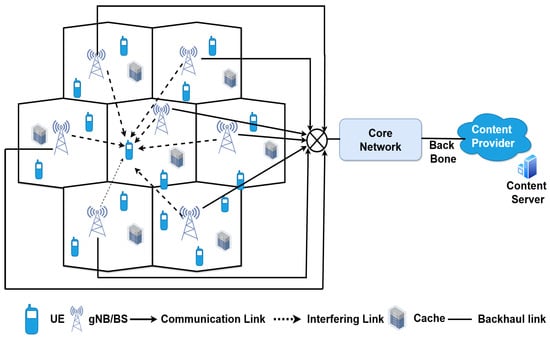
Figure 1.
System model of a cache-enabled mmWave cellular network employing joint transmission and D-TDD.
2.2. Path Loss and Blockage Models
Due to higher path loss and blockage sensitivity, signal attenuation is more significant in mmWave networks than in sub-6 GHz networks. As a result, it is crucial to utilise appropriate models for path loss and blockage [22] when analysing the performance of mmWave networks. Given the susceptibility of mmWave signals to environmental obstructions or blockages, the communication link between the UE and the BS can be in one of three states: Outage, line-of-sight (LoS), or non-line-of-sight (NLoS). The probability of each link state is distance-dependent and is modelled as follows: The outage probability is
The LoS probability is
The NLoS probability is
where R is the distance between the UE and the associated BS, and , and are the blockage parameters and the empirically set constant values of 1/30, 5.2, and 1/67.1, respectively. Consequently, the path loss experienced over the link depends on the state: for LoS links, the path loss is
and for NLoS links, the path loss is
where and are the LoS and NLoS path loss exponents, and and are the path loss intercepts given at 28 GHz frequency, respectively.
2.3. Improved Directional Beamforming Model
This study considers the deployment of uniform linear antenna arrays (ULAs) in both mobile users (MUs) and base stations (BS) to facilitate directional beamforming. For analytical tractability, a flat-top antenna model is assumed to characterise the radiation pattern of the directional beamforming. Here, is the main gain of the lobe, is the minor gain of the lobe, and is the half-power beam width (HPBW) of the main lobe. Following [23], if the maximum radiation intensity of a ULA with antenna elements is normalised to one, then the average radiation intensity can be approximated by
where d is the separation distance between antenna elements and should satisfy . Meanwhile, the half-power beam width (HPBW) of the major lobe is computed as
where . If the major lobe gain is considered as the maximum radiation intensity, i.e., then the minor lobe gain is given by
2.4. Channel Model
To facilitate analysis [23,24], the Nakagami fading model is employed to characterise the channel, leading to a gamma-distributed channel power:
is the gamma function, where m is the Nakagami fading parameter.
Different mmWave channel models have been proposed for various scenarios of interest. For example, ref. [25] considers a vehicular mmWave network with cooperative secure transmission and deep reinforcement learning-based resource allocation, and it adopts a channel model tailored to high-mobility V2X links. In contrast, our work focuses on cache-enabled, small-cell mmWave networks with joint transmission and D-TDD, for which distance-dependent LoS/NLoS/outage probability functions with Nakagami-m fading, as in [24], provide a widely used and analytically tractable basis. This choice allows us to derive closed-form expressions for cache-hit probability and ASP within the DTCC framework while remaining consistent with established mmWave cellular studies.
2.5. Caching Model
Assume user requests to the tagged transmitters are independent and identically distributed. A Zipf distribution determines the probability [26] that a user will request the jth file. Specifically, the probability of a user requesting the jth content file from a library of size L is given by
where is the Zipf exponent that determines the skewness of the content popularity distribution; higher values of indicate that fewer files are requested more frequently, suggesting greater content reuse.
In this work, cooperation occurs mainly at the communication level: the BSs in a serving cluster jointly transmit the exact content to the associated UE. At the caching level, each BS stores files independently according to the probabilistic caching policy. Thus, cache-level cooperation arises implicitly because the user benefits from the union of cached files across its serving cluster. Joint cache-placement optimisation among BSs is not considered in this work, and extending the framework to the coordinated cache placement within the cluster is left for future research.
3. Cache Hitting Probability in Cooperated Network
In coordinated networks, cache hitting probability refers to the likelihood that at least one of the cooperating BSs holds the requested content. Unlike single-BS systems, coordination among multiple BSs increases the chances of serving a user request locally, reducing backhaul load and improving delivery reliability. This probability grows with the number of cooperating BSs and is especially beneficial in mmWave networks where link reliability is limited.
3.1. Probability of Cache Hitting Distribution
The probability of identifying the correct cache with the required file in cooperating transmitting BSs can be expressed using the distribution of the strongest BSs, as characterised in the following lemma. However, the probability of successfully identifying the file cached at the transmitting BSs strongly leans on the blockage density and cell coverage radius or BS density since the popular content is assumed to be cached probabilistically at the BSs.
Lemma 1.
The strongest BS distribution of M cooperating BSs can be described as
For dual BS association, the distribution of the dominant base stations is derived as
where
After substituting, the distribution of the two strongest base stations is expressed as
When extending the analysis to M cooperating BSs, the distribution of strongest BSs is
When the UE demands a file with probability and its caching probability is , the probability of identifying that file in the caches of cooperating BSs is
Finally, the probability of hitting the cache for all files is
3.2. Average Successful Content Files Delivery Probability in Cooperated Network
The probability of successfully delivering the requested content file can be described as the probability that the user receives the correct files from their associated M BSs. When a typical user requests the jth file from these associated BSs, the probability of successful content delivery through joint transmission, based on the achievable SINR at the user and the SINR threshold, can be derived as follows:
The probability of average successful file delivery is determined by averaging all file requests, which is expressed as
Proposition 1.
The probability of successful file delivery to the user at the achieved SINR with the cooperating enabled mmWave DL network with the D-TDD mechanism is derived as
Proof.
Let the typical user request file j, conditional on geometry (cooperating distances); according to Slivnyak’s theorem, the success probability is
where is determined as
As the channel between the BS and UE is considered a Nakagami fading channel with the shaping parameter ‘m’, by using the normalised gamma random variable, the equation can be expressed as
- (a)
- Obtained by applying the Chebyshev sum inequality.
- (b)
- Obtained because of the inequality , where r denotes a gamma random variable with shaping parameter a, and .
- (c)
- Derived by denoting
- (d)
- Obtained using the binomial theorem, occurring through other DL and UL transmissions from the independent BS, which are out of coordinated transmission. Moreover, the DL and UL interference terms are further divided as LOS and NLOS interfering terms:
□
Proposition 2.
The probability of successful file delivery to the user at the achieved SINR with the cooperating, enabled mmWave DL network with the S-TDD mechanism is derived as
Similarly, derive the other interfering terms related to LOS, NLOS, and UL. The key parameter values used in this work are shown in Table 2. The validation of the proposed cache-enabled mmWave network employing dynamic TDD and coordinated base stations is presented in Section 4 with the simulation results, demonstrating the system’s performance through the average probability of success in content delivery.
Table 2.
System parameters for mmWave cache-enabled network.
A moderate Zipf coefficient indicates a balanced distribution of content requests, where popular items dominate but are not overwhelmingly requested. Cached content reduces the dependency on backhaul links, particularly benefiting the D-TDD and S-TDD mechanisms by minimising latency and improving delivery success.
In modelling interference under dynamic TDD, we assume that the sets of downlink and uplink interferers arise from independent thinning of the underlying BS and UE PPPs, with thinning probabilities determined by the traffic split parameter . This assumption follows widely used approaches in the D-TDD and stochastic-geometry and enables a tractable characterisation of cross-link interference.
4. Simulation Results
4.1. Simulation Setup and Reproducibility
The simulations focus on an evolved single-tier mmWave downlink network operating at a 28 GHz carrier frequency with a 1 GHz transmission bandwidth. Base stations (BSs) are deployed inside a circular region of radius km (area ) according to a homogeneous PPP with density , resulting in . Under this topology, the average cell area is , equivalent to a circular cell radius , providing a direct mapping between BS density and cell size. A single typical UE is located at the origin. Each BS operates in dynamic TDD mode, selecting DL or UL transmission based on the traffic split parameter . Every BS maintains a local cache of size , storing popular files according to a Zipf distribution with exponents and . Joint transmission (JT) cooperation is enabled, with the typical UE forming a JT cluster consisting of its M nearest BSs, while all remaining BSs act as interferers. Blockage on each BS–UE link follows the distance-dependent LoS/NLoS/outage model of Section 2.2, and corresponding path loss values are computed using (1)–(3). Directional beamforming employs the flat-top antenna model in (8), where each BS uses transmit antennas and each UE uses receive antennas, with small-scale fading modelled by independent Nakagami-m distributions. The is evaluated using (23), capturing both JT-enhanced desired signal contributions and interference from non-cooperating DL BSs and UL UEs. All simulation parameters—including blockage, channel model, path loss, antenna settings, JT clustering rules, cache size, and other configuration details—are summarised in Table 2, with most values adopted from [17]. All performance metrics are averaged over Monte Carlo realisations to ensure statistically accurate and stable results. In the considered D-TDD operation, the traffic split parameter denotes the probability that a BS operates in downlink mode within a given slot. In the simulations, we assume a typical value of for a DL–UL balanced traffic regime (e.g., ), which is consistent with the asymmetric traffic patterns commonly observed in mmWave small-cell deployments. The JT cluster size M is restricted to , reflecting practical cooperation orders that limit fronthaul overhead and synchronisation complexity while still providing meaningful diversity and beamforming gains. Consequently, the downlink and uplink activity probabilities for each BS are governed directly by , and the corresponding sets of active interferers are modelled according to this D-TDD operational framework.
4.2. Analysis and Discussion
The performance evaluation of the cache-enabled mmWave network that employs D-TDD, S-TDD, and a scenario without TDD (i.e., No TDD) mechanisms under coordinated BSs and a single BS association can be seen in Figure 2. Our analysis focuses on assessing the system’s performance based on the average success probability of content delivery at various SINR thresholds, using an average cell radius of 100 and 200 m. Initially, set the cache size to and (indicating the availability of a single file in the cache) and the Zipf coefficient to (representing moderate content popularity) to illustrate the performance of different duplexing mechanisms, with and without BS coordination. As can be seen from the results in Figure 2, it is observed that the mmWave network utilising D-TDD achieves a higher average success probability for content delivery than the network using S-TDD, and it underperforms relative to the network that does not implement any TDD mechanisms. Successful content delivery without a TDD split (i.e., with no TDD mechanism) is more probable than other mechanisms, as all BSs are equipped with dedicated radio resources for DL transmissions, allowing access to the files from the strongest associated BSs. Moreover, the results in Figure 2 and Figure 3 show that the average success probability of content delivery of the network reduces as BS density decreases. From the values summarised in Table 2, the network with D-TDD achieves almost 3% more successfully delivered content to the users when compared to the network with S-TDD at an SINR threshold of 0 dB. By comparing the values at rc = 100 m and rc = 200 m, the results clearly demonstrate that the network with D-TDD achieves almost 7% higher performance at rc = 100 m compared to rc = 200 m. This means that by maintaining a low average cell radius, the number of deployed BSs should be increased in the network, which subsequently helps users maintain the strongest BS association with mostly LoS communication.
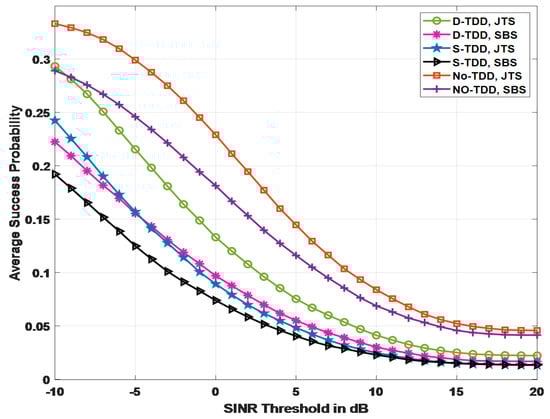
Figure 2.
ASP of content delivery at different SINR thresholds with D-TDD and S-TDD mechanisms and without TDD for an average radius of = 100 m, a cache size of and , and a Zipf coefficient of = 0.5.
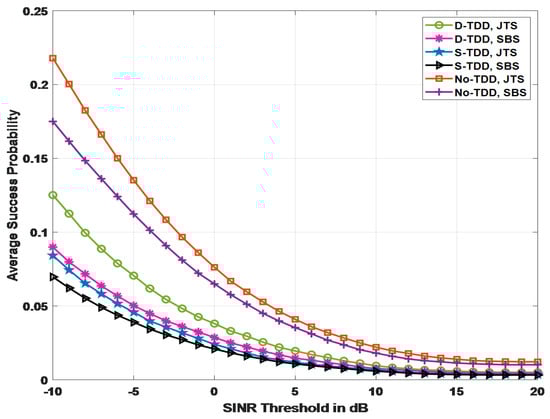
Figure 3.
ASP of content delivery at different SINR thresholds with D-TDD and S-TDD mechanisms and without TDD for an average radius of = 200 m, a cache size of and = 1, and a Zipf coefficient of = 0.5.
In Figure 4 and Figure 5, we can analyse the performance of the D-TDD network, which coordinates two BSs with varying cached files in their content storage libraries and different Zipf coefficients. The results indicate that the average success probability of delivering files increases when caching more files or raising the Zipf coefficient. For example, when the number of cached files at the BSs increases from and to and , the network shows nearly a 10% increase in the successful file delivery probability at the SINR threshold of 0 dB. Alternatively, increasing the Zipf coefficient instead of the cached files results in an approximately 15% improvement in successful file delivery probability, which aligns with expectations. Moreover, when comparing the curves for and with Zipf coefficients of 0.5 and 1.5, it becomes evident that increasing the Zipf coefficient does not enhance the network’s performance once the caches are fully occupied with the most popular content files.
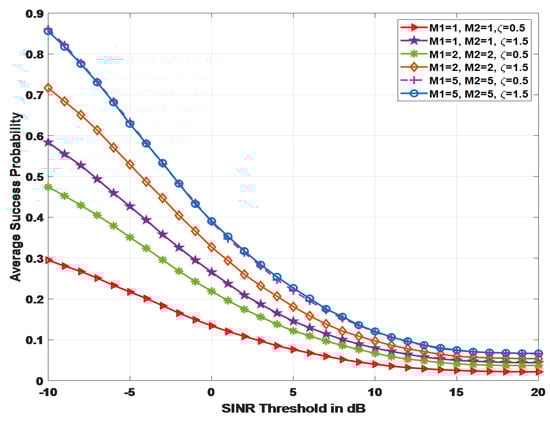
Figure 4.
ASP of content delivery at different SINR thresholds with the D-TDD mechanism for an average radius of = 100 m and various cache sizes and Zipf coefficients.
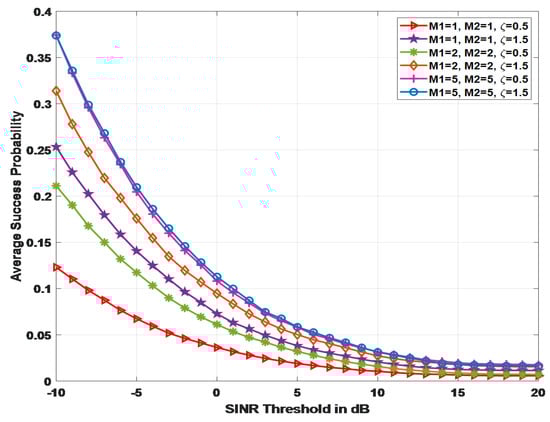
Figure 5.
ASP of content delivery at different SINR thresholds with the D-TDD mechanism for an average radius of = 200 m and various cache sizes and Zipf coefficients.
The results in Figure 6 confirm that the performance of the D-TDD network with coordinated base stations improves significantly as the number of cached files increases. Even adding just one more cached file can enhance the probability of successfully delivering the requested content to the user by approximately 3%. In addition, when comparing the configuration with and to that with and , the advantages of inter-BS cooperation become evident. In this coordinated scenario, the network achieves approximately 10% improvement in the probability of successful file delivery, highlighting the efficacy of cooperative joint transmission and caching.
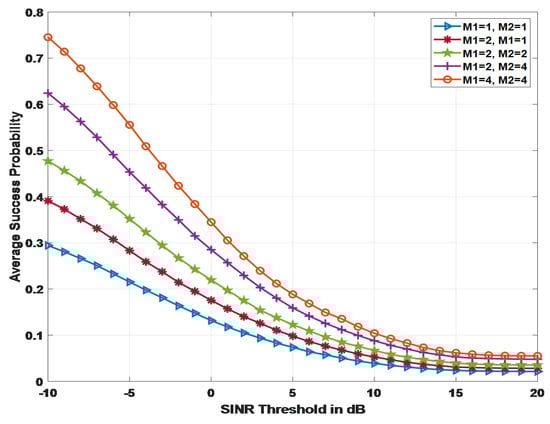
Figure 6.
ASP of content delivery at various SINR thresholds using the D-TDD mechanism for an average radius of = 100 m with a variety of cache sizes and Zipf coefficients.
From all the results, it is clear that cooperative joint transmission improves successful file delivery probability in TDD-based mmWave networks across all BS densities, particularly in environments with more blockages. Furthermore, the increased cache capacity enhances these gains by increasing the likelihood that the requested content file is stored in the cooperative BS cluster. The findings validate our proposed framework and emphasise the importance of jointly considering caching, BS cooperation, and D-TDD in the design of mmWave systems. The most significant measured gains across all scenarios range from 3% to 12%, depending on the cluster size M and Zipf exponent, consistent with the values reported in Figure 4, Figure 5 and Figure 6.
5. Conclusions
This study introduced a new DTCC architecture for mmWave cellular networks with a cache that optimises duplexing and cooperative content delivery at the same time. Significant enhancements in ASP and interference reduction are achieved by the suggested model’s novel integration of coordinated joint transmission with adaptive TDD configuration. The analytical framework was confirmed by the simulation results, which demonstrated that the DTCC scheme outperformed static TDD and single-BS transmission, with an ASP of 0.05 at 0 dB SINR, compared to 0.025 and 0.02, respectively, for a cell radius of 200 m. This also confirms the robustness of dynamic duplexing in crowded settings, with the ASP further increasing to 0.13 for smaller cells (100 m). In addition, increasing the capacity of the cache at cooperative BSs improved the dependability of file delivery, leading to an improvement in ASP from 0.15 to 0.4. The proposed DTCC framework provides analytical expressions and valuable insights into performance trends. However, its practical implementation must address several key factors, including synchronisation requirements, fronthaul bandwidth for coordinated JT, and traffic-driven duplex switching. In addition, the assumption of independence for uplink and downlink interferers, along with simplified blockage models, imposes limitations on the analysis. Future work will focus on incorporating these elements into more thorough system evaluations.
Author Contributions
Conceptualization, P.V.M.; Methodology, P.V.M.; Software, P.V.M.; Validation, P.V.M.; Formal analysis, P.V.M.; Supervision, K.S. and T.V.R. All authors have read and agreed to the published version of the manuscript.
Funding
This research received no external funding.
Data Availability Statement
The original contributions presented in this study are included in the article. Further inquiries can be directed to the corresponding authors.
Conflicts of Interest
The authors declare no conflicts of interest.
References
- Ji, M.; Caire, G. Fundamental limits of caching in wireless D2D networks. IEEE Trans. Inf. Theory 2016, 62, 849–869. [Google Scholar] [CrossRef]
- Liu, D.; Yang, C. Caching policy toward maximal success probability and area spectral efficiency of cache-enabled HetNets. IEEE Trans. Commun. 2017, 65, 2699–2714. [Google Scholar] [CrossRef]
- Gui, Y.; Lu, H.; Wu, F.; Chen, C.W. Robust video broadcast for users with heterogeneous resolution in mobile networks. IEEE Trans. Mob. Comput. 2020, 20, 3251–3266. [Google Scholar] [CrossRef]
- Poularakis, K.; Iosifidis, G.; Tassiulas, L. Approximation algorithms for mobile data caching in small cell networks. IEEE Trans. Commun. 2014, 62, 3665–3677. [Google Scholar] [CrossRef]
- Li, J.; Chen, Y.; Lin, Z.; Chen, W.; Vucetic, B.; Hanzo, L. Distributed caching for data dissemination in the downlink of heterogeneous networks. IEEE Trans. Commun. 2015, 63, 3553–3568. [Google Scholar] [CrossRef]
- Tao, M.; Gündüz, D.; Xu, F.; Roig, J.S.P. Content caching and delivery in wireless radio access networks. IEEE Trans. Commun. 2019, 67, 4724–4749. [Google Scholar] [CrossRef]
- MuraliKrishna, P.V.; VenkataRamana, T. Performance analysis of joint transmission in TDD-based mm-wave networks with BS heights. e-Prime Adv. Electr. Eng. Electron. Energy 2024, 10, 100759. [Google Scholar] [CrossRef]
- Chen, Z.; Pappas, N.; Kountouris, M. Probabilistic caching in wireless D2D networks: Cache hit optimal versus throughput optimal. IEEE Commun. Lett. 2017, 21, 584–587. [Google Scholar] [CrossRef]
- Cui, Y.; Jiang, D. Analysis and optimization of caching and multicasting in large-scale cache-enabled heterogeneous wireless networks. IEEE Trans. Wirel. Commun. 2017, 16, 250–264. [Google Scholar] [CrossRef]
- Biswas, S.; Zhang, T.; Singh, K.; Vuppala, S.; Ratnarajah, T. An analysis on caching placement for millimeter–micro-wave hybrid networks. IEEE Trans. Commun. 2019, 67, 1645–1662. [Google Scholar] [CrossRef]
- Li, J.; Chen, H.; Chen, Y.; Lin, Z.; Vucetic, B.; Hanzo, L. Pricing and resource allocation via game theory for a small-cell video caching system. IEEE J. Sel. Areas Commun. 2016, 34, 2115–2129. [Google Scholar] [CrossRef]
- Guo, F.; Zhang, H.; Li, X.; Ji, H.; Leung, V.C.M. Joint optimization of caching and association in energy-harvesting-powered small cell networks. IEEE Trans. Veh. Technol. 2018, 67, 6469–6480. [Google Scholar] [CrossRef]
- Chae, S.H.; Choi, W. Caching placement in stochastic wireless caching helper networks: Channel selection diversity via caching. IEEE Trans. Wirel. Commun. 2016, 15, 6626–6637. [Google Scholar] [CrossRef]
- Zhang, C.; Lu, H.; Gu, Z. Analysis and Optimization of Cache-Enabled mmWave HetNets with Integrated Access and Backhaul. IEEE Trans. Wirel. Commun. 2023, 22, 6993–7007. [Google Scholar] [CrossRef]
- Gu, Z.; Lu, H.; Zhang, M.; Sun, H.; Chen, C.W. Association and Caching in Relay-Assisted mmWave Networks: A Stochastic Geometry Perspective. IEEE Trans. Wirel. Commun. 2021, 20, 8316–8332. [Google Scholar] [CrossRef]
- Ochia, O.E.; Member, S.; Fapojuwo, A.O. Popularity and Size-Aware Caching with CoordinatedTransmission in Hybrid Microwave/Millimeter Wave Heterogeneous Networks. IEEE Trans. Commun. 2021, 69, 4599–4614. [Google Scholar] [CrossRef]
- Vuppala, S.; Vu, T.X.; Gautam, S.; Chatzinotas, S.; Ottersten, B. Cache-Aided Millimeter Wave Ad-Hoc Networks with Contention-Based Content Delivery. IEEE Trans. Commun. 2018, 66, 3540–3554. [Google Scholar] [CrossRef]
- Ye, Y.; Huang, S.; Xiao, M.; Ma, Z.; Skoglund, M. Cache-enabled millimeter wave cellular networks with clusters. IEEE Trans. Commun. 2020, 68, 7732–7745. [Google Scholar] [CrossRef]
- Zhao, Y.; Zhang, W.; Zhou, L.; Cao, W. A survey on caching in mobile edge computing. Wirel. Commun. Mob. Comput. 2021, 23, 5565648. [Google Scholar] [CrossRef]
- BarghiZanjani, H.; Gouda, B.; Tölli, A. Coordinated Multi-BS SSB Beam Design for Enhanced Initial Access Coverage. arXiv 2025, arXiv:2506.02760. [Google Scholar] [CrossRef]
- Kulkarni, M.N.; Andrews, J.G.; Ghosh, A. Performance of dynamic and static TDD in self-backhauled mmwave cellular networks. IEEE Trans. Wirel. Commun. 2017, 16, 6460–6478. [Google Scholar] [CrossRef]
- Bai, T.; Heath, R.W. Coverage and rate analysis for millimeter-wave cellular networks. IEEE Trans. Wirel. Commun. 2014, 14, 1100–1114. [Google Scholar] [CrossRef]
- Thornburg, A.; Bai, T.; Heath, R.W. Performance analysis of outdoor mmWave ad hoc networks. IEEE Trans. Signal Process. 2016, 64, 4065–4079. [Google Scholar] [CrossRef]
- Sánchez, J.D.V.; Urquiza-Aguiar, L.; Paredes, M.C.P. Fading Channel Models for mm-Wave Communications. Electronics 2021, 10, 798. [Google Scholar] [CrossRef]
- Ju, Y.; Gao, Z.; Wang, H.; Liu, L.; Pei, Q.; Dong, M.; Mumtaz, S.; Leung, V.C. Energy-efficient cooperative secure communications in mmwave vehicular networks using deep recurrent reinforcement learning. IEEE Trans. Intell. Transp. Syst. 2024, 25, 14460–14475. [Google Scholar] [CrossRef]
- Blaszczyszyn, B.; Giovanidis, A. Optimal geographic caching in cellular networks. In Proceedings of the IEEE International Conference on Communications (ICC), London, UK, 8–12 June 2015. [Google Scholar]
Disclaimer/Publisher’s Note: The statements, opinions and data contained in all publications are solely those of the individual author(s) and contributor(s) and not of MDPI and/or the editor(s). MDPI and/or the editor(s) disclaim responsibility for any injury to people or property resulting from any ideas, methods, instructions or products referred to in the content. |
© 2025 by the authors. Licensee MDPI, Basel, Switzerland. This article is an open access article distributed under the terms and conditions of the Creative Commons Attribution (CC BY) license (https://creativecommons.org/licenses/by/4.0/).