


Abstract
Activation functions are fundamental to the representational capacity and optimization dynamics of deep neural networks. Although numerous nonlinearities have been proposed, ranging from classical sigmoid and tanh to modern smooth and trainable functions, no single activation is universally optimal, as each involves trade-offs among gradient flow, stability, computational cost, and expressiveness. This study introduces TRex, a novel activation function that combines the efficiency and linear growth of rectified units with the smooth gradient propagation of saturating functions. TRex features a non-zero, smoothed negative region inspired by tanh while maintaining near-linear behavior for positive inputs, preserving gradients and reducing neuron inactivation. We evaluate TRex against five widely used activation functions (ReLU, ELU, Swish, Mish, and GELU) across eight convolutional architectures (AlexNet, DenseNet-121, EfficientNet-B0, GoogLeNet, LeNet, MobileNet-V2, ResNet-18, and VGGNet) on two benchmark datasets (MNIST and Fashion-MNIST) and a real-world medical imaging dataset (SkinCancer). The results show that TRex achieves competitive accuracy, AUC, and convergence stability across most deep, connectivity-rich architectures while maintaining computational efficiency comparable to those of other smooth activations. These findings highlight TRex as a contextually efficient activation function that enhances gradient flow, generalization, and training stability, particularly in deeper or densely connected architectures, while offering comparable performance in lightweight and mobile-optimized models.
1. Introduction
Deep neural networks derive much of their representational power from the nonlinear transformations applied between layers [1,2,3]. These nonlinearities, known as activation functions, enable networks to approximate highly complex mappings. Without them, a multilayer network would collapse into a simple linear transformation, severely limiting its capacity to model real-world phenomena. Activation functions, therefore, play a central role in shaping gradient flow, learning dynamics, and the overall expressiveness of deep learning architectures [1].
Over the past three decades, varied activation functions have been proposed in the literature. Classical functions such as the logistic sigmoid [4] and the hyperbolic tangent (tanh) [5] were initially favored for their biological plausibility and bounded outputs. The introduction of the rectified linear unit (ReLU) [6] marked a turning point, offering a simple, computationally efficient nonlinearity that alleviated the vanishing-gradient problem for positive inputs. Since then, numerous variants have been developed to address earlier limitations, including Leaky ReLU [7], Parametric ReLU (PReLU) [8], Exponential Linear Unit (ELU) [9], Scaled ELU (SELU) [10], the Gaussian Error Linear Unit (GELU) [11], Swish [12], and Mish [13].
Despite this progress, existing activation functions still exhibit notable drawbacks. Saturating nonlinearities, such as sigmoid and tanh, impede gradient propagation in deep networks. Piecewise-linear activations such as ReLU can suffer from the “dying neuron” problem, where negative inputs permanently map to zero, reducing network capacity. Smooth alternatives such as Swish, GELU, and Mish alleviate some of these issues but often do so at the cost of additional computational overhead or inconsistent performance across tasks. Moreover, their underlying formulations introduce certain limitations: Swish and GELU are monotonic and rely on input-dependent gating via the sigmoid or Gaussian CDF, which can lead to gradient suppression near zero; Mish introduces non-monotonicity through a composite function of , but the nested nonlinearity increases curvature and computational complexity without asserting explicit control over the negative slope.
We propose TRex, a novel activation function that combines the simplicity and efficiency of rectified units with the controlled smoothness and gradient preservation of modern nonlinearities. Unlike Mish or Swish, TRex employs a piecewise-smooth formulation that retains a linear positive regime and introduces a bounded, differentiable negative region governed by a single fixed parameter, inspired by the shape of but scaled to preserve consistent gradient magnitudes. This design offers three key distinctions:
- Controlled non-monotonicity: TRex maintains smooth transitions without the excessive flattening near zero seen in Swish or GELU;
- Analytical simplicity: Its closed-form expression avoids nested or compound operations, reducing computational cost relative to Mish;
- Stable gradient dynamics: By ensuring a non-zero negative slope and bounded curvature, TRex preserves gradient flow across layers and mitigates neuron inactivation.
Empirically, this fixed yet carefully designed nonlinearity improves convergence stability and generalization across diverse deep learning tasks without imposing significant additional computational overhead.
Recent studies have explored tunable and fractional-derivative activation functions that enable continuous control over curvature or slope during training [14,15]. While such formulations offer flexibility, they often introduce additional hyperparameters and sensitivity to initialization. In contrast, TRex achieves smooth and balanced gradient behavior through its fixed-shape formulation, eliminating the need for adaptive tuning while retaining stable, well-conditioned gradients across the activation domain. This behavior makes TRex a complementary alternative to tunable schemes, emphasizing structural simplicity and robustness over dynamic shape modulation.
2. Literature Review
This section presents a chronological overview of activation function development in deep neural networks, extending from conventional to modern variants.
Early neural networks relied heavily on saturating nonlinearities such as the logistic sigmoid [4] and the hyperbolic tangent (tanh) [5]. The sigmoid maps inputs to the range (0, 1), making it suitable for performing probabilistic interpretation, whereas tanh centers outputs around zero to facilitate optimization. However, both activations exhibit steep saturation regions where derivatives become vanishingly small, especially for large positive or negative inputs. This vanishing-gradient problem slows convergence and hinders the training of deep architectures. Several scaled or shifted variants have since been proposed to address saturation and centering, yet the fundamental issue of gradient shrinkage has persisted.
The introduction of the rectified linear unit (ReLU) [6] marked a major turning point. Defined as , ReLU is piecewise-linear and non-saturating for positive inputs, substantially improving gradient propagation and reducing computational cost. It became the default activation approach in most convolutional and feedforward networks. Nevertheless, ReLU has a key limitation: its zero output for all negative inputs causes the “dying neuron” problem, where neurons become permanently inactive and cease to contribute to learning. To address this, Leaky ReLU [7] introduced a small fixed slope on the negative side to maintain gradient flow. Parametric ReLu (PReLU) [8] extended this idea by converting the negative slope to a learnable parameter, enabling adaptive control. The Exponential Linear Unit (ELU) [9] and its scaled variant SELU [10] added smooth exponential behavior for negative inputs, promoting self-normalizing networks and more stable training, though at higher computational cost.
Beyond simple rectifications, researchers explored smooth and sometimes non-monotonic activations to preserve gradients across the input domain while maintaining nonlinear expressiveness. The self-gated activation function (Swish) [12], which was discovered through automated searching, multiplies the input by a sigmoid gate and consistently outperforms ReLU in many convolutional networks. The self-regularized non-monotonic neural activation (Mish) [13] extends this approach by combining softplus [16] and tanh into a smooth, non-monotonic function that demonstrates empirical gains over both ReLU and Swish across various benchmarks. Other functions, such as Logish [17], Smish [18], the Gaussian Error Linear Unit (GELU) [11], and NIPUNA [19], seek to blend sigmoid- or error-function-based smoothness with rectification, often introducing parametric or adaptive components to enhance gradient stability and expressive power. Although these activations outperform traditional functions on some tasks, they are typically more computationally expensive, and their benefits are inconsistent across architectures, datasets, and training regimes.
In parallel, a separate line of research treats the activation function as a learnable component rather than a fixed nonlinearity. Adaptive Piecewise Linear (APL) units [20] approximate arbitrary nonlinearities by learning multiple linear segments. Parametric Swish (P-Swish) [21] and similar gated variants introduce trainable parameters that control the slope or smoothness of the activation during training. These adaptive activations provide layer-wise flexibility and can automatically adjust to data statistics. However, they add additional parameters and hyperparameters and may cause unstable optimization dynamics, making them harder to deploy in practice. While such approaches increase expressivity, they often do so at the expense of simplicity and robustness.
Despite this diverse landscape, several limitations remain. Saturating activations still hinder gradient flow in deep architectures, rectified activations risk causing neuron inactivation and provide no gradient for large negative inputs, and smooth, non-monotonic functions, while promising, add computational overhead and exhibit inconsistent performance. Trainable or adaptive functions address some of these problems, but they do so at the cost of increased complexity and potential instability. In other words, there is still no widely accepted activation function that simultaneously achieves smooth gradient flow, avoids neuron death, retains the fast convergence of rectified units, and does so with minimal additional computational or parameter overhead. This persistent gap motivates the development of TRex, which combines the advantages of rectified and smooth activations in a single lightweight formulation, thereby enhancing gradient propagation, convergence stability, and generalization without incurring significant additional cost. While activation-level innovations such as TRex primarily target gradient smoothness and neuron-level stability, broader challenges related to loss landscape conditioning remain an active area of research. Notably, the work on Activated Gradients for Deep Neural Networks [22] addresses this issue by reparameterizing gradients to improve the conditioning of the optimization landscape and enhance convergence robustness. Such approaches are complementary to TRex, which focuses on achieving stable gradient propagation through activation design rather than explicit gradient reweighting.
3. TRex Activation Function
TRex is a novel activation function that combines the advantages of ReLU and tanh in a single formulation, addressing key limitations of traditional activation functions. Specifically, it provides smooth nonlinearity for negative and small inputs while maintaining near-linear behavior for positive ones, thereby improving gradient flow, stabilizing training, and accelerating convergence in deep neural networks. The intuition behind TRex stems from the limitations of existing activations: ReLU is linear and enables fast learning for positive inputs but completely zeroes out negative inputs, often leading to “dead neurons”, whereas tanh provides smooth nonlinear transformations that preserve gradients but suffers from saturation for large negative or positive values. TRex balances between these behaviors, ensuring that neurons remain active across the entire input range while gradients propagate effectively.
3.1. TRex Definition and Characteristics
Equation (1) represents the mathematical formulation of TRex, which integrates the complementary properties of the tanh and ReLU activation functions in a smooth and computationally efficient manner. The component introduces smooth saturation and bounded gradients, mitigating the risk of gradient instability during backpropagation. The multiplicative linear term, x, preserves the unbounded linear growth characteristic of ReLU for positive inputs, thereby maintaining sensitivity in the active region. Meanwhile, exponential attenuation on the negative side softly suppresses large negative activations without forcing them to change to zero, thus avoiding neuron inactivity. Collectively, these design elements ensure functional continuity, stable gradient propagation, and the occurrence of a smooth transition around the origin, leading to improved optimization stability and robust learning dynamics.
where x is the input. The input is first transformed using a smoothed nonlinear term, , which ensures gradual saturation for small and negative values. For negative inputs, an additional exponential scaling factor is applied to further smoothen gradients and avoid the abrupt zeroing seen in ReLU. For positive inputs, the function behaves almost linearly, preserving ReLU’s fast convergence properties. The piecewise structure ensures that a smooth transition occurs between negative and positive regions with a continuous derivative, crucial for stable gradient-based optimization. It is important to clarify that the term “gradient-free” in this work does not refer to the gradient-free optimization algorithms widely used in distributed control and source-seeking applications [23,24]. Those methods operate at the multi-agent system level, enabling cooperative optimization without analytic gradients. In contrast, TRex’s use of “gradient-free” refers solely to maintaining smooth, non-zero local gradients within the activation function, rather than implementing a distributed or system-level optimization scheme.
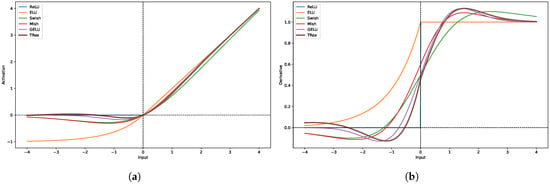
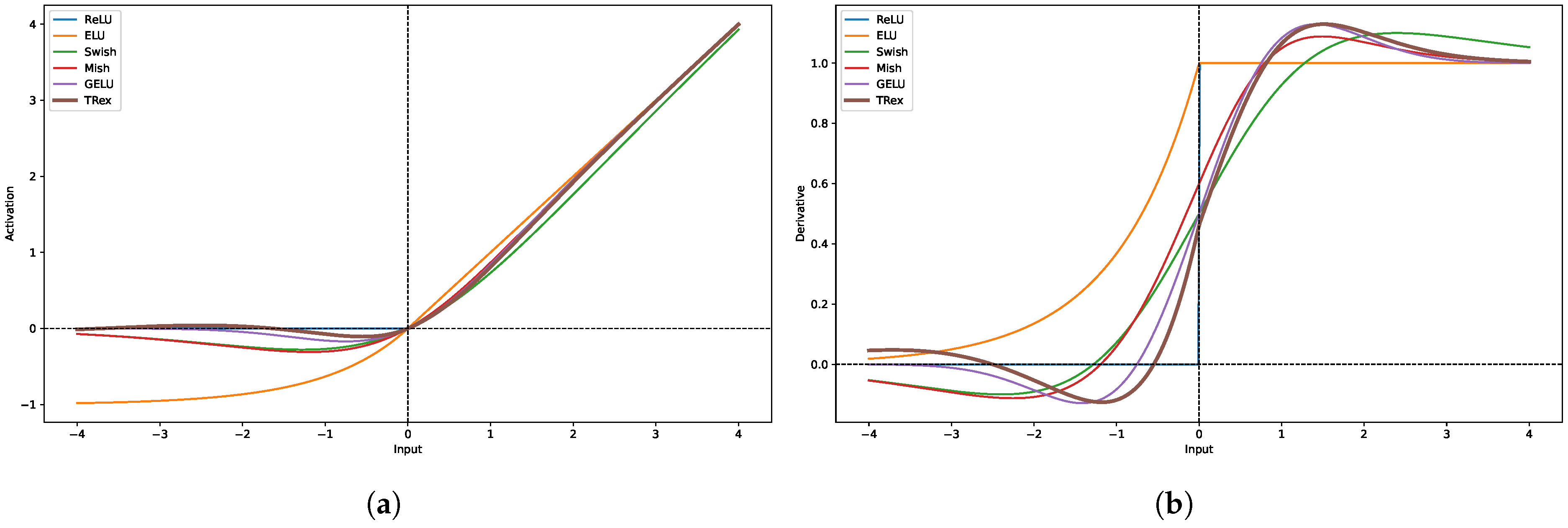
Graphically, TRex exhibits three key characteristics: For negative inputs, it behaves akin to a smoothed tanh, providing non-zero gradients and preventing neuron death. Near zero, it maintains a gradual slope that supports effective gradient propagation even for small activations. For positive inputs, TRex approximates linear growth, allowing networks to leverage the advantages of ReLU while avoiding abrupt nonlinearities that can destabilize learning. Figure 1a,b illustrate the activation and its derivative in comparison with ReLU and tanh, respectively.
Figure 1.
The graphical behavior of the TRex activation function relative to ReLU and tanh: (a) activation output; (b) derivative.
3.2. Analytic Form and Derivatives
To analyze gradient propagation, we provide the explicit derivatives of TRex. We define
The derivative of TRex is then
where
For negative inputs (), the derivative combines the effects of the smoothed tanh and exponential scaling, ensuring gradual slope changes and non-zero gradients. For positive inputs (), the derivative approximates for moderate values, preserving near-linear behavior similar to that of ReLU.
Continuity at evaluating the one-sided derivatives gives
demonstrating that the derivative is continuous at zero. This ensures smooth gradient flow during backpropagation, crucial for stable optimization.
Compared to smooth activations such as Swish or Mish, TRex is particularly beneficial in architectures where controlled saturation and bounded curvature improve stability, such as lightweight or quantized models (e.g., MobileNet-V2, EfficientNet-B0). The activation’s attenuated negative region enhances gradient flow while suppressing noise-driven responses, which is advantageous in sensor-rich or highly variable input domains. However, TRex may offer limited gains in extremely sparse representations or tasks requiring unbounded positive activations, where mild output compression can be suboptimal.
4. Datasets
4.1. MNIST
The MNIST dataset is a well-established benchmark widely used for handwritten-digit recognition and image-classification research [25]. It contains 70,000 labeled grayscale images of digits 0–9, comprising 60,000 training and 10,000 test images. Each image is a 28 × 28-pixel square (784 features when flattened), centered and normalized to enhance uniformity. The dataset is balanced across all classes, with roughly 7000 examples per digit, capturing diverse handwriting styles. Owing to its simplicity, consistency, and manageable size, MNIST remains a common choice for prototyping and benchmarking machine learning algorithms and neural network architectures, even though this is now considered to be a largely “solved” problem.
4.2. Fashion-MNIST
Fashion-MNIST is a modern drop-in replacement for MNIST designed to provide a more challenging image-classification benchmark [26]. It comprises 70,000 labeled grayscale images of 10 fashion product categories (e.g., T-shirts, trousers, shoes), with 60,000 images used for training and 10,000 for testing. Each 28 × 28-pixel image underwent preprocessing steps (centering and normalization) similar to those for MNIST to ensure consistency. The dataset is balanced across all categories, with approximately 7000 examples per class, capturing varied clothing styles and shapes. Because of its identical format but higher visual complexity compared to MNIST, Fashion-MNIST is widely used to evaluate the generalization ability of machine learning models and as an intermediate step between simple digit recognition and more complex real-world tasks.
4.3. SkinCancer
The SkinCancer dataset is a clinically sourced medical imaging collection derived from the International Skin Imaging Collaboration (ISIC) Archive [27]. It consists of 3600 dermoscopic images of skin lesions evenly divided into benign and malignant categories (1800 images per class), standardized to 224 × 224 pixels. The dataset was split into training and test sets at an 80:20 split, using a fixed random seed to ensure reproducibility. Unlike synthetic datasets, it captures the real-world variability in and complexity of clinical cases, making it especially valuable for developing and evaluating machine learning models in medical imaging. The balanced class distribution mitigates issues of class imbalance and supports robust model training and fair performance evaluation.
5. Experimental Design
To evaluate TRex, we conducted a comprehensive set of experiments that compared it with five widely used activation functions (ReLU, ELU, Swish, Mish, and GELU) across eight CNN architectures, encompassing both classical and modern designs: LeNet [28], AlexNet [29], VGGNet [30], GoogLeNet [31], ResNet-18 [32], MobileNet-V2 [33], DenseNet-121 [34], and EfficientNet-B0 [35]. These architectures span shallow networks suitable for platforms ranging from small-scale datasets to deep models that capture intricate patterns in large-scale data. The experiments were designed to evaluate the performance of the proposed TRex activation function across a diverse set of datasets and CNN architectures. The evaluation covered two standard benchmark datasets (MNIST and Fashion-MNIST) and one domain-specific real-world dataset (SkinCancer). The following experiments were performed:
- Experiment A—MNIST (benchmark dataset): Evaluated TRex via handwritten-digit classification as a baseline to compare its performance against established activation functions on a well-known benchmark dataset;
- Experiment B—Fashion-MNIST (benchmark dataset): Assessed TRex on a more complex benchmark dataset of fashion images to evaluate generalization across higher visual complexity and intra-class variation, analyzing accuracy, training stability, and convergence dynamics;
- Experiment C—SkinCancer dataset (domain-specific real-world dataset): Evaluated TRex on a real-world medical imaging dataset, focusing on skin cancer classification to test its robustness and practical utility in an application domain-specific task, where data distributions and feature complexity differ from standard benchmarks.
For all experiments, the same eight CNN architectures and six activation functions were used. Each configuration (architecture × activation function) was trained independently with consistent procedures and hyperparameters across datasets, including data preprocessing, learning rates, optimizers, batch sizes, and number of epochs, ensuring fair comparison.
During training, primary metrics such as classification accuracy, convergence speed, and training stability were recorded. Gradient behavior and derivative characteristics were also analyzed to relate activation properties to network learning dynamics. Across all dataset scenarios, the 48 independent configurations enabled a thorough evaluation of TRex across network depths, dataset complexities, and learning tasks, providing insight into its effectiveness, stability, and generalization relative to existing activation functions.
6. Setup and Evaluation Metrics
All experiments were implemented in Python 3.12.11 and executed on Google Colab Pro+, which was used as the primary computational resource. For evaluation metrics and analysis, the following libraries were used: PyTorch 3.9 [36] was used for building, training, and evaluating neural networks, along with Scikit-learn [37]. Further details, including the source codes, can be found in the Supplementary Materials.
Each model was trained for 100 epochs using default hyperparameters. Checkpoints were saved at both the epoch achieving the best validation performance and at regular intervals. Training was performed on Colab Pro+ A100 GPU devices, and the total wall-clock training time was recorded.
For the MNIST dataset, all architectures used a fixed seed of 42 and a batch size of 64. Training employed cross-entropy loss with the Adam optimizer, set at a learning rate of 0.001. For the Fashion-MNIST dataset, all architectures were initialized with a seed of 42, but they used a larger batch size of 256. Training used cross-entropy loss with the AdamW optimizer, a learning rate of 3 × , and a weight decay of 0.05. For the SkinCancer dataset, all architectures used a seed of 42 and a batch size of 32. Models were trained with cross-entropy loss and the AdamW optimizer, using a learning rate of 1 × and a weight decay of 1 × .
Model performance was evaluated using accuracy-based, classification-specific, and probabilistic metrics, defined as follows:
- Training Accuracy: The proportion of correctly predicted samples in the training set:
- Validation Accuracy: The proportion of correctly predicted samples in the held-out validation set:
- Precision (Weighted): The weighted average of per-class precision, accounting for class imbalance:where denotes the proportion of samples in class i, denotes true positives, and denotes false positives.
- Recall (Weighted): The weighted average of per-class recall:where denotes false negatives for class i.
- F1 Score (Weighted): The weighted average of per-class scores:
- Macro-Averaged AUC: The average area under the ROC curve across all classes in a one vs. the rest manner:where denotes the AUC for class i.
- Confusion Matrix: The counts of true versus predicted classes:
- Training Time: The total wall-clock time from the start of the first epoch to the completion of the final epoch.
We conducted a paired Student t-test for each dataset (MNIST, Fashion-MNIST, and SkinCancer) and each architecture (AlexNet, DenseNet-121, EfficientNet-B0, GoogLeNet, LeNet, MobileNet-V2, ResNet-18, and VGGNet) to statistically compare the performances of all pairs of activation functions, including TRex, ReLU, ELU, Swish, Mish, and GELU. This analysis used the 100 paired accuracy readings obtained at each epoch over the 100 training epochs for each pair of activation functions within the same model and dataset. The large sample size justified using the t-test despite potential deviations from normality.
7. Results and Discussion
7.1. Experiment A—MNIST Dataset
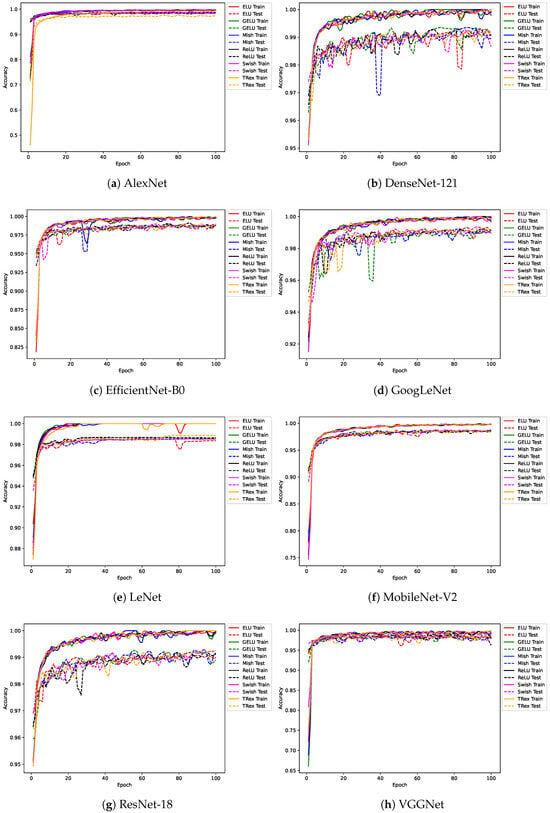
The comparative evaluation performed on the MNIST dataset highlights several functional aspects of the TRex activation function relative to existing nonlinearities. Regarding convergence stability, TRex generally provided smooth and consistent learning dynamics, with accuracy and loss curves demonstrating stable improvement across most CNNs (Figure 2 and Figure 3). Similar to GELU and Swish, TRex avoided oscillations and erratic gradient behavior, supporting steady optimization. However, in shallower networks such as AlexNet, TRex’s test accuracy plateaued earlier than that of ReLU and GELU, yielding a lower final performance (97.38% vs. 98.40–98.6%, Table 1). This suggests that while TRex ensures stability, its smoother gradient landscape may reduce its effectiveness in architectures where sharp nonlinearity is beneficial.
Figure 2.
The training and test accuracy curves for CNN models trained using multiple activation functions on the MNIST dataset.
Figure 3.
The training and test loss curves for CNN models trained using multiple activation functions on the MNIST dataset.
Table 1.
A quantitative summary of results from the MNIST experiment.
For generalization, TRex demonstrated clear advantages in deeper and modern architectures. For instance, DenseNet-121 achieved the highest accuracy with TRex (99.18%), surpassing those of all other activation functions, while EfficientNet-B0 and GoogLeNet also exhibited superior generalization with TRex, with test accuracies of 98.98% and 99.12%, respectively (Table 1). Similarly, ResNet-18 reached 99.25% with TRex, matching or surpassing the performances of Swish and Mish. These results indicate that TRex is particularly effective in models that benefit from strong gradient propagation and feature reuse. Notably, even in the simpler LeNet, TRex slightly outperformed established activation functions, achieving 98.88%. In contrast, MobileNet-V2 and AlexNet underperformed with TRex, highlighting its reduced suitability in lightweight or shallow networks where ReLU-like sparsity provides greater efficiency.
Our evaluation of class separation further underscores TRex’s strengths. Across all models, TRex achieved consistently high AUC scores (≈0.995–0.999), frequently matching or surpassing the performances of other activation functions (Figure 4, Table 1). For example, in DenseNet-121, TRex attained the highest AUC (0.9992), and in LeNet, TRex achieved an AUC of 0.9972, outperforming other smooth activation functions. These results indicate that TRex preserves discriminative capacity at decision boundaries, even when raw accuracy is not maximal, a property valuable in settings with subtle feature distinctions.
Figure 4.
The ROC curves for CNN models trained using multiple activation functions on the MNIST dataset.
Regarding computational efficiency, training times with TRex were comparable to those of Swish, Mish, and GELU across all architectures (Table 1). No significant computational penalty was observed, suggesting that TRex can be adopted without sacrificing scalability.
The Student t-test results in Table 2 indicate that, across most architectures, TRex demonstrates statistically significant performance differences compared with other activations, particularly for convolutional models such as AlexNet and LeNet. For AlexNet, all comparisons of TRex with other activations yielded p-values below 0.001, highlighting its consistently superior behavior. In contrast, for deeper or more modern architectures such as DenseNet-121, EfficientNet-B0, and MobileNet-V2, the p-values are generally higher, suggesting that the differences between activations are less pronounced in these networks. Notably, activations such as Mish and GELU exhibit significant differences in specific cases, particularly in shallower networks, reflecting architecture-dependent sensitivity to activation choice. Overall, the t-test confirms that TRex provides statistically significant improvements over standard activations in several network backbones, especially those with simpler structures.
Table 2.
A summary of the Student t-test p-values for the MNIST dataset.
Table 3 presents the inference times (in seconds) of various activation functions across multiple deep learning architectures evaluated using the MNIST dataset. Overall, the results indicate that the proposed TRex activation achieves competitive inference efficiency comparable to or better than those of existing nonlinearities across most models. For lightweight architectures such as LeNet and AlexNet, TRex performs on par with or slightly faster than ReLU and Swish, demonstrating its computational simplicity. For deeper networks such as VGGNet, GoogLeNet, and ResNet, TRex maintains inference times within a narrow margin of other activations while avoiding the significant increases in latency observed for more complex functions such as Mish and GELU. Notably, even for parameter-heavy architectures such as DenseNet and EfficientNet, TRex exhibits inference times close to the mean of all tested activations, reflecting good scalability without excessive computational overhead. These findings confirm that TRex provides a favorable trade-off between expressive nonlinearity and computational efficiency.
Table 3.
The inference times (seconds) for different activation functions across models for the MNIST Dataset.
The MNIST experiments demonstrate that TRex functionally excels in deep, connectivity-rich CNN architectures, enabling stable convergence, strong generalization, and robust class separation. Its relative underperformance in lightweight or shallow networks highlights a trade-off: the smoothness that supports gradient stability in deep models may limit effectiveness in architectures reliant on sharp activation dynamics. Overall, TRex is a promising alternative, particularly when the primary design goals are achieving stability and generalization rather than raw efficiency.
7.2. Experiment B—Fashion-MNIST Dataset
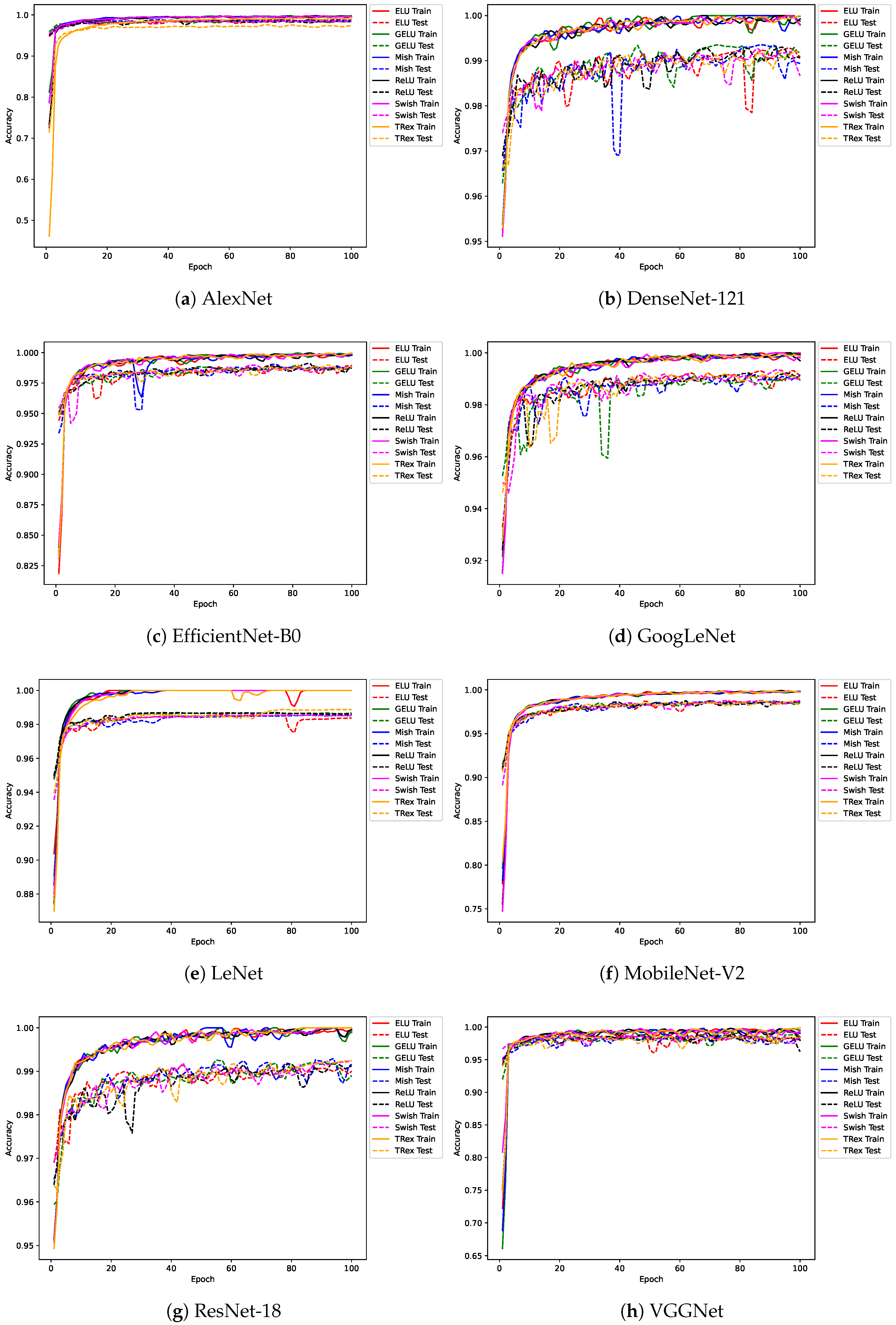
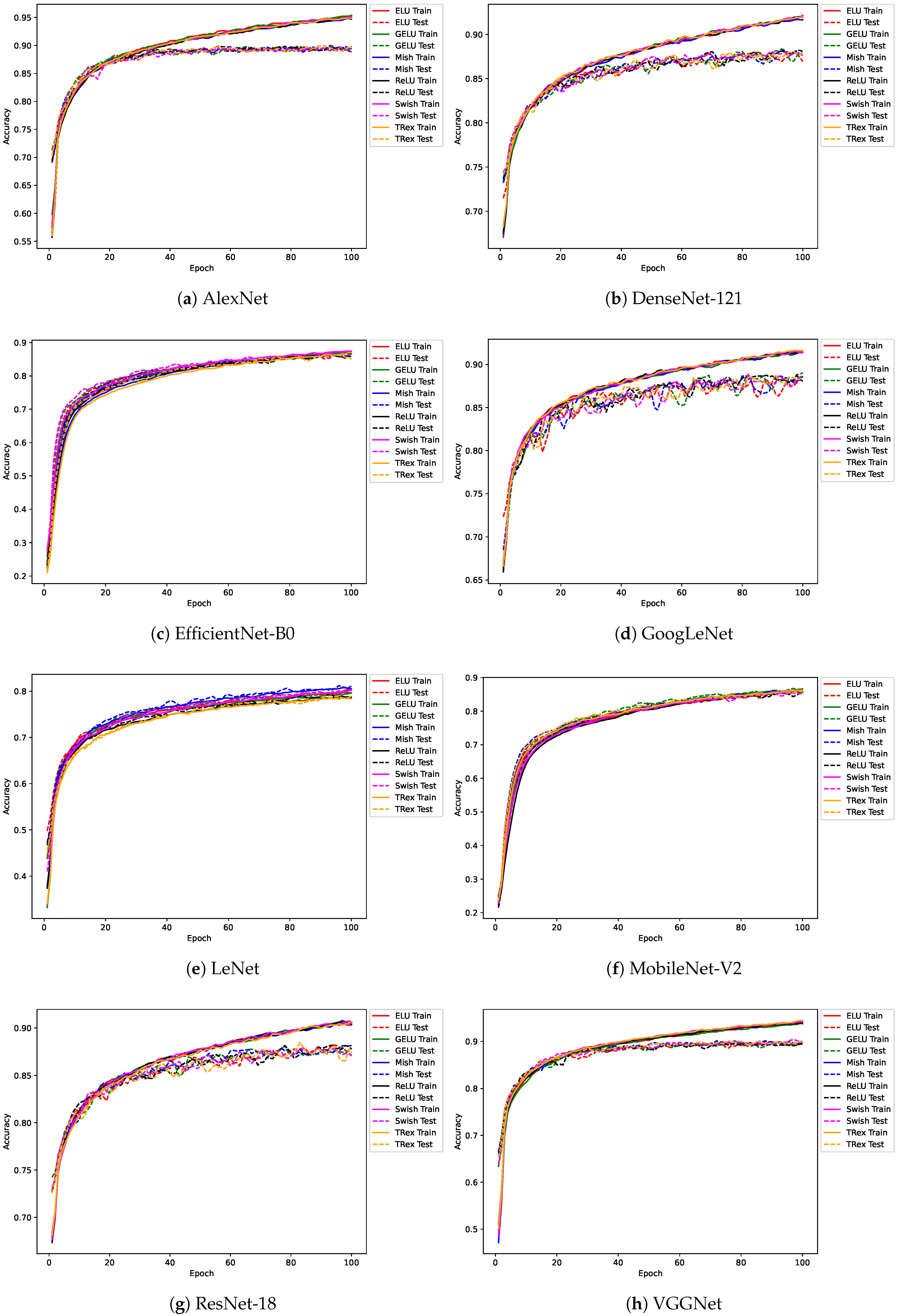
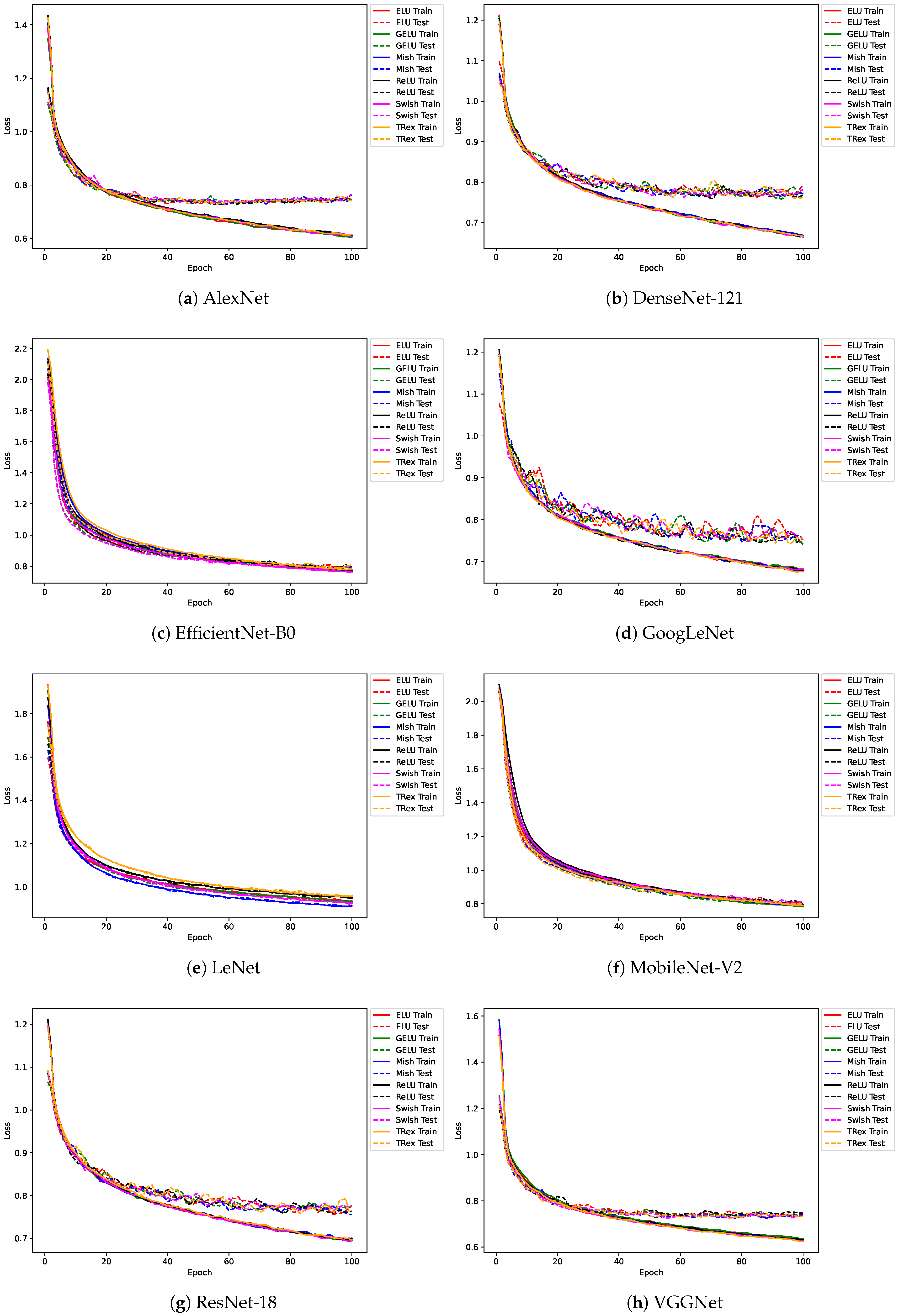
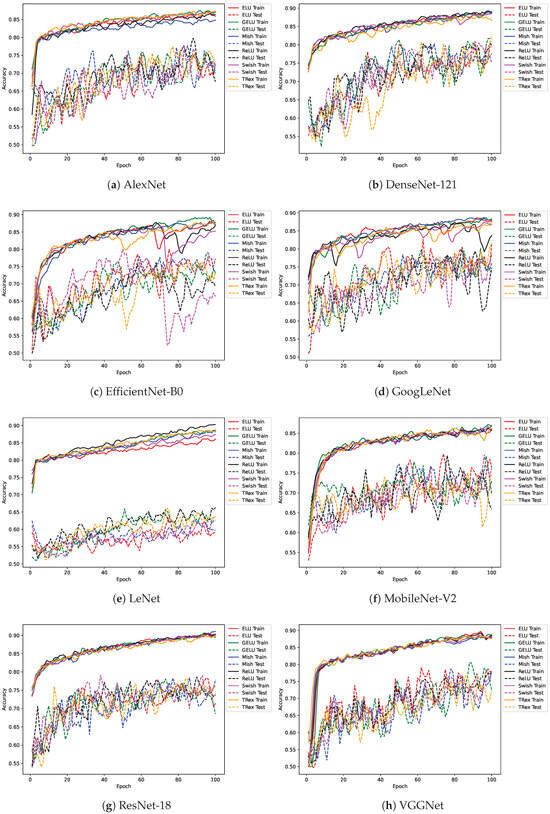
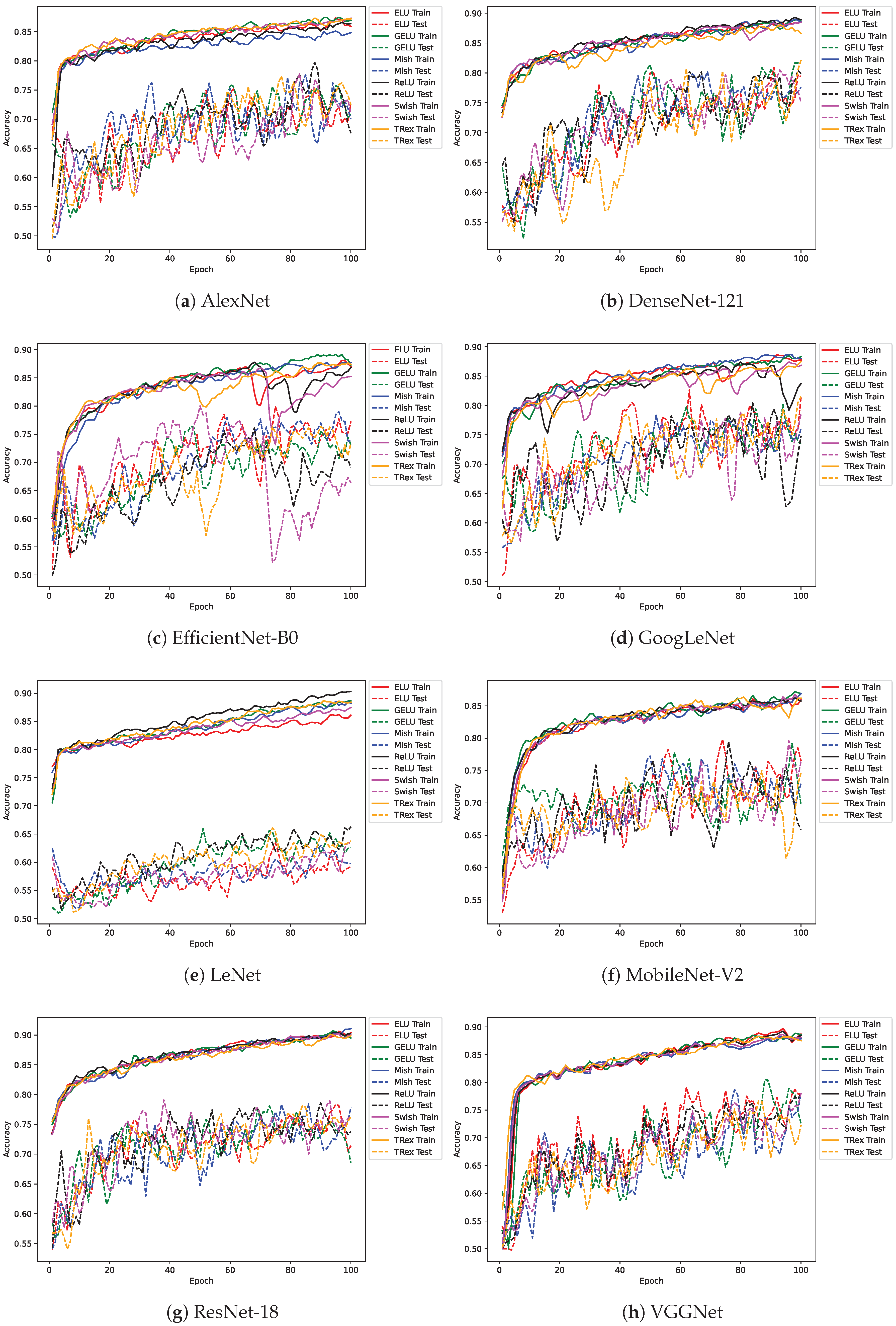
The results for Fashion-MNIST highlight functional distinctions between TRex and other activation functions across several dimensions. Regarding convergence stability, TRex generally produced smooth learning curves comparable to those for GELU and Swish, avoiding erratic oscillations during training. However, in certain architectures, particularly LeNet and EfficientNet-B0, convergence plateaued prematurely (Figure 5 and Figure 6), resulting in test accuracies lower than those of baseline functions such as ReLU or Mish. This suggests that, while TRex enables stable optimization, its smoothness can occasionally limit feature discrimination in lightweight or capacity-constrained models.
Figure 5.
The training and test accuracy curves for CNN models trained using multiple activation functions on the Fashion-MNIST dataset.
Figure 6.
The training and test loss curves for CNN models trained using multiple activation functions on the Fashion-MNIST dataset.
For generalization, TRex demonstrated competitive performance in several architectures, most notably AlexNet, GoogLeNet, ResNet-18, MobileNet-V2, and VGGNet, where it matched or surpassed existing nonlinearities. For example, for GoogLeNet and ResNet-18, TRex achieved the highest test accuracies (88.2% and 87.95%, respectively), outperforming GELU, Swish, and Mish, while for VGGNet, TRex delivered the best performance (90.25%) (Table 4). These results indicate that TRex leverages its smooth gradient profile to maintain effective learning in networks where depth and complexity make gradient stability critical. Conversely, in DenseNet-121 and EfficientNet-B0, TRex’s performance was average or below those of the top competitors, suggesting that, in architectures already optimized for gradient propagation and efficiency, TRex makes a less functional contribution.
Table 4.
Quantitative summary of results from the Fashion-MNIST experiment.
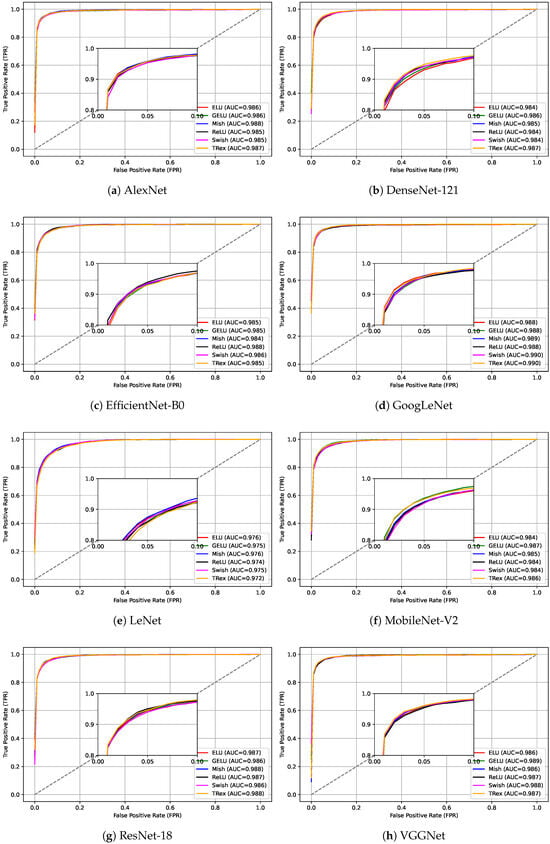
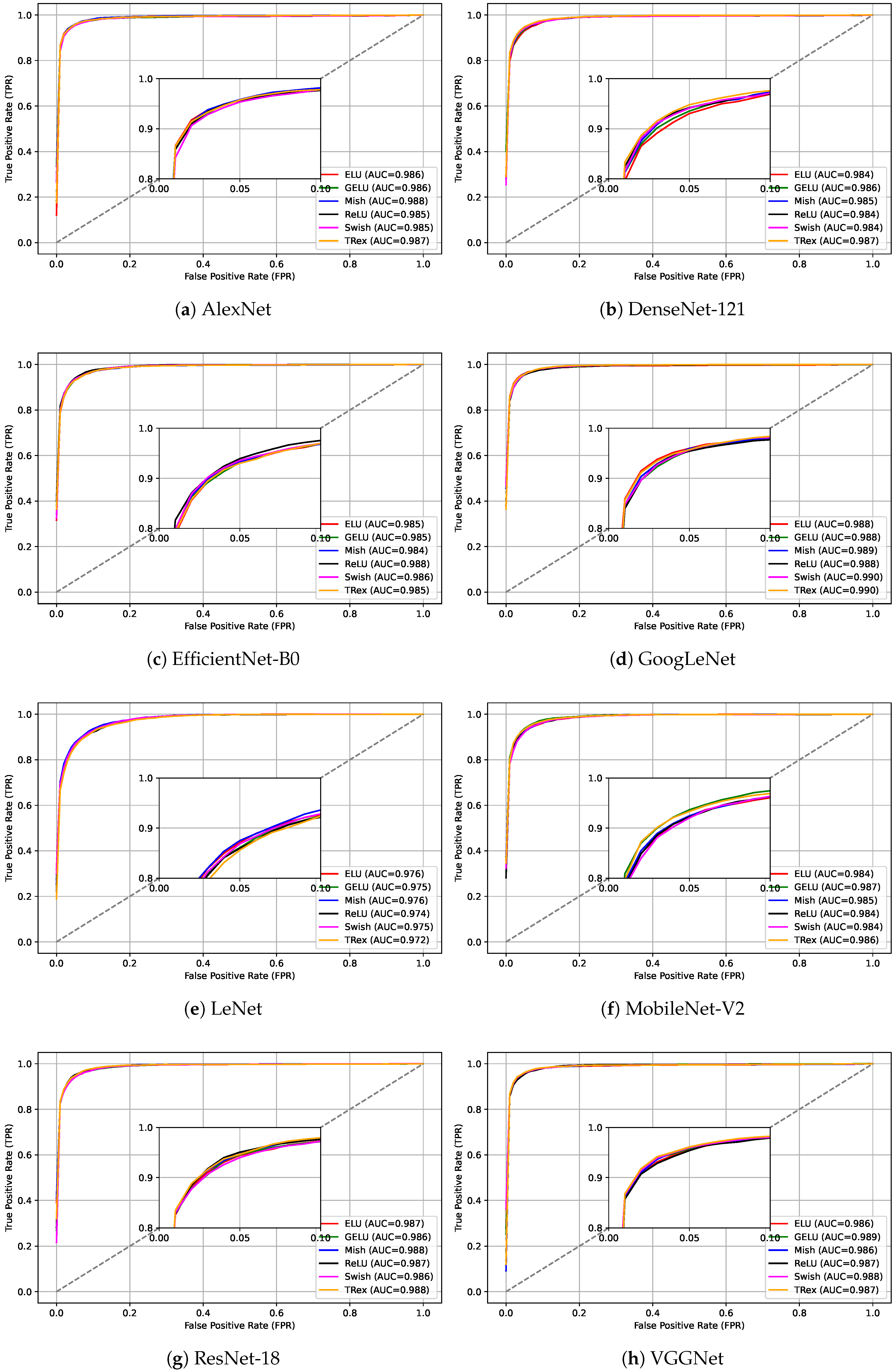
Examining class separation, TRex consistently achieved strong AUC values across all architectures, often matching or surpassing those of the best-performing activation functions. For instance, TRex attained AUCs of 0.9901 for GoogLeNet, the highest among all activation functions, and 0.9875 for ResNet-18, closely following Mish (Figure 7, Table 4). These results confirm that TRex reliably supports robust boundary discrimination, even when accuracy is not maximal. This is particularly significant for datasets such as Fashion-MNIST, where inter-class similarities challenge classification, indicating that TRex may confer resilience in separating classes with subtle feature variations.
Figure 7.
The ROC curves for CNN models trained using multiple activation functions on the Fashion-MNIST dataset.
Regarding computational efficiency, TRex did not introduce meaningful training overhead. Training times were nearly identical to those of GELU and Swish across all architectures (Table 4), suggesting that TRex maintains scalability while providing functional advantages regarding stability and generalization.
The Student t-test results (see Table 5) across different network architectures and activation functions reveal several notable trends in statistical significance. For deeper architectures such as EfficientNet-B0 and LeNet, nearly all pairwise comparisons of activations yielded highly significant p-values , indicating strong differences in performance between activations. Conversely, shallower architectures, including AlexNet and DenseNet-121, showed more mixed results: some comparisons (e.g., Swish vs. TRex or ELU) were highly significant, whereas others, particularly those between TRex, GELU, and Mish, were not significant, suggesting closer performance. ResNet-18 and VGGNet, representing intermediate depth models, exhibited moderate significance patterns, with TRex often showing statistically distinct behavior compared to ELU, GELU, or Swish. Overall, these results suggest that the choice of activation function has a statistically significant impact on performance, with the effects being more pronounced in deeper or more complex architectures. TRex, in particular, demonstrates consistently significant differences against commonly used activations such as Swish and GELU in several networks, highlighting its potential as a competitive alternative.
Table 5.
A summary of the Student t-test p-values for the Fashion MNIST dataset.
Table 6 reports the inference times (in seconds) of different activation functions across varied deep learning models trained on the Fashion MNIST dataset. The results demonstrate that the proposed TRex activation maintains consistent and efficient inference performance across all architectures. Specifically, TRex achieves one of the lowest average inference times among the tested activations, particularly excelling in LeNet, ResNet, and EfficientNet, where it slightly outperforms ReLU and other nonlinear functions. Compared to more computationally demanding activations such as Swish, Mish, and GELU, TRex achieves comparable or superior efficiency without introducing additional latency overhead. For complex architectures such as DenseNet and VGGNet, TRex exhibits stable inference behavior, remaining close to the optimal range observed among all tested functions.
Table 6.
The inference times (seconds) for different activation functions across models for the Fashion MNIST Dataset.
Overall, the Fashion-MNIST experiments reinforce the characterization of TRex as an activation function that is particularly effective in deep and moderately complex CNNs, promoting generalization and strong class separation. However, in lightweight or shallow models, TRex occasionally lags behind sharper activations such as ReLU and Mish, which better exploit sparse representations. These findings highlight TRex as a functionally versatile alternative that is most advantageous when gradient stability and robust boundary learning are prioritized over raw efficiency.
7.3. Experiment C—SkinCancer Dataset
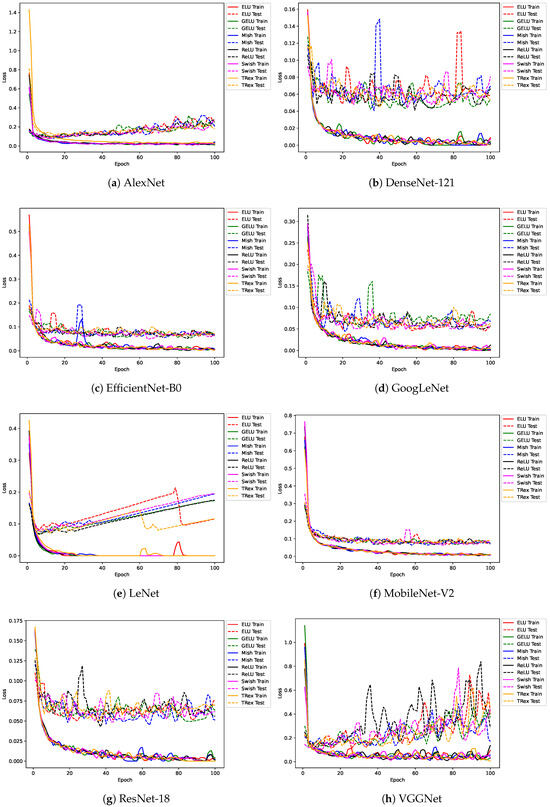
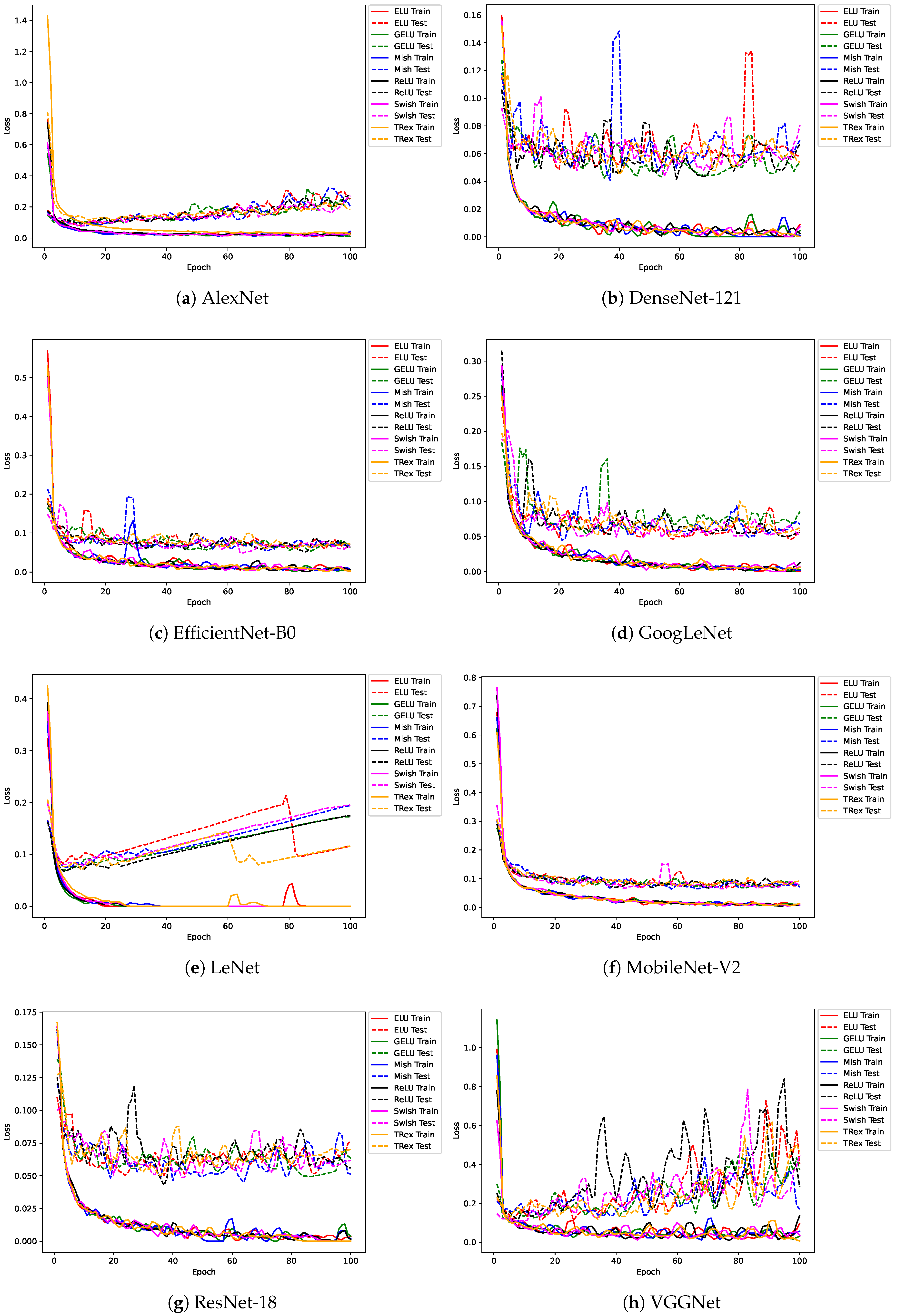
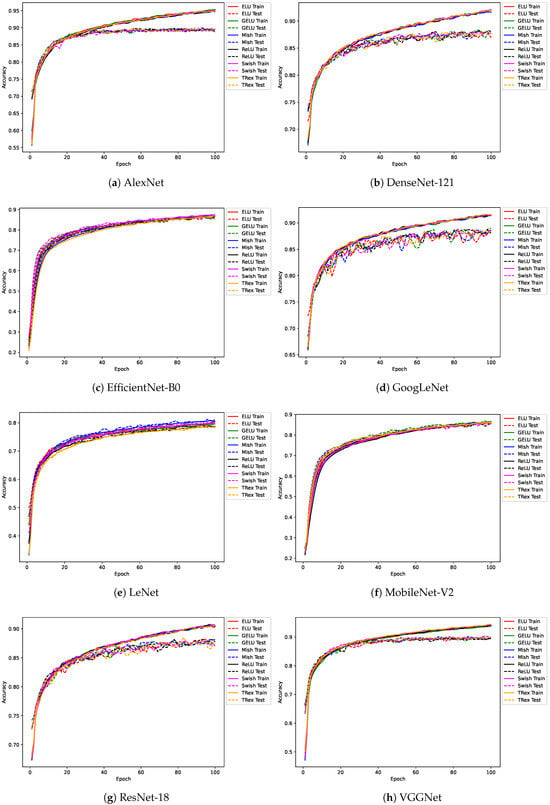
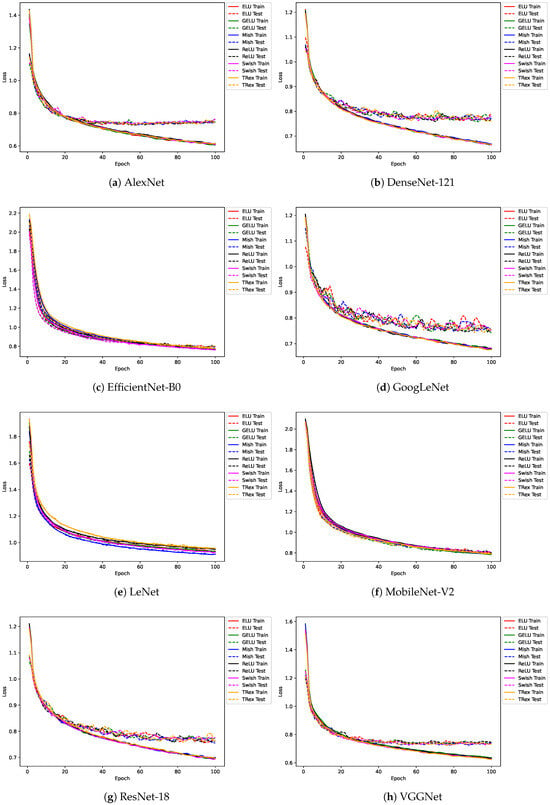
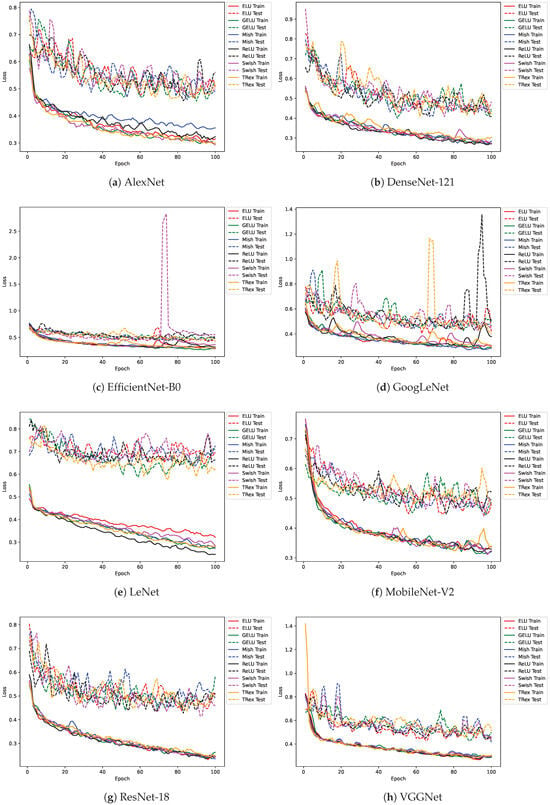
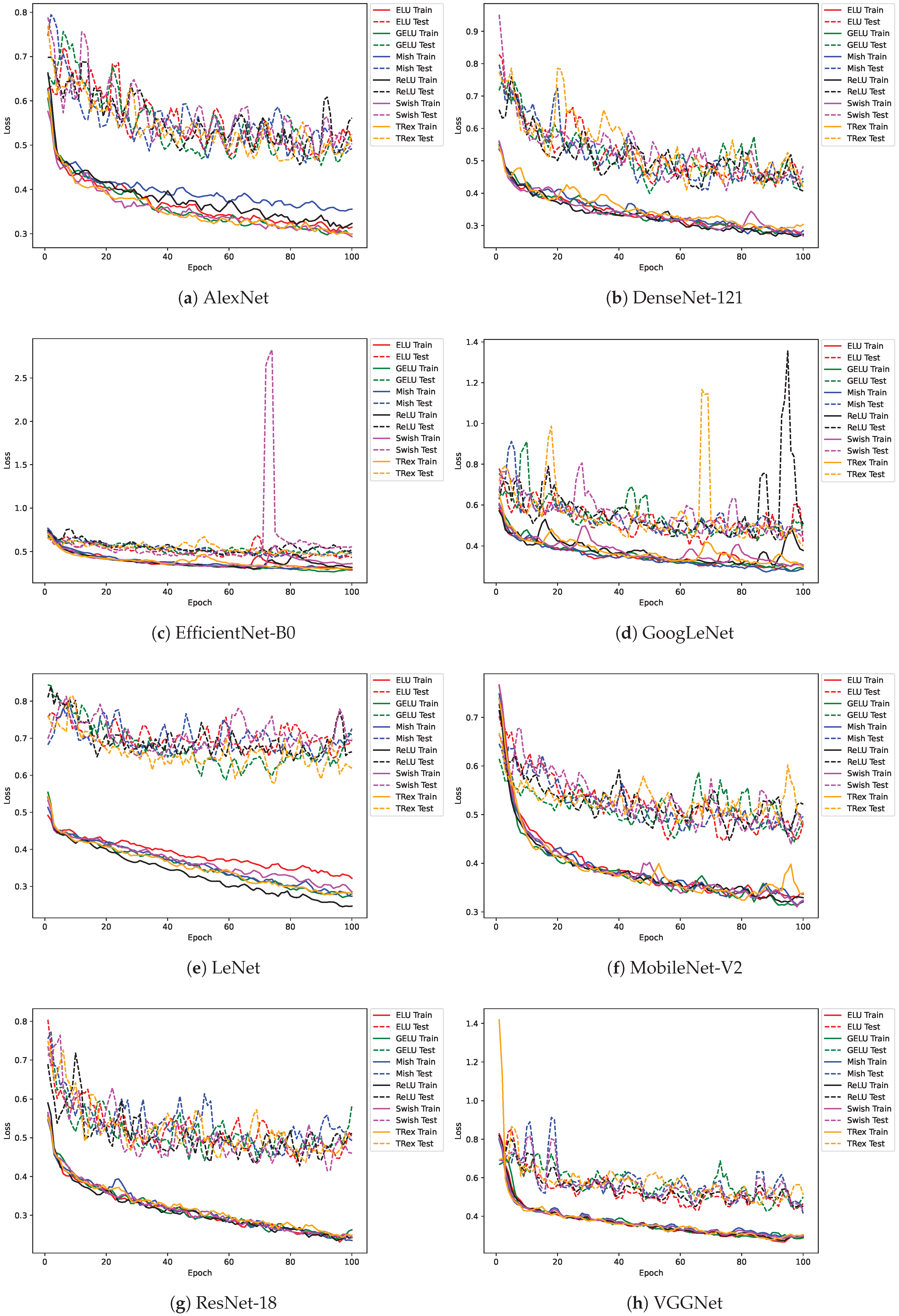
Using the SkinCancer dataset for classification is a more challenging task due to the presence of higher intra-class variability and imbalance, providing an opportunity to evaluate TRex under demanding conditions. For convergence stability, TRex demonstrated consistent and smooth training behavior, avoiding the divergence and collapse observed in certain cases, such as Swish and GELU with AlexNet and VGGNet, which converged to trivial solutions (Figure 8 and Figure 9). This indicates that TRex promotes stable optimization, particularly in scenarios where other smooth nonlinearities may suffer from vanishing or unstable gradients.
Figure 8.
The training and test accuracy curves for CNN models trained using multiple activation functions on the SkinCancer dataset.
Figure 9.
The training and test loss curves for CNN models trained using multiple activation functions on the SkinCancer dataset.
Regarding generalization, TRex delivered notable improvements across several architectures. For example, in AlexNet, it achieved the highest test accuracy (72.75%), substantially outperforming ReLU (66.25%) and ELU (66.50%) (Table 7). In DenseNet-121, TRex also achieved the highest test accuracy (83.25%), surpassing those of all competitors and confirming its effectiveness in architectures where gradient stability is critical. Similarly, GoogLeNet and ResNet-18 achieved their best generalization with TRex, reaching test accuracies of 85.50% and 79.75%, respectively, outperforming other smooth activation functions such as Mish and GELU. Conversely, in EfficientNet-B0 and VGGNet, TRex did not achieve the best results, with ELU and Mish achieving stronger performances. These results suggest that while TRex excels in deeper, connectivity-rich architectures, its advantage diminishes when using models optimized for parameter efficiency or reliant on sharp activations.
Table 7.
A quantitative summary of results from the SkinCancer experiment.
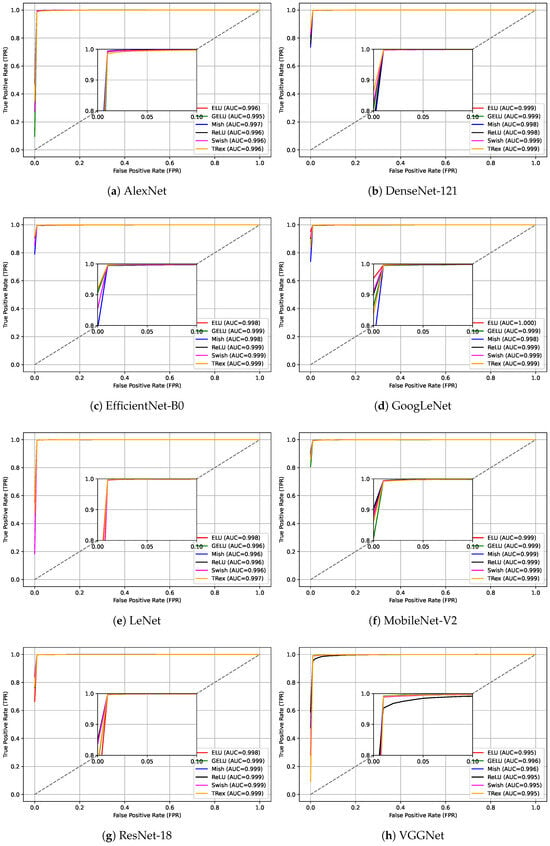
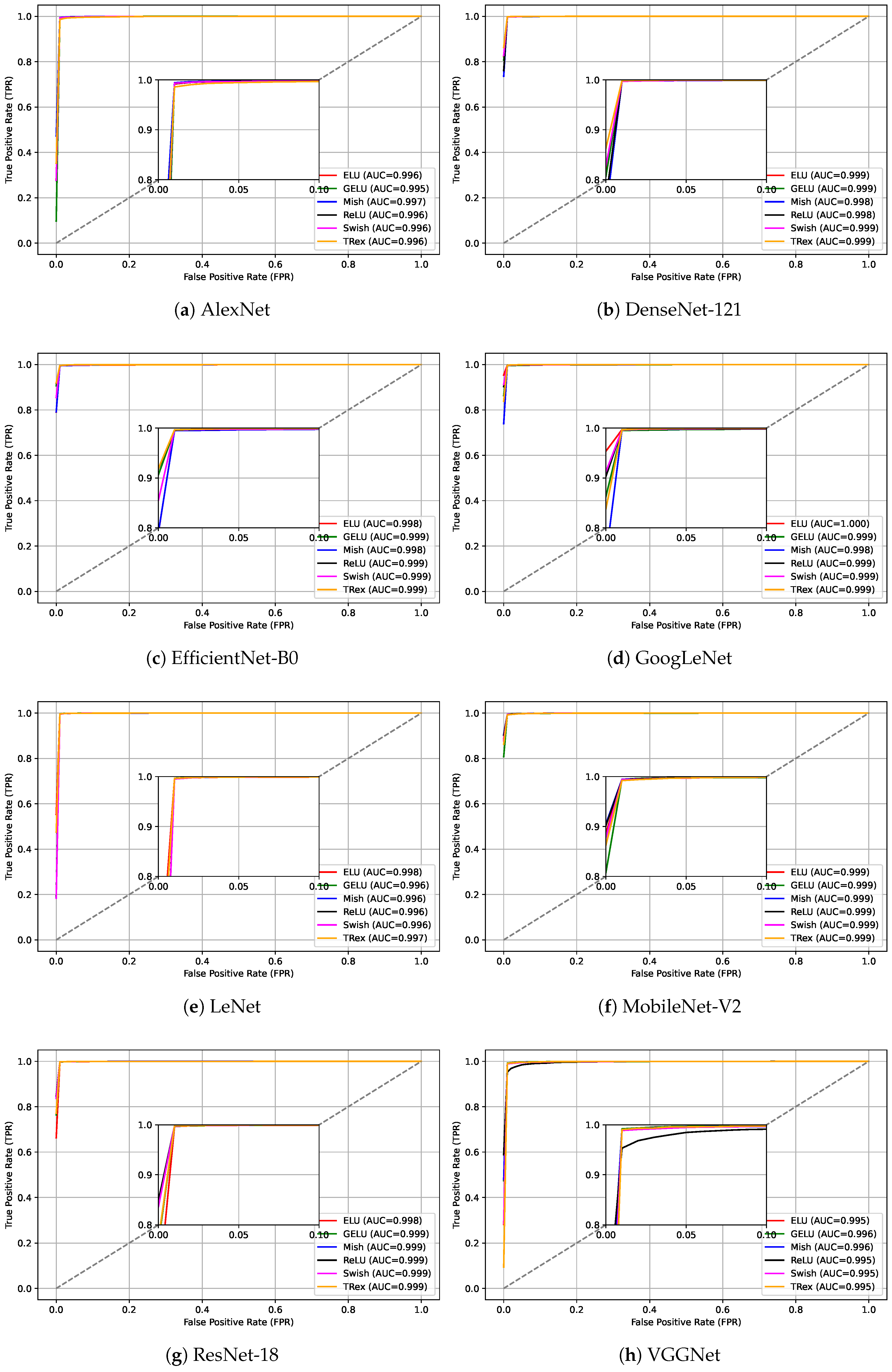
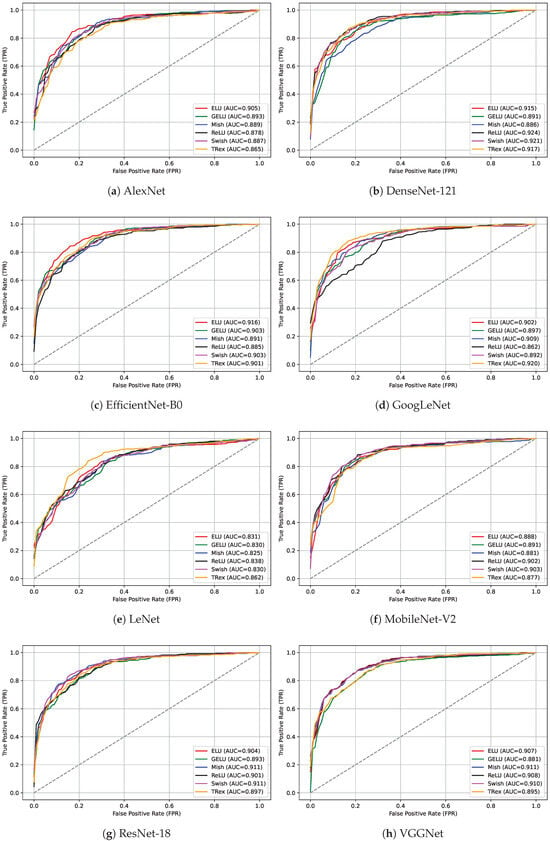
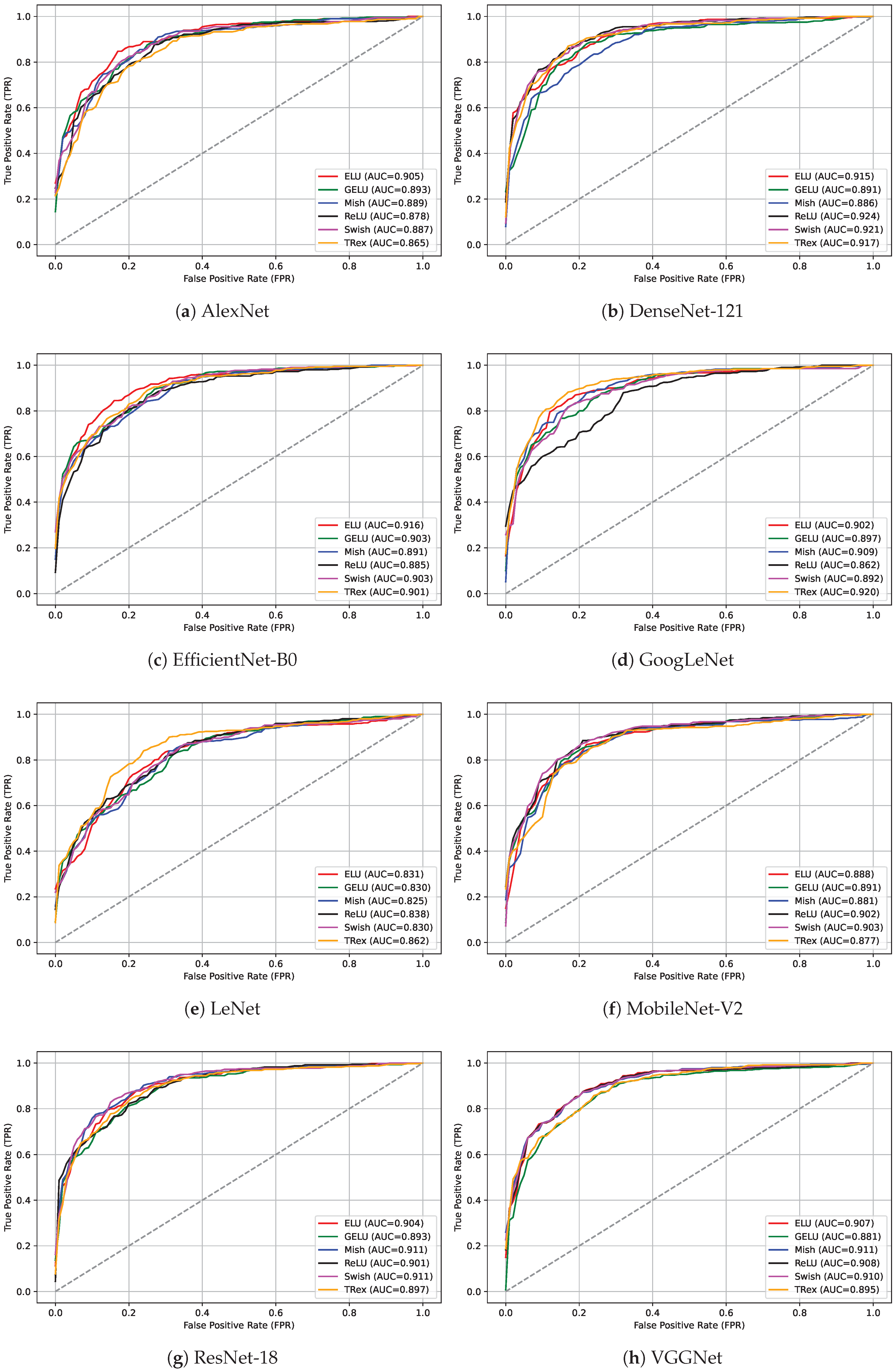
For class separation, TRex achieved competitive, though not universally superior, performance. For DenseNet-121 and GoogLeNet, it achieved strong AUC values (0.9166 and 0.9204, respectively), confirming that it supports robust discrimination at the decision boundary (Figure 10, Table 7). In MobileNet-V2 and ResNet-18, TRex achieved higher accuracy values than several baselines, but its AUC values (0.8773 and 0.8969) were slightly lower than those of Swish and Mish, indicating a trade-off between accuracy and boundary sharpness. Nonetheless, TRex consistently avoided the AUC collapse observed in some competing functions, reinforcing its stability in handling imbalanced class distributions.
Figure 10.
The ROC curves for CNN models trained using multiple activation functions on the SkinCancer dataset.
Regarding computational efficiency, TRex exhibited training times on par with those of other smooth activation functions, such as Mish and GELU, across all architectures (Table 7). This suggests that its added nonlinear complexity does not impose significant computational cost, maintaining practical scalability even in medical imaging contexts where dataset sizes can be large.
The Student t-test results (see Table 8) indicate significant differences in model performance across activation functions in several networks. For instance, in AlexNet, Swish and ReLU exhibit highly significant differences with most other activations , highlighting their distinct influence on model outcomes. DenseNet-121 and EfficientNet-B0 also show pronounced differences for TRex and ReLU compared to others, suggesting that certain activations consistently outperform or underperform across architectures. Smaller networks such as LeNet show even stronger significance, with multiple p-values in the to range, emphasizing that activation choice substantially affects classification outcomes in simpler models. Overall, the t-test confirms that differences in network performance are not random and that specific activations, particularly Swish, ReLU, and TRex, play crucial roles in driving model effectiveness for the SkinCancer dataset.
Table 8.
A summary of the Student t-test p-values for SkinCancer dataset.
Table 9 summarizes the inference times (in seconds) for various activation functions evaluated across multiple deep learning architectures on the SkinCancer dataset. Overall, the results reveal that inference times are relatively low across all models due to the smaller input dimensions and efficient network configurations. The proposed TRex activation demonstrates consistent and competitive inference efficiency, with timings closely aligned with those of standard functions such as ReLU, ELU, and GELU. For most architectures, including VGGNet, GoogLeNet, and ResNet, TRex achieves a performance nearly identical to that of ReLU, indicating negligible additional computational cost. While a slight increase in inference time is observed for LeNet, this variation remains minimal and within an acceptable range for practical deployment. Moreover, for deeper and more complex models such as DenseNet and EfficientNet, TRex maintains a stable performance comparable to those of other state-of-the-art activations.
Table 9.
Inference times for different activation functions across models for the Fashion SkinCancer Dataset.
In summary, the SkinCancer experiments demonstrate that TRex is particularly advantageous in challenging classification tasks using deeper and densely connected CNNs, enhancing both generalization and convergence stability. While its performance in lightweight or efficiency-oriented models such as EfficientNet and VGGNet was less competitive, TRex consistently avoided experiencing failure modes that affected other nonlinearities. These findings reinforce the notion that TRex is a robust and reliable activation, especially suited for medical imaging contexts where stability and reliable discrimination are critical.
7.4. Discussion
The empirical evaluation of the proposed TRex activation function on two benchmark datasets (MNIST and Fashion-MNIST) and a real-world dataset (SkinCancer) provides insights into its functional characteristics and practical utility. The results consistently highlight TRex’s strengths in stabilizing convergence, supporting generalization in deep architectures, and maintaining robust class separation, while also revealing important limitations in lightweight or efficiency-driven networks.
TRex performed strongly on the MNIST and Fashion-MNIST benchmark datasets, particularly for DenseNet, EfficientNet, GoogLeNet, and ResNet. For these models, it achieved either the best or joint-best test accuracy and AUC, reflecting its capacity to enhance learning in architectures where gradient stability and feature reuse are critical. Notably, on MNIST, TRex also outperformed alternatives in the simpler LeNet, suggesting that its benefits are not confined to very deep networks. On the Fashion-MNIST, which features higher intra-class similarity and greater classification difficulty, TRex maintained stable convergence and superior class separation in models such as GoogLeNet, ResNet-18, and VGGNet, demonstrating its adaptability to moderately complex benchmarks.
Evaluation on the SkinCancer dataset, a more challenging real-world classification task, further confirmed TRex’s practical strengths. Unlike some competing activations (e.g., Swish and GELU), which occasionally collapsed to trivial solutions in AlexNet and VGGNet, TRex ensured consistent optimization and delivered competitive accuracy and AUC values across most models. For DenseNet-121, GoogLeNet, and ResNet-18, TRex achieved the highest test accuracies and strong class separation, suggesting that it is well suited for domains such as medical imaging, where robustness and stable training are critical. However, its performance was less dominant in EfficientNet-B0 and VGGNet, where ELU and Mish performed better, reflecting the nuanced interactions between activation dynamics and architectural design.
A consistent trend across all three datasets was that TRex excelled in deep, connectivity-rich architectures. In DenseNet, ResNet, and GoogLeNet, it consistently achieved the best or near-best results, both in benchmark and real-world settings. This trend highlights the value of its hybrid design, which combines the smooth saturation of tanh with the unbounded growth of ReLU. This combination appears particularly effective in mitigating vanishing gradients while preserving nonlinear expressiveness in complex feature hierarchies. TRex also consistently demonstrated robustness in class separation, as reflected in its high AUC values across datasets, even when raw accuracy was not maximal. This suggests that TRex may be especially valuable in imbalanced or fine-grained classification tasks. Finally, across all experiments, TRex imposed no significant computational overhead, maintaining efficiency comparable to those of other modern smooth activations.
Despite these commonalities, distinct trends also emerged. On the MNIST and Fashion-MNIST benchmark datasets, TRex occasionally underperformed in lightweight architectures such as MobileNet-V2 and, to a lesser extent, AlexNet, where sharper activations such as ReLU and Mish retained an advantage. This suggests that, in models optimized for computational efficiency and sparse activations, the smoother gradient dynamics of TRex may not fully align with the architecture’s design philosophy. In contrast, on the SkinCancer dataset, TRex’s advantage was most pronounced, providing consistent optimization and avoiding the collapse observed in other functions. This robustness under challenging conditions highlights its potential utility in real-world applications where stability and reliability are paramount.
While TRex demonstrates consistent efficiency and accuracy gains across most architectures, its relative underperformance in MobileNet-V2 and EfficientNet-B0 highlights an important architectural limitation. Both of these models employ depthwise separable convolutions and parameter-efficient designs that substantially reduce channel-wise interactions. Since TRex integrates a multiplicative linear component with a smooth tanh term, its representational advantage relies on inter-channel feature coupling and richer gradient propagation—characteristics less prominent in depthwise convolutional frameworks. Consequently, the expressive benefits of TRex are not fully utilized in such lightweight architectures.
Overall, the results suggest that TRex is a versatile activation function that bridges the strengths of tanh and ReLU. It is particularly effective in deep, complex, and real-world scenarios, enhancing convergence stability, generalization, and decision-boundary discrimination. While it may not universally dominate across all architectures, its resilience against collapse and ability to outperform or match state-of-the-art activations in demanding settings represent important advantages.
8. Limitations and Future Research Directions
Despite its strengths, TRex has some limitations. Its performance was inconsistent in lightweight, efficiency-focused architectures such as MobileNet-V2 and EfficientNet-B0, where ReLU-like sparsity aligns better with the architectural design. Additionally, while TRex improved generalization in deeper models, its relative advantage was modest in cases where existing activations already ensured strong stability. Another limitation concerns the scope of evaluation: although the MNIST, Fashion-MNIST, and SkinCancer datasets provide valuable insights, broader testing on larger and more diverse datasets (e.g., CIFAR-100, ImageNet) is needed to fully establish generalizability.
The reliance on single-seed runs limits the robustness of our findings. The absence of multi-seed evaluations is a notable constraint that needs to be addressed in future work. We recognize that incorporating parametric activation functions such as LeakyReLU [7] and PReLU [8] as baselines could provide valuable insights. However, these functions require extensive parameter-specific tuning (e.g., different slopes for LeakyReLU), and conducting the necessary experiments for a fair comparison falls outside our current scope.
Future research should, therefore, focus on performing (i) extensive benchmarking across diverse domains, including natural images, text, and time-series data; (ii) theoretical analysis of gradient flow to understand why TRex excels in certain architectures but not in others; and (iii) hybridization with adaptive mechanisms, such as parameterized versions of TRex that dynamically balance its tanh- and ReLU-like behaviors depending on layer depth or task complexity, as well as the inclusion of parametric activation functions in baseline comparisons; (iv) evaluation of multi-seed robustness to enhance result reliability. Further exploration in resource-constrained environments may reveal whether TRex can be optimized for lightweight architectures without compromising its core stability benefits.
9. Conclusions
This study introduced TRex, a new activation function that combines the smoothness of tanh with the efficiency of ReLU in a single lightweight formulation. By preserving gradients in the negative region while maintaining near-linear growth for positive inputs, TRex mitigates vanishing gradients, reduces neuron inactivation, and enhances training stability. Across three datasets (MNIST, Fashion-MNIST, and SkinCancer) using eight CNN architectures, TRex consistently delivered competitive or superior results. On MNIST, DenseNet-121 achieved the highest accuracy with TRex (99.18%), compared with 98.6% for Mish and 98.4% for ReLU, while ResNet-18 achieved 99.25%, matching or surpassing the performances of Swish and Mish. On Fashion-MNIST, TRex produced the highest accuracies for GoogLeNet (88.2%) and VGGNet (90.25%), outperforming GELU and Swish. On the SkinCancer dataset, TRex achieved 83.25% for DenseNet-121 and 85.50% for GoogLeNet, surpassing the accuracies of all its competitors. For AUC metrics, TRex typically matched or surpassed the performances of other activations (e.g., 0.9992 for DenseNet-121 on MNIST and 0.9204 for GoogLeNet on SkinCancer) while maintaining training times comparable to those of GELU, Swish, and Mish. These results demonstrate that TRex provides stable convergence, strong generalization, and robust decision-boundary discrimination in deep, connectivity-rich models without incurring additional computational cost. Although its gains were more modest or inconsistent in lightweight architectures such as MobileNet-V2 and EfficientNet-B0, TRex consistently avoided the convergence failures observed with some other smooth activations. This outcome highlights that TRex is a practical alternative in scenarios where gradient stability and discriminative performance are critical, particularly in high-variability domains such as medical imaging. Future research will extend TRex to larger and more diverse datasets (e.g., CIFAR-100, ImageNet) and explore parameterized variants that adapt its shape to different architectures, enabling further optimization for resource-constrained models.
Supplementary Materials
The source codes are publicly available on GitHub: https://github.com/Data-Dominator, accessed on 18 October 2025.
Author Contributions
Conceptualization: A.R.K.; Methodology: A.R.K. and S.A.; Software: A.R.K.; Writing—Original Draft Preparation: S.A.; Writing—Review and Editing: S.A. and A.R.K.; Visualization: A.R.K.; Analysis: S.A. All authors have read and agreed to the published version of the manuscript.
Funding
This research received no external funding.
Data Availability Statement
The datasets used in this study are publicly available and can be accessed as follows: the MNIST dataset, which is a well-known dataset of handwritten digits, is available at https://www.kaggle.com/datasets/hojjatk/mnist-dataset (accessed on 12 August 2025); the Fashion MNIST dataset, containing images of clothing items, can be found at https://www.kaggle.com/zalando-research/fashionmnist (accessed on 30 June 2025); and the Skin Cancer dataset, which distinguishes between malignant and benign cases, is available at https://www.kaggle.com/datasets/fanconic/skin-cancer-malignant-vs-benign(accessed on 30 June 2025).
Acknowledgments
The authors wish to thank the reviewers for their valuable insights and constructive comments.
Conflicts of Interest
The authors declare no conflicts of interest.
Abbreviations
The following abbreviations are used in this manuscript:
| ReLU | Rectified Linear Unit |
| PReLU | Parametric ReLU |
| ELU | Exponential Linear Unit |
| SELU | Scaled ELU |
| GELU | Gaussian Error Linear Unit |
| APL | Adaptive Piecewise Linear |
| ISIC | International Skin Imaging Collaboration |
References
- Ramachandran, P.; Zoph, B.; Le, Q.V. Searching for activation functions. arXiv 2017, arXiv:1710.05941. [Google Scholar] [CrossRef] [Scilit]
- Dubey, S.R.; Singh, S.K.; Chaudhuri, B.B. Activation functions in deep learning: A comprehensive survey and benchmark. Neurocomputing 2022, 503, 92–108. [Google Scholar] [CrossRef] [Scilit]
- Apicella, A.; Donnarumma, F.; Isgrò, F.; Prevete, R. A survey on modern trainable activation functions. Neural Netw. 2021, 138, 14–32. [Google Scholar] [CrossRef] [Scilit] [PubMed]
- Rumelhart, D.E.; Hinton, G.E.; Williams, R.J. Learning representations by back-propagating errors. Nature 1986, 323, 533–536. [Google Scholar] [CrossRef] [Scilit]
- LeCun, Y.; Boser, B.; Denker, J.S.; Henderson, D.; Howard, R.E.; Hubbard, W.; Jackel, L.D. Backpropagation applied to handwritten zip code recognition. Neural Comput. 1989, 1, 541–551. [Google Scholar] [CrossRef] [Scilit]
- Nair, V.; Hinton, G.E. Rectified linear units improve restricted boltzmann machines. In Proceedings of the 27th International Conference on Machine Learning (ICML-10), Haifa, Israel, 21–24 June 2010; pp. 807–814. [Google Scholar]
- Maas, A.L.; Hannun, A.Y.; Ng, A.Y. Rectifier nonlinearities improve neural network acoustic models. In Proceedings of the International Conference on Machine Learning, Atlanta, GA, USA, 16–21 June 2013; Volume 30, p. 3. [Google Scholar]
- He, K.; Zhang, X.; Ren, S.; Sun, J. Delving deep into rectifiers: Surpassing human-level performance on imagenet classification. In Proceedings of the IEEE International Conference on Computer Vision, Santiago, Chile, 7–13 December 2015; pp. 1026–1034. [Google Scholar]
- Clevert, D.A.; Unterthiner, T.; Hochreiter, S. Fast and accurate deep network learning by exponential linear units (elus). arXiv 2015, arXiv:1511.07289. [Google Scholar]
- Klambauer, G.; Unterthiner, T.; Mayr, A.; Hochreiter, S. Self-normalizing neural networks. Adv. Neural Inf. Process. Syst. 2017, 30, 1–10. [Google Scholar]
- Hendrycks, D.; Gimpel, K. Gaussian error linear units (gelus). arXiv 2016, arXiv:1606.08415. [Google Scholar]
- Ramachandran, P.; Zoph, B.; Le, Q.V. Swish: A self-gated activation function. arXiv 2017, arXiv:1710.05941. [Google Scholar]
- Misra, D. Mish: A self regularized non-monotonic activation function. arXiv 2019, arXiv:1908.08681. [Google Scholar]
- Molek, V.; Alijani, Z. Fractional concepts in neural networks: Enhancing activation functions. Pattern Recogn. Lett. 2025, 190, 126–132. [Google Scholar] [CrossRef] [Scilit]
- Jagtap, A.D.; Kawaguchi, K.; Karniadakis, G.E. Adaptive activation functions accelerate convergence in deep and physics-informed neural networks. J. Comput. Phys. 2020, 404, 109136. [Google Scholar] [CrossRef] [Scilit]
- Dugas, C.; Bengio, Y.; Bélisle, F.; Nadeau, C.; Garcia, R. Incorporating second-order functional knowledge for better option pricing. Adv. Neural Inf. Process. Syst. 2000, 13, 472–478. [Google Scholar]
- Zhu, H.; Zeng, H.; Liu, J.; Zhang, X. Logish: A new nonlinear nonmonotonic activation function for convolutional neural network. Neurocomputing 2021, 458, 490–499. [Google Scholar] [CrossRef] [Scilit]
- Wang, X.; Ren, H.; Wang, A. Smish: A novel activation function for deep learning methods. Electronics 2022, 11, 540. [Google Scholar] [CrossRef] [Scilit]
- Madhu, G.; Kautish, S.; Alnowibet, K.A.; Zawbaa, H.M.; Mohamed, A.W. Nipuna: A novel optimizer activation function for deep neural networks. Axioms 2023, 12, 246. [Google Scholar] [CrossRef] [Scilit]
- Agostinelli, F.; Hoffman, M.; Sadowski, P.; Baldi, P. Learning activation functions to improve deep neural networks. arXiv 2014, arXiv:1412.6830. [Google Scholar]
- Mercioni, M.A.; Holban, S. P-swish: Activation function with learnable parameters based on swish activation function in deep learning. In Proceedings of the 2020 International Symposium on Electronics and Telecommunications (ISETC), Timisoara, Romania, 5–6 November 2020; pp. 1–4. [Google Scholar]
- Liu, M.; Chen, L.; Du, X.; Jin, L.; Shang, M. Activated gradients for deep neural networks. IEEE Trans. Neural Netw. Learn. Syst. 2021, 34, 2156–2168. [Google Scholar] [CrossRef] [Scilit]
- Jin, Z.; Li, H.; Qin, Z.; Wang, Z. Gradient-free cooperative source-seeking of quadrotor under disturbances and communication constraints. IEEE Trans. Ind. Electron. 2024, 72, 1969–1979. [Google Scholar] [CrossRef] [Scilit]
- Liu, T.; Qin, Z.; Hong, Y.; Jiang, Z.-P. Distributed optimization of nonlinear multiagent systems: A small-gain approach. IEEE Trans. Autom. Control 2021, 67, 676–691. [Google Scholar] [CrossRef] [Scilit]
- Shao, H.; Ma, E.; Zhu, M.; Deng, X.; Zhai, S. MNIST Handwritten Digit Classification Based on Convolutional Neural Network with Hyperparameter Optimization. Intell. Autom. Soft Comput. 2023, 36, 3595–3606. [Google Scholar] [CrossRef] [Scilit]
- Xiao, H.; Rasul, K.; Vollgraf, R. Fashion-mnist: A novel image dataset for benchmarking machine learning algorithms. arXiv 2017, arXiv:1708.07747. [Google Scholar] [CrossRef] [Scilit]
- Fanconi, C. Skin Cancer: Malignant vs. Benign-Processed Skin Cancer Pictures of the ISIC Archive. 2019. Available online: https://www.kaggle.com/datasets/fanconic/skin-cancer-malignant-vs-benign (accessed on 1 August 2025).
- LeCun, Y.; Bottou, L.; Bengio, Y.; Haffner, P. Gradient-based learning applied to document recognition. Proc. IEEE 2002, 86, 2278–2324. [Google Scholar] [CrossRef] [Scilit]
- Krizhevsky, A.; Sutskever, I.; Hinton, G.E. Imagenet classification with deep convolutional neural networks. Adv. Neural Inf. Process. Syst. 2012, 25, 1097–1105. [Google Scholar] [CrossRef] [Scilit]
- Simonyan, K.; Zisserman, A. Very deep convolutional networks for large-scale image recognition. arXiv 2014, arXiv:1409.1556. [Google Scholar]
- Szegedy, C.; Liu, W.; Jia, Y.; Sermanet, P.; Reed, S.; Anguelov, D.; Erhan, D.; Vanhoucke, V.; Rabinovich, A. Going deeper with convolutions. In Proceedings of the IEEE Conference on Computer Vision and Pattern Recognition, Boston, MA, USA, 7–12 June 2015; pp. 1–9. [Google Scholar]
- He, K.; Zhang, X.; Ren, S.; Sun, J. Deep residual learning for image recognition. In Proceedings of the IEEE Conference on Computer Vision and Pattern Recognition, Las Vegas, NV, USA, 27–30 June 2016; pp. 770–778. [Google Scholar]
- Sandler, M.; Howard, A.; Zhu, M.; Zhmoginov, A.; Chen, L.C. Mobilenetv2: Inverted residuals and linear bottlenecks. In Proceedings of the IEEE Conference on Computer Vision and Pattern Recognition, Salt Lake City, UT, USA, 18–23 June 2018; pp. 4510–4520. [Google Scholar]
- Huang, G.; Liu, Z.; Van Der Maaten, L.; Weinberger, K.Q. Densely connected convolutional networks. In Proceedings of the IEEE Conference on Computer Vision and Pattern Recognition, Honolulu, HI, USA, 21–26 July 2017; pp. 4700–4708. [Google Scholar]
- Tan, M.; Le, Q. Efficientnet: Rethinking model scaling for convolutional neural networks. In Proceedings of the International Conference on Machine Learning, Long Beach, CA, USA, 9–15 June 2019; pp. 6105–6114. [Google Scholar]
- Paszke, A.; Gross, S.; Chintala, S.; Chanan, G.; Yang, E.; DeVito, Z.; Lin, Z.; Desmaison, A.; Antiga, L.; Lerer, A. Automatic differentiation in PyTorch. In Proceedings of the NIPS-W, Long Beach, CA, USA, 4–9 December 2017. [Google Scholar]
- Pedregosa, F.; Varoquaux, G.; Gramfort, A.; Michel, V.; Thirion, B.; Grisel, O.; Blondel, M.; Prettenhofer, P.; Weiss, R.; Dubourg, V.; et al. Scikit-learn: Machine learning in Python. J. Mach. Learn. Res. 2011, 12, 2825–2830. [Google Scholar]

Disclaimer/Publisher’s Note: The statements, opinions and data contained in all publications are solely those of the individual author(s) and contributor(s) and not of MDPI and/or the editor(s). MDPI and/or the editor(s) disclaim responsibility for any injury to people or property resulting from any ideas, methods, instructions or products referred to in the content. |
© 2025 by the authors. Licensee MDPI, Basel, Switzerland. This article is an open access article distributed under the terms and conditions of the Creative Commons Attribution (CC BY) license (https://creativecommons.org/licenses/by/4.0/).