Article

Exploiting Time–Frequency Sparsity for Dual-Sensor Blind Source Separation
School of Electronic Information, Wuhan University, Wuhan 430072, China
*
Author to whom correspondence should be addressed.
Electronics 2024, 13(7), 1227; https://doi.org/10.3390/electronics13071227

Submission received: 2 February 2024 / Revised: 19 March 2024 / Accepted: 25 March 2024 / Published: 26 March 2024
(This article belongs to the Special Issue Advances in Array Signal Processing)

Abstract

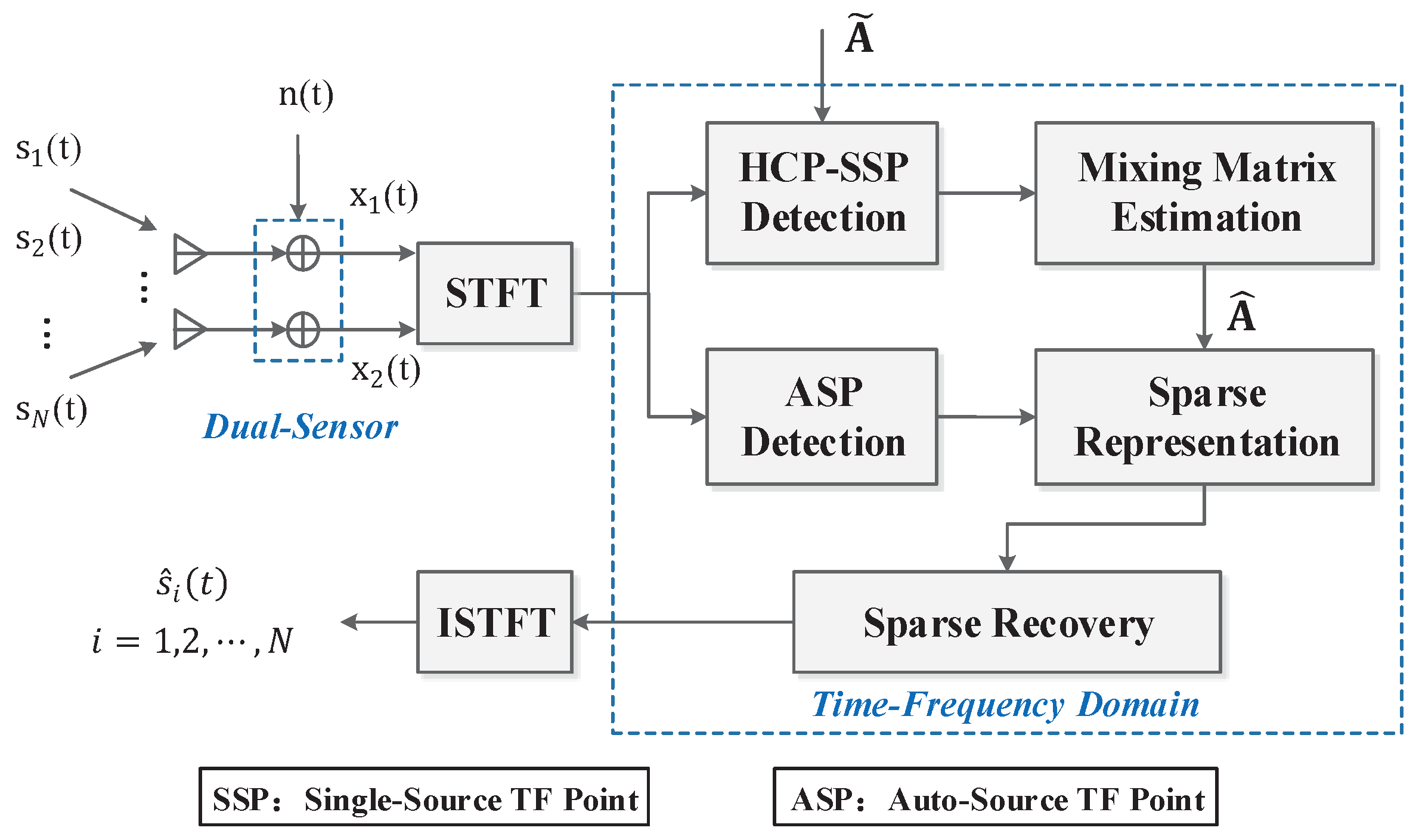
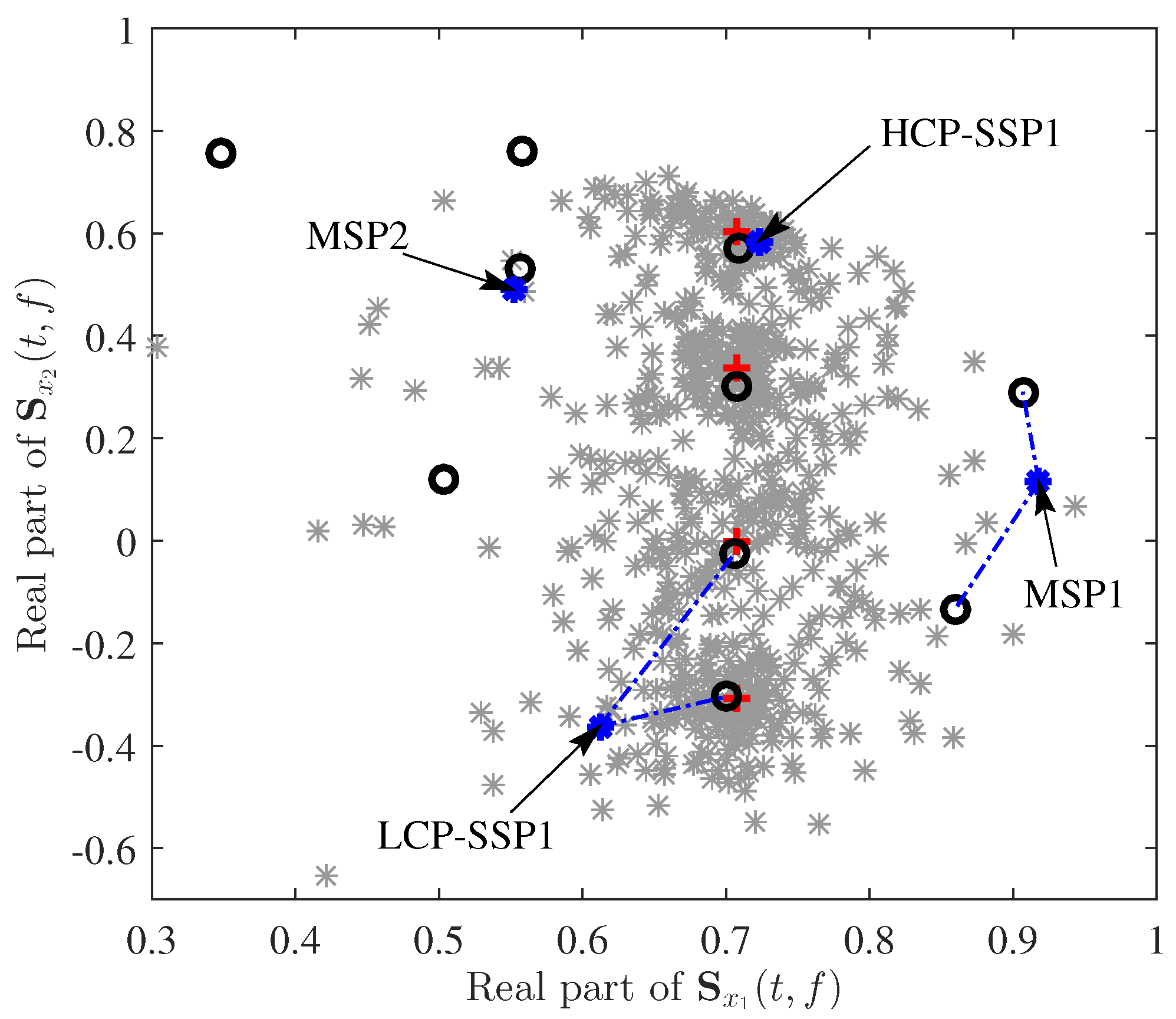
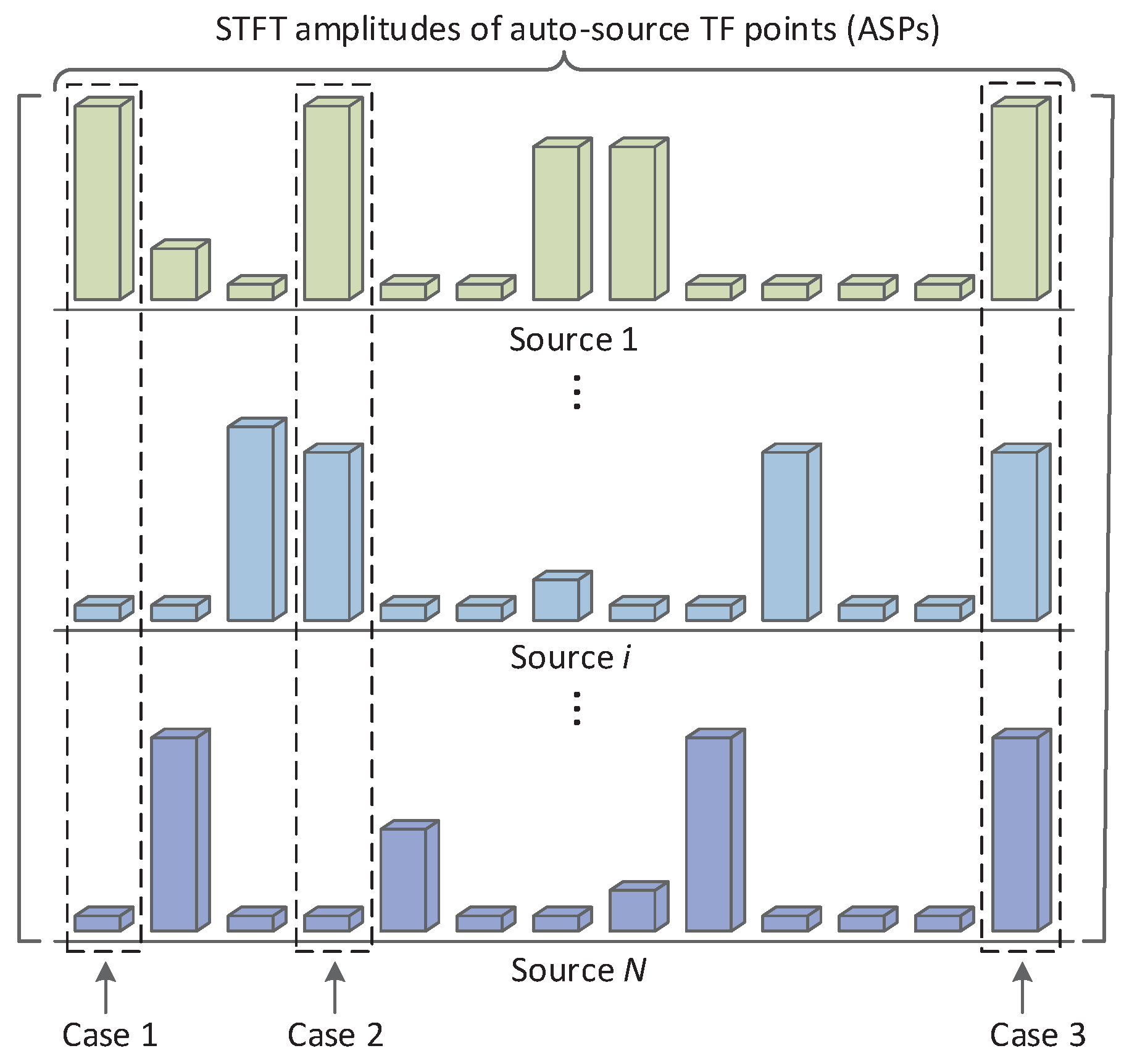
This paper explores the important role of blind source separation (BSS) techniques in separating M mixtures including N sources using a dual-sensor array, i.e., M=2, and proposes an efficient two-stage underdetermined BSS (UBSS) algorithm to estimate the mixing matrix and achieve source recovery by exploiting time–frequency (TF) sparsity. First, we design a mixing matrix estimation method by precisely identifying high clustering property single-source TF points (HCP-SSPs) with a spatial vector dictionary based on the principle of matching pursuit (MP). Second, the problem of source recovery in the TF domain is reformulated as an equivalent sparse recovery model with a relaxed sparse condition, i.e., enabling the number of active sources at each auto-source TF point (ASP) to be larger than M. This sparse recovery model relies on the sparsity of an ASP matrix formed by stacking a set of predefined spatial TF vectors; current sparse recovery tools could be utilized to reconstruct N>2 sources. Experimental results are provided to demonstrate the effectiveness of the proposed UBSS algorithm with an easily configured two-sensor array.
Keywords: underdetermined blind source separation; dual-sensor; mixing matrix estimation; source number estimation; time–frequency sparsity underdetermined blind source separation; dual-sensor; mixing matrix estimation; source number estimation; time–frequency sparsity