


Abstract
Cosmetic products are often perceived as superficial, yet their influence on health and well-being extends beyond aesthetics. Anchored in the World Health Organization definition of health and the European regulatory context, this review examines the functions of finished cosmetic products as contributors to holistic well-being across physical, mental, social, public-health, and economic dimensions. A narrative evidence-based review and synthesis were conducted, based on a structured literature search supplemented by reference screening and targeted evidence gathering in areas where the available evidence was more limited. The synthesis identified complementary pathways through which cosmetic products may support the different identified spheres of health and contribute to broader socioeconomic outcomes. Overall, cosmetic products should be recognised as everyday tools that can support health, dignity, and well-being when appropriately used and communicated.
1. Introduction
Cosmetics and personal care products are still often framed primarily through the lens of appearance. Yet this perception barely scratches the surface.
According to the European Cosmetic Products Regulation (EC) 1223/2009, cosmetic products are defined as “any substance or mixture intended to be placed in contact with the external parts of the human body or with the teeth and mucous membranes of the oral cavity with a view exclusively or mainly to cleaning them, perfuming them, changing their appearance, protecting them, keeping them in good condition or correcting body odours” [1]. Accordingly, cosmetic and personal care products are not just make-up; many are used every day as part of routine hygiene and personal care, including shampoo, conditioner, body wash, deodorant, toothpaste, skin care products, and sunscreen, while others, such as hair colourants and nail polish, are used less frequently.
This broader role is reflected in contemporary consumer evidence. In March 2026, Cosmetics Europe conducted a study in which 6001 adults were surveyed, with an equal split of male and female respondents aged 18 years and above [2]. A central finding is that, for most Europeans, personal care is about more than appearance: only 27% of respondents viewed personal care as being mainly associated with appearance, whereas 73% reported that their personal care routines support well-being and healthy ageing, either as the primary benefit or alongside appearance-related benefits.
The study also highlighted the widespread use of cosmetic and personal care products in everyday life. Women reported using around 11 different products daily, while men also reported regular daily use, at around 6.5 products; young people reported similarly frequent use, at around 10 products per day. Overall, consumers used more than eight products every day and nearly 14 over the course of a week, across approximately six product categories. Three quarters of respondents (76%) considered these products important or very important in daily life, compared with 72% in a similar Cosmetics Europe study conducted in 2022, when consumers reported using, on average, over seven cosmetic products per day [2,3]. These findings highlight both the ubiquity of cosmetic products use and the growing value consumers attach to these products as part of their daily lives. Furthermore, 88% of respondents reported that their personal care routines have a positive impact on how they feel today while also supporting healthy ageing over time [2].
Beyond physical functions, cosmetic and personal care products can also influence self-perception, confidence, emotional well- being and social functioning, while helping to reduce stress, stigma, and psychosocial distress. At the population level, cosmetic use may support prevention-oriented practices by helping to keep the body in good condition, enhance quality of life (QoL), and generate broader societal and economic benefits through reduced healthcare costs and improved workforce participation and productivity.
Against this background, this article presents a structured collection of scientific literature to demonstrate the essential role of cosmetics as contributors to overall human well-being. Anchored in the World Health Organization (WHO) definition of health as “a state of complete physical, mental and social well-being, and not merely the absence of disease or infirmity” [4], this review adopts a broad perspective to include public-health and economic dimensions, reflecting the broader population-level, societal, and systemic implications of cosmetic product use. Rather than focusing on ingredient-level toxicology or safety assessments, the review examines how selected cosmetic product categories and functions may contribute to physical, mental, social, public-health, and economic dimensions.
The analysis draws on both representative cosmetic product examples and broader cosmetic functions. The latter include cleansing, protecting, maintaining the body in good condition, perfuming, and supporting appearance-related self-care. The assessment is organised around these cosmetic functions rather than around mechanisms of action. However, where helpful, specific modes of action, such as moisturisation, masking, colouring, or modulation of normal physiological processes, are mentioned only to clarify how a given function may be achieved in practice.
Importantly, the review does not aim to provide an exhaustive assessment of all cosmetic products; rather, it uses selected examples to illustrate the diverse ways in which cosmetic functions may contribute to health, well-being, and quality of life.
2. Methodology of Literature Selection
This study was conducted as a narrative evidence-based review. Methodological transparency was supported through predefined eligibility criteria, manual assessment of identified publications against the eligibility criteria, and reporting of the complete search strings used for the initial literature search in Supplementary Table S1. The initial evidence was supplemented by reference screening and targeted evidence gathering where coverage of specific health-related dimensions was limited. The approach was intended to provide a structured and transparent framework for evidence identification and synthesis, while recognising that the review was not designed as a formal systematic review.
2.1. Review Design and Analytical Framework
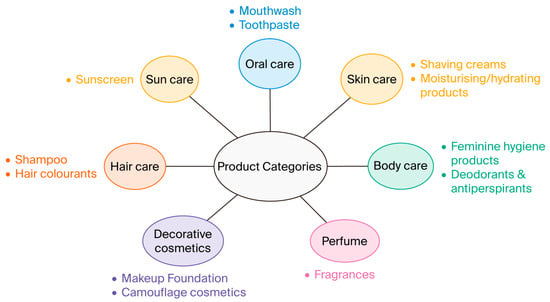
The analysis was organised around the European definition of cosmetic products and the cosmetic functions described in Regulation (EC) No 1223/2009, namely cleaning, perfuming, changing appearance, protecting, keeping in good condition the external parts of the human body, the teeth and the mucous membranes of the oral cavity, and correcting body odours. These functions were used to group cosmetic products into broad categories and to interpret how they may contribute to health and well-being in daily life. Figure 1 provides a mapping of the cosmetic product categories considered in this review and highlights the representative product types examined within each category.
Figure 1.
Mapping of cosmetic product categories and representative products examined in this review and representative product types used as illustrative examples within each category. Product categories in the cosmetics sector are not harmonised across all regulatory and scientific frameworks; therefore, the categorisation presented here is intended solely as a pragmatic framework for organising the review and should not be interpreted as a universal classification system.
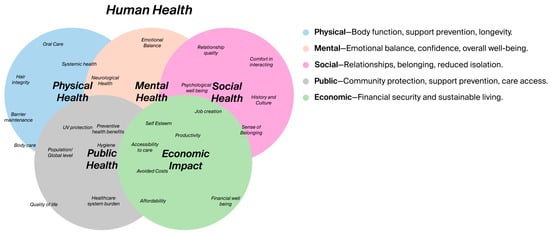
The review then examined selected product categories in relation to a health framework grounded in the World Health Organization’s definition of health and extended to include public-health and economic dimensions. Five interconnected dimensions were considered: physical health, mental health, social health, public health, and economic relevance. Specific areas of focus were defined for each dimension to clarify how cosmetic products may contribute to human health and well-being, including hygiene, support for prevention, psychological well-being, social participation, population-level health outcomes, and economic sustainability, as outlined in Table 1. Figure 2 visually represents these dimensions and their interconnection within the broader concept of human health.
Table 1.
Identified pillars of health and areas of focus.
Figure 2.
Visual representation of the integrated five-pillar framework used to examine the contribution of cosmetic products to human health and well-being.
2.2. Product-Category Mapping and Scope of Analysis
Product categories were defined in relation to the cosmetic functions described in Regulation (EC) No 1223/2009 and mapped to the categories shown in Figure 1. Given that different categorisation frameworks are used across regulatory and scientific contexts, the categories presented here should not be interpreted as a universal classification system but as a pragmatic framework for organising the review.
The analysis considered finished cosmetic products as used in daily life, rather than individual ingredients or therapeutic interventions. Categories were included to reflect the diversity of cosmetic functions, patterns of use, and contexts in which products may contribute to health and well-being.
The category mapping was intended to provide a structured basis for the analysis, ensuring that the review captured products associated with cleaning, perfuming, changing appearance, protecting, keeping in good condition the external parts of the human body, the teeth and the mucous membranes of the oral cavity, and correcting body odours. Within this mapping, representative examples were used only to illustrate how different functions are delivered in practice and how evidence is reported across the five health-related dimensions.
The selection was not intended to rank categories or to imply that some cosmetic products are more relevant than others. Instead, it aimed to support a balanced synthesis across product functions, evidence availability, frequency of use, and population or context-specific relevance, while maintaining consistency with the product-category mapping introduced in Section 2.1.
2.3. Literature Search, Eligibility and Data Extraction
The evidence-gathering process comprised an initial structured literature search followed by narrative evidence selection and synthesis. The initial search was conducted using PubMed via NCBI and Google Scholar, with both databases last searched on 17 December 2025. The complete search strategies and filters used for this initial search are provided in Supplementary Table S1.
The initial search focused on peer-reviewed literature published between 2015 and 2025. To maximise reliability and relevance, unpublished reports, grey literature and sources judged to have primarily promotional or commercial objectives were excluded from the initial evidence pool. Preference was given to recent publications to reflect the current state of scientific knowledge and contemporary product-use patterns, while earlier publications were considered where they provided foundational evidence or unique information not available in more recent literature.
The literature search was organised around finished cosmetic and personal-care products, with individual product types grouped into broader, high-frequency categories, including oral care, sun care and body care, to capture a wider range of products, cosmetic functions and relevant populations. The focus was placed on the contribution of the cosmetic products themselves rather than on individual ingredients or specific conditions that the products may help address or prevent. Publications were therefore eligible if they investigated finished cosmetic or personal-care products and reported outcomes relevant to one or more of the five dimensions considered in this review: physical health, mental well-being, social well-being, public health and socioeconomic outcomes. Publications were excluded if the relevant outcomes were not measured or reported, if the product investigated was not a finished cosmetic formulation, or if the study focused exclusively on individual ingredients, in vitro or animal research, marketing outcomes, or did not report a relevant benefit-related endpoint.
Titles, abstracts and potentially relevant full texts identified during the initial search were manually assessed against these eligibility criteria. This process resulted in an initial evidence pool of 76 publications. Data relevant to the five outcome dimensions were extracted and organised according to product category, cosmetic function and dimension of benefit. No automation tools were used for screening or eligibility assessment.
The 76 publications formed the initial eligible evidence pool but were subsequently considered for their relevance to the narrative synthesis, and not all were ultimately cited in the manuscript. Selected publications were retained to illustrate the evidence considered most pertinent to the different product categories, cosmetic functions and dimensions of benefit. Reference lists of these selected publications were also examined, and relevant publications identified through reference screening were considered where appropriate to the scope and eligibility criteria of the review.
Where the initial evidence pool provided limited coverage of a product category or health-related dimension, supplementary targeted evidence gathering was undertaken to strengthen the narrative synthesis. This focused particularly on public-health and socioeconomic outcomes. Relevant peer-reviewed publications and authoritative institutional sources identified through this process were considered where they were consistent with the scope of the review. Relevant evidence that became available during manuscript development in 2026 was also incorporated as contextual evidence.
For each product category, the available evidence was organised across the five health-related dimensions. Draft syntheses were reviewed by cosmetic-product specialists, including scientific and communication experts, to provide contextual insight and support the interpretation of the findings within the scope of finished cosmetic products. No assumptions were made regarding outcomes that were not reported in the underlying evidence.
The evidence base was heterogeneous, comprising controlled intervention studies, observational and cross-sectional studies, systematic and narrative reviews, review and background literature, consumer-perception surveys, and institutional or socioeconomic data. No formal risk-of-bias assessment was performed. In addition, publication bias may also have influenced the available evidence, as studies reporting positive or statistically significant findings may be more likely to be published than studies reporting negative or non-significant results. The available literature may therefore overrepresent favourable outcomes.
A complete contemporaneous screening log documenting the total number of records retrieved, deduplicated and excluded at each stage, including individual reasons for exclusion, was not retained. Accordingly, the findings should be interpreted within the context of a narrative review rather than a formal systematic review.
Finally, the review was specifically designed to examine the potential benefits and broader contributions of finished cosmetic products to health and well-being. Studies primarily addressing adverse effects, toxicological outcomes, or product and ingredient safety were therefore outside the predefined scope of the review. In the European Union, this should be considered within the context of the established regulatory framework for cosmetic products, which requires products placed on the market to undergo a safety assessment and comply with the safety requirements of Regulation (EC) No 1223/2009 [1].
3. Evidence Review
The evidence presented in the following sections was selected from sources considered relevant to the scope of the review and to the narrative synthesis.
Selected evidence was organised according to product category, cosmetic function and the five health-related dimensions examined in this review, with representative examples used to illustrate the different areas of benefit.
The evidence base comprised different study designs and evidence sources, including controlled intervention studies, observational and cross-sectional studies, systematic and narrative reviews, consumer-perception surveys, and institutional or socioeconomic reports.
Evidence was not evenly distributed across the product-category mapping; for example, categories such as sun care and oral care were more frequently represented in the literature than others, such as decorative cosmetics and fragrances.
In the sections that follow, each identified area of focus described in Table 1 is discussed within its respective health dimension. Representative product types are provided as illustrative examples for each area of focus; these examples are not intended to be exhaustive, as the scope of this review is not to describe every cosmetic product category or product type but to examine how cosmetic functions may contribute to health, well-being, and quality of life.
3.1. Physical Health
3.1.1. Promoting Hygiene
Hygiene is a fundamental determinant of individual and population health, contributing to reducing the spread of infections and epidemics and supporting the maintenance of overall good health [5]. In the context of cosmetic products, hygiene-related benefits are primarily linked to cleansing and to the maintenance of skin, scalp, hair, oral, and mucosal surfaces in good condition, with relevance for both women and men. Daily cleansing practices can help remove sweat, sebum, environmental residues, biological secretions, and other impurities that may otherwise contribute to irritation, microbial imbalance, or discomfort. Within the scope of the European cosmetic product definition, cleansing products can therefore support routine hygiene and help maintain body surfaces in good condition. Taking the example of feminine, intimate hygiene products such as washes and intimate gels, these are intended to support cleanliness of the external vulvar area by removing discharge, sweat, residual urine, and other impurities, all of which is relevant for comfort and self-esteem [6,7]. This function is relevant across life stages and mainly for certain vulnerable populations, in particular when physiological changes increase discharge, dryness, sensitivity, or susceptibility to discomfort. For instance, during pregnancy, hormonal changes may alter vaginal secretions and susceptibility to irritation, while postmenopausal changes can contribute to mucosal dryness and sensitivity. Appropriate intimate hygiene may therefore support comfort and help maintain local conditions that are compatible with vulvovaginal health.
Evidence reviewed in this area also indicates that inadequate menstrual or intimate hygiene practices have been associated with bacterial vaginosis, reported reproductive tract infection symptoms, and abnormal vaginal discharge; however, these findings come from observational studies, and no systematic trials have evaluated the health impact of vulvar hygiene [6]. Well-formulated feminine hygiene products intended for intimate use may also help reduce symptoms such as burning, itching, and irritation, and may support comfort in women prone to cystitis or bacterial vaginosis, as reported in a systematic review of hygiene habits in women [7].
Shampoos provide a second example of hygiene-related cosmetic products. Their primary function is to cleanse the scalp and hair by removing dirt, environmental pollutants, excess sebum, keratin debris, and residues from styling products as outlined in review and background literature [8,9,10]. Regular shampooing helps maintain a clean scalp environment and may limit the accumulation of residues that can contribute to irritation, microbial proliferation, or visible scalp discomfort.
Scalp condition is closely related to hair quality. This relationship has been examined through both experimental and review-level evidence. In a randomised, double-blind, multisite study involving 300 participants, Schwartz et al. [11] compared scalp and emerging-hair characteristics in participants with dandruff/seborrhoeic dermatitis and non-dandruff controls and evaluated the effects of anti-dandruff treatment. Complementary review literature has examined the broader relationship between scalp health, the environment in which hair fibres develop before emergence, and subsequent hair growth and retention [12]. Conditions such as dandruff and seborrhoeic dermatitis can be associated with flaking, irritation, oxidative stress, and changes in hair fibre quality [10,11,13]. Anti-dandruff shampoos designed for dandruff-prone scalps are not therapeutic products, but they can support scalp hygiene and help manage visible flaking and discomfort through regular cleansing and formulation-specific effects as reported in a controlled study on dandruff reduction [13]. When formulated with anti-dandruff actives, they may also help maintain a healthier scalp environment by reducing dandruff-associated microbial imbalance and oxidative stress. As a result, their benefits may extend beyond flake reduction to supporting scalp comfort and perceived hair quality [10,11,12,13].
Regular shampoo use is therefore relevant not only for cleanliness, but also for scalp comfort and perceived hair quality. Expert recommendations and clinical study designs commonly include shampooing several times per week when evaluating scalp-health outcomes [11].
Taken together, these examples illustrate the role of cosmetic cleansing products in routine hygiene, supporting cleanliness, comfort, barrier integrity, and favourable local conditions at body sites where inadequate hygiene may affect daily well-being.
3.1.2. Supporting Prevention
Chronic diseases are often interconnected and complex, and their management frequently involves multiple medications with potential interactions [14]. Preventive self-care can therefore complement disease management by supporting earlier action and routine risk reduction. A 2026 institutional report by the Global Self-Care Federation describes the broader potential contribution of self-care to reducing healthcare use and supporting health-system efficiency [15]. Within this broader prevention-oriented framework, certain personal-care products can contribute to everyday practices that help maintain health and reduce relevant risk factors. While they are not intended to treat diseases directly, some product categories, particularly oral-care products and sunscreens, are used as part of established preventive practices. In addition to oral care and sunscreens, moisturisers and body care products represent important preventive daily-use categories because they support skin barrier function, hydration, comfort, and resilience against irritation. This is especially relevant for individuals experiencing dryness, frequent washing, environmental stressors, or age-related changes in skin condition.
Oral health has been associated with QoL, and has also been linked with broader systemic, mental health and psychosocial outcomes in published reviews commentaries and cross- sectional analysis [16,17,18]. Published evidence also mentions that routine oral hygiene and the use of appropriate oral-care products play an important role in plaque control, caries prevention, and the maintenance of periodontal health [19,20,21]. This role is consistent with evidence from the broader self-care field. Fluoride toothpaste, for example, is described in a Cochrane systematic review as a low-cost, widely available approach to caries prevention, with regular use associated with an average 24% reduction in caries [22]. Routine oral care therefore provides a concrete example of how everyday personal care can support prevention and long-term health [15,16,17,18,19,20,21,22,23].
Poor oral hygiene and oral-health conditions have been associated with several chronic conditions, including diabetes, cardiovascular disease, rheumatoid arthritis, hypertension, chronic obstructive pulmonary disease (COPD), pneumonia, and certain cancers, such as head and neck cancer [16,23]. Several biological mechanisms have been proposed to explain potential links between oral and systemic health, including chronic inflammation, bacterial translocation, and altered immune responses [16,18,23]. For example, periodontitis may contribute to systemic inflammation that can worsen glycaemic control in diabetes and contribute to vascular dysfunction. Oral bacteria may also enter the bloodstream and colonise distant organs, like the lungs, increasing the risk of respiratory infections. In cardiovascular disease, immune responses to oral pathogens can contribute to arterial damage and accelerate the process of atherosclerosis. However, it is important to highlight that these associations and proposed mechanisms should not be interpreted as demonstrating that poor oral hygiene directly causes systemic disease.
Particular attention to oral hygiene may also be relevant during pregnancy, as poor oral health has also been associated with adverse pregnancy and neonatal outcomes. This relationship has also motivated interventional research, including a randomised controlled trial protocol involving 468 pregnant women with periodontal disease to evaluate an antimicrobial mouth-rinse intervention and its effects on maternal oral health and birth and neonatal outcomes [24]. In this context, regular tooth brushing and appropriate use of oral-care products may represent accessible preventive practices that support maternal oral health.
These oral-health considerations are relevant to both women and men, although sex-specific patterns have been reported. In fact, dental caries has often been reported as more prevalent among females than males, while periodontitis appears more prevalent among men [25,26]. Moreover, some life-stage or physiological contexts, such as pregnancy, may also require additional attention to oral hygiene.
Sunscreens are a key cosmetic tool for protecting skin health. Their primary role is to reduce exposure to harmful ultraviolet (UV) radiation during daily sun exposure [27]. When used appropriately, sunscreens help prevent acute effects such as sunburn and reduce UV-related skin damage and photoaging. Evidence examined in systematic and clinical review literature also supports a protective role of regular sunscreen use in reducing the risk of some skin cancers, with reported reductions of up to 73% for invasive melanoma and 40% for squamous cell carcinoma [27,28,29].
Photoprotection should be considered within the broader context of healthy sun behaviour. While excessive ultraviolet (UV) exposure is a well-established risk factor for undesirable outcomes such as sunburn, photoaging, and skin cancer, complete avoidance of outdoor activities is neither practical nor generally recommended [27,28,29,30,31,32].
In this context, sunscreens can support safer and more acceptable sun exposure by reducing the risk of sunburn and visible photodamage [28,29], while enabling individuals to engage in outdoor activities with appropriate photoprotection. Baggerly et al. [33] reported the conclusions of a multidisciplinary seminar convened to examine the potential health consequences of sun avoidance and to consider a more balanced approach to sunlight exposure, vitamin D and public health. Complementing this broader perspective, Taniguchi et al. [34] systematically reviewed the evidence on external natural environments, including sunshine exposure, in relation to public mental health.
Evidence on broader sunlight-related health effects should therefore be interpreted as contextual rather than as direct evidence of sunscreen benefit; the primary contribution of sunscreens remains their established photoprotective role. Moreover, sunscreen use should complement, rather than replace, other recommended sun-protection practices.
Moisturising and hydrating products are another example of cosmetic products with a prevention-oriented role in daily self-care. A healthy skin barrier is essential for maintaining cutaneous homeostasis and for limiting the impact of external irritants, allergens, and microbial challenges. When the epidermal barrier is impaired, the skin may become more susceptible to conditions such as atopic dermatitis and irritant contact dermatitis. Moisturisers and body-care products help maintain hydration, reduce transepidermal water loss, and support barrier integrity. These functions are consistent with a perspective review of epidermal-barrier dysfunction, which describes the role of natural moisturising factor and epidermal lipids in maintaining hydration and barrier function and discusses the use of emollient products to protect and restore the skin barrier [35]. Beyond prevention-oriented considerations, these products also contribute to maintaining the skin in good condition and supporting everyday skin comfort, both of which represent central objectives of routine cosmetic skin care.
3.2. Mental Health
3.2.1. Appearance-Related Self-Care, Self-Perception, and Emotional Well-Being
Mental well-being is gaining increasing recognition in public health and scientific discussion. Within this context, cosmetic products may support psychological well-being through self-care rituals, sensory experience, appearance-related confidence, and perceived control over one’s presentation.
A recent systematic review on neurophysiological approaches to cosmetic-induced emotional responses shows that cosmetics have been investigated in relation to several emotional and mental well-being outcomes, with survey-based studies generally reporting clear perceived benefits. At the same time, the review highlights the value of further developing standardised and objective approaches to better characterise and compare these effects across studies. Current findings rely largely on subjective data collection methods such as questionnaires, surveys, or focus groups, which can be influenced by contextual factors and individual biases [36].
Hair colourants provide one illustrative example: changing one’s hair colour can represent more than a simple aesthetic modification. In a specialist chapter reviewing hair dyes, Rust and Schlatter identify psychological aspects of colour transformation as an important motivation for hair-colour use and describe grey coverage as particularly relevant to perceived attractiveness and self-confidence [37]. Hair styling and colouring may serve as forms of self-expression and can carry social meanings related to identity and personal presentation. A survey-based study of 197 university students examined how variations in hair colour and length influenced perceptions of attributes including attractiveness, confidence, happiness, trustworthiness and intelligence. Digitally modified images with different hair colours and lengths were presented to participants, with several differences in perceived attributes reported across hairstyle conditions [38]. Many users also report a noticeable boost in confidence following a colour change. For individuals seeking to cover grey hair, hair colouring restores a more youthful look and may be perceived as enhancing attractiveness. In this sense, hair colouring may function as an appearance enhancing practice associated with perceived youthfulness, attractiveness and self-confidence [37]. More broadly, a review of hair care literature describes hair as an important aesthetic feature in social interactions and as a visible marker of youth and vitality [39]. These appearance-related and psychological effects can be meaningful for some users, with satisfactory hair-colour transformations described in the literature as potentially “life-transforming” [37].
Similarly, confidence- boosting effects have been reported with foundation. While its use is primarily intended to unify skin tone [40], its role extends beyond aesthetics: for individuals with conditions such as acne, vitiligo, or scarring, foundation acts as a camouflage cosmetic that conceals visible lesions associated with chronic dermatological conditions. A 2025 narrative review evaluated 15 studies of cosmetic camouflage across different dermatological conditions, including 893 recruited participants, of whom 775 were analysed. Quality-of-life outcomes were assessed using a range of validated instruments, most commonly the Dermatology Life Quality Index (DLQI), with the studies generally reporting improvements following camouflage use [41]. In a prospective, open, randomised controlled trial involving 240 participants, regular makeup use was associated with improvements in self-perception and depressive-symptom scores. The sample size was predefined based on the maximum error criterion for the average Zung Self-Rating Depression Scale (ZSDS) score, and participants were recruited from an earlier population-based cross-sectional survey of 2400 individuals [42]. Complementary evidence comes from a cross-sectional study of 1483 Brazilian participants examining relationships between makeup use, body image, and general and social self-esteem. Appearance orientation was positively associated with makeup-use frequency, time spent applying makeup and expenditure, while general and social self-esteem showed different associations with makeup use. Given the cross-sectional design, these findings describe associations rather than demonstrating that makeup use causes changes in self-esteem [43]. Body care products and moisturisers may also be relevant in this context, particularly because tactile comfort, reduction in dryness-related discomfort, and the ritualised nature of daily application can contribute to a sense of care, control, and bodily comfort.
Taken together, these examples suggest that cosmetic products may support self-confidence and play a meaningful role in one’s self-esteem, even though they should be understood as supportive rather than curative.
3.2.2. Connection to Psychological and Neurological Health
Evidence on cosmetics and emotional well-being includes both self-reported outcomes and emerging objective measures. In line with the broader evidence reviewed above, makeup use has been investigated in relation to perceived confidence, mood, stress, and depressive symptoms [36,42,43]. This area is relevant in the broader context of mental health, given the substantial global burden of depression and the high economic cost of major depressive disorder reported in some countries. In the randomised controlled trial described above, regular makeup use was associated with improvement in depressive symptoms, reflected by an 8.3-percentage-point reduction in the average ZSDS score [42].
The same study also reported an acute reduction in salivary cortisol, a marker of stress, by up to 55% after makeup application, suggesting a short-term stress-related response.
Cosmetic camouflage products are designed to conceal or reduce the visibility of skin disfigurements, including pigmentary or textural changes such as vitiligo, acne-related marks, lentigines, and scars, particularly when these are located on visible body areas [41].
In these cases, evidence collected in the narrative review suggests improvements in appearance-related QoL and emotional discomfort, particularly where visible skin changes are associated with embarrassment, self-consciousness, or social avoidance. Studies using assessment scales such as the Hospital Anxiety and Depression Scale and the Dermatology Life Quality Index have reported improvements after camouflage use, especially for self-esteem, anxiety and depression, as well as in domains related to symptoms, feelings, and emotional burden [41]. These findings support the role of camouflage cosmetics as adjunctive appearance-management tools that may help individuals manage the psychosocial impact of visible skin conditions, without implying a direct therapeutic effect on anxiety or depression.
Outdoor activity and time spent in natural environments have been associated with benefits for mood, stress reduction, attention restoration, and mental well-being [33,34]. This relationship has been considered from a broader public-health context perspective [33], and in a systematic review examining the influence of external natural environments, including sunshine exposure, on public mental health [34]. These findings do not demonstrate a direct mental-health effect of sunscreen use, but they are nevertheless relevant to the broader context of mental and neurological health. More broadly, chronic stress has been linked to changes in emotional regulation and cognitive functioning [44], while potential links between vitamin D, serotonin synthesis and mental-health-related pathways have been proposed, although clinical evidence remains limited [45].
Sunscreens may contribute indirectly by making outdoor exposure safer and more acceptable. Their photoprotective effect helps limit sunburn and UV-induced skin damage, allowing individuals to engage in outdoor activities while maintaining appropriate sun-protection behaviours.
Taken together, these examples suggest that cosmetic products may contribute to psychological and mental well-being through different pathways, including appearance-related self-care, perceived control, emotional comfort, and support for safer participation in everyday outdoor activities.
3.3. Social Health
Societal health represents a critical dimension of well-being, encompassing the ways individuals interact, form relationships, and participate in communal life.
In a targeted review of social ties and mental health, the authors describe associations between social networks and psychological well-being, stress, depressive symptoms and anxiety, while highlighting both direct and stress-buffering pathways through which social relationships may influence mental health [46]. Disruptions in social functioning, whether due to stigma, poor self-perception, or social exclusion, can therefore be associated with wide-ranging consequences such as anxiety, depression and diminished QoL.
Body odour carries strong social connotations and can act as a cue in interpersonal evaluation [47]. In a speed-friending study involving 40 participants, judgements of friendship potential based solely on everyday “diplomatic odour”, which included usual fragrance and hygiene-product use, predicted friendship-potential judgements following live four-minute interactions, even when visual judgements were taken into account [48]. Experimental evidence also indicates that fragranced cosmetics can modify how body odour is perceived: in a study involving 113 odour donors and 67 observers, body-odour samples collected when cosmetics were used were rated as more pleasant and attractive than natural body-odour samples, and cosmetic use influenced some personality judgements based on odour [48].
The societal significance of body odour management becomes particularly pronounced in pathological conditions such as hyperhidrosis (excessive sweating) and bromhidrosis (foul-smelling sweat), with reviews describing substantial psychological and social burdens associated with these conditions [49,50]. In a small empirical study of 34 patients diagnosed with bromhidrosis, psychological symptoms were assessed using the Beck Depression Inventory-II (BDI-II); 23 participants showed symptoms classified as severe depression, alongside reported problems related to self-esteem, anxiety and social isolation [51]. These conditions can also affect every day social life: some individuals may avoid social situations, feel less comfortable at work or in close relationships, or be concerned about negative reactions from others. This can add to emotional distress and make social participation more difficult.
In this context, deodorants, antiperspirants, and fragranced cosmetics represent accessible, low-cost, and non-invasive options that address both practical and social dimensions of these conditions; in fact, they help control body odour and perceived wetness, thereby supporting comfort, confidence, and social participation, particularly for individuals who are concerned about odour-related judgements or social discomfort [48,50].
Oral health is also an essential aspect of societal well-being, supporting clear speech, pleasant breath, and a confident smile, all of which are central to effective social interactions. Evidence collected in a systematic review show that halitosis, or bad breath, is highly prevalent worldwide and can negatively affect social confidence and daily interactions [52]. Because halitosis is readily perceived by others, it can contribute to avoidance, hesitation in speaking, and concerns about negative social judgements. Reported data indicate that 60% of affected individuals avoided social encounters, 56.9% hesitated to speak, and 68.1% reported being avoided by peers. Such impacts can reduce quality of life, with individuals affected by halitosis more likely to report negative social and daily-life consequences [52].
Poor oral health may also affect social participation and work-related functioning. Difficulties with chewing, swallowing, speaking, or concerns about oral appearance and breath can contribute to discomfort in daily interactions and may be associated with absenteeism or reduced productivity. For example, in a study involving 559 Japanese workers, oral health problems were associated with both absenteeism and presenteeism, reported by 6.6% and 8.9% of participants, respectively. Absenteeism was defined as being absent from work due to illness, while presenteeism referred to reduced work performance or concentration despite being present at work [53]. The social and psychological benefits of personal hygiene and oral care show that everyday personal care practices can extend beyond individual well-being by supporting interpersonal interactions, confidence, and social participation. This is consistent with the recent Cosmetics Europe consumer-perception data, in which 73% of respondents reported that their personal care routines help them engage with confidence at work, school, and in social interactions, while 71% reported that these routines help them feel focused, prepared, and able to perform in daily life [2].
The importance of social participation can also be considered within the broader context of healthy ageing. The updated Hallmarks of Aging framework describes ageing as a multidimensional process involving interconnected molecular, cellular and systemic mechanisms and recognises the potential relevance of both age-accelerating environmental factors, including stress, and health-promoting lifestyle factors, including social activities [54]. The updated ageing framework therefore provides a broader context in which social participation and psychosocial well-being can be considered across the life course. Personal care also has broader cultural and symbolic dimensions: practices such as shaving, hair grooming, hair colouring, body care, and moisturisation can reflect identity, tradition, life stage, and community norms. Grooming practices such as shaving and facial-hair styling can carry social meanings related to appearance, maturity and personal presentation [55,56]. In two empirical studies involving female and male participants, Jach and Moroń [56] examined facial-hair preferences using questionnaire-based assessments and visual representations of different facial-hair styles. Their findings indicate that preferences for facial hair are context-dependent rather than uniform. Similarly, hair colouring can support individual expression and individual presentation, with hair colour carrying social meanings that vary across contexts [37,38].
These examples illustrate that grooming and personal care practices can extend beyond their practical function and contribute to personal presentation and social interaction. Their relevance to social health therefore lies not only in hygiene, but also in the role they may play in everyday interpersonal and social contexts.
3.4. Public Health
Thanks to their varied functions, cosmetics and personal care products can contribute to public health by supporting routine practices such as cleansing, oral care, sun protection, skin maintenance, and body-odour control across all age groups and genders.
Their relevance lies not in replacing healthcare, but in making simple hygiene, protection, and self-care behaviours accessible, acceptable, and repeatable in daily life. For example, regular cleansing and hand hygiene are widely recognised as basic measures that help limit the spread of communicable diseases, while oral care and sun protection contribute to prevention over the longer term. According to Global Burden of Disease 2019 estimates reported by the World Health Organization, oral diseases affect almost half of the world’s population corresponding to approximately 3.5 billion people, while untreated dental caries affects an estimated 2.5 billion people worldwide [57]. In addition to the health effects described above, bad oral health can also diminish QoL through social withdrawal, anxiety, depression, and lowered self-esteem. Adolescents and young adults are particularly affected, with studies showing that up to 60% avoid social interactions due to bad breath [53]. The economic burden of poor oral health is also substantial: literature indicated that the global economic burden of oral conditions in 2019 was USD 710 billion, of which USD 387 billion was due to direct costs and USD 323 billion was due to productivity losses across the five main oral conditions [58].
Preventive oral care, including education, affordable hygiene products, and regular dental visits, can therefore help reduce disease prevalence, alleviate social and psychological burdens, and limit healthcare expenditures.
In addition, poor oral health is associated with several systemic conditions, including diabetes, cardiovascular disease, and respiratory infections such as pneumonia. While the evidence varies across diseases and populations, these associations suggest that oral health is connected with broader systemic health and should not be considered in isolation [16,18,23].
Sunscreens are another cornerstone of public-health prevention, helping reduce UV-related skin damage and supporting safer sun-exposure behaviours [27,28]. Globally, skin cancers represent the most frequently diagnosed group of cancers, with more than 1.5 million new cases estimated in 2022. Population-level data reported by the International Agency for Research on Cancer (IARC) indicate that, in the same year, around 330,000 new melanoma cases were diagnosed worldwide and almost 60,000 deaths were attributed to the disease. Melanoma incidence also varies substantially across countries and regions and, in most world regions, is higher in men than in women [59].
Regular sunscreen use has been shown to reduce invasive melanoma incidence by up to 73% and squamous cell carcinoma by 40%, while also protecting against DNA damage and premature skin ageing [27,28,29]. In addition to reducing UV-related skin damage, sunscreens support healthier sun-exposure behaviours by allowing people to spend time outdoors with a lower risk of sunburn and photodamage. Within a broader public-health framework, effective photoprotection may therefore help individuals engage in outdoor environments while minimising avoidable UV-related harm. The economic case for prevention is also relevant here. Health-economic analyses from different settings illustrate the scale of these costs. A recent analysis estimated that skin cancer generates substantial and rising treatment costs: direct government expenditure on newly diagnosed skin cancer cases reached AU 824 million in Australia in 2021 [60]. In the Netherlands, Noels et al. examined changes in skin-cancer-related healthcare costs over a ten-year period, reporting an increase from EUR 278 million in 2007 to EUR 465 million in 2017, with costs projected to reach EUR 1.35 billion by 2030 [61]. At European level, premature melanoma mortality has been associated with an estimated productivity loss of EUR 450,694 per premature death [62]. This economic evidence supports the broader value of prevention in reducing avoidable health and economic burdens. Within this prevention framework, sunscreens play an important role by helping reduce UV-related harm, particularly when used correctly alongside other sun-protection habits and clear public information for citizens.
These examples highlight the broader public-health importance of personal hygiene. Maintaining good hygiene depends not only on access to appropriate products, but also on the facilities and conditions that enable effective hygiene practices. An observational study conducted in low-income urban neighbourhoods of Maputo, Mozambique, examined the impact of improved sanitation on quality of life and mental well-being [63]. While the intervention concerned sanitation rather than cosmetic products, it illustrates the broader relevance of hygiene and the conditions that support good hygiene practices.
Consistent with the broader value placed on preventive self-care, 94% of European consumers surveyed reported that learning about simple daily personal care routines could help them improve their well-being, maintain healthy habits, and support healthy ageing [2].
4. Discussion
Cosmetics and personal care products are still often framed primarily through the lens of appearance, with public discourse frequently emphasising aesthetic ideals, marketing narratives, and consumerism over their broader functions and benefits. This framing can obscure their broader role in everyday hygiene, protection, self-care, social participation, and quality of life. A distinctive feature of cosmetic products is their dual nature: they can support hygiene, protection, and self-care while also functioning as personal and culturally meaningful objects. Their sensory and aesthetic qualities, such as fragrance, texture, colour, and ritualised use, allow individuals to choose products that align with their preferences, identities, and cultural backgrounds. This adaptability helps explain their widespread use across age groups, genders, and populations, and reinforces their relevance to dignity, inclusion, and social belonging, dimensions of health and well-being that are not always captured by clinical metrics alone.
At the same time, cosmetic products are distinct from medicines and other health products. They are not intended to diagnose, treat, or cure disease, and their benefits should not be interpreted as therapeutic claims. Their contribution lies instead in supporting routine behaviours that help maintain the body in good condition, improve comfort, reduce preventable discomfort, and enable people to care for their appearance and hygiene in ways that are accessible and repeatable in daily life.
Across the examples reviewed, cosmetic and personal care products appear to contribute to quality of life in different ways depending on the product function, user group, and context. These contributions may be relevant for women and men, different age groups, healthy individuals, and people living with specific conditions or vulnerabilities, but they should not be interpreted as uniform effects across all populations.
Recent European consumer-perception data provides useful real-world context for this interpretation. In the 2026 Cosmetics Europe study, 91% of European consumers reported having a personal care routine, and 76% considered cosmetics and personal care products important or very important within that routine. Consumers also associated these routines with confidence and participation, with 73% reporting that they help them engage with confidence at work, school, and in social interactions and 71% reporting their personal care routines help them feel focused, prepared, and able to perform in daily life [2]. These findings support the view that cosmetic products may contribute to daily functioning and social participation, while remaining contextual perception data rather than clinical evidence.
The same data also indicate that the scale of use is not confined to one demographic, generation, or geography. Product use and perceived relevance were reported across women and men, younger and older consumers, and multiple European regions, suggesting that the role of cosmetics and personal care products should be interpreted as a broad everyday-life phenomenon rather than as a niche or primarily appearance-driven behaviour [2].
Within this framework, the findings of Section 3 suggest that cosmetic products contribute to health and well-being through several distinct but complementary pathways. The most direct evidence relates to routine hygiene, prevention- oriented, and maintenance functions, such as cleansing, oral care, sun protection, scalp care, and skin-barrier support. These functions may also contribute to comfort, skin condition, and daily well-being through regular care routines.
These functions are closely linked to physical and public-health outcomes because they are repeated in daily life and can support prevention-oriented behaviours at both individual and population levels.
Other benefits were more experiential and context-dependent. Appearance-related products, fragranced products, deodorants, hair-care practices and camouflage cosmetics were associated with confidence, comfort, self-esteem, self-expression, social participation, and quality of life. Evidence for these mental and experience-related dimensions is still developing and is often based on self-reported outcomes rather than consistently measured objective endpoints. Nevertheless, the available findings indicate that cosmetic products can make meaningful, supportive contributions to mental and social well-being by helping individuals feel more comfortable, confident, and able to participate in everyday life, while remaining distinct from therapeutic interventions.
Finally, the review identified broader societal and economic dimensions, including links with healthcare costs, productivity, employment, innovation, and service-based activities. Evidence from the wider self-care field helps put these economic dimensions into perspective. Global estimates for self-care using registered non-prescription medicines suggest annual benefits of around USD 144 billion in health-system savings, 2.20 billion physician hours saved, 43.6 billion productive days gained, 24 million QALYs gained, and almost USD 1.97 trillion in welfare gains linked to productivity. These figures should not be transferred directly to cosmetic products, as they mainly concern non-prescription medicines. They nevertheless support the broader point that accessible, low-threshold products and routines can create societal value when they help prevent avoidable problems, support earlier action, reduce unnecessary healthcare use, and maintain daily functioning [15]. Direct evidence quantifying comparable economic benefits specifically attributable to cosmetic products remains limited, and dedicated research would be required to establish the magnitude of any such effects.
This review has several limitations. The available evidence was heterogeneous and unevenly distributed across product categories and health-related dimensions. Evidence was more developed for functions such as hygiene, oral care, and sun protection, whereas experiential, social, mental-health, and socioeconomic outcomes were generally less extensively or consistently reported. Furthermore, the evidence base included different study designs, which provide different levels and types of evidence.
A complete screening log documenting the total number of records retrieved, deduplicated, and excluded at each stage of the evidence collection, together with individual reasons for exclusion, was not retained. In addition, no formal risk-of-bias assessment was performed, and some outcomes, particularly those related to well-being, confidence, and social participation, relied on self-reported measures.
It is also important to clarify that the predefined scope of the review focused on benefit-related outcomes; therefore, adverse effects, toxicological outcomes, and product and ingredient safety were outside its scope.
Consequently, the findings should be interpreted as a synthesis of the available evidence rather than as a formal systematic or quantitative assessment.
The uneven evidence base points to the need for more granular and comparable benefit reporting across cosmetic product categories and health pillars. As a next step, Cosmetics Europe is planning dedicated work to further explore the socioeconomic benefits of cosmetics, with the aim of better understanding and quantifying the available evidence from a socioeconomic perspective.
5. Conclusions
In conclusion, the evidence reviewed suggests that cosmetics and personal care products contribute to health and well-being through multiple pathways, including hygiene, protection, maintenance, and appearance-related benefits.
However, the nature and strength of the available evidence are heterogeneous and vary considerably across product categories and health-related dimensions. The findings should therefore not be generalised uniformly across cosmetic product categories, populations or outcomes.
Across the examples reviewed, cosmetic and personal care products appear to support different aspects of health in different ways depending on the product function, user group, and context. These contributions may be relevant for women and men, different age groups, healthy individuals, and people living with specific conditions or vulnerabilities, but they should not be interpreted as uniform effects across all populations. At the same time, cosmetic products should remain clearly distinguished from therapeutic products, and their benefits should be communicated realistically.
Programmes such as “Look Good Feel Better”, which support people undergoing cancer treatment in managing appearance-related changes, illustrate how cosmetic practices can contribute to confidence, self-esteem, and quality of life in vulnerable contexts.
More broadly, continued innovation, consumer education, and responsible communication will help maximise the contribution of cosmetic products to health, well-being, and quality of life while encouraging their safe and informed use.
Supplementary Materials
The following supporting information can be downloaded at https://www.mdpi.com/article/10.3390/cosmetics13060320/s1: Table S1: Search strategies and filters used for the initial structured literature search.
Author Contributions
Conceptualization, A.G., M.A.C., S.L.-J. and F.R.; methodology, A.G., M.A.C., S.L.-J., J.G., G.-M.M., E.P. and F.R.; literature review, A.G. and M.A.C.; data curation, A.G., M.A.C., E.P., F.R. and J.G.; writing—original draft preparation, A.G. and M.A.C.; writing—review and editing, A.G., M.A.C., A.F., J.G., M.J., S.L.-J., G.-M.M., E.P. and F.R.; visualization, A.G., M.A.C. and F.R.; supervision, A.G. and F.R.; project administration, A.G. All authors have read and agreed to the published version of the manuscript.
Funding
This research was funded by Cosmetics Europe. No specific grant number was assigned to this funding.
Institutional Review Board Statement
Not applicable.
Informed Consent Statement
Not applicable.
Data Availability Statement
No new datasets were generated during this study. All information discussed in this review is derived from available sources cited in the reference list of the manuscript.
Acknowledgments
During the preparation of this manuscript, the authors used Microsoft Copilot (powered by OpenAI’s GPT-6 reasoning mode) to improve the English language, tone, and fluency of the text and to assist in the creation of figures. All outputs generated with AI assistance were reviewed and validated by the authors. The authors take full responsibility for the accuracy and integrity of the manuscript content.
Conflicts of Interest
Arianna Giusti, Malda Al Chaar and Maxime Jacques are employees of Cosmetics Europe. Andres Franco is an employee of Procter & Gamble. Juliana Gomez is an employee of Colgate-Palmolive Company. Sophie Loisel-Joubert is an employee of L’Oréal Research & Innovation. Gesa-Meike Muhr is an employee of Beiersdorf AG. Erwan Poivet is an employee of Fédération des Entreprises de la Beauté. Francesca Rapolla is an employee of The Cosmetic Toiletry and Perfumery Association. All authors are employed by organizations operating in the cosmetics sector, and these organizations are members of Cosmetics Europe. This review was funded by Cosmetics Europe. The funder did not affect the process and results in the study. The funding relationship does not affect the scientific quality of the manuscript. The authors declare that the research was conducted in the absence of any commercial or financial relationships that could be construed as a potential conflict of interest.
References
- European Parliament and Council of the European Union. Regulation (EC) No 1223/2009 of 30 November 2009 on Cosmetic Products (Recast). Off. J. Eur. Union 2009, L 342, 59–209. Available online: https://eur-lex.europa.eu/eli/reg/2009/1223/oj (accessed on 14 October 2026).
- Cosmetics Europe. Beauty & Beyond: The Everyday Role of Cosmetics and Personal Care in Europe; European Consumer Perception Study 2026; Cosmetics Europe: Brussels, Belgium, 2026; Available online: https://cosmeticseurope.eu/wp-content/uploads/2026/06/Consumer-Perception-Study-2026-Beauty-and-Beyond.pdf (accessed on 14 October 2026).
- Cosmetics Europe. Cosmetics: Our Essentials for Daily Life; European Consumer Perception Study 2022; Cosmetics Europe: Brussels, Belgium, 2022; Available online: https://cosmeticseurope.eu/wp-content/uploads/2025/03/CE_European_Consumer_Perception_Study_2022_Infographic.pdf (accessed on 14 October 2026).
- WHO. Constitution of the World Health Organization. Available online: https://www.who.int/about/governance/constitution (accessed on 15 December 2025).
- Yoshida, M. Hygiene: The Foundation of Health and Well-Being. J. Prev. Infect. Control 2024, 10, 1–2. [Google Scholar] [CrossRef]
- Chen, Y.; Bruning, E.; Rubino, J.; Eder, S.E. Role of Female Intimate Hygiene in Vulvovaginal Health: Global Hygiene Practices and Product Usage. Womens Health 2017, 13, 58–67. [Google Scholar] [CrossRef] [Scilit] [PubMed]
- Lohova-Matisa, E.; Rezeberga, D.; Miskova, A. Feminine Intimate Hygiene: A Review of Healthy and Unhealthy Habits in Women. Medicina 2025, 61, 1302. [Google Scholar] [CrossRef] [Scilit] [PubMed]
- D’Souza, P.; Rathi, S.K. Shampoo and Conditioners: What a Dermatologist Should Know? Indian J. Dermatol. 2015, 60, 248–254. [Google Scholar] [CrossRef] [Scilit] [PubMed]
- Gavazzoni Dias, M.F.R. Hair Cosmetics: An Overview. Int. J. Trichol. 2015, 7, 2–15. [Google Scholar] [CrossRef] [Scilit] [PubMed]
- Schwartz, J.R.; Johnson, E.S.; Dawson, T.L., Jr. Shampoos for Normal Scalp Hygiene and Dandruff. In Cosmetic Dermatology; John Wiley & Sons, Ltd.: Hoboken, NJ, USA, 2015; pp. 124–131. ISBN 978-1-118-65556-6. [Google Scholar]
- Schwartz, J.R.; Henry, J.P.; Kerr, K.M.; Mizoguchi, H.; Li, L. The Role of Oxidative Damage in Poor Scalp Health: Ramifications to Causality and Associated Hair Growth. Int. J. Cosmet. Sci. 2015, 37, 9–15. [Google Scholar] [CrossRef] [Scilit] [PubMed]
- Tosti, A.; Schwartz, J.R. Role of Scalp Health in Achieving Optimal Hair Growth and Retention. Int. J. Cosmet. Sci. 2021, 43, S1–S8. [Google Scholar] [CrossRef] [Scilit] [PubMed]
- Newton-Fenner, A.; Roberts, H.; Scott, M.; Jones, T.; Collins, L.; Godbehere, A.; Giesbrecht, T. Clear Scalp, Clear Mind: Examining the Beneficial Impact of Dandruff Reduction on Physical, Emotional and Social Wellbeing. Int. J. Cosmet. Sci. 2025, 47, 466–475. [Google Scholar] [CrossRef] [Scilit] [PubMed]
- Wilson, L. Pharmacological Considerations of Drug Interactions in Patients on Multiple Medications. J. Clin. Exp. Pharmacol. 2025, 15, 486. [Google Scholar] [CrossRef]
- Global Self-Care Federation. The Global Social and Economic Value of Self-Care 2.0: Self-Care at the Forefront of Prevention; Global Self-Care Federation: Geneva, Switzerland, 2026; Available online: https://www.selfcarefederation.org/ (accessed on 24 July 2026).
- Fu, D.; Shu, X.; Zhou, G.; Ji, M.; Liao, G.; Zou, L. Connection between Oral Health and Chronic Diseases. MedComm 2025, 6, e70052. [Google Scholar] [CrossRef] [Scilit] [PubMed]
- Kisely, S. No Mental Health without Oral Health. Can. J. Psychiatry Rev. Can. Psychiatr. 2016, 61, 277–282. [Google Scholar] [CrossRef] [Scilit] [PubMed]
- Natarajan, P.; Madanian, S.; Marshall, S. Investigating the Link between Oral Health Conditions and Systemic Diseases: A Cross-Sectional Analysis. Sci. Rep. 2025, 15, 10476. [Google Scholar] [CrossRef] [Scilit] [PubMed]
- Listl, S.; Galloway, J.; Mossey, P.A.; Marcenes, W. Global Economic Impact of Dental Diseases. J. Dent. Res. 2015, 94, 1355–1361. [Google Scholar] [CrossRef] [Scilit] [PubMed]
- Lertpimonchai, A.; Rattanasiri, S.; Arj-Ong Vallibhakara, S.; Attia, J.; Thakkinstian, A. The Association between Oral Hygiene and Periodontitis: A Systematic Review and Meta-Analysis. Int. Dent. J. 2017, 67, 332–343. [Google Scholar] [CrossRef] [Scilit] [PubMed]
- Unterbrink, P.; Schulze zur Wiesche, E.; Meyer, F.; Fandrich, P.; Amaechi, B.T.; Enax, J. Prevention of Dental Caries: A Review on the Improvements of Toothpaste Formulations from 1900 to 2023. Dent. J. 2024, 12, 64. [Google Scholar] [CrossRef] [Scilit] [PubMed]
- Walsh, T.; Worthington, H.V.; Glenny, A.M.; Appelbe, P.; Marinho, V.C.C.; Shi, X. Fluoride Toothpastes of Different Concentrations for Preventing Dental Caries. Cochrane Database Syst. Rev. 2019, 3, CD007868. [Google Scholar] [CrossRef] [Scilit] [PubMed]
- Winning, L.; Lundy, F.T.; Blackwood, B.; McAuley, D.F.; El Karim, I. Oral Health Care for the Critically Ill: A Narrative Review. Crit. Care 2021, 25, 353. [Google Scholar] [CrossRef] [Scilit] [PubMed]
- Jiang, H.; Xiong, X.; Buekens, P.; Su, Y.; Qian, X. Use of Mouth Rinse during Pregnancy to Improve Birth and Neonatal Outcomes: A Randomized Controlled Trial. BMC Pregnancy Childbirth 2015, 15, 311. [Google Scholar] [CrossRef] [Scilit] [PubMed]
- Shaffer, J.R.; Leslie, E.J.; Feingold, E.; Govil, M.; McNeil, D.W.; Crout, R.J.; Weyant, R.J.; Marazita, M.L. Caries Experience Differs between Females and Males across Age Groups in Northern Appalachia. Int. J. Dent. 2015, 2015, 938213. [Google Scholar] [CrossRef] [Scilit] [PubMed]
- National Institute of Dental and Craniofacial Research. Periodontal Disease in Adults (Age 30 or Older). Available online: https://www.nidcr.nih.gov/research/data-statistics/periodontal-disease/adults (accessed on 28 July 2026).
- Perugini, P.; Bonetti, M.; Cozzi, A.C.; Colombo, G.L. Topical Sunscreen Application Preventing Skin Cancer: Systematic Review. Cosmetics 2019, 6, 42. [Google Scholar] [CrossRef] [Scilit]
- Sander, M.; Sander, M.; Burbidge, T.; Beecker, J. The Efficacy and Safety of Sunscreen Use for the Prevention of Skin Cancer. CMAJ Can. Med. Assoc. J. 2020, 192, E1802–E1808. [Google Scholar] [CrossRef] [Scilit] [PubMed]
- Guan, L.L.; Lim, H.W.; Mohammad, T.F. Sunscreens and Photoaging: A Review of Current Literature. Am. J. Clin. Dermatol. 2021, 22, 819–828. [Google Scholar] [CrossRef] [Scilit] [PubMed]
- Alfredsson, L.; Armstrong, B.K.; Butterfield, D.A.; Chowdhury, R.; de Gruijl, F.R.; Feelisch, M.; Garland, C.F.; Hart, P.H.; Hoel, D.G.; Jacobsen, R.; et al. Insufficient Sun Exposure Has Become a Real Public Health Problem. Int. J. Environ. Res. Public Health 2020, 17, 5014. [Google Scholar] [CrossRef] [Scilit] [PubMed]
- Holick, M.F. Vitamin D and Brain Health: The Need for Vitamin D Supplementation and Sensible Sun Exposure. J. Intern. Med. 2015, 277, 90–93. [Google Scholar] [CrossRef] [Scilit] [PubMed]
- Wimalawansa, S.J. Vitamin D Deficiency: Effects on Oxidative Stress, Epigenetics, Gene Regulation, and Aging. Biology 2019, 8, 30. [Google Scholar] [CrossRef] [Scilit] [PubMed]
- Baggerly, C.A.; Cuomo, R.E.; French, C.B.; Garland, C.F.; Gorham, E.D.; Grant, W.B.; Heaney, R.P.; Holick, M.F.; Hollis, B.W.; McDonnell, S.L.; et al. Sunlight and Vitamin D: Necessary for Public Health. J. Am. Coll. Nutr. 2015, 34, 359–365. [Google Scholar] [CrossRef] [Scilit] [PubMed]
- Taniguchi, K.; Takano, M.; Tobari, Y.; Hayano, M.; Nakajima, S.; Mimura, M.; Tsubota, K.; Noda, Y. Influence of External Natural Environment Including Sunshine Exposure on Public Mental Health: A Systematic Review. Psychiatry Int. 2022, 3, 91–113. [Google Scholar] [CrossRef] [Scilit]
- Cork, M.J.; Danby, S.G.; Vasilopoulos, Y.; Hadgraft, J.; Lane, M.E.; Moustafa, M.; Guy, R.H.; MacGowan, A.L.; Tazi-Ahnini, R.; Ward, S.J. Epidermal Barrier Dysfunction in Atopic Dermatitis. J. Investig. Dermatol. 2009, 129, 1892–1908. [Google Scholar] [CrossRef] [Scilit] [PubMed]
- Diwoux, A.; Gabriel, D.; Bardel, M.-H.; Ben Khalifa, Y.; Billot, P.-É. Neurophysiological Approaches to Exploring Emotional Responses to Cosmetics: A Systematic Review of the Literature. Front. Hum. Neurosci. 2024, 18, 1443001. [Google Scholar] [CrossRef] [Scilit] [PubMed]
- Rust, R.C.; Schlatter, H. Hair Dyes. In Cosmetic Dermatology: Products and Procedures, 3rd ed.; Draelos, Z.D., Ed.; John Wiley & Sons Ltd.: Hoboken, NJ, USA, 2022; pp. 309–319. [Google Scholar] [CrossRef] [Scilit]
- Manning, J. The Sociology of Hair: Hair Symbolism Among College Students. Soc. Sci. J. 2010, 10, 11. [Google Scholar]
- Rashid, K.; Raj, V.B.A.; Kumar, P.S.S.; Nishad, K.M. Hair Care Promising Herbs: A Review. Indo Am. J. Pharm. Res. 2020, 10, 677–688. [Google Scholar]
- Guichard, S.; Roulier, V.; Bodnar, B.; Ricard, A. Facial Foundation. In Cosmetic Dermatology; John Wiley & Sons, Ltd.: Hoboken, NJ, USA, 2022; pp. 231–243. ISBN 978-1-119-67688-1. [Google Scholar]
- Arora, A.; Bhalla, M. Role of Cosmetic Camouflage in Improving Quality of Life in Dermatological Disorders: A Narrative Review. Indian J. Dermatol. Venereol. Leprol. 2025, 91, 196–203. [Google Scholar] [CrossRef] [Scilit] [PubMed]
- Veçoso, M.C.; Zalla, S.; Andreo-Filho, N.; Lopes, P.S.; Bagatin, E.; Fonseca, F.L.A.; Benson, H.A.E.; Leite-Silva, V.R. Effect of Makeup Use on Depressive Symptoms: An Open, Randomized and Controlled Trial. Dermatol. Ther. 2024, 14, 777–791. [Google Scholar] [CrossRef] [Scilit] [PubMed]
- Mafra, A.L.; Silva, C.S.A.; Varella, M.A.C.; Valentova, J.V. The Contrasting Effects of Body Image and Self-Esteem in the Makeup Usage. PLoS ONE 2022, 17, e0265197. [Google Scholar] [CrossRef] [Scilit] [PubMed]
- Blum, K. The Impact of Chronic Stress on Brain Function and Structure. Neurosci. Psychiatry Open Access 2024, 7, 262–264. [Google Scholar] [CrossRef]
- Yu, X.-L.; Li, C.-P.; He, L.-P. Vitamin D May Alleviate Irritable Bowel Syndrome by Modulating Serotonin Synthesis: A Hypothesis Based on Recent Literature. Front. Physiol. 2023, 14, 1152958. [Google Scholar] [CrossRef] [Scilit] [PubMed]
- Kawachi, I.; Berkman, L.F. Social Ties and Mental Health. J. Urban Health 2001, 78, 458–467. [Google Scholar] [CrossRef] [Scilit] [PubMed]
- Gaby, J.M.; Gunaydin, G.; Zayas, V. The Interactive Role of Odor Associations in Friendship Preferences. Sci. Rep. 2025, 15, 11228. [Google Scholar] [CrossRef] [Scilit] [PubMed]
- Sorokowska, A.; Sorokowski, P.; Havlíček, J. Body Odor Based Personality Judgments: The Effect of Fragranced Cosmetics. Front. Psychol. 2016, 7, 530. [Google Scholar] [CrossRef] [Scilit] [PubMed]
- Dadarkhah, A.; Asgharpour Masouleh, A. A Review of Hyperhidrosis Treatment Methods. J. Arch. Mil. Med. 2022, 10, e120639. [Google Scholar] [CrossRef] [Scilit]
- Zhang, J.; Han, P.; Yang, F.; Jiang, B. Advances in the Treatment of Axillary Bromhidrosis. Skin Res. Technol. 2024, 30, e13895. [Google Scholar] [CrossRef] [Scilit] [PubMed]
- Kataoka, A.; Mendes, C.C.S. Psychological Implications for Patients with Bromhidrosis. Rev. Bras. Cir. Plástica 2023, 36, 443–450. [Google Scholar] [CrossRef] [Scilit]
- Briceag, R.; Caraiane, A.; Raftu, G.; Horhat, R.M.; Bogdan, I.; Fericean, R.M.; Shaaban, L.; Popa, M.; Bumbu, B.A.; Bratu, M.L.; et al. Emotional and Social Impact of Halitosis on Adolescents and Young Adults: A Systematic Review. Medicina 2023, 59, 564. [Google Scholar] [CrossRef] [Scilit] [PubMed]
- Adachi, N.; Sugimoto, K.; Suzuki, H.; Shinada, K. Influence of Oral Health Status on Absenteeism and Presenteeism as Indices of Work Productivity Loss. J. Dent. Sci. 2025, 20, 794–801. [Google Scholar] [CrossRef] [Scilit] [PubMed]
- López-Otín, C.; Blasco, M.A.; Partridge, L.; Serrano, M.; Kroemer, G. Hallmarks of Aging: An Expanding Universe. Cell 2023, 186, 243–278. [Google Scholar] [CrossRef] [Scilit] [PubMed]
- Cowley, K.; Vanoosthuyze, K.; McFeat, G.; Ertel, K. Blade Shaving. In Cosmetic Dermatology; John Wiley & Sons, Ltd.: Hoboken, NJ, USA, 2022; pp. 223–230. ISBN 978-1-119-67688-1. [Google Scholar]
- Jach, Ł.; Moroń, M. I Can Wear a Beard, but You Should Shave…Preferences for Men’s Facial Hair From the Perspective of Both Sexes. Evol. Psychol. 2020, 18, 1474704920961728. [Google Scholar] [CrossRef] [Scilit] [PubMed]
- World Health Organization. Global Oral Health Status Report: Towards Universal Health Coverage for Oral Health by 2030; World Health Organization: Geneva, Switzerland, 2022. [Google Scholar]
- Jevdjevic, M.; Listl, S. Global, Regional, and Country-Level Economic Impacts of Oral Conditions in 2019. J. Dent. Res. 2025, 104, 17–21. [Google Scholar] [CrossRef] [Scilit] [PubMed]
- International Agency for Research on Cancer (IARC). Skin Cancer; International Agency for Research on Cancer: Lyon, France, 2025; Available online: https://www.iarc.who.int/cancer-type/skin-cancer/ (accessed on 14 October 2026).
- Gordon, L.G.; Leung, W.; Johns, R.; McNoe, B.; Lindsay, D.; Merollini, K.M.D.; Elliott, T.M.; Neale, R.E.; Olsen, C.M.; Pandeya, N.; et al. Estimated Healthcare Costs of Melanoma and Keratinocyte Skin Cancers in Australia and Aotearoa New Zealand in 2021. Int. J. Environ. Res. Public Health 2022, 19, 3178. [Google Scholar] [CrossRef] [Scilit] [PubMed]
- Noels, E.; Hollestein, L.; Luijkx, K.; Louwman, M.; de Uyl-de Groot, C.; van den Bos, R.; van der Veldt, A.A.; Grünhagen, D.; Wakkee, M. Increasing Costs of Skin Cancer due to Increasing Incidence and Introduction of Pharmaceuticals, 2007–2017. Acta Derm. Venereol. 2020, 100, adv00147. [Google Scholar] [CrossRef] [Scilit] [PubMed]
- Ortega-Ortega, M.; Hanly, P.; Pearce, A.; Soerjomataram, I.; Sharp, L. Paid and Unpaid Productivity Losses due to Premature Mortality from Cancer in Europe in 2018. Int. J. Cancer 2022, 150, 580–593. [Google Scholar] [CrossRef] [Scilit] [PubMed]
- Ross, I.; Greco, G.; Adriano, Z.; Nala, R.; Brown, J.; Opondo, C.; Cumming, O. Impact of a Sanitation Intervention on Quality of Life and Mental Well-Being in Low-Income Urban Neighbourhoods of Maputo, Mozambique: An Observational Study. BMJ Open 2022, 12, e062517. [Google Scholar] [CrossRef] [Scilit] [PubMed]

Disclaimer/Publisher’s Note: The statements, opinions and data contained in all publications are solely those of the individual author(s) and contributor(s) and not of MDPI and/or the editor(s). MDPI and/or the editor(s) disclaim responsibility for any injury to people or property resulting from any ideas, methods, instructions or products referred to in the content. |
© 2026 by the authors. Licensee MDPI, Basel, Switzerland. This article is an open access article distributed under the terms and conditions of the Creative Commons Attribution (CC BY) license.