


Abstract
Yellowfin tuna (Thunnus albacares) bone by-products represent an underutilized, sustainable source of marine collagen for cosmetic applications. This study developed a gel-based facial wash combining tuna bone-derived marine collagen peptide (MCP) with light fraction patchouli oil (Pogostemon cablin Benth.) and evaluated its physicochemical properties, stability, and safety. Acid-soluble collagen (85.2% protein) was extracted and hydrolyzed with pepsin, yielding a low-molecular-weight MCP (<30 kDa) with a degree of hydrolysis of 27.4 ± 1.8%; FTIR confirmed the preservation of characteristic type I collagen amide bands. Four formulations containing xanthan or guar gum were evaluated under freeze–thaw cycling and three-month storage at 30 and 40 °C. The formulation containing 1% guar gum (F4) showed the most favorable profile, maintaining pH 5.60–5.87, viscosity 8884–9223 mPa·s, spreadability 5.36–6.41 cm, and homogeneity across all conditions. F4 met Indonesian regulatory requirements, with microbial counts below 10 CFU/g, absence of pathogens, and trace levels of arsenic (0.0051 mg/kg) and lead (0.0171 mg/kg). Skin testing in 20 volunteers yielded a Primary Skin Irritation Index of 0.1 (negligible irritant). These findings establish tuna bone collagen peptide as a viable rinse-off cosmetic ingredient and demonstrate a practical route for valorizing fisheries by-products.
1. Introduction
Facial cleansing is the foundational step of any skincare regimen, removing makeup residues, dead skin cells, excess sebum, environmental pollutants, and microbial contaminants from the skin surface [1]. Beyond basic hygiene, modern facial cleansers are increasingly designed to deliver additional benefits, including moisturization, antioxidant protection, and anti-aging activity [2]. Facial skin maintains a slightly acidic pH of approximately 4.0–6.0, and exposure to alkaline cleansers may disturb the acid mantle, promoting irritation, increased transepidermal water loss, and compromised barrier function [3]. Contemporary face wash design therefore pursues two complementary objectives: gentle removal of surface impurities that preserves the integrity of the stratum corneum, and the delivery of functional ingredients that support skin health [1,3].
Skin aging is a progressive, multifactorial biological process that affects all cutaneous compartments, including the epidermis, dermis, and dermo-epidermal junction, and manifests clinically as wrinkles, laxity, loss of elasticity, reduced hydration, and irregular pigmentation [4]. This process is governed by two interrelated mechanisms: intrinsic (chronological) aging, determined by genetic factors, cellular metabolism, and endogenous hormonal changes, and extrinsic aging, which arises from cumulative exposure to environmental stressors such as ultraviolet (UV) radiation, infrared radiation, and air pollution [5]. Among these stressors, UV radiation is the predominant contributor to extrinsic aging, commonly referred to as photoaging. UV exposure induces the expression of matrix metalloproteinases (MMPs), particularly MMP-1, which cleave fibrillar collagen and progressively compromise dermal integrity. Concurrently, UV-generated reactive oxygen species (ROS) exceed the capacity of endogenous antioxidant defenses, promoting oxidative damage to collagen fibers, inducing fibroblast senescence, and further amplifying MMP activity [6]. The cumulative outcome is a profound remodeling of the extracellular matrix (ECM), characterized by collagen depletion and disorganization, which constitutes the structural basis of the visible signs of aging [7,8]. Because extrinsic aging is largely modifiable, topical strategies that limit collagen degradation, counteract oxidative stress, and support ECM homeostasis represent a rational and widely pursued approach in anti-aging cosmetic development.
Collagen is the most abundant structural protein of the dermis, accounting for approximately 70–80% of its dry weight, and is central to skin firmness, elasticity, hydration, and structural integrity [9,10]. The age-related decline in collagen biosynthesis, combined with accelerated degradation of existing fibers, is a primary driver of sagging, wrinkle formation, and loss of moisture retention [11]. In this context, marine-derived collagens, particularly those obtained from fish-processing by-products, have emerged as sustainable and biocompatible alternatives to mammalian collagens [12,13]. Compared with bovine and porcine sources, fish collagen offers lower immunogenicity, superior water solubility, a reduced risk of zoonotic disease transmission, and broader cultural and religious acceptability [13,14]. These attributes, together with the growing demand for sustainably sourced raw materials, position fish collagen as an attractive ingredient for anti-aging cosmetic development.
Yellowfin tuna (Thunnus albacares) is one of Indonesia’s most commercially important marine species, and its industrial processing generates substantial quantities of bone and cartilage waste [13]. Converting this by-product into a cosmetic ingredient simultaneously adds economic value and reduces the environmental burden of fishery waste. Collagen extracted from T. albacares bone is a promising source of bioactive peptides with reported antioxidant, anti-inflammatory, and skin-regenerative properties [13,15], consistent with the broader recognition of protein-derived peptides as multifunctional bioactive agents [16]. At the molecular level, marine collagen peptides have been reported to act through two complementary mechanisms: suppression of ERK, JNK, and p38 phosphorylation within the MAPK signaling pathway, which downregulates MMP-1 expression and attenuates collagen degradation, and upregulation of TGF-β1 signaling, which stimulates procollagen type I synthesis [17,18]. In vivo studies have further demonstrated that marine collagen improves skin elasticity, hydration, and related skin parameters [17,18].
Most cosmetic applications of marine collagen to date have centered on leave-on products and oral supplementation, while its incorporation into rinse-off cleansers has received comparatively limited attention, largely owing to the brief skin contact time of wash-off products. Several lines of evidence nevertheless support the relevance of bioactive rinse-off formats. First, repeated twice-daily application enables cumulative skin conditioning through transient deposition of bioactive ingredients on the stratum corneum, allowing brief but recurrent interaction with barrier lipids and superficial corneocytes [19]. Second, reducing the molecular size of collagen enhances its aqueous solubility and skin-surface interaction, as lower-molecular-weight collagen peptides exhibit greater skin penetration potential than native collagen, depending on formulation characteristics and delivery systems [20,21]. Third, cosmetic clinical studies have shown that skin parameters such as surface hydration, sebum level, and firmness respond to repeated short-contact exposures [22,23]. Converting tuna bone collagen into a low-molecular-weight peptide fraction therefore represents a rational strategy for its use in a rinse-off facial cleanser.
To complement the collagen peptide, light fraction patchouli oil (Pogostemon cablin Benth.), obtained by molecular distillation of crude patchouli oil, was incorporated for a dual purpose: it contributes to the fragrance profile of the product and provides supporting antioxidant and anti-aging bioactivity [24,25]. Its principal constituent, patchouli alcohol (patchoulol), has been reported to exert anti-inflammatory, antioxidant, and MMP-inhibitory effects relevant to the attenuation of skin photoaging [26,27,28], and Aceh patchouli oil has also demonstrated wound-healing activity in vivo [29]. The co-incorporation of patchouli oil thus positions it as a functional ingredient that complements marine collagen, extending its role beyond that of a fragrance agent.
To our knowledge, this is among the first studies to combine T. albacares bone-derived collagen peptide with light fraction patchouli oil in a rinse-off facial cleanser. The present study therefore aimed to develop a gel-based facial wash containing these two ingredients and to evaluate its physicochemical properties, stability under freeze–thaw and elevated-temperature storage, and safety with respect to microbial contamination, heavy metal content, and skin irritation, in accordance with established cosmetic regulatory standards. We hypothesized that T. albacares bone-derived collagen peptide could be successfully incorporated into a gel-based facial cleanser while maintaining acceptable physicochemical characteristics, stability, and safety for cosmetic application. By valorizing tuna-processing by-products as functional cosmetic ingredients, this work also supports sustainable marine resource utilization and the development of eco-conscious skincare products.
2. Materials and Methods
2.1. Materials
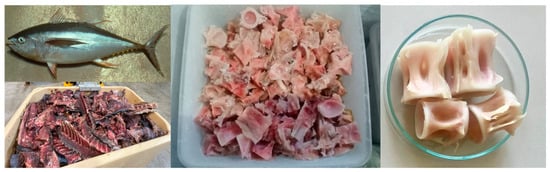
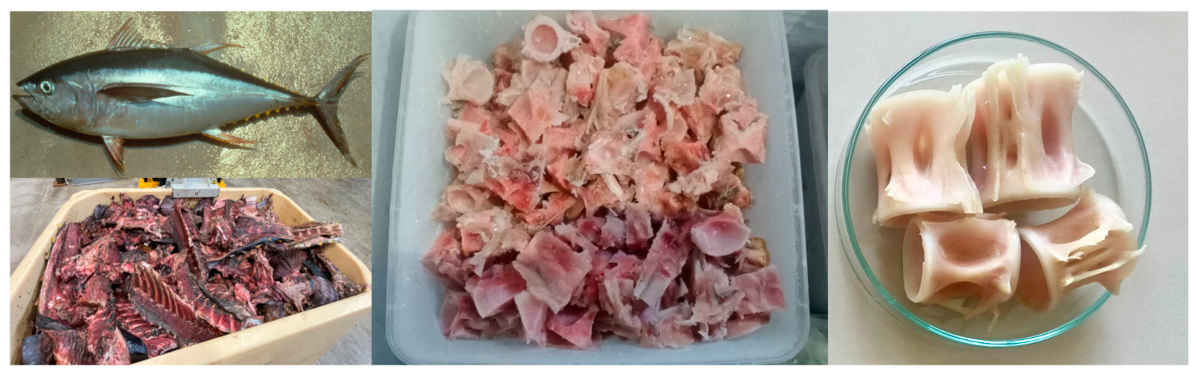
The main active ingredient used in this study was marine collagen peptide (MCP) prepared from T. albacares bones obtained as fish-processing by-products from PT. Yakin Pasifik Tuna, Banda Aceh, Indonesia. The fish species was verified morphologically before processing. The raw bone material, including fresh T. albacares and cleaned bone fragments used for collagen extraction, is shown in Figure 1. Light fraction patchouli oil (Pogostemon cablin Benth.) was purchased from the Atsiri Research Center (ARC PUI-PT Nilam Aceh), Universitas Syiah Kuala, Banda Aceh, Indonesia. Formulation excipients included distilled water, sodium chloride (analytical grade, Merck, Darmstadt, Germany), niacinamide (USP grade, DSM, Heerlen, The Netherlands), sodium benzoate (food grade, Jungbunzlauer, Basel, Switzerland), carrot and green tea extracts (standardized extracts, Croda, Snaith, UK), vegetable glycerin (USP/EP grade, Oleon, Ertvelde, Belgium), guar gum (pharmaceutical grade, Danisco, Copenhagen, Denmark), xanthan gum (pharmaceutical grade, CP Kelco, Atlanta, GA, USA), lactic acid (88% solution, food grade, Corbion, Amsterdam, The Netherlands), sodium methyl sulfolaurate (purity ≥ 95%, Stepan, Northfield, IL, USA), sodium lauroamphoacetate (purity ≥ 40%, Solvay, Brussels, Belgium), lauryl glucoside (purity ≥ 50%, BASF, Ludwigshafen, Germany), 1,3-propanediol (Cosmetic grade, DuPont Tate & Lyle, Loudon, TN, USA), sodium PCA (cosmetic grade, Ajinomoto, Tokyo, Japan), bergamot mint essential oil, clove bud essential oil, and Euxyl K903 (Schülke & Mayr, Norderstedt, Germany). All chemicals and formulation ingredients were used according to the grades and purities specified above. The chemical profile of the light fraction patchouli oil was characterized by GC–MS, and the corresponding chromatogram is presented in Figure S1.
Figure 1.
T. albacares bone by-products used as the raw material for collagen extraction: whole fish and bone residue, cleaned bone pieces, and prepared bone fractions.
2.2. Collagen Peptide Preparation
2.2.1. T. albacares Bone Collagen Extraction
Collagen was extracted from T. albacares bones using an acid solubilization approach under controlled temperature (4 °C) and pH conditions to maintain the native triple-helix conformation, adapted from earlier research with modifications [15]. Fresh tuna bones were rinsed thoroughly with cold water, cut into small pieces (approximately 1 cm × 1 cm), and maintained at 4 °C throughout processing to inhibit endogenous proteolytic enzyme activity and reduce thermal denaturation. Fat removal was achieved by soaking bone pieces in 75% ethanol (1:10 w/v) at 4 °C for 24 h, with fresh solvent added after 12 h. Following defatting, samples were treated with 0.1 M NaOH solution (1:10 w/v) at 4 °C for 8 h to remove non-collagenous proteins, with the NaOH solution refreshed every 2 h. After alkaline treatment, samples were washed with cold distilled water until reaching neutral pH (pH 7). For mineral removal, bone samples were immersed in 0.5 M EDTA solution (pH 7.4, 1:10 w/v) at 4 °C for 24 h with continuous magnetic stirring (IKA C-MAG HS 7, IKA-Werke, Staufen, Germany, 300 rpm); the EDTA solution was replaced after 12 h. The demineralized bone was then soaked in 0.5 M acetic acid (1:10 w/v) at 4 °C for 72 h under constant stirring to extract acid-soluble collagen (ASC). The resulting mixture was strained through double-layered muslin cloth and centrifuged at 10,000× g for 20 min (Eppendorf 5810R, Eppendorf, Hamburg, Germany). Collagen was precipitated by salting out with solid NaCl (final concentration approximately 2.6 M), followed by storage at 4 °C for 24 h. The precipitated collagen was recovered via centrifugation (10,000× g, 20 min), redissolved in 0.5 M acetic acid (1:5 w/v), and dialyzed sequentially against 0.1 M acetic acid (24 h) and distilled water (48 h) to eliminate salts and low-molecular-weight impurities. The dialyzed collagen solution was freeze-dried and stored at −20 °C until further use. The extraction and processing temperature (4 °C) was deliberately selected over higher temperatures because fish-derived collagen typically denatures near its species-specific denaturation temperature (often in the range of 15–30 °C for tropical/warm-water species); maintaining a cold chain at 4 °C throughout the multi-day extraction sequence therefore minimizes thermal denaturation of the native triple helix while also suppressing endogenous proteolytic and microbial activity, consistent with cold-chain extraction protocols established for other fish bone/skin collagens [15,20].
2.2.2. Enzymatic Hydrolysis to Marine Collagen Peptide (MCP)
Collagen peptides were generated through enzymatic digestion of ASC with pepsin, based on the method of Han et al. [30] with minor adjustments. Freeze-dried ASC was rehydrated in 0.5 M acetic acid and stirred continuously at 4 °C overnight. Prior to enzyme addition, the pH was adjusted to 3.0 with dilute NaOH or HCl as needed. Pepsin (Sigma-Aldrich, St. Louis, MO, USA; ≥2500 units/mg protein) was introduced at a 1:100 (w/w) enzyme-to-substrate ratio, and hydrolysis proceeded at 37 °C for 6 h with constant stirring. Enzymatic activity was halted by heating to 85 °C for 20 min. The hydrolysate was centrifuged at 10,000× g for 20 min, and the supernatant was ultrafiltered through a 30 kDa molecular-weight-cutoff (MWCO) membrane (Millipore, Burlington, MA, USA). The resulting filtrate was collected as the low-molecular-weight MCP fraction, freeze-dried, and stored at −20 °C until further analysis and formulation. The degree of hydrolysis (DH) was determined using the o-phthaldialdehyde (OPA) method and was 27.4 ± 1.8%, indicating substantial enzymatic cleavage of the parent collagen.
2.3. Formulation of the Facial Wash
Four facial wash formulations (F1–F4) were developed containing 0.5% MCP and 0.05% light fraction patchouli oil, differing only in gelling agent type and concentration (Table 1). The surfactant system comprised sodium methyl sulfolaurate, sodium lauroamphoacetate, and lauryl glucoside for mild, skin-compatible cleansing.
Table 1.
Formulation compositions of the facial wash (% w/w).
Table 1 presents the complete formulation compositions. Preparation procedure: Sodium chloride was dissolved in purified water (Phase A). MCP, niacinamide, sodium benzoate, carrot extract, and green tea extract were dissolved sequentially in Phase A. The gelling agent was dispersed in vegetable glycerin (Phase B) and incorporated into Phase A under continuous stirring until a homogeneous gel formed. Lactic acid was added to adjust the pH to 5.5–6.0. The pre-heated surfactant blend (60 °C, 10 min) was introduced stepwise with gentle stirring to minimize foaming. Propanediol, sodium PCA, essential oils (bergamot mint, patchouli, clove bud), and preservatives (Euxyl K903) were then incorporated sequentially under continuous stirring until a stable, uniform preparation was obtained. The finished product was filled into primary containers, sealed, and labelled.
2.4. Investigation of Physicochemical Properties and Stability
Organoleptic properties, including color, aroma, and texture, were evaluated descriptively by 30 untrained panelists under standardized observation conditions. The assessment focused on the sensory characteristics of the finished facial wash formulation. Homogeneity was evaluated by visual inspection of a thin film between glass plates (triplicate) [31]. The pH was measured on a 1% (w/v) aqueous dispersion using a calibrated pH meter (Mettler Toledo, Greifensee, Switzerland; triplicate; acceptable range 4.5–7.8, SNI 16-4380-1996) [32]. Spreadability was determined by the weighted-plate method (0.5 g sample; incremental loads of 50–200 g; acceptable range 5–7 cm). Adhesion was assessed by the glass-slide compression method (0.5 g, 200 g weight, 5 min; acceptable ≥4 s). Viscosity and flow behavior were measured using a Brookfield viscometer (model DV2T, AMETEK Brookfield, Middleboro, MA, USA; spindle No. 2; 3, 6, 12, 30, and 60 rpm; 25 ± 1 °C; triplicate; acceptable range 3000–50,000 mPa·s) [32]. Foam height and stability were evaluated by the cylinder shaking method: 10 mL of 5% (w/v) product solution was shaken for 60 s; foam height was recorded initially (T0) and after 5 min (final), with foam stability calculated as percentage retention.
Stability was assessed using seven freeze–thaw cycles (4 ± 2 °C/40 ± 2 °C, 24 h per cycle; 14 days total) and elevated-temperature storage at 30 ± 2 °C/75 ± 5% RH and 40 ± 2 °C/75 ± 5% RH for three months, with evaluations performed at months 1, 2, and 3 [33]. All physicochemical parameters above were evaluated at each stability time point.
2.5. Safety Assessment
Contamination testing of the facial cleanser formulation was performed at the Assessment Institute for Foods, Drugs, and Cosmetics Indonesian Council of Ulama (LPPOM MUI) in Bogor, Indonesia. Results were evaluated against the requirements specified in BPOM Regulation No. 16 of 2024 on Contaminant Limits in Cosmetics [34].
2.5.1. Microbial Contamination
Total aerobic plate count was determined by serial dilution of 1 g of formulation in peptone water, pour-plating on tryptic soy agar (TSA), and incubation at 32.5 ± 2.5 °C for 72 ± 6 h (ISO 21149:2017) [35]. Yeast and mould were enumerated on SCA incubated at 25 ± 2.5 °C for 3–5 days (ISO 16212:2017) [36]. Specific pathogens (P. aeruginosa, ISO 22717:2015; S. aureus, ISO 22718:2015; C. albicans, ISO 18416:2015) were detected using selective agar media with biochemical confirmation by Gram staining, catalase, coagulase, and oxidase tests as specified in the respective standards [37,38,39].
2.5.2. Heavy Metal Contamination
Content of As, Cd, Hg, and Pb was determined by inductively coupled plasma mass spectrometry (ICP-MS; Agilent 7800, Agilent Technologies, Santa Clara, CA, USA) following microwave-assisted acid digestion (HNO3/HCl) of 0.4 g of formulation. Rhodium (Rh) and thulium (Tm) (10 µg/L each) were used as internal standards. Instrument conditions: Co signal intensity >30,000 cps, kinetic energy discrimination (KED) ratio > 18%, oxide ratio < 2%. The analytical procedure was performed using ICP-MS in accordance with ISO 21392:2021, while the measured concentrations were evaluated against the applicable limits specified in BPOM Regulation No. 16 of 2024 [34,40].
2.5.3. Skin Irritation Test
Skin irritation of the selected formulation (F4) was assessed by open patch tests on 20 volunteers (10 with normal skin and 10 with sensitive skin). Ethical approval was obtained from the Ethics Committee of the Faculty of Nursing, Universitas Syiah Kuala (No. 113016301024). Inclusion criteria: healthy adults aged 25–35 years; written informed consent. Exclusion criteria: known allergy to formulation ingredients; pregnancy or breastfeeding; active dermatological disease at test site; systemic immunosuppressive therapy. Approximately 0.5 g of F4 was applied to a 2.5 cm × 2.5 cm area on the inner forearm (uncovered, 30 min), and reactions were scored at 0, 24, 48, and 72 h using the Draize Dermal Irritation Scoring System (DDIS; Table 2 and Table 3). The Primary Skin Irritation Index (PSII) was calculated as the sum of erythema and edema scores at 24, 48, and 72 h divided by the number of volunteers (Equation (1)).
Table 2.
Draize Dermal Irritation Scoring System (DDIS).
Table 3.
Classification of the Primary Skin Irritation Index (PSII).
2.6. Statistical Analysis
All data were expressed as mean ± standard deviation (SD) and analyzed using SPSS version 29 (IBM Corp., Armonk, NY, USA). The Shapiro–Wilk test (for sample sizes ≤ 50) was performed to assess data normality, with data considered normally distributed when p > 0.05. For formulation evaluation parameters, normally distributed data were analyzed using One-Way ANOVA, while non-normally distributed data were analyzed using the Kruskal–Wallis test. When statistically significant differences were observed (p < 0.05), post hoc tests (Tukey HSD for ANOVA; Mann–Whitney U for Kruskal–Wallis) were conducted for intergroup comparisons. Data from the irritation test were analyzed descriptively based on the DDIS scoring system.
3. Results and Discussion
3.1. Chemical Characterization of Collagen and Marine Collagen Peptide
Collagen was extracted from T. albacares bone by the acid-soluble collagen (ASC) method and subsequently hydrolyzed to marine collagen peptide (MCP) using pepsin. Characterization encompassed proximate composition, FTIR spectroscopy, SEM morphology, and SDS-PAGE analysis of the collagen and MCP fractions to evaluate their composition, structural characteristics, and molecular-weight profile in relation to their intended cosmetic application.
3.1.1. Proximate Composition
The proximate composition of collagen extracted from T. albacares bones using the acid-solubilization protocol is presented in Table 4. The moisture, protein, lipid, and ash contents provide an overall compositional profile of the extracted collagen and are presented alongside values reported for marine-derived collagen in the literature [15,41]. These compositional characteristics support the quality assessment of the extracted protein fraction and provide context for its subsequent conversion into marine collagen peptide.
Table 4.
Proximate composition of marine collagen from T. albacares bone.
The moisture content of 4.2% is substantially below the maximum allowable limit of 12%, indicating a relatively low residual moisture content in the collagen powder. This characteristic is critical for preserving the structural integrity and bioactivity of the peptide chains during long-term storage, as reduced moisture minimizes the risk of microbial proliferation, enzymatic degradation, and undesirable Maillard reactions that could compromise the functional properties of the collagen [15]. The observed moisture value is comparable to that reported for collagen from skipjack tuna bone (4.5%) and superior to collagen from mammalian sources, which typically exhibit higher moisture content due to differences in extraction and drying protocols [20].
The protein content of 85.2% exceeds the minimum requirement of 75%, indicating that the extracted material consisted predominantly of protein. This elevated protein fraction is attributed to the effective removal of non-collagenous proteins through the alkaline pretreatment (0.1 M NaOH) and the selective solubilisation of collagen α-chains during acid extraction. The high protein content is particularly significant for anti-aging applications, as the biological activity of collagen—including its capacity to stimulate fibroblast proliferation and ECM synthesis—is directly proportional to its peptide purity [41]. This value is consistent with findings from Eleccion et al. [41], who reported protein contents ranging from 80–86% for acid-soluble collagen from T. albacares viscera, confirming the efficiency of the extraction protocol employed in the present study.
Lipid content was measured at 0.2%, well within the acceptable limit of ≤1%. The near-absence of lipids confirms the thorough defatting step (75% ethanol, 24 h, 4 °C) and subsequent alkaline treatment, which together eliminate residual triglycerides and phospholipids from the bone matrix. Low lipid content is essential for maintaining collagen stability, as residual fats can undergo oxidation, leading to off-odours and potential degradation of the protein structure [15]. Furthermore, lipid-free collagen exhibits superior water solubility and compatibility with aqueous cosmetic formulations, facilitating uniform dispersion of the active ingredient.
The ash content of 0.8% is substantially lower than the maximum permissible value of 5%, demonstrating the effectiveness of the demineralisation step using 0.5 M EDTA (pH 7.4, 24 h). Efficient removal of calcium phosphate and other mineral components is crucial for obtaining a collagen product with minimal inorganic contaminants, which could otherwise interfere with the physicochemical properties of the final formulation and reduce its dermal bioavailability. The low ash content also indicates that the collagen retains its characteristic amino acid composition without significant mineral adulteration [15].
3.1.2. FTIR Analysis
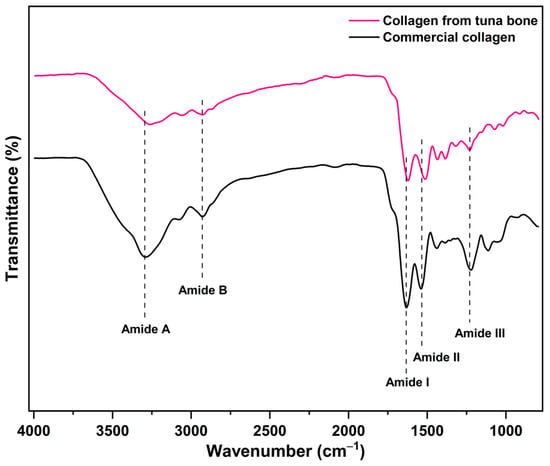
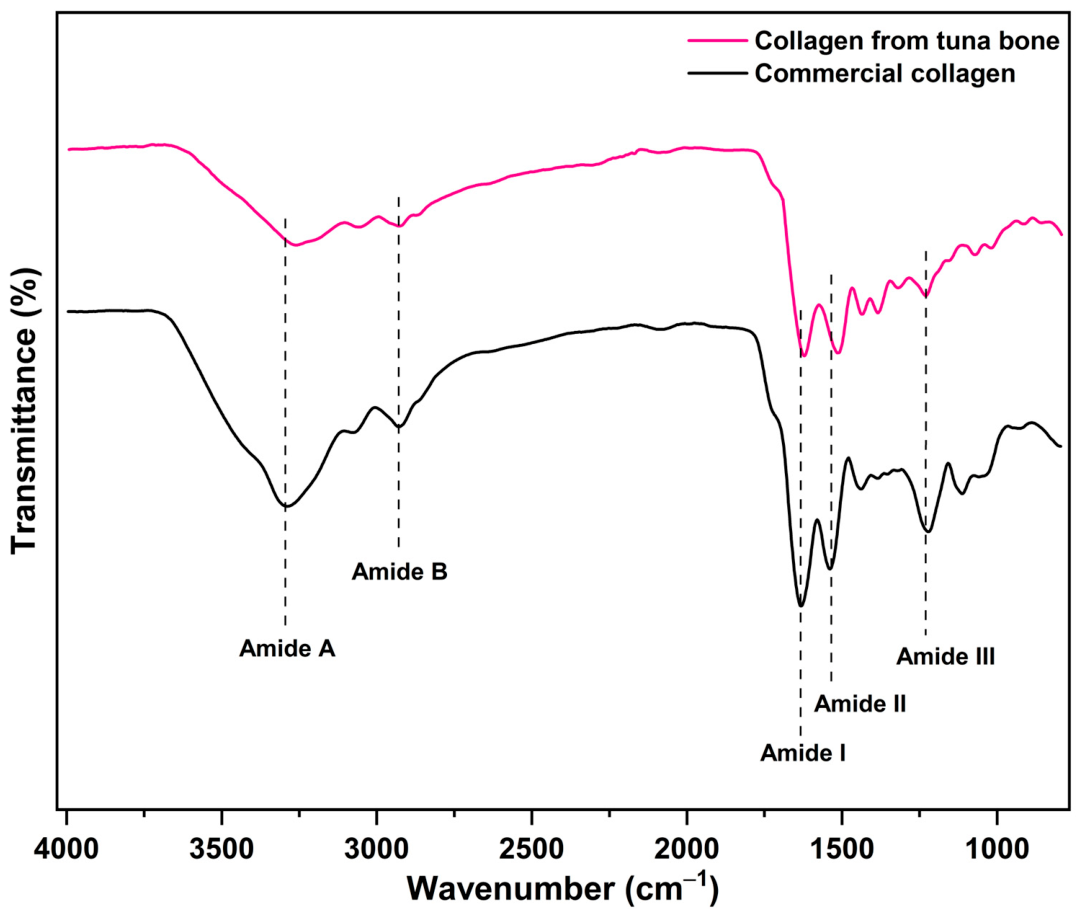
The FTIR spectra of T. albacares bone collagen and commercial collagen are presented in Figure 2. The five principal absorption bands characteristic of type I collagen (Amide A, B, I, II, and III) were identified in both samples, with close correspondence between the spectra (Table 5).
Figure 2.
FTIR of commercial collagen and collagen extracted from T. albacares bone by the ASC method.
Table 5.
Analysis results of the functional groups of T. albacares bone collagen.
The Amide I band at 1657 cm–1, corresponding primarily to C=O stretching vibrations of peptide bonds, is sensitive to protein secondary structure. Its position within the characteristic collagen Amide I region is consistent with the preservation of major collagen structural features. The Amide II band at 1545 cm–1 (C–N stretch/N–H bend) indicates regularity of the amide backbone, while the Amide III band at 1240 cm–1—arising from C–N stretch and N–H bend associated with hydroxyproline residues—directly confirms the integrity and biological activity of the collagen triple-helix [15]. The Amide A band at 3340 cm–1 corresponds to N–H stretching vibrations with intermolecular hydrogen bonding, confirming intact peptide chain cohesion. The Amide B band at 2932 cm–1 is attributed to asymmetric CH2 stretching of aliphatic amino acid side chains (glycine, proline) [15].
The close correspondence between the spectra indicates similar major collagen-related functional groups between the extracted and commercial samples [15]. This finding is consistent with previous studies on fish-derived collagens, which have shown that acid-soluble collagen from marine sources retains the characteristic triple-helical structure essential for bioactivity [41]. The presence of all five amide bands with appropriate wave numbers and intensities confirms that the extraction protocol successfully preserved the native collagen structure, supporting its suitability as a bioactive cosmetic ingredient.
The triple-helical conformation is widely regarded as a key structural determinant of collagen functionality. The Amide III band serves as a useful marker of collagen integrity, as it is associated with the proline and hydroxyproline residues that stabilize the triple helix. The presence of the Amide III band at 1240 cm−1 in both the tuna bone collagen and the commercial collagen indicates that the polypeptide chains retained an ordered, helical arrangement. Previous studies have associated the structural integrity of collagen with its biological interactions, including binding to cell-surface receptors and fibroblast-related activity [10]. Collectively, the preservation of characteristic collagen-related functional groups indicates that the low-temperature, mild acid extraction maintained the major structural features of the collagen [15].
3.1.3. Molecular Weight Profile of Marine Collagen Peptide
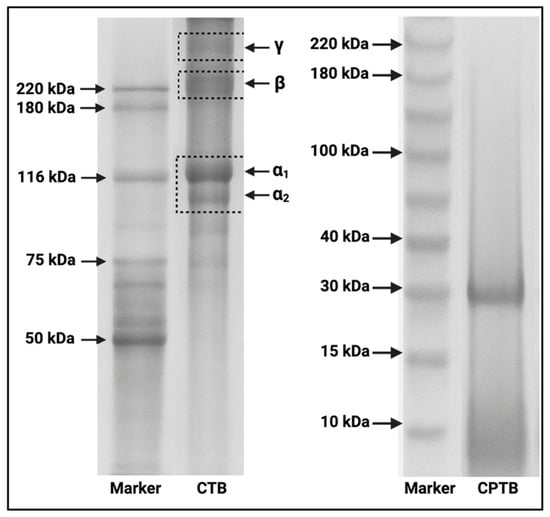
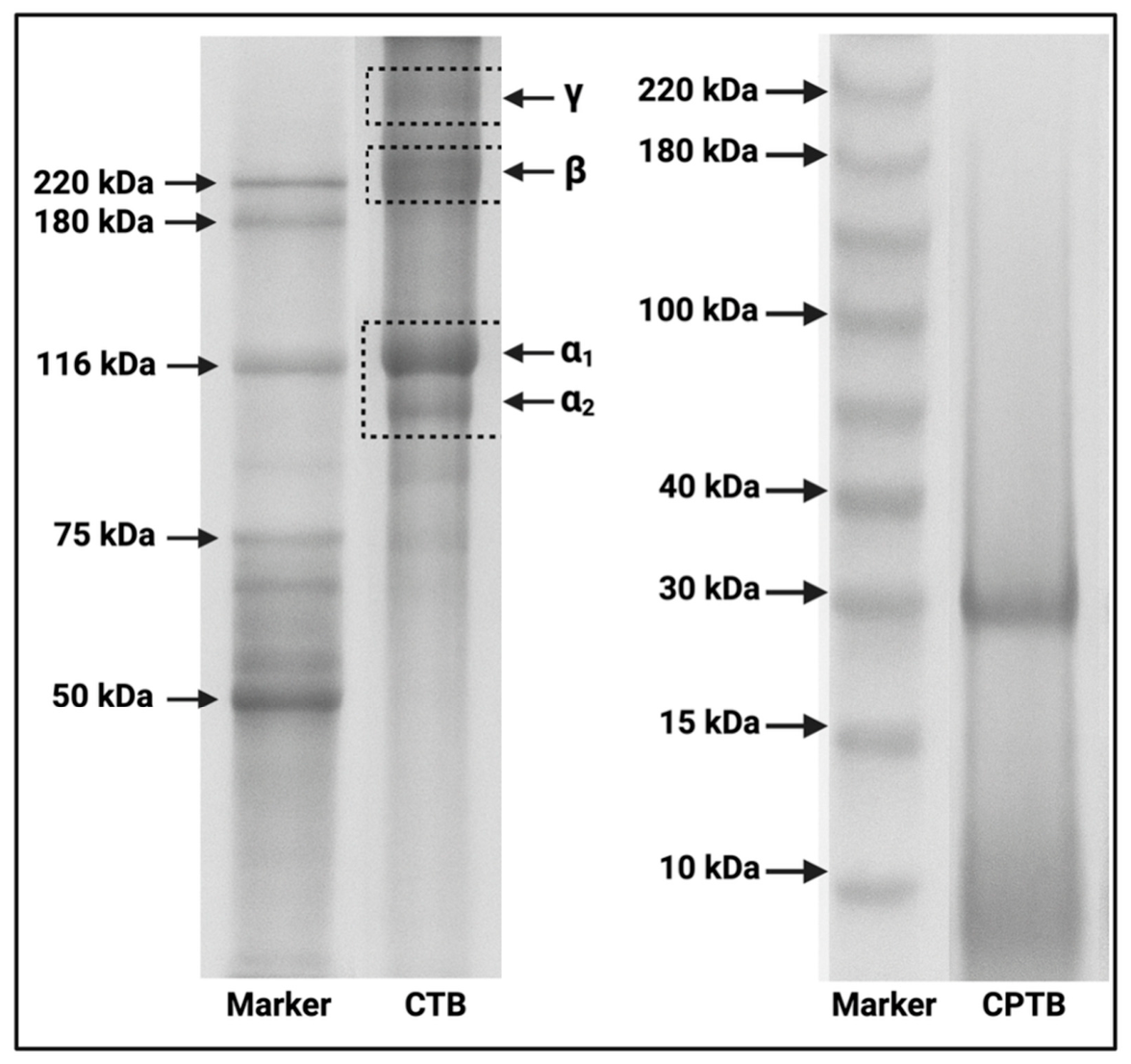
Enzymatic hydrolysis of the acid-soluble collagen with pepsin yielded a marine collagen peptide (MCP) fraction with a degree of hydrolysis (DH) of 27.4 ± 1.8%. SDS-PAGE analysis (Figure 3) showed a marked reduction in the high-molecular-weight collagen bands observed in the parent collagen fraction. In the MCP lane, no distinct α1- or α2-chain bands in the >100 kDa region were apparent, while the hydrolyzed fraction exhibited predominantly lower-molecular-weight peptide material. This observation is consistent with the subsequent 30 kDa MWCO ultrafiltration step and indicates substantial cleavage of the parent collagen into lower-molecular-weight fragments. The reduction in molecular size following collagen hydrolysis is relevant to the potential use of collagen-derived peptides in topical cosmetic formulations. Compared with intact collagen, hydrolyzed collagen contains smaller peptide fragments that generally exhibit greater aqueous solubility and may have greater potential for interaction with the skin surface [43]. The lower-molecular-weight character of the hydrolysate, together with its successful incorporation into the aqueous-based facial wash, supports its suitability as a formulation ingredient [44].
Figure 3.
SDS-PAGE profiles of collagen from tuna bone and the corresponding marine collagen peptide fraction. CTB = collagen from tuna bone; CPTB = collagen peptide from tuna bone.
The degree of hydrolysis achieved (27.4 ± 1.8%) indicates effective pepsin-mediated cleavage of the parent collagen into lower-molecular-weight peptide fragments. This value is consistent with the range reported by Han et al. [30], who obtained DH values of 25–30% for collagen peptides from marlin skin. DH is an important parameter in collagen peptide production because the extent of peptide-bond cleavage influences the resulting molecular-weight distribution and functional characteristics of the peptide fraction [45]. A DH within the range of 20–35% has been associated with favorable peptide characteristics, reflecting a balance between peptide-chain cleavage and the retention of functional peptide sequences [45]. In the present study, the SDS-PAGE profile showed a marked reduction in the high-molecular-weight collagen bands following pepsin hydrolysis, consistent with the formation of lower-molecular-weight peptide fragments. This profile, together with the subsequent 30 kDa molecular-weight-cutoff ultrafiltration, supports the successful preparation of a lower-molecular-weight MCP fraction for incorporation into the facial wash formulation [45,46]. The preserved characteristic collagen-related structural features of the parent collagen further support the suitability of the resulting MCP as a functional marine-derived ingredient for cosmetic formulation.
3.1.4. SEM Morphology of Collagen Peptide
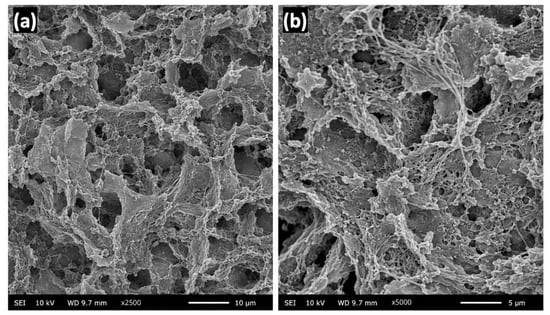
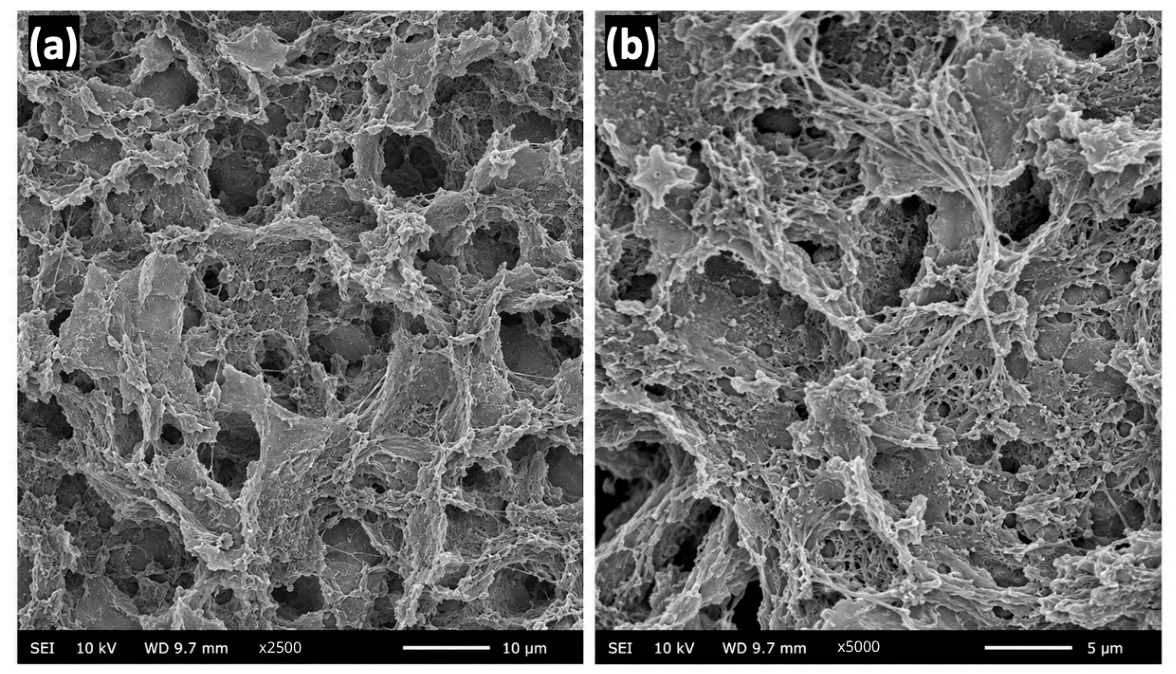
The surface morphology of the marine collagen peptide obtained after enzymatic hydrolysis and ultrafiltration was examined by scanning electron microscopy at two magnifications (2500× and 5000×), as presented in Figure 4. The micrographs reveal that the MCP exists as irregular, porous aggregates with a rough, fragmented surface architecture, distinctly different from the fibrillar, sheet-like structure observed in intact acid-soluble collagen. The particles show heterogeneous sizes, ranging from approximately 50 to 200 µm in diameter, with visible surface pores and crevices that suggest a high specific surface area.
Figure 4.
Morphological of collagen peptide from T. albacares bone at (a) 2500× and (b) 5000× magnifications.
This morphological transformation is a direct consequence of the enzymatic hydrolysis process. During pepsin digestion, the native triple-helical collagen molecules are cleaved into smaller peptide fragments, disrupting the supramolecular organization that normally gives rise to ordered fibrils and fiber bundles [47,48]. The resulting peptide aggregates appear to have undergone partial reorganization during freeze-drying, forming porous, sponge-like structures rather than the dense, interconnected networks typical of intact collagen. Similar morphological changes have been reported for hydrolyzed collagen from fish sources, where enzymatic treatment leads to the loss of fibrillar alignment and the formation of amorphous, porous particles [20].
The porous nature of the MCP is advantageous for cosmetic applications. Its high surface area and irregular surface topography may facilitate rapid dissolution and hydration upon incorporation into the aqueous facial wash, promoting uniform dispersion of the peptides [49]. The porous structure may also favor peptide interaction with the skin surface during the brief contact time of a rinse-off product. The micrographs showed a relatively uniform porous morphology, free of large, dense aggregates. This morphological evidence, together with the molecular-weight profile from SDS-PAGE, supports the successful production of a low-molecular-weight collagen peptide preparation suitable for incorporation into topical cosmetic formulations.
An important consideration for the future scale-up of fish-derived collagen is potential batch-to-batch variability. Differences in raw-material characteristics, processing history, and storage conditions may affect collagen extraction and the properties of the resulting peptide fraction, including molecular-weight distribution, solubility, and degree of hydrolysis. These variations may subsequently influence the physicochemical and stability characteristics of the final formulation.
3.2. Physicochemical Properties and Stability of Facial Wash Formulation
The physicochemical properties evaluated before and after freeze–thaw cycling and three months of elevated-temperature storage at 30 and 40 °C are summarized in Table 6.
Table 6.
Physicochemical properties of the facial wash formulation.
3.2.1. Organoleptic Properties and Homogeneity
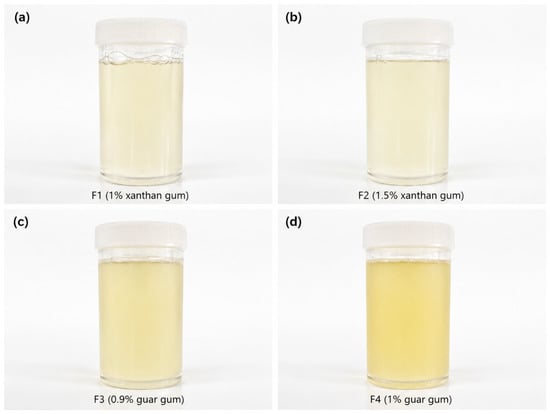
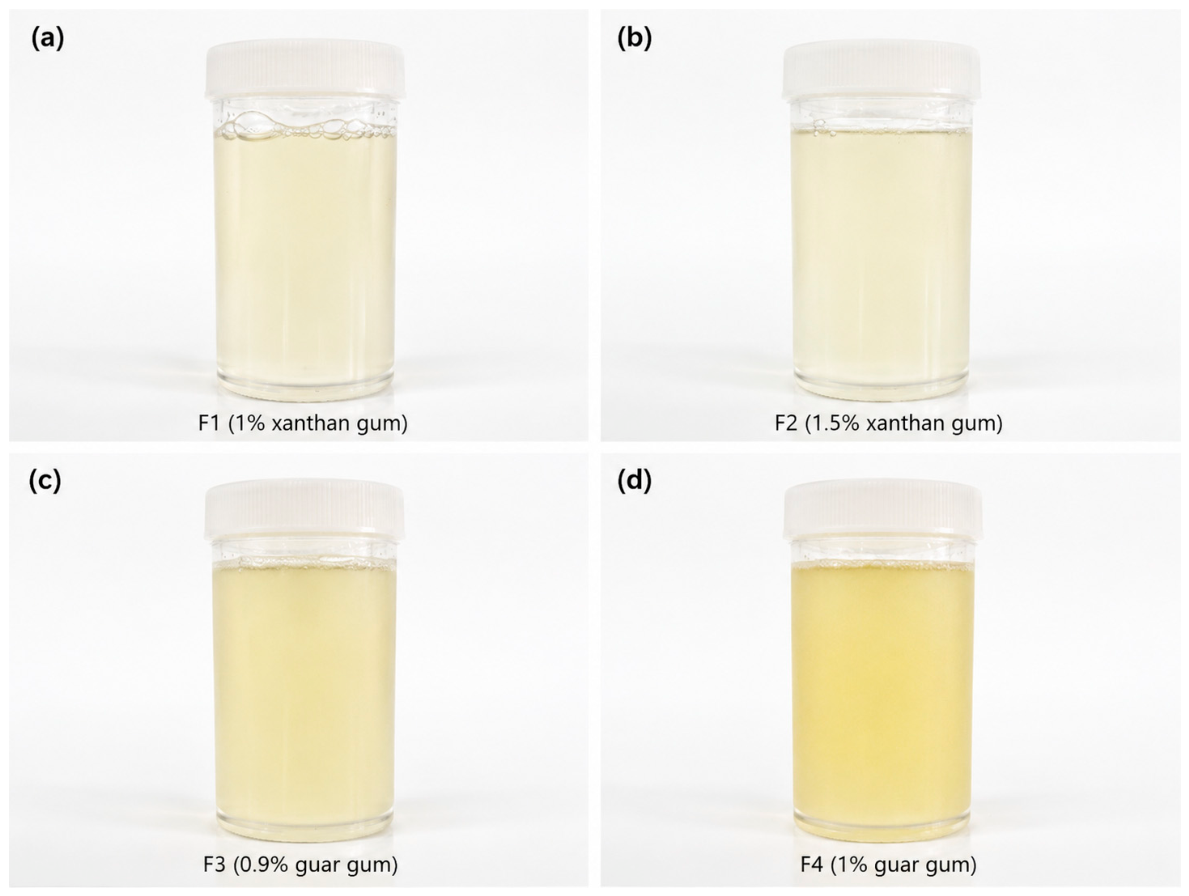
The organoleptic assessment (Figure 5) revealed marked differences between xanthan gum- and guar gum-based formulations. Formulations F1 and F2 appeared as clear, low-viscosity liquids with light yellow coloration and a bergamot odor, attributable to xanthan gum’s rigid helical polymer structure that facilitates uniform dispersion and high light transmittance. In contrast, F3 and F4 were turbid with more viscous textures and deeper yellow coloration, characteristic of guar gum’s high molecular weight and rapid hydration kinetics.
Figure 5.
Physical appearance of facial wash formulations containing different gelling agents. (a) Face wash containing 1% xanthan gum (F1); (b) face wash containing 1.5% xanthan gum (F2); (c) face wash containing 0.9% guar gum (F3); (d) face wash containing 1% guar gum (F4).
Following freeze–thaw cycling, F1 and F2 exhibited deepened yellow coloration and reduced consistency, indicative of partial phase separation—a sign of physical instability under thermal stress [50]. This destabilization likely results from the disruption of xanthan gum’s helical structure during repeated thermal cycling, leading to reduced water-binding capacity and syneresis. In contrast, F3 and F4 maintained their appearance across all stability conditions, demonstrating superior resistance to temperature-induced destabilization. The superior stability of guar gum-based formulations can be attributed to the robust hydrogen bonding network formed by guar gum’s galactomannan structure, which resists disruption by thermal stress [51,52].
Homogeneity testing confirmed that F1 and F2 formed non-uniform gel networks due to uneven polymer hydration—a phenomenon often associated with xanthan gum’s tendency to form “fish-eye” aggregates when inadequately dispersed. This inhomogeneity persisted across all test conditions, suggesting fundamental incompatibility between the xanthan gum concentration range tested and the formulation matrix [53,54]. In contrast, F3 and F4 were homogeneous throughout all stability assessments, confirming that guar gum provided superior dispersion and network formation under the preparation conditions employed.
3.2.2. pH
All formulations maintained pH values within 5.57–5.90 across the evaluated conditions, remaining within the specified range of 4.5–7.8 for facial cleansers [32]. The pH values showed only modest variation following freeze–thaw cycling and elevated-temperature storage, with no marked deviation from the initial formulation range. For the optimized F4 formulation, pH values ranged from 5.60 to 5.87 throughout the evaluated conditions. The relatively limited change in pH suggests that the formulation maintained adequate acid–base stability during the tested stability assessment. Maintaining a mildly acidic pH is relevant to facial cleanser development because formulations with pH values closer to that of the skin may be better tolerated during use [55,56]. However, pH measurement alone does not establish preservation of skin-barrier function or cleansing efficacy.
3.2.3. Spreadability, Adhesion, and Viscosity
The spreadability, adhesion, and viscosity parameters revealed marked differences between xanthan gum- and guar gum-based formulations. F1 and F2 exhibited viscosities of 880–905 mPa·s and 2044–2201 mPa·s, respectively, both below the specified range of 3000–50,000 mPa·s, and their spreadability values exceeded the upper limit of 7 cm. F1 fell below the adhesion specification at all time points, whereas F2 met the specification only before cycling (4.55 s) and subsequently declined to 3.51–3.99 s. The limited thickening performance of xanthan gum in these formulations is likely formulation-dependent rather than intrinsic to the polymer. Xanthan gum typically provides high low-shear viscosity in simple aqueous systems [57]; however, the high concentration of anionic and amphoteric surfactants (20% w/w total) combined with electrolytes in the present matrix probably altered polymer hydration and chain–chain association, thereby reducing the effective three-dimensional network [53,56].
After cycling and long-term storage, F1 and F2 showed statistically significant further reductions in viscosity and adhesion and increases in spreadability, consistent with temperature-induced weakening of intermolecular hydrogen bonding [58]. This progressive change in rheological properties under thermal stress indicates the limited physical stability of the xanthan gum-based formulations at the concentrations tested. In contrast, F3 and F4 met all three specifications at all time points, and F4, containing 1% guar gum, demonstrated the most stable and favorable rheological profile across the evaluated stability conditions. The performance of guar gum is attributable to its high molecular weight (typically in the order of 1–2 × 10⁶ Da) and its capacity to form extensive hydrogen-bonded networks through the hydroxyl groups of its galactomannan backbone, as a neutral polysaccharide whose hydration remains largely independent of ionic strength [52,58]. This structure yields a cohesive three-dimensional network that preserves viscosity and adhesion under accelerated stability conditions.
3.2.4. Foam Height and Stability
All formulations produced initial foam heights of 4.90–5.10 cm, with foam retention ranging from 82.00% to 96.08% across the evaluated stability conditions. Foam retention was highest before and immediately after freeze–thaw cycling and declined progressively following three months of storage at elevated temperature. At 40 ± 2 °C, the retention values were 84.60%, 82.00%, 90.60%, and 86.88% for F1–F4, respectively, with the guar gum-based formulations (F3 and F4) retaining more foam than the xanthan gum-based formulations (F1 and F2). These results indicate that all formulations maintained adequate foam persistence under the tested conditions, while elevated-temperature storage produced a measurable reduction in foam retention. The observed foam behavior is likely associated with the combined action of sodium methyl sulfolaurate, sodium lauroamphoacetate, and lauryl glucoside, which contribute to interfacial film formation and foam stabilization [59,60]. The temperature-dependent decline in retention suggests that storage temperature moderately influenced foam persistence, presumably through accelerated film drainage and bubble coalescence at higher temperatures.
3.2.5. Rheological Behavior
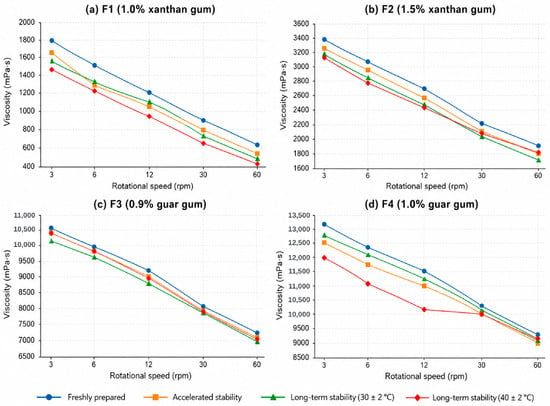
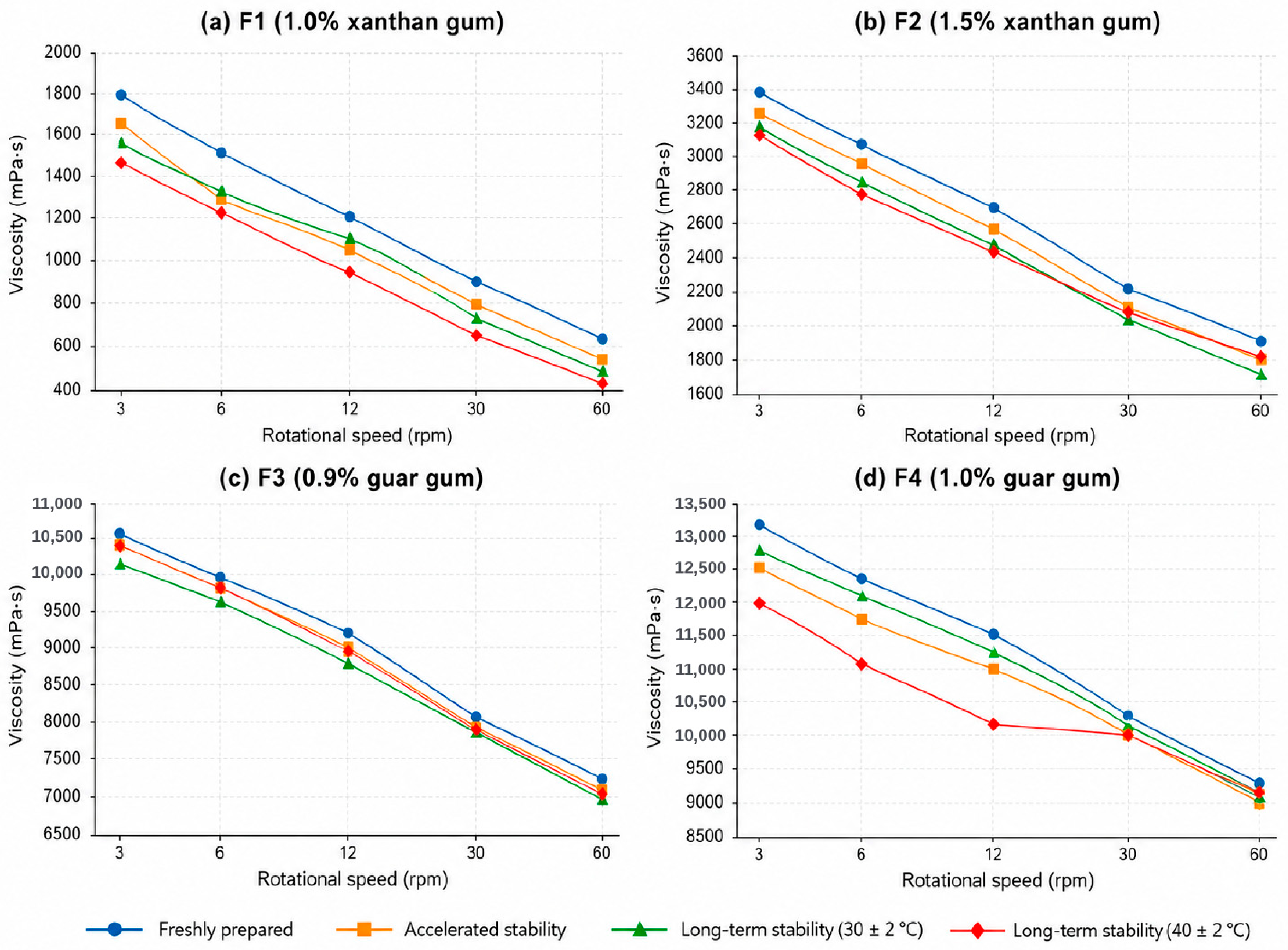
All four formulations exhibited pseudoplastic (shear-thinning) non-Newtonian flow behavior, as demonstrated by the decrease in viscosity with increasing spindle speed in the rheograms (Figure 6). This behavior is characteristic of polysaccharide-based hydrogel systems, where shear stress disrupts the three-dimensional polymer network and reduces internal flow resistance, enabling smooth spreading upon application while maintaining adequate viscosity at rest to prevent dripping [61].
Figure 6.
Rheogram of the facial wash formulations under different treatment conditions.
The pseudoplastic profile of F3 and F4 is particularly favorable for a facial wash formulation. During application, the shear forces generated by spreading reduce the apparent viscosity, allowing the product to distribute evenly across the skin surface. Thixotropic recovery after the removal of shear represents a relevant parameter for future rheological characterization. This shear-thinning behavior, together with the overall physicochemical and stability performance of the guar gum-based formulations, supported the selection of F4 for subsequent safety assessment [61].
Among the four formulations, F4 was selected as the optimized formulation based on its overall physicochemical performance across the evaluated parameters. F3 and F4 both exhibited homogeneous characteristics and met the specifications for spreadability, adhesion, and viscosity at all time points. F4 provided the highest viscosity (8884–9223 mPa·s) and adhesion (8.84–8.93 s) with minimal variation across storage conditions, whereas F3 showed slightly higher foam retention. F1 and F2 showed less favorable rheological characteristics, particularly in terms of viscosity, adhesion, and spreadability. Although F4 exhibited lower spreadability than F1 and F2, its values remained within the acceptable range of 5–7 cm and were accompanied by superior adhesion and viscosity. The selection of F4 therefore reflects the overall balance of homogeneity, consistency, adhesion, viscosity, pH stability, and acceptable foam retention, with priority given to the rheological parameters that govern product handling and residence on the skin during cleansing. These findings support 1% guar gum as the gelling agent concentration that provided the most favorable overall formulation performance.
3.3. Safety Evaluation
3.3.1. Microbial and Heavy Metal Contamination
The safety assessment was conducted with reference to BPOM Regulation No. 16 of 2024, ISO 17516:2014 [62], and Regulation (EC) No. 1223/2009. BPOM Regulation No. 16 of 2024 provides the applicable requirements for microbial contamination limits in cosmetic products in Indonesia, while ISO 17516:2014 provides guidelines for microbiological quality and contamination limits for cosmetics. In the European Union, Regulation (EC) No. 1223/2009 provides the main regulatory framework for the safety, distribution, and marketing of cosmetic products. These requirements highlight the importance of microbiological and chemical safety.
The contamination analysis results for F4 (Table 7) demonstrated full compliance with the BPOM Regulation No. 16 of 2024 requirements. Total aerobic plate count and yeast/mould count were both below the detection limit (<1.0 × 101 CFU/g), far below the BPOM limit of 103 CFU/g. All three targeted pathogens (P. aeruginosa, S. aureus, C. albicans) were absent. These results were also consistent with the microbiological quality requirements of ISO 17516:2014 for cosmetic products. These findings indicate that the finished formulation met the microbiological requirements under the conditions tested. The absence of pathogenic microorganisms is particularly critical for rinse-off products intended for facial application, as contamination could lead to skin infections or exacerbation of existing dermatological conditions [24].
Table 7.
Results of Microbial and Heavy Metal Contamination Analysis of the Facial Wash.
Heavy metal analysis revealed that arsenic (As, 0.0051 mg/kg) and lead (Pb, 0.0171 mg/kg) were present at trace levels far below the BPOM limits (As ≤ 5 mg/kg; Pb ≤ 20 mg/kg), while cadmium and mercury remained below the detection limit. These trace levels likely originate from marine raw materials and ambient environmental sources [63]. Under Regulation (EC) No. 1223/2009, heavy metals are listed as prohibited substances, and only technically unavoidable traces are tolerated in finished cosmetic products; the concentrations measured here are consistent with such trace levels. The low concentrations suggest that the extraction, purification, and dialysis steps contributed to minimizing heavy metal carry-over from the tuna bone, although direct comparison with the raw material would be required to quantify this reduction. The absence of detectable cadmium and mercury is particularly relevant, as these metals are of considerable toxicological concern in marine-derived products. Overall, all measured concentrations complied with BPOM Regulation No. 16 of 2024, supporting the chemical safety of the formulation with respect to heavy metal contamination.
3.3.2. Skin Irritation Test
The open patch tests on 20 volunteers (10 with normal skin and 10 with sensitive skin) indicated good skin tolerability of the selected formulation. All volunteers with normal skin remained free of erythema and edema and reported an absence of subjective complaints throughout the 24, 48, and 72 h observation periods. Among volunteers with sensitive skin, one participant presented mild erythema with an absence of edema, reflecting individual variability in skin response. The Primary Skin Irritation Index (PSII) was 0.1, which falls within the “negligible irritant” category (0.1–0.4) of the DDIS classification (Table 3) and lies well below the threshold for slight irritation (0.41–1.9), indicating a low irritation potential of the formulation [64]. Because the marine collagen peptide originates from T. albacares bone, potential allergenicity in individuals with fish hypersensitivity warrants consideration, and dedicated sensitization testing will further clarify this aspect.
The mild erythema observed in one volunteer with sensitive skin was likely triggered by a response to the surfactant system, which may transiently affect the integrity of the stratum corneum in individuals with compromised barrier function [65]. However, the formulation demonstrated good tolerability overall, with the vast majority of volunteers showing no adverse response. The very low irritation potential of F4 can be attributed to several formulation features: the mild, skin-compatible surfactant system (sodium methyl sulfolaurate/sodium lauroamphoacetate/lauryl glucoside), the pH adjusted to match the skin’s acid mantle (5.5–6.0), and the inclusion of humectants (glycerin, propanediol, sodium PCA) that help maintain skin hydration during and after cleansing [66]. These results indicate that the facial wash formulation is safe for topical use, even on sensitive skin, provided that individuals with known fragrance allergies exercise caution due to the presence of essential oils containing eugenol (clove bud, patchouli). The negligible irritation potential, combined with the absence of microbial and heavy metal contamination, supports the microbiological and heavy-metal safety of the formulation under the tested conditions.
3.4. Study Limitations
This study focused on the formulation, stability, and safety of the facial wash, which constitute the first stage of cosmetic product development. Accordingly, several aspects merit further investigation. The anti-aging efficacy of the formulation remains to be confirmed through controlled clinical studies that include a collagen-free vehicle, allowing the specific contribution of the marine collagen peptide to be distinguished from that of the co-formulated actives. The proposed mechanisms of action, including MMP-1 inhibition and TGF-β1-mediated collagen synthesis, are derived from the previous literature and warrant confirmation through dedicated in vitro assays. Stability assessment would also benefit from quantification of the peptide content over time, real-time shelf-life studies, and preservative efficacy testing. Furthermore, the irritation assessment involved 20 volunteers and a single application; repeated-insult patch testing in larger cohorts would clarify sensitization potential, particularly in individuals with fish or fragrance hypersensitivity. Finally, the work was performed on a single collagen batch, and evaluation of multiple batches will support the reproducibility and scalability of the process.
4. Conclusions
This study demonstrates the feasibility of formulating a gel-based facial wash containing marine collagen peptide (MCP) derived from yellowfin tuna (T. albacares) bone by-products and light fraction patchouli oil. Acid-soluble collagen with a protein content of 85.2% was obtained under cold-chain extraction and hydrolyzed with pepsin to yield a low-molecular-weight peptide fraction (<30 kDa) with a degree of hydrolysis of 27.4 ± 1.8%, while FTIR analysis indicated retention of the characteristic amide bands of type I collagen. Among the four formulations, guar gum-based systems exhibited greater homogeneity and rheological stability than xanthan gum-based systems, and F4 (1% guar gum) showed the most favorable overall profile, maintaining pH, viscosity, adhesion, and spreadability within the specified ranges throughout freeze–thaw cycling and three-month storage at 30 and 40 °C. F4 met the applicable BPOM microbial and heavy metal requirements and showed negligible irritation potential (PSII 0.1) in the tested cohort. These findings support tuna bone-derived collagen peptide as a promising ingredient for rinse-off cosmetic formulations and contribute to the valorization of fishery by-products. Controlled clinical studies are the next step to evaluate the cosmetic efficacy of the formulation.
Supplementary Materials
The following supporting information can be downloaded at: https://www.mdpi.com/article/10.3390/cosmetics13050267/s1, Figure S1: Chromatogram of light fraction patchouli oil. Table S1: Composition of Biona® facial wash.
Author Contributions
Conceptualization, N.I., V.P. and E.E.; methodology, N.I., V.P. and L.S.D.; software, D.M.P.; validation, V.P., E.E. and T.K.B.; formal analysis, N.I. and D.M.P.; investigation, N.I.; resources, V.P. and C.A.R.; data curation, N.I. and L.S.D.; writing—original draft preparation, N.I., D.M.P. and C.A.R.; writing—review and editing, V.P.; visualization, D.M.P. and C.A.R.; supervision, N.I.; project administration, E.E.; funding acquisition, N.I. All authors have read and agreed to the published version of the manuscript.
Funding
This research was funded by the Ministry of Higher Education, Science, and Technology of the Republic of Indonesia through the Matching Fund KEDAIREKA program, grant number 182/PKS/C.C4/PPK.DHK/VII/2025 and was facilitated by PT. Yagi Natural Indonesia, Merduati.
Institutional Review Board Statement
The study was conducted in accordance with the Declaration of Helsinki, and approved by the Ethics Committee of the Faculty of Nursing, Universitas Syiah Kuala (No. 113016301024 and 19 November 2024).
Informed Consent Statement
Informed consent was obtained from all subjects involved in the study.
Data Availability Statement
The raw data supporting the conclusions of this article will be made available by the authors on request.
Acknowledgments
The authors express their sincere gratitude to Universitas Syiah Kuala (USK), particularly the Faculty of Mathematics and Natural Sciences (FMIPA) and the Department of Pharmacy, for providing the research facilities and academic environment that enabled this work. The authors also extend their appreciation to the Institute for Research and Community Service (Lembaga Penelitian dan Pengabdian kepada Masyarakat, LPPM) Universitas Syiah Kuala for administrative support throughout this research. The authors gratefully acknowledge PT. Yagi Natural Indonesia, Merduati, Banda Aceh, for their collaboration and facilitation of this research. The authors thank the Atsiri Research Center (ARC PUI-PT Nilam Aceh), Universitas Syiah Kuala, for providing the light fraction patchouli oil used in this study. Special thanks are extended to all volunteers who participated in the skin irritation assessment, as well as to the technical staff at the Assessment Institute for Foods, Drugs, and Cosmetics Indonesian Council of Ulama (LPPOM MUI) in Bogor, Indonesia, for their assistance with safety testing.
Conflicts of Interest
The authors declare no conflicts of interest.
Abbreviations
The following abbreviations are used in this manuscript:
| ASC | Acid-soluble collagen |
| BPOM | Badan Pengawas Obat dan Makanan (Indonesian Food and Drug Authority) |
| Da | Dalton |
| DDIS | Draize Dermal Irritation Scoring System |
| DH | Degree of hydrolysis |
| ECM | Extracellular matrix |
| ICP-MS | Inductively coupled plasma mass spectrometry |
| JNK | c-Jun N-terminal kinase |
| SDS-PAGE | Sodium dodecyl sulfate-polyacrylamide gel electrophoresis |
References
- Mijaljica, D.; Townley, J.P.; Torpy, K.; Meere, S.; Spada, F.; Lai, M. Recognizing and Managing Skin Integrity Issues in Compromised Aging Skin: The Importance of Gentle Skin Cleansing, Adequate Moisturization, and Skin Barrier Protection. Dermato 2026, 6, 16. [Google Scholar] [CrossRef] [Scilit]
- Sagita, N.D.; Sutoro, M.; Salsabilla, S.; Pratama, R. Formulation and Physicochemical Characterization of Herbal Facial Wash Containing Moringa oleifera and Solanum lycopersicum Extracts. J. Jamu Indones. 2026, 11, 224–232. [Google Scholar] [CrossRef] [Scilit]
- Mijaljica, D.; Spada, F.; Harrison, I.P. Skin Cleansing without or with Compromise: Soaps and Syndets. Molecules 2022, 27, 2010. [Google Scholar] [CrossRef] [Scilit] [PubMed]
- Naharro-Rodriguez, J.; Bacci, S.; Hernandez-Bule, M.L.; Perez-Gonzalez, A.; Fernandez-Guarino, M. Decoding Skin Aging: A Review of Mechanisms, Markers, and Modern Therapies. Cosmetics 2025, 12, 144. [Google Scholar] [CrossRef] [Scilit]
- Hussein, R.S.; Bin Dayel, S.; Abahussein, O.; El-Sherbiny, A.A. Influences on Skin and Intrinsic Aging: Biological, Environmental, and Therapeutic Insights. J. Cosmet. Dermatol. 2025, 24, e16688. [Google Scholar] [CrossRef] [Scilit] [PubMed]
- Song, S.; Li, F.; Zhao, B.; Zhou, M.; Wang, X. Ultraviolet light causes skin cell senescence: From mechanism to prevention principle. Adv. Biol. 2025, 9, 2400090. [Google Scholar] [CrossRef] [Scilit] [PubMed]
- Liang, Y.; Su, W.; Wang, F. Skin Ageing: A Progressive, Multi-Factorial Condition Demanding an Integrated, Multilayer-Targeted Remedy. Clin. Cosmet. Investig. Dermatol. 2023, 16, 1215–1229. [Google Scholar] [CrossRef] [Scilit] [PubMed]
- Jurcevic, J.; Ceovic, R. A Multimodal Approach to Facial Rejuvenation—Integrating HA Fillers, Collagen Stimulators, Botulinum Toxin and Energy-Based Devices for Optimal Patient Outcomes. J. Aesthetic Med. 2026, 2, 3. [Google Scholar] [CrossRef] [Scilit]
- Korma, S.A.; Hussain, A.; Rehman, A.; Siddique, F.; Zulfiqar, N.; Komal, M.; Firdous, N.; Fahmy, M.A.; Esatbeyoglu, T.; Mehany, T. Collagen as a Sustainable Multifunctional Protein: Sources, Extraction Strategies, Applications, and Future Perspectives in Food, Cosmetic, and Biomedical Fields. Appl. Food Res. 2026, 6, 102151. [Google Scholar] [CrossRef] [Scilit]
- Jadach, B.; Mielcarek, Z.; Osmałek, T. Use of Collagen in Cosmetic Products. Curr. Issues Mol. Biol. 2024, 46, 2043–2070. [Google Scholar] [CrossRef] [Scilit] [PubMed]
- Bar, O.; Valiukevičienė, S. Skin Aging and Type I Collagen: A Systematic Review of Interventions with Potential Collagen-Related Effects. Cosmetics 2025, 12, 129. [Google Scholar] [CrossRef] [Scilit]
- Isnaini, N.; Prajaputra, V.; Luthfanna, S.K.; Sari, I. An Update Review: Several Extraction Methods for Collagen Isolation in Vertebrate Fish. BIO Web Conf. 2024, 87, 03019. [Google Scholar] [CrossRef] [Scilit]
- Prajaputra, V.; Isnaini, N.; Maryam, S.; Ernawati, E.; Deliana, F.; Haridhi, H.A.; Fadli, N.; Karina, S.; Agustina, S.; Nurfadillah, N.; et al. Exploring Marine Collagen: Sustainable Sourcing, Extraction Methods, and Cosmetic Applications. S. Afr. J. Chem. Eng. 2024, 47, 197–211. [Google Scholar] [CrossRef] [Scilit]
- Isnaini, N.; Prajaputra, V.; Syafhira, T.; Maryam, S.; Arisa, I.I.; Karina, S.; Agustina, S.; Haridhi, H.A. Recent Update: Collagen Extraction from Marine Resources as a Promising Natural Antiaging. BIO Web Conf. 2024, 87, 03020. [Google Scholar] [CrossRef] [Scilit]
- Prajaputra, V.; Maryam, S.; Isnaini, N.; Apriani, S.; Maqfirah, S.; Lestari, A.S.; Mulyana, W.S. Influence of Extraction Time on Collagen Yield and Proximate Composition from Yellowfin Tuna (Thunnus albacares) Bones: Insights from Industrial Waste Valorization. Ecol. Eng. Environ. Technol. 2025, 26, 1–7. [Google Scholar] [CrossRef] [Scilit] [PubMed]
- Omeje, A.; Ogbu, C.P.; Aguchem, R.N.; Okagu, I.U. Food Proteins and Bioactive Peptides as Nutraceutical Intervention against Immune System Disorders: A Review. Food Nutr. 2025, 2, 100051. [Google Scholar] [CrossRef] [Scilit]
- Geahchan, S.; Baharlouei, P.; Rahman, A. Marine Collagen: A Promising Biomaterial for Wound Healing, Skin Anti-Aging, and Bone Regeneration. Mar. Drugs 2022, 20, 61. [Google Scholar] [CrossRef] [Scilit] [PubMed]
- Lim, Y.S.; Ok, Y.J.; Hwang, S.Y.; Kwak, J.Y.; Yoon, S. Marine Collagen as a Promising Biomaterial for Biomedical Applications. Mar. Drugs 2019, 17, 467. [Google Scholar] [CrossRef] [Scilit] [PubMed]
- Gold, M.; Ablon, G.; Andriessen, A.; Goldberg, D.; Hooper, D.; Mandy, S. Facial Cleansing with a Sonic Brush—A Review of the Literature and Current Recommendations. J. Cosmet. Dermatol. 2019, 18, 686–691. [Google Scholar] [CrossRef] [Scilit] [PubMed]
- Tao, K.; Zhu, H.; Wei, J. Anti-Aging Effect of Low Molecular Weight Recombinant Humanized Collagen on Photo-Aging by Activating Adherence Junction Signaling Pathways. PLoS ONE 2025, 20, e0329460. [Google Scholar] [CrossRef] [Scilit] [PubMed]
- Szumała, P.; Jungnickel, C.; Kozłowska-Tylingo, K.; Jacyna, B.; Cal, K. Transdermal Transport of Collagen and Hyaluronic Acid Using Water-in-Oil Microemulsion. Int. J. Pharm. 2019, 572, 118738. [Google Scholar] [CrossRef] [Scilit] [PubMed]
- Rahnama, M.; Ghasemzadeh, N.; Ebrahimi, Y.; Golchin, A. A Comprehensive Evaluation of Dermal Fibroblast Therapy in Clinical Trials for Treating Skin Disorders and Cosmetic Applications: A Scoping Review. Stem Cell Res. Ther. 2024, 15, 318. [Google Scholar] [CrossRef] [Scilit] [PubMed]
- Carlomagno, F.; Roveda, G.; Michelotti, A.; Ruggeri, F.; Tursi, F. Anti-Skin-Aging Effect of a Treatment with a Cosmetic Product and a Food Supplement Based on a New Hyaluronan: A Randomized Clinical Study in Healthy Women. Cosmetics 2022, 9, 54. [Google Scholar] [CrossRef] [Scilit]
- Isnaini, N.; Harnelly, E.; Zulkarnain, Z.; Prajaputra, V.; Muhammad, S.; Syahraini, A.; Syaharani, C.P.S.; Nurfaizah, N.; Sarah, Y. Potential of Patchouli (Pogostemon cablin) and Champaca (Magnolia champaca) Oils Incorporated in Facial Wash Formulation for Effective Anti-Aging on Human Skin. J. Pharm. Pharmacogn. Res. 2025, 13, 459–474. [Google Scholar] [CrossRef] [Scilit]
- Muhammad, S.; Isnaini, N.; Ginting, B.; Aiman, H.R.; Prajaputra, V.; Sufriadi, E. Chemical Characterization and Antimicrobial Potential of Purified Aceh Patchouli Oil (Pogostemon cablin Benth.) Residue for Floor Cleaning Product Innovation. S. Afr. J. Chem. Eng. 2025, 54, 335–347. [Google Scholar] [CrossRef] [Scilit]
- Isnaini, N.; Lestari, A.S.; Sadli, S.; Prajaputra, V.; Muhammad, S. Patchouli Oil as a Natural Antioxidant in Cosmetics: Phytochemicals, Mechanisms, and Applications in Skin Protection. Int. J. Des. Nat. Ecodyn. 2025, 20, 1409–1417. [Google Scholar] [CrossRef] [Scilit]
- Mrisho, I.I.; Musazade, E.; Chen, H.; Zhao, H.; Xing, J.; Li, X.; Han, J.; Cai, E. Unlocking the Therapeutic Potential of Patchouli Leaves: A Comprehensive Review of Phytochemical and Pharmacological Insights. Plants 2025, 14, 1034. [Google Scholar] [CrossRef] [Scilit] [PubMed]
- Isnaini, N.; Prajaputra, V.; Lestari, A.S.; Fadli, R.F. Exploring Natural Antiaging Agents in Cosmetics: A Systematic Review of Mechanisms and Efficacy. Int. J. Des. Nat. Ecodyn. 2025, 20, 2177–2190. [Google Scholar] [CrossRef] [Scilit]
- Taufik, M.; Rizal, S.; Harnelly, E.; Muhammad, S.; Syahrizal, D.; Prajaputra, V.; Isnaini, N. The Therapeutic Potential of Aceh Patchouli Oil (Pogostemon cablin Benth.) in Enhancing Full-Thickness Wound Healing in Mice. Trop. J. Nat. Prod. Res. 2024, 8, 5840. [Google Scholar] [CrossRef] [Scilit]
- Han, Q.Y.; Koyama, T.; Watabe, S.; Nagashima, Y.; Ishizaki, S. Isolation and Characterization of Collagen and Collagen Peptides with Hyaluronidase Inhibition Activity Derived from the Skin of Marlin (Istiophoridae). Molecules 2023, 28, 889. [Google Scholar] [CrossRef] [Scilit] [PubMed]
- Yulyana, A.; Putri, A.M.; Mugiyanto, E. Development and Optimization of Facial Wash Gel with Okra Fruit (Abelmoschus esculentus) Extract: A Study on HPMC Concentration Variations. J. Nat. Prod. Degener. Dis. 2025, 2, 71–84. [Google Scholar] [CrossRef] [Scilit]
- SNI 16-4380-1996; Facial Cleanser. National Standardization Agency of Indonesia (BSN): Jakarta, Indonesia, 1996.
- National Agency of Drug and Food Control of the Republic of Indonesia (BPOM). Regulation Number 31 of 2020 on the Amendment to Regulation Number 25 of 2019 on Guidelines for Good Manufacturing Practices for Cosmetics; National Agency of Drug and Food Control of the Republic of Indonesia (BPOM): Jakarta, Indonesia, 2020.
- National Agency of Drug and Food Control of the Republic of Indonesia (BPOM). Regulation Number 16 of 2024 on Limits of Contaminants in Cosmetics; National Agency of Drug and Food Control of the Republic of Indonesia (BPOM): Jakarta, Indonesia, 2024.
- ISO 21149:2017; Cosmetics—Microbiology—Enumeration and Detection of Aerobic mesophilic bacteria. International Organization for Standardization: Geneva, Switzerland, 2017.
- ISO 16212:2017; Cosmetics—Microbiology—Enumeration of Yeast and Mould. International Organization for Standardization: Geneva, Switzerland, 2017.
- ISO 22717:2015; Cosmetics—Microbiology—Detection of Pseudomonas aeruginosa. International Organization for Standardization: Geneva, Switzerland, 2015.
- ISO 22718:2015; Cosmetics—Microbiology—Detection of Staphylococcus aureus. International Organization for Standardization: Geneva, Switzerland, 2015.
- ISO 18416:2015; Cosmetics—Microbiology—Detection of Candida albicans. International Organization for Standardization: Geneva, Switzerland, 2015.
- ISO 21392:2021; Cosmetics—Analytical Methods—Measurement of Traces of Heavy Metals in Cosmetic Finished Products Using ICP/MS Technique. International Organization for Standardization: Geneva, Switzerland, 2021.
- Eleccion, E.; Bual, R.; Bantilan, Z.C.; Pague, J., Jr.; Bacosa, H. Assessment of Acid-Soluble Collagen Extracted from Viscera of Yellowfin Tuna (Thunnus albacares) and Milkfish (Chanos chanos). Philipp. J. Sci. 2025, 154, 223. [Google Scholar] [CrossRef] [Scilit]
- SNI 8076:2014; Crude Collagen from Fish Scales—Quality Requirements and Processing. National Standardization Agency of Indonesia (BSN): Jakarta, Indonesia, 2014.
- Ma, X.; Chuang, P.H.; Tseng, Y.H.; Wang, X.; Ma, Z.; Chen, H.; Zhai, W.; Yang, W.; Meng, Z.; Xu, J. Progress in research on animal collagen peptides: Preparation, bioactivity, and application. Molecules 2025, 30, 3061. [Google Scholar] [CrossRef] [Scilit] [PubMed]
- Lee, E.; Ahn, D.K.; Kim, J.H.; Lee, S.; Kim, H.J.; Lee, H.K.; Shin, J.H. Skin Anti-Aging and Moisturizing Effects of Low-Molecular-Weight Collagen Peptide Supplementation in Healthy Adults: A Randomized, Double-Blind, Placebo-Controlled Clinical Trial. J. Microbiol. Biotechnol. 2025, 35, e2507008. [Google Scholar] [CrossRef] [Scilit] [PubMed]
- Al Hajj, W.; Salla, M.; Krayem, M.; Khaled, S.; Hassan, H.F.; El Khatib, S. Hydrolyzed Collagen: Exploring Its Applications in the Food and Beverage Industries and Assessing Its Impact on Human Health—A Comprehensive Review. Heliyon 2024, 10, e36433. [Google Scholar] [CrossRef] [Scilit] [PubMed]
- Bartoletti, E.; Cavallini, M.; Klinger, M.E.A.; Lim, T.S.; Llorca Pérez, V.M.; Raichi, M. Hydrolyzed Marine Collagen: Emerging Evidence of Benefits via the Oral Route—Review and Insights for Medical Aesthetics Practitioners. Clin. Cosmet. Investig. Dermatol. 2025, 18, 3339–3356. [Google Scholar] [CrossRef] [Scilit] [PubMed]
- Zhang, N.; Guo, S.; Zheng, Y.; Li, W. Isolation and Characterisation of Acid Soluble Collagens and Pepsin Soluble Collagens from Eel (Anguilla japonica Temminck et Schlegel) Skin and Bone. Foods 2025, 14, 502. [Google Scholar] [CrossRef] [Scilit] [PubMed]
- Ju, H.; Liu, X.; Zhang, G.; Liu, D.; Yang, Y. Comparison of the Structural Characteristics of Native Collagen Fibrils Derived from Bovine Tendons Using Two Different Methods: Modified Acid-Solubilized and Pepsin-Aided Extraction. Materials 2020, 13, 358. [Google Scholar] [CrossRef] [Scilit] [PubMed]
- Wu, K.; Li, Y.; Chen, J. Effect of pH on the Structure, Functional Properties and Rheological Properties of Collagen from Greenfin Horse-Faced Filefish (Thamnaconus septentrionalis) Skin. Mar. Drugs 2024, 22, 45. [Google Scholar] [CrossRef] [Scilit] [PubMed]
- Budden, T.; Gaudy-Marqueste, C.; Porter, A.; Kay, E.; Gurung, S.; Earnshaw, C.H.; Roeck, K.; Craig, S.; Traves, V.; Krutmann, J.; et al. Ultraviolet Light-Induced Collagen Degradation Inhibits Melanoma Invasion. Nat. Commun. 2021, 12, 2742. [Google Scholar] [CrossRef] [Scilit] [PubMed]
- Khalil, R.K.; El-Sayed, N.B.; El-Sayed, R.H.; Sallam, R.M.; Abdelnabi, A.Y.; Soliman, N.S.; Ibrahim, R.A.; Ibrahim, M.-T.A.; Sharaby, M.R.; Abdelrahim, D.S. Guar Gum-Based Systems Formulated with Encapsulated Propolis Extract for Minimally Processed Fruits and Confectionery Packaging. Food Hydrocoll. 2025, 169, 111640. [Google Scholar] [CrossRef] [Scilit]
- Tahmouzi, S.; Meftahizadeh, H.; Eyshi, S.; Mahmoudzadeh, A.; Alizadeh, B.; Mollakhalili-Meybodi, N.; Hatami, M. Application of Guar (Cyamopsis tetragonoloba L.) Gum in Food Technologies: A Review of Properties and Mechanisms of Action. Food Sci. Nutr. 2023, 11, 4869–4897. [Google Scholar] [CrossRef] [Scilit] [PubMed]
- Patel, J.; Maji, B.; Moorthy, N.H.N.; Maiti, S. Xanthan Gum Derivatives: Review of Synthesis, Properties and Diverse Applications. RSC Adv. 2020, 10, 27103–27136. [Google Scholar] [CrossRef] [Scilit] [PubMed]
- Kim, J.H.; Min, H.J.; Park, K.; Kim, J. Preparation and Evaluation of a Cosmetic Adhesive Containing Guar Gum. Korean J. Chem. Eng. 2017, 34, 2236–2240. [Google Scholar] [CrossRef] [Scilit]
- Cambier, B.; Barragan Ferrer, D.; Huysmans, L.; Cambier, F.; Barragan Ferrer, J.M. Formulating Glycolic Acid: Balancing Penetration, Irritation, and Therapeutic Outcomes in Dermatology. Cosmetics 2026, 13, 164. [Google Scholar] [CrossRef] [Scilit]
- Paiva, D.; Gonçalves, C.; Vale, I.; Bastos, M.M.; Magalhães, F.D. Oxidized Xanthan Gum and Chitosan as Natural Adhesives for Cork. Polymers 2016, 8, 259. [Google Scholar] [CrossRef] [Scilit] [PubMed]
- Saha, D.; Bhattacharya, S. Hydrocolloids as Thickening and Gelling Agents in Food: A Critical Review. J. Food Sci. Technol. 2010, 47, 587–597. [Google Scholar] [CrossRef] [Scilit] [PubMed]
- Moraes, I.C.; Fasolin, L.H.; Cunha, R.L.D.; Menegalli, F.C. Dynamic and Steady Shear Rheological Properties of Xanthan and Guar Gums Dispersed in Yellow Passion Fruit Pulp (Passiflora edulis f. flavicarpa). Braz. J. Chem. Eng. 2011, 28, 483–494. [Google Scholar] [CrossRef] [Scilit]
- de Jesus Towesend, V.; Creatto, E.J.; Pedroni, L.G.; Pérez-Gramatges, A. Synergism in Binary Surfactant Mixtures Containing a pH-Responsive Surfactant towards Enhanced Foam Stability in Brine at High Pressure and High Temperature Conditions. Colloids Surf. A Physicochem. Eng. Asp. 2022, 648, 129433. [Google Scholar] [CrossRef] [Scilit]
- Fameau, A.L.; Salonen, A. Effect of Particles and Aggregated Structures on the Foam Stability and Aging. Comptes Rendus Phys. 2014, 15, 748–760. [Google Scholar] [CrossRef] [Scilit]
- Bak, J.; Yoo, B. Rheological Properties of Concentrated Xanthan Gum-Guar Gum Mixtures in Aqueous and Gum Arabic-Based Emulsion Systems. Food Biophys. 2025, 20, 19. [Google Scholar] [CrossRef] [Scilit]
- ISO 17516:2014; Cosmetics—Microbiology—Microbiological Limits. International Organization for Standardization: Geneva, Switzerland, 2014.
- Wang, M.; Liu, Y.; Pallarés, N.; El Marsni, Z.; Kousoulaki, K.; Barba, F.J. Determination of Collagen Types and Mineral Contents in Fish Skin and Collagen-Containing Skin-Derived Protein Hydrolysates before and after In Vitro Simulated Digestion. Food Funct. 2025, 16, 1032–1040. [Google Scholar] [CrossRef] [Scilit] [PubMed]
- Salim, R.G.; Fadel, M.; Youssef, Y.A.; Taie, H.A.; Abosereh, N.A.; El-Sayed, G.M.; Marzouk, M. A Local Talaromyces atroroseus TRP-NRC Isolate: Isolation, Genetic Improvement, and Biotechnological Approach Combined with LC/HRESI-MS Characterization, Skin Safety, and Wool Fabric Dyeing Ability of the Produced Red Pigment Mixture. J. Genet. Eng. Biotechnol. 2022, 20, 62. [Google Scholar] [CrossRef] [Scilit] [PubMed]
- Abdollahi, H.; Ghanbarlou, S.; Babapoor, A.; Kalashgarani, M.Y.; Valadez, I.; Zarrintaj, P.; Davachi, S.M. Surfactant-Containing Detergents: Impacts on Dermal Health. Colloids Surf. B Biointerfaces 2025, 256, 115026, Corrigendum in Colloids Surf. B Biointerfaces 2026, 259, 115379. https://doi.org/10.1016/j.colsurfb.2025.115379. [Google Scholar] [CrossRef] [Scilit] [PubMed]
- Draelos, Z.D. Eczema Regimens. In Cosmetic Dermatology: Products and Procedures; Wiley-Blackwell: Hoboken, NJ, USA, 2022; pp. 606–611. [Google Scholar]

Disclaimer/Publisher’s Note: The statements, opinions and data contained in all publications are solely those of the individual author(s) and contributor(s) and not of MDPI and/or the editor(s). MDPI and/or the editor(s) disclaim responsibility for any injury to people or property resulting from any ideas, methods, instructions or products referred to in the content. |
© 2026 by the authors. Licensee MDPI, Basel, Switzerland. This article is an open access article distributed under the terms and conditions of the Creative Commons Attribution (CC BY) license.