


Abstract
Oral nutricosmetic supplements are widely used to support skin appearance, but finished multi-ingredient products require dedicated clinical evaluation because their performance cannot be inferred from ingredient-level data alone. This prospective, single-centre, open-label, single-arm exploratory study evaluated NatureU® Mind Care BeautyU Caps, a capsule containing quercetin, cranberry-derived proanthocyanidins, pyrroloquinoline quinone (PQQ), and ergothioneine. A total of 33 healthy women aged 36–56 years, eligible only if baseline cheek hydration was below 60 corneometer units, took one capsule daily for 56 days, with 31 women completing the full protocol. Instrumental assessments at days 0, 28, and 56 covered crow’s-feet wrinkle parameters (PRIMOS CR); stratum corneum hydration (Corneometer CM 825); and biomechanical, radiance, pigmentation, and dermal-structure measures. The prespecified primary endpoint, wrinkle count, fell from 965 ± 334 to 514 ± 171 (−46.73%) and hydration rose from 44.3 ± 7.8 to 70.3 ± 9.9 (+58.57%); both changes occurred in all 31 completers. Wrinkle depth changed only non-significantly. Individual-participant data show that the reduction in wrinkle count was almost exactly proportional across a 5.9-fold range of baseline values (D56/D0 ratio 0.535 ± 0.041) and was complete by day 28, a pattern more consistent with a systematic difference between imaging sessions than with a biological effect; the analysis parameters needed to exclude this were not available. No adverse reactions occurred. Because there was no control arm, because enrolment selected the low end of the hydration distribution, and because count-based profilometry is threshold-dependent, these magnitudes are upper-bound within-participant observations subject to regression to the mean and to expectancy effects; the hydration finding is hypothesis-generating, and the wrinkle-count finding should not be treated as evidence of efficacy. Confirmation in randomized, placebo-controlled trials is required.
1. Introduction
Skin aging reflects intrinsic chronological aging together with extrinsic environmental exposures, including ultraviolet radiation, pollution, oxidative stress, and chronic low-grade inflammation, producing dryness, reduced elasticity, wrinkles, pigmentary unevenness, reduced radiance, and dermal remodelling [1,2,3]. Mechanistic drivers include oxidative damage, mitochondrial dysfunction, cellular senescence, inflammatory signalling, and matrix metalloproteinase-mediated degradation of collagen and elastin [4,5,6,7,8].
Oral supplements have been studied as non-invasive adjuncts to topical skincare. A systematic review and meta-analysis of randomized controlled trials reported that selected dietary supplements can improve skin hydration [9], and trials of collagen peptides, hyaluronan, and multi-nutrient formulations have reported changes in hydration, elasticity, wrinkle parameters, and dermal density using objective methods such as corneometry, cutometry, three-dimensional profilometry, and high-frequency ultrasound [10,11,12,13,14,15]. Efficacy nevertheless depends on ingredient selection, formulation, dosing, and study population, so finished products warrant dedicated clinical evaluation.
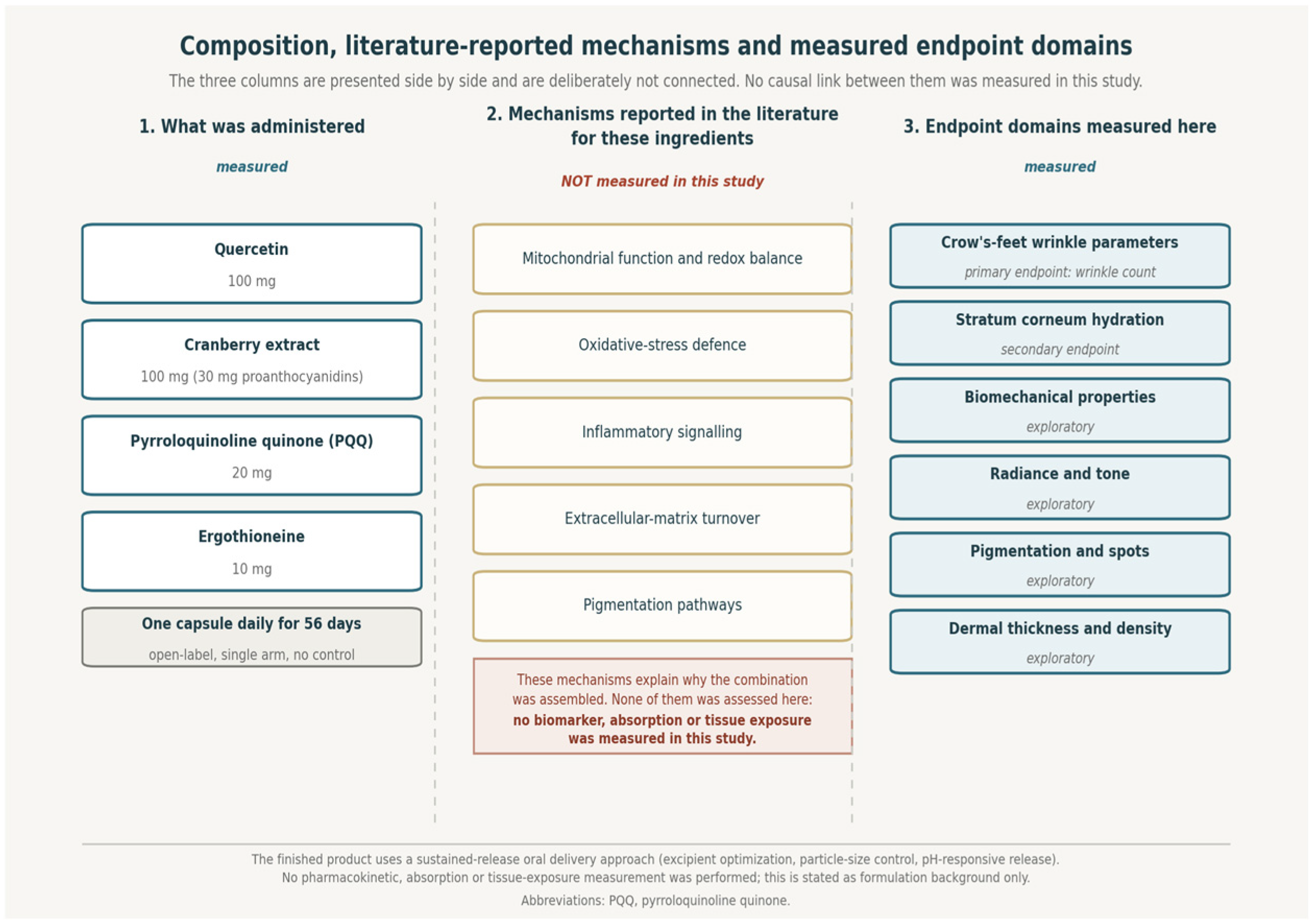
NatureU® Mind Care BeautyU Caps are a multi-ingredient oral supplement. Each capsule contains quercetin 100 mg, cranberry extract 100 mg (equivalent to 20,000 mg cranberry raw material, standardized to 30 mg proanthocyanidins), pyrroloquinoline quinone (PQQ) 20 mg, and ergothioneine 10 mg. The published literature provides a biological rationale only. PQQ has been associated with mitochondrial biogenesis via CREB phosphorylation and PGC-1α expression, with mitochondrial protection under premature senescence, and with suppression of UVB-induced caspase-1 release in keratinocytes, although the same study observed no increase in mitochondrial biogenesis in keratinocytes or fibroblasts [16,17,18,19]. Quercetin has reported antioxidant, anti-inflammatory, photoprotective, and pigment-related activities involving the JAK2, PKCδ, and SIRT1 pathways [20,21,22,23]. Ergothioneine, a sulfur-containing histidine derivative, has been reported to inhibit AP-1 signalling and activate Nrf2-mediated antioxidant genes in UVA-irradiated dermal fibroblasts [24,25,26,27]. Cranberry-derived proanthocyanidins and related polyphenols have been reported to modulate oxidative stress, photoprotection, and pigmentation-related pathways [28,29,30,31].
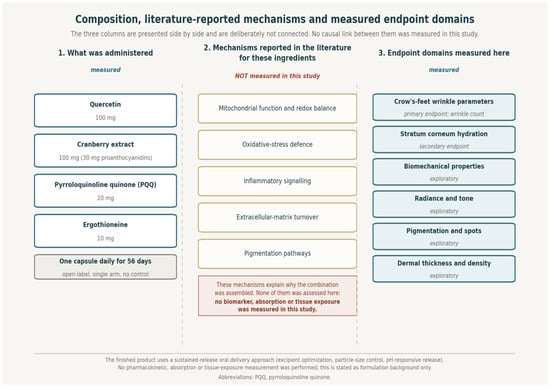
The finished product uses a sustained-release oral delivery approach, referred to by the sponsor as MASTER, based on excipient optimization, particle-size control, and pH-responsive release. Delivery strategies of this type are discussed in the food-grade literature as a means of improving the stability, solubility, and intestinal release of polyphenols [32,33,34,35]. No pharmacokinetic, absorption, or tissue-exposure measurement was performed in the present study. This paragraph is therefore stated as formulation background only; it forms no part of the study hypotheses or endpoints, and no claim about delivery performance is made or tested here. One author is a named inventor on a patent covering this delivery technology, which is held by the sponsor (see Conflicts of Interest). Figure 1 summarizes the composition administered, the mechanisms reported for these ingredients in the published literature, and the endpoint domains measured in this study.
Figure 1.
Composition, literature-reported mechanisms, and measured endpoint domains. The three columns list, respectively, what was administered, mechanisms reported for these ingredients in the published literature, and the endpoint domains measured in this study. The columns are deliberately presented without connecting arrows: no link between an ingredient, a mechanism, and an endpoint was measured or tested here, and none is asserted. Column 2 states why the combination was assembled and is not evidence about this product; no biomarker, absorption, or tissue-exposure measurement was performed. Colour is used only to distinguish what was measured in this study (teal, columns 1 and 3) from what was not measured (gold, column 2); the red panel repeats the caution note and carries no additional information.
Because the clinical performance of a finished multi-ingredient product cannot be inferred from the ingredient literature alone, this 56-day exploratory single-arm study was designed to evaluate within-participant changes in crow’s-feet wrinkle count (primary endpoint), stratum corneum hydration (secondary endpoint), and additional exploratory skin-aging parameters in adult women, and to generate hypotheses for future randomized placebo-controlled studies. Reporting follows the TREND statement for nonrandomized evaluations [36] and the TIDieR checklist for intervention description [37].
2. Materials and Methods
2.1. Study Design
This was a prospective, single-centre, open-label, single-arm exploratory clinical–instrumental study conducted over 56 days, with assessments at baseline (D0), day 28 (D28) and day 56 (D56). The study was conducted by Centre Testing International Pinbiao (Shanghai) Co., Ltd. (Shanghai, China; also operating as CTI AiPu Medical Laboratory (Shanghai) Co., Ltd.), an independent contract testing organization, on behalf of the sponsor, using standardized procedures for participant preparation, environmental control, instrument-based measurement, questionnaire collection, and statistical analysis. Instrumental efficacy testing followed the published Chinese group standards for oral beauty products: T/CIET 411–2024 (moisturizing efficacy) [38], T/CIET 415–2024 (anti-wrinkle efficacy) [39], and T/CIET 406–2024 (whitening efficacy) [40], together with the testing laboratory’s standard operating procedures. Reporting follows the TREND statement [36] and the TIDieR checklist [37].
2.2. Participants
Healthy female volunteers aged 36–56 years were recruited. In total, 56 candidates were screened, 33 were enrolled, and 31 completed the full protocol and were included in the completer analysis set. Two participants withdrew for personal reasons unrelated to tolerability.
Inclusion criteria were healthy women aged 36–56 years; cheek stratum corneum hydration below 60 corneometer units (C.U.); visible crow’s-feet wrinkles; facial laxity or reduced radiance; at least one visible facial spot meeting prespecified size and individual typology angle (ITA°) criteria; willingness to maintain regular daily habits throughout the study; and written informed consent. Participants further undertook, for the duration of the study, not to use any cosmetic, medication, or health supplement capable of influencing the results; not to use any product with efficacy claims comparable to those of the study product; not to use any cosmetic or personal-care product other than the study product; and not to undergo any aesthetic-medicine procedure. These were undertakings given at enrolment rather than variables measured during the study; the distinction is addressed in the Limitations.
Exclusion criteria were skin conditions that could interfere with assessment; highly allergic constitution; pregnancy or lactation; severe systemic illness; serious psychiatric or endocrine disorders; recent participation in other clinical studies; recent use of products or procedures that could influence skin outcomes; and inability to comply with study procedures.
2.3. Test Product and Administration
The investigational product was NatureU® Mind Care BeautyU Caps, a hard-shell capsule oral supplement supplied by the sponsor. Each capsule contained quercetin 100 mg, cranberry extract 100 mg (equivalent to 20,000 mg cranberry raw material, standardized to 30 mg proanthocyanidins), PQQ 20 mg, and ergothioneine 10 mg. Before dispensing, the testing laboratory removed all brand and manufacturer identification from the product packaging, so that participants received the capsules in unlabelled form. This does not constitute blinding in the controlled-trial sense, since there was no comparator and participants knew they were taking an active supplement, but it removes brand identity as a source of expectancy. Participants took one capsule orally once daily for 56 consecutive days. Compliance was verified by product return and weighing. No co-interventions were prescribed; participants were instructed to maintain habitual lifestyle and diet and to avoid initiating new skincare actives or cosmetic procedures.
2.4. Study Procedures and Timepoints
At baseline, eligible participants provided written informed consent and received instructions on daily intake and diary completion. At each visit, participants cleansed and dried the face and rested for 30 min in a controlled environment (21 ± 1 °C; relative humidity 50 ± 10%) before measurement. Measurements were taken at the same anatomical sites at each timepoint. A structured self-assessment questionnaire was completed at D28 and D56.
2.5. Instrumental Procedures
The assessment battery comprised the following instruments:
- PRIMOS CR (Canfield Scientific, Parsippany, NJ, USA; analysis software Primos 5.8 E): crow’s-feet wrinkle count, length, volume, depth, area, and area ratio, by three-dimensional fringe-projection profilometry. The segmentation threshold used to distinguish a wrinkle from background skin microrelief, the definition and area of the region of interest, and whether images from the three timepoints were spatially registered before analysis were requested from the contract testing organization but were not provided; these parameters are therefore not available for reporting. The implications are addressed in Section 4.
- Corneometer CM 825 (Courage + Khazaka electronic GmbH, Cologne, Germany): cheek stratum corneum hydration, expressed in corneometer units (C.U.); higher values indicate greater water content.
- Cutometer MPA580 (Courage + Khazaka): gross elasticity R2, together with the derived ratio F3/F4 and the parameter F4 as implemented by the contract testing laboratory. R2 is a standard Cutometer output for which higher values indicate greater gross elasticity. F3/F4 and F4 are laboratory-specific derived parameters rather than standard Cutometer outputs; both were recorded as exploratory only and are interpreted with caution.
- Glossymeter (Courage + Khazaka) and VISIA CR (Canfield Scientific): gloss and radiance.
- Colorimeter CL400 (Courage + Khazaka) and VISIA CR: individual typology angle (ITA°).
- Mexameter MX18 (Courage + Khazaka): melanin index.
- VISIA CR: spot area ratio, spot optical density, pore score, and pore feature count.
- DermaScan (Cortex Technology, Hadsund, Denmark): dermal thickness and density by high-frequency ultrasound.
2.6. Self-Assessment Questionnaire
A structured questionnaire was completed at D28 and D56. Items 1–19 used a five-point recognition scale covering hydration, elasticity, firmness, smoothness, gloss, wrinkles, pigmentation, and overall product experience; item 20 captured self-reported adverse reactions; and items 21–25 assessed perceived onset of benefit. Agreement rates were calculated as the proportion of responses scored 4 or 5.
2.7. Endpoints
The prespecified primary endpoint was the within-participant change from baseline at D56 in PRIMOS CR crow’s-feet wrinkle count. The prespecified secondary endpoint was the within-participant change from baseline at D56 in corneometer-measured stratum corneum hydration. All remaining instrumental parameters, together with participant-reported recognition rates, perceived onset, and self-reported tolerability, were exploratory. D28 measurements were treated as supportive interim observations rather than confirmatory timepoints.
2.8. Statistical Analysis
The prespecified analysis set was a completer analysis of participants who completed both D0 and D56 assessments (n = 31). No imputation was performed for missing data, and the two early withdrawals were not imputed. No formal power calculation was performed because the study was an exploratory, signal-generating evaluation rather than a confirmatory comparison.
Continuous variables are summarized as mean ± standard deviation. Within-participant changes from baseline at D28 and D56 were assessed by paired Student’s t-test when normality (Shapiro–Wilk test) was supported, and by the Wilcoxon signed-rank test otherwise. Change rate (%) was computed as ((post-intervention value − baseline value)/baseline value) × 100. p-values are reported as nominal values; no adjustment for multiple comparisons was applied, given the exploratory nature of the study. Inference is confined to the primary endpoint; secondary and exploratory endpoints are reported descriptively and interpreted as hypothesis-generating, in line with TREND reporting principles [36]. Participant-reported recognition rates were assessed against a prespecified benchmark of 60% agreement using a two-sided exact binomial test with n = 31, as specified in the contract testing protocol. During revision, we found that the D28 p-values given in the original testing report were not reproducible under that specification: five items sharing an identical numerator of 27 of 31 (87.10%) were reported with five different p-values (0.006, 0.016, 0.037, 0.076, and 0.350), which no single test can produce, and the ranking of p-values was inverted relative to the recognition rates. We have therefore recomputed all questionnaire p-values ourselves under the specification above; the recomputed values are those reported in Supplementary Table S4 and differ from the original testing report at D28. The D56 values are unchanged in substance. This issue has been reported to the contract testing organization. Statistical analyses in the original testing report were performed by the contract testing organization using SPSS (IBM Corp., Armonk, NY, USA); the software version was not stated in the report and was requested from the contract testing organization but not provided. The recomputed questionnaire p-values and the individual-participant analyses reported in Section 3 were computed by the authors in Python 3.10 (Python Software Foundation, Wilmington, DE, USA) using SciPy 1.15.3 and NumPy 2.2.6.
3. Results
3.1. Participant Disposition, Tolerability, and Compliance
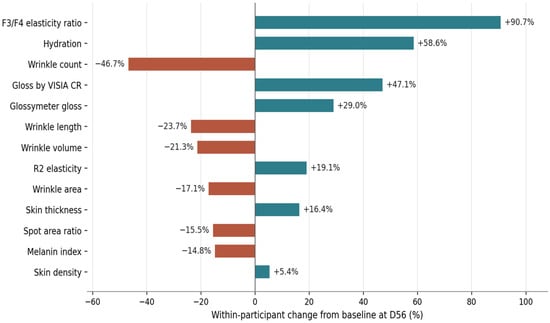
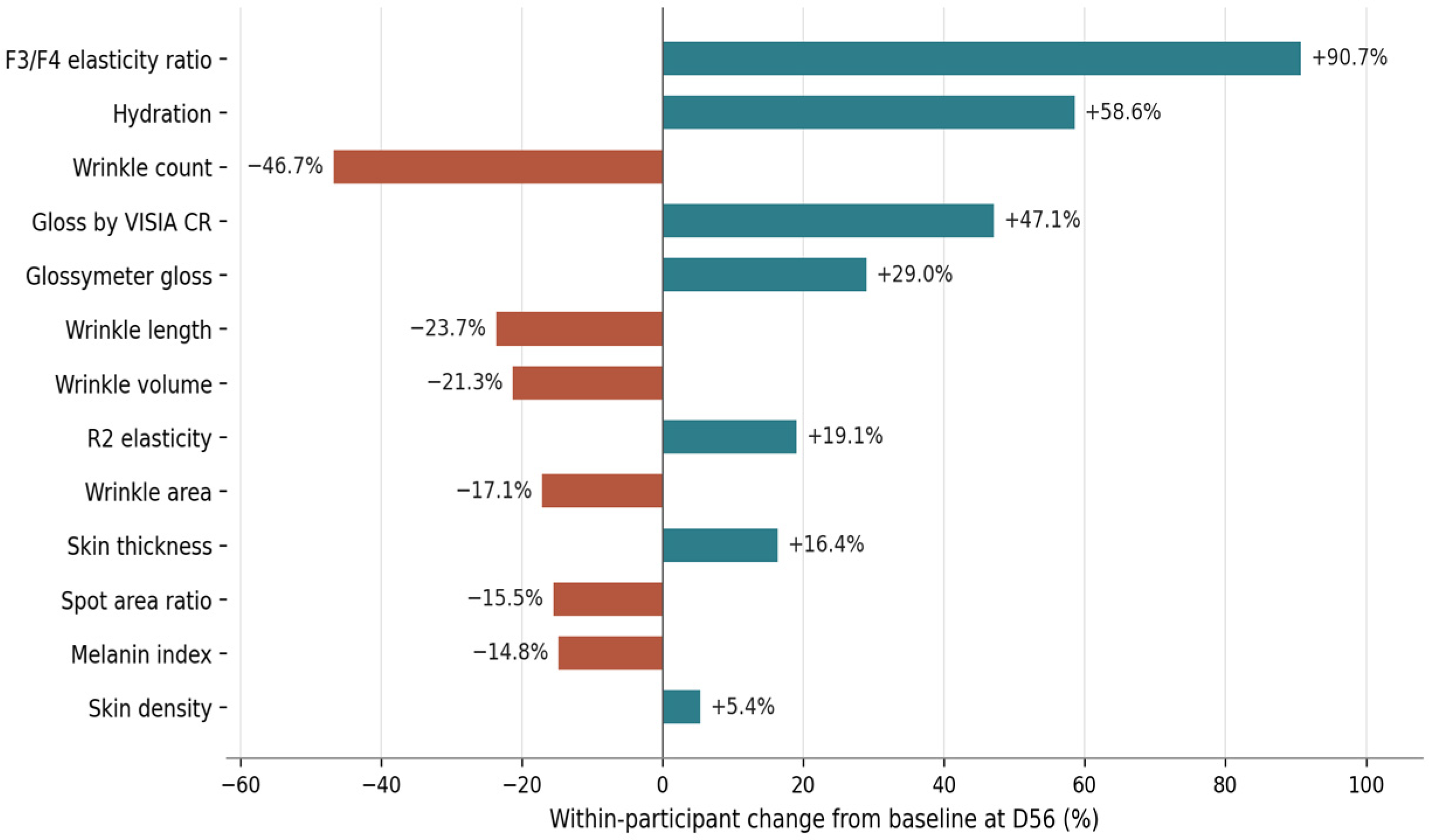
Of 33 enrolled participants, 31 (93.9%) completed the protocol and were included in the completer analysis set. Two participants withdrew, both for reasons unrelated to the study product: participant 021 was lost to follow-up at the D56 visit after contracting influenza A, and participant 030 withdrew on day 4 because of illness. The contract testing organization reports that neither participant has evaluable data, so a full-analysis-set analysis of all 33 enrolled participants is not possible. As a bounding analysis, we therefore assumed zero change for both withdrawals at the observed baseline mean and recomputed the two prespecified endpoints over n = 33: the reduction in wrinkle count moved from −46.73% to −43.89% and the increase in hydration from +58.57% to +55.02%, both remaining significant (Wilcoxon p = 1.2 × 10⁻⁶ for each), and the change in wrinkle depth remained non-significant. The conclusions are therefore not altered by the two withdrawals. No adverse reactions were reported by any of the 31 evaluable participants during the 56-day intervention. Detailed disposition is provided in Supplementary Table S1, and tolerability findings in Supplementary Table S6. An overview of the within-participant percentage changes at D56 across all instrumental outcomes is given in Figure 2; each endpoint is reported in turn in the sections that follow.
Figure 2.
Within-participant percentage changes in key instrumental skin outcomes at day 56. Positive bars represent increases in hydration, biomechanical, gloss, or dermal-structure measures; negative bars represent reductions in pigment-, spot- or wrinkle-burden measures. Provided as a visual overview only; full numerical values are given in Supplementary Tables S2 and S3.
3.2. Primary Endpoint: Crow’s-Feet Wrinkle Count
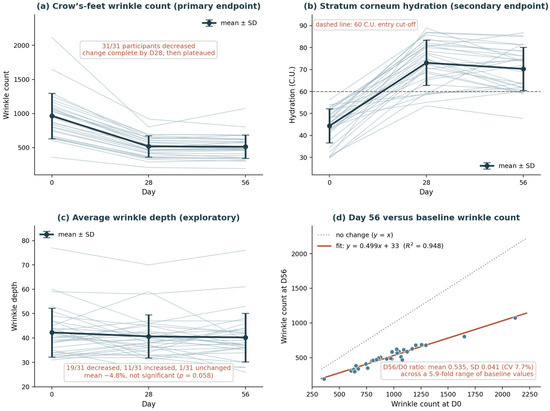
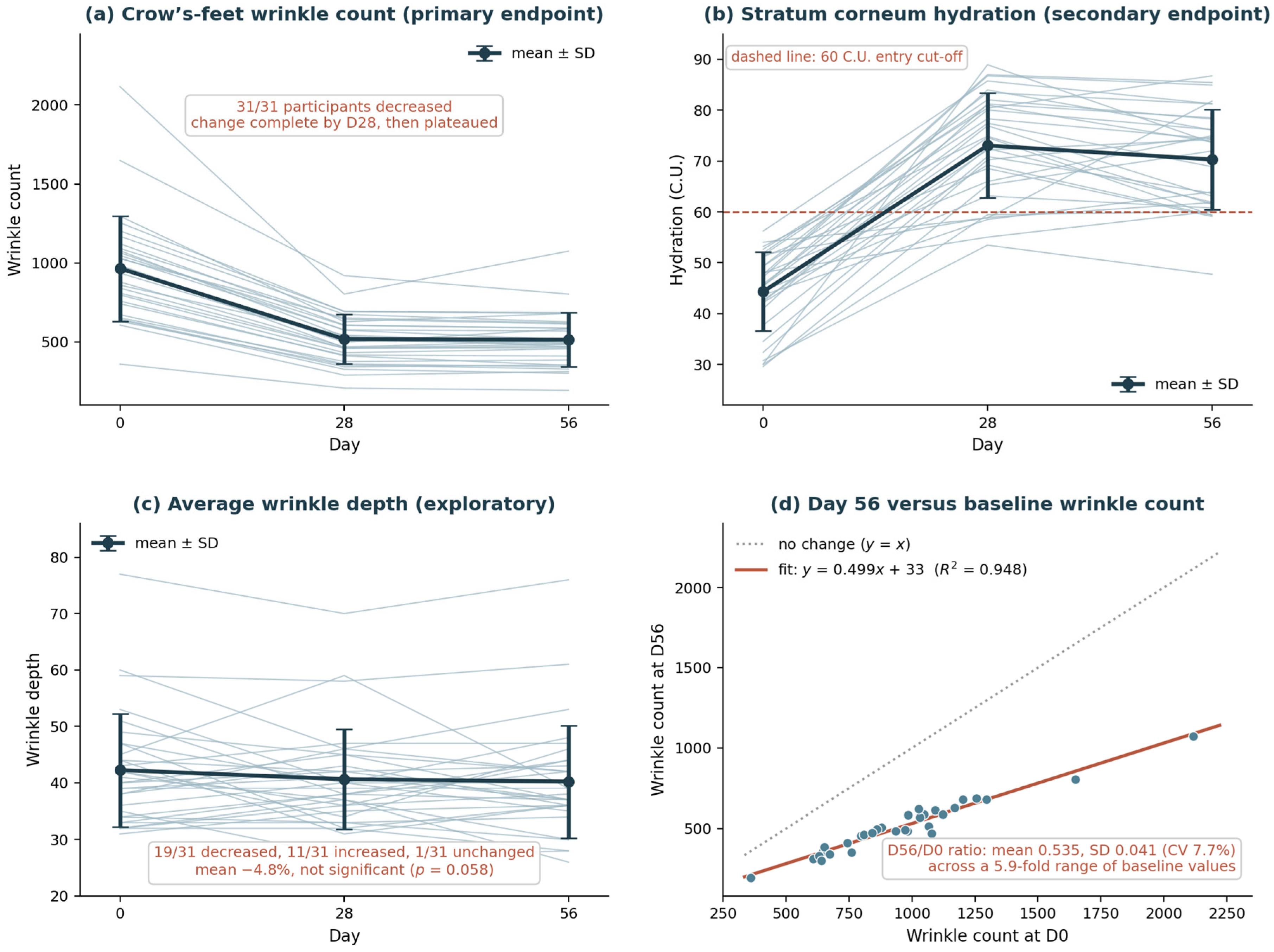
PRIMOS CR crow’s-feet wrinkle count decreased from 965.3 ± 333.7 at D0 to 518.2 ± 155.6 at D28 and 514.2 ± 171.0 at D56, corresponding to within-participant changes of −46.32% at D28 and −46.73% at D56. Differences from baseline were not normally distributed (Shapiro–Wilk p = 0.002), so significance is reported from the Wilcoxon signed-rank test (p = 1.2 × 10⁻⁶). Individual trajectories are shown in Figure 3a. Three features of the individual-level data require reporting. First, the count decreased in all 31 participants, without exception. Second, the decrease was almost exactly proportional across the cohort: the ratio of D56 to D0 count had a mean of 0.535 with a standard deviation of 0.041, a coefficient of variation of 7.7%, across baseline values spanning a 5.9-fold range (360 to 2116), and this ratio was not correlated with the baseline value (r = −0.15, p = 0.42). Linear regression of D56 on D0 gave D56 = 0.499 × D0 + 33 with R2 = 0.948 (Figure 3d). Third, the change was complete by D28 and did not progress thereafter: the ratio of D56 to D28 count was 0.990 ± 0.096, and the count increased slightly between D28 and D56 in 11 of 31 participants. For comparison, the coefficient of variation in the corresponding D56/D0 ratio was 20.3% for hydration and 16.3% for wrinkle depth, so the primary endpoint showed less between-participant dispersion than either. Detailed wrinkle parameters are provided in Supplementary Table S3.
Figure 3.
Individual-participant trajectories over 56 days in the 31 completers. (a) Crow’s-feet wrinkle count, the prespecified primary endpoint. (b) Stratum corneum hydration, the prespecified secondary endpoint; the dashed line marks the 60 C.U. entry criterion. (c) Average wrinkle depth. (d) Day 56 versus baseline wrinkle count, with the line of identity and the fitted regression. Faint lines and points are individual participants; the heavy line shows mean ± standard deviation. Panels (a,d) show that the count fell in every participant by a near-constant proportion irrespective of baseline value, and panel (a) that the change was complete by day 28; this pattern is discussed in Section 4.
3.3. Secondary Endpoint: Stratum Corneum Hydration
Stratum corneum hydration increased from 44.3 ± 7.8 C.U. at D0 to 73.1 ± 10.3 C.U. at D28 and 70.3 ± 9.9 C.U. at D56, corresponding to within-participant changes of +64.77% at D28 and +58.57% at D56 (paired t-test p = 4.6 × 10⁻¹⁵; Wilcoxon p = 1.2 × 10⁻⁶; differences normally distributed, Shapiro–Wilk p = 0.61). Hydration increased in all 31 participants, but with substantially greater between-participant dispersion than the primary endpoint (D56/D0 ratio 1.626 ± 0.330). Individual trajectories are shown in Figure 3b. Of 31 participants, 4 remained below the 60 C.U. entry threshold at D56. Detailed values are provided in Supplementary Table S2.
3.4. Exploratory Endpoints
Across exploratory endpoints, within-participant changes at D56 were directionally consistent with the primary signal:
- Other PRIMOS wrinkle parameters showed reductions in length (−23.68%), volume (−21.29%), area (−17.13%), and area ratio (−17.06%) at D56 (nominal p = 0.001 for each). Wrinkle depth showed only a non-significant numerical decrease, from 42.26 ± 10.02 to 40.23 ± 9.93 (−4.81%; paired t-test p = 0.074, Wilcoxon p = 0.058). At the individual level, depth decreased in 19 of 31 participants, increased in 11 and was unchanged in one; individual trajectories are shown in Figure 3c. The individual change in wrinkle count was only weakly related to the individual change in wrinkle depth (r = +0.30, p = 0.096) and was not related to the individual change in hydration (r = +0.23, p = 0.21).
- Biomechanical properties: Cutometer R2 increased by 19.05% and the F3/F4 ratio by 90.72% at D56 (nominal p = 0.001 each). The laboratory-specific firmness parameter F4 increased from 0.699 ± 0.451 to 1.792 ± 0.672 (+156.37%), the largest percentage change in the dataset; as set out in Section 4, this reflects the small magnitude of its baseline value rather than the largest biological effect observed.
- Radiance and tone: Glossymeter gloss increased by 28.96%, VISIA CR gloss by 47.10%, colorimeter ITA° by 16.13%, and VISIA CR ITA° by 9.09% at D56 (nominal p = 0.001 each).
- Pigmentation and spots: Mexameter melanin index decreased by 14.79%, VISIA CR spot area ratio by 15.52%, and VISIA CR spot optical density by 4.60% at D56 (nominal p = 0.001 each).
- Pores: VISIA CR pore feature count decreased by 9.31% at D56 (nominal p = 0.003).
- Dermal structure: DermaScan thickness increased by 16.36% and density by 5.36% at D56 (nominal p = 0.001 each).
- Participant-reported outcomes: At D56, recognition rates for items 1–19 reached 100% for most items (Supplementary Table S4), with most participants reporting perceived onset between 8 and 28 days (Supplementary Table S5). The full wording of all 25 questionnaire items is provided in Supplementary Table S7. The p-values shown in Supplementary Table S4 were recomputed by the authors during revision because the D28 values in the original testing report were not reproducible under the stated test specification; the reason and the recomputation are described in Section 2.8. Under the recomputed values, all items except item 9 at D28 (77.42%, p = 0.065) exceeded the prespecified 60% benchmark at both timepoints. Participant-reported outcomes remain de-emphasized throughout because self-assessment in an unblinded study is particularly susceptible to expectancy.
Exploratory endpoint values are described without adjustment for multiple comparisons and are reported as supportive observations rather than as evidence of efficacy on individual measures.
4. Discussion
This 56-day exploratory single-arm open-label study was designed to generate signals about within-participant changes in skin-aging parameters during daily intake of an oral multi-ingredient supplement, not to demonstrate efficacy. The prespecified primary endpoint (crow’s-feet wrinkle count) and secondary endpoint (stratum corneum hydration) were each associated with within-participant changes at D56 in directions consistent with the formulation rationale, and exploratory endpoints across biomechanical, radiance, pigmentation, dermal-structure, and participant-reported domains moved in broadly congruent directions.
The hydration response is directionally consistent with prior trials and meta-analytic evidence on selected dietary supplements [9,10,11,13], although the present design cannot separate hydration changes from seasonal, behavioural, or expectancy-related influences. Wrinkle outcomes were favourable for count, length, volume, area, and area ratio, whereas wrinkle depth showed only a non-significant trend; uniform improvement across all wrinkle dimensions should therefore not be claimed.
The choice of wrinkle count as the prespecified primary endpoint requires direct comment, because it is the most consequential methodological decision in this study. Count and depth are not interchangeable quantities. A count-based parameter enumerates discrete features that exceed a segmentation threshold and therefore responds to any change that moves shallow features across that threshold, including changes in surface hydration and light scattering; a depth-based parameter instead quantifies the vertical dimension of features that are already resolved. The two need not move together, and in this dataset they did not: count fell by 46.74% (nominal p = 0.001), while depth fell by 4.80% and did not reach significance (nominal p = 0.058). We interpret this dissociation as indicating that the observed change is most consistent with an alteration in the visibility of fine surface texture rather than with structural remodelling of established wrinkles. A depth- or volume-based parameter would have been the more conservative choice, and we would select one in a confirmatory trial. The primary endpoint was, however, fixed before analysis, and it is reported here as prespecified; the discrepancy is presented as a limitation of the endpoint rather than resolved after the fact by substituting a different primary measure.
Access to the individual-participant data, obtained during revision, raises a further question about the primary endpoint that we consider more important than its choice. The reduction in wrinkle count has three features that are difficult to reconcile with a biological effect. It occurred in every participant without exception. It was almost exactly proportional across a 5.9-fold range of baseline values, with a coefficient of variation in the D56/D0 ratio of 7.7%, which is lower than that of any other endpoint measured here, including hydration at 20.3% and wrinkle depth at 16.3%; the ratio was uncorrelated with baseline severity. In addition, it was complete at the first follow-up visit and did not progress between D28 and D56, increasing slightly in 11 of 31 participants over that interval. A biological response to an oral supplement would not ordinarily produce a near-constant proportional change that is independent of baseline burden, complete within four weeks with no subsequent progression, and uncorrelated with the concurrent change in either wrinkle depth or hydration. This pattern is at least as consistent with a systematic difference between the baseline imaging session and the two follow-up sessions, such as a difference in segmentation threshold, region-of-interest placement, image registration, or operator as it is with a treatment effect. We requested these acquisition and analysis parameters from the contract testing organization; the device and software version were supplied, but the analysis parameters were not, and we are therefore unable to exclude a methodological explanation. Accordingly, we do not claim that the reduction in crow’s-feet wrinkle count observed here represents a biological anti-wrinkle effect, and we recommend that the primary endpoint of this study be treated as uninterpretable until the analysis parameters are documented. The hydration result does not share these features: it varied substantially between participants, four participants remained below the entry threshold at D56, and the magnitude cannot be accounted for by the selection criterion alone, as set out below.
The magnitude of the observed changes warrants explicit and cautious comment, because several exceed what is typically reported in placebo-controlled trials of oral supplements over comparable periods, and should not be read as a direct estimate of product-attributable effect. At least four features of the present design are expected to inflate apparent within-participant change. First, eligibility required baseline cheek hydration below 60 C.U., so the cohort was selected at the low end of the hydration distribution; regression to the mean alone will therefore produce an apparent increase at follow-up independently of any intervention. Second, corneometry is sensitive to ambient temperature, humidity, and recent cleansing and skincare behaviour; although measurements were acclimatized and environmentally controlled, seasonal drift across a 56-day window cannot be excluded in an uncontrolled design. Third, the primary endpoint is a count-based profilometry parameter, which depends on the segmentation threshold used to distinguish a wrinkle from background microrelief, and is intrinsically more volatile than depth-based parameters; the divergence between a large reduction in wrinkle count and a non-significant change in wrinkle depth is consistent with this interpretation and argues against inferring uniform structural remodelling of the dermis. Fourth, in an open-label study without a control arm, participation itself may alter sun-exposure, cleansing, and moisturizing behaviour, and expectancy may influence both participant-reported outcomes and, indirectly, skin condition. For these reasons, the effect sizes reported here should be regarded as upper-bound within-participant observations under exploratory conditions, and a randomized, placebo-controlled design is required before any product-attributable magnitude can be estimated.
For the hydration endpoint, the contribution of regression to the mean can now be bounded rather than merely acknowledged. Eligibility required baseline cheek hydration below 60 C.U., and the cohort baseline mean was 44.33 C.U.; the observed rise to D56 was 25.96 C.U. The expected regression component is (1 − r) × (μ − 44.33), where r is the test–retest reliability of the measurement and μ the mean of the unselected source population. Under a conservative reliability of 0.80 and a source-population mean of 55 C.U., regression to the mean would account for 2.13 C.U., or 8.2% of the observed rise; under the most permissive assumptions we can construct, a reliability of 0.70 together with a source-population mean equal to the observed follow-up value of 70.3 C.U., it would account for 7.79 C.U., or 30.0%. More directly, for regression to the mean alone to account for the entire rise, the mean cheek hydration of the unselected population would have to be at least 70.3 C.U., which would make an entry criterion of below 60 C.U. meaningless as a selection filter. Regression to the mean is therefore a real but partial contributor to the hydration result and cannot plausibly explain it in full. This does not establish a treatment effect, since seasonal drift, behavioural change, and expectancy remain uncontrolled in a single-arm design.
One exploratory value merits specific comment because its magnitude is conspicuous. The laboratory-specific firmness parameter F4 increased by 156.37% at D56, more than any other measure reported here. This reflects the arithmetic of the parameter rather than the size of the underlying change. F4 had a baseline mean of 0.699 with a standard deviation of 0.451, a coefficient of variation of approximately 65%, and the highest relative dispersion in the dataset, and the absolute change was 1.09 units. When a derived parameter has a small mean lying close to the lower bound of its range, a modest absolute shift yields a large percentage. F4 therefore carries no more interpretive weight than measures with smaller percentage changes, and percentage change is not a suitable basis for ranking effects across parameters measured on different scales.
A biological rationale for the observed pattern, framed as hypothesis only, is that PQQ, quercetin, ergothioneine, and cranberry-derived proanthocyanidins target partially complementary pathways relevant to oxidative stress, mitochondrial function, inflammatory signalling, photoaging, and pigmentation [4,16,17,20,24,29,41]. Because absorption, pharmacokinetics, tissue exposure, OCTN1-mediated transport [42,43], and biomarker changes were not measured here, mechanistic statements remain biological rationale rather than demonstrated clinical mechanism.
A single fixed combination was administered without factorial, dose-ranging, or single-ingredient arms. The design therefore cannot attribute any observed change to quercetin, cranberry-derived proanthocyanidins, PQQ, or ergothioneine individually, nor can it establish whether the components act additively, synergistically, or not at all in combination. The ingredient literature cited in this paper serves only to explain why the combination was assembled; it provides no evidence about the contribution of any single component to the outcomes reported here. Component-dropout and dose-ranging designs would be required before any attribution could be made.
Beyond the interpretation of effect size, several further limitations apply. The study was open-label and single-arm without a placebo control, so causal inference is not possible. The sample size was modest, and the analysis was restricted to 31 completers without imputation. No mechanistic biomarkers of oxidative stress, inflammation, extracellular-matrix turnover, or ingredient exposure were measured. Exploratory endpoints were not adjusted for multiple comparisons, so interpretation should be at the level of overall pattern rather than individual endpoints. The cohort was recruited at a single centre within a narrow age window and a single ethnicity-relevant subset, limiting generalizability. The study was registered at ClinicalTrials.gov only after data collection had been completed; retrospective registration means that the endpoints and analysis plan reported here cannot be independently verified against a public record predating the study, and the primary and secondary endpoints should be read as prespecified in the contract testing protocol rather than as publicly preregistered. Several items of methodological information were requested from the contract testing organization during revision and were not provided: the PRIMOS segmentation threshold, region-of-interest definition and image-registration procedure; baseline participant characteristics beyond age, including skin phototype, body mass index, smoking status, sun-exposure habits, and baseline skincare use; the composition and constitution of the ethics review committee; which behavioural variables were actively recorded as opposed to being covered by participant undertakings; and the custody of and access to the raw data, the authorship of the statistical analysis plan, and whether an independent statistician reviewed the final analysis. We report these gaps rather than infer answers to them, and they should be weighed when interpreting this study. Participant-reported recognition is reported but deliberately de-emphasized because self-assessment in an unblinded study is particularly susceptible to expectancy. A randomized, double-blind, placebo-controlled trial with a prespecified primary endpoint, larger sample size, baseline stratification, longer follow-up, and mechanistic biomarkers is required to confirm the present exploratory signals.
5. Conclusions
In this 56-day open-label, single-arm exploratory study in adult women, daily intake of NatureU® Mind Care BeautyU Caps was associated with a within-participant increase in stratum corneum hydration and with directionally congruent changes across several exploratory skin-aging endpoints, with no reported adverse reactions. A reduction in crow’s-feet wrinkle count was also recorded, but its uniformity across participants, its independence of baseline severity, its completion at the first follow-up visit, and the absence of the analysis parameters needed to reproduce it mean that we do not interpret it as evidence of a biological anti-wrinkle effect. Because the study was uncontrolled and open-label, and because the observed magnitudes are susceptible to regression to the mean and expectancy effects, these findings should be regarded as hypothesis-generating and require confirmation in randomized, placebo-controlled trials.
Supplementary Materials
The following supporting information can be downloaded at: https://www.mdpi.com/article/10.3390/cosmetics13050253/s1, Table S1: Study design, endpoint hierarchy, and participant disposition; Table S2: Non-wrinkle instrumental outcomes; Table S3: PRIMOS CR wrinkle-related outcomes; Table S4: Participant-reported questionnaire recognition rates; Table S5: Participant-reported perceived onset of benefit at D56; Table S6: Tolerability and adverse reactions; Table S7: Full wording of the participant self-assessment questionnaire; Figure S1: Crow’s-feet wrinkle grading reference used in the clinical testing report. The reference scale provides contextual visual support for the wrinkle-related assessment framework; Figure S2: Representative DermaScan ultrasound imaging outputs at baseline (D0), day 28 (D28), and day 56 (D56). These panels provide visual documentation supporting the exploratory dermal thickness and density measurements reported in Supplementary Table S2; Figure S3: Representative PRIMOS CR crow’s-feet imaging and wrinkle-mapping outputs at baseline (D0), day 28 (D28), and day 56 (D56). These panels provide visual documentation supporting the primary endpoint and related wrinkle parameters reported in Supplementary Table S3.
Author Contributions
Conceptualization, L.L. (Lorry Luo) and L.L. (Luke Law); methodology, L.L. (Lorry Luo); validation, L.L. (Luke Law); formal analysis, L.L. (Luke Law); investigation, L.L. (Lorry Luo); data curation, L.L. (Luke Law); writing—original draft preparation, L.L. (Lorry Luo); writing—review and editing, L.L. (Luke Law); supervision, L.L. (Luke Law); project administration, L.L. (Lorry Luo). All authors have read and agreed to the published version of the manuscript.
Funding
This study was funded by OmniSolutions Laboratory Holdings Limited (Hong Kong SAR, China), which supplied the investigational product and commissioned the independent contract testing. The study was funded from the company’s internal research budget; no external grant was received and no grant number was assigned.
Institutional Review Board Statement
The study was conducted in accordance with the Declaration of Helsinki. The study protocol, participant information sheet, and informed consent form were reviewed and approved by the Shanghai CTI Clinical Medicine Department on 3 January 2025 (approval number A225000034310100101C). We state explicitly that this review body is the internal ethics committee of Centre Testing International Pinbiao (Shanghai) Co., Ltd., the contract testing organization that conducted the study under commission from, and for payment by, the sponsor. It is not an ethics committee independent of the organization that performed and invoiced the work. Under the Chinese Measures for Ethical Review of Life Science and Medical Research Involving Human Subjects, institutions conducting such research establish their own ethics review committees, so an institutional committee of this kind is the expected arrangement rather than an irregular one; we nevertheless consider that readers should be told plainly that approval and conduct sat within the same organization, and that we were unable to obtain the committee’s composition or confirmation that personnel involved in conducting the study were recused from the review (see Limitations). The study was registered at ClinicalTrials.gov on 30 April 2026 (identifier NCT07571629). Registration therefore took place after the completion of data collection and is retrospective, not prospective.
Informed Consent Statement
Written informed consent was obtained from all participants involved in this study. The study protocol, the participant information sheet, and the informed consent form were reviewed and approved by the Shanghai CTI Clinical Medicine Department on 3 January 2025 (approval reference A225000034310100101C). The informed consent form was distributed to every participant and signed by each participant before any study-related procedure was performed. Participants were informed of the purpose of the study, the identity of the product and the dosing regimen, the non-invasive nature of all assessments and the visit schedule, the foreseeable risks and the appearance-related (non-therapeutic) nature of any anticipated benefit, their right to withdraw at any time without giving a reason and without penalty, and the confidentiality and anonymization measures applied to their personal data. Written informed consent was also obtained from the participants for the publication of anonymized study data. The signed consent forms are retained by the contract testing organization in accordance with its record-retention policy.
Data Availability Statement
The summary data supporting the findings of this study are contained within the article and Supplementary Materials. The clinical testing report and additional de-identified study documentation are available from the corresponding author on reasonable request, subject to confidentiality, participant privacy, and applicable regulatory requirements.
Acknowledgments
The authors thank the study participants. The clinical testing, instrumental measurements, and statistical analysis were performed by Centre Testing International Pinbiao (Shanghai) Co., Ltd., an independent contract testing organization; the authors thank Naining Zhang and colleagues at Centre Testing International Pinbiao (Shanghai) Co., Ltd. for conducting the study procedures and instrumental assessments. These contributors were given the opportunity to review the context in which their contribution is acknowledged. During the preparation of this manuscript, the authors used Claude Opus 5 (Anthropic, San Francisco, CA, USA) to assist with reference formatting and verification against source records, language editing, and drafting of a plain-language summary of the study; Perplexity AI was used to assist with literature searching during preparation of an earlier draft. No generative AI tool was used to generate, analyse, alter, or interpret any study data, images, or results. The authors reviewed and edited all AI-assisted output and take full responsibility for the content and integrity of this publication. NatureU® is a trademark of OmniSolutions Laboratory Holdings Limited.
Conflicts of Interest
L.L. (Lorry Luo) and L.L. (Luke Law) are employees of OmniSolutions Laboratory Holdings Limited, which supplied the investigational product and funded the study; both authors also hold an equity interest in, and serve as directors of, that company. L.L. (Lorry Luo) is a named inventor on Chinese patent CN117679384B (application CN202311819501.8, published as CN117679384A), which is held by the sponsor and covers the multistage sustained- and controlled-release oral delivery technology corresponding to the MASTER delivery concept described in Section 1; the patent claims none of the four active ingredients evaluated in this study and contains no claim relating to skin outcomes. L.L. (Luke Law) is not a named inventor. The clinical testing was performed by Centre Testing International Pinbiao (Shanghai) Co., Ltd., an independent contract testing organization commissioned and paid by the sponsor. The sponsor participated in study conception and in the decision to submit the manuscript for publication; instrumental measurement and statistical analysis were performed independently by the contract testing organization. The authors declare no other conflicts of interest.
Abbreviations
The following abbreviations are used in this manuscript: C.U., corneometer units; D0, day 0 (baseline); D28, day 28; D56, day 56; ITA°, individual typology angle; PQQ, pyrroloquinoline quinone; SD, standard deviation; TEWL, transepidermal water loss; TIDieR, Template for Intervention Description and Replication; TREND, Transparent Reporting of Evaluations with Nonrandomized Designs.
References
- Russell-Goldman, E.; Murphy, G.F. The Pathobiology of Skin Aging: New Insights into an Old Dilemma. Am. J. Pathol. 2020, 190, 1356–1369. [Google Scholar] [PubMed]
- Papaccio, F.; D’Arino, A.; Caputo, S.; Bellei, B. Focus on the Contribution of Oxidative Stress in Skin Aging. Antioxidants 2022, 11, 1121. [Google Scholar] [CrossRef] [Scilit] [PubMed]
- Shin, S.H.; Lee, Y.H.; Rho, N.-K.; Park, K.Y. Skin Aging from Mechanisms to Interventions: Focusing on Dermal Aging. Front. Physiol. 2023, 14, 1195272. [Google Scholar] [CrossRef] [Scilit] [PubMed]
- Liu, H.-M.; Cheng, M.-Y.; Xun, M.-H.; Zhao, Z.-W.; Zhang, Y.; Tang, W.; Cheng, J.; Ni, J.; Wang, W. Possible Mechanisms of Oxidative Stress-Induced Skin Cellular Senescence, Inflammation, and Cancer and the Therapeutic Potential of Plant Polyphenols. Int. J. Mol. Sci. 2023, 24, 3755. [Google Scholar] [CrossRef] [Scilit] [PubMed]
- Agrawal, R.; Hu, A.; Bollag, W.B. The Skin and Inflamm-Aging. Biology 2023, 12, 1396. [Google Scholar] [CrossRef] [Scilit] [PubMed]
- Rinnerthaler, M.; Bischof, J.; Streubel, M.K.; Trost, A.; Richter, K. Oxidative Stress in Aging Human Skin. Biomolecules 2015, 5, 545–589. [Google Scholar] [CrossRef] [Scilit] [PubMed]
- Shin, J.-W.; Kwon, S.-H.; Choi, J.-Y.; Na, J.-I.; Huh, C.-H.; Choi, H.-R.; Park, K.-C. Molecular Mechanisms of Dermal Aging and Antiaging Approaches. Int. J. Mol. Sci. 2019, 20, 2126. [Google Scholar] [CrossRef] [Scilit] [PubMed]
- Qian, H.; Shan, Y.; Gong, R.; Lin, D.; Zhang, M.; Wang, C.; Wang, L. Mechanism of Action and Therapeutic Effects of Oxidative Stress and Stem Cell-Based Materials in Skin Aging: Current Evidence and Future Perspectives. Front. Bioeng. Biotechnol. 2023, 10, 1082403. [Google Scholar] [CrossRef] [Scilit] [PubMed]
- Sun, Q.; Wu, J.; Qian, G.; Cheng, H. Effectiveness of Dietary Supplement for Skin Moisturizing in Healthy Adults: A Systematic Review and Meta-Analysis of Randomized Controlled Trials. Front. Nutr. 2022, 9, 895192. [Google Scholar] [CrossRef] [Scilit] [PubMed]
- Bolke, L.; Schlippe, G.; Gerß, J.; Voss, W. A Collagen Supplement Improves Skin Hydration, Elasticity, Roughness, and Density: Results of a Randomized, Placebo-Controlled, Blind Study. Nutrients 2019, 11, 2494. [Google Scholar] [CrossRef] [Scilit] [PubMed]
- Göllner, I.; Voss, W.; von Hehn, U.; Kammerer, S. Ingestion of an Oral Hyaluronan Solution Improves Skin Hydration, Wrinkle Reduction, Elasticity, and Skin Roughness: Results of a Clinical Study. J. Evid. Based Complement. Altern. Med. 2017, 22, 816–823. [Google Scholar] [CrossRef] [Scilit] [PubMed]
- Kim, J.; Lee, S.G.; Lee, J.; Choi, S.; Suk, J.; Lee, J.H.; Yang, J.H.; Yang, J.S.; Kim, J. Oral Supplementation of Low-Molecular-Weight Collagen Peptides Reduces Skin Wrinkles and Improves Biophysical Properties of Skin: A Randomized, Double-Blinded, Placebo-Controlled Study. J. Med. Food 2022, 25, 1146–1154. [Google Scholar] [CrossRef] [Scilit] [PubMed]
- Hsu, T.-F.; Su, Z.-R.; Hsieh, Y.-H.; Wang, M.-F.; Oe, M.; Matsuoka, R.; Masuda, Y. Oral Hyaluronan Relieves Wrinkles and Improves Dry Skin: A 12-Week Double-Blinded, Placebo-Controlled Study. Nutrients 2021, 13, 2220. [Google Scholar] [CrossRef] [Scilit] [PubMed]
- Reilly, D.M.; Kynaston, L.; Naseem, S.; Proudman, E.; Laceby, D. A Clinical Trial Shows Improvement in Skin Collagen, Hydration, Elasticity, Wrinkles, Scalp, and Hair Condition Following 12-Week Oral Intake of a Supplement Containing Hydrolysed Collagen. Dermatol. Res. Pract. 2024, 2024, 8752787. [Google Scholar] [CrossRef] [Scilit] [PubMed]
- Draelos, Z.D. An Oral Supplement and the Nutrition-Skin Connection. J. Clin. Aesthet. Dermatol. 2019, 12, 13–16. [Google Scholar] [PubMed]
- Chowanadisai, W.; Bauerly, K.A.; Tchaparian, E.; Wong, A.; Cortopassi, G.A.; Rucker, R.B. Pyrroloquinoline Quinone Stimulates Mitochondrial Biogenesis through cAMP Response Element-Binding Protein Phosphorylation and Increased PGC-1α Expression. J. Biol. Chem. 2010, 285, 142–152. [Google Scholar] [CrossRef] [Scilit] [PubMed]
- Gruber, J.V.; Holtz, R. Pyrroloquinoline Quinone Disodium (PQQ2Na) Has an NLRP Inflammasome-Induced Caspase-1 Release Influence in UVB-Irradiated but Not ATP-Treated Human Keratinocytes but Has No Influence in Increasing Skin Cell Mitochondrial Biogenesis in Either Human Keratinocytes or Fibroblasts. Clin. Cosmet. Investig. Dermatol. 2022, 15, 107–115. [Google Scholar] [CrossRef] [Scilit] [PubMed]
- Jonscher, K.R.; Chowanadisai, W.; Rucker, R.B. Pyrroloquinoline-Quinone Is More Than an Antioxidant: A Vitamin-like Accessory Factor Important in Health and Disease Prevention. Biomolecules 2021, 11, 1441. [Google Scholar] [CrossRef] [Scilit] [PubMed]
- Gao, Y.; Kamogashira, T.; Fujimoto, C.; Iwasaki, S.; Yamasoba, T. Pyrroloquinoline Quinone (PQQ) Protects Mitochondrial Function of HEI-OC1 Cells under Premature Senescence. NPJ Aging 2022, 8, 3, Erratum in NPJ Aging 2022, 8, 14. [Google Scholar] [CrossRef] [Scilit] [PubMed]
- Shin, E.J.; Lee, J.S.; Hong, S.; Lim, T.-G.; Byun, S. Quercetin Directly Targets JAK2 and PKCδ and Prevents UV-Induced Photoaging in Human Skin. Int. J. Mol. Sci. 2019, 20, 5262. [Google Scholar] [CrossRef] [Scilit] [PubMed]
- Cui, Z.; Zhao, X.; Amevor, F.K.; Du, X.; Wang, Y.; Li, D.; Shu, G.; Tian, Y.; Zhao, X. Therapeutic Application of Quercetin in Aging-Related Diseases: SIRT1 as a Potential Mechanism. Front. Immunol. 2022, 13, 943321. [Google Scholar] [CrossRef] [Scilit] [PubMed]
- Zaborowski, M.K.; Długosz, A.; Błaszak, B.; Szulc, J.; Leis, K. The Role of Quercetin as a Plant-Derived Bioactive Agent in Preventive Medicine and Treatment in Skin Disorders. Molecules 2024, 29, 3206. [Google Scholar] [CrossRef] [Scilit] [PubMed]
- Okselni, T.; Septama, A.W.; Juliadmi, D.; Dewi, R.T.; Angelina, M.; Yuliani, T.; Saragih, G.S.; Saputri, A. Quercetin as a Therapeutic Agent for Skin Problems: A Systematic Review and Meta-Analysis on Antioxidant Effects, Oxidative Stress, Inflammation, Wound Healing, Hyperpigmentation, Aging, and Skin Cancer. Naunyn-Schmiedeberg’s Arch. Pharmacol. 2025, 398, 5011–5055. [Google Scholar] [CrossRef] [Scilit] [PubMed]
- Hseu, Y.-C.; Vudhya Gowrisankar, Y.; Chen, X.-Z.; Yang, Y.-C.; Yang, H.-L. The Antiaging Activity of Ergothioneine in UVA-Irradiated Human Dermal Fibroblasts via the Inhibition of the AP-1 Pathway and the Activation of Nrf2-Mediated Antioxidant Genes. Oxid. Med. Cell. Longev. 2020, 2020, 2576823. [Google Scholar] [CrossRef] [Scilit] [PubMed]
- Cheah, I.K.; Halliwell, B. Ergothioneine, Recent Developments. Redox Biol. 2021, 42, 101868. [Google Scholar] [CrossRef] [Scilit] [PubMed]
- Liu, H.-M.; Tang, W.; Wang, X.-Y.; Jiang, J.-J.; Zhang, W.; Wang, W. Safe and Effective Antioxidant: The Biological Mechanism and Potential Pathways of Ergothioneine in the Skin. Molecules 2023, 28, 1648. [Google Scholar] [CrossRef] [Scilit] [PubMed]
- Chen, L.; Zhang, L.; Ye, X.; Deng, Z.; Zhao, C. Ergothioneine and Its Congeners: Anti-Ageing Mechanisms and Pharmacophore Biosynthesis. Protein Cell 2024, 15, 191–206. [Google Scholar] [CrossRef] [Scilit] [PubMed]
- Yang, L.; Xian, D.; Xiong, X.; Lai, R.; Song, J.; Zhong, J. Proanthocyanidins against Oxidative Stress: From Molecular Mechanisms to Clinical Applications. BioMed Res. Int. 2018, 2018, 8584136. [Google Scholar] [CrossRef] [Scilit] [PubMed]
- Correia, P.; Araújo, P.; Ribeiro, C.; Oliveira, H.; Pereira, A.R.; Mateus, N.; de Freitas, V.; Brás, N.F.; Gameiro, P.; Coelho, P.; et al. Anthocyanin-Related Pigments: Natural Allies for Skin Health Maintenance and Protection. Antioxidants 2021, 10, 1038. [Google Scholar] [CrossRef] [Scilit] [PubMed]
- Jo, K.; Bae, G.Y.; Cho, K.; Park, S.S.; Suh, H.J.; Hong, K.-B. An Anthocyanin-Enriched Extract from Vaccinium uliginosum Improves Signs of Skin Aging in UVB-Induced Photodamage. Antioxidants 2020, 9, 844. [Google Scholar] [CrossRef] [Scilit] [PubMed]
- Furumura, M.; Sato, N.; Kusaba, N.; Takagaki, K.; Nakayama, J. Oral Administration of French Maritime Pine Bark Extract (Flavangenol) Improves Clinical Symptoms in Photoaged Facial Skin. Clin. Interv. Aging 2012, 7, 275–286. [Google Scholar] [CrossRef] [Scilit] [PubMed]
- Hu, B.; Liu, X.; Zhang, C.; Zeng, X. Food Macromolecule Based Nanodelivery Systems for Enhancing the Bioavailability of Polyphenols. J. Food Drug Anal. 2017, 25, 3–15. [Google Scholar] [CrossRef] [Scilit] [PubMed]
- Yang, B.; Dong, Y.; Wang, F.; Zhang, Y. Nanoformulations to Enhance the Bioavailability and Physiological Functions of Polyphenols. Molecules 2020, 25, 4613. [Google Scholar] [CrossRef] [Scilit] [PubMed]
- Rudrapal, M.; Mishra, A.K.; Rani, L.; Sarwa, K.K.; Zothantluanga, J.H.; Khan, J.; Kamal, M.; Palai, S.; Bendale, A.R.; Talele, S.G.; et al. Nanodelivery of Dietary Polyphenols for Therapeutic Applications. Molecules 2022, 27, 8706. [Google Scholar] [CrossRef] [Scilit] [PubMed]
- Zhang, Z.; Li, X.; Sang, S.; McClements, D.J.; Chen, L.; Long, J.; Jiao, A.; Jin, Z.; Qiu, C. Polyphenols as Plant-Based Nutraceuticals: Health Effects, Encapsulation, Nano-Delivery, and Application. Foods 2022, 11, 2189. [Google Scholar] [CrossRef] [Scilit] [PubMed]
- Des Jarlais, D.C.; Lyles, C.; Crepaz, N. Improving the Reporting Quality of Nonrandomized Evaluations of Behavioral and Public Health Interventions: The TREND Statement. Am. J. Public Health 2004, 94, 361–366. [Google Scholar] [CrossRef] [Scilit] [PubMed]
- Hoffmann, T.C.; Glasziou, P.P.; Boutron, I.; Milne, R.; Perera, R.; Moher, D.; Altman, D.G.; Barbour, V.; Macdonald, H.; Johnston, M.; et al. Better Reporting of Interventions: Template for Intervention Description and Replication (TIDieR) Checklist and Guide. BMJ 2014, 348, g1687. [Google Scholar] [CrossRef] [Scilit] [PubMed]
- T/CIET 411–2024; Test Methods for the Moisturizing Efficacy of Oral Beauty Products. China International Economic and Technical Cooperation Promotion Association: Beijing, China, 2024. (In Chinese)
- T/CIET 415–2024; Test Methods for the Anti-Wrinkle Efficacy of Oral Beauty Products. China International Economic and Technical Cooperation Promotion Association: Beijing, China, 2024. (In Chinese)
- T/CIET 406–2024; Test Methods for the Spot-Lightening and Whitening Efficacy of Oral Beauty Products. China International Economic and Technical Cooperation Promotion Association: Beijing, China, 2024. (In Chinese)
- Calvo, M.J.; Navarro, C.; Durán, P.; Galan-Freyle, N.J.; Parra Hernández, L.A.; Pacheco-Londoño, L.C.; Castelanich, D.; Bermúdez, V.; Chacin, M. Antioxidants in Photoaging: From Molecular Insights to Clinical Applications. Int. J. Mol. Sci. 2024, 25, 2403. [Google Scholar] [CrossRef] [Scilit] [PubMed]
- Arakawa, H.; Washio, I.; Matsuoka, N.; Kubo, H.; Staub, A.Y.; Nakamichi, N.; Ishiguro, N.; Kato, Y.; Nakanishi, T.; Tamai, I. Usefulness of Kidney Slices for Functional Analysis of Apical Reabsorptive Transporters. Sci. Rep. 2017, 7, 12814. [Google Scholar] [CrossRef] [Scilit] [PubMed]
- Ben Mariem, O.; Palazzolo, L.; Torre, B.; Wei, Y.; Bianchi, D.; Guerrini, U.; Laurenzi, T.; Saporiti, S.; De Fabiani, E.; Pochini, L.; et al. Atomistic Description of the OCTN1 Recognition Mechanism via In Silico Methods. PLoS ONE 2024, 19, e0304512, Correction in PLoS ONE 2024, 19, e0315861. [Google Scholar] [CrossRef] [Scilit] [PubMed]
Disclaimer/Publisher’s Note: The statements, opinions and data contained in all publications are solely those of the individual author(s) and contributor(s) and not of MDPI and/or the editor(s). MDPI and/or the editor(s) disclaim responsibility for any injury to people or property resulting from any ideas, methods, instructions or products referred to in the content. |
© 2026 by the authors. Licensee MDPI, Basel, Switzerland. This article is an open access article distributed under the terms and conditions of the Creative Commons Attribution (CC BY) license.