
Review

From Environmental Burden to Valuable Feedstock: A Rapid Review of Wood Waste and Residue Markets


1
Department of Sustainable Biomaterials, College of Natural Resources and Environment, Virginia Tech, Blacksburg, VA 24061, USA
2
Department of Forestry, Faculty of Agriculture and Animal Science, University of Muhammadiyah Malang, Malang 65152, Indonesia
3
Sustainable Forest Supply Chain (SFSC) Collaborative, Virginia Polytechnic Institute and State University, Blacksburg, VA 24061, USA
4
Department of Forest Resources and Environmental Conservation, College of Natural Resources and Environment, Virginia Tech, Blacksburg, VA 24061, USA
*
Author to whom correspondence should be addressed.
Resources 2026, 15(9), 123; https://doi.org/10.3390/resources15090123 (registering DOI)
Submission received: 24 August 2026 / Revised: 13 September 2026 / Accepted: 16 September 2026 / Published: 18 September 2026
(This article belongs to the Special Issue Alternative Use of Biological Resources: 2nd Edition)

Abstract

Wood waste and residues are increasingly viewed as feedstocks for the circular bioecon-omy, yet their market development remains uneven. This rapid review synthesized 125 studies published between 1967 and 2025 to examine research trends, feedstock characteristics, market constraints, and emerging opportunities through Marketing Mix and Innovation perspectives. Research was concentrated in North America and Europe (68.0%), and quantitative approaches accounted for 75.2% of the studies. Logistics and infrastructure were the most frequently reported constraints (61.6%), followed by competition (38.4%), supply–demand conditions (32.0%), and lack of standardization (14.4%). Energy-related applications remained prominent (87.2%), while 45.6% of studies also addressed material or bioproduct applications, indicating diversification rather than replacement of established uses. The synthesis shows that technological advances alone do not create viable markets. Residue characteristics, transportation, processing capacity, competing uses, pricing and distribution arrangements, institutional coordination, policy, and financing jointly shape utilization pathways. Marketing Mix and Innovation perspectives provide complementary explanations of how these markets are configured and how they change. Wood residues can become valuable feedstocks, but their value is context dependent and relies on alignment between specific residue streams and viable markets.

1. Introduction

Wood residues are generated across multiple stages of the wood supply chain, including forest harvesting, sawmills, wood manufacturing, and construction and demolition activities [1,2]. Historically, much of this material was burned, landfilled, or left on-site, contributing to resource inefficiency, air pollution, and greenhouse gas emissions [3]. That view is gradually changing. Increasing interest in renewable energy, climate mitigation, and circular economy strategies has created new opportunities for residual woody biomass. Materials once regarded primarily as disposal burdens are now used as feedstocks for renewable energy, material recovery, and biobased products, including sustainable aviation fuel, engineered wood composites, and biobased chemicals [4,5,6]. The shift is not only technological. It also reflects a change in how residual wood is valued.
Yet not every wood residue becomes a marketable resource. Wood residues arise throughout harvesting, processing, manufacturing, and end-of-life stages and include branches, tops, bark, sawdust, shavings, chips, offcuts, scrap lumber, black liquor, and construction and demolition wood [7,8]. Their status depends on context. Sawdust that has little value at one facility, for example, may serve as a feedstock for pellet production elsewhere. In this review, wood residues refer to the broader spectrum of byproducts generated across the wood supply chain, whereas wood waste refers to residues that remain unused, undervalued, or discarded because conditions prevent further utilization. This distinction matters because circularity depends not only on what a material is, but also on whether a viable pathway exists to recover its value [9,10].
The scale of the forest and wood-products sector makes this distinction economically important as well as environmentally relevant. Although the scale and structure of the sector vary considerably among regions, the United States provides one illustration of its economic significance. In 2023, the U.S. sector supported an estimated 3.4 million jobs, generated approximately $254 billion in labor income, and contributed $427.3 billion to GDP [11]. Commercial logging employs nearly 250,000 workers, while sawmills, panel manufacturers, and pulp and paper mills support substantial downstream activity [12]. Recent research has also emphasized the importance of environmental performance and operational sustainability in resource-intensive wood-product industries [13]. At this scale, the question is not only how much wood is produced, but also what happens to the residual material generated along the way. Much of this material already enters established markets. Wood residues are widely used in pulp and paper production, wood-based panels, pellets, and bioenergy [14,15]. Newer applications are also appearing, including sustainable aviation fuel and other higher-value bioproducts [4,16]. These uses do not necessarily compete directly. Residue quality, location, available processing infrastructure, and local demand often determine where the material ends up.
Availability, however, is only part of the challenge. A residue may exist in large quantities and still be difficult to use economically. Transportation costs increase when feedstocks are dispersed or far from processing facilities [17,18]. Variation in residue quality adds another constraint. Policy inconsistency can complicate investment, while concerns about emissions and sustainability may affect market acceptance [3,19]. In many cases, the challenge is not finding biomass, but getting the right material to the right market at a workable cost.
Understanding this gap requires looking beyond conversion technology. A technically usable residue still needs a product, a buyer, a workable price, and a way to reach that market. The Marketing Mix offers one way to examine these conditions through product, price, place, and promotion [20]. The four-P formulation was used because the reviewed markets are predominantly industrial and business-to-business, and the analysis focuses on product offerings, economic arrangements, distribution, and market communication. Innovation perspectives add another layer by considering technological, institutional, social, policy, and financial changes that can open or constrain utilization pathways [21]. The two perspectives therefore address related but different questions: the Marketing Mix helps describe how residue markets are configured, while Innovation helps explain how those market arrangements can change.
Previous reviews have examined specific aspects of wood-residue utilization, including conversion pathways, bioenergy systems, and broader circular-bioeconomy opportunities [9,22]. These studies have helped clarify the technical and environmental potential of residual woody biomass, but market-related evidence remains distributed across different products, regions, technologies, and end uses. Less attention has been given to how feedstock characteristics, pricing, distribution, market communication, and different forms of innovation interact to determine whether a particular residue stream can enter a viable market. This review addresses that gap by combining Marketing Mix and Innovation perspectives to examine wood-residue utilization as a market-development challenge rather than solely a technological one.
This review brings together six decades of research to examine (1) how the literature and utilization pathways have evolved, (2) which barriers continue to constrain market development, and (3) how Marketing Mix and Innovation perspectives help explain emerging opportunities for residue valorization. At the center of the review is a practical question: what allows a wood residue to move from available biomass to a viable market feedstock?

2. Materials and Methods

This study used a rapid-review approach to examine wood waste and residue markets, utilization pathways, market constraints, and emerging opportunities. PRISMA 2020 was used as a reporting framework to document the identification, screening, eligibility assessment, and inclusion of studies [23].
A targeted search was conducted in the Web of Science (WoS) Core Collection in September 2025 using the Boolean query TS = (wood OR log OR mill) AND TS = (waste OR residue) AND TS = (market). The search returned 1181 records. The terms representing wood sources and residual materials were deliberately broad, while “market” was retained to keep the retrieved literature aligned with the review questions. This decision also narrowed the scope of the search, and relevant studies addressing resource recovery, supply chains, bioenergy, or the circular economy may not have been retrieved if they did not use market-related terminology.
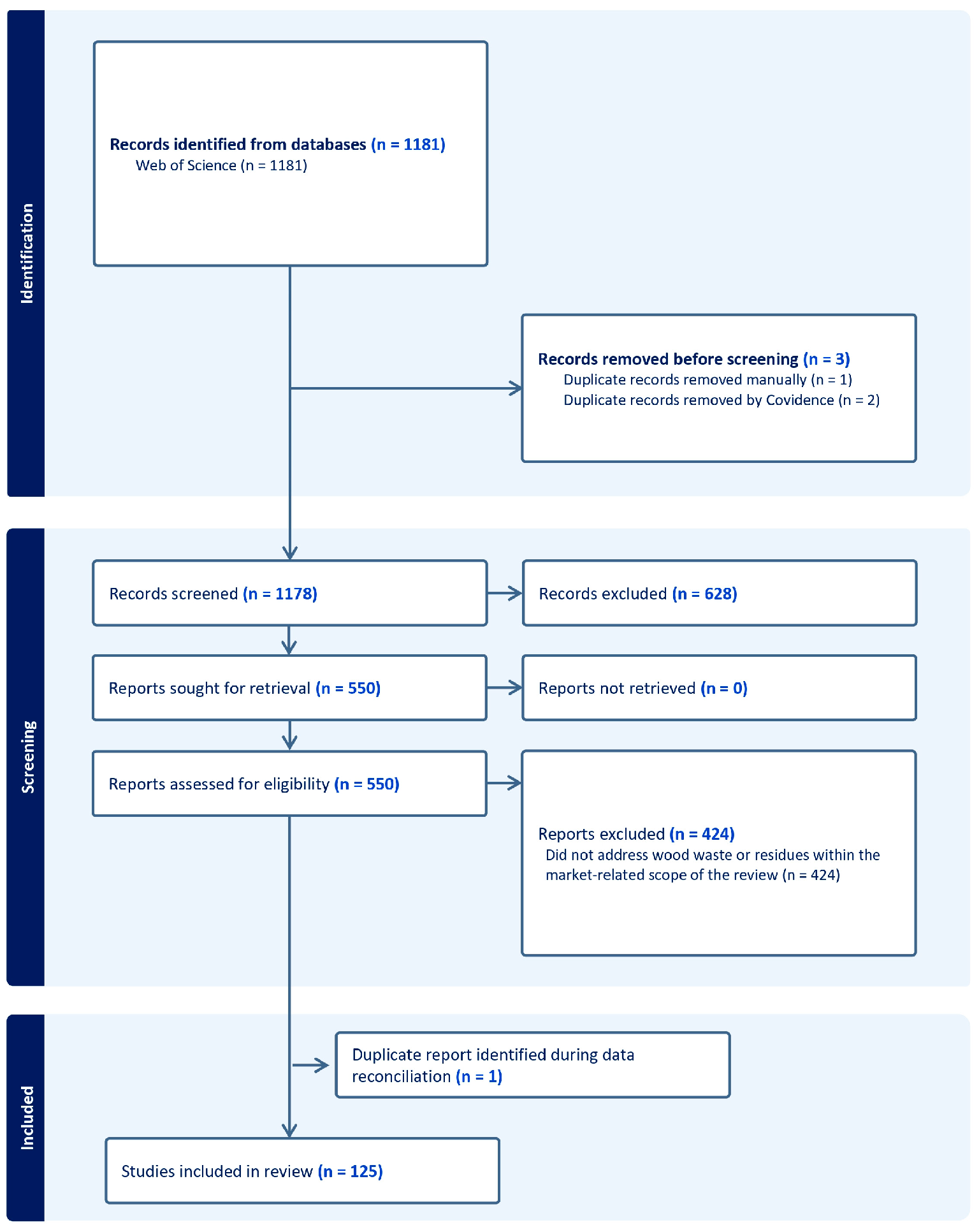
All retrieved records were imported into Covidence (Veritas Health Innovation, Melbourne, Australia) for deduplication and screening [24]. Title and abstract screening and full-text assessment were conducted independently by two reviewers using predefined eligibility criteria. Disagreements were resolved through discussion and consensus. No formal inter-rater agreement statistic was calculated. The study-selection process is summarized in the PRISMA 2020 flow diagram (Figure 1) [23].
Eligibility criteria were defined before screening. Studies were included when they focused on wood waste or residues, addressed a market-related dimension or utilization pathway, and had full text available for assessment. Studies were excluded when they focused exclusively on non-wood biomass, had no clear relevance to wood-residue markets, or examined conversion technologies solely from a technical perspective without considering utilization or market context. Studies involving mixed feedstocks were retained when wood or woody residues formed a substantive part of the analysis. These criteria were applied during both title and abstract screening and full-text assessment.
After three duplicate records were removed, 1178 records proceeded to title and abstract screening. Of these, 628 records were excluded, leaving 550 reports for retrieval. All 550 reports were successfully retrieved and assessed for eligibility, of which 424 were excluded because they did not meet the market-related scope of the review. During subsequent data reconciliation, one duplicate report was identified among the 126 eligible reports and removed. The final synthesis therefore included 125 unique studies published between 1967 and 2025 (Figure 1). Data were extracted from the 125 included studies by the lead reviewer using a predefined coding framework and subsequently reviewed by a second reviewer, with discrepancies resolved through discussion. Descriptive information included authorship, publication year, study location, research objectives, methodological approach, and key findings. Analytical coding focused on four domains: (1) feedstock characteristics, including residue type and source; (2) operational and market challenges; (3) market characteristics organized through the Marketing Mix framework; and (4) innovation dimensions. When information was not explicitly reported in a study, it was recorded as not reported rather than inferred by the reviewers. Qualitative content analysis [25] and thematic analysis were used to identify recurring patterns across the included studies. Given the heterogeneity of study designs, market contexts, feedstocks, and reported outcomes, no statistical pooling or meta-analysis was conducted.
The analysis drew on two complementary perspectives relevant to the review questions: the Marketing Mix [20] and an Innovation perspective [21,26]. Five analytical domains were used to organize the evidence: Methods, Feedstock Characteristics, Operational and Market Challenges, Marketing Mix, and Innovation. Methods covered research design, analytical techniques, time frame, and stakeholder involvement. Feedstock Characteristics captured residue type, volume or scale, and reported physical characteristics. Operational and Market Challenges covered collection and handling, transportation and logistics, storage, feedstock variability, market competition, quality specifications, and information-related constraints. Marketing Mix covered product/value proposition, pricing, distribution, promotion, and market entry or expansion. Innovation captured technological, institutional, social, policy, and financial developments (Table 1).
The coding structure was established before synthesis. The lead reviewer re-examined the included studies and organized the extracted evidence within the analytical domains, after which the coding was reviewed by a second reviewer, and differences in interpretation were resolved through discussion. Categories within the Operational and Market Challenges, Marketing Mix, and Innovation domains were not mutually exclusive; a study could therefore contribute to more than one category within each domain.
The extracted data were synthesized descriptively using frequencies and percentages where the coding supported quantitative comparison, including publication trends, geographic distribution, methodological approaches, operational and market challenges, and selected utilization patterns. Marketing Mix and Innovation dimensions were synthesized primarily through recurring qualitative patterns across the reviewed studies. Percentages were calculated using the 125 included studies as the denominator unless otherwise specified. Temporal patterns were examined by grouping studies into publication periods to assess how research activity and market-related themes were distributed over time. No formal study-level risk-of-bias or certainty-of-evidence assessment was conducted. Given the heterogeneous study designs and the review’s focus on mapping market characteristics and recurring themes rather than estimating intervention effects, the synthesis emphasized patterns reported across the literature. This review was not registered, and no formal review protocol was prepared.
During preparation of the review methodology, Microsoft Copilot (GPT-5 Chat; Microsoft Corporation, Redmond, WA, USA) was used to assist in refining the search strategy and clarifying the inclusion and exclusion criteria. The tool was not used to make screening decisions, extract study data, assign coding categories, conduct the analysis, or generate the study findings. All suggestions generated by the tool were reviewed and evaluated by the authors before use.

3. Results

3.1. Overview of the Reviewed Studies

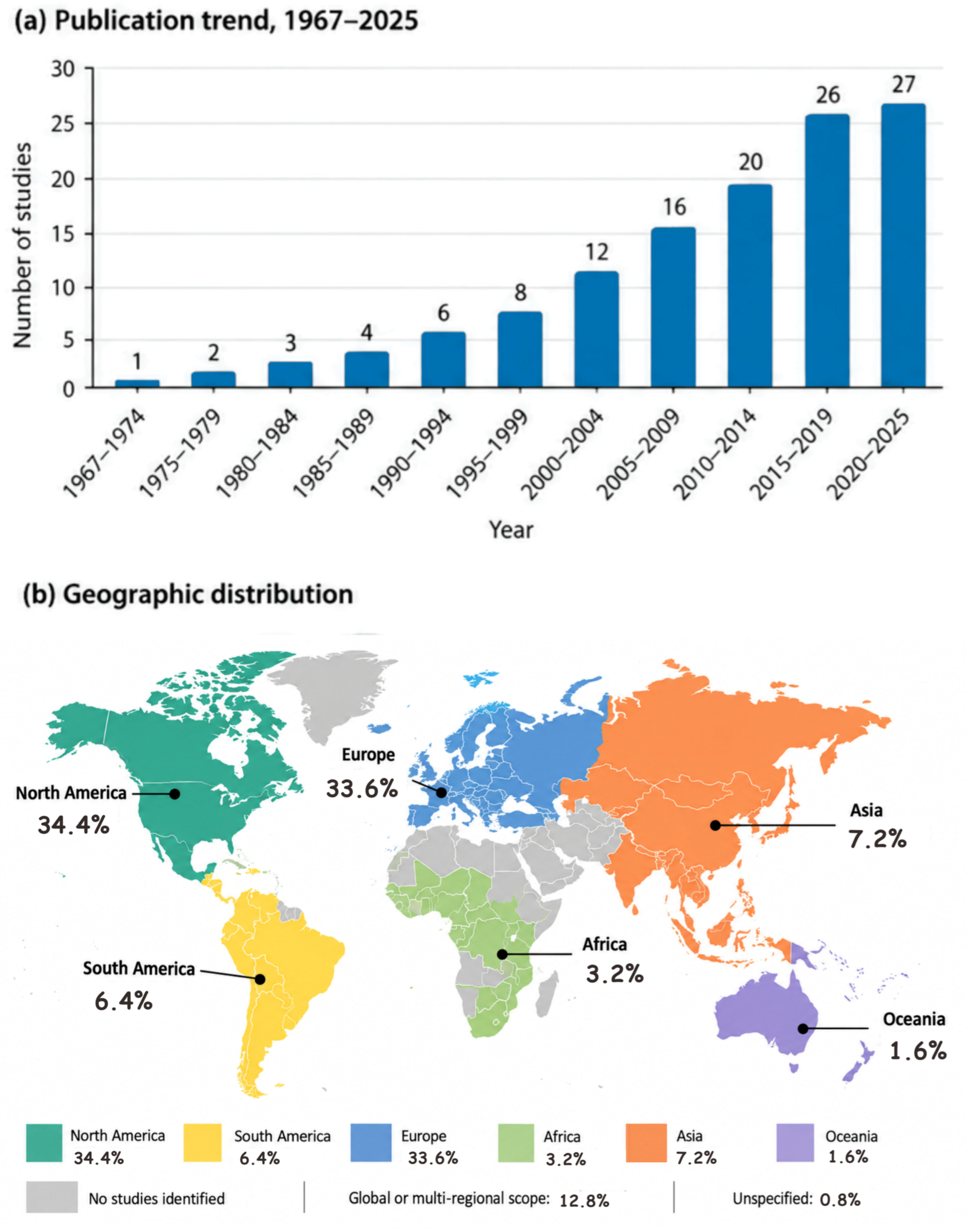
The final dataset comprised 125 studies published between 1967 and 2025, with publication activity concentrated in the more recent decades. Only 6 studies (4.8%) were published between 1967 and 1999 and 14 (11.2%) between 2000 and 2009. Research activity increased substantially thereafter, with 59 studies (47.2%) published between 2010 and 2019 and another 46 (36.8%) between 2020 and 2025. Overall, 105 studies (84.0%) were published from 2010 onward. The reviewed literature appeared across forestry, biomass energy, environmental, and industrial journals, including Biomass and Bioenergy, Forest Policy and Economics, GCB Bioenergy, and Journal of Cleaner Production. Geographically, the literature was concentrated in North America and Europe, which together accounted for 85 studies (68.0%). Europe accounted for 42 studies (33.6%) and North America for 43 (34.4%), while 16 studies (12.8%) had a global or multi-regional scope. Representation was smaller in Asia (9 studies; 7.2%), South America (8 studies; 6.4%), Africa (4 studies; 3.2%), and Oceania (2 studies; 1.6%). One study (0.8%) did not specify a geographic location. Quantitative approaches dominated the literature, accounting for 94 studies (75.2%), followed by mixed-methods approaches (20 studies; 16.0%) and qualitative research (11 studies; 8.8%). Quantitative studies included supply chain optimization [27,28], techno-economic analysis [29,30], life-cycle assessment [19,31], material-flow analysis [32], and spatial modeling [33,34]. Qualitative and mixed-method studies included literature reviews, Delphi-based assessments, interviews, and participatory approaches [35,36]. The temporal and geographic distribution of the included studies is summarized in Figure 2.

3.2. Feedstock Characteristics

The reviewed studies covered a wide range of residual wood streams generated during harvesting, primary and secondary wood processing, industrial production, and end-of-life recovery. Forest-harvesting residues, including branches, tops, slash, stumps, and roots, were among the most frequently examined materials. These residues were associated with routine forest operations, thinning, and salvage activities and were commonly characterized by dispersed availability, low bulk density, variable moisture content, and additional collection requirements [37,38].
Wood chips, sawdust, and shavings formed another prominent group, but differed from harvesting residues in where and how they were generated. Wood chips originated from both sawmill residues and chipped forest biomass and were reported in bioenergy, pulp and paper, and composite applications [18]. Sawdust and shavings were generated mainly at lumber and panel-processing facilities, producing more concentrated residue streams. These materials were subsequently used as feedstocks for products and pathways, including pellets, particleboard, biochar, and energy generation [39,40,41,42].
Some studies also examined low-grade roundwood, small-diameter trees, and low-quality sawtimber within integrated forest product and energy markets [43,44]. These materials were not consistently classified as residue or waste, but they were often considered alongside conventional wood residues when higher-value timber markets were limited. Their inclusion illustrated the variation in how low-value woody feedstocks were defined across studies and market settings [45,46].
Urban and post-consumer wood formed a distinct residue stream. Construction and demolition wood and residues from engineered wood products were more frequently associated with contamination, mixed material streams, and sorting requirements [10,47,48]. Reported uses included recycling, energy recovery, and material repurposing [8,49,50,51]. Other industrial residue streams included bark, black liquor, lignocellulosic panel residues, and other industrial residues [52,53,54,55]. The main feedstock groups, their typical sources, reported uses, and characteristics are summarized in Table 2.
Table 2. Main wood-residue and low-value woody feedstock groups reported in the reviewed studies.
Residue TypeTypical SourceCommon Uses ReportedKey Characteristics Reported
Forest-harvesting residuesHarvesting, thinning, salvage operationsBioenergy, fuels, thermochemical conversionDispersed supply, low bulk density, variable moisture, collection requirements
Wood chipsSawmills, chipped forest biomassBioenergy, pulp and paper, composites, pelletsMore uniform physical form, easier handling, intermediate feedstock
Sawdust and shavingsSawmills, lumber and panel manufacturingPellets, particleboard, biochar, energyConcentrated at processing sites, fine particle size, suitable for densification
Bark and other mill residuesSawmills and wood-processing facilitiesEnergy, biochar, biochemical products, natural dyesVariable moisture and composition; generally concentrated at processing sites
Low-grade roundwood and small-diameter woodForest management and harvestingEnergy, integrated forest-product systemsLow-value material; classification varies by market context
Urban and post-consumer woodConstruction, demolition, engineered wood productsRecycling, energy recovery, material repurposingMixed streams, contamination and sorting requirements
Black liquor and other industrial residuesPulping and industrial wood processingEnergy and biochemical conversionProcess-specific, concentrated industrial streams
Across these feedstock groups, two characteristics repeatedly distinguished the materials: where they were generated and the degree of processing or handling required before utilization. Harvesting residues tended to be dispersed and physically heterogeneous, whereas sawmill and industrial residues were concentrated at processing sites and often more readily collected. Urban wood presented a different profile because sorting and contamination were more frequently reported. Some residues, particularly chips, sawdust, and shavings, also entered downstream processing pathways in which densification or other upgrading could reduce handling and storage constraints. Overall, the reviewed literature did not treat wood residues as a single interchangeable feedstock; rather, it described materials with different physical forms, spatial distributions, processing requirements, and downstream utilization options.

3.3. Operational and Market Challenges

The frequency of reported operational and market challenges varied considerably across the 125 included studies. Logistics and infrastructure were the most frequently coded constraints, appearing in 77 studies (61.6%). Competition was identified in 48 studies (38.4%), followed by supply–demand conditions in 40 (32.0%) and lack of standardization in 18 (14.4%). Negative consumer perceptions and information gaps were reported less frequently, appearing in 6 studies (4.8%) and 2 studies (1.6%), respectively (Table 3). A single study could report more than one challenge and was therefore coded into each relevant category. These categories are not mutually exclusive, so the percentages do not sum to 100%.
Logistical constraints covered several stages of residue collection, movement, and handling. Transportation costs were repeatedly associated with dispersed supply, long hauling distances, and the low bulk density of many woody residues [17,18]. Collection and handling were also reported as constraints for materials such as slash and bark [56], while storage and drying created additional operational requirements [57,58]. Similar problems appeared in remote areas where residue sources were distant from processing facilities or supporting infrastructure was limited [59,60].
Competition and supply–demand conditions formed the next most prominent group of challenges. Competition occurred among energy producers, pulp and paper manufacturers, pellet producers, conventional forest-product markets, and emerging bioproduct industries [61]. Several studies associated this competition with higher procurement costs or reduced access to low-cost woody feedstock [31,62]. Supply–demand constraints included seasonal or uneven residue availability, weak domestic markets, changing market conditions, and shifts in demand associated with renewable-energy policies [44,63,64].
Standardization was reported less frequently than logistics or market competition but represented a distinct constraint across residue types and applications. Studies identified variation in moisture content, particle size, calorific value, species, contamination, and other feedstock characteristics, together with differences in testing procedures and product specifications [65,66]. In this part of the literature, the issue was not simply whether woody residues were available, but whether their characteristics were sufficiently consistent or defined for particular processing and utilization pathways.
Social and informational constraints were reported comparatively infrequently. Reported concerns included perceptions of emissions and sustainability and limited awareness of wood-residue products and their potential uses [3,19,67]. Information-related constraints included gaps in knowledge about resource availability, prices, market conditions, and logistics planning [68]. Although these issues appeared less frequently than logistical, competitive, and supply–demand constraints, they extended the reported challenges beyond physical supply and economic conditions to include how wood-residue products and markets were perceived and understood.

3.4. Market Characteristics Through the Marketing Mix

The Marketing Mix analysis showed that the four dimensions were represented differently across the reviewed literature. Product-related evidence was largely concerned with how residues were converted or positioned for different end uses, while Price reflected both market-based and policy-supported economic arrangements. Place was primarily associated with supply-chain configuration and the spatial relationship between residue sources and users. Promotion appeared less explicitly in the reviewed studies and was more often represented by certification, environmental claims, policy support, and knowledge sharing than by conventional consumer advertising. Because the Marketing Mix categories were not mutually exclusive, individual studies could contribute evidence to more than one dimension [69].

3.4.1. Product

Product was the most visibly diversified element of the Marketing Mix. Energy-related applications remained prominent across the review period, appearing in 109 of the 125 studies (87.2%), while 57 studies (45.6%) addressed material or bioproduct applications; these categories were not mutually exclusive. Established pathways included fuels and energy generation, while other studies examined biochar, engineered wood panels, composites, mulch, and compost [6,8,70]. More specialized applications included sustainable aviation fuel, biobased chemicals, construction materials, activated carbon, acetic acid, mycelium-based insulation, and natural textile dyes [29,53,71]. The temporal coding nevertheless indicates diversification rather than replacement: material or bioproduct applications appeared in 21 of the 46 studies published during 2020–2025 (45.7%), while fuel or energy applications remained present in 37 (80.4%).

3.4.2. Price

Price was represented through several economic arrangements rather than a single pricing mechanism. Market-based approaches included energy-value and cost-plus pricing, while policy-supported arrangements included subsidies, tax credits, carbon pricing, and Renewable Identification Numbers [33]. Other studies evaluated gate fees [72], tipping fees [52,73], minimum selling price calculations [49], economies of scale [34], cluster-based production [30,74], and life-cycle costing [75]. Across these arrangements, transportation costs and competition for woody feedstocks repeatedly affected procurement costs and the economic feasibility of residue utilization [17]. Thus, the reviewed literature treated residue price as context-dependent, reflecting not only the material itself but also transportation, processing requirements, competing uses, and policy conditions.

3.4.3. Place

Place was shaped largely by the spatial relationships among residue sources, processing facilities, and end users. Distribution in the reviewed literature was predominantly business-to-business, connecting residue suppliers with factories [47,56], power plants [17,28], pulp mills [76,77], and biorefineries [27,33]. Local and regional channels were common for relatively bulky woody feedstocks and products [78,79], whereas densified biomass also entered longer-distance and international markets [80]. Cluster-based supply systems, portable processing, and decentralized configurations represented alternative arrangements for residue streams located farther from processing facilities [18,72,81,82,83]. These patterns show that Place in wood-residue markets was expressed primarily through supply-chain configuration rather than conventional retail distribution.

3.4.4. Promotion

Promotion was the least conventional of the Marketing Mix dimensions in the reviewed literature. Rather than direct advertising or consumer-oriented campaigns, market support was more often expressed through certification, environmental claims, policy programs, and knowledge-sharing activities. Feed-in tariffs [84], renewable portfolio standards [30,85], and carbon-credit mechanisms [28,83] provided indirect support for market uptake, while sustainability certification and greenhouse-gas reduction claims communicated environmental attributes and product credibility [86,87,88]. Knowledge-sharing initiatives, stakeholder education, and trade shows provided additional channels for communicating residue uses and developing markets [18,78]. This pattern is consistent with the predominantly B2B character of existing residue markets. As residue-derived products move closer to consumer-facing applications, however, market communication may become more important because perceptions of wood-based products, environmental concern, and competing narratives can influence acceptance and adoption [89,90,91]. These Marketing Mix patterns are summarized in Table 4.
Table 4. Marketing Mix patterns identified in the reviewed literature.
DimensionDominant PatternRepresentative Market Mechanisms
ProductEstablished energy uses alongside diversified material and bioproduct pathwaysEnergy/fuels; panels/composites; biochar; chemicals; SAF; other bioproducts
PriceContext-dependent market and policy-supported pricingEnergy-value pricing; cost-plus; subsidies; fees; minimum selling price; carbon mechanisms
PlacePredominantly B2B and supply-chain-basedDirect-to-factory; local/regional markets; power plants; pulp mills; biorefineries; international trade; decentralized processing
PromotionPrimarily indirect rather than consumer advertisingCertification; environmental claims; policy support; knowledge sharing; stakeholder education

3.5. Innovation Trends in Wood-Residue Markets

The reviewed studies reported innovation across technological, institutional, social, policy, and financial dimensions. These dimensions captured different ways in which wood-residue utilization and market development were enabled or reorganized, ranging from new conversion and processing technologies to changes in coordination, stakeholder participation, policy support, and financing. The categories were not mutually exclusive, and some mechanisms operated across more than one innovation dimension. They also overlapped with elements of the Marketing Mix; these relationships are examined further in Section 4.

3.5.1. Technological Innovations

Technological innovation was represented through three broad patterns: conversion and upgrading technologies, feedstock preprocessing and decentralized processing, and decision-support tools. Thermochemical pathways, including pyrolysis, gasification, hydrothermal liquefaction, and torrefaction, were investigated for converting or upgrading wood residues [16,68,92]. Biofuel and energy pathways included Ethanol-to-Jet technologies and co-firing applications [93], while other studies examined material applications such as biochar, natural dyes derived from bark tannins, and mycelium-based insulation [48,53,94].
A second group of technologies addressed the physical and spatial constraints of residue supply. Portable and in-woods processing systems, steam explosion, pelletization, and briquetting were examined as ways of processing or modifying feedstocks before storage, transportation, or further conversion [18,73,78]. These approaches appeared particularly in studies concerned with dispersed feedstocks and high transportation costs [95,96]. Across both conversion and preprocessing pathways, technical feasibility did not necessarily imply commercial readiness; scale-up, financing, and techno-economic constraints were also reported [9,97,98,99,100].
Decision-support technologies accounted for a smaller share of the literature. Spatial and optimization tools, including GIS-based frameworks and Bioenergy Geospatial Optimization Tool (BioGeSTO), were used for facility siting, resource allocation, and supply-chain planning [4,79]. Together, these technological pathways show that innovation was directed not only toward creating new residue-derived products but also toward reducing the logistical and spatial constraints associated with supplying them.

3.5.2. Institutional Innovations

Institutional innovation was expressed primarily through new forms of coordination among residue suppliers, processors, communities, and other market actors. Cluster-based models and reverse-logistics systems were examined as mechanisms for organizing residue recovery and transportation [101,102], while community networks and cooperative arrangements were reported for dispersed resources such as orchard and vineyard residues, pest-affected trees, and urban wood waste [8,103,104]. Shared infrastructure and cooperative arrangements provided additional approaches to coordination and transaction requirements [105,106].
Integrated biorefineries and industrial-symbiosis models extended this pattern by linking industries through shared infrastructure, processing capacity, or residue streams [33,107]. Across these studies, institutional innovation therefore involved reorganizing relationships among actors and resources rather than changing the physical residue itself.

3.5.3. Social Innovations

Social innovation was less visible than technological or institutional innovation and centered mainly on participation, knowledge exchange, education, and perceptions of wood-based products. Participatory governance and social-network approaches were examined in relation to stakeholder involvement and information sharing [44,102], while consumer education and awareness initiatives addressed perceptions of wood-based energy and products [51,68]. Other studies examined stakeholder participation and certification in relation to social acceptance [22].
Changes in product and industry practices also appeared in this dimension. Design-for-Deconstruction (DfD), for example, was examined as a way to facilitate the recovery and reuse of wood in construction systems [51]. Overall, the social dimension was concerned less with changing conversion technologies than with changing how actors participate, exchange information, perceive residue-derived products, and organize practices around recovery and reuse.

3.5.4. Policy Innovations

Policy instruments were widely represented across the reviewed markets. Renewable Portfolio Standards (RPS) [108,109], feed-in tariffs [84], and incentives for energy and material recovery [8,49] were among the mechanisms reported. Policy supports also appeared in studies of residue diversion, renewable-energy deployment, and emerging applications such as sustainable aviation fuel and biobased products [4].
At the same time, studies documented differences in how renewable biomass was defined and supported across jurisdictions. Variation in classification, eligibility requirements, and incentive structures was associated with uncertainty surrounding investment and market development [110,111]. Policy innovation therefore appeared not only through the introduction of incentives but also through the rules determining which materials, technologies, and utilization pathways could benefit from them [4,8,49,84,108,109,110,111].

3.5.5. Financial Innovations

Financial innovation was represented by mechanisms that created additional revenue streams, shared investment risk, or supported early-stage commercialization. Joint government-industry funding appeared in studies of emerging technologies [112,113], while carbon credits, renewable-energy certificates, and gate-fee arrangements provided additional revenue or incentive mechanisms in other market settings [30,82,101].
The literature also frequently used discounted cash flow analysis, minimum selling price calculations, and techno-economic assessment to evaluate the financial feasibility of emerging pathways [30,70,114]. These analytical approaches were not themselves financial innovations, but they identified the cost, scale, and investment conditions under which new residue-utilization pathways could become commercially viable. This distinction separates mechanisms that change financing conditions from analytical tools used to evaluate those conditions. These innovation patterns are summarized in Table 5.
Table 5. Innovation patterns identified in the reviewed literature.
Innovation DimensionDominant PatternRepresentative Mechanisms
TechnologicalConversion, upgrading, preprocessing, and supply-chain technologiesThermochemical conversion; biofuels; densification; decentralized processing; decision-support tools
InstitutionalCoordination among actors, resources, and infrastructureIndustrial clusters; reverse logistics; cooperatives; shared infrastructure; industrial symbiosis
SocialParticipation, knowledge exchange, acceptance, and changing practicesStakeholder networks; education; certification; awareness; Design-for-Deconstruction
PolicyIncentives and rules shaping market eligibilityRPS; feed-in tariffs; recovery incentives; biomass definitions; eligibility requirements
FinancialRevenue mechanisms and risk-sharing arrangementsCarbon credits; renewable-energy certificates; public–private funding; gate-fee arrangements

4. Discussion

The reviewed literature points to a clear diversification of wood-residue utilization rather than a simple shift away from established energy uses. Energy remained a prominent outlet throughout the review period, while material and bioproduct pathways expanded to include panels, composites, biochar, biobased chemicals, sustainable aviation fuel, and other applications. This broader range of potential uses has developed across residue streams with very different physical and spatial characteristics, from harvesting residues and mill by-products to urban and post-consumer wood. Yet diversification has not removed the constraints that have long shaped these markets. Logistics, competition for feedstock, uneven supply and demand, and inconsistent specifications continue to influence whether technically available residues can be converted into commercially viable feedstocks.
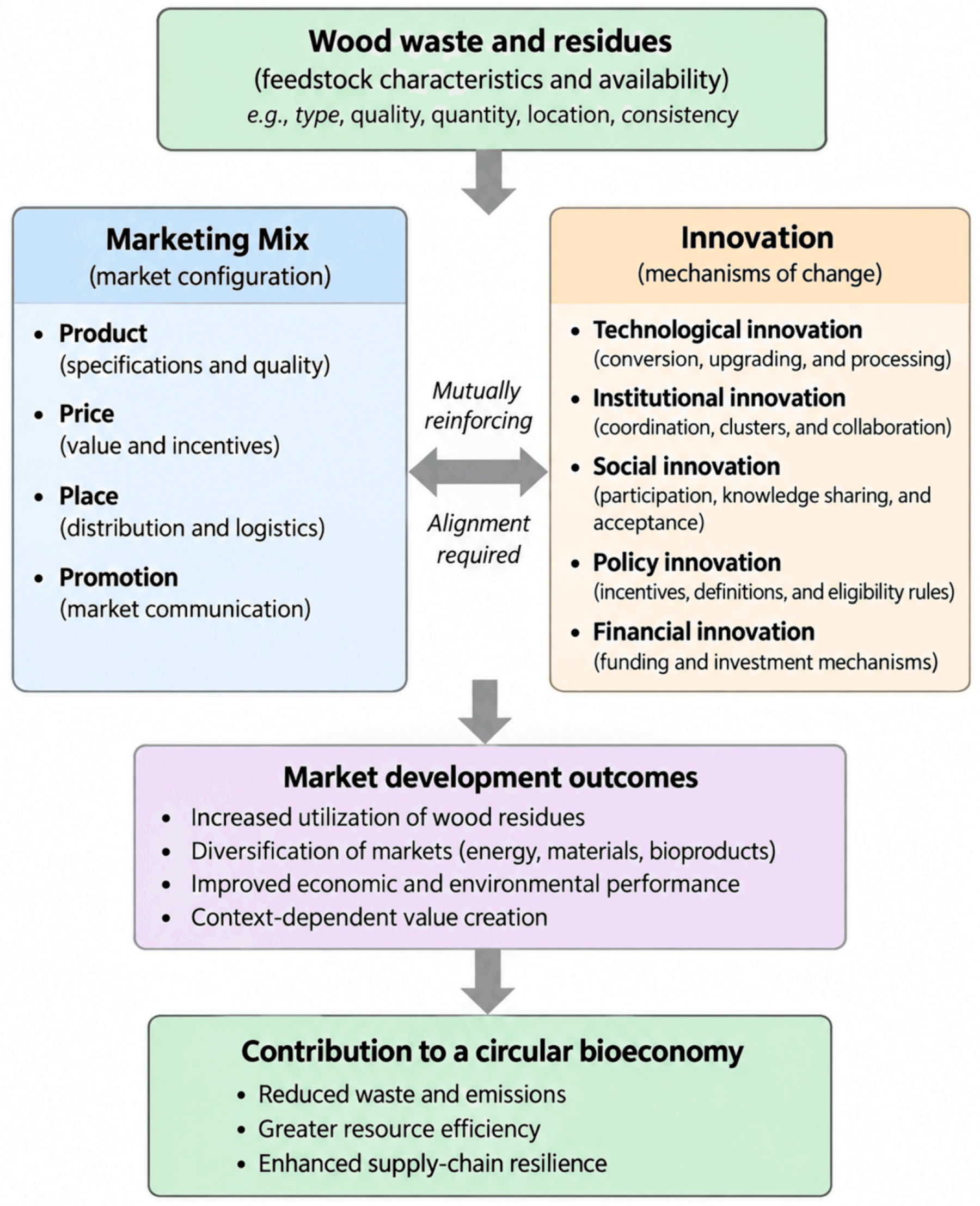
This pattern suggests that the development of wood-residue markets cannot be understood as a sequence in which new conversion technologies simply replace disposal or lower-value uses. Market outcomes depend on how feedstock characteristics, processing capacity, transportation requirements, competing uses, market expectations, and institutional conditions align within a particular setting. The Marketing Mix and Innovation perspectives are useful here because they capture different but connected parts of that process. The Marketing Mix describes how residue markets are configured through products, pricing arrangements, distribution systems, and market communication, whereas the Innovation perspective captures the technological, institutional, social, policy, and financial changes that can reshape those arrangements. Considered together, the two perspectives help explain why the existence of a technically feasible utilization pathway does not necessarily lead to a functioning market.

4.1. Feedstock Diversity Shapes Utilization Pathways

The diversity of materials identified in the review helps explain why wood residues cannot be treated as a single interchangeable feedstock. Differences in moisture content, bulk density, contamination risk, degree of processing, and spatial concentration affect not only technical suitability but also the costs and practical requirements of collection, storage, processing, and transportation. A residue stream may therefore be technically suitable for a particular application without being economically or logistically accessible to the user that requires it.
This distinction is particularly important when comparing dispersed and concentrated residue streams. Harvesting residues can occur across geographically dispersed locations and require additional collection and transportation, whereas mill residues such as sawdust and shavings are generated at processing facilities and can more readily enter established processing chains. Transportation distance and low bulk density can substantially affect the feasibility of using relatively low-value woody materials [17,18]. Consequently, estimates of aggregate residue availability provide only part of the information needed to assess market potential. The challenge analysis reinforces this point. Logistics and infrastructure were the most frequently identified constraints in the reviewed literature, but they did not operate independently of competition or supply–demand conditions. Residual fiber may already be used by pulp and paper mills, pellet manufacturers, energy facilities, or other forest-product industries. New applications can therefore compete for existing feedstock rather than simply absorb material that would otherwise remain unused [31,61]. This helps explain an apparent tension in the literature: substantial quantities of residues may coexist with localized competition for suitable woody feedstock.
Standardization adds another layer. Variation in moisture content, particle size, species, contamination, calorific value, and testing practices can affect whether a residue is suitable for a particular application and whether buyers can evaluate it consistently [65,66]. Specifications therefore serve more than a technical function. They can also reduce uncertainty between suppliers and users by clarifying what material is being exchanged and what processing requirements it can meet.
Taken together, these findings help explain why residue availability and utilization do not necessarily move together. A region may generate substantial residual biomass but still lack economical transportation, appropriate processing capacity, consistent material specifications, or sufficient demand. Conversely, particular residue streams may already face competition even where other residual materials remain underused. The relevant question is therefore not simply how much residue exists, but which residue is available, where it is located, what characteristics it has, and which utilization pathways can realistically use it.
Supply chain coordination becomes particularly important under these conditions. Suppliers, processors, transport providers, and end users must align material availability, quality requirements, timing, and costs. This interpretation is consistent with Wardani et al. [115] who emphasized the importance of coordination, efficiency, and information flow in wood-product supply chains. For residue markets, such coordination may be especially consequential because materials are heterogeneous, geographically dispersed, and often shared among competing users.

4.2. Innovation Beyond Conversion Technology

Many of the studies reviewed here focused on ways to convert residual materials into useful products. The studies reviewed here, however, suggest that developing a new conversion pathway is only one part of the innovation process. Technologies such as thermochemical conversion, densification, and mobile processing can expand the range of potential uses, but their commercial viability still depends on feedstock availability, transportation costs, processing scale, market demand, and access to capital [16,92,97,98]. In other words, technical feasibility does not necessarily translate into a viable market [116].
This is particularly evident in studies addressing transportation and dispersed feedstocks. Portable and in-woods processing can bring part of the conversion process closer to residue sources, while densification can make material easier to store and transport [18,72,95]. Both approaches respond to constraints identified across the reviewed literature, especially the cost of moving relatively bulky, low-value materials. Their usefulness, however, remains dependent on local conditions. Reducing transportation requirements offers limited advantage if feedstock volumes are insufficient, processing costs are too high, or there is no reliable market for the resulting product.
Other studies approached the same problem through changes in coordination rather than technology. Reverse logistics, industrial clusters, cooperative networks, shared infrastructure, and industrial symbiosis can connect residue generators with processors and users or allow facilities to share resources and processing capacity [33,101,102,107]. These arrangements are particularly relevant where individual residue streams are too small, dispersed, or inconsistent to support a market on their own. They also reinforce the point raised in Section 4.1: improving residue utilization often requires better coordination among actors, not simply a better conversion process.
Policy, financing, and stakeholder engagement can further determine whether these opportunities move beyond demonstration or analysis. Incentives and carbon-related mechanisms can improve project economics, while biomass definitions and eligibility requirements can determine which feedstocks and technologies qualify for support [49,84,108,109]. Certification, information exchange, and stakeholder participation can address different issues related to credibility, knowledge, and acceptance [22,44,68,102]. These mechanisms do not replace technological development, but they shape the conditions under which a technology can be adopted and a market can develop.
The innovation pattern that emerges is therefore broader than conversion technology alone. Technological innovation can expand what is possible, but institutional arrangements determine how actors and resources are coordinated; social mechanisms influence information and acceptance; policies shape incentives and eligibility; and financial mechanisms influence whether investments can proceed. The opportunities identified in the literature increasingly lie at the intersection of these dimensions.

4.3. Marketing Mix and Innovation as Complementary Perspectives

Considering the Marketing Mix and Innovation perspectives together provides a more complete view of how wood-residue markets develop. The Marketing Mix helps explain how a market is configured: what is offered, how value is priced, how materials reach users, and how product attributes are communicated. The Innovation perspective addresses a different question: how those arrangements can change through technological development, new forms of coordination, stakeholder participation, policy intervention, and financing. The distinction is useful because a residue may have a technically feasible use without yet having the market conditions needed to support it.
Several findings from the review illustrate how the two perspectives intersect. Decentralized processing can change Place by moving part of the processing closer to dispersed sources of residue, while also representing technological innovation [18,72]. Certification can support Promotion by communicating environmental attributes and credibility, but it can also serve an institutional or social role by establishing expectations among market actors [22,86,87]. Industrial clusters can reorganize distribution and relationships among suppliers and users while also representing institutional innovation [69,101,102]. Similarly, carbon-based incentives can influence Price while operating through policy and financial mechanisms.
These overlaps are important because innovation can change the conditions under which the four elements of the Marketing Mix operate. A new conversion technology may create a new Product, but its market potential still depends on whether the feedstock can be supplied at an acceptable Price and through a workable distribution system. A policy incentive may improve project economics without resolving feedstock variability or transportation constraints. Certification may strengthen confidence in a residue-derived product but cannot compensate for inconsistent material quality. Market development therefore depends less on any single intervention than on whether changes across these dimensions reinforce one another.
This combined perspective also helps explain why promising wood-residue applications do not always progress into established markets. Technical performance is only one requirement. A viable pathway also needs a suitable feedstock, workable logistics, processing capacity, buyers, acceptable costs, and institutional and financial conditions that allow transactions and investment to occur. Similar dependencies have been reported in emerging wood-product markets, where manufacturing capacity, regional costs, supply-chain conditions, and institutional factors influence adoption and economic performance [117]. For wood residues, these dependencies may be even more pronounced because feedstocks vary widely in form, quality, location, and existing uses.
The value of combining the two perspectives is therefore not to create an additional classification of wood-residue markets, but to connect market configuration with market change. The Marketing Mix identifies where market arrangements may constrain or enable utilization, while the Innovation perspective helps identify the mechanisms through which those arrangements might be altered. Viewed together, they suggest that moving a wood residue toward a higher-value or more viable use requires alignment between the characteristics of the feedstock, the market it is intended to serve, and the technological and institutional changes needed to connect the two. These relationships are summarized conceptually in Figure 3 [4,6,17,18,22,33,42,49,53,70,72,73,78,80,84,86,87,90,91,100,101,102,116,117].

4.4. Market Diversification Without Complete Resolution of Longstanding Constraints

Viewed across the period covered by this review, wood-residue markets show a pattern of diversification rather than a complete transition from established uses to newer, higher-value applications. Energy-related pathways remained prominent, even as the literature increasingly considered materials, chemicals, biochar, sustainable aviation fuel, and other bioproducts. This suggests that newer applications are expanding the range of potential markets for wood residues rather than simply replacing existing outlets. At the same time, the persistence of logistical, supply, and market constraints indicates that having more utilization options does not necessarily make residues easier to commercialize.
This distinction matters because different residue streams face different combinations of constraints. Where transportation accounts for a large share of delivered feedstock costs, decentralized processing may improve the feasibility of handling dispersed biomass by moving part of the processing closer to the feedstock source [95]. Where variability in moisture content, particle size, contamination, or other characteristics complicates transactions, clearer classification and specifications may be more important [66]. Where supply chains are fragmented, stronger coordination among residue generators, processors, transport providers, and users may offer greater benefits than introducing another conversion technology. The appropriate response therefore depends on the residue, location, existing market structure, and intended use.
The findings also help explain why underutilized residues can coexist with competition for woody feedstock. Aggregate estimates of residue availability do not necessarily indicate that material of the required type, quality, quantity, location, and price is available to a particular user [17,63]. Some residue streams may remain difficult to recover economically, while others are already used by established industries or sought by several competing markets [30]. From a market perspective, the relevant opportunity is therefore not simply to identify additional biomass, but to determine where a residue stream can be matched with a utilization pathway capable of absorbing it under realistic supply and cost conditions.
Further valorization consequently depends on more than moving residues toward the application with the highest apparent value. Emerging utilization pathways may require additional preprocessing, greater capital investment, or more complex supply arrangements than established outlets [30,95]. In some settings, improving an existing pathway may therefore be more practical than redirecting material to a technically higher-value use. This makes valorization context dependent: value is created when the characteristics and location of the residue can be aligned with processing requirements, market demand, and the institutional and economic conditions needed to support the transaction.
Taken together, these findings suggest that the next stage of wood-residue market development is less about identifying another possible use for woody biomass and more about improving the fit between specific residues and viable markets. Technological innovation remains important, but its contribution depends on logistics, market coordination, specifications, policy, and financing. The diversification observed in the literature therefore represents an expansion of opportunities rather than evidence that the longstanding barriers to wood-residue utilization have been resolved.

4.5. Research Gaps and Future Directions

Several gaps remain in the evidence base. First, the geographic concentration of research in Europe and North America means that residue-market development is less well documented in Asia, South America, Africa, and Oceania. Together, North America and Europe accounted for 68.0% of the studies included in this review. This imbalance matters because transportation infrastructure, forest-industry structure, policy conditions, processing capacity, and end markets differ substantially among regions. More research in underrepresented regions would help determine whether the market constraints and opportunities identified in this review also apply under different industrial and institutional conditions.
Second, the methodological distribution deserves greater attention. Quantitative studies accounted for 75.2% of the reviewed literature, compared with 16.0% using mixed methods and 8.8% using qualitative approaches. Quantitative studies have generated substantial evidence on biomass availability, transportation, optimization, environmental impacts, and techno-economic performance. However, the relative scarcity of qualitative and mixed-method studies leaves less evidence on stakeholder decisions, governance, business relationships, negotiation of residue specifications, and responses to emerging products and technologies. Future work could therefore complement system modeling with industry-level evidence from producers, processors, users, and other market actors.
Third, many studies continue to examine feedstock availability, conversion technology, logistics, or economic feasibility as separate problems. The findings of this review suggest value in connecting these dimensions more explicitly. Material Flow Analysis could identify where residues originate, accumulate, move, or leave a system, while Value Chain Analysis could examine where value is created, retained, or lost. Stakeholder-based research could then help explain why those patterns occur. Such integration would move analysis from identifying technically possible residue uses toward understanding how actual utilization pathway’s function.
Future research should also consider emerging applications alongside existing wood markets. Additional biomass demand can affect industries already using residual fiber, including pulp and paper, panels, pellets, and energy production. Evaluating an emerging pathway therefore requires attention not only to technical and economic feasibility but also to competing uses, existing infrastructure, regional material flows, and relationships among market actors. This is particularly important when a new application relies on feedstocks already traded or used in established regional markets.
The broader research need is consequently to understand under what combinations of feedstock, market, supply-chain, technological, institutional, policy, and financial conditions particular wood-residue utilization pathways can develop and create value. This moves the research agenda beyond asking only what can be produced from wood residues and toward explaining why particular pathways develop in some market settings but not in others.
This rapid review also has several limitations. The search was limited to the Web of Science Core Collection and did not include grey literature, which may have excluded relevant studies, industry reports, and government publications available through other sources. The broad search strategy was intended to capture studies across different wood-residue markets, but the use of the term “market” may have missed relevant research addressing supply-chain or economic issues without explicitly using market-related terminology. In addition, no formal risk-of-bias or certainty assessment was conducted because the review focused on identifying patterns across a heterogeneous body of market-related literature rather than estimating a pooled effect. The reported frequencies should therefore be interpreted as patterns within the literature identified by this rapid review rather than as a complete representation of all wood-residue market research.

5. Conclusions

This rapid review shows that wood waste and residues are increasingly considered as feedstocks for a wider range of energy, material, and bioproduct applications. The evidence, however, points to diversification rather than a simple transition from established uses to newer or higher-value pathways. Energy-related applications remain prominent, while biochar, engineered materials, biobased chemicals, sustainable aviation fuel, and other applications have broadened the range of potential markets. At the same time, transportation costs, dispersed and variable feedstock supply, competition for woody materials, supply–demand conditions, and inconsistent specifications continue to constrain utilization.
The Marketing Mix and Innovation perspectives help explain why expanding the range of technically possible uses does not necessarily create viable markets. Product opportunities must be supported by workable pricing and distribution arrangements and appropriate communication with market actors, while technological innovation depends on coordination, policy, financing, and other institutional conditions. Wood-residue utilization therefore depends not simply on how much biomass is available, but on how well the characteristics and location of particular residue streams align with processing requirements, existing uses, market demand, and the conditions needed to move them through the supply chain.
Wood residues can therefore become valuable feedstocks, but their value is context dependent rather than inherent. Further valorization will depend less on identifying additional possible uses than on improving the fit between specific residue streams and viable markets. Better supply chain coordination, clearer material specifications, and technological, market, policy, and financial arrangements tailored to different feedstocks and regional conditions will be important for converting broader utilization opportunities into functioning wood-residue markets.

Supplementary Materials

The following supporting information can be downloaded at https://www.mdpi.com/article/10.3390/resources15090123/s1, File S1: PRISMA 2020 Checklist; File S2: Study characteristics, extracted data, and analytical coding for the 125 studies included in the review. References [34,52,118,119,120,121,122,123,124,125,126,127,128,129,130,131,132,133,134,135,136,137,138,139,140,141,142,143,144,145,146,147,148,149,150,151,152,153,154] are cited in the Supplementary Materials.

Author Contributions

Conceptualization, G.G.P., P.L. and S.M.B.; methodology, G.G.P., P.L. and B.B.; validation, P.L.; formal analysis, G.G.P.; investigation, G.G.P.; data curation, G.G.P.; writing—original draft preparation, G.G.P.; writing—review and editing, G.G.P., P.L., S.M.B. and B.B.; supervision, P.L.; project administration, G.G.P. All authors have read and agreed to the published version of the manuscript.

Funding

This research was supported by the Virginia Tech Department of Sustainable Biomaterials and Virginia Cooperative Extension. The funders had no role in the design of the review; in the collection, analysis, or interpretation of data; in the writing of the manuscript; or in the decision to publish the results.

Data Availability Statement

The data supporting this review are provided in the article and its Supplementary Materials. Supplementary File S2 contains the study characteristics, extracted data, and analytical coding for the 125 studies included in the review.

Acknowledgments

During the preparation of this study, the authors used Microsoft Copilot, accessed through Virginia Tech’s institutional account, to assist in refining the search strategy and clarifying the inclusion and exclusion criteria. The authors reviewed and edited the output and take full responsibility for the content of this publication.

Conflicts of Interest

The authors declare no conflicts of interest.

Abbreviations

The following abbreviations are used in this manuscript:
B2BBusiness-to-Business
BioGeSTOBioenergy Geospatial Optimization Tool
GDPGross Domestic Product
GHGGreenhouse Gas
GISGeographic Information System
PRISMAPreferred Reporting Items for Systematic Reviews and Meta-Analyses
RPSRenewable Portfolio Standards
TSTopic Search field tag
WoSWeb of Science

References

  1. Environmental Protection Agency United States. Municipal Solid Waste Generation, Recycling, and Disposal in the United States: Methodology Document; 530B14002; U.S. Environmental Protection Agency: Washington, DC, USA, 2014. [Google Scholar]
  2. Kaza, S.; Yao, L.C.; Bhada-Tata, P.; Van Woerden, F. What a Waste 2.0: A Global Snapshot of Solid Waste to 2050; Urban Development Series; World Bank: Washington, DC, USA, 2018. [Google Scholar]
  3. Morris, J. Recycle, Bury, or Burn Wood Waste Biomass?: LCA Answer Depends on Carbon Accounting, Emissions Controls, Displaced Fuels, and Impact Costs. J. Ind. Ecol. 2017, 21, 844–856. [Google Scholar] [CrossRef] [Scilit]
  4. Akter, H.A.; Huang, Y.-K.; Dwivedi, P. Developing a Supply Chain Model for Sustainable Aviation Fuel Using Logging Residues in Georgia, United States. For. Policy Econ. 2025, 170, 103401. [Google Scholar] [CrossRef] [Scilit]
  5. Knauf, M. Waste Hierarchy Revisited—An Evaluation of Waste Wood Recycling in the Context of EU Energy Policy and the European Market. For. Policy Econ. 2015, 54, 58–60. [Google Scholar] [CrossRef] [Scilit]
  6. Neykov, N.; Antov, P.; Savov, V. Circular Economy Opportunities for Economic Efficiency Improvement in Wood-Based Panel Industry. In Proceedings of the 11th International Scientific Conference “Business and Management 2020”, Vilnius, Lithuania, 7–8 May 2020. [Google Scholar]
  7. Cetiner, I.; Shea, A.D. Wood Waste as an Alternative Thermal Insulation for Buildings. Energy Build. 2018, 168, 374–384. [Google Scholar] [CrossRef] [Scilit]
  8. Nowak, D.J.; Greenfield, E.J.; Ash, R.M. Annual Biomass Loss and Potential Value of Urban Tree Waste in the United States. Urban For. Urban Green. 2019, 46, 126469. [Google Scholar] [CrossRef] [Scilit]
  9. Besserer, A.; Troilo, S.; Girods, P.; Rogaume, Y.; Brosse, N. Cascading Recycling of Wood Waste: A Review. Polymers 2021, 13, 1752. [Google Scholar] [CrossRef] [Scilit] [PubMed]
  10. Faraca, G.; Boldrin, A.; Astrup, T. Resource Quality of Wood Waste: The Importance of Physical and Chemical Impurities in Wood Waste for Recycling. Waste Manag. 2019, 87, 135–147. [Google Scholar] [CrossRef] [Scilit] [PubMed]
  11. Arkansas Center for Forest Business. 2023 U.S. Forestry Economic Contribution by State; University of Arkansas at Monticello: Monticello, AR, USA, 2023. [Google Scholar]
  12. Jolley, G.J.; Khalaf, C.; Michaud, G.L.; Belleville, D. The Economic Contribution of Logging, Forestry, Pulp & Paper Mills, and Paper Products: A 50-State Analysis. For. Policy Econ. 2020, 115, 102140. [Google Scholar] [CrossRef] [Scilit]
  13. Garside, A.K.; Rosiani, T.Y.; Amanda, A.; Saputro, T.E.; E Oliveira, E. Enhanced Sustainability Assessment Framework for Plywood Manufacturing: A Multi-Method Approach Using Delphi Technique, BWM, and S-VSM. J. Optimasi Sist. Ind. 2025, 23, 188–206. [Google Scholar]
  14. Mesa, J.A.; Sierra-Fontalvo, L.; Ortegon, K.; Gonzalez-Quiroga, A. Advancing Circular Bioeconomy: A Critical Review and Assessment of Indicators. Sustain. Prod. Consum. 2024, 46, 324–342. [Google Scholar] [CrossRef] [Scilit]
  15. Timitimi, P.E.; Aleru, K.K.; David-Sarogoro, M.; Chukunda, F.A. Valorization of Wood Waste for Sustainable Construction: Circular Economy Approaches Using Sawdust in Cementitious Materials. Icon. Res. Eng. J. 2025, 9, 818–828. [Google Scholar] [CrossRef] [Scilit]
  16. Moreira, G.D.O.; Costa, G.F.; Cavalcante, R.M.; Young, A.F. Process Simulation and Economic Evaluation of Pyrolysis and Hydrothermal Liquefaction as Alternatives for the Valorization of Wood Waste from the Pulp and Paper Industry. Energy Convers. Manag. 2025, 325, 119387. [Google Scholar] [CrossRef] [Scilit]
  17. Pokharel, R.; Poudel, J.; Dahal, R.; GC, S. Forest Biomass Feedstock Availability and Economic Contribution of Biopower Facilities in the Lake States Region. J. For. 2023, 121, 393–407. [Google Scholar] [CrossRef] [Scilit]
  18. Sasatani, D.; Eastin, I. Demand Curve Estimation of Locally Produced Woody Biomass Products. Appl. Eng. Agric. 2018, 34, 145–155. [Google Scholar] [CrossRef] [Scilit]
  19. Bedogni, F.; Rossi, E.; Arfelli, F.; Cespi, D.; Passarini, F. Methodological Challenges in Wood Carbon Accounting: A Maritime Flooring Case Study. J. Clean. Prod. 2025, 524, 146525. [Google Scholar] [CrossRef] [Scilit]
  20. Borden, N.H. The Concept of Marketing Mix. J. Advert. Res. 1984, 1, 2–7. [Google Scholar]
  21. Rossetto, D.E.; Bernardes, R.C.; Borini, F.M.; Gattaz, C.C. Structure and Evolution of Innovation Research in the Last 60 Years: Review and Future Trends in the Field of Business through the Citations and Co-Citations Analysis. Scientometrics 2018, 115, 1329–1363. [Google Scholar] [CrossRef] [Scilit]
  22. Di Letizia, G.; De Lucia, C.; Pazienza, P.; Cappelletti, G.M. Forest Bioeconomy at Regional Scale: A Systematic Literature Review and Future Policy Perspectives. For. Policy Econ. 2023, 155, 103052. [Google Scholar] [CrossRef] [Scilit]
  23. Page, M.J.; McKenzie, J.E.; Bossuyt, P.M.; Boutron, I.; Hoffmann, T.C.; Mulrow, C.D.; Shamseer, L.; Tetzlaff, J.M.; Akl, E.A.; Brennan, S.E.; et al. The PRISMA 2020 Statement: An Updated Guideline for Reporting Systematic Reviews. BMJ 2021, 372, n71. [Google Scholar] [CrossRef] [Scilit] [PubMed]
  24. Hupe, M. Covidence. J. Electron. Resour. Med. Libr. 2025, 22, 139–147. [Google Scholar] [CrossRef] [Scilit]
  25. Schreier, M. Qualitative Content Analysis in Practice; SAGE Publications Ltd.: Thousand Oaks, CA, USA, 2012. [Google Scholar]
  26. Lin, X.; Ribeiro-Navarrete, S.; Chen, X.; Xu, B. Advances in the Innovation of Management: A Bibliometric Review. Rev. Manag. Sci. 2024, 18, 1557–1595. [Google Scholar] [CrossRef] [Scilit]
  27. Martinkus, N.; Latta, G.; Morgan, T.; Wolcott, M. A Comparison of Methodologies for Estimating Delivered Forest Residue Volume and Cost to a Wood-Based Biorefinery. Biomass Bioenergy 2017, 106, 83–94. [Google Scholar] [CrossRef] [Scilit]
  28. Masum, F.H.; Wang, W.; Colson, G.; Dwivedi, P. Replacing Coal in Georgia’s Power Plants with Woody Biomass to Increase Carbon Benefit: A Mixed Integer Linear Programming Model. J. Environ. Manag. 2022, 316, 115060. [Google Scholar] [CrossRef] [Scilit] [PubMed]
  29. Guevara-Fernandez, D.; Proano-Aviles, J. Techno-Economic Analysis of the Production of Acetic Acid via Thermochemical Processing of Residual Woody Biomass in Ecuador. Biofuels Bioprod. Biorefin. 2022, 16, 335–348. [Google Scholar] [CrossRef] [Scilit]
  30. Sahoo, K.; Bilek, E.; Bergman, R.; Mani, S. Techno-Economic Analysis of Producing Solid Biofuels and Biochar from Forest Residues Using Portable Systems. Appl. Energy 2019, 235, 578–590. [Google Scholar] [CrossRef] [Scilit]
  31. Wang, C.; Chang, Y.; Zhang, L.; Pang, M.; Hao, Y. A Life-Cycle Comparison of the Energy, Environmental and Economic Impacts of Coal versus Wood Pellets for Generating Heat in China. Energy 2017, 120, 374–384. [Google Scholar] [CrossRef] [Scilit]
  32. Wang, R.; Haller, P. Dynamic Material Flow Analysis of Wood in Germany from 1991 to 2020. Resour. Conserv. Recycl. 2024, 201, 107339. [Google Scholar] [CrossRef] [Scilit]
  33. Adams, D.M.; Latta, G.S.; Crandall, M.S.; Ochoa, I.G.G. The Importance of Incorporating Intertemporal and Spatial Log Market Dynamics in Projections of Residue-Based Biomass Supply for Liquid Biofuel Production in Western Oregon and Washington, USA. For. Policy Econ. 2019, 106, 101957. [Google Scholar] [CrossRef] [Scilit]
  34. Crawford, D.F.; O’Connor, M.H.; Jovanovic, T.; Herr, A.; Raison, R.J.; O’Connell, D.A.; Baynes, T. A Spatial Assessment of Potential Biomass for Bioenergy in Australia in 2010, and Possible Expansion by 2030 and 2050. GCB Bioenergy 2016, 8, 707–722. [Google Scholar] [CrossRef] [Scilit]
  35. Dale, V.H.; Kline, K.L.; Parish, E.S.; Cowie, A.L.; Emory, R.; Malmsheimer, R.W.; Slade, R.; Smith, C.T., Jr.; Wigley, T.B.; Bentsen, N.S.; et al. Status and Prospects for Renewable Energy Using Wood Pellets from the Southeastern United States. GCB Bioenergy 2017, 9, 1296–1305. [Google Scholar] [CrossRef] [Scilit]
  36. Kunttu, J.; Wallius, V.; Kulvik, M.; Leskinen, P.; Lintunen, J.; Orfanidou, T.; Tuomasjukka, D. Exploring 2040: Global Trends and International Policies Setting Frames for the Finnish Wood-Based Economy. Sustainability 2022, 14, 9999. [Google Scholar] [CrossRef] [Scilit]
  37. Paulson, J.S.; Kizha, A.R.; Han, H.S. Integrating Biomass Conversion Technologies with Recovery Operations In-Woods: Modeling Supply Chain. Logistics 2019, 3, 16. [Google Scholar] [CrossRef] [Scilit]
  38. Wilhelm, W.W.; Hess, J.R.; Karlen, D.L.; Johnson, J.M.F.; Muth, D.J.; Baker, J.M.; Gollany, H.T.; Novak, J.M.; Stott, D.E.; Varvel, G.E. Review: Balancing Limiting Factors & Economic Drivers for Sustainable Midwestern US Agricultural Residue Feedstock Supplies. Ind. Biotechnol. 2010, 6, 271–287. [Google Scholar] [CrossRef] [Scilit]
  39. Garcia, D.P.; Caraschi, J.C.; Ventorim, G.; Vieira, F.H.A. Trends and Challenges of Brazilian Pellets Industry Originated from Agroforestry. Cerne 2016, 22, 233–240. [Google Scholar] [CrossRef] [Scilit]
  40. Morales-Máximo, M.; Rutiaga-Quiñones, J.G.; Masera, O.; Ruiz-García, V.M. Briquettes from Pinus Spp. Residues: Energy Savings and Emissions Mitigation in the Rural Sector. Energies 2022, 15, 3419. [Google Scholar] [CrossRef] [Scilit]
  41. Ratajczak, E.; Szostak, A.; Bidzińska, G.; Leszczyszyn, E. Market in Wood By-Products in Poland and Their Flows in the Wood Sector. Drewno. Pr. Nauk. Doniesienia Komun. 2018, 61, 5–20. [Google Scholar] [CrossRef] [Scilit]
  42. Sikkema, R.; Steiner, M.; Junginger, M.; Hiegl, W.; Hansen, M.T.; Faaij, A. The European Wood Pellet Markets: Current Status and Prospects for 2020. Biofuels Bioprod. Biorefin. 2011, 5, 250–278. [Google Scholar] [CrossRef] [Scilit]
  43. Kallio, A.M.I.; Chudy, R.; Solberg, B. Prospects for Producing Liquid Wood-Based Biofuels and Impacts in the Wood Using Sectors in Europe. Biomass Bioenergy 2018, 108, 415–425. [Google Scholar] [CrossRef] [Scilit]
  44. Milauskas, J.S.; Anderson, R.B.; McNeel, J.F. Hardwood Industry Research Priorities in West Virginia. For. Prod. J. 2005, 55, 28–32. [Google Scholar]
  45. de Gier, A.; Gottlieb, S.C.; Buser, M. Categorizing Construction Waste: Closing the Gap between European Waste Regulation and Management Practices. Sustain. Futures 2024, 7, 100194. [Google Scholar] [CrossRef] [Scilit]
  46. Kalkanis, K.; Alexakis, D.E.; Kyriakis, E.; Kiskira, K.; Lorenzo-Llanes, J.; Themelis, N.J.; Psomopoulos, C.S. Transforming Waste to Wealth, Achieving Circular Economy. Circ. Econ. Sustain. 2022, 2, 1541–1559. [Google Scholar] [CrossRef] [Scilit]
  47. McKeever, D.B. Resource Potential of Solid Wood Waste in the United States; U.S. Department of Agriculture, Forest Service, Forest Products Laboratory: Madison, WI, USA, 1997.
  48. Vamza, I.; Valters, K.; Luksta, I.; Resnais, P.; Blumberga, D. Complete Circularity in Cross-Laminated Timber Production. Sci. J. Riga Tech. Univ. Environ. Clim. Technol. 2021, 25, 1101–1113. [Google Scholar] [CrossRef] [Scilit]
  49. Chanda, A.; Bin Bakri, M.K.; Adhikari, R.; Yadama, V. Re-Resinated Wood Strand Panels: Enhancing Performance Through Waste Recycling. Sustainability 2025, 17, 4596. [Google Scholar] [CrossRef] [Scilit]
  50. Ormondroyd, G.A.; Spear, M.J.; Skinner, C. The Opportunities and Challenges for Re-Use and Recycling of Timber and Wood Products within the Construction Sector. In Environmental Footprints and Eco-Design of Products and Processes; Springer: Singapore, 2016; pp. 45–103. [Google Scholar]
  51. Zhu, S.; Feng, H. Enhancing Circularity of Wood Waste through Deconstruction in Building Sector. J. Clean. Prod. 2024, 485, 144382. [Google Scholar] [CrossRef] [Scilit]
  52. Bradshaw, J.; Hampton, M.O. Recycle Florida Today and Florida Organics Recyclers Association: Then, Now, and Beyond. HortTechnology 2002, 12, 328–331. [Google Scholar] [CrossRef] [Scilit]
  53. Mindaryani, A.; Rahayuningsih, E.; Adriyanti, D.T.; Parthasiwi, L.D.; Widhiasih, M.S.; Larasati, F. Production of Tannin-Based Natural Dye from Mangrove (Rhizophora mangle) Tree Bark Waste from Wood Chips Industry: A Feasibility Study. IOP Conf. Ser. Mater. Sci. Eng. 2020, 778, 012001. [Google Scholar] [CrossRef] [Scilit]
  54. Souza, A.G.O.; Eufrade-Junior, H.d.J.; Spadim, E.R.; Guerra, S.P.S.; Esperancini, M.S.T. Exploring the Technical and Economic Viability of Lignocellulosic Waste Briquettes from the Wood Panel Industry. Ind. Crop. Prod. 2024, 216, 118782. [Google Scholar] [CrossRef] [Scilit]
  55. Stafford, W.; De Lange, W.; Nahman, A.; Chunilall, V.; Lekha, P.; Andrew, J.; Johakimu, J.; Sithole, B.; Trotter, D. Forestry Biorefineries. Renew. Energy 2020, 154, 461–475. [Google Scholar] [CrossRef] [Scilit]
  56. Angnes, G.; de Almeida, B.O.; Milan, M.; Romanelli, T.L. Energy and Economic Performances of Stump and Roots Removal of Eucalyptus for Bioenergy. Biomass Bioenergy 2021, 153, 106229. [Google Scholar] [CrossRef] [Scilit]
  57. Lunguleasa, A.; Ayrilmis, N.; Spirchez, C.; Croitoru, C. Increasing the Calorific Properties of Sawdust Waste from Pellets by Torrefaction. BioResources 2019, 14, 7821–7839. [Google Scholar] [CrossRef] [Scilit]
  58. Renström, R. The Potential of Improvements in the Energy Systems of Sawmills When Coupled Dryers Are Used for Drying of Wood Fuels and Wood Products. Biomass Bioenergy 2006, 30, 452–460. [Google Scholar] [CrossRef] [Scilit]
  59. Aruna, P.B.; Laarman, J.G.; Araman, P.A.; Coulter, E.; Cubbage, F. Used Pallets as a Source of Pellet Fuel: Current Industry Status. For. Prod. J. 1997, 47, 51–56. [Google Scholar]
  60. Tolosana, E.; Laina, R.; Ambrosio, Y.; Martín, M. Residual Biomass Recovery from Fully-Mechanized Delayed Thinnings on Spanish Pinus Spp. Plantations. Biomass Bioenergy 2014, 71, 98–105. [Google Scholar] [CrossRef] [Scilit]
  61. Johnston, C.M.T.; Guo, J.; Prestemon, J.P. U.S. and Global Wood Energy Outlook under Alternative Shared Socioeconomic Pathways. Forests 2022, 13, 786. [Google Scholar] [CrossRef] [Scilit]
  62. Suopajärvi, H.; Fabritius, T. Towards More Sustainable Ironmaking—An Analysis of Energy Wood Availability in Finland and the Economics of Charcoal Production. Sustainability 2013, 5, 1188–1207. [Google Scholar] [CrossRef] [Scilit]
  63. Nepal, P.; Abt, K.L.; E Skog, K.; Prestemon, J.P.; Abt, R.C. Projected Market Competition for Wood Biomass between Traditional Products and Energy: A Simulated Interaction of US Regional, National, and Global Forest Product Markets. For. Sci. 2019, 65, 14–26. [Google Scholar] [CrossRef] [Scilit]
  64. Santos, E. Sustainable Scaling in Forest-Based Circular Models. Sustainability 2025, 17, 5967. [Google Scholar] [CrossRef] [Scilit]
  65. Amirta, R.; Anwar, T.; Sudrajat; Yuliansyah; Suwinarti, W. Trial Production of Fuel Pellet from Acacia mangium Bark Waste Biomass. IOP Conf. Ser. Earth Environ. Sci. 2018, 144, 012040. [Google Scholar] [CrossRef] [Scilit]
  66. Blind, K.; Petersen, S.S.; Riillo, C.A.F. The Impact of Standards and Regulation on Innovation in Uncertain Markets. Res. Policy 2017, 46, 249–264. [Google Scholar] [CrossRef] [Scilit]
  67. Rothe, A.; Moroni, M.; Neyland, M.; Wilnhammer, M. Current and Potential Use of Forest Biomass for Energy in Tasmania. Biomass Bioenergy 2015, 80, 162–172. [Google Scholar] [CrossRef] [Scilit]
  68. Sayın, F.E.; Topaloğlu, G.; Ozbay, B.; Ozbay, I. Comparative Evaluation of Alternatives for Management of Wood Wastes by Using Multi-Criteria Decision Tools. Environ. Res. Commun. 2023, 5, 115022. [Google Scholar] [CrossRef] [Scilit]
  69. Anbumozhi, V.; Gunjima, T.; Ananth, A.P.; Visvanathan, C. An Assessment of Inter-Firm Networks in a Wood Biomass Industrial Cluster: Lessons for Integrated Policymaking. Clean Technol. Environ. Policy 2009, 12, 365–372. [Google Scholar] [CrossRef] [Scilit]
  70. Kuppens, T.; Van Dael, M.; Vanreppelen, K.; Carleer, R.; Yperman, J.; Schreurs, S.; Van Passel, S. Techno-Economic Assessment of Pyrolysis Char Production and Application-a Review. Chem. Eng. Trans. 2014, 37, 67–72. [Google Scholar] [CrossRef] [Scilit]
  71. Anderson, N.; Jones, J.G.; Page-Dumroese, D.; McCollum, D.; Baker, S.; Loeffler, D.; Chung, W. A Comparison of Producer Gas, Biochar, and Activated Carbon from Two Distributed Scale Thermochemical Conversion Systems Used to Process Forest Biomass. Energies 2013, 6, 164–183. [Google Scholar] [CrossRef] [Scilit]
  72. Del Alamo, G.; Kempegowda, R.S.; Skreiberg, Ø.; Khalil, R. Decentralized Production of Fischer-Tropsch Biocrude via Coprocessing of Woody Biomass and Wet Organic Waste in Entrained Flow Gasification: Techno-Economic Analysis. Energy Fuels 2017, 31, 6089–6108. [Google Scholar] [CrossRef] [Scilit]
  73. Alderman, D.R., Jr. Assessing the Availability of Wood Residues and Residue Markets in Virginia. Master’s Thesis, Virginia Tech, Blacksburg, VA, USA, 1998. [Google Scholar]
  74. de Lima, L.F.; Pelissari, A.L.; Rodrigues, C.K.; Sousa, N.J.; Corte, A.P.D. Quality Assessment of Pine Wood Harvesting by Residue Inventory Using Line Intercept Cluster Sampling. Int. J. For. Eng. 2020, 31, 205–210. [Google Scholar] [CrossRef] [Scilit]
  75. Eshun, J.F.; Potting, J.; Leemans, R. Inventory Analysis of the Timber Industry in Ghana. Int. J. Life Cycle Assess. 2010, 15, 715–725. [Google Scholar] [CrossRef] [Scilit]
  76. Du, X.; Runge, T. Price Dynamics in Wisconsin Woody Biomass Markets. Biomass Bioenergy 2014, 63, 250–256. [Google Scholar] [CrossRef] [Scilit]
  77. Melin, K.; Sermyagina, E.; Saari, J.; Lahti, J.; Vakkilainen, E.; Mänttäri, M.; Kallioinen-Mänttäri, M. Techno-Economic Assessment of Hemicellulose Extraction of Softwood Sawdust Coupled with Pelletising. Energy 2025, 319, 134886. [Google Scholar] [CrossRef] [Scilit]
  78. Ahmed, N.N.; Pokharel, R.; Miesel, J.; Saffron, C.M. Assessing Feedstock Availability and Economic Feasibility of Utilizing Forest Biomass for Biochar Production in Stationary and Portable Systems in Michigan. GCB Bioenergy 2025, 17, e70030. [Google Scholar] [CrossRef] [Scilit]
  79. Frombo, F.; Minciardi, R.; Robba, M.; Rosso, F.; Sacile, R. Planning Woody Biomass Logistics for Energy Production: A Strategic Decision Model. Biomass Bioenergy 2009, 33, 372–383. [Google Scholar] [CrossRef] [Scilit]
  80. Ruslandi, R.; Novita, N.; Malik, A. Utilization of Timber Harvesting Residues for Wood Pellet Production: A Green Strategy to Improve Timber Concession’s Profitability. IOP Conf. Ser. Earth Environ. Sci. 2020, 415, 012018. [Google Scholar] [CrossRef] [Scilit]
  81. Johnston, C.M.; van Kooten, G.C. Economic Consequences of Increased Bioenergy Demand. For. Chron. 2014, 90, 636–642. [Google Scholar] [CrossRef] [Scilit]
  82. Visser, L.; Latta, G.; Pokharel, R.; Hoefnagels, R.; Junginger, M. Exploring the Limits to Sustainable Pellet Production for International Markets: The Impact of Increasing Pellet Production in the US Southeast on Feedstock Use, Production Cost and Carbon Sequestration in Forest Areas. GCB Bioenergy 2022, 14, 896–917. [Google Scholar] [CrossRef] [Scilit]
  83. Yun, H.; Clift, R.; Bi, X. Environmental and Economic Assessment of Torrefied Wood Pellets from British Columbia. Energy Convers. Manag. 2020, 208, 112513. [Google Scholar] [CrossRef] [Scilit]
  84. Battuvshin, B.; Matsuoka, Y.; Shirasawa, H.; Toyama, K.; Hayashi, U.; Aruga, K. Supply Potential and Annual Availability of Timber and Forest Biomass Resources for Energy Considering Inter-Prefectural Trade in Japan. Land Use Policy 2020, 97, 104780. [Google Scholar] [CrossRef] [Scilit]
  85. Roman, K.; Grzegorzewska, E. Biomass Briquetting Technology for Sustainable Energy Solutions: Innovations in Forest Biomass Utilization. Energies 2024, 17, 6392. [Google Scholar] [CrossRef] [Scilit]
  86. Magelli, F.; Boucher, K.; Bi, H.T.; Melin, S.; Bonoli, A. An Environmental Impact Assessment of Exported Wood Pellets from Canada to Europe. Biomass Bioenergy 2009, 33, 434–441. [Google Scholar] [CrossRef] [Scilit]
  87. Michal, J.; Březina, D.; Šafařík, D.; Babuka, R. Sustainable Development Model of Performance of Woodworking Enterprises in the Czech Republic. Forests 2021, 12, 672. [Google Scholar] [CrossRef] [Scilit]
  88. Lintangah, W.; Omardin, N.A. An Overview of Stakeholder Awareness on Forest and Wood Products Certification Initiative: Students’ Perspective. Int. J. Agric. For. Plant. 2015, 1, 59–64. [Google Scholar]
  89. Larasatie, P.; Young, K.; Hansen, E. Concrete Cracks, Wood Burns: Competing Narratives in the Construction Sector. Int. Wood Prod. J. 2024, 15, 110–118. [Google Scholar] [CrossRef] [Scilit]
  90. Larasatie, P.; Guerrero, J.E.; Conroy, K.; Hall, T.E.; Hansen, E.; Needham, M.D. What Does the Public Believe about Tall Wood Buildings? An Exploratory Study in the US Pacific Northwest. J. For. 2018, 116, 429–436. [Google Scholar] [CrossRef] [Scilit]
  91. Handrito, R.P.; Larasatie, P.; Suryadi, N.; Rahman, A.F.; Sari, D.M.; Fitriastuti, T.; Satria, D. The More Concerned You Are, the Greener You Are: The Role of Consumer Personality towards Adoption of Biobased Shopping Bags. Bioprod. Bus. 2024, 9, 1–18. [Google Scholar] [CrossRef] [Scilit]
  92. Peng, J.H.; Bi, H.T.; Sokhansanj, S.; Lim, J.C.; Melin, S. An Economical and Market Analysis of Canadian Wood Pellets. Int. J. Green Energy 2010, 7, 128–142. [Google Scholar] [CrossRef] [Scilit]
  93. Lamers, P.; Marchal, D.; Heinimö, J.; Steierer, F. Global Woody Biomass Trade for Energy. In International Bioenergy Trade; Junginger, M., Goh, C., Faaij, A., Eds.; Springer: Dordrecht, The Netherlands, 2013. [Google Scholar]
  94. Choi, Y.; Lambert, D.M.; Jensen, K.L.; Clark, C.D.; English, B.C.; Thomas, M. Rank-Ordered Analysis of Consumer Preferences for the Attributes of a Value-Added Biofuel Co-Product. Sustainability 2020, 12, 2363. [Google Scholar] [CrossRef] [Scilit]
  95. Psathas, F.; Georgiou, P.N.; Rentizelas, A. Optimizing the Design of a Biomass-to-Biofuel Supply Chain Network Using a Decentralized Processing Approach. Energies 2022, 15, 5001. [Google Scholar] [CrossRef] [Scilit]
  96. Vijay, V.; Kapoor, R.; Singh, P.; Hiloidhari, M.; Ghosh, P. Sustainable Utilization of Biomass Resources for Decentralized Energy Generation and Climate Change Mitigation: A Regional Case Study in India. India. Environ. Res. 2022, 212, 113257. [Google Scholar] [CrossRef] [Scilit] [PubMed]
  97. El-Fawal, E.M.; El Naggar, A.M.A.; El-Zahhar, A.A.; Alghandi, M.M.; Morshedy, A.S.; El Sayed, H.A.; Mohammed, A.M.E. Biofuel Production from Waste Residuals: Comprehensive Insights into Biomass Conversion Technologies and Engineered Biochar Applications. RSC Adv. 2025, 15, 11942–11974. [Google Scholar] [CrossRef] [Scilit] [PubMed]
  98. Bobadilla, L.F.; Azancot, L.; González-Castaño, M.; Ruíz-López, E.; Pastor-Pérez, L.; Durán-Olivencia, F.J.; Ye, R.; Chong, K.; Blanco-Sánchez, P.H.; Wu, Z.; et al. Biomass Gasification, Catalytic Technologies and Energy Integration for Production of Circular Methanol: New Horizons for Industry Decarbonisation. J. Environ. Sci. 2023, 140, 306–318. [Google Scholar] [CrossRef] [Scilit] [PubMed]
  99. Jahan, I.; Zhang, G.; Bhuiyan, M.; Navaratnam, S. Circular Economy of Construction and Demolition Wood Waste—A Theoretical Framework Approach. Sustainability 2022, 14, 10478. [Google Scholar] [CrossRef] [Scilit]
  100. Burnard, M.; Tavzes, Č.; Tošić, A.; Brodnik, A.; Kutnar, A. The Role of Reverse Logistics in Recycling of Wood Products. In Environmental Footprints and Eco-Design of Products and Processes; Springer: Singapore, 2015; pp. 1–30. [Google Scholar]
  101. Navickas, V.; Vojtovic, S.; Svazas, M. Biomass Clusters Influence on Business Competitiveness. Pol. J. Manag. Stud. 2017, 16, 188–197. [Google Scholar] [CrossRef] [Scilit]
  102. Barrette, J.; Thiffault, E.; Achim, A.; Junginger, M.; Pothier, D.; De Grandpré, L. A Financial Analysis of the Potential of Dead Trees from the Boreal Forest of Eastern Canada to Serve as Feedstock for Wood Pellet Export. Appl. Energy 2017, 198, 410–425. [Google Scholar] [CrossRef] [Scilit]
  103. Breunig, H.M.; Huntington, T.; Jin, L.; Robinson, A.; Scown, C.D. Temporal and Geographic Drivers of Biomass Residues in California. Resour. Conserv. Recycl. 2018, 139, 287–297. [Google Scholar] [CrossRef] [Scilit]
  104. Adamseged, M.E.; Grundmann, P. Understanding Business Environments and Success Factors for Emerging Bioeconomy Enterprises through a Comprehensive Analytical Framework. Sustainability 2020, 12, 9018. [Google Scholar] [CrossRef] [Scilit]
  105. Carraresi, L. Systemic Innovation for Operationalising Bioeconomy: A Qualitative Content Analysis. Heliyon 2024, 10, e35914. [Google Scholar] [CrossRef] [Scilit] [PubMed]
  106. Canuel, C.-M.; Thiffault, E.; Labelle, E.R.; Thiffault, N. Forest Biomass for Bioenergy as a Tool to Mitigate Climate Change: Implications for Sustainable Forest Management in Eastern Canada. For. Chron. 2025, 101, 42–55. [Google Scholar] [CrossRef] [Scilit]
  107. Abt, R.C.; Abt, K.L.; Cubbage, F.W.; Henderson, J.D. Effect of Policy-Based Bioenergy Demand on Southern Timber Markets: A Case Study of North Carolina. Biomass Bioenergy 2010, 34, 1679–1686. [Google Scholar] [CrossRef] [Scilit]
  108. Shakya, B.S. Biomass Resources for Energy in Ohio: The OH-MARKAL Modeling Framework. Ph.D. Thesis, Ohio State University, Columbus, OH, USA, 2007. [Google Scholar]
  109. Clifton-Brown, J.; Hastings, A.; von Cossel, M.; Murphy-Bokern, D.; McCalmont, J.; Whitaker, J.; Alexopoulou, E.; Amaducci, S.; Andronic, L.; Ashman, C.; et al. Perennial Biomass Cropping and Use: Shaping the Policy Ecosystem in European Countries. GCB Bioenergy 2023, 15, 538–558. [Google Scholar] [CrossRef] [Scilit] [PubMed]
  110. Philippidis, G.; Álvarez, R.X.; Di Lucia, L.; Hermoso, H.G.; Martinez, A.G.; M’Barek, R.; Moiseyev, A.; Panoutsou, C.; Itoiz, E.S.; Sturm, V.; et al. The Development of Bio-Based Industry in the European Union: A Prospective Integrated Modelling Assessment. Ecol. Econ. 2024, 219, 108156. [Google Scholar] [CrossRef] [Scilit]
  111. Chum, H.L.; Power, A.J. Opportunities for the Cost-Effective Production of Biobased Materials. In Emerging Technologies for Materials and Chemicals from Biomass; Rowell, R.M., Schultz, T.P., Narayan, R., Eds.; ACS Publication: Washington, DC, USA, 1992. [Google Scholar]
  112. Sergey, Z.; Galina, A.; Anton, O.; Roy, D.; Natalia, P.; Mikhail, K. Marketing Research Prospects for Bioenergy Development Based on Use of Wood Fuel. In Proceedings of the International Conference on Trends of Technologies and Innovations in Economic and Social Studies, Tomsk, Russia, 28–30 June 2017. [Google Scholar]
  113. de Santoli, L.; Mancini, F.; Nastasi, B.; Piergrossi, V. Building Integrated Bioenergy Production (BIBP): Economic Sustainability Analysis of Bari Airport CHP (Combined Heat and Power) Upgrade Fueled with Bioenergy from Short Chain. Renew. Energy 2015, 81, 499–508. [Google Scholar] [CrossRef] [Scilit]
  114. Wardani, V.K.; Zulkarijah, F.; Rumijati, A. The Effect of Supply Chain Management on Operational Performance of Furniture Industry in Jombang Regency. J. Manaj. Bisnis Kewirausahaan 2021, 1, 48–56. [Google Scholar] [CrossRef] [Scilit]
  115. Prakosa, G.G.; Larasatie, P.; Winans, K.; Goben, A.; Hindman, D.; Bond, B. Is Mass Timber Positioned to Lead Future Sustainable Construction? A Review of Economic, Cost, and Market Dimensions. Sustainability 2026, 18, 6291. [Google Scholar] [CrossRef] [Scilit]
  116. Chandel, A.K.; Garlapati, V.K.; Singh, A.K.; Antunes, F.A.F.; da Silva, S.S. The Path Forward for Lignocellulose Biorefineries: Bottlenecks, Solutions, and Perspective on Commercialization. Bioresour. Technol. 2018, 264, 370–381. [Google Scholar] [CrossRef] [Scilit] [PubMed]
  117. Makepa, D.C.; Chihobo, C.H. Barriers to Commercial Deployment of Biorefineries: A Multi-Faceted Review of Obstacles across the Innovation Chain. Heliyon 2024, 10, e32649. [Google Scholar] [CrossRef] [Scilit] [PubMed]
  118. Abt, K.L.; Abt, R.C.; Galik, C. Effect of Bioenergy Demands and Supply Response on Markets, Carbon, and Land Use. For. Sci. 2012, 58, 523–539. [Google Scholar] [CrossRef] [Scilit]
  119. Baker, S.A.; Westbrook, M.D.; Greene, W.D. Evaluation of Integrated Harvesting Systems in Pine Stands of the Southern United States. Biomass Bioenergy 2010, 34, 720–727. [Google Scholar] [CrossRef] [Scilit]
  120. Béland, M.; Thiffault, E.; Barrette, J.; Mabee, W. Degraded Trees from Spruce Budworm Epidemics as Bioenergy Feedstock: A Profitability Analysis of Forest Operations. Energies 2020, 13, 4609. [Google Scholar] [CrossRef] [Scilit]
  121. Berrill, J.P.; Han, H.S. Carbon, Harvest Yields, and Residues from Restoration in a Mixed Forest on California’s Coast Range. For. Sci. 2017, 63, 128–135. [Google Scholar] [CrossRef] [Scilit]
  122. Boltz, F.; Holmes, T.P.; Carter, D.R. Economic and Environmental Impacts of Conventional and Reduced-Impact Logging in Tropical South America: A Comparative Review. For. Policy Econ. 2003, 5, 69–81. [Google Scholar] [CrossRef] [Scilit]
  123. Chang, T.; Inoue, M. Market Power in the Log and Lumber Import Market in Japan. Margin J. Appl. Econ. Res. 2013, 7, 131–146. [Google Scholar] [CrossRef] [Scilit]
  124. Cheng, H.; Wang, J.; Hu, M. Study on the Spatial Evolution of China’s Pulp and Paper Product Import Trade and Its Influencing Factors. Forests 2023, 14, 674. [Google Scholar] [CrossRef] [Scilit]
  125. Charvet, F.; Silva, F.; Ruivo, L.; Tarelho, L.; Matos, A.; da Silva, J.F.; Neves, D. Pyrolysis Characteristics of Undervalued Wood Varieties in the Portuguese Charcoal Sector. Energies 2021, 14, 2537. [Google Scholar] [CrossRef] [Scilit]
  126. Chau, J.; Sowlati, T.; Sokhansanj, S.; Preto, F.; Melin, S.; Bi, X. Economic Sensitivity of Wood Biomass Utilization for Greenhouse Heating Application. Appl. Energy 2009, 86, 616–621. [Google Scholar] [CrossRef] [Scilit]
  127. Danon, G.J.; Andjeli, M.B.; Glavonji, B.D.; Kadovi, R.B.; Furtula, M.A. Wood Biomass for Energy in Montenegro. Therm. Sci. 2010, 14, 783–798. [Google Scholar] [CrossRef] [Scilit]
  128. Chen, Y.-B.; Peng, H. Research on Creative Designing of Home Decoration by Using Waste Wood. In Proceedings of the 3rd International Conference on Social Science and Management, Xi’an, China, 8–9 April 2017; pp. 678–683. [Google Scholar]
  129. Detvaj, J.; Janovčíková, P. Efficient Exploitation of Beech Wood by Production of an Atypical Structural Element—A Hollow Wooden Post. Drv. Ind. 2017, 68, 261–266. [Google Scholar] [CrossRef] [Scilit]
  130. Diniz, F.F.; Júnior, E.S.; Martins, J.M.; Lopes, R.M.B.P.; Simioni, F.J.; Júnior, L.M.C. Shift-Share of the International Market for Energy Forest Products. Ind. Crop. Prod. 2024, 221, 119343. [Google Scholar] [CrossRef] [Scilit]
  131. Dionco-Adetayo, E.A. Utilization of Wood Wastes in Nigeria: A Feasibility Overview. Technovation 2001, 21, 55–60. [Google Scholar] [CrossRef] [Scilit]
  132. Dudek, T. The Impacts of the Energy Potential of Forest Biomass on the Local Market: An Example of South-Eastern Poland. Energies 2020, 13, 4985. [Google Scholar] [CrossRef] [Scilit]
  133. Dost, W.A. Progress in Wood Residue Use in Californix. Econ. Bot. 1967, 21, 42–45. [Google Scholar] [CrossRef] [Scilit]
  134. Joshi, O.; Grebner, D.L.; Munn, I.A.; Grado, S.C.; Grala, R.K.; Hussain, A. Factors Influencing Utilization of Woody Biomass from Wood Processing Facilities in Mississippi. For. Prod. J. 2014, 64, 64–71. [Google Scholar] [CrossRef] [Scilit]
  135. Kallio, A.M.I.; Anttila, P.; McCormick, M.; Asikainen, A. Are the Finnish Targets for the Energy Use of Forest Chips Realistic-Assessment with a Spatial Market Model. J. For. Econ. 2011, 17, 110–126. [Google Scholar] [CrossRef] [Scilit]
  136. Katinas, V.; Markevicius, A.; Kavaliauskas, A. Current Status and Prospects of Biomass Resources for Energy Production in Lithuania. Renew. Energy 2007, 32, 884–894. [Google Scholar] [CrossRef] [Scilit]
  137. Khanam, T.; Rahman, A.; Mola-Yudego, B. Renewable Energy and Wood Fuel Productions in the Nordic Region: Can It Be Changed? J. Clean. Prod. 2020, 276, 123547. [Google Scholar] [CrossRef] [Scilit]
  138. Klass, D.L. Energy from Biomass and Wastes: A Review And 1983 Update. Resour. Conserv. 1985, 11, 157–239. [Google Scholar] [CrossRef] [Scilit]
  139. Kong, J.; Rönnqvist, M.; Frisk, M. Modeling an Integrated Market for Sawlogs, Pulpwood, and Forest Bioenergy. Can. J. For. Res. 2012, 42, 315–332. [Google Scholar] [CrossRef] [Scilit]
  140. Kożuch, A.; Cywicka, D.; Wieruszewski, M.; Gejdoš, M.; Adamowicz, K. The Impact of Selected Market Factors on the Prices of Wood Industry By-Products in Poland in the Context of Climate Policy Changes. Energies 2025, 18, 4418. [Google Scholar] [CrossRef] [Scilit]
  141. Krigstin, S.; Wetzel, S.; Mabee, W.; Stadnyk, S. Can Woody Biomass Support a Pellet Industry in Southeastern Ontario: A Case Study. For. Chron. 2016, 92, 189–199. [Google Scholar] [CrossRef] [Scilit]
  142. Leone, R.; Campisi, T.; Saeli, M. Wood Industry Wastes Valorisation and Reuse for a Greener Architecture. In Proceedings of the 11th International Conference of Ar.Tec. (Scientific Society of Architectural Engineering); Lecture Notes in Civil Engineering; Corrao, R., Campisi, T., Colajanni, S., Saeli, M., Vinci, C., Eds.; Springer: Cham, Switzerland, 2024; Volume 611, pp. 439–455. [Google Scholar]
  143. Laleicke, P.F. Wood Waste, the Challenges of Communication and Innovation. BioResources 2018, 13, 2182–2183. [Google Scholar] [CrossRef] [Scilit]
  144. Mansuy, N.; Thiffault, E.; Lemieux, S.; Manka, F.; Paré, D.; Lebel, L. Sustainable Biomass Supply Chains from Salvage Logging of Fire-Killed Stands: A Case Study for Wood Pellet Production in Eastern Canada. Appl. Energy 2015, 154, 62–73. [Google Scholar] [CrossRef] [Scilit]
  145. Zobo Mfomo, J.; Biwolé, A.B.; Fedoung Fongzossie, E.E.; Ekassi, G.T.; Hubert, D.; Ducenne, H.; Tamba, J.G.; Mouangue, R. Carbonization techniques and wood species influence quality attributes of charcoals produced from industrial sawmill residues in Eastern Cameroon. Bois For. Trop. 2020, 345, 65–74. [Google Scholar] [CrossRef] [Scilit]
  146. Michaud, G.; Riley, J.; Jolley, G.J.; Belleville, D.E. Industry Survey of Wood Waste Markets in Ohio. Int. Wood Prod. J. 2022, 13, 91–98. [Google Scholar] [CrossRef] [Scilit]
  147. Moiseyev, A.; Solberg, B.; Kallio, A.M.I. Wood Biomass Use for Energy in Europe under Different Assumptions of Coal, Gas and CO2 Emission Prices and Market Conditions. J. For. Econ. 2013, 19, 432–449. [Google Scholar] [CrossRef] [Scilit]
  148. Moiseyev, A.; Solberg, B.; Kallio, A.M.I. The Impact of Subsidies and Carbon Pricing on the Wood Biomass Use for Energy in the EU. Energy 2014, 76, 161–167. [Google Scholar] [CrossRef] [Scilit]
  149. Nunes, J.; Freitas, H. An Indicator to Assess the Pellet Production per Forest Area. A Case-Study from Portugal. For. Policy Econ. 2016, 70, 99–105. [Google Scholar] [CrossRef] [Scilit]
  150. Pantaleo, A.; Villarini, M.; Colantoni, A.; Carlini, M.; Santoro, F.; Hamedani, S.R. Techno-Economic Modeling of Biomass Pellet Routes: Feasibility in Italy. Energies 2020, 13, 1636. [Google Scholar] [CrossRef] [Scilit]
  151. Parajuli, R. Wood Pellets versus Pulp and Paper: Quantifying the Impacts of Wood Pellets on the Pulpwood Markets in the Southeastern United States. J. Clean. Prod. 2021, 317, 128384. [Google Scholar] [CrossRef] [Scilit]
  152. Solberg, B.; Moiseyev, A.; Hansen, J.Ø.; Horn, S.J.; Øverland, M. Wood for Food: Economic Impacts of Sustainable Use of Forest Biomass for Salmon Feed Production in Norway. For. Policy Econ. 2021, 122, 102337. [Google Scholar] [CrossRef] [Scilit]
  153. Stelte, W.; Sanadi, A.R.; Shang, L.; Holm, J.K.; Ahrenfeldt, J.; Henriksen, U.B. Recent Developments in Biomass Pelletization–A Review. BioResources 2012, 7, 4451–4490. [Google Scholar] [CrossRef] [Scilit]
  154. Trømborg, E.; Bolkesjø, T.F.; Solberg, B. Biomass Market and Trade in Norway: Status and Future Prospects. Biomass Bioenergy 2008, 32, 660–671. [Google Scholar] [CrossRef] [Scilit]
Figure 1. PRISMA 2020 flow diagram summarizing the identification, screening, eligibility assessment, and inclusion of studies.
Resources 15 00123 g001
Figure 2. Temporal and geographic distribution of the 125 studies included in the rapid review: (a) publication trend, 1967–2025; (b) geographic distribution of the included studies.
Resources 15 00123 g002
Figure 3. Conceptual synthesis of Marketing Mix and Innovation perspectives in wood-residue market development.
Resources 15 00123 g003
Table 1. Thematic coding structure used in the rapid review.
ThemeSubthemes
MethodsResearch Design, Data Analysis Techniques, Time Frame, Stakeholder Involvement
Feedstock CharacteristicsWood Residue Type, Volume/Scale, Physical Characteristics
Operational and Market ChallengesCollection and Handling, Transportation and Logistics, Storage and Drying, Feedstock Variability, Market Volatility and Competition, Quality Specifications, Social and Information Barriers
Marketing MixProduct/Value Proposition, Pricing Models, Distribution Channels, Promotion Strategies, Market Entry/Expansion
InnovationTechnological Innovation, Institutional Mechanisms, Social Innovation, Policy Instruments, Financial Models
Table 3. Major operational and market challenges reported in the reviewed literature.
ChallengeStudies (n)% of Studies with Challenge Coding
Logistics and infrastructure7761.6
Competition4838.4
Supply–demand conditions4032.0
Lack of standardization1814.4
Negative consumer perceptions64.8
Information gaps21.6
Note: Categories were not mutually exclusive; individual studies could report more than one challenge. Percentages were calculated using the 125 included studies as the denominator and therefore do not sum to 100%.
Disclaimer/Publisher’s Note: The statements, opinions and data contained in all publications are solely those of the individual author(s) and contributor(s) and not of MDPI and/or the editor(s). MDPI and/or the editor(s) disclaim responsibility for any injury to people or property resulting from any ideas, methods, instructions or products referred to in the content.