


Abstract
Wet flue-gas purification in non-ferrous smelting facilities consumes large volumes of fresh water and generates wastewater rich in sulfate and nitrate. On-site recirculation of this wastewater is currently limited by progressive nitrate accumulation, because no conventional single-step technology can simultaneously remove sulfate and nitrate; the available routes are separate, energy- or reagent-intensive steps that either transfer nitrate into hazardous mixed salts or generate secondary sludge. The raw wastewater investigated here contained 53.3–57.5 g/L nitrate, 10.5–12.5 g/L sulfate, approximately 1.35 g/L TOC, and trace Cr, Cu, and Al. Herein, we report a one-step hydrothermal process in which an organic iron reagent, ferric citrate, simultaneously removes sulfate and nitrate from flue-gas wastewater at a moderate temperature of 120 °C—a temperature attainable with low-grade waste heat that is otherwise unrecovered on site. The advancement of knowledge lies in the underlying chemistry: thermally activated electron transfer from the citrate ligand to Fe3+ generates Fe2+, which catalytically reduces nitrate (>99% removal), while Fe3+ concurrently precipitates sulfate (and co-removes Cr and Al) as schwertmannite, an iron oxyhydroxysulfate that itself becomes a potentially recyclable iron resource. Subsequent neutralization with Ca(OH)2 further reduced residual sulfate to 4.1 g/L, making the water suitable for return to the flue-gas purification loop after optional polishing. For plant operators and decision-makers, the implication is that the current evaporation-to-hazardous-salt practice can, in principle, be replaced by a closed water cycle driven by the plant’s own waste heat, thereby reducing freshwater withdrawal, avoiding the disposal of a nitrate-bearing mixed salt, and recovering an iron-rich by-product.
1. Introduction
Pyrometallurgical processes in metallurgical industries, particularly the smelting of sulfide ores of non-ferrous metals, emit large volumes of flue gas containing sulfur dioxide (SO2) and nitrogen oxides (NOx) [1,2]. Wet scrubbing is widely applied to clean such flue gas, and the scrubbing liquor is normally recycled to limit freshwater consumption. In a conventional limestone-based wet flue gas desulfurization (WFGD) system, the wastewater bled from the recirculating liquor is dominated by chloride together with sulfate and hardness ions, whereas nitrate is usually only a minor constituent [3,4]. Nitrate can, however, become a major constituent when the upstream gas-phase denitrification stage is periodically disturbed during transient furnace operation—such as frequent start-ups, load changes, or sustained operation at high (sub-peak) load—so that part of the NOx escapes from the denitrification unit and enters the downstream wet scrubber, where it is absorbed and converted into nitrate, which then accumulates in the recycled liquor [2]. A comparable nitrate input arises when NOx abatement is integrated into the aqueous scrubbing loop itself. For instance, in wet oxidative scrubbing, a substantial fraction of the absorbed NOx is oxidized and converted into nitrate, which likewise accumulates in the recirculating liquor [5]. Because the scrubbing liquor is intensively recycled to minimize both freshwater consumption and wastewater discharge, nitrate introduced through either of these routes is progressively enriched in the circulating solution and can eventually reach concentrations of tens of grams per liter; indeed, the concentrated liquid investigated in this study contained nitrate at 53.3–57.5 g/L (Section 3.1), confirming that such levels are attainable under real operating conditions. These values, however, reflect the scrubbing chemistry and intensive in-loop recycling of the particular purification system studied here, rather than the composition of typical WFGD wastewater [3,4].
Uncontrolled discharge of this wastewater into aquatic ecosystems would trigger eutrophication and impose high salinity stress on aquatic organisms [6]. Moreover, the wastewater carries potentially toxic trace metals—notably Cr and Cu—that may persist in the environment and pose long-term risks to ecological integrity and human health [1]. As discharge regulations for industrial wastewater become increasingly stringent worldwide [4], diluting and releasing these streams is no longer an option; metallurgical plants are instead under growing pressure to regenerate the wastewater on site so that it can be reused within the purification loop.
The management of such wastewater is complicated by the contrasting chemistry of its two main anions. Sulfate can be removed by conventional precipitation, and desulfurization-oriented processes—the limestone–gypsum route and the magnesium-oxide route—are well established for capturing SO2 from the gas phase, producing gypsum or MgSO4 as by-products [7,8]. Nitrate, in contrast, cannot be removed by lime precipitation, coagulation, or other conventional physicochemical steps; it persists in the recycled liquor, whose progressive salt accumulation raises viscosity and hydraulic resistance, undermining scrubber availability and increasing maintenance burdens [3]. Sustained denitrification of the scrubbing liquor, rather than its desulfurization, is therefore the key bottleneck for closing the water loop.
To meet zero-liquid-discharge (ZLD) objectives, many plants currently resort to end-of-pipe evaporation of the bleed liquor using low-grade waste heat, followed by crystallization of the dissolved salts [9,10]. However, evaporation does not destroy nitrate; it merely transfers it into the solid phase. In the present industrial case, evaporation of the concentrated liquor yields a mixed salt containing ≈52% nitrate together with chromium, which must be handled as hazardous waste and disposed of at considerable cost (Section 3.1) [11]. In-duct evaporation alternatives suffer from additional drawbacks, including corrosion and scaling of the flue-gas duct [12]. End-of-pipe evaporation thus converts a liquid-waste problem into a solid hazardous-waste problem while recovering little water of reusable quality, and it leaves the underlying nitrate burden unresolved.
Chemical routes that convert the dissolved anions into valuable or inert solids therefore represent an attractive alternative. Our group previously reported a high-temperature mineralization strategy in which aluminum salts are dosed above 200 °C to precipitate sulfate as alunite-type solids while the accompanying organic constituents reduce nitrate, achieving simultaneous desulfurization, denitrification, and salt solidification [13]. Although effective, this process demands high-grade heat and corrosion-resistant pressure equipment, which restricts its practical applicability [14]. Iron-based systems offer a milder denitrification route: zero-valent iron and related iron-bearing materials can remove up to 80% of nitrate from high-salinity wastewater at approximately 80 °C, yet they show almost no effect on sulfate [15]. A single reagent capable of removing both nitrate and sulfate under mild conditions has, to the best of our knowledge, not yet been reported.
Herein, we report a one-step hydrothermal strategy for regenerating nitrate/sulfate-laden flue-gas purification wastewater using ferric citrate, an organic iron reagent, at a moderate temperature of 120 °C. In this process, the thermally activated electron transfer from citrate to Fe3+ generates Fe2+, which mediates the reduction of nitrate (>99% removal), while Fe3+ simultaneously precipitates sulfate as schwertmannite, a poorly crystalline iron oxyhydroxysulfate phase that also sequesters Cr and Al. A subsequent neutralization step with Ca(OH)2 lowers the residual sulfate to 4.1 g/L, after which the regenerated water can be returned to the scrubbing loop—replacing the current evaporation-to-hazardous-salt practice with a closed water cycle. Because the reaction proceeds at 120 °C, it can be driven by the low-grade waste heat available at the plant itself, and the iron-rich schwertmannite by-product has potential value as a recyclable iron resource. The mechanisms underlying the simultaneous nitrate reduction and sulfate removal are elucidated and discussed.
2. Materials and Methods
2.1. Flue Gas Wastewater
The wastewater was collected from the storage tank of the wet flue-gas purification system of Jinqiang Company (Zhengzhou, China), a non-ferrous metal smelting enterprise. In the existing operation, the wastewater is treated with Ca(OH)2 (≈50 g/L, 60 min; pH ≈ 9), lowering sulfate from 12.1 to 3.8 g/L; subsequent waste-heat evaporation emits a small amount of yellowish NOx. For this study, the wastewater was collected upstream of the lime and evaporation steps, retaining its full nitrate load. The proposed method acts on the wastewater and is therefore independent of the upstream gas-cleaning configuration.
2.2. Reagent Comparison
As the quantity of raw wastewater sample was limited, the treatment experiments were conducted on a simulated wastewater prepared with chemically pure reagents according to the average composition of the real wastewater. The simulated wastewater was prepared without any organic additive; therefore, all measured post-treatment TOC originates solely from the organic carbon introduced by the reagent, minus the fraction consumed during the reaction.
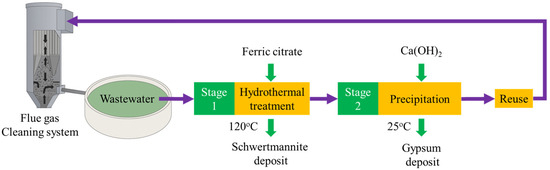
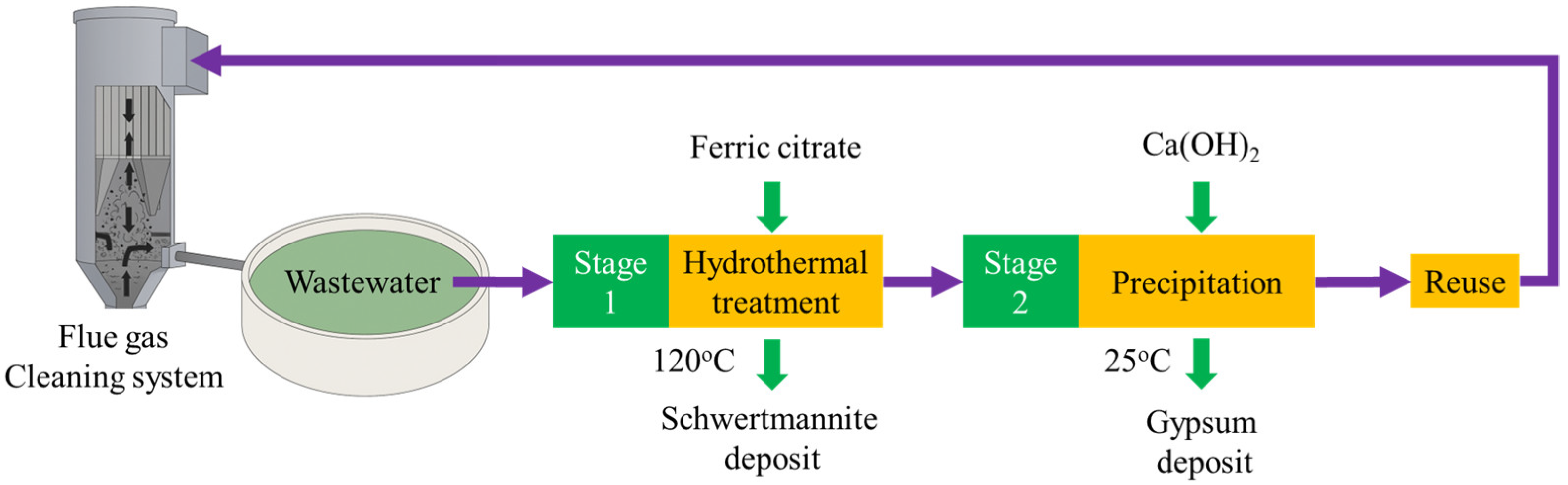
The simulated wastewater was hydrothermally treated as follows (Figure 1, Stage 1). First, 20 mL of wastewater was mixed with 0.5 g (25 g/L) of the test reagent in a 50 mL Teflon vessel. Second, the vessel was sealed and heated to 120 °C for 6 h and then cooled to room temperature overnight. Third, the vessel was opened, and the supernatant and the deposit were collected separately. Six reagents—magnesium acetate, basic aluminum acetate, basic ferric acetate, ferric acetylacetonate, calcium acetate, and ferric citrate—were each tested at the same fixed dose of 0.5 g per 20 mL.
Figure 1.
Flow chart of wastewater treatment.
2.3. Parameter Optimization
Among the experiments, the dosage of ferric acetylacetonate was optimized in the range of 0–1 g (0–50 g/L), and that of ferric citrate in the range of 0–1.5 g (0–75 g/L); the reaction time for ferric citrate was varied from 0.5 to 6 h. All dosages refer to a fixed wastewater volume of 20 mL.
After hydrothermal treatment, the generated supernatant was collected and then neutralized by adding Ca(OH)2 (Figure 1 Stage 2) according to the method of Zahedi et al. [16]; this neutralization is a process stage rather than an optimization parameter. After filtration to separate the deposit, the filtrate was collected and characterized.
2.4. Characterization
All chemicals used were of analytical grade. The raw wastewater, treated supernatant, and regenerated water were analyzed by ion chromatography (IC; ICS-6000, Thermo Fisher Scientific, Waltham, MA, USA) and inductively coupled plasma optical emission spectrometry (ICP-OES; 5110, Agilent Technologies, Santa Clara, CA, USA). The pH was measured with a pH meter (SevenDirect SD20, Mettler-Toledo, Greifensee, Switzerland), and organic carbon was determined with a total organic carbon analyzer (TOC-500, Shimadzu, Kyoto, Japan). The solid deposits were characterized by scanning electron microscopy (SEM; Sigma 360, ZEISS, Oberkochen, Germany), X-ray diffractometry (XRD; SmartLab, Rigaku, Tokyo, Japan) using Cu Kα radiation over 2θ = 5–80°, and X-ray fluorescence spectrometry (XRF; S8 TIGER, Bruker, Billerica, MA, USA). Thermodynamic calculations were performed with the HSC Chemistry software package (version 6.0, Metso, Espoo, Finland) using the MainDB6 thermodynamic database. All hydrothermal experiments were repeated three times, and the reported data are the average values of the triplicate runs. To evaluate whether the differences observed under the varying experimental conditions were statistically significant, a one-way analysis of variance (ANOVA) was performed using Microsoft Excel 2019 at a significance level of p < 0.05.
3. Results
3.1. Wastewater Disposal at Industrial Scale
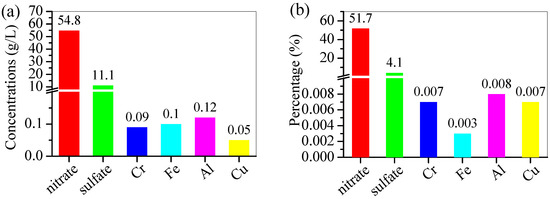
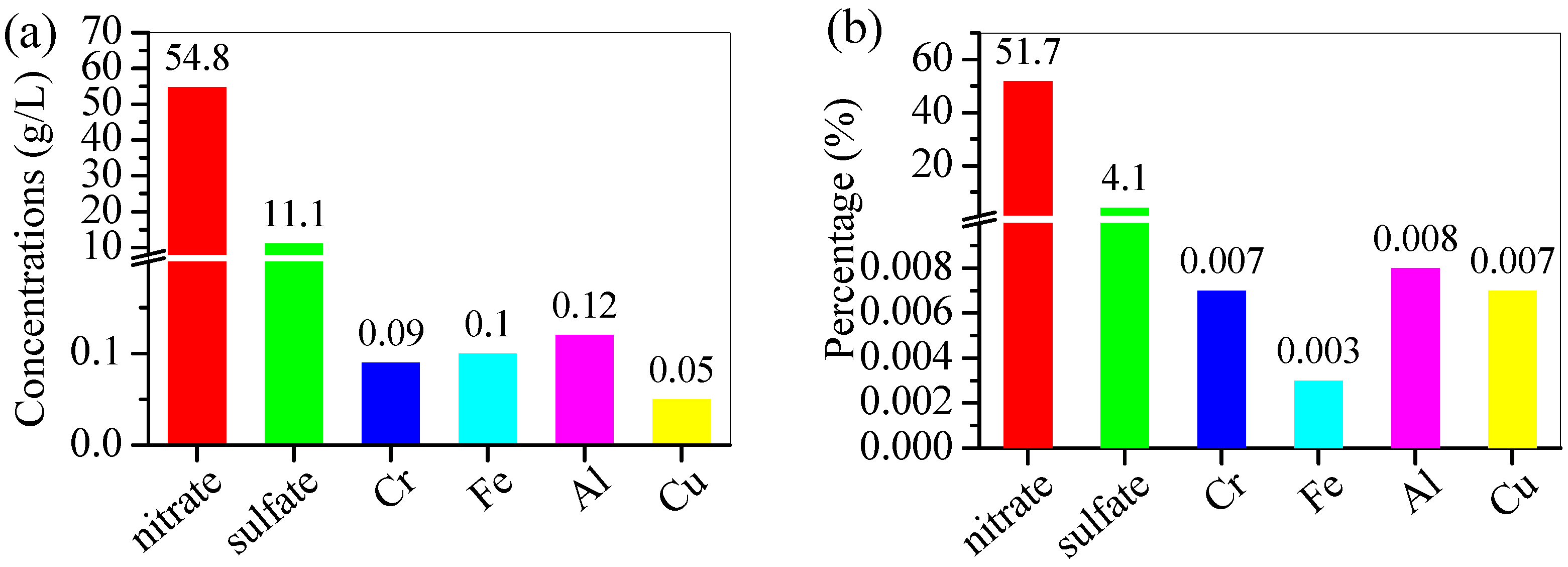
Five wastewater samples were collected and analyzed (Figure 2a). The results show sulfate and nitrate concentrations in the ranges of 10.5–12.5 g/L and 53.3–57.5 g/L, respectively, with trace amounts of Fe, Al, Cu, and Cr. The averaged wastewater quality values are: sulfate 11.1 g/L, nitrate 54.8 g/L, Cr 0.09 g/L, Fe 0.1 g/L, Al 0.12 g/L, Cu 0.05 g/L, Cl 1.9 g/L, and TOC 1.35 g/L. The wastewater was often neutralized with hydrated lime, then concentrated and evaporated to form a salt containing 4.1% sulfate, 51.7% nitrate, and 21.5% water (Figure 2b). Because the salt contains Cr, together with a high nitrate load, and no leaching-toxicity test has been performed, it must be managed as a solid waste requiring hazard identification (e.g., the GB 5085.3 leaching test) and controlled disposal rather than direct landfilling.
Figure 2.
(a) Composition variation of wastewater and (b) waste salt.
3.2. Wastewater Treatment
3.2.1. Reagent Effects
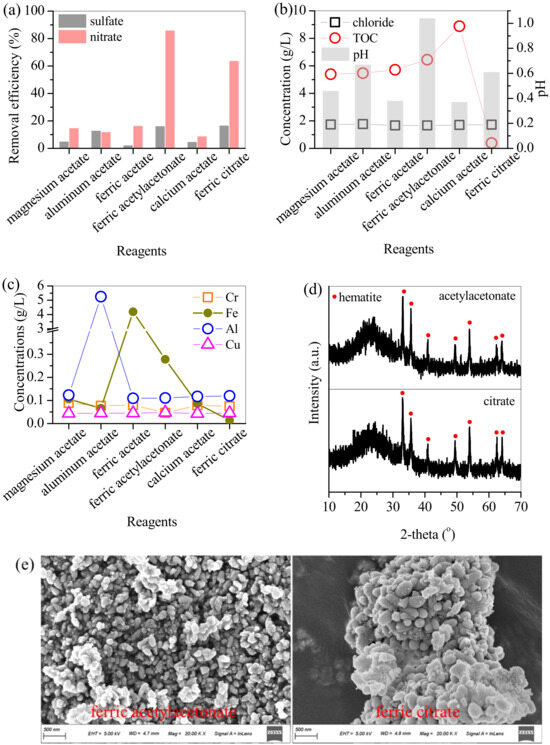
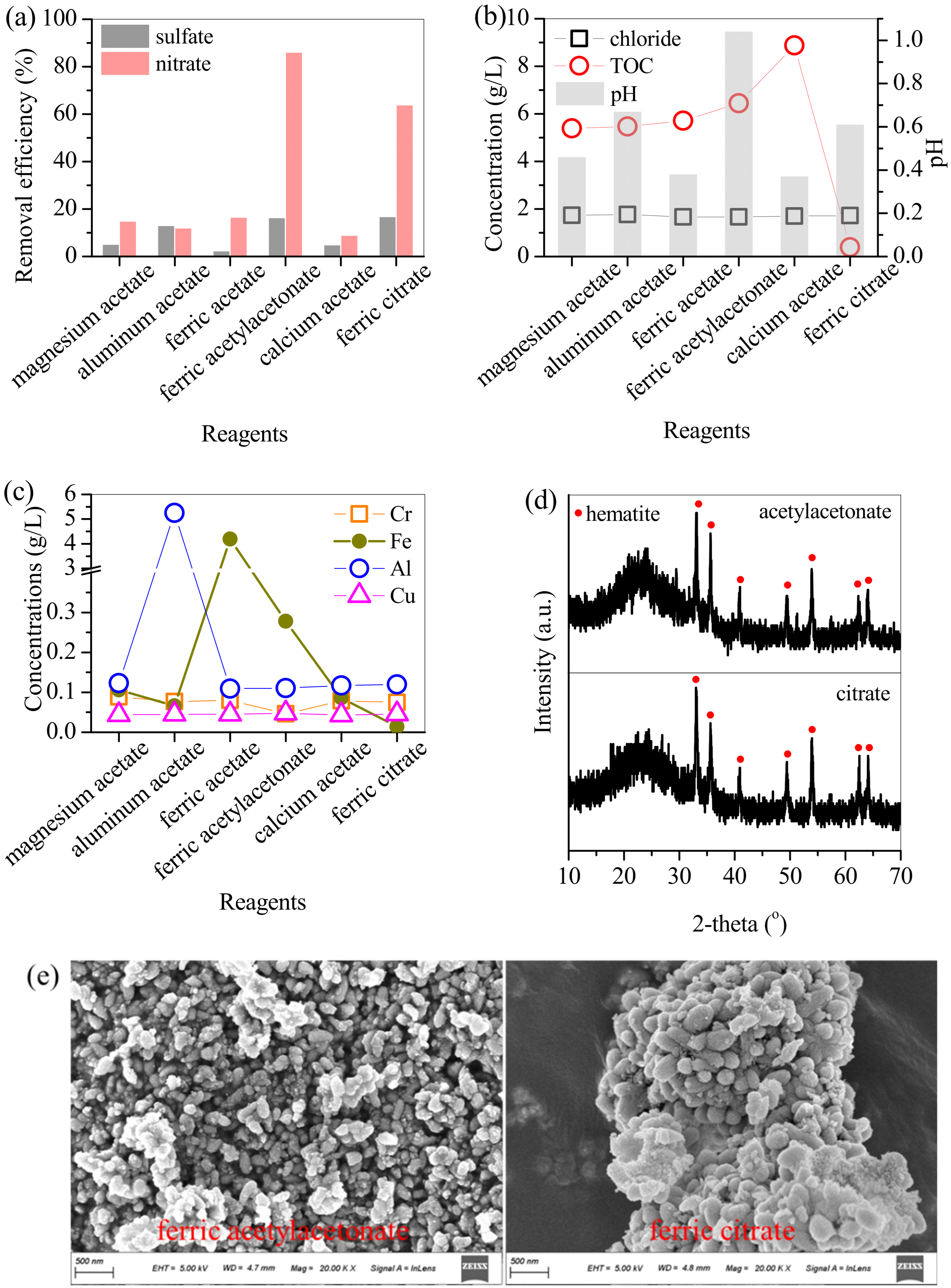
The direct addition of inorganic Fe, Al, Ca and Mg salts would inevitably introduce inorganic anions into the wastewater. To avoid this drawback, six organic reagents, including magnesium acetate, basic aluminum acetate, basic ferric acetate, ferric acetylacetonate, calcium acetate, and ferric citrate, were used for their effectiveness in wastewater treatment. Among these, ferric acetylacetonate exhibited the highest performance, achieving removal efficiencies of 16.1% for sulfate and 85.9% for nitrate (Figure 3a). Following treatment with ferric acetylacetonate, the concentration of Fe in the wastewater increased to 0.28 g/L, the pH rose to 1, and TOC reached 6.4 g/L (Figure 3b,c). Notably, the application of aluminum acetate, ferric acetate, and ferric acetylacetonate resulted in the release of both Fe and Al into the treated water, whereas ferric citrate did not contribute to Fe release. Ferric citrate was effective in removing 16.5% of nitrate and 63.6% of sulfate, while maintaining a residual reagent-derived TOC below 0.4 g/L. After treatment with ferric acetylacetonate, chloride and Cu concentrations remained nearly unchanged, while Cr decreased by 47.4%. In comparison, the other reagents produced no noticeable reduction in chloride, Cu, or Cr concentrations.
Figure 3.
(a) Removal efficiencies of nitrate and sulfate and (b) corresponding variation of chloridoid, pH and TOC. (c) Variation of heavy metals, (d) XRD and (e) SEM of generated deposits by adding ferric acetylacetonate and ferric citrate, respectively.
Upon treatment with ferric acetylacetonate and ferric citrate, Fe-bearing deposits formed (Figure 3d,e). These irregular particles exhibited characteristic hematite peaks, confirming the formation of hematite deposits.
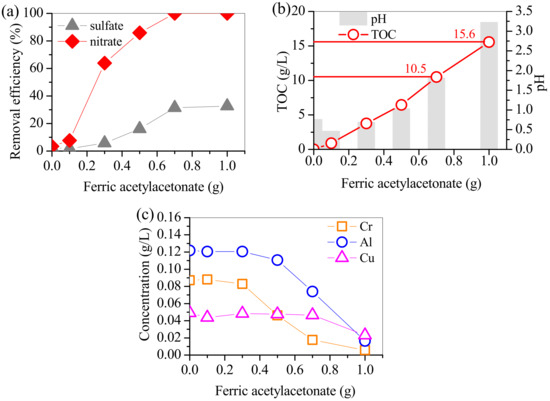
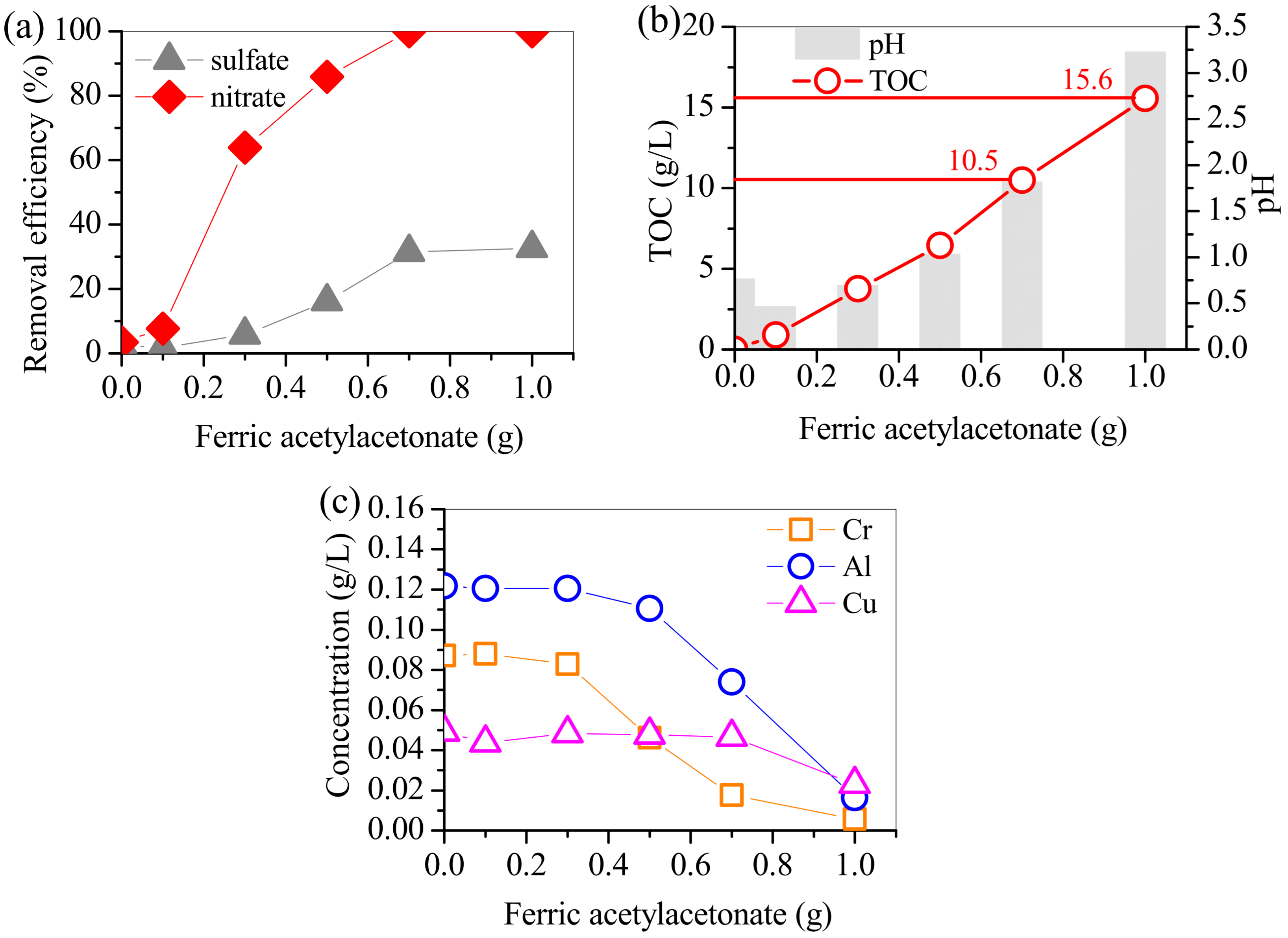
Given that ferric acetylacetonate demonstrated superior nitrate removal performance (see Figure 3a), its optimal dosage was further evaluated, as illustrated in Figure 4. In the absence of ferric acetylacetonate, both sulfate and nitrate levels showed negligible variation. Adding 0.1 g ferric acetylacetonate yielded modest removal efficiencies for nitrate and sulfate at 7.6% and 1.8%, respectively, but these efficiencies surged to 63.9% and 5.8% at 0.3 g, and approached near-complete removal of almost 100% for nitrate and 31.4% for sulfate at 0.7 g, with no significant improvement upon increasing the dosage to 1 g. Concurrently, pH and TOC in the wastewater rose consistently as the dosage increased from 0.1 to 1 g/L, with pH climbing from 0.5 to 3.2 and TOC from 0.9 to 15.6 g/L (Figure 4b). Notably, concentrations of residual Cr, Al, and Cu were substantially reduced when the ferric acetylacetonate dosage exceeded 0.7 g (Figure 4c). However, this process introduced substantial organic matter (10.5 to 15.6 g/L, Figure 4b) to the wastewater, highlighting the need for additional treatment steps to address elevated organics before discharge.
Figure 4.
Effect of ferric acetylacetonate dosage on (a) removal efficiencies of sulfate and nitrate, variation of (b) TOC and pH, and (c) Cr and Cu concentrations.
3.2.2. Effect of Ferric Citrate
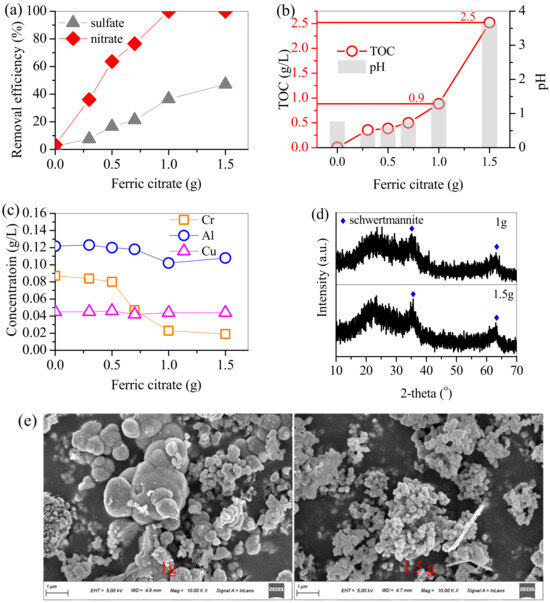
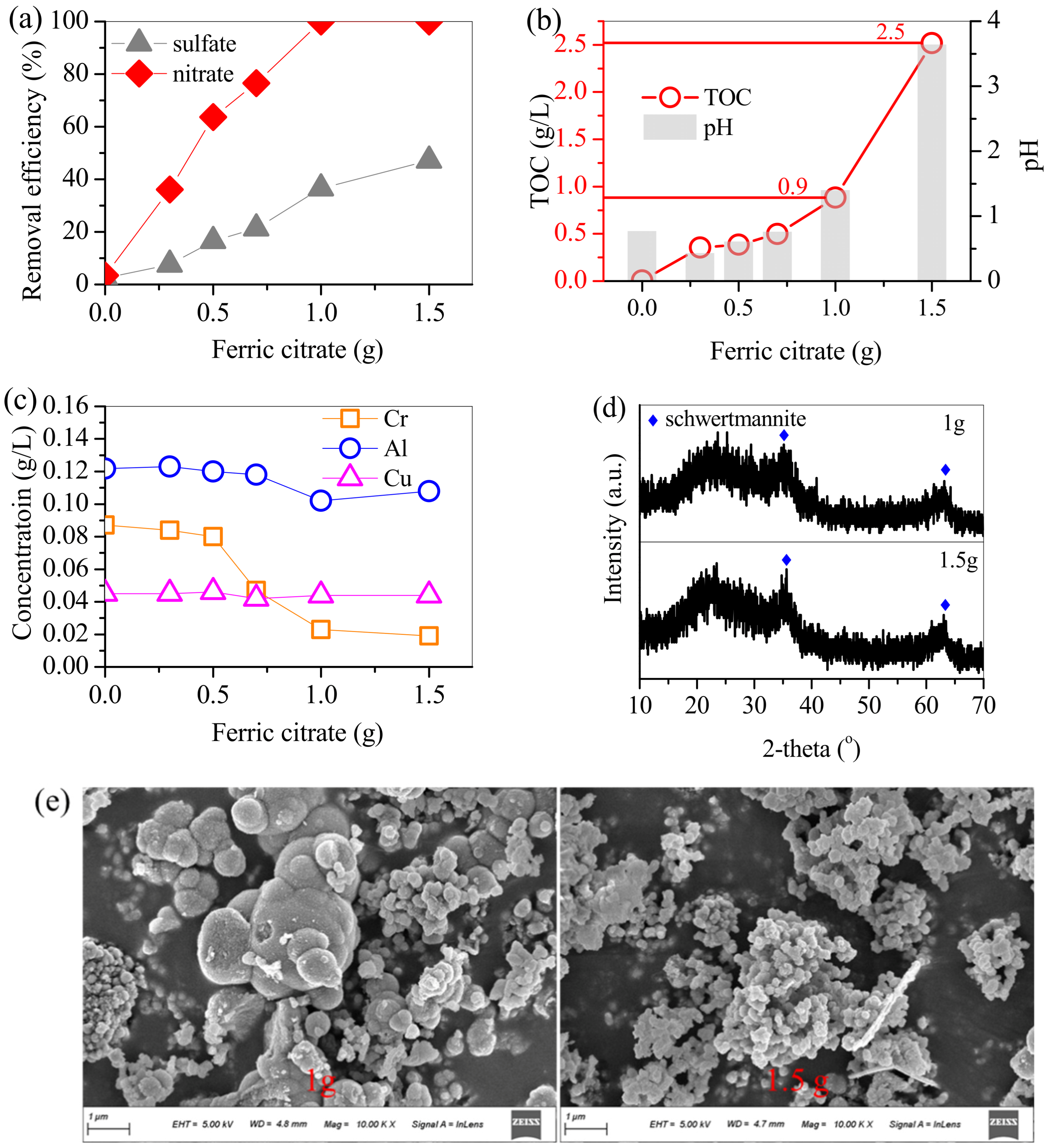
To avoid the introduction of abundant organics into wastewater, ferric citrate was considered as an additive (Figure 5). The results showed that the nitrate and sulfate removal also achieved 36.1% and 7.6% at 0.3 g ferric citrate, nearly 100% and 36.5% at 1 g, and nearly 100% and 47.1% at 1.5 g (Figure 5a). This was slightly lower than that of ferric acetylacetonate (Figure 4a). However, the residual TOC was only 0.9 g/L at 1 g ferric citrate, but elevated to 2.5 g/L at 1.5 g (Figure 5b), apparently one-tenth of that when adding ferric acetylacetonate (Figure 4b). This confirmed the avoidance of overdosing organics in the wastewater treatment. However, under these conditions, the residual Cu concentrations did not vary, while the Cr concentration dropped to 0.02 g/L, in accordance with the removal of 78% Cr from the wastewater (Figure 5c). When the ferric citrate dosage was at 1 g or 1.5 g, a brownish deposit formed—fine particles that showed typical peaks of schwertmannite (Figure 5d,e). The inflection point at 1 g marks a reagent threshold. Below 1 g, the system is reagent-limited, so nitrate and sulfate removal improve only gradually. At 1 g, sufficient Fe(III)–citrate is available to generate the Fe(II) required to sustain the catalytic nitrate-reduction chain: nitrate removal approaches completion, sulfate removal plateaus, and the residual TOC remains as low as 0.9 g/L because the ligand is consumed. Above 1 g, removal no longer improves, and the rising TOC simply reflects the excess carbon introduced with the surplus reagent. This sharp transition is consistent with the proposed Fe(II)-mediated mechanism and confirms the practical value of a single, moderate reagent dose.
Figure 5.
Effect of ferric citrate dosage on (a) removal efficiencies of sulfate and nitrate, variation of (b) TOC and pH, and (c) Cr and Cu concentrations; (d) XRD and (e) SEM images of the deposit generated by adding 1 g and 1.5 g citrate, respectively.
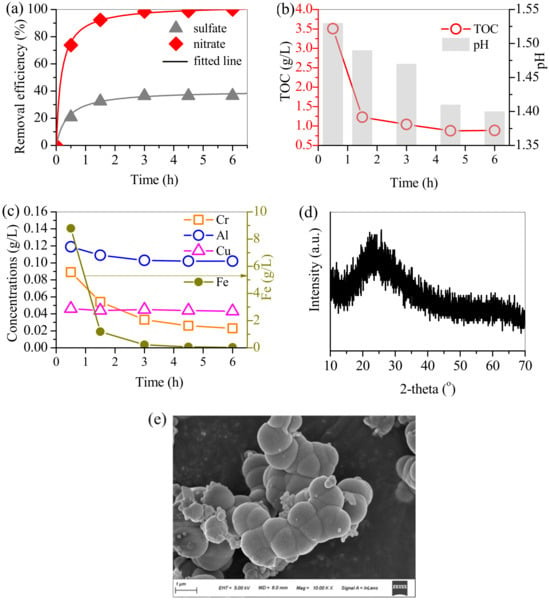
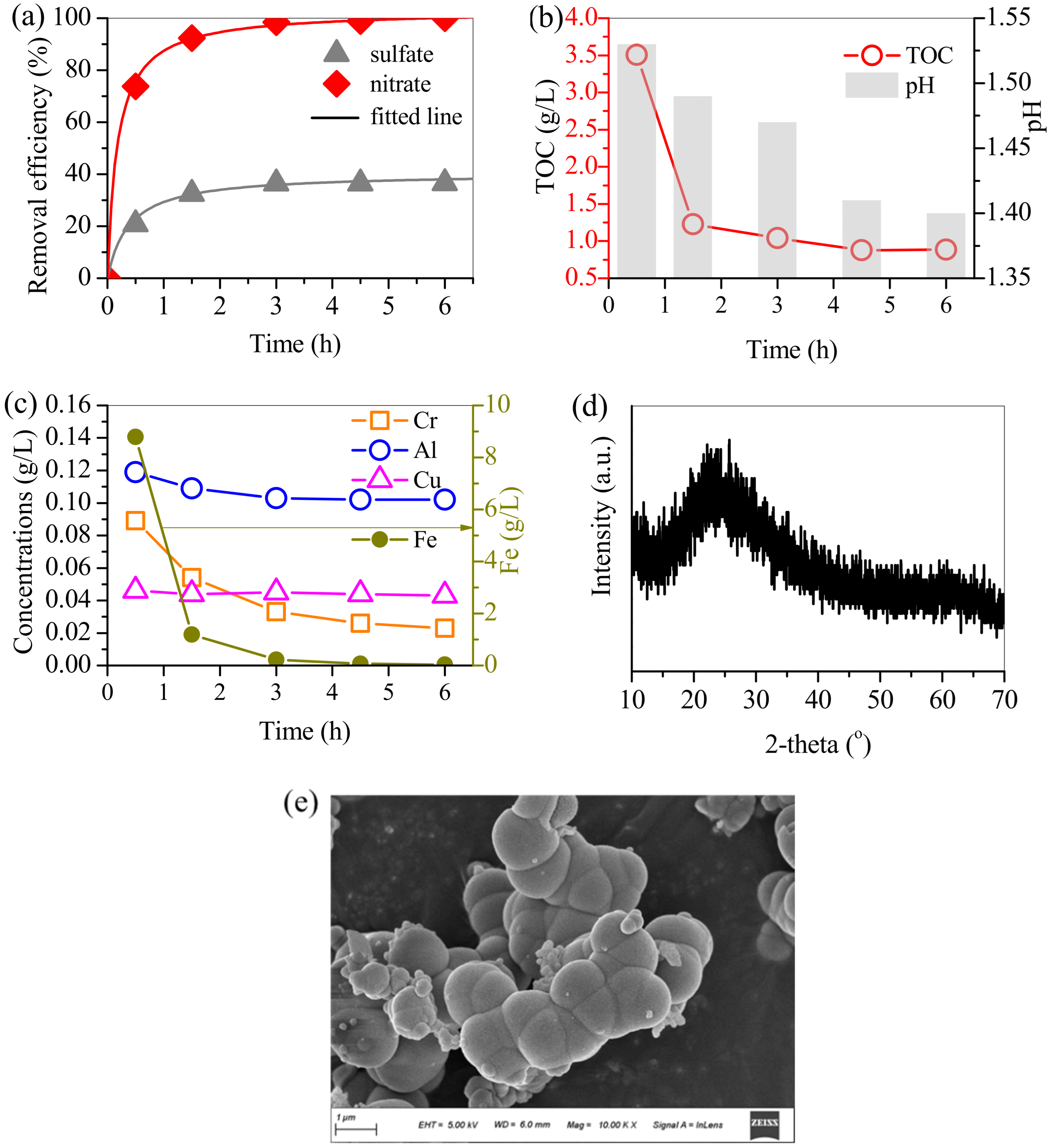
Time-course data show that adding ferric citrate rapidly reduced sulfate and nitrate concentrations, with removals of 20.7% and 73.8% at 0.5 h, increasing to 33.5% and 92.3% at 1 h, and 36.5% and nearly 100% at 3 h, then remaining unchanged beyond 3 h (Figure 6a). Concurrently, wastewater pH and TOC dropped from 1.5 and 3.5 g/L at 0.5 h to 1.4 and 1 g/L after >3 h (Figure 6b). Free Fe added with ferric citrate also decreased from 8.8 g/L at 0.5 h to 0.2 g/L at 3 h and 0.04 g/L beyond 3 h, and Cr and Al exhibited similar declining trends, indicating their participation in the Fe-removal pathway; however, Cu removal did not occur (Figure 6c). Notably, at the initial 0.5 h, the deposited phase remained in amorphous form (Figure 6d,e), a precursor of that observed after 6 h (Figure 5d 1 g and Figure 5e 1 g).
Figure 6.
Time course of ferric citrate on (a) the sulfate and nitrate removal, (b) pH and TOC variation and (c) metallic ions concentration; (d) XRD pattern and (e) SEM image of deposit generated at 0.5 h.
3.2.3. Neutralization by pH Adjustment
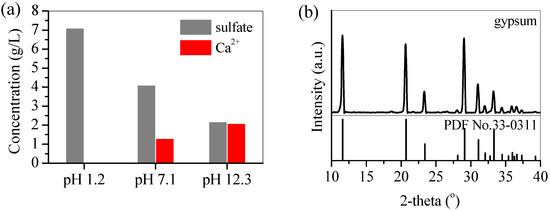
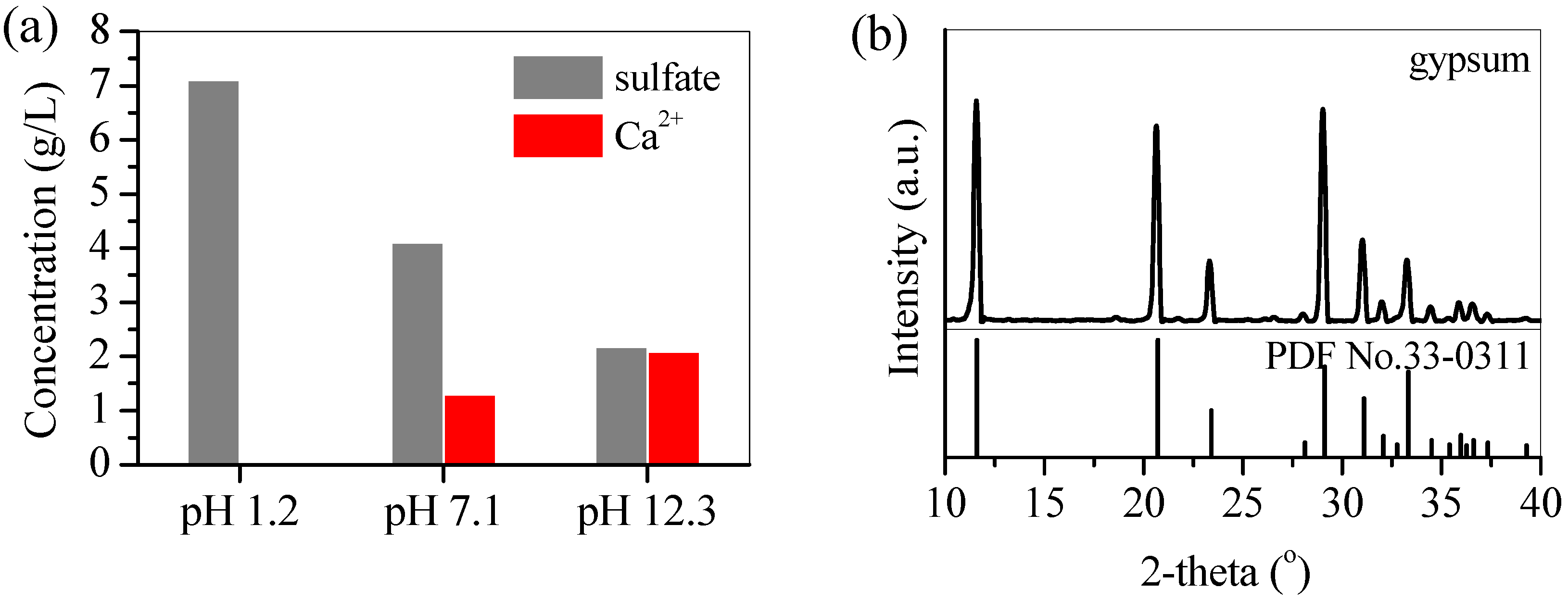
With the thermal treatment, the residual wastewater also contained 7 g/L sulfate at pH 1.2. When it was adjusted to pH 7.1 by Ca(OH)2, the residual sulfate was 4.1 g/L (Figure 7a), with the generation of 1.3 g/L Ca2+. Even though the pH was adjusted to 12.4 by overdosing Ca(OH)2, the residual sulfate was also at 2.1 g/L, accompanied by introducing 2.1 g/L Ca2+. Accordingly, gypsum precipitates were generated (Figure 7b).
Figure 7.
(a) pH adjustment for neutralization; (b) XRD patterns of generated deposits.
After neutralization, the wastewater was regenerated and then intended for in situ reuse within the flue gas purification loop rather than for environmental discharge. The intrinsic organic matter of the raw wastewater (TOC 1.35 g/L) is resistant to biological degradation but can be oxidized by nitrate under the hydrothermal conditions, with Fe3+ acting as the catalyst [17,18]. The reagent-derived TOC decreased to ≈1 g/L after treatment (Figure 6b), a level that does not noticeably affect the reuse of the water.
3.3. Wastewater Treatment Mechanism
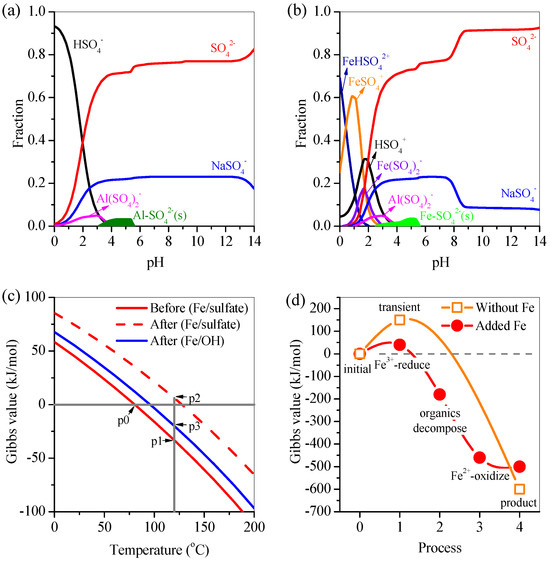
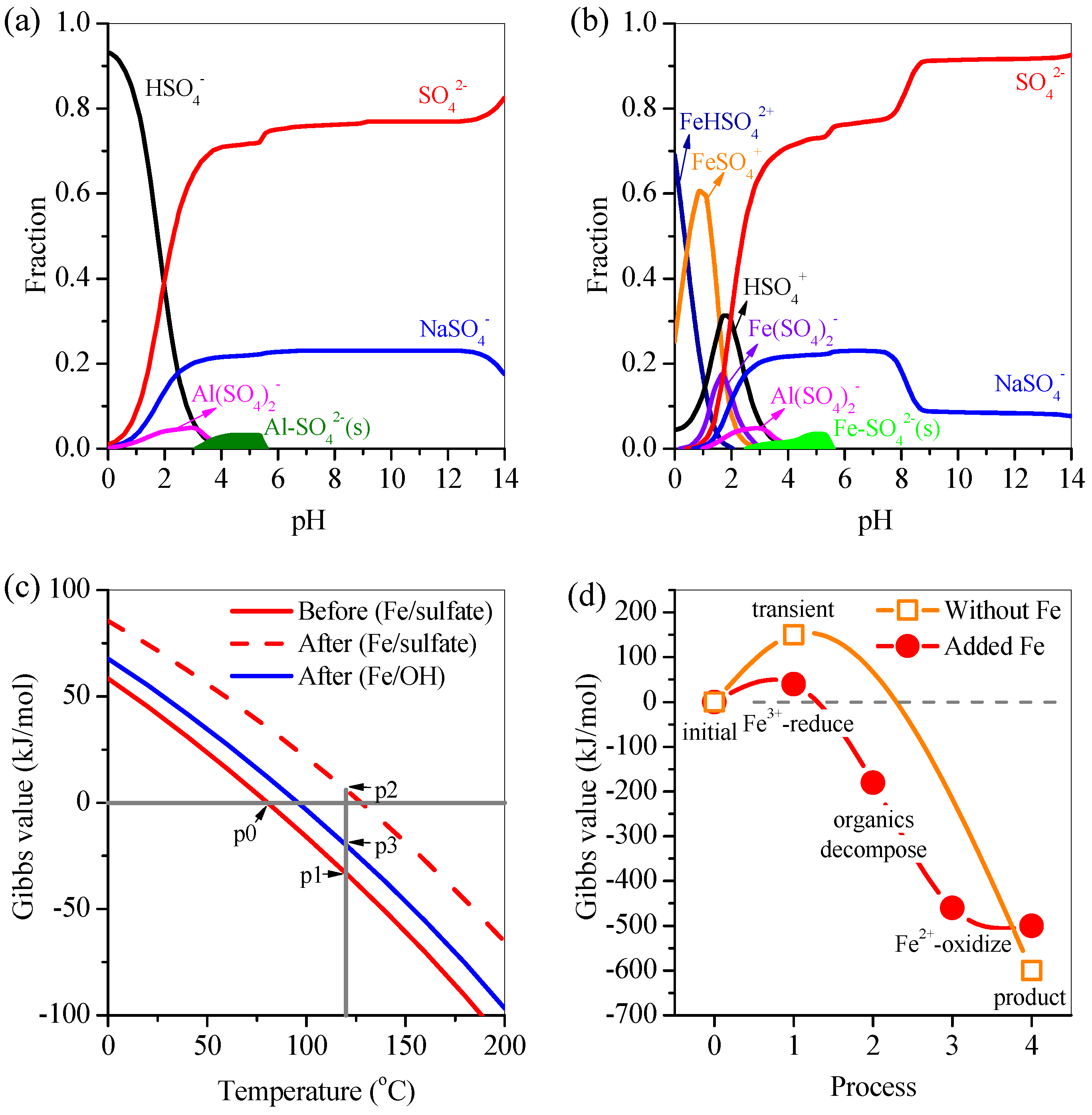
In the wastewater, sulfate and nitrate functioned as the main anions. Initially, sulfate existed as HSO4−. With the pH increased to 4, its speciation shifted to SO42−, NaSO4−, Al(SO4)2−, and Al-bearing solids (Figure 8a). Upon addition of ferric citrate, sulfate conversion pathways changed: at the initial stage, sulfate formed FeHSO42+ and FeSO4+ complexes. At pH 4, a portion of it transformed into Fe-bearing solid (Figure 8b). In contrast, nitrate and chloride species remained stable, even after ferric citrate addition [13,19]. These results highlight that sulfate, but not nitrate or chloride, can be effectively removed through the formation of Fe/Al-bearing precipitates.
Figure 8.
Fitted plot of sulfate species in the (a) absence and (b) presence of ferric citrate; (c) thermodynamic calculation of sulfate removal, (d) Gibbs value variation of nitrate removal.
Introducing ferric citrate provided sufficient Fe3+ to facilitate sulfate association as amorphous Fe/SO42−-bearing deposit, and then gradually converted to weakly crystallized schwertmannite (Fe16O16(SO4)3(OH)10·10H2O) under the desirable pH range of 1.4–3.6. But under low pH conditions, the deposit released free sulfate and then converted into hematite particles [20,21]. This did not favor sulfate removal.
Reaction temperature predominated the deposit formation. For instance, at room temperature, the formation of Fe-SO42−-bearing deposit was thermodynamically unfavorable due to a positive Gibbs free energy change (Figure 8c). But formation commenced above 80 °C (Figure 8c p0) and accelerated significantly at 120 °C (Figure 8c p1). After treatment, Fe3+ concentration dropped to 0.04 g/L (Figure 6c), halting further deposit formation in accordance with the positive Gibbs free energy (Figure 8c p2). Concurrently, Fe3+ hydrolyzed to FeOOH [22,23,24], a process with a consistently negative Gibbs free energy, indicating that hydrolysis persisted even at low Fe3+ concentration [25,26] (Figure 8c p3).
With the addition of ferric citrate, the introduced citrate can also participate in a redox reaction with nitrate [17,27]. However, at room temperature, electron delocalization within citrate is limited [28], while electron acceptance by nitrate requires “dissociation–rearrangement” of its N–O bonds (in transition state) [29,30]. This redox process involves multiple electron-transfer steps [31] and concurrent disruption of several resonance structures [32], resulting in a high activation energy, typically exceeding 150 kJ/mol (Figure 8d). When the temperature is increased to 120 °C, elevated molecular kinetic energy induces partial thermal decomposition of nitrate [18], generating highly oxidative species such as hydroxyl radicals and NO2 [33,34]. Meanwhile, the dielectric constant of water decreases with temperature, strengthening organic–inorganic interfacial interactions [35]. These factors collectively initiate the redox reaction between citrate and nitrate.
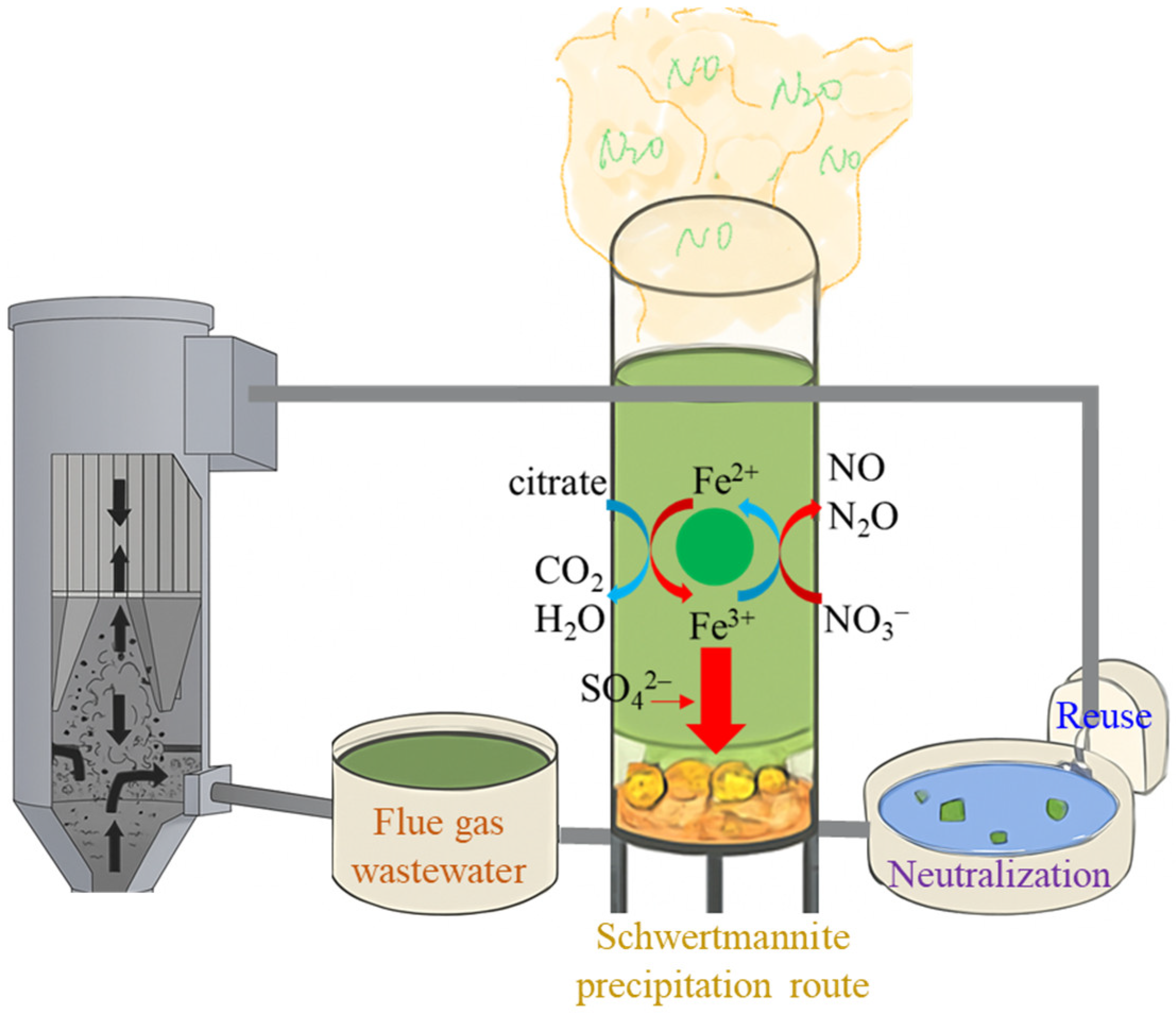
Fe3+ further facilitated the citrate–nitrate redox process by lowering the activation energy and enabling alternative reaction intermediates, thereby promoting electron transfer and accelerating the overall reaction. While Fe3+ forms stable [Fe(Cit)] complexes with citrate at room temperature [36,37], significant electron transfer from citrate to Fe3+ emerges at 120 °C [38], resulting in the reduction of Fe3+ to Fe2+. This reduction initiates the Fe3+/Fe2+ redox cycle (Figure 9), effectively mediating citrate oxidation by Fe3+ and nitrate reduction by Fe2+ [39]. Although the thermodynamic driving force remains largely unchanged, this reconstructed pathway enables the overall process to proceed through multiple lower-energy steps instead of a single high-energy barrier, as illustrated in Figure 8d.
Figure 9.
Illustration graph of wastewater purification.
Al and Cr, exhibiting similar trivalent states to Fe, also participated in sulfate precipitation [40,41], resulting in a marked decrease in their concentrations in the treated wastewater. In contrast, Cu, due to its bivalent state, remained largely unaffected. Subsequent neutralization of the wastewater using Ca(OH)2 led to the co-precipitation of these metal ions with gypsum, even though it is a residual of sulfate and free Ca2+.
3.4. Resource Implications of the Work
This method achieves the simultaneous removal of nitrate and sulfate from flue gas wastewater, providing a timely solution to the growing demand for effective industrial water management. Following hydrothermal treatment and neutralization with Ca(OH)2, nitrate became undetectable, and sulfate was reduced to 4.1 g/L. Heavy metals such as Cu and Cr were also removed efficiently, enabling the regenerated water to be reused directly in the flue gas cleaning process without further treatment (Figure 9). The result is a closed-loop system that supports ZLD, a critical objective in the face of water scarcity and increasingly stringent discharge regulations [7]. This stands in sharp contrast to the prevailing practice of routing similarly highly saline bleed streams from wet purification processes directly to evaporation [42,43], which recovers no water and leaves behind heavy-metal-laden mixed salt residues that demand costly hazardous waste disposal [11].
The feasibility of this closed loop rests, in large part, on the method’s modest energy requirements. Because the hydrothermal process operates at approximately 120 °C, it can be powered by the low-grade waste heat of the smelting enterprise itself [44], a resource that conventional techniques cannot effectively recover, since a substantial portion of the heat emitted by smelting enterprises lies below 230 °C [45]. Moreover, once nitrate reduction is initiated, the exothermic citrate–nitrate redox reaction helps sustain the reaction temperature [44], thereby reducing the dependence on external heating. The process therefore relies on waste heat [6], a clear advantage over energy-intensive techniques based on conventional evaporation–crystallization.
Beyond water recovery, the method also adds value through its solid products. Ferric citrate promotes the formation of iron-rich schwertmannite precipitates, which can be sold directly as iron concentrate for smelting or employed as additives in cement, geopolymers, and other building materials [46,47]. In this way, what would otherwise be a treatment by-product is transformed into a beneficial resource rather than a disposal burden.
The method also compares favorably with existing technologies. Conventional limestone–gypsum desulfurization is the most widely practiced method, and its effectiveness for sulfate removal is limited, with about 2–4.1 g/L sulfate remaining in the treated effluent. This method, however, does not remove nitrate, and deeper sulfate removal by lime alone is intrinsically limited by the solubility of gypsum (nearly 2 g/L) [48]. Commercial inorganic coagulants such as PAC and PFS have been tested for the simultaneous treatment of such high-salt wastewater, but direct treatment removed only a small fraction of sulfate and nitrate unless combined with additional steps [14], and chloride-bearing reagents inevitably accumulate Cl− in the recirculating water. Chemical reductants used for high-concentration nitrate—zero-valent iron and sodium sulfite—are low efficient in the present matrix: sodium sulfite hydrolyzes to sulfite, whose oxidation to sulfate introduces an additional sulfate load equivalent to the nitrate reduced, whereas iron-powder reduction is kinetically limited by the consumption of H+ [49,50]. Waste-heat evaporation, although an acceptable means of volume reduction, merely transfers the pollutants into a residual mixed salt without destroying the nitrate, and is associated with high energy demand and costly salt disposal [7]. Taken together, the regeneration and reuse of wastewater simultaneously containing high concentrations of nitrate and sulfate still remains an open challenge at the industrial scale, which justifies the one-step hydrothermal process proposed in this work.
Nevertheless, the method is not without limitations. Gypsum formed during partial neutralization often retains heavy metals, complicating its disposal [51]. A promising alternative is to deliberately route Cu and Cr into the iron-rich schwertmannite phase, converting these contaminants into valuable raw materials for iron smelting while simultaneously preventing their entry into the subsequent gypsum. A further challenge is the unintended formation of NOx rather than direct conversion to N2, underscoring the need for future research to prioritize pathways that enhance nitrate-to-N2 transformation [31,52]. In addition, chloride removal remains inadequate; the resulting Cl− accumulation in the reused water increases the risk of corrosion, making vigilant monitoring of Cl− concentration essential.
These limitations notwithstanding, the method carries significance that extends well beyond a single treatment train. Given that many facilities still employ oxidation-based technologies for flue gas purification [5], which inevitably generate substantial volumes of flue gas wastewater [2], the broader relevance of this regeneration approach is considerable. More fundamentally, it signals a reconceptualization of how flue gas wastewater is valued within the industrial system as a whole. Rather than following the conventional linear trajectory, in which water is withdrawn, used, treated, and discharged while fresh supplies are perpetually drawn from external sources, the method establishes a circular resource dynamic in which the plant’s water, energy, and material flows become mutually reinforcing. The regenerated water, once a liability requiring intensive handling before any release, is returned directly to the process from which it originated, effectively closing the loop within the plant and decoupling its operation from external water availability. The facility no longer merely reduces its discharge; it fundamentally redefines its water balance, transforming a continuous waste stream into a continuous internal supply while shrinking its environmental interface to near zero.
At its core, the process is self-reinforcing: water is recycled in place, heat that would otherwise be lost is put to use, and dissolved constituents are returned to productive ends, three resource streams recovered simultaneously. For the smelting enterprise itself, this convergence translates into concrete operational gains. It reduces dependence on external water intake, alleviates the pressure of increasingly stringent discharge regulations, and converts treatment by-products into saleable materials rather than disposal liabilities. In this sense, the method demonstrates how a smelting enterprise can move beyond mere compliance toward genuine resource self-sufficiency, closing its water loop with waste heat it already produces, and turning what was once a costly disposal problem into an integrated part of its own operations. It offers, in short, a realistic template for how smelting enterprises can meet tightening environmental requirements while improving their internal resource efficiency.
4. Conclusions
This study presented a hydrothermal strategy for regenerating flue gas wastewater containing high concentrations of nitrate and sulfate. In this approach, ferric citrate was employed as the water treatment reagent, achieving the removal of >99% nitrate and 36.5% sulfate after wastewater treatment at 120 °C for 3 h. This also effectively co-removed trace amounts of Cr and Al through schwertmannite precipitation routes. The added citrate was largely oxidized, leaving a residual reagent-derived TOC of ~1 g/L. Although ferric acetylacetonate also demonstrated comparable denitrification and desulfurization efficiency, it left a much higher residual reagent-derived TOC (up to 10.5 g/L), making it unsuitable for application. After treatment, the supernatant was subsequently adjusted to pH 7.1 using Ca(OH)2, further reducing the sulfate concentration to merely 4.1 g/L. Consequently, the treated wastewater could be directly recirculated in flue gas purification systems without requiring additional polishing steps. Despite these significant advantages, several limitations warrant attention, including inefficient chloride removal and NOx gas emissions during the treatment process. Overall, this regeneration strategy substantially reduced freshwater consumption and wastewater discharge volumes in industrial flue gas purification processes, offering considerable potential for large-scale implementation and economic benefits.
Author Contributions
Conceptualization, S.Z.; experiment, methodology and validation, Y.L.; formal analysis and experiment, X.L.; data curation, D.Y. and Y.C.; writing—original draft preparation, S.Z.; writing—review and editing, Y.L.; project administration and funding acquisition, S.Z. and Y.L.; resources, H.K. All authors have read and agreed to the published version of the manuscript.
Funding
This work was supported by the National Natural Science Foundation of China (No. 52293443), the Science and Technology Program of Jilin Province (Grant No. 20240304178SF), and the Open Funding of Key Laboratory of Songliao Aquatic Environment, Ministry of Education, China (JLJUSLKF042024004).
Data Availability Statement
The original contributions presented in this study are included in the article. Further inquiries can be directed to the corresponding author.
Conflicts of Interest
The authors declare no conflicts of interest.
References
- Tchounwou, P.B.; Yedjou, C.G.; Patlolla, A.K.; Sutton, D.J. Heavy metal toxicity and the environment. In Molecular, Clinical and Environmental Toxicology: Volume 3: Environmental Toxicology; Springer: Berlin/Heidelberg, Germany, 2012; pp. 133–164. [Google Scholar]
- Zhu, Z.; Xu, B. Purification technologies for NOx removal from flue gas: A review. Separations 2022, 9, 307. [Google Scholar] [CrossRef] [Scilit]
- Gingerich, D.B.; Grol, E.; Mauter, M.S. Fundamental challenges and engineering opportunities in flue gas desulfurization wastewater treatment at coal fired power plants. Environ. Sci.-Wat. Res. 2018, 4, 909–925. [Google Scholar] [CrossRef] [Scilit]
- Gingerich, D.B.; Mauter, M.S. Flue gas desulfurization wastewater composition and implications for regulatory and treatment train design. Environ. Sci. Technol. 2020, 54, 3783–3792. [Google Scholar] [CrossRef] [Scilit] [PubMed]
- Flagiello, D.; Erto, A.; Lancia, A.; Di Natale, F. Advanced Flue-Gas cleaning by wet oxidative scrubbing (WOS) using NaClO2 aqueous solutions. Chem. Eng. J. 2022, 447, 137585. [Google Scholar] [CrossRef] [Scilit]
- Álvarez-Ayuso, E.; Querol, X.; Tomás, A. Environmental impact of a coal combustion-desulphurisation plant: Abatement capacity of desulphurisation process and environmental characterisation of combustion by-products. Chemosphere 2006, 65, 2009–2017. [Google Scholar] [CrossRef] [Scilit] [PubMed]
- Tong, T.; Elimelech, M. The global rise of zero liquid discharge for wastewater management: Drivers, technologies, and future directions. Environ. Sci. Technol. 2016, 50, 6846–6855. [Google Scholar] [CrossRef] [Scilit] [PubMed]
- Yan, L.; Lu, X.; Wang, Q.; Guo, Q. Recovery of SO2 and MgO from by-products of MgO wet flue gas desulfurization. Environ. Eng. Sci. 2014, 31, 621–630. [Google Scholar] [CrossRef] [Scilit] [PubMed]
- Ye, X.; Zhang, C.; Wang, S.; Yang, D.; Guo, B.; An, X.; Yu, A. Simulation of desulphurization wastewater evaporation through flue gas. Powder Technol. 2020, 361, 462–472. [Google Scholar] [CrossRef] [Scilit]
- Jin, Y.; Zheng, C.; Wang, Q.; Song, D. Design and operation of the low-temperature flue gas evaporation-main flue duct drying system for desulfurization wastewater treatment in coal-fired power plants. Huadian Technol. 2021, 43, 1674–1951. [Google Scholar]
- Plata, S.L.; Devenport, C.L.; Miara, A.; Sitterley, K.A.; Evans, A.; Talmadge, M.; Van Allsburg, K.M.; Kurup, P.; Cox, J.; Kerber, S. Zero liquid discharge and water reuse in recirculating cooling towers at power facilities: Review and case study analysis. ACS ES T Eng. 2022, 2, 508–525. [Google Scholar] [CrossRef] [Scilit]
- Zhou, H.; Zhan, L.; Chen, H.; Yang, L. Concentration of desulfurization wastewater using low-temperature flue gas and associated corrosion risk. Environ. Sci. Pollut. R. 2023, 30, 18395–18407. [Google Scholar] [CrossRef] [Scilit] [PubMed]
- Li, T.; Su, T.; Wang, J.; Zhu, S.; Zhang, Y.; Geng, Z.; Wang, X.; Gao, Y. Simultaneous removal of sulfate and nitrate from real high-salt flue gas wastewater concentrate via a waste heat crystallization route. J. Clean. Prod. 2023, 382, 135262. [Google Scholar] [CrossRef] [Scilit]
- Liu, J.; Wang, Y.; Wang, Y.; Wang, Z.; Wang, X.; Kong, F.; Yan, Z.; Li, T.; Wang, L. High Performance of Commercial PAC on the Simultaneous Desulfurization and Denitrification of Wastewater From a Coal-Fired Heating Plant. Front. Chem. 2022, 10, 916368. [Google Scholar] [CrossRef] [Scilit] [PubMed]
- Ścieżyńska, D.; Majewski, M.; Nath, S.; Bury, D.; Jastrzębska, A.; Bogacki, J.; Marcinowski, P. Application of waste iron in wet flue gas desulfurization (WFGD) wastewater treatment. Environ. Sci. Pollut. R. 2024, 31, 66090–66102. [Google Scholar] [CrossRef] [Scilit] [PubMed]
- Zahedi, R.; Mirmohammadi, S.J. Sulfate removal from chemical industries’ wastewater using ettringite precipitation process with recovery of Al(OH)3. Appl. Water Sci. 2022, 12, 226. [Google Scholar] [CrossRef] [Scilit]
- Dell’Orco, P.; Foy, B.; Wilmanns, E.; Le, L.; Ely, J.; Patterson, K.; Buelow, S. Hydrothermal Oxidation of Organic Compounds by Nitrate and Nitrite; ACS Publications: Washington, DC, USA, 1995; Volume 12, pp. 179–196. [Google Scholar]
- Stutzenstein, P.; Weiner, B.; Köhler, R.; Pfeifer, C.; Kopinke, F.-D. Wet oxidation of process water from hydrothermal carbonization of biomass with nitrate as oxidant. Chem. Eng. J. 2018, 339, 1–6. [Google Scholar] [CrossRef] [Scilit]
- Xin, Y.; Zhou, Z.; Ming, Q.; Sun, D.; Han, J.; Ye, X.; Dai, S.; Jiang, L.-M.; Zhao, X.; An, Y. A two-stage desalination process for zero liquid discharge of flue gas desulfurization wastewater by chloride precipitation. J. Hazard. Mater. 2020, 397, 122744. [Google Scholar] [CrossRef] [Scilit] [PubMed]
- Zhu, S.; Zhang, Y.; Xin, L.; Oo, K.H.; Zheng, M.; Ma, S.; Guo, J.; Chen, Y. Near-complete recycling of real mix electroplating sludge as valuable metals via Fe/Cr co-crystallization and stepwise extraction route. J. Environ. Manag. 2024, 358, 120821. [Google Scholar] [CrossRef] [Scilit] [PubMed]
- Zhao, Q.; Sun, K.; Wang, X.; Wang, Q.; Wang, J. Examining green-sustainable approaches for recycling of lithium-ion batteries. DeCarbon 2024, 3, 100034, Erratum in DeCarbon 2024, 6, 100081. [Google Scholar] [CrossRef] [Scilit]
- Zhu, S.; Xin, L.; Zheng, M.; Lin, Y.; Li, S.; Kaung, H.O.; Yang, W.; Qin, W.; Jadambaa, T.; Yang, Y.; et al. Hydrometallurgy recycling of heavy metals from electroplating sludge: Recent development and challenge. Chem. Eng. Res. Des. 2025, 214, 269–280. [Google Scholar] [CrossRef] [Scilit]
- Lin, Y.; Guo, J.; Xin, L.; Zheng, M.; Oo, K.H.; Chen, H.; Yu, C.; Zhu, S.; Yang, Y. A New Route for Separating Impurities Al and Recovering Cu/Ag from Waste Solar Panels. J. Sustain. Metall. 2025, 11, 353–366. [Google Scholar] [CrossRef] [Scilit]
- Flynn, C.M., Jr. Hydrolysis of inorganic iron (III) salts. Chem. Rev. 1984, 84, 31–41. [Google Scholar] [CrossRef] [Scilit]
- Qu, Z.; Dong, G.; Zhu, S.; Yu, Y.; Huo, M.; Xu, K.; Liu, M. Recycling of groundwater treatment sludge to prepare nano-rod erdite particles for tetracycline adsorption. J. Clean. Prod. 2020, 257, 120462. [Google Scholar] [CrossRef] [Scilit]
- Su, T.; Han, Z.; Qu, Z.; Chen, Y.; Lin, X.; Zhu, S.; Bian, R.; Xie, X. Effective recycling of Co and Sr from Co/Sr-bearing wastewater via an integreated Fe coagulation and hematite precipitation approach. Environ. Res. 2020, 187, 109654. [Google Scholar] [CrossRef] [Scilit] [PubMed]
- Du, C.; Zhang, Y.; Wan, G.; Wu, L.; Li, L.; Mou, P.; Li, L.; Xiong, H.; Wang, G. Multi-interfaced FeCoNi@ C/carbon cloth composites for eliminating electromagnetic wave pollution. DeCarbon 2024, 6, 100065. [Google Scholar] [CrossRef] [Scilit]
- Zhao, J.; Hu, X.; Kong, L.; Peng, X. Degradation of citrate and reduction of Cu(II) in wastewater containing Cu(II)-citrate complex by UV irradiation. Chem. Eng. J. 2024, 499, 156235. [Google Scholar] [CrossRef] [Scilit]
- Carvalho, O.Q.; Marks, R.; Nguyen, H.K.; Vitale-Sullivan, M.E.; Martinez, S.C.; Árnadóttir, L.; Stoerzinger, K.A. Role of electronic structure on nitrate reduction to ammonium: A periodic journey. J. Am. Chem. Soc. 2022, 144, 14809–14818. [Google Scholar] [CrossRef] [Scilit] [PubMed]
- Jung, W.; Hwang, Y.J. Material strategies in the electrochemical nitrate reduction reaction to ammonia production. Mater. Chem. Front. 2021, 5, 6803–6823. [Google Scholar] [CrossRef] [Scilit]
- Das, S.; Devi, T.; Goswami, M.; Yenuganti, M.; Bhardwaj, P.; Ghosh, S.; Sahoo, S.C.; Kumar, P. Oxygen atom transfer promoted nitrate to nitric oxide transformation: A step-wise reduction of nitrate → nitrite → nitric oxide. Chem. Sci. 2021, 12, 10605–10612. [Google Scholar] [CrossRef] [Scilit] [PubMed]
- Fanning, J.C. The chemical reduction of nitrate in aqueous solution. Coord. Chem. Rev. 2000, 199, 159–179. [Google Scholar] [CrossRef] [Scilit]
- Zhao, A.; Xiong, B.; Han, Y.; Tong, H. Thermal decomposition paths of calcium nitrate tetrahydrate and calcium nitrite. Thermochim. Acta 2022, 714, 179264. [Google Scholar] [CrossRef] [Scilit]
- Zhu, S.; Yang, X.; Yang, W.; Zhang, L.; Wang, J.; Huo, M. Application of porous nickel-coated TiO2 for the photocatalytic degradation of aqueous quinoline in an internal airlift loop reactor. Int. J. Environ. Res. Public Health 2012, 9, 548–563. [Google Scholar] [CrossRef] [Scilit] [PubMed]
- Krishnamoorthy, A.; Nomura, K.-I.; Baradwaj, N.; Shimamura, K.; Rajak, P.; Mishra, A.; Fukushima, S.; Shimojo, F.; Kalia, R.; Nakano, A. Dielectric constant of liquid water determined with neural network quantum molecular dynamics. Phys. Rev. Lett. 2021, 126, 216403. [Google Scholar] [CrossRef] [Scilit] [PubMed]
- Ogura, J.; Sato, T.; Higuchi, K.; Sivaprakasam, S.; Kopel, J.; Bhutia, Y.D.; Ganapathy, V. Binding of Citrate-Fe3+ to Plastic Culture Dishes, an Artefact Useful as a Simple Technique to Screen for New Iron Chelators. Int. J. Mol. Sci. 2022, 23, 6657. [Google Scholar] [CrossRef] [Scilit] [PubMed]
- Liu, J.; Yu, Y.; Zhu, S.; Yang, J.; Song, J.; Fan, W.; Yu, H.; Bian, D.; Huo, M. Synthesis and characterization of a magnetic adsorbent from negatively-valued iron mud for methylene blue adsorption. PLoS ONE 2018, 13, e0191229. [Google Scholar] [CrossRef] [Scilit] [PubMed]
- Su, T.; Kong, F.; Chen, Y.; Liu, J.; Bian, R.; Zhu, S. Effect of inorganic anions on hydrothermal removal of impurities Fe/Al from Cu-bearing polymetallic leachate. Environ. Sci. Pollut. R. 2024, 31, 10635–10647. [Google Scholar] [CrossRef] [Scilit] [PubMed]
- Ottley, C.; Davison, W.; Edmunds, W. Chemical catalysis of nitrate reduction by iron (II). Geochim. Cosmochim. Acta 1997, 61, 1819–1828. [Google Scholar] [CrossRef] [Scilit]
- Qu, Z.; Chen, Y.; Chen, Y.; Zhu, S.; Liu, J.; Ren, H.; Su, T.; Huo, M. Efficient separation of impurities Fe/Al/Ca and recovery of Zn from electroplating sludge using glucose as reductant. Sci. Total Environ. 2023, 896, 165202. [Google Scholar] [CrossRef] [Scilit] [PubMed]
- Zhu, S.; Fan, W.; Xie, X.; Temuujin, J. Editorial: Green chemistry to recycle Fe/C-rich wastes for environmental pollution control. Front. Chem. 2023, 11, 1178615. [Google Scholar] [CrossRef] [Scilit] [PubMed]
- Han, X.Q.; Zhang, D.; Yan, J.J.; Zhao, S.R.; Liu, J.P. Process development of flue gas desulphurization wastewater treatment in coal-fired power plants towards zero liquid discharge: Energetic, economic and environmental analyses. J. Clean. Prod. 2020, 261, 121144. [Google Scholar] [CrossRef] [Scilit]
- Liu, J. Analysis on Water Saving Effect of “Zero Discharge” Wastewater from 4 × 300 MW Coal-fired Power Plants. In Proceedings of the IOP Conference Series: Earth and Environmental Science; IOP Publishing: Bristol, UK, 2021; p. 012102. [Google Scholar]
- Nazin, E.; Belova, E.; Smirnov, A.; Belova, M. Parameters of exothermic processes in nitric acid solutions containing reducing agents. Prog. Nucl. Energy 2024, 176, 105408. [Google Scholar] [CrossRef] [Scilit]
- Jouhara, H.; Ahmad, D.; van den Boogaert, I.; Katsou, E.; Simons, S.; Spencer, N. Thermal Science and Engineering Progress. Waste Heat Recovery Technol. Appl. 2018, 6, 268–289. [Google Scholar]
- Chen, Y.; Liang, D.; Chen, H.; Zhu, S.; Wang, X.; Yang, J.; Xie, X.; Eskola, J.; Bian, D. Review of resource utilization of Fe-rich sludges: Purification, upcycling, and application in wastewater treatment. Environ. Rev. 2022, 30, 460–484. [Google Scholar] [CrossRef] [Scilit]
- Jönsson, J.; Persson, P.; Sjöberg, S.; Lövgren, L. Schwertmannite precipitated from acid mine drainage: Phase transformation, sulphate release and surface properties. Appl. Geochem. 2005, 20, 179–191. [Google Scholar] [CrossRef] [Scilit]
- Li, Y.; Luo, T.; Zeng, H. A Review of Sulfate Removal Technologies in Wastewater: A Perspective on Simultaneous Removal of Sulfate and Co-Existing Contaminants. Sustainability 2026, 18, 2031. [Google Scholar] [CrossRef] [Scilit]
- Wagner, K.M.; Karathanasis, T.; Matocha, C.J. Reactivity of nitrate with zero-valent iron. Water 2022, 14, 2796. [Google Scholar] [CrossRef] [Scilit]
- Liu, Y.; Gong, X.; Yang, W.; Wang, B.; Yang, Z.; Liu, Y. Selective reduction of nitrate into nitrogen using Cu/Fe bimetal combined with sodium sulfite. Ind. Eng. Chem. Res. 2019, 58, 5175–5185. [Google Scholar] [CrossRef] [Scilit]
- Shao, D.; Zhao, B.; Gao, L.; Xu, Y.; Wang, Z.; Cao, J. Preparation of Whitening Dihydrate Gypsum and Short Columnar α-Hemihydrate Gypsum with FGD Gypsum. Cryst. Res. Technol. 2017, 52, 1700166. [Google Scholar] [CrossRef] [Scilit]
- Liu, Y.; Li, S.; Wu, H.; Shi, Y. Experimental investigation and analysis for the bubble size distribution during alkaline water electrolysis by using a wire electrode. DeCarbon 2024, 5, 100052. [Google Scholar] [CrossRef] [Scilit]
Disclaimer/Publisher’s Note: The statements, opinions and data contained in all publications are solely those of the individual author(s) and contributor(s) and not of MDPI and/or the editor(s). MDPI and/or the editor(s) disclaim responsibility for any injury to people or property resulting from any ideas, methods, instructions or products referred to in the content. |
© 2026 by the authors. Licensee MDPI, Basel, Switzerland. This article is an open access article distributed under the terms and conditions of the Creative Commons Attribution (CC BY) license.