


Abstract
Admiralty brass, commonly used in heat exchangers, is particularly susceptible to corrosion in acidic media such as those used in industrial cleaning. To mitigate this problem, the present study evaluated Musa acuminata (banana) peel and Lupinus mutabilis Sweet (Andean lupine) extracts as sustainable, low-toxicity corrosion inhibitors for admiralty brass in 0.5 M HCl. Six extracts were prepared using different solvents and characterized by qualitative and semi-quantitative phytochemical analyses (phenols, flavonoids, alkaloids). M. acuminata extracts were rich in phenolic compounds, while L. mutabilis extracts contained high levels of quinolizidine alkaloids. A comparative electrochemical screening of the agro-industrial waste-derived extracts revealed that the inhibition efficiency of M. acuminata extracts reached up to 43.6%, whereas the debittering wastewater extract of L. mutabilis (E6) achieved a maximum efficiency of 85.5% at 2000 ppm. A preliminary techno-economic analysis indicated the feasibility of industrial-scale production of the L. mutabilis-based inhibitor, yielding a net present value (NPV) of USD 9.48 million, an internal rate of return (IRR) of 27.3%, and a payback period of 6.7 years. These results demonstrate that agro-industrial residues can be valorized into effective and profitable green corrosion inhibitors, aligning with circular economy and sustainable chemistry principles.
1. Introduction
Admiralty brass (Cu–Zn alloys), CDA 443, is widely employed in heat exchangers and marine and industrial cooling systems; however, it is particularly vulnerable under acidic cleaning and pickling conditions [1]. In hydrochloric acid media, corrosion is dominated by dezincification mechanisms, in which zinc is selectively dissolved from the alloy matrix, leading to porous copper-rich layers, mechanical weakening, and deterioration of heat-transfer efficiency. The presence of chloride ions further accelerates localized attack, while cathodic hydrogen evolution contributes to surface degradation and instability of protective films [2]. These corrosion pathways differ significantly from those of carbon steel, making the direct transfer of inhibitor strategies non-trivial.
Corrosion inhibition is one of the most widely applied techniques due to its ease of implementation and relatively low cost [3,4,5]. Conventional inhibitors have been effective in protecting metallic structures, pipelines, and industrial equipment; however, their use is often accompanied by side effects such as high toxicity and high production costs [6,7]. These limitations of conventional corrosion inhibitors have inspired the scientific community to research and develop environmentally friendly, or green, corrosion inhibitors derived from natural, inedible sources and agro-industrial waste [5,8]. The efficacy of an inhibitor is intrinsically associated with its capacity to adsorb onto the metallic surface, which is determined by the physicochemical properties of the inhibitor molecules [9]. These properties include the presence of functional groups, the steric properties of the molecule, the degree of aromaticity, the electronic density of the donor atoms, and the nature of the orbitals involved in charge donation [10]. Plant-based corrosion inhibitors reported in the literature encompass a wide range of secondary metabolites, among which phenolic compounds and alkaloids are the most frequently associated with inhibition activity [11,12,13]. Phenolic-rich extracts are generally reported to inhibit corrosion through π–electron interactions with the metal surface, hydrogen bonding, and the formation of adsorbed organic films that hinder charge transfer processes [14,15,16]. These mechanisms are often effective on copper and brass surfaces but may show limited stability in strongly acidic environments. In contrast, alkaloid-based inhibitors, particularly those containing nitrogen heteroatoms, tend to exhibit stronger donor–acceptor interactions with copper-rich alloys through coordination between lone electron pairs and vacant metal orbitals [17]. Previous studies report higher corrosion inhibition efficiencies (IEs) for alkaloid-rich extracts on copper and brass substrates, attributed to enhanced adsorption strength and surface coverage [18,19]. Although numerous green corrosion inhibitors based on plant extracts have been reported, most studies focus on carbon steel substrates [20,21]. When applied to copper–zinc alloys in strong acidic environments, many green inhibitors exhibit reduced efficiency, limited stability, or require relatively high concentrations [22]. Moreover, techno-economic feasibility and scalability are rarely addressed, despite being critical for industrial implementation. These limitations highlight the need for resource-efficient, waste-derived corrosion inhibitors specifically evaluated for admiralty brass under acidic cleaning conditions and assessed not only for electrochemical performance but also for economic viability.
In Ecuador, the agro-industrial sector contributes roughly 8% of GDP and has expanded steadily, driven mainly by banana, coffee, and cocoa production [23]. In 2022, these commodities generated more than USD 3.0 billion in revenue, with bananas remaining in the country’s leading non-oil export [24]. Ecuador is the main exporter of Musa acuminata Colla (banana), contributing about 2% to its national GDP. In 2022, 6.1 million tons of M. acuminata were produced, resulting in considerable peel waste that poses a significant environmental challenge [25,26]. M. acuminata peel has been reported to contain secondary metabolites of great importance, especially phenolic compounds and dietary fiber [27]. To be more specific, catechin, epicatechin, and gallocatechin had been identified in greater amounts in M. acuminata peel [28]. On the other hand, Lupinus mutabilis Sweet (Andean lupine), native to South America, has diverse uses, including food, medicine, and functional protein isolate [29]. L. mutabilis is found from Colombia to northern Argentina. In Ecuador, L. mutabilis is commonly known as “chocho” and it is estimated that 140,712 hectares are cultivated with this species, especially in the highlands [30]. L. mutabilis is notable for its high levels of protein, minerals, dietary fiber, and fats. Phytochemical analysis shows that the Lupinus genus contains secondary metabolites such as fatty acids, esters, sterols, isoflavones, and quinolizidine alkaloids (QAs) [31,32]. L. mutabilis seeds contain 3.9 wt% total alkaloids, in contrast with other species such as L. albus (2.36 wt%), L. angustifolius (1.51 wt%), and L. campestris (2.45 wt%) [33]. The main QAs present in the dry seeds of L. mutabilis are lupanine and sparteine, which constitute, on average, 77.2% and 9.9% of the total alkaloid content, respectively [34]. QAs are toxic secondary metabolites that impart bitterness to food. Direct consumption causes acute anticholinergic toxicity, which may lead to headache, blurry vision, weakness, and nausea. The lethal dose of QA for children is reported as 11–25 mg/kg [35]. Therefore, toxic alkaloids must be removed through a process known as debittering, which requires large amounts of freshwater. Discharging these untreated effluents can pollute water and harm local communities due to the presence of toxic alkaloids [36]. Based on diagnostics, industry and government actors have formulated strategies to improve collection and final disposal in line with environmental regulations [37]. Notably, these residues are rich in secondary metabolites that can be valorized into higher-value-added products in line with the principles of the circular economy [38]. In this context, agro-industrial residues such as banana peels have been successfully valorized as green corrosion inhibitors. For instance, a study evaluating the mixture of banana peel and rice straw extracts for carbon steel in 1 M HCl reported an inhibition efficiency of 96.36% at 750 ppm [39]. In a related study, unripe banana peel extract was also reported to mitigate carbon steel corrosion across different acidic media (1.0 M HCl, 0.5 M H2SO4, and a mixed solution of 0.5 M HCl/0.25 M H2SO4), delivering inhibition efficiencies of 95.91%, 83.33%, and 91.50%, respectively, when applied at 3000 ppm [40]. While banana peel extracts have been explored as green inhibitors in acidic media, their application to admiralty brass under acidic conditions has not yet been investigated. In contrast, L. mutabilis extracts remain entirely unexplored as a corrosion inhibitor, as no inhibition studies have been reported to date.
Although plant-derived corrosion inhibitors have been widely studied, particularly for carbon steel, integrated studies that combine the valorization of agro-industrial residues and wastewater streams with electrochemical evaluation and techno-economic feasibility analysis remain limited, especially for admiralty brass in acidic media. This study proposes an integrated waste-to-value approach in which agro-industrial solid residues from banana and wastewater streams from L. mutabilis are evaluated not only for their corrosion-inhibition performance but also for their techno-economic feasibility, thereby aligning corrosion science with circular-economy principles. Herein, six different extracts from agro-industrial residues of M. acuminata peels and L. mutabilis debittering wastewater are evaluated as green corrosion inhibitors in acidic media using admiralty brass alloy. Phytochemical and electrochemical characterization are carried out to determine the metabolic composition and corrosion inhibition efficiency, respectively. Additionally, a techno-economic feasibility study was conducted to assess the potential for large-scale production of the optimized L. mutabilis inhibitor.
2. Materials and Methods
2.1. Extractions
Four extracts from M. acuminata and two extracts from L. mutabilis were prepared using distinct extraction methods described in the following section. The extraction protocols employed in this study were selected based on previous literature to obtain extracts enriched in different classes of secondary metabolites. They were not intended to represent optimized extraction conditions. The focus was placed on comparative screening rather than process optimization.
2.1.1. Musa acuminata Ethanolic Extraction (E1)
The peels of M. acuminata were collected from bananas purchased at a local open market in Ibarra, Ecuador. The peel was separated from the fruit pulp and dried at room temperature for 72 h. Then, the peels were dehydrated in the oven at 40 °C for 24 h, until a constant weight was obtained.
10.24 g of dehydrated M. acuminata peel was extracted with 130 mL of ethanol (solvent) at 54% (solid–solvent ratio, 7.5% w/v) using ultrasound-assisted extraction (UAE) for four 1 min cycles at a frequency of 40 kHz and a power of 80 W at 21 °C. The mixture was filtered under vacuum, and the solvent was removed by rotary evaporation to obtain a brown-colored extract.
2.1.2. Musa acuminata Acetonic Extraction (E2)
20.14 g of dehydrated M. acuminata peel was boiled with 200 mL of distilled water (solid–solvent, 1:10% w/v) for 10 min, then filtered to obtain an aqueous extract. The recovered solid was sequentially extracted with 286 mL of 70% acetone under shaking conditions at a solid–solvent ratio of 7% w/v and at room temperature at 30 rpm for 24 h. The mixture obtained was filtered and centrifuged to obtain the acetonic extract, which was then rotary-evaporated to dryness.
2.1.3. Musa acuminata Hydrochloric Acid Extraction (E3)
1.01 g of dehydrated M. acuminata peel was refluxed for two hours with 100 mL of 1M HCl, in a solid–solvent 1:10% w/v, at 80 °C. The mixture was filtered under vacuum using filter paper to obtain an intense, pink-colored extract.
2.1.4. Musa acuminata Sequential Extraction Acetone 70% (E4)
38.09 g of dehydrated M. acuminata peel powder was subjected to UAE with 300 mL of hexane (solid–solvent ratio 1:10 w/v) for one cycle of 30 min at 40 kHz and 80 W at 21 °C. The mixture was vacuum-filtered, yielding a green-colored extract. The remaining solid residue was subsequently extracted with 190 mL of chloroform under identical UAE conditions (solid–solvent ratio 1:6 w/v), producing a green–yellow extract. Finally, the crude residue obtained from chloroform filtration was homogenized with 70% acetone (solid–solvent ratio 1:10 w/v) under shaking conditions (60 rpm, 24 h), followed by vacuum filtration to obtain a brown extract.
2.1.5. Lupinus mutabilis Dichloromethane Extract (E5)
Seeds of L. mutabilis were bought in a local market in Ibarra, Imbabura, Ecuador. 541.51 g of seeds were immersed in 1.83 L of distilled water, boiled for 1 h, and filtered by gravity. The pH of the solution was changed to 11 using 3 mL of ammonia. This solution was subjected to liquid–liquid extraction with dichloromethane (1:1) three times. The organic phase was recovered and combined, then the solvent was removed using a rotary evaporator at 39 °C, and the extract was dried under vacuum for 12 h to obtain a viscous, intensely yellow extract.
2.1.6. Lupinus mutabilis Wastewater Extract (E6)
Wastewater from the industrial cooking process of L. mutabilis was obtained from a local store in Sangolqui, Pichincha, Ecuador. 150 mL of wastewater was subjected to rotary evaporation at 39 °C to reduce the volume by half, then lyophilized to obtain a yellowish dry powder extract.
2.2. Phytochemical Characterization
Qualitative phytochemical screening of L. mutabilis and M. acuminata extracts was performed using standard procedures reported in the literature [41]. For L. mutabilis extracts, 0.3247 g of E6 was diluted to 50 mL with distilled water (Type I), while 1 mL of E5 extract was diluted to 12.5 mL with methanol. For M. acuminata extracts, aliquots of 0.5–2 mL were used to perform the specific tests.
2.3. Quantitative Determination of Phenols in the Extracts from M. acuminata
The total phenolic content of M. acuminata extracts was determined in triplicate using the Folin–Ciocalteu method. A calibration curve was prepared with gallic acid (0.02–0.12 mg/mL in distilled water). Each reaction mixture contained 0.3 mL of extract and 2.5 mL of 10% Folin–Ciocalteu reagent, was shaken for 8 min at room temperature, and was then followed by the addition of 2 mL of 7.5% Na2CO3. After incubation in the dark for 120 min, absorbance was measured at 765 nm (UV–Vis). Results were expressed as mg gallic acid equivalents (GAE) per gram of extract.
2.4. Quantitative Determination of Total Flavonoid Content in the Extracts from M. acuminata
The total flavonoid content of M. acuminata extracts was determined in triplicate by the aluminum chloride colorimetric assay. Quercetin was used as a standard (0.025–0.20 mg/mL in ethanol). Each assay contained 0.25 mL of extract, 1 mL of distilled water, 75 µL of NaNO2 (5 min), 150 µL of AlCl3 (6 min, dark), followed by the addition of 4% NaOH and distilled water to a final volume of 4 mL. The solution was incubated in the dark for 15 min, and the absorbance was recorded. Results were expressed as mg quercetin equivalents (QE) per gram of extract.
2.5. Determination of Total Alkaloid Content in the Extracts from L. mutabilis
Alkaloid quantification in L. mutabilis extracts was performed using the bromocresol green method. Solutions of 1 mg/mL extract were prepared in distilled water, and 5 mL were mixed with 5 mL phosphate buffer (pH 4.7) and 0.2 M citric acid in a separatory funnel. Subsequently, 5 mL of 0.1 mM bromocresol green and sequential portions of chloroform (1–4 mL) were added, and the mixture was shaken for 30 min. Organic phases were collected, dried over anhydrous MgSO4, filtered, and adjusted to 10 mL with chloroform. Absorbance was measured at 416 nm (UV–Vis) using atropine as the standard (0–12 µg/mL). Results were expressed as mg atropine equivalents (AE) per gram of extract.
2.6. Electrochemical Studies of the Corrosion Inhibition Efficiency for the Extracts from M. acuminata and L. mutabilis
Potentiodynamic polarization was employed as a screening technique to comparatively evaluate the corrosion inhibition performance. The IE should therefore be interpreted comparatively, reflecting relative trends between extracts and concentrations rather than statistically averaged values. Electrochemical studies were performed in a three-electrode cell at 25 °C under static conditions using a potentiostat/galvanostat (Autolab PGSTAT128N, Metrohm AG, Herisau, Switzerland). Admiralty brass (Cu-71.8500, Zn-27.0000, Sn-0.0300, Fe-0.060, As-0.0430, and Pb-0.0030) was used as a working electrode (WE) with an exposed area of 0.283 cm2. Titanium plate as a counter electrode (CE) and Ag/AgCl/KCl 3 M (0.210 V vs. SHE) as a reference electrode (RE). The admiralty brass electrode was manually grounded with 220, 500, 1000, and 2000 emery paper, then polished with 0.5 μm alumina, washed with ethanol and type I water, and dried. The electrode was then immersed in the electrolyte and allowed to stabilize at open circuit potential (OCP) for 30 min before polarization measurements. No additional electrochemical activation treatment was applied. Tafel curves were obtained by performing potential sweeps from −200 mV to +200 mV vs. OCP at a scan rate of 0.5 mV/s. The linear segments of the anodic and cathodic curves were extrapolated to the corrosion potential (Ecorr) for obtaining the corrosion current densities (jcorr). Potentiodynamic polarization measurements reflect short-term performance under controlled laboratory conditions and do not account for temperature variations, changes in acid concentration, long-term exposure, or hydrodynamic factors.
2.7. Techno-Economic Pre-Feasibility Study
The techno-economic pre-feasibility study for large-scale production of corrosion inhibitors focused on the extract that demonstrated the best IE in laboratory tests. Conceptual and basic engineering were then developed, which defined the plant capacity, executed the process design, prepared the typical process flowsheets (block diagram (BD) and process flow diagram (PFD)), and conducted an economic study (Class V). To estimate plant capacity, a market study reviewed official statistics on agricultural production in Ecuador by province [42]. For the plant design, conventional solvent extraction technologies were selected [43,44,45,46]. Additionally, a 3D model was constructed to show the plant’s infrastructure, allowing visualization of its final appearance once built. The economic study was based on freely and openly available data in the literature and the commercialization of the new corrosion inhibitor in the Ecuadorian market.
3. Results and Discussion
3.1. Extracts Results
The M. acuminata peel extracts yielded 22.7% (E1), 3.5% (E2), 43.6% (E3), and 6.1% (E4). Among these, E3 exhibited the highest yield. The extract obtained from L. mutabilis using dichloromethane (E5) was a thick yellow liquid, while wastewater evaporation and lyophilization extract (E6) gave a yellow powder, with yields of 0.4% and 2.3%, respectively. It should be noted that the extraction yields are reported as indicative values, intended to compare the relative efficiency of the different extraction approaches rather than to provide statistically optimized yield data. The six different extracts are visualized in Figure S1.
3.2. Phytochemical Screening of the Extracts from M. acuminata and L. mutabilis
The qualitative screening of secondary metabolites (see Table S1) revealed clear differences between the extracts of M. acuminata (E1–E4) and L. mutabilis (E5–E6). M. acuminata extracts consistently contained phenols, flavonoids, tannins, and phytosterols. This confirmed a phytochemical profile dominated by phenolic compounds, which have been reported to possess antioxidant properties and inhibit corrosion [8,47]. In contrast, L. mutabilis extracts were enriched in alkaloids, as shown by Dragendorff, Mayer, Wagner, and xanthoproteic tests. This indicates the prevalence of nitrogen-containing compounds which might be beneficial in the corrosion inhibition of the metal [48].
3.3. Structural Analysis of Extracts from M. acuminata and L. mutabilis
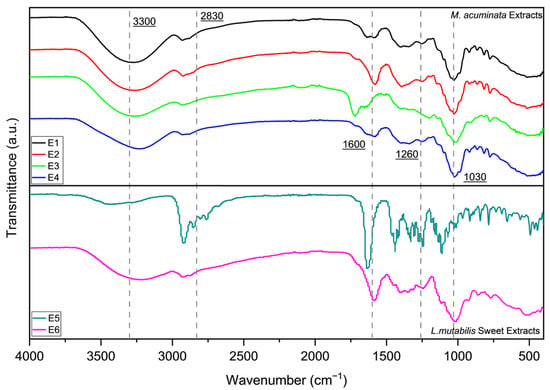
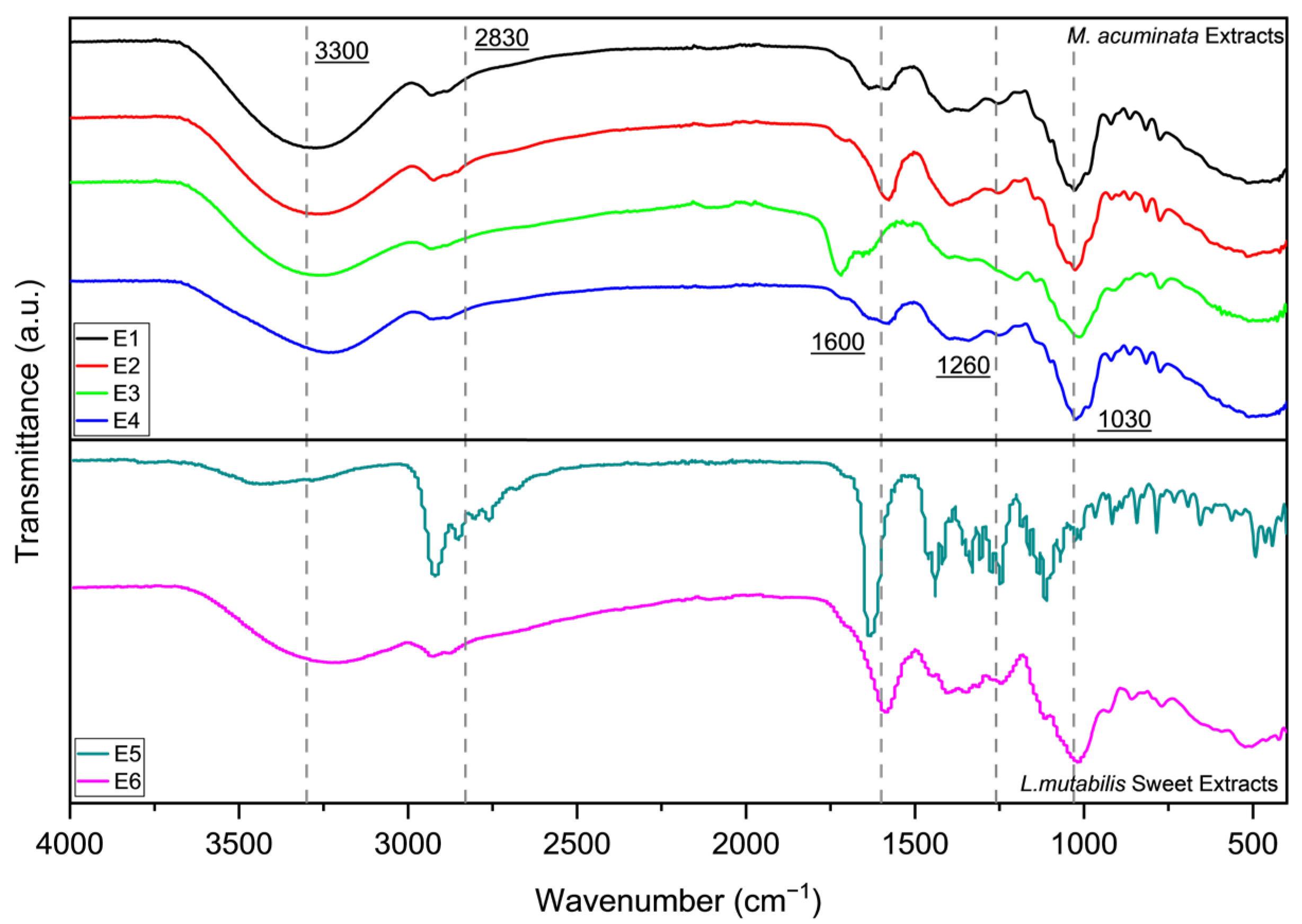
Figure 1 shows the FTIR spectra of the extracts from M. acuminata and L. mutabilis exhibiting the main functional groups linked to phenols and alkaloids, respectively. The M. acuminata extracts exhibit dominant features typical of phenolic and carbohydrate-rich matrices, including a broad O–H stretching band in the 3200–3400 cm−1 region, aromatic C=C vibrations around 1600 cm−1, and strong C–O and C–O–C stretching bands in the 1200–1000 cm−1 region. These features are consistent with the presence of polyphenols, flavonoids, and glycosides, which are commonly reported in banana peel extracts. Notably, the acid-hydrolyzed extract E3 shows a more pronounced carbonyl absorption near 1720 cm−1 compared to the other banana extracts, indicating compositional changes induced by the extraction conditions, such as the release or formation of carbonyl-containing species [49]. Compared with the M. acuminata extracts, the L. mutabilis FTIR profile exhibits similarities in the broad O–H stretching band of flavonoids and carbohydrates, which were identified in the phytochemical screening and have also been widely reported in several literature references [50,51]. However, the alkaloid region is where the main differences are observed. E5 and E6 exhibit characteristic absorptions in the 2840–2600 cm−1 region, which have been associated in the literature with vibrations of the quinolizidine ring system and C–N functionalities [52].
Figure 1.
FTIR spectrum of M. acuminata peel and L. mutabilis extracts.
Furthermore, both extracts present a characteristic signal above 1600 cm−1. In the case of E5, this signal could be associated with tertiary amide groups, which exhibit absorption bands in the range of 1680–1640 cm−1 corresponding to C=O stretching of amide groups. Such a band overlap is commonly observed in nitrogen-containing heterocyclic alkaloids [11,53,54]. The signals observed for E6 could be associated with various secondary metabolites, including flavonoids and alkaloids previously mentioned. The lyophilized wastewater extract E6 shows broader, more overlapping spectral features than E5, indicating a more complex, multicomponent matrix typical of wastewater-derived materials. Functional groups within M. acuminata and L. mutabilis extracts, particularly O–H, C=O, and C–N, are crucial in promoting interactions with the vacant d-orbitals of the metal surface [52,55]. A comparative summary of the main FTIR absorption bands, assignments, and extract-specific differences is provided in Table S2.
3.4. Quantification of Phenols, Flavonoids, and Alkaloids of the Extracts
The qualitative phytochemical screening results were complemented by quantitative determination of total phenolic and flavonoid contents for M. acuminata extracts (see Table S3) and total alkaloid content for L. mutabilis extracts (see Table S4). M. acuminata extracts showed the highest levels of phenols and flavonoids in E3 of 49 ± 2 mg GAE/g and 24 ± 2 mg QE/g, respectively, followed by E2 and E1. E4 showed the lowest phenol and flavonoid concentrations. This trend shows that the extraction method matters. The acidic procedure (E3) was the most efficient for phenolic recovery. The phenol and flavonoid values obtained for M. acuminata peel are comparable to those previously reported for other banana varieties. For example, M. paradisiaca peel showed flavonoid values of 15.21 mg QE/g and 15.44 mg QE/g using 80% ethanol and 80% acetone, respectively [56]. These differences can be attributed to the banana variety and extraction conditions (solvent and technique). Although there is no data for flavonoid content in hydrolysed M. acuminata peel extracts, it has been reported that hydrolysis can increase flavonoid content by releasing aglycones from their glycosidic forms [57], which is consistent with the higher phenol and flavonoid values observed for the hydrolysed extract E3. On the other hand, L. mutabilis extracts were richer in alkaloids. Extract E5 (226 mg AE/g) had a higher alkaloid content than extract E6 (126 mg AE/g) which was expected by using dichloromethane extraction.
3.5. Electrochemical Determination of the Corrosion Inhibition Efficiency for the Extracts from M. acuminata and L. mutabilis
The main objective of these experiments was to compare the corrosion behavior on admiralty brass in hydrochloric acid of the diverse extracts of M. acuminata peel and L. mutabilis wastewater. While potentiodynamic polarization provides direct information on corrosion current density and IE, it does not capture interfacial impedance characteristics.
The corrosion inhibition efficiency was calculated using Equation (1):
where and are the current densities without and with inhibitors, respectively.
Table 1 shows the IE on admiralty brass reported to the six different extracts in 0.5 M HCl. IE was used as the primary comparative parameter to summarize polarization results and enable clear comparison of inhibition performance across different extracts and concentrations. The working concentrations were established based on preliminary solubility tests in the corrosive medium. For M. acuminata extracts (E1, E2, and E4), the maximum concentration that remained fully soluble and free of turbidity or precipitate was 70 ppm; higher concentrations (≥100 ppm) produced visible instability, thus 70 ppm was selected as the experimental limit to ensure homogeneity and reproducibility. In contrast, L. mutabilis extracts (E5 and E6) exhibited greater solubility under the same conditions, allowing concentrations of 500 ppm to be used without precipitation, thereby ensuring the preparation of clear and stable solutions.
Table 1.
Inhibition efficiency of M. acuminata and L. mutabilis extracts on admiralty brass in 0.5 M HCl.
The percentage IE revealed a differentiated performance between M. acuminata extracts (70 ppm) and L. mutabilis extracts (500 ppm). For M. acuminata extracts, the highest efficiency was observed for E2 (43.62%), followed by E1 (34.72%) and E4 (30.03%). E3 showed the lowest IE of 27.03% despite having the highest phenol and flavonoid content among M. acuminata extracts. This result may be explained by the phenolic content not being a determining factor in the metal’s adsorption; rather, it could be the diversity of the molecules present in the inhibitor. It may be that the hydrolyzed extract shows a higher measured phenolic content due to the release of aglycones during acid hydrolysis. At the same time, it may have lost some of the compounds that contributed most to its inhibitory activity [58]. These compounds might stabilize the metal–solution interface through π-interactions and antioxidant effects [59,60].
L. mutabilis extracts exhibited IEs of 35.17% for E5 and 59.59% for E6 despite E6 showing a lower alkaloid concentration compared to E5 extract. Like M. acuminata extract, the superior performance of E6 can be attributed to the synergistic action of multiple secondary metabolites interacting with the metal surface and the inhibitor, thereby improving inhibition percentage. It has been demonstrated that the presence of various metabolites in natural corrosion inhibitors can generate a synergistic effect, thereby enhancing their IE. Examples include plant-derived extracts such as licorice (Glycyrrhiza uralensis Fisch.) leaves, applied to copper alloys in H2SO4 solutions [61] or mixtures of phenolic compounds such as cinnamaldehyde and vanillin [62]. These findings suggest that the improved performance of certain extracts may be associated with synergistic interactions among their components [63]. According to the literature, the main alkaloids reported in L. mutabilis are lupanine and sparteine [34]. Both are alkaloids characterized by the presence of nitrogen heteroatoms within rigid bicyclic ring systems. These features might favor adsorption on copper-rich admiralty brass surfaces through a combination of electrostatic interactions and donor–acceptor coordination between nitrogen lone pairs and vacant metal d orbitals [64,65]. In the absence of adsorption isotherm analysis, this interpretation remains qualitative; nevertheless, it is consistent with the observed electrochemical trends and with reports on alkaloid-based corrosion inhibitors in acidic media. Croton lechleri extracts have been used as green inhibitors in acidic solutions to protect admiralty brass CDA 443 [66]. In this study, the IE reached 57% at 50 ppm, attributed to the alkaloid content and the ability to form a protective organic layer on the AB surface that hinders the dezincification process.
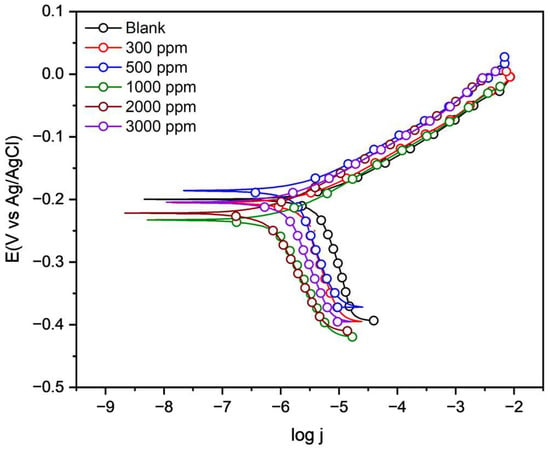
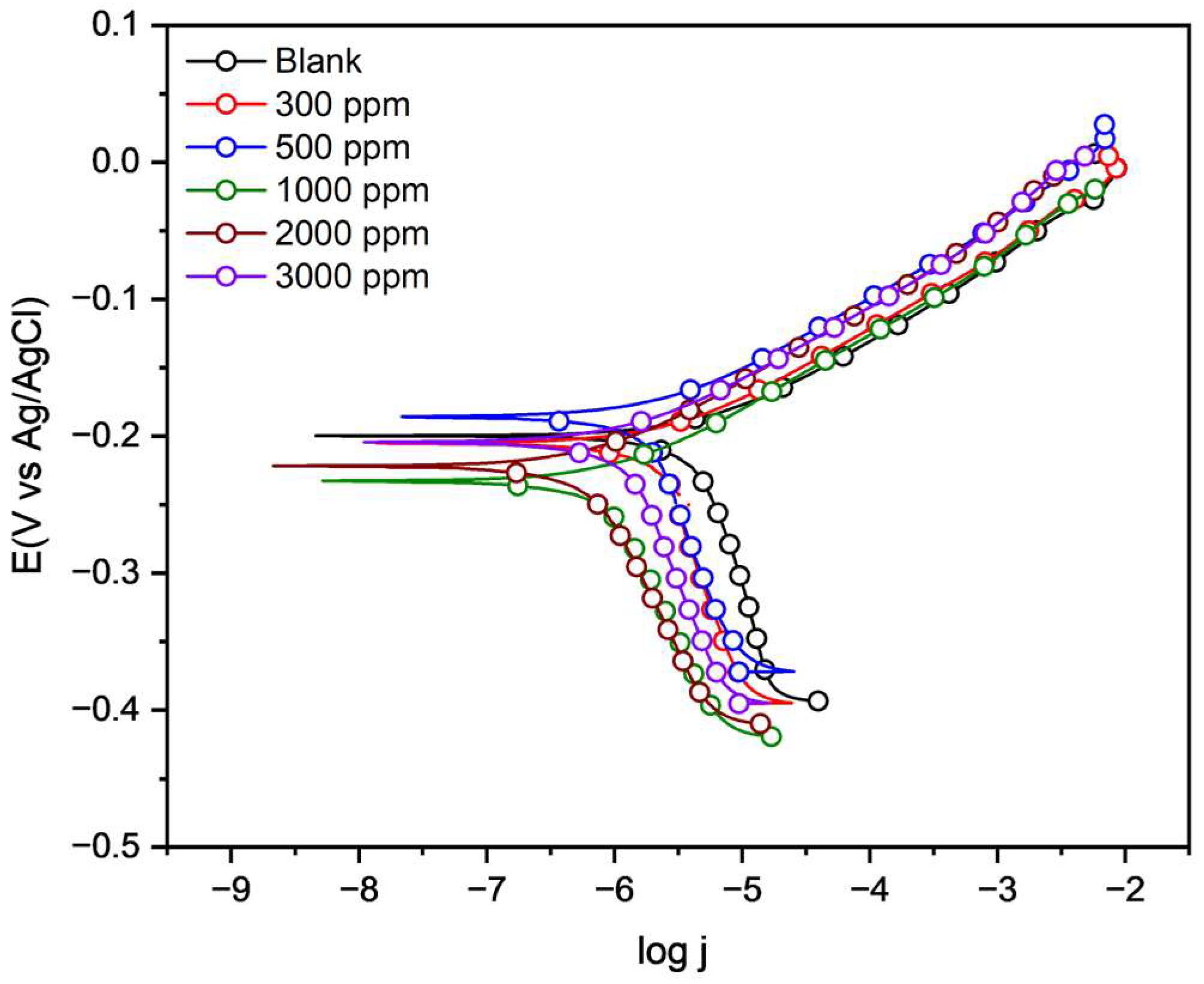
Figure 2 shows the potentiodynamic polarization curves for L. mutabilis extract E6 in 0.5 M hydrochloric acid at 25 °C, using concentrations ranging from 300 ppm to 3000 ppm. In all cases, the corrosion current density decreased in the presence of the extracts, indicating corrosion inhibition on the surface of admiralty brass. The analysis of the polarization curves shows that the Ecorr displacement is less than 85 mV, indicating that the system can be classified as a mixed-type corrosion inhibitor. Furthermore, similar mixed-type inhibition behavior has been reported in other studies, such as Schiff base derivatives on copper in NaCl solution [67], triazole-based compounds in H2O2 solutions [68], and inhibitors in alkaline slurry environments on copper surface [69].
Figure 2.
Potentiodynamic polarization performance of L. mutabilis extract E6 in 0.5 M HCl in the absence and addition of varying concentrations of E6 green inhibitor at 298 K.
Table 2 shows that the IE of L. mutabilis extract E6 increased progressively with concentration, reaching a maximum of 85.47% at 2000 ppm. This indicates that higher concentrations might promote an improved coverage of the active species on the admiralty brass surface, effectively reducing the corrosion rate. Importantly, an IE above 80% is considered highly promising for practical applications, suggesting that this extract could serve as a sustainable alternative to synthetic inhibitors in acid cleaning or pickling processes where admiralty brass components are frequently employed. According to a study of L. albus in HCl solutions, the adsorption mechanism of the inhibitor on a steel surface comprises a positive synergistic effect [70]. In the presence of strongly adsorbable anions such as Cl−, the surface charge becomes negative due to their specific adsorption. This facilitates the co-adsorption of anions and cations. The anions adsorb onto the metal surface by forming oriented dipoles, which in turn enhance the adsorption of the cationic moieties of the lupine extract through electrostatic interactions with these dipoles. However, the percentage inhibition at 3000 ppm falls to 72.14%. Once the IE reaches the maximum capacity, the surface might be completely covered. Above this concentration, the possible interaction between molecules of inhibitors adsorbed and unadsorbed increases. Consequently, a desorption process might begin, and the IE declines as the concentration increases further [71]. Therefore, 2000 ppm represents the optimum concentration, combining high efficiency with the added value of being derived from an agro-industrial residue, which aligns with sustainable and low-cost corrosion control strategies. Table S5 compares the inhibition efficiencies reported for brass alloys in acidic media using different classes of corrosion inhibitors. It can be observed that higher inhibition efficiencies are typically achieved with synthetic formulations at relatively low concentrations (220 ppm for 6-dimethyl-nicotinonitrile). Green inhibitors based on crude plant extracts generally exhibit high efficiencies at relatively high concentrations (3000 ppm for garlic extracts). The inhibition efficiencies reported in the present work fall within the range commonly reported for plant-based inhibitors applied to brass alloys, despite the use of non-optimized, waste-derived sources.
Table 2.
Polarization parameters and inhibition efficiency for admiralty brass in 0.5 M HCl with different concentrations of L. mutabilis extract.
Given the high inhibition performance of L. mutabilis (E6) on admiralty brass in acidic media, the extract is not only interesting from a molecular and electrochemical point of view but also from a technological perspective. Once the extract and its effective concentration range are identified at the laboratory scale through isolation and structural elucidation, this knowledge can serve as a blueprint for designing industrial inhibitor formulations based on lupin extracts or enriched alkaloid fractions. Recent reviews on plant-extract-based “green” corrosion inhibitors emphasize that the translation from laboratory tests to commercial products requires standardization of the extraction protocol, control of the phytochemical profile, evaluation of toxicity and biodegradability, and validation under service-like conditions (flow, temperature, and long-term exposure) [72,73]. In this context, lupine extracts, which have already shown high IEs for steel and copper in acidic solutions [70], emerge as promising candidates for the development of commercial inhibitors.
3.6. Techno-Economic Pre-Feasibility Study to Produce Corrosion Inhibitors Based on L. mutabilis Extracts
Considering that extract E6 showed the best efficiency as a corrosion inhibitor, a techno-economic pre-feasibility study was conducted to determine the viability of large-scale production of an inhibitor from L. mutabilis debittering wastewater. Domestic L. mutabilis production in Ecuador is estimated at 1725 tons/year, concentrated mainly in the provinces of the central highlands (Cotopaxi, Chimborazo, Pichincha, and Bolívar) [74]. The cultivation and processing of L. mutabilis are carried out on an artisanal scale across different provinces [75] which presents a logistical challenge for the centralized disposal of the debittering wastewater required for corrosion inhibitor production. In this study, the Bolívar province was used as a reference, producing 138 tons/year of L. mutabilis and generating approximately 345 tons/year of debittering wastewater. 60% of the total wastewater volume would be processed at the corrosion inhibitor production plant. To develop an industrial process, the engineering team proposed a liquid–liquid extraction method based on the E6 sample inhibition results. This approach aimed to design a large-scale production process utilizing well-established technology to achieve high yields [76,77,78]. Ethanol was selected as the solvent for the liquid–liquid extraction because the main alkaloids of L. mutabilis, lupanine and sparteine, among other metabolites, are soluble in ethanol [79]. This solvent is generally preferred for industrial formulations due to its low toxicity and regulatory acceptance. Moreover, in Ecuador, ethanol is produced in large quantities from sugarcane [80].
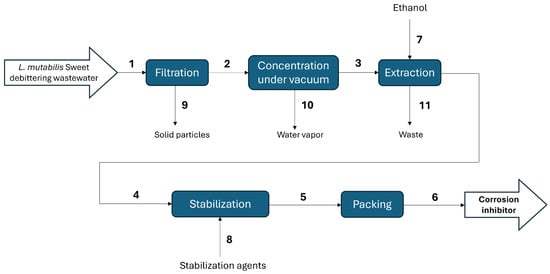
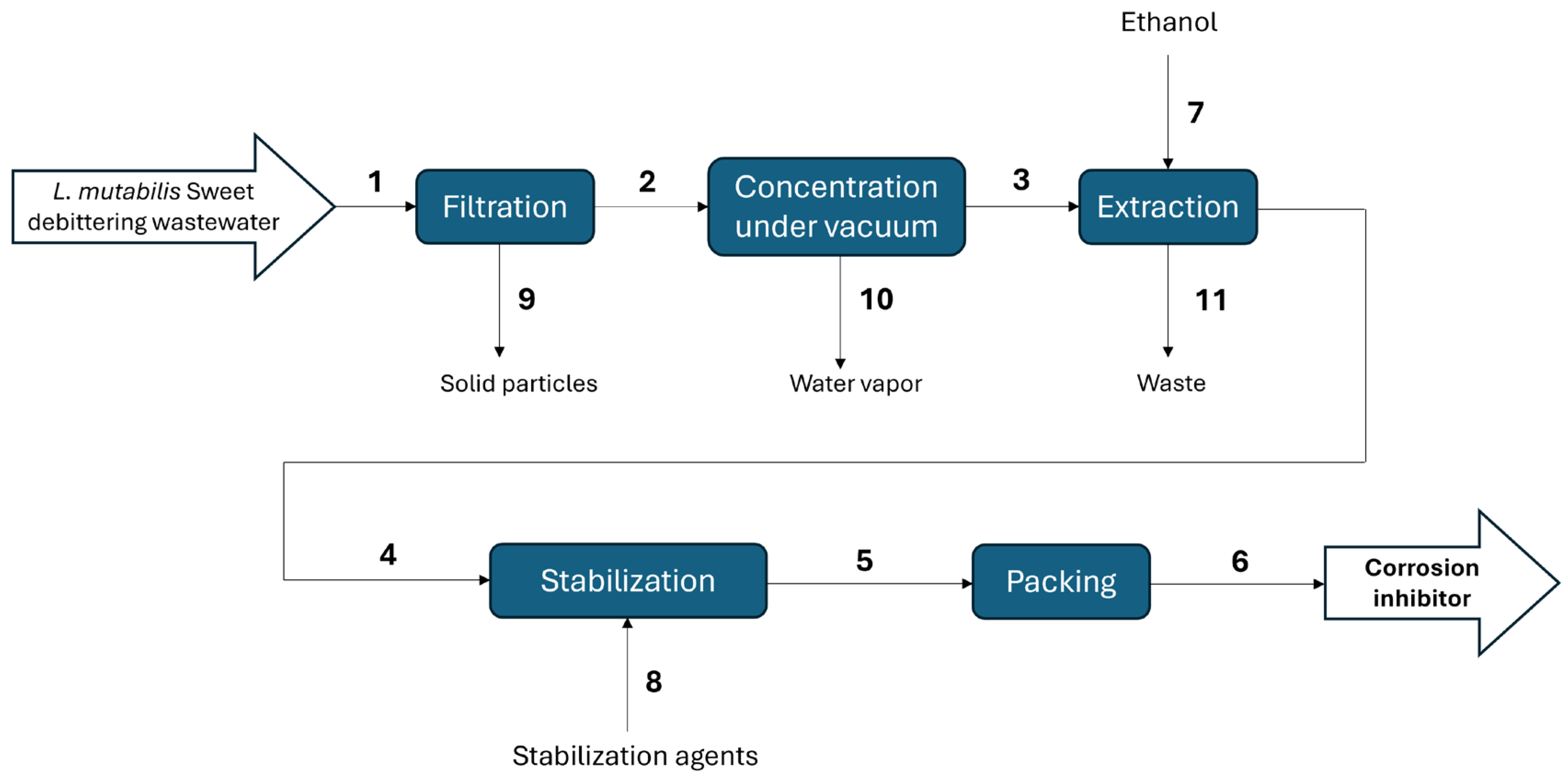
Figure 3 illustrates the process for transforming L. mutabilis debittering wastewater into a corrosion inhibitor. 207 tons/year of raw material enter the system (stream 1). Initially, filtration and vacuum concentration are performed to remove solid particles and excess water, respectively. The stream of interest (stream 3) is subjected to the liquid–liquid extraction process with ethanol, obtaining an extract (stream 4) that consists of a mixture of alkaloids, water, and extraction solvent. Subsequently, stabilization is performed to ensure the product’s biological safety, using stabilizing agents (amines and parabens) that prevent mold growth, preserve its properties, and protect the corrosion inhibitor from environmental degradation. This approach would ensure the corrosion inhibitor’s performance under industrial handling conditions [81,82]. The final stage is packaging, where the corrosion inhibitor is ready for commercialization (stream 6). The final product consists of 57.07 tons/year of a corrosion inhibitor containing 7.17% L. mutabilis extract (ca. 70,000 ppm) and 54.12% water, meaning the obtained inhibitor is water-based (due to its high-water content).
Figure 3.
Production plant for a corrosion inhibitor based on L. mutabilis debittering wastewater: block diagram (BD).
Figure S2 shows the process flow diagram (PFD). The plant’s yield is 0.257 kg of corrosion inhibitor/kg of debittering water. The selected extraction solvent was 95 wt.% ethanol, at a 4:1 ratio. To reduce ethanol consumption, the installation of a recovery unit for the extracting agent using atmospheric distillation was proposed. As noted previously, stabilizing agents are added in low concentrations to prevent the proliferation of fungi, bacteria, and yeasts. Otherwise, the lack of stabilization would lead to degradation of the corrosion inhibitor under industrial handling conditions [83]. Figure S3 shows images of the 3D model representing the plant. The plant is divided into three main sections: (1) reception of raw material and vacuum concentration for partial water removal by vacuum evaporation; (2) extraction and stabilization of the extract based on L. mutabilis debittering water; (3) formulation and packaging of the corrosion inhibitor. To facilitate product commercialization, it will be sold in 25 kg drums.
The following premises and assumptions were considered in the economic study (Class V):
- ○
- The plant will operate continuously (24 h) on a semi-industrial scale. This reduces downtime and enables thermal stability for each piece of equipment.
- ○
- Overdesign factor: 10%.
- ○
- The plant will be located in the city of Guaranda (Bolívar province). This selection was based on the availability of raw material, proximity to lupine processing centers, and the existence of adequate basic infrastructure for storing the debittering water under controlled conditions.
- ○
- Service factor: 85%. This refers to the percentage of the year the plant will be operational. The remaining 15% is considered for plant shutdowns for preventive and corrective maintenance, operational adjustments, calibrations, and minor failures or raw material logistics issues.
- ○
- Capital expenditure (CAPEX) estimation includes the cost of main equipment, auxiliary equipment, wastewater and waste treatment facilities, ethanol recovery unit, land acquisition, civil works, and installation and commissioning costs.
- ○
- Operating expense (OPEX) estimation includes the costs of acquiring and transporting raw materials and supplies, energy consumption, labor costs, and waste management.
- ○
- The cash flow was projected over 15 years with a discount rate of 10%. Net present value (NPV), internal rate of return (IRR), payback period (PRI), and benefit/cost ratio (B/C) were taken as financial indicators for the 15-year horizon.
The economic analysis was calculated using real terms, with all cash flows and expenditures indexed to 2025 United States Dollars (USD). The economic analysis is outlined in Table 3:
Table 3.
Cash flow and economic indicators.
The economic indicators showed that the project is profitable, as the NPV is positive, the IRR exceeds the discount rate, and the benefit/cost ratio exceeds 1. Additionally, the payback period is shorter than the project’s useful life. The corrosion inhibitor proposed in this study should cost around USD 12.52 per kg (USD 313 per 25 kg drums) in the Ecuadorian domestic market. For contextualization, commercial corrosion inhibitors used in acidic cleaning and pickling operations are reported to range in price from approximately USD 4.50 to 18.00 per kg in the Ecuadorian domestic market, depending on formulation complexity, active component concentration, and application sector [84,85]. These products are commonly based on synthetic amines, azoles, or proprietary organic blends [82,86].
In comparison, the proposed inhibitor is derived from an agro-industrial wastewater stream, significantly reducing raw material costs and contributing to favorable economic indicators, particularly when solvent recovery and domestic sourcing are considered, while offering additional environmental and circular-economy benefits. In the economic sensitivity analysis, the main variables identified were sales price, discount rate, and production volume. The sensitivity analysis concluded that variations in raw material costs do not significantly impact the project’s cash flow, as the L. mutabilis debittering wastewater is an agro-industrial residue with minimal acquisition costs. Finally, the project is considered viable, and investment is recommended.
4. Conclusions and Future Work
M. acuminata peels and L. mutabilis wastewater were used as a source for extracts yielding up to 43.6%. These green extracts were successfully employed to obtain novel green corrosion inhibitors on admiralty brass in 0.5 M HCl media. The inhibitory behavior could be associated with the phytochemical profile of each extract. M. acuminata extracts are rich in phenolic and flavonoid compounds, while L. mutabilis extracts are rich in quinolizidine alkaloids. Among the tested samples, L. mutabilis wastewater extract (E6) showed the highest IE, 85.47% at 2000 ppm. The prefeasibility study confirmed that large-scale production of corrosion inhibitors from L. mutabilis is economically attractive with an NPV of USD 9.48 million, an IRR of 27.3%, and a payback period of 6.7 years. This work demonstrates that Ecuadorian agro-industrial residues can be transformed into efficient and eco-friendly corrosion inhibitors, contributing to reducing environmental pollution and creating value within a circular economy framework.
Future work should prioritize strengthening both the mechanistic understanding and the process-level robustness of the proposed waste-derived corrosion inhibitors. From a processing perspective, replicated extractions and systematic optimization of extraction parameters are required to rigorously assess yield variability, reproducibility, and scalability. While the phytochemical assays employed in this study provide valuable group-level and semi-quantitative insights into dominant classes of secondary metabolites, making them appropriate for comparative screening of complex extracts, they do not enable molecular-level identification. Accordingly, future investigations should incorporate chromatographic and spectrometric techniques to resolve individual active compounds and clarify their specific contributions to inhibition performance. From an electrochemical standpoint, the inclusion of advanced techniques such as electrochemical impedance spectroscopy measurements will be essential to directly probe adsorption-layer resistance, interfacial capacitance behavior, and inhibitor film stability, thereby enabling more definitive mechanistic interpretation. In parallel, the effects of temperature, acid concentration, exposure time, and hydrodynamic conditions should be systematically evaluated to better simulate industrial acid cleaning and pickling environments and to assess long-term and operational stability. In addition, surface-sensitive characterization techniques, including SEM, EDS, AFM, FTIR of adsorbed layers, and XPS, should be employed to directly examine surface morphology, elemental composition, and inhibitor adsorption, providing experimental verification of protective film formation. Finally, future research should explore alternative bio-based or low-impact stabilizing agents to further enhance the environmental profile of the inhibitor formulations, while maintaining adequate storage stability and operational performance under industrially relevant conditions.
Supplementary Materials
The following supporting information can be downloaded at: https://www.mdpi.com/article/10.3390/resources15060080/s1, Figure S1. Different extracts from M. acuminata and L. mutabilis Sweet waste; Table S1. Phytochemical screening of the six extracts; Table S2. Main FTIR absorption bands, assignments, and comparative observations for the extracts; Table S3. Quantification of phenols and flavonoids of M. acuminata extracts; Table S4. Quantification of alkaloids in L. mutabilis extracts; Table S5. Selected literature reports on corrosion inhibition of brass in acidic media [87,88,89,90]; Figure S2: Production plant for a corrosion inhibitor based on L. mutabilis debittering wastewater: Process flow diagram (PFD); Figure S3. Production plant for a corrosion inhibitor based on L. mutabilis debittering wastewater: 3D model.
Author Contributions
Conceptualization, A.V., R.O., P.E.O., M.R. and A.P.-C.; methodology, A.V., R.O., P.E.O., M.R. and A.P.-C.; formal analysis, A.M., M.B.C. and M.O.; investigation, A.M., M.B.C. and M.O.; writing—original draft preparation, M.B.C., M.O., M.R. and A.P.-C.; writing—review and editing, P.E.O., M.R. and A.P.-C.; visualization, M.B.C., M.O., M.R. and A.P.-C.; supervision, A.P.-C.; project administration, A.P.-C.; funding acquisition, A.V., R.O., P.E.O., M.R. and A.P.-C. All authors have read and agreed to the published version of the manuscript.
Funding
This research was funded by Corporación Ecuatoriana para el Desarrollo de la Investigación y Academia-CEDIA, grant number CEPRA XV-2021-015, and Yachay Tech University through the Call for Research Articles Funding 2026.
Data Availability Statement
Data are available from the authors upon request.
Acknowledgments
We thank Vanessa Cuaspa, Diego Guerrro, Josue Moriera, and Evelyn Yandún for their support on the process flow diagram and the 3D model. The authors thank Corporación Ecuatoriana para el Desarrollo de la Investigación y Academia-CEDIA for the financial support provided to the present research, development, and innovation work through its CEPRA program, especially the CEPRA XV-2021-015 fund. The authors also thanks to Yachay Tech University for the financial support through the Internal Call for Research Articles Funding 2026. We thank the anonymous reviewers for their insightful and constructive feedback, which helped to refine the scope, strengthen the discussion, and improve the overall quality of the manuscript.
Conflicts of Interest
The authors declare that this study received funding from Corporación Ecuatoriana para el Desarrollo de la Investigación y Academia-CEDIA. The funder was not involved in the study design, collection, analysis, interpretation of data, the writing of this article, or the decision to submit it for publication.
References
- Collivignarelli, M.C.; Abbà, A.; Bestetti, M.; Crotti, B.M.; Carnevale Miino, M. Electrolytic Recovery of Nickel and Copper from Acid Pickling Solutions Used to Treat Metal Surfaces. Water Air Soil Pollut. 2019, 230, 101. [Google Scholar] [CrossRef] [Scilit]
- Ranjbar, K.; Taghavian, A.; Amra, M. Failure Assessment of an Admiralty Brass Oil Exchanger Tubes. J. Fail. Anal. Prev. 2020, 20, 218–225. [Google Scholar] [CrossRef] [Scilit]
- Dariva, C.G.; Galio, A.F. Corrosion Inhibitors–Principles, Mechanisms and Applications. In Developments in Corrosion Protection; InTech: London, UK, 2014. [Google Scholar]
- Soeda, K.; Ichimura, T. Present State of Corrosion Inhibitors in Japan. Cem. Concr. Compos. 2003, 25, 117–122. [Google Scholar] [CrossRef] [Scilit]
- Sastri, V. Green Corrosion Inhibitors: Theory and Practice; John Wiley & Sons: Hoboken, NJ, USA, 2012; Volume 10. [Google Scholar]
- Pal Singh, W.; Bockris, J.O. Toxicity Issues of Organic Corrosion Inhibitors: Applications of QSAR Model. In CORROSION 1996; NACE International: Houston, TX, USA, 1996; pp. 1–16. [Google Scholar]
- Izionworu, V.O.; Ukpaka, C.P.; Oguzie, E.E. Green and Eco-Benign Corrosion Inhibition Agents: Alternatives and Options to chemical Based Toxic Corrosion Inhibitors. Chem. Int. 2020, 6, 232–259. [Google Scholar]
- Miralrio, A.; Vázquez, A.E. Plant Extracts as Green Corrosion Inhibitors for Different Metal Surfaces and Corrosive Media: A Review. Processes 2020, 8, 942. [Google Scholar] [CrossRef] [Scilit]
- Verma, D.K.; Dewangan, Y.; Dewangan, A.K.; Asatkar, A. Correction to: Heteroatom-Based Compounds as Sustainable Corrosion Inhibitors: An Overview. J. Bio Tribocorros. 2021, 7, 70. [Google Scholar] [CrossRef] [Scilit]
- Ma, I.A.W.; Ammar, S.; Kumar, S.S.A.; Ramesh, K.; Ramesh, S. A Concise Review on Corrosion Inhibitors: Types, Mechanisms and Electrochemical Evaluation Studies. J. Coat. Technol. Res. 2022, 19, 241–268. [Google Scholar] [CrossRef] [Scilit]
- Thapa Magar, J.; Budhathoki, I.K.; Rajaure, A.; Oli, H.B.; Bhattarai, D.P. Alkaloid Extract of Ageratina Adenophora Stem as Green Inhibitor for Mild Steel Corrosion in One Molar Sulfuric Acid Solution. Electrochem 2023, 4, 84–102. [Google Scholar] [CrossRef] [Scilit]
- Ohunene, Y.M.; Oguegbulu, J.; Passos, M.-O.L.; Mtunzi, F.F.; Ojo, F.; Okoli, B.J. Corrosion Inhibition of Mild Steel in Acidic Environments Using Polyphenol-Rich Extract from Senegalia senegal (L.) Britton Stem Bark. Arch. Metall. Mater. 2025, 70, 749–763. [Google Scholar] [CrossRef] [Scilit]
- Thapa, O.; Thapa Magar, J.; Oli, H.B.; Rajaure, A.; Nepali, D.; Bhattarai, D.P.; Mukhiya, T. Alkaloids of Solanum Xanthocarpum Stem as Green Inhibitor for Mild Steel Corrosion in One Molar Sulphuric Acid Solution. Electrochem 2022, 3, 820–842. [Google Scholar] [CrossRef] [Scilit]
- Hamidi, H.; Shojaei, F.; Pourfath, M.; Vaez-Zadeh, M. Adsorption Behavior of Some Green Corrosion Inhibitors on Fe (110) Surface: The Critical Role of d-π Interactions in Binding Strength. Appl. Surf. Sci. 2024, 655, 159425. [Google Scholar] [CrossRef] [Scilit]
- Ahmed, M.A.; Amin, S.; Mohamed, A.A. Current and Emerging Trends of Inorganic, Organic and Eco-Friendly Corrosion Inhibitors. RSC Adv. 2024, 14, 31877–31920. [Google Scholar] [CrossRef] [Scilit]
- Goyal, M.; Kumar, S.; Bahadur, I.; Verma, C.; Ebenso, E.E. Organic Corrosion Inhibitors for Industrial Cleaning of Ferrous and Non-Ferrous Metals in Acidic Solutions: A Review. J. Mol. Liq. 2018, 256, 565–573. [Google Scholar] [CrossRef] [Scilit]
- Verma, C.; Ebenso, E.E.; Quraishi, M.A. Alkaloids as Green and Environmental Benign Corrosion Inhibitors: An Overview. Int. J. Corros. Scale Inhib. 2019, 8, 512–528. [Google Scholar] [CrossRef] [Scilit]
- Nobahar, A.; Carlier, J.D.; Miguel, M.G.; Costa, M.C. A Review of Plant Metabolites with Metal Interaction Capacity: A Green Approach for Industrial Applications. BioMetals 2021, 34, 761–793. [Google Scholar] [CrossRef] [Scilit]
- Ray, M.; Saha, B.; Rout, T.K.; Bhagat, A.N. Adsorption Mechanism and Performance Analysis of Alkaloids as Green Corrosion Inhibitors on Mild Steel. Theor. Chem. Acc. 2022, 141, 32. [Google Scholar] [CrossRef] [Scilit]
- Furtado, L.B.; da Silva, R.C.G.; de Oliveira, W.F.; Guimarães, M.J.O.C.; Leoni, G.B.; Chrisman, E.C.A.N.; de Carvalho, L.J.; Brasil, S.L.D.C.; Gomes, J.A.d.C.P. Phenolic Compounds as Eco-Friendly Corrosion Inhibitor Obtained by Optimized Extraction from Residual Broccoli Leaves. Results Chem. 2025, 17, 102562. [Google Scholar] [CrossRef] [Scilit]
- Holla, B.R.; Mahesh, R.; Manjunath, H.R.; Anjanapura, V.R. Plant Extracts as Green Corrosion Inhibitors for Different Kinds of Steel: A Review. Heliyon 2024, 10, e33748. [Google Scholar] [CrossRef] [Scilit] [PubMed]
- Gadow, H.E.; Elabbasy, H.M. Electrochemical Study on the Efficiency of Curcuma Extract as a Green Inhibitor for Corrosion of α-Brass in 1MHCl. Int. J. Electrochem. Sci. 2017, 12, 5867–5887. [Google Scholar] [CrossRef] [Scilit]
- Zambrano-Flores, R.C.; Plaza-Macías, N. Impacto de Las Políticas Agrícolas En El Crecimiento Económico Del Ecuador [Impact of Agricultural Policies on Ecuador’s Economic Growth]. MQRInvestigar 2024, 8, 3914–3934. [Google Scholar] [CrossRef] [Scilit]
- Caiza López, D.L.; Shiguango Grefa, J.F.; Ordoñez Bravo, E.F.; Quishpe Mejia, M.A. Impacto de La Agroindustria En El Desarrollo Económico y Sostenibilidad Ambiental En Ecuador [Impact of Agro-Industry on Economic Development and Environmental Sustainability in Ecuador]. RECIENA 2025, 5, 33–42. [Google Scholar] [CrossRef] [Scilit]
- Yasin, M.; Gangan, S.; Panchal, S.K. Banana Peels: A Genuine Waste or a Wonderful Opportunity? Appl. Sci. 2025, 15, 3195. [Google Scholar] [CrossRef] [Scilit]
- Veliz, K.; Chico-Santamarta, L.; Ramirez, A.D. The Environmental Profile of Ecuadorian Export Banana: A Life Cycle Assessment. Foods 2022, 11, 3288. [Google Scholar] [CrossRef] [Scilit]
- Mathew, N.S.; Negi, P.S. Traditional Uses, Phytochemistry and Pharmacology of Wild Banana (Musa acuminata Colla): A Review. J. Ethnopharmacol. 2017, 196, 124–140. [Google Scholar] [CrossRef] [Scilit]
- Vu, H.T.; Scarlett, C.J.; Vuong, Q.V. Phenolic Compounds within Banana Peel and Their Potential Uses: A Review. J. Funct. Foods 2018, 40, 238–248. [Google Scholar] [CrossRef] [Scilit]
- Carvajal-Larenas, F.E.; Linnemann, A.R.; Nout, M.J.R.; Koziol, M.; van Boekel, M.A.J.S. Lupinus Mutabilis: Composition, Uses, Toxicology, and Debittering. Crit. Rev. Food Sci. Nutr. 2016, 56, 1454–1487. [Google Scholar] [CrossRef] [Scilit]
- Rodríguez-Ortega, D.; Zambrano, J.L.; Pereira-Lorenzo, S.; Torres, A.; Murillo, Á. Lupinus Mutabilis Breeding in the Andes of Ecuador, Peru, and Bolivia: A Review. Agronomy 2023, 14, 94. [Google Scholar] [CrossRef] [Scilit]
- Wink, M.; Meißner, C.; Witte, L. Patterns of Quinolizidine Alkaloids in 56 Species of the Genus Lupinus. Phytochemistry 1995, 38, 139–153. [Google Scholar] [CrossRef] [Scilit]
- Wojakowska, A.; Muth, D.; Narożna, D.; Mądrzak, C.; Stobiecki, M.; Kachlicki, P. Changes of Phenolic Secondary Metabolite Profiles in the Reaction of Narrow Leaf Lupin (Lupinus angustifolius) Plants to Infections with Colletotrichum Lupini Fungus or Treatment with Its Toxin. Metabolomics 2013, 9, 575–589. [Google Scholar] [CrossRef] [Scilit] [PubMed]
- Rosas-Quina, Y.E.; Mejía-Nova, F.C. Supercritical Fluid Extraction with Cosolvent of Alkaloids from Lupinus Mutabilis Sweet and Comparison with Conventional Method. J. Food Process Eng. 2021, 44, e13657. [Google Scholar] [CrossRef] [Scilit]
- Cortés-Avendaño, P.; Tarvainen, M.; Suomela, J.-P.; Glorio-Paulet, P.; Yang, B.; Repo-Carrasco-Valencia, R. Profile and Content of Residual Alkaloids in Ten Ecotypes of Lupinus Mutabilis Sweet after Aqueous Debittering Process. Plant Foods Hum. Nutr. 2020, 75, 184–191. [Google Scholar] [CrossRef] [Scilit] [PubMed]
- Frick, K.M.; Kamphuis, L.G.; Siddique, K.H.M.; Singh, K.B.; Foley, R.C. Quinolizidine Alkaloid Biosynthesis in Lupins and Prospects for Grain Quality Improvement. Front. Plant Sci. 2017, 8, 87. [Google Scholar] [CrossRef] [Scilit] [PubMed]
- Esteves, T.; Mota, A.T.; Barbeitos, C.; Andrade, K.; Afonso, C.A.M.; Ferreira, F.C. A Study on Lupin Beans Process Wastewater Nanofiltration Treatment and Lupanine Recovery. J. Clean. Prod. 2020, 277, 123349. [Google Scholar] [CrossRef] [Scilit]
- Costa, I.; Massard, G.; Agarwal, A. Waste Management Policies for Industrial Symbiosis Development: Case Studies in European Countries. J. Clean. Prod. 2010, 18, 815–822. [Google Scholar] [CrossRef] [Scilit]
- Velenturf, A.P.M.; Archer, S.A.; Gomes, H.I.; Christgen, B.; Lag-Brotons, A.J.; Purnell, P. Circular Economy and the Matter of Integrated Resources. Sci. Total Environ. 2019, 689, 963–969. [Google Scholar] [CrossRef] [Scilit]
- Dazdari, M.; Khormali, A.; Taleghani, A. Analysis of a Mixture of Banana Peel and Rice Straw Extracts for Inhibiting Corrosion of Carbon Steel in Hydrochloric Acid Solution. Appl. Sci. 2025, 15, 5026. [Google Scholar] [CrossRef] [Scilit]
- Xuan Bach, L.; Dao, T.-B.-N.; Duong-Ngo, K.-L.; Tran, T.N.; Le Minh, T.; Nguyen Trong, H.; Hoang Ngoc, C.T.; Panaitescu, C.; To Hoai, N.; Dang, N.N. Inhibitive Behaviours of Unripe Banana Peel Extract for Mitigating Electrochemical Corrosion of Carbon Steel in Aggressively Acidic Solutions. J. Taibah Univ. Sci. 2023, 17, 2247633. [Google Scholar] [CrossRef] [Scilit]
- Shaikh, J.R.; Patil, M. Qualitative Tests for Preliminary Phytochemical Screening: An Overview. Int. J. Chem. Stud. 2020, 8, 603–608. [Google Scholar] [CrossRef] [Scilit]
- Sistema de Información Pública Agropecuaria Panorama Agroestadístico [Agro-Statistical Overview]. Available online: https://sipa.agricultura.gob.ec/descargas/panorama_estadistico/panorama_estadistico.pdf (accessed on 2 February 2026).
- Goti, D.; Dasgupta, D.S. A Comprehensive Review of Conventional and Non-Conventional Solvent Extraction Techniques. J. Pharmacogn. Phytochem. 2023, 12, 202–211. [Google Scholar] [CrossRef] [Scilit]
- Garcia-Vaquero, M.; Rajauria, G.; Tiwari, B. Conventional Extraction Techniques: Solvent Extraction. In Sustainable Seaweed Technologies; Elsevier: Amsterdam, The Netherlands, 2020; pp. 171–189. [Google Scholar]
- Geow, C.H.; Tan, M.C.; Yeap, S.P.; Chin, N.L. A Review on Extraction Techniques and Its Future Applications in Industry. Eur. J. Lipid Sci. Technol. 2021, 123, 2000302. [Google Scholar] [CrossRef] [Scilit]
- Bhadange, Y.A.; Carpenter, J.; Saharan, V.K. A Comprehensive Review on Advanced Extraction Techniques for Retrieving Bioactive Components from Natural Sources. ACS Omega 2024, 9, 31274–31297. [Google Scholar] [CrossRef] [Scilit]
- Bennett, R.N.; Shiga, T.M.; Hassimotto, N.M.A.; Rosa, E.A.S.; Lajolo, F.M.; Cordenunsi, B.R. Phenolics and Antioxidant Properties of Fruit Pulp and Cell Wall Fractions of Postharvest Banana (Musa acuminata Juss.) Cultivars. J. Agric. Food Chem. 2010, 58, 7991–8003. [Google Scholar] [CrossRef] [Scilit]
- Kovačević, N.; Kokalj, A. Chemistry of the Interaction between Azole Type Corrosion Inhibitor Molecules and Metal Surfaces. Mater. Chem. Phys. 2012, 137, 331–339. [Google Scholar] [CrossRef] [Scilit]
- Abbas, O.; Compère, G.; Larondelle, Y.; Pompeu, D.; Rogez, H.; Baeten, V. Phenolic Compound Explorer: A Mid-Infrared Spectroscopy Database. Vib. Spectrosc. 2017, 92, 111–118. [Google Scholar] [CrossRef] [Scilit]
- Akremi, I.; Kabtni, S.; Ben Ammar, H.; Genva, M.; Hejazi, S.; Elbok, S.; Rouz, S.; Marghali, S.; Fauconnier, M.-L. Comparative Highlights of Morphological, Phytochemical and Nutritional Key Characteristics of Mediterranean Lupinus Species. Food Chem. 2025, 480, 143962. [Google Scholar] [CrossRef] [Scilit]
- Akremi, I.; Kabtni, S.; Ammar, H.B.; Riolo, M.; Genva, M.; Rouz, S.; El-Bok, S.; Cacciola, S.O.; Fauconnier, M.-L.; Marghali, S. Targeted Phytochemical Profiling and Functional Evaluation of Bitter and Sweet Lupinus Albus Genotypes from Diverse Origins. Food Chem. 2025, 496, 146674. [Google Scholar] [CrossRef] [Scilit]
- Skolik, J.; Krueger, P.J.; Wiewiorowski, M. Correlation between the Stereochemistry of Quinolizidine Alkaloids and Their Infrared Spectra from 2840–2600 CM−1. Tetrahedron 1968, 24, 5439–5456. [Google Scholar] [CrossRef] [Scilit] [PubMed]
- Osei Akoto, C.; Acheampong, A.; Boakye, Y.D.; Asante, B.; Ohene, S.; Amankwah, F. Anthelminthic, Anti-Inflammatory, Antioxidant, and Antimicrobial Activities and FTIR Analyses of Vernonia Camporum Stem-Bark. J. Chem. 2021, 2021, 3328073. [Google Scholar] [CrossRef] [Scilit]
- Kumar, D.; Jain, N.; Jain, V.; Rai, B. Amino Acids as Copper Corrosion Inhibitors: A Density Functional Theory Approach. Appl. Surf. Sci. 2020, 514, 145905. [Google Scholar] [CrossRef] [Scilit]
- Atiba, J.O.; Fayomi, O.S.I.; Ogbuozobe, G.O. Evaluation of Vernonia Amygdalina Extract as a Green Inhibitor for Copper Corrosion in Acidic Media: Adsorption Mechanisms, Electrochemical Behaviour, and Thermodynamic Analysis. Prog. Eng. Sci. 2025, 2, 100106. [Google Scholar] [CrossRef] [Scilit]
- Aboul-Enein, A.M.; Salama, Z.A.E.-R.; Gaafar, A.A.; Aly, H.F.; Abou-Elella, F.; Ahmed, H. Identification of Phenolic Compounds from Banana Peel (Musa paradaisica L.) as Antioxidant and Antimicrobial Agents. J. Chem. Pharm. Res. 2016, 8, 46–55. [Google Scholar]
- Nuutila, A.M.; Kammiovirta, K.; Oksman-Caldentey, K.-M. Comparison of Methods for the Hydrolysis of Flavonoids and Phenolic Acids from Onion and Spinach for HPLC Analysis. Food Chem. 2002, 76, 519–525. [Google Scholar] [CrossRef] [Scilit]
- Ebrahimi, P.; Bayram, I.; Lante, A.; Decker, E.A. Acid-Hydrolyzed Phenolic Extract of Parsley (Petroselinum crispum L.) Leaves Inhibits Lipid Oxidation in Soybean Oil-in-Water Emulsions. Food Res. Int. 2024, 187, 114452. [Google Scholar] [CrossRef] [Scilit]
- Ahmed, R.K.; Zhang, S. Bee Pollen Extract as an Eco-Friendly Corrosion Inhibitor for Pure Copper in Hydrochloric Acid. J. Mol. Liq. 2020, 316, 113849. [Google Scholar] [CrossRef] [Scilit]
- McCafferty, E. Introduction to Corrosion Science; Springer: Berlin/Heidelberg, Germany, 2009. [Google Scholar]
- Zhou, Z.Y.; Li, S.Y.; Cao, J.J.; Hao, L.; Liao, B.K.; Guo, X.P. Waste Licorice Leaf Extract as a Sustainable Corrosion Inhibitor for Copper in 0.5 M H2SO4: Intermolecular Synergism Effect and Long-Term Protection Performance. Ind. Crops Prod. 2025, 232, 121230. [Google Scholar] [CrossRef] [Scilit]
- Wang, Z.; Wang, T.; Zhu, J.; Wei, L.; Shen, Y.; Li, N.; Hu, J. Synergistic Effect and Mechanism of Copper Corrosion Inhibition Using Cinnamaldehyde and Vanillin in HCl Solution: An Experimental and Theoretical Approach. Colloids Surf. A Physicochem. Eng. Asp. 2019, 563, 246–254. [Google Scholar] [CrossRef] [Scilit]
- Li, H.-J.; Zhang, W.; Wu, Y.-C. Anti-Corrosive Properties of Alkaloids on Metals. In Alkaloids-Their Importance in Nature and Human Life; IntechOpen: London, UK, 2019; pp. 73–75. [Google Scholar]
- Zucchi, F.; Trabanelli, G.; Monticelli, C. The Inhibition of Copper Corrosion in 0.1 M NaCl under Heat Exchange Conditions. Corros. Sci. 1996, 38, 147–154. [Google Scholar] [CrossRef] [Scilit]
- Fateh, A.; Aliofkhazraei, M.; Rezvanian, A.R. Review of Corrosive Environments for Copper and Its Corrosion Inhibitors. Arab. J. Chem. 2020, 13, 481–544. [Google Scholar] [CrossRef] [Scilit]
- Cevallos-Morillo, C.; Cisneros-Pérez, P.; Llive, R.; Ricaurte, M.; Reinoso, C.; Meneses, M.A.; Guamán, M.d.C.; Palma-Cando, A. Croton Lechleri Extracts as Green Corrosion Inhibitors of Admiralty Brass in Hydrochloric Acid. Molecules 2021, 26, 7417. [Google Scholar] [CrossRef] [Scilit] [PubMed]
- Lasri, M.; El Alami, A.; Idlahoussaine, N.; Ait-Karra, A.; Zakir, O.; Maatallah, M.; Idouhli, R.; Fdil, R.; Khadiri, M.E.; Abouelfida, A. Electrochemical and Theoretical Insights into Schiff Base Derivatives for the Prevention of Copper Corrosion. Phys. Chem. Chem. Phys. 2025, 27, 18710–18722. [Google Scholar] [CrossRef] [Scilit] [PubMed]
- Wu, T.; Gao, B.; Zheng, Q.; Liu, S.; Wang, J. Corrosion Inhibition and the Synergistic Effect of Three Different Inhibitors on Copper Surface. ECS J. Solid State Sci. Technol. 2022, 11, 054009. [Google Scholar] [CrossRef] [Scilit]
- Wang, F.; Ma, T.; Zhang, S.; Tan, B.; Guo, L.; Du, H.; Wang, X.; Han, X.; Liu, R. Corrosion Inhibition Performance and Mechanism of Nitrogen-Containing Organic Compounds on Copper in an Alkaline Slurry. J. Mol. Liq. 2024, 398, 124207. [Google Scholar] [CrossRef] [Scilit]
- Abdel-Gaber, A.M.; Abd-El-Nabey, B.A.; Saadawy, M. The Role of Acid Anion on the Inhibition of the Acidic Corrosion of Steel by Lupine Extract. Corros. Sci. 2009, 51, 1038–1042. [Google Scholar] [CrossRef] [Scilit]
- Alhaffar, M.T.; Umoren, S.A.; Obot, I.B.; Ali, S.A. Isoxazolidine Derivatives as Corrosion Inhibitors for Low Carbon Steel in HCl Solution: Experimental, Theoretical and Effect of KI Studies. RSC Adv. 2018, 8, 1764–1777. [Google Scholar] [CrossRef] [Scilit]
- Galleguillos Madrid, F.M.; Soliz, A.; Cáceres, L.; Bergendahl, M.; Leiva-Guajardo, S.; Portillo, C.; Olivares, D.; Toro, N.; Jimenez-Arevalo, V.; Páez, M. Green Corrosion Inhibitors for Metal and Alloys Protection in Contact with Aqueous Saline. Materials 2024, 17, 3996. [Google Scholar] [CrossRef] [Scilit] [PubMed]
- Reza, N.A.; Akhmal, N.H.; Fadil, N.A.; Taib, M.F.M. A Review on Plants and Biomass Wastes as Organic Green Corrosion Inhibitors for Mild Steel in Acidic Environment. Metals 2021, 11, 1062. [Google Scholar] [CrossRef] [Scilit]
- Villacrés, E.; Navarrete, M.; Lucero, O.; Espin, S.; Peralta García, E.L. Evaluación Del Rendimiento, Características Físico-Químicas y Nutraceúticas Del Aceite de Chocho (Lupinus mutabilis Sweet) [Evaluation of the Performance, Physical-Chemical and Nutraceutical Characteristics of Lupin Oil (Lupinus mutabilis Sweet)]. Rev. Tecnológica ESPOL 2011, 32, 57–62. [Google Scholar]
- Peralta, E. El Chocho En Ecuador: Estado Del Arte [Andean Lupine in Ecuador: State-of-the-Art]; INIAP: Quito, Ecuador, 2016. [Google Scholar]
- Castro-Muñoz, R.; Díaz-Montes, E.; Gontarek-Castro, E.; Boczkaj, G.; Galanakis, C.M. A Comprehensive Review on Current and Emerging Technologies toward the Valorization of Bio-based Wastes and by Products from Foods. Compr. Rev. Food Sci. Food Saf. 2022, 21, 46–105. [Google Scholar] [CrossRef] [Scilit]
- Hu, Y.; Yan, B.; Chen, Z.S.; Wang, L.; Tang, W.; Huang, C. Recent Technologies for the Extraction and Separation of Polyphenols in Different Plants: A Review. J. Renew. Mater. 2022, 10, 1471–1490. [Google Scholar] [CrossRef] [Scilit]
- Kant, R.; Kumar, A. Review on Essential Oil Extraction from Aromatic and Medicinal Plants: Techniques, Performance and Economic Analysis. Sustain. Chem. Pharm. 2022, 30, 100829. [Google Scholar] [CrossRef] [Scilit]
- Ramadan, M. Lupin Alkaloids from the Herb of Lupinus Pubescens Benth. Bull. Pharm. Sci. Assiut 2000, 23, 79–83. [Google Scholar] [CrossRef] [Scilit]
- Ricaurte, M.; Viloria, A. Project-Based Learning as a Strategy for Multi-Level Training Applied to Undergraduate Engineering Students. Educ. Chem. Eng. 2020, 33, 102–111. [Google Scholar] [CrossRef] [Scilit]
- Dewangan, A.K.; Dewangan, Y.; Verma, D.K.; Verma, C. Synthetic Environment-Friendly Corrosion Inhibitors. In Environmentally Sustainable Corrosion Inhibitors; Elsevier: Amsterdam, The Netherlands, 2022; pp. 71–95. [Google Scholar]
- Zehra, S.; Mobin, M.; Aslam, R. Corrosion Inhibitors: An Introduction. In Environmentally Sustainable Corrosion Inhibitors; Elsevier: Amsterdam, The Netherlands, 2022; pp. 47–67. [Google Scholar]
- Nasrollahi, S.S.; Moosavi, N.S.; Yamini, Y. Determination of Parabens in Different Samples Using Green Analytical Chemistry Approaches since 2015. TrAC Trends Anal. Chem. 2023, 166, 117163. [Google Scholar] [CrossRef] [Scilit]
- Mobility Foresights Latin America Corrosion Inhibitors Market Size and Forecasts 2031. Available online: https://mobilityforesights.com/product/latin-america-corrosion-inhibitors-market (accessed on 12 January 2026).
- Grand View Research Latin America Corrosion Inhibitors Market Size & Outlook. Available online: https://www.grandviewresearch.com/horizon/outlook/corrosion-inhibitors-market/latin-america (accessed on 12 January 2026).
- Wang, L.; Liu, K.; Li, J.; Geng, S. A Review on Corrosion Behavior and Surface Modification Technology of Nickel Aluminum Bronze Alloys: Current Research and Prospects. Adv. Eng. Mater. 2025, 27, 2401779. [Google Scholar] [CrossRef] [Scilit]
- Fouda, A.S.; Shalabi, K.; Idress, A.A. Ceratonia Siliqua Extractas a Green Corrosion Inhibitor for Copper and Brass in Nitric Acid Solutions. Green Chem. Lett. Rev. 2015, 8, 17–29. [Google Scholar] [CrossRef] [Scilit]
- Keshk, R.M.; Elgawad, G.E.A.; Sallam, E.R.; Alsubaie, M.S.; Fetouh, H.A. Synthesis and Characterization of Nicotinonitrile Derivatives as Efficient Corrosion Inhibitors for Acid Pickling of Brass Alloy in Nitric Acid. ChemistrySelect 2022, 7, e202202678. [Google Scholar] [CrossRef] [Scilit]
- Raeisi, S.; Yousefpour, M. The Electrochemical Study of the Garlic Extract as a Corrosion Inhibitor for Brass in the Nitric Acid Solution. Mater. Chem. Phys. 2024, 312, 128516. [Google Scholar] [CrossRef] [Scilit]
- Fouda, A.S.; El-Dossoki, F.I.; Shady, I.A. Adsorption and Corrosion Inhibition Behavior of Polyethylene Glycol on α-Brass Alloy in Nitric Acid Solution. Green Chem. Lett. Rev. 2018, 11, 67–77. [Google Scholar] [CrossRef] [Scilit]

Disclaimer/Publisher’s Note: The statements, opinions and data contained in all publications are solely those of the individual author(s) and contributor(s) and not of MDPI and/or the editor(s). MDPI and/or the editor(s) disclaim responsibility for any injury to people or property resulting from any ideas, methods, instructions or products referred to in the content. |
© 2026 by the authors. Licensee MDPI, Basel, Switzerland. This article is an open access article distributed under the terms and conditions of the Creative Commons Attribution (CC BY) license.