

Skip to Content

Resources, Volume 12, Issue 1

2023 January - 16 articles

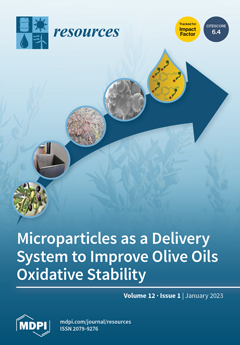
Cover Story: Olive oil from olive fruit (Olea europaea L.; Oleaceae) is an outstanding source of a great variety of bioactive compounds. Nevertheless, the majority of phenolic compounds—around 98%—are retained in olive oil by-products during olive oil processing. From this perspective, olive mill pomace (OMP), generated in large quantities during olive oil processing, is a powerful source of natural phenolic antioxidants, such as tyrosol, hydroxytyrosol. However, many phenolic compounds are sensitive to environmental conditions and the encapsulation is a straightforward technological strategy to protect these valuable compounds. In this sense, the purpose of this study was to evaluate the effectiveness of encapsulated olive mill pomace extract on the retarding lipidic oxidation of olive oils. View this paper
  • Issues are regarded as officially published after their release is announced to the table of contents alert mailing list .
  • You may sign up for email alerts to receive table of contents of newly released issues.
  • PDF is the official format for papers published in both, html and pdf forms. To view the papers in pdf format, click on the "PDF Full-text" link, and use the free Adobe Reader to open them.

Articles (16)

  • Article
  • Open Access
11 Citations
5,764 Views
15 Pages

The Ecological Footprint of Construction Materials—A Standardized Approach from Hungary

  • Cecília Szigeti,
  • Zoltán Major,
  • Dániel Róbert Szabó and
  • Áron Szennay

10 January 2023

Due to the large volume and mass of materials used, the construction industry is one of the sectors with the highest environmental impact. However, to provide good quality, affordable, and low-energy housing, the business case must be maintained. Acc...

  • Article
  • Open Access
6 Citations
5,090 Views
32 Pages

Geodiversity of Las Loras UNESCO Global Geopark: Hydrogeological Significance of Groundwater and Landscape Interaction and Conceptual Model of Functioning

  • África de la Hera-Portillo,
  • Julio López-Gutiérrez,
  • Luis Moreno-Merino,
  • Miguel Llorente-Isidro,
  • Rod Fensham,
  • Mario Fernández,
  • Marwan Ghanem,
  • Karmah Salman,
  • Jose Ángel Sánchez-Fabián and
  • Nour-Eddine Laftouhi
  • + 4 authors

Las Loras UNESCO Global Geopark (UGGp) is geologically diverse, particularly in relation to water-derived features: springs, karst springs, travertine buildings, waterfalls, caves. In this work, the interactions between geology, geomorphology, struct...

  • Article
  • Open Access
9 Citations
3,349 Views
23 Pages

Assessment of the Geomorphological Heritage of the Costa Branca Area, a Potential Geopark in Brazil

  • Marco Túlio Mendonça Diniz,
  • Maria Luiza de Oliveira Terto and
  • Fernando Eduardo Borges da Silva

The Atlantic margin of South America is considered passive and stable. However, there are some local points of discordance within the Brazilian coastal region with more than 7490 km of extension, where there is only one tectonic relief. These sites a...

  • Article
  • Open Access
16 Citations
5,302 Views
16 Pages

Effects of Feeding Speed and Temperature on Properties of Briquettes from Poplar Wood Using a Hydraulic Briquetting Press

  • Joseph I. Orisaleye,
  • Simeon O. Jekayinfa,
  • Christian Dittrich,
  • Okey F. Obi and
  • Ralf Pecenka

Biomass has a high potential to contribute towards resolving the energy deficit. Processing biomass into solid fuels enhances its use in various bioenergy conversion technologies. The quality of densified biomass depends on several variables. The inv...

  • Article
  • Open Access
5 Citations
3,324 Views
17 Pages

Modelling of Burnt Pine Heartwood Acid-Catalysed Liquefaction

  • Sila Ozkan,
  • Diogo Gonçalves,
  • Ivo Paulo,
  • Carla S. G. P. Queirós,
  • Ana Carvalho,
  • Jaime Puna,
  • João Gomes,
  • João Bordado and
  • Rui Galhano dos Santos

This study focused on bio-oil production by thermochemical liquefaction. For the reaction, the burnt pine heartwood was used as feedstock material, 2-Ethylhexanol (2-EHEX) was used as a solvent, p-Toluenesulfonic acid (pTSA) was used as a catalyst, a...

  • Review
  • Open Access
13 Citations
7,310 Views
29 Pages

Structural Performance of Waste Plastic Bottles Modified Asphalt: A Review

  • Abdul Muqeet Shah,
  • Rida Hameed Lodhi,
  • Muhammad Faisal Javed,
  • Michał Jasiński,
  • Elżbieta Jasińska and
  • Miroslava Gono

The usage of plastic materials in our daily life is increasing day by day. These plastic materials are somehow beneficial for us, but the disposal of waste plastic materials has become a serious problem. The use of plastic not only enhances road cons...

  • Article
  • Open Access
6 Citations
2,933 Views
24 Pages

The geodiversity of loess areas is reflected in the characteristic dataset of loess landforms, with the dominance of several types of valley forms (mainly gullies). The availability of satellite elevation data and high-resolution aerial topography sc...

  • Article
  • Open Access
4 Citations
3,117 Views
22 Pages

On the Utilization of Modified Red Mud in Dimethyl Disulfide and Methyl Mercaptan Emission Abatement

  • Sanna Päivärinta-Antikainen,
  • Satu Ojala,
  • Satu Pitkäaho,
  • Lenka Matějová and
  • Riitta L. Keiski

In this paper, a novel application of industrial waste, namely red mud (RM), in the abatement of two malodorous and harmful sulfur compounds, dimethyl disulfide (DMDS) and methyl mercaptan (MM), is presented. The effects of calcination and activation...

  • Article
  • Open Access
7 Citations
3,731 Views
26 Pages

Guidelines for the Technical Sustainability Evaluation of the Urban Drinking Water Systems Based on Analytic Hierarchy Process

  • Rukhshanda Rehman,
  • Muhammad Sagheer Aslam,
  • Elżbieta Jasińska,
  • Muhammad Faisal Javed and
  • Miroslava Goňo

The challenge of achieving and measuring urban water sustainability is hard because of its complex nature. The sustainability of urban drinking water system (UDWS) is no exception, as integration of technical, environmental, social, economic, and ins...

  • Article
  • Open Access
7 Citations
3,424 Views
21 Pages

The protective effect of olive mill pomace (OMP) loaded ethylcellulose microparticles as an alternative to synthetic antioxidants against the oxidation of olive oils was assessed. OMP extract was obtained by an optimized two-step solid-liquid extract...

  • Article
  • Open Access
46 Citations
17,685 Views
19 Pages

Organic farming is functionally integrated and serves as the foundation for circular agriculture. It guarantees resource efficiency in the deployment of nature-based initiatives to mitigate climate change. Organic farming is the most cost-efficient s...

  • Concept Paper
  • Open Access
9 Citations
4,561 Views
14 Pages

An Approach to Assess the Water Resources Reliability and Its Management

  • Jakub Żywiec,
  • Dawid Szpak,
  • Izabela Piegdoń,
  • Krzysztof Boryczko,
  • Katarzyna Pietrucha-Urbanik,
  • Barbara Tchórzewska-Cieślak and
  • Janusz Rak

One of the factors limiting the possibility of the development of urban agglomerations is access to drinking water. Due to progressive climate change, the available water resources are limited. The paper proposes new indicators of limiting the develo...

  • Review
  • Open Access
5 Citations
2,635 Views
17 Pages

Inventory of Good Practices of Sustainable and Circular Phosphorus Management in the Visegrad Group (V4)

  • Marzena Smol,
  • Paulina Marcinek,
  • Zuzana Šimková,
  • Tomáš Bakalár,
  • Milan Hemzal,
  • Jiří Jaromír Klemeš,
  • Yee Van Fan,
  • Kinga Lorencz,
  • Eugeniusz Koda and
  • Anna Podlasek

30 December 2022

The most important raw material needed for food production is phosphorus (P), which cannot be replaced by other elements. P is listed as a Critical Raw Material (CRM) for the European Union (EU). It is an element essential for human nutrition and is...

  • Article
  • Open Access
7 Citations
4,933 Views
26 Pages

The Inequities of National Adaptation to Climate Change

  • Heidi K. Edmonds,
  • C. A. Knox Lovell and
  • Julie E. Lovell

28 December 2022

With global efforts to mitigate climate change lagging behind what is necessary to achieve Paris Agreement global warming targets, global mean temperatures are increasing, and weather extremes are becoming more frequent and more severe. When mitigati...

Get Alerted

Add your email address to receive forthcoming issues of this journal.

XFacebookLinkedIn
Resources - ISSN 2079-9276