


Abstract
Image-based generative AI is rapidly entering urban design practice, yet it remains unclear whether its limitations can be addressed through prompt refinement or whether they reflect properties of the generation architecture itself. This study examines this question through a comparative case study of two urban design studio tasks under contrasting constraint conditions, drawing on 151 prompt episodes across 20 team projects. In concept-driven tasks, generative AI primarily supported divergence and visual exploration, while morphological bias was partly managed through curatorial selection and reference anchoring. In site-specific tasks, however, outputs often achieved visual plausibility while failing to preserve relational spatial logic, including circulation hierarchy, adjacency dependencies, and boundary conditions. The findings distinguish element-level errors, recoverable through post-editing, from system-level errors, which tended to resist repair within the observed image-generation workflows. Across cases, a three-stage human–AI workflow emerged as a control mechanism: human-led structuring, AI-driven generation and enrichment, and critical curation and refinement. The study contributes to research on human–AI systems by showing that effective integration in constraint-intensive urban design can depend less on prompt optimisation than on workflow architecture, particularly the allocation of validation, generation, and repair functions between human and AI components.
1. Introduction
Image-based generative AI tools are increasingly entering urban design practice, altering how designers explore formal alternatives, visualise spatial propositions, and communicate design intent. Whereas conventional digital tools such as CAD (Computer-Aided Design) and BIM (Building Information Modelling) primarily supported the accurate representation of ideas already formed by the designer, text-to-image systems increasingly function as generative tools within the design process, producing complex visual alternatives from prompts alone. Prior studies report that generative AI can stimulate designers’ visual imagination and support divergent thinking during early ideation, functioning as a powerful design partner [1,2,3]. In particular, designers with limited drawing or visualisation skills can externalise concepts in high fidelity, lowering barriers to design exploration [4,5]. This raises a methodological question that is increasingly consequential for design practice: under what task conditions does generative AI genuinely support design reasoning, and when does it merely accelerate image production without improving the spatial and contextual quality of design outcomes? More fundamentally, when generative AI fails, can the failure be addressed through better tools and prompts, or does it expose a structural limit that human–AI collaboration must work around? Such a limit would lie not in any single prompt but in how current image-generation pipelines represent, or fail to represent, relational spatial structure.
Despite the rapid uptake of text-to-image AI in design studios, early discourse has often celebrated novelty and efficiency, sometimes implying that AI use straightforwardly increases creativity. Yet this assumption is problematic because design quality requires more than mere image appeal. Research cautions that generative systems can reproduce dominant visual conventions embedded in training data and may privilege familiar aesthetics over genuinely exploratory reasoning [3,6]. In design practice, such tendencies become problematic when designers treat visually persuasive outputs as well-structured spatial logic. This risk intensifies in site-specific urban design, where the design process must engage competencies beyond form generation, including spatial organisation, circulation hierarchy, adjacency logic, and the interpretation of place-based constraints. Under such conditions, uncritical reliance on generative AI may displace the very reasoning processes (constraint interpretation, spatial validation, and contextual judgement) that distinguish defensible design from appealing imagery. This displacement is especially risky when the underlying limitations are misdiagnosed as fixable through better prompts. Such limitations may instead be candidate properties of the generation architecture of current image-generation systems.
These concerns suggest that the role of generative AI is not uniform but depends on task context, especially the degree to which a design task requires reasoning with constraints. The intuitive expectation is straightforward: more constrained tasks require more human intervention. Yet this framing obscures a more consequential question. If image-based generative AI fails under constraint-intensive conditions, is this a matter of degree (addressable through better prompting, larger models, or more iteration) or a matter of kind (reflecting a structural mismatch between current image-generation pipelines and the logic of design reasoning)? This distinction is treated less as a strict binary than as a spectrum: some failures may be mitigated by better prompts, models, or control mechanisms, while others appear to require workflow-level restructuring. The aim of the comparison is to locate where, empirically, the balance shifts. The distinction matters because it determines whether effective AI integration is a problem of tool mastery or of workflow architecture, and whether the competencies designers need are incremental refinements of current practice or categorically different from those required in unaided design.
Comparative empirical evidence on this question remains limited. Recent work has begun to examine how AI is reshaping design practice [7,8], but most studies examine AI integration within a single task type, making it difficult to assess whether observed limitations reflect tool immaturity, user inexperience, or more fundamental constraints on what current generation architectures can encode. Without comparative evidence linking task conditions, breakdown patterns, and intervention strategies, guidance for AI integration tends to stay generic, focused on tool operation or prompt tactics, rather than clarifying when and why human judgement becomes structurally indispensable.
To address this gap, this study empirically examines how task context and contextual demands shape the use of generative AI and the human–AI collaborative process in urban design studio settings. Specifically, it compares two studio courses offered under contrasting task conditions: a concept-driven task with relatively flexible contextual requirements (Case A: Future City) and a site-specific task requiring alignment with circulation structures and spatial coherence (Case B: Site-Specific Design). Team-produced AI-use reports are the primary data source, including prompt excerpts, intermediate outputs, and reflection commentary. These reports, alongside final presentation panels, are analysed to examine how design teams recognise AI-related constraints and reallocate validation, generation, and repair functions between human and AI components as task constraints intensify.
Throughout, we use constraint intensity to denote the degree to which a design task requires its outputs to align with fixed, externally given conditions—site geometry and circulation structure, adjacency and program requirements, boundary and land-use conditions, and regulatory or operational constraints. Concept-driven tasks sit toward the low-to-moderate end; site-specific tasks, which must reconcile several such conditions at once, sit toward the high end.
This study addresses three research questions:
- RQ1. How do patterns of generative AI use in urban design differ between concept-driven (low-to-moderate constraint) and site-specific (high-constraint) tasks?
- RQ2. What limitations of image-based generative AI become more pronounced under higher contextual demands, and how do design teams diagnose these limitations during the design process?
- RQ3. How do design teams reallocate validation, generation, and repair functions between human and AI components to maintain contextual consistency under increasing constraint intensity?
This study contributes to research on human–AI collaboration in design on three fronts. Theoretically, drawing on the present cases and on the known computational logic of diffusion-based generation, it interprets morphological bias and spatial illiteracy not as transient tool limitations but as candidate structural properties of current text-to-image generation, suggesting a gap between visual co-occurrence, which the model encodes, and the relational logic that urban design reasoning requires. It further distinguishes element-level errors (recoverable through post-editing) from system-level errors (resistant to repair because the underlying relational structure is absent), clarifying why prompt refinement alone cannot close this gap. Methodologically, it identifies a three-stage human–AI hybrid workflow that functions not as an image production strategy but as a spatial control mechanism, and it specifies two transferable competencies, evaluative judgement (diagnosing when outputs are spatially unreliable) and strategic judgement (deciding what to delegate, protect, and bound), that remain stable as tools change. Practically, it provides context-sensitive guidance for structuring, assessing, and supporting AI-integrated design processes under varying contextual demands, with specific implications for design protocols, evaluative criteria, and workflow design that foreground process evidence over surface quality.
The remainder of the paper is organised as follows. Section 2 reviews generative AI in design, the limitations of morphological bias and spatial illiteracy, and human–AI workflow structuring. Section 3 describes the comparative case design, data, and coding procedure. Section 4 reports AI-use patterns, observed limitations, and the hybrid workflow. Section 5 discusses the structural interpretation, implications, limitations, and conclusions.
2. Literature Review
2.1. From Representation Tools to Generative Agents in Design
Generative AI reshapes architectural and urban design by actively proposing visual and formal alternatives, functioning not as a passive representational medium but as an active participant in ideation and form exploration [3,9,10]. In urban design contexts, this shift has prompted renewed questions about how generative systems influence early-stage design thinking, spatial configuration, and the relationship between human intent and machine-generated output [5,11].
Image-based generative tools such as Midjourney, Stable Diffusion, and LookX have attracted attention because they can generate high-fidelity imagery from text prompts (text-to-image, T2I) or from reference images combined with prompts (image-to-image, I2I), enabling rapid externalisation of concepts and exploration of multiple stylistic directions [1,4,12]. In design studio settings, these capabilities can support divergent thinking during early ideation and allow designers with limited rendering skills to visualise spatial concepts at high fidelity [2,7]. Recent architecture-focused studies further suggest that text-to-image generators can function as ideation media rather than mere visualisation aids, but that their usefulness depends on iterative use and the designer’s ability to steer and evaluate outputs [8,13].
Recent reviews document a growing body of work on AI applications across different stages of architectural design (from site analysis and massing generation to façade articulation, visualisation, and pedestrian-environment assessment) but note that integration into actual design workflows remains fragmented and often tool-specific [5,14,15]. These reviews also show that GenAI adoption concentrates in early-stage image production, while evaluation practices and workflow integration remain underdeveloped across phases and tasks, including in analytical applications such as place-quality interpretation [16,17].
A parallel line of work seeks to make generation more spatially controllable. Beyond text prompts, image- and structure-conditioned methods constrain layout and massing, for example sketch- or base-model-conditioned generation [18,19]. A growing body of “3D-aware” generative models couples image synthesis with explicit geometric representations—for example geometry-aware GANs [20] and 3D-aware diffusion approaches, which tie outputs to an underlying 3D structure rather than to 2D co-occurrence alone. These directions are promising for spatial fidelity, but most remain object- or scene-centric and are not yet integrated into urban design workflows that coordinate circulation, adjacency, and site constraints across scales; whether they resolve the relational-encoding limits discussed below is an open empirical question.
2.2. Limitations of AI Generation: Morphological Bias and Spatial Illiteracy
However, research has identified limitations that matter when tasks demand more than mere visual appeal. The central issue is stylistic convergence: repeated reliance on generative outputs can homogenise design representations and reinforce recognisable AI aesthetics, narrowing the diversity of exploration [21]. Three related but separable tendencies can be distinguished. Stylistic convergence refers to homogenisation of surface aesthetics across outputs; generic imagery refers to loss of context-specific cues, yielding placeless but plausible scenes; and morphological bias refers more specifically to a pull toward dominant formal and typological conventions embedded in training data. The first two concern appearance and specificity; the last concerns form and is the primary focus of this study. This concern aligns with broader creativity-support evidence that AI assistance can increase productivity while simultaneously reducing the diversity of outputs across users, producing convergence effects [22]. Morphological bias compounds this problem: generative models may privilege dominant visual conventions embedded in training data and reproduce familiar tropes, which can constrain innovation and shift designers toward superficial plausibility [3,5,6]. Critical analyses of widely used image generators also emphasise how “good-looking” defaults and embedded aesthetic politics can shape what appears plausible or desirable [23]. These tendencies become critical when designers treat visually persuasive outputs as proxies for well-reasoned spatial propositions.
Critiques of AI-mediated place representation also suggest that GenAI outputs can drift away from cultural and contextual specificity, producing visually compelling but contextually generic imagery that risks misrepresenting local meaning and conditions [24]. Empirical work on place identity and generative systems likewise suggests that while GenAI can reproduce recognisable visual markers of cities, it can also compress place specificity into stereotyped, surface-level cues, an issue that becomes especially visible when designs require fine-grained contextual alignment [25]. In design practice, where critique aims to strengthen the relationship between design intent, constraints, and justification, these risks may lead designers to prioritise visually polished outputs over the core work of problem framing, spatial reasoning, and evaluative judgement.
At the urban scale, these challenges become more pronounced. For example, in a case study on Indonesia’s new capital, Kurniawan et al. [26] report that AI supported ideation and simulation but struggled to coordinate complex, multi-layered urban context, suggesting that generative systems may rely more on pattern-based visual plausibility than on robust representations of urban-system relations. This gap aligns with critiques describing spatial illiteracy or fragmented integration, where outputs appear visually coherent yet fail to encode street hierarchy, functional relationships, and environmental responsiveness in a reliable manner [27]. For clarity, spatial illiteracy is defined as the failure of a generated output to preserve the relational and operational structure of a design—specifically circulation hierarchy, adjacency and connectivity logic, boundary and land-use conditions, scale consistency, and topographic relations—even when individual elements appear visually plausible.
These limitations are especially important in urban design because design objectives are fundamentally context-bound and constraint-intensive. Urban design tasks often require designers to interpret heterogeneous site conditions (circulation systems, adjacency logic, regulatory constraints, and socio-spatial relations) and to translate them into coherent spatial strategies across multiple scales. When contextual demands are light, GenAI may function productively as a driver of divergent exploration [3,7]. Yet as contextual demands increase, text-to-image generation may struggle to preserve internal consistency or encode relational spatial logic. In such settings, the problem extends beyond visual error to the unreliability of relational encoding (i.e., whether constraints and dependencies remain intact and interpretable after generation).
These recurring failures can be traced to the computational logic of current text-to-image architectures. Diffusion-based models such as Stable Diffusion learn to reverse a noise-addition process, guided by text embeddings that encode statistical co-occurrence between tokens and visual patterns across large image corpora [28]. For example, a prompt specifying “sunken plaza with a waterway following the terrace curve” activates visual fragments associated with those tokens (plazas, water features, curved forms), but the denoising process recombines them according to distributional likelihood, not according to the spatial or functional constraints implied by the prompt. In other words, the generation pipeline optimises for perceptual plausibility without maintaining a representation of relational structure such as circulation hierarchy, adjacency dependencies, or boundary conditions. This is read as an interpretive inference rather than a direct measurement. The computational logic of diffusion-based generation offers a plausible explanation for why, in these cases, morphological bias and spatial illiteracy recurred rather than appearing as occasional malfunctions: visual co-occurrence is encoded, while relational logic is not necessarily preserved.
These tendencies have consequences beyond image quality. They shift attention from prompt-level adjustments to the broader question of how human and AI components should be coordinated when the model cannot reliably preserve what the design problem requires.
2.3. Human–AI Collaboration and Workflow Structuring in Design
For these reasons, human–AI co-creativity research increasingly emphasises the importance of preserving human control, context sensitivity, and reflective evaluation rather than maximising automation [11]. Karadağ and Ozar [7] examined human–AI collaboration in a conceptual design studio, finding that AI was most productive when designers maintained strong agency over concept development and used AI outputs as stimuli for refinement rather than final proposals. Similarly, Horvath and Pouliou [10] explored text-to-text, text-to-image, and image-to-image generators in conceptual architecture, concluding that effective use required designers to maintain critical distance and iterative control over generated outputs.
Beyond architecture-specific studio studies, the broader human–AI interaction literature provides convergent guidance on what “effective collaboration” requires in practice. Human–AI interaction guidelines emphasise transparency, controllability, and support for correction as prerequisites for reliable use, especially when systems are probabilistic and can fail silently [29]. Human-centred AI frameworks further argue that high automation must be paired with high human control, particularly in tasks where safety, responsibility, or justification is at stake [30]. In creative domains, co-creativity frameworks further emphasise that interaction dynamics (how responsibility, turn-taking, and contribution types are structured) are not peripheral but constitutive of successful co-creation [31,32]. These perspectives suggest that the value of generative AI in design depends less on “prompt cleverness” than on workflow structuring: how designers frame constraints, interrogate outputs, and repair or reintegrate results into higher-order spatial decisions.
Empirical work in design studios supports this view. Recent studies have likewise begun to frame generative-AI-assisted design as a workflow-level and co-creative systems problem, examining prompt-driven agency dynamics in GenAI-enabled design processes and generative dynamic workflows in co-creative design [33,34]. Studies of Midjourney-supported design processes highlight that productive use often involves purposeful iteration cycles that alternate between divergence and convergence, with designers acting as curators and evaluators rather than passive recipients of outputs [8]. At a technical-workflow level, the move toward image-conditioned generation (using sketches, base models, or reference imagery as inputs) has been recognised as a way to stabilise intent and reduce drift [18,19]. Such pipelines clarify what is held fixed and what is allowed to vary, but do not remove the need for human validation of circulation logic, boundaries, and operational coherence.
Despite these contributions, most existing studies examine AI integration within a single task type or studio format, making it difficult to assess how the same tools function under varying levels of contextual constraint. While Karadağ and Ozar [7] focused on conceptual ideation with relatively open-ended briefs, and Horvath and Pouliou [10] examined generators in exploratory architectural exercises, neither compared AI’s role across tasks that differ systematically in constraint intensity. This study addresses this gap through a comparative design, examining human–AI collaboration across two urban design studio tasks that contrast in contextual demands. By linking AI affordances and breakdowns to task context, the study moves beyond generalised claims about AI and creativity to offer context-sensitive insights into when and how human structuring becomes essential for design quality in AI-integrated workflows.
3. Methodology
3.1. Study Design and Cases
This study examines how the role and limitations of image-based generative AI in urban design vary with task context, especially contextual demands and constraint intensity. A comparative case study design was adopted, using two settings that contrast in constraint intensity: Case A (Future City), a concept-/scenario-driven task with relatively flexible contextual requirements, and Case B (Site-Specific Design), a site-specific task where proposals must respond to concrete site conditions and demands for operational and spatial coherence. By comparing these two contexts, the study examines three issues: how designers’ AI use patterns change as contextual demands increase, what breakdowns arise under higher constraint intensity, and what human-in-the-loop strategies design teams develop to maintain design intent and contextual consistency.
In Case A (Future City), the task was conducted in 2023 and 2024 with 16 participants each year, organised into 4 teams per year (8 team projects in total). In Case B (Site-Specific Design), the task was conducted in 2024 and 2025 with 31 participants (8 teams) in 2024 and 16 participants (4 teams) in 2025 (12 team projects in total). The primary analytic unit is the team (i.e., one team report/project), because AI-related decisions (prompting, iteration, selection, and post-editing) were typically coordinated at the team level and consolidated into a single team output. All materials were collected as part of normal studio activities and were anonymised prior to analysis. Although the two cases differ in year, task type, and number of teams, they were comparable in the respects most relevant here: both were upper-level urban design studios at the same institution, taught in the same curricular sequence and assessed through public exhibition panels and critique. Their principal design difference was constraint intensity. The contrast in tools—text-to-image generators in Case A versus structure-referenced tools such as LookX in Case B—is treated not as an independent confound but as partly endogenous to constraint intensity, since the high-constraint task itself motivated the shift to base-model-conditioned generation. Other differences, such as cohort composition and instructor guidance, could not be fully controlled in a naturalistic studio setting.
3.2. Data Sources and Analytical Procedure
To examine how generative AI was used in practice, the primary dataset consisted of team-produced AI-use reports collected across both cases. These reports typically include tool choices and rationales, prompt construction and revisions, intermediate and final generated images, and reflections diagnosing limitations and documenting corrective actions (e.g., re-modelling, tool switching, post-editing). For example, reports often record prompt revisions and negative prompts in detail and describe iterative editing workflows.
In addition, the dataset included final exhibition panels as outcome artefacts, because both tasks were presented in public exhibition-style presentations followed by critique. Panels provide a consistent representation of each team’s final proposition and how spatial logic and narrative were communicated externally. Critique notes/feedback records—recorded by the author during the public review sessions for each team—were used as a secondary source to contextualise how outputs were discussed and assessed, and to corroborate (or, where relevant, qualify) claims drawn from the team reports and final panels, rather than as a primary coded dataset.
The analytical procedure followed an inductive thematic analysis of the team reports and embedded artefacts to identify recurrent patterns of AI use purposes, breakdowns under constraint intensity, and human-in-the-loop interventions that restored contextual alignment. Analysis proceeded in four steps:
Step 1. Segmentation into AI-use episodes: Each team report was read holistically and then segmented into episodes of AI use (e.g., ideation, variation/refinement, and repair/post-editing). Episode boundaries were defined by a shift in AI-use purpose or operation—e.g., a move from ideation to variation/refinement, a change of conditioning mode or tool, or the initiation of a repair sequence. A continuous run of prompt revisions pursuing the same intended output was treated as a single episode. Such process evidence (prompt excerpts, intermediate outputs, narrated iterations, and reflection commentary) also informed these judgements. As a supplementary step, prompts and prompt revisions were reviewed with attention to three aspects: conditioning mode (text-only, reference-conditioned, structure-referenced, or region-specific), constraint type (atmospheric/stylistic, spatial/programmatic, or negative/exclusionary), and prompt–output alignment (retained, partially retained, or violated). This procedure yielded a total of 151 prompt episodes across 20 team projects (Case A: 62 episodes from 8 teams; Case B: 89 episodes from 12 teams). Operational definitions, decision rules, and coded examples for all three dimensions are provided in the codebook (Appendix A). Prompt–output alignment was judged by comparing each output against the spatially and programmatically salient content of its prompt: retained (all preserved), partially retained (some preserved while other often-relational content was lost or altered), and violated (a core specified element replaced, dropped, or inverted). Table 1 summarises the distribution of prompt episodes by conditioning mode, constraint type, and prompt–output alignment across the two cases.
Table 1.
Summary of structured prompt episode coding across cases.
Step 2. Open coding and iterative refinement: Report segments were coded inductively to capture affordances (e.g., rapid divergence, visual articulation), breakdowns/limitations (e.g., inconsistency, contextual detachment, geometric drift), and repair strategies (e.g., base-model anchoring, tool switching, post-editing). Primary coding was conducted by the author through iterative rounds of constant comparison. To assess reliability, a second coder—given only the codebook (Appendix A) and blind to the author’s codes—independently coded a random 22.5% subsample (34 of 151 episodes, stratified by case). Agreement was substantial: Cohen’s κ = 0.80 (88.2% agreement) for constraint type, 0.69 (82.4%) for prompt–output alignment, and 0.75 (85.3%) for conditioning mode. Disagreements clustered at adjacent-category boundaries (no “retained” vs. “violated” confusions) and were reconciled; the codebook was clarified—in particular, a named stylistic precedent supplied without an input image (e.g., “Gaudí style”) was specified as reference-conditioned rather than text-only—and the corpus was reviewed under the clarified rules. Analytic memos were maintained throughout the process to document coding decisions, definitional revisions, and rationales for category boundaries, and counter-examples were actively sought to test emerging interpretations against raw data.
Step 3. Breakdown-focused analysis: To make context-dependent limitations empirically visible, episodes were identified where teams explicitly identified outputs as problematic or described repeated corrections. Such episodes were often identified directly in reports, for example where teams described generation as failing to respect site and cultural context or ignoring prompt constraints.
Step 4. Cross-case synthesis: A case-by-theme matrix was constructed to contrast patterns of AI use, prominent breakdowns, and intervention strategies across Case A (lower-to-moderate constraints) and Case B (high constraints). In reporting findings, representative excerpts are used as illustrative evidence while ensuring that interpretations are checked against the full corpus and that deviant/atypical cases are noted when they contradict dominant patterns. Table 2 summarises the two cases, including task conditions, enrolment, data sources, and analytic focus.
Table 2.
Overview of cases, contextual demands, and analytical materials.
To enhance the trustworthiness of the analysis, four strategies were used. First, within-report triangulation: claims were grounded by cross-checking prompt excerpts, intermediate images, and teams’ written reflections within the same report, ensuring that no interpretation relied on a single evidence type. Second, the analytic documentation described in Step 2 (including iterative memos recording coding decisions, definitional revisions, and category boundaries) served as an audit trail throughout the analysis. Third, the self-reported nature of team reports was partially mitigated by the inclusion of embedded process artefacts (prompt excerpts, intermediate outputs, and iterative revision records) that provide contemporaneous evidence independent of retrospective reflection. Fourth, the inter-coder reliability check on a blind 22.5% subsample (reported above) provided a quantitative test of the coding scheme’s consistency, complementing the qualitative audit trail.
4. Findings
4.1. AI Use Patterns Under Contrasting Task Conditions
Across the two cases, teams’ integration of generative AI differed in line with task conditions, particularly the level of contextual demands and constraint intensity. In Case A (Future City), where site-specific constraints were comparatively low, generative AI was positioned as a creative partner for rapid exploration, expanding the range of formal and atmospheric alternatives and supporting narrative visualisation. In this condition, designers’ role was most evident in directing and curating image variation through iterative prompting and selective adoption of outputs, functioning as visual directors who stabilised coherence at the level of imagery and story.
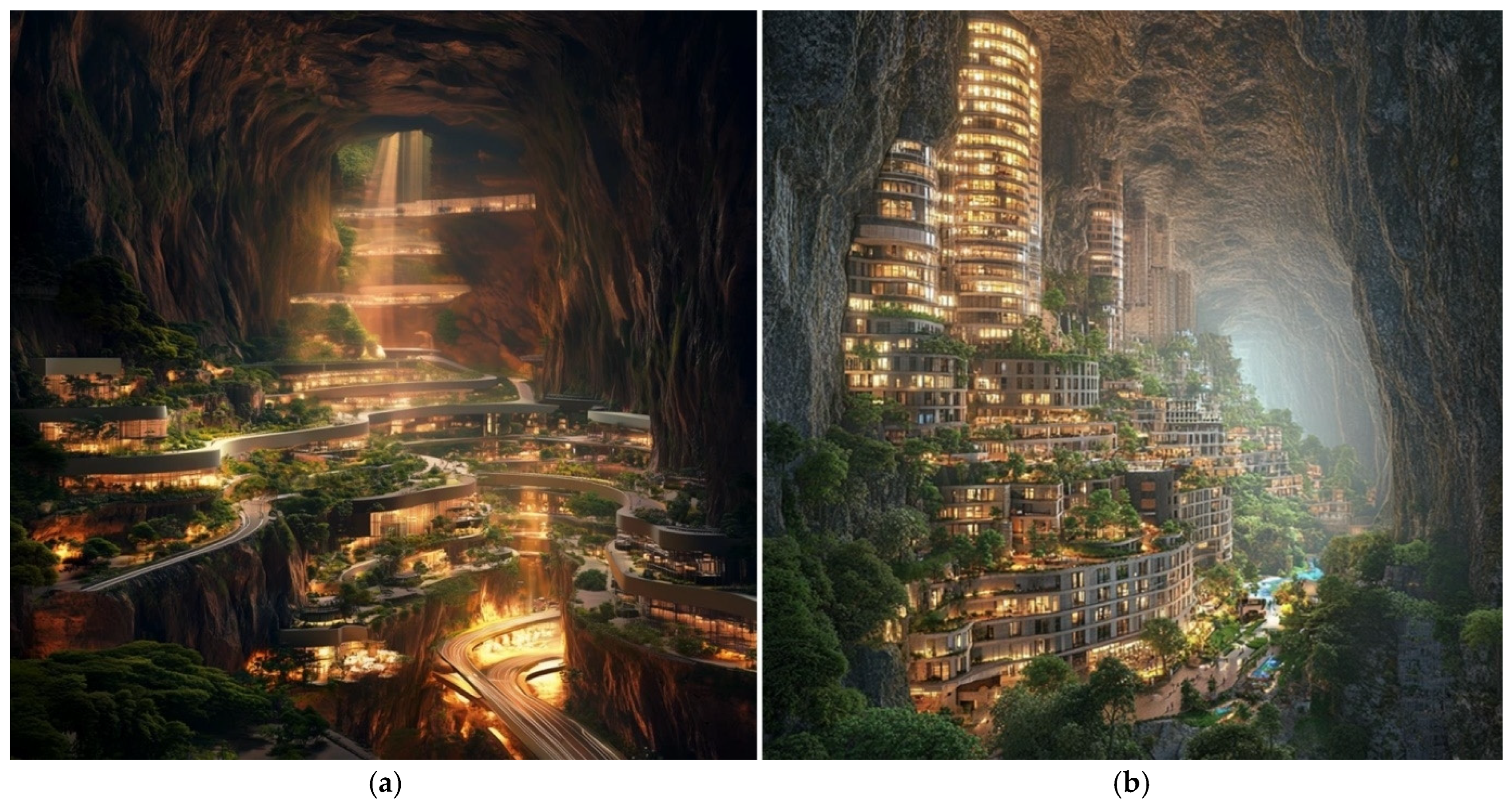
Based on all team AI-use reports (Case A: 8 teams; Case B: 12 teams), Figure 1, Figure 2, Figure 3, Figure 4 and Figure 5 present representative projects selected for data completeness and for the clarity with which they illustrate dominant patterns and key contrasts (rather than for visual quality); the cross-case frequency of these patterns is reported in Section 4.2 so that the representativeness of the selected cases can be assessed.
Figure 1.
Mountain City: AI-generated outputs (generated with Midjourney v6, then partially modified by the team using Midjourney’s Edit function). (a) Terraced residential area within the excavated cavern; (b) high-rise towers viewed from inside the cavern toward the opening.
Figure 2.
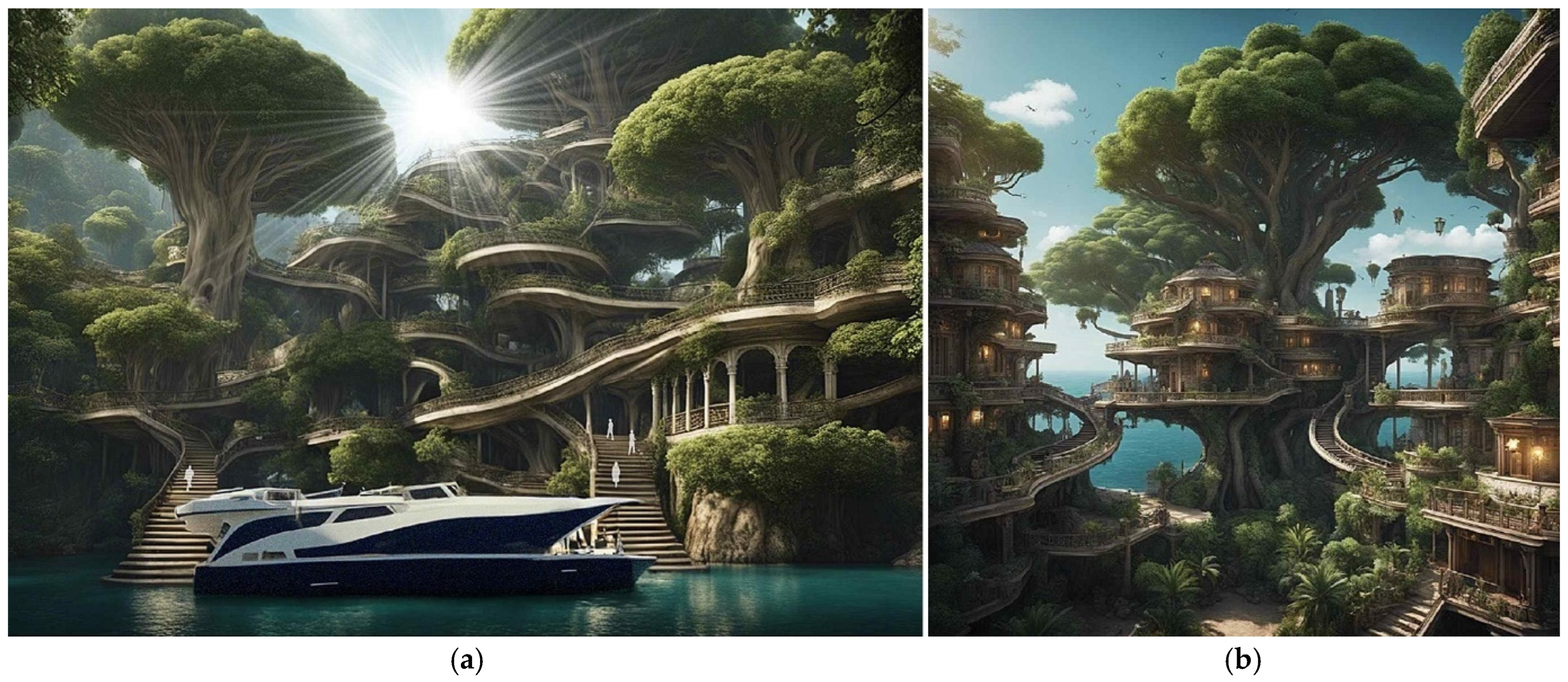
Forest City: AI-generated outputs (generated with Stable Diffusion XL 1.0 via Clipdrop, accessed November 2023). (a) Transit hub integrated into the tree structure; the boat in the foreground was subsequently added in Photoshop by the team. (b) Residential area entangled in the giant trees.
Figure 3.
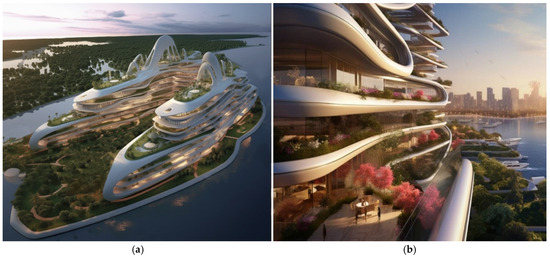
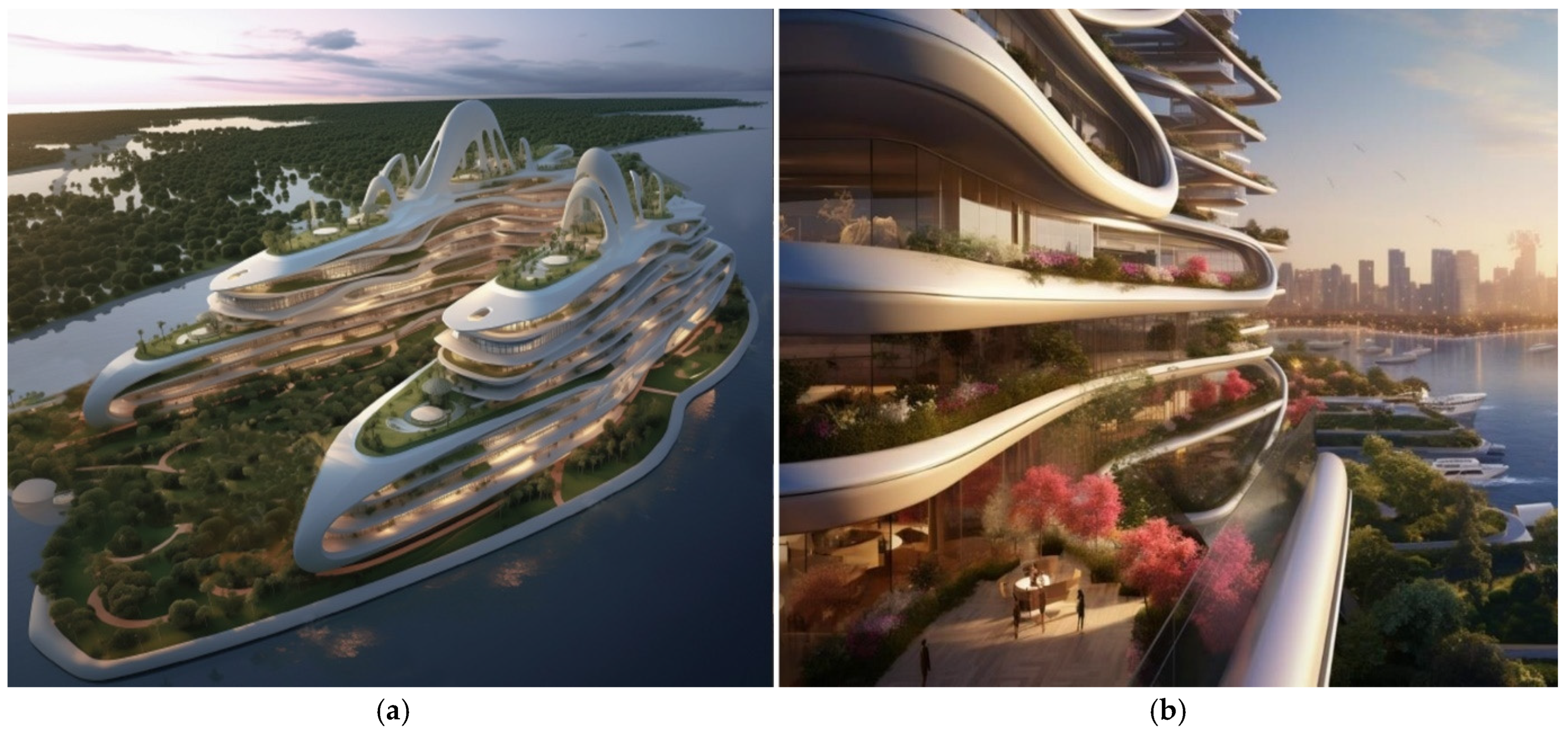
Cruise City: AI-generated outputs (generated with Midjourney v5.2, then refined by the team in Photoshop for colour adjustment and removal of extraneous elements). (a) Aerial view of the cruise city; (b) balcony-level view of the terraced façades.
Figure 4.
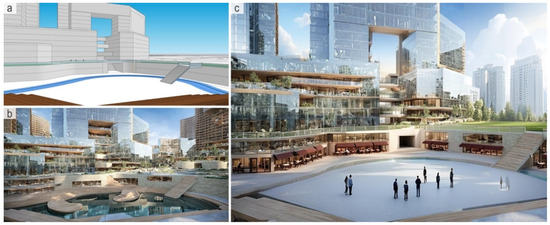
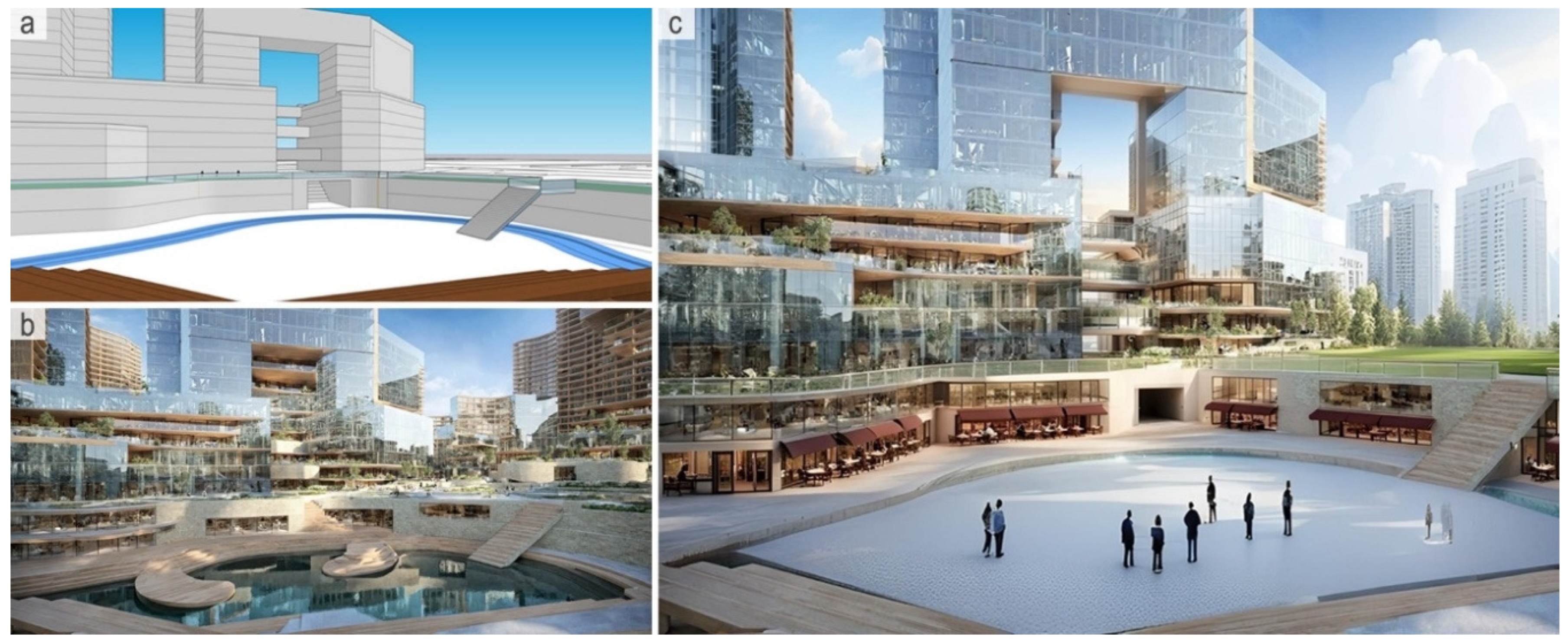
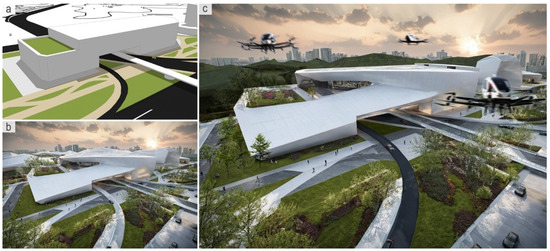
Net_Walk Bundang: Human–AI visualisation workflow. (a) Team-produced SketchUp base model (input). (b) LookX intermediate output (May 2025). (c) Final image: LookX output refined through LookX’s pen-based edit function and Photoshop to integrate site context.
Figure 5.
Future Transit Hub: Human–AI visualisation workflow. (a) Team-produced SketchUp base model (input). (b) LookX intermediate output (May 2025). (c) Final image: LookX output with extensive post-editing in Photoshop to integrate site context and better convey the function of the transit hub.
4.1.1. Case A (Future City): Generative Exploration and Reference-Anchored Coherence
Representative project 1: Mountain City
The Mountain City team developed a speculative narrative in which young residents, displaced by soaring housing costs in Seoul, construct a self-sufficient subterranean settlement by excavating mountainous geology on the urban periphery. To visualise spaces that merge complex underground rock structures with advanced residential systems, the team used text-to-image generation to produce a wide range of alternatives for sectional atmospheres, structural motifs, and spatial scenes. Rather than fixing a single form early, the team treated AI outputs as intermediate design cues. Recurring motifs (e.g., cavern-like voids, crystalline or stratified structural expressions) were then selected and integrated into plan-level ideas and final panel compositions (see Figure 1).
Team reports show that Case A exploration often involved iterative prompting as a means to stabilise a desired visual direction; the Mountain City team documented that they “repeated the same prompt until the desired image was generated.” This illustrates how divergence and convergence were managed through human curation even when AI produced abundant alternatives.
Representative project 2: Forest City
The Forest City team explored an ecological future scenario in which climatic shifts transform urban living and trees evolve into giant organisms that operate as infrastructural supports. Early trials using broad keywords (e.g., “forest,” “tree house”) produced generic and low-specificity imagery. At this point, Antoni Gaudí was introduced as a reference anchor for organic structural principles and spatial integration; once the team incorporated this reference into prompts, generated images aligned more closely with the intended architectural language and helped stabilise a coherent visual vocabulary that connected narrative, materiality, and architectural expression (see Figure 2).
This project illustrates a broader Case A pattern: when prompt-only descriptors remained generic, teams increased specificity by adding reference anchors and then curated outputs into a consistent visual language. However, another Case A team reported that certain conceptually specific intentions remained difficult to encode: the model “struggled to recognise the enclosedness of the city” and “did not understand it even when the prompt was modified,” indicating limits of prompt-level control for poorly learned spatial concepts.
Representative project 3: Cruise City
The Cruise City team proposed a mobile megastructure-city navigating the globe, requiring a persuasive synthesis of engineering scale and urban life. Here, AI was used primarily to test and stabilise a consistent identity for the proposal through repeated prompting with stylistic cues, especially for exterior massing impressions, façade articulation, and atmospheric scenes. Zaha Hadid was used as a reference anchor to introduce a fluid and dynamic formal language that counterbalanced the heaviness of large-scale massing; embedding such cues improved visual coherence and supported the intended design direction (see Figure 3).
Across these Case A projects, AI supported creative ideation and visual exploration, while design quality depended on designers’ curatorial judgement and the strategic use of reference anchors to reduce generic outputs.
4.1.2. Case B (Site-Specific Design): Bounded AI Use Under High Contextual Demands
Representative project 4: Net_Walk Bundang
In Case B (Site-Specific Design), where proposals were expected to remain consistent with site-specific constraints (e.g., circulation hierarchy, adjacency logic, and contextual coherence), AI use shifted away from open-ended ideation toward bounded assistance for visualisation and localised detailing. The Net_Walk Bundang team sought to restore publicness to a civic open space and remodel an adjacent public building. Unconstrained generations frequently conflicted with the project’s spatial logic, introducing curvilinear patterns that disrupted intended movement structures or proposing building dispositions that weakened public-space performance. AI was therefore positioned in a constrained role: the spatial backbone was protected through human-led modelling, while AI was used mainly to enrich atmosphere, material expression, and presentation scenes.
Reported evidence on site-element recognition failures reinforces this bounded role. Figure 4b illustrates a representative case: the team used image-conditioned generation by providing a SketchUp-derived base image (Figure 4a) alongside a detailed text prompt that specified a circular sunken plaza with a 4-metre-wide waterway following the terrace curve, wide staircases descending from the upper level, and open commercial frontages facing the plaza. The generated output, however, replaced the waterway with an unrelated lake at the centre of the plaza, oriented the staircases so that they descend directly into the water, and rendered the commercial frontages as closed walls.
The relational logic of the design was only partially captured in the output despite explicit specification in the prompt. This team documented that “the system could distinguish buildings and sky, but failed to recognise roads, waterways, and landscape, resulting in mismatched renderings.” The team then undertook extensive manual repair and post-editing to bring the image back into alignment with the intended spatial relations (see Figure 4c).
Representative project 5: Future Transit Hub
Similarly, another Case B team aimed to articulate a future transit hub as a key spatial anchor within a broader site-based urban design proposal. Rather than treating the hub as an isolated building object, it was developed as an infrastructural node coordinating movement systems and public space under high contextual demands. In this context, AI was most useful for form evolution only when anchored by a human-defined spatial backbone. The team first constructed simplified volumetric massing and the intended core circulation structure in SketchUp because it enabled rapid base-massing with low overhead while preserving the intended circulation structure (Figure 5a). They then ran image-to-image generation using this base image, paired with a future-oriented reference image to steer architectural language, and a prompt that translated their concept into explicit constraints. After repeated iterations, they converged on an output in which the hub’s architectural massing and overall character aligned with their concept (Figure 5b). The team then re-integrated the AI-generated hub massing into the overall masterplan through a reverse-design process, translating the image back into plan-level decisions and filtering it against circulation logic and operational coherence (Figure 5c).
The intermediate output nevertheless exposes a different dimension of spatial illiteracy: the failure to encode circulation hierarchy and land-use boundaries even when the building object itself appears plausible. The prompt explicitly specified “no buildings in the greenery” to preserve the mountainous backdrop behind the transit hub, yet the generated output filled this area with an array of buildings. More critically, it merges vehicular roads, pedestrian-only paths, and elevated pedestrian bridges into an undifferentiated surface. Lane markings are absent, making it difficult to read how vehicles circulate. The access road from the transit hub, which should connect to the main road at the lower right, terminates ambiguously without a legible junction. This type of failure is distinct from the element-level errors seen in Figure 4: here, it is the systemic logic of movement (the hierarchy between vehicular, pedestrian, and grade-separated circulation) that the model does not reliably maintain. Report excerpts further show that even with explicit constraints, functional and operational details were not consistently produced; despite specifying a drone-mobility landing pad, “no structure resembling a landing pad appeared on the rooftop.”
Accordingly, the team treated AI outputs as provisional and invested substantial manual effort in repair and compositing. To produce the final representation, they corrected surrounding environmental conditions and adjusted roadway colour and related graphic cues to better differentiate movement systems; even after these interventions, circulation hierarchy remained only partially resolved in the final output (Figure 5c).
4.2. Observed Limitations: Morphological Bias and Spatial Illiteracy
The limitations observed appeared to be more than isolated technical glitches; in these cases they recurred in ways consistent with context-dependent, structural constraints rather than one-off errors. In Case A, a recurring challenge was morphological bias, a tendency for outputs to converge toward visually dominant patterns embedded in training data. Teams such as Mountain City and Forest City sought distinct design identities aligned with their narratives, yet repeatedly encountered generic futuristic imagery or stylistically stereotyped outputs. This pattern is consistent with concerns about the standardisation of expression: without strong designer control, outputs can become visually persuasive while narrowing exploratory space. This limitation is reflected in documented prompt revisions and reflections describing persistent misalignment between intended concepts and generated imagery. For example, in the Forest City case, the team reported persistent misalignment even after repeated prompt revision, suggesting that prompt iteration alone does not guarantee reliable alignment with intended spatial concepts.
As Table 1 shows, Case B prompts relied more heavily on structure-referenced conditioning with spatial and programmatic constraints, yet alignment violations increased, especially for relational elements such as circulation hierarchy and land-use boundaries. This pattern indicates that the problem lay not in prompt formulation alone but in the limited capacity of image generators to preserve relational spatial logic. This shift is also visible at the episode level: prompt–output violations rose from 13% in Case A (8/62) to 30% in Case B (27/89), and the alignment distribution differed between cases (χ2(2, N = 151) = 13.7, p = 0.001). Because episodes are nested within teams, this test is reported as descriptive rather than as a strict inferential claim. A team-level comparison of per-team violation rates showed the same direction. The relevant point is the consistent direction—higher constraint intensity coincided with more frequent relational-alignment failure despite heavier reliance on structure-referenced conditioning.
In Case B, constraints became more operational and spatial. Under site-specific task conditions, AI frequently struggled to maintain spatial literacy in circulation hierarchy and functional relationships. As Figure 4b and Figure 5b illustrate, these failures operate at two distinct levels: element-level errors, where specified features (waterways, commercial frontages) are replaced by unrelated elements; and system-level errors, where the relational logic of movement (vehicular versus pedestrian circulation, grade separation, and route connectivity) is collapsed into an undifferentiated surface. These two levels carry different practical implications: element-level errors were typically recoverable through post-editing (as in Figure 4c), whereas system-level errors, such as the collapse of circulation hierarchy in Figure 5b, resisted repair because the underlying relational structure was absent rather than merely misrepresented. These patterns show that image-level plausibility and richness cannot substitute for the logical consistency required in urban design.
These limitations were particularly acute under higher constraint intensity: AI remained most useful when its generative capacity was bounded by human-defined geometry and evaluation criteria, whereas unconstrained generation was more likely to conflict with contextual requirements. Table 3 synthesises these contrasts by comparing generation modes, prompt strategies, breakdowns, and workflow responses across the two cases, and Table 4 reports the team-level incidence of these breakdown types and workflow stages.
Table 3.
Cross-case comparison of AI use patterns, breakdowns, and workflow strategies.
Table 4.
Cross-case frequency of breakdown types and workflow stages (team-level incidence).
4.3. Hybrid Workflow and Design Improvisation Under Constraints
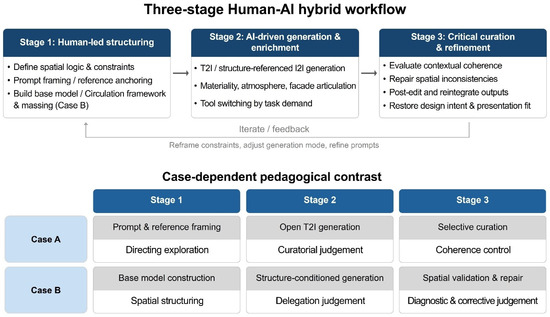
As Table 3 shows, rising constraint intensity changed not only the amount of human control but its character. In Case A, teams typically iterated within the generative tool, running variations and re-entering prompts until an acceptable result appeared. In Case B, teams restructured the workflow itself, retaining circulation hierarchy, adjacency structure, and site alignment under human authority while confining AI to surface-level enrichment. Across projects, a recurring three-stage hybrid workflow emerged: (1) human-led structuring, (2) AI-driven generation and enrichment, and (3) critical curation and refinement (see Figure 6). Rather than an image production strategy, this workflow operated as a spatial control mechanism, preserving the relational logic of urban design while allowing AI to contribute within defined bounds. This pattern was not universal but was concentrated under high constraint: the full three-stage sequence was evident in 8 of 12 Case B teams and in only 1 of 8 Case A teams (Table 4), where teams more often iterated within the generative tool without restructuring the workflow. Variations occurred—some Case B teams compressed Stages 2 and 3 or switched tools repeatedly—but the human-led structuring stage was present in 10 of 12 Case B teams.
Figure 6.
Three-stage human–AI hybrid workflow.
In the first stage (human-led structuring), core planning logic such as road networks, base massing, and topographic levels was modelled primarily in SketchUp, often after importing 2D CAD linework. By keeping spatial structure under human control, the likelihood of AI-driven spatial errors was reduced from the outset. In the second stage (AI-driven generation and enrichment), AI was used to add materiality, atmosphere, and façade-level articulation while remaining bounded by human-defined geometry and criteria. Teams did not treat a single tool as fixed. Instead, tools were selected and switched pragmatically depending on what needed to be preserved and what could be generatively expanded. Case B teams often favoured LookX to maintain perspective and massing cues from SketchUp base models, reducing drift from the intended spatial backbone and lowering the cost of iterative corrections. In the third stage (critical curation and refinement), post-editing and iterative corrections were used to restore contextual coherence and align representation with planning logic. Under high contextual demand, output quality was determined less by the generative power of AI than by the designer’s capacity to evaluate, repair, and contextualise results.
This three-stage workflow was not prescribed but emerged from teams’ own encounters with AI limitations. After repeated failures with unconstrained generation, Case B teams independently arrived at the strategy of protecting spatial structure through human-led modelling. One team reported that “the overall spatial plan and groundwork must be done manually, with AI used only for rendering and refinement.” Within this structure, prompting rarely functioned as a standalone activity. Teams authored, expanded, or repaired prompts through auxiliary systems such as ChatGPT (versions available during 2023–2025) or template generators, and routinely combined text prompts with reference images or 3D base models. As a result, prompting functioned as one operation within a broader human–AI pipeline rather than as the sole interface with the generative model. Effective AI use thus required less mastery of any single tool than the ability to select and combine tools to maintain design intent under model limitations.
5. Discussion
5.1. Spatial Illiteracy and the Three-Stage Workflow
This study examined how task context, especially constraint intensity, shapes designers’ use of image-based generative AI in urban design, what limitations become apparent as contextual demands increase, and how human agency is reshaped through hybrid workflows. The findings indicate that the functional role of generative AI is not uniform: it depends on whether the design task primarily rewards divergence and visual exploration or requires stable contextual reasoning and operational coherence. In Case A, generative AI functioned largely as a divergence engine, and design quality depended on designers’ capacity to curate and stabilise a coherent visual vocabulary. In Case B, visually persuasive images frequently failed to encode the relational logic that constitutes the basis for evaluating design quality in urban design, underlining the distinction between visual plausibility and contextual validity.
In the diffusion-based, image-centric workflows observed here, this limitation appears structural rather than incidental. Diffusion-based generation optimises for distributional plausibility rather than relational coherence, which offers a principled reason to expect that element-level and system-level failures differ in kind rather than only in degree; the present cases are consistent with this distinction, though it is presented as an interpretive claim to be tested further rather than as a settled property of all image-generation systems. Element-level errors arise from probabilistic substitution among visually plausible alternatives and can be locally repaired. System-level errors arise from a deeper absence: the model has no representation of relational structure to preserve, and prompt refinement alone is unlikely to supply a spatial grammar that the pipeline does not encode. The Net_Walk Bundang case (Figure 4) and the Future Transit Hub case (Figure 5) make this distinction concrete: in Figure 4, the model replaced specified spatial relations with visually plausible but functionally incoherent arrangements, while in Figure 5, the circulation hierarchy that connects the transit hub to its surroundings was collapsed into an undifferentiated surface despite explicit prompt constraints. The three-stage hybrid workflow that emerged across teams is therefore not a workaround for weak prompting but a necessary response to this structural limitation. Stage 1 (human-led structuring) compensates for what the model cannot represent, Stage 2 (AI-driven generation and enrichment) operates within the bounds Stage 1 sets, and Stage 3 (critical curation and refinement) catches what the model misrepresents. The intensity of Stage 3 increases under higher constraint demands, consistent with broader work that emphasises pairing high automation with high human control in justification-intensive tasks [29,30].
This structural account points to two forms of judgement that operate on the workflow itself rather than on the model’s outputs alone. Evaluative judgement concerns outputs: diagnosing when an image is spatially unreliable and whether the unreliability is recoverable through post-editing or requires manual re-establishment of relational structure. Strategic judgement concerns the workflow: deciding what to delegate to AI, what to protect under human authority, and how to bound AI’s involvement so that spatial logic is not compromised from the outset. These two judgements remain useful even as the underlying tools change. In this framing, effective AI integration depends less on prompt optimisation than on workflow architecture. This is a matter of emphasis, not hierarchy. Prompting is not a purely technical operation; it embodies professional knowledge, design experience, and spatial judgement. The present cases suggest, rather, that under current tool limitations such expertise could not always be translated into spatially reliable outputs through prompts alone. This is precisely why workflow structuring became more visible and necessary, and why prompt optimisation and workflow architecture are best seen as complementary rather than ranked. The central design problem becomes how to distribute control between human designers and AI components in a way that respects what each can reliably do.
5.2. Implications for Urban Design Method and Practice
In the cases observed, morphological bias and spatial illiteracy appeared to follow from how diffusion-based generation works rather than from how it is currently implemented. They are therefore unlikely to disappear with better prompts alone, and may persist in newer models unless underlying architectures more explicitly encode spatial relations. This also delimits the scope of the claim. If newer architectures encode spatial relations more explicitly—through structure- and 3D-aware conditioning or layout-grounded generation—then system-level spatial illiteracy may be reduced rather than merely post-edited. The argument is therefore not that image generation is permanently spatially illiterate, but that, for the diffusion-based, image-centric pipelines used by the teams studied, relational logic was not reliably preserved and had to be supplied by the workflow. Whether 3D-aware systems close this gap is a priority for future work. This recognition carries consequences at three levels: how designers diagnose AI outputs, how design processes are structured and evaluated, and how control is allocated within the workflow.
At the level of output diagnosis, the element-/system-level distinction provides an operational rule. When a designer encounters an unsatisfactory output, the first question is whether the failure is element-level, in which case post-editing can recover the intended relations, or system-level, in which case the underlying relational structure is absent and must be re-established through workflow restructuring. Treating a system-level failure as element-level invites repeated post-editing that cannot recover the missing relational structure, whereas correctly diagnosing it points back to human-led structuring. In the present cases, this diagnostic capacity—more than prompt skill—appeared to distinguish effective from ineffective AI integration in constraint-intensive work.
At the level of process structure, evaluative criteria should reflect the spatial and relational logic central to urban design rather than the surface quality of generated imagery. In constraint-intensive projects, designers benefited when the spatial backbone (circulation logic, adjacency relationships, level organisation) was protected through human-led structuring before AI-driven generation. In these cases, protecting the spatial backbone in this way functioned as an implicit design protocol: explicit constraint reasoning—circulation hierarchy diagrams, adjacency rationales, and schematic plans defensible on their own terms—preceded extensive image generation. Evaluation routines, in turn, should test contextual coherence directly, asking where circulation hierarchy is visible, how site specificity is preserved, and whether massing logic is consistent across views. Such protocols reduce the likelihood of decisions driven by image appeal and preserve a traceable logic that can anchor design review.
At the system level, these observations suggest that workflow architecture should be treated as a deliberate design problem in its own right, not as a residual of tool selection. The three stages identified here describe an explicit control allocation: spatial reasoning and constraint validation under human authority, generative variation and surface enrichment delegated to AI, and corrective judgement reserved for human reintegration. Making this allocation explicit, rather than letting it emerge case by case, allows teams and organisations to design AI involvement around what current generation architectures can and cannot reliably preserve.
A further consequence concerns how AI-integrated design processes should be evaluated. When polished images can be produced rapidly, product-only evaluation becomes vulnerable to surface-quality inflation, in which visual quality masks weak spatial reasoning. Documentation of iteration, explicit constraint checks, and evidence of repair help locate judgement in the workflow rather than only in the final image.
5.3. Limitations
The study has several limitations. It draws on two studio contexts at one institution; patterns may differ across design cultures, project types, and tool ecosystems. The primary data are team-produced reports, which capture self-reported accounts of the design process rather than real-time behaviour and may reflect authoring bias; final exhibition panels are also optimised for presentation. Tool versions changed across the years studied, and tool-version effects cannot be fully separated from constraint effects. Beyond version changes, tool type also co-varied with task type (text-to-image generators in Case A; structure-referenced generation in Case B), so the observed differences cannot be attributed to constraint intensity alone rather than to the differing affordances of the tools. Although this co-variation was partly endogenous to constraint intensity, fully disentangling tool from task effects would require holding the toolset constant across constraint conditions, which this naturalistic design could not do. Similarly, instructional framing within each studio, and variation in students’ prior experience, may have shaped both AI use and reporting. Finally, although a blind subsample established substantial inter-coder reliability, most episodes were coded by a single analyst, and studio evidence may not transfer directly to professional practice.
Future research could extend this work with process-tracing methods such as think-aloud protocols or screen recordings, and with design quality assessments that compare AI-integrated and conventional workflows under matched conditions. Generative models are evolving quickly, and some of the limitations documented here may diminish as 3D-aware and spatially reasoning systems emerge. Whether system-level spatial illiteracy persists under such architectures is an open question that warrants longitudinal tracking. Intervention studies in professional practice would also help test whether the hybrid workflow and evaluative protocols identified here hold beyond the studio setting.
5.4. Conclusions and Recommendations
Despite these limitations, the comparative design reveals what single-case studies cannot: constraint intensity changes not only the degree of human control but its character. Under lower constraints, designers filter and curate AI outputs within the generative tool. Under higher constraints, they restructure the workflow itself, deciding in advance which components AI may modify and which must remain under human control. Because the observed patterns are consistent with known limitations of diffusion-based generation rather than with user error or tool immaturity, spatial illiteracy is unlikely to be resolved by prompt refinement alone. It can be worked around only through workflows that allocate control between human and AI components in ways that respect what each can reliably preserve.
This reframing repositions the central question of generative AI in urban design from the image to the system that produces it. Effective integration depends less on the capabilities of any single generative model than on how validation, generation, and repair functions are allocated between human and AI components, and on the judgement that holds this allocation together as tools change. As image-generation architectures continue to evolve, the specific prompts and interfaces will be replaced, but the requirement to design the workflow itself, deciding what to delegate, what to protect, and how to bound AI’s role, will remain. In this sense, the design problem at the centre of generative AI in urban design is no longer the prompt but the sociotechnical system within which generative models and human judgement are coordinated.
These conclusions translate into several practical recommendations. First, designers should diagnose an unsatisfactory output before re-prompting, distinguishing element-level failures, which post-editing can recover, from system-level failures, which require returning to human-led structuring rather than further iteration. Second, the spatial backbone—circulation hierarchy, adjacency relationships, and level organisation—should be established and protected through human-led modelling before extensive image generation begins. Third, evaluation should attend to process evidence, including constraint checks, documented iteration, and repair, rather than to the surface quality of final images alone, so that visual polish does not mask weak spatial reasoning. Finally, workflow architecture itself—what to delegate to AI, what to keep under human authority, and how to bound AI’s role—should be treated as a deliberate design decision rather than as a by-product of tool selection.
Funding
This research received no external funding.
Institutional Review Board Statement
The study was reviewed by the Institutional Review Board of Gachon University and determined to be exempt from further review (IRB No.: 1044396-202603-HR-016-01, 9 March 2026).
Informed Consent Statement
Written informed consent was obtained from team representatives whose course-produced materials are referenced in this study. All identifying information was removed prior to analysis.
Data Availability Statement
The data presented in this study are available on request from the corresponding author. The raw materials are not publicly available due to privacy considerations regarding student-generated content.
Acknowledgments
The generative-AI images analysed in this study (Figure 1, Figure 2, Figure 3, Figure 4b and Figure 5b) were produced by student design teams during normal studio activities and constitute the study’s research data. The generation tool and version for each figure are identified in the corresponding figure caption, and the full prompts are provided in Appendix B.
Conflicts of Interest
The author declares no conflicts of interest.
Appendix A
Appendix A presents the codebook used in the inductive thematic analysis (Section 3.2). Inter-coder reliability for the coded dimensions was κ = 0.80 (constraint type), 0.69 (alignment), and 0.75 (conditioning mode).
Table A1.
Structured prompt-episode coding scheme.
Table A2.
Inductive thematic codes.
Appendix B
Appendix B reports the generative-AI tools, versions, and full prompts used to produce the AI-assisted figures (Figure 1, Figure 2, Figure 3, Figure 4b and Figure 5b), in accordance with the journal’s reporting standards for AI-assisted technologies. These images were produced by student design teams as part of the study’s research data. Prompts are reproduced as authored by the teams, with minor formatting standardised; each image was subsequently post-edited as noted in the corresponding figure caption and in Table A3.
Table A3.
Generative-AI tools and prompts for AI-assisted figures.
References
- Petráková, L.; Šimkovič, V. Architectural Alchemy: Leveraging Artificial Intelligence for Inspired Design—A Comprehensive Study of Creativity, Control, and Collaboration. Archit. Pap. Fac. Archit. Des. STU 2023, 28, 3–14. [Google Scholar] [CrossRef] [Scilit]
- Weber, S.; Klein, H.C.; Siemon, D.; Kordyaka, B.; Niehaves, B. Designing Effective Human-AI Collaboration for Creative Problem-Solving in Architectural Design. In Proceedings of the International Conference on Information Systems (ICIS 2024), Bangkok, Thailand, 15–18 December 2024; AIS Electronic Library (AISeL): Atlanta, GA, USA, 2024. [Google Scholar]
- Lu, Y. Artificial Intelligence Applied on Today’s Urban and Architectural Conceptual Design—A Competition Case Study. Master’s Thesis, Politecnico di Torino, Turin, Italy, 2025. [Google Scholar]
- Quan, S.J. Urban-GAN: An Artificial Intelligence-Aided Computation System for Plural Urban Design. Environ. Plan. B Urban Anal. City Sci. 2022, 49, 2500–2515. [Google Scholar] [CrossRef] [Scilit]
- Huang, T.; Ye, X.; Yigitcanlar, T.; Xu, B.; Newman, G.; Zhao, B.; Ennemoser, B.; Wu, D.; Kim, J.; Wang, D. Artificial Intelligence in Urban Design: A Systematic Review. Cities 2026, 169, 106527. [Google Scholar]
- Salem, A.A.; Mansour, Y.; Eldaly, H. Generative vs. Non-Generative AI: Analyzing the Effects of AI on the Architectural Design Process. Eng. Res. J. 2024, 53, 119–128. [Google Scholar] [CrossRef] [Scilit]
- Karadağ, D.; Ozar, B. A New Frontier in Design Studio: AI and Human Collaboration in Conceptual Design. Front. Archit. Res. 2025, 14, 1536–1550. [Google Scholar] [CrossRef] [Scilit]
- Tan, L.; Luhrs, M. Using Generative AI Midjourney to Enhance Divergent and Convergent Thinking in an Architect’s Creative Design Process. Des. J. 2024, 27, 677–699. [Google Scholar] [CrossRef] [Scilit]
- He, W.; Chen, M. Advancing Urban Life: A Systematic Review of Emerging Technologies and Artificial Intelligence in Urban Design and Planning. Buildings 2024, 14, 835. [Google Scholar] [CrossRef] [Scilit]
- Horvath, A.-S.; Pouliou, P. AI for Conceptual Architecture: Reflections on Designing with Text-to-Text, Text-to-Image, and Image-to-Image Generators. Front. Archit. Res. 2024, 13, 593–612. [Google Scholar] [CrossRef] [Scilit]
- Quan, S.J.; Park, J.; Economou, A.; Lee, S. Artificial Intelligence-Aided Design: Smart Design for Sustainable City Development. Environ. Plan. B Urban Anal. City Sci. 2019, 46, 1581–1599. [Google Scholar] [CrossRef] [Scilit]
- Schmitt-Fumian, T.K.; Tauscher, S.; Thoring, K. AI vs. Human: Exploring the Potential of Generative AI as a Feedback Tool to Support Ideation in Design Education. Proc. Des. Soc. 2025, 5, 429–438. [Google Scholar] [CrossRef] [Scilit]
- Paananen, V.; Oppenlaender, J.; Visuri, A. Using Text-to-Image Generation for Architectural Design Ideation. Int. J. Archit. Comput. 2024, 22, 458–474. [Google Scholar]
- Li, C.; Zhang, T.; Du, X.; Zhang, Y.; Xie, H. Generative AI Models for Different Steps in Architectural Design: A Literature Review. Front. Archit. Res. 2025, 14, 759–783. [Google Scholar] [CrossRef] [Scilit]
- Hollander, J.B.; Naughton, L.; Miller, E.L.; Jacob, R.J. The Walkable Neighborhood and Public Art: Using AI to Measure the Impact of Visual Interest on Pedestrian Behavior. Urban Des. Int. 2025, 30, 37–54. [Google Scholar]
- Jang, S.; Roh, H.; Lee, G. Generative AI in Architectural Design: Application, Data, and Evaluation Methods. Autom. Constr. 2025, 174, 106174. [Google Scholar] [CrossRef] [Scilit]
- Han, Z.; Ja’afar, N.H.; Abd Malek, M.I.; Jamil, M.; Lyu, Y. Potential of GenAI for Thematic Analysis in Urban Design: A Pilot Study on the Sense of Place. Urban Des. Int. 2025, 1–15. [Google Scholar] [CrossRef] [Scilit]
- Zhang, C.; Wang, W.; Pangaro, P.; Martelaro, N.; Byrne, D. Generative Image AI Using Design Sketches as Input: Opportunities and Challenges. In Proceedings of the 15th Conference on Creativity and Cognition (C&C ’23), Virtual Event, 19–21 June 2023; ACM: New York, NY, USA, 2023; pp. 254–261. [Google Scholar]
- Shi, M.; Oh, S.J.; Cha, S.H.; Bo, X.; Lin, C.H.-L. Generative AI-Powered Architectural Exterior Conceptual Design Based on the Design Intent. J. Comput. Des. Eng. 2024, 11, 125–142. [Google Scholar] [CrossRef] [Scilit]
- Chan, E.R.; Lin, C.Z.; Chan, M.A.; Nagano, K.; Pan, B.; De Mello, S.; Gallo, O.; Guibas, L.; Tremblay, J.; Khamis, S.; et al. Efficient Geometry-Aware 3D Generative Adversarial Networks. In Proceedings of the IEEE/CVF Conference on Computer Vision and Pattern Recognition (CVPR), New Orleans, LA, USA, 18–24 June 2022; IEEE: Piscataway, NJ, USA, 2022; pp. 16123–16133. [Google Scholar]
- Mansour, N. Redefining Architectural Pedagogy: Navigating the Integration of Midjourney AI in Design Education. In Proceedings of the 112th ACSA Annual Meeting, Disruptors on the Edge, Vancouver, BC, Canada; Barnes, G., Satterfield, B., Eds.; ACSA: Washington, DC, USA, 2024; pp. 172–179. [Google Scholar]
- Anderson, B.R.; Shah, J.H.; Kreminski, M. Homogenization Effects of Large Language Models on Human Creative Ideation. In Proceedings of the 16th Conference on Creativity and Cognition (C&C ’24), Chicago, IL, USA, 23–26 June 2024; ACM: New York, NY, USA, 2024; pp. 413–425. [Google Scholar]
- Jääskeläinen, P.; Sharma, N.K.; Pallett, H.; Åsberg, C. Intersectional Analysis of Visual Generative AI: The Case of Stable Diffusion. AI Soc. 2025, 40, 4341–4362. [Google Scholar] [CrossRef] [Scilit] [PubMed]
- Campo-Ruiz, I. Artificial Intelligence May Affect Diversity: Architecture and Cultural Context Reflected through ChatGPT, Midjourney, and Google Maps. Humanit. Soc. Sci. Commun. 2025, 12, 24. [Google Scholar] [CrossRef] [Scilit]
- Jang, K.M.; Chen, J.; Kang, Y.; Kim, J.; Lee, J.; Duarte, F.; Ratti, C. Place Identity: A Generative AI’s Perspective. Humanit. Soc. Sci. Commun. 2024, 11, 1156. [Google Scholar] [CrossRef] [Scilit]
- Kurniawan, A.; Saragih, V.C.; Wiranti, A.; Rahmadi, D.; Poerbo, H.W. Revealing the Future of Urban Design: Exploring Human and Artificial Intelligence Collaboration in Planning and Design for the Sustainable Built Environment (Case Study: IKN Nusantara). IOP Conf. Ser. Earth Environ. Sci. 2024, 1394, 012032. [Google Scholar] [CrossRef] [Scilit]
- Toyyibah, W.; Chandra, M.F.W.; Sishartami, D.R.W.; Belinda, B.P.; Abidzar, F.; Winarso, H. Human Natural and Artificial Intelligence Collaboration in Urban Design: A Case Study of Indonesia’s New Capital City. IOP Conf. Ser. Earth Environ. Sci. 2024, 1394, 012030. [Google Scholar] [CrossRef] [Scilit]
- Rombach, R.; Blattmann, A.; Lorenz, D.; Esser, P.; Ommer, B. High-Resolution Image Synthesis with Latent Diffusion Models. In Proceedings of the IEEE/CVF Conference on Computer Vision and Pattern Recognition (CVPR), New Orleans, LA, USA, 18–24 June 2022; IEEE: Piscataway, NJ, USA, 2022; pp. 10684–10695. [Google Scholar]
- Amershi, S.; Weld, D.; Vorvoreanu, M.; Fourney, A.; Nushi, B.; Collisson, P.; Suh, J.; Iqbal, S.; Bennett, P.N.; Inkpen, K.; et al. Guidelines for Human-AI Interaction. In Proceedings of the 2019 CHI Conference on Human Factors in Computing Systems, Glasgow, UK, 4–9 May 2019; ACM: New York, NY, USA, 2019; pp. 1–13. [Google Scholar]
- Shneiderman, B. Human-Centered Artificial Intelligence: Reliable, Safe & Trustworthy. Int. J. Hum.-Comput. Interact. 2020, 36, 495–504. [Google Scholar] [CrossRef] [Scilit]
- Rezwana, J.; Maher, M.L. Designing Creative AI Partners with COFI: A Framework for Modeling Interaction in Human-AI Co-Creative Systems. ACM Trans. Comput.-Hum. Interact. 2023, 30, 1–28. [Google Scholar] [CrossRef] [Scilit]
- Davis, N.; Sherson, J.F.; Rafner, J.F. The Co-Creative Design Framework for Hybrid Intelligence. In Proceedings of the 17th Conference on Creativity and Cognition (C&C ’25), Virtual Event, 23–25 June 2025; ACM: New York, NY, USA, 2025; pp. 560–572. [Google Scholar]
- Jiang, C.; Huang, S.; Shen, T. Guiding the Unseen: A Systems Model of Prompt-Driven Agency Dynamics in Generative AI-Enabled VR Serious Game Design. Systems 2025, 13, 576. [Google Scholar] [CrossRef] [Scilit]
- Liu, C.; Zhong, M.; He, M.; Wang, X.; Gan, H.; Cao, P.; Wang, C.; Lou, Y. Research on Co-Creation of Community Public Cultural Spaces Through Generative Dynamic Workflows. Systems 2025, 13, 316. [Google Scholar] [CrossRef] [Scilit]

Disclaimer/Publisher’s Note: The statements, opinions and data contained in all publications are solely those of the individual author(s) and contributor(s) and not of MDPI and/or the editor(s). MDPI and/or the editor(s) disclaim responsibility for any injury to people or property resulting from any ideas, methods, instructions or products referred to in the content. |
© 2026 by the author. Licensee MDPI, Basel, Switzerland. This article is an open access article distributed under the terms and conditions of the Creative Commons Attribution (CC BY) license.