Article

Integrated Planning and Scheduling of Charging Infrastructure for Battery Electric Buses Under Effective Capacity Uncertainty

1
Glorious Sun School of Business and Management, Donghua University, Shanghai 200051, China
2
School of Economics and Management, Tongji University, Shanghai 200092, China
*
Author to whom correspondence should be addressed.
Systems 2026, 14(7), 770; https://doi.org/10.3390/systems14070770
Submission received: 25 May 2026 / Revised: 28 June 2026 / Accepted: 29 June 2026 / Published: 2 July 2026
(This article belongs to the Section Systems Engineering)

Abstract

The electrification of urban transport has made battery electric buses (BEBs) an important option for reducing carbon emissions and improving urban air quality. However, the high investment cost of charging infrastructure and the uncertainty in effective usable battery capacity at the day-ahead scheduling stage—caused by accumulated degradation, heterogeneous operating conditions, and imperfect state estimation—create major challenges for charging infrastructure siting and daily bus operations. This study proposes a joint optimization model for infrastructure siting and BEB charging scheduling, in which effective capacity uncertainty is handled using a distributionally robust optimization (DRO) framework. To solve the resulting mixed-integer nonlinear program efficiently, we develop a matheuristic decomposition method that integrates Adaptive Large Neighborhood Search (ALNS) with small gaps relative to a relaxation-based lower bound. Computational experiments based on real-world bus route data indicate that the proposed framework obtains high-quality solutions with small gaps relative to a relaxation-based lower bound, performs better than representative benchmark heuristics, and scales well to large instances.

1. Introduction

Against the backdrop of global climate change mitigation and energy transition, decarbonizing the transport sector has become a central priority for governments and urban policymakers. Public transit systems, as a critical component of urban mobility, are undergoing a profound shift toward electrification. In particular, BEBs with their advantages of zero tailpipe emissions, low noise, and potential cost savings, are widely regarded as a key technological pathway to replace conventional diesel buses and enable sustainable urban travel [1,2]. However, the high capital cost of charging infrastructure, limited space at depots and terminals, and heterogeneous charging technologies often lead to insufficient charging capacity, rendering isolated planning of infrastructure deployment or operational scheduling ineffective in practice [3,4,5].
In real-world operations, the deployment of BEBs is constrained by several interrelated challenges. First, the effective driving range of BEBs is inherently limited and may be further constrained by reductions in effective usable battery capacity caused by accumulated degradation, which directly affect route feasibility and charging requirements. Second, charging processes of BEBs are time-consuming relative to conventional refueling, leading to tight coupling between vehicle availability and charging infrastructure utilization. Third, charging resources are often limited due to investment budgets, spatial constraints and local power supply capacity, restricting both the number and types of charging piles that can be installed and operate simultaneously.
As a result, urban transit authorities are often faced with conflicting operational and planning requirements. On the one hand, investment in charging facilities is constrained by annual budget limits and physical space restrictions at depots and terminals [6]. On the other hand, reliable daily operations require that BEBs maintain a sufficient state-of-charge (SoC) to ensure on-time departures and service regularity. At the same time, as BEB penetration increases, concurrent charging activities impose additional stress on local distribution networks, while time-of-use (TOU) electricity tariffs further complicate charging decisions by introducing temporal cost heterogeneity. These factors necessitate a comprehensive decision framework that jointly considers charging infrastructure siting, operational charging scheduling, and TOU-based electricity costs, rather than addressing these elements in isolation.
Moreover, the operational reliability of BEBs is further complicated by uncertainty in the effective usable battery capacity available at the scheduling stage, which may arise from accumulated degradation, imperfect battery state estimation, and heterogeneous operating conditions across vehicles [7]. Battery health evolves over time under the influence of multiple factors, such as cyclic aging [8], temperature fluctuations [9], and charging power variability [5]. These factors gradually reduce the effective usable capacity of batteries, thereby affecting both driving range and charging duration and leaving less operational flexibility in daily scheduling. Ignoring such uncertainty may lead to overly optimistic or even infeasible charging schedules, resulting in service disruptions and increased operational risk. Therefore, explicitly accounting for uncertainty in effective usable battery capacity is essential for developing charging schedules that remain reliable and cost-effective under real-world operating conditions.
At the same time, solving the resulting optimization problem is computationally demanding. The joint siting and scheduling problem is inherently a large-scale mixed-integer nonlinear program (MINLP) [10], in which bilinear terms arise from the interaction between charging decisions and uncertain effective usable battery capacity. Exact global optimization of such problems quickly becomes intractable as the number of buses and charging events increases. This motivates the use of hybrid frameworks that combine heuristic exploration of combinatorial decisions with exact evaluation of operational feasibility. ALNS, in particular, has proven effective in vehicle routing and charging contexts due to its flexibility in exploring high-dimensional decision spaces and its ability to integrate problem-specific repair heuristics [11].
Motivated by the above observations, this work develops a DROmodel that integrates charging infrastructure siting with BEB scheduling under uncertainty in effective usable battery capacity. The model is formulated as an MINLP and solved using a matheuristic decomposition framework: ALNS explores the combinatorial space of siting and assignment decisions, while an exact solver evaluates continuous scheduling and energy balance. To facilitate tractability and performance evaluation, a fully linearized counterpart is derived and used to construct a rigorous theoretical lower bound. Case studies on real-world bus network data demonstrate that the proposed DRO-based framework achieves a superior balance between cost efficiency and robustness while maintaining computational scalability. Our main contributions are summarized as follows.
  • We develop a capacity uncertainty-aware planning–scheduling optimization model for BEB charging systems, which jointly determines heterogeneous charging pile installation and event-level daytime charging operations. Compared with existing integrated planning frameworks that mainly rely on nominal or deterministic battery capacity assumptions, the proposed model explicitly links effective usable capacity uncertainty with SoC evolution, charging feasibility, infrastructure investment, and TOU-based operational cost.
  • We directly incorporate uncertainty in effective usable battery capacity into SoC evolution and safety constraints via a Wasserstein-based distributionally robust framework. Unlike post hoc risk assessments, our model allows capacity uncertainty to endogenously drive decisions. This treatment provides a principled trade-off: it is more robust than stochastic programming (SP) under incomplete information, yet less conservative than classical robust optimization (RO).
  • To reflect real-world operational complexities, we incorporate heterogeneous facilities, budget constraints, and TOU pricing. Furthermore, we design a tailored matheuristic combining ALNS with exact subproblem evaluation, ensuring computational tractability for large-scale transit networks.
The remainder of this paper is organized as follows. Section 2 reviews related literature on electric bus charging infrastructure planning and scheduling. Section 3 describes the considered problem and presents the distributionally robust MINLP formulation. In Section 4, we develop a rigorous theoretical lower bound for the proposed model. We then introduce a decomposition-based matheuristic solution framework that integrates ALNS with exact subproblem evaluation in Section 5. Section 6 reports experimental results based on real-world bus network data. Finally, Section 7 concludes this work and outlines potential directions for future research.

2. Literature Review

BEBs are increasingly adopted in urban transport, yet their operation faces considerable challenges in charging scheduling, infrastructure planning, and battery management. The literature has devoted extensive efforts to these issues, with research focusing on several core directions.

2.1. Charging Scheduling Strategies

Existing studies classify BEB charging strategies into overnight charging, opportunity charging, and integrated approaches that combine the two or incorporate additional decisions such as fleet scheduling and facility siting. Overnight charging typically takes place at depots during parking hours, aiming to minimize both charging and battery deterioration costs [12]. For example, Wang et al. [13] developed a mixed-integer linear programming (MILP) model for overnight charging that incorporates setup time and battery health considerations. Basma et al. [14] demonstrated that overnight charging can be superior to opportunity charging at en-route stations, as lower charging power over extended durations mitigates battery deterioration.
For BEBs with limited battery capacities, they require daytime opportunity charging, which is conducted during layovers at terminals or intermediate stops. Abdelwahed et al. [6] optimized opportunity charging schedules to lower electricity costs and mitigate grid impacts, introducing a discrete event optimization (DEO) method to efficiently handle irregular time slots. Hu et al. [15] examined the joint optimization of fast-charging pile deployment and charging schedules, showing that frequent short charging at intermediate and terminal stops during passenger boarding and rest periods improves operational performance. Similarly, Tang et al. [16] proposed a variable vehicle scheduling strategy that incorporates partial charging at route terminals to enhance fleet flexibility.
Several studies highlight the complementarity of overnight and opportunity charging. Foda et al. [17] demonstrated that when overnight charging alone cannot meet energy demand, daytime opportunity charging becomes essential. In contrast, Wang et al. [5] emphasized that even with increased battery capacity (e.g., beyond 240 kWh), charging costs plateau due to charging pile and grid limitations, necessitating continued daytime charging despite sufficient nighttime availability.
In practice, however, BEB systems operate with heterogeneous charging piles reflecting incremental investments and technological diversity across depots and terminals. Moreover, financial budgets constrain the number and types of charging facilities that can be installed or upgraded annually [18], while strategic charging station siting must also account for the spatial distribution of both current and future charging demand [19]. Several recent studies have addressed integrated decision-making in this context. Refs. Foda et al. [17] and Wang et al. [5] examined the coordination between charging strategies and operational constraints, while Guo and Zhang [20] proposed a joint optimization framework that simultaneously considers charging infrastructure planning, fleet composition, and charging schedules under multiple charging modes. Despite these advances, most integrated charging studies still treat battery-related parameters as deterministic inputs. As a result, they provide limited insight into how uncertainty in effective usable battery capacity may affect the feasibility and reliability of daily charging schedules when charging resources are constrained.

2.2. Modeling of Uncertainty

Uncertainty is a critical factor in BEB operations, influencing both cost and feasibility. Prior studies have investigated multiple sources of uncertainty, including travel time and passenger demand [15], energy consumption and arrival/departure deviations [21], seasonal grid constraints [22], and especially battery capacity deterioration [3,17].
To address these challenges, SP and RO have been widely adopted. For instance, Zhou et al. [23] formulated a two-stage SP model that jointly considers travel time and battery deterioration uncertainties, while An [24] developed a stochastic integer program framework to manage uncertain charging demand. On the RO side, Huang et al. [25] proposed a model for hybrid charging systems that accounts for the uncertain SoC at arrival caused by unpredictable traffic conditions, and Manzolli et al. [26] designed a fleet-level RO framework incorporating battery aging, TOU tariffs, and stochastic energy demand.
Despite their usefulness, both RO and SP approaches have limitations. RO protects against worst-case scenarios but is often overly conservative, leading to costly or under-utilized solutions. SP relies on precise probability distributions, which are rarely available in practice. Recently, DRO has emerged as an attractive paradigm for handling data-driven uncertainty, particularly when ambiguity sets are constructed using the Wasserstein distance. Wasserstein-DRO enables the formation of uncertainty sets centered on empirical data and, in many cases, admits tractable dual or reformulated representations [27]. This approach strikes a favorable balance between robustness and performance. Extensive theoretical and applied research has demonstrated its feasibility and computational tractability in fields such as machine learning, distribution networks, and energy systems. Nevertheless, the use of Wasserstein-DRO in BEB studies remains limited in settings where uncertainty in effective usable battery capacity directly interacts with charging feasibility under limited and heterogeneous infrastructure. In particular, while a few DRO-based studies have considered some elements of integrated charging decision-making, comprehensive frameworks that jointly model charging pile siting, event-level charging scheduling, heterogeneous charging infrastructure, and TOU-based operational costs are still rare in the literature.

2.3. Algorithmic Approaches

The BEB charging scheduling problem is typically formulated as an MILP or MINLP, both of which are NP-hard. Solving large-scale instances to global optimality is computationally intractable. As shown in Table 1, a wide range of solution methods have been explored: exact solvers such as Gurobi and CPLEX [18,28], Benders decomposition and column generation [8], and rolling horizon strategies [21]. While these methods perform well on small to medium-scale cases, their scalability is usually quite limited.
To overcome this, researchers have increasingly turned to heuristic and matheuristic algorithms. Iterated local search (ILS) [22] and reinforcement learning integrated with Monte Carlo simulation and surrogate model-based space mapping [17] illustrate the trend toward data-driven and hybrid methods. In particular, ALNS has demonstrated strong flexibility in large-scale vehicle routing and energy applications [31,32], and more recently in electric vehicle routing with nonlinear battery effects [11]. However, few studies exploit ALNS within a decomposition framework that couples infrastructure siting with BEB charging under uncertainty. Most existing heuristic or matheuristic approaches focus on either scheduling or routing decisions alone, and rarely exploit decomposition structures that separate combinatorial infrastructure decisions from continuous operational optimization under uncertainty.
In summary, existing studies have made important progress in charging scheduling, infrastructure planning, uncertainty modeling, and algorithmic design for BEB systems. Recent research has increasingly recognized the need to coordinate charging infrastructure planning with operational charging decisions. However, most integrated frameworks still rely on nominal battery capacity settings or do not explicitly model how effective capacity uncertainty propagates through trip sequences, charging events, SoC evolution, and infrastructure-capacity constraints. In particular, limited attention has been paid to how uncertainty in effective usable battery capacity affects event-level charging feasibility when charging resources are limited, heterogeneous, and subject to investment constraints. This is the gap addressed in this study.

3. Problem Description and Modeling

3.1. Problem Description

This study investigates the integrated daytime charging scheduling and infrastructure planning problem for a fleet of BEBs operating on fixed urban routes. Each route connects two terminal stations between which BEBs shuttle repeatedly according to a given timetable. Some routes allow BEB charging at both terminals, while others are restricted to only one due to space or power supply constraints. The manager seeks to determine: (i) an installation plan for additional charging piles with optional power levels at potential terminals, and (ii) a feasible daytime charging schedule for all BEBs under TOU electricity pricing, so as to minimize the total system cost while guaranteeing operational reliability. The total system cost includes the amortized investment cost associated with installing new charging piles at terminals and the operational charging cost incurred during daytime operations. The former captures the capital cost of charging infrastructure, while charger performance is represented by heterogeneous rated power levels, which directly affect charging duration, energy replenishment, pile utilization, and TOU-based operational charging cost.
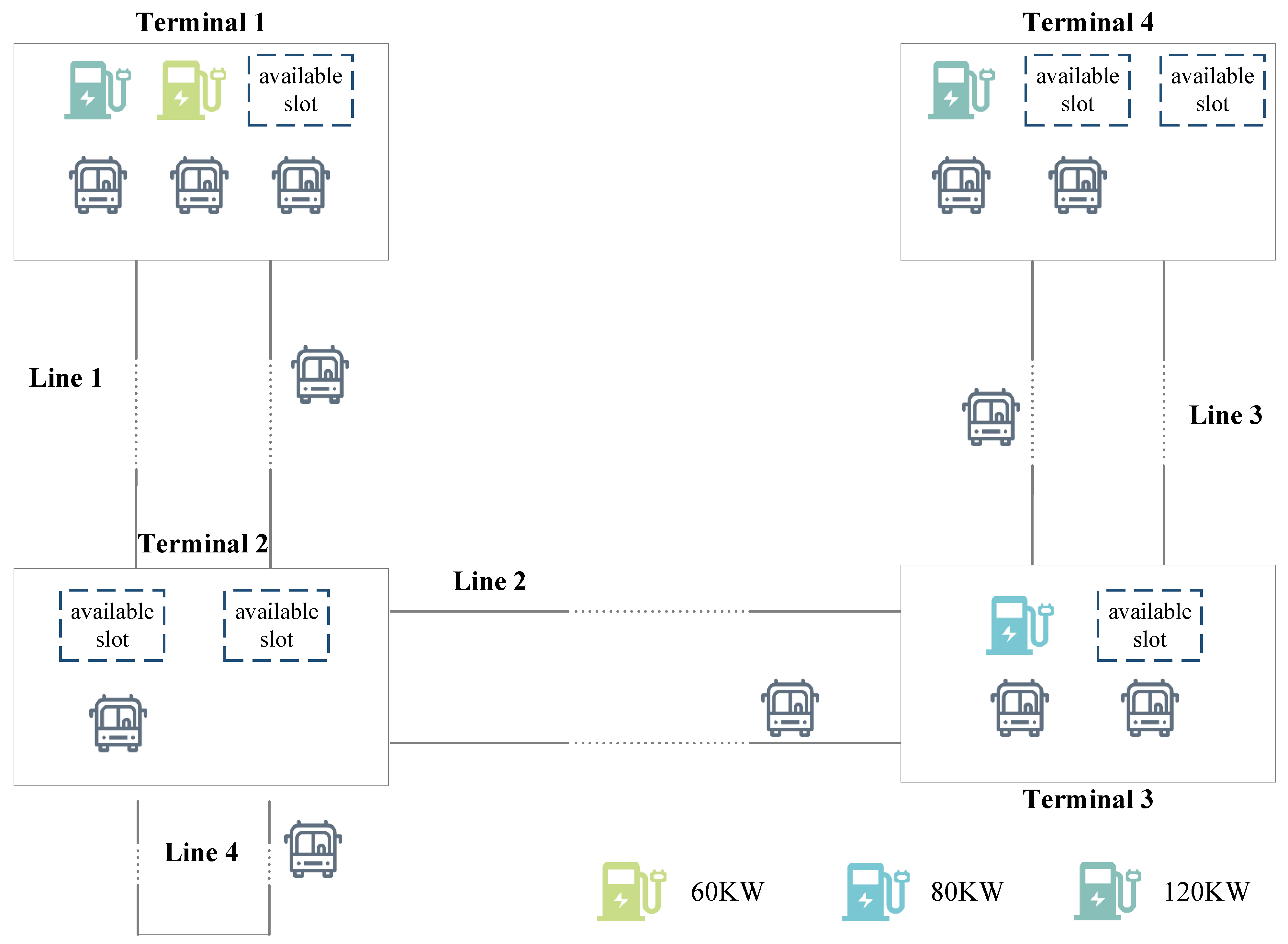
Figure 1 provides an illustration of the considered BEB route-terminal system with heterogeneous charging piles and candidate installation slots. Each large textbox represents a terminal station, and a pair of lines connecting two terminals represents a fixed bus route, along which BEBs operate repeatedly according to a given timetable. Terminal stations are equipped with heterogeneous charging infrastructure: existing charging piles with different rated power levels are depicted in distinct colors, while the orange dotted line textboxes indicate candidate locations for installing additional charging piles. The charging power of heterogeneous piles directly affects BEB charging duration, energy replenishment, and operational cost. During daytime operations, BEBs may perform partial charging during short layovers at terminals, provided that there are available charging piles and time constraints are met.
Let V denote the set of terminals, as shown in Figure 1. For each terminal v V , we use M v to represent the set of both existing charging piles and potential new charging piles. The latter, if they exist, are to be installed one-on-one in finite available slots at the terminal. The rated power p of a newly installed pile is selected from set P and accompanied by an amortized investment cost of f p . Note that existing charging piles are indexed preceding that of newly installed charging piles in the set M v . The installation decision is represented by the binary variable y i p v and is constrained by a total budget B. Each BEB j J performs a sequence of trips during the daytime period. A charging opportunity arises whenever a BEB dwells at a terminal where charging is permitted. Let L denote the set of all candidate charging events for the fleet. For each event l L , the time window [ b l , e l ] defines the maximum feasible charging duration. The operational schedule is coupled with the infrastructure plan through vehicle-pile assignment decisions x and installation decisions y. To connect trips and charging events, we use mapping functions ϕ ( l , v ) and ψ ( j , n ) to identify the events associated with BEB j at terminal v and the first charging event following transportation task n, respectively. Operational feasibility is governed by two exclusivity constraints: (i) charging pile exclusivity, whereby each pile can serve at most one bus at any given time, and (ii) event exclusivity, whereby each charging event can be assigned to at most one pile.
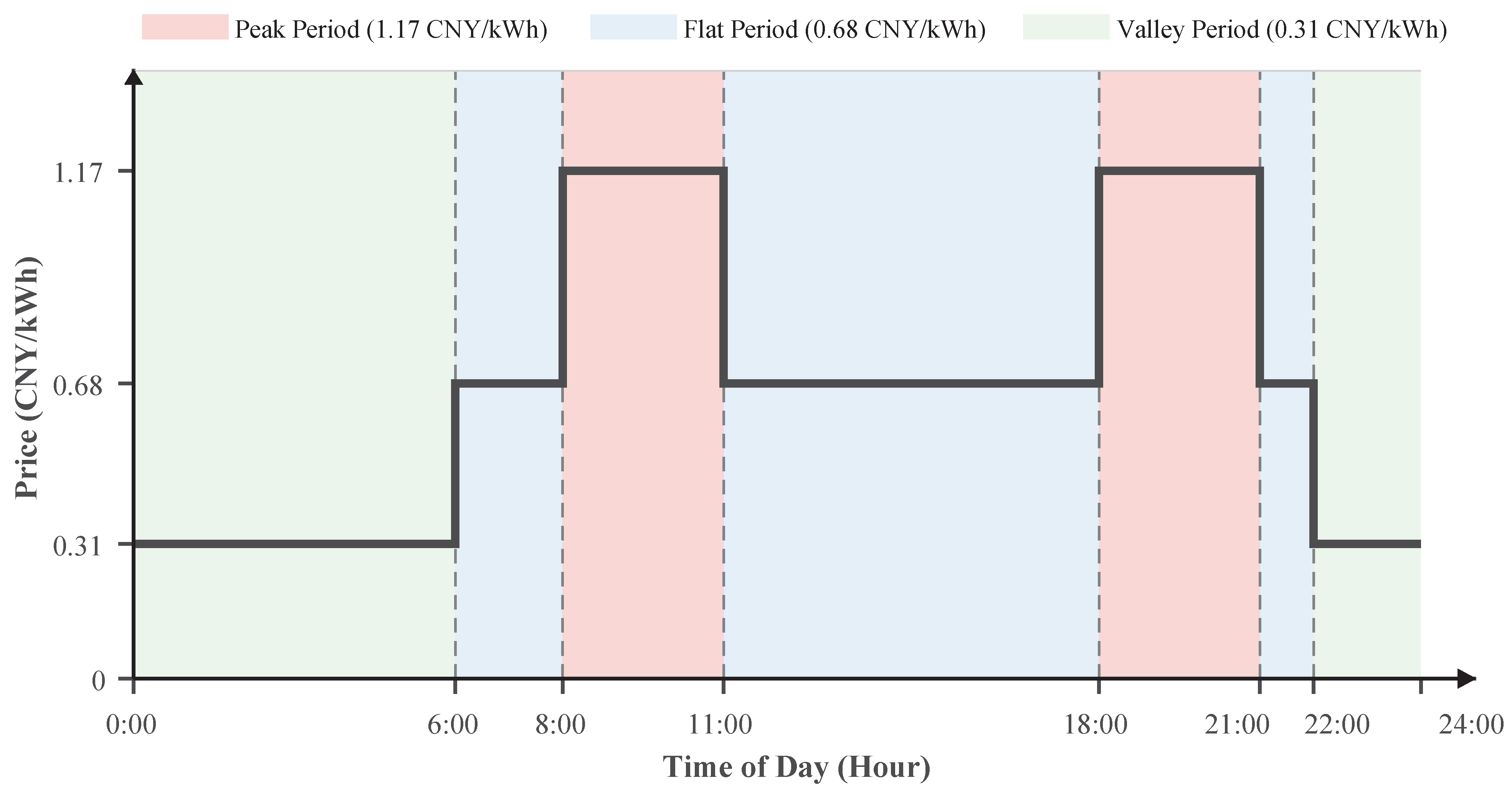
Let E j , e l denote the SoC of BEB j at the end of event l. The SoC decreases with trip energy consumption and increases linearly with charging power and charging duration. It also must remain within [ S o C ̲ , S o C ¯ ] while ensuring sufficient charge before each departure. The trip energy consumption is treated as an exogenous net energy requirement, specified using an average energy-consumption rate from empirical studies of comparable BEB operations. Since the empirically observed energy consumption is the net value accounting for braking energy recovery, the average effect of regenerative braking is implicitly reflected in this net rate. Moreover, charging costs follow a TOU tariff c ( t ) (Figure 2), which motivates shifting charging to lower-price periods subject to operational constraints. If a charging event spans multiple TOU price periods, it is divided into consecutive sub-events with constant electricity prices, and continuity constraints are imposed to preserve the temporal consistency of the original charging process; the detailed linearized formulation is provided in Appendix A. Battery capacity deterioration introduces uncertainty into the usable energy of each BEB. The actual capacity C ˜ j deviates from its nominal value C j 0 , which directly affects SoC evolution and may render nominal schedules infeasible.
It is worth noting that battery degradation itself is a long-term aging process that unfolds over months or years. Therefore, this study does not model within-day electrochemical degradation dynamics. Instead, it focuses on uncertainty in the effective usable battery capacity available at the scheduling stage, which may arise from accumulated degradation, imperfect battery state estimation, and heterogeneous operating conditions across vehicles. This uncertainty directly affects the conversion between physical energy consumption and SoC variation, thereby influencing the feasibility and reliability of daily charging operations.
To ensure robustness against such deterioration-induced infeasibility, we adopt a Wasserstein distance-based DRO framework to model battery capacity uncertainty. In the proposed model, battery capacity deterioration has a direct impact on the SoC variation constraints that must be satisfied throughout the operating day. Since SoC levels are temporally coupled across successive trips and charging events, a reduction in usable battery capacity will tighten operational feasibility margins and accumulate over time. Therefore, a feasible charging schedule under the fixed capacity setting may violate the SoC safety constraints in the scenario with battery capacity deterioration, leading to operational infeasibility. Applying deterministic modeling would underestimate this risk and lead to solution infeasibility, while adopting robustness optimization would require hedging against extreme and practically unlikely deterioration realizations, leading to excessively conservative infrastructure investment. The Wasserstein DRO framework provides a balanced alternative by constructing an ambiguity set based on empirical deterioration information. It captures distributional uncertainty while remaining sensitive to the magnitude of realistic deterioration deviations. Moreover, the corresponding worst-case expectation admits a tractable reformulation that can be embedded into the operational scheduling MILP subproblem, allowing effective battery capacity uncertainty to be evaluated consistently within the proposed Integrated Charging–Siting Adaptive Large Neighborhood Search (ICS-ALNS) framework. The full distributionally robust siting-scheduling model is presented in Section 3.3.
To reconcile operational realism with solution tractability, this study adopts several fundamental assumptions when formulating the integrated infrastructure planning and event-level charging scheduling problem. These assumptions allow the model to capture the main interactions among charging infrastructure investment, daytime charging operations, TOU-based charging cost, and effective capacity uncertainty, while keeping the resulting optimization problem computationally solvable.

Basic Assumptions

To ensure model tractability while preserving the essential characteristics of BEB operation systems, we give the following fundamental assumptions.
  • All BEBs share the same average energy consumption per unit distance (e.g., kWh/km), which is treated as a deterministic parameter in the SoC evolution.
  • BEBs on the same route share identical nominal battery capacity and similar deterioration characteristics, while BEBs on different routes may have non-identical battery capacities and deterioration levels.
  • Any BEB can be charged at most once within each charging time window, and each charging process must be continuous without interruption. The setup time for charging is neglected.
  • Assume that BEBs strictly follow their transit timetable, and thus the set of available charging time windows for each BEB is determined in advance.
The second assumption reflects route-induced heterogeneity in operational intensity and energy demand. The fourth assumption is based on the practical operational requirement that public transit systems adhere to fixed timetables, implying that vehicle availability for charging is predetermined and cannot be adjusted dynamically during operations.

3.2. Model Formulation

In this section, we formulate an integrated distributionally robust MINLP that jointly determines the installation of heterogeneous charging piles and the scheduling of charging events under effective battery capacity uncertainty. We first introduce basic parameters and variables, and then establish the mathematical model for the considered problem.

3.2.1. Parameters and Variables

Sets
V :Set of BEB terminals, indexed by v, i.e., v V = { 1 , 2 , , | V | } ;
M v :Set of heterogeneous charging piles at terminal v, including both existing and newly installed piles, indexed by i i.e., i M v = { 1 , 2 , , m v , m v + 1 , , | M v | } , where m v denotes the number of existing piles at terminal v;
J :Set of BEBs on all bus routes in the network, indexed by j, i.e., j J = { 1 , 2 , , | J | } ;
L :Set of all candidate charging events, indexed by l, i.e., l L = { 1 , 2 , , | L | } ;
N j :Set of pre-determined transportation tasks for BEB j, indexed by n, n N j = { 1 , 2 , , | N j | }
P :Set of charging pile power levels, indexed by p, i.e., p P = { P 1 , P 2 , } ;
Parameters
f p :Amortized cost of installing a charging pile with power level P p
B:Total amortized cost for new charging piles;
C j 0 :Initial nominal battery capacity of BEB j;
Q j 0 :Initial SoC of BEB j;
b l :The earliest allowed start time for possible charging event l;
e l :The latest allowed end time for possible charging event l;
S o C ¯ :Upper limits of SoC for any BEB;
S o C ̲ :Lower limits of SoC for any BEB;
c ( t ) :Electricity price function in CNY/kWh and it varies with time t under the TOU pricing scheme;
α :Energy consumption rate (kWh/km);
β ¯ v i :Charging power of pile i ( m v ) ;
d i s j n :Distance of the n-th transportation task for BEB j;
ϵ :A small positive real number, representing the minimum allowable duration for any charging activity;
ϕ ( l , v ) :Mapping function that returns the BEB associated with charging event l at terminal v, i.e., ϕ ( l , v ) = j if charging event l occurs at terminal v and belongs to BEB j;
ψ ( j , n ) :Mapping function specifying the charging event l associated with BEB j after completing task n;
L:A sufficiently large positive real number;
Variables
y i p v :Binary variable, y i p v = 1 if a charging pile i ( i m v ) with power P p is installed at terminal v, and y i p v = 0 otherwise;
E j , b l :The SoC of BEB j at the start of charging event l;
E j , e l :The SoC of BEB j at the end of charging event l;
β v i :Continuous variable, charging power of charging pile i ( > m v ) ;
s i l :Continuous variable, start time of charging event l on charging pile i;
c i l :Continuous variable, completion time of charging event l on charging pile i;
x i l :Binary variable, x i l = 1 if charging event l is assigned to charging pile i, and x i l = 0 otherwise;
b l , l i :An auxiliary binary variable. For any two charging events l and l that could be assigned to the same pile i, b l , l i = 1 if event l precedes event l , and b l , l i = 0 if event l precedes event l.

3.2.2. Mathematical Model

We present an MINLP for the temporal-spatial joint charging scheduling problem, as shown in the following Formulas (1)–(20). First, the objective function in Equation (1) aims to minimize the total system cost, which consists of two components. The first term represents the amortized cost of installing new charging piles, while the second term accounts for the charging cost incurred by BEBs.
min Z = v V p P i M v f p · y i p v + v V i M v l L s i l c i l c ( t ) · β v i d t
Constraints (2)–(5) belong to the first-stage decision-making process. Constraint (2) ensures that the total amortized cost of newly installed charging piles does not exceed the budget limit. Constraints (3) stipulate that each newly installed charging pile i can be assigned at most one power level. Constraints (4) ensure that new installed charging piles are indexed sequentially. Constraints (5) determine the total charging power, taking into account both existing and newly installed charging piles.
v V p P i = m v + 1 | M v | f p · y i p v B
p P y i p v 1 i ( m v , | M v | ] , v V
p P y i p v p P y i 1 , p v i ( m v , | M v | ] , v V
β v i = β ¯ v i v V , i [ 1 , m v ] ; p P P p · y i p v i ( m v , | M v | ] , v V ;
Constraints (6)–(10) describe the evolution of SoC during the charging events indexed by l. Specifically, Constraints (6) specify the initial SoC of each BEB. Constraints (7) compute the SoC at the beginning of each charging event after the bus departs for a trip, while Constraints (8) determine the SoC at the end of each charging event. Constraints (9) and (10) impose the upper and lower bounds of SoC at the start and end of each charging event l, respectively.
E j , b l = Q j 0 ψ ( j , n ) = 0 , j = ϕ ( l , v ) , l L , v V
E j , b l = E j , e l n = ψ ( l , j ) + 1 ψ ( j , n ) α · d i s j n C j 0 ψ ( j , n ) > 0 , j = ϕ ( l , v ) , l , l L , l l , v V
E j , e l = E j , b l + i M v ( c i l s i l ) β v i C j 0 j = ϕ ( l , v ) , l L , v V
E j , b l S o C ̲ j = ϕ ( l , v ) , l L , v V
E j , e l S o C ¯ j = ϕ ( l , v ) , l L , v V
Constraints (11) and (12) ensure that charging activities occur only within the allowable time windows of their respective events. Constraints (13) and (14) are disjunctive constraints that prevent temporal overlaps between two charging events assigned to the same pile. If events l and l are both assigned to pile i ( x i l = 1 , x i l = 1 ), the auxiliary binary variable b l l i determines their sequence: if b l l i = 0 , event l must finish before l begins, whereas if b l l i = 1 , event l must finish before l begins. Constraints (15) enforce that the completion time exceeds the start time if a charging event occurs, and both are equal otherwise. Constraints (16) and (17) specify whether charging event l is assigned to pile i, while Constraints (18) ensure that each event is allocated to at most one pile.
b l · x i l s i l i v V M v , l L
c i l e l · x i l i v V M v , l L
c i l s i l + ( 3 x i l x i l b l , l i ) L i v V M v , l L , l [ 1 , l )
c i l s i l + ( 2 x i l x i l + b l , l i ) L i v V M v , l L , l [ 1 , l )
s i l c i l i v V M v , l L
c i l s i l L · x i l i v V M v , l L
c i l s i l ϵ · x i l i v V M v , l L
i v V M v x i l 1 l L
Constraints (19) and (20) describe the domains of variables.
E j , b l , E j , e l , s i l , c i l , β v i R + j = ϕ ( l , v ) , l L , v V
x i l , y i p v , b l , l i { 0 , 1 } i M v , l L , v V , p P

3.3. Distributionally Robust Optimization Under Battery Capacity Deterioration

In the daily operation of BEBs, lithium-ion batteries inevitably undergo capacity deterioration due to the cumulative effect of charge–discharge cycles and calendar aging [33,34,35]. As the fleet ages, such deterioration reduces the actual usable capacity of each battery, posing significant challenges for the development of reliable charging schedules. Traditional deterministic models typically assume that the nominal battery capacity C j 0 of each BEB j remains constant, thereby ignoring the stochastic nature of capacity loss. This simplification can lead to infeasible or overly optimistic schedules, particularly for long-term fleet operations.
In this study, effective usable battery capacity is selected as the core source of uncertainty because it directly determines the conversion between physical energy consumption and SoC variation. For a given trip energy consumption, a lower effective capacity leads to a larger SoC decrease. Similarly, for a given amount of charged energy, the resulting SoC increment also depends on the available usable capacity. Therefore, uncertainty in effective capacity propagates through the entire sequence of transportation tasks and charging events, and may affect both operational feasibility and charging infrastructure requirements. This differs from modeling battery degradation only as a long-term cost component, because the uncertainty considered here directly enters the day-ahead SoC transition and safety constraints.
To explicitly account for this uncertainty, we adopt a DRO framework. The actual usable capacity of BEB j is modeled as a random variable
C ˜ j = ( 1 δ ˜ j ) C j 0 δ ˜ j [ δ j L , δ j U ]
Here, δ ˜ j represents the uncertain deterioration factor of BEB j, measuring the proportional loss in battery capacity relative to its nominal value C j 0 . Since the true probability distribution of δ ˜ j is typically unknown in practice, we construct a data-driven ambiguity set of plausible distributions. This approach provides a statistically principled representation of effective battery capacity uncertainty for robust decision-making.
Under this representation, δ ˜ j affects the SoC dynamics through the inverse-capacity multiplier 1 / C ˜ j . Hence, both the trip-related SoC consumption and the charging-related SoC increment are functions of the uncertain effective capacity. When C ˜ j is smaller than its nominal value, the same physical energy consumption corresponds to a larger SoC decrease, thereby tightening the SoC safety margin. This is the mechanism through which effective capacity uncertainty enters the SoC transition and safety constraints.

3.3.1. Wasserstein Ambiguity Set Formulation

Due to the lack of detailed historical deterioration trajectories for individual batteries, this study adopts a simplified representation based on an average deterioration factor. Empirical evidence from lifecycle assessments indicates that battery deterioration in BEBs is primarily driven by cycle aging, while calendar aging plays a comparatively minor role.
In practical BEB fleet operations, detailed vehicle-level battery deterioration trajectories are often unavailable, and the true distribution of effective capacity loss is difficult to identify. This data-scarce setting makes it challenging to use stochastic programming, which relies on a reliable probability distribution, or divergence-based ambiguity sets, which usually require a well-specified reference distribution. Classical robust optimization can handle bounded uncertainty, but it protects against the most adverse deterioration realization and may therefore lead to overly conservative infrastructure investment and charging schedules. Moment-based ambiguity sets provide another alternative, but reliable moment information is also difficult to obtain when only limited battery health records are available. Wasserstein DRO provides a suitable compromise: it constructs a distributional neighborhood around the available deterioration estimate, hedges against distributional misspecification, and avoids relying on a fully known probability law. Moreover, the resulting worst-case expectation can be reformulated through Kantorovich duality and embedded into the proposed optimization framework.
Ref. [36], employing machine learning techniques under real-world operational conditions, reported that lithium-ion batteries used in BEBs typically experience an average annual capacity deterioration of approximately 5.56%. To reflect the cumulative impact of battery aging, we define the nominal deterioration level of BEB j as δ ¯ j = T j · 0.0556 , where T j denotes the number of years that BEB j has been in service. The uncertain deterioration factor δ ˜ j is then assumed to vary around this nominal cumulative deterioration level. However, battery deterioration can vary under different operating conditions. As discussed in [35], the deterioration rate is strongly influenced by factors such as the frequency and depth of charge–discharge cycles, operating temperature, and charging power levels, particularly when wide SoC windows are used. To account for such variability, we associate each BEB with a bounded deterioration interval [ δ j L , δ j U ] centered around the nominal deterioration level δ ¯ j . The interval captures plausible deviations from the nominal deterioration level caused by heterogeneous operational conditions and battery aging characteristics.
In implementation, this interval can be specified according to the nominal deterioration level, service age, available battery health records, and practical end-of-life considerations. A general specification is δ j L = max { 0 , δ ¯ j Δ j } , δ j U = min { δ max , δ ¯ j + Δ j } , where Δ j represents the uncertainty width and δ max denotes the maximum allowable deterioration level before battery replacement or operational exclusion. A larger Δ j reflects more heterogeneous battery conditions or less reliable capacity information, whereas a smaller Δ j corresponds to more stable or better-monitored batteries.
The width of this interval reflects the degree of uncertainty in battery degradation and is constrained by practical battery end-of-life considerations. By varying the interval width, the model can represent different levels of deterioration uncertainty without imposing restrictive assumptions on the underlying probability distribution. Motivated by these empirical observations, we define a degenerate empirical distribution concentrated at the average deterioration level:
P ^ j = δ δ ¯ j
where δ δ ¯ j denotes the Dirac distribution located at δ ¯ j . The use of a Dirac empirical distribution does not imply that battery deterioration is deterministic. Rather, it reflects the data-scarce setting considered in this study, where detailed vehicle-level deterioration samples are not available, but an average deterioration estimate can be obtained from empirical battery aging studies, service age, maintenance records, or periodic battery health inspections. Therefore, δ δ ¯ j serves as the empirical center of the ambiguity set rather than a complete probabilistic characterization of battery deterioration.
When multiple vehicle-level deterioration observations are available, the empirical distribution can be generalized as P ^ j N = 1 N j r = 1 N j δ δ ^ j r , where δ ^ j r denotes the r-th observed deterioration sample of BEB j. The Dirac distribution used in this study can thus be interpreted as a data-scarce special case with a single empirical center.
To account for distributional ambiguity, we define the following Wasserstein ambiguity set:
P j : = Q P ( [ δ j L , δ j U ] ) | W 1 ( Q , δ δ ¯ j ) ε j
Here, P ( [ δ j L , δ j U ] ) denotes the set of all probability distributions supported on the deterioration interval [ δ j L , δ j U ] , and W 1 ( · ,   · ) represents the first-order Wasserstein distance. The parameter ε j > 0 specifies the radius of the Wasserstein ambiguity set and controls the level of distributional robustness. This formulation enables the model to hedge against distributional shifts around the empirical mean deterioration level, even in the presence of limited statistical information.
The radius ε j reflects the confidence level associated with the empirical deterioration estimate. When sufficient deterioration samples are available, more data-driven methods, such as bootstrapping, sample-based confidence bounds, or out-of-sample validation, can be employed to determine ε j . In the data-scarce setting considered here, ε j is specified as a fraction of the deterioration support width: ε j = κ j ( δ j U δ j L ) , where κ j 0 is a robustness-control parameter. A larger κ j indicates lower confidence in the empirical center and leads to a larger ambiguity set, while a smaller κ j reflects stronger confidence in the available deterioration estimate.

3.3.2. Integrated DRO Reformulation of SoC Constraints

Battery deterioration directly affects the energy dynamics of BEBs, particularly in terms of how their SoC evolves over time. In the scheduling model, the SoC of each bus must be updated to reflect both charging and discharging operations. Based on Constraints (7), (8) and (21), the original deterministic SoC evolution equations are formulated as follows.
E j , b l = E j , e l 1 C ˜ j n = ψ ( l , j ) + 1 ψ ( l , j ) α · d i s j n ψ ( j , n ) > 0 , j = ϕ ( l , v ) , l , l L , l l , v V
E j , e l = E j , b l + 1 C ˜ j i M v ( c i l s i l ) β v i j = ϕ ( l , v ) , l L , v V
Battery deterioration affects SoC dynamics via the inverse-capacity multiplier. Define f j ( δ ) = 1 ( 1 δ ) C j 0 . The worst-case expected inverse capacity over the Wasserstein ambiguity set P j can be expressed using the Kantorovich dual representation [37] as
sup Q P j E Q 1 ( 1 δ ˜ j ) C j 0 = inf λ j 0 λ j · ε j + sup δ [ δ j L , δ j U ] f j ( δ ) λ j | δ δ ¯ j |
Since f j ( δ ) is convex and monotonically increasing in δ , its expectation under any distribution Q P j satisfies E Q [ f j ( δ ˜ j ) ] f j ( E Q [ δ ˜ j ] ) by Jensen’s inequality [27,37]. Therefore, the smallest possible expected inverse capacity (the optimistic case) occurs when the distribution collapses at its empirical mean δ ¯ j , yielding z j inf = f j ( δ ¯ j ) = 1 ( 1 δ ¯ j ) C j 0 . This value provides a natural lower bound for z j in the subsequent reformulation and will be used as z ̲ j in the McCormick linearization process.
Building on this convexity property, we introduce the auxiliary decision variables λ j and z j and rewrite Constraint (26) in its epigraph form. Because f j ( δ ) is convex and monotonically increasing in δ , and the term | δ δ ¯ j | creates a kink at the empirical center δ ¯ j , the inner supremum in the Kantorovich dual representation can be evaluated by checking the endpoints of the two subintervals [ δ j L , δ ¯ j ] and [ δ ¯ j , δ j U ] . Therefore, it is sufficient to impose the following inequalities corresponding to δ j L , δ ¯ j , and δ j U :
z j f j ( δ j L ) λ j | δ j L δ ¯ j | + λ j · ε j j J
z j f j ( δ ¯ j ) + λ j · ε j j J
z j f j ( δ j U ) λ j | δ j U δ ¯ j | + λ j · ε j j J
λ j 0 j J
Constraints (27)–(30) ensure that the auxiliary variable z j represents the worst-case expected inverse effective battery capacity over all distributions within the Wasserstein ambiguity set. As a result, the proposed integrated MILP jointly determines (i) bus–charging pile assignment and event-level charging schedules, (ii) charging infrastructure siting and sizing decisions, and (iii) the endogenous worst-case deterioration response characterized by ( z j , λ j ) . Importantly, this robustification is achieved while preserving full linearity and computational tractability.
The SoC transition equations can then be reformulated as
E j , b l E j , e l n = ψ ( l , j ) + 1 ψ ( l , j ) α · d i s j n · z j ψ ( j , n ) > 0 , j = ϕ ( l , v ) , l , l L , l l , v V
E j , e l E j , b l + i M v ( c i l s i l ) β v i · z j j = ϕ ( l , v ) , l L , v V
In principle, battery degradation may also affect other battery-related characteristics such as charging efficiency and energy consumption. In this study, however, we focus on effective capacity reduction as the primary manifestation of battery aging. This is because the reduction in usable battery capacity directly influences the SoC feasibility and charging requirements in daily BEB operations. Modeling degradation through capacity uncertainty therefore, captures the most relevant operational impact of battery aging while maintaining model tractability. Consequently, the proposed framework is most applicable to settings in which battery aging is primarily reflected through uncertainty in effective usable capacity.
Under this modeling perspective, the deterioration factor δ ˜ j itself remains an exogenous random parameter reflecting the uncertain physical aging of each battery. In contrast, the auxiliary variable z j introduced in the integrated DRO formulation does not represent deterioration directly; rather, it captures the worst-case expected inverse-capacity multiplier implied by the ambiguity set. Hence, z j acts as a deterministic surrogate that internalizes the stochastic deterioration effect into the optimization problem, allowing the model to jointly determine both operational decisions and their distributionally robust responses. This reformulation preserves the physical interpretability of battery aging while maintaining linearity and tractability within the MILP framework.
The proposed distributionally robust formulation provides a balanced trade-off between conservatism and computational tractability. Unlike classical RO, which guards against an extreme worst-case scenario, the DRO approach considers the worst-case expected outcome over an ambiguity set, thus avoiding excessive conservatism while maintaining reliability. This feature is particularly advantageous for BEB operations, where historical deterioration data are scarce and full probabilistic characterizations are unavailable.
To summarize, the final optimization model under the distributionally robust framework is formulated as an MINLP that integrates facility siting, charging scheduling, and battery capacity deterioration under uncertainty. Its key components include
Objective function
min Z = v V p P i M v f p · y i p v + v V i M v l L s i l c i l c ( t ) · β v i d t
subject to: Constraints (2)–(6), (9)–(20) and (24)–(32), where Constraints (31) and (32) replace the original SoC transition Constraints (7) and (8).
The proposed MINLP framework explicitly incorporates effective battery capacity uncertainty, thereby enabling robust planning and scheduling over a realistic operational horizon. The model’s nonlinear components and their corresponding linearization procedures are detailed in Appendix A.

4. Computational Complexity and Theoretical Lower Bound

The optimization problem developed in this study integrates charging pile siting, event-level pile assignment, and continuous charging schedule decisions into a unified MILP. Even though full linearization ensures that the final formulation is a mixed-integer linear program, the problem size and structural characteristics make it computationally impossible for realistic transit networks. This section analyzes the intrinsic sources of complexity and constructs a theoretically valid lower bound that provides a meaningful benchmark for evaluating the proposed matheuristic.

4.1. Computational Complexity Analysis

The integrated charging infrastructure planning and charging scheduling problem is computationally challenging because it combines discrete infrastructure siting, event-level charging pile assignment, and continuous charging-time decisions. To provide a formal complexity characterization, we first show that the proposed problem contains a classical NP-hard problem as a special case.
Proposition 1.
The integrated charging infrastructure planning and charging scheduling problem is NP-hard.
Proof. 
Consider a restricted version of the proposed model with a single terminal, a fixed number K of identical existing charging piles, no candidate new piles, flat electricity pricing, deterministic battery capacity, identical charging power, and no infrastructure investment decision. In this restricted case, the remaining decision is to assign a set of charging events to identical charging piles and determine their non-overlapping charging intervals within a common operating horizon.
We reduce the bin packing problem to this restricted charging scheduling problem. Given a bin packing instance with item sizes a 1 , , a n , bin capacity B, and K bins, construct a charging scheduling instance with K identical charging piles and n charging events. Each charging event l corresponds to item a l and requires a non-preemptive charging duration of a l . This can be induced by assigning a fixed charging energy requirement to the event under identical charging power. All charging events share the same feasible time window [ 0 , B ] , and each charging pile can serve at most one event at any time.
If the bin packing instance is feasible, then the items assigned to each bin can be scheduled sequentially on the corresponding charging pile within the time horizon [ 0 , B ] , yielding a feasible charging schedule. Conversely, if a feasible charging schedule exists, then the charging events assigned to the same pile define a bin whose total processing time does not exceed B. Therefore, the corresponding items can be packed into K bins of capacity B. Hence, the bin packing instance is feasible if and only if the constructed charging scheduling instance is feasible.
Since bin packing is NP-hard, this restricted version of the proposed charging scheduling problem is NP-hard. Because the full integrated planning and scheduling problem generalizes this restricted case by additionally considering infrastructure installation, heterogeneous charging piles, TOU pricing, SoC evolution, and battery capacity uncertainty, the proposed problem is NP-hard.    □
Beyond NP-hardness, the practical intractability of the proposed model is further exacerbated by the following structural features.
The first source of complexity arises from the charging pile installation configuration. At any terminal v, only slots m v + 1 , , | M v | are available for installing new charging piles. Let N v = | M v | m v be the number of available slots at the terminal. Remember that slot i cannot be activated unless its previous slot i 1 has already been active. Any feasible configuration can be fully characterized by the number of activated slots. Once the number of newly installed charging piles at terminal v is determined and equal to k { 0 , 1 , , N v } , each activated slot independently selects one charging pile type from the set P .
Observation 1.
The number of feasible installation configurations at terminal v equals | Y v | = 1 + | P | + | P | 2 + + | P | N v = | P | N v + 1 1 | P | 1 , which grows exponentially in N v . Since terminals operate independently, the entire infrastructure-design space is the Cartesian product of all Y v across the terminals.
At terminal v, only the last N v = | M v | m v slots are eligible for installing new charging piles. Each candidate slot may either remain uninstalled or be equipped with one charging pile type from the set P . To ensure an ordered construction of charging infrastructure, a monotonicity constraint is imposed, i.e., p P y i p v p P y i 1 , p v . Under this structure, the decision of installing piles at terminal v is to determine the number k { 0 , 1 , , N v } of new charging piles and assign a pile type to each of the k new piles (or activated slots). Given the value of k, the number of feasible installation configurations is | P | k . Summing over all possible values of k yields 1 + | P | + | P | 2 + + | P | N v = | P | N v + 1 1 | P | 1 . Since all terminals make new decisions on charging pile installation independently, the overall infrastructure design space is given by the Cartesian product of the sets Y v across all the terminals, which is very large even for moderate-scale networks.
This combinatorial surge constitutes the first layer of computational complexity. After the installation configuration is fixed, it is necessary to determine whether charging activity is performed and, if so, select an appropriate charging pile in each charging event. Because each event is associated with a specific terminal, which typically provides multiple charging slots, the resulting event-to-pile assignment gives rise to a second exponential decision space structure.
Observation 2.
In each charging event, either one of the available charging piles is selected for BEB charging at the corresponding terminal or there occurs no charging activity. As terminal v has up to | M v | piles, any event occurring at terminal v admits at most | M v | + 1 assignment choices. Consequently, the global assignment decision space grows as the Cartesian product of all event-level choices and is exponential in the total number of charging events.
For any charging event l, the assignment variable x i l satisfies i x i l 1 , meaning that event l may either charge at exactly one pile or remain unassigned. Because events occur at specific terminals determined by the service pattern of their associated buses, an event taking place at terminal v has precisely | M v | + 1 admissible choices. Since assignment decisions across events are independent, the global assignment space is given by | X a s s i g n | = l ( | M v | + 1 ) . Convenient representation, let d ¯ = 1 | L | l | M v | denote the average number of piles per event. The assignment space therefore, satisfies the growth rate | X a s s i g n | ( d ¯ + 1 ) | L | , which increases exponentially with the number of charging events. This combinatorial explosion explains why the assignment component alone overwhelms exact MILP solvers and often leads to intractability in realistic-scale instances.
The impact of Observations 1 and 2 becomes more severe when considering the continuous-time scheduling component. Even adopting a purely event-based timeline, the MILP introduces time coupling constraints among charging events belonging to the same BEB. These include SoC tracking, power–energy dynamics, and temporal feasibility constraints. The resulting formulation contains O ( | L | ) continuous variables and up to O ( | L | 2 ) pairwise consistency constraints. Combined with the installation and assignment decisions, the full MILP intertwines discrete and continuous structures in a way that produces an exceptionally rugged branch-and-bound search space.
Although the model is fully linearized, solving the resulting MILP remains computationally prohibitive because of the enormous number of binary installation and assignment variables. These discrete variables induce an exponentially large branch-and-bound search tree, forcing the solver to explore vast combinatorial subproblems. While the LP relaxation at the root node is already sizeable due to the dense SoC–time coupling constraints, the dominant source of memory consumption arises from storing millions of branch-and-bound nodes. Empirical tests show that, even for instances involving only 15 BEBs, commercial solvers such as CPLEX terminate prematurely because the search tree exhausts the available memory. This intrinsic intractability underscores the necessity of a decomposition-based matheuristic rather than relying on exact MILP optimization.
The proposition establishes the NP-hardness of the proposed problem through a restricted deterministic special case. The following observations further explain why the full formulation becomes computationally challenging in realistic BEB networks. The number of binary infrastructure variables is on the order of O v V ( | M v | m v ) · | P | while the number of event–pile assignment variables scales as O ( | L | · d ¯ ) . In addition, the temporal non-overlap and SoC consistency constraints introduce up to O ( | L | 2 ) coupling constraints among charging events. As a result, even after full linearization, the problem structure induces an exponentially large branch-and-bound tree, rendering exact MILP solvers computationally infeasible for realistically sized BEB networks. This complexity characterization further justifies the adoption of a decomposition-based matheuristic framework.

4.2. A Theoretical Lower Bound

Given the intrinsic intractability of the full mixed-integer formulation, it is essential to establish a theoretically valid lower bound that can serve as a benchmark for evaluating the matheuristic developed in Section 5. To this end, we construct a relaxed formulation that removes the combinatorial structure of the problem while preserving the physical and temporal feasibility of charging operations. The optimal objective value of the relaxed formulation provides a theoretical lower bound on the optimal objective value of the original MILP. This relaxation simultaneously convexifies both the infrastructure-design and charging scheduling layers and replaces pessimistic battery deterioration assumptions with the most optimistic admissible values.
The relaxation incorporates three conceptual mechanisms. First, all binary variables associated with charging installation and event–pile assignment are relaxed to continuous variables in [ 0 , 1 ] . The investment cost function and the global budget limit remain fully enforced, so the model may select any fractional installation pattern that respects the total investment constraint. This convexifies the design space and allows the model to allocate fractional pile types to each feasible slot. Second, all pairwise pile-conflict constraints that prevent overlapping use of the same pile are removed. In the relaxed model, multiple vehicles may occupy a pile simultaneously in a fractional sense, thereby eliminating the discrete bottleneck that typically drives combinatorial difficulty. Third, battery deterioration of each BEB j is modeled optimistically by fixing the inverse-capacity multiplier at z j L B = 1 ( 1 δ j L ) C j 0 , where δ j L is the best-case deterioration rate. This reflects the maximum effective battery capacity permissible within the deterioration model and yields a more favorable SoC evolution than the nominal or worst-case multipliers used in the robust formulation.
Despite these relaxations, the physical backbone of the problem is preserved. All SoC dynamics, time-continuity relations, travel-energy consumption, power constraints, and the mapping of charging durations to SoC increments remain identical to the original MILP. As a result, the joint LP relaxation still produces operational trajectories that are physically consistent and time-feasible, even though they may not be implementable in practice due to the absence of charging pile exclusivity and integer decisions. The relaxation thus isolates the minimum achievable cost under idealized, congestion-free, and deterioration-optimistic conditions.
Let F M I L P denote the feasible set of the original MILP. We define the relaxed feasible set F R by: (i) replacing all binary variables ( y , x ) { 0 , 1 } with continuous variables ( y , x ) [ 0 , 1 ] , (ii) removing all pile conflict constraints, and (iii) replacing the robust deterioration term by the optimistic multiplier z j L B = 1 ( 1 δ j L ) C j 0 . The optimal objective value of the relaxed formulation is given by
Z R : = min { Z ( y , x , τ ; z L B ) ( y , x , τ ) F R }
where Z ( · ) is the same objective function as in the original MILP, and τ collectively denotes the continuous charging-time and event-timing decision variables associated with the operational scheduling layer.
Proposition 2
(Theoretical lower bound). Let Z , Z R denote the optimal objective value of the original MILP and the relaxed formulation defined in (33), respectively. Then Z R Z .
Proof. 
By construction, the relaxed feasible set F R is a superset of the original feasible set F M I L P . Specifically, relaxing integrality enlarges the feasible region, removing exclusivity constraints further expands it, and using z j L B yields the most optimistic SoC feasibility margins among all admissible deterioration realizations. Consequently, any feasible solution to the original MILP is also feasible in the relaxed problem defined in (33). Since both models minimize the same objective function and the relaxation can only enlarge the feasible region, the optimal objective value of the relaxed problem cannot exceed that of the original MILP. Therefore, Z R = min ( y , x , τ ) F R Z ( y , x , τ ; z L B ) min ( y , x , τ ) F M I L P Z ( y , x , τ ) = Z , which establishes that Z R serves as a valid lower bound for the original MILP.    □
The theoretical lower bound represents an idealized operating environment in which charging pile congestion, discrete installation choices, and adverse battery deterioration effects have all been smoothed away. The resulting solution corresponds to a physically consistent—but operationally unconstrained—charging plan that yields the minimum cost theoretically achievable under the best possible infrastructure and deterioration conditions.
In computational experiments, the value Z R serves as a rigorous benchmark for evaluating the solution quality of the matheuristic. Since the value Z R may substantially underestimate the true implementable cost, the relative gap quantifies the distance between heuristic performance and the idealized, convexified lower limit of system operation. This provides a conservative and physically interpretable measure of solution quality that is robust across instances of different scales.
It is worth noting that the proposed lower bound is intentionally optimistic, and its tightness depends on system operating conditions. Specifically, the bound tends to be tighter in scenarios where (i) charging congestion is mild, (ii) investment budgets are relatively loose, and (iii) Battery capacity uncertainty is limited. In contrast, in heavily congested terminals or under stringent budget constraints, the relaxation of charging pile exclusivity and integer installation decisions may lead to a noticeable underestimation of the true implementable cost.
Nevertheless, by preserving physically consistent SoC dynamics and time feasibility, the bound remains a meaningful and interpretable benchmark. In Section 6, this lower bound is used to quantify the performance gap of the proposed heuristic relative to an idealized, congestion-free operating environment.
This section has examined the intrinsic computational structure of the integrated charging pile-siting and charging–scheduling problem and established a theoretically valid lower bound for benchmarking solution quality. The complexity analysis reveals the fundamental sources of combinatorial difficulty, while the proposed lower bound provides a rigorous and physically interpretable reference under idealized operating conditions. Together, these results lay the theoretical foundation for the solution methodology developed in the next section. Building upon these insights, Section 5 introduces a dedicated matheuristic framework designed to exploit the problem structure and to deliver high-quality solutions within practical computation time.


5. Solution Method

Following the linearization procedure in Appendix A, the proposed optimization model is cast into a large-scale MILP. Although linearization removes the non-convexities, the resulting MILP remains computationally challenging. The major computational bottleneck arises from the high-dimensional combinatorial decision space stemming from infrastructure investments and charging assignments, i.e., variables y and x. For realistic problem instances, it becomes computationally difficult for off-the-shelf solvers to achieve the optimal solution for such a large-scale MILP due to the exponential growth of the combinatorial search space [38].
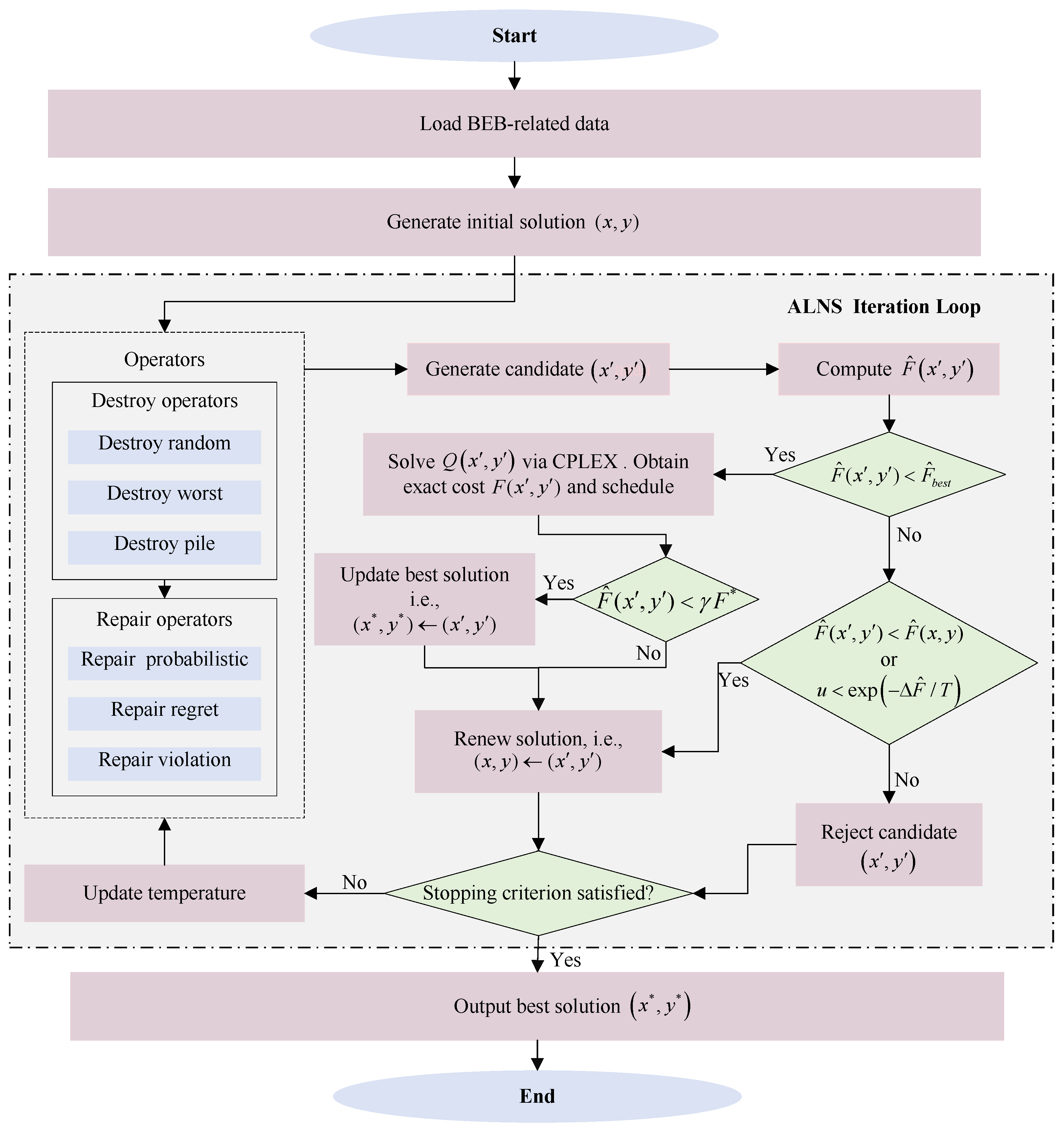
To address this challenge, we develop a decomposition-based matheuristic framework that integrates an ALNS master problem with an exact MILP-based operational subproblem. In this framework, the ALNS component explores the combinatorial decision space associated with charging pile siting and charging event assignment, while the operational feasibility and total system cost of selected candidate solutions are evaluated by solving an MILP subproblem. We refer to this hybrid approach as the ICS-ALNS, highlighting its capability to jointly optimize infrastructure siting and daytime charging scheduling decisions. By decomposing the original problem into a combinatorial search layer and a continuous operational evaluation layer, the proposed framework leverages the complementary strengths of heuristic exploration and exact mathematical optimization.
The overall workflow of the proposed ICS-ALNS framework is illustrated in Figure 3. At a high level, the algorithm alternates between heuristic exploration of combinatorial siting-assignment decisions and selective exact evaluation of promising candidates through the MILP subproblem. In the algorithmic notation, the superscript * denotes the corresponding optimal or incumbent-best solution/value obtained during the search process. The detailed master search procedure, including surrogate-cost screening, exact validation, and operator adaptation, is described in Section 5.2, Section 5.3 and Section 5.4.

5.1. Decomposition Structure

Formally, the problem is structured as a two-level decomposition framework. The upper-level master problem determines the set of combinatorial decisions, denoted by ( x , y ) , including infrastructure investments and charging event assignments (i.e., variables y i p v and x i l ). The objective is to minimize the total system cost, which consists of discrete investment expenditures and operational charging costs:
min x , y F ( x , y ) = v V i M v p P f p · y i p v + Q ( x , y ) s . t . ( x , y ) X
where X defines the feasible set of combinatorial decisions. The operational cost Q ( x , y ) is obtained by solving the lower-level subproblem:
Q ( x , y ) = min s , c , E , z G ( s , c , E , z x , y ) s . t . ( s , c , E , z ) Y ( x , y )
where ( s , c , E , z ) are the continuous scheduling, charging, and battery-related variables (e.g., s i l , c i l , E , z j ). The feasible region Y ( x , y ) is defined by constraints governing SoC dynamics, temporal feasibility, charging pile capacity, and energy balance, which include bilinear terms such as w i p l v · z j .
Within the proposed solution framework, each ALNS iteration generates a candidate combinatorial solution ( x , y ) that may require evaluation. Exact evaluation, when invoked, is provided by the operational subproblem in (35). For a given ( x , y ) , the infrastructure investment and charging assignment decisions are fixed, and the remaining scheduling and SoC feasibility decisions are evaluated through an MILP subproblem.
The detailed formulation of this operational subproblem is given in Section 5.3. Here, we emphasize that solving this subproblem for every candidate solution would still be computationally expensive. Therefore, the overall computational burden is mainly determined by the number of ALNS iterations and the frequency of invoking the MILP subproblem for exact validation. This observation motivates the use of a surrogate-cost screening rule in the master search, while retaining exact optimization-based evaluation for promising candidates.

5.2. Heuristic ICS-ALNS for Solving the Master Problem

The master problem explores the high-dimensional discrete decision space of infrastructure siting and charging event assignment. Due to its combinatorial complexity, we adopt a heuristic named ICS-ALNS [31,32].
ICS-ALNS iteratively generates candidate solutions ( x , y ) through a destroy–repair mechanism with adaptive operator selection. During solution reconstruction, an event-level SoC monitoring procedure is embedded within the destroy and repair steps to incrementally update the SoC trajectories of affected vehicles and maintain physical consistency. After a candidate solution is repaired, the algorithm applies several fast post-repair procedures, including state synchronization, removal of unused newly installed piles, completion of fixed charging decisions, and TOU-based cost shifting. A TOU-based surrogate cost is then evaluated and used for search-level screening and acceptance decisions.
Algorithm A1 summarizes the ICS-ALNS workflow, where the surrogate cost is used for fast screening and search guidance, while the best solution is updated only after exact MILP validation. Algorithm A2 provides the event-level SoC monitoring procedure used as a diagnostic tool during repair. The TOU-based surrogate cost estimator is summarized in Algorithm A3.
The master search preserves the key combinatorial feasibility requirements inherited from Section 3.2, including event exclusivity, budget feasibility, and binary siting-assignment decisions.
The detailed surrogate-cost screening rule, exact validation mechanism, and acceptance strategy are described in Section 5.4. Related hybrid ALNS–MILP designs have also been adopted in large-scale EV optimization problems with nonlinear battery deterioration [11].

5.3. The Operational Scheduling MILP for Solving the Subproblem

While Section 5.1 describes the decomposition logic, this subsection presents the explicit MILP evaluation problem solved for a fixed combinatorial solution. Given a set of combinatorial decisions ( x ¯ , y ¯ ) generated by the ICS-ALNS search procedure, the operational subproblem determines a feasible charging schedule and the corresponding SoC trajectories for all BEBs. This subproblem is formulated as an MILP, in which all decisions on infrastructure installation and event pile assignment become parameters.
Q ( x ¯ , y ¯ ) = min s , c , E , z v V i M v l L p l ( c i l s i l ) β v i
s . t . SoC evolution constraints ( e . g . , ( 6 ) , ( 9 ) and ( 10 ) , ( 31 ) and ( 32 ) )
DRO SoC update ( e . g . , ( 26 ) ( 30 ) )
Auxiliary linearization constraints ( e . g . , ( A 7 ) ( A 13 ) , ( A 15 ) ( A 22 ) )
Linearized charging deterioration coupling ( cf . ( A 23 ) )
Temporal feasibility and non - overlap ( e . g . , ( 11 ) ( 17 ) , ( A 2 ) ( A 6 ) )
( s , c , E , z ) 0 .
The subproblem includes continuous variables describing charging start times, completion times, SoC levels, and deterioration response variables, together with a limited number of auxiliary binary variables required to enforce non-overlapping charging operations on the same pile. The nonlinear charging–deterioration coupling terms are represented through McCormick envelope linearization, using variable bounds derived from charging event time windows and the support of the effective capacity deterioration factor. The corresponding linearization details are provided in Appendix A.
The above resulting MILP can be solved using commercial solvers such as CPLEX, providing an exact evaluation of operational feasibility and charging cost for any given ( x ¯ , y ¯ ) configuration.

5.4. ALNS Operator Design

The ALNS master problem explores the combinatorial space of charging pile siting and charging event assignment through a set of destroy and repair operators. Destroy operators partially relax the current solution to diversify the search and escape local minima, while repair operators reconstruct a complete charging schedule in a cost-aware and feasibility-guided manner.
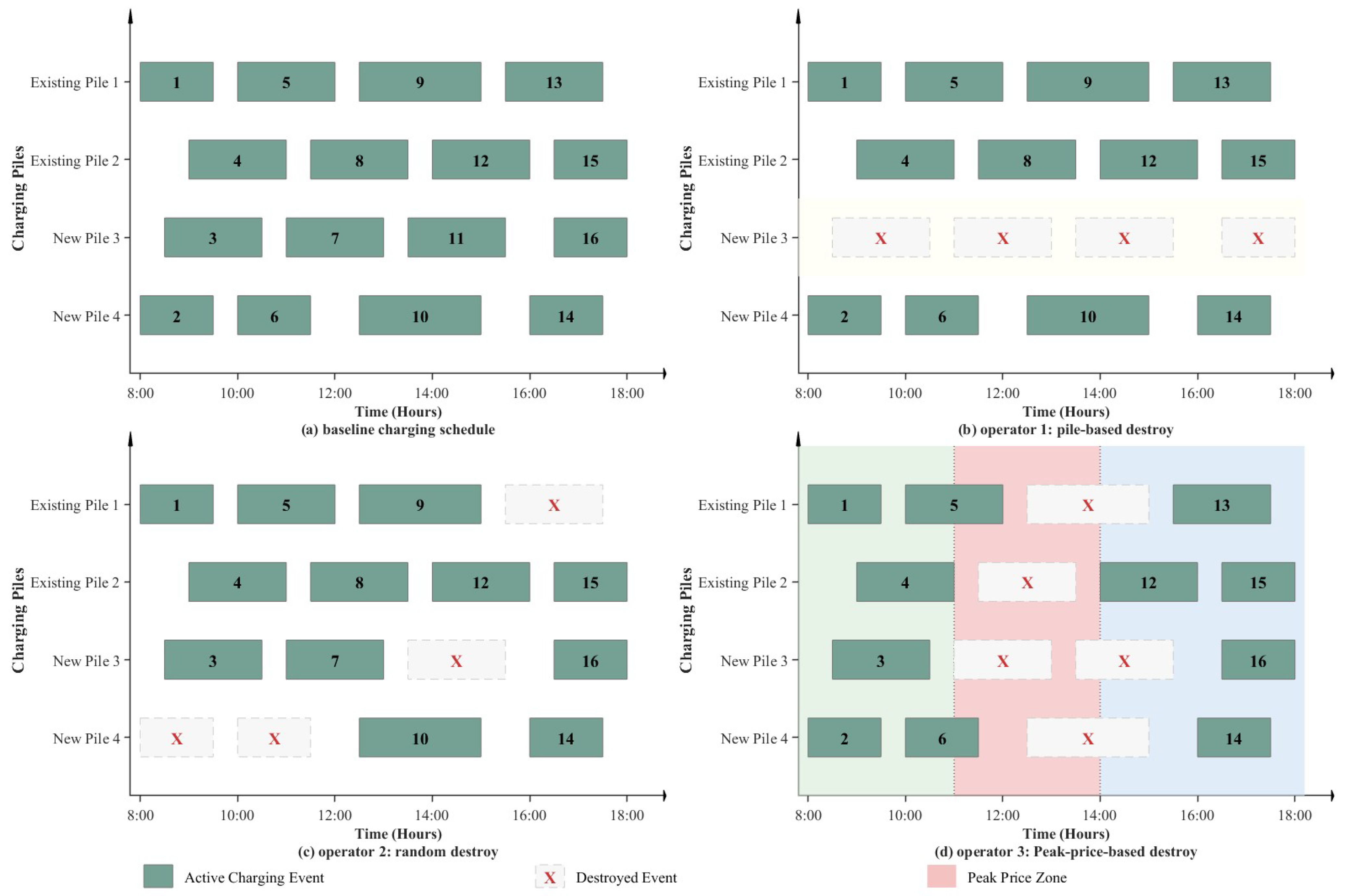
Three complementary destroy operators are implemented.
  • Pile-based destroy: A subset of newly installed charging piles is selected, and all charging events assigned to these piles are removed. This operator directly perturbs the infrastructure siting configuration and enables the algorithm to reassess potentially inefficient or redundant investments.
  • Random destroy: A small proportion of charging sub-events is removed uniformly at random. This operator enhances diversification by introducing unbiased structural variations.
  • Peak-price-based destroy: Charging segments occurring during peak electricity price periods, particularly those with long charging durations, are preferentially removed. This encourages the subsequent repair phase to shift these charging activities toward lower-price time periods or alternative charging piles whenever feasible.
The differences among the three destroy operators are schematically illustrated in Figure 4.
During the execution of destroy operators, the SoC trajectories of the affected BEBs are incrementally updated as charging events are removed. This SoC monitoring is performed online throughout the destroy process and maintains a physically consistent intermediate system state for subsequent reconstruction, without enforcing full feasibility at this stage. The detailed pseudocode of the event-level SoC monitoring and incremental propagation procedure is provided in Appendix B (Algorithm A2).
Repair operators reconstruct a complete charging schedule by reinserting the removed charging events. Their strategies differ in determining the reinsertion priorities.
  • Regret-based repair: For each removed charging event, multiple feasible reinsertion positions are evaluated, and the option with the highest regret—defined as the difference between the two best reinsertion costs—is selected.
  • Probabilistic repair: Feasible reinsertion positions are sampled according to a probability distribution biased toward low-cost choices, which maintains diversity and prevents premature convergence.
  • Violation-based repair: Charging events that contribute most to SoC deficits are repaired first, stabilizing the solution after aggressive destroy operations.
During the repair phase, charging events are reinserted sequentially. After each reinsertion, the SoC trajectory is incrementally updated at the event level, allowing the algorithm to monitor proximity to SoC bounds in real time and to guide reinsertion priorities accordingly. Rather than discarding all insertions that may eventually lead to violations, this SoC-aware repair mechanism serves as a diagnostic tool that prevents the accumulation of severe infeasibilities while maintaining search flexibility.
Once the repair phase is completed and a candidate solution ( x , y ) is obtained, a heuristic objective value is computed using a TOU-based surrogate cost estimator. This surrogate cost has two roles in the ICS-ALNS framework. First, it serves as a fast screening metric for deciding whether the candidate should be sent to the exact MILP subproblem. Second, for candidates that do not trigger exact evaluation, it is used in the heuristic-level acceptance rule.
If a candidate satisfies F ^ ( x , y ) < γ F ^ b e s t , the exact MILP subproblem is solved to obtain its exact objective value and schedule. The exact objective is then used for incumbent updating and exact cost-based simulated annealing acceptance. If the candidate does not trigger exact evaluation, it may still be accepted according to the surrogate-cost acceptance rule. Therefore, the surrogate cost guides the search process, whereas the best-found solution is updated only after exact MILP validation.
Operator performance is recorded through a score-based feedback mechanism. Destroy and repair operators that contribute to solution improvement receive higher weights, thereby increasing their selection probability in subsequent iterations. This adaptive learning mechanism enables the search to balance diversification and intensification dynamically over the course of the algorithm.

6. Case Study

To evaluate the performance of the proposed algorithmic framework, we conduct numerical experiments on both small- and large-scale instances. All computations are implemented in MATLAB R2024b, and the MILP subproblems arising in the ICS-ALNS iterations are solved using the CPLEX 12.10 solver. The experiments are performed on a personal computer equipped with an Intel Core i5-12600KF processor (3.70 GHz), which provides a standard desktop computing environment for large-scale scheduling studies.
The case study is based on the public bus network of the charging district in Shanghai, China. The network consists of 11 bus lines and 12 terminals. Several of these terminals are equipped with a limited number of pre-installed charging piles, while the remaining stations provide available slots for potential charging pile deployment. Detailed operational data for all 11 bus lines, such as line origins and destinations, round-trip travel times, route distances, and typical riding durations, are summarized in Table A1 in Appendix C. It should be noted that the tested network represents a district-level route cluster in Shanghai rather than a full city-wide BEB deployment. Therefore, the largest instance with 92 BEBs should be interpreted as a district-level operational case used to evaluate the proposed integrated planning-scheduling framework.

6.1. Experimental Settings

The case study is conducted using operational data from the public bus network in the urban area of Shanghai, China. In accordance with standard safety and operational guidelines for BEBs, the lower bound of the SoC is set to S o C ̲ = 20 % . The upper bound of post-charging SoC is set to S o C ¯ = 90 % following the empirical recommendations reported by [6]. Due to substantial variations in route length, travel time, and operating intensity across bus lines, the fleet employs heterogeneous battery capacities, specifically 280 kWh and 350 kWh packs. The energy consumption rate is set to 1.493 kWh/km, consistent with values documented in previous empirical studies for BEB operations in comparable urban environments.
Field investigations further indicate that several terminal stations continue to operate legacy charging piles rated at 60 kW, 80 kW, and 120 kW. Among these, 60 kW units are widely used for slow charging during longer dwell times, whereas 120 kW units are commonly deployed for fast opportunity charging during short layovers. With recent technological upgrades, certain terminals have been retrofitted to support higher-power charging piles rated at 160 kW and 180 kW. However, the terminals included in this study do not yet possess the electrical or structural infrastructure required for 240 kW pantograph-based fast charging systems. Consequently, the candidate power levels for newly installed charging piles are restricted to the set {60 kW, 120 kW, 160 kW, 180 kW}.
To evaluate the effectiveness of the proposed solution method, we benchmark ICS-ALNS against two representative joint optimization algorithms from the recent literature: (i)  the genetic algorithm-based integrated optimization method proposed by [39], and (ii) the joint iterated local search approach proposed by [22]. To ensure a fair comparison, the proposed ICS-ALNS and the GA-based method are executed with the same computational time budget. For the ILS benchmark, we adopt the stopping criterion reported in the original study [22], in order to remain consistent with its algorithmic design.
In the numerical experiments, effective battery capacity uncertainty is explicitly incorporated into the operational MILP subproblem of the proposed ICS-ALNS framework. The benchmark algorithms of [22,39] were originally designed for deterministic settings and do not explicitly incorporate battery deterioration uncertainty during candidate-solution construction. All final solutions generated by ICS-ALNS, GA, and ILS are re-evaluated using the same DRO-based operational subproblem. This approach separates differences in search mechanisms from the robustness assessment, while highlighting the advantage of ICS-ALNS in integrating DRO-based feasibility evaluation into the search process.
For clarity of exposition, we adopt a unified notation for reporting computational outcomes. Let o b j L B denote the theoretical lower bound developed in Section 4. Let o b j I C S denote the objective value obtained by the proposed ICS-ALNS, and let o b j G A and o b j I L S denote the objective values obtained by the GA-based method of [39] and the ILS method of [22], respectively. Based on these quantities, we define the following relative performance indicators:
  • g a p I C S = o b j I C S o b j L B o b j L B × 100 % ;
  • g a p G A = o b j G A o b j I C S o b j G A × 100 % ;
  • g a p I L S = o b j I L S o b j I C S o b j I L S × 100 % .
Here, g a p I C S measures the distance between the solution obtained by ICS-ALNS and the theoretical lower bound Z R , providing an indication of how closely the algorithm approaches the idealized minimum under relaxed and optimistic conditions. The indicators g a p G A and g a p I L S quantify the relative performance improvement of ICS-ALNS over the benchmark methods of [39] and [22], respectively. Positive values of g a p G A and g a p I L S indicate that, under the same experimental settings, ICS-ALNS achieves a lower total system cost compared to the corresponding benchmark algorithm.

6.2. Numerical Results

Building upon the experimental settings established in Section 6.1, we now evaluate the performance of the proposed ICS-ALNS algorithm on a series of benchmark instances. The experiments are organized into two groups. The first group focuses on small- and medium-scale instances, where the problem size remains tractable enough to provide detailed performance diagnostics and fine-grained comparisons. The second group examines larger district-level cases that reflect the operational scale of the studied route cluster and provide evidence on the computational performance of the proposed framework within this district-level setting. In Table 2 and Table 3, N v a r and N c o n denote the total number of variables and linear constraints, respectively, in the linearized MILP evaluation model solved during exact operational assessment. They are reported to characterize the computational size after linearization.
For fairness, all reported solutions obtained by ICS-ALNS, GA [39], and ILS [22] are evaluated under the same DRO-based operational subproblem. The key difference lies in how candidate solutions are generated and screened. ICS-ALNS selectively invokes exact MILP-based validation during the search for promising candidates, whereas GA and ILS mainly rely on heuristic construction and are then re-evaluated by the same DRO-based subproblem. In preliminary tests, using the average deterioration level in GA and ILS generated many candidate schedules that became infeasible after DRO validation, especially as the fleet size increased. Therefore, the benchmark heuristics are implemented with a conservative deterioration setting during candidate construction and are subsequently evaluated using the same DRO-based feasibility and cost evaluation procedure. This setting improves the likelihood of obtaining DRO-feasible benchmark solutions, but it may also induce more conservative infrastructure configurations in some instances.

6.2.1. Small- and Medium-Scale Instances

To construct small- and medium-scale instances, we select different combinations of bus lines, terminals, and existing charging piles from the Shanghai network. Because each bus line has its own operational pattern (including heterogeneous travel times, distances, and headways), assembling instances by mixing different lines naturally produces non-integer growth in the number of charging events and decision variables. These instances, therefore, represent realistic and diverse operating conditions rather than artificially uniformly scaled scenarios.
As reported in Table 2, ICS-ALNS consistently produces high-quality solutions for all small- and medium-scale instances. The gap between ICS-ALNS and the theoretical lower bound ranges from 0.43% to 2.76%, with an average value of 1.55%. This indicates that the proposed matheuristic can obtain near-lower-bound solutions while satisfying implementable charging assignment, integer infrastructure investment, and DRO-based SoC feasibility requirements.
Table 2. Computational results for small- and medium-scale instances.
Instance | J | | L | N var N con LBICS-ALNS gap LB GA [39] gap GA ILS [22] gap ILS
Time obj LB Time obj ICS Time obj GA Time obj ILS
1162121505367468.00540.3572.62542.650.4315.34568.594.784.12579.566.80
2192111581390783.021240.02127.481267.752.2416.311336.575.434.551439.7013.56
32431121545272248.091350.28196.451360.530.7621.811430.195.128.811497.4810.07
42833323105658231.781270.43175.571291.931.6922.291373.606.328.191533.8118.72
53240230037422334.931318.71452.151344.351.9424.701489.9710.837.111555.5315.71
63642330477402267.72969.94164.98987.371.8031.301108.4612.2637.981235.9725.18
74039828617032254.311835.95215.051866.391.6626.002034.369.0019.232054.5310.08
84452339809840525.382065.51774.792074.760.4534.352190.335.5712.932361.9213.84
948617450711,1043793.502535.64619.412582.061.8370.072829.849.6092.912818.788.40
1052635457811,120682.111542.39268.611584.912.7644.531724.708.8224.501740.639.82
Average2952.607243.10648.881466.92306.711490.271.5530.671608.667.7722.031681.7913.22
Compared with the benchmark heuristics, ICS-ALNS achieves better solution quality in all small- and medium-scale instances. On average, the objective values obtained by GA and ILS are 7.77% and 13.22% higher than those obtained by ICS-ALNS, respectively. This performance advantage indicates that the proposed search mechanism is more effective in coordinating infrastructure siting, charging event assignment, and DRO-based operational feasibility.
The computation times of GA and ILS are shorter because these benchmark heuristics rely mainly on direct heuristic construction and final DRO-based evaluation, whereas ICS-ALNS selectively invokes the MILP subproblem during the search to validate promising candidates. Therefore, the advantage of ICS-ALNS lies primarily in solution quality rather than raw computational speed. The repeated exact validation improves the reliability of candidate evaluation and helps avoid retaining schedules that appear attractive under heuristic assessment but become inefficient after DRO-based feasibility checking.
The larger relative gaps of GA and ILS in this group are also consistent with the fixed-charge nature of charging infrastructure investment. In small- and medium-scale instances, installing one additional pile represents a relatively large share of the total system cost. Therefore, conservative charging pile configurations generated during benchmark search can noticeably increase the objective value. By contrast, ICS-ALNS evaluates promising siting-assignment decisions more carefully through the exact subproblem, which helps identify a better trade-off between infrastructure investment and charging operation cost.
Figure 5 illustrates the SoC evolution of a representative BEB under the solution generated by ICS-ALNS, together with the corresponding TOU electricity prices. The SoC trajectory remains within the prescribed bounds throughout the operating horizon, indicating that the generated charging schedule satisfies the required SoC safety margins under effective capacity uncertainty. The charging events are assigned to piles with different rated powers, showing the coupling between event-level charging decisions and infrastructure configuration.
The use of a higher-power charging pile in this representative schedule does not simply indicate a preference for larger capacity. Rather, it reflects the cost trade-off embedded in the proposed optimization framework. Installing a higher-power pile incurs a larger fixed investment cost, but it can shorten charging duration, increase the ability to complete charging within valley-price periods, and reduce the need for peak-price charging or additional charging opportunities. Conversely, not installing the pile, or installing a lower-power pile, may reduce investment cost but can increase charging cost or make it harder to maintain SoC feasibility within limited time windows. Therefore, ICS-ALNS selects the charging pile type by balancing amortized infrastructure cost, TOU charging cost, and operational feasibility. The behavior shown in Figure 5 indicates that the algorithm is able to implement this investment–operation trade-off rather than simply minimizing charging cost or minimizing infrastructure cost alone.
The remaining gap between ICS-ALNS and the theoretical lower bound is mainly caused by the idealized nature of the relaxed benchmark. The lower-bound model relaxes part of the operational assignment and charging pile conflict structures and uses an optimistic battery capacity treatment, whereas ICS-ALNS must generate implementable schedules that satisfy charging pile exclusivity, integer infrastructure decisions, and DRO-based SoC feasibility. Therefore, the lower bound provides a useful reference for solution quality, but it is not expected to be fully attainable by a practical schedule. The small gaps observed in Table 2 indicate that ICS-ALNS produces solutions close to this idealized benchmark while preserving operational feasibility.

6.2.2. Larger-Scale Instances and Scalability Analysis

Building upon the insights obtained from the small- and medium-scale experiments, we further examine larger-scale instances to evaluate the scalability of the proposed framework. Here, “larger-scale” is used in an algorithmic sense. As the number of BEBs and candidate charging events increases, the search space expands not only because more siting-assignment decisions must be determined, but also because temporal interactions among charging events become denser. In particular, potential charging conflicts may increase substantially when more events compete for limited charging piles within overlapping time windows, even if the total number of candidate events does not increase monotonically.
This group therefore provides a stress test for ICS-ALNS under stronger event-pile competition and more complex non-overlap relationships. The theoretical lower bound is retained as a reference benchmark, and GA and ILS are also reported for consistency with the small- and medium-scale comparison. The purpose of this experiment is to examine whether the proposed method can maintain high-quality solutions when the combinatorial assignment structure, charging pile competition, and temporal conflict relationships become more complex.
Table 3 reports the computational results for the larger-scale scalability instances. The number of BEBs ranges from 56 to 92, and the number of candidate charging events ranges from 610 to 1015. The corresponding linearized evaluation models contain up to 7561 variables and 18,502 constraints. Although these raw model sizes are moderate compared with generic MILP benchmarks, the computational difficulty is amplified by the event-pile assignment structure, temporal non-overlap constraints, DRO-related SoC propagation, and repeated exact subproblem evaluations embedded in the ICS-ALNS search.
ICS-ALNS maintains high solution quality in this group, with an average gap of 3.10% relative to the theoretical lower bound. The gap remains within a narrow range across instances, indicating that the proposed method can still produce near-benchmark solutions when the siting-assignment structure becomes more complex. Compared with the benchmark heuristics, GA and ILS produce objective values that are on average 5.79% and 8.52% higher than those of ICS-ALNS, respectively. This result confirms that the proposed method retains a clear solution-quality advantage under stronger event-pile competition.
Table 3. Computational results for larger-scale scalability instances.
Instance | J | | L | N var N con LBICS-ALNS gap LB GA [39] gap GA ILS [22] gap ILS
Time obj LB Time obj ICS Time obj GA Time obj ILS
156610457811,120975.102421.69268.882508.403.5845.102619.584.4332.052743.297.88
260634474911,658763.822975.26734.813065.483.0350.273242.885.7943.763347.849.21
364616475511,716903.603645.69736.013741.522.6349.303951.795.6237.684034.417.83
468825630615,3561135.422337.18503.022392.892.3855.292649.5110.7238.822603.688.81
572800597014,5922097.143219.97947.543324.783.2561.853462.054.1351.153625.099.03
676846635815,5441424.383560.81544.813657.302.7160.873946.647.9160.843929.567.44
780828622815,3121938.704229.12909.324378.453.5373.304622.775.5854.014751.228.51
884921677816,6164633.623966.78675.454088.083.0681.894208.862.9575.154451.638.89
9901015744618,1762571.273646.56808.243791.163.9799.553965.384.6065.704125.448.82
1092996756118,5024188.145049.162810.625194.512.88199.815516.466.20237.755652.488.82
Average6072.914,859.22063.123505.22893.873614.263.1077.723818.595.7969.693926.468.52
The computational time is not determined solely by the number of charging events. For example, Instance 10 has fewer candidate charging events than Instance 9, but its ICS-ALNS runtime is substantially higher. This suggests that the density of potential charging conflicts and the structure of time-window overlaps are important drivers of computational difficulty. When more BEBs require charging within similar time periods, more candidate events compete for limited piles, and the resulting non-overlap relationships become more restrictive. Consequently, the exact subproblem evaluations become more difficult, and the ALNS search requires more effort to identify feasible and cost-effective siting-assignment configurations. This observation supports the use of the larger-scale group as a scalability test from the perspective of algorithmic complexity, rather than from the raw number of variables or charging events alone. The system-level charging pattern of Instance 10 is further illustrated in Figure 6.
To further illustrate the system-level operational behavior underlying the larger-scale computational results in Table 3, Figure 6 presents the aggregate charging load together with the corresponding TOU electricity price over time for Instance 10. This instance contains 92 BEBs and 996 candidate charging events, representing the largest fleet-size instance in Table 3. As shown in the figure, charging activities are mainly concentrated during valley-price periods, indicating that the proposed framework effectively exploits TOU electricity price signals at the system level.
It is also observed that a non-negligible amount of charging occurs during peak-price periods. This behavior is mainly driven by operational feasibility requirements. In a larger fleet-size instance, many BEBs may require charging within overlapping time windows, and low-price charging periods may not be sufficient to accommodate all charging demand. Therefore, some charging activities must be scheduled during higher-price periods to maintain SoC safety and ensure uninterrupted service execution. In addition, peak-period charging reflects the trade-off between charging cost and infrastructure investment cost. Rather than installing additional charging piles solely to eliminate all peak-period charging, the algorithm may accept limited peak electricity costs when this option is more economical than committing to further discrete infrastructure investment. This system-level behavior highlights the ability of ICS-ALNS to balance operational reliability, TOU electricity cost, and long-term investment efficiency under larger-scale operating conditions.

6.2.3. Comparison with Deterministic Counterparts

To further evaluate the value of explicitly modeling effective capacity uncertainty, we compare the proposed DRO-based framework with two deterministic counterparts on three instances selected from different scale groups. Specifically, the selected instances cover small-, medium-, and larger-scale operating conditions with | J | = 16 , 52 and 90, respectively. To avoid tailoring the comparison to specific cases, the instances are randomly selected within the corresponding scale groups. In the deterministic-best scenario, the battery deterioration level is fixed at the lower bound of the deterioration interval, representing an optimistic effective capacity condition. In the deterministic-nominal scenario, the deterioration level is fixed at the data-supported average value δ ¯ j = 0.0556 .
Table 4 reports the comparison results. The deterministic-best case serves as an optimistic reference because it assumes favorable battery capacity conditions. For | J | = 52  and | J | = 90 , its total cost is slightly lower than that of DRO, which is consistent with the fact that it does not hedge against adverse deterioration. For the smallest instance, however, DRO obtains a slightly lower total cost than the deterministic-best case. This minor reversal is an instance-specific numerical outcome rather than a systematic trend. Since charging pile installation decisions are discrete and the solutions are obtained under finite heuristic search, a more conservative uncertainty-aware model may lead to a different siting–charging combination that happens to be less costly after exact evaluation.
Compared with the deterministic-nominal case, DRO achieves lower total cost for all tested fleet sizes. This result indicates that using only the average deterioration level may lead to less effective charging and infrastructure decisions when the solution is evaluated under effective capacity uncertainty. The cost decomposition further shows that DRO may allocate more infrastructure investment in some cases, especially for J = 90, but this additional investment helps improve operational flexibility and reduce charging cost relative to the deterministic-nominal case. Peak-period charging remains negligible in all cases, suggesting that the main difference among the three settings lies in the coordination between infrastructure investment and charging operations rather than in a substantial shift toward peak charging.
A classical RO benchmark is not included because the corresponding formulation is substantially more conservative and computationally demanding for the integrated siting-scheduling problem considered here. To keep the comparison focused, we use the two deterministic counterparts as no-uncertainty references.

6.3. Sensitivity Analysis

To further assess the robustness of the proposed ICS-ALNS framework under different economic and technical conditions, we conduct sensitivity analyses focusing on two key factors: TOU electricity pricing and battery deterioration severity. TOU pricing represents an external economic incentive that affects charging timing, while battery deterioration imposes technical constraints on usable capacity and SoC safety margins.
The sensitivity analyses are conducted on the same representative instances used in the deterministic comparison, covering different fleet sizes. This setting allows us to examine how economic incentives and battery aging conditions affect charging operations, infrastructure investment, and total system cost.

6.3.1. Sensitivity to TOU Electricity Pricing

Table 5 shows that stronger TOU price differentiation reduces the total system cost for all tested fleet sizes. Compared with the baseline, the total cost decreases from 542.65 to 536.13 for | J | = 16 , from 1640.48 to 1560.07 for | J | = 52 , and from 3791.16 to 3669.11 for | J | = 90 . This indicates that a stronger peak–valley price spread can improve system-level cost performance by providing stronger incentives to exploit low-price charging periods.
The effect of TOU pricing, however, should not be interpreted only through charging cost. Under the strong TOU scenario, the system does not necessarily pursue the lowest possible charging expenditure in isolation. Instead, ICS-ALNS evaluates whether the savings from valley-period charging are sufficient to justify additional charging capacity or higher-power piles. For the smallest instance, the strong TOU scenario leads to a slightly higher charging cost than the baseline, but it reduces investment cost and therefore achieves a lower total cost. This suggests that when charging demand is limited, installing additional or higher-power charging resources solely to exploit low-price periods may not be economically justified.
Conversely, weak TOU pricing provides weaker temporal incentives because the peak price is not sufficiently high, and the valley price is not sufficiently low. As a result, the system becomes less sensitive to shifting charging schedules or expanding charging capacity to avoid high-price periods. Overall, the results indicate that TOU pricing affects both charging operations and infrastructure configuration. A stronger TOU signal can reduce total cost when the system has sufficient scheduling flexibility, but the optimal response still depends on the trade-off between electricity cost savings and discrete infrastructure  investment.
From a managerial perspective, these results suggest that TOU tariff design should be evaluated together with charging infrastructure planning. A stronger peak–valley spread can reduce the system-wide cost when operators have sufficient flexibility to shift charging to low-price periods. However, the benefit of stronger TOU pricing depends on whether additional charging capacity can be economically justified. For small fleets or limited charging demand, a lower-investment configuration may be preferable even if it leads to slightly higher charging expenditure. Therefore, for small fleets or limited charging demand, exploiting low-price periods may be more cost-effective through schedule shifting than through additional charging capacity investment.

6.3.2. Sensitivity to Battery Deterioration Level

While the previous subsection focuses on economic incentives induced by TOU electricity pricing, charging and infrastructure decisions are also affected by technical constraints related to battery health. Battery deterioration reduces effective usable capacity and tightens SoC safety margins, thereby influencing charging frequency, charging timing, and the need for infrastructure support. We therefore conduct a sensitivity analysis with respect to the battery deterioration level.
Table 6 reports the sensitivity of charging and infrastructure decisions to different battery deterioration levels. As the deterioration level increases, both charging cost and total cost rise consistently across the tested instances. This pattern confirms that battery aging directly reduces operational flexibility by tightening effective capacity and SoC safety margins.
The response of infrastructure investment is more instance-dependent because charging pile installation is discrete and jointly determined by charging windows, TOU prices, and pile availability. For small and medium instances, the model may absorb part of the deterioration impact through adjusted charging schedules rather than additional investment. However, when severe deterioration is combined with a larger fleet size, as in the | J | = 90 case with δ ¯ j = 0.070 , investment cost increases substantially and peak-period charging becomes difficult to avoid. These results indicate that severe battery aging mainly increases charging cost, but under tight operating conditions, it can also trigger additional infrastructure investment and limited peak-period charging.
This section evaluates the proposed ICS-ALNS framework on a real-world BEB network in Shanghai across different operating scales. The computational results show that ICS-ALNS consistently achieves small gaps to the theoretical lower bound and outperforms GA and ILS in solution quality. Its main advantage lies in coordinating infrastructure siting, charging event assignment, and DRO-based operational feasibility, rather than in raw runtime dominance.
The vehicle-level and system-level charging patterns show that ICS-ALNS effectively exploits TOU price signals when operationally feasible. Charging activities are generally shifted toward valley-price periods; however, limited peak-period charging may still be accepted when it is more economical than installing additional charging capacity solely to eliminate peak charging. This reflects the investment–operation trade-off embedded in the integrated charging siting model. More broadly, stronger TOU differentiation provides clearer market incentives for cost-saving charging behavior, but its benefit depends on the system’s operational flexibility and the economic value of additional charging capacity.
The sensitivity analyses further show that TOU pricing and battery deterioration affect the system through different mechanisms and therefore imply different operational strategies. TOU pricing changes the economic value of charging at different times of day and reshapes the trade-off between electricity cost and infrastructure investment. As shown in Table 5, the strong TOU case reduces the total cost for larger fleets, but for the smallest fleet it is associated with a lower investment cost than the baseline case (27.4 versus 47.9). This indicates that cost reduction does not necessarily require uniform expansion of charging capacity; instead, it depends on whether charging events can be shifted to low-price periods under the constraints of bus dwell times, charger availability, and terminal-level charging window scarcity. Therefore, operators should identify terminals where high-price-period charging demand is concentrated and where schedule-compatible shifts to lower-price periods are feasible. The results also suggest that higher-power chargers are not always preferable. Their marginal value is greater at terminals with short charging windows, high charger utilization pressure, or frequent temporal conflicts, whereas moderate-power chargers may be sufficient at terminals with longer dwell times or lower utilization. By contrast, battery deterioration directly reduces effective usable capacity and tightens SoC feasibility margins. As shown in Table 6, when | J | = 90 and δ ¯ j = 0.070 , the investment cost increases to 575.2 and 27.5% of charging occurs during peak-price periods. It indicates that planning based only on nominal battery capacity may underestimate both infrastructure requirements and operational cost exposure. Although vehicle–duty assignment is exogenous in the current model, this finding suggests that battery health information should be incorporated into practical charging plans and future duty assignment extensions. Vehicles with lower effective capacity may require duties with more reliable charging opportunities or larger SoC margins, and terminals serving such vehicles should receive priority in infrastructure reinforcement. Overall, transit agencies should coordinate TOU tariff design, charging infrastructure planning, and battery health management, rather than treating electricity price response, charger deployment, and capacity deterioration as separate decisions.

7. Conclusions and Future Research

This study addresses the integrated charging infrastructure planning and daytime charging scheduling problem for BEB systems under battery capacity uncertainty. We develop a Wasserstein distance DRO formulation to model usable battery capacity over a bounded deterioration interval, and jointly optimize heterogeneous charging pile installation and event-level charging decisions under TOU pricing. To solve the resulting large-scale mixed-integer program efficiently, we propose an ICS-ALNS matheuristic that couples ALNS with exact MILP-based subproblem evaluation, and derive a relaxation-based lower bound for benchmarking. Experiments on a real-world Shanghai network show that ICS-ALNS delivers high-quality and scalable solutions, maintaining small gaps to the lower bound and outperforming benchmark heuristics in solution quality. The numerical results further show that TOU pricing, infrastructure investment, and charging operations are closely interdependent. Stronger TOU differentiation reduces total system cost in the tested cases by providing clearer incentives for cost-saving charging behavior, but its effect should be evaluated through the joint trade-off between electricity cost and discrete charging infrastructure investment. In addition, more severe battery deterioration increases charging cost and total cost by reducing effective usable capacity and tightening SoC feasibility margins. Under larger fleet sizes and severe deterioration, additional infrastructure support and limited peak-period charging may become necessary to maintain reliable operations.
Several promising research directions can further extend the practical scope of this work. First, although the present study accounts for the amortized investment cost and rated-power heterogeneity of charging infrastructure, more detailed infrastructure-performance factors can be further incorporated, such as charger efficiency curves, maintenance cost, failure probability, service reliability, transformer capacity expansion, and grid-connection upgrade cost. Second, the current model focuses on infrastructure investment cost and electricity cost, while battery aging is incorporated through effective battery capacity uncertainty. One extension is to explicitly integrate battery lifecycle cost components, such as replacement cost or deterioration-cost proxies, into the objective, enabling the model to quantify trade-offs among charging aggressiveness, infrastructure expansion, and long-term battery expenditure. Battery technology development can also be represented through technology-specific battery aging and performance models, rather than relying only on an average deterioration rate. Such models can link effective usable capacity, degradation speed, and lifecycle cost to battery chemistry, energy-management strategy, charging rate, temperature condition, depth of discharge, and SoC operating window, thereby evaluating how battery progress affects infrastructure investment and daily charging schedules. In addition, the current effective capacity-based representation can be further extended by incorporating a mechanism-level battery degradation submodel that explicitly captures charging cycle accumulation, temperature effects, charging rate, depth of discharge, and SoC operating window. Such an extension would allow capacity loss to be endogenously linked with daily charging operations, rather than being treated as an exogenous uncertain parameter.
Third, the current framework takes the bus timetable as a fixed input and focuses on charging infrastructure planning and daytime charging scheduling under effective capacity uncertainty. Timetable stability and passenger service reliability, although important in real-world operations, are not endogenously optimized in this study. Future research may extend the framework by incorporating delay propagation, on-time performance, headway regularity, passenger waiting time, and charging feasibility into a joint timetable–charging optimization model. Fourth, when extending the framework to city-wide deployments with hundreds of buses, research should focus on improving computational acceleration while maintaining solution quality, rather than only increasing the tested fleet size. Potential directions include parallel evaluation of candidate solutions, warm-start strategies for the MILP subproblem, adaptive control of exact validation frequency, and more efficient screening rules for algorithmic parameters. Finally, LLM-assisted decision support may be explored to enhance both uncertainty modeling and algorithm configuration. For example, LLMs can help organize sparse operational knowledge, generate plausible uncertainty scenarios for travel conditions, energy consumption, or battery deterioration, and suggest initial ranges for key algorithmic parameters such as the exact screening tolerance γ , operator selection rules, and acceptance parameters.

Author Contributions

Conceptualization, Z.W. and F.Z.; methodology, Z.W.; software, Z.W.; validation, Z.W. and F.Z.; formal analysis, Z.W.; investigation, Z.W.; resources, F.Z. and M.L.; data curation, Z.W.; writing—original draft preparation, Z.W.; writing—review and editing, F.Z. and M.L.; visualization, Z.W.; supervision, F.Z. and M.L.; project administration, F.Z. and M.L.; funding acquisition, F.Z. and M.L. All authors have read and agreed to the published version of the manuscript.

Funding

This research was partially funded by the National Natural Science Foundation of China (NSFC), grant numbers 72271051, 72471174 and 72071144. The APC was funded by the authors.

Institutional Review Board Statement

Not applicable.

Informed Consent Statement

Not applicable. This study did not involve humans.

Data Availability Statement

The data supporting the findings of this study are available from the corresponding author upon reasonable request.

Conflicts of Interest

The authors declare no conflicts of interest.

Appendix A. Linearization of Nonlinear Constraints

To linearize the second term in Equation (1), v V i M v l L s i l c i l c ( t ) · β v i d t , we consider the structure of the TOU electricity pricing function c ( t ) during each charging event l. Two scenarios are distinguished: (i) Constant pricing: If c ( t ) remains constant over the charging interval [ s i l , c i l ) , the integral simplifies to a linear expression: p l ( c i l s i l ) β v i , where p l denotes the constant electricity price applicable during the interval. (ii) Price transition: If c ( t ) changes within the interval (e.g., from off-peak to peak), we divide the original event into two consecutive subevents, each associated with a constant price segment. To ensure modeling consistency, we introduce an auxiliary constraint that requires both sub-events to be assigned to the same pile. By applying this transformation, all charging intervals can be represented as piecewise segments with constant electricity prices. This approach allows the integral term to be fully expressed as a linear function, facilitating its integration into an MILP model for charging cost optimization.
min v V i M v l L p l ( c i l s i l ) β v i
To manage the scheduling of sub-events derived from the pre-processing step, we introduce an additional set definition and an auxiliary variable. This approach ensures that all sub-events originating from the same parent event are handled as a coherent group, while still allowing the model the flexibility to schedule only the most cost-effective segments.
Sets
L :For each original event l L , this denotes the ordered set of scheduling events ( l 1 , l 2 , , l k ) in L a l l that were generated from the partitioning of that specific event l;
Auxiliary Variables
σ i l :Binary variable, σ i l = 1 if charging pile i is designated to serve the original event l (and its constituent sub-events), and σ i l = 0 otherwise.
i v V M v σ i l 1 l L
x i , l k σ i l l L , l k L , i v V M v
c i , l k s i , l k + 1 ( 2 x i , l k x i , l k + 1 ) L l L , l k , l k + 1 L , i v V M v
s i , l k + 1 c i , l k ( 2 x i , l k x i , l k + 1 ) L l L , l k , l k + 1 L , i v V M v
x i , l k + x i , l k + 2 1 x i , l k + 1 l L , l k , l k + 1 , l k + 2 L , i v V M v
Constraints (A2) and (A3) regulate the consistency between original charging events and their associated sub-events. Specifically, (A2) ensures that each original event l is assigned to at most one charging pile, while (A3) links this assignment to the sub-events l k L , such that if event l is designated to pile i ( σ i l = 1 ), then all of its sub-events can be scheduled only on pile i. Constraints (A4) and (A5) enforce temporal continuity within sub-events of the same original event: if two consecutive sub-events l k and l k + 1 are scheduled on pile i, then the completion time of l k must exactly coincide with the start time of l k + 1 . Finally, Constraint (A6) ensures that all sub-charging events of a primary event are scheduled consecutively on the same charging pile, thereby preventing any gaps or skipped segments.
We leverage constraint (5) to reformulate constraints (A1) and (32) as follows:
min { v V i = 1 m v l L p l · β ¯ v i ( c i l s i l ) + v V i = m v + 1 | M v | l L p P p l · y i p v ( c i l s i l ) }
E j , e l E j , b l + i = 1 m v z j ( c i l s i l ) β ¯ v i + i = m v + 1 | M v | p P P p · y i p v ( c i l s i l ) · z j j = ϕ ( l , v ) , l L , v V
Accordingly, we define the charging duration of event l on pile i as u i l = c i l s i l denote the maximum feasible duration of charging event l. Hence, 0 u i l u ¯ i l for all feasible event–pile pairs. For newly installed piles, we further introduce w i p l v = u i l y i p v to represent the charging duration associated with power level p if pile i is installed at terminal v. Since y i p v is binary, this product can be linearized exactly as follows:
w i p l v u i l u ¯ i l ( 1 y i p v ) i [ m v + 1 , | M v | ] , p P , L , v V
w i p l v u ¯ i l y i p v i [ m v + 1 , | M v | ] , p P , l L , v V
w i p l v u i l i [ m v + 1 , | M v | ] , p P , l L , v V
w i p l v 0 i [ m v + 1 , | M v | ] , p P , l L , v V
Using u i l and w i p l v , the charging cost term can be written as
v V i = 1 m v l L p l · β ¯ v i · u i l + v V i = m v + 1 | M v | l L p P p l · P p · w i p l v
Building on constraint (A8), the robust SoC replenishment constraint can be rewritten as
E j , e l E j , b l + i = 1 m v β ¯ v i · u i l · z j + i = m v + 1 | M v | p P P p · w i p l v · z j j = ϕ ( l , v ) , l L , v V
The remaining nonlinear terms in (A14) are u i l · z j and w i p l v · z j . We introduce g i l j = u i l · z j , h i p l j v = w i p l v · z j . The bounds used in the McCormick envelopes are defined as 0 u i l u ¯ i l , 0 w i p l v w ¯ i p l v , z ̲ j z j z ¯ j , where w ¯ i p l v = u ¯ i l , z ̲ j = 1 ( 1 δ ¯ j ) C j 0 , z ¯ j = 1 ( 1 δ j U ) C j 0 .These bounds are obtained from the charging event time windows and the support of the effective capacity deterioration factor. They are therefore problem-specific and physically meaningful.
For the product g i l j = u i l · z j , the McCormick envelope is given by
g i l j z ̲ j · u i l i v V M v , j J , l L
g i l j u ¯ i l · z j + z ¯ j · u i l u ¯ i l · z ¯ j i v V M v , j J , l L
g i l j u ¯ i l · z j + z ̲ j · u i l u ¯ i l · z ̲ j i v V M v , j J , l L
g i l j z ¯ j · u i l i v V M v , j J , l L
Similarly, for the product h i p l j v = w i p l v · z j , the McCormick envelope is
h i p l j v z ̲ j · w i p l v j J , i [ m v + 1 , | M v | ] , v V , p P , l L
h i p l j v w ¯ i p l v · z j + z ¯ j · w i p l v w ¯ i p l v · z ¯ j j J , i [ m v + 1 , | M v | ] , v V , p P , l L
h i p l j v w ¯ i p l v · z j + z ̲ j · w i p l v w ¯ i p l v · z ̲ j j J , i [ m v + 1 , | M v | ] , v V , p P , l L
h i p l j v z ¯ j · w i p l v j J , i [ m v + 1 , | M v | ] , v V , p P , l L
With these substitutions, (A14) is represented by the following linear constraint:
E j , e l E j , b l + i = 1 m v β ¯ v i · g i l j + i = m v + 1 | M v | p P P p · h i p l j v j = ϕ ( l , v ) , l L , v V
It should be noted that the above McCormick envelopes provide an exact linearization for the binary-continuous product u i l · y i p v , but an outer approximation for the continuous-continuous products u i l · z j and w i p l v · z j . The tightness of this approximation depends on the width of the variable bounds. In this study, the bounds are narrow because u i l and w i p l v are limited by the charging event time windows, while z j is bounded by the empirical deterioration level and the upper deterioration support. Therefore, the McCormick relaxation is controlled by operationally meaningful limits rather than arbitrary big-M constants. To assess the numerical impact of the McCormick relaxation, the approximation residuals can be checked after solving the MILP by comparing the auxiliary variables with their corresponding products, i.e., | g i l j u i l · z j | and | h i p l j v w i p l v · z j | . In the computational experiments, these residuals provide a direct diagnostic of the relaxation accuracy and are used to verify that the obtained charging schedules remain consistent with the nonlinear SoC relationships.

Appendix B. Algorithmic Pseudocode for the ICS-ALNS Framework

Algorithm A1: Iterative ICS-ALNS Matheuristic Framework
Systems 14 00770 i001
Algorithm A2: Event-level SoC Monitoring for a BEB
Systems 14 00770 i002
Algorithm A3: Heuristic Cost Evaluation under TOU Pricing
Systems 14 00770 i003

Appendix C. Bus Line Data for Numerical Experiments

Table A1. Bus line information.
LineDeparture StationTerminal StationOperating TimeRoute LengthNumber
Line 491205:00–23:5012.216
2105:00–23:5012.1
Line 7541305:30–23:5114.318
3105:30–22:3013.9
Line 9261405:35–22:3512.916
4105:31–22:328.9
Line 9231505:30–23:4218.922
5105:30–22:3019
Line 431604:15–23:1014.218
6104:15–23:3013.8
Line 7181706:00–23:5113.517
7105:25–22:2512.9
Line 921805:00–23:1517.623
8105:30–22:0016.5
Line 7489805:30–22:3015.212
8905:30–22:3014.8
Line 6461004:30–23:301315
10604:30–23:3012.3
Line 8961104:30–23:3016.619
11604:30–22:5015.5
Line 1861205:00–23:0010.912
12605:05–23:0510.4
1: Shanghai Indoor Stadium; 2: Hankou Road Jiangxi Middle Road; 3: Qingjian New Village; 4: Old West Gate; 5: Huanzhen South Road Zhenpeng Road; 6: Nanpu Bridge; 7: Yonglian Village; 8: Jiuting; 9: Shanghai Zoo Hub; 10: Zhongshan North Road Zhongtan Road; 11: Hechuan Road Yishan Road; 12: Lu Xun Park.

References

  1. Kharouf, M.; Abdelaziz, M. Battery Electric Bus System Schedule-Based Optimization. In 2021 IEEE Electrical Power and Energy Conference (EPEC), Online, 22–31 October 2021; IEEE: Piscataway, NJ, USA, 2021; pp. 402–407. [Google Scholar] [CrossRef]
  2. Xiao, G.; Xiao, Y.; Shu, Y.; Ni, A.; Jiang, Z. Technical and Economic Analysis of Battery Electric Buses with Different Charging Rates. Transp. Res. Part D Transp. Environ. 2024, 132, 104254. [Google Scholar] [CrossRef]
  3. Najafi, A.; Gao, K.; Parishwad, O.; Tsaousoglou, G.; Jin, S.; Yi, W. Integrated Optimization of Charging Infrastructure, Electric Bus Scheduling and Energy Systems. Transp. Res. Part D Transp. Environ. 2025, 141, 104664. [Google Scholar] [CrossRef]
  4. Battaïa, O.; Dolgui, A.; Guschinsky, N.; Kovalyov, M.Y. Designing Fast-Charge Urban Electric Bus Services: An Integer Linear Programming Model. Transp. Res. Part E Logist. Transp. Rev. 2023, 171, 103065. [Google Scholar] [CrossRef]
  5. Wang, Z.; Zheng, F.; Hamdan, S.; Jouini, O. On the Spatio-Temporal Optimization for the Charging Scheduling of Battery Electric Buses. Transp. Res. Part E Logist. Transp. Rev. 2025, 197, 104086. [Google Scholar] [CrossRef]
  6. Abdelwahed, A.; Berg, P.L.V.D.; Brandt, T.; Collins, J.; Ketter, W. Evaluating and Optimizing Opportunity Fast-Charging Schedules in Transit Battery Electric Bus Networks. Transp. Sci. 2020, 54, 1601–1615. [Google Scholar] [CrossRef]
  7. Shehabeldeen, A.; Mohamed, M. Battery Electric Bus Transit System Optimization with Battery Degradation and Energy Consumption Uncertainty. Transp. Plan. Technol. 2025, 1–22. [Google Scholar] [CrossRef]
  8. Zhang, L.; Guo, W.; Wang, Y.; Hu, Q.; Han, Y. Optimal Charger Deployment for Electric Buses: Incorporating En-Route Charging and Battery Management. Transp. Res. Part D Transp. Environ. 2025, 140, 104603. [Google Scholar] [CrossRef]
  9. Abdelaty, H.; Mohamed, M. A Prediction Model for Battery Electric Bus Energy Consumption in Transit. Energies 2021, 14, 2824. [Google Scholar] [CrossRef]
  10. Jin, K.; Li, X.; Wang, W.; Hua, X. Cost-Optimal Charging Strategies for Electric Bus Fleets Considering Battery Degradation and Nonlinear Charging. IEEE Trans. Intell. Transp. Syst. 2024, 25, 6212–6222. [Google Scholar] [CrossRef]
  11. Yang, S.; Zhang, R.; Ma, Y.; Zuo, X. Adaptive Large Neighborhood Search Incorporating Mixed-Integer Linear Programming for Electric Vehicle Routing Problem with Mobile Charging and Nonlinear Battery Degradation. Appl. Soft Comput. 2025, 175, 112988. [Google Scholar] [CrossRef]
  12. Vendé, P.; Desaulniers, G.; Kergosien, Y.; Mendoza, J.E. Matheuristics for a Multi-Day Electric Bus Assignment and Overnight Recharge Scheduling Problem. Transp. Res. Part C Emerg. Technol. 2023, 156, 104360. [Google Scholar] [CrossRef]
  13. Wang, Z.; Zheng, F.; Hamdan, S.; Jouini, O. Charging Scheduling Optimisation of Battery Electric Buses with Charging Setup Time. Int. J. Prod. Res. 2024, 63, 3538–3563. [Google Scholar] [CrossRef]
  14. Basma, H.; Mansour, C.; Nemer, M.; Haddad, M.; Stabat, P. Optimization of Battery Electric Bus Charging Under Varying Operating Conditions. In 2020 IEEE Vehicle Power and Propulsion Conference (VPPC), Online, 18 November–16 December 2020; IEEE: Piscataway, NJ, USA, 2020; pp. 1–6. [Google Scholar] [CrossRef]
  15. Hu, H.; Du, B.; Liu, W.; Perez, P. A Joint Optimisation Model for Charger Locating and Electric Bus Charging Scheduling Considering Opportunity Fast Charging and Uncertainties. Transp. Res. Part C Emerg. Technol. 2022, 141, 103732. [Google Scholar] [CrossRef]
  16. Tang, C.; Xue, H.; Ceder, A.; Ge, Y. Optimal Variable Vehicle Scheduling Strategy for a Network of Electric Buses with Fast Opportunity Charging. Transp. A Transp. Sci. 2024, 20, 2182611. [Google Scholar] [CrossRef]
  17. Foda, A.; Abdelaty, H.; Mohamed, M.; El-Saadany, E. A Generic Cost-Utility-Emission Optimization for Electric Bus Transit Infrastructure Planning and Charging Scheduling. Energy 2023, 277, 127592. [Google Scholar] [CrossRef]
  18. Gkiotsalitis, K.; Rizopoulos, D.; Merakou, M.; Iliopoulou, C.; Liu, T.; Cats, O. Electric Bus Charging Station Location Selection Problem with Slow and Fast Charging. Appl. Energy 2025, 382, 125242. [Google Scholar] [CrossRef]
  19. Hu, X.; Lei, H.; Deng, D.; Bi, Y.; Zhao, J.; Wang, R. A Two-Stage Approach to Siting Electric Bus Charging Stations Considering Future-Current Demand. J. Clean. Prod. 2024, 434, 139962. [Google Scholar]
  20. Guo, Y.; Zhang, M. Joint Optimization of Electric Bus Infrastructure Planning, Fleet Composition, and Charging Schedule with Multiple Charging Modes. Expert Syst. Appl. 2026, 297, 129402. [Google Scholar] [CrossRef]
  21. He, Y.; Liu, Z.; Song, Z. Integrated Charging Infrastructure Planning and Charging Scheduling for Battery Electric Bus Systems. Transp. Res. Part D Transp. Environ. 2022, 111, 103437. [Google Scholar] [CrossRef]
  22. Nath, R.B.; Rambha, T.; Schiffer, M. On the Impact of Co-Optimizing Station Locations, Trip Assignment, and Charging Schedules for Electric Buses. Transp. Res. Part C Emerg. Technol. 2024, 167, 104839. [Google Scholar] [CrossRef]
  23. Zhou, Y.; Ong, G.P.; Meng, Q.; Cui, H. Electric Bus Charging Facility Planning with Uncertainties: Model Formulation and Algorithm Design. Transp. Res. Part C Emerg. Technol. 2023, 150, 104108. [Google Scholar] [CrossRef]
  24. An, K. Battery Electric Bus Infrastructure Planning Under Demand Uncertainty. Transp. Res. Part C Emerg. Technol. 2020, 111, 572–587. [Google Scholar] [CrossRef]
  25. Huang, D.; Zhang, J.; Liu, Z. A Robust Coordinated Charging Scheduling Approach for Hybrid Electric Bus Charging Systems. Transp. Res. Part D Transp. Environ. 2023, 125, 103955. [Google Scholar] [CrossRef]
  26. Manzolli, J.A.; Trovão, J.P.F.; Henggeler Antunes, C. Electric Bus Fleet Charging Management: A Robust Optimisation Framework Addressing Battery Ageing, Time-of-Use Tariffs, and Energy Consumption Uncertainty. Appl. Energy 2025, 381, 125137. [Google Scholar] [CrossRef]
  27. Mohajerin Esfahani, P.; Kuhn, D. Data-Driven Distributionally Robust Optimization Using the Wasserstein Metric: Performance Guarantees and Tractable Reformulations. Math. Program. 2018, 171, 115–166. [Google Scholar] [CrossRef]
  28. Liu, X.; Qu, X.; Ma, X. Optimizing Electric Bus Charging Infrastructure Considering Power Matching and Seasonality. Transp. Res. Part D Transp. Environ. 2021, 100, 103057. [Google Scholar] [CrossRef]
  29. Wang, X.; Song, Z.; Xu, H.; Wang, H. En-Route Fast Charging Infrastructure Planning and Scheduling for Battery Electric Bus Systems. Transp. Res. Part D Transp. Environ. 2023, 117, 103659. [Google Scholar] [CrossRef]
  30. Lee, J.; Shon, H.; Papakonstantinou, I.; Son, S. Optimal Fleet, Battery, and Charging Infrastructure Planning for Reliable Electric Bus Operations. Transp. Res. Part D Transp. Environ. 2021, 100, 103066. [Google Scholar] [CrossRef]
  31. Ropke, S.; Pisinger, D. An Adaptive Large Neighborhood Search Heuristic for the Pickup and Delivery Problem with Time Windows. Transp. Sci. 2006, 40, 455–472. [Google Scholar] [CrossRef]
  32. Duan, Y.-R.; Hu, Y.; Wu, P. An Adaptive Large Neighborhood Search Heuristic for the Electric Vehicle Routing Problems with Time Windows and Recharging Strategies. Edited by Jianbin Xin. J. Adv. Transp. 2023, 2023, 1200526. [Google Scholar] [CrossRef]
  33. Mosammam, Z.M.; Ahmadi, P.; Houshfar, E. Multi-Objective Optimization-Driven Machine Learning for Charging and V2G Pattern for Plug-in Hybrid Vehicles: Balancing Battery Aging and Power Management. J. Power Sources 2024, 608, 234639. [Google Scholar] [CrossRef]
  34. Zhang, K.; Zhou, J.; Tian, T.; Kai, Y.; Li, Y.; Zheng, B.; Yang, F. Cycling-Induced Damage of Silicon-Based Lithium-Ion Batteries: Modeling and Experimental Validation. Int. J. Fatigue 2023, 172, 107660. [Google Scholar] [CrossRef]
  35. Zhang, L.; Zeng, Z.; Qu, X. On the Role of Battery Capacity Fading Mechanism in the Lifecycle Cost of Electric Bus Fleet. IEEE Trans. Intell. Transp. Syst. 2021, 22, 2371–2380. [Google Scholar] [CrossRef]
  36. Ahmadi, P.; Raeesi, M.; Changizian, S.; Teimouri, A.; Khoshnevisan, A. Lifecycle Assessment of Diesel, Diesel-Electric and Hydrogen Fuel Cell Transit Buses with Fuel Cell Degradation and Battery Aging Using Machine Learning Techniques. Energy 2022, 259, 125003. [Google Scholar] [CrossRef]
  37. Gao, R.; Kleywegt, A. Distributionally Robust Stochastic Optimization with Wasserstein Distance. Math. Oper. Res. 2023, 48, 603–655. [Google Scholar] [CrossRef]
  38. Karp, R.M. Reducibility Among Combinatorial Problems. Complex. Comput. Comput. 1972, 85–103. [Google Scholar] [CrossRef]
  39. He, Y.; Liu, Z.; Song, Z. Joint Optimization of Electric Bus Charging Infrastructure, Vehicle Scheduling, and Charging Management. Transp. Res. Part D Transp. Environ. 2023, 117, 103653. [Google Scholar] [CrossRef]
Figure 1. An illustrative BEB route–terminal network with heterogeneous charging piles and candidates.
Systems 14 00770 g001
Figure 2. TOU electricity tariff.
Systems 14 00770 g002
Figure 3. The framework of the ALNS-based solution approach.
Systems 14 00770 g003
Figure 4. Illustration of destroy operators in the ICS-ALNS framework.
Systems 14 00770 g004
Figure 5. Example of BEB charging behavior under TOU electricity pricing.
Systems 14 00770 g005
Figure 6. System-level charging load under TOU pricing.
Systems 14 00770 g006
Table 1. Studies related to the BEB charging scheduling problem.
LiteratureInfrastructure AllocationHetero-Geneous PilesBudgetTOU TariffUncertaintySolution Approach
[15]Terminal, Stop Travel time and passenger demand uncertaintyGurobi, RO
[17]Terminal, Stop, Depot Gurobi, SMSM
[23]Terminal, Depot Travel time and battery deterioration uncertaintyRL-MC-NN, SBO
[29]Terminal, Stop SDE
[21]Terminal, Depot Arrival/Departure time and energy consumption uncertaintyCplex, IO-RH
[30]Terminal, Depot Energy consumption uncertaintyTwo-Stage solution
[28]Charging station Battery performance under seasonality and power matching uncertaintySBO, Gurobi
[22]Terminal ILS
[18]Depots, Charging stations Gurobi
[8]Terminal, Stop Operational uncertaintiesGurobi
[3]Terminal, Stop BD, Cplex
This studyTerminalBattery capacity uncertaintyALNS-Cplex, DRO
SMSM: Surrogate Model-based Space Mapping; RL-MC-NN: Reinforcement Learning-Monte Carlo-Neural Network; SBO: Surrogate-Based Optimization; SDE: Station-based Discrete Event approach; IO-RH: Integrated Optimization-Rolling Horizon; ILS: Iterated Local Search; DX-CG: Dual Extended Column Generation Algorithm; BD: Benders Decomposition.
Table 4. Comparison between DRO and deterministic counterparts.
Scenario | J | Investment CostCharging CostTotal CostPeak Charging Share (%)
1647.9497.40545.300.00
Deterministic-best52130.11485.961616.060.00
90130.13608.133738.230.00
1647.9494.75542.650.00
DRO52123.21517.281640.480.00
90212.33578.863791.160.04
1627.4616.93644.330.00
Deterministic-nominal52123.21736.441859.640.00
90157.54189.844347.340.00
Table 5. Sensitivity analysis with respect to TOU electricity pricing.
Scenario | J | Investment CostCharging CostTotal CostPeak Charging Share (%)
Weak TOU1627.4552.55579.950.00
5227.41629.911657.310.00
90184.93677.283862.180.00
Baseline1647.9494.75542.650.00
52123.21517.281640.480.00
90212.33578.863791.160.04
Strong TOU1627.4508.73536.130.00
5275.31484.771560.070.00
90157.53511.613669.110.00
Table 6. Sensitivity analysis with respect to battery deterioration level.
Scenario | J | Investment CostCharging CostTotal CostPeak Charging Share (%)
δ ¯ j = 0.045 1647.9405.73453.630.00
5227.41341.341368.740.00
90239.73196.703436.400.00
δ ¯ j = 0.0556 1647.9494.75542.650.00
52123.21517.281640.480.00
90212.33578.863791.160.04
δ ¯ j = 0.070 1627.4665.42692.820.00
5247.91912.401960.300.00
90575.25029.215604.4127.50
Disclaimer/Publisher’s Note: The statements, opinions and data contained in all publications are solely those of the individual author(s) and contributor(s) and not of MDPI and/or the editor(s). MDPI and/or the editor(s) disclaim responsibility for any injury to people or property resulting from any ideas, methods, instructions or products referred to in the content.