


Abstract
Debates around corporate greenwashing increase consumer skepticism toward environmental claims and heighten reputational risks in sustainability communication. Consequently, some corporations strategically limit the visibility of their environmental practices, making it more difficult for stakeholders to interpret sustainability communication. This study develops and validates a multidimensional scale to measure consumer attitudes toward greenhushing. An initial pool of 35 items was refined through evaluation by 12 experts, followed by sequential exploratory and confirmatory factor analyses using pilot (n = 94) and main study (n = 401) data. The resulting 16-item, three-dimensional scale comprising greenhushing approval, price-based trust, and greenwashing skepticism was supported by convergent and discriminant validity tests alongside internal consistency measures. Rather than directly measuring sustainability communication performance, the scale offers a stakeholder-level diagnostic indicator of how limited sustainability communication is perceived by consumers, providing a quantitative foundation for empirical research and managerial decision-making.
1. Introduction
Global sustainable development is advancing in depth, and supervision over corporate sustainability communication is becoming increasingly stringent. The implementation of the EU Corporate Sustainability Reporting Directive (CSRD) [1] and the improvement of green consumption norms in emerging markets have intensified the scrutiny of environmental disclosures. Within this context, greenhushing has emerged as a critical response to avoid greenwashing controversies. This phenomenon refers to the behavior of enterprises that choose to maintain communication silence or under-report their initiatives despite possessing verifiable environmental performance. Evaluating these strategies requires a nuanced focus on the balance between transparency and strategic silence, as highlighted by Pérez-Barea et al. [2]. An expert review is also a critical step in the scale development process to assess whether the items sufficiently reflect. Consequently, sustainability communication operates simultaneously as a tool for legitimacy and an area of risk management, creating a tension between system-level transparency/accountability and strategic uncertainty. Greenhushing is conceptualized as the strategic underreporting, downplaying, or reduction in the visibility of sustainability initiatives by corporations [3].
More than a communication choice, greenhushing is an organizational decision situated at the intersection of ethical responsibility, risk management, and sustainability performance objectives. By limiting the visibility of their initiatives, corporations may reduce the likelihood of greenwashing accusations, but they also risk undermining stakeholders’ capacity to evaluate sustainability performance and organizational integrity. For high-performing sustainable corporations, this evaluability challenge is critical, as performance is shaped not only by operational outputs but also by stakeholder interpretations of signals, disclosures, and strategic silence, which collectively impact reputation and relational outcomes. Recent studies have shown that greenhushing is intricately linked to governance/accountability dynamics, including the reliability of disclosures and the corporate environment. That silence can be related not only to procedural acts but also to performance and risk outcomes [4,5,6].
Underlying this balance issue are debates regarding the credibility of environmental claims. Greenwashing is perceived as firms’ practices of masking their poor environmental performance through positive communication or presenting environmental benefits differently than they actually are. It is emphasized that such communicative deviations erode consumer and investor trust and become even more visible in contexts of regulatory uncertainty and enforcement risk [7]. The proliferation of greenwashing creates information asymmetry, weakening the credibility of sustainability discourse as a basis for stakeholder evaluation and making it difficult for stakeholders to distinguish genuine environmental efforts from greenwashing. This asymmetry can deepen not only due to greenwashing claims, but also through understating environmental achievements or selective silence.
The key distinction between greenwashing and greenhushing emerges when the alignment between “actions and communication” is disrupted. In greenwashing, communication exceeds action, while in greenhushing, action precedes communication, but communication is deliberately limited [3]. In both cases, stakeholders’ assessment capacity is confronted with a type of communicative breakdown/decoupling. At this point, it has been demonstrated that the decoupling between corporate discourse and practice is shaped not only in the content of the communication, but also through the properties of communication and stakeholders’ competence in interpreting them [8]. Therefore, the issue of assessing firms’ environmental performance is no longer a simple matter of information availability or lack thereof, but has become a more complex decision-making process involving interpretation, trust, and the attribution of intent among stakeholders in the system.
The emergence dynamics of greenhushing make this decision problem more visible. Recent research suggests that greenhushing can be driven by fears of greenwashing accusations and by firms’ limited confidence in the robustness of their sustainability practices. In such contexts, organizations may reduce direct sustainability communication and rely more on indirect or third-party sustainability signals, with important implications for transparency, credibility, and stakeholder evaluation [9]. These findings suggest that greenhushing is not merely a communication style, but rather a strategic alignment/misalignment practice shaped within the context of corporate governance alongside transparency norms, regulatory expectations, and stakeholder oversight. Similarly, evidence indicating that environmental policy instruments (e.g., tax regulations) may be related to corporate greenhushing behaviors also points to system-level drivers of the phenomenon [10].
However, despite the rapid growth of the greenhushing literature, a significant limitation persists. Valid and reliable measurement tools that directly capture consumers’ perceptions and evaluations of greenhushing remain limited, even though the interpretation of sustainability communication depends not only on corporate outputs but also on how stakeholders, especially consumers, evaluate them. Scale development literature suggests the following systematic stages: identification of the domain, item generation, content validity, and extraction and validation of latent factors to make novel and complex phenomena explainable and measurable [11,12]. From this perspective, greenhushing can produce a multi-dimensional attitude structure, so scales based on single-item or indirect indicators will limit both theoretical analysis and comparability for performance evaluation.
Existing literature has already developed important tools for understanding how consumers respond to problematic environmental communication, particularly through greenwashing perception and judgment scales [13,14]. These studies have helped operationalize consumer reactions to exaggerated, misleading, or unreliable environmental claims. At the same time, sustainability communication research has shown that stakeholder evaluations depend not only on whether firms communicate, but also on how visibility, framing, and credibility are managed under conditions of scrutiny and uncertainty [9,15,16]. To the best of our knowledge, however, no validated scale has yet been developed specifically to measure consumer attitudes toward greenhushing as a distinct form of low-visibility sustainability communication.
This study aims to fill this gap from the consumer perspective by developing a multidimensional scale to measure consumer attitudes toward greenhushing and validating it psychometrically. The central argument of this study is that understanding sustainability communication requires not only examining the content and extent of firms’ sustainability claims but also assessing how consumers interpret low-visibility communication through judgments of sincerity, credibility, and suspicion.
Accordingly, this study makes three distinct contributions to the literature on sustainability communication. First, it offers a theoretical contribution by positioning greenhushing not merely as the opposite of greenwashing, but as a strategic visibility choice in which firms restrict otherwise relevant sustainability signals under conditions of information asymmetry, credibility uncertainty, and fear of greenwashing accusations [3,8,9]. Second, it makes a methodological contribution by developing and validating a multidimensional scale that operationalizes consumer attitudes toward greenhushing through a systematic scale development procedure [11,12]. Third, it provides a practical contribution by offering a stakeholder-level diagnostic indicator that helps assess how low-visibility sustainability communication is interpreted in terms of sincerity, credibility, and suspicion [3,8,9]. In this sense, the scale should be understood not as a direct measure of firms’ objective sustainability communication performance, but as a diagnostic tool for understanding how such communication is interpreted and evaluated by stakeholders.
The following sections develop the study’s theoretical framework, outline the scale development procedure, report the empirical validation findings, and discuss the conceptual, methodological, and diagnostic implications of the proposed measure for research and practice in sustainability communication.
2. Theoretical Basis and Conceptual Framework
2.1. Sustainability Communication and Stakeholder Evaluation in the Corporate Context
Sustainability communication is not a simple information activity that relies solely on public displays of corporate environmental performance. Rather, it is an evaluation system shaped by the simultaneous expectations of different stakeholders and which generates and disseminates trust or skepticism at the system level, depending on the quality of the information flow. This relationship between firms’ environmental performance and the discourse surrounding it provides the fundamental basis for stakeholders’ evaluations of a firm’s performance. Therefore, the performance of communication depends not only on the existence of the message but also on its verifiability, level of visibility, and the intent attributed to this visibility by stakeholders [3].
As such, evaluating sustainability communication performance creates a two-tier problem. At the first level, information quality concerns the accuracy and completeness of environmental claims, particularly regarding full versus partial disclosure. At the second level, interpretive quality arises as an issue shaped by stakeholders’ access to information and the cognitive mechanisms through which such information is processed and interpreted. Sustainability claims often test stakeholders’ capacity to generate confidence rather than the firm’s capacity to act. Therefore, communication performance evaluation must take into account both perceptual and behavioral outcomes [8].
This systemic framing allows greenhushing to be understood not simply as a communication choice but as a strategic management of visibility that shapes the operation of the evaluative regime governing sustainability communication performance. This is supported by practical examples reported in the literature, in which firms state that when they openly announce their sustainability goals, they may be subject to greater scrutiny and therefore opt not to announce them at times [17]. These practices demonstrate that the performance evaluation system depends not only on what is accomplished, but also on what can be communicated.
This study is primarily grounded in signaling theory. Because sustainability performance is only partially observable to consumers, firms rely on communication to signal environmental attributes that are otherwise difficult to verify directly. Within this framework, greenwashing and greenhushing can be understood as two opposite forms of action communication misalignment. In greenwashing, communication exceeds underlying action, whereas in greenhushing, underlying action may exist, but signal visibility is deliberately reduced. From the consumer side, what matters is not only whether a firm acts sustainably, but how visible, credible, and interpretable those signals are. Accordingly, consumer attitudes toward greenhushing are expected to emerge through a chain in which corporate visibility or silence functions as a signal, consumers interpret that signal, form judgments of trust, skepticism, and organizational intent, and then translate those judgments into broader attitudes toward the communication strategy [9,18,19].
2.2. The Credibility Problem of Green Claims
One of the main reasons sustainability communication becomes difficult to evaluate is that the credibility of environmental signals has been weakened by greenwashing. When firms overstate environmental performance, stakeholders face a signal reliability problem: communication becomes more visible, but less trustworthy and harder to interpret as evidence of genuine sustainability action. From a signaling perspective, the problem is not the existence of communication itself, but whether the signal remains sufficiently credible, observable, and distinguishable to reduce information asymmetry rather than intensify it [7,18,19].
At the consumer level, this process becomes visible through the weakening of green trust. Greenwashing increases green consumer confusion and green perceived risk when evaluating environmental claims, both of which ultimately reduce green trust [6]. This finding demonstrates that evaluating sustainability communication performance cannot be based solely on a firm’s claims; it must also include the cognitive/emotional mechanisms that drive the consumer’s evaluative process.
In such a context, firms’ communication strategy becomes an optimization problem. While visibility generates legitimacy on one hand, it increases scrutiny on the other and raises the reputational cost of any potential inconsistencies. Therefore, while greenwashing produces disruption through excessive communication, it also creates an incentive structure that could push some firms into an undercommunication or visibility constraint as a side effect of this disruption [7].
2.3. Greenhushing as Strategic Signal Reduction
Greenhushing can be understood as a strategic form of visibility management that emerges when action–communication alignment is disrupted on the communication side. Unlike greenwashing, where firms amplify sustainability messages beyond underlying performance, greenhushing occurs when firms deliberately reduce the visibility of otherwise relevant environmental action. This means that greenhushing is not simply the absence of communication, nor merely a low-volume communication style. Rather, it is a strategic disclosure choice through which firms manage scrutiny by limiting direct sustainability signals, relying more selectively on indirect or third-party validation, and calibrating the visibility of their environmental initiatives to stakeholders [9,17,19].
The reasons and circumstances behind greenhushing indicate that this strategy is not accidental silence, but a calculated communication response. Recent evidence shows that organizations may engage in greenhushing because of fears of greenwashing accusations and limited confidence in their sustainability claims, while also relying on third-party sustainability signals in place of direct communication [9]. This suggests that greenhushing should be interpreted not merely as silence, but as a strategic adjustment in the visibility of signals under scrutiny. Beyond consumer markets, corporate greenhushing has increasingly been associated with governance and risk-related outcomes. Accordingly, corporate visibility strategies acquire significance within a broader performance evaluation framework in sustainable organizations [20,21]. Similarly, findings indicating that greenhushing becomes more pronounced during periods of performance-related pressure suggest that decisions concerning sustainability visibility are inherently embedded within, and cannot be meaningfully interpreted apart from, the broader organizational performance context [22].
In this context, evaluating sustainability communication requires attention not only to the content and extent of corporate claims, but also to how consumers interpret them through a lens of trust and skepticism. Lou et al. [10] propose a relationship between environmental policy instruments (e.g., tax regulations) and corporate greenhushing behavior, demonstrating that greenhushing should be understood not merely as a communicative strategy but as a practice shaped by the incentive structures of the corporate–political system. Thus, greenhushing provides an analytical framework that reveals the interactions between the system’s input conditions (control, incentives, norms) and outputs (trust, skepticism, attribution of intent) in evaluating sustainability communication performance.
2.4. Communicative Decoupling and Stakeholder Interpretation
Communicative decoupling also helps explain why sustainability signals are not evaluated solely based on their presence or absence. As prior research has shown, stakeholders interpret sustainability claims through linguistic framing, selectivity, and varying levels of interpretive competence. In the context of greenhushing, this perspective helps explain how reduced signal visibility can be read as either caution and sincerity or concealment and avoidance [8].
This dimension of interpretation is critical for the greenhushing debate in two respects. Firstly, sustainability claims can increase audit by raising stakeholder expectations and increasing reputational risk for firms, leading them to evaluate their communication preferences to account for these risks [3]. Secondly, communication preferences create a decisive signaling mechanism for stakeholders’ attribution of intent and trust-building, as much as the actions themselves. Therefore, understanding how greenhushing is interpreted at the consumer level requires a theoretical tool that explains how communication activates certain meaning frameworks in stakeholders’ minds, rather than focusing on the quantity of communication [3,8]. This asymmetry is crucial for consumer evaluation, because stakeholders do not respond only to the volume of sustainability communication, but also to the direction of the misalignment between action and communication—whether firms appear to overstate their actions or strategically restrict their visibility.
2.5. Consumer Interpretation: Attribution, Trust, and Skepticism
Attribution theory further explains how consumers move from signal interpretation to evaluative judgment. Consumers do not respond only to the content of sustainability communication; they also infer the motives behind it. Research on CSR skepticism shows that egoistic and stakeholder-driven attributions tend to increase skepticism, whereas values-driven attributions tend to reduce it. Applied to greenhushing, this means that limited sustainability communication may be interpreted either as values-driven restraint or as a firm serving concealment, and these motive attributions shape subsequent judgments of trust, skepticism, and communication credibility [9,23].
From this perspective, consumer evaluation of greenhushing depends not simply on whether firms communicate more or less, but on how muted or selective sustainability signals are interpreted in context. When direct communication is reduced, consumers may rely more on inferred intent, prior skepticism, and alternative cues to judge credibility. In this respect, studies comparing greenwashing and greenhushing raise the question of how consumers evaluate exaggerated versus minimal claims. At the same time, evidence showing that the desirability of CSR communication and strategic silence varies across contexts and audiences further highlights the importance of consumer-based measurement as a diagnostic tool [16,24,25].
2.6. Attitude Formation and the Justification of the Dimensions
Under low-information conditions, consumers evaluate greenhushing in the absence of fully observable evidence of firms’ environmental performance. Their judgments, therefore, depend on how restricted visibility is interpreted, how credibility is inferred from incomplete signals, and how organizational motives are attributed under uncertainty. As a result, attitudes toward greenhushing are unlikely to be one-dimensional. Rather, they are expected to involve approval of strategic silence, price-based trust under limited information, and skepticism toward environmental claims. Thus, greenhushing approval, price-based trust, and greenwashing skepticism should be understood not as unrelated dimensions, but as distinct components of the same interpretive evaluation process [8,18,23].
Greenhushing approval captures the extent to which consumers interpret low-visibility sustainability communication as a legitimate, cautious, or sincere response under conditions of scrutiny. Consumers may associate this caution in communication with indicators of positive intent, such as avoiding exaggeration and inflammatory claims [3,7]. In particular, in circumstances where fear of inconsistency between claims and evidence is growing, low visibility may also be interpreted by some consumers as more realistic communication [7,9]. Therefore, greenhushing approval is meaningful as a separate dimension that measures under which conditions consumers perceive strategic silence as appropriate.
Price-based trust should not be interpreted as evidence that price proves sustainability. Rather, it captures a credibility inference that becomes salient when direct sustainability communication is limited, ambiguous, or difficult to verify. Under such conditions, consumers may rely on price as an auxiliary cue when judging whether environmental claims reflect genuine investment or opportunistic positioning [26]. This is why price-based trust is relevant to greenhushing. When visibility is strategically reduced, consumers may compensate for missing information by turning to external market cues [26]. However, the role of price is not unidirectional. While higher prices may increase perceived credibility in some cases, they may also contribute to misleading inferences and facilitate greenwashing when consumers treat price as a proxy for environmental authenticity [26,27].
Greenwashing skepticism captures the generalized suspicion that consumers bring to evaluating environmental claims when information is incomplete, difficult to verify, or shaped by prior experiences with greenwashing. Studies arguing the drivers of greenwashing point out that information asymmetry and lack of verifiable information erode consumer trust [7,20]. A lack of green trust in this context can make consumers feel more confused and risk-averse when making decisions. This skepticism can work in two ways in greenhushing. The consumer may interpret silence as a positive sign of avoiding exaggeration, as well as a sign of concealment or avoidance. Therefore, greenwashing skepticism can be considered not as a key variable determining the direction of attitudes toward greenhushing, but rather as a direct component of the attitude structure itself. Studies that consider the distinction between greenwashing and greenhushing in terms of consumer reactions provide a foundation for how visibility strategies can influence consumer evaluations [24]. Research suggesting that perceived greenwashing and perceived risk can negatively affect attitudes indicates that skepticism may remain central to the evaluation process even in relation to greenhushing [14].
When these three dimensions are taken together, attitudes toward greenhushing can be understood as a multifaceted evaluation shaped by processes of signal interpretation, credibility inference, trust-building, risk perception, and intention attribution [3,8,23]. Therefore, testing this structure empirically requires a multi-item, validated measurement tool that operationalizes the conceptual domain as suggested in the scale development literature [11,12].
This conceptualization has served as a framework for defining both the scope and decision criteria for scale construction. The multidimensional approach to attitudes toward greenhushing, drawing on factors of positive evaluation, trust, and skepticism, required systematic screening of the conceptual field to create the item pool and to produce indicators representing each dimension. In subsequent stages, expert review supported content validity; exploratory analyses in the pilot study clarified the domain’s boundaries; and, in the main analysis, confirmatory analyses and tests of validity and reliability verified the model’s consistency [11,12].
3. Materials and Methods
This study employed a rigorous, multi-stage scale development process to create a valid and reliable scale of greenhushing, aimed at understanding consumers’ reactions to firms’ silent sustainability communications, drawing on the present literature [11,25]. Firstly, an initial item pool was developed and evaluated by experts based on the conceptual discussion in the previous section, in which the construct and its possible dimensions were identified through a literature review. Subsequently, a scale refinement process was carried out through a pilot study to improve the measurement instrument. Finally, the scale was finalized using data from the main study, which included 401 participants.
3.1. Item Generation and Expert Review Based on the Conceptual Domain of the Construct
The first step in developing a valid and reliable scale is to define the construct and delineate its domains and boundaries to create an initial item pool. This process involved conducting an extensive literature review to generate the initial items. A deductive method was used to develop the item pool. Deductive methods involve item generation based on an extensive literature review and pre-existing scales [28,29]. As discussed in the previous section, scientific articles, academic theses, industry and firm reports, and other relevant publications related to greenhushing were systematically reviewed. The literature search was conducted using databases including Web of Science, Scopus, and Google Scholar, with keywords such as “greenhushing”, “green silence”, “sustainability communication”, “corporate transparency”, and “greenwashing”. In addition, literature and scales from sustainable marketing, corporate sustainability communication, corporate transparency, and greenwashing were consulted to supplement the item pool. Existing validated scales, such as greenwashing skepticism, perceived corporate transparency, and credibility perceptions in sustainability communication, were examined to enrich the greenhushing item pool [21,30,31,32,33,34,35]. In line with this conceptual framework, discussed in the literature review section, an initial pool of 41 items was generated. Before submitting the items to expert review, the authors conducted an initial screening to eliminate redundant, overlapping, conceptually similar, and poorly constructed items, as such items may introduce ambiguity, bias, or respondent fatigue [36]. This process reduced the item pool to 35 items, which experts then reviewed.
Following the development of the final preliminary item pool, 12 academic experts specializing in sustainability and marketing evaluated the items to eliminate ambiguous, unclear, irrelevant, and otherwise faulty items. An expert review is also a critical step in the scale development process, as it assesses whether the items sufficiently reflect the construct’s domain [37]. The expert panel included scholars with expertise in sustainable marketing (n = 5), corporate communication (n = 4), and consumer behavior (n = 3), ensuring multidisciplinary coverage of the construct domain. Experts were provided with a structured review form, a conceptual definition of greenhushing, and the proposed dimensional structure of the scale. Thus, experts assessed the scale items as “representative,” “somewhat representative,” or “not representative” of the greenhushing scale. Items for which the majority of experts indicated ‘not representative’ were removed, while items receiving mixed evaluations were revised or deleted based on the qualitative comments provided. In addition, experts evaluated items for clarity and redundancy. Based on their feedback, several items were revised, removed, or added to improve clarity, content coverage, and conceptual consistency. This process eliminated 16 items, leaving 19 items.
3.2. Scale Purification with Pilot Study
After the initial item pool was generated, a pilot study was conducted to determine the factor structure of greenhushing and purify the scale based on its psychometric properties [20]. A convenience sample of 94 people from the target population completed the 19-item scale, rated on a 5-point Likert scale (1 = Strongly disagree, 5 = Strongly agree). To determine the latent factor structure and eliminate poorly performing items, exploratory factor analysis (EFA) was performed using principal component analysis (PCA) with varimax rotation. The purpose of PCA is to reduce the number of items while retaining as much of the original item variance as possible [37]. Thus, PCA was selected as an appropriate technique for this exploratory stage, given the primary objectives of data reduction and identification of the underlying factor structure [38]. Moreover, EFA is an appropriate tool for instances where the relationships between observed and latent variables are unknown or uncertain [39]. First, Bartlett’s test of sphericity and the Kaiser–Meyer–Olkin (KMO) measure were examined to determine whether the data were suitable for EFA. Bartlett’s test of sphericity was significant (p < 0.001), and the KMO value was calculated as 0.817, exceeding the recommended threshold of 0.50, indicating that the data were suitable for EFA [38]. Using principal component factor analysis with varimax rotation, a three-factor structure emerged, accounting for 55.6% of the explained variance. However, 3 items were eliminated for failing to meet the specific psychometric criteria. These items demonstrated weak factor loadings, corrected cross-loadings across multiple factors, and item-to-total correlation coefficients below the recommended threshold of 0.50, indicating insufficient convergent validity and low contribution to internal consistency. Therefore, they were excluded from subsequent analyses to improve the scale’s overall reliability and construct validity [38,40]. Final set of remaining 16 items retained for further and final step in the scale development process with the main study.
3.3. Study 3: Finalization of the Scale with the Main Study
The main study was conducted to finalize the scale and confirm its reliability, dimensionality, and validity. The final set of 16 items was used to develop the survey instrument. Items were measured on a 5-point Likert scale ranging from “strongly disagree” to “strongly agree.” A sample representative of the target population was preferred [25]. Data for the main study were obtained from a crowdsourced online research platform, YouReply, which connects researchers with the target audience to obtain reliable data. YouReply selected participants from its own panel, ensuring demographic representativeness of the population. An online survey was used to collect data. Data were collected over three days. The questionnaire required approximately 10 min to complete. Participation was limited to individuals with prior green consumption experience, and the survey was distributed via the YouReply database to respondents meeting this criterion to ensure relevance to the study context. Before survey administration, participants received a brief conceptual definition of greenhushing to ensure clarity and reduce potential response bias arising from misunderstandings of the concept. To ensure data quality, two attention check questions were randomly embedded in the questionnaire. The first instructed respondents to select “Agree” for a specific statement, while the second required participants to select “Strongly Disagree” for a control item, regardless of its content. Responses from 45 participants who failed the attention-check questions were excluded from the final dataset. Additionally, 9 respondents were excluded from the dataset due to excessively short completion times (below 3 min), indicating insufficient engagement with the survey. A total of 401 complete questionnaires (out of 455) were found usable for this stage.
4. Results
This section presents the systematic psychometric evaluation of the greenhushing attitude scale, derived from the main study data (n = 401). The findings are structured to demonstrate the scale’s evolution from its initial factor extraction to its final structural confirmation. First, the construct’s dimensionality and internal consistency are established through an exploratory factor analysis (EFA).
4.1. Demographic Profile of Participants
Of the participants, 50.9% were female, and 49.1% were male. The majority of respondents were aged 26–44 (68.4%), while 22.4% were aged 18–24 and 8.2% were aged 45 or older. Regarding education, 66.6% of participants held a university degree. Overall, the sample shows a balanced distribution across age, gender, and education level, indicating it is reasonably representative of the target population.
4.2. Assessment of Dimensionality and Reliability
Exploratory factor analysis was conducted to examine the dimensionality of the greenhushing scale. EFA with varimax rotation revealed a three-factor structure that accounted for 63.7% of the variance and had eigenvalues greater than 1. All items’ factor loadings ranged from 0.66 to 0.86, and communalities ranged from 0.46 to 0.75, indicating that no further items needed to be deleted. Consequently, a three-factor structure was finalized, comprising 16 items categorized into three dimensions: “Greenhushing Approval” (9 items), “Price-Based Trust” (4 items), and “Greenwashing Skepticism” (3 items). The reliability of the extracted dimensions was assessed using Cronbach’s alpha. All dimensions demonstrated satisfactory reliability (Greenhushing Approval = 0.91; Price-Based Trust = 0.80; Greenwashing Skepticism = 0.79), exceeding the recommended threshold of 0.70 [41]. Table 1 presents the results of the EFA, including factor loadings, communalities, eigenvalues, explained variances, and Cronbach’s alpha values.
Table 1.
Exploratory factor analysis of the main study.
4.3. Discriminant and Convergent Validity
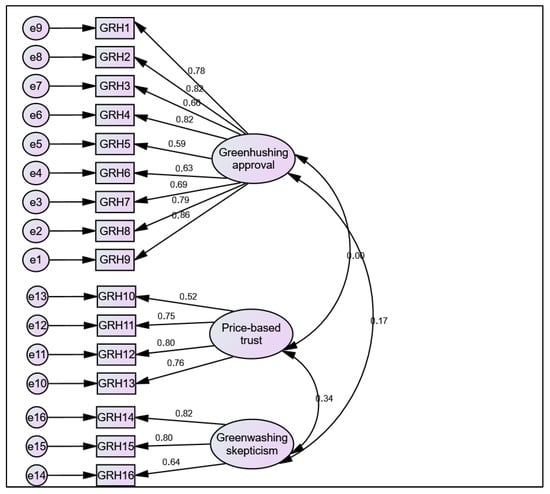
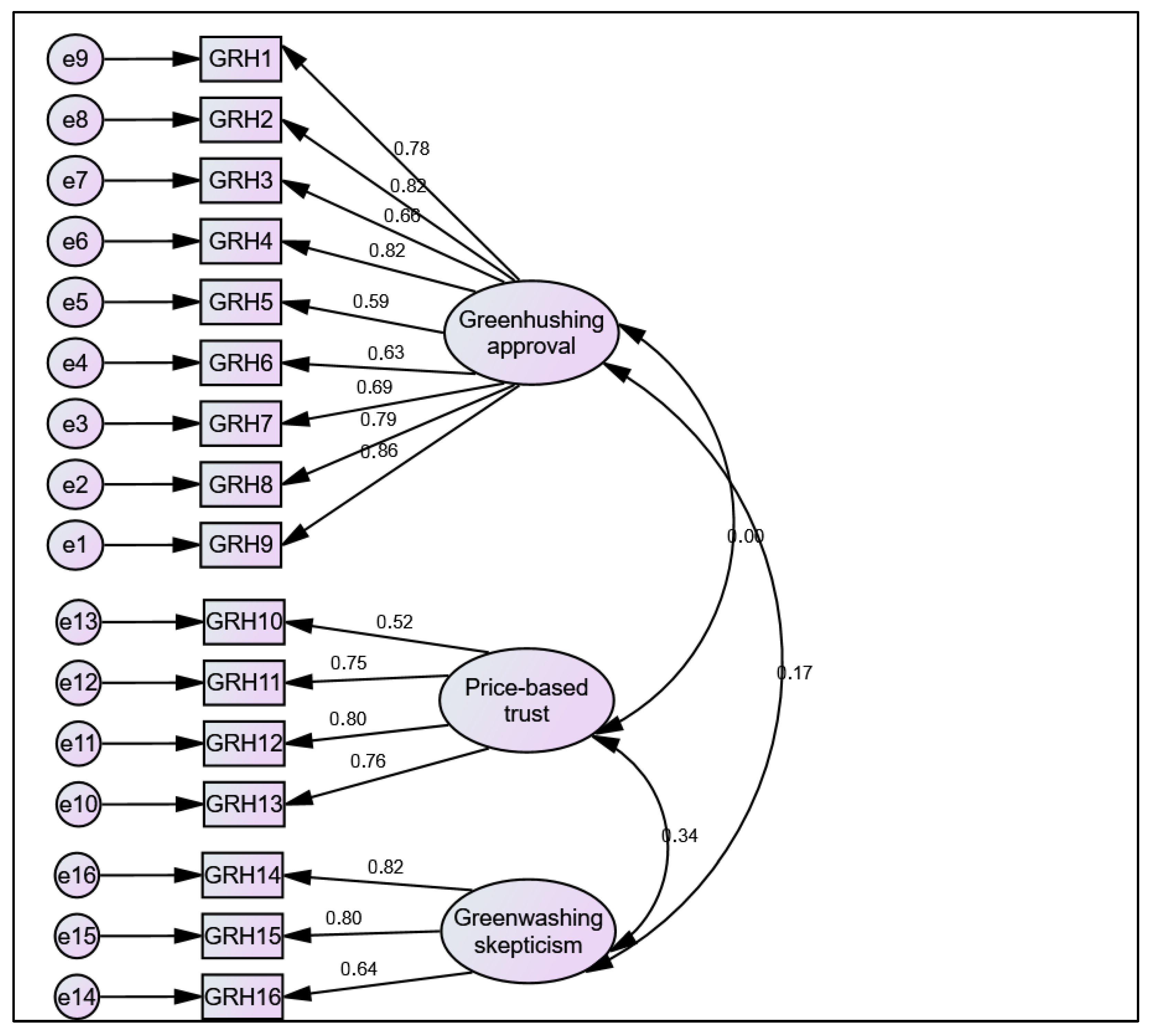
Confirmatory factor analysis (CFA) was conducted to assess the measurement model fit and its construct validity. Structural equation modeling (SEM) is a powerful confirmatory technique used for conducting CFA [37]. Given the three-factor structure determined in the EFA, a model diagram was drawn for the 16 items and three factors using Amos 23 (IBM Corp., Armonk, NY, USA). CFA of a first-order model was performed using the maximum likelihood (ML) method. Model fit was assessed using commonly accepted cut-off criteria: χ2/df ≤ 3–5, CFI ≥ 0.90, TLI ≥ 0.90, NFI ≥ 0.90, GFI ≥ 0.90, and RMSEA ≤ 0.08 [38,42]. Accordingly, the measurement model provided a good fit (χ2 = 307, df = 101, χ2/df = 3.04, CFI = 0.93, GFI = 0.91, NFI = 0.90, TLI = 0.92, RMSEA = 0.07), as shown in Table 2 [43]. All standardized factor loadings exceeded the acceptable threshold and were statistically significant, as shown in Figure 1.
Table 2.
Goodness-of-fit indices for the first-order CFA model.
Figure 1.
CFA model of greenhushing scale.
Further, the measurement model was examined for convergent and discriminant validity. The convergent validity was estimated using factor loadings, Average Variance Extracted (AVE), and Composite Reliability (CR). All standardized factor loadings were above 0.50. For each construct, the values of AVE were greater than 0.50, and the values of CR were greater than 0.70, indicating adequate convergent validity [38]. Table 3 presents the full list of items for the final scale, along with their estimates and AVE and CR values.
Table 3.
Confirmatory factor analysis of the main study.
In addition, the Fornell-Larcker criterion was used to assess discriminant validity. According to this criterion, the AVE for each construct must exceed the respective squared inter-construct correlations [44]. Table 4 shows that the square root of the AVE for each construct is greater than its squared correlations with other latent variables. Thus, the Fornell-Larcker criterion was satisfied, indicating adequate discriminant validity.
Table 4.
Discriminant validity of the greenhushing scale.
5. Discussion
This study contributes to sustainability communication research by developing and validating a scale that measures consumer attitudes toward greenhushing. Rather than directly measuring sustainability communication performance, the scale provides a stakeholder-level diagnostic indicator of how limited sustainability communication is interpreted on the consumer side within a corporate context. The findings show that consumer evaluations of greenhushing cannot be reduced to a one-dimensional judgment. The validated measurement model indicates that attitudes toward greenhushing exhibit a multidimensional structure, consisting of (i) greenhushing approval (the perception of strategic silence as reasonable or sincere), (ii) price-based trust (inferences regarding the credibility of environmental messages based on price signals), and (iii) greenwashing skepticism (a general suspicion toward environmental claims). Considered jointly, these dimensions suggest that greenhushing can be conceptualized as a “visibility strategy,” shaped by the interpretive frameworks through which consumers evaluate corporate sustainability communication and by the broader discourse of greenwashing [3,45].
5.1. Greenhushing as a Consumer Evaluation Problem
The literature indicates that greenhushing emerges as a strategic response to increasing scrutiny and reputational risks associated with sustainability claims [3,45]. The findings of this study extend this perspective by suggesting that greenhushing also creates an “evaluation problem” on the consumer side. In contexts where sustainability claims have become contested, consumers may interpret the visibility of corporate communication not merely as the transmission of information but as a signal requiring interpretation. This perspective is consistent with prior research suggesting that stakeholder evaluations are shaped not only by corporate actions but also by the linguistic framing of sustainability claims and how different stakeholders interpret these frames [8]. A key conceptual implication of these findings is that greenhushing should not be reduced to a simple lack of sustainability communication. Rather, the multidimensional structure identified in this study is consistent with treating greenhushing as a distinct form of strategic visibility management under scrutiny. Specifically, the coexistence of greenhushing approval, price-based trust, and greenwashing skepticism suggests that consumers do not respond only to the amount of communication, but to how limited visibility is interpreted in terms of sincerity, credibility, and concealment.
The emergence of the “approval” dimension in the scale demonstrates that some consumers can interpret strategic silence as moderation, caution, and even sincerity. This interpretation is particularly likely in contexts where accusations of greenwashing are salient and where “exaggerated claims” are perceived as reputationally risky [3,7]. At the same time, the presence of a skepticism dimension indicates that consumers may also interpret the same low-visibility strategy as concealment or strategic avoidance. Greenhushing, therefore, cannot be understood merely as a reduction in communication. Rather, it functions as an interpretive cue that may prompt different attributions of organizational intent in consumers’ minds, especially when firms limit direct sustainability communication and rely on weaker or indirect signals [8,9]. This dual interpretability provides a strong rationale for conceptualizing greenhushing as a distinct construct at the measurement level.
5.2. Theoretical Contribution: A Measurement Perspective on Stakeholder Interpretation in Sustainability Communication
The main theoretical contribution of the study is the provision of a validated measurement tool that captures consumer attitudes toward greenhushing. Its value for sustainability communication research lies in making stakeholder interpretations empirically observable rather than in directly measuring firm performance. Measurement, within the tradition of scale development, is not merely a technical procedure but a prerequisite for the accumulation of scientific knowledge. Consistent operationalization, cross-study comparability, and empirical replicability depend on the availability of reliable and valid measurement instruments [11,12]. Therefore, this study renders a previously underexamined and complex phenomenon empirically measurable, thereby enabling more nuanced theoretical inquiry into how corporate visibility preferences in sustainability communication are interpreted by consumers through trust and skepticism.
This contribution should also be understood in relation to existing greenwashing perception research [13,14]. Whereas greenwashing scales focus on consumer judgments of exaggerated, misleading, or unreliable environmental claims, the present study addresses a different but related problem: how consumers interpret strategic reductions in visibility in sustainability communication. In this respect, the scale complements rather than duplicates existing greenwashing measures, extending the measurement agenda from overcommunication to undercommunication within the broader sustainability communication literature [9,15,16].
5.3. Why Is Price-Based Trust Important?
An important insight emerging from the scale is that trust in environmental claims may partly be constructed through economic cues, particularly price signals. However, price-based trust should not be interpreted as evidence that price proves sustainability. Rather, this dimension suggests that consumers may rely on price as a heuristic cue when evaluating whether an environmental claim reflects a genuine sustainability effort or opportunistic positioning. This mechanism becomes especially salient under conditions of information asymmetry and limited verifiability, where consumers cannot fully observe or verify the environmental substance behind corporate claims [7,26]. In such cases, price may function as an auxiliary basis for credibility inference. For some consumers, higher prices may be interpreted as consistent with the additional costs of environmentally responsible practices. In contrast, others may increase suspicion by suggesting that the green premium is being strategically exploited.
Recent empirical studies further illustrate the role of price signals in sustainability evaluations. Evidence shows that price cues can interact with other environmental signals to shape how consumers interpret sustainability claims and whether environmental positioning is perceived as credible or misleading [26,27]. This means that higher prices do not necessarily protect firms from suspicion of greenwashing. On the contrary, under some conditions, they may even facilitate misleading inferences when consumers treat price as a proxy for environmental authenticity [27]. In this respect, price-based trust helps explain why greenhushing should not be examined in isolation from broader signals of pricing and market positioning. It also helps clarify how consumer evaluations may shift depending on whether pricing cues reinforce or undermine the perceived credibility of limited sustainability communication [14].
Building on this, price-based trust functions as a diagnostic tool. Consumers use it to address the information asymmetry caused by greenhushing. When direct signals are limited, price becomes the primary proxy. It helps consumers assess whether strategic silence is values-driven or a risk-avoidance tactic.
5.4. Managerial Implications: Calibrating the Transparency-Silence Balance
From a managerial perspective, the findings suggest that greenhushing cannot be regarded as a universally risk-reducing strategy. While strategic silence may trigger positive intention attributions (approval) among some consumers, it may simultaneously increase skepticism among others. Consequently, greenhushing should not be treated as an automatic reflex; rather, it should be approached as a strategy that requires careful calibration in relation to the target audience, industry norms, and the prevailing regulatory environment [3]. The scale developed in this study provides a diagnostic tool that enables firms to monitor consumer responses to low visibility in sustainability communication and to identify early signals that strategic silence is beginning to undermine trust.
The findings also indicate that visibility decisions should be managed consistently with price signals. When pricing cues and communication visibility are misaligned, consumers may rely more heavily on external signals, which can increase uncertainty and skepticism toward environmental claims [26,27]. Accordingly, sustainability communication should be treated not as an isolated ‘message design’ task but as a strategic element integrated with positioning and value proposition.
5.5. A Stakeholder-Level Diagnostic Indicator for Sustainability Communication
One practical contribution of the scale is its potential use as a stakeholder-level diagnostic indicator within broader assessments of sustainability communication. In contexts where sustainability claims are increasingly scrutinized, firms may oscillate between disclosure and strategic silence to manage reputational risk; nonetheless, stakeholders continue to form judgments regarding credibility, intent, and legitimacy. The proposed measurement tool enables these judgments to be systematically monitored, allowing identification of when greenhushing is interpreted as “measured caution” and when it triggers skepticism. In this regard, the scale complements governance-focused approaches to sustainability signals by providing a traceable metric at the stakeholder level and facilitating comparative evaluation across communication strategies [9]. Moreover, the accelerated feedback loops that shape organizational identity, image, and reputation in digital environments suggest that strategic silence must be managed as a delicate balance between risk avoidance and reduced evaluability [46].
5.6. Policy and System-Level Implications: Maintaining Evaluability
At the corporate governance and stakeholder ecosystem levels, greenhushing poses significant challenges for disseminating sustainability norms and assessing organizational performance. Suppression of sustainability disclosures by companies impedes stakeholders’ ability to evaluate progress, compare practices, and recognize credible sustainability efforts. This issue is particularly salient within the EU Corporate Sustainability Reporting Directive (CSRD) [1], which seeks to standardize and enhance transparency through comprehensive reporting requirements. Transparent disclosure mechanisms have been demonstrated to mitigate reputational risks and counteract greenhushing [45]. Additionally, environmental taxes and mandatory reporting requirements shape corporate disclosure behaviors [10]. Nevertheless, empirical evidence indicates that heightened scrutiny and the potential for backlash may lead corporations to withhold information about sustainability achievements [19]. Regulatory authorities, including capital markets boards and advertising agencies, should clarify disclosure requirements and establish standards to distinguish legitimate strategic silence from greenwashing. Furthermore, it is essential to ensure that mandatory reporting does not inadvertently incentivize silence as a form of legal protection. To maintain the integrity of sustainability communications, policies should incentivize objectively verifiable claims, as [2] highlights. Effective governance that enhances the reliability and comparability of disclosed information reduces strategic silence and strengthens performance evaluation systems.
6. Conclusions
This study addresses a significant gap in the literature by developing and validating a multidimensional scale to measure consumer attitudes toward greenhushing. The findings demonstrate that consumer evaluations of strategic silence involve a complex interplay among greenhushing approval, price-based trust, and greenwashing skepticism. The introduction of this validated tool reframes the greenhushing debate, shifting it from an organizational choice to a consumer-based evaluation problem and enabling measurable interpretations of limited sustainability communication. Therefore, the scale should be regarded primarily as an attitude measure rather than a direct indicator of sustainability communication performance.
The results confirm the utility of Signaling Theory in interpreting strategic silence. Greenhushing functions as an interpretive cue that prompts specific attributions of intent. From a managerial perspective, greenhushing does not consistently serve as a risk-reducing strategy; silence may signal sincerity to some stakeholders while increasing suspicion among others. Accordingly, this scale enables corporations to monitor stakeholder perceptions of strategic silence, indicating when silence is perceived as caution and when it undermines credibility. By providing a clear quantitative foundation for these thresholds, the study offers a practical tool for navigating the global sustainability communication regime and maintaining evaluability within the corporate ecosystem.
Limitations and Future Research
Although this study offers valuable insights, it is subject to several limitations that inform potential avenues for future research. These limitations are organized into three primary categories:
- Sample-related Limitations: The scale was validated within a specific geographic and cultural context, limiting its generalizability. As Pérez-Barea et al. [2] indicate, perceptions of sustainability communication performance differ across regions. Consequently, future research should examine the scale’s cross-cultural validity and invariance by comparing developed markets with stringent CSRD mandates to emerging economies such as China.
- Methodological Limitations: This study employed cross-sectional data to capture a single point in time regarding consumer attitudes, without investigating how these perceptions or the causal relationships between attitudes and behavior evolve over time. Future research should utilize longitudinal designs to track changes in attitudes toward strategic silence as global transparency norms develop. Furthermore, experimental methods are recommended to isolate the effects of specific visibility strategies in combination with various pricing and positioning cues.
- Scale and Scope Limitations: The current scale assesses attitudinal dimensions, including approval, trust, and skepticism, but does not measure behavioral outcomes such as purchase intention or actual green consumption. To address this gap, future research should incorporate the scale into broader models to explicitly evaluate its predictive capacity for behavioral outcomes. Specifically, studies should test the scale’s predictive validity and examine its applicability in diverse contexts, including AI-driven sustainability disclosures and short-video platforms like TikTok and Instagram Reels, where communication constraints may influence consumers’ attribution of intent. Additionally, research should clarify the regulatory mechanisms underlying price-oriented trust by investigating how price signals interact with strategic silence across various product categories [23,26]. Future research may also examine whether the interpretive role of price varies across different market contexts, including variations in functional expectations, consumer awareness, education, purchasing power, and broader cultural norms regarding sustainable consumption [47,48,49]. Overall, by providing a validated measurement framework, this research establishes a foundational step towards a more integrated and stakeholder-oriented understanding of contemporary sustainability communication.
Author Contributions
Conceptualization, V.Y., S.Ç. and G.G.; methodology, V.Y., S.Ç. and G.G.; validation, V.Y., S.Ç. and G.G.; formal analysis, V.Y., S.Ç. and G.G.; resources, V.Y., S.Ç. and G.G.; data curation, V.Y., S.Ç. and G.G.; writing—original draft preparation, V.Y., S.Ç., G.G. All authors have read and agreed to the published version of the manuscript.
Funding
This research was funded by the Manisa Celal Bayar University Scientific Research Projects Coordination Unit, grant number 2025-010. No funding was received to cover article processing charges (APC).
Institutional Review Board Statement
This study was conducted in accordance with the Declaration of Helsinki, and the protocol was approved by the Institutional Review Board of Social and Human Sciences Scientific Research and Publication Ethics Committee, Manisa Celal Bayar University (protocol code 2024/17 (Decision No: 19)) on 23 December 2024.
Informed Consent Statement
Informed consent was obtained from all subjects involved in the study.
Data Availability Statement
The raw data supporting the conclusions of this article will be made available by the authors on request.
Conflicts of Interest
The authors declare no conflicts of interest.
Abbreviations
The following abbreviations are used in this manuscript:
| EFA | Exploratory Factor Analysis |
| CFA | Confirmatory Factor Analysis |
| AVE | Average Variance Extracted |
| CR | Composite Reliability |
| SEM | Structural Equation Modeling |
| KMO | Kaiser–Meyer–Olkin |
| RMSEA | Root Mean Square Error of Approximation |
| CFI | Comparative Fit Index |
| TLI | Tucker–Lewis Index |
| GFI | Goodness-of-Fit Index |
References
- European Union. Directive (EU) 2022/2464 of the European Parliament and of the Council of 14 December 2022 amending Regulation (EU) No 537/2014, Directive 2004/109/EC, Directive 2006/43/EC and Directive 2013/34/EU, as regards corporate sustainability reporting. Off. J. Eur. Union 2022, L322, 15–80. [Google Scholar]
- Pérez-Barea, J.J.; Espantaleón-Pérez, R.; Šedík, P. Evaluating the Perception of Socially Responsible Consumers: The Case of Products Derived from Organic Beef. Sustainability 2020, 12, 10166. [Google Scholar] [CrossRef] [Scilit]
- Hilton, J. An integrated analysis of greenhush. Innov. Green Dev. 2025, 4, 100222. [Google Scholar] [CrossRef] [Scilit]
- Rasche, A. The Concepts of Greenwashing and Greenhushing. Available online: https://academic.oup.com/oxford-law-pro/edited-volume/59931/chapter-abstract/512684379 (accessed on 14 March 2026).
- Sakchuenyos, P.; Haji, A.A. The Effect of Greenhushing and ESG Disclosure Assurance on Investors’ Judgements. Account. Financ. 2026, 66, 979–996. [Google Scholar] [CrossRef] [Scilit]
- Cheng, H.; Dong, D.; Feng, Y. Corporate greenhushing and stock price crash risk: Evidence from China. Environ. Dev. Sustain. 2024, 27, 30761–30797. [Google Scholar] [CrossRef] [Scilit]
- Delmas, M.A.; Burbano, V.C. The drivers of greenwashing. Calif. Manag. Rev. 2011, 54, 64–87. [Google Scholar] [CrossRef] [Scilit]
- Crilly, D.; Hansen, M.T.; Zollo, M. The grammar of decoupling: A cognitive-linguistic perspective on firms’ sustainability claims and stakeholders’ interpretation. Acad. Manag. J. 2016, 59, 705–729. [Google Scholar] [CrossRef] [Scilit]
- Khan, N.; Nieto-García, M.; Acuti, D.; Viglia, G. An Investigation of How and Why Organizations Enact Greenhushing. J. Advert. Res. 2026, 66, 150–173. [Google Scholar] [CrossRef] [Scilit]
- Lou, Q.J.; Lin, C.; Cai, B.W. Environmental protection tax and corporate greenhushing: Evidence from China. Appl. Ecol. Environ. Res. 2025, 23, 9863–9884. [Google Scholar] [CrossRef] [Scilit]
- Churchill, G. A paradigm for developing better measures of marketing constructs. J. Mark. Res. 1979, 16, 64–73. [Google Scholar] [CrossRef] [Scilit]
- Boateng, G.O.; Neilands, T.B.; Frongillo, E.A.; Melgar-Quiñonez, H.R.; Young, S.L. Best practices for developing and validating scales for health, social, and behavioral research: A primer. Front. Public Health 2018, 6, 149. [Google Scholar]
- Andreoli, T.P.; Costa, E.D.S.; Prearo, L.C. Consumer judgment on the practice of greenwashing: Scale development and validation. BBR Braz. Bus. Rev. 2022, 19, 508–524. [Google Scholar]
- Shabani Shojaei, A.; Barbosa, B.; Oliveira, Z.; Coelho, A.M.R. Perceived greenwashing and its impact on eco-friendly product purchase. Tour. Manag. Stud. 2024, 20, 1–12. [Google Scholar] [CrossRef] [Scilit]
- Font, X.; Elgammal, I.; Lamond, I. Greenhushing: The deliberate undercommunication of sustainability practices by tourism businesses. J. Sustain. Tour. 2017, 25, 1007–1023. [Google Scholar]
- Ettinger, A.; Okazaki, S.; Terlutter, R. The Desirability of CSR Communication versus Greenhushing in the Hospitality Industry: The Customers’ Perspective. J. Travel Res. 2021, 60, 618–638. [Google Scholar] [CrossRef] [Scilit]
- Letzing, J. What Is ‘Greenhushing’ and Is It Really a Cause for Concern? World Economic Forum, 2022. Available online: https://www.weforum.org/agenda/2022/11/what-is-greenhushing-and-is-it-really-a-cause-for-concern (accessed on 2 March 2026).
- Connelly, B.L.; Certo, S.T.; Ireland, R.D.; Reutzel, C.R. Signaling theory: A review and assessment. J. Manag. 2011, 37, 39–67. [Google Scholar]
- Hilton, J. Greenhush and greenwash: A signaling game analysis of strategic environmental disclosure. Environ. Dev. Econ. 2025, 1–22. [Google Scholar] [CrossRef] [Scilit]
- Chen, Y.S.; Chang, C.H. Greenwash and green trust: The mediation effects of green consumer confusion and green perceived risk. J. Bus. Ethics 2013, 114, 489–500. [Google Scholar]
- De Novellis, G.; Pedrazzoli, A.; Pennetta, D.; Venturelli, V. Greenwashing, greenhushing, and the path to green banking. Glob. Financ. J. 2025, 67, 101147. [Google Scholar]
- Zhang, Z.; Meng, D.; Shi, Y.; Liu, C. ESG underperformance duration and corporate greenhushing: Evidence from China. Financ. Res. Lett. 2026, 90, 109392. [Google Scholar] [CrossRef] [Scilit]
- Skarmeas, D.; Leonidou, C.N. When consumers doubt, watch out! The role of CSR skepticism. J. Bus. Res. 2013, 66, 101831–101838. [Google Scholar] [CrossRef] [Scilit]
- Swestiana, A.; Kusworo, H.A.; Fandeli, C. Greenwashing or greenhushing?: A quasi-experiment to correlate green behavior and tourists’ level of trust toward communication strategies in volunteer tourism’s website. J. Kepariwisataan Destin. Hosp. Perjalanan 2022, 6, 53–66. [Google Scholar]
- Netemeyer, R.G.; Bearden, W.O.; Sharma, S. Scaling Procedures: Issues and Applications; Sage: London, UK, 2003. [Google Scholar]
- Feuß, S.; Fischer-Kreer, D.; Majer, J.; Kemper, J.; Brettel, M. The interplay of eco-labels and price cues: Empirical evidence from a large-scale field experiment in an online fashion store. J. Clean. Prod. 2022, 373, 133707. [Google Scholar]
- Ende, L.; Reinhard, M.A.; Göritz, L. Detecting greenwashing! The influence of product color and product price on consumers’ detection accuracy of faked bio-fashion. J. Consum. Policy 2023, 46, 155–189. [Google Scholar]
- Hinkin, T.R. A review of scale development practices in the study of organizations. J. Manag. 1995, 21, 967–988. [Google Scholar] [CrossRef] [Scilit]
- Quoquab, F.; Mohammad, J. Cognitive, affective, and conative domains of sustainable consumption: Scale development and validation using confirmatory composite analysis. Sustainability 2020, 12, 7784. [Google Scholar] [CrossRef] [Scilit]
- Kang, J.; Hustvedt, G. Building Trust between Consumers and Corporations: The Role of Consumer Perceptions of Transparency and Social Responsibility. J. Bus. Ethics 2014, 125, 253–265. [Google Scholar]
- Öberseder, M.; Schlegelmilch, B.B.; Murphy, P.E.; Gruber, V. Consumers’ Perceptions of Corporate Social Responsibility: Scale Development and Validation. J. Bus. Ethics 2014, 124, 101–115. [Google Scholar]
- Pimonenko, T.; Bilan, Y.; Horák, J.; Starchenko, L.; Gajda, W. Green Brand of Companies and Greenwashing under Sustainable Development Goals. Sustainability 2020, 12, 1679. [Google Scholar] [CrossRef] [Scilit]
- Oppong-Tawiah, D.; Webster, J. Corporate Sustainability Communication as ‘Fake News’: Firms’ Greenwashing on Twitter. Sustainability 2023, 15, 6683. [Google Scholar] [CrossRef] [Scilit]
- Montecchi, M.; Plangger, K.; West, D.; De Ruyter, K. Perceived Brand Transparency: A Conceptualization and Measurement Scale. Psychol. Mark. 2024, 41, 2274–2297. [Google Scholar] [CrossRef] [Scilit]
- Janik, A.; Ryszko, A. Greenwashing in Sustainability Reporting: A Systematic Literature Review of Strategic Typologies and Content-Analysis-Based Measurement Approaches. Sustainability 2025, 18, 17. [Google Scholar] [CrossRef] [Scilit]
- Koo, M.; Yang, S.-W. Questionnaire Use and Development in Health Research. Encyclopedia 2025, 5, 65. [Google Scholar] [CrossRef] [Scilit]
- Worthington, R.L.; Whittaker, T.A. Scale development research: A content analysis and recommendations for best practices. Couns. Psychol. 2006, 34, 806–838. [Google Scholar] [CrossRef] [Scilit]
- Hair, J.F.; Black, W.C.; Babin, B.J.; Anderson, R.E. Multivariate Data Analysis, 7th ed.; Pearson Prentice Hall: Upper Saddle River, NJ, USA, 2010. [Google Scholar]
- Byrne, B.M. Structural Equation Modeling with AMOS: Basic Concepts, Applications, and Programming, 2nd ed.; Routledge: New York, NY, USA, 2010. [Google Scholar]
- Costello, A.B.; Osborne, J. Best practices in exploratory factor analysis: Four recommendations for getting the most from your analysis. Pract. Assess. Res. Eval. 2005, 10, 1–9. [Google Scholar]
- Nunnally, J.C.; Bernstein, I.H. Psychometric Theory, 3rd ed.; McGraw-Hill: New York, NY, USA, 1994; pp. 248–292. [Google Scholar]
- Hu, L.-T.; Bentler, P.M. Cutoff criteria for fit indexes in covariance structure analysis: Conventional criteria versus new alternatives. Struct. Equ. Model. 1999, 6, 1–55. [Google Scholar]
- Kline, R. Principles and Practice of Structural Equation Modeling, 4th ed.; The Guilford Press: New York, NY, USA, 2016. [Google Scholar]
- Fornell, C.; Larcker, D.F. Evaluating structural equation models with unobservable variables and measurement error. J. Mark. Res. 1981, 18, 39–50. [Google Scholar]
- Tao, Y.; Yoo, C.C.; Animesh, A. Green Disclosure or Green Hushing? The Impact of Corporate Environmental Sustainability Communication on Social Media Engagement; Elsevier Inc.: Amsterdam, The Netherlands, 2025. [Google Scholar]
- Fors, P.; Kronlid, C.; Ahlström, E. When Silence is Strategic: Sustainable Organizational Identity, Image and Reputation in the Digital Peer-to-Peer Industry. 2025. Available online: https://ssrn.com/abstract=5220484 (accessed on 4 March 2026).
- Skard, S.; Jørgensen, S.; Pedersen, L.J. When is sustainability a liability, and when is it an asset? Quality inferences for core and peripheral attributes. J. Bus. Ethics 2021, 173, 109–132. [Google Scholar]
- Khan, O.; Varaksina, N.; Hinterhuber, A. The influence of cultural differences on consumers’ willingness to pay more for sustainable fashion. J. Clean. Prod. 2024, 442, 141024. [Google Scholar] [CrossRef] [Scilit]
- Ansu-Mensah, P. Green product awareness effect on green purchase intentions of university students: An emerging market’s perspective. Future Bus. J. 2021, 7, 48. [Google Scholar]

Disclaimer/Publisher’s Note: The statements, opinions and data contained in all publications are solely those of the individual author(s) and contributor(s) and not of MDPI and/or the editor(s). MDPI and/or the editor(s) disclaim responsibility for any injury to people or property resulting from any ideas, methods, instructions or products referred to in the content. |
© 2026 by the authors. Licensee MDPI, Basel, Switzerland. This article is an open access article distributed under the terms and conditions of the Creative Commons Attribution (CC BY) license.