


Abstract
Business development unfolds within complex adaptive environments marked by nonlinear interaction, structural asymmetry, and recurrent instability. Sustained performance under such conditions requires regulatory structures that preserve coherence while enabling structural transformation. This study advances symmetry evolution as a systems principle that explains the emergence of balance through interaction among decision bias, structural symmetry, and regulatory intensity. An evolutionary regulation framework represents this interaction as a closed-loop dynamic that drives coevolution of regulation and symmetry through recursive feedback. Stability emerges as a property of proportional coupling rather than correction of deviations. Multi-modal simulations representing turbulent decision landscapes demonstrate formation of bounded oscillatory equilibrium under perturbation while preserving exploratory capacity, with a mean recovery interval of 1.01 iterations, compared with 9.56 under fixed regulatory intensity and 47.29 under exogenous adjustment, indicating a substantial reduction in recovery time. Coordinated evolution of regulatory gain and structural symmetry sustains adaptive stability without suppressing innovation dynamics. The study establishes a systemic foundation for resilience and endogenous governance in complex business systems and reframes decision optimization as structural adaptation within evolving regulatory architectures.
1. Introduction
Business development unfolds within complex adaptive systems characterized by nonlinear interaction, structural interdependence, and persistent environmental turbulence [1,2]. Firms operate in evolving state spaces shaped by shifting demand, technological innovation, and competitive feedback [3]. Such environments generate recurrent instability rather than steady equilibrium. Traditional optimization logic treats instability as a deviation from an optimal state; complexity theory interprets instability as an intrinsic feature of adaptive systems [4,5]. Stability therefore requires mechanisms that sustain coherence while permitting structural transformation [6].
Within complex adaptive systems, structural order arises from the interaction of symmetry and asymmetry [7]. Symmetry reflects coordinated relationships among system components, whereas asymmetry introduces differentiation and innovation [8,9]. Episodes of symmetry breaking generate diversity while increasing the risk of fragmentation [10]. Regulatory feedback determines whether the system reorganizes into a higher-order configuration or drifts toward instability [11]. This interplay of disruption and regulation shapes the evolutionary trajectory of adaptive systems [12].
Business decision architectures exhibit comparable dynamics. Organizations balance exploration and control across multi-objective landscapes involving innovation, efficiency, and strategic alignment [13]. Excessive exploration amplifies volatility; rigid control suppresses adaptation [14]. Dynamic capability theory emphasizes the capacity to reconfigure resources and structures in response to environmental change [15,16]. Such reconfiguration implies endogenous regulatory processes that stabilize evolving structures rather than enforce static equilibrium [17]. The challenge lies in formalizing how regulation and structural balance co-evolve within decision systems operating under uncertainty.
Algorithmic decision systems provide a computational analogue for studying this problem. Population-based optimization models demonstrate how coordinated search emerges through interaction among agents [18]. However, most models treat regulation as external parameter tuning rather than as a structural property of the system. Fixed or exogenously adjusted parameters limit the capacity for sustained adaptation under non-stationary conditions [19,20]. Recent work in adaptive control and dynamic optimization highlights the importance of feedback-driven parameter evolution for maintaining performance in turbulent environments [21]. These findings suggest that regulation must evolve alongside structural configuration.
This study advances symmetry evolution as a systems-level principle explaining how structural balance emerges through recursive interactions linking bias, regulation, and environmental perturbation [22,23]. Rather than treating stability as convergence to a fixed optimum, symmetry evolution conceptualizes equilibrium as coordinated transformation within a bounded dynamic regime [24,25]. The proposed Evolutionary Regulation Framework (ERF) models this process through coupled state variables representing decision bias, structural symmetry, and regulatory gain. Their interaction forms a closed feedback topology that governs adaptation across changing landscapes [26].
Unlike prior computational implementations that emphasize algorithmic efficiency, the present study focuses on the systemic evolution of regulatory structures within complex business systems [27,28]. The framework reframes decision optimization as structural adaptation embedded in endogenous governance mechanisms [29]. Through multi-modal simulations reflecting turbulent decision environments, the analysis examines how proportional coevolution of regulation and symmetry sustains adaptive stability without suppressing exploratory dynamics [30].
By integrating complexity theory, adaptive control, and evolutionary computation, the study establishes a systemic foundation for understanding resilience and structural intelligence in business development systems [31,32,33]. Symmetry evolution emerges as a mechanism through which complex systems maintain coherence while transforming in response to change [34].
Existing models fail to explain how complex systems maintain stability under persistent perturbation when structure and regulation must emerge endogenously. This study addresses this limitation in three ways. First, it shows that structural coherence emerges from recursive interaction of asymmetry and regulatory feedback rather than from an imposed exogenous condition. Second, it demonstrates that regulatory adjustment arises within the system through feedback-driven co-evolution of decision bias, structural symmetry, and regulatory gain, replacing approaches that rely on externally specified control parameters. Third, it reconceptualizes stability as a bounded oscillatory equilibrium rather than static convergence and provides a dynamic interpretation of how systems sustain performance under continuous disturbance. These contributions establish a unified framework that integrates structural adaptation, regulatory design, and adaptive stability in complex systems. The framework provides a basis for interpreting how real-world systems, including organizational and business environments, maintain stability through endogenous adjustment under persistent perturbation.
2. Theoretical Background
2.1. Symmetry, State Space, and Structural Regulation in Complex Systems
Complex systems evolve within structured state spaces shaped by interdependent variables and nonlinear dynamics [35]. Invariance preserves relational coherence under transformation and stabilizes attractor configurations [36]. Asymmetry, by contrast, perturbs trajectories and induces structural differentiation. Symmetry breaking reorganizes the topology of the state space rather than merely producing variation [37].
Regulation mediates these transitions. Ashby’s law of requisite variety establishes that regulatory capacity must match environmental complexity to sustain stability [38]. Regulatory capacity shapes the feedback topology governing propagation of perturbations across interconnected components [39]. Structural alignment of regulatory feedback guides the system toward dynamic attractors rather than disorder [40]. Recursive interaction linking structural invariance with adaptive correction generates self-organization [41].
Symmetry functions as a dynamic constraint guiding state evolution rather than as a static property [42]. Regulation transforms local asymmetry into higher-order organization [22,43]. This interplay defines structural regulation in complex adaptive systems and provides the ontological basis for modeling adaptive stability in evolving decision architectures [44].
2.2. Adaptive Stability, Feedback Topology, and Attractor Dynamics
Adaptive stability refers to the capacity of a system to maintain bounded trajectories within its state space despite environmental perturbations [45]. In complex systems, stability denotes persistent occupancy of attractor basins as inputs fluctuate, reflecting dynamic constraint rather than static equilibrium [46].
Control theory conceptualizes regulation as feedback that aligns system output with reference states [47]. In adaptive systems, feedback parameters evolve alongside structural change [21]. This evolution modifies the geometry of attractor landscapes and determines whether trajectories stabilize, oscillate, or bifurcate [48]. Kelso (1995) demonstrated that coordinated dynamics emerge when interacting components synchronize through nonlinear coupling [49]. Such synchronization reflects phase alignment rather than static balance.
The strength of regulatory gain relative to perturbation amplitude determines whether oscillations remain bounded [50,51]. Excessive gain induces instability; insufficient gain permits drift. Studies in adaptive robotics confirm that proportional feedback maintains resilience while preventing chaotic divergence [52,53]. Adaptive stability therefore depends on the coevolution of feedback intensity and structural configuration. Stability arises from matched rates of change rather than fixed control parameters [54].
2.3. Evolutionary Computation as Distributed Regulatory Dynamics
Evolutionary computation offers a distributed representation of adaptive regulation within multi-agent state spaces [55,56]. Population-based models such as Genetic Algorithms, Particle Swarm Optimization, and Differential Evolution coordinate exploration through interaction among agents [18,57]. Diversity expands the reachable region of state space, while selection constrains trajectories toward attractor basins [58].
Traditional formulations treat parameter tuning as an external intervention. Such separation limits structural responsiveness under non-stationary landscapes [20]. Adaptive parameter control integrates feedback within the search process. Regulation becomes endogenous when algorithmic parameters evolve in response to structural indicators such as diversity or convergence rate [59,60].
Recent research demonstrates that feedback-driven parameter evolution strengthens stability under shifting objective surfaces [61,62]. Real-time regulatory loops reduce sensitivity to noise and maintain bounded convergence [63]. From a systems perspective, evolutionary computation functions as a distributed regulatory mechanism that reorganizes population symmetry through iterative feedback [64]. Convergence therefore marks attractor stabilization rather than simple optimization [65].
2.4. Symmetry Evolution in Business Systems
Business organizations operate as complex adaptive systems embedded in interdependent economic networks [66,67]. Resource allocation, innovation, and coordination occur within evolving state spaces shaped by technological and institutional change [68]. Dynamic capability theory identifies reconfiguration capacity as the basis of sustained competitive advantage [15,69]. Such reconfiguration implies structural adaptation governed by internal feedback rather than external enforcement [16].
Symmetry evolution provides a formal representation of this process. Organizational coherence corresponds to structural symmetry among strategic variables, while innovation introduces asymmetry that perturbs equilibrium [70]. Regulatory processes transform disruption into coordinated reorganization. The system stabilizes when feedback intensity aligns with structural deviation [71].
Decision systems implemented through computational models exhibit analogous dynamics. Multiple objectives interact across nonlinear landscapes, requiring proportional regulation to maintain coherence [29,72]. The Evolutionary Regulation Framework conceptualizes this interaction as the coevolution of bias, symmetry, and regulatory gain. Regulation intensity adapts to environmental signals, allowing structural balance to evolve without suppressing exploratory variation. Governance in intelligent systems emerges from the design of feedback and control structures that regulate system behavior [28,41]. Symmetry evolution embodies such endogenous governance within adaptive business systems.
3. Conceptual Framework: Evolutionary Regulation as Regulatory Architecture
3.1. Conceptual Overview: Endogenous Regulatory Architecture
The Evolutionary Regulation Framework conceptualizes adaptive stability as a property emerging from endogenous regulatory architecture within complex adaptive systems. Rather than describing a computational procedure, the framework specifies a structural configuration that governs state-space evolution through recursive feedback.
The system comprises three coupled state variables: decision bias, structural symmetry, and regulatory gain. Bias represents displacement from attractor configurations. Structural symmetry captures relational coherence among system components. Regulatory gain determines the intensity of corrective feedback applied to structural deviation. Their interaction forms a closed feedback topology that continuously reshapes system trajectories.
Perturbation displaces the system from an existing attractor basin. Regulatory response alters structural symmetry, which in turn modifies the generation of bias. This recursive coupling produces phase-aligned oscillations that maintain bounded trajectories within the evolving state space. Stability arises through coordinated transformation rather than restoration of a prior equilibrium. Such dynamics align with complexity theory, where order emerges from internal interaction rather than external enforcement [73].
The Evolutionary Regulation Framework therefore represents a regulatory architecture embedded within the system’s ontology. Regulation forms an intrinsic structural dimension of the system rather than an external intervention.
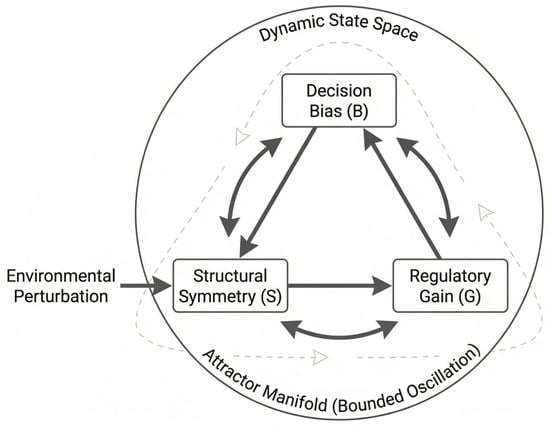
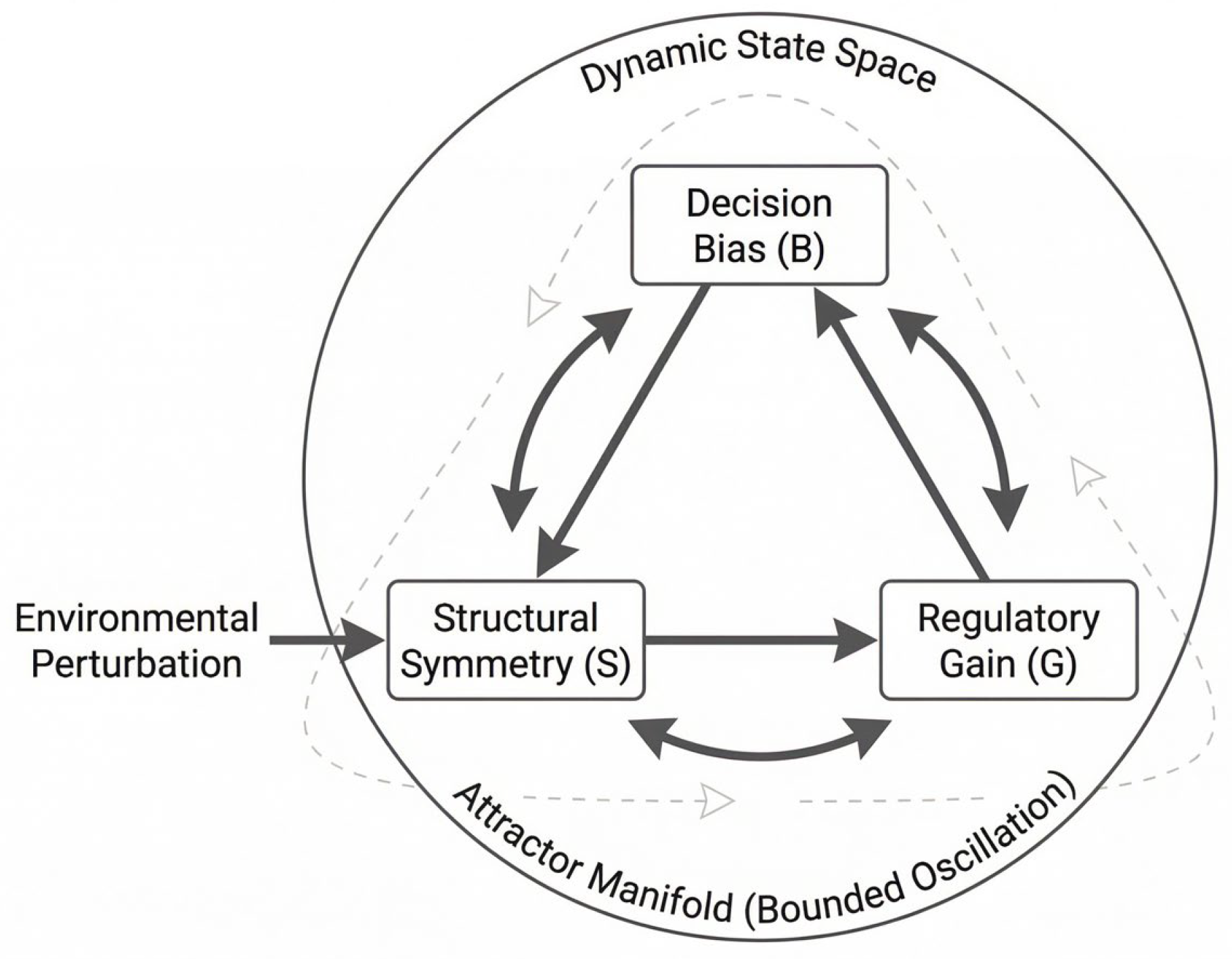
Figure 1 depicts the Evolutionary Regulation Framework as a closed recursive topology within a bounded state space. Three interdependent variables govern system evolution: decision bias, structural symmetry, and regulatory gain. Nonlinear coupling among these variables shapes trajectory curvature. Environmental perturbation enters through structural symmetry and displaces the system from its attractor configuration. Regulatory gain scales with deviation and redirects bias within the state space.
Figure 1.
Evolutionary Regulation Framework (ERF): Endogenous regulatory architecture.
Topological representation illustrates emergence of adaptive stability from recursive coupling operating within bounded attractor manifolds. Structural perturbation displaces symmetry, regulatory gain scales with deviation, and bias reorganizes within the evolving state space. Constrained oscillatory reconfiguration characterizes stability rather than restoration of a prior equilibrium. Diagrammatic representation formalizes structural relations governing nonlinear state-space evolution. Solid arrows indicate directional interactions and feedback among system variables, while the dotted triangular path represents the attractor manifold associated with bounded oscillatory dynamics within the dynamic state space.
3.2. State-Space Dynamics and Feedback Coupling
At time step , the system state forms a vector in a three-dimensional regulatory space defined by bias , symmetry , and regulatory gain . These variables co-evolve through nonlinear coupling functions that determine trajectory curvature within state space.
Appendix C lists all symbols used in the formal specification.
External perturbation introduces asymmetry. Bias increases as the system diverges from structural coherence. Regulation responds in proportion to deviation from a critical symmetry threshold. Subsequent symmetry reconfiguration under regulatory influence alters the attractor landscape.
This interaction defines a feedback topology with three properties:
- Bidirectional coupling of structure and regulation;
- Proportional gain adjustment relative to structural deviation;
- Recursive modification of attractor basins.
Equilibrium corresponds to bounded oscillation within a dynamic manifold rather than a fixed point. Convergence reflects stabilization of phase relationships among the three variables rather than elimination of variation. Regulatory gain evolving at a rate commensurate with structural change maintains trajectories within stable attractor basins. Misalignment of regulatory gain and structural change produces bifurcation or chaotic drift.
The Evolutionary Regulation Framework therefore models stability as coordinated state evolution within a regulated phase space.
3.3. Evolutionary Symmetry Equilibrium as Dynamic Attractor
Evolutionary Symmetry Equilibrium represents a dynamic attractor state characterized by matched rates of change in symmetry and regulation. At this point, the system maintains structural coherence while preserving adaptive responsiveness.
The equilibrium condition reflects proportional alignment of regulatory adjustment and structural deviation. When and converge toward compatible magnitudes, oscillations remain bounded. Bias neither accumulates nor collapses. The system operates within a stable oscillatory regime.
This regime differs from mechanical equilibrium. Mechanical systems minimize motion; adaptive systems sustain patterned motion within constraint boundaries. The Evolutionary Regulation Framework defines equilibrium as persistence within an attractor manifold shaped by evolving symmetry. Similar coordination principles appear in neural excitation–inhibition coupling and synchronized nonlinear oscillators [49].
Evolutionary Symmetry Equilibrium thus captures the moment when regulatory intensity and structural adaptation achieve phase coherence.
3.4. Operational Realization in Distributed Adaptive Systems
Operational implementation of the Evolutionary Regulation Framework instantiates regulatory architecture within distributed adaptive agents rather than defining the framework itself. In population-based systems, each agent occupies a position in solution space and contributes to global symmetry.
Bias corresponds to deviation from collective coherence. Structural symmetry reflects relational alignment among agents. Regulatory gain modulates search intensity according to deviation magnitude. Regulation embedded within iterative update rules integrates feedback into structural evolution.
Metaheuristic procedures function as distributed regulatory networks that reorganize population symmetry. Convergence reflects stabilization of a collective attractor configuration.
Dynamic parameter adaptation in evolutionary computation demonstrates that endogenous feedback enhances resilience under non-stationary landscapes [56,74]. The Evolutionary Regulation Framework generalizes this principle by formalizing regulation as a structural state variable rather than as an auxiliary parameter.
3.5. Theoretical Propositions in Systems Terms
The Evolutionary Regulation Framework characterizes adaptive stability as the outcome of recursive interaction among regulatory gain, structural symmetry, and decision bias. Environmental perturbation introduces asymmetry that displaces system trajectories from existing attractor configurations. Regulatory adjustment modifies this deviation through feedback coupling, while symmetry reconfiguration reshapes the attractor landscape. Stability depends on structural coordination among these evolving system components rather than convergence toward a fixed equilibrium state.
Regulatory adjustment that scales with structural deviation constrains trajectory expansion and maintains bounded evolution within attractor manifolds. Alignment of regulatory response with structural asymmetry preserves coherence across system variables and stabilizes attractor configurations. Divergence of regulatory intensity from structural deviation produces trajectory expansion and elevates bifurcation or chaotic drift risk. These mechanisms generate theoretical implications for structural determinants of adaptive stability in complex business systems.
Proposition 1.
Adaptive stability emerges when regulatory gain co-evolves with structural asymmetry and maintains bounded state trajectories.
Proposition 2.
Structural symmetry mediates attractor stabilization through alignment of feedback topology and system configuration.
Proposition 3.
Endogenous regulatory architecture enables resilience in complex business systems through transformation of perturbation into coordinated structural reconfiguration.
These propositions specify measurable relationships linking regulatory coupling and system-level stability. Empirical analysis centers on attractor persistence and bounded oscillation rather than optimization performance.
3.6. Evolutionary Regulation in Complex Business Systems
Business organizations operate within evolving economic state spaces shaped by interdependent actors, technological change, and institutional constraints. Strategic coherence in such environments depends on structural coordination among decision variables such as innovation intensity, resource allocation, and organizational coordination mechanisms. These interacting elements form a dynamic configuration whose evolution determines organizational stability and adaptability.
Regulation within this context reflects governance structures that adjust in response to deviation from strategic alignment. Regulatory capacity evolving with structural disruption enables organizations to sustain adaptive stability during environmental turbulence. Static control mechanisms lack this adaptive capacity and fail to preserve organizational coherence when perturbation intensity exceeds the range of fixed governance structures [15].
The Evolutionary Regulation Framework formalizes this regulatory process in system terms. Decision bias, structural symmetry, and regulatory gain function as interacting dimensions that shape organizational trajectories within evolving decision landscapes. Structural asymmetry introduces deviation from strategic coherence, while regulatory adjustment constrains divergence and preserves bounded system evolution.
Symmetry evolution therefore captures how organizations maintain strategic direction while transforming internal configuration in response to environmental change. Regulation functions as an intrinsic structural dimension embedded within the organizational system rather than an external corrective instrument. Adaptive stability arises from recursive interaction among bias, symmetry, and regulatory adjustment operating within complex business systems.
These structural relationships provide the conceptual basis for examining adaptive stability through computational simulation and admit direct interpretation through observable organizational patterns.
Core constructs require clear interpretation in organizational settings. Table 1 defines decision bias, structural symmetry, and regulatory gain through observable dimensions and measurable indicators. The operationalization reflects construct definitions developed in this study and aligns with observable patterns in organizational and business development settings.
Table 1.
Operationalization of core constructs.
Structural symmetry serves as the central state variable in the framework and refers to the degree of alignment across core organizational dimensions, including strategic priorities, resource allocation, decision timing, and coordination of interdependent activities. Decision bias captures deviation from this alignment, and regulatory gain represents the governance response to such deviation. This construct has direct interpretation through observable indicators such as variance in resource allocation across units, delays in cross-functional project execution, and divergence of realized actions from planned strategy. These dimensions establish a measurable representation of symmetry in business development settings.
The operational definitions establish a direct mapping from abstract constructs to organizational conditions and support interpretation of the simulation results and the illustrative application.
4. Methodology: Structural Validation of Regulatory Coevolution
4.1. Dynamic System Specification of Regulatory Coevolution
Adaptive stability in complex decision systems depends on coevolution of structural symmetry and regulatory intensity within a dynamic state space. The methodological design examines whether endogenous regulatory coupling preserves bounded structural coherence under perturbation.
Analysis focuses on state-space dynamics rather than equilibrium outcomes. Regulation operates as an internal structural variable within the system rather than an external control parameter. Feedback coupling modifies trajectory curvature when symmetry deviates from attractor configuration. Controlled perturbation regimes introduce structural disruption and expose regulatory response. Resulting trajectories indicate whether proportional coupling constrains divergence and reorganizes coherence.
System evolution follows a discrete-time dynamical process defined by three interdependent state variables: decision bias, structural symmetry, and regulatory gain. Recursive feedback links these variables so that deviation in one dimension alters the others.
Structural symmetry represents coherence among interacting decision components. Bias indicates displacement from current attractor structure. Regulatory gain determines feedback intensity applied to symmetry deviation. Symmetry deviation influences regulatory gain, while regulatory adjustment shapes subsequent bias formation. Reciprocal interaction across these variables determines trajectory curvature in state space.
The framework rejects fixed-point convergence as a stability criterion. Stability instead requires persistence of trajectories within bounded attractor manifolds. External disturbance modifies structural symmetry and displaces trajectories from existing attractors. Endogenous regulatory coupling must constrain divergence and guide reorganization within finite state-space regions.
Appendix A presents the discrete-time specification of the recursive state equations.
4.2. Perturbation as a Structural Test Condition
Structural properties of adaptive systems emerge under disturbance. Perturbation therefore functions as a structural probe rather than an environmental scenario. Disruption introduces asymmetry that displaces trajectories from existing attractor configurations and exposes the capacity of regulatory coupling to constrain divergence.
Exogenous modification of bias and structural symmetry alters the local geometry of the attractor basin. Such modification changes trajectory direction and magnitude of deviation. Regulatory gain must respond to this displacement. The resulting interaction determines whether trajectories reorganize within bounded regions or expand toward instability.
Three environmental regimes structure this examination. Baseline conditions permit observation of intrinsic attractor organization without external disturbance. Periodic shocks introduce deterministic asymmetry at fixed intervals and test recovery dynamics under structured displacement. Stochastic disturbance varies asymmetry magnitude and timing and tests resilience under irregular disruption.
These regimes abstract structural perturbations rather than represent specific domain events. Each regime modifies state space geometry in a distinct manner. Comparative observation across regimes reveals whether proportional coevolution transforms disruption into reorganized coherence instead of cumulative divergence.
4.3. Stability Indicators and Their Operational Role
Adaptive stability requires containment of divergence, reciprocal proportional feedback, and structural reorganization within finite temporal bounds. Appendix B provides the formal definitions of recovery interval, coupling correlation, and tail variance. Each requirement generates observable consequences in state space dynamics.
Containment produces two measurable conditions. Trajectories remain within finite attractor regions, a property termed attractor boundedness. Perturbation cannot drive divergence beyond geometric limits. Containment requires return to the bounded region within finite temporal intervals; a property termed the recovery horizon. Failure of either requirement signals loss of structural constraint.
Reciprocal proportional feedback produces two additional consequences. Regulatory gain must covary with symmetry deviation, a condition termed coupling proportionality. Temporal coordination of deviation and regulation must preserve phase structure, a condition termed oscillatory coherence. Absence of proportional scaling or phase alignment converts regulation into exogenous adjustment.
Reorganization generates a final observable consequence. Structural deviation must decline after disturbance and reform bounded attractor structure. This condition defines variance attenuation. Persistent variance growth indicates fragmentation rather than adaptation.
Adaptive stability requires translation of structural principles into observable quantities. Containment, reciprocal proportional coupling, and reorganizational capacity define the necessary structural requirements of endogenous regulatory architecture. Each requirement yields measurable consequences in state space dynamics. Table 2 presents the mapping of structural requirements to operational indicators and their role in empirical validation.
Table 2.
Structural requirements and corresponding operational indicators.
The mapping clarifies the logical progression from theoretical construct to measurable outcome. Each indicator operationalizes a distinct structural requirement and functions as a condition test rather than a descriptive statistic. Joint evaluation across indicators determines whether regulatory coupling preserves geometric confinement, temporal coordination, proportional scaling, and structural reformation under perturbation.
4.4. Comparative Structural Conditions
Evaluation of endogenous regulatory architecture requires contrast with alternative feedback structures. Two comparative configurations remove coevolution while preserving identical decision dynamics.
The first configuration fixes regulatory intensity across iterations. This structure eliminates adaptive scaling and tests whether bounded stability can emerge without dynamic adjustment.
The second configuration allows regulatory intensity to change but detaches adjustment from structural symmetry. Regulatory variation follows a trajectory without linkage to deviation magnitude. This structure tests whether temporal variability suffices to maintain stability.
All configurations retain the same decision space and perturbation regimes. Variation occurs solely in feedback topology. Differences in attractor boundedness, coupling proportionality, recovery horizon, and variance attenuation therefore reflect structural consequences of regulatory design rather than differences in decision dynamics.
Comparison across configurations isolates the role of endogenous coevolution in constraining divergence and reorganizing coherence under disturbance.
Comparative evaluation requires isolation of feedback topology while holding decision dynamics constant. Endogenous regulatory coupling represents one structural configuration among several possible arrangements. Alternative configurations remove proportional or recursive linkage of symmetry deviation with regulatory gain. Table 3 presents structural characteristics of each configuration and clarifies feedback relations under examination.
Table 3.
Comparative feedback structures.
The configurations differ in regulatory topology. Decision space, perturbation regime, and state variables remain identical across conditions. Observed differences in containment, proportional scaling, recovery dynamics, and variance attenuation reflect structural consequences of feedback design. Comparative analysis across these configurations determines whether endogenous coevolution constitutes a necessary condition for adaptive stability.
4.5. Necessary Structural Conditions for Endogenous Regulatory Stability
Adaptive stability defined through proportional coevolution of structural symmetry and regulatory gain imposes structural constraints on system dynamics. Endogenous regulation requires observable conditions under perturbation. Absence of these conditions implies loss of structural integrity.
- Containment of State Space Divergence
Perturbation must remain insufficient to drive trajectories beyond finite attractor regions. Stability here denotes persistence within bounded manifolds rather than convergence to a fixed point. Divergent expansion indicates failure of regulatory containment. Bounded evolution marks the first structural requirement.
- 2.
- Phase Structured Symmetry Regulation Alignment
Coevolution requires temporal coordination of symmetry deviation and regulatory gain. Reciprocal adjustment produces patterned oscillatory behavior. Desynchronization, monotonic decay, or uncontrolled dispersion signal breakdown of structural reciprocity. Phase coherence functions as a condition of endogenous coupling.
- 3.
- Proportional Feedback Scaling
Regulatory intensity must scale with magnitude of symmetry deviation. Lack of proportional covariance converts the architecture into parameter control. Observable scaling of deviation with gain confirms endogenous feedback structure. Proportionality defines systemic character.
- 4.
- Bounded Temporal Responsiveness
Regulation must respond within finite temporal bounds. Delayed adjustment allows divergence. Immediate amplification destabilizes trajectories. Calibrated recovery within limited intervals indicates structural viability. Temporal moderation therefore constitutes a necessary stability condition.
- 5.
- Structural Reorganization Through Variance Attenuation
Perturbation must transform into reorganized coherence. Decline in symmetry deviation across iterations signals attractor reformation. Persistent amplification indicates fragmentation. Variance attenuation therefore reflects reorganizational capacity.
These conditions define structural requirements implied by endogenous regulatory coupling. Containment, reciprocity, proportional scaling, temporal calibration, and reorganizational coherence together determine whether the regulatory architecture preserves integrity under disturbance.
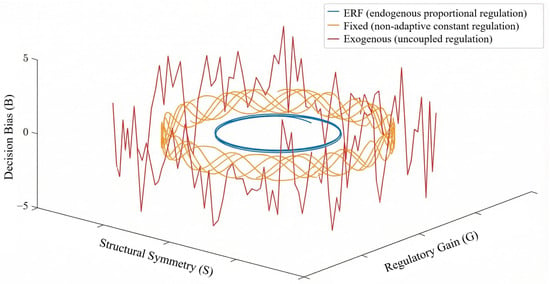
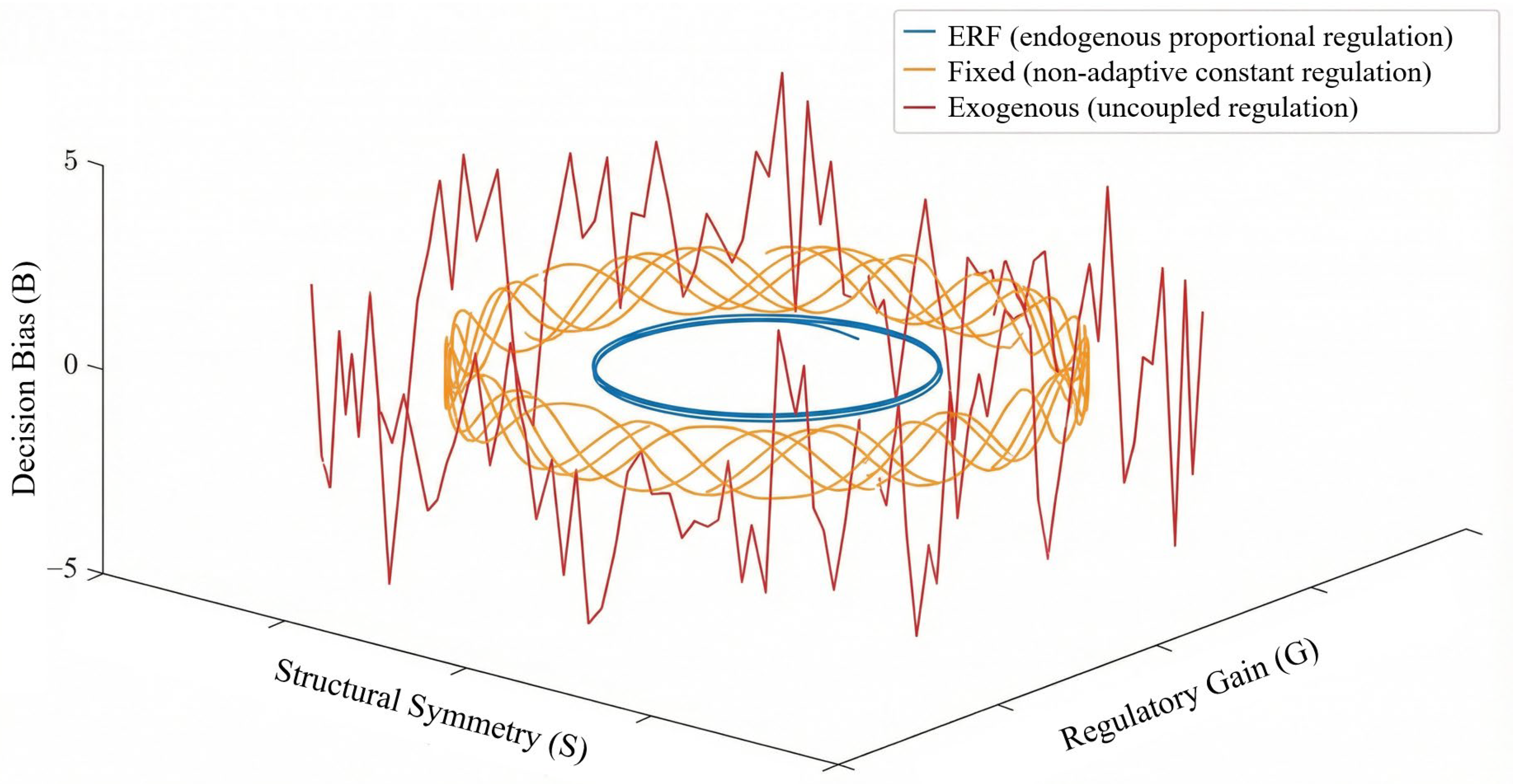
Figure 2 depicts system trajectories within a three-dimensional state space defined by decision bias, structural symmetry, and regulatory gain. Each trajectory traces the evolution of regulatory topology under repeated perturbation. Spatial curvature reveals how coupling structure shapes boundedness, dispersion, and attractor formation across alternative architectures.
Figure 2.
Three-dimensional state-space evolution across regulatory topologies.
Structural symmetry (S) reflects the degree of system coherence. Decision bias (B) captures state deviation. Regulatory gain (G) represents feedback intensity. Each trajectory represents the temporal evolution of system states under repeated perturbation. These trajectories demonstrate clear structural differentiation among architectures. Endogenous proportional coupling produces a compact oscillatory attractor. Fixed gain regulation generates broader loops with delayed contraction. Exogenous adjustment yields irregular expansion and weak geometric confinement. Three-dimensional representation reveals the topological basis of adaptive stability. This structure indicates that endogenous proportional coupling is necessary for maintaining bounded attractor dynamics under perturbation.
4.6. Robustness Analysis Under Alternative Conditions
To examine robustness, Monte Carlo simulations operate under stochastic perturbations across multiple runs. Parameter variation includes initial bias, structural symmetry, and regulatory gain. Results show consistent qualitative patterns across configurations, with endogenous proportional coupling producing bounded trajectories and rapid recovery.
Statistical analysis confirms strong differences across regulatory regimes. One-way ANOVA yields F-statistics of 327.62 for recovery interval and 854.98 for tail variance, and p-values fall below 10−50. Effect size estimates indicate large magnitude differences, and Cohen’s d exceeds 3.9 in all comparisons.
The proposed framework maintains a mean recovery interval near 1.01 and shows low dispersion, compared with 9.56 under fixed regulatory intensity and 47.29 under exogenous adjustment. Variance remains lower under endogenous coupling and indicates stable convergence dynamics.
These findings indicate that adaptive stability emerges from feedback topology rather than specific parameter choices. Robust results across stochastic realizations support the generality of the Evolutionary Regulation Framework.
5. Results
5.1. Structural Containment and Recovery Dynamics
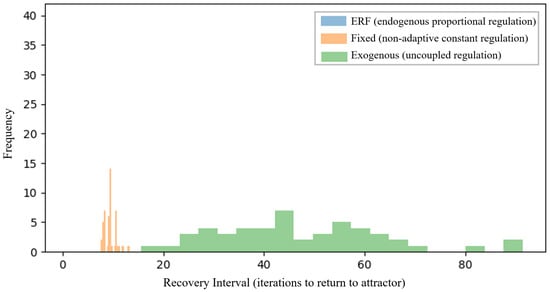
Monte Carlo evaluation across fifty independent runs examined structural recovery following periodic perturbation. Endogenous regulatory coupling produced rapid reentry into pre-shock attractor neighborhoods. The mean recovery interval for ERF was 1.01 iterations with a standard deviation of 0.03. Fixed regulatory intensity required 9.56 iterations on average, while exogenous adjustment required 47.29 iterations with greater dispersion.
One-way analysis of variance confirmed statistically significant differences across regulatory architectures for recovery interval, F = 327.62, p < 0.001. Pairwise effect sizes indicated very large separation between ERF and both comparison configurations. The magnitude of these effects demonstrates that proportional endogenous adjustment substantially shortens recovery horizon under repeated perturbation. This result indicates that regulatory architecture shapes the temporal structure of adjustment rather than producing marginal differences in recovery speed.
All configurations remained within bounded regions. Differences therefore arise from structural responsiveness rather than numerical instability. Endogenous coupling constrains divergence and restores coherence within minimal temporal intervals. This pattern indicates that adaptive stability arises from structural feedback alignment rather than numerical containment alone.
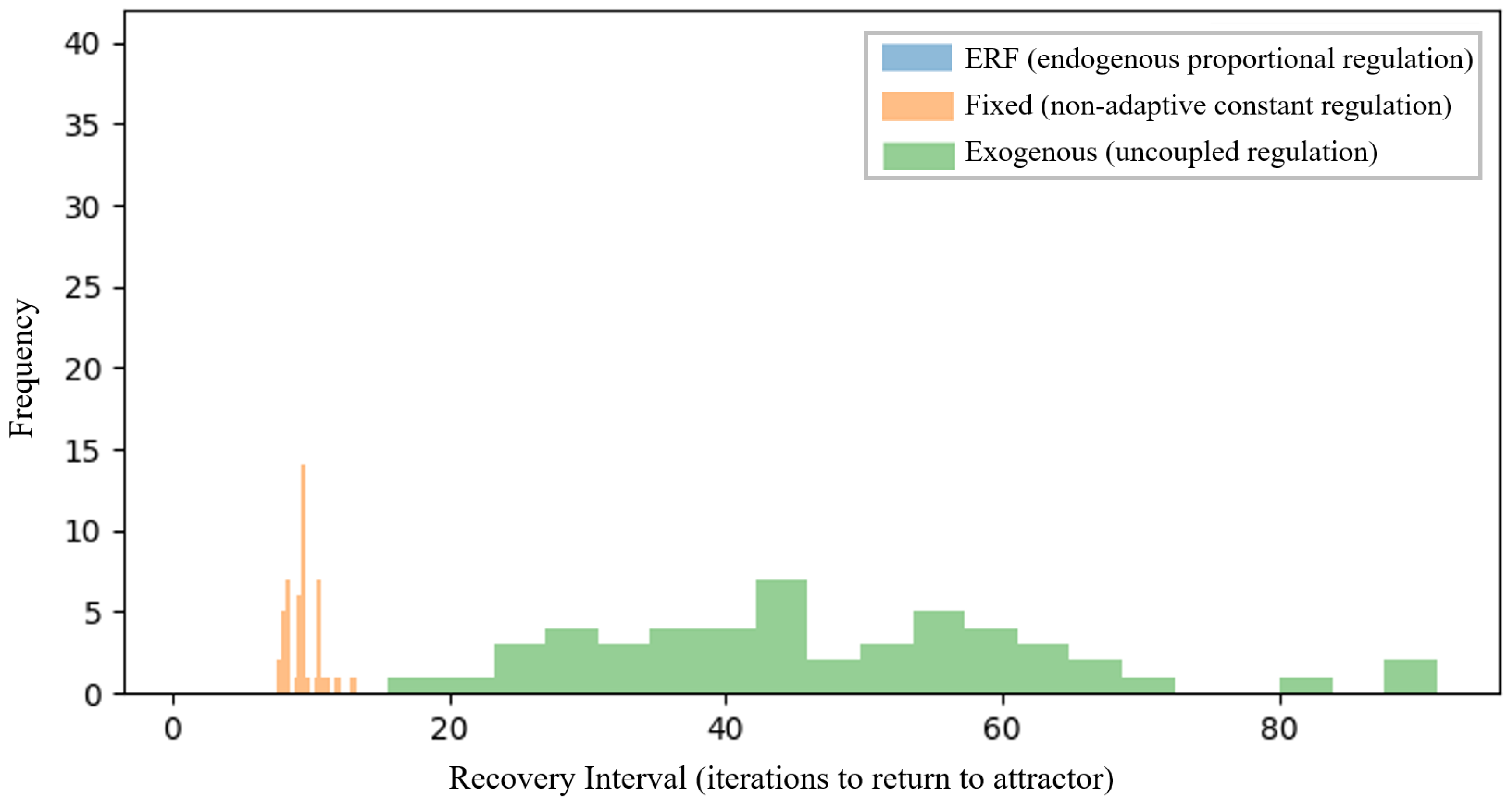
Monte Carlo realizations further clarify the distributional structure of recovery intervals across regulatory architectures. Figure 3 displays the empirical distribution of recovery horizon across fifty independent simulations. Distributional separation complements mean comparisons and reveals the consistency of endogenous proportional adjustment under stochastic perturbation.
Figure 3.
Recovery distribution.
Distribution of the Evolutionary Regulation Framework concentrates within a narrow interval close to unity, indicating minimal dispersion in recovery behavior. ERF observations are therefore compressed into a narrow region of the histogram, which reduces their visual prominence relative to other distributions. Fixed gain regulation exhibits moderate spread, while exogenous adjustment produces a wide skewed distribution. Absence of distributional overlap across the Evolutionary Regulation Framework and alternative architectures reinforces structural robustness of proportional coevolution. Distributional separation indicates that endogenous proportional coupling defines a distinct regime of system behavior rather than a variation within a common distribution. This pattern indicates that endogenous proportional regulation enables rapid and consistent recovery, whereas alternative architectures produce delayed and dispersed adjustment.
5.2. Proportional Feedback Coupling
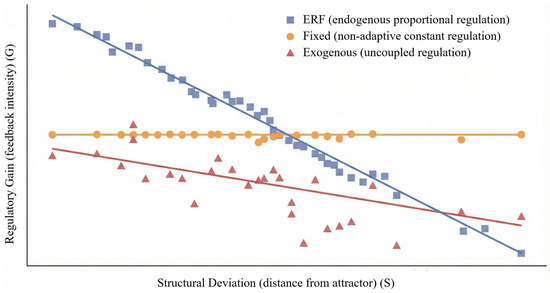
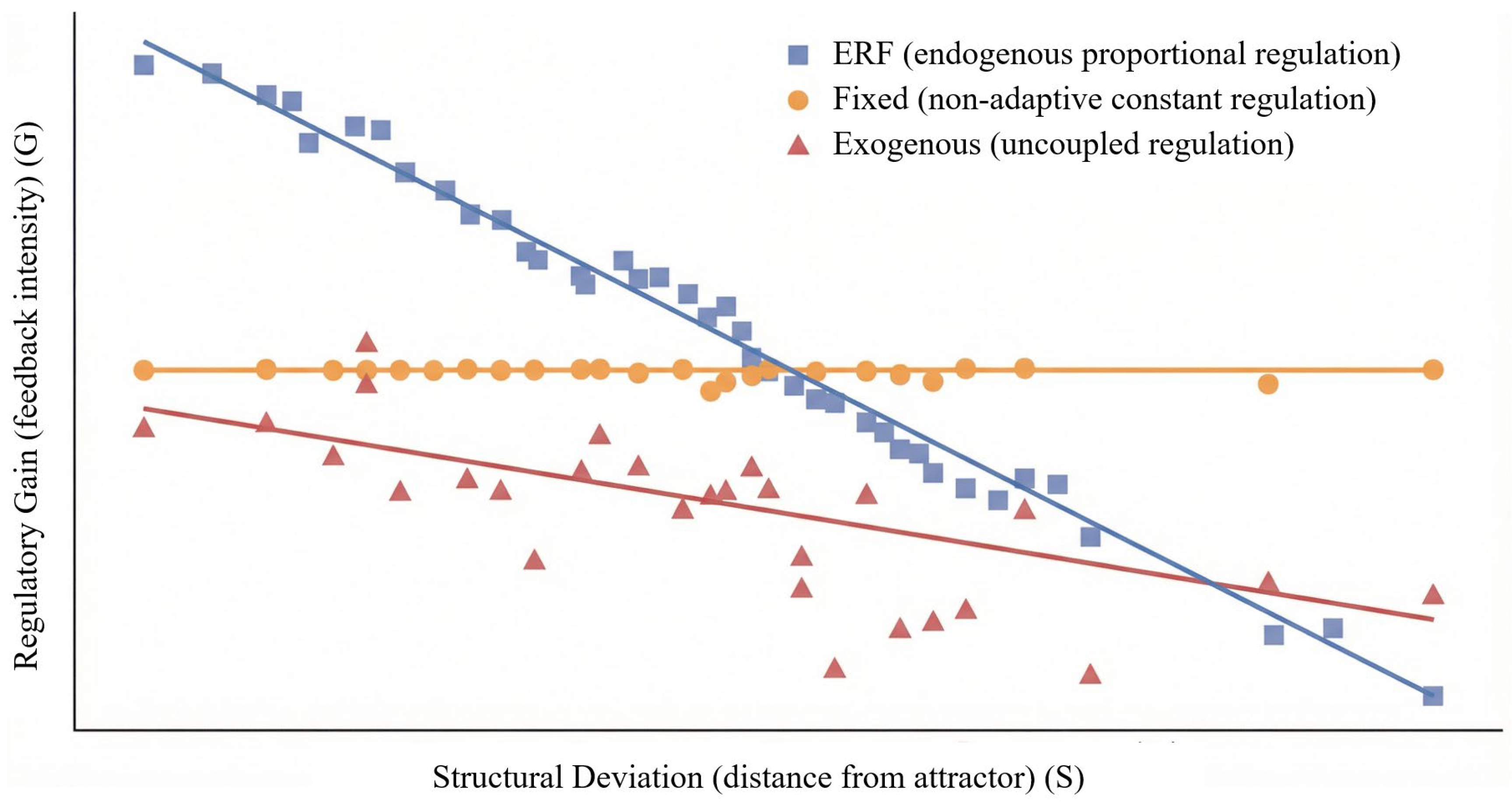
Correlation of symmetry deviation magnitude with regulatory gain quantified proportional feedback scaling. Figure 4 displays the relation of structural symmetry deviation to regulatory gain across regulatory architectures. Each point represents a state observation from Monte Carlo realizations. Geometric alignment of gain with deviation reveals whether proportional scaling governs feedback adjustment.
Figure 4.
Proportional feedback coupling across regulatory architectures.
Endogenous proportional coupling produces a clear negative linear relationship between deviation and gain. Fixed gain regulation shows no association and forms a horizontal pattern. Exogenous adjustment generates dispersion without consistent alignment. The scatter structure confirms that adaptive stability depends on proportional reciprocity rather than parameter variation alone. This relationship establishes proportional feedback as a structural mechanism that links deviation and regulatory response within the system. Proportional regulation maintains alignment of deviation and response, a condition required for adaptive stability.
ERF exhibited the strongest corrective association, with a mean correlation of −0.682 and a standard deviation of 0.020 across runs. Fixed gain displayed no systematic association. Exogenous adjustment produced a moderate but weaker correlation of −0.521.
The negative sign reflects corrective scaling, whereby increases in structural deviation induce compensatory regulatory adjustment. Strength and stability of this association across runs confirm that the Evolutionary Regulation Framework preserves endogenous proportional coupling under stochastic perturbation. Consistent correlation across realizations indicates that this mechanism operates as a stable property of the system rather than a sample-specific outcome.
Fixed regulation lacks adaptive scaling and therefore shows null covariance. Exogenous adjustment introduces temporal variability but does not maintain consistent proportional alignment with deviation magnitude.
5.3. Reorganizational Capacity and Variance Attenuation
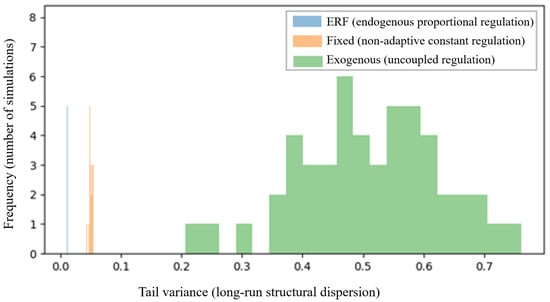
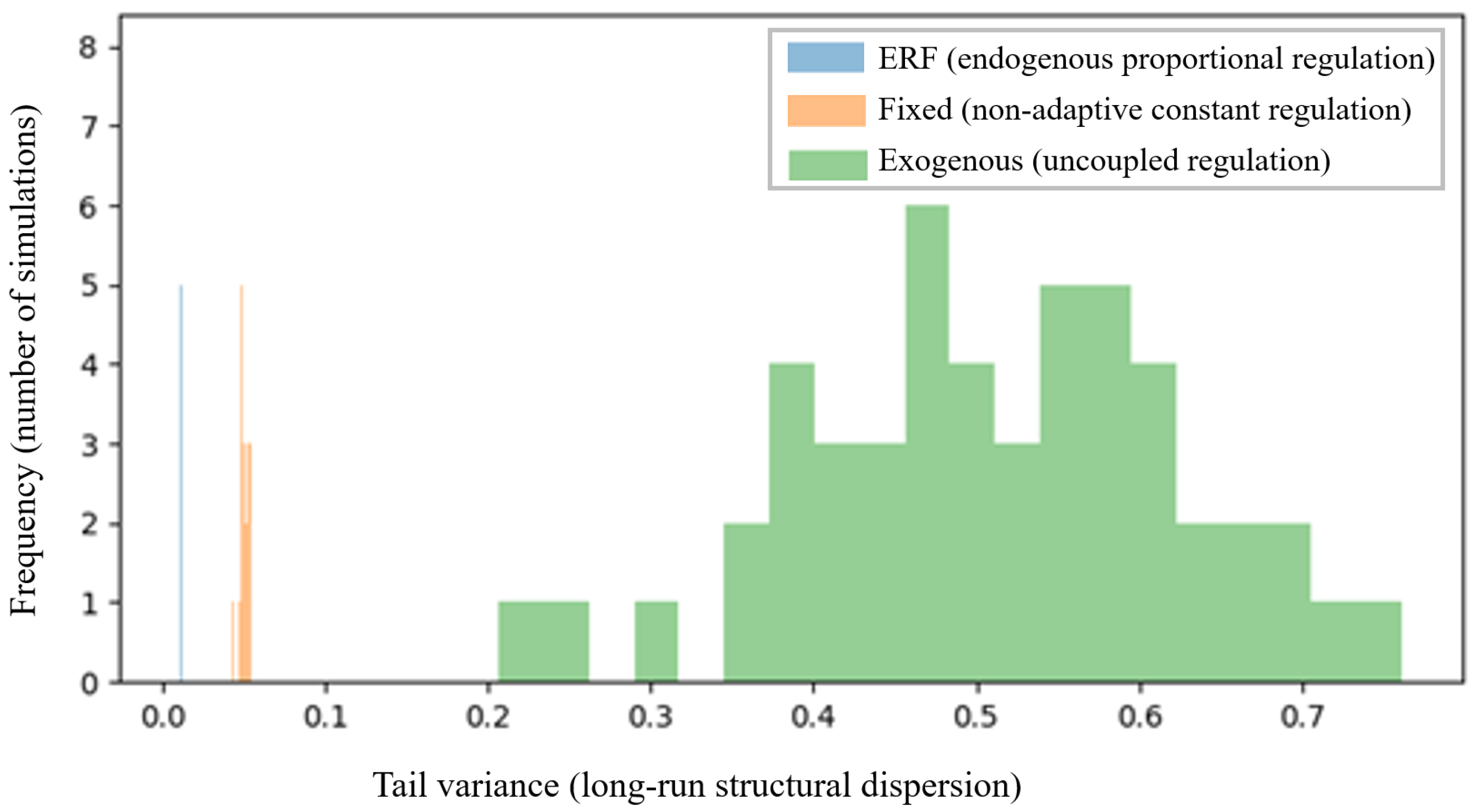
Tail variance of symmetry deviation assessed long-horizon structural dispersion. ERF converged toward a low-variance attractor; mean terminal variance equaled 0.0118. Fixed gain maintained moderate residual dispersion at 0.0502. Exogenous regulation accumulated substantial dispersion; mean variance reached 0.5100 with large stochastic spread.
Analysis of variance revealed significant architectural differences in tail variance (F = 854.98, p < 0.001). Effect sizes for ERF relative to comparison configurations were large in magnitude, indicating pronounced structural separation. These differences indicate that regulatory structure governs long-horizon dispersion rather than shifting variance at the margin.
These findings demonstrate that endogenous proportional coupling transforms disturbance into renewed bounded coherence. The result supports the interpretation that disturbance functions as an input to structural reorganization under proportional feedback. Fixed intensity constrains divergence but fails to minimize residual dispersion. Exogenous adjustment permits variance accumulation and weak structural reformation.
Long-horizon structural dispersion provides an additional dimension of adaptive stability. Figure 5 presents the empirical distribution of asymptotic tail variance across Monte Carlo realizations. Variance dispersion captures attractor tightness and long-run coherence under persistent perturbation.
Figure 5.
Tail variance distribution.
The Evolutionary Regulation Framework distribution remains compact at low variance levels, indicating stable attractor reformation across realizations. Fixed regulation retains moderate dispersion, whereas exogenous adjustment displays substantial spread and variance accumulation. These distributional patterns indicate that regulatory topology governs long-term structural organization. This confirms that long-run system behavior depends on feedback structure rather than parameter magnitude alone. Endogenous proportional regulation preserves long-run structural coherence, whereas uncoupled regulation leads to persistent dispersion.
Monte Carlo simulation evaluated structural differentiation across regulatory architectures under repeated periodic perturbation with stochastic environmental noise. Each configuration ran across fifty independent realizations. Structural indicators quantified recovery interval, proportional feedback coupling, and asymptotic variance. Table 4 reports mean values and standard deviations across runs. These indicators operationalize containment, endogenous reciprocity, and reorganizational capacity within evolving state-space dynamics.
Table 4.
Monte Carlo structural indicators across regulatory architectures (N = 50).
Results demonstrate consistent structural separation among regulatory architectures. Endogenous proportional coupling yields minimal recovery intervals and lowest asymptotic dispersion across realizations. Fixed gain regulation preserves boundedness yet exhibits slower reorganization and higher residual variance. Exogenous adjustment produces extended recovery horizons and substantial variance accumulation. These differences arise from regulatory topology rather than stochastic fluctuation. Significance therefore reflects structural differentiation across regulatory architectures rather than random variation across simulations. The findings support the proposition that adaptive stability depends on proportional coevolution of structural deviation and regulatory intensity. This connection links empirical regularities to the theoretical claim that adaptive stability emerges from endogenous coupling within the system.
5.4. Structural Interpretation of Regulatory Architectures
Adaptive stability requires coordinated containment, proportional reciprocity, and reorganizational capacity. Evolutionary Regulation Framework satisfies all three structural conditions across deterministic shocks and stochastic perturbations. Fixed regulatory intensity preserves boundedness but exhibits slower recovery and higher residual variance. Exogenous adjustment displays extended recovery intervals and substantial dispersion.
The three empirical indicators characterize structural consequences of alternative regulatory architectures. Recovery interval captures temporal responsiveness of regulatory adjustment following perturbation. Coupling correlation measures proportional alignment of regulatory gain with symmetry deviation. Tail variance evaluates long-horizon containment of structural dispersion. Joint evaluation across these indicators reveals whether regulatory feedback constrains divergence while preserving adaptive reorganization.
The Evolutionary Regulation Framework exhibits consistent performance across all structural dimensions. Rapid recovery indicates effective containment of perturbation-induced deviation. Strong coupling correlation confirms proportional feedback scaling. Low tail variance demonstrates sustained attractor reformation under repeated disturbance. Fixed gain regulation preserves bounded trajectories, yet lacks sufficient responsiveness for rapid structural reorganization. Exogenous adjustment removes proportional linkage and permits progressive dispersion across realizations.
Structural differentiation persists across repeated stochastic realizations. Regulatory topology, rather than parameter magnitude alone, determines system-level resilience under disturbance. Endogenous proportional coupling constitutes a necessary structural mechanism for adaptive stability in evolving state-space dynamics. This interpretation connects statistical evidence with the theoretical requirement that stability depends on coordinated adjustment across structural dimensions.
Business development environments provide a practical context for interpreting these structural indicators. Strategic initiatives such as market entry, technological collaboration, and alliance formation introduce structural asymmetry into organizational decision systems. The recovery interval corresponds to the speed with which governance mechanisms restore strategic alignment following such disturbances. Short recovery intervals indicate regulatory architectures capable of rapid strategic realignment.
Coupling correlation reflects the degree to which governance responses scale with the magnitude of strategic deviation. High correlation indicates proportional adjustment of regulatory intensity as organizational configurations diverge from prior equilibrium. Such proportional responsiveness allows firms to maintain coordination across strategic initiatives while preserving exploratory adaptation.
Tail variance captures long-horizon structural dispersion in decision trajectories. Low asymptotic variance indicates reformation of coherent strategic configurations after repeated disturbance, whereas persistent variance growth signals fragmentation of strategic direction. Combined evidence indicates that proportional regulatory coupling functions as a governance principle that enables organizations to convert disruption into coordinated strategic reorganization in complex business development systems.
5.5. Illustrative Application in Business Development Contexts
Expansion into new markets under sustainability requirements raises compliance costs, delays project approval, and reshapes the feasible set of opportunities. A typical case arises in digital transformation initiatives, where firms adopt data platforms, automation systems, or AI-enabled processes under regulatory and sustainability constraints. These changes increase decision bias by misaligning strategic intent and resource allocation under constraint. Structural symmetry weakens across functions such as product development and marketing. Projects with marginal expected return fail to pass internal investment screening, leading to contraction of the opportunity set.
Governance response takes the form of adjustments in decision and control processes. In digital transformation settings, this response may include staged deployment of digital infrastructure, real-time performance dashboards, and iterative project evaluation. Firms tighten capital budgeting rules, shorten review cycles, or introduce stage-gate evaluation to reassess projects under updated conditions. These actions reduce decision bias and restore structural symmetry through coordinated adjustment across organizational units. Resource reallocation shifts funding from high-uncertainty initiatives to projects with sustainability alignment. Performance monitoring intensifies through reporting and feedback loops and enables detection of deviation from strategic targets. Regulatory gain responds to structural deviation.
Adjustment occurs on the value side. Firms redesign products to meet sustainability standards, renegotiate supplier contracts, or use green certification to enhance market value. These actions improve the expected return of selected opportunities and offset the increase in cost. The adjustment modifies the value dimension of the opportunity set and supports restoration of structural symmetry.
When governance response scales with the magnitude of constraint, coordination across functions improves, and viable projects remain within the feasible set. This condition reflects proportional coupling of structural deviation and regulatory adjustment, which produces bounded trajectories and recovery patterns observed in the simulation results. Insufficient adjustment leads to persistent misalignment and contraction of the opportunity set, consistent with increased recovery interval and higher tail variance under alternative regulatory configurations. The application shows how governance actions operationalize the model’s mechanisms in business development contexts.
6. Discussion
6.1. Regulatory Architecture and Adaptive Stability
The results demonstrate that adaptive stability emerges from regulatory topology rather than parameter magnitude alone. Endogenous proportional coupling of structural deviation and regulatory intensity yields rapid recovery, strong corrective alignment, and minimal long-horizon dispersion. Alternative configurations preserve boundedness yet fail to sustain equivalent reorganizational coherence. Fixed gain regulation lacks scaling capacity, while exogenous adjustment introduces stochastic variability without consistent proportional alignment.
These findings indicate that adaptive stability requires structural reciprocity of deviation and regulation. Stability arises through transformation of disturbance into reorganized coherence. Proportional coevolution converts asymmetry into renewed structural balance while preserving exploratory variation.
6.2. Symmetry Evolution as Endogenous Governance
Symmetry deviation functions as a structural signal rather than a defect. Regulatory intensity interprets this signal through proportional scaling. The resulting feedback loop constitutes an endogenous governance mechanism embedded within state-space dynamics. Governance resides in coupling topology rather than external intervention.
Fixed gain architectures impose static control. Exogenous regulation introduces adjustment without structural reference. Neither configuration embeds governance within deviation itself. In contrast, proportional coevolution links structural asymmetry with regulatory modulation. This linkage forms a self-regulating architecture capable of sustained adaptation under recurrent perturbation.
Simulation results indicate that governance strength corresponds to the structural integrity of proportional coupling. Weak reciprocity yields extended recovery and growing dispersion. Strong reciprocity restores attractor coherence within a narrow adjustment horizon.
6.3. Structural Resilience and Attractor Reformation
Resilience in complex adaptive systems extends beyond numerical boundedness. Structural resilience requires preservation of attractor architecture under disturbance. Monte Carlo evaluation shows that endogenous regulatory coupling maintains tight attractor manifolds across stochastic realizations. Variance attenuation indicates structural reformation rather than drift toward fragmentation.
Exogenous adjustment permits variance accumulation and prolonged deviation from pre-shock configurations. Fixed gain control maintains bounded trajectories yet yields slower reorganization and residual dispersion. These distinctions indicate that resilience depends on dynamic reciprocity instead of static constraint.
Attractor persistence emerges as a property of regulatory proportionality. Deviation magnitude determines regulatory intensity, and structural coherence reforms with minimal temporal cost.
6.4. Theoretical Implications for Complex Adaptive Systems
The findings extend symmetry-based modeling into the domain of regulatory topology. Prior approaches treat symmetry as descriptive structure and regulation as corrective intervention. The present framework integrates these dimensions within a unified state-space formulation. Symmetry deviation and regulatory gain co-evolve through reciprocal adjustment, forming a closed feedback architecture.
This formulation reframes business development as a dynamic process of structural asymmetry and proportional correction. Instability reflects temporary imbalance rather than systemic breakdown. Adaptive stability arises when regulatory gain scales with structural deviation across temporal iterations.
The results support a systems-theoretic perspective where structural intelligence resides in feedback design. Stability requires no convergence to equilibrium. Bounded oscillatory reorganization within evolving attractor manifolds sustains systemic coherence.
6.5. Limitations and Future Directions
The present model relies on discrete-time formalization and simplified state variables. Real organizational systems contain higher-dimensional interaction structures and heterogeneous decision components. Parameter exploration remains constrained to periodic perturbation with moderate stochastic noise.
Future research may extend the framework to continuous-time formulations, multi-agent interaction networks, or empirical calibration using organizational performance data. Additional investigation into nonlinear saturation functions and adaptive gain thresholds may refine understanding of phase transitions within regulatory topology.
Despite these limitations, the structural differentiation observed across architectures demonstrates that proportional endogenous regulation constitutes a necessary condition for adaptive stability in evolving systems.
Additional robustness analyses appear in the Supplementary Materials.
7. Conclusions
This study develops a systems-theoretic framework for understanding adaptive stability in complex business environments through coevolution of structural symmetry and regulatory intensity. Instead of interpreting instability as failure or regulation as external correction, the framework conceptualizes asymmetry and regulation as reciprocally coupled dimensions within evolving state-space dynamics. Adaptive stability emerges when regulatory gain scales in proportion to structural deviation, enabling disturbance to reorganize into renewed coherence rather than accumulate into divergence.
Computational evaluation demonstrates consistent structural differentiation across regulatory architectures. Endogenous proportional coupling yields rapid recovery, strong corrective alignment, and low asymptotic dispersion under repeated perturbation with stochastic noise. Fixed gain regulation preserves boundedness yet produces slower reorganization and residual variance. Exogenous adjustment exhibits extended recovery intervals and substantial variance accumulation. Statistical analysis confirms that these differences arise from regulatory topology rather than stochastic fluctuation. The results support the proposition that proportional coevolution constitutes a necessary structural condition for resilient adaptation.
The findings contribute to systems research by integrating symmetry evolution, regulatory feedback, and attractor dynamics within a unified formalization. Stability requires no convergence to a static equilibrium. Bounded reorganization within dynamic attractor manifolds sustained through endogenous reciprocity preserves systemic coherence. Structural intelligence resides in feedback architecture. Governance emerges as a property of proportional coupling embedded in system dynamics.
This perspective reframes business development as an adaptive process governed by internal regulatory topology. Instability reflects transient asymmetry within evolving configurations. When regulation remains proportionate to deviation, structural coherence reforms with minimal temporal cost. The framework therefore offers a foundation for analyzing resilience, adaptation, and systemic transformation across complex organizational contexts.
Supplementary Materials
Supplementary Materials include the Python 3.13 simulation code and additional simulation outputs used in the analysis. The following supporting information can be downloaded at: https://www.mdpi.com/article/10.3390/systems14040436/s1. Code S1: Supplementary_Code_ERF_MonteCarlo; Table S1. MonteCarlo_ANOVA; Table S2. MonteCarlo_EffectSizes; Table S3. MonteCarlo_Raw_Noise; Table S4. MonteCarlo_Summary_Noise.
Funding
This research received no funding.
Data Availability Statement
The original contributions presented in this study are included in the article/Supplementary Materials. Further inquiries can be directed to the corresponding author.
Acknowledgments
The author acknowledges the valuable feedback that contributed to the improvement of this manuscript.
Conflicts of Interest
The author declares no conflicts of interest.
Abbreviations
The following abbreviations are used in this manuscript:
| ERF | Evolutionary Regulation Framework |
Appendix A. Formal Model Specification
The system is modeled as a discrete-time nonlinear dynamical process defined over three interdependent state variables: bias , structural symmetry deviation , and regulatory gain . The evolution of the system is governed by the following recursive equations:
where
- denotes regulatory scaling sensitivity;
- denotes regulatory damping;
- denotes bias propagation intensity;
- denotes bias damping;
- represents environmental stochastic disturbance.
Periodic structural perturbation is introduced at discrete intervals through:
where denotes shock interval and denotes shock magnitude.
Stability is defined as persistence of trajectories within bounded attractor manifolds rather than convergence to a fixed point. The nonlinear saturation function ensures state-space boundedness under recursive evolution.
Appendix B. Structural Indicator Definitions
Three structural indicators operationalize adaptive stability.
Appendix B.1. Recovery Interval
Recovery interval measures the mean number of iterations required for symmetry deviation to return to the pre-shock attractor neighborhood.
Let denote the onset of shock . Define the pre-shock mean:
Recovery for shock is:
Overall recovery interval:
where denotes pre-shock window size and denotes tolerance threshold.
Appendix B.2. Proportional Feedback Coupling
Proportional coupling is measured by Pearson correlation between absolute symmetry deviation and regulatory gain:
Negative correlation indicates corrective proportional alignment, where increases in deviation induce compensatory regulatory response.
Appendix B.3. Tail Variance
Tail variance evaluates asymptotic structural dispersion:
where denotes the terminal observation window. Lower variance indicates tighter attractor reformation.
Appendix C. Symbol Table
| Symbol | Definition |
| Bias at time | |
| Structural symmetry deviation at time | |
| Regulatory gain at time | |
| Regulatory scaling coefficient | |
| Regulatory damping coefficient | |
| Bias propagation coefficient | |
| Bias damping coefficient | |
| Stochastic disturbance term | |
| Shock interval | |
| Shock magnitude | |
| Pre-shock averaging window | |
| Recovery tolerance threshold | |
| Tail variance evaluation window |
References
- Liu, Y.; Deng, P.; Wei, J.; Ying, Y.; Tian, M. International R&D alliances and innovation for emerging market multinationals: Roles of environmental turbulence and knowledge transfer. J. Bus. Ind. Mark. 2019, 34, 1374–1387. [Google Scholar] [CrossRef] [Scilit]
- Marillo, C.; Freeman, B.; Espanha, A.; Watson, J.; Viphindrat, B. Strategies for competence development in dynamic business landscapes. Interconnect. Econ. Perspect. Horiz. 2024, 1, 233–241. [Google Scholar] [CrossRef] [Scilit]
- Kim, Y. Optimal timing strategies in the evolutionary dynamics of competitive supply chains. Systems 2024, 12, 114. [Google Scholar] [CrossRef] [Scilit]
- Frynas, J.G.; Mol, M.J.; Mellahi, K. Management innovation made in China: Haier’s Rendanheyi. Calif. Manag. Rev. 2018, 61, 71–93. [Google Scholar] [CrossRef] [Scilit]
- Hajiyev, N.; Abdullayeva, S.; Abdullayeva, E. Financial stability strategies for oil companies amidst high volatility in the global oil products market. Energy Strategy Rev. 2024, 53, 101377. [Google Scholar] [CrossRef] [Scilit]
- Swaroop, D.; Hedrick, J.K. String stability of interconnected systems. IEEE Trans. Autom. Control 1996, 41, 349–357. [Google Scholar] [CrossRef] [Scilit]
- Sampson, J.R. Adaptation in natural and artificial systems (John H. Holland). Math. Gaz. 1976, 60, 292–293. [Google Scholar] [CrossRef] [Scilit]
- Arthur, W.B. The Nature of Technology: What It Is and How It Evolves; Free Press: New York, NY, USA, 2009. [Google Scholar]
- Gintis, H. The Origin of Wealth: Evolution, Complexity, and the Radical Remaking of Economics; Beinhocker, E.D., Ed.; American Economic Association: Nashville, TN, USA, 2006; Volume 44, pp. 1018–1031. Available online: http://www.jstor.org/stable/30032395 (accessed on 10 March 2026).
- Anderson, P.W. Complexity theory and organization science. Organ. Sci. 1999, 10, 216–232. [Google Scholar] [CrossRef] [Scilit]
- Ashby, W.R. An Introduction to Cybernetics; Chapman & Hall: London, UK, 1956. [Google Scholar]
- Mitchell, M. Complexity: A Guided Tour; Oxford University Press: Oxford, UK, 2009. [Google Scholar]
- Levinthal, D.A.; March, J.G. The myopia of learning. Strateg. Manag. J. 1993, 14, 95–112. [Google Scholar] [CrossRef] [Scilit]
- March, J.G. Exploration and exploitation in organizational learning. Organ. Sci. 1991, 2, 71–87. [Google Scholar] [CrossRef] [Scilit]
- Teece, D.J.; Pisano, G.; Shuen, A. Dynamic capabilities and strategic management. Strateg. Manag. J. 1997, 18, 509–533. [Google Scholar] [CrossRef] [Scilit]
- Eisenhardt, K.M.; Martin, J.A. Dynamic capabilities: What are they? In The SMS Blackwell Handbook of Organizational Capabilities; Helfat, C.E., Ed.; Blackwell Publishing: Malden, MA, USA, 2006; pp. 341–358. [Google Scholar] [CrossRef] [Scilit]
- Winter, S.G. Understanding dynamic capabilities. Strateg. Manag. J. 2003, 24, 991–995. [Google Scholar] [CrossRef] [Scilit]
- Kennedy, J.; Eberhart, R. Particle swarm optimization. In Proceedings of the IEEE International Conference on Neural Networks (ICNN’95); IEEE: Perth, Australia, 1995; Volume 4, pp. 1942–1948. [Google Scholar] [CrossRef] [Scilit]
- Eiben, Á.E.; Hinterding, R.; Michalewicz, Z. Parameter control in evolutionary algorithms. IEEE Trans. Evol. Comput. 1999, 3, 124–141. [Google Scholar] [CrossRef] [Scilit]
- Sutton, R.S.; Barto, A.G. Reinforcement Learning: An Introduction; MIT Press: Cambridge, MA, USA, 1998. [Google Scholar]
- Åström, K.J. Adaptive control. In Mathematical System Theory: The Influence of R.E. Kalman; Willems, J.C., Byrnes, C.I., Eds.; Springer: Berlin/Heidelberg, Germany, 1995; pp. 437–450. [Google Scholar] [CrossRef] [Scilit]
- Roy, R.; Sidhu, K.; Byczynski, G.; D’Angiulli, A.; Dresp-Langley, B. The precision principle: Driving biological self-organization. Front. Netw. Physiol. 2025, 5, 1678473. [Google Scholar] [CrossRef] [Scilit]
- Daniel, D. Optimized to death: The hypernetic law of experience. Systems 2026, 14, 197. [Google Scholar] [CrossRef] [Scilit]
- Eriksson, L.J. How technology evolves. Complexity 1997, 2, 23–30. [Google Scholar] [CrossRef] [Scilit]
- Prigogine, I.; Stengers, I. Order Out of Chaos: Man’s New Dialogue with Nature; Verso Books: London, UK, 2018. [Google Scholar]
- Nghe, P.; de Vos, M.G.; Kingma, E.; Kogenaru, M.; Poelwijk, F.J.; Laan, L.; Tans, S.J. Predicting evolution using regulatory architecture. Annu. Rev. Biophys. 2020, 49, 181–197. [Google Scholar] [CrossRef] [Scilit]
- Kordzadeh, N.; Ghasemaghaei, M. Algorithmic bias: Review, synthesis, and future research directions. Eur. J. Inf. Syst. 2022, 31, 388–409. [Google Scholar] [CrossRef] [Scilit]
- Ulbricht, L.; Yeung, K. Algorithmic regulation: A maturing concept for investigating regulation of and through algorithms. Regul. Gov. 2022, 16, 3–22. [Google Scholar] [CrossRef] [Scilit]
- Levinthal, D.A. Adaptation on rugged landscapes. Manag. Sci. 1997, 43, 934–950. [Google Scholar] [CrossRef] [Scilit]
- Davis, J.P.; Eisenhardt, K.M.; Bingham, C.B. Developing theory through simulation methods. Acad. Manag. Rev. 2007, 32, 480–499. [Google Scholar] [CrossRef] [Scilit]
- Fraccascia, L.; Giannoccaro, I.; Albino, V. Resilience of complex systems: State of the art and directions for future research. Complexity 2018, 2018, 3421529. [Google Scholar] [CrossRef] [Scilit]
- Liu, J.; Tong, T.W.; Sinfield, J.V. Toward a resilient complex adaptive system view of business models. Long Range Plan. 2021, 54, 102030. [Google Scholar] [CrossRef] [Scilit]
- Akpinar, H.; Özer-Çaylan, D. Achieving organizational resilience through complex adaptive systems approach: A conceptual framework. Manag. Res. J. Iberoam. Acad. Manag. 2022, 20, 289–309. [Google Scholar] [CrossRef] [Scilit]
- Mainzer, K. Symmetry and complexity in dynamical systems. Eur. Rev. 2005, 13, 29–48. [Google Scholar] [CrossRef] [Scilit]
- Strogatz, S.H. Nonlinear Dynamics and Chaos: With Applications to Physics, Biology, Chemistry, and Engineering; Westview Press: Boulder, CO, USA, 2001. [Google Scholar]
- Abraham, F.D. Nonlinear coherence in multivariate research: Invariants and the reconstruction of attractors. Nonlinear Dyn. Psychol. Life Sci. 1997, 1, 7–33. [Google Scholar] [CrossRef] [Scilit]
- Stewart, I. Symmetry-breaking cascades and the dynamics of morphogenesis and behaviour. Sci. Prog. 1999, 82, 9–48. [Google Scholar] [CrossRef] [Scilit]
- Ebbesson, J. The rule of law in governance of complex socio-ecological changes. Glob. Environ. Change 2010, 20, 414–422. [Google Scholar] [CrossRef] [Scilit]
- Luscombe, N.M.; Madan Babu, M.; Yu, H.; Snyder, M.; Teichmann, S.A.; Gerstein, M. Genomic analysis of regulatory network dynamics reveals large topological changes. Nature 2004, 431, 308–312. [Google Scholar] [CrossRef] [Scilit]
- Demongeot, J.; Aracena, J.; Lamine, S.B.; Meignen, S.; Tonnelier, A.; Thomas, R. Dynamical systems and biological regulations. In Complex Systems; Springer: Dordrecht, The Netherlands, 2001; pp. 105–149. [Google Scholar] [CrossRef] [Scilit]
- Schmeck, H.; Müller-Schloer, C.; Çakar, E.; Mnif, M.; Richter, U. Adaptivity and self-organization in organic computing systems. ACM Trans. Auton. Adapt. Syst. 2010, 5, 1–32. [Google Scholar] [CrossRef] [Scilit]
- Tournier, M.; Nesme, M.; Gilles, B.; Faure, F. Stable constrained dynamics. ACM Trans. Graph. 2015, 34, 1–10. [Google Scholar] [CrossRef] [Scilit]
- Heylighen, F. The science of self-organization and adaptivity. In The Encyclopedia of Life Support Systems; UNESCO: Paris, France, 1999. [Google Scholar]
- Mahdavi-Hezavehi, S.; Avgeriou, P.; Weyns, D. A classification framework of uncertainty in architecture-based self-adaptive systems with multiple quality requirements. In Managing Trade-Offs in Adaptable Software Architectures; Morgan Kaufmann: Cambridge, MA, USA, 2017; pp. 45–77. [Google Scholar] [CrossRef] [Scilit]
- Hutt, A. Synergetics: An introduction. In Synergetics; Springer: New York, NY, USA, 2020; pp. 1–3. [Google Scholar] [CrossRef] [Scilit]
- Prigogine, I.; Nicolis, G. Self-organisation in nonequilibrium systems: Toward a dynamics of complexity. In Bifurcation Analysis; Springer: Dordrecht, The Netherlands, 1985; pp. 3–12. [Google Scholar] [CrossRef] [Scilit]
- Ogata, K.; Brewer, J.W. Modern control engineering. J. Dyn. Syst. Meas. Control 1971, 93, 63. [Google Scholar] [CrossRef] [Scilit]
- Haken, H. Introduction to synergetics. In Synergetics: Cooperative Phenomena in Multi-Component Systems; Vieweg+Teubner: Wiesbaden, Germany, 1973; pp. 9–19. [Google Scholar] [CrossRef] [Scilit]
- Kelso, J.S. Dynamic Patterns: The Self-Organization of Brain and Behavior; MIT Press: Cambridge, MA, USA, 1995. [Google Scholar]
- Khalil, H.K.; Grizzle, J.W. Nonlinear Systems, 3rd ed.; Prentice Hall: Upper Saddle River, NJ, USA, 2002. [Google Scholar]
- Åström, K.J.; Murray, R.M. Feedback Systems: An Introduction for Scientists and Engineers; Princeton University Press: Princeton, NJ, USA, 2021. [Google Scholar]
- Slotine, J.J.E.; Li, W. Applied Nonlinear Control; Prentice Hall: Englewood Cliffs, NJ, USA, 1991. [Google Scholar]
- Hutter, M.; Gehring, C.; Jud, D.; Lauber, A.; Bellicoso, C.D.; Tsounis, V.; Hwangbo, J.; Bodie, K.; Fankhauser, P.; Hoepflinger, M. ANYmal—A highly mobile and dynamic quadrupedal robot. In Proceedings of the IEEE/RSJ International Conference on Intelligent Robots and Systems (IROS); IEEE: Daejeon, Korea, 2016; pp. 38–44. [Google Scholar] [CrossRef] [Scilit]
- Sastry, S.; Bodson, M. Adaptive Control: Stability, Convergence and Robustness; Courier Corporation: Mineola, NY, USA, 2011. [Google Scholar]
- Holland, J.H. Adaptation in Natural and Artificial Systems: An Introductory Analysis with Applications to Biology, Control, and Artificial Intelligence; MIT Press: Cambridge, MA, USA, 1992. [Google Scholar]
- Bäck, T.; Fogel, D.B.; Michalewicz, Z. Handbook of Evolutionary Computation; IOP Publishing: Bristol, UK, 1997. [Google Scholar]
- Storn, R.; Price, K. Differential evolution—A simple and efficient heuristic for global optimization over continuous spaces. J. Glob. Optim. 1997, 11, 341–359. [Google Scholar] [CrossRef] [Scilit]
- Shrimali, M.D.; Prasad, A.; Ramaswamy, R.; Feudel, U. The nature of attractor basins in multistable systems. Int. J. Bifurc. Chaos 2008, 18, 1675–1688. [Google Scholar] [CrossRef] [Scilit]
- Aleti, A.; Moser, I. A systematic literature review of adaptive parameter control methods for evolutionary algorithms. ACM Comput. Surv. 2016, 49, 1–35. [Google Scholar] [CrossRef] [Scilit]
- Eiben, A.E.; Michalewicz, Z.; Schoenauer, M.; Smith, J.E. Parameter control in evolutionary algorithms. In Parameter Setting in Evolutionary Algorithms; Springer: Berlin/Heidelberg, Germany, 2007; pp. 19–46. [Google Scholar] [CrossRef] [Scilit]
- Karafotias, G.; Hoogendoorn, M.; Eiben, Á.E. Parameter control in evolutionary algorithms: Trends and challenges. IEEE Trans. Evol. Comput. 2014, 19, 167–187. [Google Scholar] [CrossRef] [Scilit]
- Bäck, T. An overview of parameter control methods by self-adaptation in evolutionary algorithms. Fundam. Inform. 1998, 35, 51–66. [Google Scholar] [CrossRef] [Scilit]
- Auger, A.; Hansen, N. A restart CMA evolution strategy with increasing population size. In Proceedings of the IEEE Congress on Evolutionary Computation (CEC); IEEE: Edinburgh, UK, 2005; pp. 1769–1776. [Google Scholar] [CrossRef] [Scilit]
- Doerr, B.; Doerr, C. Theory of parameter control for discrete black-box optimization: Provable performance gains through dynamic parameter choices. In Theory of Evolutionary Computation: Recent Developments in Discrete Optimization; Springer: Cham, Switzerland, 2019; pp. 271–321. [Google Scholar] [CrossRef] [Scilit]
- Zelinka, I.; Senkerik, R. Chaotic attractors of discrete dynamical systems used in the core of evolutionary algorithms: State of art and perspectives. In Recent Improvements in the Theory of Chaotic Attractors; Springer: Cham, Switzerland, 2025; pp. 80–105. [Google Scholar]
- Arthur, W.B. Complexity and the Economy; Oxford University Press: Oxford, UK, 2014. [Google Scholar]
- Beinhocker, E.D. The Origin of Wealth: Evolution, Complexity, and the Radical Remaking of Economics; Random House: Boston, MA, USA, 2007. [Google Scholar]
- Nelson, R.R.; Winter, S.G. An Evolutionary Theory of Economic Change; Harvard University Press: Cambridge, MA, USA, 1985. [Google Scholar]
- Teece, D.J. Explicating dynamic capabilities: The nature and microfoundations of sustainable enterprise performance. Strateg. Manag. J. 2007, 28, 1319–1350. [Google Scholar] [CrossRef] [Scilit]
- Mainzer, K. Thinking in Complexity: The Computational Dynamics of Matter, Mind, and Mankind; Springer: Berlin/Heidelberg, Germany, 2007. [Google Scholar]
- Girod, S.J.; Whittington, R. Change escalation processes and complex adaptive systems: From incremental reconfigurations to discontinuous restructuring. Organ. Sci. 2015, 26, 1520–1535. [Google Scholar] [CrossRef] [Scilit]
- Rivkin, J.W. Imitation of complex strategies. Manag. Sci. 2000, 46, 824–844. [Google Scholar] [CrossRef] [Scilit]
- Mol, A.; Law, J. Complexities: An introduction. In Complexities: Social Studies of Knowledge Practices; Duke University Press: Durham, NC, USA, 2002; pp. 1–22. [Google Scholar]
- Liu, Z.; Lu, J.; Xuan, J.; Zhang, G. Learning latent and changing dynamics in real non-stationary environments. IEEE Trans. Knowl. Data Eng. 2025, 37, 1930–1942. [Google Scholar] [CrossRef] [Scilit]

Disclaimer/Publisher’s Note: The statements, opinions and data contained in all publications are solely those of the individual author(s) and contributor(s) and not of MDPI and/or the editor(s). MDPI and/or the editor(s) disclaim responsibility for any injury to people or property resulting from any ideas, methods, instructions or products referred to in the content. |
© 2026 by the author. Licensee MDPI, Basel, Switzerland. This article is an open access article distributed under the terms and conditions of the Creative Commons Attribution (CC BY) license.