


Abstract
The deep integration of the digital and real economies is a critical force reshaping the global economic landscape. At the same time, new high-quality productive forces that are distinguished by their high level of efficiency, quality, and technology mark a new phase in productivity evolution. Understanding the spatial interplay between these two phenomena is crucial for coordinated development. This study empirically investigates their bidirectional relationship and spatial spillover effects. With panel data from 30 provinces in China (2011–2022), we use the Generalized Spatial Three-Stage Least Squares (GS3SLS) approach to estimate a spatial simultaneous equations model. The results reveal a significant bidirectional positive correlation, with the promotional effect of digital–real integration on new quality productive forces being slightly stronger. However, we also identify significantly negative spatial spillover effects between them. These findings underscore the necessity of strengthening their interactive development, fostering interregional cooperation, and optimizing source allocation to alleviate adverse spillovers. This study systematically examines their spatial dynamics and proposes policy recommendations to foster the coordinated advancement of both digital–real integration and New Quality Productive Forces.
1. Introduction
The Fourth Industrial Revolution, driven by AI, Big Data, Blockchain, and Cloud Computing, is fundamentally reshaping the world economy. In the context of this transformation, the key to international competitiveness is the profound integration of digital and real economies (digital–real integration). With the intensification of technology and the re-engineering of the global value chain by digital innovations, the real economy, which is widely acknowledged as the cornerstone of the country’s economic stability and sustainable development, is confronted with the need not only to adapt but also to initiate endogenous transformation. This involves strategic enhancements in digital infrastructure, the valorization of data as a key productive factor, and the innovative application of digital technologies. Such integration is poised to stimulate the economy’s regenerative capabilities, paving the way for expanded developmental space, new growth drivers, and the cultivation of new quality productive forces.
Conceptualized within China’s specific socio-economic context, while grounded in the universal principles of Marxist productive forces theory, new quality productivity reflects the advanced productive forces. It is characterized by high technology, high efficiency, and high quality, reliant on a highly skilled workforce, new types of labor objects, and modernized means of production, including advanced digital technologies [1]. As a concept residing within the domain of innovation theory, new quality productive forces shares a conceptual affinity with innovation-driven strategic frameworks such as the “Strategy for American Innovation” and the “UK Innovation Strategy.” The cultivation of new, quality productive forces is pivotal to the transition from old to new growth drivers, fostering innovation across human capital, science and technology, production methods, and industrial models. This evolution enables the real economy to synchronize with the pace of the digital era, thereby creating a foundation for effective digital–real integration.
This intrinsic linkage suggests a deeply embedded and interactive relationship. From a structural standpoint, digital–real integration acts as the fundamental driver, transforming the real economy through digitization. In contrast, new quality productive forces are the advanced qualitative results and tangible performance indicators that emerge from this integration. However, beyond this structural relationship, the precise nature of their bidirectional spatial interaction—particularly the causal feedback and spillover effects across regional boundaries—remains an area requiring systematic empirical investigation.
2. Literature Review
2.1. Studies on Digital–Real Integration
First, research focuses on the conceptualization, impact, pathways, and measurement of “digital–real integration” or “real–digital integration”. Both concepts describe the dissemination, application, penetration, and restructuring of digital elements—including Internet technologies, cloud computing, and digital talent—within the non-digital real economy. This process enables digital technologies to empower traditional sectors, resulting in mutually reinforcing development [2,3]. Scholarly work postulates that the essence of such integration lies in driving the evolution from traditional economic models toward digital economic paradigms [4]. It is recognized as pivotal for advancing enterprise modernization [5,6], promoting green development [7], enhancing economic resilience [8], and addressing challenges in high-quality development [9], while demonstrating significant spatial spillover effects. Regarding integration pathways, scholars maintain diverse perspectives, such as Xin, et al. The key to interoperability is infrastructure, data sources and platforms [10]. Wang et al. suggest that digital and real integration needs a robust, data-driven support system, demand-led manufacturing processes, and a financial system to run smoothly [11]. According to Ouyang, data has a key role to play in fostering a deeper integration between the digital and the real economy; governments and enterprises should give priority to data-driven development by increasing data capacity and promoting the development and use of data in businesses [12]. Tan, et al. found that structural embedding, relational embedding, element ratio, and element diffusion within the digital economy industry network significantly enhance digital–real integration [13]. Wang, et al. identified technological innovation, policy environment, consumption capacity, openness, marketization, and industrial structure as key factors influencing the integration of the digital and real economies [14]. The synergy between the digital and the real economy requires the collaboration of multiple systems in order to promote integration [15]. Scholarly consensus characterizes the measurement of their integration level as a coupling between two systems, though divergent methodological approaches in constructing respective indicator systems have precluded consistent conclusions [16,17].
2.2. Studies on New Quality Productive Forces
The second is the content, effect, path and measure of the new quality productivity. The “new quality productivity” concept was first introduced by the Chinese Government in 2023, and it is defined as an advanced form of productivity that is driven primarily by innovation, going beyond the traditional pattern of economic growth and development. It embodies high technology, high efficiency and high quality, which is in line with the new concept of development. Scholars have characterized this concept from multiple perspectives, including Chang, et al. and Lyu, et al. Emphasis is placed on technology innovation as a key driving force, in particular, manufacturing processes and new technologies such as IT and AI [18,19], according to Li and Chen, Yue et al. It is conceptualized as a qualitative change in labor, capital, and technology driven by scientific progress [20,21], while Guo, et al. and Jiang, et al. stress the Sustainable Development Dimension, which seeks to reconcile economic growth and environmental management [22,23]. Research shows that these forces create positive territorial impacts by strengthening the economy, creating jobs, regional coordination and protection of the environment, facilitating the modernization of industry [24], the renewal of the countryside [25], joint prosperity [26], the modernization of China [27] and the quality of the economy [28]. Their cultivation requires multi-faceted approaches including human capital accumulation, enhanced innovation capability, accelerated commercialization of research outcomes, optimized policy support, and high-tech industry development [29,30,31,32]. Measurement approaches include: comprehensive evaluation systems based on productivity components [33]; green total factor productivity indicators [34]; and evaluation frameworks applying the Wuli–Shili–Renli systems methodology [35].
2.3. The Interrelationship Between the Digital–Real Integration and New Quality Productive Forces
Third, the interaction of digital and real integration with new productivity. Existing research has systematically investigated this relationship through multiple dimensions. Theoretical analyses clarify the mechanisms by which digital and physical integration can generate new qualitative productivity, with data as a key productive factor and digital technology as a transformation tool, with integration as a key driving force [36]. Empirical studies confirm significant positive effects at both the macro level, where integration substantially promotes development, and the micro level, where enterprise-level technology integration enhances productive forces [37,38]. On the contrary, some academics argue that the new qualitative productive forces are fundamentally driving digital and physical integration through industrial and technical convergence [39]. Parallel research focusing on the digital economy relationship theoretically identifies data-driven mechanisms and novel resource allocation models as sources of new quality productive forces [40], while empirical evidence demonstrates enabling effects through transmission pathways including digital innovation, factor allocation optimization, and industrial transformation [41].
2.4. Construct Boundaries and Differentiation
In order to build an accurate theoretical basis, we need to differentiate the concept of “new quality productivity” from those of innovation-oriented development, high-quality development, and green total factor productivity (TFP). Although all of them stress progress and sustainability, there are significant differences in their theoretical orientations and operational areas.
Innovation-driven development primarily describes a process in which technological and institutional innovations serve as key drivers of economic growth, without specifying the structural attributes of the resulting productivity. High-quality development functions as a comprehensive development paradigm, integrating objectives such as efficiency, equity, sustainability, and stability; yet, it does not explicitly foreground the productive forces that underlie these outcomes. Green TFP, as a measurement instrument, captures environmental efficiency within productivity growth but remains a partial metric rather than a holistic conceptualization of productive forces.
By contrast, “new quality productivity” represents a comprehensive and advanced productive model, defined as a systematic integration of digital, smart, and green technologies across production systems. The concept goes beyond technical progress to include the qualitative transformation of the factors of production, the restructuring of the industrial system, and the synergy between the diffusion of innovation and the sustainability of results. Thus, whereas related constructs address individual facets of modernization or sustainability, “new quality productive forces” conceptualizes the core productive capacity that synthesizes and propels these dimensions forward in a new developmental phase. Within this framework, digital–real integration is positioned both as a strategic constituent of such productive forces and as a critical enabler of their evolution.
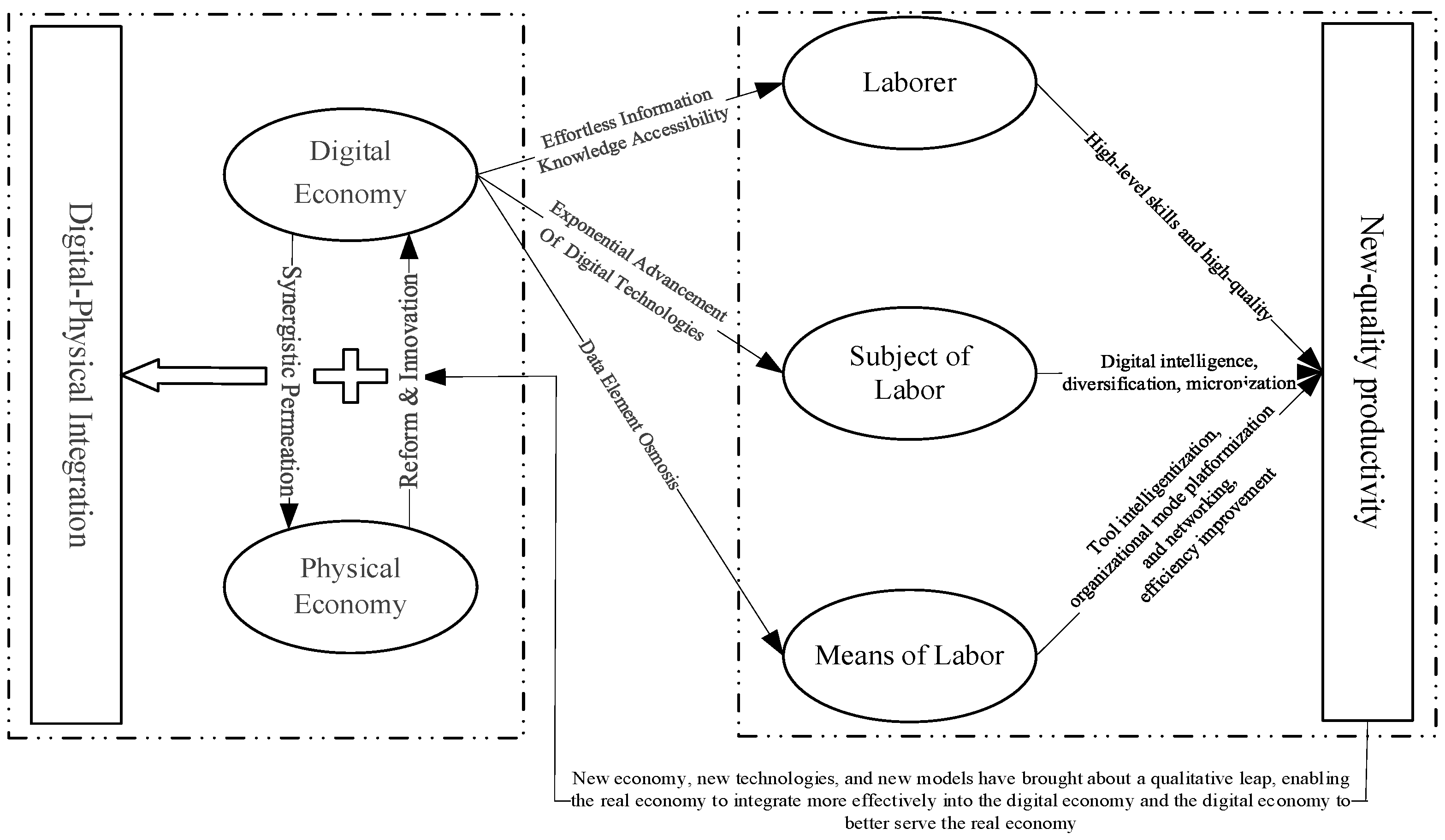
Overall, although academic research has produced significant qualitative and quantitative research on digital and physical integration and new qualitative productivity gains, there has been little systematic examination of the interplay between them and the resulting diversity. Departing from the existing literature, this study proposes a dual-role analytical framework. Structurally, digital–real integration is conceptualized as a key strategic input and enabling driver for the cultivation of new quality productive forces. Conversely, new quality productive forces are positioned as the advanced systemic outcome and goal of such integration. Dynamically, however, they engage in a mutually reinforcing feedback loop: The development of new high-quality production forces, in turn, creates more demand and creates sophisticated elements for deeper digital integration (Figure 1). This framework clearly distinguishes their structural positions while capturing their dynamic, interactive relationship and spatial spillover effects and regional interactive influences. To empirically validate these propositions, establishing comprehensive evaluation indicator systems for both phenomena based on the existing literature and apply entropy methods to calculate regional development indices. The methodological approach includes spatial autocorrelation testing, specification of spatial simultaneous equation models, and implementation of GS3SLS estimation to analyze interaction mechanisms and determining factors.
Figure 1.
Interaction between digital and real economy and new quality productivity.
The remainder of this study is organized as follows: Section 3 develops the theoretical framework and proposes research hypotheses, analyzing the mutual impact and spatial interaction mechanisms between digital–real integration and new quality productive forces. Section 4 introduces the data and methodology, detailing variable measurement, the construction of spatial weight matrices, model specification, and data sources. Section 5 presents the main empirical results. Section 6 conducts a series of robustness tests and explores regional as well as temporal heterogeneity. Finally, Section 7 discusses the findings, summarizes the conclusions, and outlines the policy implications, along with the limitations of the study.
3. Theory and Hypotheses
3.1. The Impact Mechanism on the New Quality Productive Forces by Digital–Real Integration
Digital and real integration involves a pervasive infusion of digital technologies into all aspects of traditional industries—from research, development, manufacturing, distribution and services. This represents far more than a superficial technological overlay; it fundamentally reshapes the landscape through multidimensional transformations in technological innovation, business models, and industrial structures [3,11]. The resulting new technologies, models and formats represent a new quality of production that is inherent in the new quality of production [36].
Driving Technological Innovation. We posit that digital–real integration drives technological innovation, thereby forming our first research hypothesis. The application of emerging technologies within physical industries optimizes production processes and elevates productivity [2,37]. Furthermore, it enables enterprises to engage with consumers more directly, gaining real-time insights into market demands. Technologies supporting remote collaboration, for instance, dismantle geographical barriers in R&D and production activities, thus increasing the efficiency of regional allocation of resources [13]. Thus, we propose Hypothesis 1: The digital–real integration promotes the development of new quality productivity through the promotion of technology innovation.
Reshaping Business Models. We further argue that it reshapes business models, leading to our second hypothesis. Digital–real integration blurs the boundaries and disrupts the conventional organization of traditional industries [5,6]. Digital platforms, by seamlessly connecting suppliers and consumers, can significantly reduce search and transaction costs [11,14]. Concurrently, the analysis of user-generated Big Data facilitates highly accurate, personalized recommendations, making the economically viable model of “mass customization” a reality [12]. Thus, we propose Hypothesis 2: The digital–real integration promotes the creation of new high-quality productivity through the restructuring of business models.
Catalyzing New Business Formats. We propose that it catalyzes new business formats, which constitutes our third hypothesis. The deep penetration of digital technologies into agriculture, industry and services sectors spawns novel and dynamic formats [6,40]. Examples include smart agriculture, intelligent manufacturing, smart logistics, online education, and telemedicine. These are not mere digital add-ons but fundamentally new ways of creating and delivering value. Thus, we propose Hypothesis 3: The digital–real integration promotes the development of new quality productivity through the catalyzing of new business forms.
Essentially, the new technologies, models, and formats that emerge from the integration of digital and real are deeply interwoven and mutually reinforcing. Together, they create a synergy that will boost productivity substantially and provide the basis for developing new high-quality productivity [28,36].
3.2. The Reinforcing Mechanism of New Quality Productive Forces on Digital–Real Integration
The new high-quality productive forces are not only the result of digital and physical integration, but also the key driver for their future development [36]. Through the incorporation of innovative technologies, the new quality productivity has fundamentally changed the traditional industry’s production process and technology base, thereby accelerating the transition of conventional production models toward greater digitalization and intelligence [38].
Generating New Demand. The new quality productivity can promote integration through the creation of new demand. A new high-quality productivity based on AI, Big Data and IoT breakthroughs, stimulates novel integrated consumption scenarios and production requirements. The development of smart connected vehicles, for example, necessitates not only advancements in physical manufacturing but also relies critically on vehicle-network data services and the iterative improvement of autonomous driving algorithms. This “physical product + digital service” paradigm creates a structural demand for deeper and more robust integration between the digital and real economies. Thus, we propose Hypothesis 4: The new high-quality productive forces promote the integration of digital and real by creating new requirements for integrated products and services.
Shaping a Conducive Environment for Integration. We also contend that they shape a conducive environment, which is the basis for Hypothesis 5. The technological innovations inherent to new quality productive forces possess a “demand-shaping” character. As firms increasingly depend on innovations such as Internet platforms and digital management systems, traditional sectors of the real economy face mounting pressure to accelerate their own digital transformation [5]. This dynamic simultaneously encourages the deeper penetration of digital technologies into the physical domain, establishing a positive feedback loop that continuously refines the environment for integration. Thus, we propose Hypothesis 5: New quality productive forces promote digital–real integration by shaping a conducive environment that pressures and facilitates digital transformation.
Redirecting the Objectives of Integration. Moreover, we propose that they redirect the objectives of integration, leading to Hypothesis 6. The extensive use of industrial Internet platforms not only increases production efficiency but also fosters the emergence of a “data-interconnected, value-co-creating” ecosystem across the industrial chain. This evolution redefines the goal of integration from mere efficiency gains to the cultivation of collaborative, innovation-driven ecosystems, thereby steering digital–real integration toward high-quality development. Thus, we propose Hypothesis 6: New quality productive forces promote digital–real integration by redirecting its objectives towards building collaborative, innovation-driven ecosystems.
3.3. The Spatial Interaction Mechanism Between Digital–Real Integration and New Quality Productive Forces
The interplay between digital–real integration and new quality productive forces follows a closed-loop logic characterized by a “spiral ascent” [36]. The new technology, business model and industry form of the digital and real integration form the core of the New Quality Productivity. In turn, new high-quality production forces promote higher levels of digital and physical integration by generating new demand, optimizing the institutional environment, and reshaping developmental objectives. This dynamic interaction fosters an economic and social transition toward digitalization, intelligence, and sustainability, creating a cyclical momentum of “integration → innovation → re-integration → re-innovation”.
This relationship is inherently spatial, shaped by the interplay between geographical attributes and the laws of productivity development.
Spatial Heterogeneity. We hypothesize that this interaction exhibits spatial heterogeneity, forming Hypothesis 7. Disparities in regional resource endowments, technological foundations, and market demand lead to varying initial levels of digital and physical integration, as well as new qualitative productivity [33]. Their mutual reinforcement can, in the absence of coordinated policies, exacerbate these regional disparities rather than mitigate them. Thus, we propose Hypothesis 7: The interaction between the digital and the new qualitative productive forces shows marked spatial heterogeneity, which is likely to increase the regional disparity.
Spatial Correlation. Conversely, we also hypothesize that a positive spatial correlation exists, which is Hypothesis 8. The non-rivalrous nature of digital technologies—where use by one actor does not preclude use by another—provides the technical basis for spatial interaction [10]. At the same time, the network externalities of digital technologies—in which the value of a network increases with the number of users—allow the benefits of digital and physical integration and new qualitative productivity to produce spillover effects across regions [13]. This process helps transcend geographical constraints, fostering dynamic adaptation and symbiotic development between regions. Thus, we propose Hypothesis 8: There is a positive spatial spillover effect between digital and physical integration and the emergence of qualitative productive forces between regions, in which the development of one area has a positive impact on neighbouring regions.
In summary, this study posits that a robust, spatially mediated interactive relationship exists between digital–real integration and new quality productive forces, forming a complex system that operates across both functional and geographical dimensions.
4. Data and Methods
4.1. Variable Selection
4.1.1. Measurement of Digital–Real Integration
The indicator system for assessing the level of digital–real integration is constructed based on a multi-dimensional framework that captures its foundational, operational, and outcome dimensions. Digital infrastructure constitutes the foundational support for integration [10], while digital manufacturing reflects the depth of technological penetration and innovation within production processes. The dimension of digital products and services gauges the application effectiveness and value creation in the service sector, and digital financial services highlight the critical synergy between the financial system and the real economy [11]. Furthermore, following Ouyang [12], data element-driven indicators are incorporated to emphasize the pivotal role of data as a new factor of production. Finally, a comprehensive set of real-economy output and structural indicators is included to measure the tangible impacts of digitalization, ensuring the index captures the synergistic outcome of integration [6]. The complete indicator system is detailed in Appendix A. This two-system framework ensures strong conceptual validity for measuring integration. The “digital economy” system captures the supply-side drivers across five key facets: infrastructure, manufacturing, services, finance, and data elements. The “real economy” system measures the output-side performance across six core traditional sectors. Crucially, the coupling coordination degree model does not merely aggregate these indicators but quantifies the synergy and interaction between these two systems. Thus, our index directly operationalizes the theoretical definition of digital–real integration as the harmonious interaction and co-development between the digital and real economic systems, ensuring the index captures the construct’s substantive meaning. A comprehensive index is constructed in two steps. Firstly, we use the entropy method to compute the combined scores of the digital economy and the real economy. Subsequently, the coupling coordination degree model—a well-established approach for assessing the interaction between two systems [16,17]—is employed to measure their integration level. Detailed formulas for calculation are given in Appendix C and Appendix D.
4.1.2. Measurement of New Quality Productive Forces
On the basis of the definition and theory of the new productivity, this paper constructs a comprehensive evaluation index system from the three core dimensions: the workers, the materials, and the work objects. This framework aims to capture the essential features of the new qualitative productivity, with emphasis on innovation-driven growth, factor upgrading, and system transformation. The worker dimension not only measures labor productivity, but also measures the quality of skills and creativity of workers, which reflects the key role that human capital plays in driving quality growth [33]. The labor dimension measures the degree of industrial development and environmental performance and captures technological and sustainable production processes [34]. The labor dimension covers both physical and non-physical inputs, in particular the evaluation of digital infrastructure and the capacity for innovation, which is a transformation of traditional factors into new qualitative productive forces [35]. The full indicator system is described in Appendix B, and the final composite index is calculated by the entropy method, which effectively determines the objective weight of each indicator and avoids subjective bias. The construction of this index is grounded in the classical tripartite theory of productive forces, ensuring strong conceptual coherence and content validity. By systematically measuring the qualitative advancement of laborers (via productivity, skill, and innovation spirit), labor materials (via industrial upgrading and green production), and labor objects (via digital infrastructure and innovation capacity), the index directly operationalizes the core definition of “new quality productive forces” as an innovation-driven, high-quality, and sustainable form of productivity. This framework moves beyond measuring mere output scale to capture the essential qualitative transformation of production factors, ensuring the index substantively reflects the theoretical construct it intends to measure.
4.1.3. Construction of Weight Matrices
To empirically examine the spatial interaction effects between digital–real integration and new quality productive forces, this study constructs the following spatial weight matrices:
- Spatial Adjacency Weight Matrix : A binary spatial adjacency weight matrix is constructed based on geographical contiguity. If two areas share a common border, a value of 1 is assigned to the respective matrix element; otherwise, it is set to 0. Diagonal elements are set to 0, meaning a region is not considered its own neighbor. This matrix is symmetric and time-invariant throughout the sample period.
- Spatial distance weight matrix (inverse geographic distance matrix) : An inverse distance weight matrix captures geographical proximity effects. Each off-diagonal element is set to the reciprocal of the Euclidean distance between the centroids of two regions, measured in kilometers. The diagonal elements are set to 0. This matrix is symmetric and time-invariant, as geographical distances remain constant.
- Economic–geographic nested weight matrix : A nested weight matrix combines both geographic proximity and economic similarity. The construction involves three steps:
Step 1: Start with inverse distance weights.
Step 2: Calculate the average GDP:
Step 3: In this formula, is the time-averaged per capita real GDP of region over the study period, where is the average of time-averaged per capita real GDP across all regions, is the number of time periods, and is the total number of regions.
- Construct the nested matrix:
This matrix may be asymmetric when economic levels differ between regions. Time-averaged economic data ensure the matrix remains time-invariant.
All three spatial weight matrices are row-standardized for estimation. Row-standardization ensures that each row sums to 1, making the spatial lag term interpretable as a weighted average of neighboring regions’ characteristics. This follows standard practice in spatial econometrics.
4.1.4. Control Variables
Government Intervention Level (gov): The government can provide a favorable institutional environment and policy support for innovation activities through fiscal and tax policies, thus supporting the development of digital and physical integration and the creation of new high-quality production forces.
Economic Development Level (digit): The improvement of the economy provides the necessary financial and technological support for the development of digital integration and the new productive forces of the region.
Degree of Openness (open): This factor helps enhance international competitiveness, promoting industrial upgrading and technological growth.
Population Density (popd): As an important factor influencing industrial layout and the social division of labor, higher population density typically indicates greater market demand and innovation potential.
Infrastructure Development (infit): A well-developed infrastructure provides a physical basis for digital and physical integration and the creation of new high-quality productive forces. This development helps to increase productivity, lower transaction costs, and promote digital and real integration as well as new productive forces.
Innovation Level (ino): In the digital and real integration process, the use and promotion of innovative techniques can greatly increase the productivity and quality of products. This will help to transform and upgrade traditional industries, as well as create new ones.
Fixed-Asset Investment Level (fix): This has helped to improve infrastructure, increase productivity, and promote technical innovation.
Based on the core variables and controls defined above, we proceed to specify the empirical models to test the hypothesized relationships.
4.2. Empirical Model Specification and Data Description
4.2.1. Empirical Model Specification
A preliminary spatial autocorrelation analysis is essential before employing spatial econometric modeling. This study utilizes the global Moran’s I index for this purpose. As summarized in Table 1, the indices for both digital–real integration and new quality productive forces from 2011 to 2022 are statistically significant, indicating a consistent and positive spatial dependence. This means that stronger regional development is accompanied by a higher degree of digital integration or a new qualitative production power in neighbouring regions. The confirmation of these spatial clustering effects provides a sound basis for the later use of spatial econometric models.
Table 1.
Global Moran’s.
Considering the possibility of a two-way causal link between digital and physical integration and new qualitative productivity, and building upon established econometric practices, this study adopts a spatial simultaneous equations model. This framework is particularly apt as it simultaneously accounts for two critical features: the spatial spillover effects across geographical units and the endogenous interaction between the core variables of interest. The formal specification of the model is as follows:
In the model, and are constants, represents the local region, and denotes the spatial weight matrix. Then, represents the digital–real integration level in province i during year t; represents the digital–real integration level in province j during year t; represents the new quality productive forces index in province i during year t; represents the new quality productive forces index in province j during year t, and represents the estimated coefficient of the spatial spillover of digital–real integration from neighboring regions, which reflects both the direction and strength of the spatial spillover effect of digital–real integration. Next, represents the intensity and direction of the impact of new quality productive forces in neighboring regions on the digital–real integration level in the local region; represents the estimated coefficient of the spatial spillover of new quality productive forces from neighboring regions, which reflects both the direction and strength of the spatial spillover effect of new quality productive forces; represents the intensity and direction of the impact of digital–real integration in neighboring regions on the new quality productive forces in the local region; and and are used to test the spatial interaction effects between digital–real integration and new quality productive forces. Additionally, and are used to represent the endogenous relationships between the two. To control for the influence of other factors, the following control variables are included in the equations: government intervention level, economic development level, degree of openness, population density, infrastructure development, innovation level, and fixed-asset investment level, using to represent these. Finally, represents random disturbance factors.
In testing the spatial interaction effects between two variables, the GS3SLS spatial simultaneous equation model offers distinct methodological advantages. First, it incorporates the product of the spatial weight matrix and explanatory variables as instrumental variables in the estimation, thereby effectively addressing endogeneity concerns in the dependent variable. Second, the extended GS3SLS routine supports zero-order diagnostic regression, which helps determine the presence of endogeneity within the equations—a feature that further ensures robust control over endogeneity throughout the estimation process.
Building on these methodological strengths, we further clarify the assumptions and scope of our causal interpretation. The GS3SLS estimator provides consistent estimates under the key identification assumption that the spatial lags ( and ) are valid instrumental variables—that is, they affect the local outcome primarily through their impact on neighboring regions’ endogenous variables, satisfying the exclusion restriction. Under this and the assumption of correct model specification, the coefficients are interpreted as capturing the contemporaneous, structural feedback effects within the spatially interdependent system. It is important to note that while our design rigorously addresses simultaneity and spatial dependence, the estimates are best understood as evidence of robust system-level associations and spatial mechanisms that are consistent with a bidirectional causal narrative, rather than as isolated causal effects from an experimental setting.
4.2.2. Data Description
This study employs a balanced panel dataset covering 30 provincial-level regions in China from 2011 to 2022. The period from 2011 to 2022 is selected for its alignment with both the phased evolution of China’s digitalization policies and the availability of consistent provincial-level data. This timeframe begins with the formal inclusion of Strategic Emerging Industries in the Twelfth Five-Year Plan in 2011, which marked the start of systematic investment in digital infrastructure. It fully spans the rollout and deepening of key national initiatives such as the Internet Plus Action Plan and the Digital China strategy, extending into the period when new quality productive forces gained explicit policy emphasis. From a data perspective, since 2011, core indicators related to the digital economy—including broadband penetration, enterprise cloud adoption, industrial robot density, R&D expenditure, and invention patents—have been published systematically and consistently at the provincial level, providing a reliable longitudinal basis for analysis. By ending in 2022, the study avoids major recent statistical revisions while incorporating the latest complete annual data, thereby ensuring comparability over time and suitability for spatial econometric modeling of the dynamic interaction between digital–real integration and new quality productive forces. The selection of this sample period and scope is based on two primary considerations: first, to ensure comparability and continuity, as the “Peking University Digital Inclusive Finance Index”—a key component of the digital–real integration indicator system—has been systematically published since 2011, and second, to maintain data completeness, given the limited availability of certain indicators for Tibet. Data for the relevant variables were mainly compiled from the National Bureau of Statistics, provincial statistical yearbooks, and the EPS database. Missing values for specific province-year observations were addressed using interpolation methods. Variable definitions and descriptive statistics are presented in Table 2.
Table 2.
Descriptive statistics of variables.
5. Results
In order to explore the spatial interaction between digital and real integration, we used a Generalized Spatial Three-Stage Least Squares (GS3SLS) estimator. The results, shown in Table 3, are based on the second-order regression, which was chosen because it provided the best efficiency and performance. Lower and higher order regressions were also performed as part of the robustness checks. Furthermore, a standard nonspatial Three-Stage Least Squares (3SLS) approach was used to evaluate the spatial estimator. The coefficient signs remained consistent across both methods, despite minor variations in magnitude, thereby reinforcing the reliability of the core findings from the spatial model.
Table 3.
The 3SLS and GS3SLS estimation results.
The GS3SLS estimation results presented in Table 4 elucidate a nuanced spatial interdependence between digital–real integration and new quality productive forces, characterized by a distinct divergence between same-variable and cross-variable spillover pathways. Same-variable spatial spillovers demonstrate positive reinforcement, indicating regional convergence within individual development dimensions. Specifically, advancements in digital integration among neighboring regions foster local digital development, as evidenced by the coefficients for W × dsf on dsf (0.214 *** in column 3, 0.371 *** in column 5, and 0.282 *** in column 7). Similarly, progress in new quality productive forces in adjacent areas enhances local productivity, reflected in the positive coefficients for W × nqp on nqp (0.275 *** in column 6 and 0.444 *** in column 8). This pattern suggests the operation of mechanisms such as knowledge diffusion and policy emulation within homogenous developmental agendas.
Table 4.
Results based on different lag orders of the adjacency matrix.
In contrast, cross-variable spatial spillovers exhibit a consistently inhibitory pattern, forming a critical finding of this analysis. A region’s progression in digital integration significantly impedes the development of new quality productive forces in neighboring jurisdictions, with W × dsf on nqp coefficients of −0.217 *** (column 4), −0.353 *** (column 6), and −0.284 *** (column 8). Conversely, a region’s gains in productive forces hinder digital integration in adjacent areas, as shown by W × nqp on dsf coefficients of −0.270 *** (column 4), −0.468 *** (column 6), and −0.359 *** (column 7). This consistent negative cross-effect signals potential interregional competition rather than cooperative synergy across different developmental dimensions. The negative cross-spillovers are principally attributed to competitive resource reallocation dynamics, most notably a factor siphon effect from the perspective of factor mobility theory. Regions demonstrating comparative advantage in digital integration attract skilled labor, technological capital, and innovative capacity that might otherwise contribute to productivity enhancement in neighboring areas. Symmetrically, regions advancing in productive forces draw investment and entrepreneurial resources away from digital initiatives in adjacent jurisdictions. This dynamic illustrates how the agglomeration economies in leading regions can, in the short- to medium-term, generate negative externalities for neighbors by concentrating high-quality factors. This creates a zero-sum dynamic at the regional system level, where progress in one dimension within a region constrains development in the complementary dimension across its borders. This dynamic may be further exacerbated by strategic policy responses, a phenomenon anticipated by regional competition theory, wherein regions adopt protective or specialized stances in reaction to neighbors’ successes, inadvertently stifling cross-dimensional growth.
The coexistence of positive same-dimension and negative cross-dimension spillovers necessitates a recalibrated approach to regional policy coordination. Effective intervention requires moving beyond siloed, dimension-specific strategies toward an integrated framework that simultaneously leverages convergent forces and mitigates competitive inhibitions. Policy optimization should focus on three interconnected pillars: First, establishing bilateral complementarity agreements that formally couple digital and productivity investments across regions, preventing fragmented development. Second, instituting spatial externality compensation mechanisms, such as targeted fiscal transfers or resource-sharing protocols, to offset losses borne by regions experiencing negative cross-spillovers. Third, implementing a regional synergy monitoring platform to track the spatial interactions between digital and productivity metrics in real-time, enabling evidence-based policy adjustments.
Through such systemic coordination, policy can steer interregional relations from the observed state of “competitive inhibition” toward a more desirable paradigm of “collaborative complementarity.” This approach not only harnesses the positive convergence within dimensions—for instance, by fostering regional digital innovation clusters—but also actively dismantles the zero-sum competition for resources across dimensions. The ultimate objective is to cultivate an ecosystem where advancements in digital–real integration and new quality productive forces are mutually reinforcing across geographical boundaries, thereby underpinning more balanced and sustainable regional development.
6. Robustness and Heterogeneity
6.1. Robustness Tests
6.1.1. Robustness to Lag Order Specification
To further verify the robustness of the empirical findings, we re-estimated the model using one-, three-, and four-period lags of the explanatory variables. The results, presented in Table 4, Table 5 and Table 6, demonstrate that the core spatial interaction between digital–real integration and new quality productive forces remains consistent across all lag specifications. This stability aligns with prior theoretical expectations and confirms that the identified relationship is not sensitive to the specific temporal dynamic chosen, thereby reinforcing the reliability of our baseline conclusions.
Table 5.
Results based on different lag orders of the geographical distance matrix.
Table 6.
Results based on different lag orders of the economic–geographic nested matrix.
6.1.2. Sample Robustness: Exclusion of Municipalities
Municipalities (Beijing, Shanghai, Tianjin, and Chongqing) have distinct administrative status and socioeconomic characteristics, which may introduce unobservable heterogeneity into the analysis of the province. In order to make sure that we do not have these unique entities as the driving force, we took them out of the sample and reran the regression. This exercise aims to assess the model’s applicability under more generalized conditions. The empirical results of this limited sample, as presented in Table 7, confirm that the main findings remain qualitatively unchanged, suggesting that the evidence of the interaction of digital and nqp is robust to sample composition and cannot be attributed to the effect of these outlier regions.
Table 7.
Robustness test results after excluding municipalities directly under the central government.
In addition to the above-mentioned robustness test methods, we further test the robustness of our results by measuring digital integration with Principal Component Analysis (PCA). The regression results, presented in Appendix E, show that all key findings remain unchanged, supporting the consistency of our conclusions.
6.2. Heterogeneity Analysis
To examine potential variations in the observed relationships across geographical and temporal dimensions, this study conducts the following heterogeneity tests.
6.2.1. Regional Heterogeneity
Substantial disparities in natural conditions, economic development, industrial structure, and resource endowments across China’s regions may lead to differentiated policy outcomes and resource utilization efficiency. A regional-level analysis offers a more nuanced understanding of local conditions and challenges, thereby providing an empirical basis for tailored policy-making and coordinated regional development. To examine these regional heterogeneities, the sample of 30 provinces is divided into eastern, central, and western subgroups, with the estimation results reported in Table 8. Given that both digital–real integration and new quality productive forces are shaped by geographical and economic factors, the analysis uses the economic and geographical nested spatial weight matrix.
Table 8.
Regional heterogeneity analysis.
As shown in the table above, the regression coefficients between digital–real integration and new quality productive forces are significantly positive at the 1% level across eastern, central, and western regions. Specifically, the impact coefficients of digital–real integration on new quality productive forces are 1.222, 0.501, and 0.566, respectively, with the eastern region exhibiting the strongest effect, while the central and western regions show relatively similar magnitudes. This regional disparity may be attributed to the eastern region’s more advanced economic development, superior infrastructure, and faster pace of digital transformation, all of which amplify the promotive effect of digital–real integration on new quality productive forces.
Conversely, the coefficients measuring the impact of new quality productive forces on digital–real integration are 0.759, 1.195, and 1.755 in the eastern, central, and western regions, respectively, with the western region displaying the highest coefficient. One plausible explanation is that the western region is still undergoing economic transformation, where new quality productive forces play a more substantial role in driving digital–real integration and regional growth. In contrast, the marginal effect of new quality productive forces is relatively smaller in the economically more mature eastern region, leading to a lower regression coefficient.
In terms of spatial spillovers, both digital–real integration and new quality productive forces in neighboring regions exert a positive influence on their local counterparts, with the most pronounced effect observed in the western region. Several factors may account for this pattern. First, compared to eastern coastal areas, the western region faces certain gaps in technological capacity and industrial foundation, making it more receptive to adopting advanced experiences and technology transfers from neighboring regions. Second, national strategies such as the “Western Development” initiative have substantially improved infrastructure and policy environments in the west, creating favorable conditions for the development of digital–real integration and new quality productive forces. Finally, the western region’s abundant resources and untapped market potential enhance its attractiveness for external investment and technological collaboration. Consistent with earlier findings, however, neighboring regions’ digital–real integration and new quality productive forces also exhibit significant negative cross-dimensional spillover effects on local regions’ new quality productive forces and digital–real integration.
In conclusion, these results underscore the need for region-specific policies that account for local conditions. Tailored strategies and differentiated guidelines should be formulated to effectively promote the coordinated development of digital–real integration and new quality productive forces across China’s diverse regional landscapes.
6.2.2. Temporal Heterogeneity
The year 2015 marked a pivotal shift, as China elevated the digital economy to the status of national strategy, accelerating its penetration into traditional industries and propelling the growth of industrial digitalization and digital industrialization. Using 2015 as a cutoff point allows for a clearer examination of how this strategic upgrade influenced the dynamic between digital–real integration and new quality productive forces.
Table 9 reports the estimation results for the pre- and post-2015 subsamples. As shown in the table below, after 2015, the promoting effect of local digital–real integration on local new quality productive forces declined slightly from 0.910 to 0.860. Similarly, the positive spatial spillover of neighboring regions’ digital–real integration on local digital–real integration decreased from 0.275 to 0.246, and its inhibitory effect on local new quality productive forces weakened from −0.247 to −0.228. In contrast, the influence of new quality productive forces strengthened: local new quality productive forces’s effect on local digital–real integration increased from 1.055 to 1.095, and the positive spatial spillover from neighboring new quality productive forces to local new quality productive forces rose from 0.270 to 0.302, while its negative cross-effect on local digital–real integration intensified from −0.301 to −0.330.
Table 9.
Temporal heterogeneity analysis.
These shifts suggest that, following the national strategic turn, the relative role of digital–real integration has been moderate, while that of new quality productive forces has become more pronounced. This may be attributed to the broader, more systemic approach to digitalization under the national strategy, which extended beyond integration per se to emphasize digital industrialization, industrial digitalization, and data factor deployment. In this context, new quality productive forces emerged as a strategic concept in its own right—one aligned with national priorities and viewed as essential to achieving Chinese-style modernization. Thus, as digital–real integration’s influence became more diffused across a wider set of objectives, new quality productive forces gained prominence as a distinct and powerful driver of development.
7. Discussion and Conclusions
The synergistic development of digital–real integration and new quality productive forces constitutes a crucial pathway toward high-quality development and Chinese-style modernization. This study employs provincial panel data (2011–2022) and a spatial simultaneous equations model to investigate their interactions. The principal findings are as follows: (1) a significant bidirectional positive relationship within regions; (2) positive same-dimension yet negative cross-dimension spatial spillovers from neighboring regions’ digital–real integration; (3) a symmetric spillover pattern from neighboring regions’ new quality productive forces; (4) regional heterogeneity, with stronger digital–real integration-driven effects in eastern China and higher marginal contributions from new quality productive forces in central and western regions; and (5) a temporal evolution post-2015, indicating a strategic transition from foundational integration to productivity-driven advancement as new quality productive forces gain primacy.
In light of these findings, this study proposes the following policy recommendations:
Implementing a “policy package” for synergistic development of digital–real integration and new quality productive forces. This could be institutionalized through, for instance, a “National Inter-Ministerial Conference on the Synergistic Development of the Digital and Real Economies and New Quality Productive Forces,” supported by the formulation of “Technical Integration Guidelines for Digital Technologies and Key Industries” to provide unified implementation standards. Key measures include creating cross-departmental coordination mechanisms and implementing an integrated policy package encompassing industrial, technological, and talent development strategies to synergistically promote digital transformation and innovation. In industrial ecosystem planning, simultaneous advancement of digital industrialization and industrial digitalization should be encouraged to form a dual-core driven “integration–innovation” cluster effect. Concurrently, focused efforts on talent and data elements are essential: cultivating interdisciplinary experts with combined digital and industry expertise while facilitating conditional access and standardized circulation of governmental and industrial data. Ultimately, an evaluation system centered on “interactive efficacy” should be institutionalized to dynamically monitor policy outcomes and ensure stage-appropriate resource allocation, thereby systematically enhancing the positive feedback loop between these two domains and fostering endogenous regional economic growth momentum.
Building a spatial governance system for regional coordination and differentiated planning. Both digital–real integration and new quality productive forces demonstrate significant spatial dependence and regional heterogeneity within their respective dimensions. A dual-driven spatial governance framework balancing “coordination-differentiation” should be established. In the vertical coordination dimension, cross-regional cooperation platforms should be created. A concrete step would be to pilot an “East–Central–West Digital Pairing and Co-Development Mechanism”, underpinned by “Cross-Provincial Fiscal Revenue Sharing and Data Factor Compensation Measures” to institutionally safeguard the benefits of cooperation. This platform should utilize incentive mechanisms such as tax incentives and targeted subsidies to facilitate technology transfer, industrial collaboration, and talent exchange from eastern to central–western regions, thereby enhancing positive spatial spillovers while mitigating resource siphon effects. In the horizontal planning dimension, differentiated development paths should be implemented: eastern regions should concentrate on advanced digital technologies, smart manufacturing, and innovation sourcing, while central–western regions should prioritize digital infrastructure deployment and digital transformation of traditional industries, forming distinctive development models compatible with regional factor endowments.
Mitigating negative spatial spillovers and promoting healthy interregional Competition. To counteract negative spillover effects stemming from interregional resource competition, regional relations should transition from a zero-sum game toward collaborative symbiosis. This can be achieved by establishing cross-regional benefit-sharing and compensation mechanisms, such as a “Regional Development Impact Assessment and Compensation Fund”. This fund would facilitate horizontal fiscal transfers based on the quantified net spillover effects (positive or negative) a province has on its neighbors, thereby balancing developmental interests. Complementary industrial functions and differentiated regional positioning should be strengthened to prevent resource dissipation caused by homogeneous competition. The formation of regional innovation consortia and industrial chain collaboration networks should be promoted to facilitate orderly factor mobility and efficient resource allocation. Concurrently, accelerating cross-regional infrastructure connectivity and institutional coordination will reduce barriers to factor mobility, collectively shaping a new regional development paradigm characterized by “functional complementarity, factor interoperability, and mutually reinforcing development”.
Establishing dynamic policy adaptation and regional coordination mechanisms. Temporal heterogeneity analysis reveals that the interaction between digital–real integration and new quality productive forces demonstrates phased evolutionary characteristics along with the development of digital economy strategies. To this end, we propose establishing a dynamic monitoring mechanism, centered on a public “Regional Digital–Real Integration and New Quality Productivity Synergy Index” dashboard, with its assessment results linked to the performance-based allocation of central government special transfer payments. This mechanism should be supported by interdisciplinary policy research teams to track technological evolution and regional development dynamics. During the initial development phase, policy support should prioritize digital infrastructure construction and inclusive transformation. As integration deepens, policy formulation should undergo three strategic transitions: the strategic focus should shift from foundational integration to innovation leadership, maintaining support for industrial digitalization while emphasizing frontier technology domains; policy instruments should evolve from universal subsidies to targeted incentives, establishing a differentiated support system based on innovation capabilities; and implementation pathways should transition from project-driven approaches to ecosystem cultivation, building an innovation ecosystem centered on new quality productive forces and supported by digital–real integration. This progressive adaptation enables strategic transformation from scale expansion to quality enhancement in accordance with evolving developmental requirements.
Author Contributions
X.L. (Xiao Li): Formal Analysis, Methodology, Supervision, Validation, Visualization, Writing—Original Draft Preparation, and Writing—Review and Editing. X.L. (Xiaoxuan Liu): Conceptualization, Data Curation, Validation, Visualization, Writing—Original Draft Preparation, and Writing—Review and Editing. All authors have read and agreed to the published version of the manuscript.
Funding
This research was funded by the Education Department of Shaanxi Provincial Government, grant number 23JZ029.
Institutional Review Board Statement
Not applicable.
Informed Consent Statement
Not applicable.
Data Availability Statement
Readers may contact the corresponding author to obtain the data used here.
Acknowledgments
We would like to express our gratitude to all the individuals and organizations who have supported this study, and we are very grateful for the valuable advice and assistance received during this study.
Conflicts of Interest
The authors declare no conflicts of interest.
Appendix A
Table A1.
Evaluation indicator system for digital–real integration.
Appendix B
Table A2.
Evaluation indicator system for the new quality productive forces.
Appendix C
The calculation process of the entropy value method: The entropy method objectively assigns weights to indicators based on the size of information entropy and conducts a comprehensive evaluation of multiple indicators. The smaller the information entropy, the greater the degree of dispersion; the more information there is, the greater the weight assigned. The specific steps are as follows:
- (1)
- Suppose there are years, provincial regions, and indicators; represents the value of the indicator in the region during the year.
- (2)
- Conducting raw data processing:
Considering that different evaluation indicators have different magnitudes and units, the data is first standardized. The calculation process is as follows:
Positive indicators: .
Negative indicators: .
- (3)
- Calculate the proportion of each indicator: .
- (4)
- Calculate the information entropy of each indicator: .
- (5)
- Calculate the information utility value of the item indicator: .
- (6)
- Calculate the weights of each indicator: .
- (7)
- Calculate the final scores for the digital economy and the real economy separately: .
Appendix D
The coupling coordination degree model is typically employed to assess the degree of coordinated development between systems. In this study, with provinces as the spatial units, we constructed two subsystems: “Digital Economic Development Level” and “Real Economic Development Level”. The coupling degree is utilized to measure the degree of interdependence between the digital economy and the real economy, while the coordination index gauges the extent of coordination between the two subsystems. Finally, the coupling coordination degree is calculated as the integrated indicator reflecting both coupling and coordination. The specific steps are as follows:
In the equation, represents the coupling coordination degree, denotes the coupling degree, and are the respective performance indices of the two subsystems, and indicates the overall coordination degree of the variables. It is generally acknowledged that both subsystems hold equal importance in the coupling analysis. Therefore, the coefficients are set as = = 0.5.
Appendix E
Table A3.
Robustness test based on Principal Component Analysis.
References
- Shen, H.; Li, Y. Theoretical Thinking on the Development of New Quality Productive Forces According to Local Conditions in Heilongjiang Province. Int. J. Manag. Sci. Res. 2024, 7, 1–7. [Google Scholar] [CrossRef] [Scilit]
- Blichfeldt, H.; Faullant, R. Performance Effects of Digital Technology Adoption and Product & Service Innovation—A Process-Industry Perspective. Technovation 2021, 105, 102275. [Google Scholar] [CrossRef] [Scilit]
- Xi, C. Promoting the Deep Digital-Real Economy Integration: Theory and Practice. Front. Econ. China 2024, 19, 154–172. [Google Scholar] [CrossRef]
- Fu, Y.; Yu, H.; Da, J.; Kan, X. Discussion on the Influence of Digital Economy Development on Real Economy. Front. Bus. Econ. Manag. 2022, 6, 176–179. [Google Scholar] [CrossRef] [Scilit]
- Chen, H.; Cui, X.; Li, Z. Research on the Impact of Digital-Realistic Integration to Promote Sustainable Development of Enterprises: Based on the Perspective of Technology Bias. SAGE Open 2025, 15, 21582440251329725. [Google Scholar] [CrossRef] [Scilit]
- Cheng, D.; Zhao, Y.; Guo, Y. Research on the Mechanism of Digital–Real Economic Integration Enhancing Industrial Structure Upgrading. Economies 2025, 13, 253. [Google Scholar] [CrossRef] [Scilit]
- Fu, C.; Ouyang, W. Level of Integration of Real and Digital Economies: Effects and Mechanisms of Environmental Pollution Impacts. Sustainability 2025, 17, 4108. [Google Scholar] [CrossRef] [Scilit]
- Huo, C.; Bian, S.; He, D.; Lv, M. Research on the Impact of the Integration of Digital Economy and Real Economy on China’s Domestic Value Chain Resilience. Digit. Econ. Sustain. Dev. 2025, 3, 13. [Google Scholar] [CrossRef] [Scilit]
- Liu, F. Research and Empirical Verification of the Path of Digital-Real Integration on High-Quality Economic Development. Front. Sustain. Dev. 2024, 8, 74–80. [Google Scholar] [CrossRef] [Scilit]
- Xin, Y.; Song, H.; Shen, Z.; Wang, J. Measurement of the Integration Level between the Digital Economy and Industry and Its Impact on Energy Consumption. Energy Econ. 2023, 126, 106988. [Google Scholar] [CrossRef] [Scilit]
- Wang, D.; Wu, W.; Li, L. Analysis of the Model and Mechanism for Integrated Development of the Digital Economy and the Real Economy. Front. Econ. China 2024, 19, 226–253. [Google Scholar] [CrossRef]
- Ouyang, R. Data as a Factor of Production Promoting the Deep Integration of the Digital Economy and the Real Economy: Theoretical Logic and Analysis Framework. Front. Econ. China 2024, 19, 129–153. [Google Scholar] [CrossRef]
- Tan, X.; Xue, X.; Fan, H. How Digital Economy Industry Network Embedding Drives Digital-Real Integration in Construction Firms: A Dynamic Capability and Innovation Diffusion Perspective. Eng. Constr. Archit. Manag. 2025, 1–30. [Google Scholar] [CrossRef] [Scilit]
- Wang, S.; Teng, T.; Hu, S.; Pan, Y. Interplay of Digital Economy and Real Economy: How to Integrate and What Drives It? Appl. Spat. Anal. Policy 2025, 18, 130. [Google Scholar] [CrossRef] [Scilit]
- Li, X. The Path of Integrated Development between Digital Economy and Real Economy. Acad. J. Bus. Manag. 2023, 5, 160–164. [Google Scholar] [CrossRef]
- Qian, F. Coupling Coordination and Dynamic Analysis of the Integration and Development of Digital Economy and Real Economy. Acad. J. Bus. Manag. 2024, 6, 270–275. [Google Scholar] [CrossRef] [Scilit]
- Wang, Z.; Lin, S.; Chen, Y.; Lyulyov, O.; Pimonenko, T. The Digital Economy and Real Economy: The Dynamic Interaction Effect and the Coupling Coordination Degree. Sustainability 2024, 16, 5769. [Google Scholar] [CrossRef] [Scilit]
- Chang, L.; Taghizadeh-Hesary, F.; Mohsin, M. Role of Artificial Intelligence on Green Economic Development: Joint Determinates of Natural Resources and Green Total Factor Productivity. Resour. Policy 2023, 82, 103508. [Google Scholar] [CrossRef] [Scilit]
- Lyu, Y.; Wang, W.; Wu, Y.; Zhang, J. How Does Digital Economy Affect Green Total Factor Productivity? Evidence from China. Sci. Total Environ. 2023, 857, 159428. [Google Scholar] [CrossRef] [Scilit]
- Li, Y.; Chen, G. An Analysis of Digital Finance in Promoting the Development of New Quality Productivity. Proc. Bus. Econ. Stud. 2024, 7, 227–233. [Google Scholar] [CrossRef] [Scilit]
- Yue, S.; Bajuri, N.H.; Khatib, S.F.; Lee, Y. New Quality Productivity and Environmental Innovation: The Hostile Moderating Roles of Managerial Empowerment and Board Centralization. J. Environ. Manag. 2024, 370, 122423. [Google Scholar] [CrossRef] [Scilit]
- Guo, B.; Yu, H.; Jin, G. Urban Green Total Factor Productivity in China: A Generalized Luenberger Productivity Indicator and Its Parametric Decomposition. Sustain. Cities Soc. 2024, 106, 105365. [Google Scholar] [CrossRef] [Scilit]
- Jiang, Y.; Guo, Y.; Bashir, M.F.; Shahbaz, M. Do Renewable Energy, Environmental Regulations and Green Innovation Matter for China’s Zero Carbon Transition: Evidence from Green Total Factor Productivity. J. Environ. Manag. 2024, 352, 120030. [Google Scholar] [CrossRef] [Scilit]
- Shao, C.; Dong, H.; Gao, Y. New Quality Productivity and Industrial Structure in China: The Moderating Effect of Environmental Regulation. Sustainability 2024, 16, 6796. [Google Scholar] [CrossRef] [Scilit]
- Lin, L.; Gu, T.; Shi, Y. The Influence of New Quality Productive Forces on High-Quality Agricultural Development in China: Mechanisms and Empirical Testing. Agriculture 2024, 14, 1022. [Google Scholar] [CrossRef] [Scilit]
- Liu, S.; Zeng, Z.; Kong, Y. The Impact of New Quality Productive Forces on Common Prosperity: Evidence from Chinese Cities. Sustainability 2025, 17, 7703. [Google Scholar] [CrossRef] [Scilit]
- Huang, Q.; Guo, W.; Wang, Y. A Study of the Impact of New Quality Productive Forces on Agricultural Modernization: Empirical Evidence from China. Agriculture 2024, 14, 1935. [Google Scholar] [CrossRef] [Scilit]
- Liu, Z.; Zhang, H.; Guo, C.; Yang, Y. New Quality Productive Forces Enabling High-Quality Development: Mechanism, Measurement, and Empirical Analysis. Sustainability 2025, 17, 8146. [Google Scholar] [CrossRef] [Scilit]
- Sun, J.; Hou, S.; Deng, Y.; Li, H. New Media Environment, Green Technological Innovation and Corporate Productivity: Evidence from Listed Companies in China. Energy Econ. 2024, 131, 107395. [Google Scholar] [CrossRef] [Scilit]
- Feng, N.; Yan, M.; Yan, M. Spatiotemporal Evolution and Influencing Factors of New-Quality Productivity. Sustainability 2024, 16, 10852. [Google Scholar] [CrossRef] [Scilit]
- Xie, F.; Jiang, N.; Kuang, X. Towards an Accurate Understanding of ‘New Quality Productive Forces’. Econ. Political Stud. 2025, 13, 1–15. [Google Scholar] [CrossRef] [Scilit]
- Liu, Y.; He, Z. Synergistic Industrial Agglomeration, New Quality Productive Forces and High-Quality Development of the Manufacturing Industry. Int. Rev. Econ. Financ. 2024, 94, 103373. [Google Scholar] [CrossRef] [Scilit]
- Wang, F.; Tu, X.; Yang, Z.; Tian, Z.; Yin, Q. Spatial and Temporal Characteristics and Differentiation Mechanisms of New Quality Productive Forces Development in China. Environ. Sustain. Indic. 2025, 27, 100645. [Google Scholar] [CrossRef] [Scilit]
- Cao, Y.; Dai, S. Understanding and Evaluating New Quality Productive Forces in China: Based on Machine Learning. Appl. Econ. Lett. 2025, 32, 1–7. [Google Scholar] [CrossRef] [Scilit]
- Li, Y.; Zhang, T. How Does the Digital Ecosystem Foster New Quality Productive Forces? A Dynamic Qca of Sustainable Development Pathways in China. Sustainability 2025, 17, 4935. [Google Scholar] [CrossRef] [Scilit]
- Yahong, Z.; Xuhua, L. Digital-Real Economy Integration: Empowering New Quality Productive Forces. China Econ. 2024, 19, 91–120. [Google Scholar] [CrossRef]
- Zhang, J.; Liu, Y. How Does Digital Innovation Empower the Development of New Quality Productive Forces? An Empirical Study Based on Double Machine Learning. Sustainability 2025, 17, 2652. [Google Scholar] [CrossRef] [Scilit]
- Song, Y.; Ab Razak, R. The Impact of Technological Convergence in Digital and Real Industries on the New Quality Productive Forces: Evidence from Chinese Listed Companies. Cap. Mark. Rev. 2025, 33, 25–39. [Google Scholar]
- Dai, D.; Cao, S.; Zhao, M. Research on the Coupling and Coordination between New-Quality Productivity and Digital Transformation in China’s Provinces. Sustainability 2025, 17, 3806. [Google Scholar] [CrossRef] [Scilit]
- Zheng, M.; Yan, S.; Xu, S. Digital Economy, Industry–Academia–Research Collaborative Innovation, and the Development of New-Quality Productive Forces. Sustainability 2025, 17, 318. [Google Scholar] [CrossRef] [Scilit]
- Xu, Y.; Wang, R.; Zhang, S. Digital Economy, Green Innovation Efficiency, and New Quality Productive Forces: Empirical Evidence from Chinese Provincial Panel Data. Sustainability 2025, 17, 633. [Google Scholar] [CrossRef] [Scilit]

Disclaimer/Publisher’s Note: The statements, opinions and data contained in all publications are solely those of the individual author(s) and contributor(s) and not of MDPI and/or the editor(s). MDPI and/or the editor(s) disclaim responsibility for any injury to people or property resulting from any ideas, methods, instructions or products referred to in the content. |
© 2026 by the authors. Licensee MDPI, Basel, Switzerland. This article is an open access article distributed under the terms and conditions of the Creative Commons Attribution (CC BY) license.