1. Introduction
The production industry is currently in a tumultuous era. On the business side, we see on the one hand a swiftly growing complexity of products and services (and combinations thereof, the so-called product–service systems [
1]) that have ever-shorter life cycles, and on the other hand a continuously changing market landscape with new opportunities but also new threats. Many look at the technology side for a solution to deal with all this tumult—and these days, high hopes are placed on digital technology. But digitization in the production industry is often not so straightforward, both because the production industry is by nature rather ‘physical’ and hence not so much used to thinking in digital terms and concepts, and because the abundance and fluidity of new digital technologies make well-structured adoption hard.
In this short commentary paper, we first take a more detailed look at the changing market landscape in the production industry in
Section 2, both from the business and technology perspectives. Then, in
Section 3, we reason that proper digitization strategies are an absolute necessity for production firms. In
Section 4, based on our experience in innovation projects covering more than two decades, we conclude that these digitization strategies are not so easy to establish because of several tension fields in the combined business and technology domains, which reinforce each other. In
Section 5, we explain why we think that digital architecture is the answer and where the emphasis in digital architecture should be in this context. We illustrate our view with concrete experiences from practice in the production industry in
Section 6. We end our commentary in
Section 7 with a few short conclusions. The intended contribution of this paper to the production industry domain is a raised awareness of the importance of using proper system architecture in digital transformation projects.
2. A Changing Market Landscape
As remarked in the introduction of this paper, the market landscape for production firms is changing in a tumultuous way, both from a business and a technological perspective. This is often characterized as the development of first Industry 4.0 [
2] and then Industry 5.0 [
3]. In the business perspective, there are several main developments that contribute to this tumultuous change.
Firstly, customer expectations of products are growing. This leads in general to more complex products, and in many cases to products with a growing part of digital functionality (that sometimes replaces physical functionality)—the automotive industry is a typical example domain for this trend. Also, we see that products are increasingly accompanied by value-adding services, leading to product–service systems [
1].
Secondly, the life cycles of products in many markets are getting increasingly shorter [
4]: new product versions are required more and more frequently (sometimes as a consequence of the above-mentioned digital functionality that changes rapidly). This requires high levels of effectiveness and efficiency in product life cycle management and agility in adopting new production processes. It also leads to the necessity to work more with just-in-time supply chains, leading in turn to effects on required supply chain intelligence [
5].
Thirdly, the competitive landscape is changing swiftly in many production industry domains. This is partly due to the rise in global competition that puts heavy pressure on product pricing. Consequently, markets are becoming more volatile and production efficiency (also known as being ‘lean’ [
6]) is of utmost importance to keep prices competitive.
From the technology perspective, many organizations see the adoption of new technologies, like the use of artificial intelligence in dynamic scheduling [
7] or in product quality monitoring [
8], as a way to deal with the main business developments outlined above. But the developments of technology are not so easy to follow, and adoption is therefore not always (or hardly ever) straightforward. There are two main reasons for this.
Firstly, the spectrum of developed technologies can be quite confusing. New technologies appear swiftly, often evolve in many variations, and sometimes die away quite quickly as well. The interrelationships between diverse technologies are often quite unclear to the non-expert—particularly as the technologies may be made available (or even pushed) by different technology providers.
Secondly, it is often hard to judge the true potential of technologies because many of them are subject to the hype cycle effect [
9], i.e., soon after their introduction, their potential may be hugely over-estimated and overstated, while truly successful applications have not yet materialized on a large scale. The e-commerce bubble (or
dot-com bubble) at the turn of the century [
10] is a well-known example of this effect. As a consequence of the hype cycle effect, production firms may perceive specific technologies as a ‘cure-for-every-pain’ (a panacea)—also in cases where this is not so wise.
3. The Need for Digitization Strategies
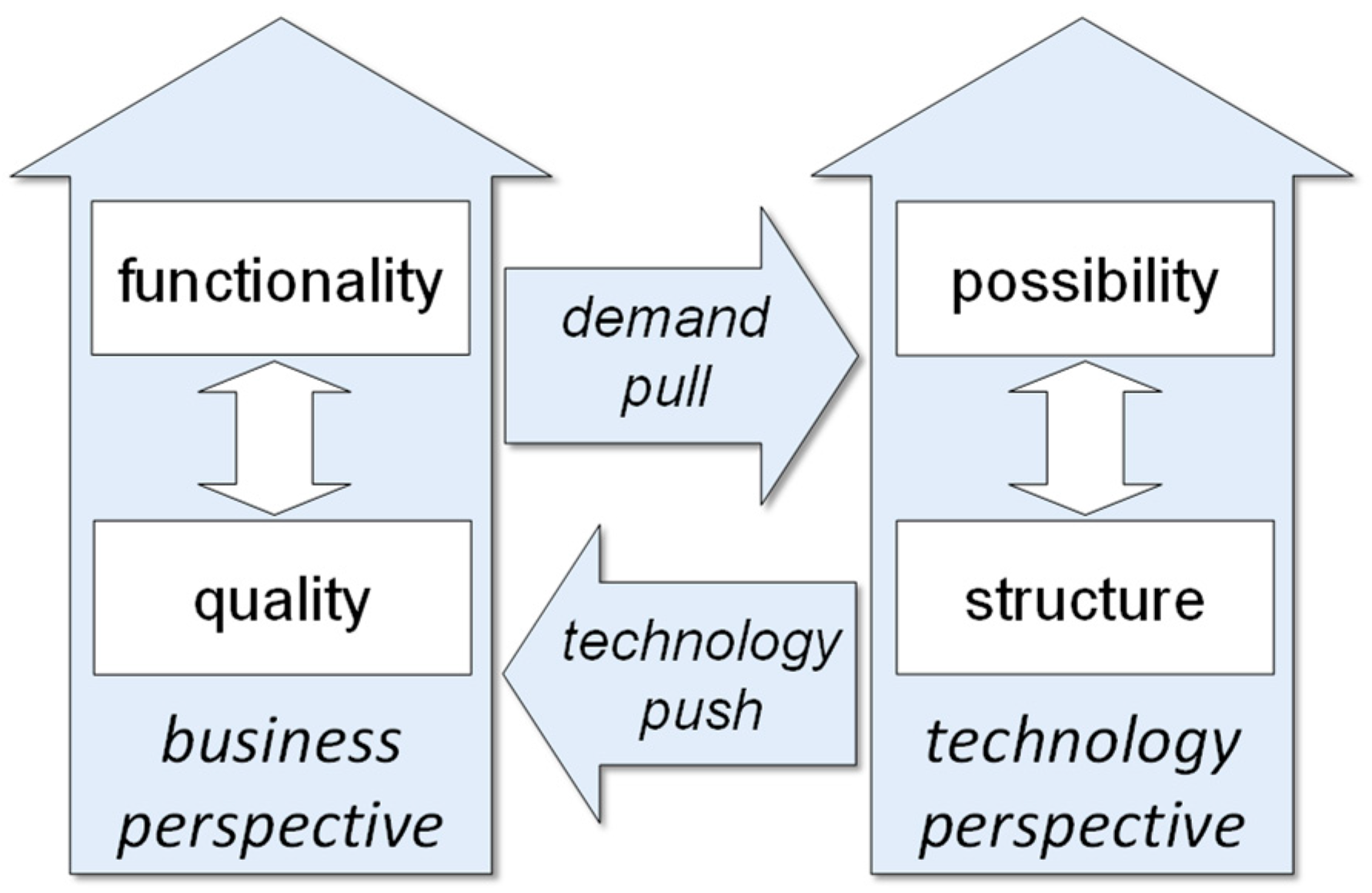
In dealing with the changing market landscape discussed in the previous section, production companies have to find their way in using advanced digital technologies to reach the required levels of customer-orientation, agility and efficiency. Their way must be plotted in a tension field of
demand-pull and
technology-push forces, as illustrated in
Figure 1 [
11].
On the left-hand side of the figure, we see the business perspective. The growing business demands for the functionality of digital solutions create a demand-pull force on the technology perspective. At the same time, these growing functional demands create a tension field with quality requirements within the business perspective: for example, data has to be consistent and adequately up-to-date, and decisions have to be correct and adequately in time. The more complex functional requirements get, the harder it is to have a full specification of non-functional requirements that adequately describe all quality constraints.
On the right-hand side of the figure, we see the (digital) technology perspective. Technical possibilities are growing rapidly here, often at a speed that dazzles many practitioners in smart production. A spectrum of technologies has become available for smart production, among which are (generative) artificial intelligence [
12], big data [
13], blockchain [
14], end-to-end production process management [
15], the (industrial) internet-of-things [
16] and cyber-physical systems [
17], augmented and virtual reality [
18], mobile and wearable technology [
19], and edge, fog, and cloud computing [
20]. Updated and new technologies appear at a fast pace. This abundance of technologies creates a technology-push force on the business perspective: shining promises that technologies will solve all business problems are ‘all over the place’. But adopting technologies creates a tension field within the digital technology perspective (indicated by the vertical arrow in the right-hand side of
Figure 1): it is hard to keep a proper structure in digital solutions when new, ground-breaking technologies are adopted that have unclear effects on the use of existing technologies.
Most production companies recognize that they need a vision to streamline and structure their digital transformation to deal with problems like the ones outlined above. Such a vision is typically outlined in a digitization strategy for the firm. But as we will see in the next section, creating an adequate digitization strategy is not without problems.
4. The Two Problems with Digitization Strategies
Many digitization strategies are developed by firms in the business domain of smart production to deal with the developments outlined in the previous section. There are, however, two main general problems with these strategies that we have observed in many digitization efforts.
The first main problem with many strategies is that a large gap exists between the intentions formulated in digitization strategies and the realization of these strategies in practical digitization projects. Strategies are often formulated in abstract, high-level objectives, such as “implementing a smart factory based on the latest intelligent digital technology” or “embracing AI to reach new levels of production efficiency”. Digitization projects, however, require concrete goals that lead to concrete solution structures.
The second main problem is the fact that many strategies focus on explicit technology classes from the onset, or even on a single technology class. As a consequence, concrete digitization projects resulting from these strategies are each focused on single digital technology classes. This is even more the case with new, innovative technologies, as these may be subject to the discussed hype cycle effect [
9]. At the time of writing this paper, this is certainly the case for artificial intelligence (AI), and sometimes even more specifically for generative artificial intelligence (GenAI) [
21] and large language models (LLMs) [
22]. Some authors make strong claims, like “GenAI holds immense potential to revolutionize various industries and reshape our daily lives” [
23]. The fact that there are warnings for the hype cycle effect [
24,
25] does not seem to have much influence—even though we have seen the hype cycle effect and the consequent over-estimation of possibilities before with different digital technology classes, like RFID [
26], big data [
27], and blockchain [
28].
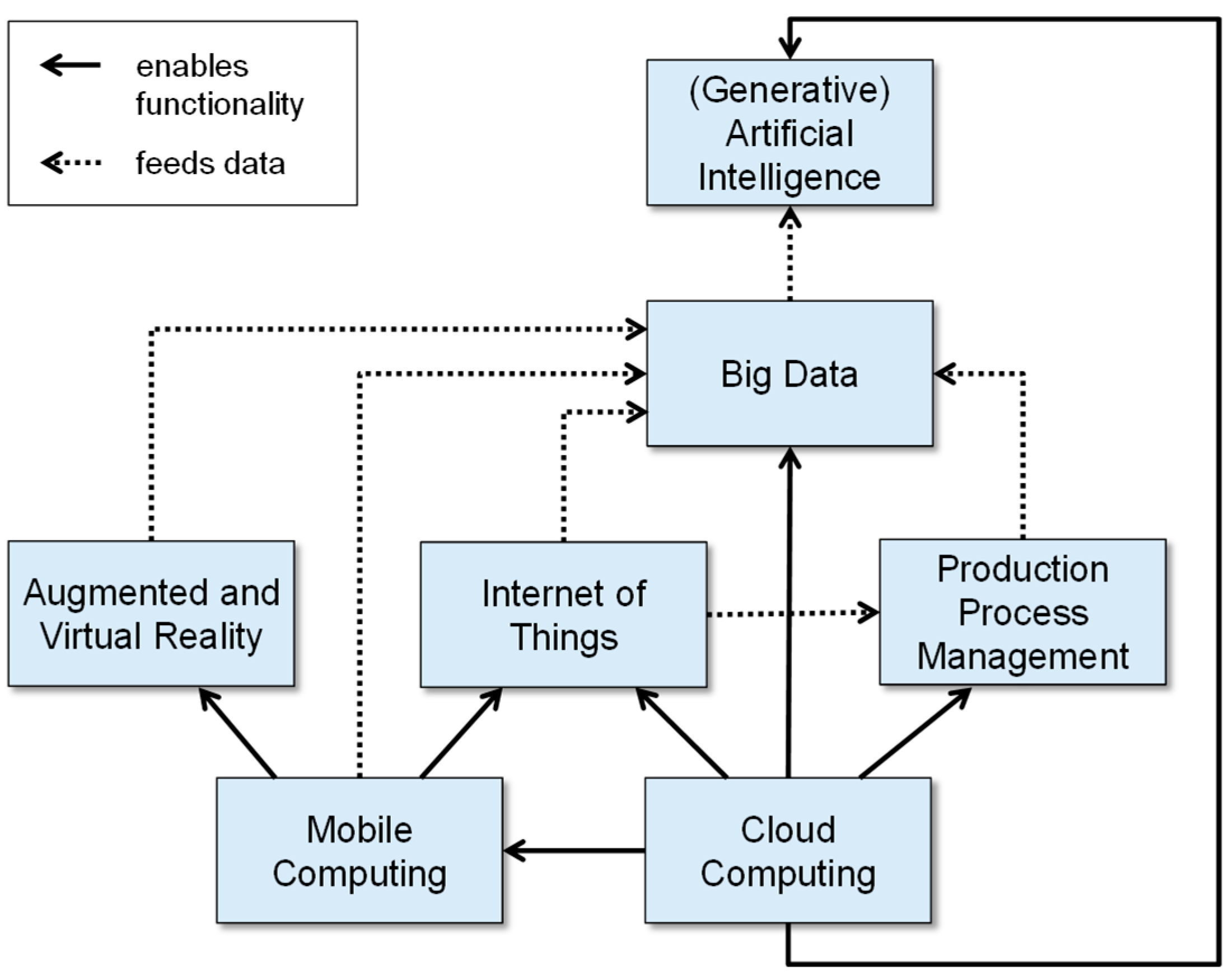
The reality in general, however, is that digital technologies applied in isolation typically do not constitute complete solutions and hence do not produce business results by themselves—the production domain is no exception here. Technologies need to be embedded in a technological context to come to full fruition. This is illustrated for a set of technology classes in
Figure 2 (adapted from [
29]). In this figure, we show that technology classes rely on each other for both reasons of functional dependencies and reasons of required data. For instance, big data technologies often rely on data storage and data processing in the cloud (hence requiring cloud computing functionality) for handling massive, complex data sets, and need to be fed with input data acquired with applications using various other classes of technology (such as mobile computing and the internet-of-things).
5. Digital Architecture to Overcome These Problems
In overcoming the problems discussed above, it is our belief and our experience (both in research and industrial practice) that digital architecture is an essential ingredient. Digital architecture acts as a bridge between an abstract digitization strategy and concrete deployment of digital technology—across various technology classes as outlined in the previous section. Architecture for production solution design should be holistic in this respect and agnostic to specific technology preferences [
30].
Whereas it is not so hard to find architectural designs targeting the application of one class of digital technology in a production context (for example, the application of big data analytics technology [
31]) or architecture designs that have no link to any specific class of digital technology (like abstract architecture frameworks [
32]), approaches covering multiple classes of digital technology are sparse. Some works mention several classes of technology, but only partially place them explicitly in an architecture design. An example is the use of AI in the design of a matrix controller as part of a solution for manufacturing operations management [
33].
Frameworks exist in the domain of smart manufacturing that are positioned as architectures but lack the rigor of a system engineering focus required to be the basis of structured solution design. A well-known example is the Reference Architectural Model Industrie 4.0 (RAMI 4.0) [
34]. RAMI 4.0 is in essence a framework that presents three dimensions in which to locate topics related to the digitization of smart industry: a
layers dimension that contains six viewpoints on digitization, a
hierarchy levels dimension that contains seven aggregation dimensions (extending the more traditional ISA-95 hierarchy for manufacturing [
35]), and a
life cycle and value stream dimension that covers the life cycles of the development, production and usage of products. The Industrial Internet Reference Architecture (IIRA) [
36] provides a functional viewpoint with five elements (or layers):
business,
application,
information,
operations, and
control. These five elements can be mapped to the six elements in the layers dimension of the RAMI 4.0 model [
37]. The Chinese Intelligent Manufacturing System Architecture (IMSA) is a three-dimensional model [
38] that has clear similarities to RAMI 4.0 but redefines the layers dimension of RAMI 4.0 as an Intelligent Functions dimension. ISA-95, RAMI 4.0, IIRA and IMSA are more frameworks for concept positioning than solid architectures for system engineering, as they provide dimensions for positioning architecture elements, but do not suggest concrete system blueprints. They certainly have their value but should be used in the right way at the right moment: as a basis for solution positioning but not as a complete basis for structured solution design.
In designing solutions for smart production environments, it is essential to choose the right level of abstraction to model these solutions in an architectural structure. We advocate the level of business information system architecture [
11]. Business information system architecture is positioned between the fields of enterprise architecture and software (and where necessary hardware) architecture. Enterprise architecture typically takes the more business-oriented point of view, where designing the structure of information systems is a final step. Software architecture focuses on the technical design of detailed software structures. Business information system architecture covers the middle ground, connecting the two, and focuses on structuring business-oriented system application landscapes. In our experience, this middle ground is where many organizations in the smart production domain are currently struggling with making the right choices; a challenge that is complicated by the growing complexity of system landscapes and by quickly evolving digital technologies—as we have discussed earlier in this paper.
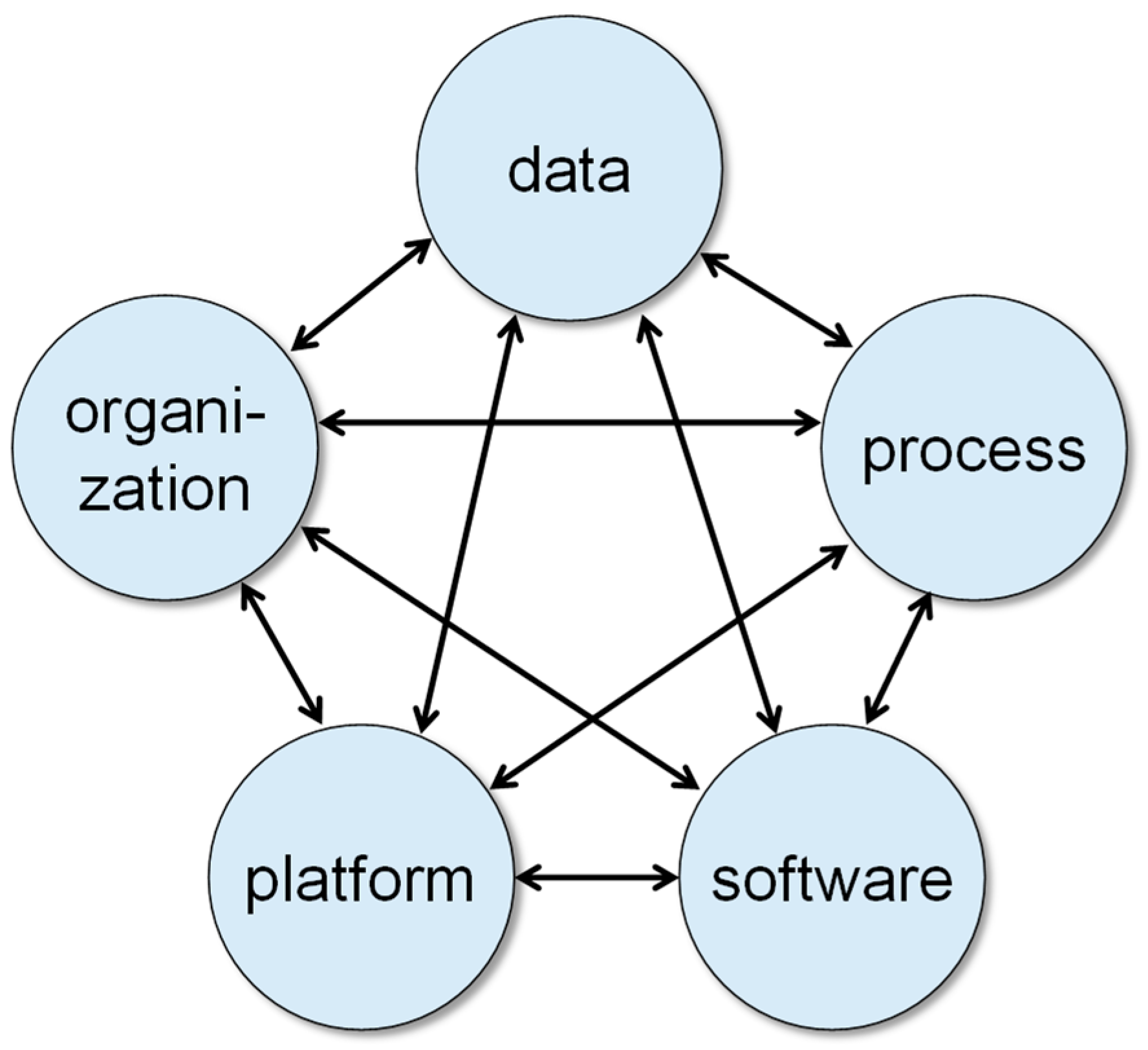
Business information system architecture does not focus only on software but is based on a well-chosen set of architecture aspects. It is less abstract and more technology-oriented than typical enterprise architecture, but more abstract and less technology-oriented than typical software architecture (which is often the focus in production system design, including the examples mentioned earlier in this section). In quite many design contexts, we have used the UT5 dimension framework [
11], which is shown in
Figure 3. This framework is a modernization of a practical framework that has proven its value in business [
39] and highlights the interplay of the required separation of concerns between five perspectives (architectural dimensions) on the one hand and the interrelationships between these perspectives on the other hand. Put very briefly, the UT5 model states that business processes manipulate business data in a business organization using specific software solutions that run on general platforms. Each of the five dimensions has its own characteristics (the separation of concerns) but changes to an element in one dimension can have effects on elements in all the other dimensions (the interrelationships). The essence in working with dimensions, however, is not choosing a very specific dimension framework (as there are alternatives), but using such a framework consistently.
The emphasis in putting business information system architecture in practice should not be on using complex architecture language syntax (either textual or graphical) to be as precise and detailed as possible. This practice is sometimes the case in enterprise architecture—and its products are then only understandable to seasoned enterprise architects, not to problem owners. The emphasis should be on proper, structured systems thinking, while keeping all involved stakeholders ‘on board’ in the design discussions [
40].
For example, in designing a complex solution for a smart production environment, it is unavoidable to design its architecture at multiple aggregation levels [
30]. Moving along the aggregation dimension, meaningful system–subsystem relations and consistency in interface definitions across aggregation levels must be respected. This should be respected at all costs, as neglecting this will inevitably lead to a poor solution design. Likewise, guarding strict consistency between architecture models in different architecture aspect dimensions (like the ones in the UT5 model) is not a luxury, but a must-have to avoid faulty designs that will be costly to repair in the best case and will never work in the worst case.
6. Does Architecture Work in Practice?
Then one might ask whether the broad, architecture-based approach advocated in the previous section does actually work in smart production practice, or whether it is a castle in the sky of yet another architect (which, in our opinion, is a valid doubt). Experience in various large, international research and development projects over the past two decades, as well as experience in international industrial consulting practice indicates that the approach does indeed work. Architecture is not the art of creating even more complicated structures but the engineering of design choices to strive for consistency and flexibility in digital solutions.
We have applied the described line of architecture thinking in the CrossWork, HORSE, OEDIPUS and SHOP4CF international research and development projects in smart manufacturing (as an important subdomain of smart production). These projects in total involved over 50 industrial organizations across Europe. We have analyzed and documented the application of architecture thinking across these projects [
41]. In the first of these projects, we observed a lack of coherence in the solution definition during the project execution and decided to redesign things from the start using a strict architecture approach at the business information system level of abstraction. This got a complex project back on track within several months and led to a good result [
42]. In the latter three projects, we took the architecture approach as an essential ingredient of the project design from the very start, using the discussed UT5 framework as a conceptual backbone. In all three projects, this led to a well-structured solution design, where the difficult discussions could focus on the smaller details, not on the overall structure.
We have made similar observations in commercial industrial consulting practice. Certainly in the smart production domain, solution design is often of a very ‘pragmatic’ kind, in which the lack of sound architecture principles leads to confusion and unnecessary design iterations, or far worse things. The recognition that a proper architecture framework is an important ingredient to any complex digital transformation effort in the smart production domain has even led to the establishment of a new version of the UT5 model [
11] by amalgamating it with another model from practice [
43], which has been adopted as a standard by the involved consultancy firm and published as the AC
2E model in the public domain for general use [
44].
7. Conclusions
In the current turbulent times for the smart production domain, an innovation strategy based on digital transformation—rightfully if done right—is seen as a way to deal with new threats and opportunities. How to do things right is, however, not always obvious.
Often, a digital innovation strategy is based on the application of several technologies in isolation, or even on the application of a single technology that appears very, very promising at the time (i.e., it is hyped). As already observed, the latter is currently certainly the case for (Gen)AI: according to many, this is the solution for most problems–data is the ‘new gold’ and digital algorithms are the ‘new business brains’. Even though (Gen)AI certainly has its merits, it is not a solution to every problem. And it will not work in isolation. We have seen the same with previous technology hypes, like RFID, big data, and blockchain. These technologies do each work in practice in their right application contexts but have not changed the complete industrial world on their own. Therefore, we explicitly try and combine digital technologies in the quest for smart production solutions, for example in the process industry domain [
45].
Also often, a solution is hastily put together because of time pressure, combining parts of old solutions (i.e., legacy systems) with new elements. But without proper structure in the design process, these processes are bound to either badly overrun in project costs and delivery time or fail altogether. The legacy problem is a difficult beast to master–and postponing the mastering will typically allow the beast to grow bigger (and the gap towards a solution to grow wider).
Based on our experience, we think that the basis for addressing digital transformation in the production domain in this turbulent time is in architecture. Architecture should be applied at the right abstraction level with the right mix between pragmatism, a strict regard for basic system engineering principles, and possibilities for participation of all the stakeholders involved. Architecture has been practiced in other, often more administrative, domains as a regular basis for digital transformation for a long time—see for example [
39,
46,
47]. In this regard, there is still ample room for learning and improving in the production domain. In doing so, architecture is the basis on which to connect business developments with technology-based solutions—with the right mix of ingredients—thereby realizing digitization strategies as starting points of innovation, not as fancy documents to be shelved. The goal of this short paper is to raise awareness for this important role of digital architecture in the smart production domain.
Author Contributions
Conceptualization, P.G. and A.W.; methodology, P.G.; investigation, P.G. and A.W.; writing—original draft preparation, P.G.; writing—review and editing, A.W.; visualization, P.G. All authors have read and agreed to the published version of the manuscript.
Funding
This research received no external funding.
Acknowledgments
All colleagues who took part in the CrossWork, HORSE, OEDIPUS and SHOP4CF projects as well as colleagues at Atos Digital Transformation Consulting working in the smart manufacturing domain are thanked for their contributions to the practice that is the basis for the insights presented in this commentary paper.
Conflicts of Interest
The authors declare no conflicts of interest.
References
- Zheng, P.; Lin, T.; Chen, C.; Xu, X. A systematic design approach for service innovation of smart product-service systems. J. Clean. Prod. 2018, 201, 657–667. [Google Scholar] [CrossRef]
- Vaidya, S.; Ambad, P.; Bhosle, S. Industry 4.0—A Glimpse. Procedia Manuf. 2018, 20, 233–238. [Google Scholar] [CrossRef]
- Barata, J.; Kayser, I. Industry 5.0—Past, Present, and Near Future. Procedia Comput. Sci. 2023, 219, 778–788. [Google Scholar] [CrossRef]
- Aytac, B.; Wu, S. Characterization of demand for short life-cycle technology products. Ann. Oper. Res. 2013, 203, 255–277. [Google Scholar] [CrossRef]
- Yang, J.; Xie, H.; Yu, G.; Liu, M. Achieving a just–in–time supply chain: The role of supply chain intelligence. Int. J. Prod. Econ. 2021, 231, 107878. [Google Scholar] [CrossRef]
- Netland, T.; Powell, D. The Routledge Companion to Lean Management; Routledge: London, UK, 2016. [Google Scholar]
- Ding, J.; Chen, M.; Wang, T.; Zhou, J.; Fu, X.; Li, K. A Survey of AI-enabled Dynamic Manufacturing Scheduling: From Directed Heuristics to Autonomous Learning. ACM Comput. Surv. 2023, 55, 307. [Google Scholar] [CrossRef]
- Okuyelu, O.; Daja, O. AI-Driven Real-time Quality Monitoring and Process Optimization for Enhanced Manufacturing Performance. J. Adv. Math. Comput. Sci. 2024, 39, 81–89. [Google Scholar] [CrossRef]
- Edwards, C. Waiting for the DROP. Eng. Technol. Mag. 2015, 10, 32–35. [Google Scholar] [CrossRef]
- Min, H.; Caltagirone, J.; Serpico, A. Life after a dot-com bubble. Int. J. Inf. Technol. Manag. 2008, 7, 21–35. [Google Scholar] [CrossRef]
- Grefen, P. Business Information System Architecture; G.DBA: Eindhoven, The Netherlands, 2025. [Google Scholar]
- Kim, S.; Kong, J.; Lee, S.; Lee, S. Recent Advances of Artificial Intelligence in Manufacturing Industrial Sectors: A Review. Int. J. Precis. Eng. Manuf. 2022, 23, 111–129. [Google Scholar] [CrossRef]
- Tao, F.; Qi, Q.; Liu, A.; Kusiak, A. Data-driven smart manufacturing. J. Manuf. Syst. 2018, 48, 157–169. [Google Scholar] [CrossRef]
- Kasten, J. Engineering and Manufacturing on the Blockchain: A Systematic Review. IEEE Eng. Manag. Rev. 2020, 48, 31–47. [Google Scholar] [CrossRef]
- Mangler, J.; Ehrendorfer, M.; Wais, B.; Rinderle-Ma, S. Business Process Management for Efficient Manufacturing—Sustainability by Design. In Handbook on Business Process Management and Digital Transformation; Edward Elgar Publishing: Cheltenham, UK, 2024. [Google Scholar] [CrossRef]
- Alexopoulos, K.; Sipsas, K.; Xanthakis, E.; Makris, S.; Mourtzis, D. An industrial Internet of things based platform for context-aware information services in manufacturing. Int. J. Comput. Integr. Manuf. 2018, 31, 1111–1123. [Google Scholar] [CrossRef]
- Yao, X.; Zhou, J.; Lin, Y.; Li, Y.; Yu, H.; Liu, Y. Smart manufacturing based on cyber-physical systems and beyond. J. Intell. Manuf. 2019, 30, 2805–2817. [Google Scholar] [CrossRef]
- Malik, A.; Masood, T.; Bilber, A. Virtual reality in manufacturing: Immersive and collaborative artificial-reality in design of human-robot workspace. Int. J. Comput. Integr. Manuf. 2020, 33, 22–37. [Google Scholar] [CrossRef]
- Nguyen, T.; Tran, K.D.; Raza, A.; Nguyen, Q.T.; Bui, H.M.; Tran, K.P. Wearable Technology for Smart Manufacturing in Industry 5.0. In Artificial Intelligence for Smart Manufacturing; Springer: Cham, Switzerland, 2023. [Google Scholar] [CrossRef]
- Qi, Q.; Tao, F. A Smart Manufacturing Service System Based on Edge Computing, Fog Computing, and Cloud Computing. IEEE Access 2019, 7, 86769–86777. [Google Scholar] [CrossRef]
- Shafiee, S. Generative AI in manufacturing: A literature review of recent applications and future prospects. Procedia CIRP 2025, 132, 1–6. [Google Scholar] [CrossRef]
- Naveed, H.; Khan, A.U.; Qiu, S.; Saqib, M.; Anwar, S.; Usman, M.; Akhtar, N.; Barnes, N.; Mian, A. A comprehensive overview of large language models. ACM Trans. Intell. Syst. Technol. 2025, 16, 106. [Google Scholar] [CrossRef]
- Solanki, S.; Khublani, D. Generative Artificial Intelligence: Exploring the Power and Potential of Generative AI; Apress Media: New York, NY, USA, 2024. [Google Scholar]
- Floridi, L. Why the AI Hype is Another Tech Bubble. Philos. Technol. 2024, 37, 128. [Google Scholar] [CrossRef]
- Widder, D.; Hicks, M. Watching the Generative AI Hype Bubble Deflate. arXiv 2024, arXiv:2408.08778. [Google Scholar] [CrossRef]
- Venables, M. Analysis: RFID—Don’t believe the hype. Manuf. Eng. 2005, 84, 8–9. [Google Scholar] [CrossRef]
- Fox, S.; Do, T. Getting real about Big Data: Applying critical realism to analyse Big Data hype. Int. J. Manag. Proj. Bus. 2013, 6, 739–760. [Google Scholar] [CrossRef]
- Michelman, P. Seeing Beyond the Blockchain Hype. MIT Sloan Manag. Rev. 2017, 58, 17–19. [Google Scholar]
- Grefen, P. Networked Business: Charting Digitally Enabled Business Collaboration; in press; Routledge: Abingdon, UK, 2026. [Google Scholar]
- Grefen, P.; Zimniewicz, M.; Vanderfeesten, I.; Traganos, K.; Becue, P.; Pedersen, A.; Rivera, G.P. The SHOP4CF modular reference architecture for flexible process-oriented, data-driven smart manufacturing. J. Manuf. Syst. 2026, 85, 227–247. [Google Scholar] [CrossRef]
- Fahmideh, M.; Beydoun, G. Big data analytics architecture design—An application in manufacturing systems. Comput. Ind. Eng. 2019, 128, 948–963. [Google Scholar] [CrossRef]
- Benkamoun, N.; ElMaraghy, W.; Huyet, A.; Kouiss, K. Architecture Framework for Manufacturing System Design. Procedia CIRP 2014, 17, 88–93. [Google Scholar] [CrossRef]
- Nielsen, C.; Avhad, A.; Schou, C.; Ribeiro da Silva, E. Control system architecture for matrix-structured manufacturing systems. Comput. Ind. 2023, 146, 103851. [Google Scholar] [CrossRef]
- Hankel, M.; Rexroth, B. The Reference Architectural Model Industrie 4.0 (RAMI 4.0); German Electrical and Electronic Manufacturers’ Association: Frankfurt, Germany, 2015. [Google Scholar]
- IEC. Enterprise-Control System Integration—Part 1: Models and Terminology, 2nd ed.; The International Electrotechnical Commission (IEC): Geneva, Switzerland, 2013. [Google Scholar]
- Lin, S. Industrial Internet Reference Architecture (IIRA); Industrial Internet Consortium (IIC): Needham, MA, USA, 2015. [Google Scholar]
- Moghaddam, M.; Cadavid, M.N.; Kenley, C.R.; Deshmukh, A.V. Reference architectures for smart manufacturing: A critical review. J. Manuf. Syst. 2018, 49, 215–225. [Google Scholar] [CrossRef]
- Li, Q.; Tang, Q.; Chan, I.; Wei, H.; Pu, Y.; Jiang, H.; Li, J.; Zhou, J. Smart manufacturing standardization: Architectures, reference models and standards framework. Comput. Ind. 2018, 101, 91–106. [Google Scholar] [CrossRef]
- Truijens, J.; Oosterhaven, A.; Maes, R.; Jägers, H.; van Iersel, F. Informatie-Infrastructuur: Een Instrument Voor Het Management; Kluwer Bedrijfswetenschappen: Alphen aan den Rijn, The Netherlands, 1990. (In Dutch) [Google Scholar]
- Rozanski, N.; Woods, E. Software Systems Architecture: Working with Stakeholders Using Viewpoints and Perspectives, 2nd ed.; Addison-Wesley Professional: Boston, MA, USA, 2011. [Google Scholar]
- Grefen, P.; Vanderfeesten, I.; Traganos, K.; Domagala-Schmidt, Z.; van der Vleuten, J. Advancing Smart Manufacturing in Europe: Experiences from Two Decades of Research and Innovation Projects. Machines 2022, 10, 45. [Google Scholar] [CrossRef]
- Mehandjiev, N.; Grefen, P. (Eds.) Dynamic Business Process Formation for Instant Virtual Enterprises; Springer: London, UK, 2010. [Google Scholar]
- Klaverbladmodel. Available online: https://managementmodellensite.nl/klaverbladmodel/ (accessed on 11 February 2026). (In Dutch)
- Grefen, P. The AC2E Model for Scoping, Defining and Executing Digital Transformation Projects; Atos Digital Transformation Consulting: Eindhoven, The Netherlands, 2025; Available online: https://hal.science/hal-05157775v1 (accessed on 17 January 2026).
- Pietrasik, M.; Wilbik, A.; Grefen, P. The Enabling Technologies for Digitalization in the Chemical Process Industry. Digit. Chem. Eng. 2024, 12, 100161. [Google Scholar] [CrossRef]
- Bass, L.; Clements, P.; Kazman, R. Software Architecture in Practice, 2nd ed.; Addison Wesley: Boston, MA, USA, 2003. [Google Scholar]
- Greefhorst, D.; Proper, E. Architecture Principles: The Cornerstones of Enterprise Architecure; Springer: Berlin/Heidelberg, Germany, 2011. [Google Scholar]
| Disclaimer/Publisher’s Note: The statements, opinions and data contained in all publications are solely those of the individual author(s) and contributor(s) and not of MDPI and/or the editor(s). MDPI and/or the editor(s) disclaim responsibility for any injury to people or property resulting from any ideas, methods, instructions or products referred to in the content. |