


Abstract
Ports are critical nodes in global supply chains and play a central role in sustainability transitions in trade and logistics. This study investigates how Artificial Intelligence (AI) contributes to sustainable innovation within port ecosystems, focusing on efficiency, transparency, resilience, and environmental performance. To address the research question—how has AI supported sustainability in maritime ports?—we conducted a systematic screening combined with bibliometric performance analysis and science mapping. A total of 80 peer-reviewed articles published between 2019 and 2025 (Scopus) were analysed. The results show a strong acceleration of publications in 2025, alongside a citation–time lag for recent studies. The findings indicate three dominant application streams: (1) operational efficiency and optimisation (terminal operations, forecasting, routing, scheduling); (2) digital and smart-port enablement through IoT and data infrastructures; and (3) governance, risk, and compliance (e.g., Port State Control, inspection analytics, cyber-resilience). The mapping also evidences increasing convergence of AI with complementary technologies—particularly IoT and, in a smaller but visible subset, blockchain—to enhance trust, accountability, and interoperability. By synthesising the field’s intellectual structure and thematic evolution, this study outlines research gaps and proposes future directions toward integrated frameworks for sustainable port ecosystems and Sustainable Commerce 4.0.
1. Introduction
Ports constitute critical nodes within global supply chains, operating as complex socio-technical systems where logistics efficiency, environmental performance, governance structures, and technological infrastructures intersect. In recent years, increasing pressure to decarbonise transport systems, enhance supply chain resilience, and improve transparency has accelerated the adoption of advanced digital technologies in port operations. Within this context, Artificial Intelligence (AI) has emerged as a central enabler of what is often described as the transition from smart ports to sustainable port ecosystems, supporting decision-making across operational, environmental, and institutional dimensions.
In the existing literature, smart ports are commonly understood as ports that leverage digital technologies—such as automation, Internet of Things (IoT), big data analytics, and AI—to enhance operational efficiency, safety, and service quality. This paradigm emphasises data-driven decision-making, real-time monitoring, and the optimisation of logistics and terminal operations through advanced analytics and automation technologies. Empirical studies within this stream highlight improvements in navigation safety, estimated time of arrival prediction, and terminal performance, positioning smart ports as technology-intensive hubs focused primarily on operational excellence and competitiveness [1,2].
While the smart port concept has contributed significantly to performance optimisation, several authors argue that a technology-centric focus alone is insufficient to address the broader sustainability and resilience challenges faced by contemporary maritime supply chains. Recent governance- and strategy-oriented research highlights that AI adoption requires alignment with organisational capabilities, institutional frameworks, and long-term sustainability objectives. In this regard, AI is increasingly framed not merely as an operational tool but as a catalyst for organisational transformation and adaptive governance within ports [3,4,5,6].
By contrast, the concept of a port ecosystem reflects a broader system-level perspective, in which ports are viewed as complex socio-technical systems embedded within regional, urban, and global supply chains. Port ecosystems encompass not only physical infrastructure and port authorities but also shipping companies, logistics service providers, regulators, technology developers, labour markets, and surrounding communities. This perspective emphasises interdependencies, feedback mechanisms, and the co-evolution of technological innovation, governance structures, and environmental performance [7,8]. Within this framework, sustainability and resilience are emergent properties of coordinated system-wide interactions rather than outcomes of isolated technological interventions.
Recent studies explicitly addressing sustainable port logistics and environmental performance reinforce this ecosystemic view. Research focusing on Spanish ports, for example, demonstrates how the integration of AI with emerging technologies such as digital twins and environmental monitoring systems supports emissions reduction, energy efficiency, and sustainable logistics planning at the system level [7]. Similarly, integrated modelling and measurement approaches show how AI-enabled systems can support near-real-time assessments of port-related environmental impacts, strengthening the link between operational decision-making and sustainability outcomes [9].
Within this conceptual framing, the transition from smart ports to sustainable port ecosystems represents a shift from technology-driven optimisation toward system-oriented sustainability and resilience. AI plays a critical role in this transition by enabling not only advanced operational analytics but also cross-actor coordination, adaptive governance, and integrative decision-making across the port ecosystem. Governance-focused studies illustrate how AI transformation strategies, when embedded in resilient governance models, can enhance adaptability and long-term competitiveness in ports [3], while portfolio-based approaches highlight the importance of aligning AI project complexity with organisational readiness and strategic objectives [6].
Despite the rapid growth of research on AI in maritime and port contexts, the literature remains fragmented across technical, environmental, and governance perspectives. Many studies address isolated applications of AI, while fewer provide integrative, system-level syntheses that capture how AI contributes to sustainability and resilience across port ecosystems and supply chain systems. This fragmentation underscores the need for a comprehensive analysis of the intellectual structure and thematic evolution of AI-driven sustainability research in port ecosystems.
- Research Gap and Objectives
Against this background, a clear research gap emerges. Although the volume of publications on AI applications in ports has increased substantially, there is a limited system-oriented understanding of how these contributions collectively support the transition from smart ports to sustainable port ecosystems within resilient supply chains. Existing reviews rarely combine bibliometric techniques with an explicit focus on ecosystem-level sustainability, governance, and resilience dynamics.
The primary objective of this study is therefore to analyse, from a system-level perspective, how AI has been conceptualised and applied to support sustainability and resilience in port ecosystems. To achieve this aim, this study pursues four specific objectives:
- To trace the temporal evolution of scientific production and citation impact related to AI applications in sustainable port and maritime systems;
- To identify the most influential publications and foundational contributions shaping the field;
- To map the principal contributors in terms of journals, authors, institutions, and countries;
- To uncover the dominant thematic clusters and their evolution through bibliographic coupling and keyword co-occurrence analysis.
By addressing these objectives, this study contributes to the Systems literature by offering a structured and integrative overview of AI-driven innovation in port ecosystems, highlighting how technological, environmental, and governance dimensions converge within complex supply chain systems.
The remainder of this article is structured as follows. Section 2 presents the materials and methods, detailing the data sources, search strategy, and bibliometric techniques employed. Section 3 reports the results of the bibliometric analysis. Section 4 discusses the findings from a system-level perspective, outlining theoretical and practical implications. Section 5 concludes this paper by summarising key contributions, limitations, and avenues for future research.
2. Materials and Methods
This study adopts a transparent and replicable bibliometric research design, following established methodological guidelines for science mapping and performance analysis. Bibliometric analysis is particularly suited to examining the structural development of interdisciplinary research domains and identifying patterns of knowledge production, collaboration, and thematic evolution within complex systems.
Given the fragmented and rapidly expanding nature of research on Artificial Intelligence (AI) in maritime and port contexts, a bibliometric approach enables the synthesis of a heterogeneous body of literature while preserving analytical rigour and conceptual coherence. This study combines performance analysis (publication trends, citation impact, leading contributors) with science mapping techniques (bibliographic coupling and keyword co-occurrence) to uncover the intellectual structure and thematic evolution of the field.
Importantly, the objective of this study is not to exhaustively catalogue all AI-related publications in maritime studies but to identify dominant knowledge structures, thematic trajectories, and system-level research patterns that support the transition from smart ports to sustainable port ecosystems.
2.1. Data Source and Search Strategy
The bibliographic data were retrieved from the Scopus database, selected for its broad coverage of peer-reviewed journals and its consistency in citation indexing. Scopus is widely used in bibliometric studies related to engineering, logistics, and sustainability, making it appropriate for capturing the multidisciplinary nature of AI research in port and maritime systems.
The search was conducted using a combination of keywords related to AI, ports, maritime systems, and sustainability. The literature search was conducted in December 2025 and applied to article titles, abstracts, and author keywords. The following search string was used: (TITLE-ABS-KEY (port) AND TITLE-ABS-KEY (artificial Intelligence) AND TITLE-ABS-KEY (sea OR maritime)) AND PUBYEAR > 2018 AND PUBYEAR < 2026 AND (LIMIT-TO (DOCTYPE, “ar”)) AND (EXCLUDE (SUBJAREA, “BIOC”) OR EXCLUDE (SUBJAREA, “CHEM”) OR EXCLUDE (SUBJAREA, “PHYS”) OR EXCLUDE (SUBJAREA, “EART”) OR EXCLUDE (SUBJAREA, “ARTS”) OR EXCLUDE (SUBJAREA, “CENG”)).
This query was designed to capture research explicitly addressing Artificial Intelligence within port and maritime systems while maintaining a clear focus on sustainability- and resilience-related outcomes. Although specific techniques such as machine learning, deep learning, or neural networks were not included as standalone search terms, these approaches are widely recognised as methodological sub-fields within the broader AI domain. Their relevance emerges endogenously through keyword co-occurrence and thematic clustering, rather than through pre-imposed search constraints.
Furthermore, only journal articles written in English were considered to ensure quality control and comparability of citation metrics. The temporal scope of the analysis covered publications from 2019 to 2025, reflecting the period in which AI applications in sustainable port systems have gained significant academic traction.
2.2. Inclusion and Exclusion Criteria
An initial dataset of 85 records was retrieved from Scopus. These records were subjected to a manual screening process to ensure relevance and consistency with the research objectives. Articles were included if they explicitly addressed AI applications within port, maritime, or closely related logistics contexts, with clear relevance to sustainability, efficiency, resilience, or governance.
Review articles and studies with only peripheral references to AI or port systems were excluded to maintain analytical focus. Following this screening process, four review papers were removed, resulting in a final dataset of 80 peer-reviewed journal articles used for bibliometric analysis.
2.3. Bibliometric Techniques and Analytical Tools
The analysis combined performance analysis and science mapping techniques, in line with recommendations by [10,11,12], and related bibliometric scholarship. Performance analysis was used to examine publication trends, citation impact, and the most influential sources and contributors (journals, authors, institutions, and countries) within the field. Science mapping techniques were employed to reveal the intellectual and thematic structure of the literature.
Citation analysis was conducted using raw citation counts as provided by Scopus. Given the relatively short temporal window (2019–2025) and the exploratory objective of identifying influential contributions rather than benchmarking cross-field performance, raw citations were considered appropriate. The expected citation–time lag for recent publications is explicitly acknowledged and interpreted in the results.
Bibliographic coupling analysis was used to detect clusters of documents and authors sharing similar reference bases, thereby revealing thematic proximities within the research field. In addition, keyword co-occurrence analysis was conducted to explore the conceptual structure and temporal evolution of research themes.
All visualisations and network analyses were generated using VOSviewer software (version 1.6.20) applying the Visualisation of Similarities (VOS) algorithm [13]. The following analytical settings were adopted:
- Counting method: full counting;
- Minimum keyword occurrence threshold: three occurrences;
- Data cleaning: consolidation of synonyms and lexical variants (e.g., “smart port”/“smart ports”; “AI”/“artificial intelligence”);
- Network types: bibliographic coupling (authors and documents), keyword co-occurrence (author keywords);
- Visualisations: network, overlay, and density maps.
These parameters were selected to balance analytical clarity with conceptual inclusiveness, ensuring robust cluster formation while avoiding excessive fragmentation.
2.4. Reliability and Validity Considerations
To enhance reliability, data extraction and screening procedures were conducted systematically, with consistent application of inclusion and exclusion criteria. The use of established bibliometric techniques and widely adopted analytical software supports methodological robustness and replicability.
While the study is limited to a single database, Scopus provides extensive coverage of high-impact journals relevant to the research domain, mitigating potential database bias.
3. Data Analysis and Results
This section reports the findings of the bibliometric performance analysis and science mapping based on the screened Scopus dataset (n = 80 journal articles, 2019–2025). Citation indicators correspond to the Scopus export dated 1 December 2025. Overall, the corpus accumulates 1288 citations and an h-index of 21, with an average of 16.1 citations per article.
3.1. Objective 1—Temporal Evolution of Scientific Production and Citations
Annual publication output and citation counts are presented in Table 1. The field exhibits accelerated growth in 2025 (26 articles), while citations are concentrated in earlier years, reflecting an expected citation–time lag for more recent publications. The period 2019–2022 concentrates the highest citations per paper, consistent with the longer time available for diffusion and uptake.
Table 1.
Annual scientific production and citations (screened corpus; n = 80).
The results reveal a dynamic yet asymmetric relationship between publication output and citation performance. Between 2019 and 2022, the field demonstrated steady growth, with publication counts ranging from 6 to 9 articles per year and citations consistently above 230. This period represents the emergence and consolidation phase of AI research in maritime sustainability, when digitalisation, automation, and environmental monitoring became focal points of academic attention.
A notable inflexion occurs in 2024 and 2025, where publication productivity expands sharply, particularly in 2025, reaching 26 articles, the highest value in the entire period. However, the number of citations during this phase declines to 75, indicating the expected temporal lag between publication and citation accumulation for newly released studies. This divergence suggests that while the field is expanding rapidly in scope and visibility, the academic influence of these contributions is still maturing.
The citation peak observed in 2020–2022 aligns with the post-pandemic acceleration of digital transformation and the integration of AI-based solutions for operational efficiency and carbon reduction in port ecosystems. These years correspond to the production of influential works that shaped current research directions, especially regarding predictive analytics, digital twins, and IoT-enabled environmental intelligence.
Overall, the distribution underscores an ongoing transition from a formative to a productivity-intensive stage. The increasing output in 2024–2025 reflects growing global awareness of AI’s role in sustainable logistics, while the citation asymmetry highlights the need for longitudinal, theory-driven research capable of generating enduring academic and practical value. Maintaining conceptual rigour and systemic integration will be key to ensuring that this expanding body of literature contributes not only to innovation but also to the long-term resilience of maritime port systems.
3.2. Objective 2—Identification of the Most Influential Papers
Influence was assessed through total citations (“Cited by” in Scopus). Table 2 lists the twenty most cited articles, which collectively anchor the intellectual structure of the field. The most influential works emphasise (i) predictive analytics for vessel movement and ETA, (ii) optimisation and simulation–optimisation in port/terminal decision-making, and (iii) risk, compliance, and cyber intelligence within increasingly digital port ecosystems.
Table 2.
Top 10 most cited papers in the screened corpus (ranked by total citations).
A focused examination of citation patterns between 2019 and 2025 was performed. Table 2 shows a temporally uneven yet coherent distribution of high-impact contributions (≥50 citations) in AI-enabled, sustainability-oriented maritime research. Overall, productivity and impact are asymmetric: publication output accelerates in 2024–2025, while citations concentrate in 2019–2023, consistent with the time needed for scholarly uptake.
The foundational–consolidation phase (2019–2021) is anchored in AIS/LRIT data exploitation and early decision support. High-impact studies demonstrate how data-driven methods improve estimated time of arrival and maritime situational awareness (e.g., [1,9]), while intelligent optimisation and integrity assurance address terminal operations and AIS data falsification [18,19]. Concurrently, learning-based models advance collision-avoidance decision-making [20] and strengthen Port State Control through predictive analytics and resource-allocation models [15,21]. Collectively, these works establish the technical bedrock linking safety, efficiency, and data governance.
A maturation phase (2021–2022) consolidates system-level perspectives. High-impact articles formalise smart-port architectures, metrics, and change-management pathways [4] and extend path planning by integrating COLREGs, geospatial theory, and autonomy [22]. This period marks the transition from isolated applications to systemic, data-driven frameworks that couple AI with IoT and simulation.
The expansion phase (2023–2024) broadens the scope toward resilience, sustainability, and cyber–physical integration. Deep learning-based cyber threat intelligence for IoT-enabled maritime systems [16], machine learning approaches for green port operations [23], and RNN/CNN ETA prediction for bulk ports [24] exemplify this shift. Field-level syntheses reinforce the research agenda in operations research for container terminals [25], while digital twin/ANN solutions enable near-real-time structural health monitoring of port assets [26]. Scientometric mapping [27] traces the diffusion of Industry 4.0 technologies across port ecosystems.
Recent outputs in 2024–2025 display lower citation counts—an expected lag rather than a signal of limited relevance—yet they consolidate a trajectory toward governance, resilience, and integrated cyber–physical systems. Taken together, the high-impact corpus converges on four enduring themes: (i) operational efficiency (ETA, optimisation, digital twins), (ii) safety and compliance (PSC, anomaly detection, collision avoidance), (iii) environmental performance (air-quality and emissions intelligence), and (iv) system-level governance (smart-port frameworks, data integrity, and emerging trust technologies). This evolution aligns closely with the Systems Special Issue mandate on sustainable and resilient supply chains, evidencing a maturing, impact-oriented research frontier in AI for port ecosystems.
The synthesis of the evolutionary phases of research on AI in maritime and port systems (Table 3) highlights the temporal progression of core research foci, representative studies, and key contributions. By organising the literature into four distinct phases—foundational–consolidation, maturation, expansion, and emergent—the Table provides a structured overview of how AI research has evolved from data-driven operational applications toward system-level, governance-oriented, and sustainability-focused port ecosystem frameworks.
Table 3.
Analytical phases of thematic consolidation in AI research on maritime and port systems.
To synthesise the temporal and thematic evolution of the field, the literature was organised into a set of analytical phases of thematic consolidation. These phases do not represent rigid historical stages, nor are they defined by quantitative thresholds. Rather, they constitute interpretative constructs derived from converging evidence across publication timing, citation concentration, and dominant thematic orientations revealed through bibliographic coupling and keyword co-occurrence analysis.
Accordingly, the phases capture shifts in research emphasis and system-level orientation, rather than discrete or exhaustive representations of all publications within a given period.
3.3. Objective 3—Principal Contributors: Journals, Authors, Institutions, and Countries
This section addresses the third research objective by mapping the principal contributors to the field of AI in maritime and port systems. Specifically, it examines the distribution of scholarly output and citation impact across journals, authors, institutions, and countries, providing a comprehensive overview of the actors shaping the intellectual and geographical structure of the research domain.
3.3.1. Key Contributors—Analysis of Journals
The primary contributors and the analysis of the journals, as illustrated in Table 4, reveal a concentration of publications and citations within a select few academic journals, highlighting significant disparities in productivity and citation impact. Notably, the IEEE Transactions on Intelligent Transportation Systems and Ocean Engineering emerge as the most influential outlets, each surpassing 210 total citations despite having published only three and eight articles, respectively. These journals also exhibit the highest average citation impact per article, signifying a strong emphasis on highly cited contributions.
Table 4.
Top 10 journals (by number of publications) in the screened corpus.
Other journals, such as Maritime Economics and Logistics and Expert Systems with Applications, also display substantial citation levels relative to their publication counts, reflecting their relevance in disseminating research at the intersection of AI, maritime systems, and decision-support methodologies. In addition, Journal of Computational Science and Transportation Research Part D and Transportation Research Part B, although represented by a single publication each, exhibit high citation averages, highlighting the visibility of specific methodological and environmental transport studies within the field.
By contrast, the Journal of Marine Science and Engineering emerges as the most productive source, with eleven published articles, but shows a comparatively lower average citation impact. This pattern suggests a broader dissemination role, supporting the publication of applied and emerging research topics related to maritime technologies and port systems. Journals such as Case Studies on Transport Policy and IEEE Access further contribute to the diversity of publication outlets, with moderate citation performance and a focus on applied policy analysis and open-access technological research.
Overall, the results indicate a differentiated publication landscape, where a small number of journals concentrate high citation impact, while others contribute primarily through higher publication volume. This distribution reflects the coexistence of highly selective, high-impact outlets and more prolific journals that facilitate the diffusion of research on AI in maritime and port systems.
3.3.2. Geographical Distribution of Contributions
As illustrated in Table 5, the geographical distribution of contributions highlights the number of publications and total citations by country. The findings reveal a notable concentration of research output and citation impact in a select group of countries. China stands out as the leading contributor, with 22 publications and a total of 529 citations, indicating both significant productivity and strong scholarly visibility in the field of AI as applied to maritime and port systems.
Table 5.
Documents by country/territory.
As shown in Table 5, Belgium and the United States present comparable publication volumes, with five documents each, but differ slightly in total citation counts, recording 140 and 133 citations, respectively. These figures indicate a high citation intensity relative to the number of publications, suggesting that contributions from these countries achieve substantial academic impact despite lower output volumes. Spain, with seven publications and 89 citations, combines moderate productivity with consistent citation performance, while South Korea, represented by six documents and 49 citations, shows a growing but comparatively lower citation footprint.
Overall, the results highlight a geographically concentrated research landscape, in which a small number of countries account for most publications and citations. This distribution reflects differing national research capacities and strategic priorities in the development of AI-driven solutions for maritime and port systems.
3.3.3. Author’s Contributions
An author-level analysis reveals a concentrated distribution of scholarly influence within a relatively small group of contributors, as presented in Table 6. Most prominently, Wang, Shuaian Aian and Yan, Ran emerge as the field’s leading figures, each with four publications and an impressive 166 citations. Their consistent co-authorship and methodological orientation toward Artificial Intelligence applications in port operations and maritime safety suggest a sustained research agenda that has significantly shaped discourse on smart-port analytics and data-driven maritime governance. Their joint output represents not only high productivity but also exceptional resonance, positioning their contributions as foundational references in the study of AI-enabled maritime systems.
Table 6.
Most productive authors by number of publications and citations (full counting).
A second tier of contributors, including Gao, Miao (58 citations, Scopus-based count) and Liu, Jingxian (46 citations, Scopus-based count), demonstrates the potential of focused, high-impact research with fewer outputs. Each author has published two papers that explore machine learning, collision avoidance, and trajectory prediction within maritime contexts. Despite smaller publication portfolios, their work exhibits strong conceptual depth and technical sophistication, underscoring that impact is not necessarily proportional to volume. These examples highlight the value of rigorous, technically innovative studies that resonate across the disciplinary boundaries of engineering, logistics, and Artificial Intelligence.
Other contributors, such as Vanelslander, Thierry (34 citations, Scopus-based count) and González-Cancelas, Nicoletta (15 citations, Scopus-based count), occupy an important intermediary position, connecting technological innovation with policy and governance frameworks. Their research situates AI within the broader institutional and sustainability discourse of port management, suggesting that interdisciplinary approaches—linking operations, policy, and sustainability—are increasingly central to the field’s development.
By contrast, Gan, Langxiong, Liu, Chengyong, and Xu, Yi, each with two publications and nine citations, represent emerging voices in this evolving domain. Their collaborative work on Port State Control (PSC) inspections and knowledge graph–based vessel assessment contributes to the methodological diversification of maritime AI research. Similarly, Huiskonen, Janne, with two papers and five citations, reflects ongoing but modest engagement within a specialised niche of maritime logistics optimisation.
Taken together, these patterns reveal a dual dynamic between productivity and impact. Authors with repeated, thematically cohesive output—such as Wang and Yan—achieve visibility through continuity and collaboration, while others gain influence through highly focused, technically robust single contributions. The data emphasise that scholarly recognition in this domain hinges less on publication volume than on conceptual clarity, methodological rigour, and alignment with emergent technological and sustainability agendas in maritime research.
3.3.4. Institutional and Organisational Contributions
An institutional-level analysis of scholarly contributions reveals a geographically concentrated yet intellectually diverse research landscape (Table 7). The Hong Kong Polytechnic University stands as the most prolific and influential institution, with seven publications and 213 citations, confirming its leadership in the field of Artificial Intelligence applications in port management and maritime logistics. Its sustained research agenda—often led by highly cited scholars such as Wang, Shuaian Aian and Yan, Ran—focuses on data-driven optimisation, Port State Control systems, and smart-port innovation. The institution’s prominence underscores Hong Kong’s strategic role as a global maritime hub and a centre for digital transformation in logistics and transportation systems.
Table 7.
Contributions by organisations.
Following closely, Dalian Maritime University (four documents, 128 citations) and Shanghai Maritime University (three documents, 69 citations) further consolidate China’s dominant position in this domain. Their collective work demonstrates a strong emphasis on machine learning, neural networks, and safety analytics for ship operations, reflecting the country’s broader national agenda toward port automation and intelligent transportation. These contributions highlight a synergy between academic research and the maritime industry’s drive for technological modernisation.
The University of Antwerp (four publications, 34 citations) exemplifies Europe’s intellectual contribution to the socio-economic and governance dimensions of maritime sustainability. Research emerging from Antwerp’s transport and logistics group—particularly by Thierry Vanelslander—emphasises policy, efficiency, and governance frameworks that align digitalisation with sustainability objectives. Similarly, Universidad Politécnica de Madrid (two publications, 15 citations) and Universitat Politècnica de València (two publications, 54 citations) add to Europe’s footprint by focusing on sustainable port development, digital transformation strategies, and public–private collaboration models.
In parallel, Wuhan University of Technology (three documents, 76 citations) and Zhejiang University (two documents, 9 citations) contribute through highly technical studies employing AI-based optimisation, digital twins, and structural health monitoring—key areas for improving port resilience and infrastructure management. These institutions represent China’s expanding academic ecosystem dedicated to integrating engineering innovation with environmental performance.
Beyond Asia and Europe, the Norwegian University of Science and Technology (NTNU) and Korea Maritime and Ocean University (each with two publications, 12 and 8 citations, respectively) represent emerging research nodes in AI-driven maritime safety, autonomous navigation, and logistics analytics. Their contributions, though quantitatively smaller, reflect growing participation in global collaborative networks, often through interdisciplinary partnerships combining ocean engineering, information systems, and sustainability research.
Collectively, these patterns illustrate a dual dynamic of regional specialisation and international collaboration. Asian institutions dominate in technical and data-centric innovation, while European counterparts provide complementary expertise in policy integration and sustainability governance. This convergence suggests a maturing research ecosystem where technological capability, institutional strategy, and sustainability imperatives are becoming increasingly intertwined in the evolution of sustainable maritime systems.
3.4. Objective 4—The Main Research Themes
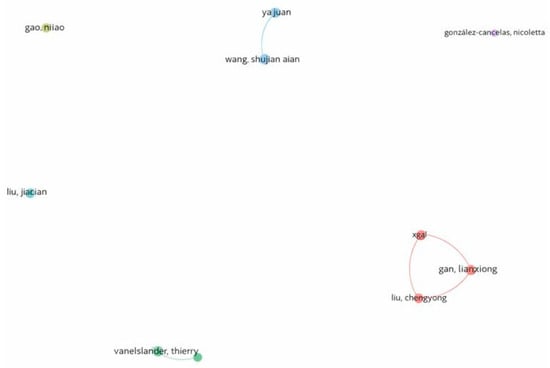
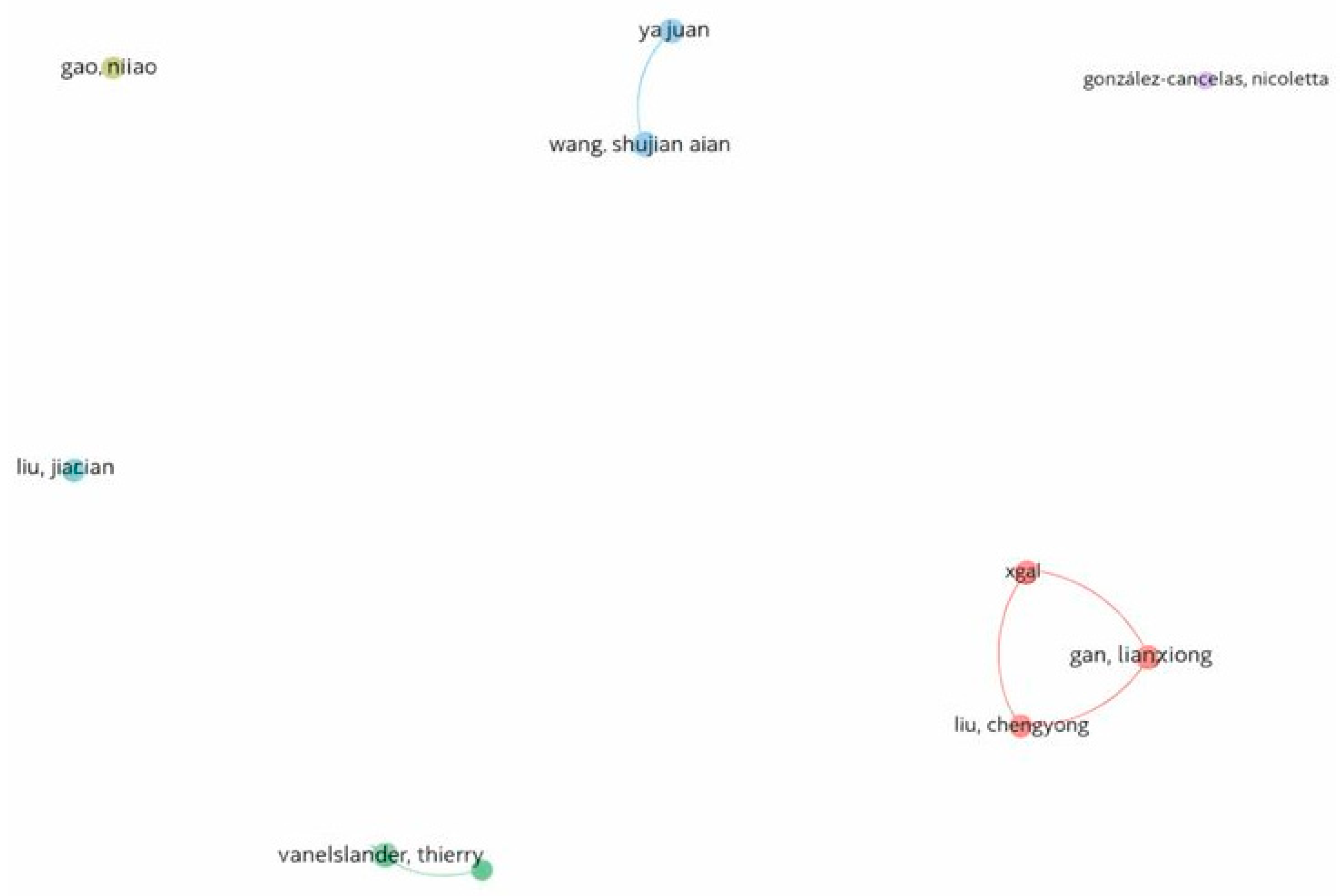
The bibliographic coupling visualisation, as illustrated in Figure 1, shows the intellectual proximity among authors working on Artificial Intelligence and sustainable maritime systems. By mapping shared reference patterns, this network reveals how scholars are aligned conceptually, even in the absence of direct collaboration. The strength of connections reflects common methodological frameworks, research interests, and thematic intersections across maritime logistics, port management, and digital transformation.
Figure 1.
Author co-citation network showing thematic clusters in AI and sustainable maritime research, where node colours denote distinct co-citation clusters and node size reflects citation frequency.
Three main clusters emerge within this intellectual landscape, each corresponding to a distinct strand of inquiry.
The red cluster, which includes Gan, Langxiong, Liu, Chengyong, and Xu, Yi, reflects a complementary yet more specialised focus. The red cluster occupies the most recent temporal range (2024–2025). These authors collaborate on Port State Control (PSC) inspections, knowledge graph modelling, and neural-network-based vessel assessment. Their work bridges AI techniques with maritime regulation and safety, contributing to the operational resilience of port ecosystems. The circular structure of this cluster indicates active mutual citation and conceptual coherence, suggesting a close-knit research group exploring the integration of explainable AI and regulatory compliance mechanisms.
The green cluster, centred around Vanelslander, Thierry, is smaller but intellectually distinct. The green cluster also spans publications from 2022 to 2024, but with a distinct European policy and governance orientation. His work emphasises sustainability, transport economics, and port efficiency, providing a counterbalance to the technically focused Asian contributions. It captures research rooted in transport economics, governance, and port policy, often connecting AI innovation with sustainability and efficiency assessments. The relative isolation of this cluster implies limited cross-referencing with technically focused studies, highlighting a conceptual divide between engineering-oriented and policy-oriented research streams.
In addition, Gao, Miao, Liu, Jingxian, and González-Cancelas, Nicoletta appear as independent nodes. Their positioning outside dense clusters indicates specialised or emerging research trajectories, often emphasising decision support systems, cyber resilience, or sustainable logistics. These isolated nodes reflect thematic novelty or methodological differentiation rather than marginality, suggesting potential bridges for future interdisciplinary collaboration. Their temporal placement near 2024–2025 reinforces the broadening thematic scope of maritime AI research toward interdisciplinary sustainability concerns.
Overall, this network reveals a multicentric yet complementary structure, where Asian scholars dominate the technical and operational AI research, while European authors contribute to policy, governance, and sustainability frameworks. The coexistence of dense intra-cluster collaboration and loose inter-cluster connections points to a maturing but still fragmented research ecosystem, poised for deeper integration across technological and institutional dimensions of maritime sustainability.
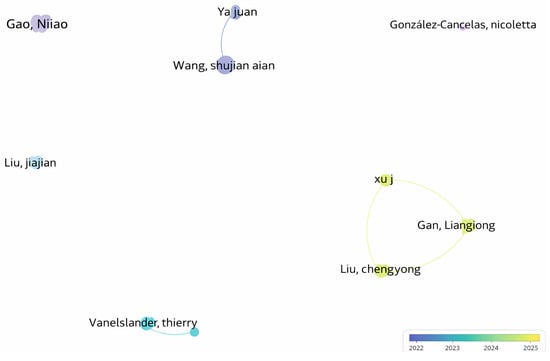
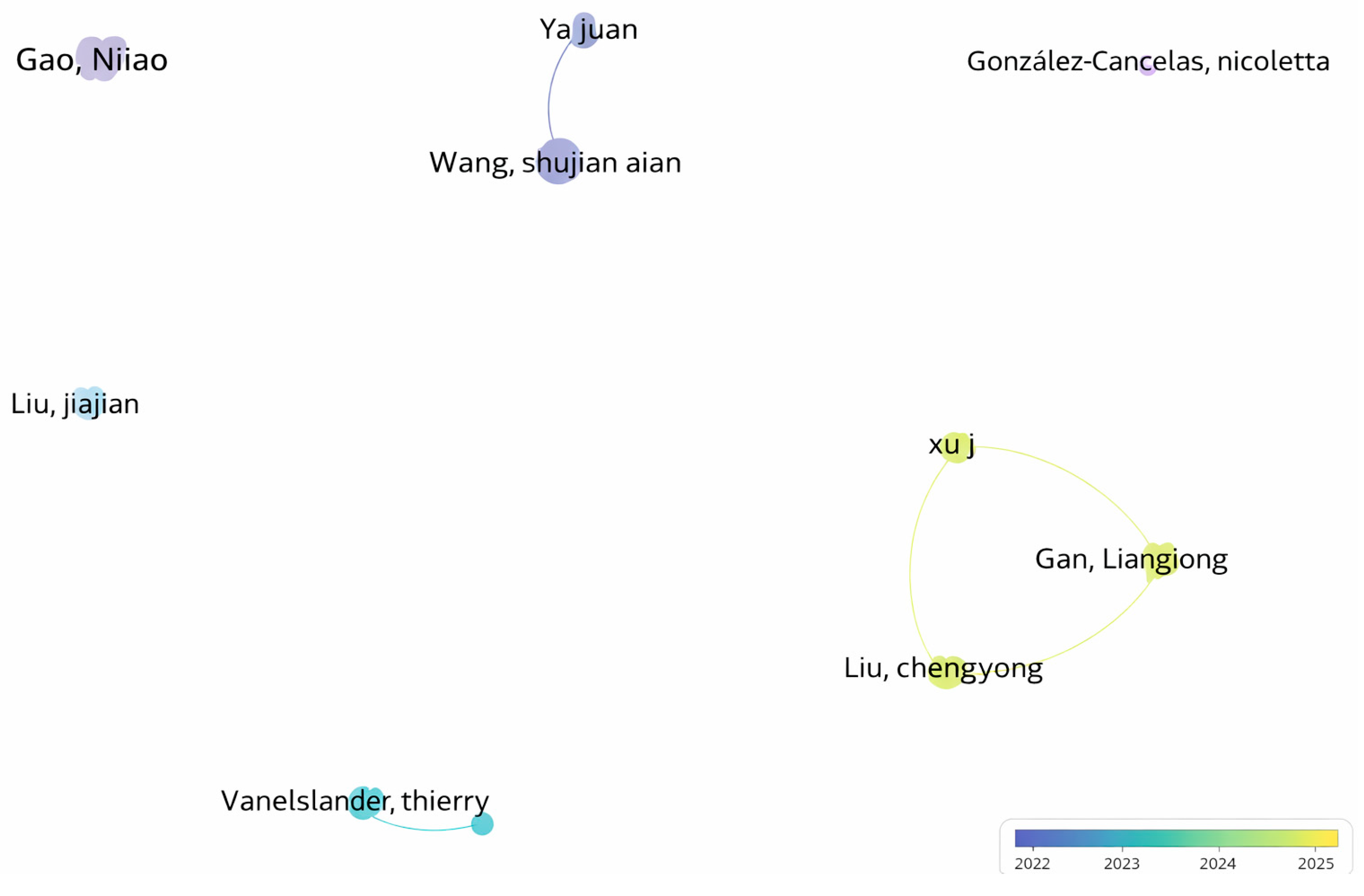
The network evolves chronologically, beginning with foundational algorithmic and operational research from 2022 to 2023 and progressing towards integrated frameworks for safety, governance, and sustainability from 2024 to 2025, as illustrated in Figure 2. This transition from individual or dyadic collaborations to clustered research teams signifies an increasing institutionalisation of maritime AI scholarship, bolstered by advancements in technology and active policy engagement.
Figure 2.
Author bibliographic coupling and temporal distribution in AI and Sustainable Maritime Research. The colour gradient reflects publication year progression, from early (blue) to recent (yellow) contributions.
Overall, this temporal bibliographic coupling map captures the transition from experimental AI applications to system-level integration and governance in port ecosystems, marking a clear trajectory of intellectual and collaborative evolution within the field.
Thematic Clustering of Research: Keywords Analysis
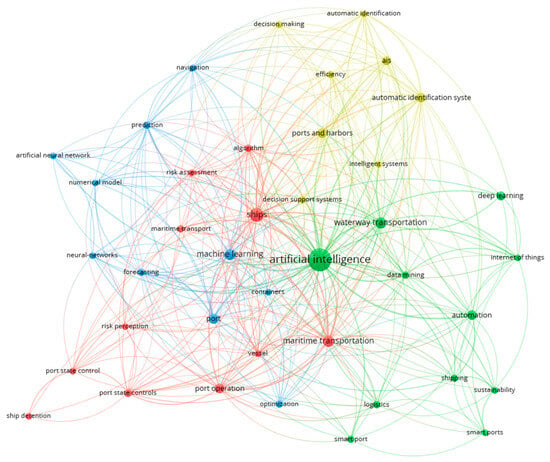
The keyword co-occurrence network presented in Figure 3 illustrates the intellectual landscape of research at the intersection of Artificial Intelligence (AI) and sustainable maritime systems. Nodes represent recurring keywords, while their size indicates relative frequency, and the thickness of connecting lines denotes co-occurrence strength. The network reveals four major thematic clusters, each corresponding to a distinctive research stream shaping the field.
Figure 3.
Keyword co-occurrence network for AI and Sustainable Maritime Research (2019–2025). Node size represents keyword frequency, link thickness indicates co-occurrence strength, and colour denotes thematic clusters.
- Cluster 1—AI-driven Maritime Operations and Risk Management (Red Cluster)
This cluster is centred around terms such as port operation, Port State Control, ship detention, risk assessment, and vessel inspection. It captures research focused on the application of AI and machine learning to safety monitoring, regulatory compliance, and maritime risk analysis. The frequent co-occurrence of neural networks and risk perception indicates the growing adoption of AI-based predictive systems to enhance inspection efficiency and accident prevention. This strand reflects the operationalisation of AI tools in maritime governance and control systems.
- Cluster 2—Machine Learning and Predictive Modelling (Blue Cluster)
Keywords such as machine learning, neural networks, forecasting, and numerical models form the second cluster, emphasising algorithmic innovation and predictive analytics. Research in this stream focuses on developing computational methods to optimise navigation, ship trajectory forecasting, and port logistics performance. The dense interconnections between AI, ships, and ports suggest methodological convergence, where advanced modelling techniques underpin real-time decision support and simulation systems.
- Cluster 3—Smart Ports and Digitalisation (Green Cluster)
The third cluster—anchored by Artificial Intelligence, Internet of Things (IoT), automation, data mining, smart ports, and sustainability—represents the technological transformation of port ecosystems. Studies within this stream explore AI integration with IoT, big data, and intelligent transport systems to achieve energy efficiency, operational optimisation, and sustainable port governance. The co-occurrence of shipping, logistics, and sustainability indicates the transition from isolated automation efforts toward a holistic vision of Sustainable Port 4.0, aligning with global decarbonization and digitalisation goals.
- Cluster 4—Decision Support and Maritime Efficiency (Yellow Cluster)
This smaller but significant cluster is connected by keywords such as automatic identification system (AIS), decision support systems, efficiency, and navigation. It reflects the development of AI-based decision-making architectures that leverage real-time data streams from AIS and other maritime sensors. The emphasis is on optimising navigation, fleet coordination, and port traffic management, showcasing the interplay between AI, automation, and information systems in enhancing maritime operational intelligence.
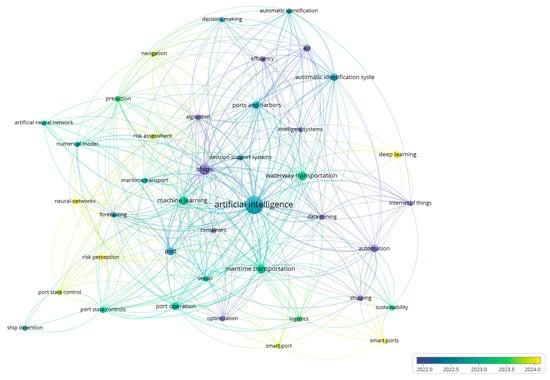
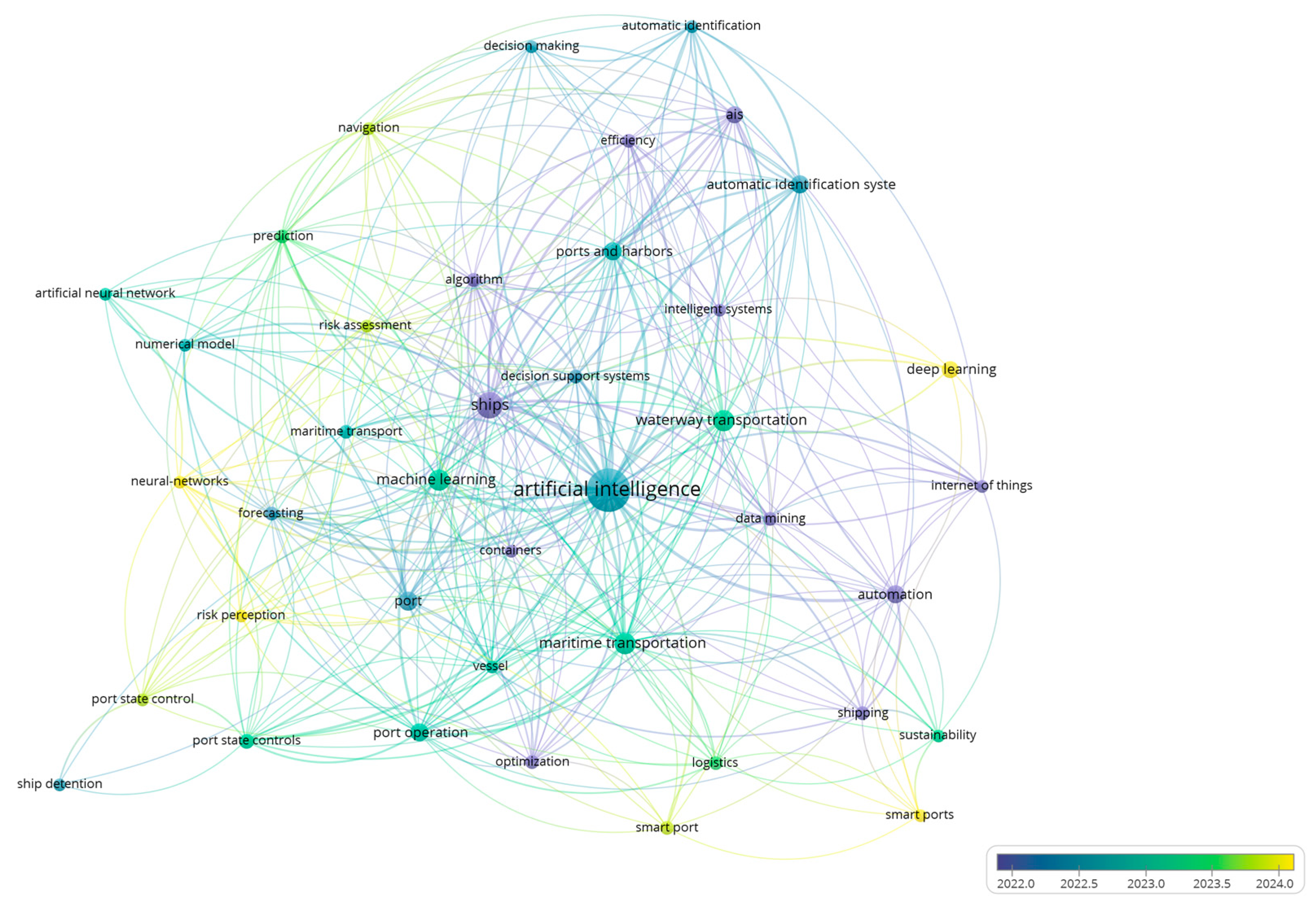
The chronological visualisation of keyword co-occurrence (Figure 4) reveals a clear temporal evolution in the research trajectory of Artificial Intelligence applications in maritime systems. The earliest works (2022, shown in blue tones) concentrate around Clusters 2 and 4, which represent the technological backbone of the field. These clusters are dominated by terms such as machine learning, neural networks, automatic identification system (AIS), and decision support systems, highlighting an initial phase focused on algorithmic development, model optimisation, and navigation efficiency. This period established the computational and methodological foundations of maritime AI, emphasising performance, automation, and operational accuracy.
Figure 4.
Overlay visualisation of keyword co-occurrence in AI and Sustainable Maritime Research (2022–2025). Colour gradient represents average publication year, from early-stage algorithmic development (blue) to recent sustainability-oriented integration (yellow).
Progressing toward 2023 (turquoise–green range), the research focus expands to Cluster 1, oriented toward risk assessment, Port State Control, and vessel inspection. This shift signals the transition from purely technical experimentation to applied intelligence in safety management and regulatory compliance. AI tools such as predictive analytics and explainable models began to be integrated into maritime risk governance, reflecting an increasing concern for resilience and reliability within port operations.
By late 2023 and into 2024 (green–yellow tones), Cluster 3—centred on smart ports, Internet of Things (IoT), automation, and sustainability—emerges as the dominant thematic frontier. This phase reflects the systemic integration of AI into sustainable port ecosystems, where digital technologies converge with environmental and logistical goals. The co-occurrence of logistics, shipping, and sustainability suggests a mature stage of research aligning with global sustainability agendas and the concept of Sustainable Port 4.0.
Overall, the network illustrates a progressive evolution: from foundational algorithmic studies (2022), through applied operational intelligence and safety governance (2023), to system-level integration and sustainability-driven innovation (2024). This temporal layering underscores AI’s dual role as both a technological enabler and a strategic catalyst for the transformation of maritime logistics and port management toward sustainability, transparency, and resilience.
4. Discussion
This study set out to examine how AI has been conceptualised and applied to support sustainability and resilience in port ecosystems, adopting a system-level perspective grounded in bibliometric analysis. The results reveal not only a rapid expansion of scientific output but also a clear evolution in the intellectual structure of the field, moving from isolated technical applications toward more integrated, sustainability-oriented port ecosystems. This discussion interprets these findings considering systems theory and sustainable supply chain research, highlighting key implications for theory, practice, and future research.
4.1. Artificial Intelligence as a Systemic Enabler of Sustainable Port Ecosystems
The bibliometric results indicate that AI has progressively shifted from a purely operational optimisation tool to a systemic enabler of sustainability within port ecosystems. Early high-impact studies focused primarily on efficiency, safety, and predictive accuracy, particularly in applications such as ETA prediction and collision-risk-aware trajectory modelling [1,2]. These contributions established the technical foundations of maritime AI but largely treated sustainability as a secondary outcome.
More recent research, however, conceptualises AI as an integrative capability that connects operational performance with environmental and governance objectives. Studies on sustainable port logistics and environmental impact monitoring illustrate how AI-enabled modelling and measurement systems support near-real-time decision-making related to emissions, air quality, and port–city interactions [7,9]. These applications illustrate how AI contributes to sustainability not through isolated improvements but through the coordination of multiple subsystems within the port ecosystem.
From a systems perspective, AI functions as an integrative layer that connects physical infrastructure, digital data flows, and organisational decision-making. The identified thematic clusters suggest that AI enables ports to manage complexity by enhancing information processing capacity, supporting adaptive responses to uncertainty, and facilitating coordination among multiple stakeholders. As such, AI contributes to the emergence of sustainable port ecosystems rather than merely improving discrete operational processes.
4.2. From Smart Ports to Resilient and Sustainable Supply Chain Systems
A key insight emerging from the analysis is the gradual shift from smart port concepts toward resilient and sustainable port ecosystems embedded in global supply chains. While early smart port initiatives emphasised automation and digitalisation, recent governance-focused studies highlight the importance of organisational transformation, human capital, and institutional coordination in achieving resilience [3,28].
Research on the labour market for the ports of the future underscores that AI-driven transformation reshapes skill requirements, employment structures, and governance arrangements, reinforcing the view of ports as socio-technical systems rather than purely technological infrastructures [28]. In this sense, AI contributes to supply chain resilience not only by improving predictive and operational capabilities but also by enabling adaptive governance and workforce transitions that support long-term sustainability.
The temporal evolution of research themes shows that resilience and sustainability considerations have gained prominence, particularly after 2022, coinciding with global supply chain disruptions and heightened awareness of climate-related risks. AI-driven solutions are increasingly framed as mechanisms for enhancing supply chain resilience by improving situational awareness, risk anticipation, and decision-making under uncertainty. Applications such as predictive analytics, digital twins, and AI-enabled risk assessment tools enable ports to respond more effectively to shocks, adapt operations in real time, and coordinate responses across supply chain actors.
Importantly, the bibliographic coupling and co-authorship patterns reveal a partial fragmentation between technically oriented research and governance- or policy-oriented studies. Asian institutions dominate technical and data-intensive innovation, while European research tends to emphasise governance, sustainability assessment, and policy integration. This division highlights an opportunity—and a necessity—for greater integration between technological development and institutional design. Sustainable and resilient supply chains require not only advanced AI capabilities but also governance frameworks that align technological innovation with environmental and societal objectives.
By situating AI within port ecosystems rather than individual organisations, this study reinforces the idea that resilience emerges from system-wide interactions. Ports act as critical interfaces between global and local supply chains, and AI-enhanced port ecosystems can function as stabilising nodes that absorb shocks, redistribute flows, and support sustainable trade dynamics.
4.3. Implications for Systems Theory and Sustainable Supply Chain Research
The findings of this study offer several implications for systems-oriented research. First, they demonstrate the value of bibliometric analysis as a tool for uncovering the structural and thematic evolution of complex research domains. By mapping intellectual clusters and temporal dynamics, this study provides insights into how knowledge systems themselves adapt to emerging sustainability challenges.
Second, the results suggest that AI should be conceptualised not merely as a technological artefact but as a systemic capability that reshapes relationships between actors, technologies, and institutions. This aligns with core principles of systems theory, which emphasise emergence, non-linearity, and co-evolution. Future theoretical work could build on these insights by developing integrative frameworks that explicitly model the interactions between AI, governance structures, and sustainability outcomes in port and supply chain systems.
From a practical standpoint, this study highlights the need for port authorities and policymakers to adopt holistic strategies when implementing AI solutions. Investments in AI technologies should be accompanied by organisational learning, cross-sector collaboration, and regulatory alignment to realise their full sustainability potential. Fragmented or purely technology-driven approaches risk reinforcing silos rather than enabling systemic transformation.
Finally, the identified research gaps point to promising avenues for future research. These include longitudinal studies examining the long-term impacts of AI adoption on port ecosystem performance, comparative analyses across regions and governance models, and the development of system dynamics or agent-based models to simulate AI-enabled sustainability transitions in supply chains.
4.4. Negative Effects, Risks, and Unintended Consequences of Artificial Intelligence in Port Ecosystems
While bibliometric analysis highlights the transformative potential of Artificial Intelligence (AI) in enhancing efficiency, sustainability, and resilience in port ecosystems, a systematic examination of the analysed corpus also reveals a range of negative effects, risks, and unintended consequences spanning technical, institutional, socio-economic, and environmental dimensions, best understood through a systems perspective, in which ports function as tightly coupled socio-technical ecosystems rather than isolated operational units.
A first and prominent category of risk concerns cybersecurity and systemic vulnerability. Several studies within the corpus explicitly demonstrate that AI-enabled digitalisation—particularly when combined with Internet of Things (IoT) infrastructures—significantly expands the attack surface of port systems. Research on deep learning-based cyber threat intelligence and IoT-enabled maritime environments highlights the risk of cascading failures, whereby localised cyber incidents propagate across interconnected operational and informational subsystems, compromising overall system resilience [16,29]. Complementary contributions on maritime cyber resilience emphasise low levels of organisational awareness, legacy operational technologies, and insufficient integration between IT and OT security as structural weaknesses that amplify systemic vulnerability if cybersecurity governance does not evolve in parallel with technological integration [8].
A second set of risks relates to governance, algorithmic opacity, and accountability. Studies highlight that the growing complexity of AI systems—particularly those based on deep learning architectures—creates challenges for transparency, explainability, and regulatory oversight. Research on AI project prioritisation and governance models in ports shows that poorly aligned AI initiatives may result in suboptimal strategic decisions, governance gaps, and unintended organisational consequences [3,6]. From a broader socio-technical perspective, systems-oriented studies warn that AI adoption may generate emergent and non-linear effects. These effects may exceed the control capacity of existing institutional frameworks, particularly in safety-critical maritime contexts [4,30]
Closely linked to governance concerns are issues of surveillance, data governance, and privacy. Some contributions caution that pervasive AI-enabled monitoring may foster panoptic forms of organisational control, raising concerns regarding the erosion of labour rights, misuse of personal and professional data, and deterioration of trust within port organisations [3,8,31]. From a systems perspective, such dynamics may undermine social sustainability and organisational legitimacy, even when technological performance improves.
A third category of unintended consequences concerns trade-offs between operational efficiency and sustainability objectives. While many AI applications prioritise optimisation of throughput, turnaround times, and resource utilisation, multiple authors caution that efficiency-driven models may conflict with broader environmental and societal goals if sustainability constraints are not explicitly embedded in system design and governance frameworks. Research on machine learning for environmental applications in ports highlights the risk of “efficiency bias”, whereby optimisation logics may reinforce carbon-intensive practices or neglect cumulative environmental impacts [23]. Empirical evidence from environmental impact assessments further demonstrates that gains in operational efficiency do not automatically translate into reduced externalities at the port–city interface [9]. In addition, some studies emphasise high upfront investment costs and uncertainty regarding return on investment, particularly during transitional phases in which temporary efficiency losses may occur as organisations adapt to AI-based systems [31,32].
Socio-technical and labour-related impacts constitute a fourth dimension of risk. Several studies explicitly address how AI-driven automation reshapes employment structures, skill requirements, and organisational dynamics within port ecosystems. Research on the future port labour market highlights risks of job polarisation, workforce displacement, and resistance to technological change, particularly among groups with limited digital competencies [28]. Governance-oriented contributions further suggest that smart port strategies may exacerbate institutional exclusion or power asymmetries if technological adoption outpaces organisational learning and stakeholder engagement [5]. At a broader scale, research on port governance and digital transformation points to asymmetries in AI readiness across ports and regions, where large and well-resourced hubs advance more rapidly than smaller or peripheral ports, potentially weakening system-wide resilience [33].
Several studies also highlight data integrity and model reliability risks with systemic implications. Dependence on AIS and other sensor-based data streams—known to be vulnerable to errors, falsification, and spoofing—can compromise the reliability of AI-driven decision support systems, leading to incorrect operational assessments or safety risks [19]. Additional concerns relate to algorithmic bias and limited generalisability, as models trained on context-specific or unbalanced datasets may reproduce structural biases or perform poorly when transferred across heterogeneous port environments [3,6].
Finally, a smaller but significant body of work points to competitive and market-related risks associated with widespread AI adoption. These include the potential for homogenised competition among ports, opportunistic behaviour such as free-riding, and the unintended disclosure of commercially sensitive information through shared AI or blockchain-based platforms [31,34,35]. Such dynamics may alter competitive balance within port systems and generate outcomes that are misaligned with broader societal or sustainability objectives.
Taken together, the evidence from the analysed corpus demonstrates that AI adoption in port ecosystems constitutes a systemic intervention rather than a purely technical upgrade. Its outcomes are shaped by complex interactions between technological capabilities, governance arrangements, organisational practices, and market structures. Addressing negative effects and unintended consequences is therefore not ancillary but central to ensuring that AI contributes to the long-term transformation of smart ports into sustainable and resilient port ecosystems.
4.5. Future Research and Policy Implications
The identification of negative effects, risks, and unintended consequences associated with Artificial Intelligence (AI) adoption in port ecosystems highlights the need for an integrated agenda that combines future research directions with policy and practical implications. Rather than representing peripheral concerns, these issues point to structural challenges that shape whether AI functions as an enabler of sustainability and resilience or as a source of new systemic vulnerabilities.
From a research perspective, future studies should move beyond technology-centred analyses toward system-level and governance-oriented inquiry. There is a clear need for comparative and longitudinal research examining how different governance arrangements influence AI outcomes across ports and regions, particularly in relation to cybersecurity, accountability, and sustainability alignment. Further work is also required on explainable and trustworthy AI, especially in safety-critical maritime contexts where opaque decision-making may undermine institutional trust and regulatory compliance. In addition, future research should address sustainability not only as an operational outcome but as an emergent system property, using modelling approaches capable of capturing trade-offs between efficiency, environmental performance, and social impacts over time. Finally, socio-technical dimensions—such as workforce adaptation, organisational learning, and resistance to automation—remain underexplored and warrant deeper empirical investigation across diverse port contexts.
These research priorities translate directly into several policy and practical implications. First, AI deployment in ports should be embedded within integrated governance frameworks that align technological innovation with sustainability strategies, cybersecurity policies, and accountability mechanisms. Fragmented or project-based AI adoption risks amplifying systemic fragility, whereas coordinated governance can help mitigate unintended consequences. Second, cybersecurity should be treated as a core governance issue, not merely a technical safeguard. Policies promoting shared standards, continuous risk assessment, and stronger integration between IT and OT security are essential to protecting AI-enabled port infrastructures.
In practical terms, port authorities should adopt phased and context-sensitive implementation pathways, recognising variations in digital readiness, institutional capacity, and resource availability. Pilot projects, incremental scaling, and capacity-building initiatives can reduce the risks associated with high upfront investment costs and uncertain returns, while allowing AI systems to be adapted to local operational and sustainability priorities. Equally important is the proactive management of human and organisational dimensions, including reskilling programmes, participatory governance mechanisms, and transparent communication with workers and stakeholders to maintain social legitimacy and resilience.
Finally, the findings point to the importance of collaborative and ecosystem-based approaches. Cooperation between ports, technology providers, research institutions, and public authorities can support knowledge sharing, reduce asymmetries in AI readiness, and limit competitive distortions associated with data sharing and platform-based innovation. Such collaborative arrangements are consistent with a systems perspective, recognising that sustainable and resilient outcomes emerge from coordinated action across the port ecosystem rather than from isolated technological upgrades.
5. Conclusions
In line with the objectives outlined in the Introduction, this study examined the role of Artificial Intelligence (AI) in supporting sustainability and resilience in port ecosystems by tracing the temporal evolution, intellectual structure, and systemic implications of AI adoption through a systematic bibliometric analysis of 80 peer-reviewed articles published between 2019 and 2025. By adopting a system-level perspective, the research moved beyond isolated technological applications to uncover the intellectual structure, thematic evolution, and emerging governance challenges shaping AI-driven transformation in maritime and port systems.
The findings reveal a clear evolution in the literature. Early research predominantly focused on operational efficiency, safety, and predictive accuracy, addressing challenges such as vessel traffic management, navigation safety, and terminal optimisation. Over time, the research agenda expanded toward broader concerns related to environmental sustainability, governance, and resilience, reflecting the growing recognition of ports as complex socio-technical systems embedded within global supply chains. This transition from smart ports to sustainable port ecosystems underscores the increasing integration of AI with systemic sustainability and resilience objectives.
Importantly, this study also demonstrates that AI adoption in port ecosystems is not a neutral or purely technical process. The bibliometric evidence highlights a range of negative effects, risks, and unintended consequences, including cybersecurity vulnerabilities, governance and accountability challenges, efficiency–sustainability trade-offs, socio-technical impacts on labour and organisations, and asymmetries in AI readiness across ports. These findings reinforce the need to conceptualise AI as a systemic intervention whose outcomes depend on interactions between technological, institutional, and human subsystems, rather than as an isolated optimisation tool.
From a theoretical standpoint, this study contributes to the Systems literature by reinforcing recent arguments that frame AI as an enabling capability embedded within governance structures, organisational processes, and sustainability strategies [3,6]. By integrating bibliometric performance analysis with science mapping and system-level interpretation, this study clarifies how AI-driven innovation evolves across technical, environmental, and institutional dimensions and how sustainability and resilience emerge from coordinated interactions within port ecosystems.
In practical terms, and consistent with the integrated research and policy agenda discussed in Section 4.5, the results highlight important implications for port authorities, policymakers, and supply chain stakeholders. AI-based solutions offer significant potential to enhance operational efficiency, environmental performance, and risk management; however, their effectiveness depends on governance alignment, organisational readiness, and cross-actor collaboration. Fragmented adoption strategies risk limiting the systemic benefits of AI, whereas integrated approaches—combining technological innovation with regulatory frameworks and stakeholder engagement—are more likely to support resilient and sustainable supply chain systems.
Despite its contributions, this study is subject to certain limitations. The analysis was based on a single bibliographic database, which may exclude some relevant publications indexed elsewhere. In addition, bibliometric methods identify patterns of knowledge production, thematic evolution, and scholarly influence, but they do not directly measure the real-world performance or effectiveness of AI implementations in port ecosystems. As such, the findings should be interpreted as indicators of intellectual structure and research trajectories rather than as empirical evidence of operational or environmental outcomes. These limitations suggest caution in generalising the findings beyond the scope of the analysed literature.
Future research could address these limitations by incorporating multiple databases, conducting longitudinal empirical studies, and integrating qualitative case analyses to examine how AI-driven solutions are implemented and governed in practice. Further work is also needed to develop integrative conceptual frameworks and simulation models that explicitly link AI adoption to sustainability and resilience outcomes across supply chain systems. Such research would strengthen the understanding of AI’s transformative potential and support evidence-based decision-making in the transition toward sustainable and resilient port ecosystems.
Overall, this study shows that Artificial Intelligence has significant potential to support the transition from smart ports to sustainable and resilient port ecosystems—but only when embedded within coherent governance arrangements, inclusive organisational strategies, and system-oriented sustainability frameworks. By aligning technological innovation with institutional design and policy objectives, ports can better harness AI as a catalyst for sustainable transformation within global maritime supply chains.
Author Contributions
Conceptualization, M.R.S. and M.C.; methodology, M.C.; formal analysis, M.C. and M.R.S.; investigation, M.R.S.; resources, T.P.; data curation, M.d.R.C.; writing—original draft preparation, M.R.S.; writing—review and editing, M.R.S.; visualisation, A.M.; supervision, T.P.; project administration, A.M.; funding acquisition, T.P. All authors have read and agreed to the published version of the manuscript.
Funding
Content produced within the scope of the Agenda “NEXUS—Pacto de Inovação—Transição Verde e Digital para Transportes, Logística e Mobilidade”, financed by the Portuguese Recovery and Resilience Plan (PRR), with no. C645112083-00000059 (investment project n.º 53).
Data Availability Statement
The data used in this study were obtained from the Scopus database and are available in CSV at: https://docs.google.com/spreadsheets/d/1zbbBplH_o_BWDqfySC27wRuOjK9cNOtXFJO7Lri8ZKc/edit?usp=drive_link (accessed on 18 December 2025). The bibliometric data analysed during the current study is available from the corresponding author upon request.
Acknowledgments
NECE: Research Centre for Business Sciences, Research Centre and this work are funded by FCT—Fundação para a Ciência e a Tecnologia, IP, project UIDB/04630/2020 and DOI identifier 10.54499/UIDB/04630/2020. CIEQV—Life Quality Research Centre, funded by FCT—Foundation for Science and Technology, IP, project no UID/CED/04748/2025. During the preparation of this manuscript, the authors used a generative artificial intelligence tool to support language refinement and structural editing. The authors have reviewed and edited the content and take full responsibility for the accuracy, integrity, and originality of the work.
Conflicts of Interest
The authors declare no conflicts of interest. The funders had no role in the design of the study; in the collection, analyses, or interpretation of data; in the writing of the manuscript; or in the decision to publish the results.
Abbreviations
The following abbreviations are used in this manuscript:
| IA | Artificial Intelligence |
| AIS | Automatic Identification System |
| CNN | Convolutional Neural Network |
| COLREGs | International Regulations for Preventing Collisions at Sea |
| ETA | Estimated Time of Arrival |
| IoT | Internet of Things |
| PSC | Port State Control |
| RNN | Recurrent Neural Network |
References
- Alessandrini, A.; Mazzarella, F.; Vespe, M. Estimated Time of Arrival Using Historical Vessel Tracking Data. IEEE Trans. Intell. Transp. Syst. 2019, 20, 7–15. [Google Scholar] [CrossRef] [Scilit]
- Zhang, Y.; Tu, P.; Zhao, Z.; Chen, X.Y. Incorporating prior knowledge of collision risk into deep learning networks for ship trajectory prediction in the maritime Internet of Things industry. Eng. Appl. Artif. Intell. 2025, 146, 110311. [Google Scholar] [CrossRef] [Scilit]
- Lee, J.M.; Sim, M.S.; Kim, Y.S.; Lim, H.R.; Lee, C.H. Strategizing Artificial Intelligence Transformation in Smart Ports: Lessons from Busan’s Resilient AI Governance Model. J. Mar. Sci. Eng. 2025, 13, 1276. [Google Scholar] [CrossRef] [Scilit]
- Min, H. Developing a smart port architecture and essential elements in the era of Industry 4.0. Marit. Econ. Logist. 2022, 24, 189–207. [Google Scholar] [CrossRef] [Scilit]
- Lin, S.C.; Chang, H.K.; Chung, Y.F. Exploring the Impact of Different Port Governances on Smart Port Development Strategy in Taiwan and Spain. Sustainability 2022, 14, 9158. [Google Scholar] [CrossRef] [Scilit]
- Farzadmehr, M.; Carlan, V.; Vanelslander, T. AI project portfolio ranking in port and maritime industries: A novel framework for assessing deployment complexity. Transp. Eng. 2025, 21, 100370. [Google Scholar] [CrossRef] [Scilit]
- González-Cancelas, N.; Calzada, J.P.C.P.; Vaca-Cabrero, J.; Camarero-Orive, A. Optimizing Sustainable Port Logistics in Spanish Ports with Emerging Technologies. Sustainability 2025, 17, 3392. [Google Scholar] [CrossRef] [Scilit]
- Ćelić, J.; Vukšić, M.; Baždarić, R.; Cuculić, A. The Challenges of Cyber Resilience in the Maritime Sector: Addressing the Weak Awareness of the Dangers Caused by Cyber Threats. J. Mar. Sci. Eng. 2025, 13, 762. [Google Scholar] [CrossRef] [Scilit]
- Merico, E.; Dinoi, A.; Contini, D. Development of an integrated modelling-measurement system for near-real-time estimates of harbour activity impact to atmospheric pollution in coastal cities. Transp. Res. D Transp. Environ. 2019, 73, 108–119. [Google Scholar] [CrossRef] [Scilit]
- Donthu, N.; Kumar, S.; Mukherjee, D.; Pandey, N.; Lim, W.M. How to conduct a bibliometric analysis: An overview and guidelines. J. Bus. Res. 2021, 133, 285–296. [Google Scholar] [CrossRef] [Scilit]
- Zupic, I.; Čater, T. Bibliometric Methods in Management and Organization. Organ. Res. Methods 2015, 18, 429–472. [Google Scholar] [CrossRef] [Scilit]
- Konu Kadirhanogullari, M.; Ozay Kose, E. A Bibliometric Analysis of Articles on Bibliometric Studies in Science Education. Int. J. Res. Educ. Sci. 2024, 10, 315–339. [Google Scholar] [CrossRef] [Scilit]
- van Eck, N.J.; Waltman, L. Software survey: VOSviewer, a computer program for bibliometric mapping. Scientometrics 2010, 84, 523–538. [Google Scholar] [CrossRef] [Scilit]
- Yan, R.; Wang, S.; Peng, C. An Artificial Intelligence Model Considering Data Imbalance for Ship Selection in Port State Control Based on Detention Probabilities. J. Comput. Sci. 2021, 48, 101257. [Google Scholar] [CrossRef] [Scilit]
- Guo, S.; Mou, J.; Chen, L.; Chen, P. Improved kinematic interpolation for AIS trajectory reconstruction. Ocean. Eng. 2021, 234, 109256. [Google Scholar] [CrossRef] [Scilit]
- Kumar, P.; Gupta, G.P.; Tripathi, R.; Garg, S.; Hassan, M.M. DLTIF: Deep Learning-Driven Cyber Threat Intelligence Modeling and Identification Framework in IoT-Enabled Maritime Transportation Systems. IEEE Trans. Intell. Transp. Syst. 2023, 24, 2472–2481. [Google Scholar] [CrossRef] [Scilit]
- Yan, R.; Wang, S.; Cao, J.; Sun, D. Shipping Domain Knowledge Informed Prediction and Optimization in Port State Control. Transp. Res. Part B Methodol. 2021, 149, 52–78. [Google Scholar] [CrossRef] [Scilit]
- Castilla-Rodríguez, I.; Expósito-Izquierdo, C.; Melián-Batista, B.; Aguilar, R.M.; Moreno-Vega, J.M. Simulation-optimization for the management of the transshipment operations at maritime container terminals. Expert Syst. Appl. 2020, 139, 112852. [Google Scholar] [CrossRef] [Scilit]
- Iphar, C.; Ray, C.; Napoli, A. Data integrity assessment for maritime anomaly detection. Expert Syst. Appl. 2020, 147, 113219. [Google Scholar] [CrossRef] [Scilit]
- Gao, M.; Shi, G.Y. Ship collision avoidance anthropomorphic decision-making for structured learning based on AIS with Seq-CGAN. Ocean. Eng. 2020, 217, 107922. [Google Scholar] [CrossRef] [Scilit]
- Yan, R.; Wang, S. Ship detention prediction using anomaly detection in port state control: Model and explanation. Electron. Res. Arch. 2022, 30, 3679–3691. [Google Scholar] [CrossRef] [Scilit]
- Yu, H.; Murray, A.T.; Fang, Z.; Liu, J.; Peng, G.; Solgi, M.; Zhang, W. Ship Path Optimization That Accounts for Geographical Traffic Characteristics to Increase Maritime Port Safety. IEEE Trans. Intell. Transp. Syst. 2022, 23, 5765–5776. [Google Scholar] [CrossRef] [Scilit]
- Mansoursamaei, M.; Moradi, M.; González-Ramírez, R.G.; Lalla-Ruiz, E. Machine Learning for Promoting Environmental Sustainability in Ports. J. Adv. Transp. 2023, 2023, 2144733. [Google Scholar] [CrossRef] [Scilit]
- El, S.; Benabbou, L.; Berrado, A. Deep learning models for vessel’s ETA prediction: Bulk ports perspective. Flex. Serv. Manuf. J. 2023, 35, 5–28. [Google Scholar] [CrossRef] [Scilit]
- Weerasinghe, B.A.; Perera, H.N.; Bai, X. Optimizing container terminal operations: A systematic review of operations research applications. Marit. Econ. Logist. 2024, 26, 307–341. [Google Scholar] [CrossRef] [Scilit]
- Jayasinghe, S.C.; Mahmoodian, M.; Sidiq, A.; Nanayakkara, T.M.; Alavi, A.; Mazaheri, S.; Shahrivar, F.; Sun, Z.; Setunge, S. Innovative digital twin with artificial neural networks for real-time monitoring of structural response: A port structure case study. Ocean. Eng. 2024, 312, 119187. [Google Scholar] [CrossRef] [Scilit]
- Gerrero-Molina, M.-I.; Vásquez-Suárez, Y.-A.; Valdés-Mosquera, D.-M. Smart, Green, and Sustainable: Unveiling Technological Trajectories in Maritime Port Operations. IEEE Access 2024, 12, 47713–47723. [Google Scholar] [CrossRef] [Scilit]
- Esser, A.; Sys, C.; Vanelslander, T.; Verhetsel, A. The labour market for the port of the future. A case study for the port of Antwerp. Case Stud. Transp. Policy 2020, 8, 349–360. [Google Scholar] [CrossRef] [Scilit]
- Chen, H.; Wen, Y.; Huang, Y.; Xiao, C.; Sui, Z. Edge Computing Enabling Internet of Ships: A Survey on Architectures, Emerging Applications, and Challenges. IEEE Internet Things J. 2025, 12, 1509–1528. [Google Scholar] [CrossRef] [Scilit]
- Liang, X.; Wang, Y.; Yang, M. Systemic Modeling and Prediction of Port Container Throughput Using Hybrid Link Analysis in Complex Networks. Systems 2024, 12, 23. [Google Scholar] [CrossRef] [Scilit]
- Dinh, G.H.; Pham, H.T.; Nguyen, L.C.; Dang, H.Q.; Pham, N.D.K. Leveraging Artificial Intelligence to Enhance Port Operation Efficiency. Pol. Marit. Res. 2024, 31, 140–155. [Google Scholar] [CrossRef] [Scilit]
- Yang, Y.C.; Hsieh, Y.H. The critical success factors of smart port digitalization development in the post-COVID-19 era. Case Stud. Transp. Policy 2024, 17, 101231. [Google Scholar] [CrossRef] [Scilit]
- Handayani, M.P.; Kim, D.; Lee, S.; Lee, J. Predictive analysis of fuel oil consumption in vessels: Interpretable modelling with emphasis on load conditions. Marit. Policy Manag. 2025, 52, 666–689. [Google Scholar] [CrossRef] [Scilit]
- Carlan, V.; Vanelslander, T. Economic Aspects of Introducing Artificial Intelligence Solutions in Logistics and Port Sectors: The Data Entry Case. Front. Future Transp. 2021, 2, 710330. [Google Scholar] [CrossRef] [Scilit]
- Zou, Z.; Wang, C.; Chen, L. Blockchain Adoption or Not? Analysis of Demand Information Sharing in Maritime Supply Chain. Information 2025, 16, 577. [Google Scholar] [CrossRef] [Scilit]

Disclaimer/Publisher’s Note: The statements, opinions and data contained in all publications are solely those of the individual author(s) and contributor(s) and not of MDPI and/or the editor(s). MDPI and/or the editor(s) disclaim responsibility for any injury to people or property resulting from any ideas, methods, instructions or products referred to in the content. |
© 2026 by the authors. Licensee MDPI, Basel, Switzerland. This article is an open access article distributed under the terms and conditions of the Creative Commons Attribution (CC BY) license.