


Abstract
In the era of globalization, Chinese firms increasingly leverage sequential cross-border mergers and acquisitions to navigate complex international environments. Understanding the sustained impact of this strategy requires a holistic view beyond isolated transactions. Adopting an open systems perspective, this study examines how sequential cross-border M&As influence the evolution of firms’ innovation boundaries as a dynamic system property. Combining grounded theory with textual analysis of Chinese M&A cases, this study develops an integrated systemic process framework and empirically tests it using data from Chinese listed firms (2002–2021) via fixed-effects models. Results reveal that sequential cross-border M&As act as external inputs that trigger internal system reconfiguration, significantly expanding innovation boundaries. This expansion process is mediated by dynamic capabilities, which constitute the firm’s core adaptive mechanism, and is moderated by resource slack that functions as critical system redundancy. These findings contribute to systems science by elucidating how firms, conceptualized as complex adaptive systems, transition from isolated deal-making to sustained capability building through iterative feedback loops in global competition.
1. Introduction
In the evolving strategic landscape of emerging markets, a distinct phenomenon has surfaced: leading Chinese enterprises are evolving from closed entities into open, adaptive systems by transcending the model of isolated international acquisitions [1]. Instead, they are orchestrating sequential cross-border mergers and acquisitions—a deliberate strategy of continuous engagement aimed at counteracting organizational entropy through cumulative learning and strategic asset seeking [2]. While cross-border M&As are recognized as critical vehicles for accessing external inputs (technologies and markets) [3], the specific implications of this sequential engagement for the firm’s systemic innovation capacity remain underexplored. Unlike discrete transactions, sequential cross-border M&As involve a critical temporal dimension of experiential accumulation and system feedback [4]. However, mainstream research has predominantly treated M&A deals as episodic events [5], neglecting the systemic continuity of these activities. This study seeks to bridge this gap by examining how sequential cross-border M&As drive the expansion of firms’ innovation boundaries through a systems science lens.
Existing literature on innovation performance often relies on traditional input–output metrics [6,7], which fail to capture the qualitative, structural shifts in a firm’s technological subsystems. In this study, we conceptualize “Innovation Boundaries” from a systems perspective as the limit of a system’s internal variety and its capacity to process novel external information [8,9]. Expanding these boundaries is critical for emerging market multinationals to transition from imitation to leadership [10]. The central theoretical puzzle we address is: How do firms, acting as complex adaptive systems, leverage the cumulative feedback from sequential cross-border M&As to overcome structural inertia and expand their innovation frontiers? Current theories on single M&A events offer limited insights into the dynamic feedback loops that unfold across a sequence of deals, specifically involving the ongoing reconfiguration of organizational subsystems [11].
To unravel these mechanisms, this study employs a mixed-method design that integrates Grounded Theory with large-sample empirical testing. We posit that sequential cross-border M&As serve not merely as asset accumulation but as a catalyst for enhancing the system’s dynamic capabilities [12]. Through repeated acquisitions, firms systematically refine their adaptive mechanisms—environmental adaptability, absorptive capacity, and coordination routines. It is this enhanced dynamic capability that enables firms to reorganize their internal knowledge structures and ultimately propel the expansion of their innovation boundaries.
This study makes three primary contributions to the systems and management literature. First, it introduces a temporal, system-evolution dimension to cross-border M&A research, shifting the focus from isolated transactions to the cumulative effects of successive acquisitions on innovation Second, it broadens the conceptualization of innovation outcomes by defining innovation boundaries as a dynamic system state, thereby moving beyond traditional input/output indicators to examine how firms qualitatively expand the scope and diversity of their innovation activities. Third, it integrates general systems theory with dynamic capability views to explain how sequential M&As facilitate boundary expansion through iterative feedback and system self-organization.
2. Literature Review
2.1. Conceptualizing Sequential Cross-Border M&As: A Systemic Perspective
To establish the ontological foundations of this study, we explicitly conceptualize “Sequential Cross-Border Mergers and Acquisitions” (SCBMAs) by distinguishing them from sporadic, single cross-border deals or sequential domestic acquisitions. Grounded in a complex adaptive systems view [13], this study defines SCBMAs through two distinct dimensions: sequentiality and cross-border complexity.
First, “Sequentiality” is defined not merely as temporal spacing between deals, but as a strategic logic of “Paced Learning.” In complex adaptive systems, acquiring external knowledge introduces a “shock” or an increase in systemic entropy (information complexity and uncertainty) [14]. A sequential approach, characterized by the deliberate staging of acquisitions, allows the firm to match the rate of external inputs with its internal absorptive and reconfiguration capacities [15]. This temporal pacing creates crucial intervals for stabilization, where new routines are codified and learning from prior integration is consolidated before initiating the next strategic perturbation. This logic prevents the “systemic indigestion” associated with simultaneous major acquisitions and enables strategic experimentation [16].
Second, the “Cross-Border” dimension introduces qualitative complexities distinct from domestic M&As. Cross-border targets embed knowledge systems characterized by high “causal ambiguity” due to differing institutional, cultural, and technological contexts [17]. Unlike domestic integration, which is often operational, cross-border integration necessitates bridging significant institutional and cognitive distances [18]. Therefore, the knowledge integration process transforms from simple assimilation to one of translation and synthesis across system boundaries.
Consequently, the combined construct of SCBMAs represents a unique strategic instrument for “Iterative Boundary Spanning.” It is through the deliberate rhythm created by the sequence that the firm leverages inter-deal periods to convert high-entropy foreign knowledge into stable internal capabilities. This iterative process allows for the progressive, managed expansion of the firm’s innovation boundaries while mitigating the risk of systemic overload.
2.2. Sequential Cross-Border M&As and Innovation Boundaries
An enterprise is an open system that must continuously exchange matter, energy, and information with its environment to survive and grow [19]. Sequential cross-border mergers and acquisitions can be viewed as a strategic pattern wherein firms undertake multiple international acquisitions to increase the system’s requisite variety [20]. Unlike isolated events, this approach enables firms to establish feedback loops that convert external experiential knowledge into internal system stability. While motivations such as acquiring advanced technologies and strategic assets are well-documented [21], empirical findings on performance are mixed. Some studies point to integration challenges that may impair short-term outcomes [22,23], whereas others, like Li et al. [24], demonstrate that richer M&A experience leads to superior performance through cumulative learning. These contradictions may stem from applying a static lens to an inherently dynamic system process. This underscores that sequential cross-border M&As represent a process of systemic adaptation yielding “learning economies”.
Traditionally, research on innovation in cross-border M&A has focused on reverse technology spillovers, measured through inputs like R&D intensity or outputs like patent counts. However, these quantitative metrics are increasingly critiqued for failing to capture the qualitative and structural evolution of a firm’s innovation portfolio [25]. Consequently, scholarly focus is shifting toward “Innovation Boundaries”. In systems terminology, boundaries define the distinction between the system and its environment, regulating the flow of information. We define Innovation Boundaries as the extent to which firms break through path-dependent structural constraints to enter novel technological domains. Expanding these boundaries is equivalent to reducing the system’s rigidity [26] and increasing its permeability to new knowledge. Although global innovation networks are recognized facilitators [27], the specific role of sequential M&As in systematically bridging distant knowledge subsystems remains underexplored.
To theorize the link between sequential M&As (the system input) and innovation boundaries (the system state), this study integrates dynamic capability theory with systems thinking. Dynamic capabilities, defined as a firm’s capacity to sense, seize, and reconfigure resources, function as the system’s high-level control mechanism for adaptation [28]. Existing studies [11] have identified mechanisms such as environmental and business leverage through which sequential activities generate value. This study argues that these leverage mechanisms essentially operationalize the micro-processes of subsystem reconfiguration. We posit that sequential cross-border M&As act as a perturbation trigger. Through repeated acquisitions, firms do not merely accumulate assets; they develop sophisticated integration routines that allow for the continuous self-organization of their capability base. This internal reconfiguration is fundamental for pushing the system’s functional (innovation) frontiers outward [29].
3. Theoretical Models Based on Grounded Theory
This study adopts Grounded Theory, a qualitative methodology introduced by Strauss and Corbin [30], to explore the “black box” of organizational evolution. From a systems science perspective, quantitative methods often treat the organization as a static entity, whereas Grounded Theory allows us to capture the emergent properties and dynamic feedback loops within Complex Adaptive Systems. By employing a procedurally grounded approach with Nvivo11, we aim to uncover the generative mechanisms by which sequential cross-border M&As (external inputs) trigger internal system reconfiguration and subsequent boundary expansion.
3.1. Case Selection
To investigate these systemic mechanisms, we employed theoretical sampling to select cases that exhibit high “system evolutionary intensity.” Based on rigorous criteria, Geely Holding Group, Joyson Electronics, Alibaba Group, and Haier Group were selected as the focal systems:(1) System Evolution Intensity: All four firms are high-frequency, serial acquirers (2009–2021). Their trajectories represent a continuous influx of external matter and information, making them ideal for observing how systems process cumulative inputs. (2) Environmental Variety: The cases span distinct ecosystems: capital-intensive (automotive), technology-intensive (electronics), and platform-based (e-commerce). This diversity ensures that the emergent theoretical framework possesses general system validity across different environments. (3) Data Transparency: High levels of disclosure enable the construction of “thick descriptions” essential for tracing the temporal evolution of the system.
Beyond these methodological criteria, these four firms were strategically chosen to represent maximally contrasting M&A typologies and strategic orientations. This purposeful variation allows for a comparative analysis of how different strategic logics, which encompass horizontal, vertical, and platform ecosystem approaches, shape the process of boundary expansion, directly addressing the research objective.
Geely Holding Group exemplifies a horizontal M&A strategy oriented toward brand and technology upgrading. Its landmark acquisition of Volvo Cars was driven by the dual objectives of accessing premium brand equity and core safety technologies, facilitating a leap in the global value chain and illustrating how horizontal acquisitions can catalyze market and product boundary expansion. In the automotive components sector, Joyson Electronics pursued vertical and related M&As, such as its acquisitions of Preh and Key Safety Systems. This strategy focused on internalizing upstream electronic and safety technologies, transforming the firm from a component supplier into a global Tier-1 system integrator and demonstrating a pathway of technological depth and value chain boundary expansion. As a digital platform, Alibaba Group undertook a platform ecosystem form of expansion through its acquisition of Lazada, aiming to transplant and adapt its e-commerce ecosystem into Southeast Asia while capturing new user bases and data streams. This typology leads to ecosystem and digital scenario boundary expansion. In home appliances, Haier Group followed a horizontal global localization strategy, acquiring entities such as GE Appliances to internalize global manufacturing capabilities and distribution networks, thereby reinforcing a pathway of market and operational boundary expansion.
The comparative analysis reveals that although sequential M&As act as a universal catalyst for boundary expansion, the direction and nature of that expansion are contingent on the strategic typology of the acquisitions. Horizontal M&As, as observed in Geely and Haier, primarily drive expansion across market and product domains. Vertical M&As, exemplified by Joyson, facilitate deepening into technological and supply chain frontiers. Platform ecosystem M&As, illustrated by Alibaba, enable expansion into new network and digital ecosystem spaces. This crucial variation underscores that a firm’s strategic orientation toward a particular type of M&A functions as a key moderating structure, channeling the systemic “input” of sequential deals into distinct evolutionary paths. Together, these contrasting cases provide a robust empirical foundation for developing a more nuanced, process-oriented theory of innovation boundary expansion.
The selected cases are detailed in Table 1.
Table 1.
Cross-Border Mergers and Acquisitions: Target Case Studies.
3.2. Data Collection
Given the longitudinal nature of this study (spanning 2002–2021) and the complexity of sequential M&A processes, we adopted a systematic archival data strategy. While reliance on retrospective interviews can be subject to recall bias and rationalization, historical archival data provides a real-time, unaltered record of corporate strategic intent and actions. To ensure validity and reliability, we strictly adhered to the principle of Data Triangulation, cross-verifying information across three distinct tiers of sources: (1) Core Strategic Documents (High Reliability). We prioritized legally binding disclosures, including Annual Reports, IPO Prospectuses, and Regulatory Filings. These documents provide the most objective data on M&A transaction details, R&D expenditures, and patent applications. For the selected cases, we systematically extracted the “Management Discussion and Analysis” (MD&A) sections to trace the evolution of strategic logic over time. (2) External Validating Sources (Objectivity). To mitigate the potential “positive bias” of corporate self-disclosure, we collected third-party analytical reports from reputable financial media and in-depth academic case studies from databases such as Web of Science and CNKI. These sources provided external verification of the integration challenges and market reactions following each acquisition. (3) Executive Communications (Intent). We gathered speeches, open letters, and interviews given by key decision-makers during the specific M&A windows. These texts were used to capture the subjective “sensing” and “seizing” dimensions of dynamic capabilities. In total, this multi-source approach resulted in a corpus of approximately 43,000 words of core textual data (excluding financial tables). We constructed a “thick description” of the sequential M&A process that ensures robust theoretical saturation.
According to the aforementioned method, this paper systematically collected relevant information, ultimately acquiring a substantial amount of resources. This included a total of 39 literature sources, 101 media reports, and approximately 43,000 words of official data, ensuring robust theoretical saturation regarding system dynamics. The results of the raw case material collection are presented in Table 2.
Table 2.
Results of Case Raw Data Collection.
3.3. Data Analysis
3.3.1. Open Coding
Open coding aims to identify potential patterns and themes within the data through an initial, assumption-free coding process, thereby providing a foundational basis for subsequent axial and selective coding. An example of open coding is presented in Table 3.
Table 3.
Example of Open Coding.
Open coding aims to identify the basic structural and functional components of the evolving system through an initial, assumption-free coding process. After conducting open coding on the raw data from Geely Holding, Joyson Electronics, Alibaba, and Haier, 78 system concepts were identified. Instead of merely labeling them as static capabilities, we conceptualized them as dynamic system states, such as “Technological Subsystem Upgrade A1” (formerly Tech Innovation), “Governance Mechanism Reconfiguration A3” (formerly Management Innovation), and “System Responsiveness A4”. 20 initial categories were established to capture the system’s evolutionary logic, such as “System Functional Evolution S1” (Innovation Capability), “System Adaptability S2” (Agility), and “Internal Reconfiguration S3” (Resource Optimization). Specific details of the open coding process are provided in Table 4.
Table 4.
Concepts and Initial Categories Developed Through Open Coding.
3.3.2. Axial Coding
Axial coding is the process of integrating and categorizing the initial categories derived from open coding to create a systematic theoretical framework or model. In this study, the initial categories generated from open coding are summarized into core categories, as detailed in Table 5.
Table 5.
Axial coding results.
3.3.3. Selective Coding
Selective coding involves meticulously refining and integrating the results of open and axial coding to crystallize the final core concepts, thereby establishing a coherent theoretical framework. In this paper, through a comprehensive analysis of the raw data, the core category has been identified as sequential cross-border mergers and acquisitions as an effective means of expanding innovation boundaries for enterprises. This core category is crucial for understanding how enterprises broaden their innovation boundaries in emerging technological fields. Furthermore, the paper employs the “prerequisite—action/interaction strategies—consequence” paradigm model to connect other related categories with this core category, facilitating a deeper exploration of the impact of sequential cross-border M&A on corporate innovation boundaries and further investigating the underlying mechanisms of its influence. The selective coding of the paper is illustrated in Figure 1.
Figure 1.
The Systemic Evolution Model: Transforming External Perturbations into Boundary Expansion.
From an Open Systems perspective, an enterprise must continuously import “negative entropy,” that is, energy and information, to counteract stagnation and survive. While resource dependence theory emphasizes knowledge acquisition [31], systems theory views sequential cross-border M&As as a strategic mechanism to increase the system’s “requisite variety”. Geely’s acquisition of Volvo was not merely asset accumulation but an injection of high-complexity technological subsystems that reconfigured its innovation architecture. Similarly, Joyson Electronics integrated Key Safety Systems and Takata, effectively expanding its system boundaries from local components to global safety integration. Likewise, Alibaba’s acquisition of Lazada extended its digital ecosystem into new environmental niches in Southeast Asia.
In summary, these continuous strategic actions act as heterogeneous inputs that disrupt the firm’s static equilibrium. By absorbing external complexity, these firms overcome path dependence and push their functional frontiers outward. Based on this analysis, the following hypothesis can be proposed.
Hypothesis 1.
Sequential cross-border mergers and acquisitions by Chinese companies can facilitate the expansion of their innovation capabilities.
While M&As provide the input, the conversion of this input into system growth depends on internal processing mechanisms. We integrate Dynamic Capability Theory as the system’s control and adaptation mechanism. In the context of sequential M&As, dynamic capabilities enable the system to “sense, seize, and reconfigure” to match external complexity [32].
First, the trajectories of Geely and Joyson Electronics provide compelling evidence for the enhancement of environmental adaptability. By repeatedly navigating complex regulatory frameworks and distinct cultural landscapes—such as Geely’s strategic entry into European and Southeast Asian markets via Volvo and Proton, and Joyson’s expansion into Germany and the U.S. through Preh and Key Safety Systems—these firms have cultivated a heightened sensitivity to global market shifts. This cumulative experience has allowed them to develop flexible strategic routines that can swiftly adjust to diverse institutional environments. Furthermore, this continuous engagement acts as a powerful mechanism for amplifying learning and absorptive capacity. Rather than merely accumulating assets, the case firms prioritized the deep internalization of external knowledge. For instance, Geely systematically absorbed Volvo’s safety protocols, while Joyson integrated advanced semiconductor technologies from its targets. Similarly, Alibaba leveraged its acquisition of Lazada not just for market share, but to accelerate its accumulation of localized e-commerce operational knowledge, effectively transforming external insights into internal innovation power. Finally, the escalating complexity of managing sequential deals necessitates the evolution of sophisticated coordination and integration capabilities. As the portfolio of acquired entities grew, these firms were compelled to establish robust organizational routines to ensure synergy. This is evident in Alibaba’s seamless consolidation of business units post-acquisition and Geely’s strategic alignment of global R&D resources, which fostered collaborative innovation across its diverse subsidiaries.
In summary, the sequential nature of these cross-border activities forces firms to iterate and upgrade their capabilities continuously. These firms systematically improve their adaptability, refine their learning absorption, and optimize their coordination routines, which collectively propel the expansion of their innovation boundaries. Based on this analysis, this paper proposes the following hypotheses:
Hypothesis 2.
Sequential cross-border mergers and acquisitions will facilitate the expansion of a company’s innovation boundaries by enhancing its dynamic capabilities.
Hypothesis 2a.
Sequential cross-border mergers and acquisitions will facilitate the expansion of a company’s innovation boundaries by improving its adaptability to environmental changes.
Hypothesis 2b.
Sequential cross-border mergers and acquisitions will enhance a company’s innovation boundaries by improving its learning and absorption capabilities.
Hypothesis 2c.
Sequential cross-border mergers and acquisitions will enhance a company’s innovation boundaries by improving its coordination and integration capabilities.
In systems theory, redundancy is not waste; it is a critical feature for reliability and robustness. We reconceptualize “Organizational Slack” as System Redundancy. Firms like Alibaba and Geely maintained substantial uncommitted resources. In the context of sequential M&As, this redundancy plays a dual buffering role. First, it acts as a shock absorber against the integration disruptions inherent in frequent acquisitions, preventing system collapse during the reconfiguration phase. Second, it provides the degrees of freedom necessary for experimentation. Expanding innovation boundaries involves exploring unknown territories; high levels of system redundancy allow the firm to tolerate local failures without compromising global system stability. Conversely, a system with zero redundancy is brittle and cannot sustain the risks of boundary expansion.
Hypothesis 3.
Resource slack positively moderates the process of expanding a company’s innovation boundaries through Sequential cross-border mergers and acquisitions.
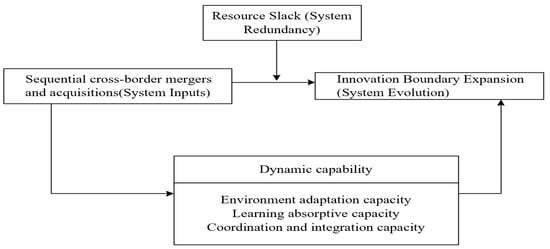
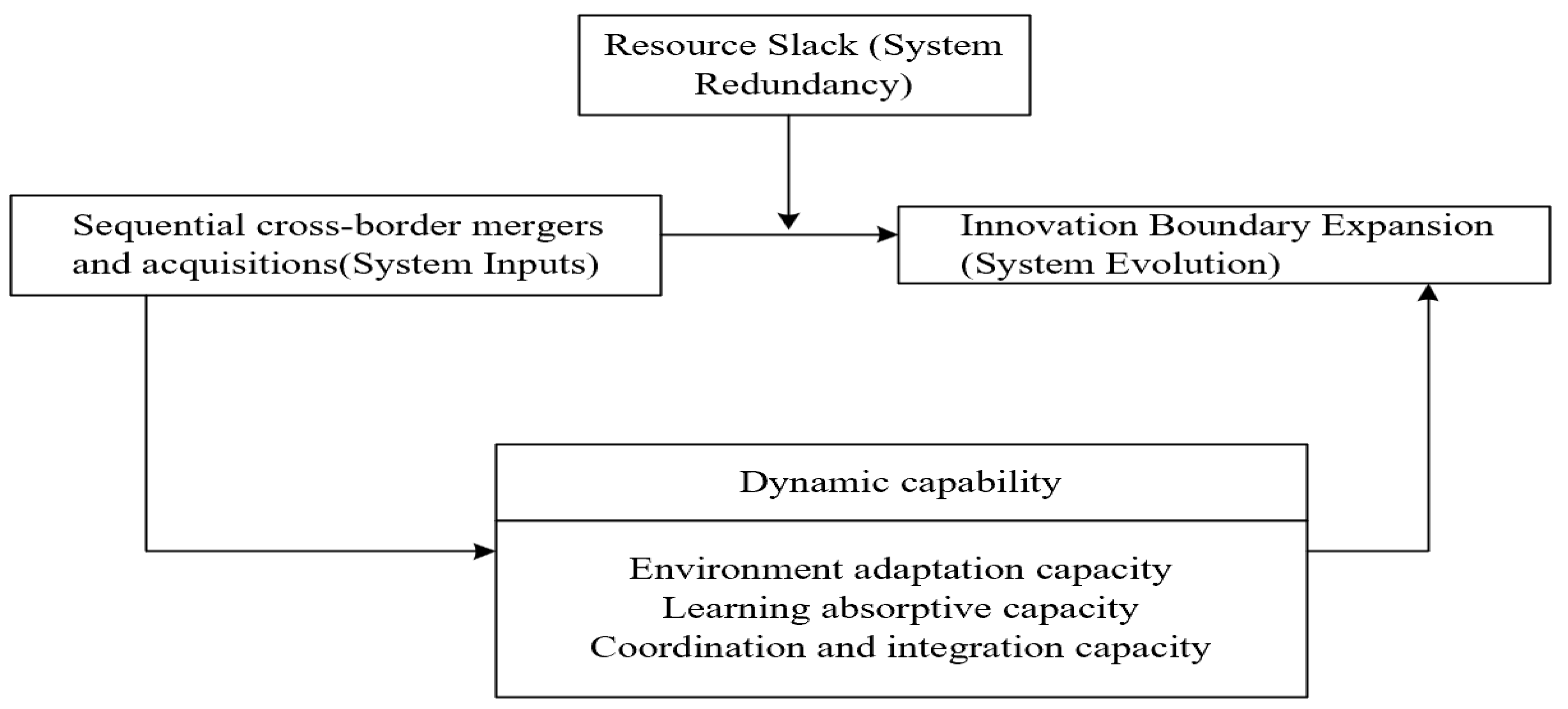
Synthesizing the grounded theory analysis of Geely Holding, Joyson Electronics, and Alibaba, this paper proposes a process-oriented theoretical framework (illustrated in Figure 2) to elucidate how sequential cross-border M&As drive the expansion of corporate innovation boundaries. The framework posits that sequential cross-border engagement serves as a significant catalyst for boundary extension. Crucially, this mechanism is mediated by dynamic capabilities: the cumulative experience from sequential acquisitions enhances a firm’s ability to sense, seize, and reconfigure resources, which subsequently propels the expansion of innovation boundaries. Furthermore, resource slack acts as a positive moderator; a robust buffer of uncommitted resources amplifies the impact of sequential M&As on innovation boundaries by providing the strategic flexibility necessary for integration and experimentation.
Figure 2.
A systemic process framework: How sequential cross-border M&As drive innovation boundary evolution through capability reconfiguration.
3.3.4. Inductive Derivation of the Theoretical Framework
This section delineates the inductive process through which the testable research framework (Figure 2) was systematically derived from the preceding grounded theory analysis, specifically from the axial and selective coding results. We trace the complete “genealogy” of the model, from coded data to formal theoretical constructs.
First, the core variables in the model were synthesized and refined directly from the coding categories (see Table 5). The mediator, Dynamic Capabilities, emerged as a higher-order construct integrating the axial categories of System Adaptability (S2) and Internal Reconfiguration (S3). For instance, evidence for S2 included Geely’s rapid adjustment to European regulations, while S3 captured Joyson’s integration of disparate R&D teams. The established theoretical label “Dynamic Capabilities” was subsequently engaged to facilitate dialogue with existing literature, aligning with the core mechanisms of environmental sensing and internal reconfiguration observed in the data. Similarly, the moderator Resource Slack was identified through cross-case comparison of the category System Redundancy (S4). The stark contrast between Alibaba’s high-redundancy strategy (enabling trial-and-error) and more constrained approaches in other cases established “Slack” as a critical boundary condition for boundary expansion.
Second, the causal pathways among variables were identified using the “Prerequisite—Action—Consequence” paradigm and were subsequently formalized as the hypotheses in Figure 2. The Mediation Path (Hypothesis 2) encapsulates the temporal logic observed in cases like Geely and Joyson: sequential M&A (Action) triggered a phase of capability reconfiguration (Interaction), which then led to entry into new patent domains (Consequence). The Moderation Path (Hypothesis 3) corresponds directly to the “Intervening Conditions” within the paradigm, where successful boundary expansion was consistently associated with high levels of system redundancy.
Finally, it is crucial to note that a systematic engagement with the broader literature occurred primarily after this inductive model had taken shape. This post hoc dialogue served to refine construct definitions, connect findings to the academic conversation, and ensure external validity, rather than to generate the initial hypotheses. This sequence ensures that the theory-building process was fundamentally data-driven and bottom-up.
3.3.5. Theoretical Saturation Test
To verify the completeness and systemic validity of the proposed evolutionary framework, this study conducted a theoretical saturation test using the case of Haier Group. The coding analysis of Haier’s system trajectory (sequential M&As) revealed that no new adaptive mechanisms or structural components emerged beyond the existing framework. This finding confirms that theoretical saturation has been achieved, indicating that the system dynamics derived from the grounded analysis of Geely Holding, Joyson Electronics, and Alibaba possess sufficient explanatory power and reliability across different organizational systems.
3.4. Comparative Analysis of Evolutionary Paths
While the systemic mechanism linking sequential M&As to innovation boundary expansion through dynamic capabilities is universal, our cross-case comparison reveals significant variation in the specific evolutionary paths and the primary dimensions of boundary expansion. These differences are contingent on the firm’s industrial context and strategic M&A typology, which channel the firm’s dynamic capabilities toward distinct priorities. The horizontal/capital-intensive path, exemplified by Geely and Haier, follows a logic of “symbiotic evolution.” Here, acquisitions aim for market and brand access, with innovation boundary expansion manifesting primarily as increased market and product breadth. This path heavily relies on coordination and integration capabilities to manage modular structures and benefits from financial slack to support parallel brand operations.
In contrast, the vertical/technology-intensive path, observed in Joyson Electronics, is driven by a logic of “deep fusion and vertical penetration.” The strategic goal is technological control and value chain upgrading, leading to an expansion of technological depth. This path intensely activates the firm’s learning and absorptive capacity to internalize complex upstream knowledge and requires technological redundancy to buffer deep integration processes. Finally, the platform ecosystem path, illustrated by Alibaba, operates on a logic of “infrastructure grafting.” The objective is to replicate and adapt a core digital ecosystem in new regions, resulting in an expansion of ecosystem scope and network effects. This path places a premium on environmental sensing and reconfiguration capabilities and demands high strategic and operational slack to enable exploratory trials in unfamiliar environments.
This comparative analysis provides a crucial specification of our core theoretical model. It demonstrates that while sequential M&As serve as a universal catalyst and dynamic capabilities as the essential mediator, the industry context and M&A typology act as a structural funnel, directing the adaptive process toward qualitatively different forms of boundary expansion (breadth, depth, or scope). Thus, the firm’s strategic orientation determines not if but in which dimension its innovation boundaries are most decisively reconfigured.
4. Empirical Testing and Analysis
4.1. Empirical Research Design
4.1.1. Model Construction
To examine the impact of Sequential cross-border mergers and acquisitions on the boundaries of corporate innovation, this paper constructs the following model:
The dependent variable in this study is innovation boundary, using to represent, which is measured by the number of patents filed by firm i in new research and development (R&D) areas during year t. The primary explanatory variable of this paper is , it indicates whether firm i has engaged in Sequential cross-border mergers and acquisitions. If firm i participates in two or more Sequential cross-border mergers and acquisitions within the three-year [t−2,t], the variable is assigned a value of 1; otherwise, it is assigned a value of 0. represents a series of firm-level control variables. represents year fixed effects, represents industry fixed effects, represents a random error term, i and t denote the firm and the year, respectively.
To further investigate the mediating effect of dynamic capabilities, the following mediation effect model has been constructed based on the methodology of Jiang Ting [33]:
In order to investigate whether resource slack () has a moderating effect on the process of sequential cross-border mergers and acquisitions by Chinese enterprises in promoting the expansion of innovation boundaries, this paper establishes the following model:
is the interaction term between resource slack and sequential cross-border mergers and acquisitions. If the regression coefficient () of this interaction term is significantly positive, it suggests that resource slack () can positively moderate the process through which sequential cross-border mergers and acquisitions facilitate the expansion of firms’ innovation boundaries.
4.1.2. Variable Selection and Data Sources
This paper analyzes cross-border merger and acquisition data of Chinese listed companies over a 20-year period, from 2002 to 2021, sourced from the SDC M&A database. Data on innovation boundaries is obtained from the CPDP patent database, while additional control variables are derived from the WIND database, CSMAR database, and other sources.
- (1)
- Explained Variable
The innovation boundary of a firm is a crucial category and a limiting concept in innovation activities. This study employs the research methods of Byun et al. [34], utilizing the number of patent applications in emerging technological fields as an indicator of the expansion of the innovation boundary.
First, all International Patent Classification (IPC) codes (the first four digits) of patents filed by the firm prior to the current year are collected to create the firms’ “technology set”. Second, data on new patent applications submitted by the firm in the current year are gathered, and the first four digits of their IPC codes are extracted and compared with the firm’s existing “technology set” to identify the firm’s patent applications in emerging technological fields. Finally, the total number of patents in these new technological fields filed by the firm in the current year is calculated, serving as an indicator for assessing the expansion of the firm’s innovation boundary (Innovation_new).
- (2)
- Explanatory Variable
Sequential cross-border mergers and acquisitions refer to the behavior of a firm that engages in multiple cross-border M&A activities over a sustained period. To empirically capture the dynamic nature of this “system evolution” and “experiential accumulation” emphasized in our theoretical framework, we operationalize this variable using a rolling time-window strategy rather than a static snapshot.
Drawing on the research of Billett and Qian [35], we define sequential cross-border M&As as the occurrence of two or more cross-border M&A transactions within a rolling span of three sequential years (accumulating activities from year t−2 to t). This measurement acts as a proxy for the firm’s continuous learning trajectory. Specifically, if firm i has completed two or more cross-border M&As within this three-year rolling window, the variable is assigned a value of 1, representing a state of sustained integration; otherwise, it is assigned a value of 0. This approach ensures that the measurement reflects the temporal continuity of external inputs required for boundary expansion.
- (3)
- Mediating Variable
Dynamic capability refers to a firm’s ability to adapt to rapidly changing external environments while maintaining a competitive advantage. This paper categorizes dynamic capability into three primary dimensions: environmental adaptability, learning and absorptive capacity, and coordination and integration capability [36]. Environmental adaptability (ACV) pertains to the firm’s sensitivity to and responsiveness to external environmental changes, which is measured by the coefficient of variation of three key expenditures: research and development (R&D), capital, and advertising expenses. Learning and absorptive capacity (RD) denotes the firm’s ability to acquire and apply new knowledge, quantified by the ratio of annual R&D expenditure to operating revenue. Coordination and integration capability (IA) evaluates the extent to which the firm coordinates and integrates its resources, based on two indicators: the intensity of annual R&D investment and the proportion of technical personnel. These two indicators are standardized and then summed. Ultimately, the three indicators are standardized and averaged to derive the firm’s dynamic capability (DC).
- (4)
- Moderating Variable
Resource slack refers to resources that exceed a firm’s current operational needs. Drawing on the research of Jiang and Zhao [37] and Deng [25], this paper measures resource slack by calculating the arithmetic mean of the debt-to-asset ratio (total assets/total liabilities) and the equity-to-debt ratio (owner’s equity/total liabilities).
- (5)
- Control variables
The control variables in this paper include the following: fixed asset ratio (fixed), return on equity (roe), book-to-market ratio (bm), debt-to-asset ratio (lev), firm age (firmage), Tobin’s Q (tobinq), revenue growth rate (growth), ownership ratio of the top 10 shareholders (top 10), CEO duality (dual), capital intensity (cap), and ownership structure (soe).
4.2. Baseline Regression Results
The baseline regression results are presented in Table 6. Column (1) displays the regression outcomes without control variables and without year and industry fixed effects. Column (2) presents the regression results after incorporating control variables, while Column (3) illustrates the results with the additional inclusion of control variables, as well as year and industry fixed effects. The regression results in Column (3) indicate that the coefficient for serial multinational acquisitions (SMA) is 0.9557, which is significant at the 1% confidence level. This finding suggests that serial multinational acquisitions by Chinese firms can expand their innovation boundaries, thereby further validating Hypothesis 1.
Table 6.
The Impact of Sequential Cross-Border Mergers and Acquisitions by Enterprises on the Boundaries of Innovation.
4.3. Robustness Test Results
4.3.1. Instrumental Variable Method
The relationship between Sequential cross-border mergers and acquisitions and the boundaries of corporate innovation may not be unidirectional. The expansion of a company’s innovation boundaries can enhance its vitality, prompting it to adopt a sequential cross-border merger strategy. This bidirectional causality may introduce endogeneity into the model, leading to regression coefficients that inaccurately reflect the impact of Sequential cross-border mergers on corporate innovation boundaries. Drawing on methods utilized in existing literature, this paper employs the instrumental variable method for model estimation. Specifically, the paper uses lagged one-period values of the independent variable (LSMA) as the instrumental variable. This lagged structure explicitly models the temporal precedence of acquisition activities, ensuring that the estimated impact on innovation boundaries reflects a causal sequence inherent in capability development rather than simultaneous correlation. The regression results obtained through the instrumental variable method are presented in Table 7.
Table 7.
Instrumental Variable Regression Results.
The first-stage regression results presented in Table 7 indicate that the significance level of the instrumental variable’s regression coefficient reaches 1%. Furthermore, the F-statistic test results reject the null hypothesis of weak instruments. Therefore, the instrumental variables selected in this study are deemed appropriate. The second-stage regression results demonstrate that, after employing the instrumental variable method, the regression coefficient for Sequential cross-border mergers and acquisitions (SMA) remains significantly positive and does not differ substantially from the original regression results. This finding suggests that the positive impact of Sequential cross-border mergers and acquisitions on corporate innovation boundaries remains robust.
4.3.2. Changing the Explanatory Variables
Due to potential discrepancies in analysis results arising from differing measurement standards for the selected variables, this paper revises the measurement method for the explanatory variable related to sequential cross-border mergers and acquisitions (SMA). (1) Extending the time window for sequential cross-border mergers and acquisitions (SMA5). This method quantifies the number of Sequential cross-border mergers and acquisitions conducted by a company over a five-year period. If the number of mergers and acquisitions is three or more, SMA5 is assigned a value of 1; otherwise, it is assigned a value of 0. (2) Utilizing cross-border acquisition intensity (SAI) as a metric. Drawing on the research methodology of Zhuang et al. [38], this approach quantifies the intensity of ongoing cross-border mergers and acquisitions by assessing the frequency of such transactions that a company has engaged in over the past three years. Specifically, the total number of cross-border mergers and acquisitions in the current year, along with those from the two preceding years, is incremented by one and then logarithmically transformed to serve as an indicator of the intensity of the company’s cross-border acquisition activities. This method offers a more comprehensive representation of the company’s engagement level in cross-border mergers and acquisitions.
By incorporating alternative explanatory variables, the robustness and reliability of the regression model are enhanced, allowing for a more precise evaluation of the effects of sequential cross-border mergers and acquisitions on the expansion of corporate innovation boundaries. The regression results are presented in Table 8.
Table 8.
Changing the Explanatory Variables.
The results indicate that after altering the measurement method for the explanatory variable related to sequential cross-border mergers and acquisitions, the regression outcomes for SMA5 and SMI remain positive and are both significant at the 1% confidence level. This further reinforces the robustness of the regression results presented in this paper.
4.3.3. Propensity Score Matching Method
The propensity score matching method effectively addresses endogeneity issues in causal inference, thereby enhancing the credibility and accuracy of research findings. To elucidate the relationship between sequential cross-border mergers and acquisitions and innovation boundaries, this paper employs the propensity score matching (PSM) method for robustness checks. The specific steps are as follows: conduct one-to-one nearest neighbor matching on the sample to obtain matching results for companies with varying levels of sequential cross-border mergers and acquisitions (SMA) while controlling for similar conditions. Subsequently, compare the average treatment effects on innovation boundaries based on the matched sample results to determine whether the expansion of innovation boundaries in Chinese companies is significantly influenced by sequential cross-border mergers and acquisitions. The results are presented in Table 9.
Table 9.
Treatment Effects Based on Propensity Score Matching.
Table 9 presents the treatment effects derived from propensity score matching. The results indicate that, following the matching process, the innovation boundaries of the treatment group samples surpass those of the control group samples, with this difference being statistically significant at the 10% significance level (T > 1.64). In other words, after controlling for various characteristic variables, companies involved in sequential cross-border mergers and acquisitions (the treatment group) demonstrate stronger innovation capabilities in emerging research areas compared to companies that did not engage in such activities (the control group). This conclusion aligns with the baseline regression results and further substantiates the assertion that sequential cross-border mergers and acquisitions by Chinese companies can facilitate the expansion of innovation boundaries.
4.4. Mechanism Analysis
4.4.1. Mediating Effect Analysis of Dynamic Capabilities
As theorized in our system framework, sequential cross-border mergers and acquisitions act as external inputs that trigger the evolution of the firm. However, the conversion of these inputs into boundary expansion depends on the firm’s internal adaptive mechanisms. This paper argues that dynamic capabilities function as the critical system software. This paper investigates the mediating role of dynamic capabilities (DC), with results presented in Table 10.
Table 10.
Mediating Effect of Dynamic Capabilities.
The dependent variables in columns (1), (2), and (3) represent the three sub-systems of dynamic capabilities: learning and absorptive capacity (System Input Processing), integration and coordination capacity (System Reconfiguration), and environmental adaptability (System Sensing). The regression coefficients are significantly positive in all cases. This indicates that sequential cross-border M&As act as a “training set” that significantly enhances the firm’s capacity to process information, reconfigure internal structures, and sense environmental changes.
Learning and absorptive capacity (Column 1) acts as the input filter. It enables companies not only to update their technological reserves but to effectively metabolize the “negative entropy” (new knowledge) acquired from targets, facilitating the generation of novel system outputs (new products). Integration and coordination capacity (Column 2) functions as the reconfiguration mechanism. It allows companies to align external resources with internal subsystems (technology and talent), reducing system friction and optimizing resource allocation. Environmental adaptability (Column 3) serves as the feedback loop. Companies with strong adaptability can detect environmental perturbations (market fluctuations) and swiftly adjust their strategic goals to maintain system stability while exploring new boundaries.
Sequential cross-border mergers and acquisitions represent a crucial strategic choice that significantly enhances a company’s learning and absorptive capacity, integration and coordination capabilities, and environmental adaptability. Consequently, these factors promote innovation in emerging research areas. This supports Hypotheses 2a, 2b, and 2c. The regression coefficient in column (4) is significantly positive, confirming that sequential M&As enhance the overall dynamic capabilities of the firm. In the language of complex adaptive systems, dynamic capabilities allow the firm to manage the high complexity and ambiguity introduced by cross-border deals. They offer an optimal pathway for breaking structural inertia. Consequently, sequential cross-border mergers and acquisitions facilitate the expansion of innovation boundaries by upgrading the system’s adaptive mechanisms, thereby validating Hypothesis 2.
4.4.2. Analysis of the Moderating Effect of Resource Slack
In our theoretical framework, we posit that while sequential M&As provide the input for evolution, the system requires a buffer to safely manage this reconfiguration. We conceptualize Resource Slack as “System Redundancy.” To test its role, this paper incorporates resource slack and its interaction term with sequential cross-border mergers and acquisitions (SMA * slack) into the model. The regression results are presented in Table 11.
Table 11.
Analysis of the Moderating Effect of Resource slack.
The findings in column (3) indicate that the coefficient for the interaction term (SMA * slack) is 0.369 and is significantly positive. This result confirms that system redundancy positively moderates the relationship between sequential M&As (inputs) and innovation boundary expansion (evolution). From a Complex Adaptive Systems perspective, this mechanism operates in two ways: Sequential M&As introduce significant entropy and integration shocks. High levels of resource slack act as a stabilizer, allowing the system to absorb these internal fluctuations without compromising core functions. Innovation boundary expansion is an exploratory process with high failure rates. Abundant slack provides the system with greater degrees of freedom, enabling it to tolerate local failures and engage in risky, boundary-spanning experiments.
5. Conclusions and Discussion
This study adopts an open systems perspective to examine how sequential cross-border M&As drive innovation boundary expansion. Integrating grounded theory with empirical testing, our findings strongly support the proposed framework. First, validating Hypothesis 1, results confirm that sequential M&As function as continuous “systemic inputs” that increase requisite variety, contrasting with prior studies that view M&As as isolated episodic events. Second, we confirm the mediating role of dynamic capabilities (Hypothesis 2). Sequential activities act as a “training set” that enhances environmental adaptability (H2a), absorptive capacity (H2b), and coordination capability (H2c). This extends static capability views by highlighting how capabilities evolve through feedback loops. Third, supporting Hypothesis 3, resource slack is proven to act as essential “System Redundancy,” positively moderating the expansion process by buffering integration shocks.
Theoretically, this bridges complex adaptive systems theory with strategic management. It shifts the focus from discrete transactions to a temporal framework of systemic adaptation. Furthermore, it advances innovation metrics by defining “Innovation Boundaries” as dynamic system properties (permeability and scope), moving beyond the static patent counts used in traditional literature.
Managers should adopt a “Systemic Mindset,” treating M&As not as isolated deals but as a long-term program for managing system variety. Firms must actively invest in adaptive mechanisms by codifying integration routines and fostering coordination to metabolize external assets. Crucially, maintaining strategic redundancy is vital for resilience, preventing the influx of external complexity from causing system overload.
This study has limitations that suggest future directions. First, the sample focuses on Chinese firms; future research should test cross-contextual validity in other economies. Second, reliance on archival data may limit insights into “soft” capability evolution. Future studies could employ longitudinal fieldwork to capture the micro-foundations of integration routines. Third, while we posit a positive linear relationship, excessive M&As might lead to “indigestion.” Future research should investigate the nonlinear tipping points between evolutionary growth and systemic collapse.
Author Contributions
Conceptualization, H.G.; methodology, H.G.; formal analysis, H.G.; investigation, H.G. and L.G.; resources, D.X.; data curation, H.G.; writing—original draft preparation, H.G. and L.G.; writing—review and editing, D.X. and L.G.; supervision, P.L.; project administration, D.X.; funding acquisition, D.X. All authors have read and agreed to the published version of the manuscript.
Funding
This research was funded by the National Social Science Funding (grant number 21BJL110).
Data Availability Statement
The data presented in this study are available on request from the corresponding author. The study utilized data sourced from the SDC Mergers and Acquisitions Database (https://www.lseg.com/), the CPDP Patent Database, WIND (https://www.wind.com.cn/), and CSMAR (https://global.csmar.com/).
Acknowledgments
The authors would like to thank the anonymous reviewers for their constructive comments and suggestions.
Conflicts of Interest
The authors declare no conflicts of interest. The funders had no role in the design of the study; in the collection, analyses, or interpretation of data; in the writing of the manuscript; or in the decision to publish the results.
References
- Peng, M.W. The global strategy of emerging multinationals from China. Glob. Strategy J. 2012, 2, 97–107. [Google Scholar] [CrossRef] [Scilit]
- Deng, P.; Yang, M. Cross-border mergers and acquisitions by emerging market firms: A comparative investigation. Int. Bus. Rev. 2015, 24, 157–172. [Google Scholar] [CrossRef] [Scilit]
- Figueiredo, P.N.; Cabral, B.P.; Silva, F.Q. Intricacies of firm-level innovation performance: An empirical analysis of latecomer process industries. Technovation 2021, 105, 102302. [Google Scholar] [CrossRef] [Scilit]
- Dhir, S.; Ongsakul, V.; Ahmed, Z.U.; Pleshko, L.P. Integration of knowledge and enhancing competitiveness: A case of acquisition of Zain by Bharti Airtel. J. Bus. Res. 2020, 119, 674–684. [Google Scholar] [CrossRef] [Scilit]
- Aktas, N.; de Bodt, E.; Roll, R. Serial acquirer bidding: An empirical test of the learning hypothesis. J. Corp. Financ. 2011, 17, 18–32. [Google Scholar] [CrossRef] [Scilit]
- Freeman, C.; Soete, L. Developing science, technology and innovation indicators: What we can learn from the past. Res. Policy 2009, 38, 583–589. [Google Scholar] [CrossRef] [Scilit]
- Hsu, P.-H.; Huang, P.; Humphery-Jenner, M.; Powell, R. Cross-border mergers and acquisitions for innovation. J. Int. Money Financ. 2021, 112, 102320. [Google Scholar] [CrossRef] [Scilit]
- Masucci, M.; Brusoni, S.; Cennamo, C. Removing bottlenecks in business ecosystems: The strategic role of outbound open innovation. Res. Policy 2020, 49, 104049. [Google Scholar] [CrossRef] [Scilit]
- Saura, J.R.; Palacios-Marqués, D.; Ribeiro-Soriano, D. Exploring the boundaries of open innovation: Evidence from social media mining. Technovation 2023, 119, 102447. [Google Scholar] [CrossRef] [Scilit]
- Luo, Y.; Wang, S. Foreign direct investment strategies by developing country multinationals: A diagnostic model for home country effects. Glob. Strategy J. 2012, 2, 244–261. [Google Scholar] [CrossRef] [Scilit]
- Chen, X.; Liang, X.; Wu, H. Cross-border mergers and acquisitions and CSR performance: Evidence from China. J. Bus. Ethics 2023, 183, 255–288. [Google Scholar] [CrossRef] [Scilit]
- Kim, H.; Reiche, B.S.; Harzing, A.W. How does successive inpatriation contribute to subsidiary capability building and subsidiary evolution? An organizational knowledge creation perspective. J. Int. Bus. Stud. 2022, 53, 1394–1419. [Google Scholar] [CrossRef] [Scilit]
- Roundy, P.T.; Bradshaw, M.; Brockman, B.K. The emergence of entrepreneurial ecosystems: A complex adaptive systems approach. J. Bus. Res. 2018, 86, 1–10. [Google Scholar] [CrossRef] [Scilit]
- Ursacescu, M.; Cioc, M. Evaluation of information entropy in organizational system. Manag. Econ. Rev. 2016, 1, 82–91. [Google Scholar]
- Lichtenthaler, U.; Lichtenthaler, E. A capability-based framework for open innovation: Complementing absorptive capacity. J. Manag. Stud. 2009, 46, 1315–1338. [Google Scholar] [CrossRef] [Scilit]
- Feldman, E.R.; Hernandez, E. Synergy in mergers and acquisitions: Typology, life cycles, and value. Acad. Manag. Rev. 2022, 47, 549–578. [Google Scholar] [CrossRef] [Scilit]
- Ho, M.H.W.; Ghauri, P.N.; Kafouros, M. Knowledge acquisition in international strategic alliances: The role of knowledge ambiguity. Manag. Int. Rev. 2019, 59, 439–463. [Google Scholar] [CrossRef] [Scilit]
- Zhu, H.; Ma, X.; Sauerwald, S.; Peng, M.W. Home country institutions behind cross-border acquisition performance. J. Manag. 2019, 45, 1315–1342. [Google Scholar] [CrossRef] [Scilit]
- Teece, D.J. Explicating dynamic capabilities: The nature and microfoundations of (sustainable) enterprise performance. Strateg. Manag. J. 2007, 28, 1319–1350. [Google Scholar] [CrossRef] [Scilit]
- Ashby, W.R. An Introduction to Cybernetics; Chapman & Hall: London, UK, 1956. [Google Scholar]
- Anand, J.; Delios, A. Absolute and relative resources as determinants of international acquisitions. Strateg. Manag. J. 2002, 23, 119–134. [Google Scholar] [CrossRef] [Scilit]
- Aybar, B.; Ficici, A. Cross-border acquisitions and firm value: An analysis of emerging-market multinationals. J. Int. Bus. Stud. 2009, 40, 1317–1338. [Google Scholar] [CrossRef] [Scilit]
- Liu, H.Y.; Li, Y.X.; Yang, R.; Li, X. How do Chinese firms perform before and after cross-border mergers and acquisitions? Emerg. Mark. Financ. Trade 2021, 57, 348–364. [Google Scholar] [CrossRef] [Scilit]
- Li, Y.; Redding, K.S.; Xie, E. Organizational characteristics of cross-border mergers and acquisitions: A synthesis and classic case examples from around the world. J. Organ. Change Manag. 2021, 34, 223–251. [Google Scholar] [CrossRef] [Scilit]
- Deng, X.; Guo, Y. Competitive experience, multi-market exposure, and firm performance: A study based on the Red Queen competition perspective. Manag. World 2020, 36, 111–132. [Google Scholar]
- Zhuo, C.; Chen, J. Can digital transformation overcome the enterprise innovation dilemma: Effect, mechanism and effective boundary. Technol. Forecast. Soc. Change 2023, 190, 122378. [Google Scholar] [CrossRef] [Scilit]
- Yao, L.; Li, J.; Li, J. Urban innovation and intercity patent collaboration: A network analysis of China’s national innovation system. Technol. Forecast. Soc. Change 2020, 160, 120185. [Google Scholar] [CrossRef] [Scilit]
- Álvarez, I.; Torrecillas, C. Interactive learning processes and mergers and acquisitions in national systems of innovation. Transnatl. Corp. Rev. 2020, 12, 63–81. [Google Scholar] [CrossRef] [Scilit]
- Jin, P.; Mangla, S.K.; Song, M. The power of innovation diffusion: How patent transfer affects urban innovation quality. J. Bus. Res. 2022, 145, 414–425. [Google Scholar] [CrossRef] [Scilit]
- Strauss, A.; Corbin, J.M. Basics of Qualitative Research: Grounded Theory Procedures and Techniques; Sage Publications: Newbury Park, CA, USA, 1990. [Google Scholar]
- Chao, Y.C. Organizational learning and acquirer performance: How do serial acquirers learn from acquisition experience? Asia Pac. Manag. Rev. 2018, 23, 161–168. [Google Scholar] [CrossRef] [Scilit]
- Degbey, W.Y.; Pelto, E.; Rodgers, P.; Oguji, N. Understanding cross-border mergers and acquisitions of African firms: The role of dynamic capabilities in enabling competitiveness amidst contextual constraints. Thunderbird Int. Bus. Rev. 2021, 63, 77–93. [Google Scholar] [CrossRef] [Scilit]
- Jiang, T. Mediating and moderating effects in causal inference empirical research. China Ind. Econ. 2022, 5, 100–120. [Google Scholar]
- Byun, S.K.; Oh, J.M.; Xia, H. Incremental vs. breakthrough innovation: The role of technology spillovers. Manag. Sci. 2021, 67, 1779–1802. [Google Scholar] [CrossRef] [Scilit]
- Billett, M.T.; Qian, Y. Are overconfident CEOs born or made? Evidence of self-attribution bias from frequent acquirers. Manag. Sci. 2008, 54, 1037–1051. [Google Scholar] [CrossRef] [Scilit]
- Buzzao, G.; Rizzi, F. On the conceptualization and measurement of dynamic capabilities for sustainability: Building theory through a systematic literature review. Bus. Strategy Environ. 2021, 30, 135–175. [Google Scholar] [CrossRef] [Scilit]
- Jiang, C.; Zhao, S. The relationship between organizational slack and performance: A time-series empirical study of listed companies in China. Manag. World 2004, 5, 108–115. [Google Scholar]
- Zhuang, M.; Li, S.; Liang, Q. The Impact of Serial Acquisitions on Stock Price Crash Risk. J. Manag. 2021, 18, 1086–1094. [Google Scholar]



Disclaimer/Publisher’s Note: The statements, opinions and data contained in all publications are solely those of the individual author(s) and contributor(s) and not of MDPI and/or the editor(s). MDPI and/or the editor(s) disclaim responsibility for any injury to people or property resulting from any ideas, methods, instructions or products referred to in the content. |
© 2026 by the authors. Licensee MDPI, Basel, Switzerland. This article is an open access article distributed under the terms and conditions of the Creative Commons Attribution (CC BY) license.