


Simple Summary
Soil salinity limits common bean production and can disrupt its association with nitrogen-fixing bacteria called rhizobia. We tested whether a salt-tolerant beneficial bacterium (Pantoea sp. T7), a commercial humic biostimulant, or their combination improved bean performance under neutral and alkaline salinity. Plants received either mineral nitrogen or one of two rhizobial strains. With mineral nitrogen, T7 promoted growth, while both T7 and the humic biostimulant improved the balance between potassium and sodium in leaves under salinity. In rhizobium-inoculated plants, responses depended on the bacterial partner and salinity conditions. With Rhizobium etli CFN42, T7 suppressed nodule formation under control and neutral salinity conditions without reducing shoot growth, but increased both shoot growth and viable nodule numbers under alkaline salinity. With Rhizobium tropici CIAT899, T7 reduced nodulation, whereas the humic biostimulant was the most beneficial amendment. Combining T7 and the biostimulant provided no consistent additional benefit. These findings show that growth promotion does not necessarily coincide with improved nodulation and highlight the importance of considering nitrogen nutrition, rhizobial partners and salinity conditions when selecting biostimulants for common bean.
Abstract
Common bean (Phaseolus vulgaris L.) is sensitive to salinity, which impairs growth and nodulation. We evaluated Pantoea sp. T7, a humic–fulvic biostimulant (BS), and their combination under neutral and alkaline salinity conditions in plants supplied with mineral nitrogen or inoculated with Rhizobium etli CFN42 or Rhizobium tropici CIAT899 without mineral nitrogen. Screening identified 12.5 mM of Na+ as a suitable stress level, as it reduced shoot biomass without abolishing nodulation. Under mineral nitrogen supply, T7 promoted growth, and both T7 and BS increased leaf K+/Na+ ratios under both salt treatments. In roots, T7 induced PvHAK5 (K+ transporter) under both salt treatments and induced PvNHX1/2, PvSOS1 (Na+/H+ antiporters), and PvSOS2 (SOS1-activating kinase) under alkaline salinity. With CFN42, T7 suppressed nodulation under control and neutral salinity without reducing shoot biomass, whereas under alkaline salinity it increased shoot biomass by 87%, showing viable nodule numbers. With CIAT899, T7 reduced nodulation and disrupted nodule redox balance under alkaline salinity, whereas BS was the most beneficial amendment. Combining BS and T7 provided no consistent additional benefit. Growth promotion and nodulation can therefore diverge, highlighting the need for context-specific biostimulant selection and identifying CFN42–T7 as a promising combination for alkaline–saline conditions.
1. Introduction
Soil salinization is a major threat to agricultural productivity, and its extent is expected to increase with climate change, sea-level rise, and the use of low-quality irrigation water [1]. Salinity affects around 20% of cultivated land, and Europe is the second most affected region [2]. In the Mediterranean basin, saline soils frequently develop on calcareous materials, where Na+ is accompanied by carbonate and bicarbonate anions that raise soil pH above 8. This alkaline salinity combines the osmotic and ionic components of neutral salinity with high-pH constraints on root function and on the availability of micronutrients such as Fe, and it is therefore considered more complex and often more damaging than neutral salinity [3].
Common bean (Phaseolus vulgaris L.) is a major grain legume for direct human consumption, providing protein (about 22% of seed dry weight), starch, dietary fiber, and micronutrients [4,5,6]. Bean is a salt-sensitive crop: salinity reduces growth, causes flower abortion and decreases pod set, with large yield penalties [7,8]. At the physiological level, salinity first imposes an osmotic stress that limits water uptake and leaf expansion, followed by an ionic phase in which Na+ and Cl− accumulate to toxic concentrations in the leaves [9,10]. Both phases stimulate the production of reactive oxygen species (ROS), which cause lipid peroxidation and membrane damage unless they are counteracted by antioxidant enzymes such as superoxide dismutase (SOD) and catalase (CAT), and by non-enzymatic antioxidants and osmolytes such as proline [11]. Tolerance also relies on the control of Na+ and K+ fluxes. The plasma membrane Na+/H+ antiporter SALT OVERLY SENSITIVE 1 (SOS1), activated by the SOS3–SOS2 kinase complex, extrudes Na+ and controls its long-distance transport [12,13]; tonoplast NHX antiporters sequester Na+ and K+ into vacuoles [14]; and high-affinity K+ transporters of the HAK/KUP family, such as HAK5, sustain K+ uptake when external Na+ is high, preserving the cytosolic K+/Na+ ratio [14,15].
As a legume, common bean can obtain much of its nitrogen through symbiosis with rhizobia. However, this symbiosis is generally more sensitive to salinity than the host plant: salt inhibits root-hair infection, nodule initiation and development, and nitrogenase activity, and it accelerates nodule senescence [16,17]. Nodules are also highly susceptible to oxidative stress because of their high respiratory rates and leghemoglobin content [18]. Rhizobial strains differ markedly in their tolerance to salinity, partly through the accumulation of compatible solutes [19], and the symbiotic performance of bean under salt stress depends on both the host cultivar and the rhizobial species [8].
Biostimulants are increasingly used to improve crop performance under abiotic stress [20,21,22]. Plant growth-promoting bacteria (PGPB) enhance plant growth through nitrogen fixation, phosphate solubilization, siderophore production, synthesis or degradation of phytohormones, and modulation of ion homeostasis and antioxidant defenses [23,24]. Non-microbial biostimulants such as humic and fulvic acids promote root growth, nutrient uptake, and chlorophyll synthesis [25,26]. Combining microbial and non-microbial biostimulants can yield additive or synergistic effects [27,28,29,30], but whether a combination outperforms its individual components requires direct evaluation. In legumes, amendment responses must also be considered in relation to nitrogen nutrition and the rhizobial association. Evaluating plants supplied with mineral N alongside plants inoculated with rhizobia provides complementary contexts for assessing these responses. Moreover, in legumes, the benefits of biostimulants cannot be assessed solely through plant growth, because both microbial and non-microbial products may also influence the establishment and functioning of the rhizobial symbiosis. Co-inoculation with PGPB can have beneficial or detrimental effects on nodulation depending on the microbial partners and environmental conditions [31,32]. Consequently, improved plant growth does not necessarily imply enhanced nodulation, and the relationship between these responses remains poorly understood under saline conditions, particularly when neutral and alkaline salinity are compared. Understanding this context dependence is essential for selecting biostimulants compatible with specific rhizobial associations.
In previous work, we isolated a salt-tolerant strain of Pantoea sp. (T7) from the rhizosphere of natural populations of Brassica fruticulosa, a Mediterranean species whose coastal populations grow on saline soils [33]. Here, we evaluated T7, a commercial humic–fulvic biostimulant (BS), and their combination (BS + T7) in common bean under control conditions, neutral salinity (S), and alkaline salinity (SK), in three nitrogen-nutrition contexts: plants supplied with mineral N without rhizobial inoculation, and plants grown without mineral N and inoculated with either R. etli CFN42 or R. tropici CIAT899. The two strains were selected as well-characterized but contrasting common bean microsymbionts. R. etli CFN42, isolated from bean nodules in Guanajuato, Mexico, is a model strain whose multipartite genome comprises one chromosome and six plasmids [34]. R. tropici CIAT899, isolated from a bean nodule in Colombia, is a broad-host-range strain whose genome comprises one chromosome and three plasmids and which tolerates acidity and high temperature [35,36] and grows and produces Nod factors at high NaCl concentrations [37]. These contrasting genetic and ecological characteristics provided a basis for testing whether the response to T7 depended on the rhizobial partner. Compatibility between T7 and either strain in planta was not known before this study. We hypothesized that (i) T7 improves plant growth and leaf ion homeostasis under salinity when nitrogen is supplied independently of the rhizobial symbiosis, and (ii) in rhizobium-inoculated plants, the effects of T7 on growth, nodulation, and oxidative status depend on the rhizobial partner and the type of salinity. We also evaluated the combined application of BS and T7 relative to each amendment alone and examined growth responses alongside changes in nodulation in rhizobium-inoculated plants. To test these hypotheses and address these additional objectives, we measured growth, chlorophyll content, and leaf K+/Na+ ratio within each nitrogen-nutrition context. We further characterized ion transporter expression in N-supplied plants, as well as nodulation and leaf and nodule oxidative status in rhizobium-inoculated plants.
2. Materials and Methods
2.1. Plant Material and Growth Conditions
Seeds of P. vulgaris cv. Contender (Morera Agrocomerç, Les Preses, Spain) were surface-sterilised in 5% (v/v) commercial bleach(Conejo; Henkel Ibérica, Barcelona, Spain) for 15 min, rinsed thoroughly with sterile distilled water and kept at 4 °C in darkness for 2 days to synchronise germination. Germinated seeds with radicles of 3–5 cm were transferred to 7 L pots filled with autoclaved sand:perlite (2:1, v/v) and grown in a growth chamber at 25 °C with a 16 h light/8 h dark photoperiod and a photosynthetic photon flux density of 200 µmol m−2 s−1. Plants were irrigated every 2–3 days with Evans nutrient solution [38], either N-free (symbiotic conditions) or supplemented with 1 mM of KNO3 (N-fertilized conditions; Table S1). Unless otherwise stated, all chemicals were of analytical grade and were purchased from Sigma-Aldrich (St. Louis, MO, USA).
2.2. Bacterial Strains and Biostimulant
Rhizobium etli CFN42 and Rhizobium tropici CIAT899 were obtained from the rhizobial collection of IFAPA Centro Las Torres Tomejil (Seville, Spain) and used as microsymbionts. The PGPB Pantoea sp. T7 was isolated from the rhizosphere of natural populations of B. fruticulosa growing on saline soils (Tossa de Mar, Spain) [33]. T7 was grown in tryptone–yeast extract (TY) medium and the rhizobia in yeast extract–mannitol (YEM) medium (both prepared with tryptone and yeast extract from Condalab (Laboratorios Conda S.A., Torrejón de Ardoz, Spain), in liquid culture at 28 °C to the late exponential phase, and cell suspensions were adjusted to 108 CFU mL−1. Rhizobia were inoculated into the substrate 10 days after germination by applying 3 mL of suspension (108 CFU mL−1) to each seedling. In co-inoculated treatments (T7 and BS + T7), plants received 1.5 mL of the rhizobial suspension and 1.5 mL of the T7 suspension (108 CFU mL−1 each), applied simultaneously. Before the plant experiments, the growth of both rhizobial strains under salinity was tested in B− minimal medium supplemented with 0, 12.5, 25, 50 or 75 mM of NaCl. Cultures were inoculated at OD600 = 0.1 and incubated at 28 °C and 150 rpm for 2 days in triplicate. Both strains grew at NaCl concentrations of up to 50 mM, and CIAT899 also grew at 75 mM (Table S2); the halotolerance of T7 has been reported previously [33].
The commercial biostimulant Biosoil© (Desarrollos Agroquímicos S.A., Menàrguens, Spain) contains 15.0% total humic extract (7.0% humic acids and 8.0% fulvic acids) and 5.0% water-soluble K2O.
2.3. Experimental Design
The study comprised a preliminary salinity screening and a main experiment with three nitrogen-nutrition contexts established simultaneously: mineral N supply without rhizobial inoculation, and inoculation with either CFN42 or CIAT899 without mineral N supply. For clarity, the rhizobium-inoculated and mineral N-supplied groups are described below as Experiments 2 and 3, respectively.
Experiment 1 (salinity screening). To select a salt concentration that reduced growth without abolishing the symbiosis, non-amended plants inoculated with CFN42 or CIAT899 and grown under N-free conditions were irrigated with control solution (pH 6.0) or with solutions containing 12.5, 25, or 50 mM of Na+ supplied either as NaCl (neutral salinity, S; pH 6.0) or as a 9:1 molar mixture of NaCl and NaHCO3 (alkaline salinity, SK; pH 8.3). Shoot dry weight and nodule number were determined at harvest, 35 days after rhizobial inoculation (n = 5–13 plants per treatment).
Experiment 2 (rhizobium × amendment). Plants inoculated with CFN42 or CIAT899 were grown under N-free conditions and exposed from the start of the experiment to a non-saline control (C; pH 6.0), neutral salinity (S; 12.5 mM of NaCl, pH 6.0), or alkaline salinity (SK; 11.25 mM of NaCl + 1.25 mM of NaHCO3, pH 8.3). Four amendment treatments were applied: no amendment (NoA), co-inoculation with T7 at the time of rhizobial inoculation (Section 2.2), the humic–fulvic biostimulant (BS; 1 mL L−1 added to the irrigation solution from the start of the experiment), and the combination of both (BS + T7). Thus, C refers to the salinity factor (no added salt), whereas NoA refers to the amendment factor (neither T7 nor BS), irrespective of the salinity treatment. The full factorial design comprised 24 treatments (2 rhizobia × 3 salinity levels × 4 amendments) with 6–10 plants per treatment. This experiment evaluated whether plant responses to T7, BS, and their combination depended on the rhizobial partner, and examined growth responses alongside changes in nodulation.
Experiment 3 (N-fertilized conditions). Plants without rhizobial inoculation were irrigated with Evans solution supplemented with 1 mM of KNO3 and exposed to the same salinity treatments described for Experiment 2 (3 × 4 factorial design; 6–16 plants per treatment). BS was added to the irrigation solution from the start of the experiment, and T7 (1.5 mL of 108 CFU mL−1 per plant) was applied when the first leaves were fully expanded. This experiment evaluated the effects of T7, BS, and their combination under mineral N supply, providing a complementary nitrogen-nutrition context to the two rhizobial associations examined in Experiment 2.
In Experiments 2 and 3, all plants were harvested at the same time, 35 days after rhizobial inoculation. Leaves, roots, and nodules for biochemical and molecular analyses were frozen in liquid nitrogen and stored at −80 °C. Nodules were counted on all plants, whereas shoot and root dry weight and leaf Na+ and K+ concentrations were determined on a subset of plants per treatment (n = 3–5 in Experiment 2 and n = 4–7 in Experiment 3), because the remaining plants were frozen for biochemical and molecular analyses.
2.4. Growth, Nodulation and Photosynthetic Parameters
Shoots and roots were separated and dried at 60 °C to constant weight to determine dry weight (DW). Nodules were counted on each root system, and nodule viability was estimated as the percentage of nodules with pink-red internal colouration indicative of leghaemoglobin; the number of viable nodules per plant was calculated as total nodule number × viability. Leaf chlorophyll content (mg m−2) was measured on the youngest fully expanded leaf with a chlorophyll meter (CCM-300, Opti-Sciences, Hudson, NH, USA). The maximum quantum efficiency of photosystem II (Fv/Fm) was measured on dark-adapted (20 min) leaves with a MINI-PAM-II fluorometer(Heinz Walz GmbH, Effeltrich, Germany) and WinControl-3 software version 3.18.
2.5. Leaf Na+ and K+ Concentrations
Dried leaf samples (0.1 g) were ashed in a muffle furnace at 700 °C for 3 h. Ashes were dissolved in HCl:H2O (1:1, v/v), diluted, filtered, and analyzed by flame photometry (Jenway, PFP7, Stone, UK) against Na+ and K+ standard curves (0–100 mg L−1).
2.6. Oxidative Stress Markers and Antioxidant Enzymes
Frozen leaves or nodules (0.1 g) were homogenized in a pre-cooled mortar with 1 mL of 50 mM potassium phosphate buffer (pH 7.8) containing 0.5 mM of EDTA, insoluble polyvinylpolypyrrolidone (PVPP) and 0.5% (v/v) Triton X-100. The homogenate was centrifuged at 10,000× g for 10 min at 4 °C, and the supernatant was used for SOD, CAT, and NADPH oxidase assays. Soluble protein was quantified according to Bradford [39] with bovine serum albumin (Thermo Fisher Scientific, Waltham, MA, USA) as standard. SOD activity was determined by the inhibition of nitroblue tetrazolium (NBT) photoreduction by riboflavin at 560 nm [40]. One unit of SOD was defined as the amount of enzyme required to inhibit NBT reduction by 50%, and activity was expressed as U mg−1 protein. CAT activity was determined according to Aebi [41] by following H2O2 decomposition at 240 nm in a reaction mixture containing 50 mM of potassium phosphate buffer (pH 7.4), 12.5 mM of H2O2 and 20 µg of protein extract. The decrease in A240 was recorded every 5 s (ε = 40 M−1 cm−1), and activity was expressed as µmol H2O2 min−1 mg−1 protein. NADPH oxidase activity was determined as the NADPH-dependent reduction in NBT at 560 nm [42]. H2O2 and thiobarbituric acid-reactive substances (TBARS) were determined in the same extract, obtained by homogenizing frozen tissue (0.1 g) in 1 mL of 0.1% (w/v) trichloroacetic acid (TCA) and centrifuging at 12,000× g for 15 min at 4 °C. H2O2 was quantified with KI at 390 nm [43], and lipid peroxidation was estimated as TBARS content at 535 nm, corrected for non-specific absorbance at 600 nm [44]. Free proline was extracted with 3% (w/v) 5-sulfosalicylic acid and determined using the acid-ninhydrin method at 520 nm [45]. Leaf parameters were determined in all treatments of Experiment 2 (n = 3–4), and nodule parameters were determined in NoA and T7 plants of the treatments that produced enough viable nodules (n = 3). In leaves, SOD and NADPH oxidase activities were measured in technical duplicate, and the mean of both readings was used for each biological replicate; three NADPH oxidase readings identified as outliers (>Q3 + 3 × IQR; Grubbs’ test, α = 0.01) were excluded, and the remaining reading of the duplicate was used. Superoxide accumulation in leaves was visualized histochemically using nitroblue tetrazolium (NBT) staining, adapted from Frahry and Schopfer [46]. Leaves were incubated in 10 mM of sodium citrate buffer (pH 6.0) containing 1 mM of NBT for 6 h in darkness at room temperature, cleared in 96% ethanol at 80 °C, and stored in a water:glycerol mixture (1:1, v/v) until imaging.
2.7. Gene Expression Analysis
Gene expression was analyzed in roots of plants from Experiment 3. Total RNA was extracted from approximately 100 mg of frozen root tissue with the Maxwell® RSC Plant RNA Kit (Promega, Madison, WI, USA), and RNA concentration and purity were assessed with a NanoDrop spectrophotometer (Thermo Fisher Scientific, Waltham, MA, USA). First-strand cDNA was synthesized from 2 µg of total RNA with the iScript™ cDNA Synthesis Kit (Bio-Rad, Hercules, CA, USA). RT-qPCR was performed with iTaq™ Universal SYBR® Green Supermix on a CFX384 Real-Time PCR Detection System (both from Bio-Rad). Primers for PvHAK5, PvSOS1, PvSOS2, PvNHX1, and PvNHX2 are listed in Table 1. Primer specificity was verified by melt-curve analysis and agarose gel electrophoresis of the amplicons, and PvTub was used as the reference gene, as in previous RT-qPCR studies in common bean inoculated with R. etli [47]; β-tubulin has also been identified as one of the most stable reference genes across common bean tissues [48]. Relative expression was calculated as 2−ΔCt with respect to PvTub, and fold changes in the gene expression heatmap were expressed as log2 ratios relative to non-saline, non-amended plants (C–NoA) [49]. Three to four biological replicates (individual plants) were analysed per treatment, each in a single qPCR reaction.
Table 1.
Primers used for RT-qPCR analysis.
2.8. Statistical Analysis
Statistical analyses were performed with JMP® v.16 (SAS Institute, Cary, NC, USA). In Experiment 1, the effect of the salt treatment was analyzed for each rhizobium using one-way ANOVA followed by Dunnett’s test against the control; Tukey–Kramer HSD was used for the pairwise comparisons shown in Figure S1. In Experiment 2, data were analyzed using three-way ANOVA with rhizobium, salinity, and amendment as fixed factors, followed by two-way ANOVAs within each rhizobium; in Experiment 3, data were analyzed using two-way ANOVA (salinity × amendment). In both experiments, differences among amendments within each salinity level were tested with Tukey–Kramer HSD test (p < 0.05). Nodule oxidative parameters were analyzed with linear models including amendment and salinity, and the T7 vs. NoA contrast within each salinity level was tested with t-tests based on the linear model. For RT-qPCR, contrasts between amended and non-amended plants within each salinity level, and between salt-treated and control non-amended plants, were tested on log-transformed relative expression values, and p values were adjusted with the Benjamini–Hochberg procedure [50]. The gene expression heatmap displays log2 fold changes relative to C–NoA plants, whereas the leaf oxidative status heatmap displays log2 ratios relative to NoA plants of the same rhizobium and salinity treatment. The reference used to display gene expression fold changes is distinct from the statistical contrasts indicated by asterisks and daggers, as specified in the figure legend. Viable nodule counts were analyzed separately because seven treatments formed no viable nodules in any plant. Counts from treatments with viable nodules were analyzed with a negative binomial generalized linear model (log link) [51] fitted for each rhizobial strain, and amendments were compared within each salinity level with Wald tests; comparisons with treatments without viable nodules were based on Fisher’s exact test of nodulation occurrence. p values were adjusted with the Holm method [52] within each rhizobium × salinity combination. These analyses were performed in Python 3.12 (statsmodels v0.15 [53]). Plant-level relationships between viable nodule number and shoot or root dry weight were assessed with Spearman rank correlations in plants with matched measurements, separately for each rhizobial strain (n = 48) and, within each strain, for each salinity level (n = 16).
3. Results
3.1. Salt Dose Selection: Nodulation Is More Sensitive than Growth to Neutral Salinity
Shoot growth responded differently to increasing salinity depending on salt type and rhizobial partner (Figure S1, Dataset S1). At equivalent Na+ concentrations, S caused greater reductions in shoot biomass than SK. At 12.5 mM of Na+, shoot biomass decreased by 51% and 59% under S in CFN42- and CIAT899-inoculated plants, respectively, compared with 37% and 30% under SK. Higher NaCl concentrations did not cause further significant reductions. Under SK, biomass of CFN42-inoculated plants decreased by 37%, 41% and 55% at 12.5, 25 and 50 mM of Na+, respectively, whereas in CIAT899-inoculated plants the reductions were 30%, 22% (n.s.) and 43%.
Nodulation was more sensitive to salinity than shoot growth. In CFN42-inoculated plants, 12.5 mM of NaCl reduced nodule number by 90%, and nodulation was completely inhibited at 25 and 50 mM of NaCl. Under SK, however, nodule numbers at 12.5 and 25 mM of Na+ were comparable to the control (140 and 115 vs. 125 nodules per plant), and declined markedly only at 50 mM of Na+. In CIAT899-inoculated plants, nodulation was less affected than in CFN42-inoculated plants under S (−67% and −90% at 12.5 and 25 mM of NaCl) but more affected under SK, with a non-significant 22% reduction at 12.5 mM and a 49% reduction at 25 mM of Na+. Nodulation was abolished or nearly abolished at 50 mM of Na+ under both salt types. Therefore, 12.5 mM of Na+ was selected for subsequent experiments, as it significantly reduced shoot biomass under both salt types while allowing nodulation to persist in both symbioses.
3.2. Effects of the Amendments on Growth and Ion Balance Under N Fertilization
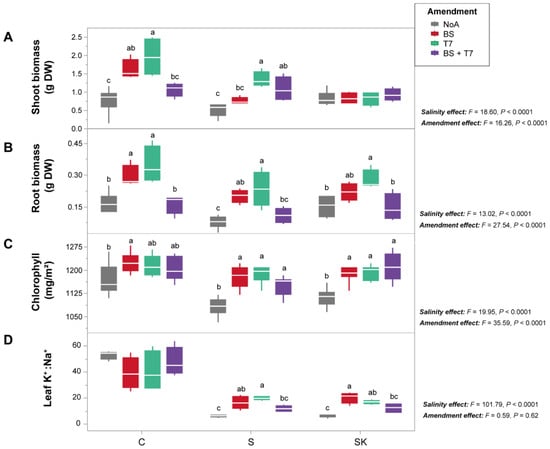
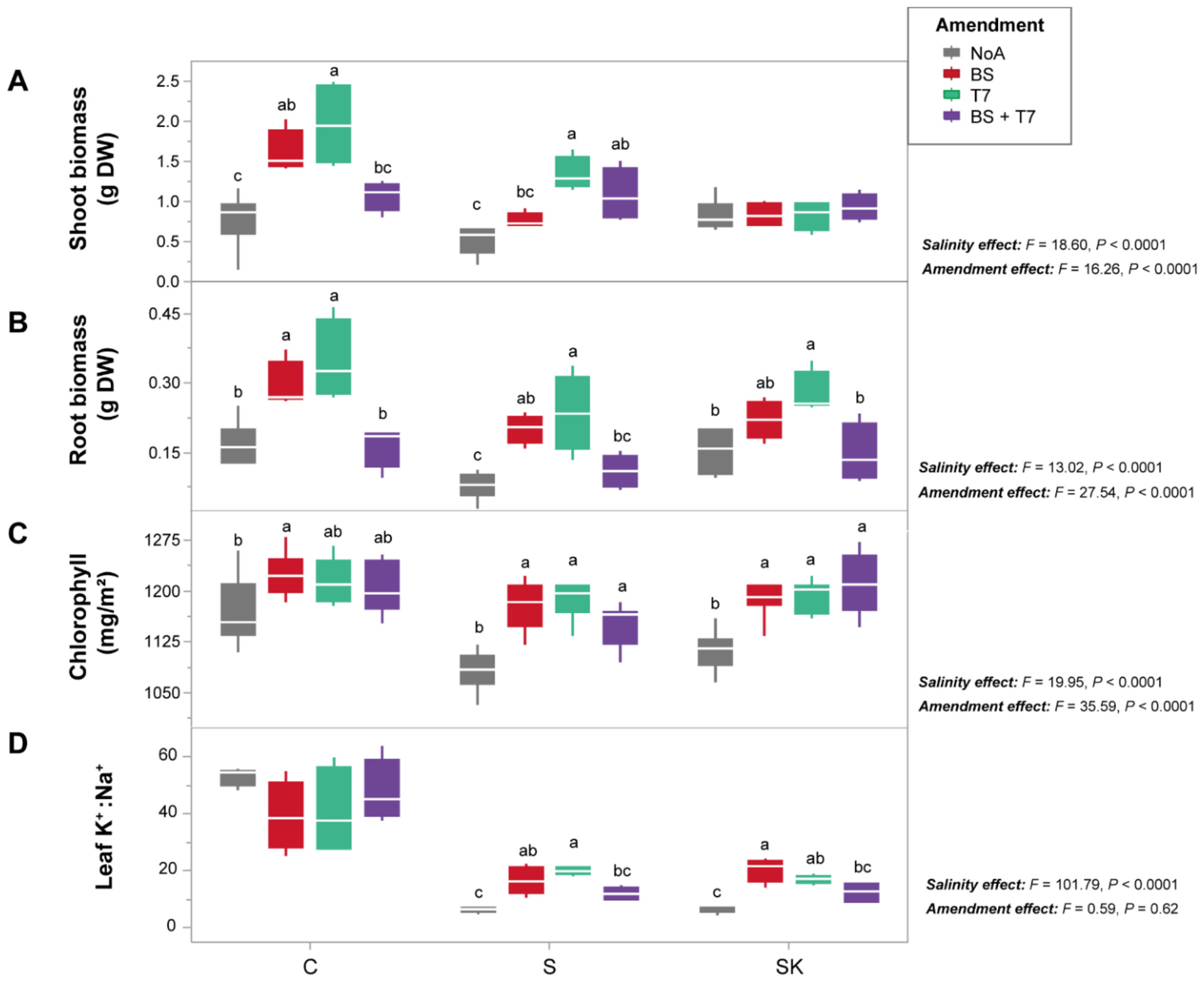
Under N-fertilized conditions, S reduced shoot and root biomass of NoA plants by 36% (n.s.) and 56% (p < 0.01), respectively, whereas SK did not affect biomass (Figure 1A,B). Salinity (F = 18.60, p < 0.0001), amendment (F = 16.26, p < 0.0001), and their interaction (F = 5.86, p = 0.0002) affected shoot biomass (Dataset S1). T7 was the most effective amendment, increasing shoot biomass by 2.5-fold under C and by 2.7-fold under S, and increasing root biomass by 2.0-, 3.1-, and 1.8-fold under C, S, and SK, respectively. BS increased shoot biomass under C (2.1-fold) and root biomass under C and S, whereas BS + T7 increased shoot biomass only under S (2.2-fold) and did not affect root biomass. Under SK, no amendment modified shoot biomass (F = 0.31, p = 0.82).
Figure 1.
Growth, chlorophyll content, and leaf K+/Na+ ratio of N-fertilized common bean plants grown in control (C), neutral salinity (S), or alkaline salinity (SK) without amendment (NoA) or with the humic–fulvic biostimulant (BS), Pantoea sp. T7 or both (BS + T7). (A) Shoot dry weight; (B) root dry weight; (C) leaf chlorophyll content; and (D) leaf K+/Na+ ratio. Boxes show the median and interquartile range. Different letters indicate significant differences among amendments within each salinity treatment (Tukey–Kramer HSD test, p < 0.05). F and p values correspond to the main effects of the two-way ANOVA. n = 4–7 (biomass), n = 6–16 (chlorophyll), and n = 4 (ions). Absence of letters indicates no significant differences among amendments.
All amendments prevented the salt-induced decrease in chlorophyll content (Figure 1C). NoA plants had 8% and 5% less chlorophyll under S and SK than under C, whereas amended plants maintained values similar to or higher than non-saline plants (1147–1210 mg m−2). Both salt treatments decreased the leaf K+/Na+ ratio of NoA plants about eight-fold (from 53 to 6–7; Figure 1D). T7 and BS increased this ratio 2.5- to 3.2-fold under S and SK, whereas the effect of BS + T7 was smaller (about 1.8-fold, n.s.). T7 reduced leaf Na+ by 45% under S and 35% under SK, and both T7 and BS increased leaf K+ by 64–96% under salinity (Dataset S1).
3.3. T7 Induces Root Ion Transporter Genes, Especially Under Alkaline Salinity
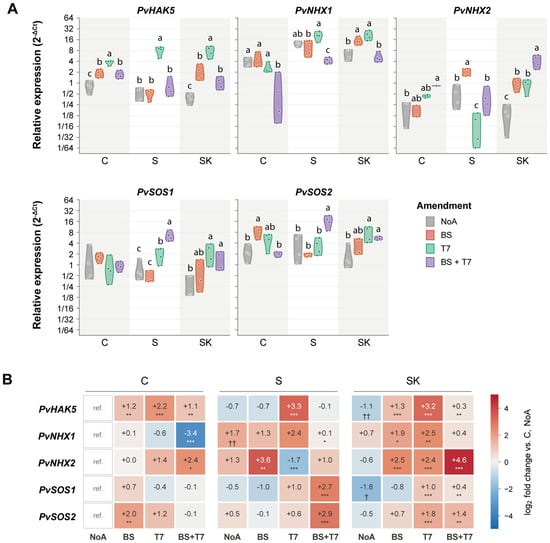
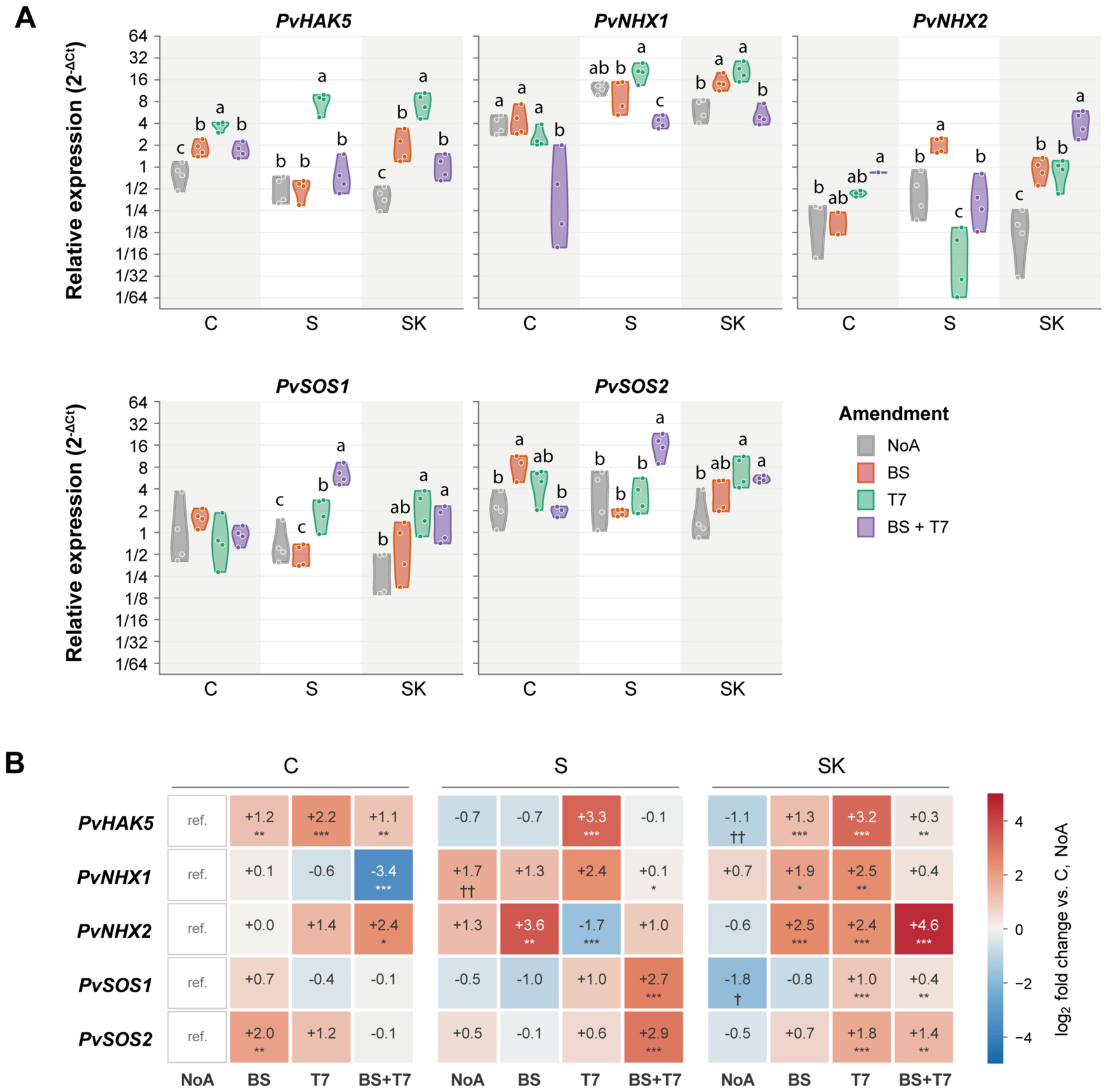
The amendments markedly modulated ion transporter gene expression in roots of N-fertilized common bean plants, with responses varying according to both the amendment and the salinity treatment (Figure 2). T7 strongly induced PvHAK5 under neutral (S) and alkaline (SK) salinity, reaching 16- and 20-fold the expression levels of the corresponding non-amended (NoA) plants, respectively. This induction was also observed under control conditions (C), although to a lesser extent (4.7-fold). Under SK, T7 additionally induced PvNHX1 (3.4-fold), PvNHX2 (7.6-fold), PvSOS1 (7.2-fold), and PvSOS2 (4.7-fold), encompassing all five transporters analyzed. In contrast, under S, T7 strongly repressed PvNHX2 expression (0.12-fold relative to NoA) (Figure 2).
Figure 2.
Expression of ion transporter genes in roots of N-fertilized common bean plants grown in control (C), neutral salinity (S), or alkaline salinity (SK) without amendment (NoA) or with the humic–fulvic biostimulant (BS), Pantoea sp. T7 or both (BS + T7). (A) Relative expression (2−ΔCt, normalised to PvTub) of PvHAK5, PvNHX1, PvNHX2, PvSOS1 and PvSOS2. Different letters indicate significant differences among amendments within each salinity treatment (Tukey–Kramer HSD test, p < 0.05). (B) Heatmap of the log2 fold change relative to non-saline, non-amended plants (C, NoA). Asterisks indicate significant differences between each amendment and NoA within the same salinity treatment, and daggers indicate significant differences between salt-treated and control NoA plants (Benjamini–Hochberg-adjusted p: */† < 0.05; **/†† < 0.01; *** < 0.001). n = 2–4 biological replicates per treatment.
BS also altered transporter expression, inducing PvHAK5 under C and SK (2.3- and 5.1-fold, respectively), PvNHX2 under S and SK (4.9- and 8.1-fold), and PvNHX1 under SK (2.4-fold) (Figure 2). The combined BS + T7 treatment elicited the strongest induction of PvSOS1 and PvSOS2 under S (9.5- and 5.2-fold, respectively) and of PvNHX2 under SK (36-fold). However, this combination also strongly repressed PvNHX1 under C and S (0.09- and 0.34-fold, respectively) (Figure 2). In the absence of amendments, salinity had comparatively limited effects on transporter expression. PvNHX1 was induced by 3.2-fold under S, whereas PvHAK5 and PvSOS1 were repressed under SK to 0.48- and 0.28-fold of control levels, respectively (Figure 2B).
Overall, T7 promoted a broad transcriptional response involving all five transporters under alkaline salinity, whereas BS + T7 elicited a particularly strong response involving the SOS pathway under neutral salinity and PvNHX2 under alkaline salinity. These contrasting responses highlight the dependence of transporter gene regulation on both the type of salinity and the amendment applied.
3.4. Effects of the Amendments on Growth and Physiological Parameters
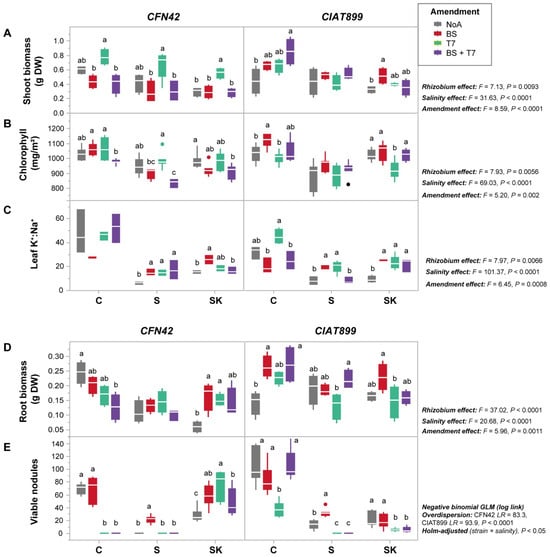
Under N-free conditions, shoot biomass was significantly affected by rhizobial partner (F = 7.13, p = 0.009), salinity (F = 31.63, p < 0.0001), and amendment (F = 8.59, p < 0.0001). The significant rhizobium × amendment interaction (F = 18.67, p < 0.0001) indicated that amendment efficacy depended on the microsymbiont (Figure 3A). In CFN42-inoculated plants, salinity reduced shoot biomass in non-amended (NoA) plants by 31% under neutral salinity (S) and 51% under alkaline salinity (SK). T7 was the only amendment that increased shoot biomass relative to NoA, by 29%, 60%, and 87% under control (C), S, and SK conditions, respectively, although the increase was significant only under SK. BS and BS + T7 did not improve shoot growth and resulted in lower biomass than T7 under C and S. In CIAT899-inoculated plants, salinity did not significantly reduce shoot biomass of NoA plants relative to C, although biomass under control conditions was lower than in CFN42-inoculated plants (0.44 vs. 0.60 g DW). BS + T7 increased shoot biomass under C (+94%), whereas BS was beneficial under SK (+58%); T7 alone did not improve shoot growth under either salt treatment.
Figure 3.
Growth, chlorophyll content, leaf K+/Na+ ratio and nodulation of common bean plants inoculated with Rhizobium etli CFN42 or R. tropici CIAT899 and grown under N-free conditions in control (C), neutral salinity (S; 12.5 mM of NaCl, pH 6.0) or alkaline salinity (SK; 11.25 mM of NaCl + 1.25 mM of NaHCO3, pH 8.3), without amendment (NoA) or with the humic–fulvic biostimulant (BS), Pantoea sp. T7 or both (BS + T7). (A) Shoot dry weight; (B) leaf chlorophyll content; (C) leaf K+/Na+ ratio; (D) root dry weight; and (E) number of viable nodules per plant. Boxes show the median and interquartile range. In (A–D), different letters indicate significant differences among amendments within each rhizobium and salinity treatment (Tukey–Kramer HSD test, p < 0.05). F and p values in (A–D) correspond to the main effects of the three-way ANOVA. n = 3–5 (biomass and ions), n = 3–7 (chlorophyll) and n = 6–10 (nodules). Absence of letters indicates no significant differences among amendments. In (E), different letters indicate significant differences among amendments (negative binomial GLM or Fisher’s exact test, Holm-adjusted p < 0.05). (E) also reports the likelihood-ratio test for overdispersion of the negative binomial model relative to a Poisson model.
Chlorophyll content showed treatment-dependent responses that also varied between rhizobial partners (Figure 3B). In NoA plants inoculated with either rhizobial strain, chlorophyll content decreased under S by 8% in CFN42-inoculated plants and 15% in CIAT899-inoculated plants (p < 0.05), but was not significantly affected under SK. In CFN42-inoculated plants, T7 maintained chlorophyll content under S (986 mg m−2), whereas BS + T7 resulted in the lowest values under both S and SK. In CIAT899-inoculated plants, BS increased chlorophyll content under C, while T7 reduced it under SK. Consistent with these responses, the maximum quantum efficiency of photosystem II (Fv/Fm) decreased under S in NoA plants, with a greater decline in CIAT899-inoculated plants (from 0.72 to 0.61) than in CFN42-inoculated plants (from 0.80 to 0.77) (Dataset S1).
Salinity significantly decreased the leaf K+/Na+ ratio (F = 101.37, p < 0.0001; Figure 3C), primarily reflecting increased Na+ accumulation. In NoA plants, the ratio declined from 48 under C to 6 under S and 15 under SK in CFN42-inoculated plants, and from 32 to 8 and 9, respectively, in CIAT899-inoculated plants. All amendments increased the K+/Na+ ratio in CFN42-inoculated plants under S by 2.5- to 2.8-fold, while BS also improved the ratio under SK (26 vs. 15 in NoA plants). In CIAT899-inoculated plants, BS and T7 increased the ratio under S by 2.3- to 2.5-fold, and all amendments increased it under SK by 2.4- to 2.8-fold. These improvements were mainly associated with higher leaf K+ concentrations in BS and BS + T7 plants (123–132 vs. 67 mg g−1 DW in CFN42-inoculated plants under S), together with lower Na+ concentrations in T7-treated CFN42-inoculated plants (6.4 vs. 11.5 mg g−1 DW under S) (Dataset S1).
3.5. Nodulation Responses to T7 Depend on the Rhizobial Partner and Salinity
Root biomass responses depended on both rhizobial partner and amendment (Figure 3D). In CFN42-inoculated plants, salinity reduced root biomass in NoA plants by 55% under S and 76% under SK. Under SK, BS and T7 maintained higher root biomass than NoA (0.15–0.17 vs. 0.06 g DW). In CIAT899-inoculated plants, BS and BS + T7 nearly doubled root biomass under C. Under S, BS + T7 maintained the highest root biomass, whereas under SK, BS was the most effective treatment. T7 alone resulted in the lowest root biomass under both salt treatments.
The number of viable nodules depended on the rhizobial partner, salinity, and amendment (Figure 3E). In CFN42-inoculated plants, S completely abolished the formation of viable nodules in NoA plants, whereas SK reduced the number of viable nodules by 58%. Under S, NoA plants still formed nodules, but 84% fewer than under C (11 vs. 73 per plant; Dataset S1), a reduction similar to that observed in the screening (Figure S1), and none of them were viable. T7, both alone and combined with BS, completely suppressed nodulation under C and S. Under SK, however, T7 increased the number of viable nodules to 76 per plant, 2.6-fold higher than in NoA plants and comparable to the non-saline NoA control. BS was the only amendment that maintained viable nodules under S (22 per plant) and also doubled their number under SK. BS + T7 also increased viable nodule number under SK (48 vs. 29 per plant), although less than T7 alone. In CIAT899-inoculated plants, T7 reduced viable nodule numbers under all conditions (−64% under C, complete suppression under S, and −73% under SK), including when combined with BS under salinity. Conversely, BS increased viable nodule numbers under S by 2.3-fold relative to NoA (32 vs. 14 per plant). At the plant level, viable nodule number was not correlated with shoot biomass in CFN42-inoculated plants (ρ = −0.19, p = 0.20). In CIAT899-inoculated plants, nodule number was positively correlated with shoot biomass across salinity levels (ρ = 0.43, p = 0.002), but not within any salinity level (|ρ| ≤ 0.12, p ≥ 0.66), indicating that this association reflected the common negative effect of salinity on both traits (Table S3). Viable nodule number was also positively correlated with root biomass when treatments were pooled within each rhizobial strain, although within individual salinity levels this association was retained only in CFN42-inoculated plants under control conditions (Table S3).
3.6. Effects of the Amendments on Leaf Oxidative Stress
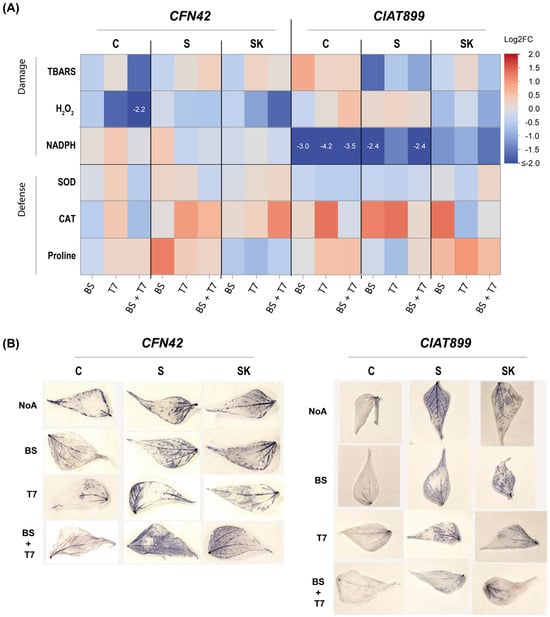
Salinity increased leaf H2O2, TBARS, and proline in NoA plants inoculated with either rhizobial strain, but the extent of oxidative damage was strain-dependent (Figure 4 and Figure S2). In CIAT899-inoculated plants, S increased H2O2 by 4.1-fold and TBARS by 5.5-fold relative to the control, whereas in CFN42-inoculated plants the increases were only 1.6- and 1.4-fold, respectively. Under SK, H2O2 increased by 2.3-fold in plants inoculated with either rhizobial strain, whereas TBARS increased by 2.2-fold in CIAT899-inoculated plants but only by 1.2-fold in CFN42-inoculated plants. Proline increased by 3.6- to 6.1-fold under both salt treatments in plants inoculated with either rhizobial strain. NBT staining showed stronger superoxide accumulation in leaves of non-amended CIAT899-inoculated plants under S and SK (Figure 4B).
Figure 4.
Leaf oxidative status of common bean plants inoculated with CFN42 or CIAT899 and grown under N-free conditions in control (C), neutral salinity (S), or alkaline salinity (SK) with the humic–fulvic biostimulant (BS), Pantoea sp. T7 or both (BS + T7). (A) Heatmap of the log2 fold change of each amended treatment relative to non-amended plants (NoA) of the same rhizobium and salinity treatment for damage markers (TBARS, H2O2, NADPH oxidase activity) and defence parameters (SOD and CAT activities, proline); red and blue indicate higher and lower values than NoA, respectively (means of n = 3–4). Cells with |log2FC| > 2 are shown at the limit of the colour scale and their values are given in the cell. Absolute values and statistical comparisons are shown in Figure S2. (B) Histochemical detection of superoxide (blue formazan precipitate after NBT staining) in representative leaves. Leaves are not shown to scale.
In CFN42-inoculated plants, the amendments mainly lowered ROS levels (Figure 4A). T7 and BS + T7 reduced leaf H2O2 under all conditions (by 35–78%; Tukey–Kramer, p < 0.05), with the largest relative reductions under C (−69% and −78%) and SK (−53% and −69%). Under S, BS resulted in the lowest TBARS level together with the highest proline accumulation (2.4-fold higher than NoA). Under SK, all amendments reduced proline accumulation relative to NoA, which is consistent with a lower perception of stress.
In CIAT899-inoculated plants, the amendments did not reduce the very high H2O2 levels induced by S, but all of them reduced lipid peroxidation, most notably BS (−68% TBARS) (Figure 4A and Figure S2). Under SK, BS + T7 halved H2O2 and showed the lowest TBARS content, while BS increased CAT activity by 2.5-fold. T7, in contrast, showed the highest TBARS level under SK; it resulted in the lowest proline content under S but the highest under SK. Leaf NADPH oxidase activity did not differ among amendments in CFN42-inoculated plants. In CIAT899-inoculated plants, it was higher in NoA plants than in all amended plants under C, whereas under SK, only BS + T7 reduced it relative to NoA (Figure S2).
3.7. Effects of T7 on Nodule Oxidative Status
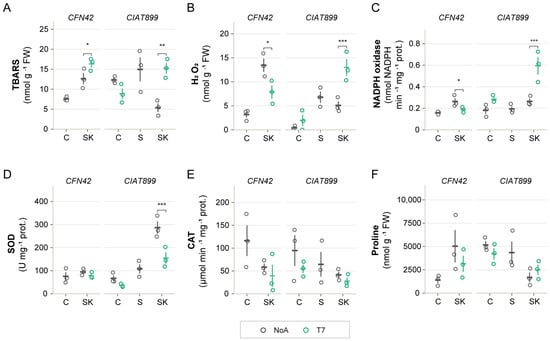
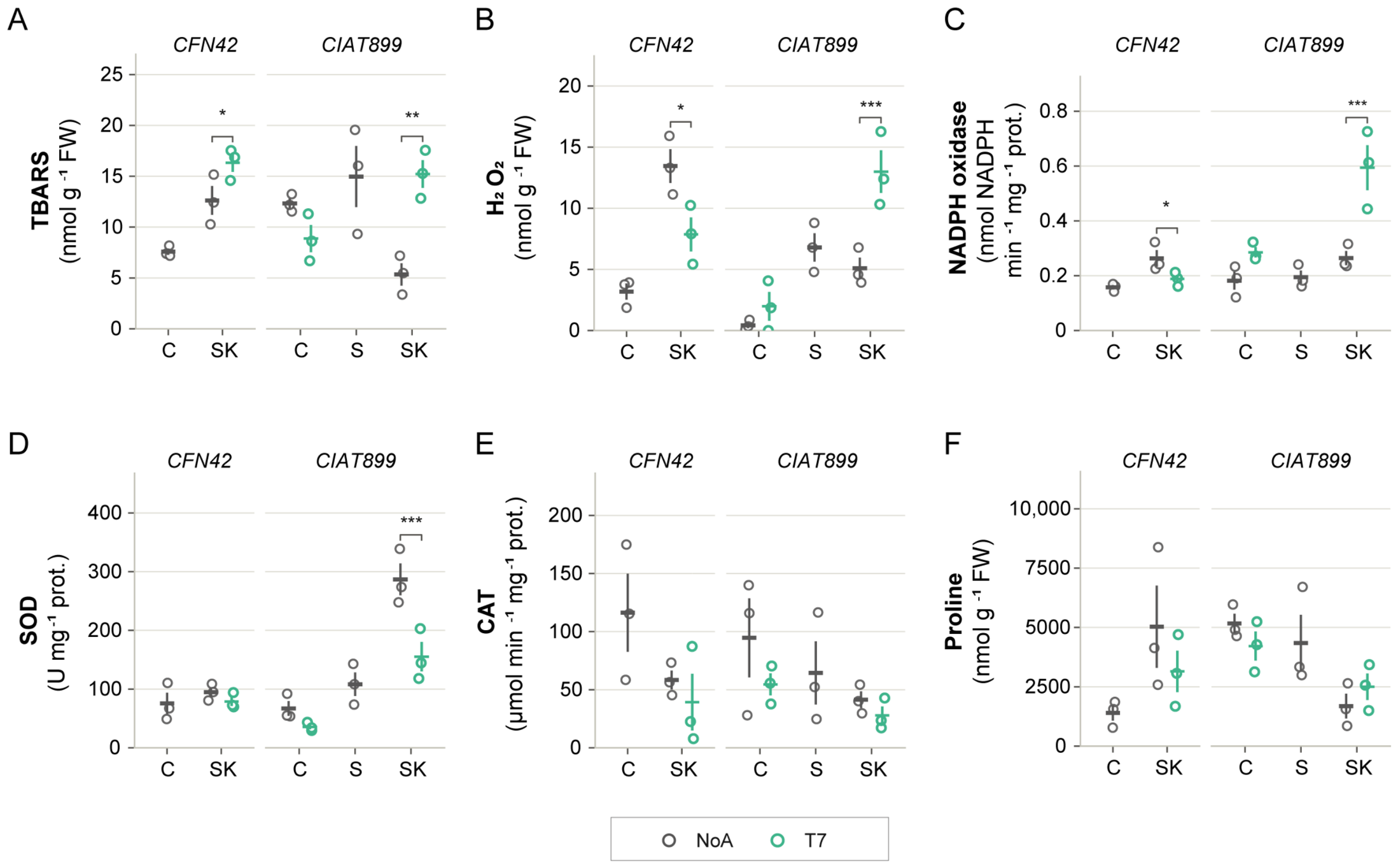
In NoA nodules from CFN42-inoculated plants, SK increased H2O2 (4.2-fold), TBARS (1.7-fold), and NADPH oxidase activity (1.7-fold), whereas in nodules from CIAT899-inoculated plants, SK increased H2O2 by 12-fold and SOD activity by 4.3-fold, without increasing TBARS. The response of nodules to T7 under SK differed markedly between the two symbioses. In nodules from CFN42-inoculated plants, T7 decreased H2O2 (−42%) and NADPH oxidase activity (−29%) but increased TBARS (+29%). In nodules from CIAT899-inoculated plants, T7 increased H2O2 (2.6-fold), TBARS (2.8-fold) and NADPH oxidase activity (2.2-fold) while decreasing SOD activity (−46%), indicating an oxidative imbalance (Figure 5).
Figure 5.
Oxidative status of nodules from non-amended (NoA) and T7-inoculated common bean plants in symbiosis with CFN42 or CIAT899 under control (C), neutral salinity (S), or alkaline salinity (SK), in the treatments that produced enough viable nodules. (A) TBARS; (B) H2O2; (C) NADPH oxidase activity; (D) SOD activity; (E) CAT activity; (F) proline. Circles show individual replicates (n = 3); horizontal lines and bars show mean ± SE. Asterisks indicate significant differences between T7 and NoA within each salinity treatment (t-tests of linear-model contrasts; * p < 0.05; ** p < 0.01; *** p < 0.001).
4. Discussion
4.1. T7 and BS Improve Plant Performance and Ion Homeostasis Under Mineral N Supply
Under mineral N supply, where plant growth does not depend on the symbiosis, T7 promoted growth and improved leaf ion homeostasis under salinity, consistent with our first hypothesis (Figure 1). The growth response depended on organ and salinity treatment: T7 increased shoot biomass under C and S and root biomass under all salinity treatments, whereas no amendment modified shoot biomass under SK. Both T7 and BS increased the leaf K+/Na+ ratio under S and SK, and their combination provided no consistent additional benefit. Together with the induction of ion transporter genes by T7 (Figure 2), these responses indicate that T7 improves host growth and ion homeostasis independently of the symbiosis, providing a reference for interpreting the responses of rhizobium-inoculated plants.
The maintenance of chlorophyll content by all amendments under salinity (Figure 1C) may reflect improved Fe nutrition. Salinity and high pH reduce Fe availability and uptake and cause chlorosis [30,54]. In lettuce grown with 25 mM of NaCl or 10 mM of NaHCO3 (pH 8.1), a microbial biostimulant containing Rhizophagus intraradices and Trichoderma atroviride, alone or combined with a protein hydrolysate, maintained a higher SPAD index and attenuated the decrease in leaf Fe under both stresses [30]. This effect was attributed to a larger total root length and surface, which improved the uptake of the Fe2+ and Mg2+ required for chlorophyll biosynthesis [30]. A similar mechanism could apply to T7 and BS, which increased the root biomass of plants supplied with mineral N (Figure 1B). In addition, T7 produces siderophores even with 300 mM of NaCl [33], and humic substances such as those in BS form soluble Fe complexes that plants can use directly, while also stimulating root Fe acquisition [55]. Notably, BS + T7 also maintained chlorophyll content without increasing root biomass (Figure 1B,C). This suggests that Fe mobilisation in the rhizosphere, rather than root growth alone, contributes to the effect. Since leaf Fe was not determined in this study, measuring leaf Fe concentration and root Fe(III)-chelate reductase activity would be needed to confirm this hypothesis.
The root gene expression data are consistent with the improved K+/Na+ homeostasis (Figure 2). Maintaining K+ uptake under salinity is a key tolerance trait [15], and HAK5-type transporters mediate high-affinity K+ uptake by roots when external Na+ is high [14]. The strong induction of PvHAK5 by T7 in roots under both salt treatments is therefore consistent with the higher leaf K+ concentrations of T7-treated plants (Dataset S1), as described for other PGPB [24]. Under SK, T7 also induced PvNHX1, PvNHX2, and the PvSOS1–PvSOS2 module. In roots, SOS1 extrudes Na+ and controls its long-distance transport to the shoot, whereas NHX antiporters retain Na+ in root vacuoles [12,13,14]; their coordinated induction could contribute to restricting Na+ delivery to the leaves, consistent with the lower leaf Na+ concentrations of T7-treated plants. Under S, however, T7 also lowered leaf Na+ while repressing PvNHX2 and without a comparable induction of the SOS pathway, which suggests that other processes, such as dilution by the larger biomass (Figure 1A,B) or Na+ retrieval from the xylem [9], also contribute. BS induced PvNHX2 and PvHAK5, although K+ accumulation in BS-treated plants probably reflects the K+ supplied by the product. Interestingly, BS + T7 caused the strongest induction of PvSOS1 and PvSOS2 under S and of PvNHX2 under SK, yet it produced the smallest improvement in the leaf K+/Na+ ratio among amendments (Figure 1D) and repressed PvNHX1. This mismatch suggests that transcript levels do not fully reflect transporter activity, which is regulated post-translationally (e.g., phosphorylation of SOS1 by SOS2 [12]), or that, because SOS1 also controls long-distance Na+ transport [13], its induction in roots does not necessarily reduce Na+ delivery to the shoot. Because ion concentrations were determined only in leaves, measuring root Na+ and K+ concentrations and net Na+ fluxes would help to clarify the contribution of root transporters to the response to the amendments.
4.2. The Rhizobial Partner and Salinity Conditions Shape the Response to T7 and BS
In rhizobium-inoculated plants, growth and nodulation responses did not always coincide: nodulation was suppressed in plants co-inoculated with CFN42 and T7 under control and neutral salinity conditions without a corresponding reduction in shoot biomass, whereas under alkaline salinity T7 increased both shoot biomass and the number of viable nodules (Figure 3). Plant-level correlations supported this decoupling: nodule number did not predict shoot biomass in CFN42-inoculated plants, and the positive association observed in CIAT899-inoculated plants disappeared when salinity levels were analysed separately (Table S3). Because nitrogen fixation was not measured, nodule number may not fully reflect symbiotic N supply; nevertheless, these results indicate that shoot growth during the experimental period was not primarily determined by the number of viable nodules.
T7 tended to increase shoot biomass of CFN42-inoculated plants under all conditions, significantly so under SK, whereas it did not significantly increase shoot biomass in CIAT899-inoculated plants (Figure 3A). CFN42-inoculated plants suffered less oxidative damage under salinity and maintained higher Fv/Fm. In these plants, T7 lowered leaf H2O2 under all conditions (Figure 4A). Under SK, T7 not only restored the number of viable nodules from CFN42-inoculated plants to control levels but also lowered H2O2 and NADPH oxidase activity in these nodules, although nodule TBARS increased moderately (Figure 3E and Figure 5). In CIAT899-inoculated plants under SK, by contrast, T7 strongly reduced viable nodule number, and the remaining nodules showed higher H2O2, TBARS and NADPH oxidase activity and lower SOD activity (Figure 3E and Figure 5). Because ROS homeostasis is critical for nodule activity and senescence [18], the T7–CIAT899 combination may impair nodule functioning under alkaline salinity.
The absence of nodules in plants co-inoculated with CFN42 and T7 under C and S (Figure 3E) deserves attention. Co-inoculation of bean with PGPB can stimulate or inhibit nodulation depending on PGPB traits such as auxin production and ACC deaminase activity, and on the nutrient status of the plant [31,32]. T7 is a highly halotolerant strain that, in vitro, fixes nitrogen, solubilizes phosphate, produces siderophores and high amounts of IAA-like compounds, and maintains these traits at NaCl contents up to 300 mM [33]. In Sinapis alba, T7 efficiently colonized the root surface, which was linked to its high motility, and remodeled root architecture, an effect attributed to bacterial auxin signaling [33]. These traits point to several non-exclusive mechanisms. First, IAA-like compounds produced by T7 could alter root hair development or stimulate ethylene synthesis, a negative regulator of rhizobial infection [56]; in addition, root development in common bean responds to auxin produced by PGPB in a genotype-dependent manner [57]. Second, efficient colonization of the root surface by T7 could limit rhizobial access to infection sites. Consistent with an effect on early stages of the interaction, no nodules were formed in plants co-inoculated with CFN42 and T7 under C and S (Dataset S1). Third, N supplied by T7 could contribute to the N-dependent systemic inhibition of nodulation [58], although complete suppression appears unlikely to result from associative N fixation alone. Co-inoculated plants received half the rhizobial suspension volume; however, the same reduced dose supported abundant nodulation in other combinations (Figure 3E), indicating that inoculum dilution alone does not account for the absence of nodules, although its contribution cannot be completely excluded.
Non-nodulated plants co-inoculated with CFN42 and T7 maintained shoot growth (Figure 3A,E). This may reflect seed N reserves and the absence of the carbon cost of nodule formation and function, which can consume 4–16% of recently fixed photosynthates [59], during the experimental period. Because T7 also promoted growth in plants supplied with mineral N (Figure 1), its growth-promoting effects are not restricted to N-limited conditions. The nitrogen-fixing capacity of T7 [33], also described in other Pantoea strains [60], makes an additional bacterial N contribution possible, but this remains to be demonstrated in planta. Finally, the restoration of nodulation by T7 specifically under SK (pH 8.3; Figure 3E) suggests that alkaline conditions (high pH and/or bicarbonate) modulate the T7–CFN42–host interaction. In legume rhizospheres, alkalinization acts as a selective filter that enriches Rhizobium and Mesorhizobium taxa, whereas the rhizobia inside nodules are mainly determined by the host [61]. A moderately alkaline rhizosphere could therefore favour CFN42 in its competition with T7 for root colonization. Consistent with a pH-dependent modulation of symbiotic competitiveness, Frey and Blum [62] found that CIAT899 occupied most bean nodules in acidic soil, whereas a type I strain, a group now largely assigned to R. etli, outcompeted it after liming to pH 7.6.
In contrast to T7, BS was the most beneficial amendment for CIAT899-inoculated plants (Figure 3), and it was the only amendment that maintained viable nodules in CFN42-inoculated plants under neutral salinity. Humic substances can improve root growth and nutrient uptake [25,26], and BS also supplies K+, which can support both the host and the symbiosis. However, unlike the synergy reported for other combinations of microbial and non-microbial biostimulants [27,28,29,30], BS + T7 was not synergistic with either rhizobial strain: it abolished the nodulation maintained by BS alone under S with both strains (Figure 3E) and often resulted in the lowest chlorophyll content (Figure 3B). Combining the two biostimulants therefore does not seem advisable, at least at the doses tested, and the amendment should be matched to the rhizobial partner and to the type of salinity: T7 with CFN42 under alkaline salinity, whereas BS was the amendment most compatible with nodulation under neutral salinity.
4.3. Contrasting Effects of Neutral and Alkaline Salinity on Growth and Nodulation
Although high pH and bicarbonate can impose additional constraints on plant performance [3], alkaline salinity was less detrimental than neutral salinity to nodulation in our screening at equal Na+ concentrations (Figure S1). Growth responses were more context-dependent: SK did not reduce biomass in plants supplied with mineral N (Figure 1), whereas it reduced shoot biomass of non-amended CFN42-inoculated plants more than S did (Figure 3A). Thus, the relative effects of S and SK differed between growth and nodulation and among nitrogen-nutrition contexts. In CFN42-inoculated plants, the relative effects of S and SK on shoot biomass also differed between the screening and the main experiment (Figure S1 and Figure 3A), whereas the greater sensitivity of nodulation to S than to SK was consistent across experiments. Several features of the treatments could contribute to these responses. Replacing 10% of NaCl with NaHCO3 reduced the Cl− load only marginally (1.25 mM), and Cl− accumulation up to 3% of leaf dry weight did not inhibit growth in cv. Contender [63], making lower Cl− toxicity an unlikely explanation. At the selected dose, the low bicarbonate concentration (1.25 mM) may also have limited the development of Fe-deficiency chlorosis [3,54], consistent with the maintenance of chlorophyll under SK in rhizobium-inoculated plants (Figure 3B). Differences between CFN42 and CIAT899 may reflect variation in bacterial stress tolerance or early host–rhizobium interactions [16].
4.4. Practical Implications and Limitations
Context-dependent performance is increasingly recognized as a major limitation of microbial inoculants. In wheat, Huang et al. [64] found a non-linear relationship between soil organic carbon and inoculant efficacy and proposed an SOC–plant immunity–rhizosphere microbiome axis in which resource availability, microbial antagonism and colonization resistance determine inoculant establishment and crop response. Similar context dependence has been reported for the co-inoculation of legumes with rhizobia and other PGPB. In common bean and soybean under moderate salinity, the effect of co-inoculation with Chryseobacterium balustinum depended on the rhizobial species [65]; in chickpea under mild salinity, only one of several endophyte consortia improved nodulation and growth [66]; and a meta-analysis of soybean co-inoculation studies showed that responses varied with the PGPR genus and the experimental conditions [67]. Our results are consistent with this general principle: the effects of T7 varied among nitrogen-nutrition contexts, rhizobial partners and salinity conditions. Because the substrate was autoclaved, these effects are unlikely to reflect colonization resistance from a pre-existing resident soil microbiome. These contextual effects should be distinguished from traits specific to T7, including its halotolerance and its capacity to produce siderophores and auxin-like compounds, solubilize phosphate and fix nitrogen in vitro [33]. These traits may support plant growth under salinity but do not ensure compatibility with every rhizobial partner, as shown by the strain- and salinity-dependent nodulation responses of CFN42- and CIAT899-inoculated plants.
From an applied perspective, these results indicate that the response of a legume to a PGPB under mineral N supply may not predict its response when the plant depends on rhizobial symbiosis. T7 promoted growth and improved leaf ion homeostasis under mineral N supply, whereas in rhizobium-inoculated plants its effects on nodulation ranged from suppression to stimulation depending on the rhizobial partner and the type of salinity. Because growth promotion and nodulation did not necessarily coincide, nodulation should be considered alongside biomass when evaluating biostimulants for legumes. Moreover, the combination of BS and T7 provided no consistent additional benefit over either amendment alone. As N source and rhizobial inoculation differed jointly between nitrogen-nutrition contexts, differences between contexts are interpreted as context-dependent responses rather than as effects attributable to the rhizobium alone. Further studies under field conditions, including measurements of nitrogen fixation, are required to validate the potential of the CFN42–T7 combination in alkaline–saline soils.
5. Conclusions
Under mineral N supply, T7 promoted common bean growth, with responses depending on the plant organ and salinity treatment, while both T7 and BS improved the leaf K+/Na+ ratio under neutral and alkaline salinity. In rhizobium-inoculated plants, amendment responses depended on the rhizobial partner and salinity conditions. Growth promotion did not necessarily coincide with improved nodulation: T7 suppressed nodulation in CFN42-inoculated plants under control and neutral salinity conditions without a corresponding reduction in shoot biomass, whereas under alkaline salinity it increased shoot biomass and viable nodule numbers and lowered nodule H2O2 and NADPH oxidase activity, despite a moderate increase in nodule TBARS. With CIAT899, T7 reduced nodulation, whereas BS provided greater benefits to plant performance. Combining BS and T7 offered no consistent additional benefit over the individual amendments. Together, these findings highlight the importance of considering nitrogen nutrition, rhizobial identity and salinity conditions when evaluating biostimulants, and identify CFN42–T7 as a promising combination for further evaluation under alkaline salinity.
Supplementary Materials
The following supporting information can be downloaded at https://www.mdpi.com/article/10.3390/biology15222126/s1, Figure S1: Shoot biomass and nodule number of common bean plants inoculated with R. etli CFN42 or R. tropici CIAT899 and exposed to increasing concentrations (12.5, 25 and 50 mM of Na+) of neutral (S) or alkaline (SK) salinity; Figure S2: Absolute values of leaf oxidative stress markers and antioxidant parameters in CFN42- and CIAT899-inoculated plants; Table S1: Composition of the modified Evans nutrient solution used under symbiotic (N-free) and N-fertilized conditions; Table S2: Growth of R. etli CFN42 and R. tropici CIAT899 in B⁻ medium supplemented with increasing NaCl concentrations; Table S3: Spearman rank correlations between viable nodule number and shoot or root dry weight in CFN42- and CIAT899-inoculated plants, pooled and within each salinity level; Dataset S1: Raw data and statistical analyses.
Author Contributions
Conceptualization, S.B., E.B. and C.P.; methodology, E.B., G.F.-O., M.S. and G.E.; investigation, G.F.-O., M.S. and S.B.; formal analysis, G.F.-O., M.S., S.B. and E.B.; data curation, E.B. and S.B.; writing—original draft preparation, S.B. and E.B.; writing—review and editing, all authors; supervision, S.B., E.B. and C.P.; funding acquisition, C.P. All authors have read and agreed to the published version of the manuscript.
Funding
This research was funded by the Spanish Ministry of Science and Innovation (MICINN), grant number PID2019-104000-RB-I00.
Institutional Review Board Statement
Not applicable.
Informed Consent Statement
Not applicable.
Data Availability Statement
The original contributions presented in this study are included in the article and its Supplementary Materials (Dataset S1). Further inquiries can be directed to the corresponding authors.
Acknowledgments
We thank all members of the Plant Physiology Laboratory of the Universitat Autònoma de Barcelona for their technical support during the experimental work. We thank Desarrollos Agroquímicos S.A. (DASA, Menàrguens, Spain) for kindly providing Biosoil© free of charge. We thank Dulce Rodríguez-Navarro (IFAPA Centro Las Torres Tomejil, Seville, Spain) for kindly providing rhizobial strains CFN42 and CIAT899. During the preparation of this manuscript, the authors used Claude Opus 5.5 (Anthropic) and ChatGPT-6 (OpenAI) to assist with manuscript organization, to improve textual clarity and language, to identify potential inconsistencies, and to assist with the representation of the graphical abstract. The authors reviewed and edited all AI-assisted content and take full responsibility for the final manuscript.
Conflicts of Interest
The authors declare no conflicts of interest. Desarrollos Agroquímicos S.A. provided the biostimulant free of charge and had no role in the design of the study; in the collection, analyses, or interpretation of data; in the writing of the manuscript; or in the decision to publish the results.
References
- Mukhopadhyay, R.; Sarkar, B.; Jat, H.S.; Sharma, P.C.; Bolan, N.S. Soil salinity under climate change: Challenges for sustainable agriculture and food security. J. Environ. Manag. 2021, 280, 111736. [Google Scholar] [CrossRef] [Scilit] [PubMed]
- Negacz, K.; Malek, Ž.; de Vos, A.; Vellinga, P. Saline soils worldwide: Identifying the most promising areas for saline agriculture. J. Arid Environ. 2022, 203, 104775. [Google Scholar] [CrossRef] [Scilit]
- Busoms, S.; Almira-Casellas, M.J.; Barceló, J.; Poschenrieder, C. Plant tolerance to alkaline salinity: A Gordian knot to untie. In Plant Stress Tolerance: Molecular Mechanisms and Breeding Strategies; Chen, J.-T., Ed.; CRC Press/Taylor & Francis: Boca Raton, FL, USA, 2025; pp. 37–69. [Google Scholar]
- Graham, P.H.; Ranalli, P. Common bean (Phaseolus vulgaris L.). Field Crops Res. 1997, 53, 131–146. [Google Scholar] [CrossRef] [Scilit]
- Los, F.G.B.; Zielinski, A.A.F.; Wojeicchowski, J.P.; Nogueira, A.; Demiate, I.M. Beans (Phaseolus vulgaris L.): Whole seeds with complex chemical composition. Curr. Opin. Food Sci. 2018, 19, 63–71. [Google Scholar] [CrossRef] [Scilit]
- Zargar, S.M.; Mahajan, R.; Nazir, M.; Nagar, P.; Kim, S.T.; Rai, V.; Masi, A.; Ahmad, S.M.; Shah, R.A.; Ganai, N.A.; et al. Common bean proteomics: Present status and future strategies. J. Proteom. 2017, 169, 239–248. [Google Scholar] [CrossRef] [Scilit] [PubMed]
- McClean, P.E.; Burridge, J.; Beebe, S.; Rao, I.M.; Porch, T.G. Crop improvement in the era of climate change: An integrated, multi-disciplinary approach for common bean (Phaseolus vulgaris). Funct. Plant Biol. 2011, 38, 927–933. [Google Scholar] [CrossRef] [Scilit] [PubMed]
- Bouhmouch, I.; Souad-Mouhsine, B.; Brhada, F.; Aurag, J. Influence of host cultivars and Rhizobium species on the growth and symbiotic performance of Phaseolus vulgaris under salt stress. J. Plant Physiol. 2005, 162, 1103–1113. [Google Scholar] [CrossRef] [Scilit] [PubMed]
- Munns, R.; Tester, M. Mechanisms of salinity tolerance. Annu. Rev. Plant Biol. 2008, 59, 651–681. [Google Scholar] [CrossRef] [Scilit] [PubMed]
- Le, L.T.T.; Kotula, L.; Siddique, K.H.M.; Colmer, T.D. Na+ and/or Cl− toxicities determine salt sensitivity in soybean (Glycine max (L.) Merr.), mungbean (Vigna radiata (L.) R. Wilczek), cowpea (Vigna unguiculata (L.) Walp.), and common bean (Phaseolus vulgaris L.). Int. J. Mol. Sci. 2021, 22, 1909. [Google Scholar] [CrossRef] [Scilit] [PubMed]
- Hasanuzzaman, M.; Raihan, M.R.H.; Masud, A.A.C.; Rahman, K.; Nowroz, F.; Rahman, M.; Nahar, K.; Fujita, M. Regulation of reactive oxygen species and antioxidant defense in plants under salinity. Int. J. Mol. Sci. 2021, 22, 9326. [Google Scholar] [CrossRef] [Scilit] [PubMed]
- Qiu, Q.-S.; Guo, Y.; Dietrich, M.A.; Schumaker, K.S.; Zhu, J.-K. Regulation of SOS1, a plasma membrane Na+/H+ exchanger in Arabidopsis thaliana, by SOS2 and SOS3. Proc. Natl. Acad. Sci. USA 2002, 99, 8436–8441. [Google Scholar] [CrossRef] [Scilit] [PubMed]
- El Mahi, H.; Pérez-Hormaeche, J.; De Luca, A.; Villalta, I.; Espartero, J.; Gámez-Arjona, F.; Fernández, J.L.; Bundó, M.; Mendoza, I.; Mieulet, D.; et al. A critical role of sodium flux via the plasma membrane Na+/H+ exchanger SOS1 in the salt tolerance of rice. Plant Physiol. 2019, 180, 1046–1065. [Google Scholar] [CrossRef] [Scilit] [PubMed]
- Assaha, D.V.M.; Ueda, A.; Saneoka, H.; Al-Yahyai, R.; Yaish, M.W. The role of Na+ and K+ transporters in salt stress adaptation in glycophytes. Front. Physiol. 2017, 8, 509. [Google Scholar] [CrossRef] [Scilit] [PubMed]
- Shabala, S.; Cuin, T.A. Potassium transport and plant salt tolerance. Physiol. Plant. 2008, 133, 651–669. [Google Scholar] [CrossRef] [Scilit] [PubMed]
- Zahran, H.H. Rhizobium-legume symbiosis and nitrogen fixation under severe conditions and in an arid climate. Microbiol. Mol. Biol. Rev. 1999, 63, 968–989. [Google Scholar] [CrossRef] [Scilit] [PubMed]
- Ferri, A.; Lluch, C.; Ocaña, A. Effect of salt stress on carbon metabolism and bacteroid respiration in root nodules of common bean (Phaseolus vulgaris L.). Plant Biol. 2000, 2, 396–402. [Google Scholar] [CrossRef] [Scilit]
- Becana, M.; Dalton, D.A.; Moran, J.F.; Iturbe-Ormaetxe, I.; Matamoros, M.A.; Rubio, M.C. Reactive oxygen species and antioxidants in legume nodules. Physiol. Plant. 2000, 109, 372–381. [Google Scholar] [CrossRef] [Scilit]
- Fernandez-Aunión, C.; Hamouda, T.B.; Iglesias-Guerra, F.; Argandoña, M.; Reina-Bueno, M.; Nieto, J.J.; Aouani, M.E.; Vargas, C. Biosynthesis of compatible solutes in rhizobial strains isolated from Phaseolus vulgaris nodules in Tunisian fields. BMC Microbiol. 2010, 10, 192. [Google Scholar] [CrossRef] [Scilit] [PubMed]
- Calvo, P.; Nelson, L.; Kloepper, J.W. Agricultural uses of plant biostimulants. Plant Soil 2014, 383, 3–41. [Google Scholar] [CrossRef] [Scilit]
- Bhupenchandra, I.; Chongtham, S.K.; Devi, E.L.; Ramesh, R.; Choudhary, A.K.; Salam, M.D.; Sahoo, M.R.; Bhutia, T.L.; Devi, S.H.; Thounaojam, A.S.; et al. Role of biostimulants in mitigating the effects of climate change on crop performance. Front. Plant Sci. 2022, 13, 967665. [Google Scholar] [CrossRef] [Scilit] [PubMed]
- Ondrasek, G.; Rathod, S.; Manohara, K.K.; Gireesh, C.; Anantha, M.S.; Sakhare, A.S.; Parmar, B.; Yadav, B.K.; Bandumula, N.; Raihan, F.; et al. Salt stress in plants and mitigation approaches. Plants 2022, 11, 717. [Google Scholar] [CrossRef] [Scilit] [PubMed]
- de Souza, R.; Ambrosini, A.; Passaglia, L.M.P. Plant growth-promoting bacteria as inoculants in agricultural soils. Genet. Mol. Biol. 2015, 38, 401–419. [Google Scholar] [CrossRef] [Scilit] [PubMed]
- Kumar, A.; Singh, S.; Gaurav, A.K.; Srivastava, S.; Verma, J.P. Plant growth-promoting bacteria: Biological tools for the mitigation of salinity stress in plants. Front. Microbiol. 2020, 11, 1216. [Google Scholar] [CrossRef] [Scilit] [PubMed]
- Bulgari, R.; Cocetta, G.; Trivellini, A.; Vernieri, P.; Ferrante, A. Biostimulants and crop responses: A review. Biol. Agric. Hortic. 2015, 31, 1–17. [Google Scholar] [CrossRef] [Scilit]
- Canellas, L.P.; Olivares, F.L.; Aguiar, N.O.; Jones, D.L.; Nebbioso, A.; Mazzei, P.; Piccolo, A. Humic and fulvic acids as biostimulants in horticulture. Sci. Hortic. 2015, 196, 15–27. [Google Scholar] [CrossRef] [Scilit]
- Rouphael, Y.; Colla, G. Synergistic biostimulatory action: Designing the next generation of plant biostimulants for sustainable agriculture. Front. Plant Sci. 2018, 9, 1655. [Google Scholar] [PubMed]
- Furlan, A.; Bianucci, E.; Sequeira, M.; Álvarez, L.; Peralta, J.M.; Valente, C.; Guarnieri, V.; Castro, S. Combined application of microbial and non-microbial biostimulants to improve growth of peanut plants exposed to abiotic stresses. In Microbial Probiotics for Agricultural Systems; Zúñiga-Dávila, D., González-Andrés, F., Ormeño-Orrillo, E., Eds.; Springer: Cham, Switzerland, 2019; pp. 239–256. [Google Scholar]
- Xu, F.; Liang, Y.; Wang, X.; Guo, Y.; Tang, K.; Feng, F. Synergic mitigation of saline-alkaline stress in wheat by silicon and Enterobacter sp. FN0603. Front. Microbiol. 2023, 13, 1100232. [Google Scholar] [CrossRef] [Scilit] [PubMed]
- Rouphael, Y.; Cardarelli, M.; Bonini, P.; Colla, G. Synergistic action of a microbial-based biostimulant and a plant derived-protein hydrolysate enhances lettuce tolerance to alkalinity and salinity. Front. Plant Sci. 2017, 8, 131. [Google Scholar] [CrossRef] [Scilit] [PubMed]
- Remans, R.; Croonenborghs, A.; Gutierrez, R.T.; Michiels, J.; Vanderleyden, J. Effects of plant growth-promoting rhizobacteria on nodulation of Phaseolus vulgaris L. are dependent on plant P nutrition. Eur. J. Plant Pathol. 2007, 119, 341–351. [Google Scholar] [CrossRef] [Scilit]
- Korir, H.; Mungai, N.W.; Thuita, M.; Hamba, Y.; Masso, C. Co-inoculation effect of rhizobia and plant growth promoting rhizobacteria on common bean growth in a low phosphorus soil. Front. Plant Sci. 2017, 8, 141. [Google Scholar] [CrossRef] [Scilit] [PubMed]
- Escolà, G.; Bollmann-Giolai, A.; Bellegrandi, G.; Giolai, M.; Malone, J.; Yant, L.; Poschenrieder, C.; Busoms, S.; Bianucci, E. Rhizosphere microbiome and plant growth-promoting bacteria isolates enhance salinity tolerance in Brassicaceae species. Appl. Soil Ecol. 2026, 226, 107347. [Google Scholar] [CrossRef] [Scilit]
- González, V.; Santamaría, R.I.; Bustos, P.; Hernández-González, I.; Medrano-Soto, A.; Moreno-Hagelsieb, G.; Janga, S.C.; Ramírez, M.A.; Jiménez-Jacinto, V.; Collado-Vides, J.; et al. The partitioned Rhizobium etli genome: Genetic and metabolic redundancy in seven interacting replicons. Proc. Natl. Acad. Sci. USA 2006, 103, 3834–3839. [Google Scholar] [CrossRef] [Scilit] [PubMed]
- Martínez-Romero, E.; Segovia, L.; Mercante, F.M.; Franco, A.A.; Graham, P.; Pardo, M.A. Rhizobium tropici, a novel species nodulating Phaseolus vulgaris L. beans and Leucaena sp. trees. Int. J. Syst. Bacteriol. 1991, 41, 417–426. [Google Scholar] [CrossRef] [Scilit] [PubMed]
- Ormeño-Orrillo, E.; Menna, P.; Almeida, L.G.P.; Ollero, F.J.; Nicolás, M.F.; Rodrigues, E.P.; Nakatani, A.S.; Batista, J.S.S.; Chueire, L.M.O.; Souza, R.C.; et al. Genomic basis of broad host range and environmental adaptability of Rhizobium tropici CIAT 899 and Rhizobium sp. PRF 81 which are used in inoculants for common bean (Phaseolus vulgaris L.). BMC Genom. 2012, 13, 735. [Google Scholar] [CrossRef] [Scilit] [PubMed]
- Guasch-Vidal, B.; Estévez, J.; Dardanelli, M.S.; Soria-Díaz, M.E.; Fernández de Córdoba, F.; Balog, C.I.A.; Manyani, H.; Gil-Serrano, A.; Thomas-Oates, J.; Hensbergen, P.J.; et al. High NaCl concentrations induce the nod genes of Rhizobium tropici CIAT899 in the absence of flavonoid inducers. Mol. Plant-Microbe Interact. 2013, 26, 451–460. [Google Scholar] [CrossRef] [Scilit] [PubMed]
- Evans, H.J. Symbiotic nitrogen fixation in legume nodules. In Research Experiences in Plant Physiology; Moore, T.C., Ed.; Springer: New York, NY, USA, 1974; pp. 417–426. [Google Scholar]
- Bradford, M.M. A rapid and sensitive method for the quantitation of microgram quantities of protein utilizing the principle of protein-dye binding. Anal. Biochem. 1976, 72, 248–254. [Google Scholar] [CrossRef] [Scilit]
- Beauchamp, C.O.; Fridovich, I. Isozymes of superoxide dismutase from wheat germ. Biochim. Biophys. Acta 1973, 317, 50–64. [Google Scholar] [CrossRef] [Scilit] [PubMed]
- Aebi, H. Catalase in vitro. Methods Enzymol. 1984, 105, 121–126. [Google Scholar] [CrossRef] [Scilit] [PubMed]
- Sagi, M.; Fluhr, R. Superoxide production by plant homologues of the gp91phox NADPH oxidase. Modulation of activity by calcium and by tobacco mosaic virus infection. Plant Physiol. 2001, 126, 1281–1290. [Google Scholar] [CrossRef] [Scilit] [PubMed]
- Alexieva, V.; Sergiev, I.; Mapelli, S.; Karanov, E. The effect of drought and ultraviolet radiation on growth and stress markers in pea and wheat. Plant Cell Environ. 2001, 24, 1337–1344. [Google Scholar] [CrossRef] [Scilit]
- Heath, R.L.; Packer, L. Photoperoxidation in isolated chloroplasts: I. Kinetics and stoichiometry of fatty acid peroxidation. Arch. Biochem. Biophys. 1968, 125, 189–198. [Google Scholar]
- Bates, L.S.; Waldren, R.P.; Teare, I.D. Rapid determination of free proline for water-stress studies. Plant Soil 1973, 39, 205–207. [Google Scholar] [CrossRef] [Scilit]
- Frahry, G.; Schopfer, P. NADH-stimulated, cyanide-resistant superoxide production in maize coleoptiles analyzed with a tetrazolium-based assay. Planta 2001, 212, 175–183. [Google Scholar] [CrossRef] [Scilit] [PubMed]
- Díaz-Valle, A.; López-Calleja, A.C.; Alvarez-Venegas, R. Enhancement of pathogen resistance in common bean plants by inoculation with Rhizobium etli. Front. Plant Sci. 2019, 10, 1317. [Google Scholar] [CrossRef] [Scilit] [PubMed]
- Pereira, W.J.; Bassinello, P.Z.; Brondani, C.; Vianello, R.P. An improved method for RNA extraction from common bean seeds and validation of reference genes for qPCR. Crop Breed. Appl. Biotechnol. 2017, 17, 150–158. [Google Scholar] [CrossRef] [Scilit]
- Schmittgen, T.D.; Livak, K.J. Analyzing real-time PCR data by the comparative CT method. Nat. Protoc. 2008, 3, 1101–1108. [Google Scholar] [CrossRef] [Scilit] [PubMed]
- Benjamini, Y.; Hochberg, Y. Controlling the false discovery rate: A practical and powerful approach to multiple testing. J. R. Stat. Soc. Ser. B 1995, 57, 289–300. [Google Scholar] [CrossRef] [Scilit]
- O’Hara, R.B.; Kotze, D.J. Do not log-transform count data. Methods Ecol. Evol. 2010, 1, 118–122. [Google Scholar] [CrossRef] [Scilit]
- Holm, S. A simple sequentially rejective multiple test procedure. Scand. J. Stat. 1979, 6, 65–70. [Google Scholar]
- Seabold, S.; Perktold, J. Statsmodels: Econometric and statistical modeling with Python. In Proceedings of the 9th Python in Science Conference, Austin, TX, USA, 28 June–3 July 2010; pp. 92–96. [Google Scholar]
- Yu, S.; Yu, L.; Hou, Y.; Zhang, Y.; Guo, W.; Xue, Y. Contrasting effects of NaCl and NaHCO3 stresses on seed germination, seedling growth, photosynthesis, and osmoregulators of the common bean (Phaseolus vulgaris L.). Agronomy 2019, 9, 409. [Google Scholar] [CrossRef] [Scilit]
- Zanin, L.; Tomasi, N.; Cesco, S.; Varanini, Z.; Pinton, R. Humic substances contribute to plant iron nutrition acting as chelators and biostimulants. Front. Plant Sci. 2019, 10, 675. [Google Scholar] [CrossRef] [Scilit] [PubMed]
- Guinel, F.C. Ethylene, a hormone at the center-stage of nodulation. Front. Plant Sci. 2015, 6, 1121. [Google Scholar] [CrossRef] [Scilit] [PubMed]
- Remans, R.; Beebe, S.; Blair, M.; Manrique, G.; Tovar, E.; Rao, I.; Croonenborghs, A.; Torres-Gutierrez, R.; El-Howeity, M.; Michiels, J.; et al. Physiological and genetic analysis of root responsiveness to auxin-producing plant growth-promoting bacteria in common bean (Phaseolus vulgaris L.). Plant Soil 2008, 302, 149–161. [Google Scholar] [CrossRef] [Scilit]
- Nishida, H.; Suzaki, T. Two negative regulatory systems of root nodule symbiosis: How are symbiotic benefits and costs balanced? Plant Cell Physiol. 2018, 59, 1733–1738. [Google Scholar] [CrossRef] [Scilit] [PubMed]
- Kaschuk, G.; Kuyper, T.W.; Leffelaar, P.A.; Hungria, M.; Giller, K.E. Are the rates of photosynthesis stimulated by the carbon sink strength of rhizobial and arbuscular mycorrhizal symbioses? Soil Biol. Biochem. 2009, 41, 1233–1244. [Google Scholar] [CrossRef] [Scilit]
- Loiret, F.G.; Ortega, E.; Kleiner, D.; Ortega-Rodés, P.; Rodés, R.; Dong, Z. A putative new endophytic nitrogen-fixing bacterium Pantoea sp. from sugarcane. J. Appl. Microbiol. 2004, 97, 504–511. [Google Scholar] [CrossRef] [Scilit] [PubMed]
- Xia, K.; Ouyang, S.; Mo, X.; Gao, Y.; Liu, J.; Wang, Y.; Tian, C.; Wang, X. Soil pH adjustment and the neutralizing effect reshape the rhizobial community in the legume rhizosphere. Soil Tillage Res. 2026, 258, 107050. [Google Scholar] [CrossRef] [Scilit]
- Frey, S.D.; Blum, L.K. Effect of pH on competition for nodule occupancy by type I and type II strains of Rhizobium leguminosarum bv. phaseoli. Plant Soil 1994, 163, 157–164. [Google Scholar] [CrossRef] [Scilit]
- Montero, E.; Cabot, C.; Poschenrieder, C.; Barceló, J. Relative importance of osmotic-stress and ion-specific effects on ABA-mediated inhibition of leaf expansion growth in Phaseolus vulgaris. Plant Cell Environ. 1998, 21, 54–62. [Google Scholar] [CrossRef] [Scilit]
- Huang, Y.; Tang, S.; Liu, R.; Yu, P.; Liu, J.; Xiao, T.; Zhang, Y.; Fan, M.; Zhang, F.; Ni, B. Soil organic carbon mediates plant immunity–rhizosphere microbiome interactions and controls colonization resistance to microbial inoculants. Cell Host Microbe 2025, 33, 1929–1944. [Google Scholar] [CrossRef] [Scilit] [PubMed]
- Estévez, J.; Dardanelli, M.S.; Megías, M.; Rodríguez-Navarro, D.N. Symbiotic performance of common bean and soybean co-inoculated with rhizobia and Chryseobacterium balustinum Aur9 under moderate saline conditions. Symbiosis 2009, 49, 29–36. [Google Scholar] [CrossRef] [Scilit]
- Ben Gaied, R.; Sbissi, I.; Tarhouni, M.; Brígido, C. Bacterial endophytes from legumes native to arid environments are promising tools to improve Mesorhizobium–chickpea symbiosis under salinity. Biology 2024, 13, 96. [Google Scholar] [CrossRef] [Scilit] [PubMed]
- Zeffa, D.M.; Fantin, L.H.; Koltun, A.; de Oliveira, A.L.M.; Nunes, M.P.B.A.; Canteri, M.G.; Gonçalves, L.S.A. Effects of plant growth-promoting rhizobacteria on co-inoculation with Bradyrhizobium in soybean crop: A meta-analysis of studies from 1987 to 2018. PeerJ 2020, 8, e7905. [Google Scholar] [CrossRef] [Scilit] [PubMed]

Disclaimer/Publisher’s Note: The statements, opinions and data contained in all publications are solely those of the individual author(s) and contributor(s) and not of MDPI and/or the editor(s). MDPI and/or the editor(s) disclaim responsibility for any injury to people or property resulting from any ideas, methods, instructions or products referred to in the content. |
© 2026 by the authors. Licensee MDPI, Basel, Switzerland. This article is an open access article distributed under the terms and conditions of the Creative Commons Attribution (CC BY) license.