


Simple Summary
The parasitic flatworm Ityogonimus ocreatus parasitizes the intestine of European moles. Ityogonimus ocreatus is the type species of the genus Ityogonimus. Genetic data on trematodes of this taxonomic group are lacking, so the phylogenetic position of this genus remains unresolved. In this study, we collected I. ocreatus specimens from the European mole in Russia. We analyzed morphological and morphometric characteristics, provided a detailed morphological description of the parasite, and obtained the first genetic data for this species of helminth. Based on morphological features, I. ocreatus belongs to the subfamily Ityogonimiinae within the family Brachylaimidae. Our genetic data demonstrate that the genus Ityogonimus is clearly distinct from other members of the family Brachylaimidae. Further comprehensive analyses on brachylaimids are required to clarify the appropriate classification of the constituent species within the family.
Abstract
The genus Ityogonimus currently comprises three recognized species: Ityogonimus ocreatus, Ityogonimus lorum, and Ityogonimus scalopi. The type species of this genus, I. ocreatus, parasitizes European moles. Despite the widespread distribution of the genus Ityogonimus, molecular studies on these parasites have not yet been conducted. The phylogenetic position of this genus remains unresolved. In this study, we present the first molecular phylogenetic data on Ityogonimus ocreatus from the European mole in Russia based on partial sequences of its LSU (28S rRNA) gene, alongside a comprehensive morphological and morphometric description of this trematode. Additionally, we obtained sequences of the nuclear ITS2 region and mitochondrial cox1 gene. The morphological characteristics of the flukes examined indicate that they belong to the subfamily Ityogoniminae within the family Brachylaimidae. The molecular data obtained demonstrate that the genus Ityogonimus is clearly distinct from other members of the Brachylaimidae. Further comprehensive analyses on brachylaimids, including multilocus approaches, are required to clarify the appropriate classification of the constituent species within the family.
1. Introduction
The genus Ityogonimus Lühe, 1899 currently comprises three recognized species: Ityogonimus ocreatus (Goeze, 1782) (=I. talpae) and Ityogonimus lorum (Dujardin, 1845), which parasitize Palearctic moles [1,2,3], and Ityogonimus scalopi Turner & McKeever, 1980, a parasite of the eastern mole Scalopus aquaticus Linnaeus, 1758 in North America [4]. The former two trematode species, I. ocreatus and I. lorum, are common parasites of moles in Europe [1,2,3,5,6,7,8,9,10,11,12,13]. The type species of the genus Ityogonimus, I. ocreatus, infects the European mole Talpa europaea Linnaeus, 1758, the Iberian mole Talpa occidentalis Cabrera, 1907, and the Italian mole Talpa romana Thomas, 1902 [1,3].
In Russia, the European mole T. europaea serves as a host exclusively for I. ocreatus among Ityogonimus. This species was first recorded in Russia by Wittenberg [14] in moles from the Moscow Oblast. Afterward, this species was found in moles from the Urals [15], as well as the Nizhny Novgorod [16], Tver, Moscow [17,18], and Yaroslavl [19] Oblasts. Despite the widespread distribution of the genus Ityogonimus, molecular studies on these parasites have not yet been conducted. Consequently, the phylogenetic position of this genus remains unresolved. In our study, we collected I. ocreatus from moles in Russia, analyzed its morphological and morphometric characteristics, and provided the first molecular phylogenetic data for the genus Ityogonimus.
2. Materials and Methods
2.1. Sample Collection and Morphological Examination
European mole specimens were obtained during a population inventory of myomorph rodents. Trapping was conducted regularly in accordance with the research programs of the Mordovia Nature Reserve, approved by the Ministry of Natural Resources and Ecology of Russia. In July–August 2025, four specimens of the European mole T. europaea were incidentally captured across four localities within the Mordovia Nature Reserve: Inorki, Picherki, Plotomoyka, and Srednyaya Melnitsa. Trematodes morphologically identified as I. ocreatus were recovered from three of the four examined moles, with a total of 31 digeneans collected.
Only live, mature trematodes were selected for morphological and molecular study. The flukes were isolated from the small intestine of the moles and killed by heating in water. Twenty trematode specimens were used for morphological examination; these were stained with aceto-carmine, dehydrated through a graded ethanol series (70–96%), cleared in clove oil, and mounted in Canada balsam (Panreac, Barcelona, Spain) [20]. For molecular analysis, specimens were fixed in 96% ethanol and stored at +4 °C.
Drawings were prepared using a Levenhuk M500 BASE digital camera (Levenhuk, Inc., Tampa, FL, USA) and an RA-7 drawing tube (Lomo, Saint Petersburg, Russia) attached to an MBI-9 light microscope (Lomo, Saint Petersburg, Russia). All measurements are given in millimeters. Comparative morphometric data were sourced exclusively from published literature containing both illustrations and detailed descriptions of I. ocreatus. The digeneans were identified according to Skrjabin [21], Adalid et al. [3], and Petrov and Chertkova [17]. Voucher specimens are stored in the parasitological collection of the IEVB RAS (Togliatti, Russia).
2.2. Molecular Data and Phylogenetic Analysis
Total DNA extraction and amplification were performed from a single worm in 50 µL of a 0.05% Chelex-100 (Bio-Rad, Hercules, CA, USA) solution with proteinase K (diaGene, Moscow, Russia). All amplicons were sequenced by “Evrogen” company (Moscow, Russia) using the same primer pairs (for PCR conditions, see Table 1).
Table 1.
Primers and PCR conditions used in this study.
Sequences from both forward and reverse primers were assembled using Chromas Pro v. 1.7.4 (Technelysium Pty Ltd., South Brisbane, Australia). The alignment of partial LSU sequences was created with SeaView 5.1 [27]. The final length of the alignment was 1262 bp. Bayesian Inference (BI) analyses were performed on the 28S rDNA dataset (Table 2). The best-fitted evolutionary model for the phylogenetic analysis was GTR + G + I, as estimated with MrModeltest v. 2.4 [28]. The Bayesian analysis was performed using MrBayes v. 3.2.7a [29] on a local workstation for 15,000,000 generations. The quality of the chains was estimated using the built-in MrBayes tools. Based on the estimates, the first 25,000 generations were discarded for burn-in. The scope of the study was limited to the superfamily Brachylaimoidea. Liolope copulans (Liolopidae) was used as an outgroup following phylogenetic reconstruction by Perez-Ponce de Leon and Hernandez-Mena [30].
Table 2.
Sequences used in molecular phylogenetic analysis.
3. Results
3.1. Molecular Phylogenetic Analysis
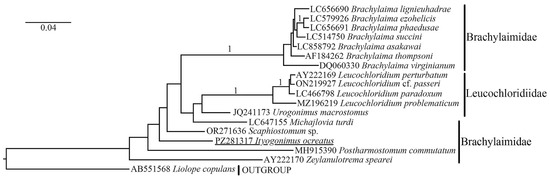
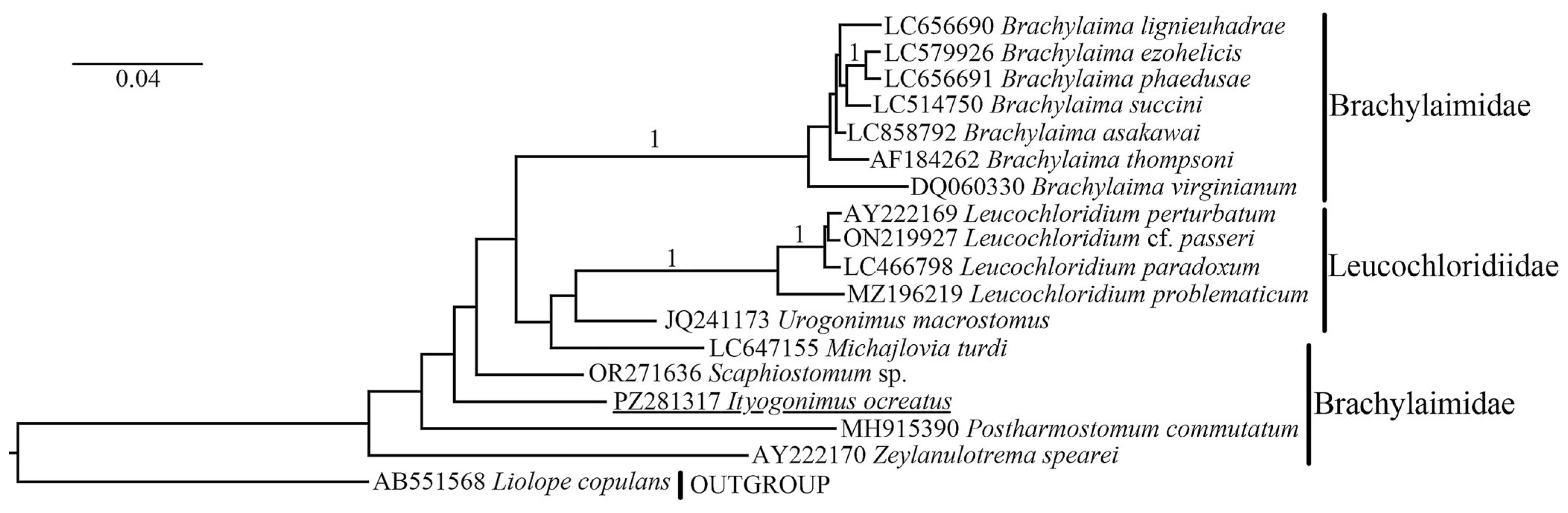
Zeylanulotrema spearei Cribb & Barton, 1991 (Brachylaimidae) occupied the most basal position among Brachylaimoidea. It was followed sequentially by Postharmostomum commutatum (Diesing, 1858), I. ocreatus, and Scaphiostomum sp. (all of which currently belong to Brachylaimidae). In our analysis, Michajlovia turdi (Yamaguti, 1939) (Brachylaimidae) occupied a basal position within the subclade of the family Leucochloridiidae (genera Urogonimus Monticelli, 1888 and Leucochloridium Carus, 1835), albeit with low support values. Species of the genus Brachylaima Dujardin, 1843 formed a well-supported subclade that occupies a sister-group position to the Leucochloridiidae (Figure 1).
Figure 1.
Phylogenetic position of Ityogonimus ocreatus inferred from partial LSU sequences. Only significant Bayesian posterior probability values are shown.
In the present study, we obtained sequences of ITS2 but excluded them from the molecular phylogenetic analysis, as the resulting alignments yielded highly inconsistent topologies and, in our view, lacked sufficient informative value for resolving phylogenetic relationships at the level of genera and families within the Brachylaimoidea.
3.2. Taxonomy and Morphological Features
Superfamily Brachylaimoidea Joeux et Foley, 1930
Family Brachylaimidae Joeux et Foley, 1930
Subfamily Ityogoniminae Yamaguti, 1958
Genus Ityogonimus Lühe, 1899
Ityogonimus ocreatus Goeze, 1782) (Figure 2)
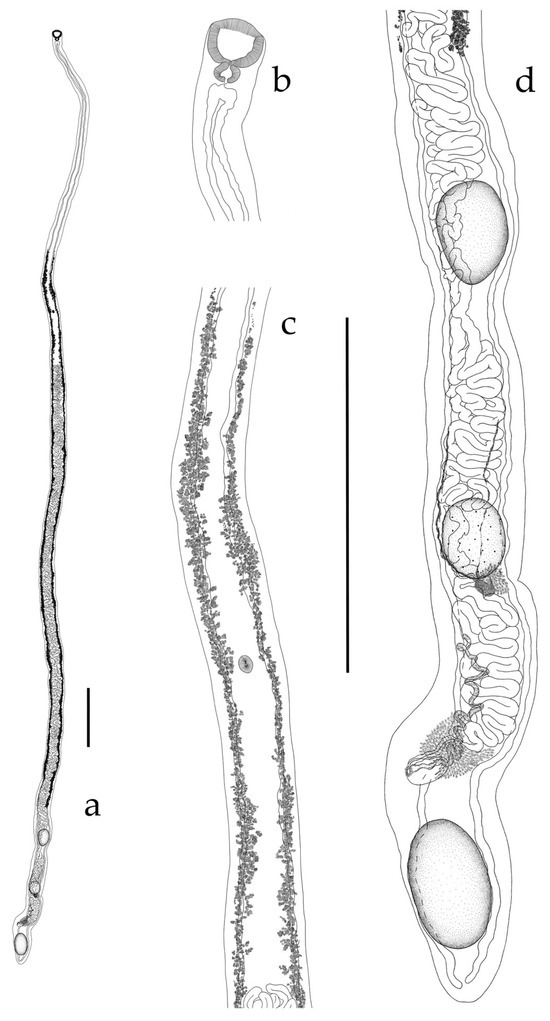
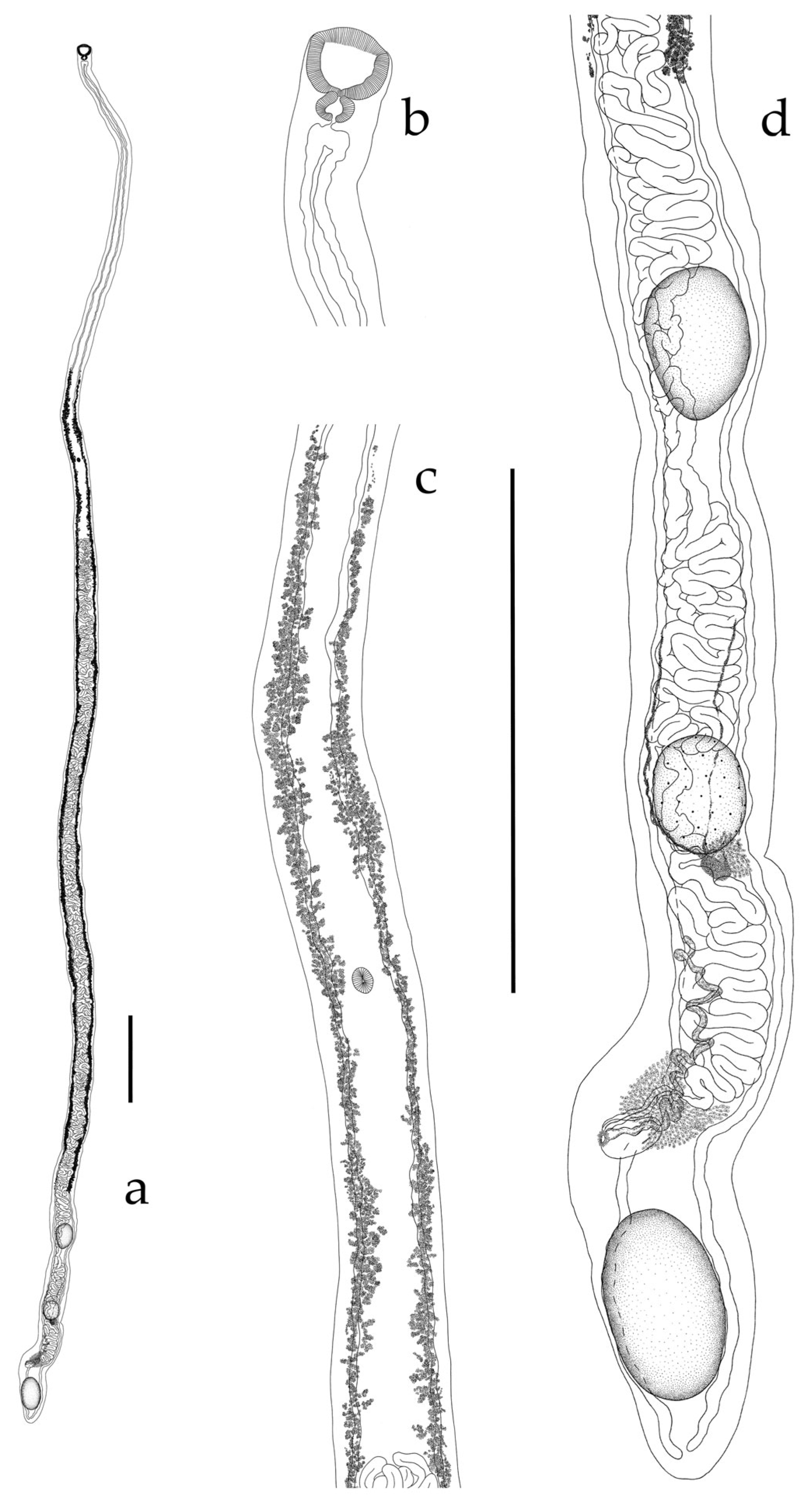
Figure 2.
Ityogonimus ocreatus ex Talpa europaea; (a) general morphology (ventral view); (b) oral sucker; (c) ventral sucker; (d) posterior body end. Scale bars = 2.0 mm.
Host: Talpa europaea.
Geographical localities: Mordovia Nature Reserve (Republic of Mordovia)—Inorki Lake (54.727266 N, 43.146248 E), cordon Plotomoyka (54.892595 N, 43.162863 E), cordon Srednyaya Melnitsa (54.903387, N, 43.231963 E).
Prevalence: in three examined moles (75.0%).
Intensity: 3–21 per infected mole (3, 7, 21).
Mean intensity: 7.8.
Availability: GenBank No PZ281317—partial LSU; PZ281315—ITS2; PZ277241—partial cox1.
Accession numbers in the parasitological collection of IEVB RAS: No 2501–2512.
Morphological description of Ityogonimus ocreatus (based on 20 specimens; measurements are given in Table 3): Body narrow, elongated, ribbon-like; maximum width in posterior part (Figure 2a). Tegument unarmed. Oral sucker well-developed, terminal (Figure 2b). Ventral sucker round to slightly oval, significantly smaller than oral sucker, situated at approximately the first third of body length (Figure 2c). Pharynx round. Esophagus very short, often indistinct. Intestinal ceca extending along body to posterior extremity. Gonads median, at hindmost posterior end of body. Testes smooth-margined, oval, elongated (Figure 2d). Genital pore at anterior margin of posterior testis, opening ventrally, surrounded by muscular sphincter. Cirrus sac small, anterior to posterior testis, surrounded by numerous glandular cells, containing only ejaculatory duct and cirrus. Seminal vesicle long, convoluted, lying free in parenchyma. Ovary roundly oval, intertesticular (Figure 2d). Mehlis’ gland dorsal, immediately adjacent to the posterior of the posterolateral margin of the ovary, about half of ovary size. Vitellarium composed of numerous small follicles; vitelline fields initiating slightly anterior to, at the level of, or slightly posterior to the ventral sucker. Vitelline fields asymmetrical, with left and right fields initiating and terminating at different levels (Figure 2a). Vitelline fields extending laterally toward the posterior end, terminating at the anterior margin of the anterior testis or slightly short of it. Vitelline ducts originating from posterior follicles, merging behind Mehlis’ gland to form a small vitelline reservoir. Uterus with ascending and descending loops, densely intertwined, occupying entire intercecal space, not extending extracecally. Anterior uterine margin slightly posterior to ventral sucker. Posteriorly, uterine loops extending past the ovary, reaching the anterior margin of the posterior testis. Metraterm well-differentiated. Eggs elongated-oval, light yellow.
Table 3.
Measurements of Ityogonimus ocreatus from the original description and redescriptions.
4. Discussion
Based on their primary morphological characteristics, the collected specimens are assignable to the family Brachylaimidae [43]. Furthermore, a set of distinct features—namely a filiform body, small suckers, the presence of a short esophagus, the uterus not reaching the level of the ventral sucker, and the genital pore positioned between the ovary and the posterior testis—indicates their affiliation with the subfamily Ityogoniminae [43]. According to Pojmanska [43], this subfamily comprises two genera: Ityogonimus (parasites of moles) and Scaphiostomum (parasites of birds). Taxonomic attributes such as the intertesticular position of the genital pore, well-separated gonads and suckers, and the anterior margin of the vitellaria reaching the ventral sucker level clearly confirm that the studied specimens belong to the genus Ityogonimus [43]. The species of Ityogonimus parasitizing European moles (I. ocreatus and I. lorum) differ distinctly in their key morphometric parameters, including body length, ventral sucker size, sucker ratio, and the distance between suckers [3]. The aforementioned features allow us to assign the studied trematodes to I. ocreatus. The characteristic features of this species were consistently observed across all examined specimens. In terms of body shape and the topography of internal organs, our results are in good agreement with previously published descriptions of I. ocreatus [3,7,14,16,17]. Morphometrically, the specimens generally correspond to prior records (Table 1).
However, our phylogenetic analyses suggested I. ocreatus does not form a monophyletic lineage with the other represented Brachylaimidae (Figure 1). The basal branching of Zeylanulotrema spearei and Postharmostomum commutatum relative to the Ityogonimus and Scaphiostomum clades suggests their status as early-diverging brachylaimid lineages. Nevertheless, this issue remains open to question, as analyses of alternative phylogenetic markers yield conflicting tree topologies [22,37,40,41]. The well-supported sister-group relationship between Brachylaima and Leucochloridiidae contrasts with the weakly supported basal position of Michajlovia turdi within Leucochloridiidae, which warrants further validation, although a close relationship between Michajlovia and leucochloridiids was previously demonstrated based on SSU sequence analysis [22]. Our LSU-based hypothesis corroborates the non-monophyly of the Brachylaimidae as currently circumscribed [41]. These results necessitate a taxonomic revision of taxonomic boundaries and emphasize the need for combined SSU and LSU markers to resolve deeper nodes. If these findings are consistently reproduced in alternative analyses and across different markers, the paraphyly of the family Brachylaimidae will be robustly confirmed.
5. Conclusions
In this study, we present the first molecular phylogenetic data on Ityogonimus ocreatus from European moles in Russia and provide morphological and morphometric descriptions of this parasite. The morphological features of the examined trematodes indicate their affiliation with the subfamily Ityogoniminae within the family Brachylaimidae. The analysis of molecular data obtained herein demonstrates that the genus Ityogonimus is distinctly separated from other members of the family, although its precise phylogenetic position remains unresolved. Further comprehensive analyses on brachylaimid trematodes, including multilocus approaches, are required to clarify the appropriate classification of the constituent species within the family.
Author Contributions
Conceptualization, N.Y.K., A.A.K. and S.V.S.; methodology, N.Y.K. and S.V.S.; validation, A.A.K. and S.V.S.; formal analysis, A.A.K. and S.V.S.; investigation, N.Y.K., A.A.K., E.Y.G. and S.V.S.; resources, A.A.K., E.Y.G. and S.V.S.; writing—original draft preparation, A.A.K., N.Y.K. and S.V.S.; writing—review and editing, N.Y.K., S.V.S. and A.A.K.; supervision, A.A.K.; project administration, N.Y.K. and A.A.K. All authors have read and agreed to the published version of the manuscript.
Funding
This research received no external funding.
Institutional Review Board Statement
This study was approved by the Bioethics Committee of the Institute of Ecology of the Volga River Basin of RAS (Registration number: 9/26; 6 August 2026). All applicable international, national, and institutional guidelines for the use and care of wild animals were followed. Our research was conducted in compliance with the ethical standards of humane treatment of animals according to the recommended standards of the Directive of the European Parliament and of the Council of the European Union of 22 September 2010 “On the protection of animals used for scientific purposes” (EU Directive 2010/63/EU).
Informed Consent Statement
Not applicable.
Data Availability Statement
The data presented in this study are openly available in Genbank at https://www.ncbi.nlm.nih.gov/genbank/, PZ281317, PZ281315, PZ277241.
Acknowledgments
This study was performed by the staff of the Laboratory for Zoology and Parasitology of the Institute of Ecology of the Volga River Basin—a branch of the Samara Scientific Center of the Russian Academy of Sciences within the framework of the state assignment of the Ministry of Education and Science of the Russian Federation No. 1023062000002-6-1.6.20; 1.6.19 on the research topic No. FMRW-2024-0003. We acknowledge the support from the St. Petersburg State University (project ID 125022803066-3) and the Centre for Molecular and Cell Technologies and Core Facility “Chromas” (Research Park, St. Petersburg State University) for technical assistance.
Conflicts of Interest
The authors declare no conflicts of interest.
Abbreviations
The following abbreviations are used in this manuscript:
| DNA | Deoxyribonucleic acid |
| PCR | Polymerase chain reaction |
| IEVB RAS | Institute of Ecology of the Volga River Basin of the Russian Academy of Sciences |
| OS | Oral sucker |
| VS | Ventral sucker |
| BI | Bayesian Inference |
| ITS2 | Internal Transcribed Spacer 2 |
| LSU | Large Subunit Ribosomal |
| SSU | Small Subunit Ribosomal |
References
- Milazzo, C.; Casanova, J.C.; Aloise, G.; Ribas, A.; Cagnin, M. The helminth community of Talpa romana (Thomas, 1902) (Insectivora, Talpidae) in southern Italy. Parasitol. Res. 2002, 88, 979–983. [Google Scholar] [CrossRef] [Scilit] [PubMed]
- Ribas, A.; Casanova, J.C. Helminth fauna of Talpa spp. in the Palaearctic Realm. J. Helminthol. 2006, 80, 1–6. [Google Scholar] [CrossRef] [Scilit] [PubMed]
- Adalid, R.; Torres, J.; Miñarro, M.; Fuentes, M.V.; Miquel, J. First finding of Ityogonimus lorum and I. ocreatus co-infection in the Iberian mole, Talpa occidentalis. Acta Parasitol. 2018, 63, 835–838. [Google Scholar] [CrossRef] [Scilit] [PubMed]
- Turner, H.M.; McKeever, S. Ityogonimus scalopi sp. n. (Trematoda: Brachylaemidae) from the Eastern mole, Scalopus aquaticus (Linnaeus 1758). J. Parasitol. 1980, 66, 823–824. [Google Scholar] [CrossRef] [Scilit]
- Davies, E. On a trematode, Ityogonimus lorum (Duj. 1845), with notes on the occurrence of other trematode parasites of Talpa europaea in the Aberystwyth area. Parasitology 1932, 24, 253–259. [Google Scholar] [CrossRef] [Scilit]
- Frankland, H.M.T. The incidence and distribution in Britain of the trematodes of Talpa europaea. Parasitology 1959, 49, 132–142. [Google Scholar] [CrossRef] [Scilit] [PubMed]
- Edelenyi, B. Saugwürmer in einheimischen Kleinsäugern II. Ann. Hist.-Natl. Mus. Nat. Hung. 1965, 57, 217–222. [Google Scholar]
- Merkusheva, I.V.; Kraevskaya, L.I. Helminths of moles in the Belarus. Proc. Sci. Conf. All-Union Soc. Helminthol. 1965, 4, 153–158. (In Russian) [Google Scholar]
- Chiriac, E.; Popescu, A. Cercetari asupra helmintofaunei unor specii de insectivore (Mammalia) corelativ cu hrana lor. Stud. Cercet. Biol. Ser. Zool. 1973, 25, 117–125. (In Romanian) [Google Scholar]
- Casanova, J.C. Análisis Ecológico de las Helmintofaunas de Mamíferos Silvestres: Genetta genetta Linnaeus, 1758 (Carnivora: Viverridae), Clethrionomys glareolus Schreber, 1790 (Rodentia: Arvicolidae) y Talpa occidentalis Cabrera, 1907 (Insectivora: Talpidae). Ph.D. Thesis, Universitat de Barcelona, Barcelona, Spain, 1993. (In Spanish) [Google Scholar]
- Casanova, J.C.; Feliu, C.; Torres, J. Helminthic community of the dwarf mole, Talpa occidentalis Cabrera, 1907 (Insectivora: Talpidae), in Iberian Peninsula. Faunistic and ecological features. Riv. Parassitol. 1996, 13, 439–449. [Google Scholar]
- Shimalov, V.V.; Shimalov, V.V. Helminth fauna of the European mole (Talpa europaea Linnaeus, 1758) in Bielorussian Polesie. Parasitol. Res. 2001, 87, 790–791. [Google Scholar] [CrossRef] [Scilit] [PubMed]
- Ribas, A.; Casanova, J.C. Helminths of Talpa europaea (Insectivora, Talpidae) in southwestern Europe. Acta Parasitol. 2005, 50, 161–167. [Google Scholar]
- Witenberg, G. Versuch einer Monographie der Trematoden unterfamilie Harmostominae Braun. Zool. Jahrb. Abt. Syst. 1925, 51, 167–254. [Google Scholar]
- Pavlinin, N.I. Biology and Basics of Mole Hunting in the Urals. Ph.D. Thesis, All-Union Helminthological Institute, Moscow, Russia, 1949. (In Russian) [Google Scholar]
- Morozov, F.N. To the helminth fauna of moles in the Gorky region. Proc. Gorky St. Ped. Inst. 1957, 19, 27–29. (In Russian) [Google Scholar]
- Petrov, A.M.; Chertkova, A.M. To the study of the helminth fauna of moles in the USSR. Proc. All-Union Inst. Helminthol. 1959, 6, 167–175. (In Russian) [Google Scholar]
- Petrov, A.M.; Savinov, V.A. To the helminth fauna of moles in the Kalinin region. Proc. All-Union Inst. Helminthol. 1959, 6, 160–165. (In Russian) [Google Scholar]
- Zhokhov, A.E. (Papanin Institute for Biology of Inland Waters of Russian Academy of Sciences, Borok, Yaroslavl Oblast, Russia). Personal communication, 2024.
- Anikanova, V.S.; Bugmyrin, S.V.; Ieshko, E.P. Methods of the Collection and Studies of Helminths of Small Mammals; Karelian Scientific Center of RAS: Petrozavodsk, Russia, 2007; pp. 3–145. (In Russian) [Google Scholar]
- Skrjabin, K.I. Essentials of Trematodology. Trematodes of Animals and Man; Academy of Sciences of the USSR: Moscow, Russia, 1948; Volume 2, pp. 3–600. (In Russian) [Google Scholar]
- Bowles, J.; Blair, D.; McManus, D.P. Genetic variants within the genus Echinococcus identified by mitochondrial DNA sequencing. Mol. Biochem. Parasitol. 1992, 54, 165–173. [Google Scholar] [CrossRef] [Scilit] [PubMed]
- Cribb, T.H.; Anderson, G.R.; Adlard, R.D.; Bray, R.A. A DNA-based demonstration of a three-host life-cycle for the Bivesiculidae (Platyhelminthes: Digenea). Int. J. Parasitol. 1998, 28, 1791–1795. [Google Scholar] [CrossRef] [Scilit] [PubMed]
- Morgan, J.A.T.; Blair, D. Nuclear rDNA ITS sequence variation in the trematode genus Echinostoma: An aid to establishing relationships within the 37-collar-spine group. Parasitology 1995, 111, 609–615. [Google Scholar] [CrossRef] [Scilit] [PubMed]
- Lockyer, A.E.; Olson, P.D.; Littlewood, D.T.J. Utility of complete large and small subunit rRNA genes in resolving the phylogeny of the Neodermata (Platyhelminthes): Implications and a review of thecercomer theory. Biol. J. Linn. Soc. 2003, 78, 155–171. [Google Scholar] [CrossRef] [Scilit]
- Van Steenkiste, N.; Locke, S.A.; Castelin, M.; Marcogliese, D.J.; Abbott, C.L. New primers for DNA barcoding of digeneans and cestodes (Platyhelminthes). Mol. Ecol. Resour. 2015, 15, 945–952. [Google Scholar] [CrossRef] [Scilit] [PubMed]
- Gouy, M.; Guindon, S.; Gascuel, O. SeaView version 4: A multiplatform graphical user interface for sequence alignment and phylogenetic tree building. Mol. Biol. Evol. 2010, 27, 221–224. [Google Scholar] [CrossRef] [Scilit] [PubMed]
- Nylander, J.A.A. MrModeltest v2. Program Distributed by the Author; Evolutionary Biology Centre, Uppsala University: Uppsala, Sweden, 2004. Available online: https://github.com/nylander/MrModeltest2/releases (accessed on 11 May 2026).
- Huelsenbeck, J.P.; Ronquist, F. MRBAYES: Bayesian inference of phylogenetic trees. Bioinformatics 2001, 17, 754–755. [Google Scholar] [CrossRef] [Scilit] [PubMed]
- Perez-Ponce de Leon, G.; Hernandez Mena, D.I. Testing the higher-level phylogenetic classification of Digenea (Platyhelminthes, Trematoda) based on nuclear rDNA sequences before entering the age of the ‘next-generation’ Tree of Life. J. Helminthol. 2019, 93, 260–276. [Google Scholar] [CrossRef] [Scilit] [PubMed]
- Waki, T.; Nakao, M.; Sasaki, M.; Takano, T.; Ikezawa, H.; Miyazaki, S. Report of unidentified metacercariae of the genus Brachylaima (Trematoda, Brachylaimidae) in Japan, with records of new localities and new hosts of two known species. Taxa 2022, 52, 37–47. [Google Scholar] [CrossRef] [PubMed]
- Nakao, M.; Sasaki, M.; Waki, T. Brachylaima succini sp. nov. (Trematoda: Brachylaimidae) from Succinea lauta, an amber snail in Hokkaido. Japan. Parasitol. Int. 2020, 77, 102104. [Google Scholar] [CrossRef] [Scilit] [PubMed]
- Hidaka, M.; Uraguchi, K.; Matsuyama, H.; Kouguchi, H. The first record of Brachylaima ezohelicis (Trematoda: Brachylaimidae) in the red fox (Vulpes vulpes schrencki). Parasitol. Int. 2024, 98, 102826. [Google Scholar] [CrossRef] [Scilit] [PubMed]
- Tkach, V.V.; Pawlowski, J.; Mariaux, J.; Swiderski, Z. Molecular phylogeny of the suborder Plagiorchiata and its position in the system of Digenea. In Interrelationships of the Platyhelminthes; Littlewood, D.T.J., Bray, R.A., Eds.; Taylor & Francis: London, UK, 2001; pp. 186–193. [Google Scholar]
- Olson, P.D.; Cribb, T.H.; Tkach, V.V.; Bray, R.A.; Littlewood, D.T.J. Phylogeny and classification of the Digenea (Platyhelminthes: Trematoda). Int. J. Parasitol. 2003, 33, 733–755. [Google Scholar] [CrossRef] [Scilit] [PubMed]
- Chiu, M.C.; Lin, Z.H.; Hsu, P.W.; Chen, H.W. Molecular identification of the broodsacs from Leucochloridium passeri (Digenea: Leucochloridiidae) with a review of Leucochloridium species records in Taiwan. Parasitol. Int. 2022, 91, 102644. [Google Scholar] [CrossRef] [Scilit] [PubMed]
- Nakao, M.; Sasaki, M.; Waki, T.; Iwaki, T.; Morii, Y.; Yanagida, K.; Watanabe, M.; Tsuchitani, Y.; Saito, T.; Asakawa, M. Distribution records of three species of Leucochloridium (Trematoda: Leucochloridiidae) in Japan, with comments on their microtaxonomy and ecology. Parasitol. Int. 2019, 72, 101936. [Google Scholar] [CrossRef] [Scilit] [PubMed]
- Locke, S.A.; Lapierre, A.R.; Byers, K.; Proctor, H.; McLaughlin, J.D.; Marcogliese, D.J. Molecular and morphological evidence for the Holarctic distribution of Urogonimus macrostomus (Rudolphi, 1803) Monticelli, 1888 (Digenea: Leucochloridiidae). J. Parasitol. 2012, 98, 880–882. [Google Scholar] [CrossRef] [Scilit] [PubMed]
- Sasaki, M.; Iwaki, T.; Nakao, M. Rediscovery of Michajlovia turdi (Digenea: Brachylaimoidea) from Japan. J. Parasitol. 2022, 108, 122–126. [Google Scholar] [CrossRef] [Scilit] [PubMed]
- Panti May, J.A.; Moguel Chin, W.I.; Hernández Mena, D.I.; Cárdenas-Vargas, M.H.; Torres Castro, M.; García Prieto, L.; Digiani, M.C.; Hernndez-Betancourt, S.F.; Vidal Martínez, V.M. Helminths of small rodents (Heteromyidae and Cricetidae) in the Yucatan Peninsula, Mexico: An integrative taxonomic approach to their inventory. Zootaxa 2023, 5357, 205–240. [Google Scholar] [CrossRef] [Scilit] [PubMed]
- Valadão, M.C.; Silva, B.C.; López-Hernández, D.; Araújo, J.V.; Locke, S.A.; Pinto, H.A. A molecular phylogenetic study of the caecal fluke of poultry, Postharmostomum commutatum (=P. gallinum) (Trematoda: Brachylaimidae). Parasitol. Res. 2018, 117, 3927–3934. [Google Scholar] [CrossRef] [Scilit] [PubMed]
- Baba, T.; Hosoi, M.; Urabe, M.; Shimazu, T.; Tochimoto, T.; Hasegawa, H. Liolope copulans (Trematoda: Digenea: Liolopidae) parasitic in Andrias japonicus (Amphibia: Caudata: Cryptobranchidae) in Japan: Life cycle and systematic position inferred from morphological and molecular evidence. Parasitol. Int. 2011, 60, 181–192. [Google Scholar] [CrossRef] [Scilit] [PubMed]
- Pojmanska, T. Family Brachylaimidae Joyeux & Foley, 1930. In Keys to the Trematoda; Gibson, D.I., Jones, A., Bray, R.A., Eds.; CAB International and The Natural History Museum: London, UK, 2002; Volume 1, pp. 37–43. [Google Scholar]

Disclaimer/Publisher’s Note: The statements, opinions and data contained in all publications are solely those of the individual author(s) and contributor(s) and not of MDPI and/or the editor(s). MDPI and/or the editor(s) disclaim responsibility for any injury to people or property resulting from any ideas, methods, instructions or products referred to in the content. |
© 2026 by the authors. Licensee MDPI, Basel, Switzerland. This article is an open access article distributed under the terms and conditions of the Creative Commons Attribution (CC BY) license.