


Simple Summary
Effective management of bioinvasions not only requires documenting the presence of invasive species, but also understanding the broad range of their population dynamics over time (such as delayed reproduction, rapid population growth, and fluctuations in density). Several species of the genus Corbicula are among the most widespread invasive bivalves globally and have rapidly expanded throughout South America. This study aimed to evaluate the coexistence patterns between Corbicula fluminea and C. largillierti, considering key population dynamic parameters such as density, size structure, and reproductive biology in an unstable environment (affected by droughts and floods) within a Pampean stream in Argentina. Fluctuations in the stream’s water level and flow rate affected these species differently. C. fluminea dominated due to its resilience and longevity, while C. largillierti was more sensitive despite its initial rapid growth. We conclude that the environment thus shapes invasion success and interspecific competition.
Abstract
Invasive species require long-term characterization of their shifting population dynamics to understand their environmental impacts and socio-economic effects. The dynamics of freshwater bivalves depend on their biology, which is influenced by the vulnerability of the ecosystems. This study evaluates the coexistence of Corbicula fluminea and C. largillierti in a stream in the Argentine Pampa, integrating density, size, and reproduction. In this stream, characterized by a temperate climate and hydrological fluctuations, live specimens of both species were sampled monthly using a 0.07 m2 cylinder. The anteroposterior length of each specimen was measured, and size distributions were analyzed by decomposing normal modes using the least-squares method. Gonadal cycles were compared with data from the previous literature. Since 2004, C. fluminea has dominated the system with significantly higher densities. Both species exhibited contrasting reproductive cycles. Hydrological instability in the stream limited both species. C. fluminea dominated due to its greater resilience and longevity under stress. In contrast, C. largillierti prioritized initial rapid growth, making it more sensitive to fluctuations. These results highlight that environmental instability conditions invasive success and interspecific competition in freshwater systems.
1. Introduction
Understanding biological invasions not only requires documenting the presence of invasive species, but also characterizing their long-term population dynamics, as these ultimately determine ecological impacts and inform management strategies [1]. As invasions progress, changes in abundance and population traits can lead to shifts in both ecological impacts and economic effects [2]. Invasive populations are known to exhibit a wide range of dynamics, including delayed reproduction, rapid population growth, sudden collapses (even leading to local extinction), and long-term increases or declines in density; however, these dynamics remain poorly understood from both empirical and theoretical perspectives [3]. In bivalves, these complexities are further shaped by life-history strategies in which population dynamics, growth, and reproduction are tightly interconnected and strongly influenced by environmental variability [4]. Temporal fluctuations in density are often driven by recruitment pulses and mortality events, which in turn structure size distributions and cohort progression. At the same time, growth rates and size structure can modulate reproductive output, as reproduction is frequently size-dependent and energetically constrained [5,6]. In freshwater environments, these processes are regulated by external drivers such as hydrological disturbances, including floods and droughts, which affect resource availability, habitat stability, and physiological performance [7]. Consequently, the population trajectories and impacts of invasive freshwater bivalves are expected to arise from the interaction between intrinsic biological traits and environmentally driven constraints [8].
The genus Corbicula (Bivalvia: Cyrenidae) comprises both estuarine and freshwater species and represents the most species-rich genus within the family Cyrenidae [9]. Several species within this genus rank among the most widespread invasive bivalves worldwide [10] and have rapidly expanded across South America [11] since their first detection in the early 1980s [12]. Corbicula spp. frequently form dense populations and can induce substantial ecosystem changes, both through alterations of trophic webs and through their role as ecosystem engineers [13]. These impacts are evident, for example, in benthic macroinvertebrate communities, where they modify taxonomic composition and affect dominant taxa [14].
In the Neotropical region, at least four non-native Corbicula species have been reported to occur sympatrically: C. largillierti (Philippi, 1844), C. fluminalis (Müller, 1774), C. fluminea (Müller, 1774), and Corbicula sp. [15]. Among these, C. fluminea is generally considered to have higher competitive ability, often displacing congeneric species such as C. largillierti [16]. As a result, C. fluminea frequently becomes dominant in invaded habitats, acting as a strong ecosystem engineer and causing both physical and biological alterations [13]. However, such displacement patterns have been described for other invasive bivalves as dreissenids [17].
Reshaid et al. [18] compared density values of C. fluminea and C. largillierti along the Río de la Plata River shoreline during the 1980s, near the sites of the first record of the genus in South America, with those recorded approximately 25 years later (2015–2016) at the same locations. Their results showed a marked retreat of Corbicula spp. from this system. While in the 1980s C. fluminea and C. largillierti exhibited occurrence frequencies of 75% and 37%, respectively, C. fluminea showed a substantial decline in frequency in the later period, and no live individuals of C. largillierti were recorded. These differences were accompanied by a significant reduction in density, with C. fluminea decreasing by approximately 90% and C. largillierti effectively disappearing from the area.
Size structure can indicate whether an invasive species is expanding or declining, as it reflects the population state within the ecosystem [19]. For instance, a size distribution including both juveniles and adults suggests a stable population. In the Río de la Plata River (Argentina), early studies, in the late 1980s, showed that both Corbicula largillierti (between 1 and 31 mm total length) and Corbicula fluminea (between 1 and 36 mm) had size distributions dominated by small individuals (~2 mm), indicating expanding populations [20]. However, 25 years later, C. largillierti had disappeared, while C. fluminea persisted at lower densities and smaller average sizes (<20 mm) [18]. Although a high proportion of small individuals in C. fluminea could suggest ongoing recruitment and expansion, this interpretation is inconsistent with the invasion history. Corbicula species were introduced to the Río de la Plata in the late 1960s–early 1970s [12], indicating a long-established invasion.
Differences in habitat use and competitive ability have been proposed to explain these patterns. Corbicula fluminea is considered competitively superior and is dominant in large rivers and estuarine environments, whereas C. largillierti has been displaced toward tributary streams, where it may coexist with C. fluminea, albeit at lower densities [16]. This preference for lotic environments has also been reported in other basins, such as the Suquía River [21]. Currently, C. fluminea is widely distributed in the Río de la Plata River and major rivers of eastern and southern Argentina, where it shows greater adaptive capacity, while C. largillierti predominates in smaller rivers, streams, and lakes in central and northwestern regions [22]. Environmental factors further contribute to shaping these distribution patterns. The density of invasive bivalves such as C. fluminea is influenced by substrate composition, slope, and water characteristics [23]. In particular, its presence has been positively associated with sandy sediments and is unlikely in environments where sand content falls below 66% [24].
The reproductive strategy used is another key factor that influences the success of invasive species in novel environments [9,25]. The genus Corbicula exhibits a remarkable diversity of reproductive modes, including both sexual reproduction and androgenesis. The sexual structure of populations varies geographically, ranging from dioecious systems in native ranges to predominantly hermaphroditic populations in invaded areas, often with variable sex ratios [26,27,28]. While some species, such as C. sandai and C. japonica, reproduce via external fertilization through the release of free gametes, a condition considered ancestral among freshwater bivalves [29], many invasive lineages exhibit derived reproductive traits. In particular, Corbicula spp. are typically protogynous [29]. For example, C. largillierti in South America is described as a simultaneous hermaphrodite [30]. Self-fertilization, well documented in C. fluminea [31], has also been proposed for C. largillierti in the region [32]. Foundational studies addressing reproductive strategies of Corbicula in South America include Ituarte [30,32], Mansur et al. [33], Cao et al. [34], Dei Tos et al. [35], and Damborenea et al. [36].
In this context, the present study aims to evaluate the coexistence of Corbicula fluminea and C. largillierti under sympatric conditions by integrating population density, size structure, and reproductive traits in a Pampean stream in Argentina. From January 2003 to April 2005, both species were monitored concurrently, allowing for a direct comparison of their reproductive cycles and population dynamics within the same environmental setting [34,36]. This coexistence provides an opportunity to evaluate whether closely related species exhibit similar or divergent ecological responses under shared environmental conditions. We hypothesize that the dominance of C. fluminea reflects its ability to preserve coordinated growth, reproduction, and population dynamics under environmental variability, in contrast to C. largillierti, where this coordination is lost under stressful conditions.
2. Materials and Methods
2.1. Study Area
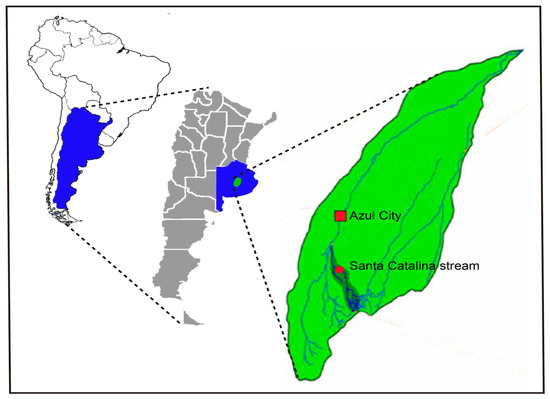
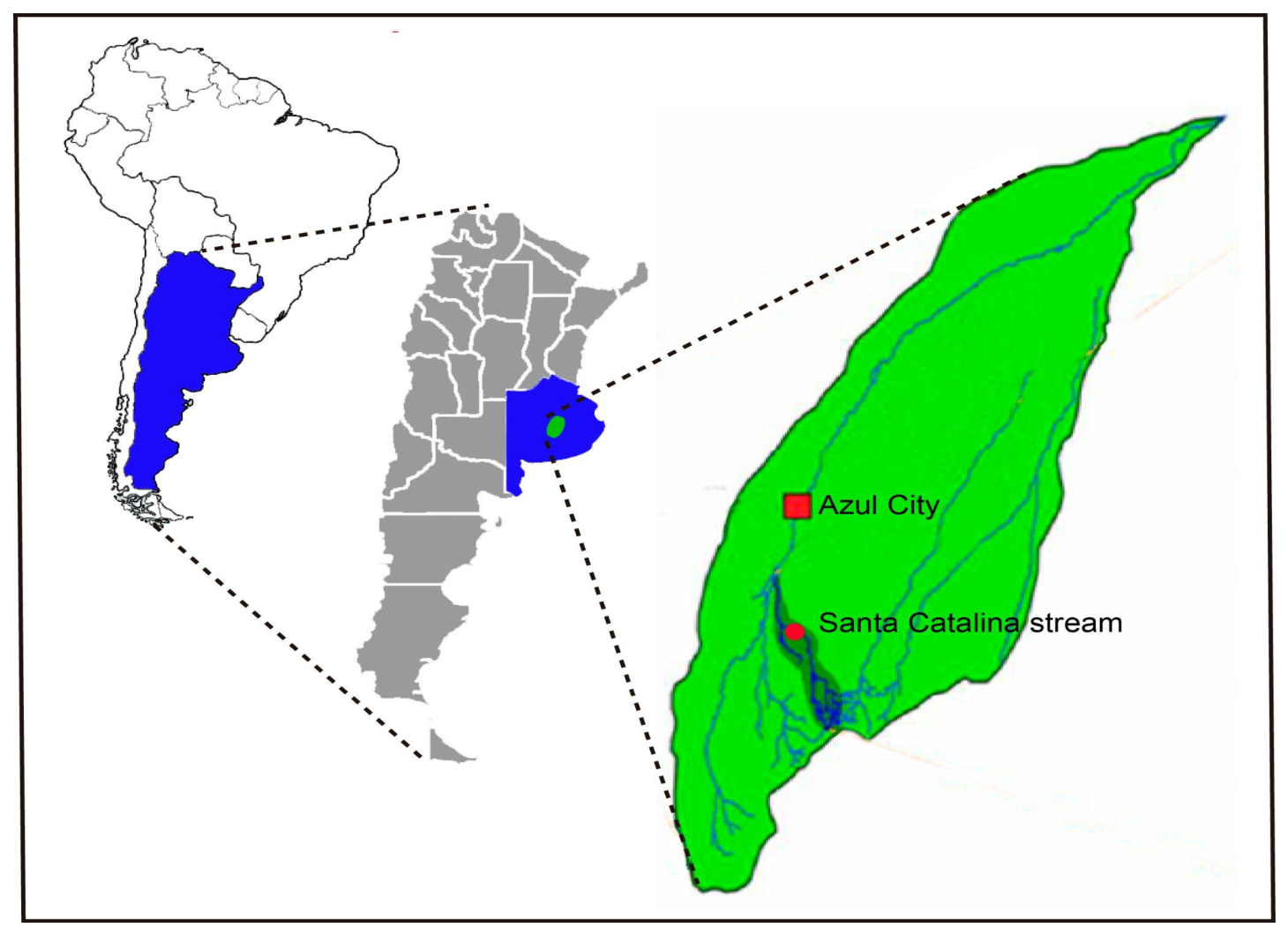
The study was conducted in the Santa Catalina stream, Buenos Aires Province, Argentina (Figure 1). The stream basin covers an area of 138 km2, and the sampling site was located in the lower basin at 151 m above sea level, within the “Pampa Deprimida” region. This area is characterized by flat topography, low relief, and a poorly developed drainage system [37]. Climatic conditions include maximum temperatures between December and March (monthly mean: 20 °C) and minimum temperatures between June and August (monthly mean: 8 °C). Annual precipitation averages approximately 840 mm, with higher rainfall during spring–summer (~100 mm/month) and lower values in autumn–winter (~50 mm/month). The region is subject to recurrent hydrological fluctuations, including both droughts and floods [37].
Figure 1.
Geographical location of the Santa Catalina stream. Light green inset represents the Azul basin, and dark green the Santa Catalina stream basin. Red dot indicates the sampling site (36°53′04.5″ S; 59°55′25.22″ W). The color blue indicates Argentina (on the map of South America) and the Buenos Aires Province (on the map of Argentina in the center of the figure).
Physical and chemical parameters (i.e., water temperature, dissolved oxygen, oxygen saturation, conductivity, and total dissolved solids) were measured in the field using a Lutron WA-2017SD multi-parameter water quality meter. Daily rainfall, streamflow, and water level data were provided by the Instituto de Hidrología de Llanuras “Dr. Eduardo Jorge Usunoff” (IHLLA) in Azul, Argentina. Limnological variables recorded during the study period are reported in Cao et al. [34] and Damborenea et al. [36] (Table 1). Mean flow showed differences between the first (2003) and second (2004–2005) sampling periods.
Table 1.
Environmental variables considered in this study and sampling dates in the Santa Catalina stream [34,36]. Average rainfall (mm); Cond., conductivity (mS); O2 (mg/L), O2 dissolved (mg/L); O2 %, percentage of O2; pH, T °C, temperature; TDS, total dissolved solids (mg/L); WF, water flow (m3/s); WL, water level (m).
2.2. Field Sampling
All samples were collected at Santa Catalina stream and its intersection with National Route 3 (36°53′04.5″ S; 59°55′25.22″ W) (Figure 1). Sampling was always carried out in the presence of water in the environment. Twenty-seven samples were collected between January 2003 and April 2005 [34,36]. Sampling was performed using a cylindrical corer (0.07 m2), which was manually inserted into the sediment to a depth of approximately 0.20 m (until reaching the compact sediment layer). Three replicate samples were taken on each date. Samples were sieved in situ using a 1 mm mesh, and live specimens of Corbicula largillierti and C. fluminea were transported to the laboratory for analysis. The specimens were identified according to valve morphology [30,36]. As Corbicula spp. are invasive in the Neotropical region, no specific permits were required for their collection.
2.3. Genetic Analysis
To confirm the morphological identification of both Corbicula species, genomic DNA of three specimens identified as C. fluminea and of two identified as C. largillierti was extracted from a tissue sample taken from the foot of specimens collected in Santa Catalina stream, using the commercial Wizard Promega kit, Promega Corporation, Madison, WI, USA (www.promega.com, accessed 22 June 2026). A partial fragment of the COI gene was amplified by polymerase chain reaction (PCR) using universal primers [38]. Amplification was performed in a final volume of 25mL following the protocol described by [39]. The PCR products were purified, and sequencing of both DNA strands was carried out by Macrogen (Seoul, Republic of Korea). Raw sequences were edited in BioEdit version 7.0.5.3, University of North Texas, Denton, TX, USA [40] and aligned with homologous COI sequences from GenBank using Clustal X version 2.0.12 [41]. The resulting sequences were compared with reference sequences from GenBank, https://www.ncbi.nlm.nih.gov/genbank/ (accessed on 22 June 2026) and with data from previous studies conducted in Argentina and South America [42,43] using the BLASTN algorithm [44]. Corrected genetic distances (using the Kimura 2-parameter model) were calculated with MEGA X [45].
2.4. Size Structure and Density
A total of 5969 live individuals of Corbicula fluminea and 4913 of C. largillierti were analyzed. The maximum anteroposterior length (APL) of each specimen was measured using a digital caliper Mitutoyo Corporation, Jundiaí, Brazil, accurate to 0.1 mm. Mean density (individuals/m2) and standard deviation were calculated for each sampling date. Population size structure was assessed using 1 mm APL size classes between January 2003 and September 2004. Specimens smaller than 3 mm were excluded from the analysis because species cannot be reliably distinguished morphologically at smaller sizes. To test for differences in density between the populations of both Corbicula species, a Wilcoxon signed-rank test was applied [46].
The polymodal APL frequency distributions for each date and species using 1mm class intervals, were decomposed into their normal components (assuming a normal length distribution for each cohort) to obtain the mean APL, standard deviation, and density of each detected cohort [47]. The procedure for the decomposition consisted of finding, using the least squares method, the sum of normals that best fit the observed polymodal distribution (R2 > 0.95), using a spreadsheet programmed in Excel and its Solver add-in.
2.5. Gonadal and Life Cycle Comparison with Environmental Variables
Previous studies on the reproductive biology of Corbicula fluminea [34] and C. largillierti [36] were compared. This was possible because both investigations were carried out using the same methodology (histological analysis) and correspond to the same sampling site and dates of the present research.
Spearman’s correlations were performed to determine the relationship between the percentage of presence of different gonadal stages and the presence of individuals with incubating larvae and physical and chemical environmental parameters. Canonical correspondence analysis (CCA) was performed to compare qualitative gonadal stages, oocyte size, and environmental parameters using PAST software version 4.17c [48]. Environmental variables included in the analysis were conductivity (µS/cm), mean water level (m), oxygen concentration (mg/L), mean flow rate (m3/s), and water temperature (°C).
3. Results
3.1. Molecular Validation of Corbicula Species Identification
COI gene sequences were obtained from five specimens, confirming the coexistence of both species within the same environment. Three sequences showed a 100% match with haplotype FW5, corresponding to the form AR of Corbicula fluminea. The remaining two sequences showed a 100% match with haplotype FW17, corresponding to the form CS of Corbicula largillierti (Table 2 and Table 3). The sequences generated in this study were deposited in GenBank.
Table 2.
GenBank accession numbers of cytochrome oxidase I (COI) gene sequences from Corbicula individuals collected in this study (in bold) and haplotypes registered in South America available in GenBank.
Table 3.
Percentage of K2P-corrected genetic distances of Corbicula spp. recorded in South America. In bold: the sequences obtained in this study.
3.2. Density and Size
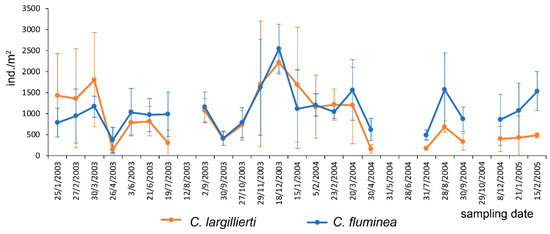
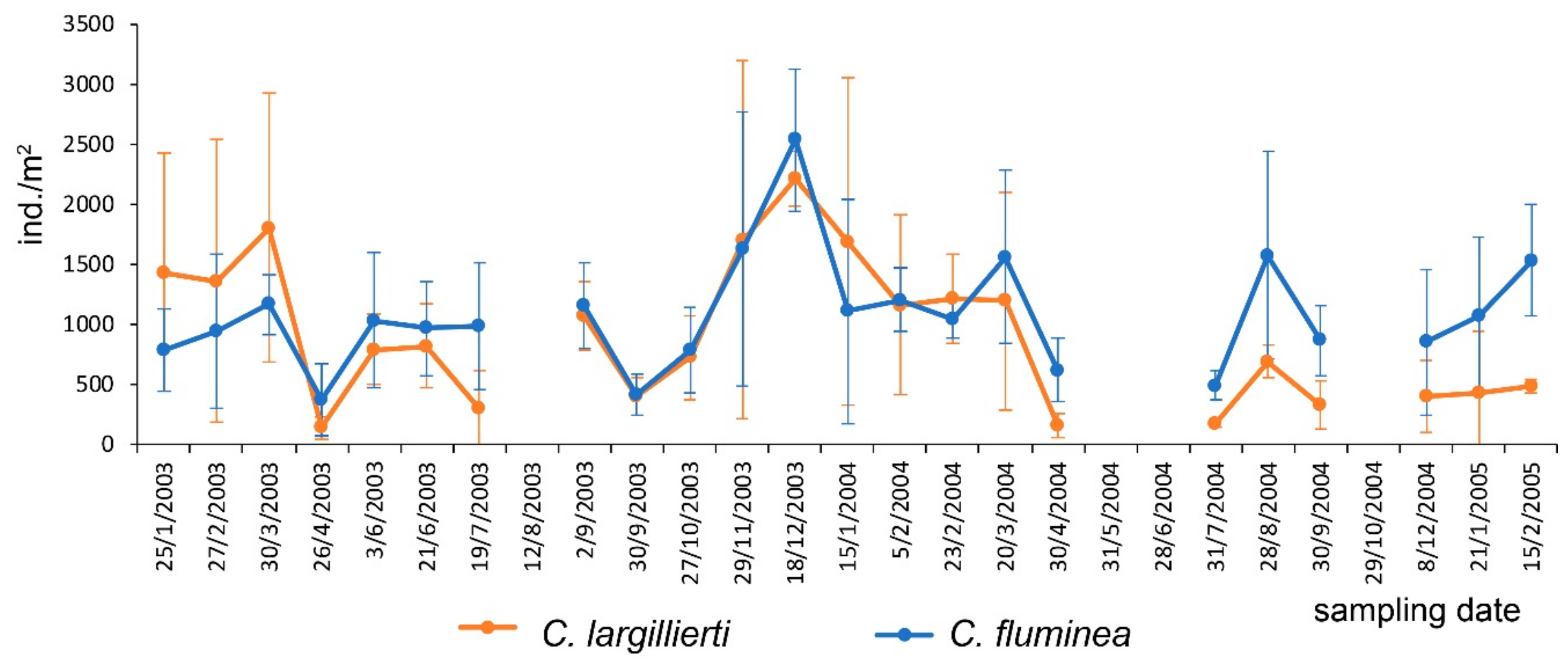
A total of 5969 specimens of Corbicula fluminea and 4913 of Corbicula largillierti were collected from the Santa Catalina stream. Although the density of both species exhibited marked temporal variability (Figure 2), no statistically significant differences were detected between them. The Wilcoxon signed-rank test indicated a small, non-significant difference between C. largillierti (Mdn = 1199, n = 47) and C. fluminea (Mdn = 1038, n = 47) (Z = −1, p = 0.304, r = −0.2). At the beginning of the study period (January 2003), the density of C. largillierti reached 1777 ind./m, whereas C. fluminea showed a lower density of 788 ind./m2. By the end of the sampling period (March 2005), this pattern had reversed, with C. fluminea attaining a density of 1100 ind./m2 and C. largillierti declining to 228 ind./m2.
Figure 2.
Mean density (ind./m2) of C. fluminea and C. largillierti in Santa Catalina stream during the sampled period. Lines denotes ± 1 standard deviation.
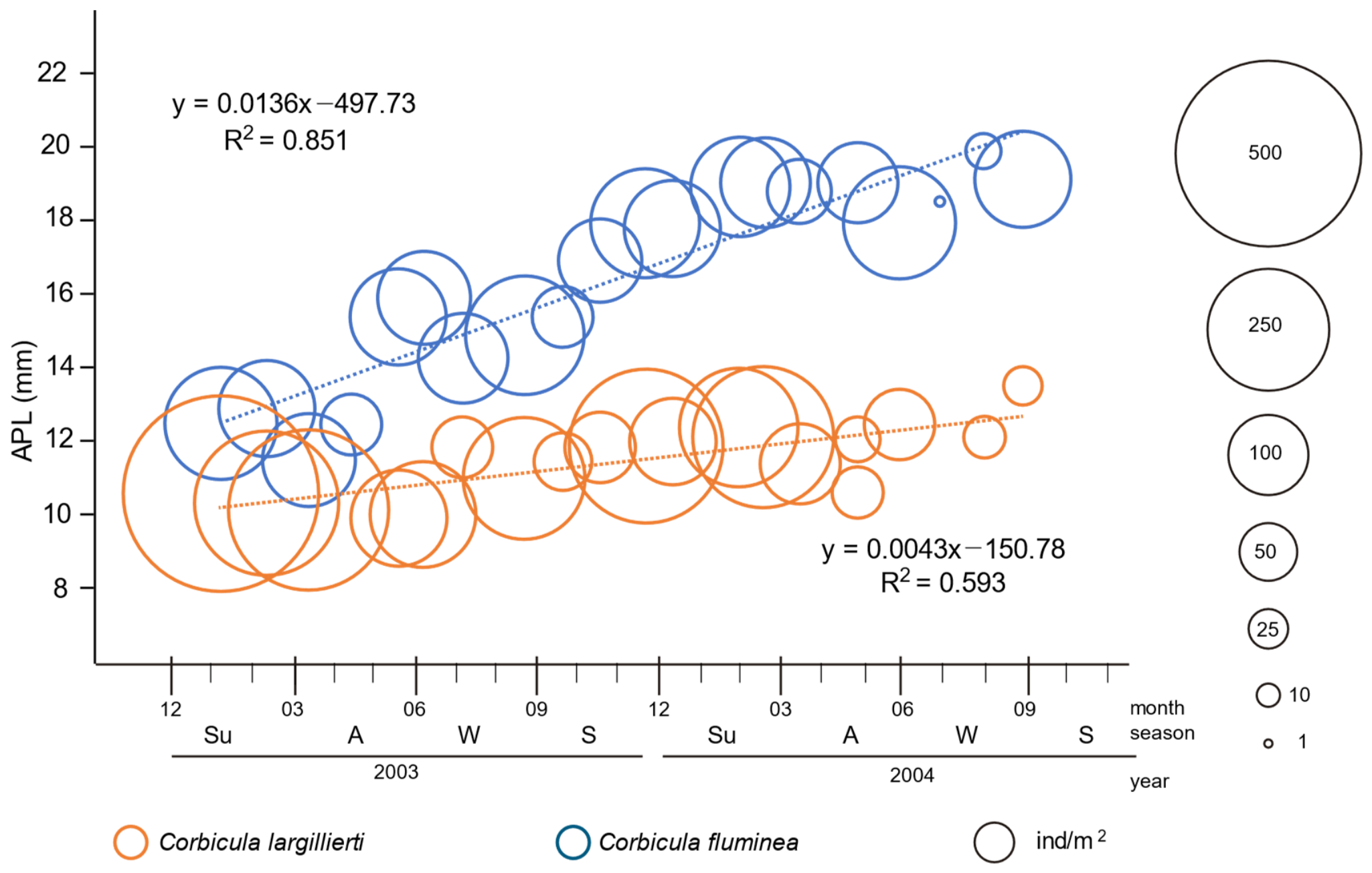
The decomposition of size-frequency distributions for each sampling date and species generally revealed the presence of a single dominant size group. Given this pattern, we tracked changes in the size and density of the components of these dominant size classes (Figure 3).
Figure 3.
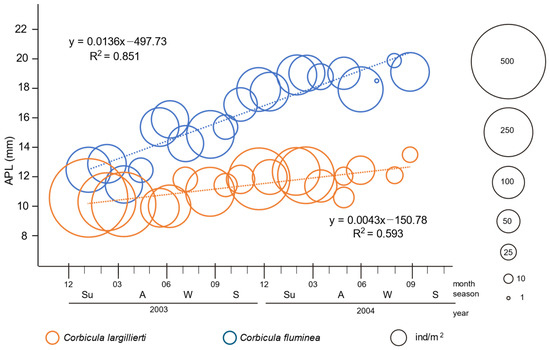
Temporal tracking of total length (mm) and density of the dominant size classes for C. fluminea (blue) and C. largillierti (orange) over the period January 2003–September 2004. Circle diameter represents the density of individuals at each sampling date. Linear trend lines are shown, along with their corresponding equations and coefficients of determination (R2).
Thus, the decomposition of size distributions at each date was characterized by a dominant group of individuals in terms of density, whose sizes showed a progressive increase and, in general, a decrease in numerical representation over the course of the sampling period.
Differences in growth between the two species were evident throughout the sampling dates. C. largillierti showed a moderate fit (R2 = 0.59), indicating greater size variability compared to C. fluminea. In contrast, the growth of C. fluminea was more consistent over time, with an R2 of 0.85. Moreover, C. largillierti not only exhibited generally lower densities, but also a markedly lower growth rate than C. fluminea, with a slope of 0.0043, indicating a growth rate nearly three times lower than that of C. fluminea, which showed an average growth rate of 0.0136 over the same period.
Additionally, C. largillierti reached average sizes of approximately 13–14 mm by the end of the study period, with a maximum size in the environment of about 19.20 mm. In contrast, C. fluminea exhibited modal sizes around 20 mm in the final sampling period (Figure 3), reaching maximum sizes in the environment of approximately 27–28 mm (Table 4) (Figures S1 and S2).
Table 4.
Population characteristics of C. fluminea and C. largillierti in the Santa Catalina stream.
In Figure 3, regarding the relative abundance of cohorts, both species showed substantial recruitment toward the end of 2003 (large bubbles at small sizes). As time progressed, cohorts of C. fluminea displayed a clearer progression, whereas the modes of C. largillierti remained more clustered.
3.3. Reproduction
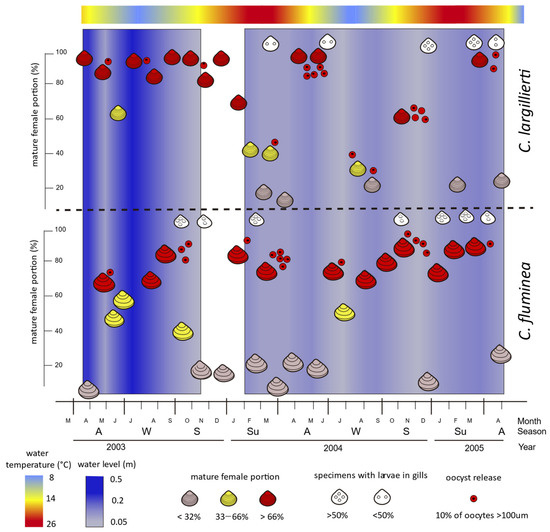
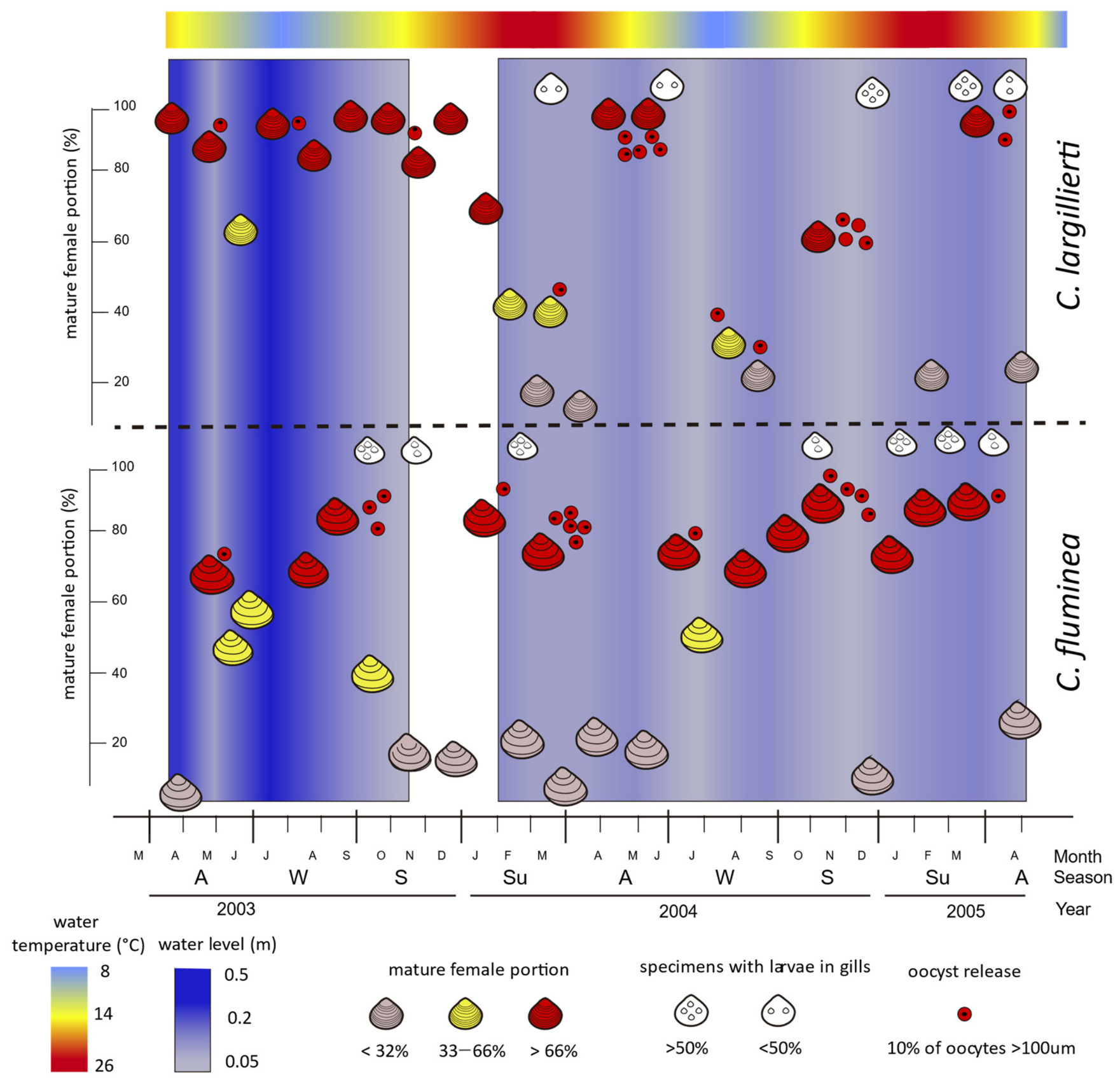
Populations of Corbicula fluminea and C. largillierti exhibited contrasting patterns in their reproductive cycles (Table 5, Figure 4). In C. fluminea, the pattern was relatively constant over time, with high proportions of mature female follicles (generally close to 80%) throughout most of the study period. Peaks in maturity were associated with marked oocyte release events, mainly during spring and summer, although lower-intensity releases were also recorded during autumn and winter.
Table 5.
Patterns in the reproductive cycle of C. fluminea and C. largillierti populations in the Santa Catalina stream.
Figure 4.
Reproductive dynamics of Corbicula fluminea and Corbicula largillierti between 2003 and 2005 [34,36]. The proportion of mature female follicles (%) over time is shown, with sampling months grouped by seasons (Su: summer; A: autumn; W: winter; S: spring), together with the occurrence of oocyte release and the presence of larvae in the gills. Symbol colors indicate proportion of maturity (beige: <32%; yellow: 33–66%; red: >66%). Small red circles represent oocyte release events, whereas white symbols indicate the proportion of individuals with incubated larvae in the gills (>50% or <50%). The color gradient in the upper bar represents water temperature (°C), and the background shading (from blue to gray) indicates water level in the Santa Catalina stream. The year 2003 corresponds to a period of environmental stress, characterized by increased water level and water flow (intense blue), whereas 2004–2005 represent more stable water level (light blue). Differences in clam size reflect the maximum size reached by each species.
In contrast, Corbicula largillierti showed more pronounced variation among periods. During the phase of high water level (2003), high proportions of mature follicles were observed (often close to 100%), but with limited oocyte release. Conversely, during the period of hydrological stability (2004–2005), the proportion of mature follicles was more variable, and the main oocyte release events were recorded. This suggests a decoupling between maturation and release under stressful conditions, followed by a reactivation of reproductive activity under more favorable conditions.
Additionally, differences in larval incubation were observed. In C. fluminea, the presence of larvae in the gills was continuous across both periods, whereas in C. largillierti it was only recorded during the phase of environmental stability.
3.4. Relationship Between Physical and Chemical Parameters with Gonadal Stages
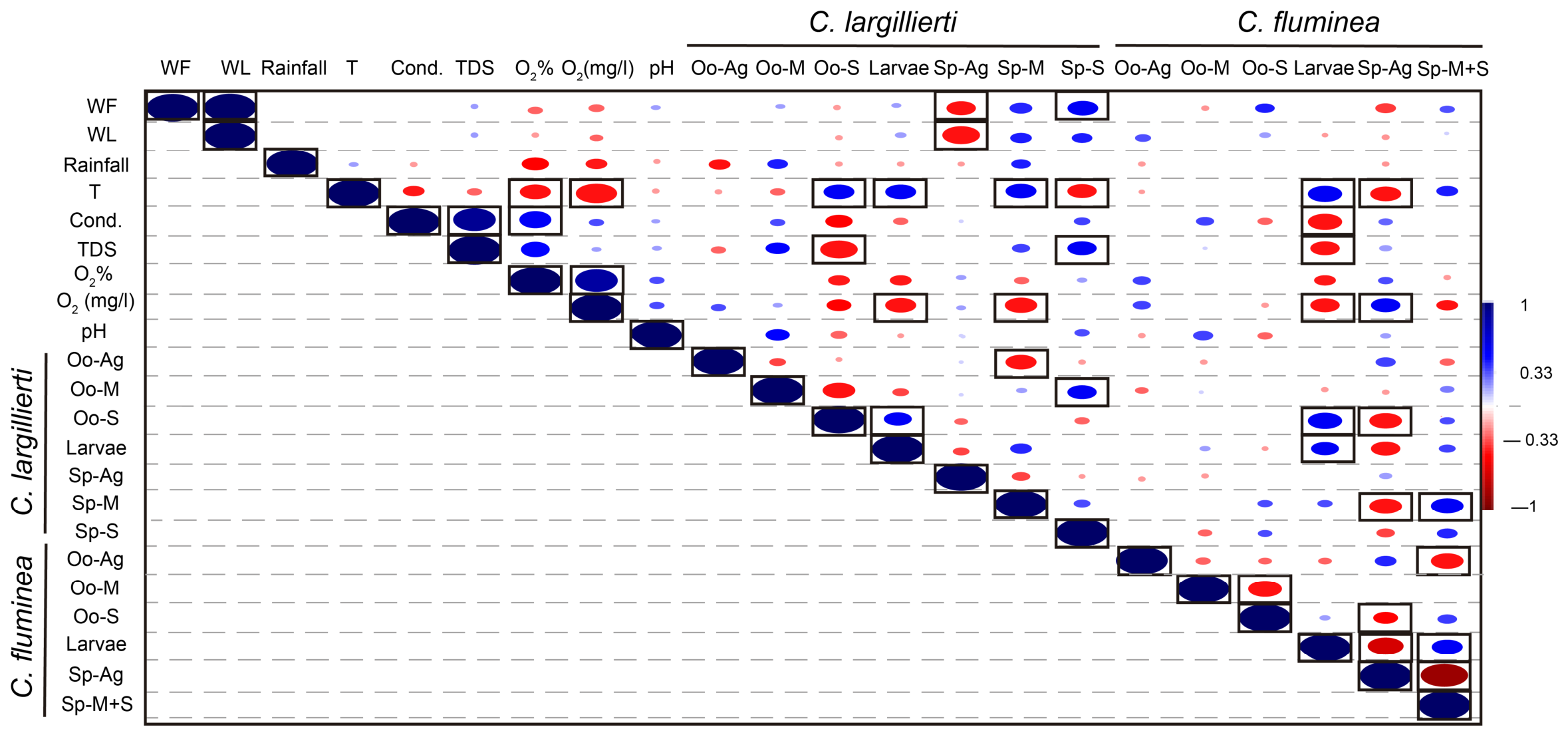
Gonadal stages were correlated with physical and chemical parameters. In C. largillierti, the proportion of spent female follicles increased significantly with rising temperature (S = 0.467, p < 0.033) and decreasing total dissolved solids (S = −0.667, p = 0.002). Similarly, maturing spermatogenetic follicles correlated positively with temperature (S = 0.477, p < 0.029) and negatively with dissolved oxygen (S = −0.581, p < 0.007). While the proportion of spawned spermatogenetic follicles correlated with increasing water flow (S = 0.488, p < 0.016) and decreasing temperature (S = −0.456, p < 0.038), male follicles in active gametogenesis showed negative correlations with both water flow and water level (S = −0.462, p < 0.023 and S = −0.643, p < 0.001, respectively). Conversely, in C. fluminea, spermatogenetic follicles in active gametogenesis only correlated significantly with decreasing temperature (S = −0.478, p < 0.028) and increasing dissolved oxygen (S = 0.481, p < 0.032). For both species, the proportion of individuals brooding larvae in the gills was positively related to temperature (C. largillierti: S = 0.521, p < 0.015; C. fluminea: S = 0.595, p < 0.004) and inversely correlated with dissolved oxygen (C. largillierti: S = −0.459, p < 0.042; C. fluminea: S = −0.474, p < 0.035). Additionally, larval presence in C. fluminea was negatively correlated with conductivity (S = −0.609, p < 0.007) and total dissolved solids (S = −0.524, p < 0.026) (Figure 5).
Figure 5.
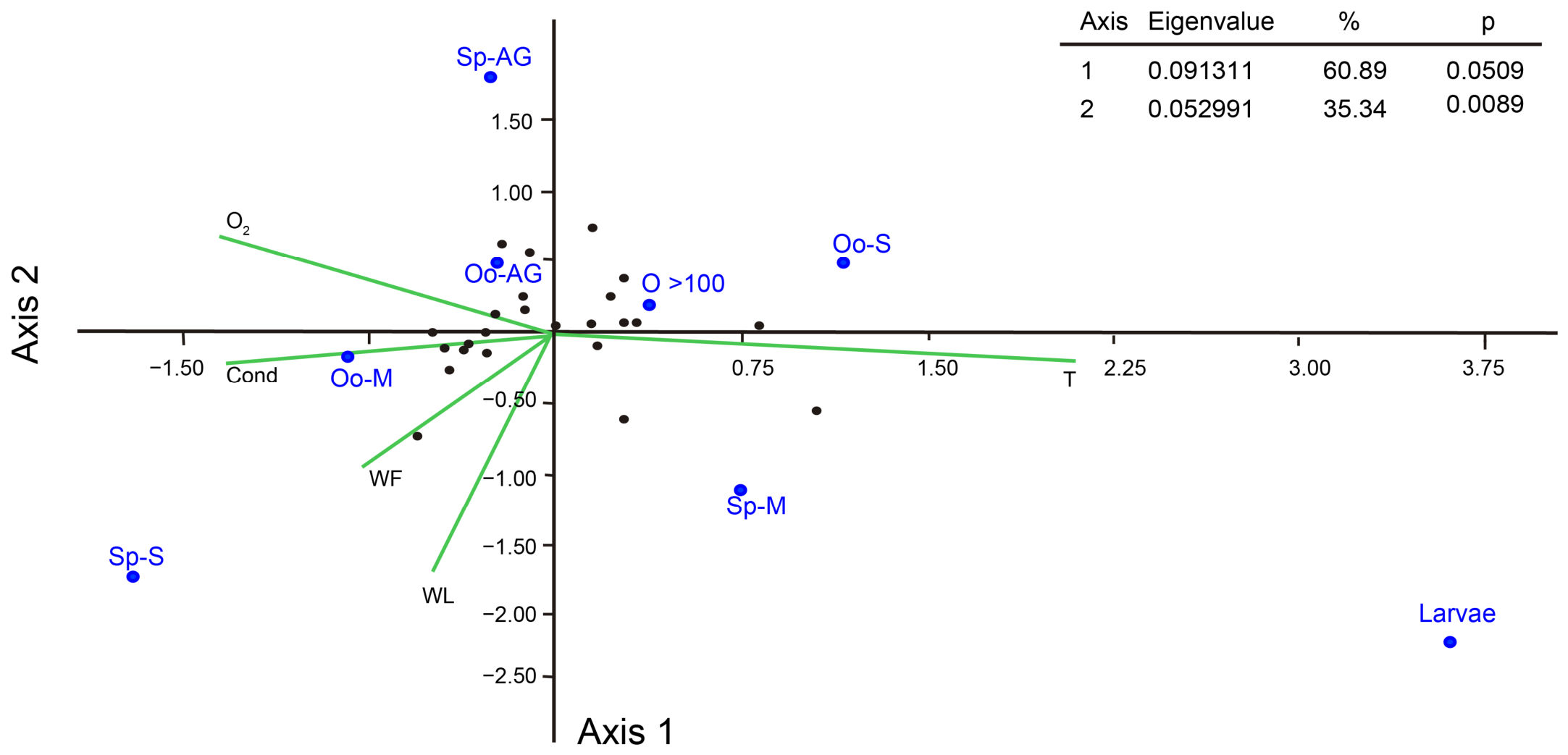
Correlation between environmental variables and gonadal stages of C. largillierti and C. fluminea. Environmental variables: COND, conductivity (uS/cm); O2, oxygen concentration (mg/L); O2 %, percentage of oxygen; pH; Rainfall (mm); T, temperature (°C); TDS, total dissolved solids (mg/L); WF, water flow (m3/s); WL, water level (m); gonadal stages: Larvae, proportion of individuals brooding larvae in the gills; Oo-AG, oogenic follicles in active gametogenesis; Oo-M, mature oogenic follicles; Oo-S, spawned oogenic follicles; Sp-AG, spermatogenic follicles with active gametogenesis; Sp-M, mature spermatogenic follicles; Sp-S, spawned spermatogenic follicles. In blue, positively correlated; in red, negatively correlated; circles in boxes, significantly correlated.Canonical correspondence analysis showed relations among physical and chemical parameters with the reproductive characteristics. For C. largillierti, the first two axes explained 96.23% of the variability, with axis 2 being clearly significant. High temperatures are related to the evacuation of oogenetic follicles and the maturation of spermatogenetic follicles. On the other hand, high streamflow and stream level values are related to the evacuation of spermatogenetic follicles and, to a lesser extent, to their maturation. Conductivity is related to the maturity of oogenetic follicles, while active gametogenesis shows no marked environmental association (Figure 6).
Figure 6.
Canonical correspondence analysis triplot (scaling type 2). Black dots, samples. Blue dot, reproductive characteristics of Corbicula largillierti: O > 100, oocytes bigger than 100 um; Larvae, proportion of individuals brooding larvae in the gills; Oo-AG, oogenic follicles in active gametogenesis; Oo-M, mature oogenic follicles; Oo-S, spawned oogenic follicles; Sp-AG, spermatogenic follicles with active gametogenesis; Sp-M, mature spermatogenic follicles; Sp-S, spawned spermatogenic follicles. Green lines, environmental variables: Cond, conductivity (uS/cm); WL, mean water level (m); O2, oxygen concentration (mg/L); WF, water flow (m3/s); T, temperature (°C).
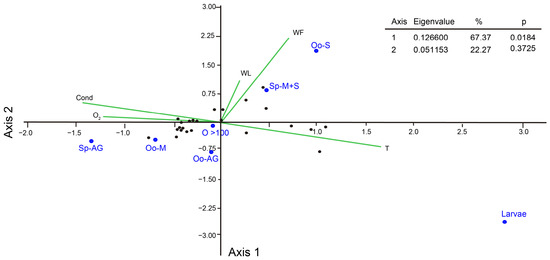
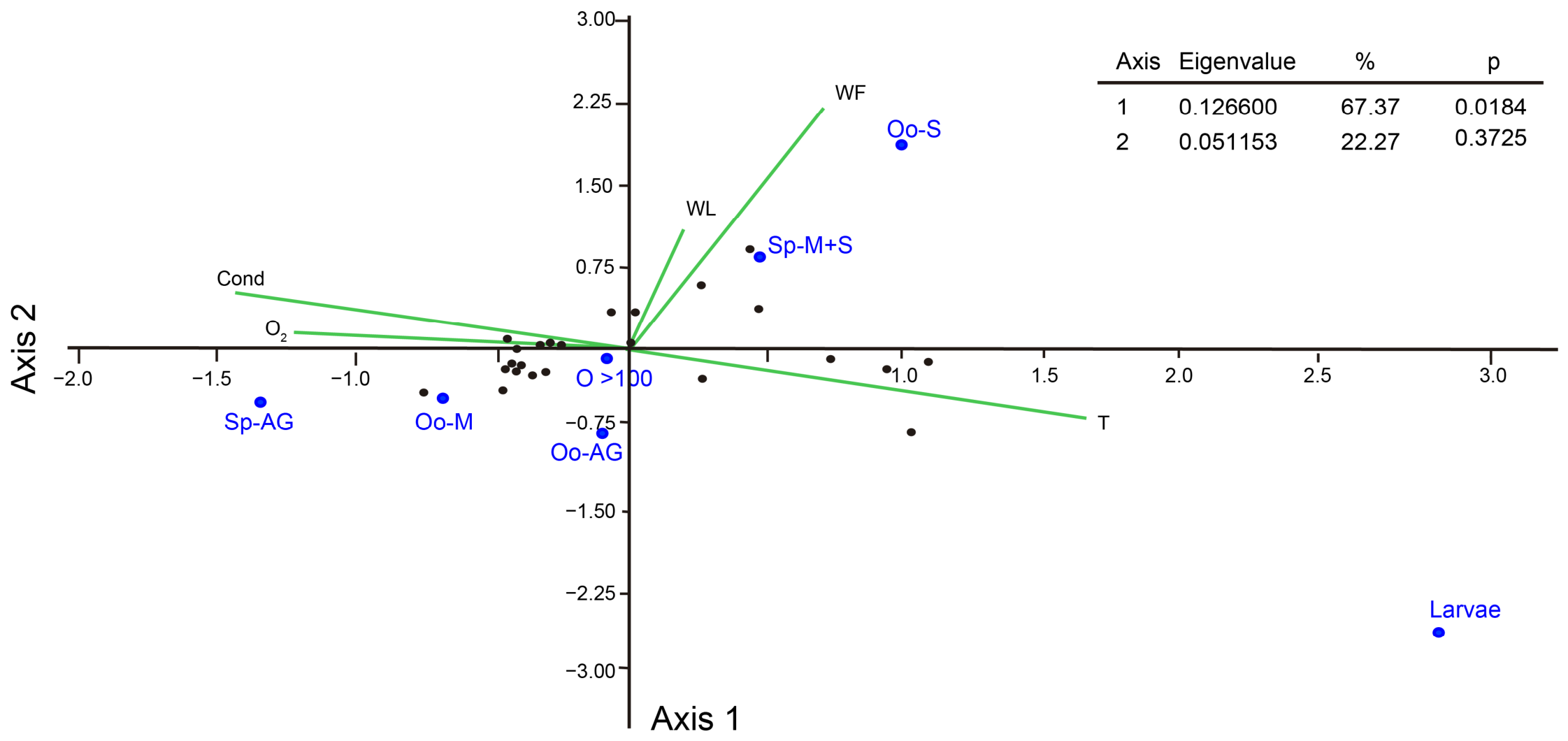
For C. fluminea, the first two components explained 89.64% of the variability, with axis 1 being significant. Waterflow, stream water level, and temperature are related to maturing and spawning spermatogenic follicles, as well as spawning oogenetic follicles. The maturation of oogenetic follicles and active gametogenesis of spermatogenic follicles are related to dissolved oxygen and conductivity, and inversely related to temperature (Figure 7). The proportion of oocytes larger than 100 μm is not clearly associated with the analyzed variables. Temperature is strongly associated with the increase in individuals brooding larvae in the gills.
Figure 7.
Canonical correspondence analysis triplot (scaling type 2). Black dots, samples. Blue dots, reproductive characteristics of Corbicula fluminea: O > 100, oocytes bigger than 100 um; Larvae, proportion of individuals brooding larvae in the gills; Oo-AG, oogenic follicles in active gametogenesis; Oo-M, mature oogenic follicles; Oo-S, spawned oogenic follicles; Sp-AG, spermatogenic follicles with active gametogenesis; Sp-M+S, mature and spawned spermatogenic follicles. Green lines, environmental variables: Cond, conductivity (uS/cm); WL, mean water level (m); O2, oxygen concentration (mg/L); WF, water flow (m3/s); T, temperature (°C).
4. Discussion
The analysis of the population dynamics of Corbicula fluminea and C. largillierti in the Santa Catalina stream highlights contrasting adaptive responses to hydrological parameters. The population parameters observed during the study period are consistent with the variable environmental conditions of this system, characterized by recurrent droughts and floods. Over a 10-year period (1997–2007), 499 days of drought emergency were recorded, along with multiple flooding events [37]. Floods generally occur in autumn and winter, when the water table is high, evapotranspiration is low, and human activities, particularly agriculture, leave soils without vegetation cover, thereby increasing surface runoff within the basin [37].
Such environmental instability in streams is known to be a key regulator of freshwater biodiversity, particularly in bivalves. Freshwater organisms commonly exhibit strategies to cope with extreme events; however, the unpredictability of stream hydrology can disrupt dispersal, reproduction, and survival [49].
Regarding the population densities of both Corbicula species in the Santa Catalina stream, C. largillierti reached higher densities than C. fluminea during the first three months of the year. This finding contrasts with observations from other invaded environments where both species coexist, in which C. fluminea consistently dominates numerically and attains substantially higher population densities than C. largillierti [16,18].
From 2004 onwards, however, density patterns in the Santa Catalina stream became comparable to those reported elsewhere, with both species exhibiting synchronized fluctuations in abundance and C. fluminea remaining numerically dominant [18].
The temporary dominance of C. largillierti observed in 2003 may be explained by the distinct responses of the two species to environmental variation. Canonical correspondence analysis revealed a common environmental framework characterized by a primary thermal gradient and a secondary hydrological gradient. However, the species differed in the way reproductive traits were associated with hydrological conditions. In C. largillierti, gonadal maturation and oocyte growth were more closely related to increases in water level. In contrast, reproductive traits in C. fluminea were more strongly associated with stream flow, potentially promoting population growth under the regular flow conditions that prevailed during subsequent non-flood years. These results suggest that, although both species respond to similar environmental drivers, differences in the relative importance of hydrological variables may contribute to the temporal shifts in dominance observed between the populations of Corbicula species in the Santa Catalina stream.
Corbicula fluminea exhibits a more efficient life-history strategy in this ecosystem, characterized by faster growth and larger body size compared to C. largillierti. Together with its high reproductive and adaptive capacity, this supports its invasive success. In contrast, C. largillierti displays a slower and more conservative growth pattern. These differences are supported by size-frequency analyses. The dominant size class throughout the sampling period was consistently larger in C. fluminea. This agrees with Hünicken et al. [22], who showed that growth investment in C. fluminea is directed toward increasing shell size, whereas in C. largillierti it is more associated with shell thickening. Additionally, C. fluminea exhibited predictable growth over time, with cohorts fitting regression models, whereas C. largillierti showed greater variability and stronger cohort overlap. This suggests slower growth after reaching sexual maturity and greater sensitivity to environmental fluctuations such as floods and droughts.
Under typical population dynamics, an increase in individual size within a cohort is associated with a decrease in density [20]. However, in the Santa Catalina stream, hydrological variables obscure this pattern, and neither species shows a clear density trend over time. Population structure was dominated by individuals of similar size, derived from an exceptional recruitment event occurring under short-lived favorable conditions. This cohort constituted the majority of the population throughout the study period. Similar dynamics have been observed in other taxa inhabiting unstable aquatic environments of the region as adaptive mechanism to sustain viable populations. For example, the fish Prochilodus lineatus (Valenciennes, 1836) relies on flood-generated nursery areas for reproductive success, rather than larval abundance [50]. Consequently, cohorts originating in flood years dominate population structure until the next major recruitment event.
Given that the distribution of invasive bivalves is closely linked to water levels [35] the dynamics of Corbicula spp., particularly C. largillierti, despite their phylogenetic and reproductive differences, show population strategies that parallel those described for P. lineatus. In this system, fluctuations in water level may act as a demographic bottleneck. Paschoal et al. [51] reported that changes in water column height affect density, distribution, and mean shell length in C. fluminea. Under this framework, extreme drought and flood events likely limit the survival of reproductive individuals, particularly those exceeding 20 mm in C. fluminea and 12 mm in C. largillierti.
Population structure traits are linked to episodic recruitment dynamics, reflected in size-frequency histograms that are unimodal and dominated by cohorts recruited under favorable conditions. In this context, environmental constraints explain population reductions, while the proposed demographic dynamics determine the survival of individuals smaller than 20 mm. The impact of hydrological instability is evident when comparing maximum sizes: while in stable environments C. fluminea can reach 37 mm and C. largillierti 31 mm [20], in the Santa Catalina stream they do not exceed 28 mm and 20 mm, respectively. These sizes suggest that local populations do not exceed two years of age.
Understanding the reproductive biology of invasive bivalves is essential to explain their establishment, spread, and ecological impact [52]. Populations of C. fluminea in Asia, North America, and Africa exhibit two reproductive periods per year (spring and autumn), a lifespan of 1.5–3 years, and rapid juvenile growth [53]. In the Santa Catalina stream, however, no clear pattern of gamete release or reproductive behavior was detected [34]. Mature and developing oocytes were observed throughout the year, even under unfavorable conditions. This allows C. fluminea to release gametes opportunistically when conditions become favorable and to rapidly replace them [34]. Indeed, more spawning events were recorded for C. fluminea than for C. largillierti.
In contrast, identifying reproductive patterns in C. largillierti proved difficult, as reported for other Corbicula species [36]. Under unfavorable conditions, individuals showed predominantly mature female follicles with a high proportion (>90%) of large oocytes, and few or no developing oocytes. During periods of environmental stability, female gonads contained both mature and developing oocytes, similar to C. fluminea, although in lower proportions.
Both species exhibit early parental care through branchial incubation of larvae. C. largillierti shows a higher incubation capacity than C. fluminea [22]. However, no incubating individuals were observed in either species during flood conditions. Following periods of relative environmental stability, both species showed larval incubation, although it was more frequent in C. fluminea.
5. Conclusions
Hydrological parameters in the Santa Catalina stream strongly constrained the population performance of Corbicula fluminea and C. largillierti. These findings indicate that hydrological parameters can act as a limiting factor for the establishment and persistence of invasive Corbicula populations. Under fluctuating conditions, C. fluminea displayed a more resilient life-history strategy, characterized by greater longevity and larger maximum size, suggesting enhanced survival under environmental stress. In contrast, C. largillierti exhibited a strategy biased toward earlier maturation, and reduced maximum size.
Overall, our results demonstrate that the dominance of C. fluminea is likely driven by its higher adaptive and reproductive capacity, with opportunistic gamete release throughout the year, allowing it to maintain population stability under hydrological variable regimen, while C. largillierti appears to be more sensitive to environmental fluctuations. This differential response highlights the role of environmental parameters as a key factor in species performance and competitive outcomes in invaded freshwater systems. Therefore, this study may have important implications for understanding the mechanisms by which competitive hierarchies among cogeneric invasive species are mediated not only by intrinsic biological traits but also by the environmental context. These results would support monitoring programs, considering that artificial flow management could potentially serve as a control tool for a bioinvasion such as a Corbicula fluminea invasion.
Supplementary Materials
The following supporting information can be downloaded at: https://www.mdpi.com/article/10.3390/biology15131026/s1. Figure S1. Size frequency (percentage) measured as maximum anteroposterior length (APL) in mm, of Corbicula fluminea in the Santa Catalina stream, Buenos Aires Province, during the sampling period. Specimens smaller than 3 mm are not considered. Figure S2. Size frequency (percentage) measured as maximum anteroposterior length (APL) in mm, of Corbicula largillierti in the Santa Catalina stream, Buenos Aires Province, during the sampling period. Specimens smaller than 3 mm are not considered.
Author Contributions
Conceptualization, G.D. and C.D.; methodology, P.P., M.M., D.C., D.E.G.G., G.D. and C.D.; software, D.E.G.G. and D.C.; validation, P.P., D.C., D.E.G.G., C.D. and G.D.; formal analysis, G.D., C.D. and P.P.; investigation, G.D., C.D., P.P., M.M., D.C. and D.E.G.G.; resources, M.M., D.C., D.E.G.G., G.D. and C.D.; data curation, P.P., D.C., D.E.G.G., G.D. and C.D.; writing—original draft preparation, G.D. and C.D.; writing—review and editing, G.D., C.D., P.P., D.C. and D.E.G.G.; visualization, P.P., D.C., D.E.G.G., C.D. and G.D.; supervision, G.D. and C.D.; project administration, G.D. and C.D. Author Miriam Maroñas passed away prior to the publication of this manuscript. All other authors have read and agreed to the published version of this manuscript.
Funding
This work was partially funded by Agencia Nacional de Promoción Científica y Tecnológica (PICT-2019-01417), Consejo Nacional de Investigaciones Científicas y Técnicas (PIP-2021/2023-1966) and Programa Incentivos UNLP (11/N1045).
Institutional Review Board Statement
Not applicable.
Informed Consent Statement
The study did not involve humans.
Data Availability Statement
The raw data supporting the conclusions of this article will be made available by the authors upon request.
Acknowledgments
This research has the invaluable technical support of Micaela Delucia, and the technical support of Instituto de Hidrología de Llanuras de Azul (IHLLA) (Comisión de Investigaciones Científicas, Buenos Aires -CIC-, Universidad Nacional del Centro, Buenos Aires-UNCPBA- and Municipalidad de Azul) for providing hydrological data.
Conflicts of Interest
The authors declare no conflicts of interest.
References
- Haubrock, P.J.; Carneiro, L.; Macêdo, R.L.; Balzani, P.; Soto, I.; Jessen Rasmussen, J.; Wiberg-Larsen, P.; Csabai, Z.; Várbíró, G.; Murphy, J.F.; et al. Advancing our understanding of biological invasions with long-term biomonitoring data. Biol. Invasions 2023, 25, 3637–3649. [Google Scholar] [CrossRef] [Scilit]
- Lovell, S.J.; Stone, S.F.; Fernandez, L. The economic impacts of aquatic invasive species: A review of the literature. Agric. Resour. Econ. Rev. 2006, 35, 195–208. [Google Scholar] [CrossRef] [Scilit]
- Strayer, D.L.; Adamovich, B.V.; Adrian, R.; Aldridge, D.C.; Balog, C.; Burlakova, L.E.; Fired-Petersen, H.; Tóth, L.G.; Hetherington, A.L.; Jones, T.S.; et al. Long-term population dynamics of dreissenid mussels (Dreissena polymorpha and D. rostriformis): A cross-system analysis. Ecosphere 2019, 10, e02701. [Google Scholar] [CrossRef] [Scilit]
- Correia, S.; Lopes, M.L.; Picado, A.; Dias, J.M.; Vaz, N.; Freitas, R.; Magalhães, L. Cockle Population Dynamics in a Complex Ecological Aquatic System. Biology 2025, 14, 1427. [Google Scholar] [CrossRef] [Scilit] [PubMed]
- Aldridge, D.W.; McMahon, R.F. Growth, fecundity, and bioenergetics in a natural population of the Asiatic freshwater clam, Corbicula malinensis Philippi, from North Central Texas. J. Mollus. Stud. 1978, 44, 147–162. [Google Scholar] [CrossRef] [Scilit]
- Sousa, R.; Nogueira, A.J.; Gaspar, M.B.; Antunes, C.; Guilhermino, L. Growth and extremely high production of non-indigenous invasive species Corbicula fluminea Muller, 1774): Possible implications for ecosystem funcioting. Estuar. Coast. Shelf Sci. 2008, 80, 289–295. [Google Scholar] [CrossRef] [Scilit]
- Álvarez, M.G.; Rolo, F.; Godinho, F.; Pinheiro, P.; Gil, M.; Pires, D.; Banha, F.; Gama, M.; Anastácio, P.; Sousa-Santos, C.; et al. Living on the Edge: Challenges for Freshwater Mussel Conservation in Mediterranean-Type Temporary Streams. Diversity 2026, 18, 189. [Google Scholar] [CrossRef] [Scilit]
- McDowell, W.G.; Sousa, R. Mass Mortality Events of Invasive Freshwater Bivalves: Current Understanding and Potential Directions for Future Research. Front. Ecol. Evol. 2019, 7, 331. [Google Scholar] [CrossRef] [Scilit]
- Kwak, H.; Lee, Y.; Hwai, A.T.S.; Kim, J.; Nakano, T.; Park, J.-K. Multiple origins of freshwater invasion and parental care reflecting ancient vicariances in the bivalve family Cyrenidae (Mollusca). Commun. Biol. 2024, 7, 1212. [Google Scholar] [CrossRef] [Scilit] [PubMed]
- Gomes, C.; Sousa, R.; Mendes, T.; Borges, R.; Vilares, P.; Vasconcelos, V.; Guilhermino, L.; Antunes, A. Low Genetic Diversity and High Invasion Success of Corbicula fluminea (Bivalvia, Corbiculidae) (Müller, 1774) in Portugal. PLoS ONE 2016, 11, e0158108. [Google Scholar] [CrossRef] [Scilit] [PubMed]
- Darrigran, G.; Agudo-Padrón, I.; Baez, P.; Belz, C.; Cardoso, F.; Carranza, A.; Collado, G.; Correoso, M.; Cuezzo, M.G.; Fabres, A.; et al. Non-native mollusks throughout South America: Emergent patterns in an understudied continent. Biol. Invasions 2020, 22, 853–871. [Google Scholar] [CrossRef] [Scilit]
- Ituarte, C.F. Primera noticia acerca de la introducción de pelecípodos asiáticos en el área rioplatense. Neotropica 1981, 27, 79–83. [Google Scholar]
- Sousa, R.; Gutiérrez, J.L.; Aldridge, D.C. Non-indigenous invasive bivalves as ecosystem engineers. Biol. Invasions 2009, 11, 2367–2385. [Google Scholar] [CrossRef] [Scilit]
- Labaut, Y.; Macchi, P.A.; Archuby, F.M.; Darrigran, G. Homogenization of macroinvertebrate Assemblages and Asiatic Clam Corbicula fluminea Invasion in a River of the Arid Patagonian Plateau, Argentina. Front. Environ. Sci. 2021, 9, 728620. [Google Scholar] [CrossRef] [Scilit]
- Santos, S.B.; Thiengo, S.C.; Fernandez, M.A.; Miyahira, I.C.; Brito Gonçalves, I.C.; Ximenes, R.F.; Mansur, M.C.D.; Pereira, D. Espécies de moluscos límnicos invasores no Brasil. In Moluscos Límnicos Invasores no Brasil; Mansur, M.C.D., dos Santos, C.P., Pereira, D., Paz, I.C.P., Zurita, M.L.L., Rodriguez, M.T.R., Nehrke, M.V., Bergonci, P.E.A., Eds.; Redes Editora: Porto Alegre, Brazil, 2012; pp. 25–49. [Google Scholar]
- Reyna, P.; Nori, J.; Ballesteros, M.L.; Hued, A.C.; Tatián, M. Targeting clams: Insights into the invasive potential and current and future distribution of Asian clams. Environ. Conserv. 2018, 45, 387–395. [Google Scholar] [CrossRef] [Scilit]
- Hetherington, A.L.; Rudstam, L.G.; Schneider, R.L.; Holeck, K.T.; Hotaling, C.W.; Cooper, J.E.; Jackson, J.R. Invader invaded: Population dynamics of zebra mussels (Dreissena polymorpha) and quagga mussels (Dreissena rostriformis bugensis) in in polymictic Oneida Lake, NY, USA (1992–2013). Biol. Invasions 2019, 21, 1529–1544. [Google Scholar] [CrossRef] [Scilit]
- Reshaid, Y.; Cao, L.; Brea, F.; Blanche, M.O.; Torres, S.; Darrigran, G. Variation in distribution of Corbicula species (Mollusca: Bivalvia: Corbiculidae) after 25 years of its introduction in the Río de la Plata. Zoologia 2017, 34, e22181. [Google Scholar] [CrossRef] [Scilit]
- Bonel, N.; Lorda, J. Growth and body weight variability of the invasive mussel Limnoperna fortunei (Mytilidae) across habitat and season. Malacologia 2015, 58, 129–145. [Google Scholar] [CrossRef] [Scilit]
- Darrigran, G.; Maroñas, M. Crecimiento de las poblaciones naturales de Corbicula fuminea (Müller, 1774) y C. largillierti (Philippi, 1814) (Bivalvia, Sphaeriacea) en el litoral de Punta Blanca, estuario del Río de la Plata, República Argentina. Comun. Soc. Malacol. Urug. 1989, 7, 139–157. [Google Scholar] [CrossRef] [Scilit]
- Reyna, P.B.; Morán, A.G.; Tatián, M. Taxonomy, distribution and population structure of invasive Corbiculidae (Mollusca, Bivalvia) in the Suquía River basin, Córdoba, Argentina. Iheringia Sér. Zool. 2013, 103, 77–84. [Google Scholar] [CrossRef] [Scilit]
- Hünicken, L.A.; Sylvester, F.; Paolucci, E.M. Physiological and morphological assessments suggest opposite structural allocation strategies between closely related invasive clams. Hydrobiologia 2022, 849, 2859–2875. [Google Scholar] [CrossRef] [Scilit]
- Pavel, A.B.; Gheablau, C.; Kreuter, S.; Catianis, I.; Scrieciu, A.; Enachi, A. The Spatio-Temporal Distribution of the Freshwater Bivalves Corbicula fluminea and Dreissena polymorpha in the Lower Sector of the Danube River and the Danube Delta. Sustainability 2023, 15, 8526. [Google Scholar] [CrossRef] [Scilit]
- Rodríguez, H.M.; Muniz, P.; Brazeiro, A.; Defeo, O. Distribución y dinámica poblacional de la almeja asiática Corbicula fluminea (Bivalvia, Corbiculidae) en ríos de Uruguay. Ecol. Austral 2021, 31, 328–342. [Google Scholar] [CrossRef] [Scilit]
- Queiroz, R.N.M.; Dias, T.L.P.; Batista, R.; da Silva, P.M. Reproduction and population dynamics of the invasive bivalves Mytilopsis sallei and Isognomon bicolor on the Northeast coast of Brazil. Zoology 2022, 153, 126028. [Google Scholar] [CrossRef] [Scilit] [PubMed]
- Morton, B. The sexuality of Corbicula fluminea (Müller) in lentic and lotic waters in Hong Kong. J. Moll. Stud. 1983, 49, 81–83. [Google Scholar] [CrossRef] [Scilit]
- Pi, J.; Wang, X.; Coughlan, N.E.; Tang, Y.; Liu, L.; Xiang, J.; Li, D. Reproductive activity of an androdioecious population of clams of the genus Corbicula. J. Moll. Stud. 2024, 90, eyae017. [Google Scholar] [CrossRef] [Scilit]
- Tejima, K.; Yamada, M.; Houki, S.; Komaru, A. Coexistence of Hermaphrodites and Males in Androgenetic Clam Corbicula fluminea Müller in Shirakawa River, Kyoto, Japan. J. Shellfish Res. 2020, 39, 337–344. [Google Scholar] [CrossRef] [Scilit]
- Pigneur, L.-M.; Hedtke, S.M.; Etoundi, E.; Van Doninck, K. Androgenesis: A review through the study of the selfish shellfish Corbicula spp. Heredity 2012, 108, 581–591. [Google Scholar] [CrossRef] [Scilit] [PubMed]
- Ituarte, C.F. Corbicula and Neocorbicula in the Paraná, Uruguay and Río de la Plata basins. Nautilus 1994, 107, 129–135. [Google Scholar]
- McMahon, R.F. Invasive characteristics of Corbicula fluminea. In Nonindigenous Freshwater Organisms; Claudi, R., Leach, J.H., Eds.; Lewis Publishers: Washington, DC, USA, 2000; pp. 315–343. [Google Scholar]
- Ituarte, C.F. Aspectos biológicos de las poblaciones de Corbicula largillierti Philippi (Molusca Pelecypoda) en el Río de La Plata. Rev. Mus. La Plata 1984, 13, 231–247. Available online: https://publicaciones.fcnym.unlp.edu.ar/rmlp/article/view/2039 (accessed on 6 May 2026).
- Mansur, M.C.D.; Vanin, A.S.; Bergonci, P.E.A.; Oliveira, A.S. Dinâmica reprodutiva de Corbicula fluminea e C. largillierti. In Moluscos Límnicos Invasores no Brasil; Mansur, M.C.D., dos Santos, C.P., Pereira, D., Paz, I.C.P., Zurita, M.L.L., Rodriguez, M.T.R., Nehrke, M.V., Bergonci, P.E.A., Eds.; Redes Editora: Porto Alegre, Brazil, 2012; pp. 119–124. [Google Scholar]
- Cao, L.; Damborenea, C.; Penchaszadeh, P.E.; Darrigran, G. Gonadal cycle of Corbicula fluminea (Bivalvia: Corbiculidae) in Pampean streams (Southern Neotropical region). PLoS ONE 2017, 12, e0186850. [Google Scholar] [CrossRef] [Scilit] [PubMed]
- Dei Tos, C.; Cardim, C.A.; Pereira, V.d.B.; Mormul, R.P. Synchrony between reproductive phase and flood period: A dispersion mechanism for the freshwater clam Corbicula fluminea (Bivalvia: Corbiculidae) in a Brazilian Neotropical Floodplain. Zool. Stud. 2021, 60, 3. [Google Scholar] [CrossRef] [Scilit] [PubMed]
- Damborenea, C.; Labaut, Y.; Penchaszadeh, P.; Collado, G.A.; Darrigran, G. Gonadal cycle of Corbicula largillierti (Bivalvia: Cyrenidae) in a Pampean streams, Argentina. Diversity 2024, 16, 357. [Google Scholar] [CrossRef] [Scilit]
- Ochoa, C.C.G. Una Metodología Para el Manejo Integral de Extremos Hídricos en Una Cuenca Rural en Zona de Llanura. Master’s Thesis, Universidad Nacional de La Plata, La Plata, Argentina, June 2015. Available online: http://sedici.unlp.edu.ar/handle/10915/47518 (accessed on 22 June 2026).
- Folmer, O.; Black, M.; Hoeh, W.; Lutz, R.; Vrijenhoek, R. DNA primers for amplification of mitochondrial cytochrome c oxidase subunit I from diverse metazoan invertebrates. Mol. Mar. Biol. Biotechnol. 1994, 3, 294–299. [Google Scholar] [PubMed]
- Gregoric, D.E.G.; Beltramino, A.A.; Vogler, R.E.; Cuezzo, M.G.; Núñez, V.; Gomes, S.R.; Virgillito, M.; Miquel, S.E. First records of four exotic slugs in Argentina. Am. Malacol. Bul. 2013, 31, 245–256. [Google Scholar] [CrossRef] [Scilit]
- Hall, T.A. BioEdit: A user-friendly biological sequence alignment editor and analysis program for Windows 95/98/NT. Nucleic Acids Symp. Ser. 1999, 41, 95–98. [Google Scholar]
- Larkin, M.A.; Blackshields, G.; Brown, N.P.; Chenna, R.; McGettigan, P.A.; McWilliam, H.; Valentin, F.; Wallace, I.M.; Wilm, A.; Lopez, R.; et al. Clustal W and Clustal X version 2.0. Bioinformatics 2007, 23, 2947–2948. [Google Scholar] [CrossRef] [Scilit] [PubMed]
- Ludwig, S.; Darrigran, G.; Boeger, W.A. Opening the black box of the invasion of Corbicula clams (Bivalvia, Corbiculidae) in South America: A genetic and morphological evaluation. Hydrobiologia 2024, 851, 1203–1217. [Google Scholar] [CrossRef] [Scilit]
- Hünicken, L.A.; Paolucci, E.M.; Lavinia, P.D.; Sylvester, F. Morphological and genetic assessment of invasive Corbicula lineages in southern South America: A case study in Argentina. Animals 2024, 14, 1843. [Google Scholar] [CrossRef] [Scilit] [PubMed]
- Altschul, S.F.; Gish, W.; Miller, W.; Myers, E.W.; Lipman, D.J. Basic local alignment search tool. J. Mol. Biol. 1990, 215, 403–410. [Google Scholar] [CrossRef] [PubMed]
- Kumar, S.; Stecher, G.; Li, M.; Knyaz, C.; Tamura, K. MEGA X: Molecular evolutionary genetics analysis across computing platforms. Mol. Biol. Evol. 2018, 35, 1547–1549. [Google Scholar] [CrossRef] [Scilit] [PubMed]
- Rey, D.; Neuhäuser, M. Wilcoxon-Signed-Rank Test. In International Encyclopedia of Statistical Science; Lovric, M., Ed.; Springer: Berlin/Heidelberg, Germany, 2011. [Google Scholar] [CrossRef] [Scilit]
- Quinn, T.J., II; Deriso, R.B. Quantitative Fishery Dynamics; Oxford University Press: New York, NY, USA, 1999; 566p. [Google Scholar]
- Hammer, O.; Harper, D.A.T.; Ryan, P.D. PAST: Paleontological Statistics software package for education and data analysis. Paleontol. Electron. 2001, 4, 9. Available online: https://paleo.carleton.ca/2001_1/past/past.pdf (accessed on 5 June 2026).
- Miqueleiz, I. Mapping the Global Conflict Between Mining and Freshwater Biodiversity Protection. Glob. Change Biol. 2026, 32, e70823. [Google Scholar] [CrossRef] [Scilit] [PubMed]
- Lozano, I.E.; Vegh, S.L.; Gómez, M.I.; Piazza, Y.G.; Salva, J.L.; Fuentes, C.M. Episodic recruitment of young Prochilodus lineatus (Valenciennes, 1836) (Characiformes: Prochilodontidae) during high discharge in a floodplain lake of the River Paraná, Argentina. Fish. Manag. Ecol. 2019, 26, 260–268. [Google Scholar] [CrossRef] [Scilit]
- Paschoal, L.R.P.; Andrade, D.P.; Darrigran, G. How the fluctuations of water levels affect populations of invasive bivalve Corbicula fluminea (Müller, 1774) in a Neotropical reservoir? Braz. J. Biol. 2015, 75, 135–143. [Google Scholar] [CrossRef] [Scilit] [PubMed]
- Sienes, R.K.A.; Golez, M.S.M.; Cabanilla, H.T.; Flores, M.H.; Laguit, M.A.; Gacus, P.G.Q.; Degoma, J.N.L.; Bucay, D.M.; Gonzales, R.C.; Uba, K.I.N. Continuous reproduction facilitates the invasion success of the black mussel Mytella strigata in a tropical estuary. Reg. Stud. Mar. Sci. 2026, 97, 104973. [Google Scholar] [CrossRef] [Scilit]
- Mouthon, J.; Parghentanian, T. Comparison of the life cycle and population dynamics of two Corbicula species, C. fluminea and C. fluminalis (Bivalvia: Corbiculidae) in two French canals. Arch. Hydrobiol. 2004, 161, 267–287. [Google Scholar] [CrossRef] [Scilit]

Disclaimer/Publisher’s Note: The statements, opinions and data contained in all publications are solely those of the individual author(s) and contributor(s) and not of MDPI and/or the editor(s). MDPI and/or the editor(s) disclaim responsibility for any injury to people or property resulting from any ideas, methods, instructions or products referred to in the content. |
© 2026 by the authors. Licensee MDPI, Basel, Switzerland. This article is an open access article distributed under the terms and conditions of the Creative Commons Attribution (CC BY) license.