


Abstract
Advanced oxidation processes (AOPs) have been widely applied to treat textile wastewater, in which synthetic dyes are among the main pollutants. Some of these processes, such as the Fenton reaction, exhibit enhanced efficiency when coupled with radiation sources, particularly when combined with a compound parabolic concentrator (CPC). In this study, a UV-A photo-Fenton process assisted by CPC, constructed using reused fluorescent lamps as reaction tubes and operating with recirculation was applied to treat real textile wastewater. A preliminary factorial design was employed to optimize reagent concentrations, identifying optimal conditions of 2647.8 g·L−1 of H2O2 and 15 mg·L−1 of Fe2+. Overall, the use of the CPC led to an increase in photon availability, resulting in COD degradation efficiencies of 83%, corresponding to an ~19% relative increase in treatment efficiency, compared to the system without the CPC, as well as 79% removal efficiency for apparent color and 57% for turbidity. Results demonstrate that the CPC-assisted UV-A photo-Fenton process is an efficient and robust approach for treating real textile wastewater. Meanwhile, the reuse of fluorescent lamps represents a low-cost, environmentally sustainable alternative that contributes to waste valorization and process intensification.
1. Introduction
Since the Industrial Revolution, advances in industrial activity have caused serious environmental impacts, including air, soil, and water pollution. Currently, the main causes of water pollution and scarcity are population growth and industrialization, and conventional pollutants released by industry include pesticides, heavy metal ions, pharmaceuticals, and dyes [1]. In this context, water pollution poses a great challenge due to the inadequate disposal of effluents with very heterogeneous chemical characteristics and compositions [2,3]. Therefore, the textile industry is a source of great concern, as it consumes large volumes of water at all stages of production and consequently generates significant wastewater [4].
The textile industry is the second-largest worldwide, and some wastewater containing dyes is disposed of without proper treatment. Textile wastewaters are characterized by high levels of organic matter, surfactants, soaps, fats, oils, waxes, solvents, salts, and synthetic dyes [1,5]. Incorrect treatment has a series of consequences for the aquatic environment. Synthetic dyes are toxic, mutagenic, carcinogenic, and bioaccumulative compounds, which can cause serious damage to aquatic biota and humans [6,7]. The presence of dyes in textile wastewater hinders sunlight penetration, interfering with photosynthesis [8]. The presence of high concentrations of COD, BOD5, and particulates can also cause eutrophication of aquatic bodies and reduce dissolved oxygen concentrations [9].
Most dyes used in the textile industry are water-soluble and non-biodegradable due to their complex chemical structures. The composition of wastewater from the textile industry depends on various factors, such as the type of process, the chemicals used, and the fabrics [10,11]. For this reason, the treatment of these compounds is still challenging. Usually, conventional physical-chemical and biochemical treatments cannot completely remove organic compounds, high color, and dissolved solids [12]. Additionally, wastewater can contain toxic compounds for microorganisms, such as azo dyes, heavy metals (e.g., chromium, copper, and lead), surfactants, and phenolic compounds, which hinder biological treatment [13,14,15].
In this context, synthetic organic dyes and other recalcitrant organic substances are not efficiently treated via conventional treatments, such as coagulation-flocculation, which, despite being effective for removing suspended solids and some pigments, results in significant sludge production and fails to degrade complex molecular structures [16]. Consequently, complementary treatments are necessary to achieve higher removal efficiency. Membrane filtration produces high-quality effluent by physically separating pollutants, but it is prone to membrane fouling [17,18]. Adsorption is widely used due to its operational simplicity and its ability to target specific organic molecules, but it requires the disposal or regeneration of the saturated adsorbent [19]. Among these, Advanced Oxidation Processes (AOPs) stand out for their ability to mineralize persistent pollutants into non-toxic byproducts [20].
The mechanisms of AOPs involve the generation of highly reactive, non-selective radicals, mainly hydroxyl radicals (OH, E° = 1.8–2.7 V), which can mineralize organic compounds [21]. Among existing AOPs, the Fenton process is of particular interest because it achieves high yields with relatively low-cost reagents [22]. The reaction uses ferrous ions (Fe2+) as a catalyst and hydrogen peroxide (H2O2) to generate hydroxyl radicals and ferric ions (Fe3+) [23,24]. In the photo-Fenton process, the efficiency of the Fenton reaction can be improved through a light source that induces the photoreduction of ferric ions and the regeneration of ferrous ions [25].
One way to optimize photon use is through the development and application of photoreactors. Among large-scale reactors, those with compound parabolic concentrators (CPCs) are promising [26], being efficient for treating synthetic effluents containing medicines [27], other organic compounds [28], real wastewater from the textile and pharmaceutical industries, and landfill leachate [3,29]. CPCs are non-imaging concentrators that use the principle of edge optics, composed of a reflective surface connected to a receptor tube in the focus. The mirrored surface of these concentrators reflects all incident radiation to the receptor, where the effluent circulates internally, and accepts direct and diffuse radiation over a relatively wide range of angles. In addition, it presents the advantages of the variety of possible configurations and the homogeneous distribution of radiation in the receptor [30,31]. One disadvantage of CPCs, however, is the relatively high system cost, with unit installation estimated at approximately €400 per m2 [32]. To reduce the cost of CPC units, Martín-Sómer et al. prepared plastic supports for collectors using 3D printing and investigated recycled materials as reflectors [33].
To the best of the authors’ knowledge, this work reports the first construction of a CPC reactor using reused fluorescent lamps as receiver tubes for real textile wastewater. This represents an innovative reuse of waste materials, as these lamps were repurposed rather than discarded, thereby reducing both waste generation and equipment costs. This approach demonstrates that alternative materials can maintain satisfactory performance while lowering economic barriers to practical applications. Initially, tests to evaluate the degradation of textile wastewater via photo-Fenton were carried out in a photocatalytic reactor, and the best working conditions were determined using a factorial design. These optimal conditions were applied in a photo-Fenton photocatalytic reactor containing the CPC, operating in batch mode with recirculation, to evaluate the parameters: absorbance, apparent color, turbidity, and chemical oxygen demand (COD).
Beyond its performance in terms of degradation efficiency, the implications of using a system like the one proposed in the present work are evident in the treatment of textile wastewater, with a focus on strengthening the guarantee of the Human Right to Water [34]. Furthermore, its goal is to decontaminate wastewater from the textile industry, which contains various contaminants, including textile dyes, thereby increasing the volume of water reused in industrial activities. In this context, this study contributes to advancing the field by applying the photo-Fenton process to real textile wastewater and providing more realistic insights into treatment efficiency. The CPC apparatus was manufactured from reused fluorescent lamps, aligning the project with the principles of the circular economy and promoting a sustainable, low-cost alternative. Finally, and no less importantly, a prior experimental design was incorporated into the work, enabling the systematic optimization of Fe2+ and H2O2 concentrations prior to CPC validation. These results advance sustainable chemical and environmental engineering.
2. Materials and Methods
2.1. Real Textile Wastewater Characterization
The real wastewater samples were collected from a textile mill in the state of Pernambuco (Brazil) that processes and dyes clothes. The effluent was collected from the central part of the coagulation/flocculation tank in the textile mill, after having previously passed through the screening system and equalization tank in the textile wastewater treatment plant.
To preserve the real textile wastewater sample and prevent rapid degradation, the sample was stored in the lab in freezers at 4 ± 2 °C without adding any chemicals [9]. In general, wastewater from textile mills contains various types of reactive and direct dyes, soap, fabric softeners (silicone), stone-removing enzymes, bleaching agents, activators (metasilicate, soda ash, and caustic soda), neutralizers, fixing resin, and metal ions, among other substances.
Initial characterization of a real textile wastewater sample was carried out in triplicate, considering the parameters: pH (pH meter–Quimis), apparent color (colorimeter–Spectroquant), turbidity (turbidimeter–Quimis), COD by the spectrophotometric method (SMEWW 5220D), and BOD5 by the respirometric method (SMEWW 5210D). Characterization analyses of the textile wastewater samples before and after the proposed treatment were performed following the Standard Methods for the Examination of Water and Wastewater (SMEWW) [35] methodology, considering the aforementioned parameters.
2.2. Factorial Design Experiments
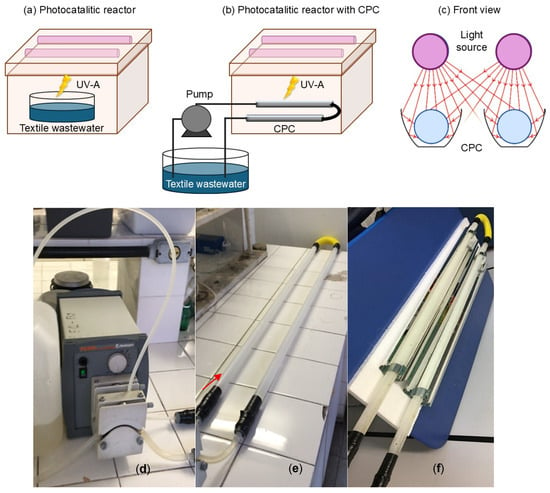
To evaluate the optimal degradation conditions for textile wastewater, a full 22-factorial design was conducted in duplicate. Thus, 50 mL of the effluent was submitted to the photo-Fenton process using radiation from two UV-A lamps (Taschibra TF 40 T-8 IY, 40 W, Indaial, Brazil), with a characteristic wavelength (λ) from 315 nm to 400 nm, 28 cm above the system, composed of an open circular glass flask with a 15 cm diameter (0.28 cm optical path) – see Figure 1a.
Figure 1.
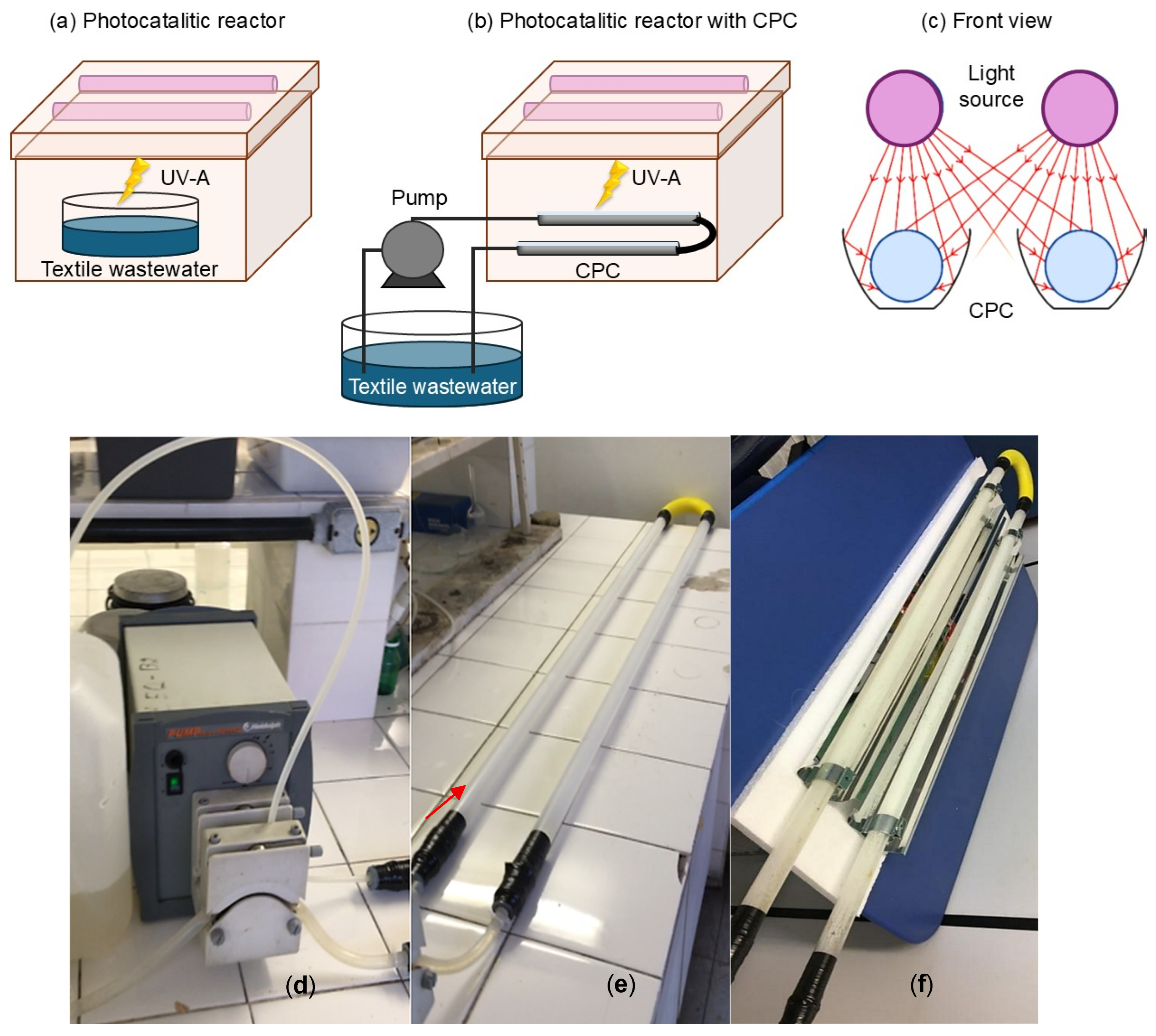
Scheme of the photocatalytic reactor (a), photocatalytic reactor equipped with a compound parabolic concentrator operating in batch mode with recirculation (b), and representation of the frontal view of the source emission in the CPC (c); Photographs of the system containing peristaltic pump and storage tank (d), piping with fluorescent lamps (e), and system with included CPC (f).
Tests were carried out using the real textile wastewater sample collected from the textile mill in a benchtop photocatalytic reactor for 60 min. The initial concentration of hydrogen peroxide ([H2O2]) (Isofar Inc., Bonn, Germany, 30% w/w) used at the lowest level was estimated according to the effluent COD stoichiometry (16 g of reactive oxygen per 34 g of hydrogen peroxide), with values equal to 1323.9 mg∙L−1 (−1), 1985.8 mg∙L−1 (0), and 2647.8 mg∙L−1 (+1). The concentration of ferrous ion ([Fe2+]), added as FeSO4∙7H2O (Dynamic Inc., Guangzhou, China, 99% purity), was evaluated in the values: 5 mg∙L−1 (−1), 10 mg∙L−1 (0), and 15 mg∙L−1 (+1), this being the maximum allowed level of this metal in effluents, according to Brazilian legislation [36].
Notably, the pH was adjusted with a solution of sulfuric acid 0.1 mol∙L−1 to 3.0, which was ideal for Fenton reactions [37]. The degradation of the real textile wastewater samples was evaluated by the COD removal efficiency. A statistical analysis was conducted to better understand the process and determine the optimal working conditions. The main effects and interactions between the factors were verified at the 95% confidence level using Analysis of Variance (ANOVA), via a Pareto diagram and response surface adjustments. A mathematical model was developed to synthesize this result using Equation (1).
I = a0 + a1x1 + a2x2 + a3x1x2
The domains of x1 and x2 were {x Є R/−1 ≤ x ≤ 1}, attributed to [Fe2+] and [H2O2], respectively. Coefficients a0 to a3 are the model coefficients, experimentally determined, and the image (I) represents COD removal efficiency. Removal efficiency (R%) was calculated using Equation (2), where Y0 is the initial value, and Yf is the final value.
The coefficient of determination (R2) was calculated according to analysis of variance [38] and represents the fit of the mathematical model to the experimental data. This coefficient specifies the relationship between the regression sum of squares (Îi − Ī)2 and the total sum of squares (Iij − Ī)2. The percentage of variation explained (or coefficient of determination) was calculated using Equation (3).
where Iij are the experimental values (i level and j repetition), Îi represents the values calculated according to the model, as given by Equation (1), and Ī represents the global average. To evaluate model fit, an F-test was conducted. This test was performed using the total sum of squares (TSS), regression sum of squares (RSS), residual sum of squares (rSS), and the corresponding mean squares [38].
2.3. Phytotoxicity Assays
After determining the optimal Fe2+ and H2O2 concentrations, a toxicity test was conducted using the treated effluent under these conditions. For that, lettuce seeds of the cultivar Lechuga Mesa 659/Lettuce Great Lakes 659 (Great Lakes head lettuce 659), supplied by Feltrin Sementes, were used. Toxicity tests were performed using lettuce seeds of the cultivar Lechuga Mesa 659 (Lactuca sativa L.). The seeds were free of fungicides and pesticides. The analysis consisted of exposing the seeds to 2 mL of untreated or photo-Fenton/UV-A–treated effluent samples. Treated effluent samples were tested at different concentrations (100%, 30%, 10%, 3%, and 1%), and all experiments were performed in duplicate. Moreover, distilled water was used as the negative control, and a 3% boric acid solution as the positive control.
Petri dishes (80 mm diameter, 15 mm depth) lined with quantitative filter paper (125 mm diameter, blue band) were used. Ten seeds were evenly distributed in each dish, followed by the addition of the test solutions. The dishes were covered with aluminum foil to prevent light exposure and moisture loss, identified, and incubated for 120 h at 25 ± 1 °C. After incubation, the number of germinated seeds was recorded, and radicle length was measured using a caliper. The relative growth index (RGI) and germination index (GI) were calculated according to Equations (4) and (5) [39].
where RGI is the relative growth index, CRA is the radicle length in the sample (cm), CRC is the radicle length in the negative control (cm), GI is the germination index (%), SGA is the number of germinated seeds in the sample, and SGC is the total number of seeds.
Tests with negative control germination below 90% were discarded. Radicle growth evaluation considered only germinated seeds, and abnormal effects such as necrosis, discoloration, fungal growth, or abnormal germination were qualitatively assessed.
2.4. Tests in the Photocatalytic Reactor with Compound Parabolic Concentrator
Based on the best concentrations of Fe2+ and H2O2 obtained in the factorial design, the AOP photo-Fenton with two UV-A lamps (TASCHIBRA TF 40 T-8 IY, 40 W) was performed in a photocatalytic reactor with a compound parabolic concentrator (Figure 1b,c), operating in batch with recirculation. The receivers were produced from two reused tubular fluorescent lamps (EMPALUX, FT40216, 36 W, Curitiba, Brazil), with a 2.5 cm diameter and a 118 cm length. The effluent was recirculated using a peristaltic pump (PUMP drive PD5002, Heidolph, Germany). The system operates with a total reaction volume of 2 L, corresponding to the external storage reservoir, and an effluent flow rate of 0.8 L·min−1 under recirculation mode [25].
The geometric concentration ratio (Cg) of the CPC was determined from the ratio between the half-aperture width (a) and the receiver radius (a’). The fluorescent tubular reactor presented a diameter of 2.54 cm, corresponding to a receiver radius of 1.27 cm. The entrance half-aperture was defined as 4.46 cm based on the available parabolic aluminum reflectors. Thus, the geometric concentration ratio was calculated according to Equation (6).
Then, the acceptance angle was subsequently determined according to Equation (7).
Resulting in an acceptance angle of 16.6°, which is consistent with the theoretical CPC design [40]. The truncated CPC had a height-to-aperture ratio of 2.25, yielding a truncated height of 10.04 cm without significantly affecting optical performance.
Experimental sampling was carried out every 1 h for 8 h of treatment to assess the evolution of pollutant degradation with reaction time by spectral scanning analysis using an ultraviolet-visible (UV-Vis) spectrophotometer (Thermo Scientific, Waltham, MA, USA) over wavelengths from 200 to 800 nm. After treatment, analyses were performed to determine the removal of turbidity and color, as well as the conversion of organic matter by COD analysis [5]. The comparison was performed for the system with and without the CPC coupled under identical chemical conditions.
Photographs showing parts that compose the photocatalytic reactor system are exhibited in Figure 1d–f. The lamp system was housed in a rectangular wooden box (dimensions: 149 × 39 × 27.5 cm). The interior of the box was completely lined with aluminum foil to reflect radiation, and it contains two UV-A lamps in the upper part, as depicted in the scheme (Figure 1b).
3. Results and Discussion
3.1. Textile Wastewater Characterization
The characterization of the sample (Table 1) indicates that the wastewater presents noticeable levels of color, turbidity, COD, and BOD5, which may impact receiving water bodies. The COD/BOD5 ratio suggests moderate biodegradability, indicating that while a portion of the organic matter can be biologically degraded, a persistent fraction remains, likely associated with synthetic dyes. This non-biodegradable fraction is important for polluting recipient water systems and for the visual impact of its color. Therefore, a physicochemical post-treatment remains necessary to ensure effective decolorization and the degradation of recalcitrant molecular fragments that biological systems may fail to remove [41,42].
Table 1.
Parameters analyzed in the characterization of effluents.
Evaluating the treatment of real textile wastewater via adsorption with a graphene oxide (GO) suspension, Araujo et al. also observed a COD/BOD5 ratio of >2 (2.68), indicating that only 37% of the pollution was biodegradable, with a considerable level of recalcitrance. Additionally, the authors also observed high apparent color values, around 485 uH, in accordance with the findings of the present study [9].
3.2. Factorial Design
Results of the factorial design study, with the percentage removal of COD from real textile wastewater as the response, via the photo-Fenton UV-A process in a photocatalytic reactor, were analyzed using a “pure error” model. The COD removal depended on hydrogen peroxide and ferrous ions. An ANOVA was performed to assess the effects of these variables, and the results are shown in Table 2.
Table 2.
Analysis of variance to study the effect of varying the working conditions/parameters.
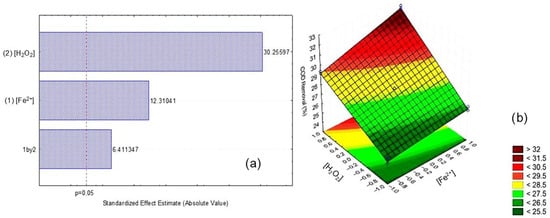
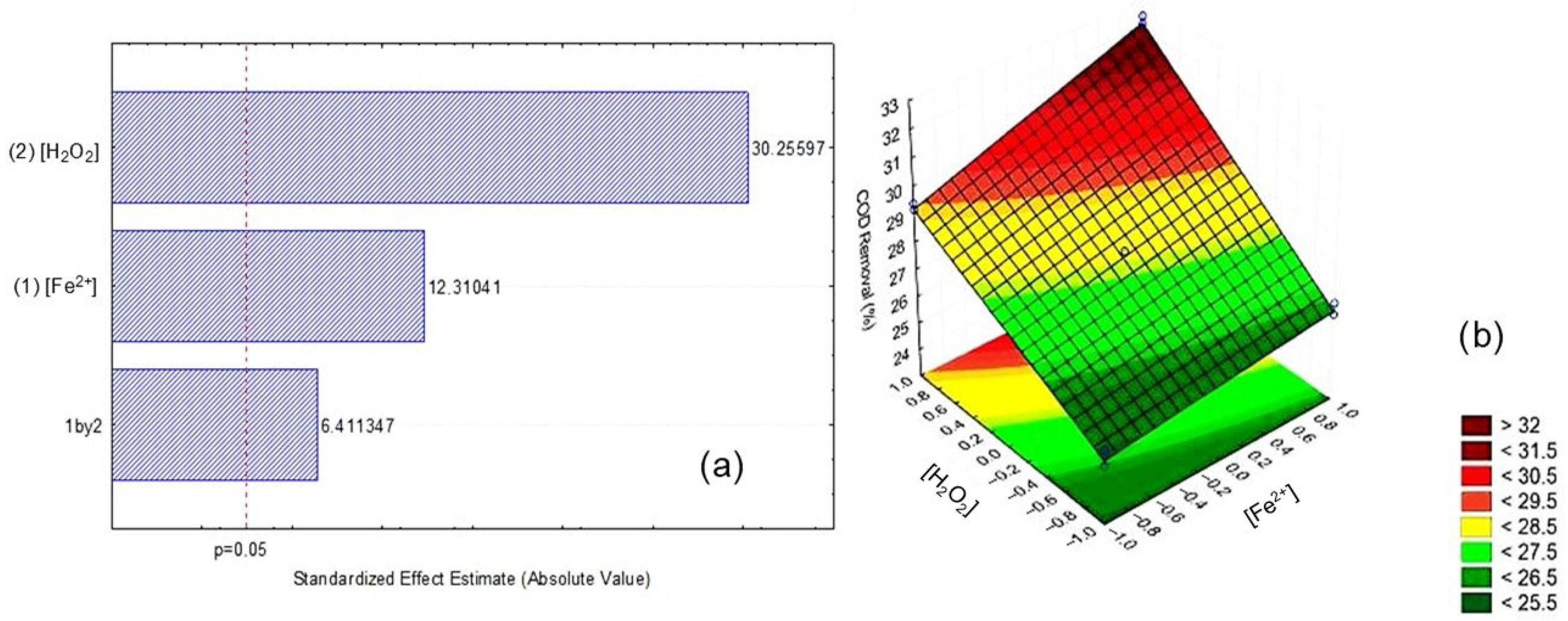
The results indicated that varying the initial concentrations of both ferrous ion and hydrogen peroxide had a statistically significant effect on COD removal from the real textile wastewater sample. Among them, the effect of [H2O2] was the most significant, with a 95% confidence level. It is also observed that the “1 by 2” interaction effect is statistically significant in the removal of COD from the discharge textile effluent. The photo-Fenton process involves many chemical reactions. Probably, the Fenton reaction, hydrogen peroxide photocatalysis, and ferrous ion regeneration occurred simultaneously [43].
The mathematical model describing COD removal in the domain of experimental design is shown in Equation (8).
I = 28.24 + 0.99x1 + 2.44x2 + 0.52x1x2
The domains of x1 and x2 is {x Є R/−1 ≤ x ≤ 1} are attributed to [Fe2+] and [H2O2], respectively. It was observed that this model was statistically significant because F1 (RMS/rMS) was higher than F3,6 (p value 0.05; 188.27 > 4.76). Also, this model was predictive, because F2 (LFMS/PEMS) was less than F1,5 (p value 0.05; 5.46 < 6.61) [38]. The percentage of variation explained was 0.989, very close to 1.00, indicating a satisfactory fit of the model to the experimental data.
According to the Pareto diagram presented in Figure 2a, it is observed that the main and interaction effects of the factors [Fe2+] and [H2O2] were significant in reducing the effluent COD at the 95% confidence level. In addition, according to the response surface (Figure 2b), the highest COD removal (32.3%) was obtained at the highest levels of [Fe2+] and [H2O2]. That is, the best concentrations of H2O2 and Fe2+ in the degradation of the effluent were 2.6478 g·L−1 and 15 mg·L−1, respectively.
Figure 2.
Pareto chart for the experimental design (a) and response surface (b) for the percentage removal of COD by the photo-Fenton UV-A treatment in a photocatalytic reactor.
3.3. Phytotoxicity Assessment
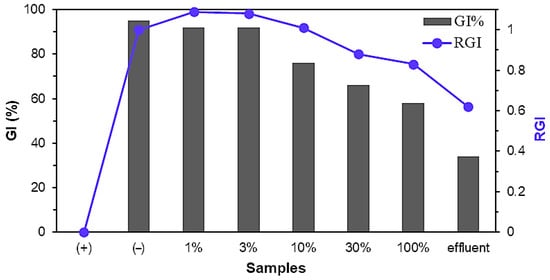
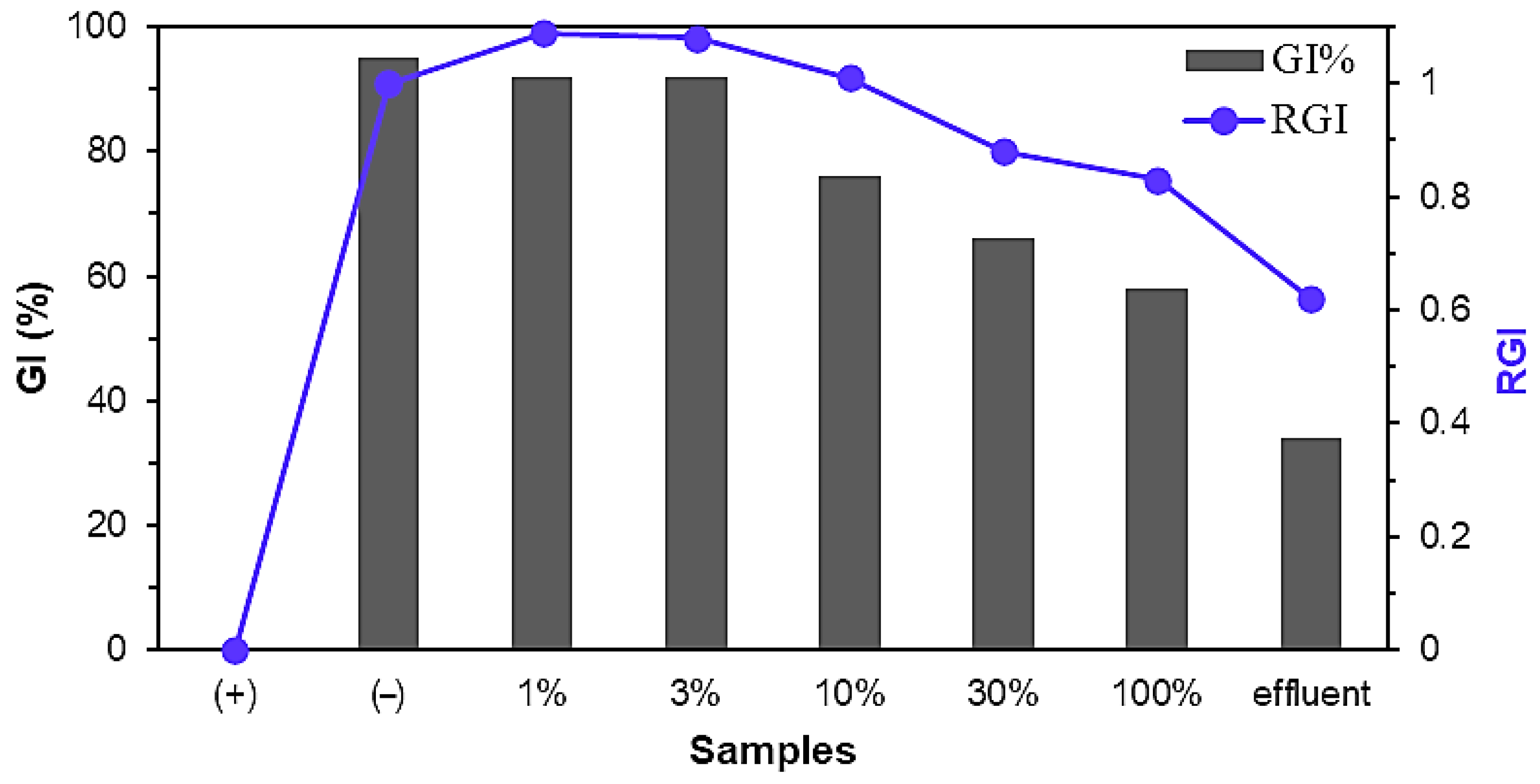
The RGI and GI values, calculated from the number of germinated seeds and the radicle growth measurements, are shown in Figure 3. The phytotoxicity assays for the negative control (distilled water) showed a germination index (GI) of 95%, whereas in the positive control (3% boric acid solution), no seeds germinated. The untreated wastewater exhibited a relative growth index (RGI) of 0.62, indicating inhibition of radicle growth and, consequently, toxicity to Lactuca sativa seeds. In contrast, textile wastewater treated by the photo-Fenton/UV-A process at different concentrations showed RGI values between 0.8 and 1.2, indicating improved effects and reduced toxicity.
Figure 3.
Relative Growth Index (RGI) and Germination Index (GI) of Lactuca sativa seeds exposed to untreated and photo-Fenton/UV-A–treated textile wastewater at different concentrations, including positive control (+) and negative control (−).
Furthermore, the GI value of untreated wastewater was low (34%), confirming its toxic effect on lettuce seeds. After treatment, the GI increased at all tested concentrations, showing no toxic effect. Comparing the GI values between the untreated (34%) and the concentrated treated wastewater (58%), an increase of 71% was observed, reflecting a significant reduction in phytotoxicity.
3.4. Experiments Using the Photocatalytic Reactor with Compound Parabolic Concentrator
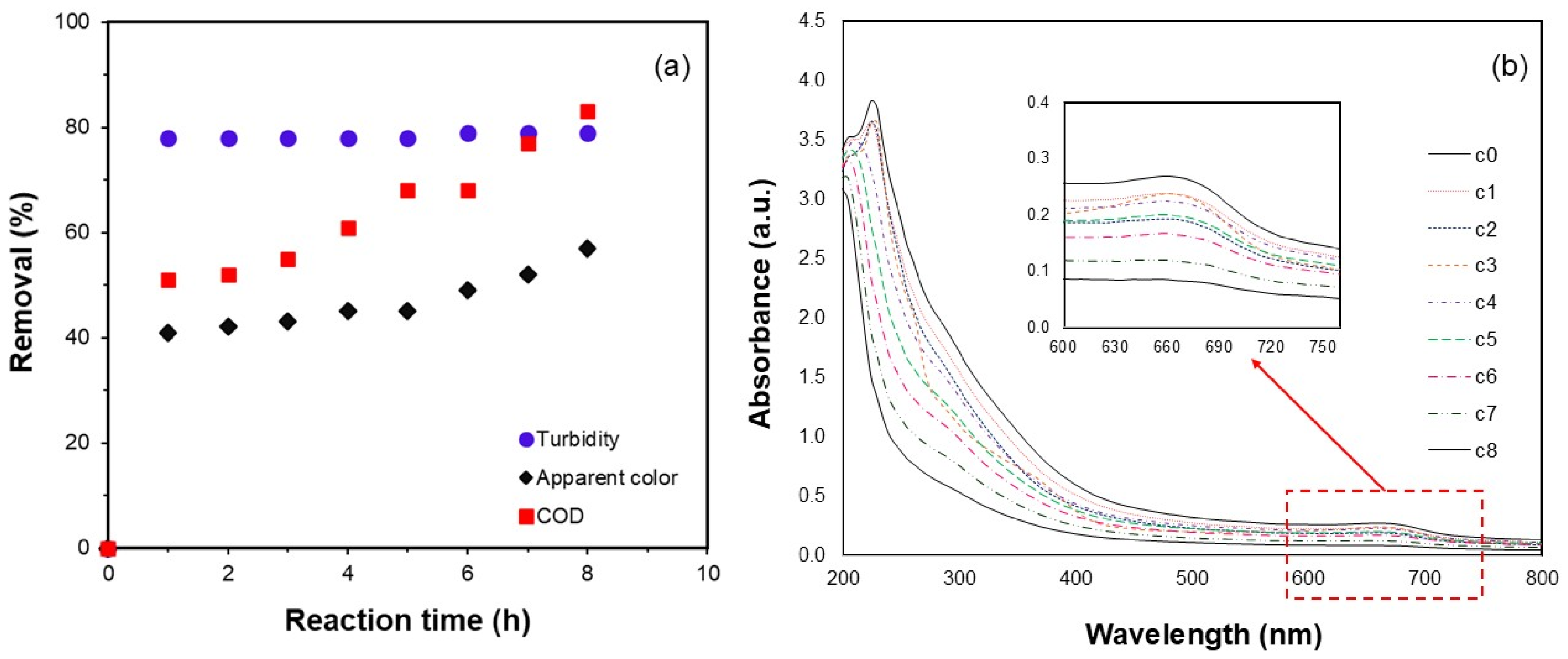
The hydrogen peroxide and ferrous ion concentrations that showed the highest percentage of textile wastewater degradation in the factorial design were applied in the photo-Fenton UV-A process operating in the photocatalytic reactor under recirculation and with the CPC. Results for apparent color, turbidity, and COD removal efficiency over time under these optimal conditions are shown in Figure 4a. Notably, while turbidity % removal reached a plateau within 1 h of the experiment, the apparent color and COD removal continued to rise over the first 8 h.
Figure 4.
Evolution of turbidity, apparent color, and COD efficiency removal values over time, in the textile wastewater, using a photocatalytic reactor with CPC and with recirculation under the optimal working conditions (a); UV-Vis absorption spectra evolution with the treatment time at 0.82 L·min−1 and 25 °C (b).
The evolution of the molecular absorption spectrum with the reaction time is shown in Figure 4b, in which “Ci” corresponds to the effluent spectrum at time “i” of the treatment in hours. A progressive decrease in absorbance over time was observed in the wavelength region between 600 and 700 nm (see the inset in Figure 4b), which is mainly associated with the chromophore groups of the dye molecules. In this case, one should bear in mind that real textile wastewater contains a complex mixture of different organic substances, including dyes, surfactants, softeners, etc. Although the absorption peaks between 600 and 700 nm cannot be attributed to a single dye species, this interval is usually associated with chromophore structures characteristic of textile dyes. On the other hand, non-chromophore organic compounds normally absorb in the UV region. Thus, attenuation in the visible region may indicate degradation of dye chromophores, whereas attenuation in the UV region implies decomposition of aromatic intermediates and other organics. By the end of the process, after 8 h of reaction, there was a 61% reduction in the total area of the absorption curve, compared to the initial “raw” textile wastewater. There was also a reduction in the range between 230 and 290 nm, which can be attributed to the degradation of aromatic hydrocarbons in the molecular structures of the textile dyes in the sample [44].
Results from experiments performed in the bench reactor operating under recirculation mode without CPC were used for comparison with the photo-Fenton system coupled with CPC. The use of the compound parabolic concentrator improved textile wastewater degradation, with a COD removal of 83%, while the process without the CPC at the same conditions and reagent concentrations resulted in a 70% removal, corresponding to an improvement factor of ~1.2, and representing almost 19% of relative increase in treatment efficiency. This can be ascribed to improved photon delivery and the utilization efficiency provided by the CPC geometry, which increases the capture and distribution of radiation on the reactor surface. In this context, the 83% reduction in COD serves as a primary indicator of the organic load degradation. Although TOC analysis was not performed, the substantial decrease in chemical oxygen demand indicates that the organic chromophores were transformed into simpler molecular structures, demonstrating the oxidative capacity of the reused lamp system.
The better exploitation of the lamp emission by using a CPC favors the photo-regeneration of the catalyst (Fe2+), thereby improving the efficiency of the Fenton reaction and increasing the production of hydroxyl radicals. Consequently, there is a significant increase in the degradation of organic matter. In addition, reductions of 79% in turbidity and 57% in apparent color were observed.
The application and effectiveness of the CPC have already been extensively investigated in the literature for the treatment of different wastewaters, including those from the textile industry. Guardiano and coworkers have designed and tested a lab-made solar CPC photoreactor in a heterogeneous solar photo-Fenton process. The photoreactor was also built using recyclable materials, like the present work. However, although the authors achieved a methylene blue (MB) removal efficiency of 98% in only 1 h of solar irradiation, real textile wastewater typically contains multiple target compounds, including various dyes, which can reduce the overall system efficiency [25].
Sanchis et al. investigated the simultaneous application of ozonation and solar photo-Fenton using a CPC composed of a borosilicate tube and parabolic mirrors, which resulted in removal efficiencies greater than 67% for COD, 26% for total nitrogen, and 62% for total organic carbon from raw textile wastewater. These results were achieved in 2 h of reaction, at pH 3, and with low reagent content (10 mg·L−1 of Fe2+) as a result of the combined methods [3].
Starling et al. applied the solar photo-Fenton process using a CPC equipped with borosilicate tubes and aluminum reflectors (20 mg·L−1 of Fe2+, 500 mg·L−1 of H2O2, and pH = 2.8) for the treatment of real textile effluent, obtaining 96% reduction in dissolved organic carbon and 99% reduction in absorbance. In addition, they confirmed the success of reusing wastewater treated during the dyeing and washing stages in the textile industry [29].
Although other studies have presented interesting results regarding the degradation of organic compounds in aqueous media using different degradation methods [45,46], the coupling of a CPC to a photocatalytic reactor has demonstrated significant advantages, especially for wastewater treatment via AOP, with potential to contribute particularly to optimizing the use of solar energy in the future.
In the present study, reused tubular lamps were used as CPC receptor tubes. Thus, in addition to avoiding pollution by disposing of the lamps, which represent serious solid waste, there is the production of a low-cost reactor compared to previous ones reported in the literature. Although the phosphorus present in the lamp reduces the penetration of radiation, in general, effective and viable results were obtained for the treatment of a real textile wastewater sample, thereby complying with the limits established by legislation for wastewater disposal into water bodies.
4. Conclusions
The initial factorial study in a photocatalytic reactor indicated that better conditions were achieved at the highest levels of the study factors, corresponding to Fe2+ and H2O2 concentrations of 15 mg·L−1 and 2647.8 mg·L−1, respectively, yielding an effluent degradation of 32.3%. When applying the best conditions in the photocatalytic reactor equipped with a compound parabolic concentrator, operating with recirculation, a significant improvement in the degradation of the effluent was observed, with degradation efficiencies of 83% of COD, 79% of turbidity, and 57% of apparent color. The significant increase in degradation efficiency demonstrates that the reuse of the lamps for reactor construction improved photon capture and yielded good results in treating the effluent, even with the low concentration of ferrous ions added. Therefore, this study enabled the development of a low-cost photocatalytic reactor and the reuse of what could be solid waste, in this case, used lamps.
Future prospects include performing TOC and BOD5 analyses to further evaluate the mineralization degree and the final biodegradability of the treated effluent. Direct quantification of residual H2O2 will also be included in future works to investigate the oxidant utilization efficiency. Additionally, experiments using sunlight as a radiation source will be conducted due to the high incidence of sunlight throughout the year in the Brazilian Northeast. Analyzing the viability of this approach would reduce energy costs and positively impact the environmental and sustainability aspects of the project.
Author Contributions
Conceptualization, M.B.C., J.V.F.L.C. and M.A.d.M.S.; methodology, M.B.C.; formal analysis, M.B.C., Z.S.B.d.S., C.M.B.d.A. and N.B.V.S.; investigation, M.B.C.; resources, J.V.F.L.C. and M.A.d.M.S.; data curation, M.B.C., Z.S.B.d.S., C.M.B.d.A. and N.B.V.S.; writing—original draft preparation, M.B.C., Z.S.B.d.S., C.M.B.d.A. and N.B.V.S.; writing—review and editing, M.B.C., Z.S.B.d.S., C.M.B.d.A., N.B.V.S., J.V.F.L.C. and M.A.d.M.S.; supervision, J.V.F.L.C. and M.A.d.M.S.; project administration, J.V.F.L.C. and M.A.d.M.S.; funding acquisition, J.V.F.L.C. and M.A.d.M.S. All authors have read and agreed to the published version of the manuscript.
Funding
This research was funded by the Brazilian Government agencies: Conselho Nacional de Desenvolvimento Científico e Tecnológico (CNPq) [Grant numbers 168484/2018-8], and the Coordenação de Aperfeiçoamento de Pessoal de Nível Superior (CAPES); and also by the Fundação de Amparo à Ciência e Tecnologia do Estado de Pernambuco (FACEPE) [Grant numbers IBPG-1008-3.06/19, IBPG-1917-3.06/16, and APQ-1086-3.06/15].
Institutional Review Board Statement
Not applicable.
Data Availability Statement
The original contributions presented in this study are included in the article. Further inquiries can be directed to the corresponding author.
Acknowledgments
I thank the funding agencies from the Brazilian Government, the Department of Chemical Engineering at the Federal University of Pernambuco (UFPE), as well as the Postgraduate Program in Chemical Engineering (PPGEQ) at UFPE.
Conflicts of Interest
The authors declare no conflicts of interest. The funders had no role in the design of the study; in the collection, analyses, or interpretation of data; in the writing of the manuscript; or in the decision to publish the results.
Abbreviations
The following abbreviations are used in this manuscript:
| AOP | Advanced Oxidation Processes |
| a.u. | Arbitrary Unit |
| CPC | Compound Parabolic Concentrator |
| BOD5 | Biochemical Oxygen Demand (5-day period) |
| COD | Chemical Oxygen Demand |
| Df | Degree of freedom |
| GO | Graphene Oxide |
| I | Image |
| Ī | Global mean |
| Îi | Values calculated according to the model |
| Iij | Experimental values (i level and j repetition) |
| LFMS | Lack of fit mean square |
| LFSS | Lack of fit sum of squares |
| MB | Methylene Blue |
| NTU | Nephelometric Turbidity Units |
| PEMS | Pure error mean square |
| PESS | Pure error sum of squares |
| R% | Removal efficiency |
| R2 | Coefficient of determination |
| rMS | Residual mean square |
| RMS | Regression mean square |
| rSS | Residual sum of squares |
| RSS | Regression sum of squares |
| TSS | Total sum of squares |
| uH | Hazen units |
| UV | Ultraviolet radiation |
| UV-A | Near Ultraviolet radiation |
| UV-C | Far Ultraviolet/vacuum Ultraviolet radiation |
| Vis | Visible light |
| Y0 | Initial value of the studied parameter |
| Yf | Final value of the studied parameter |
| λ | Wavelength |
References
- Jamil, T. Role of Advance Oxidation Processes (AOPs) in Textile Wastewater Treatment: A Critical Review. Desalination Water Treat. 2024, 318, 100387. [Google Scholar] [CrossRef] [Scilit]
- Tony, M.A.; Mansour, S.A. Solar Photo-Fenton Reagent with Nanostructured Iron Oxide for Bismarck Dye Oxidation: An Egyptian Apparel Case Study. Int. J. Environ. Sci. Technol. 2020, 17, 1337–1350. [Google Scholar] [CrossRef] [Scilit]
- Sanchis, S.; Meschede-Anglada, L.; Serra, A.; Simon, F.X.; Sixto, G.; Casas, N.; Garcia-Montaño, J. Solar Photo-Fenton with Simultaneous Addition of Ozone for the Treatment of Real Industrial Wastewaters. Water Sci. Technol. 2018, 77, 2497–2508. [Google Scholar] [CrossRef] [Scilit]
- Cetinkaya, S.G.; Morcali, M.H.; Akarsu, S.; Ziba, C.A.; Dolaz, M. Comparison of Classic Fenton with Ultrasound Fenton Processes on Industrial Textile Wastewater. Sustain. Environ. Res. 2018, 28, 165–170. [Google Scholar] [CrossRef] [Scilit]
- de Araujo, C.M.B.; Ghislandi, M.G.; Rios, A.G.; da Costa, G.R.B.; do Nascimento, B.F.; Ferreira, A.F.P.; da Motta Sobrinho, M.A.; Rodrigues, A.E. Wastewater Treatment Using Recyclable Agar-Graphene Oxide Biocomposite Hydrogel in Batch and Fixed-Bed Adsorption Column: Bench Experiments and Modeling for the Selective Removal of Organics. Colloids Surf. A Physicochem. Eng. Asp. 2022, 639, 128357. [Google Scholar] [CrossRef] [Scilit]
- Fraga, T.J.M.; Ghislandi, M.G.; Carvalho, M.N.; da Motta Sobrinho, M.A. One Step Forward: How Can Functionalization Enhance the Adsorptive Properties of Graphene towards Metallic Ions and Dyes? Environ. Res. 2020, 184, 109362. [Google Scholar] [CrossRef] [Scilit] [PubMed]
- do Nascimento, G.F.O.; da Costa, G.R.B.; de Araújo, C.M.B.; Ghislandi, M.G.; da Motta Sobrinho, M.A. Graphene-Based Materials Production and Application in Textile Wastewater Treatment: Color Removal and Phytotoxicity Using Lactuca sativa as Bioindicator. J. Environ. Sci. Health Part A 2020, 55, 97–106. [Google Scholar] [CrossRef] [Scilit]
- Carvalho, M.N.; Fraga, T.J.M.; de Lima, L.E.M.; Freire, E.M.P.d.L.; Ghislandi, M.G.; da Motta, M.A.; de Souza, Z.S.B. Amino-Fe3O4-Functionalized Graphene Oxide as a Novel Adsorbent of Methylene Blue: Kinetics, Equilibrium, and Recyclability Aspects. Environ. Sci. Pollut. Res. 2019, 26, 28593–28602. [Google Scholar] [CrossRef] [Scilit]
- de Araújo, C.M.B.; do Nascimento, G.F.O.; da Costa, G.R.B.; Baptisttella, A.M.S.; Fraga, T.J.M.; de Assis Filho, R.B.; Ghislandi, M.G.; da Motta Sobrinho, M.A. Real Textile Wastewater Treatment Using Nano Graphene-Based Materials: Optimum PH, Dosage, and Kinetics for Colour and Turbidity Removal. Can. J. Chem. Eng. 2020, 98, 1429–1440. [Google Scholar] [CrossRef] [Scilit]
- Ahsan, A.; Jamil, F.; Rashad, M.A.; Hussain, M.; Inayat, A.; Akhter, P.; Al-Muhtaseb, A.H.; Lin, K.Y.A.; Park, Y.K. Wastewater from the Textile Industry: Review of the Technologies for Wastewater Treatment and Reuse. Korean J. Chem. Eng. 2023, 40, 2060–2081. [Google Scholar] [CrossRef] [Scilit]
- Lellis, B.; Fávaro-Polonio, C.Z.; Pamphile, J.A.; Polonio, J.C. Effects of Textile Dyes on Health and the Environment and Bioremediation Potential of Living Organisms. Biotechnol. Res. Innov. 2019, 3, 275–290. [Google Scholar] [CrossRef] [Scilit]
- Tian, Q.; Ran, M.; Fang, G.; Ding, L.; Pan, A.; Shen, K.; Deng, Y. ZnAl2O4/BiPO4 Composites as a Heterogeneous Catalyst for Photo-Fenton Treatment of Textile and Pulping Wastewater. Sep. Purif. Technol. 2020, 239, 116574. [Google Scholar] [CrossRef] [Scilit]
- Jagaba, A.H.; Kutty, S.R.M.; Isa, M.H.; Ghaleb, A.A.S.; Lawal, I.M.; Usman, A.K.; Birniwa, A.H.; Noor, A.; Abubakar, S.; Umaru, I.; et al. Toxic Effects of Xenobiotic Compounds on the Microbial Community of Activated Sludge. ChemBioEng Rev. 2022, 9, 497–535. [Google Scholar] [CrossRef] [Scilit]
- Hama Aziz, K.H.; Mustafa, F.S.; Omer, K.M.; Hama, S.; Hamarawf, R.F.; Rahman, K.O. Heavy Metal Pollution in the Aquatic Environment: Efficient and Low-Cost Removal Approaches to Eliminate Their Toxicity: A Review. RSC Adv. 2023, 13, 17595–17610. [Google Scholar] [CrossRef] [Scilit] [PubMed]
- Kolya, H.; Kang, C.-W. Toxicity of Metal Oxides, Dyes, and Dissolved Organic Matter in Water: Implications for the Environment and Human Health. Toxics 2024, 12, 111. [Google Scholar] [CrossRef] [Scilit]
- Peng, S.; Wang, Z.; Li, L.; Ai, J.; Li, L.; Liao, G.; Wang, D.; Peng, S.; Zhang, W. Molecular Dynamic Modeling of EPS and Inorganic/Organic Flocculants during Sludge Dual Conditioning. Sci. Total Environ. 2024, 906, 167719. [Google Scholar] [CrossRef] [Scilit]
- Ahmed, S.F.; Mehejabin, F.; Momtahin, A.; Tasannum, N.; Faria, N.T.; Mofijur, M.; Hoang, A.T.; Vo, D.-V.N.; Mahlia, T.M.I. Strategies to Improve Membrane Performance in Wastewater Treatment. Chemosphere 2022, 306, 135527. [Google Scholar] [CrossRef] [Scilit]
- Zulkefli, N.F.; Alias, N.H.; Jamaluddin, N.S.; Abdullah, N.; Abdul Manaf, S.F.; Othman, N.H.; Marpani, F.; Mat-Shayuti, M.S.; Kusworo, T.D. Recent Mitigation Strategies on Membrane Fouling for Oily Wastewater Treatment. Membranes 2021, 12, 26. [Google Scholar] [CrossRef] [Scilit]
- Baskar, A.V.; Bolan, N.; Hoang, S.A.; Sooriyakumar, P.; Kumar, M.; Singh, L.; Jasemizad, T.; Padhye, L.P.; Singh, G.; Vinu, A.; et al. Recovery, Regeneration and Sustainable Management of Spent Adsorbents from Wastewater Treatment Streams: A Review. Sci. Total Environ. 2022, 822, 153555. [Google Scholar] [CrossRef] [Scilit]
- Kasemodel, M.C.; Rodrigues, V.G.S.; Farah Silva, J.M.R.; Vallim, B.S.C.; Romão, É.L. Investigation of Methylene Blue Removal from Aqueous Solutions Using Biochar Derived from Mango and Pitanga Pruning Waste. Colorants 2025, 4, 28. [Google Scholar] [CrossRef] [Scilit]
- Priyadarshini, M.; Das, I.; Ghangrekar, M.M.; Blaney, L. Advanced Oxidation Processes: Performance, Advantages, and Scale-up of Emerging Technologies. J. Environ. Manag. 2022, 316, 115295. [Google Scholar] [CrossRef] [Scilit] [PubMed]
- Zúñiga-Benítez, H.; Peñuela, G.A. Application of Solar Photo-Fenton for Benzophenone-Type UV Filters Removal. J. Environ. Manag. 2018, 217, 929–938. [Google Scholar] [CrossRef] [Scilit]
- Fenton, H.J.H. LXXIII.—Oxidation of Tartaric Acid in Presence of Iron. J. Chem. Soc. Trans. 1894, 65, 899–910. [Google Scholar] [CrossRef] [Scilit]
- Giannakis, S. A Review of the Concepts, Recent Advances and Niche Applications of the (Photo) Fenton Process, beyond Water/Wastewater Treatment: Surface Functionalization, Biomass Treatment, Combatting Cancer and Other Medical Uses. Appl. Catal. B Environ. 2019, 248, 309–319. [Google Scholar] [CrossRef] [Scilit]
- Guardiano, M.G.; Silva, Y.S.E.; Gimenes, R.; de Andrade, S.J.; Kondo, M.M.; da Silva, M.R.A. Continuous-Flow Solar Heterogeneous Photo-Fenton Process in a Lab-Made Low-Cost CPC Photoreactor for Efficient Dye Degradation. ACS Omega 2025, 10, 32216–32225. [Google Scholar] [CrossRef] [Scilit] [PubMed]
- Cabrera-Reina, A.; Miralles-Cuevas, S.; Rivas, G.; Sánchez Pérez, J.A. Comparison of Different Detoxification Pilot Plants for the Treatment of Industrial Wastewater by Solar Photo-Fenton: Are Raceway Pond Reactors a Feasible Option? Sci. Total Environ. 2019, 648, 601–608. [Google Scholar] [CrossRef] [Scilit] [PubMed]
- Talwar, S.; Verma, A.K.; Sangal, V.K.; Štangar, U.L. Once through Continuous Flow Removal of Metronidazole by Dual Effect of Photo-Fenton and Photocatalysis in a Compound Parabolic Concentrator at Pilot Plant Scale. Chem. Eng. J. 2020, 388, 124184. [Google Scholar] [CrossRef] [Scilit]
- Zúñiga-Benítez, H.; Muñoz-Calderón, A.; Peñuela, G.A. Removal of a Mix of Benzophenones and Parabens Using Solar Photo-Fenton and a Cylinder Parabolic Collector in Aqueous Solutions. J. Environ. Chem. Eng. 2018, 6, 7347–7357. [Google Scholar] [CrossRef] [Scilit]
- Starling, M.C.V.M.; dos Santos, P.H.R.; de Souza, F.A.R.; Oliveira, S.C.; Leão, M.M.D.; Amorim, C.C. Application of Solar Photo-Fenton toward Toxicity Removal and Textile Wastewater Reuse. Environ. Sci. Pollut. Res. 2017, 24, 12515–12528. [Google Scholar] [CrossRef] [Scilit]
- Asdrubali, F.; Desideri, U. High Efficiency Plants and Building Integrated Renewable Energy Systems. In Handbook of Energy Efficiency in Buildings: A Life Cycle Approach; Elsevier: Amsterdam, The Netherlands, 2019; pp. 441–595. [Google Scholar]
- Jiang, C.; Yu, L.; Yang, S.; Li, K.; Wang, J.; Lund, P.D.; Zhang, Y. A Review of the Compound Parabolic Concentrator (CPC) with a Tubular Absorber. Energies 2020, 13, 695. [Google Scholar] [CrossRef] [Scilit]
- Rizzo, L. Addressing Main Challenges in the Tertiary Treatment of Urban Wastewater: Are Homogeneous Photodriven AOPs the Answer? Environ. Sci. Water Res. Technol. 2022, 8, 2145–2169. [Google Scholar] [CrossRef] [Scilit]
- Martín-Sómer, M.; Moreno-SanSegundo, J.; Álvarez-Fernández, C.; van Grieken, R.; Marugán, J. High-Performance Low-Cost Solar Collectors for Water Treatment Fabricated with Recycled Materials, Open-Source Hardware and 3d-Printing Technologies. Sci. Total Environ. 2021, 784, 147119. [Google Scholar] [CrossRef] [Scilit] [PubMed]
- Vázquez-Dávila, F.; López-Álvarez, M.Á.; Ortega-Gudiño, P.; Neri-Cortés, C. Visible-Light Photocatalytic Degradation of Synthetic Dyes Using Spinel-Type CoMn2O4: Environmental Relevance and Human Water Rights Perspective. Colorants 2025, 4, 36. [Google Scholar] [CrossRef] [Scilit]
- American Public Health Association. Standard Methods for the Examination of Water and Wastewater, 22nd ed.; American Public Health Association (APHA): Washington, DC, USA, 2012; ISBN 9780875530130. [Google Scholar]
- CONSELHO NACIONAL DO MEIO AMBIENTE—CONAMA Efluentes. Diário Oficial de União, Resolution No. 357/2005. Dated 17 March 2005. Available online: https://anmlegis.datalegis.net/action/TematicaAction.php?acao=abrirVinculos&cotematica=10060589&cod_menu=6783&cod_modulo=405 (accessed on 5 March 2026).
- Nidheesh, P.V. Heterogeneous Fenton Catalysts for the Abatement of Organic Pollutants from Aqueous Solution: A Review. RSC Adv. 2015, 5, 40552–40577. [Google Scholar] [CrossRef] [Scilit]
- Barros Neto, B.; Scarminio, I.S.; Bruns, R.E. Como Fazer Experimentos. In Pesquisa e Desenvolvimento na Ciência e na Indústria, 4th ed.; Bookman: Porto Alegre, Brazil, 2010; ISBN 9788577807130. [Google Scholar]
- Young, B.J.; Riera, N.I.; Beily, M.E.; Bres, P.A.; Crespo, D.C.; Ronco, A.E. Toxicity of the Effluent from an Anaerobic Bioreactor Treating Cereal Residues on Lactuca sativa. Ecotoxicol. Environ. Saf. 2012, 76, 182–186. [Google Scholar] [CrossRef] [Scilit]
- Duffie, J.A.; Beckman, W.A. Solar Engineering of Thermal Processes; John Wiley & Sons: Hoboken, NJ, USA, 2013. [Google Scholar]
- Rudaru, D.G.; Lucaciu, I.E.; Fulgheci, A.M. Correlation between BOD5 and COD—Biodegradability Indicator of Wastewater. Rom. J. Ecol. Environ. Chem. 2022, 4, 80–86. [Google Scholar] [CrossRef] [Scilit]
- Dinçer, A.R. Increasing BOD5/COD Ratio of Non-Biodegradable Compound (Reactive Black 5) with Ozone and Catalase Enzyme Combination. SN Appl. Sci. 2020, 2, 736. [Google Scholar] [CrossRef] [Scilit]
- Stefan, M.I. Advanced Oxidation Processes for Water Treatment—Fundamentals and Applications. Water Intell. Online 2017, 16, 9781780407197. [Google Scholar] [CrossRef] [Scilit]
- Cho, I.-H.; Zoh, K.-D. Photocatalytic Degradation of Azo Dye (Reactive Red 120) in TiO2/UV System: Optimization and Modeling Using a Response Surface Methodology (RSM) Based on the Central Composite Design. Dye. Pigment. 2007, 75, 533–543. [Google Scholar] [CrossRef] [Scilit]
- Ye, F.; Qian, J.; Xia, J.; Li, L.; Wang, S.; Zeng, Z.; Mao, J.; Ahamad, M.; Xiao, Z.; Zhang, Q. Efficient Photoelectrocatalytic Degradation of Pollutants over Hydrophobic Carbon Felt Loaded with Fe-Doped Porous Carbon Nitride via Direct Activation of Molecular Oxygen. Environ. Res. 2024, 249, 118497. [Google Scholar] [CrossRef] [Scilit]
- Ye, F.; Liu, Y.; Lv, Q.; Gao, B.; Xia, J.; Li, X.; Dou, M.; Zhao, K.; Ahmad, M.; Xiao, Z.; et al. Unveiling the Mechanism of Efficient Detoxification by Pd Species in Chlorinated Pollutant Degradation. Chin. Chem. Lett. 2026, 37, 111136. [Google Scholar] [CrossRef] [Scilit]

Disclaimer/Publisher’s Note: The statements, opinions and data contained in all publications are solely those of the individual author(s) and contributor(s) and not of MDPI and/or the editor(s). MDPI and/or the editor(s) disclaim responsibility for any injury to people or property resulting from any ideas, methods, instructions or products referred to in the content. |
© 2026 by the authors. Licensee MDPI, Basel, Switzerland. This article is an open access article distributed under the terms and conditions of the Creative Commons Attribution (CC BY) license.