


Highlights
What are the main findings?
- Replacing fine aggregate with rubber in concrete decreases its strength but increases its ductility and energy absorption capacity.
- Replacing 10% of the fine aggregate with recycled rubber by volume is the optimal percentage to avoid excessive loss of mechanical strength and ductility.
- Confinement of concrete with recycled rubber using FRP significantly improves its strength and ductility, modifying the material’s failure mode.
- Confinement of concrete with rubber using CFRP provides greater effectiveness than with BFRP, due to the greater stiffness of the carbon fiber.
What are the implications of these findings?
- Rubberized concrete can be used in applications requiring impact resistance and vibration damping.
- FRP confinement enables the structural use of higher rubber contents.
- CFRP is more suitable than BFRP when maximum mechanical performance is required.
- The interaction between rubber and FRP must be considered in structural design.
- Supports development of more sustainable and ductile concrete systems.
Abstract
This research aims to study the compressive behavior of concrete with partial replacement of fine aggregate by recycled rubber. In addition, the mechanical capacity of these concretes will be analyzed when reinforced by carbon fibers (CFRP) and basalt (BFRP) confinement. To carry out the work, 48 cylindrical test specimens were made, corresponding to 4 mixes, with different percentages of recycled rubber by volume (0%, 10%, 20%, and 30%). The compressive behavior of unreinforced concrete with and without recycled rubber, reinforced concrete made from concrete with and without recycled rubber previously taken to failure, and reinforced concrete with and without recycled rubber without prior failure were evaluated in order to assess the influence of concrete quality before placing the reinforcement. The results show that replacing fine aggregate with recycled rubber in concrete reduces its strength and stiffness, increasing its ductility, with the optimum replacement percentage being 10%. On the other hand, confining concrete with FRP (BFRP and CFRP) improves its strength and ductility compared to unconfined concrete, obtaining similar values regardless of the initial strength of the reinforcing concrete. Confining concrete with CFRP achieves strength improvements of 26% compared to reinforcement with BFRP.
1. Introduction
Concrete is the most widely used structural material in civil engineering and construction because it is highly versatile, allowing for the construction of structural elements with complex geometries, as well as achieving high compressive strength. However, its tensile strength is limited, and to overcome this limitation, it is combined with steel to form reinforced concrete, as steel is a material that works well under tension [1,2].
Due to growing concern about global climate change, it is necessary to promote sustainable practices. The construction sector is one of the main contributors to greenhouse gas emissions. Between 8% and 10% of global CO2 emissions come from cement production, which releases approximately 750 kg of CO2 per ton of cement [3,4].
The growing demand for concrete driven by urbanization and industrialization increases pressure on natural resources. To address these challenges, one viable approach is to use recycled materials, including ground tire rubber (GTR), as an alternative to natural fine aggregates in concrete production [3,5,6].
In Spain, 300,000 tons of tires are discarded every year; in Europe, 3.5 million tons; and worldwide, 25 million tons. The improper disposal of tires raises significant environmental concerns and poses a risk to human health [6,7,8,9,10,11].
In Spain, waste management is regulated by Royal Decree 712/2025 [12], which promotes waste reduction, reuse, recycling, and other forms of recovery in order to protect the environment and move towards a circular economy [5,13,14]. The five typical stages of the tire life cycle are: extraction, production, consumption, tire collection, and used tire management. The next step is recovery for other uses or disposal in landfills [7,15,16].
Tire recycling helps to preserve the environment, save energy, optimize resources, and contribute to the circular economy, and it has promoted the use of GTR in engineering applications [6]. Some examples of applications in engineering include the construction of bituminous road surfaces, safety pavements, artificial turf (for playgrounds and sports fields), continuous pavements, acoustic and impact noise insulation, porous concrete, roads, roofing materials, and industrial applications, among others [6,7,17,18,19].
Rubber concrete (RuC) is a type of concrete with recycled rubber used as a partial replacement for fine aggregate. It offers advantages such as improved energy absorption, lightness, impact resistance, and thermal insulation [7,18,20,21,22,23,24].
Eldin and Senouci first investigated concrete with natural aggregates partially replaced by ground tire rubber (GTR) in 1993, reporting reduced workability, compressive and tensile strength, and increased toughness due to poor adhesion between rubber particles and the cement matrix [9]. Subsequent studies confirmed that both the size and content of rubber significantly influence mechanical performance, with larger particles increasing internal friction and reducing workability [25,26,27,28], and higher replacement ratios leading to substantial strength losses—up to 85% in compression and 50% in tension—as well as reductions in elastic modulus [9,25,29]. Furthermore, the reduction in mechanical performance is associated with weak interfacial bonding between rubber particles and the cement matrix and with premature lateral dilation, which significantly modifies the stress–strain response compared to conventional concrete [30,31]. Despite these drawbacks, some authors have identified optimal substitution levels around 10–15%, which can provide a balance between mechanical performance and durability-related properties [6,26].
The mechanical behavior of GTR concrete is also influenced by the treatment applied to the rubber particles. Various surface treatments, including water washing, acid treatments, and chemical or thermal modifications, have been shown to improve the interfacial bond and partially mitigate strength losses, with their effectiveness depending on the level of rubber substitution [7].
In this context, confinement techniques become particularly relevant for rubberized concrete. Compared to conventional concrete, rubberized concrete exhibits higher deformability and earlier lateral expansion, which leads to earlier activation of external confinement and may enhance confinement efficiency [30,31].
Due to the ageing of the building stock, the reinforcement and rehabilitation of structures is essential. The reinforcement of concrete structures may be necessary for various reasons, including change of use of the building, or earthquake or deterioration due to various pathologies [27,28,29,30,31,32]. There are different ways to reinforce concrete structures; fiber-reinforced polymers (FRP) have emerged as an effective solution, with the use of this type of reinforcement becoming increasingly common for the confinement of circular columns [27,28,33,34,35].
The application of reinforcement techniques using polymers and polymer composites began at the end of the Second World War in the aerospace sector. However, it was not used in the construction and infrastructure sector until the late 1980s. The first practical applications took place in Switzerland, with the aim of increasing the flexural load-bearing capacity of reinforced concrete bridges. The pilot test was carried out in 1991 on the Ibach Bridge in Lucerne (Switzerland) [28,36]. In Spain, this technique began to be used to reinforce the beams of the Dragó bridge deck in Barcelona [37,38]. Initially, these types of reinforcements were carried out using the Hermite method, which consisted of adhering steel plates with epoxy in the positions of the beam where the amount needed to be increased [37,39].
Fiber-reinforced polymer (FRP) is a composite material made of fiber impregnated with resin and manufactured using a special process [40,41]. FRPs, particularly those made from carbon fiber and fiberglass, are increasingly used in a variety of applications due to their excellent mechanical properties, such as high tensile strength, corrosion resistance, high temperature resistance, and durability, in addition to their light weight, non-conductive nature, durability over time and, above all, ease of handling, transport, and application [27,34,42,43,44,45,46,47,48,49].
The effectiveness of FRP confinement depends, among other factors, on the confinement ratio, geometry, h/b ratio, and strength of the unconfined concrete. Tests carried out on cylindrical specimens showed better performance than those carried out on prismatic specimens, as the stresses are distributed evenly and are not concentrated in the corners, causing premature failure [27,50,51].
In recent years, numerous research projects on the behavior of different types of FRP reinforcement have been carried out [43,52,53,54,55,56,57,58]. There are numerous studies on the compressive behavior of concrete columns confined with FRP under axial compression [59,60,61,62,63]. Many research studies conclude that composite materials are effective in increasing the strength of concrete, as fiber-reinforced polymers significantly improve the strength and maximum stress of confined concrete, with higher levels of confinement resulting in greater final strength [27,44,50,64,65,66,67,68].
However, most of these studies are focused on conventional concrete, and their direct applicability to rubberized concrete remains uncertain, as the presence of rubber significantly modifies dilation behavior, stiffness degradation, and confinement effectiveness [30,31].
Studies such as that by Zhao et al. [69] have investigated carbon fiber-reinforced polymers (CFRP) confined concrete under high temperatures, showing that CFRP confinement can significantly enhance the compressive strength of heat-damaged concrete; moreover, its effectiveness increases with the level of thermal damage, while differences between the number of CFRP layers become less pronounced.
Other researchers have focused on the prediction and evaluation of compressive strength and deformation. For instance, Turgay et al. [70] compared experimental results from CFRP-confined cylindrical specimens to assess five analytical models, considering different numbers of layers [68]. Similarly, Ozbakkaloglu and Lim [61] reviewed experimental data from 1991 to 2013, focusing on various fiber types to evaluate the deformation reduction factor.
Beyond CFRP, Baasankhuu et al. [71] analyzed concrete confinement using different fiber types, including basalt (BFRP) and polyethylene naphthalate (PEN FRP), reporting compressive strengths 1.4–2.5 times higher than unconfined concrete with 2–6 layers of BFRP and 1–3 layers of PEN FRP.
Realfonzo and Napoli [72] analyzed cylindrical concrete specimens confined with different fiber types, statistically evaluating the influence of fiber type and unconfined concrete strength through the deformation efficiency factor (kε). Comparison with previous studies, such as Lam and Teng [60,73], showed significant dispersion, with average kε values of 0.586 for CFRP and 0.624 for GFRP.
The differences between FRP materials mainly depend on the properties of the fibers used. Fibers have unique properties, including lightness, high strength, low electromagnetic and thermal conductivity, corrosion resistance, and good thermal resistance [74]. Although carbon fibers (CFRP) provide much greater strength, modulus of elasticity, and fatigue resistance as well as good corrosion resistance, they are associated with relatively limited deformability, especially when compared to other fibers [34]. Basalt fibers (BFRP) have excellent properties, such as high tensile strength, high modulus of elasticity, good impact resistance, thermal stability, electrical insulation, alkali resistance, and radiation resistance [75,76,77].
Despite extensive research on FRP-confined concrete and rubberized concrete, limited studies have addressed their combined behavior. Youssf et al. [78] investigated specimens with 0–50% rubber content confined with 1–3 CFRP layers, finding that confinement compensates for strength loss, preserves ductility, and increases impact resistance by up to 3.5 times. Similarly, Chan et al. [25] studied specimens with 0–75% rubber, both unconfined and confined with 2–6 GFRP layers, concluding that rubber replacement has limited effect on strength but improves the relationship between confined and unconfined concrete. Overall, these studies show that FRP confinement mitigates the mechanical property reductions caused by rubber incorporation [22,78].
Based on previous research, the objective of the study is to analyze the behavior of concrete with fine aggregate replaced by recycled rubber in different percentages, when reinforced with two types of FRP materials: carbon fiber (CFRP) and basalt fiber (BFRP).
2. Experimental Program
For the experimental development of the work, compression tests were carried out on concretes with different characteristics, in accordance with standard EN 12390-1:2022 [79]. Four mixes were made, with different percentages of replacement of natural fine aggregate with recycled rubber from ELVs. The work was carried out in three phases: in the first phase, the compressive behavior of concrete with and without rubber from ELVs was evaluated; in the second phase, the compressive behavior of concrete specimens with and without rubber that had been taken to failure was evaluated but reinforced by FRP confinement. In the third phase, we studied the compressive behavior of concrete with and without rubber, reinforced by FRP confinement, but without prior breakage.
In this study, ground tire rubber (GTR) was used as a partial substitute for natural fine aggregate in percentages of 0%, 10%, 20%, and 30% by volume. The material consisted of a bimodal mixture of 2 mm and 4 mm particles in equal parts, with the aim of improving granular packing and reducing intergranular porosity. The combination of sizes favors a more uniform distribution of vacancies, which helps to mitigate the loss of mechanical strength typically observed in concrete with coarse-grained rubber [80]. Several authors point out that particles smaller than 1 mm increase water demand and entrap air, while fractions between 1–4 mm offer a better balance between workability and mechanical performance [81].
The substitution percentages adopted (10%, 20%, and 30%) were selected based on the literature review. Considering that, it is recommended not to replace more than 20% of the total aggregates with GTR due to the significant loss of strength that occurs, and thus it was concluded that 10% is considered the optimal replacement threshold to maintain acceptable strength without compromising durability; higher levels (20–30%) allow the influence of rubber on physical and durability properties to be explored, at the cost of a progressive reduction in compressive strength [14,24,78].
Overall, the choice of a mixture with 2 mm and 4 mm rubber and the established replacement levels allow us to study the combined effect of particle size and volumetric content on concrete properties, following the latest trends in the literature on sustainable concrete with recycled aggregates from GTR.
2.1. Materials
The following materials were used to manufacture test specimens:
- Portland cement (CEM I 52.5 R SR 5). It mainly contains clinker (95–100%) and 0–5% minor components such as natural mineral materials or clinker derivatives, complying with standards EN 197-1:2011 [82] and EN 197-2:2020 [83].
- Two types of aggregate: coarse siliceous river aggregate with a maximum size of 12 mm and fine siliceous aggregate with a maximum size of 4 mm, complying with standard EN 12620:2003+1:2009 [84].
- Water from the Canal Isabel II water infrastructure in Madrid, which meets the technical requirements for concrete production.
- Granulated rubber, obtained from the recycling of ground tire rubber (GTR), in two sizes, 2 mm and 4 mm, using both sizes in equal proportions in each mix.
- High-activity superplasticizer/water reducer based on polycarboxylates, complying with the requirements of standard EN 934-2:2010+A1:2012 [85].
Table 1 shows the physical and chemical characteristics of the materials used in concrete mixes.
Table 1.
Physical and chemical characteristics of the materials.
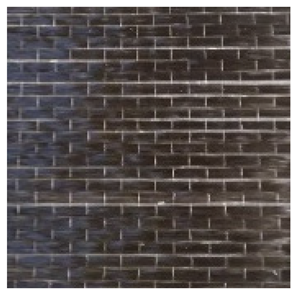
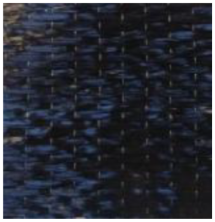
Two types of fabric were used to confine the test specimens: B UNI-AX 400 basalt fiber (BFRP) and C UNI-AX 300 carbon fiber (CFRP). Table 2 shows the appearance of each type of fiber and its geometric and mechanical characteristics, where “e” is the equivalent thickness of the fabric, “σr” is the tensile stress, “E” is the longitudinal modulus of elasticity, and “εfu” is the unit of longitudinal deformation.
Table 2.
Fiber properties.
A two-component epoxy adhesive with a 4:1 ratio (400 g of resin and 100 g of hardener) was used to bond the fiber to the substrate. Once hardened, this adhesive acquires optimal dielectric properties and high mechanical strength. The epoxy adhesive used complies with standard EN 1504-4:2005 [86].
2.2. Experimental Process
To achieve the objective of this research, 48 cylindrical test specimens were manufactured using four different concrete mixes, corresponding to 0%, 10%, 20%, and 30% replacement of fine aggregate by volume with recycled rubber. The mix proportions are presented in Table 3.
Table 3.
Dosage used in each mix.
From each mix, the test specimens were divided into two groups. One group of test specimens was tested in unconfined conditions until failure and then subsequently strengthened using external confinement with carbon or basalt fiber reinforcement. The second group of test specimens was directly strengthened with carbon or basalt fiber without prior loading and then tested under axial compression until failure. The nomenclature of the test specimens can be seen in Table 4.
Table 4.
Test specimens nomenclature.
Before concrete production, all materials (cement, aggregates, rubber, and water) were stored in the laboratory for 24 h to ensure stable environmental conditions. Coarse aggregate was sieved using a mechanical sieve to eliminate particles larger than 12 mm. All constituents were weighed separately using an industrial scale and a precision digital balance, depending on the required accuracy.
Concrete mixing was carried out using an IBERTEST IB32-040V0 vertical shaft planetary mixer. Dry materials were first homogenized for 2 min. Water and plasticizer were then added, and the mixture was further mixed for 5 min to ensure uniform consistency.
The test specimens were cast in cylindrical steel molds with dimensions of 100 mm diameter and 200 mm height, in accordance with EN 12390-1:2022 [77]. The concrete was placed in three layers and compacted between each layer following EN 12390-2:2020 [81].
After casting, the test specimens were stored for 24 h at room temperature (23 ± 3 °C) and a relative humidity of 60%. They were then demolded and cured in a controlled chamber at 20 ± 2 °C and a relative humidity ≥ 95% for 28 days, following EN-12390-2:2020 [87].
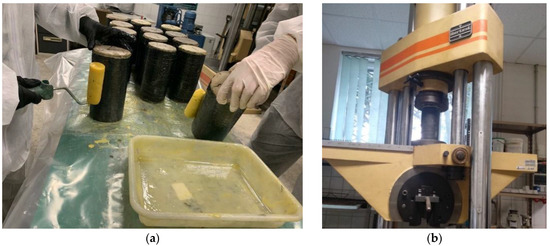
The 24 unconfined test specimens were tested under axial compression in accordance with EN 83506:2004 [88]. Once failure occurred, the damaged test specimens were strengthened by applying a first epoxy resin layer, followed by carbon or basalt fiber wrapping with a 10 cm overlap to prevent premature failure at the joint, and a second resin layer was applied over the fiber (Figure 1a). The remaining test specimens were strengthened directly without prior loading and tested under axial compression until failure.
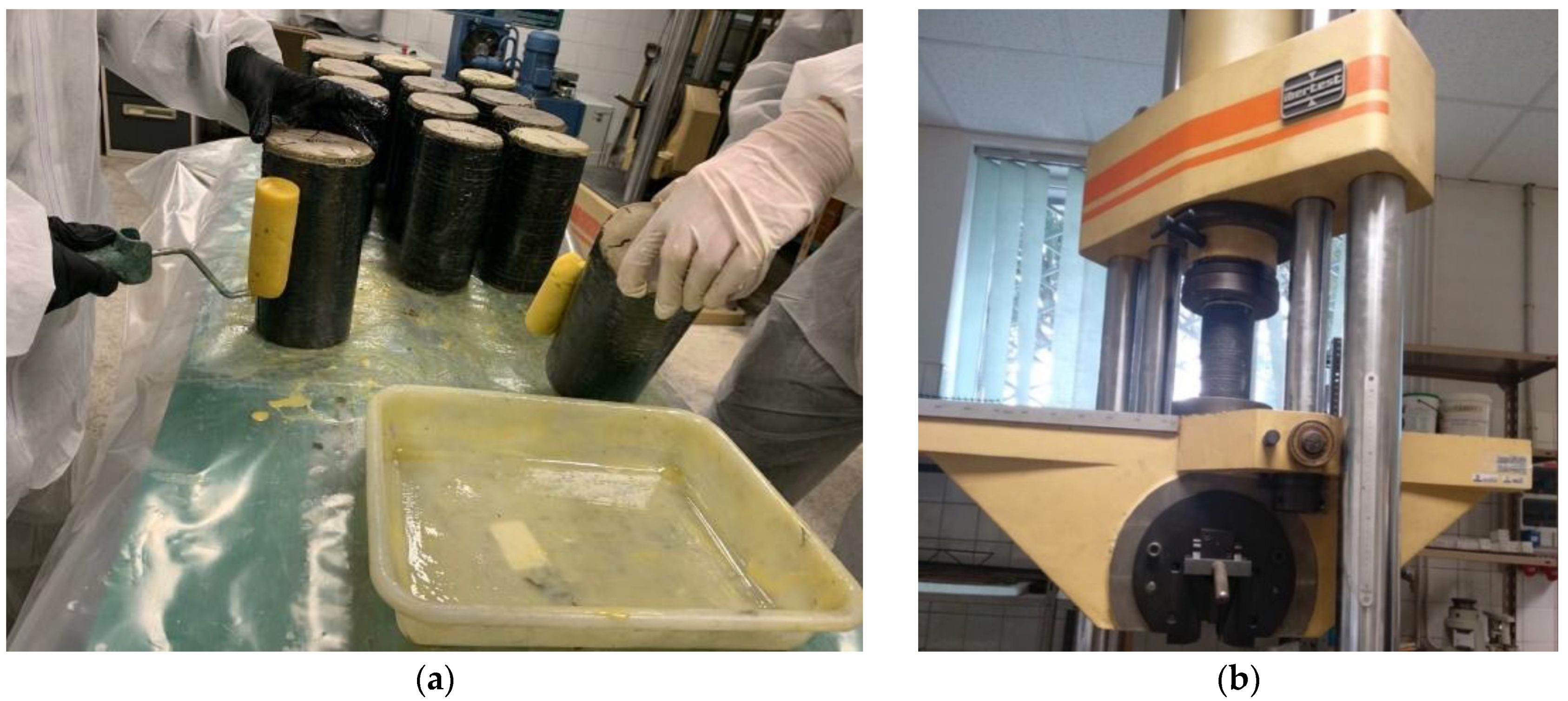
Figure 1.
(a) Reinforcement execution; (b) Compression test.
All experimental tests were performed at the Materials Laboratory of the Higher Technical School of Building Construction (Polytechnic University of Madrid), using an IBERTEST universal testing machine model MIB-60/AM (Daganzo de Arriba, Madrid, Spain), in accordance with EN 12390-4:2022 [89] (Figure 1b).
3. Results and Analysis
The results obtained in the compression rupture tests on concrete specimens with and without rubber and with and without reinforcement are shown below.
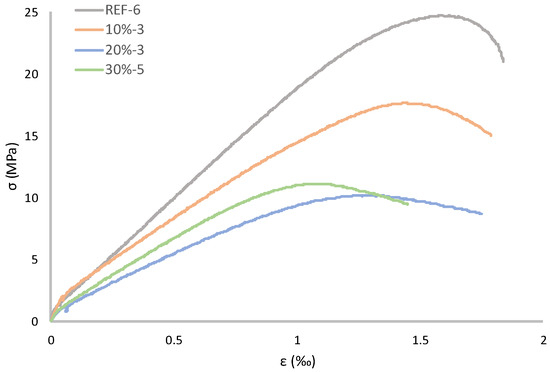
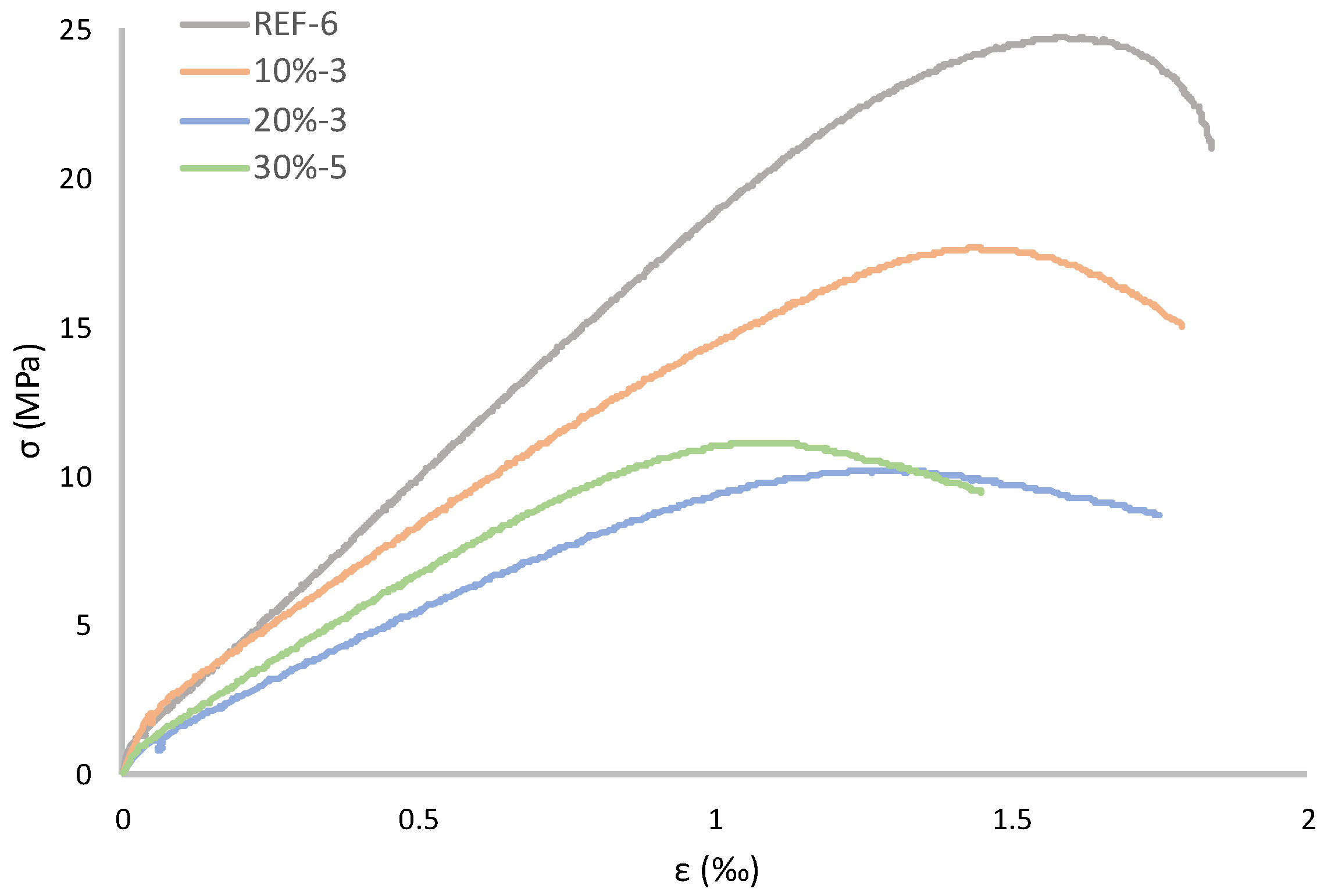
Figure 2 shows the stress–strain curves corresponding to the compression test on the unconfined specimens. For clarity, only the most representative curve of each mix is presented. It can be observed that the maximum stress is reached in the reference concrete and decreases as the percentage of rubber increases up to 20% replacement, while a similar maximum stress is obtained for the concrete with a 30% replacement. Additionally, the longitudinal strain at peak decreases as the rubber substitution ratio increases.
Figure 2.
Stress–strain graph of the compression test on unconfined concrete specimens.
Table 5, Table 6 and Table 7 show the most representative average results obtained in the compression tests for the different dosages and types of reinforcement: maximum normal stress (σmax), maximum longitudinal strain (εmax), ductility as a function of strain (Dε), ultimate normal stress (σult), ultimate unit longitudinal strain (εult), ductility as a function of strain energy density (DA), ultimate strain energy density (Uult), maximum strain energy density (Umax), and longitudinal modulus of elasticity (E).
Table 5.
Average values of mechanical properties of unconfined test specimens.
Table 6.
Average values of mechanical properties of broken and subsequently confined specimens.
Table 7.
Average values of mechanical properties of the compression test on confined specimens.
The values of σmax, εmax, σult, εult, and E are obtained directly from the stress–strain graphs. Ductility as a function of deformation (Dε) is calculated using the following Equation (1):
Ductility as a function of deformation energy density (DA) is calculated using the following Equation (2):
Table 5 shows that, as the percentage of fine aggregate replaced by recycled rubber increases, the maximum (Umax) and ultimate (Uult) deformation energy densities decrease, indicating a lower capacity to store and dissipate energy when deformed; ductility as a function of deformation (Dε) and ductility as a function of deformation energy density (DA) show a slight increase as the percentage of rubber increases, up to a replacement percentage of 20%.
Figure 3 shows that the incorporation of recycled rubber as a partial replacement for fine aggregate significantly reduces the mechanical properties of concrete. Compared to the reference concrete, the maximum stress decreases in the case of 10% replacement to a percentage of 8%. In concrete with substitution percentages of 20 and 30%, the maximum stresses are similar, with a loss of compressive strength of approximately 14%, due, among other factors, to the deficient performance of the interfacial transition zone due to the properties of the rubber. At the same time, the maximum longitudinal deformation per unit length is progressively reduced, decreasing by 0.52% for the 30% substitution percentage. It can also be observed that concrete with rubber addition exhibits ductile failure modes compared to the reference concrete. The behavior of the concrete is similar to that observed in the research by Villanueva, Youssf, and Ospina [78,90,91]. The modulus of elasticity decreases significantly between 0% and 20% substitution, with similar values obtained for concretes with 20% and 30% substitutions.
Figure 3.
Comparison of mechanical properties of unconfined test specimens.
Ling’s study [92] analyzes the same percentages of fine aggregate replacement with recycled rubber (GTR) as this research (0%, 10%, 20%, and 30%), although it was not carried out on cylindrical test specimens but on rectangular paving blocks. The results of this study show that the inclusion of a small proportion—up to 10% rubber—slightly improved strength, because the rubber particles deformed easily and filled the gaps between the solid particles, filling the free pores in the concrete mixture; on the contrary, it was observed that increasing the percentage of fine aggregate replaced by rubber decreased the compressive strength.
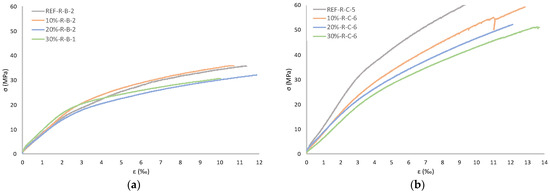
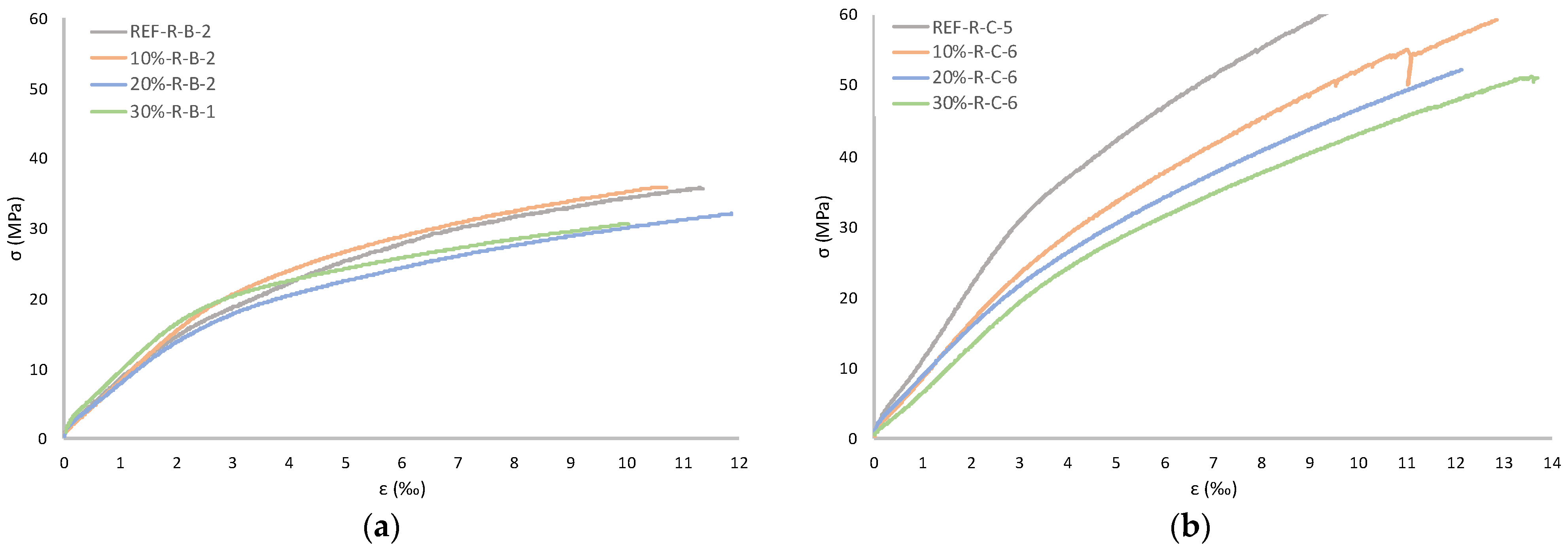
Figure 4 presents the most representative stress–strain curves of the test specimens subjected to prior failure and subsequently confined with FRP, allowing a clear comparison of the influence of recycled rubber content and fiber type on their post-damage mechanical response.
Figure 4.
Stress–strain graph of compression test on specimens tested to failure and subsequently confined with (a) BFRP; (b) CFRP.
Figure 4a shows the behavior of basalt fiber-reinforced concrete (BFRP) specimens, starting with the specimens taken to failure. As can be seen, the specimens without rubber addition achieve the highest levels of strength and deformation. In specimens with 10% of the fine aggregate replaced by recycled rubber, a 2% reduction in strength is observed, and in specimens with 20% and 30% replacements, the reduction is approximately 5%.
Figure 4b shows the behavior of the test specimens confined with carbon fiber (CFRP), starting with the specimens taken to failure. It can be seen that replacing fine aggregate with recycled rubber produces a progressive decrease in the maximum stress and initial stiffness of the material, accompanied by variations in its ductility; the reference concrete reaches the highest stress, while with a 10% substitution there is a 2.34% decrease in stress, increasing its deformation capacity, which indicates a more ductile behavior. With the increase in the substitution percentage to 20% and 30%, the resistances decrease by 8–9%, but the rupture deformations increase.
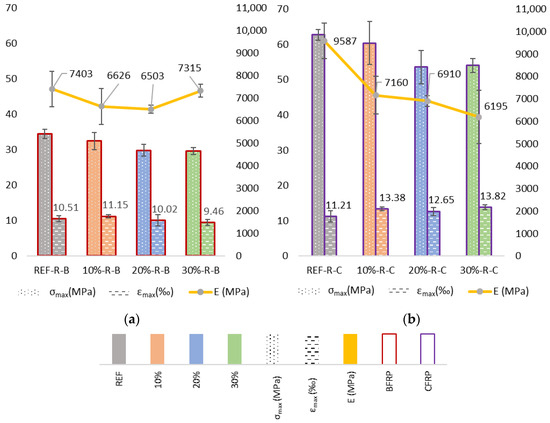
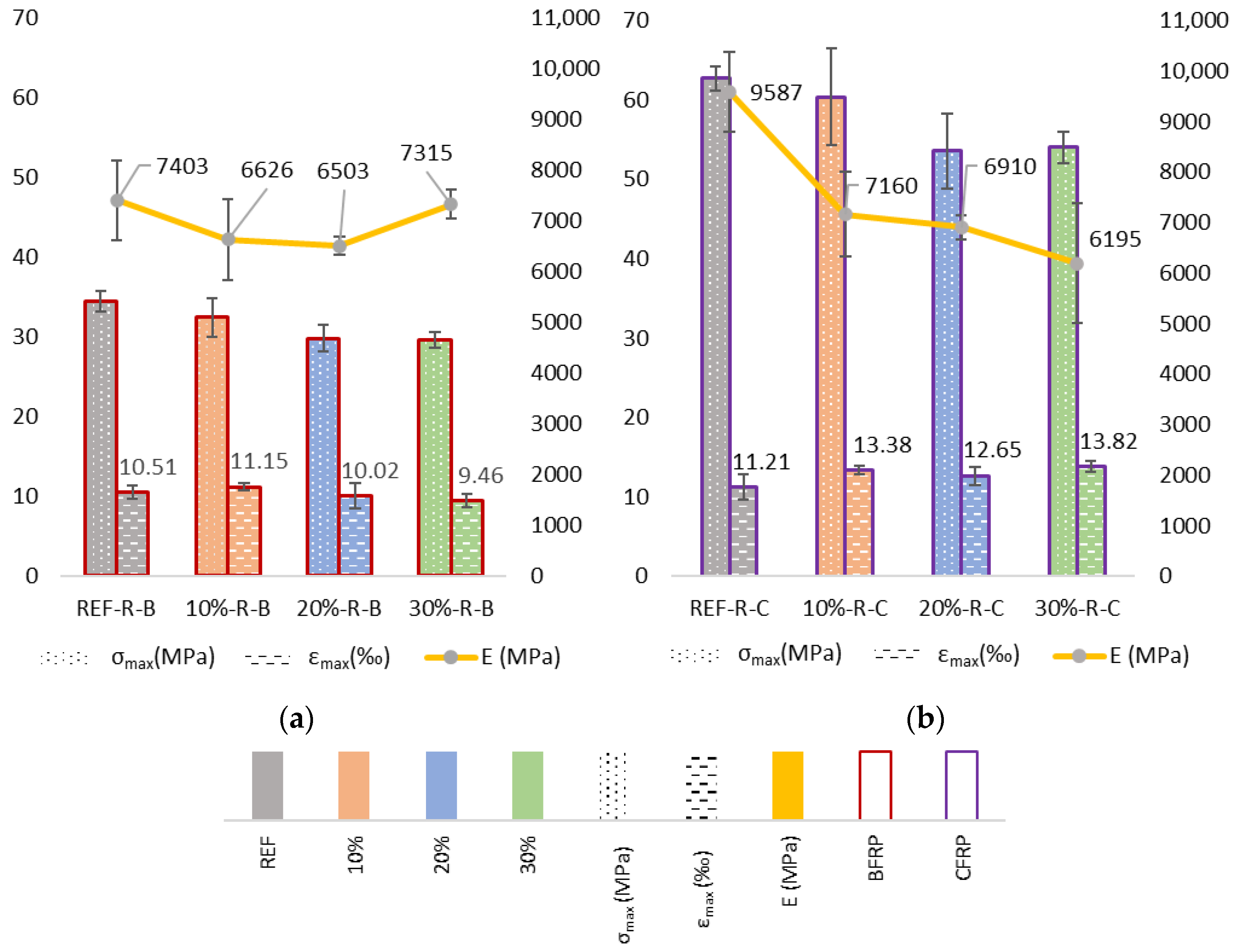
Table 6 shows the mechanical properties of concrete specimens that had been subjected to compression until failure and subsequently confined. As can be seen, replacing fine aggregates with rubber reduces the mechanical capacity of confined concrete when the concrete has low initial strengths; the ultimate strain (εult) remains practically constant, so the incorporation of rubber does not increase its deformation capacity when the specimen is confined. Due to the confinement of the concrete with the fibers, the maximum and ultimate deformation energy densities coincide, resulting in a ductility index based on deformation energy density (DA) uniformly equal to 1. This value explicitly indicates a brittle post-peak failure behavior, as no additional energy is absorbed beyond the maximum load. Although the reinforcement improves the mechanical capacity of the concrete, once failure is reached, it occurs in a brittle manner.
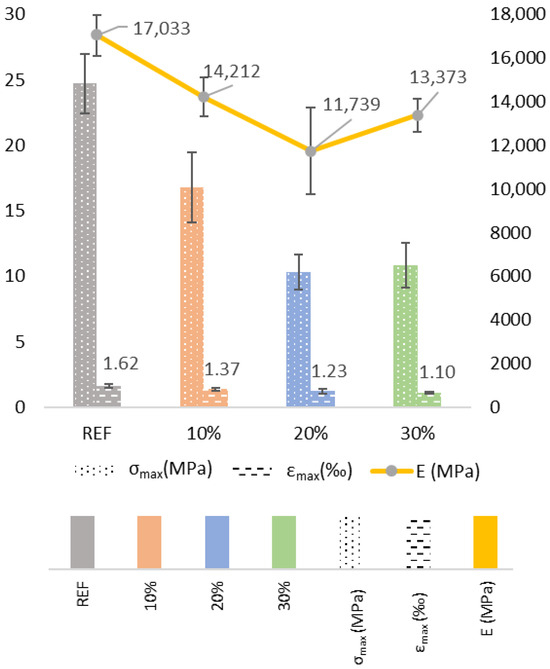
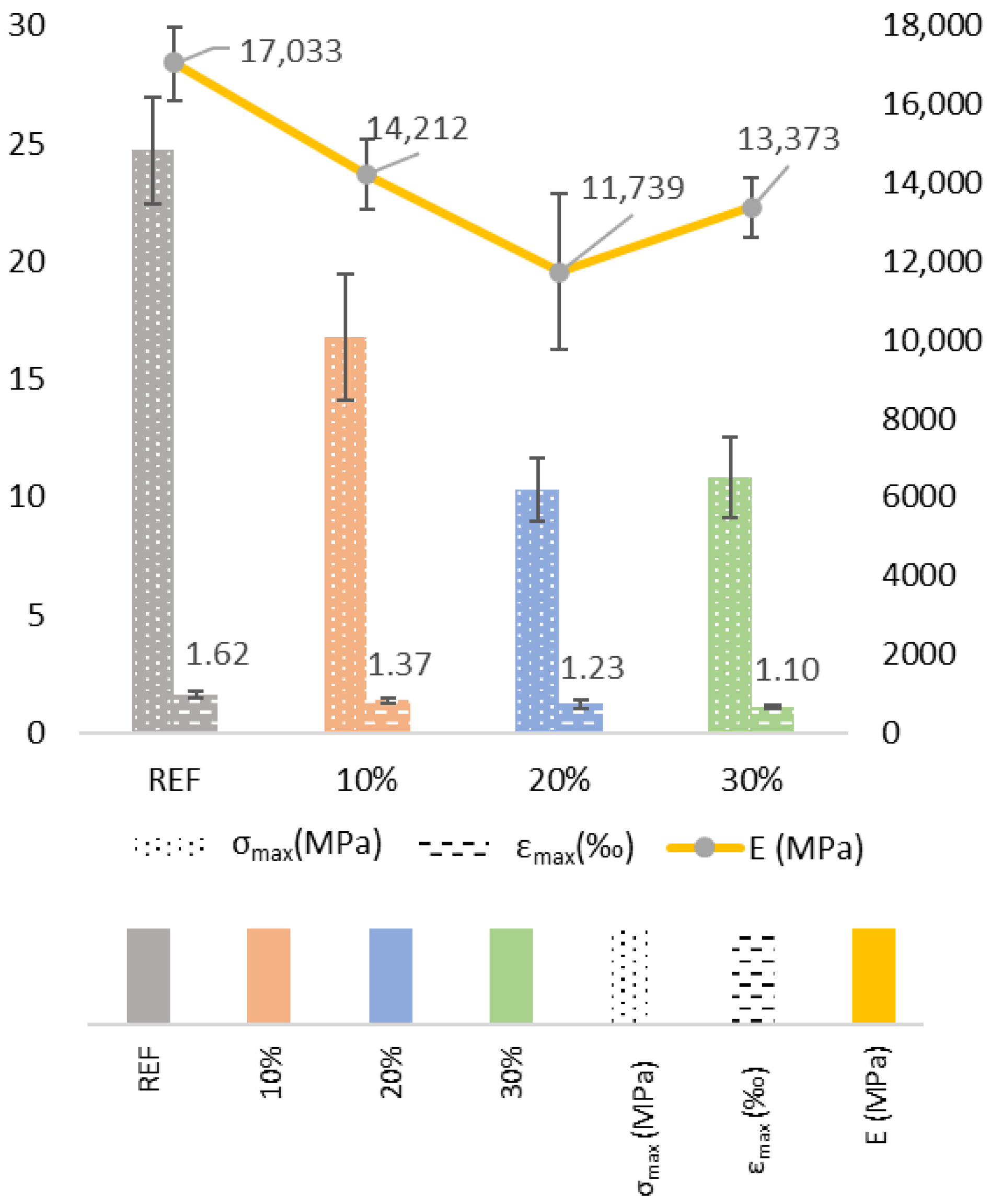
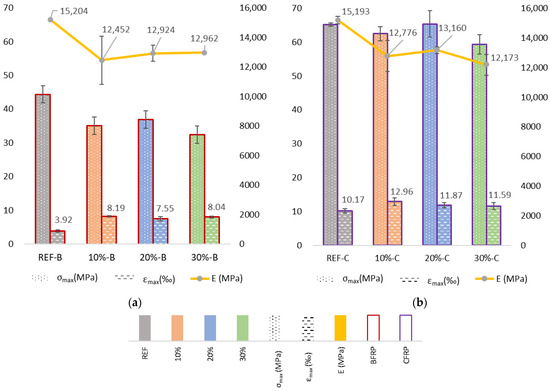
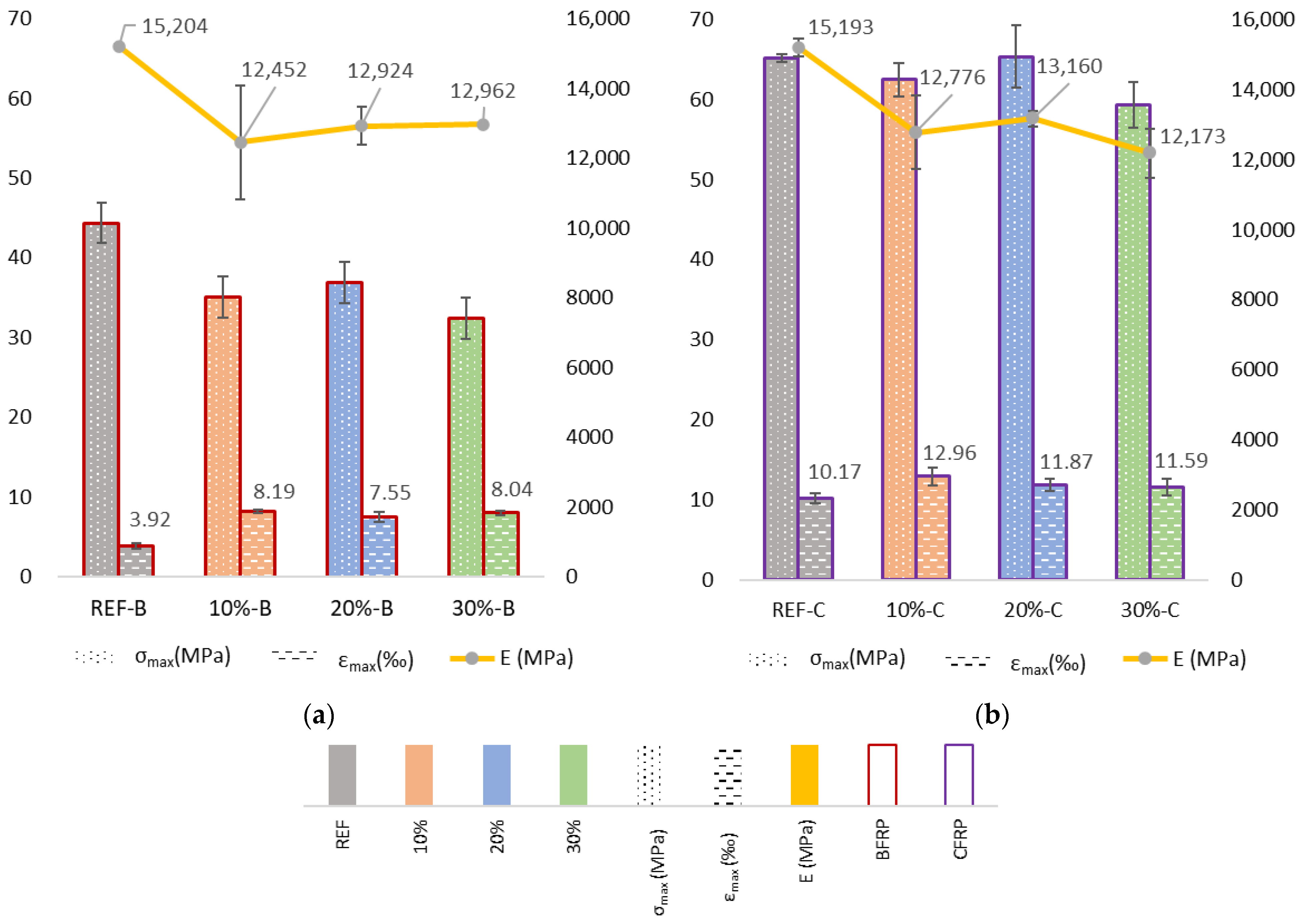
Figure 5a,b shows that the specimens confined with CFRP exhibit greater maximum deformation εmax than those confined with BFRP, indicating greater ultimate ductility under confinement in the case of those confined with CFRP; in both cases, the longitudinal deformation (εmax) remains almost constant as the percentage of rubber increases. The modulus of elasticity (E) decreases as the percentage of rubber increases in both cases, except in the case of 30% basalt, although the drop is much more pronounced in the case of CFRP, where the incorporation of rubber reduces stiffness, especially when confined with CFRP. In terms of maximum stress (σmax), the specimens confined with CFRP reach higher values than those confined with BFRP, but both show the same decreasing trend in strength as the percentage of rubber increases.
Figure 5.
Comparison of mechanical properties of test specimens taken to failure and subsequently confined with fibers (a) BFRP; (b) CFRP.
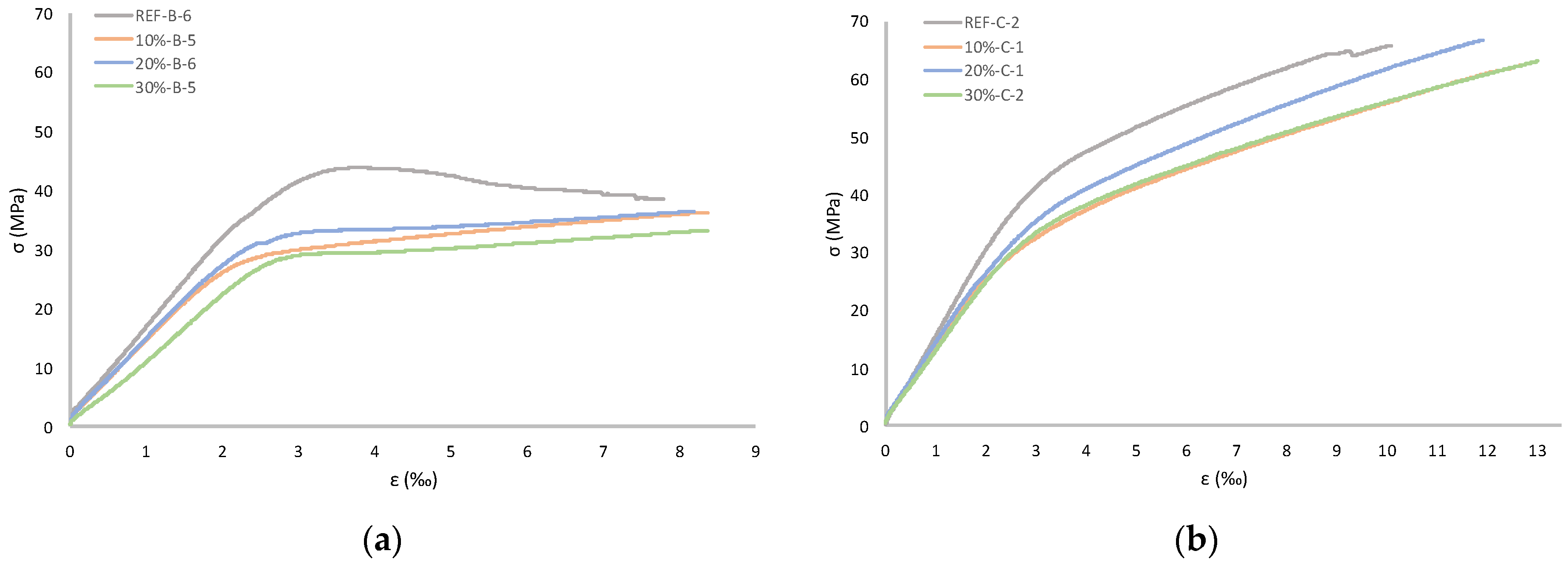
Figure 6 presents the most representative stress–strain curves of the directly confined test specimens, highlighting the effect of recycled rubber content on the mechanical performance and ductility of FRP-confined concrete under axial compression.
Figure 6.
Stress–strain graph of the compression test on confined specimens with: (a) BFRP; (b) CFRP.
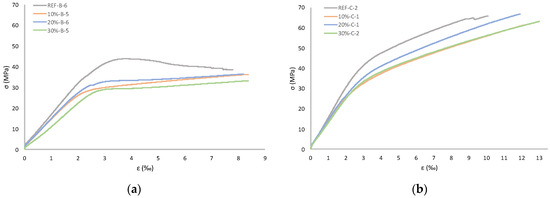
In Figure 6a, the behavior of the specimens confined with BFRP can be observed. In particular, it can be seen that the incorporation of recycled rubber as a partial substitute for fine aggregates in the mixture affects the mechanical behavior of the material; the reference test specimens have the highest compressive strength values, reaching maximum stress for a deformation of approximately 4 per thousand, at which point their strength begins to decrease until ultimate deformation. In concrete with different percentages of rubber, the maximum and ultimate stress and deformation coincide, although for a deformation of approximately 3 per thousand, the slope of the graph changes, with the stress increasing very slowly in this phase as the deformation increases. The mixture with 30% rubber performs the worst, and mixtures with 10% and 20% rubber substitution perform similarly.
In Figure 6b, the behavior of the CFRP-confined specimens can be observed, showing that the incorporation of recycled rubber does not negatively affect the mechanical performance of the confined concrete, with all concretes reaching similar maximum stresses and increasing ultimate strains as the percentage of rubber introduced increases. The best performance of the rubbers is observed with a 20% substitution.
Table 7 shows that replacing fine aggregate with rubber in confined specimens with BFRP reduces the ultimate deformation energy density (Uult) compared to the reference concrete, but the values are similar regardless of the percentage of aggregate replaced. When reinforcement is made with CFRP, the ultimate deformation energy density (Uult) increases compared to the reference concrete, especially for replacement percentages of 10 and 20%. The modulus of elasticity decreases when the concrete contains rubber in its composition, which makes rubber-reinforced concrete more ductile than the reference reinforced concrete, regardless of the type of fiber used.
Figure 7a,b shows that in both cases there is a clear improvement in mechanical performance when the concrete is reinforced with fibers: the specimens confined with CFRP achieve the highest stresses and unit strains in both the reference concrete and the rubbers, with the highest stresses being achieved in the concrete with 20% recycled rubber. The modulus of elasticity decreases in rubbers compared to the reference concrete, regardless of the type of reinforcement used. The behavior of the concrete is similar to that found in the research by Chan, Youssf, Cao, and Bompa [25,76,93,94].
Figure 7.
Comparison of mechanical properties of confined test specimens: (a) BFRP; (b) CFRP.
As can be seen in Figure 6 and Figure 7, and Table 7, comparing the compressive strength results of specimens confined with CFRP and confined with BFRP, without having been previously tested to failure, the specimens confined with CFRP have a higher compressive strength, reaching an average increase of 26%.
Table 8 shows the percentage variations in strength produced by basalt fiber reinforcement, depending on the initial strength of the concrete to be reinforced:
Table 8.
Comparison of maximum compressive stress, in %, of specimens confined with BFRP.
- Test specimens broken and subsequently confined show increases in maximum stress of 16% on average compared to their non-confined counterparts, with percentages ranging from 10% in concrete without rubber to 19% in concrete with 20% and 30% replacement of fine aggregate with recycled rubber. Fiber reinforcement in low-performance concretes is a viable alternative for recovering or improving the strength capacity of these concretes.
- Confined test specimens show increases in maximum stress of 22% on average over their unconfined counterparts, with percentages of 20% in reference concretes and 26% in concrete with 20% replacement of fine aggregate by rubber.
- Confined test specimens show increases in maximum stress of 6% on average over their broken and confined counterparts, with the main improvements seen in reference concretes, at 10%, and in concrete with 20% replacement of fine aggregate with recycled rubber, at 7%. This implies that this type of reinforcement with BFRP is viable both in low-performance concretes, due to their depletion prior to reinforcement or the incorporation of recycled rubber, and in structural concretes.
Table 9 shows the differences in maximum stress between concrete with and without rubber and reinforced with CFRP:
Table 9.
Comparison of maximum compressive stress, in %, of specimens confined with CFRP.
- The test specimens broken and subsequently confined show increases in maximum stress of 42% on average compared to their non-confined counterparts, with percentages of 38% in concrete without rubber, up to 44% in concrete with 20% and 30% replacement of fine aggregate with recycled rubber, with the highest increases being achieved in CFRP-reinforced rubber concretes.
- Confined specimens show increases in maximum stress of 47% on average over their unconfined counterparts, with percentages ranging from 40% in reference concretes to 55% in concretes with 20% replacement of fine aggregate with recycled rubber.
- Confined specimens show increases in maximum stress of 5% on average compared to their broken and confined counterparts, with the main improvements being achieved in concrete with 20% of the fine aggregate replaced by recycled rubber.
- CFRP reinforcement performs best in concrete with 20% of fine aggregate replaced by recycled rubber, even though the concrete to be reinforced has very low strength.
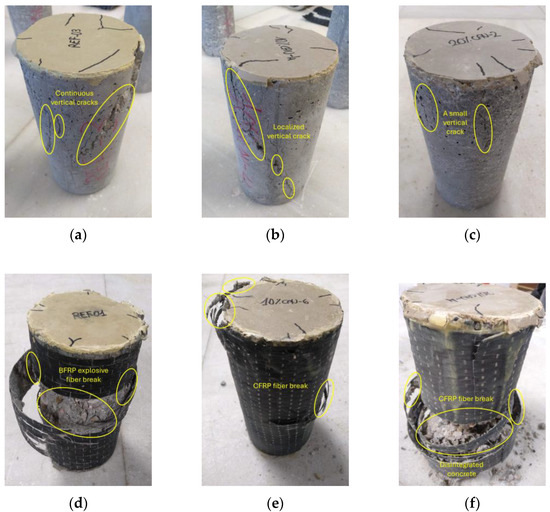
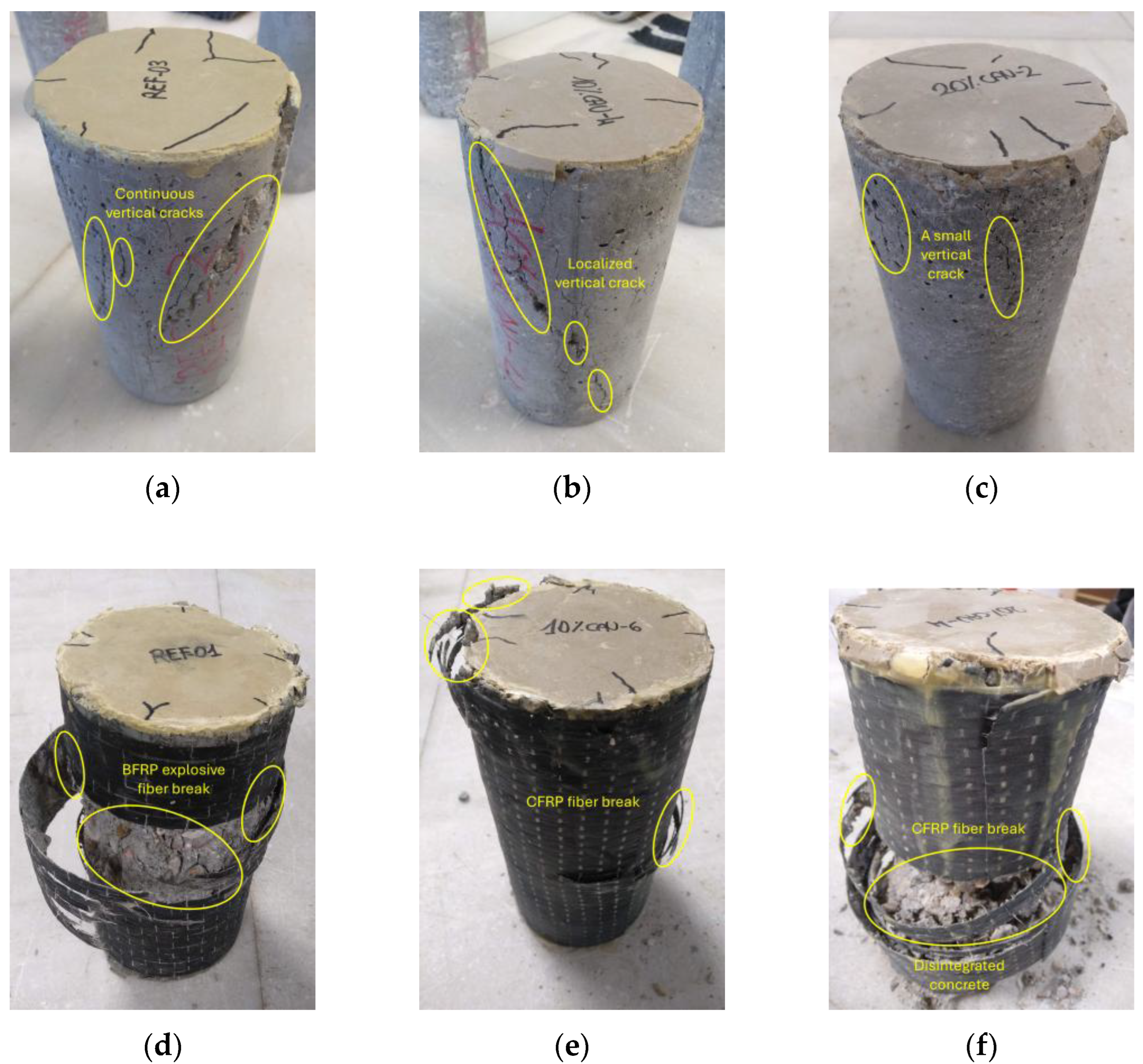
The reference concrete (Figure 8a) exhibits predominantly vertical cracks due to the tensile forces generated by the Poisson effect under compression. As the load increases, the microcracks produced in the interfacial transition zone (ITZ) between the aggregate and the cement paste extend into the paste and interconnect, forming visible and continuous cracks. The resulting fracture is brittle, rapidly losing its strength capacity once its maximum breaking stress is reached.
Figure 8.
Tested specimens: (a) REF without confinement; (b) 10% without confinement; (c) 20% without confinement; (d) REF confined with BFRP; (e) 10% confined with CFRP; (f) 20% confined with CFRP.
The incorporation of rubber into the concrete (Figure 8b,c) modifies its cracking and fracture mechanism due to its low modulus of elasticity and poor adhesion to the cement paste. Microcracking at the rubber/cement paste interface occurs rapidly, but its deformation capacity slows the propagation of the cracks, generating a more distributed crack with a smaller crack opening. Increasing the percentage of rubber reduces the concrete’s strength capacity but improves its energy absorption capacity and therefore its ductility.
Figure 8d shows the behavior of reference concrete reinforced with BFRP confinement, which delays cracking, increasing its strength and ductility. The type of failure in this type of concrete is brittle, due to sudden fiber rupture, but it reaches much higher compressive strengths than unconfined concrete. Figure 8e,f shows the behavior of concrete with different percentages of rubber reinforced with CFRP. The presence of rubber in the concrete causes the CFRP to come into load sooner than the reference concrete, increasing its strength and ductility. Due to the high modulus of elasticity of CFRP, large lateral pressures are generated for small deformations of the concrete, increasing its strength even above that of the unconfined reference concrete.
Table 10 shows a comparison of the most important mechanical behavior parameters as a function of the percentage of rubber added. The inclusion of rubber clearly modifies the mechanical behavior: the reference concretes show low deformation and very low absorbed energy, while with 10–20% rubber, εmax and Umax increase dramatically, reflecting greater deformability and energy dissipation capacity. Confinement-reinforced concretes with rubber percentages of 10–20% provide the best performance in terms of strength, deformation, and energy absorption, while 30% rubber reduces σmax despite maintaining high Umax.
Table 10.
Average values are grouped by percentage of rubber.
In summary, the compressive strength of unconfined rubber concrete decreases approximately linearly with the proportion of fine aggregate replacement, and the confinement of rubber concrete with FRP increases its compressive strength and ultimate axial deformation, as found in the research by Chan et al. [25].
4. Conclusions
Based on the study of the mechanical behavior of concrete with carbon fiber-reinforced polymer (CFRP) and basalt fiber-reinforced polymer (BFRP) confinement, the following conclusions have been drawn:
- Replacing fine aggregate with recycled rubber in concrete reduces compressive strength and stiffness while enhancing ductility and energy absorption capacity, which can be useful in applications requiring impact absorption and vibration reduction.
- Rubber particles also promote crack arrest, bridging effects, and energy dissipation, resulting in a less brittle response; however, this leads to reduced post-peak strength and stiffness.
- Among the replacement levels studied (10%, 20%, and 30%), 10% rubber content provides the best overall balance between mechanical performance and ductility retention.
- FRP confinement (BFRP and CFRP) significantly improves both strength and ductility of rubberized concrete compared to unconfined conditions, leading to a more stable damage evolution and delayed crack propagation.
- FRP confinement modifies the failure mode from splitting and early cracking in unconfined specimens to a confined crushing mechanism; however, failure becomes sudden and brittle upon rupture of the FRP jacket.
- CFRP confinement is more effective than BFRP, providing higher confinement efficiency and achieving strength increases of approximately 26% or higher due to its greater stiffness.
- The greatest strength enhancements under confinement were observed in concrete with 20% rubber replacement, reaching increases of approximately 26% for BFRP and up to 55% for CFRP relative to unconfined specimens.
- A sustainable design strategy consists of using 10% rubber replacement as a baseline solution, while higher rubber contents (20% and 30%) can be structurally compensated through BFRP and CFRP confinement, respectively.
- The combined effect of rubber inclusion and FRP confinement governs both damage evolution and failure mechanisms. Rubber enhances deformability and energy dissipation, whereas FRP confinement restrains lateral expansion and delays cracking. This interaction is critical for the design of sustainable, ductile, and resilient concrete structures.
Author Contributions
Conceptualization, M.C.C., M.I.P. and A.C.; Methodology, M.C.C., M.I.P. and A.C.; Software, M.C.C. and F.I.O.; Validation, M.C.C., M.I.P. and F.I.O.; Formal analysis, M.C.C., M.I.P. and A.C.; Investigation, MCC, M.I.P., A.C. and F.I.O.; Resources, M.I.P. and A.C.; Data curation, M.C.C. and F.I.O.; Writing—original draft, M.C.C.; Writing—review & editing, M.I.P., A.C. and F.I.O.; Visualization, F.I.O.; Supervision, M.I.P. and A.C.; Funding acquisition, A.C. All authors have read and agreed to the published version of the manuscript.
Funding
This research received no external funding.
Data Availability Statement
The original contributions presented in this study are included in the article. Further inquiries can be directed to the corresponding author.
Conflicts of Interest
The authors declare no conflict of interest.
References
- Malsang, I. El Hormigón, Tercer Emisor Mundial de Gases de Efecto Invernadero. 2021. Available online: https://chateurope.eu/es/el-hormigon-tercer-emisor-mundial-de-gases-de-efecto-invernadero/ (accessed on 29 December 2025).
- Aizaga, H. Avances en el Uso del Hormigón Armado en Ingeniería Civil: Una revisión sistemática. Mag. Las Cienc. Rev. Investig. E Innov. 2024, 9, 47–68. [Google Scholar] [CrossRef] [Scilit]
- Zrar, Y.J.; Abdulrahman, P.I.; Sherwani, A.F.H.; Younis, K.H.; Mohammed, A.S. Sustainable innovation in self-compacted concrete: Integrating by-products and waste rubber for green construction practices. Structures 2024, 62, 106234. [Google Scholar] [CrossRef] [Scilit]
- Haller, T.; Scherb, S.; Beuntner, N.; Thienel, K.-C. Construcción renovable con hormigón ligero–Sistemas de materiales reciclados recuperados con absorción de CO2. Constr. Build. Mater. 2025, 466, 140339. [Google Scholar] [CrossRef] [Scilit]
- Albano, C.; Camacho, N.; Hernandez, M.; Bravo, A.J.; Guevara, H. Estudio de concreto elaborado con caucho de reciclado de diferentes tamaños de partículas. Rev. Fac. Ing. Univ. Cent. Venezuela 2008, 23, 67–75. [Google Scholar]
- Thomas, B.S.; Gupta, R.C. Long term behaviour of cement concrete containing discarded tire rubber. J. Clean. Prod. 2015, 102, 78–87. [Google Scholar] [CrossRef] [Scilit]
- Azunna, S.U.; Aziz, F.N.A.A.; Rashid, R.S.M.; Bakar, N.B.A. Review on the characteristic properties of crumb rubber concrete. Clean. Mater. 2024, 12, 100237. [Google Scholar] [CrossRef] [Scilit]
- Si, R.; Wang, J.; Guo, S.; Dai, Q.; Han, S. Evaluation of laboratory performance of self-consolidating concrete with recycled tire rubber. J. Clean. Prod. 2018, 180, 823–831. [Google Scholar] [CrossRef] [Scilit]
- Eldin, N.N.; Senouci, A.B. Rubber-Tire Particles as Concrete Aggregate. J. Mater. Civ. Eng. 1993, 5, 478–496. [Google Scholar] [CrossRef] [Scilit]
- Batayneh, M.K.; Marie, I.; Asi, I. Promoting the use of crumb rubber concrete in developing countries. Waste Manag. 2008, 28, 2171–2176. [Google Scholar] [CrossRef] [Scilit]
- Li, Y.; Zhang, S.; Wang, R.; Dang, F. Potential use of waste tire rubber as aggregate in cement concrete—A comprehensive review. Constr. Build. Mater. 2019, 225, 1183–1201. [Google Scholar] [CrossRef] [Scilit]
- Ministerio de la Presidencia, Justicia y Relaciones con las Cortes, Real Decreto 712/2025, de 26 de Agosto, de Neumáticos al Final de su Vida útil. 2025. Available online: https://www.boe.es/eli/es/rd/2025/08/26/712 (accessed on 7 October 2025).
- ¿Qué Son los Neumáticos Fuera de Uso (NFU)? 2018. Available online: https://www.miteco.gob.es/es/calidad-y-evaluacion-ambiental/temas/prevencion-y-gestion-residuos/flujos/neumaticos.html (accessed on 8 October 2023).
- Siddika, A.; Mamun, M.A.A.; Alyousef, R.; Amran, Y.H.M.; Aslani, F.; Alabduljabbar, H. Properties and utilizations of waste tire rubber in concrete: A review. Constr. Build. Mater. 2019, 224, 711–731. [Google Scholar] [CrossRef] [Scilit]
- Gesoǧlu, M.; Güneyisi, E.; Khoshnaw, G.; Ipek, S. Investigating properties of pervious concretes containing waste tire rubbers. Constr. Build. Mater. 2014, 63, 206–213. [Google Scholar] [CrossRef] [Scilit]
- Shahjalal, M.; Islam, K.; Batool, F.; Tiznobaik, M.; Hossain, F.M.Z.; Ahmed, K.S.; Alam, M.S.; Ahsan, R. Fiber-reinforced recycled aggregate concrete with crumb rubber: A state-of-the-art review. Constr. Build. Mater. 2023, 404, 133233. [Google Scholar] [CrossRef] [Scilit]
- Alonso, L.A. Reciclado de Neumáticos Para la Fabricación de Láminas Impermeabilizantes en la Construcción. Master’s Thesis, E.U. de Arquitectura Técnica (UPM), Madrid, Spain, 2010. Available online: https://oa.upm.es/5497/ (accessed on 26 March 2024).
- Xie, Y.; Su, X.R.; Wang, H.X.; Luo, D.M.; Zhou, Y.L. Experimental analysis of the toughness mechanism of rubber concrete. IOP Conf. Ser. Mater. Sci. Eng. 2019, 504, 012041. [Google Scholar] [CrossRef] [Scilit]
- Calahorra-Jimenez, M.; Gimenez, Z.; Herrera, R.F.; Martinez, J.; Salazar, F.L.A. Análisis de ciclo de vida de mezcla asfáltica con/sin caucho: Estudio de caso. In Proceedings of the VII Elagec, Bogotá, Colombia, 15–18 November 2016. [Google Scholar]
- El-Gammal, A.; Abdel-Gawad, A.K.; El-Sherbini, Y.; Shalaby, A. Compressive strength of concrete utilizing waste tire rubber. J. Emerg. Trends Eng. Appl. Sci. 2010, 1, 96–99. Available online: https://hdl.handle.net/10520/EJC156734 (accessed on 21 April 2026).
- Committee, A.C. Report on Pervious Concrete; American Concrete Institute: Farmington Hills, MI, USA, 2010; Available online: https://www.concrete.org/Portals/0/Files/PDF/Previews/522R-10web.pdf (accessed on 16 April 2024).
- Ganjian, E.; Khorami, M.; Maghsoudi, A.A. Scrap-tyre-rubber replacement for aggregate and filler in concrete. Constr. Build. Mater. 2009, 23, 1828–1836. [Google Scholar] [CrossRef] [Scilit]
- Liu, F.; Chen, G.; Li, L.; Guo, Y. Study of impact performance of rubber reinforced concrete. Constr. Build. Mater. 2012, 36, 604–616. [Google Scholar] [CrossRef] [Scilit]
- Senin, M.S.; Shahidan, S.; Abdullah, S.R.; Guntor, N.A.; Leman, A.S. A review on the suitability of rubberized concrete for concrete bridge decks. IOP Conf. Ser. Mater. Sci. Eng. 2017, 271, 012074. [Google Scholar] [CrossRef] [Scilit]
- Chan, C.W.; Yu, T.; Zhang, S.S.; Xu, Q.F. Compressive behaviour of FRP-confined rubber concrete. Constr. Build. Mater. 2019, 211, 416–426. [Google Scholar] [CrossRef] [Scilit]
- Fattuhi, N.I.; Clark, L.A. Cement-based materials containing shredded scrap truck tyre rubber. Constr. Build. Mater. 1996, 10, 229–236. [Google Scholar] [CrossRef] [Scilit]
- Adafer, S.; Youcef, Y.S.; Amziane, S. Cyclic behaviour of CFRP confined concrete under axial compression. Constr. Build. Mater. 2022, 340, 127793. [Google Scholar] [CrossRef] [Scilit]
- Hollaway, L.C. The evolution of and the way forward for advanced polymer composites in the civil infrastructure. Constr. Build. Mater. 2003, 17, 365–378. [Google Scholar] [CrossRef] [Scilit]
- Abbara, A.A.; Abdelhalim, A.; Al-Ajamee, M.; Ahmed, O.; Adhikary, S.K.; Ahmed, M. Uniaxial compressive stress-strain relationship for rubberized concrete with coarse aggregate replacement up to 100%. Case Stud. Constr. Mater. 2022, 17, e01336. [Google Scholar] [CrossRef] [Scilit]
- Han, S.; Xiao, G.; Wang, P.; Xu, C.; Zhou, A.; Yu, J.; Ou, J. Axial-bending behavior of hybrid fiber-reinforced polymer-steel reinforced concrete columns with novel closed ties: Confinement mechanism and equivalent design. Eng. Struct. 2026, 353, 122236. [Google Scholar] [CrossRef] [Scilit]
- Han, S.; Liu, Y.; Weng, K.; Xiao, G.; Li, Z.; Yu, J.; Ou, J. Efficient combination of steel-FRP composite bar and seawater sea-sand ECC permanent formwork for high-performance slabs: Experimental and analytical investigation. Constr. Build. Mater. 2026, 506, 144951. [Google Scholar] [CrossRef] [Scilit]
- Siddika, A.; Mamun, M.A.A.; Ferdous, W.; Alyousef, R. Performances, challenges and opportunities in strengthening reinforced concrete structures by using FRPs—A state-of-the-art review. Eng. Fail. Anal. 2020, 111, 104480. [Google Scholar] [CrossRef] [Scilit]
- Li, Y.; Zhang, J.; He, Y.; Huang, G.; Li, J.; Niu, Z.; Gao, B. A review on durability of basalt fiber reinforced concrete. Compos. Sci. Technol. 2022, 225, 109519. [Google Scholar] [CrossRef] [Scilit]
- Valasaki, M.K.; Papakonstantinou, C.G. Fiber Reinforced Polymer (FRP) Confined Circular Concrete Columns: An Experimental Overview. Buildings 2023, 13, 1248. [Google Scholar] [CrossRef] [Scilit]
- Fardis, M.N.; Khalili, H.H. FRP-encased concrete as a structural material. Mag. Concr. Res. 1982, 34, 191–202. [Google Scholar] [CrossRef] [Scilit]
- Bakis, C.E.; Bank, L.C.; Brown, V.L.; Cosenza, E.; Davalos, J.F.; Lesko, J.J.; Machida, A.; Rizkalla, S.H.; Triantafillou, T.C. Fiber-Reinforced Polymer Composites for Construction—State-of-the-Art Review. J. Compos. Constr. 2002, 6, 73–87. [Google Scholar] [CrossRef] [Scilit]
- Pérez, M.A. (Ed.) Aplicaciones Avanzadas de los Materiales Compuestos en la Obra Civil y la Edificación, 1st ed.; OmniaScience: Barcelona, Spain, 2014. [Google Scholar] [CrossRef] [Scilit]
- Clarke, J.L. (Ed.) Alternative Materials for the Reinforcement and Prestressing of Concrete; CRC Press: London, UK, 2014. [Google Scholar] [CrossRef] [Scilit]
- Hermite, R. Constructional Element and Method of Making the Same. U.S. Patent US3468090A, 23 September 1969. [Google Scholar]
- Cao, Q.; Lv, X.; Wang, Y.; Wu, Z.; Lin, Z. Performance and analysis of unidirectional GFRP actively confined high-strength concrete under monotonic and cyclic axial compression. Constr. Build. Mater. 2021, 271, 121593. [Google Scholar] [CrossRef] [Scilit]
- Liao, J.; Zeng, J.-J.; Zhuge, Y.; Zheng, Y.; Ma, G.; Zhang, L. FRP-confined concrete columns with a stress reduction-recovery behavior: A state-of-the-art review, design recommendations and model assessments. Compos. Struct. 2023, 321, 117313. [Google Scholar] [CrossRef] [Scilit]
- Raza, A.; Rafique, U.; Masood, B.; Ali, B.; Haq, F.U.; Nawaz, M.A. Performance evaluation of hybrid fiber reinforced low strength concrete cylinders confined with CFRP wraps. Structures 2021, 31, 182–189. [Google Scholar] [CrossRef] [Scilit]
- Huang, L.; Chen, J.; Tan, X. BP-ANN based bond strength prediction for FRP reinforced concrete at high temperature. Eng. Struct. 2022, 257, 114026. [Google Scholar] [CrossRef] [Scilit]
- Rodsin, K.; Hussain, Q.; Suparp, S.; Nawaz, A. Compressive behavior of extremely low strength concrete confined with low-cost glass FRP composites. Case Stud. Constr. Mater. 2020, 13, e00452. [Google Scholar] [CrossRef] [Scilit]
- Yung, W.H.; Yung, L.C.; Hua, L.H. A study of the durability properties of waste tire rubber applied to self-compacting concrete. Constr. Build. Mater. 2013, 41, 665–672. [Google Scholar] [CrossRef] [Scilit]
- Lam, L.; Teng, J.G. Stress–strain model for FRP-confined concrete under cyclic axial compression. Eng. Struct. 2009, 31, 308–321. [Google Scholar] [CrossRef] [Scilit]
- Yuhazri, M.Y.; Zulfikar, A.J.; Ginting, A. Fiber Reinforced Polymer Composite as a Strengthening of Concrete Structures: A Review. IOP Conf. Ser. Mater. Sci. Eng. 2020, 1003, 012135. [Google Scholar] [CrossRef] [Scilit]
- Hawileh, R.A.; Alharmoodi, H.; Hajjaj, A.; Aljarwan, A.; Abdalla, J.A. Effect of CFRP Wraps on the Compressive Strength of Normal and Structural Lightweight Concrete. Procedia Struct. Integr. 2024, 54, 279–286. [Google Scholar] [CrossRef] [Scilit]
- Moreno, J.C.; Mora, R.B.; Sevillano, Á.A.R.; González, Á.C. Performance enhancement of a bioinspired micro air vehicle by integrating a smart composite in its morphing wing. Compos. Struct. 2023, 311, 116794. [Google Scholar] [CrossRef] [Scilit]
- Wang, Z.Y.; Wang, D.Y.; Lu, D.G. Behavior of Large-Scale Circular and Square RC Columns Confined with Carbon Fiber-Reinforced Polymer under Uniaxial Compression. Adv. Mater. Res. 2010, 163–167, 3686–3693. [Google Scholar] [CrossRef] [Scilit]
- Silva, M.A.G. Behavior of square and circular columns strengthened with aramidic or carbon fibers. Constr. Build. Mater. 2011, 25, 3222–3228. [Google Scholar] [CrossRef] [Scilit]
- Cakiroglu, C.; Islam, K.; Bekdaş, G.; Kim, S.; Geem, Z.W. Interpretable Machine Learning Algorithms to Predict the Axial Capacity of FRP-Reinforced Concrete Columns. Materials 2022, 15, 2742. [Google Scholar] [CrossRef] [Scilit]
- Cousin, P.; Hassan, M.; Vijay, P.; Robert, M.; Benmokrane, B. Chemical resistance of carbon, basalt, and glass fibers used in FRP reinforcing bars. J. Compos. Mater. 2019, 53, 3651–3670. [Google Scholar] [CrossRef] [Scilit]
- Hu, X.; Xiao, J.; Zhang, K.; Zhang, Q. The state-of-the-art study on durability of FRP reinforced concrete with seawater and sea sand. J. Build. Eng. 2022, 51, 104294. [Google Scholar] [CrossRef] [Scilit]
- Deifalla, A. Punching shear strength and deformation for FRP-reinforced concrete slabs without shear reinforcements. Case Stud. Constr. Mater. 2022, 16, e00925. [Google Scholar] [CrossRef] [Scilit]
- El Zareef, M.A.; Elbisy, M.S.; Badawi, M. Evaluation of code provisions predicting the concrete shear strength of FRP-reinforced members without shear reinforcement. Compos. Struct. 2021, 275, 114430. [Google Scholar] [CrossRef] [Scilit]
- Truong, G.T.; Choi, K.-K.; Kim, C.-S. Punching shear strength of interior concrete slab-column connections reinforced with FRP flexural and shear reinforcement. J. Build. Eng. 2022, 46, 103692. [Google Scholar] [CrossRef] [Scilit]
- Ali, A.H.; Mohamed, H.M.; Benmokrane, B. Composite FRP reinforced concrete members with fiber reinforced polymer spirals. Structures 2021, 33, 1868–1877. [Google Scholar] [CrossRef] [Scilit]
- Xiao, Y.; Wu, H. Compressive Behavior of Concrete Confined by Carbon Fiber Composite Jackets. J. Mater. Civ. Eng. 2000, 12, 139–146. [Google Scholar] [CrossRef] [Scilit]
- Lam, L.; Teng, J.G. Design-oriented stress–strain model for FRP-confined concrete. Constr. Build. Mater. 2003, 17, 471–489. [Google Scholar] [CrossRef] [Scilit]
- Ozbakkaloglu, T.; Lim, J.C. Axial compressive behavior of FRP-confined concrete: Experimental test database and a new design-oriented model. Compos. Part B Eng. 2013, 55, 607–634. [Google Scholar] [CrossRef] [Scilit]
- Cao, Q.; Tao, J.; John, Z.; Wu, Z. Axial Compressive Behavior of CFRP-Confined Expansive Concrete Columns. ACI Struct. J. 2017, 114, 475–485. [Google Scholar] [CrossRef] [Scilit]
- Cao, Q.; Li, X.; Zhou, J.; Ma, Z.J. Expansive concrete confined by CFRP under eccentric compression. Constr. Build. Mater. 2019, 208, 113–124. [Google Scholar] [CrossRef] [Scilit]
- Kubat, T.; Al-Mahaidi, R.; Shayan, A. CFRP confinement of circular concrete columns affected by alkali-aggregate reaction. Constr. Build. Mater. 2016, 116, 98–109. [Google Scholar] [CrossRef] [Scilit]
- Wu, Y.-F.; Wei, Y.-Y. Effect of cross-sectional aspect ratio on the strength of CFRP-confined rectangular concrete columns. Eng. Struct. 2010, 32, 32–45. [Google Scholar] [CrossRef] [Scilit]
- De Luca, A.; Nardone, F.; Matta, F.; Nanni, A.; Lignola, G.P.; Prota, A. Structural Evaluation of Full-Scale FRP-Confined Reinforced Concrete Columns. J. Compos. Constr. 2011, 15, 112–123. [Google Scholar] [CrossRef] [Scilit]
- Youcef, Y.S.; Amziane, S.; Chemrouk, M. CFRP confinement effectiveness on the behavior of reinforced concrete columns with respect to buckling instability. Constr. Build. Mater. 2015, 81, 81–92. [Google Scholar] [CrossRef] [Scilit]
- Shao, Y.; Zhu, Z.; Mirmiran, A. Cyclic modeling of FRP-confined concrete with improved ductility. Cem. Concr. Compos. 2006, 28, 959–968. [Google Scholar] [CrossRef] [Scilit]
- Zhao, K.; Hu, Z.; Wang, B.; Wen, Y.; Han, J.; Wu, Q.; Xu, Y. Experimental investigation on axial compression behavior of heat-damaged concrete cylinders confined with CFRP sheets. Structures 2024, 70, 107560. [Google Scholar] [CrossRef] [Scilit]
- Turgay, T.; Köksal, H.O.; Polat, Z.; Karakoc, C. Stress–strain model for concrete confined with CFRP jackets. Mater. Des. 2009, 30, 3243–3251. [Google Scholar] [CrossRef] [Scilit]
- Baasankhuu, B.; Choi, D.; Ha, S. Behavior of Small-Scale Concrete Cylinders in Compression Laterally Confined by Basalt Fiber and PEN Fiber Reinforced Polymer Composites. Int. J. Concr. Struct. Mater. 2020, 14, 8. [Google Scholar] [CrossRef] [Scilit]
- Realfonzo, R.; Napoli, A. Concrete confined by FRP systems: Confinement efficiency and design strength models. Compos. Part B Eng. 2011, 42, 736–755. [Google Scholar] [CrossRef] [Scilit]
- Lam, L.; Teng, J.G. Ultimate Condition of Fiber Reinforced Polymer-Confined Concrete. J. Compos. Constr. 2004, 8, 539–548. [Google Scholar] [CrossRef] [Scilit]
- Noël, M. Probabilistic fatigue life modelling of FRP composites for construction. Constr. Build. Mater. 2019, 206, 279–286. [Google Scholar] [CrossRef] [Scilit]
- Konráðsson, A. Experimental Research on BFRP Confined Concrete Columns. Master’s Thesis, Reykjavík University, Reykjavik, Iceland, 2011. [Google Scholar]
- Sim, J.; Park, C.; Moon, D.Y. Characteristics of basalt fiber as a strengthening material for concrete structures. Compos. Part B Eng. 2005, 36, 504–512. [Google Scholar] [CrossRef] [Scilit]
- Xu, X.; Jiang, Z.; Wan, M.; Cui, S.; Liu, P.; Zeng, H. Experimental study on performance of reinforced concrete short columns repaired and strengthened with Basalt fiber ultra-high-performance concrete (BF-UHPC). Structures 2024, 62, 106170. [Google Scholar] [CrossRef] [Scilit]
- Youssf, O.; Hassanli, R.; Mills, J.E. Mechanical performance of FRP-confined and unconfined crumb rubber concrete containing high rubber content. J. Build. Eng. 2017, 11, 115–126. [Google Scholar] [CrossRef] [Scilit]
- EN 12390-1:2022; Testing Hardened Concrete. Part 1: Shape, Dimensions and Other Requirements for Specimens and Moulds. European Committee for Standardization (CEN): Brussels, Belgium, 2022.
- Qureshi, M.; Li, J.; Wu, C.; Sheng, D. Mechanical strength of rubberized concrete: Effects of rubber particle size, content, and waste fibre reinforcement. Constr. Build. Mater. 2024, 444, 137868. [Google Scholar] [CrossRef] [Scilit]
- Guo, S.; Dai, Q.; Si, R.; Sun, X.; Lu, C. Evaluation of properties and performance of rubber-modified concrete for recycling of waste scrap tire. J. Clean. Prod. 2017, 148, 681–689. [Google Scholar] [CrossRef] [Scilit]
- EN 197-1:2011; Cement. Part 1: Composition, Specifications and Conformity Criteria for Common Cements. European Committee for Standardization (CEN): Brussels, Belgium, 2011.
- EN 197-2:2020; Cement. Part 2: Assessment and Verification of Constancy of Performance. European Committee for Standardization (CEN): Brussels, Belgium, 2020.
- EN 12620:2003+A1:2009; Aggregates for Concrete. European Committee for Standardization (CEN): Brussels, Belgium, 2009.
- EN 934-2:2010+A1:2012; Admixtures for Concrete, Mortar and Grout. Part 2: Concrete Admixtures. Definitions, Requirements, Conformity, Marking and Labelling. European Committee for Standardization (CEN): Brussels, Belgium, 2012.
- EN 1504-4:2005; Products and Systems for the Protection and Repair of Concrete Structures. Definitions, Requirements, Quality Control and Evaluation of Conformity. Part 4: Structural Bonding. European Committee for Standardization (CEN): Brussels, Belgium, 2005.
- EN 12390-2:2020; Testing Hardened Concrete. Part 2: Making and Curing Specimens for Strength Tests. European Committee for Standardization (CEN): Brussels, Belgium, 2020.
- UNE 83506-2004; Concrete with Fibres. Capping with Sulfur Mortar. AENOR (Asociación Española de Normalización y Certificación): Madrid, Spain, 2004.
- EN 12390-4:2022; Testing Hardened Concrete. Part 4: Compressive Strength. Specification for Testing Machines. European Committee for Standardization (CEN): Brussels, Belgium, 2022.
- Villanueva, P.B.; Barrio, M.I.P.; Escamilla, A.C. Performance of Microconcretes with Different Percentages of Recycled Tire Rubber Granulate. Appl. Mech. 2025, 6, 3. [Google Scholar] [CrossRef] [Scilit]
- Torres Ospina, H.A. Valoración de Propiedades Mecánicas y de Durabilidad de Concreto Adicionado con Residuos de Llantas de Caucho. Master’s Thesis, Escuela Colombiana de Ingeniería Julio Garavito, Bogotá, Colombia, 2014. Available online: https://repositorio.escuelaing.edu.co/entities/publication/398ae8bb-9841-4bef-ba10-a294b1728c44 (accessed on 2 March 2025).
- Ling, T.-C. Effects of compaction method and rubber content on the properties of concrete paving blocks. Constr. Build. Mater. 2012, 28, 164–175. [Google Scholar] [CrossRef] [Scilit]
- Cao, Y.; Li, L.; Liu, M.; Wu, Y. Mechanical behavior of FRP confined rubber concrete under monotonic and cyclic loading. Compos. Struct. 2021, 272, 114205. [Google Scholar] [CrossRef] [Scilit]
- Bompa, D.V.; Elghazouli, A.Y. Stress–strain response and practical design expressions for FRP-confined recycled tyre rubber concrete. Constr. Build. Mater. 2020, 237, 117633. [Google Scholar] [CrossRef] [Scilit]

Disclaimer/Publisher’s Note: The statements, opinions and data contained in all publications are solely those of the individual author(s) and contributor(s) and not of MDPI and/or the editor(s). MDPI and/or the editor(s) disclaim responsibility for any injury to people or property resulting from any ideas, methods, instructions or products referred to in the content. |
© 2026 by the authors. Licensee MDPI, Basel, Switzerland. This article is an open access article distributed under the terms and conditions of the Creative Commons Attribution (CC BY) license.