


Highlights
What are the main findings?
- Strengthening and toughening modifications of resin-based carbon fiber composites.
- Carbon fiber surface modification for resin-based carbon fiber composites.
- Resin-toughening modification for resin-based carbon fiber composites.
What are the implications of the main findings?
- This review provides systematic references for the performance optimization of resin-based carbon fiber composites.
- It offers guidance for developing high-performance carbon fiber composite materials.
Abstract
Resin-based carbon fiber composites exhibit outstanding comprehensive mechanical properties, including high specific strength, high modulus, corrosion resistance, low weight, stable dimensional performance and low thermal expansion coefficient, and they have been widely deployed in aerospace, wind power generation, automotive manufacturing, national defense equipment and sports equipment sectors. In aerospace engineering, these composites are employed to manufacture aircraft wings, fuselages and other key components, effectively reducing overall aircraft weight and enhancing fuel efficiency. For wind power facilities, large-scale turbine blades manufactured from such materials gain superior fatigue resistance and an extended service life. In automobile production, structural body parts made of these composites cut vehicle weight and improve energy utilization efficiency; in national defense equipment, they serve as lightweight protective components to boost shielding capacity, while high-performance rackets, bicycles and other sporting goods manufactured from the composites deliver better athletic performance and user comfort. Nevertheless, two critical drawbacks restrict their large-scale application in high-end manufacturing fields: insufficient interfacial bonding between carbon fibers and the resin matrix, and the inherent low ductility of cross-linked epoxy matrices. Therefore, strategies to regulate the mechanical performance of resin matrices and fiber–matrix interfaces have become a prominent research hotspot in recent years. This paper systematically reviews recent research advances regarding resin-based carbon fiber composite optimization, focusing on two mainstream technical routes: carbon fiber surface modification and resin matrix regulation. Meanwhile, prospective research directions are proposed, aiming to provide reliable theoretical references for the further development of this field.
1. Introduction
Resin-based carbon fiber composites are widely employed as structural materials in the aerospace, automotive, and marine industries because of their excellent mechanical properties and high heat resistance. However, the highly cross-linked resin matrix usually exhibits low fracture toughness, which restricts its engineering applications in fields that demand extreme performance, such as aerospace. The interphase formed by physical and chemical interactions between fiber and matrix differs from both the fiber and the bulk resin; it possesses a unique microstructure and physicochemical characteristics. Strengthening interfacial adhesion therefore improves structural integrity, guarantees efficient load transfer between the matrix and the fiber, reduces stress concentration, and simultaneously toughens and reinforces the composite, leading to enhanced mechanical performance [1,2,3].
At present, the overall mechanical performance of carbon-fiber-reinforced resin-matrix composites is generally upgraded through fiber-surface treatments and/or matrix modification. Surface treatment protocols include oxidative etching, sizing removal, covalent grafting, and plasma activation. Matrix toughening, on the other hand, focuses on introducing a secondary phase—typically a thermoplastic or an elastomeric rubber—into the thermoset network; the resulting “flexible molecular segments” plasticize the matrix and raise the composite’s bulk toughness [4,5].
Literature retrieval for this review was performed based on the Web of Science Core Collection and Scopus databases. The main search keywords included carbon fiber composites, mechanical performance regulation, surface treatment, and resin matrix. The publication time range covered 1995–2025, with primary emphasis on publications released from 2015 to 2025. Peer-reviewed original journal articles and review papers focusing on strengthening, toughening, and interfacial modification of carbon fiber–epoxy composites were included.
2. Carbon Fiber Surface Modification
The interfacial adhesion between carbon fiber (CF) and the polymer matrix is the critical factor that dictates composite performance: a stronger bond yields higher structural integrity and more efficient load transfer from fiber to matrix. Nevertheless, the inherently smooth and chemically inert surface of CF usually results in poor wetting and limited interfacial cohesion. Tailored surface treatments are therefore essential to unlock the full potential of CF composites. Widely employed strategies include gaseous or electrochemical oxidation, electropolymerization, covalent grafting, and plasma activation [1,6,7]. These processes enhance wetting, promote chemical bonding, and introduce mechanical interlocking, thereby creating a graded interphase that mitigates stress concentrations and enables the composite to meet the stringent demands of high-end applications.
2.1. Oxidative Treatment
Oxidative treatment refers to gas-, liquid-, or electrochemical-based processes that strip, roughen, and activate the carbon fiber surface, which greatly raises its concentration of reactive functional groups and surface roughness. Compared with sizing-type modifications, however, overly aggressive oxidation conditions will degrade the fiber’s intrinsic strength [1,7].
Gas-phase oxidation exposes CF to oxygen-containing (air, O2, O3) or nitrogen-containing (NH3) atmospheres at elevated temperature and/or in the presence of catalysts, inducing oxidation of edge carbon atoms and grafting of polar groups such as –OH and –COOH. This simultaneously increases surface chemical activity and micro-roughness [6]. Liquid-phase oxidation, most commonly with concentrated or dilute nitric acid, achieves comparable functionalization; however, residual acid and oxidant species adsorbed on the fiber surface are difficult to remove by rinsing and can subsequently impair composite performance [6,7].
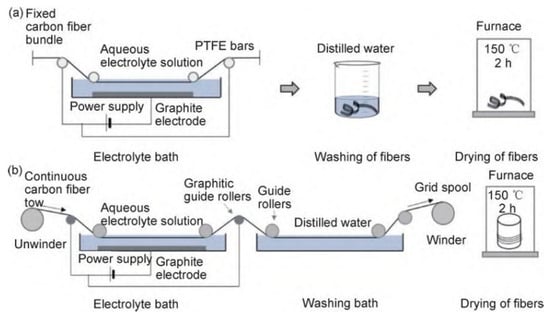
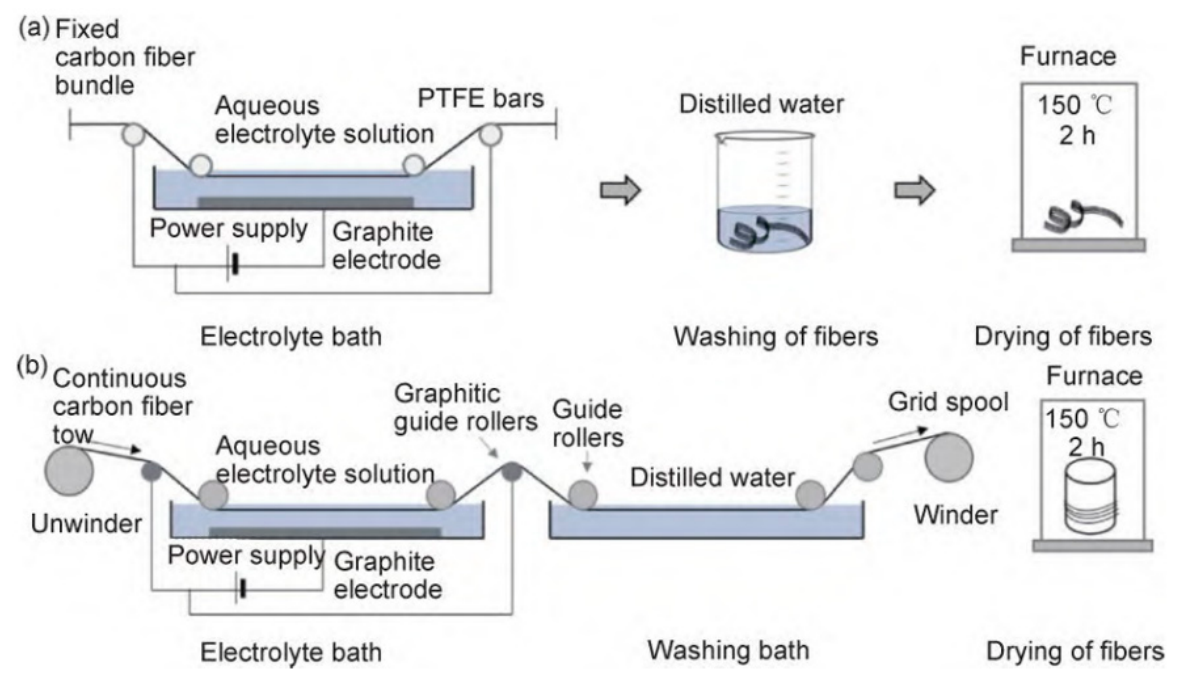
Electrochemical oxidation initiates a controlled electron-transfer reaction on the fiber surface, tuning its oxidation state and introducing reactive sites. This method is easily scaled up and ranks among the most widely employed routes for CF functionalization: the treatment raises surface energy and roughness and markedly improves adhesion to the polymeric matrix [1,6,8]. Electrophoretic deposition, frequently carried out in the same electrolytic cell, is then used to graft a coating or functional layer that heals surface flaws and can even restore fiber strength [6]. To maximize modification efficiency, researchers systematically optimize electrolyte chemistry, ionic concentration, treatment time, and cell environment (Figure 1) [7]. Typical electrolytes are H2SO4, HNO3, NaOH and (NH4)2CO3, each selected to create specific functional groups or to etch the CF surface to a desired extent [8].
Figure 1.
Electrochemical modification device: (a) static anodic oxidation of fixed fiber bundles; (b) dynamic anodic oxidation of continuous CF bundles (reprinted from Ref. [7]).
Anodic oxidation improves both wetting and the stability of chemical bonding at the fiber–matrix interface [9]. High-modulus CFs—which are intrinsically more inert—gain abundant oxygen- and nitrogen-containing surface functionalities after electrochemical treatment; the enhanced grafting capacity delivers pronounced improvements in interfacial properties [10]. In one study, MXene nanosheets were continuously electrophoretically deposited onto high-strength, high-modulus CF, increasing surface roughness and specific area and greatly strengthening mechanical interlocking with an epoxy matrix [11]. Electrochemical modification is already widely adopted in industry because it does not damage the fibers and can be run at high throughput; its main drawback is the considerable energy demand, which constrains further expansion.
2.2. Fiber Desizing
Unsized CF can be directly compounded with polydicyclopentadiene (PDCPD) and still endow the composite with a measurable property upgrade. A dicyclopentadiene (DCPD)/Grubbs 2nd-generation catalyst system was adopted to fabricate CF/PDCPD laminates by vacuum-assisted resin infusion (VARI) [12]. Although the resulting mechanical performance was greatly improved compared with neat PDCPD, the flexural strength remained far below that of an analogous CF fabric/epoxy laminate. This gap was traced to the commercial CF fabric, whose sizing chemistry is optimized for epoxy; consequently, interfacial compatibility with PDCPD is poor. The CF/PDCPD interface was likewise found to be weak: although the fracture toughness of the CF/PDCPD composite exceeded that of its epoxy counterpart by ~30%, its flexural strength amounted to only 24% of the latter [13]. SEM images of the tensile-fractured CF/PDCPD surface show massive PDCPD pull-out, whereas the CF/epoxy fracture surface is compact and cohesive.
Simple solvent (acetone) or even mild acid/alkali desizing physically etches the CF surface, introduces defect sites, increases the specific surface area, and simultaneously enhances affinity toward PDCPD. Because most commercially available CF is sized with epoxy-compatible finishes, acetone desizing removes the majority of this epoxy-based layer. After desizing, the fiber exhibits uniformly deep grooves that enable mechanical interlocking with PDCPD, yielding a markedly improved interface.
2.3. Chemical Grafting
Chemical grafting introduces tailored functional groups onto the CF surface and can be grouped into three classes of grafted species: (i) small molecules such as diazonium salts, nitro-terminated or amino-terminated diazonium derivatives; (ii) polymers, e.g., epoxies and hyper-branched polyimidoazoles; and (iii) nanomaterials, including carbon nanotubes (CNTs) and silica nanoparticles [7].
Carbon fibers (CFs) were modified by polyethyleneimine (PEI) sizing and subsequent poly(amido-amine) (PAMAM) coupling-agent grafting for use in carbon fiber/poly(ether-ether-ketone) (PEEK) composites [14]. Hot-press sintering was used to prepare neat PEEK and CF/PEEK laminates before and after modification, and interfacial, mechanical, and dry-sliding tribological behaviors were evaluated. After PEI sizing or PAMAM grafting, the surface energy of the fibers rose by 30.9% and 10.6%, respectively, relative to neat PEEK, and the interfacial adhesion strength of the corresponding composites increased markedly. XPS confirmed a pronounced enrichment of oxygen- and nitrogen-containing functionalities on the modified CF surface, providing a higher density of active sites that effectively strengthen interfacial bonding with the PEEK matrix.
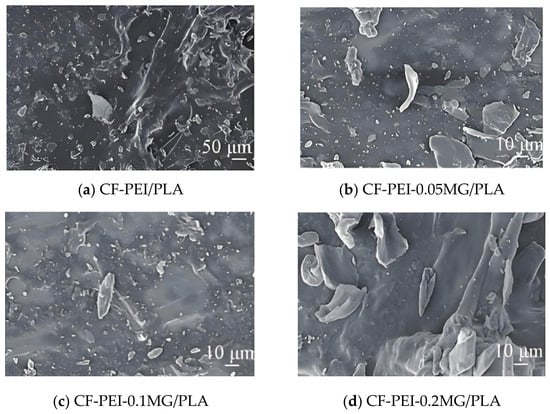
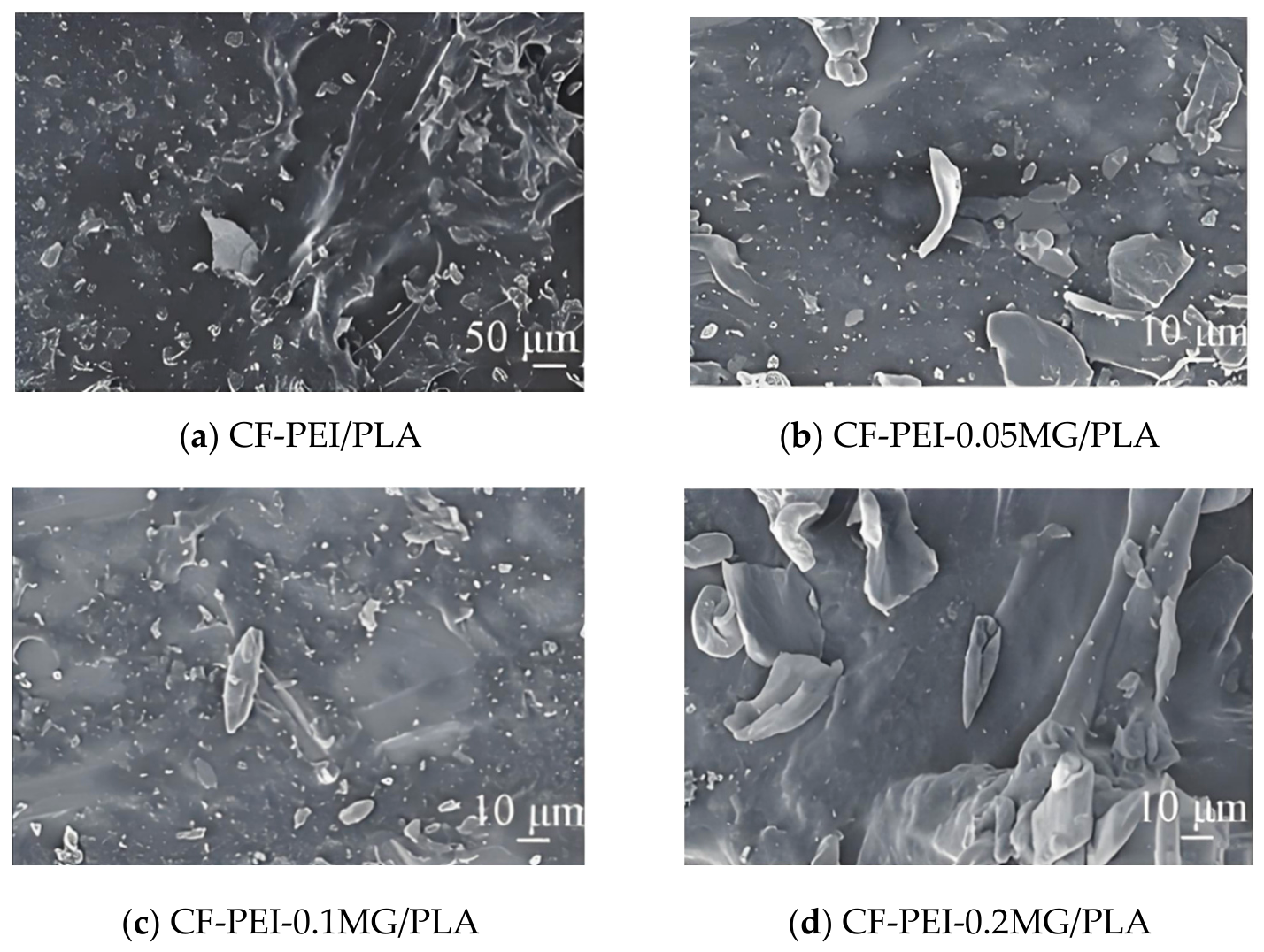
CFs were used to reinforce polylactic acid (PLA), and the mechanical performance of as-received, PEI-functionalized, and MXene-graphene-oxide-decorated CFs were systematically compared [15]. First, branched PEI was deposited onto the fibers to introduce reactive amine groups (PEI-CF). Subsequently, MXene-GO was anchored onto the PEI-CF surface. The modified fibers were then melt-compounded in a twin-screw extruder and injection-molded into CF/PLA test specimens at different fiber loadings and MXene-GO contents. Flexural modulus increased after both PEI and MXene-GO modification, but tensile strength remained almost unchanged because the average fiber length was below the critical reinforcement length. Scanning electron microscopy revealed that the tensile-fracture surface became progressively rougher as the MXene-GO content rose; fragments were visible on the fracture plane of the PEI-MXene-GO-CF/PLA composite (Figure 2), indicating enhanced energy dissipation at the fiber/matrix interface.
Figure 2.
Cross-sectional morphology of CF/PLA composites (reprinted from Ref. [15]).
Chopped CFs were desized in acetone and subsequently functionalized with carboxylic acid, triol and norbornene termini to covalently anchor norbornenyl groups on the fiber surface [16]. Adding only 3 wt% of these norbornene-grafted short fibers raised the inter-layer adhesion of 3D-printed laminates by 255%, because the pendant norbornenyl moieties copolymerized with the matrix via ring-opening metathesis, creating a continuous, covalently bonded interphase.
A comparable approach was followed by grafting norbornene-bearing triethoxysilane, tert-butyl norbornene-carboxylate, or norbornene anhydride onto desized CF [17]. The resulting fibers intimately co-reacted with the PDCPD resin during ring-opening metathesis polymerization (ROMP), yielding composites with a tensile strength of 654.6 MPa and flexural strength of 510.7 MPa—substantial improvements over the unmodified baseline.
2.4. Plasma Treatment
Plasma treatment creates nanometer-scale physical defects through the bombardment of high-energy particles and concurrently grafts oxygen-containing functional groups onto the CF surface. This dual action increases surface roughness and chemical reactivity, promoting mechanical interlocking and covalent bonding with the resin matrix [6]. Owing to its short process time, high efficiency, and absence of chemical waste, plasma modification has become one of the most widely adopted surface activation methods for CF.
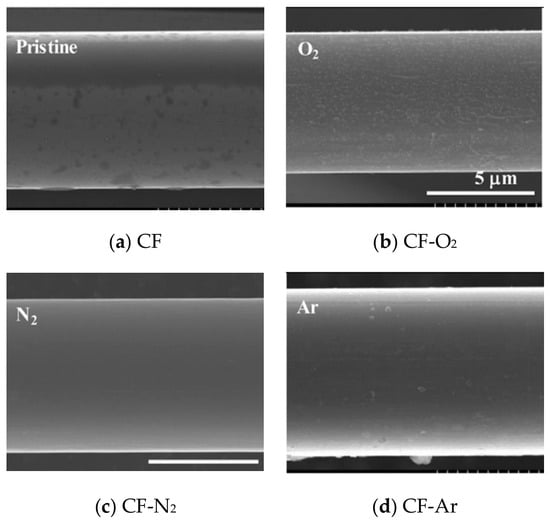
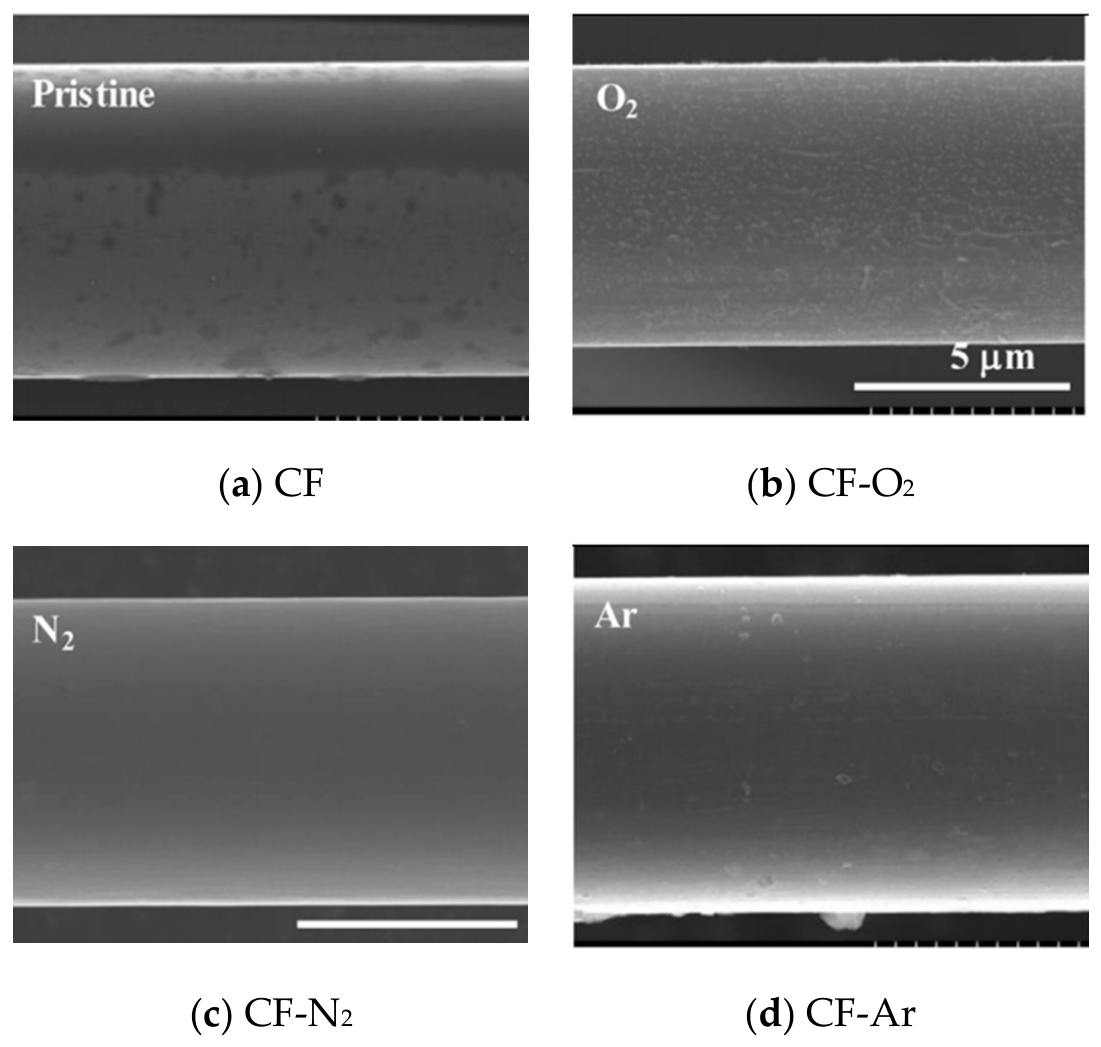
Plasma exposure in O2, N2, NH3 or other atmospheres generates polymer radicals and anchors reactive functionalities on the CF surface [18,19], converting it from non-polar to polar. The process can be run at either low or elevated temperatures. Atmospheric-pressure plasma treatments in Ar, N2 and air were applied to carbon-fiber-reinforced polymer (CFRP) substrates, generating polar groups (–NH2, –OH, –COOH) that increased surface free energy and promoted adhesion through hydrogen and covalent bonding [18]. As a result, lap-shear strength jumped from 8.6 MPa to 23.1 MPa. CFs were exposed to Ar, O2 and N2 plasmas, all of which generated hydrophilic functionalities and increased surface roughness; among them, Ar-plasma treatment yielded the highest interfacial shear strength [19]. Surface morphologies before and after modification are shown in Figure 3.
Figure 3.
SEM images of the carbon fiber surface before and after plasma treatment (reprinted from Ref. [19]).
Although plasma treatment is environmentally friendly, simple to operate, and highly efficient, it demands stringent processing conditions—vacuum enclosures and high-quality power/gas-delivery systems—that complicate scale-up to a continuous, industrial CF line.
2.5. Coating Modification
Coating modification—classified as a physico-chemical hybrid route—deposits a highly reactive molecular or polymeric layer onto the CF surface. This interphase, exhibiting excellent compatibility with both fiber and resin, reconstructs the bonding interface and tailors its mechanical and chemical characteristics. Common scalable techniques include sizing re-formulation, chemical vapor deposition (CVD), and coupling-agent deposition [6,7].
Compared with oxidative surface treatments, coating technology can strengthen interfacial bonding without etching or embrittling the carbon fiber, so mechanical performance is not sacrificed. The process is simple, cost-effective and readily scaled to industrial lines, provided the coating chemistry is compatible with the target resin matrix. A water-borne, thermoplastic polyimide sizing was developed for high-strength/high-modulus CF [20]. After sizing, the fiber O/C ratio rose by 125%, and the interlaminar shear strength (ILSS) of CF/PEEK laminates increased by 54.3%. A carboxyl-terminated poly(aryl ether ketone) (PEKC-COOH) sizing was synthesized [21]. The water-soluble coating markedly improved fiber–resin adhesion, raising flexural strength and ILSS by 52.9% and 53.3%, respectively, relative to unsized CF/PEEK. The intrinsic compatibility between PEKK and PEEK, combined with hydrogen bonding between PEKK and the CF surface, was exploited to establish a PEKK-rich interphase [22]. CF/PEEK composites exhibited increases of 70% in ILSS, 37% in flexural strength and 48% in flexural modulus. The straightforward sizing route is well-suited to industrial implementation. A siloxane-based polymer coating was deposited onto CF [23]. The flexible interlayer improved wetting and stress transfer, simultaneously enhancing flexural properties and ILSS of CF/PEEK composites. Pan and Yapici compared siloxane coatings with polyimide and PEKK sizing systems under identical molding conditions, proving that siloxane interlayers delivered stable interfacial reinforcement without sacrificing the high heat resistance of the PEEK matrix. Unlike rigid sizing layers that readily crack under bending loads, the elastic siloxane network alleviates interfacial stress concentration and inhibits premature interlayer delamination during service. This coating strategy offers a complementary interfacial optimization approach alongside the water-borne thermoplastic sizing agents described above.
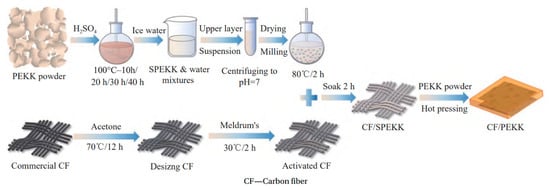
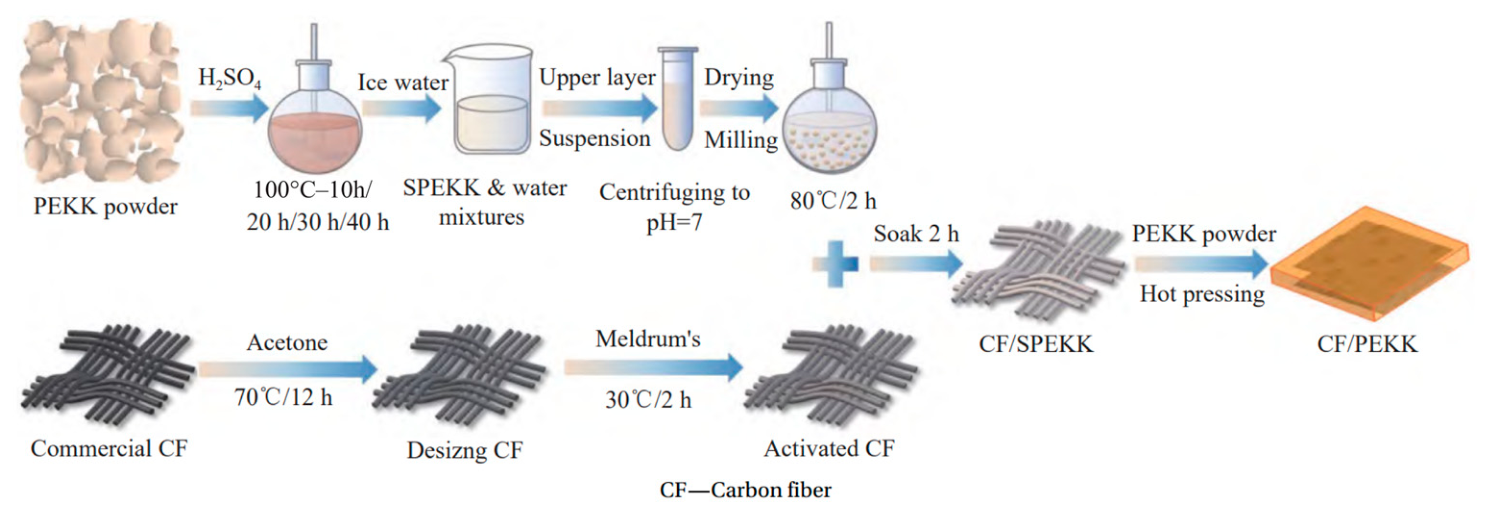
A water-borne sulfonated poly(ether-ketone-ketone) (SPEKK) sizing agent was prepared by concentrated-sulfuric-acid sulfonation [24]. After SPEKK sizing, hydrogen bonding and π–π interactions between SPEKK and the CF surface coexist with π–π stacking and inter-diffusion between SPEKK and the PEKK matrix, collectively strengthening the CF/PEKK interface (composite fabrication route shown in Figure 4). Compared with unsized CF/PEKK, the sized composite exhibited increases of 35.5% in flexural strength, 5.4% in flexural modulus and 26.0% in ILSS.
Figure 4.
Schematic diagram of the CF/PEKK composite preparation process (Reprinted from Ref. [24]).
Surface coating of CF for thermoplastic-matrix composites continues to attract intense academic interest. A polyurethane (PU) sizing was applied to CF/acrylonitrile–butadiene–styrene (ABS) laminates; the sized fibers exhibited stronger adhesion to ABS, yielding molded composites with increased tensile strength, modulus and impact resistance [25]. A polyurethane interlayer was deposited on CF to reinforce the CF/polyamide (PA) interface; urethane groups in the coating were shown to interact specifically with the amide functionalities of the PA matrix [26]. After coating, the consolidated stack was subjected to electron-beam (EB) irradiation to induce cross-linking of the PA and thereby further boost interfacial adhesion.
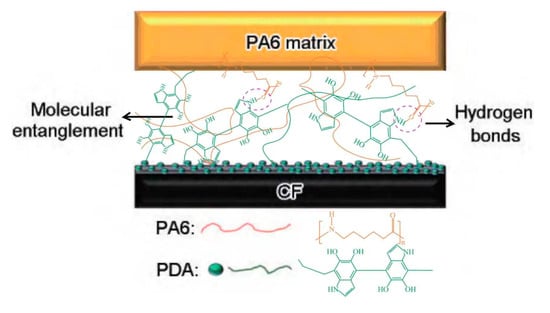
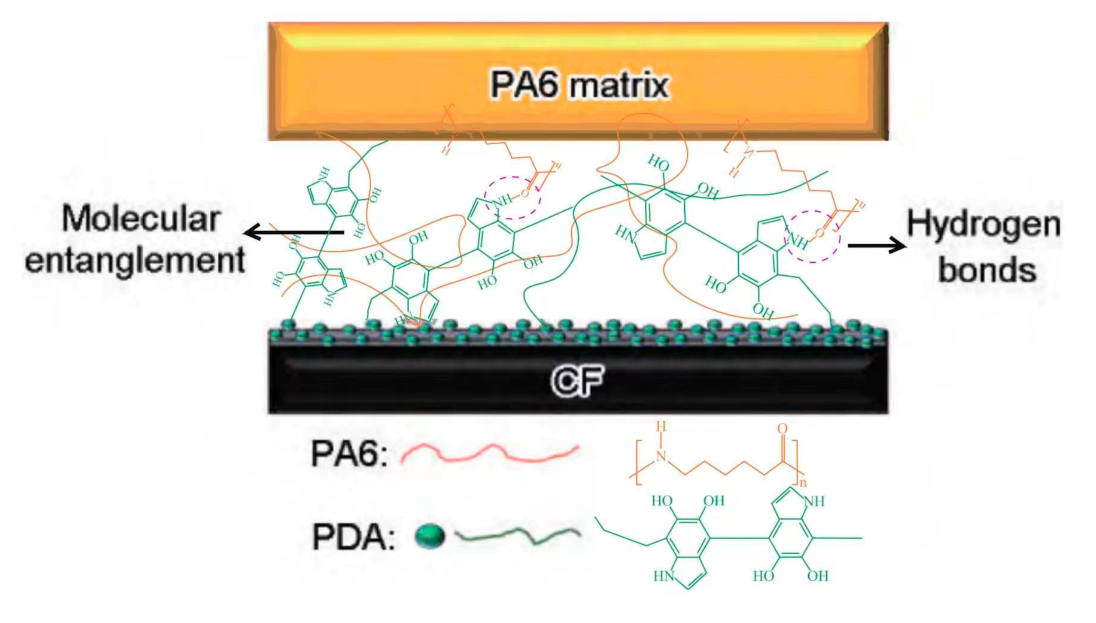
A polydopamine (PDA) layer was deposited on CF, introducing amine and other reactive groups that markedly increased surface activity [27]. The PDA coating simultaneously enhanced π–π interactions between CF and polyamide 6 (PA6), promoting both mechanical interlocking and interfacial adhesion. The authors evaluated the fiber surface and composite interface from multiple perspectives and clarified the toughening mechanism of the PDA interphase (illustrated in Figure 5). For CF/PA6, the optimum interfacial performance was achieved with 16 h of PDA deposition. Owing to its strong interfacial adhesion, the PDA layer can also serve as a platform for secondary modifications, offering a route to shorten deposition time in future work.
Figure 5.
Schematic diagram of the interfacial reinforcement mechanism of CF/PA6 composite material (Reprinted from Ref. [27]).
To further strengthen the fiber/matrix interface, researchers have incorporated carbon nanotubes (CNTs), graphene, SiO2 and other nanoparticles into sizing coatings. These nanofillers intensify mechanical interlocking and penetration between the coating, fiber and matrix, yielding additional interfacial gains. A PDA-CNT hybrid sizing was formulated; tensile strength of CF/PEI increased by up to 12.5%, and surface roughening raised ILSS by 39.4% [28]. A PU/SiO2 hybrid sizing was applied to CF, raising the CF/PA6 interfacial strength by more than 40% compared with neat PU [29]. Hydroxylated boron nitride was grafted onto CNTs (BNO-CNTs) and subsequently dispersed in a PEI sizing [30]. The added roughness, surface energy and oxygen functionality improved mechanical interlocking in CF/PEEK, raising flexural strength, modulus and ILSS by 77.7%, 59.4% and 68.9%, respectively. However, nanoparticle content must be optimized; excessive loadings agglomerate at the interface, impede load transfer, and can degrade mechanical performance.
Different surface modification approaches deliver distinct ILSS enhancement effects, which can be interpreted from three core interfacial mechanisms: chemical bonding, mechanical interlocking, and increased surface energy [9]. Plasma treatment primarily etches the CF surface to generate micro-scale roughness for mechanical interlocking and elevates surface energy; however, it only introduces a small number of reactive groups, so the contribution of covalent chemical bonding is relatively limited [18]. By contrast, chemical grafting can anchor many reactive functional moieties onto fiber surfaces, establishing direct covalent chemical bonding with epoxy resin, which becomes the dominant factor for significant increases in ILSS [10]. For nanoparticle-incorporation modification, improved performance originates from the combined effect of surface roughness-induced mechanical interlocking, higher surface energy, and partial interfacial chemical interactions. Nevertheless, severe nanoparticle agglomeration will weaken load-transfer capacity and degrade final ILSS, making dispersion state a critical precondition for obtaining satisfactory interfacial properties [11].
The individual strategies of fiber–matrix interface strengthening and matrix toughening are frequently reviewed in isolation, yet their mutual coupling largely governs the final mechanical performance of CF-reinforced composites [1,7]. Appropriate interface properties can fully release the toughness advantage of modified matrices, giving rise to prominent synergistic effects: a moderately strong interface enables effective stress transfer, while a ductile matrix alleviates severe stress concentration near the fiber ends, promoting crack deflection, fiber debonding, and subsequent fiber pull-out to dissipate fracture energy [2,9]. Nevertheless, undesirable trade-offs should not be overlooked. Excessively high interfacial adhesion or intrinsically brittle interphase layers may suppress these critical energy-dissipation mechanisms. Even if a highly toughened matrix is employed, brittle failure dominated by fiber fracture can occur instead of progressive fiber pull-out. Under such circumstances, the intrinsic toughness of the modified matrix cannot be exploited, and the composite still exhibits low fracture resistance [5]. Therefore, matching interface strength and matrix toughness is essential for the rational design of high-performance carbon fiber composites.
3. Resin-Toughening Modification
Epoxy resin (EP) serves as the dominant matrix material for high-performance carbon fiber-reinforced composites, benefiting from superior mechanical performance, outstanding chemical resistance, convenient processing characteristics, and robust interfacial bonding with carbon fiber. Nevertheless, the highly cross-linked network formed after epoxy curing results in intrinsic brittleness and low Mode-I fracture toughness. When subjected to impact loads, rapid microcrack extension and interlayer delamination can easily occur, severely deteriorating composite structural safety and service reliability. Accordingly, thermoplastic-based toughening modification has become one of the most mature and efficient strategies to overcome epoxy brittleness, which systematically regulates multi-scale energy dissipation via reaction-induced phase separation (RIPS).
3.1. Thermoplastic Toughening of Epoxy Matrices
High-performance engineering thermoplastics including polyetherimide (PEI), polyethersulfone (PES), polysulfone (PSF) and polyphenylene oxide (PPO) are widely adopted as epoxy tougheners [31]. Unlike rubber modifiers that sacrifice thermal and stiffness properties, these TP polymers simultaneously possess high modulus, excellent heat resistance and ductility; they can significantly elevate epoxy fracture toughness without obvious deterioration of matrix thermal stability and rigid mechanical properties. During epoxy curing, the mismatch between cross-linking-induced molecular weight growth and TP–epoxy miscibility triggers RIPS, and adjusting TP loading, curing temperature and curing agent reactivity can precisely tailor microphase morphologies including sea-island particulate structure, bicontinuous co-continuous structure and phase-inverted structure [32]. Extensive experimental evidence confirms that a bicontinuous TP-rich continuous network embedded in an epoxy matrix delivers the optimal toughening effect while preserving epoxy modulus and thermal performance [33].
3.1.1. Quantitative Toughness Prediction Model for PEI-Modified Binary Epoxy System
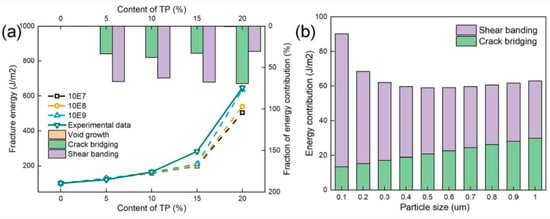
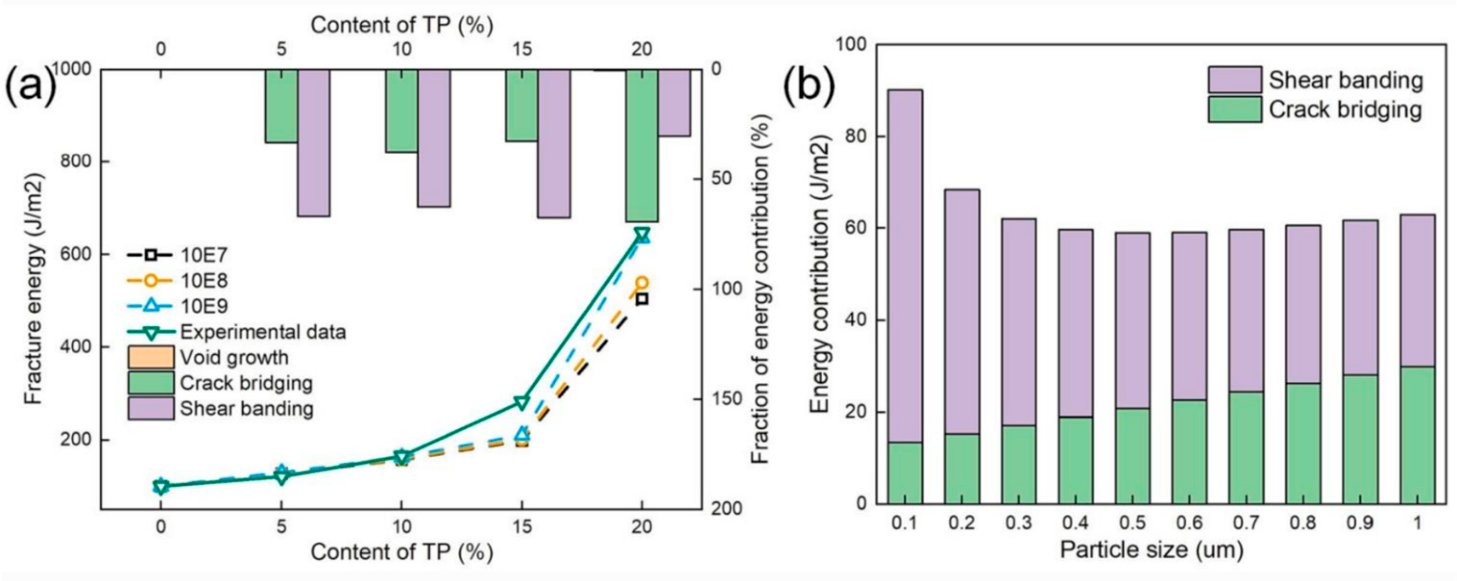
A complete analytical model quantifying Mode-I fracture toughness and decoupling multiple energy dissipation terms was proposed for PEI/epoxy two-phase blends, which can quantitatively distinguish the independent contributions of matrix shear banding, thermoplastic crack bridging, and matrix void growth [34].
For low PEI loading (5–15 wt%, sea-island particulate morphology): Discrete PEI particles are uniformly dispersed in the continuous epoxy matrix, and matrix shear banding accounts for over 60% of total fracture energy increase. After crack propagation, stretched PEI ligaments form typical crack-bridging zones accompanied by particle–matrix debonding. As PEI content increases from 5 wt% to 15 wt%, the energy dissipation of crack bridging rises continuously, leading to a 33% improvement in fracture toughness at 5 wt% PEI [34].
At high PEI loading (20 wt%, bicontinuous and phase-inverted morphology): Secondary phase separation takes place, forming interpenetrating PEI-rich and epoxy-rich domains with tiny epoxy inverse particles embedded in thermoplastic phases. Plastic deformation and crack bridging of PEI become the dominant toughening mechanisms, contributing up to 70% of total toughness gain and boosting fracture toughness by 70% relative to neat epoxy; void growth only appears within epoxy domains and provides negligible energy consumption [34]. Further parametric analysis based on this model also reveals that reducing the average size of phase-separated PEI particles facilitates the generation of more shear bands around fillers under identical thermoplastic content, thereby further enhancing the crack resistance of epoxy matrices [34].
The quantitative outputs of the analytical toughness model are illustrated in Figure 6.
Figure 6.
(a) Comparison of the predicted fracture energies with the measured values for PEI/epoxy and (b) variation in toughness contribution from shear banding and crack bridging under different PEI particle sizes (reprinted from Ref. [34]).
3.1.2. PES-Toughened Epoxy with Co-Continuous Phase Structure
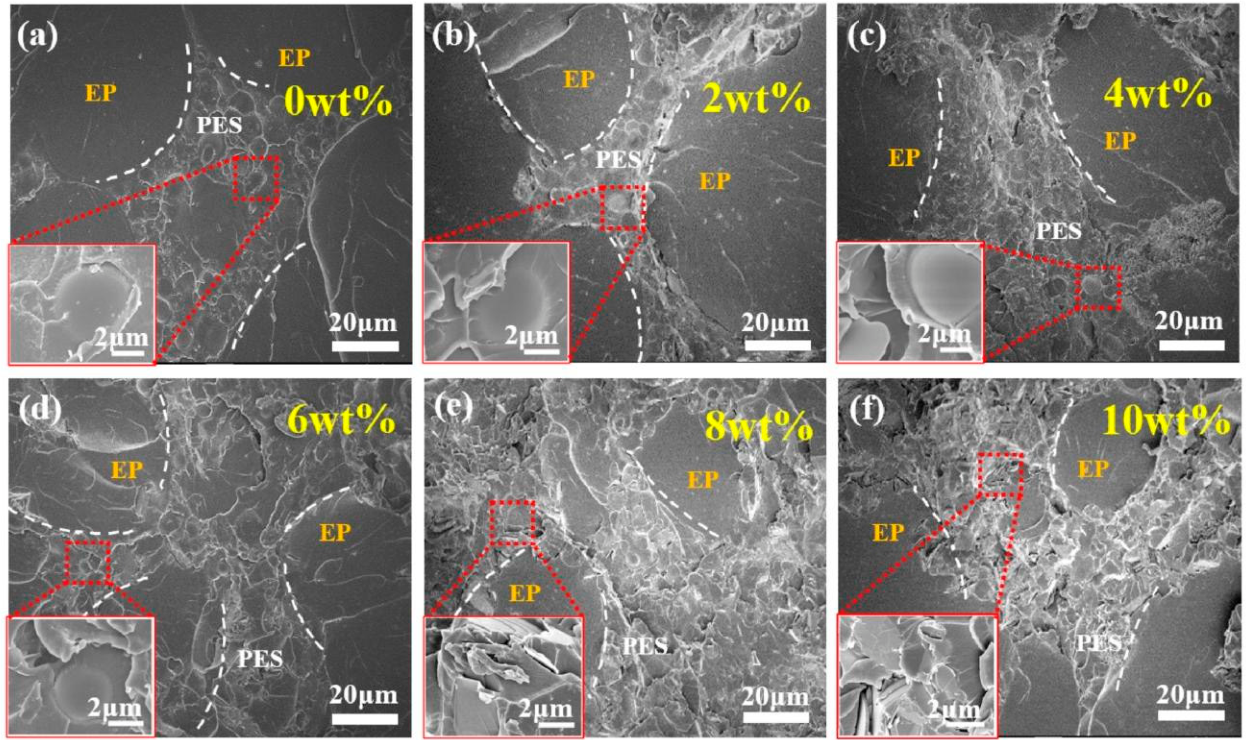
PES is a classic miscible thermoplastic modifier for EP. During curing, RIPS drives the formation of adjustable PES/epoxy microstructures, and the bicontinuous phase architecture completely transforms the brittle fracture characteristic of neat epoxy into ductile failure behavior, simultaneously upgrading the tensile, flexural and fracture resistance of epoxy composites [32,35]. For diglycidyl ether of bisphenol-A(DGEBA) epoxy cross-linked with 4,4′-diaminodiphenyl sulfone (DDS) curing agent, PES and epoxy chains construct semi-interpenetrating polymer networks via synergistic curing reactions; under external loading, continuous PES domains undergo large cold drawing and plastic elongation to absorb abundant fracture energy and inhibit crack propagation [32]. In addition, the bicontinuous PES phase can act as a preferential distribution channel for silver nanoparticle-modified boron nitride (AgBN) fillers, constructing continuous heat conduction pathways while retaining the prominent toughening efficiency of PES domains, which realizes synchronous optimization of thermal conductivity and mechanical properties of epoxy composites [35].
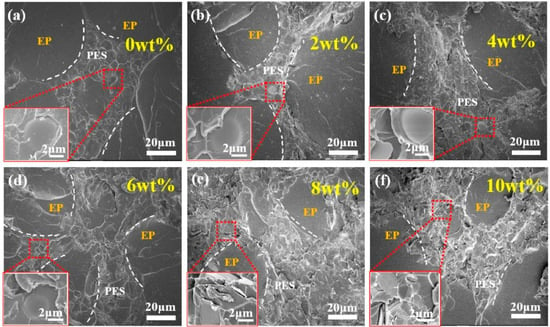
The morphological evolution of PES/epoxy blends with increasing PES loading is presented in Figure 7.
Figure 7.
SEM images of PES-EP/AgBNs with (a) 0 wt%, (b) 2 wt%, (c) 4 wt%, (d) 6 wt%, (e) 8 wt%, and (f) 10 wt% AgBNs (reprinted from Ref. [35]).
3.1.3. Polysulfone (PSF)-Modified Epoxy: Morphology Evolution and Property Trade-Offs
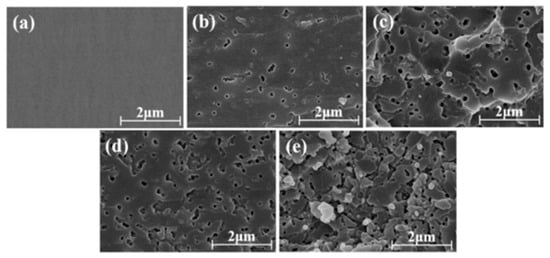
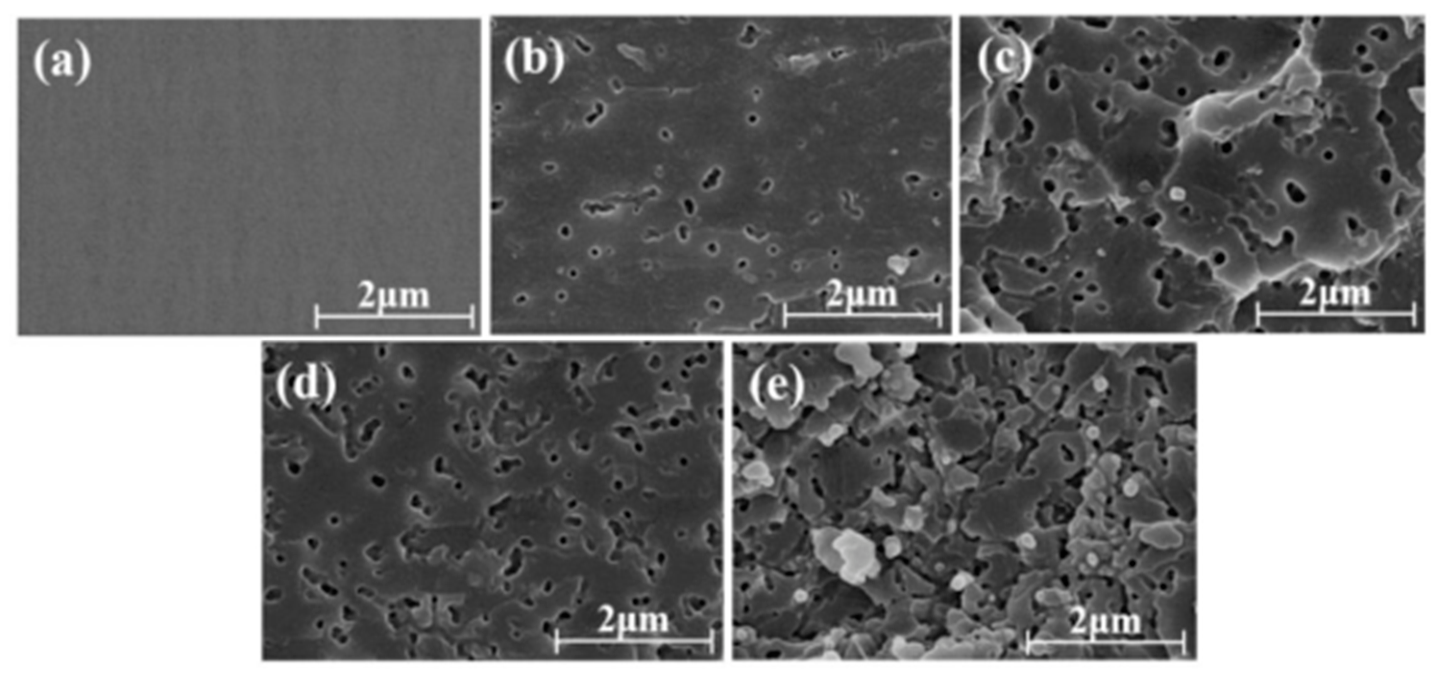
PSF contains abundant polar groups on its macromolecular backbone, showing excellent miscibility with uncured bisphenol A epoxy and forming stable interphase regions after phase separation [36]. With PSF loading ranging from 5 phr to 20 phr, the phase morphology evolves sequentially: discrete particulate PSF dispersion (5–10 phr) → bicontinuous interpenetrating network (15 phr) → phase-inverted structure with continuous PSF wrapping isolated epoxy microdomains (20 phr) [36].
Performance compromise: Incorporation of PSF increases the viscosity of uncured resin and reduces epoxy cross-link density, which gradually decreases the tensile strength and tensile modulus with the growth of PSF content, though the comprehensive mechanical performance remains superior to rubber-toughened epoxy systems [36]. The fractured surfaces of PSF–epoxy blends are shown in Figure 8.
Figure 8.
Scanning electron microscope (SEM) images of the fractured surfaces of the PSF–epoxy blends: (a) 0 phr, (b) 5 phr, (c) 10 phr, (d) 15 phr, and (e) 20 phr (reprinted from Ref. [36]).
Combined with the above morphological characterization and quantitative toughness analysis of PEI-, PES- and PSF-modified epoxy matrices, Table 1 compares their optimal content, phase evolution, toughening improvement and drawbacks for intuitive horizontal comparison [32,34,35,36].
Table 1.
Summary of typical characteristics for PEI-, PES- and PSF-toughened epoxy systems [32,34,35,36].
3.2. Interpenetrating Polymer Network (IPN)/Semi-Interpenetrating Polymer Network (SIPN) Matrix Regulation
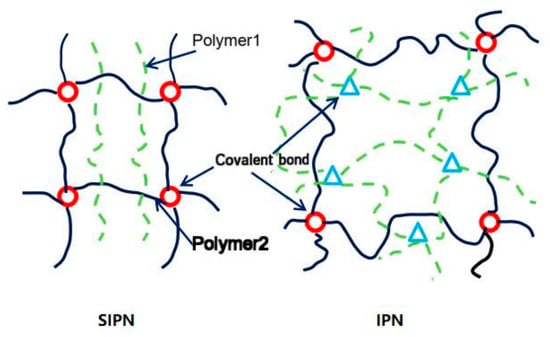
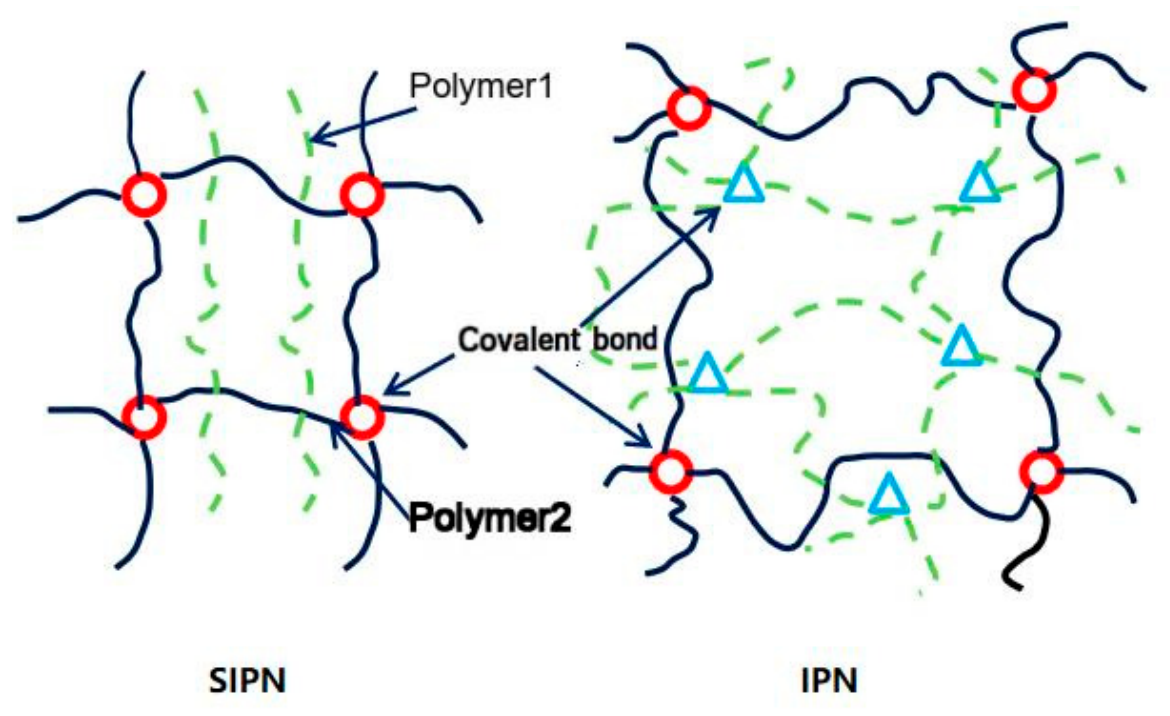
IPNs are a unique class of polymer alloys in which two—or more—cross-linked networks interpenetrate and entangle on a random, molecular scale [37]. This topological “forced compatibility” locks the components together, stabilizes the blend and allows each constituent to contribute its best properties, yielding synergistic performance that often exceeds that of either network alone. In a two-component system, if only one constituent is cross-linked while the second remains linear, the architecture is termed a SIPN; a schematic comparison of ideal IPN and SIPN morphologies is shown in Figure 9.
Figure 9.
Schematic diagram of an interpenetrating network structure.
PEEK-type tougheners were synthesized through azide–alkyne click polymerization of 1,4-bis(azidomethyl)benzene(BAB) with either 4,4′-bis(2-propynyloxy)benzophenone(PBP) or 4,4′-sulfonylbis(propynyloxy)benzene(SBP) [38]. The resulting linear polymers were added to an epoxy prepolymer, where they polymerized in situ and simultaneously reduced viscosity while improving thermal stability. At 5 wt% loading, poly(p-BAB/PBP) doubled the fracture toughness of the cured epoxy, outperforming the analogous p-BAB/SBP polysulfone-type toughener and retaining low viscosity and high heat resistance. The superior performance is attributed to a SIPN formed between the epoxy network and the linear poly(p-BAB/PBP) chains. These attributes are highly attractive for advancing carbon-fiber-reinforced epoxies as lightweight metal replacements.
3.3. Thermotropic Liquid-Crystalline Polymer (TLCP) Toughening
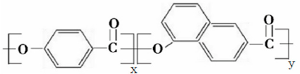
Early fundamental investigations into TLCP composite fabrication and intrinsic toughening effects can be traced back to the classic work reported by Handlos and Baird [39], while Xiao et al. [40] summarized the basic classification and synthetic routes of thermotropic liquid-crystalline polymers in an early review. By carefully controlling heating time and temperature, highly ordered crystals of pure compounds are converted into an isotropic melt through a thermodynamically stable intermediate—the “liquid-crystalline phase”—that contains both flexible spacers and rigid, mesogenic units. In the laboratory, TLCPs are synthesized via solution or interfacial polycondensation of aromatic acid chlorides with phenolic monomers, whereas industrial routes favor high-efficiency oxidative esterification, acidolysis, or phenyl–ester exchange processes [40]. Representative commercial TLCP grades and their properties are summarized in Table 2.
Table 2.
Thermal liquid crystal polymer product diagram [40].
When a flexible-segment curing agent is selected for the epoxy system, the ordered mesogenic units of TLCP become further oriented during curing. Simultaneous phase separation generates micro-scale, highly ordered fibrillar bridges within the resin. Under impact, these in situ micro-fibers act in concert with the macroscopic high-strength carbon reinforcement, sharing the load and efficiently dispersing localized stress—a mechanism known as in situ toughening. In recent years, research in China has moved beyond simply blending neat TLCP toward chemically modifying the TLCP itself or combining it with other tougheners to achieve synergistic effects. For example, graphene-oxide (GO) sheets were covalently grafted onto TLCP chains to create TLCP-g-GO. The addition of this hybrid filler raises composite tensile strength and flexural modulus by >45% and also produces a slight increase in glass-transition temperature [41].
Within the cured epoxy matrix, microfibrillar liquid-crystalline domains act as crack-arrest bridges. When a craze front encounters these domains, the oriented TLCP fibrils span the fracture plane, pinning the craze tips much like anchors. The advancing craze is either blunted or forced to branch, preventing its conversion into a propagating crack and thereby markedly increasing the toughness of the liquid-crystalline composite [42,43].
3.4. Rubber Elastomer Crack-Resistance Enhancement
The core mechanism of epoxy modification via rubber elastomers relies on differences in Poisson’s ratio between two phases. After rubber domains are dispersed within an epoxy matrix, the rubber phase possesses a far larger Poisson’s ratio than the continuous resin phase. Upon impact loading, rubber particles undergo much stronger lateral shrinkage than the surrounding epoxy, generating localized stress concentration zones that trigger matrix shear bands. These shear bands serve as major energy dissipation channels and effectively boost the crack resistance of epoxy materials [31].
Rubber-based epoxy modification approaches fall into two main categories: reactive liquid rubbers and pre-synthesized rubber microparticles. Low-molecular-weight liquid rubbers exhibit full miscibility with uncured epoxy monomers. As cross-linking proceeds, chemical incompatibility gradually develops, driving nucleation and phase separation to form uniformly distributed submicron spherical rubber domains. During external loading, these discrete rubber microspheres induce matrix cavitation and shear yielding to consume fracture energy, achieving simultaneous optimization of stiffness and ductility. End-hydroxyl polybutadiene (HTPB) and butadiene–acrylonitrile copolymers are the most widely adopted rubber modifiers for epoxy matrices, thanks to facile fabrication processes and prominent crack-resistance improvement capacity.
Carboxyl-terminated butadiene–acrylonitrile rubber (CTBN) was adopted to modify AG-80 EP [44]. Researchers systematically characterized matrix mechanical response, fiber surface features, tensile performance, and fracture microstructures to reveal critical factors controlling fiber–matrix interfacial bonding in CF/epoxy composites. A peak crack resistance value was achieved at an optimal CTBN loading of 6.90 wt%. Benefiting from abundant polar functional groups and excellent resin wettability, T800SC CF-reinforced composites delivered superior overall mechanical performance compared with T800HB counterparts. An in situ pre-cross-linked CTBN/epoxy blend was further fabricated. Pre-reaction enables the formation of local interpenetrating structures, which elevate phase compatibility and interfacial bonding compared with ordinary CTBN-modified epoxy, thus achieving remarkable mechanical advancement [45].
A hybrid system combining silica nanoparticles and CTBN micro-rubber particles was studied for anhydride-cured epoxy matrices [46]. Researchers characterized the intrinsic resin performance as well as carbon/glass fiber-reinforced composite counterparts. The dual-filler hybrid system delivered a maximum strain energy release rate of 965 J/m2. Notably, the improved intrinsic crack resistance of bulk epoxy can be fully inherited by fiber-reinforced composites; extra energy dissipation originating from fiber bridging further elevates the interlayer failure resistance of composite laminates.
3.5. Core–Shell-Structured Polymer Reinforcement
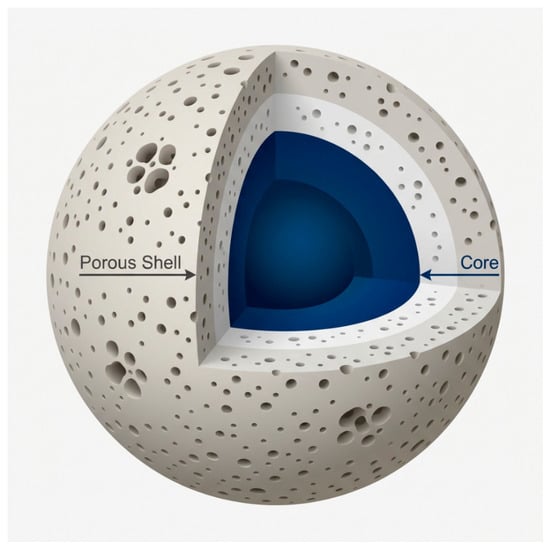
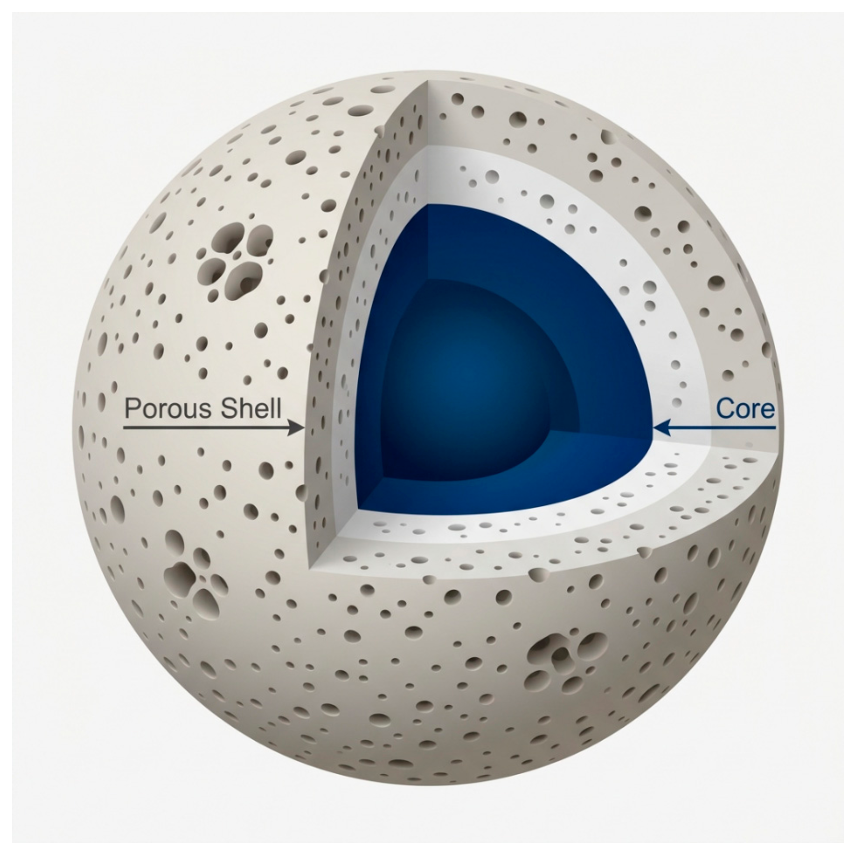
Core–shell latex polymers (CSLPs) are composite particles obtained by emulsion polymerization of two or more monomers. Their typical morphology is illustrated in Figure 10. They are usually designed as either “soft-core/hard-shell” or “hard-core/soft-shell” architectures, of which the former is preferred for toughening purposes. The particles exhibit a distinct bilayer (or multilayer) structure: the outer shell is commonly poly(methyl methacrylate) (PMMA), whereas the core comprises flexible components such as butadiene rubber, acrylate elastomer, polyurethane or silicone. The glassy shell ensures good compatibility with the epoxy matrix, while the rubbery core provides toughness. Upon loading, the rubber particles cavitate first, initiating numerous crazes and shear bands in the surrounding matrix; the synergistic deformation mechanisms dissipate substantial fracture energy. Because the PMMA shell constrains large-scale plasticization of the epoxy, the glass-transition temperature remains essentially unchanged, enabling CSLPs to toughen epoxies without sacrificing thermal performance [31].
Figure 10.
Schematic diagram of CSLP structure.
Toughened epoxy/carbon fiber composites were prepared by resin-transfer molding using two types of epoxy-functional, pre-formed toughening microspheres [47]. The particles possessed a tri-layer core–shell architecture: a cross-linked PMMA core, an intermediate cross-linked poly(butyl acrylate) rubber layer, and an outer terpolymer shell of methyl methacrylate–ethyl acrylate–glycidyl methacrylate. Their performance was compared with that of (i) analogous core–shell acrylic particles lacking epoxy functionality and (ii) a conventional CTBN liquid-rubber modifier. Tensile, compressive, and impact tests quantified mechanical response; optical and scanning electron microscopy revealed fracture-surface features, while short-beam shear and fracture-toughness tests evaluated interfacial behavior. The results demonstrate that the epoxy-functional toughening particles outperform both non-functional acrylic particles and CTBN, delivering superior strength, toughness and interlaminar properties.
To date, CSLPs have emerged as one of the most efficient toughening additives, and considerable progress has been achieved in tailoring their synthesis protocols, controlling micro-morphology and clarifying formation mechanisms. Nevertheless, their transition from laboratory to industry remains hampered by high raw material costs and complex multi-step processing routes.
4. Comparison of Modification Strategies
Table 3 quantitatively compares the performance enhancement, cost, and industrialization potential of all mainstream modification approaches. For fiber surface modification, electrochemical oxidation and thermoplastic sizing exhibit the highest industrial maturity with balanced mechanical enhancement and low raw material costs, while plasma and chemical grafting are limited by expensive equipment or complicated pre-treatment processes [48]. In terms of matrix toughening, core–shell particles and liquid rubber achieve the most prominent fracture toughness improvement [49,50], yet core–shell modifiers suffer from high material costs. TLCP and IPN systems deliver outstanding comprehensive toughening effects but remain confined to laboratory research due to complicated synthesis and ultra-high raw material prices, which greatly restricts their large-scale industrial application in the short term.
Table 3.
Comparison of modification strategies for CF–epoxy composites.
Based on the above comparative analysis of various modification routes summarized in Table 3, both fiber-surface engineering and matrix regulation are indispensable to boost the mechanical properties of CFRPs. Among them, fiber-surface engineering plays a pivotal role: oxidation, chemical grafting, plasma activation, sizing replacement and nano-coating markedly increase interfacial adhesion, enabling efficient load transfer and elevating overall composite performance [51,52,53,54]. Matrix modification is equally important—incorporating rubbers, thermoplastics, liquid-crystalline polymers, core–shell particles or nanoscale fillers creates multi-phase or interpenetrating architectures that dissipate fracture energy without sacrificing modulus or glass-transition temperature [44,55,56]. The synergistic combination of these two categories of strategies has produced CFRPs whose impact resistance and fracture toughness are several-fold higher than those of conventional systems, while retaining their low density and high strength, thereby expanding their use in aerospace, automotive, defense and other demanding fields.
5. Conclusions and Outlook
This review systematically summarizes two primary technical routes to improve the mechanical performance of carbon fiber–epoxy composites: carbon fiber surface modification and resin-matrix regulation. For fiber surface modification, oxidative treatment, chemical grafting, plasma activation, and coating sizing can effectively enhance fiber–matrix interfacial adhesion, while trade-offs exist among reinforcement efficiency, processing complexity, and industrial maturity. Electrochemical oxidation and thermoplastic sizing deliver balanced interfacial improvement with high technical readiness, whereas plasma treatment and chemical grafting are limited by high equipment cost or complex operation. For resin-matrix toughening, thermoplastics, interpenetrating networks, thermotropic liquid-crystalline polymers, rubber elastomers and core–shell particles improve fracture toughness through different energy-dissipation mechanisms. Each toughener has distinct pros and cons in mechanical properties, processability and material cost; no single strategy can simultaneously achieve high strength, high toughness, low cost and scalable manufacturing. The match between interfacial bonding strength and matrix toughness is essential for composite performance. Excessively strong interfaces can suppress crack deflection and fiber pull-out even with highly toughened matrices. Therefore, coordinated optimization of fiber-surface engineering and matrix modification is necessary for high-performance CFRPs.
Future research can focus on several practically oriented directions. First, recyclable CFRPs for low-carbon manufacturing require degradable epoxy matrices and removable interphases, where balancing recyclability and mechanical performance remains a key bottleneck. Second, AI-assisted formulation design can accelerate toughener screening, parameter optimization and performance prediction to reduce redundant experiments. Third, tailored modification strategies should be developed to meet the special rheological and curing demands of 3D-printable CF/epoxy composites. Furthermore, self-healing fiber–matrix interphases deserve investigation to repair microcracks and delamination and improve cyclic-loading reliability. Finally, multifunctional toughening agents combining mechanical reinforcement with sensing or lightning-strike protection are promising for integrated structural–functional CFRPs. Nevertheless, several practical bottlenecks remain for real-world application: better insight into long-term aging and durability of tailored fiber–matrix interfaces, higher reproducibility of modification procedures, solutions for large-scale industrial translation, and unified characterization-testing protocols for modified CFRPs. Collectively, these avenues provide next-generation material solutions for advanced manufacturing.
Author Contributions
Conceptualization, H.Y. and L.W.; methodology, Y.W. and Y.J.; formal analysis, Y.W., W.G. and Q.X.; investigation, Y.W., Y.J., W.G. and Q.X.; resources, H.Y., L.W., W.G. and Q.X.; data curation, Y.W. and Y.J.; writing—original draft preparation, Y.W.; writing—review and editing, H.Y., L.W., Y.J., W.G. and Q.X.; visualization, Y.W. and Y.J.; supervision, H.Y. and L.W.; project administration, H.Y. and L.W.; funding acquisition, H.Y. and L.W. All authors have read and agreed to the published version of the manuscript.
Funding
Support from the Zhejiang Province Research and Development Plan (2024SJCZX0033) is gratefully acknowledged.
Data Availability Statement
No new data were created or analyzed in this study. Data sharing is not applicable to this article.
Conflicts of Interest
Authors Yun Wang, Wentao Gao, and Qiongchun Xie were employed by the company Zhejiang Tuanyuan Composite Materials Co., Ltd. The remaining authors declare that the research was conducted in the absence of any commercial or financial relationships that could be construed as a potential conflict of interest.
References
- Peng, X.C.; Wu, Y.F.; Wei, Z.M. Research progress on the surface modification of carbon fiber. RSC Adv. 2024, 14, 4043–4064. [Google Scholar] [CrossRef] [PubMed]
- Yao, J.W.; Niu, K.M.; Niu, Y.F.; Zhang, T. Toughening efficiency and mechanism of carbon fibre epoxy matrix composites by PEK-C. Compos. Struct. 2019, 229, 111431. [Google Scholar] [CrossRef] [Scilit]
- Zhao, Z.; Wu, C.; Yu, X.; Wang, Z.; Ma, Y. Research progress on laser processing of carbon fiber-reinforced composites. Int. J. Adv. Manuf. Technol. 2024, 134, 4041–4069. [Google Scholar] [CrossRef] [Scilit]
- Ying, W.B.; Yang, H.S.; Moon, D.S.; Lee, M.W.; Ko, N.Y.; Kwak, N.H.; Lee, B.; Zhu, J.; Zhang, R. Epoxy resins toughened with in situ azide–alkyne polymerized polysulfones. J. Appl. Polym. Sci. 2018, 135, 45790. [Google Scholar] [CrossRef] [Scilit]
- Van Velthem, P.; Ballout, W.; Horion, J.; Janssens, Y.-A.; Destoop, V.; Pardoen, T.; Bailly, C. Morphology and fracture properties of toughened highly crosslinked epoxy composites: A comparative study between high and low Tg tougheners. Compos. B-Eng. 2016, 101, 14–20. [Google Scholar] [CrossRef] [Scilit]
- Andrianova, N.N.; Borisov, A.M.; Mashkova, E.S.; Ovchinnikov, M.A.; Suminov, I.V. Ion-Beam surface modification of carbon fibers. J. Surf. Investig. 2023, 17, 426–439. [Google Scholar] [CrossRef] [Scilit]
- Bauer, M.; Beratz, S.; Ruhland, K.; Horn, S.; Moosburger-Will, J. Anodic oxidation of carbon fibers in alkaline and acidic electrolyte: Quantification of surface functional groups by gas-phase derivatization. Appl. Surf. Sci. 2020, 506, 144947. [Google Scholar] [CrossRef] [Scilit]
- Gulyas, J.; Foldesi, E.; Lazar, A.; Pukánszky, B. Electrochemical oxidation of carbon fibers: Surface chemistry and adhesion. Compos. A-Appl. Sci. Manuf. 2001, 32, 353–360. [Google Scholar] [CrossRef] [Scilit]
- Ma, Q.; Gu, Y.; Li, M.; Wang, S.; Zhang, Z. Effects of surface treating methods of high-strength carbon fibers on interfacial properties of epoxy resin matrix composites. Appl. Surf. Sci. 2016, 379, 199–205. [Google Scholar] [CrossRef] [Scilit]
- Fu, Y.; Li, H.; Cao, W. Enhancing the interfacial properties of high-modulus carbon fiber reinforced polymer matrix composites via electrochemical surface oxidation and grafting. Compos. A-Appl. Sci. Manuf. 2020, 130, 105719. [Google Scholar] [CrossRef] [Scilit]
- Huang, L.; Dong, Y.S.; Tian, Y.H.; Zhang, X. Electrophoretic deposition of Ti3C2Tx MXene nanosheets onto high modulus carbon fiber enhances their composites interfacial properties. Mater. Today Commun. 2023, 34, 105429. [Google Scholar] [CrossRef] [Scilit]
- Qiao, X.F.; Liu, J.; Li, X.J.; Duan, G.K.; Fang, C.L.; Fu, H.W.; Yang, W.C.; Luo, Y. Preparation and study of polydicyclopentadiene-based carbon fiber reinforced composites. Shanghai Plast. 2020, 4, 19–23. [Google Scholar]
- Yang, Q.; Cheng, C.; Diao, C.X.; Lü, Y.E.; Zhou, F.; Ding, X.M.; Chen, Z.G. Performance of polydicyclopentadiene and its carbon fiber reinforced composites for vacuum assisted resin infusion. Compos. Sci. Eng. 2022, 6, 89–95. [Google Scholar]
- Tang, M.J.; Wang, Y.X.; Yang, X.X.; Xue, J.X.; Wang, L.L.; Wang, S.; Song, C.F.; Lu, H.H.; Zhang, Y.Z.; Li, J.; et al. Effect of reinforcement surface modification on friction and wear behavior of carbon fiber/polyetheretherketone composites. Acta Polym. Sin. 2025, 56, 653–667. [Google Scholar]
- Zuo, H.M.; Gao, M.; Ruan, F.T.; Zou, L.H.; Xu, Z.Z. Preparation and mechanical properties of MXene-graphene oxide modified carbon fiber/polylactic acid composites. J. Text. Res. 2025, 46, 9–15. [Google Scholar]
- Zhang, Z.; Liu, R.; Li, W.; Liu, Y.; Pei, Z.; Qiu, J.; Wang, S. Frontal polymerization-assisted 3D printing of short carbon fibers/dicyclopentadiene composites. J. Manuf. Process. 2021, 71, 753–762. [Google Scholar] [CrossRef] [Scilit]
- Wang, X.; Zhang, Z.; Gao, F.; He, X. Improved interfacial adhesion of carbon fiber-reinforced polydicyclopentadiene layered composite material by modification of norbornene derivatives. Polym. Eng. Sci. 2024, 64, 3289–3302. [Google Scholar] [CrossRef] [Scilit]
- Lin, J.; Sun, C.; Min, J.; Wan, H.; Wang, S. Effect of atmospheric pressure plasma treatment on surface physicochemical properties of carbon fiber reinforced polymer and its interfacial bonding strength with adhesive. Compos. B-Eng. 2020, 199, 108237. [Google Scholar] [CrossRef] [Scilit]
- Kim, J.H.; Han, J.H.; Hong, S.; Kim, D.-W.; Park, S.H.; Wee, J.-H.; Yang, K.S.; Kim, Y.A. Effect of plasma surface modification on pullout characteristics of carbon fiber-reinforced cement composites. Carbon Trends 2021, 3, 100030. [Google Scholar] [CrossRef] [Scilit]
- Wang, Q.Q.; Wang, P.P.; Qian, X.; Zhang, Y.G.; Yang, W. Effect of water-soluble thermoplastic polyimide sizing agent on interfacial properties of domestic high-strength and high-modulus carbon fiber composites. J. Mater. Eng. 2023, 51, 174–182. [Google Scholar]
- Hu, J.; Yan, F.; Liu, H.; Zhao, L.; Li, Z.; Liu, Y.; Ao, Y.; Liu, L. Water-based PEKC-COOH sizing agent for enhancing the interfacial adhesion of carbon fiber/polyether-ether-ketone composites. Compos. B-Eng. 2021, 225, 109279. [Google Scholar] [CrossRef] [Scilit]
- Hassan, E.A.M.; Ge, D.; Yang, L.; Zhou, J.; Liu, M.; Yu, M.; Zhu, S. Highly boosting the interlaminar shear strength of CF/PEEK composites via introduction of PEKK onto activated CF. Compos. A-Appl. Sci. Manuf. 2018, 112, 155–160. [Google Scholar] [CrossRef] [Scilit]
- Pan, L.; Yapici, U. A comparative study on mechanical properties of carbon fiber/PEEK composites. Adv. Compos. Mater. 2016, 25, 359–374. [Google Scholar] [CrossRef] [Scilit]
- Yang, X.Q.; Ren, H.L.; Luo, J.M.; Xue, Y.; Tao, X.T.; Liu, Y.; Zhang, H.; Yu, J.Y. Mechanical properties of CF/PEKK composites improved by water-borne SPEKK sizing agent. Acta Mater. Compos. Sin. 2023, 40, 6061–6072. [Google Scholar]
- Ahmed, S.A.; Tırkes, S.; Tayfun, U. Reinforcing effect of polyurethane sizing on properties of acrylonitrile-butadiene-styrene composites involving short carbon fiber. SN Appl. Sci. 2020, 2, 2024. [Google Scholar] [CrossRef] [Scilit]
- Kim, S.Y.; Gang, H.E.; Park, G.T.; Jeon, H.; Bin Kim, H.; Oh, S.; Jeong, Y.G. Synergistic effect of polyurethane-coated carbon fiber and electron-beam irradiation on the thermal/mechanical properties and long-term durability of polyamide-based thermoplastic composites. Polym. Compos. 2022, 43, 1685–1697. [Google Scholar] [CrossRef] [Scilit]
- Wang, G.; Du, L.L.; Miao, Z.Q.; Qian, K.C.; Du, X.B.W.; Deng, Z.T.; Li, R.H. Interfacial properties of polydopamine-modified carbon fiber reinforced nylon 6 composites. Chin. J. Mater. Res. 2023, 37, 203–210. [Google Scholar]
- Sun, Z.; Guo, F.L.; Li, Y.Q.; Hu, J.-M.; Liu, Q.-X.; Mo, X.-L.; Huang, P.; Fu, S.-Y. Effects of carbon nanotube-polydopamine hybridization on the mechanical properties of short carbon fiber/polyetherimide composites. Compos. B-Eng. 2022, 236, 109848. [Google Scholar] [CrossRef] [Scilit]
- Zhang, T.; Song, Y.; Zhao, Y.; Zhang, B. Effect of hybrid sizing with nano-SiO2 on the interfacial adhesion of carbon fibers/nylon 6 composites. Colloids Surf. A 2018, 553, 125–133. [Google Scholar] [CrossRef] [Scilit]
- Li, Y.; Jiang, N.; Xu, N.; Zhang, H.; Zhou, N.; Zou, X.; Zhang, Y.; Zhang, D. A facile strategy to prepare boron nitride grafted carbon nanotubes coating for CF/PEEK composites interfacial enhancement. Compos. Commun. 2023, 44, 101770. [Google Scholar] [CrossRef] [Scilit]
- Veeramani, N.; Devine, M.; Quinn, J.A.; Alapati, A.K.; Bolluk, A.; Ray, D. Enhancing fracture toughness of carbon fiber/epoxy composites using polyphenylene ether as a modifier. J. Appl. Polym. Sci. 2024, 141, e55388. [Google Scholar] [CrossRef] [Scilit]
- Ding, Y.Y.; Jia, Y.X.; Yao, X.L.; Liu, H.Y.; Li, Y. Numerical simulation of phase separation in PES-epoxy blends. Acta Mater. Compos. Sin. 2018, 35, 81–88. [Google Scholar]
- Cheng, Q.F.; Fang, Z.P.; Xu, Y.H.; Yi, X. Morphological and spatial effects on toughness and impact damage resistance of PAEK-toughened BMI and graphite fiber composite laminates. Chin. J. Aeronaut. 2009, 22, 87–96. [Google Scholar] [CrossRef] [Scilit][Green Version]
- Ma, H.; Geng, P.; Xu, T.; Bandaru, A.K.; Aravand, A.; Falzon, B.G. Analytical fracture toughness model for multiphase epoxy matrices modified by thermoplastic and carbon nanotube/thermoplastic. Compos. A-Appl. Sci. Manuf. 2024, 177, 107948. [Google Scholar] [CrossRef] [Scilit]
- Luo, J.; Yang, X.; Xue, Y.; Yang, C.; Yang, Z.; Tusiime, R.; Liu, Y.; Zhang, H.; Yu, J. Simultaneous optimization of the thermal conductivity and mechanical properties of epoxy resin composites through PES and AgNP functionalized BNs. Compos. B-Eng. 2023, 248, 110373. [Google Scholar] [CrossRef] [Scilit]
- Sun, Z.; Xu, L.; Chen, Z.; Wang, Y.; Tusiime, R.; Cheng, C.; Zhou, S.; Liu, Y.; Yu, M.; Zhang, H. Enhancing the mechanical and thermal properties of epoxy resin via blending with thermoplastic polysulfone. Polymers 2019, 11, 461. [Google Scholar] [CrossRef] [Scilit] [PubMed]
- Ujala, F.; Julie, T.; Clemens, D. Toughening of epoxy systems with interpenetrating polymer network (IPN): A Review. Polymers 2020, 12, 1908. [Google Scholar] [CrossRef] [Scilit] [PubMed]
- Lee, J.S.; Ying, W.B. Toughening of semi-IPN structured epoxy using a new PEEK type polymer via in-situ azide-alkyne click polymerization. J. Appl. Polym. Sci. 2019, 136, 4344. [Google Scholar] [CrossRef] [Scilit]
- Handlos, A.A.; Baird, D.G. Processing and associated properties of in situ composites based on thermotropic liquid crystalline polymers and thermoplastics. J. Macromol. Sci. 1995, 35, 183–238. [Google Scholar] [CrossRef] [Scilit]
- Xiao, Z.P.; Mai, K.C.; Cao, M.; Jiang, S.J.; Zeng, X.B.; Cai, T.M.; Xu, B.R. Research progress on thermotropic liquid crystalline polymers. Guangzhou Chem. Ind. 2013, 41, 9–12. [Google Scholar]
- Qi, B.; Lu, S.R.; Xiao, X.E.; Pan, L.L.; Tan, F.Z.; Yu, J.H. Enhanced thermal and mechanical properties of epoxy composites by mixing thermotropic liquid crystalline epoxy grafted graphene oxide. Express Polym. Lett. 2014, 8, 467–475. [Google Scholar] [CrossRef] [Scilit]
- Zhou, W.Y.; Wang, Y.; Kong, F.R.; Peng, W.; Wang, Y.; Yuan, M.; Han, X.; Liu, X.; Li, B. Advances in liquid crystal epoxy: Molecular structures, thermal conductivity, and promising applications in thermal management. Energy Environ. Mater. 2024, 7, e12698. [Google Scholar] [CrossRef] [Scilit]
- Mi, X.Q.; Liang, N.; Xu, H.F.; Wu, J.; Jiang, Y.; Nie, B.; Zhang, D. Toughness and its mechanisms in epoxy resins. Prog. Mater. Sci. 2022, 130, 100977. [Google Scholar] [CrossRef] [Scilit]
- Zhao, C.Y.; Su, Y.N.; Zheng, S.Q.; He, H.; Zheng, X.; Li, Z. Study on the mechanical properties and microstructure of high-performance carbon fiber/epoxy composites. J. Appl. Polym. Sci. 2024, 141, e55170. [Google Scholar] [CrossRef] [Scilit]
- Xu, S.A.; Song, X.X.; Cai, Y.B. Mechanical properties and morphologies of carboxyl-terminated butadiene acrylonitrile liquid rubber/epoxy blends compatibilized by pre-crosslinking. Materials 2016, 9, 640. [Google Scholar] [CrossRef] [Scilit] [PubMed]
- Hsieh, T.H.; Kinloch, A.J. The toughness of epoxy polymers and fibre composites modified with rubber microparticles and silica nanoparticles. J. Mater. Sci. 2010, 45, 1193–1210. [Google Scholar] [CrossRef] [Scilit]
- Day, R.J.; Lovell, P.A.; Wazzan, A. Toughened carbon/epoxy composites made by using core/shell particles. Compos. Sci. Technol. 2001, 61, 41–56. [Google Scholar] [CrossRef] [Scilit]
- Zheng, H.; Zhang, W.; Li, B.; Zhu, J.; Wang, C.; Song, G.; Wu, G.; Yang, X.; Huang, Y.; Ma, L. Recent advances of interphases in carbon fiber-reinforced polymer composites: A review. Compos. B-Eng. 2022, 233, 109639. [Google Scholar] [CrossRef] [Scilit]
- Keller, A.; Chong, H.M.; Taylor, A.C.; Dransfeld, C.; Masania, K. Core-shell rubber nanoparticle reinforcement and processing of high toughness fast-curing epoxy composites. Compos. Sci. Technol. 2017, 147, 78–88. [Google Scholar] [CrossRef] [Scilit]
- Mousavi, S.R.; Estaji, S.; Javidi, M.R. Toughening of epoxy resin systems using core-shell rubber particles: A literature review. J. Mater. Sci. 2021, 56, 18345–18367. [Google Scholar] [CrossRef] [Scilit]
- Downey, M.A.; Drzal, L.T. Toughening of carbon fiber-reinforced epoxy polymer composites utilizing fiber surface treatment and sizing. Compos. A-Appl. Sci. Manuf. 2016, 90, 687–698. [Google Scholar] [CrossRef] [Scilit]
- Ou, Y.; González, C.; Vilatela, J.J. Interlaminar toughening in structural carbon fiber/epoxy composites interleaved with carbon nanotube veils. Compos. A-Appl. Sci. Manuf. 2019, 124, 105477. [Google Scholar] [CrossRef] [Scilit]
- Boon, Y.D.; Joshi, S.C. A review of methods for improving interlaminar interfaces and fracture toughness of laminated composites. Mater. Today Commun. 2020, 22, 100830. [Google Scholar] [CrossRef] [Scilit]
- Nasser, J.; Zhang, L.; Sodano, H. Aramid nanofiber interlayer for improved interlaminar properties of carbon fiber/epoxy composites. Compos. B-Eng. 2020, 197, 108130. [Google Scholar] [CrossRef] [Scilit]
- Mahato, B.; Lomov, S.V.; Shiverskii, A.; Owais, M.; Abaimov, S.G. A review of electrospun nanofiber interleaves for interlaminar toughening of composite laminates. Polymers 2023, 15, 1380. [Google Scholar] [CrossRef] [Scilit] [PubMed]
- Pu, Y.; Ma, Z.; Liu, M.; Bai, Y.; Liu, L.; Huang, Y. Modification of dual functioning PDA-PAADA capsules on interface and resin towards CFRPs with high strength and toughness. Compos. B-Eng. 2023, 266, 110968. [Google Scholar] [CrossRef] [Scilit]



Disclaimer/Publisher’s Note: The statements, opinions and data contained in all publications are solely those of the individual author(s) and contributor(s) and not of MDPI and/or the editor(s). MDPI and/or the editor(s) disclaim responsibility for any injury to people or property resulting from any ideas, methods, instructions or products referred to in the content. |
© 2026 by the authors. Licensee MDPI, Basel, Switzerland. This article is an open access article distributed under the terms and conditions of the Creative Commons Attribution (CC BY) license.