


Abstract
This study investigated the influence of a novel flow–through electro-Fenton (EF) reactor configuration on hydrodynamics and dye removal efficiency using Pt and boron-doped diamond (BDD) anodes coupled with a carbon–PTFE gas diffusion cathode. In this work, an innovative pre–pilot-scale reactor operating in recirculation mode was used to treat 100 mg L−1 Calcon dye solutions in 0.05 mol L−1 Na2SO4 at pH 3.0 under electrochemical oxidation (EO) with electrogenerated H2O2 (EO-H2O2), EF, and Photoelectro-Fenton (PEF) conditions. The effects of applied current density (30–90 mA cm−2) and Fe2+ concentration (0.25–0.75 mmol L−1) were evaluated through color removal, TOC decay, and identification of oxidation intermediates. The hydrodynamic characterization results revealed flow conditions in a transitional region between laminar and turbulent flow (Re = 3.6 × 10³; Sh = 246). Comparing EF and EO-H2O2 processes, when Fe2+ was added to the solution, it significantly accelerated discoloration and, consequently, dye degradation in the former, while the absence of Fe2+ resulted in slower discoloration kinetics, reaching only 85.8% color removal after 180 min in the latter. The best performance was obtained with 0.50 mmol L−1 Fe2+ in EF, achieving >98% discoloration. Among the investigated processes, PEF exhibited the highest mineralization efficiency. TOC removals using BDD as the anode efficiently reached high mineralization levels of 83.88%, 86.99%, and 93.38% for EO-H2O2, EF, and PEF, respectively, while Pt as the anode achieved 81.80%, 85.14%, and 91.63%. Overall, the BDD/PEF system showed the best degradation and mineralization performance. The proposed reactor was designed at the pre-pilot scale and incorporates vertical recirculation flow with hydrodynamic optimization, enabling efficient mass transfer and improved oxidant generation. The study provides practical insights into the reactor engineering aspects required for the future scale-up of EF technologies.
1. Introduction
Among advanced treatment technologies, electrochemical advanced oxidation processes (EAOPs) have emerged as versatile and environmentally compatible alternatives because they enable the in situ electrogeneration of highly reactive oxidizing species [1,2,3,4]. These systems offer several advantages, including easy automation, modular design, operation at ambient conditions, and compatibility with renewable electricity sources [5]. Depending on the electrode material and reactor configuration, EAOPs can promote direct anodic oxidation and/or indirect oxidation mediated by hydroxyl radicals (•OH), sulfate radicals, hydrogen peroxide, active chlorine, and related oxidants [5]. Consequently, they have shown high efficiency for degrading dyes, pharmaceuticals, pesticides, phenols, and complex industrial effluents [6].
Despite the significant progress achieved in EAOPs, important gaps remain regarding the influence of flow-through reactor configurations on hydrodynamic behavior and pollutant degradation efficiency in the EF process [7,8]. Most recent studies have focused primarily on catalyst development, electrode modification, or operational parameter optimization, whereas comparatively less attention has been devoted to understanding how flow distribution and reactor geometry affect mass transfer, oxidant generation, and degradation pathways in EF systems [9]. In particular, the interaction between hydrodynamic conditions and anodic material properties in filter-press flow reactors remains insufficiently explored, especially for dye degradation applications [10,11,12,13,14].
Even when excellent degradation performance at the laboratory scale has been attained, the industrial implementation of EF technology is still hindered by reactor-related limitations rather than reaction chemistry itself. Most published studies rely on batch reactors with magnetic stirring, whereas fewer investigations address continuous flow systems under realistic hydraulic conditions [15]. Reactor architecture strongly controls oxygen transfer to cathodes, hydrodynamic mixing, residence time distribution, current distribution, bubble disengagement, electrode accessibility, and ohmic resistance [16,17,18]. Inadequate designs may create stagnant zones, short-circuit flow, uneven oxidant production, and excessive energy consumption [19]. Therefore, reactor engineering has become a decisive step for translating EF processes from proof-of-concept studies to industrial practice [20,21].
Recent studies have shown that flow-through EF membrane reactors can significantly intensify pollutant removal by combining electrochemical reaction zones with convective transport through porous electrodes [22]. For example, Zhu et al. [23] developed a continuous flow-through homogeneous EF membrane reactor using dual cathodes, achieving efficient in situ H2O2 generation and enhanced degradation performance through controlled residence time and stoichiometric Fe2SO4 dosing. Their results demonstrated that hydrodynamics, electrode spacing, residence time, and Fe2+ management are critical parameters governing process efficiency, confirming the central role of reactor configuration in EF performance [12,14,24,25].
In this context, flow electrochemical reactors represent a particularly attractive alternative to scale up the processes [18]. Vertical hydraulic circulation can improve fluid recirculation, enhance gas–liquid–solid contact, facilitate removal of bubbles accumulated at electrode surfaces, reduce dead zones, and provide more homogeneous mass transport along the electrode gap [26,27,28]. Such features are especially advantageous when using gas diffusion cathodes for H2O2 electrogeneration, since oxygen availability at the cathode interface is a key limiting factor in EF systems. Moreover, compact vertical arrangements are more favorable for scale-up and modular industrial installation than many conventional horizontal batch designs [29].
Another important aspect in reactor optimization is anode material selection. Nonactive anodes such as BDD generally produce large amounts of weakly adsorbed •OH radicals and favor deep mineralization [30], whereas active anodes such as Pt tend to promote more selective oxidation pathways and lower mineralization rates depending on the wastewater composition [31,32]. Comparative assessment of Pt and BDD under identical flow EF conditions is therefore essential for defining practical trade-offs between treatment efficiency, durability, and operational cost [33].
To address these technological gaps, the present work proposes a continuous flow EF reactor operated at pre-pilot scale for the treatment of organic wastewater using Calcon dye as a model azo pollutant. The system employs a carbon–PTFE gas diffusion cathode for in situ H2O2 electrogeneration coupled with a Pt or BDD anode in recirculation mode. The performance of EO-H2O2, EF, and PEF processes was comparatively evaluated by investigating the effects of current density and Fe2+ concentration, assessing the treatment efficiency through discoloration, total organic carbon (TOC) removal, and identification of carboxylic acid intermediates. The findings provided relevant insights into the role of vertical flow reactor design for process intensification and demonstrated the potential of scalable EF systems for industrial wastewater treatment.
2. Materials and Methods
2.1. Reagents and Materials
Calcon solutions were prepared in distilled water containing 0.05 mol L−1 Na2SO4 as electrolytic support, purchased from Anidrol (São Paulo, Brazil), and adjusted to pH 3 using H2SO4 (98% purity), supplied by Synth (São Paulo, Brazil), with pH adjustments performed on a pH meter (Tecnopon mPA-210, São Paulo, Brazil). The EF and PEF experiments were performed using an FeSO4·7H2O catalyst purchased from Neon (São Paulo, Brazil).
2.2. Electrolytic System
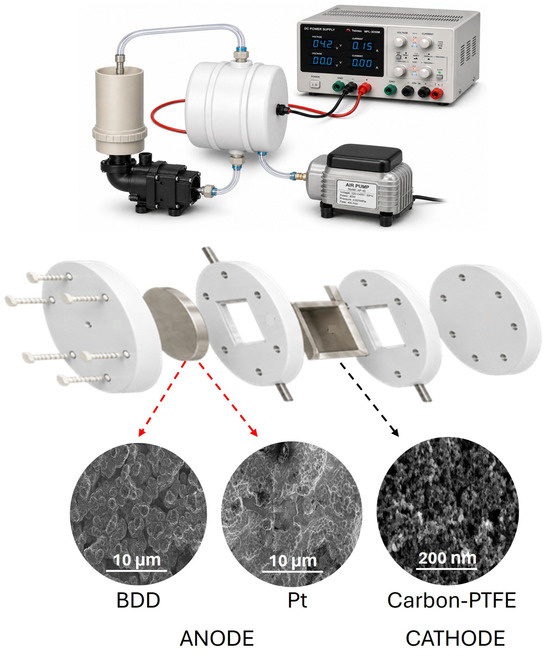
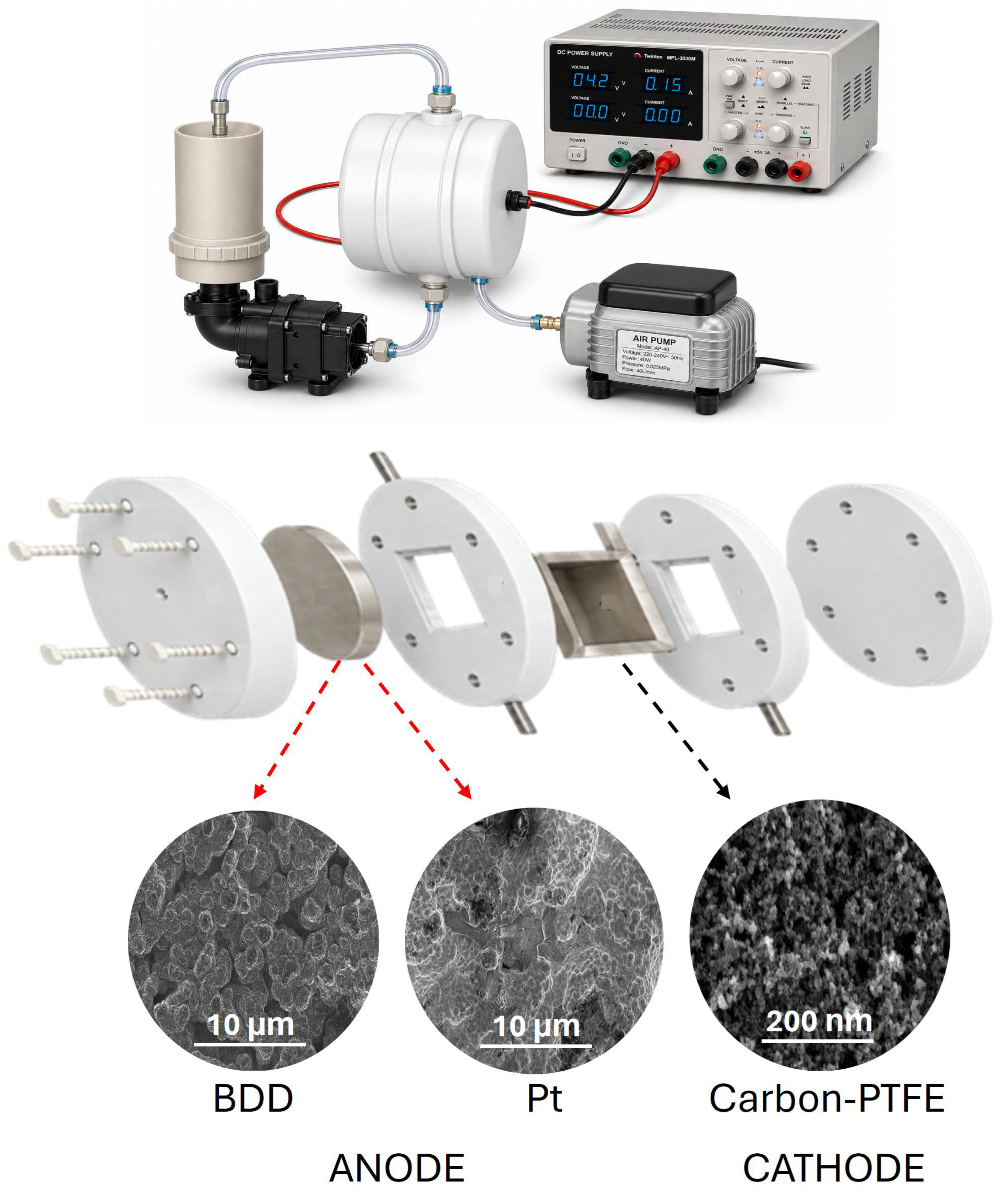
A sketch of the innovative pre-pilot flow plant designed for the electrochemical processes is shown in Figure 1. In each trial, 2.0 L of the solution was introduced into the reservoir and recirculated through a peristaltic pump at a constant flow rate of about 7.08 L min−1. The electrochemical reactor retained a filter-press cell arrangement using Si/BDD or Ti/Pt as the anode and carbon–PTFE air diffusion as the cathode, with an area of 35 cm2. The system was fed with air pumped at an overpressure of 8.6 kPa to continuously produce H2O2 from the oxygen reduction reaction. In the PEF process, a photoreactor equipped with a 6 W UVC lamp was coupled to the system when needed. All the experiments were performed for 180 min by applying current densities (j) of 30, 60, and 90 mA cm−2.
Figure 1.
Schematic illustration of the experimental setup used for the flow reactor in the EF process. The exploded view highlights the reactor configuration and the arrangement of the electrodes, consisting of BDD and Pt anodes coupled to a carbon–PTFE cathode.
Additional experiments were performed to evaluate the influence of the electrolyte matrix under the optimized operating conditions. These experiments were carried out using a BDD anode operated at 90 mA cm−2 for the EO-H2O2, EF, and PEF processes. For the PEF experiments, a 6 W UVC lamp was employed, while a Fe2+ concentration of 0.5 mmol L−1 was used in both the EF and PEF systems. All remaining operating conditions were maintained identical to those previously described. The only experimental variable was the electrolyte composition, which was modified from the standard supporting electrolyte (0.05 mol L−1 Na2SO4) to a synthetic wastewater matrix containing 7 g L−1 Na2SO4 and 1 g L−1 NaCl in order to assess the influence of Cl− on degradation performance (chloride is a common ion in real textile effluents [22]; thus, its study is essential for electrochemical treatment at environmentally relevant conditions). All experiments were carried out in triplicate, and the data were reported including standard deviation bars.
Instruments and Analytical Procedures
The hydrodynamics of the flow reactor were characterized using the diffusion boundary current technique [34]. For this purpose, solutions of potassium ferri/ferrocyanide (K3Fe(CN)6/K4Fe(CN)6) with a concentration in the range of 20–100 mmol L−1 in 0.5 mol L−1 NaOH were used. These solutions were electrolyzed, and the limiting current profiles for the oxidation–reduction processes of ferricyanide/ferrocyanide were measured and obtained. From these results, the mass transfer coefficient was estimated based on the equations reported by Quiroz and coworkers [34], and the hydrodynamic conditions were evaluated as a function of the Reynolds (Re) and Sherwood (Sh) numbers. Re and Sh parameters were estimated according to Equations (1) and (2), where u is the average fluid velocity in the channel (m s−1), ν is the kinematic viscosity of the electrolyte (m2 s−1), k (m s−1) is the experimental mass transfer coefficient obtained using the limiting current method, and D is the diffusion coefficient of ferricyanide in 0.5 mol L−1 NaOH at 25 °C [35].
Electrochemical experiments were carried out to test the efficacy of the carbon–PTFE cathode to produce H2O2, obtaining the electroproduction profiles as a function of time. The pH value of the supporting electrolyte solution was initially adjusted to 3.0. Meanwhile, the concentration of H2O2 generated during electrolysis was determined spectrophotometrically using the metavanadate method [36].
On the other hand, the decolorization of Calcon solutions was monitored by absorbance (A) decay at the maximum visible wavelength of λmax = 513 nm [37] using a Thermo Scientific GENESYS 180 UV-vis spectrophotometer. The decolorization efficiency/percentage color removal was estimated according to Equation (3), where Abs0 and Abst are the initial absorbance at time zero and absorbance at time t, respectively.
Additionally, the mineralization of organic matter in the treated solutions was determined by total organic carbon (TOC) abatement, which was measured on an Analytik Jena MULTI N/C 3100 according to the ASTM D 7573-18 standard test method. The evolution of final short linear carboxylic acids formed during various stages of electrolysis was also monitored by HPLC-DAD (UHPLC Vanquish, Thermo Scientific, Waltham, MA, USA) using a Rezex Roa Organic Acid H+ column (250 × 4.6 mm; Phenomenex, Torrance, CA, USA) at 30 °C, 0.05 mol L−1 H2SO4 as the mobile phase in isocratic mode (250 μL min−1), detection at 210 nm, and 10 μL injection volume, as also described elsewhere [38].
3. Results and Discussion
3.1. Reactor Characterization
To support the calculation of the experimental mass transfer coefficient, an electrochemical study was carried out on aqueous potassium ferri/ferrocyanide solutions (K3Fe(CN)6/K4Fe(CN)6) at different concentrations (20, 40, 60, 80, and 100 mmol L−1), prepared in 0.5 mol L−1 NaOH, while varying the potential, aiming to analyze the behavior of the current profiles. From the current profiles obtained at 20, 40, 60, 80, and 100 mmol L−1 of K3Fe(CN)6/K4Fe(CN)6 solutions, limiting current values of 1.7, 2.1, 2.5, 2.8, and 3.1 A were obtained, respectively, and afterwards, the angular coefficient of the linear relationship between limiting current and concentration was determined. Based on these results, the experimental mass transfer coefficient was estimated as 6.44 × 10⁻⁶ m s−1. This parameter is fundamental for understanding mass transport phenomena within the reactor and for identifying strategies to minimize diffusion limitations, thereby enhancing the efficiency of electrochemical processes. Mass transport directly affects the rate at which reactants reach the electrode surface and are converted into products; thus, the optimization of this parameter is essential for improving reactor performance.
Using the mass transport coefficient and considering a flow rate of about 7.08 L min−1 and a reactor hydraulic diameter (Dh) of about 0.0290 m, the Re number was experimentally calculated as 3.6 × 10³. This value indicates that the flow operates in the transition region between laminar and turbulent flow conditions. Furthermore, the Sh number was determined to be Sh = 246.0, based on the experimentally determined mass transfer coefficient and the diffusion coefficient of the ferri/ferrocyanide redox probe. This relatively high Sh number indicates efficient convective mass transfer and reduced diffusion resistance, suggesting that the transport of electroactive species within the reactor is not significantly limited by molecular diffusion. Consequently, the hydrodynamic conditions employed are favorable for enhancing electrochemical reaction rates and overall reactor performance [39].
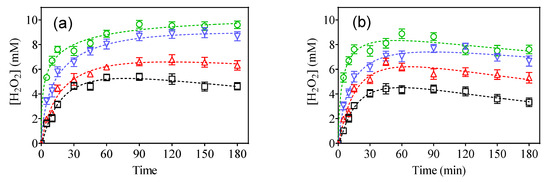
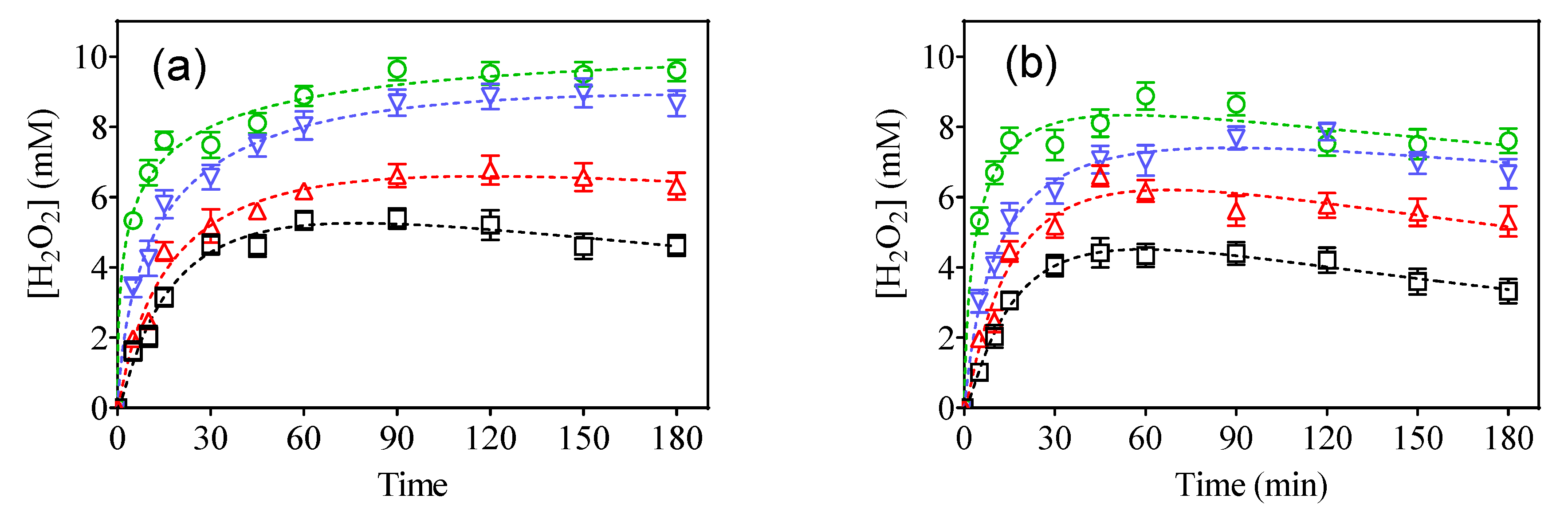
To investigate the electrosynthesis of H2O2 (Figure 2) using the innovative flow-through EF reactor proposed here, equipped with anodes of BDD (Figure 2a) and Pt (Figure 2b), its electroproduction at the carbon–PTFE cathode and accumulation in solution was monitored during the electrolysis of a 0.05 mol L−1 Na2SO4 solution at pH 3.0. The experiments were carried out in the absence of organic compounds and iron ions, corresponding to the electrochemical process of EO-H2O2. Under these conditions, a gradual increase in H2O2 concentration was observed until a steady-state concentration was reached (see Figure 2a,b, which illustrate the progressive accumulation of H2O2 in solution) as a function of electrolysis time. The final accumulated concentration increased as a function of j, indicating that higher current densities favor efficient H2O2 electrogeneration. This behavior is due to the surface features and high catalytic activity of the carbon–PTFE cathode towards H2O2 electrogeneration [40,41]. It is important to indicate that the electrogeneration of H2O2 at the carbon–PTFE cathode occurs according to reaction (4) [42]:
O2 + 2H+ + 2e− → H2O2
Figure 2.
Variation in accumulated H2O2 concentration, as a function of electrolysis time and j ((□) 30, (∆) 60, (▽) 90, and (○) 120 mAcm−2), for the (a) BDD and (b) Pt anodes. Solution without Fe2+ in solution at acidic pH conditions (pH 3.0).
Simultaneously, H2O2 can undergo decomposition through reactions such as (5):
H2O2 → HO2• + H+ + e−
As observed in the experimental results, the H2O2 concentration stabilized after approximately 15 min of electrolysis and remained nearly constant throughout the remaining reaction time. This quick stabilization suggests that a steady-state condition was established, in which the rate of H2O2 electrogeneration became equal to its rate of decomposition. Furthermore, the proportional increase in steady-state H2O2 concentration by applying different j values indicates that its decomposition is strongly influenced by chemical and electrochemical reactions occurring in the system, particularly at the Pt anode, where H2O2 can be converted back to O2. This behavior explains the decrease in the H2O2 concentration after 90 min of electrolysis when Pt is used as the anode in the EO-H2O2 system, in contrast to the increase in the accumulation of the H2O2 concentration observed in the BDD EO-H2O2 system.
For the BDD system, H2O2 accumulation increased progressively with j, which is consistent with the nonactive nature of BDD [43], avoiding significant H2O2 decomposition at the anode surface. Conversely, for the Pt system, the steady-state H2O2 concentration at 90 mA cm−2 was lower than expected from a strictly monotonic trend, likely due to the catalytic decomposition of H2O2 at active Pt sites via reaction (4) [44]. These results indicate that the optimal j for H2O2 electrogeneration depends on the anode material. BDD favors efficient H2O2 electrogeneration at higher j (90–120 mA cm−2) without significant decomposition losses, whereas for Pt, an intermediate j (60–90 mA cm−2) may represent the best compromise between generation rate and H2O2 stability. Based on these findings, 90 mA cm−2 was selected as the reference j for subsequent experiments.
3.2. System Performance
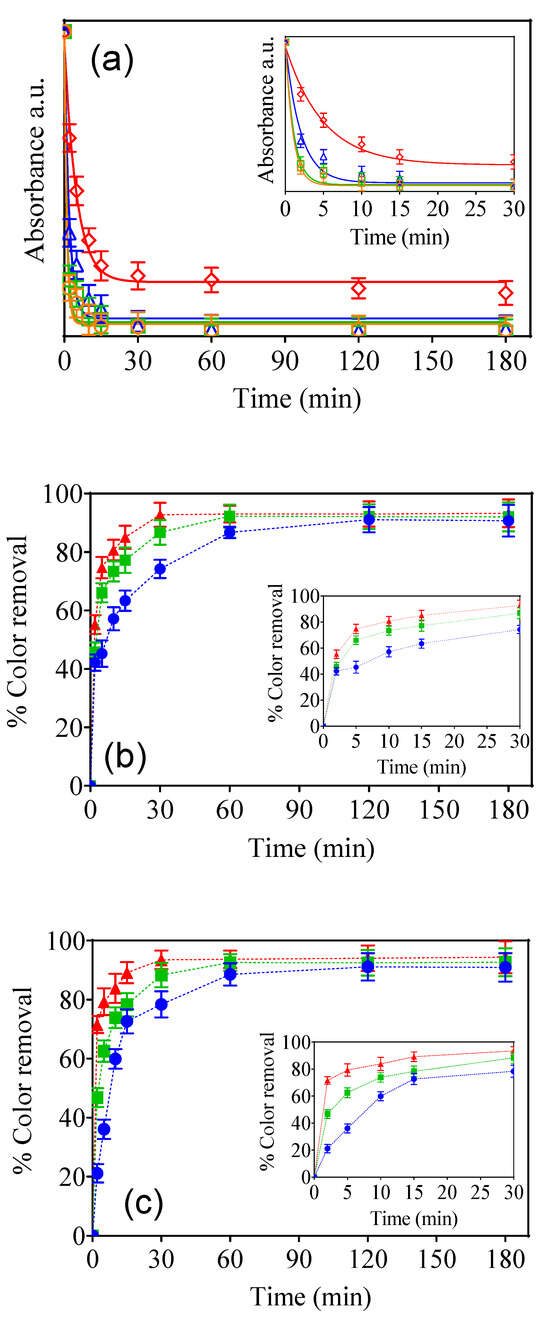
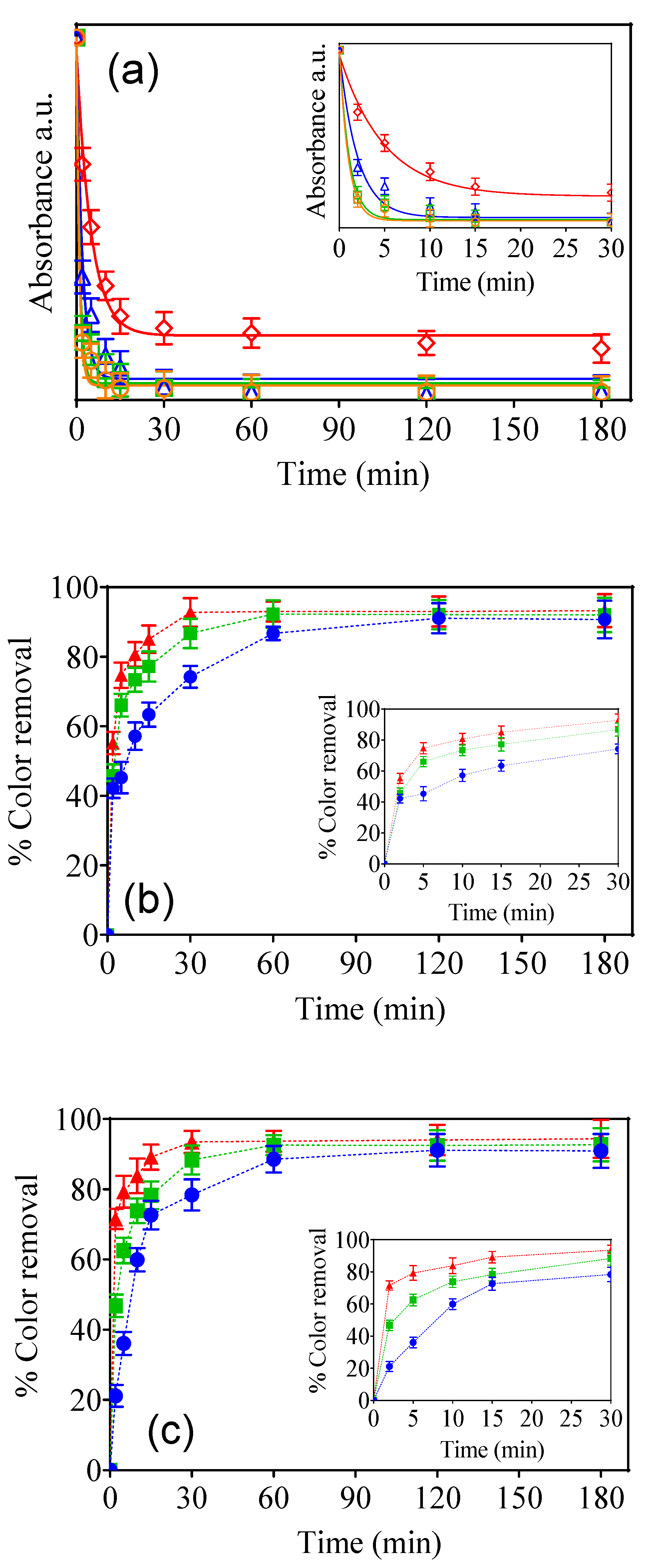
Color removal was investigated in order to further investigate the performance of the electrocatalytic material at different concentrations of Fe2+ (from 0.25 to 0.75 mmol L−1) during the treatment of a 100 mg L−1 Calcon dye solution by applying 90 mA cm−2 using a BDD anode. The results are presented in Figure 3a. In the absence of Fe2+ ions, the discoloration rate was considerably slower, with the absorbance decreasing from 2.89 to only 0.41 after 180 min of electrochemical treatment, corresponding to approximately 85.8% color removal (see Figure 3a, (♢) 0.0 mmol L−1). Conversely, the decolorization rate was significantly improved when Fe2+ was added to the solution (see Figure 3a: (○) 0.25, (□) 0.5, and (∆) 0.75 mmol L−1), confirming the important role of homogeneous Fenton reactions in the generation of highly oxidative •OH [45].
Figure 3.
(a) Effect of Fe2+ concentration ((♢) 0.0, (○) 0.25, (□) 0.5, and (∆) 0.75 mmol L−1) on color removal during Calcon dye electrolysis using the BDD anode. Effect of j ((●) 30, (■) 60, and (▲) 90 mA cm−2) on color removal of Calcon dye during electrolysis: (b) Pt and (c) BDD anodes. Experimental conditions: 0.05 mol L−1 Na2SO4, pH = 3.0 and [Fe2+] = 0.5 mmol L−1. Inset plot shows the % color removal during the first 30 min.
For the electrochemical system with 0.25 mmol L−1 Fe2+ in solution, the absorbance rapidly decreased from 2.89 to 0.45 within the first 2 min and reached 0.094 after 15 min, corresponding to approximately 96.7% color removal. A similar trend was observed for 0.50 mmol L−1 Fe2+, where almost complete color removal (>98%) was attained by reaching the lowest final absorbance value (0.032) at 120 min. In the presence of Fe2+, the main reaction responsible for •OH generation is the classical Fenton reaction [20,46,47]:
Fe2+ + H2O2 + H+ → Fe3+ + •OH + H2O
Simultaneously, Fe3+ can react with H2O2 to regenerate Fe2+ according to:
Fe3+ + H2O2 → Fe2+ + HO2• + H+
These reactions establish the catalytic iron cycle responsible for the continuous generation of oxidizing radicals during electrolysis. As observed in Figure 3a, the presence of Fe2+ considerably improved Calcon dye degradation via •OH radicals (indirect oxidation [48]), which is considered the dominant pathway for removing dyes in EF systems. However, after increasing the Fe2+ concentration above 0.5 mmol L−1, no substantial improvements in color removal efficiencies were achieved. This behavior has been extensively reported in the literature, which is associated with the scavenging effect caused by excess ferrous ions [49].
It is worth noting that the scavenging effect of excess Fe2+ may be differentially marked depending on the anode material. At BDD electrodes, •OH radicals are generated in weakly adsorbed form (quasi-free close to the electrode surface), making them more susceptible to consumption by dissolved Fe2+ ions via reaction (8) [50]. In contrast, at Pt electrodes, •OH radicals are more strongly adsorbed at the electrode surface, consequently partially limiting their availability for homogeneous Fenton side reactions. Consequently, while both systems exhibit performance suppression at [Fe2+] > 0.5 mmol L−1, the magnitude of this effect may be somewhat attenuated at Pt due to the reduced availability of free •OH in the bulk solution [32,51]. This hypothesis is consistent with the difference in discoloration efficiency between 0.50 and 0.75 mmol L−1 Fe2+, as observed in Figure 3a.
Furthermore, at high Fe2+ concentrations, hydroxyl radicals are consumed through secondary reactions [52], such as:
Fe2+ + •OH → Fe3+ + OH−
As a result, part of the generated •OH radicals are wasted before reacting with the organic pollutant, reducing the overall oxidation efficiency. The existing literature has shown that excessive concentrations of Fe2+ can decrease process performance because radical consumption competes with pollutant oxidation [53,54,55]. Therefore, the concentration of 0.5 mmol L−1 Fe2+ appears to provide the best balance between radical production and scavenging effects under the studied conditions.
A comparison between the Pt and BDD anodes (Figure 3b,c) clearly demonstrates the strong influence of j on the degradation of Calcon dye by the EF process [56]. In both systems, the decolorization rate increases when j is increased from 30 to 60 and 90 mA cm−2, especially during the first 30 min of electrolysis. This behavior is primarily associated with the increased rate of H2O2 electrogeneration as j increases, as shown in Figure 2. This increase in j leads to a higher concentration of homogeneous •OH radicals in the solution via the Fenton reaction, accelerating dye oxidation. Calcon dye is mainly attacked by •OH radicals in the chromophore group responsible for the dye’s color in the solution, provoking a fragmentation of the chemical structure. This explains the faster decolorization behavior observed at 90 mA cm−2 compared to 30 mA cm−2. To understand this behavior, a comparative study was conducted between different EAOPs, and the oxidation byproducts were also analyzed, as discussed below.
3.3. Comparative Degradation by EAOPs
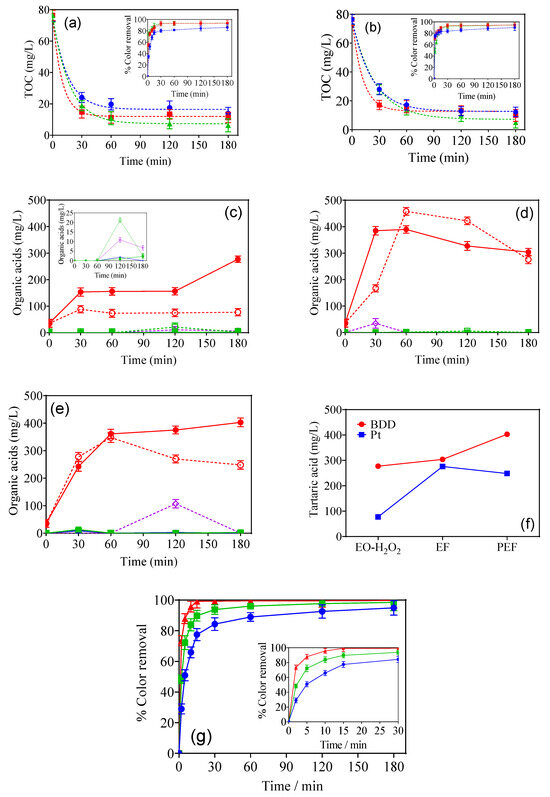
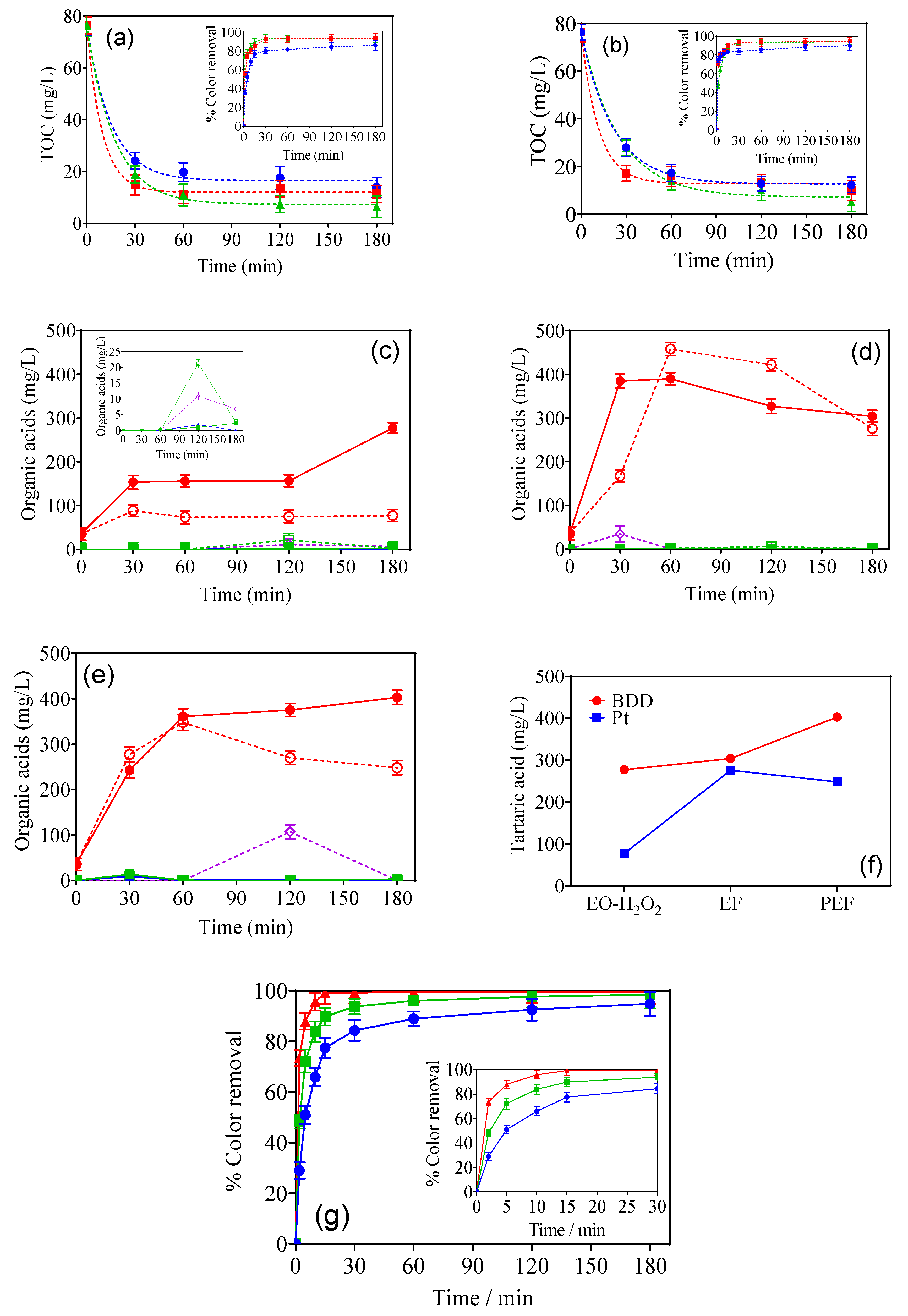
Figure 4 depicts the comparative performance of the EO-H2O2, EF, and PEF (with 6 W UVC) processes for degrading Calcon dye using Ptǀcarbon–PTFE and BDDǀcarbon–PTFE electrochemical cells, applying 90 mA cm−2. The evolution of TOC decay (Figure 4a) and color removal (Figure 4b) demonstrates the strong influence of both the oxidation process and the anodic material on pollutant mineralization efficiency. For both anodes, as can be observed in the insets of Figure 4a,b, rapid color removal was attained during the initial phases of treatment, reaching values above 80% within the initial 30 min for all EAOPs. These results indicate that the azo chromophoric groups are swiftly destroyed by system-generated •OH radicals in all cases. Nevertheless, while color removal was rapid, the slower decline in TOC highlights that visual decolorization does not necessarily guarantee total mineralization of the parent organic compounds [57].
Figure 4.
Percentage of TOC decay and color removal (inset), as a function of electrolysis time, for (a) Ptǀcarbon–PTFE and (b) BDDǀcarbon–PTFE cells by applying 90 mA cm−2 with different EAOPs: (●) EO-H2O2, (■) EF and (▲) PEF with 6 W UVC. Evolution of the concentration of (●) tartaric, (■) oxalic, (▲) acetic and (♦) formic acids, using BDD (solid symbol) and Pt (empty symbol) anodes by applying 90 mA cm−2 with different EAOPs: (c) EO-H2O2, (d) EF and (e) PEF with 6 W UVC. [Fe2+] = 0.5 mmol L−1 when EF and PEF processes were applied. (f) Evolution of the tartaric acid with different EAOPs at both electrodes. (g) Effect of the matrix with different EAOPs ((●) EO-H2O2, (■) EF and (▲) PEF) on the color removal of Calcon dye using BDD as the anode.
Within this framework, TOC removal efficiencies of about 83.88%, 86.99%, and 93.38% were obtained for the EO-H2O2, EF, and PEF processes, respectively, using the BDDǀcarbon–PTFE electrochemical cell, applying 90 mA cm−2. Conversely, TOC removals of about 81.80% for EO-H2O2, 85.14% for EF, and 91.63% were observed for the PEF process when the Ptǀcarbon–PTFE electrochemical cell was used. Among all treatments, the PEF process exhibited the most significant mineralization efficiency regardless of the anodic material employed. In the absence of Fe2+ ions ((●) EO-H2O2), oxidation mainly occurs through heterogeneous reactions at the anode surface and by the limited action of reactive oxygen species generated electrochemically (●OH radical and H2O2) [20]. Consequently, the kinetics of mineralization was slower, mainly at the Pt anode (Figure 4a), which is characterized as an “active” electrode with lower ●OH radical production and limited availability to react with organic pollutants [58]. Meanwhile, the addition of Fe2+ ions (named the EF process (■)) significantly improved TOC removal and color decay (Figure 4a,b). This enhancement is associated with the additional homogeneous production of ●OH radicals via the classical Fenton reaction between Fe2+ and electrogenerated H2O2. The continuous regeneration of Fe2+ from Fe3+ during electrolysis sustains radical production throughout the treatment, resulting in more efficient oxidation of Calcon dye and organic intermediates [59]. Among the investigated processes, PEF exhibited the highest mineralization performance, particularly when coupled with the BDD anode (Figure 4b). This behavior is due to the action of light irradiation [5,60,61,62]. In this frame, the results demonstrated that the combination of electrogenerated H2O2, homogeneous Fenton reactions, photochemical assistance, and highly oxidative BDD anodes significantly enhanced the degradation and mineralization of Calcon dye, due to the intensification of ●OH radical accumulation in solution, which accelerated the degradation of the dye.
The BDD/PEF system exhibited the best performance due to the synergistic effect between anodic oxidation, homogeneous radical production, and photochemical regeneration of catalytic iron species [63]. However, organic load is not completely eliminated from solutions, as confirmed by non-total TOC abatement. As already reported in our previous studies, short-chain carboxylic acids are generated at the end of the electrochemical treatment, and these organic acids require longer electrolysis times for complete mineralization [64]. Thus, carboxylic acid identification and concentration during these processes were monitored as a function of time, and these profiles are shown in Figure 4c–e. By using the BDDǀcarbon–PTFE electrochemical cell, tartaric, oxalic, and acetic acids were identified, whereas at the Ptǀcarbon–PTFE cell, the formation of tartaric, oxalic, and formic acids was promoted. These results are consistent with those reported by Cardozo et al. [65], who identified acetic, formic, fumaric, maleic, and oxalic acids using a BDD anode in a membrane-separated system. Also, the production of these organic acids has been reported as end byproducts when other organic pollutants have been electrochemically treated [66].
For both electrodes, tartaric acid was the predominant byproduct formed throughout the degradation process, as shown in Figure 4f. The concentration of tartaric acid increased markedly in the EF-based treatments compared with EO-H2O2, demonstrating that Fenton processes favor the generation of partially oxidized carboxylic intermediates. This behavior can be attributed to the higher production of •OH in EF and PEF systems, which accelerates the cleavage of azo bonds and aromatic structures, leading to the formation of low-molecular-weight organic acids.
Although ecotoxicological assays were not performed in the present study, the substantial TOC removal achieved, together with the degradation of the parent azo dye and the formation of low-molecular-weight carboxylic acids, suggests a significant reduction in the organic load and complexity of the treated solution. Previous studies have reported that in EF and PEF processes, the formation of short-chain, low-toxicity carboxylic acids generally occurs, as was achieved in this study [67,68]. Thus, the results presented here demonstrate that the proposed flow-through EF reactor combines process intensification, operational stability, and high degradation efficiency, representing a promising and scalable alternative for the treatment of dye-containing industrial effluents and other recalcitrant organic wastewaters [62,69].
To investigate the influence of wastewater composition on process performance, the optimized operating conditions were used to treat a synthetic matrix containing 7 g L−1 Na2SO4 and 1 g L−1 NaCl, applying 90 mA cm−2 and using BDD as the anode. As shown in Figure 4g, the electrolyte composition affected the discoloration kinetics. As can be observed in the first 30 min of treatment, color removal reached 78.4%, 88.4%, and 93.5% for the Na2SO4 matrix during the EO-H2O2, EF, and PEF processes, respectively, whereas the Na2SO4 + NaCl matrix achieved 84.3%, 93.8%, and 99.3%. The enhanced performance observed in the presence of Cl− is likely associated with the electrogeneration of reactive chlorine species (Cl2, HOCl, and OCl−) through anodic oxidation of Cl− on the BDD surface [22], which are known to promote the rapid oxidation of azo chromophore groups [28]. These oxidants were not directly quantified in the present study due to the complexity of the matrix; however, these assertions are based on the established electrochemical behavior of BDD electrodes in chloride-containing media [22,28]. These results demonstrate that chloride ions accelerate the initial discoloration kinetics, particularly during the first stages of electrolysis.
3.4. Kinetic Analysis
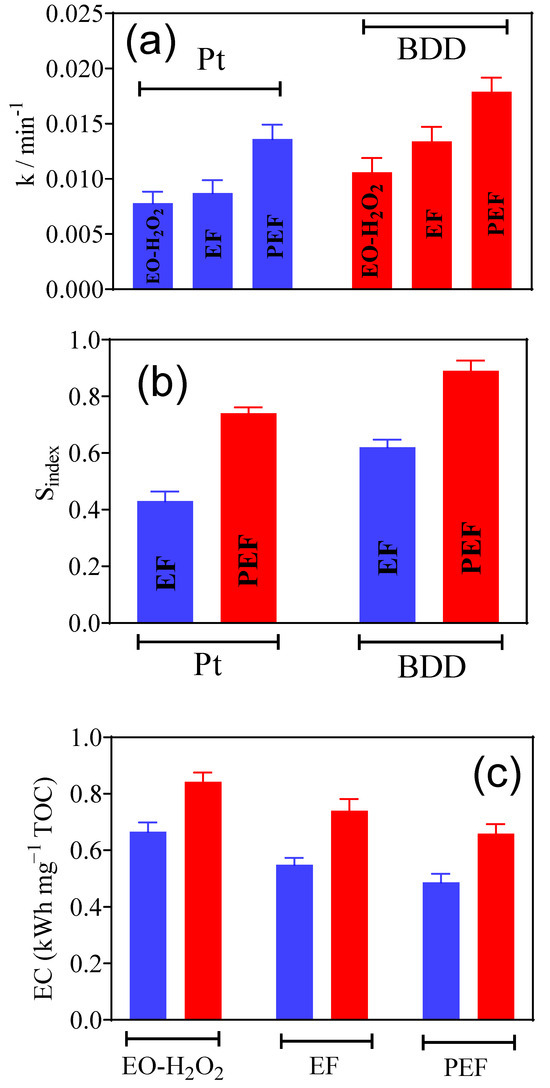
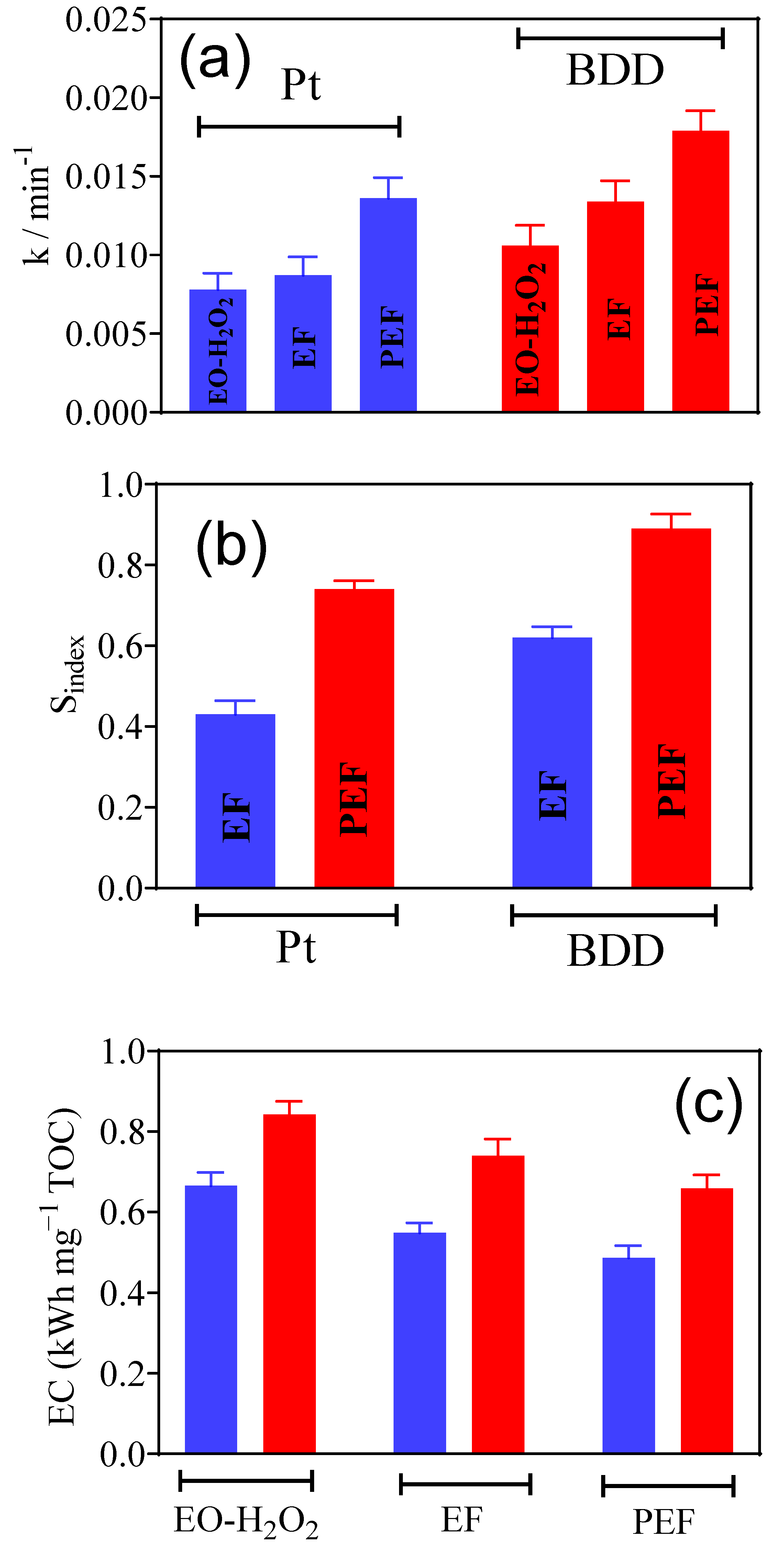
A kinetic analysis was performed based on the TOC decay profiles, which showed excellent agreement with the pseudo-first-order kinetic model. The coefficients of determination (R2) ranged from 0.98 to 0.99 for the Pt anode and from 0.98 to 0.98 for the BDD anode, demonstrating the robustness of the kinetic fitting. These high r2 values, all exceeding 0.98, indicate that the pseudo-first-order model adequately describes the degradation kinetics of the organic compounds under all operating conditions. Thus, the apparent kinetic constants of the EO-H2O2, EF, and PEF (with 6 W UVC) processes were estimated. As shown in Figure 5a, it is clear that the apparent kinetic constants for the PEF process (by using the Pt and BDD anodes) increased in comparison to EO-H2O2 and EF when the Pt and BDD anodes were used, which represents a remarkable improvement when EF was performed with UVC irradiation (named the PEF approach). For PEF, values of about 0.0136 and 0.0179 min−1 were estimated for the apparent kinetic constants at 90 mA cm−2.
Figure 5.
(a) Comparison of the apparent kinetic constants obtained from TOC data for EO-H2O2, EF and PEF processes with Pt and BDD anodes. (b) Synergistic effect estimated at different electrochemical cells (Ptǀcarbon–PTFE and BDDǀcarbon–PTFE) for EF and PEF approaches. (c) Energetic requirements for the different processes evaluated. (■) Pt and (■) BDD.
In order to evaluate the efficiency of the integration of both processes (EF and PEF irradiations), the synergistic index (Sindex), as an important parameter, was estimated. It was determined by establishing all kinetic constants and mathematically treated according to Equation (9) [70].
As can be observed in Figure 5b, the Sindex of the combined processes increased in comparison with EF and PEF. In this sense, the PEF process showed high performance due to the higher generation of oxidants (e.g., H2O2, •OH), which contributes to the degradation of organic matter and also the oxidants that are activated by UV irradiation, increasing the elimination efficiency. This result provides evidence that PEF is an efficient technology for the degradation of dyes.
Figure 5c shows the specific energy consumption (EC), calculated according to Equation (10) [71], for the EO-H2O2, EF, and PEF processes using the Pt and BDD anodes at 90 mA cm−2.
where E is the cell potential (V), i is the applied current (A), t is the electrolysis time (h), Vs is the solution volume (L), and (∆TOC) is the corresponding experimental abatement of TOC (in mg L−1). For all systems, EC increased with treatment time due to the continuous energy input. However, significant differences were observed among the processes. EO-H2O2 exhibited the highest EC values, reflecting its lower mineralization efficiency, whereas the incorporation of Fe2+ into the EF process reduced the energy demand by enhancing •OH radical production. The PEF process showed the lowest EC values throughout the treatment, which can be attributed to the synergistic effect of UV irradiation on Fe3+ photoreduction and •OH generation, leading to faster mineralization and lower energy consumption per unit of TOC removed. The BDD anode required approximately 26.7%–35.5% higher specific energy consumption than the Pt anode, but the final TOC removals were similar for both materials, differing by 4.1% depending on the process.
3.5. Comparative Evaluation with the Existing Literature on Dye Degradation by the EO-H2O2, EF, and PEF Processes
The degradation performance obtained in the present study using the innovative flow-through electrochemical reactor can be critically compared with several previous reports available in the literature concerning the treatment of azo and other synthetic dyes by the EO-H2O2, EF, and PEF processes. Such a comparison is particularly relevant because the operational conditions employed in this work, namely, the acidic medium (0.05 mol L−1 Na2SO4, pH = 3.0), application of relatively high j (90 mA cm−2), use of Fe2+ ions (0.5 mmol L−1) in EF and PEF systems, and the coupling of a low-power 6 W UVC irradiation source, are compatible with or comparable to several experimental conditions previously reported for dye-containing wastewaters.
The obtained results demonstrated that the proposed flow-through reactor coupled with the BDD and Pt anodes achieved excellent discoloration and mineralization efficiencies toward Calcon dye degradation. In particular, the BDD/PEF system exhibited the highest performance, reaching 93.38% TOC removal and almost complete discoloration (>98%), whereas the Pt/PEF system achieved 91.63% TOC abatement under similar conditions. These results are highly competitive compared with previous studies involving EO-H2O2, EF, and PEF treatments of dyes.
The superior performance observed for the PEF process agrees with the extensive literature (see Table 1) regarding the synergistic effect promoted by simultaneous electrogeneration of H2O2, homogeneous Fenton reactions, anodic oxidation, and photochemical irradiation [5]. Brillas et al. [72] reported that PEF processes significantly enhance mineralization efficiencies due to the continuous photoreduction of Fe3+ species to Fe2+, promoting sustained hydroxyl radical production during electrolysis. Furthermore, UVC irradiation contributes to the photodecarboxylation of Fe(III)–carboxylate complexes generated during dye oxidation, accelerating the destruction of persistent intermediates. Similar behavior was observed in the present work, where the PEF system showed superior TOC decay compared with the EO-H2O2 and EF systems.
When comparing the obtained results with previous dye degradation studies using BDD and Pt anodes, it becomes evident that the nonactive BDD electrode strongly favors mineralization processes [18]. Clematis and Panizza investigated the degradation of Erythrosine B dye by EF and PEF systems using BDD anodes and reported that PEF treatment promoted significantly higher mineralization than EF due to enhanced production of hydroxyl radicals and photochemical destruction of organic intermediates [73]. Similarly, the present study demonstrated that BDD coupled with PEF conditions yielded the highest mineralization efficiency among all evaluated systems.
The remarkable performance of the flow-through reactor can also be associated with its favorable hydrodynamic characteristics. Unlike many conventional laboratory-scale batch reactors operating under magnetic stirring, the proposed system operates under conditions approaching the onset of turbulent flow (Re = 3.6 × 10³), which significantly improves mass transport, oxygen distribution, and contact between electroactive species and the electrode surface [16,17,74]. Such intensified hydrodynamics likely contributed to the enhanced H2O2 electrogeneration and pollutant degradation kinetics observed in this work. Ren et al. [19] previously demonstrated that vertical flow EF reactors provide superior degradation efficiencies compared with conventional configurations because of improved convective transport and reduced diffusion limitations. The present results corroborate these observations and further demonstrate that hydrodynamic optimization is a decisive parameter for process intensification [16,17].
In studies involving azo dyes, Brito et al. [75] investigated the electrochemical degradation of Acid Violet 7 using a BDD flow reactor and reported that turbulent hydrodynamic conditions significantly accelerated color removal and mineralization due to improvements in mass transport and the production of oxidants. Likewise, Pieczyńska et al. [76] evaluated the electrochemical degradation of textile dyes in flow reactors and highlighted that reactor configuration and mass transfer conditions directly influence degradation kinetics and process efficiency. The excellent results obtained in the present work therefore reinforce the importance of reactor engineering and flow optimization in EAOPs.
Another important aspect concerns the influence of Fe2+ concentration. The present study identified 0.5 mmol L−1 Fe2+ as the optimum condition for the EF and PEF processes, producing the best balance between hydroxyl radical generation and oxidant scavenging effects [77]. Similar observations were reported by He et al. [78] during the degradation of Reactive Blue 19 using EF systems, where excessive Fe2+ concentrations promoted parasitic hydroxyl radical consumption reactions, reducing overall oxidation efficiency. Deng et al. [79] also emphasized that the optimization of Fe2+ regeneration and concentration is fundamental for maximizing EF performance while minimizing radical scavenging effects.
The comparison with previously reported dye degradation efficiencies further confirms the competitiveness of the proposed reactor system. Cardozo et al. [65] reported the photovoltaic–electrochemical degradation of Calcon dye using BDD anodes, achieving efficient discoloration but requiring longer electrolysis times to attain high mineralization levels due to the formation of persistent carboxylic acids, such as oxalic and tartaric acids. In the present work, similar byproducts were identified, confirming that the oxidation pathways are consistent with previous electrochemical studies involving azo dyes. However, the enhanced hydrodynamic conditions and the coupling with PEF significantly accelerated the oxidation of these intermediates, contributing to the higher mineralization efficiencies obtained.
The literature also indicates that active anodes such as Pt generally exhibit lower mineralization capability compared with BDD due to differences in hydroxyl radical adsorption behavior [80,81]. Thiam and Salazar [82] demonstrated that BDD electrodes favor the formation of weakly adsorbed hydroxyl radicals with higher oxidation capability, whereas Pt tends to produce more selective oxidation pathways. This behavior was also observed in the present work, where BDD consistently outperformed Pt under EO-H2O2, EF, and PEF conditions.
Overall, the comparative analysis demonstrates that the proposed flow-through electrochemical reactor exhibits degradation and mineralization efficiencies that are comparable or superior to many previously reported EO-H2O2, EF, and PEF systems for dye treatment. The combination of intensified hydrodynamics, efficient H2O2 electrogeneration at the carbon–PTFE cathode, optimized Fe2+ concentration, photochemical assistance, and the use of highly oxidative BDD anodes resulted in outstanding treatment performance when compared to anodic oxidation treatments. Therefore, the present reactor configuration represents a promising and scalable strategy for the treatment of dye-containing industrial wastewaters and other recalcitrant organic pollutants.
Table 1.
Comparative performance of electrochemical advanced oxidation processes for dye degradation in the present study and selected reports from the literature.
4. Conclusions
The present study demonstrated that the configuration of a flow-through EF reactor plays a decisive role in cell hydrodynamics, mass transport, and dye degradation efficiency. Hydrodynamic characterization indicates that the system operates in the transition region between laminar and turbulent flow, promoting enhanced mixing and mass transport compared to purely laminar conditions (Re = 3.6 × 10³), with a Sh number of 246 indicating efficient convective mass transfer and efficient transport of electroactive species toward the electrode surface. These characteristics contributed to improved H2O2 electrogeneration and intensified oxidation performance under continuous flow operation. Comparative evaluation of the EO-H2O2, EF, and PEF processes revealed that the PEF system achieved the highest mineralization efficiencies for both anodic materials. Using the BDD anode, TOC removals of 83.88%, 86.99%, and 93.38% were obtained for EO-H2O2, EF, and PEF, respectively, while the Pt anode reached 81.80%, 85.14%, and 91.63%. The superior performance of the BDD/PEF system was attributed to the synergistic interaction between electrogenerated H2O2, homogeneous hydroxyl radical production, photochemical regeneration of Fe2+ species, and the high oxidation capability of BDD anodes. Overall, the results demonstrate that reactor hydrodynamics, anodic material selection, and operational parameters strongly influence the efficiency of flow-through EF systems. The proposed continuous flow-through configuration coupled with BDD and PEF conditions exhibited outstanding degradation and mineralization performance, demonstrating its technical feasibility and strong potential for future application in the treatment of dye-containing industrial wastewaters. The continuous-flow operation, combined with the efficient in situ electrogeneration of H2O2 at the carbon–PTFE gas diffusion cathode, promotes efficient mass transport under the transitional flow regime, stable oxidant production, and improved process intensification. These characteristics, together with the compact reactor design and high mineralization efficiencies achieved, highlight the technological feasibility of the proposed system for future scale-up and integration into industrial wastewater treatment facilities [84]. Nevertheless, before practical implementation, comprehensive ecotoxicological assessments using standardized bioassays should be performed to verify the environmental safety of the treated effluent. Lastly, while the organic acids yielded by dye oxidation are conventionally viewed as secondary pollutants, they can be repurposed into high-value compounds via organic electro-refining [85]. This paradigm embodies a novel, win–win approach that advances the circular electrochemical economy.
Author Contributions
Conceptualization, J.C.C., A.E.C.B. and A.M.S.S.; methodology, J.C.C., A.E.C.B. and A.M.S.S.; validation, J.C.C., A.M.S.S. and M.K.S.M.; formal analysis, J.C.C.; investigation, J.C.C. and A.M.S.S.; resources, E.V.d.S. and C.A.M.-H.; data curation, J.C.C.; writing, original draft preparation, J.C.C., M.K.S.M., E.V.d.S. and C.A.M.-H.; writing review and editing, E.V.d.S. and C.A.M.-H.; supervision, E.V.d.S. and C.A.M.-H.; project administration, E.V.d.S. and C.A.M.-H.; funding acquisition, E.V.d.S. and C.A.M.-H. All authors have read and agreed to the published version of the manuscript.
Funding
This study was financially supported by the Human Resources Training Program of the Brazilian National Agency for Petroleum, Natural Gas and Biofuels—PRH-ANP, under the management of the São Paulo Research Foundation (FAPESP), Brazil, process N. 2025/02723-7. Financial support from Conselho Nacional de Desenvolvimento Científico e Tecnológico (CNPq, Brazil) (408110/2022-8, 317075/2023-3, 421313/2023-4, 302123/2025-3, 350088/2026-8) is gratefully acknowledged.
Institutional Review Board Statement
Not applicable.
Informed Consent Statement
Not applicable.
Data Availability Statement
The data that support the findings of this study are available from the corresponding author upon reasonable request.
Conflicts of Interest
The authors declare no conflicts of interest.
Abbreviations
The following abbreviations are used in this manuscript:
| BDD | Boron-doped diamond |
| EO-H2O2 | Electrochemical oxidation with electrogenerated H2O2 |
| EF | Electro-Fenton |
| PEF | Photoelectro-Fenton |
| TOC | Total organic carbon |
References
- Wei, J.; Liu, Y.; Wu, X. Electrochemical Advanced Oxidation Processes Using PbO2 Anode and H2O2 Electrosynthesis Cathode for Wastewater Treatment. Process Saf. Environ. Prot. 2023, 178, 444–455. [Google Scholar] [CrossRef] [Scilit]
- Cornejo, O.M.; Murrieta, M.F.; Aguilar, Z.G.; Rodríguez, J.F.; Márquez, A.A.; León, M.I.; Nava, J.L. Recent Advances in Electrochemical Flow Reactors Used in Advanced Oxidation Processes: A Critical Review. Chem. Eng. J. 2024, 496, 153935. [Google Scholar] [CrossRef] [Scilit]
- Scaria, J.; Nidheesh, P.V. Comparison of Hydroxyl-Radical-Based Advanced Oxidation Processes with Sulfate Radical-Based Advanced Oxidation Processes. Curr. Opin. Chem. Eng. 2022, 36, 100830. [Google Scholar] [CrossRef] [Scilit]
- Nidheesh, P.V.; Zhou, M.; Oturan, M.A. An Overview on the Removal of Synthetic Dyes from Water by Electrochemical Advanced Oxidation Processes. Chemosphere 2018, 197, 210–227. [Google Scholar] [CrossRef] [Scilit] [PubMed]
- Tanos, F.; Gomri, C.; Trellu, C.; Oturan, M.A.; Li, S.; Zhou, M.; Jayeola, K.D.; Arotiba, O.A.; dos Santos, E.V.; Martínez-Huitle, C.A.; et al. Basic Notions and Innovations in Electrochemical Advanced Oxidation Processes for Water Treatment; Basic Notions and Innovations in Electrochemical Advanced Oxidation Processes for Water Treatment. Small Sci. 2026, 6, e70332. [Google Scholar] [CrossRef] [Scilit] [PubMed]
- Ganiyu, S.O.; Martínez-Huitle, C.A.; Oturan, M.A. Electrochemical Advanced Oxidation Processes for Wastewater Treatment: Advances in Formation and Detection of Reactive Species and Mechanisms. Curr. Opin. Electrochem. 2021, 27, 100678. [Google Scholar] [CrossRef] [Scilit]
- Wen, J.; Yu, Y.; Sun, D.; Qu, Y.; Yuan, X.; Lin, C.; Liu, J.; Jiang, Y.; Yang, Y.; Xu, B. Synthesis of Crystalline–Amorphous CoMoP/NF Heterostructure with 3D Hierarchical Nanosheet Flowers and Its Electrocatalytic Water Splitting Performance. Catalysts 2026, 16, 428. [Google Scholar] [CrossRef] [Scilit]
- Dong, H.; Qi, Y.; Yan, Z.; Feng, Y.; Song, W.; Li, F.; Hua, T. FeCo-LDH/CF Cathode-Based Electrocatalysts Applied to a Flow-Through Electro-Fenton System: Iron Cycling and Radical Transformation. Catalysts 2025, 15, 685. [Google Scholar] [CrossRef] [Scilit]
- Nidheesh, P.V. Heterogeneous Fenton Catalysts for the Abatement of Organic Pollutants from Aqueous Solution: A Review. RSC Adv. 2015, 5, 40552–40577. [Google Scholar] [CrossRef] [Scilit]
- Deng, F.; Jiang, J.; Sirés, I. State-of-the-Art Review and Bibliometric Analysis on Electro-Fenton Process. Carbon Lett. 2023, 33, 17–34. [Google Scholar] [CrossRef] [Scilit] [PubMed]
- Pormazar, S.M.; Dalvand, A. Heterogeneous Electro-Fenton Process Using a Novel Catalytic Electrode for the Degradation of Direct Dye from Aqueous Solutions: Modeling, Optimization, Degradation Pathway and Toxicity Evaluation. Appl. Water Sci. 2025, 15, 52. [Google Scholar] [CrossRef] [Scilit]
- Clematis, D.; Panizza, M. Application of Boron-Doped Diamond Electrodes for Electrochemical Oxidation of Real Wastewaters. Curr. Opin. Electrochem. 2021, 30, 100844. [Google Scholar] [CrossRef] [Scilit]
- Panizza, M.; Cerisola, G. Electrocatalytic Materials for the Electrochemical Oxidation of Synthetic Dyes. Appl. Catal. B 2007, 75, 95–101. [Google Scholar] [CrossRef] [Scilit]
- Clematis, D.; Panizza, M. Electrochemical Oxidation of Organic Pollutants in Low Conductive Solutions. Curr. Opin. Electrochem. 2021, 26, 100665. [Google Scholar] [CrossRef] [Scilit]
- Cornejo, O.M.; Murrieta, M.F.; Castañeda, L.F.; Nava, J.L. Characterization of the Reaction Environment in Flow Reactors Fitted with BDD Electrodes for Use in Electrochemical Advanced Oxidation Processes: A Critical Review. Electrochim. Acta 2020, 331, 135373. [Google Scholar] [CrossRef] [Scilit]
- Arenas, L.F.; de León, C.P.; Walsh, F.C. Critical Review—The Versatile Plane Parallel Electrode Geometry: An Illustrated Review. J. Electrochem. Soc. 2020, 167, 023504. [Google Scholar] [CrossRef] [Scilit]
- Walsh, F.C.; Arenas, L.F.; Ponce de León, C. Developments in Plane Parallel Flow Channel Cells. Curr. Opin. Electrochem. 2019, 16, 10–18. [Google Scholar] [CrossRef] [Scilit]
- Skolotneva, E.; Kislyi, A.; Klevtsova, A.; Clematis, D.; Mareev, S.; Panizza, M. Mathematical Modeling of the Anodic Oxidation of Organic Pollutants: A Review. Environ. Chem. Lett. 2024, 22, 1521–1561. [Google Scholar] [CrossRef] [Scilit]
- Ren, G.; Zhou, M.; Liu, M.; Ma, L.; Yang, H. A Novel Vertical-Flow Electro-Fenton Reactor for Organic Wastewater Treatment. Chem. Eng. J. 2016, 298, 55–67. [Google Scholar] [CrossRef] [Scilit]
- Oturan, M.A.; Nidheesh, P.V.; Zhou, M. Electrochemical Advanced Oxidation Processes for the Abatement of Persistent Organic Pollutants. Chemosphere 2018, 209, 17–19. [Google Scholar] [CrossRef] [Scilit] [PubMed]
- Scaria, J.; Gopinath, A.; Nidheesh, P.V. A Versatile Strategy to Eliminate Emerging Contaminants from the Aqueous Environment: Heterogeneous Fenton Process. J. Clean. Prod. 2021, 278, 124014. [Google Scholar] [CrossRef] [Scilit]
- Nidheesh, P.V.; Gandhimathi, R. Trends in Electro-Fenton Process for Water and Wastewater Treatment: An Overview. Desalination 2012, 299, 1–15. [Google Scholar] [CrossRef] [Scilit]
- Zhu, Y.; Wang, H.; Li, J. Flow-through Homogeneous Electro-Fenton Membrane Reactor with Two Cathodes for Efficient Removal of DMAC by Stoichiometric Dosing of FeSO4. Sep. Purif. Technol. 2025, 368, 133045. [Google Scholar] [CrossRef] [Scilit]
- Brillas, E. Fenton, Photo-Fenton, Electro-Fenton, and Their Combined Treatments for the Removal of Insecticides from Waters and Soils. A Review. Sep. Purif. Technol. 2022, 284. [Google Scholar] [CrossRef] [Scilit]
- Klidi, N.; Clematis, D.; Carpanese, M.P.; Gadri, A.; Ammar, S.; Panizza, M. Electrochemical Oxidation of Crystal Violet Using a BDD Anode with a Solid Polymer Electrolyte. Sep. Purif. Technol. 2019, 208, 178–183. [Google Scholar] [CrossRef] [Scilit]
- Xie, J.; Jing, J.; Gu, J.; Guo, J.; Li, Y.; Zhou, M. Hydrogen Peroxide Generation from Gas Diffusion Electrode for Electrochemical Degradation of Organic Pollutants in Water: A Review. J. Environ. Chem. Eng. 2022, 10, 107882. [Google Scholar] [CrossRef] [Scilit]
- Wenderich, K.; Nieuweweme, B.A.M.; Mul, G.; Mei, B.T. Selective Electrochemical Oxidation of H2O to H2O2Using Boron-Doped Diamond: An Experimental and Techno-Economic Evaluation. ACS Sustain. Chem. Eng. 2021, 9, 7803–7812. [Google Scholar] [CrossRef] [Scilit]
- Oliveira Silva, T.; Granados-Fernández, R.; Lobato, J.; Lanza, M.R.V.; Rodrigo, M.A. Boosting New Electrochemical Reactor Designs to Improve the Performance in H2O2 Production Using Gas Diffusion Electrodes. ACS Sustain. Chem. Eng. 2025, 13, 3172–3182. [Google Scholar] [CrossRef] [Scilit] [PubMed]
- Dominguez, J.R.; González, T.; Correia, S.E.; Núñez, M.M. Emerging Contaminants Decontamination of WWTP Effluents by BDD Anodic Oxidation: A Way towards Its Regeneration. Water 2023, 15, 1668. [Google Scholar] [CrossRef] [Scilit]
- Yang, N.; Yu, S.; MacPherson, J.V.; Einaga, Y.; Zhao, H.; Zhao, G.; Swain, G.M.; Jiang, X. Conductive Diamond: Synthesis, Properties, and Electrochemical Applications. Chem. Soc. Rev. 2019, 48, 157–204. [Google Scholar] [CrossRef] [Scilit] [PubMed]
- Mbaye, M.; Diaw, P.A.; Mbaye, O.M.A.; Oturan, N.; Gaye Seye, M.D.; Trellu, C.; Coly, A.; Tine, A.; Aaron, J.J.; Oturan, M.A. Rapid Removal of Fungicide Thiram in Aqueous Medium by Electro-Fenton Process with Pt and BDD Anodes. Sep. Purif. Technol. 2022, 281, 119837. [Google Scholar] [CrossRef] [Scilit]
- Fernandes, A.; Pereira, C.; Kozioł, V.; Pacheco, M.J.; Ciríaco, L.; Lopes, A. Emerging Contaminants Removal from Effluents with Complex Matrices by Electrooxidation. Sci. Total Environ. 2020, 740, 140153. [Google Scholar] [CrossRef] [Scilit] [PubMed]
- Brillas, E.; Thiam, A.; Garcia-Segura, S. Incineration of Acidic Aqueous Solutions of Dopamine by Electrochemical Advanced Oxidation Processes with Pt and BDD Anodes. J. Electroanal. Chem. 2016, 775, 189–197. [Google Scholar] [CrossRef] [Scilit]
- Quiroz, M.A.; Martínez-Huitle, U.A.; Martínez-Huitle, C.A. Mass Transfer Measurements in a Parallel Disk Cell Using the Limiting Current Technique. J. Mex. Chem. Soc. 2005, 49, 279–283. [Google Scholar]
- de Araujo Vidal, I.C.; Cardozo, J.C.; Barbosa Segundo, I.D.; dos Santos, E.V.; Martínez-Huitle, C.A.; Rodrigues Rocha, E.M. Reuse of Sludge from Photo-Fenton Process and Further Application as a Catalyst in Electrochemical Processes for the Treatment of Landfill Leachate. Waste Manag. 2025, 202, 114796. [Google Scholar] [CrossRef] [Scilit] [PubMed]
- Nogueira, R.F.P.; Oliveira, M.C.; Paterlini, W.C. Simple and Fast Spectrophotometric Determination of H2O2 in Photo-Fenton Reactions Using Metavanadate. Talanta 2005, 66, 86–91. [Google Scholar] [CrossRef] [Scilit] [PubMed]
- Sahoo, M.K.; Sinha, B.; Marbaniang, M.; Naik, D.B. Degradation and Mineralization of Calcon Using UV365/H2O2 Technique: Influence of PH. Desalination 2011, 280, 266–272. [Google Scholar] [CrossRef] [Scilit]
- Loor-Urgilés, L.D.; Feijoó, T.N.; Magalhães, K.G.D.; Mendez, E.; dos Santos, E.V.; Martínez-Huitle, C.A. Understanding the Influence of PH Conditions and Chloride Concentration on Chlorine Species Formation Using Ti/SnO2–IrO2–Sb2O3 Electrode: Toward Greener Electrochemical Technologies for Water Treatment and Disinfection. J. Environ. Chem. Eng. 2025, 13, 120142. [Google Scholar] [CrossRef] [Scilit]
- Montagnaro, F. Sherwood (Sh) Number in Chemical Engineering Applications—A Brief Review. Energies 2024, 17, 4342. [Google Scholar] [CrossRef] [Scilit]
- Ramírez, Á.; Muñoz-Morales, M.; López-Fernández, E.; Villaseñor, J.; Llanos, J. Role of Catalyst Deposition Strategies and Carbon Materials in the Efficient Electrochemical Generation of Hydrogen Peroxide. J. Environ. Chem. Eng. 2025, 13, 119931. [Google Scholar] [CrossRef] [Scilit]
- Wang, J.; Li, C.; Rauf, M.; Wang, W. Highly Efficient H2O2 Electrogeneration Enabled by Controlling the Wettability of Gas Diffusion Electrodes and the Reaction Pathway in Divided Cells. ACS Sustain. Chem. Eng. 2023, 11, 436–443. [Google Scholar] [CrossRef] [Scilit]
- Fernandes, C.M.; Cerrón-Calle, G.A.; Brillas, E.; Santos, M.C.; Garcia-Segura, S. Optimization of Fipronil Removal via Electro-Fenton Using a Carbon Cloth Air-Diffusion Electrode. Sep. Purif. Technol. 2025, 367, 132955. [Google Scholar] [CrossRef] [Scilit]
- Oliveira, K.S.G.C.; dos Santos, E.V.; Loor-Urgilés, L.D.; Shabanloo, A.; Martínez-Huitle, C.A. The World Impact of Boron Doped Diamond Electrodes and Low-Cost Strategies for Novel Production Systems for Sustainable Wastewater Treatment. Curr. Opin. Electrochem. 2025, 50, 101648. [Google Scholar] [CrossRef] [Scilit]
- Brillas, E. A Review on the Photoelectro-Fenton Process as Efficient Electrochemical Advanced Oxidation for Wastewater Remediation. Treatment with UV Light, Sunlight, and Coupling with Conventional and Other Photo-Assisted Advanced Technologies. Chemosphere 2020, 250, 126198. [Google Scholar] [CrossRef] [Scilit] [PubMed]
- Emeji, I.C.; Patel, B. Recent Advancements in the Catalytic Electro-Fenton Process for Sustainable and Effective Degradation of Hazardous Organic Compounds in Wastewater. Int. J. Electrochem. Sci. 2025, 20, 101049. [Google Scholar] [CrossRef] [Scilit]
- Brillas, E.; Garcia-Segura, S. Benchmarking Recent Advances and Innovative Technology Approaches of Fenton, Photo-Fenton, Electro-Fenton, and Related Processes: A Review on the Relevance of Phenol as Model Molecule. Sep. Purif. Technol. 2020, 237, 116337. [Google Scholar] [CrossRef] [Scilit]
- Nidheesh, P.V.; Gandhimathi, R.; Ramesh, S.T. Degradation of Dyes from Aqueous Solution by Fenton Processes: A Review. Environ. Sci. Pollut. Res. 2013, 20, 2099–2132. [Google Scholar] [CrossRef] [Scilit] [PubMed]
- Varindani, A.; Singh, T.S.A.; Menon, P.; Nidheesh, P.V. Chelate-Modified Electro-Fenton Process for Mixed Industrial Wastewater Treatment. Environ. Technol. 2021, 43, 3497–3506. [Google Scholar] [CrossRef] [Scilit] [PubMed]
- Adjimani, J.P.; Asare, P. Antioxidant and Free Radical Scavenging Activity of Iron Chelators. Toxicol. Rep. 2015, 2, 721–728. [Google Scholar] [CrossRef] [Scilit] [PubMed]
- Karim, A.V.; Nidheesh, P.V.; Oturan, M.A. Boron-Doped Diamond Electrodes for the Mineralization of Organic Pollutants in the Real Wastewater. Curr. Opin. Electrochem. 2021, 30, 100855. [Google Scholar] [CrossRef] [Scilit]
- Chen, H.; Yoshida, G.; Andriamanohiarisoamanana, F.J.; Ihara, I. Electro-Oxidation Combined with Electro-Fenton for Decolorization of Caramel Colorant Aqueous Solution Using BDD Electrodes. J. Water Process Eng. 2022, 47, 102672. [Google Scholar] [CrossRef] [Scilit]
- Panizza, M.; Dirany, A.; Sirés, I.; Haidar, M.; Oturan, N.; Oturan, M.A. Complete Mineralization of the Antibiotic Amoxicillin by Electro-Fenton with a BDD Anode. J. Appl. Electrochem. 2014, 44, 1327–1335. [Google Scholar] [CrossRef] [Scilit]
- Deng, F.; Olvera-Vargas, H.; Zhou, M.; Qiu, S.; Sirés, I.; Brillas, E. Critical Review on the Mechanisms of Fe2+ Regeneration in the Electro-Fenton Process: Fundamentals and Boosting Strategies. Chem. Rev. 2023, 123, 4635–4662. [Google Scholar] [CrossRef] [Scilit] [PubMed]
- Mirzaei, A.; Chen, Z.; Haghighat, F.; Yerushalmi, L. Removal of Pharmaceuticals from Water by Homo/Heterogonous Fenton-Type Processes—A Review. Chemosphere 2017, 174, 665–688. [Google Scholar] [CrossRef] [Scilit] [PubMed]
- Brillas, E.; Sires, I.; Oturan, M.A. Electro-Fenton Process and Related Electrochemical Technologies Based on Fenton’s Reaction Chemistry. Chem. Rev. 2009, 109, 6570–6631. [Google Scholar] [CrossRef] [Scilit] [PubMed]
- Sruthi, T.; Gandhimathi, R.; Ramesh, S.T.; Nidheesh, P. V Stabilized Landfill Leachate Treatment Using Heterogeneous Fenton and Electro-Fenton Processes. Chemosphere 2018, 210, 38–43. [Google Scholar] [CrossRef] [Scilit] [PubMed]
- Guo, H.; Xu, Z.; Wang, D.; Chen, S.; Qiao, D.; Wan, D.; Xu, H.; Yan, W.; Jin, X. Evaluation of Diclofenac Degradation Effect in “Active” and “Non-Active” Anodes: A New Consideration about Mineralization Inclination. Chemosphere 2022, 286, 131580. [Google Scholar] [CrossRef] [Scilit] [PubMed]
- Crispim, A.C.; de Araújo, D.M.; Martínez-Huitle, C.A.; Souza, F.L.; Dos Santos, E.V. Application of Electro-Fenton and Photoelectro-Fenton Processes for the Degradation of Contaminants in Landfill Leachate. Environ. Res. 2022, 213, 113552. [Google Scholar] [CrossRef] [Scilit] [PubMed]
- Trellu, C.; Chakraborty, S.; Nidheesh, P.V.; Oturan, M.A. Environmental Applications of Boron-Doped Diamond Electrodes: 2. Soil Remediation and Sensing Applications. ChemElectroChem 2019, 6, 2143–2156. [Google Scholar] [CrossRef] [Scilit]
- George, S.J.; Gandhimathi, R.; Nidheesh, P.V.; Ramesh, S.T. Electro-Fenton Oxidation of Salicylic Acid from Aqueous Solution: Batch Studies and Degradation Pathway. Clean 2014, 42, 1701–1711. [Google Scholar] [CrossRef] [Scilit]
- Nidheesh, P.V.; Divyapriya, G.; Oturan, N.; Trellu, C.; Oturan, M.A. Environmental Applications of Boron-Doped Diamond Electrodes: 1. Applications in Water and Wastewater Treatment. ChemElectroChem 2019, 6, 2124–2142. [Google Scholar] [CrossRef] [Scilit]
- Moratalla, Á.; Lacasa, E.; Cañizares, P.; Rodrigo, M.A.; Sáez, C. Electro-Fenton-Based Technologies for Selectively Degrading Antibiotics in Aqueous Media. Catalysts 2022, 12, 602. [Google Scholar] [CrossRef] [Scilit]
- Ferro, S.; Martínez-Huitle, C.A.; De Battisti, A. Electroxidation of Oxalic Acid at Different Electrode Materials. J. Appl. Electrochem. 2010, 40, 1779–1787. [Google Scholar] [CrossRef] [Scilit]
- Cardozo, J.C.; Silva, D.R.; Martínez-Huitle, C.A.; Quiroz, M.A.; dos Santos, E.V. Photovoltaic Electrochemically Driven Degradation of Calcon Dye with Simultaneous Green Hydrogen Production. Materials 2022, 15, 7445. [Google Scholar] [CrossRef] [Scilit] [PubMed]
- Parrilla, J.; Segundo, I.D.B.; Marchante, C.M.F.; dos Santos, E.V.; Lobato, J.; Castro, S.S.L.; Martínez-Huitle, C.A.; Rodrigo, M.A. Proof of Concept for the Organic Electrorefinery Technology with Actual Effluents. Ind. Eng. Chem. Res. 2024, 63, 18734–18745. [Google Scholar] [CrossRef] [Scilit] [PubMed]
- Meijide, J.; Dunlop, P.S.M.; Pazos, M.; Sanromán, M.A. Heterogeneous Electro-Fenton as “Green” Technology for Pharmaceutical Removal: A Review. Catalysts 2021, 11, 85. [Google Scholar] [CrossRef] [Scilit]
- Ding, H.; Ma, Q.; Zhang, X.; Wang, C.; You, N.; Deng, S. Material Design and Operation Strategy of the Electro-Fenton System for the Treatment of High Pollutant Load Wastewater. Sustainability 2025, 17, 10501. [Google Scholar] [CrossRef] [Scilit]
- Divyapriya, G.; Scaria, J.; Singh, T.S.A.; Nidheesh, P.V.; Babu, D.S.; Kumar, M.S. Advanced Treatment of Real Wastewater Effluents by an Electrochemical Approach. In Water Pollution and Remediation: Heavy Metals; Springer: Berlin/Heidelberg, Germany, 2021; pp. 85–122. [Google Scholar] [CrossRef] [Scilit]
- Barcenas-Grangeno, C.; Pacheco-Álvarez, M.O.A.; Brillas, E.; Sandoval, M.A.; Peralta-Hernández, J.M. Kinetic Insights and Process Selection for Electrochemical Remediation of Industrial Dye Effluents Using Mixed Electrode Systems. Processes 2025, 13, 3439. [Google Scholar] [CrossRef] [Scilit]
- Teutli-Sequeira, E.A.; Vasquez-Medrano, R.; Prato-Garcia, D.; Ibanez, J.G. The Electrooxidation of Synthetic Bipyridyl Herbicide Wastewaters with Boron-Doped Diamond Electrodes: A Technical and Economic Study to Boost Their Application for Pollution Prevention in the Agricultural Sector. Processes 2024, 12, 2486. [Google Scholar] [CrossRef] [Scilit]
- Brillas, E.; Peralta-Hernandez, J.M. The Recent Development of Innovative Photoelectro-Fenton Processes for the Effective and Cost-Effective Remediation of Organic Pollutants in Waters. Chemosphere 2024, 366, 143465. [Google Scholar] [CrossRef] [Scilit] [PubMed]
- Clematis, D.; Panizza, M. Electro-Fenton, Solar Photoelectro-Fenton and UVA Photoelectro-Fenton: Degradation of Erythrosine B Dye Solution. Chemosphere 2021, 270, 129480. [Google Scholar] [CrossRef] [Scilit] [PubMed]
- Mousset, E.; Dionysiou, D.D. Photoelectrochemical Reactors for Treatment of Water and Wastewater: A Review. Environ. Chem. Lett. 2020, 18, 1301–1318. [Google Scholar] [CrossRef] [Scilit]
- Brito, C.N.; Ferreira, M.B.; de Moura Santos, E.C.M.; Léon, J.J.L.; Ganiyu, S.O.; Martínez-Huitle, C.A. Electrochemical Degradation of Azo-Dye Acid Violet 7 Using BDD Anode: Effect of Flow Reactor Configuration on Cell Hydrodynamics and Dye Removal Efficiency. J. Appl. Electrochem. 2018, 48, 1321–1330. [Google Scholar] [CrossRef] [Scilit]
- Pieczyńska, A.; Ossowski, T.; Bogdanowicz, R.; Siedlecka, E. Electrochemical Degradation of Textile Dyes in a Flow Reactor: Effect of Operating Conditions and Dyes Chemical Structure. Int. J. Environ. Sci. Technol. 2018, 16, 929–942. [Google Scholar] [CrossRef] [Scilit]
- Chaplin, B.P. Critical Review of Electrochemical Advanced Oxidation Processes for Water Treatment Applications. Environ. Sci. 2014, 1, 1182–1203. [Google Scholar] [CrossRef] [Scilit] [PubMed]
- He, Z.; Gao, C.; Qian, M.; Shi, Y.; Chen, J.; Song, S. Electro-Fenton Process Catalyzed by Fe3O4 Magnetic Nanoparticles for Degradation of C.I. Reactive Blue 19 in Aqueous Solution: Operating Conditions, Influence, and Mechanism. Ind. Eng. Chem. Res. 2014, 53, 3435–3447. [Google Scholar] [CrossRef] [Scilit]
- Trench, A.B.; Oturan, N.; Demir, A.; Moura, J.P.C.; Trellu, C.; Santos, M.C.; Oturan, M.A. Degradation of Methylparaben by Anodic Oxidation, Electro-Fenton, and Photoelectro-Fenton Using Carbon Felt-BDD Cell. Sep. Purif. Technol. 2025, 371, 133335. [Google Scholar] [CrossRef] [Scilit]
- Enache, T.A.; Chiorcea-Paquim, A.M.; Fatibello-Filho, O.; Oliveira-Brett, A.M. Hydroxyl Radicals Electrochemically Generated in Situ on a Boron-Doped Diamond Electrode. Electrochem. Commun. 2009, 11, 1342–1345. [Google Scholar] [CrossRef] [Scilit]
- Groenen-Serrano, K.; Weiss-Hortala, E.; Savall, A.; Spiteri, P. Role of Hydroxyl Radicals During the Competitive Electrooxidation of Organic Compounds on a Boron-Doped Diamond Anode. Electrocatalysis 2013, 4, 346–352. [Google Scholar] [CrossRef] [Scilit]
- Thiam, A.; Salazar, R. Fenton-Based Electrochemical Degradation of Metolachlor in Aqueous Solution by Means of BDD and Pt Electrodes: Influencing Factors and Reaction Pathways. Environ. Sci. Pollut. Res. 2018, 26, 2580–2591. [Google Scholar] [CrossRef] [Scilit] [PubMed]
- Oturan, M.A.; Oturan, N.; Edelahi, M.C.; Podvorica, F.I.; Kacemi, K. El Oxidative Degradation of Herbicide Diuron in Aqueous Medium by Fenton’s Reaction Based Advanced Oxidation Processes. Chem. Eng. J. 2011, 171, 127–135. [Google Scholar] [CrossRef] [Scilit]
- Olvera-Vargas, H.; Trellu, C.; Nidheesh, P.V.; Mousset, E.; Ganiyu, S.O.; Martínez-Huitle, C.A.; Zhou, M.; Oturan, M.A. Challenges and Opportunities for Large-Scale Applications of the Electro-Fenton Process. Water Res. 2024, 266, 122430. [Google Scholar] [CrossRef] [Scilit] [PubMed]
- Cardozo, J.C.; Oliveira, K.S.; Shabanloo, A.; Martínez-Huitle, C.A.; dos Santos, E.V. Electro-Refinery in Organic Compounds and H2 Co-Production: From Waste Valorization to Sustainable Industrial Energy Solutions. Curr. Opin. Chem. Eng. 2026, 52, 101254. [Google Scholar] [CrossRef] [Scilit]
- da Silva, L.M.G.; Costa, L.G.A.; Santos, J.E.L.; Emily, E.C.T.; de Morais Araújo, A.M.; Gondim, A.D.; Cavalcanti, L.N.; Quiroz, M.A.; dos Santos, E.V.; Martínez-Huitle, C.A. Electro-Refinery in Organics to Produce Energy Carriers: Co-Generation of Green Hydrogen and Carboxylic Acids by Glycerol Electrooxidation Using Dimensionally Stable Anode. Catalysts 2025, 15, 333. [Google Scholar] [CrossRef] [Scilit]
Disclaimer/Publisher’s Note: The statements, opinions and data contained in all publications are solely those of the individual author(s) and contributor(s) and not of MDPI and/or the editor(s). MDPI and/or the editor(s) disclaim responsibility for any injury to people or property resulting from any ideas, methods, instructions or products referred to in the content. |
© 2026 by the authors. Licensee MDPI, Basel, Switzerland. This article is an open access article distributed under the terms and conditions of the Creative Commons Attribution (CC BY) license.