


Abstract
Balancing energy efficiency and wearer thermal comfort in cold environments remains a critical challenge for wearable heating systems. Commercial graphene-film heating pads, consisting of a graphene film sandwiched between cotton-gauze layers, provide a flexible heating platform; however, the effects of temporal power-modulation strategies on physiological responses, subjective thermal perception, and energy use remain insufficiently understood. Using identical heating elements and fixed heating locations, this study evaluated three intermittent heating strategies for electrically heated garments: (i) a descending-step protocol (IP-1), (ii) alternating dual-power heating (IP-2), and (iii) periodic ON/OFF cycling (IP-3). Ten healthy male participants completed five randomized experimental conditions, including continuous heating (CP) and no heating (NH), during 60 min of exposure at −5 °C. Mean skin and torso temperatures, together with subjective thermal sensation, comfort, and preference, were assessed. Compared with IP-3, IP-1 and IP-2 maintained significantly higher mean skin temperatures from 15 to 60 min (p < 0.05), while their subjective responses remained closer to thermal neutrality. CP produced the strongest local warming but resulted in excessive warmth in the directly heated torso regions, whereas IP-3 provided insufficient thermal compensation. IP-1 achieved the most favorable comfort–efficiency balance, maintaining torso warmth and acceptable subjective responses while reducing energy use by approximately 46% relative to CP. These findings indicate that the transition characteristics and continuity of power delivery, rather than heating duration alone, are critical for optimizing thermal comfort and energy efficiency in wearable heating systems.
1. Introduction
Prolonged exposure to cold environments can cause cold-related injuries and impair physiological and cognitive function, including hypothermia, frostbite, reduced peripheral circulation, loss of manual dexterity, and diminished cognitive performance [1,2,3]. These consequences pose substantial risks to the health, occupational safety, and work capacity of individuals who are routinely exposed to cold conditions, including cold-storage workers, agricultural workers, and reindeer herders [4]. Inadequate thermal insulation and moisture management in protective clothing can further increase body heat loss and cold strain [5]. Effective personal thermal protection is therefore essential, and cold-protective clothing remains one of the most practical and widely accessible protective measures.
Cold-protective clothing generally relies on passive insulation, active heating, or a combination of the two. Passive systems limit heat loss by increasing clothing thermal resistance through multilayer assemblies, insulating fabrics, down, and fibrous fillings. However, simply increasing clothing thickness or the number of layers does not necessarily result in a proportional improvement in thermal protection, particularly during prolonged cold exposure [6,7,8]. Excessive clothing bulk and weight may also increase physiological burden, restrict movement, and reduce occupational performance [6,9]. Active heating supplements metabolic heat with externally generated heat and therefore provides a means of enhancing thermal protection without relying exclusively on thicker or heavier insulation.
Among active thermal-protection technologies, electrically heated garments (EHGs) have attracted considerable attention because they can deliver controllable heat directly to selected body regions and improve both physiological and subjective responses during cold exposure [6,10,11,12]. Recent thermal-manikin studies have also demonstrated that active-heating systems can substantially modify the thermal performance of complete clothing ensembles [9,13]. A typical EHG system consists of a power supply, heating elements, a control unit, and a user interface [14,15,16]. Its thermal performance is governed not only by the electrothermal properties of the heating elements but also by the coupled heat-transfer processes among the heater, textile layers, skin–clothing air gaps, the human body, and the surrounding environment [15,17,18,19,20]. Because wearable heating creates a spatially non-uniform thermal environment, the heated body region and the resulting local thermal responses may also influence whole-body thermal sensation and comfort [21,22,23]. Consequently, both the heating material and the strategy used to regulate heat output can influence the thermal comfort, energy efficiency, and operating duration of the complete garment system. Previous system-level studies have further shown that the performance of wearable heating products depends on the interactions among heating parameters, textile-layer properties, and heat-transfer pathways rather than on the heating element alone [15,19,20].
Flexible carbon-based materials, including carbon fibers and graphene-based materials, have been widely investigated as wearable heating elements because of their low mass, mechanical flexibility, and favorable electrothermal properties [14,16,18,24]. Graphene-based heating elements are particularly attractive for wearable applications because they can provide rapid and relatively uniform heating at low operating voltages [14,17,18,24]. Previous studies have extensively examined the preparation, electrical conductivity, electrothermal performance, and textile integration of graphene-based and other flexible heating materials [14,17,18,24]. Nevertheless, favorable material-level performance does not necessarily ensure satisfactory thermal comfort or system-level energy efficiency, because human thermal responses also depend on when, where, and how electrical power is delivered.
In the present study, commercially supplied graphene-based heating elements were incorporated into a heated vest and heated trousers and used as a fixed electrothermal platform. The heating-element structure, number, dimensions, locations, and garment configuration were maintained consistently across all active-heating conditions. The synthesis, modification, and microstructural optimization of the commercial graphene-film heating pads were therefore not experimental variables in this study. Instead, the research was designed to isolate the influence of the temporal pattern of heat delivery on human thermal responses and energy consumption.
Most wearable heating systems regulate heat output by adjusting the applied voltage or electrical power. Commercial heated garments commonly provide continuous heating or several manually selectable heating levels, whereas more advanced systems employ temperature sensors and automatic controllers [14,15,16,19]. Manual adjustment requires user intervention and may be inconvenient during occupational, field, or emergency tasks. Sensor-based control can reduce the need for manual regulation but may introduce additional electronic components, structural complexity, system weight, and parasitic energy demand. Moreover, the operating duration of wearable heating systems is constrained by battery capacity, and this limitation can become more pronounced under cold conditions [14,15,16]. Continuous heating may also deliver more heat than required to directly heated regions, resulting in unnecessary energy consumption and localized warm discomfort. Balancing thermal protection, subjective comfort, battery endurance, and system complexity, therefore, remains an important engineering challenge.
Intermittent heating has been proposed as a practical means of reducing energy consumption while maintaining acceptable thermal protection. Previous studies have demonstrated that intermittent heat delivery can lower energy demand relative to continuous heating [10,11,24]. Shin et al. [11], for example, compared continuous and intermittent protocols in graphene-heated clothing and reported that intermittent heating could reduce energy consumption while maintaining physiological warming. However, conventional intermittent strategies are commonly based on binary ON/OFF control. Complete interruption of heat generation may produce repeated cooling phases and discontinuous thermal stimulation, which can compromise thermal continuity and subjective comfort even when the total heating duration or duty cycle is controlled. These findings suggest that intermittent-heating performance may depend not only on the total heating time or duty cycle but also on the manner in which power changes within each cycle.
Wang et al. [10] recently compared constant lower-temperature heating, synchronized intermittent heating, and alternating intermittent heating under extremely cold conditions. Their alternating strategy sequentially activated different groups of body regions, thereby reducing the number of regions heated simultaneously while maintaining thermal stimulation at the whole-body level. This spatially alternating strategy achieved a favorable balance between thermal comfort and energy consumption. However, the synchronized intermittent condition remained primarily based on binary ON/OFF control. Moreover, gradual power transitions and alternation between two nonzero power levels within fixed heating regions were not systematically compared. Thus, whereas Wang et al. focused primarily on the spatial allocation and sequencing of heated body regions, the influence of different temporal power-transition profiles applied to identical heating regions remains insufficiently understood.
Overall, previous research has mainly addressed heating-material performance, continuous heating, binary ON/OFF control, heating frequency, duty cycle, and the spatial allocation of heated regions [9,10,14,16,17,18]. Comparatively limited attention has been given to the systematic comparison of different temporal power-transition profiles under an otherwise identical garment configuration. When the heating elements and their locations remain unchanged, descending-step protocol, alternation between high and moderate power levels, and complete ON/OFF cycling may generate different heating and cooling trajectories. These differences may, in turn, affect skin-temperature regulation, thermal sensation, thermal comfort, thermal preference, and energy consumption.
Accordingly, the present study compared three representative intermittent-heating strategies using identical commercial graphene-based heating elements and fixed heating locations: a descending-step protocol (IP-1), alternating dual-power heating (IP-2), and periodic ON/OFF heating (IP-3). Continuous heating (CP) and no heating (NH) were included as reference conditions. Mean skin and torso temperatures, thermal sensation, thermal comfort, thermal preference, and relative energy consumption were evaluated during a 60-min controlled exposure at −5 °C. The objective was to determine how the continuity and transition characteristics of power delivery influence human thermal responses and to identify an intermittent-heating strategy that provides a favorable balance between thermal comfort and energy use. In contrast to previous studies emphasizing heating material development or the spatial allocation of heated regions, the principal novelty of this work lies in the systematic evaluation of temporal power-transition profiles within fixed heating regions of a wearable heated-clothing system.
2. Materials and Methods
2.1. Participants
Ten healthy male volunteers participated in this study. Their age, height, weight, and body mass index (BMI) were 22.8 ± 0.9 yrs, 174.1 ± 2.5 cm, 63 ± 3.6 kg, and 20.8 ± 0.9 kg/m2, respectively. They were informed of the purpose and details of the trial. They were not allowed to do strenuous exercises or consume coffee, tea, or alcohol at least 24 h before any trial. To eliminate the circadian variations, each participant performed the trials at the same time of the day. Besides, trials were conducted between 9 a.m. and 6 p.m., spaced by at least 24 h. Before participation, all volunteers received written and verbal information regarding the study objectives, experimental procedures, potential discomforts and risks, and the handling of their data. Written informed consent was obtained from each participant before the experiments. The participants were also informed that their participation was voluntary and that they could withdraw from the study at any time without penalty.
The sample size was within the range adopted in previous controlled climatic-chamber studies investigating wearable or localized electrical heating under cold exposure. A previous study of continuous and intermittent graphene-heated clothing used eight male participants under five repeated experimental conditions [11]. A more recent study of torso heating and intermittent alternating heating enrolled twelve male participants [6]. Given the repeated-measures design and the controlled experimental conditions, the present sample enabled direct within-participant comparisons among the five heating protocols. Nevertheless, the modest sample size and the inclusion of young male participants only limit the generalizability of the findings and are acknowledged in Section 3.5.
2.2. Experimental Clothing
The experimental clothing ensemble had a total thermal insulation of approximately 1.46 clo and consisted of boots, socks, gloves, thermal underwear, heated trousers, a heated vest, over-trousers, and an outer coat. The material composition and structural characteristics of the clothing components are summarized in Table 1. The rescue-protective clothing fabrics/products were supplied by Qingdao Haina Protective Materials Technology Co., Ltd., Qingdao, China. The same clothing ensemble was used under all five experimental conditions to minimize differences in passive thermal insulation among trials. The heated vest and trousers had a multilayer construction comprising a nylon Oxford-woven outer fabric, a quilted cotton insulation layer, and a 100% cotton inner lining. The nylon Oxford fabric served as the protective outer layer, whereas the quilted cotton layer provided thermal insulation, and the cotton lining formed the skin-side layer. The nylon Oxford-woven outer fabric served as a durable protective shell; its protective performance was not independently evaluated in this study. These protective properties were not experimental variables in the present study.
Table 1.
Material composition and construction of the experimental clothing ensemble.
Figure 1.
Design of the graphene-based heating textile system: heating-pad locations and detailed pad construction, and cross-section of the garment layers and heating-pad location.
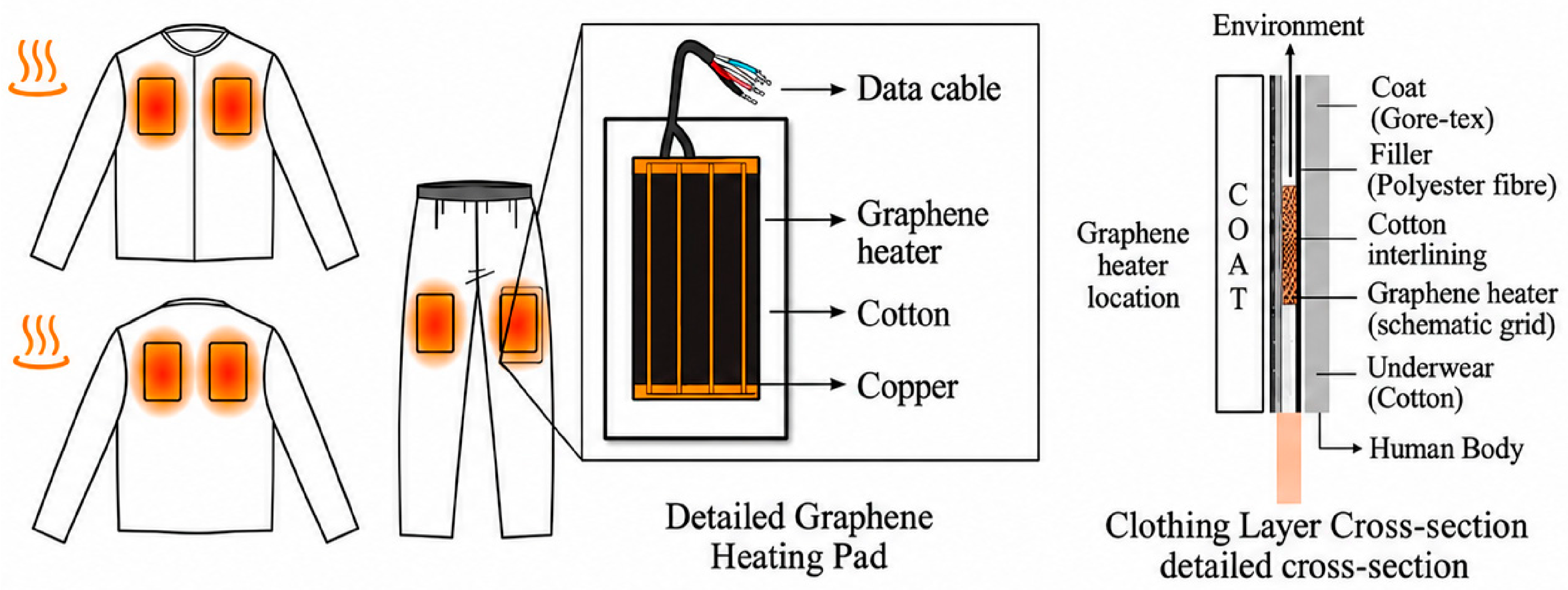
Table 2.
Specifications and garment integration of the commercial graphene-based heating pads.
According to supplier-provided third-party Raman data, peaks were observed at 1354.5, 1573.9, and 2700.4 cm−1 and were assigned to the D, G, and 2D bands, respectively. These spectral features are consistent with graphene-related graphitic carbon materials.
Two heating pads were positioned over the chest, two over the upper back, and two over the anterior thigh regions, as illustrated in Figure 1. The greatest changes in local body temperature in a cold environment are in the chest, abdomen, upper back, forearms, and calves [22,23]. The chest and upper-back locations were selected to provide heat to the torso, whereas the thigh locations offered relatively large heating areas without substantially restricting upper-body movement. The number, dimensions, positions, and garment integration of the heating pads were identical under all active-heating conditions. Consequently, the principal experimental variable was the temporal pattern of electrical power delivery rather than the material or spatial configuration of the heating system.
The heating pads were purchased as finished commercial products and were used without material modification. The authors did not synthesize graphene, prepare a graphene coating, or fabricate the conductive films. Independent compositional or microstructural characterization by Fourier-transform infrared spectroscopy, X-ray diffraction, or scanning electron microscopy was not conducted. Accordingly, the material designation and structural information reported here are based on supplier-provided product documentation, and the components are consistently referred to as “commercial graphene-film heating pads” rather than author-fabricated graphene-coated textiles.
The six heating pads were electrically connected in parallel. The heating system provided nominal power settings of 5, 7.5, and 10 W, corresponding to maximum reported surface temperatures of 37 ± 1, 45 ± 1, and 52 ± 1 °C, respectively. Electrical power was supplied by two portable DC power units, each rated at 5 V and 10,000 mAh and weighing 186 g. During the experiments, the power supply for the heated vest was stored in an internal pocket at the lower-left side of the vest, whereas the power supply for the heated trousers was stored in the right-thigh cargo pocket.
The heating pads were installed in a removable configuration. Each pad was inserted into the actual fixation method: placed in a sewn inner pocket. The connecting wires were routed within the garment interlayer and connected to the power supply. The connections allowed the power supplies and heating pads to be disconnected and removed before laundering. These construction details were maintained consistently in all experimental trials.
Cotton socks and gloves were used consistently under all experimental conditions to standardize the clothing system and minimize inter-trial variability. Cotton is hygroscopic, and moisture accumulation may reduce its thermal-insulation performance. However, the participants remained seated at a low activity level during the 60 min exposure, and exercise-induced sweating was therefore expected to be limited, although moisture accumulation was not directly measured. Because the same socks and gloves were used in every condition, their material-related influence was controlled within the repeated-measures design. Nevertheless, this material choice should be considered when extrapolating the findings to prolonged exposure or physically demanding work involving greater sweat production.
2.3. Heating Protocols
To balance thermal protection and battery endurance in wearable electrically heated garments (EHGs), several heating-control strategies have been proposed. Continuous heating is widely used in commercial systems; however, prolonged heat delivery may increase energy consumption and cause localized over-warming at directly heated body regions [11,16]. Sensor-based automatic control can improve thermal regulation but may also increase system complexity, weight, and auxiliary power demand [14,16]. Intermittent heating has therefore attracted attention as a practical approach for reducing energy consumption while maintaining acceptable thermophysiological responses under cold conditions [10,11].
For example, Wang et al. [10] demonstrated that alternating the activation of different heated body regions could improve energy efficiency while maintaining thermal comfort in extremely cold environments. However, their strategy primarily concerned the spatial allocation of heated regions, whereas the effects of different temporal power-transition patterns applied to identical heating regions remain insufficiently understood.
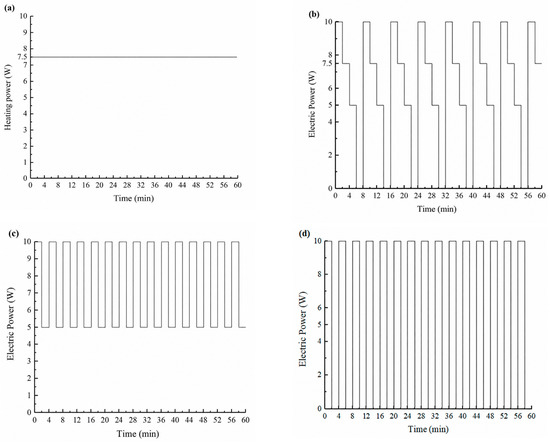
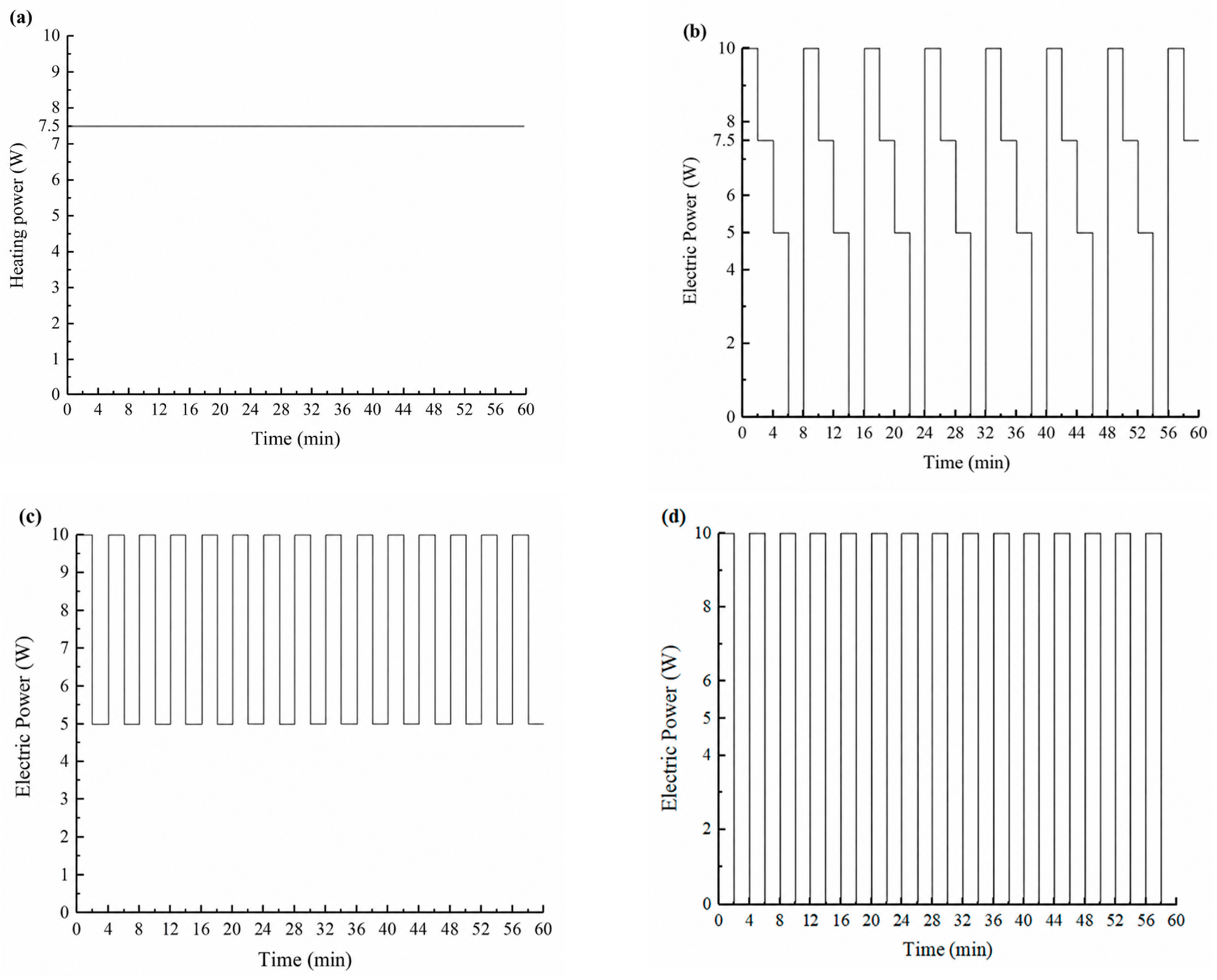
Accordingly, four active-heating protocols were evaluated in the present study. The power levels were selected according to the available operating settings of the commercial heating system, namely 5, 7.5, and 10 W, with 0 W representing the off state. Continuous heating (CP) (Figure 2a) delivered a constant power of 7.5 W and served as the continuous-heating reference. This power level corresponded to the medium operating setting of the system and was selected as a practical baseline for comparison.
Figure 2.
Schematic diagrams of four heating protocols. (a) CP; (b) IP-1; (c) IP-2; (d) IP-3.
Intermittent heating protocol 1 (IP-1) (Figure 2b) adopted a stepwise intermittent profile consisting of 10, 7.5, 5, and 0 W, with each power level maintained for 2 min and the sequence repeated cyclically throughout the exposure period. This protocol was designed to evaluate the effect of progressive stepwise power reduction on thermal stability and subjective comfort.
Intermittent heating protocol 2 (IP-2) (Figure 2c) alternated between 10 and 5 W every 2 min. These two levels corresponded to the high- and low-power nonzero settings of the heating system. Because heating was maintained throughout the cycle, IP-2 reduced power intermittently without completely interrupting heat delivery. Its nominal cycle-average power was 7.5 W, equal to that of CP, allowing comparison between constant heating and alternating, nonzero-power heating under the same average power input.
Intermittent heating protocol 3 (IP-3) (Figure 2d) represented conventional binary ON/OFF control, consisting of 10 W heating for 2 min followed by 0 W for 2 min [11]. This protocol corresponded to a 50% duty cycle and was included to examine whether complete interruption of heating could reduce energy consumption at the expense of repeated cooling of the heating pads, clothing microclimate, and skin surface.
A 2 min interval was used for all intermittent modes to ensure a consistent temporal basis for comparison and to produce repeated transient heating–cooling cycles during the 60 min exposure. A no-heating condition (NH) was included as the control. These conditions enabled a systematic comparison of continuous heating, stepwise descending power modulation, alternating nonzero power levels, and binary ON/OFF heating under an identical garment configuration. Each participant completed five experimental conditions—NH, CP, IP-1, IP-2, and IP-3—in randomized order.
2.4. Experimental Procedure
All experiments were conducted in a climatic chamber (ESPEC Inc., Osaka, Japan) maintained at an air temperature of −5 °C, a relative humidity of 50 ± 5%, and an air velocity below 0.1 m/s. Each participant completed five randomized trials corresponding to the NH, CP, IP-1, IP-2, and IP-3 conditions, resulting in a total of 50 trials involving 10 participants.
Before each trial, participants rested in a seated position for 30 min under thermoneutral conditions. Skin-temperature sensors (iButton® DS1922L, Maxim Integrated Products, Inc., San Jose, CA, USA; resolution: 0.0625 °C) were then attached using Transpore™ surgical tape (3M Company, St. Paul, MN, USA) at 11 body sites: the forehead, chest, abdomen, scapula, lower back, upper arm, forearm, hand, thigh, calf, and foot. Participants subsequently donned the experimental clothing ensemble.
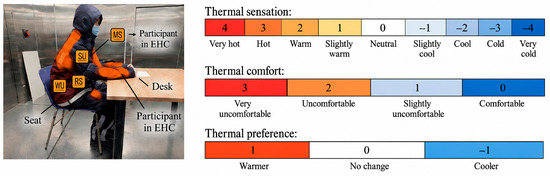
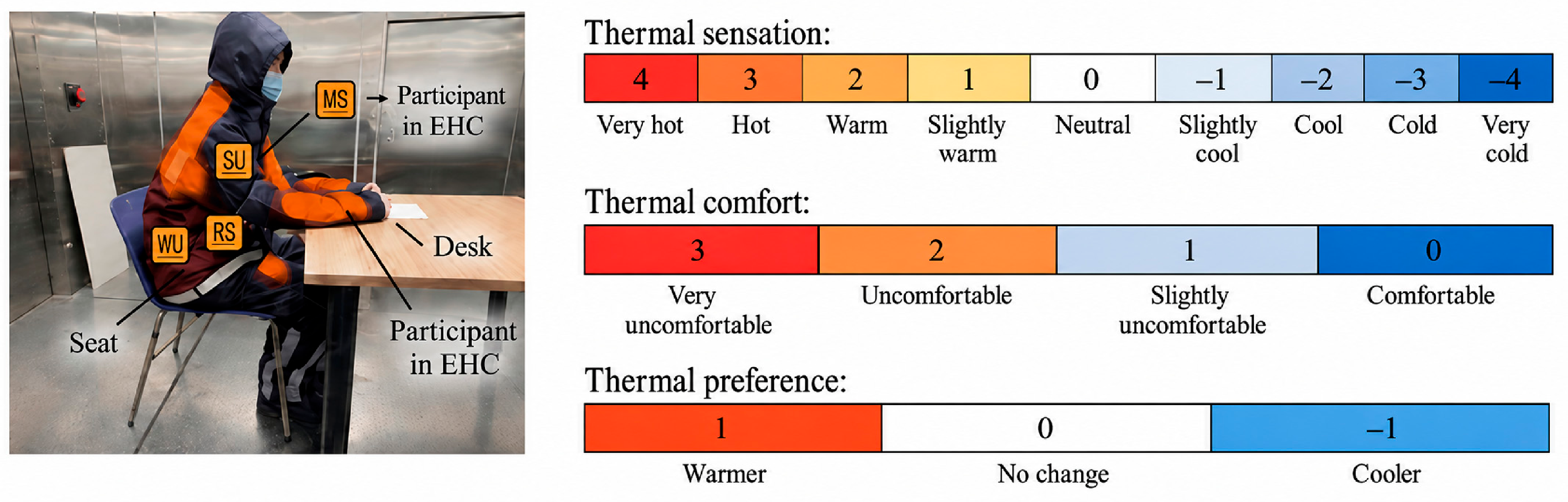
After instrumentation, the participants entered the climatic chamber and remained seated upright on an armless chair for 60 min, as shown in Figure 3. They were instructed to maintain a seated posture and avoid unnecessary body movement throughout the exposure. Overall thermal sensation, thermal comfort, and thermal preference were recorded at 10 min intervals using the scales presented in Table 3. Participants were permitted to report intermediate decimal values to provide a more sensitive representation of their subjective thermal perceptions.
Figure 3.
Performance evaluation of a graphene-based heating textile system. Experimental setup and thermal perception assessment indices.
Table 3.
Rating scales of the subjective responses.
2.5. Calculations and Statistical Analysis
The mean skin temperature () was calculated as a weighted sum of local skin temperatures measured at multiple body sites, based on multi-node thermoregulation models that evaluate segmental skin temperatures and their overall integration. The mean skin temperature and the mean torso temperature () were calculated using the following equations [25,26,27].
where , ,, , , , , , , and are local skin temperatures (°C) at the forehead, forearm, chest, abdomen, scapular, upper arm, hand, thigh, calf, foot and lower back, respectively.
All data were presented as mean ± standard deviation (SD), and the statistical analyses were performed using IBM SPSS Statistics (v.22.0, IBM Corporation, Armonk, NY, USA). Mean skin temperature, mean torso temperature, local skin temperature, and perceptual responses were tested for normality with the Shapiro-Wilk test. Repeated-measures ANOVA and paired-sample t tests were performed to examine statistical differences in physiological and psychological responses between the heating protocol and time effect and interaction effect. Statistical significance was set as p < 0.05 in all tests.
3. Results and Discussion
3.1. Thermophysiological Responses
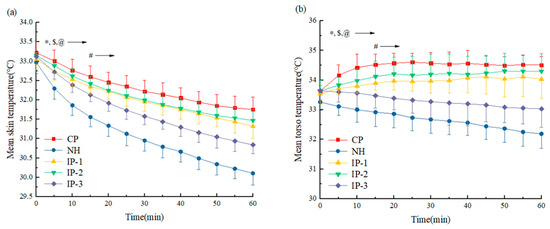
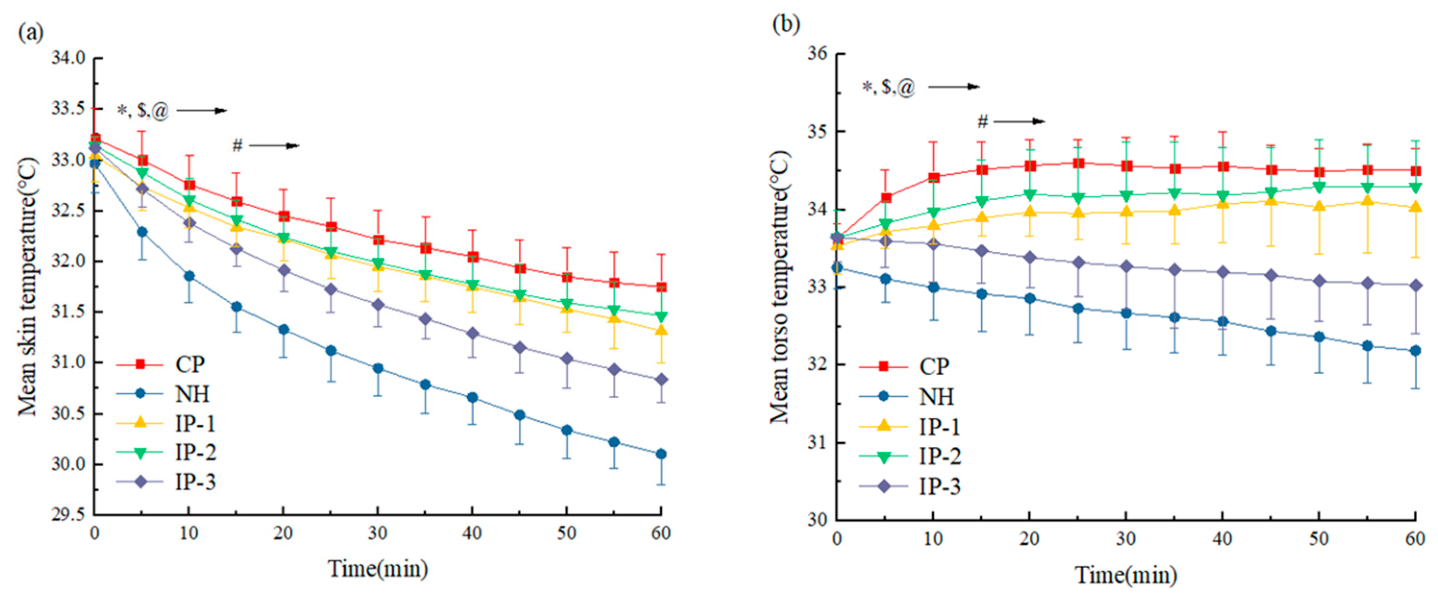
Figure 4 shows the temporal changes in mean skin temperature and mean torso temperature under the five heating conditions. During the 60 min exposure at −5 °C, mean skin temperature decreased in all protocols, indicating continuous heat loss from the body to the cold environment. The largest decline occurred in NH, where mean skin temperature decreased from 32.97 °C to 30.11 °C. In contrast, active heating attenuated this reduction, with final mean skin temperatures of 31.76 °C, 31.32 °C, 31.46 °C, and 30.84 °C for CP, IP-1, IP-2, and IP-3, respectively. Compared with NH, all active heating protocols maintained significantly higher mean skin temperatures from 5 to 60 min (p < 0.05), confirming the effectiveness of the electrically heated garment in reducing cold-induced skin cooling.
Figure 4.
Time courses of (a) mean skin temperatures and (b) mean torso temperature in CP, NH, IP-1, IP-2 and IP-3. * p < 0.05, IP-1 vs. NH; # p < 0.05, IP-1 vs. IP-3; $ p < 0.05, IP-3 vs. NH; @ p < 0.05, IP-1 vs. CP. Horizontal arrows indicate the time intervals over which the corresponding between-condition differences were statistically significant.
The differences among intermittent protocols indicate that the temporal form of heat delivery strongly influences thermal regulation. Mean skin temperatures under IP-1 and IP-2 were significantly higher than those under IP-3 from 15 to 60 min (p < 0.05), whereas no significant difference was observed between IP-1 and IP-2 throughout the trial (p > 0.05). Although IP-3 reduced power input through a 2 min on/off cycle, the complete interruption of heating during the off phase likely caused repeated cooling of the clothing microclimate and skin surface. By contrast, IP-1 and IP-2 maintained a more continuous thermal stimulus, thereby reducing abrupt thermal fluctuations. This result suggests that intermittent heating should not be understood simply as reducing heating duration; rather, the continuity and transition pattern of heat input are critical for maintaining physiological stability.
Mean torso temperature showed a similar but more localized response. Under CP, torso temperature increased during the first 15 min and then stabilized at approximately 34.5 °C. Under IP-1 and IP-2, torso temperature remained close to 34 °C throughout the exposure, whereas IP-3 and NH showed a gradual decline. The higher torso temperature under CP demonstrates strong heat compensation, but it also indicates possible heat accumulation in directly heated regions. In comparison, IP-1 and IP-2 maintained torso warmth without excessive elevation, suggesting a more balanced heat exchange between the body, clothing microclimate, and ambient cold environment.
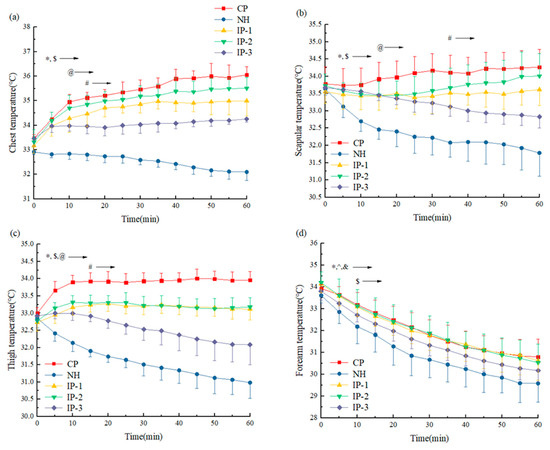
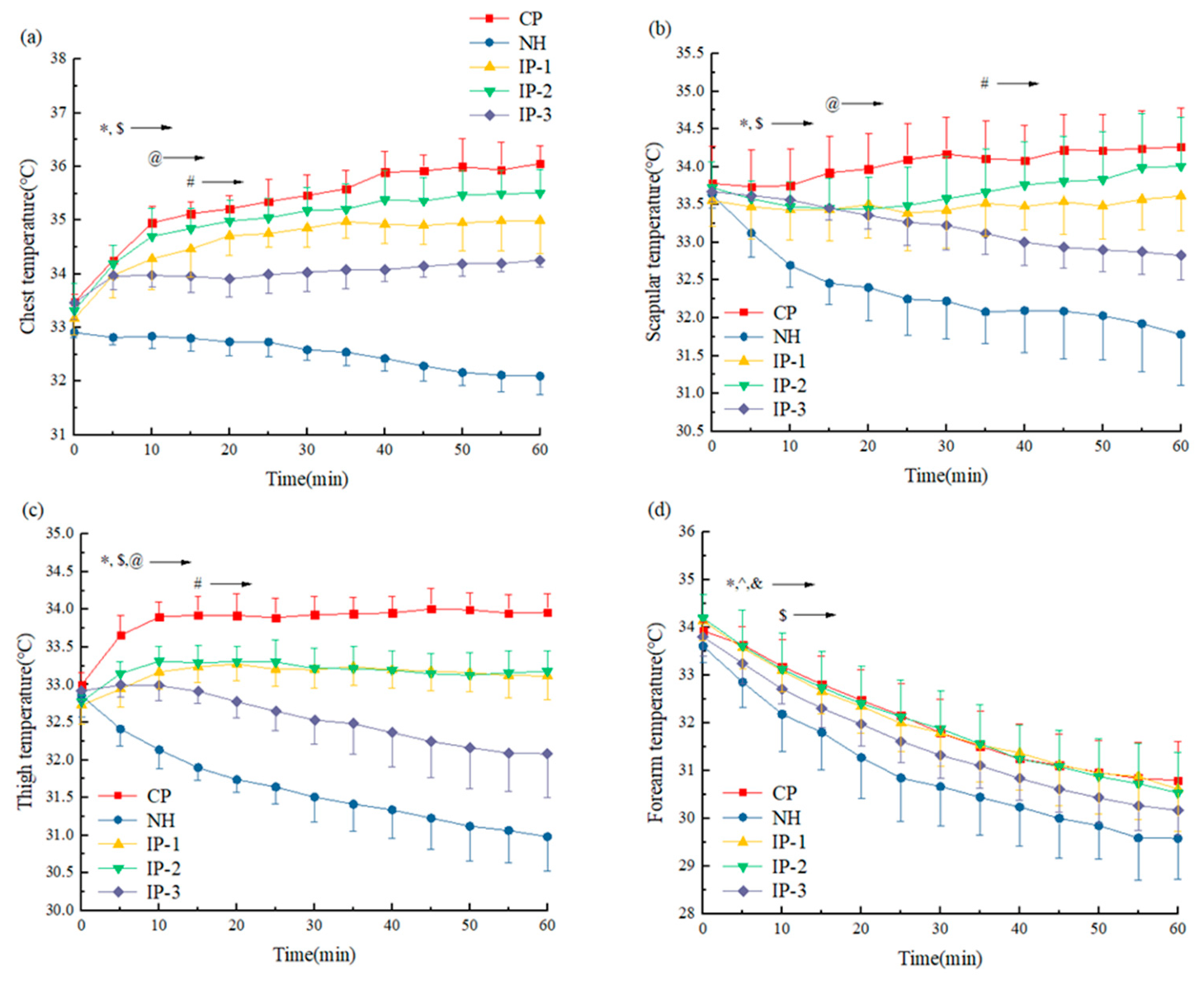
The local skin temperature results further support this interpretation (Figure 5). Chest, scapular, and thigh temperatures were significantly higher under active heating conditions than under NH for most of the exposure period (p < 0.05). The chest temperature under CP reached approximately 36 °C by the end of the trial, whereas that under IP-1 remained below 35 °C. This distinction is important because local overheating at thermally sensitive torso regions may reduce whole-body comfort, even under cold exposure. Compared with IP-3, IP-1 maintained significantly higher chest temperature from 15 to 60 min, scapular temperature from 35 to 60 min, and thigh temperature from 15 to 60 min (p < 0.05), indicating that the descending-step protocol was more effective than abrupt on/off cycling in preserving local warmth.
Figure 5.
Local skin temperatures at the (a) chest, (b) scapular, (c) thigh and (d) forearm in CP, NH, IP-1, IP-2 and IP-3. * p < 0.05, IP-1 vs. NH; ^ p < 0.05, IP-2 vs. NH; & p < 0.05, CP vs. NH; $ p < 0.05, IP-3 vs. NH; # p < 0.05, IP-1 vs. IP-3; @ p < 0.05, IP-1 vs. CP. Horizontal arrows indicate the time intervals over which the corresponding between-condition differences were statistically significant.
However, the heating effect was mainly concentrated in the directly heated or adjacent regions. Forearm temperature decreased over time in all conditions, although CP, IP-1, and IP-2 maintained higher forearm temperatures than NH during most of the trial. No significant differences were observed in hand, calf, and foot temperatures among the five protocols (p > 0.05). This indicates that torso- and thigh-focused heating improved overall thermal balance but was insufficient to protect distal extremities. Since local thermal conditions can influence whole-body thermal perception [22,23], future garment designs may require additional low-power heating or improved insulation for the hands and feet, especially during long-duration cold exposure or tasks requiring manual dexterity.
3.2. Subjective Thermal Perception
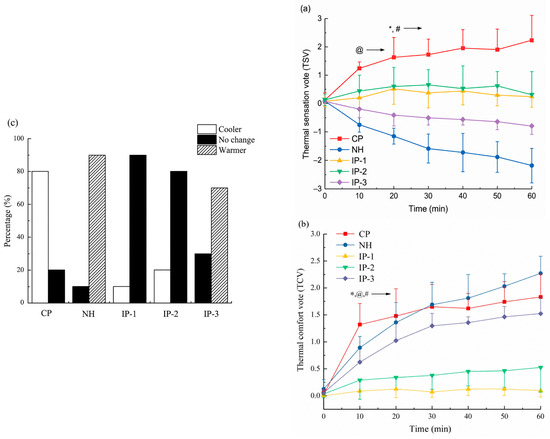
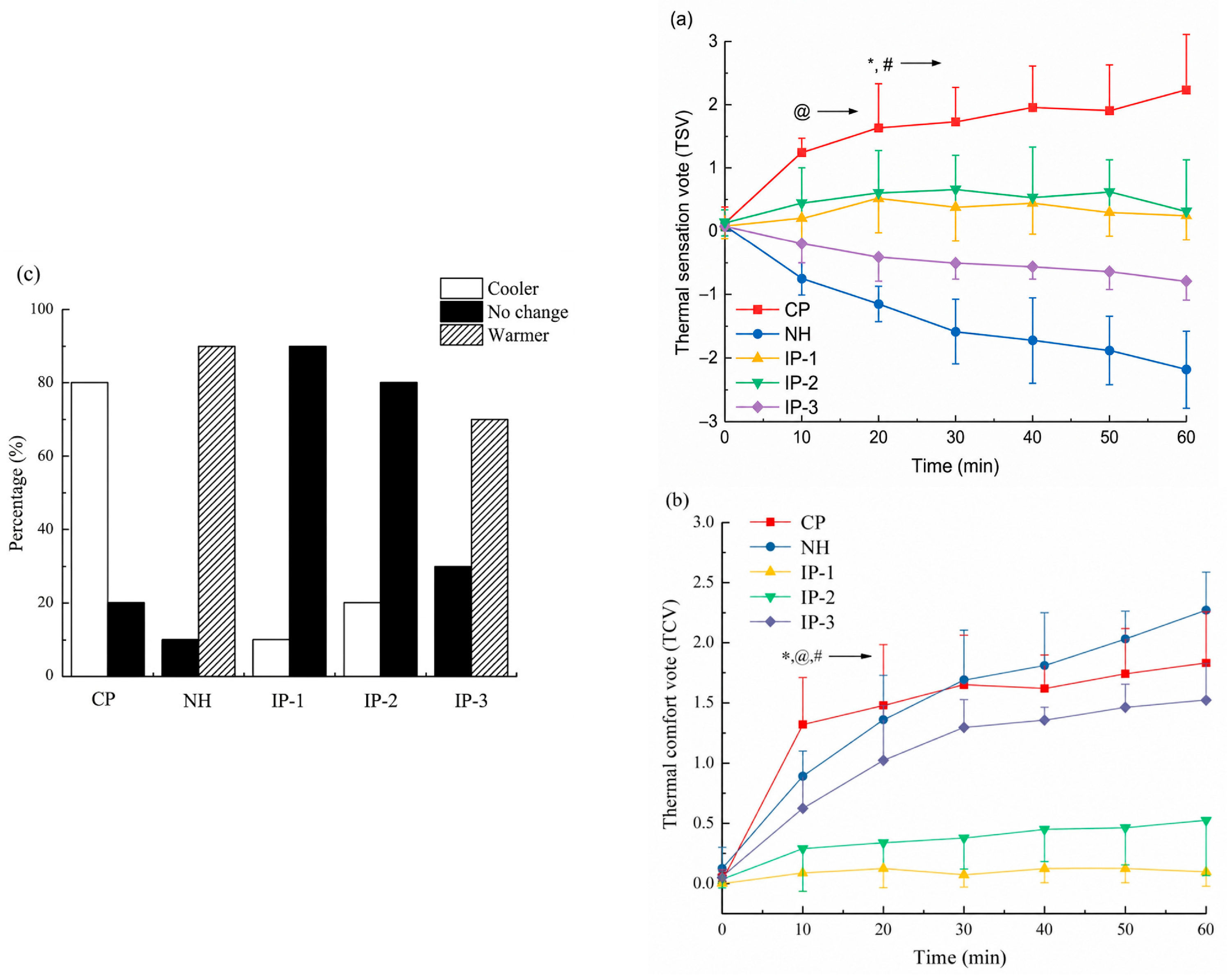
Figure 6 presents the overall thermal sensation vote (TSV), thermal comfort vote (TCV), and thermal preference vote. The subjective responses show that higher skin temperature did not necessarily lead to better comfort. Previous research under steady resting conditions has identified mean skin temperature as a useful physiological correlate of thermal comfort, with one study reporting a comfort-associated range of approximately 32.6–33.7 °C [26]. In the present study, CP maintained the highest torso and local skin temperatures, but this was accompanied by excessive warmth and reduced comfort. Therefore, the objective of wearable heating should be to maintain an acceptable thermal range rather than to maximize heat input.
Figure 6.
(a) Overall TSVs; (b) TCVs in CP, NH, IP-1, IP-2 and IP-3. * p < 0.05, IP-1 vs. NH; # p < 0.05, IP-1 vs. IP-3; @ p < 0.05, IP-1 vs. CP; (c) Thermal preference vote in CP, NH, IP-1, IP-2 and IP-3. Horizontal arrows indicate the time intervals over which the corresponding between-condition differences were statistically significant.
Under IP-1 and IP-2, TSV remained between neutral and slightly warm throughout the trial, ranging from +0.08 to +0.90. These values indicate a stable and acceptable thermal sensation. In contrast, TSV under CP increased progressively and reached +2.23 at 60 min, corresponding to a sensation between “warm” and “hot”.
This is consistent with the high chest temperature observed under CP, which suggests that continuous heating caused perceptible local heat accumulation. Conversely, NH and IP-3 resulted in insufficient thermal compensation, with final TSV values of −2.18 and −0.80, respectively.
The TCV results showed the same tendency. Under IP-1 and IP-2, TCV remained between comfortable and slightly uncomfortable, ranging from 0 to +0.53. By contrast, TCV under CP remained around +1.5 during most of the exposure, indicating a state between slightly uncomfortable and uncomfortable. NH and IP-3 also produced discomfort, but for the opposite reason: inadequate heat supply. Thus, CP and IP-3 represent two different suboptimal strategies. CP provided excessive and energy-intensive heating, whereas IP-3 saved energy at the expense of thermal continuity and comfort.
Thermal preference votes further confirmed this interpretation. Under CP, 80% of participants preferred a cooler environment, indicating overheating. Under NH and IP-3, 90% and 70% of participants preferred a warmer environment, respectively, indicating insufficient cold protection. In contrast, 90% of participants under IP-1 and 80% under IP-2 reported no desire to change the thermal environment. These results demonstrate that IP-1 and IP-2 maintained thermal perception closer to neutrality, while avoiding both overheating and cold discomfort.
3.3. Mechanisms of Different Heating Strategies
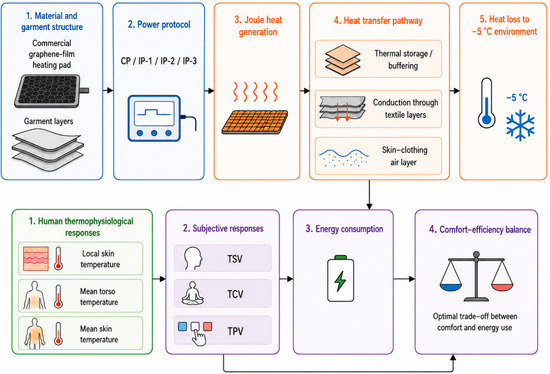
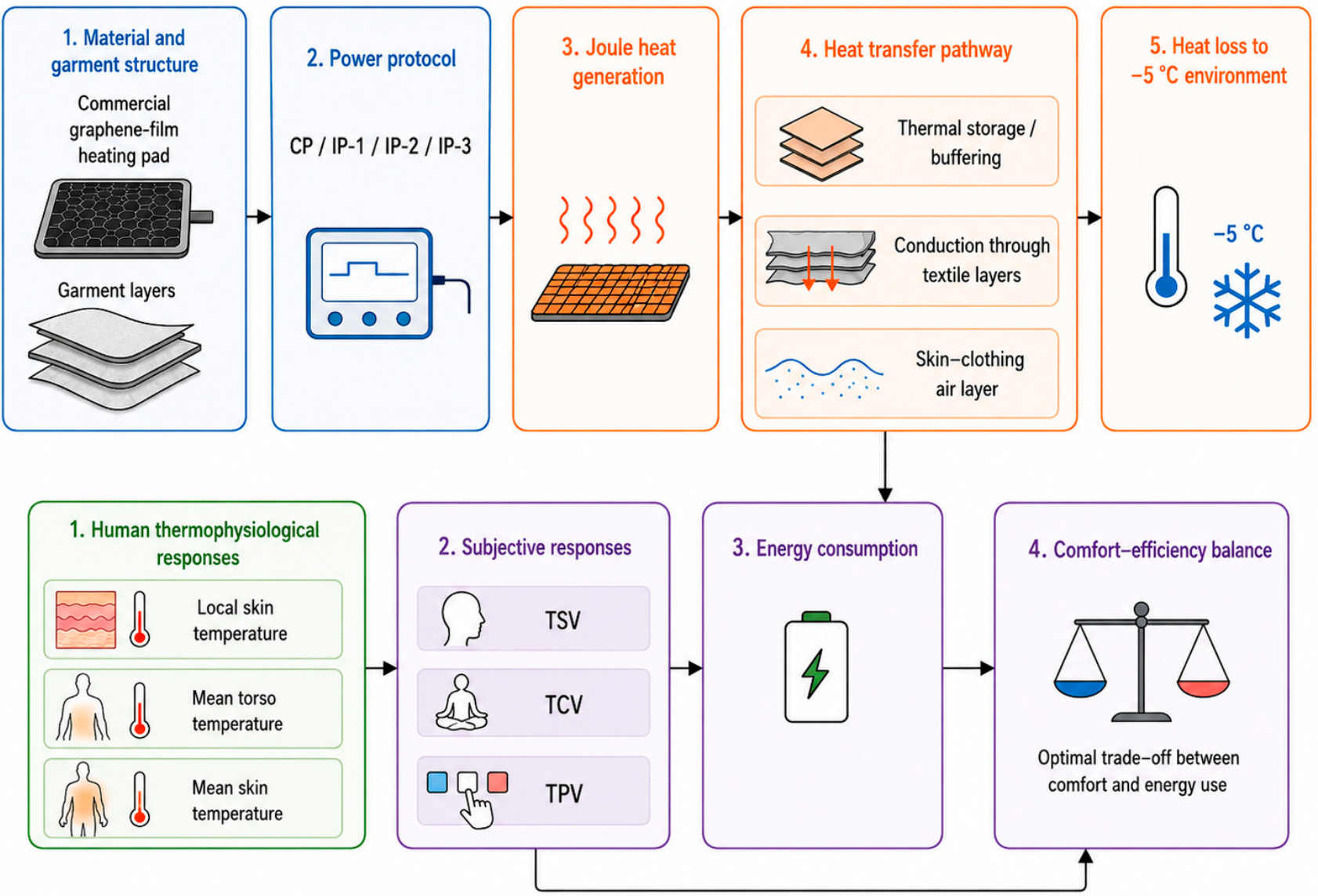
Because the heating-element material, dimensions, locations, garment configuration, environmental conditions, and participant posture were identical across all active-heating conditions, the differences observed among CP, IP-1, IP-2, and IP-3 were primarily associated with the temporal characteristics of power delivery. The proposed heat-generation and heat-transfer pathway in the heated garment system is summarized in Figure 7. Electrical power is converted into heat by the graphene-based heating pads through Joule heating. The generated heat is temporarily stored and transferred through the pad covering, garment layers, and skin–clothing air layer before affecting skin temperature and subjective thermal perception. Part of the heat is simultaneously dissipated to the cold environment.
Figure 7.
Heat-generation and heat-transfer pathway in the heated garment system.
The graphene heating pads converted electrical energy into heat through Joule heating [18]. However, changes in electrical power were not transmitted instantaneously to the skin. Before reaching the body, the generated heat passed through the heating-pad encapsulation, garment fabrics, insulation layers, clothing air gaps, and underwear. Heat transfer in electrically heated clothing is therefore governed by the thermal interactions among the heating element, textile layers, air gaps, skin, and surrounding environment [15,16]. These components can temporarily store and redistribute heat, thereby delaying and smoothing the thermal response at the skin. Consequently, the skin temperature was determined not only by the instantaneous electrical power but also by the duration, lower power limit, transition magnitude, and continuity of each heating stage. This thermal-buffering behavior helps explain why heating protocols with different temporal waveforms produced different physiological and subjective responses even when the same heating pads and body locations were used.
Under CP, the continuous 7.5 W power input provided uninterrupted heat compensation throughout the cold exposure. This sustained heat supply rapidly increased the torso temperature during the initial stage and subsequently maintained it at approximately 34.5 °C. The chest temperature approached approximately 36 °C by the end of the exposure, indicating substantial local warming in a directly heated region. Because heat generation continued without a low-power recovery period, the heat supplied to the torso may have exceeded the amount required to offset local heat loss. The resulting local heat accumulation was consistent with the progressively warmer thermal sensation, reduced thermal comfort, and preference for a cooler condition reported under CP. Therefore, the strongest warming response did not produce the most favorable subjective outcome. This result demonstrates that the objective of wearable heating should be to maintain local temperatures within an acceptable range rather than to maximize the delivered heat.
IP-3 represented conventional binary ON/OFF heating [10,11]. During each OFF period, electrical heat generation stopped completely, whereas heat stored in the heating pad, textile layers, clothing microclimate, and superficial tissues continued to dissipate toward the −5 °C environment. When the heater was reactivated, part of the newly generated heat was required to compensate for the heat lost during the preceding OFF period before the local microclimate could be restored. Repeated ON/OFF cycling, therefore, subjected the heater–clothing–skin system to alternating heat-storage and heat-release processes.
The decreasing torso and local skin temperatures under IP-3 suggest that the heat delivered during the ON stages did not fully compensate for the cumulative heat loss during the repeated OFF stages. Thermal sensation under transient conditions is associated not only with mean skin temperature but also with its rate of change [28]. Repeated cooling after complete heater deactivation may therefore have strengthened the cool sensation, even when the cycle-averaged power remained sufficient to provide some thermal protection. This interpretation is consistent with the lower final thermal sensation, greater discomfort, and stronger preference for additional warmth observed under IP-3.
In contrast to IP-3, IP-2 alternated between 10 and 5 W and therefore maintained a nonzero thermal baseline throughout the exposure. The 5 W stage continued to generate heat and limited the extent to which the clothing microclimate entered a passive cooling state. This continuous heat supply contributed to the relatively stable mean torso and local skin temperatures and helped maintain thermal sensation and comfort close to neutral. However, because the lower stage remained at 5 W and the heater was continuously active, the cumulative energy consumption of IP-2 was close to that of CP. The principal advantage of IP-2 was therefore improved thermal continuity rather than substantial energy saving.
IP-1 combined reduced energy input with gradual changes in heating power. Unlike IP-3, in which the power switched directly between 10 and 0 W, IP-1 progressively decreased the power through intermediate stages before reaching 0 W. The smaller changes between successive power stages reduced the abruptness of the thermal disturbance applied to the heater–clothing system. During the descending phase, heat retained in the heating pad, textile layers, clothing air gaps, and superficial tissues could continue to support the local microclimate while the electrical input was gradually reduced. At the end of the 0 W stage, the power setting was abruptly reset to 10 W to initiate the next cycle.
The thermal storage and buffering capacity of the clothing system may therefore have converted the stepwise electrical input of IP-1 into a smoother temperature response at the skin. At the same time, the reduced cumulative power input limited the excessive local warming observed under CP. This combination explains why IP-1 maintained higher mean skin and heated-region temperatures than IP-3 while preventing the pronounced chest and torso warming associated with CP. The relatively neutral thermal sensation, low discomfort, and high proportion of participants reporting no desired thermal change further indicate that the descending-step protocol maintained a more balanced local thermal environment.
The comparison between IP-1 and IP-3 also shows that the presence of a zero-power stage alone does not determine the effectiveness of intermittent heating. Both protocols included periods without electrical input, but their transition pathways differed considerably. In IP-3, the direct transition from 10 to 0 W produced an abrupt interruption in heat generation. In IP-1, the gradual reduction through intermediate power levels allowed the thermal energy stored in the garment system to be released more progressively. Thus, the comfort advantage of IP-1 appears to arise from the complete temporal waveform, including the transition magnitude, transition sequence, and duration of each power level, rather than simply from heating duration or duty cycle.
The regional results provide further insight into the scope of the heating effect. Significant differences were mainly observed in the chest, scapular, thigh, and, to a lesser extent, forearm regions, whereas no significant differences were found in the hand, calf, or foot temperatures. Local thermal signals from different body regions are integrated into whole-body thermal sensation and comfort [22,23]. Nevertheless, the absence of measurable improvement at the distal sites indicates that the present torso–thigh heating configuration did not provide adequate thermal protection for the extremities. Overall, the four protocols produced distinct thermal-control behaviors. CP maintained uninterrupted heat input but increased the risk of local heat accumulation. IP-2 preserved a nonzero thermal baseline and provided stable warming, but with limited energy-saving benefit. IP-3 minimized energy use but repeatedly exposed the clothing microclimate to passive cooling during the OFF stages. IP-1 used a staged reduction in power before a brief OFF stage to make more effective use of the temporary heat storage and buffering capacity of the heater–clothing system, thereby limiting both excessive warming and rapid cooling. These results indicate that the effectiveness of intermittent heating depends not only on the total energy supplied but also on how that energy is distributed over time.
The proposed interpretation is supported by the measured skin temperature and subjective-response patterns, but should be regarded as a system-level mechanism rather than a direct verification of every heat-transfer and thermoregulatory process. Heater surface temperature, clothing microclimate temperature, local heat flux, and skin blood flow were not measured during the individual heating cycles. Future studies incorporating these measurements would enable the transient thermal pathways associated with different power-transition profiles to be quantified more directly.
3.4. Energy Consumption and Comfort–Efficiency Balance
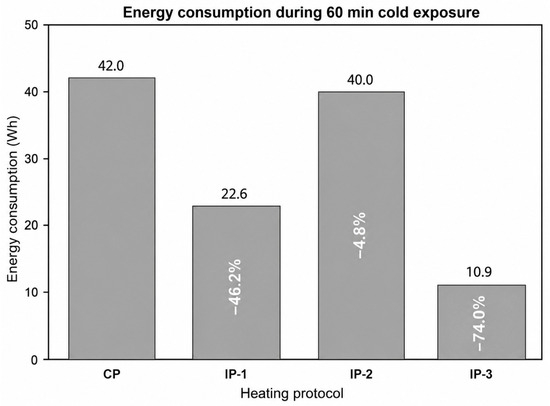
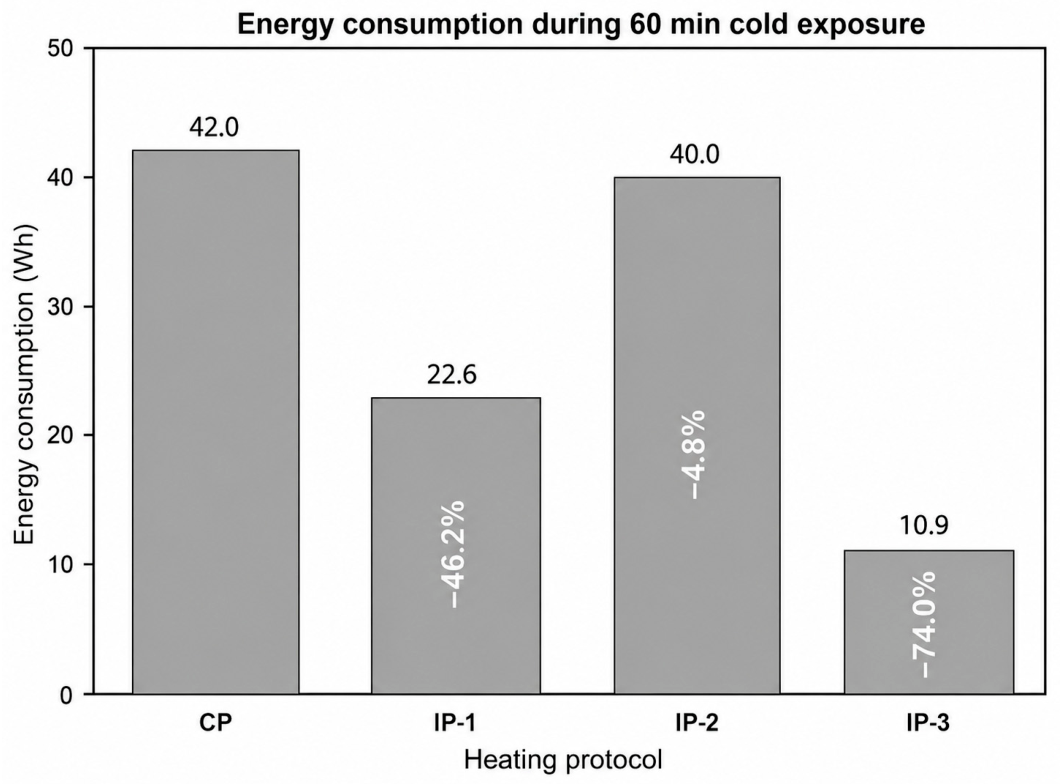
Energy consumption (Figure 8) differed substantially among the four active-heating protocols. During the 60 min exposure, CP consumed 42.0 Wh, whereas IP-1 consumed 22.6 Wh, corresponding to a 46.2% reduction relative to CP. IP-2 consumed 40.0 Wh and therefore provided only a limited reduction in energy use. IP-3 consumed 10.9 Wh, representing a 74.0% reduction compared with CP. However, the lowest energy consumption did not correspond to the best physiological or subjective performance.
Figure 8.
Energy consumption of the four active-heating protocols during the 60 min cold exposure. Percentage values indicate the reduction in energy consumption relative to CP.
The combined temperature and perceptual results reveal a clear trade-off between warming effectiveness, thermal comfort, and energy demand. CP produced the highest torso and local skin temperatures, but also caused excessive warmth in the directly heated regions and increased the preference for a cooler condition. IP-3 achieved the greatest energy saving, but its repeated OFF periods were accompanied by lower mean skin and local temperatures, cooler thermal sensation, and a greater preference for additional warmth. IP-2 maintained favorable physiological and subjective responses, but its energy consumption remained close to that of CP.
Among the tested protocols, IP-1 provided the most favorable overall balance. It maintained mean skin and torso temperatures within an acceptable range, preserved local warmth in the heated regions, and kept thermal sensation, comfort, and preference close to neutral while reducing energy consumption by nearly half relative to CP. IP-1, therefore, achieved meaningful energy savings without the substantial deterioration in thermal continuity observed under IP-3.
From an application perspective, this balance is particularly important for battery-powered protective clothing. Reducing energy demand while maintaining acceptable thermal comfort may extend garment operating time, reduce the required battery capacity, or permit the use of a lighter power supply. Nevertheless, the present heating arrangement mainly benefited the torso and thigh regions and provided limited thermal protection for the hands and feet. Further optimization should therefore consider both temporal power modulation and spatial heating distribution, particularly for prolonged cold exposure and occupational tasks requiring distal dexterity.
3.5. Study Limitations and Future Perspectives
Several limitations should be considered. First, the commercial graphene-film heating pads were described according to manufacturer-provided information, and no independent FTIR, XRD, or SEM characterization was performed. Graphene content, coating morphology, coating amount, and heating area were not experimental variables. Therefore, the findings apply to the tested commercial heating platform and should not be interpreted as an evaluation of graphene material structure or coating fabrication.
Transient heating-pad temperature, local heat flux, and clothing-microclimate heat and moisture conditions were not directly measured and should be investigated in future studies. Second, only ten healthy young men participated, and the experiments involved 60 min of seated exposure in a controlled climatic chamber. Although the within-subject design reduced inter-individual variability, the findings may not be directly generalized to women, older adults, longer exposure periods, or physically active workers. Third, laundering resistance and long-term durability were not evaluated. The power supplies, heating pads, and connecting wires could all be removed before laundering. However, the effects of repeated removal, reinstallation, bending, and long-term use on connector stability, electrical resistance, and heating uniformity remain to be examined. Finally, heating was concentrated on the chest, upper back, and thighs, and no significant improvement was observed in hand, calf, or foot temperatures. Future designs should combine temporal power modulation with optimized heating distribution or additional thermal protection for the extremities.
Within these limitations, the study demonstrates that temporal power-delivery patterns can influence thermal comfort and energy use even when garment configurations and heating locations are otherwise identical.
4. Conclusions
This study shows that the performance of electrically heated clothing depends not only on the amount of heat supplied but also on how electrical power is distributed over time. Under the tested conditions, continuous heating maintained the highest local temperatures but increased the likelihood of excessive torso warmth, whereas binary ON/OFF heating reduced energy demand at the expense of thermal continuity. Alternating between two nonzero power levels maintained stable warming, but its energy demand remained close to that of continuous heating.
Among the evaluated strategies, the descending-step protocol provided the most favorable overall balance. By reducing abrupt changes in heat input, IP-1 maintained adequate torso and mean skin temperatures without the pronounced local warming observed under continuous heating or the progressive cooling associated with ON/OFF cycling. The results, therefore, indicate that the transition pathway, lower power level, and continuity of heat delivery should be considered together when designing intermittent-heating protocols.
The main contribution of this work is the identification of temporal power-transition characteristics as an important system-level design factor for wearable heating. Rather than maximizing heating intensity or minimizing operating time alone, practical control strategies should maintain sufficient thermal continuity while preventing unnecessary local heat accumulation. This principle may support the development of heated garments with improved comfort and longer battery operation. Within the present experimental scope, however, the conclusions apply primarily to short-term sedentary exposure and torso–thigh heating; further optimization should consider longer use conditions and the thermal protection of distal body regions.
Author Contributions
Conceptualization, J.D. and C.H.; methodology, Y.K. and H.Z.; investigation, J.D. and H.Z.; data curation, J.D.; writing—original draft preparation, J.D. and H.Z.; writing—review and editing, J.D., Y.K. and C.H.; supervision, C.H.; resources, Y.K. All authors have read and agreed to the published version of the manuscript.
Funding
This research was funded by the China Postdoctoral Science Foundation, grant number 2020T130255; the MOE Project of Humanities and Social Sciences, grant number 20YJCZH063; and the Open Fund of the Key Laboratory of Clothing Design and Technology (Donghua University), Ministry of Education, China, grant number KLCDT2020-02.
Informed Consent Statement
Written informed consent was obtained from all participants involved in the study.
Data Availability Statement
Data are contained within the article.
Acknowledgments
The authors would like to thank all volunteers for their participation in the experiments.
Conflicts of Interest
The authors declare no conflicts of interest.
References
- Falla, M.; Micarelli, A.; Hüfner, K.; Strapazzon, G. The Effect of Cold Exposure on Cognitive Performance in Healthy Adults: A Systematic Review. Int. J. Environ. Res. Public Health 2021, 18, 9725. [Google Scholar] [CrossRef] [Scilit] [PubMed]
- Saraoui, W.; Sivakumar, B.S.; Forli, A.; Perruisseau-Carrier, A. Frostbite to the upper limb: An updated review and management recommendations. Hand Surg. Rehabil. 2025, 44, 102302. [Google Scholar] [CrossRef] [Scilit] [PubMed]
- Wu, J.S.; Hu, Z.Q.; Han, Z.X.; Gu, Y.; Yang, L.; Sun, B.Y. Human physiological responses of exposure to extremely cold environments. J. Therm. Biol. 2021, 98, 102933. [Google Scholar] [CrossRef] [Scilit] [PubMed]
- Mäkinen, T.M.; Jokelainen, J.; Näyhä, S.; Laatikainen, T.; Jousilahti, P.; Hassi, J. Occurrence of frostbite in the general population-work-related and individual factors. Scand. J. Work. Environ. Health 2009, 35, 384–393. [Google Scholar] [PubMed]
- He, M.Y.; Zhao, B.C.; Yue, X.J.; Chen, Y.F.; Qiu, F.X.; Zhang, T. Infrared radiative modulating textiles for personal thermal management: Principle, design and application. Nano Energy 2023, 116, 108821. [Google Scholar] [CrossRef] [Scilit]
- Li, S.S.; Jia, X.Y.; Cao, B.; Zhu, Y.X. Improvement of thermal perceptions and physiological responses using torso heating under short-term cold exposure. Sci. Total Environ. 2023, 892, 164491. [Google Scholar] [CrossRef] [Scilit] [PubMed]
- Blachowicz, T.; Malczyk, M.; Kola, I.; Ehrmann, G.; Schwenzfeier-Hellkamp, E.; Ehrmann, A. Textiles for Very Cold Environments. Processes 2024, 12, 927. [Google Scholar] [CrossRef] [Scilit]
- Liu, X.H.; Wang, Y.Y.; Tian, M. Quantitative characterization of clothing’s cold protective capability to achieve thermal comfort: A systematic review. Build. Environ. 2022, 219, 109226. [Google Scholar] [CrossRef] [Scilit]
- Li, S.S.; Deng, Y.; Cao, B. Study on the Performance of Personal Heating in Extremely Cold Environments Using a Thermal Manikin. Buildings 2023, 13, 362. [Google Scholar] [CrossRef] [Scilit]
- Wang, J.H.; Ju, X.Y.; Wang, M.; Zhu, Y.X.; Chong, A.D.; Fan, Y.M.; Cao, B. Alternating intermittent heating: An energy-efficient wearable heating strategy for enhanced comfort in extremely cold environments. Energy 2025, 339, 139010. [Google Scholar] [CrossRef] [Scilit]
- Shin, S.; Choi, H.H.; Kim, Y.B.; Hong, B.H.; Lee, J.Y. Evaluation of body heating protocols with graphene heated clothing in a cold environment. Int. J. Cloth. Sci. Technol. 2017, 29, 830–844. [Google Scholar] [CrossRef] [Scilit]
- Lee, C.; Tan, J.; Lam, N.Y.K.; Tang, H.T.; Chan, H.H. The effectiveness of e-textiles in providing thermal comfort: A systematic review and meta-analysis. Text. Res. J. 2023, 93, 1568–1586. [Google Scholar] [CrossRef] [Scilit]
- Greszta, A.; Mlynarczyk, M.; Dabrowska, A.; Krzeminska, S.; Jangas, M.; Starzak, L.; Marciniak, P.; Malachowski, B. Assessment of a Clothing Ensemble with an Active Heating Function Based on Thermal Manikin Tests. Materials 2025, 18, 5258. [Google Scholar] [CrossRef] [Scilit] [PubMed]
- Wang, D.B.; Dong, J.; Ge, H.X.; Tang, M.Y.; Xie, Q.Y.; Liu, J.T.; Si, Y.H.; Wang, Y.P.; Sun, R.J. Electrically Heated Flexible Heaters in Wearable Technology: A Review of Research Progress and Challenges. ACS Appl. Mater. Interfaces 2025, 17, 66151–66179. [Google Scholar] [CrossRef] [Scilit] [PubMed]
- Cheng, Z.Q.; Xu, J.X.; Lu, Y.H. A multi-scale simulation for heat transfer between human and heated clothing: Towards personalized and efficient thermal management. Build. Environ. 2026, 287, 113764. [Google Scholar] [CrossRef] [Scilit]
- Fang, S.; Wang, R.; Ni, H.S.; Liu, H.; Liu, L. A review of flexible electric heating element and electric heating garments. J. Ind. Text. 2022, 51, 101S–136S. [Google Scholar] [CrossRef] [Scilit]
- Lei, L.Q.; Shi, S.; Wang, D.; Meng, S.; Dai, J.G.; Fu, S.H.; Hu, J.L. Recent Advances in Thermoregulatory Clothing: Materials, Mechanisms, and Perspectives. ACS Nano 2023, 17, 1803–1830. [Google Scholar] [CrossRef] [Scilit] [PubMed]
- Park, J. Functional Fibers, Composites and Textiles Utilizing Photothermal and Joule Heating. Polymers 2020, 12, 189. [Google Scholar] [CrossRef] [Scilit] [PubMed]
- Neves, S.F.; Couto, S.; Campos, J.; Mayor, T.S. Advances in the optimisation of apparel heating products: A numerical approach to study heat transport through a blanket with an embedded smart heating system. Appl. Therm. Eng. 2015, 87, 491–498. [Google Scholar] [CrossRef] [Scilit]
- Islam, M.R.; Golovin, K.; Dolez, P.I. Clothing Thermophysiological Comfort: A Textile Science Perspective. Textiles 2023, 3, 353–407. [Google Scholar] [CrossRef] [Scilit]
- Yau, Y.H.; Toh, H.S.; Chew, B.T.; Ghazali, N.N.N. A review of human thermal comfort model in predicting human-environment interaction in non-uniform environmental conditions. J. Therm. Anal. Calorim. 2022, 147, 14739–14763. [Google Scholar] [CrossRef] [Scilit] [PubMed]
- Zhong, X.Z.; Yu, H.; Tang, Y.; Mao, H.C.; Zhang, K.G. Local Thermal Comfort and Physiological Responses in Uniform Environments. Buildings 2024, 14, 59. [Google Scholar] [CrossRef] [Scilit]
- Liang, X.H.; He, Y.D.; Li, N.P.; Yin, Y.C.; Hu, J.H. A Field Investigation to Quantify the Correlation between Local and Overall Thermal Comfort in Cool Environments. Buildings 2024, 14, 1171. [Google Scholar] [CrossRef] [Scilit]
- Wang, F.Q.; Liu, Y.M.; Yu, J.Y.; Li, Z.L.; Ding, B. Recent progress on general wearable electrical heating textiles enabled by functional fibers. Nano Energy 2024, 124, 109497. [Google Scholar] [CrossRef] [Scilit]
- Choudhary, B.; Udayraj. A modified multi-node human thermoregulation model with improved sweating response to simulate human physiological behaviours in warm and hot environments. Build. Environ. 2025, 267, 112164. [Google Scholar] [CrossRef] [Scilit]
- Liu, W.W.; Lian, Z.W.; Deng, Q.H.; Liu, Y.M. Evaluation of calculation methods of mean skin temperature for use in thermal comfort study. Build. Environ. 2011, 46, 478–488. [Google Scholar] [CrossRef] [Scilit]
- Gao, C.; Kuklane, K.; Wang, F.; Holmér, I. Personal cooling with phase change materials to improve thermal comfort from a heat wave perspective. Indoor Air 2012, 22, 523–530. [Google Scholar] [CrossRef] [Scilit] [PubMed]
- Takada, S.; Matsumoto, S.; Matsushita, T. Prediction of whole-body thermal sensation in the non-steady state based on skin temperature. Build. Environ. 2013, 68, 123–133. [Google Scholar] [CrossRef] [Scilit]

Disclaimer/Publisher’s Note: The statements, opinions and data contained in all publications are solely those of the individual author(s) and contributor(s) and not of MDPI and/or the editor(s). MDPI and/or the editor(s) disclaim responsibility for any injury to people or property resulting from any ideas, methods, instructions or products referred to in the content. |
© 2026 by the authors. Licensee MDPI, Basel, Switzerland. This article is an open access article distributed under the terms and conditions of the Creative Commons Attribution (CC BY) license.