


Highlights
- N alloying enhances the yield/tensile strength of TWIP steel without ductility loss.
- Solution treatment transforms the corrosion mode from intergranular corrosion to pitting corrosion.
- N-alloyed TWIP steel via solution treatment exhibits the optimal synergy of mechanical and corrosion properties.
Abstract
High-Mn twinning-induced plasticity (TWIP) steels are renowned for their exceptional strength-ductility synergy. However, their practical applications are severely constrained by inadequate yield strength and poor corrosion resistance. In this study, an N-alloyed TWIP steel (Fe-25Mn-12Cr-0.3C-0.3N, wt.%, designated as TWIP-2) was developed, using an N-free counterpart (Fe-25Mn-12Cr-0.3C, TWIP-1) as a reference. Both steels underwent hot forging (HF) followed by solution treatment (ST). The synergistic effects of N alloying and thermomechanical processing on the microstructural evolution, mechanical properties, and corrosion behavior were systematically investigated. Results indicate that all samples retain a single-phase FCC austenitic structure. N alloying increased the yield strength of the hot-forged TWIP steel from 488.1 MPa to 802.9 MPa while maintaining an elongation after fracture around 40%. Solution treatment markedly improved corrosion resistance, changing the corrosion mode from intergranular attack to pitting. The TWIP-2-ST specimen exhibited the lowest corrosion current density of 2.88 × 10⁻⁵ A/cm2 and demonstrated the best overall performance. This comprehensive improvement in mechanical and corrosion performance is primarily attributed to the elevated work-hardening capacity, a higher fraction of low-energy grain boundaries, and the beneficial role of interstitial N in suppressing pitting nucleation and propagation.
1. Introduction
High-Mn twinning-induced plasticity (TWIP) steels have attracted extensive attention in both academic and industrial fields due to their outstanding combination of ultra-high strength (up to 1600 MPa) and excellent ductility (with elongations reaching as high as 107%) [1,2,3,4,5,6,7,8]. These properties have enabled successful implementation in major national engineering equipment, such as the soft-landing mechanism of the Tianwen-1 Mars probe [9], and have made them ideal candidate materials for large-scale applications, including automotive manufacturing, liquefied natural gas shipbuilding, oil and gas exploration, military armor, and seismic-resistant engineering [9,10,11].
However, the industrial promotion of TWIP steels, especially as structural components serving in corrosive environments, is greatly limited by their low yield strength (typically only 200~400 MPa) and poor corrosion resistance, which severely constrain their engineering applications under heavy-loading conditions and in corrosive environments such as marine and chemical settings [5,12]. To improve the comprehensive performance of TWIP steels, numerous efforts have been made through microstructure control [2,3,4,5,6,7,8,12] and alloying design [13,14,15,16,17]. In terms of strength enhancement, Zhang et al. [3] adopted cold rolling coupled with partial recrystallization annealing to achieve a yield strength of 1215 MPa and an elongation of 16%, effectively solving the problem of low yield strength. Wang et al. [4] investigated the mechanical behavior of TWIP steel processed by warm forging and annealing and found that warmly forged steel exhibited an apparent yield-point phenomenon and significantly enhanced yield strength due to the high density of initial dislocations. Chen et al. [6,7] explored laser powder bed fusion additive manufacturing of TWIP steel and successfully fabricated parts with relative density above 99.5%, yield strength over 600 MPa and strength-ductility product exceeding 40 GPa∙%. In corrosion resistance improvement, Wang et al. [12] employed twin-induced grain boundary engineering to optimize the microstructure of TWIP steel, which increased the fraction of low-Σ coincidence site lattice boundaries from 81% to 86% and reduced the corrosion current density by 78%. We systematically clarified the corrosion resistance mechanism of Cr in Fe-Mn-C TWIP steels and found that the addition of 12 wt% Cr tripled intergranular corrosion resistance and enabled the material to maintain tensile strength above 900 MPa and elongation over 40% simultaneously [14,15].
However, most aforementioned studies have enhanced material performance merely via grain-size regulation and microstructure manipulation, failing to break the inherent trade-off between yield strength, ductility and corrosion resistance [12]. This drawback originates from the high carbon content of Fe-Mn-C TWIP steels, which facilitates carbide precipitation at austenite grain boundaries. Such precipitation deteriorates mechanical properties and triggers grain-boundary Cr depletion, further worsening corrosion susceptibility [18,19]. In terms of corrosion resistance, due to the high chemical activity of Mn and the lack of passivating elements (Cr, Ni, and Mo), TWIP steels usually undergo severe corrosion deterioration [20]. The standard reduction potential of Mn (E° Mn2+/Mn = −1.18 V, vs. SHE) is much more negative than that of Fe (E° Fe2+/Fe = −0.44 V, vs. SHE), which causes Mn to be preferentially corroded in aqueous solutions [21]. In addition, Mn oxides form a porous and loose surface film with poor protective properties, further accelerating the corrosion of TWIP steels [22].
As reported, the solid solution strengthening effect of the N element is more significant compared with C [18,19], and previous studies have confirmed that the interstitial elements (such as N) and passivating elements (such as Cr) can optimize both the mechanical and corrosion-resistant properties of austenitic steels. To date, the effect of Cr/N alloying on the microstructure, mechanical properties, and corrosion resistance has been extensively studied in Hadfield steels, austenitic stainless steels, and high-N steels [23,24,25,26,27,28,29,30]. The results show that the addition of the N element has a significant solid solution strengthening effect and improves the pitting corrosion resistance. The Cr/N synergy can stabilize the austenite, eliminate the network carbides, and significantly enhance the strength and toughness of high-Mn steels [23]. However, most existing studies mainly focus on enhancing yield strength and optimizing low-temperature mechanical properties [31,32,33], while few investigations concern the synergistic regulation of strength and corrosion resistance via single N or Cr-N co-alloying in Fe-Mn-C TWIP steels. Furthermore, systematic research is still insufficient to clarify the effects of coupled evolution among N alloying, grain size and microstructure morphology on the mechanical performance and corrosion behavior of newly developed Fe-Mn-Cr-C TWIP steels under diverse processing conditions.
In this study, Fe-25Mn-12Cr-0.3C (TWIP-1) and Fe-25Mn-12Cr-0.3C-0.3N (TWIP-2) TWIP steels were prepared by hot forging (HF) and solution treatment (ST). The effects of N alloying and processing on the microstructure evolution, mechanical properties, and corrosion behavior were systematically characterized. This study firstly established the quantitative correlation of N content, processing conditions, microstructure and comprehensive properties of TWIP steels and revealed the synergistic strengthening and anti-corrosion mechanisms of N alloying and solution treatment. It provides an experimental basis and theoretical guidance for developing high-performance corrosion-resistant TWIP steels.
2. Experimental
2.1. Material Preparation
N-alloyed TWIP-2 steel was melted in a vacuum induction furnace under a N2 atmosphere using electrolytic Mn, Cr nitride, graphite, and pure Fe as raw materials, according to reference [17]. N-free TWIP-1 steel was prepared using the same raw materials (excluding Cr nitride). The chemical compositions of the as-cast steels are listed in Table 1. The ingots were first homogenized by annealing at 1150 °C for 4 h, then hot forged at 1070 °C (with the final forging temperature no lower than 900 °C) into 40 mm diameter round bars. Some of the hot-forged material was subsequently solution treated at 1200 °C for 4 h and water-quenched to obtain a homogenized microstructure. Dog-bone-shaped tensile samples with a gauge size of 20 × 6 × 2 mm3 were cut axially from the bars by wire-cut electrical discharge machining.
Table 1.
Chemical composition of the TWIP steels (wt. %).
2.2. Characterization
Phase identification was performed using an X-ray diffractometer (XRD, X’Pert Pro MPD, PANalytical B.V., Almelo, The Netherlands) equipped with Cu Kα radiation (2θ = 40–100°, scanning rate = 2°/min). Microstructure characterization was carried out using an optical microscope (OM, Carl Zeiss AX10, Carl Zeiss AG, Oberkochen, Germany), a field-emission scanning electron microscope (FE-SEM, SU8020, Hitachi High-Tech Corporation, Tokyo, Japan) equipped with electron backscatter diffraction (EBSD), and a transmission electron microscope (TEM, JEM-2010F, JEOL Ltd., Tokyo, Japan).
The metallographic samples were mechanically polished to a 0.25 μm diamond finish and then etched in a solution composed of 100 mL C2H5OH, 3 g picric acid, and 5 mL of 10 vol.% HCl. The average grain size was determined by the line intercept method. The EBSD samples were electropolished (20 V, 0.5 A) in a mixed solution consisting of 20 vol.% perchloric acid, 10 vol.% acetic acid, and 70 vol.% ethanol to eliminate residual stress. TEM foil samples were prepared by the twin-jet electropolishing method, using a polishing solution of 5 vol.% HClO4 and 95 vol.% C2H5OH at a polishing temperature of −25 °C.
2.3. Mechanical and Corrosion Tests
Tensile tests were conducted on a universal testing machine (Instron 3369, Instron Corporation, Norwood, MA, USA) at a crosshead speed of 2 mm/min in accordance with GB/T 228.1-2010 [34], and the yield strength was determined using the 0.2% offset method. All tensile tests were repeated three times, and the mean values and standard deviations were reported. Corrosion behavior was evaluated through potentiodynamic polarization tests in a 3.5 wt.% sodium chloride solution at room temperature using a standard three-electrode system according to GB/T 24196-2009 [35], with the sample (exposed area = 1 cm2) serving as the working electrode, a platinum plate as the counter electrode, and a saturated calomel electrode as the reference electrode. After the open-circuit potential was stabilized for 1 h, the test was carried out at a scanning rate of 0.5 mV/s from −1.5 V to 0.5 V. To ensure repeatability, all tests were repeated three times. After the polarization tests, the samples were cleaned and dried with distilled water and acetone, and their surface morphology and weight loss were characterized to quantitatively evaluate the corrosion resistance. Post-polarization corrosion morphologies and products were characterized by SEM and X-ray photoelectron spectroscopy (XPS, Thermo Scientific K-Alpha, Thermo Fisher Scientific, East Grinstead, UK).
3. Results and Discussion
3.1. Microstructural Evolution
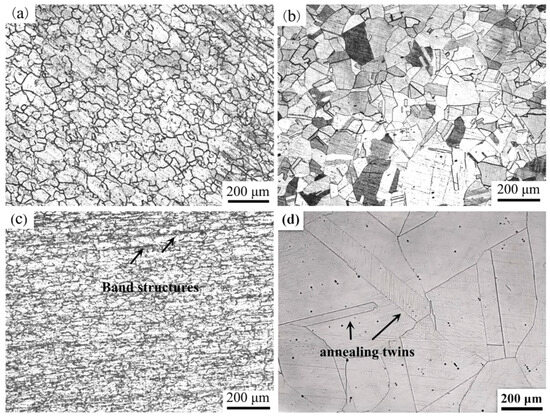
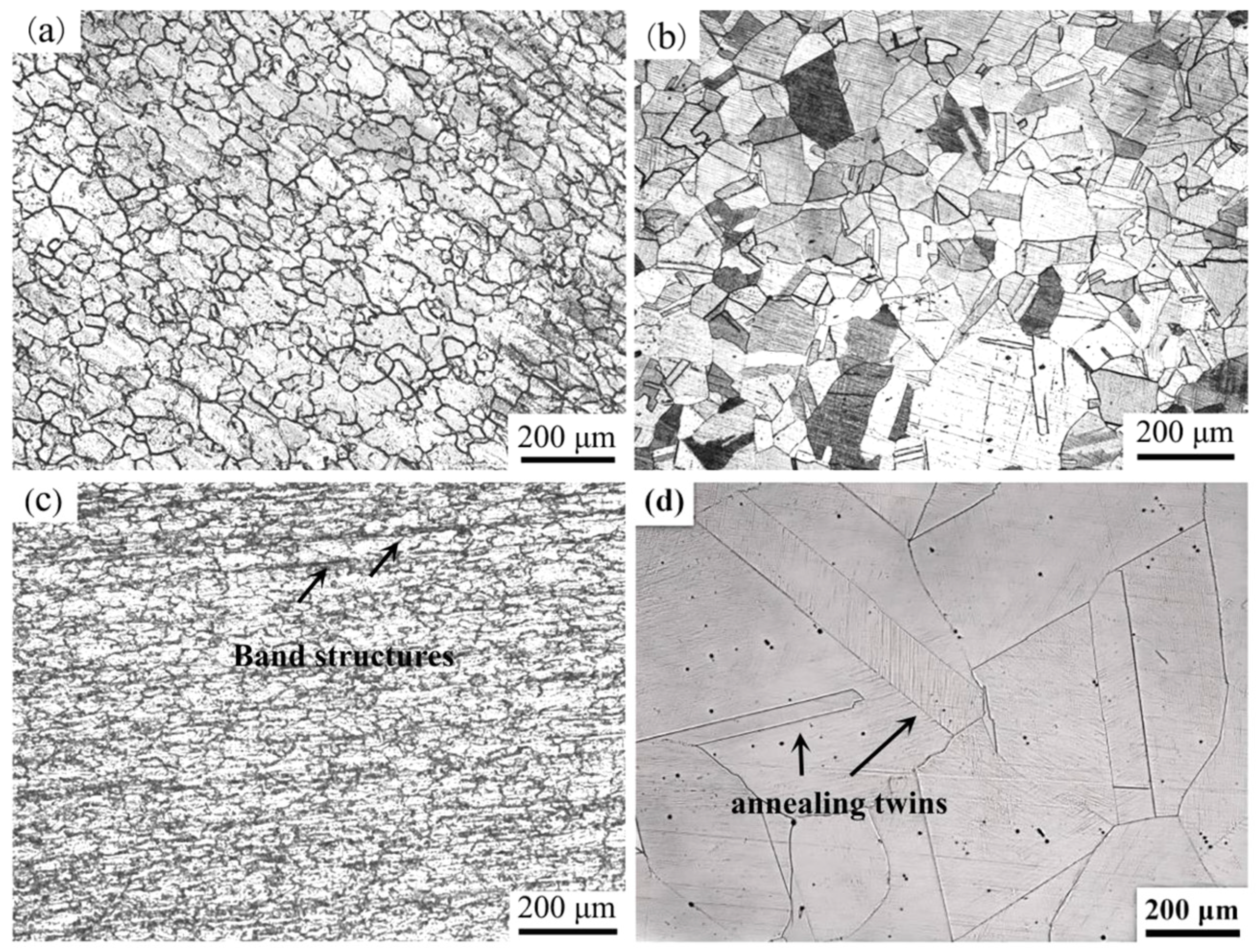
Figure 1 shows the OM micrographs of two TWIP steels under HF and ST conditions. It can be clearly observed that all samples exhibit a typical equiaxed grain morphology, but there are significant differences in grain size. The measured average grain sizes are listed in Table 2. Specifically, TWIP-1-HF shows a fine-grained structure (Figure 1a), indicating that dynamic recrystallization (DRX) occurred during the hot forging process at 1070 °C. High-temperature deformation provides sufficient driving force for the nucleation and growth of recrystallized grains, thereby eliminating the as-cast coarse structure. After solution treatment at 1200 °C for 4 h, obvious grain growth occurred in TWIP-1-ST, and the average grain size increased from 16.7 μm to 57.1 μm. Meanwhile, many annealing twins were formed within the grains (Figure 1b). This is a typical microstructural feature of high-Mn TWIP steel after high-temperature heat treatment [1]. The decrease in dislocation density and the release of stored energy promote grain boundary migration and grain growth and reduce the total interfacial energy of the system [2].
Figure 1.
Optical micrographs of the investigated TWIP steels: (a) TWIP-1-HF, (b) TWIP-1-ST, (c) TWIP-2-HF, (d) TWIP-2-ST.
In contrast, the TWIP-2 steel exhibits significantly different microstructural evolution behavior. The TWIP-2-HF shows finer grains and blurred grain boundaries, accompanied by the residual hot-deformed banded structure (black arrows, refer to Figure 1c), indicating incomplete DRX during the hot forging process. This phenomenon is essentially attributed to the solute drag effect caused by interstitial N atoms [28]. As a strong austenite-stabilizing interstitial element, N atom tends to segregate at grain boundaries and dislocations, which increases the diffusion activation energy of atoms and hinders grain boundary migration and dislocation movement. Therefore, the recrystallization process is inhibited [29], and part of the deformed structure is retained in the matrix after hot forging. After solution treatment, the TWIP-2-ST shows abnormal grain growth, with an average grain size of 198.3 μm (Figure 1d). The abnormal grain growth can be explained from two aspects: on one hand, the residual deformation energy stored in the TWIP-2-HF is significantly higher than that in the fully recrystallized TWIP-1-HF, which provides a stronger driving force for grain boundary migration and grain growth during the high-temperature solution treatment; on the other hand, N can inhibit the precipitation of grain boundary carbides [26], thus eliminating the pinning effect of the second-phase particles on the grain boundaries and further promoting rapid grain growth.
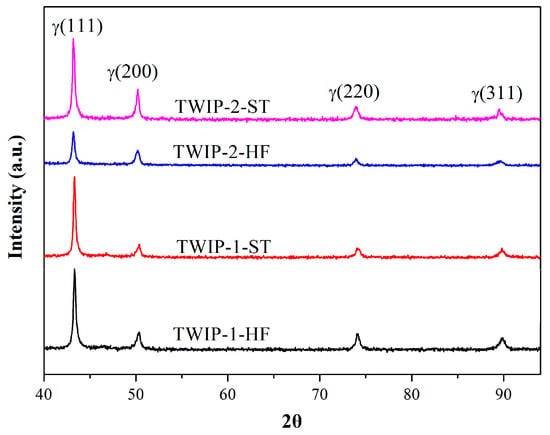
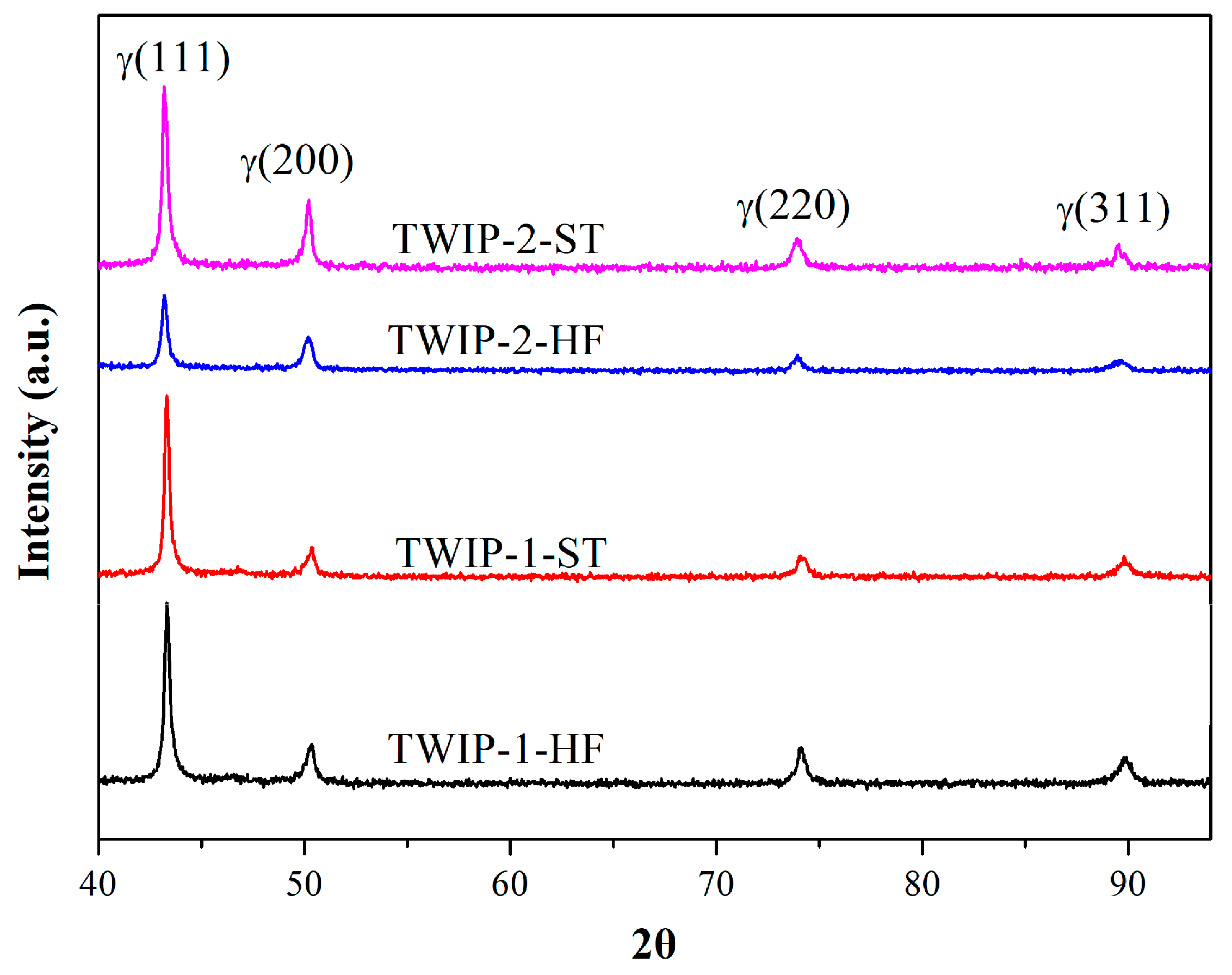
The XRD patterns shown in Figure 2 confirm that all samples exhibit diffraction peaks corresponding to the FCC austenite phase (γ), and no diffraction peaks of ferrite, martensite, or precipitated phases are detected. This indicates that both TWIP-1 and TWIP-2 steels maintain a stable single-phase austenite structure under HF and ST conditions, and the addition of 0.3 wt.% N does not trigger a phase transformation. The absence of precipitated phases in XRD may be due to the low volume fraction of carbides or nitrides, which is beyond the detection limit of XRD.
Figure 2.
XRD spectra of the TWIP steels.
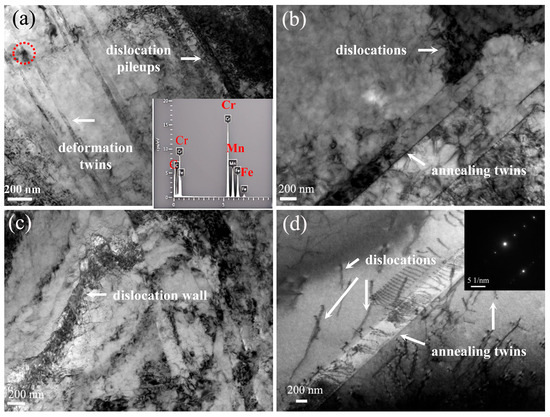
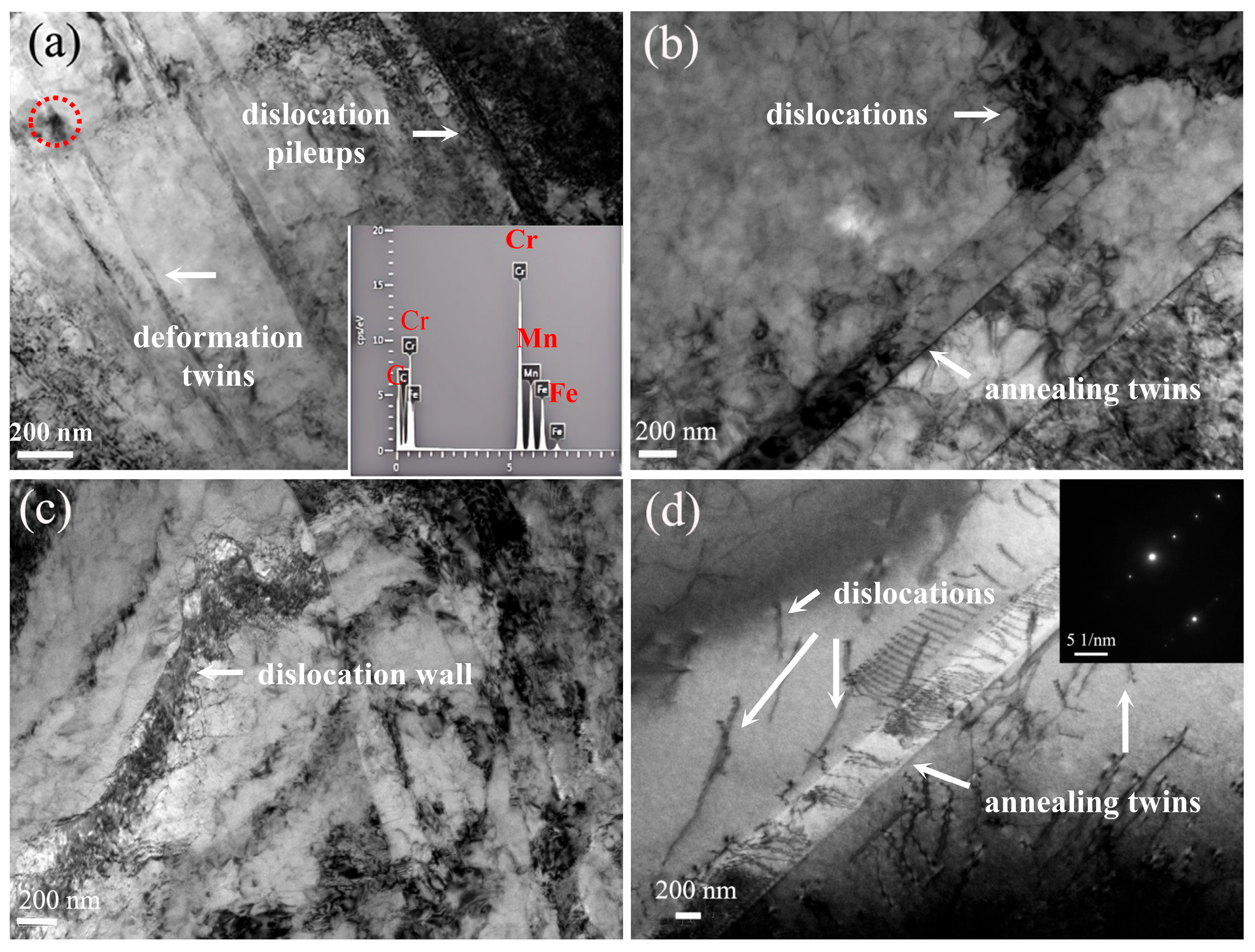
TEM observations further revealed the fine microstructure and substructure characteristics of TWIP steel, as shown in Figure 3. For the HF samples, a high density of dislocations was distributed in the matrix, forming typical deformation substructures such as dislocation pile-ups, dislocation walls, and dislocation tangles, and deformation twins were also present. These substructures are important sources for the increase in internal stress and strength in the hot-forged deformed materials. In the TWIP-1-HF steel, carbide precipitates were observed at the grain boundaries, and the results of EDS analysis (inset of Figure 3a, refer to Table 2) confirmed these precipitates were Cr-enriched (54.68 wt%) with Fe and Mn as secondary components. The calculated metal-to-carbon atomic ratio of ~4.25:1 matches the theoretical 3.83:1 stoichiometry of M23C6 carbides closely. Combined with literature evidence [18,19], these were confirmed as (Cr,Fe,Mn)23C6 complex carbides. In contrast, no obvious C/N precipitates were found in the TWIP-2-HF steel, indicating that N can effectively inhibit the precipitation of grain boundary carbides in high-Mn austenitic steels [19]. From a thermodynamic perspective, the binding force between N and Cr is stronger than that between C and Cr, which reduces the activity of Cr in the matrix and inhibits the nucleation and growth of Cr-rich carbides [29].
Figure 3.
TEM micrographs of the investigated TWIP steels: (a) TWIP-1-HF and the inset is EDS mapping of the circled Cr-rich carbide, (b) TWIP-1-ST, (c) TWIP-2-HF, (d) TWIP-2-ST.
After solution treatment, the dislocation density in the two steels decreased sharply. Deformation substructures such as dislocation walls and dislocation pile-ups were eliminated, and many annealing twins with clear interfaces formed within the grains, although a small number of dislocations were retained (Figure 3d). Meanwhile, no obvious precipitated phases were observed in the ST samples, indicating that most of the carbides precipitated during the HF process dissolved into the austenite matrix under high-temperature ST conditions, achieving the homogenization of the microstructure and chemical composition. The elimination of precipitates and the formation of coherent annealing twins jointly optimize the microstructural uniformity, which lays a foundation for the improvement of ductility and corrosion resistance.
Table 2.
EDS analysis result of the Cr-rich carbide precipitate marked in Figure 3a (wt.%).
3.2. Mechanical Properties
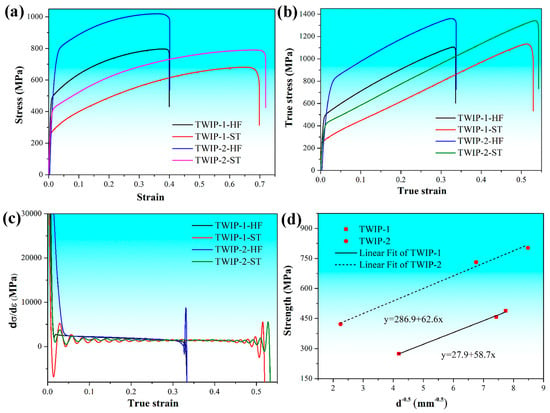
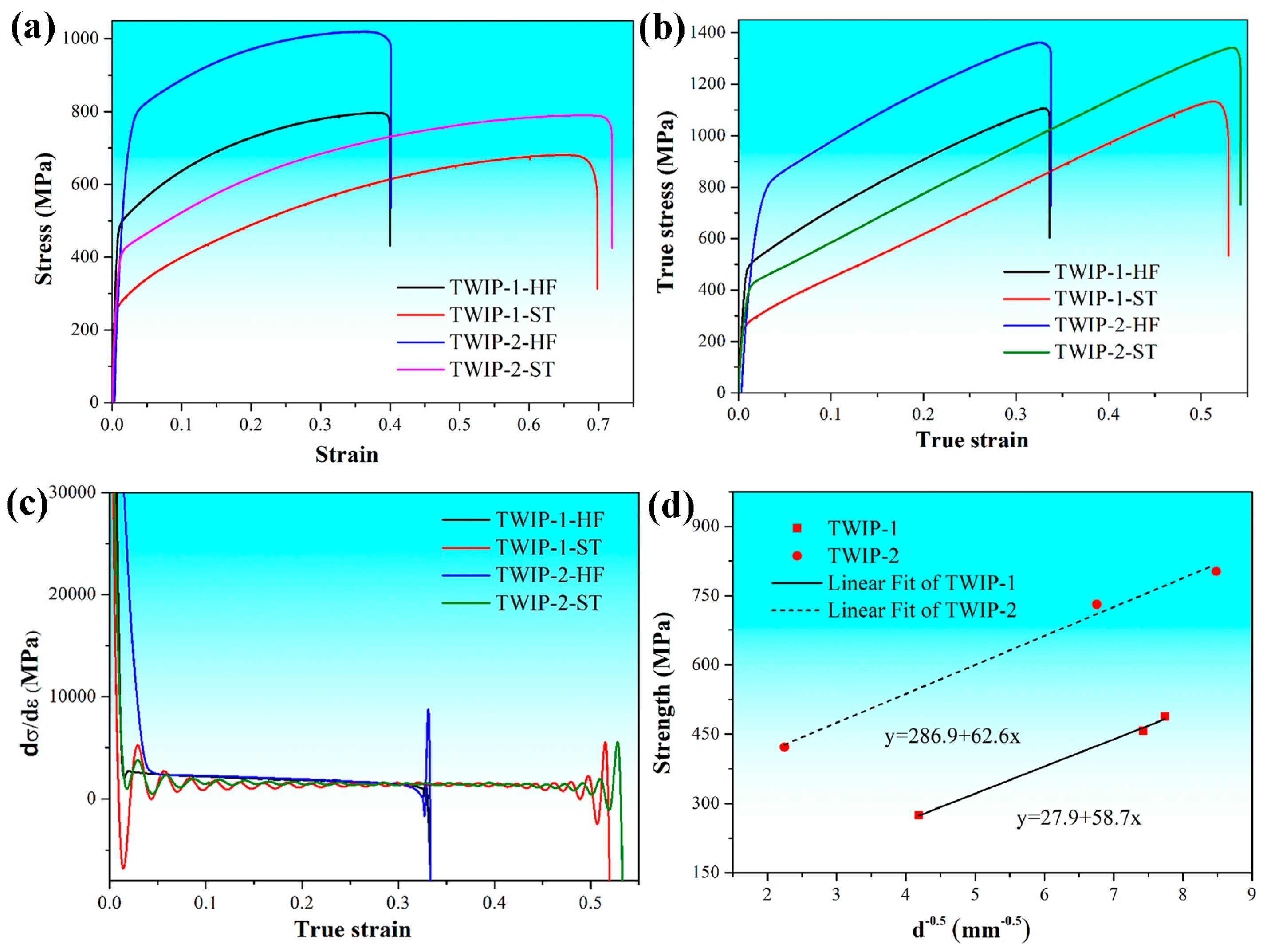
Figure 4 displays the engineering stress–strain curves, true stress–strain curves, strain-hardening rate (SHR) curves, and the Hall–Petch relationship of TWIP steels, and the corresponding tensile property parameters, including yield strength, ultimate tensile strength, and elongation at break, are listed in Table 3.
Figure 4.
Mechanical properties of the TWIP steels. (a) Engineering stress–strain curves, (b) true stress–strain curves, (c) strain-hardening rate curves, (d) Hall–Petch relationships.
Table 3.
The average grain size and mechanical properties of the TWIP steels.
As can be seen from Figure 4a, N alloying and processing have a significant impact on the strength and ductility of the experimental steels. In the HF state, N alloying achieved a synergistic optimization of strength and ductility, breaking the traditional strength-ductility trade-off relationship in metallic materials. Specifically, the yield strength of TWIP-2-HF reached 802.9 MPa, which was 64.5% higher than that of TWIP-1-HF. The ultimate tensile strength increased from 797.1 MPa to 1020.1 MPa, and the elongation also slightly improved synchronously (40.1% vs. 39.7%).
This excellent comprehensive performance may result from the synergistic coupling effect of solid solution strengthening of N, grain boundary strengthening, and dislocation strengthening. First, as an interstitial element in the FCC austenite lattice, the N atom has a smaller radius than C and a stronger interaction with dislocations. Therefore, its solid solution strengthening efficiency is about 1.5 times that of C [30]. Second, grain boundary strengthening further enhances the yield strength. The grain size of TWIP-2-HF (13.9 μm) is finer than that of TWIP-1-HF. According to the Hall-Petch relationship, the yield strength is inversely proportional to the square root of the grain size. Grain refinement increases the number of grain boundaries, which strongly hinder dislocation slip and significantly improve the deformation resistance of the material. Third, dislocation and twinning strengthening jointly enhance the strain-hardening ability and ultimate tensile strength. The residual deformation substructure in TWIP-2-HF contains a higher density of dislocations, and the interaction between dislocations increases the deformation resistance. More importantly, N reduces the stacking fault energy (SFE) of TWIP steel [31,32,33]. Low SFE promotes the nucleation and propagation of mechanical twins during tensile deformation. Twin boundaries divide the original grains into smaller sub-regions, forming a dynamic Hall-Petch effect [1]. This effect continuously increases the strain-hardening rate of the material during deformation (see Figure 4c), delays necking, and achieves high ultimate tensile strength without sacrificing ductility.
After solution treatment, the strength of TWIP-1 steel and TWIP-2 steel decreased significantly, while the ductility increased substantially. The elongation increased to 69.8% and 72.1%, respectively. The decrease in strength is mainly dominated by grain coarsening and dislocation annihilation [8]. On the one hand, the grain size increased rapidly, and then the grain boundary strengthening effect weakened. On the other hand, the deformation dislocations were eliminated by high-temperature solution treatment, so the dislocation strengthening effect decreased. The significant improvement in ductility is attributed to the elimination of internal stress and microstructural defects, which reduces the stress concentration during the deformation process, delays the initiation and propagation of microcracks, and enables the material to undergo large-scale uniform plastic deformation before fracture.
Notably, even in the coarse-grained ST state, the yield strength and ultimate tensile strength of TWIP-2-ST are still significantly higher than those of TWIP-1-ST, which demonstrates that the solid solution strengthening effect of N is persistent and stable, and is not affected by grain size or processing. As seen from Figure 4c, the SHR of TWIP-2 is higher than that of TWIP-1 during the uniform deformation stage under the same processing conditions. The sustained high SHR induced by N ensures continuous strain hardening during plastic deformation, which is the core reason for maintaining high strength while improving ductility [36].
Based on the Hall-Petch Formula (1), the relationship between the yield strength and the grain size was fitted, as shown in Figure 4d.
where σ0 represents the Peierls-Nabarro frictional force related to dislocation contribution and solid solution strengthening, d is the average grain size of the TWIP steel samples, and ky is the Hall-Petch coefficient. As seen from Figure 4d, the two steels exhibit different linear fitting relationships, which indicates that N can not only refine the grains but also change the intrinsic mechanical properties of the matrix. The increase in σ0 of TWIP-2 reflects the enhancement of solid solution strengthening, and the increase in ky indicates that N enhances the blocking effect of grain boundaries on dislocations. This multi-dimensional strengthening effect is the fundamental reason why N can significantly improve the yield strength of TWIP-2 steel. Previous studies [31] have confirmed that N in steel produces slip planarity, which hinders cross-slip at grain boundaries, thereby delaying the activation of dislocation sources. This means that a higher stress is required to activate the dislocation sources in adjacent grains. Therefore, the N-alloyed steel exhibits a higher Hall–Petch slope, which further enhances the fine-grain strengthening effect of the N-alloyed steel.
σ = σ0 + kyd−0.5
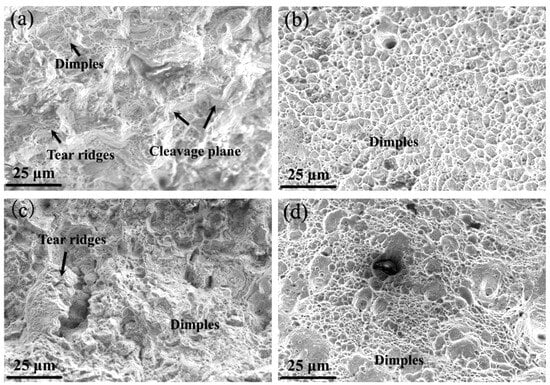
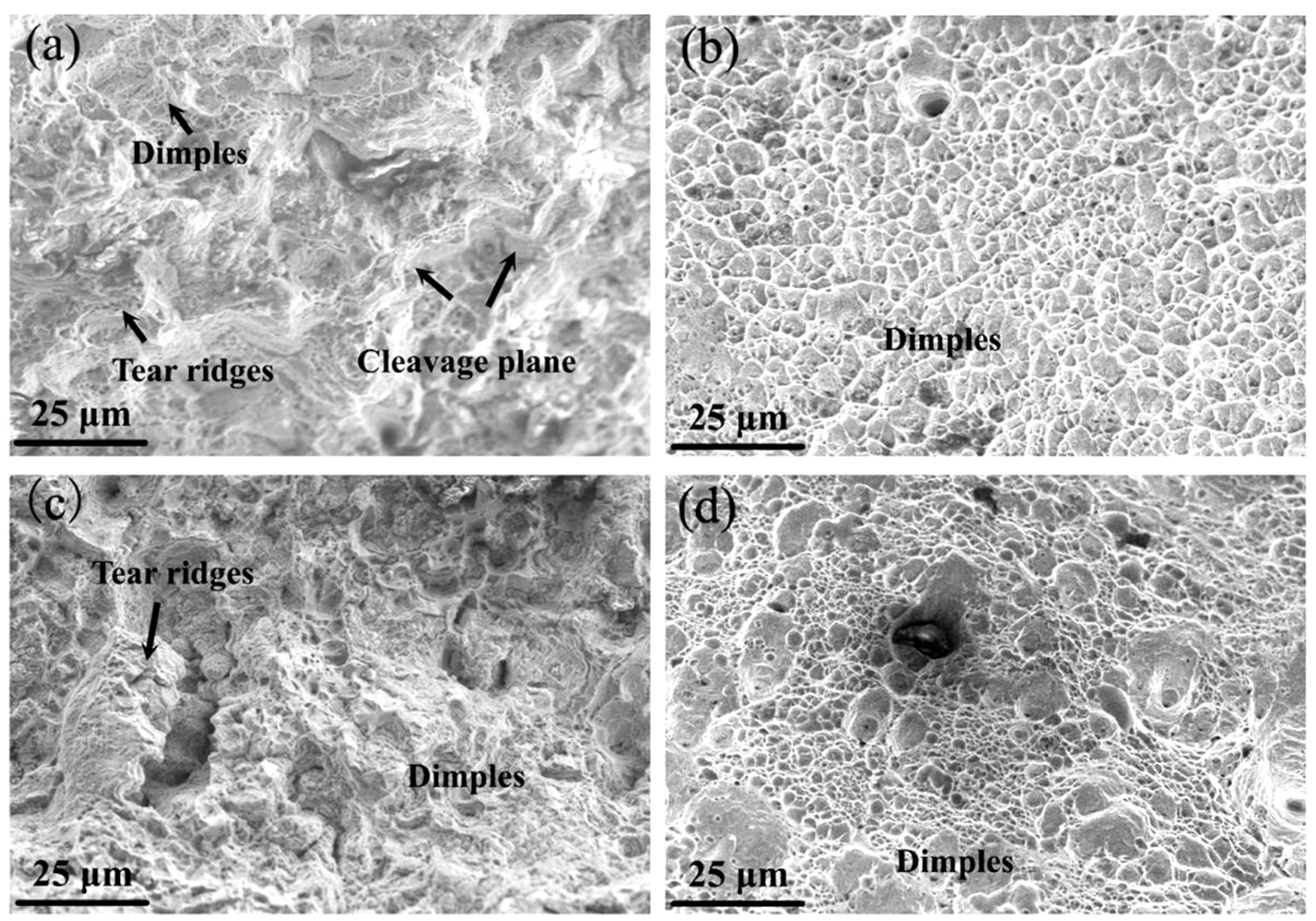
The tensile fracture morphologies observed by SEM are shown in Figure 5, which reflect the fracture mechanism of the test steels. The HF samples exhibit a mixed fracture mode of intergranular fracture and transgranular dimple fracture. As reported, the intergranular fracture region is usually related to the grain boundary carbides and the stress concentration at the grain boundaries [32], while the dimples are typical features of ductile fracture. Furthermore, N alloying shows no obvious effect on the fracture mode of the HF samples, indicating that the improvement in strength is not accompanied by the embrittlement of the material.
Figure 5.
Tensile fracture morphologies of the TWIP steels. (a) TWIP-1-HF, (b) TWIP-1-ST, (c) TWIP-2-HF, (d) TWIP-2-ST.
After solution treatment, the fracture surfaces of both steels are covered with dense and uniform equiaxed dimples, exhibiting typical ductile fracture characteristics. The dimples in TWIP-2-ST are deeper and larger than those in TWIP-1-ST, which corresponds to its higher strength and better ductility. The transformation of the fracture mode is essentially caused by the homogenization of the microstructure. The reduction in carbides and the elimination of deformed substructures reduce the crack initiation sources at grain boundaries [23], while the high work-hardening ability induced by N ensures sufficient plastic deformation before fracture [31,32,33].
3.3. Corrosion Resistance
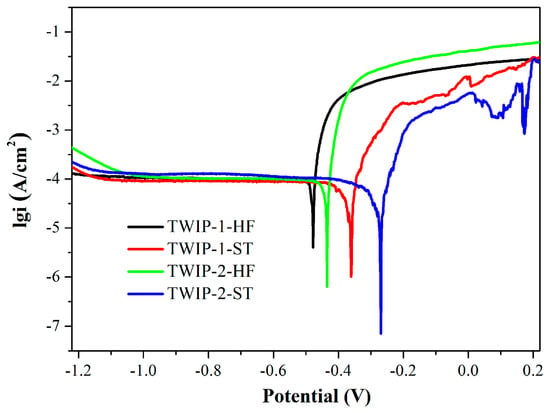
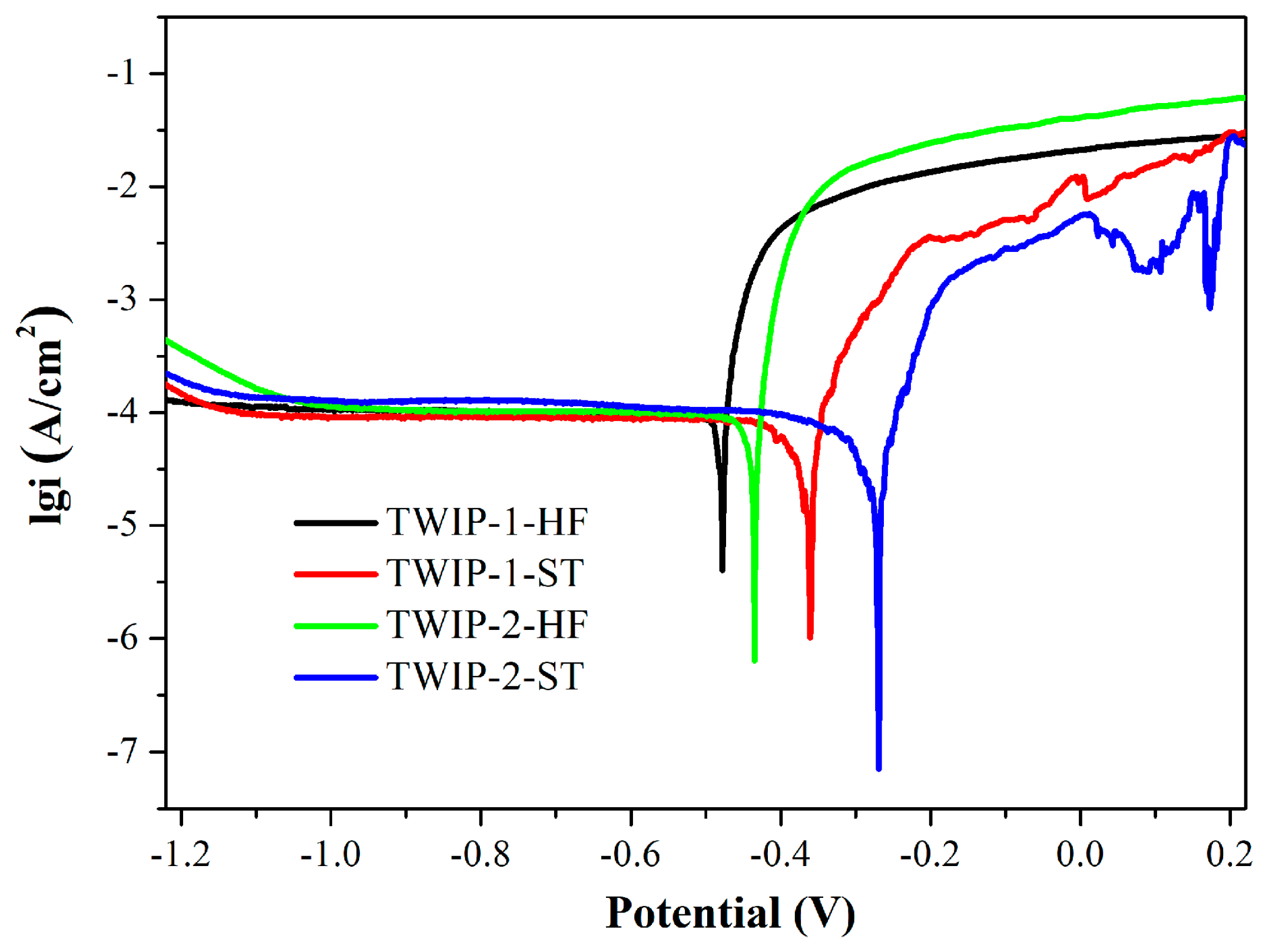
Figure 6 shows the potentiodynamic polarization curves of TWIP steels in 3.5 wt.% sodium chloride solution. The corrosion potential (Ecorr) and corrosion current density (icorr) obtained by the Tafel extrapolation method are listed in Table 4. Ecorr reflects the thermodynamic stability of the steel in the corrosive medium, while icorr is proportional to the corrosion rate and is the core parameter for evaluating the kinetic corrosion resistance.
Figure 6.
Potentiodynamic polarization curves of the TWIP steels.
Table 4.
Characteristic data obtained from the polarization curves.
The results show that solution treatment significantly optimized the corrosion resistance of both steels. Compared with the HF state, the Ecorr of the ST samples shifted significantly in the positive direction, and the icorr decreased by an order of magnitude. This indicates that high-temperature solution treatment reduces the corrosion tendency and corrosion rate of TWIP steels. Under the same processing conditions, the corrosion resistance of N-alloyed steel was better than that of N-free steel. In particular, TWIP-2-ST steel exhibited the highest Ecorr (−0.27 V) and the lowest icorr (2.88 × 10⁻⁵ A/cm2), showing the best corrosion resistance in a chlorine-containing corrosion environment.
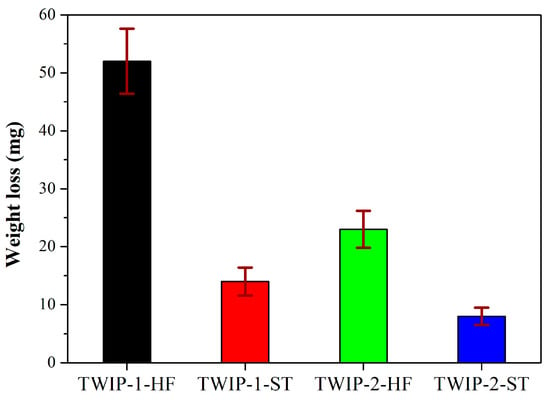
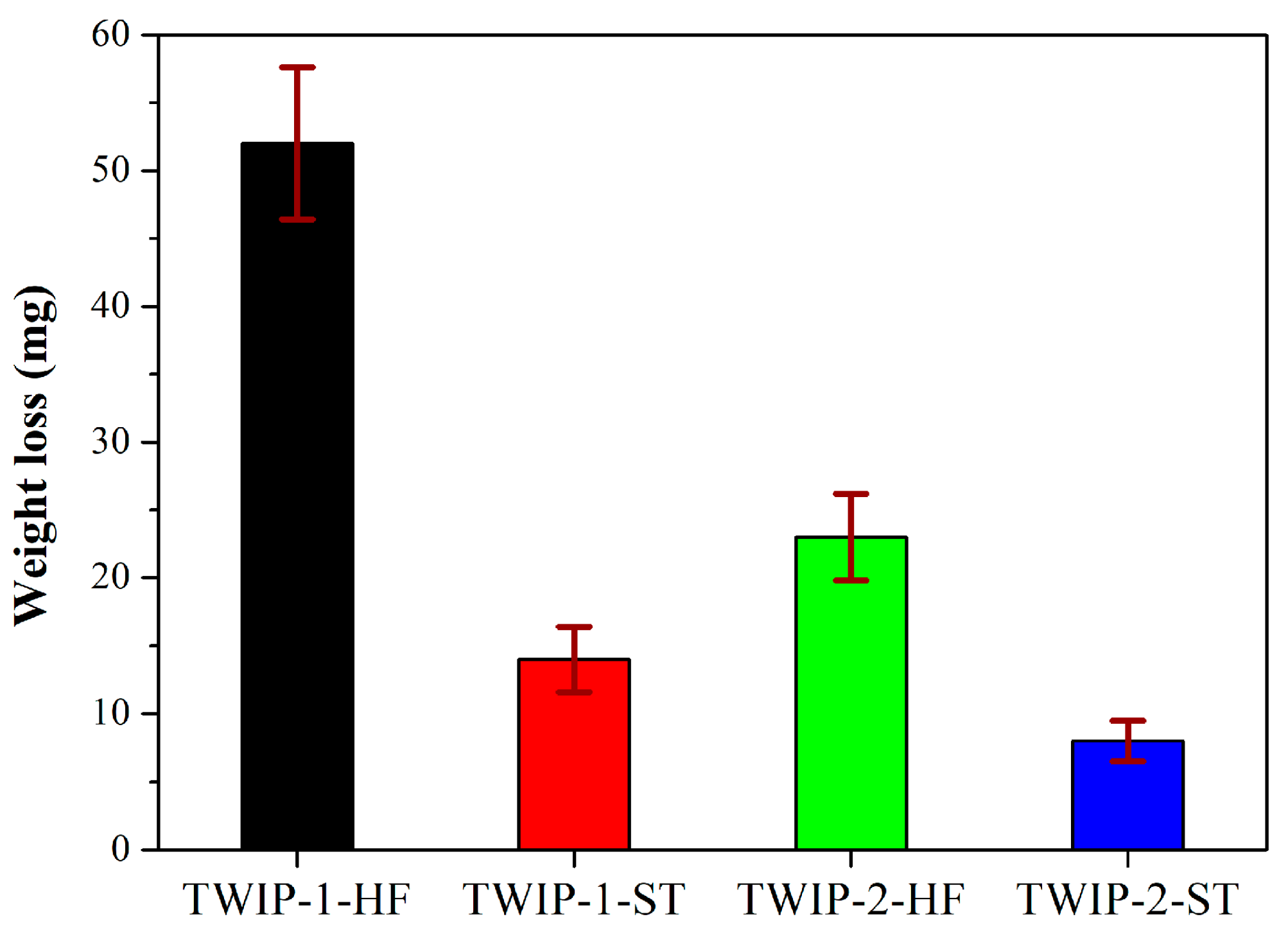
The weight-loss statistics after the polarization test are shown in Figure 7, which are highly consistent with the electrochemical test results. The weight loss of the ST samples is significantly lower than that of the HF samples, and the TWIP-2-ST sample has the lowest weight loss. This cross-verification from the perspectives of macroscopic weight loss and microscopic electrochemical kinetics confirms the reliability of the corrosion performance conclusion.
Figure 7.
Weight loss of the tested TWIP steel samples after polarization curve measurements.
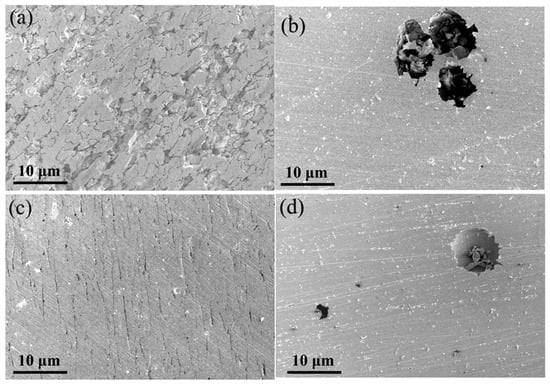
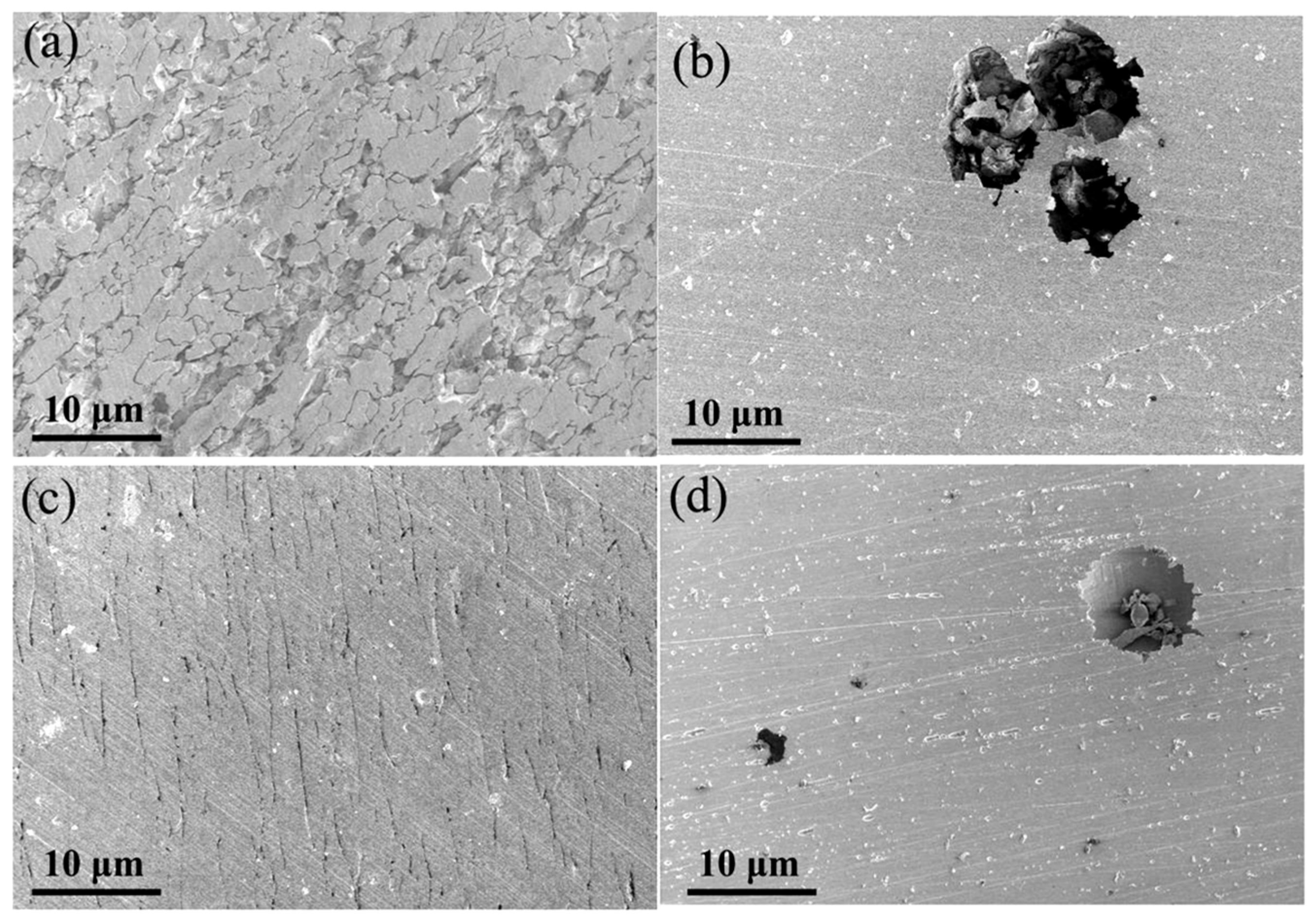
The corrosion surface morphology observed by SEM is shown in Figure 8, which reveals the evolution of the corrosion mode and the local corrosion mechanism of the experimental steel.
Figure 8.
SEM morphologies of the tested TWIP steel samples after polarization curve measurements. (a) TWIP-1-HF, (b) TWIP-1-ST, (c) TWIP-2-HF, (d) TWIP-2-ST.
Local corrosion occurred in all samples, but there were significant differences in corrosion morphology and severity. TWIP-1-HF exhibited severe intergranular corrosion, accompanied by obvious grain detachment and relatively deep grain boundary corrosion grooves. According to relevant studies, the high Mn element [20,21,22] and structure defects (such as precipitates and crystal defects) [37,38] would lead to a sharp decrease in the corrosion potential and an increase in the corrosion current density. As shown in the TEM micrograph (Figure 3a), there are a small number of precipitates in the TWIP-1-HF steel, which would cause Cr depletion at the grain boundaries. The Cr-depleted region has a lower electrochemical potential and becomes the anodic dissolution area, while the inside of the grains acts as the cathode, forming a galvanic corrosion couple [36]. In addition, the high-density dislocations in the HF state increase the electrochemical activity, further accelerating the corrosion rate. Compared with TWIP-1-HF, TWIP-2-HF showed slight intergranular corrosion. On the one hand, N effectively inhibits the precipitation of grain boundary carbides, reduces the Cr-depleted region, and significantly alleviates intergranular corrosion. On the other hand, the residual deformation bands and dislocation segregation regions in the incompletely recrystallized structure act as corrosion-active sites, leading to selective dissolution along the forging direction. Therefore, the combined effect of N alloying and the residual hot-deformed structure results in the streamlined corrosion morphology of TWIP-2-HF steel.
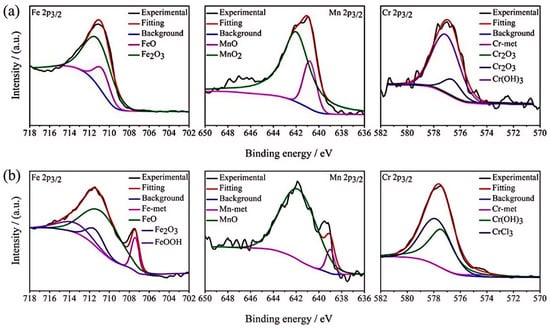
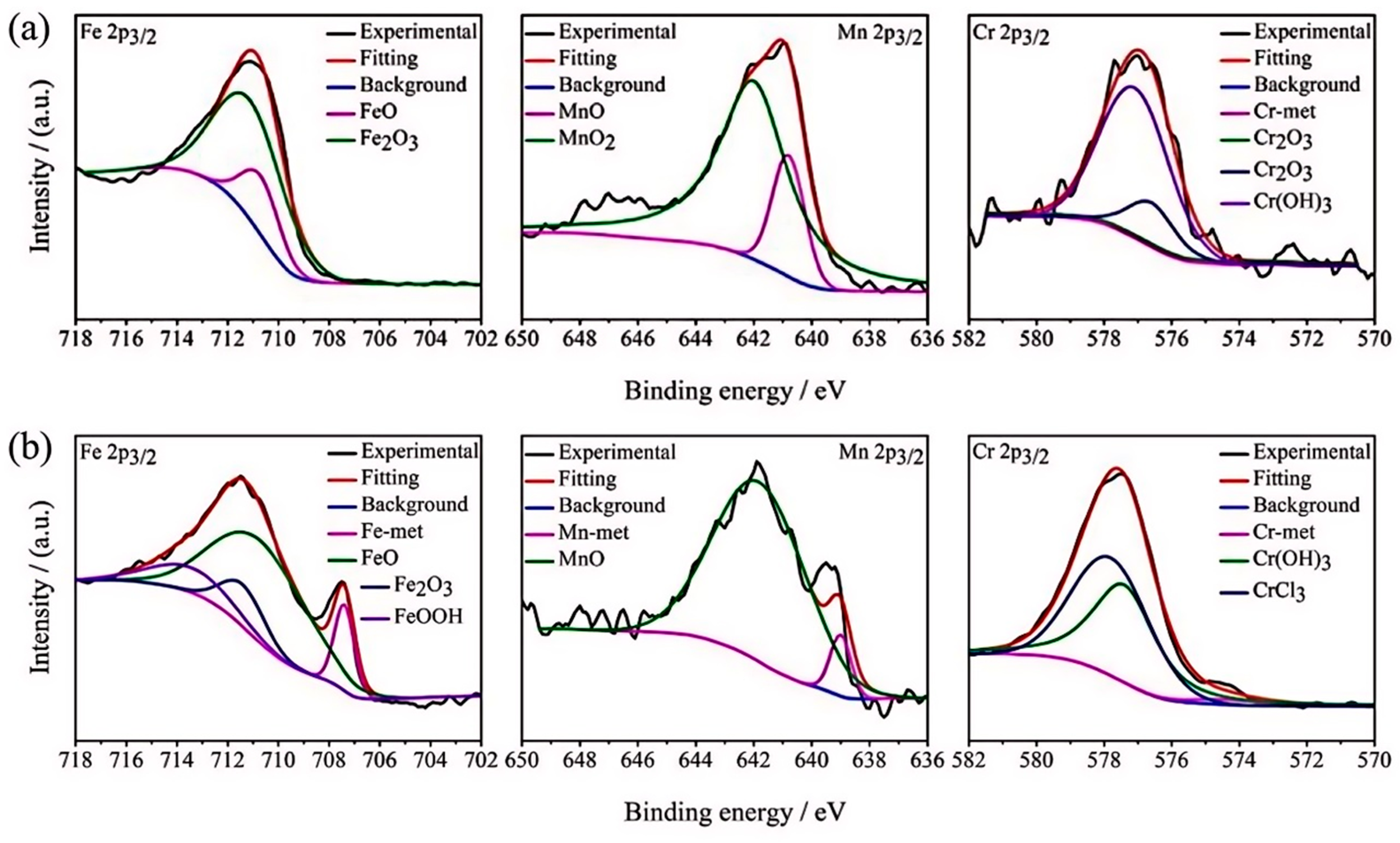
After solution treatment, the corrosion mode of both steels changed from intergranular corrosion to pitting corrosion, and no obvious grain boundary corrosion was observed. A small number of corrosion pits were distributed on the sample surface, with sizes ranging from approximately 60 to 100 μm. Compared to TWIP-1-ST, TWIP-2-ST exhibited fewer, shallower, and more dispersed corrosion pits. To further clarify the differences in their corrosion behavior, XPS characterization was conducted on specimens after polarization curve tests. As shown in Figure 9, the corrosion products of both TWIP-1-ST and TWIP-2-ST consist of oxides and hydroxides of Fe, Mn, and Cr. However, N alloying markedly altered the valence-state distributions and relative abundances of these elements. Fe valence analysis indicates that the Fe 2p3/2 spectrum of TWIP-1-ST can be fitted only with peaks at 710.7 eV (FeO) and 711.1 eV (Fe2O3), with no metallic Fe signal detected, implying the formation of a relatively thick iron oxide layer dominated by low-valence, porous FeO on the surface. In contrast, the Fe 2p3/2 spectrum of TWIP-2-ST exhibits an additional metallic Fe peak at 707.4 eV and an FeOOH peak at 713.5 eV, and the total content of Fe oxides is significantly reduced. The appearance of the metallic Fe peak is a key indicator of improved passive film quality, suggesting that N alloying produces a thinner, denser passive film that permits X-ray penetration to detect the substrate metal while effectively suppressing substrate dissolution. Mn valence changes mirror those of Fe. TWIP-1-ST shows only peaks at 640.8 eV (MnO) and 642.0 eV (MnO2), whereas TWIP-2-ST presents an additional metallic Mn peak at 639.0 eV and a pronounced decrease in the total Mn oxide peak area. MnO is a principal deleterious corrosion product in TWIP steels, whose porous structure readily forms corrosion pathways [15]. N alloying inhibits the preferential anodic dissolution of Mn, thereby reducing the formation of porous corrosion products at the source. Cr, as the key protective element in the passive film, has its content and valence distribution directly determining film performance. The Cr 2p3/2 spectrum of TWIP-1-ST corresponds to 576.6 eV (Cr2O3) and 577.1 eV (Cr(OH)3); TWIP-2-ST additionally displays a metallic Cr peak at 574.7 eV, and the total atomic fraction of Cr increases substantially from 12.3% to 18.7%. Among these, the most protective oxide, Cr2O3, rises in proportion of total Cr from 72% to 85%, while the less stable Cr(OH)3 correspondingly decreases.
Figure 9.
XPS spectra of Fe 2p3/2, Mn 2p3/2 and Cr 2p3/2 for (a) TWIP-1-ST and (b) TWIP-2-ST after polarization curve tests.
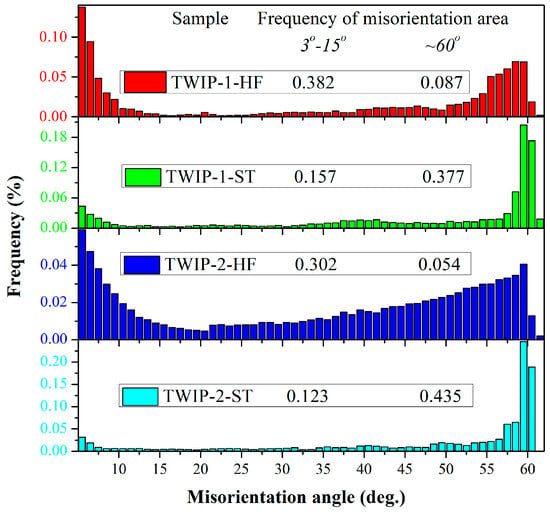
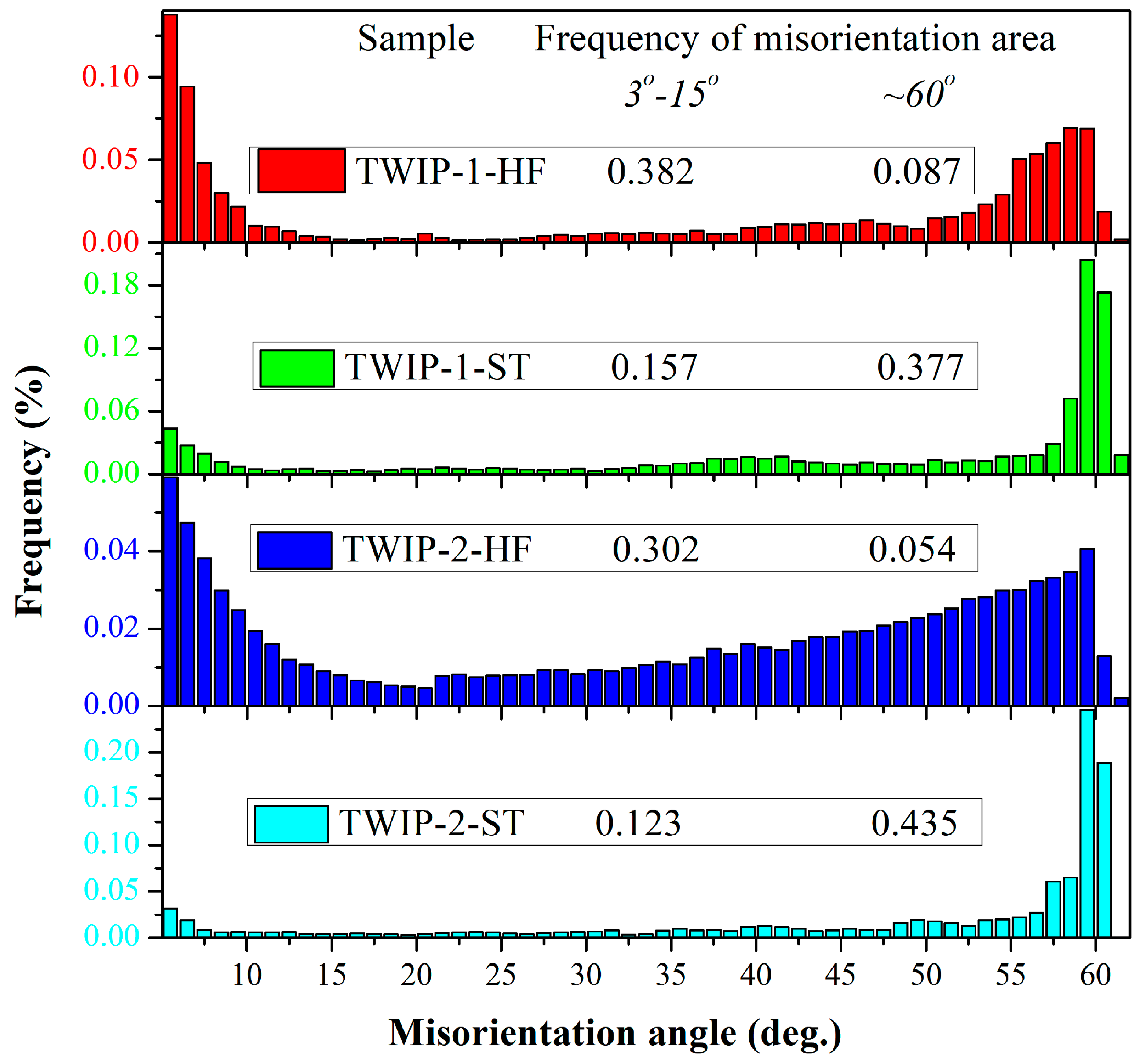
Thus, the improvement in pitting corrosion resistance of TWIP-2-ST might be attributed to the following mechanisms: First, dissolved N atoms can react with H+ in the occluded cavity of the corrosion pit, consuming H+, inhibiting local acidification inside the pit, and preventing the autocatalytic propagation of pitting corrosion [25]. Second, N promotes the enrichment of Cr in the surface passive film, enhancing the compactness and stability of the Cr2O3 passive film and increasing the resistance to Cl− penetration [15]. Third, the homogenization of the microstructure after solution treatment eliminates the galvanic corrosion effect caused by composition and microstructure segregation, reducing the nucleation probability of pitting corrosion. In addition, the types of crystal defects are closely related to the misorientation angle [12,37,38]. When the angle is in the ranges of 0–3°, 3–15°, 60°, and other ranges, the defects are dislocations, low-angle grain boundaries, special-angle grain boundaries known as Σ3 twin boundaries, and high-angle grain boundaries, respectively [12]. To quantitatively determine the types and proportions of defects in TWIP steels under different states, EBSD tests were conducted to analyze the distribution of misorientation angles in the samples, and the angles in the ranges of 3–15° and 60° were calculated. The results are shown in Figure 10.
Figure 10.
Misorientation distribution maps of the TWIP steels.
It can be clearly seen that compared with the TWIP-HF samples, the proportion of Σ3 grain boundaries in the TWIP-ST samples increased significantly, while the proportion of low-angle grain boundaries decreased by more than half. Qi et al. [37] studied the influence of grain boundary types on the corrosion resistance of high-N CrMn austenitic stainless steels in 3.5 wt.% NaCl solution. They found that both low-angle grain boundaries with low mismatch energy and Σ3 grain boundaries were difficult to corrode, exhibiting similar corrosion resistance, while random high-angle grain boundaries had no corrosion resistance [38]. As can be seen from Figure 10, after solution treatment, the sum of the proportions of low-angle grain boundaries and Σ3 grain boundaries of TWIP-ST steels increased significantly. Among them, TWIP-2-ST shows the highest proportion of low-energy grain boundaries (low-angle grain boundaries + Σ3 twins) and the least weight loss after the polarization curve test, showing the best corrosion resistance. This confirms that grain boundary engineering induced by N alloying and ST is a key strategy to improve the corrosion resistance of TWIP steels in chloride-containing environments.
4. Conclusions
In this study, the effects of N alloying and processing method on the microstructure, mechanical properties, and corrosion behavior of Fe-25Mn-12Cr-0.3C TWIP steels were systematically investigated. The main conclusions are as follows:
- (1)
- All Fe-25Mn-12Cr-0.3C-based TWIP steels maintain a stable single-phase austenite structure. N alloying inhibits grain boundary migration and (Cr,Fe,Mn)23C6-type carbide precipitation and enhances the work-hardening ability, thereby significantly improving the yield strength without sacrificing ductility.
- (2)
- The fracture behavior is primarily governed by the processing method. The hot-forged alloys exhibit a mixed intergranular-transgranular fracture mode, whereas solution treatment transforms the fracture mechanism into a fully ductile dimple rupture, owing to the elimination of deformation-induced defects and subsequent microstructural homogenization.
- (3)
- The N-alloyed TWIP steel subjected to solution treatment achieves the highest corrosion resistance, which is attributed to the increased proportion of low-energy grain boundaries, enhanced microstructure homogeneity, and the inhibitory effect of N on pitting propagation.
Author Contributions
L.H.: Methodology; Writing—original draft. X.W.: Validation; Writing—review and editing. C.J.: Methodology. Y.L.: Methodology. J.L.: Project administration; Funding acquisition. All authors have read and agreed to the published version of the manuscript.
Funding
This study was jointly supported by the Guangdong Basic and Applied Basic Research Foundation (Grant No. 2024B1515130001), the Anhui Provincial Key Laboratory of Special Welding Technology Open Fund (No. 2025SW005), the Science and Technology Innovation Tackling Plan of Anhui Province (Grant No. 202523j08050015) and the Key R&D Program of Yunnan Province (Grant No. 202402AC080003).
Institutional Review Board Statement
Not applicable.
Informed Consent Statement
Not applicable.
Data Availability Statement
The data presented in this study are available on request from the corresponding author. The data are not publicly available due to privacy and ethical restrictions.
Conflicts of Interest
The authors declare that they have no known competing financial interests or personal relationships that could have appeared to influence the work reported in this paper.
References
- Grassel, O.; Frommeyer, G.; Derder, C.; Schmitt, J. Phase transformations and mechanical properties of Fe-Mn-Si-Al TRIP-steels. J. De Phys. IV 1997, 7, C5-383–C5-388. [Google Scholar] [CrossRef] [Scilit]
- Wesselmecking, S.; Haupt, M.; Ma, Y.; Prahl, U. Mechanism-controlled thermomechanical treatment of high Mn steels. Mater. Sci. Eng. A 2021, 828, 142056. [Google Scholar] [CrossRef] [Scilit]
- Zhang, W.X.; Wang, J.; Wan, J.; Li, X.H. Improved yield strength-ductility synergy of a high Mn TWIP steel by grain refinement and partial recrystallization. Mater. Sci. Eng. A 2024, 916, 147355. [Google Scholar] [CrossRef] [Scilit]
- Wang, W.; Wang, D.; Han, F.S.; Liu, Y.; Li, X. Study on the mechanical behavior of twinning-induced plasticity steel processed by warm forging and annealing. J. Mater. Sci. 2018, 53, 14645–14656. [Google Scholar] [CrossRef] [Scilit]
- Wang, D.; Wang, K.; Li, Z.D.; Han, F.S. Improved mechanical properties of a twinning-induced plasticity steel prepared by directional solidification. Mater. Sci. Eng. A 2015, 636, 396–406. [Google Scholar] [CrossRef] [Scilit]
- Chen, Y.Y.; Zhai, W.G.; Liang, J.H.; Si, Y.L. Microstructures and mechanical properties of additively manufactured Fe-30Mn-3Al-3Si TWIP steel using laser powder bed fusion. Mater. Sci. Eng. A 2024, 913, 147087. [Google Scholar] [CrossRef] [Scilit]
- Chen, Y.Y.; Zhai, W.G.; Liang, J.H.; Si, Y.L. Microstructures and mechanical properties of additively manufactured Fe-21Mn-0.6C TWIP steel using laser powder bed fusion. J. Mater. Res. Technol. 2024, 30, 2145–2158. [Google Scholar] [CrossRef] [Scilit]
- Kim, G.Y.K. An overview of high yield strength twinning-induced plasticity steels. Metals 2021, 11, 124. [Google Scholar] [CrossRef] [Scilit]
- Luo, M.; Yang, J.Z.; Han, F.S.; Wang, D. Design and verification of energy absorption material for the soft landing gear of the Tianwen-1 Mars probe. J. Deep. Space Explor. 2021, 8, 472–477. [Google Scholar]
- Bouaziz, O.; Allain, S.; Scott, C.P.; Cugy, P.; Barbier, D. High Mn austenitic twinning induced plasticity steels: A review of the microstructure properties relationships. Curr. Opin. Solid State Mater. Sci. 2011, 15, 141–168. [Google Scholar] [CrossRef] [Scilit]
- De Cooman, B.C.; Estrin, Y.; Kim, S.K. Twinning-induced plasticity (TWIP) steels. Acta Mater. 2018, 142, 283–362. [Google Scholar] [CrossRef] [Scilit]
- Wang, K.; Wei, A.P.; Tong, X.; Wang, D. Improvement of the anti-corrosion property of twinning-induced plasticity steel by twin-induced grain boundary engineering. Mater. Lett. 2018, 211, 118–121. [Google Scholar] [CrossRef] [Scilit]
- Yuan, X.Y.; Zhao, Y.; Li, X.; Zhang, T. Effect of Cr on mechanical properties and corrosion behaviors of FeMn-C-Al-Cr-N TWIP steels. J. Mater. Sci. Technol. 2017, 33, 1555–1560. [Google Scholar] [CrossRef] [Scilit]
- Si, Y.L.; Wang, X.F.; Liang, J.H.; Xue, J.T. Research on Microstructures and Properties of High-Strength Anticorrosion Twinning-Induced Plasticity Steels. Metals 2022, 12, 537. [Google Scholar] [CrossRef] [Scilit]
- Si, Y.L.; Xue, J.T.; Wang, X.F.; Liang, J.H. Effect of Cr Addition on the Corrosion Behavior of Twinning-Induced Plasticity Steel. Acta Metall. Sin. 2023, 59, 905–914. [Google Scholar]
- Mujica, L.; Weber, S.; Theisen, W.; Huth, S. Development of high-strength corrosion-resistant austenitic TWIP steel. Metall. Ital. 2011, 6, 31–35. [Google Scholar]
- Roncery, L.M.; Weber, S.; Theisen, W.; Huth, S. Mechanical properties of (20-30)Mn12Cr(0.56-0.7)CN corrosion resistant austenitic TWIP steels. Steel Res. Int. 2012, 83, 307–314. [Google Scholar] [CrossRef] [Scilit]
- Kim, K.S.; Kang, J.H.; Kim, S.J.; Lee, J.H. Effects of carbon and N on precipitation and tensile behavior in 15Cr-15Mn-4Ni austenitic stainless steels. Mater. Sci. Eng. A 2018, 712, 114–121. [Google Scholar] [CrossRef] [Scilit]
- Jiao, W.C.; Li, H.B.; Dai, J.; Feng, H.; Jiang, Z.H.; Zhang, T.; Xu, D.K.; Zhu, H.C.; Zhang, S.C. Effect of partial replacement of carbon by nitrogen on intergranular corrosion behavior of high nitrogen martensitic stainless steels. J. Mater. Sci. Technol. 2019, 35, 2357–2364. [Google Scholar] [CrossRef] [Scilit]
- Ha, H.Y.; Jang, M.H.; Lee, T.H.; Kim, J.H. Influences of Mn in solid solution on the pitting corrosion behaviour of Fe-23 wt%Cr-based alloys. Electrochim. Acta 2016, 191, 864–875. [Google Scholar] [CrossRef] [Scilit]
- Park, K.J.; Kwon, H.S. Effects of Mn on the localized corrosion behavior of Fe-18Cr alloys. Electrochim. Acta 2010, 55, 3421–3427. [Google Scholar] [CrossRef] [Scilit]
- Cao, X.; Zhang, Y.; Rong, L.; Yan, D. Effect of Mn on the Growth Behavior of Pre-oxidized Film on the Heat-resistant Steel Surface. High Temp. Corros. Mater. 2024, 101, 729–754. [Google Scholar] [CrossRef] [Scilit]
- Chen, C.; Zhang, F.C.; Wang, F.; Wang, T. Effect of N+Cr alloying on the microstructures and tensile properties of Hadfield steel. Mater. Sci. Eng. A 2017, 679, 95–103. [Google Scholar] [CrossRef] [Scilit]
- Behjati, P.; Kermanpur, A.; Najafizadeh, A.; Rezaei, A. Influence of N alloying on properties of Fe-18Cr-12Mn-XN austenitic stainless steels. Mater. Sci. Eng. A 2013, 588, 43–48. [Google Scholar] [CrossRef] [Scilit]
- Dai, J.; Feng, H.; Li, H.B.; Jiang, Y. N significantly enhances corrosion resistance of 316L stainless steel in thiosulfate-chloride solution. Corros. Sci. 2020, 174, 108792. [Google Scholar] [CrossRef] [Scilit]
- Mosecker, L.; Pierce, D.T.; Schwedt, A.; Bleck, W. Temperature effect on deformation mechanisms and mechanical properties of a high Mn C+N alloyed austenitic stainless steel. Mater. Sci. Eng. A 2015, 642, 71–83. [Google Scholar] [CrossRef] [Scilit]
- Norstrom, L.A. The influence of N and grain size on yield strength in Type AISI 316L austenitic stainless steel. Met. Sci. 1977, 11, 208–212. [Google Scholar] [CrossRef] [Scilit]
- Cho, Y.; Gwon, H.; Kim, S.J.; Kang, J.H. Effects of C and N on high-temperature deformation behavior of 15Cr-15Mn-4Ni austenitic stainless steels. Mater. Sci. Eng. A 2021, 819, 141463. [Google Scholar] [CrossRef] [Scilit]
- Kai, N.; Fengde, L.; Xingran, L.; Wei, Y. First principle study on the effect of Cr, Mn and Ni on electronic structure and mechanical properties of high N steel. Appl. Phys. A 2023, 129, 109. [Google Scholar] [CrossRef] [Scilit]
- Xiao, X.; Wang, H.; Sun, X.; Zhang, L. Enhancing dry sliding wear resistance of high-Mn austenitic steel by adding N. Wear 2025, 562, 205635. [Google Scholar]
- Jung, Y.S.; Kang, S.; Jeong, K.; Lee, Y.K. The effects of N on the microstructures and tensile properties of Fe-15Mn-0.6C-2Cr-xN twinning-induced plasticity steels. Acta Mater. 2013, 61, 6541–6548. [Google Scholar] [CrossRef] [Scilit]
- Chen, J.; Furushima, T. Effects of intergranular deformation incompatibility on stress state and fracture initiation at grain boundary: Experiments and crystal plasticity simulations. Int. J. Plast. 2024, 180, 104052. [Google Scholar] [CrossRef] [Scilit]
- Wang, X.J.; Sun, X.J.; Song, C.; Liu, H. Enhancement of yield strength by Cr/N alloying in high-Mn cryogenic steel. Mater. Sci. Eng. A 2017, 698, 110–116. [Google Scholar] [CrossRef] [Scilit]
- GB/T 228.1-2010; Metallic Materials—Tensile Testing—Part 1: Method of Test at Room Temperature. Standards Press of China: Beijing, China, 2010.
- GB/T 24196-2009; Corrosion of Metals and Alloys—Test Method for Potentiodynamic Polarization Measurement. Standards Press of China: Beijing, China, 2009.
- Park, S.J.; Kim, K.S.; Kang, J.H.; Kim, S.J. Effects of carbon and N on Hall-Petch relationship in austenitic stainless steel. J. Mater. Res. Technol. 2022, 19, 2964–2970. [Google Scholar] [CrossRef] [Scilit]
- Qi, J.J.; Huang, B.Y.; Wang, Z.H.; Li, Y. Dependence of corrosion resistance on grain boundary characteristics in a high N CrMn austenitic stainless steel. J. Mater. Sci. Technol. 2017, 33, 1621–1628. [Google Scholar] [CrossRef] [Scilit]
- Wang, C.; Yin, J.; He, J.; Zhang, Y. Effect of grain boundary engineering on electrochemical and intergranular corrosion of 316L stainless steel. Corros. Sci. 2025, 254, 113050. [Google Scholar] [CrossRef] [Scilit]

Disclaimer/Publisher’s Note: The statements, opinions and data contained in all publications are solely those of the individual author(s) and contributor(s) and not of MDPI and/or the editor(s). MDPI and/or the editor(s) disclaim responsibility for any injury to people or property resulting from any ideas, methods, instructions or products referred to in the content. |
© 2026 by the authors. Licensee MDPI, Basel, Switzerland. This article is an open access article distributed under the terms and conditions of the Creative Commons Attribution (CC BY) license.