


Highlights
What are the main findings?
- •
- Mechanical properties of GAP-BPS binders are predicted using the dataset generated from molecular simulations.
- •
- Molecular simulations reveal the evolution of mechanical properties of GAP-BPS binders with microstructural changes.
- •
- The prediction accuracies of three algorithms, namely RF, XGBoost, and TabPFN, are systematically compared on small-scale tabular datasets.
What are the implications of the main findings?
- •
- The framework adopted in this study provides a feasible approach for the efficient prediction of mechanical properties of crosslinked binders.
- •
- The dataset established from molecular simulation results offers a valuable reference for future studies on the mechanical properties of GAP-BPS binders.
- •
- TabPFN shows favorable performance, which provides a basis for its application in the field of binder mechanical property prediction.
Abstract
The crosslinked binders formed by using glycidyl azide polymer (GAP) as the binder matrix and bis-propargyl succinate (BPS) as the curing agent have good application prospects in the field of solid propellants. Aiming at the shortcomings of traditional experimental research, such as high cost, and molecular dynamics (MD) simulation, which are time-consuming for complex combination problems, this study will realize accurate prediction of the mechanical properties of binders through machine learning (ML) based on the molecular simulation dataset. Firstly, 273 sets of GAP-BPS binder models under different conditions were formed based on 21 crosslinking degrees and 13 temperatures, and MD simulation and mechanical property simulation were carried out. Then, the initial conditions of molecular simulation (crosslinking degree, temperature) and structural parameters (free volume) were taken as features, and the bulk modulus and shear modulus were taken as labels to form the dataset. Three machine learning models were trained and evaluated based on this dataset to test their prediction performance. Based on the cross-validation results, the Tabular Prior Data Fitting Network (TabPFN) exhibits the highest average prediction values (the average R2 for bulk modulus and shear modulus were 0.9684 and 0.8827, respectively). But the significance analysis reveals that TabPFN significantly outperforms the RF model only in predicting bulk modulus. In subsequent prediction tasks with smaller datasets, TabPFN achieves superior average prediction values compared with RF and XGBoost.
1. Introduction
Solid propellants are high-energy polymeric materials used in rockets and weapon systems. The development of propellant materials with high strength and toughness is critical to ensuring safety during transportation, storage, launch, and other stages. As the matrix component of solid propellants, the binder encapsulates solid fillers to provide protection and also exerts a significant influence on the mechanical properties of propellants [1,2]. At present, crosslinking modification of binders represents an important research direction for developing binders with high energy density and excellent mechanical performance. Crosslinked binders are formed via the reaction between the polymer matrix and curing agent [3], resulting in a three-dimensional network structure. For a long time, researchers have continuously conducted mechanistic studies, formulation optimization, and technological innovation focusing on the mechanical and thermal properties of crosslinked binders.
Currently, mechanistic investigations and performance optimization of crosslinked binders are still dominated by experimental approaches. Numerous studies have demonstrated that crosslinking reactions can effectively improve the tensile strength, Young’s modulus, and thermal stability of binders [4,5,6]. Systematic research has been extensively conducted to explore the strengthening mechanisms governing the mechanical properties of crosslinked systems. For instance, Ding [7] optimized the compatibility between binder components by investigating the molar ratio of reactive functional groups, enabling the targeted regulation of crosslinked network structures and mechanical properties. Ou [8] significantly enhanced the tensile strength and elongation of binders using a crosslinked structure formed via dual-curing reactions. However, traditional experimental methods suffer from high costs and long cycles. Moreover, the crosslinking process of binders involves complex factors such as multicomponent systems, crosslinking degree control, and interfacial interactions, making large-scale systematic research difficult to implement.
The emergence of molecular dynamics (MD) simulations has provided a reliable approach for investigating the properties of solid propellants [9,10], alleviating the trade-off between accuracy and efficiency. Based on accurate molecular models and force fields, MD simulations can capture the equilibrium configurations of binder systems, compensating for the limitations of experimental methods in revealing microscopic mechanisms. On the basis of MD simulations, Deng [11] explored the effect of binder concentration on the interfacial behavior in composite propellants. Liu [12] observed that elevated simulation temperatures led to a marked decrease in binder viscosity, accompanied by degraded interfacial microstructure. However, in multi-factor computational studies, performing long-duration MD simulations individually for each system incurs prohibitive computational costs [13], which still hardly meet the engineering requirements for rapid formulation optimization and efficient performance prediction of solid propellants.
With the development of data science, machine learning (ML) has been widely used in fields such as structural design and material property prediction owing to its strong learning and fitting capabilities [14,15]. ML enables rapid prediction of mechanical, thermal, and safety-related properties of propellants through autonomous learning. For example, Yang [16] realized the fast prediction of adsorption energies and the screening of catalytic effects of energetic materials on metal surfaces. Based on a dataset of 16,000 high-energy molecular samples, Wang [17] achieved high-precision prediction of thermodynamic parameters such as combustion chamber temperature and specific impulse for HTPB-based and GAP-based propellant systems. Bi [18] quantitatively characterized the casting and molding process of solid propellants using 18 parameters, enabling safety and reliability assessment of the manufacturing procedure. However, the prediction accuracy and generalization ability of ML models strongly rely on high-quality datasets [19,20,21]. In the field of solid propellants, the wide variety of material systems and high experimental testing costs result in severely limited availability of valid experimental data.
The combination of MD and ML provides a new strategy to address the two major challenges of data scarcity and low efficiency inherent in traditional methods [22]. Current applications of ML in MD simulations mainly fall into two categories. The first is machine learning-accelerated MD simulations, in which classical force fields are replaced by machine learning potentials. Zhou [23] applied a machine learning potential to nitrate ester plasticized polyether (NEPE) propellants and systematically investigated the effects of molecular size, strain rate, and temperature on mechanical properties. This approach maintains accuracy close to quantum chemical simulations while improving computational efficiency by orders of magnitude, overcoming the limitations of conventional MD in system size and time scales. The second category involves constructing standardized structure–property datasets to bypass MD simulations, and then training ML models to establish the mapping relationship between input features and target properties [24]. Meng [25] performed MD simulations on 48 polyurethane elastomer systems and constructed datasets via feature engineering. Based on these datasets, six classical machine learning algorithms were compared. On the basis of this dataset, six classical machine learning algorithms were compared, enabling rapid prediction of binder properties.
This study aims to establish a mapping from molecular structural parameters to the mechanical properties of GAP-BPS binders by combining molecular simulations and machine learning. In this study, we first obtain the mechanical responses of the GAP-BPS model under various conditions using molecular dynamics simulations. Based on the dataset constructed from 273 molecular simulation results, three machine learning algorithms (random forest (RF), extreme gradient boosting (XGBoost) [26], and Tabular Prior Data Fitting Network (TabPFN) [27]) are employed to investigate the relationships among simulation parameters and mechanical properties. The result shows that TabPFN achieves the best overall prediction performance, and exhibits stronger stability and applicability on small-sample datasets. Finally, the SHAP method is used to quantitatively analyze the contribution of each input feature to the mechanical properties of GAP-BPS binders in the trained TabPFN model, clarifying the influence mechanism and importance ranking of all features.
2. Materials and Methods
2.1. Model Construction
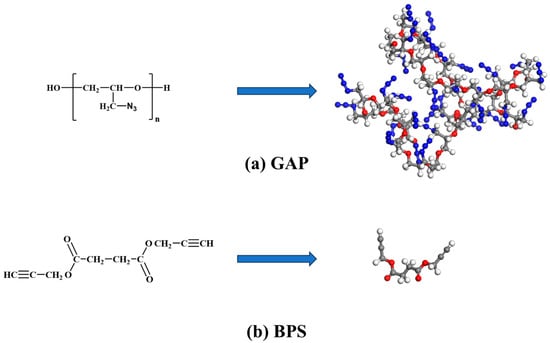
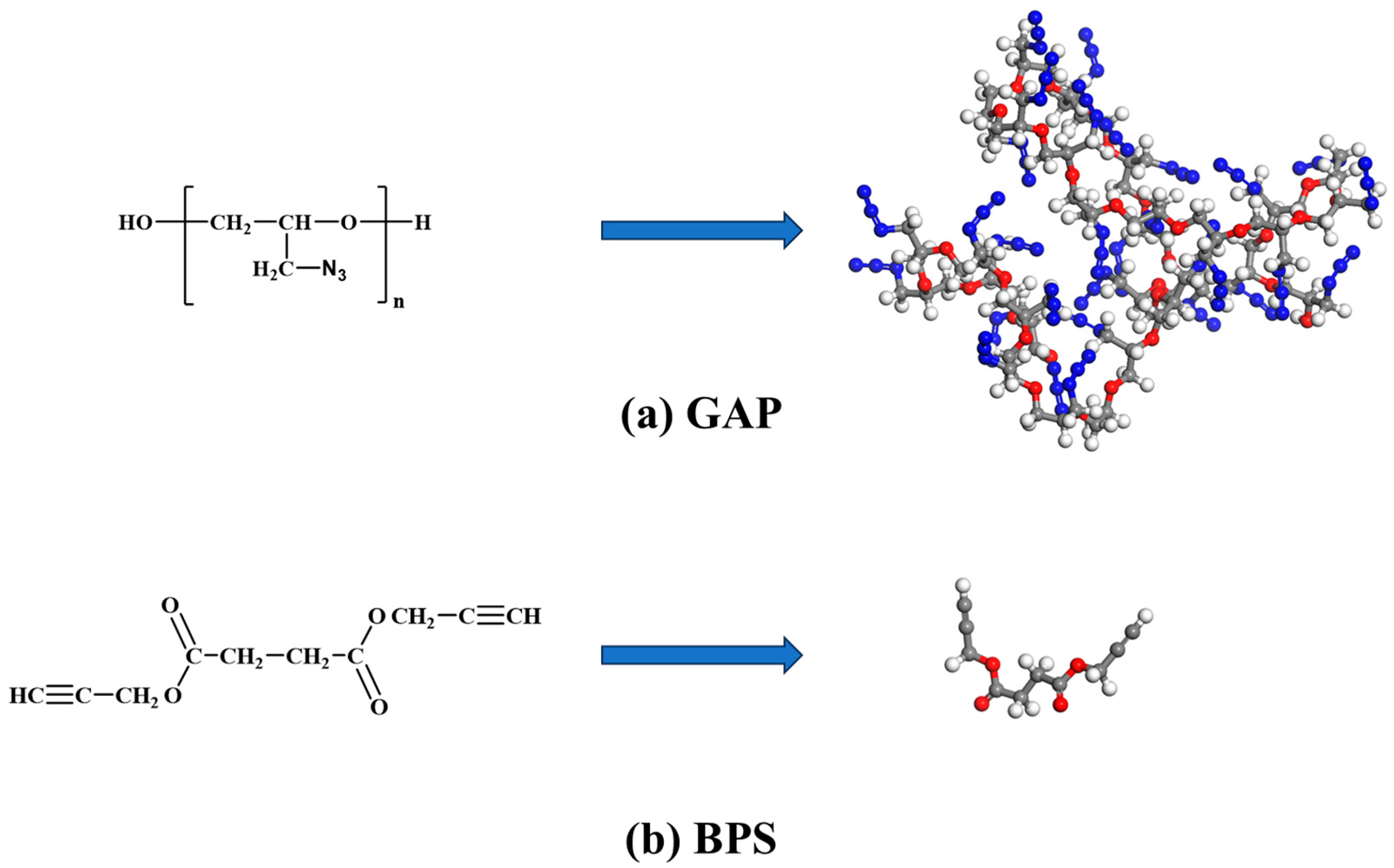
The monomer models of GAP and BPS were constructed using the J-OCTA 10.1 software, and their molecular structures are shown in Figure 1. GAP consists of 30 repeating units bearing azide functional groups, with a molecular weight of approximately 3000 Da. As a typical alkynyl compound, BPS contains two terminal alkyne functional groups, with a molecular weight of approximately 194 Da.
Figure 1.
Molecular structure.
During the subsequent construction of the amorphous cell, GAP and BPS were used as the binder matrix and curing agent, respectively, to establish a GAP/BPS mixed system with R = 1. Here, R refers to the equivalent ratio of functional groups in the curing agent to those in the prepolymer. The initial density of the mixed system was set below 1 g/cm3 to reduce intermolecular entanglement. Meanwhile, this setup ensures that each molecule has sufficient space to adjust its conformation when the simulation box is compressed under the NPT ensemble, thereby guaranteeing the sufficiency and randomness of the crosslinking reaction.
2.2. Crosslinking Reaction
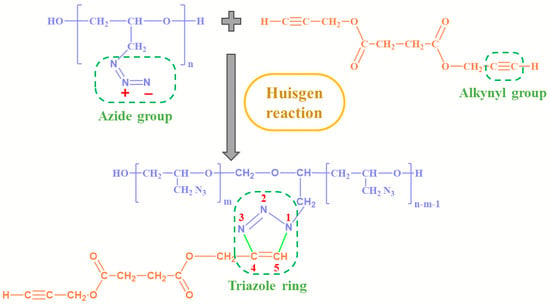
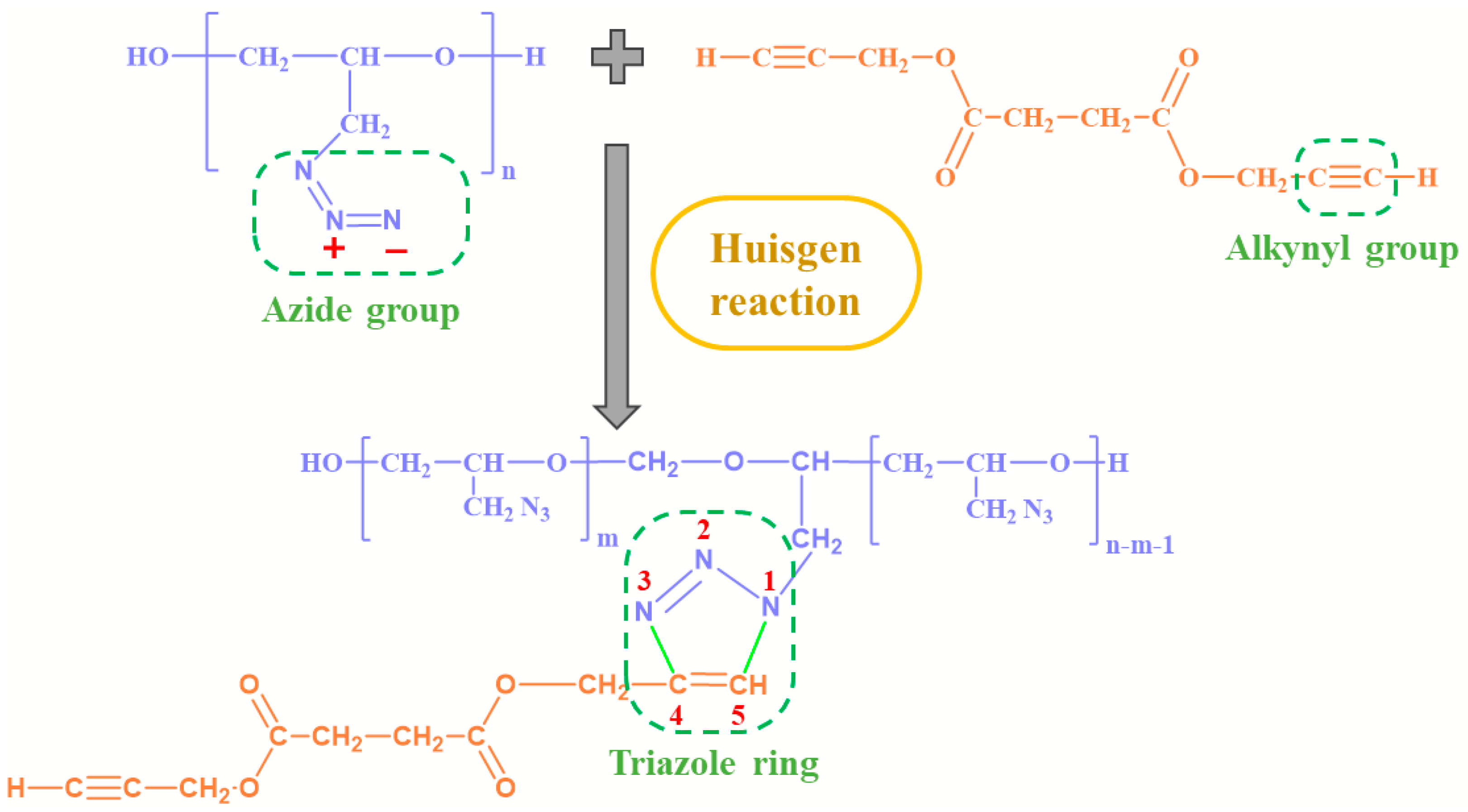
The crosslinking simulation of the GAP/BPS mixed system was carried out with the Reaction Modeler module in the J-OCTA software [28]. In the GAP/BPS mixed system, alkynyl groups and azide groups undergo the Huisgen cycloaddition reaction to form a 1,4-disubstituted 1,2,3-triazole ring. The mechanism of the crosslinking reaction is shown in Figure 2.
Figure 2.
Principle of the crosslinking reaction.
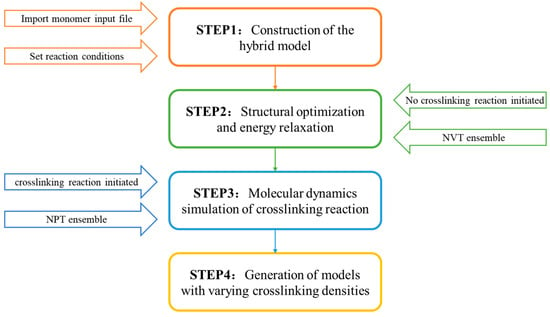
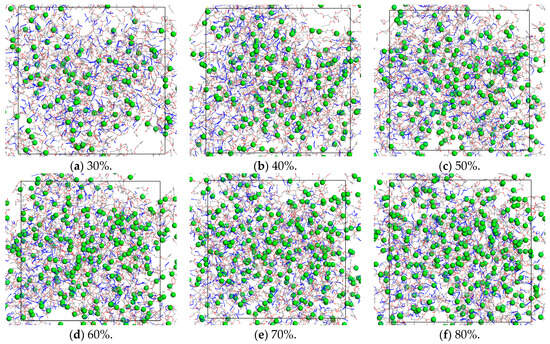
The flow chart of the crosslinking reaction simulation is shown in Figure 3. The detailed settings for the reaction between GAP and BPS are described as follows.
Figure 3.
Flow chart of crosslinking reaction simulation.
(1) Import the molecular models of GAP and BPS, and mix 20 GAP chains with 300 BPS molecules to construct an amorphous cell. According to the mechanism of the Huisgen cycloaddition reaction, the active sites of GAP and BPS molecules are defined. The crosslinking parameters are set as follows: the cutoff distance is set to 4 Å, and no reaction occurs between active sites with a distance exceeding this value. The reaction probability is set to 1.0, and perform a reaction check every 100 time steps to improve the efficiency of the crosslinking reaction.
(2) Structural optimization and thermal equilibration of the amorphous cell. On the premise of suppressing the crosslinking reaction, geometry optimization and NVT ensemble MD simulation are sequentially performed on the GAP/BPS mixed system. After this simulation, the molecules in the system are fully relaxed, and the temperature and energy of the system reach a pre-equilibrium state.
(3) Simulation of the crosslinking reaction. At 300 K, an NPT ensemble MD simulation of 200 ps was performed on the pre-equilibrated GAP/BPS system, with the crosslinking simulation conducted simultaneously. During this process, based on the reaction mechanism shown in Figure 2, azide groups in GAP molecules and alkynyl groups in BPS molecules undergo the Huisgen cycloaddition reaction. As the reaction proceeds continuously, the crosslinking degree of the GAP-BPS system finally stabilizes at 80%.
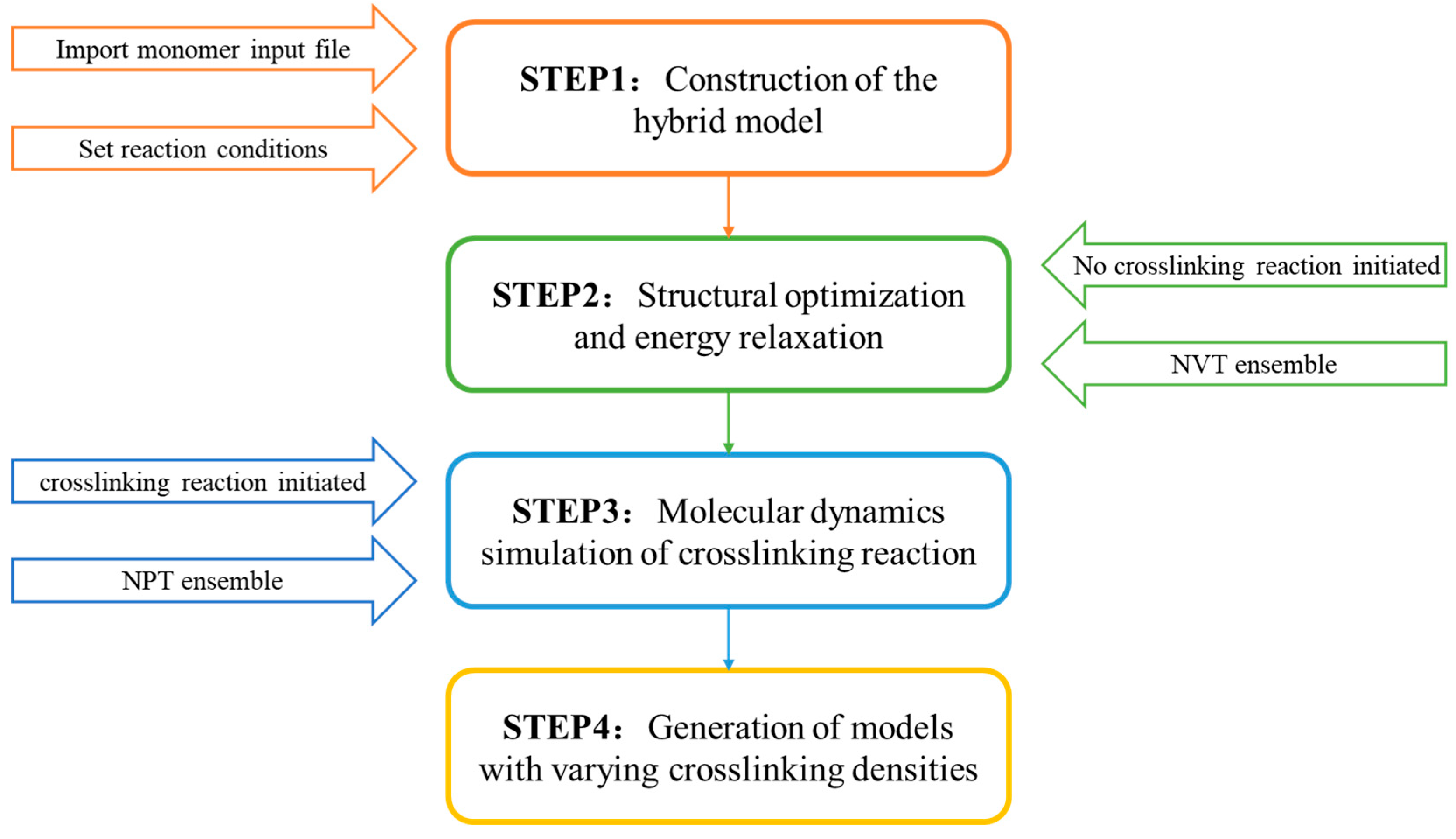
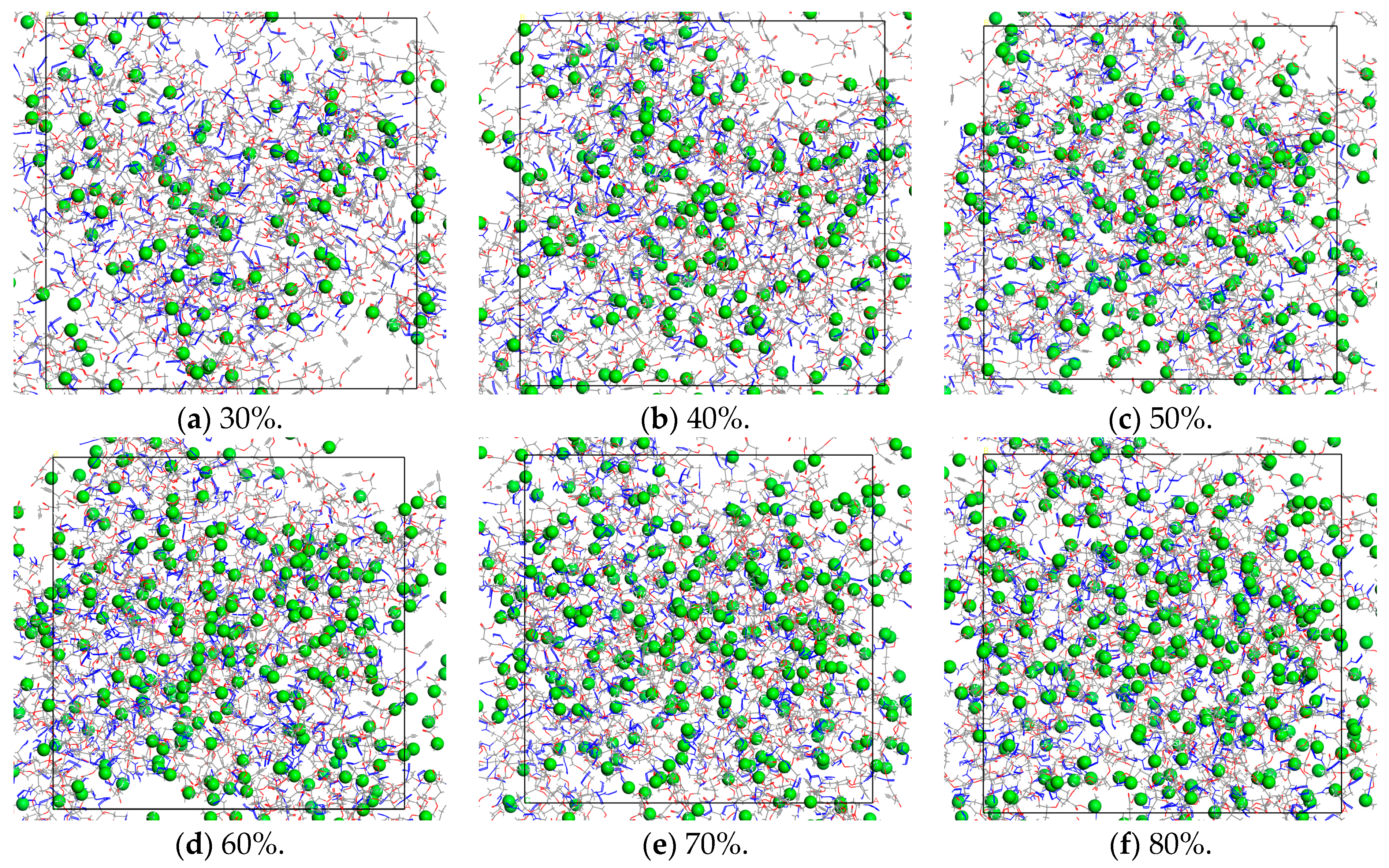
(4) Export the crosslinked models. Based on the results of crosslinking simulation, 21 GAP-BPS molecular models with different crosslinking degrees were exported, and some of the crosslinked models are shown in Figure 4.
Figure 4.
Molecular models with different crosslinking degrees. Color scheme: gray (carbon), blue (nitrogen), red (oxygen), white (hydrogen), and green ball (the nitrogen atom labeled 1 in the triazole ring).
2.3. Molecular Dynamics Simulation and Mechanical Property Calculation
MD simulation and mechanical property calculation were both performed using the Forcite module in Materials Studio 2019. Meanwhile, to accurately describe the interactions between various structures in the system, the COMPASS II force field was adopted throughout the simulation to characterize the potential energy of the polymer system.
In this section, the core purpose of MD simulation is to obtain molecular structures under equilibrium conditions, laying a reliable model foundation for subsequent mechanical property calculations. The detailed simulation procedure is as follows: Firstly, 21 molecular models with different crosslinking degrees were imported. Then, the smart algorithm was adopted to perform geometry optimization on the amorphous cell structure, with the maximum number of iteration steps set to 10,000. Subsequently, MD simulations were carried out for the models at a constant pressure of 1 atm and various constant temperatures (ranging from 200 K to 500 K with an interval of 25 K). Each simulation was divided into two steps: first, a 200 ps NVT ensemble MD simulation was performed to fully relax the system structure, followed by an 800 ps NPT ensemble MD simulation. During the simulations, the Nose–Hoover and Andersen algorithms were used to maintain the temperature and pressure of the system, respectively. Meanwhile, the time evolution of density, temperature, energy, and other parameters with time was monitored to ensure that the simulation system reached a thermodynamic equilibrium state. Finally, 273 equilibrium configurations of the GAP-BPS binder under different conditions (including 21 different crosslinking degrees and 13 different temperatures) were obtained.
Based on the equilibrated GAP-BPS models obtained from MD simulations, quantitative calculations of their mechanical properties were carried out. The constant strain method was adopted, where linear strain or angular strain was applied in six directions of the simulation box, with the maximum strain set to 0.003 and the strain step set to 6. Previous studies [29,30] have shown that during uniaxial tensile simulation of solid propellants, when the strain is less than a certain critical value, their stress–strain curves exhibit typical linear elastic characteristics. In this process of mechanical property calculation, the applied strain was far lower than the critical value of linear elastic strain for common binders, so as to ensure that the simulation results were obtained based on the elastic regime. In addition, to minimize the influence of random errors on the simulation results, the last 6 frames (sampled at an interval of 2 ps) of the models from the NPT dynamic equilibrium stage were extracted. Subsequently, batch calculations of mechanical properties were performed via scripts, and the arithmetic mean values of mechanical parameters were recorded. Finally, mechanical property data of the GAP-BPS models under 273 different states were obtained.
2.4. Machine Learning Prediction
The calculated mechanical properties were statistically analyzed, and a dataset containing 273 samples was constructed. For this dataset, the crosslinking degree and temperature were used as input features, while the bulk modulus and shear modulus from the mechanical property parameters were adopted as labels. This dataset systematically characterizes the mechanical response laws of the GAP-BPS model under different conditions, providing data support for the prediction of ML algorithms.
When dealing with data with small samples and low feature dimensions, traditional deep learning algorithms often tend to suffer from severe overfitting due to their excessive expressive power, resulting in limited application. Although ensemble tree-based models such as RF and XGBoost occupy a dominant position in small-sample data prediction owing to their advantages of low complexity and high adaptability [31,32]. However, when processing small-sample data, RF tends to produce large prediction fluctuations, resulting in relatively low accuracy. The structure of XGBoost is prone to amplifying noise and thus easily leads to overfitting. In contrast, the TabPFN algorithm is specifically optimized for small-sample scenarios, exhibiting stronger generalization ability and more stable prediction performance in tasks with limited sample size and low feature dimensions. Therefore, this study introduces the TabPFN algorithm for small-sample tabular data and compares it with RF and XGBoost for mechanical parameter prediction. For the TabPFN V2 model, we directly employ its pre-trained parameters without additional tuning. The RF and XGBoost models are constructed using the scikit-learn framework, and their hyperparameters are optimized via grid search combined with K-fold cross-validation. The optimal hyperparameters selected for RF and XGBoost are presented in Table 1.
Table 1.
Optimal hyperparameters for different machine learning models.
In this study, the coefficient of determination (R2), Root Mean Square Error (RMSE), and Mean Absolute Percentage Error (MAPE) were selected as core metrics to quantitatively evaluate the prediction performance of the three types of algorithmic models. Specifically, R2 is used to measure the data-fitting ability of the model, and the generalization ability can be further evaluated by comparing the values between the training set and the test set; RMSE is sensitive to extreme deviations between predicted and actual values, which can effectively reflect the overall prediction error; the smaller the value, the higher the prediction accuracy; MAPE characterizes the prediction error in the form of a relative percentage, which directly reflects the relative accuracy of model prediction; the smaller the value, the more reliable the model prediction performance.
Interpretable analysis of models is crucial for understanding their prediction mechanisms. As traditional ensemble tree models, RF and XGBoost algorithms inherently possess favorable interpretability. In contrast, models with complex weights, such as TabPFN, are often regarded as “black-box” models and have significant shortcomings in interpretability [33,34]. As a game theory-based method for feature importance assessment [35,36], Shapley Additive Explanations (SHAP) can effectively compensate for the poor interpretability of TabPFN. Therefore, this study introduces the SHAP method to quantitatively analyze the importance of features (crosslinking degree, temperature, and free volume) to the labels (bulk modulus, shear modulus) in the TabPFN model.
3. Results and Discussion
3.1. Model Validation and Analysis of Molecular Simulation
3.1.1. Model Validation and Mechanical Property Calculation
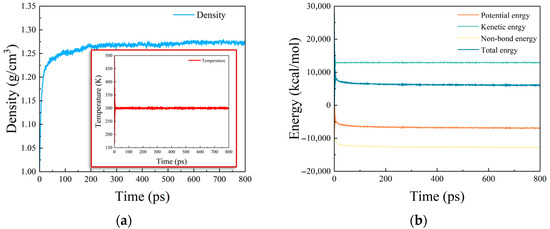
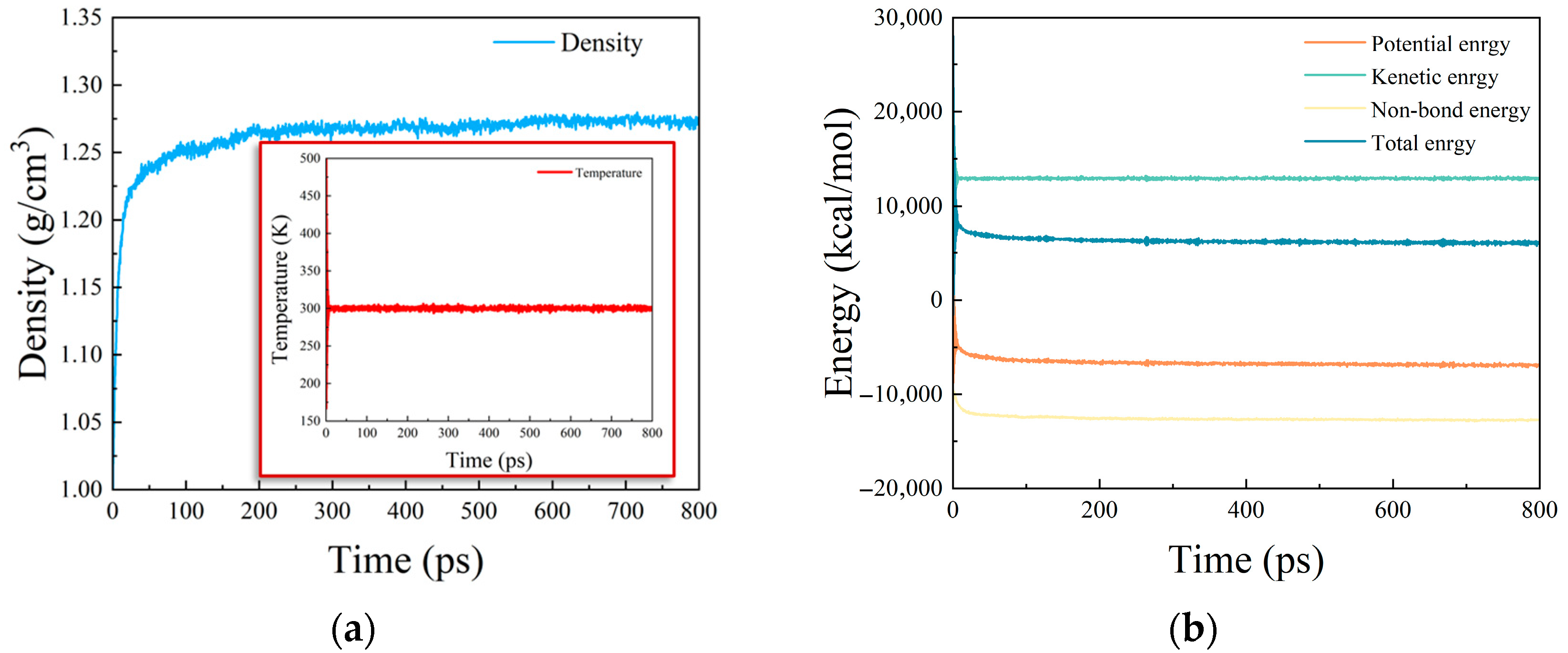
Prior to investigating the effects of crosslinking degree and temperature on the mechanical properties of GAP-BPS binders, we first validate the equilibrium structures obtained from MD simulations to ensure the credibility of subsequent mechanical analysis. For the representative model with 80% crosslinking degree, MD simulation is performed in the NPT ensemble at 1 atm and 300 K. As depicted in Figure 5, the temperature, density, and total energy of the system gradually leveled off after 200 ps of simulation, indicating that the system has reached a dynamic equilibrium state. At the end of the simulation, the temperature and density of the structure stabilized at 300 K and 1.28 g/cm3, respectively. The density and temperature evolution curves for representative simulation systems are provided (see Figure A1 in Appendix A.1).
Figure 5.
NPT simulation process of the 80% crosslinking degree model. (a) Density-time curve and temperature-time curve; (b) energy–time curves.
Studies have shown that the experimental density of GAP is 1.30 g/cm3 [37], while the experimental density of BPS is 1.17 g/cm3 [38]. Based on Keicher’s experimental study [39], and considering that the volume change in GAP and BPS after crosslinking is less than 1%, the density of the GAP-BPS system after crosslinking is approximately 1.29 g/cm3. This value is very close to the simulated density of the GAP-BPS system with an 80% crosslinking degree reported in this paper. In addition, the experimental density of the GAP-BPS system was compared with that of other GAP alkyne-curing systems (GAP-BPE and GAP-BPM systems) [40]. The density value of the GAP-BPS system at an 80% crosslinking rate is slightly lower than that of other alkyne-cured systems, with the maximum difference not exceeding 6%. The above results indicate that the simulated density of the GAP-BPS system shows good agreement with the experimental density. The selected model and force fields exhibit no systematic bias when handling the azide–alkyne chemical environment and can accurately capture the physical behavior of this type of crosslinked network.
In summary, after MD simulation of the GAP-BPS model, the temperature and density of the system reach dynamic equilibrium. By comparing the experimental density of GAP-BPS with that of other alkyne-cured GAP systems, the accuracy of the MD simulation is verified. The above results show that the constructed equilibrium GAP-BPS model can provide a stable and reliable model basis for subsequent mechanical property calculations.
Mechanical property calculations were performed on the equilibrium configuration obtained from the above MD simulation, and the stiffness matrix and compliance matrix (for the model with 80% crosslinking degree at 300 K) are presented in Table 2 and Table 3, respectively.
Table 2.
Stiffness matrix of the model (with 80% crosslinking degree at 300 K).
Table 3.
Compliance matrix of the model (with 80% crosslinking degree at 300 K).
Here, and represent the stiffness matrix coefficients and compliance matrix coefficients, respectively. Since both matrices are derived from the linear elastic deformation regime of the GAP-based binder, and the deformation of the elastomer follows the conservation of strain energy and the principle of reversibility, the matrix coefficients satisfy symmetry, i.e., and . In summary, both the stiffness matrix and the compliance matrix are characterized by 21 independent coefficients.
Due to the scale limitations of molecular simulation, factors such as the local orientation of molecular chains and the inhomogeneity of the crosslinking network can lead to anisotropic mechanical behavior of the binder in the stiffness matrix at the microscopic scale. If the elastic modulus is only evaluated along a single specific direction, the results will vary irregularly owing to the randomness of crosslinking and molecular chain orientation during the MD simulation. To obtain direction-independent physical quantities with clear physical meaning that are consistent with the microstructure of the binder, this paper adopts the bulk modulus and shear modulus as the representative mechanical properties. The equivalent bulk modulus and equivalent shear modulus based on the Voigt estimate can be obtained using Equations (1) and (2). Similarly, the equivalent bulk modulus and equivalent shear modulus based on the Reuss estimate can be calculated using Equations (3) and (4). Among them, the bulk modulus quantifies the ability of a material to resist volume deformation under hydrostatic pressure, while the shear modulus characterizes its resistance to shear deformation:
The extent of anisotropy of the binder material was evaluated using the Ranganathan method [41]. The equivalent bulk modulus and shear modulus from the Reuss approximation were calculated to be 4.9074 GPa and 2.1936 GPa, respectively, using Equations (1)–(4). For the Voigt approximation, the corresponding values were determined as 4.9525 GPa and 2.3214 GPa, respectively. According to Equation (5), the anisotropy index of the binder ( = 0.30 < 1) is extremely weak, and the material can be regarded as isotropic at the macroscopic scale. Therefore, it is reasonable to characterize the mechanical properties of GAP-BPS binders via the equivalent bulk modulus and equivalent shear modulus:
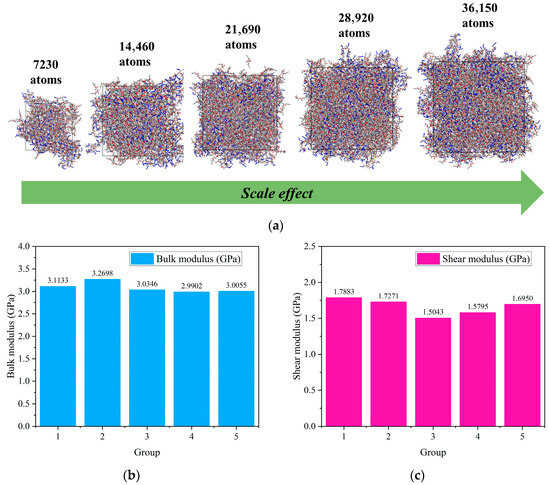
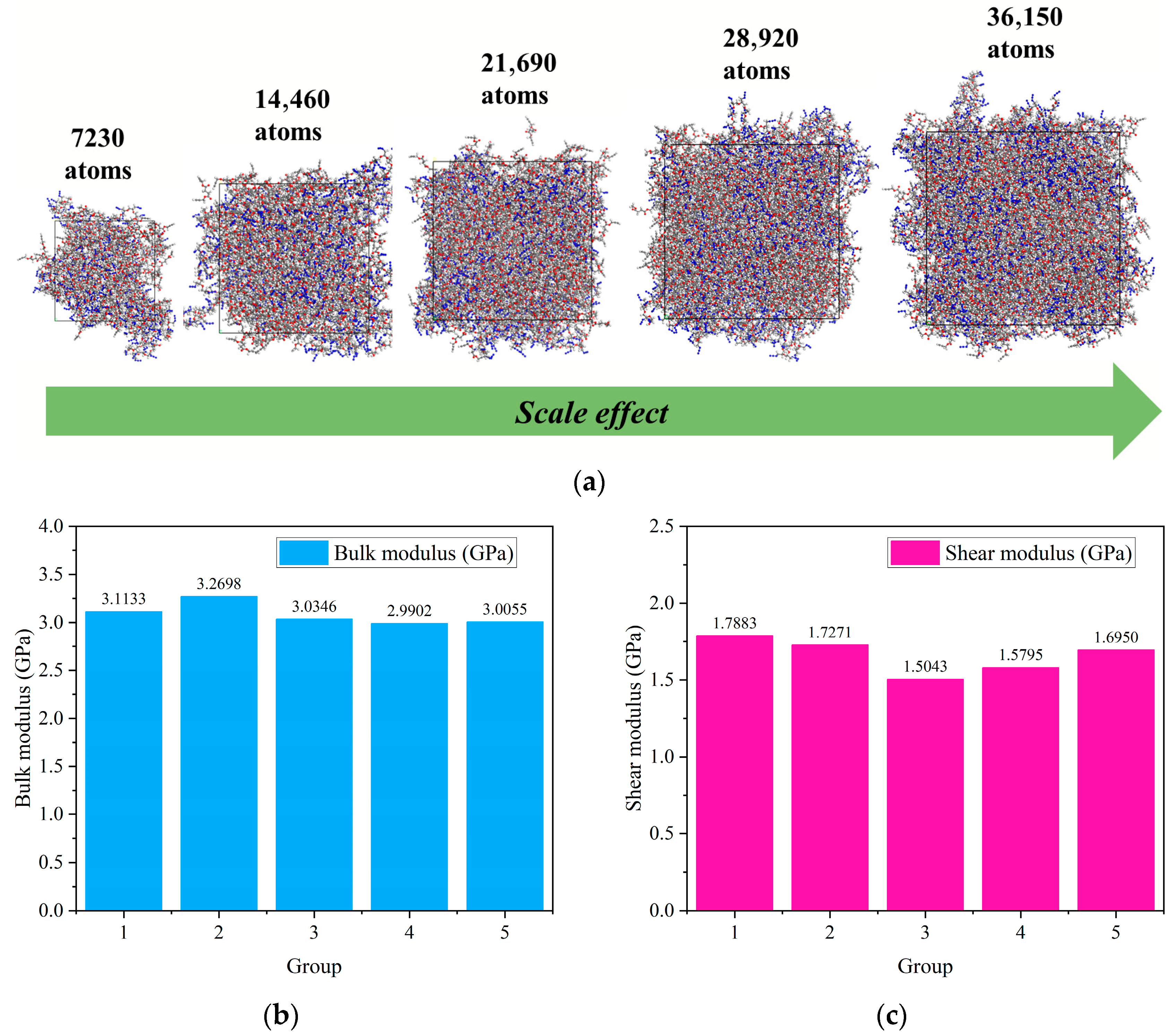
In addition, equilibrium configurations of uncrosslinked binders with different system sizes were constructed at 300 K. Based on these models, the influence of the size effect on the mechanical properties of the molecular models was investigated, as shown in Figure 6. As illustrated in Figure 6b,c, the bulk modulus and shear modulus of the binder in the elastic regime exhibit low sensitivity to the system size. When the total number of atoms in the system reaches 14,460, the simulation deviation of its mechanical properties compared with that of the largest model is less than 10%. Considering both computational accuracy and efficiency, the system with a total of 14,460 atoms was selected for the subsequent mechanical property studies in this work.
Figure 6.
Effect of size effect on mechanical properties: (a) Snapshots of the non-crosslinked model under five different system sizes; (b) effect of size effect on bulk modulus (system size increases from left to right); and (c) effect of size effect on shear modulus (system size increases from left to right).
3.1.2. Radial Distribution Function
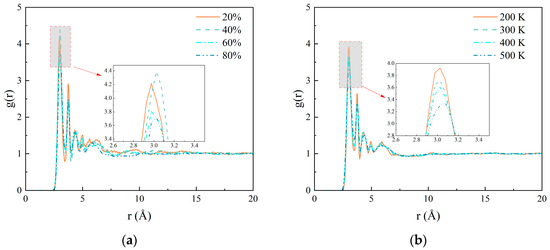
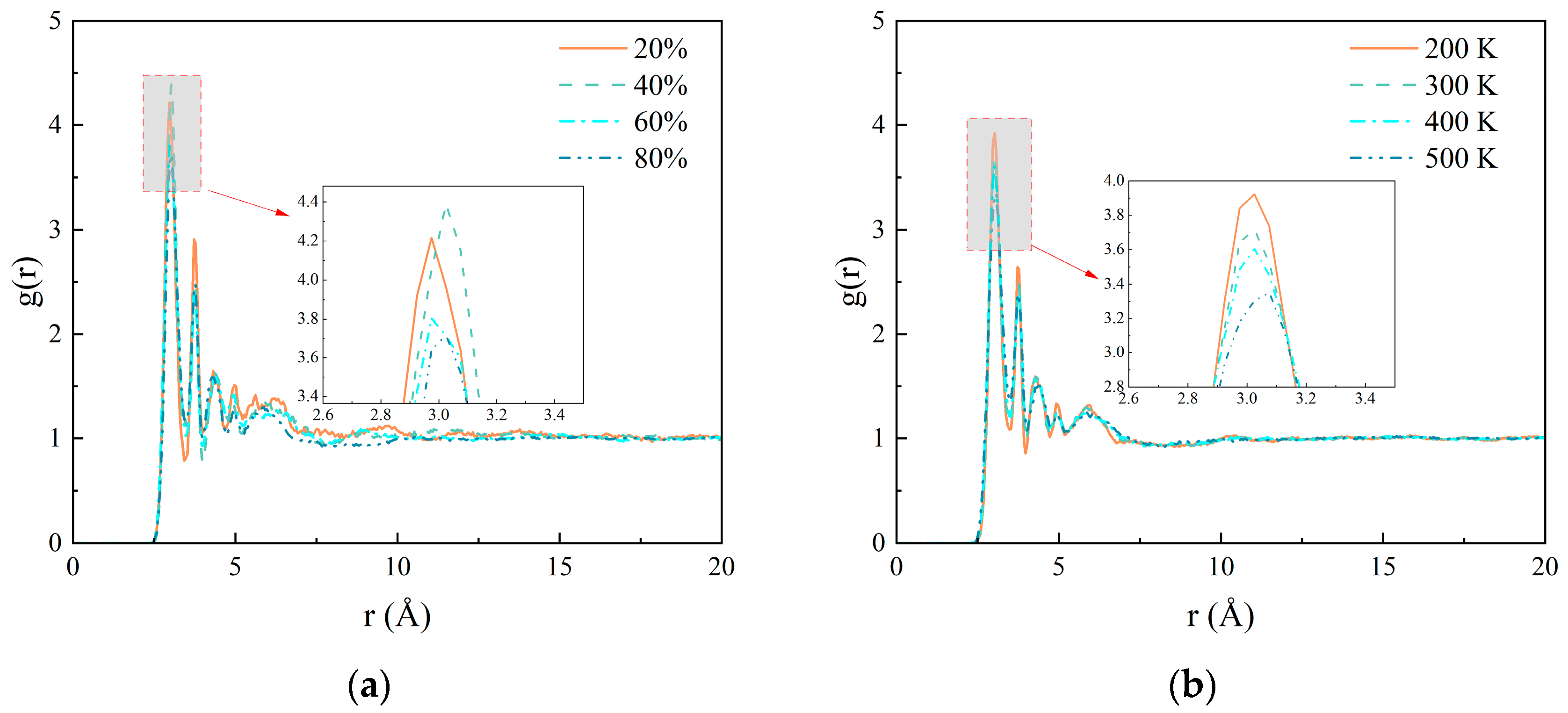
The radial distribution function (RDF) is a key statistical metric for characterizing the microscopic structure of materials [42]. By analyzing the peak intensity and peak position of the RDF curve, the spatial distribution between particles and the interaction strength can be quantitatively revealed [43]. To characterize the entanglement degree between GAP backbones and crosslinked segments, the spatial correlation of two characteristic atoms (oxygen atoms of ether bonds in the GAP backbone, with the nitrogen atom labeled 1 in the triazole rings) is selected as the evaluation indicator, and the corresponding RDF is shown in Figure 7.
Figure 7.
Radial distribution function (oxygen atoms of ether bonds in the GAP backbone, with the nitrogen atom labeled 1 in the triazole rings). (a) RDF curves at different crosslinking degrees; (b) RDF curves at different temperatures.
At 300 K, the RDF curves of binders with different crosslinking degrees are shown in Figure 7a. In the short-range region (r < 2.5 Å), the value of g(r) is 0 due to the volume effect; in the middle-range region (2.5 Å < r < 7.5 Å), non-bonded interactions play a dominant role. After the interparticle distance r exceeds 2.5 Å, the value of g(r) increases gradually and reaches the maximum peak near r = 3.0 Å, then decreases rapidly, accompanied by successive minor peaks. In the long-range region (r > 7.5 Å), the value of g(r) gradually approaches 1, close to the stable state of long-range disorder. Notably, by comparing the main peaks of models with different crosslinking degrees, it is found that the peak value first increases and then decreases with the rise in crosslinking degree. This indicates that as the crosslinking degree increases, the segmental motion of molecular chains is gradually restricted, which in turn leads to a decrease in the degree of physical entanglement between chain segments. The RDF curves of the binder with 80% crosslinking degree at various temperatures are presented in Figure 7b, where the distribution of peak positions is basically consistent with that in Figure 7a. By comparing the main peaks, it can be seen that the value of g(r) shows a decreasing trend with an increase in temperature. This phenomenon indicates that elevated temperature enhances molecular thermal motion, which unwinds part of the entanglement between chain segments and consequently reduces the short-range order of the structure.
3.1.3. Mean Squared Displacement
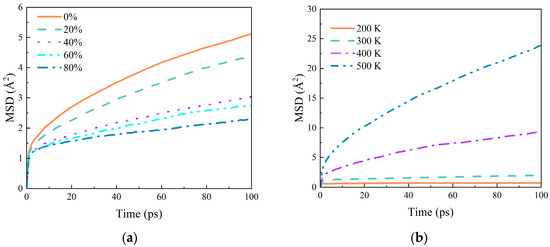
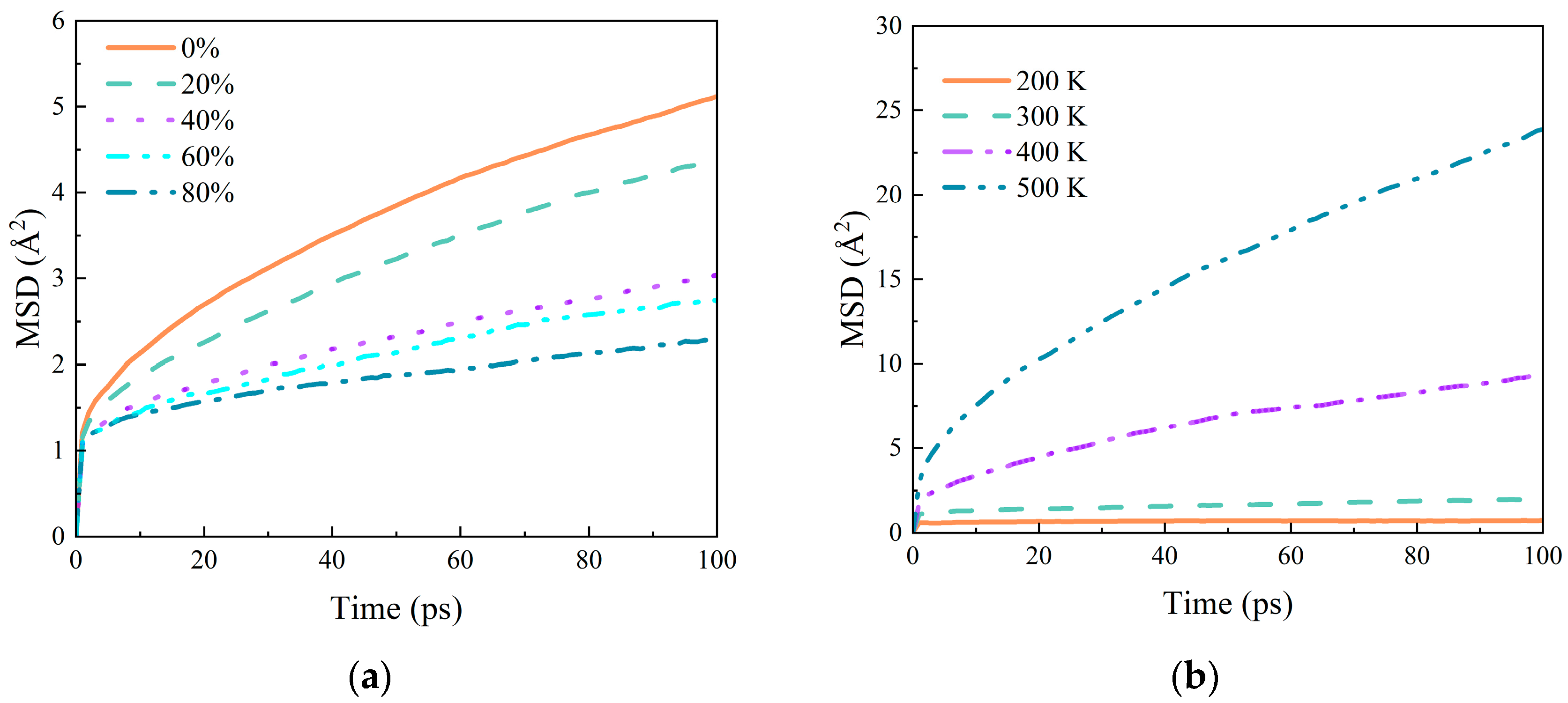
The mean squared displacement (MSD) curve describes the variation in the mean squared displacement of particles with time [44]. The slope of the MSD curve is proportional to the diffusion coefficient, which can be used to characterize the diffusion capability of particles. Figure 8a presents the MSD curves of BPS molecules in models with different crosslinking degrees at 300 K. As the crosslinking degree increases, the slope of the MSD curve for BPS gradually decreases. This indicates that the increase in crosslinking points within the system raises the degree of structural curing, leading to a gradual weakening in the diffusion of BPS molecules. Figure 8b shows the MSD curves of BPS molecules in the model with 80% crosslinking degree at various temperatures. The slope of the MSD curve increases sharply with every 100 K rise in temperature. This suggests that elevated temperature intensifies the thermal motion of molecules in the system, strengthens the ability of molecules to overcome steric hindrance, and thus significantly improves the diffusion capability of BPS.
Figure 8.
MSD curves of BPS: (a) MSD curves at different crosslinking degrees; and (b) MSD curves at different temperatures.
3.1.4. Free Volume
Free volume is defined as the total void volume unoccupied by molecules in a microscopic system. In this study, the van der Waals surface free volume (with solvent probe radius of 0 Å) and solvent surface free volume (with solvent probe radius of 1.4 Å) were analyzed using the Atom Volumes & Surfaces module in Materials Studio 2019 software. The free volume distribution results are presented in Table 4 and Table 5.
Table 4.
Free volume of models with different crosslinking degrees.
Table 5.
Free volume of models at different temperatures.
With increasing crosslinking degree, the van der Waals surface free volume shows a slight and steady decrease, whereas the solvent surface free volume exhibits a fluctuating upward trend. This indicates that a higher degree of curing leads to a denser atomic distribution and a reduction in the total volume of interstitial voids. Meanwhile, the rigid framework formed by crosslinking and curing contributes to an increase in large voids. As the system temperature rises from 200 K to 500 K, the van der Waals surface free volume and solvent surface free volume increase to 1.23 times and 4.83 times their initial values, respectively, with the latter showing a significantly higher amplification. Elevated temperature enhances the thermal motion of chain segments and causes overall volume expansion of the system, thereby increasing the free volume. In this process, small voids expand or merge with each other, resulting in a more pronounced increase in large-scale voids.
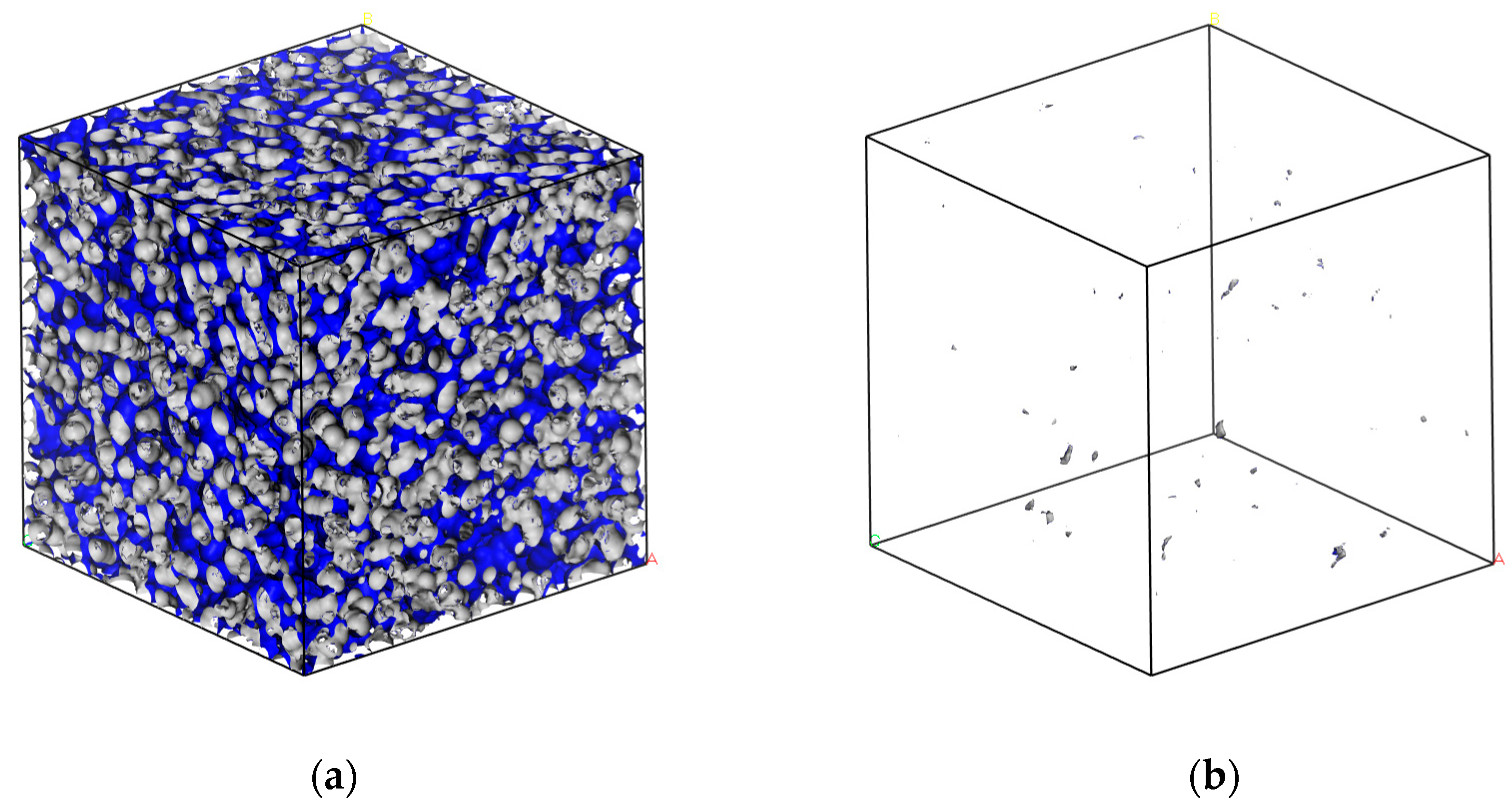
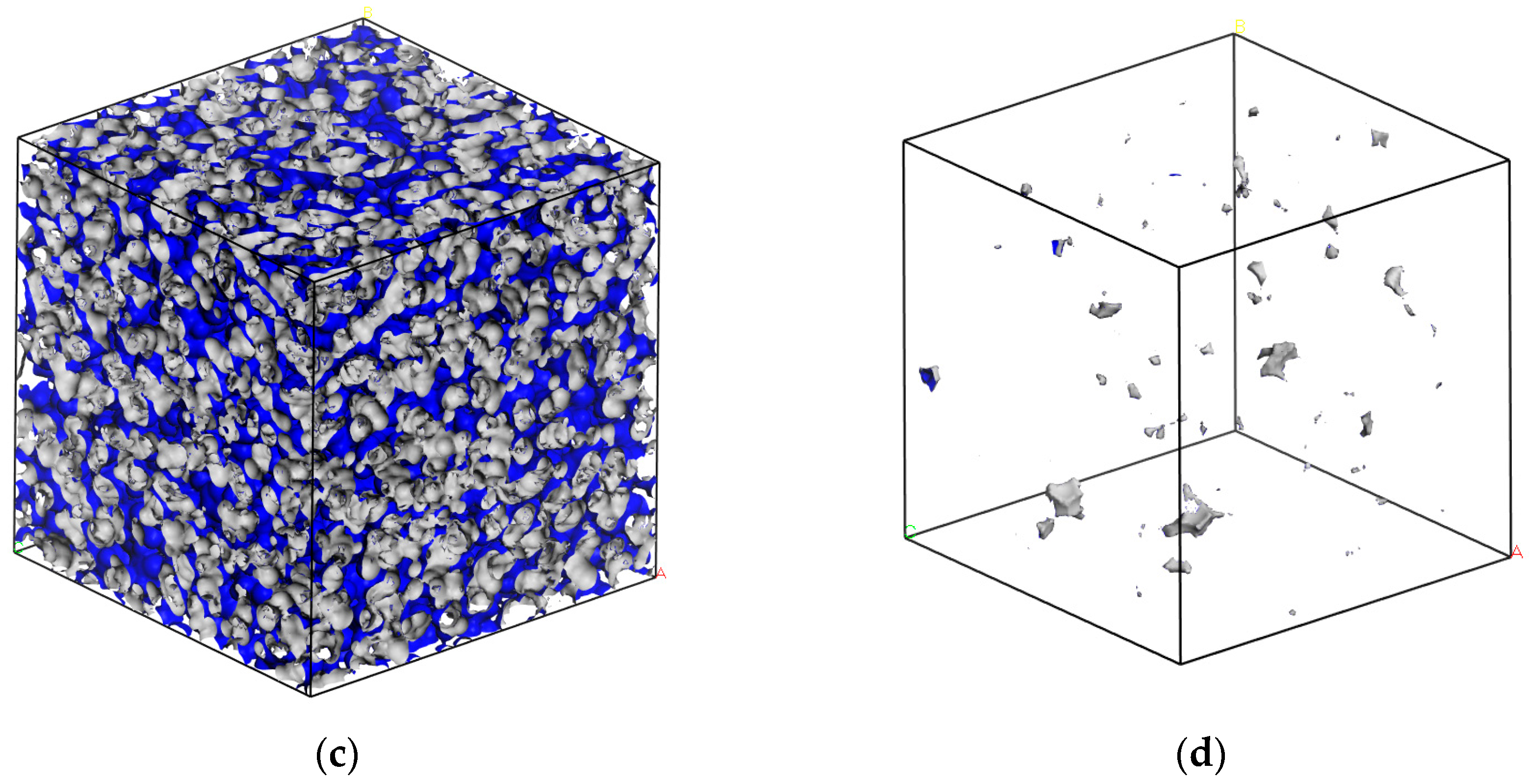
In addition, the van der Waals surface free volume and solvent surface free volume distributions of the uncrosslinked and 80% crosslinking degree models are presented (see Figure A2 in Appendix A.2). The 80% crosslinking model exhibits more large voids than the uncrosslinked case, but their distribution remains dispersed. This distribution characteristic is still unfavorable for long-distance diffusion of molecules within the system.
3.1.5. Effect of Crosslinking Degree on Mechanical Properties
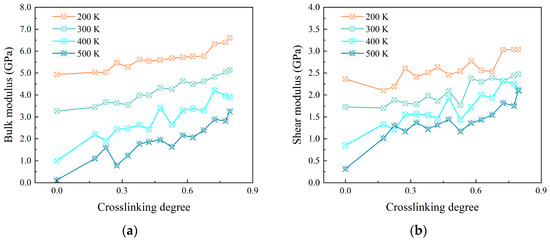
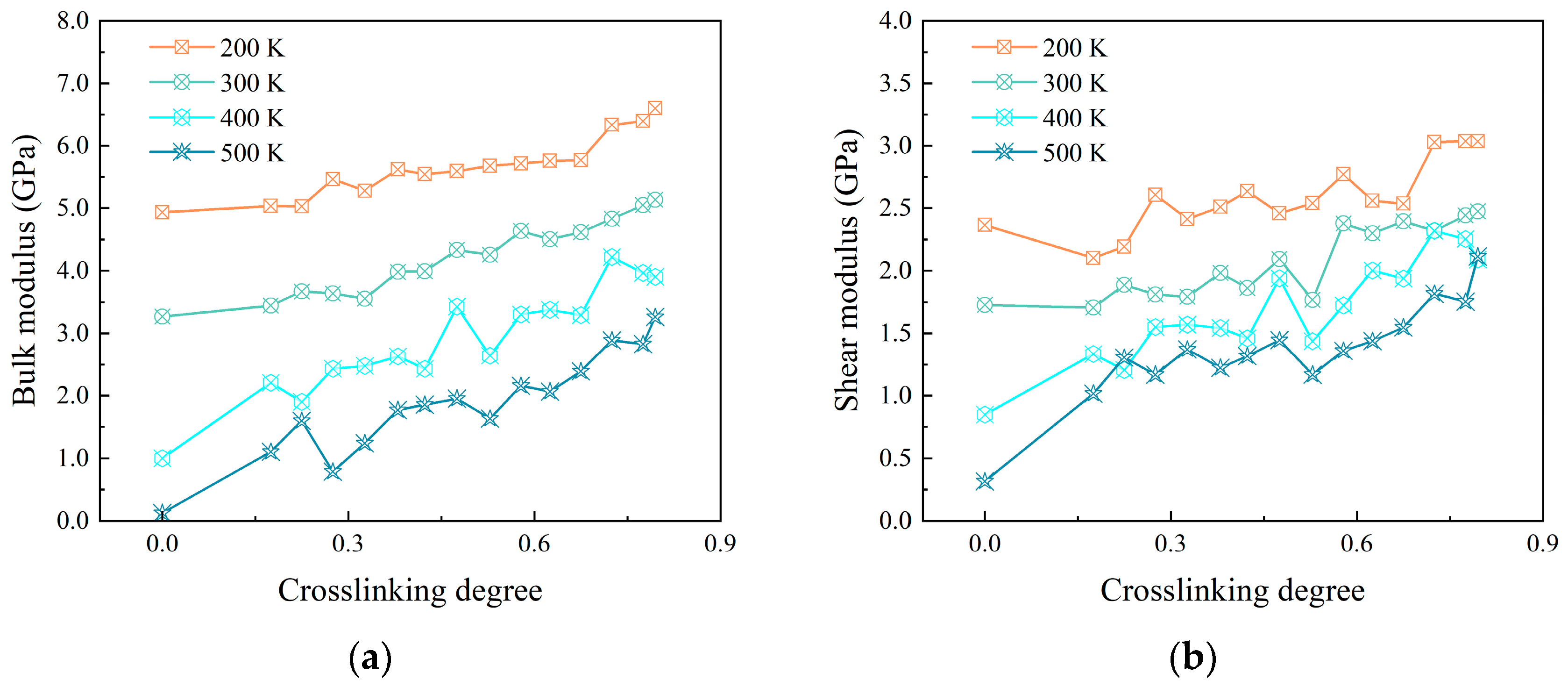
To elucidate the effect of crosslinking degree on the mechanical properties of GAP-BPS binders, curves of the binder mechanical parameters against crosslinking degree (ranging from 0 to 80%) were plotted at four characteristic temperatures (200 K, 300 K, 400 K, and 500 K), as shown in Figure 9.
Figure 9.
Relationship between crosslinking degree and mechanical properties: (a) Bulk modulus-crosslinking degree curves; and (b) shear modulus-crosslinking degree curves.
At four characteristic temperatures, both the bulk modulus and shear modulus exhibit an increasing trend with rising crosslinking degree. Compared with the uncrosslinked model, the bulk modulus and shear modulus of the 80% crosslinking degree model are both increased by more than 15%. This phenomenon can be attributed to the fact that with the progress of the crosslinking reaction, the density of crosslinking points in the system increases and the intermolecular connections become tighter, resulting in an increase in the bulk modulus. Meanwhile, the crosslinked network density formed with increasing crosslinking degree restricts the spatial displacement of chain segments and reduces the possibility of their slippage and rearrangement, leading to an increase in the shear modulus.
3.1.6. Effect of Temperature on Mechanical Properties
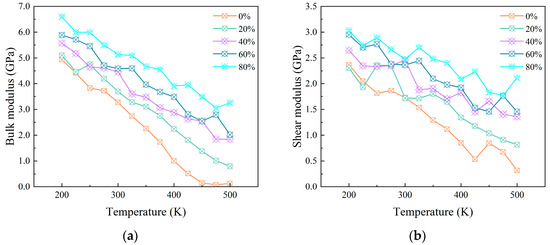
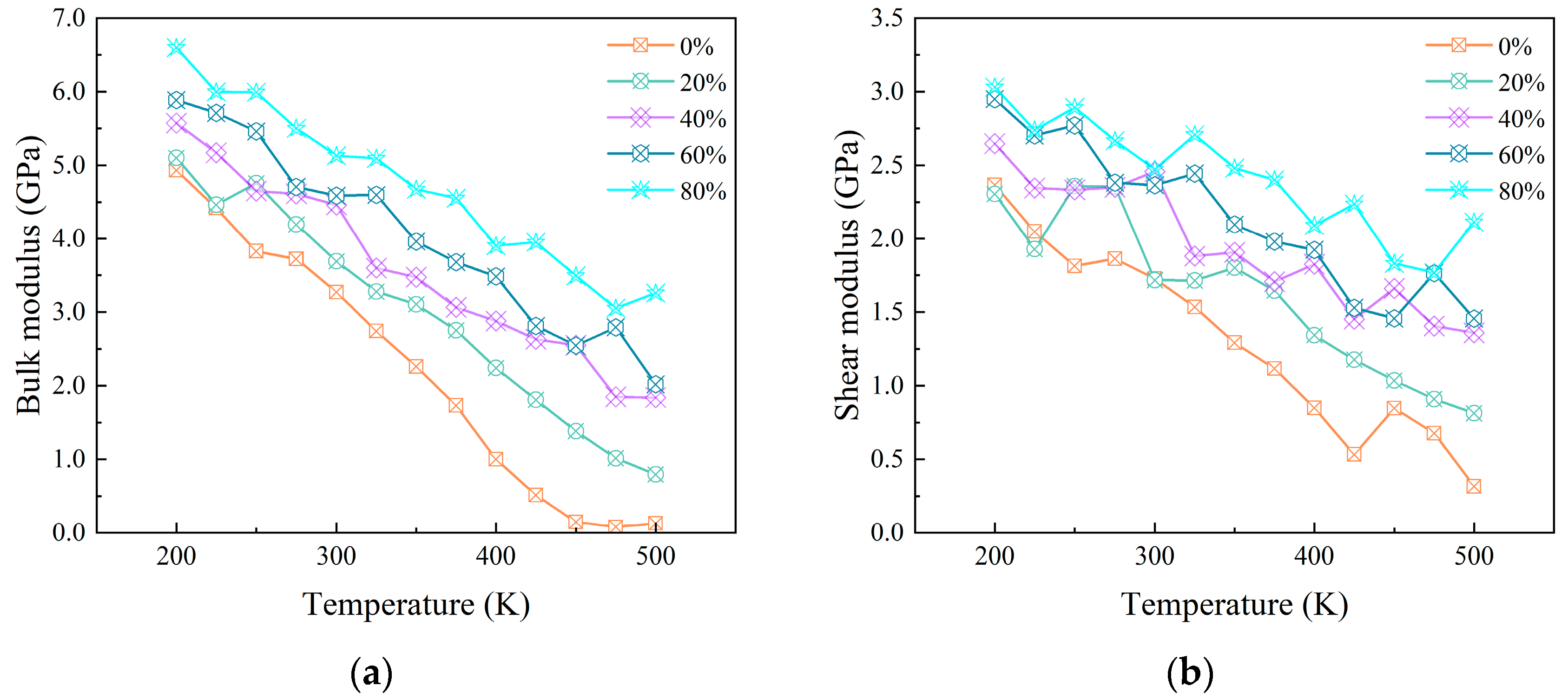
To clarify the effect of temperature on the mechanical properties of GAP-BPS binders, curves of the binder mechanical parameters against temperature (ranging from 200 K to 500 K) were plotted at five characteristic crosslinking degrees (0, 20%, 40%, 60%, and 80%), as shown in Figure 10. With the increase in temperature, both bulk modulus and shear modulus of all models with different crosslinking degrees show a significant downward trend. Combined with the analysis of RDF distribution and MSD curves, this phenomenon can be attributed to the changes in the microstructure caused by the rising temperature: the increase in temperature intensifies the thermal motion of molecular chains in the structure, leading to larger intermolecular gaps; meanwhile, the degree of entanglement between molecular chains decreases and the mobility of the molecular structure is enhanced, resulting in a reduction in both bulk modulus and shear modulus. In summary, the ability of the binder to resist volume change and shear deformation decreases significantly with the rise in temperature, which is consistent with the results of previous studies [45,46,47].
Figure 10.
Relationship between temperature and mechanical properties: (a) Bulk modulus–temperature curves; and (b) shear modulus–temperature curves.
3.2. Analysis of Machine Learning Results
3.2.1. Dataset Characteristics
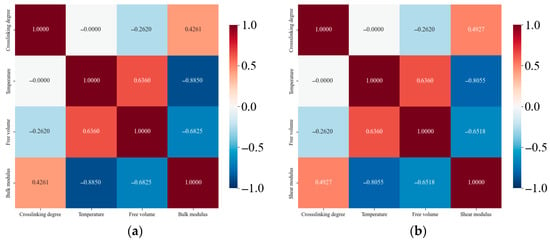
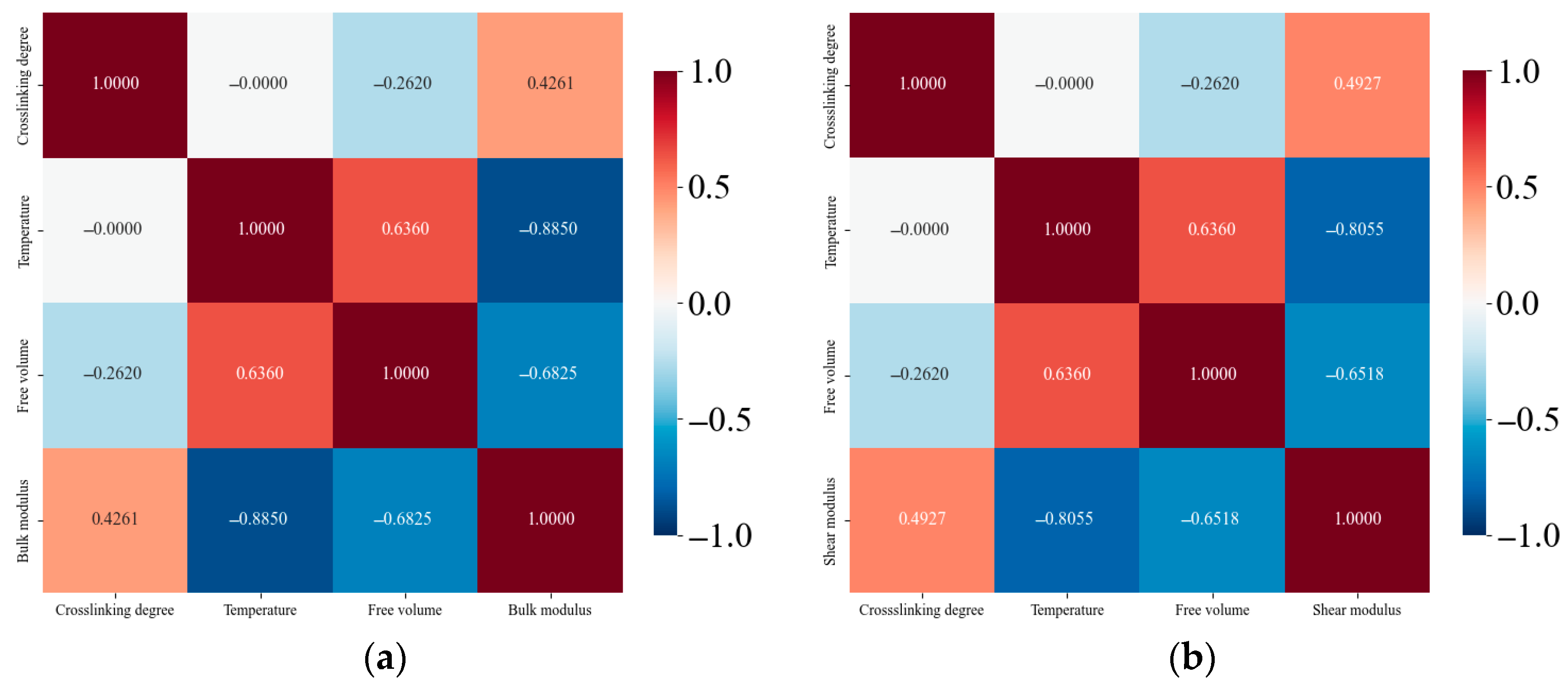
Based on the mechanical parameters of the GAP-based binder obtained from molecular simulation, a dataset containing 273 samples was constructed. The detailed dataset is shown in the Supplementary Material Table S1. To clarify the correlation among parameters in the dataset, the Pearson correlation coefficients between features as well as between features and labels were analyzed, as shown in Figure 11 [48]. The Pearson correlation coefficient can verify the rationality of feature selection by quantifying the linear correlation between parameters, and provide reliable support for subsequent ML modeling.
Figure 11.
Pearson correlation coefficient. (a) Correlation between descriptors and bulk modulus; (b) correlation between descriptors and shear modulus.
As shown in Figure 11, significant correlations exist between the features and the target labels. Specifically, the Pearson correlation coefficients between crosslinking degree and labels are both greater than 0.4, indicating a positive correlation. The coefficients between temperature and labels are both less than −0.8, suggesting a strong negative correlation. In contrast, free volume also exhibits a negative correlation with the labels.
Furthermore, the Pearson correlation coefficient between crosslinking degree and temperature is 0, indicating no linear correlation between these two features. The absolute values of the Pearson correlation coefficients between the remaining features are less than 0.7. Low correlations between features help avoid the problem of multicollinearity, thereby improving the convergence speed and generalization ability of the algorithm models. In summary, it is reasonable to choose crosslinking degree, temperature, and free volume (with solvent probe radius of 1.4 Å) as input features for the model.
3.2.2. Model Prediction Accuracy
To identify the optimal algorithm for predicting the mechanical properties of GAP-based binders, this study compared the predictive performance of three ML models. The 80% dataset was split into training and test sets in a 9:1 ratio for cross-validation. The prediction results of the three algorithmic models on the test set are shown in Table 6.
Table 6.
Prediction accuracy of different ML models.
The results of the cross-validation are shown in Table 6. In the prediction of bulk modulus, the coefficient of determination (R2) for three models exceeded 0.94, and the Root Mean Square Error (RMSE) is low for all, although the Mean Absolute Percentage Error (MAPE) is above 10% for all. In contrast, for the prediction of shear modulus, the R2 for all three models was less than 0.89, whilst both the RMSE and MAPE were low. In summary, the models demonstrate a higher ability to fit the bulk modulus than the shear modulus, but the stability of the predictions for the shear modulus is significantly higher than that for the bulk modulus.
To compare the predictive performance of different algorithms, the TabPFN model achieves the best overall predictive performance. Specifically, in the prediction of bulk modulus and shear modulus, TabPFN exhibits higher coefficients of determination R2 (0.9684 and 0.8827, respectively) and lower average values of RMSE (0.2216 GPa and 0.1638 GPa, respectively) and MAPE (10.51% and 7.92%, respectively) than the other models. This indicates that the predictive performance of RF and XGBoost remains inferior to that of the TabPFN model even after hyperparameter optimization.
Furthermore, the Mann–Whitney U Test [49] was performed based on the R2 values from 10-fold cross-validation. For the bulk modulus prediction, cross-validation results reveal a significant difference between TabPFN and RF (p = 0.0376), whereas no significant difference is observed between TabPFN and XGBoost (p = 0.0757). However, for the shear modulus prediction, none of the three pairwise comparisons show statistically significant differences.
3.2.3. Prediction Accuracy with Different Training Sizes
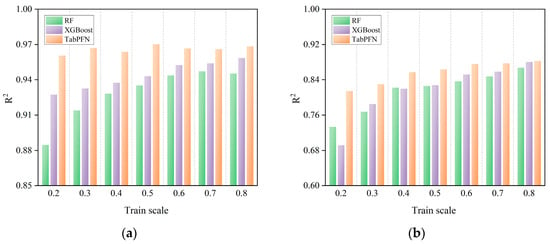
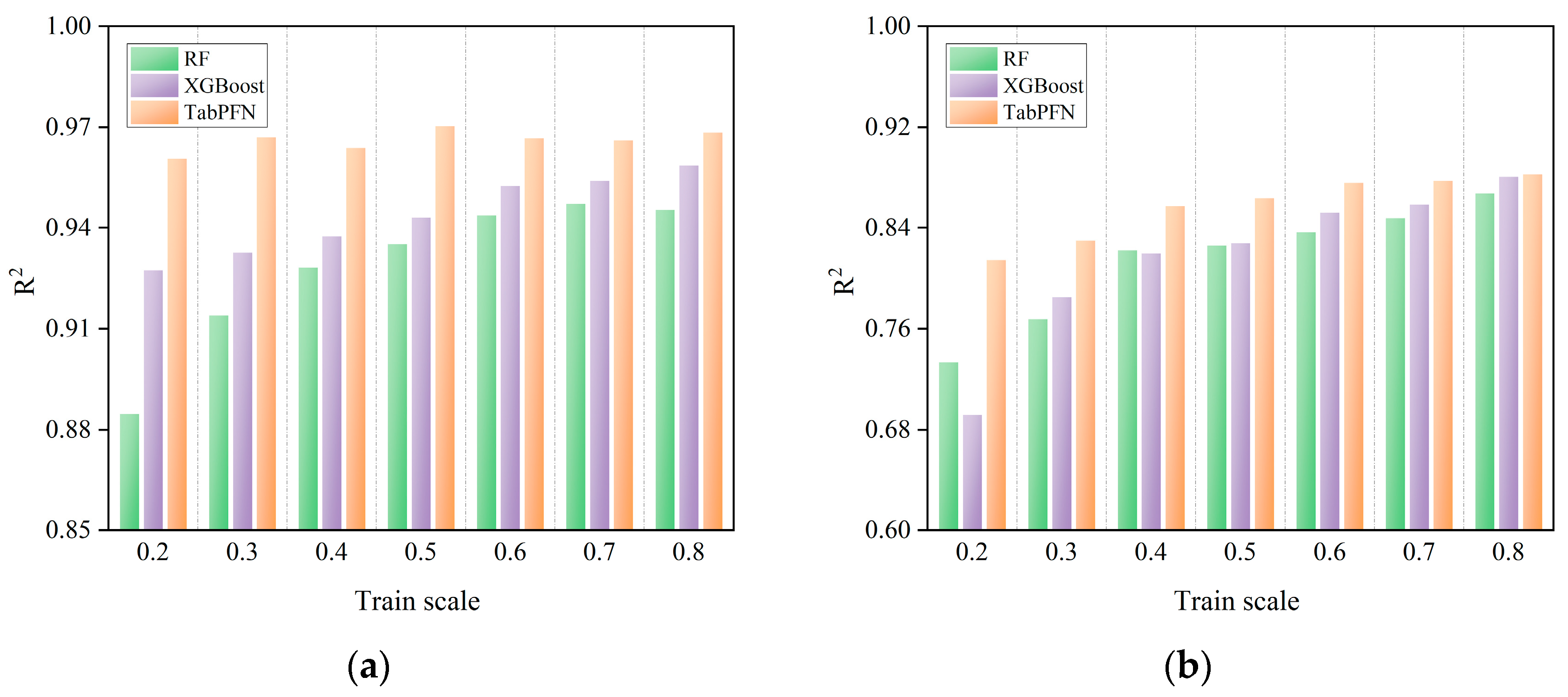
To further examine the prediction performance of each model under a smaller dataset, the R2 of three models were compared under different dataset sizes, with the results shown in Figure 12. As the number of training samples decreases, the R2 of TabPFN drops significantly less than that of the RF and XGBoost models. When the training set (55 samples) accounts for only 20% of the total dataset, the R2 of TabPFN is significantly higher than that of other models under both prediction scenarios. The results demonstrate that the TabPFN model exhibits stronger fitting ability and more stable prediction performance in the small-sample tasks. Furthermore, according to the variation trends of the remaining evaluation metrics as the training dataset size decreases (see Table A1 and Table A2 in Appendix B.1), the average values of the evaluation metrics for TabPFN are generally superior.
Figure 12.
Coefficient of determination for different training scales: (a) Coefficient of determination for bulk modulus; and (b) coefficient of determination for shear modulus.
Finally, the SHAP method was employed to quantify the contribution of each feature to the predicted values in the TabPFN model, so as to remedy TabPFN’s deficiency in model interpretability [50,51]. As revealed by the SHAP analysis (as shown in Appendix B.2), the ranking of feature importance for both bulk modulus and shear modulus predictions is as follows: temperature > crosslinking density > free volume. Meanwhile, the contribution direction of each feature is highly consistent with the evolution laws obtained from molecular simulations, which clearly uncovers the quantitative mechanism of how each feature affects the bulk modulus and shear modulus in the TabPFN model.
4. Conclusions
Based on the dataset generated from molecular simulations, we employed machine learning methods to predict the mechanical properties of GAP-BPS binders. The main conclusions are as follows.
(1) The combination of structural analyses, including radial distribution function, mean squared displacement, and free volume, with mechanical property calculations reveals that increasing temperature intensifies molecular thermal motion, leading to the disentanglement of interchain entanglements and enhanced structural fluidity, which in turn degrades the mechanical properties of the GAP-BPS binder. With increasing crosslinking rate, the degree of interchain entanglement first decreases and then increases. Meanwhile, as the crosslinking and curing process proceeds, small voids within the system decrease, while gaps larger than 2.8 Å become more abundant. Despite the combined effects of various structural factors, the mechanical properties of the GAP-BPS system still exhibit an upward trend with increasing crosslinking degree.
(2) Based on the dataset constructed from molecular simulations, ML models can accurately predict the simulated mechanical properties. Cross-validation results show that the average prediction performance of the TabPFN model is superior to that of the random forest and extreme gradient boosting models. Significance tests indicate that the TabPFN model performs significantly better than the random forest model in predicting bulk modulus. In other prediction tasks, TabPFN shows no significant advantage. When the dataset size is further reduced, the average cross-validation R2 values of all three models decrease to varying degrees. Among them, TabPFN exhibits the smallest decline, demonstrating its superior applicability to small-sample tabular data. Finally, the SHAP method is used to quantitatively analyze feature contributions in the TabPFN model, revealing that the influence trends of features are highly consistent with those observed in molecular simulation results.
In this study, molecular simulations provide a reliable dataset for machine learning. By employing machine learning techniques, computational cost and time are significantly reduced, enabling rapid prediction of the mechanical properties of crosslinked binders and analysis of each feature’s contributions. However, this work has limitations: the dataset is limited to simulated conditions and a narrow range of features, and the models have not been validated with experimental data. In future molecular design efforts, additional feature dimensions (such as curing parameters, external pressure, and multi-crosslinking systems) can be further incorporated. Leveraging the strong nonlinear fitting capability of machine learning, this work lays a solid foundation for inversely determining the optimal experimental formulation.
Supplementary Materials
The following supporting information can be downloaded at: https://www.mdpi.com/article/10.3390/coatings16040495/s1. Table S1: Mechanical property dataset of the GAP-BPS binder systems.
Author Contributions
Conceptualization, H.Z., W.Z., and X.T.; methodology, H.Z., W.Z., and X.T.; software, W.Z. and X.T.; validation, H.Z., P.C., and X.T.; formal analysis, H.Z. and W.Z.; investigation, H.Z. and W.Z.; resources, P.C.; data curation, H.Z. and W.Z.; writing—original draft preparation, H.Z. and W.Z.; writing—review and editing, W.Z., P.C., and B.Y.; visualization, H.Z.; supervision, P.C. and B.Y.; project administration, X.T.; funding acquisition, W.Z. and X.Z. All authors have read and agreed to the published version of the manuscript.
Funding
Innovation Research Foundation of National University of Defense Technology (23-ZZCX-ZZGC-01-10), National Natural Science Foundation of China Joint Fund Projects (U22B20138), and National University of Defense Technology College of Aerospace Science TuoTian Talent Fund (KY0505072515).
Institutional Review Board Statement
Not applicable.
Informed Consent Statement
Not applicable.
Data Availability Statement
Data will be made available on request.
Conflicts of Interest
The authors declare no conflicts of interest.
Appendix A
Appendix A.1
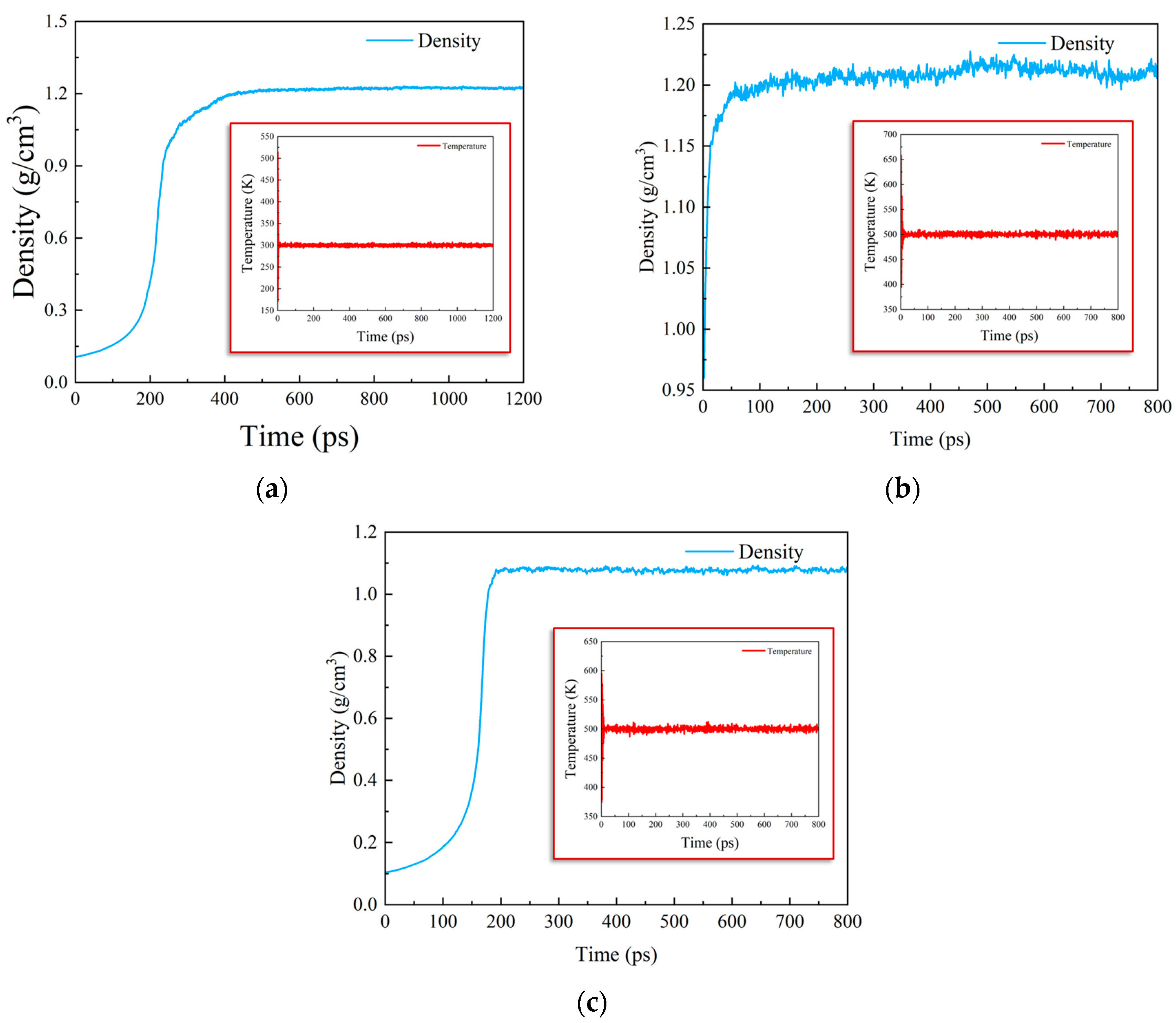
Figure A1.
Density–time curve and temperature–time curve of three models: (a) Model with 20% crosslinking degree at 300 K; (b) model with 80% crosslinking degree at 500 K; and (c) model with 20% crosslinking degree at 500 K.
Appendix A.2
Figure A2.
Free volume: (a) van der Waals surface free volume of the non-crosslinked model; (b) solvent surface free volume of the non-crosslinked model; (c) van der Waals surface free volume of the 80% crosslinking density model; and (d) solvent surface free volume of the 80% crosslinking density model.
Appendix B
Appendix B.1
Table A1.
Performance of each model for predicting the bulk modulus under different dataset scales.
Table A2.
Performance of each model for predicting the shear modulus under different dataset scales.
Appendix B.2
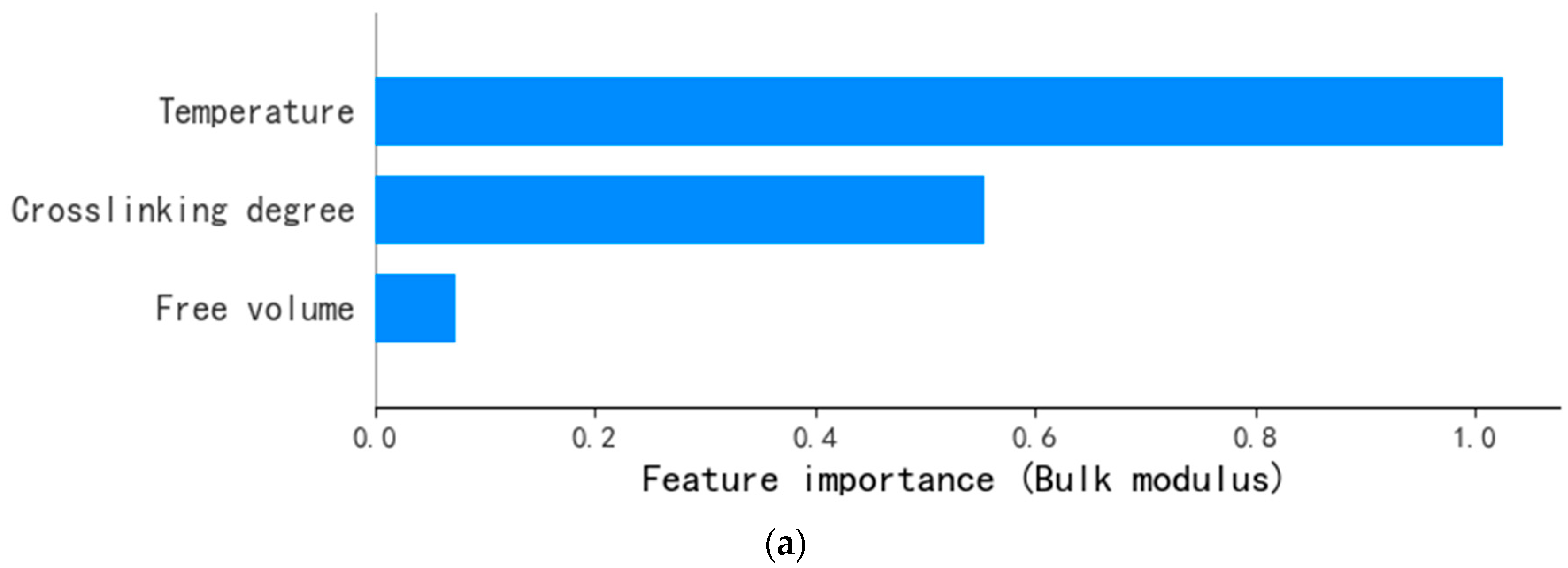
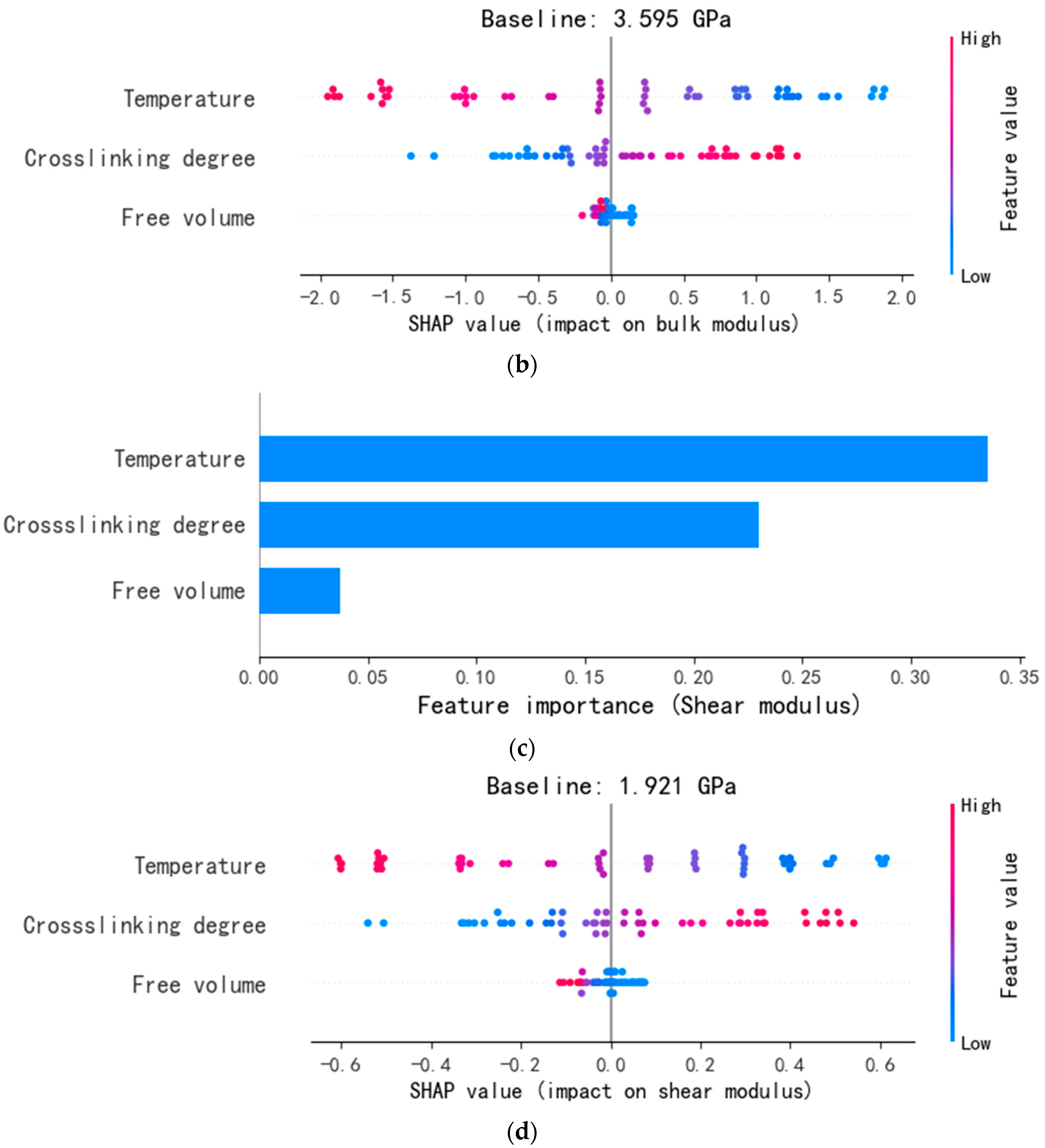
The SHAP approach was employed to analyze the importance of the features with respect to the predicted bulk modulus and shear modulus, with the results presented in Figure A3a,c. Within the range of parameters and values studied in this work, the importance of temperature (0.93 and 0.29, respectively) is higher than the crosslinking degree and free volume.
Additionally, to quantify the impact magnitude of features on the predicted values, the SHAP values of each sample in the test set (55 samples) were obtained, as shown in Figure A3b,d. Each point in the Figure represents a single feature of one sample, and the SHAP value indicates the influence of that feature on the predicted value for the sample. In Figure A3b,d, temperature has the most significant effect on bulk modulus and shear modulus: an increase in temperature leads to the softening of the binder system. Crosslinking degree is the second most influential factor, where a higher crosslinking degree enhances the rigidity of the system, while free volume exhibits the weakest impact.
Figure A3.
SHAP results of TabPFN: (a) feature importance of bulk modulus; (b) scatter plot of features with SHAP values of bulk modulus; (c) feature importance of shear modulus; and (d) scatter plot of features with SHAP values of shear modulus.
References
- Lysien, K.; Stolarczyk, A.; Jarosz, T. Solid Propellant Formulations: A Review of Recent Progress and Utilized Components. Materials 2021, 14, 6657. [Google Scholar] [CrossRef] [Scilit] [PubMed]
- Akbaş, A.; Aksoy, S.; Hasırcı, N. Effects of Thermal Ageing on the Properties and Lifetime Prediction of Hydroxyl-Terminated Polybutadiene. Polymer 1994, 35, 2568–2572. [Google Scholar] [CrossRef] [Scilit]
- Wu, W.; Chen, C.; Fu, X.; Ding, C.; Wang, G. The Correlation between Chemical Stability and Binder Network Structure in NEPE Propellant. Propellants Explos. Pyrotech. 2017, 42, 541–546. [Google Scholar] [CrossRef] [Scilit]
- Hu, W.; Qi, C.; Guo, X.; Pang, A.; Zhou, N.; Lu, J.; Tang, G.; Gan, L.; Huang, J. Alkynyl-Functionalization of Carbon Nanotubes to Promote Anchoring Potential in Glycidyl Azide Polymer-Based Binders via Huisgen Reaction for Solid Propellant Application. J. Polym. Res. 2021, 28, 126. [Google Scholar] [CrossRef] [Scilit]
- Qi, C.; Tang, G.; Guo, X.; Liu, C.; Pang, A.; Gan, L.; Huang, J. Network Regulation and Properties Optimization of Glycidyl Azide Polymer-based Materials as a Candidate of Solid Propellant Binder via Alternating the Functionality of Propargyl-terminated Polyether. J. Appl. Polym. Sci. 2019, 136, 48016. [Google Scholar] [CrossRef] [Scilit]
- Wang, J.; Yu, H.; Dong, L.; Ling, Z.; Zhang, H.; Zhang, A.; Meng, Z.; E, X.-t.-f. Enhanced Mechanical Properties of a GAP Propellant Utilizing Alcohol Amine and Its Interaction Mechanism. Ind. Eng. Chem. Res. 2025, 64, 12512–12520. [Google Scholar] [CrossRef] [Scilit]
- Ding, Y.; Hu, C.; Guo, X.; Che, Y.; Huang, J. Structure and Mechanical Properties of Novel Composites Based on Glycidyl Azide Polymer and Propargyl-terminated Polybutadiene as Potential Binder of Solid Propellant. J. Appl. Polym. Sci. 2013, 131, 40007. [Google Scholar] [CrossRef] [Scilit]
- Ou, Y.; Zhao, Q.; Zhang, W.; Zhang, B.; Yan, S.; Jiao, Q. Fabrication of Glycidyl Azide Polymer–Hydroxyl Terminated Polyether Semi-Interpenetrating Network via Synchronous Dual Curing System. Mater. Lett. 2019, 237, 152–155. [Google Scholar] [CrossRef] [Scilit]
- Shudo, Y.; Izumi, A.; Hagita, K.; Nakao, T.; Shibayama, M. Structure-Mechanical Property Relationships in Crosslinked Phenolic Resin Investigated by Molecular Dynamics Simulation. Polymer 2017, 116, 506–514. [Google Scholar] [CrossRef] [Scilit]
- Wang, J.; Luo, X.; Deng, S.; Mao, C.; Wang, J. Molecular Dynamics Study of Glass Transition and Uniaxial Mechanical Properties in PBT/Al Nanocomposites for Solid Propellants. Comput. Mater. Sci. 2025, 261, 114334. [Google Scholar] [CrossRef] [Scilit]
- Deng, S.; Wang, J.; Sun, Y.; Luo, G.; Huan, F.; Mao, C.; Wang, J. Effect of Bonding Agent on Interfacial Strength of AP/T313/PBT in PBT-Based Composite Solid Propellants by Molecular Dynamics Simulation. Mater. Today Commun. 2025, 45, 112291. [Google Scholar] [CrossRef] [Scilit]
- Liu, K.; Cheng, X. Investigation of PBT-AP Interactions in PBT-Based Solid Propellants: A Combined Density Functional Theory and Molecular Dynamics Study. Polymers 2025, 17, 1492. [Google Scholar] [CrossRef] [Scilit] [PubMed]
- Nguyen, D.; Tao, L.; Li, Y. Integration of Machine Learning and Coarse-Grained Molecular Simulations for Polymer Materials: Physical Understandings and Molecular Design. Front. Chem. 2022, 9, 820417. [Google Scholar] [CrossRef] [Scilit] [PubMed]
- Sarfarazi, S.; Shamass, R.; Rabi, M.; Abarkan, I.; Ferreira, F.P.V.; Tsavdaridis, K.D. Inverse Machine Learning for the Design of Perforated Beams: Parent Section and Material Prediction. Eng. Appl. Artif. Intell. 2026, 164, 113275. [Google Scholar] [CrossRef] [Scilit]
- Rabi, M.; Abarkan, I.; Sarfarazi, S.; Ferreira, F.P.V.; Alkherret, A.J. Automated Design and Optimization of Concrete Beams Reinforced with Stainless Steel. Struct. Concr. 2025, 26, e70332. [Google Scholar] [CrossRef] [Scilit]
- Yang, X.; Dang, J.; Zhang, C.; Li, J.; Niu, S.; Gao, H.; Liu, B.; Guo, Z.; Ma, H. Comparing the Catalytic Effect of Metals for Energetic Materials: Machine Learning Prediction of Adsorption Energies on Metals. Langmuir 2023, 40, 1087–1095. [Google Scholar] [CrossRef] [Scilit]
- Wang, R.; Pan, L.; Fan, M.; Wang, Y.; Yang, X.; Feng, X.; Qi, X.; Song, S.; Zhang, Q. Intelligent High-Energy Molecules Design for Solid Propellants via Interpretable Machine Learning and Latent Space Optimization. Chem. Eng. J. 2025, 528, 172198. [Google Scholar] [CrossRef] [Scilit]
- Bi, Y.; Wang, S.; Zhang, C.; Cong, H.; Qu, B.; Li, J.; Gao, W. Safety and Reliability Analysis of the Solid Propellant Casting Molding Process Based on FFTA and PSO-BPNN. Process Saf. Environ. Prot. 2022, 164, 528–538. [Google Scholar] [CrossRef] [Scilit]
- Pinheiro, M.; Ge, F.; Ferré, N.; Dral, P.O.; Barbatti, M. Choosing the Right Molecular Machine Learning Potential. Chem. Sci. 2021, 12, 14396–14413. [Google Scholar] [CrossRef] [Scilit]
- Noordhoek, K.; Bartel, C.J. Accelerating the Prediction of Inorganic Surfaces with Machine Learning Interatomic Potentials. Nanoscale 2024, 16, 6365–6382. [Google Scholar] [CrossRef] [Scilit]
- Butler, K.T.; Davies, D.W.; Cartwright, H.; Isayev, O.; Walsh, A. Machine Learning for Molecular and Materials Science. Nature 2018, 559, 547–555. [Google Scholar] [CrossRef] [Scilit] [PubMed]
- Bonneau, K.; Pasos-Trejo, A.S.; Plainer, M.; Sagresti, L.; Venturin, J.; Zaporozhets, I.; Caruso, A.; Rolando, E.; Guljas, A.; Klein, L.; et al. Breaking the Barriers of Molecular Dynamics with Deep-Learning: Opportunities, Pitfalls, and How to Navigate Them. WIREs Comput. Mol. Sci. 2026, 16, e70064. [Google Scholar] [CrossRef] [Scilit]
- Zhou, Z.; Wen, M.; Han, J.; Wang, X.; Chen, D.; Chu, Q. Machine Learning Potential-Driven Investigation of NEPE Matrix: Mechanical Properties and Failure Mechanism. J. Phys. Chem. B 2025, 129, 7631–7641. [Google Scholar] [CrossRef] [Scilit] [PubMed]
- Esteki, B.; Masoomi, M.; Moosazadeh, M.; Yoo, C. Data-Driven Prediction of Janus/Core–Shell Morphology in Polymer Particles: A Machine-Learning Approach. Langmuir 2023, 39, 4943–4958. [Google Scholar] [CrossRef] [Scilit]
- Meng, Y.; Lin, Y.; Zhang, A. Prediction and Explanation of Properties in Multicomponent Polyurethane Elastomers: Integrating Molecular Dynamics and Machine Learning. Macromolecules 2024, 57, 10912–10925. [Google Scholar] [CrossRef] [Scilit]
- Shuaib, S.E.; Riyapan, P.; Muangprathub, J. Formal Concept Views for Explainable Boosting: A Lattice-Theoretic Framework for Extreme Gradient Boosting and Gradient Boosting Models. Intell. Syst. Appl. 2025, 27, 200569. [Google Scholar] [CrossRef] [Scilit]
- Hollmann, N.; Müller, S.; Purucker, L.; Krishnakumar, A.; Körfer, M.; Hoo, S.B.; Schirrmeister, R.T.; Hutter, F. Accurate Predictions on Small Data with a Tabular Foundation Model. Nature 2025, 637, 319–326. [Google Scholar] [CrossRef] [Scilit]
- Shudo, Y.; Izumi, A.; Hagita, K.; Nakao, T.; Shibayama, M. Large-Scale Molecular Dynamics Simulation of Crosslinked Phenolic Resins Using Pseudo-Reaction Model. Polymer 2016, 103, 261–276. [Google Scholar] [CrossRef] [Scilit]
- Liao, H.; Lv, J.; Cao, P.; Cao, L.; Huang, R.; Tang, X. Molecular Dynamics Simulation of Interfacial Effects in PBT-Based Azide Propellants Under Tensile Deformation. Polymers 2025, 17, 885. [Google Scholar] [CrossRef] [Scilit]
- Dong, G.; Liu, H.; Deng, L.; Yu, H.; Zhou, X.; Tang, X.; Li, W. Study on the Interfacial Interaction between Ammonium Perchlorate and Hydroxyl-Terminated Polybutadiene in Solid Propellants by Molecular Dynamics Simulation. e-Polymers 2022, 22, 264–275. [Google Scholar] [CrossRef] [Scilit]
- Grinsztajn, L.; Oyallon, E.; Varoquaux, G. Why Do Tree-Based Models Still Outperform Deep Learning on Tabular Data? Adv. Neural Inf. Process. Syst. 2022, 35, 507–520. [Google Scholar]
- McElfresh, D.; Khandagale, S.; Valverde, J.; Prasad, C.V.; Ramakrishnan, G.; Goldblum, M.; White, C. When Do Neural Nets Outperform Boosted Trees on Tabular Data? Adv. Neural Inf. Process. Syst. 2023, 36, 76336–76369. [Google Scholar]
- Wang, F.; Cui, K.; Liu, J.; He, W.; Zhang, Q.; Zhang, W.; Wang, T. Prediction of Propellant Electrostatic Sensitivity Based on Small-Sample Machine Learning Models. Aerospace 2025, 12, 622. [Google Scholar] [CrossRef] [Scilit]
- Van den Broeck, G.; Lykov, A.; Schleich, M.; Suciu, D. On the Tractability of SHAP Explanations. Proc. AAAI Conf. Artif. Intell. 2021, 35, 6505–6513. [Google Scholar] [CrossRef] [Scilit]
- Lundberg, S.M.; Lee, S.I. A Unified Approach to Interpreting Model Predictions. Adv. Neural Inf. Process. Syst. 2017, 30, 4765–4774. [Google Scholar]
- Wang, R.; Li, Y.; Pan, L.; Fan, M.; Wang, Y.; Song, S.; Zhang, Q. Machine Learning-Driven Discovery of High-Performance Solid Propellants. ACS Appl. Energy Mater. 2025, 8, 6756–6767. [Google Scholar] [CrossRef] [Scilit]
- Jarosz, T.; Stolarczyk, A.; Wawrzkiewicz-Jalowiecka, A.; Pawlus, K.; Miszczyszyn, K. Glycidyl Azide Polymer and Its Derivatives-Versatile Binders for Explosives and Pyrotechnics: Tutorial Review of Recent Progress. Molecules 2019, 24, 4475. [Google Scholar] [CrossRef] [Scilit]
- Vo, T.S.; Vo, T.T.B.C.; Pham, N.D.; Lai, T.N.H. A Self-Healing Material Based on Microcapsules of Poly(Urea-Formaldehyde)/Bis-Propargyl-Succinate Containing in Polyurethane Matrix. J. Turk. Chem. Soc. Sect. A Chem. 2021, 8, 787–802. [Google Scholar] [CrossRef] [Scilit]
- Keicher, T.; Kuglstatter, W.; Eisele, S.; Wetzel, T.; Krause, H. Isocyanate-Free Curing of Glycidyl Azide Polymer (GAP) with Bis-Propargyl-Succinate (II). Propellants Explos. Pyrotech. 2009, 34, 210–217. [Google Scholar] [CrossRef] [Scilit]
- St-Charles, J.; Dubois, C. Thermal and Mechanical Properties of Triazole Cross-Linked Glycidyl Azide (GAP) and Azido Polycarbonate Networks. Propellants Explos. Pyrotech. 2020, 45, 1780–1789. [Google Scholar] [CrossRef] [Scilit]
- Ranganathan, S.I.; Ostoja-Starzewski, M. Universal Elastic Anisotropy Index. Phys. Rev. Lett. 2008, 101, 055504. [Google Scholar] [CrossRef] [Scilit]
- Jia, X.; Tang, L.; Liu, R.; Liao, H.; Cao, L.; Tang, X.; Cao, P. Analysis of Interfacial Adhesion Properties Between PBT Azide Propellant Matrix and Defective AP Fillers Using Molecular Dynamics Simulations. Polymers 2024, 16, 3497. [Google Scholar] [CrossRef] [Scilit] [PubMed]
- Li, Y.; Li, G.; Kong, L.; Zang, H. Experimental Measurement and Molecular Dynamics Simulation Analysis of Thermal Aging Performance in Composite Solid Propellants. Polym. Degrad. Stab. 2024, 225, 110812. [Google Scholar] [CrossRef] [Scilit]
- Zhang, L.; Chen, C.; Tang, X.; Zhou, X. Mesoscale Mechanics Investigation of Multi-Component Solid Propellant Systems. e-Polymers 2024, 24, 20240006. [Google Scholar] [CrossRef] [Scilit]
- Zhang, J.; Luo, P. Molecular-Level Insights into the Improvement Mechanism of the Bonding Agent MAPO on the Mechanical Properties of the AP/HTPB-TDI Cross-Linked System. Ind. Eng. Chem. Res. 2023, 62, 20689–20701. [Google Scholar] [CrossRef] [Scilit]
- Lv, L.; Yang, M.; Long, Y.; Chen, J. Molecular Dynamics Simulation of Structural and Mechanical Features of a Polymer-Bonded Explosive Interface under Tensile Deformation. Appl. Surf. Sci. 2021, 557, 149823. [Google Scholar] [CrossRef] [Scilit]
- Shi, L.; Ren, L.; Li, Y.; Fu, X.; Meng, S.; Wang, J. A Study of the Mechanical Properties of the NEPE Binders by Molecular Dynamic Simulations and Experiments. RSC Adv. 2022, 12, 16319–16328. [Google Scholar] [CrossRef] [Scilit]
- Han, Z.; Chen, A.; Li, Z.; Zhang, M.; Wang, Z.; Yang, L.; Gao, R.; Jia, Y.; Ji, G.; Lao, Z.; et al. Machine Learning-Based Design of Electrocatalytic Materials towards High-Energy Lithium||sulfur Batteries Development. Nat. Commun. 2024, 15, 8433. [Google Scholar] [CrossRef] [Scilit]
- Ersen, K.A.; Gürbüz, Ö.; Özcan, M. Evaluation of Polymerization Shrinkage of Bulk-Fill Resin Composites Using Microcomputed Tomography. Clin. Oral Investig. 2020, 24, 1687–1693. [Google Scholar] [CrossRef] [Scilit]
- Takefuji, Y. Beyond XGBoost and SHAP: Unveiling True Feature Importance. J. Hazard. Mater. 2025, 488, 137382. [Google Scholar] [CrossRef] [Scilit]
- Lamens, A.; Bajorath, J. Comparing Explanations of Molecular Machine Learning Models Generated with Different Methods for the Calculation of Shapley Values. Mol. Inform. 2025, 44, e202500067. [Google Scholar] [CrossRef] [Scilit]

Disclaimer/Publisher’s Note: The statements, opinions and data contained in all publications are solely those of the individual author(s) and contributor(s) and not of MDPI and/or the editor(s). MDPI and/or the editor(s) disclaim responsibility for any injury to people or property resulting from any ideas, methods, instructions or products referred to in the content. |
© 2026 by the authors. Licensee MDPI, Basel, Switzerland. This article is an open access article distributed under the terms and conditions of the Creative Commons Attribution (CC BY) license.