


Abstract
To improve the adhesion and tribological performance of diamond-like carbon (DLC) coatings on steel substrate, a Ti-enhanced plasma nitriding (PNTi) layer was formed on the surface of 38CrMoAl steel, followed by deposition of a Cr-based interlayer (mainly CrN) and then a W interlayer. Finally, a DLC coating was deposited, resulting in a novel PNTi/DLC coating. For comparison, a conventional PN/DLC coating was prepared under the same processing conditions. Optical microscopy, scanning electron microscopy (SEM), X-ray diffraction (XRD), Raman spectroscopy, hardness tests, and tribological experiments were performed to systematically investigate the effect of TiN-enriched PNTi supporting layer on the performances of the PNTi/DLC composite coating. The results show that comparing with PN/DLC composite coating, the critical load (Lc2) of the PNTi/DLC coating was increased from 28.89 N to 43.25 N—about a 50% enhancement. The microhardness was increased from 2650 HV0.05 to 4400 HV0.05 (corresponding to 28.2 GPa to 44.1 GPa). The friction coefficient was decreased from 0.28 to 0.11, about a 60% reduction, and the wear rate declined more than 40%, from 4.81 × 10⁻⁶ to 2.90 × 10⁻⁶ mm3·N−1·m−1. The introduction of Ti promoted the in situ formation of TiN phase in the nitrided layer, which significantly improved the compactness of the nitrided layer and the adhesion at the film–substrate interface. Consequently, the PNTi/DLC composite coating exhibited excellent wear resistance and friction stability under high-load and severe tribological conditions. This study provides a promising perspective for engineering applications of steel-based DLC coatings in harsh service environments.
1. Introduction
38CrMoAl steel is widely used in key components such as petroleum drill bits due to its excellent combined performances, including strength and toughness. Its surface is usually strengthened by plasma nitriding to meet requirements under harsh conditions [1,2]. However, under high loads and severe abrasive environments, a single nitrided layer tends to fail prematurely due to wear or corrosion, which makes it difficult for it to have a long service life [3]. Therefore, developing efficient composite surface-modification technologies has attracted extensive research interest.
Diamond-like carbon (DLC) coating, a kind of amorphous carbon-based film, possesses extremely high hardness, ultra-low friction coefficient, and excellent wear and corrosion resistance [4,5]. These properties endow DLC coatings with great potential for reinforcing metallic substrates and enhancing the service performance of 38CrMoAl steel under extreme conditions. Nevertheless, directly depositing DLC onto steel substrates faces two critical challenges. First, the intrinsic high residual stress of DLC easily induces cracks [6]. Second, the substantial disparities in the elastic modulus and coefficient of thermal expansion (CTE) between DLC and steel are detrimental. The former leads to interfacial stress concentration under loading, while the latter introduces substantial thermal stress during the cooling process. These stresses act synergistically and can easily exceed the interfacial adhesion strength, leading to coating spallation and the characteristic “eggshell effect” [7]. These problems severely restrict the engineering applications of DLC coatings on steel.
To overcome these adhesion failures caused by mechanical mismatch, constructing a graded supporting layer between the steel substrate and the DLC topcoat is considered to be an effective strategy. Among the available techniques, plasma nitriding has received significant attention. A well-developed nitrided case, comprising a compound (white) layer and a diffusion zone, can provide a hardened and continuous mechanical foundation for subsequent coating deposition [8]. However, the compound layer produced by conventional plasma nitriding (consisting of ε-Fe2–3N and γ′-Fe4N phases) often lacks the microstructural integrity required for smooth load transfer. Therefore, improving the density and microstructural integrity of this nitrided interlayer is crucial for maximizing the load-bearing capacity of the duplex system.
To suppress porosity and enhance the compactness of the compound layer during plasma nitriding, introducing active titanium into the plasma atmosphere has proven to be effective [9]. Under strong ion bombardment, a certain amount of active nitrogen, iron, and titanium ions are formed and sputtered onto the surface of the samples. Because the affinity of titanium and nitrogen ions is much greater than that of iron and nitrogen, nitrogen-titanium compounds (TiN) distributed dispersedly will be preferentially formed, thus inhibiting or slowing down the formation of FexN and significantly reducing the thickness of the compound layer [9,10]. Owing to the high thermodynamic stability of TiN and its strong affinity for nitrogen, these in situ formed TiN precipitates alters the growth kinetics of the iron nitrides layer and suppresses the coalescence of nitrogen atoms at grain boundaries—the primary cause of porosity [11]. As a result, the Ti-modified layer possesses a refined and dense microstructure. Such a layer provides an ideal, defect-tolerant, and mechanically graded support for subsequent DLC deposition, thereby effectively mitigating interfacial mismatch and adhesion issues. Previous studies on duplex plasma nitriding/DLC treatments [8,10,12,13] have improved surface properties but still suffer from the porous and brittle compound layer. Therefore, an integrated approach that simultaneously enhances the compactness of the nitrided support layer and avoids extra interlayer steps is highly desirable for high-load engineering applications. Although Ti-enhanced plasma nitriding has been reported to improve the surface properties of steels [9], its systematic application as a support layer for DLC coatings has rarely been explored.
In this work, we present a novel duplex treatment combining a Ti-enhanced plasma nitrided (PNTi) support layer with a Cr/W interlayer system and a DLC topcoat on 38CrMoAl steel. The objective is to systematically investigate the effect of the Ti-modified nitrided layer on the microstructure, interfacial adhesion, and tribological performance of the DLC coating, and to clarify the strengthening mechanisms. This study provides new insights into the design of high-performance DLC coatings on steel substrates.
2. Materials and Methods
Specimens were prepared from quenched-and-tempered 38CrMoAl steel. The chemical composition (in mass fractions) was as follows: 0.35%–0.42% C, 1.35%–1.65% Cr, 0.15%–0.25% Mo, 0.30%–0.60% Mn, 0.70%–1.10% Al, and the balance Fe. The samples were machined into dimensions of 10 mm × 10 mm × 5 mm, mechanically ground and polished, ultrasonically cleaned in anhydrous ethanol, and dried for subsequent treatment.
Novel PNTi/DLC composite coating was developed by the following processes as shown in Figure 1. First, a Ti-enhanced plasma-nitrided layer was produced on the surface of the 38CrMoAl steel to act as a supporting layer. Subsequently, Cr/W interlayers were deposited, followed by magnetron-sputtered DLC coating. For comparison, a reference composite coating (PN/DLC) was prepared under the same processing conditions, except that the substrate was plasma nitrided without Ti addition.
Figure 1.
The schematic process of PNTi/DLC composite coating.
Plasma nitriding was carried out in a direct-current plasma nitriding furnace. The chamber was first evacuated to about 15 Pa, and the specimen surfaces were sputter-cleaned in pure hydrogen atmosphere for 30 min. Nitriding was then performed in a gas mixture of 75% H2–25% N2 at 500 °C for 4 h under a working pressure of 450 Pa. To optimize the compound-layer structure, a small amount of sponge titanium was placed around the samples during nitriding to promote the in situ formation of TiN and enhance the uniformity and compactness of the nitrided layer. The corresponding process parameters are listed in Table 1. The nitriding temperature of 500 °C and duration of 4 h, together with the Ti amount of 0.8 g, were not arbitrarily chosen but were determined through our previous systematic optimization study on Ti-enhanced plasma nitriding for steel substrates [9]. That study demonstrated that these conditions yield the most pronounced improvement in the compactness and hardness of the nitrided layer without destabilizing the plasma discharge. These optimized parameters were kept constant in the present work to isolate the effect of Ti addition, allowing a direct comparison between the PN and PNTi support layers under otherwise identical conditions.
Table 1.
Parameters for plasma nitriding.
Based on the as-prepared Ti-modified plasma-nitrided specimens, the samples were mounted on the rotating holder of a multifunctional coating unit. The chamber was equipped with two unbalanced magnetron sputtering sources fitted with Cr (99.5%) and W (99.5%) targets, respectively. High-purity CH4 (99.95%) was used as the carbon precursor for DLC deposition, and high-purity Ar and N2 (both 99.99%) were used as the working gases. The chamber was first evacuated. When the pressure was decreased below 5 Pa, the turbomolecular pump and the heater were switched on. After the chamber pressure reached 2 × 10⁻³ Pa, the specimen surfaces were cleaned by Ar glow-discharge plasma. A Cr interlayer was first deposited using a pure Cr target (99.5%) by magnetron sputtering. During this process, the Cr layer was in situ converted to CrN in the N2-containing atmosphere. Subsequently, a pure W interlayer was deposited using a pure W target (99.5%) to provide a gradient hardness transition. Finally, the DLC top layer was deposited to form a composite coating. The detailed deposition parameters are listed in Table 2. The DLC deposition parameters, including the Cr/W interlayer design, were adopted from an established industrial process provided by our collaborating company, which has been validated as optimal for DLC coating production. No systematic optimization of these parameters was performed in this study, as the focus is on the effect of the PNTi support layer.
Table 2.
Parameters for DLC deposition.
The cross-sectional microstructures of the samples were observed using a DMI-3000M optical microscope (Leica Microsystems, Wetzlar, Germany)and a JSM-IT100 scanning electron microscope (SEM) (Carl Zeiss AG, Oberkochen, Germany). Phase composition was identified by X-ray diffraction (XRD) using a D/max2500 diffractometer (Rigaku Corporation, Tokyo, Japan) with Cu-Kα radiation. The cross-sectional microhardness profile was measured using an HXD-1000 TMC/LCD Vickers microhardness tester (Shanghai Hengyi Electronic Testing Instrument Co., Ltd., Shanghai, China) under a load of 50 g with a dwell time of 15 s. Three indentations were performed at each depth location, and the average value was reported. The spacing between adjacent indentations was maintained at 1.5 times the indentation diagonal length to avoid mutual influence of strain fields. Surface hardness was determined using a Nano Indenter G200(KLA Corporation, Milpitas, CA, USA) system, with the penetration depth controlled to within 1/10 of the coating thickness. The adhesion strength of the coatings was evaluated by scratch testing performed on an MFT-4000 multi-functional tester (Lanzhou Huahui Instrument Technology Co., Ltd., Lanzhou, China), using a diamond indenter with a tip radius of 200 µm under a progressively increasing load at a rate of 30 N·min−1; the critical load corresponding to coating spallation was recorded. Wear resistance was assessed using a ball-on-disk tribometer (MFT-4000) under dry-sliding conditions with a 3 mm-diameter SiC hard-alloy ball as the counterpart, a linear speed of 220 mm·min−1, a normal load of 20 N, and a test duration of 30 min. After testing, the wear tracks were characterized using a laser confocal microscope to analyze the three-dimensional morphology and wear mechanisms. The wear volume V was determined from the 3D topography acquired by the laser confocal microscope (Nanjing Kaishi Technology Co., Ltd., Nanjing, China), with the instrument’s software integrating the cross-sectional area along the wear track length. The wear rate K was calculated according to the formula K = V/(F·L), where V is the wear volume (mm3), F is the applied normal load (N), and L is the total sliding distance (m).
3. Results and Discussions
3.1. Microstructure and Composition Analysis
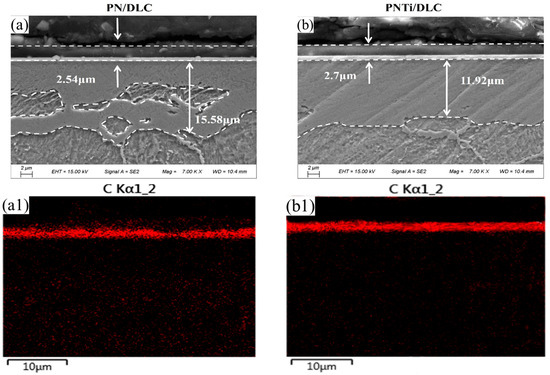
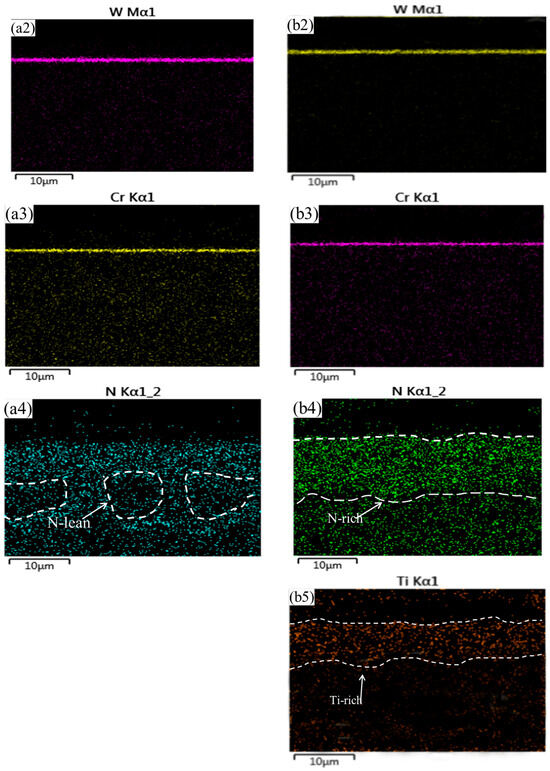
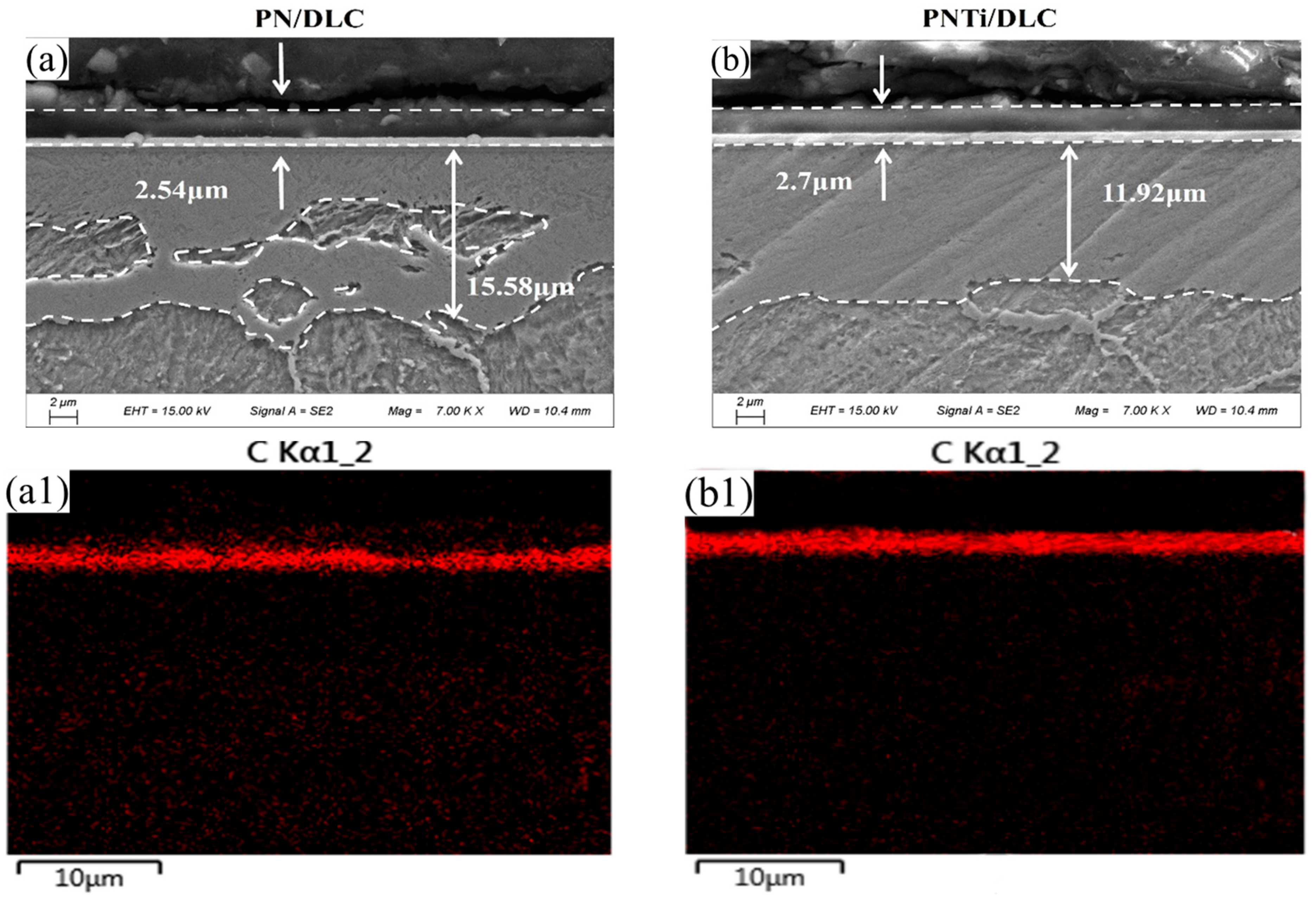
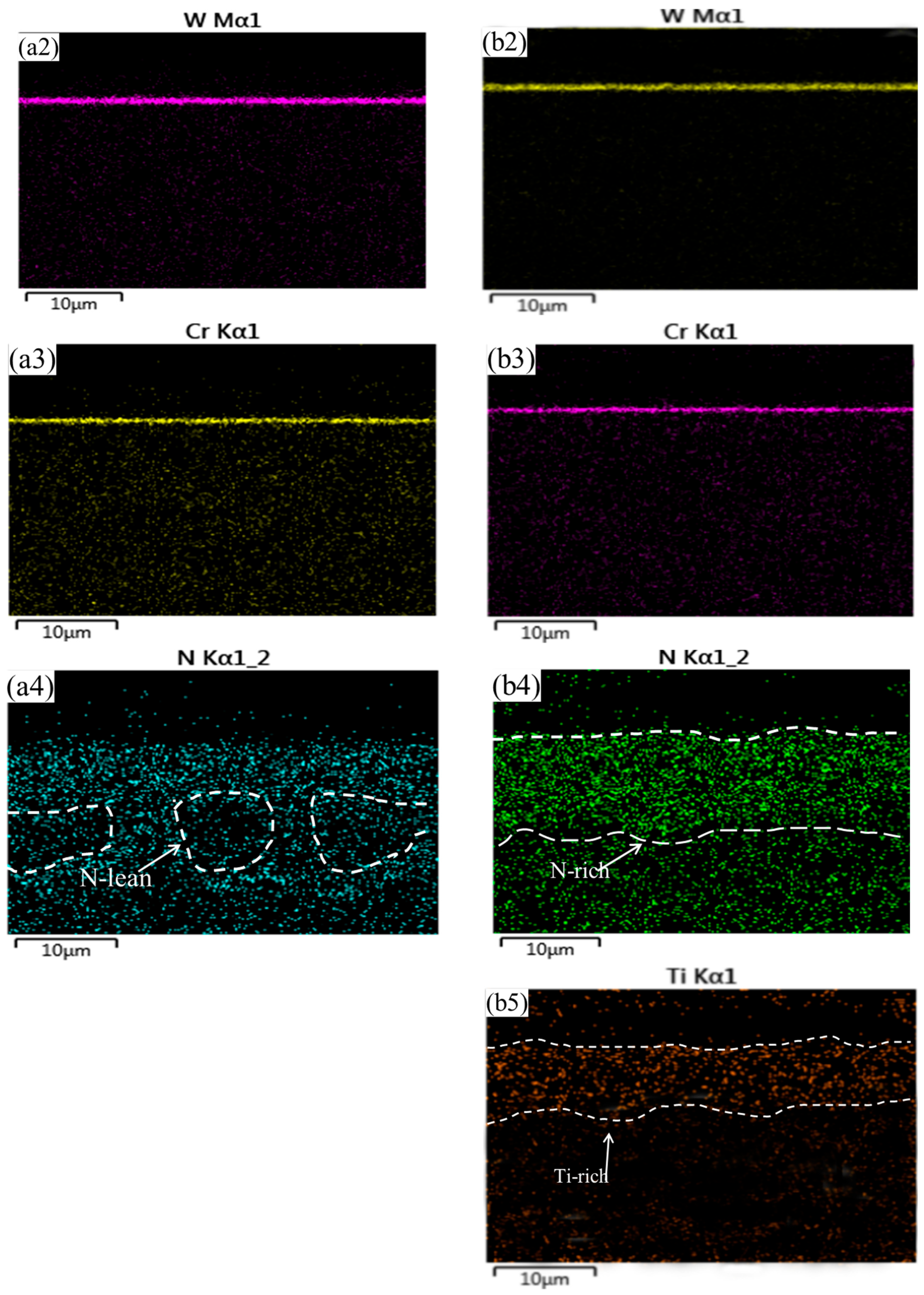
Figure 2 presents the cross-sectional SEM morphologies and corresponding EDS elemental maps of the PN/DLC and PNTi/DLC composite coatings. It can be seen that although both composite coatings share a similar microstructure—comprising an outer DLC topcoat, W and Cr-based (typically as CrN) interlayers, and a plasma-nitrided supporting layer—the PNTi/DLC composite coating shows much better microstructural integrity, and homogeneity, and with a thicker DLC coating of 2.7 µm (vs. 2.54 µm) and a thinner compound layer of 11.92 µm (vs. 15.58 µm). The slightly increased DLC thickness on the PNTi-treated sample is attributed to the enhanced interfacial adhesion and more uniform surface condition of the PNTi layer, which promotes more efficient deposition of the overlying DLC coating.
Figure 2.
Cross-sectional analysis of the composite coatings: (a) SEM micrograph of the PN/DLC sample and (a1–a4) the corresponding EDS elemental overlay maps; (b) SEM micrograph of the PNTi/DLC sample and (b1–b5) the corresponding EDS elemental overlay maps.
EDS mapping (Figure 2(a1–a4)) also corroborates the structural non-uniformity: the C content in the coating and N distribution in the PN compound layer is notably inhomogeneous. This structurally weak and inhomogeneous layer leads to uneven stress distribution and reduces load-bearing capacity.
In contrast, the PNTi/DLC sample exhibits a much uniform C content in the coating and homogeneous N distribution in the PNTi compound layer. This improvement is supposed to associate with the formation of TiN particles during PNTi, which is suggested by the spatial overlap of Ti and N signals in the EDS maps and is consistent with the TiN peaks in the XRD patterns shown in Section 3.2. Owing to the strong affinity of Ti for N, dispersed TiN particles may modify the formation and growth of iron nitrides and reduce pore formation related to local nitrogen supersaturation, thereby promoting microstructural refinement and yielding a denser compound layer with fewer defects [9,11]. Overall, the denser PNTi layer improves the load-bearing capability of the underlying Cr/W layer, thereby enhancing load transfer to the DLC topcoat [14].
3.2. Phase Structure Analysis
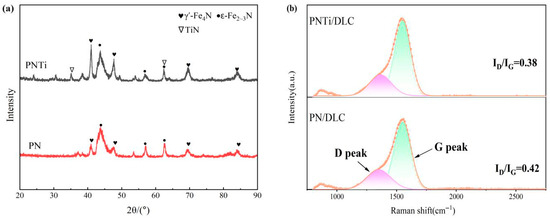
As shown in Figure 3a, the XRD patterns of the PN and PNTi samples reveal the phase composition of the nitrided layers. After conventional plasma nitriding, the surface nitriding layer of the 38CrMoAl steel primarily consists of a compound layer of ε-Fe2–3N and γ′-Fe4N. In contrast, the PNTi sample not only retains the peaks of iron nitrides, but also exhibits several new diffraction peaks. The peaks at approximately 36.7° and 61.8°, which can be indexed to the (111) and (220) planes of TiN, respectively, are clearly visible, indicating TiN phase was formed during the PNTi process.
Figure 3.
Phase and bonding structure analysis of the coatings: (a) XRD patterns of the PN and PNTi layers; (b) Raman spectra of the PN/DLC and PNTi/DLC composite coatings.
The structural characteristics of the DLC coatings on the PN/DLC and PNTi/DLC samples were characterized by Raman spectroscopy, as shown in Figure 3b. Two typical Raman peaks were observed at approximately 1350 cm−1 and 1545 cm−1, corresponding to the D and G bands, respectively. The D band is related to the breathing vibration of sp2 carbon rings, whereas the G band corresponds to the stretching vibration of sp2 carbon bonds [15], confirming that both coatings exhibit the characteristics of amorphous carbon. It is noteworthy that the ID/IG ratio decreased from 0.42 for the PN/DLC coating to 0.38 for the PNTi/DLC coating, indicating a reduction in the size and quantity of sp2 clusters and an increase in the sp3 bonding fraction.
3.3. Hardness Distribution
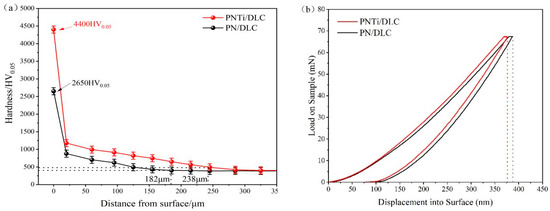
Figure 4a shows the cross-sectional microhardness profiles of the PN/DLC and PNTi/DLC composite coatings. Both display a typical gradient feature of “cross-sectional hardness gradually decreasing with depth”. The PN/DLC coating exhibits a surface microhardness of 2650 HV0.05 and an effective case depth of approximately 182 µm, while the PNTi/DLC sample exhibits a much higher surface hardness of 4400 HV0.05, and a much thicker effective hardened layer of approximately 238 µm.
Figure 4.
Mechanical property characterization of the composite coatings: (a) cross-sectional microhardness profiles; (b) nanoindentation load–displacement curves.
Figure 4b presents representative nanoindentation load–displacement curves obtained on the surface of the coatings. Both coatings show smooth loading and unloading branches. The maximum load is about 68 mN and the corresponding maximum penetration depth is about 380–400 nm. After unloading, the curves do not return to zero depth, confirming that the deformation includes both plastic and elastic components. The two curves have similar overall shapes; however, at the same maximum load, the PNTi/DLC coating reaches a slightly smaller penetration depth than the PN/DLC coating.
Hardness (H) and reduced elastic modulus (E) were determined using the Oliver–Pharr method [16]. The resulting mechanical parameters are listed in Table 3. The PNTi/DLC coating exhibits higher hardness (44.1 GPa vs. 28.2 GPa), higher H/E ratio (0.48 vs. 0.36), and higher H3/E2 ratio (0.935 vs. 0.202) than the PN/DLC coating.
Table 3.
Comparison of nanoindentation parameters between PN/DLC and PNTi/DLC.
3.4. Adhesion Strength
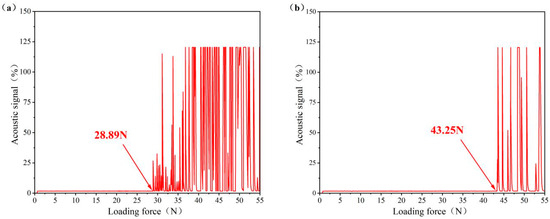
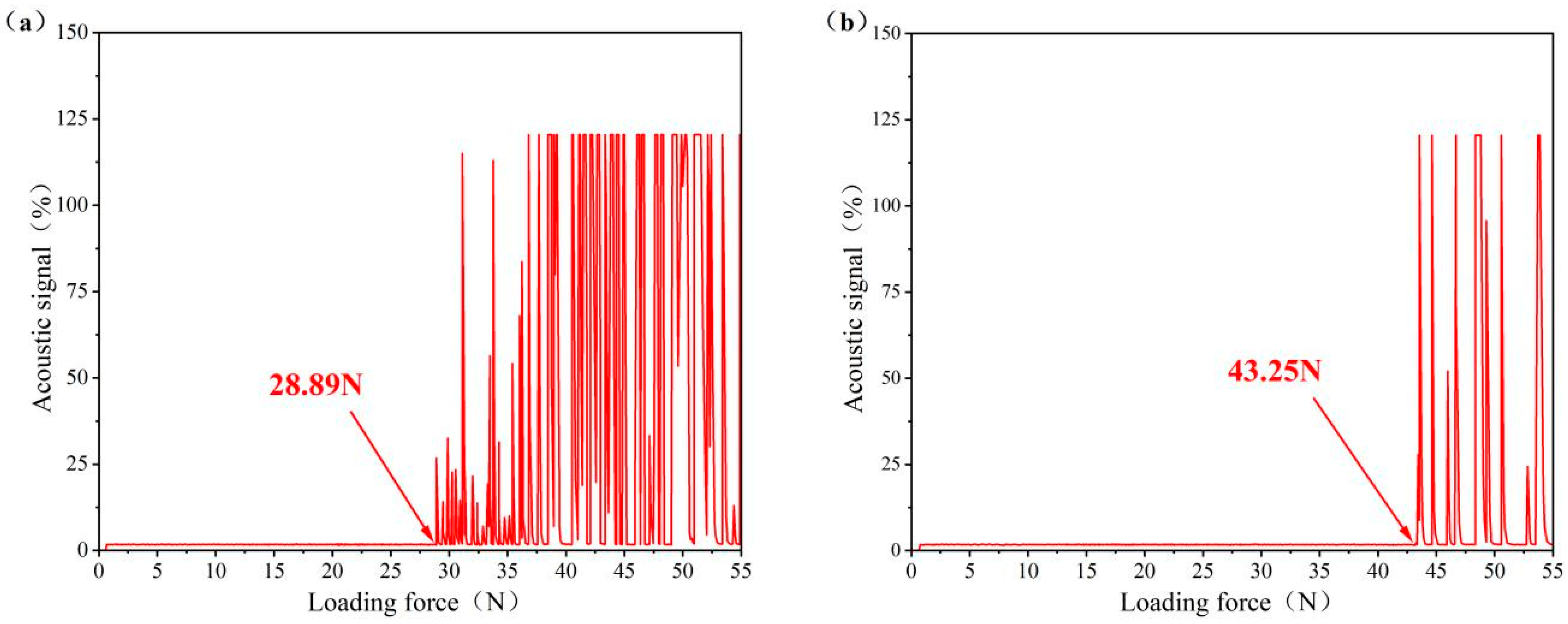
Figure 5 shows the acoustic emission (AE) signals recorded during scratch tests on the PN/DLC and PNTi/DLC coatings. For both coatings, the AE signal exhibits pronounced rises with increasing normal load, indicating the occurrence and accumulation of damage events, such as cracking and subsequent spallation. The critical load for coating failure (Lc2) is 28.89 N for PN/DLC (Figure 5a) and increases to 43.25 N for PNTi/DLC (Figure 5b), corresponding to an increase of about 50%. The higher Lc2 indicates improved scratch resistance of the coating stack after the PNTi treatment.
Figure 5.
Curves of acoustic emission signals as a function of the applied load during the scratch test: (a) PN/DLC sample; (b) PNTi/DLC sample.
3.5. Tribological Performance
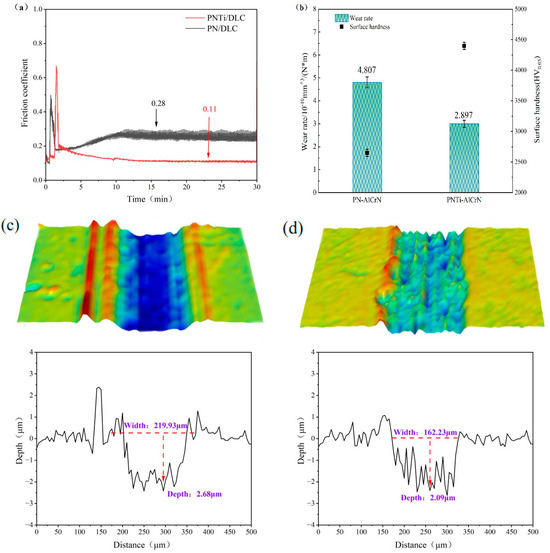
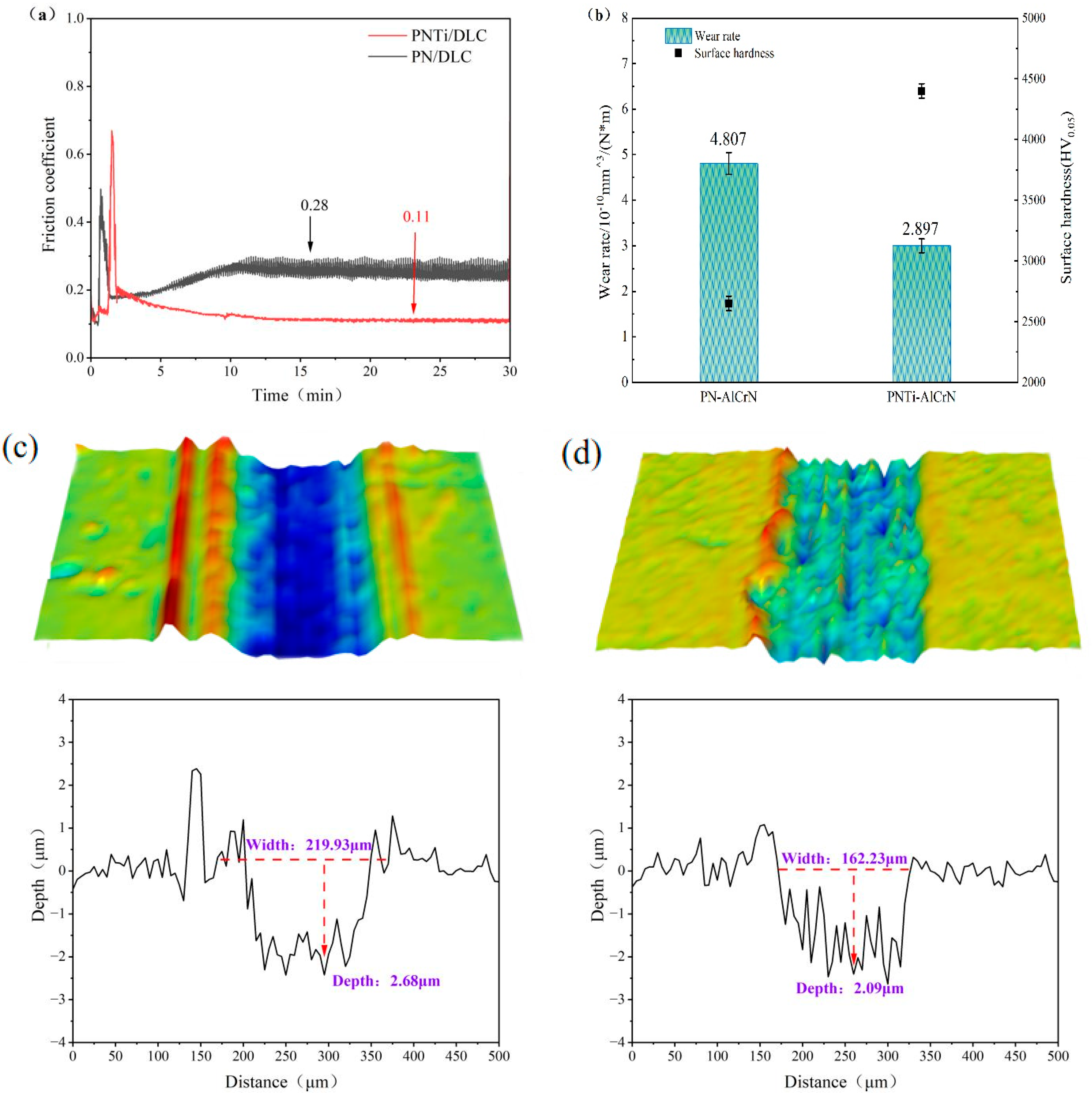
Figure 6a shows the friction coefficient curves of the PN/DLC and PNTi/DLC coatings during dry sliding against SiC ball under 20 N for 60 min. The PN/DLC coating exhibits a rapid increase in friction coefficient during the running-in period, which lasts approximately 12 min, followed by a steady-state value of 0.28 with large fluctuations. In contrast, the PNTi/DLC coating shows a lower and considerably more stable friction coefficient, with a short running-in stage of approximately 5 min, reaching a steady-state value of 0.11.
Figure 6.
Tribological properties of the composite coatings: (a) friction coefficient curves; (b) relationship between wear rate and surface hardness; (c) 3D morphology and cross-sectional profile of the wear track on the PN/DLC coating; (d) 3D morphology and cross-sectional profile of the wear track on the PNTi/DLC coating.
Specific wear rates are compared in Figure 6b. The PN/DLC coating exhibits a wear rate of 4.81 × 10⁻⁶ mm3·N−1·m−1, whereas the PNTi/DLC coating shows a reduced value of 2.90 × 10⁻⁶ mm3·N−1·m−1 (a decrease of 40%).
Three-dimensional optical micrographs and cross-sectional profiles of the wear tracks are presented in Figure 6c,d. The PN/DLC coating displays a wide wear track (219 µm) with rough morphology, deep grooves, and clear evidence of coating spallation, indicating that abrasive wear accompanied by localized coating delamination is the dominant mechanism. The PNTi/DLC coating exhibits a narrower (162 µm) and shallower (2.09 µm) wear track with a smooth appearance, indicating mild abrasive wear as the dominant mechanism.
4. Discussion
Compared with PN/DLC coating, the improved performances of the PNTi/DLC coating is mainly due to the effect of Ti modification on the nitrided layer, which enhances interfacial continuity and promotes a higher-quality DLC topcoat.
First, at the nitride/interlayer interface, the introduction of Ti fundamentally alters the phase composition and surface state of the compound layer. As illustrated by the XRD patterns (Figure 3a), the PNTi process promotes the formation of the γ′-Fe4N phase with a face-centered cubic (fcc) lattice, which may offer improved crystallographic compatibility with the subsequently deposited CrN layer compared to the hexagonal ε-Fe2–3N phase, potentially contributing to the enhanced interfacial adhesion [17]. This improved lattice matching minimizes interfacial strain energy, thereby promoting a more coherent and stable interface. In addition, the modified surface morphology of the PNTi layer is conducive to an increased surface free energy. According to classical nucleation theory, a higher surface energy significantly reduces the critical energy barrier for nucleation of the depositing species [18]. Consequently, during the magnetron sputtering of the Cr (CrN) interlayer, the PNTi compound layer facilitates a substantially higher density of nucleation sites. This leads to the rapid formation of a continuous, fine-grained, and highly dense CrN layer, as indicated by the sharp interface in Figure 2b. Furthermore, this CrN layer achieves excellent mechanical interlocking with the underlying nitrided layer. This enhanced load-bearing capacity of the supporting layer is responsible for the observed 50% increase in critical load (Lc2 = 43.3 N vs. 28.9 N).
Second, the optimized multilayer support stack exerts a defining influence on the growth and final structure of the DLC topcoat. The dispersed TiN particles act as strengthening phases within the PNTi layer, contributing to its enhanced hardness and load-bearing capacity via precipitation strengthening and grain refinement. This is consistent with our previous systematic study on Ti-enhanced plasma nitriding [9], which demonstrated that TiN formation significantly improves the mechanical properties of the nitrided layer. Compared to the conventional PN, the PNTi provides higher hardness and improved load-bearing capability (4400 vs. 2650 HV0.05, Figure 4a). This improvement helps maintain the continuity of the W/Cr (CrN) interlayers and reduces interfacial defects. As a result, during DLC deposition, the mechanically stronger support can reduce local compliance and energy dissipation associated with deformation, which is conducive to forming a denser DLC film. The enhanced confinement promotes sub-surface implantation and the development of localized compressive stress—conditions that thermodynamically and kinetically favor the stabilization of metastable sp3-hybridized carbon over the formation of graphitic (sp2) clusters [19]. This mechanism is directly corroborated by the Raman spectra (Figure 3b), which show a lower ID/IG ratio for the PNTi/DLC coating, indicating a reduction in sp2 cluster size and an increased sp3-bond fraction. A higher sp3 content is known to enhance the hardness and elastic modulus of DLC coatings, as the tetrahedral bonding network restricts atomic slip and plastic deformation [4]. This nanostructural evolution is the fundamental cause of the remarkable increase in DLC nanohardness from 28.2 GPa (PN/DLC) to 44.1 GPa (PNTi/DLC) (Table 3). The higher H3/E2 value further demonstrates the coating’s superior resistance to plastic deformation and crack propagation.
Under tribological stress, the combined effect of the multilayer structure accounts for the improved performance. First, the enhanced interfacial adhesion prevents coating delamination. Second, the hard and load-bearing PNTi/CrN/W support layer effectively suppresses substrate deformation, which helps to maintain the integrity of the DLC topcoat. Finally, the DLC coating itself, with its higher sp3 content, provides a low-shear-strength surface with high abrasion resistance. As a result, the PNTi/DLC coating shows a stable, low friction coefficient and a significantly lower wear rate. The wear mechanism is thus altered from severe grooving and spallation (as seen in PN/DLC) to mild abrasion (Figure 6c,d).
Compared with other duplex treatments reported in the literature for DLC coatings on steel, the PNTi/DLC approach offers several distinct advantages. Conventional plasma nitriding followed by DLC deposition has been widely studied on various steel substrates, such as low-carbon steel [12] and 316 L stainless steel [13]. While these studies demonstrate improved surface properties, the porous and brittle nature of the conventional ε-Fe2–3N/γ′-Fe4N compound layer remains a limiting factor for achieving optimal interfacial adhesion and load-bearing capacity. In contrast, the present PNTi process incorporates Ti during plasma nitriding, leading to the in situ formation of TiN particles that refine the microstructure and enhance the compactness of the nitrided layer (Figure 2b). This TiN-enriched support layer not only exhibits significantly higher hardness (4400 HV0.05 vs. 2650 HV0.05) but also promotes the formation of γ′-Fe4N, which offers better crystallographic compatibility with the subsequently deposited CrN interlayer. The integration of a Cr/W gradient interlayer further facilitates a smooth hardness transition. As a result, the PNTi/DLC coating achieves superior adhesion (Lc2 = 43.3 N, ~50% higher than PN/DLC) and excellent tribological performance (COF = 0.11, wear rate reduced by 40%), outperforming conventional PN/DLC duplex systems [8,12,13]. These advantages highlight the potential of Ti-enhanced plasma nitriding as an effective support layer strategy for high-performance DLC coatings on steel substrates.
5. Conclusions
To address the limited adhesion and tribological performance of diamond-like carbon (DLC) coatings on steel, a Ti-enhanced plasma nitriding treatment was applied to 38CrMoAl steel to form a TiN-containing nitrided layer serving as a load-supporting layer. Cr/W interlayers were then deposited as a transition layer, followed by magnetron-sputtered DLC to obtain the PNTi/DLC composite coating. The main conclusions are summarized as follows.
- (1)
- A Ti-modified plasma nitriding (PNTi) layer was primarily employed as a supporting layer to form PNTi/DLC composite coating with enhanced performances.
- (2)
- Compared with PN/DLC composite coating, the critical load (Lc2) of the PNTi/DLC coating increased from 28.89 N to 43.25 N, an improvement of about 50%, due to the in situ formation of TiN phase in the PNTi layer, which significantly improved the compactness of the nitrided layer and the adhesion at the film–substrate interface.
- (3)
- Compared with PN/DLC composite coating, the microhardness of PNTi/DLC coating increased from 2650 HV0.05 to 4400 HV0.05, and the nano hardness increased from 28.2 GPa to 44.1 GPa.
- (4)
- Compared with PN/DLC composite coating, PNTi/DLC coating exhibited excellent wear resistance and friction stability under high-load and severe tribological conditions, with the friction coefficient decreasing from 0.28 to 0.11, the wear rate decreasing from 4.81 × 10⁻⁶ to 2.90 × 10⁻⁶ mm3·N−1·m−1.
- (5)
- This study provides a promising perspective for engineering applications of steel-based DLC coatings in harsh service environments.
Author Contributions
L.Z.: Methodology, Investigation, Formal analysis, Writing—Original Draft. J.W.: Conceptualization, Resources, Supervision. L.Q.: Resources, Data Curation. J.H.: Conceptualization, Supervision, Project administration, Funding acquisition, Writing—Review and Editing. X.A.: Investigation. X.L. (Xilang Liu): Validation, Data Curation. D.W.: Resources, Visualization. X.L. (Xiangkui Liu): Formal analysis. K.W.: Writing—Review and Editing. All authors have read and agreed to the published version of the manuscript.
Funding
The authors give thanks to National Natural Science Foundation of China (52574427, 21978025), Changzhou Science and Technology Bureau (CJ20245044), Changzhou Health Commission (ZD202441), and Postgraduate Research & Practice Innovation Program of Jiangsu Province (SJCX25_1712).
Institutional Review Board Statement
Not applicable.
Informed Consent Statement
Not applicable.
Data Availability Statement
The original contributions presented in this study are included in the article. Further inquiries can be directed to the corresponding author.
Conflicts of Interest
Author Lin Qi was employed by the company North Unites Power Dalate Power Plant. The remaining authors declare that the research was conducted in the absence of any commercial or financial relationships that could be construed as a potential conflict of interest.
References
- Zdravecká, E.; Slota, J.; Solfronk, P.; Kolnerová, M. Evaluation of the effect of different plasma-nitriding parameters on the properties of low-alloy steel. J. Mater. Eng. Perform. 2017, 26, 3588–3596. [Google Scholar] [CrossRef] [Scilit]
- Kang, Q.; Wei, K.; Fan, H.; Liu, X.; Hu, J. Ultra-high efficient novel plasma aluminum-nitriding methodology and performances analysis. Scr. Mater. 2022, 220, 114902. [Google Scholar] [CrossRef] [Scilit]
- Yan, H.; Zhao, L.; Chen, Z.; Hu, X.; Yan, Z. Investigation of the surface properties and wear properties of AISI H11 steel treated by auxiliary heating plasma nitriding. Coatings 2020, 10, 528. [Google Scholar] [CrossRef] [Scilit]
- Robertson, J. Diamond-like amorphous carbon. Pure Appl. Chem. 1994, 66, 1789–1796. [Google Scholar] [CrossRef] [Scilit]
- Hauert, R. A review of DLC coatings for biological applications. In Proceedings of the World Tribology Congress III, Washington, DC, USA, 12–16 September 2005; Volume 2, pp. 681–682. [Google Scholar]
- Bewilogua, K.; Hofmann, D. History of diamond-like carbon films—From first experiments to worldwide applications. Surf. Coat. Technol. 2014, 242, 214–225. [Google Scholar] [CrossRef] [Scilit]
- Lifshitz, Y. Diamond-like carbon—Present status. Diam. Relat. Mater. 1999, 8, 1659–1665. [Google Scholar] [CrossRef] [Scilit]
- Kovacı, H.; Baran, Ö.; Yetim, A.F.; Bozkurt, Y.B.; Kara, L.; Çelik, A. The friction and wear performance of DLC coatings deposited on plasma nitrided AISI 4140 steel by magnetron sputtering under air and vacuum conditions. Surf. Coat. Technol. 2018, 349, 255–265. [Google Scholar] [CrossRef] [Scilit]
- Wu, J.; Mao, C.; Wei, K.; Hu, J. Titanium-modified plasma nitriding layer and enhanced properties for 42CrMo steel. J. Mater. Res. Technol. 2022, 18, 3819–3825. [Google Scholar] [CrossRef] [Scilit]
- Kovács, D.; Quintana, I.; Dobránszky, J. Effects of different variants of plasma nitriding on the properties of the nitrided layer. J. Mater. Eng. Perform. 2019, 28, 5405–5413. [Google Scholar] [CrossRef] [Scilit]
- Segura-Giraldo, B.; Restrepo-Parra, E.; Arango-Arango, P.J. On the influence of a TiN interlayer on DLC coatings produced by pulsed vacuum arc discharge: Compositional and morphological study. Appl. Surf. Sci. 2009, 256, 276–280. [Google Scholar] [CrossRef] [Scilit]
- Fenili, C.P.; de Souza, F.S.; Marin, G.; Probst, S.M.H.; Binder, C.; Klein, A.N. Corrosion resistance of low-carbon steel modified by plasma nitriding and diamond-like carbon. Diam. Relat. Mater. 2017, 80, 153–159. [Google Scholar] [CrossRef] [Scilit]
- Chicot, D.; Puchi-Cabrera, E.S.; Decoopman, X.; Roudet, F.; Lesage, J.; Staia, M.H. Diamond-like carbon film deposited on nitrided 316L stainless steel substrate: A hardness depth-profile modeling. Diam. Relat. Mater. 2011, 20, 1450–1457. [Google Scholar] [CrossRef] [Scilit]
- Wang, K.; Zhou, H.; Zhang, K.; Liu, X.; Feng, X.; Zhang, Y.; Chen, G.; Zheng, Y. Effects of Ti interlayer on adhesion property of DLC films: A first principle study. Diam. Relat. Mater. 2021, 111, 108188. [Google Scholar] [CrossRef] [Scilit]
- Ferrari, A.C.; Robertson, J. Resonance Raman spectroscopy of disordered, amorphous, and diamondlike carbon. Phys. Rev. B 2001, 64, 075414. [Google Scholar] [CrossRef] [Scilit]
- Miköovsky, J.; Lukeš, J.; Tolde, Z.; Remsa, J.; Kocourek, T.; Jelínek, M. Micro and Macro Scratch and Microhardness Study of Biocompatible DLC and TiO2 Films Prepared by Laser. In Proceedings of the 2012 International Conference on Biomaterial and Bioengineering (ICBB 2012), Hong Kong, China, 19–20 December 2012; pp. 42–46. [Google Scholar]
- Wu, J.; Zhao, L.; Ji, J.; Sun, F.; Hu, J.; Liu, X.; Wang, D.; An, X.; Liu, X.; Wei, W. The Effect of Novel Support Layer by Titanium-Modified Plasma Nitriding on the Performance of AlCrN Coating. Materials 2025, 18, 4186. [Google Scholar] [CrossRef] [Scilit] [PubMed]
- Thompson, C.V. Solid-State Dewetting of Thin Films. Annu. Rev. Mater. Res. 2012, 42, 399–434. [Google Scholar] [CrossRef] [Scilit]
- Ma, T.B.; Hu, Y.Z.; Wang, H. Growth mechanism of diamond-like carbon films based on atomic motion simulation model. Acta Phys. Sin. 2007, 56, 480–487. [Google Scholar]



Disclaimer/Publisher’s Note: The statements, opinions and data contained in all publications are solely those of the individual author(s) and contributor(s) and not of MDPI and/or the editor(s). MDPI and/or the editor(s) disclaim responsibility for any injury to people or property resulting from any ideas, methods, instructions or products referred to in the content. |
© 2026 by the authors. Licensee MDPI, Basel, Switzerland. This article is an open access article distributed under the terms and conditions of the Creative Commons Attribution (CC BY) license.